EP2448333A1 - Method and apparatuses for providing local traffic in a cell or group of cells of a cellular communication network - Google Patents
Method and apparatuses for providing local traffic in a cell or group of cells of a cellular communication network Download PDFInfo
- Publication number
- EP2448333A1 EP2448333A1 EP11275131A EP11275131A EP2448333A1 EP 2448333 A1 EP2448333 A1 EP 2448333A1 EP 11275131 A EP11275131 A EP 11275131A EP 11275131 A EP11275131 A EP 11275131A EP 2448333 A1 EP2448333 A1 EP 2448333A1
- Authority
- EP
- European Patent Office
- Prior art keywords
- users
- group
- access
- network
- access nodes
- Prior art date
- Legal status (The legal status is an assumption and is not a legal conclusion. Google has not performed a legal analysis and makes no representation as to the accuracy of the status listed.)
- Granted
Links
Images



Classifications
-
- H—ELECTRICITY
- H04—ELECTRIC COMMUNICATION TECHNIQUE
- H04W—WIRELESS COMMUNICATION NETWORKS
- H04W76/00—Connection management
- H04W76/20—Manipulation of established connections
- H04W76/22—Manipulation of transport tunnels
-
- H—ELECTRICITY
- H04—ELECTRIC COMMUNICATION TECHNIQUE
- H04W—WIRELESS COMMUNICATION NETWORKS
- H04W40/00—Communication routing or communication path finding
- H04W40/02—Communication route or path selection, e.g. power-based or shortest path routing
- H04W40/20—Communication route or path selection, e.g. power-based or shortest path routing based on geographic position or location
-
- H—ELECTRICITY
- H04—ELECTRIC COMMUNICATION TECHNIQUE
- H04W—WIRELESS COMMUNICATION NETWORKS
- H04W4/00—Services specially adapted for wireless communication networks; Facilities therefor
- H04W4/24—Accounting or billing
-
- H—ELECTRICITY
- H04—ELECTRIC COMMUNICATION TECHNIQUE
- H04W—WIRELESS COMMUNICATION NETWORKS
- H04W88/00—Devices specially adapted for wireless communication networks, e.g. terminals, base stations or access point devices
- H04W88/08—Access point devices
-
- H—ELECTRICITY
- H04—ELECTRIC COMMUNICATION TECHNIQUE
- H04W—WIRELESS COMMUNICATION NETWORKS
- H04W24/00—Supervisory, monitoring or testing arrangements
- H04W24/04—Arrangements for maintaining operational condition
-
- H—ELECTRICITY
- H04—ELECTRIC COMMUNICATION TECHNIQUE
- H04W—WIRELESS COMMUNICATION NETWORKS
- H04W4/00—Services specially adapted for wireless communication networks; Facilities therefor
- H04W4/06—Selective distribution of broadcast services, e.g. multimedia broadcast multicast service [MBMS]; Services to user groups; One-way selective calling services
- H04W4/08—User group management
-
- H—ELECTRICITY
- H04—ELECTRIC COMMUNICATION TECHNIQUE
- H04W—WIRELESS COMMUNICATION NETWORKS
- H04W76/00—Connection management
- H04W76/10—Connection setup
- H04W76/14—Direct-mode setup
-
- H—ELECTRICITY
- H04—ELECTRIC COMMUNICATION TECHNIQUE
- H04W—WIRELESS COMMUNICATION NETWORKS
- H04W88/00—Devices specially adapted for wireless communication networks, e.g. terminals, base stations or access point devices
- H04W88/02—Terminal devices
- H04W88/04—Terminal devices adapted for relaying to or from another terminal or user
-
- H—ELECTRICITY
- H04—ELECTRIC COMMUNICATION TECHNIQUE
- H04W—WIRELESS COMMUNICATION NETWORKS
- H04W88/00—Devices specially adapted for wireless communication networks, e.g. terminals, base stations or access point devices
- H04W88/14—Backbone network devices
-
- H—ELECTRICITY
- H04—ELECTRIC COMMUNICATION TECHNIQUE
- H04W—WIRELESS COMMUNICATION NETWORKS
- H04W92/00—Interfaces specially adapted for wireless communication networks
- H04W92/16—Interfaces between hierarchically similar devices
- H04W92/18—Interfaces between hierarchically similar devices between terminal devices
Definitions
- the present invention relates to cellular telecommunications networks and in particular, to cellular telecommunications networks in which local traffic (calls and/or messages) may be provided between users in a cell area or group of cell areas.
- the first approach which is referred to as "Local Switching” is a radio network functionally that allows switching user plane traffic information flow through the access node (BTS) when a call is established between parties camped in the same BTS coverage (refer to 3GPP work item CP-090812, Release #10).
- Control plane information i.e. signalling
- BSC access nodes
- Core Network 40 An example of how this local switching works is depicted in figure 1 : a 2G cellular communication network 10 comprises access nodes 20 (BTSs), radio control nodes 30 (BSCs) and a Core Network 40.
- Voice calls 60 between mobile users 50 in the same cell area covered by one of the access nodes or in the cell areas of a cluster of access nodes, are switched locally.
- the signalling 70 proceeds up to the core network 40.
- the second approach which is referred to as "Network in a Box" provides a local system which is designed to provide emergency or temporary network to provide coverage after a disaster.
- This solution includes a functional preconfigured core network that offers routing, authentication and radio access network management. Node B options and expansion kits allow customers to create a custom network that meets their needs.
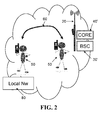
- FIG. 2 schematically illustrates certain features of an implementation of this second approach.
- the radio control node functionality 30' and core network functionality 40' are collapsed for an access node 20 or cluster of access nodes.
- Voice calls 60 between local mobile users 50 in the same cell area covered by one of the access nodes or in the cell areas of a cluster of access nodes are switched and controlled locally, by means of a local network 80 covering the cell areas of the access node 20 or cluster of access nodes.
- Local users are manually provisioned in the local network 80.
- the invention provides a laptop or computer software which locally emulates the functionality of MSC/Radio controller, connected to a BTS. It is also possible that the software is integral with the BTS.
- a network component of a cellular network comprising:
- the users are divided into a first group of users (local users), for whom the provision of traffic communication is locally controlled by means of the network component provided by the invention, and a second group of users (public users) for whom the provision of traffic communication is centrally controlled by a central functionality, including an access control node and a core network.
- a first group of users local users
- a second group of users public users
- a central functionality including an access control node and a core network.
- users of the second group -public users- are not handled as roamers when they are in the cell area or areas covered by the single access node or group of access nodes, which area is referred to in the present disclosure as local coverage area.
- the call provisioning for user of the second group of users - public users- is controlled centrally in the cellular communication network there is no VAS service restriction for public users.
- User belonging to the first group of users -local users- can also benefit from VAS services provided by the cellular communication network.
- the network component according to the invention can also communicate and synchronize with the core network of the public cellular communication network, so whenever the link between the network entity and the public cellular network is available and operative, local users can also benefit from VAS. Finally, local traffic does not require a transmission link to a radio control node or core network of the cellular communication network, so any transmission link failures do not affect the local traffic.
- the network component further includes monitoring means for detecting an outage in a link between at least one of the access nodes and the access control node, in which case the communication manager is further configured for still enabling traffic between all users located in that cell area or areas covered by the single access node or group of access nodes, regardless if they are local users belonging to the first or the second group of users. Consequently, service in the local area is not interrupted in case of a link outage on the link to the public cellular network.
- the network component is implemented as a conventional computer on which a computer program is running, the computer being locally arranged to the access node or group of access nodes. In this way, it augments but does not replace existing hardware (BTS/node-B and BSC/RNC) and software. No new elements or modifications of the network architecture are needed apart from a conventional computer (e.g. a laptop) and the corresponding software package.
- the network component is configured for billing users of the first group of users -local users- and the central functionality is configured for billing users of the second group of users -public users-.
- the network component is configured for billing users of the first group of users -local users- and the central functionality is configured for billing users of the second group of users -public users-.
- the functionality implemented by the network component is transparent for public users. In this way, the service to the public users in the local coverage area is not different from the service in other coverage areas of the cellular communication network and the public users will not notice any difference.
- a user of the first group of users -a local user- becomes a user of the second group of users -public user- outside the cell area of their access node or group of access nodes.
- the local users are provided with non-roaming communication services in the coverage area of the whole cellular communication network and not only in the local area.
- the central functionality may be implemented by a conventional access control node (BSC/RNC) and core network of the cellular communication network (MSC).
- BSC/RNC access control node
- MSC core network of the cellular communication network
- the traffic between public users in the cell area or areas covered by a single access node or group of access nodes is switched locally.
- the signalling of the public users in the local coverage area is transmitted to the central functionality of the cellular communication network and not the traffic. This results in a further reduction in the use of transmission bandwidth on the links between the access node(s) and the rest of the cellular communication network.
- a method for locally emulating a core network in a cellular communication network comprising a plurality of access nodes each covering a cell area and an access control node common to all access nodes for controlling the provision of traffic; the method comprising the step of:
- the method comprises the further step of:
- the method according to the invention is implemented by means of a computer program loaded to a network entity of the cellular communication network.
- FIG 3 an embodiment of the invention is described.
- the embodiment is described with reference to a 2G cellular communication network and related voice calls and SMS messages.
- the skilled person can also implement the present invention for other types of technologies, e.g. in 3G cellular communication networks without any undue burden.
- a 2G cellular communication network 10 which, as is usual, comprises a plurality of radio access nodes 20 (BTSs), one or more access control nodes 30 (BSC) (only one BSC is shown for clarity purposes) and a core network 40.
- the core network comprises the conventional network nodes and functionality of a 2G cellular communication network, such as MSC (Mobile Switching Centre), HLR (Home Location Register), VLR (Visiting Location Register), SMSC (Short Message Service Centre), the billing function, OSS (Operation Support System), etc.
- MSC Mobile Switching Centre
- HLR Home Location Register
- VLR Visit Location Register
- SMSC Short Message Service Centre
- billing function OSS (Operation Support System)
- OSS Operaation Support System
- the functionality of the control node 30 and the most relevant functionalities of the core network, as listed, are implemented locally by means of a software executed on to a conventional computer 100 (e.g. a laptop) connected to the BTS(s) 20.
- a conventional computer 100 e.g. a laptop
- This functionality will be referred to as "local functionality" in this description. So this conventional computer 100 is collapsing part of the functionalities traditionally supported by the BSC 30 and the core network 40. Alternatively, the local functionality can be integrated in the BTS itself.
- users are classed as either “local users” 110 or “public users” 120.
- Local users are provisioned in the local functionality and public users are provisioned in the central functionality.
- the computer can be physically directly connected to the BTS 20 through, for instance, an Ethernet link. And then, the BTS to the control node 30.
- the connection will depend on how these BTS's are inter-connected; very likely, the BTS links are concentrated in a router, and the computer is also connected to this router. Then, from the router there is a link towards the control node.
- a preferred embodiment to control the BTS/Node B makes use of CPRI ("Common Public Radio Interface"), which is an industry specification that standardises control functions for the radio base station on lower layers (layers 1 & 2 of the GSM OSI stack), and that enables the computer to make the BTS act accordingly to what it is defined in the invention.
- CPRI Common Public Radio Interface
- the computer implements some proprietary software that translates actions for the BTS's in CPRI orders. For instance, in the case of a call between two local users and in the link up case:
- the computer reuses the existing link between the BTS 20 or the group of BTS's and the BSC 30; and so, it might use the O&M link normally configured in Abis (2G) or Iub (3G) interfaces.
- the control of the call provisioning to and the billing of local users are performed by the local functionality, as long as the users are in the camped area, which is the area covered by the access node or cluster of access nodes in which the local functionality is implemented.
- the local functionality is performed by the local functionality, as long as the users are in the camped area, which is the area covered by the access node or cluster of access nodes in which the local functionality is implemented.
- the local functionality follows 3GPP standards that apply (e.g. TS 44.XXX 3GPP specification series, signalling protocols) to control the call provisioning of local users.
- 3GPP standards that apply (e.g. TS 44.XXX 3GPP specification series, signalling protocols) to control the call provisioning of local users.
- control of the call provisioning and the billing of public users are performed by the central functionality, in other words by the control node 30 and the core network 40 in the conventional way.
- IMSI-numbers may be assigned from different ranges and/or different pools of numbers.
- the local functional supports common 3GPP standardised ciphering algorithms in the radio interface (e.g. A5/1, A5/3, etc.).
- the central functionality will take this responsibility, regardless the type of user.
- the local functionality will receive a particular local user interception order from the central functionality and will route all calls belonging to that local user through the central functionality. If there is an outage of the link between the local and the central functionalities, the local functionality implements capabilities to record and store all calls involving intercepted users; and when the link is operative again, it will provide this information to the operator.
- the local functionality may implement some operation/configuration capabilities to change some parameters on the BTS or group of BTS's, the main operation responsibilities will belong to central functionality (e.g. OSS).
- central functionality e.g. OSS
- the local functionality checks (step 1002) whether the link between local and central functionalities is available and operative. If this link is not working -due to, for example, some outage-(1002n), it is checked (1003) whether both users A and B are in the local area (area covered by the BTS's or group of BTS's which directly implement the invention or to which the computer 100 is connected). If so (1003y), the call/SMS is handled by the local functionality (1007), regardless of users being public or local users. Unless both users are in the local area (1003n), the call/SMS cannot be handled (1008).
- the call is handled by the local functionality (1007). Otherwise, if any of the users is a public user (1004n; or 1004y & 1005n) the call/SMS is handled by the central functionality (1006).
- the local functionality monitors outgoing signalling messages originating from mobile users in the local coverage area. It filters the signalling messages from local users for local processing and passes on the rest to the control node 30. Consequently, the local functionality is transparent for public users.
- the local functionality deals with the control thereof and the billing of the call/SMS originated by the local user.
- the destination of the traffic is also a local user in the local area of the access node or cluster of access nodes by referring to the HLR implemented by the local functionality. If the destination is also a local user located in the local coverage area, this means that the generated traffic will be local traffic, i.e. traffic between users in the cell area or areas covered by the local access node or group of access nodes.
- the local functionality executes a signalling procedure 60 with both local users. This results in a locally switched call/SMS 70 between them.
- the local functionality will transparently pass on the corresponding signalling to the control node 30 of the network. Even if the call destination is another public user, who is also located in the local area the signalling 130 is routed to and from the control node 30 and the call control and the billing will be executed by the "central functionality" in the conventional way.
- the call 140 itself may be locally switched in the way as described with reference to the prior art solution shown in figure 1 . Since, local switching is a widely known standard functionality, there is no need to describe it in more detail, here.
- both the signalling and the call will be executed in the conventional way by the central functionality, as shown in the figure by double arrow 150.
- the local functionality implemented by means of the computer 100 is only involved for billing the local user.
- both the signalling and the call will be executed in the conventional way by the central functionality, as shown in the figure by double arrow 160.
- the local functionality still enables voice calls and SMS messages processing between all users located in the local area, regardless if they are local or public, providing further robustness compared to the prior art "local switching" functionality shown in figure 1 .
- the local functionality assumes all operations of the local network. Any change or information collected during that time is afterwards synchronised with central functionality, when the link is operative again.
- the IMSI of the user is stored in both the HLR of the local functionality and the HLR of the central functionality.
- the Visitor Location Register (VLR) of the central functionality may have also local users' data thanks to a previous synchronisation process between the local functionality and central functionality. So, when a local user is outside his local area, traffic control and billing thereof will be dealt with by the cellular communication network in the conventional way.
- a computer program may be stored/distributed on a suitable medium, such as an optical storage medium or a solid-state medium supplied together with or as part of other hardware, but may also be distributed in other forms, such as via the Internet or other wired or wireless telecommunication systems. Any reference signs in the claims should not be construed as limiting the scope.
Landscapes
- Engineering & Computer Science (AREA)
- Computer Networks & Wireless Communication (AREA)
- Signal Processing (AREA)
- Business, Economics & Management (AREA)
- Accounting & Taxation (AREA)
- Mobile Radio Communication Systems (AREA)
Abstract
Description
- The present invention relates to cellular telecommunications networks and in particular, to cellular telecommunications networks in which local traffic (calls and/or messages) may be provided between users in a cell area or group of cell areas.
- Cellular network operators are deploying their networks across more and more remote areas. Consequently, instability on transmission links, which are part of the radio access network, i.e. the Base Station System (BSS) in case of 2G networks or the RAN in case of 3G networks, is becoming a common problem. In emerging markets, this instability is typically due to the more challenging requirements placed on network links, such as those arising from distance, terrain, improper maintenance, bad quality transport networks, etc. Due to this instability, users suffer from frequent service outages. This undermines customers' confidence in the service and it has an economical impact, both for users and operators. So, it would be desirable to provide a solution which is able to alleviate transmission problems and provides service with an acceptable level of quality in remote areas.
- There have been several attempts at minimizing used transmission bandwidth in the cellular communication network for isolated / rural coverage and in order to address the impact of transmission link instability. Two broad approaches can be distinguished.
- The first approach, which is referred to as "Local Switching" is a radio network functionally that allows switching user plane traffic information flow through the access node (BTS) when a call is established between parties camped in the same BTS coverage (refer to 3GPP work item CP-090812, Release #10). Control plane information (i.e. signalling) is still conducted towards other access nodes: BSC and Core. Thanks to this functionally some savings in transmission bandwidth links are obtained. An example of how this local switching works is depicted in
figure 1 : a 2Gcellular communication network 10 comprises access nodes 20 (BTSs), radio control nodes 30 (BSCs) and a Core Network 40. Voice calls 60 betweenmobile users 50 in the same cell area covered by one of the access nodes or in the cell areas of a cluster of access nodes, are switched locally. However, thesignalling 70 proceeds up to thecore network 40. - This results of course in a considerable reduction of the used transmission bandwidth in the radio access network, because the forward and backward voice transmission connection from the
access node 20 to thecore network 40 can be dispensed with. Furthermore, this solution has no impact on VAS (value added services) provided by the cellular communication network. They can be provided in a conventional manner by the core network, because the signalling messages from and to the mobile station involved in the intra BTS voice call are at its disposal. Finally, there is no need for a fundamental architecture change of the cellular network. - However, a transmission link failure in the access network results in a complete service outage because the signalling can no longer reach the core network. Furthermore, local business models, wherein the billing and call provisioning of the
users 50 are managed locally, are not possible. - The second approach, which is referred to as "Network in a Box", provides a local system which is designed to provide emergency or temporary network to provide coverage after a disaster. This solution includes a functional preconfigured core network that offers routing, authentication and radio access network management. Node B options and expansion kits allow customers to create a custom network that meets their needs.
-
Figure 2 schematically illustrates certain features of an implementation of this second approach. In this case, the radio control node functionality 30' and core network functionality 40' are collapsed for anaccess node 20 or cluster of access nodes. Voice calls 60 between localmobile users 50 in the same cell area covered by one of the access nodes or in the cell areas of a cluster of access nodes, are switched and controlled locally, by means of alocal network 80 covering the cell areas of theaccess node 20 or cluster of access nodes. Local users are manually provisioned in thelocal network 80. - In this second approach there is no integration with any operator network whatsoever, since this system provides a solution designed to provide a emergency or temporary network. In fact, only users provisioned in the system can make calls.
- It is an object of the invention to provide a network component and a method for locally emulating a core network for use in a cellular communication network by which the above mentioned problems are at least partially solved.
- Thereto, according to the invention a network component and a method according to the independent claims are provided. Favourable embodiments are defined in the dependent claims.
- The invention provides a laptop or computer software which locally emulates the functionality of MSC/Radio controller, connected to a BTS. It is also possible that the software is integral with the BTS.
- According to an aspect of the invention there is provided a network component of a cellular network, the cellular network comprising:
- a plurality of access nodes each covering a cell area;
- an access control node (30) common to all access nodes for controlling the provision of traffic;
- a classifier for classifying users of the cellular network into a first group of users and a second group of users, wherein said first group of users include users in a cell area or areas covered by a single access node or group of access nodes; and.
- a communication manager for:
- checking if a call or SMS is set up by a user belonging to the first or to the second group of users;
- taking control over calls and/or SMSs set up between users belonging to the first group of users;
- passing control to the access control node of the remaining calls and/or SMSs,
- So, according to the invention the users are divided into a first group of users (local users), for whom the provision of traffic communication is locally controlled by means of the network component provided by the invention, and a second group of users (public users) for whom the provision of traffic communication is centrally controlled by a central functionality, including an access control node and a core network. As a result thereof, users of the second group -public users- are not handled as roamers when they are in the cell area or areas covered by the single access node or group of access nodes, which area is referred to in the present disclosure as local coverage area. Furthermore, since the call provisioning for user of the second group of users - public users- is controlled centrally in the cellular communication network there is no VAS service restriction for public users. User belonging to the first group of users -local users- can also benefit from VAS services provided by the cellular communication network.
- The network component according to the invention can also communicate and synchronize with the core network of the public cellular communication network, so whenever the link between the network entity and the public cellular network is available and operative, local users can also benefit from VAS. Finally, local traffic does not require a transmission link to a radio control node or core network of the cellular communication network, so any transmission link failures do not affect the local traffic.
- Preferably the network component further includes monitoring means for detecting an outage in a link between at least one of the access nodes and the access control node, in which case the communication manager is further configured for still enabling traffic between all users located in that cell area or areas covered by the single access node or group of access nodes, regardless if they are local users belonging to the first or the second group of users. Consequently, service in the local area is not interrupted in case of a link outage on the link to the public cellular network.
- According to an embodiment of the invention, the network component is implemented as a conventional computer on which a computer program is running, the computer being locally arranged to the access node or group of access nodes. In this way, it augments but does not replace existing hardware (BTS/node-B and BSC/RNC) and software. No new elements or modifications of the network architecture are needed apart from a conventional computer (e.g. a laptop) and the corresponding software package.
- Preferably, the network component is configured for billing users of the first group of users -local users- and the central functionality is configured for billing users of the second group of users -public users-. In this way, local business models become possible, wherein a local network operator offers communication services to local users in the coverage area of a single access node or a cluster of access nodes.
- According to a further embodiment of the invention, the functionality implemented by the network component is transparent for public users. In this way, the service to the public users in the local coverage area is not different from the service in other coverage areas of the cellular communication network and the public users will not notice any difference.
- According to a still further embodiment of the invention, a user of the first group of users -a local user- becomes a user of the second group of users -public user- outside the cell area of their access node or group of access nodes. In this way, the local users are provided with non-roaming communication services in the coverage area of the whole cellular communication network and not only in the local area.
- The central functionality may be implemented by a conventional access control node (BSC/RNC) and core network of the cellular communication network (MSC).
- According to a yet further embodiment of the invention, the traffic between public users in the cell area or areas covered by a single access node or group of access nodes is switched locally. As a consequence only the signalling of the public users in the local coverage area is transmitted to the central functionality of the cellular communication network and not the traffic. This results in a further reduction in the use of transmission bandwidth on the links between the access node(s) and the rest of the cellular communication network.
- According to a further aspect of the invention, a method is provided for locally emulating a core network in a cellular communication network comprising a plurality of access nodes each covering a cell area and an access control node common to all access nodes for controlling the provision of traffic; the method comprising the step of:
- classifying users of the cellular network into a first group of users and a second group of users, wherein said first group of users include users in a cell area or areas covered by a single access node or group of access nodes; and.
- checking if a call or SMS is set up by a user belonging to the first or to the second group of users;
- taking control over calls and/or SMSs set up between users belonging to the first group of users;
- passing control to the access control node (30) of the remaining calls and/or SMSs.
- In a preferred embodiment, the method comprises the further step of:
- detecting an outage in a link between at least one of the access nodes and the access control node , and
- enabling traffic between all users located in that cell area or areas covered by the single access node or group of access nodes.
- Preferably, the method according to the invention is implemented by means of a computer program loaded to a network entity of the cellular communication network.
- These and other aspects of the invention will be apparent from and elucidated with reference to the embodiments described hereinafter.
- The invention will be better understood and its numerous objects and advantages will become more apparent to those skilled in the art by reference to the following drawings, in conjunction with the accompanying specification, in which:
-
Figure 1 shows a first approach for providing local traffic in a cellular communication network according to the prior art. -
Figure 2 shows a second approach for providing local traffic in a cellular communication network according to the prior art. -
Figure 3 shows the approach for providing local traffic and non-local traffic in a cellular communication network according to an embodiment of the present invention. -
Figure 4 shows a flow chart describing the call/SMS handling procedure according to the present invention. - Throughout the figures like reference numerals refer to like elements.
- Referring now to
figure 3 an embodiment of the invention is described. The embodiment is described with reference to a 2G cellular communication network and related voice calls and SMS messages. However, it should be understood that the skilled person can also implement the present invention for other types of technologies, e.g. in 3G cellular communication networks without any undue burden. - A 2G
cellular communication network 10 is shown, which, as is usual, comprises a plurality of radio access nodes 20 (BTSs), one or more access control nodes 30 (BSC) (only one BSC is shown for clarity purposes) and acore network 40. The core network comprises the conventional network nodes and functionality of a 2G cellular communication network, such as MSC (Mobile Switching Centre), HLR (Home Location Register), VLR (Visiting Location Register), SMSC (Short Message Service Centre), the billing function, OSS (Operation Support System), etc. The functionality of theBSC 30 and thecore network 40 together will be referred to as "central functionality" in this description. For one of theBTS 20 or a cluster of BTS's covering a specific local area, the functionality of thecontrol node 30 and the most relevant functionalities of the core network, as listed, are implemented locally by means of a software executed on to a conventional computer 100 (e.g. a laptop) connected to the BTS(s) 20. This functionality will be referred to as "local functionality" in this description. So thisconventional computer 100 is collapsing part of the functionalities traditionally supported by theBSC 30 and thecore network 40. Alternatively, the local functionality can be integrated in the BTS itself. - According to the invention users are classed as either "local users" 110 or "public users" 120. Local users are provisioned in the local functionality and public users are provisioned in the central functionality.
- In the case of a having a
single BTS 20, the computer can be physically directly connected to theBTS 20 through, for instance, an Ethernet link. And then, the BTS to thecontrol node 30. In the case of having a group or cluster of BTS's 20, the connection will depend on how these BTS's are inter-connected; very likely, the BTS links are concentrated in a router, and the computer is also connected to this router. Then, from the router there is a link towards the control node. - A preferred embodiment to control the BTS/Node B makes use of CPRI ("Common Public Radio Interface"), which is an industry specification that standardises control functions for the radio base station on lower layers (layers 1 & 2 of the GSM OSI stack), and that enables the computer to make the BTS act accordingly to what it is defined in the invention. On top of this, the computer implements some proprietary software that translates actions for the BTS's in CPRI orders. For instance, in the case of a call between two local users and in the link up case:
- ● During the call set up, both mobiles report their IMEI's.
- ● These IMEIS's are captured by the computer that confirms that both users are local.
- ● From that time onwards, the computer informs the corresponding BTS through CPRI commands that it takes care of call proceedings for this particular call.
- For interaction purposes with the rest of the network elements (BSC, Core NW), the computer reuses the existing link between the
BTS 20 or the group of BTS's and theBSC 30; and so, it might use the O&M link normally configured in Abis (2G) or Iub (3G) interfaces. - The control of the call provisioning to and the billing of local users are performed by the local functionality, as long as the users are in the camped area, which is the area covered by the access node or cluster of access nodes in which the local functionality is implemented. When a local user leaves his local area, he becomes a public user.
- The local functionality follows 3GPP standards that apply (e.g. TS 44.XXX 3GPP specification series, signalling protocols) to control the call provisioning of local users.
- The control of the call provisioning and the billing of public users are performed by the central functionality, in other words by the
control node 30 and thecore network 40 in the conventional way. - To differentiate between local users and public users IMSI-numbers may be assigned from different ranges and/or different pools of numbers.
- Regarding security aspects, the local functionally supports common 3GPP standardised ciphering algorithms in the radio interface (e.g. A5/1, A5/3, etc.). In case of lawful interception needed, if the link between the local and central functionalities is available and operative, the central functionality will take this responsibility, regardless the type of user. In case of lawful interception of a local user, the local functionality will receive a particular local user interception order from the central functionality and will route all calls belonging to that local user through the central functionality. If there is an outage of the link between the local and the central functionalities, the local functionality implements capabilities to record and store all calls involving intercepted users; and when the link is operative again, it will provide this information to the operator.
- Although the local functionality may implement some operation/configuration capabilities to change some parameters on the BTS or group of BTS's, the main operation responsibilities will belong to central functionality (e.g. OSS).
- As shown in
Figure 4 , once theBTS 20 receives a call/SMS setup request between a User A and a User B (step 1001), the local functionality checks (step 1002) whether the link between local and central functionalities is available and operative. If this link is not working -due to, for example, some outage-(1002n), it is checked (1003) whether both users A and B are in the local area (area covered by the BTS's or group of BTS's which directly implement the invention or to which thecomputer 100 is connected). If so (1003y), the call/SMS is handled by the local functionality (1007), regardless of users being public or local users. Unless both users are in the local area (1003n), the call/SMS cannot be handled (1008). - If the link between the local and central functionalities is available and operative (1002y) and if both users A and B are defined as local users and provisioned by the local functionality (1004y & 1005y), the call is handled by the local functionality (1007). Otherwise, if any of the users is a public user (1004n; or 1004y & 1005n) the call/SMS is handled by the central functionality (1006).
- So the local functionality monitors outgoing signalling messages originating from mobile users in the local coverage area. It filters the signalling messages from local users for local processing and passes on the rest to the
control node 30. Consequently, the local functionality is transparent for public users. - In case of intercepting signalling originating from a
local user 110 for setting up a call or SMS, from a local user, the local functionality deals with the control thereof and the billing of the call/SMS originated by the local user. First it is determined if the destination of the traffic is also a local user in the local area of the access node or cluster of access nodes by referring to the HLR implemented by the local functionality. If the destination is also a local user located in the local coverage area, this means that the generated traffic will be local traffic, i.e. traffic between users in the cell area or areas covered by the local access node or group of access nodes. In this case the local functionality executes asignalling procedure 60 with both local users. This results in a locally switched call/SMS 70 between them. - In case of a
public user 120 setting up a call the local functionality will transparently pass on the corresponding signalling to thecontrol node 30 of the network. Even if the call destination is another public user, who is also located in the local area the signalling 130 is routed to and from thecontrol node 30 and the call control and the billing will be executed by the "central functionality" in the conventional way. However, thecall 140 itself may be locally switched in the way as described with reference to the prior art solution shown infigure 1 . Since, local switching is a widely known standard functionality, there is no need to describe it in more detail, here. - In case of a
local user 110 calling apublic user 120 located outside the local area of the local user, both the signalling and the call will be executed in the conventional way by the central functionality, as shown in the figure bydouble arrow 150. The local functionality implemented by means of thecomputer 100 is only involved for billing the local user. - In case of a
public user 120 calling apublic user 120 located in a different local area, both the signalling and the call will be executed in the conventional way by the central functionality, as shown in the figure bydouble arrow 160. - In case of an outage of the link between the local and central functionality, the local functionality still enables voice calls and SMS messages processing between all users located in the local area, regardless if they are local or public, providing further robustness compared to the prior art "local switching" functionality shown in
figure 1 . - During the takeover after an outage of the link between the local and central functionalities, calls between local users are not affected. However, calls that involve public users are probably dropped. During that process all users in the local coverage area are informed by SMS about the type of services that are available during the outage. Additionally, users can also be informed when the link is operative again.
- Additionally, when there is an outage of the link, the local functionality assumes all operations of the local network. Any change or information collected during that time is afterwards synchronised with central functionality, when the link is operative again.
- When a local user leaves his local coverage area, he becomes a public user. To this end, the IMSI of the user is stored in both the HLR of the local functionality and the HLR of the central functionality. Additionally, the Visitor Location Register (VLR) of the central functionality may have also local users' data thanks to a previous synchronisation process between the local functionality and central functionality.
So, when a local user is outside his local area, traffic control and billing thereof will be dealt with by the cellular communication network in the conventional way. - While the invention has been illustrated and described in detail in the drawings and foregoing description, such illustration and description are to be considered illustrative or exemplary and not restrictive; the invention is not limited to the disclosed embodiments.
- Although, the invention has been described with reference to a 2G cellular communication network for voice calls and SMS messaging of course it may also be implemented in 3G cellular communication networks.
- Other variations to the disclosed embodiments can be understood and effected by those skilled in the art in practising the claimed invention, from a study of the drawings, the disclosure, and the appended claims. In the claims, the word "comprising" does not exclude other elements or steps, and the indefinite article "a" or "an" does not exclude a plurality. A single processor or other unit may fulfil the functions of several items recited in the claims. The mere fact that certain measures are recited in mutually different dependent claims does not indicate that a combination of these measured cannot be used to advantage. A computer program may be stored/distributed on a suitable medium, such as an optical storage medium or a solid-state medium supplied together with or as part of other hardware, but may also be distributed in other forms, such as via the Internet or other wired or wireless telecommunication systems. Any reference signs in the claims should not be construed as limiting the scope.
Claims (12)
- Network component (100) of a cellular network, the cellular network comprising:- a plurality of access nodes (20) each covering a cell area;- an access control node of the access network (30) common to all access nodes for controlling the provision of traffic;wherein the network component comprises:- a classifier for classifying users of the cellular network into a first group of users (110) and a second group of users (120), wherein said first group of users include users in a cell area or areas covered by a single access node or group of access nodes; and.- a communication manager for:the network component being arranged in communication with said single access node or group of access nodes.- checking if a call or SMS is set up by a user belonging to the first or to the second group of users;- taking control over calls and/or SMSs set up between users belonging to the first group of users (110);- passing control to the access control node (30) of the remaining calls and/or SMSs,
- Network component according to claim 1, which further comprises:- monitoring means for detecting an outage in a link between at least one of the access nodes (20) and the access control node (30),
wherein the communication manager is further configured for enabling traffic between all users located in that cell area or areas covered by the single access node or group of access nodes. - Network entity according to any of claims 1-2, wherein the network component is a computer.
- Network entity according to any of claims 2-3, wherein said link between at least one of the access nodes (20) and the central functionality is an Abis or an lub interface.
- Network entity according to any previous claim, wherein the communication manager is further configured for billing users belonging to the first group of users.
- Cellular communication network (10) comprising:- a plurality of access nodes (20) each covering a cell area;- an access control node (30) common to all access nodes for controlling the provision of traffic; and- a network component (100) according to any of the previous claims.
- Cellular communication network according to claim 6, wherein a user of the first group of users becomes a user of the second group of users outside the cell area of their access node or group of access nodes.
- Method for locally emulating a core network in a cellular communication network (10) comprising a plurality of access nodes (20) each covering a cell area and an access control node (30) common to all access nodes for controlling the provision of traffic; the method comprising the step of:- classifying users of the cellular network into a first group of users (110) and a second group of users (120), wherein said first group of users include users in a cell area or areas covered by a single access node or group of access nodes; and.- checking if a call or SMS is set up by a user belonging to the first or to the second group of users;- taking control over calls and/or SMSs set up between users belonging to the first group of users (110);- passing control to the access control node (30) of the remaining calls and/or SMSs.
- Method according to claim 8, comprising the further step of:- detecting an outage in a link between at least one of the access nodes (20) and the access control node (30), and- enabling traffic between all users located in that cell area or areas covered by the single access node or group of access nodes.
- Method according to any of claims 8-9, wherein a user of the first group of users becomes a user of the second group of users outside the cell area of their access node or group of access nodes.
- Method according to any of claims 8-10, wherein the method is implemented by means of a computer program loaded to a network entity of the cellular communication network.
- A computer program comprising computer program code means adapted to perform the steps of the method according to any of the claims 8 to 11 when said program is run on a computer, a digital signal processor, a field-programmable gate array, an application-specific integrated circuit, a microprocessor, a micro-controller, or any other form of programmable hardware.
Applications Claiming Priority (2)
| Application Number | Priority Date | Filing Date | Title |
|---|---|---|---|
| ES201031576A ES2385751B1 (en) | 2010-10-27 | 2010-10-27 | PROVIDE LOCAL TRAFFIC IN A CELL OR CELL GROUP OF A CELLULAR COMMUNICATION NETWORK. |
| GBGB1103749.6A GB201103749D0 (en) | 2010-10-27 | 2011-03-07 | Providing local traffic in a cell or group of cells of a cellular communication network |
Publications (2)
| Publication Number | Publication Date |
|---|---|
| EP2448333A1 true EP2448333A1 (en) | 2012-05-02 |
| EP2448333B1 EP2448333B1 (en) | 2018-08-29 |
Family
ID=43923237
Family Applications (1)
| Application Number | Title | Priority Date | Filing Date |
|---|---|---|---|
| EP11275131.8A Active EP2448333B1 (en) | 2010-10-27 | 2011-10-21 | Method and apparatuses for providing local traffic in a cell or group of cells of a cellular communication network |
Country Status (4)
| Country | Link |
|---|---|
| US (1) | US8862132B2 (en) |
| EP (1) | EP2448333B1 (en) |
| ES (1) | ES2385751B1 (en) |
| GB (1) | GB201103749D0 (en) |
Families Citing this family (12)
| Publication number | Priority date | Publication date | Assignee | Title |
|---|---|---|---|---|
| US10057739B2 (en) | 2015-10-21 | 2018-08-21 | International Business Machines Corporation | Distributed and localized policy and charging control in cellular networks to enable route flexibility |
| CN107332704A (en) * | 2017-07-03 | 2017-11-07 | 南京华苏科技有限公司 | Assess the method and system that high-speed railway mobile subscriber uses LTE service quality |
| US11601348B2 (en) * | 2020-12-10 | 2023-03-07 | Amazon Technologies, Inc. | Managing radio-based private networks |
| US11627472B2 (en) | 2020-12-10 | 2023-04-11 | Amazon Technologies, Inc. | Automated deployment of radio-based networks |
| US11886315B2 (en) | 2020-12-10 | 2024-01-30 | Amazon Technologies, Inc. | Managing computing capacity in radio-based networks |
| US11729091B2 (en) | 2020-12-10 | 2023-08-15 | Amazon Technologies, Inc. | Highly available data-processing network functions for radio-based networks |
| US11310733B1 (en) | 2020-12-10 | 2022-04-19 | Amazon Technologies, Inc. | On-demand application-driven network slicing |
| US11711727B1 (en) | 2021-03-16 | 2023-07-25 | Amazon Technologies, Inc. | Provisioning radio-based networks on demand |
| US11895508B1 (en) | 2021-03-18 | 2024-02-06 | Amazon Technologies, Inc. | Demand-based allocation of ephemeral radio-based network resources |
| US11838273B2 (en) | 2021-03-29 | 2023-12-05 | Amazon Technologies, Inc. | Extending cloud-based virtual private networks to radio-based networks |
| US11743953B2 (en) | 2021-05-26 | 2023-08-29 | Amazon Technologies, Inc. | Distributed user plane functions for radio-based networks |
| US11871240B2 (en) | 2021-06-28 | 2024-01-09 | Amazon Technologies, Inc. | Interfaces for creating radio-based private networks |
Citations (4)
| Publication number | Priority date | Publication date | Assignee | Title |
|---|---|---|---|---|
| WO2006032003A2 (en) * | 2004-09-13 | 2006-03-23 | Nextel Communications, Inc. | System and method for handoff processing |
| WO2009135981A1 (en) * | 2008-05-07 | 2009-11-12 | Nokia Corporation | Method, apparatus and computer program product for providing routing in a network |
| US7643458B1 (en) * | 2005-05-25 | 2010-01-05 | Hewlett-Packard Development Company, L.P. | Communicating between wireless communities |
| US20100020779A1 (en) * | 2008-07-22 | 2010-01-28 | Amit Kalhan | Data routing through local network connected to a base station |
Family Cites Families (9)
| Publication number | Priority date | Publication date | Assignee | Title |
|---|---|---|---|---|
| US6996630B1 (en) | 1999-06-18 | 2006-02-07 | Mitsubishi Denki Kabushiki Kaisha | Integrated network system |
| CN101116279A (en) * | 2005-02-08 | 2008-01-30 | 诺基亚公司 | Harq failure indication over iub-interface |
| US7385947B2 (en) * | 2005-05-04 | 2008-06-10 | Nokia Corporation | Low-cost radio access network enabling local switching |
| WO2006126923A1 (en) * | 2005-05-27 | 2006-11-30 | Telefonaktiebolaget Lm Ericsson (Publ) | Local switching in radio access networks |
| JP2009508434A (en) | 2005-09-14 | 2009-02-26 | テレフオンアクチーボラゲット エル エム エリクソン(パブル) | Control temporary mobile network |
| CN101431812B (en) * | 2007-11-09 | 2010-09-22 | 华为技术有限公司 | Method, system and device for processing circuit-switched domain services |
| WO2009107144A1 (en) | 2008-02-29 | 2009-09-03 | Lucent Technologies Inc | A method and system for channel assignment in rural wireless mesh networks |
| KR101682388B1 (en) * | 2009-07-31 | 2016-12-06 | 삼성전자주식회사 | Method and apparatus for supporting communication service for unauthenticated/unregistered mobile device in wireless communication system |
| EP2604052B1 (en) * | 2010-08-09 | 2014-10-08 | NEC Europe Ltd. | Apparatus and method for local mobility management in a clustered femtocell network |
-
2010
- 2010-10-27 ES ES201031576A patent/ES2385751B1/en active Active
-
2011
- 2011-03-07 GB GBGB1103749.6A patent/GB201103749D0/en not_active Ceased
- 2011-10-21 EP EP11275131.8A patent/EP2448333B1/en active Active
- 2011-10-27 US US13/283,505 patent/US8862132B2/en active Active
Patent Citations (4)
| Publication number | Priority date | Publication date | Assignee | Title |
|---|---|---|---|---|
| WO2006032003A2 (en) * | 2004-09-13 | 2006-03-23 | Nextel Communications, Inc. | System and method for handoff processing |
| US7643458B1 (en) * | 2005-05-25 | 2010-01-05 | Hewlett-Packard Development Company, L.P. | Communicating between wireless communities |
| WO2009135981A1 (en) * | 2008-05-07 | 2009-11-12 | Nokia Corporation | Method, apparatus and computer program product for providing routing in a network |
| US20100020779A1 (en) * | 2008-07-22 | 2010-01-28 | Amit Kalhan | Data routing through local network connected to a base station |
Also Published As
| Publication number | Publication date |
|---|---|
| US8862132B2 (en) | 2014-10-14 |
| GB201103749D0 (en) | 2011-04-20 |
| ES2385751B1 (en) | 2013-06-14 |
| EP2448333B1 (en) | 2018-08-29 |
| ES2385751A1 (en) | 2012-07-31 |
| US20120108229A1 (en) | 2012-05-03 |
Similar Documents
| Publication | Publication Date | Title |
|---|---|---|
| EP2448333B1 (en) | Method and apparatuses for providing local traffic in a cell or group of cells of a cellular communication network | |
| EP3403448B1 (en) | Radio network node, communication network and methods performed thereby | |
| US10973040B2 (en) | Data notification during a service request procedure | |
| US10517123B2 (en) | Radio network node, network node and methods performed therein | |
| EP4183169A1 (en) | Inter-cu migration in iab networkinter-cu migration in iab network | |
| EP2421326B1 (en) | Method and apparatus for acquiring machine type communication device group identification | |
| CN105392153A (en) | Communication system, method and device | |
| US9980103B2 (en) | Non-access stratum (NAS) transparent messaging | |
| US20130286869A1 (en) | Lawful intercepts | |
| WO2019210947A1 (en) | Systems, network functions and methods therein for enabling a determination of information associated with a user plane connection in a communications network | |
| US9680737B2 (en) | Telecommunications networks | |
| US10045229B2 (en) | System and method for monitoring and traffic management in cellular networks based on cellular attributes | |
| US20180376364A1 (en) | Network node, radio network node and methods performed therein | |
| EP2900004A1 (en) | Mobile telecommunications network including a SAVi platform | |
| EP2887614B1 (en) | Telecommunications networks | |
| US20220330004A1 (en) | Enforcement of steering of roaming for user equipment via a proxy | |
| EP3529954B1 (en) | Method and apparatuses for attaching a radio base station to a core network node | |
| EP2699041A1 (en) | Equipment triggering method and network elememnt equipment | |
| EP3340046B1 (en) | Method for accessing local network, and related device | |
| US12328263B2 (en) | Systems and methods for cooperative radio function for multiple core networks | |
| JP5161246B2 (en) | Network pooling improvements | |
| KR20230165298A (en) | Wireless communication system, wireless communication method, wireless communication program | |
| US12634693B2 (en) | Systems and methods for inter-radio access technology handover | |
| US20250088852A1 (en) | Systems and methods for inter-radio access technology handover | |
| US20250301369A1 (en) | Systems and methods for core network bypass in a wireless network |
Legal Events
| Date | Code | Title | Description |
|---|---|---|---|
| PUAI | Public reference made under article 153(3) epc to a published international application that has entered the european phase |
Free format text: ORIGINAL CODE: 0009012 |
|
| AK | Designated contracting states |
Kind code of ref document: A1 Designated state(s): AL AT BE BG CH CY CZ DE DK EE ES FI FR GB GR HR HU IE IS IT LI LT LU LV MC MK MT NL NO PL PT RO RS SE SI SK SM TR |
|
| AX | Request for extension of the european patent |
Extension state: BA ME |
|
| 17P | Request for examination filed |
Effective date: 20121102 |
|
| 17Q | First examination report despatched |
Effective date: 20170619 |
|
| GRAP | Despatch of communication of intention to grant a patent |
Free format text: ORIGINAL CODE: EPIDOSNIGR1 |
|
| INTG | Intention to grant announced |
Effective date: 20180322 |
|
| GRAS | Grant fee paid |
Free format text: ORIGINAL CODE: EPIDOSNIGR3 |
|
| GRAA | (expected) grant |
Free format text: ORIGINAL CODE: 0009210 |
|
| AK | Designated contracting states |
Kind code of ref document: B1 Designated state(s): AL AT BE BG CH CY CZ DE DK EE ES FI FR GB GR HR HU IE IS IT LI LT LU LV MC MK MT NL NO PL PT RO RS SE SI SK SM TR |
|
| REG | Reference to a national code |
Ref country code: GB Ref legal event code: FG4D |
|
| REG | Reference to a national code |
Ref country code: CH Ref legal event code: EP |
|
| REG | Reference to a national code |
Ref country code: AT Ref legal event code: REF Ref document number: 1036680 Country of ref document: AT Kind code of ref document: T Effective date: 20180915 |
|
| REG | Reference to a national code |
Ref country code: IE Ref legal event code: FG4D |
|
| REG | Reference to a national code |
Ref country code: DE Ref legal event code: R096 Ref document number: 602011051486 Country of ref document: DE |
|
| REG | Reference to a national code |
Ref country code: FR Ref legal event code: PLFP Year of fee payment: 8 |
|
| REG | Reference to a national code |
Ref country code: NL Ref legal event code: MP Effective date: 20180829 |
|
| REG | Reference to a national code |
Ref country code: LT Ref legal event code: MG4D |
|
| PG25 | Lapsed in a contracting state [announced via postgrant information from national office to epo] |
Ref country code: BG Free format text: LAPSE BECAUSE OF FAILURE TO SUBMIT A TRANSLATION OF THE DESCRIPTION OR TO PAY THE FEE WITHIN THE PRESCRIBED TIME-LIMIT Effective date: 20181129 Ref country code: NL Free format text: LAPSE BECAUSE OF FAILURE TO SUBMIT A TRANSLATION OF THE DESCRIPTION OR TO PAY THE FEE WITHIN THE PRESCRIBED TIME-LIMIT Effective date: 20180829 Ref country code: IS Free format text: LAPSE BECAUSE OF FAILURE TO SUBMIT A TRANSLATION OF THE DESCRIPTION OR TO PAY THE FEE WITHIN THE PRESCRIBED TIME-LIMIT Effective date: 20181229 Ref country code: RS Free format text: LAPSE BECAUSE OF FAILURE TO SUBMIT A TRANSLATION OF THE DESCRIPTION OR TO PAY THE FEE WITHIN THE PRESCRIBED TIME-LIMIT Effective date: 20180829 Ref country code: NO Free format text: LAPSE BECAUSE OF FAILURE TO SUBMIT A TRANSLATION OF THE DESCRIPTION OR TO PAY THE FEE WITHIN THE PRESCRIBED TIME-LIMIT Effective date: 20181129 Ref country code: SE Free format text: LAPSE BECAUSE OF FAILURE TO SUBMIT A TRANSLATION OF THE DESCRIPTION OR TO PAY THE FEE WITHIN THE PRESCRIBED TIME-LIMIT Effective date: 20180829 Ref country code: FI Free format text: LAPSE BECAUSE OF FAILURE TO SUBMIT A TRANSLATION OF THE DESCRIPTION OR TO PAY THE FEE WITHIN THE PRESCRIBED TIME-LIMIT Effective date: 20180829 Ref country code: LT Free format text: LAPSE BECAUSE OF FAILURE TO SUBMIT A TRANSLATION OF THE DESCRIPTION OR TO PAY THE FEE WITHIN THE PRESCRIBED TIME-LIMIT Effective date: 20180829 Ref country code: GR Free format text: LAPSE BECAUSE OF FAILURE TO SUBMIT A TRANSLATION OF THE DESCRIPTION OR TO PAY THE FEE WITHIN THE PRESCRIBED TIME-LIMIT Effective date: 20181130 |
|
| REG | Reference to a national code |
Ref country code: AT Ref legal event code: MK05 Ref document number: 1036680 Country of ref document: AT Kind code of ref document: T Effective date: 20180829 |
|
| PG25 | Lapsed in a contracting state [announced via postgrant information from national office to epo] |
Ref country code: LV Free format text: LAPSE BECAUSE OF FAILURE TO SUBMIT A TRANSLATION OF THE DESCRIPTION OR TO PAY THE FEE WITHIN THE PRESCRIBED TIME-LIMIT Effective date: 20180829 Ref country code: AL Free format text: LAPSE BECAUSE OF FAILURE TO SUBMIT A TRANSLATION OF THE DESCRIPTION OR TO PAY THE FEE WITHIN THE PRESCRIBED TIME-LIMIT Effective date: 20180829 Ref country code: HR Free format text: LAPSE BECAUSE OF FAILURE TO SUBMIT A TRANSLATION OF THE DESCRIPTION OR TO PAY THE FEE WITHIN THE PRESCRIBED TIME-LIMIT Effective date: 20180829 |
|
| PG25 | Lapsed in a contracting state [announced via postgrant information from national office to epo] |
Ref country code: EE Free format text: LAPSE BECAUSE OF FAILURE TO SUBMIT A TRANSLATION OF THE DESCRIPTION OR TO PAY THE FEE WITHIN THE PRESCRIBED TIME-LIMIT Effective date: 20180829 Ref country code: PL Free format text: LAPSE BECAUSE OF FAILURE TO SUBMIT A TRANSLATION OF THE DESCRIPTION OR TO PAY THE FEE WITHIN THE PRESCRIBED TIME-LIMIT Effective date: 20180829 Ref country code: RO Free format text: LAPSE BECAUSE OF FAILURE TO SUBMIT A TRANSLATION OF THE DESCRIPTION OR TO PAY THE FEE WITHIN THE PRESCRIBED TIME-LIMIT Effective date: 20180829 Ref country code: CZ Free format text: LAPSE BECAUSE OF FAILURE TO SUBMIT A TRANSLATION OF THE DESCRIPTION OR TO PAY THE FEE WITHIN THE PRESCRIBED TIME-LIMIT Effective date: 20180829 Ref country code: ES Free format text: LAPSE BECAUSE OF FAILURE TO SUBMIT A TRANSLATION OF THE DESCRIPTION OR TO PAY THE FEE WITHIN THE PRESCRIBED TIME-LIMIT Effective date: 20180829 Ref country code: AT Free format text: LAPSE BECAUSE OF FAILURE TO SUBMIT A TRANSLATION OF THE DESCRIPTION OR TO PAY THE FEE WITHIN THE PRESCRIBED TIME-LIMIT Effective date: 20180829 |
|
| PG25 | Lapsed in a contracting state [announced via postgrant information from national office to epo] |
Ref country code: SK Free format text: LAPSE BECAUSE OF FAILURE TO SUBMIT A TRANSLATION OF THE DESCRIPTION OR TO PAY THE FEE WITHIN THE PRESCRIBED TIME-LIMIT Effective date: 20180829 Ref country code: DK Free format text: LAPSE BECAUSE OF FAILURE TO SUBMIT A TRANSLATION OF THE DESCRIPTION OR TO PAY THE FEE WITHIN THE PRESCRIBED TIME-LIMIT Effective date: 20180829 Ref country code: SM Free format text: LAPSE BECAUSE OF FAILURE TO SUBMIT A TRANSLATION OF THE DESCRIPTION OR TO PAY THE FEE WITHIN THE PRESCRIBED TIME-LIMIT Effective date: 20180829 |
|
| REG | Reference to a national code |
Ref country code: CH Ref legal event code: PL Ref country code: DE Ref legal event code: R097 Ref document number: 602011051486 Country of ref document: DE |
|
| REG | Reference to a national code |
Ref country code: BE Ref legal event code: MM Effective date: 20181031 |
|
| PG25 | Lapsed in a contracting state [announced via postgrant information from national office to epo] |
Ref country code: MC Free format text: LAPSE BECAUSE OF FAILURE TO SUBMIT A TRANSLATION OF THE DESCRIPTION OR TO PAY THE FEE WITHIN THE PRESCRIBED TIME-LIMIT Effective date: 20180829 Ref country code: LU Free format text: LAPSE BECAUSE OF NON-PAYMENT OF DUE FEES Effective date: 20181021 |
|
| PLBE | No opposition filed within time limit |
Free format text: ORIGINAL CODE: 0009261 |
|
| STAA | Information on the status of an ep patent application or granted ep patent |
Free format text: STATUS: NO OPPOSITION FILED WITHIN TIME LIMIT |
|
| REG | Reference to a national code |
Ref country code: IE Ref legal event code: MM4A |
|
| 26N | No opposition filed |
Effective date: 20190531 |
|
| PG25 | Lapsed in a contracting state [announced via postgrant information from national office to epo] |
Ref country code: BE Free format text: LAPSE BECAUSE OF NON-PAYMENT OF DUE FEES Effective date: 20181031 Ref country code: SI Free format text: LAPSE BECAUSE OF FAILURE TO SUBMIT A TRANSLATION OF THE DESCRIPTION OR TO PAY THE FEE WITHIN THE PRESCRIBED TIME-LIMIT Effective date: 20180829 Ref country code: CH Free format text: LAPSE BECAUSE OF NON-PAYMENT OF DUE FEES Effective date: 20181031 Ref country code: LI Free format text: LAPSE BECAUSE OF NON-PAYMENT OF DUE FEES Effective date: 20181031 |
|
| PG25 | Lapsed in a contracting state [announced via postgrant information from national office to epo] |
Ref country code: IE Free format text: LAPSE BECAUSE OF NON-PAYMENT OF DUE FEES Effective date: 20181021 |
|
| PG25 | Lapsed in a contracting state [announced via postgrant information from national office to epo] |
Ref country code: MT Free format text: LAPSE BECAUSE OF NON-PAYMENT OF DUE FEES Effective date: 20181021 |
|
| PG25 | Lapsed in a contracting state [announced via postgrant information from national office to epo] |
Ref country code: TR Free format text: LAPSE BECAUSE OF FAILURE TO SUBMIT A TRANSLATION OF THE DESCRIPTION OR TO PAY THE FEE WITHIN THE PRESCRIBED TIME-LIMIT Effective date: 20180829 |
|
| PG25 | Lapsed in a contracting state [announced via postgrant information from national office to epo] |
Ref country code: PT Free format text: LAPSE BECAUSE OF FAILURE TO SUBMIT A TRANSLATION OF THE DESCRIPTION OR TO PAY THE FEE WITHIN THE PRESCRIBED TIME-LIMIT Effective date: 20180829 |
|
| PG25 | Lapsed in a contracting state [announced via postgrant information from national office to epo] |
Ref country code: MK Free format text: LAPSE BECAUSE OF NON-PAYMENT OF DUE FEES Effective date: 20180829 Ref country code: CY Free format text: LAPSE BECAUSE OF FAILURE TO SUBMIT A TRANSLATION OF THE DESCRIPTION OR TO PAY THE FEE WITHIN THE PRESCRIBED TIME-LIMIT Effective date: 20180829 Ref country code: HU Free format text: LAPSE BECAUSE OF FAILURE TO SUBMIT A TRANSLATION OF THE DESCRIPTION OR TO PAY THE FEE WITHIN THE PRESCRIBED TIME-LIMIT; INVALID AB INITIO Effective date: 20111021 |
|
| P01 | Opt-out of the competence of the unified patent court (upc) registered |
Effective date: 20230725 |
|
| PGFP | Annual fee paid to national office [announced via postgrant information from national office to epo] |
Ref country code: DE Payment date: 20251021 Year of fee payment: 15 |
|
| PGFP | Annual fee paid to national office [announced via postgrant information from national office to epo] |
Ref country code: GB Payment date: 20251022 Year of fee payment: 15 |
|
| PGFP | Annual fee paid to national office [announced via postgrant information from national office to epo] |
Ref country code: IT Payment date: 20251024 Year of fee payment: 15 |
|
| PGFP | Annual fee paid to national office [announced via postgrant information from national office to epo] |
Ref country code: FR Payment date: 20251030 Year of fee payment: 15 |