EP2448181A2 - Auto-aware dynamic control policy for energy efficiency - Google Patents
Auto-aware dynamic control policy for energy efficiency Download PDFInfo
- Publication number
- EP2448181A2 EP2448181A2 EP11008468A EP11008468A EP2448181A2 EP 2448181 A2 EP2448181 A2 EP 2448181A2 EP 11008468 A EP11008468 A EP 11008468A EP 11008468 A EP11008468 A EP 11008468A EP 2448181 A2 EP2448181 A2 EP 2448181A2
- Authority
- EP
- European Patent Office
- Prior art keywords
- network
- discovery
- node
- traffic
- control policy
- Prior art date
- Legal status (The legal status is an assumption and is not a legal conclusion. Google has not performed a legal analysis and makes no representation as to the accuracy of the status listed.)
- Ceased
Links
- 230000000694 effects Effects 0.000 claims abstract description 37
- 230000004044 response Effects 0.000 claims abstract description 17
- 238000000034 method Methods 0.000 claims description 31
- 230000004043 responsiveness Effects 0.000 claims description 10
- 238000012360 testing method Methods 0.000 claims description 9
- 230000005540 biological transmission Effects 0.000 claims description 7
- 239000000872 buffer Substances 0.000 claims description 7
- 230000000737 periodic effect Effects 0.000 claims description 3
- 239000010410 layer Substances 0.000 description 23
- 230000002776 aggregation Effects 0.000 description 6
- 238000004220 aggregation Methods 0.000 description 6
- 239000012792 core layer Substances 0.000 description 5
- 230000007704 transition Effects 0.000 description 5
- 230000006870 function Effects 0.000 description 4
- 230000008859 change Effects 0.000 description 3
- 230000008569 process Effects 0.000 description 3
- 230000008901 benefit Effects 0.000 description 2
- 230000001419 dependent effect Effects 0.000 description 2
- 230000007246 mechanism Effects 0.000 description 2
- 230000009467 reduction Effects 0.000 description 2
- 230000000630 rising effect Effects 0.000 description 2
- 235000008694 Humulus lupulus Nutrition 0.000 description 1
- 230000004931 aggregating effect Effects 0.000 description 1
- 230000003466 anti-cipated effect Effects 0.000 description 1
- 230000006399 behavior Effects 0.000 description 1
- 238000001514 detection method Methods 0.000 description 1
- 239000002346 layers by function Substances 0.000 description 1
- 238000005259 measurement Methods 0.000 description 1
- 230000007935 neutral effect Effects 0.000 description 1
- 238000012545 processing Methods 0.000 description 1
- 238000012552 review Methods 0.000 description 1
- 238000012546 transfer Methods 0.000 description 1
- 230000000007 visual effect Effects 0.000 description 1
Images


Classifications
-
- H—ELECTRICITY
- H04—ELECTRIC COMMUNICATION TECHNIQUE
- H04L—TRANSMISSION OF DIGITAL INFORMATION, e.g. TELEGRAPHIC COMMUNICATION
- H04L12/00—Data switching networks
- H04L12/02—Details
- H04L12/12—Arrangements for remote connection or disconnection of substations or of equipment thereof
-
- H—ELECTRICITY
- H04—ELECTRIC COMMUNICATION TECHNIQUE
- H04L—TRANSMISSION OF DIGITAL INFORMATION, e.g. TELEGRAPHIC COMMUNICATION
- H04L41/00—Arrangements for maintenance, administration or management of data switching networks, e.g. of packet switching networks
- H04L41/08—Configuration management of networks or network elements
- H04L41/0803—Configuration setting
- H04L41/0823—Configuration setting characterised by the purposes of a change of settings, e.g. optimising configuration for enhancing reliability
- H04L41/0833—Configuration setting characterised by the purposes of a change of settings, e.g. optimising configuration for enhancing reliability for reduction of network energy consumption
-
- H—ELECTRICITY
- H04—ELECTRIC COMMUNICATION TECHNIQUE
- H04L—TRANSMISSION OF DIGITAL INFORMATION, e.g. TELEGRAPHIC COMMUNICATION
- H04L43/00—Arrangements for monitoring or testing data switching networks
- H04L43/08—Monitoring or testing based on specific metrics, e.g. QoS, energy consumption or environmental parameters
- H04L43/0876—Network utilisation, e.g. volume of load or congestion level
- H04L43/0882—Utilisation of link capacity
-
- Y—GENERAL TAGGING OF NEW TECHNOLOGICAL DEVELOPMENTS; GENERAL TAGGING OF CROSS-SECTIONAL TECHNOLOGIES SPANNING OVER SEVERAL SECTIONS OF THE IPC; TECHNICAL SUBJECTS COVERED BY FORMER USPC CROSS-REFERENCE ART COLLECTIONS [XRACs] AND DIGESTS
- Y02—TECHNOLOGIES OR APPLICATIONS FOR MITIGATION OR ADAPTATION AGAINST CLIMATE CHANGE
- Y02D—CLIMATE CHANGE MITIGATION TECHNOLOGIES IN INFORMATION AND COMMUNICATION TECHNOLOGIES [ICT], I.E. INFORMATION AND COMMUNICATION TECHNOLOGIES AIMING AT THE REDUCTION OF THEIR OWN ENERGY USE
- Y02D30/00—Reducing energy consumption in communication networks
-
- Y—GENERAL TAGGING OF NEW TECHNOLOGICAL DEVELOPMENTS; GENERAL TAGGING OF CROSS-SECTIONAL TECHNOLOGIES SPANNING OVER SEVERAL SECTIONS OF THE IPC; TECHNICAL SUBJECTS COVERED BY FORMER USPC CROSS-REFERENCE ART COLLECTIONS [XRACs] AND DIGESTS
- Y02—TECHNOLOGIES OR APPLICATIONS FOR MITIGATION OR ADAPTATION AGAINST CLIMATE CHANGE
- Y02D—CLIMATE CHANGE MITIGATION TECHNOLOGIES IN INFORMATION AND COMMUNICATION TECHNOLOGIES [ICT], I.E. INFORMATION AND COMMUNICATION TECHNOLOGIES AIMING AT THE REDUCTION OF THEIR OWN ENERGY USE
- Y02D30/00—Reducing energy consumption in communication networks
- Y02D30/50—Reducing energy consumption in communication networks in wire-line communication networks, e.g. low power modes or reduced link rate
Definitions
- the present invention relates generally to energy efficiency and, more particularly, to an auto-aware dynamic control policy for energy efficiency.
- one of the considerations is the traffic profile on the network link. For example, many network links are typically in an idle state between sporadic bursts of data, while in other network links, there can be regular or intermittent low-bandwidth traffic, with bursts of high-bandwidth traffic.
- Various solutions can seek to adapt the link, link rate, and layers above the link to an optimal solution based on various energy costs and impact on traffic, which itself is dependent on the application. Implementation of various solutions is based on a control policy. What is needed, however, is an auto-aware dynamic control policy for energy efficiency.
- an energy efficiency method in a discovery node comprising:
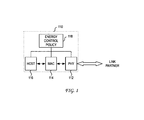
- FIG. 1 illustrates an example of an energy efficiency control policy implemented in a network node.
- FIG. 2 illustrates an example of a network architecture.
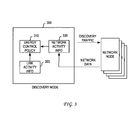
- FIG. 3 illustrates an example of an energy efficiency control policy according to the present invention.
- FIG. 4 illustrates a flowchart of a process of the present invention.
- Energy efficient Ethernet networks attempt to save power when the traffic utilization of the network is not at its maximum capacity. This serves to minimize the performance impact while maximizing power savings.
- the energy efficiency control policy for a particular link in the network determines when to enter a power saving state, what power saving state (i.e., level of power savings) to enter, how long to remain in that power saving state, what power saving state to transition to out of the previous power saving state, etc.
- an energy efficiency control policy can base these decisions on the properties of the traffic on the link itself.
- FIG. 1 illustrates an example of a network node (e.g., switch) to which an energy efficiency control policy can be applied.
- network node 110 includes physical layer device (PHY) 112, media access control (MAC) 114, and host 116.
- PHY physical layer device
- MAC media access control
- host 116 can comprise suitable logic, circuitry, and/or code that may enable operability and/or functionality of the five highest functional layers for data packets that are to be transmitted over the link. Since each layer in the OSI model provides a service to the immediately higher interfacing layer, MAC controller 114 can provide the necessary services to host 116 to ensure that packets are suitably formatted and communicated to PHY 112.
- MAC controller 114 can comprise suitable logic, circuitry, and/or code that may enable handling of data link layer (Layer 2) operability and/or functionality.
- MAC controller 114 can be configured to implement Ethernet protocols, such as those based on the IEEE 802.3 standard, for example.
- PHY 112 can be configured to handle physical layer requirements, which include, but are not limited to, packetization, data transfer and serialization/deserialization (SERDES).
- SERDES serialization/deserialization
- controlling the data rate of the link may enable the network node and possibly its link partner to communicate in a more energy efficient manner. More specifically, a reduction in link rate to a sub-rate of the main rate enables a reduction in power, thereby leading to power savings. In one example, this sub-rate can be a zero rate, which produces maximum power savings.
- subrating is through the use of a subset PHY technique.
- a low link utilization period can be accommodated by transitioning the PHY to a lower link rate that is enabled by a subset of the parent PHY.
- the subset PHY technique is enabled by turning off portions of the parent PHY to enable operation at a lower or subset rate (e.g., turning off three of four channels).
- the subset PHY technique can be enabled by slowing down the clock rate of a parent PHY.
- a parent PHY having an enhanced core that can be slowed down and sped up by a frequency multiple can be slowed down by a factor of 10 during low link utilization, then sped up by a factor of 10 when a burst of data is received.
- a 10G enhanced core can be transitioned down to a 1G link rate when idle, and sped back up to a 10G link rate when data is to be transmitted.
- LPI low power idle
- Refresh signals can be sent periodically to enable wake up from the sleep mode.
- both the subset and LPI techniques involve turning off or otherwise modifying portions of the PHY during a period of low link utilization.
- power savings in the higher layers e.g., MAC
- network node 110 also includes control policy entity 118.
- control policy entity 118 can be designed to determine when to enter a power saving state, what power saving state (i.e., level of power savings) to enter, how long to remain in that power saving state, what power saving state to transition to out of the previous power saving state, etc.
- control policy entity 118 in network node 110 includes software code that can interoperate with various layers, including portions of the PHY, MAC, or other subsystems in the host.
- control policy entity 118 is enabled to analyze traffic on the physical link and to analyze operations and/or processing of data.
- control policy entity 118 can be designed to analyze empty or non-empty conditions of ports, queues, buffers, etc. to determine whether to transition to or from a power saving state.
- the analysis of the conditions of ports, queues, buffers, etc. enables the control policy entity 118 to determine historical levels of link utilization.
- an indication of a low level of link utilization over a period of time can be used to trigger a change to a low-power operating state of one or more network node components (e.g., PHY, MAC, PHY/MAC interface, etc.) that support the particular network link.
- network node components e.g., PHY, MAC, PHY/MAC interface, etc.
- the conventional analysis of looking at measures of past traffic levels on a network link is limiting in that those measures do not provide an indication of real-time network behavior or conditions.
- the link-based measures are limiting in that they are focused on a link-specific context instead of a broader network context in which the link is operating. As such, the link-based measures fail to provide any indication of future changes to link utilization.
- a control policy of a network node can be designed to be responsive not only to historical measures of link utilization, but also to real-time measures of network activity in which the network node resides.
- a network node such as a switch is typically found in a network with a large number of switches and connections.
- Such networks can include access networks, enterprise networks, data centers, high performance computing (HPC) networks, storage area networks (SANs), etc.
- HPC high performance computing
- SANs storage area networks
- a computing environments such as a large enterprise network, can include very hundreds and even thousands of network switches designed to interconnect large numbers of computing devices.
- FIG. 2 illustrates an example architecture of such networks in which a network node can be included.
- the network architecture can be organized into a core layer, an aggregation layer, and an access layer.
- the core layer is responsible for fast and reliable transmission of data across a network.
- the core layer functions as the backbone network because all other layers rely upon it.
- the core layer is designed for high data transmission rate, reduced latency, and high reliability.
- the aggregation layer plays a key role in aggregating traffic from large number of edge switches to be forwarded to the core switches as well as receiving traffic from core switches to distribute towards edge switches.
- the aggregation layer can include Layer 2/Layer 3 multilayer switches, firewalls, caches, load balancers, SSL offloaders, and intrusion detection systems.
- the access layer provides connectivity of servers to the aggregation layer via Layer 2 switches.
- an operational state of a particular network node can be influenced by much more than a simple historical analysis of traffic on a network link supported by the network node.
- a switch in the core layer or the aggregation layer that looks only at the historical analysis of traffic on one of its network links would be unable to discern what is going on across the network.
- the activity in the network e.g., loading at various servers in the access layer
- knowledge of such network activity can be used to anticipate future traffic levels, thereby providing an additional input by which a control policy can govern the operational state of a network node.
- FIG. 3 illustrates an embodiment of a control policy implemented by a network node that can additionally consider measures of network activity.
- discovery node 300 includes an energy control policy 310.
- any network node can function as a discovery node, whose function is described in detail below.
- energy control policy 310 is designed to govern the energy efficiency of discovery node 300.
- a power saving state can be defined for a PHY that supports a network link.
- energy control policy 310 can be designed to determine when the PHY is to enter a power saving state, what power saving state that the PHY is to enter (e.g., form of subrating implemented by the PHY), how long the PHY is to remain in that power saving state, what operational state the PHY is to transition to out of the power saving state, etc.
- energy control policy 310 can use link activity information 320 as one input to make energy control policy decisions. Link activity information can be based on the operation of a port, queue, buffer, etc., which provides some indication of traffic on a link.
- link activity information provides a historical perspective of network activity and cannot be used to anticipate changes in link activity. For this reason, discovery node 300 is also designed to generate network activity information 330, which provides a second data input for energy control policy 310.
- network activity information 330 is designed to provide energy control policy 310 with an indication of network activity that suggests a change in the future activity of discovery node 300.
- Network activity information 330 can be based on various network methods and is not confined to a particular form or discovery mechanism.
- network activity information 330 is based on network data received from a plurality of network nodes.
- network data received from the plurality of network nodes is generated by the network nodes in response to discovery traffic generated by discovery node 300.
- the discovery traffic generated by discovery node 300 is designed to poll or otherwise test the responsiveness or activity level of the plurality of network nodes.
- the responsiveness or activity level of the plurality of network nodes provides discovery node 300 with an indication of network activity that may or may not be reflected in the historical measures of link activity available to discovery node 300.
- the discovery traffic can represent a "ping" of a network node (e.g., DNS server).
- This "ping" can represent a short data package that is sent to a particular network node to produce a response.
- the discovery node can measure the roundtrip time of the package to determine a relative measure of network loading.
- discovery node 300 can generate discovery traffic based on the Cisco Resource Reservation Protocol (RSVP).
- RSVP is a network-control protocol that provides a means for reserving network resources to guarantee that applications transmitting end-to-end across networks achieve the desired quality of service (QoS).
- QoS quality of service
- RSVP enables discovery node 300 to determine latency across various hops in the network.
- discovery node 300 can test the responsiveness of the network by sending traffic intensive bursts (e.g., uploading/downloading test files).
- traffic intensive bursts e.g., uploading/downloading test files.
- various types of discovery traffic can be sent to network nodes across the network to generate an aggregate picture of the real-time activity in the network. Such discovery traffic can be sent out on a periodic basis to identify any changes in network loading or performance.
- the process begins at step 402 where a discovery node measures network link activity. These measures of network link activity can be performed based on an analysis of a port, buffer, queue, etc. at the discovery node. In one embodiment, the measures of network activity can be performed in combination with information that is received from a peer device coupled to the discovery node via the network link.
- the discovery node transmits discovery traffic to a plurality of network nodes.
- the discovery traffic is transmitted periodically such that the discovery node is able to ascertain any changes in the network.
- the specific form of the discovery traffic e.g., ping, RSVP, data burst, etc.
- the discovery traffic can be designed to enable measurement of a responsiveness of the network for particular types of traffic.
- the discovery traffic can be designed to determine network responsiveness or activity relative to voice over IP (VOIP) traffic, video traffic, data traffic having a particular quality of service level, Ethernet audio/visual bridging (AVB) traffic, etc.
- VOIP voice over IP
- VVB Ethernet audio/visual bridging
- measures relative to a particular type of traffic can be used to influence a control policy that is designed for that particular type of traffic. Traffic-specific measures can therefore produce greater granularity in the adjustments of one or more control policies implemented by the discovery node.
- the discovery node would generate measures of real-time network performance based on responses by the plurality of network nodes to the discovery traffic.
- the discovery node can generate measures of latency, responsiveness, upload/download speed, jitter, etc. based on the responses by the plurality of network nodes.
- the generated measures are designed to provide the discovery node with a real-time view into the current state of the network. This real-time view is in contrast to link-based measures that can provide only a historical perspective of link traffic.
- the real-time view afforded by the network activity information is used to anticipate changes (i.e., increase or decrease) in network loading that will be experienced by the discovery node.
- the adjustment to the control policy can be reflected by a change in the level of aggressiveness (e.g., aggressive, neutral, conservative) of the control policy.
- the level of aggressiveness can be used by the control policy to determine the relative length of timers that control operational state transitions.
- an aggressive control policy can shorten a timer that determines when a low power state is entered, while a conservative control policy can lengthen a timer that determines when a low power state is entered.
- an aggressive control policy can lengthen a timer that determines a duration of a sleep state
- a conservative control policy can shorten a timer that determines a duration of a sleep state.
- the network activity information can be used to adjust any parameter of the control policy.
- the adjustment to the control policy can relate to additional wake times or other operational parameters in a transmitter/receiver.
- control policy adjusted by the network activity information can also be used to determine what power saving state to enter.
- the power savings states can relate to LPI or some other form of subrating.
- the power saving states can relate to subsystems beyond the PHY that are powered down.
- the power saving states can relate to the MAC, the controller, memory on the switch, screen on a VOIP phone, etc.
- the power saving states can relate to services such as Ethernet AVB, Internet Small Computer System Interface (iSCSI), etc. that may or may not be run.
- the use of discovery traffic by a discovery node enables the discovery node to augment the considerations used by the control policy to now include real-time network activity information.
- This real-time network activity information enables the control policy to respond more accurately to network conditions (e.g., what to power down, how much to power down, etc.), thereby increasing energy efficiency of the discovery node.
- multiple network nodes having a control policy can be implemented as discovery nodes.
- the multiple discovery nodes can scheduled in a round-robin scheme that prevents unnecessarily high levels of discovery traffic from loading the network.
- a particular discovery node can be designed to share network activity information generated in response to discovery traffic to be shared with other network nodes in the network. This provides an efficient mechanism by which a plurality of network nodes can benefit from real-time information that is generated by a single discovery node.
Landscapes
- Engineering & Computer Science (AREA)
- Computer Networks & Wireless Communication (AREA)
- Signal Processing (AREA)
- Environmental & Geological Engineering (AREA)
- Data Exchanges In Wide-Area Networks (AREA)
- Small-Scale Networks (AREA)
- Mobile Radio Communication Systems (AREA)
Abstract
Description
- The present invention relates generally to energy efficiency and, more particularly, to an auto-aware dynamic control policy for energy efficiency.
- Energy costs continue to escalate in a trend that has accelerated in recent years. Such being the case, various industries have become increasingly sensitive to the impact of those rising costs. One area that has drawn increasing scrutiny is the IT infrastructure. Many companies are now looking at their IT systems' power usage to determine whether the energy costs can be reduced. For this reason, an industry focus on energy efficient networks (IEEE 802.3az) has arisen to address the rising costs of IT equipment usage as a whole (i.e., PCs, displays, printers, switches, servers, network equipment, etc.).
- In designing an energy efficient solution, one of the considerations is the traffic profile on the network link. For example, many network links are typically in an idle state between sporadic bursts of data, while in other network links, there can be regular or intermittent low-bandwidth traffic, with bursts of high-bandwidth traffic. Various solutions can seek to adapt the link, link rate, and layers above the link to an optimal solution based on various energy costs and impact on traffic, which itself is dependent on the application. Implementation of various solutions is based on a control policy. What is needed, however, is an auto-aware dynamic control policy for energy efficiency.
- An auto-aware dynamic control policy for energy efficiency, substantially as shown in and/or described in connection with at least one of the figures, as set forth more completely in the claims.
According to an aspect, an energy efficiency method in a discovery node is provided, comprising: - measuring a level of utilization of a network link supported by said discovery node;
- controlling, via an energy efficiency control policy operating in said discovery node, an operating state of components in said discovery node that support said network link, said energy efficiency control policy receiving as a first input said measured level of utilization of said network link;
- transmitting, from said discover node, discovery traffic to each of a plurality of network nodes;
- generating a measure of current network performance for each of said plurality of network nodes based on messages received from said plurality of network nodes in response to said transmitted discovery traffic; and
- adjusting an effect of said energy efficiency control policy on said components in said discovery node based on a second input based on said generated measure of current network performance for each of said plurality of network nodes.
- transmitting, from said discover node, first discovery traffic to each of a first plurality of network nodes, said first discovery traffic being designed to test a level of current network performance of a first type of network traffic;
- transmitting, from said discover node, second discovery traffic to each of a second plurality of network nodes, said second discovery traffic being designed to test a level of current network performance of a second type of network traffic different from said first type of network traffic;
- generating a first measure of current network performance for each of said first plurality of network nodes based on first messages received from said first plurality of network nodes in response to said transmitted first discovery traffic;
- generating a second measure of current network performance for each of said second plurality of network nodes based on second messages received from said second plurality of network nodes in response to said transmitted second discovery traffic; and
- adjusting an energy efficiency control policy in said discovery node based on said first and second generated measures of current network performance, said energy efficiency control policy controlling an operating state of components in said discovery node.
- controlling, via an energy efficiency control policy operating in said discovery node, an operating state of a physical layer device in said discovery node that supports a network link, said energy efficiency control policy being based at least in part on a level of utilization of said network link; and
- adjusting a level of aggressiveness of said energy efficiency control policy based on measures of current network performance of a plurality of nodes in a network in which said discovery node resides, said measures of current network performance being based on messages generated by said plurality of nodes in response to discovery messages designed to test a responsiveness of said plurality of nodes.
- In order to describe the manner in which the above-recited and other advantages and features of the invention can be obtained, a more particular description of the invention briefly described above will be rendered by reference to specific embodiments thereof which are illustrated in the appended drawings. Understanding that these drawings depict only typical embodiments of the invention and are not therefore to be considered limiting of its scope, the invention will be described and explained with additional specificity and detail through the use of the accompanying drawings in which:
-
FIG. 1 illustrates an example of an energy efficiency control policy implemented in a network node. -
FIG. 2 illustrates an example of a network architecture. -
FIG. 3 illustrates an example of an energy efficiency control policy according to the present invention. -
FIG. 4 illustrates a flowchart of a process of the present invention. - Various embodiments of the invention are discussed in detail below. While specific implementations are discussed, it should be understood that this is done for illustration purposes only. A person skilled in the relevant art will recognize that other components and configurations may be used without parting from the spirit and scope of the invention.
- Energy efficient Ethernet networks attempt to save power when the traffic utilization of the network is not at its maximum capacity. This serves to minimize the performance impact while maximizing power savings. At a broad level, the energy efficiency control policy for a particular link in the network determines when to enter a power saving state, what power saving state (i.e., level of power savings) to enter, how long to remain in that power saving state, what power saving state to transition to out of the previous power saving state, etc. In one example, an energy efficiency control policy can base these decisions on the properties of the traffic on the link itself.
-
FIG. 1 illustrates an example of a network node (e.g., switch) to which an energy efficiency control policy can be applied. As illustrated inFIG. 1 ,network node 110 includes physical layer device (PHY) 112, media access control (MAC) 114, andhost 116. In general,host 116 can comprise suitable logic, circuitry, and/or code that may enable operability and/or functionality of the five highest functional layers for data packets that are to be transmitted over the link. Since each layer in the OSI model provides a service to the immediately higher interfacing layer,MAC controller 114 can provide the necessary services to host 116 to ensure that packets are suitably formatted and communicated toPHY 112.MAC controller 114 can comprise suitable logic, circuitry, and/or code that may enable handling of data link layer (Layer 2) operability and/or functionality.MAC controller 114 can be configured to implement Ethernet protocols, such as those based on the IEEE 802.3 standard, for example.PHY 112 can be configured to handle physical layer requirements, which include, but are not limited to, packetization, data transfer and serialization/deserialization (SERDES). - In general, controlling the data rate of the link may enable the network node and possibly its link partner to communicate in a more energy efficient manner. More specifically, a reduction in link rate to a sub-rate of the main rate enables a reduction in power, thereby leading to power savings. In one example, this sub-rate can be a zero rate, which produces maximum power savings.
- One example of subrating is through the use of a subset PHY technique. In this subset PHY technique, a low link utilization period can be accommodated by transitioning the PHY to a lower link rate that is enabled by a subset of the parent PHY. In one embodiment, the subset PHY technique is enabled by turning off portions of the parent PHY to enable operation at a lower or subset rate (e.g., turning off three of four channels). In another embodiment, the subset PHY technique can be enabled by slowing down the clock rate of a parent PHY. For example, a parent PHY having an enhanced core that can be slowed down and sped up by a frequency multiple can be slowed down by a factor of 10 during low link utilization, then sped up by a factor of 10 when a burst of data is received. In this example of a factor of 10, a 10G enhanced core can be transitioned down to a 1G link rate when idle, and sped back up to a 10G link rate when data is to be transmitted.
- Another example of subrating is through the use of a low power idle (LPI) technique. In general, LPI relies on entering a quiet state where power savings can be achieved when there is nothing to transmit. Power is thereby saved when the link is off. Refresh signals can be sent periodically to enable wake up from the sleep mode.
- In general, both the subset and LPI techniques involve turning off or otherwise modifying portions of the PHY during a period of low link utilization. As in the PHY, power savings in the higher layers (e.g., MAC) can also be achieved by using various forms of subrating as well.
- As
FIG. 1 illustrates,network node 110 also includescontrol policy entity 118. As noted above,control policy entity 118 can be designed to determine when to enter a power saving state, what power saving state (i.e., level of power savings) to enter, how long to remain in that power saving state, what power saving state to transition to out of the previous power saving state, etc. In one embodiment,control policy entity 118 innetwork node 110 includes software code that can interoperate with various layers, including portions of the PHY, MAC, or other subsystems in the host. - Conventionally,
control policy entity 118 is enabled to analyze traffic on the physical link and to analyze operations and/or processing of data. For example,control policy entity 118 can be designed to analyze empty or non-empty conditions of ports, queues, buffers, etc. to determine whether to transition to or from a power saving state. In this example, the analysis of the conditions of ports, queues, buffers, etc. enables thecontrol policy entity 118 to determine historical levels of link utilization. In one scenario, an indication of a low level of link utilization over a period of time can be used to trigger a change to a low-power operating state of one or more network node components (e.g., PHY, MAC, PHY/MAC interface, etc.) that support the particular network link. - In the present invention, it is recognized that the conventional analysis of looking at measures of past traffic levels on a network link is limiting in that those measures do not provide an indication of real-time network behavior or conditions. Moreover, the link-based measures are limiting in that they are focused on a link-specific context instead of a broader network context in which the link is operating. As such, the link-based measures fail to provide any indication of future changes to link utilization.
- It is a feature of the present invention that a control policy of a network node can be designed to be responsive not only to historical measures of link utilization, but also to real-time measures of network activity in which the network node resides. A network node such as a switch is typically found in a network with a large number of switches and connections. Such networks can include access networks, enterprise networks, data centers, high performance computing (HPC) networks, storage area networks (SANs), etc. In one example, a computing environments such as a large enterprise network, can include very hundreds and even thousands of network switches designed to interconnect large numbers of computing devices.
-
FIG. 2 illustrates an example architecture of such networks in which a network node can be included. As illustrated, the network architecture can be organized into a core layer, an aggregation layer, and an access layer. In general, the core layer is responsible for fast and reliable transmission of data across a network. The core layer functions as the backbone network because all other layers rely upon it. As such, the core layer is designed for high data transmission rate, reduced latency, and high reliability. The aggregation layer plays a key role in aggregating traffic from large number of edge switches to be forwarded to the core switches as well as receiving traffic from core switches to distribute towards edge switches. In performing this aggregation function, the aggregation layer can include Layer 2/Layer 3 multilayer switches, firewalls, caches, load balancers, SSL offloaders, and intrusion detection systems. Finally, the access layer provides connectivity of servers to the aggregation layer via Layer 2 switches. - In the context of such a network architecture, an operational state of a particular network node (e.g., switch) can be influenced by much more than a simple historical analysis of traffic on a network link supported by the network node. For example, a switch in the core layer or the aggregation layer that looks only at the historical analysis of traffic on one of its network links would be unable to discern what is going on across the network. As would be appreciated, the activity in the network (e.g., loading at various servers in the access layer) can have a direct impact on the link utilization about to be seen at that switch. In the present invention, it is recognized that knowledge of such network activity can be used to anticipate future traffic levels, thereby providing an additional input by which a control policy can govern the operational state of a network node.
-
FIG. 3 illustrates an embodiment of a control policy implemented by a network node that can additionally consider measures of network activity. As illustrated,discovery node 300 includes anenergy control policy 310. In general, any network node can function as a discovery node, whose function is described in detail below. - As described above,
energy control policy 310 is designed to govern the energy efficiency ofdiscovery node 300. As would be appreciated, the particular power saving states that are defined fordiscovery node 300 would be implementation dependant. In a simple example, a power saving state can be defined for a PHY that supports a network link. In the context of this example,energy control policy 310 can be designed to determine when the PHY is to enter a power saving state, what power saving state that the PHY is to enter (e.g., form of subrating implemented by the PHY), how long the PHY is to remain in that power saving state, what operational state the PHY is to transition to out of the power saving state, etc. As illustrated,energy control policy 310 can uselink activity information 320 as one input to make energy control policy decisions. Link activity information can be based on the operation of a port, queue, buffer, etc., which provides some indication of traffic on a link. - Ultimately, link activity information provides a historical perspective of network activity and cannot be used to anticipate changes in link activity. For this reason,
discovery node 300 is also designed to generatenetwork activity information 330, which provides a second data input forenergy control policy 310. In general,network activity information 330 is designed to provideenergy control policy 310 with an indication of network activity that suggests a change in the future activity ofdiscovery node 300.Network activity information 330 can be based on various network methods and is not confined to a particular form or discovery mechanism. - As illustrated in
FIG. 3 ,network activity information 330 is based on network data received from a plurality of network nodes. In one embodiment, network data received from the plurality of network nodes is generated by the network nodes in response to discovery traffic generated bydiscovery node 300. In general, the discovery traffic generated bydiscovery node 300 is designed to poll or otherwise test the responsiveness or activity level of the plurality of network nodes. The responsiveness or activity level of the plurality of network nodes providesdiscovery node 300 with an indication of network activity that may or may not be reflected in the historical measures of link activity available todiscovery node 300. - In a simple example, the discovery traffic can represent a "ping" of a network node (e.g., DNS server). This "ping" can represent a short data package that is sent to a particular network node to produce a response. By listening for the response, the discovery node can measure the roundtrip time of the package to determine a relative measure of network loading.
- In another example,
discovery node 300 can generate discovery traffic based on the Cisco Resource Reservation Protocol (RSVP). In general, RSVP is a network-control protocol that provides a means for reserving network resources to guarantee that applications transmitting end-to-end across networks achieve the desired quality of service (QoS). As such, RSVP enablesdiscovery node 300 to determine latency across various hops in the network. - In further examples,
discovery node 300 can test the responsiveness of the network by sending traffic intensive bursts (e.g., uploading/downloading test files). As would be appreciated, various types of discovery traffic can be sent to network nodes across the network to generate an aggregate picture of the real-time activity in the network. Such discovery traffic can be sent out on a periodic basis to identify any changes in network loading or performance. - Having described a general framework of a dynamic control policy that is responsive to link activity information as well as network activity information, reference is now made to the flowchart of
FIG. 4 , which illustrates a process of the present invention. As illustrated, the process begins atstep 402 where a discovery node measures network link activity. These measures of network link activity can be performed based on an analysis of a port, buffer, queue, etc. at the discovery node. In one embodiment, the measures of network activity can be performed in combination with information that is received from a peer device coupled to the discovery node via the network link. - Next, at
step 404, the discovery node transmits discovery traffic to a plurality of network nodes. In one embodiment, the discovery traffic is transmitted periodically such that the discovery node is able to ascertain any changes in the network. As noted above, the specific form of the discovery traffic (e.g., ping, RSVP, data burst, etc.) would be implementation dependent. In one embodiment, the discovery traffic can be designed to enable measurement of a responsiveness of the network for particular types of traffic. For example, the discovery traffic can be designed to determine network responsiveness or activity relative to voice over IP (VOIP) traffic, video traffic, data traffic having a particular quality of service level, Ethernet audio/visual bridging (AVB) traffic, etc. As would be appreciated, measures relative to a particular type of traffic can be used to influence a control policy that is designed for that particular type of traffic. Traffic-specific measures can therefore produce greater granularity in the adjustments of one or more control policies implemented by the discovery node. - Next, at
step 406, the discovery node would generate measures of real-time network performance based on responses by the plurality of network nodes to the discovery traffic. In various examples, the discovery node can generate measures of latency, responsiveness, upload/download speed, jitter, etc. based on the responses by the plurality of network nodes. Regardless of the particular type of response and/or measure produced based on such response, the generated measures are designed to provide the discovery node with a real-time view into the current state of the network. This real-time view is in contrast to link-based measures that can provide only a historical perspective of link traffic. In one embodiment, the real-time view afforded by the network activity information is used to anticipate changes (i.e., increase or decrease) in network loading that will be experienced by the discovery node. - These anticipated changes reflected by the network activity information are then used at
step 408 to adjust the control policy. In one embodiment, the adjustment to the control policy can be reflected by a change in the level of aggressiveness (e.g., aggressive, neutral, conservative) of the control policy. For example, the level of aggressiveness can be used by the control policy to determine the relative length of timers that control operational state transitions. Here, an aggressive control policy can shorten a timer that determines when a low power state is entered, while a conservative control policy can lengthen a timer that determines when a low power state is entered. Similarly, an aggressive control policy can lengthen a timer that determines a duration of a sleep state, while a conservative control policy can shorten a timer that determines a duration of a sleep state. In general, the network activity information can be used to adjust any parameter of the control policy. For example, the adjustment to the control policy can relate to additional wake times or other operational parameters in a transmitter/receiver. - Additionally, the control policy adjusted by the network activity information can also be used to determine what power saving state to enter. In one implementation, the power savings states can relate to LPI or some other form of subrating. In another implementation, the power saving states can relate to subsystems beyond the PHY that are powered down. For example, the power saving states can relate to the MAC, the controller, memory on the switch, screen on a VOIP phone, etc. In another example, the power saving states can relate to services such as Ethernet AVB, Internet Small Computer System Interface (iSCSI), etc. that may or may not be run.
- As has been described, the use of discovery traffic by a discovery node enables the discovery node to augment the considerations used by the control policy to now include real-time network activity information. This real-time network activity information enables the control policy to respond more accurately to network conditions (e.g., what to power down, how much to power down, etc.), thereby increasing energy efficiency of the discovery node.
- In one embodiment, multiple network nodes having a control policy can be implemented as discovery nodes. To facilitate the discovery traffic for each discovery node, the multiple discovery nodes can scheduled in a round-robin scheme that prevents unnecessarily high levels of discovery traffic from loading the network.
- In another embodiment, a particular discovery node can be designed to share network activity information generated in response to discovery traffic to be shared with other network nodes in the network. This provides an efficient mechanism by which a plurality of network nodes can benefit from real-time information that is generated by a single discovery node.
- These and other aspects of the present invention will become apparent to those skilled in the art by a review of the preceding detailed description. Although a number of salient features of the present invention have been described above, the invention is capable of other embodiments and of being practiced and carried out in various ways that would be apparent to one of ordinary skill in the art after reading the disclosed invention, therefore the above description should not be considered to be exclusive of these other embodiments. Also, it is to be understood that the phraseology and terminology employed herein are for the purposes of description and should not be regarded as limiting.
Advantageously, said controlling comprises placing at least part of a physical layer device in a low power state.
Advantageously, said controlling comprises placing at least part of a media access control device in a low power state.
Advantageously, said transmitting comprises transmitting a message that enables a determination of latency of a network node.
Advantageously, said transmitting comprises transmitting a message that enables a determination of a responsiveness of a network node.
Advantageously, said transmitting comprises transmitting a message that enables a determination of an upload or download speed of a network node.
Advantageously, said transmitting comprises transmitting a message that enables a determination of jitter in latency of a network node.
Advantageously, said transmitting comprises transmitting at periodic intervals.
Advantageously, the method further comprises transmitting said generated measure of current network performance for each of said plurality of network nodes to one or more switch nodes separate from said discovery node.
Advantageously, said adjusting comprises adjusting a level of aggressiveness of said energy efficiency control policy.
According to an aspect, an energy efficiency method in a discovery node is provided, comprising:
Advantageously, said transmitting comprises transmitting messages designed to measure network performance of transmission of video data.
Advantageously, said transmitting comprises transmitting messages designed to measure network performance of transmission of data having a particular quality of service level.
Advantageously, said adjusting comprises adjusting a level of aggressiveness of said energy efficiency control policy.
Advantageously, said energy efficiency control policy is also based on a measure of a level of utilization of a network link supported by said discovery node.
Advantageously, the method further comprises determining said level of utilization based a measure of a condition of a port, queue, or buffer in said discovery node.
According to an aspect, an energy efficiency method in a discovery node comprises:
Claims (15)
- An energy efficiency method in a discovery node, comprising:measuring a level of utilization of a network link supported by said discovery node;controlling, via an energy efficiency control policy operating in said discovery node, an operating state of components in said discovery node that support said network link, said energy efficiency control policy receiving as a first input said measured level of utilization of said network link;transmitting, from said discover node, discovery traffic to each of a plurality of network nodes;generating a measure of current network performance for each of said plurality of network nodes based on messages received from said plurality of network nodes in response to said transmitted discovery traffic; andadjusting an effect of said energy efficiency control policy on said components in said discovery node based on a second input based on said generated measure of current network performance for each of said plurality of network nodes.
- The method of claim 1, wherein said measuring comprises measuring a condition of a port, queue, or buffer in said discovery node.
- The method of claim 1, wherein said controlling comprises placing at least part of a physical layer device in a low power state.
- The method of claim 1, wherein said controlling comprises placing at least part of a media access control device in a low power state.
- The method of claim 1, wherein said transmitting comprises transmitting a message that enables a determination of latency of a network node.
- The method of claim 1, wherein said transmitting comprises transmitting a message that enables a determination of a responsiveness of a network node.
- The method of claim 1, wherein said transmitting comprises transmitting a message that enables a determination of an upload or download speed of a network node.
- The method of claim 1, wherein said transmitting comprises transmitting a message that enables a determination of jitter in latency of a network node.
- The method of claim 1, wherein said transmitting comprises transmitting at periodic intervals.
- The method of claim 1, further comprising transmitting said generated measure of current network performance for each of said plurality of network nodes to one or more switch nodes separate from said discovery node.
- The method of claim 1, wherein said adjusting comprises adjusting a level of aggressiveness of said energy efficiency control policy.
- An energy efficiency method in a discovery node, comprising:transmitting, from said discover node, first discovery traffic to each of a first plurality of network nodes, said first discovery traffic being designed to test a level of current network performance of a first type of network traffic;transmitting, from said discover node, second discovery traffic to each of a second plurality of network nodes, said second discovery traffic being designed to test a level of current network performance of a second type of network traffic different from said first type of network traffic;generating a first measure of current network performance for each of said first plurality of network nodes based on first messages received from said first plurality of network nodes in response to said transmitted first discovery traffic;generating a second measure of current network performance for each of said second plurality of network nodes based on second messages received from said second plurality of network nodes in response to said transmitted second discovery traffic; andadjusting an energy efficiency control policy in said discovery node based on said first and second generated measures of current network performance, said energy efficiency control policy controlling an operating state of components in said discovery node.
- The method of claim 12, wherein said transmitting comprises transmitting messages designed to measure network performance of transmission of voice over IP data.
- The method of claim 12, wherein said transmitting comprises transmitting messages designed to measure network performance of transmission of video data.
- An energy efficiency method in a discovery node, comprising:controlling, via an energy efficiency control policy operating in said discovery node, an operating state of a physical layer device in said discovery node that supports a network link, said energy efficiency control policy being based at least in part on a level of utilization of said network link; andadjusting a level of aggressiveness of said energy efficiency control policy based on measures of current network performance of a plurality of nodes in a network in which said discovery node resides, said measures of current network performance being based on messages generated by said plurality of nodes in response to discovery messages designed to test a responsiveness of said plurality of nodes.
Applications Claiming Priority (1)
| Application Number | Priority Date | Filing Date | Title |
|---|---|---|---|
| US12/915,103 US9014018B2 (en) | 2010-10-29 | 2010-10-29 | Auto-aware dynamic control policy for energy efficiency |
Publications (2)
| Publication Number | Publication Date |
|---|---|
| EP2448181A2 true EP2448181A2 (en) | 2012-05-02 |
| EP2448181A3 EP2448181A3 (en) | 2014-01-08 |
Family
ID=44862331
Family Applications (1)
| Application Number | Title | Priority Date | Filing Date |
|---|---|---|---|
| EP11008468.8A Ceased EP2448181A3 (en) | 2010-10-29 | 2011-10-21 | Auto-aware dynamic control policy for energy efficiency |
Country Status (4)
| Country | Link |
|---|---|
| US (1) | US9014018B2 (en) |
| EP (1) | EP2448181A3 (en) |
| CN (1) | CN102457413B (en) |
| TW (1) | TWI521921B (en) |
Cited By (1)
| Publication number | Priority date | Publication date | Assignee | Title |
|---|---|---|---|---|
| WO2018089372A1 (en) * | 2016-11-11 | 2018-05-17 | Qualcomm Incorporated | Energy efficient discovery and traffic management in a mesh wan for ioes with a wakeup receiver |
Families Citing this family (9)
| Publication number | Priority date | Publication date | Assignee | Title |
|---|---|---|---|---|
| US8958337B1 (en) * | 2010-12-23 | 2015-02-17 | Juniper Networks, Inc. | Scalable method to support multi-device link aggregation |
| JP5870319B2 (en) * | 2011-08-15 | 2016-02-24 | パナソニックIpマネジメント株式会社 | Network terminal, control method thereof, and network system |
| CN103401793B (en) * | 2013-07-12 | 2017-06-20 | 华为技术有限公司 | A kind of method, the device of adjustment equipment bandwidth |
| US20160073249A1 (en) * | 2014-09-05 | 2016-03-10 | Qualcomm Incorporated | System and method for discovering a wireless device |
| US9596092B2 (en) * | 2015-03-27 | 2017-03-14 | Lenovo Enterprise Solutions (Singapore) Pte. Ltd. | On-demand power management in a networked computing environment |
| CN106100859A (en) * | 2016-05-31 | 2016-11-09 | 深圳市双赢伟业科技股份有限公司 | Control method that switch is standby and device |
| CN106102070A (en) * | 2016-05-31 | 2016-11-09 | 深圳市双赢伟业科技股份有限公司 | Switch running status control method and device |
| US10892938B1 (en) * | 2019-07-31 | 2021-01-12 | Abb Power Grids Switzerland Ag | Autonomous semantic data discovery for distributed networked systems |
| TWI768812B (en) * | 2021-04-07 | 2022-06-21 | 聚騰科技股份有限公司 | How to detect network bandwidth |
Family Cites Families (13)
| Publication number | Priority date | Publication date | Assignee | Title |
|---|---|---|---|---|
| US8144671B2 (en) * | 2005-07-01 | 2012-03-27 | Twitchell Jr Robert W | Communicating via nondeterministic and deterministic network routing |
| US8327026B1 (en) * | 2004-07-01 | 2012-12-04 | Hewlett-Packard Development Company, L.P. | Method and system for selecting a data compression technique for data transfer through a data network |
| US20100115306A1 (en) | 2008-11-05 | 2010-05-06 | Wael William Diab | Method and system for control of energy efficiency and associated policies in a physical layer device |
| CN101114875A (en) * | 2006-07-25 | 2008-01-30 | 中兴通讯股份有限公司 | System and method for measuring link performance of mobile communication network |
| US8064391B2 (en) * | 2006-08-22 | 2011-11-22 | Embarq Holdings Company, Llc | System and method for monitoring and optimizing network performance to a wireless device |
| US20080049639A1 (en) * | 2006-08-22 | 2008-02-28 | Wiley William L | System and method for managing a service level agreement |
| US8125897B2 (en) * | 2006-08-22 | 2012-02-28 | Embarq Holdings Company Lp | System and method for monitoring and optimizing network performance with user datagram protocol network performance information packets |
| US7916676B2 (en) | 2007-03-23 | 2011-03-29 | Broadcom Corporation | Method and system for holistic energy management in ethernet networks |
| US8588254B2 (en) * | 2007-12-17 | 2013-11-19 | Broadcom Corporation | Method and system for energy efficient signaling for 100mbps Ethernet using a subset technique |
| US7930373B2 (en) * | 2008-06-30 | 2011-04-19 | Broadcom Corporation | System and method for controlling a PHY attached to a MAC interface for energy efficient ethernet |
| EP2161879B1 (en) * | 2008-07-08 | 2019-02-20 | Avago Technologies International Sales Pte. Limited | Method comprising determining when to refresh an outdated parameter in an ethernet link, corresponding system and corresponding machine-readable storage |
| WO2010091340A2 (en) * | 2009-02-06 | 2010-08-12 | Aware, Inc. | Network measurements and diagnostics |
| WO2010093647A2 (en) * | 2009-02-10 | 2010-08-19 | Interdigital Patent Holdings, Inc. | Spectrum management across diverse radio access technologies |
-
2010
- 2010-10-29 US US12/915,103 patent/US9014018B2/en active Active
-
2011
- 2011-10-21 EP EP11008468.8A patent/EP2448181A3/en not_active Ceased
- 2011-10-28 TW TW100139324A patent/TWI521921B/en not_active IP Right Cessation
- 2011-10-31 CN CN201110337554.7A patent/CN102457413B/en active Active
Non-Patent Citations (1)
| Title |
|---|
| None |
Cited By (2)
| Publication number | Priority date | Publication date | Assignee | Title |
|---|---|---|---|---|
| WO2018089372A1 (en) * | 2016-11-11 | 2018-05-17 | Qualcomm Incorporated | Energy efficient discovery and traffic management in a mesh wan for ioes with a wakeup receiver |
| US10869266B2 (en) | 2016-11-11 | 2020-12-15 | Qualcomm Incorporated | Energy efficient discovery and traffic management in a mesh WAN for IoEs with a wakeup receiver |
Also Published As
| Publication number | Publication date |
|---|---|
| EP2448181A3 (en) | 2014-01-08 |
| TW201244422A (en) | 2012-11-01 |
| TWI521921B (en) | 2016-02-11 |
| US20120106363A1 (en) | 2012-05-03 |
| HK1171124A1 (en) | 2013-03-15 |
| CN102457413A (en) | 2012-05-16 |
| US9014018B2 (en) | 2015-04-21 |
| CN102457413B (en) | 2016-01-13 |
Similar Documents
| Publication | Publication Date | Title |
|---|---|---|
| US9014018B2 (en) | Auto-aware dynamic control policy for energy efficiency | |
| US8347121B2 (en) | System and method for adjusting an energy efficient ethernet control policy using measured power savings | |
| KR101355065B1 (en) | Dynamic power management in a communications device | |
| US8914506B2 (en) | Method and system for managing network power policy and configuration of data center bridging | |
| EP2247027B1 (en) | System and method for enabling fallback states for energy efficient ethernet | |
| TWI478527B (en) | Energy efficiency ethernet with asymmetric low power idle | |
| CN103051463A (en) | Wake Mode Management | |
| US20120254851A1 (en) | Energy Efficiency Control Policy Library | |
| US20130308941A1 (en) | Energy Efficient Ethernet Network Capability and Feature Exchange in Optical Network Links | |
| US20130089091A1 (en) | Control of Energy Efficiency Above PMD Interface | |
| TWI521342B (en) | System and method for managing network devices that deliver an application service using energy savings information | |
| US20140126908A1 (en) | System and Method for Enabling Energy Efficiency Over Ethernet Links in Consideration of Optical Network Transport Equipment | |
| HK1167957A (en) | Auto-aware policy for energy efficiency in nodes | |
| HK1171124B (en) | An energy efficiency method in a discovery node | |
| US8812884B2 (en) | System and method for user driven configuration sets for energy efficient networks | |
| HK1178340B (en) | Energy efficiency ethernet with asymmetric low power idle | |
| HK1164579B (en) | Method for managing a computing center and managing an energy efficient control policy in a computing center resource resident in a computing center | |
| HK1164576A (en) | Method for managing computing centers and managing energy-efficient control strategy of computing center resources | |
| HK1159889A (en) | Networking method and networking system |
Legal Events
| Date | Code | Title | Description |
|---|---|---|---|
| PUAI | Public reference made under article 153(3) epc to a published international application that has entered the european phase |
Free format text: ORIGINAL CODE: 0009012 |
|
| AK | Designated contracting states |
Kind code of ref document: A2 Designated state(s): AL AT BE BG CH CY CZ DE DK EE ES FI FR GB GR HR HU IE IS IT LI LT LU LV MC MK MT NL NO PL PT RO RS SE SI SK SM TR |
|
| AX | Request for extension of the european patent |
Extension state: BA ME |
|
| PUAL | Search report despatched |
Free format text: ORIGINAL CODE: 0009013 |
|
| AK | Designated contracting states |
Kind code of ref document: A3 Designated state(s): AL AT BE BG CH CY CZ DE DK EE ES FI FR GB GR HR HU IE IS IT LI LT LU LV MC MK MT NL NO PL PT RO RS SE SI SK SM TR |
|
| AX | Request for extension of the european patent |
Extension state: BA ME |
|
| RIC1 | Information provided on ipc code assigned before grant |
Ipc: H04L 12/40 20060101AFI20131204BHEP |
|
| 17P | Request for examination filed |
Effective date: 20140708 |
|
| RBV | Designated contracting states (corrected) |
Designated state(s): AL AT BE BG CH CY CZ DE DK EE ES FI FR GB GR HR HU IE IS IT LI LT LU LV MC MK MT NL NO PL PT RO RS SE SI SK SM TR |
|
| 17Q | First examination report despatched |
Effective date: 20150129 |
|
| RAP1 | Party data changed (applicant data changed or rights of an application transferred) |
Owner name: AVAGO TECHNOLOGIES GENERAL IP (SINGAPORE) PTE. LTD |
|
| RAP1 | Party data changed (applicant data changed or rights of an application transferred) |
Owner name: AVAGO TECHNOLOGIES INTERNATIONAL SALES PTE. LIMITE |
|
| STAA | Information on the status of an ep patent application or granted ep patent |
Free format text: STATUS: THE APPLICATION HAS BEEN REFUSED |
|
| 18R | Application refused |
Effective date: 20181116 |