EP2448035A2 - Organic light-emitting device - Google Patents
Organic light-emitting device Download PDFInfo
- Publication number
- EP2448035A2 EP2448035A2 EP11185086A EP11185086A EP2448035A2 EP 2448035 A2 EP2448035 A2 EP 2448035A2 EP 11185086 A EP11185086 A EP 11185086A EP 11185086 A EP11185086 A EP 11185086A EP 2448035 A2 EP2448035 A2 EP 2448035A2
- Authority
- EP
- European Patent Office
- Prior art keywords
- group
- substituted
- unsubstituted
- layer
- compound
- Prior art date
- Legal status (The legal status is an assumption and is not a legal conclusion. Google has not performed a legal analysis and makes no representation as to the accuracy of the status listed.)
- Granted
Links
- 0 **(*)*c(cc1)c(cc2)c3c1ccc1c3c2cc(*2I)c1-c1c2c(*)c(*)c(*)c1N Chemical compound **(*)*c(cc1)c(cc2)c3c1ccc1c3c2cc(*2I)c1-c1c2c(*)c(*)c(*)c1N 0.000 description 4
- YKYCXNAEXSPQCJ-UHFFFAOYSA-N CC1(C)OB(c2ccc(N(c3ccccc3)c3ccccc3)nc2)OC1(C)C Chemical compound CC1(C)OB(c2ccc(N(c3ccccc3)c3ccccc3)nc2)OC1(C)C YKYCXNAEXSPQCJ-UHFFFAOYSA-N 0.000 description 1
- DDGPPAMADXTGTN-UHFFFAOYSA-N Clc1nc(-c2ccccc2)nc(-c2ccccc2)n1 Chemical compound Clc1nc(-c2ccccc2)nc(-c2ccccc2)n1 DDGPPAMADXTGTN-UHFFFAOYSA-N 0.000 description 1
- QMUWKVAJRMMADG-UHFFFAOYSA-N c(cc1)ccc1-c1nc(-[n]2c3cc(cc4)c5c6c4c(-c(cc4)ccc4N(c4ccccc4)c4cc(cccc7)c7cc4)ccc6ccc5c3c3c2cccc3)nc(-c2ccccc2)n1 Chemical compound c(cc1)ccc1-c1nc(-[n]2c3cc(cc4)c5c6c4c(-c(cc4)ccc4N(c4ccccc4)c4cc(cccc7)c7cc4)ccc6ccc5c3c3c2cccc3)nc(-c2ccccc2)n1 QMUWKVAJRMMADG-UHFFFAOYSA-N 0.000 description 1
- IXWDDMARMBWPEP-UHFFFAOYSA-N c(cc1)ccc1N(c(cc1)ccc1-c1c(ccc2cc([nH]c3c4cccc3)c4c(cc3)c22)c2c3cc1)c1cc(cccc2)c2cc1 Chemical compound c(cc1)ccc1N(c(cc1)ccc1-c1c(ccc2cc([nH]c3c4cccc3)c4c(cc3)c22)c2c3cc1)c1cc(cccc2)c2cc1 IXWDDMARMBWPEP-UHFFFAOYSA-N 0.000 description 1
Images
Classifications
-
- C—CHEMISTRY; METALLURGY
- C07—ORGANIC CHEMISTRY
- C07D—HETEROCYCLIC COMPOUNDS
- C07D209/00—Heterocyclic compounds containing five-membered rings, condensed with other rings, with one nitrogen atom as the only ring hetero atom
- C07D209/56—Ring systems containing three or more rings
-
- C—CHEMISTRY; METALLURGY
- C07—ORGANIC CHEMISTRY
- C07D—HETEROCYCLIC COMPOUNDS
- C07D209/00—Heterocyclic compounds containing five-membered rings, condensed with other rings, with one nitrogen atom as the only ring hetero atom
- C07D209/56—Ring systems containing three or more rings
- C07D209/80—[b, c]- or [b, d]-condensed
- C07D209/82—Carbazoles; Hydrogenated carbazoles
- C07D209/88—Carbazoles; Hydrogenated carbazoles with hetero atoms or with carbon atoms having three bonds to hetero atoms with at the most one bond to halogen, e.g. ester or nitrile radicals, directly attached to carbon atoms of the ring system
-
- C—CHEMISTRY; METALLURGY
- C07—ORGANIC CHEMISTRY
- C07D—HETEROCYCLIC COMPOUNDS
- C07D401/00—Heterocyclic compounds containing two or more hetero rings, having nitrogen atoms as the only ring hetero atoms, at least one ring being a six-membered ring with only one nitrogen atom
- C07D401/02—Heterocyclic compounds containing two or more hetero rings, having nitrogen atoms as the only ring hetero atoms, at least one ring being a six-membered ring with only one nitrogen atom containing two hetero rings
- C07D401/04—Heterocyclic compounds containing two or more hetero rings, having nitrogen atoms as the only ring hetero atoms, at least one ring being a six-membered ring with only one nitrogen atom containing two hetero rings directly linked by a ring-member-to-ring-member bond
-
- C—CHEMISTRY; METALLURGY
- C07—ORGANIC CHEMISTRY
- C07D—HETEROCYCLIC COMPOUNDS
- C07D401/00—Heterocyclic compounds containing two or more hetero rings, having nitrogen atoms as the only ring hetero atoms, at least one ring being a six-membered ring with only one nitrogen atom
- C07D401/02—Heterocyclic compounds containing two or more hetero rings, having nitrogen atoms as the only ring hetero atoms, at least one ring being a six-membered ring with only one nitrogen atom containing two hetero rings
- C07D401/12—Heterocyclic compounds containing two or more hetero rings, having nitrogen atoms as the only ring hetero atoms, at least one ring being a six-membered ring with only one nitrogen atom containing two hetero rings linked by a chain containing hetero atoms as chain links
-
- C—CHEMISTRY; METALLURGY
- C07—ORGANIC CHEMISTRY
- C07D—HETEROCYCLIC COMPOUNDS
- C07D401/00—Heterocyclic compounds containing two or more hetero rings, having nitrogen atoms as the only ring hetero atoms, at least one ring being a six-membered ring with only one nitrogen atom
- C07D401/14—Heterocyclic compounds containing two or more hetero rings, having nitrogen atoms as the only ring hetero atoms, at least one ring being a six-membered ring with only one nitrogen atom containing three or more hetero rings
-
- C—CHEMISTRY; METALLURGY
- C07—ORGANIC CHEMISTRY
- C07D—HETEROCYCLIC COMPOUNDS
- C07D403/00—Heterocyclic compounds containing two or more hetero rings, having nitrogen atoms as the only ring hetero atoms, not provided for by group C07D401/00
- C07D403/02—Heterocyclic compounds containing two or more hetero rings, having nitrogen atoms as the only ring hetero atoms, not provided for by group C07D401/00 containing two hetero rings
- C07D403/04—Heterocyclic compounds containing two or more hetero rings, having nitrogen atoms as the only ring hetero atoms, not provided for by group C07D401/00 containing two hetero rings directly linked by a ring-member-to-ring-member bond
-
- C—CHEMISTRY; METALLURGY
- C07—ORGANIC CHEMISTRY
- C07D—HETEROCYCLIC COMPOUNDS
- C07D403/00—Heterocyclic compounds containing two or more hetero rings, having nitrogen atoms as the only ring hetero atoms, not provided for by group C07D401/00
- C07D403/02—Heterocyclic compounds containing two or more hetero rings, having nitrogen atoms as the only ring hetero atoms, not provided for by group C07D401/00 containing two hetero rings
- C07D403/12—Heterocyclic compounds containing two or more hetero rings, having nitrogen atoms as the only ring hetero atoms, not provided for by group C07D401/00 containing two hetero rings linked by a chain containing hetero atoms as chain links
-
- C—CHEMISTRY; METALLURGY
- C07—ORGANIC CHEMISTRY
- C07D—HETEROCYCLIC COMPOUNDS
- C07D405/00—Heterocyclic compounds containing both one or more hetero rings having oxygen atoms as the only ring hetero atoms, and one or more rings having nitrogen as the only ring hetero atom
- C07D405/02—Heterocyclic compounds containing both one or more hetero rings having oxygen atoms as the only ring hetero atoms, and one or more rings having nitrogen as the only ring hetero atom containing two hetero rings
- C07D405/12—Heterocyclic compounds containing both one or more hetero rings having oxygen atoms as the only ring hetero atoms, and one or more rings having nitrogen as the only ring hetero atom containing two hetero rings linked by a chain containing hetero atoms as chain links
-
- C—CHEMISTRY; METALLURGY
- C07—ORGANIC CHEMISTRY
- C07D—HETEROCYCLIC COMPOUNDS
- C07D409/00—Heterocyclic compounds containing two or more hetero rings, at least one ring having sulfur atoms as the only ring hetero atoms
- C07D409/02—Heterocyclic compounds containing two or more hetero rings, at least one ring having sulfur atoms as the only ring hetero atoms containing two hetero rings
- C07D409/04—Heterocyclic compounds containing two or more hetero rings, at least one ring having sulfur atoms as the only ring hetero atoms containing two hetero rings directly linked by a ring-member-to-ring-member bond
-
- C—CHEMISTRY; METALLURGY
- C07—ORGANIC CHEMISTRY
- C07D—HETEROCYCLIC COMPOUNDS
- C07D409/00—Heterocyclic compounds containing two or more hetero rings, at least one ring having sulfur atoms as the only ring hetero atoms
- C07D409/02—Heterocyclic compounds containing two or more hetero rings, at least one ring having sulfur atoms as the only ring hetero atoms containing two hetero rings
- C07D409/12—Heterocyclic compounds containing two or more hetero rings, at least one ring having sulfur atoms as the only ring hetero atoms containing two hetero rings linked by a chain containing hetero atoms as chain links
-
- C—CHEMISTRY; METALLURGY
- C07—ORGANIC CHEMISTRY
- C07D—HETEROCYCLIC COMPOUNDS
- C07D413/00—Heterocyclic compounds containing two or more hetero rings, at least one ring having nitrogen and oxygen atoms as the only ring hetero atoms
- C07D413/02—Heterocyclic compounds containing two or more hetero rings, at least one ring having nitrogen and oxygen atoms as the only ring hetero atoms containing two hetero rings
- C07D413/04—Heterocyclic compounds containing two or more hetero rings, at least one ring having nitrogen and oxygen atoms as the only ring hetero atoms containing two hetero rings directly linked by a ring-member-to-ring-member bond
-
- C—CHEMISTRY; METALLURGY
- C07—ORGANIC CHEMISTRY
- C07D—HETEROCYCLIC COMPOUNDS
- C07D471/00—Heterocyclic compounds containing nitrogen atoms as the only ring hetero atoms in the condensed system, at least one ring being a six-membered ring with one nitrogen atom, not provided for by groups C07D451/00 - C07D463/00
- C07D471/02—Heterocyclic compounds containing nitrogen atoms as the only ring hetero atoms in the condensed system, at least one ring being a six-membered ring with one nitrogen atom, not provided for by groups C07D451/00 - C07D463/00 in which the condensed system contains two hetero rings
- C07D471/04—Ortho-condensed systems
-
- C—CHEMISTRY; METALLURGY
- C09—DYES; PAINTS; POLISHES; NATURAL RESINS; ADHESIVES; COMPOSITIONS NOT OTHERWISE PROVIDED FOR; APPLICATIONS OF MATERIALS NOT OTHERWISE PROVIDED FOR
- C09K—MATERIALS FOR MISCELLANEOUS APPLICATIONS, NOT PROVIDED FOR ELSEWHERE
- C09K11/00—Luminescent materials, e.g. electroluminescent or chemiluminescent
- C09K11/06—Luminescent materials, e.g. electroluminescent or chemiluminescent containing organic luminescent materials
-
- H—ELECTRICITY
- H10—SEMICONDUCTOR DEVICES; ELECTRIC SOLID-STATE DEVICES NOT OTHERWISE PROVIDED FOR
- H10K—ORGANIC ELECTRIC SOLID-STATE DEVICES
- H10K85/00—Organic materials used in the body or electrodes of devices covered by this subclass
- H10K85/60—Organic compounds having low molecular weight
- H10K85/631—Amine compounds having at least two aryl rest on at least one amine-nitrogen atom, e.g. triphenylamine
- H10K85/636—Amine compounds having at least two aryl rest on at least one amine-nitrogen atom, e.g. triphenylamine comprising heteroaromatic hydrocarbons as substituents on the nitrogen atom
-
- H—ELECTRICITY
- H10—SEMICONDUCTOR DEVICES; ELECTRIC SOLID-STATE DEVICES NOT OTHERWISE PROVIDED FOR
- H10K—ORGANIC ELECTRIC SOLID-STATE DEVICES
- H10K85/00—Organic materials used in the body or electrodes of devices covered by this subclass
- H10K85/60—Organic compounds having low molecular weight
- H10K85/649—Aromatic compounds comprising a hetero atom
- H10K85/657—Polycyclic condensed heteroaromatic hydrocarbons
- H10K85/6572—Polycyclic condensed heteroaromatic hydrocarbons comprising only nitrogen in the heteroaromatic polycondensed ring system, e.g. phenanthroline or carbazole
-
- H—ELECTRICITY
- H10—SEMICONDUCTOR DEVICES; ELECTRIC SOLID-STATE DEVICES NOT OTHERWISE PROVIDED FOR
- H10K—ORGANIC ELECTRIC SOLID-STATE DEVICES
- H10K85/00—Organic materials used in the body or electrodes of devices covered by this subclass
- H10K85/60—Organic compounds having low molecular weight
- H10K85/649—Aromatic compounds comprising a hetero atom
- H10K85/657—Polycyclic condensed heteroaromatic hydrocarbons
- H10K85/6576—Polycyclic condensed heteroaromatic hydrocarbons comprising only sulfur in the heteroaromatic polycondensed ring system, e.g. benzothiophene
-
- C—CHEMISTRY; METALLURGY
- C09—DYES; PAINTS; POLISHES; NATURAL RESINS; ADHESIVES; COMPOSITIONS NOT OTHERWISE PROVIDED FOR; APPLICATIONS OF MATERIALS NOT OTHERWISE PROVIDED FOR
- C09K—MATERIALS FOR MISCELLANEOUS APPLICATIONS, NOT PROVIDED FOR ELSEWHERE
- C09K2211/00—Chemical nature of organic luminescent or tenebrescent compounds
- C09K2211/10—Non-macromolecular compounds
- C09K2211/1003—Carbocyclic compounds
- C09K2211/1007—Non-condensed systems
-
- C—CHEMISTRY; METALLURGY
- C09—DYES; PAINTS; POLISHES; NATURAL RESINS; ADHESIVES; COMPOSITIONS NOT OTHERWISE PROVIDED FOR; APPLICATIONS OF MATERIALS NOT OTHERWISE PROVIDED FOR
- C09K—MATERIALS FOR MISCELLANEOUS APPLICATIONS, NOT PROVIDED FOR ELSEWHERE
- C09K2211/00—Chemical nature of organic luminescent or tenebrescent compounds
- C09K2211/10—Non-macromolecular compounds
- C09K2211/1003—Carbocyclic compounds
- C09K2211/1011—Condensed systems
-
- C—CHEMISTRY; METALLURGY
- C09—DYES; PAINTS; POLISHES; NATURAL RESINS; ADHESIVES; COMPOSITIONS NOT OTHERWISE PROVIDED FOR; APPLICATIONS OF MATERIALS NOT OTHERWISE PROVIDED FOR
- C09K—MATERIALS FOR MISCELLANEOUS APPLICATIONS, NOT PROVIDED FOR ELSEWHERE
- C09K2211/00—Chemical nature of organic luminescent or tenebrescent compounds
- C09K2211/10—Non-macromolecular compounds
- C09K2211/1018—Heterocyclic compounds
- C09K2211/1022—Heterocyclic compounds bridged by heteroatoms, e.g. N, P, Si or B
-
- C—CHEMISTRY; METALLURGY
- C09—DYES; PAINTS; POLISHES; NATURAL RESINS; ADHESIVES; COMPOSITIONS NOT OTHERWISE PROVIDED FOR; APPLICATIONS OF MATERIALS NOT OTHERWISE PROVIDED FOR
- C09K—MATERIALS FOR MISCELLANEOUS APPLICATIONS, NOT PROVIDED FOR ELSEWHERE
- C09K2211/00—Chemical nature of organic luminescent or tenebrescent compounds
- C09K2211/10—Non-macromolecular compounds
- C09K2211/1018—Heterocyclic compounds
- C09K2211/1025—Heterocyclic compounds characterised by ligands
- C09K2211/1029—Heterocyclic compounds characterised by ligands containing one nitrogen atom as the heteroatom
-
- C—CHEMISTRY; METALLURGY
- C09—DYES; PAINTS; POLISHES; NATURAL RESINS; ADHESIVES; COMPOSITIONS NOT OTHERWISE PROVIDED FOR; APPLICATIONS OF MATERIALS NOT OTHERWISE PROVIDED FOR
- C09K—MATERIALS FOR MISCELLANEOUS APPLICATIONS, NOT PROVIDED FOR ELSEWHERE
- C09K2211/00—Chemical nature of organic luminescent or tenebrescent compounds
- C09K2211/10—Non-macromolecular compounds
- C09K2211/1018—Heterocyclic compounds
- C09K2211/1025—Heterocyclic compounds characterised by ligands
- C09K2211/1044—Heterocyclic compounds characterised by ligands containing two nitrogen atoms as heteroatoms
-
- C—CHEMISTRY; METALLURGY
- C09—DYES; PAINTS; POLISHES; NATURAL RESINS; ADHESIVES; COMPOSITIONS NOT OTHERWISE PROVIDED FOR; APPLICATIONS OF MATERIALS NOT OTHERWISE PROVIDED FOR
- C09K—MATERIALS FOR MISCELLANEOUS APPLICATIONS, NOT PROVIDED FOR ELSEWHERE
- C09K2211/00—Chemical nature of organic luminescent or tenebrescent compounds
- C09K2211/10—Non-macromolecular compounds
- C09K2211/1018—Heterocyclic compounds
- C09K2211/1025—Heterocyclic compounds characterised by ligands
- C09K2211/1044—Heterocyclic compounds characterised by ligands containing two nitrogen atoms as heteroatoms
- C09K2211/1048—Heterocyclic compounds characterised by ligands containing two nitrogen atoms as heteroatoms with oxygen
-
- C—CHEMISTRY; METALLURGY
- C09—DYES; PAINTS; POLISHES; NATURAL RESINS; ADHESIVES; COMPOSITIONS NOT OTHERWISE PROVIDED FOR; APPLICATIONS OF MATERIALS NOT OTHERWISE PROVIDED FOR
- C09K—MATERIALS FOR MISCELLANEOUS APPLICATIONS, NOT PROVIDED FOR ELSEWHERE
- C09K2211/00—Chemical nature of organic luminescent or tenebrescent compounds
- C09K2211/10—Non-macromolecular compounds
- C09K2211/1018—Heterocyclic compounds
- C09K2211/1025—Heterocyclic compounds characterised by ligands
- C09K2211/1059—Heterocyclic compounds characterised by ligands containing three nitrogen atoms as heteroatoms
-
- C—CHEMISTRY; METALLURGY
- C09—DYES; PAINTS; POLISHES; NATURAL RESINS; ADHESIVES; COMPOSITIONS NOT OTHERWISE PROVIDED FOR; APPLICATIONS OF MATERIALS NOT OTHERWISE PROVIDED FOR
- C09K—MATERIALS FOR MISCELLANEOUS APPLICATIONS, NOT PROVIDED FOR ELSEWHERE
- C09K2211/00—Chemical nature of organic luminescent or tenebrescent compounds
- C09K2211/10—Non-macromolecular compounds
- C09K2211/1018—Heterocyclic compounds
- C09K2211/1025—Heterocyclic compounds characterised by ligands
- C09K2211/1088—Heterocyclic compounds characterised by ligands containing oxygen as the only heteroatom
-
- C—CHEMISTRY; METALLURGY
- C09—DYES; PAINTS; POLISHES; NATURAL RESINS; ADHESIVES; COMPOSITIONS NOT OTHERWISE PROVIDED FOR; APPLICATIONS OF MATERIALS NOT OTHERWISE PROVIDED FOR
- C09K—MATERIALS FOR MISCELLANEOUS APPLICATIONS, NOT PROVIDED FOR ELSEWHERE
- C09K2211/00—Chemical nature of organic luminescent or tenebrescent compounds
- C09K2211/10—Non-macromolecular compounds
- C09K2211/1018—Heterocyclic compounds
- C09K2211/1025—Heterocyclic compounds characterised by ligands
- C09K2211/1092—Heterocyclic compounds characterised by ligands containing sulfur as the only heteroatom
-
- H—ELECTRICITY
- H10—SEMICONDUCTOR DEVICES; ELECTRIC SOLID-STATE DEVICES NOT OTHERWISE PROVIDED FOR
- H10K—ORGANIC ELECTRIC SOLID-STATE DEVICES
- H10K2101/00—Properties of the organic materials covered by group H10K85/00
- H10K2101/10—Triplet emission
-
- H—ELECTRICITY
- H10—SEMICONDUCTOR DEVICES; ELECTRIC SOLID-STATE DEVICES NOT OTHERWISE PROVIDED FOR
- H10K—ORGANIC ELECTRIC SOLID-STATE DEVICES
- H10K2102/00—Constructional details relating to the organic devices covered by this subclass
- H10K2102/10—Transparent electrodes, e.g. using graphene
- H10K2102/101—Transparent electrodes, e.g. using graphene comprising transparent conductive oxides [TCO]
- H10K2102/103—Transparent electrodes, e.g. using graphene comprising transparent conductive oxides [TCO] comprising indium oxides, e.g. ITO
-
- H—ELECTRICITY
- H10—SEMICONDUCTOR DEVICES; ELECTRIC SOLID-STATE DEVICES NOT OTHERWISE PROVIDED FOR
- H10K—ORGANIC ELECTRIC SOLID-STATE DEVICES
- H10K50/00—Organic light-emitting devices
- H10K50/10—OLEDs or polymer light-emitting diodes [PLED]
- H10K50/11—OLEDs or polymer light-emitting diodes [PLED] characterised by the electroluminescent [EL] layers
-
- H—ELECTRICITY
- H10—SEMICONDUCTOR DEVICES; ELECTRIC SOLID-STATE DEVICES NOT OTHERWISE PROVIDED FOR
- H10K—ORGANIC ELECTRIC SOLID-STATE DEVICES
- H10K85/00—Organic materials used in the body or electrodes of devices covered by this subclass
- H10K85/30—Coordination compounds
- H10K85/321—Metal complexes comprising a group IIIA element, e.g. Tris (8-hydroxyquinoline) gallium [Gaq3]
- H10K85/324—Metal complexes comprising a group IIIA element, e.g. Tris (8-hydroxyquinoline) gallium [Gaq3] comprising aluminium, e.g. Alq3
-
- H—ELECTRICITY
- H10—SEMICONDUCTOR DEVICES; ELECTRIC SOLID-STATE DEVICES NOT OTHERWISE PROVIDED FOR
- H10K—ORGANIC ELECTRIC SOLID-STATE DEVICES
- H10K85/00—Organic materials used in the body or electrodes of devices covered by this subclass
- H10K85/60—Organic compounds having low molecular weight
- H10K85/649—Aromatic compounds comprising a hetero atom
- H10K85/654—Aromatic compounds comprising a hetero atom comprising only nitrogen as heteroatom
Definitions
- the present invention relates to a heterocyclic compound represented by Formula 1, an organic light-emitting device including the heterocyclic compound and a flat panel display device comprising the organic light-emitting device.
- Light-emitting devices are self-emitting display devices and have a wide viewing angle, a high contrast ratio, and a short response time. Due to these characteristics, light-emitting devices are drawing attention.
- organic light-emitting devices can be roughly classified as either inorganic light-emitting devices that include emission layers containing inorganic compounds, or organic light-emitting devices that include emission layers containing organic compounds.
- Organic light-emitting devices have higher luminance, lower driving voltages, and shorter response times than inorganic light-emitting devices, and can render multicolored displays. Thus, much research into such organic light-emitting devices has been conducted.
- an organic light-emitting device has a stack structure including an anode, a cathode and an organic emission layer interposed therebetween.
- a hole injection layer, a hole transport layer, an electron transport layer, or an electron injection layer may be further stacked between either the anode or the cathode and the organic emission layer.
- an organic light-emitting device may have a stack structure of anode/hole transport layer/organic emission layer/cathode or a stack structure of anode/hole transport layer/organic emission layer/electron transport layer/cathode.
- naphthalene derivatives can be used as a material for forming the organic emission layer.
- organic light-emitting devices including such materials may not have satisfactory life span, efficiency, and power consumption characteristics, thereby improved materials are still necessary.
- a heterocyclic compound represented by Formula 1 below wherein, in Formula 1, R 1 through R 5 are each independently a hydrogen atom, a deuterium atom, a substituted or unsubstituted C 1 -C 60 alkyl group, a substituted or unsubstituted C 2 -C 60 alkenyl group, a substituted or unsubstituted C 2 -C 60 alkynyl group, a substituted or unsubstituted C 3 -C 60 cycloalkyl group, a substituted or unsubstituted C 1 -C 60 alkoxy group, a substituted or unsubstituted C 5 -C 60 aryloxy group, a substituted or unsubstituted C 5 -C 60 arylthio group, a substituted or unsubstituted C 5 -C 60 aryl group, an amino group substituted with a C 5 -C 60 aryl group, an amino group substituted with a C 5
- the heterocyclic compound according to the present invention may have improved electrical characteristics, charge transporting capabilities, light-emission capabilities, and a high glass-transition temperature that is high enough to prevent crystallization.
- R 1 to R 5 may be each independently a hydrogen atom, a deuterium atom, a cyano group, a halogen atom, a substituted or unsubstituted C 1 -C 20 alkyl group, a substituted or unsubstituted C 5 -C 20 aryl group, or a substituted or unsubstituted C 3 -C 20 heteroaryl group.
- the substituted C 1 -C 20 alkyl group may be substituted with at least one fluorine (-F) substituent.
- R 1 to R 5 may be each independently a hydrogen atom, a deuterium atom, a cyano group, a halogen atom, , a methyl group, an ethyl group, a propyl group, a butyl group, a pentyl group, or groups represented by Formulae 3a to 3l below: wherein in Formula 3a to 3l, Ar 12 and Ar 13 are each independently a substituted or unsubstituted C 5 -C 60 aryl group, a substituted or unsubstituted C 3 -C 20 heteroaryl group, or a substituted or unsubstituted C 6 -C 20 condensed polycyclic group; r is an integer from 0 to 2; and * indicates a binding site.
- R 2 and R 5 may be hydrogen atoms; and R 1 , R 3 , and R 4 may be each independently a hydrogen atom, a deuterium atom, a halogen atom, a cyano group, a methyl group, an ethyl group, a propyl group, a butyl group, a pentyl group, or groups represented by Formulae 3a to 3l below: wherein, in Formula 3a to 3l, Ar 12 and Ar 13 are each independently a substituted or unsubstituted C 5 -C 60 aryl group, a substituted or unsubstituted C 3 -C 20 heteroaryl group, or a substituted or unsubstituted C 6 -C 20 condensed polycyclic group; r is an integer from 0 to 2; and * indicates a binding site.
- R 2 and R 5 may be hydrogen atoms
- R 1 may be a substituted or unsubstituted C 5 -C 20 aryl group or a substituted or unsubstituted C 3 -C 20 heteroaryl group
- R 3 may be a hydrogen atom or a substituted or unsubstituted C 5 -C 20 aryl group
- R 4 may be a hydrogen atom or an amino group substituted with a C 3 -C 20 heteroaryl group.
- Ar 1 and Ar 2 may be each independently a substituted or unsubstituted C 1 -C 20 alkyl group, a substituted or unsubstituted C 5 -C 20 aryl group, or a substituted or unsubstituted C 3 -C 20 heteroaryl group.
- Ar 1 and Ar 2 may be each independently a group represented by one of Formulae 5a to 5i below: wherein Z 1 and Z 2 are each independently a hydrogen atom, a deuterium atom, a substituted or unsubstituted C 1 -C 20 alkyl group, a substituted or unsubstituted C 5 -C 20 aryl group, a substituted or unsubstituted C 3 -C 20 heteroaryl group, or a substituted or unsubstituted C 6 -C 20 condensed polycyclic group; and * indicates a binding site.
- Z 1 and Z 2 are each independently a hydrogen atom, a deuterium atom, a substituted or unsubstituted C 1 -C 20 alkyl group, a substituted or unsubstituted C 5 -C 20 aryl group, a substituted or unsubstituted C 3 -C 20 heteroaryl group, or a substituted or unsubstituted C 6
- Ar 3 of X in Formula 1 may be a substituted or unsubstituted C 5 -C 20 arylene group, a substituted or unsubstituted C 3 -C 20 heteroarylene group, or a substituted or unsubstituted C 6 -C 20 condensed polycyclic group.
- n may be 1 or 2.
- X may include a group represented by one of Formulae 7a to 7j: wherein, in Formula 7a to 7j, * indicates a binding site.
- R 1 , R 3 , and R 4 may be each independently a hydrogen atom, a deuterium atom, a halogen atom, a cyano group, a methyl group, an ethyl group, a propyl group, a butyl group, a pentyl group, or groups represented by Formulae 3a to 3l below: wherein, in Formula 3a to 3l, Ar 12 and Ar 13 are each independently a substituted or unsubstituted C 5 -C 60 aryl group, a substituted or unsubstituted C 3 -C 20 heteroaryl group, or a substituted or unsubstituted C 6 -C 20 condensed polycyclic group; r is an integer from 0 to 2, and * indicates a binding site; R 2 and R 5 are hydrogen atoms;
- the heterocyclic compound may include one of the compounds below:
- an organic light-emitting device includes: a first electrode; a second electrode; and an organic layer between the first electrode and the second electrode, wherein the organic layer includes a first layer including a heterocyclic compound according to the invention in its first aspect.
- the first layer may include at least one layer selected from a hole injection layer, a hole transport layer, a functional layer having both hole injection and hole transport capabilities, an electron injection layer, an electron transport layer, a functional layer having both electron injection and electron transport capabilities or any combination thereof.
- the first layer may include an emission layer, and the heterocyclic compound of Formula 1 may be used in the emission layer as a host or a dopant for a fluorescent or phosphorescent device.
- the first layer may include an emission layer.
- the emission layer may further include an anthracene compound, an arylamine compound, or a styryl compound.
- the first layer may include an emission layer.
- a red layer, a green layer, a blue layer, or a white layer of the emission layer may further include a phosphorescent compound.
- the first layer may include a blue emission layer.
- the first layer may include a blue emission layer, and the heterocyclic compound of Formula 1 may be used as a blue dopant.
- the organic layer of the organic light-emitting device may include a hole injection layer, a hole transport layer, a functional layer having hole injecting and transporting capabilities, an emission layer, a hole blocking layer, an electron transport layer, an electron injecting layer, or a combination of two or more layers thereof.
- At least one layer selected from the hole injection layer, the hole transport layer, or the functional layer having hole injecting and transporting capabilities may, when present, further include a charge-generating material.
- the electron transport layer of the organic light-emitting device may include an electron transporting organic material and a metal-containing material.
- the metal-containing material may further include a Li complex.
- the first layer may be formed using a wet process by using a heterocyclic compound according to a first aspect of the present invention.
- a flat panel display device includes the organic light-emitting device according to the invention in its second aspect.
- the first electrode of the organic light-emitting device may be electrically connected to a source electrode or a drain electrode of a thin-film transistor.
- Organic light-emitting devices manufactured using a compound of phenylanthracene dimer or trimer as an organic emission layer material are widely known.
- organic light-emitting devices have a narrow energy gap and lower blue-light color purity since two or three oligomeric species of anthracene are linked by conjugation.
- such compounds are highly vulnerable to oxidation and thus are liable to produce impurities, necessitating purification.
- organic light-emitting devices manufactured using an anthracene compound in which naphthalene is substituted for anthracene at 1,9-positions or using a diphenylanthracene compound including an aryl group substituted for a phenyl group at m-position have been introduced.
- these organic light-emitting devices have lower light-emission efficiency.
- Organic light-emitting devices may also be manufactured using naphthalene-substituted monoanthracene derivatives. However, the light-emission efficiency thereof is low at about 1cd/A, and thus such organic light-emitting devices are not suitable for practical use.
- organic light-emitting devices may be manufactured using phenylanthracene compounds including aryl substituents at m-position.
- phenylanthracene compounds including aryl substituents at m-position.
- Such a compound has excellent thermal resistance but leads to an unsatisfactorily low light-emission efficiency of about 2cd/A.
- a heterocyclic compound is represented by Formula 1 below:
- R 1 through R 5 are each independently a hydrogen atom, a deuterium atom, a substituted or unsubstituted C 1 -C 60 alkyl group, a substituted or unsubstituted C 2 -C 60 alkenyl group, a substituted or unsubstituted C 2 -C 60 alkynyl group, a substituted or unsubstituted C 3 -C 60 cycloalkyl group, a substituted or unsubstituted C 1 -C 60 alkoxy group, a substituted or unsubstituted C 5 -C 60 aryloxy group, a substituted or unsubstituted C 5 -C 60 arylthio group, a substituted or unsubstituted C 5 -C 60 aryl group, a substituted amino group with a C 5 -C 60 aryl or C 3 -C 60 heteroaryl group, a substituted or unsubstituted C 3 -
- the heterocyclic compound of Formula 1 may be used as a light-emitting material, a hole transporting material, or an electron transporting material.
- the compound of Formula 1 has better performance as a blue emission material than conventional blue emission materials, and thus may be used as a deep blue material for use in a large display having a non-resonance structure.
- the heterocyclic compound of Formula 1 having a heterocyclic group in the molecules thereof has a high glass transition temperature (Tg) or a high melting point due to the inclusion of the heterocyclic group.
- Tg glass transition temperature
- the heterocyclic compound has high heat resistance against Joule's heat generated in an organic layer, between organic layers, or between an organic layer and a metal electrode when light emission occurs, and has high durability in high-temperature environments.
- An organic light-emitting device manufactured using the heterocyclic compound of Formula 1 has high durability when stored or operated.
- a substituent such as an aryl group or heteroaryl group, molecular layers formed as thin films may be maintained in good condition, thereby improving the characteristics of the organic light-emitting device.
- R 1 to R 5 in Formula 1 above may be each independently a hydrogen atom, a deuterium atom, a cyano group, a halogen atom, an unsubstituted C 1 -C 20 alkyl group, a substituted C 1 -C 20 alkyl group with at least one fluorine (-F) substituent, a substituted or unsubstituted C 5 -C 20 aryl group, or a substituted or unsubstituted C 3 -C 20 heteroaryl group.
- R 1 to R 5 in Formula 1 may be each independently a hydrogen atom, a deuterium atom, a halogen atom, a cyano group, a substituted or unsubstituted C 1 -C 20 alkyl group, or compounds represented by Formulae 2a to 2i below:
- Q 1 is a linking group represented by -C(R 6 ) (R 7 )-,-N(R 6 )-, -S-, or -O-;
- Z 1 , Z 2 , Ar 12 , Ar 13 , R 6 , R 7 , and R 8 are each independently a hydrogen atom, a deuterium atom, a substituted or unsubstituted C 1 -C 20 alkyl group, a substituted or unsubstituted C 5 -C 20 aryl
- R 1 to R 5 in Formula 1 above may be each independently a hydrogen atom, a deuterium atom, a halogen atom, a cyano group, a methyl group, an ethyl group, a propyl group, a butyl group, a pentyl group, or compounds represented by Formulae 3a to 3l below:
- Ar 12 and Ar 13 are each independently a substituted or unsubstituted C 5 -C 60 aryl group, a substituted or unsubstituted C 3 -C 20 heteroaryl group, or a substituted or unsubstituted C 6 -C 20 condensed polycyclic group; r is an integer from 0 to 2; and * indicates a binding site.
- R 2 and R 5 in Formula 1 are hydrogen atoms; and R 1 , R 3 , and R 4 are each independently a hydrogen atom, a deuterium atom, a halogen atom, a cyano group, a methyl group, an ethyl group, a propyl group, a butyl group, a pentyl group, or groups represented by Formulae 3a to 3l below:
- Ar 12 and Ar 13 are each independently a substituted or unsubstituted C 5 -C 60 aryl group, a substituted or unsubstituted C 3 -C 20 heteroaryl group, or a substituted or unsubstituted C 6 -C 20 condensed polycyclic group; r is an integer from 0 to 2; and * indicates a binding site.
- R 2 and R 5 may be hydrogen atoms
- R 1 may be a substituted or unsubstituted C 5 -C 20 aryl group or a substituted or unsubstituted C 3 -C 20 heteroaryl group
- R 3 may be a hydrogen atom or a substituted or unsubstituted C 5 -C 20 aryl group
- R 4 may be a hydrogen atom or an amino group with a C 3 -C 20 heteroaryl group.
- Ar 1 and Ar 2 in Formula 1 above may be each independently a substituted or unsubstituted C 1 -C 20 alkyl group, a substituted or unsubstituted C 5 -C 20 aryl group, or a substituted or unsubstituted C 3 -C 20 heteroaryl group.
- Ar 1 and Ar 2 in Formula 1 above may be each independently a compound represented by Formulae 4a to 4d below:
- Q 1 is a linking group represented by -C(R 6 ) (R 7 )-, -N(R 6 )-, -S-, or -O-;
- Z 1 , Z 2 , R 6 , R 7 , and R 8 are each independently a hydrogen atom, a deuterium atom, a substituted or unsubstituted C 1 -C 20 alkyl group, a substituted or unsubstituted C 5 -C 20 aryl group, a substituted or unsubstituted C 3 -C 20 heteroaryl group, a substituted or unsubstituted C 6 -C 20 condensed polycyclic group, a halogen atom, a cyano group, a nitro group, a hydroxyl group, or a carboxy group;
- Ar 1 and Ar 2 in Formula 1 above may be each independently a compound represented by one of Formulae 5a to 5i below:
- Z 1 and Z 2 are each independently a hydrogen atom, a deuterium atom, a substituted or unsubstituted C 1 -C 20 alkyl group, a substituted or unsubstituted C 5 -C 20 aryl group, a substituted or unsubstituted C 3 -C 20 heteroaryl group, or a substituted or unsubstituted C 6 -C 20 condensed polycyclic group; and * indicates a binding site.
- Ar 3 for X in Formula 1 above may be a substituted or unsubstituted C 5 -C 20 arylene group, a substituted or unsubstituted C 3 -C 20 heteroarylene group, or a substituted or unsubstituted C 6 -C 20 condensed polycyclic group.
- Ar 3 may be a group represented by one of Formulae 6a to 6e:
- Q 1 is a linking group represented by -C (R 6 ) (R 7 )-, -N (R 6 )-, or -S-;
- Z 1 , Z 2 , R 6 , R 7 , and R 8 are each independently a hydrogen atom, a deuterium atom, a substituted or unsubstituted C 1 -C 20 alkyl group, a substituted or unsubstituted C 5 -C 20 aryl group, a substituted or unsubstituted C 3 -C 20 heteroaryl group, a substituted or unsubstituted C 6 -C 20 condensed polycyclic group, a halogen
- n indicating the number of Ar 3 groups for X in Formula 1 above may be an integer of 1 or 2.
- X in Formula 1 above may be a group represented by one of Formulae 7a to 7j:
- R 1 , R 3 , and R 4 in Formula 1 above may be each independently a hydrogen atom, a deuterium atom, a halogen atom, a cyano group, a methyl group, an ethyl group, a propyl group, a butyl group, a pentyl group, or compounds represented by Formulae 3a to 3l below:
- the unsubstituted C 1 -C 50 alkyl group used herein may be linear or branched.
- alkyl group may include, but are not limited to, a methyl group, an ethyl group, a propyl group, an isobutyl group, a sec-butyl group, a pentyl group, an iso-amyl group, a hexyl group, a heptyl group, an octyl group, a nonyl group, and a decyl group.
- At least one hydrogen atom of the alkyl group may be substituted with a heavy hydrogen atom, a halogen atom, a hydroxyl group, a nitro group, a cyano group, an amino group, an amidino group, hydrazine, hydrazone, a carboxyl group or a salt thereof, a sulfonic acid group or a salt thereof, a phosphoric acid group or a salt thereof, a C 1 -C 10 alkyl group, a C 1 -C 10 alkoxy group, a C 2 -C 10 alkenyl group, a C 2 -C 10 alkynyl group, a C 5 -C 16 aryl group, or a C 3 -C 16 heteroaryl group.
- the unsubstituted C 2 -C 60 alkenyl group indicates an unsaturated alkyl groups having at least one carbon-carbon double bond in the center or at a terminal of the alkyl group.
- alkenyl group include an ethenyl group, a propenyl group, a butenyl group, and the like.
- At least one hydrogen atom in the unsubstituted alkenyl group may be substituted with a substituent described above in conjunction with the alkyl group.
- the unsubstituted C 2 -C 60 alkynyl group indicates an alkyl group having at least one carbon-carbon triple bond in the center or at a terminal of the alkyl group.
- Examples of the unsubstituted C 2 -C 20 alkynyl group include acetylene, propylene, phenylacetylene, naphthylacetylene, isopropylacetylene, t-butylacetylene, diphenylacetylene, and the like.
- At least one hydrogen atom in the alkynyl group may be substituted with a substituent described above in conjunction with the alkyl group.
- the unsubstituted C 3 -C 50 cycloalkyl group indicates a C 3 -C 50 cyclic alkyl group wherein at least one hydrogen atom in the cycloalkyl group may be substituted with a substituent described above in conduction with the C 1 -C 50 alkyl group.
- the unsubstituted C 1 -C 50 alkoxy group indicates a group having a structure of -OA wherein A is an unsubstituted C 1 -C 50 alkyl group as described above.
- Non-limiting examples of the unsubstituted C 1 -C 50 alkoxy group include a methoxy group, an ethoxy group, a propoxy group, an isopropyloxy group, a butoxy group, and a pentoxy group.
- At least one hydrogen atom of the alkoxy group may be substituted with a substituent such as those described above in conjunction with the alkyl group.
- the unsubstituted C 5 -C 60 aryl group indicates a carbocyclic aromatic system containing at least one ring. At least two rings may be fused to each other or linked to each other by a single bond.
- the term 'aryl' refers to an aromatic system, such as phenyl, naphthyl, or anthracenyl. At least one hydrogen atom in the aryl group may be substituted with a described above with reference to the unsubstituted C 1 -C 50 alkyl group.
- Examples of the substituted or unsubstituted C 5 -C 60 aryl group include, but are not limited to, a phenyl group, a C 1 -C 10 alkylphenyl group (for example, ethylphenyl group), a halophenyl group (for example, o-, m-, and p-fluorophenyl group, dichlorophenyl group), a cyanophenyl group, dicyanophenyl group, a trifluoromethoxyphenyl group, a biphenyl group, a halobiphenyl group, a cyanobiphenyl group, a C 1 -C 10 alkyl biphenyl group, a C 1 -C 10 alkoxybiphenyl group, a o-, m-, and p-toryl group, an o-, m-, and p-cumenyl group, a mesityl group, a phenoxypheny
- the unsubstituted C 3 -C 60 heteroaryl group includes one, two or three hetero atoms selected from N, O, P and S. At least two rings may be fused to each other or linked to each other by a single bond.
- Examples of the unsubstituted C 3 -C 60 heteroaryl group include a pyrazolyl group, an imidazolyl group, an oxazolyl group, a thiazolyl group, a triazolyl group, a tetrazolyl group, an oxadiazolyl group, a pyridinyl group, a pyridazinyl group, a pyrimidinyl group, a triazinyl group, a carbazol group, an indol group, a quinolyl group, an isoquinolyl group, and a dibenzothiophene group.
- at least one hydrogen atom in the heteroaryl group may be substituted with a substituent described above in
- the unsubstituted C 5 -C 50 aryloxy group is a group represented by -OA, wherein A 1 may be a C 5 -C 50 aryl group.
- An example of the aryloxy group is a phenoxy group.
- At least one hydrogen atom in the aryloxy group may be substituted with a substituent described above in conjunction with the unsubstituted C 1 -C 50 alkyl group.
- the unsubstituted C 5 -C 50 arylthio group is a group represented by -SA 1 where A 1 may be a C 5 -C 60 aryl group.
- a 1 may be a C 5 -C 60 aryl group.
- Non-limiting examples of the arylthio group include a benzenethio group and a naphthylthio group.
- At least one hydrogen atom in the arylthio group may be substituted with a substituent described above in conjunction with the unsubstituted C 1 -C 50 alkyl group.
- the unsubstituted C 6 -C 60 condensed polycyclic group refers to a substituent including at least two rings wherein at least one aromatic ring and/or at least one non-aromatic ring are fused to each other.
- the unsubstituted C 6 -C 60 condensed polycyclic group may include some of the substituents described in conjunction with the aryl group or the heteroaryl group.
- the following compound is an example of the condensed polycyclic group.
- X prevents formation of a resonance structure between a lone pair electron of a moiety B (arylamine part) and a moiety A (pyrene part) since X has a tendency to be perpendicular to the A moiety (pyrene part).
- the compound of Formula 1 emits blue light having high colour purity.
- the blue light emitted from the compound of Formula 1 may be distinguished from a bluish green light that is long-wavelength shifted compared to a conventional blue light.
- the compound of Formula 1 has excellent heat resistance, and thus, an organic light-emitting device using the compound may have higher efficiency and longer lifespan.
- heterocyclic compound represented by Formula 1 may include Compounds 1 through 84 represented by the following formulae. However, the heterocyclic compounds represented by Formula 1 are not limited thereto.
- an organic light-emitting device includes a first electrode, a second electrode, and an organic layer between the first electrode and the second electrode, in which the organic layer includes a first layer including a heterocyclic compound according to an embodiment of the present invention.
- the first layer including the heterocyclic compound may include a hole injection layer, a hole transport layer, or a functional layer having both hole injection and hole transport capabilities.
- the first layer including the heterocyclic compound may include an electron injection layer, an electron transport layer, or a functional layer having both electron injection and electron transport capabilities.
- the heterocyclic compound of Formula 1 may be used in the emission layer as a host or a dopant for a fluorescent or phosphorescent device.
- the first layer of the organic light-emitting device may include an emission layer; the emission layer may further include a known anthracene, arylamine or styryl compound.
- At least one hydrogen atom in the anthracene, arylamine or styryl compound may be substituted with a substituent described above in conjunction with the unsubstituted C 1 -C 60 alkyl group.
- the arylamine is a C 5 -C 60 arylamine group and may also be referred to as an amino group with a C 5 -C 60 aryl or C 3 -C 60 heteroaryl substituent.
- the first layer of the organic light-emitting device may include an emission layer; a red layer, a green layer, a blue layer or a white layer of the emission layer may include a widely-known phosphorescent compound.
- the first layer of the organic light-emitting device may include a blue emission layer.
- the heterocyclic compound of Formula 1 may be used as a blue dopant.
- the organic layer of the organic light-emitting device may include a hole injection layer, a hole transport layer, a functional layer having hole injecting and transporting capabilities, an emission layer, a hole blocking layer, an electron transport layer, an electron injecting layer, or a combination of two or more layers thereof.
- the organic layer is not limited thereto.
- At least one layer selected from the hole injection layer, the hole transport layer, or the functional layer having hole injecting and transporting capabilities may further include a charge-generating material, in addition to a heterocyclic compound according to an embodiment of the present invention, a known hole injecting material, and a known hole transporting material, so as to improve film conductivity.
- the charge-generating material may be, for example, p-dopant.
- p-dopant are quinine derivatives, such as tetracyanoquinodimethane (TCNQ) or 2,3,5,6-tetrafluoro-tetracyano-1,4-benzoquinonedimethane(F4TCNQ); metal oxides, such as tungsten oxide and molybdenum oxide; and a cyano group-containing compound such as Compound 100 below:
- the hole injection layer, the hole transport layer, or the functional layer having hole injecting and transporting capabilities further include the charge-generating material
- the charge-generating material may be uniformly or non-uniformly dispersed in the corresponding layer.
- the electron transport layer of the organic light-emitting device may further include an electron transporting organic compound and a metal-containing material.
- the electron transporting organic compound are 9,10-di(naphtalene-2-yl)anthracene (ADN); and an anthracene-based compound, such as Compounds 101 and 102 below.
- the metal-containing material may include a Li complex.
- Li complex Non-limiting examples of the Li complex are lithium quinolate (LiQ) and Compound 103 below:
- the first electrode may be an anode, and the second electrode may be a cathode, but the reverse is also possible.
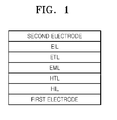
- the organic light-emitting device may have a first electrode/hole injection layer/emission layer/second electrode structure, a first electrode/hole injection layer/hole transport layer/emission layer/electron transport layer/second electrode structure, or a first electrode/hole injection layer/hole transport layer/emission layer/electron transport layer/electron injection layer/second electrode structure.
- the organic light-emitting device may have a first electrode/functional layer having both hole injection and hole transport capabilities/emission layer/electron transport layer/second electrode structure, or a first electrode/functional layer having both hole injection and hole transport capabilities/emission layer/electron transport layer/electron injection layer/second electrode structure.
- the organic light-emitting device may have a first electrode/hole transport layer/emission layer/functional layer having both electron injection and electron transport capabilities/second electrode structure, a first electrode/hole injection layer/emission layer/functional layer having both electron injection and electron transport capabilities/second electrode structure, or a first electrode/hole injection layer/hole transport layer/emission layer/functional layer having both electron injection and electron transport capabilities/second electrode structure.
- the organic light-emitting device may be either a top-emission organic light-emitting device or a bottom-emission organic light-emitting device.
- Figure 1 illustrates the structure of an organic light-emitting device according to an embodiment.
- the organic light-emitting device according to the present embodiment includes a substrate (not shown), a first electrode (anode), a hole injection layer (HIL), a hole transport layer (HTL), an emission layer (EML), an electron transport layer (ETL), an electron injection layer (EIL), and a second electrode (cathode).
- HIL hole injection layer
- HTL hole transport layer
- EML emission layer
- ETL electron transport layer
- EIL electron injection layer
- cathode cathode
- the first electrode is formed on the substrate by using a deposition or sputtering method.
- the first electrode may comprise a first electrode material having a high work function.
- the first electrode may constitute an anode or a cathode.
- the substrate may be a substrate conventionally used in organic light-emitting devices, and may include, for example, a glass substrate or a transparent plastic substrate with excellent mechanical strength, thermal stability, transparency, surface smoothness, ease of handling, and water resistance.
- the first electrode material include materials, such as indium tin oxide (ITO), indium zinc oxide (IZO), tin oxide (SnO 2 ), zinc oxide (ZnO), aluminum (Al), silver (Ag), and magnesium (Mg), which have excellent conductivity.
- the first electrode may be formed as a transparent or reflective electrode.
- the HIL may be formed on the first electrode by using any of a variety of methods, and in some embodiments, by using vacuum deposition, spin coating, casting, Langmuir-Blodgett (LB) deposition, or the like.
- vacuum deposition spin coating, casting, Langmuir-Blodgett (LB) deposition, or the like.
- LB Langmuir-Blodgett
- the deposition conditions may vary according to the material that is used to form the HIL, and the structure and thermal characteristics of the HIL.
- the deposition conditions may include a deposition temperature of from about 100 to about 500°C, a vacuum pressure of about 10 -8 to about 10 -3 torr, and a deposition rate of from about 0.01 to about 100 ⁇ /sec.
- coating conditions may vary according to the material used to form the HIL, and the structure and thermal properties of the HIL.
- the coating conditions may include a coating speed of from about 2000 rpm to about 5000 rpm, and a thermal treatment temperature of from about 80°C to about 200°C at which the solvent remaining after coating may be removed.
- the HIL may comprise the heterocyclic compound of Formula 1 or any material that is commonly used to form a HIL.
- the material that can be used to form the HIL include a phthalocyanine compound such as copper phthalocyanine, 4,4',4"-tris (3-methylphenylphenylamino) triphenylamine (m-MTDATA), N,N'-di(1-naphthyl)-N,N'-diphenylbenzidine (NPB), TDATA, 2TNATA, polyaniline/dodecylbenzenesulfonic acid (Pani/DBSA), poly(3,4-ethylenedioxythiophene)/poly(4-styrenesulfonate) (PEDOT/PSS), polyaniline/camphor sulfonic acid (Pani/CSA), and polyaniline)/poly(4-styrenesulfonate (PANI/PSS).
- a phthalocyanine compound such as copper phthalocyan
- the HIL may have a thickness of from about 100 ⁇ to about 10000 ⁇ , and in some embodiments, a thickness of from about 100 ⁇ to about 1000 ⁇ . When the thickness of the HIL is within these ranges, the HIL may have good hole injection characteristics without an increase in driving voltage.
- the HTL may be formed on the HIL by using any of a variety of methods, and in some embodiments, by using vacuum deposition, spin coating, casting, LB deposition, or the like.
- the deposition or coating conditions may be similar to those applied to form the HIL, though the deposition or coating conditions may vary according to the material that is used to form the HTL.
- the HTL may comprise the heterocyclic compound of Formula 1 or any known HTL material.
- HTL materials include carbazole derivatives such as N-phenylcarbazole or polyvinylcarbazole, and amine derivatives having an aromatic condensed ring, such as NPB, N,N'-bis(3-methylphenyl)- N,N'-diphenyl-[1,1-biphenyl]-4,4'-diamine (TPD).
- the HTL may have a thickness of from about 50 ⁇ to about 1000 ⁇ , and in some embodiments, a thickness of from about 100 ⁇ to about 600 ⁇ . When the thickness of the HTL is within these ranges, the HTL may have good hole transport characteristics without a substantial increase in driving voltage.
- the EML may be formed on the HTL by using any of a variety of methods, and in some embodiments, by using vacuum deposition, spin coating, casting, LB deposition, or the like.
- the deposition or coating conditions may be similar to those applied to form the HIL, though the deposition or coating conditions may vary according to the material that is used to form the EML.
- the EML may include the heterocyclic compound of Formula 1 described above.
- the heterocyclic compound of Formula 1 may be used as a host or a dopant.
- the EML may be formed using a variety of well-known light-emitting materials, in addition to the heterocyclic compound of Formula 1.
- the EML may also be formed using a well-known host and a dopant.
- Dopants that may be used to form the EML may include either a fluorescent dopant or a phosphorescent dopant, which are widely known in the art.
- Examples of the host include Alq3, 4,4'-N,N'- dicarbazole-biphenyl (CBP), poly(n-vinylcarbazole) (PVK), 9,10-di(naphthalene-2-yl)anthracene (ADN), TCTA, 1,3,5-tris(N-phenylbenzimidazole-2-yl)benzene (TPBI), 3-tert-butyl-9,10-di-2-naphthylanthracene (TBADN), E3, and distyrylarylene (DSA), bur are not limited thereto.
- CBP 4,4'-N,N'- dicarbazole-biphenyl
- PVK poly(n-vinylcarbazole)
- ADN 9,10-di(naphthalene-2-yl)anthracene
- TCTA 1,3,5-tris(N-phenylbenzimidazole-2-yl)benzene
- red dopants include platinum(II) octaethylporphyrin (PtOEP), Ir(piq) 3 , Btp 2 Ir(acac), and DCJTB.
- Non-limiting examples of green dopants include Ir(ppy) 3 (where "ppy” denotes phenylpyridine), Ir(ppy) 2 (acac), Ir(mpyp) 3 , and C545T.
- Non-limiting examples of blue dopants include the heterocyclic compound of Formula 1, F 2 Irpic, (F 2 ppy) 2 Ir(tmd), Ir(dfppz) 3 , ter-fluorene, 4,4'-bis(4-diphenylaminostyryl)biphenyl (DPAVBi), and 2,5,8,11-tetra-t-butyl phenylene (TBP).
- the amount of the dopant may be from about 0.1 to about 20 parts by weight, and in some embodiments, from about 0.5 to about 12 parts by weight, based on 100 parts by weight of the EML material, which is equivalent to the total weight of the host and the dopant. When the amount of the dopant is within these ranges, concentration quenching may be substantially prevented.
- the EML may have a thickness of from about 100 ⁇ to about 1,000 ⁇ , and in some embodiments, from about 200 ⁇ to about 600 ⁇ . When the thickness of the EML is within these ranges, the EML may have good light-emitting characteristics without a substantial increase in driving voltage.
- HBL Hole Blocking Layer
- the HBL may comprise any material commonly used to form a HBL.
- HBL materials include oxadiazole derivatives, triazole derivatives, phenathroline derivatives, Balq, and BCP.
- the HBL may have a thickness of from about 50 ⁇ to about 1,000 ⁇ , and in some embodiments, from about 100 ⁇ to about 300 ⁇ . When the thickness of the HBL is within these ranges, the HBL may have good hole blocking characteristics without a substantial increase in driving voltage.
- the ETL is formed on the EML (or HBL) by using any of a variety of methods, and in some embodiments, by using vacuum deposition, spin coating, casting, or the like.
- the deposition or coating conditions may be similar to those applied to form the HIL, though the deposition or coating conditions may vary according to the material that is used to form the ETL.
- the ETL material may include the heterocyclic compound of Formula 1 described above.
- the ETL may comprise any material that is widely known in the art.
- Non-limiting examples of the ETL material include quinoline derivatives, such as tris(8-quinolinolate)aluminium (Alq3), TAZ, and BAlq.
- the ETL may have a thickness of from about 100 ⁇ to about 1,000 ⁇ , and in some embodiments, from about 100 ⁇ to about 500 ⁇ . When the thickness of the ETL is within these ranges, the ETL may have good electron transport characteristics without a substantial increase in driving voltage.
- the EIL which facilitates injection of electrons from the cathode, may be formed on the ETL.
- the EIL may include the heterocyclic compound of Formula 1 described above.
- well-known EIL materials such as LiF, NaCl, CsF, Li 2 O, or BaO, may be used to form the EIL.
- the deposition or coating conditions may be similar to those applied to form the HIL, although the deposition and coating conditions may vary according to the material that is used to form the EIL.
- the EIL may have a thickness of from about 1 ⁇ to about 100 ⁇ , and in some embodiments, from about 5 ⁇ to about 90 ⁇ . When the thickness of the EIL is within these ranges, the EIL may have good electron injection characteristics without a substantial increase in driving voltage.
- the second electrode may be formed on the EIL by using, for example, vacuum deposition, sputtering, or the like.
- the second electrode may constitute a cathode or an anode.
- the material for forming the second electrode may include a metal, an alloy, or an electrically conductive compound, which are materials having a low work function, or a mixture thereof. Non-limiting examples of such materials include lithium (Li), magnesium (Mg), aluminum (Al), aluminum-lithium (Al-Li), calcium (Ca), magnesium-indium(Mg-In), and magnesium-silver (Mg-Ag).
- a transparent cathode comprising a transparent material such as ITO or IZO may be used as the second electrode.
- the organic light-emitting device may be included in various types of flat panel display devices, such as in a passive matrix organic light-emitting display device or in an active matrix organic light-emitting display device.
- the first electrode on the substrate may function as a pixel electrode, electrically connected to a source electrode or a drain electrode of the thin-film transistor.
- the organic light-emitting device may also be included in flat panel display devices having double-sided screens.
- the organic light-emitting device may include the first layer, wherein the first layer may be formed by depositing a heterocyclic compound according to an embodiment of the present invention or by using a wet method of coating a solution of the heterocyclic compound according to the present invention.
- a corning 15 ⁇ /cm 2 (1200 ⁇ ) ITO glass substrate was cut to a size of 50 mm x 50 mm x 0.7 mm and then sonicated in isopropyl alcohol and pure water each for five minutes, and then cleaned by irradiation of ultraviolet rays for 30 minutes and exposure to ozone.
- the resulting glass substrate was loaded into a vacuum deposition device.
- 2-TNATA which is a HIL material
- 2-TNATA which is a HIL material
- a HIL having a thickness of about 600 ⁇
- NPB 4,4'-bis[N-(1-naphthyl)-N-phenylamino]biphenyl
- a blue fluorescent host 9,10-di-naphthalene-2-yl-anthracene (ADN) and Compound 2 of Synthesis Example 1, which is a blue fluorescent dopant, were simultaneously deposited on the HTL with a weight ratio of 98:2 to form an EML having a thickness of 300 ⁇ .
- Alq3 was deposited on the EML to form an ETL having a thickness of 300 ⁇ , and then LiF, which is a halogenated alkali metal, was deposited on the ETL to form an EIL having a thickness of 10 ⁇ .
- A1 was vacuum-deposited on the EIL to form a cathode having a thickness of 3000 ⁇ , thereby forming an LiF/Al electrode and completing the manufacture of an organic light-emitting device.
- the organic light-emitting device had a driving voltage of 6.57V at a current density of 50 mA/cm 2 , a high luminosity of 2830 cd/m 2 , a luminescent efficiency of 5.66 cd/A, and a half-lifespan of 263 hours at 100 mA/cm 2 .
- An organic light-emitting device was manufactured in the same manner as in Example 1, except that Compound 11 was used, instead of Compound 2, to form the EML.
- the organic light-emitting device had a driving voltage of 6.45V at a current density of 50 mA/cm 2 , a high luminosity of 2970 cd/m 2 , a luminescent efficiency of 5.94 cd/A, and a half-lifespan of 225 hours at 100 mA/cm 2 .
- An organic light-emitting device was manufactured in the same manner as in Example 1, except that Compound 24 was used, instead of Compound 2, to form the EML.
- the organic light-emitting device had a driving voltage of 6.32V at a current density of 50 mA/cm 2 , a high luminosity of 2310 cd/m 2 , a luminescent efficiency of 4.62 cd/A, and a half-lifespan of 201 hours at 100mA/cm 2 .
- An organic light-emitting device was manufactured in the same manner as in Example 1, except that Compound 34 was used, instead of Compound 2, to form the EML.
- the organic light-emitting device had a driving voltage of 6.50V at a current density of 50 mA/cm 2 , a high luminosity of 2785 cd/m 2 , a luminescent efficiency of 5.57 cd/A, and a half-lifespan of 220 hours at 100mA/cm 2 .
- An organic light-emitting device was manufactured in the same manner as in Example 1, except that Compound 45 was used, instead of Compound 2, to form the EML.
- the organic light-emitting device had a driving voltage of 6.42V at a current density of 50 mA/cm 2 , a high luminosity of 2567 cd/m 2 , a luminescent efficiency of 5.13 cd/A, and a half-lifespan of 210 hours at 100mA/cm 2 .
- An organic light-emitting device was manufactured in the same manner as in Example 1, except that Compound 48 was used, instead of Compound 2, to form the EML.
- the organic light-emitting device had a driving voltage of 6.35V at a current density of 50 mA/cm 2 , a high luminosity of 2473 cd/m 2 , a luminescent efficiency of 4.95 cd/A, and a half-lifespan of 195 hours at 100mA/cm 2 .
- An organic light-emitting device was manufactured in the same manner as in Example 1, except that Compound 55 was used, instead of Compound 2, to form the EML.
- the organic light-emitting device had a driving voltage of 6.22V at a current density of 50 mA/cm 2 , a high luminosity of 2657 cd/m 2 , a luminescent efficiency of 5.31 cd/A, and a half-lifespan of 183 hours at 100mA/cm 2 .
- An organic light-emitting device was manufactured in the same manner as in Example 1, except that Compound 57 was used, instead of Compound 2, to form the EML.
- the organic light-emitting device had a driving voltage of 6.62V at a current density of 50 mA/cm 2 , a high luminosity of 2796 cd/m 2 , a luminescent efficiency of 5.59 cd/A, and a half-lifespan of 231 hours at 100mA/cm 2 .
- An organic light-emitting device was manufactured in the same manner as in Example 1, except that Compound 73 was used, instead of Compound 2, to form the EML.
- the organic light-emitting device had a driving voltage of 6.26V at a current density of 50 mA/cm 2 , a high luminosity of 2640 cd/m 2 , a luminescent efficiency of 5.28 cd/A, and a half-lifespan of 203 hours at 100mA/cm 2 .
- An organic light-emitting device was manufactured in the same manner as in Example 1, except that Compound 82 was used, instead of Compound 2, to form the EML.
- the organic light-emitting device had a driving voltage of 6.44V at a current density of 50 mA/cm 2 , a high luminosity of 2940 cd/m 2 , a luminescent efficiency of 5.88 cd/A, and a half-lifespan of 216 hours at 100mA/cm 2 .
- An organic light-emitting device was manufactured in the same manner as in Example 1, except that a blue fluorescent dopant 1,4-bis-(2,2-diphenylvinyl)biphenyl (DPVBi) was used, instead of Compound 2, to form the EML.
- DPVBi blue fluorescent dopant 1,4-bis-(2,2-diphenylvinyl)biphenyl
- the organic light-emitting device had a driving voltage of 7.85V at a current density of 50 mA/cm 2 , a luminosity of 1560 cd/m 2 , a luminescent efficiency of 3.12 cd/A, and a half-lifespan of 113 hours at 100mA/cm 2 .
- the organic light-emitting devices manufactured using the heterocyclic compounds represented by Formula 1 according to embodiments as blue dopants for EML had improved driving voltages and much higher I-V-L characteristics, as compared to those manufactured using DPVBi.
- the organic light-emitting devices according to the embodiments had markedly improved lifetimes.
- novel heterocyclic compounds according to the present invention may have good electrical characteristics, good charge transporting capabilities and good emission characteristics, and may be used to prevent crystallization due to high glass transition temperatures (T g ).
- the heterocyclic compounds may also be used as electron transporting materials for most colour-fluorescent and phosphorescent devices, such as red, green, blue, and white fluorescent and phosphorescent devices, or as red, green, blue or white-light emitting materials.
- colour-fluorescent and phosphorescent devices such as red, green, blue, and white fluorescent and phosphorescent devices, or as red, green, blue or white-light emitting materials.
- an organic light-emitting device with high-efficiency, low-driving voltage, high luminance and long lifespan may be manufactured using the heterocyclic compounds.
Landscapes
- Chemical & Material Sciences (AREA)
- Organic Chemistry (AREA)
- Engineering & Computer Science (AREA)
- Materials Engineering (AREA)
- Physics & Mathematics (AREA)
- Spectroscopy & Molecular Physics (AREA)
- Electroluminescent Light Sources (AREA)
- Nitrogen And Oxygen Or Sulfur-Condensed Heterocyclic Ring Systems (AREA)
Abstract

Description
- The present invention relates to a heterocyclic compound represented by Formula 1, an organic light-emitting device including the heterocyclic compound and a flat panel display device comprising the organic light-emitting device.

- Light-emitting devices are self-emitting display devices and have a wide viewing angle, a high contrast ratio, and a short response time. Due to these characteristics, light-emitting devices are drawing attention.
- Such organic light-emitting devices can be roughly classified as either inorganic light-emitting devices that include emission layers containing inorganic compounds, or organic light-emitting devices that include emission layers containing organic compounds.
- Organic light-emitting devices have higher luminance, lower driving voltages, and shorter response times than inorganic light-emitting devices, and can render multicolored displays. Thus, much research into such organic light-emitting devices has been conducted.
- Typically, an organic light-emitting device has a stack structure including an anode, a cathode and an organic emission layer interposed therebetween. However, a hole injection layer, a hole transport layer, an electron transport layer, or an electron injection layer may be further stacked between either the anode or the cathode and the organic emission layer. In other words, an organic light-emitting device may have a stack structure of anode/hole transport layer/organic emission layer/cathode or a stack structure of anode/hole transport layer/organic emission layer/electron transport layer/cathode.
- As a material for forming the organic emission layer, naphthalene derivatives can be used. However, organic light-emitting devices including such materials may not have satisfactory life span, efficiency, and power consumption characteristics, thereby improved materials are still necessary.
- According to a first aspect of the present invention, there is provided a heterocyclic compound represented by Formula 1 below:
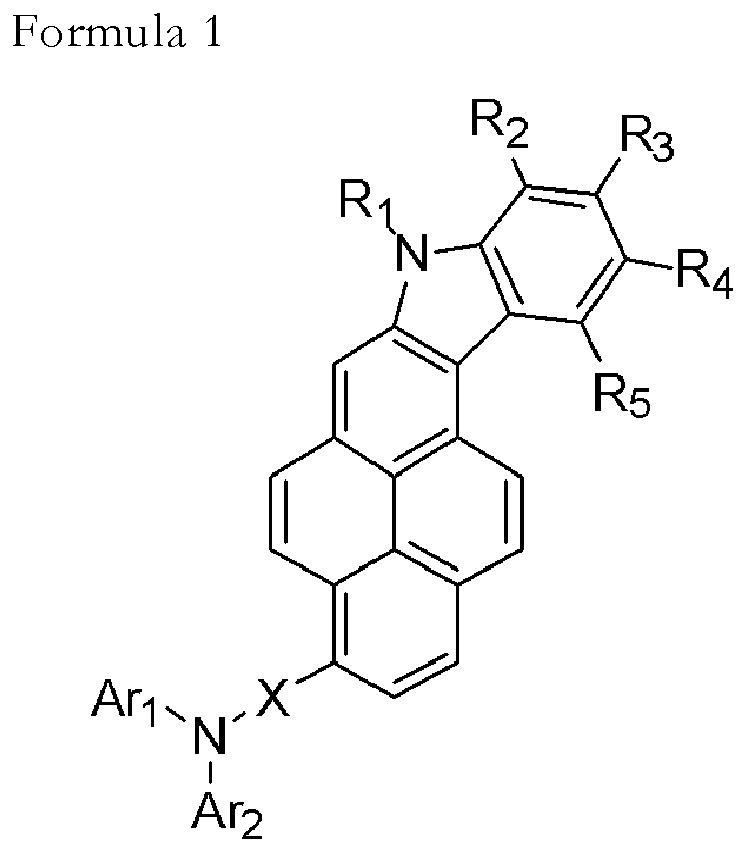
Ar1 and Ar2 are each independently a substituted or unsubstituted C3-C30 cycloalkyl group, a substituted or unsubstituted C5-C60 aryloxy group, a substituted or unsubstituted C5-C60 arylthio group, a substituted or unsubstituted C5-C60 aryl group, an amino group substituted with a C5-C60 aryl or C3-C60 heteroaryl group, a substituted or unsubstituted C3-C60 heteroaryl group, or a substituted or unsubstituted C6-C60 condensed polycyclic group; and
X is a divalent linking group represented by -(Ar3)n- where Ar3 is a substituted or unsubstituted C5-C60 arylene group, a substituted or unsubstituted C3-C60 heteroarylene group, or a substituted or unsubstituted C6-C60 condensed polycyclic group, and n is an integer from 1 to 10, herein n groups of Ar3 are identical to or different from each other, and wherein when n is greater than 1, at least two adjacent groups of the n Ar3 groups are fused or linked to each other by a single bond. - The heterocyclic compound according to the present invention may have improved electrical characteristics, charge transporting capabilities, light-emission capabilities, and a high glass-transition temperature that is high enough to prevent crystallization.
- In Formula 1 above, R1 to R5 may be each independently a hydrogen atom, a deuterium atom, a cyano group, a halogen atom, a substituted or unsubstituted C1-C20 alkyl group, a substituted or unsubstituted C5-C20 aryl group, or a substituted or unsubstituted C3-C20 heteroaryl group.
- The substituted C1-C20 alkyl group may be substituted with at least one fluorine (-F) substituent.
- In Formula 1 above, R1 to R5 may be each independently a hydrogen atom, a deuterium atom, a cyano group, a halogen atom,, a substituted or unsubstituted C1-C20 alkyl group, or groups represented by Formulae 2a to 2i below:

Q1 is a linking group represented by -C(R6) (R7)-, -N(R6)-, -S-, or -O-;
Y1, Y2, and Y3 are each independently a linking group represented by -N= or - C(R8) =;
Z1, Z2, Ar12, Ar13, R6, R7, and R8 are each independently a hydrogen atom, a deuterium atom, a substituted or unsubstituted C1-C20 alkyl group, a substituted or unsubstituted C5-C20 aryl group, a substituted or unsubstituted C3-C20 heteroaryl group, a substituted or unsubstituted C6-C20 condensed polycyclic group, a halogen atom, a cyano group, a nitro group, a hydroxyl group, or a carboxy group;
Ar11 is a substituted or unsubstituted C1-C20 alkylene group, a substituted or unsubstituted C5-C20 arylene group, or a substituted or unsubstituted C3-C20 heteroarylene group;
p is an integer from 1 to 12;
q is an integer from 1 to 12;
r is an integer from 0 to 5; and
* indicates a binding site. - In Formula 1 above, R1 to R5 may be each independently a hydrogen atom, a deuterium atom, a cyano group, a halogen atom, , a methyl group, an ethyl group, a propyl group, a butyl group, a pentyl group, or groups represented by Formulae 3a to 3l below:

r is an integer from 0 to 2; and
* indicates a binding site. - In Formula 1 above, R2 and R5 may be hydrogen atoms; and R1, R3, and R4 may be each independently a hydrogen atom, a deuterium atom, a halogen atom, a cyano group, a methyl group, an ethyl group, a propyl group, a butyl group, a pentyl group, or groups represented by Formulae 3a to 3l below:

- In Formula 1 above, R2 and R5 may be hydrogen atoms, and R1 may be a substituted or unsubstituted C5-C20 aryl group or a substituted or unsubstituted C3-C20 heteroaryl group, R3 may be a hydrogen atom or a substituted or unsubstituted C5-C20 aryl group, and R4 may be a hydrogen atom or an amino group substituted with a C3-C20 heteroaryl group.
- In Formula 1 above, Ar1 and Ar2 may be each independently a substituted or unsubstituted C1-C20 alkyl group, a substituted or unsubstituted C5-C20 aryl group, or a substituted or unsubstituted C3-C20 heteroaryl group.
- In Formula 1 above, Ar1 and Ar2 may be each independently a group represented by one of Formulae 4a to 4d below:

Y1, Y2, and Y3 are each independently a linking group represented by -N= or - C (R8) =;
Z1, Z2, R6, R7, and R8 are each independently a hydrogen atom, a deuterium atom, a substituted or unsubstituted C1-C20 alkyl group, a substituted or unsubstituted C5-C20 aryl group, a substituted or unsubstituted C3-C20 heteroaryl group, a substituted or unsubstituted C6-C20 condensed polycyclic group, a halogen atom, a cyano group, a nitro group, a hydroxyl group, or a carboxy group;
p is an integer from 1 to 8; and
* indicates a binding site. - In Formula 1 above, Ar1 and Ar2 may be each independently a group represented by one of Formulae 5a to 5i below:

Ar3 of X in Formula 1 may be a substituted or unsubstituted C5-C20 arylene group, a substituted or unsubstituted C3-C20 heteroarylene group, or a substituted or unsubstituted C6-C20 condensed polycyclic group.
Ar3 of X in Formula 1 may include a group represented by one of Formulae 6a to 6e below:
Y4, Y5, and Y6 are each independently a linking group represented by -N= or - C(R8)=, -S-, or -O-;
Z1, Z2, R6, R7, and R8 are each independently a hydrogen atom, a deuterium atom, a substituted or unsubstituted C1-C20 alkyl group, a substituted or unsubstituted C5-C20 aryl group, a substituted or unsubstituted C3-C20 heteroaryl group, a substituted or unsubstituted C6-C20 condensed polycyclic group, a halogen atom, a cyano group, a nitro group, a hydroxyl group, or a carboxy group;
p is an integer from 1 to 8;
q is an integer from 1 to 8; and
* indicates a binding site. - In Formula 1 above, n may be 1 or 2.
- In Formula 1, X may include a group represented by one of Formulae 7a to 7j:

- In Formula 1 above, R1, R3, and R4 may be each independently a hydrogen atom, a deuterium atom, a halogen atom, a cyano group, a methyl group, an ethyl group, a propyl group, a butyl group, a pentyl group, or groups represented by Formulae 3a to 3l below:

r is an integer from 0 to 2, and * indicates a binding site;
R2 and R5 are hydrogen atoms; - Ar3 comprises a group represented by one of Formulae 6a to 6e below:

-N=, -C(R8)=, -S-, or -O-; Z1, Z2, R6, R7, and R8 are each independently a hydrogen atom, a deuterium atom, a substituted or unsubstituted C1-C20 alkyl group, a substituted or unsubstituted C5-C20 aryl group, a substituted or unsubstituted C3-C20 heteroaryl group, a substituted or unsubstituted C6-C20 condensed polycyclic group, a halogen atom, a cyano group, a nitro group, a hydroxyl group, or a carboxy group; p is an integer from 1 to 8; q is an integer from 1 to 8; and * indicates a binding site; n in Formula 1 is 1 or 2; and - Ar1 and Ar2 are each independently selected from among groups represented by Formulae 4a to 4d below:

- The heterocyclic compound may include one of the compounds below:

- According to a second aspect of the present invention, an organic light-emitting device includes: a first electrode; a second electrode; and an organic layer between the first electrode and the second electrode, wherein the organic layer includes a first layer including a heterocyclic compound according to the invention in its first aspect.
- The first layer may include at least one layer selected from a hole injection layer, a hole transport layer, a functional layer having both hole injection and hole transport capabilities, an electron injection layer, an electron transport layer, a functional layer having both electron injection and electron transport capabilities or any combination thereof.
- The first layer may include an emission layer, and the heterocyclic compound of Formula 1 may be used in the emission layer as a host or a dopant for a fluorescent or phosphorescent device.
- The first layer may include an emission layer. The emission layer may further include an anthracene compound, an arylamine compound, or a styryl compound.
- The first layer may include an emission layer. A red layer, a green layer, a blue layer, or a white layer of the emission layer may further include a phosphorescent compound.
- The first layer may include a blue emission layer.
- The first layer may include a blue emission layer, and the heterocyclic compound of Formula 1 may be used as a blue dopant.
- The organic layer of the organic light-emitting device may include a hole injection layer, a hole transport layer, a functional layer having hole injecting and transporting capabilities, an emission layer, a hole blocking layer, an electron transport layer, an electron injecting layer, or a combination of two or more layers thereof.
- At least one layer selected from the hole injection layer, the hole transport layer, or the functional layer having hole injecting and transporting capabilities may, when present, further include a charge-generating material.
- The electron transport layer of the organic light-emitting device may include an electron transporting organic material and a metal-containing material.
- The metal-containing material may further include a Li complex.
- The first layer may be formed using a wet process by using a heterocyclic compound according to a first aspect of the present invention.
- According to a third aspect of the present invention, a flat panel display device includes the organic light-emitting device according to the invention in its second aspect. The first electrode of the organic light-emitting device may be electrically connected to a source electrode or a drain electrode of a thin-film transistor.
- A more complete appreciation of the present invention, and many of the attendant advantages thereof, will be readily apparent as the same becomes better understood by reference to the following detailed description when considered in conjunction with the accompanying drawings, wherein:
-
Figure 1 illustrates the structure of an organic light-emitting device according to an embodiment of the present invention. - Organic light-emitting devices manufactured using a compound of phenylanthracene dimer or trimer as an organic emission layer material are widely known. However, such organic light-emitting devices have a narrow energy gap and lower blue-light color purity since two or three oligomeric species of anthracene are linked by conjugation. In addition, such compounds are highly vulnerable to oxidation and thus are liable to produce impurities, necessitating purification. In order to overcome these drawbacks, organic light-emitting devices manufactured using an anthracene compound in which naphthalene is substituted for anthracene at 1,9-positions or using a diphenylanthracene compound including an aryl group substituted for a phenyl group at m-position have been introduced. However, these organic light-emitting devices have lower light-emission efficiency.
- Organic light-emitting devices may also be manufactured using naphthalene-substituted monoanthracene derivatives. However, the light-emission efficiency thereof is low at about 1cd/A, and thus such organic light-emitting devices are not suitable for practical use.
- Furthermore, organic light-emitting devices may be manufactured using phenylanthracene compounds including aryl substituents at m-position. Such a compound has excellent thermal resistance but leads to an unsatisfactorily low light-emission efficiency of about 2cd/A.
- According to the invention in its first aspect, a heterocyclic compound is represented by Formula 1 below:
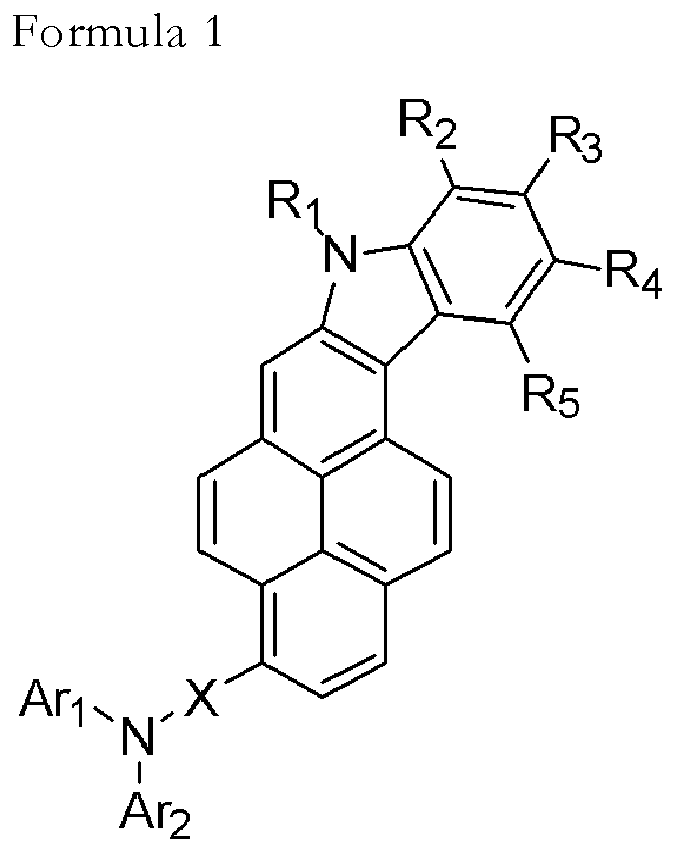
- In Formula 1, R1 through R5 are each independently a hydrogen atom, a deuterium atom, a substituted or unsubstituted C1-C60 alkyl group, a substituted or unsubstituted C2-C60 alkenyl group, a substituted or unsubstituted C2-C60 alkynyl group, a substituted or unsubstituted C3-C60 cycloalkyl group, a substituted or unsubstituted C1-C60 alkoxy group, a substituted or unsubstituted C5-C60 aryloxy group, a substituted or unsubstituted C5-C60 arylthio group, a substituted or unsubstituted C5-C60 aryl group, a substituted amino group with a C5-C60 aryl or C3-C60 heteroaryl group, a substituted or unsubstituted C3-C60 heteroaryl group, a substituted or unsubstituted C6-C60 condensed polycyclic group, a halogen atom, a cyano group, a nitro group, a hydroxyl group, or a carboxyl group;
Ar1 and Ar2 are each independently a substituted or unsubstituted C3-C50 cycloalkyl group, a substituted or unsubstituted C5-C60 aryloxy group, a substituted or unsubstituted C5-C60 arylthio group, a substituted or unsubstituted C5-C60 aryl group, a substituted amino group with a C5-C60 aryl or C3-C60 heteroaryl group, a substituted or unsubstituted C3-C60 heteroaryl group, or a substituted or unsubstituted C6-C60 condensed polycyclic group; and
X is a divalent linking group represented by -(Ar3)n- where Ar3 is a substituted or unsubstituted C5-C60 arylene group, a substituted or unsubstituted C3-C60 heteroarylene group, or a substituted or unsubstituted C6-C60 condensed polycyclic group, and n is an integer from 1 to 10, herein n groups of Ar3 may be identical to or different from each other, and at least two adjacent groups of the n Ar3 groups may be fused or linked to each other by a single bond. - The heterocyclic compound of Formula 1 may be used as a light-emitting material, a hole transporting material, or an electron transporting material. The compound of Formula 1 has better performance as a blue emission material than conventional blue emission materials, and thus may be used as a deep blue material for use in a large display having a non-resonance structure. The heterocyclic compound of Formula 1 having a heterocyclic group in the molecules thereof has a high glass transition temperature (Tg) or a high melting point due to the inclusion of the heterocyclic group. Thus, the heterocyclic compound has high heat resistance against Joule's heat generated in an organic layer, between organic layers, or between an organic layer and a metal electrode when light emission occurs, and has high durability in high-temperature environments.
- An organic light-emitting device manufactured using the heterocyclic compound of Formula 1 has high durability when stored or operated. In addition, due to the inclusion of a substituent such as an aryl group or heteroaryl group, molecular layers formed as thin films may be maintained in good condition, thereby improving the characteristics of the organic light-emitting device.
- Substituents in the heterocyclic compound of Formula 1 will now be described in detail.
- R1 to R5 in Formula 1 above may be each independently a hydrogen atom, a deuterium atom, a cyano group, a halogen atom, an unsubstituted C1-C20 alkyl group, a substituted C1-C20 alkyl group with at least one fluorine (-F) substituent, a substituted or unsubstituted C5-C20 aryl group, or a substituted or unsubstituted C3-C20 heteroaryl group.
- In some embodiments R1 to R5 in Formula 1 may be each independently a hydrogen atom, a deuterium atom, a halogen atom, a cyano group, a substituted or unsubstituted C1-C20 alkyl group, or compounds represented by Formulae 2a to 2i below:

Z1, Z2, Ar12, Ar13, R6, R7, and R8 are each independently a hydrogen atom, a deuterium atom, a substituted or unsubstituted C1-C20 alkyl group, a substituted or unsubstituted C5-C20 aryl group, a substituted or unsubstituted C3-C20 heteroaryl group, a substituted or unsubstituted C6-C20 condensed polycyclic group, a halogen atom, a cyano group, a nitro group, a hydroxyl group, or a carboxy group;
Ar11 is a substituted or unsubstituted C1-C20 alkylene group, a substituted or unsubstituted C5-C20 arylene group, or a substituted or unsubstituted C3-C20 heteroarylene group;
p is an integer from 1 to 12; q is an integer from 1 to 12; r is an integer from 0 to 5; and * indicates a binding site. - In some embodiments R1 to R5 in Formula 1 above may be each independently a hydrogen atom, a deuterium atom, a halogen atom, a cyano group, a methyl group, an ethyl group, a propyl group, a butyl group, a pentyl group, or compounds represented by Formulae 3a to 3l below:

- In Formula 3a to 3l above, Ar12 and Ar13 are each independently a substituted or unsubstituted C5-C60 aryl group, a substituted or unsubstituted C3-C20 heteroaryl group, or a substituted or unsubstituted C6-C20 condensed polycyclic group;
r is an integer from 0 to 2; and
* indicates a binding site. - In some embodiments, R2 and R5 in Formula 1 are hydrogen atoms; and R1, R3, and R4 are each independently a hydrogen atom, a deuterium atom, a halogen atom, a cyano group, a methyl group, an ethyl group, a propyl group, a butyl group, a pentyl group, or groups represented by Formulae 3a to 3l below:

- In Formula 3a to 3l above, Ar12 and Ar13 are each independently a substituted or unsubstituted C5-C60 aryl group, a substituted or unsubstituted C3-C20 heteroaryl group, or a substituted or unsubstituted C6-C20 condensed polycyclic group;
r is an integer from 0 to 2; and
* indicates a binding site. - In other embodiments, R2 and R5 may be hydrogen atoms, and R1 may be a substituted or unsubstituted C5-C20 aryl group or a substituted or unsubstituted C3-C20 heteroaryl group,
R3 may be a hydrogen atom or a substituted or unsubstituted C5-C20 aryl group, and
R4 may be a hydrogen atom or an amino group with a C3-C20 heteroaryl group.
In some embodiments Ar1 and Ar2 in Formula 1 above may be each independently a substituted or unsubstituted C1-C20 alkyl group, a substituted or unsubstituted C5-C20 aryl group, or a substituted or unsubstituted C3-C20 heteroaryl group. - In some other embodiments Ar1 and Ar2 in Formula 1 above may be each independently a compound represented by Formulae 4a to 4d below:

- In Formulae 4a to 4d, Q1 is a linking group represented by -C(R6) (R7)-, -N(R6)-, -S-, or -O-; Y1, Y2, and Y3 are each independently a linking group represented by -N= or -C (R8) =; Z1, Z2, R6, R7, and R8 are each independently a hydrogen atom, a deuterium atom, a substituted or unsubstituted C1-C20 alkyl group, a substituted or unsubstituted C5-C20 aryl group, a substituted or unsubstituted C3-C20 heteroaryl group, a substituted or unsubstituted C6-C20 condensed polycyclic group, a halogen atom, a cyano group, a nitro group, a hydroxyl group, or a carboxy group; p is an integer from 1 to 8; and * indicates a binding site.
- In some embodiments Ar1 and Ar2 in Formula 1 above may be each independently a compound represented by one of Formulae 5a to 5i below:

- In Formulae 5a to 5i, Z1 and Z2 are each independently a hydrogen atom, a deuterium atom, a substituted or unsubstituted C1-C20 alkyl group, a substituted or unsubstituted C5-C20 aryl group, a substituted or unsubstituted C3-C20 heteroaryl group, or a substituted or unsubstituted C6-C20 condensed polycyclic group; and * indicates a binding site.
- In some embodiments Ar3 for X in Formula 1 above may be a substituted or unsubstituted C5-C20 arylene group, a substituted or unsubstituted C3-C20 heteroarylene group, or a substituted or unsubstituted C6-C20 condensed polycyclic group.
- In some other embodiments Ar3 may be a group represented by one of Formulae 6a to 6e:

Y4, Y5, and Y6 are each independently a linking group represented by -N= or -C (R8) =, -S-, or -O-;
Z1, Z2, R6, R7, and R8 are each independently a hydrogen atom, a deuterium atom, a substituted or unsubstituted C1-C20 alkyl group, a substituted or unsubstituted C5-C20 aryl group, a substituted or unsubstituted C3-C20 heteroaryl group, a substituted or unsubstituted C6-C20 condensed polycyclic group, a halogen atom, a cyano group, a nitro group, a hydroxyl group, or a carboxy group;
P is an integer from 1 to 8; q is an integer from 1 to 8; and
* indicates a binding site. - In some embodiments n indicating the number of Ar3 groups for X in Formula 1 above may be an integer of 1 or 2.
- In some embodiments X in Formula 1 above may be a group represented by one of Formulae 7a to 7j:

- In Formulae 7a to 7j, * indicates a binding site.
- In some embodiments R1, R3, and R4 in Formula 1 above may be each independently a hydrogen atom, a deuterium atom, a halogen atom, a cyano group, a methyl group, an ethyl group, a propyl group, a butyl group, a pentyl group, or compounds represented by Formulae 3a to 3l below:

- In Formula 3a to 3l above, Ar12 and Ar13 are each independently a substituted or unsubstituted C5-C60 aryl group, a substituted or unsubstituted C3-C20 heteroaryl group, or a substituted or unsubstituted C6-C20 condensed polycyclic group; r is an integer from 0 to 2, and * indicates a binding site;
R2 and R5 in Formula 1 may be hydrogen atoms;
Ar3 in Formula 1 may be a group represented by one of Formulae 6a to 6e below;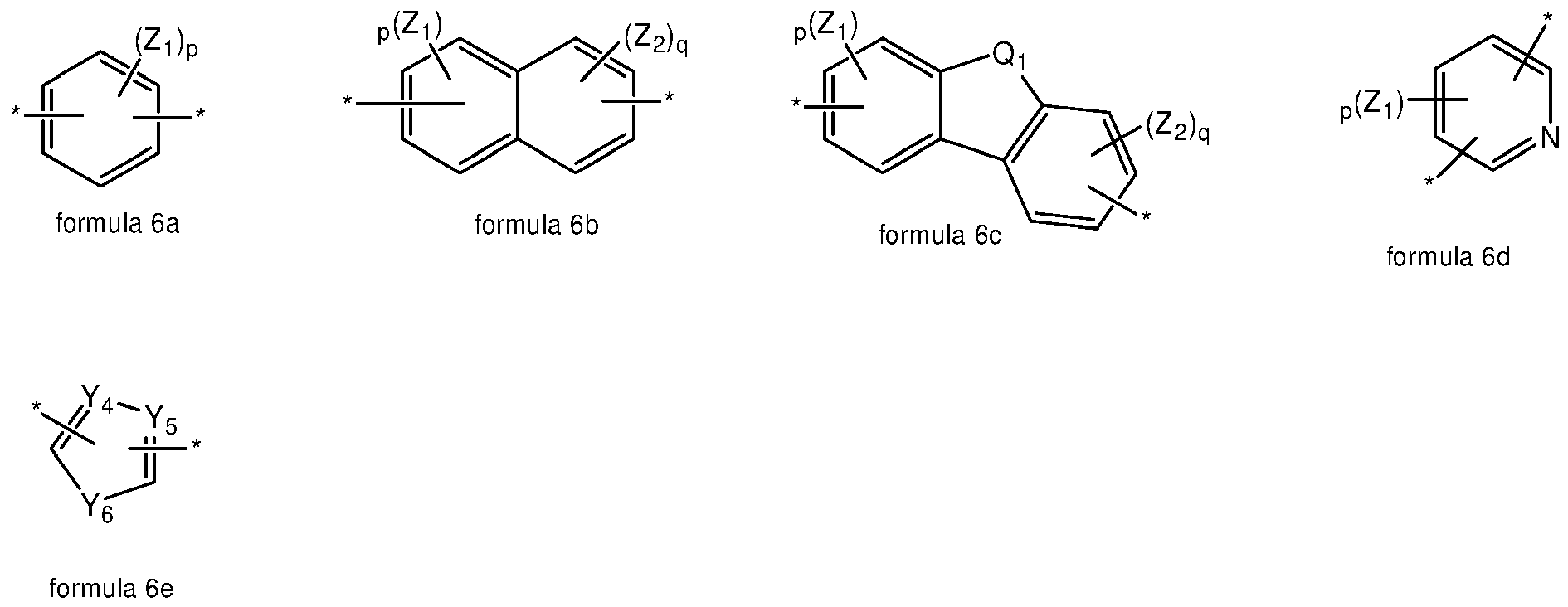
Ar1 and Ar2 in Formula 1 may be each independently a compound represented by one of Formulae 4a to 4d below: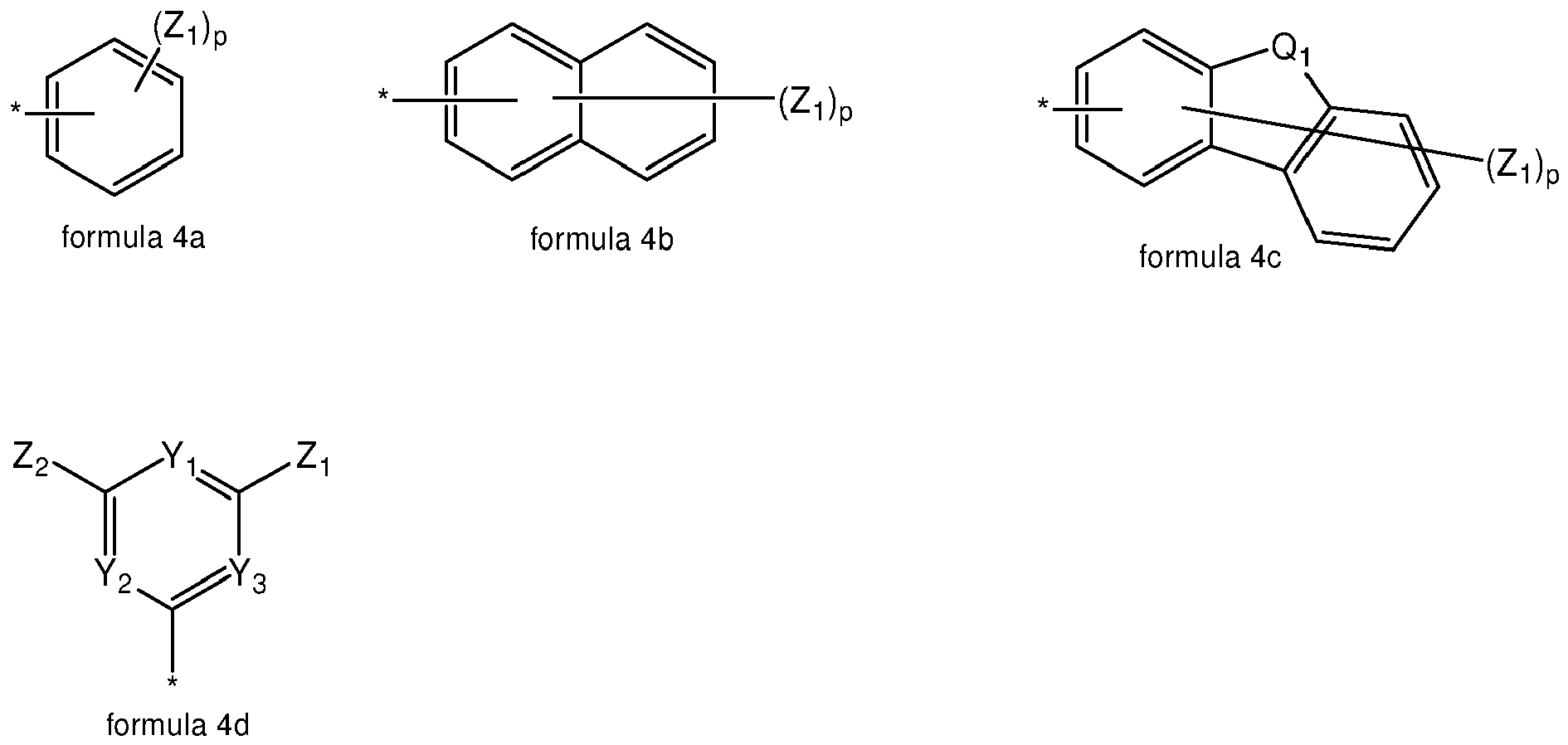
- Hereinafter, substituents described with reference to formulae used herein will now be described in detail. In this regard, the numbers of carbons in substituents are presented for illustrative purposes only.
- The unsubstituted C1-C50 alkyl group used herein may be linear or branched.
- Examples of the alkyl group may include, but are not limited to, a methyl group, an ethyl group, a propyl group, an isobutyl group, a sec-butyl group, a pentyl group, an iso-amyl group, a hexyl group, a heptyl group, an octyl group, a nonyl group, and a decyl group. At least one hydrogen atom of the alkyl group may be substituted with a heavy hydrogen atom, a halogen atom, a hydroxyl group, a nitro group, a cyano group, an amino group, an amidino group, hydrazine, hydrazone, a carboxyl group or a salt thereof, a sulfonic acid group or a salt thereof, a phosphoric acid group or a salt thereof, a C1-C10 alkyl group, a C1-C10 alkoxy group, a C2-C10 alkenyl group, a C2-C10 alkynyl group, a C5-C16 aryl group, or a C3-C16 heteroaryl group.
- The unsubstituted C2-C60 alkenyl group indicates an unsaturated alkyl groups having at least one carbon-carbon double bond in the center or at a terminal of the alkyl group. Examples of the alkenyl group include an ethenyl group, a propenyl group, a butenyl group, and the like. At least one hydrogen atom in the unsubstituted alkenyl group may be substituted with a substituent described above in conjunction with the alkyl group.
- The unsubstituted C2-C60 alkynyl group indicates an alkyl group having at least one carbon-carbon triple bond in the center or at a terminal of the alkyl group. Examples of the unsubstituted C2-C20 alkynyl group include acetylene, propylene, phenylacetylene, naphthylacetylene, isopropylacetylene, t-butylacetylene, diphenylacetylene, and the like. At least one hydrogen atom in the alkynyl group may be substituted with a substituent described above in conjunction with the alkyl group.
- The unsubstituted C3-C50 cycloalkyl group indicates a C3-C50 cyclic alkyl group wherein at least one hydrogen atom in the cycloalkyl group may be substituted with a substituent described above in conduction with the C1-C50 alkyl group.
- The unsubstituted C1-C50 alkoxy group indicates a group having a structure of -OA wherein A is an unsubstituted C1-C50 alkyl group as described above. Non-limiting examples of the unsubstituted C1-C50 alkoxy group include a methoxy group, an ethoxy group, a propoxy group, an isopropyloxy group, a butoxy group, and a pentoxy group. At least one hydrogen atom of the alkoxy group may be substituted with a substituent such as those described above in conjunction with the alkyl group.
- The unsubstituted C5-C60 aryl group indicates a carbocyclic aromatic system containing at least one ring. At least two rings may be fused to each other or linked to each other by a single bond. The term 'aryl' refers to an aromatic system, such as phenyl, naphthyl, or anthracenyl. At least one hydrogen atom in the aryl group may be substituted with a described above with reference to the unsubstituted C1-C50 alkyl group.
- Examples of the substituted or unsubstituted C5-C60 aryl group include, but are not limited to, a phenyl group, a C1-C10 alkylphenyl group (for example, ethylphenyl group), a halophenyl group (for example, o-, m-, and p-fluorophenyl group, dichlorophenyl group), a cyanophenyl group, dicyanophenyl group, a trifluoromethoxyphenyl group, a biphenyl group, a halobiphenyl group, a cyanobiphenyl group, a C1-C10 alkyl biphenyl group, a C1-C10 alkoxybiphenyl group, a o-, m-, and p-toryl group, an o-, m-, and p-cumenyl group, a mesityl group, a phenoxyphenyl group, a (α,α-dimethylbenzene)phenyl group, a (N,N'-dimethyl)aminophenyl group, a (N,N'-diphenyl)aminophenyl group, a pentalenyl group, an indenyl group, a naphthyl group, a halonaphthyl group (for example, fluoronaphthyl group), a C1-C10 alkylnaphthyl group (for example, methylnaphthyl group), a C1-C10 alkoxynaphthyl group (for example, methoxynaphthyl group), a cyanonaphthyl group, an anthracenyl group, an azulenyl group, a heptalenyl group, an acenaphthylenyl group, a phenalenyl group, a fluorenyl group, an anthraquinolyl group, a methylanthryl group, a phenanthryl group, a triphenylene group, a pyrenyl group, a chrycenyl group, an ethyl-chrysenyl group, a picenyl group, a perylenyl group, a chloroperylenyl group, a pentaphenyl group, a pentacenyl group, a tetraphenylenyl group, a hexaphenyl group, a hexacenyl group, a rubicenyl group, a coronelyl group, a trinaphthylenyl group, a heptaphenyl group, a heptacenyl group, a pyranthrenyl group, and an ovalenyl group.
- The unsubstituted C3-C60 heteroaryl group includes one, two or three hetero atoms selected from N, O, P and S. At least two rings may be fused to each other or linked to each other by a single bond. Examples of the unsubstituted C3-C60 heteroaryl group include a pyrazolyl group, an imidazolyl group, an oxazolyl group, a thiazolyl group, a triazolyl group, a tetrazolyl group, an oxadiazolyl group, a pyridinyl group, a pyridazinyl group, a pyrimidinyl group, a triazinyl group, a carbazol group, an indol group, a quinolyl group, an isoquinolyl group, and a dibenzothiophene group. In addition, at least one hydrogen atom in the heteroaryl group may be substituted with a substituent described above in conjunction with the unsubstituted C1-C50 alkyl group.
- The unsubstituted C5-C50 aryloxy group is a group represented by -OA, wherein A1 may be a C5-C50 aryl group. An example of the aryloxy group is a phenoxy group. At least one hydrogen atom in the aryloxy group may be substituted with a substituent described above in conjunction with the unsubstituted C1-C50 alkyl group.
- The unsubstituted C5-C50 arylthio group is a group represented by -SA1 where A1 may be a C5-C60 aryl group. Non-limiting examples of the arylthio group include a benzenethio group and a naphthylthio group. At least one hydrogen atom in the arylthio group may be substituted with a substituent described above in conjunction with the unsubstituted C1-C50 alkyl group.
- The unsubstituted C6-C60 condensed polycyclic group refers to a substituent including at least two rings wherein at least one aromatic ring and/or at least one non-aromatic ring are fused to each other. The unsubstituted C6-C60 condensed polycyclic group may include some of the substituents described in conjunction with the aryl group or the heteroaryl group.
- The following compound is an example of the condensed polycyclic group.

- In Formula 1 below, X prevents formation of a resonance structure between a lone pair electron of a moiety B (arylamine part) and a moiety A (pyrene part) since X has a tendency to be perpendicular to the A moiety (pyrene part).

- As a result, the compound of Formula 1 emits blue light having high colour purity. The blue light emitted from the compound of Formula 1 may be distinguished from a bluish green light that is long-wavelength shifted compared to a conventional blue light.
- Also, the compound of Formula 1 has excellent heat resistance, and thus, an organic light-emitting device using the compound may have higher efficiency and longer lifespan.
- Examples of the heterocyclic compound represented by Formula 1 may include Compounds 1 through 84 represented by the following formulae. However, the heterocyclic compounds represented by Formula 1 are not limited thereto.


- According to an embodiment, an organic light-emitting device includes a first electrode, a second electrode, and an organic layer between the first electrode and the second electrode, in which the organic layer includes a first layer including a heterocyclic compound according to an embodiment of the present invention.
- The first layer including the heterocyclic compound may include a hole injection layer, a hole transport layer, or a functional layer having both hole injection and hole transport capabilities.
- The first layer including the heterocyclic compound may include an electron injection layer, an electron transport layer, or a functional layer having both electron injection and electron transport capabilities.
- When the first layer including the heterocyclic compound of Formula 1 is an emission layer, the heterocyclic compound of Formula 1 may be used in the emission layer as a host or a dopant for a fluorescent or phosphorescent device.
- In some embodiments the first layer of the organic light-emitting device may include an emission layer; the emission layer may further include a known anthracene, arylamine or styryl compound.
- In addition, at least one hydrogen atom in the anthracene, arylamine or styryl compound may be substituted with a substituent described above in conjunction with the unsubstituted C1-C60 alkyl group.
- The arylamine is a C5-C60 arylamine group and may also be referred to as an amino group with a C5-C60 aryl or C3-C60 heteroaryl substituent.
- In some embodiments the first layer of the organic light-emitting device may include an emission layer; a red layer, a green layer, a blue layer or a white layer of the emission layer may include a widely-known phosphorescent compound.
- In some embodiments the first layer of the organic light-emitting device may include a blue emission layer. When the first layer includes a blue emission layer, the heterocyclic compound of Formula 1 may be used as a blue dopant.
- The organic layer of the organic light-emitting device may include a hole injection layer, a hole transport layer, a functional layer having hole injecting and transporting capabilities, an emission layer, a hole blocking layer, an electron transport layer, an electron injecting layer, or a combination of two or more layers thereof. However, the organic layer is not limited thereto. At least one layer selected from the hole injection layer, the hole transport layer, or the functional layer having hole injecting and transporting capabilities may further include a charge-generating material, in addition to a heterocyclic compound according to an embodiment of the present invention, a known hole injecting material, and a known hole transporting material, so as to improve film conductivity.
- The charge-generating material may be, for example, p-dopant. Non-limiting examples of the p-dopant are quinine derivatives, such as tetracyanoquinodimethane (TCNQ) or 2,3,5,6-tetrafluoro-tetracyano-1,4-benzoquinonedimethane(F4TCNQ); metal oxides, such as tungsten oxide and molybdenum oxide; and a cyano group-containing compound such as Compound 100 below:

- If the hole injection layer, the hole transport layer, or the functional layer having hole injecting and transporting capabilities further include the charge-generating material, the charge-generating material may be uniformly or non-uniformly dispersed in the corresponding layer.
- The electron transport layer of the organic light-emitting device according to an embodiment of the present invention may further include an electron transporting organic compound and a metal-containing material. Non-limiting examples of the electron transporting organic compound are 9,10-di(naphtalene-2-yl)anthracene (ADN); and an anthracene-based compound, such as Compounds 101 and 102 below.


- The metal-containing material may include a Li complex. Non-limiting examples of the Li complex are lithium quinolate (LiQ) and Compound 103 below:

- The first electrode may be an anode, and the second electrode may be a cathode, but the reverse is also possible.
- In some embodiments, the organic light-emitting device may have a first electrode/hole injection layer/emission layer/second electrode structure, a first electrode/hole injection layer/hole transport layer/emission layer/electron transport layer/second electrode structure, or a first electrode/hole injection layer/hole transport layer/emission layer/electron transport layer/electron injection layer/second electrode structure. In some other embodiments, the organic light-emitting device may have a first electrode/functional layer having both hole injection and hole transport capabilities/emission layer/electron transport layer/second electrode structure, or a first electrode/functional layer having both hole injection and hole transport capabilities/emission layer/electron transport layer/electron injection layer/second electrode structure. Alternatively, the organic light-emitting device may have a first electrode/hole transport layer/emission layer/functional layer having both electron injection and electron transport capabilities/second electrode structure, a first electrode/hole injection layer/emission layer/functional layer having both electron injection and electron transport capabilities/second electrode structure, or a first electrode/hole injection layer/hole transport layer/emission layer/functional layer having both electron injection and electron transport capabilities/second electrode structure.
- In some embodiments the organic light-emitting device may be either a top-emission organic light-emitting device or a bottom-emission organic light-emitting device.
- Hereinafter, a method of manufacturing an organic light-emitting device according to an embodiment will be described with reference to
Figure 1. Figure 1 illustrates the structure of an organic light-emitting device according to an embodiment. Referring toFigure 1 , the organic light-emitting device according to the present embodiment includes a substrate (not shown), a first electrode (anode), a hole injection layer (HIL), a hole transport layer (HTL), an emission layer (EML), an electron transport layer (ETL), an electron injection layer (EIL), and a second electrode (cathode). - First, the first electrode is formed on the substrate by using a deposition or sputtering method. The first electrode may comprise a first electrode material having a high work function. The first electrode may constitute an anode or a cathode. The substrate may be a substrate conventionally used in organic light-emitting devices, and may include, for example, a glass substrate or a transparent plastic substrate with excellent mechanical strength, thermal stability, transparency, surface smoothness, ease of handling, and water resistance. Examples of the first electrode material include materials, such as indium tin oxide (ITO), indium zinc oxide (IZO), tin oxide (SnO2), zinc oxide (ZnO), aluminum (Al), silver (Ag), and magnesium (Mg), which have excellent conductivity. The first electrode may be formed as a transparent or reflective electrode.
- Then, the HIL may be formed on the first electrode by using any of a variety of methods, and in some embodiments, by using vacuum deposition, spin coating, casting, Langmuir-Blodgett (LB) deposition, or the like.
- When the HIL is formed using vacuum deposition, the deposition conditions may vary according to the material that is used to form the HIL, and the structure and thermal characteristics of the HIL. For example, the deposition conditions may include a deposition temperature of from about 100 to about 500°C, a vacuum pressure of about 10-8 to about 10-3 torr, and a deposition rate of from about 0.01 to about 100Å/sec.
- When the HIL is formed using spin coating, coating conditions may vary according to the material used to form the HIL, and the structure and thermal properties of the HIL. For example, the coating conditions may include a coating speed of from about 2000 rpm to about 5000 rpm, and a thermal treatment temperature of from about 80°C to about 200°C at which the solvent remaining after coating may be removed.
- The HIL may comprise the heterocyclic compound of Formula 1 or any material that is commonly used to form a HIL. Non-limiting examples of the material that can be used to form the HIL include a phthalocyanine compound such as copper phthalocyanine, 4,4',4"-tris (3-methylphenylphenylamino) triphenylamine (m-MTDATA), N,N'-di(1-naphthyl)-N,N'-diphenylbenzidine (NPB), TDATA, 2TNATA, polyaniline/dodecylbenzenesulfonic acid (Pani/DBSA), poly(3,4-ethylenedioxythiophene)/poly(4-styrenesulfonate) (PEDOT/PSS), polyaniline/camphor sulfonic acid (Pani/CSA), and polyaniline)/poly(4-styrenesulfonate (PANI/PSS).


- The HIL may have a thickness of from about 100 Å to about 10000 Å, and in some embodiments, a thickness of from about 100 Å to about 1000 Å. When the thickness of the HIL is within these ranges, the HIL may have good hole injection characteristics without an increase in driving voltage.
- Next, the HTL may be formed on the HIL by using any of a variety of methods, and in some embodiments, by using vacuum deposition, spin coating, casting, LB deposition, or the like. When the HTL is formed using vacuum deposition or spin coating, the deposition or coating conditions may be similar to those applied to form the HIL, though the deposition or coating conditions may vary according to the material that is used to form the HTL.
- The HTL may comprise the heterocyclic compound of Formula 1 or any known HTL material. Non-limiting examples of such HTL materials include carbazole derivatives such as N-phenylcarbazole or polyvinylcarbazole, and amine derivatives having an aromatic condensed ring, such as NPB, N,N'-bis(3-methylphenyl)- N,N'-diphenyl-[1,1-biphenyl]-4,4'-diamine (TPD).


- The HTL may have a thickness of from about 50 Å to about 1000 Å, and in some embodiments, a thickness of from about 100 Å to about 600 Å. When the thickness of the HTL is within these ranges, the HTL may have good hole transport characteristics without a substantial increase in driving voltage.
- Next, the EML may be formed on the HTL by using any of a variety of methods, and in some embodiments, by using vacuum deposition, spin coating, casting, LB deposition, or the like. When the EML is formed using vacuum deposition or spin coating, the deposition or coating conditions may be similar to those applied to form the HIL, though the deposition or coating conditions may vary according to the material that is used to form the EML.
- The EML may include the heterocyclic compound of Formula 1 described above. For example, the heterocyclic compound of Formula 1 may be used as a host or a dopant. The EML may be formed using a variety of well-known light-emitting materials, in addition to the heterocyclic compound of Formula 1. Alternatively, the EML may also be formed using a well-known host and a dopant. Dopants that may be used to form the EML may include either a fluorescent dopant or a phosphorescent dopant, which are widely known in the art.
- Examples of the host include Alq3, 4,4'-N,N'- dicarbazole-biphenyl (CBP), poly(n-vinylcarbazole) (PVK), 9,10-di(naphthalene-2-yl)anthracene (ADN), TCTA, 1,3,5-tris(N-phenylbenzimidazole-2-yl)benzene (TPBI), 3-tert-butyl-9,10-di-2-naphthylanthracene (TBADN), E3, and distyrylarylene (DSA), bur are not limited thereto.


- Non-limiting examples of red dopants include platinum(II) octaethylporphyrin (PtOEP), Ir(piq)3, Btp2Ir(acac), and DCJTB.
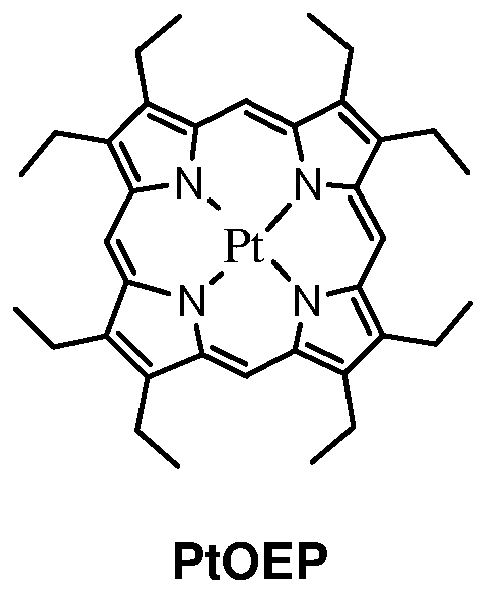


- Non-limiting examples of green dopants include Ir(ppy)3 (where "ppy" denotes phenylpyridine), Ir(ppy)2(acac), Ir(mpyp)3, and C545T.


- Non-limiting examples of blue dopants include the heterocyclic compound of Formula 1, F2Irpic, (F2ppy)2Ir(tmd), Ir(dfppz)3, ter-fluorene, 4,4'-bis(4-diphenylaminostyryl)biphenyl (DPAVBi), and 2,5,8,11-tetra-t-butyl phenylene (TBP).


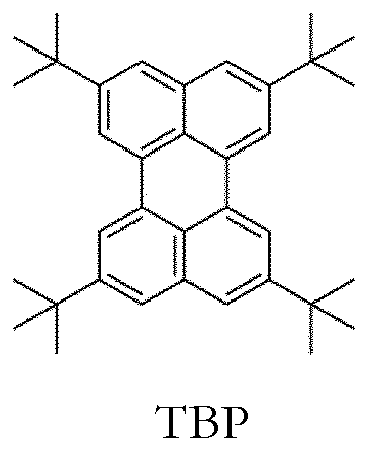
- The amount of the dopant may be from about 0.1 to about 20 parts by weight, and in some embodiments, from about 0.5 to about 12 parts by weight, based on 100 parts by weight of the EML material, which is equivalent to the total weight of the host and the dopant. When the amount of the dopant is within these ranges, concentration quenching may be substantially prevented.
- The EML may have a thickness of from about 100 Å to about 1,000 Å, and in some embodiments, from about 200 Å to about 600 Å. When the thickness of the EML is within these ranges, the EML may have good light-emitting characteristics without a substantial increase in driving voltage.
- When the EML includes a phosphorescent dopant, a Hole Blocking Layer (HBL) (not shown in
Figure 1 ) may be formed on the EML in order to prevent diffusion of triplet excitons or holes into the ETL. In this case, the HBL may comprise any material commonly used to form a HBL. Non-limiting examples of such HBL materials include oxadiazole derivatives, triazole derivatives, phenathroline derivatives, Balq, and BCP. - The HBL may have a thickness of from about 50 Å to about 1,000 Å, and in some embodiments, from about 100 Å to about 300 Å. When the thickness of the HBL is within these ranges, the HBL may have good hole blocking characteristics without a substantial increase in driving voltage.
- Next, the ETL is formed on the EML (or HBL) by using any of a variety of methods, and in some embodiments, by using vacuum deposition, spin coating, casting, or the like. When the ETL is formed using vacuum deposition or spin coating, the deposition or coating conditions may be similar to those applied to form the HIL, though the deposition or coating conditions may vary according to the material that is used to form the ETL.
- The ETL material may include the heterocyclic compound of Formula 1 described above. Alternatively, the ETL may comprise any material that is widely known in the art. Non-limiting examples of the ETL material include quinoline derivatives, such as tris(8-quinolinolate)aluminium (Alq3), TAZ, and BAlq.


- The ETL may have a thickness of from about 100 Å to about 1,000 Å, and in some embodiments, from about 100 Å to about 500 Å. When the thickness of the ETL is within these ranges, the ETL may have good electron transport characteristics without a substantial increase in driving voltage.
- In addition, the EIL, which facilitates injection of electrons from the cathode, may be formed on the ETL.
- The EIL may include the heterocyclic compound of Formula 1 described above. In some embodiments well-known EIL materials, such as LiF, NaCl, CsF, Li2O, or BaO, may be used to form the EIL. The deposition or coating conditions may be similar to those applied to form the HIL, although the deposition and coating conditions may vary according to the material that is used to form the EIL.
- The EIL may have a thickness of from about 1 Å to about 100 Å, and in some embodiments, from about 5 Å to about 90 Å. When the thickness of the EIL is within these ranges, the EIL may have good electron injection characteristics without a substantial increase in driving voltage.
- Finally, the second electrode may be formed on the EIL by using, for example, vacuum deposition, sputtering, or the like. The second electrode may constitute a cathode or an anode. The material for forming the second electrode may include a metal, an alloy, or an electrically conductive compound, which are materials having a low work function, or a mixture thereof. Non-limiting examples of such materials include lithium (Li), magnesium (Mg), aluminum (Al), aluminum-lithium (Al-Li), calcium (Ca), magnesium-indium(Mg-In), and magnesium-silver (Mg-Ag). In addition, in order to manufacture a top-emission organic light-emitting device, a transparent cathode comprising a transparent material such as ITO or IZO may be used as the second electrode.
- The organic light-emitting device may be included in various types of flat panel display devices, such as in a passive matrix organic light-emitting display device or in an active matrix organic light-emitting display device. In particular, when the organic light-emitting device is included in an active matrix organic light-emitting display device including a thin-film transistor, the first electrode on the substrate may function as a pixel electrode, electrically connected to a source electrode or a drain electrode of the thin-film transistor. Moreover, the organic light-emitting device may also be included in flat panel display devices having double-sided screens.
- The organic light-emitting device may include the first layer, wherein the first layer may be formed by depositing a heterocyclic compound according to an embodiment of the present invention or by using a wet method of coating a solution of the heterocyclic compound according to the present invention.
- Hereinafter, the present embodiments will be described in detail with reference to synthesis examples of Compounds 2, 11, 24, 34, 45, 48, 55, 57, 73, and 82 and other examples. However, these examples are for illustrative purposes only and are not intended to limit the scope of the present invention.
-

- 4.93 g (20.0 mmol) of pyren-1-yl-1-boronic acid, 4.04 g (20.0 mmol) of 2-bromonitrobenzene, 1.15 g (1.0 mmol) of Pd(PPh3)4, and 8.29 g (60.0 mmol) of K2CO3 were dissolved in 60 mL of a mixed tetrahydrofuran (THF) and H2O (2:1) solution to obtain a solution, which was then stirred at from about 70°C for about 5 hours. The reaction solution was cooled to room temperature, and 40 mL of water was added thereto, followed by three times of extraction with 50 mL of ethylether. The organic phase was collected, and was dried using magnesium sulfate to evaporate the solvent. The residue was separated and purified using silica gel column chromatography to obtain 5.95 g of Intermediate I-1 (Yield: 92 %). This compound was identified using HR-MS and NMR. C22H13NO2 estimated value: 323.0946; measured value: 323.0939
1H NMR (CDCl3, 400MHz) δ (ppm) 8.22-8.20 (d, 2H), 8.17-8.10 (m, 4H), 8.03-8.01 (d, 1H), 8.01-7.98 (d, 1H), 7.88-7.85 (d, 1H), 7.69-7.67 (m, 2H), 7.66-7.56 (m, 2H) - 4.85 g (15.0 mmol) of Intermediate I-1 was dissolved in 100 mL of dichloromethane 100 ml to obtain a solution, and 1.75 ml (15.0 mmol) of bromine (Br2) was slowly dropwise added to the solution at about 0°C to obtain a reaction solution. The reaction solution was stirred at room temperature for from about 12 hours. 60 mL of water and 30 mL of a 20% aqueous thiosodium sulfate solution were added to the reaction solution, followed by three times of extraction with 80 mL of dichloromethane. The organic phase was collected, and was dried using magnesium sulfate to evaporate the solvent. The residue was separated and purified by silica gel column chromatography, followed by recrystallization with a dichloromethane/hexane solution to obtain 3.38 g of Intermediate I-2 (Yield 56 %). This compound was identified using HR-MS and NMR. C22H12BrNO2 estimated value: 401.0051; measured value: 401.0046
1H NMR (CDCl3, 400MHz) δ (ppm) 8.50-8.47 (d, 1H), 8.40-8.22 (dd, 2H), 8.18-8.15 (dd, 1H), 8.10-8.00 (m, 3H), 7.91-7.89 (d, 1H), 7.83-7.80 (d, 1H), 7.79-7.74 (dt, 1H), 7.70-7.65 (dt, 1H), 7.59-7.53 (dd, 1H) - 4.02 g (10.0 mmol) of Intermediate I-2 and 5.77 g (22 mmol) of triphenylphosphine (PPh3) were dissolved in 30 mL of 1,2-dichlorobenzene to obtain a solution, which was then stirred at about 170°C for about 12 hours. The reaction solution was cooled to room temperature, and the solvent was removed therefrom under vacuum conditions, followed by three times of extraction with 50 mL of water and 50 mL of dichloromethane. The organic phase was collected, and was dried using magnesium sulfate to evaporate the solvent. The residue was separated and purified using silica gel column chromatography to obtain 2.66 g of Intermediate I-3 (Yield: 72 %). This compound was identified using HR-MS and NMR. C22H12BrN estimated value: 369.0153; measured value: 323.0939
1H NMR (THF-d8, 400MHz) δ (ppm) 11.06 (s, 1H), 9.37-9.34 (d, 1H), 8.88-8.85 (d, 1H), 8.73-8.69 (d, 1H), 8.33 (s, 1H), 8.23-8.17 (t, 2H), 8.08-8.00 (dd, 2H), 7.69-7.66(d, 1H), 7.56-7.51 (dt, 1H), 7.44-7.38 (dt, 1H) - 3.70 g (10.0 mmol) of Intermediate I-3, 3.06 g (15.0 mmol) of iodobenzene, 0.19 g (1.0 mmol) of CuI, 0.05 g (0.2 mmol) of 18-Crown-6, and 4.15 g (30.0 mmol) of K2CO3 were dissolved in 30 mL of 1,3-dimethyl-3,4,5,6-tetrahydro-2(1H)-pyrimidinone (DMPU) to obtain a solution, which was then stirred at about 170°C for about 12 hours. The reaction solution was cooled to room temperature, followed by three times of extraction with 50 mL of water and 50 mL of dichloromethane. The organic phase was collected, and was dried using magnesium sulfate to evaporate the solvent. The residue was separated and purified using silica gel column chromatography to obtain 4.15 g of Intermediate I-4 (Yield: 93 %). This compound was identified using HR-MS and NMR. C28H16BrN estimated value: 445.0466; measured value: 445.0459
1H NMR (CDCl3, 400MHz) δ (ppm) 9.09-9.05 (d, 1H), 8.67-8.65 (dd, 1H), 8.53-8.50 (d, 1H) 8.01-7.99 (d, 1H), 7.94 (s, 1H), 7.86-7.75 (m, 3H), 7.56-7.47 (m, 5H), 7.44-7.31 (m, 4H)
- 3.24 g (10.0 mmol) of 4-bromotriphenylamine, 2.54 g (10.0 mmol) of bis(pinacolato)diborone, 0.36 g(0.5 mmol) of [1,1'-bis(diphenylphosphino)ferrocene]dichloro palladium (II) (hereinafter, PdCl2(dppf)2), and 2.94 g (30.0 mmol) of KOAc were dissolved in 40 mL of dimethylsulfoxide (DMSO) to obtain a solution, which was then stirred at about 80°C for about 6 hours. The reaction solution was cooled to room temperature, followed by three times of extraction with 50 mL of water and 50 mL of diethylether. The organic phase was collected, and was dried using magnesium sulfate to evaporate the solvent. The residue was separated and purified using silica gel column chromatography to obtain 2.57 g of Intermediate I-5 (Yield: 89 %). This compound was identified using HR-MS and NMR. C14H16BNO2 estimated value: 371.2057; measured value 371.2051
1H NMR (CDCl3, 400MHz) δ (ppm) 7.67-7.63 (m, 2H), 7.30-7.21 (m, 4H), 7.14-7.06 (m, 4H), 7.05-7.00 (m, 4H), 1.32 (s, 12H) - 2.23 g (5.0 mmol) of Intermediate I-4, 1.86 g (5.0 mmol) of Intermediate I-5, 0.29 g (0.25 mmol) of Pd(PPh3)4, and 2.07 g (15.0 mmol) of K2CO3 were dissolved in 30 mL of a mixed solution THF/H2O (2:1) to obtain a solution, which was then stirred at about 70°C for about 5 hours. The reaction solution was cooled to room temperature, followed by three times of extraction with 50 mL of water and 50 mL of diethylether. The organic phase was collected, and was dried using magnesium sulfate to evaporate the solvent. The residue was separated and purified using silica gel column chromatography to obtain 2.11 g of Compound 2 (Yield: 69 %). This compound was identified using HR-MS and NMR. C46H30N2 estimated value: 610.2409; measured value [M+1] 611.2401
1H NMR (CDCl3, 400MHz) δ (ppm) 9.25-9.21 (d, 1H), 8.92-8.85 (m, 1H), 8.66-8.62 (d, 1H), 8.26-8.24 (d, 1H), 8.17 (s, 1H), 8.07 (s, 2H), 8.01-7.98 (d, 1H), 7.76-7.74 (d, 4H), 7.62-7.56 (m, 6H), 7.39-7.23 (m, 10H), 7.12-7.00 (dt, 2H)
- 4.22 g (20.0 mmol) of 1-bromo-2,3,4-trifluorobenzene, 2.79 g (30.0 mmol) of aniline, 0.37 g (0.4 mmol) of Pd2(dba)3, 0.08 g (0.4 mmol) of PtBu3, and 2.88 g (30.0 mmol) of KOtBu were dissolved in 60 mL of toluene to obtain a solution, which was then stirred at about 85°C for about 4 hours. The reaction solution was cooled to room temperature, followed by three times of extraction with 50 mL of water and 50 mL of diethylether. The organic phase was collected, and was dried using magnesium sulfate to evaporate the solvent. The residue was separated and purified using silica gel column chromatography to obtain 3.93 g of Intermediate I-6 (Yield: 88 %). This compound was identified using HR-MS and NMR. C12H8F3N estimated value: 223.0609; measured value 223.0901
1H NMR (CDCl3, 400MHz) δ (ppm) 7.34-7.26 (m, 2H), 7.04-7.00 (m, 3H), 6.99-6.92 (m,1H), 6.87-6.77 (m,1H), 5.62 (s,1H) - 3.45 g (15.0 mmol) of Intermediate I-6, 2.83 g (10.0 mmol) of 4-bromoiodobenzene, 0.18 g (0.2 mmol) of Pd2(dba)3, 0.04 g (0.4 mmol) of PtBu3, and 1.44 g (15.0 mmol) of KOtBu were dissolved in 40 mL of toluene to obtain a solution, which was then stirred at about 85°C for about 4 hours. The reaction solution was cooled to room temperature, followed by three times of extraction with 30 mL of water and 30 mL of diethylether. The organic phase was collected, and was dried using magnesium sulfate to evaporate the solvent. The residue was separated and purified using silica gel column chromatography to obtain 2.38 g of Intermediate I-7 (Yield: 63 %). This compound was identified using HR-MS and NMR. C18H11BrF3N estimated value: 377.0027; measured value 377.0023
1H NMR (CDCl3, 400MHz) δ (ppm) 7.38-7.31 (m, 2H), 7.30-7.25 (m, 2H), 7.11-7.07 (dt, 1H), 7.06-7.01 (m, 2H), 6.98-6.91 (m, 2H), 6.88-6.85 (m, 2H) - 3.78 g (10.0 mmol) of Intermediate I-7, 2.54 g (10.0 mmol) of bis(pinacolato)diborone, 0.36 g (0.5 mmol) of PdCl2(dppf)2, and 2.94 g (30.0 mmol) of KOAc were dissolved in 40 mL of DMSO to obtain a solution, which was then stirred at about 80°C for about 6 hours. The reaction solution was cooled to room temperature, followed by three times of extraction with 50 mL of water and 50 mL of diethylether. The organic phase was collected, and was dried using magnesium sulfate to evaporate the solvent. The residue was separated and purified using silica gel column chromatography to obtain 3.40 g of Intermediate I-8 (Yield: 80 %). This compound was identified using HR-MS and NMR. C24H23BF3NO2 estimated value: 425.1774; measured value 425.1769
1H NMR (CDCl3, 400MHz) δ (ppm) 7.72-7.68 (m, 2H), 7.32-7.25 (m, 2H), 7.13-7.05 (m, 3H), 6.99-6.85 (m, 4H), 1.35 (s, 12H) - Compound 11 was synthesized from Intermediate I-4 and Intermediate I-8 in the same manner as in the synthesis of Compound 2. This compound was identified using HR-MS and NMR. C46H27F3N2 estimated value: 664.2126; measured value [M+1] 665.2124
1H NMR (CDCl3, 400MHz) δ (ppm) 8.80-8.78 (d, 1H), 8.44-8.41 (d, 1H), 8.23-8.20 (m, 1H), 8.10-8.07 (d, 1H), 8.04 (s, 1H), 8.00-7.99 (d, 1H), 7.95-7.88 (m, 2H), 7.56-7.53 (m, 2H), 7.91-7.47 (m, 3H), 7.35-7.29 (m, 8H), 6.64-6.60 (m, 1H),, 6.45-6.43 (d, 2H), 6.35-6.33 (d, 1H), 5.71-5.70 (d, 1H)


- Intermediate I-9 was synthesized from 2-aminopyridine and 2-bromopyridine in the same manner as in the synthesis of Intermediate I-7 from Intermediate I-6 and Intermediate I-8 from Intermediate I-7. This compound was identified using HR-MS. C22H24BN3O2 estimated value: 373.1962; measured value 373.1956
1H NMR (CDCl3, 400MHz) δ (ppm) 8.22-8.21 (d, 2H), 7.96-7.94 (d, 2H), 7.55-7.51 (t, 2H), 7.36-7.34 (d, 4H), 6.93-6.91 (t, 2H), 1.34 (s, 12H) - Intermediate I-10 was synthesized from diphenylamine and 1,4-dibromo-tetrafluorobenzene in the same manner as in the synthesis of Intermediate I-9. This compound was identified using HR-MS. C24H22BF4NO2 estimated value: 443.1680; measured value 443.1685
1H NMR (CDCl3, 400MHz) δ (ppm) 7.37-7.33 (t, 4H), 6.62-6.60 (t, 2H), 5.73-5.71 (d, 4H), 1.35 (s, 12H) - Intermediate I-11 was synthesized from diphenylamine and 2-bromo-5-iodopyridine in the same manner as in the synthesis of Intermediate I-9. This compound was identified using HR-MS. C23H25BN2O2 estimated value: 372.2009; measured value 372.2006
1H NMR (CDCl3, 400MHz) δ (ppm) 8.82 (s, 1H), 7.91-7.89 (d, 1H), 7.50-7.48 (m, 5H), 7.00-6.97 (t, 2H), 6.95-6.91 (d, 4H), 6.49-6.47 (d, 1H), 1.33 (s, 12H) - Intermediate I-12 was synthesized from diphenylamine and 3,7-dibromo-dibenzothiophene in the same manner as in the synthesis of Intermediate I-9. This compound was identified using HR-MS. C30H28BNO2S estimated value: 477.1934; measured value 477.1931
1H NMR (CDCl3, 400MHz) δ (ppm) 8.28-8.25 (d, 2H), 8.02-8.00 (d, 1H), 7.72-7.70 (d, 1H), 7.56 (s, 1H), 7.33-7.29 (t, 4H), 7.00-6.98 (d, 1H), 6.64-6.62 (t, 2H), 5.89-5.86 (d, 4H), 1.35 (s, 12H) - Compound 24 was synthesized from Intermediate I-4 and Intermediate I-9 in the same manner as in the synthesis of Compound 2. This compound was identified using HR-MS. C44H28N4 estimated value: 612.2314; measured value [M+1] 613.2310 1H NMR (CDCl3, 400MHz) δ (ppm) 8.80 (d, 1H), 8.44-8.41 (d, 1H), 8.23-8.20 (m, 2H), 8.10-8.07 (d, 1H), 8.04 (s, 1H), 8.00-7.98 (d, 1H), 7.94-7.88 (m, 2H), 7.58-7.51 (m, 3H), 7.50-7.47 (m, 6H), 7.37-7.29 (m, 6H), 7.01-6.97 (m, 2H), 6.91-6.89 (dd, 2H)
- Compound 24 was synthesized from Intermediate I-4 and Intermediate I-10 in the same manner as in the synthesis of Compound 2. This compound was identified using HR-MS. C46H26F4N2 estimated value: 682.2032; measured value [M+1] 683.2029
1H NMR (CDCl3, 400MHz) δ (ppm) 8.79-8.77 (d, 1H),8.40-8.39 (d, 1H), 8.25-8.22 (m, 1H), 8.14-8.11 (d, 1H), 8.06-8.01 (m, 2H), 7.93-7.91 (d, 1H), 7.59-7.57 (d, 1H), 7.51-7.46 (m, 4H), 7.35-7.31 (m, 8H), 6.64-6.60 (t, 2H), 5.73-5.71 (m, 4H) - Compound 24 was synthesized from Intermediate I-4 and Intermediate I-11 in the same manner as in the synthesis of Compound 2. This compound was identified using HR-MS. C45H29N3 estimated value: 611.2361; measured value [M+1] 612.2357 1H NMR (CDCl3, 400MHz) δ (ppm) 8.93-8.91 (m, 1H), 8.77-8.75 (d, 1H), 8.43-8.42 (d, 1H), 8.23-8.19 (m, 2H), 8.17-8.11 (m, 3H), 8.07-8.01 (m, 3H), 5.55-7.46 (m, 8H), 7.33-7.26 (m, 3H), 7.01-6.96 (m, 2H), 6.93-6.90 (m, 4H), 6.61-6.58 (d, 1H)
- Compound 24 was synthesized from Intermediate I-4 and Intermediate I-12 in the same manner as in the synthesis of Compound 2. This compound was identified using HR-MS. C52H32N2S estimated value: 716.2286; measured value [M+1] 717.2281
1H NMR (CDCl3, 400MHz) δ (ppm) 8.74-8.72 (d, 1H), 8.39-8.37 (d, 1H), 8.22-8.17 (m, 3H), 8.13-8.04 (m, 5H), 7.98-7.96 (d, 1H), 7.72-7.70 (d, 1H), 7.54-7.45 (m, 5H), 7.37-7.27 (m, 8H), 7.04-6.98 (m, 1H), 6.66-6.60 (m, 2H), 6.23-6.21 (d, 4H) -

- 2-bromonaphthalene and aniline were reacted in the same manner as in the synthesis of Intermediate I-8 to synthesize a secondary amine, and then the secondary amine was Suzuki-reacted with 4-bromo-1-iodobenzene. Then, the reaction product was reacted with Bis(pinacolato)diborone and PdCl2(dppf)2 to synthesize a boron compound. Then, the boron compound and Intermediate I-3 were reacted to synthesize Intermediate I-13.
- 2.92 g (5.0 mmol) of Intermediate I-13 was dissolved in 20 ml of DMF 20 and then the solution was slowly added to a solution prepared by dissolving 0.6 g (15.0 mmol) of 60% sodium hydride (NaH) in 10 ml of DMF for 10 minutes. After one hour at room temperature, a solution prepared by dissolving 2.67g (10.0 mmol) of 2-chloro-4,6-diphenyl-(1,3,5)-triazine in 10 ml of DMF was slowly added thereto for 30 minutes and the mixture was stirred at room temperature for 3 hours. After the reaction was finished, the reaction solution was extracted three times with water and 60 ml of diethylether. The organic phase was collected, and was dried using magnesium sulfate to evaporate the solvent. The residue was separated and purified using silica gel column chromatography to obtain 3.83 g (Yield 47 %) of Compound 55. This compound was identified using HR-MS. C59H37N5 estimated value: 815.3049; measured value [M+1] 816.3044
1H NMR (CDCl3, 400MHz) δ (ppm) 8.85-8.78 (m, 3H), 8.59-8.56 (m, 4H), 8.44-8.41 (d, 1H), 8.22-8.21 (d, 1H), 8.08-7.98 (m, 2H), 7.94-7.86 (m, 3H), 7.70-7.62 (m, 2H), 7.57-7.50 (m, 3H), 7.47- 7.25 (m, 11H), 7.16-7.11 (m, 1H), 6.87-6.79 (m, 1H), 6.63-6.59 (m, 3H), 6.12-6.09 (m, 2H)
- Intermediate I-14 was synthesized from bromopentafluorobenzene in the same manner as in the synthesis of Intermediate I-4, and Compound 57 was synthesized from Intermediate I-14 and Intermediate I-5 in the same manner as in the synthesis of Compound 2. This compound was identified using HR-MS. C45H25F5N2 estimated value: 700.1938; measured value [M+1] 701.1932
1H NMR (CDCl3, 400MHz) δ (ppm) 8.70-8.68 (d, 1H), 8.34-8.31(d, 1H), 8.16-8.14 (m, 1H), 8.05-8.02 (m, 2H), 7.80-7.78 (d, 1H), 7.70-7.58 (m, 2H), 7.41-7.23 (m, 8H), 6.86-6.82 (m, 3H), 6.65-6.61 (m, 2H), 5.99-5.97 (m, 4H)
- 5.62 g (20.0 mmol) of 2-4,Dibromo-1-nitrobenzene, 1.71 g (10.0 mmol) of di-4-pyridylamine, 0.18 g (0.2 mmol) of Pd2(dba)3, 0.04 g (0.2 mmol) of PtBu3, and 1.44 g (15.0 mmol) of NaOtBu were mixed and 40 ml of toluene was added to the mixture and stirred at a temperature of 85°C for 5 hours. The reaction solution was cooled to room temperature, followed by three times of extraction with 50 mL of water and 50 mL of diethylether. The organic phase was collected, and was dried using magnesium sulfate to evaporate the solvent. The residue was separated and purified using silica gel column chromatography to obtain 1.63 g of Intermediate I-15 (Yield 44 %). This compound was identified using HR-MS. C16H11BrN4O2 estimated value: 370.0065; measured value 370.0061
1H NMR (CDCl3, 400MHz) δ (ppm) 8.20-8.18 (d, 1H), 8.17-8.12 (m, 4H), 7.64-7.62 (m, 1H), 6.98-6.96 (m, 4H), 6.51-6.47 (dd, 1H) - Intermediate I-16 was synthesized from Intermediate I-15 in the same manner as in the synthesis of Intermediate I-1. This compound was identified using HR-MS. C32H20N4O2 estimated value: 492.1586; measured value 492.1583
1H NMR (CDCl3, 400MHz) δ (ppm) 8.28-8.20 (m, 3H), 8.18-8.12 (m, 4H), 8.09-8.00 (m, 4H), 7.99-7.75 (m, 2H), 7.71-7.69 (d, 1H), 7.47-7.43 (m, 1H), 7.23-7.19 (dd, 1H), 6.70-6.66 (m, 4H) - Intermediate I-17 was synthesized from Intermediate I-16 in the same manner as in the synthesis of Intermediate I-2. This compound was identified using HR-MS. C32H19BrN4O2 estimated value: 570.0691; measured value 570.0686
1H NMR (CDCl3, 400MHz) δ (ppm) 8.85-8.83 (d, 1H), 8.35-8.33 (d, 1H), 8.28-8.21 (m, 3H), 8.18-8.12 (m, 4H), 8.08-8.02 (dd, 1H), 7.95-7.89 (m, 2H), 7.71-7.69 (d, 1H), 7.47-7.43 (m, 1H), 723-7.21 (dd, 1H), 6.78-6.76 (m, 4H) - Intermediate I-18 was synthesized from Intermediate I-17 in the same manner as in the synthesis of Intermediate I-3. This compound was identified using HR-MS. C32H19BrN4 estimated value: 538.0793; measured value 538.0787
1H NMR (CDCl3, 400MHz) δ (ppm) 9.8 (s, 1H), 8.99-8.97 (d, 1H), 8.85-8.83 (d, 1H), 8.50-8.36 (m, 2H), 8.25-8.12 (m, 5H), 7.99-7.95 (m, 2H), 7.46-7.42 (m, 2H), 7.34-7.29 (m, 1H), 6.93-6.82 (m, 4H) - Intermediate I-19 was synthesized from Intermediate I-18 in the same manner as in the synthesis of Intermediate I-4. This compound was identified using HR-MS. C38H23BrN4 estimated value: 614.1106; measured value 614.1102
1H NMR (CDCl3, 400MHz) δ (ppm) 9.04-9.02 (d, 1H), 8.85-8.83 (d, 1H), 8.46-8.44 (d, 1H), 8.36-8.34 (d, 1H), 8.28 (s, 1H), 8.18-8.12 (m, 4H), 8.03-7.98 (m, 2H), 7.79-7.76 (m, 1H), 7.68-7.60 (m, 1H), 7.53-7.44 (m, 5H), 7.37-7.30 (m, 1H), 6.82-6.79 (m, 4H) - Compound 73 was synthesized from Intermediate I-5 and Intermediate I-19 in the same manner as in the synthesis of Compound 2. This compound was identified using HR-MS. C56H37N5 estimated value: 779.3049; measured value [M+1] 780.3042 1H NMR (CDCl3, 400MHz) δ (ppm) 8.95-8.92 (d, 1H), 8.44-8.41 (d, 1H), 8.21-8.10 (m, 5H), 8.05-7.99 (m, 2H), 7.96-7.88 (m, 2H), 7.79-7.76 (m, 1H), 7.66-7.62 (m, 1H), 7.53-7.45 (m, 4H), 7.36-7.25 (m, 8H), 6.92-6.88 (m, 4H), 6.74-6.70 (m, 2H), 6.54-6.50 (m, 2H), 6.02-6.98 (m, 4H)

- 5.62 g (20.0 mmol) of 1,4-Dibromo-2-nitrobenzene, 1.22 g (10.0 mmol) of phenylboronic acid, 0.58 g (0.5 mmol) of PdPPh3, and 4.14 g (30.0 mmol) of K2CO3 were dissolved in 40 ml of THF/H2O (2/1) and the mixture was stirred at a temperature of 80 °C for 5 hours. The reaction solution was cooled to room temperature, followed by three times of extraction with 50 mL of water and 50 mL of diethylether. The organic phase was collected, and was dried using magnesium sulfate to evaporate the solvent. The residue was separated and purified using silica gel column chromatography to obtain 1.33 g (Yield 48 %) of Intermediate I-20. This compound was identified using HR-MS. C12H8BrNO2 estimated value: 276.9738; measured value 276.9732
1H NMR (CDCl3, 400MHz) δ (ppm) 8.15-8.13 (m, 1H), 7.82-7.76 (m, 2H), 7.49-7.46 (d, 1H), 7.34-7.28 (m, 1H), 7.21-7.13 (m, 2H), 7.11-7.08 (dd, 1H) - Intermediate I-21 was synthesized from Intermediate I-20 in the same manner as in the synthesis of Intermediate I-16. This compound was identified using HR-MS. C28H17NO2 estimated value: 399.1259; measured value 399.1253 1H NMR (CDCl3, 400MHz) δ (ppm) 8.28-8.26 (d, 1H), 8.11-8.01 (m, 6H), 7.99-7.97 (d, 1H), 7.89-7.86 (d, 1H), 7.73-7.66 (m, 2H), 7.42-7.38 (m, 1H), 7.36-7.28 (m, 1H), 7.19-7.15 (t, 2H), 6.94-6.92 (dd, 1H), 6.74-6.68 (dd, 1H)
- Intermediate I-22 was synthesized from Intermediate I-21 in the same manner as in the synthesis of Intermediate I-17. This compound was identified using HR-MS. C28H16BrNO2 estimated value: 477.0364; measured value 477.0359
1H NMR (CDCl3, 400MHz) δ (ppm) 8.85-8.83 (d, 1H), 8.35-8.33 (d, 1H), 8.24-8.22(d, 1H), 8.15-8.08 (m, 2H), 7.95-7.84 (m, 3H), 7.74-7.66 (m, 2H), 7.42-7.36 (m, 1H), 7.34-7.28 (m, 1H), 7.19-7.14 (m, 2H), 6.94-6.93 (d, 1H), 6.78-6.69 (m, 1H) - Intermediate I-13 was synthesized from Intermediate I-22 in the same manner as in the synthesis of Intermediate I-18. This compound was identified using HR-MS. C28H16BrN estimated value: 445.0466; measured value 445.0461
1H NMR (CDCl3, 400MHz) δ (ppm) 9.8 (s, 1H), 8.84-8.80 (m, 2H), 8.50-8.46 (d, 1H), 8.40-8.36 (d, 1H), 8.26-8.19 (m, 1H), 8.05-7.95 (m, 4H), 7.72-7.65 (m, 3H), 7.50-7.46 (dt, 2H), 7.38-7.32 (m, 1H) - Intermediate I-24 was synthesized from Intermediate I-24 and 4-bromobiphenyl in the same manner as in the synthesis of Intermediate I-19. This compound was identified using HR-MS. C40H24BrN estimated value: 597.1092; measured value 597.1085
1H NMR (CDCl3, 400MHz) δ (ppm) 8.90-8.81 (m, 2H), 8.46-8.44 (d, 1H), 8.36-8.28 (m, 2H), 8.13-8.07 (m, 2H), 8.03-7.95 (m, 2H), 7.61-7.52 (m, 4H), 7.50-7.44 (m, 2H), 7.42-7.28 (m, 7H), 6.58-6.54 (m, 2H) - Compound 82 was synthesized from Intermediate I-8 and Intermediate I-24 in the same manner as in the synthesis of Compound 73. This compound was identified using HR-MS. C58H35F3N estimated value: 816.2752; measured value [M+1] 817.2746
1H NMR (CDCl3, 400MHz) δ (ppm) 8.80-8.76 (d, 1H), 8.46-8.43 (d, 1H), 8.32-8.29 (dd, 1H), 8.6-8.06 (m, 2H), 8.02-7.89 (m, 4H), 7.76-7.52 (m, 4H), 7.50-7.46 (m, 2H), 7.43-7.28 (m, 12H), 6.84-6.63 (m, 3H), 6.55-6.52 (m, 2H), 6.45-6.43 (d, 1H), 6.12-6.09 (m, 2H) - To manufacture an anode, a corning 15 Ω/cm2 (1200 Å) ITO glass substrate was cut to a size of 50 mm x 50 mm x 0.7 mm and then sonicated in isopropyl alcohol and pure water each for five minutes, and then cleaned by irradiation of ultraviolet rays for 30 minutes and exposure to ozone. The resulting glass substrate was loaded into a vacuum deposition device.
- Then, 2-TNATA, which is a HIL material, was vacuum-deposited on the glass substrate to form a HIL having a thickness of about 600 Å. Then, 4,4'-bis[N-(1-naphthyl)-N-phenylamino]biphenyl (NPB), which is a hole transporting compound, was vacuum-deposited on the HIL to form a HTL having a thickness of about 300Å.
- A blue fluorescent host 9,10-di-naphthalene-2-yl-anthracene (ADN) and Compound 2 of Synthesis Example 1, which is a blue fluorescent dopant, were simultaneously deposited on the HTL with a weight ratio of 98:2 to form an EML having a thickness of 300Å.

- Then, Alq3 was deposited on the EML to form an ETL having a thickness of 300Å, and then LiF, which is a halogenated alkali metal, was deposited on the ETL to form an EIL having a thickness of 10 Å. Then, A1 was vacuum-deposited on the EIL to form a cathode having a thickness of 3000 Å, thereby forming an LiF/Al electrode and completing the manufacture of an organic light-emitting device.
- The organic light-emitting device had a driving voltage of 6.57V at a current density of 50 mA/cm2, a high luminosity of 2830 cd/m2, a luminescent efficiency of 5.66 cd/A, and a half-lifespan of 263 hours at 100 mA/cm2.
- An organic light-emitting device was manufactured in the same manner as in Example 1, except that Compound 11 was used, instead of Compound 2, to form the EML.
- The organic light-emitting device had a driving voltage of 6.45V at a current density of 50 mA/cm2, a high luminosity of 2970 cd/m2, a luminescent efficiency of 5.94 cd/A, and a half-lifespan of 225 hours at 100 mA/cm2.
- An organic light-emitting device was manufactured in the same manner as in Example 1, except that Compound 24 was used, instead of Compound 2, to form the EML.
- The organic light-emitting device had a driving voltage of 6.32V at a current density of 50 mA/cm2, a high luminosity of 2310 cd/m2, a luminescent efficiency of 4.62 cd/A, and a half-lifespan of 201 hours at 100mA/cm2.
- An organic light-emitting device was manufactured in the same manner as in Example 1, except that Compound 34 was used, instead of Compound 2, to form the EML.
- The organic light-emitting device had a driving voltage of 6.50V at a current density of 50 mA/cm2, a high luminosity of 2785 cd/m2, a luminescent efficiency of 5.57 cd/A, and a half-lifespan of 220 hours at 100mA/cm2.
- An organic light-emitting device was manufactured in the same manner as in Example 1, except that Compound 45 was used, instead of Compound 2, to form the EML.
- The organic light-emitting device had a driving voltage of 6.42V at a current density of 50 mA/cm2, a high luminosity of 2567 cd/m2, a luminescent efficiency of 5.13 cd/A, and a half-lifespan of 210 hours at 100mA/cm2.
- An organic light-emitting device was manufactured in the same manner as in Example 1, except that Compound 48 was used, instead of Compound 2, to form the EML.
- The organic light-emitting device had a driving voltage of 6.35V at a current density of 50 mA/cm2, a high luminosity of 2473 cd/m2, a luminescent efficiency of 4.95 cd/A, and a half-lifespan of 195 hours at 100mA/cm2.
- An organic light-emitting device was manufactured in the same manner as in Example 1, except that Compound 55 was used, instead of Compound 2, to form the EML.
- The organic light-emitting device had a driving voltage of 6.22V at a current density of 50 mA/cm2, a high luminosity of 2657 cd/m2, a luminescent efficiency of 5.31 cd/A, and a half-lifespan of 183 hours at 100mA/cm2.
- An organic light-emitting device was manufactured in the same manner as in Example 1, except that Compound 57 was used, instead of Compound 2, to form the EML.
- The organic light-emitting device had a driving voltage of 6.62V at a current density of 50 mA/cm2, a high luminosity of 2796 cd/m2, a luminescent efficiency of 5.59 cd/A, and a half-lifespan of 231 hours at 100mA/cm2.
- An organic light-emitting device was manufactured in the same manner as in Example 1, except that Compound 73 was used, instead of Compound 2, to form the EML.
- The organic light-emitting device had a driving voltage of 6.26V at a current density of 50 mA/cm2, a high luminosity of 2640 cd/m2, a luminescent efficiency of 5.28 cd/A, and a half-lifespan of 203 hours at 100mA/cm2.
- An organic light-emitting device was manufactured in the same manner as in Example 1, except that Compound 82 was used, instead of Compound 2, to form the EML.
- The organic light-emitting device had a driving voltage of 6.44V at a current density of 50 mA/cm2, a high luminosity of 2940 cd/m2, a luminescent efficiency of 5.88 cd/A, and a half-lifespan of 216 hours at 100mA/cm2.
- An organic light-emitting device was manufactured in the same manner as in Example 1, except that a blue fluorescent dopant 1,4-bis-(2,2-diphenylvinyl)biphenyl (DPVBi) was used, instead of Compound 2, to form the EML.

- The organic light-emitting device had a driving voltage of 7.85V at a current density of 50 mA/cm2, a luminosity of 1560 cd/m2, a luminescent efficiency of 3.12 cd/A, and a half-lifespan of 113 hours at 100mA/cm2.
- The organic light-emitting devices manufactured using the heterocyclic compounds represented by Formula 1 according to embodiments as blue dopants for EML had improved driving voltages and much higher I-V-L characteristics, as compared to those manufactured using DPVBi. In particular, the organic light-emitting devices according to the embodiments had markedly improved lifetimes. These results are shown in Table 1 below.
Table 1 EML material Driving voltage (V) Current density (mA/cm2) Luminosity (cd/m2) Luminescent efficiency (cd/A) Emitting light colour Half life-span (hr @100mA/ cm2) Example 1 Compound 2 6.57 50 2,830 5.66 blue 263 hr Example 2 Compound 11 6.45 50 2,970 5.94 blue 225 hr Example 3 Compound 24 6.32 50 2,310 4.62 blue 201 hr Example 4 Compound 34 6.50 50 2,785 5.57 blue 220 hr Example 5 Compound 45 6.42 50 2,567 5.13 blue 210 hr Example 6 Compound 48 6.35 50 2,473 4.95 blue 195 hr Example 7 Compound 55 6.22 50 2,657 5.31 blue 183 hr Example 8 Compound 57 6.62 50 2,796 5.59 blue 231 hr Example 9 Compound 73 6.26 50 2,640 5.28 bluish green 203 hr Example 10 Compound 82 6.44 50 2,940 5.88 blue 216 hr Comparative Example 1 DPVB1 7.85 50 1,560 3.12 blue 113 hr - As described above, novel heterocyclic compounds according to the present invention may have good electrical characteristics, good charge transporting capabilities and good emission characteristics, and may be used to prevent crystallization due to high glass transition temperatures (Tg). The heterocyclic compounds may also be used as electron transporting materials for most colour-fluorescent and phosphorescent devices, such as red, green, blue, and white fluorescent and phosphorescent devices, or as red, green, blue or white-light emitting materials. Thus, an organic light-emitting device with high-efficiency, low-driving voltage, high luminance and long lifespan may be manufactured using the heterocyclic compounds.
- While the present invention has been described in connection with certain exemplary embodiments thereof, it is to be understood that the invention is not limited to the disclosed embodiments, but, on the contrary, is intended to cover various modifications and equivalent arrangements included within the scope of the appended claims.
Claims (19)
- A heterocyclic compound represented by Formula 1 below:

an amino group substituted with a C5-C60 aryl or C3-C60 heteroaryl group, a substituted or unsubstituted C3-C60 heteroaryl group, a substituted or unsubstituted C6-C60 condensed polycyclic group, a halogen atom, a cyano group, a nitro group, a hydroxyl group, or a carboxyl group;
Ar1 and Ar2 are each independently a substituted or unsubstituted C3-C50 cycloalkyl group, a substituted or unsubstituted C5-C60 aryloxy group, a substituted or unsubstituted C5-C60 arylthio group, a substituted or unsubstituted C5-C60 aryl group, an amino group substituted with a C5-C60 aryl or C3-C60 heteroaryl group, a substituted or unsubstituted C3-C60 heteroaryl group, or a substituted or unsubstituted C6-C60 condensed polycyclic group; and
X is a divalent linking group represented by -(Ar3)n- wherein Ar3 is a substituted or unsubstituted C5-C60 arylene group, a substituted or unsubstituted C3-C60 heteroarylene group, or a substituted or unsubstituted C6-C60 condensed polycyclic group, and n is an integer from 1 to 10, wherein n groups of Ar3 are identical to or different from each other, and wherein when n is greater than 1, at least two adjacent groups of the n Ar3 groups are fused or linked to each other by a single bond. - The heterocyclic compound of claim 1, wherein R1 to R5 in Formula 1 are each independently a hydrogen atom, a deuterium atom, a cyano group, a halogen atom, an unsubstituted C1-C20 alkyl group, a substituted C1-C20 alkyl group optionally with at least one fluorine (-F) substituent, a substituted or unsubstituted C5-C20 aryl group, or a substituted or unsubstituted C3-C20 heteroaryl group.
- The heterocyclic compound of claim 2, wherein the substituted or unsubstituted aryl group is represented by Formulae 2a to 2i or Formulae 3a to 3I below:

Y1, Y2, and Y3 are each independently a linking group represented by -N= or - C(R8) =;
A1, Z2, Ar12, Ar13, R6, R7, and R8 are each independently a hydrogen atom, a deuterium atom, a substituted or unsubstituted C1-C20 alkyl group, a substituted or unsubstituted C5-C20 aryl group, a substituted or unsubstituted C3-C20 heteroaryl group, a substituted or unsubstituted C6-C20 condensed polycyclic group, a halogen atom, a cyano group, a nitro group, a hydroxyl group, or a carboxy group;
Ar11 is a substituted or unsubstituted C1-C20 alkylene group, a substituted or unsubstituted C5-C20 arylene group, or a substituted or unsubstituted C3-C20 heteroarylene group;
p is an integer from 1 to 12;
q is an integer from 1 to 12;
r is an integer from 0 to 5; and
* indicates a binding site:
r is an integer from 0 to 2; and
* indicates a binding site. - The heterocyclic compound of claim 3, wherein R2 and R5 in Formula 1 are hydrogen atoms; and R1, R3, and R4 are each independently a hydrogen atom, a deuterium atom, a halogen atom, a cyano group, a methyl group, an ethyl group, a propyl group, a butyl group, a pentyl group, or groups represented by Formulae 3a to 3l.
- The heterocyclic compound of claim 1, wherein R2 and R5 are hydrogen atoms;
R1 is a substituted or unsubstituted C5-C20 aryl group or a substituted or unsubstituted C3-C20 heteroaryl group,
R3 is a hydrogen atom or a substituted or unsubstituted C5-C20 aryl group, and
R4 is a hydrogen atom or an amino group substituted with a C3-C20 heteroaryl group. - The heterocyclic compound of any preceding claim, wherein Ar1 and Ar2 in Formula 1 are each independently a substituted or unsubstituted C1-C20 alkyl group, a substituted or unsubstituted C5-C20 aryl group, or a substituted or unsubstituted C3-C20 heteroaryl group, preferably wherein Ar1 and Ar2 in Formula 1 are each independently a group represented by one of Formulae 4a to 4d or Formulae 5a to 5d below:


Y1, Y2, and Y3 are each independently a linking group represented by -N= or - C (R8) =;
Z1, Z2, R6, R7, and R8 are each independently a hydrogen atom, a deuterium atom, a substituted or unsubstituted C1-C20 alkyl group, a substituted or unsubstituted C5-C20 aryl group, a substituted or unsubstituted C3-C20 heteroaryl group, a substituted or unsubstituted C6-C20 condensed polycyclic group, a halogen atom, a cyano group, a nitro group, a hydroxyl group, or a carboxy group;
p is an integer from 1 to 8; and
* indicates a binding site;

- The heterocyclic compound of any preceding claim, wherein Ar3 in X of Formula 1 is a substituted or unsubstituted C5-C20 arylene group, a substituted or unsubstituted C3-C20 heteroarylene group, or a substituted or unsubstituted C6-C20 condensed polycyclic group, preferably wherein
Ar3 in X of Formula 1 comprises a group represented by one of Formulae 6a to 6e below:
Y4, Y5, and Y6 are each independently a linking group represented by -N= or - C(R8)=, -S-, or -O-;
Z1, Z2, R6, R7, and R8 are each independently a hydrogen atom, a deuterium atom, a substituted or unsubstituted C1-C20 alkyl group, a substituted or unsubstituted C5-C20 aryl group, a substituted or unsubstituted C3-C20 heteroaryl group, a substituted or unsubstituted C6-C20 condensed polycyclic group, a halogen atom, a cyano group, a nitro group, a hydroxyl group, or a carboxy group;
p is an integer from 1 to 8;
q is an integer from 1 to 8; and
* indicates a binding site. - The heterocyclic compound of any preceding claim, wherein n is 1 or 2.
- The heterocyclic compound of any of claims 1 to 7, wherein X in Formula 1 comprises a group represented by one of Formulae 7a to 7j:


- The heterocyclic compound of claim 1, comprising one of the compounds below:

- An organic light-emitting device comprising:a first electrode;a second electrode; andan organic layer between the first electrode and the second electrode,
wherein the organic layer comprises a first layer comprising the heterocyclic compound of any of claims 1 to 10. - The organic light-emitting device of claim 11, wherein the first layer comprises at least one layer selected from a hole injection layer, a hole transport layer, a functional layer having both hole injection and hole transport capabilities, an emission layer, a hole blocking layer, an electron injection layer, an electron transport layer, a functional layer having both electron injection and electron transport capabilities or any combination thereof.
- The organic light-emitting device of claim 11 or claim 12, wherein the first layer comprises an emission layer, and the heterocyclic compound of Formula 1 is used in the emission layer as a host or a dopant for a fluorescent or phosphorescent device.
- The organic light-emitting device of claimany of claims 11 to 13, wherein the first layer comprises an emission layer, and the emission layer comprises an anthracene compound, an arylamine compound, or a styryl compound.
- The organic light-emitting device of claim any of claims 11 to 14, wherein the first layer comprises an emission layer, and a red layer, a green layer, a blue layer, or a white layer of the emission layer comprises a phosphorescent compound.
- The organic light-emitting device of claim any of claims 11 to 15, wherein the first layer comprises a blue emission layer, preferably wherein.
the heterocyclic compound of Formula 1 is used as a blue dopant. - The organic light-emitting device of claim any of claims 11 to 16, wherein at least one layer selected from the hole injection layer, the hole transport layer, or the functional layer having hole injecting and transporting capabilities further comprises a charge-generating material.
- The organic light-emitting device of claim any of claims 11 to 17, wherein the electron transport layer comprises an electron transporting organic material and a metal-containing material, preferably wherein the metal-containing material comprises a Li complex..
- A flat panel display device comprising the organic light-emitting device of any of claims 11 to 18, wherein the first electrode of the organic light-emitting device is electrically connected to a source electrode or a drain electrode of a thin-film transistor.
Applications Claiming Priority (2)
| Application Number | Priority Date | Filing Date | Title |
|---|---|---|---|
| KR20100104734 | 2010-10-26 | ||
| KR1020110028213A KR101328977B1 (en) | 2010-10-26 | 2011-03-29 | Organic light emitting device |
Publications (3)
| Publication Number | Publication Date |
|---|---|
| EP2448035A2 true EP2448035A2 (en) | 2012-05-02 |
| EP2448035A3 EP2448035A3 (en) | 2013-06-05 |
| EP2448035B1 EP2448035B1 (en) | 2014-06-11 |
Family
ID=44910129
Family Applications (1)
| Application Number | Title | Priority Date | Filing Date |
|---|---|---|---|
| EP11185086.3A Active EP2448035B1 (en) | 2010-10-26 | 2011-10-13 | Organic light-emitting device |
Country Status (2)
| Country | Link |
|---|---|
| US (1) | US8546793B2 (en) |
| EP (1) | EP2448035B1 (en) |
Cited By (1)
| Publication number | Priority date | Publication date | Assignee | Title |
|---|---|---|---|---|
| EP3078721A1 (en) * | 2015-04-07 | 2016-10-12 | Samsung Display Co., Ltd. | Compound and organic light-emitting device including the same |
Families Citing this family (3)
| Publication number | Priority date | Publication date | Assignee | Title |
|---|---|---|---|---|
| KR20140131133A (en) | 2013-05-03 | 2014-11-12 | 삼성디스플레이 주식회사 | Compound and organic light emitting device comprising same |
| KR102232692B1 (en) * | 2014-03-13 | 2021-03-29 | 삼성디스플레이 주식회사 | Condensed-cyclic compound and organic light emitting diode comprising the same |
| KR102215147B1 (en) * | 2014-08-14 | 2021-02-15 | 삼성디스플레이 주식회사 | Organic light emitting diode display |
Family Cites Families (19)
| Publication number | Priority date | Publication date | Assignee | Title |
|---|---|---|---|---|
| JP3816969B2 (en) | 1994-04-26 | 2006-08-30 | Tdk株式会社 | Organic EL device |
| EP0681019B1 (en) | 1994-04-26 | 1999-09-01 | TDK Corporation | Phenylanthracene derivative and organic EL element |
| US5972247A (en) | 1998-03-20 | 1999-10-26 | Eastman Kodak Company | Organic electroluminescent elements for stable blue electroluminescent devices |
| JP2000003782A (en) | 1998-06-12 | 2000-01-07 | Casio Comput Co Ltd | EL device |
| EP1009043A3 (en) | 1998-12-09 | 2002-07-03 | Eastman Kodak Company | Electroluminescent device with polyphenyl hydrocarbon hole transport layer |
| US6465115B2 (en) | 1998-12-09 | 2002-10-15 | Eastman Kodak Company | Electroluminescent device with anthracene derivatives hole transport layer |
| JP2006176494A (en) | 2004-11-25 | 2006-07-06 | Kyoto Univ | PYRENE COMPOUND AND LIGHT EMITTING TRANSISTOR DEVICE AND ELECTROLUMINESCENT DEVICE USING THE SAME |
| KR20060117038A (en) | 2005-05-12 | 2006-11-16 | 엘지전자 주식회사 | Light emitting compound and organic electroluminescent device |
| KR100786947B1 (en) | 2005-06-30 | 2007-12-17 | 주식회사 엘지화학 | Pyrene derivatives and organic electronic device using pyrene derivatives |
| KR100786946B1 (en) | 2005-06-30 | 2007-12-17 | 주식회사 엘지화학 | Organic Thin Film Transistor |
| CN103193697B (en) | 2005-09-08 | 2015-11-18 | 东丽株式会社 | Light emitting element material and luminous element |
| JP5055818B2 (en) * | 2006-04-19 | 2012-10-24 | コニカミノルタホールディングス株式会社 | ORGANIC ELECTROLUMINESCENT ELEMENT MATERIAL, ORGANIC ELECTROLUMINESCENT ELEMENT, DISPLAY DEVICE AND LIGHTING DEVICE |
| US20080049413A1 (en) | 2006-08-22 | 2008-02-28 | Idemitsu Kosan Co., Ltd. | Organic electroluminescence device |
| JP4830750B2 (en) | 2006-09-21 | 2011-12-07 | 東レ株式会社 | Light emitting device material and light emitting device |
| KR100874472B1 (en) | 2007-02-28 | 2008-12-18 | 에스에프씨 주식회사 | Blue light emitting compound and organic light emitting device using the same |
| US8115200B2 (en) * | 2007-12-13 | 2012-02-14 | E.I. Du Pont De Nemours And Company | Electroactive materials |
| US8461291B2 (en) * | 2007-12-17 | 2013-06-11 | E I Du Pont De Nemours And Company | Organic electroactive materials and an organic electronic device having an electroactive layer utilizing the same material |
| JP2010073987A (en) | 2008-09-19 | 2010-04-02 | Idemitsu Kosan Co Ltd | Material for organic thin-film solar cell |
| KR101603070B1 (en) | 2009-03-31 | 2016-03-14 | 롬엔드하스전자재료코리아유한회사 | Novel organic electroluminescent compounds and organic electroluminescent device using the same |
-
2011
- 2011-04-01 US US13/078,853 patent/US8546793B2/en active Active
- 2011-10-13 EP EP11185086.3A patent/EP2448035B1/en active Active
Non-Patent Citations (1)
| Title |
|---|
| None |
Cited By (1)
| Publication number | Priority date | Publication date | Assignee | Title |
|---|---|---|---|---|
| EP3078721A1 (en) * | 2015-04-07 | 2016-10-12 | Samsung Display Co., Ltd. | Compound and organic light-emitting device including the same |
Also Published As
| Publication number | Publication date |
|---|---|
| EP2448035B1 (en) | 2014-06-11 |
| US8546793B2 (en) | 2013-10-01 |
| EP2448035A3 (en) | 2013-06-05 |
| US20120097925A1 (en) | 2012-04-26 |
Similar Documents
| Publication | Publication Date | Title |
|---|---|---|
| EP2447250B1 (en) | Organic light-emitting device | |
| KR102059941B1 (en) | Heterocyclic compound and organic light emitting device comprising same | |
| US8455867B2 (en) | Organic light-emitting device | |
| KR102269131B1 (en) | Compound and organic light emitting device comprising same | |
| KR102191996B1 (en) | Herocyclic compound and organic light emitting device comprising same | |
| KR101885699B1 (en) | Novel heterocyclic compound and Organic light emitting device containing same | |
| KR101328977B1 (en) | Organic light emitting device | |
| US9252370B2 (en) | Heterocyclic compounds and organic light emitting devices including the same | |
| KR102059939B1 (en) | Compound and organic light emitting device comprising the same | |
| US8889270B2 (en) | Organic light-emitting device | |
| JP5900946B2 (en) | Organic light emitting device | |
| US8986855B2 (en) | Heterocyclic compound and organic light-emitting device including the same | |
| US8846213B2 (en) | Organic light-emitting device | |
| KR101511168B1 (en) | A condensed-cyclic compound and an organic light emitting diode comprising the same | |
| KR20140050388A (en) | Compound for organic light emitting device and organic light emitting device comprising the same | |
| EP2448035B1 (en) | Organic light-emitting device | |
| EP2769977A1 (en) | Heterocyclic Compound and Organic Light-Emitting Diode including the same | |
| KR20140008235A (en) | Novel compound with electron injecting ability and/or electron transporting ability and organic light emitting device comprising the same | |
| KR101941206B1 (en) | Novel heterocyclic compound and organic light emitting device containing same | |
| KR20150001171A (en) | Heterocyclic compound and organic light emitting device comprising same |
Legal Events
| Date | Code | Title | Description |
|---|---|---|---|
| PUAI | Public reference made under article 153(3) epc to a published international application that has entered the european phase |
Free format text: ORIGINAL CODE: 0009012 |
|
| AK | Designated contracting states |
Kind code of ref document: A2 Designated state(s): AL AT BE BG CH CY CZ DE DK EE ES FI FR GB GR HR HU IE IS IT LI LT LU LV MC MK MT NL NO PL PT RO RS SE SI SK SM TR |
|
| AX | Request for extension of the european patent |
Extension state: BA ME |
|
| RAP1 | Party data changed (applicant data changed or rights of an application transferred) |
Owner name: SAMSUNG DISPLAY CO., LTD. |
|
| PUAL | Search report despatched |
Free format text: ORIGINAL CODE: 0009013 |
|
| AK | Designated contracting states |
Kind code of ref document: A3 Designated state(s): AL AT BE BG CH CY CZ DE DK EE ES FI FR GB GR HR HU IE IS IT LI LT LU LV MC MK MT NL NO PL PT RO RS SE SI SK SM TR |
|
| AX | Request for extension of the european patent |
Extension state: BA ME |
|
| RIC1 | Information provided on ipc code assigned before grant |
Ipc: H01L 51/52 20060101AFI20130430BHEP Ipc: C07D 209/00 20060101ALN20130430BHEP Ipc: C09K 11/06 20060101ALN20130430BHEP |
|
| 17P | Request for examination filed |
Effective date: 20130620 |
|
| RBV | Designated contracting states (corrected) |
Designated state(s): AL AT BE BG CH CY CZ DE DK EE ES FI FR GB GR HR HU IE IS IT LI LT LU LV MC MK MT NL NO PL PT RO RS SE SI SK SM TR |
|
| RIC1 | Information provided on ipc code assigned before grant |
Ipc: C09K 11/06 20060101ALN20131108BHEP Ipc: H01L 51/52 20060101AFI20131108BHEP Ipc: C07D 209/00 20060101ALN20131108BHEP |
|
| GRAP | Despatch of communication of intention to grant a patent |
Free format text: ORIGINAL CODE: EPIDOSNIGR1 |
|
| INTG | Intention to grant announced |
Effective date: 20140109 |
|
| GRAS | Grant fee paid |
Free format text: ORIGINAL CODE: EPIDOSNIGR3 |
|
| GRAA | (expected) grant |
Free format text: ORIGINAL CODE: 0009210 |
|
| AK | Designated contracting states |
Kind code of ref document: B1 Designated state(s): AL AT BE BG CH CY CZ DE DK EE ES FI FR GB GR HR HU IE IS IT LI LT LU LV MC MK MT NL NO PL PT RO RS SE SI SK SM TR |
|
| REG | Reference to a national code |
Ref country code: GB Ref legal event code: FG4D |
|
| REG | Reference to a national code |
Ref country code: CH Ref legal event code: EP |
|
| REG | Reference to a national code |
Ref country code: IE Ref legal event code: FG4D |
|
| REG | Reference to a national code |
Ref country code: AT Ref legal event code: REF Ref document number: 672616 Country of ref document: AT Kind code of ref document: T Effective date: 20140715 |
|
| REG | Reference to a national code |
Ref country code: DE Ref legal event code: R096 Ref document number: 602011007557 Country of ref document: DE Effective date: 20140724 |
|
| PG25 | Lapsed in a contracting state [announced via postgrant information from national office to epo] |
Ref country code: GR Free format text: LAPSE BECAUSE OF FAILURE TO SUBMIT A TRANSLATION OF THE DESCRIPTION OR TO PAY THE FEE WITHIN THE PRESCRIBED TIME-LIMIT Effective date: 20140912 Ref country code: NO Free format text: LAPSE BECAUSE OF FAILURE TO SUBMIT A TRANSLATION OF THE DESCRIPTION OR TO PAY THE FEE WITHIN THE PRESCRIBED TIME-LIMIT Effective date: 20140911 Ref country code: LT Free format text: LAPSE BECAUSE OF FAILURE TO SUBMIT A TRANSLATION OF THE DESCRIPTION OR TO PAY THE FEE WITHIN THE PRESCRIBED TIME-LIMIT Effective date: 20140611 Ref country code: FI Free format text: LAPSE BECAUSE OF FAILURE TO SUBMIT A TRANSLATION OF THE DESCRIPTION OR TO PAY THE FEE WITHIN THE PRESCRIBED TIME-LIMIT Effective date: 20140611 |
|
| REG | Reference to a national code |
Ref country code: NL Ref legal event code: VDEP Effective date: 20140611 |
|
| REG | Reference to a national code |
Ref country code: AT Ref legal event code: MK05 Ref document number: 672616 Country of ref document: AT Kind code of ref document: T Effective date: 20140611 |
|
| REG | Reference to a national code |
Ref country code: LT Ref legal event code: MG4D |
|
| PG25 | Lapsed in a contracting state [announced via postgrant information from national office to epo] |
Ref country code: RS Free format text: LAPSE BECAUSE OF FAILURE TO SUBMIT A TRANSLATION OF THE DESCRIPTION OR TO PAY THE FEE WITHIN THE PRESCRIBED TIME-LIMIT Effective date: 20140611 Ref country code: SE Free format text: LAPSE BECAUSE OF FAILURE TO SUBMIT A TRANSLATION OF THE DESCRIPTION OR TO PAY THE FEE WITHIN THE PRESCRIBED TIME-LIMIT Effective date: 20140611 Ref country code: HR Free format text: LAPSE BECAUSE OF FAILURE TO SUBMIT A TRANSLATION OF THE DESCRIPTION OR TO PAY THE FEE WITHIN THE PRESCRIBED TIME-LIMIT Effective date: 20140611 Ref country code: LV Free format text: LAPSE BECAUSE OF FAILURE TO SUBMIT A TRANSLATION OF THE DESCRIPTION OR TO PAY THE FEE WITHIN THE PRESCRIBED TIME-LIMIT Effective date: 20140611 |
|
| PG25 | Lapsed in a contracting state [announced via postgrant information from national office to epo] |
Ref country code: ES Free format text: LAPSE BECAUSE OF FAILURE TO SUBMIT A TRANSLATION OF THE DESCRIPTION OR TO PAY THE FEE WITHIN THE PRESCRIBED TIME-LIMIT Effective date: 20140611 Ref country code: SK Free format text: LAPSE BECAUSE OF FAILURE TO SUBMIT A TRANSLATION OF THE DESCRIPTION OR TO PAY THE FEE WITHIN THE PRESCRIBED TIME-LIMIT Effective date: 20140611 Ref country code: RO Free format text: LAPSE BECAUSE OF FAILURE TO SUBMIT A TRANSLATION OF THE DESCRIPTION OR TO PAY THE FEE WITHIN THE PRESCRIBED TIME-LIMIT Effective date: 20140611 Ref country code: EE Free format text: LAPSE BECAUSE OF FAILURE TO SUBMIT A TRANSLATION OF THE DESCRIPTION OR TO PAY THE FEE WITHIN THE PRESCRIBED TIME-LIMIT Effective date: 20140611 Ref country code: CZ Free format text: LAPSE BECAUSE OF FAILURE TO SUBMIT A TRANSLATION OF THE DESCRIPTION OR TO PAY THE FEE WITHIN THE PRESCRIBED TIME-LIMIT Effective date: 20140611 Ref country code: PT Free format text: LAPSE BECAUSE OF FAILURE TO SUBMIT A TRANSLATION OF THE DESCRIPTION OR TO PAY THE FEE WITHIN THE PRESCRIBED TIME-LIMIT Effective date: 20141013 |
|
| PG25 | Lapsed in a contracting state [announced via postgrant information from national office to epo] |
Ref country code: NL Free format text: LAPSE BECAUSE OF FAILURE TO SUBMIT A TRANSLATION OF THE DESCRIPTION OR TO PAY THE FEE WITHIN THE PRESCRIBED TIME-LIMIT Effective date: 20140611 Ref country code: PL Free format text: LAPSE BECAUSE OF FAILURE TO SUBMIT A TRANSLATION OF THE DESCRIPTION OR TO PAY THE FEE WITHIN THE PRESCRIBED TIME-LIMIT Effective date: 20140611 Ref country code: AT Free format text: LAPSE BECAUSE OF FAILURE TO SUBMIT A TRANSLATION OF THE DESCRIPTION OR TO PAY THE FEE WITHIN THE PRESCRIBED TIME-LIMIT Effective date: 20140611 Ref country code: IS Free format text: LAPSE BECAUSE OF FAILURE TO SUBMIT A TRANSLATION OF THE DESCRIPTION OR TO PAY THE FEE WITHIN THE PRESCRIBED TIME-LIMIT Effective date: 20141011 |
|
| REG | Reference to a national code |
Ref country code: DE Ref legal event code: R097 Ref document number: 602011007557 Country of ref document: DE |
|
| PLBE | No opposition filed within time limit |
Free format text: ORIGINAL CODE: 0009261 |
|
| STAA | Information on the status of an ep patent application or granted ep patent |
Free format text: STATUS: NO OPPOSITION FILED WITHIN TIME LIMIT |
|
| PG25 | Lapsed in a contracting state [announced via postgrant information from national office to epo] |
Ref country code: IT Free format text: LAPSE BECAUSE OF FAILURE TO SUBMIT A TRANSLATION OF THE DESCRIPTION OR TO PAY THE FEE WITHIN THE PRESCRIBED TIME-LIMIT Effective date: 20140611 Ref country code: DK Free format text: LAPSE BECAUSE OF FAILURE TO SUBMIT A TRANSLATION OF THE DESCRIPTION OR TO PAY THE FEE WITHIN THE PRESCRIBED TIME-LIMIT Effective date: 20140611 |
|
| 26N | No opposition filed |
Effective date: 20150312 |
|
| PG25 | Lapsed in a contracting state [announced via postgrant information from national office to epo] |
Ref country code: MC Free format text: LAPSE BECAUSE OF FAILURE TO SUBMIT A TRANSLATION OF THE DESCRIPTION OR TO PAY THE FEE WITHIN THE PRESCRIBED TIME-LIMIT Effective date: 20140611 Ref country code: LU Free format text: LAPSE BECAUSE OF FAILURE TO SUBMIT A TRANSLATION OF THE DESCRIPTION OR TO PAY THE FEE WITHIN THE PRESCRIBED TIME-LIMIT Effective date: 20141013 |
|
| REG | Reference to a national code |
Ref country code: CH Ref legal event code: PL |
|
| REG | Reference to a national code |
Ref country code: DE Ref legal event code: R097 Ref document number: 602011007557 Country of ref document: DE Effective date: 20150312 |
|
| REG | Reference to a national code |
Ref country code: IE Ref legal event code: MM4A |
|
| PG25 | Lapsed in a contracting state [announced via postgrant information from national office to epo] |
Ref country code: CH Free format text: LAPSE BECAUSE OF NON-PAYMENT OF DUE FEES Effective date: 20141031 Ref country code: LI Free format text: LAPSE BECAUSE OF NON-PAYMENT OF DUE FEES Effective date: 20141031 Ref country code: SI Free format text: LAPSE BECAUSE OF FAILURE TO SUBMIT A TRANSLATION OF THE DESCRIPTION OR TO PAY THE FEE WITHIN THE PRESCRIBED TIME-LIMIT Effective date: 20140611 |
|
| REG | Reference to a national code |
Ref country code: FR Ref legal event code: PLFP Year of fee payment: 5 |
|
| PG25 | Lapsed in a contracting state [announced via postgrant information from national office to epo] |
Ref country code: IE Free format text: LAPSE BECAUSE OF NON-PAYMENT OF DUE FEES Effective date: 20141013 |
|
| PG25 | Lapsed in a contracting state [announced via postgrant information from national office to epo] |
Ref country code: SM Free format text: LAPSE BECAUSE OF FAILURE TO SUBMIT A TRANSLATION OF THE DESCRIPTION OR TO PAY THE FEE WITHIN THE PRESCRIBED TIME-LIMIT Effective date: 20140611 |
|
| PG25 | Lapsed in a contracting state [announced via postgrant information from national office to epo] |
Ref country code: CY Free format text: LAPSE BECAUSE OF FAILURE TO SUBMIT A TRANSLATION OF THE DESCRIPTION OR TO PAY THE FEE WITHIN THE PRESCRIBED TIME-LIMIT Effective date: 20140611 Ref country code: BG Free format text: LAPSE BECAUSE OF FAILURE TO SUBMIT A TRANSLATION OF THE DESCRIPTION OR TO PAY THE FEE WITHIN THE PRESCRIBED TIME-LIMIT Effective date: 20140611 |
|
| PG25 | Lapsed in a contracting state [announced via postgrant information from national office to epo] |
Ref country code: TR Free format text: LAPSE BECAUSE OF FAILURE TO SUBMIT A TRANSLATION OF THE DESCRIPTION OR TO PAY THE FEE WITHIN THE PRESCRIBED TIME-LIMIT Effective date: 20140611 Ref country code: MT Free format text: LAPSE BECAUSE OF FAILURE TO SUBMIT A TRANSLATION OF THE DESCRIPTION OR TO PAY THE FEE WITHIN THE PRESCRIBED TIME-LIMIT Effective date: 20140611 Ref country code: BE Free format text: LAPSE BECAUSE OF FAILURE TO SUBMIT A TRANSLATION OF THE DESCRIPTION OR TO PAY THE FEE WITHIN THE PRESCRIBED TIME-LIMIT Effective date: 20140611 Ref country code: HU Free format text: LAPSE BECAUSE OF FAILURE TO SUBMIT A TRANSLATION OF THE DESCRIPTION OR TO PAY THE FEE WITHIN THE PRESCRIBED TIME-LIMIT; INVALID AB INITIO Effective date: 20111013 |
|
| REG | Reference to a national code |
Ref country code: FR Ref legal event code: PLFP Year of fee payment: 6 |
|
| REG | Reference to a national code |
Ref country code: FR Ref legal event code: PLFP Year of fee payment: 7 |
|
| PG25 | Lapsed in a contracting state [announced via postgrant information from national office to epo] |
Ref country code: MK Free format text: LAPSE BECAUSE OF FAILURE TO SUBMIT A TRANSLATION OF THE DESCRIPTION OR TO PAY THE FEE WITHIN THE PRESCRIBED TIME-LIMIT Effective date: 20140611 |
|
| REG | Reference to a national code |
Ref country code: FR Ref legal event code: PLFP Year of fee payment: 8 |
|
| PG25 | Lapsed in a contracting state [announced via postgrant information from national office to epo] |
Ref country code: AL Free format text: LAPSE BECAUSE OF FAILURE TO SUBMIT A TRANSLATION OF THE DESCRIPTION OR TO PAY THE FEE WITHIN THE PRESCRIBED TIME-LIMIT Effective date: 20140611 |
|
| REG | Reference to a national code |
Ref country code: DE Ref legal event code: R079 Ref document number: 602011007557 Country of ref document: DE Free format text: PREVIOUS MAIN CLASS: H01L0051520000 Ipc: H10K0050800000 |
|
| P01 | Opt-out of the competence of the unified patent court (upc) registered |
Effective date: 20230515 |
|
| PGFP | Annual fee paid to national office [announced via postgrant information from national office to epo] |
Ref country code: GB Payment date: 20250922 Year of fee payment: 15 |
|
| PGFP | Annual fee paid to national office [announced via postgrant information from national office to epo] |
Ref country code: FR Payment date: 20250925 Year of fee payment: 15 |
|
| PGFP | Annual fee paid to national office [announced via postgrant information from national office to epo] |
Ref country code: DE Payment date: 20250922 Year of fee payment: 15 |