EP2445903B1 - 1,3-disubstituted imidazolidin-2-one derivatives as inhibitors of cyp 17 - Google Patents
1,3-disubstituted imidazolidin-2-one derivatives as inhibitors of cyp 17 Download PDFInfo
- Publication number
- EP2445903B1 EP2445903B1 EP10730132.7A EP10730132A EP2445903B1 EP 2445903 B1 EP2445903 B1 EP 2445903B1 EP 10730132 A EP10730132 A EP 10730132A EP 2445903 B1 EP2445903 B1 EP 2445903B1
- Authority
- EP
- European Patent Office
- Prior art keywords
- pyridin
- methyl
- imidazolidin
- mmol
- benzothiazol
- Prior art date
- Legal status (The legal status is an assumption and is not a legal conclusion. Google has not performed a legal analysis and makes no representation as to the accuracy of the status listed.)
- Active
Links
- PGYDISKBIVRYOH-UHFFFAOYSA-N CC(C)(CCl)N=C=O Chemical compound CC(C)(CCl)N=C=O PGYDISKBIVRYOH-UHFFFAOYSA-N 0.000 description 1
- SHGNERDGXZEUBB-UHFFFAOYSA-N CC(C)(CN(C1=O)c2c(C)ccnc2)N1c(cc1)cc2c1nc[s]2 Chemical compound CC(C)(CN(C1=O)c2c(C)ccnc2)N1c(cc1)cc2c1nc[s]2 SHGNERDGXZEUBB-UHFFFAOYSA-N 0.000 description 1
- DRKUVSRFOJIOCL-UHFFFAOYSA-N CC(C)[n]1ncc(N(CCN2c3c(C)ccnc3)C2=O)c1 Chemical compound CC(C)[n]1ncc(N(CCN2c3c(C)ccnc3)C2=O)c1 DRKUVSRFOJIOCL-UHFFFAOYSA-N 0.000 description 1
- IZKKGIDWKNLUKD-UHFFFAOYSA-N CC(CN(C1=O)c(cc2)cc3c2nc[s]3)N1c1cnccc1C Chemical compound CC(CN(C1=O)c(cc2)cc3c2nc[s]3)N1c1cnccc1C IZKKGIDWKNLUKD-UHFFFAOYSA-N 0.000 description 1
- BLKMPELUOVTGNV-UHFFFAOYSA-N CC(Nc1ccncc1N(CCN1c(cc2)cc3c2nc[s]3)C1=O)=O Chemical compound CC(Nc1ccncc1N(CCN1c(cc2)cc3c2nc[s]3)C1=O)=O BLKMPELUOVTGNV-UHFFFAOYSA-N 0.000 description 1
- KBVKFDLLQIMUJQ-UHFFFAOYSA-N CCN(c(ccc(N(CCN1c2c(C)ccnc2)C1=O)c1)c1C(C)=C1)C1=O Chemical compound CCN(c(ccc(N(CCN1c2c(C)ccnc2)C1=O)c1)c1C(C)=C1)C1=O KBVKFDLLQIMUJQ-UHFFFAOYSA-N 0.000 description 1
- CIYOWEKVPCZMFG-UHFFFAOYSA-N CCOC(c1ccncc1N(CCN1c(cc2)cc3c2nc[s]3)C1O)=O Chemical compound CCOC(c1ccncc1N(CCN1c(cc2)cc3c2nc[s]3)C1O)=O CIYOWEKVPCZMFG-UHFFFAOYSA-N 0.000 description 1
- DZWCBCPPAIURGG-UHFFFAOYSA-N COC(NCCC1)N1c1cnccc1 Chemical compound COC(NCCC1)N1c1cnccc1 DZWCBCPPAIURGG-UHFFFAOYSA-N 0.000 description 1
- VUEXWBATPUMKKC-UHFFFAOYSA-N COc(ccnc1)c1N(CCN1c(cc2)cc3c2nc[s]3)C1=O Chemical compound COc(ccnc1)c1N(CCN1c(cc2)cc3c2nc[s]3)C1=O VUEXWBATPUMKKC-UHFFFAOYSA-N 0.000 description 1
- FJTBZWVYMFORRM-UHFFFAOYSA-N Cc(cc(nc1)F)c1N(CCN1c(cc2)cc3c2nc[s]3)C1=O Chemical compound Cc(cc(nc1)F)c1N(CCN1c(cc2)cc3c2nc[s]3)C1=O FJTBZWVYMFORRM-UHFFFAOYSA-N 0.000 description 1
- SUAPMUGGPOEIDD-UHFFFAOYSA-N Cc(cc1)ncc1N(CCN1c(cc2)cc3c2nc[s]3)C1=O Chemical compound Cc(cc1)ncc1N(CCN1c(cc2)cc3c2nc[s]3)C1=O SUAPMUGGPOEIDD-UHFFFAOYSA-N 0.000 description 1
- WEAKNSAEJJMOFX-UHFFFAOYSA-N Cc(ccnc1)c1N(CCN1c(cc2)cc3c2OCCO3)C1=O Chemical compound Cc(ccnc1)c1N(CCN1c(cc2)cc3c2OCCO3)C1=O WEAKNSAEJJMOFX-UHFFFAOYSA-N 0.000 description 1
- FYAJFCYSQWLUJV-UHFFFAOYSA-N Cc(ccnc1)c1N(CCN1c(cc2)cc3c2[n](C)cc3)C1=O Chemical compound Cc(ccnc1)c1N(CCN1c(cc2)cc3c2[n](C)cc3)C1=O FYAJFCYSQWLUJV-UHFFFAOYSA-N 0.000 description 1
- JWKKDTYDCIVBGT-UHFFFAOYSA-N Cc(ccnc1)c1N(CCN1c(cc2)ccc2Cl)C1=O Chemical compound Cc(ccnc1)c1N(CCN1c(cc2)ccc2Cl)C1=O JWKKDTYDCIVBGT-UHFFFAOYSA-N 0.000 description 1
- YORXYVZCETZSPD-UHFFFAOYSA-N Cc(ccnc1)c1N(CCN1c(cc2)ccc2F)C1=O Chemical compound Cc(ccnc1)c1N(CCN1c(cc2)ccc2F)C1=O YORXYVZCETZSPD-UHFFFAOYSA-N 0.000 description 1
- LAJDGEFZYMPFJK-UHFFFAOYSA-N Cc(ccnc1)c1N(CCN1c2c[s]c3ccncc23)C1=O Chemical compound Cc(ccnc1)c1N(CCN1c2c[s]c3ccncc23)C1=O LAJDGEFZYMPFJK-UHFFFAOYSA-N 0.000 description 1
- QRPMKVOSQKQWHH-UHFFFAOYSA-N Cc(ccnc1)c1N(CCN1c2cc3c(C)nccc3[s]2)C1=O Chemical compound Cc(ccnc1)c1N(CCN1c2cc3c(C)nccc3[s]2)C1=O QRPMKVOSQKQWHH-UHFFFAOYSA-N 0.000 description 1
- PBODJZSDMJUSJM-UHFFFAOYSA-N Cc(ccnc1)c1N(CCN1c2ccc3[nH]nnc3c2)C1=O Chemical compound Cc(ccnc1)c1N(CCN1c2ccc3[nH]nnc3c2)C1=O PBODJZSDMJUSJM-UHFFFAOYSA-N 0.000 description 1
- JCUSTPJFYZIYLZ-UHFFFAOYSA-N Cc(ccnc1)c1N(CCN1c2ccc3c(N)n[n](C)c3c2)C1=O Chemical compound Cc(ccnc1)c1N(CCN1c2ccc3c(N)n[n](C)c3c2)C1=O JCUSTPJFYZIYLZ-UHFFFAOYSA-N 0.000 description 1
- GHGZEBQWFIPOQK-UHFFFAOYSA-N Cc(ccnc1)c1N(CCN1c2ccc3nc[s]c3c2)C1=O Chemical compound Cc(ccnc1)c1N(CCN1c2ccc3nc[s]c3c2)C1=O GHGZEBQWFIPOQK-UHFFFAOYSA-N 0.000 description 1
- GESDEHAECKFTCZ-UHFFFAOYSA-N Cc(ccnc1)c1N(CCN1c2cccc(C(F)(F)F)c2)C1=O Chemical compound Cc(ccnc1)c1N(CCN1c2cccc(C(F)(F)F)c2)C1=O GESDEHAECKFTCZ-UHFFFAOYSA-N 0.000 description 1
- IJSSVANWRAVUNO-UHFFFAOYSA-N Cc(ccnc1)c1N(CCN1c2nc(cccc3)c3cc2)C1=O Chemical compound Cc(ccnc1)c1N(CCN1c2nc(cccc3)c3cc2)C1=O IJSSVANWRAVUNO-UHFFFAOYSA-N 0.000 description 1
- KPZYFYMGXLMJIT-UHFFFAOYSA-N Cc1ccc(N(CCN2c3c(C)ccnc3)C2=O)[s]1 Chemical compound Cc1ccc(N(CCN2c3c(C)ccnc3)C2=O)[s]1 KPZYFYMGXLMJIT-UHFFFAOYSA-N 0.000 description 1
- NEFVVCHUAQFFEZ-UHFFFAOYSA-N Cc1ccncc1N(CCN1c(cc2)cc3c2nccc3)C1=O Chemical compound Cc1ccncc1N(CCN1c(cc2)cc3c2nccc3)C1=O NEFVVCHUAQFFEZ-UHFFFAOYSA-N 0.000 description 1
- SRYVZUMYVQXCOO-UHFFFAOYSA-N Cc1n[nH]c(cc2)c1cc2N(CCN1c2c(C)ccnc2)C1=O Chemical compound Cc1n[nH]c(cc2)c1cc2N(CCN1c2c(C)ccnc2)C1=O SRYVZUMYVQXCOO-UHFFFAOYSA-N 0.000 description 1
- LPGMCPWPUNVBRV-UHFFFAOYSA-N N#Cc(ccnc1)c1N(CCN1c(cc2)cc3c2nc[s]3)C1=O Chemical compound N#Cc(ccnc1)c1N(CCN1c(cc2)cc3c2nc[s]3)C1=O LPGMCPWPUNVBRV-UHFFFAOYSA-N 0.000 description 1
- QAUQTQYMZJFHKG-UHFFFAOYSA-N O=C(N(CC1)c(cc2)cc3c2[s]cn3)N1c1cccnc1 Chemical compound O=C(N(CC1)c(cc2)cc3c2[s]cn3)N1c1cccnc1 QAUQTQYMZJFHKG-UHFFFAOYSA-N 0.000 description 1
- QTXMTCIVXLYYGC-UHFFFAOYSA-N O=C(N(CC1)c(cc2)cc3c2nc[s]3)N1c1cc(nc[nH]2)c2nc1 Chemical compound O=C(N(CC1)c(cc2)cc3c2nc[s]3)N1c1cc(nc[nH]2)c2nc1 QTXMTCIVXLYYGC-UHFFFAOYSA-N 0.000 description 1
- VPMDSBXKDLGEKK-UHFFFAOYSA-N O=C(N(CC1)c2cc(cccc3)c3cc2)N1c1cnccc1 Chemical compound O=C(N(CC1)c2cc(cccc3)c3cc2)N1c1cnccc1 VPMDSBXKDLGEKK-UHFFFAOYSA-N 0.000 description 1
- BYADDAVAVMHSGK-UHFFFAOYSA-N O=C(N(CC1)c2cc3ccccc3cc2)N1c1cc(F)cnc1 Chemical compound O=C(N(CC1)c2cc3ccccc3cc2)N1c1cc(F)cnc1 BYADDAVAVMHSGK-UHFFFAOYSA-N 0.000 description 1
- ZYYBWMKJCUYWFU-UHFFFAOYSA-N O=C(N(CCC1)c2cc3ccccc3cc2)N1c1cccnc1 Chemical compound O=C(N(CCC1)c2cc3ccccc3cc2)N1c1cccnc1 ZYYBWMKJCUYWFU-UHFFFAOYSA-N 0.000 description 1
- VDSLSNHEHXQJAQ-UHFFFAOYSA-N O=C(NCC1C(F)(F)F)N1c(cc1)cc2c1nc[s]2 Chemical compound O=C(NCC1C(F)(F)F)N1c(cc1)cc2c1nc[s]2 VDSLSNHEHXQJAQ-UHFFFAOYSA-N 0.000 description 1
Classifications
-
- A—HUMAN NECESSITIES
- A61—MEDICAL OR VETERINARY SCIENCE; HYGIENE
- A61K—PREPARATIONS FOR MEDICAL, DENTAL OR TOILETRY PURPOSES
- A61K31/00—Medicinal preparations containing organic active ingredients
- A61K31/33—Heterocyclic compounds
- A61K31/395—Heterocyclic compounds having nitrogen as a ring hetero atom, e.g. guanethidine or rifamycins
- A61K31/435—Heterocyclic compounds having nitrogen as a ring hetero atom, e.g. guanethidine or rifamycins having six-membered rings with one nitrogen as the only ring hetero atom
- A61K31/44—Non condensed pyridines; Hydrogenated derivatives thereof
- A61K31/4427—Non condensed pyridines; Hydrogenated derivatives thereof containing further heterocyclic ring systems
- A61K31/4439—Non condensed pyridines; Hydrogenated derivatives thereof containing further heterocyclic ring systems containing a five-membered ring with nitrogen as a ring hetero atom, e.g. omeprazole
-
- A—HUMAN NECESSITIES
- A61—MEDICAL OR VETERINARY SCIENCE; HYGIENE
- A61P—SPECIFIC THERAPEUTIC ACTIVITY OF CHEMICAL COMPOUNDS OR MEDICINAL PREPARATIONS
- A61P13/00—Drugs for disorders of the urinary system
- A61P13/08—Drugs for disorders of the urinary system of the prostate
-
- A—HUMAN NECESSITIES
- A61—MEDICAL OR VETERINARY SCIENCE; HYGIENE
- A61K—PREPARATIONS FOR MEDICAL, DENTAL OR TOILETRY PURPOSES
- A61K31/00—Medicinal preparations containing organic active ingredients
- A61K31/33—Heterocyclic compounds
- A61K31/395—Heterocyclic compounds having nitrogen as a ring hetero atom, e.g. guanethidine or rifamycins
- A61K31/435—Heterocyclic compounds having nitrogen as a ring hetero atom, e.g. guanethidine or rifamycins having six-membered rings with one nitrogen as the only ring hetero atom
- A61K31/44—Non condensed pyridines; Hydrogenated derivatives thereof
- A61K31/4427—Non condensed pyridines; Hydrogenated derivatives thereof containing further heterocyclic ring systems
- A61K31/444—Non condensed pyridines; Hydrogenated derivatives thereof containing further heterocyclic ring systems containing a six-membered ring with nitrogen as a ring heteroatom, e.g. amrinone
-
- A—HUMAN NECESSITIES
- A61—MEDICAL OR VETERINARY SCIENCE; HYGIENE
- A61K—PREPARATIONS FOR MEDICAL, DENTAL OR TOILETRY PURPOSES
- A61K31/00—Medicinal preparations containing organic active ingredients
- A61K31/33—Heterocyclic compounds
- A61K31/395—Heterocyclic compounds having nitrogen as a ring hetero atom, e.g. guanethidine or rifamycins
- A61K31/435—Heterocyclic compounds having nitrogen as a ring hetero atom, e.g. guanethidine or rifamycins having six-membered rings with one nitrogen as the only ring hetero atom
- A61K31/44—Non condensed pyridines; Hydrogenated derivatives thereof
- A61K31/445—Non condensed piperidines, e.g. piperocaine
- A61K31/4523—Non condensed piperidines, e.g. piperocaine containing further heterocyclic ring systems
- A61K31/454—Non condensed piperidines, e.g. piperocaine containing further heterocyclic ring systems containing a five-membered ring with nitrogen as a ring hetero atom, e.g. pimozide, domperidone
-
- A—HUMAN NECESSITIES
- A61—MEDICAL OR VETERINARY SCIENCE; HYGIENE
- A61K—PREPARATIONS FOR MEDICAL, DENTAL OR TOILETRY PURPOSES
- A61K45/00—Medicinal preparations containing active ingredients not provided for in groups A61K31/00 - A61K41/00
- A61K45/06—Mixtures of active ingredients without chemical characterisation, e.g. antiphlogistics and cardiaca
-
- A—HUMAN NECESSITIES
- A61—MEDICAL OR VETERINARY SCIENCE; HYGIENE
- A61P—SPECIFIC THERAPEUTIC ACTIVITY OF CHEMICAL COMPOUNDS OR MEDICINAL PREPARATIONS
- A61P29/00—Non-central analgesic, antipyretic or antiinflammatory agents, e.g. antirheumatic agents; Non-steroidal antiinflammatory drugs [NSAID]
-
- A—HUMAN NECESSITIES
- A61—MEDICAL OR VETERINARY SCIENCE; HYGIENE
- A61P—SPECIFIC THERAPEUTIC ACTIVITY OF CHEMICAL COMPOUNDS OR MEDICINAL PREPARATIONS
- A61P35/00—Antineoplastic agents
-
- A—HUMAN NECESSITIES
- A61—MEDICAL OR VETERINARY SCIENCE; HYGIENE
- A61P—SPECIFIC THERAPEUTIC ACTIVITY OF CHEMICAL COMPOUNDS OR MEDICINAL PREPARATIONS
- A61P43/00—Drugs for specific purposes, not provided for in groups A61P1/00-A61P41/00
-
- C—CHEMISTRY; METALLURGY
- C07—ORGANIC CHEMISTRY
- C07D—HETEROCYCLIC COMPOUNDS
- C07D401/00—Heterocyclic compounds containing two or more hetero rings, having nitrogen atoms as the only ring hetero atoms, at least one ring being a six-membered ring with only one nitrogen atom
- C07D401/02—Heterocyclic compounds containing two or more hetero rings, having nitrogen atoms as the only ring hetero atoms, at least one ring being a six-membered ring with only one nitrogen atom containing two hetero rings
- C07D401/04—Heterocyclic compounds containing two or more hetero rings, having nitrogen atoms as the only ring hetero atoms, at least one ring being a six-membered ring with only one nitrogen atom containing two hetero rings directly linked by a ring-member-to-ring-member bond
-
- C—CHEMISTRY; METALLURGY
- C07—ORGANIC CHEMISTRY
- C07D—HETEROCYCLIC COMPOUNDS
- C07D401/00—Heterocyclic compounds containing two or more hetero rings, having nitrogen atoms as the only ring hetero atoms, at least one ring being a six-membered ring with only one nitrogen atom
- C07D401/14—Heterocyclic compounds containing two or more hetero rings, having nitrogen atoms as the only ring hetero atoms, at least one ring being a six-membered ring with only one nitrogen atom containing three or more hetero rings
-
- C—CHEMISTRY; METALLURGY
- C07—ORGANIC CHEMISTRY
- C07D—HETEROCYCLIC COMPOUNDS
- C07D405/00—Heterocyclic compounds containing both one or more hetero rings having oxygen atoms as the only ring hetero atoms, and one or more rings having nitrogen as the only ring hetero atom
- C07D405/14—Heterocyclic compounds containing both one or more hetero rings having oxygen atoms as the only ring hetero atoms, and one or more rings having nitrogen as the only ring hetero atom containing three or more hetero rings
-
- C—CHEMISTRY; METALLURGY
- C07—ORGANIC CHEMISTRY
- C07D—HETEROCYCLIC COMPOUNDS
- C07D409/00—Heterocyclic compounds containing two or more hetero rings, at least one ring having sulfur atoms as the only ring hetero atoms
- C07D409/14—Heterocyclic compounds containing two or more hetero rings, at least one ring having sulfur atoms as the only ring hetero atoms containing three or more hetero rings
-
- C—CHEMISTRY; METALLURGY
- C07—ORGANIC CHEMISTRY
- C07D—HETEROCYCLIC COMPOUNDS
- C07D413/00—Heterocyclic compounds containing two or more hetero rings, at least one ring having nitrogen and oxygen atoms as the only ring hetero atoms
- C07D413/14—Heterocyclic compounds containing two or more hetero rings, at least one ring having nitrogen and oxygen atoms as the only ring hetero atoms containing three or more hetero rings
-
- C—CHEMISTRY; METALLURGY
- C07—ORGANIC CHEMISTRY
- C07D—HETEROCYCLIC COMPOUNDS
- C07D417/00—Heterocyclic compounds containing two or more hetero rings, at least one ring having nitrogen and sulfur atoms as the only ring hetero atoms, not provided for by group C07D415/00
- C07D417/14—Heterocyclic compounds containing two or more hetero rings, at least one ring having nitrogen and sulfur atoms as the only ring hetero atoms, not provided for by group C07D415/00 containing three or more hetero rings
-
- C—CHEMISTRY; METALLURGY
- C07—ORGANIC CHEMISTRY
- C07D—HETEROCYCLIC COMPOUNDS
- C07D471/00—Heterocyclic compounds containing nitrogen atoms as the only ring hetero atoms in the condensed system, at least one ring being a six-membered ring with one nitrogen atom, not provided for by groups C07D451/00 - C07D463/00
- C07D471/02—Heterocyclic compounds containing nitrogen atoms as the only ring hetero atoms in the condensed system, at least one ring being a six-membered ring with one nitrogen atom, not provided for by groups C07D451/00 - C07D463/00 in which the condensed system contains two hetero rings
- C07D471/04—Ortho-condensed systems
-
- C—CHEMISTRY; METALLURGY
- C07—ORGANIC CHEMISTRY
- C07D—HETEROCYCLIC COMPOUNDS
- C07D487/00—Heterocyclic compounds containing nitrogen atoms as the only ring hetero atoms in the condensed system, not provided for by groups C07D451/00 - C07D477/00
- C07D487/02—Heterocyclic compounds containing nitrogen atoms as the only ring hetero atoms in the condensed system, not provided for by groups C07D451/00 - C07D477/00 in which the condensed system contains two hetero rings
- C07D487/04—Ortho-condensed systems
-
- C—CHEMISTRY; METALLURGY
- C07—ORGANIC CHEMISTRY
- C07D—HETEROCYCLIC COMPOUNDS
- C07D495/00—Heterocyclic compounds containing in the condensed system at least one hetero ring having sulfur atoms as the only ring hetero atoms
- C07D495/02—Heterocyclic compounds containing in the condensed system at least one hetero ring having sulfur atoms as the only ring hetero atoms in which the condensed system contains two hetero rings
- C07D495/04—Ortho-condensed systems
Definitions
- the present invention relates to cyclic urea derivatives and their use for the treatment of various disease conditions mediated by the regulation of 17 ⁇ -hydroxylase/C 17,20 -lyase.
- Cancer is characterized by an increase in the number of abnormal cells derived from a given normal tissue, invasion of adjacent tissues by these abnormal cells, or lymphatic or blood-borne spread of malignant cells to regional lymph nodes and to distant sites (i.e., metastasis).
- Prostate cancer is currently the most common non-skin cancer and the second leading cause of cancer-related death in men after lung cancer.
- the primary course of treatment for patients diagnosed with organ-confined prostate cancer is usually prostatectomy or radiotherapy.
- These treatments for prostate and breast cancer are highly invasive and characterized by undesirable and serious side effects.
- a large percent of individuals who receive localized treatments such as surgery or radiotherapy may suffer from recurring cancer and widespread metastases.
- surgery and radiation therapies there are several drawbacks to chemotherapy, including the fact that almost all chemotherapeutic agents are toxic, and chemotherapy causes significant, and often dangerous, side effects, such as severe nausea, bone marrow depression, and immunosuppression. Additionally, many tumor cells are resistant or become resistant to chemotherapeutic agents through multi-drug resistance.
- Treatments such as hormone therapy are another option for individuals diagnosed with hormone-dependent, hormone-responsive, or hormone-sensitive cancers, such as prostate or breast cancer.
- hormone-dependent, hormone-responsive, or hormone-sensitive cancers such as prostate or breast cancer.
- hormone-sensitive cancers such as prostate or breast cancer.
- some individuals who have been administered current hormone therapy treatments may not show a significant response to such treatments and some may suffer from relapsing of cancer.
- the biosynthetic cascade also leads to the formation of gluco- and mineralcorticoids.
- Steroid-type compounds and non-steroid-type compounds are already known as steroid C 17,20 -lyase inhibitors.
- the steroid-type compounds are disclosed in, for example, WO 92/15404 , WO 93/20097 , EP-A 288053 , EP-A 413270 and the like.
- non-steroid-type compounds for example, in WO94/27989 , WO96/14090 and WO97/00257 azole derivatives are described in WO95/09157 1H-benzimidazole derivatives are described in US 5,491,161 , dihydronaphthalene derivatives are described in in WO99/18075 , and naphthalene derivatives are shown in WO99/54309 .
- Non-steroidal small molecule inhibitors have been described for example in BMC 2004,12,(4313 ), YM116, 2-(1H-imidazol-4-ylmethyl) -9H-carbazole, and their effects in decreasing adrenal androgen synthesis by inhibiting C17-20 lyase activity in NCI-H295 human adrenocortical carcinoma cells has_been described by Ideyama Y, Kudoh M, Tanimoto K, Susaki Y, Nanya T, Nakahara T, Ishikawa H, Fujikura T, Akaza H, Shikama H in "Jpn.J.Pharmacol.,1999,79:No. 2(213-20 )".
- Novel non-steroidal inhibitor of cytochrome P450 (17 alpha-hydroxylase/C17-20 lyase), YM116, and its role in decreased prostatic weights by reducing the serum concentrations of testosterone and adrenal androgens in rats has been reported by Ideyama Y, Kudoh M, Tanimoto K, Susaki Y, Nanya T, Nakahara T, Ishikawa H, Yoden T, Okada M, Fujikura T, Shikama H Proc.Am.Assoc. Cancer Res.,1998,39:89 Meet.(384)
- the compounds described herein have been shown to be inhibitors of 17 ⁇ -hydroxylase/C 17,20 -lyase.
- One embodiment of the present invention provides compounds of Formula (Ia) or (Ib) wherein:
- R 50 is H or methyl
- R 51 is H, halo, methyl, trifluoromethyl, methoxy, or-C(O)OCH 3
- R 52 is halo, -CN, methyl, ethyl, methoxy, hydroxymethyl, 1-hydroxyethyl, 2-hydroxypropan-2-yl, difluoromethyl, trifluoromethyl, dimethoxymethyl, -NH 2 , or -NHC(O)CH 3 ; or a pharmaceutically acceptable salt thereof.
- R 53 is phenyl, 4-chloro-3-fluoro-phenyl, m-tolyl, 3-methoxy-phenyl, 3-chloro-4-fluoro-phenyl, 4-fluoro-3-methyl-phenyl, 3-trifluoromethyl-phenyl, 3-chlorophenyl, 4-fluoro-3-trifluoromethyl-phenyl, 3-difluoromethyl-4-fluoro-phenyl, 3-cyano-4-fluorophenyl, 3-cyanophenyl, 3-chloro-4-cyanophenyl, 3,4-difluoro-phenyl, 4-trifluoromethyl-phenyl; or a pharmaceutically acceptable salt thereof.
- R 53 is naphthalen-2-yl, benzo[b]thiophen-5-yl, 3-methyl-benzo[d]isoxazol-5-yl, 1H-indazol-5-yl, 1-methyl-1H-indazol-5-yl, 3-amino-1H-indazol-5-yl, 1H-indazol-6-yl, 3-amino-1H-indazol-6-yl, 3-methyl-1H-indazol-6-yl, 3-trifluoromethyl-1H-indazol-6-yl, benzothiazol-6-yl, 1,2-dihydro-3-oxo-indazol-6-yl, indan-5-yl, 1H-benzotriazol-5-yl, 3-methyl-benzofuran-5-yl, 2,3-dihydro-benzo[1,4]dioxin-6-yl,
- R 53 is benzothiazol-6-yl, 3-methyl-benzofuran-5-yl, 1H-indazol-6-yl, 3-methyl-1H-indazol-6-yl, or 3-trifluoromethyl-1H-indazol-6-yl; or a pharmaceutically acceptable salt thereof.
- R 53 is 5-methyl-thiophen-2-yl, 5-chloro-thiophen-2-yl, 5-trifluoromethyl-thiophen-2-yl, 5-difluoromethyl-thiophen-3-yl, 5-methyl-thiophen-3-yl, 2-methyl-pyridin-4-yl, 2-trifluoromethyl-pyridin-4-yl, 2-chloro-pyridin-4-yl, or 2-methoxy-pyridin-4-yl; or a pharmaceutically acceptable salt thereof.
- R 53 is 4-chloro-thieno[3,2-c]pyridin-2-yl, 4-chloro-thieno[3,2-c]pyridin-3-yl, thieno[3,2-c]pyridin-2-yl, 3-chloro-imidazo[1,2-a]pyridin-7-yl, benzo[b]thiophen-2-yl, or 4-methylthieno[3,2-c]pyridin-2-yl; or a pharmaceutically acceptable salt thereof.
- IC 50 less than 1 ⁇ M (or 1,000 nM), preferably, less than 500 nM, more preferably, less than 100 nM.
- a pharmaceutical composition which comprises a compound of Formula (Ia) or (Ib) or a pharmaceutically acceptable salt thereof, and a pharmaceutically acceptable carrier or excipient.
- the pharmaceutical composition optionally comprises at least one additional pharmaceutical agent (suitable pharmaceutical agents are described herein below).
- Another aspect of the present invention includes a compound according to Formula (Ia) or (Ib) for use in therapy (e.g., the use of a compound of Formula (Ia) or (Ib) for the treatment of a disease, disorder, or syndrome mediated by Cyp17 inhibition).
- Yet another aspect of the present invention includes the use of a compound of Formula (1a) or (1b), or a pharmaceutically acceptable salt thereof, for the manufacture of a medicament for the treatment of a disease, disorder, or syndrome mediated by Cyp17 inhibition. comprising the step of administering
- the disease, disorder, or syndrome is selected from the group consisting of cancer (in particular, prostate cancer) and inflammation.
- alkyl refers to a hydrocarbon radical of the general formula C n H 2n+1 .
- the alkane radical may be straight or branched.
- (C 1 -C 6 )alkyl refers to a monovalent, straight, or branched aliphatic group containing 1 to 6 carbon atoms (e.g., methyl, ethyl, n-propyl, i-propyl, n-butyl, i-butyl, s-butyl, t-butyl, n-pentyl, 1-methylbutyl, 2-methylbutyl, 3-methylbutyl, neopentyl, 3,3-dimethylpropyl, hexyl, 2-methylpentyl, and the like).
- Halo-substituted alkyl refers to an alkyl group, as defined above, substituted with at least one halogen atom.
- halogen atom is fluoro
- common haloalkyl groups include fluoromethyl, difluoromethyl, trifluoromethyl, 2,2,2-trifluoroethyl, 2,2,2,1,1-pentafluoroethyl, and the like.
- Mixed halogen substitution are also included (e.g., chlorofluoromethyl).
- alkenyl refers to a monovalent group derived from a hydrocarbon having at least one carbon-carbon double bond.
- C 2 -C 6 -alkenyl refers to a monovalent group derived from a hydrocarbon having two to six carbon atoms and comprising at least one carbon-carbon double bond.
- the alkenyl group can be unbranched or branched. Representative examples of alkenyl include vinyl, 1-propenyl, 2-propenyl, 1-methyl-1-propenyl, 1-methyl-2-propenyl, 2-methyl-1-propenyl, 2-methyl-2-propenyl, 1-butenyl, 2-butenyl, 3-butenyl, and so on.
- alkynyl refers to a monovalent group derived from a hydrocarbon having at least one carbon-carbon triple bond.
- C 2 -C 6 -alkynyl refers to a monovalent group derived from a hydrocarbon having two to six carbon atoms and comprising at least one carbon-carbon triple bond.
- the alkynyl group can be unbranched or branched. Representative examples include ethynyl, propynyl, butyn-1-yl, butyn-2-yl, and so on.
- hydroxy-substituted alkyl refers to an alkyl group, as defined above, substituted with one or more hydroxyl (-OH) groups (e.g., -CH 2 OH, -CH(OH) 2 , -CH(OH)-CH 2 OH, -CH(OH)-CH 3 , and so on).
- -OH hydroxyl
- the alkyl group is substituted with 1 to 2 hydroxyl groups, more preferably one hydroxyl group.
- Halogen or "halo” may be fluorine, chlorine, bromine or iodine (preferred halogens as substituents are fluorine and chlorine).
- oxo or -C(O)- refers to a carbonyl group.
- a ketone, aldehyde, or part of an acid, ester, amide, lactone, or lactam group for example, a ketone, aldehyde, or part of an acid, ester, amide, lactone, or lactam group.
- partially or fully saturated carbocyclic ring refers to nonaromatic rings that are either partially or fully hydrogenated and may exist as a single ring, bicyclic ring or a spiral ring. Unless specified otherwise, the carbocyclic ring is generally a 3- to 8-membered ring.
- partially or fully saturated carbocyclic rings include groups such as cyclopropyl, cyclopropenyl, cyclobutyl, cyclobutenyl, cyclopentyl, cyclpentenyl, cyclopentadienyl, cyclohexyl, cyclohexenyl, cyclohexadienyl, norbornyl (bicyclo[2.2.1]heptyl), norbornenyl, bicyclo[2.2.2]octyl, and the like.
- partially saturated or fully saturated heterocyclic ring refers to nonaromatic rings that are either partially or fully hydrogenated and may exist as a single ring, bicyclic ring or a spiral ring.
- the heterocyclic ring is generally a 3- to 6-membered ring containing 1 to 3 heteroatoms (preferably 1 or 2 heteroatoms) each independently selected from sulfur, oxygen and/or nitrogen.
- fused phenyl refers to a phenyl group fused to another ring, such as another phenyl (i.e., naphthalene (e.g., naphthalen-2-yl, naphthalen-1-yl), a partially or fully saturated cycloalkyl (e.g., indan-5-yl, 2,3-dihydro-1H-indenyl, or tetrahydronaphthalenyl, etc.), a heteroaryl (e.g., 1H-indol-5-yl, 1H-indol-6-yl, benzothiazol-5-yl, benzothiazol-6-yl, benzo[b]thiophen-5-yl, quinolin-6-yl, quinolin-7-yl, isoquinolin-5-yl, isoquinolin-6-yl isoquinolin-7-yl, isoquinolin-8-yl, indazol
- heteroaryl or “heteroaromatic ring” refers to aromatic moieties containing at least one heteratom (e.g., oxygen, sulfur, nitrogen or combinations thereof) within a 5- to 6-membered aromatic ring system (e.g., pyrrolyl, pyridyl, pyrazolyl, thienyl, furanyl, oxazolyl, imidazolyl, tetrazolyl, triazinyl, pyrimidyl, pyrazinyl, thiazolyl, isothiazolyl, etc.).
- a typical single heteroaryl ring is generally a 5- to 6-membered ring containing one to three heteroatoms each independently selected from oxygen, sulfur and nitrogen.
- fused heteroaryl refers to a heteroaryl group fused to another ring, such as another heteroaryl (e.g. purinyl, thieno[3,2-c]pyridinyl (e.g., thieno[3,2-c]pyridin-2-yl and thieno[3,2-c]pyridin-3-yl), imidazo[1,2-a]pyridinyl (e.g., imidazo[1,2-a]pyridin-3-yl, imidazo[1,2-a]pyridin-6-yl, imidazo[1,2-a]pyridin-7-yl and 3H-imidazo[4,5-b]pyridin-6-yl), or benzo[b]thiophenyl, etc.), phenyl (e.g., benzo[b]thiophen-2-yl, benzo[b]thiophen-3-yl, quinolin-2-yl, quinolin-3-yl, benzooxazol-2
- terapéuticaally effective amount means an amount of a compound of the present invention that (i) treats or prevents the particular disease, condition, or disorder, (ii) attenuates, ameliorates, or eliminates one or more symptoms of the particular disease, condition, or disorder, or (iii) prevents or delays the onset of one or more symptoms of the particular disease, condition, or disorder described herein.
- animal refers to humans (male or female), companion animals (e.g., dogs, cats and horses), zoo animals, marine animals, birds and other similar animal species.
- phrases "pharmaceutically acceptable” indicates that the substance or composition must be compatible chemically and/or toxicologically, with the other ingredients comprising a formulation, and/or the mammal being treated therewith.
- treating embrace both preventative, i.e., prophylactic, and palliative treatment.
- compounds of the present invention refer to compounds of Formula (Ia) and (Ib), prodrugs thereof, pharmaceutically acceptable salts of the compounds, and/or prodrugs, and hydrates or solvates of the compounds, salts, and/or prodrugs, as well as, all stereoisomers (including diastereoisomers and enantiomers), tautomers and isotopically labeled compounds.
- the present invention provides compounds and pharmaceutical formulations thereof that are useful in the treatment of diseases, conditions and/or disorders modulated by the inhibition of 17 ⁇ -hydroxylase/C 17,20 -lyase.
- Compounds of the present invention may be synthesized by synthetic routes that include processes analogous to those well-known in the chemical arts, particularly in light of the description contained herein.
- the starting materials are generally available from commercial sources such as Aldrich Chemicals (Milwaukee, Wis.) or are readily prepared using methods well known to those skilled in the art (e.g., prepared by methods generally described in Louis F. Fieser and Mary Fieser, Reagents for Organic Synthesis, v. 1-19, Wiley, New York (1967-1999 ed .), or Beilsteins Handbuch der organischen Chemie, 4, Aufl. ed. Springer-Verlag, Berl in, including supplements (also available via the Beilstein online database)).
- R is represented by the following group
- Step-1 & 2
- Steps 1 and 2 may be synthesized using methods analogous to those described by Kak-Shan Shia, et al., in J. Med. Chem., 2002, 45, 1644-1655 using the desired starting materials which are available commercially or synthesized using known procedures described in the art.
- 2-chloroalkyl isocyanates can be prepared using the methods described by C K Johnson in J Org Chem (1967), 32(5), 1508-10 .
- the reaction times in certain cases were prolonged to increase the % yield as compared to reported yields in the above mentioned J Med Chem reference.
- Step -2 obtained as described above may be converted into the desired products by reacting with the appropriate alkyl or aryl halides preferably chloro / bromo alkyl or aryl derivatives using conditions well know to those of skill in the art, e.g., the Buchwald-Hartwig C-N coupling conditions or NaH/ DMF, and the like.
- Preferred conditions are those known as the 'Buchwald-Hartwig" reaction, e.g., in the presence of (a) a catalyst, such as copper iodide, (b) a base, such as potassium phosphate or cesium carbonate; and (c) a ligand, such as trans-1, 2-diamino cyclohexane, in the presence of suitable solvents (e.g., 1, 4-dioxane) at temperatures ranging from about room temperature to the refluxing temperature of the solvent.
- suitable solvents e.g., 1, 4-dioxane
- R 53 and R may be introduced in the reverse.
- R 53 -NH 2 is used as the starting material.
- the R group is then introduced in step 3 by using R-X instead of R 53 -X. See, e.g., Example 79 in the Example section below for a more detailed description.
- Scheme 2 describes how one could make the starting material (SM-1) above where R 54 is other than hydrogen.
- the desired chloro carboxylic acid is first converted to its corresponding acid chloride derivative using procedures well-known to those of skill in the art.
- the carboxylic acid derivative may be treated with thionyl chloride in the presence of dimethylformamide (DMF) and a solvent (e.g., dichloromethane (DCM)).
- DMF dimethylformamide
- DCM dichloromethane
- Other chlorinating agents may be used, e.g., phosphorous trichloride or phosphorous pentachloride.
- the acid chloride can then be converted to its corresponding azide by treatment with sodium azide.
- the azide is then converted to the desired isocyanate (SM-1) by the Curtius rearrangement, e.g., heating the azide at elevated temperatures.
- SM-1 isocyanate
- R is represented by the following moiety
- aromatic or heteroaromatic amines in particular, 6-benzothiazolyl amine, 5-benzo[b]thiophenyl amine, 2-difluoromethyl-1-fluoro-phen-4-yl amine, 2-methyl-thiophene-4-yl amine, and the like
- reagents such as triphosgene, triethylamine (TEA) and suitable solvents (e.g., THF) to provide the corresponding 1-substituted 3-(2,2-dimethoxy-ethyl)-urea intermediate compounds.
- Step 2 1-substituted-1 H -imidazol-2(3 H )-one intermediates can be prepared by methods analagous to those known in art, such as the procedures described by T. Hafner, et al., in Synthesis (2007) 9, 1403-1411 .
- Scheme 4 provides an alternative synthesis for preparing compounds of Formula (II) or (Ib).
- the desired R 53 group may be attached to the desired amino carboxylate compound via Buchwald-Hartwig C-N coupling conditions or NaH/ DMF, and the like.
- the cyclic urea is then formed using methods analogous to those described by Kak-Shan Shia, et al., in J. Med. Chem., 2002, 45, 1644-1655 .
- the pyridine derivative may then be coupled to the imidazoline via a Buchwald-Hartwig C-N coupling reaction described previously.
- the unsymmetrical disubstituted-1 H- imidazolin-2(3 H )-ones can be prepared by other methods discussed by T. Hafner, et al., in Synthesis (2007) 9, 1403-1411 (e.g., Brazier, S.A, et al., J Chem Soc (1912), 101, 2352 and Schonherr, H.J., et al, Chem Ber (1970), 103, 1037 ).
- Scheme 5 provides another alternative synthesis for preparing compounds of Formula (II) or (Ib).
- R is represented by the following group
- Intermediate (I-5a) may be formed via a Michael addition of the desired amine (R 53 -NH 2 ) to the desired acrylic acid using procedures well-known to those of skill in the art.
- a suitable solvent e.g., toluene
- the amino acid intermediate (I-5a) may then be cyclized to form the cyclic urea intermediate (I-5b).
- the cyclic urea intermediate (I-5b) may be formed by treating the amino acid intermediate (I-5a) with an activating agent (e.g., diphenyl phosphoryl azide (DPPA)) in the presence of an amine (e.g., triethylamine) and appropropriate solvent (e.g., toluene) at elevated temperatures.
- an activating agent e.g., diphenyl phosphoryl azide (DPPA)
- amine e.g., triethylamine
- solvent e.g., toluene
- Example section below provides a more detailed description of the synthetic schemes as well as other alternative processes for making compounds of the present invention which could be easily modified (e.g., substituting different starting materials) by those of skill in the art.
- Pharmaceutically acceptable acid addition salts of the compound of Formula (I), (II), (Ia) and (Ib) include those of inorganic acids, for example, hydrohalic acids such as hydrochloric acid, hydrobromic acid or hydroiodic acid, nitric acid, sulfuric acid, phosphoric acid; and organic acids, for example aliphatic monocarboxylic acids such as formic acid, acetic acid, , propionic acid and butyric acid, aliphatic hydroxy acids such as lactic acid, citric acid, tartaric acid or malic acid, dicarboxylic acids such as maleic acid or succinic acid, aromatic carboxylic acids such as benzoic acid, p-chlorobenzoic acid, diphenylacetic acid or triphenylacetic acid, aromatic hydroxy acids such as o-hydroxybenzoic acid, p-hydroxybenzoic acid, 1-hydroxynaphthalene-2-carboxylic acid or 3-hydroxynaphthalene-2-carboxylic acid, and sul
- compositions of the present invention which contain acidic, e.g. carboxyl, groups, are also capable of forming salts with bases, in particular pharmaceutically acceptable bases such as those well known in the art; suitable such salts include metal salts, particularly alkali metal or alkaline earth metal salts such as sodium, potassium, magnesium or calcium salts, or salts with ammonia or pharmaceutically acceptable organic amines or heterocyclic bases such as ethanolamines, benzylamines or pyridine. These salts may be prepared from compounds of Formula (I), (II), (Ia) and (Ib) by known salt-forming procedures.
- the present invention includes all pharmaceutically acceptable isotopically-labeled compounds of the present invention wherein one or more atoms are replaced by atoms having the same atomic number, but an atomic mass or mass number different from the atomic mass or mass number usually found in nature.
- isotopes suitable for inclusion in the compounds of the invention comprises isotopes of hydrogen, such as 2 H and 3 H, carbon, such as 11 C, 13 C and 14 C, chlorine, such as 36 Cl, fluorine, such as 18 F, iodine, such as 23 I and 125 I, nitrogen, such as 13 N and 15 N, oxygen, such as 15 O, 17 O and 18 O, phosphorus, such as 32 P, and sulphur, such as 35 S.
- hydrogen such as 2 H and 3 H
- carbon such as 11 C, 13 C and 14 C
- chlorine such as 36 Cl
- fluorine such as 18 F
- iodine such as 23 I and 125 I
- nitrogen such as 13 N and 15 N
- oxygen such as 15 O, 17 O and 18 O
- phosphorus such as 32 P
- sulphur such as 35 S.
- Isotopically-labeled compounds of the present invention can generally be prepared by conventional techniques known to those skilled in the art or by processes analogous to those described in the accompanying Examples and Preparations Sections using an appropriate isotopically-labeled reagent in place of the non-labeled reagent previously employed.
- solvates are considered pharmaceutical compositions, e.g., a compound of Formula (I), (II), (Ia) or (Ib) (or pharmaceutically acceptable salt thereof) in combination with an excipient, wherein the excipient is a solvent.
- Compounds of the present invention are useful for treating diseases, conditions and disorders mediated by the regulation of 17 ⁇ -hydroxylase/C 17,20 -lyase (e.g., cancer (in particular, prostate cancer) or inflammation); consequently, the compounds of the present invention (including the compositions and processes used therein) may be used in the manufacture of a medicament for the therapeutic applications described herein.
- another embodiment of the present invention is a pharmaceutical composition comprising a therapeutically effective amount of a compound of the present invention and a pharmaceutically acceptable excipient, diluent or carrier.
- a typical formulation is prepared by mixing a compound of the present invention and a carrier, diluent or excipient.
- Suitable carriers, diluents and excipients are well known to those skilled in the art and include materials such as carbohydrates, waxes, water soluble and/or swellable polymers, hydrophilic or hydrophobic materials, gelatin, oils, solvents, water, and the like.
- the particular carrier, diluent or excipient used will depend upon the means and purpose for which the compound of the present invention is being applied. Solvents are generally selected based on solvents recognized by persons skilled in the art as safe (GRAS) to be administered to a mammal.
- GRAS solvents recognized by persons skilled in the art as safe
- safe solvents are non-toxic aqueous solvents such as water and other non-toxic solvents that are soluble or miscible in water.
- Suitable aqueous solvents include water, ethanol, propylene glycol, polyethylene glycols (e.g., PEG400, PEG300), etc. and mixtures thereof.
- the formulations may also include one or more buffers, stabilizing agents, surfactants, wetting agents, lubricating agents, emulsifiers, suspending agents, preservatives, antioxidants, opaquing agents, glidants, processing aids, colorants, sweeteners, perfuming agents, flavoring agents and other known additives to provide an elegant presentation of the drug (i.e., a compound of the present invention or pharmaceutical composition thereof) or aid in the manufacturing of the pharmaceutical product (i.e., medicament).
- buffers stabilizing agents, surfactants, wetting agents, lubricating agents, emulsifiers, suspending agents, preservatives, antioxidants, opaquing agents, glidants, processing aids, colorants, sweeteners, perfuming agents, flavoring agents and other known additives to provide an elegant presentation of the drug (i.e., a compound of the present invention or pharmaceutical composition thereof) or aid in the manufacturing of the pharmaceutical product (i.e., medicament).
- the formulations may be prepared using conventional dissolution and mixing procedures.
- the bulk drug substance i.e., compound of the present invention or stabilized form of the compound (e.g., complex with a cyclodextrin derivative or other known complexation agent)
- a suitable solvent in the presence of one or more of the excipients.
- the compound of the present invention is typically formulated into pharmaceutical dosage forms to provide an easily controllable dosage of the drug and to give the patient an elegant and easily handleable product.
- the pharmaceutical composition (or formulation) for application may be packaged in a variety of ways depending upon the method used for administering the drug.
- an article for distribution includes a container having deposited therein the pharmaceutical formulation in an appropriate form.
- Suitable containers are well-known to those skilled in the art and include materials such as bottles (plastic and glass), sachets, ampoules, plastic bags, metal cylinders, and the like.
- the container may also include a tamper-proof assemblage to prevent indiscreet access to the contents of the package.
- the container has deposited thereon a label that describes the contents of the container. The label may also include appropriate warnings.
- a Cyp17 inhibitor of the present invention may be usefully combined with at least one additional pharmacologically active compound, particularly in the treatment of cancer.
- a compound of the present invention may be administered simultaneously, sequentially or separately in combination with one or more agents selected from chemotherapy agents, e.g. mitotic inhibitors such as a taxane (e.g., paclitaxel or docetaxel), a vinca alkaloid (e.g., vincristine, vinblastine, vinorelbine or vinflunine) or other anticancer agents, e.g. cisplatin, 5-fluorouracil or 5-fluoro-2-4(1H,3H)-pyrimidinedione (5FU), flutamide or gemcitabine.
- chemotherapy agents e.g. mitotic inhibitors such as a taxane (e.g., paclitaxel or docetaxel), a vinca alkaloid (e.g., vincristine, vinblastine, vinorelbine or vinflun
- a compound of the present invention may also be used in combination with other antiproliferative compounds.
- antiproliferative compounds include, but are not limited to aromatase inhibitors; antiestrogens; topoisomerase I inhibitors; topoisomerase II inhibitors; microtubule active compounds; alkylating compounds; compounds which induce cell differentiation processes; cyclooxygenase inhibitors; MMP inhibitors; mTOR inhibitors; antineoplastic antimetabolites; platin compounds; compounds targeting/decreasing a protein or lipid kinase activity and further anti-angiogenic compounds; compounds which target, decrease or inhibit the activity of a protein or lipid phosphatase; gonadorelin agonists; anti-androgens; methionine aminopeptidase inhibitors; bisphosphonates; biological response modifiers; antiproliferative antibodies; heparanase inhibitors; inhibitors of Ras oncogenic isoforms; telomerase inhibitors; proteasome inhibitors; compounds
- tumor treatment approaches including surgery, ionizing radiation, photodynamic therapy, implants, e.g. with corticosteroids, hormones, or they may be used as radiosensitizers.
- implants e.g. with corticosteroids, hormones, or they may be used as radiosensitizers.
- anti-inflammatory and/or antiproliferative treatment combination with anti-inflammatory drugs is included. Combination is also possible with antihistamine drug substances, bronchodilatatory drugs, NSAID or antagonists of chemokine receptors.
- aromatase inhibitor as used herein relates to a compound which inhibits the estrogen production, i.e. the conversion of the substrates androstenedione and testosterone to estrone and estradiol, respectively.
- the term includes, but is not limited to steroids, especially atame-stane, exemestane and formestane and, in part-icular, non-steroids, especially aminoglutethimide, roglethimide, pyridoglutethimide, trilostane, testolactone, ketokonazole, vorozole, fadrozole, anastrozole and letrozole.
- Exemestane can be administered, e.g., in the form as it is marketed, e.g.
- AROMASIN Formestane can be administered, e.g., in the form as it is marketed, e.g. under the trademark LENTARON. Fadrozole can be administered, e.g., in the form as it is marketed, e.g. un-der the trademark AFEMA. Anastrozole can be administered, e.g., in the form as it is marketed, e.g. under the trademark ARIMIDEX. Letrozole can be administered, e.g., in the form as it is marketed, e.g. under the trademark FEMARA or FEMAR. Amino glutethimide can be administered, e.g., in the form as it is marketed, e.g. under the trademark, ORIMETEN.
- a combination of the invention comprising a chemo-therapeutic agent which is an aromatase inhibitor is particularly useful for the treatment of hormone receptor positive tumors, e.g., breast tumors.
- anti-estrogen as used herein relates to a compound which antagonizes the effect of estrogens at the estrogen receptor level.
- the term includes, but is not limited to tamoxifen, fulvestrant, raloxifene and raloxifene hydrochloride.
- Tamoxifen can be administered, e.g., in the form as it is marketed, e.g. under the trademark NOLVADEX.
- Raloxifene hydrochloride can be administered, e.g., in the form as it is marketed, e.g. under the trademark EVISTA.
- Fulvestrant can be formulated as disclosed in US 4,659,516 or it can be administered, e.g., in the form as it is marketed, e.g. under the trademark FASLODEX.
- a combination of the invention comprising a chemotherapeutic agent which is an anti-estrogen is particularly useful for the treatment of estrogen receptor positive tumors, e.g. breast tumors.
- anti-androgen as used herein relates to any substance which is capable of in-hibiting the biological effects of androgenic hormones and includes, but is not limited to, bicalutamide (CASODEX), which can be formulated, e.g. as disclosed in US 4,636,505 .
- CASODEX bicalutamide
- gonadorelin agonist includes, but is not limited to abarelix, goserelin and goserelin acetate.
- Goserelin is disclosed in US 4,100,274 and can be administered, e.g., in the form as it is marketed, e.g. under the trademark ZOLADEX.
- Abarelix can be formulated, e.g. as disclosed in US 5,843,901 .
- topoisomerase I inhibitor includes, but is not limited to topotecan, gimatecan, irinotecan, camptothecin and its analogues, 9-nitrocamptothecin and the macromolecular camptothecin conjugate PNU-166148 (compound A1 in WO99/ 17804 ).
- Irinotecan can be administered, e.g. in the form as it is marketed, e.g. under the trademark CAMPTOSAR.
- Topotecan can be administered, e.g., in the form as it is marketed, e.g. under the trademark HYCAMTIN.
- topoisomerase II inhibitor includes, but is not limited to the anthracyclines such as doxorubicin (including liposomal formulation, e.g. CAELYX), daunorubicin, epirubicin, idarubicin and nemorubicin, the anthraquinones mitoxantrone and losoxantrone, and the podophillotoxines etoposide and teniposide.
- Etoposide can be administered, e.g. in the form as it is marketed, e.g. under the trademark ETOPOPHOS.
- Teniposide can be administered, e.g. in the form as it is marketed, e.g.
- Doxorubicin can be administered, e.g. in the form as it is marketed, e.g. under the trademark ADRIBLASTIN or ADRIAMYCIN.
- Epirubicin can be administered, e.g. in the form as it is marketed, e.g. under the trademark FARMORUBICIN.
- Idarubicin can be administered, e.g. in the form as it is marketed, e.g. under the trademark ZAVEDOS.
- Mitoxantrone can be administered, e.g. in the form as it is marketed, e.g. under the trademark NOVANTRON.
- microtubule active compound relates to microtubule stabilizing, microtubule destabilizing compounds and microtublin polymerization inhibitors including, but not limited to taxanes, e.g. paclitaxel and docetaxel, vinca alkaloids, e.g., vinblastine, especially vinblastine sulfate, vincristine especially vincristine sulfate, and vinorelbine, discodermolides, cochicine and epothilones and derivatives thereof, e.g. epothilone B or D or derivatives thereof.
- Paclitaxel may be administered e.g. in the form as it is marketed, e.g. TAXOL.
- Docetaxel can be administered, e.g., in the form as it is marketed, e.g. under the trademark TAXOTERE.
- Vinblastine sulfate can be administered, e.g., in the form as it is marketed, e.g. under the trademark VINBLASTIN R.P.
- Vincristine sulfate can be administered, e.g., in the form as it is marketed, e.g. under the trademark FARMISTIN.
- Discodermolide can be obtained, e.g., as disclosed in US 5,010,099 .
- Epothilone derivatives which are disclosed in WO 98/10121 , US 6,194,181 , WO 98/25929 , WO 98/08849 , WO 99/43653 , WO 98/22461 and WO 00/31247 .
- Epothilone A and/or B are especially preferred.
- alkylating compound includes, but is not limited to, cyclophosphamide, ifosfamide, melphalan or nitrosourea (BCNU or Gliadel).
- Cyclophosphamide can be administered, e.g., in the form as it is marketed, e.g. under the trademark CYCLOSTIN.
- Ifosfamide can be administered, e.g., in the form as it is marketed, e.g., under the trademark HOLOXAN.
- antimetabolite includes, but is not limited to, 5-Fluorouracil or 5-FU, capecitabine, gemcitabine, DNA demethylating compounds, such as 5-azacy-ti-dine and decitabine, methotrexate and edatrexate, and folic acid antagonists such as pemetrexed.
- Capecitabine can be administe-red, e.g., in the form as it is marketed, e.g. under the trademark XELODA.
- Gemcitabine can be administered, e.g., in the form as it is marketed, e.g. under the trademark GEMZAR.
- platinum compound as used herein includes, but is not limited to, carboplatin, cis-platin, cisplatinum and oxaliplatin.
- Carboplatin can be administered, e.g., in the form as it is marketed, e.g. under the trademark CARBOPLAT.
- Oxaliplatin can be administered, e.g., in the form as it is marketed, e.g. under the trademark ELOXATIN.
- compounds targeting/decreasing a protein or lipid kinase activity includes, but is not limited to, protein tyrosine kinase and/or serine and/or threonine kinase inhibitors or lipid kinase inhibitors, e.g., a) compounds targeting, decreasing or inhibiting the activity of the platelet-derived growth factor-receptors (PDGFR), such as compounds which target, decrease or inhibit the activity of PDGFR, especially compounds which inhibit the PDGF receptor, e.g.
- PDGFR platelet-derived growth factor-receptors
- a N-phenyl-2-pyrimidine-amine derivative e.g. imatinib, SU101, SU6668 and GFB-111
- imatinib h
- imatinib or nilotinib AN107
- PD180970 AG957
- NSC 680410 PD173955 from ParkeDavis
- dasatinib BMS-354825
- PKC protein kinase C
- Raf family of serine/threonine kinases members of the MEK, SRC, JAK, FAK, PDK1, PKB/Akt, and Ras/MAPK family members
- CDK cyclin-dependent kinase family
- examples of further compounds include e.g. UCN-01, safingol, BAY 43-9006, Bryostatin 1, Perifosine; Ilmofosine; RO 318220 and RO 320432; GO 6976; Isis 3521; LY333531/LY379196; isochinoline compounds such as those disclosed in WO 00/09495 ; FTIs; BEZ235 (a P13K inhibitor) or AT7519 (CDK inhibitor); j) compounds targeting, decreasing or inhibiting the activity of protein-tyrosine kinase inhibitors, such as compounds which target, decrease or inhibit the activity of protein-tyrosine kinase inhibitors include imatinib mesylate (GLEEVEC) or tyrphostin.
- GLEEVEC imatinib mesylate
- EGF receptor, ErbB2, ErbB3 and ErbB4 or bind to EGF or EGF related ligands, and are in particular those compounds, proteins or monoclonal antibodies generically and specifically disclosed in WO 97/02266 , e.g. the compound of ex. 39, or in EP 0 564 409 , WO 99/03854 , EP 0520722 , EP 0 566 226 , EP 0 787 722 , EP 0 837 063 , US 5,747,498 , WO 98/10767 , WO 97/30034 , WO 97/49688 , WO 97/38983 and, especially, WO 96/30347 (e.g.
- WO 96/33980 e.g. compound ZD 1839
- WO 95/03283 e.g. compound ZM105180
- trastuzumab Herceptin
- cetuximab Erbitux
- Iressa Tarceva
- OSI-774 CI-1033
- EKB-569 E1.1, E2.4, E2.5, E6.2, E6.4, E2.11, E6.3 or E7.6.3, and 7H-pyrrolo-[2,3-d]pyrimidine derivatives which are disclosed in WO 03/013541
- compounds targeting, decreasing or inhibiting the activity of the c-Met receptor such as compounds which target, decrease or inhibit the activity of c-Met, especially compounds which inhibit the kinase activity of c-Met receptor, or antibodies that target the extracellular domain of c-Met or bind to HGF.
- anti-angiogenic compounds include compounds having another mechanism for their activity, e.g. unrelated to protein or lipid kinase inhibition e.g. thalidomide (THALOMID) and TNP-470.
- TAALOMID thalidomide
- TNP-470 TNP-470.
- Compounds which target, decrease or inhibit the activity of a protein or lipid phosphatase are e.g., inhibitors of phosphatase 1, phosphatase 2A, or CDC25, e.g. okadaic acid or a derivative thereof.
- bisphosphonates as used herein includes, but is not limited to, etridonic, clodronic, tiludronic, pamidronic, alendronic, ibandronic, risedronic and zoledronic acid.
- Etridonic acid can be administered, e.g., in the form as it is marketed, e.g. under the trademark DIDRONEL.
- Clodronic acid can be administered, e.g., in the form as it is marketed, e.g. under the trademark BONEFOS.
- titaniumudronic acid can be administered, e.g., in the form as it is marketed, e.g. under the trademark SKELID.
- “Pamidronic acid” can be administered, e.g. in the form as it is marketed, e.g. under the trademark AREDIA.
- “Alendronic acid” can be administered, e.g., in the form as it is marketed, e.g. under the trademark FOSAMAX.
- “Ibandronic acid” can be administered, e.g., in the form as it is marketed, e.g. under the trademark BONDRANAT.
- “Risedronic acid” can be administered, e.g., in the form as it is marketed, e.g. under the trademark ACTONEL.
- "Zoledronic acid” can be administered, e.g. in the form as it is marketed, e.g. under the trademark ZOMETA.
- mTOR inhibitors relates to compounds which inhibit the mammalian target of rapamycin (mTOR) and which possess antiproliferative activity such as sirolimus (Rapamune), everolimus (Certican ⁇ ), CCI-779 and ABT578.
- heparanase inhibitor refers to compounds which target, decrease or inhibit heparin sulfate degradation.
- the term includes, but is not limited to, PI-88.
- biological response modifier refers to a lymphokine or interferons, e.g. interferon.
- inhibitor of Ras oncogenic isoforms e.g. H-Ras, K-Ras, or N-Ras
- H-Ras, K-Ras, or N-Ras refers to compounds which target, decrease or inhibit the oncogenic activity of Ras e.g. a "farnesyl transferase inhibitor” e.g. L-744832, DK8G557 or R115777 (Zarnestra).
- telomerase inhibitor refers to compounds which target, decrease or inhibit the activity of telomerase.
- Compounds which target, decrease or inhibit the activity of telomerase are especially compounds which inhibit the telomerase receptor, e.g. telomestatin.
- methionine aminopeptidase inhibitor refers to compounds which target, decrease or inhibit the activity of methionine aminopeptidase.
- Compounds which target, decrease or inhibit the activity of methionine aminopeptidase are e.g. bengamide or a derivative thereof.
- proteasome inhibitor refers to compounds which target, decrease or inhibit the activity of the proteasome.
- Compounds which target, decrease or inhibit the activity of the proteasome include e.g. Bortezomid (Velcade) and MLN 341.
- matrix metalloproteinase inhibitor or (“MMP” inhibitor) as used herein includes, but is not limited to, collagen peptidomimetic and nonpeptidomimetic inhibitors, tetracycline derivatives, e.g.
- compounds used in the treatment of hematologic malignancies includes, but is not limited to, FMS-like tyrosine kinase inhibitors e.g.
- FMS-like tyrosine kinase receptors FMS-like tyrosine kinase receptors
- ara-c 1-b-D-arabinofuransylcytosine
- ALK inhibitors e.g. compounds which target, decrease or inhibit anaplastic lymphoma kinase.
- Compounds which target, decrease or inhibit the activity of FMS-like tyrosine kinase receptors (Flt-3R) are especially compounds, proteins or antibodies which inhibit members of the Flt-3R receptor kinase family, e.g. PKC412, TKI258, midostaurin, a staurosporine derivative, SU11248 and MLN518.
- HSP90 inhibitors includes, but is not limited to, compounds targeting, decreasing or inhibiting the intrinsic ATPase activity of HSP90; degrading, targeting, decreasing or inhibiting the HSP90 client proteins via the ubiquitin proteosome pathway.
- Compounds targeting, decreasing or inhibiting the intrinsic ATPase activity of HSP90 are especially compounds, proteins or antibodies which inhibit the ATPase activity of HSP90 e.g., 17-allylamino,17-demethoxygeldanamycin (17AAG), a geldanamycin derivative; other geldanamycin related compounds; radicicol and HDAC inhibitors.
- An example HSP90 inhibitor is AUY922.
- antiproliferative antibodies includes, but is not limited to, trastuzumab (Herceptin), Trastuzumab-DM1,erbitux, bevacizumab (Avastin), rituximab (Rituxan), PRO64553 (anti-CD40) and 2C4 Antibody.
- antibodies is meant e.g. intact monoclonal antibodies, polyclonal antibodies, multispe-cific antibodies formed from at least 2 intact antibodies, and antibodies fragments so long as they exhibit the desired biological activity.
- compounds of formula (I) can be used in combination with standard leukemia therapies, especially in combination with therapies used for the treatment of AML.
- compounds of formula (I) can be administered in combination with, e.g., farnesyl transferase inhibitors and/or other drugs useful for the treatment of AML, such as Daunorubicin, Adriamycin, Ara-C, VP-16, Teniposide, Mitoxantrone, Idarubicin, Carboplatinum and PKC412.
- antigenemic compounds includes, for example, Ara-C, a pyrimidine analog, which is the 2-alpha-hydroxy ribose (arabinoside) derivative of deoxycytidine. Also included is the purine analog of hypoxanthine, 6-mercaptopurine (6-MP) and fludarabine phosphate.
- Somatostatin receptor antagonists refers to compounds which target, treat or inhibit the somatostatin receptor such as octreotide, and SOM230 (pasireotide).
- Tumor cell damaging approaches refer to approaches such as ionizing radiation.
- ionizing radiation means ionizing radiation that occurs as either electromagnetic rays (such as X-rays and gamma rays) or particles (such as alpha and beta particles). Ionizing radiation is provided in, but not limited to, radiation therapy and is known in the art. See Hellman, Principles of Radiation Therapy, Cancer, in Principles and Practice of Oncology, Devita et al., Eds., 4th Edition, Vol. 1, pp. 248-275 (1993 ).
- EDG binders refers a class of immunosuppressants that modulates lymphocyte recirculation, such as FTY720.
- ribonucleotide reductase inhibitors refers to pyrimidine or purine nucleoside analogs including, but not limited to, fludarabine and/or cytosine arabinoside (ara-C), 6-thioguanine, 5-fluorouracil, cladribine, 6-mercaptopurine (especially in combination with ara-C against ALL) and/or pentostatin.
- Ribonucleotide reductase inhibitors are especially hydroxyurea or 2-hydroxy-1 H -isoindole-1,3-dione derivatives, such as PL-1, PL-2, PL-3, PL-4, PL-5, PL-6, PL-7 or PL-8 mentioned in Nandy et al., Acta Oncologica, Vol. 33, No. 8, pp. 953-961 (1994 ).
- anthranilic acid amides ZD4190; ZD6474; SU5416; SU6668; bevacizumab; or anti-VEGF antibodies or anti-VEGF receptor antibodies, e.g. rhuMAb and RHUFab, VEGF aptamer e.g. Macugon; FLT-4 inhibitors, FLT-3 inhibitors, VEGFR-2 IgG1 antibody, Angiozyme (RPI 4610) and Bevacizumab (Avastin).
- Photodynamic therapy refers to therapy which uses certain chemicals known as photosensitizing compounds to treat or prevent cancers.
- Examples of photodynamic therapy includes treatment with compounds, such as e.g. VISUDYNE and porfimer sodium.
- Angiostatic steroids refers to compounds which block or inhibit angiogenesis, such as, e.g., anecortave, triamcinolone, hydrocortisone, 11-epihydrocotisol, cortexolone, 17-hydroxyprogesterone, corticosterone, desoxycorticosterone, testosterone, estrone and dexamethasone.
- Implants containing corticosteroids refers to compounds, such as e.g. fluocinolone, dexamethasone.
- “Other chemotherapeutic compounds” include, but are not limited to, plant alkaloids, hormonal compounds and antagonists; biological response modifiers, preferably lymphokines or interferons; antisense oligonucleotides or oligonucleotide derivatives; shRNA or siRNA; or miscellaneous compounds or compounds with other or unknown mechanism of action.
- reaction was monitored by TLC (10% MeOH in chloroform).
- the reaction mixture was filtered through a celite bed and the bed was washed with chloroform.
- the organic layer was concentrated and purification by column chromatography (using silica gel of mesh size of 60-120, 20% ethyl acetate in hexane as eluent) afforded 48 mg (28% yield) of 1-naphthalen-2-yl-3-pyridin-3-yl-imidazolidin-2-one.
- Step 1 Preparation of Intermediate 1-(3-Chloro-propyl)-3-pyridin-3-yl-urea (I-10a):
- Step 1 Preparation of Intermediate 1-(2-Chloro-ethyl)-3-(4-methyl-pyridin-3-yl)-urea (I-14a):
- Step 1 Preparation of Intermediate 1-(2-Chloro-ethyl)-3-naphthalen-2-yl-urea (I-79a) :
- Step 2 Preparation of Intermediate 1-Naphthalen-2-yl-imidazolidin-2-one (I-79b) :
- Step 3 Preparation of 1-Naphthalen-2-yl-3-(5-trifluoromethyl-pyridin-3-yl)-imidazolidin-2-one (79A)
- Step 1 Preparation of Intermediate 1-benzothiazol-6-yl-3-(2-chloro-ethyl)-urea (I-84a) :
- Step 1 Preparation of Intermediate 2-Fluoro-5-[3-(4-methyl-pyridin-3-yl)-2-oxo-imidazolidin-1-yl]-benzaldehyde (I-113a) :
- Step 2 Preparation of Intermediate 2-Fluoro-5-[3-(4-methyl-pyridin-3-yl)-2-oxo-imidazolidin-1-yl]-benzaldehyde oxime (I-113b) :
- Step 1 Preparation of Intermediate 2-Fluoro-5-[3-(4-methyl-pyridin-3-yl)-2-oxo-imidazolidin-1-yl]-benzoic acid methyl ester (I-117a):
- Step 1 Preparation of Intermediate 2-Fluoro-4-[3-(4-methyl-pyridin-3-yl)-2-oxo-imidazolidin-1-yl]-benzaldehyde (I-121a):
- Step 2 Preparation of Intermediate 2-Fluoro-4-[3-(4-methyl-pyridin-3-yl)-2-oxo-imidazolidin-1-yl]-benzaldehyde O-methyl-oxime (121b):
- Step 1 Preparation of Intermediate -(4-Methyl-pyridin-3-yl)-3-[1-(2-trimethylsilanyl-ethoxymethyl)-1H-pyrazolo[3,4-b]pyridin-5-yl]-imidazolidin-2-one (I-122a):
- Step 1 Preparation of Intermediate 2-Fluoro-4-[3-(4-methyl-pyridin-3-yl)-2-oxo-imidazolidin-1-yl]-benzonitrile (I-123a):
- Step 1 Preparation of Intermediate 3-(3-Benzothiazol-6-yl-2-oxo-imidazolidin-1-yl)-pyridine-4-carbaldehyde (I-126a):
- Step 1 Preparation of Intermediate 1-(3-chloro-propyl)-3-(4-methyl-pyridin-3-yl)-urea (I-130a):
- Step 2 Preparation of Intermediate 1-(4-methyl-pyridin-3-yl)-tetrahydro-pyrimidin-2-one (I-130b):
- Step 1 Preparation of Intermediate 1-(2-chloro-ethyl)-3-m-tolyl-urea (I-131a):
- Step 1 Preparation of Intermediate 2-fluoro-4-[3-(4-methyl-pyridin-3-yl)-2-oxo-imidazolidin-1-yl]-benzoic acid methyl ester (I-135a):
- Step 1 Preparation of Intermediate 1-(4-Chloro-thieno[3,2-c]pyridin-3-yl)-3-(4-methyl-pyridin-3-yl)-imidazolidin-2-one (I-136a):
- Step 1 Preparation of Intermediate 1-(4-Methyl-pyridin-3-yl)-3-[1-(2-trimethylsilanyl-ethoxymethyl)-1H-benzotriazol-5-yl]-imidazolidin-2-one (I-141a):
Landscapes
- Chemical & Material Sciences (AREA)
- Organic Chemistry (AREA)
- Health & Medical Sciences (AREA)
- General Health & Medical Sciences (AREA)
- Veterinary Medicine (AREA)
- Public Health (AREA)
- Medicinal Chemistry (AREA)
- Animal Behavior & Ethology (AREA)
- Life Sciences & Earth Sciences (AREA)
- Pharmacology & Pharmacy (AREA)
- Epidemiology (AREA)
- Nuclear Medicine, Radiotherapy & Molecular Imaging (AREA)
- General Chemical & Material Sciences (AREA)
- Chemical Kinetics & Catalysis (AREA)
- Bioinformatics & Cheminformatics (AREA)
- Engineering & Computer Science (AREA)
- Rheumatology (AREA)
- Pain & Pain Management (AREA)
- Urology & Nephrology (AREA)
- Pharmaceuticals Containing Other Organic And Inorganic Compounds (AREA)
- Plural Heterocyclic Compounds (AREA)
- Nitrogen Condensed Heterocyclic Rings (AREA)
- Heterocyclic Carbon Compounds Containing A Hetero Ring Having Oxygen Or Sulfur (AREA)
- Medicines That Contain Protein Lipid Enzymes And Other Medicines (AREA)
Description
- The present invention relates to cyclic urea derivatives and their use for the treatment of various disease conditions mediated by the regulation of 17α-hydroxylase/C17,20-lyase.
- The number of people diagnosed with cancer world wide has significantly increased and continues to rise at an alarming rate. Cancer is characterized by an increase in the number of abnormal cells derived from a given normal tissue, invasion of adjacent tissues by these abnormal cells, or lymphatic or blood-borne spread of malignant cells to regional lymph nodes and to distant sites (i.e., metastasis).
- Of special interest are individuals diagnosed with androgen-dependent disorders, such as prostate cancer, and estrogen-dependent disorders, such as breast, uterine, and ovarian cancer.
- Prostate cancer is currently the most common non-skin cancer and the second leading cause of cancer-related death in men after lung cancer. The primary course of treatment for patients diagnosed with organ-confined prostate cancer is usually prostatectomy or radiotherapy. These treatments for prostate and breast cancer are highly invasive and characterized by undesirable and serious side effects. Furthermore, a large percent of individuals who receive localized treatments such as surgery or radiotherapy may suffer from recurring cancer and widespread metastases. As with surgery and radiation therapies, there are several drawbacks to chemotherapy, including the fact that almost all chemotherapeutic agents are toxic, and chemotherapy causes significant, and often dangerous, side effects, such as severe nausea, bone marrow depression, and immunosuppression. Additionally, many tumor cells are resistant or become resistant to chemotherapeutic agents through multi-drug resistance.
- Treatments such as hormone therapy are another option for individuals diagnosed with hormone-dependent, hormone-responsive, or hormone-sensitive cancers, such as prostate or breast cancer. However, some individuals who have been administered current hormone therapy treatments may not show a significant response to such treatments and some may suffer from relapsing of cancer.
- Currently chemo-refractory and hormone-refractory cancer patients are left with very few treatment options and there remains an unmet need for more effective ways to treat cancer such as, but not limited to, prostate cancer and breast cancer.
- The demonstration by Huggins and Hodges C.V., (Cancer Res., 1941, 1, 293) and Huggins et al in Arch.Surg.,1941, 43, 209 lead to androgen ablation being considered as a possible approach to treatment. It has been demonstrated that testosterone levels are reduced by orchidectomy or by administration of GnRH analogs (gonadotropic releasing hormones). GnRH analogs can have side effects such as cardiovascular degeneration and osteoporosis, which are the two most potentially serious conditions induced by the continuous presence of GnRH. Moreover these treatment options only eliminate testosterone production from the testes and not that produced by the adrenal.
- In the adrenal glands, the biosynthetic cascade also leads to the formation of gluco- and mineralcorticoids.
- Since androgen and estrogen are hormones having various physiological activities such as differentiation and proliferation of cells and the like, it was thought that potent and specific compounds that inhibit androgen synthesis in the testes, adrenals, and other tissue may be more effective for the treatment of PCa (Njar, V. C. O.; Brodie, A. M. H., "Inhibitors of 17α-hydroxylase-C17,20-lyase (CYP17): Potential agents for the treatment of prostate cancer", Current Pharm. Design, 1999, 5: 163-180).
- In order to avoid unwanted side effects, androgen biosnthesis inhibitors have to be specific enough not to influence corticosteroid biosynthesis. A promising novel strategy for the treatment of prostrate cancer is the development of strong and selective inhibitors of CYP 17 as this would result in complete and excusive elimination of androgen biosynthesis as suggested in Current Medicinal Chemistry, 2005,12, 1623-1629.
- Steroid-type compounds and non-steroid-type compounds are already known as steroid C17,20-lyase inhibitors. The steroid-type compounds are disclosed in, for example,
WO 92/15404 WO 93/20097 EP-A 288053 EP-A 413270 WO94/27989 WO96/14090 WO97/00257 WO95/09157 US 5,491,161 , dihydronaphthalene derivatives are described in inWO99/18075 WO99/54309 - A variety of potent steroidal and non-steroidal inhibitors of CYP17 have been reported and some have been shown to be potent inhibitors of testosterone production in rodent models (Njar and Brodie, above). Jarman and colleagues have described the hormonal impact of their most potent CYP17 inhibitor, abiraterone in patients with prostate cancer (O'Donnell et al., "Hormonal impact of the 17α-hydroxylase/C17,20-lyase inhibitors abiraterone acetate (CB7630) in patients with prostate cancer", Br. J. Cancer, 2004, 90: 2317-2325). Abiraterone has been discussed in patents such as
WO 200900132 WO 2008024485 ,WO 2006021776 ,WO 09509178 WO 09320097 - Non-steroidal small molecule inhibitors have been described for example in BMC 2004,12,(4313), YM116, 2-(1H-imidazol-4-ylmethyl) -9H-carbazole, and their effects in decreasing adrenal androgen synthesis by inhibiting C17-20 lyase activity in NCI-H295 human adrenocortical carcinoma cells has_been described by Ideyama Y, Kudoh M, Tanimoto K, Susaki Y, Nanya T, Nakahara T, Ishikawa H, Fujikura T, Akaza H, Shikama H in "Jpn.J.Pharmacol.,1999,79:No. 2(213-20)". Novel non-steroidal inhibitor of cytochrome P450 (17 alpha-hydroxylase/C17-20 lyase), YM116, and its role in decreased prostatic weights by reducing the serum concentrations of testosterone and adrenal androgens in rats has been reported by Ideyama Y, Kudoh M, Tanimoto K, Susaki Y, Nanya T, Nakahara T, Ishikawa H, Yoden T, Okada M, Fujikura T, Shikama H Proc.Am.Assoc. Cancer Res.,1998,39:89 Meet.(384)
- Synthesis and biological evaluation of novel non-steroidal inhibitors of steroid 17,20 lyase has been described by -Yoden T, Okada M, Kawaminami E, Kinoyama I, Ideyama Y, Isomura Y in Abstr.Pap.Am.Chem.Soc.,1997,213 Meet.:Pt. 2(MEDI206)
- Further illustrative of the background of the invention are patent applications such as
US20080280864A1 orWO28154382A1 - The compounds described herein have been shown to be inhibitors of 17α-hydroxylase/C17,20-lyase.
- One embodiment of the present invention provides compounds of Formula (Ia) or (Ib)

- n is 1, 2, or 3;
- R53 is
- (i) a phenyl optionally substituted with 1 to 2 substituents each independently selected from fluoro, chloro, methyl, methoxy, trifluoromethyl, difluoromethyl, or cyano;
- (ii) a biphenyl;
- (iii) a fused phenyl selected from naphthalen-2-yl, quinolin-6-yl, 3,4-dihydro-2-oxo-quinolin-6-yl, benzo[b]thiophen-5-yl, benzo[d]isoxazol-5-yl, 1H-indazol-6-yl, 1H-indazol-5-yl, benzothiazol-6-yl, 1,2-dihydro-3-oxo-indazol-6-yl, indan-5-yl, 1H-benzotriazol-5-yl, benzofuran-5-yl, 2,3-dihydro-benzo[1,4]dioxin-6-yl, 2,3-dihydro-benzofuran-5-yl, or benzo[1,3]dioxol-5-yl where said fused phenyl is optionally substituted with 1 to 2 substituents each independently selected from chloro, fluoro, methyl, ethyl, difluoromethyl, trifluoromethyl, cyclopropyl, cyano, or amino;
- (iv) a 5- to 6-membered heteroaryl selected from isothiazol-4-yl, thiophen-2-yl, thiophen-3-yl, or pyridin-4-yl, where said isothiazol-4-yl, said thiophen-2-yl, said thiophen-3-yl, and said pyridin-4-yl are optionally substituted with fluoro, chloro, methyl, trifluoromethyl, difluoromethyl, or methoxy; or
- (v) a fused heteroaryl selected from thieno[3,2-c]pyridin-2-yl, thieno[3,2-c]pyridin-3-yl, thieno[3,2-c]pyridin-2-yl, imidazo[1,2-a]pyridin-7-yl, or benzo[b]thiophen-2-yl, where said fused heteroaryl is optionally substituted with 1 to 2 substituents each independently selected from fluoro, chloro, methyl, difluoromethyl, trifluoromethyl, cyclopropyl, or amino;
- R54 is (C1-C4)alkyl, halo-substituted (C1-C4)alkyl, or -CH2OH;
- p is 0, 1, 2; or 3;
- q is 0, 1 or 2;
- R50, R51 and R52 are each independently H, halo, -OH, -CN, (C1-C4)alkyl, halo-substituted(C1-C4)alkyl, hydroxy-substituted (C1-C4)alkyl, -(CH2)r -O(C1-C4)alkyl,-(CH2)r -CH(O(C1-C4)alkyl)2, -NH2, -NH(C1-C4)alkyl, -N((C1-C4)alkyl)2, -NHC(O)-(C1-C4)alkyl, -C(O)NH2, -C(O)-NH(C1-C4)alkyl, -C(O)-N((C1-C4)alkyl)2, or -C(O)-O(C1-C4)alkyl;
- r is 0, 1 or 2;
- with the proviso that when R50, R51, and R52 are H and R53 is phenyl, R53 is not unsubstituted or substituted with halogen or CF3;
- or a pharmaceutically acceptable salt thereof.
- In another embodiment there is provided a compound of Formula (Ia), or a pharmaceutically acceptable salt thereof.
- In another embodiment there is provided a compound of Formula (Ia), where q is 0; or a pharmaceutically acceptable salt thereof.
- In another embodiment there is provided a compound of Formula (Ib), or a pharmaceutically acceptable salt thereof.
- In another embodiment there is provided a compound of Formula (Ib), wherein R54 is -CH3 or CF3; or a pharmaceutically acceptable salt thereof.
- In another embodiment there is provided a compound of Formula (Ib), wherein n is 1; or a pharmaceutically acceptable salt thereof.
- In another embodiment there is provided a compound of Formula (Ia) or Formula (Ib), wherein R50 is H or methyl; R51 is H, halo, methyl, trifluoromethyl, methoxy, or-C(O)OCH3; and R52 is halo, -CN, methyl, ethyl, methoxy, hydroxymethyl, 1-hydroxyethyl, 2-hydroxypropan-2-yl, difluoromethyl, trifluoromethyl, dimethoxymethyl, -NH2, or -NHC(O)CH3; or a pharmaceutically acceptable salt thereof.
- In another embodiment there is provided a compound of Formula (Ia) or Formula (Ib), wherein R53 is phenyl, 4-chloro-3-fluoro-phenyl, m-tolyl, 3-methoxy-phenyl, 3-chloro-4-fluoro-phenyl, 4-fluoro-3-methyl-phenyl, 3-trifluoromethyl-phenyl, 3-chlorophenyl, 4-fluoro-3-trifluoromethyl-phenyl, 3-difluoromethyl-4-fluoro-phenyl, 3-cyano-4-fluorophenyl, 3-cyanophenyl, 3-chloro-4-cyanophenyl, 3,4-difluoro-phenyl, 4-trifluoromethyl-phenyl;
or a pharmaceutically acceptable salt thereof. - In another embodiment there is provided a compound of Formula (Ia) or Formula (Ib), wherein R53 is naphthalen-2-yl, benzo[b]thiophen-5-yl, 3-methyl-benzo[d]isoxazol-5-yl, 1H-indazol-5-yl, 1-methyl-1H-indazol-5-yl, 3-amino-1H-indazol-5-yl, 1H-indazol-6-yl, 3-amino-1H-indazol-6-yl, 3-methyl-1H-indazol-6-yl, 3-trifluoromethyl-1H-indazol-6-yl, benzothiazol-6-yl, 1,2-dihydro-3-oxo-indazol-6-yl, indan-5-yl, 1H-benzotriazol-5-yl, 3-methyl-benzofuran-5-yl, 2,3-dihydro-benzo[1,4]dioxin-6-yl, 2,3-dihydro-benzofuran-5-yl, or 2,2-difluoro-benzo[1,3]dioxol-5-yl;
or a pharmaceutically acceptable salt thereof. - In another embodiment there is provided a compound of Formula (Ia) or Formula (Ib), R53 is benzothiazol-6-yl, 3-methyl-benzofuran-5-yl, 1H-indazol-6-yl, 3-methyl-1H-indazol-6-yl, or 3-trifluoromethyl-1H-indazol-6-yl;
or a pharmaceutically acceptable salt thereof. - In another embodiment there is provided a compound of Formula (Ia) or Formula (Ib), wherein R53 is 5-methyl-thiophen-2-yl, 5-chloro-thiophen-2-yl, 5-trifluoromethyl-thiophen-2-yl, 5-difluoromethyl-thiophen-3-yl, 5-methyl-thiophen-3-yl, 2-methyl-pyridin-4-yl, 2-trifluoromethyl-pyridin-4-yl, 2-chloro-pyridin-4-yl, or 2-methoxy-pyridin-4-yl;
or a pharmaceutically acceptable salt thereof. - In another embodiment there is provided a compound of Formula (Ia) or Formula (Ib), wherein R53 is 4-chloro-thieno[3,2-c]pyridin-2-yl, 4-chloro-thieno[3,2-c]pyridin-3-yl, thieno[3,2-c]pyridin-2-yl, 3-chloro-imidazo[1,2-a]pyridin-7-yl, benzo[b]thiophen-2-yl, or 4-methylthieno[3,2-c]pyridin-2-yl;
or a pharmaceutically acceptable salt thereof. - In another embodiment there is provided a compound selected from the group consisting of
1-Benzothiazol-6-yl-3-(4-methyl-pyridin-3-yl)-imidazolidin-2-one;
1-(2-Chloro-pyridin-4-yl)-3-(4-methyl-pyridin-3-yl)-imidazolidin-2-one;
1-(4-Chloro-thieno[3,2-c]pyridin-2-yl)-3-(4-methyl-pyridin-3-yl)-imidazolidin-2-one ;
1-(1H-Indazol-6-yl)-3-(4-methyl-pyridin-3-yl)-imidazolidin-2-one;
1-(3-Difluoromethyl-4-fluoro-phenyl)-3-(4-methyl-pyridin-3-yl)-1,3-dihydro-imidazol-2-one;
1-(4-Methyl-pyridin-3-yl)-3-(5-methyl-thiophen-3-yl)-1,3-dihydro-imidazol-2-one;
1-(3-Methyl-1H-indazol-6-yl)-3-(4-methyl-pyridin-3-yl)-imidazolidin-2-one;
1-Benzothiazol-6-yl-4-methyl-3-(4-methyl-pyridin-3-yl)-imidazolidin-2-one;
1-Benzo[b]thiophen-5-yl-3-(4-methyl-pyridin-3-yl)-1,3-dihydro-imidazol-2-one; and
1-Benzothiazol-6-yl-3-(4-methyl-pyridin-3-yl)-1,3-dihydro-imidazol-2-one; or a pharmaceutically acceptable salt thereof. - In another embodiment there is provided a compound selected from the group consisting of
1-Naphthalen-2-yl-3-pyridin-3-yl-imidazolidin-2-one;
1-Benzo[b]thiophen-5-yl-3-pyridin-3-yl-imidazolidin-2-one;
1-(4-Methyl-pyridin-3-yl)-3-naphthalen-2-yl-imidazolidin-2-one;
1-(4-Methyl-pyridin-3-yl)-3-(5-methyl-thiophen-2-yl)-imidazolidin-2-one;
1-Benzothiazol-6-yl-3-(4-methyl-pyridin-3-yl)-imidazolidin-2-one;
1-Benzo[b]thiophen-5-yl-3-(4-methyl-pyridin-3-yl)-imidazolidin-2-one;
1-(1H-Indazol-5-yl)-3-(4-methyl-pyridin-3-yl)-imidazolidin-2-one;
1-(3-Methyl-benzofuran-5-yl)-3-(4-methyl-pyridin-3-yl)-imidazolidin-2-one;
1-(5-Chloro-thiophen-2-yl)-3-(4-methyl-pyridin-3-yl)-imidazolidin-2-one;
1-(3,4-Difluoro-phenyl)-3-(4-methyl-pyridin-3-yl)-imidazolidin-2-one;
1-(3-Chloro-4-fluoro-phenyl)-3-(4-methyl-pyridin-3-yl)-imidazolidin-2-one;
1-(2,3-Dihydro-benzo[1,4]dioxin-6-yl)-3-(4-methyl-pyridin-3-yl)-imidazolidin-2-one;
1-(2,3-Dihydro-benzofuran-5-yl)-3-(4-methyl-pyridin-3-yl)-imidazolidin-2-one;
1-(4-Chloro-3-fluoro-phenyl)-3-(4-methyl-pyridin-3-yl)-imidazolidin-2-one;
1-(4-Methyl-pyridin-3-yl)-3-m-tolyl-imidazolidin-2-one;
1-(3-Methoxy-phenyl)-3-(4-methyl-pyridin-3-yl)-imidazolidin-2-one;
1-(2-Chloro-pyridin-4-yl)-3-(4-methyl-pyridin-3-yl)-imidazolidin-2-one;
1-(4-Fluoro-3-methyl-phenyl)-3-(4-methyl-pyridin-3-yl)-imidazolidin-2-one;
1-(2,2-Difluoro-benzo[1,3]dioxol-5-yl)-3-(4-methyl-pyridin-3-yl)-imidazolidin-2-one;
1-(4-Methyl-pyridin-3-yl)-3-phenyl-imidazolidin-2-one;
1-(4-Methyl-pyridin-3-yl)-3-(3-trifluoromethyl-phenyl)-imidazolidin-2-one;
1-(2-Methoxy-pyridin-4-yl)-3-(4-methyl-pyridin-3-yl)-imidazolidin-2-one;
1-(5-Difluoromethyl-thiophen-3-yl)-3-(4-methyl-pyridin-3-yl)-imidazolidin-2-one;
1-(3-Chloro-phenyl)-3-(4-methyl-pyridin-3-yl)-imidazolidin-2-one;
1-(4-Fluoro-3-trifluoromethyl-phenyl)-3-(4-methyl-pyridin-3-yl)-imidazolidin-2-one;
1-(3-Difluoromethyl-4-fluoro-phenyl)-3-(4-methyl-pyridin-3-yl)-imidazolidin-2-one;
1-(4-Methyl-pyridin-3-yl)-3-(5-methyl-thiophen-3-yl)-imidazolidin-2-one;
1-(4-Chloro-thieno[3,2-c]pyridin-2-yl)-3-(4-methyl-pyridin-3-yl)-imidazolidin-2-one;
1-(4-Chloro-thieno[3,2-c]pyridin-3-yl)-3-(4-methyl-pyridin-3-yl)-imidazolidin-2-one;
1-(4-Methyl-pyridin-3-yl)-3-(2-methyl-pyridin-4-yl)-imidazolidin-2-one;
1-(3-Methyl-benzo[d]isoxazol-5-yl)-3-(4-methyl-pyridin-3-yl)-imidazolidin-2-one;
1-(3-Methyl-1H-indazol-6-yl)-3-(4-methyl-pyridin-3-yl)-imidazolidin-2-one;
2-Fluoro-5-[3-(4-methyl-pyridin-3-yl)-2-oxo-imidazolidin-1-yl]-benzonitrile;
3-[3-(4-Methyl-pyridin-3-yl)-2-oxo-imidazolidin-1-yl]-benzonitrile;
2-Chloro-4-[3-(4-methyl-pyridin-3-yl)-2-oxo-imidazolidin-1-yl]-benzonitrile;
1-(1-Methyl-1H-indazol-5-yl)-3-(4-methyl-pyridin-3-yl)-imidazolidin-2-one;
1-(3-Amino-1H-indazol-5-yl)-3-(4-methyl-pyridin-3-yl)-imidazolidin-2-one;
1-(4-Methyl-pyridin-3-yl)-3-thieno[3,2-c]pyridin-2-yl-imidazolidin-2-one;
1-(1H-Indazol-6-yl)-3-(4-methyl-pyridin-3-yl)-imidazolidin-2-one;
1-(3-Amino-1H-indazol-6-yl)-3-(4-methyl-pyridin-3-yl)-imidazolidin-2-one;
1-Benzothiazol-6-yl-3-(4-methoxy-pyridin-3-yl)-imidazolidin-2-one;
1-Benzothiazol-6-yl-3-(4-difluoromethyl-pyridin-3-yl)-imidazolidin-2-one;
1-Benzothiazol-6-yl-3-(4-hydroxymethyl-pyridin-3-yl)-imidazolidin-2-one;
1-Benzothiazol-6-yl-3-(4-trifluoromethyl-pyridin-3-yl)-imidazolidin-2-one;
1-Indan-5-yl-3-(4-methyl-pyridin-3-yl)-imidazolidin-2-one;
1-(1H-Benzotriazol-5-yl)-3-(4-methyl-pyridin-3-yl)-imidazolidin-2-one;
1-(3-Chloro-imidazo[1,2-a]pyridin-7-yl)-3-(4-methyl-pyridin-3-yl)-imidazolidin-2-one;
1-(4-Methyl-pyridin-3-yl)-3-(2-trifluoromethyl-pyridin-4-yl)-imidazolidin-2-one;
1-Benzothiazol-6-yl-3-(4-dimethoxymethyl-pyridin-3-yl)-imidazolidin-2-one;
1-Benzothiazol-6-yl-3-(5-chloro-4-methyl-pyridin-3-yl)-imidazolidin-2-one;
1-(4-Methylpyridin-3-yl)-3-(5-(trifluoromethyl)thiophen-2-yl)imidazolidin-2-one;
1-(4-Methylpyridin-3-yl)-3-(4-methylthieno[3,2-c]pyridin-2-yl)imidazolidin-2-one;
1-(Benzo[d]thiazol-6-yl)-3-(4-(1-hydroxyethyl)pyridin-3-yl)imidazolidin-2-one;
.1-(Benzo[d]thiazol-6-yl)-3-(4-ethylpyridin-3-yl)imidazolidin-2-one;
1-(4-Methylpyridin-3-yl)-3-(3-(trifluoromethyl)-1H-indazol-6-yl)imidazolidin-2-one;
1-Benzothiazol-6-yl-4-methyl-3-(4-methyl-pyridin-3-yl)-imidazolidin-2-one;
1-Benzothiazol-6-yl-4-ethyl-3-(4-methyl-pyridin-3-yl)-1,3-dihydro-imidazol-2-one;
1-Benzothiazol-6-yl-4-ethyl-3-pyridin-3-yl-1,3-dihydro-imidazol-2-one;
1-Benzothiazol-6-yl-3-pyridin-3-yl-4-trifluoromethyl-imidazolidin-2-one;
1-Benzothiazol-6-yl-3-(4-methyl-pyridin-3-yl)-1,3-dihydro-benzoimidazol-2-one;
1-Benzothiazol-6-yl-4-methyl-3-(4-methyl-pyridin-3-yl)-imidazolidin-2-one;
3-Benzothiazol-6-yl-1-pyridin-3-yl-4-trifluoromethyl-imidazolidin-2-one;
1-Benzothiazol-6-yl-3-(4-methyl-pyridin-3-yl)-4-trifluoromethyl-imidazolidin-2-one;
1-Benzothiazol-6-yl-4,5-dimethyl-3-(4-methyl-pyridin-3-yl)-imidazolidin-2-one;
1-Benzothiazol-6-yl-3-(6-fluoro-4-methyl-pyridin-3-yl)-imidazolidin-2-one;
3-(3-Benzothiazol-6-yl-2-oxo-imidazolidin-1-yl)-isonicotinamide;
1-Benzothiazol-6-yl-3-(4-methyl-5-trifluoromethyl-pyridin-3-yl)-imidazolidin-2-one;
1-Isothiazol-4-yl-3-(4-methyl-pyridin-3-yl)-imidazolidin-2-one;
1-(4-Methyl-pyridin-3-yl)-3-(5-trifluoromethyl-thiophen-2-yl)-imidazolidin-2-one;
1-Benzothiazol-6-yl-3-[4-(1-hydroxy-1-methyl-ethyl)-pyridin-3-yl]-imidazolidin-2-one;
1-(4-Methyl-pyridin-3-yl)-3-(4-methyl-thieno[3,2-c]pyridin-2-yl)-imidazolidin-2-one;
1-Benzothiazol-6-yl-3-[4-(1-hydroxy-ethyl)-pyridin-3-yl]-imidazolidin-2-one;
1-Benzothiazol-6-yl-3-(4-ethyl-pyridin-3-yl)-imidazolidin-2-one;
1-(4-Methyl-pyridin-3-yl)-3-(3-trifluoromethyl-1H-indazol-6-yl)-imidazolidin-2-one;
1-(3-Cyclopropyl-1H-indazol-6-yl)-3-(4-methyl-pyridin-3-yl)-imidazolidin-2-one;
3-Benzothiazol-6-yl-4,4-dimethyl-1-(4-methyl-pyridin-3-yl)-imidazolidin-2-one;
1-Benzothiazol-6-yl-4,4-dimethyl-3-pyridin-3-yl-imidazolidin-2-one;
1-Benzothiazol-6-yl-4,4-dimethyl-3-(4-methyl-pyridin-3-yl)-imidazolidin-2-one;
3-Benzothiazol-6-yl-4-methyl-1-(4-methyl-pyridin-3-yl)-imidazolidin-2-one;
1-Benzothiazol-6-yl-4-methyl-3-(4-methyl-pyridin-3-yl)-imidazolidin-2-one;
1-Benzothiazol-6-yl-4,5-dimethyl-3-(4-methyl-pyridin-3-yl)-imidazolidin-2-one;
1-Benzothiazol-6-yl-4,4-dimethyl-3-pyridin-3-yl-imidazolidin-2-one; and
3-Benzothiazol-6-yl-4-methyl-1-(4-methyl-pyridin-3-yl)-imidazolidin-2-one;
or a pharmaceutically acceptable salt thereof. - In another embodiment there is provided a compound which is 1-(2-chloro-pyridin-4-yl)-3-(4-methyl-pyridin-3-yl)-imidazolidin-2-one having the structure:

- Other compounds include those described in the Example section below, in particular, those comounds having an IC50 less than 1 µM (or 1,000 nM), preferably, less than 500 nM, more preferably, less than 100 nM.
- In another aspect of the present invention a pharmaceutical composition is provided which comprises a compound of Formula (Ia) or (Ib) or a pharmaceutically acceptable salt thereof, and a pharmaceutically acceptable carrier or excipient. The pharmaceutical composition optionally comprises at least one additional pharmaceutical agent (suitable pharmaceutical agents are described herein below).
- In yet another aspect of the present invention, there is provided the use of a compound of Formula (1a) or (1b), or a pharmaceutically acceptable salt thereof, for the manufacture of a medicament for the treatment of a disease, disorder, or syndrome mediated by Cyp17 inhibition.
- Another aspect of the present invention includes a compound according to Formula (Ia) or (Ib) for use in therapy (e.g., the use of a compound of Formula (Ia) or (Ib) for the treatment of a disease, disorder, or syndrome mediated by Cyp17 inhibition).
- Yet another aspect of the present invention includes the use of a compound of Formula (1a) or (1b), or a pharmaceutically acceptable salt thereof, for the manufacture of a medicament for the treatment of a disease, disorder, or syndrome mediated by Cyp17 inhibition.
comprising the step of administering - (i) a first composition comprising a compound of Claim 1 through 15, or a pharmaceutically acceptable salt thereof, and a pharmaceutically acceptable carrier or excipient; and
- (ii) a second composition comprising at least one additional pharmaceutical agent and a pharmaceutically acceptable carrier or excipient;
- In one particular embodiment for each of the uses described above, the disease, disorder, or syndrome is selected from the group consisting of cancer (in particular, prostate cancer) and inflammation.
- As used herein, the terms "alkyl" refers to a hydrocarbon radical of the general formula CnH2n+1. The alkane radical may be straight or branched. For example, the term "(C1-C6)alkyl" refers to a monovalent, straight, or branched aliphatic group containing 1 to 6 carbon atoms (e.g., methyl, ethyl, n-propyl, i-propyl, n-butyl, i-butyl, s-butyl, t-butyl, n-pentyl, 1-methylbutyl, 2-methylbutyl, 3-methylbutyl, neopentyl, 3,3-dimethylpropyl, hexyl, 2-methylpentyl, and the like). Similarly, the alkyl portion (i.e., alkyl moiety) of an alkoxy, acyl (e.g., alkanoyl), alkylamino, dialkylamino, and alkylthio group have the same definition as above.
- "Halo-substituted alkyl" refers to an alkyl group, as defined above, substituted with at least one halogen atom. For example, when the halogen atom is fluoro, common haloalkyl groups include fluoromethyl, difluoromethyl, trifluoromethyl, 2,2,2-trifluoroethyl, 2,2,2,1,1-pentafluoroethyl, and the like. Mixed halogen substitution are also included (e.g., chlorofluoromethyl).
- The term "alkenyl" refers to a monovalent group derived from a hydrocarbon having at least one carbon-carbon double bond. The term "C2-C6-alkenyl" refers to a monovalent group derived from a hydrocarbon having two to six carbon atoms and comprising at least one carbon-carbon double bond. The alkenyl group can be unbranched or branched. Representative examples of alkenyl include vinyl, 1-propenyl, 2-propenyl, 1-methyl-1-propenyl, 1-methyl-2-propenyl, 2-methyl-1-propenyl, 2-methyl-2-propenyl, 1-butenyl, 2-butenyl, 3-butenyl, and so on.
- The term "alkynyl" refers to a monovalent group derived from a hydrocarbon having at least one carbon-carbon triple bond. The term "C2-C6-alkynyl" refers to a monovalent group derived from a hydrocarbon having two to six carbon atoms and comprising at least one carbon-carbon triple bond. The alkynyl group can be unbranched or branched. Representative examples include ethynyl, propynyl, butyn-1-yl, butyn-2-yl, and so on.
- The term "hydroxy-substituted alkyl" refers to an alkyl group, as defined above, substituted with one or more hydroxyl (-OH) groups (e.g., -CH2OH, -CH(OH)2, -CH(OH)-CH2OH, -CH(OH)-CH3, and so on). Preferably, the alkyl group is substituted with 1 to 2 hydroxyl groups, more preferably one hydroxyl group.
- "Halogen" or "halo" may be fluorine, chlorine, bromine or iodine (preferred halogens as substituents are fluorine and chlorine).
- The term "oxo" or -C(O)- refers to a carbonyl group. For example, a ketone, aldehyde, or part of an acid, ester, amide, lactone, or lactam group.
- The terms "partially or fully saturated carbocyclic ring" (also referred to as "partially or fully saturated cycloalkyl") refers to nonaromatic rings that are either partially or fully hydrogenated and may exist as a single ring, bicyclic ring or a spiral ring. Unless specified otherwise, the carbocyclic ring is generally a 3- to 8-membered ring. For example, partially or fully saturated carbocyclic rings (or cycloalkyl) include groups such as cyclopropyl, cyclopropenyl, cyclobutyl, cyclobutenyl, cyclopentyl, cyclpentenyl, cyclopentadienyl, cyclohexyl, cyclohexenyl, cyclohexadienyl, norbornyl (bicyclo[2.2.1]heptyl), norbornenyl, bicyclo[2.2.2]octyl, and the like.
- The term "partially saturated or fully saturated heterocyclic ring" (also referred to as "partially saturated or fully saturated heterocycle") refers to nonaromatic rings that are either partially or fully hydrogenated and may exist as a single ring, bicyclic ring or a spiral ring. Unless specified otherwise, the heterocyclic ring is generally a 3- to 6-membered ring containing 1 to 3 heteroatoms (preferably 1 or 2 heteroatoms) each independently selected from sulfur, oxygen and/or nitrogen. Partially saturated or fully saturated heterocyclic rings include groups such as epoxy, aziridinyl, tetrahydrofuranyl, dihydrofuranyl, dihydropyridinyl, pyrrolidinyl, N-methylpyrrolidinyl, imidazolidinyl, imidazolinyl, piperidinyl, piperazinyl, pyrazolidinyl, 2H-pyranyl, 4H-pyranyl, 2H-chromenyl, oxazinyl, morpholino, thiomorpholino, tetrahydrothienyl, tetrahydrothienyl 1,1-dioxide, and the like. Unless specified otherwise, the heterocyclic ring may be attached via any ring member.
- The term "fused phenyl" refers to a phenyl group fused to another ring, such as another phenyl (i.e., naphthalene (e.g., naphthalen-2-yl, naphthalen-1-yl), a partially or fully saturated cycloalkyl (e.g., indan-5-yl, 2,3-dihydro-1H-indenyl, or tetrahydronaphthalenyl, etc.), a heteroaryl (e.g., 1H-indol-5-yl, 1H-indol-6-yl, benzothiazol-5-yl, benzothiazol-6-yl, benzo[b]thiophen-5-yl, quinolin-6-yl, quinolin-7-yl, isoquinolin-5-yl, isoquinolin-6-yl isoquinolin-7-yl, isoquinolin-8-yl, indazol-4-yl, indazol-5-yl, indazol-6-yl, indazol-7-yl, benzofuran-4-yl, benzofuran-5-yl, benzofuran-6-yl, benzofuran-7-yl,benzimidazol-4-yl, or quinoxalin-6-yl, benzooxazol-5-yl, benzo[d]isoxazol-5-yl, benzo[d]isoxazol-6-yl, 1H-benzoimidazol-4-yl, 1H-benzoimidazol-5-yl, 1H-benzoimidazol-6-yl, 1H-benzoimidazol-7-yl, 1H-benzotriazol-5-yl, etc.) or a partially saturated or fully saturated heterocycle (e.g., indolin-4-yl, indolin-5-yl, indolin-6-yl, indolin-7-yl, 1,2-dihydroquinolin-6-yl, 1,2,3,4-tetrahydro-quinolin-6-yl, 1,2,3,4-tetrahydro-quinolin-7-yl, 2,3-dihydro-1H-benzo[d]imidazolyl, 2,3-dihydro-1H-indazolyl, 2,3-dihydrobenzo[d]oxazolyl, 2,3-dihydrobenzo[1,4]dioxin-6-yl, 2,3-dihydro-benzofuran-5-yl, benzo[1,3]dioxol-5-yl, 2,3-dihydro-1H-indazol-5-yl, 2,3-dihydro-1H-indazol-6-yl, etc.), where the group is attached via one of the phenyl carbon atoms. When substituted, the fused phenyl can be substituted on any of the atoms within the fused system. For example, a benzofuranyl group may be substituted on the phenyl or furanyl portion of the benzofuranyl group.
- The term "heteroaryl" or "heteroaromatic ring" refers to aromatic moieties containing at least one heteratom (e.g., oxygen, sulfur, nitrogen or combinations thereof) within a 5- to 6-membered aromatic ring system (e.g., pyrrolyl, pyridyl, pyrazolyl, thienyl, furanyl, oxazolyl, imidazolyl, tetrazolyl, triazinyl, pyrimidyl, pyrazinyl, thiazolyl, isothiazolyl, etc.). A typical single heteroaryl ring is generally a 5- to 6-membered ring containing one to three heteroatoms each independently selected from oxygen, sulfur and nitrogen.
- The term "fused heteroaryl" refers to a heteroaryl group fused to another ring, such as another heteroaryl (e.g. purinyl, thieno[3,2-c]pyridinyl (e.g., thieno[3,2-c]pyridin-2-yl and thieno[3,2-c]pyridin-3-yl), imidazo[1,2-a]pyridinyl (e.g., imidazo[1,2-a]pyridin-3-yl, imidazo[1,2-a]pyridin-6-yl, imidazo[1,2-a]pyridin-7-yl and 3H-imidazo[4,5-b]pyridin-6-yl), or benzo[b]thiophenyl, etc.), phenyl (e.g., benzo[b]thiophen-2-yl, benzo[b]thiophen-3-yl, quinolin-2-yl, quinolin-3-yl, benzooxazol-2-yl, benzothiazol-2-yl, 1H-indol-2-yl, 1H-indol-3-yl, isoquinolin-1-yl, isoquinolin-3-yl, isoquinolin-4-yl, benzofuran-2-yl, benzofuran-3-yl, indazol-3-yl, , benzimidazol-2-yl, etc.), a partially or fully saturated cycloalkyl (e.g., 4,5,6,7-tetrahydrobenzo[d]oxazolyl, 4,5,6,7-tetrahydro-1H-indolyl, 5,6,7,8-tetrahydroquinolinyl, 5,6,7,8-tetrahydroisoquinolinyl, 4,5,6,7-tetrahydrobenzo[b]thiophenyl, 4,5,6,7-tetrahydrobenzofuranyl, 4,5,6,7-tetrahydro-1H-indazolyl, 4,5,6,7-tetrahydro-1H-benzo[d]imidazolyl, or 4,5,6,7-tetrahydrobenzo[d]oxazolyl, etc.), or a partially saturated or fully saturated heterocycle (e.g., 8,9-dihydro-7H-purinyl, 2,3-dihydrothieno[3,2-c]pyridinyl, 4,5,6,7-tetrahydro-thieno[2,3-c]pyridin-2-yl, 4,5,6,7-tetrahydrothieno[3,2-c]pyridinyl, or 5,6,7,8-tetrahydroimidazo[1,2-a]pyridinyl, etc.), where the heteroaryl group is attached via one of the heteroaryl ring atoms. When substituted, the fused heteroaryl can be substituted on any of the atoms within the fused system. For example, an imidazo[1,2-a]pyridinyl group may be substituted on the imidazole or pyridine portion of the fused system.
- The phrase "therapeutically effective amount" means an amount of a compound of the present invention that (i) treats or prevents the particular disease, condition, or disorder, (ii) attenuates, ameliorates, or eliminates one or more symptoms of the particular disease, condition, or disorder, or (iii) prevents or delays the onset of one or more symptoms of the particular disease, condition, or disorder described herein. The term "animal" refers to humans (male or female), companion animals (e.g., dogs, cats and horses), zoo animals, marine animals, birds and other similar animal species.
- The phrase "pharmaceutically acceptable" indicates that the substance or composition must be compatible chemically and/or toxicologically, with the other ingredients comprising a formulation, and/or the mammal being treated therewith.
- The terms "treating", "treat", or "treatment" embrace both preventative, i.e., prophylactic, and palliative treatment.
- The term "compounds of the present invention" (unless specifically identified otherwise) refer to compounds of Formula (Ia) and (Ib), prodrugs thereof, pharmaceutically acceptable salts of the compounds, and/or prodrugs, and hydrates or solvates of the compounds, salts, and/or prodrugs, as well as, all stereoisomers (including diastereoisomers and enantiomers), tautomers and isotopically labeled compounds.
- The present invention provides compounds and pharmaceutical formulations thereof that are useful in the treatment of diseases, conditions and/or disorders modulated by the inhibition of 17α-hydroxylase/C17,20-lyase.
- Compounds of the present invention may be synthesized by synthetic routes that include processes analogous to those well-known in the chemical arts, particularly in light of the description contained herein. The starting materials are generally available from commercial sources such as Aldrich Chemicals (Milwaukee, Wis.) or are readily prepared using methods well known to those skilled in the art (e.g., prepared by methods generally described in Louis F. Fieser and Mary Fieser, Reagents for Organic Synthesis, v. 1-19, Wiley, New York (1967-1999 ed.), or Beilsteins Handbuch der organischen Chemie, 4, Aufl. ed. Springer-Verlag, Berlin, including supplements (also available via the Beilstein online database)).
- For illustrative purposes, the reaction schemes depicted below provide potential routes for synthesizing the compounds of the present invention as well as key intermediates. For a more detailed description of the individual reaction steps, see the Examples section below. Those skilled in the art will appreciate that other synthetic routes may be used to synthesize the inventive compounds. Although specific starting materials and reagents are depicted in the schemes and discussed below, other starting materials and reagents can be easily substituted to provide a variety of derivatives and/or reaction conditions. In addition, many of the compounds prepared by the methods described below can be further modified in light of this disclosure using conventional chemistry well known to those skilled in the art.
- The schemes detailed below show general schemes for synthesizing compounds herein (e.g., compounds of Formula (I), (II), (Ia) and (Ib)).
-

- In Scheme I above, R is represented by the following group

- The intermediate products of Steps 1 and 2 may be synthesized using methods analogous to those described by Kak-Shan Shia, et al., in J. Med. Chem., 2002, 45, 1644-1655 using the desired starting materials which are available commercially or synthesized using known procedures described in the art. For example, a variety of 2-chloroalkyl isocyanates can be prepared using the methods described by C K Johnson in J Org Chem (1967), 32(5), 1508-10. The reaction times in certain cases were prolonged to increase the % yield as compared to reported yields in the above mentioned J Med Chem reference.
- The products of Step -2 obtained as described above may be converted into the desired products by reacting with the appropriate alkyl or aryl halides preferably chloro / bromo alkyl or aryl derivatives using conditions well know to those of skill in the art, e.g., the Buchwald-Hartwig C-N coupling conditions or NaH/ DMF, and the like. Preferred conditions are those known as the 'Buchwald-Hartwig" reaction, e.g., in the presence of (a) a catalyst, such as copper iodide, (b) a base, such as potassium phosphate or cesium carbonate; and (c) a ligand, such as trans-1, 2-diamino cyclohexane, in the presence of suitable solvents (e.g., 1, 4-dioxane) at temperatures ranging from about room temperature to the refluxing temperature of the solvent. When p is zero, a compound of Formula (Ia-1) may also form. When a protection group is used, then the protecting group is removed using the conditions appropriate for the particular protecting group used to produce compounds of the present invention. For a more detailed description, see Examples 1 and 14 in the Example section below.
- Alternatively, the substituents R53 and R may be introduced in the reverse. For example, instead of starting with R-NH2, R53-NH2 is used as the starting material. The R group is then introduced in step 3 by using R-X instead of R53-X. See, e.g., Example 79 in the Example section below for a more detailed description.
- Scheme 2 describes how one could make the starting material (SM-1) above where R54 is other than hydrogen.

- The desired chloro carboxylic acid is first converted to its corresponding acid chloride derivative using procedures well-known to those of skill in the art. For example, the carboxylic acid derivative may be treated with thionyl chloride in the presence of dimethylformamide (DMF) and a solvent (e.g., dichloromethane (DCM)). Other chlorinating agents may be used, e.g., phosphorous trichloride or phosphorous pentachloride. The acid chloride can then be converted to its corresponding azide by treatment with sodium azide. The azide is then converted to the desired isocyanate (SM-1) by the Curtius rearrangement, e.g., heating the azide at elevated temperatures.
- Scheme 3 describes a synthesis for compounds of the present invention having an 1H-imidazol-2(3H)-one core (compounds of Formula (I) or (Ia)).

- In Scheme 3 above, R is represented by the following moiety

- In Step-1, certain aromatic or heteroaromatic amines (in particular, 6-benzothiazolyl amine, 5-benzo[b]thiophenyl amine, 2-difluoromethyl-1-fluoro-phen-4-yl amine, 2-methyl-thiophene-4-yl amine, and the like) can undergo coupling with 2,2-dimethoxy-ethylamine via an isocyanate intermediate using reagents such as triphosgene, triethylamine (TEA) and suitable solvents (e.g., THF) to provide the corresponding 1-substituted 3-(2,2-dimethoxy-ethyl)-urea intermediate compounds.
- In Step 2, 1-substituted-1H-imidazol-2(3H)-one intermediates can be prepared by methods analagous to those known in art, such as the procedures described by T. Hafner, et al., in Synthesis (2007) 9, 1403-1411.
- The products of Step 2 obtained as described above may be converted into the desired products by reacting with the desired aryl halides preferably iodo or bromo aryl derivatives using conditions such as the Buchwald-Hartwig C-N coupling conditions as described in Scheme 1 above. Alternatively, the product may be prepared via a copper-catalyzed N-arylation of the 1-substituted-1H-imidazol-2(3H)-one intermediate with conventional heating (e.g., R53-X, (CuOTf)2-C6H6, Cu:ligand:dibenzylideneacetone(dba) = 1:5:1, in dioxane at about 150°C). See, Hafner, et al., Synthesis (2007) 9, 1403-1411. For a more detailed description, see Examples 142 in the Example section below.
- Scheme 4 provides an alternative synthesis for preparing compounds of Formula (II) or (Ib).

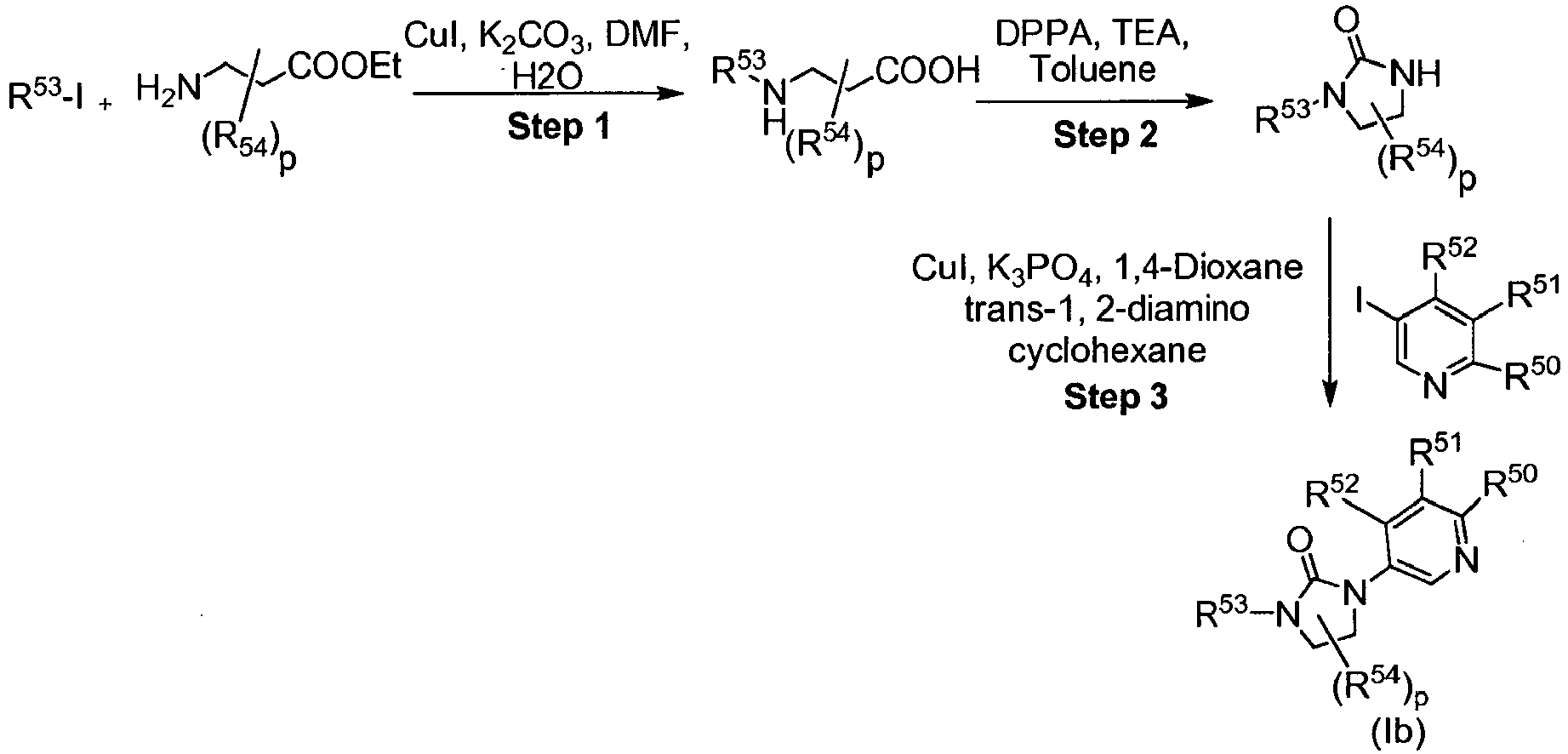
- The desired R53 group may be attached to the desired amino carboxylate compound via Buchwald-Hartwig C-N coupling conditions or NaH/ DMF, and the like. The cyclic urea is then formed using methods analogous to those described by Kak-Shan Shia, et al., in J. Med. Chem., 2002, 45, 1644-1655 . The pyridine derivative may then be coupled to the imidazoline via a Buchwald-Hartwig C-N coupling reaction described previously.
- Alternatively, the unsymmetrical disubstituted-1H-imidazolin-2(3H)-ones can be prepared by other methods discussed by T. Hafner, et al., in Synthesis (2007) 9, 1403-1411 (e.g., Brazier, S.A, et al., J Chem Soc (1912), 101, 2352 and Schonherr, H.J., et al, Chem Ber (1970), 103, 1037).
- Scheme 5 provides another alternative synthesis for preparing compounds of Formula (II) or (Ib).


- In Scheme 5 above, R is represented by the following group

- Intermediate (I-5a) may be formed via a Michael addition of the desired amine (R53-NH2) to the desired acrylic acid using procedures well-known to those of skill in the art. For example, the amine and acrylic acid in a suitable solvent (e.g., toluene) are heated at an elevated temperature (e.g., about 70°C to about 100° C) under an inert atmosphere. The amino acid intermediate (I-5a) may then be cyclized to form the cyclic urea intermediate (I-5b). For example, the cyclic urea intermediate (I-5b) may be formed by treating the amino acid intermediate (I-5a) with an activating agent (e.g., diphenyl phosphoryl azide (DPPA)) in the presence of an amine (e.g., triethylamine) and appropropriate solvent (e.g., toluene) at elevated temperatures. The desired A group may be coupled to the cyclic urea intermediate (I-5b) using standard coupling conditions described above to form the a compound of the Formula (II) or (Ib).
- The Example section below provides a more detailed description of the synthetic schemes as well as other alternative processes for making compounds of the present invention which could be easily modified (e.g., substituting different starting materials) by those of skill in the art.
- The compounds and intermediates described herein may be isolated and used as the compound per se or its salt. Many of the compounds represented by Formula (I), (II), (Ia), and (Ib) are capable of forming acid addition salts, particularly pharmaceutically acceptable acid addition salts. Pharmaceutically acceptable acid addition salts of the compound of Formula (I), (II), (Ia) and (Ib) include those of inorganic acids, for example, hydrohalic acids such as hydrochloric acid, hydrobromic acid or hydroiodic acid, nitric acid, sulfuric acid, phosphoric acid; and organic acids, for example aliphatic monocarboxylic acids such as formic acid, acetic acid, , propionic acid and butyric acid, aliphatic hydroxy acids such as lactic acid, citric acid, tartaric acid or malic acid, dicarboxylic acids such as maleic acid or succinic acid, aromatic carboxylic acids such as benzoic acid, p-chlorobenzoic acid, diphenylacetic acid or triphenylacetic acid, aromatic hydroxy acids such as o-hydroxybenzoic acid, p-hydroxybenzoic acid, 1-hydroxynaphthalene-2-carboxylic acid or 3-hydroxynaphthalene-2-carboxylic acid, and sulfonic acids such as methanesulfonic acid or benzenesulfonic acid. These salts may be prepared from compounds of Formula (I), (II), (Ia) or (Ib) by known salt-forming procedures.
- Compounds of the present invention which contain acidic, e.g. carboxyl, groups, are also capable of forming salts with bases, in particular pharmaceutically acceptable bases such as those well known in the art; suitable such salts include metal salts, particularly alkali metal or alkaline earth metal salts such as sodium, potassium, magnesium or calcium salts, or salts with ammonia or pharmaceutically acceptable organic amines or heterocyclic bases such as ethanolamines, benzylamines or pyridine. These salts may be prepared from compounds of Formula (I), (II), (Ia) and (Ib) by known salt-forming procedures.
- In those compounds where there is an asymmetric carbon atom the compounds exist in individual optically active isomeric forms or as mixtures thereof, e.g. as racemic or diastereomeric mixtures. The present invention embraces both individual optically active R and S isomers as well as mixtures, e.g. racemic or diastereomeric mixtures, thereof.
- The present invention includes all pharmaceutically acceptable isotopically-labeled compounds of the present invention wherein one or more atoms are replaced by atoms having the same atomic number, but an atomic mass or mass number different from the atomic mass or mass number usually found in nature.
- Examples of isotopes suitable for inclusion in the compounds of the invention comprises isotopes of hydrogen, such as 2H and 3H, carbon, such as 11C, 13C and 14C, chlorine, such as 36Cl, fluorine, such as 18F, iodine, such as 23I and 125I, nitrogen, such as 13N and 15N, oxygen, such as 15O, 17O and 18O, phosphorus, such as 32P, and sulphur, such as 35S.
- Substitution with heavier isotopes such as deuterium, i.e. 2H, may afford certain therapeutic advantages resulting from greater metabolic stability, for example, increased in vivo half-life or reduced dosage requirements, and hence may be preferred in some circumstances.
- Isotopically-labeled compounds of the present invention can generally be prepared by conventional techniques known to those skilled in the art or by processes analogous to those described in the accompanying Examples and Preparations Sections using an appropriate isotopically-labeled reagent in place of the non-labeled reagent previously employed.
- The compounds of the present invention may exist in unsolvated as well as solvated forms with pharmaceutically acceptable solvents such as water, ethanol, and the like, and it is intended that the invention embrace both solvated and unsolvated forms. For purposes of the present invention, solvates (including hydrates) are considered pharmaceutical compositions, e.g., a compound of Formula (I), (II), (Ia) or (Ib) (or pharmaceutically acceptable salt thereof) in combination with an excipient, wherein the excipient is a solvent.
- Compounds of the present invention are useful for treating diseases, conditions and disorders mediated by the regulation of 17α-hydroxylase/C17,20-lyase (e.g., cancer (in particular, prostate cancer) or inflammation); consequently, the compounds of the present invention (including the compositions and processes used therein) may be used in the manufacture of a medicament for the therapeutic applications described herein. Hence, another embodiment of the present invention is a pharmaceutical composition comprising a therapeutically effective amount of a compound of the present invention and a pharmaceutically acceptable excipient, diluent or carrier.
- A typical formulation is prepared by mixing a compound of the present invention and a carrier, diluent or excipient. Suitable carriers, diluents and excipients are well known to those skilled in the art and include materials such as carbohydrates, waxes, water soluble and/or swellable polymers, hydrophilic or hydrophobic materials, gelatin, oils, solvents, water, and the like. The particular carrier, diluent or excipient used will depend upon the means and purpose for which the compound of the present invention is being applied. Solvents are generally selected based on solvents recognized by persons skilled in the art as safe (GRAS) to be administered to a mammal. In general, safe solvents are non-toxic aqueous solvents such as water and other non-toxic solvents that are soluble or miscible in water. Suitable aqueous solvents include water, ethanol, propylene glycol, polyethylene glycols (e.g., PEG400, PEG300), etc. and mixtures thereof. The formulations may also include one or more buffers, stabilizing agents, surfactants, wetting agents, lubricating agents, emulsifiers, suspending agents, preservatives, antioxidants, opaquing agents, glidants, processing aids, colorants, sweeteners, perfuming agents, flavoring agents and other known additives to provide an elegant presentation of the drug (i.e., a compound of the present invention or pharmaceutical composition thereof) or aid in the manufacturing of the pharmaceutical product (i.e., medicament).
- The formulations may be prepared using conventional dissolution and mixing procedures. For example, the bulk drug substance (i.e., compound of the present invention or stabilized form of the compound (e.g., complex with a cyclodextrin derivative or other known complexation agent)) is dissolved in a suitable solvent in the presence of one or more of the excipients. The compound of the present invention is typically formulated into pharmaceutical dosage forms to provide an easily controllable dosage of the drug and to give the patient an elegant and easily handleable product.
- The pharmaceutical composition (or formulation) for application may be packaged in a variety of ways depending upon the method used for administering the drug. Generally, an article for distribution includes a container having deposited therein the pharmaceutical formulation in an appropriate form. Suitable containers are well-known to those skilled in the art and include materials such as bottles (plastic and glass), sachets, ampoules, plastic bags, metal cylinders, and the like. The container may also include a tamper-proof assemblage to prevent indiscreet access to the contents of the package. In addition, the container has deposited thereon a label that describes the contents of the container. The label may also include appropriate warnings.
- A Cyp17 inhibitor of the present invention may be usefully combined with at least one additional pharmacologically active compound, particularly in the treatment of cancer. For example, a compound of the present invention, as defined above, may be administered simultaneously, sequentially or separately in combination with one or more agents selected from chemotherapy agents, e.g. mitotic inhibitors such as a taxane (e.g., paclitaxel or docetaxel), a vinca alkaloid (e.g., vincristine, vinblastine, vinorelbine or vinflunine) or other anticancer agents, e.g. cisplatin, 5-fluorouracil or 5-fluoro-2-4(1H,3H)-pyrimidinedione (5FU), flutamide or gemcitabine. Such combinations may offer significant advantages, including synergistic activity, in therapy.
- A compound of the present invention may also be used in combination with other antiproliferative compounds. Such antiproliferative compounds include, but are not limited to aromatase inhibitors; antiestrogens; topoisomerase I inhibitors; topoisomerase II inhibitors; microtubule active compounds; alkylating compounds; compounds which induce cell differentiation processes; cyclooxygenase inhibitors; MMP inhibitors; mTOR inhibitors; antineoplastic antimetabolites; platin compounds; compounds targeting/decreasing a protein or lipid kinase activity and further anti-angiogenic compounds; compounds which target, decrease or inhibit the activity of a protein or lipid phosphatase; gonadorelin agonists; anti-androgens; methionine aminopeptidase inhibitors; bisphosphonates; biological response modifiers; antiproliferative antibodies; heparanase inhibitors; inhibitors of Ras oncogenic isoforms; telomerase inhibitors; proteasome inhibitors; compounds used in the treatment of hematologic malignancies; compounds which target, decrease or inhibit the activity of Flt-3; Hsp90 inhibitors such as 17-AAG (17-allylamino-gelda-namycin, NSC330507), 17-DMAG (17-dimethylaminoethylamino-17-demethoxy-geldana-mycin, NSC707545), IPI-504, CNF1010, CNF2024, CNF1010 from Conforma Therapeutics; temozolomide (TEMODAL); kinesin spindle protein inhibitors, such as SB715992 or SB743921 from GlaxoSmithKline, or pentamidine/chlorpromazine from CombinatoRx; PI3K inhibitors; RAF inhibitors; EDG binders, antileukemia compounds, ribonucleotide reductase inhibitors, S-adenosylmethionine decarboxylase inhibitors, antiproliferative anti-bodies or other chemotherapeutic compounds. Further, alternatively or in addition they may be used in combination with other tumor treatment approaches, including surgery, ionizing radiation, photodynamic therapy, implants, e.g. with corticosteroids, hormones, or they may be used as radiosensitizers. Also, in anti-inflammatory and/or antiproliferative treatment, combination with anti-inflammatory drugs is included. Combination is also possible with antihistamine drug substances, bronchodilatatory drugs, NSAID or antagonists of chemokine receptors.
- The term "aromatase inhibitor" as used herein relates to a compound which inhibits the estrogen production, i.e. the conversion of the substrates androstenedione and testosterone to estrone and estradiol, respectively. The term includes, but is not limited to steroids, especially atame-stane, exemestane and formestane and, in part-icular, non-steroids, especially aminoglutethimide, roglethimide, pyridoglutethimide, trilostane, testolactone, ketokonazole, vorozole, fadrozole, anastrozole and letrozole. Exemestane can be administered, e.g., in the form as it is marketed, e.g. under the trademark AROMASIN. Formestane can be administered, e.g., in the form as it is marketed, e.g. under the trademark LENTARON. Fadrozole can be administered, e.g., in the form as it is marketed, e.g. un-der the trademark AFEMA. Anastrozole can be administered, e.g., in the form as it is marketed, e.g. under the trademark ARIMIDEX. Letrozole can be administered, e.g., in the form as it is marketed, e.g. under the trademark FEMARA or FEMAR. Amino glutethimide can be administered, e.g., in the form as it is marketed, e.g. under the trademark, ORIMETEN. A combination of the invention comprising a chemo-therapeutic agent which is an aromatase inhibitor is particularly useful for the treatment of hormone receptor positive tumors, e.g., breast tumors.
- The term "anti-estrogen" as used herein relates to a compound which antagonizes the effect of estrogens at the estrogen receptor level. The term includes, but is not limited to tamoxifen, fulvestrant, raloxifene and raloxifene hydrochloride. Tamoxifen can be administered, e.g., in the form as it is marketed, e.g. under the trademark NOLVADEX. Raloxifene hydrochloride can be administered, e.g., in the form as it is marketed, e.g. under the trademark EVISTA. Fulvestrant can be formulated as disclosed in
US 4,659,516 or it can be administered, e.g., in the form as it is marketed, e.g. under the trademark FASLODEX. A combination of the invention comprising a chemotherapeutic agent which is an anti-estrogen is particularly useful for the treatment of estrogen receptor positive tumors, e.g. breast tumors. - The term "anti-androgen" as used herein relates to any substance which is capable of in-hibiting the biological effects of androgenic hormones and includes, but is not limited to, bicalutamide (CASODEX), which can be formulated, e.g. as disclosed in
US 4,636,505 . - The term "gonadorelin agonist" as used herein includes, but is not limited to abarelix, goserelin and goserelin acetate. Goserelin is disclosed in
US 4,100,274 and can be administered, e.g., in the form as it is marketed, e.g. under the trademark ZOLADEX. Abarelix can be formulated, e.g. as disclosed inUS 5,843,901 . - The term "topoisomerase I inhibitor" as used herein includes, but is not limited to topotecan, gimatecan, irinotecan, camptothecin and its analogues, 9-nitrocamptothecin and the macromolecular camptothecin conjugate PNU-166148 (compound A1 in
WO99/ 17804 - The term "topoisomerase II inhibitor" as used herein includes, but is not limited to the anthracyclines such as doxorubicin (including liposomal formulation, e.g. CAELYX), daunorubicin, epirubicin, idarubicin and nemorubicin, the anthraquinones mitoxantrone and losoxantrone, and the podophillotoxines etoposide and teniposide. Etoposide can be administered, e.g. in the form as it is marketed, e.g. under the trademark ETOPOPHOS. Teniposide can be administered, e.g. in the form as it is marketed, e.g. under the trademark VM 26-BRISTOL. Doxorubicin can be administered, e.g. in the form as it is marketed, e.g. under the trademark ADRIBLASTIN or ADRIAMYCIN. Epirubicin can be administered, e.g. in the form as it is marketed, e.g. under the trademark FARMORUBICIN. Idarubicin can be administered, e.g. in the form as it is marketed, e.g. under the trademark ZAVEDOS. Mitoxantrone can be administered, e.g. in the form as it is marketed, e.g. under the trademark NOVANTRON.
- The term "microtubule active compound" relates to microtubule stabilizing, microtubule destabilizing compounds and microtublin polymerization inhibitors including, but not limited to taxanes, e.g. paclitaxel and docetaxel, vinca alkaloids, e.g., vinblastine, especially vinblastine sulfate, vincristine especially vincristine sulfate, and vinorelbine, discodermolides, cochicine and epothilones and derivatives thereof, e.g. epothilone B or D or derivatives thereof. Paclitaxel may be administered e.g. in the form as it is marketed, e.g. TAXOL. Docetaxel can be administered, e.g., in the form as it is marketed, e.g. under the trademark TAXOTERE. Vinblastine sulfate can be administered, e.g., in the form as it is marketed, e.g. under the trademark VINBLASTIN R.P. Vincristine sulfate can be administered, e.g., in the form as it is marketed, e.g. under the trademark FARMISTIN. Discodermolide can be obtained, e.g., as disclosed in
US 5,010,099 . Also included are Epothilone derivatives which are disclosed inWO 98/10121 US 6,194,181 ,WO 98/25929 WO 98/08849 WO 99/43653 WO 98/22461 WO 00/31247 - The term "alkylating compound" as used herein includes, but is not limited to, cyclophosphamide, ifosfamide, melphalan or nitrosourea (BCNU or Gliadel). Cyclophosphamide can be administered, e.g., in the form as it is marketed, e.g. under the trademark CYCLOSTIN. Ifosfamide can be administered, e.g., in the form as it is marketed, e.g., under the trademark HOLOXAN.
- The term "antineoplastic antimetabolite" includes, but is not limited to, 5-Fluorouracil or 5-FU, capecitabine, gemcitabine, DNA demethylating compounds, such as 5-azacy-ti-dine and decitabine, methotrexate and edatrexate, and folic acid antagonists such as pemetrexed. Capecitabine can be administe-red, e.g., in the form as it is marketed, e.g. under the trademark XELODA. Gemcitabine can be administered, e.g., in the form as it is marketed, e.g. under the trademark GEMZAR. The term "platin compound" as used herein includes, but is not limited to, carboplatin, cis-platin, cisplatinum and oxaliplatin. Carboplatin can be administered, e.g., in the form as it is marketed, e.g. under the trademark CARBOPLAT. Oxaliplatin can be administered, e.g., in the form as it is marketed, e.g. under the trademark ELOXATIN.
- The term "compounds targeting/decreasing a protein or lipid kinase activity"; or a "protein or lipid phosphatase activity"; or "further anti-angiogenic compounds" as used herein includes, but is not limited to, protein tyrosine kinase and/or serine and/or threonine kinase inhibitors or lipid kinase inhibitors, e.g., a) compounds targeting, decreasing or inhibiting the activity of the platelet-derived growth factor-receptors (PDGFR), such as compounds which target, decrease or inhibit the activity of PDGFR, especially compounds which inhibit the PDGF receptor, e.g. a N-phenyl-2-pyrimidine-amine derivative, e.g. imatinib, SU101, SU6668 and GFB-111; b) compounds targeting, decreasing or inhibiting the activity of the fibroblast growth factor-receptors (FGFR); c) compounds targeting, decreasing or inhibiting the activity of the insulin-like growth factor receptor I (IGF-IR), such as compounds which target, decrease or inhibit the activity of IGF-IR, especially compounds which inhibit the kinase activity of IGF-I receptor, such as those compounds disclosed in
WO 02/092599 US 5,093,330 , e.g. midostaurin; examples of further compounds include e.g. UCN-01, safingol, BAY 43-9006, Bryostatin 1, Perifosine; Ilmofosine; RO 318220 and RO 320432; GO 6976; Isis 3521; LY333531/LY379196; isochinoline compounds such as those disclosed inWO 00/09495 WO 97/02266 EP 0 564 409 ,WO 99/03854 EP 0520722 ,EP 0 566 226 ,EP 0 787 722 ,EP 0 837 063 ,US 5,747,498 ,WO 98/10767 WO 97/30034 WO 97/49688 WO 97/38983 WO 96/30347 WO 96/33980 WO 95/03283 WO 03/013541 - Further anti-angiogenic compounds include compounds having another mechanism for their activity, e.g. unrelated to protein or lipid kinase inhibition e.g. thalidomide (THALOMID) and TNP-470.
- Compounds which target, decrease or inhibit the activity of a protein or lipid phosphatase are e.g., inhibitors of phosphatase 1, phosphatase 2A, or CDC25, e.g. okadaic acid or a derivative thereof.
- Compounds which induce cell differentiation processes are e.g. retinoic acid, or tocopherol or tocotrienol.
- The term cyclooxygenase inhibitor as used herein includes, but is not limited to, e.g. Cox-2 inhibitors, 5-alkyl substituted 2-arylaminophenylacetic acid and derivatives, such as celecoxib (CELEBREX), rofecoxib (VIOXX), etoricoxib, valdecoxib or a 5-alkyl-2-arylaminophenylacetic acid, e.g. 5-methyl-2-(2'-chloro-6'-fluoroanilino)phenyl acetic acid, lumiracoxib.
- The term "bisphosphonates" as used herein includes, but is not limited to, etridonic, clodronic, tiludronic, pamidronic, alendronic, ibandronic, risedronic and zoledronic acid. "Etridonic acid" can be administered, e.g., in the form as it is marketed, e.g. under the trademark DIDRONEL. "Clodronic acid" can be administered, e.g., in the form as it is marketed, e.g. under the trademark BONEFOS. "Tiludronic acid" can be administered, e.g., in the form as it is marketed, e.g. under the trademark SKELID. "Pamidronic acid" can be administered, e.g. in the form as it is marketed, e.g. under the trademark AREDIA. "Alendronic acid" can be administered, e.g., in the form as it is marketed, e.g. under the trademark FOSAMAX. "Ibandronic acid" can be administered, e.g., in the form as it is marketed, e.g. under the trademark BONDRANAT. "Risedronic acid" can be administered, e.g., in the form as it is marketed, e.g. under the trademark ACTONEL. "Zoledronic acid" can be administered, e.g. in the form as it is marketed, e.g. under the trademark ZOMETA.
- The term "mTOR inhibitors" relates to compounds which inhibit the mammalian target of rapamycin (mTOR) and which possess antiproliferative activity such as sirolimus (Rapamune), everolimus (CerticanÔ), CCI-779 and ABT578.
- The term "heparanase inhibitor" as used herein refers to compounds which target, decrease or inhibit heparin sulfate degradation. The term includes, but is not limited to, PI-88.
- The term "biological response modifier" as used herein refers to a lymphokine or interferons, e.g. interferon.
- The term "inhibitor of Ras oncogenic isoforms", e.g. H-Ras, K-Ras, or N-Ras, as used herein refers to compounds which target, decrease or inhibit the oncogenic activity of Ras e.g. a "farnesyl transferase inhibitor" e.g. L-744832, DK8G557 or R115777 (Zarnestra).
- The term "telomerase inhibitor" as used herein refers to compounds which target, decrease or inhibit the activity of telomerase. Compounds which target, decrease or inhibit the activity of telomerase are especially compounds which inhibit the telomerase receptor, e.g. telomestatin.
- The term "methionine aminopeptidase inhibitor" as used herein refers to compounds which target, decrease or inhibit the activity of methionine aminopeptidase. Compounds which target, decrease or inhibit the activity of methionine aminopeptidase are e.g. bengamide or a derivative thereof.
- The term "proteasome inhibitor" as used herein refers to compounds which target, decrease or inhibit the activity of the proteasome. Compounds which target, decrease or inhibit the activity of the proteasome include e.g. Bortezomid (Velcade) and MLN 341. The term "matrix metalloproteinase inhibitor" or ("MMP" inhibitor) as used herein includes, but is not limited to, collagen peptidomimetic and nonpeptidomimetic inhibitors, tetracycline derivatives, e.g. hydroxamate peptidomimetic inhibitor batimastat and its orally bioavailable analogue marimastat (BB-2516), prinomastat (AG3340), metastat (NSC 683551) BMS-279251, BAY 12-9566, TAA211, MMI270B or AAJ996. The term "compounds used in the treatment of hematologic malignancies" as used herein includes, but is not limited to, FMS-like tyrosine kinase inhibitors e.g. compounds targeting, decreasing or inhibiting the activity of FMS-like tyrosine kinase receptors (Flt-3R); interferon, 1-b-D-arabinofuransylcytosine (ara-c) and bisulfan; and ALK inhibitors e.g. compounds which target, decrease or inhibit anaplastic lymphoma kinase. Compounds which target, decrease or inhibit the activity of FMS-like tyrosine kinase receptors (Flt-3R) are especially compounds, proteins or antibodies which inhibit members of the Flt-3R receptor kinase family, e.g. PKC412, TKI258, midostaurin, a staurosporine derivative, SU11248 and MLN518.
- The term "HSP90 inhibitors" as used herein includes, but is not limited to, compounds targeting, decreasing or inhibiting the intrinsic ATPase activity of HSP90; degrading, targeting, decreasing or inhibiting the HSP90 client proteins via the ubiquitin proteosome pathway. Compounds targeting, decreasing or inhibiting the intrinsic ATPase activity of HSP90 are especially compounds, proteins or antibodies which inhibit the ATPase activity of HSP90 e.g., 17-allylamino,17-demethoxygeldanamycin (17AAG), a geldanamycin derivative; other geldanamycin related compounds; radicicol and HDAC inhibitors. An example HSP90 inhibitor is AUY922.
- The term "antiproliferative antibodies" as used herein includes, but is not limited to, trastuzumab (Herceptin), Trastuzumab-DM1,erbitux, bevacizumab (Avastin), rituximab (Rituxan), PRO64553 (anti-CD40) and 2C4 Antibody. By antibodies is meant e.g. intact monoclonal antibodies, polyclonal antibodies, multispe-cific antibodies formed from at least 2 intact antibodies, and antibodies fragments so long as they exhibit the desired biological activity.
- For the treatment of acute myeloid leukemia (AML), compounds of formula (I) can be used in combination with standard leukemia therapies, especially in combination with therapies used for the treatment of AML. In particular, compounds of formula (I) can be administered in combination with, e.g., farnesyl transferase inhibitors and/or other drugs useful for the treatment of AML, such as Daunorubicin, Adriamycin, Ara-C, VP-16, Teniposide, Mitoxantrone, Idarubicin, Carboplatinum and PKC412.
- The term "antileukemic compounds" includes, for example, Ara-C, a pyrimidine analog, which is the 2-alpha-hydroxy ribose (arabinoside) derivative of deoxycytidine. Also included is the purine analog of hypoxanthine, 6-mercaptopurine (6-MP) and fludarabine phosphate.
- Somatostatin receptor antagonists as used herein refers to compounds which target, treat or inhibit the somatostatin receptor such as octreotide, and SOM230 (pasireotide).
- Tumor cell damaging approaches refer to approaches such as ionizing radiation. The term "ionizing radiation" referred to above and hereinafter means ionizing radiation that occurs as either electromagnetic rays (such as X-rays and gamma rays) or particles (such as alpha and beta particles). Ionizing radiation is provided in, but not limited to, radiation therapy and is known in the art. See Hellman, Principles of Radiation Therapy, Cancer, in Principles and Practice of Oncology, Devita et al., Eds., 4th Edition, Vol. 1, pp. 248-275 (1993).
- The term "EDG binders" as used herein refers a class of immunosuppressants that modulates lymphocyte recirculation, such as FTY720.
- The term "ribonucleotide reductase inhibitors" refers to pyrimidine or purine nucleoside analogs including, but not limited to, fludarabine and/or cytosine arabinoside (ara-C), 6-thioguanine, 5-fluorouracil, cladribine, 6-mercaptopurine (especially in combination with ara-C against ALL) and/or pentostatin. Ribonucleotide reductase inhibitors are especially hydroxyurea or 2-hydroxy-1H-isoindole-1,3-dione derivatives, such as PL-1, PL-2, PL-3, PL-4, PL-5, PL-6, PL-7 or PL-8 mentioned in Nandy et al., Acta Oncologica, Vol. 33, No. 8, pp. 953-961 (1994).
- The term "S-adenosylmethionine decarboxylase inhibitors" as used herein includes, but is not limited to the compounds disclosed in
US 5,461,076 . - Also included are in particular those compounds, proteins or monoclonal antibodies of VEGF disclosed in
WO 98/35958 WO 00/09495 WO 00/27820 WO 00/59509 WO 98/11223 WO 00/27819 EP 0 769 947 ; those as described by Prewett et al, Cancer Res, Vol. 59, pp. 5209-5218 (1999); Yuan et al., Proc Natl Acad Sci U S A, Vol. 93, pp. 14765-14770 (1996); Zhu et al., Cancer Res, Vol. 58, pp. 3209-3214 (1998); and Mordenti et al., Toxicol Pathol, Vol. 27, No. 1, pp. 14-21 (1999); inWO 00/37502 WO 94/10202 - Photodynamic therapy as used herein refers to therapy which uses certain chemicals known as photosensitizing compounds to treat or prevent cancers. Examples of photodynamic therapy includes treatment with compounds, such as e.g. VISUDYNE and porfimer sodium.
- Angiostatic steroids as used herein refers to compounds which block or inhibit angiogenesis, such as, e.g., anecortave, triamcinolone, hydrocortisone, 11-epihydrocotisol, cortexolone, 17-hydroxyprogesterone, corticosterone, desoxycorticosterone, testosterone, estrone and dexamethasone. Implants containing corticosteroids refers to compounds, such as e.g. fluocinolone, dexamethasone.
- "Other chemotherapeutic compounds" include, but are not limited to, plant alkaloids, hormonal compounds and antagonists; biological response modifiers, preferably lymphokines or interferons; antisense oligonucleotides or oligonucleotide derivatives; shRNA or siRNA; or miscellaneous compounds or compounds with other or unknown mechanism of action.
- The structure of the active compounds identified by code nos., generic or trade names may be taken from the actual edition of the standard compendium "The Merck Index" or from databases, e.g. Patents International (e.g. IMS World Publications).
- The following abbreviations used in the examples below have the corresponding meanings:
- DIPA:
- Diisopropylamine
- DPPA :
- Diphenylphosphoryl Azide
- DCM:
- Dichloromethane
- DCE:
- Dichloroethane
- DMF:
- N,N-Dimethylformamide
- DMSO:
- Dimethylsulfoxide
- TEA:
- Triethylamine
- THF:
- Tetrahydrofuran
- NaBH(OAc)3:
- Sodium triacetoxy borohydride
- PTSA:
- Para toluene sulphonic acid
- TES:
- Triethyl silane
- LiHMDS:
- Lithium bis(trimethylsilyl)amide
- TEA:
- Triethyl amine
- Pd2(dba)3:
- Tris(dibenzylideneacetone)dipalladium(O)
- TLC:
- Thin Layer Chromatography
- NMR:
- Nuclear Magnetic Resonance
- LCMS:
- Liquid chromatography Mass spectrometry
- HPLC:
- High Performance Liquid Chromatography
-

-

- 1-Chloro-2-isocyanato-ethane (560 mg, 5.31 mmol) was added dropwise to a stirred solution of pyridin-3-ylamine (500 mg, 5.31 mmol) in toluene (10 mL) over a period of 30 minutes at 0°C. The reaction temperature was maintained at room temperature for 5 hours. The reaction was monitored by TLC (100% ethyl acetate). The reaction mixture was filtered, washed with toluene and dried under reduced pressure to afford 1.0g (98% yield) of 1-(2-Chloro-ethyl)-3-pyridin-3-yl-urea.
- 'H NMR (DMSO-D6, 300MHz): δ 8.9 (br s, 1H), 8.55 (br s, 1H), 8.1 (d, 1H), 7.9 (m, 1H), 7.3 (m, 1H), 6.5 (t, 1H), 3.65 (t, 2H), 3.45 (q, 2H)
LCMS purity: 99.75%, m/z= 200.2(M+1) -

- 1-(2-Chloro-ethyl)-3-pyridin-3-yl-urea (I-1a: 1000 mg, 5.0 mmol) in dry DMF (10 mL) was added to a stirred solution of sodium hydride (216mg, 9.0mmol) in THF (10 mL) at 0°C The reaction temperature was maintained at room temperature for 30 minutes. The reaction was monitored by TLC (100% ethyl acetate). The reaction mixture was quenched with MeOH (5 mL) at 0°C. The reaction mixture was concentrated under reduced pressure and partitioned between ice water and chloroform. The organic layer was dried over Na2SO4, and concentrated under reduced pressure to afford 800mg (97% yield) of 1-pyridin-3-yl-imidazolidin-2-one.
- 'H NMR (CDCl3, 300MHz): δ 8.75 (d, 1H), 8.2 (dd, 1H), 8.0 (m, 1H), 7.35 (m, 1H), 7.15 (br s, 1H), 3.9 (m, 2H), 3.45 (m, 2H)
LCMS purity: m/z= 164.2(M+1) - Copper iodide (10.0 mg, 0.113 mmol), trans-1,2-diamino cyclohexane (10.0 mg, 0.091 mmol) and potassium carbonate (169 mg, 1.22 mmol) were added to a solution of 1, 4-dioxane (5 mL) previously purged with argon (10 minutes). The reaction mixture was purged with argon for 10 minutes, followed by the addition of 1-pyridin-3-yl-imidazolidin-2-one (I-1b: 100 mg, 0.61 mmol) and 2-bromo naphthalene (126 mg, 0.61 mmol). The reaction mixture was heated to reflux at 110°C for 15 hours. The reaction was monitored by TLC (10% MeOH in chloroform). The reaction mixture was filtered through a celite bed and the bed was washed with chloroform. The organic layer was concentrated and purification by column chromatography (using silica gel of mesh size of 60-120, 20% ethyl acetate in hexane as eluent) afforded 48 mg (28% yield) of 1-naphthalen-2-yl-3-pyridin-3-yl-imidazolidin-2-one.
- 1H NMR (DMSO-D6, 300 MHz): δ 8.9 (d, 1H), 8.3 (d, 1H), 8.15-8.05 (m, 2H), 7.95-7.85 (m, 4H), 7.55-7.4 (m, 3H), 4.2-4.0 (m, 4H)
LCMS purity: 98.57%; m/z= 290.0(M+1)
HPLC: 96.05% -

- Using the same reaction conditions as in Example 1, 1-pyridin-3-yl-imidazolidin-2-one (I-1b: 200 mg, 1.226 mmol) was reacted with 5-bromo-1-ethyl-1H-indole (274 mg, 1.226 mmol), 1,4-dioxane (10 mL), copper iodide (23.3 mg, 0.1226 mmol), trans-1,2-diamino cyclohexane (20.99mg, 1.839mmol) and potassium carbonate (338mg, 2.452 mmol) to afford the crude product. Purification by column chromatography on silica gel (30% ethylacetate in hexane), afforded 185 mg of the product (49.33% yield).
- 1H NMR (DMSO-D6, 300 MHz): δ 8.85-8.8 (br s, 1H), 8.2 (d, 1H), 8.1-8.05 (m, 1H), 7.65 (s, 1H), 7.5 (s, 2H), 7.4-7.35 (m, 2H), 6.4 (d, 1H), 4.5 (q, 2H), 4.1-4.0 (m, 4H), 1.4 (t, 3H)
LCMS purity: 96.97%, m/z = 307.0 (M+1)
HPLC: 98.74% -

- Using the same reaction conditions as in Example 1, 1-pyridin-3-yl-imidazolidin-2-one (I-1b: 68.7 mg, 0.4217 mmol) was reacted with 2-bromo-6-methoxy-naphthalene (100 mg, 0.4217 mmol), 1, 4-dioxane (5 mL), copper iodide (8.0 mg, 0.04217 mmol), trans-1,2-diamino cyclohexane (7 mg, 0.0632 mmol) and potassium carbonate (116 mg, 0.8432 mmol) to afford the crude product. Purification by column chromatography on silica gel (50% ethylacetate in hexane), afforded 72 mg of the product (55.22% yield).
- 1H NMR (DMSO-D6, 300 MHz): δ 8.9 (d, 1H), 8.3 (dd, 1H), 8.0-8.1 (m, 2H), 7.8 (m, 3H), 7.4 (m, 1H), 7.3 (d, 1H), 7.15(dd, 1H), 4.2-4.0 (m, 4H), 3.85 (s, 3H)
LCMS purity: 96.72%, m/z = 320.0 (M+1)
HPLC: 97.84% -

- Using the same reaction conditions as in Example 1, 1-pyridin-3-yl-imidazolidin-2-one (I-1b: 62mg, 0.3831 mmol)) was reacted with 6-iodo-benzothiazole (100 mg, 0.3831 mmol), 1, 4-dioxane (10 mL), copper iodide (7 mg, 0.03831mmol), trans-1,2-diamino cyclohexane (6 mg, 0.5747 mmol) and potassium carbonate (105 mg, 0.7662 mmol) to afford the crude product. Purification by column chromatography on silica gel (1% MeOH in chloroform), afforded 52 mg of the product (46.01 % yield).
- 1H NMR (DMSO-D6, 300 MHz): δ 9.3 (s, 1H), 8.9 (d, 1H), 8.35-8.25 (m, 2H), 8.1-8.0 (m, 2H), 7.95 (dd, 1H), 7.45-7.4 (m, 1H), 4.2-4.0 (m, 4H)
LCMS purity: 93.45%, m/z = 297.3 (M+1)
HPLC: 95.65% -

- Using the same reaction conditions as in Example 1, 1-pyridin-3-yl-imidazolidin-2-one (I-1b: 95 mg, 0.5882 mmol) was reacted with 6-bromo-1-ethyl-3,4-dihydro-1H-quinolin-2-one (150 mg, 0.5882 mmol), 1, 4-dioxane (5 mL), copper iodide (11 mg, 0.05882 mmol), trans-1,2-diamino cyclohexane (10 mg, 0.08823 mmol) and potassium carbonate (162 mg, 1.1764 mmol) to afford the crude product. Purification by column chromatography on silica gel (1% MeOH in chloroform), afforded 94 mg of the product (47.71% yield).
- 1H NMR (DMSO-D6, 300 MHz): δ 8.85 (d, 1H), 8.3 (dd, 1H), 8.1-8.0 (m, 1H), 7.55-7.45 (m, 2H), 7.45-7.35 (m, 1H), 7.15 (d, 1H), 4.0 (s, 4H), 3.9 (q, 2H), 2.85 (t, 2H), 2.55-2.5 (m, 2H), 1.1 (t, 3H)
LCMS purity: 99.16%, m/z = 337.3 (M+1)
HPLC: 95.77% -

- Using the same reaction conditions as in Example 1, 1-pyridin-3-yl-imidazolidin-2-one (I-1b: 73 mg, 0.45 mmol) was reacted with 2-bromo-5-fluoro-3-methyl-benzo[b]thiophene (110 mg, 0.45 mmol), 1, 4-dioxane (5 mL), copper iodide (8 mg, 0.045 mmol), trans-1,2-diamino cyclohexane (7 mg, 0.0675 mmol) and potassium carbonate (124 mg, 0.9 mmol) to afford the crude product. Purification by column chromatography on silica gel (1% MeOH in chloroform), afforded 90 mg of the product (61.64% yield).
- 1H NMR (DMSO-D6, 300 MHz): δ 8.9 (d, 1H), 8.3 (dd, 1H), 8.15-8.05 (m, 1H), 7.95-7.7 (m, 1H), 7.6 (dd, 1H), 7.45-7.4 (m, 1H), 7.3-7.2 (m, 1H), 4.15-4.0 (m, 4H), 2.3 (s, 3H)
LCMS purity: 98.04%, m/z = 327.9 (M+1)
HPLC: 95.05% -

- Using the same reaction conditions as in Example 1,1-pyridin-3-yl-imidazolidin-2-one (I-1b: 93.6 mg, 0.5747 mmol) was reacted with 5-iodo-benzo[b]thiophene (150 mg, 0.5747 mmol), 1, 4-dioxane (5 mL), copper iodide (10 mg, 0.05747 mmol), trans-1,2-diamino cyclohexane (9 mg, 0.0862 mmol) and potassium carbonate (158.9 mg, 1.149 mmol) to afford the crude product. Purification by column chromatography on silica gel (1% MeOH in chloroform), afforded 70 mg of the product (41.42% yield).
- 1H NMR (DMSO-D6, 300 MHz): δ 8.9 (d, 1H), 8.3 (dd, 1H), 8.1-8.0 (m, 3H), 7.8-7.75 (m, 2H), 7.45-7.4 (m, 2H), 4.1-4.0 (m, 4H)
LCMS purity: 97.11 %, m/z = 296.3 (M+1)
HPLC: 97.46% -

- Using the same reaction conditions as in Example 1, 1-pyridin-3-yl-imidazolidin-2-one (I-1b: 117 mg, 0.7215 mmol) was reacted with 6-bromo-quinoline (150 mg, 0.7215 mmol), 1, 4-dioxane (5 mL), copper iodide (13 mg, 0.07215 mmol), trans-1,2-diamino cyclohexane (24.78 mg, 0.21645 mmol) and potassium carbonate (199.49 mg, 1.1443 mmol) to afford the crude product. Purification by column chromatography on silica gel (1% MeOH in chloroform), afforded 125 mg of the product (60.09% yield).
- 1H NMR (DMSO-D6, 300 MHz): δ 8.9 (d, 1H), 8.8 (dd, 1H), 8.4-8.25 (m, 3H), 8.15-8.0 (m, 2H), 7.9 (d, 1H), 7.55-7.4 (m, 2H), 4.2-4.0 (m, 4H)
LCMS purity: 98.99%, m/z = 291.1 (M+1)
HPLC: 98.55% -
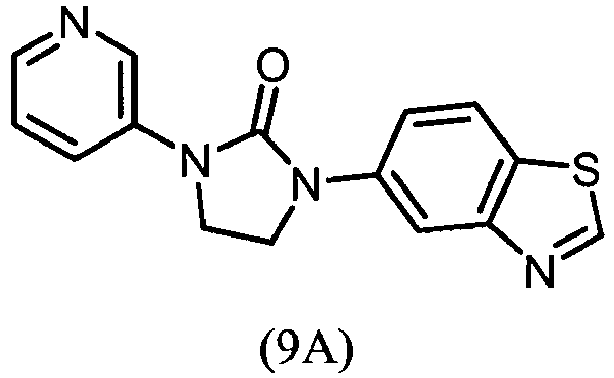
- Using the same reaction conditions as in Example 1, 1-pyridin-3-yl-imidazolidin-2-one (I-1b: 93.67 mg, 0.5747 mmol) was reacted with 5-iodo-benzothiazole (150mg, 0.5747 mmol), 1, 4-dioxane (5 mL), copper iodide (10.9 mg, 0.05747 mmol), trans-1,2-diamino cyclohexane (19.65 mg, 0.1724 mmol) and potassium carbonate (159mg, 1.1494mmol) to afford the crude product. Purification by column chromatography on silica gel (1% MeOH in chloroform) afforded 105 mg of the product (61.76% yield).
- 1H NMR (DMSO-D6, 300 MHz): δ 9.4 (s, 1H), 8.9 (d, 1H), 8.35-8.25 (m, 2H), 8.2-8.05 (m, 2H), 8.0-7.9 (dd, 1H), 7.45-7.4 (m, 1H), 4.2-4.0 (m, 4H)
LCMS purity: 98.09%, m/z = 296.9 (M+1)
HPLC: 95.27% -

-

- 1-Chloro-3-isocyanato-propane (1.897 g, 15.873 mmol) was added dropwise to a stirred solution of pyridin-3-ylamine (1 g, 10.582 mmol) in toluene (15 mL) over a period of 30 minutes at 0°C. The reaction temperature was maintained at room temperature for 6 hours. The reaction was monitored by TLC (100% ethyl acetate). The reaction mixture was filtered, washed with toluene and dried under reduced pressure to afford 2.1 g (95.45% yield) of 1-(3-chloro-propyl)-3-pyridin-3-yl-urea.
- 1H NMR (DMSO-D6, 300 MHz): δ; 8.65(brS, 1H), 8.5(d, 1H), 8.15 (dd, 1H), 7.9 (m, 1H), 7.35(m, 1H), 6.4 (t, 1H), 3.65(t, 2H), 3.2 (q, 2H), 1.9(m,2H)
-

- 1-(3-Chloro-propyl)-3-pyridin-3-yl-urea (I-10a: 2.1 g, 9.859 mmol) in dry DMF (10 mL) was added to a solution of sodium hydride (487 mg, 10.154 mmol) in THF (2 mL) at 0°C. The reaction temperature was maintained at room temperature for 30 minutes. The reaction was monitored by TLC (100% ethyl acetate). The reaction mixture was quenched with MeOH (5 mL) at 0°C, concentrated under reduced pressure and partitioned between ice cold water and chloroform. The organic layer was dried over Na2SO4, and concentrated under reduced pressure to afford 1.7 g (97.14% yield) of 1-pyridin-3-yl-tetrahydro-pyrimidin-2-one.
- 1H NMR (DMSO-D6, 300 MHz): δ 8.59(d, 1H), 8.3(dd, 1H), 7.7 (m, 1H), 7.35(m, 1H), 6.75(brS, 1H), 3.7 (t, 2H), 3.35(m, 2H), 1.9 (m, 2H)
- Using the same reaction conditions as in Example 1, 1-pyridin-3-yl-tetrahydro-pyrimidin-2-one (I-10b: 118 mg, 0.724 mmol) was reacted with 2-bromo-naphthalene (150 mg, 0.724 mmol), 1, 4-dioxane (5 mL), copper iodide (13.79 mg, 0.0724 mmol), trans-1,2-diamino cyclohexane (24.865 mg, 0.2172 mmol) and potassium carbonate (200 mg, 1.448 mmol) to afford the crude product. Purification by column chromatography on silica gel (1% MeOH in chloroform) afforded 75 mg of the product (35.71% yield).
- 1H NMR (DMSO-D6, 300 MHz): δ 8.65 (d, 1H), 8.35-8.3 (m, 1H), 7.95-7.75 (m, 5H), 7.6-7.4 (m, 4H), 3.95-3.8 (m, 4H), 2.3-2.2 (m, 2H)
LCMS purity: 98.98%, m/z = 304.0 (M+1)
HPLC: 99.14% -

- Using the same reaction conditions as in Example 1, 1-pyridin-3-yl-imidazolidin-2-one (I-1b: 95.8 mg, 0.5882 mmol) was reacted with 6-bromo-2-chloro-4-methylquinoline (150 mg, 0.5882 mmol), 1, 4-dioxane (5 mL), copper iodide (11.2 mg, 0.05882 mmol), trans-1,2-diamino cyclohexane (20.20 mg, 0.1764 mmol) and potassium carbonate (162.6 mg, 1.1764 mmol) to afford the crude product. Purification by column chromatography on silica gel (1% MeOH in chloroform) afforded 70 mg of the product (35.17% yield).
- 1H NMR (DMSO-D6, 300 MHz): δ 8.85 (d, 1H), 8.4-8.3 (m, 2H), 8.15-7.95 (m, 3H), 7.5-7.4 (m, 2H), 4.3-4.0 (m, 4H), 2.6 (s, 3H)
LCMS purity: 89.47%, m/z = 339.0 (M+1)
HPLC: 97.08% -

- Using the same reaction conditions as in Example 1, 1-pyridin-3-yl-imidazolidin-2-one (I-1b: 270 mg, 1.6587 mmol) was reacted with 5-bromo-indan-1-one (350 mg, 1.6587 mmol), 1, 4-dioxane (10 mL), copper iodide (31.59 mg, 0.165879 mmol), trans-1,2-diamino cyclohexane (56.976 mg, 0.4976 mmol) and potassium carbonate (458.63 mg, 3.3174 mmol) to afford the crude product. Purification by column chromatography on silica gel (1% MeOH in chloroform) afforded 300 mg of 1-(1-oxo-indan-5-yl)-3-pyridin-3-yl-imidazolidin-2-one (61.72% yield).
- Hydroxylamine hydrochloride (141 mg, 2.044 mmol) and sodium acetate (167.6 mg, 2.044 mmol) in 5 mL of water were added to a solution of 1-(3-oxo-indan-5-yl)-3-pyridin-3-yl-imidazolidin-2-one (200 mg, 0.6814 mmol) in ethanol (7 mL). The reaction mixture was heated to 90°C and maintained for 6 hours. The reaction mixture was then cooled to room temperature and the solvent was distilled from the reaction mixture. The precipitate formed was collected, washed with chloroform and dried under reduced pressure to afford 200 mg of the product (90% yield).
- 1H NMR (DMSO-D6, 300 MHz): δ 10.5 (s, 1H), 8.9 (s, 1H), 8.35-8.25 (br s, 1H), 8.1 (d, 1H), 7.7-7.4 (m, 4H), 4.0 (s, 4H), 3.05-3.0 (m, 2H), 2.85-2.7 (m, 2H)
LCMS purity: 98.13%, m/z = 309.2 (M+1)
HPLC: 83.39% -

- Using the same reaction conditions as in Example 1, 1-pyridin-3-yl-tetrahydro-pyrimidin-2-one (I-10b: 67.8 mg, 0.3831 mmol) was reacted with 5-iodo-benzo[b]thiophene (100 mg, 0.3831 mmol), 1, 4-dioxane (5 mL), copper iodide (7.29 mg, 0.03831 mmol), trans-1,2-diamino cyclohexane (13.15 mg, 0.1149 mmol) and potassium carbonate (106.1 mg, 0.7662 mmol) to afford 15 mg of the product (17.5% yield).
- 1H NMR (DMSO-D6, 300 MHz): δ 8.7-8.5 (br s, 1H), 8.4-8.3 (br s, 1H), 7.95 (d, 1H), 7.85-7.75 (m, 3H), 7.45-7.35 (m, 3H), 3.9 (q, 4H), 2.35-2.25 (m, 2H)
LCMS purity: 99.84%, m/z = 309.9 (M+1)
HPLC: 94.28% -

-

- 1-Chloro-2-isocyanato-ethane (5.91 ml, 69.35 mmol) was added dropwise to a stirred solution of 4-methyl-pyridin-3-ylamine (5 g, 46.23 mmol) in toluene (180 mL) at 0°C. The reaction temperature was maintained at room temperature for 5 hours. The reaction was monitored by TLC (5% MeOH in chloroform). The reaction mixture was filtered, washed with toluene and dried under reduced pressure to afford 8.5 g (86% yield) of 1-(2-chloro-ethyl)-3-(4-methyl-pyridin-3-yl)-urea.
- 'H NMR (DMSO-D6, 300MHz): δ 8.95 (s, 1H), 8.1 (m, 2H), 7.25 (d, 1H), 6.95 (t, 1H), 3.7 (t, 2H), 3.45 (q, 2H), 2.2 (s, 3H)
LCMS: m/z= 214.1 (M+1) -

- 1-(2-Chloro-ethyl)-3-(4-methyl-pyridin-3-yl)-urea (I-14a: 8.5 g, 39.96 mmol) in dry DMF (150 mL) was added to a stirred mixture of sodium hydride (2.87 g, 59.94 mmol) in THF (150 mL) at 0°C. The reaction temperature was maintained at room temperature for 30 minutes. The reaction was monitored by TLC. The reaction mixture was quenched with MeOH at 0°C, concentrated under reduced pressure and partitioned between ice water and chloroform. The organic layer was dried over Na2SO4, and concentrated under reduced pressure to afford 6.5 g (91% yield) of 1-(4-methyl-pyridin-3-yl)-imidazolidin-2-one.
- 'H NMR (DMSO-D6, 300MHz): δ 8.4 (s, 1H), 8.3 (m, 1H), 7.3 (d, 1H), 6.85 (br s, 1H), 3.8 (t, 2H), 3.45 (t, 2H), 2.25 (s, 3H)
LCMS purity: 100%, m/z= 178.3 (M+1) - Copper iodide (21.5 mg, 0.113 mmol), trans-1,2-diamino cyclohexane (0.041 mL, 0.339 mmol) and potassium carbonate (313 mg, 2.26 mmol) were added to 1, 4-Dioxane (15 mL) previously sparged with argon (10 minutes). The reaction mixture was sparged with argon for a further 10 minutes, followed by the addition of 1-(4-methyl-pyridin-3-yl)-imidazolidin-2-one (I-14b: 200 mg, 1.13 mmol) and 2-bromo naphthalene (234 mg, 1.13 mmol). The resulting mixture was heated to reflux at 110°C for 15 hours. The reaction was monitored by TLC (10% MeOH in chloroform). The reaction mixture was filtered through a celite and the bed was washed with chloroform. The organic layer was dried over Na2SO4 and concentrated. Purification by column chromatography (using silica gel of mesh size of 60-120, 1% MeOH in chloroform as eluent) afforded 250 mg (73% yield) of 1-(4-methyl-pyridin-3-yl)-3-naphthalen-2-yl-imidazolidin-2-one.
- 1H NMR (DMSO-D6, 300 MHz): δ 8.62 (s, 1H), 8.48-8.42 (m, 1H), 8.2 (dd, 1H), 8.0-7.85 (m, 4H), 7.55-7.4 (m, 3H), 4.4-4.25 (m, 2H), 3.95-4.1 (m, 2H), 2.35 (s, 3H)
LCMS purity: 98.31%, m/z= 304.1 (M+1)
HPLC: 97.55% -

- Copper iodide (16 mg, 0.084 mmol), trans-1,2-diamino cyclohexane (28.8 mg, 0.25 mmol) and potassium phosphate (445 mg, 2.1 mmol) were added to 1, 4-Dioxane (10 mL) previously degassed with argon (10 minutes). The reaction mixture was purged with argon for a further 10 minutes, followed by the addition of 1-(4-methyl-pyridin-3-yl)-imidazolidin-2-one (I-14b: 150 mg, 0.84 mmol) and 2-bromo-5-methylthiophene (150 mg, 0.84 mmol). The resulting mixture was heated to reflux at 110°C for 4 hours. The reaction was monitored by TLC (10% MeOH in chloroform). The reaction mixture was filtered through celite and the celitebed was washed with chloroform. The organic layer was dried over Na2SO4 and concentrated. The concentrate was quenched with ice, the precipitate formed was collected and dried to afford 170 mg (74% yield) of 1-(4-methyl-pyridin-3-yl)-3-(5-methyl-thiophen-2-yl)-imidazolidin-2-one.
- 1H NMR (DMSO-D6, 300 MHz): δ 8.5 (s, 1H), 8.4 (d, 1H), 7.35 (d, 1H), 6.55 (d, 1H), 6.25 (d, 1H), 4.0 (s, 4H), 2.35 (s, 3H), 2.25 (s, 3H)
LCMS purity: 98.84%, m/z= 274.0 (M+1)
HPLC: 97.43% -

- Using the same reaction conditions as in Example 14, 1-(4-methyl-pyridin-3-yl)-imidazolidin-2-one (I-14b: 150 mg, 0.847 mmol) was reacted with 6-iodo-benzothiazole (200.93 mg, 0.847 mmol), 1, 4-dioxane (20 mL), copper iodide (16.135 mg, 0.0847 mmol), trans-1,2-diamino cyclohexane (0.03 mL, 0.254 mmol) and potassium carbonate (233.97 mg, 1.694 mmol) to afford the crude product. Purification by column chromatography on silica gel (1% MeOH in chloroform) afforded 130 mg of the product (49.6% yield).
- 1H NMR (DMSO-D6, 300 MHz): δ 9.26 (s, 1H), 8.56 (s, 1H), 8.4 (d, 1H), 8.3 (d, 1H), 8.1-8.06 (m, 1H), 7.96 (dd, 1H), 7.38 (d, 1H), 4.2-4.1 (m, 2H), 4.0-3.92 (m, 2H), 2.3 (s, 3H)
LCMS purity: 97.79%, m/z = 310.9 (M+1)
HPLC: 96.64% -

- Using the same reaction conditions as in Example 14, 1-(4-methyl-pyridin-3-yl)-imidazolidin-2-one (I-14b: 150 mg, 0.847 mmol) was reacted with 6-bromo-1-ethyl-3,4-dihydro-1H-quinolin-2-one (215.15 mg, 0.847 mmol), 1,4-dioxane (0.03 mL, 0.254 mmol), copper iodide (16.13 mg, 0.0847 mmol), trans-1,2-diamino cyclohexane (0.03 mL, 0.254 mmol) and potassium carbonate (233.97 mg, 1.694 mmol) to afford the crude product. Purification by column chromatography on silica gel (1% MeOH in chloroform) afforded 95 mg of the product (31.99%) yield.
- 1H NMR (DMSO-D6, 300 MHz): δ 8.56-8.5 (br s, 1H), 8.42-8.38 (br s, 1H), 7.52-7.46 (m, 2H), 7.35 (d, 1H), 7.13 (d, 1H), 4.1-3.85 (m, 6H), 3.35-3.25 (m, 2H), 2.85 (t, 2H), 2.25 (s, 3H), 1.1 (t, 3H)
LCMS purity: 96.43%, m/z = 351.0 (M+1)
HPLC: 96.26% -

- Using the same reaction conditions as in Example 14, 1-(4-methyl-pyridin-3-yl)-imidazolidin-2-one (I-14b: 150 mg, 0.8465 mmol) was reacted with 1-bromo-4-fluoro-benzene (148.1 mg, 0.8465 mmol), 1, 4-dioxane (25 mL), copper iodide (16 mg, 0.08465 mmol), trans-1,2-diamino cyclohexane (29 mg, 0.2539 mmol) and potassium carbonate (468 mg, 3.3860 mmol) to afford the crude product. Purification by column chromatography on silica gel (2% MeOH in chloroform) afforded 100 mg of the product (43% yield).
- 1H NMR (DMSO-D6, 300 MHz): δ 8.7-8.3 (m, 2H), 7.7-7.6 (m, 2H), 7.4-7.3 (br s, 1H), 7.2 (t, 2H), 4.1-3.9 (m, 4H), 2.3 (s, 3H)
LCMS purity: 99.85%, m/z = 272.0 (M+1)
HPLC: 96.49% -

- Using the same reaction conditions as in Example 14, 1-(4-methyl-pyridin-3-yl)-imidazolidin-2-one (I-14b: 150 mg, 0.8465 mmol) was reacted with 4-bromo-biphenyl (197.3 mg, 0.8465 mmol), 1, 4-dioxane (25 mL), copper iodide (16 mg, 0.08465 mmol), trans-1,2-diamino cyclohexane (29mg, 0.2539 mmol) and potassium carbonate (468mg, 3.3860 mmol) to afford the crude product. Purification by column chromatography on silica gel (2% MeOH in chloroform) afforded 147 mg of the product (52% yield).
- 1H NMR (DMSO-D6, 300 MHz): δ 8.6 (s, 1H), 8.4 (d, 1H), 7.8-7.6 (m, 6H), 7.45 (t, 2H), 7.35 (t, 2H), 4.1 (t, 2H), 4.0 (t, 2H), 2.3 (s, 3H)
LCMS purity: 85.37%, m/z = 330.1 (M+1)
HPLC: 96.0% -

- Using the same reaction conditions as in Example 14, 1-(4-methyl-pyridin-3-yl)-imidazolidin-2-one (I-14b: 99 mg, 0.5597 mmol) was reacted with 6-bromo-1-ethyl-4-methyl-1H-quinolin-2-one (150 mg, 0.5597 mmol), 1, 4-dioxane (5 mL), copper iodide (10.66 mg, 0.05597 mmol), trans-1,2-diamino cyclohexane (19.22 mg, 0.1679 mmol) and potassium carbonate (77.37 mg, 1.1194 mmol) to afford the crude product. Purification by column chromatography on silica gel (1% MeOH in chloroform) afforded 56 mg of the product (28.1 % yield).
- 1H NMR (DMSO-D6, 300 MHz): δ 8.55 (s, 1H), 8.4 (d, 1H), 8.0-7.85 (m, 2H), 7.6 (d, 1H), 7.35 (d, 1H), 6.55 (s, 1H), 4.25 (q, 2H), 4.2-4.1 (m, 2H), 4.0-3.9 (m, 2H), 2.4 (s, 3H), 2.3 (s, 3H), 1.15 (t, 3H)
LCMS purity: 99.36%, m/z = 362.9 (M+1)
HPLC: 97.77% -

- Using the same reaction conditions as in Example 14, 1-(4-methyl-pyridin-3-yl)-imidazolidin-2-one (I-14b: 275.4 mg, 1.5564 mmol) was reacted with 6-bromo-2-chloro-4-methyl-quinoline (400 mg, 1.5564 mmol), 1, 4-dioxane (10 mL), copper iodide (29.649 mg, 0.15564 mmol), trans-1,2-diamino cyclohexane (53.448 mg, 0.4668 mmol) and potassium carbonate (430 mg, 3.112 mmol) to afford the crude product. Purification by column chromatography on silica gel (1% MeOH in chloroform) afforded 256 mg of the product (46.54% yield).
- 1H NMR (DMSO-D6, 300 MHz): δ 8.55 (s, 1H), 8.45-8.3 (m, 2H), 8.0-7.9 (m, 2H), 7.5-7.45 (br s, 1H), 7.35 (d, 1H), 4.25-4.15 (m, 2H), 4.05-3.95 (m, 2H), 2.65 (s, 3H), 2.3 (s, 3H)
LCMS purity: 96.22%, m/z = 352.9 (M+1)
HPLC: 98.78% -

- 1N HCl (5mL) was added to 1-(2-chloro-4-methyl-quinolin-6-yl)-3-(4-methyl-pyridin-3-yl)-imidazolidin-2-one (21A: 50 mg, 0.1418 mmol). The reaction mixture was stirred at 120°C overnight. The reaction mass was cooled to 0°C, aqueous NaHCO3 was added till a pH of about 8 was attained. The reaction mixture was extracted with chloroform. The organic layer was dried over Na2SO4 and concentrated to afford 38 mg of the product (80.85% yield).
- 1H NMR (DMSO-D6, 300 MHz): δ 11.5 (s, 1H), 8.55 (s, 1H), 8.4 (d, 1H), 7.85-7.8 (m, 2H), 7.4-7.3 (m, 2H), 6.5-6.4 (br s, 1H), 4.15-4.05 (m, 2H), 4.0-3.9 (m, 2H), 2.4 (s, 3H), 2.3 (s, 3H)
LCMS purity: 98.45%, m/z = 334.9 (M+1)
HPLC: 93.73% -

- Using the same reaction conditions as in Example 14, 1-(4-methyl-pyridin-3-yl)-imidazolidin-2-one (I-14b: 150 mg, 0.84650 mmol) was reacted with 2-chloro-quinoline (138.4 mg, 0.84650 mmol), 1, 4-dioxane (30 mL), copper iodide (16 mg, 0.08465 mmol), trans-1,2-diamino cyclohexane (29 mg, 0.2539 mmol) and potassium carbonate (468mg, 3.3860mmol) to afford the crude product. Purification by column chromatography on silica gel (2% MeOH in DCM) afforded 105 mg of the product (40.8% yield).
- 1H NMR (DMSO-D6, 300 MHz): δ 8.6 (s, 1H), 8.5 (d, 1H), 8.4 (d, 1H), 8.3 (d, 1H), 7.9-7.8 (m, 2H), 7.75-7.65 (m, 1H), 7.5-7.45 (m, 1H), 7.4 (d, 1H), 4.3 (t, 2H), 4.0 (t, 2H), 2.3 (s, 3H)
LCMS purity: 97.22%, m/z = 305.1 (M+1)
HPLC: 96.07% -

- Using the same reaction conditions as in Example 14, 1-(4-methyl-pyridin-3-yl)-imidazolidin-2-one (I-14b: 150 mg, 0.847 mmol) was reacted with 3-bromo-quinoline (176.13 mg, 0.847 mmol), 1, 4-dioxane (15 mL), copper iodide (16.13 mg, 0.0847 mmol), trans-1,2-diamino cyclohexane (0.03 mL, 0.254 mmol) and potassium carbonate (233.97 mg, 1.694 mmol) to afford the crude product. Purification by column chromatography on silica gel (1% MeOH in chloroform) afforded 190 mg of the product (73.76% yield).
- 1H NMR (DMSO-D6, 300 MHz): δ 9.5 (d, 1H), 8.6 (s, 1H), 8.42 (d, 1H), 8.35 (d, 1H), 8.02-7.92 (m, 2H), 7.7-7.58 (m, 2H), 7.4 (d, 1H), 4.25-4.15 (m, 2H), 4.05-3.9 (m, 2H), 2.35 (s, 3H)
LCMS purity: 98.34%, m/z = 305.2 (M+1)
HPLC: 95.64% -

- Using the same reaction conditions as in Example 14, 1-(4-methyl-pyridin-3-yl)-imidazolidin-2-one (I-14b: 150 mg, 0.847 mmol) was reacted with 2-bromo-6-methoxy-naphthalene (200.74 mg, 0.847 mmol), 1, 4-dioxane (15 mL), copper iodide (16.13 mg, 0.0847 mmol), trans-1,2-diamino cyclohexane (0.03 mL, 0.254 mmol) and potassium carbonate (233.97 mg, 1.694 mmol) to afford the crude product. Purification by column chromatography on silica gel (1% MeOH in chloroform) afforded 85 mg of the product (30.08% yield).
- 1H NMR (DMSO-D6, 300 MHz): δ 8.62-8.58 (br s, 1H), 8.44-8.4 (br s, 1H), 8.28 (dd, 1H), 7.86-7.76 (m, 3H), 7.4 (d, 1H), 7.28 (d, 1H), 7.16 (dd, 1H), 4.18-4.1 (m, 2H), 4.02-3.96 (m, 2H), 3.86 (s, 3H), 2.33 (s, 3H)
LCMS purity: 95.49%, m/z = 334.1 (M+1)
HPLC: 93.56% -
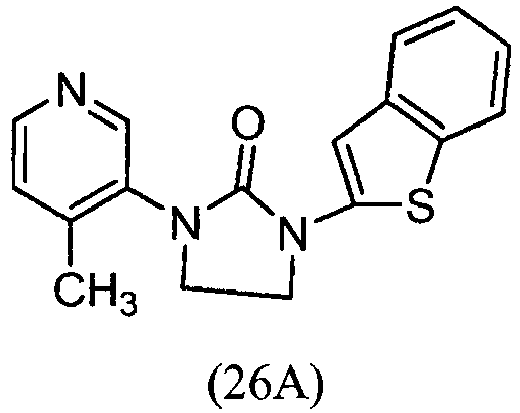
- Using the same reaction conditions as in Example 14, 1-(4-methyl-pyridin-3-yl)-imidazolidin-2-one (I-14b: 109.25 mg, 0.6171 mmol) was reacted with 2-bromo-benzo[b]thiophene (150 mg, 0.6171 mmol), 1, 4-dioxane (5mL), copper iodide (11.75mg, 0.06171 mmol), trans-1,2-diamino cyclohexane (21.19 mg, 0.1851 mmol) and potassium carbonate (170.62 mg, 1.2342 mmol) to afford the crude product. Purification by column chromatography on silica gel (1% MeOH in chloroform) afforded 75 mg of the product (62.5% yield).
- 1H NMR (DMSO-D6, 300 MHz): δ 8.5 (s, 1H), 8.4 (d, 1H), 7.8 (d, 1H), 7.75 (d, 1H), 7.4 (d, 1H), 7.35-7.25 (m, 1H), 7.2 (t, 1H), 6.75 (s, 1H), 4.25-4.1 (m, 2H), 4.1-4.0 (m, 2H), 2.3 (s, 3H)
LCMS purity: 97.09%, m/z = 310.1 (M+1)
HPLC: 92.27% -

- Using the same reaction conditions as in Example 14, 1-(4-methyl-pyridin-3-yl)-imidazolidin-2-one (I-14b: 150 mg, 0.847 mmol) was reacted with 5-bromo-benzo[b]thiophene (180.5 mg, 0.847 mmol), 1, 4-dioxane (15 mL), copper iodide (16.13 mg, 0.0847 mmol), trans-1,2-diamino cyclohexane (0.03 mL, 0.254 mmol) and potassium carbonate (233.97 mg, 1.694 mmol) to afford the crude product. Purification by column chromatography on silica gel (1% MeOH in chloroform) afforded 28 mg of the product in (10.69% yield).
- 1H NMR (DMSO-D6, 300 MHz): δ 8.75 (s, 1H), 8.55 (d, 1H), 8.04-7.98 (m, 2H), 7.84-7.76 (m, 2H), 7.63 (d, 1H), 7.45 (d, 1H), 4.2-4.1 (m, 2H), 4.05-3.95 (m, 2H), 2.4 (s, 3H)
LCMS purity: 91.88%, m/z = 309.9 (M+1)
HPLC: 97.97% -

- Using the same reaction conditions as in Example 14, 1-(4-methyl-pyridin-3-yl)-imidazolidin-2-one (I-14b: 0.095 g, 0.00058 mol) was reacted with 5-bromo-1-(2-trimethylsilanyl-ethoxymethyl)-1H-indazole (0.170 g, 0.00058 mmol), 1, 4-dioxane (10 mL), copper iodide (0.011 g, 0.000051 mol), trans-1,2-diamino cyclohexane (0.018g, 0.00016 mol) and potassium carbonate (0.134 g, 0.00106 mmol) to afford the crude product. Purification by column chromatography on silica gel (1% MeOH in chloroform) afforded 0.24 g of 1-(4-Methyl-pyridin-3-yl)-3-[1-(2-trimethylsilanyl-ethoxymethyl)-1H-indazol-5-yl]-imidazolidin-2-one (97.5% yield).
- TFA (0.096 g, 0.00084 mol) was added to solution of 1-(4-methyl-pyridin-3-yl)-3-[1-(2-trimethylsilanyl-ethoxymethyl)-1H-indazol-5-yl]-imidazolidin-2-one (0.24 g, 0.00056 mol) in DCM (10 mL) at 0°C. The reaction mixture was stirred at room temperature overnight. The reaction was monitored by TLC (10% MeOH in CHCl3). The reaction mixture was concentrated and the concentrate was purified by preparative HPLC to afford 42 mg of the product (19.47% yield).
- 1H NMR (CD3OD, 300 MHz): δ 8.52 (s, 1H), 8.35 (d, 1H), 8.06-8.0 (br s, 1H), 7.86-7.76 (m, 2H), 7.6-7.5 (m, 1H), 7.45-7.4 (m, 1H), 4.2-4.1 (m, 2H), 4.05-3.95 (m, 2H), 2.4 (s, 3H)
LCMS purity: m/z = 294.1 (M+1)
HPLC: 98.89% -

- Using the same reaction conditions as in Example 14, 1-(4-methyl-pyridin-3-yl)-imidazolidin-2-one (I-14b: 105 mg, 0.8465 mol) was reacted with 5-bromo-3-methyl-benzofuran (197 mg, 0.9311 mmol), 1, 4-dioxane (10 mL), copper iodide (20 mg), trans-1,2-diamino cyclohexane (40 mg) and potassium carbonate (359 mg, 1.6930 mmol) to afford the crude product. Purification by column chromatography on silica gel (2% MeOH in chloroform) afforded 80 mg of the product (30.76% yield).
- 1H NMR (CDCl3, 300 MHz): δ 8.54 (s, 1H), 8.4 (d, 1H), 7.76-7.73 (m, 1H), 7.46-7.39 (m, 3H), 7.22 (d, 1H), 4.19-4.1 (m, 2H), 4.0-3.9 (m, 2H), 2.38 (s, 3H), 2.24 (s, 3H)
LCMS purity: 96.84%, m/z = 307.9 (M+1)
HPLC: 96.37% -

- Using the same reaction conditions as in Example 14, 1-(4-methyl-pyridin-3-yl)-imidazolidin-2-one (I-14b: 150 mg, 0.8474 mmol) was reacted with 5-bromo-2-fluoro-pyridine (87.7 mL, 0.8474 mmol), 1, 4-dioxane (10 mL), copper iodide (16.13 mg, 0.084 mmol), trans-1,2-diamino cyclohexane (30.5mL, 0.254mmol) and potassium carbonate (234 mg, 1.695 mmol) to afford the crude product. Purification by column chromatography on silica gel (2% MeOH in chloroform), followed by preparative HPLC afforded 165 mg of the product (71.5% yield).
- 1H NMR (CDCl3, 300 MHz): δ 8.6-8.4 (m, 3H), 8.2 (s, 1H), 7.3-7.2 (m, 1H), 7.0-6.9 (m, 1H), 4.2-4.0 (m, 4H), 2.4 (s, 3H)
LCMS purity: 97.96%, m/z = 273.1 (M+1)
HPLC: 95.26% -

- Using the same reaction conditions as in Example 14, 1-(4-methyl-pyridin-3-yl)-imidazolidin-2-one (I-14b: 150 mg, 0.8474 mmol) was reacted with 3-bromo-thiophene (79.4 mL, 0.8474 mmol), 1,4-dioxane (10 mL), copper iodide (16.13mg, 0.084mmol), trans-1,2-diamino cyclohexane (30.5 mL, 0.254 mmol) and potassium carbonate (234 mg, 1.695 mmol) to afford the crude product. Purification by column chromatography on silica gel (2% MeOH in chloroform), followed by preparative HPLC afforded 22 mg of the product (10% yield).
- 1H NMR (DMSO-D6, 300 MHz): δ 8.5 (s, 1H), 8.4 (d, 1H), 7.6 (d, 2H), 7.4 (d, 1H), 7.1 (t, 1H), 4.1-3.9 (m, 4H), 2.3 (s, 3H)
LCMS purity: 97.96%, m/z = 260.0 (M+1)
HPLC: 97.4% -

- Using the same reaction conditions as in Example 14, 1-(4-methyl-pyridin-3-yl)-imidazolidin-2-one (I-14b: 150 mg, 0.847 mmol) was reacted with 3-bromo-5-methoxy-pyridine (159.24 mg, 0.847 mmol), 1, 4-dioxane (15 mL), copper iodide (16.13 mg, 0.0847 mmol), trans-1,2-diamino cyclohexane (0.03 mL, 0.254 mmol) and potassium carbonate (233.97 mg, 1.694 mmol) to afford the crude product. Purification by column chromatography on silica gel (1% MeOH in chloroform), followed by preparative HPLC afforded 23 mg of the product (9.55% yield).
- 1H NMR (DMSO-D6, 300 MHz): δ 8.8 (s, 1H), 8.55 (d, 2H), 8.2 (s, 1H), 7.8 (s, 1H), 7.7 (d, 1H), 4.2-3.9 (m, 4H), 3.9 (s, 3H), 2.4 (s, 3H)
LCMS purity: 96.22%, m/z = 285.0 (M+1)
HPLC: 99.27% -

- Using the same reaction conditions as in Example 14, 1-(4-methyl-pyridin-3-yl)-imidazolidin-2-one (I-14b: 79.79 mg, 0.4508 mmol) was reacted with 2-bromo-5-fluoro-3-methyl-benzo[b]thiophene (110 mg, 0.4508 mmol), 1, 4-dioxane (5 mL), copper iodide (8.58 mg, 0.04508 mmol), trans-1,2-diamino cyclohexane (15.48 mg, 0.1352 mmol) and potassium carbonate (124.6 mg, 0.9016 mmol) to afford the crude product. Purification by column chromatography on silica gel (1% MeOH in chloroform) afforded 84 mg of the product (60.45% yield).
- 1H NMR (DMSO-D6, 300 MHz): δ 8.55 (s, 1H), 8.4 (d, 1H), 7.95-7.85 (m, 1H), 7.62-7.55 (dd, 1H), 7.35 (d, 1H), 7.3-7.2 (m, 1H), 4.15-3.95 (m, 4H), 2.25 (d, 6H)
LCMS purity: 97.84%, m/z = 342.0 (M+1)
HPLC: 97.83% -

- Using the same reaction conditions as in Example 14, 1-(4-methyl-pyridin-3-yl)-imidazolidin-2-one (I-14b: 150 mg, 0.8465 mmol) was reacted with 5-bromo-2-chloropyrimidine (163.7 mg, 0.8465 mmol), 1, 4-dioxane (30 mL), copper iodide (16 mg, 0.08465 mmol), trans-1,2-diamino cyclohexane (29 mg, 0.2539 mmol) and potassium carbonate (468 mg, 3.3860 mmol) to afford the crude product. Purification by column chromatography on silica gel (2% MeOH in chloroform), followed by preparative HPLC afforded 65 mg of the product (26.5% yield).
- 1H NMR (DMSO-D6, 300 MHz): δ 9.0 (s, 2H), 8.6 (s, 1H), 8.5 (s, 1H), 7.4 (s, 1H), 4.15-3.95 (m, 4H), 2.35 (s, 3H)
LCMS purity: 97.13%, m/z = 290.0 (M+1)
HPLC: 96.83% -

- Using the same reaction conditions as in Example 14, 1-(4-methyl-pyridin-3-yl)-imidazolidin-2-one (I-14b: 150 mg, 0.8465 mmol) was reacted with 4-bromo-1-trityl-1H-pyrazole (369.3 mg, 0.8465 mmol), 1, 4-dioxane (50 mL), copper iodide (16 mg, 0.08465 mmol), trans-1,2-diamino cyclohexane (29 mg, 0.2539 mmol) and potassium carbonate (468 mg, 3.3860 mmol) to afford the crude product. Purification by column chromatography on silica gel (2% MeOH in chloroform) afforded 250 mg of 1-(4-Methyl-pyridin-3-yl)-3-(1-trityl-1H-pyrazol-4-yl)-imidazolidin-2-one (60% yield).
- Dioxane hydrochloride (10 mL) was added to a stirred solution of 1-(4-methyl-pyridin-3-yl)-3-(1-trityl-1H-pyrazol-4-yl)-imidazolidin-2-one (250 mg, 0.51484 mmol) in dioxane under nitrogen atmosphere at 0°C. The reaction mixture was stirred at room temperature for 2 hours with TLC monitoring (10% MeOH in DCM). The solvent was distilled from the reaction mixture and washed with ether. The precipitate was collected and dried under reduced pressure to afford 80 mg of the product (55% yield).
- 1H NMR (DMSO-D6, 300 MHz): δ 8.95 (s, 1H), 8.7 (d, 1H), 8.0 (d, 1H), 7.8 (s, 2H), 4.1-4.0 (m, 2H), 4.0-3.95 (m, 2H), 2.5 (s, 3H)
LCMS purity: 98.04%, m/z = 244.1 (M+1)
HPLC: 94.48% -

- Using the same reaction conditions as in Example 14, 1-(4-methyl-pyridin-3-yl)-imidazolidin-2-one (I-14b: 150 mg, 0.8465 mmol) was reacted with 2-bromo-thiazole (138.8 mg, 0.846 mmol), 1,4-dioxane (50 mL), copper iodide (16 mg, 0.08465 mmol), trans-1,2-diamino cyclohexane (29 mg, 0.2539 mmol) and potassium carbonate (468 mg, 3.3860 mmol) to afford the crude product. Purification by column chromatography on silica gel (2% MeOH in chloroform) afforded 125 mg of the product (56.8% yield).
- 1H NMR (DMSO-D6, 300 MHz): δ 8.6 (s, 1H), 8.4 (s, 1H), 7.45-7.35 (m, 2H), 7.2 (d, 1H), 4.4 (t, 2H), 4.2 (t, 2H), 2.3 (s, 3H)
LCMS purity: 96.14%, m/z = 261.0 (M+1)
HPLC: 97.87% -
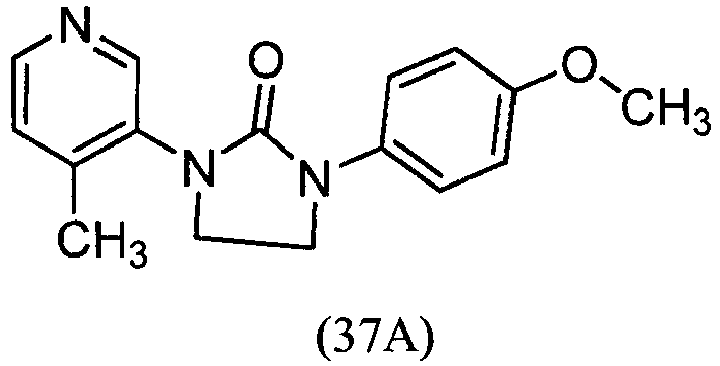
- Using the same reaction conditions as in Example 14, 1-(4-methyl-pyridin-3-yl)-imidazolidin-2-one (I-14b: 150 mg, 0.8474 mmol) was reacted with 1-bromo-4-methoxy-benzene (158 mg, 0.8474 mmol), 1, 4-dioxane (5 mL), copper iodide (16.142 mg, 0.08474 mmol), trans-1,2-diamino cyclohexane (29.108 mg, 0.2542 mmol) and potassium carbonate (234.3 mg, 1.6948 mmol) to afford the crude product. Purification by column chromatography on silica gel (1% MeOH in chloroform) afforded 172 mg of the product (72.26% yield).
- 1H NMR (DMSO-D6, 300 MHz): δ 8.5 (s, 1H), 8.4 (d, 1H), 7.55-7.45 (m, 2H), 7.39-7.3 (d, 1H), 7.0-6.9 (m, 2H), 4.1-4.0 (m, 2H), 3.95-3.85 (m, 2H), 3.75 (s, 3H), 2.25 (s, 3H)
LCMS purity: 95.51 %, m/z = 284.1 (M+1)
HPLC: 96.79% -

- Using the same reaction conditions as in Example 14, 1-(4-methyl-pyridin-3-yl)-imidazolidin-2-one (I-14b: 150 mg, 0.8474 mmol) was reacted with 1-bromo-4-chloro-benzene (162 mg, 0.8474 mmol), 1, 4-dioxane (5 mL), copper iodide (16.142 mg, 0.08474 mmol), trans-1,2-diamino cyclohexane (29.108 mg, 0.2542 mmol) and potassium carbonate (234.3 mg, 1.6948 mmol) to afford the crude product. Purification by column chromatography on silica gel (1% MeOH in chloroform) afforded 155 mg of the product (63.78% yield).
- 1H NMR (DMSO-D6, 300 MHz): δ 8.55 (s, 1H), 8.4 (d, 1H), 7.7-7.6 (m, 2H), 7.5-7.3 (m, 3H), 4.05-3.9 (m, 2H), 3.9-3.8 (m, 2H), 2.25 (s, 3H)
LCMS purity: 98.81 %, m/z = 287.9 (M+1)
HPLC: 96.55% -

- Using the same reaction conditions as in Example 14, 1-(4-methyl-pyridin-3-yl)-imidazolidin-2-one (I-14b: 150 mg, 0.8465 mmol) was reacted with 4-bromo-benzonitrile (154 mg, 0.84650 mmol), 1,4-dioxane (50 mL), copper iodide (16mg, 0.084650mmol), trans-1,2-diamino cyclohexane (29mg, 0.2539mmol) and potassium carbonate (468 mg, 3.3860 mmol) to afford the crude product. Purification by column chromatography on silica gel (5% MeOH in DCM) afforded 151 mg of the product (64.2% yield).
- 1H NMR (DMSO-D6, 300 MHz): δ 8.55 (s, 1H), 8.4 (d, 1H), 7.8 (s, 4H), 7.3 (d, 1H), 4.2-4.15 (m, 2H), 4.0-3.95 (m, 2H), 2.3 (s, 3H)
LCMS purity: 100.00%, m/z = 278.9 (M+1)
HPLC: 98.45% -

- Using the same reaction conditions as in Example 14, 1-(4-methyl-pyridin-3-yl)-imidazolidin-2-one (I-14b: 150 mg, 0.84650 mmol) was reacted with 2-chloro-benzooxazole (96 mL, 0.84650 mmol), 1, 4-dioxane (50 mL), copper iodide (16 mg, 0.084650 mmol), trans-1,2-diamino cyclohexane (29 mg, 0.2539 mmol) and potassium carbonate (468 mg, 3.3860 mmol) to afford the crude product. Purification by column chromatography on silica gel (2% MeOH in DCM) afforded 40 mg of the product (16% yield).
- 1H NMR (DMSO-D6, 300 MHz): δ 8.7-8.6 (br s, 1H), 8.5-8.45 (br s, 1H), 7.75-7.6 (m, 2H), 7.5 (d, 1H), 7.4-7.25 (m, 2H), 4.35-4.25 (m, 2H), 4.15-4.05 (m, 2H), 2.3 (s, 3H)
LCMS purity: 96.56%, m/z = 295.1 (M+1)
HPLC: 95.79% -

- Using the same reaction conditions as in Example 14, 1-(4-methyl-pyridin-3-yl)-imidazolidin-2-one (I-14b: 300 mg, 1.6949 mmol) was reacted with 2-bromo-5-chloro-thiophene (0.185 mL, 1.6949 mmol), 1,4-dioxane (10 mL), copper iodide (32 mg, 0.169 mmol), trans-1,2-diamino cyclohexane (58 mg, 0.5084 mmol) and potassium carbonate (467 mg, 3.3898 mmol) to afford the crude product. Purification by column chromatography on silica gel (1% MeOH in DCM) afforded 240 mg of the product (48.4% yield).
- 1H NMR (DMSO-D6, 300 MHz): δ 8.59 (s, 1H), 8.45 (d, 1H), 7.4 (d, 1H), 6.97 (d, 1H), 6.38 (d, 1H), 4.05 (s, 4H), 2.3 (s, 3H)
LCMS purity: 93.37%, m/z = 293.8 (M+1)
HPLC: 99.32% -

- Using the same reaction conditions as in Example 14, 1-(4-methyl-pyridin-3-yl)-imidazolidin-2-one (I-14b: 150 mg, 0.847 mmol) was reacted with 2-bromo-thiophene (0.08mL, 0.847 mmol), 1, 4-dioxane (10 mL), copper iodide (16.13 mg, 0.0847 mmol), trans-1,2-diamino cyclohexane (0.03 mL) and potassium carbonate (233 mg, 1.694 mmol) to afford the crude product. Purification by column chromatography on silica gel (1% MeOH in DCM) afforded 240 mg of the product (48.4% yield).
- 1H NMR (DMSO-D6, 300 MHz): δ 8.5 (s, 1H), 8.4 (d, 1H), 7.36 (d, 1H), 6.98 (dd, 1H), 6.92-6.86 (m, 1H), 6.5 (dd, 1H), 4.1-3.96 (m, 4H), 2.26 (s, 3H)
LCMS purity: 96.18%, m/z = 260.0 (M+1)
HPLC: 98.53% -

- 1-(6-Fluoro-pyridin-3-yl)-3-(4-methyl-pyridin-3-yl)-imidazolidin-2-one (30A: 0.1 g, 0.00036 mmol) in 5% HCl (10 mL) was added into the reaction flask and the flask was heated to reflux at 100°C overnight. The reaction was monitored by TLC (10% MeOH in chloroform. The reaction mixture was basified with NaHCO3 solution and extracted with chloroform. The organic layer was washed with water, brine solution, dried and concentrated to afford 72 mg of the product (98.96% yield).
- 1H NMR (DMSO-D6, 300 MHz): δ 8.5 (s, 1H), 8.35 (d, 1H), 7.75 (dd, 1H), 7.6-7.5 (m, 1H), 7.35 (d, 1H), 6.3 (d, 1H), 3.85 (s, 4H), 2.25 (s, 3H)
LCMS purity: 96.74%, m/z = 270.9 (M+1)
HPLC: 98.42% -

- Using the same reaction conditions as in Example 14, 1-(4-methyl-pyridin-3-yl)-imidazolidin-2-one (I-14b: 150 mg, 0.84650 mmol) was reacted with 4-bromo-benzoic acid methyl ester (182 mg, 0.84650 mmol), 1, 4-dioxane (50 mL), copper iodide (16mg, 0.084650 mmol), trans-1,2-diamino cyclohexane (29 mg, 0.2539 mmol) and potassium carbonate (468 mg, 3.3860mmol) to afford the crude product. Purification by column chromatography on silica gel (5% MeOH in DCM) afforded 230 mg of 4-[3-(4-Methyl-pyridin-3-yl)-2-oxo-imidazolidin-1-yl]-benzoic acid methyl ester (91.6% yield).
- LiOH (46.4mg, 3.782mmol) was added to a stirred solution of 4-[3-(4-methyl-pyridin-3-yl)-2-oxo-imidazolidin-1-yl]-benzoic acid methyl ester (230 mg, 0.7387 mmol) in (3:2:1) THF (10 mL, water (6 mL) and MeOH (3 mL). The reaction mixture was stirred at room temperature for 4 hours. The reaction was monitored by TLC (10% MeOH in DCM). The reaction mixture was concentrated under reduced pressure, followed by the addition of ice water and neutralized with 1N HCl till a pH of about 2 was attained. The precipitate was collected and dried under reduced pressure to afford 210 mg of 4-[3-(4-Methyl-pyridin-3-yl)-2-oxo-imidazolidin-1-yl]-benzoic acid (95% yield).
- EDCI (176.4 mg, 0.9205 mmol), HOBt (5.8 mg, 0.2525 mmol), DIPEA (0.3mL, 2.3006mmol) and methylamine hydrochloride (62mg, 0.9205mmol) were added to a stirred solution of 4-[3-(4-methyl-pyridin-3-yl)-2-oxo-imidazolidin-1-yl]-benzoic acid (228 mg, 0.7668 mmol) in dry DMF (10mL) at 0°C under nitrogen atmosphere. The reaction mixture was stirred at room temperature for 12 hours. The reaction mixture was partitioned between water and ethylacetate. The organic layer was washed with water, brine solution, dried over Na2SO4 and concentrated under reduced pressure. Purification by column chromatography on silica gel (5% MeOH in DCM) afforded 155 mg of the product (65.4% yield).
- 1H NMR (DMSO-D6, 300 MHz): δ 8.65-8.55 (br s, 1H), 8.45-8.4 (br s, 1H), 8.35 (d, 1H), 7.9 (d, 2H), 7.7 (d, 2H), 7.4 (d, 1H), 4.15-4.05 (m, 2H), 4.0-3.85 (m, 2H), 2.8 (d, 3H), 2.3 (s, 3H)
LCMS purity: 87.61 %, m/z = 311.1 (M+1)
HPLC: 98.28% -

- Using the same reaction conditions as in Example 14, 1-(4-methyl-pyridin-3-yl)-imidazolidin-2-one (I-14b: 150 mg, 0.8474 mmol) was reacted with 4-bromo-1,2-difluoro-benzene (163.5 mg, 0.8474 mmol), 1, 4-dioxane (5 mL), copper iodide (16.14 mg, 0.08474 mmol), trans-1,2-diamino cyclohexane (29.10 mg, 0.253942 mmol) and potassium carbonate (234.3 mg, 1.6948 mmol) to afford the crude product. Purification by column chromatography on silica gel (1% MeOH in CHCl3) afforded 205 mg of the product (84.01 % yield).
- 1H NMR (DMSO-D6, 300 MHz): δ 8.55 (s, 1H), 8.39 (d, 1H), 7.85-7.75 (m, 1H), 7.5-7.35 (m, 3H), 4.1-3.9 (m, 4H), 2.26 (s, 3H)
LCMS purity: 98.17%, m/z = 290.0 (M+1)
HPLC: 98.83% -

- Using the same reaction conditions as in Example 14, 1-(4-methyl-pyridin-3-yl)-imidazolidin-2-one (I-14b: 150 mg, 0.8465 mmol) was reacted with 4-bromo-2-chloro-1-fluoro-benzene (102 mL, 0.8465 mmol), 1,4-dioxane (20mL), copper iodide (16 mg, 0.08465 mmol), trans-1,2-diamino cyclohexane (29 mg, 0.2539 mmol) and potassium carbonate (468 mg, 3.3860 mmol) to afford the crude product. Purification by column chromatography on silica gel (5% MeOH in DCM) afforded 220 mg of the product (84. 2% yield).
- 1H NMR (DMSO-D6, 300 MHz): δ 8.55 (s, 1H), 8.4 (d, 1H), 7.9 (dd, 1H), 7.6-7.55 (m, 1H), 7.45-7.35 (m, 2H), 4.15-4.0 (m, 2H), 4.0-3.9 (m, 2H), 2.3 (s, 3H)
LCMS purity: 96.91 %, m/z = 306.0 (M+1)
HPLC: 98.62% -
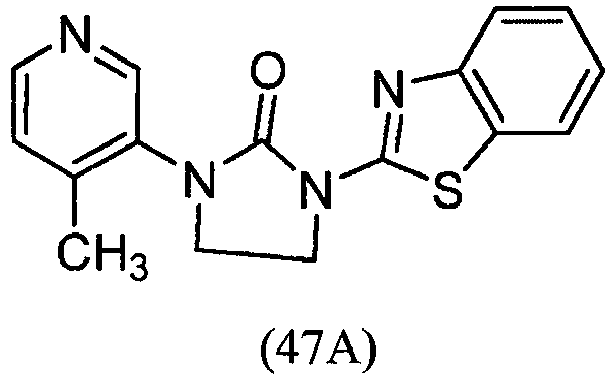
- Using the same reaction conditions as in Example 14, 1-(4-methyl-pyridin-3-yl)-imidazolidin-2-one (I-14b: 150 mg, 0.84 mmol) was reacted with 2-bromo-benzothiazole (179 mg, 0.847 mmol), 1, 4-dioxane (10 mL), copper iodide (16 mg, 0.084 mmol), trans-1,2-diamino cyclohexane (28.8 mg, 0.25 mmol) and potassium carbonate (231 mg, 1.68 mmol) to afford the crude product. Purification by column chromatography on silica gel (1.5% MeOH in CHCl3) afforded 95mg of the product (36.5% yield).
- 1H NMR (DMSO-D6, 300 MHz): δ 8.6 (s, 1H), 8.45 (d, 1H), 8.3 (s, 1H), 7.95 (d, 1H), 7.75 (d, 1H), 7.45-7.35 (m, 1H), 7.3-7.25 (m, 1H), 4.35 (t, 2H), 4.05 (t, 2H), 2.3 (s, 3H)
LCMS purity: 98.81 %, m/z = 310.9 (M+1)
HPLC: 97.25% -

- Using the same reaction conditions as in Example 14, 1-(4-methyl-pyridin-3-yl)-imidazolidin-2-one (I-14b: 250 mg, 1.412 mmol) was reacted with 5-bromo-indole-1-carboxylic acid tert-butyl ester (0.499 g, 1.691 mmol), 1,4-dioxane (15 mL), copper iodide (0.0080 g), trans-1,2-diamino cyclohexane (0.0241 g, 0.2110 mmol) and potassium carbonate (0.389 g, 2.818 mmol) to afford the crude product. Purification by column chromatography on silica gel (10% MeOH in CHCl3) afforded 125 mg of 5-[3-(4-Methyl-pyridin-3-yl)-2-oxo-imidazolidin-1-yl]-indole-1-carboxylic acid tert-butyl ester (24% yield).
- 2N HCl (6 mL) was added to a solution of 5-[3-(4-methyl-pyridin-3-yl)-2-oxo-imidazolidin-1-yl]-indole-1-carboxylic acid tert-butyl ester (120 mg, 0.0306 mmol) in MeOH (3 mL) at 0°C. The reaction mixture was stirred at room temperature for 19 hours. The reaction was monitored by TLC (10% MeOH in CHCl3). The resulting mixture was neutralized with NaHCO3, filtered and dried to afford the crude product. Purification by preparative HPLC afforded 17 mg of the product (19.1 % yield).
- 1H NMR (DMSO-D6, 300 MHz): δ 10.8 (s, 1H), 8.6 (s, 1H), 8.55 (s, 1H), 8.45-8.4 (m, 1H), 7.6 (s, 1H), 7.55-7.45 (m, 2H), 7.35-7.25 (m, 2H), 3.6-3.5 (m, 4H), 2.35 (s, 3H)
LCMS purity: 98.00%, m/z = 293.0 (M+1)
HPLC: 92.87% -

- Using the same reaction conditions as in Example 14, 1-(4-methyl-pyridin-3-yl)-imidazolidin-2-one (I-14b: 150 mg, 0.84 mmol) was reacted with 6-bromo-2,3-dihydro-benzo[1,4]dioxine (180 mg, 0.84 mmol), 1, 4-dioxane (10 mL), copper iodide (16 mg, 0.084 mmol), trans-1,2-diamino cyclohexane (28.8 mg, 0.25 mmol) and potassium carbonate (231 mg, 1.68 mmol) to afford the crude product. Purification by column chromatography on silica gel (1% MeOH in CHCl3) afforded 110 mg of the product (42.1 % yield).
- 1H NMR (DMSO-D6, 300 MHz): δ 8.55 (s, 1H), 8.4 (d, 1H), 7.4 (d, 1H), 7.2 (d, 1H), 7.0 (dd, 1H), 6.85 (d, 1H), 4.3-4.2 (m, 4H), 4.0-3.9 (m, 4H), 2.3 (s, 3H)
LCMS purity: 99.67%, m/z = 311.9 (M+1)
HPLC: 98.00% -

- Using the same reaction conditions as in Example 14, 1-(4-methyl-pyridin-3-yl)-imidazolidin-2-one (I-14b: 150 mg, 0.8474 mmol) was reacted with 1-bromo-4-trifluoromethyl-benzene (92 mL, 1.0168 mmol), 1, 4-dioxane (20 mL), copper iodide (16 mg, 0.08484 mmol), trans-1,2-diamino cyclohexane (20 mL, 0.254 mmol) and potassium phosphate (355 mg, 212.27 mmol) to afford the crude product. Purification by column chromatography on silica gel (2% MeOH in CHCl3) afforded 180 mg of the product (66% yield).
- 1H NMR (DMSO-D6, 300 MHz): δ 8.6 (s, 1H), 8.4 (d, 1H), 7.9-7.5 (m, 4H), 7.4 (d, 1H), 4.15-4.05 (m, 2H), 4.0-3.9 (m, 2H), 2.3 (s, 3H)
LCMS purity: 99.63%, m/z = 321.8 (M+1)
HPLC: 99.1 % -

- Using the same reaction conditions as in Example 14, 1-(4-methyl-pyridin-3-yl)-imidazolidin-2-one (I-14b: 150 mg, 0.84 mmol) was reacted with 5-bromo-2,3-dihydro-benzofuran (167 mg, 0.84 mmol), 1,4-dioxane (10 mL), copper iodide (16 mg, 0.084 mmol), trans-1,2-diamino cyclohexane (28.8 mg, 0.25 mmol) and potassium phosphate (445 mg, 2.1 mmol) to afford the crude product. Purification by column chromatography on silica gel (1% MeOH in CHCl3) afforded 200 mg of the product (80.9% yield).
- 1H NMR (DMSO-D6, 300 MHz): δ 8.5 (s, 1H), 8.35 (d, 1H), 7.5 (s, 1H), 7.3 (d, 1H), 7.2 (d, 1H), 6.8 (d, 1H), 4.5 (t, 2H), 4.0-3.85 (m, 4H), 3.2 (t, 2H), 2.3 (s, 3H)
LCMS purity: 90.40%, m/z = 296.1 (M+1)
HPLC: 98.45% -

- Using the same reaction conditions as in Example 14, 1-(4-methyl-pyridin-3-yl)-imidazolidin-2-one (I-14b: 200 mg, 1.13 mmol) was reacted with 6-bromo-quinoline (233.9 mg, 1.13 mmol), 1, 4-dioxane (15 mL), copper iodide (16.53 mg, 0.113 mmol), trans-1,2-diamino cyclohexane (0.04 mL, 0.339 mmol) and potassium carbonate (312 mg, 2.26 mmol) to afford the crude product. Purification by column chromatography on silica gel (0.5% MeOH in CHCl3) afforded 150 mg of the product (43.668% yield).
- 1H NMR (DMSO-D6, 300 MHz): δ 8.8 (dd, 1H), 8.58 (s, 1H), 8.45-8.35 (m, 2H), 8.3 (d, 1H), 8.0 (d, 1H), 7.86 (d, 1H), 7.52-7.48 (m, 1H), 7.37 (d, 1H), 4.24-4.16 (m, 2H), 4.02-3.98 (m, 2H), 2.31 (s, 3H)
LCMS purity: 99.55%, m/z = 305.2 (M+1)
HPLC: 95.53% -

- Using the same reaction conditions as in Example 14, 1-(4-methyl-pyridin-3-yl)-imidazolidin-2-one (I-14b: 150 mg, 0.8474 mmol) was reacted with 4-bromo-2-fluoro-1-methoxy-benzene (191 mg, 0.932 mmol), 1, 4-dioxane (20 mL), copper iodide (16mg, 0.08474 mmol), trans-1,2-diamino cyclohexane (29.4 mg, 0.2542 mmol) and potassium phosphate (449 mg, 2.11 mmol) to afford 220 mg of the product (86% yield).
- 1H NMR (DMSO-D6, 300 MHz): δ 8.5 (s, 1H), 8.4 (d, 1H), 7.7-7.6 (dd, 1H), 7.35 (d, 1H), 7.3-7.1 (m, 2H), 4.0-3.8 (m, 7H), 2.3 (s, 3H)
LCMS purity: 99.59%, m/z = 301.9 (M+1)
HPLC: 98.6% -

- Using the same reaction conditions as in Example 14, 1-(4-methyl-pyridin-3-yl)-imidazolidin-2-one (I-14b: 150 mg, 0.8474 mmol) was reacted with 4-bromo-1-chloro-2-fluoro-benzene (213 mg, 1.0168 mmol), 1,4-dioxane (20 mL), copper iodide (16 mg, 0.08474 mmol), trans-1,2-diamino cyclohexane (29.4 mg, 0.2542 mmol) and potassium phosphate (449.7mg, 2.1185mmol) to afford 190 mg of the product (73% yield).
- 1H NMR (CDCl3, 300 MHz): δ 8.5 (s, 1H), 8.4 (d, 1H), 7.6 (dd, 1H), 7.4-7.3 (m, 2H), 7.25-7.2 (m, 1H), 4.1-3.9 (m, 4H), 2.35 (s, 3H)
LCMS purity: 96.94%, m/z = 306.1 (M+1)
HPLC: 96.4% -

- Using the same reaction conditions as in Example 14, 1-(4-methyl-pyridin-3-yl)-imidazolidin-2-one (I-14b: 150 mg, 0.847 mmol) was reacted with 1-bromo-3-methyl-benzene (172.8 mg, 1.017 mmol), 1, 4-dioxane (20 mL), copper iodide (16.13 mg, 0.0847 mmol), trans-1,2-diamino cyclohexane (0.03 mL, 0.254 mmol) and potassium phosphate (539.3 mg, 2.541 mmol) to afford the crude product. Purification by column chromatography on silica gel (1.2% MeOH in CHCl3) afforded 153 mg of the product (67.69% yield).
- 1H NMR (DMSO-D6, 300 MHz): δ 8.54 (s, 1H), 8.38 (d, 1H), 7.48-7.38 (m, 2H), 7.35 (d, 1H), 7.23 (t, 1H), 6.86 (d, 1H), 4.08-3.98 (m, 2H), 3.96-3.88 (m, 2H), 2.28 (s, 3H), 2.32 (s, 3H)
LCMS purity: 93.74%, m/z = 268.1 (M+1)
HPLC: 96.86% -

- Using the same reaction conditions as in Example 14, 1-(4-methyl-pyridin-3-yl)-imidazolidin-2-one (I-14b: 150 mg, 0.84650 mmol) was reacted with 1-bromo-3-methoxy-benzene (107 mg, 0.84650 mmol), 1, 4-dioxane (50 mL), copper iodide (16 mg, 0.08465mmol), trans-1,2-diamino cyclohexane (0.03 mL, 0.2539 mmol) and potassium phosphate (538 mg, 2.539 mmol) to afford the crude product. Purification by column chromatography on silica gel (2% MeOH in CHCl3) afforded 180 mg of the product (75% yield).
- 1H NMR (DMSO-D6, 300 MHz): δ 8.55 (s, 1H), 8.4 (d, 1H), 7.4 (d, 1H), 7.35-7.25 (m, 2H), 7.2 (d, 1H), 6.65 (dd, 1H), 4.15-4.0 (m, 2H), 4.0-3.95 (m, 2H), 3.75 (s, 3H), 2.3 (s, 3H)
LCMS purity: 95.82%, m/z = 283.9 (M+1)
HPLC: 97.25% -

- Using the same reaction conditions as in Example 14, 1-(4-methyl-pyridin-3-yl)-imidazolidin-2-one (I-14b: 50 mg, 0.28216 mmol) was reacted with 2-bromo-4,7-dihydro-5H-thieno[2,3-c]pyridine-6-carboxylic acid tert-butyl ester (90 mg, 0.28216 mmol), 1, 4-dioxane (20 mL), copper iodide (5.3 mg, 0.0282 mmol), trans-1,2-diamino cyclohexane (9.69 mg, 0.08464 mmol) and potassium phosphate (179.6 mg, 0.84650 mmol) to afford the crude product. Purification by column chromatography on silica gel (2% MeOH in DCM) afforded 70 mg of 2-[3-(4-Methyl-pyridin-3-yl)-2-oxo-imidazolidin-1-yl]-4,7-dihydro-5H-thieno[2,3-c]pyridine-6-carboxylic acid tert-butyl ester (60% yield).
- 6N HCl (5 mL) was added dropwise to stirred solution of 2-[3-(4-methyl-pyridin-3-yl)-2-oxo-imidazolidin-1-yl]-4,7-dihydro-5H-thieno[2,3-c]pyridine-6-carboxylic acid tert-butyl ester (70 mg, 0.16887 mmol) in methanol (2 mL) at 0°C. The reaction mixture was stirred at room temperature for 12 hours. The reaction was monitored by TLC (5% MeOH in DCM). The solvent was distilled from the reaction mixture under reduced pressure, followed by the addition of diethylether. The precipitate was washed with ether and dried under reduced pressure to afford 36 mg of the product (61 % yield).
- 1H NMR (DMSO-D6, 300 MHz): δ 9.55 (s, 2H), 8.8 (s, 1H), 8.7-8.5 (m, 2H), 7.8 (d, 1H), 6.35 (s, 1H), 4.2 (s, 2H), 4.0 (s, 4H), 3.4 (t, 2H), 2.8 (t, 2H), 2.4 (s, 3H)
LCMS purity: 90.09%, m/z = 315.1 (M+1)
HPLC: 84.27% -

- Using the same reaction conditions as in Example 14, 1-(4-methyl-pyridin-3-yl)-imidazolidin-2-one (I-14b: 600 mg, 3.3898 mmol) was reacted with 2-chloro-4-iodo-pyridine (974 mg, 4.067 mmol), 1, 4-dioxane (60 mL), copper iodide (65 mg, 0.3398 mmol), trans-1,2-diamino cyclohexane (0.12 mL, 1.0169 mmol) and potassium phosphate (2.15 g, 10.1694 mmol) to afford 810 mg of the product (83% yield).
- 1H NMR (CDCl3, 300 MHz): δ 8.5-8.4 (m, 2H), 8.3 (d, 1H), 7.6-7.5 (m, 2H), 7.2 (s, 1H), 4.1-3.9 (m, 4H), 2.35 (s, 3H)
LCMS purity: 90.8%, m/z = 289.1 (M+1)
HPLC: 97.14% -

- Using the same reaction conditions as in Example 14, 1-(4-methyl-pyridin-3-yl)-imidazolidin-2-one (I-14b: 160 mg, 0.9039 mmol) was reacted with 4-bromo-1-fluoro-2-methyl-benzene (0.135 mL, 0.7142 mmol), 1, 4-dioxane (15 mL), copper iodide (0.005 g, 0.0263 mmol), trans-1,2-diamino cyclohexane (0.015 g, 0.1315 mmol) and potassium phosphate (0.575 g, 2.7094 mmol) to afford the crude product. Purification by column chromatography on silica gel (1% MeOH in chloroform) afforded 26 mg of the product (30% yield).
- 1H NMR (CDCl3, 300 MHz): δ 8.6-8.4 (m, 2H), 7.5-7.4 (m, 1H), 7.35-7.25 (m, 2H), 7.0(t, 1H), 4.1-3.9 (m, 4H), 2.4 (s, 3H), 2.3 (s, 3H)
LCMS purity: 95.40%, m/z = 286.0 (M+1)
HPLC: 94.03% -

- Using the same reaction conditions as in Example 14, 1-(4-methyl-pyridin-3-yl)-imidazolidin-2-one (I-14b: 150 mg, 0.84650 mmol) was reacted with 2-bromo-4-chloro-1-fluoro-benzene (177 mg, 0.84650 mmol), 1, 4-dioxane (10 mL), copper iodide (16mg, 0.084650mmol), trans-1,2-diamino cyclohexane (29 mg, 0.2539 mmol) and potassium phosphate (538 mg, 2.539 mmol) to afford the crude product. Purification by column chromatography on silica gel (2% MeOH in DCM) afforded 180 mg of the product (69.7% yield).
- 1H NMR (DMSO-D6, 300 MHz): δ 8.6-8.5 (br s, 1H), 8.4 (d, 1H), 7.7 (d, 1H), 7.4-7.3 (m, 3H), 4.1-3.85 (m, 4H), 2.15 (s, 3H)
LCMS purity: 98.67%, m/z = 305.8 (M+1)
HPLC: 92.0% -
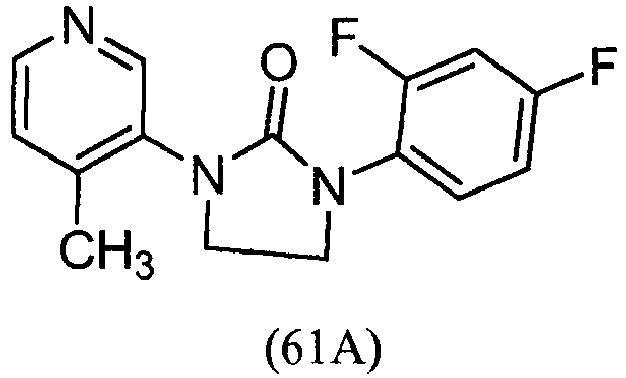
- Using the same reaction conditions as in Example 14, 1-(4-methyl-pyridin-3-yl)-imidazolidin-2-one (I-14b: 150 mg, 0.8474 mmol) was reacted with 1-bromo-2,4-difluoro-benzene (0.114 mL, 1.0169 mmol), 1,4-dioxane (20 mL), copper iodide (16 mg, 0.08474 mmol), trans-1,2-diamino cyclohexane (29.4 mg, 0.254 mmol) and potassium phosphate (449.7 mg, 2.118 mmol) to afford the crude product. Purification by column chromatography on silica gel (2% MeOH in CHCl3) afforded 150 mg of the product (61 % yield).
- 1H NMR (DMSO-D6, 300 MHz): δ 8.52 (s, 1H), 8.39 (d, 1H), 7.65-7.55 (m, 1H), 7.45-7.30 (m, 2H), 7.2-7.1 (m, 1H), 3.9 (s, 4H), 2.3 (s, 3H)
LCMS purity: 99.49%, m/z = 290.2 (M+1)
HPLC: 95.04% -

- Using the same reaction conditions as in Example 14, 1-(4-methyl-pyridin-3-yl)-imidazolidin-2-one (I-14b: 150 mg, 0.84650 mmol) was reacted with 5-iodo-benzothiazole (221 mg, 0.84650 mmol), 1, 4-dioxane (25 mL), copper iodide (16 mg, 0.084650 mmol), trans-1,2-diamino cyclohexane (29 mg, 0.2539 mmol) and potassium phosphate (538 mg, 2.539 mmol) to afford the crude product. Purification by column chromatography on silica gel (2% MeOH in DCM) afforded 185 mg of the product (70.6% yield).
- 1H NMR (DMSO-D6, 300 MHz): δ 9.4 (s, 1H), 8.59 (s, 1H), 8.4 (d, 1H), 8.24-8.22 (m, 1H), 8.15-8.1 (m, 1H), 8.0-7.9 (m, 1H), 7.39 (d, 1H), 4.2-4.1 (m, 2H), 4.0-3.9 (m, 2H), 2.3 (s, 3H)
LCMS purity: 93.36%, m/z = 311 (M+1)
HPLC: 95.21 % -

- Using the same reaction conditions as in Example 14, 1-(4-methyl-pyridin-3-yl)-imidazolidin-2-one (I-14b: 150 mg, 0.8474 mmol) was reacted with 6-bromo-2-oxo-3,4-dihydro-2H-quinoline-1-carboxylic acid tert-butyl ester (276 mg, 0.8474 mmol), 1, 4-dioxane (5 mL), copper iodide (16.14 mg, 0.08474 mmol), trans-1,2-diamino cyclohexane (29.1 mg, 0.2542 mmol) and potassium carbonate (234.3 mg, 1.6948 mmol) to afford the crude product. Purification by preparative HPLC afforded 86 mg of the product (31.5% yield).
- 1H NMR (DMSO-D6, 300 MHz): δ 10.0 (s, 1H), 8.5 (s, 1H), 8.4 (d, 1H), 7.5-7.3 (m, 3H), 6.9-6.75 (d, 1H), 4.0-3.85 (m, 4H), 2.85 (t, 2H), 2.45-2.4 (m, 2H), 2.3 (s, 3H)
LCMS purity: 96.55%, m/z = 322.9 (M+1)
HPLC: 97.13% -

- Using the same reaction conditions as in Example 14, 1-(4-methyl-pyridin-3-yl)-imidazolidin-2-one (I-14b: 150 mg, 0.84650 mmol) was reacted with 5-bromo-2,2-difluoro-benzo[1,3] dioxole (200.6 mg, 0.84650 mmol), 1,4-dioxane (50 mL), copper iodide (16 mg, 0.084650 mmol), trans-1,2-diamino cyclohexane (29 mg, 0.2539 mmol) and potassium phosphate (538 mg, 2.539 mmol) to afford the crude product. Purification by column chromatography on silica gel (2% MeOH in DCM) afforded 260 mg of the product (92% yield).
- 1H NMR (DMSO-D6, 300 MHz): δ 8.6-8.4 (m, 2H), 7.7-7.69 (m, 1H), 7.25-7.2 (m, 1H), 7.06-6.9 (m, 2H), 4.1-3.9 (m, 4H), 2.35 (s, 3H)
LCMS purity: 95.12%, m/z = 333.6 (M+1)
HPLC: 92.82% -

- Using the same reaction conditions as in Example 14, 1-(4-methyl-pyridin-3-yl)-imidazolidin-2-one (I-14b: 0.15 g, 0.00084 mol) was reacted with 7-bromo-2-oxo-3,4-dihydro-2H-quinoline-1-carboxylic acid tert-butyl ester (0.276 g, 0.00084 mol), 1, 4-dioxane (20 mL), copper iodide (0.0158 g, 0.000084 mol), trans-1,2-diamino cyclohexane (0.28 g, 0.00025 mol) and potassium phosphate (0.356 g, 0.00168 mol) to afford the crude product. Purification by column chromatography on silica gel (5% MeOH in CHCl3) afforded 0.145 g of 7-[3-(4-Methyl-pyridin-3-yl)-2-oxo-imidazolidin-1-yl]-2-oxo-3,4-dihydro-2H-quinoline-1-carboxylic acid tert-butyl ester (67.48% yield).
- 1H NMR (DMSO-D6, 300 MHz): δ 8.1-8.02 (br s, 1H), 7.15-7.0 (m, 2H), 6.99-6.92 (m, 1H), 2.95 (t, 2H), 2.65 (t, 2H), 2.1-2.0 (m, 2H), 1.8-1.7 (m, 1H), 1.45-1.40 (m, 5H), 1.25 (s, 11H)
- Dioxane hydrochloride (3 mL) was added to 7-[3-(4-methyl-pyridin-3-yl)-2-oxo-imidazolidin-1-yl]-2-oxo-3,4-dihydro-2H-quinoline-1-carboxylic acid tert-butyl ester (0.145 g, 0.00034 mol) at 0°C. The resulting reaction mixture was stirred at room temperature for 2 hours. The reaction was monitored by TLC (40% ethylacetate in hexane). Purification by preparative HPLC, followed by column chromatography on silica gel (5% MeOH in CHCl3) afforded 48 mg of the product (35.47% yield).
- 1H NMR (DMSO-D6, 300 MHz): δ 10.09 (s, 1H), 8.52 (s, 1H), 8.35 (d, 1H), 7.35 (d, 1H), 7.3-7.22 (m, 1H), 7.19-7.0 (m, 2H), 4.0-3.84 (m, 4H), 2.82 (t, 2H), 2.45-2.40 (m, 2H), 2.27 (s, 3H)
LCMS purity: 99.47%, m/z = 322.8 (M+1) -
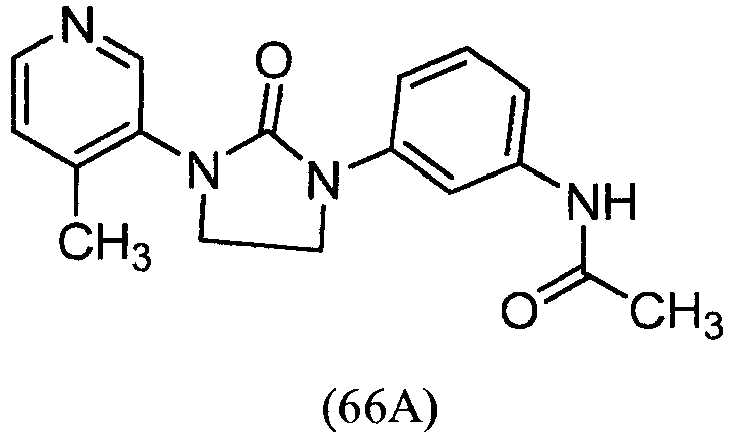
- Using the same reaction conditions as in Example 14, 1-(4-methyl-pyridin-3-yl)-imidazolidin-2-one (I-14b: 150 mg, 0.8474 mmol) was reacted with N-(3-bromo-phenyl)-acetamide (217.6 mg, 1.0169 mmol), 1,4-dioxane (20 mL), copper iodide (16 mg, 0.08474 mmol), trans-1,2-diamino cyclohexane (449.7 mg, 0.2542 mmol) and potassium phosphate (29.4 mg, 2.1185 mmol) to afford the crude product. Purification by column chromatography on silica gel (5% MeOH in CHCl3), followed by preparative HPLC afforded 60 mg of the product (23% yield).
- 1H NMR (DMSO-D6, 300 MHz): δ 9.95 (s, 1H), 8.52 (s, 1H), 8.37 (d, 1H), 7.85 (s, 1H), 7.4-7.2 (m, 4H), 4.02-3.82 (m, 4H), 2.28 (s, 3H), 2.02 (s, 3H)
LCMS purity: 99.02%, m/z = 310.9 (M+1)
HPLC: 99.6% -

- Using the same reaction conditions as in Example 14, 1-(4-methyl-pyridin-3-yl)-imidazolidin-2-one (I-14b: 150 mg, 0.84 mmol) was reacted with 2-bromo-3-methylthiophene (150 mg, 0.84 mmol), 1, 4-dioxane (10 mL), copper iodide (16 mg, 0.084 mmol), trans-1,2-diamino cyclohexane (28.8 mg, 0.25 mmol) and potassium phosphate (445 mg, 2.1 mmol) to afford the crude product. Purification by column chromatography on silica gel (2% MeOH in DCM) afforded 130 mg of the product (56.7% yield).
- 1H NMR (DMSO-D6, 300 MHz): δ 8.52 (s, 1H), 8.39 (d, 1H), 7.39-7.25 (dd, 2H), 6.85 (d, 1H), 4.0-3.82 (m, 4H), 2.29 (s, 3H), 2.12 (s, 3H)
LCMS purity: 98.05%, m/z = 274.0 (M+1)
HPLC: 98.08% -

- Using the same reaction conditions as in Example 14, 1-(4-methyl-pyridin-3-yl)-imidazolidin-2-one (I-14b: 0.150 g, 0.847 mmol) was reacted with 6-bromo-2-methylquinoline (0.225 g, 1.016 mmol), 1,4-dioxane (20 mL), copper iodide (0.016 g, 0.084 mmol), trans-1,2-diamino cyclohexane (0.029 g, 0.254 mmol) and potassium phosphate (0.449 g, 2.1 mmol) to afford the crude product. Purification by column chromatography on silica gel (5% MeOH in CHCl3) afforded 115 mg of the product (43% yield).
- 1H NMR (CDCl3, 300 MHz): δ 8.55 (s, 1H), 8.45 (d, 1H), 8.12 (dd, 1H), 8.05-8.0 (m, 2H), 7.85 (d, 1H), 7.3-7.2 (m, 2H), 4.24-4.15 (m, 2H), 4.05-3.95 (m, 2H), 2.75 (s, 3H), 2.39 (s, 3H)
LCMS purity: 99.63%, m/z = 318.9 (M+1)
HPLC: 98.15% -

- Using the same reaction conditions as in Example 14, 1-(4-methyl-pyridin-3-yl)-imidazolidin-2-one (I-14b: 100 mg, 0.5643 mmol) was reacted with bromo-benzene (89 mg, 0.5643 mmol), 1,4-dioxane (20 mL), copper iodide (10 mg), trans-1,2-diamino cyclohexane (20 mg) and potassium phosphate (359 mg, 1.693 mmol) to afford the crude product. Purification by column chromatography on silica gel (1.2-1.4% MeOH in CHCl3) afforded 132 mg of the product (92.30% yield).
- 1H NMR (DMSO-D6, 300 MHz): δ 8.6-8.3 (m, 2H), 7.65-7.6 (m, 2H), 7.42-7.3 (m, 3H), 7.05 (t, 1H), 4.1-3.85 (m, 4H), 2.28 (s, 3H)
LCMS purity: 95.32%, m/z = 254.1 (M+1)
HPLC: 95.86% -

- Using the same reaction conditions as in Example 14, 1-(4-methyl-pyridin-3-yl)-imidazolidin-2-one (I-14b: 150 mg, 0.847 mmol) was reacted with 1-bromo-3-trifluoromethyl-benzene (0.14 mL, 1.016 mmol), 1, 4-dioxane (10 mL), copper iodide (16.13mg, 0.0847 mmol), trans-1,2-diamino cyclohexane (0.03 mL, 0.254 mmol) and potassium phosphate (539 mg, 2.54 mmol) to afford the crude product. Purification by column chromatography on silica gel (1.2% MeOH in CHCl3) afforded 190 mg of the product (70.11% yield).
- 1H NMR (DMSO-D6, 300 MHz): δ 8.55 (s, 1H), 8.4 (d, 1H), 8.18-8.12 (br s, 1H), 7.8-7.77(d, 1H), 7.6 (t, 1H), 7.42-7.32 (m, 2H), 4.15-4.05 (m, 2H), 4.0-3.9 (m, 2H), 2.29 (s, 3H)
LCMS purity: 95.74%, m/z = 322.1 (M+1)
HPLC: 97.15% -

- Using the same reaction conditions as in Example 14, 1-(4-methyl-pyridin-3-yl)-imidazolidin-2-one (I-14b: 150 mg, 0.84650 mmol) was reacted with 4-iodo-1-isopropyl-1H-pyrazole (199.8 mg, 0.84650 mmol), 1, 4-dioxane (50 mL), copper iodide (16 mg, 0.084650 mmol), trans-1,2-diamino cyclohexane (29 mg, 0.2539 mmol) and potassium phosphate (538 mg, 2.539 mmol) to afford the crude product. Purification by column chromatography on silica gel (2% MeOH in DCM) afforded 175 mg of the product (72.6% yield).
- 1H NMR (DMSO-D6, 300 MHz): δ 8.55-8.25 (m, 2H), 7.82 (s, 1H), 7.54 (s, 1H), 7.36-7.3 (m, 1H), 4.45 (quin, 1H), 4.0-3.8 (m, 4H), 2.25 (s, 3H), 1.4 (d, 6H)
LCMS purity: 99.86%, m/z = 286.1 (M+1)
HPLC: 96.85% -

- Sodium methoxide (225 mg, 4.165 mmol) was added dropwise to a stirred solution of 1-(2-chloro-pyridin-4-yl)-3-(4-methyl-pyridin-3-yl)-imidazolidin-2-one (58A: 100 mg, 0.374 mmol) in 1, 4-dioxane (20 mL) over a period of 10 minutes. The resulting mixture was heated to 110°C and maintained at the same temperature for 4 days. The reaction was monitored by TLC (10% MeOH in CHCl3). The solvent was distilled from the reaction mixture and the concentrate was partitioned between water and ethylacetate. The organic layer was dried over Na2SO4 to afford the crude product. Purification by column preparative HPLC afforded 30 mg of the product (30.61 % yield).
- 1H NMR (CDCl3, 300 MHz): δ 8.5 (s, 1H), 8.45 (d, 1H), 8.08 (d, 1H), 7.44 (dd, 1H), 7.25-7.2 (d, 1H), 6.75 (d, 1H), 4.09-3.9 (m, 7H), 2.35 (s, 3H)
LCMS purity: 96.29%, m/z = 285.1 (M+1)
HPLC: 98.13% -

- Using the same reaction conditions as in Example 14, 1-(4-methyl-pyridin-3-yl)-imidazolidin-2-one (I-14b: 150 mg, 0.8474 mmol) was reacted with 7-bromo-imidazo[1,2-a]pyridine (166.94 mg, 0.8474 mmol), 1,4-Dioxane (5 mL), copper iodide (16.1 mg, 0.08474 mmol), trans-1,2-diamino cyclohexane (29.1 mg, 0.2542 mmol) and potassium phosphate (539.63 mg, 2.542 mmol) to afford the crude product. Purification by column chromatography on silica gel (3% MeOH in CHCl3) afforded 69 mg of the product (29.15% yield).
- 1H NMR (DMSO-D6, 300 MHz): δ 8.8-8.7 (br s, 1H), 8.6-8.5 (br s, 1H), 8.45-8.35 (br s, 1H), 8.1-7.9 (br s, 1H), 7.85-7.7 (m, 1H), 7.65-7.5 (br s, 2H), 7.4-7.3 (d, 1H), 4.1-3.9 (m, 4H), 2.3 (s, 3H)
LCMS purity: 98.45%, m/z = 294.1 (M+1)
HPLC: 98.56% -

- Using the same reaction conditions as in Example 14, 1-(4-methyl-pyridin-3-yl)-imidazolidin-2-one (I-14b: 150 mg, 0.8474 mmol) was reacted with 4-bromo-1-fluoro-2-methoxy-benzene (191 mg, 0.9315 mmol), 1, 4-dioxane (20 mL), copper iodide (16 mg, 0.08474 mmol), trans-1,2-diamino cyclohexane (29.4 mg, 0.254 mmol) and potassium phosphate (449.7 mg, 2.118 mmol) to afford the crude product. Purification by column chromatography on silica gel (5% MeOH in CHCl3) afforded 170 mg of the product (66.7% yield).
- 1H NMR (CDCl3, 300 MHz): δ 8.52 (s, 1H), 8.42 (d, 1H), 7.8 (dd, 1H), 7.22 (d, 1H), 7.1-7.0 (m, 1H), 6.7-6.6 (m, 1H), 4.1-3.85 (m, 7H), 2.35 (s, 3H)
LCMS purity: 98.3%, m/z = 301.8 (M+1)
HPLC: 96.74% -

- Using the same reaction conditions as in Example 14, 1-(4-methyl-pyridin-3-yl)-imidazolidin-2-one (I-14b: 150 mg, 0.8465 mmol) was reacted with N-(5-bromo-pyridin-2-yl)-acetamide (217.4 mg, 1.016 mmol), 1,4-dioxane (20 mL), copper iodide (16 mg, 0.08474 mmol), trans-1,2-diamino cyclohexane (29.4 mg, 0.254 mmol) and potassium phosphate (449.7 mg, 2.118 mmol) to afford the crude product. Purification by column chromatography on silica gel (2% MeOH in CHCl3) afforded 105 mg of the product (40% yield).
- 1H NMR (CDCl3, 300 MHz): δ 8.6-8.4 (m, 3H), 8.22 (d, 1H), 8.1-8.0 (br s, 1H), 8.0-7.9 (m, 1H), 7.25-7.2 (m, 1H), 4.15-3.95 (m, 4H), 2.35 (s, 3H), 2.2 (s, 3H)
LCMS purity: 97.86%, m/z = 311.9 (M+1)
HPLC: 90.08% -

- 6N HCl (4 mL) was added to a solution of N-{3-[3-(4-methyl-pyridin-3-yl)-2-oxo-imidazolidin-1-yl]-phenyl}-acetamide (75A: 100 mg, 0.3212 mmol) in ethanol (4 mL). The resulting reaction mixture was heated to 65°C and maintained at 65°C for 3 hours. The reaction was monitored by TLC (5% MeOH in CHCl3). The reaction mixture was concentrated, followed by the addition of ice, NaHCO3 and extracted with DCM. The organic layer was dried over Na2SO4 and concentrated. The concentrate was dissolved in DCM, followed by the addition of hexane to afford the precipitate which was collected and dried under reduced pressure to afford 55 mg of the product (63.5%yield).
- 1H NMR (DMSO-D6, 300 MHz): δ 8.52 (s, 1H), 8.39 (d, 1H), 7.78 (d, 1H), 7.35 (d, 1H), 6.88-6.8 (m, 1H), 6.63 (s, 1H), 5.8 (s, 2H), 4.0-3.8 (m, 4H), 2.25 (s, 3H)
LCMS purity: 99.73%, m/z = 270.0 (M+1)
HPLC: 95.60% -

- Using the same reaction conditions as in Example 14, 1-(4-methyl-pyridin-3-yl)-imidazolidin-2-one (I-14b: 150 mg, 0.84650 mmol) was reacted with 6-bromo-quinoxaline (176.9 mg, 0.84650 mmol), 1, 4-dioxane (20 mL), copper iodide (16 mg, 0.084650 mmol), trans-1,2-diamino cyclohexane (29 mg, 0.2539 mmol) and potassium phosphate (538 mg, 2.539 mmol) to afford the crude product. Purification by column chromatography on silica gel (2% MeOH in DCM) afforded 175 mg of the product (67.8% yield).
- 1H NMR (DMSO-D6, 300 MHz): δ 8.9 (d, 1H), 8.8 (d, 1H), 8.55 (dd, 2H), 8.48-8.39 (brS, 1H), 8.1 (d, 1H), 7.95 (d, 1H), 7.42-7.36 (m, 1H), 4.3-4.2 (m, 2H), 4.05-3.95 (m, 2H), 2.3 (s, 3H)
LCMS purity: 91.95%, m/z = 306.1 (M+1)
HPLC: 96.82% -

- Using the same reaction conditions as in Example 14, 1-(4-methyl-pyridin-3-yl)-imidazolidin-2-one (I-14b: 150 mg, 0.8474 mmol) was reacted with 4-bromo-2-difluoromethyl-thiophene (179.6 mg, 0.8474 mmol), 1, 4-dioxane (5 mL), copper iodide (16.14 mg, 0.08474 mmol), trans-1,2-diamino cyclohexane (29.1 mg, 0.2542 mmol) and potassium phosphate (539.59 mg, 2.542 mmol) to afford the crude product. Purification by column chromatography on silica gel (2% MeOH in CHCl3) afforded 22 mg of the product (8.5% yield).
- 1H NMR (CDCl3, 300 MHz): δ 8.9 (s, 1H), 8.55 (d, 1H), 7.9-7.6(m, 2H), 7.06 (s, 1H), 6.5-7.0 (m, 1H),, 4.1 (s, 4H), 2.68- (s, 3H)
LCMS purity: 95.24%, m/z = 309.8 (M+1)
HPLC: 96.51% -

-

- 1-Chloro-2-isocyanato-ethane (0.81 mL, 9.42 mmol) was added dropwise to a stirred solution of naphthalen-2-ylamine (900 mg, 6.28 mmol) in toluene (50 mL) over a period of 30 minutes at 0°C. The reaction temperature was maintained at room temperature for 5 hours. The reaction was monitored by TLC (5% MeOH in chloroform). The reaction mixture was filtered, washed with toluene and dried under reduced pressure to afford 1.3 g (83% yield) of 1-(2-chloro-ethyl)-3-naphthalen-2-yl-urea.
- 'H NMR (DMSO-D6, 300MHz): δ 8.85 (s, 1H), 8.05 (d, 1H), 7.75 (m, 3H), 7.4 (m, 3H), 6.5 (t, 1H), 3.7 (t, 2H), 3.5 (q, 2H)
LCMS purity: 91.47%, m/z= 249.1(M+1) -

- 1-(2-Chloro-ethyl)-3-naphthalen-2-yl-urea (I-79a: 750 mg, 3.01 mmol) in dry DMF (10 mL) was added to a stirred solution of sodium hydride (150 mg, 3.1 mmol) in THF (10 mL) at 0 °C . The reaction temperature was maintained at room temperature for 30 minutes. The reaction was monitored by TLC (5% MeOH in chloroform, double run). The reaction mixture was quenched with MeOH at 0°C, concentrated under reduced pressure and partitioned between ice water and chloroform. The organic layer was dried over Na2SO4, and concentrated under reduced pressure to afford 600 mg (94% yield) of 1-naphthalen-2-yl-imidazolidin-2-one.
- 1H NMR (DMSO-D6, 300MHz): δ 8.15 (dd, 1H), 7.85 (m, 3H), 7.7 (d, 1H), 7.5-7.3 (m, 2H), 7.05 (br s, 1H), 3.95 (t, 2H), 3.45 (t, 2H)
LCMS purity: 100%, m/z= 213.1 (M+1) - Copper iodide (12.6 mg, 0.066 mmol), trans-1,2-diamino cyclohexane (22.79 mg, 0.199 mmol) and potassium carbonate (183.5 mg, 1.32 mmol) were added to 1, 4-dioxane (5 mL) and 3-bromo-5-trifluoromethyl-pyridine (150 mg, 0.66 mmol) previously degassed with argon (10 minutes). The reaction was purged with argon for a further 10 minutes, followed by the addition of 1-naphthalen-2-yl-imidazolidin-2-one (I-79b: 140 mg, 0.66 mmol) and the resulting mixture was heated to reflux at 110 °C for 15 hours. The reaction was monitored by TLC (50% ethyl acetate in hexane). The reaction mixture was filtered through celite and the bed was washed with chloroform. The organic layer was dried over Na2SO4 and concentrated. Purification by column chromatography (using silica gel of mesh size of 60-120, 30% EtOAc in hexane as eluant) afforded 120mg (52% yield) of 1-naphthalen-2-yl-3-(5-trifluoromethyl-pyridin-3-yl)-imidazolidin-2-one.
- 1H NMR (DMSO-D6, 300 MHz): δ 9.2 (d, 1H), 8.6 (d, 2H),8.1(dd, 1H), 8-7.86(m, 4H), 7.56-7.4(m, 2H), 4.1 (s, 4H)
LCMS purity: 94.5%, m/z= 357.9 (M+1)
HPLC: 97.34% -

- Using the same reaction conditions as in Example 79, 1-naphthalen-2-yl-imidazolidin-2-one (I-79b: 110 mg, 0.5196 mmol) was reacted with 3-bromo-5-chloropyridine (100 mg, 0.5196 mmol), 1,4-Dioxane (5 mL), copper iodide (9.89 mg, 0.05196 mmol), trans-1,2-diamino cyclohexane (17.84 mg, 0.1558 mmol) and potassium carbonate (143.5 mg, 1.039 mmol) to afford the crude product. Purification by column chromatography on silica gel (30% EtOAc in hexane) afforded 35 mg of the product (21.45% yield).
- 1H NMR (DMSO-D6, 300 MHz): δ 8.83 (d, 1H), 8.35-8.25 (m, 2H), 8.15-8.05 (m, 1H), 7.95-7.85 (m, 4H), 7.55-7.4 (m, 2H), 4.25-4.1 (m, 2H), 4.05-4.0 (m, 2H)
LCMS purity: 97.21%, m/z = 323.9 (M+1)
HPLC: 96.37% -

- Using the same reaction conditions as in Example 79, 1-naphthalen-2-yl-imidazolidin-2-one (I-79b: 120 mg, 0.5681 mmol) was reacted with 3-bromo-5-fluoro-pyridine (100 mg, 0.5681 mmol), 1,4-dioxane (5 mL), copper iodide (10.82 mg, 0.05681 mmol), trans-1,2-diamino cyclohexane (19.51 mg, 0.1704 mmol) and potassium carbonate (157.07 mg, 1.1362 mmol) to afford the crude product. Purification by column chromatography on silica gel (30% EtOAc in hexane) afforded 100 mg of the product (57.15% yield).
- 1H NMR (DMSO-D6, 300 MHz): δ 8.76 (t, 1H), 8.3 (d, 1H), 8.2-8.15 (m, 2H), 8.0-7.8 (m, 4H), 7.55-7.4 (m, 2H), 4.25-4.1 (m, 2H), 4.05-4.0 (m, 2H)
LCMS purity: 97.34%, m/z = 308.2 (M+1)
HPLC: 97.51% -

- Using the same reaction conditions as in Example 79, 1-naphthalen-2-yl-imidazolidin-2-one (I-79b: 112.7 mg, 0.5319 mmol) was reacted with 3-bromo-5-methoxy-pyridine (100 mg, 0.5319 mmol), 1,4-dioxane (5 mL), copper iodide (10.13 mg, 0.05319 mmol), trans-1,2-diamino cyclohexane (18.27 mg, 0.1595 mmol) and potassium carbonate (147.07 mg, 1.0638 mmol) to afford the crude product. Purification by column chromatography on silica gel (30% EtOAc in hexane) afforded 48 mg of the product (30.3% yield).
- 1H NMR (DMSO-D6, 300 MHz): δ 8.5-8.45 (br s, 1H), 8.2-8.1 (m, 1H), 8.1-8.0 (d, 1H), 8.0-7.8 (m, 5H), 7.55-7.4 (m, 2H), 4.2-4.0 (m, 4H), 3.9 (s, 3H)
LCMS purity: 95.38%, m/z = 320.2 (M+1)
HPLC: 97.64% -

- Using the same reaction conditions as in Example 79, 1-naphthalen-2-yl-imidazolidin-2-one (I-79b: 100 mg, 0.4711 mmol) was reacted with 5-bromo-nicotinic acid methyl ester (112 mg, 0.5182 mmol), 1,4-dioxane (10 mL), copper iodide (11 mg), trans-1,2-diamino cyclohexane (22 mg) and potassium phosphate (200 mg, 0.9422 mmol) to afford the crude product. Purification by column chromatography on silica gel (80% EtOAc in hexane) afforded 44 mg of the product (26.99% yield).
- 1H NMR (CDCl3, 300 MHz): δ 9.1 (d, 1H), 8.99-8.92 (m, 1H), 8.58 (t, 1H), 8.05 (dd, 1H), 7.9-7.7 (m, 4H), 7.5-7.4 (m, 2H), 4.22-4.14 (m, 2H), 4.12-4.04 (m, 2H), 3.98 (s, 3H)
LCMS purity: 93.43%, m/z = 348.0 (M+1)
HPLC: 92.04% -

- 1-Chloro-2-isocyanato-ethane (2.1 g, 19.99 mmol) was added drop wise to a stirred solution of benzothiazol-6-ylamine (2 g, 13.33 mmol) in toluene (80 mL) over a period of 15 minutes at 0°C. The reaction mixture was stirred at room temperature for 18 hours. The reaction was monitored by TLC (50% ethyl acetate in hexane). The reaction mixture was filtered, washed with toluene and dried under reduced pressure to afford 2.73 g (80.2% yield) of 1-benzothiazol-6-yl-3-(2-chloro-ethyl)-urea.
- 1H NMR (DMSO-D6, 300 MHz): δ 9.19 (s, 1H), 8.96 (s, 1H), 8.26 (d, 1H), 7.94 (d, 1H), 7.4 (dd, 1H), 6.55 (t, 1H), 3.72-3.64 (t, 2H), 3.5-3.42 (m, 2H)
LCMS purity: 85.64%, m/z = 256.0 (M+1) - 1-Benzothiazol-6-yl-3-(2-chloro-ethyl)-urea (I-84a: 2.7 g, 10.58 mmol) in dry DMF (80 mL) was added dropwise to a stirred mixture of sodium hydride (0.76 g, 31.74 mmol) in THF (100 mL) over a period of 20 minutes at 0°C under nitrogen atmosphere. The reaction mixture was stirred at room temperature for 2 hours. The reaction was monitored by TLC (100% ethyl acetate). The reaction mixture was quenched with MeOH (6 mL), concentrated under reduced pressure, followed by the addition of ice. The precipitate was collected and dried under reduced pressure to afford 2.3 g (85.18% yield) of 1-benzothiazol-6-yl-imidazolidin-2-one as the required product.
- 1H NMR (DMSO-D6, 300 MHz): δ 9.24-9.2 (m, 1H), 8.24-8.19 (m, 1H), 8.04-7.84 (m, 2H), 7.1 (s, 1H), 3.95 (t, 2H), 3.45 (t, 2H)
CMS purity: 92.37%, m/z = 220.0 (M+1) - Using the same reaction conditions as in Example 14, 1-benzothiazol-6-yl-imidazolidin-2-one (I-84b: 0.150 g, 0.684 mmol) was reacted with 3-bromo-4-chloropyridine (0.157 g, 0.820 mmol), 1,4-dioxane (20 mL), copper iodide (0.012 g, 0.0684 mmol), trans-1,2-diamino cyclohexane (0.022g, 0.20mmol) and potassium phosphate (0.362g, 1.71 mmol) to afford the crude product. Purification by column chromatography on silica gel (2% MeOH in CHCl3) afforded 85 mg of the product (37.7% yield).
- 1H NMR (DMSO-D6, 300 MHz): δ 9.23 (s, 1H), 8.79 (s, 1H), 8.56 (d, 1H), 8.30 (d, 1H), 8.13 (d, 1H), 7.99 (d, 1H), 7.75 (d, 1H), 4.2-4.1 (m, 2H), 4.02-3.94 (m, 2H)
LCMS purity: 95.81%, m/z = 331.0 (M+1)
HPLC: 95.36% -

- 1-(2-Chloro-pyridin-4-yl)-3-(4-methyl-pyridin-3-yl)-imidazolidin-2-one (58A: 100 mg, 0.3463 mmol) and pyrrolidine (0.145 mL, 1.7317 mmol) were added to toluene previously degassed for 10 minutes. The resulting mixture was stirred for 5 minutes. This was followed by the addition of Pd(OAc)2 (4mg, 0.01732 mmol), diphenyl-phosphino-propane (14.3 mg, 0.03463 mmol) and potassium tertiary butoxide (66 mg, 0.6926 mmol) and stirring was continued for a further 10 minutes. The reaction mixture was heated to reflux for 16 hours. The reaction was monitored by TLC (10% MeOH in CHCl3). The reaction mixture was cooled to room temperature, filtered and the filtrate was concentrated. Purification by column chromatography on silica gel (8% MeOH in chloroform) afforded 45 mg of the product (40% yield).
- 1H NMR (CDCl3, 300 MHz): δ 8.5 (s, 1H), 8.4 (d, 1H), 8.1 (d, 1H), 7.25-7.2 (m, 1H), 6.98-6.94 (br s, 1H), 6.6 (dd, 1H), 4.1-3.9 (m, 4H), 3.5 (t, 4H), 2.35 (s, 3H), 2.05-1.95 (m, 4H)
LCMS purity: 99.8%, m/z = 324.2 (M+1)
HPLC: 84.5% -

- Using the same reaction conditions as described in Example 14, 1-(4-methyl-pyridin-3-yl)-imidazolidin-2-one (I-14b: 0.15 g, 0.847 mmol) was reacted with 1-bromo-3-chloro-2-fluoro-benzene (0.211 g, 1.016 mmol), 1,4-dioxane (20 mL), copper iodide (0.015 g, 0.084 mmol), trans-1,2-diamino cyclohexane (0.028 g, 0.254 mmol) and potassium phosphate (0.445g, 2.1mmol) to afford 8 mg of the product (0.03% yield).
- 1H NMR (DMSO-D6, 300 MHz): δ 8.68 (s, 1H), 8.49 (d, 1H), 7.6-7.45 (m, 3H), 7.3-7.22 (m, 1H), 4.09-3.95 (m, 4H), 2.36 (s, 3H)
LCMS purity: 96.83%, m/z = 306.0 (M+1)
HPLC: 98.93% -

- Using the same reaction conditions as in Example 14, 1-(4-methyl-pyridin-3-yl)-imidazolidin-2-one (I-14b: 100 mg, 0.5649 mmol) was reacted with 4'-fluoro-4-iodo-biphenyl (198 mg, 0.675 mmol), 1, 4-dioxane (15 mL), copper iodide (0.0096 g, 0.0504 mmol), trans-1,2-diamino cyclohexane (0.0032 g, 0.0280 mmol) and potassium phosphate (0.359 g, 1.691 mmol) to afford the crude product. Purification by column chromatography on silica gel (1% MeOH in CHCl3), followed by preparative HPLC afforded 12 mg of the product (12.35% yield).
- 1H NMR (CDCl3, 300 MHz): δ 8.55 (s, 1H), 8.42 (d, 1H), 7.7-7.64 (m, 2H), 7.6-7.5 (m, 3H), 7.24-7.2 (m, 2H), 7.15-7.05 (m, 2H), 4.15-4.05 (m, 2H), 4.0-3.9 (m, 2H), 2.38 (s, 3H)
LCMS purity: 98.86%, m/z = 348.1 (M+1)
HPLC: 96.84% -

- Using the same reaction conditions as in Example 14, 1-(4-methyl-pyridin-3-yl)-imidazolidin-2-one (I-14b: 200 mg, 1.129 mmol) was reacted with 1-bromo-3-chloro-benzene (0.281 g, 1.471 mmol), 1, 4-dioxane (20 mL), copper iodide (0.021 g, 0.110 mmol), trans-1,2-diamino cyclohexane (0.038 g, 0.333 mmol) and potassium phosphate (0.718 g, 3.386 mmol) to afford 192 mg of the product (59.25% yield).
- 1H NMR (CDCl3, 300 MHz): δ 8.52 (s, 1H), 8.42 (d, 1H), 7.7-7.6 (m, 1H), 7.55-7.41 (m, 1H), 7.32-7.19 (m, 2H), 7.1-7.0 (m, 1H), 4.1-3.9 (m, 4H), 2.38 (s, 3H)
LCMS purity: 99.41%, m/z = 288.1 (M+1)
HPLC: 91.65% -

- Using the same reaction conditions as in Example 14, 1-(4-methyl-pyridin-3-yl)-imidazolidin-2-one (I-14b: 150 mg, 0.8474 mmol) was reacted with 1-bromo-4-chloro-2-methyl-benzene (174 mg, 0.8474 mmol), 1, 4-dioxane (5 mL), copper iodide (16.19 mg, 0.08474 mmol), trans-1,2-diamino cyclohexane (29.1 mg, 0.2542 mmol) and potassium phosphate (539.63 g, 2.542 mmol) to afford 200 mg of the product (78.43% yield).
- 1H NMR (DMSO-D6, 300 MHz): δ 8.52 (s, 1H), 8.36 (d, 1H), 7.42-7.3 (m, 4H), 3.99-3.85 (m, 4H), 2.29 (d, 6H)
LCMS purity: 99.27%, m/z = 301.8 (M+1)
HPLC: 96.77% -

- Using the same reaction conditions as in Example 14, 1-(4-methyl-pyridin-3-yl)-imidazolidin-2-one (I-14b: 150 mg, 0.847 mmol) was reacted with 4-bromo-1-fluoro-2-trifluoromethyl-benzene (247 mg, 1.016 mmol), 1, 4-dioxane (15 mL), copper iodide (16 mg, 0.0842 mmol), trans-1,2-diamino cyclohexane (0.0289 g, 0.2456 mmol) and potassium phosphate (0.538 g, 2.537 mmol) to afford the crude product. Purification by column chromatography on silica gel (1% MeOH in CHCl3) afforded 173 mg of the product (60.27% yield).
- 1H NMR (CDCl3, 300 MHz): δ 8.52 (s, 1H), 8.44 (d, 1H), 7.9-7.75 (m, 2H), 7.3-7.19 (m, 2H), 4.12-3.9 (m, 4H), 2.39 (s, 3H)
LCMS purity: 92.1 %, m/z = 340.1 (M+1)
HPLC: 94.55% -

- Using the same reaction conditions as in Example 14, 1-(4-methyl-pyridin-3-yl)-imidazolidin-2-one (I-14b: 150 mg, 0.847 mmol) was reacted with 4-bromo-2-difluoromethyl-1-fluoro-benzene (228 mg, 1.016 mmol), 1,4-dioxane (10 mL), copper iodide (16.13 mg, 0.0847 mmol), trans-1,2-diamino cyclohexane (0.030 mL, 0.254 mmol) and potassium phosphate (539 mg, 2.54 mmol) to afford the crude product. Purification by column chromatography on silica gel (1% MeOH in CHCl3), followed by preparative HPLC afforded 23 mg of compound 91A (8.45% yield) and 8 mg of compound 91B (2.94% yield).
- 1H NMR (DMSO-D6, 300 MHz): δ 8.55 (s, 1H), 8.4 (d, 1H), 8.0-7.9 (m, 1H), 7.8-7.69 (m, 1 H), 7.49-7.32 (m, 2H), 7.22 (s, 1 H), 4.14-3.89 (m, 4H), 2.28 (s, 3H)
LCMS purity: 95.56%, m/z = 322.1 (M+1)
HPLC: 99.42% - 1H NMR (DMSO-D6, 300 MHz): δ 8.59-8.45 (br s, 2H), 8.15-7.9 (m, 2H), 7.59-7.36 (m, 3H), 7.3-7.22 (br s, 1H), 7.15-7.02 (br s, 1H), 2.3 (s, 3H)
LCMS purity: 98.54%, m/z = 320.1 (M+1)
HPLC: 98.02% -

- Using the same reaction conditions as in Example 14, 1-(4-methyl-pyridin-3-yl)-imidazolidin-2-one (I-14b: 0.150 g, 0.847 mmol) was reacted with 4-bromo-2-methylthiophene (0.179 g, 1.016 mmol), 1, 4-dioxane (20 mL), copper iodide (0.015 g, 0.084 mmol), trans-1,2-diamino cyclohexane (0.028 g, 0.254 mmol) and potassium phosphate (0.445 g, 2.1 mmol) to afford the crude product. Purification by column chromatography on silica gel (1% MeOH in CHCl3), followed by preparative HPLC afforded 10 mg of the Compound 92A (4.3% yield) and 17 mg of Compound 92B (7.3% yield) was obtained.
- 1H NMR (CDCl3, 300 MHz): δ 8.5 (m, 2H), 7.26 (s, 2H), 7.1 (s, 1H), 6.75 (d, 1H), 6.44 (d, 1H), 2.5 (s, 3H), 2.35 (s, 3H)
LCMS purity: 98.71%, m/z = 271.9 (M+1)
HPLC: 99.56% - 1H NMR (CDCl3, 300 MHz): δ 8.52 (s, 1H), 8.4 (d, 1H), 7.35-7.19 (m, 2H), 6.6 (s, 1H), 4.05-3.89 (m, 4H), 2.5 (s, 3H), 2.35 (s, 3H)
LCMS purity: 99.44%, m/z = 273.8 (M+1)
HPLC: 98.76% -

- Using the same reaction conditions as in Example 14, 1-(4-methyl-pyridin-3-yl)-imidazolidin-2-one (I-14b: 0.1 g, 0.00057 mol) was reacted with 5-bromo-2-methyl-benzooxazole (0.119 g, 0.000597 mol), 1, 4-dioxane (20 mL), copper iodide (0.01 g, 0.000057 mol), trans-1,2-diamino cyclohexane (0.019 g, 0.00017 mol) and potassium phosphate (0.242 g, 0.00114 mol) to afford the crude product. Purification by column chromatography on silica gel (2% MeOH in CHCl3), followed by preparative HPLC afforded 29 mg of the product (16% yield).
- 1H NMR (CD3OD, 300 MHz): δ 8.52 (s, 1H), 8.36 (d, 1H), 7.84 (d, 1H), 7.66-7.52 (m, 2H), 7.4 (d, 1H), 4.2-4.1 (m, 2H), 4.05-3.95 (m, 2H), 2.65 (s, 3H), 2.4 (s, 3H)
LCMS purity: 93.74%, m/z = 309.1 (M+1)
HPLC: 99.08% -

- Using the same reaction conditions as in Example 14, 1-(4-methyl-pyridin-3-yl)-imidazolidin-2-one (I-14b: 150 mg, 0.847 mmol) was reacted with 6-bromo-imidazo[1,2-a]pyridine (249.5 mg, 1.27 mmol), 1,4-dioxane (10 mL), copper iodide (16.13 mg, 0.0847 mmol), trans-1,2-diamino cyclohexane (0.03 mL, 0.254 mmol) and potassium phosphate (539 mg, 2.54 mmol) to afford the crude product. Purification by column chromatography on silica gel (5% MeOH in CHCl3) afforded 110 mg of the product (44.35% yield).
- 1H NMR (DMSO-D6, 300 MHz): δ 8.75-8.7 (m, 1H), 8.55 (s, 1H), 8.4 (d, 1H), 7.98 (s, 1H), 7.8 (dd, 1H), 7.65-7.55 (m, 2H), 7.36 (d, 1H), 4.12-3.9 (m, 4H), 2.3 (s, 3H)
LCMS purity: 94.08%, m/z = 294.1 (M+1)
HPLC: 92.22% -

- Using the same reaction conditions as in Example 14, 1-(4-methyl-pyridin-3-yl)-imidazolidin-2-one (I-14b: 500 mg, 2.8248 mmol) was reacted with 1-(5-bromo-2-fluoro-phenyl)-ethanone (610 mg, 2.8248 mmol), 1, 4-dioxane (15 mL), copper iodide (53.81 mg, 0.28248 mmol), trans-1,2-diamino cyclohexane (97.03 mg, 0.8474 mmol) and potassium phosphate (1.798 g, 8.474 mmol) to afford the crude product. Purification by column chromatography on silica gel (2% MeOH in CHCl3) afforded 170 mg of 1-(3-acetyl-4-fluoro-phenyl)-3-(4-methyl-pyridin-3-yl)-imidazolidin-2-one (19.31% yield).
- 1H NMR (CDCl3, 300 MHz): δ 8.5 (d, 1H), 8.4-8.3 (m, 1H), 7.7-7.6 (m, 1H), 7.3-7.1 (m, 2H), 4.2-3.9 (m, 4H), , 2.7 (d, 3H), 2.35 (s, 3H)
LCMS purity: 99.03%, m/z = 314.0 (M+1) - 1-(3-Acetyl-4-fluoro-phenyl)-3-(4-methyl-pyridin-3-yl)-imidazolidin-2-one (160 mg, 0.513 mmol) in hydrazine hydrate (5 mL) was taken in a reaction flask and the flask was heated to reflux and maintained for 21 hours. The reaction was monitored by TLC (10% MeOH in CHCl3). The reaction mixture was partitioned between ethylacetate and water. The organic layer was dried over Na2SO4, filtered and the filtrate was concentrated. Purification by column chromatography on silica gel (3% MeOH in CHCl3), followed by preparative HPLC afforded 22 mg of the product (14% yield).
- 1H NMR (CDCl3, 300 MHz): δ 8.55 (s, 1H), 8.44-8.4 (d, 1H), 7.8 (d, 1H), 7.7 (s, 1H), 7.44-7.4 (d, 1H), 7.25-7.2 (m, 1H), 4.25-4.2 (m, 2H), 4.02-3.9 (m, 2H), 2.6 (s, 3H), 2.4 (s, 3H)
LCMS purity: 98.92%, m/z = 308.0 (M+1)
HPLC: 93.18% -

- Using the same reaction conditions as in Example 14, 1-(4-methyl-pyridin-3-yl)-imidazolidin-2-one (I-14b: 150 mg, 0.8465 mmol) was reacted with N-(4-bromo-pyridin-2-yl)-acetamide (240 mg, 1.12 mmol), 1, 4-dioxane (25 mL), copper iodide (16 mg, 0.084 mmol), trans-1,2-diamino cyclohexane (29.4mg, 0.254mmol) and potassium phosphate (449.7 mg, 2.118 mmol) to afford the crude product. Purification by column chromatography on silica gel (5% MeOH in CHCl3) afforded 120 mg of the product (45.5% yield).
- 1H NMR (CDCl3, 300 MHz): δ 8.52 (s, 1H), 8.45 (d, 1H), 8.19-8.05 (m, 2H), 8.02-7.9 (m, 2H), 7.25-7.2 (m, 1H), 4.2-4.1 (m, 2H), 4.0-3.9 (m, 2H), 2.35 (s, 3H), 2.22 (s, 3H)
LCMS purity: 98.96%, m/z = 312.2 (M+1)
HPLC: 86.35% -

- Using the same reaction conditions as in Example 14, 1-(4-methyl-pyridin-3-yl)-imidazolidin-2-one (I-14b: 62 mg, 0.3498 mmol) was reacted with 2-bromo-4-methoxy-thieno[3,2-c]pyridine (85.4 mg, 0.3498 mmol), 1,4-dioxane (50 mL), copper iodide (6.6 mg, 0.03498 mmol), trans-1,2-diamino cyclohexane (12 mg, 0.1049 mmol) and potassium phosphate (185.6 mg, 0.8747 mmol) to afford the crude product. Purification by column chromatography on silica gel (1% MeOH in CHCl3) afforded 50 mg of the product (40% yield).
- 1H NMR (DMSO-D6, 300 MHz): δ 8.59 (s, 1H), 8.42 (d, 1H), 7.88 (d, 1H), 7.5 (d, 1H), 7.39 (d, 1H), 6.72 (s, 1H), 4.25-4.15 (m, 2H), 4.1-4.04 (m, 2H), 4.0 (s, 3H), 2.3 (s, 3H)
LCMS purity: 97.46%, m/z= 341.1 (M+1)
HPLC: 93.75% -

- Using the same reaction conditions as in Example 14, 1-(4-methyl-pyridin-3-yl)-imidazolidin-2-one (I-14b: 100 mg, 0.5643 mmol) was reacted with 2-bromo-4-chloro-thieno[3,2-c]pyridine (141.3 mg, 0.5643 mmol), 1, 4-dioxane (20 mL), copper iodide (10.75 mg, 0.05643 mmol), trans-1,2-diamino cyclohexane (19.38 mg, 0.1693 mmol) and potassium phosphate (299 mg, 1.4108 mmol) to afford the crude product. Purification by column chromatography on silica gel (2% MeOH in CHCl3) afforded 43 mg of the product (22.16% yield).
- 1H NMR (DMSO-D6, 300 MHz): δ 8.7 (s, 1H), 8.55-8.49 (m, 1H), 8.1 (d, 1H), 7.98 (d, 1H), 7.56 (d, 1H), 6.75 (s, 1H), 4.3-4.2 (m, 4H), 2.38 (s, 3H)
LCMS purity: 91.81 %, m/z = 345.0 (M+1)
HPLC: 91.32% -

- Using the same reaction conditions as in Example 14, 1-(4-methyl-pyridin-3-yl)-imidazolidin-2-one (I-14b: 100 mg, 0.5643 mmol) was reacted with 3-bromo-4-chloro-thieno[3,2-c]pyridine (141.3 mg, 0.5643 mmol), 1, 4-dioxane (20 mL), copper iodide (10.75 mg, 0.05643 mmol), trans-1,2-diamino cyclohexane (19.38 mg, 0.1693 mmol) and potassium phosphate (299 mg, 1.4108 mmol) to afford the crude product. Purification by preparative HPLC afforded 10 mg of the product (10% yield).
- 1H NMR (DMSO-D6, 300 MHz): δ 8.68 (s, 1H), 8.5 (d, 1H), 8.1 (d, 1H), 7.98 (d, 1H), 7.54 (d, 1H), 6.75 (s, 1H), 4.3-4.2 (m, 2H), 4.12-4.05 (m, 2H), 2.36 (s, 3H)
LCMS purity: 98.12%, m/z = 345.0 (M+1)
HPLC: 99.28% -

- Using the same reaction conditions as in Example 14, 1-(4-methyl-pyridin-3-yl)-imidazolidin-2-one (I-14b: 100 mg, 0.5649 mmol) was reacted with 4-bromo-2-methylpyridine (97 mg, 0.5649 mmol), 1,4-dioxane (5 mL), copper iodide (10.76 mg, 0.05649 mmol), trans-1,2-diamino cyclohexane (19.4 mg, 0.1694 mmol) and potassium phosphate (359.58 mg, 1.694 mmol) to afford the crude product. Purification by column chromatography on silica gel (2% MeOH in CHCl3) afforded 132 mg of the product (88.0% yield).
- 1H NMR (DMSO-D6, 300 MHz): δ 8.5-8.3 (m, 3H), 7.5-7.3 (m, 3H), 4.1-3.9 (m, 4H), 2.3 (s, 3H), 2.2 (s, 3H)
LCMS purity: 92.28%, m/z = 269.0 (M+1)
HPLC: 97.29% -

- Using the same reaction conditions as in Example 14, 1-(4-methyl-pyridin-3-yl)-imidazolidin-2-one (I-14b: 0.500 g, 2.82 mmol) was reacted with 1-(5-bromo-2-fluorophenyl)-ethanone (0.612 g, 2.82 mmol), 1, 4-dioxane (30 mL), copper iodide (53.81 mg, 0.282 mmol), trans-1,2-diamino cyclohexane (97.03 mg, 0.846 mmol) and potassium phosphate (1.79 g, 8.46 mmol) to afford the crude product. Purification by column chromatography on silica gel (2% MeOH in CHCl3) afforded 220 mg of 1-(3-Acetyl-4-fluoro-phenyl)-3-(4-methyl-pyridin-3-yl)-imidazolidin-2-one (24.9% yield).
- 1H NMR (DMSO-D6, 300 MHz): δ 8.52 (s, 1H), 8.38 (d, 1H), 8.0-7.84 (m, 2H), 7.4-7.32 (m, 2H), 4.1-4.0 (m, 2H), 3.95-3.9 (m, 2H), 2.6 (d, 3H), 2.29 (s, 3H)
LCMS purity: 99.03%, m/z = 314.0 (M+1) - Hydroxylamine hydrochloride (145 mg, 2.106 mmol) in pyridine (5 mL) was added to 1-(3-acetyl-4-fluoro-phenyl)-3-(4-methyl-pyridin-3-yl)-imidazolidin-2-one (220 mg, 0.702 mmol) under nitrogen atmosphere. The resulting mixture was stirred at room temperature for 18 hours. The reaction was monitored by TLC (10% MeOH in CHCl3). The reaction mixture was partitioned between ethylacetate and water. The organic layer was dried over Na2SO4 and concentrated to afford 220 mg of 1-[4-Fluoro-3-(1-hydroxyimino-ethyl)-phenyl]-3-(4-methyl-pyridin-3-yl)-imidazolidin-2-one (90% yield). LCMS purity: 98.93%, m/z = 329.0 (M+1)
- 1-[4-Fluoro-3-(1-hydroxyimino-ethyl)-phenyl]-3-(4-methyl-pyridin-3-yl)-imidazolidin-2-one (220 mg, 0.670 mmol) in DMF (5 mL) was added to a stirred mixture of NaH (19 mg, 0.804 mmol) in DMF (2 mL) under nitrogen atmosphere at 0°C. The resulting mixture was stirred at room temperature for 21 hours. The reaction was monitored by TLC (10% MeOH in CHCl3). The reaction mixture was partitioned between ethylacetate and ice water. The organic layer was washed with brine solution, dried over Na2SO4 and concentrated. Purification by column chromatography on silica gel (1% MeOH in CHCl3) afforded 28 mg of the product (14.5% yield).
- 1H NMR (CDCl3, 300 MHz): δ 8.6-8.5 (br s, 1H), 8.5-8.4 (br s, 1H), 7.9 (d, 1H), 7.78 (dd, 1H), 7.55 (d, 1H), 7.26-7.24 (m, 1H), 4.2-4.1 (m, 2H), 4.05-3.95 (m, 2H), 2.59 (s, 3H), 2.39 (s, 3H)
LCMS purity: 95.75%, m/z = 309.0 (M+1)
HPLC: 88.61% -

- Using the same reaction conditions as in Example 14, 1-(4-methyl-pyridin-3-yl)-imidazolidin-2-one (I-14b: 500 mg, 2.8216 mmol) was reacted with 1-(4-bromo-2-fluoro-phenyl)-ethanone (679.9 mg, 3.1038 mmol), 1,4-dioxane (50 mL), copper iodide (53.6 mg, 0.28216 mmol), trans-1,2-diamino cyclohexane (97.09 mg, 0.84650 mmol) and potassium phosphate (1.49 g, 7.0541 mmol) to afford the crude product. Purification by column chromatography on silica gel (2% MeOH in CHCl3) afforded 780 mg of 1-(4-acetyl-3-fluoro-phenyl)-3-(4-methyl-pyridin-3-yl)-imidazolidin-2-one (88.2% yield).
- 1H NMR (DMSO-D6, 300 MHz): δ 8.55 (s, 1H), 8.4 (d, 1H), 7.85 (t, 1H), 7.68 (dd, 1H), 7.52 (dd, 1H), 7.37 (d, 1H), 4.15-3.9 (m, 4H), 2.56 (s, 3H), 2.29 (s, 3H)
- Hydrazine hydrate (10 mL) was added to 1-(4-acetyl-3-fluoro-phenyl)-3-(4-methyl-pyridin-3-yl)-imidazolidin-2-one (380 mg, 1.2128 mmol) under nitrogen atmosphere. The resulting mixture was stirred at 120°C for 12 hours, cooled to room temperature and continued stirring for the next 12 hours. The reaction was monitored by TLC (10% MeOH in CHCl3). The reaction mixture was partitioned between ethylacetate and ice water. The organic layer was washed with brine solution, dried over Na2SO4 and concentrated. Purification by column chromatography on silica gel (4% MeOH in CHCl3) afforded 240 mg of the product (64.5% yield).
- 1H NMR (DMSO-D6, 300 MHz): δ 8.84 (s, 1H), 8.65-8.55 (m, 1H), 7.8-7.64 (m, 3H), 7.55-7.45 (d, 1H), 4.25-3.95 (m, 4H), 2.49 (d, 6H)
LCMS purity: 94.698%, m/z = 308.2 (M+1)
HPLC: 96.12% -

- Using the same reaction conditions as in Example 14, 1-(4-methyl-pyridin-3-yl)-imidazolidin-2-one (I-14b: 100 mg, 0.5643 mmol) was reacted with 5-bromo-2-fluoro-benzonitrile (124 mg, 0.6199 mmol), 1,4-dioxane (20 mL), copper iodide (10.7 mg, 0.056 mmol), trans-1,2-diamino cyclohexane (19.4 mg, 0.169 mmol) and potassium phosphate (300 mg, 1.413 mmol) to afford the crude product. Purification by column chromatography on silica gel (2% MeOH in CHCl3) afforded 110 mg of the product (65.7% yield).
- 1H NMR (DMSO-D6, 300 MHz): δ 8.6-8.5 (br s, 1H), 8.4 (s, 1H), 8.1-8.0 (m, 2H), 7.6-7.5 (t, 1H), 7.4-7.3 (m, 1H), 4.1-3.9 (m, 4H), 2.3 (s, 3H)
LCMS purity: 98.73%, m/z = 297.2 (M+1)
HPLC: 97.3% -


- Using the same reaction conditions as in Example 14, 1-(4-methyl-pyridin-3-yl)-imidazolidin-2-one (I-14b: 118 mg, 0.6633 mmol) was reacted with 6-bromo-2-methyl-imidazo[1,2-a]pyridine (140 mg, 0.6633 mmol), 1, 4-dioxane (10 mL), copper iodide (14 mg), trans-1,2-diamino cyclohexane (28mg) and potassium phosphate (422 mg, 1.9899 mmol) to afford the crude product. Purification by column chromatography on silica gel (10% MeOH in DCM), followed by preparative HPLC afforded 13 mg of the product (6.4% yield).
- 1H NMR (DMSO-D6, 300 MHz): δ 8.6 (d, 2H), 8.4 (d, 1H), 7.75-7.65 (m, 2H), 7.5 (d, 1H), 7.36 (d, 1H), 4.1-3.9 (m, 4H), 2.4-2.2 (d, 6H), LCMS purity: 99.71%, m/z = 308.1 (M+1)
HPLC: 98.04% -

- Using the same reaction conditions as in Example 14, 1-(4-methyl-pyridin-3-yl)-imidazolidin-2-one (I-14b: 100 mg, 0.5643 mmol) was reacted with 6-iodo-2-methyl-benzothiazole (154 mg, 0.5598 mmol), 1,4-dioxane (20mL), copper iodide (10.7 mg, 0.056 mmol), trans-1,2-diamino cyclohexane (19.4mg, 0.169mmol) and potassium phosphate (300 mg, 1.413 mmol) to afford the crude product. Purification by column chromatography on silica gel (5% MeOH in CHCl3) afforded 115 mg of the product (62.8% yield).
- 1H NMR (CDCl3, 300 MHz): δ 8.54 (s, 1H), 8.42 (d, 1H), 8.24 (s, 1H), 7.9 (d, 1H), 7.56 (d, 1H), 7.26-7.2(m, 1H), 4.2-3.9 (m, 4H), 2.82 (s, 3H), 2.35 (s, 3H)
LCMS purity: 96.39%, m/z = 324.8 (M+1)
HPLC: 96.16% -

- Using the same reaction conditions as in Example 14, 1-(4-methyl-pyridin-3-yl)-imidazolidin-2-one (I-14b: 100 mg, 0.5643 mmol) was reacted with 3-bromo-benzonitrile (115 mg, 0.6317 mmol), 1, 4-dioxane (20 mL), copper iodide (10.7 mg, 0.0564 mmol), trans-1,2-diamino cyclohexane (19.4 mg, 0.169 mmol) and potassium phosphate (300 mg, 1.413 mmol) to afford the crude product. Purification by column chromatography on silica gel (2% MeOH in CHCl3), followed by preparative HPLC afforded 80 mg of the product (49% yield).
- 1H NMR (DMSO-d6, 300 MHz): δ 8.75 (s, 1H), 8.55 (s, 1H), 8.1-7.9 (m, 2H), 7.7-7.5 (m, 3H), , 4.2-4.05 (m, 4H), 2.58 (s, 3H)
LCMS purity: 99.71%, m/z = 279.0 (M+1)
HPLC: 95.64% -

- Using the same reaction conditions as in Example 14, 1-(4-methyl-pyridin-3-yl)-imidazolidin-2-one (I-14b: 150 mg, 0.00084 mol) was reacted with 3-bromo-1-(toluene-4-sulfonyl)-1H-indole (292 mg, 0.00084 mol), 1, 4-dioxane (20 mL), copper iodide (0.015 g, 0.000084 mol), trans-1,2-diamino cyclohexane (0.028 g, 0.00025 mol) and potassium phosphate (356 mg, 0.00168 mol) to afford the crude product. Purification by column chromatography on silica gel (2% MeOH in CHCl3), followed by preparative HPLC afforded 110 mg of 1-(4-Methyl-pyridin-3-yl)-3-[1-(toluene-4-sulfonyl)-1H-indol-3-yl]-imidazolidin-2-one (33.66% yield).
LCMS purity: 92.68%, m/z = 446.9 (M+1) - 10% NaOH solution (10 mL) was added to a solution of 1-(4-methyl-pyridin-3-yl)-3-[1-(toluene-4-sulfonyl)-1H-indol-3-yl]-imidazolidin-2-one (110 mg, 0.0002 mol) in ethanol (10 mL) and the resulting mixture was stirred at 90°C for 1 hour. The reaction was monitored by TLC (10% MeOH in CHCl3). The reaction mixture was partitioned between ethylacetate and ice water. The organic layer was washed with brine solution, dried over Na2SO4 and concentrated. Purification by column chromatography on silica gel (2% MeOH in CHCl3) afforded 50 mg of the product (86.2% yield).
- 1H NMR (DMSO-D6, 300 MHz): δ 11.1 (s, 1H), 8.55 (s, 1H), 8.4-8.3 (m, 1H), 7.64 (d, 1H), 7.5-7.3 (m, 3H), 7.2-6.95 (m, 2H), 4.1-3.9 (m, 4H), 2.35 (s, 3H)
LCMS purity: 96.36%, m/z = 292.8 (M+1)
HPLC: 88.07% -

- Using the same reaction conditions as in Example 14, 1-(4-methyl-pyridin-3-yl)-imidazolidin-2-one (I-14b: 150 mg, 0.8474 mmol) was reacted with 5-bromo-1-(2-trimethylsilanyl-ethoxymethyl)-1H-benzoimidazole (332 mg, 1.0152 mmol), 1, 4-dioxane (15 mL), copper iodide (16 mg, 0.0842 mmol), trans-1,2-diamino cyclohexane (28 mg, 0.2456 mmol) and potassium phosphate (538 mg, 2.5377 mmol) to afford the crude product. Purification by column chromatography on silica gel (1% MeOH in CHCl3) afforded 270 mg of 1-(4-Methyl-pyridin-3-yl)-3-[1-(2-trimethylsilanyl-ethoxymethyl)-1H-benzoimidazol-5-yl]-imidazolidin-2-one (75.41% yield).
LCMS purity: 98.46%, m/z = 424.1 (M+1) - 1-(4-Methyl-pyridin-3-yl)-3-[1-(2-trimethylsilanyl-ethoxymethyl)-1H-benzoimidazol-5-yl]-imidazolidin-2-one (260 mg, 0.6138 mmol) in 1,4-dioxane hydrochloride (15 mL) was taken in a reaction flask and the flask was stirred at room temperature for 12 hours. The reaction was monitored by TLC (10% MeOH in CHCl3). The reaction mixture was concentrated under reduced pressure and the concentrate was washed with diethyl ether and hexane to afford 26 mg of the product (46.8% yield).
- 1H NMR (DMSO-D6, 300 MHz): δ 8.6-8.55 (br s, 1H), 8.45-8.35 (m, 1H), 8.25-8.15 (br s, 1H), 7.85-7.8 (br s, 1H), 7.65-7.5 (m, 2H), 7.4-7.35 (m, 1H), 4.2-3.9 (m, 4H), 2.3 (s, 3H)
LCMS purity: 99.71%, m/z = 294.0 (M+1)
HPLC: 93.74% -

- Using the same reaction conditions as in Example 14, 1-(4-methyl-pyridin-3-yl)-imidazolidin-2-one (I-14b: 150 mg, 0.8465 mmol) was reacted with 3-bromo-benzo[b]thiophene (216.3 mg, 1.0158 mmol), 1,4-dioxane (50 mL), copper iodide (10.7 mg, 0.0865 mmol), trans-1,2-diamino cyclohexane (29 mg, 0.2539 mmol) and potassium phosphate (449.1 mg, 2.1162 mmol) to afford the crude product. Purification by column chromatography on silica gel (2% MeOH in CHCl3) afforded 95 mg of the product (36.3% yield).
- 1H NMR (DMSO-d6, 300 MHz): δ 8.65-8.55 (br s, 1H), 8.45-8.3 (br s, 1H), 8.05-7.8 (m, 2H), 7.69 (s, 1H), 7.5-7.3 (m, 3H), 4.15-3.9 (m, 4H), 2.35 (s, 3H)
LCMS purity: 93.71 %, m/z = 310.0 (M+1)
HPLC: 96.65% -

- Using the same reaction conditions as in Example 14, 1-(4-methyl-pyridin-3-yl)-imidazolidin-2-one (I-14b: 65 mg, 0.3668 mmol) was reacted with 3-bromo-4-methoxy-thieno[3,2-c]pyridine (98.4 mg, 0.4034 mmol), 1, 4-dioxane (20 mL), copper iodide (6.9 mg, 0.03668 mmol), trans-1,2-diamino cyclohexane (12.6 mg, 0.1100 mmol) and potassium phosphate (194.6 mg, 0.91704 mmol) to afford the crude product. Purification by column chromatography on silica gel (2% MeOH in CHCl3) afforded 50 mg of the product (40.3% yield).
- 1H NMR (DMSO-d6, 300 MHz): δ 8.65-8.3 (m, 2H), 8.05 (d, 1H), 7.8 (s, 1H), 7.65 (d, 1H), 7.45-7.4 (br s, 1H), 4.1-3.9 (m, 7H), 2.36 (s, 3H)
LCMS purity: 99.04%, m/z = 340.9 (M+1)
HPLC: 95.61 -

- Using the same reaction conditions as in Example 14, 1-(4-methyl-pyridin-3-yl)-imidazolidin-2-one (I-14b: 500 mg, 2.8216 mmol) was reacted with 1-(4-bromo-2-fluorophenyl)-ethanone (679.9 mg, 3.1038 mmol), 1,4-dioxane (50 mL), copper iodide (53.6 mg, 0.28216 mmol), trans-1,2-diamino cyclohexane (97.09 mg, 0.84650 mmol) and potassium phosphate (1.49 g, 7.0541 mmol) to afford the crude product. Purification by column chromatography on silica gel (2% MeOH in CHCl3) afforded 780 mg of 1-(4-acetyl-3-fluoro-phenyl)-3-(4-methyl-pyridin-3-yl)-imidazolidin-2-one (I-111a: 88.2% yield).
1H NMR (DMSO-D6, 300 MHz): δ 8.54 (s, 1H), 8.4 (d, 1H), 7.84 (t, 1H), 7.68 (dd, 1H), 7.5 (dd, 1H), 7.34 (d, 1H), 4.15-3.9 (m, 4H), 2.55 (s, 3H), 2.28 (s, 3H) - NaOH (72.7 mg, 1.8193 mmol) in water (5 mL) was added dropwise to a stirred solution of 1-(4-acetyl-3-fluoro-phenyl)-3-(4-methyl-pyridin-3-yl)-imidazolidin-2-one (I-111a: 380 mg, 1.2128 mmol) and hydroxylamine hydrochloride in ethanol (10 mL) over a period of 5 minutes. The resulting mixture was stirred at room temperature for 4 hours. The reaction was monitored by TLC (10% MeOH in CHCl3). Ice was added to the reaction mixture to yield a precipitate which was collected and dried under reduced pressure to afford 350 mg of 1-[3-Fluoro-4-(1-hydroxyimino-ethyl)-phenyl]-3-(4-methyl-pyridin-3-yl)-imidazolidin-2-one (I-111b: 87.9% yield).
1H NMR (DMSO-D6, 300 MHz): δ 11.3 (s, 1H), 8.52 (s, 1H), 8.4 (d, 1H), 7.6 (dd, 1H), 7.54-7.3 (m, 3H), 4.1-3.9 (m, 4H), 2.28 (s, 3H), 2.12 (s, 3H) - NaH (32.8 mg, 1.3705 mmol) and DMF (4 mL) was added to 1-[3-fluoro-4-(1-hydroxyimino-ethyl)-phenyl]-3-(4-methyl-pyridin-3-yl)-imidazolidin-2-one (I-111b: 150 mg, 0.4568 mmol). The resulting mixture was microwaved at 50°C for 1 hour. The reaction was monitored by TLC (10% MeOH in DCM). The reaction mixture was partitioned between ice water and ethylacetate. The organic layer was washed with water, brine solution, dried over Na2SO4 and concentrated under reduced pressure. Purification by column chromatography on silica gel (5% MeOH in CHCl3) afforded 15 mg of the product (10.7% yield).
- 1H NMR (CD3OD, 300 MHz): δ 8.6-8.32 (m, 2H), 7.9-7.6 (m, 3H), 7.4 (s, 1H), 4.3-4.2 (m, 2H), 4.1-3.98 (m, 2H), 2.6 (s, 3H), 2.4 (s, 3H)
LCMS purity: 97.90%, m/z = 309.0 (M+1)
HPLC: 83.77% -

- Using the same reaction conditions as in Example 14, 1-(4-methyl-pyridin-3-yl)-imidazolidin-2-one (I-14b: 150 mg, 0.8465 mmol) was reacted with 2-chloro-4-iodo-benzonitrile (245.3 mg, 0.9311 mmol), 1, 4-dioxane (20 mL), copper iodide (16.1 mg, 0.08465 mmol), trans-1,2-diamino cyclohexane (12.6 mg, 0.1100 mmol) and potassium phosphate (30.6 mL, 0.254 mmol) to afford the crude product which was purified by column chromatography on silica gel (2% MeOH in CHCl3). The residue was washed with hexane and dried to afford 85 mg of the product (32% yield).
- 1H NMR (CDCl3, 300 MHz): δ 8.52-8.4 (m, 2H), 7.85 (s, 1H), 7.62 (s, 2H), 7.3-7.2 (m, 1H), 4.12-3.9 (m, 4H), 2.32 (s, 3H)
LCMS purity: 99.54%, m/z = 312.8 (M+1)
HPLC: 93.79% -

- Using the same reaction conditions as in Example 14, 1-(4-methyl-pyridin-3-yl)-imidazolidin-2-one (I-14b: 200 mg, 1.12 mmol) was reacted with 5-bromo-2-fluorobenzaldehyde (272 mg, 1.34 mmol), 1,4-dioxane (20 mL), copper iodide (18 mg, 0.098 mmol), trans-1,2-diamino cyclohexane (0.05 mL, 0.294 mmol) and potassium phosphate (520 mg, 2.54 mmol) to afford the crude product which was purified by column chromatography on silica gel (2-3% MeOH in CHCl3). The residue was washed with DCM and hexane in dry ice and dried to afford 235 mg of 2-Fluoro-5-[3-(4-methyl-pyridin-3-yl)-2-oxo-imidazolidin-1-yl]-benzaldehyde (70.35% yield).
- 1H NMR (CDCl3, 300 MHz): δ 10.38 (s, 1H), 8.6-8.3 (m, 3H),7.6 (q,1H), 7.3-7.25 (m, 2H), 4.12-3. 9 (m, 4H), 2.32 (s, 3H)
LCMS purity: 98.49%, m/z = 299.9 (M+1) - 2-Fluoro-5-[3-(4-methyl-pyridin-3-yl)-2-oxo-imidazolidin-1-yl]-benzaldehyde (I-113a: 230mg, 0.769mmol), hydroxylamine hydrochloride (160mg, 2.307mmol) and pyridine (5mL) were taken in a reaction flask and the flask was stirred at room temperature for 18 hours under nitrogen atmosphere. The reaction was monitored by TLC (10% MeOH in CHCl3). The reaction mixture was partitioned between ice water and ethylacetate. The organic layer was dried over Na2SO4 and concentrated. The concentrate was washed with diethyl ether and decanted to afford 170mg of 2-Fluoro-5-[3-(4-methyl-pyridin-3-yl)-2-oxo-imidazolidin-1-yl]-benzaldehyde oxime (70.8% yield).
- 1H NMR (CDCl3, 300 MHz): δ 8.88-8.32 (m, 4H), 7.9-7.72 (m, 2H), 7.32-7.02 (m, 2H), 4.1-3.89 (m, 4H), 2.35 (s, 3H)
LCMS purity: 99.53%, m/z = 314.9 (M+1) - 2-Fluoro-5-[3-(4-methyl-pyridin-3-yl)-2-oxo-imidazolidin-1-yl]-benzaldehyde oxime (I-113b: 160 mg, 0.509 mmol) in dry DMF (2 mL) was added dropwise to a stirred mixture ofNaH (72 mg, 1.52 mmol) in DMF (1 mL) at 0°C. The resulting mixture was stirred at room temperature for 70 hours. The reaction was monitored by TLC (10% MeOH in CHCl3). The reaction mixture was partitioned between ice water and ethylacetate. The aqueous layer was distilled to afford the solid residue which was dissolved 1:1 DCM: MeOH. The crude product was purified by column chromatography on silica gel (4-5% MeOH in CHCl3). The residue was washed with hexane and dried to afford 105mg of the product (70.4% yield).
- 1H NMR (CD3OD, 300 MHz): δ 8.58 (s, 1H), 8.38 (d, 1H), 7.76-7.68 (m, 2H), 7.42 (d, 1H), 7.0-6.92 (m, 1H), 4.1-3.9 (m, 4H), 2.41 (s, 3H)
LCMS purity: 97.14%, m/z = 295.1 (M+1)
HPLC: 95.66% -

- Using the same reaction conditions as in Example 14, 1-(4-methyl-pyridin-3-yl)-imidazolidin-2-one (I-14b: 100 mg, 0.5649 mmol) was reacted with 5-bromo-1-methyl-1H-indazole (142 mg, 0.6794 mmol), 1, 4-dioxane (15 mL), copper iodide (10 mg, 0.0526 mmol), trans-1,2-diamino cyclohexane (19 mg, 0.1666 mmol) and potassium phosphate (36 mg, 1.698 mmol) to afford the crude product. Purification by column chromatography on silica gel (2% MeOH in CHCl3) afforded 57 mg of the product (32.94% yield).
- 1H NMR (CDCl3, 300 MHz): δ 8.52 (s, 1H), 8.4 (d, 1H), 7.94 (m, 2H), 7.62 (s, 1H), 7.4 (d, 1H), 7.26-7.2 (d, 1H), 4.2-3.8 (m, 7H), 2.4 (s, 3H)
LCMS purity: 96.62%, m/z = 308.1 (M+1)
HPLC: 97.44% -

- Using the same reaction conditions as in Example 14, 1-(4-methyl-pyridin-3-yl)-imidazolidin-2-one (I-14b: 150 mg, 0.00084 mol) was reacted with 3-bromo-1-methyl-1H-indole (174 mg, 0.00084 mol), 1, 4-dioxane (20 mL), copper iodide (15 mg, 0.000084 mol), trans-1,2-diamino cyclohexane (28 mg, 0.00025 mol) and potassium phosphate (356 mg, 0.00168 mol) to afford the crude product. Purification by column chromatography on silica gel (2-3% MeOH in CHCl3), followed by preparative HPLC afforded 23 mg of the product (9% yield).
- 1H NMR (CD3OD3, 300 MHz): δ 8.9-8.8 (br s, 1H), 8.6-8.5 (br s, 1H), 7.9-7.82 (m, 1H), 7.65 (d, 1H), 7.44-7.3 (m, 2H), 7.22 (t, 1H), 7.08 (t, 1H), 4.2-4.05 (m, 4H), 3.8 (s, 3H), 2.62 (s, 3H)
LCMS purity: 97.54%, m/z = 307.0 (M+1)
HPLC: 97.65% -

- Using the same reaction conditions as in Example 14, 1-(4-methyl-pyridin-3-yl)-imidazolidin-2-one (I-14b: 150 mg, 0.847 mmol) was reacted with 5-bromo-1-methyl-1H-benzoimidazole (214 mg, 1.016 mmol), 1, 4-dioxane (25 mL), copper iodide (14 mg, 0.071 mmol), trans-1,2-diamino cyclohexane (24 mg, 0.213 mmol) and potassium phosphate (375 mg, 1.77 mmol) to afford the crude product. Purification by column chromatography on silica gel (2% MeOH in CHCl3), followed by preparative HPLC afforded 25 mg of the product (9.6% yield).
- 1H NMR (CDCl3, 300 MHz): δ 8.9-8.8 (m, 2H), 8.52-8.35 (m, 2H), 7.82 (s, 1H), 7.61 (m, 2H), 4.25-4.12 (m, 2H), 4.15 (s, 5H), 2.5 (s, 3H)
LCMS purity: 89.78%, m/z = 308.1 (M+1)
HPLC: 86.56% -
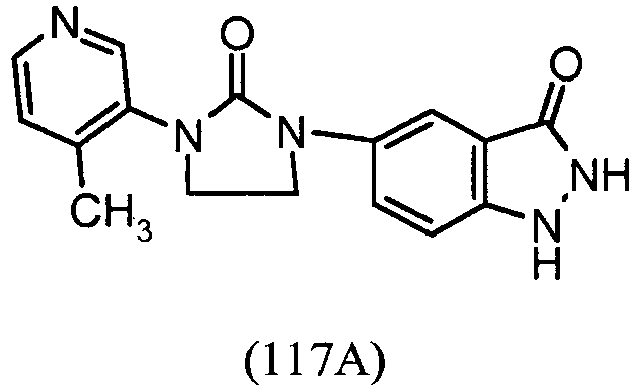
- Using the same reaction conditions as in Example 14, 1-(4-methyl-pyridin-3-yl)-imidazolidin-2-one (I-14b: 315 mg, 1.78 mmol) was reacted with 5-bromo-2-fluorobenzoic acid methyl ester (500 mg, 2.14 mmol), 1,4-dioxane (30 mL), copper iodide (34 mg, 0.178 mmol), trans-1,2-diamino cyclohexane (0.08 mL, 0.534 mmol) and potassium phosphate (935 mg, 4.45 mmol) to afford 520 mg of 2-Fluoro-5-[3-(4-methyl-pyridin-3-yl)-2-oxo-imidazolidin-1-yl]-benzoic acid methyl ester (88.8% yield).
- 1H NMR (CDCl3, 300 MHz): δ 8.55-8.4 (m, 2H), 8.1-7.82 (m, 2H), 7.3-7.1 (m, 2H), 4.1-3.9 (m, 7H), 2.35 (s, 3H)
- 2-Fluoro-5-[3-(4-methyl-pyridin-3-yl)-2-oxo-imidazolidin-1-yl]-benzoic acid methyl ester (I-117a: 510 mg, 1.55 mmol) and hydrazine hydrate were taken in a reaction flask and the flask was heated to 120°C for 18 hours with stirring. The reaction was monitored by TLC (10% MeOH in CHCl3). The reaction mixture was partitioned between ice water and ethylacetate. The aqueous layer was concentrated to afford the solid residue which was dissolved in 1:1 DCM: MeOH and filtered. The filtrate was concentrated and purified by column chromatography on silica gel (10-15% MeOH in CHCl3). The residue was washed with DCM and dried to afford 180 mg of the product (37.6% yield).
- 1H NMR (DMSO-D6, 300 MHz): δ 11.2 (s, 1H), 8.55 (s, 1H), 8.46 (d, 1H), 7.86 (d, 1H), 7.6 (s, 1H), 7.39-7.28 (m, 2H), 4.1-3.89 (m, 4H), 2.3 (s, 3H)
LCMS purity: 86.23%, m/z = 310.1 (M+1)
HPLC: 93.9% -

- Hydrazine hydrate (5 mL) was added to solution of 2-fluoro-5-[3-(4-methyl-pyridin-3-yl)-2-oxo-imidazolidin-1-yl]-benzonitrile (103A: 265 mg) in 2-methoxymethanol (5 mL). The resulting mixture was heated to 170°C and maintained for 20 hours. The reaction was monitored by TLC (20% MeOH in CHCl3). The reaction mixture was partitioned between ice water and DCM. The organic layer was dried over Na2SO4 and concentrated. Purification by column chromatography on silica gel (10% MeOH in CHCl3) afforded 125 mg of the product (45.3% yield).
- 1H NMR (DMSO-D6, 300 MHz): δ 11.28 (s, 1H), 8.55 (s, 1H), 8.4-8.32 (d, 1H), 7.75-7.62 (m, 2H), 7.4-7.2 (m, 2H), 5.5-5.2 (br s, 2H), 4.1-3.9 (m, 4H), 2.32 (s, 3H)
LCMS purity: 97.92%, m/z = 308.8 (M+1)
HPLC: 94.4% -

- Using the same reaction conditions as in Example 14, 1-(4-methyl-pyridin-3-yl)-imidazolidin-2-one (I-14b: 250 mg, 1.4108 mmol) was reacted with 3-iodo-imidazo[1,2-a]pyridine (344 mg, 1.4108 mmol), 1,4-dioxane (10 mL), copper iodide (34 mg), trans-1,2-diamino cyclohexane (68 mg) and potassium phosphate (898 mg, 4.2325 mmol) to afford the crude product. Purification by column chromatography on silica gel (10% MeOH in CHCl3) afforded 82 mg of the product (19.81% yield).
- 1H NMR (DMSO-D6, 300 MHz): δ 8.62 (s, 1H), 8.42-8.3 (m, 2H), 7.66-7.58 (m, 2H), 7.4-7.26 (m, 2H), 7.02 (t, 1H), 4.05 (s, 4H), 2.38 (s, 3H)
LCMS purity: 98.51 %, m/z = 294.1 (M+1)
HPLC: 90.42% -

- 10% Pd-C (10 mg) was added to a solution of 1-(4-chloro-thieno[3,2-c]pyridin-2-yl)-3-(4-methyl-pyridin-3-yl)-imidazolidin-2-one (98A: 80 mg, 0.232 mmol) in methanol (10 mL) under nitrogen atmosphere. The resulting mixture was hydrogenated at 30 PSI (2.04 atm) for 12 hours at room temperature. The reaction was monitored by TLC (10% MeOH in CHCl3). The reaction mixture was filtered through celite bed, washed with methanol and the filtrate was concentrated under reduced pressure to afford the crude product. Purification by preparative TLC afforded 10 mg of the product (14% yield).
- 1H NMR (CD3OD, 300 MHz): δ 8.85-8.75 (br s, 1H), 8.45 (s, 1H), 8.3 (d, 1H), 8.2-8.1 (m, 1H), 7.9 (d, 1H), 7.35 (d, 1H), 6.8 (s, 1H), 4.25-4.15 (m, 2H), 4.1-4.0 (m, 2H), 2.3 (s, 3H)
LCMS purity: 97.15%, m/z = 311.0 (M+1)
HPLC: 93.24% -

- Using the same reaction conditions as in Example 14, 1-(4-methyl-pyridin-3-yl)-imidazolidin-2-one (I-14b: 300 mg, 1.694 mmol) was reacted with 4-bromo-2-fluoro-benzaldehyde (403 mg, 2.118 mmol), 1, 4-dioxane (25 mL), copper iodide (32.186 mg, 0.1694 mmol), trans-1,2-diamino cyclohexane (72.16 mg, 0.5082 mmol) and potassium phosphate (1.077 g, 5.082 mmol) to afford the crude product. Purification by column chromatography on silica gel (1.5% MeOH in CHCl3) afforded 300 mg of 2-Fluoro-4-[3-(4-methyl-pyridin-3-yl)-2-oxo-imidazolidin-1-yl]-benzaldehyde (59.05% yield).
- 1H NMR (CDCl3, 300 MHz): δ 10.25 (s, 1H), 8.7-8.4 (m, 2H), 7.9 (t, 1H), 7.7 (d, 1H), 7.4-7.2 (m, 2H), 4.2-3.9 (m, 4H), 2.35 (s, 3H)
- O-Methyl-hydroxylamine (84 mg, 1.003 mmol) and K2CO3 (207 mg, 1.5 mmol) were added to a solution of 2-fluoro-4-[3-(4-methyl-pyridin-3-yl)-2-oxo-imidazolidin-1-yl]-benzaldehyde (I-121a: 300 mg, 1.003 mmol) in dimethoxyethane (10mL). The resulting mixture was heated to 40°C for 2 hours. The reaction was monitored by TLC (5% MeOH in CHCl3). The reaction mixture was filtered, washed with CHCl3 and the filtrate was concentrated under reduced pressure to afford 30 mg of crude 2-Fluoro-4-[3-(4-methyl-pyridin-3-yl)-2-oxo-imidazolidin-1-yl]-benzaldehyde O-methyl-oxime, which was used in the next step without further purification.
- 1H NMR (CDCl3, 300 MHz): δ 8.5 (s, 2H), 8.25 (s, 1H), 7.8 (t, 1H), 7.6-7.5 (m, 1H), 7.3-7.2 (m, 3H), 4.1-3.9 (m, 7H), 2.35 (s, 3H)
- Hydrazine hydrate (5 mL) was added to solution of 2-fluoro-4-[3-(4-methyl-pyridin-3-yl)-2-oxo-imidazolidin-1-yl]-benzaldehyde O-methyl-oxime (I-121b: 350 mg, 0.917 mmol) in 2-methoxymethanol (10 mL). The resulting mixture was heated to 200°C and maintained for 2 days. The reaction was monitored by TLC (5% MeOH in CHCl3). The reaction mixture was cooled to room temperature and concentrated. The crude product was purified by column chromatography on silica gel (4% MeOH in CHCl3), washed with ether and dried to afford 105 mg of the product (39.17% yield).
- 1H NMR (CD3OD, 300 MHz): δ 8.45 (s, 1H), 8.29 (d, 1H), 7.9 (s, 1H), 7.7-7.6 (m, 2H), 7.45-7.3 (m, 2H), 4.2-4.1 (m, 2H), 4.0-3.9 (m, 2H), 2.32 (s, 3H)
LCMS purity: 99.18%, m/z = 294.0 (M+1)
HPLC: 94.38% -

- Using the same reaction conditions as in Example 18, 1-(4-methyl-pyridin-3-yl)-imidazolidin-2-one (I-14b: 0.108 g, 0.0006 mol) was reacted with 5-bromo-1-(2-trimethylsilanyl-ethoxymethyl)-1H-pyrazolo[3,4-b]pyridine (0.2g, 0.0006mol), 1, 4-dioxane (20 mL), copper iodide (6.011 g, 0.00006 mol), trans-1,2-diamino cyclohexane (0.020 g, 0.00018 mol) and potassium phosphate (0.254 g, 0.0012 mol) to afford the crude product. Purification by column chromatography on silica gel (15% MeOH in CHCl3) afforded 172 mg of 1-(4-Methyl-pyridin-3-yl)-3-[1-(2-trimethylsilanyl-ethoxymethyl)-1H-pyrazolo[3,4-b]pyridin-5-yl]-imidazolidin-2-one (67.71% yield).
- Dioxane HCl (5 mL) was added to 1-(4-methyl-pyridin-3-yl)-3-[1-(2-trimethylsilanyl-ethoxymethyl)-1H-pyrazolo[3,4-b]pyridin-5-yl]-imidazolidin-2-one (I-122a: 172 mg) at 0°C. The resulting mixture was stirred at room temperature for 2 hours. The reaction was monitored by TLC (10% MeOH in CHCl3). Purification by preparative HPLC afforded 38 mg of the product (32% yield).
- 1H NMR (CD3OD, 300 MHz): δ 8.6 (s, 1H), 8.45 (s, 1H), 8.3-8.2 (m, 3H), 7.35 (d, 1H), 4.2-4.1 (m, 2H), 4.0-3.9 (m, 2H), 2.32 (s, 3H)
LCMS purity: 99.19%, m/z = 295.0 (M+1)
HPLC: 95.78% -
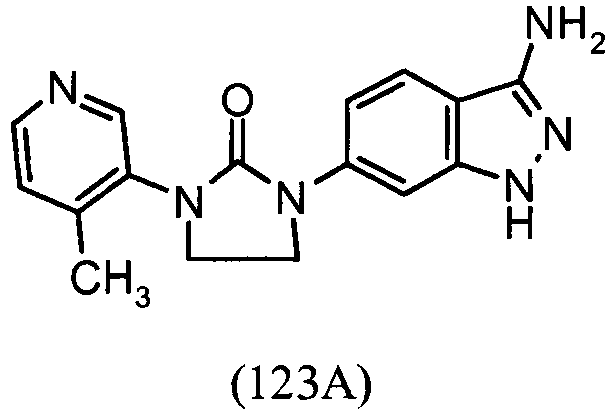
- Using the same reaction conditions as in Example 14, 1-(4-methyl-pyridin-3-yl)-imidazolidin-2-one (I-14b: 300 mg, 1.693 mmol) was reacted with 4-bromo-2-fluoro-benzonitrile (372 mg, 1.86 mmol), 1, 4-dioxane (50 mL), copper iodide (32.2 mg, 0.016 mmol), trans-1,2-diamino cyclohexane (61 mL, 0.5079 mmol) and potassium phosphate (900 mg, 4.23 mmol) to afford the crude product. Purification by column chromatography on silica gel (2% MeOH in CHCl3) afforded 163 mg of 2-Fluoro-4-[3-(4-methyl-pyridin-3-yl)-2-oxo-imidazolidin-1-yl]-benzonitrile (32.5% yield).
LCMS purity: 97.23%, m/z = 297.0 (M+1) - Hydrazine hydrate (5 mL) was added to solution of 2-fluoro-4-[3-(4-methyl-pyridin-3-yl)-2-oxo-imidazolidin-1-yl]-benzonitrile (I-123a: 163 mg) in 2-methoxymethanol (10 mL). The resulting mixture was heated to 170°C and maintained for 22 hours. The reaction was monitored by TLC (10% MeOH in CHCl3). The reaction mixture was partitioned between ice water and ethylacetate. The organic layer was washed with brine solution, dried over Na2SO4 and concentrated. Purification by preparative HPLC afforded 30 mg of the product (17.6% yield).
- 1H NMR (DMSO-d6, 300 MHz): δ 11.2 (s, 1H), 8.54 (s, 1H), 8.38 (d, 1H), 7.62 (d, 1H), 7.44 (s, 1H), 7.36 (d, 1H), 7.24 (d, 1H), 5.3 (s, 2H), 4.15-3.85 (m, 4H), 2.28 (s, 3H)
LCMS purity: 97.44%, m/z = 308.9 (M+1)
HPLC: 95.39% -

- 1-Benzothiazol-6-yl-3-(4-chloro-pyridin-3-yl)-imidazolidin-2-one (84A: 50 mg, 0.1515 mmol) was added dropwise to a solution of sodium methoxide (0.122 g, 2.259 mmol) in 1,4-dioxane (15 mL) over a period of 5 minutes. The resulting mixture was refluxed for 10 hours. The reaction was monitored by TLC (10% MeOH in CHCl3). The reaction mixture was partitioned between ice water and ethylacetate. The organic layer was dried over Na2SO4 and concentrated. Purification by preparative HPLC afforded 16 mg of the product (31.66% yield).
- 1H NMR (CDCl3, 300 MHz): δ 8.9 (s, 1H), 8.58 (s, 1H), 8.46 (d, 1H), 8.39 (s, 1H), 8.1 (d, 1H), 7.7 (dd, 1H), 6.92 (d, 1H), 4.18-4.09 (m, 2H), 4.0-3.9 (m, 5H)
LCMS purity: 99.16%, m/z = 326.9 (M+1)
HPLC: 91.89% -
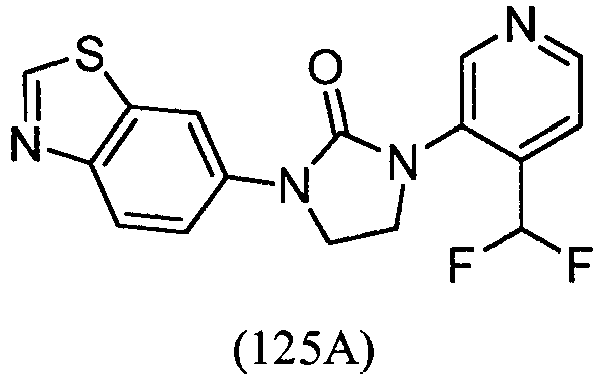
- Using the same reaction conditions as in Example 14, 1-benzothiazol-6-yl-imidazolidin-2-one (I-84b: 75 mg, 0.3173 mmol) was reacted with 3-bromo-4-difluoromethyl-pyridine (60 mg, 0.2884 mmol), 1, 4-dioxane (5 mL), copper iodide (7.5 mg), trans-1,2-diamino cyclohexane (15 mg) and potassium phosphate (122 mg, 0.5769 mmol) to afford the crude product. Purification by column chromatography on silica gel (2% MeOH in CHCl3), followed by preparative HPLC afforded 2 mg of the product (2% yield).
- 1H NMR (CDCl3, 300 MHz): δ 8.92 (s, 1H), 8.68 (s, 2H), 8.36-8.32 (d, 1H), 8.16-8.12 (d, 1H), 7.72-7.58 (m, 2H), 7.24-6.8 (t, 1H), 4.24-4.04 (m, 4H)
LCMS purity: 95.49%, m/z = 347 (M+1)
HPLC: 93.66% -

- Using the same reaction conditions as in Example 14, 1-benzothiazol-6-yl-imidazolidin-2-one (I-84b: 588.7 mg, 2.688 mmol) was reacted with 3-bromo-pyridine-4-carbaldehyde (500 mg, 2.688 mmol), 1, 4-dioxane (10 mL), copper iodide (51.2 mg, 0.2688 mmol), trans-1,2-diamino cyclohexane (92.33 mg, 0.8064 mmol) and potassium phosphate (1.711 g, 8.064 mmol) to afford the crude product. Purification by column chromatography on silica gel (2% MeOH in CHCl3) afforded 250 mg of 3-(3-Benzothiazol-6-yl-2-oxo-imidazolidin-1-yl)-pyridine-4-carbaldehyde (28.9% yield).
- 1H NMR (DMSO-D6, 300 MHz): δ 9.94 (s, 1H), 9.3 (s, 1H), 8.85 (s, 1H), 8.64 (d, 1H), 8.32 (d, 1H), 8.12-8.08 (d, 1H), 7.7 (dd, 1H), 7.66 (d, 1H), 4.32-4.16 (m, 4H)
- NaBH4 (82 mg, 2.1604 mmol) was added to a solution of 3-(3-benzothiazol-6-yl-2-oxo-imidazolidin-1-yl)-pyridine-4-carbaldehyde (I-126a: 140 mg, 0.4320 mmol) in MeOH (15 mL) and DCM (5 mL) at 0°C. The resulting mixture was stirred for 10 minutes. The reaction was monitored by TLC (10% MeOH in CHCl3). The reaction mixture was partitioned between water and DCM. The organic layer was washed with water and dried under reduced pressure to afford 110 mg of the product (78.01 % yield).
- 1H NMR (DMSO-D6, 300 MHz): δ 9.3 (s, 1H), 8.62 (s, 1H), 8.54 (d, 1H), 8.32 (s, 1H), 8.15-7.95 (m, 2H), 7.6 (d, 1H), 5.48 (t, 1H), 4.6 (d, 2H), 4.2-3.98 (m, 4H)
LCMS purity: 88.87%, m/z = 327.1 (M+1)
HPLC: 94.07% -

- Using the same reaction conditions as in Example 14, 1-benzothiazol-6-yl-imidazolidin-2-one (I-84b: 150 mg, 0.685 mmol) was reacted with 5-bromo-2-methylpyridine (140.5 mg, 0.822 mmol), 1, 4-dioxane (10 mL), copper iodide (12.92 mg, 0.068 mmol), trans-1,2-diamino cyclohexane (23 mg, 0.205 mmol) and potassium phosphate (435 mg, 2.055 mmol) to afford the crude product. Purification by column chromatography on silica gel (2% MeOH in CHCl3) afforded 110 mg of the product (51.80% yield).
- 1H NMR (DMSO-D6, 300 MHz): δ 9.3 (s, 1H), 8.7 (s, 1H), 8.3 (s, 1H), 8.1-7.9 (m, 3H), 7.3-7.2 (m, 1H), 4.1-4.0 (m, 4H), 2.5 (s, 3H)
LCMS purity: 91.9%, m/z = 311.1 (M+1)
HPLC: 92.14% -

- Using the same reaction conditions as in Example 14, 1-benzothiazol-6-yl-imidazolidin-2-one (I-84b: 150 mg, 0.684 mmol) was reacted with 3-bromo-4-trifluoromethyl-pyridine (185.75 mg, 0.822 mmol), 1, 4-dioxane (10 mL), copper iodide (12.99 mg, 0.0684 mmol), trans-1,2-diamino cyclohexane (23.37 mg, 0.205 mmol) and potassium phosphate (435 mg, 2.052 mmol) to afford the crude product. Purification by column chromatography on silica gel (1% MeOH in CHCl3), followed by preparative HPLC afforded 7 mg of the product (12.04% yield).
- 1H NMR (CDCl3, 300 MHz): δ 8.92 (s, 1H), 8.82-8.79 (m, 2H), 8.38 (s, 1H), 8.12 (d, 1H), 7.7-7.62 (m, 2H), 4.18 (t, 2H), 3.96 (t, 2H)
LCMS purity: 85.069%, m/z = 365.1 (M+1)
HPLC: 92.93% -

- Using the same reaction conditions as in Example 14, 1-benzothiazol-6-yl-imidazolidin-2-one (I-84b: 120 mg, 0.5472 mmol) was reacted with 3-bromo-isonicotinonitrile (100 mg, 0.5472 mmol), 1,4-dioxane (10 mL), copper iodide (12 mg), trans-1,2-diamino cyclohexane (24 mg) and potassium phosphate (349 mg, 1.6418 mmol) to afford the crude product. Purification by column chromatography on silica gel (2% MeOH in CHCl3) afforded 47 mg of the product (26.70% yield).
- 1H NMR (DMSO-D6, 300 MHz): δ 9.3 (s, 1H), 8.98 (s, 1H), 8.65 (d, 1H), 8.35 (s, 1H), 8.12-7.9 (m, 3H), 4.4-4.1 (m, 4H)
LCMS purity: 95.40%, m/z = 322 (M+1)
HPLC: 98.74% -

- 1-Chloro-3-isocyanato-propane (1.6 g, 13.87 mmol) was added dropwise to a stirred solution of 4-methyl-pyridin-3-ylamine (1 g, 9.25 mmol) in toluene (15 mL) at 0°C. The reaction mixture was stirred at room temperature for 18 hours. The reaction was monitored by TLC (100% ethylacetate). The reaction mixture was filtered, washed with toluene and dried under reduced pressure to afford 2.12 g (99.5% yield) of 1-(3-chloro-propyl)-3-(4-methyl-pyridin-3-yl)-urea.
LCMS: 94.28%, m/z= 228.1 (M+1) - 1-(3-Chloro-propyl)-3-(4-methyl-pyridin-3-yl)-urea (I-130a: 2 g, 9.25 mmol) in dry DMF (15 mL) was added to a stirred mixture of sodium hydride (330 mg, 13.87 mmol) in THF (30 mL) at 0°C. The reaction was stirred at room temperature for 1 hour. The reaction was monitored by TLC (100% ethylacetate). The reaction mixture was quenched with MeOH at 0°C, concentrated under reduced pressure and partitioned between ice water and chloroform. The organic layer was washed with brine solution, dried over Na2SO4 and concentrated under reduced pressure to afford 1.7 g (96.5% yield) of 1-(4-methyl-pyridin-3-yl)-tetrahydro-pyrimidin-2-one.
- 1H NMR (CDCl3, 300MHz): δ 8.44-8.36 (m, 2H), 7.19 (d, 1H), 5.1-5.0 (br s, 1H), 3.72-3.64 (m, 1H), 3.52-3.4 (m, 3H), 2.29 (s, 3H), 2.2-2.1 (m, 2H)
- Using the same reaction conditions as in Example 14, 1-(4-methyl-pyridin-3-yl)-tetrahydro-pyrimidin-2-one (I-130b: 150 mg, 0.785 mmol) was reacted with 2-bromo-naphthalene (195 mg, 0.942 mmol), 1, 4-dioxane (20 mL), copper iodide (15mg, 0.078 mmol), trans-1,2-diamino cyclohexane (0.03 mL, 0.235 mmol) and potassium phosphate (415 mg, 1.96 mmol) to afford the crude product. Purification by column chromatography on silica gel (1% MeOH in CHCl3), followed by recrystallization using DCM and hexane afforded 65 mg of the product (26.2% yield).
- 1H NMR (CDCl3, 300 MHz): δ 8.5 (s, 1H), 8.39 (d, 1H), 7.85-7.7 (m, 4H), 7.6-7.4 (m, 3H), 7.18 (d, 1H), 4.1-3.8 (m, 3H), 3.69-3.58 (m, 1H), 2.4-2.3 (m, 5H)
LCMS purity: 99.72%, m/z = 318.1 (M+1)
HPLC: 98.65% -

- 1-Chloro-2-isocyanato-ethane (2.36 g, 0.02239 mmol) was added dropwise to a stirred solution of m-tolylamine (2 g, 0.01866 mmol) in toluene (50 mL) over a period of 30 minutes at 0°C. The reaction mixture was stirred at room temperature for 12 hours. The reaction was monitored by TLC (5% MeOH in DCM). The reaction mixture was filtered, washed with toluene and dried under reduced pressure to afford 3.8 g (97% yield) of 1-(2-chloro-ethyl)-3-m-tolyl-urea.
- 1H NMR (DMSO-D6, 300MHz): δ 8.56 (s, 1H), 7.23 (s, 1H), 7.2-7.05 (m, 2H), 6.72 (d, 1H), 6.36 (t, 1H), 3.7-3.6 (m, 2H), 3.45-3.38 (m, 2H), 2.23 (s, 3H)
- 1-(2-Chloro-ethyl)-3-m-tolyl-urea (I-131a: 4 g, 18.86 mmol) in dry DMF (70 mL) was added to a stirred mixture of sodium hydride (1.358 g, 28.30 mmol) in THF (70 mL) at 0°C. The reaction was stirred at room temperature for 1 hour. The reaction was monitored by TLC (100% ethylacetate). The reaction mixture was quenched with MeOH at 0°C, concentrated under reduced pressure and partitioned between ice water and chloroform. The organic layer was washed with brine solution, dried over Na2SO4, and concentrated under reduced pressure to afford 2.7 g (81.34% yield) of 1-m-tolyl-imidazolidin-2-one.
- 1H NMR (DMSO-D6, 300MHz): δ 7.4-7.3 (m, 2H), 7.18 (t, 1H), 6.95-6.89 (br s, 1H), 6.8 (d, 1H), 3.85-3.78 (m, 2H), 3.44-3.36 (m, 2H), 2.26 (s, 3H)
LCMS purity: 96.44%, m/z= 177.2 (M+1) - Using the same reaction conditions as in Example 14, 1-m-tolyl-imidazolidin-2-one (I-131b: 150 mg, 0.8522 mmol) was reacted with 3-bromo-4-trifluoromethyl-pyridine (160 mg, 0.8522 mmol), 1, 4-dioxane (5 mL), copper iodide (16.23 mg, 0.08522 mmol), trans-1,2-diamino cyclohexane (29.27 mg, 0.2552 mmol) and potassium phosphate (542.56 mg, 2.556 mmol) to afford the crude product. Purification by preparative HPLC afforded 94 mg of the product (34.43% yield).
- 1H NMR (CDCl3, 300 MHz): δ 8.82-8.75 (br s, 1H), 7.64 (d, 1H), 7.46 (s, 1H), 7.4-7.2 (m, 3H), 6.95 (d, 1H), 4.15-3.85 (m, 4H), 2.36 (s, 3H)
LCMS purity: 97.94%, m/z = 321.7 (M+1)
HPLC: 97.47% -
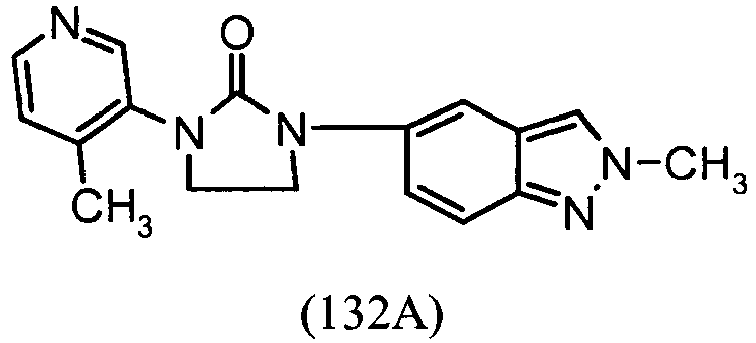
- Using the same reaction conditions as in Example 14, 1-(4-methyl-pyridin-3-yl)-imidazolidin-2-one (I-14b: 100 mg, 0.564 mmol) was reacted with 5-bromo-2-methyl-2H-indazole (120 mg, 0.5741 mmol), 1, 4-dioxane (15 mL), copper iodide (10 mg, 0.056 mmol), trans-1,2-diamino cyclohexane (19 mg, 0.166 mmol) and potassium phosphate (360 mg, 1.698 mmol) to afford the crude product. Purification by preparative HPLC afforded 3.6 mg of the product (6.228% yield).
- 1H NMR (CD3OD, 300 MHz): δ 8.5-8.46 (br s, 1H), 8.43-8.32 (m, 1H), 8.15 (s, 1H), 7.82-7.54 (m, 3H), 7.4 (d, 1H), 4.3-4.1 (m, 5H), 4.05-3.92 (m, 2H), 2.4 (s, 3H)
LCMS purity: 96.38%, m/z = 308.1 (M+1)
HPLC: 96.18% -

- Using the same reaction conditions as in Example 14, 1-(4-methyl-pyridin-3-yl)-imidazolidin-2-one (I-14b: 150 mg, 0.8465 mmol) was reacted with 1-bromo-naphthalene (118 mL, 0.8465 mmol), 1, 4-dioxane (10 mL), copper iodide (18 mg), trans-1,2-diamino cyclohexane (36mg) and potassium phosphate (539mg, 2.5395mmol) to afford the crude product. Purification by column chromatography on silica gel (2% MeOH in DCM) afforded 162 mg of the product (63.28% yield).
- 1H NMR (DMSO-D6, 300 MHz): δ 8.76-8.28 (m, 2H), 8.2-7.8 (m, 3H), 7.76-7.24 (m, 5H), 4.2-3.92 (br s, 4H), 2.35 (s, 3H)
LCMS purity: 98.99%, m/z = 303.9 (M+1)
HPLC: 98.34% -

- Using the same reaction conditions as in Example 14, 1-(4-methyl-pyridin-3-yl)-imidazolidin-2-one (I-14b: 150 mg, 0.847 mmol) was reacted with 5-bromo-1-methyl-1H-indole (215 mL, 1.016 mmol), 1, 4-dioxane (20 mL), copper iodide (15 mg, 0.084 mmol), trans-1,2-diamino cyclohexane (0.03 mL, 0.254 mmol) and potassium carbonate (230 mg, 1.69 mmol) to afford the crude product. Purification by column chromatography on silica gel (2% MeOH in CHCl3), followed by recrystallization using DCM and hexane afforded 55 mg of the product (27% yield).
- 1H NMR (CDCl3, 300 MHz): δ 8.53 (s, 1H), 8.38 (d, 1H), 7.7-7.55 (m, 2H), 7.4-7.15 (m, 2H), 7.1-7.01 (m, 1H), 6.5-6.45 (br s, 1H), 4.2-4.05 (m, 2H), 4.0-3.9 (m, 2H), 3.78 (s, 3H), 2.38 (s, 3H)
LCMS purity: 93.43%, m/z = 307.1 (M+1)
HPLC: 87.91% -

- Using the same reaction conditions as in Example 15, 1-(4-methyl-pyridin-3-yl)-imidazolidin-2-one (I-14b: 295 mg, 1.65 mmol) was reacted with 4-bromo-2-fluorobenzoic acid methyl ester (350 mg, 1.5 mmol), 1, 4-dioxane (25mL), copper iodide (32 mg, 0.165 mmol), trans-1,2-diamino cyclohexane (70 mg, 0.495 mmol) and potassium phosphate (875 mg, 4.12 mmol). The resulting mixture was refluxed for 18 hours. The reaction workup afforded 350 mg of 2-fluoro-4-[3-(4-methyl-pyridin-3-yl)-2-oxo-imidazolidin-1-yl]-benzoic acid methyl ester (68.7% yield).
- 1H NMR (CDCl3, 300 MHz): δ 8.78-8.26 (m, 2H), 8.1-7.82 (m, 1H), 7.55 (d, 1H), 7.48-7.12 (m, 2H), 4.3-3.8 (m, 7H), 2.32 (s, 3H)
LCMS purity: 97.47%, m/z = 330.1 (M+1) - Hydrazine hydrate (10 mL) was added to 2-fluoro-4-[3-(4-methyl-pyridin-3-yl)-2-oxo-imidazolidin-1-yl]-benzoic acid methyl ester (I-135a: 350 mg, 1.06 mmol) and the resulting mixture was heated to 120°C for 18 hours. The reaction was monitored by TLC (10% MeOH in CHCl3). The reaction mixture was partitioned between ice water and ethylacetate. The aqueous layer was concentrated to afford the crude product. Purification by column chromatography on silica gel (10% MeOH in CHCl3), followed by preparative HPLC afforded 135mg of the product (41.2% yield).
- 1H NMR (DMSO-D6, 300 MHz): δ 11.2-10.8 (br s, 1H), 10.7-10.4 (br s, 1H), 8.58-8.3 (m, 2H), 7.62-7.42 (m, 2H), 7.41-7.22 (m, 2H), 4.2-3.82 (m, 4H), 2.28 (s, 3H)
LCMS purity: 99.15%, m/z = 310.0 (M+1)
HPLC: 97.14% -

- Using the same reaction conditions as in Example 14, 1-(4-methyl-pyridin-3-yl)-imidazolidin-2-one (I-14b: 321.4 mg, 1.8142 mmol) was reacted with 3-bromo-4-chloro-thieno[3,2-c]pyridine (500 mg, 1.9956 mmol), 1, 4-dioxane (50 mL), copper iodide (34.4 mg, 0.1845 mmol), trans-1,2-diamino cyclohexane (62.3 mg, 0.5434 mmol) and potassium phosphate (961.3 mg, 4.528 mmol) to afford the crude product. Purification by column chromatography on silica gel (2% MeOH in CHCl3) afforded 220 mg of 1-(4-Chloro-thieno[3,2-c]pyridin-3-yl)-3-(4-methyl-pyridin-3-yl)-imidazolidin-2-one (35.2% yield).
- 1H NMR (CDCl3, 300 MHz): δ 8.55 (s, 1H), 8.46-8.2 (dd, 2H), 7.8-7.6 (m, 1H), 7.3-7.2 (m, 2H), 4.2-4.0 (m, 4H), 2.4 (s, 3H)
- Activated Zinc (417 mg, 6.380 mmol) was added to a stirred solution of 1-(4-chloro-thieno[3,2-c]pyridin-3-yl)-3-(4-methyl-pyridin-3-yl)-imidazolidin-2-one (I-136a: 220 mg, 0.6380 mmol) in acetic acid (10 mL). The resulting mixture was stirred at room temperature for 2 days. The reaction was monitored by TLC (10% MeOH in DCM). The reaction mixture was filtered and the filtrate was concentrated under reduced pressure. Aqueous NH3 solution was added to the concentrate and extracted with DCM. The organic layer was dried over Na2SO4 and concentrated under reduced pressure to afford the crude product. Purification by column chromatography on silica gel (5% MeOH in DCM) afforded 80 mg of the product (40.6% yield).
- 1H NMR (DMSO-D6, 300 MHz): δ 9.15 (s, 1H), 8.8-7.91 (m, 4H), 7.68 (s, 1H), 7.48-7.02 (m, 1H), 4.24-3.92 (m, 4H), 2.3 (s, 3H)
LCMS purity: 98.96%, m/z = 310.9 (M+1)
HPLC: 95.37% -

- K2CO3 (1.39 g, 10.08 mmol) was added to a stirred solution of 3-bromo-5-chloro-1H-indole (775 mg, 3.36 mmol) in DMF (7.5 mL) and the resulting mixture was stirred for 30 minutes. This was followed by the addition of methyl iodide (572.5 mg, 4.03 mmol) at 0-5°C and the stirring was continued for a further 2 hours at room temperature. The reaction was monitored by TLC (10% ethylacetate in hexane). The reaction mixture was partitioned between ice water and DCM. The organic layer was concentrated to afford the crude product. Purification by column chromatography on silica gel (5% ethylacetate in hexane) afforded 530 mg of 3-Bromo-5-chloro-1-methyl-1H-indole (65% yield).
1H NMR (DMSO-D6, 300 MHz): δ 7.94-7.2 (m, 4H), 3.8 (s, 3H) - Using the same reaction conditions as in Example 15, 1-(4-methyl-pyridin-3-yl)-imidazolidin-2-one (I-14b: 150 mg, 0.8465 mmol) was reacted with 3-bromo-5-chloro-1-methyl-1H-indole (I-137a: 226.2 mg, 0.9311 mmol), 1,4-dioxane (20 mL), copper iodide (16.1 mg, 0.8465 mmol), trans-1,2-diamino cyclohexane (30.6 mL, 0.255 mmol) and potassium phosphate (441 mg, 2.077 mmol). The resulting mixture was heated to reflux for 16 hours. The reaction workup afforded 170 mg of 1-(5-Chloro-1-methyl-1H-indol-3-yl)-3-(4-methyl-pyridin-3-yl)-imidazolidin-2-one (58.9% yield).
- 1H NMR (DMSO-D6, 300 MHz): δ 8.68-8.18 (m, 2H), 7.7 (s, 1H), 7.6-7.08 (m, 4H), 4.1-3.9 (br s, 4H), 3.78 (s, 3H), 2.3 (s, 3H)
LCMS purity: 100%, m/z = 340.8 (M+1)
HPLC: 96.1 % -

- Using the same reaction conditions as in Example 14, 1-(4-methyl-pyridin-3-yl)-imidazolidin-2-one (I-14b: 150 mg, 0.847 mmol) was reacted with 5-bromo-indan (248 mg, 1.0163 mmol), 1, 4-dioxane (10 mL), copper iodide (0.0161 g, 0.0842 mmol), trans-1,2-diamino cyclohexane (0.028g, 0.245mmol) and potassium phosphate (538mg, 2.537mmol) to afford the crude product. Purification by column chromatography on silica gel (1 % MeOH in CHCl3) afforded 45 mg of the product (20% yield).
- 1H NMR (CDCl3, 300 MHz): δ 8.8-8.2 (m, 2H), 7.7-7.0 (m, 4H), 4.15-3.8 (m, 4H), 3.15-2.65 (m, 4H), 2.34 (s, 3H), 2.2-1.8 (m, 2H)
LCMS purity: 85.44%, m/z = 294.1 (M+1)
HPLC: 91.46% -

- Using the same reaction conditions as in Example 14, 1-(4-methyl-pyridin-3-yl)-imidazolidin-2-one (I-14b: 500 mg, 2.825 mmol) was reacted with 5-bromo-benzo[b]thiophene (661.86 mg, 3.12 mmol), 1, 4-dioxane (20 mL), copper iodide (53.81 g, 0.2825 mmol), trans-1,2-diamino cyclohexane (97.03 g, 0.8475 mmol) and potassium phosphate (1.796g, 8.475 mmol) to afford the crude product. Purification by column chromatography on silica gel (1.2% MeOH in CHCl3), followed by preparative HPLC afforded 40 mg of the product (4.61 % yield).
- 1H NMR (CD3OD, 300 MHz): δ 7.4-7.1 (m, 2H), 7.02-6.65 (m, 2H), 6.54-6.1 (m, 4H), 6.0-5.5 (m, 2H), 1.12 (s, 3H)
LCMS purity: 95.27%, m/z = 308.0 (M+1)
HPLC: 97.39% -

- The title compound was prepared in a manner analogous to the procedures described for Example (I-123a).
- 1H NMR (DMSO-D6, 300 MHz): δ 8.55 (s, 1H), 8.42 (d, 1H), 8.0-7.74 (m, 2H), 7.7-7.52 (m, 1H), 7.38 (d, 1H), 4.18-3.9 (m, 4H), 2.29 (s, 3H)
LCMS purity: 96.96%, m/z = 297.1 (M+1)
HPLC: 97.49% -

- Using the same reaction conditions as in Example 14, 1-(4-methyl-pyridin-3-yl)-imidazolidin-2-one (I-14b: 175 mg, 0.9875 mmol) was reacted with 5-bromo-1-(2-trimethylsilanyl-ethoxymethyl)-1H-benzotriazole (353 mg, 1.08634 mmol), 1, 4-dioxane (50 mL), copper iodide (80.76 mg, 0.09875 mmol), trans-1,2-diamino cyclohexane (33.9 mg, 0.2962 mmol) and potassium phosphate (524 mg, 2.4689 mmol) to afford the crude product. Purification by column chromatography on silica gel (2% MeOH in CHCl3) afforded 350 mg of 1-(4-Methyl-pyridin-3-yl)-3-[1-(2-trimethylsilanyl-ethoxymethyl)-1H-benzotriazol-5-yl]-imidazolidin-2-one (79% yield).
1H NMR (CDCl3, 300 MHz): δ 8.66-8.25 (m, 2H), 8.2-7.6 (m, 2H), 7.2-7.4 (m, 2H), 6.15-5.8 (d, 2H), 4.35-3.9 (m, 4H), 3.7-3.4 (m, 2H), 2.4 (s, 3H), 1.05-0.7 (m, 2H), 0.2 --0.2 (m, 9H) - Dioxane HCl (10 ml) was added to 1-(4-methyl-pyridin-3-yl)-3-[1-(2-trimethylsilanyl-ethoxymethyl)-1H-benzotriazol-5-yl]-imidazolidin-2-one (I-141a: 350 mg, 0.78125 mmol) and the resulting mixture was stirred room temperature for 12 hours. The reaction was monitored by TLC (10% MeOH in DCM). The reaction mixture was concentrated and washed with ether. The solid formed was collected and dried under reduced pressure to afford 230 mg of the product (89.4% yield).
- 1H NMR (DMSO-D6, 300 MHz): δ 9.02 (s, 1H), 8.84-8.6 (m, 1H), 8.2-7.8 (m, 4H), 4.3-4.0 (m, 4H), 2.35 (s, 3H)
LCMS purity: 84.98%, m/z = 295.1 (M+1)
HPLC: 95.17% -

- TEA (185 mL, 1.3315 mmol) and triphosgene (138 mg, 0.4660 mmol) were added to a solution of benzothiazol-6-ylamine (200 mg, 1.3315 mmol) in THF (20 mL) at 0°C. The resulting mixture was stirred at room temperature for 3 hours. This was followed by the addition of 2,2-dimethoxy-ethylamine (173 mL, 1.5978 mmol) in THF and TEA (185 mL, 1.3315 mmol) and the stirring was continued for a further 18 hours at room temperature. The reaction was monitored by TLC (50% ethylacetate in hexane). The reaction mixture was concentrated and the concentrate was partitioned between ethylacetate and water. The organic layer was washed with water, brine solution, dried over Na2SO4 and concentrated. Purification by column chromatography on silica gel (100% ethylacetate) afforded 300 mg of 1-Benzothiazol-6-yl-3-(2,2-dimethoxy-ethyl)-urea (80.21% yield).
1H NMR (DMSO-D6, 300 MHz): δ 9.2 (s, 1H), 8.85 (s, 1H), 8.3 (s, 1H), 7.95 (d, 1H), 7.4 (d, 1H), 6.3 (s, 1H), 4.6-4.2 (m, 1H), 3.4-3.1 (m, 8H)
LCMS purity: 98.37%, m/z = 282.0 (M+1) - 1N H2SO4 (2 mL) was added to 1-benzothiazol-6-yl-3-(2,2-dimethoxy-ethyl)-urea (I-142a: 300 mg) and the resulting mixture was stirred at 0°C for 30 minutes. The reaction mixture was heated to 50°C for 2 hours. The reaction was monitored by TLC (10% MeOH in CHCl3). The reaction mixture was cooled to 0°C and basified with 10% KOH solution. The precipitate was collected, washed with water and dried under reduced pressure to afford 170 mg of 1-Benzothiazol-6-yl-1,3-dihydro-imidazol-2-one (73.59% yield).
- 1H NMR (DMSO-D6, 300 MHz): δ 10.6-10.1 (br s, 1H), 9.35 (br s, 1H), 8.5 (s, 1H), 8.2-7.7 (m, 2H), 7.0 (s, 1H), 6.6 (s, 1H)
LCMS purity: 93.78%, m/z = 217.9 (M+1)
HPLC: 94.03% - Using the same reaction conditions as in Example 14, 1-benzothiazol-6-yl-1,3-dihydro-imidazol-2-one (I-142b: 170 mg, 0.7834 mmol) was reacted with 3-iodo-4-methyl-pyridine (172 mg, 0.7834 mmol), 1, 4-dioxane (10 mL), copper iodide (17 mg), trans-1,2-diamino cyclohexane (34 mg) and potassium phosphate (499 mg, 2.3502 mmol) to afford the crude product. Purification by column chromatography on silica gel (2-3% MeOH in CHCl3), followed by preparative HPLC afforded 16 mg of the product (6.63% yield).
- 1H NMR (DMSO-D6, 300 MHz): δ 9.42 (s, 1H), 8.67-8.45 (d, 2H), 8.25-8.14 (d, 1H), 8.05-7.94 (m, 1H), 7.55-7.32 (m, 2H), 7.18-7.05 (d, 1H), 2.34 (s, 3H)
LCMS purity: 97.90%, m/z = 308.9 (M+1)
HPLC: 97.01% -
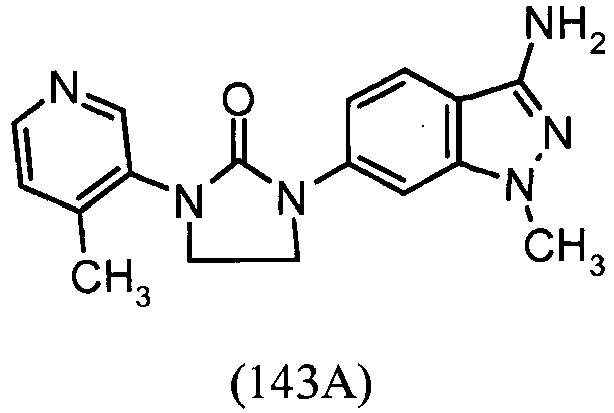
- Methyl hydrazine (10 mL) was added to a stirred solution of 2-fluoro-4-[3-(4-methyl-pyridin-3-yl)-2-oxo-imidazolidin-1-yl]-benzonitrile (I-123a: 240 mg, 0.80998 mmol) in 2-methoxy ethanol (20 mL). The resulting mixture was stirred at 170°C for 12 hours. The reaction was monitored by TLC (10% MeOH in CHCl3). The reaction mixture was cooled to room temperature and concentrated. Ice was added to the concentrate and the precipitate formed was collected and dried under reduced pressure to afford 180 mg of the product (69.2% yield).
- 1H NMR (DMSO-D6, 300 MHz): δ 8.8-8.1 (d, 2H), 7.8-7.15 (m, 4H), 5.35 (s, 2H), 4.4-3.8 (m, 4H), 3.6 (s, 3H), 2.35 (s, 3H)
LCMS purity: 99.42%, m/z = 323.1 (M+1)
HPLC: 95.08% -

- Using the same reaction conditions as in Example 14, 1-(4-methyl-pyridin-3-yl)-imidazolidin-2-one (I-14b: 130 mg, 0.00073 mol) was reacted with 6-bromo-1-(toluene-4-sulfonyl)-1H-indole (200 mg, 0.00073 mol), 1, 4-dioxane (20 mL), copper iodide (13 mg, 0.000073 mol), trans-1,2-diamino cyclohexane (26 mg, 0.00021 mol) and potassium phosphate (309 mg, 0.00146 mol) to afford the crude product. Purification by column chromatography on silica gel (2% MeOH in CHCl3) afforded 94 mg of 1-(4-Methyl-pyridin-3-yl)-3-[1-(toluene-4-sulfonyl)-1H-indol-6-yl]-imidazolidin-2-one (30.12% yield).
- 1H NMR (CDCl3, 300 MHz): δ 8.7-8.3 (m, 2H), 8.16 (s, 1H), 7.95-7.7 (m, 2H), 7.68-7.4 (m, 2H), 7.36-7.12 (m, 4H), 6.7-6.5 (s, 1H), 4.3-3.8 (m, 4H), 2.4 (s, 3H), 2.3 (s, 3H)
LCMS purity: 81.93%, m/z = 447.1 (M+1) - 10% NaOH solution (10 mL) was added to a solution of 1-(4-methyl-pyridin-3-yl)-3-[1-(toluene-4-sulfonyl)-1H-indol-6-yl]-imidazolidin-2-one (I-144a: 94 mg) in ethanol (10 mL). The resulting mixture was heated to reflux at 90°C for 1 hour. The reaction was monitored by TLC (10% MeOH in CHCl3). The reaction mixture was concentrated and partitioned between ethylacetate and water. The organic layer was washed with water, brine solution, dried and concentrated. Purification by column chromatography on silica gel (2% MeOH in DCM) afforded 29 mg of the product (47.54% yield).
- 1H NMR (CD3OD, 300 MHz): δ 8.7-8.2 (m, 2H), 7.9-7.0 (m, 5H), 6.4 (s, 1H), 4.3-3.8 (m, 4H), 2.4 (s, 3H)
LCMS purity: 75.15%, m/z = 293.0 (M+1)
HPLC: 85.90% -

- Using the same reaction conditions as in Example 14, 1-(4-methyl-pyridin-3-yl)-imidazolidin-2-one (I-14b: 165 mg, 0.932 mmol) was reacted with 7-bromo-3-chloro-imidazo[1,2-a]pyridine (278 mg, 1.21 mmol), 1, 4-dioxane (6 mL), copper iodide (17.71 mg, 0.093 mmol), trans-1,2-diamino cyclohexane (32.01 mg, 0.279 mmol) and potassium phosphate (493.96 mg, 2.33 mmol) to afford the crude product. Purification by column chromatography on silica gel (2% MeOH in CHCl3), followed by preparative HPLC afforded 20 mg of the product (6.57% yield).
- 1H NMR (CDCl3, 300 MHz): δ 9.1-8.9 (m, 2H), 8.6-8.3 (m, 2H), 8.0-7.6 (m, 3H), 4.4-4.1 (m, 4H), 2.6 (s, 3H)
LCMS purity: 83.31 %, m/z = 328.0 (M+1)
HPLC: 89.12% -

- Bromine in DMF (0.796 g, 4.975 mmol) was added to a stirred solution of 1H-indole-4-carbonitrile (700 mg, 4.9295 mmol) in DMF (15 mL) at room temperature. The resulting mixture was stirred at room temperature for 2 hours. The reaction was monitored by TLC (10% ethylacetate in hexane). The reaction mixture was poured into ice water containing 0.5% ammonia and 0.5% sodium metabisulphite. The precipitate was collected, washed with cold water and dried to afford 850 mg of 3-Bromo-1H-indole-4-carbonitrile (78.41 % yield).
- 1H NMR (DMSO-D6, 300 MHz): δ 12.1 (s, 1H), 8.02-7.49 (m, 3H), 7.42-7.2 (m, 1H)
- 3-Bromo-1H-indole-4-carbonitrile (I-146a: 500 mg, 2.272 mmol) was added dropwise to a stirred mixture ofNaH (0.218 g, 9.0833 mmol) in dry DMF (15 mL) at 0°C over a period of 10 minutes. This was followed by the addition of methyl iodide and the resulting mixture was stirred at 0°C for 2 hours. The reaction was monitored by TLC (10% ethylacetate in hexane). The reaction mixture was quenched with ice water; the precipitate formed was collected and dried to afford 0.400 g of the crude product.
1H NMR (CDCl3, 300 MHz): δ 7.8-7.0 (m, 4H), 3.82 (s, 3H) - Using the same reaction conditions as in Example 14, 1-(4-methyl-pyridin-3-yl)-imidazolidin-2-one (I-14b: 110 mg, 0.621 mmol) was reacted with 3-bromo-1-methyl-1H-indole-4-carbonitrile (I-146b: 175 mg, 0.744 mmol), 1,4-dioxane (15 mL), copper iodide (11mg, 0.0573 mmol), trans-1,2-diamino cyclohexane (21 mg, 0.1843 mmol) and potassium carbonate (171 mg, 1.239 mmol) to afford the crude product. Purification by column chromatography on silica gel (3% MeOH in CHCl3) afforded 49 mg of 1-Methyl-3-[3-(4-methyl-pyridin-3-yl)-2-oxo-imidazolidin-1-yl]-1H-indole-4-carbonitrile (23.90% yield).
- 1H NMR (CDCl3, 300 MHz): δ 8.6 (s, 1H), 8.5-8.3 (m, 1H), 7.7-7.1 (m, 4H), 4.18-3.95 (m, 4H), 3.85 (s, 3H), 2.45 (s, 3H)
LCMS purity: 99.70%, m/z = 331.9 (M+1)
HPLC: 95.81% -

- Using the same reaction conditions as in Example 14, 1-(4-methyl-pyridin-3-yl)- imidazolidin-2-one (I-14b: 0.123 g, 0.0007 mol) was reacted with 5-iodo-3,3-dimethyl-1-(2-trimethylsilanyl-ethoxymethyl)-1,3-dihydro-indol-2-one (0.29 g, 0.0007 mol), 1, 4-dioxane (20 mL), copper iodide (0.013 g, 0.00007 mol), trans-1,2-diamino cyclohexane (0.028 g, 0.00025 mol) and potassium phosphate (356 mg, 0.00168 mol) to afford the crude product. Purification by column chromatography on silica gel (80% ethylacetate in hexane) afforded 170 mg of 3,3-Dimethyl-5-[3-(4-methyl-pyridin-3-yl)-2-oxo-imidazolidin-1-yl]-1-(2-trimethylsilanyl-ethoxymethyl)-1,3-dihydro-indol-2-one (52.14% yield).
- 1H NMR (CDCl3, 300 MHz): δ 8.6-8.4 (m, 2H), 7.5-7.0 (m, 4H), 5.2 (s, 2H), 4.2-3.9 (m, 4H), 3.6-3.4 (m, 2H), 2.3 (s, 3H), 1.4 (s, 6H), 1.1-0.7 (m, 2H), 0.2-0.2 (s, 9H)
LCMS purity: 88.56%, m/z = 467.2 (M+1) - Dioxane HCl (4 mL) was added to 3,3-dimethyl-5-[3-(4-methyl-pyridin-3-yl)-2-oxo-imidazolidin-1-yl]-1-(2-trimethylsilanyl-ethoxymethyl)-1,3-dihydro-indol-2-one (I-147a: 50 mg) and the resulting mixture was stirred room temperature for 1 hour. The reaction was monitored by TLC (10% MeOH in CHCl3). The reaction mixture was basified with bicarbonate solution and extracted with DCM. The organic layer was concentrated; the concentrate was recrystallized with DCM and hexane and dried to afford 37 mg of the product (94.87% yield).
- 1H NMR (CD3OD, 300 MHz): δ 8.7-8.3 (m, 2H), 7.7-7.1 (m, 4H), 5.2 (s, 2H), 4.3-3.9 (m, 4H), 2.4 (s, 3H), 1.4 (s, 6H)
LCMS purity: 79.51%, m/z = 367.1 (M+1)
HPLC: 82.25% -

- Using the same reaction conditions as in Example 15, 1-(4-methyl-pyridin-3-yl)-imidazolidin-2-one (I-14b: 150 mg, 0.847 mmol) was reacted with 4-bromo-2-trifluoromethyl-pyridine (229 mg, 1.017 mmol), 1, 4-dioxane (10 mL), copper iodide (16.13 mg, 0.0847 mmol), trans-1,2-diamino cyclohexane (29.09 mg, 0.254 mmol) and potassium phosphate (44.89 mg, 2.117 mmol). The resulting mixture was heated to 120°C for 6 hours. The reaction workup afforded 200 mg of the product (73.52% yield).
- 1H NMR (DMSO-D6, 300 MHz): δ 8.8-8.5 (m, 2H), 8.5-8.35 (m, 1H), 8.35-8.1 (br s, 1H), 7.8-7.6 (m, 1H), 7.5-7.25 (m, 1H), 4.3-3.8 (m, 4H), 2.3 (s, 3H)
LCMS purity: 98.05%, m/z = 323.0 (M+1)
HPLC: 98.13% -

- PTSA (834 mg, 4.384 mmol) was added to a solution of 3-bromo-pyridine-4-carbaldehyde (600 mg, 3.2256 mmol) in methanol (20 mL). The resulting mixture was heated to reflux for 4 hours. The reaction was monitored by TLC (20% ethylacetate in hexane). The reaction mixture was concentrated and basified with NaHCO3 solution. The reaction mixture was partitioned between water and DCM. The organic layer was washed with brine solution, dried over Na2SO4, filtered and the filtrate was concentrated to afford 700 mg of 3-Bromo-4-dimethoxymethyl-pyridine (93.5% yield).
- 1H NMR (CDCl3, 300 MHz): δ 8.8-8.4 (m, 2H), 7.5 (s, 1H), 5.5 (s, 1H), 3.4 (s, 6H)
- Using the same reaction conditions as in Example 14, 1-benzothiazol-6-yl-imidazolidin-2-one (I-84b: 590 mg, 2.7 mmol) was reacted with 3-bromo-4-dimethoxymethyl-pyridine (I-149a: 690 mg, 2.97 mmol), 1, 4-dioxane (50 mL), copper iodide (51.46 mg, 0.27 mmol), trans-1,2-diamino cyclohexane (93 mg, 0.81 mmol) and potassium phosphate (1.72 g, 8.1 mmol) to afford the crude product. Purification by column chromatography on silica gel (1% MeOH in CHCl3) afforded 510 mg of the product (51.2% yield).
- 1H NMR (DMSO-D6, 300 MHz): δ 9.28 (s, 1H), 8.8-8.5 (m, 2H), 8.3 (s, 1H), 8.18-7.82 (m, 2H), 7.68-7.42 (br s, 1H), 5.6 (s, 1H), 4.25-3.85 (m, 4H), 3.3 (s, 6H)
LCMS purity: 98.35%, m/z = 371.2 (M+1)
HPLC: 96.82% -

- Using the same reaction conditions as in Example 14, 1-benzothiazol-6-yl-imidazolidin-2-one (I-84b: 200 mg, 0.912 mmol) was reacted with N-(3-iodo-pyridin-4-yl)-acetamide (262 mg, 1.003 mmol), 1, 4-dioxane (10 mL), copper iodide (17.3 mg, 0.09 mmol), trans-1,2-diamino cyclohexane (31.4 mg, 0.273 mmol) and potassium phosphate (581 mg, 2.73 mmol) to afford the crude product. Purification by column chromatography on silica gel (2% MeOH in CHCl3) afforded 75 mg of the product (23.36% yield).
- 1H NMR (DMSO-D6, 300 MHz): δ 9.75 (s, 1H), 9.28 (s, 1H), 8.55 (s, 1H), 8.45-7.9 (m, 5H), 4.3-4.0 (m, 2H), 3.95-3.8 (m, 2H), 2.2 (s, 3H)
LCMS purity: 78.28%, m/z = 354.0 (M+1)
HPLC: 90.16% -

- Using the same reaction conditions as in Example 14, 1-benzothiazol-6-yl-imidazolidin-2-one (I-84b: 100 mg, 0.456 mmol) was reacted with 3-bromo-5-chloro-4-methyl-pyridine (94 mg, 0.456 mmol), 1, 4-dioxane (5 mL), copper iodide (8.68 mg, 0.0456 mmol), trans-1,2-diamino cyclohexane (15.66 mg, 0.1368 mmol) and potassium phosphate (290.38 mg, 1.368 mmol) to afford the crude product. Purification by preparative HPLC afforded 52 mg of the product (34.21 % yield).
- 1H NMR (CD3OD, 300 MHz): δ 9.15 (s, 1H), 8.5 (s, 1H), 8.32 (s, 1H), 8.15-7.8 (m, 2H), 4.31-4.2 (m, 2H), 4.1-3.98 (m, 2H), 2.41 (s, 3H)
LCMS purity: 99.33%, m/z = 344.9 (M+1)
HPLC: 97.28% -

- 6N HCl (3 mL) was added to a solution of N-[3-(3-benzothiazol-6-yl-2-oxo-imidazolidin-1-yl)-pyridin-4-yl]-acetamide (150A: 70 mg, 0.198 mmol) in ethanol (3 mL) and the resulting mixture was refluxed at 65°C overnight. The reaction was monitored by TLC (10% MeOH in CHCl3). The reaction mixture was concentrated and the concentrate was washed with diethyl ether and dried to afford 20mg of the product (29.02% yield).
- 1H NMR (CD3OD, 300 MHz): δ 9.6 (s, 1H), 8.6-8.3 (m, 2H), 8.1 (s, 3H), 7.1-6.9 (m, 1H), 4.4-4.2 (m, 2H), 4.05-3.85 (m, 2H)
LCMS purity: 98.71%, m/z = 312.1 (M+1)
HPLC: 95.01% -

- Butyl Lithium (1.9 mL, 3.044 mmol) was added to a solution of DIPA (335.7 mg, 3.318 mmol) in THF (6 mL) at -78°C. The reaction mixture was stirred at -10°C for 10 minutes. This was followed by the addition of 3-bromo-5-trifluoromethyl-pyridine (500 mg, 2.212 mmol) in THF (3 mL) at -100°C. The reaction mixture was stirred for a further 15 minutes at -90°C and was followed by the addition of methyl iodide (557.0 mg, 3.924 mmol) in THF (2 mL) at -78°C with stirring over a period of 30 minutes. The reaction was monitored by TLC (5% ethylacetate in hexane). The reaction mixture was quenched with aqueous NaHCO3 solution and extracted with ethylacetate (100 mL). The organic layer was dried over Na2SO4 and concentrated. Purification by column chromatography on silica gel (2% ethylacetate in hexane) afforded 95 mg of the product (17.92% yield). LCMS: m/z = 239.8 (M+1)
- Using the same reaction conditions as described in example 14, 1-benzothiazol-6-yl-imidazolidin-2-one (I-84b: 80 mg, 0.365 mmol) was reacted with 3-bromo-4-methyl-5-trifluoromethyl-pyridine (SM-153a: 90 mg, 0.365 mmol), 1, 4-dioxane (5 mL), copper iodide (6.95 mg, 0.0365 mmol), trans-1,2-diamino cyclohexane (12.5 mg, 0.1095 mmol) and potassium phosphate (232.4 mg, 1.095 mmol) to afford the crude product. Purification by preparative HPLC afforded 5 mg of the product (3.6% yield).
- 1H NMR (CDCl3, 300 MHz): δ 9.05-8.65 (m, 3H), 8.35 (s, 1H), 8.25-8.05 (m, 1H), 7.78-7.58 (m, 1H), 4.32-4.12 (m, 2H), 4.12-3.91 (m, 2H), 2.49 (s, 3H)
LCMS purity: 100%, m/z = 378.9 (M+1)
HPLC: 93.5% -

- Using the same reaction conditions as described in example 14, 1-(4-methyl-pyridin-3-yl)-imidazolidin-2-one (I-14b: 150 mg, 0.847 mmol) was reacted with 4-bromo-isothiazole (166 mg, 1.016 mmol), 1,4-dioxane (15 mL), copper iodide (16.09 mg, 0.0847 mmol), trans-1,2-diamino cyclohexane (29 mg, 0.254 mmol) and potassium phosphate (540 mg, 2.541 mmol) to afford the crude product. Purification by column chromatography on silica gel (2% MeOH in CHCl3) afforded 120mg of the product (54.54% yield).
- 1H NMR (CDCl3, 300 MHz): δ 8.82 (s, 1H), 8.65-8.25 (m, 3H), 7.4-7.1 (m, 1H), 4.20-3.95 (m, 4H), 2.19 (s, 3H)
LCMS purity: 97.95%, m/z = 261.0 (M+1)
HPLC: 96.08% -

- Using the same reaction conditions as described in example 14, 1-(4-methyl-pyridin-3-yl)-imidazolidin-2-one (I-14b: 100 mg, 0.5643 mmol) was reacted with 2-bromo-5-trifluoromethyl-thiophene (136.9 mg, 0.5925 mmol), 1, 4-dioxane (10 mL), copper iodide (10.75 mg, 0.0564 mmol), trans-1,2-diamino cyclohexane (20.4 mL, 0.1693 mmol) and potassium phosphate (360 mg, 1.693 mmol) to afford the crude product. Purification by column chromatography on silica gel (2% MeOH in CHCl3) afforded 120mg of the product (65% yield).
- 1H NMR (DMSO-D6, 300 MHz): δ 8.66-8.3 (m, 2H), 7.65-7.23 (m, 2H), 6.55 (d, 1H), 4.24-3.90 (m, 4H), 2.26 (s, 3H)
LCMS purity: 96.35%, m/z = 327.9 (M+1)
HPLC: 95.04% -

- Butyl Lithium (10.28 mL, 16.455 mmol) was added to a solution of DIPA (2.66 mL, 18.98 mmol) in THF (25 mL) at -78°C. The reaction mixture was stirred at -10°C for 10 minutes, followed by the addition of 3-bromo-pyridine (500 mg, 2.212 mmol) in THF (10 mL) at -100°C. The reaction mixture was stirred for a further 15 minutes at -90°C and was followed by the addition of acetone (1.675 mL, 22.78 mmol) in THF (10 mL) at -78°C with stirring over a period of 1 hour. The reaction was monitored by TLC (5% ethylacetate in hexane). The reaction mixture was quenched with aqueous NaHCO3 solution and extracted with ethylacetate. The organic layer was dried over Na2SO4 and concentrated. Purification by column chromatography on silica gel (15% ethylacetate in hexane) afforded 200 mg of 2-(3-bromo-pyridin-4-yl)-propan-2-ol (11% yield).
- 1H NMR (CDCl3, 300 MHz): δ 8.7 (s, 1H), 8.5 (d, 1H), 7.65 (d, 1H), 1.7 (s, 6H) LCMS purity: 89.57%, m/z = 215.9 (M+1)
- Using the same reaction conditions as described in example 14, 1-benzothiazol-6-yl-imidazolidin-2-one (I-84b: 125 mg, 0.57 mmol) was reacted with 2-(3-bromo-pyridin-4-yl)-propan-2-ol (SM-156a: 122.7 mg, 0.57 mmol), 1, 4-dioxane (5 mL), copper iodide (10.85 mg, 0.057mmol), trans-1,2-diamino cyclohexane (19.57mg, 0.171mmol) and potassium phosphate (362.9 mg, 1.71 mmol) to afford the crude product. Purification by preparative HPLC afforded 38 mg of the product (19% yield).
- 1H NMR (CDCl3, 300 MHz): δ 8.68 (s, 1H), 8.50-8.32 (m, 2H), 7.86 (d, 1H), 7.18-7.02 (m, 2H), 6.82 (dd, 1H), 4.55-4.42 (m, 1H), 4.32 (t, 2H), 3.7-3.6 (m, 2H), 1.74-1.58 (m, 6H)
LCMS purity: 97.84%, m/z = 354.9 (M+1)
HPLC: 95.61 % -

- Tetrakis (triphenylphosphine) palladium (33mg, 0.0288mmol) was added to potassium carbonate (120mg, 0.8649mmol) previously purged with argon (30 minutes). The reaction mixture was purged with argon for 15 minutes, followed by the addition of 1-(4-chloro-thieno[3,2-c]pyridin-2-yl)-3-(4-methyl-pyridin-3-yl)-imidazolidin-2-one (98A: 100 mg, 0.2883 mmol) and methyl boronic acid (21 mg, 0.3459 mmol). The reaction mixture was heated to reflux for 6 hours. The reaction was monitored by TLC (10% MeOH in CHCl3). The reaction mixture was concentrated to afford the crude product. Purification by column chromatography on silica gel (3-4% MeOH in CHCl3), followed by preparative HPLC afforded 10mg of the product (16.39% yield).
- 1H NMR (CDCl3, 300 MHz): δ 8.7-8.35 (m, 2H), 8.35-8.2 (d, 1H), 7.5 (d, 1H), 6.58 (s, 1H), 4.4-3.9 (m, 4H), 2.79 (s, 3H), 2.36 (s, 3H)
LCMS purity: 96.01 %, m/z = 324.9 (M+1)
HPLC: 96.32% -

- Using the same reaction conditions as described in example 14, 1-benzothiazol-6-yl-imidazolidin-2-one (I-84b: 150mg, 0.6849mmol) was reacted with 1-(3-bromo-pyridin-4-yl)-ethanol (137.6 mg, 0.6849 mmol), 1, 4-dioxane (5 mL), copper iodide (13.04 mg, 0.06849 mmol), trans-1,2-diamino cyclohexane (23.52 mg, 0.205 mmol) and potassium phosphate (435.1 mg, 2.05 mmol) to afford the crude product. Purification by column chromatography on silica gel (2% MeOH in CHCl3), followed by preparative HPLC afforded 9 mg of the product (3.9% yield).
- 1H NMR (CDCl3, 300 MHz): δ 8.92 (s, 1H), 8.65-8.54 (m, 2H), 8.32 (d, 1H), 8.15 (d, 1H), 7.70-7.62 (dd, 1H), 7.6 (d, 1H), 5.10-4.96 (m, 1H), 4.30-4.12 (m, 3H), 4.02-3.85 (m, 1H), 3.75-3.66 (br s, 1H), 1.60-1.45 (d, 3H)
LCMS purity: 98.20%, m/z = 340.9 (M+1)
HPLC: 91.15% -

- Using the same reaction conditions as described in example 14, 1-benzothiazol-6-yl-imidazolidin-2-one (I-84b: 600 mg, 2.739 mmol) was reacted with 3-bromo-4-ethylpyridine (512 mg, 2.739 mmol), 1,4-dioxane (10 mL), copper iodide (52 mg, 0.2739 mmol), trans-1,2-diamino cyclohexane (94.08 mg, 0.82 mmol) and potassium phosphate (1.74 mg, 8.2 mmol) to afford the crude product. Purification by column chromatography on silica gel (2% MeOH in CHCl3), followed by preparative HPLC afforded 30 mg of the product (3.75% yield).
- 1H NMR (CD3OD, 300 MHz): δ 9.15 (s, 1H), 8.60-8.35 (m, 3H), 8.15-7.95 (m, 1H), 7.95-7.70 (m, 1H), 7.5 (d, 1H), 4.3-3.9 (m, 4H), 2.85-2.65 (q, 2H), 1.4-1.2 (t, 3H)
LCMS purity: 99.77%, m/z = 325.1 (M+1)
HPLC: 95.03% -

-

- A 0.5M solution of trimethyl-trifluoromethyl-silane in THF (6.68mL, 3.344mmol) and K2CO3 (250 mg, 10.82 mmol) was added to 2-fluoro-4-[3-(4-methyl-pyridin-3-yl)-2-oxo-imidazolidin-1-yl]-benzaldehyde (I-121a: 400 mg, 1.337 mmol) in dry DMF (5 mL) under nitrogen atmosphere. The resulting mixture was stirred at room temperature overnight. The reaction was monitored by thin layer chromatography (5% MeOH in CHCl3). The reaction mixture was quenched with brine solution and the THF layer was concentrated. The aqueous layer was extracted with chloroform. The organic layer was dried over Na2SO4 and concentrated to get the crude product. Purification by column chromatography on silica gel (2.5% MeOH in CHCl3), followed by hexane wash, afforded 325 mg of the product (65.92% yield).
- 1H NMR (CDCl3, 300 MHz): δ 8.56-8.00 (m, 2H), 7.75-7.45 (m, 2H), 7.36-7.08 (m, 2H), 5.38 (q, 1H), 4.55-4.24 (br s, 1H), 4.20-3.76 (m, 4H), 2.32 (s, 3H)
-

- MnO2 (536mg, 6.165mmol) was added to 1-[3-fluoro-4-(2,2,2-trifluoro-1-hydroxy-ethyl)-phenyl]-3-(4-methyl-pyridin-3-yl)-imidazolidin-2-one (I-160a: 325 mg, 0.880 mmol) in DCM (20 mL) under nitrogen atmosphere. The resulting suspension was stirred at 50°C overnight. The reaction was monitored by TLC (5% MeOH in DCM). The reaction mixture was cooled to room temperature and filtered through celite pad. The filtrate was washed with CHCl3, dried over Na2SO4 and concentrated. The concentrate was washed with hexane and dried to afford 240 mg of the product (74.53% yield).
- 1H NMR (DMSO-D6, 300 MHz): δ 8.8-8.2 (m, 2H), 7.98 (t, 1H), 7.86-7.50 (m, 2H), 7.46-7.25 (m, 1H), 4.40-3.75 (m, 4H), 2.28 (s, 3H).
- Acetic acid (0.1 mL, 1.36 mmol) and 1M hydrazine in THF (4 mL, 2.72 mmol) were added to 1-[3-fluoro-4-(2,2,2-trifluoro-acetyl)-phenyl]-3-(4-methyl-pyridin-3-yl)- imidazolidin-2-one I-160b: 100 mg, 0.272 mmol) in dry THF (2 mL). The resulting mixture was stirred at 150°C overnight. The reaction was monitored by TLC (5% MeOH in CHCl3). The reaction mixture was partitioned between water and chloroform. The organic layer was dried over Na2SO4 and concentrated. Purification by column chromatography on silica gel (4% MeOH in CHCl3), followed by preparative HPLC afforded 23 mg of the product (23.46% yield).
- 1H NMR (CD3OD, 300 MHz): δ 8.57-8.48 (br s, 1H), 8.37 (d, 1H), 7.86-7.70 (m, 2H), 7.70-7.60 (m, 1H), 7.42 (d, 1H), 4.34-4.12 (m, 2H), 4.12-3.90 (m, 2H), 2.41 (s, 3H).
LCMS purity: 96.14%, m/z = 362.0 (M+1)
HPLC: 94.33% -

-

- A 0.5M solution of cyclopropyl magnesium bromide in THF (2.4 mL, 1.170 mmol) was added dropwise to 2-fluoro-4-[3-(4-methyl-pyridin-3-yl)-2-oxo-imidazolidin-1-yl]-benzaldehyde (I-121a: 175 mg, 0.585 mmol) in dry THF (10 mL) at 0°C under nitrogen atmosphere. The resulting mixture was stirred at room temperature for 3 hours. The reaction was monitored by TLC (5% MeOH in CHCl3). The reaction mixture was quenched with aqueous NH4Cl solution and the THF layer was concentrated. The aqueous layer was extracted with ethylacetate. The organic layer was dried over Na2SO4 and concentrated to afford the crude product. Purification by column chromatography on silica gel (3% MeOH in CHCl3), followed by hexane wash, afforded 200 mg of the product (99.41% yield).
- 1H NMR (DMSO-D6, 300 MHz): δ 8.72-8.28 (m, 2H), 7.70-7.48 (m, 2H), 7.42-7.25 (m, 2H), 5.30 (d, 1H), 4.48-4.20 (m, 1H), 4.18-3.82 (m, 4H), 2.32 (s, 3H), 1.2-1.0 (m, 1H), 0.7-0.1 (m, 4H)
LCMS purity: 97.58%, m/z = 342.3 (M+1) -

- MnO2 (357 mg, 41.055 mmol) was added to 1-[4-(cyclopropyl-hydroxy-methyl)-3-fluoro-phenyl]-3-(4-methyl-pyridin-3-yl)-imidazolidin-2-one (I-161a: 200 mg, 8.586 mmol) in DCM (20 mL) under nitrogen atmosphere and worked up in a manner similar to what has been described previously for example 160 (Step 2) to afford 175 mg of the product (60.13% yield).
- 1H NMR (DMSO-D6, 300 MHz): δ 8.56 (s, 1H), 8.41 (d, 1H), 7.82 (t, 1H), 7.76-7.65 (m, 1H), 7.60-7.47 (m, 1H), 7.37 (d, 1H), 4.22-3.82 (m, 4H), 2.80-2.60 (m, 1H), 2.29 (s, 3H), 1.18-0.93 (m, 4H)
LCMS purity: 98.34%, m/z = 339.7 (M+1) - 1-(4-Cyclopropanecarbonyl-3-fluoro-phenyl)-3-(4-methyl-pyridin-3-yl)-imidazolidin-2-one (I-161b: 175 mg, 0.516 mmol) in hydrazine hydrate solution (10 mL) was taken in a reaction flask. The flask was refluxed at 120°C overnight. The reaction was monitored by TLC (5% MeOH in CHCl3). The reaction mixture was cooled to room temperature and partitioned between ice water and chloroform. The organic layer was dried over Na2SO4 and concentrated. Purification by column chromatography on silica gel (4% MeOH in CHCl3), followed by hexane and ether wash, afforded 55 mg of the product (31.97% yield).
- 1H NMR (DMSO-D6, 300 MHz): δ 12.42 (s, 1H), 8.55 (s, 1H), 8.39 (d, 1H), 7.85-7.28 (m, 4H), 4.28-3.80 (m, 4H), 2.6-2.1 (m, 4H), 1.04-0.80 (m, 4H)
LCMS purity: 100.00%, m/z = 333.8 (M+1)
HPLC: 94.27% -
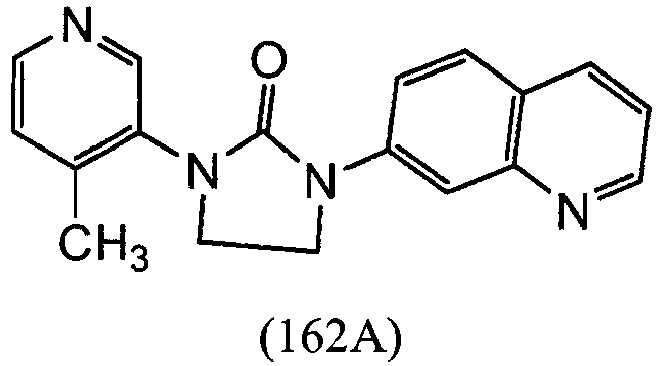
- Using the same reaction conditions as described in example 14, 1-(4-methyl-pyridin-3-yl)-imidazolidin-2-one (I-14b: 116 mg, 0.6554 mmol) was reacted with 7-bromo-quinoline (150 mg, 0.72098 mmol), 1, 4-dioxane (50 mL), copper iodide (12.4 mg, 0.06554 mmol), trans-1,2-diamino cyclohexane (22.5 mg, 0.19638 mmol) and potassium phosphate (347.3 g, 1.6365 mmol) to afford the crude product. Purification by column chromatography on silica gel (2% MeOH in CHCl3) afforded 130 mg of the product (65.3% yield).
- 1H NMR (DMSO-D6, 300 MHz): δ 8.95-8.76 (m, 1H), 8.6 (s, 1H), 8.48-8.22 (m, 3H), 8.06-7.82 (m, 2H), 7.50-7.32 (m, 2H), 4.32-4.12 (m, 2H), 4.10-3.90 (m, 2H), 2.31 (s, 3H)
LCMS purity: 99.57%, m/z = 305.0 (M+1)
HPLC: 93.16% -

- SOCl2 (5.22 g, 44.23 mmol) was added dropwise to a stirred solution of 3-chloro-2,2-dimethyl-propionic acid (5 g, 36.76 mmol) in DCM (50 mL) at 0°C over a period of 5mins. This was followed by the addition of DMF (0.1 mL) and the resulting mixture was heated to 60°C for 3 hours. The reaction was monitored by TLC (5% MeOH in CHCl3). The reaction mixture was concentrated and the crude product (6 g) was used in the next step without further purification.
- Sodium azide (4.64 g, 71.38 mmol) was added to a solution of 3-chloro-2,2-dimethyl-propionyl chloride (6 g, 35.71 mmol) in 1,4-dioxane (15 mL) and water (15 mL). The resulting mixture was stirred at room temperature for 2 hours. The reaction was monitored by TLC (5% ethylacetate in hexane). The reaction mixture was extracted with diethyl ether and the organic layer was dried over Na2SO4 to afford 3.5 g of the product (61.40% yield).
- 1-Chloro-2-isocyanato-2-methyl-propane (3.5 g, 20 mmol) in toluene (35 mL) was taken a reaction flask and flask was heated to 85°C for 1.30 hour. The reaction was monitored by TLC (5% ethylacetate in hexane). The crude product (3 g) was used in the next step without further purification.
-

- 4-Methyl-pyridin-3-ylamine (1.98 g, 18.33 mmol) was added to solution of 1-chloro-2-isocyanato-2-methyl-propane (3 g, 20.40 mmol) in toluene (30 mL). The resulting mixture was stirred at room temperature for 3 days. The reaction was monitored by TLC (5% MeOH in CHCl3). The reaction mixture was filtered and the residue was dried to afford 4.3 g of the product (87.75% yield).
- 1H NMR (CDCl3, 300 MHz): δ 8.70 (s, 1H), 8.3 (s, 1H), 7.12 (s, 1H), 6.39 (s, 1H), 4.9 (s, 1H), 3.87 (s, 2H), 2.30 (s, 3H), 1.4 (s, 6H)
LCMS purity: 76.36%, m/z = 242.0 (M+1) -

- 1-(2-Chloro-1,1-dimethyl-ethyl)-3-(4-methyl-pyridin-3-yl)-urea (I-163a: 1 g, 4.149 mmol) in dry THF (5 mL) was added dropwise to a stirred mixture ofNaH (298 mg, 6.208 mmol) in dry THF (10 mL) under argon atmosphere over a period of 10 minutes at 0°C. The resulting reaction mixture was stirred for 2 hours. The reaction was monitored by TLC (5% MeOH in CHCl3). The reaction mixture was partitioned between water and ethylacetate. The organic layer was dried over Na2SO4 and concentrated to afford 800 mg of the product (94.33% yield).
- 1H NMR (DMSO, 300 MHz): δ 8.4 (s, 1H), 8.3 (d, 1H), 7.30 (d, 1H), 7.0 (s, 1H), 3.53 (s, 2H), 2.22 (s, 3H), 1.3 (s, 6H)
LCMS purity: 100%, m/z = 205.7 (M+1) - Using the same reaction conditions as described in example 14, 4,4-dimethyl-1-(4-methyl-pyridin-3-yl)-imidazolidin-2-one (I-163b: 150mg, 0.731mmol) was reacted with 6-iodo-benzothiazole (248mg, 0.950mmol), 1,4-dioxane (10mL), copper iodide (13mg, 0.0682mmol), trans-1,2-diamino cyclohexane (31mg, 0.218mmol) and potassium phosphate (387mg, 1.825mmol) to afford the crude product. Purification by column chromatography on silica gel (1% MeOH in CHCl3) afforded 30mg of the product (12.14% yield).
- 1H NMR (CD3OD, 300 MHz): δ 9.32 (s, 1H), 8.51 (s, 1H), 8.35 (d, 1H), 8.0-8.2 (m, 2H), 7.60 (d, 1H), 7.40 (d, 1H), 3.90 (s, 2H), 2.45 (s, 3H), 1.5 (s, 6H)
LCMS purity: 94.09%, m/z = 339.1 (M+1)
HPLC: 89.11% -

-

- Benzothiazol-6-ylamine (1.8 g, 12.00 mmol) was added portion wise to solution of 1-chloro-2-isocyanato-2-methyl-propane (2 g, 13.60 mmol) in toluene (20 mL) over a period of 5 minutes. The resulting mixture was stirred at room temperature for 2 ½ days. The reaction was monitored by TLC (5% MeOH in CHCl3). The reaction mixture was concentrated and extracted with ethylacetate. The organic layer was dried over Na2SO4 and concentrated. Purification by column chromatography on silica gel (1% MeOH in CHCl3) afforded 630 mg of the product (16.57% yield).
- 1H NMR (CDCl3, 300 MHz): δ 8.85 (s, 1H), 8.23 (d, 1H), 8.0 (d, 1H), 7.20-7.15 (dd, 1H), 7.03 (s, 1H), 5.10 (s, 1H), 3.89 (s, 2H), 1.49 (s, 6H)
LCMS purity: 98.84%, m/z = 283.9 (M+1) -

- 1-Benzothiazol-6-yl-3-(2-chloro-1,1-dimethyl-ethyl)-urea (I-164a: 620 mg, 2.18 mmol) in dry THF (5 mL) was added dropwise to a stirred mixture of NaH (78 mg, 3.25 mmol) in dry THF (5 mL) under argon atmosphere over a period of 10mins at 0°C. The resulting reaction mixture was stirred at room temperature for 45 minutes. The reaction was monitored by TLC (5% MeOH in CHCl3). The reaction mixture was partitioned between chilled water and ethylacetate. The organic layer was dried over Na2SO4 and concentrated to afford 410 mg of the product (77.35% yield).
- 1H NMR (CDCl3, 300 MHz): δ 8.90 (s, 1H), 8.31 (d, 1H), 8.09 (d, 1H), 7.69-7.58 (dd, 1H), 5.0 (br s, 1H), 3.73 (s, 2H), 1.49 (s, 6H)
LCMS purity: 99.16%, m/z = 247.8 (M+1) - Using the same reaction conditions as described in example 14, 1-benzothiazol-6-yl-4,4-dimethyl-imidazolidin-2-one (I-164b: 100 mg, 0.4048 mmol) was reacted with 3-bromo-pyridine (83 mg, 0.525 mmol), 1, 4-dioxane (10 mL), copper iodide (7 mg, 0.036 mmol), trans-1,2-diamino cyclohexane (17 mg, 0.119 mmol) and potassium phosphate (214 mg, 1.009 mmol) to afford the crude product. Purification by column chromatography on silica gel (1% MeOH in CHCl3) afforded 15 mg of the product (11.45% yield).
- 1H NMR (CDCl3, 300 MHz): δ 8.90 (s, 1H), 8.7-8.5 (br s, 2H), 8.35 (d, 1H), 8.12 (d, 1H), 7.77-7.60 (m, 2H), 7.5-7.4 (m, 1H), 3.9 (s, 2H), 1.49 (s, 6H)
LCMS purity: 100%, m/z = 325.1 (M+1)
HPLC: 95.40% -

- Using the same reaction conditions as described in example 14, 1-benzothiazol-6-yl-4,4-dimethyl-imidazolidin-2-one (I-164b: 100 mg, 0.4048 mmol) was reacted with 3-iodo-4-methyl-pyridine (115 mg, 0.525 mmol), 1,4-dioxane (10 mL), copper iodide (7 mg, 0.0368mmol), trans-1,2-diamino cyclohexane (18 mg, 0.1197 mmol) and potassium phosphate (214 mg, 1.0094 mmol) to afford the crude product. Purification by column chromatography on silica gel (1% MeOH in CHCl3) afforded 6 mg of the product (4.8% yield).
- 1H NMR (CDCl3, 300 MHz): δ 8.30 (d, 1H), 8.15 (d, 1H), 7.7-7.6 (dd, 1H), 3.8 (s, 2H), 2.72 (s, 3H), 1.49 (s, 6H)
LCMS purity: 94.22%, m/z = 339.1 (M+1)
HPLC: 86.98% -

-

- 3-Amino-butyric acid ethyl ester (2 g, 15.27 mmol), 6-iodo-benzothiazole (3.98 g, 15.27 mmol) and potassium carbonate (5.27 g, 38.18 mmol) were dissolved in DMF (50 mL) and the reaction mixture was purged with argon for 10 minutes. This was followed by the addition of copper iodide (290 mg, 1.527 mmol) and the resulting mixture was heated to 110 °C overnight. The reaction was monitored by TLC (10% MeOH in CHCl3) which showed the presence of starting material. The reaction mixture was heated to 120°C for a further 24 hours. The reaction mixture was concentrated and adjusted the pH to 5 using acetic acid. The reaction mixture was partitioned between water and ethylacetate. The organic layer was dried over Na2SO4 and concentrated. Purification by column chromatography on silica gel (1% MeOH in CHCl3) afforded 800 mg of the product (22.22% yield).
- 1H NMR (DMSO, 300 MHz): δ 12.2 (s, 1H), 8.9 (s, 1H), 7.75 (d, 1H), 7.15 (d, 1H), 6.85 (dd, 1H), 5.90-5.80 (m, 1H), 3.90-3.80 (m, 1H), 2.60-2.50 (m, 1H), 2.25-2.35 (m, 1H), 1.20 (d, 3H)
LCMS purity: 61.65%, m/z = 237.0 (M+1) -
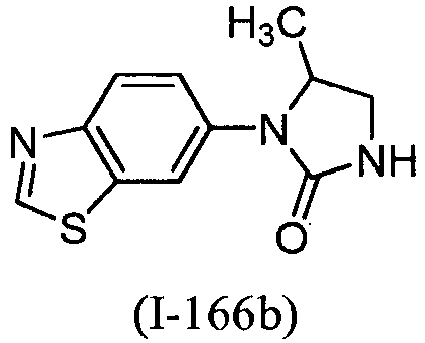
- Triethylamine (1.129 g, 11.18 mmol) was added to a mixture of 3-(benzothiazol-6-ylamino)-butyric acid I-166a: 800 mg, 3.39 mmol) in toluene (30 mL) and the reaction mixture was purged with argon for 10 minutes. This was followed by the addition of DPPA (2.796 g, 10.17 mmol) and the resulting mixture was heated to 100°C overnight. The reaction was monitored by TLC (10% MeOH in CHCl3) which showed the presence of starting material. The reaction mixture was heated to 120°C for the next 24 hours. The reaction mixture was partitioned between water and ethylacetate. The organic layer was dried over Na2SO4 and concentrated. Purification by column chromatography on silica gel (2% MeOH in CHCl3) afforded 600 mg of the product (75.95% yield).
- 1H NMR (DMSO, 300 MHz): δ 9.25 (s, 1H), 8.22 (d, 1H), 8.0 (d, 1H), 7.7 (dd, 1H), 7.0 (s, 1H), 4.6-4.5 (m, 1H), 3.6 (t, 1H), 3.0 (m, 1H), 1.2 (d, 3H)
LCMS purity: 81.90%, m/z = 234.0 (M+1) - Using the same reaction conditions as described in example 14, 1-benzothiazol-6-yl-5-methyl-imidazolidin-2-one (I-166b: 150 mg, 0.644 mmol) was reacted with 3-iodo-4-methyl-pyridine (140.99 mg, 0.644 mmol), 1, 4-dioxane (10 mL), copper iodide (12.27 mg, 0.0644 mmol), trans-1,2-diamino cyclohexane (27.43 mg, 0.193 mmol) and potassium phosphate (341 mg, 1.61 mmol) to afford the crude product. Purification by column chromatography on silica gel (1.5% MeOH in DCM) afforded 50mg of the product (24.15% yield).
- 1H NMR (CDCl3, 300 MHz): δ 8.95 (s, 1H), 8.55 (s, 1H), 8.43 (d, 1H), 8.26 (d, 1H), 8.15 (d, 1H), 7.55 (dd, 1H), 7.25 (d, 1H), 4.7-4.6 (m, 1H), 4.2-4.1 (m, 1H), 3.6-3.5 (m, 1H), 2.4 (s, 3H), 1.5 (d, 3H)
LCMS purity: 95.66%, m/z = 325.0 (M+1)
HPLC: 96.32% -

-

- 2-Methyl-acrylic acid (0.63g, 0.00732mol) and Benzene-1,4-diol (0.029g, 0.000266mol) were added to a stirred solution of Benzothiazol-6-ylamine (1g, 0.00665mol) in toluene (6mL) under nitrogen atmosphere. The resulting reaction mass was heated at 70°C for 72 hours and further at 100°C for 48 hours. The reaction was monitored by TLC (5% methanol in chloroform). The reaction mixture was cooled to room temperature and partitioned between water and ethyl acetate. The organic layer was washed with brine solution, dried over Na2SO4 and concentrated to afford the crude product. Purification by column chromatography on silica gel (0.75% methanol in chloroform) afforded 0.43g of the product (26.87% yield).
- 1H NMR (300 MHz, DMSO): δ 12.25 (s, 1H), 8.9 (s, 1H), 7.75 (d, 1H), 7.15 (s, 1H), 6.85 (d, 1H), 6.20-6.05 (bs, 1H), 3.45-3.3 (m, 1H), 3.15-3.0 (m, 1H), 2.7 (q, 1H), 1.15 (d, 3H)
LCMS: 100%, m/z = 237.3 (M+1) -
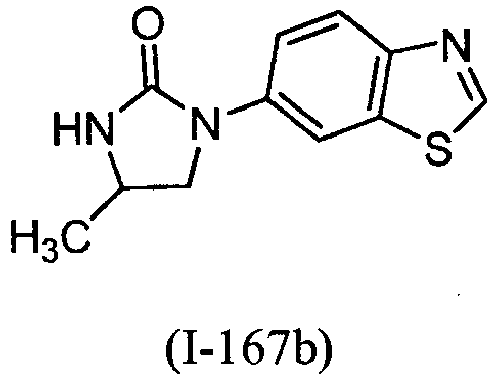
- 3-(Benzothiazol-6-ylamino)-2-methyl-propionic acid (I-167a: 500mg, 2.118mmol) was refluxed with triethylamine (1mL, 6.989mmol), DPPA (1.75g, 6.35mmol) and toluene (10mL) at 120°C in a sealed tube to afford the crude product. The reaction was monitored by TLC (5% methanol in chloroform). Purification by column chromatography on silica gel (2% methanol in chloroform) afforded 350mg of the product (71.42% yield).
- 1H NMR (300 MHz, DMSO): δ 9.25(s, 1H), 8.25 (d, 1H), 8.0 (d, 1H), 7.9 -7.8 (dd, 1H), 7.28 (s, 1H), 4.05 (t, 1H), 3.9-3.8 (m, 1H), 3.55-3.45 (m, 1H), 1.2 (d, 3H)
LCMS: 100%, m/z = 233.8 (M+H) - Using the same reaction conditions and work up as described in Example 1, step-3, 1-benzothiazol-6-yl-4-methyl-imidazolidin-2-one (I-167b: 150mg, 0.643mmol) was refluxed with 3-iodo-4-methyl-pyridine (155mg, 0.708mmol), copper iodide (12.21mg, 0.0643mmol), N,N'-dimethyl-cyclohexane-1,2-diamine (27.39mg, 0.192mmol), potassium phosphate (341.5mg, 1.607mmol) and 1, 4-dioxane (5mL) at 120°C for 12 hours to afford the crude product. The reaction was monitored by TLC (10% MeOH in chloroform). Purification by column chromatography on silica gel (3% methanol in chloroform) followed by preparative HPLC afforded 34mg of the product (16.66% yield).
- 1H NMR (300 MHz, CDCl3): δ 8.9 (s, 1H), 8.5-8.4 (bs, 2H), 8.35(d, 1H), 8.1 (d, 1H), 7.65(dd, 1H) 7.26 (s, 1H), 4.45-4.2 (m, 2H), 3.75 (t, 1H), 2.35(s, 3H), 1.34(d, 3H).
LCMS: 98.01%, m/z = 325 (M+1)
HPLC: 96.28% -

-

- Sodium acetate (300mg, 3.66mmol) and 1-bromo-butan-2-one (0.373mL, 3.66mmol) were added to a stirred solution of benzothiazol-6-ylamine (500mg, 3.328mmol) in methanol (10mL) under nitrogen atmosphere. The resulting reaction mass was stirred at room temperature for 24 hours. The reaction was monitored by TLC (20% ethyl acetate in hexane). The reaction mixture was filtered and the solid collected was dried under reduced pressure to afford 250mg of the product (32% yield).
- 1H NMR (DMSO-d6, 300MHz) δ: 8.9 (s, 1H), 7.8 (d, 1H), 7.1 (d, 1H), 6.9 (m, 1H), 6.3 (t, 1H), 4.1 (d, 2H), 2.5 (q, 2H), 1.0 (t, 3H)
LCMS: 50.40%, m/z = 221.0 (M+1). -

- (4-Methyl-pyridin-3-yl)-carbamic acid phenyl ester (165mg, 0.727mmol) and 1-(benzothiazol-6-ylamino)-butan-2-one (I-168a: 160mg, 0.727mmol) in toluene (10mL) were refluxed at 120°C under nitrogen atmosphere for 48 hours. The reaction was monitored by TLC (5% MeOH in chloroform). The reaction mixture was concentrated under reduced pressure and partitioned between water and chloroform. The organic layer was washed with brine solution, dried over Na2SO4 and concentrated to afford the crude product. Purification by column chromatography on silica gel (2% methanol in chloroform) afforded 185mg of the product (71.98% yield).
LCMS: 99.81%, m/z = 355.2 (M+1) - 1-Benzothiazol-6-yl-3-(4-methyl-pyridin-3-yl)-1-(2-oxo-butyl)-urea (I-168b: 185mg, 0.522mmol) in toluene (15mL) was refluxed at 120°C for 20 hours. The reaction was monitored by TLC (5% MeOH in chloroform). The reaction mixture was concentrated under reduced pressure and the crude residue was purified by column chromatography on silica gel (2.5% methanol in chloroform) to afford 50mg of the product (28.57% yield).
- 1H NMR (300 MHz, CDCl3): δ 9.0 (s, 1H), 8.58-8.45(m, 3H), 8.2 (d, 1H) 7.75(dd, 1H), 7.34 (d, 1H), 6.6 (s, 1H), 2.4-2.1 (m, 5H), 1.1(t, 3H).
LCMS: 100%, m/z = 337 (M+1)
HPLC: 98.76% -

- Triethylamine (0.2mL, 1.219mmol) and DPPA (0.3mL, 1.219mmol) were added to a solution of nicotinic acid (150mg, 1.219mmol) in toluene (12mL) under nitrogen atmosphere and stirred at room temperature for 1.5 hours. The reaction mixture was allowed to reflux at 70°C for 1.5 hours. The reaction was monitored by TLC (5% MeOH in DCM). This was followed by the addition of 1-(benzothiazol-6-ylamino)-butan-2-one (I-168a: 241mg, 1.097mmol) at room temperature. The resulting reaction mass was heated at 100°C overnight. The reaction mixture was cooled to room temperature, concentrated under reduced pressure and the crude residue was partitioned between water and DCM. The organic layer was washed with water, brine solution, dried over Na2SO4 and concentrated to afford the crude product. Purification by column chromatography on silica gel (1.5% methanol in chloroform) followed by preparative HPLC afforded 5mg of the product (1.5% yield).
- 1H NMR (300 MHz, CDCl3): δ 9.0 (s, 1H), 8.7 - 8.6 (m, 2H), 8.44 (d, 1H), 8.2 (d, 1H), 7.85 - 7.68 (m, 2H), 7.5 - 7.44 (m, 1H), 6.55 (s, 1H), 2.46 - 2.35 (q, 2H), 1.15 (t, 3H).
LCMS: 90.98%, m/z = 323.1 (M+1)
HPLC: 94.09% -

-

- Benzothiazol-6-ylamine (1g, 6.66mmol) was reacted with 2-trifluoromethyl-acrylic acid (1.39g, 9.99mmol), benzene-1,4-diol (51.3mg, 0.46mmol) and toluene (10mL) to afford the crude product. Purification by column chromatography on silica gel (30% ethyl acetate in hexane) afforded 380mg of the product (19.67% yield).
- 1H NMR (300 MHz, DMSO-d6): δ 13.8-13.0 (bs, 1H), 8.95 (s, 1H), 7.8 (d, 1H), 7.2 (d, 1H), 6.95-6.85 (dd, 1H), 3.75-3.50 (m, 3H)
LCMS: 100%, m/z= 291.1 (M+1) -

- 2-(Benzothiazol-6-ylaminomethyl)-3,3,3-trifluoro-propionic acid (I-170a: 380mg, 1.3mmol) was refluxed with triethyl amine (433.29mg, 4.29mmol), DPPA (1.08g, 3.9mmol) and toluene (8mL) at 110°C for 72 hours to afford the crude product. Purification by column chromatography on silica gel (1.5% methanol in chloroform) afforded 40mg of the product (10.72% yield).
- 1H NMR (300 MHz, CDCl3): δ 8.93 (s, 1H), 8.3 (d, 1H), 8.1 (d, 1H), 7.61 (dd, 1H), 5.68-5.58 (bs, 1H), 4.42-4.22 (m, 2H), 4.12-4.04 (m, 1H)
- Using the same reaction conditions and work up as described in example 1, step-3, 1-Benzothiazol-6-yl-4-trifluoromethyl-imidazolidin-2-one (I-170b: 50mg, 0.174mmol) was refluxed with 3-Bromo-pyridine (33mg, 0.209mmol), copper iodide (3.3mg, 0.0174mmol), Cyclohexane-1,2-diamine (6mg, 0.0522mmol), potassium phosphate (110mg, 0.522mmol) and 1, 4-Dioxane (2mL) at 120°C for 12 hours to afford the crude product. Purification by column chromatography on silica gel (2% methanol in chloroform) followed by n-pentane washing afforded 15mg of the product (23.8% yield).
- 1H NMR (300 MHz, CDCl3): δ 8.95(s, 1H), 8.92-8.4 (m, 2H), 8.35 (d, 1H), 8.15 (d, 1H), 7.95 (d, 1H), 7.7 (dd, 1H), 7.5 - 7.35 (bs, 1H), 5.1 - 4.9 (m, 1H), 4.4 (t, 1H), 4.25 (dd, 1H).
LCMS: 98.0%, m/z = 364.7 (M+1)
HPLC: 90.04% -

-

- 1M LiHMDS solution (9.25mL, 9.25mmol) in THF was added drop wise to a cooled solution of 4-Methyl-pyridin-3-ylamine (1g, 9.25mmol) in THF (10mL) at 0°C under nitrogen atmosphere. The resulting mixture was added drop wise to a solution of 1-fluoro-2-nitro-benzene (0.98mL, 9.25mmol) in THF at 0°C. The resulting reaction mass was stirred at room temperature overnight. The reaction was monitored by TLC (50% ethyl acetate in hexane). The reaction mixture was diluted with ethyl acetate and concentrated under reduced pressure. The crude residue was purified by column chromatography on silica gel (50% ethyl acetate in hexane) to afford 600mg of the product (28.32% yield).
- 1H NMR (300 MHz, CDCl3): δ 9.3 (s, 1H), 8.55 (s, 1H), 8.45 (d, 1H), 8.25 (d, 1H), 7.40-7.25 (m, 2H), 6.85-6.75 (m, 2H), 2.3 (s, 3H)
-

- 10% Pd/C (100mg) was charged portion wise to a solution of (4-methyl-pyridin-3-yl)-(2-nitro-phenyl)-amine (I-171a: 600mg, 2.62mmol) in methanol (15mL) under nitrogen atmosphere. The resulting mixture was stirred at room temperature under hydrogen atmosphere for 2 hours. The reaction was monitored by TLC (80% ethyl acetate in hexane). The reaction mixture was filtered and the filtrate was concentrated under reduced pressure to afford 525mg of the product (98.91 % yield).
- 1H NMR (300 MHz, DMSO): δ 7.82 (s, 1H), 7.6 (s, 1H), 7.08 (d, 1H), 6.9-6.7 (m, 3H), 6.65-6.50 (m, 2H), 5.0-4.7 (bs, 2H), 2.2 (s, 3H)
-

- Triethylamine (0.76mL, 5.276mmol) was added to a solution ofN-(4-Methyl-pyridin-3-yl)-benzene-1,2-diamine (525mg, 2.638mmol) in THF (10mL) under nitrogen atmosphere. This was followed by the drop wise addition oftriphosgene (313mg, 1.055mmol) in THF (10mL) at 0°C. The resulting suspension was stirred at room temperature for 1.5 hours. The reaction was monitored by TLC (50% ethyl acetate in hexane). The reaction mixture was quenched with ice and partitioned between water and ethyl acetate. The organic layer was washed with water, brine solution, dried over Na2SO4 and concentrated to afford the crude product. Purification by column chromatography on silica gel (50% ethyl acetate in hexane) afforded 270mg of the product (46.37% yield).
- 1H NMR (300 MHz, CDCl3): δ 8.9 (s, 1H), 8.15-8.05 (m, 2H), 7.80-7.65 (m, 3H), 6.7 (dd, 1H), 5.8 (dd, 1H), 1.9 (s, 3H)
- Using the same reaction conditions and work up as described in Example 1, step-3, 1-(4-methyl-pyridin-3-yl)-1,3-dihydro-benzoimidazol-2-one (I-171c: 120mg, 0.53mmol) was refluxed with 6-Iodo-benzothiazole (167mg, 0.639mmol), copper iodide (10.13mg, 0.0533mmol), N,N'-Dimethyl-cyclohexane-1,2-diamine (22.7mg, 0.159mmol), potassium phosphate (339mg, 0.015mmol) and 1, 4-Dioxane (5mL) at 120°C for 12 hours to afford the crude product. Purification by column chromatography on silica gel (1% methanol in chloroform) followed by hexane washing afforded 20mg of the product (10.5% yield).
- 1H NMR (300 MHz, DMSO δ 9.55(s, 1H), 8.7-8.6 (m,2H), 8.54 (s, 1H), 8.3 (d, 1H), 7.85 (dd, 1H), 7.6 (d, 1H), 7.3 - 7.1 (m, 3H), 6.9 - 6.8 (m, 1H), 2.2 (s, 3H).
LCMS: 97.32%, m/z = 359.1(M+1)
HPLC: 95.78% -

-

- Benzothiazol-6-ylamine (1g, 0.006mol) was reacted with 4,4,4-trifluoro-but-2-enoic acid (1.39g, 0.009mol), benzene-1,4-diol (0.05g, 0.00046mol) and toluene (50mL) to afford the crude product. Purification by column chromatography on silica gel (15% ethyl acetate in hexane) afforded 1.02g of the product (53.68% yield).
- 1H NMR (300 MHz, DMSO-D6): δ 12.6 (bs, 1H), 9.0 (s, 1H), 7.9 (d, 1H), 7.5 (d, 1H), 7.0 (dd, 1H), 6.6 (d, 1H), 4.8-4.6 (m, 1H), 2.9 (dd, 1H), 2.7-2.55 (m, 1H)
-

- 3-(Benzothiazol-6-ylamino)-4,4,4-trifluoro-butyric acid (I-172a: 1g, 0.003mol) was refluxed with triethyl amine (0.4g, 0.0041 mol), DPPA (1.1 g, 0.004mol) and toluene (510mL) at 120°C to afford the crude product. The reaction was monitored by TLC (80% ethyl acetate in hexane). Purification by column chromatography on silica gel (40% ethyl acetate in hexane) afforded 0.62g of the product (63.2% yield).
- 1H NMR (300MHz, DMSO-D6): δ 9.4(s, 1H), 8.3 (d, 1H), 8.1 (d, 1H), 7.7 (dd, 1H), 7.5 (s, 1H), 5.65-5.5 (m, 1H), 3.85 (t, 1H), 3.5 (dd, 1H)
LCMS: 100.0%, (m/z) = 288.2 (M+1) - Using the same reaction conditions and work up as described in Example 1, step-3, 1-benzothiazol-6-yl-5-trifluoromethyl-imidazolidin-2-one (I-172b: 0.15g, 0.0005mol) was refluxed with 3-Iodo-4-methyl-pyridine (0.168g, 0.0007mol), copper iodide (0.01g, 0.00005mol), N,N'-Dimethyl-cyclohexane-1,2-diamine (0.01g, 0.000015mol), potassium phosphate (0.3g, 0.001mol) and 1, 4-dioxane (20mL) at 120°C for 12 hours to afford the crude product. The reaction was monitored by TLC (100% ethyl acetate). Purification by column chromatography on silica gel (2% methanol in DCM) afforded 75mg of the product (39.47% yield).
- 1H NMR (300 MHz, CDCl3): δ 9.04 (s, 1H), 8.82 - 8.6 (bs, 1H), 8.5 - 8.3 (bs, 1H), 8.28 - 8.12 (m, 3H), 7.52 (dd, 1H), 7.4 - 7.28 (bs, 1H), 5.05 - 4.9 (m, 1H), 4.35 (t, 1H), 3.96 (dd, 1H), 2.4 (s, 3H).
LCMS: 98.43%, m/z = 378.7 (M+1)
HPLC: 96.49% -

- Using the same reaction conditions and work up as described in Example 1, step-3, 1-benzothiazol-6-yl-5-trifluoromethyl-imidazolidin-2-one (I-172b: 0.1g, 0.0004mol) was refluxed with 3-bromo-pyridine (0.085g, 0.0005mol), copper iodide (0.0076g, 0.00004mol), N,N'-dimethyl-cyclohexane-1,2-diamine (0.017g, 0.00012mol), potassium phosphate (0.22g, 0.0012mol) and 1, 4-dioxane (20mL) at 120°C for 12 hours to afford the crude product. The reaction was monitored by TLC (100% ethyl acetate). Purification by column chromatography on silica gel (2% methanol in DCM) afforded 54mg of the product (45.2% yield).
- 1H NMR (300 MHz, CDCl3): δ 9.04 (s, 1H), 8.82 - 8.6 (bs, 1H), 8.5 - 8.36 (bs, 1H), 8.28 - 8.12 (m, 3H), 7.52 (dd, 1H), 7.4 - 7.28 (bs, 1H), 5.05 - 4.9 (m, 1H), 4.35 (t, 1H), 4.1 (dd, 1H).
LCMS: 99.42%, m/z = 364.7 (M+1)
HPLC: 96.05% -

- 1-Benzothiazol-6-yl-4-trifluoromethyl-imidazolidin-2-one (I-170b: 100mg, 0.348mmol) was reacted with 3-iodo-4-methyl-pyridine (83.9mg, 0.383mmol), Pd2(dba)3 (15.9mg, 0.0174mmol), Xantphos (30.2mg, 0.0528mmol), cesium carbonate (170mg, 0.152mmol) and 1,4-dioxane (10mL) to afford the crude product. Purification by column chromatography on silica gel (2% methanol in chloroform) followed by preparative HPLC afforded 10mg of the product (7.5% yield).
- 1H NMR (300 MHz, CD3OD): δ 9.2-9.05 (bs, 1H), 8.74-8.58 (bs, 1H), 8.34 (d, 1H), 8.1-8.03 (m, 1H), 7.96 - 7.7 (m, 2H), 4.65 - 4.1 (m, 3H), 2.86 (s,3H).
LCMS: 95.13%, m/z = 379 (M+1)
HPLC: 76.33% -

-

- Benzothiazol-6-ylamine (1g, 6.667mmol) was reacted with 2-methyl-but-2-enoic acid (1g, 9.99mmol), benzene-1,4-diol (51.38mg, 0.467mmol) and toluene (6mL) to afford the crude product. Purification by column chromatography on silica gel (50% ethyl acetate in hexane) afforded 100mg of the product (6.02% yield).
LCMS: 59.05%, m/z = 251 (M+1) -

- 3-(Benzothiazol-6-ylamino)-2-methyl-butyric acid (I-175a: 100mg, 0.4mmol) was refluxed with triethyl amine (0.067mL, 0.48mmol), DPPA (0.107mLg, 6.35mmol) and toluene (3mL) at 120°C in a sealed tube to afford the crude product. The reaction was monitored by TLC (80% ethyl acetate in hexane). Purification by column chromatography on silica gel (40% ethyl acetate in hexane) afforded 50mg of the product (50.6% yield).
LCMS: 79.64%, m/z = 248 (M+1) - Using the same reaction conditions and work up as described in Example 1, step-3, 1-benzothiazol-6-yl-4,5-dimethyl-imidazolidin-2-one (I-175b: 50mg, 0.202mmol) was refluxed with 3-iodo-4-methyl-pyridine (44.33mg, 0.202mmol), copper iodide (3.85mg, 0.0202mmol), N,N'-dimethyl-cyclohexane-1,2-diamine (0.0095mL, 0.061mmol), potassium phosphate (107.2mg, 0.506mmol) and 1, 4-dioxane (5mL) at 120°C for 16 hours to afford the crude product. The reaction was monitored by TLC (100% ethyl acetate). Purification by column chromatography on silica gel (60% ethyl acetate in hexane) followed by preparative HPLC afforded 6mg of the product (8.76% yield).
- 1H NMR (300 MHz, CDCl3): δ 8.95 (s, 1H), 8.5 - 8.4 (m, 2H), 8.16 - 8.1 (m, 2H), 7.59-7.5 (dd, 1H), 7.25 (s, 1H), 4.2 - 4.1 (m, 1H), 3.92 - 3.82 (m, 1H), 2.35 (s, 3H), 1.46 (d, 3H), 1.3 (d, 3H).
LCMS: 100.00%, m/z = 339 (M+1)
HPLC: 95.46% -

-

- Acetic acid (0.1mL) was added to a stirred solution of 3-bromo-pyridine-4-carbaldehyde (220mg, 1.8mmol) and pyrrolidine (0.11mL, 1.34mmol) in DCE (15mL) under nitrogen atmosphere and stirred at room temperature for 2 hours. This was followed by addition of NaBH(OAc)3 (342mg, 1.612mmol) at 0°C over a period of 10 minutes. The resulting reaction mass was stirred for 12 hours at room temperature. The reaction was monitored by TLC (30% ethyl acetate in hexane). The reaction mixture was washed with NaHCO3 solution and extracted using ethyl acetate. The organic layer was dried over Na2SO4 and concentrated to afford 275mg of the product (98.2% yield).
- 1H NMR (300 MHz, CDCl3): δ 8.63 (s, 1H), 8.46 (dd, 1H), 7.49 (d, 1H), 7.27 (d, 1H), 3.72 (s, 2H), 2.6 (m, 4H), 1.84 (m, 4H)
- Using the same reaction conditions and work up as described in Example 1, step-3, 3-bromo-4-pyrrolidin-1-ylmethyl-pyridine (I-176a: 290mg, 1.205mmol) was refluxed with 1-benzothiazol-6-yl-imidazolidin-2-one (I-84b: 220mg, 1.004mmol), copper iodide (19mg, 0.1004mmol), N,N'-Dimethyl-cyclohexane-1,2-diamine (42.7mg, 0.301mmol), potassium phosphate (640mg, 3.012mmol) and 1, 4-dioxane (15mL) at 120°C for 12 hours to afford the crude product. The reaction was monitored by TLC (5% MeOH in DCM). Purification by column chromatography on silica gel (5% MeOH in chloroform) followed by preparative HPLC afforded 72mg of the product (18.9% yield).
- 1H NMR (300 MHz, CDCl3): δ 8.9 (s, 1H), 8.6-8.5 (m, 2H), 8.38 (d, 1H), 8.12 (d, 1H), 7.7 (dd, 1H) 7.54(d, 1H), 4.2-3.95 (m, 4H), 3.7 (s, 2H), 2.5 (bs, 4H), 1.8(m, 4H).
LCMS: 98.39%, m/z = 380.1 (M+1)
HPLC: 99.11 % -

-

- Using the same reaction conditions and work up as described in Example 1, step-3, 1-benzothiazol-6-yl-imidazolidin-2-one (I-84b: 515mg, 2.35mmol) was refluxed with 3-bromo-4-dimethoxymethyl-pyridine (600mg, 2.584mmol), copper iodide (44.7mg, 0.2312mmol), N,N'-dimethyl-cyclohexane-1,2-diamine (80.8mg, 0.7405mmol), potassium phosphate (1.4g, 7.046mmol) and 1, 4-dioxane (20mL) at 110°C for 12 hours to afford the crude product. The reaction was monitored by TLC (10% MeOH in chloroform). Purification by column chromatography on silica gel (2% methanol in chloroform) afforded 460mg of the product (52.9% yield).
- 1H NMR (400 MHz, CDCl3): δ 8.9 (s, 1H), 8.6 (bs, 2H), 8.4 (d, 1H), 8.14-8.1 (d, 1H), 7.7 (dd, 1H), 7.64-7.6 (bs, 1H), 5.7 (s, 1H), 4.2-4.12 (m, 2H), 4.0-3.95 (m, 2H), 3.35 (s, 6H)
-

- PTSA (2.2g, 11.672mmol) was added to a stirred solution of 1-benzothiazol-6-yl-3-(4-dimethoxymethyl-pyridin-3-yl)-imidazolidin-2-one (I-177a: 460mg, 1.2418mmol) in acetone (20mL) and water (20mL). The resulting reaction mass was stirred for 48 hours at room temperature. The reaction was monitored by TLC (5% methanol in chloroform). The reaction mixture was concentrated, the residue was diluted with ice-water, basified with saturated NaHCO3 solution and extracted using ethyl acetate. The aqueous layer was filtered and the solid collected was dried under reduced pressure. The solid was dissolved in methanol and chloroform, dried over Na2SO4 and concentrated under reduced pressure to afford 400mg of the product (99.5% yield).
- 1H NMR (300 MHz, DMSO): δ 9.9 (s, 1H), 9.3 (s, 1H), 8.9 (s, 1H), 8.62 (d, 1H), 8.3 (d, 1H), 8.1 (d, 1H), 7.9 (dd, 1H), 7.65 (d, 1H), 4.3-4.15 (m, 4H)
- Morpholine (0.032mL, 0.3699mmol) was added to a stirred solution of 3-(3-Benzothiazol-6-yl-2-oxo-imidazolidin-1-yl)-pyridine-4-carbaldehyde (I-177b: 100mg, 0.3082mmol) in acetic acid (2mL) and stirred at room temperature for 4 hours. This was followed by the addition of NaBH(OAc)3 (98mg, 0.4624mmol). The resulting reaction mass was stirred at room temperature for 24 hours. The reaction was monitored by TLC (10% methanol in chloroform). The reaction mixture was concentrated under reduced, pressure, added ice, basified using saturated NaHCO3 solution and extracted using ethyl acetate. The organic layer was washed with water, brine solution, dried over Na2SO4 and concentrated. Purification by column chromatography on silica gel (2% methanol in chloroform) followed by preparative HPLC afforded 25mg of the product (20.6% yield).
- 1H NMR (400 MHz, CDCl3): δ 8.9 (s, 1H), 8.58-8.5 (m, 2H), 8.34(d, 1H), 8.12(d, 1H) 7.7 (dd, 1H), 7.54 (d, 1H), 4.2-4.14(m, 2H), 4.04 (m, 2H), 3.7 (t, 4H), 3.6 (s, 2H), 2.44(t, 4H).
LCMS: 99.10%, m/z = 396.1 (M+1)
HPLC: 95.64% -

- 3-(3-Benzothiazol-6-yl-2-oxo-imidazolidin-1-yl)-pyridine-4-carbaldehyde (I-177b: 100mg, 0.3083mmol) was reacted with NaBH(OAc)3 (98mg, 0.4624mmol), Cyclopropylamine (0.032mL, 0.462mmol) and acetic acid (5mL) at room temperature for 12 hours to afford the crude product. The reaction was monitored by TLC (5% methanol in chloroform). Purification by column chromatography on silica gel (2% methanol in chloroform) followed by preparative HPLC afforded 13mg of the product (11.6% yield).
- 1H NMR (400 MHz, CDCl3): δ 8.9 (s, 1H), 8.6-8.5 (m, 2H), 8.35(s, 1H), 8.1 (d, 1H), 7.7 (dd, 1H) 7.5 (d, 1H), 4.2 (m, 2H), 4.05(m, 2H), 3.9 (s, 2H), 2.25-2.15 (m, 1H), 0.5-0.3 (m, 4H).
LCMS: 98.17%, m/z = 366.1 (M+1)
HPLC: 93.36% -

- 1-Benzothiazol-6-yl-imidazolidin-2-one (I-84b: 150mg, 0.6849mmol) was reacted with 5-bromo-2-fluoro-4-methyl-pyridine (130mg, 0.6849mmol), 1,4-dioxane (5mL), copper iodide (13mg, 0.06849mmol), trans -N,N'-dimethyl-cyclohexane-1,2-diamine (32.3mL, 0.2054mmol) and potassium phosphate (362.9mg, 1.7122mmol) to afford the crude product. Purification by column chromatography on silica gel (60% ethylacetate in hexane) afforded 65mg of the product (28.9% yield).
- 1H NMR (400 MHz, CDCl3): δ 8.9 (s, 1H), 8.34 (d, 1H), 8.16-8.1 (m, 2H), 7.68 (dd, 1H), 6.9 (d, 1H), 4.16 (m, 2H), 3.95 (m, 2H), 2.4 (s, 3H).
LCMS: 98.93%, m/z = 328.9 (M+1)
HPLC: 98.02% -

-

- Using the same reaction conditions and work up as described in Example 1, step-3, 1-benzothiazol-6-yl-imidazolidin-2-one (I-84b: 800mg, 3.653mmol) was refluxed with 3-bromo-4-chloro-pyridine (879mg, 4.566mmol), copper iodide (70mg, 0.365mmol), cyclohexane-1,2-diamine (125mg, 1.0958mmol), potassium phosphate (2.32g, 10.958mmol) and 1,4-Dioxane (50mL) at 110°C for 12 hours to afford the crude product. The reaction was monitored by TLC (10% MeOH in chloroform). Purification by column chromatography on silica gel (1.5% methanol in chloroform) afforded 715mg of the product (60% yield).
- 1H NMR (400 MHz, CDCl3): δ 8.9 (s, 1H), 8.7 (s, 1H), 8.48 (d, 1H), 8.38 (d, 1H), 8.12 (d, 1H), 7.68 (dd, 1H), 7.46 (d, 1H), 4.22 - 4.14 (m, 2H), 4.06 - 4.0 (m, 2H).
LCMS: 96.70%, m/z = 331 (M+1)
HPLC: 95.64%. - 1-Benzothiazol-6-yl-3-(4-chloro-pyridin-3-yl)-imidazolidin-2-one (I-180a: 100mg, 0.3023mmol) was refluxed with 2-morpholin-4-yl-ethanol (60mg, 0.4534mmol), potassium hydroxide (68mg, 1.2092mmol), potassium carbonate (42mg, 0.3023mmol), 18-crown-ether (8mg, 0.0302mmol) and toluene (3mL) at 120°C to afford the crude product. The reaction was monitored by TLC (10% MeOH in chloroform). Purification by column chromatography on silica gel (3.5% methanol in chloroform) followed by hexane wash and ether wash afforded 8.5mg of the product (6.6% yield).
- 1H NMR (400 MHz, CDCl3): δ 8.9 (s, 1H), 8.65 (s, 1H), 8.54(d, 1H), 8.3 (s, 1H), 8.1 (d, 1H) 7.7 (d, 1H), 6.95 (d, 1H), 4.24(t, 2H), 4.32- 3.94(m, 4H), 3.64 (t, 4H), 2.82(t, 2H), 2.58-2.48 (m, 4H)
LCMS: 94.37%, m/z = 426 (M+1)
HPLC: 91.83% -

- 1-Benzothiazol-6-yl-3-(4-chloro-pyridin-3-yl)-imidazolidin-2-one (I-180a: 100mg, 0.3023mmol) was added to a stirred mixture of KOH (68mg, 1.2092mmol), K2CO3 (42mg, 0.3023mmol) and toluene (3mL) and the reaction mixture was stirred at RT for 5mins. This was followed by the addition of (1-methyl-pyrrolidin-2-yl)-methanol (52mg, 0.4534mmol) and 18 crown ether (8mg, 0.0302mmol) and the resulting mixture was refluxed for 24hrs. The reaction was monitored by TLC (10% MeOH in CHCl3). The reaction mixture was concentrated and the concentrate was partitioned between ethylacetate and water. The organic layer was washed with water, brine, dried over Na2SO4 and concentrated. Purification by preparative HPLC afforded 6mg of the product (5% yield).
- 1H NMR (300 MHz, CDCl3): δ 8.9 (s, 1H), 8.55 (s, 1H), 8.45 (d, 1H), 8.35 (d, 1H), 8.1 (d, 1H) 7.7 (dd, 1H), 6.9 (d, 1H), 4.2-3.9 (m, 7H), 3.1 (t, 1H), 2.7 (bs, 1H), 2.45 (s, 3H), 2.35-2.2 (m, 1H), 2.05-1.95 (m, 1H), 1.85-1.7 (m, 2H).
LCMS: 100%, m/z = 410 (M+1)
HPLC: 96.12% -

- 3-(3-benzothiazol-6-yl-2-oxo-imidazolidin-1-yl)-pyridine-4-carbaldehyde (I-177b: 100mg, 0.308mmol) was reacted with NaBH(OAC)3 (131mg, 0.616mmol), 5-methyl-1H-pyrazol-3-ylamine (40mg, 0.370mmol) and acetic acid (10mL) to afford the crude product. Purification by column chromatography on silica gel (5% MeOH in CHCl3), followed by preparative HPLC afforded 4mg of the product (7.7% yield).
- 1H NMR (400 MHz, CD3OD): δ 9.18 (s, 1H), 8.64 (s, 1H), 8.5 (d, 1H), 8.32 (d, 1H), 8.06 (d, 1H), 7.9 (dd, 1H), 7.6 (d, 1H), 5.5(s, 1H), 4.5 (s, 2H), 4.3-4.05 (m, 4H), 2.15 (s, 3H).
LCMS: 100%, m/z = 405.9 (M+1)
HPLC: 80.60% -
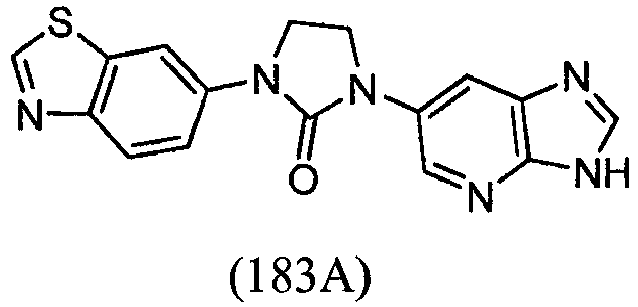
-

- (2-Chloromethoxy-ethyl)-trimethyl-silane (508.6mg, 3.0456mmol), catalytic amount of benzyl triethyl-ammonium chloride and NaOH (203.04mg, 5.076mmol) were added to a solution of 6-bromo-3H-imidazo[4,5-b]pyridine (500mg, 2.538mmol) in DCM (10mL) at 0°C. The resulting mixture was stirred room temperature for 6 hours. The reaction was monitored by TLC (80% ethylacetate in hexane). The reaction mixture was partitioned between DCM and water. The organic layer was washed with water, brine, dried over Na2SO4 and concentrated. Purification by column chromatography on silica gel (20% ethylacetate in hexane) afforded 120mg of the product (14.4% yield).
1H NMR (400 MHz, CDCl3): 8.48 (d, 1H), 8.25 (d, 1H), 8.2 (s, 1H), 5.65 (s, 2H), 3.7-3.5 (t, 2H), 1.0-0.9 (t, 2H), -0.09-0.00 (m, 9H). -

- 1-Benzothiazol-6-yl-imidazolidin-2-one (I-84b: 80.3mg, 0.3669mmol) was reacted with 6-bromo-3-(2-trimethylsilanyl-ethoxymethyl)-3H-imidazo[4,5-b]pyridine (I-183a: 120mg, 0.3669mmol), 1, 4-dioxane (5mL), copper iodide (6.9mg, 0.03669mmol), trans N,N'-dimethyl-cyclohexane-1,2-diamine (17.3mL, 0.1100mmol) and potassium phosphate (194.4mg, 0.9172mmol) to afford the crude product. Purification by column chromatography on silica gel (2% MeOH in DCM) afforded 100mg of the product (58.4% yield).
1H NMR (400 MHz, CDCl3): δ 9.0-8.8 (m, 2H), 8.5-8.1 (m, 4H), 7.7 (d, 1H), 5.7 (bs, 2H), 4.2 (bs, 4H), 3.6 (t, 2H), 0.95 (t, 2H), -0.09-0.00 (m, 9H). - 1,4-Dioxane HCl (5ml) was added to 1-benzothiazol-6-yl-3-[3-(2-trimethylsilanyl-ethoxy)-3H-imidazo[4,5-b]pyridin-6-yl]-imidazolidin-2-one (I-183b: 100mg, 0.2145mmol) and the resulting mixture was stirred room temperature for 6 hours. The reaction was monitored by TLC (10% MeOH in DCM). The reaction mixture was concentrated and washed with diethyl ether. Purification by preparative HPLC afforded 20mg of the product (25.4% yield).
- 1H NMR (400 MHz, DMSO-D6): δ 13.2 (s, 0.5H), 12.6 (s, 0.5H), 9.3 (s, 1H), 8.7 (dd, 1H), 8.44 (s, 1H), 8.36 (s, 1H), 8.3 (dd, 1H), 8.1 (d, 1H), 8.0 (dd, 1H), 4.2 (s, 4H).
LCMS: 75.25%, m/z = 337 (M+1)
HPLC: 95.02% -

- 1-Benzothiazol-6-yl-3-(4-chloro-pyridin-3-yl)-imidazolidin-2-one (I-180a: 150mg, 0.4534mmol) was reacted with (1-methyl-piperidin-4-yl)-methanol (88mg, 0.6801mmol), KOH (101mg, 1.8138mmol), K2CO3 (63mg, 0.4534mmol) and toluene (6mL) to afford crude product. Purification by column chromatography on silica gel (10% MeOH in CHCl3), followed by preparative HPLC afforded 10mg of the product (5% yield).
- 1H NMR (400 MHz, CDCl3): δ 8.9 (s, 1H), 8.55 (s, 1H), 8.45 (d, 1H), 8.35 (d, 1H), 8.1 (d, 1H), 7.7 (dd, 1H), 6.9 (d, 1H), 4.15 (m, 2H), 4.0-3.9 (m, 4H), 2.9 (d, 2H), 2.3 (s, 3H), 2.0-1.75 (m, 5H), 1.5 (t, 2H).
LCMS: 100%, m/z = 424.2 (M+1)
HPLC: 98.88% -

-

- 1-Benzothiazol-6-yl-imidazolidin-2-one (I-84b: 0.25g, 1.1mmol) was reacted with 3-bromo-isonicotinic acid ethyl ester (0.28g, 1.2mmol), 1, 4-dioxane (30mL), copper iodide (0.065g, 0.3mmol), trans N,N'-dimethyl-cyclohexane-1,2-diamine (0.048g, 0.3mmol) and potassium phosphate (0.81 g, 2.8mmol) to afford the crude product. Purification by column chromatography on silica gel (100% CHCl3) afforded 160mg of the product (38.2% yield).
- 3-(3-Benzothiazol-6-yl-2-oxo-imidazolidin-1-yl)-isonicotinic acid ethyl ester (I-185a: 0.16g, 0.4mmol) in methanolic ammonia (20mL) was taken in a reaction flask and the flask was heated to 40°C overnight. The reaction was monitored by TLC (10% MeOH in CHCl3). The reaction mixture was cooled to room temperature and concentrated. The concentrate was partitioned between DCM and water. The organic layer was washed with water, brine, dried over Na2SO4 and concentrated. Purification by column chromatography on silica gel (10% MeOH in CHCl3) afforded 40mg of the product (28.57% yield).
1H NMR (400 MHz, DMSOd6): δ 9.3 (s, 1H), 8.7 (s, 1H), 8.55 (d, 1H), 8.3 (d, 1H), 8.1- 7.9 (m, 3H) 7.6 (s, 1H), 7.5 (d, 1H), 4.1 (s, 4H).
LCMS: 100%, m/z = 339.9 (M+1)
HPLC: 88.41% -

- Synthesis of Intermediate 5-Chloro-imidazo[1,2-a]pyrazine (I-186a):

- NaHCO3 (4.215g, 50.1736mmol) and IPA (40mL) were added to a mixture of 2-bromo-1,1-dimethoxy-ethane (6.37mL, 10.8066mmol), 40% HBr (475mL, 2.3157mmol) and 2 drops of water previously refluxed for 1hr. The reaction mixture was stirred for 5mins and filtered. To the filtrate was added 6-chloro-pyrazin-2-ylamine (1g, 7.7190mmol) and the resulting mixture was refluxed for overnight. The reaction was monitored by TLC (50% ethylacetate in hexane). The reaction mixture was neutralized with Na2CO3 and partitioned between ethylacetate and water. The organic layer was washed with water, brine, dried over Na2SO4 and concentrated. Purification by column chromatography on silica gel (1-2% MeOH in CHCl3) afforded 300mg of the product (25.31 % yield).
- 1H NMR (400 MHz, CDCl3): δ 9.05 (s, 1H), 7.98 (s, 1H), 7.92-7.85 (m, 2H).
LCMS: 97.85%, m/z = 154.0 (M+1) - 1-benzothiazol-6-yl-imidazolidin-2-one (I-84b: 240mg, 1.0945mmol) was reacted with 5-chloro-imidazo[1,2-a]pyrazine (I-186a: 202mg, 1.3135mmol), 1,4-dioxane (3mL), copper iodide (24mg), trans N,N'-dimethyl-cyclohexane-1,2-diamine (48mg) and potassium phosphate (581mg, 2.7364mmol) to afford the crude product. Purification by column chromatography on silica gel (2% MeOH in CHCl3), followed by preparative HPLC afforded 13mg of the product (3.53% yield).
- 1H NMR (300 MHz, CDCl3): δ 8.9 (s, 1H), 8.54 (d, 1H), 8.1 (d, 1H), 7.95 (d, 1H), 7.85 (d, 1H) 7.75-7.7 (m, 3H), 4.5 (t, 2H), 4.1 (t, 2H).
LCMS: 100%, m/z = 337 (M+1)
HPLC: 91.78% -

-

- 5-bromo-1H-pyrrolo[2,3-b]pyridine (0.3g, 1.6mmol) was reacted with (2-chloromethoxy-ethyl)-trimethyl-silane (0.35g, 2.1mmol), catalytic amount of benzyl triethyl-ammonium chloride and NaOH (0.2g, 5.2mmol) and DCM (20mL) to afford the crude product. Purification by column chromatography on silica gel (20% ethylacetate in hexane) afforded 0.32g of the product (64.2% yield).
1H NMR (400MHz, CDCl3) δ: 8.36 (d, 1H), 8.03 (d, 1H), 7.36 (d, 1H), 6.46 (d, 1H), 5.6 (s, 2H), 3.5 (t, 2H), 0.9 (t, 2H), -0.95 (m, 9H) -

- 1-Benzothiazol-6-yl-imidazolidin-2-one (I-84b: 0.2g, 0.9mmol) was reacted with 5-bromo-1-(2-trimethylsilanyl-ethoxymethyl)-1H-pyrrolo[2,3-b]pyridine (I-187a: 0.32g, 1.0mmol), 1,4-dioxane (15mL), copper iodide (0.052g, 0.2mmol), trans N,N'-dimethylcyclohexane-1,2-diamine (0.038g, 0.27mmol) and potassium phosphate (0.65g, 2.2mmol) to afford the crude product. Purification by column chromatography on silica gel (1.5% methanol in DCM) afforded 0.22g of the product (52.3% yield).
- 1H NMR (400MHz, CDCl3) δ: 8.9 (s, 1H), 8.48 (d, 1H), 8.38 (d, 1H), 8.24 (d, 1H), 8.1 (d, 1H), 7.7 (dd, 1H), 7.37 (d, 1H), 6.5 (s, 1H), 5.7 (s, 2H), 4.1 (s, 4H), 3.55 (t, 2H), 0.9 (t, 2H), -0.95 (s, 9H)
- 1,4-Dioxane HCl (10ml) was added to 1-(benzothiazol-6-yl)-3-(1-((2-(trimethylsilyl)-ethoxy)methyl)-1H-pyrrolo[2,3-b]pyridin-5-yl)imidazolidin-2-one (I-187b: 0.07g, 0.19mmol) and the resulting mixture was heated to 110°C for 2 days. The reaction was monitored by TLC (20% MeOH in CHCl3). The reaction mixture was basified with Na2CO3 solution (pH∼8), cooled to room temperature, concentrated and the concentrate was washed with diethyl ether. Purification by preparative HPLC afforded 1.7mg of the product (25.6% yield).
- 1H NMR (300 MHz, CDCl3): δ 8.9 (s, 1H), 8.5 (s, 1H), 8.4 (d, 1H), 8.3 (s, 1H), 8.1 (d, 1 H) 7.7 (dd, 1H), 7.35 (t, 1H), 6.55 (m, 1H), 4.2 (s, 4H).
LCMS: 97.14%, m/z = 336 (M+1)
HPLC: 87.78% -

- 1-Benzothiazol-6-yl-imidazolidin-2-one (I-84b: 150mg, 0.6849mmol) was reacted with 5-bromo-1-methyl-1H-imidazole (121.3mg, 0.753mmol), 1, 4-dioxane (5mL), copper iodide (12.99mg, 0.0684mmol), trans N,N'-dimethyl-cyclohexane-1,2-diamine (29.176mg, 0.205mmol) and potassium phosphate (435.01mg, 2.05mmol) to afford the crude product. Purification by column chromatography on silica gel (2% MeOH in CHCl3) afforded 85mg of the product (41.64% yield).
- 1H NMR (300 MHz, CDCl3): δ 8.9 (s, 1H), 8.35 (d, 1H), 8.1 (d, 1H), 7.7 (dd, 1H), 7.5-7.4 (brs, 1H), 7.0 (brs, 1H), 4.1 (t, 2H), 3.9 (t, 2H), 3.6 (s, 3H).
LCMS: 100%, m/z = 299.8 (M+1)
HPLC: 98.52% -

-

- n-Butyl Lithium (1.9mL), 3.044mmol) was added to a solution of DIPA (335.7mg, 3.318mmol) in THF (6mL) at -78°C. The reaction mixture was stirred at -10°C for 10 minutes. This was followed by the addition of 3-bromo-5-trifluoromethyl-pyridine (500mg, 2.212mmol) in THF (3mL) at -100°C. The reaction mixture was stirred for a further 15 minutes at -90°C and was followed by the addition of methyl iodide (557.0mg, 3.924mmol) in THF (2mL) at -78°C with stirring over a period of 30 minutes. The reaction was monitored by TLC (5% ethyl acetate in hexane). The reaction mixture was quenched with aqueous NaHCO3 solution and extracted with ethyl acetate (100mL). The organic layer was dried over Na2SO4 and concentrated. Purification by column chromatography on silica gel (2% ethylacetate in hexane) afforded 95mg of the product (17.92% yield). LCMS: m/z = 239.8 (M+1)
- 1-Benzothiazol-6-yl-imidazolidin-2-one (I-84b: 80mg, 0.365mmol) was reacted with 3-bromo-4-methyl-5-trifluoromethyl-pyridine (I-189a: 90mg, 0.365mmol), 1, 4-dioxane (5mL), copper iodide (6.95mg, 0.0365mmol), trans-1,2-diamino cyclohexane (12.5mg, 0.1095mmol) and potassium phosphate (232.4mg, 1.095mmol) to afford the crude product. Purification by preparative HPLC afforded 5mg of the product (3.6% yield).
- 1H NMR (CDCl3, 300 MHz): δ 9.05-8.65 (m, 3H), 8.35 (s, 1H), 8.25-8.05 (m, 1H), 7.78-7.58 (m, 1H), 4.32-4.12 (m, 2H), 4.12-3.91 (m, 2H), 2.49 (s, 3H)
LCMS purity: 100%, m/z = 378.9 (M+1)
HPLC: 93.5% -

- 1-(4-Methyl-pyridin-3-yl)-imidazolidin-2-one (I-14b: 150mg, 0.847mmol) was reacted with 4-bromo-isothiazole (166mg, 1.016mmol), 1,4-dioxane (15mL), copper iodide (16.09mg, 0.0847mmol), trans-1,2-diamino cyclohexane (29mg, 0.254mmol) and potassium phosphate (540mg, 2.541mmol) to afford the crude product. Purification by column chromatography on silica gel (2% MeOH in CHCl3) afforded 120mg of the product (54.54% yield).
- 1H NMR (CDCl3, 300 MHz): δ 8.82 (s, 1H), 8.65-8.25 (m, 3H), 7.4-7.1 (m, 1H), 4.20-3.95 (m, 4H), 2.19 (s, 3H)
LCMS purity: 97.95%, m/z = 261.0 (M+1)
HPLC: 96.08% -

- 1-Benzothiazol-6-yl-imidazolidin-2-one (I-84b: 150mg, 0.6904mmol) was reacted with 2-bromo-pyridine (99mL, 1.0356mmol), 1, 4-dioxane (10mL), copper iodide (16mg), trans-1,2-diamino cyclohexane (32mg) and potassium phosphate (440mg, 2.0713mmol) to afford the crude product. Purification by column chromatography on silica gel (10% ethylacetate in hexane), followed by preparative HPLC afforded 37mg of the product (18.13% yield).
- 1H NMR (DMSO-D6, 300 MHz): δ 9.3 (s, 1H), 8.5-8.3 (m, 2H), 8.25 (d, 1H), 8.18-8.02 (m, 1H), 8.02-7.9 (m, 1H), 7.88-7.70 (m, 1H), 7.18-7.00 (m, 1H), 4.2-4.0 (m, 4H)
LCMS purity: 97.44%, m/z = 297.1 (M+1)
HPLC: 95.28% -

- 1-(4-methyl-pyridin-3-yl)-imidazolidin-2-one (I-14b: 100mg, 0.5643mmol) was reacted with 2-bromo-5-trifluoromethyl-thiophene (136.9mg, 0.5925mmol), 1, 4-dioxane (10mL), copper iodide (10.75mg, 0.0564mmol), trans-1,2-diamino cyclohexane (20.4mL, 0.1693mmol) and potassium phosphate (360mg, 1.693mmol) to afford the crude product. Purification by column chromatography on silica gel (2% MeOH in CHCl3) afforded 120mg of the product (65% yield).
- 1H NMR (DMSO-D6, 300 MHz): δ 8.66-8.3 (m, 2H), 7.65-7.23 (m, 2H), 6.55 (d, 1H), 4.24-3.90 (m, 4H), 2.26 (s, 3H)
LCMS purity: 96.35%, m/z = 327.9 (M+1)
HPLC: 95.04% -

-

- n-Butyl Lithium (10.28mL, 16.455mmol) was added to a solution of DIPA (2.66mL, 18.98mmol) in THF (25mL) at -78°C. The reaction mixture was stirred at -10°C for 10mins, followed by the addition of 3-bromo-pyridine (500mg, 2.212mmol) in THF (10mL) at -100°C. The reaction mixture was stirred for a further 15 minutes at -90°C and was followed by the addition of acetone (1.675mL, 22.78mmol) in THF (10mL) at -78°C with stirring over a period of 1hr. The reaction was monitored by TLC (5% ethylacetate in hexane). The reaction mixture was quenched with aqueous NaHCO3 solution and extracted with ethylacetate. The organic layer was dried over Na2SO4 and concentrated. Purification by column chromatography on silica gel (15% ethylacetate in hexane) afforded 200mg of the product (11% yield).
- 1H NMR (CDCl3, 300 MHz): δ 8.7 (s, 1H), 8.5 (d, 1H), 7.65 (d, 1H), 1.7 (s, 6H) LCMS purity: 89.57%, m/z = 215.9 (M+1)
- 1-benzothiazol-6-yl-imidazolidin-2-one (I-84b: 125mg, 0.57mmol) was reacted with 2-(3-bromo-pyridin-4-yl)-propan-2-ol (122.7mg, 0.57mmol), 1,4-dioxane (5mL), copper iodide (10.85mg, 0.057mmol), trans-1,2-diamino cyclohexane (19.57mg, 0.171mmol) and potassium phosphate (362.9mg, 1.71mmol) to afford the crude product. Purification by preparative HPLC afforded 38mg of the product (19% yield).
- 1H NMR (CDCl3, 300 MHz): δ 8.68 (s, 1H), 8.50-8.32 (m, 2H), 7.86 (d, 1H), 7.18-7.02 (m, 2H), 6.82 (dd, 1H), 4.55-4.42 (m, 1H), 4.32 (t, 2H), 3.7-3.6 (m, 2H), 1.74-1.58 (m, 6H)
LCMS purity: 97.84%, m/z = 354.9 (M+1)
HPLC: 95.61 % -

- Tetrakis (triphenylphosphine) palladium (33mg, 0.0288mmol) was added to potassium carbonate (120mg, 0.8649mmol) previously purged with argon (30 minutes). The reaction mixture was purged with argon for 15 minutes, followed by the addition of 1-(4-chloro-thieno[3,2-c]pyridin-2-yl)-3-(4-methyl-pyridin-3-yl)-imidazolidin-2-one (98A: 100mg, 0.2883mmol) and methyl boronic acid (21mg, 0.3459mmol). The reaction mixture was heated to reflux for 6 hours. The reaction was monitored by TLC (10% MeOH in CHCl3). The reaction mixture was concentrated to afford the crude product. Purification by column chromatography on silica gel (3-4% MeOH in CHCl3), followed by preparative HPLC afforded 10mg of the product (16.39% yield).
- 1H NMR (CDCl3, 300 MHz): δ 8.7-8.35 (m, 2H), 8.35-8.2 (d, 1H), 7.5 (d, 1H), 6.58 (s, 1H), 4.4-3.9 (m, 4H), 2.79 (s, 3H), 2.36 (s, 3H)
LCMS purity: 96.01%, m/z = 324.9 (M+1)
HPLC: 96.32% -

- 1-Benzothiazol-6-yl-imidazolidin-2-one (I-84b: 150mg, 0.6849mmol) was reacted with 1-(3-bromo-pyridin-4-yl)-ethanol (137.6mg, 0.6849mmol), 1,4-dioxane (5mL), copper iodide (13.04mg, 0.06849mmol), trans-1,2-diamino cyclohexane (23.52mg, 0.205mmol) and potassium phosphate (435.1mg, 2.05mmol) to afford the crude product. Purification by column chromatography on silica gel (2% MeOH in CHCl3), followed by preparative HPLC afforded 9mg of the product (3.9% yield).
- 1H NMR (CDCl3, 300 MHz): δ 8.92 (s, 1H), 8.65-8.54 (m, 2H), 8.32 (d, 1H), 8.15 (d, 1H), 7.70-7.62 (dd, 1H), 7.6 (d, 1H), 5.10-4.96 (m, 1H), 4.30-4.12 (m, 3H), 4.02-3.85 (m, 1H), 3.75-3.66 (br s, 1H), 1.60-1.45 (d, 3H)
LCMS purity: 98.20%, m/z = 340.9 (M+1)
HPLC: 91.15% -

- 1-Benzothiazol-6-yl-imidazolidin-2-one (I-84b: 600mg, 2.739mmol) was reacted with 3-bromo-4-ethyl-pyridine (512mg, 2.739mmol), 1, 4-dioxane (10mL), copper iodide (52mg, 0.2739mmol), trans-1,2-diamino cyclohexane (94.08mg, 0.82mmol) and potassium phosphate (1.74mg, 8.2mmol) to afford the crude product. Purification by column chromatography on silica gel (2% MeOH in CHCl3), followed by preparative HPLC afforded 30mg of the product (3.75% yield).
- 1H NMR (CD3OD, 300 MHz): δ 9.15 (s, 1H), 8.60-8.35 (m, 3H), 8.15-7.95 (m, 1H), 7.95-7.70 (m, 1H), 7.5 (d, 1H), 4.3-3.9 (m, 4H), 2.85-2.65 (q, 2H), 1.4-1.2 (t, 3H)
LCMS purity: 99.77%, m/z = 325.1 (M+1)
HPLC: 95.03% -

-

- 0.5M solution oftrimethyl-trifluoromethyl-silane in THF (6.68mL, 3.344mmol) and K2CO3 (250mg, 10.82mmol) were added to 2-fluoro-4-[3-(4-methyl-pyridin-3-yl)-2-oxo-imidazolidin-1-yl]-benzaldehyde (I-121a: 400mg, 1.337mmol) in dry DMF (5mL) under nitrogen atmosphere. The resulting mixture was stirred at room temperature overnight. The reaction was monitored by TLC (5% MeOH in CHCl3). The reaction mixture was quenched with brine solution and the THF layer was concentrated. The aqueous layer was extracted with chloroform. The organic layer was dried over Na2SO4 and concentrated to get the crude product. Purification by column chromatography on silica gel (2.5% MeOH in CHCl3), followed by hexane wash, afforded 325mg of the product (65.92% yield).
1H NMR (CDCl3, 300 MHz): δ 8.56-8.00 (m, 2H), 7.75-7.45 (m, 2H), 7.36-7.08 (m, 2H), 5.38 (q, 1H), 4.55-4.24 (br s, 1H), 4.20-3.76 (m, 4H), 2.32 (s, 3H) -

- MnO2 (536mg, 6.165mmol) was added to 1-[3-fluoro-4-(2,2,2-trifluoro-1-hydroxy-ethyl)-phenyl]-3-(4-methyl-pyridin-3-yl)-imidazolidin-2-one (I-197a: 325mg, 0.880mmol) in DCM (20mL) under nitrogen atmosphere. The resulting suspension was stirred at 50°C overnight. The reaction was monitored by TLC (5% MeOH in DCM). The reaction mixture was cooled to room temperature and filtered through celite pad. The filtrate was washed with CHCl3, dried over Na2SO4 and concentrated. The concentrate was washed with hexane and dried to afford 240mg of the product (74.53% yield).
1H NMR (DMSO-D6, 300 MHz): δ 8.8-8.2 (m, 2H), 7.98 (t, 1H), 7.86-7.50 (m, 2H), 7.46-7.25 (m, 1H), 4.40-3.75 (m, 4H), 2.28 (s, 3H) - Acetic acid (0.1mL, 1.36mmol) and 1M hydrazine in THF (4mL, 2.72mmol) were added to 1-[3-fluoro-4-(2,2,2-trifluoro-acetyl)-phenyl]-3-(4-methyl-pyridin-3-yl)-imidazolidin-2-one (I-197b: 100mg, 0.272mmol) in dry THF (2mL). The resulting mixture was stirred at 150°C overnight. The reaction was monitored by TLC (5% MeOH in CHCl3). The reaction mixture was partitioned between water and chloroform. The organic layer was dried over Na2SO4 and concentrated. Purification by column chromatography on silica gel (4% MeOH in CHCl3), followed by preparative HPLC afforded 23mg of the product (23.46% yield).
- 1H NMR (CD3OD, 300 MHz): δ 8.57-8.48 (br s, 1H), 8.37 (d, 1H), 7.86-7.70 (m, 2H), 7.70-7.60 (m, 1H), 7.42 (d, 1H), 4.34-4.12 (m, 2H), 4.12-3.90 (m, 2H), 2.41 (s, 3H)
LCMS purity: 96.14%, m/z = 362.0 (M+1)
HPLC: 94.33% -
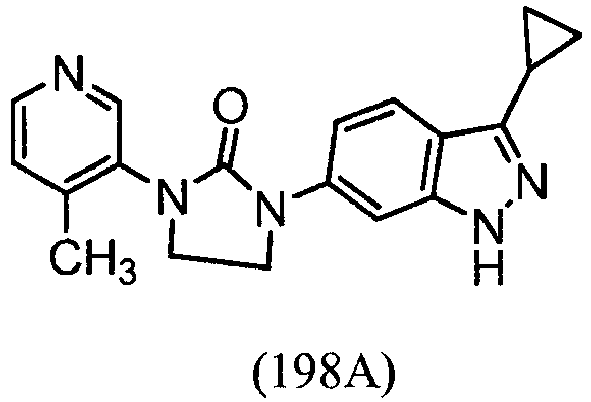
-

- 0.5M solution of cyclopropyl magnesium bromide in THF (2.4mL, 1.170mmol) was added dropwise to 2-fluoro-4-[3-(4-methyl-pyridin-3-yl)-2-oxo-imidazolidin-1-yl]-benzaldehyde (I-121a: 175mg, 0.585mmol) in dry THF (10mL) at 0°C under nitrogen atmosphere. The resulting mixture was stirred at room temperature for 3 hours. The reaction was monitored by TLC (5% MeOH in CHCl3). The reaction mixture was quenched with aqueous NH4Cl solution and the THF layer was concentrated. The aqueous layer was extracted with ethylacetate. The organic layer was dried over Na2SO4 and concentrated to afford the crude product. Purification by column chromatography on silica gel (3% MeOH in CHCl3), followed by hexane wash, afforded 200mg of the product (99.41% yield).
- 1H NMR (DMSO-D6, 300 MHz): δ 8.72-8.28 (m, 2H), 7.70-7.48 (m, 2H), 7.42-7.25 (m, 2H), 5.30 (d, 1H), 4.48-4.20 (m, 1H), 4.18-3.82 (m, 4H), 2.32 (s, 3H), 1.2-1.0 (m, 1H), 0.7-0.1 (m, 4H)
LCMS purity: 97.58%, m/z = 342.3 (M+1) -

- MnO2 (357mg, 41.055mmol) was added to 1-[4-(cyclopropyl-hydroxy-methyl)-3-fluoro-phenyl]-3-(4-methyl-pyridin-3-yl)-imidazolidin-2-one (I-198a: 200mg, 8.586mmol) in DCM (20mL) under nitrogen atmosphere and worked up in a manner similar to what was described for Example 197 to afford 175mg of the product (60.13% yield).
- 1H NMR (DMSO-D6, 300 MHz): δ 8.56 (s, 1H), 8.41 (d, 1H), 7.82 (t, 1H), 7.76-7.65 (m, 1H), 7.60-7.47 (m, 1H), 7.37 (d, 1H), 4.22-3.82 (m, 4H), 2.80-2.60 (m, 1H), 2.29 (s, 3H), 1.18-0.93 (m, 4H)
LCMS purity: 98.34%, m/z = 339.7 (M+1) - 1-(4-Cyclopropanecarbonyl-3-fluoro-phenyl)-3-(4-methyl-pyridin-3-yl)-imidazolidin-2-one (I-198b: 175mg, 0.516mmol) in hydrazine hydrate solution (10mL) was taken in a reaction flask. The flask was refluxed at 120°C overnight. The reaction was monitored by TLC (5% MeOH in CHCl3). The reaction mixture was cooled to room temperature and partitioned between ice water and chloroform. The organic layer was dried over Na2SO4 and concentrated. Purification by column chromatography on silica gel (4% MeOH in CHCl3), followed by hexane and ether wash, afforded 55mg of the product (31.97% yield).
- 1H NMR (DMSO-D6, 300 MHz): δ 12.42 (s, 1H), 8.55 (s, 1H), 8.39 (d, 1H), 7.85-7.28 (m, 4H), 4.28-3.80 (m, 4H), 2.6-2.1 (m, 4H), 1.04-0.80 (m, 4H)
LCMS purity: 100.00%, m/z = 333.8 (M+1)
HPLC: 94.27% -

- 1-(4-Methyl-pyridin-3-yl)-imidazolidin-2-one (I-14b: 116mg, 0.6554mmol) was reacted with 7-bromo-quinoline (150mg, 0.72098mmol), 1,4-dioxane (50mL), copper iodide (12.4mg, 0.06554mmol), trans-1,2-diamino cyclohexane (22.5mg, 0.19638mmol) and potassium phosphate (347.3g, 1.6365mmol) to afford the crude product. Purification by column chromatography on silica gel (2% MeOH in CHCl3) afforded 130mg of the product (65.3% yield).
- 1H NMR (DMSO-D6, 300 MHz): δ 8.95-8.76 (m, 1H), 8.6 (s, 1H), 8.48-8.22 (m, 3H), 8.06-7.82 (m, 2H), 7.50-7.32 (m, 2H), 4.32-4.12 (m, 2H), 4.10-3.90 (m, 2H), 2.31 (s, 3H)
LCMS purity: 99.57%, m/z = 305.0 (M+1)
HPLC: 93.16% -

-

- SOCl2 (5.22g, 44.23mmol) was added dropwise to a stirred solution of 3-chloro-2,2-dimethyl-propionic acid (5g, 36.76mmol) in DCM (50mL) at 0°C over a period of 5mins. This was followed by the addition of DMF (0.1mL) and the resulting mixture was heated to 60°C for 3 hours. The reaction was monitored by TLC (5% MeOH in CHCl3). The reaction mixture was concentrated and the crude product (6g) was used in the next step without further purification.
-

- Sodium azide (4.64g, 71.38mmol) was added to a solution of 3-chloro-2,2-dimethyl-propionyl chloride (I-200a: 6g, 35.71mmol) in 1,4-dioxane (15mL) and water (15mL). The resulting mixture was stirred at room temperature for 2 hours. The reaction was monitored by TLC (5% ethylacetate in hexane). The reaction mixture was extracted with diethyl ether and the organic layer was dried over Na2SO4 to afford 3.5g of the product (61.40% yield).
-

- 1-Chloro-2-isocyanato-2-methyl-propane (I-200b: 3.5g, 20mmol) in toluene (35mL) was taken a reaction flask and flask was heated to 85°C for 1.30hr. The reaction was monitored by TLC (5% ethylacetate in hexane). The crude product (3gm) was used in the next step without further purification.
-

- 4-Methyl-pyridin-3-ylamine (1.98g, 18.33mmol) was added to solution of 1-chloro-2-isocyanato-2-methyl-propane (I-200c: 3g, 20.40mmol) in toluene (30mL). The resulting mixture was stirred at room temperature for 3 days. The reaction was monitored by TLC (5% MeOH in CHCl3). The reaction mixture was filtered and the residue was dried to afford 4.3g of the product (87.75% yield).
- 1H NMR (CDCl3 300 MHz): δ 8.70 (s, 1H), 8.3 (s, 1H), 7.12 (s, 1H), 6.39 (s, 1H), 4.9 (s, 1H), 3.87 (s, 2H), 2.30 (s, 3H), 1.4 (s, 6H)
LCMS purity: 76.36%, m/z = 242.0 (M+1) -

- 1-(2-Chloro-1,1-dimethyl-ethyl)-3-(4-methyl-pyridin-3-yl)-urea (I-200d: 1g, 4.149 mmol) in dry THF (5mL) was added dropwise to a stirred mixture of NaH (298mg, 6.208mmol) in dry THF (10mL) under argon atmosphere over a period of 10 minutes at 0°C. The resulting reaction mixture was stirred for 2hrs. The reaction was monitored by TLC (5% MeOH in CHCl3). The reaction mixture was partitioned between water and ethylacetate. The organic layer was dried over Na2SO4 and concentrated to afford 800mg of the product (94.33% yield).
- 1H NMR (DMSO, 300 MHz): δ 8.4 (s, 1H), 8.3 (d, 1H), 7.30 (d, 1H), 7.0 (s, 1H), 3.53 (s, 2H), 2.22 (s, 3H), 1.3 (s, 6H)
LCMS purity: 100%, m/z = 205.7 (M+1) - 4,4-Dimethyl-1-(4-methyl-pyridin-3-yl)-imidazolidin-2-one (I-163b: 150mg, 0.731mmol) was reacted with 6-iodo-benzothiazole (I-200e: 248mg, 0.950mmol), 1, 4-dioxane (10mL), copper iodide (13mg, 0.0682mmol), trans-1,2-diamino cyclohexane (31mg, 0.218mmol) and potassium phosphate (387mg, 1.825mmol) to afford the crude product. Purification by column chromatography on silica gel (1% MeOH in CHCl3) afforded 30mg of the product (12.14% yield).
- 1H NMR (CD3OD, 300 MHz): δ 9.32 (s, 1H), 8.51 (s, 1H), 8.35 (d, 1H), 8.0-8.2 (m, 2H), 7.60 (d, 1H), 7.40 (d, 1H), 3.90 (s, 2H), 2.45 (s, 3H), 1.5 (s, 6H)
LCMS purity: 94.09%, m/z = 339.1 (M+1)
HPLC: 89.11 % -

-

- Benzothiazol-6-ylamine (1.8g, 12.00mmol) was added portion wise to solution of 1-chloro-2-isocyanato-2-methyl-propane (2g, 13.60mmol) in toluene (20mL) over a period of 5 minutes. The resulting mixture was stirred at room temperature for 2 ½ days. The reaction was monitored by TLC (5% MeOH in CHCl3). The reaction mixture was concentrated and extracted with ethylacetate. The organic layer was dried over Na2SO4 and concentrated. Purification by column chromatography on silica gel (1% MeOH in CHCl3) afforded 630 mg of the product (16.57% yield).
- 1H NMR (CDCl3, 300 MHz): δ 8.85 (s, 1H), 8.23 (d, 1H), 8.0 (d, 1H), 7.20-7.15 (dd, 1H), 7.03 (s, 1H), 5.10 (s, 1H), 3.89 (s, 2H), 1.49 (s, 6H)
LCMS purity: 98.84%, m/z = 283.9 (M+1) -

- 1-Benzothiazol-6-yl-3-(2-chloro-1,1-dimethyl-ethyl)-urea (I-201a: 620mg, 2.18mmol) in dry THF (5mL) was added dropwise to a stirred mixture of NaH (78mg, 3.25mmol) in dry THF (5mL) under argon atmosphere over a period of 10 minutes at 0°C. The resulting reaction mixture was stirred at room temperature for 45 minutes. The reaction was monitored by TLC (5% MeOH in CHCl3). The reaction mixture was partitioned between chilled water and ethylacetate. The organic layer was dried over Na2SO4 and concentrated to afford 410 mg of the product (77.35% yield).
- 1H NMR (CDCl3, 300 MHz): δ 8.90 (s, 1H), 8.31 (d, 1H), 8.09 (d, 1H), 7.69-7.58 (dd, 1H), 5.0 (br s, 1H), 3.73 (s, 2H), 1.49 (s, 6H)
LCMS purity: 99.16%, m/z = 247.8 (M+1) - 1-Benzothiazol-6-yl-4,4-dimethyl-imidazolidin-2-one (I-201b: 100mg, 0.4048mmol) was reacted with 3-bromo-pyridine (83mg, 0.525mmol), 1, 4-dioxane (10mL), copper iodide (7mg, 0.036mmol), trans-1,2-diamino cyclohexane (17mg, 0.119 mmol) and potassium phosphate (214mg, 1.009 mmol) to afford the crude product. Purification by column chromatography on silica gel (1% MeOH in CHCl3) afforded 15mg of the product (11.45% yield).
- 1H NMR (CDCl3, 300 MHz): δ 8.90 (s, 1H), 8.7-8.5 (br s, 2H), 8.35 (d, 1H), 8.12 (d, 1H), 7.77-7.60 (m, 2H), 7.5-7.4 (m, 1H), 3.9 (s, 2H), 1.49 (s, 6H)
LCMS purity: 100%, m/z = 325.1 (M+1)
HPLC: 95.40% -

- 1-Benzothiazol-6-yl-4,4-dimethyl-imidazolidin-2-one (I-201b: 100mg, 0.4048mmol) was reacted with 3-iodo-4-methyl-pyridine (115mg, 0.525mmol), 1, 4-dioxane (10mL), copper iodide (7mg, 0.0368mmol), trans-1,2-diamino cyclohexane (18mg, 0.1197mmol) and potassium phosphate (214mg, 1.0094mmol) to afford the crude product. Purification by column chromatography on silica gel (1% MeOH in CHCl3) afforded 6mg of the product (4.8% yield).
- 1H NMR (CDCl3, 300 MHz): δ 8.30 (d, 1H), 8.15 (d, 1H), 7.7-7.6 (dd, 1H), 3.8 (s, 2H), 2.72 (s, 3H), 1.49 (s, 6H)
LCMS purity: 94.22%, m/z = 339.1 (M+1)
HPLC: 86.98% -

-

- 3-Amino-butyric acid ethyl ester (2g, 15.27mmol), 6-iodo-benzothiazole (3.98g, 15.27mmol) and potassium carbonate (5.27g, 38.18mmol) were dissolved in DMF (50mL) and the reaction mixture was purged with argon for 10 minutes. This was followed by the addition of copper iodide (290mg, 1.527mmol) and the resulting mixture was heated to 110°C overnight. The reaction was monitored by TLC (10% MeOH in CHCl3) which showed the presence of starting material. The reaction mixture was heated to 120°C for a further 24 hours. The reaction mixture was concentrated and adjusted the pH to 5 using acetic acid. The reaction mixture was partitioned between water and ethylacetate. The organic layer was dried over Na2SO4 and concentrated. Purification by column chromatography on silica gel (1% MeOH in CHCl3) afforded 800mg of the product (22.22% yield).
- 1H NMR (DMSO, 300 MHz): δ 12.2 (s, 1H), 8.9 (s, 1H), 7.75 (d, 1H), 7.15 (d, 1H), 6.85 (dd, 1H), 5.90-5.80 (m, 1H), 3.90-3.80 (m, 1H), 2.60-2.50 (m, 1H), 2.25-2.35 (m, 1H), 1.20 (d, 3H)
LCMS purity: 61.65%, m/z = 237.0 (M+1) -

- Triethylamine (1.129g, 11.18mmol) was added to a mixture of 3-(benzothiazol-6-ylamino)-butyric acid (I-203a: 800mg, 3.39 mmol) in toluene (30mL) and the reaction mixture was purged with argon for 10 minutes. This was followed by the addition of DPPA (2.796g, 10.17mmol) and the resulting mixture was heated to 100°C overnight. The reaction was monitored by TLC (10% MeOH in CHCl3) which showed the presence of starting material. The reaction mixture was heated to 120°C for the next 24 hours. The reaction mixture was partitioned between water and ethylacetate. The organic layer was dried over Na2SO4 and concentrated. Purification by column chromatography on silica gel (2% MeOH in CHCl3) afforded 600 mg of the product (75.95% yield).
- 1H NMR (DMSO, 300 MHz): δ 9.25 (s, 1H), 8.22 (d, 1H), 8.0 (d, 1H), 7.7 (dd, 1H), 7.0 (s, 1H), 4.6-4.5 (m, 1H), 3.6 (t, 1H), 3.0 (m, 1H), 1.2 (d, 3H)
LCMS purity: 81.90%, m/z = 234.0 (M+1) - 1-Benzothiazol-6-yl-5-methyl-imidazolidin-2-one (I-203b: 150mg, 0.644mmol) was reacted with 3-iodo-4-methyl-pyridine (140.99 mg, 0.644mmol), 1,4-dioxane (10mL), copper iodide (12.27mg, 0.0644mmol), trans-1,2-diamino cyclohexane (27.43mg, 0.193mmol) and potassium phosphate (341 mg, 1.61 mmol) to afford the crude product. Purification by column chromatography on silica gel (1.5% MeOH in DCM) afforded 50mg of the product (24.15% yield).
- 1H NMR (CDCl3, 300 MHz): δ 8.95 (s, 1H), 8.55 (s, 1H), 8.43 (d, 1H), 8.26 (d, 1H), 8.15 (d, 1H), 7.55 (dd, 1H), 7.25 (d, 1H), 4.7-4.6 (m, 1H), 4.2-4.1 (m, 1H), 3.6-3.5 (m, 1H), 2.4 (s, 3H), 1.5 (d, 3H)
LCMS purity: 95.66%, m/z = 325.0 (M+1)
HPLC: 96.32% - The abbreviations listed below and used in the preparations below have the corresponding meanings.
- CYP
- Cytochrome P450
- CPM
- Counts per minute
- Cyt b5
- Cytochrome b5
- DMSO
- Dimethyl sulfoxide
- DHEA
- Dehydroepiandrosterone
- NADPH
- Nicotinamide adenine dinucleotide phosphate
- Cytochrome P450, 17-α-Hydroxylase, 17-20 lyase (CYP17) is a multi functional enzyme that plays a key role in the biosynthesis of steroid hormones. It catalyses both conventional hydroxylation and also the carbon-carbon bond cleavage reactions (Peter Lee-Robichaud et al, Biochem.J, (1997) 321, 857-63). In the hydroxylation reaction, it converts progesterone and pregnenolone to the corresponding hydroxylated products 17-α-hydroxy progesterone and 17-α-hydroxy pregnenolone. In the lyase reaction, it catalyzes the conversion of these hydroxylated substrates to Androstenedione and Dehydroepiandrosterone (DHEA) respectively. In the Cyp17 lyase assay described here, the conversion of 17-α-hydroxy pregnenolone to Dehydroepiandrosterone and acetic acid is being monitored..
- The hydroxylation and cleavage activities are catalyzed sequentially at the common active site of Cyp17 and proceed through transfer of two electrons from NADPH via its redox partner, cytochrome P450 reductase (CPR). The reaction mechanism for each activity is thought to involve formation of distinct iron-oxygen complexes. Cytochromeb5 selectively stimulates the lyase activity and has no significant effect on its hydroxylase activity. Lyase activity is stimulated by cytochrome b5 up to 10-fold in reconstituted assays with insignificant stimulation of the hydroxylase activity (MK Akthar et al, Journal of Endocrinology (2005) 187, 267-274 and Katagiri M et al, Biophysical Research Communications (1982) 108, 379-384).
- Assay method was adopted from a published protocol with some modifications to suit our requirements (Dmitry N Grigoryev et al, Analytical Biochemistry, (1999) 267, 319-330). The conversion of 17-α-hydroxy pregnenolone to Dehydroepiandrosterone is accompanied by the release of acetic acid. In the Cyp17 lyase assay, 17-α-hydroxy pregnenolone labeled with tritium (3H) at position 21 is used as the substrate. Chloroform extraction removes the radioactive steroids and acetic acid is taken into aqueous layer. The tritiated acetic acid released in the assay thus extracted is quantified to determine the enzyme activity.
- Initial buffer conditions were, 50 mM Phosphate buffer, pH 7.5 was used as the starting buffer for Cyp17 lyase activity based on the data published in US patent publication No.
US2004/0198773 A1 . This buffer was found to be suitable for regular Cyp17 lyase assay. Human Cyp 17 gene was cloned and expressed in Adenoviral expression system in A549 cell lines. The purified cell membrane preparations were used as the source for Human CYP 17 enzyme. Total protein concentration: 8 mg/mL. - To identify the appropriate concentration of the enzyme required for the assay, concentration dependent enzyme activity was determined at a substrate (17-α-hydroxypregnenolone [21-3H]) concentration of 0.5 µM (Vincent C.O. Nijar, et al., J Med Chem, (1998) 41, 902-912). The protein activity was found to be in the linear range up to 20 µg, the highest concentration tested. Based on the enzyme concentration curve and stock concentration, 15 µg was selected for the assay. At this protein concentration, the S/N ratio was 30, with a good signal window (CPMPos.Ctrl - CPMBlank = 1650)
- Km (Michaelis Menton constant) is a measure of the binding affinity of substrate to the enzyme. 17-α-hydroxy pregnenolone [21-3H] is a substrate for 17, 20 lyase enzyme. Km for this substrate was determined by monitoring the tritiated acetic acid release as a function of substrate concentration. Concentration of 17-α-hydroxy-pregnenolone [21-3H] was varied from 0.03125 µM to 1 µM. For the Km determination, the data was fit to a hyperbolic equation (Graphpad Prism® software IV). The Km was estimated as 0.25 µM, close to the reported value. (Dmitry N. Grigoryev et al, Analytical Biochemistry (1999) 267, 319-330)
- For routine screening, the assay was set up with 16 µg of enzyme in 50 µL reaction volume. 17α-hydroxy pregnenolone [21-3H] was added to a final concentration of 0.25 µM. NADPH is used at a final concentration of 4.2 mM. Total reaction volume was made up to 50 µL with 50 mM Phosphate buffer pH 7.5. The reaction mixture was incubated at room temperature for 90 minutes with gentle shaking. The reaction was stopped by the addition of 100 µL of buffer. 500 µL of 5% freshly prepared activated charcoal was added to the solution and mixed well by vortexing. The samples were centrifuged at 17568 x g for 5 minutes. (14000 rpm). The supernatant was carefully transferred to fresh tube and 1.3 mL of scintillation fluid was added, mixed by vortexing.
- The radioactivity was measured in a 1450 MicroBeta TriLux™ scintillation counter from Wallac-Perkin Elmer®, USA. The measurements were carried out in 2.0 mL eppendorf™ tubes. Each tube was counted for 1 minute. The amount of tritiated acetic acid released is proportional to the lyase activity. Percent lyase activity in presence of inhibitor was calculated using the formula given below.

- Sample: Enzyme reaction in presence of inhibitor.
- Positive control: Enzyme reaction without inhibitor but containing DMSO at 1% final concentration.
- Blank- Contains all reagents except enzyme.
- % Inhibition = 100% - % Lyase activity
- For IC50 determination, the % inhibition was plotted as a function of inhibitor concentration. The data was fitted to sigmoidal equation using Graphpad Prism® software IV to generate IC50 values.
- Dose-response studies by standard compounds Abiraterone and Ketoconazole were carried out as part of assay optimization.
- The same procedure described above was used but using rat testes microsomes as the source and with a substrate concentration of 0.5 µM.
- The results for the compounds tested from the Examples above using the assay above are listed in Table 1 below.
Table 1 Example No. Final compounds Lyase IC 50 nM Human /Rat rCYP17 Lyase %Inh @ 100 nM 1A 1-Naphthalen-2-yl-3-pyridin-3-yl-imidazolidin-2-one 34 nM/35 nM 84% 2A 1-(1-Ethyl-1H-indol-5-yl)-3-pyridin-3-yl-imidazolidin-2-one --/-- 23% 3A 1-(6-Methoxy-naphthalen-2-yl)-3-pyridin-3-yl-imidazolidin-2-one --/-- 31% 4A 1-Benzothiazol-6-yl-3-pyridin-3-yl-imidazolidin-2-one 77 nM/-- 59% 5A 1-Ethyl-6-(2-oxo-3-pyridin-3-yl-imidazolidin-1-yl)-3,4-dihydro-1H-quinolin-2-one --/-- 51% 6A 1-(5-Fluoro-3-methyl-benzo[b]thiophen-2-yl)-3-pyridin-3-yl-imidazolidin-2-one --/157 nM 51% 7A 1-Benzo[b]thiophen-5-yl-3-pyridin-3-yl-imidazolidin-2-one --/16 nM 87% 8A 1-Pyridin-3-yl-3-quinolin-6-yl-imidazolidin-2-one --/-- 48% 9A 1-Benzothiazol-5-yl-3-pyridin-3-yl-imidazolidin-2-one --/-- 18% 10A 1-Naphthalen-2-yl-3-pyridin-3-yl-tetrahydro-pyrimidin-2-one --/-- 11% 11A 1-(2-Chloro-4-methyl-quinolin-6-yl)-3-pyridin-3-yl-imidazolidin-2-one --/97 nM 59% 12A 1-(1-Hydroxyimino-indan-5-yl)-3-pyridin-3-yl-imidazolidin-2-one --/-- 17% 13A 1-Benzo[b]thiophen-5-yl-3-pyridin-3-yl-tetrahydro-pyrimidin-2-one --/-- 9% 14A 1-(4-Methyl-pyridin-3-yl)-3-naphthalen-2-yl-imidazolidin-2-one 17 nM/2 nM 102% 15A 1-(4-Methyl-pyridin-3-yl)-3-(5-methyl-thiophen-2-yl)-imidazolidin-2-one 10 nM/-- -- 16A 1-Benzothiazol-6-yl-3-(4-methyl-pyridin-3-yl)-imidazolidin-2-one 6 nM/5 nM 94% 17A 1-Ethyl-6-[3-(4-methyl-pyridin-3-yl)-2-oxo-imidazolidin-1-yl]-3,4-dihydro-1H-quinolin-2-one --/21 nM 83% 18A 1-(4-Fluoro-phenyl)-3-(4-methyl-pyridin-3-yl)-imidazolidin-2-one 76 nM/12 nM 88% 19A 1-Biphenyl-4-yl-3-(4-methyl-pyridin-3-yl)-imidazolidin-2-one --/11 nM 91% 20A 1-Ethyl-4-methyl-6-[3-(4-methyl-pyridin-3-yl)-2-oxo-imidazolidin-1-yl]-1H-quinolin-2-one --/56 nM 69% 21A 1-(2-Chloro-4-methyl-quinolin-6-yl)-3-(4-methyl-pyridin-3-yl)-imidazolidin-2-one --/5 nM 98% 22A 4-Methyl-6-[3-(4-methyl-pyridin-3-yl)-2-oxo-imidazolidin-1-yl]-1H-quinolin-2-one --/24 nM 85% 23A 1-(4-Methyl-pyridin-3-yl)-3-quinolin-2-yl-imidazolidin-2-one --/20 nM 85% 24A 1-(4-Methyl-pyridin-3-yl)-3-quinolin-3-yl-imidazolidin-2-one 72 nM/-- 98% 25A 1-(6-Methoxy-naphthalen-2-yl)-3-(4-methyl-pyridin-3-yl)-imidazolidin-2-one --/-- 89% 26A 1-Benzo[b]thiophen-2-yl-3-(4-methyl-pyridin-3-yl)-imidazolidin-2-one 15 nM/-- 100% 27A 1-Benzo[b]thiophen-5-yl-3-(4-methyl-pyridin-3-yl)-imidazolidin-2-one 24 nM/-- 101% 28A 1-(1H-Indazol-5-yl)-3-(4-methyl-pyridin-3-yl)-imidazolidin-2-one 4 nM/52 nM 61% 29A 1-(3-Methyl-benzofuran-5-yl)-3-(4-methyl-pyridin-3-yl)-imidazolidin-2-one 3 nM/-- 98% 30A 1-(6-Fluoro-pyridin-3-yl)-3-(4-methyl-pyridin-3-yl)-imidazolidin-2-one --/-- 76% 31A 1-(4-Methyl-pyridin-3-yl)-3-thiophen-3-yl-imidazolidin-2-one 108 nM/-- 74% 32A 1-(5-Methoxy-pyridin-3-yl)-3-(4-methyl-pyridin-3-yl)-imidazolidin-2-one --/-- 73% 33A 1-(5-Fluoro-3-methyl-benzo[b]thiophen-2-yl)-3-(4-methyl-pyridin-3-yl)-imidazolidin-2-one --/-- -- 34A 1-(2-Chloro-pyrimidin-5-yl)-3-(4-methyl-pyridin-3-yl)-imidazolidin-2-one --/-- -- 35A 1-(4-Methyl-pyridin-3-yl)-3-(1H-pyrazol-4-yl)-imidazolidin-2-one --/-- -- 36A 1-(4-Methyl-pyridin-3-yl)-3-thiazol-2-yl-imidazolidin-2-one --/-- -- 37A 1-(4-Methoxy-phenyl)-3-(4-methyl-pyridin-3-yl)-imidazolidin-2-one --/-- -- 38A 1-(4-Chloro-phenyl)-3-(4-methyl-pyridin-3-yl)-imidazolidin-2-one 70 nM/-- -- 39A 4-[3-(4-Methyl-pyridin-3-yl)-2-oxo-imidazolidin-1-yl]-benzonitrile --/-- -- 40A 1-Benzooxazol-2-yl-3-(4-methyl-pyridin-3-yl)-imidazolidin-2-one --/-- -- 41A 1-(5-Chloro-thiophen-2-yl)-3-(4-methyl-pyridin-3-yl)-imidazolidin-2-one 10 nM/3 nM -- 42A 1-(4-Methyl-pyridin-3-yl)-3-thiophen-2-yl-imidazolidin-2-one --/-- -- 43A 1-(6-Hydroxy-pyridin-3-yl)-3-(4-methyl-pyridin-3-yl)-imidazolidin-2-one --/-- -- 44A N-Methyl-4-[3-(4-methyl-pyridin-3-yl)-2-oxo-imidazolidin-1-yl]-benzamide --/-- -- 45A 1-(3,4-Difluoro-phenyl)-3-(4-methyl-pyridin-3-yl)-imidazolidin-2-one 27 nM/-- -- 46A 1-(3-Chloro-4-fluoro-phenyl)-3-(4-methyl-pyridin-3-yl)-imidazolidin-2-one 10 nM/-- -- 47A 1-Benzothiazol-2-yl-3-(4-methyl-pyridin-3-yl)-imidazolidin-2-one --/-- -- 48A 1-(1H-Indol-5-yl)-3-(4-methyl-pyridin-3-yl)-imidazolidin-2-one --/-- -- 49A 1-(2,3-Dihydro-benzo[1,4]dioxin-6-yl)-3-(4-methyl-pyridin-3-yl)-imidazolidin-2-one 30 nM/-- -- 50A 1-(4-Methyl-pyridin-3-yl)-3-(4-trifluoromethyl-phenyl)-imidazolidin-2-one 51 nM/-- -- 51A 1-(2,3-Dihydro-benzofuran-5-yl)-3-(4-methyl-pyridin-3-yl)-imidazolidin-2-one 14 nM/-- -- 52A 1-(4-Methyl-pyridin-3-yl)-3-quinolin-6-yl-imidazolidin-2-one 96 nM/5 nM 97% 53A 1-(3-Fluoro-4-methoxy-phenyl)-3-(4-methyl-pyridin-3-yl)-imidazolidin-2-one 136 nM/-- -- 54A 1-(4-Chloro-3-fluoro-phenyl)-3-(4-methyl-pyridin-3-yl)-imidazolidin-2-one 15 nM/-- -- 55A 1-(4-Methyl-pyridin-3-yl)-3-m-tolyl-imidazolidin-2-one 9 nM/7 nM -- 56A 1-(3-Methoxy-phenyl)-3-(4-methyl-pyridin-3-yl)-imidazolidin-2-one 25 nM/-- -- 57A 1-(4-Methyl-pyridin-3-yl)-3-(4,5,6,7-tetrahydro-thieno[2,3-c]pyridin-2-yl)-imidazolidin-2-one --/-- -- 58A 1-(2-Chloro-pyridin-4-yl)-3-(4-methyl-pyridin-3-yl)-imidazolidin-2-one 27 nM/-- -- 59A 1-(4-Fluoro-3-methyl-phenyl)-3-(4-methyl-pyridin-3-yl)-imidazolidin-2-one 17 nM/-- -- 60A 1-(5-Chloro-2-fluoro-phenyl)-3-(4-methyl-pyridin-3-yl)-imidazolidin-2-one --/-- -- 61A 1-(2,4-Difluoro-phenyl)-3-(4-methyl-pyridin-3-yl)-imidazolidin-2-one --/-- -- 62A 1-Benzothiazol-5-yl-3-(4-methyl-pyridin-3-yl)-imidazolidin-2-one 426 nM/-- -- 63A 6-[3-(4-Methyl-pyridin-3-yl)-2-oxo-imidazolidin-1-yl]-3,4-dihydro-1H-quinolin-2-one --/-- -- 64A 1-(2,2-Difluoro-benzo[1,3]dioxol-5-yl)-3-(4-methyl-pyridin-3-yl)-imidazolidin-2-one 35 nM/-- -- 65A 7-[3-(4-Methyl-pyridin-3-yl)-2-oxo-imidazolidin-1-yl]-3,4-dihydro-1H-quinolin-2-one --/-- -- 66A N-{3-[3-(4-Methyl-pyridin-3-yl)-2-oxo-imidazolidin-1-yl]-phenyl}-acetamide --/-- -- 67A 1-(4-Methyl-pyridin-3-yl)-3-(3-methyl-thiophen-2-yl)-imidazolidin-2-one --/-- -- 68A 1-(4-Methyl-pyridin-3-yl)-3-(2-methyl-quinolin-6-yl)-imidazolidin-2-one --/-- -- 69A 1-(4-Methyl-pyridin-3-yl)-3-phenyl-imidazolidin-2-one 34 nM/-- -- 70A 1-(4-Methyl-pyridin-3-yl)-3-(3-trifluoromethyl-phenyl)-imidazolidin-2-one 6.5 nM/2 nM -- 71A 1-(1-Isopropyl-1H-pyrazol-4-yl)-3-(4-methyl-pyridin-3-yl)-imidazolidin-2-one --/-- -- 72A 1-(2-Methoxy-pyridin-4-yl)-3-(4-methyl-pyridin-3-yl)-imidazolidin-2-one 9.4 nM/10 nM -- 73A 1-Imidazo[1,2-a]pyridin-7-yl-3-(4-methyl-pyridin-3-yl)-imidazolidin-2-one 109 nM/-- -- 74A 1-(4-Fluoro-3-methoxy-phenyl)-3-(4-methyl-pyridin-3-yl)-imidazolidin-2-one 76 nM/-- -- 75A N-{5-[3-(4-Methyl-pyridin-3-yl)-2-oxo-imidazolidin-1-yl]-pyridin-2-yl}-acetamide > 10 µM -- 76A 1-(2-Amino-pyridin-4-yl)-3-(4-methyl-pyridin-3-yl)-imidazolidin-2-one 192 nM/-- -- 77A 1-(4-Methyl-pyridin-3-yl)-3-quinoxalin-6-yl-imidazolidin-2-one 195 nM/-- -- 78A 1-(5-Difluoromethyl-thiophen-3-yl)-3-(4-methyl-pyridin-3-yl)-imidazolidin-2-one, trifluoro-acetic acid 9.3 nM/-- -- 79A 1-Naphthalen-2-yl-3-(5-trifluoromethyl-pyridin-3-yl)-imidazolidin-2-one --/-- 3.6% 80A 1-(5-Chloro-pyridin-3-yl)-3-naphthalen-2-yl-imidazolidin-2-one --/-- 57% 81A 1-(5-Fluoro-pyridin-3-yl)-3-naphthalen-2-yl-imidazolidin-2-one --/-- 82% 82A 1-(5-Methoxy-pyridin-3-yl)-3-naphthalen-2-yl-imidazolidin-2-one --/-- -- 83A 5-(3-Naphthalen-2-yl-2-oxo-imidazolidin-1-yl)-nicotinic acid methyl ester --/-- -- 84A 1-Benzothiazol-6-yl-3-(4-chloro-pyridin-3-yl)-imidazolidin-2-one 85 nM/-- -- 85A 1-(4-Methyl-pyridin-3-yl)-3-(2-pyrrolidin-1-yl-pyridin-4-yl)-imidazolidin-2-one 1,263 nM/-- -- 86A 1-(3-Chloro-2-fluoro-phenyl)-3-(4-methyl-pyridin-3-yl)-imidazolidin-2-one 1,200 nM/-- -- 87A 1-(4'-Fluoro-biphenyl-4-yl)-3-(4-methyl-pyridin-3-yl)-imidazolidin-2-one 255 nM/-- -- 88A 1-(3-Chloro-phenyl)-3-(4-methyl-pyridin-3-yl)-imidazolidin-2-one 12 nM/-- -- 89A 1-(4-Chloro-2-methyl-phenyl)-3-(4-methyl-pyridin-3-yl)-imidazolidin-2-one 326 nM/-- -- 90A 1-(4-Fluoro-3-trifluoromethyl-phenyl)-3-(4-methyl-pyridin-3-yl)-imidazolidin-2-one 5 nM /-- -- 91A 1-(3-Difluoromethyl-4-fluoro-phenyl)-3-(4-methyl-pyridin-3-yl)-imidazolidin-2-one 4.3 nM /-- -- 91B 1-(3-Difluoromethyl-4-fluoro-phenyl)-3-(4-methyl-pyridin-3-yl)-1,3-dihydro-imidazol-2-one 22 nM/-- -- 92A 1-(4-Methyl-pyridin-3-yl)-3-(5-methyl-thiophen-3-yl)-1,3-dihydro-imidazol-2-one 21 nM/-- -- 92B 1-(4Methyl-pyridin-3-yl)-3-(5-methyl-thiophen-3-yl)-imidazolidin-2-one 12 nM/-- -- 93A 1-(2-Methyl-benzooxazol-5-yl)-3-(4-methyl-pyridin-3-yl)-imidazolidin-2-one > 10 µM/-- -- 94A 1-Imidazo[1,2-a]pyridin-6-yl-3-(4-methyl-pyridin-3-yl)-imidazolidin-2-one 110 nM/-- -- 95A 1-(3-Methyl-1H-indazol-5-yl)-3-(4-methyl-pyridin-3-yl)-imidazolidin-2-one 119 nM/-- -- 96A N-{4-[3-(4-Methyl-pyridin-3-yl)-2-oxo-imidazolidin-1-yl]-pyridin-2-yl}-acetamide > 10 µM/-- -- 97A 1-(4-Methoxy-thieno[3,2-c]pyridin-2-yl)-3-(4-methyl-pyridin-3-yl)-imidazolidin-2-one 356 nM /-- -- 98A 1-(4-Chloro-thieno[3,2-c]pyridin-2-yl)-3-(4-methyl-pyridin-3-yl)-imidazolidin-2-one 18 nM /-- -- 99A 1-(4-Chloro-thieno[3,2-c]pyridin-3-yl)-3-(4-methyl-pyridin-3-yl)-imidazolidin-2-one 22 nM/-- -- 100A 1-(4-Methyl-pyridin-3-yl)-3-(2-methyl-pyridin-4-yl)-imidazolidin-2-one 46 nM /-- -- 101A 1-(3-Methyl-benzo[d]isoxazol-5-yl)-3-(4-methyl-pyridin-3-yl)-imidazolidin-2-one 46 nM /-- -- 102A 1-(3-Methyl-1H-indazol-6-yl)-3-(4-methyl-pyridin-3-yl)-imidazolidin-2-one, trifluoroacetic acid 7.5 nM/5 nM -- 103A 2-Fluoro-5-[3-(4-methyl-pyridin-3-yl)-2-oxo-imidazolidin-1-yl]-benzonitrile 19 nM/-- -- 104A 1-(2-Methyl-imidazo[1,2-a]pyridin-6-yl)-3-(4-methyl-pyridin-3-yl)-imidazolidin-2-one 1,991 nM /-- -- 105A 1-(2-Methyl-benzothiazol-6-yl)-3-(4-methyl-pyridin-3-yl)-imidazolidin-2-one 1,469 nM /-- -- 106A 3-[3-(4-Methyl-pyridin-3-yl)-2-oxo-imidazolidin-1-yl]-benzonitrile, trifluoroacetic acid 35 nM /-- -- 107A 1-(1H-Indol-3-yl)-3-(4-methyl-pyridin-3-yl)-imidazolidin-2-one 334 nM/-- -- 108A 1-(1H-Benzoimidazol-5-yl)-3-(4-methyl-pyridin-3-yl)-imidazolidin-2-one 363 nM /-- -- 109A 1-Benzo[b]thiophen-3-yl-3-(4-methyl-pyridin-3-yl)-imidazolidin-2-one 158 nM /-- -- 110A 1-(4-Methoxy-thieno[3,2-c]pyridin-3-yl)-3-(4-methyl-pyridin-3-yl)-imidazolidin-2-one > 10 µM/-- -- 111A 1-(3-Methyl-benzo[d]isoxazol-6-yl)-3-(4-methyl-pyridin-3-yl)-imidazolidin-2-one 106 nM/-- -- 112A 2-Chloro-4-[3-(4-methyl-pyridin-3-yl)-2-oxo-imidazolidin-1-yl]-benzonitrile 28 nM /-- -- 113A 1-Benzo[d]isoxazol-5-yl-3-(4-methyl-pyridin-3-yl)-imidazolidin-2-one 230 nM/-- -- 114A 1-(1-Methyl-1H-indazol-5-yl)-3-(4-methyl-pyridin-3-yl)-imidazolidin-2-one 24 nM /-- -- 115A 1-(1-Methyl-1H-indol-3-yl)-3-(4-methyl-pyridin-3-yl)-imidazolidin-2-one, trifluoroacetic acid 173 nM /-- -- 116A 1-(1-Methyl-1H-benzoimidazol-5-yl)-3-(4-methyl-pyridin-3-yl)-imidazolidin-2-one, trifluoroacetic acid > 10 µM/-- -- 117A 5-[3-(4-Methyl-pyridin-3-yl)-2-oxo-imidazolidin-1-yl]-1,2-dihydro-indazol-3-one 94 nM /-- -- 118A 1-(3-Amino-1H-indazol-5-yl)-3-(4-methyl-pyridin-3-yl)-imidazolidin-2-one 17 nM/-- -- 119A 1-Imidazo[1,2-a]pyridin-3-yl-3-(4-methyl-pyridin-3-yl)-imidazolidin-2-one 3,198 nM /-- -- 120A 1-(4-Methyl-pyridin-3-yl)-3-thieno[3,2-c]pyridin-2-yl-imidazolidin-2-one 4 µM/-- -- 121A 1-(1H-Indazol-6-yl)-3-(4-methyl-pyridin-3-yl)-imidazolidin-2-one 2.5 nM /-- -- 122A 1-(3H-Imidazo[4,5-b]pyridin-6-yl)-3-(4-methyl-pyridin-3-yl)-imidazolidin-2-one, trifluoroacetic acid 383 nM/-- -- 123A 1-(3-Amino-1H-indazol-6-yl)-3-(4-methyl-pyridin-3-yl)-imidazolidin-2-one 10 nM /-- -- 124A 1-Benzothiazol-6-yl-3-(4-methoxy-pyridin-3-yl)-imidazolidin-2-one 23 nM/12 nM -- 125A 1-Benzothiazol-6-yl-3-(4-difluoromethyl-pyridin-3-yl)-imidazolidin-2-one 17 nM / -- -- 126A 1-Benzothiazol-6-yl-3-(4-hydroxymethyl-pyridin-3-yl)-imidazolidin-2-one 25 nM / -- -- 127A 1-Benzothiazol-6-yl-3-(6-methyl-pyridin-3-yl)-imidazolidin-2-one > 10 µM /-- -- 128A 1-Benzothiazol-6-yl-3-(4-trifluoromethyl-pyridin-3-yl)-imidazolidin-2-one 44 nM/-- -- 129A 3-(3-Benzothiazol-6-yl-2-oxo-imidazolidin-1-yl)-isonicotinonitrile 202 nM/-- -- 130A 1-(4-Methyl-pyridin-3-yl)-3-naphthalen-2-yl-imidazolidin-2-one > 10 µM/-- -- 131A 1-m-Tolyl-3-(4-trifluoromethyl-pyridin-3-yl)-imidazolidin-2-one 103 nM /-- -- 132A 1-(2-Methyl-2H-indazol-5-yl)-3-(4-methyl-pyridin-3-yl)-imidazolidin-2-one > 10 µM -- 133A 1-(4-Methyl-pyridin-3-yl)-3-naphthalen-1-yl-imidazolidin-2-one 1,970 nM/-- -- 134A 1-(1-Methyl-1H-indol-5-yl)-3-(4-methyl-pyridin-3-yl)-imidazolidin-2-one 950 nM / -- -- 135A 6-[3-(4-Methyl-pyridin-3-yl)-2-oxo-imidazolidin-1-yl]-1,2-dihydro-indazol-3-one 15.9 nM /-- -- 136A 1-(4-Methyl-pyridin-3-yl)-3-thieno[3,2-c]pyridin-3-yl-imidazolidin-2-one 500 nM/ -- -- 137A 1-(5-Chloro-1-methyl-1H-indol-3-yl)-3-(4-methyl-pyridin-3-yl)-imidazolidin-2-one 1,554 nM /-- -- 138A 1-Indan-5-yl-3-(4-methyl-pyridin-3-yl)-imidazolidin-2-one 13 nM/-- -- 139A 1-Benzo[b]thiophen-5-yl-3-(4-methyl-pyridin-3-yl)-1,3-dihydro-imidazol-2-one 83 nM/-- -- 140A 2-Fluoro-4-[3-(4-methyl-pyridin-3-yl)-2-oxo-imidazolidin-1-yl]-benzonitrile 97 nM/-- -- 141A 1-(1H-Benzotriazol-5-yl)-3-(4-methyl-pyridin-3-yl)-imidazolidin-2-one, hydrochloride 13 nM/-- -- 142A 1-Benzothiazol-6-yl-3-(4-methyl-pyridin-3-yl)-1,3-dihydro-imidazol-2-one 21 nM/-- -- 143A 1-(3-Amino-1-methyl-1H-indazol-6-yl)-3-(4-methyl-pyridin-3-yl)-imidazolidin-2-one 116 nM/-- -- 144A 1-(1H-Indol-6-yl)-3-(4-methyl-pyridin-3-yl)-imidazolidin-2-one 174 nM/-- -- 145A 1-(3-Chloro-imidazo[1,2-a]pyridin-7-yl)-3-(4-methyl-pyridin-3-yl)-imidazolidin-2-one 31 nM/-- -- 146A 1-Methyl-3-[3-(4-methyl-pyridin-3-yl)-2-oxo-imidazolidin-1-yl]-1H-indole-4-carbonitrile > 10 µM -- 147A 1-Hydroxymethyl-3,3-dimethyl-5-[3-(4-methyl-pyridin-3-yl)-2-oxo-imidazolidin-1-yl]-1,3-dihydro-indol-2-one 346 nM/-- -- 148A 1-(4-Methyl-pyridin-3-yl)-3-(2-trifluoromethyl-pyridin-4-yl)-imidazolidin-2-one 25 nM/-- -- 149A 1-Benzothiazol-6-yl-3-(4-dimethoxymethyl-pyridin-3-yl)-imidazolidin-2-one 37 nM/-- -- 150A N-[3-(3-Benzothiazol-6-yl-2-oxo-imidazolidin-1-yl)-pyridin-4-yl]-acetamide 496 nM/-- -- 151A 1-Benzothiazol-6-yl-3-(5-chloro-4-methyl-pyridin-3-yl)-imidazolidin-2-one 13.3 nM/-- -- 152A 1-(4-Amino-pyridin-3-yl)-3-benzothiazol-6-yl-imidazolidin-2-one hydrochloride 7 nM/-- -- 153A 1-(benzo[d]thiazol-6-yl)-3-(4-methyl-5-(trifluoromethyl)pyridin-3-yl)imidazolidin-2-one, trifluoroacetic acid salt 280 nM -- 154A 1-(isothiazol-4-yl)-3-(4-methylpyridin-3-yl)imidazolidin-2-one 89 nM -- 155A 1-(4-methylpyridin-3-yl)-3-(5-(trifluoromethyl)thiophen-2-yl)imidazolidin-2-one 2.7 nM -- 156A 1-(benzo[d]thiazol-6-yl)-3-(4-(2-hydroxypropan-2-yl)pyridin-3-yl)imidazolidin-2-one > 10 µM -- 157A 1-(4-methylpyridin-3-yl)-3-(4-methylthieno[3,2-c]pyridin-2-yl)imidazolidin-2-one 21 nM -- 158A 1-(benzo[d]thiazol-6-yl)-3-(4-(1-hydroxyethyl)pyridin-3-yl)imidazolidin-2-one 38 nM -- 159A 1-(benzo[d]thiazol-6-yl)-3-(4-ethylpyridin-3-yl)imidazolidin-2-one 3.4 nM -- 160A 1-(4-methylpyridin-3-yl)-3-(3-(trifluoromethyl)-1H-indazol-6-yl)imidazolidin-2-one 34 nM -- 161A 1-(3-cyclopropyl-1H-indazol-6-yl)-3-(4-methylpyridin-3-yl)imidazolidin-2-one 82 nM -- 162A 1-(4-methylpyridin-3-yl)-3-(quinolin-7-yl)imidazolidin-2-one 317 nM -- 163A 3-Benzothiazol-6-yl-4,4-dimethyl-1-(4-methyl-pyridin-3-yl)-imidazolidin-2-one > 10 µM -- 164A 1-Benzothiazol-6-yl-4,4-dimethyl-3-pyridin-3-yl-imidazolidin-2-one 70 nM/-- -- 165A 1-B enzothiazol-6-yl-4,4-dimethyl-3-(4-methyl-pyridin-3-yl)-imidazolidin-2-one 1,153 nM/-- -- 166A 3-Benzothiazol-6-yl-4-methyl-1-(4-methyl-pyridin-3-yl)-imidazolidin-2-one 32 nM/-- -- 167A 1-Benzothiazol-6-yl-4-methyl-3-(4-methyl-pyridin-3-yl)-imidazolidin-2-one 38 nM/-- -- 168A 1-Benzothiazol-6-yl-4-ethyl-3-(4-methyl-pyridin-3-yl)-1,3-dihydro-imidazol-2-one 384 nM/-- -- 169A 1-Benzothiazol-6-yl-4-ethyl-3-pyridin-3-yl-1,3-dihydro-imidazol-2-one --/-- -- 170A 1-Benzothiazol-6-yl-3-pyridin-3-yl-4-trifluoromethyl-imidazolidin-2-one --/-- -- 171A 1-Benzothiazol-6-yl-3-(4-methyl-pyridin-3-yl)-1,3-dihydro-benzoimidazol-2-one --/-- -- 172A 1-Benzothiazol-6-yl-4-methyl-3-(4-methyl-pyridin-3-yl)-imidazolidin-2-one 326 nM/-- -- 173A 3-Benzothiazol-6-yl-1-pyridin-3-yl-4-trifluoromethyl-imidazolidin-2-one --/-- -- 174A 1-Benzothiazol-6-yl-3-(4-methyl-pyridin-3-yl)-4-trifluoromethyl-imidazolidin-2-one --/-- -- 175A 1-Benzothiazol-6-yl-4,5-dimethyl-3-(4-methyl-pyridin-3-vl)-imidazolidin-2-one 85 nM/-- -- 176A 1-Benzothiazol-6-yl-3-(4-pyrrolidin-1-ylmethyl-pyridin-3-yl)-imidazolidin-2-one 39 nM/-- -- 177A 1-Benzothiazol-6-yl-3-(4-morpholin-4-ylmethyl-pyridin-3-yl)-imidazolidin-2-one 32 nM/-- -- 178A 1-Benzothiazol-6-yl-3-(4-cyclopropylaminomethyl-pyridin-3-yl)-imidazolidin-2-one 19 nM/-- -- 179A 1-Benzothiazol-6-yl-3-(6-fluoro-4-methyl-pyridin-3-yl)-imidazolidin-2-one --/-- -- 180A 1-Benzothiazol-6-yl-3-[4-(2-morpholin-4-yl-ethoxy)-pyridin-3-yl]-imidazolidin-2-one --/-- -- 181A 1-Benzothiazol-6-yl-3-[4-(1-methyl-pyrrolidin-2-ylmethoxy)-pyridin-3-yl]-imidazolidin-2-one 3064 nM/-- -- 182A 1-Benzothiazol-6-yl-3-{4-[(5-methyl-1H-pyrazol-3-ylamino)-methyl]-pyridin-3-yl}-imidazolidin-2-one 27 nM/-- -- 183A 1-Benzothiazol-6-yl-3-(3H-imidazo[4,5-b]pyridin-6-yl)-imidazolidin-2-one > 10 µM/-- -- 184A 1-Benzothiazol-6-yl-3-[4-(1-methyl-piperidin-4-ylmethoxy)-pyridin-3-yl]-imidazolidin-2-one > 10 µM/-- -- 185A 3-(3-Benzothiazol-6-yl-2-oxo-imidazolidin-1-yl)-isonicotinamide > 10 µM /-- -- 186A 1-Benzothiazol-6-yl-3-imidazo[1,2-a]pyrazin-5-yl-imidazolidin-2-one > 10 µM /-- -- 187A 1-Benzothiazol-6-yl-3-(1H-pyrrolo[2,3-b]pyridin-5-yl)-imidazolidin-2-one > 10 µM /-- -- 188A 3-Benzothiazol-6-yl-3'-methyl-4,5-dihydro-3H,3'H-[1,4']biimidazolyl-2-one 195 nM/-- -- 189A 1-Benzothiazol-6-yl-3-(4-methyl-5-trifluoromethyl-pyridin-3-yl)-imidazolidin-2-one trifluoro-acetic acid 280 nM/-- -- 190A 1-Isothiazol-4-yl-3-(4-methyl-pyridin-3-yl)-imidazolidin-2-one 89 nM/-- -- 191A 1-Benzothiazol-6-yl-3-pyridin-2-yl-imidazolidin-2-one > 10 µM /-- -- 192A 1-(4-Methyl-pyridin-3-yl)-3-(5-trifluoromethyl-thiophen-2-yl)-imidazolidin-2-one 2.7 nM/-- -- 193A 1-Benzothiazol-6-yl-3-[4-(1-hydroxy-1-methyl-ethyl)-pyridin-3-yl]-imidazolidin-2-one > 10 µM /-- -- 194A 1-(4-Methyl-pyridin-3-yl)-3-(4-methyl-thieno[3,2-c]pyridin-2-yl)-imidazolidin-2-one 21 nM/-- -- 195A 1-Benzothiazol-6-yl-3-[4-(1-hydroxy-ethyl)-pyridin-3-yl]-imidazolidin-2-one 38 nM/-- 8% 196A 1-Benzothiazol-6-yl-3-(4-ethyl-pyridin-3-yl)-imidazolidin-2-one 3.4 nM/-- -- 197A 1-(4-Methyl-pyridin-3-yl)-3-(3-trifluoromethyl-1H-indazol-6-yl)-imidazolidin-2-one 34 nM/-- -- 198A 1-(3-Cyclopropyl-1H-indazol-6-yl)-3-(4-methyl-pyridin-3-yl)-imidazolidin-2-one 82 nM/-- -- 199A 1-(4-Methyl-pyridin-3-yl)-3-quinolin-7-yl-imidazolidin-2-one 317 nM/-- -- 200A 3-Benzothiazol-6-yl-4,4-dimethyl-1-(4-methyl-pyridin-3-yl)-imidazolidin-2-one >10 µM/-- -- 201A 1-Benzothiazol-6-yl-4,4-dimethyl-3-pyridin-3-yl-imidazolidin-2-one 70 nM/-- -- 202A 1-Benzothiazol-6-yl-4,4-dimethyl-3-(4-methyl-pyridin-3-yl)-imidazolidin-2-one 1153 nM/-- -- 203A 3-Benzothiazol-6-yl-4-methyl-1-(4-methyl-pyridin-3-yl)-imidazolidin-2-one 32 nM/-- -- - The compounds of present invention in free form or in salt form, exhibit valuable pharmacological properties, e.g. inhibition of CYP17 lyase, e.g. as indicated in the in vitro tests provided above and are therefore useful for therapy mediated by such inhibition. For example, the compounds of the present invention are useful in the treatment of inflammation and cancer (in particular, prostate cancer) in a mammal (preferably, a human).
- Thus, as a further embodiment, the present invention provides the use of a compound of the present invention in the manufacture of a medicament for use in in therapy. In a further embodiment, the therapy is selected from a disease mediated by the regulation of 17α-hydroxylase/C17,20-lyase.
- In another embodiment, the invention provides a compound of the present invention for treating a disease which is treated by the regulation of 17α-hydroxylase/C17,20-lyase comprising administration of a therapeutically acceptable amount of a compound of the present invention. In a further embodiment, the disease is prostate cancer.
-
- Tsuneo Imai et al, "Expression and purification of Functional Human 17α-Hydroxylase/17,20-Lyase (P450c17) in Escherichia coli" Journal of biological chemistry, (1993) 268, No. 26,19681-9
- Peter Lee-Robichaud et al, "Interaction of human Cyp17 (P-45017α, 17α-hydroxylase-17,20-lyase) with cytochrome b5: importance of the orientation of the hydrophobic domain of cytochrome b5." Biochem.J, (1997) 321, 857-63
- Zuber et al, "Expression of Bovine 17-a-hydroxylase Cytochrome P-450 c-DNA in nonsteroidogenic (COS1) cells" Science (1986a) 234, 1258-1261.
- Sakaki T, "Expression of Bovine Cytochrome P-450c17 in Saccharomyces serevisiae" DNA (1989) 8, 409-418.
- Barnes et al, "Expression and enzymatic activity of recombinant cytochrome P-450 17 alpha hydroxylase in Escherichia coli" Proc.Natl.Acad.Sci. U.S.A, (1991) 88, 5597-5601.
- M.K Akhtar et al, "Cytochrome b5 modulation of 17α-hydroxylase and 17-20 lyase (Cyp17) activities in Steroidogenesis" Journal of Endocrinology (2005) 187, 267-274.
- Vincent C.O. Nijar et al, "Novel 17-Azolys Steroids, Potent Inhibitors of Human Cytochrome 17α-Hydroxylase-C17-20-lyase (P45017α): Potestial agents for the treatment of Prostate cancer" J Med Chem (1998) 41, 902-912.
- Katagiri M et al, "Role of Cytochrome b5 in the Cytochrome P-450 mediated C21-Steroid 17,20-lyase activity" Biophysical Research Communications (1982) 108, 379-384. US Patent:
US 2004/0198773 A1 . - Dmitry N. Grigoryev et al, "Cytochrome P450c17-expressing Escherichia coli as a first-step screening system for 17 alpha-hydroxylase-C17,20-lyase inhibitors" Analytical Biochemistry, (1999) 267, 319-330.
- Venkatesh D. Handratta et al, "Novel C-17-heteroaryl steroidal Cyp17 inhibitors/antiandrogens: synthesis, invitro biological activity, pharmacokinetics and antitumor activity in the LAP C4 human prostate cancer xenograft model" J. Med. Chem. (2005) 48, 2972-2984.
- Ravi A Madan et al, "Abiraterone, Cougar biotechnology" IDrugs. (2006) 9(1), 49 - 55.
Claims (23)
- A compound of Formula (Ia) or (Ib)
 n is 1, 2, or 3;R53 is(i) a phenyl optionally substituted with 1 to 2 substituents each independently selected from fluoro, chloro, methyl, methoxy, trifluoromethyl, difluoromethyl, or cyano;(ii) a biphenyl;(iii) a fused phenyl selected from naphthalen-2-yl, quinolin-6-yl, 3,4-dihydro-2-oxo-quinolin-6-yl, benzo[b]thiophen-5-yl, benzo[d]isoxazol-5-yl, 1H-indazol-6-yl, 1H-indazol-5-yl, benzothiazol-6-yl, 1,2-dihydro-3-oxo-indazol-6-yl, indan-5-yl, 1H-benzotriazol-5-yl, benzofuran-5-yl, 2,3-dihydro-benzo[1,4]dioxin-6-yl, 2,3-dihydro-benzofuran-5-yl, or benzo[1,3]dioxol-5-yl where said fused phenyl is optionally substituted with 1 to 2 substituents each independently selected from chloro, fluoro, methyl, ethyl, difluoromethyl, trifluoromethyl, cyclopropyl, cyano, or amino;(iv) a 5- to 6-membered heteroaryl selected from isothiazol-4-yl, thiophen-2-yl, thiophen-3-yl, or pyridin-4-yl, where said isothiazol-4-yl, said thiophen-2-yl, said thiophen-3-yl, and said pyridin-4-yl are optionally substituted with fluoro, chloro, methyl, trifluoromethyl, difluoromethyl, or methoxy; or(v) a fused heteroaryl selected from thieno[3,2-c]pyridin-2-yl, thieno[3,2-c]pyridin-3-yl, thieno[3,2-c]pyridin-2-yl, imidazo[1,2-a]pyridin-7-yl, or benzo[b]thiophen-2-yl, where said fused heteroaryl is optionally substituted with 1 to 2 substituents each independently selected from fluoro, chloro, methyl, difluoromethyl, trifluoromethyl, cyclopropyl, or amino;R54 is (C1-C4)alkyl, halo-substituted (C1-C4)alkyl, or -CH2OH;p is 0, 1, 2, or 3;q is 0, 1 or 2;R50, R51 and R52 are each independently H, halo, -OH, -CN, (C1-C4)alkyl, halo-substituted(C1-C4)alkyl, hydroxy-substituted (C1-C4)alkyl, -(CH2)r-O(C1-C4)alkyl, - (CH2)r-CH(O(C1-C4)akyl)2, -NH2, -NH(C1-C4)alkyl, -N((C1-C4)alkyl)2, -NHC(O)-(C1-C4)alkyl, -C(O)NH2, -C(O)-NH(C1-C4)alkyl, -C(O)-N((C1-C4)alkyl)2, or -C(O)-O(C1-C4)alkyl;r is 0, 1 or 2;with the proviso that when R50, R51, and R52 are H and R53 is phenyl, R53 is not unsubstituted or substituted with halogen or CF3;or a pharmaceutically acceptable salt thereof.
 - The compound of Claim 1 wherein said compound is a compound of Formula (Ia); or a pharmaceutically acceptable salt thereof.
- The compound of Claim 2 where q is 0; or a pharmaceutically acceptable salt thereof.
- The compound of Claim 1 wherein said compound is a compound of Formula (Ib); or a pharmaceutically acceptable salt thereof.
- The compound of Claim 4 wherein R54 is -CH3 or CF3; or a pharmaceutically acceptable salt thereof.
- The compound of Claim 4 or 5 wherein n is 1; or a pharmaceutically acceptable salt thereof.
- The compound of Claim 1, 2, 3, 4, 5 or 6 wherein R50 is H or methyl; R51 is H, halo, methyl, trifluoromethyl, methoxy, or -C(O)OCH3; and R52 is halo, -CN, methyl, ethyl, methoxy, hydroxymethyl, 1-hydroxyethyl, 2-hydroxypropan-2-yl, difluoromethyl, trifluoromethyl, dimethoxymethyl, -NH2, or NHC(O)CH3; or a pharmaceutically acceptable salt thereof.
- The compound of Claim 1, 2, 3, 4, 5, 6 or 7, wherein R53 is phenyl, 4-chloro-3-fluoro-phenyl, m-tolyl, 3-methoxy-phenyl, 3-chloro-4-fluoro-phenyl, 4-fluoro-3-methyl-phenyl, 3-trifluoromethyl-phenyl, 3-chloro-phenyl, 4-fluoro-3-trifluoromethyl-phenyl, 3-difluoromethyl-4-fluoro-phenyl, 3-cyano-4-fluorophenyl, 3-cyanophenyl, 3-chloro-4-cyanophenyl, 3,4-difluoro-phenyl, 4-trifluoromethyl-phenyl;
or a pharmaceutically acceptable salt thereof. - The compound of claim 1, 2, 3, 4, 5, 6 or 7, wherein R53 is naphthalen-2-yl, benzo[b]thiophen-5-yl, 3-methyl-benzo[d]isoxazol-5-yl, 1H-indazol-5-yl, 1-methyl-1H-indazol-5-yl, 3-amino-1H-indazol-5-yl, 1H-indazol-6-yl, 3-amino-1H-indazol-6-yl, 3-methyl-1H-indazol-6-yl, 3-trifluoromethyl-1H-indazol-6-yl, benzothiazol-6-yl, 1,2-dihydro-3-oxo-indazol-6-yl, indan-5-yl, 1H-benzotriazol-5-yl, 3-methyl-benzofuran-5-yl, 2,3-dihydro-benzo[1,4]dioxin-6-yl, 2,3-dihydro-benzofuran-5-yl, or 2,2-difluoro-benzo[1,3]dioxol-5-yl;
or a pharmaceutically acceptable salt thereof. - The compound of Claim 9 wherein R53 is benzothiazol-6-yl, 3-methyl-benzofuran-5-yl, 1H-indazol-6-yl, 3-methyl-1H-indazol-6-yl, or 3-trifluoromethyl-1H-indazol-6-yl;
or a pharmaceutically acceptable salt thereof. - The compound of claims 1, 2, 3, 4, 5, 6 or 7, wherein R53 is 5-methyl-thiophen-2-yl, 5-chloro-thiophen-2-yl, 5-trifluoromethyl-thiophen-2-yl, 5-difluoromethyl-thiophen-3-yl, 5-methyl-thiophen-3-yl, 2-methyl-pyridin-4-yl, 2-trifluoromethyl-pyridin-4-yl, 2-chloro-pyridin-4-yl, or 2-methoxy-pyridin-4-yl;
or a pharmaceutically acceptable salt thereof. - The compound of claims 1, 2, 3, 4, 5, 6 or 7, wherein R53 is 4-chloro-thieno[3,2-c]pyridin-2-yl, 4-chloro-thieno[3,2-c]pyridin-3-yl, thieno[3,2-c]pyridin-2-yl, 3-chloro-imidazo[1,2-a]pyridin-7-yl, benzo[b]thiophen-2-yl, or 4-methylthieno[3,2-c]pyridin-2-yl;
or a pharmaceutically acceptable salt thereof. - A compound of claim 1, selected from the group consisting of
1-Benzothiazol-6-yl-3-(4-methyl-pyridin-3-yl)-imidazolidin-2-one;
1-(2-Chloro-pyridin-4-yl)-3-(4-methyl-pyridin-3-yl)-imidazolidin-2-one;
1-(4-Chloro-thieno[3,2-c]pyridin-2-yl)-3-(4-methyl-pyridin-3-yl)-imidazolidin-2-one;
1-(1H-Indazol-6-yl)-3-(4-methyl-pyridin-3-yl)-imidazolidin-2-one;
1-(3-Difluoromethyl-4-fluoro-phenyl)-3-(4-methyl-pyridin-3-yl)-1,3-dihydro-imidazol-2-one;
1-(4-Methyl-pyridin-3-yl)-3-(5-methyl-thiophen-3-yl)-1,3-dihydro-imidazol-2-one;
1-(3-Methyl-1H-indazol-6-yl)-3-(4-methyl-pyridin-3-yl)-imidazolidin-2-one;
1-Benzothiazol-6-yl-4-methyl-3-(4-methyl-pyridin-3-yl)-imidazolidin-2-one;
1-Benzo[b]thiophen-5-yl-3-(4-methyl-pyridin-3-yl)-1,3-dihydro-imidazol-2-one; and
1-Benzothiazol-6-yl-3-(4-methyl-pyridin-3-yl)-1,3-dihydro-imidazol-2-one;
or a pharmaceutically acceptable salt thereof. - A compound of claim 1 selected from the group consisting of
1-Naphthalen-2-yl-3-pyridin-3-yl-imidazolidin-2-one;
1-Benzo[b]thiophen-5-yl-3-pyridin-3-yl-imidazolidin-2-one;
1-(4-Methyl-pyridin-3-yl)-3-naphthalen-2-yl-imidazolidin-2-one;
1-(4-Methyl-pyridin-3-yl)-3-(5-methyl-thiophen-2-yl)-imidazolidin-2-one;
1-Benzothiazol-6-yl-3-(4-methyl-pyridin-3-yl)-imidazolidin-2-one;
1-Benzo[b]thiophen-5-yl-3-(4-methyl-pyridin-3-yl)-imidazolidin-2-one;
1-(1H-Indazol-5-yl)-3-(4-methyl-pyridin-3-yl)-imidazolidin-2-one;
1-(3-Methyl-benzofuran-5-yl)-3-(4-methyl-pyridin-3-yl)-imidazolidin-2-one;
1-(5-Chloro-thiophen-2-yl)-3-(4-methyl-pyridin-3-yl)-imidazolidin-2-one;
1-(3,4-Difluoro-phenyl)-3-(4-methyl-pyridin-3-yl)-imidazolidin-2-one;
1-(3-Chloro-4-fluoro-phenyl)-3-(4-methyl-pyridin-3-yl)-imidazolidin-2-one;
1-(2,3-Dihydro-benzo[1,4]dioxin-6-yl)-3-(4-methyl-pyridin-3-yl)-imidazolidin-2-one;
1-(2,3-Dihydro-benzofuran-5-yl)-3-(4-methyl-pyridin-3-yl)-imidazolidin-2-one;
1-(4-Chloro-3-fluoro-phenyl)-3-(4-methyl-pyridin-3-yl)-imidazolidin-2-one;
1-(4-Methyl-pyridin-3-yl)-3-m-tolyl-imidazolidin-2-one;
1-(3-Methoxy-phenyl)-3-(4-methyl-pyridin-3-yl)-imidazolidin-2-one;
1-(2-Chloro-pyridin-4-yl)-3-(4-methyl-pyridin-3-yl)-imidazolidin-2-one;
1-(4-Fluoro-3-methyl-phenyl)-3-(4-methyl-pyridin-3-yl)-imidazolidin-2-one;
1-(2,2-Difluoro-benzo[1,3]dioxol-5-yl)-3-(4-methyl-pyridin-3-yl)-imidazolidin-2-one;
1-(4-Methyl-pyridin-3-yl)-3-phenyl-imidazolidin-2-one;
1-(4-Methyl-pyridin-3-yl)-3-(3-trifluoromethyl-phenyl)-imidazolidin-2-one;
1-(2-Methoxy-pyridin-4-yl)-3-(4-methyl-pyridin-3-yl)-imidazolidin-2-one;
1-(5-Difluoromethyl-thiophen-3-yl)-3-(4-methyl-pyridin-3-yl)-imidazolidin-2-one;
1-(3-Chloro-phenyl)-3-(4-methyl-pyridin-3-yl)-imidazolidin-2-one;
1-(4-Fluoro-3-trifluoromethyl-phenyl)-3-(4-methyl-pyridin-3-yl)-imidazolidin-2-one;
1-(3-Difluoromethyl-4-fluoro-phenyl)-3-(4-methyl-pyridin-3-yl)-imidazolidin-2-one;
1-(4-Methyl-pyridin-3-yl)-3-(5-methyl-thiophen-3-yl)-imidazolidin-2-one;
1-(4-Chloro-thieno[3,2-c]pyridin-2-yl)-3-(4-methyl-pyridin-3-yl)-imidazolidin-2-one;
1-(4-Chloro-thieno[3,2-c]pyridin-3-yl)-3-(4-methyl-pyridin-3-yl)-imidazolidin-2-one;
1-(4-Methyl-pyridin-3-yl)-3-(2-methyl-pyridin-4-yl)-imidazolidin-2-one;
1-(3-Methyl-benzo[d]isoxazol-5-yl)-3-(4-methyl-pyridin-3-yl)-imidazolidin-2-one;
1-(3-Methyl-1H-indazol-6-yl)-3-(4-methyl-pyridin-3-yl)-imidazolidin-2-one;
2-Fluoro-5-[3-(4-methyl-pyridin-3-yl)-2-oxo-imidazolidin-1-yl]-benzonitrile;
3-[3-(4-Methyl-pyridin-3-yl)-2-oxo-imidazolidin-1-yl]-benzonitrile;
2-Chloro-4-[3-(4-methyl-pyridin-3-yl)-2-oxo-imidazolidin-1-yl]-benzonitrile;
1-(1-Methyl-1H-indazol-5-yl)-3-(4-methyl-pyridin-3-yl)-imidazolidin-2-one;
1-(3-Amino-1H-indazol-5-yl)-3-(4-methyl-pyridin-3-yl)-imidazolidin-2-one;
1-(4-Methyl-pyridin-3-yl)-3-thieno[3,2-c]pyridin-2-yl-imidazolidin-2-one;
1-(1H-Indazol-6-yl)-3-(4-methyl-pyridin-3-yl)-imidazolidin-2-one;
1-(3-Amino-1H-indazol-6-yl)-3-(4-methyl-pyridin-3-yl)-imidazolidin-2-one;
1-Benzothiazol-6-yl-3-(4-methoxy-pyridin-3-yl)-imidazolidin-2-one;
1-Benzothiazol-6-yl-3-(4-difluoromethyl-pyridin-3-yl)-imidazolidin-2-one;
1-Benzothiazol-6-yl-3-(4-hydroxymethyl-pyridin-3-yl)-imidazolidin-2-one;
1-Benzothiazol-6-yl-3-(4-trifluoromethyl-pyridin-3-yl)-imidazolidin-2-one;
1-Indan-5-yl-3-(4-methyl-pyridin-3-yl)-imidazolidin-2-one;
1-(1H-Benzotriazol-5-yl)-3-(4-methyl-pyridin-3-yl)-imidazolidin-2-one;
1-(3-Chloro-imidazo[1,2-a]pyridin-7-yl)-3-(4-methyl-pyridin-3-yl)-imidazolidin-2-one;
1-(4-Methyl-pyridin-3-yl)-3-(2-trifluoromethyl-pyridin-4-yl)-imidazolidin-2-one;
1-Benzothiazol-6-yl-3-(4-dimethoxymethyl-pyridin-3-yl)-imidazolidin-2-one;
1-Benzothiazol-6-yl-3-(5-chloro-4-methyl-pyridin-3-yl)-imidazolidin-2-one;
1-(4-Methylpyridin-3-yl)-3-(5-(trifluoromethyl)thiophen-2-yl)imidazolidin-2-one;
1-(4-Methylpyridin-3-yl)-3-(4-methylthieno[3,2-c]pyridin-2-yl)imidazolidin-2-one;
1-(Benzo[d]thiazol-6-yl)-3-(4-(1-hydroxyethyl)pyridin-3-yl)imidazolidin-2-one;
1-(Benzo[d]thiazol-6-yl)-3-(4-ethylpyridin-3-yl)imidazolidin-2-one;
1-(4-Methylpyridin-3-yl)-3-(3-(trifluoromethyl)-1H-indazol-6-yl)imidazolidin-2-one;
1-Benzothiazol-6-yl-4-methyl-3-(4-methyl-pyridin-3-yl)-imidazolidin-2-one;
1-Benzothiazol-6-yl-4-ethyl-3-(4-methyl-pyridin-3-yl)-1,3-dihydro-imidazol-2-one;
1-Benzothiazol-6-yl-4-ethyl-3-pyridin-3-yl-1,3-dihydro-imidazol-2-one;
1-Benzothiazol-6-yl-3-pyridin-3-yl-4-trifluoromethyl-imidazolidin-2-one;
1-Benzothiazol-6-yl-3-(4-methyl-pyridin-3-yl)-1,3-dihydro-benzoimidazol-2-one;
1-Benzothiazol-6-yl-4-methyl-3-(4-methyl-pyridin-3-yl)-imidazolidin-2-one;
3-Benzothiazol-6-yl-1-pyridin-3-yl-4-trifluoromethyl-imidazolidin-2-one;
1-Benzothiazol-6-yl-3-(4-methyl-pyridin-3-yl)-4-trifluoromethyl-imidazolidin-2-one;
1-Benzothiazol-6-yl-4,5-dimethyl-3-(4-methyl-pyridin-3-yl)-imidazolidin-2-one;
1-Benzothiazol-6-yl-3-(6-fluoro-4-methyl-pyridin-3-yl)-imidazolidin-2-one;
3-(3-Benzothiazol-6-yl-2-oxo-imidazolidin-1-yl)-isonicotinamide;
1-Benzothiazol-6-yl-3-(4-methyl-5-trifluoromethyl-pyridin-3-yl)-imidazolidin-2-one;
1-Isothiazol-4-yl-3-(4-methyl-pyridin-3-yl)-imidazolidin-2-one;
1-(4-Methyl-pyridin-3-yl)-3-(5-trifluoromethyl-thiophen-2-yl)-imidazolidin-2-one;
1-Benzothiazol-6-yl-3-[4-(1-hydroxy-1-methyl-ethyl)-pyridin-3-yl]-imidazolidin-2-one;
1-(4-Methyl-pyridin-3-yl)-3-(4-methyl-thieno[3,2-c]pyridin-2-yl)-imidazolidin-2-one;
1-Benzothiazol-6-yl-3-[4-(1-hydroxy-ethyl)-pyridin-3-yl]-imidazolidin-2-one;
1-Benzothiazol-6-yl-3-(4-ethyl-pyridin-3-yl)-imidazolidin-2-one;
1-(4-Methyl-pyridin-3-yl)-3-(3-trifluoromethyl-1H-indazol-6-yl)-imidazolidin-2-one;
1-(3-Cyclopropyl-1H-indazol-6-yl)-3-(4-methyl-pyridin-3-yl)-imidazolidin-2-one;
3-Benzothiazol-6-yl-4,4-dimethyl-1-(4-methyl-pyridin-3-yl)-imidazolidin-2-one;
1-Benzothiazol-6-yl-4,4-dimethyl-3-pyridin-3-yl-imidazolidin-2-one;
1-Benzothiazol-6-yl-4,4-dimethyl-3-(4-methyl-pyridin-3-yl)-imidazolidin-2-one;
3-Benzothiazol-6-yl-4-methyl-1-(4-methyl-pyridin-3-yl)-imidazolidin-2-one;
1-Benzothiazol-6-yl-4-methyl-3-(4-methyl-pyridin-3-yl)-imidazolidin-2-one;
1-Benzothiazol-6-yl-4,5-dimethyl-3-(4-methyl-pyridin-3-yl)-imidazolidin-2-one;
1-Benzothiazol-6-yl-4,4-dimethyl-3-pyridin-3-yl-imidazolidin-2-one; and
3-Benzothiazol-6-yl-4-methyl-1-(4-methyl-pyridin-3-yl)-imidazolidin-2-one;
or a pharmaceutically acceptable salt thereof. - A compound of claim 1 which is 1-(2-chloro-pyridin-4-yl)-3-(4-methyl-pyridin-3-yl)-imidazolidin-2-one having the structure:

- A pharmaceutical composition comprising a compound of any one of Claims 1 to 15, or a pharmaceutically acceptable salt thereof, and a pharmaceutically acceptable carrier or excipient.
- The pharmaceutical composition of Claim 16 further comprising at least one additional pharmaceutical agent wherein said at least one additional pharmaceutical agent is an anticancer agent, chemotherapy agent, or antiproliferative compound.
- The use of a compound according to any one of Claims 1 to 15, or a pharmaceutically acceptable salt thereof, for the manufacture of a medicament for the treatment of a disease, disorder, or syndrome mediated by Cyp17 inhibition.
- A compound according to any one of claims 1 to 15 for use in medicine.
- A compound according to claim 19 for use in the treatment of a disease, disorder, or syndrome mediated by Cyp17 inhibition.
- A compound according to claim 20, or use according to claim 18, wherein the disease, disorder, or syndrome mediated by Cyp17 inhibition is inflammation or cancer.
- A compound according to claim 21, or use according to claim 21, wherein the cancer is prostate cancer.
- The pharmaceutical composition of claim 17 for use in the treatment of cancer, wherein the additional pharmaceutical agent which is an anticancer agent, chemotherapy agent, or antiproliferative compound, is administered simultaneously with the compound of any one of claims 1-15, or the additional pharmaceutical agent which is an anticancer agent, chemotherapy agent, or antiproliferative compound and the compound of any one of claims 1-15 are administered sequentially in any order.
Priority Applications (4)
| Application Number | Priority Date | Filing Date | Title |
|---|---|---|---|
| SI201030633T SI2445903T1 (en) | 2009-06-26 | 2010-06-24 | 1,3-disubstituted imidazolidin-2-one derivatives as inhibitors of cyp 17 |
| MEP-2014-65A ME01886B (en) | 2009-06-26 | 2010-06-24 | 1,3-disubstituted imidazolidin-2-one derivatives as inhibitors of cyp 17 |
| PL10730132T PL2445903T3 (en) | 2009-06-26 | 2010-06-24 | 1,3-disubstituted imidazolidin-2-one derivatives as inhibitors of cyp 17 |
| CY20141100465T CY1115426T1 (en) | 2009-06-26 | 2014-06-26 | 1,3-DIMUNATED IMIMAZOLIDIN-2-ONE PRODUCERS AS INPUTS TOY CYP 17 |
Applications Claiming Priority (3)
| Application Number | Priority Date | Filing Date | Title |
|---|---|---|---|
| IN1500CH2009 | 2009-06-26 | ||
| IN2181DE2009 | 2009-10-21 | ||
| PCT/EP2010/059029 WO2010149755A1 (en) | 2009-06-26 | 2010-06-24 | 1, 3-disubstituted imidazolidin-2-one derivatives as inhibitors of cyp 17 |
Publications (2)
| Publication Number | Publication Date |
|---|---|
| EP2445903A1 EP2445903A1 (en) | 2012-05-02 |
| EP2445903B1 true EP2445903B1 (en) | 2014-03-26 |
Family
ID=42357251
Family Applications (1)
| Application Number | Title | Priority Date | Filing Date |
|---|---|---|---|
| EP10730132.7A Active EP2445903B1 (en) | 2009-06-26 | 2010-06-24 | 1,3-disubstituted imidazolidin-2-one derivatives as inhibitors of cyp 17 |
Country Status (43)
Cited By (2)
| Publication number | Priority date | Publication date | Assignee | Title |
|---|---|---|---|---|
| US10449211B2 (en) | 2015-03-10 | 2019-10-22 | Aduro Biotech, Inc. | Compositions and methods for activating “stimulator of interferon gene”—dependent signalling |
| WO2021053559A1 (en) | 2019-09-18 | 2021-03-25 | Novartis Ag | Entpd2 antibodies, combination therapies, and methods of using the antibodies and combination therapies |
Families Citing this family (46)
| Publication number | Priority date | Publication date | Assignee | Title |
|---|---|---|---|---|
| PT2445502T (en) | 2009-06-25 | 2017-09-22 | Alkermes Pharma Ireland Ltd | Heterocyclic compounds for the treatment of neurological and psychological disorders |
| KR101594660B1 (en) | 2010-08-04 | 2016-02-16 | 펠피큐어 파마슈티걸즈 아이엔씨 | Combination therapy for the treatment of prostate carcinoma |
| EP2627648A1 (en) | 2010-09-16 | 2013-08-21 | Novartis AG | 17aHYDROXYLASE/C17,20-LYASE INHIBITORS |
| BR112013017722A2 (en) | 2011-01-11 | 2016-07-12 | Glaxosmithkline Llc | combination |
| MX359399B (en) * | 2011-04-28 | 2018-09-27 | Novartis Ag | 17a-HYDROXYLASE/C17,20-LYASE INHIBITORS. |
| HUE056549T2 (en) * | 2011-08-26 | 2022-02-28 | Meiji Seika Pharma Co Ltd | Method for producing pest control agent |
| WO2013049263A1 (en) * | 2011-09-27 | 2013-04-04 | Bristol-Myers Squibb Company | Substituted bicyclic heteroaryl compounds |
| CN102702223A (en) * | 2012-05-28 | 2012-10-03 | 盛世泰科生物医药技术(苏州)有限公司 | Method for preparing 2-bromo-4-chlorothieno[3, 2-C]pyridine |
| CA2872541A1 (en) | 2012-06-06 | 2013-12-12 | Novartis Ag | Combination of a 17 -alpha -hydroxylase (c17, 20 - lyase) inhibitor and a specific pi-3k inhibitor for treating a tumor disease |
| AU2014241816B9 (en) | 2013-03-14 | 2019-02-14 | Pellficure Pharmaceuticals Inc. | Novel therapy for prostate carcinoma |
| TW201534586A (en) * | 2013-06-11 | 2015-09-16 | Orion Corp | Novel CYP17 inhibitors/antiandrogens |
| BR112015031155A2 (en) | 2013-06-20 | 2017-07-25 | Bayer Cropscience Ag | aryl sulfide derivatives and aryl sulfoxide derivatives as acaricides and insecticides |
| MX2016004267A (en) * | 2013-10-01 | 2016-07-08 | Novartis Ag | Combination. |
| UA122479C2 (en) | 2014-01-24 | 2020-11-25 | Дана-Фарбер Кенсер Інстітьют, Інк. | Isolated ANTIBODY MOLECULE BINDS TO HUMAN PROGRAMMED DEATH-1 (PD-1) PROTEIN |
| PL3099717T3 (en) | 2014-01-31 | 2019-10-31 | Novartis Ag | Antibody molecules to tim-3 and uses thereof |
| EA201691765A1 (en) | 2014-03-14 | 2016-12-30 | Новартис Аг | ANTIBODY MOLECULES AGAINST LAG-3 AND THEIR APPLICATIONS |
| WO2016040896A1 (en) | 2014-09-12 | 2016-03-17 | Pellficure Pharmaceuticals, Inc. | Compositions and methods for treatment of prostate carcinoma |
| US9783527B2 (en) * | 2014-09-16 | 2017-10-10 | Abbvie Inc. | Indazole ureas and method of use |
| MA41044A (en) | 2014-10-08 | 2017-08-15 | Novartis Ag | COMPOSITIONS AND METHODS OF USE FOR INCREASED IMMUNE RESPONSE AND CANCER TREATMENT |
| SG11201702401RA (en) | 2014-10-14 | 2017-04-27 | Novartis Ag | Antibody molecules to pd-l1 and uses thereof |
| EP3233918A1 (en) | 2014-12-19 | 2017-10-25 | Novartis AG | Combination therapies |
| HK1249105A1 (en) | 2015-07-17 | 2018-10-26 | 富士胶片富山化学株式会社 | Nitrogen-containing heterocyclic compound |
| US20180207273A1 (en) | 2015-07-29 | 2018-07-26 | Novartis Ag | Combination therapies comprising antibody molecules to tim-3 |
| EP3328418A1 (en) | 2015-07-29 | 2018-06-06 | Novartis AG | Combination therapies comprising antibody molecules to pd-1 |
| US20180340025A1 (en) | 2015-07-29 | 2018-11-29 | Novartis Ag | Combination therapies comprising antibody molecules to lag-3 |
| PT3370768T (en) | 2015-11-03 | 2022-04-21 | Janssen Biotech Inc | ANTIBODIES THAT SPECIFICALLY BIND TO PD-1 AND THEIR USES |
| CN108495651A (en) | 2015-12-17 | 2018-09-04 | 诺华股份有限公司 | The antibody molecule and application thereof of anti-PD-1 |
| CA3026564A1 (en) * | 2016-06-06 | 2017-12-14 | Max-Planck-Gesellschaft Zur Forderung Der Wissenschaften E.V. | Proteasome inhibitors |
| CN109563126B (en) * | 2016-06-06 | 2023-06-16 | 马克斯-普朗克科学促进学会 | Proteasome inhibitors |
| EP3507367A4 (en) | 2016-07-05 | 2020-03-25 | Aduro BioTech, Inc. | Locked nucleic acid cyclic dinucleotide compounds and uses thereof |
| WO2018080933A1 (en) | 2016-10-24 | 2018-05-03 | Pellficure Pharmaceuticals Inc. | Pharmaceutical compositions of 5-hydroxy-2-methylnaphthalene-1, 4-dione |
| EP3563851B1 (en) | 2016-12-27 | 2021-04-21 | FUJIFILM Corporation | Antitumor agent and bromodomain inhibitor |
| CN108264509B (en) * | 2016-12-30 | 2021-05-04 | 复旦大学 | Substituted benzothieno[2,3-c]tetrahydropyridine derivatives and preparation method and use thereof |
| UY37695A (en) | 2017-04-28 | 2018-11-30 | Novartis Ag | BIS 2’-5’-RR- (3’F-A) (3’F-A) CYCLE DINUCLEOTIDE COMPOUND AND USES OF THE SAME |
| US20200172628A1 (en) | 2017-06-22 | 2020-06-04 | Novartis Ag | Antibody molecules to cd73 and uses thereof |
| WO2019043208A1 (en) | 2017-09-04 | 2019-03-07 | F. Hoffmann-La Roche Ag | Dihydroquinolinones |
| WO2019060693A1 (en) * | 2017-09-22 | 2019-03-28 | Kymera Therapeutics, Inc. | Crbn ligands and uses thereof |
| US12398209B2 (en) | 2018-01-22 | 2025-08-26 | Janssen Biotech, Inc. | Methods of treating cancers with antagonistic anti-PD-1 antibodies |
| AU2019230014B2 (en) | 2018-03-05 | 2024-11-28 | Alkermes Pharma Ireland Limited | Aripiprazole dosing strategy |
| KR102767362B1 (en) * | 2018-03-22 | 2025-02-13 | 오리진 온콜로지 리미티드 | Substituted imidazolidin-2-one derivatives as PRMT5 inhibitors |
| UY38247A (en) | 2018-05-30 | 2019-12-31 | Novartis Ag | ANTIBODIES AGAINST ENTPD2, COMBINATION THERAPIES AND METHODS OF USE OF ANTIBODIES AND COMBINATION THERAPIES |
| KR20220047589A (en) * | 2019-08-08 | 2022-04-18 | 래크나 리미티드 | How to treat cancer |
| UY39863A (en) * | 2021-07-22 | 2023-02-28 | Novartis Ag | COMPOUNDS AND COMPOSITIONS FOR THE TREATMENT OF CORONAVIRUS-RELATED DISEASES |
| JP2025503727A (en) * | 2022-01-18 | 2025-02-04 | オーリジーン オンコロジー リミテッド | SUBSTITUTED BICYCLIC HETEROCYCLEANS AS MALT-1 INHIBITORS CROSS-REFERENCE TO RELATED APPLICATIONS This application claims priority to Indian Provisional Patent Application No. 202241002859, filed on January 18, 2022. The entire contents of this provisional application are incorporated herein by reference. |
| CN115304591B (en) * | 2022-07-08 | 2024-10-01 | 广州中医药大学(广州中医药研究院) | A kind of epicyclic steroid synthase inhibitor and its preparation method and application |
| WO2025190395A2 (en) * | 2024-03-14 | 2025-09-18 | Pharmaengine, Inc. | Mta-cooperative prmt5 inhibitor |
Citations (1)
| Publication number | Priority date | Publication date | Assignee | Title |
|---|---|---|---|---|
| US5789425A (en) * | 1993-09-17 | 1998-08-04 | Kyorin Pharmaceutical Co., Ltd. | Imidazolidinone derivatives, their acid adducts and therapeutic drugs for senile dementia |
Family Cites Families (91)
| Publication number | Priority date | Publication date | Assignee | Title |
|---|---|---|---|---|
| IL39283A (en) * | 1971-05-03 | 1976-01-30 | Ciba Geigy Ag | Substituted 2-oxo or thioxo-3-(5-nitro-imidazol-2-yl)-tetrahydroimidazoles and their manufacture |
| CH590266A5 (en) * | 1972-10-04 | 1977-07-29 | Ciba Geigy Ag | |
| DE2701794A1 (en) * | 1976-01-21 | 1977-07-28 | Ciba Geigy Ag | OXIGENATED N-ARYL DIAZACYCLES |
| GB1524747A (en) | 1976-05-11 | 1978-09-13 | Ici Ltd | Polypeptide |
| DE3372965D1 (en) | 1982-07-23 | 1987-09-17 | Ici Plc | Amide derivatives |
| GB8327256D0 (en) | 1983-10-12 | 1983-11-16 | Ici Plc | Steroid derivatives |
| ZA882717B (en) | 1987-04-22 | 1988-10-17 | Merrell Dow Pharmaceuticals Inc. | 17beta-(cyclopropylamino)-androst-5-eb-3beta-ol and related compounds useful as c17-20 lyase inhibitors |
| US5093330A (en) | 1987-06-15 | 1992-03-03 | Ciba-Geigy Corporation | Staurosporine derivatives substituted at methylamino nitrogen |
| US5010099A (en) | 1989-08-11 | 1991-04-23 | Harbor Branch Oceanographic Institution, Inc. | Discodermolide compounds, compositions containing same and method of preparation and use |
| US4966898A (en) | 1989-08-15 | 1990-10-30 | Merrell Dow Pharmaceuticals Inc. | 4-substituted 17β-(cyclopropylamino)androst-5-en-3β-ol and related compounds useful as C17-20 lyase inhibitors |
| US5395855A (en) | 1990-05-07 | 1995-03-07 | Ciba-Geigy Corporation | Hydrazones |
| EP0573534B1 (en) | 1991-03-01 | 1998-12-23 | Electrostatic Technology, Inc. | Powder coating method for producing circuit board laminae and the like |
| US5145845A (en) * | 1991-05-14 | 1992-09-08 | Warner-Lambert Co. | Substituted 2-carboxylindoles having pharmaceutical activity |
| NZ243082A (en) | 1991-06-28 | 1995-02-24 | Ici Plc | 4-anilino-quinazoline derivatives; pharmaceutical compositions, preparatory processes, and use thereof |
| AU661533B2 (en) | 1992-01-20 | 1995-07-27 | Astrazeneca Ab | Quinazoline derivatives |
| US5457102A (en) | 1994-07-07 | 1995-10-10 | Janssen Pharmaceutica, N.V. | Pyrroloimidazolyl and imidazopyridinyl substituted 1H-benzimidazole derivatives |
| ES2138618T3 (en) | 1992-03-31 | 2000-01-16 | Btg Int Ltd | STEROIDS 17-SUBSTITUTED USEFUL IN THE TREATMENT OF CANCER. |
| TW225528B (en) | 1992-04-03 | 1994-06-21 | Ciba Geigy Ag | |
| KR100335584B1 (en) | 1992-10-28 | 2002-11-29 | 제넨테크, 인코포레이티드 | Antagonists Against Vascular Endothelial Growth Factor |
| US5270329A (en) * | 1992-12-10 | 1993-12-14 | Eli Lilly And Company | Antitumor compositions and methods of treatment |
| DE4332168A1 (en) * | 1993-02-22 | 1995-03-23 | Thomae Gmbh Dr K | Cyclic derivatives, pharmaceutical compositions containing these compounds and process for their preparation |
| GB9310635D0 (en) | 1993-05-21 | 1993-07-07 | Glaxo Group Ltd | Chemical compounds |
| GB9314893D0 (en) | 1993-07-19 | 1993-09-01 | Zeneca Ltd | Quinazoline derivatives |
| EP0721943A4 (en) | 1993-09-30 | 1996-09-04 | Yamanouchi Pharma Co Ltd | AZOLE DERIVATIVE AND PHARMACEUTICAL COMPOSITION CONTAINING THE SAME |
| ES2127413T3 (en) | 1993-09-30 | 1999-04-16 | Btg Int Ltd | SYNTHESIS OF STEROIDS 17- (3-PIRIDILO). |
| WO1996014090A1 (en) | 1994-11-07 | 1996-05-17 | Janssen Pharmaceutica N.V. | Compositions comprising carbazoles and cyclodextrins |
| JPH08176111A (en) * | 1994-12-20 | 1996-07-09 | Kyorin Pharmaceut Co Ltd | N, N'-disubstituted ethylenediamine derivatives and process for producing N, N'-disubstituted imidazolidinone derivatives using them |
| ATE446955T1 (en) | 1995-03-30 | 2009-11-15 | Pfizer Prod Inc | QUINAZOLINONE DERIVATIVES |
| GB9508538D0 (en) | 1995-04-27 | 1995-06-14 | Zeneca Ltd | Quinazoline derivatives |
| US5747498A (en) | 1996-05-28 | 1998-05-05 | Pfizer Inc. | Alkynyl and azido-substituted 4-anilinoquinazolines |
| US5880141A (en) | 1995-06-07 | 1999-03-09 | Sugen, Inc. | Benzylidene-Z-indoline compounds for the treatment of disease |
| US5843901A (en) | 1995-06-07 | 1998-12-01 | Advanced Research & Technology Institute | LHRH antagonist peptides |
| AU6015796A (en) | 1995-06-14 | 1997-01-15 | Yamanouchi Pharmaceutical Co., Ltd. | Fused imidazole derivatives and medicinal composition thereof |
| PL188959B1 (en) | 1995-07-06 | 2005-05-31 | Novartis Ag | Pyrollepyrimidines and methods of obtaining them |
| WO1997008150A1 (en) | 1995-08-22 | 1997-03-06 | The Du Pont Merck Pharmaceutical Company | Substituted cyclic ureas and derivatives thereof useful as retroviral protease inhibitors |
| US5760041A (en) | 1996-02-05 | 1998-06-02 | American Cyanamid Company | 4-aminoquinazoline EGFR Inhibitors |
| GB9603095D0 (en) | 1996-02-14 | 1996-04-10 | Zeneca Ltd | Quinazoline derivatives |
| CN100503580C (en) | 1996-04-12 | 2009-06-24 | 沃尼尔·朗伯公司 | Irreversible inhibitors of tyrosine kinases |
| CA2254769A1 (en) * | 1996-05-20 | 1997-11-27 | Merck & Co., Inc. | Antagonists of gonadotropin releasing hormone |
| BR9709959A (en) | 1996-06-24 | 2000-05-09 | Pfizer | Tricyclic derivatives of substituted phenylamino for the treatment of hyperproliferative diseases |
| AU716610B2 (en) | 1996-08-30 | 2000-03-02 | Novartis Ag | Method for producing epothilones, and intermediate products obtained during the production process |
| DE938597T1 (en) | 1996-09-06 | 2000-03-09 | Obducat Ab | METHOD FOR ANISOTROPE ETCHING STRUCTURES IN CONDUCTIVE MATERIALS |
| DE19638745C2 (en) | 1996-09-11 | 2001-05-10 | Schering Ag | Monoclonal antibodies against the extracellular domain of the human VEGF receptor protein (KDR) |
| WO1998010767A2 (en) | 1996-09-13 | 1998-03-19 | Sugen, Inc. | Use of quinazoline derivatives for the manufacture of a medicament in the treatment of hyperproliferative skin disorders |
| EP0837063A1 (en) | 1996-10-17 | 1998-04-22 | Pfizer Inc. | 4-Aminoquinazoline derivatives |
| ATE267197T1 (en) | 1996-11-18 | 2004-06-15 | Biotechnolog Forschung Gmbh | EPOTHILONE D, ITS PRODUCTION AND ITS USE AS A CYTOSTATIC AGENT OR AS A PLANT PROTECTIVE PRODUCT |
| US6441186B1 (en) | 1996-12-13 | 2002-08-27 | The Scripps Research Institute | Epothilone analogs |
| CO4950519A1 (en) | 1997-02-13 | 2000-09-01 | Novartis Ag | PHTHALAZINES, PHARMACEUTICAL PREPARATIONS THAT UNDERSTAND THEM AND THE PROCESS FOR THEIR PREPARATION |
| CO4940418A1 (en) | 1997-07-18 | 2000-07-24 | Novartis Ag | MODIFICATION OF A CRYSTAL OF A DERIVATIVE OF N-PHENYL-2-PIRIMIDINAMINE, PROCESSES FOR ITS MANUFACTURE AND USE |
| DK1028110T3 (en) | 1997-10-02 | 2004-07-19 | Daiichi Seiyaku Co | New dihydronaphthalene compounds and methods for their preparation |
| GB9721069D0 (en) | 1997-10-03 | 1997-12-03 | Pharmacia & Upjohn Spa | Polymeric derivatives of camptothecin |
| US6194181B1 (en) | 1998-02-19 | 2001-02-27 | Novartis Ag | Fermentative preparation process for and crystal forms of cytostatics |
| CA2322157C (en) | 1998-02-25 | 2012-05-29 | Sloan-Kettering Institute For Cancer Research | Synthesis of epothilones, intermediates thereto and analogues thereof |
| US6573289B1 (en) | 1998-04-23 | 2003-06-03 | Takeda Chemical Industries, Ltd. | Naphthalene derivatives, their production and use |
| ES2342240T3 (en) | 1998-08-11 | 2010-07-02 | Novartis Ag | ISOQUINOLINE DERIVATIVES WITH ACTIVITY INHIBITED BY ANGIOGENIA. |
| GB9824579D0 (en) | 1998-11-10 | 1999-01-06 | Novartis Ag | Organic compounds |
| UA71587C2 (en) | 1998-11-10 | 2004-12-15 | Шерінг Акцієнгезелльшафт | Anthranilic acid amides and use thereof as medicaments |
| CN100381566C (en) | 1998-11-20 | 2008-04-16 | 科森生物科学公司 | Recombinant methods and materials for producing epothilone and derivatives thereof |
| EP1579871A1 (en) | 1998-12-22 | 2005-09-28 | Genentech, Inc. | Vascular endothelial cell growth factor antagonists and uses thereof |
| ATE329596T1 (en) | 1999-03-30 | 2006-07-15 | Novartis Pharma Gmbh | PHTHALAZINE DERIVATIVES FOR THE TREATMENT OF INFLAMMATORY DISEASES |
| WO2001054694A1 (en) | 2000-01-28 | 2001-08-02 | Bristol-Myers Squibb Company | Tetrahydropyrimidone inhibitors of fatty acid binding protein and method |
| JP2002302488A (en) * | 2000-03-30 | 2002-10-18 | Takeda Chem Ind Ltd | Substituted 1,3-thiazole compound, its production method and use thereof |
| NO312876B1 (en) * | 2000-07-21 | 2002-07-15 | Balans Man As | Adjustable chair |
| AU2001288605A1 (en) | 2000-09-06 | 2002-03-22 | Chugai Seiyaku Kabushiki Kaisha | A traceless solid-phase synthesis of 2-imidazolones |
| TWI238824B (en) | 2001-05-14 | 2005-09-01 | Novartis Ag | 4-amino-5-phenyl-7-cyclobutyl-pyrrolo[2,3-d]pyrimidine derivatives |
| GB0119249D0 (en) | 2001-08-07 | 2001-10-03 | Novartis Ag | Organic compounds |
| US20040198773A1 (en) | 2001-09-26 | 2004-10-07 | Barry Hart | Substituted 3-pyridyl oxazoles as c17,20 lyase inhibitors |
| GB0200283D0 (en) * | 2002-01-08 | 2002-02-20 | Smithkline Beecham Plc | Compounds |
| EP1542667B1 (en) * | 2002-07-24 | 2012-03-07 | PTC Therapeutics, Inc. | Ureido substituted benzoic acid compounds and their use for nonsense suppression and the treatment of disease |
| CN1681805A (en) | 2002-09-18 | 2005-10-12 | 辉瑞产品公司 | Novel imidazole compounds as transforming growth factor (TGF) inhibitors |
| GB0418900D0 (en) | 2004-08-24 | 2004-09-29 | Btg Int Ltd | Novel salt forms |
| US20080070867A1 (en) * | 2005-01-19 | 2008-03-20 | Metabasis Therapeutics, Inc. | 2-Imidazolone and 2-Imidazolidinone Heterocyclic Inhibitors of Tyrosine Phosphatases |
| JP5130453B2 (en) | 2005-03-02 | 2013-01-30 | ユニバーシティ オブ メリーランド,ボルティモア | Novel C-17-heteroaryl steroid CYP17 inhibitors / antiandrogens: synthesis, in vitro bioactivity, pharmacokinetics and antitumor activity |
| EP1864971A4 (en) * | 2005-03-31 | 2010-02-10 | Takeda Pharmaceutical | PROPHYLACTIC / THERAPEUTIC AGENT FOR DIABETES |
| WO2007109330A2 (en) | 2006-03-21 | 2007-09-27 | Epix Delaware, Inc. | S1p receptor modulating compounds |
| CA2838089A1 (en) | 2006-08-25 | 2008-02-28 | Cougar Biotechnology, Inc. | Methods for treating cancer comprising the administration of a vitamin d compound and an additional therapeutic agent, and compositions containing the same |
| US20110039893A1 (en) * | 2006-10-11 | 2011-02-17 | Takeda Pharmaceutical Company Limited | Gsk-3beta inhibitor |
| WO2008094556A2 (en) | 2007-01-30 | 2008-08-07 | Biogen Idec Ma Inc. | Imidazolone compounds as tgf-beta family type i receptors, alk5 and/or alk4 antagonists |
| WO2008154382A1 (en) | 2007-06-06 | 2008-12-18 | University Of Maryland, Baltimore | Hdac inhibitors and hormone targeted drugs for the treatment of cancer |
| CN101084881B (en) | 2007-06-23 | 2012-08-29 | 淮北辉克药业有限公司 | Targeted quick-releasing effervescence preparation and preparation method thereof |
| WO2009078992A1 (en) * | 2007-12-17 | 2009-06-25 | Amgen Inc. | Linear tricyclic compounds as p38 kinase inhibitors |
| EP2250176B1 (en) * | 2008-01-30 | 2012-08-01 | Cephalon, Inc. | Substituted spirocyclic piperidine derivatives as histamine-3 (h3) receptor ligands |
| JP5504259B2 (en) * | 2008-05-19 | 2014-05-28 | メルク・シャープ・アンド・ドーム・コーポレーション | Heterocyclic compounds as factor IXA inhibitors |
| CN102131801B (en) | 2008-06-25 | 2015-04-08 | 福拉姆医药股份有限公司 | 1, 2 disubstituted heterocyclic compounds |
| WO2009156484A2 (en) | 2008-06-27 | 2009-12-30 | Novartis Ag | Organic compounds |
| EP2350067A2 (en) | 2008-10-16 | 2011-08-03 | Schering Corporation | Pyrrolidine, piperidine and piperazine derivatives and methods of use thereof |
| US8431699B2 (en) * | 2009-02-27 | 2013-04-30 | Vertichem Corporation | Method for manufacture of 2-oxoimidazolidines |
| EP2461814A4 (en) | 2009-08-07 | 2012-12-05 | Tokai Pharmaceuticals Inc | Treatment of prostate cancer |
| AU2010319697B2 (en) | 2009-11-13 | 2016-05-19 | Tokai Pharmaceuticals, Inc. | Mammalian metabolites of steroids |
| WO2011088160A2 (en) | 2010-01-15 | 2011-07-21 | Biomarin Pharmaceutical Inc. | Novel cyp17 inhibitors |
| GB201002563D0 (en) | 2010-02-15 | 2010-03-31 | Cambridge Entpr Ltd | Compounds |
-
2010
- 2010-06-24 PE PE2011002130A patent/PE20121048A1/en not_active Application Discontinuation
- 2010-06-24 AR ARP100102237A patent/AR078228A1/en unknown
- 2010-06-24 PT PT107301327T patent/PT2445903E/en unknown
- 2010-06-24 UA UAA201115301A patent/UA105794C2/en unknown
- 2010-06-24 RS RS20140323A patent/RS53384B/en unknown
- 2010-06-24 HR HRP20140593AT patent/HRP20140593T1/en unknown
- 2010-06-24 ME MEP-2014-65A patent/ME01886B/en unknown
- 2010-06-24 PL PL10730132T patent/PL2445903T3/en unknown
- 2010-06-24 CA CA2765983A patent/CA2765983C/en active Active
- 2010-06-24 CN CN201080028351.3A patent/CN102803250B/en active Active
- 2010-06-24 KR KR1020127001913A patent/KR101360725B1/en active Active
- 2010-06-24 NZ NZ596488A patent/NZ596488A/en not_active IP Right Cessation
- 2010-06-24 MX MX2011013771A patent/MX2011013771A/en active IP Right Grant
- 2010-06-24 GE GEAP201012550A patent/GEP20156250B/en unknown
- 2010-06-24 UY UY0001032730A patent/UY32730A/en not_active Application Discontinuation
- 2010-06-24 WO PCT/EP2010/059029 patent/WO2010149755A1/en not_active Ceased
- 2010-06-24 AU AU2010264698A patent/AU2010264698C1/en active Active
- 2010-06-24 ES ES10730132.7T patent/ES2475945T3/en active Active
- 2010-06-24 SI SI201030633T patent/SI2445903T1/en unknown
- 2010-06-24 SG SG2011084407A patent/SG176105A1/en unknown
- 2010-06-24 MY MYPI2011005620A patent/MY155570A/en unknown
- 2010-06-24 EP EP10730132.7A patent/EP2445903B1/en active Active
- 2010-06-24 MA MA34559A patent/MA33451B1/en unknown
- 2010-06-24 JO JO2010210A patent/JO2892B1/en active
- 2010-06-24 DK DK10730132.7T patent/DK2445903T3/en active
- 2010-06-24 JP JP2012516752A patent/JP5456891B2/en active Active
- 2010-06-24 BR BRPI1015568A patent/BRPI1015568B8/en active IP Right Grant
- 2010-06-24 EA EA201200049A patent/EA021011B1/en not_active IP Right Cessation
- 2010-06-25 TW TW099120966A patent/TWI492942B/en not_active IP Right Cessation
- 2010-06-28 US US12/824,845 patent/US8263635B2/en not_active Ceased
-
2011
- 2011-11-15 ZA ZA2011/08373A patent/ZA201108373B/en unknown
- 2011-11-29 TN TNP2011000611A patent/TN2011000611A1/en unknown
- 2011-12-01 IL IL216741A patent/IL216741A/en not_active IP Right Cessation
- 2011-12-19 CU CU2011000235A patent/CU24039B1/en active IP Right Grant
- 2011-12-20 CR CR20110684A patent/CR20110684A/en unknown
- 2011-12-21 DO DO2011000399A patent/DOP2011000399A/en unknown
- 2011-12-21 NI NI201100223A patent/NI201100223A/en unknown
- 2011-12-22 HN HN2011003371A patent/HN2011003371A/en unknown
- 2011-12-22 CL CL2011003266A patent/CL2011003266A1/en unknown
- 2011-12-22 CO CO11177195A patent/CO6480927A2/en active IP Right Grant
-
2012
- 2012-01-26 EC EC2012011625A patent/ECSP12011625A/en unknown
-
2013
- 2013-06-28 US US13/929,901 patent/USRE45173E1/en active Active
-
2014
- 2014-04-21 US US14/257,433 patent/US20140228394A1/en not_active Abandoned
- 2014-06-26 CY CY20141100465T patent/CY1115426T1/en unknown
- 2014-07-10 SM SM201400091T patent/SMT201400091B/en unknown
Patent Citations (1)
| Publication number | Priority date | Publication date | Assignee | Title |
|---|---|---|---|---|
| US5789425A (en) * | 1993-09-17 | 1998-08-04 | Kyorin Pharmaceutical Co., Ltd. | Imidazolidinone derivatives, their acid adducts and therapeutic drugs for senile dementia |
Cited By (3)
| Publication number | Priority date | Publication date | Assignee | Title |
|---|---|---|---|---|
| US10449211B2 (en) | 2015-03-10 | 2019-10-22 | Aduro Biotech, Inc. | Compositions and methods for activating “stimulator of interferon gene”—dependent signalling |
| US11040053B2 (en) | 2015-03-10 | 2021-06-22 | Chinook Therapeutics, Inc. | Compositions and methods for activating “stimulator of interferon gene”13 dependent signalling |
| WO2021053559A1 (en) | 2019-09-18 | 2021-03-25 | Novartis Ag | Entpd2 antibodies, combination therapies, and methods of using the antibodies and combination therapies |
Also Published As
Similar Documents
| Publication | Publication Date | Title |
|---|---|---|
| US8263635B2 (en) | Inhibitors of CYP 17 | |
| US8946260B2 (en) | 17α-hydroxylase/C17,20-lyase inhibitors | |
| US20170267678A1 (en) | Tetrahydro-Pyrido-Pyrimidine Derivatives | |
| US9339501B2 (en) | 17a-hydroxylase/C17,20-lyase inhibitors | |
| HK1164876B (en) | 1, 3-disubstituted imidazolidin-2-one derivatives as inhibitors of cyp 17 |
Legal Events
| Date | Code | Title | Description |
|---|---|---|---|
| PUAI | Public reference made under article 153(3) epc to a published international application that has entered the european phase |
Free format text: ORIGINAL CODE: 0009012 |
|
| 17P | Request for examination filed |
Effective date: 20120126 |
|
| AK | Designated contracting states |
Kind code of ref document: A1 Designated state(s): AL AT BE BG CH CY CZ DE DK EE ES FI FR GB GR HR HU IE IS IT LI LT LU LV MC MK MT NL NO PL PT RO SE SI SK SM TR |
|
| AX | Request for extension of the european patent |
Extension state: BA ME RS |
|
| REG | Reference to a national code |
Ref country code: HK Ref legal event code: DE Ref document number: 1164876 Country of ref document: HK |
|
| 17Q | First examination report despatched |
Effective date: 20121031 |
|
| REG | Reference to a national code |
Ref country code: DE Ref legal event code: R079 Ref document number: 602010014615 Country of ref document: DE Free format text: PREVIOUS MAIN CLASS: C07D0403040000 Ipc: C07D0401040000 |
|
| GRAP | Despatch of communication of intention to grant a patent |
Free format text: ORIGINAL CODE: EPIDOSNIGR1 |
|
| RIC1 | Information provided on ipc code assigned before grant |
Ipc: A61P 35/00 20060101ALI20131001BHEP Ipc: C07D 401/14 20060101ALI20131001BHEP Ipc: C07D 401/04 20060101AFI20131001BHEP Ipc: C07D 417/14 20060101ALI20131001BHEP Ipc: C07D 413/14 20060101ALI20131001BHEP Ipc: C07D 405/14 20060101ALI20131001BHEP Ipc: C07D 407/14 20060101ALI20131001BHEP Ipc: C07D 409/14 20060101ALI20131001BHEP Ipc: A61K 31/4178 20060101ALI20131001BHEP |
|
| INTG | Intention to grant announced |
Effective date: 20131029 |
|
| GRAS | Grant fee paid |
Free format text: ORIGINAL CODE: EPIDOSNIGR3 |
|
| GRAA | (expected) grant |
Free format text: ORIGINAL CODE: 0009210 |
|
| AK | Designated contracting states |
Kind code of ref document: B1 Designated state(s): AL AT BE BG CH CY CZ DE DK EE ES FI FR GB GR HR HU IE IS IT LI LT LU LV MC MK MT NL NO PL PT RO SE SI SK SM TR |
|
| AX | Request for extension of the european patent |
Extension state: BA ME RS |
|
| REG | Reference to a national code |
Ref country code: GB Ref legal event code: FG4D |
|
| REG | Reference to a national code |
Ref country code: CH Ref legal event code: EP |
|
| REG | Reference to a national code |
Ref country code: AT Ref legal event code: REF Ref document number: 658926 Country of ref document: AT Kind code of ref document: T Effective date: 20140415 |
|
| REG | Reference to a national code |
Ref country code: IE Ref legal event code: FG4D |
|
| REG | Reference to a national code |
Ref country code: DE Ref legal event code: R096 Ref document number: 602010014615 Country of ref document: DE Effective date: 20140508 |
|
| REG | Reference to a national code |
Ref country code: DK Ref legal event code: T3 Effective date: 20140620 |
|
| REG | Reference to a national code |
Ref country code: HR Ref legal event code: TUEP Ref document number: P20140593 Country of ref document: HR |
|
| REG | Reference to a national code |
Ref country code: RO Ref legal event code: EPE |
|
| REG | Reference to a national code |
Ref country code: NL Ref legal event code: T3 |
|
| REG | Reference to a national code |
Ref country code: HK Ref legal event code: GR Ref document number: 1164876 Country of ref document: HK |
|
| REG | Reference to a national code |
Ref country code: SE Ref legal event code: TRGR Ref country code: PT Ref legal event code: SC4A Free format text: AVAILABILITY OF NATIONAL TRANSLATION Effective date: 20140623 |
|
| REG | Reference to a national code |
Ref country code: ES Ref legal event code: FG2A Ref document number: 2475945 Country of ref document: ES Kind code of ref document: T3 Effective date: 20140711 |
|
| REG | Reference to a national code |
Ref country code: HR Ref legal event code: T1PR Ref document number: P20140593 Country of ref document: HR |
|
| REG | Reference to a national code |
Ref country code: EE Ref legal event code: FG4A Ref document number: E009316 Country of ref document: EE Effective date: 20140625 |
|
| REG | Reference to a national code |
Ref country code: PL Ref legal event code: T3 |
|
| REG | Reference to a national code |
Ref country code: NO Ref legal event code: T2 Effective date: 20140326 |
|
| REG | Reference to a national code |
Ref country code: GR Ref legal event code: EP Ref document number: 20140401242 Country of ref document: GR Effective date: 20140718 |
|
| REG | Reference to a national code |
Ref country code: SK Ref legal event code: T3 Ref document number: E 17032 Country of ref document: SK |
|
| REG | Reference to a national code |
Ref country code: DE Ref legal event code: R097 Ref document number: 602010014615 Country of ref document: DE |
|
| REG | Reference to a national code |
Ref country code: HU Ref legal event code: AG4A Ref document number: E021478 Country of ref document: HU |
|
| PLBE | No opposition filed within time limit |
Free format text: ORIGINAL CODE: 0009261 |
|
| STAA | Information on the status of an ep patent application or granted ep patent |
Free format text: STATUS: NO OPPOSITION FILED WITHIN TIME LIMIT |
|
| 26N | No opposition filed |
Effective date: 20150106 |
|
| REG | Reference to a national code |
Ref country code: DE Ref legal event code: R097 Ref document number: 602010014615 Country of ref document: DE Effective date: 20150106 |
|
| REG | Reference to a national code |
Ref country code: HR Ref legal event code: ODRP Ref document number: P20140593 Country of ref document: HR Payment date: 20150511 Year of fee payment: 6 |
|
| PGFP | Annual fee paid to national office [announced via postgrant information from national office to epo] |
Ref country code: MK Payment date: 20150624 Year of fee payment: 6 |
|
| PGFP | Annual fee paid to national office [announced via postgrant information from national office to epo] |
Ref country code: CZ Payment date: 20150604 Year of fee payment: 6 Ref country code: SE Payment date: 20150611 Year of fee payment: 6 Ref country code: SK Payment date: 20150603 Year of fee payment: 6 Ref country code: NO Payment date: 20150609 Year of fee payment: 6 Ref country code: MC Payment date: 20150512 Year of fee payment: 6 Ref country code: LT Payment date: 20150525 Year of fee payment: 6 Ref country code: BG Payment date: 20150512 Year of fee payment: 6 Ref country code: SI Payment date: 20150521 Year of fee payment: 6 Ref country code: LU Payment date: 20150629 Year of fee payment: 6 Ref country code: DK Payment date: 20150610 Year of fee payment: 6 Ref country code: RO Payment date: 20150513 Year of fee payment: 6 Ref country code: HR Payment date: 20150511 Year of fee payment: 6 Ref country code: EE Payment date: 20150526 Year of fee payment: 6 Ref country code: FI Payment date: 20150609 Year of fee payment: 6 |
|
| PGFP | Annual fee paid to national office [announced via postgrant information from national office to epo] |
Ref country code: IS Payment date: 20150507 Year of fee payment: 6 Ref country code: HU Payment date: 20150521 Year of fee payment: 6 Ref country code: LV Payment date: 20150528 Year of fee payment: 6 Ref country code: IE Payment date: 20150609 Year of fee payment: 6 Ref country code: AL Payment date: 20150612 Year of fee payment: 6 |
|
| PGFP | Annual fee paid to national office [announced via postgrant information from national office to epo] |
Ref country code: SM Payment date: 20150506 Year of fee payment: 6 |
|
| PGFP | Annual fee paid to national office [announced via postgrant information from national office to epo] |
Ref country code: CY Payment date: 20150529 Year of fee payment: 6 |
|
| REG | Reference to a national code |
Ref country code: FR Ref legal event code: PLFP Year of fee payment: 7 |
|
| PGFP | Annual fee paid to national office [announced via postgrant information from national office to epo] |
Ref country code: MT Payment date: 20150623 Year of fee payment: 6 |
|
| REG | Reference to a national code |
Ref country code: HR Ref legal event code: PBON Ref document number: P20140593 Country of ref document: HR Effective date: 20160624 |
|
| REG | Reference to a national code |
Ref country code: LT Ref legal event code: MM4D Effective date: 20160624 |
|
| REG | Reference to a national code |
Ref country code: EE Ref legal event code: MM4A Ref document number: E009316 Country of ref document: EE Effective date: 20160630 |
|
| REG | Reference to a national code |
Ref country code: DK Ref legal event code: EBP Effective date: 20160630 |
|
| REG | Reference to a national code |
Ref country code: NO Ref legal event code: MMEP |
|
| PG25 | Lapsed in a contracting state [announced via postgrant information from national office to epo] |
Ref country code: RO Free format text: LAPSE BECAUSE OF NON-PAYMENT OF DUE FEES Effective date: 20160624 Ref country code: CZ Free format text: LAPSE BECAUSE OF NON-PAYMENT OF DUE FEES Effective date: 20160624 Ref country code: MC Free format text: LAPSE BECAUSE OF NON-PAYMENT OF DUE FEES Effective date: 20160630 Ref country code: CY Free format text: LAPSE BECAUSE OF NON-PAYMENT OF DUE FEES Effective date: 20160624 Ref country code: LT Free format text: LAPSE BECAUSE OF NON-PAYMENT OF DUE FEES Effective date: 20160624 Ref country code: FI Free format text: LAPSE BECAUSE OF NON-PAYMENT OF DUE FEES Effective date: 20160624 |
|
| REG | Reference to a national code |
Ref country code: SE Ref legal event code: EUG |
|
| PG25 | Lapsed in a contracting state [announced via postgrant information from national office to epo] |
Ref country code: LV Free format text: LAPSE BECAUSE OF NON-PAYMENT OF DUE FEES Effective date: 20160624 Ref country code: SE Free format text: LAPSE BECAUSE OF NON-PAYMENT OF DUE FEES Effective date: 20160625 |
|
| REG | Reference to a national code |
Ref country code: SK Ref legal event code: MM4A Ref document number: E 17032 Country of ref document: SK Effective date: 20160624 |
|
| REG | Reference to a national code |
Ref country code: SI Ref legal event code: KO00 Effective date: 20170228 |
|
| PG25 | Lapsed in a contracting state [announced via postgrant information from national office to epo] |
Ref country code: HU Free format text: LAPSE BECAUSE OF NON-PAYMENT OF DUE FEES Effective date: 20160625 Ref country code: NO Free format text: LAPSE BECAUSE OF NON-PAYMENT OF DUE FEES Effective date: 20160630 Ref country code: EE Free format text: LAPSE BECAUSE OF NON-PAYMENT OF DUE FEES Effective date: 20160630 |
|
| REG | Reference to a national code |
Ref country code: FR Ref legal event code: PLFP Year of fee payment: 8 |
|
| PG25 | Lapsed in a contracting state [announced via postgrant information from national office to epo] |
Ref country code: SK Free format text: LAPSE BECAUSE OF NON-PAYMENT OF DUE FEES Effective date: 20160624 Ref country code: SM Free format text: LAPSE BECAUSE OF NON-PAYMENT OF DUE FEES Effective date: 20170102 Ref country code: HR Free format text: LAPSE BECAUSE OF NON-PAYMENT OF DUE FEES Effective date: 20160624 Ref country code: IE Free format text: LAPSE BECAUSE OF NON-PAYMENT OF DUE FEES Effective date: 20160624 Ref country code: IS Free format text: LAPSE BECAUSE OF FAILURE TO SUBMIT A TRANSLATION OF THE DESCRIPTION OR TO PAY THE FEE WITHIN THE PRESCRIBED TIME-LIMIT Effective date: 20170101 Ref country code: BG Free format text: LAPSE BECAUSE OF NON-PAYMENT OF DUE FEES Effective date: 20170131 Ref country code: SI Free format text: LAPSE BECAUSE OF NON-PAYMENT OF DUE FEES Effective date: 20160625 |
|
| PG25 | Lapsed in a contracting state [announced via postgrant information from national office to epo] |
Ref country code: DK Free format text: LAPSE BECAUSE OF NON-PAYMENT OF DUE FEES Effective date: 20160630 |
|
| REG | Reference to a national code |
Ref country code: FR Ref legal event code: PLFP Year of fee payment: 9 |
|
| PG25 | Lapsed in a contracting state [announced via postgrant information from national office to epo] |
Ref country code: LU Free format text: LAPSE BECAUSE OF NON-PAYMENT OF DUE FEES Effective date: 20160624 |
|
| PG25 | Lapsed in a contracting state [announced via postgrant information from national office to epo] |
Ref country code: MK Free format text: LAPSE BECAUSE OF NON-PAYMENT OF DUE FEES Effective date: 20160625 |
|
| PG25 | Lapsed in a contracting state [announced via postgrant information from national office to epo] |
Ref country code: MT Free format text: LAPSE BECAUSE OF NON-PAYMENT OF DUE FEES Effective date: 20160624 |
|
| PG25 | Lapsed in a contracting state [announced via postgrant information from national office to epo] |
Ref country code: AL Free format text: LAPSE BECAUSE OF NON-PAYMENT OF DUE FEES Effective date: 20160624 |
|
| P01 | Opt-out of the competence of the unified patent court (upc) registered |
Effective date: 20230514 |
|
| PGFP | Annual fee paid to national office [announced via postgrant information from national office to epo] |
Ref country code: ES Payment date: 20250704 Year of fee payment: 16 |
|
| PGFP | Annual fee paid to national office [announced via postgrant information from national office to epo] |
Ref country code: CH Payment date: 20250701 Year of fee payment: 16 |
|
| PGFP | Annual fee paid to national office [announced via postgrant information from national office to epo] |
Ref country code: NL Payment date: 20260514 Year of fee payment: 17 |
|
| REG | Reference to a national code |
Ref country code: CH Ref legal event code: U11 Free format text: ST27 STATUS EVENT CODE: U-0-0-U10-U11 (AS PROVIDED BY THE NATIONAL OFFICE) Effective date: 20260701 |
|
| PGFP | Annual fee paid to national office [announced via postgrant information from national office to epo] |
Ref country code: GB Payment date: 20260511 Year of fee payment: 17 Ref country code: PL Payment date: 20260514 Year of fee payment: 17 |
|
| PGFP | Annual fee paid to national office [announced via postgrant information from national office to epo] |
Ref country code: IT Payment date: 20260522 Year of fee payment: 17 Ref country code: GR Payment date: 20260513 Year of fee payment: 17 |
|
| PGFP | Annual fee paid to national office [announced via postgrant information from national office to epo] |
Ref country code: DE Payment date: 20260506 Year of fee payment: 17 |
|
| PGFP | Annual fee paid to national office [announced via postgrant information from national office to epo] |
Ref country code: AT Payment date: 20260527 Year of fee payment: 17 |
|
| PGFP | Annual fee paid to national office [announced via postgrant information from national office to epo] |
Ref country code: BE Payment date: 20260514 Year of fee payment: 17 |
|
| PGFP | Annual fee paid to national office [announced via postgrant information from national office to epo] |
Ref country code: PT Payment date: 20260616 Year of fee payment: 17 |
|
| PGFP | Annual fee paid to national office [announced via postgrant information from national office to epo] |
Ref country code: TR Payment date: 20260618 Year of fee payment: 17 |
|
| PGFP | Annual fee paid to national office [announced via postgrant information from national office to epo] |
Ref country code: FR Payment date: 20260511 Year of fee payment: 17 |