EP2444389A1 - Process for preparation of 2-fluoroacrylic esters - Google Patents
Process for preparation of 2-fluoroacrylic esters Download PDFInfo
- Publication number
- EP2444389A1 EP2444389A1 EP10777617A EP10777617A EP2444389A1 EP 2444389 A1 EP2444389 A1 EP 2444389A1 EP 10777617 A EP10777617 A EP 10777617A EP 10777617 A EP10777617 A EP 10777617A EP 2444389 A1 EP2444389 A1 EP 2444389A1
- Authority
- EP
- European Patent Office
- Prior art keywords
- ester
- methyl
- fluoroacrylic
- reaction
- producing
- Prior art date
- Legal status (The legal status is an assumption and is not a legal conclusion. Google has not performed a legal analysis and makes no representation as to the accuracy of the status listed.)
- Granted
Links
- 150000002148 esters Chemical class 0.000 title claims abstract description 128
- 238000000034 method Methods 0.000 title claims abstract description 29
- 230000008569 process Effects 0.000 title claims abstract description 27
- 238000006243 chemical reaction Methods 0.000 claims abstract description 95
- 239000003795 chemical substances by application Substances 0.000 claims abstract description 22
- 239000003999 initiator Substances 0.000 claims abstract description 22
- 238000007269 dehydrobromination reaction Methods 0.000 claims abstract description 20
- 238000005893 bromination reaction Methods 0.000 claims abstract description 16
- 230000031709 bromination Effects 0.000 claims abstract description 14
- GQHTUMJGOHRCHB-UHFFFAOYSA-N 2,3,4,6,7,8,9,10-octahydropyrimido[1,2-a]azepine Chemical compound C1CCCCN2CCCN=C21 GQHTUMJGOHRCHB-UHFFFAOYSA-N 0.000 claims description 106
- NLZUEZXRPGMBCV-UHFFFAOYSA-N Butylhydroxytoluene Chemical compound CC1=CC(C(C)(C)C)=C(O)C(C(C)(C)C)=C1 NLZUEZXRPGMBCV-UHFFFAOYSA-N 0.000 claims description 50
- 235000010354 butylated hydroxytoluene Nutrition 0.000 claims description 50
- OZAIFHULBGXAKX-UHFFFAOYSA-N 2-(2-cyanopropan-2-yldiazenyl)-2-methylpropanenitrile Chemical compound N#CC(C)(C)N=NC(C)(C)C#N OZAIFHULBGXAKX-UHFFFAOYSA-N 0.000 claims description 42
- 238000004821 distillation Methods 0.000 claims description 37
- KYIKRXIYLAGAKQ-UHFFFAOYSA-N abcn Chemical compound C1CCCCC1(C#N)N=NC1(C#N)CCCCC1 KYIKRXIYLAGAKQ-UHFFFAOYSA-N 0.000 claims description 32
- 238000006116 polymerization reaction Methods 0.000 claims description 30
- PCLIMKBDDGJMGD-UHFFFAOYSA-N N-bromosuccinimide Chemical compound BrN1C(=O)CCC1=O PCLIMKBDDGJMGD-UHFFFAOYSA-N 0.000 claims description 21
- 239000002585 base Substances 0.000 claims description 20
- 239000003112 inhibitor Substances 0.000 claims description 20
- 239000004342 Benzoyl peroxide Substances 0.000 claims description 19
- OMPJBNCRMGITSC-UHFFFAOYSA-N Benzoylperoxide Chemical compound C=1C=CC=CC=1C(=O)OOC(=O)C1=CC=CC=C1 OMPJBNCRMGITSC-UHFFFAOYSA-N 0.000 claims description 19
- 235000019400 benzoyl peroxide Nutrition 0.000 claims description 19
- 239000007875 V-40 Substances 0.000 claims description 16
- OZAIFHULBGXAKX-VAWYXSNFSA-N AIBN Substances N#CC(C)(C)\N=N\C(C)(C)C#N OZAIFHULBGXAKX-VAWYXSNFSA-N 0.000 claims description 14
- QIGBRXMKCJKVMJ-UHFFFAOYSA-N Hydroquinone Chemical compound OC1=CC=C(O)C=C1 QIGBRXMKCJKVMJ-UHFFFAOYSA-N 0.000 claims description 14
- QVGXLLKOCUKJST-UHFFFAOYSA-N atomic oxygen Chemical compound [O] QVGXLLKOCUKJST-UHFFFAOYSA-N 0.000 claims description 13
- 229910052760 oxygen Inorganic materials 0.000 claims description 13
- 239000001301 oxygen Substances 0.000 claims description 13
- WJFKNYWRSNBZNX-UHFFFAOYSA-N 10H-phenothiazine Chemical compound C1=CC=C2NC3=CC=CC=C3SC2=C1 WJFKNYWRSNBZNX-UHFFFAOYSA-N 0.000 claims description 12
- 229950000688 phenothiazine Drugs 0.000 claims description 12
- 230000003197 catalytic effect Effects 0.000 claims description 11
- 238000000746 purification Methods 0.000 claims description 11
- 229910000288 alkali metal carbonate Inorganic materials 0.000 claims description 10
- 150000008041 alkali metal carbonates Chemical class 0.000 claims description 10
- 125000002496 methyl group Chemical group [H]C([H])([H])* 0.000 claims description 10
- IMFACGCPASFAPR-UHFFFAOYSA-N tributylamine Chemical compound CCCCN(CCCC)CCCC IMFACGCPASFAPR-UHFFFAOYSA-N 0.000 claims description 10
- 125000000217 alkyl group Chemical group 0.000 claims description 7
- 125000001495 ethyl group Chemical group [H]C([H])([H])C([H])([H])* 0.000 claims description 7
- 125000004206 2,2,2-trifluoroethyl group Chemical group [H]C([H])(*)C(F)(F)F 0.000 claims description 5
- 238000004519 manufacturing process Methods 0.000 abstract description 11
- 239000003153 chemical reaction reagent Substances 0.000 abstract description 6
- 239000007788 liquid Substances 0.000 description 49
- ZTZJVAOTIOAZGZ-UHFFFAOYSA-N methyl 2-fluoroacrylate Chemical compound COC(=O)C(F)=C ZTZJVAOTIOAZGZ-UHFFFAOYSA-N 0.000 description 48
- 238000004293 19F NMR spectroscopy Methods 0.000 description 41
- ZMXDDKWLCZADIW-UHFFFAOYSA-N N,N-Dimethylformamide Chemical compound CN(C)C=O ZMXDDKWLCZADIW-UHFFFAOYSA-N 0.000 description 36
- IKRDKJVRFGHKNK-UHFFFAOYSA-N methyl 2-bromo-2-fluoropropanoate Chemical compound COC(=O)C(C)(F)Br IKRDKJVRFGHKNK-UHFFFAOYSA-N 0.000 description 33
- 239000012295 chemical reaction liquid Substances 0.000 description 24
- XLYOFNOQVPJJNP-UHFFFAOYSA-N water Substances O XLYOFNOQVPJJNP-UHFFFAOYSA-N 0.000 description 24
- 239000007810 chemical reaction solvent Substances 0.000 description 23
- KZNICNPSHKQLFF-UHFFFAOYSA-N succinimide Chemical compound O=C1CCC(=O)N1 KZNICNPSHKQLFF-UHFFFAOYSA-N 0.000 description 22
- 238000001914 filtration Methods 0.000 description 21
- 239000007789 gas Substances 0.000 description 19
- 239000000706 filtrate Substances 0.000 description 18
- RWBWZPDOQVNCHU-UHFFFAOYSA-N methyl 2,2-difluoropropanoate Chemical compound COC(=O)C(C)(F)F RWBWZPDOQVNCHU-UHFFFAOYSA-N 0.000 description 18
- MHAIQPNJLRLFLO-UHFFFAOYSA-N methyl 2-fluoropropanoate Chemical compound COC(=O)C(C)F MHAIQPNJLRLFLO-UHFFFAOYSA-N 0.000 description 18
- 238000003756 stirring Methods 0.000 description 18
- 238000010813 internal standard method Methods 0.000 description 17
- GETTZEONDQJALK-UHFFFAOYSA-N trifluorotoluene Substances FC(F)(F)C1=CC=CC=C1 GETTZEONDQJALK-UHFFFAOYSA-N 0.000 description 17
- 238000011002 quantification Methods 0.000 description 16
- 239000012043 crude product Substances 0.000 description 13
- HEDRZPFGACZZDS-MICDWDOJSA-N Trichloro(2H)methane Chemical compound [2H]C(Cl)(Cl)Cl HEDRZPFGACZZDS-MICDWDOJSA-N 0.000 description 12
- 238000009835 boiling Methods 0.000 description 12
- 238000004508 fractional distillation Methods 0.000 description 12
- BWHMMNNQKKPAPP-UHFFFAOYSA-L potassium carbonate Chemical compound [K+].[K+].[O-]C([O-])=O BWHMMNNQKKPAPP-UHFFFAOYSA-L 0.000 description 12
- 238000001577 simple distillation Methods 0.000 description 12
- VZGDMQKNWNREIO-UHFFFAOYSA-N tetrachloromethane Chemical compound ClC(Cl)(Cl)Cl VZGDMQKNWNREIO-UHFFFAOYSA-N 0.000 description 12
- CYSGHNMQYZDMIA-UHFFFAOYSA-N 1,3-Dimethyl-2-imidazolidinon Chemical compound CN1CCN(C)C1=O CYSGHNMQYZDMIA-UHFFFAOYSA-N 0.000 description 11
- 238000001816 cooling Methods 0.000 description 11
- 229960002317 succinimide Drugs 0.000 description 11
- CPELXLSAUQHCOX-UHFFFAOYSA-N Hydrogen bromide Chemical compound Br CPELXLSAUQHCOX-UHFFFAOYSA-N 0.000 description 10
- 238000007701 flash-distillation Methods 0.000 description 10
- -1 nitrogen-containing basic compound Chemical class 0.000 description 10
- 239000012264 purified product Substances 0.000 description 10
- 238000005160 1H NMR spectroscopy Methods 0.000 description 9
- YMWUJEATGCHHMB-UHFFFAOYSA-N Dichloromethane Chemical compound ClCCl YMWUJEATGCHHMB-UHFFFAOYSA-N 0.000 description 9
- XEKOWRVHYACXOJ-UHFFFAOYSA-N Ethyl acetate Chemical compound CCOC(C)=O XEKOWRVHYACXOJ-UHFFFAOYSA-N 0.000 description 9
- 238000005273 aeration Methods 0.000 description 9
- GDTBXPJZTBHREO-UHFFFAOYSA-N bromine Substances BrBr GDTBXPJZTBHREO-UHFFFAOYSA-N 0.000 description 9
- 239000000463 material Substances 0.000 description 9
- 239000002904 solvent Substances 0.000 description 9
- 239000000758 substrate Substances 0.000 description 9
- WYURNTSHIVDZCO-UHFFFAOYSA-N Tetrahydrofuran Chemical compound C1CCOC1 WYURNTSHIVDZCO-UHFFFAOYSA-N 0.000 description 8
- 239000007787 solid Substances 0.000 description 8
- 238000005406 washing Methods 0.000 description 8
- OKTJSMMVPCPJKN-UHFFFAOYSA-N Carbon Chemical compound [C] OKTJSMMVPCPJKN-UHFFFAOYSA-N 0.000 description 7
- 239000006227 byproduct Substances 0.000 description 7
- 239000002808 molecular sieve Substances 0.000 description 7
- 239000007800 oxidant agent Substances 0.000 description 7
- URGAHOPLAPQHLN-UHFFFAOYSA-N sodium aluminosilicate Chemical compound [Na+].[Al+3].[O-][Si]([O-])=O.[O-][Si]([O-])=O URGAHOPLAPQHLN-UHFFFAOYSA-N 0.000 description 7
- 238000011282 treatment Methods 0.000 description 7
- WEVYAHXRMPXWCK-UHFFFAOYSA-N Acetonitrile Chemical compound CC#N WEVYAHXRMPXWCK-UHFFFAOYSA-N 0.000 description 6
- IAZDPXIOMUYVGZ-UHFFFAOYSA-N Dimethylsulphoxide Chemical compound CS(C)=O IAZDPXIOMUYVGZ-UHFFFAOYSA-N 0.000 description 6
- ZHNUHDYFZUAESO-UHFFFAOYSA-N Formamide Chemical compound NC=O ZHNUHDYFZUAESO-UHFFFAOYSA-N 0.000 description 6
- IMNFDUFMRHMDMM-UHFFFAOYSA-N N-Heptane Chemical compound CCCCCCC IMNFDUFMRHMDMM-UHFFFAOYSA-N 0.000 description 6
- SECXISVLQFMRJM-UHFFFAOYSA-N N-Methylpyrrolidone Chemical compound CN1CCCC1=O SECXISVLQFMRJM-UHFFFAOYSA-N 0.000 description 6
- CDBYLPFSWZWCQE-UHFFFAOYSA-L Sodium Carbonate Chemical compound [Na+].[Na+].[O-]C([O-])=O CDBYLPFSWZWCQE-UHFFFAOYSA-L 0.000 description 6
- YXFVVABEGXRONW-UHFFFAOYSA-N Toluene Chemical compound CC1=CC=CC=C1 YXFVVABEGXRONW-UHFFFAOYSA-N 0.000 description 6
- 229910052799 carbon Inorganic materials 0.000 description 6
- 239000011903 deuterated solvents Substances 0.000 description 6
- 229910000027 potassium carbonate Inorganic materials 0.000 description 6
- 235000011181 potassium carbonates Nutrition 0.000 description 6
- 239000012925 reference material Substances 0.000 description 6
- 238000010992 reflux Methods 0.000 description 6
- KALSHRGEFLVFHE-UHFFFAOYSA-N 2,4-dichloro-1-(trifluoromethyl)benzene Chemical compound FC(F)(F)C1=CC=C(Cl)C=C1Cl KALSHRGEFLVFHE-UHFFFAOYSA-N 0.000 description 5
- WKBOTKDWSSQWDR-UHFFFAOYSA-N Bromine atom Chemical compound [Br] WKBOTKDWSSQWDR-UHFFFAOYSA-N 0.000 description 5
- XYLMUPLGERFSHI-UHFFFAOYSA-N alpha-Methylstyrene Chemical compound CC(=C)C1=CC=CC=C1 XYLMUPLGERFSHI-UHFFFAOYSA-N 0.000 description 5
- 229910052794 bromium Inorganic materials 0.000 description 5
- 229910000042 hydrogen bromide Inorganic materials 0.000 description 5
- 239000000203 mixture Substances 0.000 description 5
- VHYFNPMBLIVWCW-UHFFFAOYSA-N 4-Dimethylaminopyridine Chemical compound CN(C)C1=CC=NC=C1 VHYFNPMBLIVWCW-UHFFFAOYSA-N 0.000 description 4
- 239000004641 Diallyl-phthalate Substances 0.000 description 4
- UIIMBOGNXHQVGW-UHFFFAOYSA-M Sodium bicarbonate Chemical compound [Na+].OC([O-])=O UIIMBOGNXHQVGW-UHFFFAOYSA-M 0.000 description 4
- 238000009825 accumulation Methods 0.000 description 4
- QUDWYFHPNIMBFC-UHFFFAOYSA-N bis(prop-2-enyl) benzene-1,2-dicarboxylate Chemical compound C=CCOC(=O)C1=CC=CC=C1C(=O)OCC=C QUDWYFHPNIMBFC-UHFFFAOYSA-N 0.000 description 4
- 150000001875 compounds Chemical class 0.000 description 4
- 230000000694 effects Effects 0.000 description 4
- 238000004817 gas chromatography Methods 0.000 description 4
- 239000000047 product Substances 0.000 description 4
- 230000035484 reaction time Effects 0.000 description 4
- 238000011084 recovery Methods 0.000 description 4
- YLQBMQCUIZJEEH-UHFFFAOYSA-N tetrahydrofuran Natural products C=1C=COC=1 YLQBMQCUIZJEEH-UHFFFAOYSA-N 0.000 description 4
- XWKFPIODWVPXLX-UHFFFAOYSA-N 2,5-dimethylpyridine Chemical compound CC1=CC=C(C)N=C1 XWKFPIODWVPXLX-UHFFFAOYSA-N 0.000 description 3
- OISVCGZHLKNMSJ-UHFFFAOYSA-N 2,6-dimethylpyridine Chemical compound CC1=CC=CC(C)=N1 OISVCGZHLKNMSJ-UHFFFAOYSA-N 0.000 description 3
- WMFOQBRAJBCJND-UHFFFAOYSA-M Lithium hydroxide Chemical compound [Li+].[OH-] WMFOQBRAJBCJND-UHFFFAOYSA-M 0.000 description 3
- FXHOOIRPVKKKFG-UHFFFAOYSA-N N,N-Dimethylacetamide Chemical compound CN(C)C(C)=O FXHOOIRPVKKKFG-UHFFFAOYSA-N 0.000 description 3
- KWYUFKZDYYNOTN-UHFFFAOYSA-M Potassium hydroxide Chemical compound [OH-].[K+] KWYUFKZDYYNOTN-UHFFFAOYSA-M 0.000 description 3
- HEMHJVSKTPXQMS-UHFFFAOYSA-M Sodium hydroxide Chemical compound [OH-].[Na+] HEMHJVSKTPXQMS-UHFFFAOYSA-M 0.000 description 3
- ZMANZCXQSJIPKH-UHFFFAOYSA-N Triethylamine Chemical compound CCN(CC)CC ZMANZCXQSJIPKH-UHFFFAOYSA-N 0.000 description 3
- 239000013543 active substance Substances 0.000 description 3
- 150000001721 carbon Chemical group 0.000 description 3
- 239000012024 dehydrating agents Substances 0.000 description 3
- 238000000151 deposition Methods 0.000 description 3
- 239000011737 fluorine Substances 0.000 description 3
- 229910052731 fluorine Inorganic materials 0.000 description 3
- 230000007062 hydrolysis Effects 0.000 description 3
- 238000006460 hydrolysis reaction Methods 0.000 description 3
- 239000012535 impurity Substances 0.000 description 3
- 150000007529 inorganic bases Chemical class 0.000 description 3
- MHAIQPNJLRLFLO-GSVOUGTGSA-N methyl (2r)-2-fluoropropanoate Chemical compound COC(=O)[C@@H](C)F MHAIQPNJLRLFLO-GSVOUGTGSA-N 0.000 description 3
- 230000009257 reactivity Effects 0.000 description 3
- 229910000029 sodium carbonate Inorganic materials 0.000 description 3
- 235000017550 sodium carbonate Nutrition 0.000 description 3
- 239000000126 substance Substances 0.000 description 3
- 238000003786 synthesis reaction Methods 0.000 description 3
- CZDYPVPMEAXLPK-UHFFFAOYSA-N tetramethylsilane Chemical compound C[Si](C)(C)C CZDYPVPMEAXLPK-UHFFFAOYSA-N 0.000 description 3
- QPFMBZIOSGYJDE-UHFFFAOYSA-N 1,1,2,2-tetrachloroethane Chemical compound ClC(Cl)C(Cl)Cl QPFMBZIOSGYJDE-UHFFFAOYSA-N 0.000 description 2
- WSLDOOZREJYCGB-UHFFFAOYSA-N 1,2-Dichloroethane Chemical compound ClCCCl WSLDOOZREJYCGB-UHFFFAOYSA-N 0.000 description 2
- CRSBERNSMYQZNG-UHFFFAOYSA-N 1-dodecene Chemical compound CCCCCCCCCCC=C CRSBERNSMYQZNG-UHFFFAOYSA-N 0.000 description 2
- HOPRXXXSABQWAV-UHFFFAOYSA-N 2,3,4-trimethylpyridine Chemical compound CC1=CC=NC(C)=C1C HOPRXXXSABQWAV-UHFFFAOYSA-N 0.000 description 2
- HPYNZHMRTTWQTB-UHFFFAOYSA-N 2,3-dimethylpyridine Chemical compound CC1=CC=CN=C1C HPYNZHMRTTWQTB-UHFFFAOYSA-N 0.000 description 2
- MNDSSKADVGDFDF-UHFFFAOYSA-N 2,4,5-trimethylpyridine Chemical compound CC1=CC(C)=C(C)C=N1 MNDSSKADVGDFDF-UHFFFAOYSA-N 0.000 description 2
- BWZVCCNYKMEVEX-UHFFFAOYSA-N 2,4,6-Trimethylpyridine Chemical compound CC1=CC(C)=NC(C)=C1 BWZVCCNYKMEVEX-UHFFFAOYSA-N 0.000 description 2
- JYYNAJVZFGKDEQ-UHFFFAOYSA-N 2,4-Dimethylpyridine Chemical compound CC1=CC=NC(C)=C1 JYYNAJVZFGKDEQ-UHFFFAOYSA-N 0.000 description 2
- NURQLCJSMXZBPC-UHFFFAOYSA-N 3,4-dimethylpyridine Chemical compound CC1=CC=NC=C1C NURQLCJSMXZBPC-UHFFFAOYSA-N 0.000 description 2
- HWWYDZCSSYKIAD-UHFFFAOYSA-N 3,5-dimethylpyridine Chemical compound CC1=CN=CC(C)=C1 HWWYDZCSSYKIAD-UHFFFAOYSA-N 0.000 description 2
- VTYYLEPIZMXCLO-UHFFFAOYSA-L Calcium carbonate Chemical compound [Ca+2].[O-]C([O-])=O VTYYLEPIZMXCLO-UHFFFAOYSA-L 0.000 description 2
- HEDRZPFGACZZDS-UHFFFAOYSA-N Chloroform Chemical compound ClC(Cl)Cl HEDRZPFGACZZDS-UHFFFAOYSA-N 0.000 description 2
- KRHYYFGTRYWZRS-UHFFFAOYSA-M Fluoride anion Chemical compound [F-] KRHYYFGTRYWZRS-UHFFFAOYSA-M 0.000 description 2
- MHAJPDPJQMAIIY-UHFFFAOYSA-N Hydrogen peroxide Chemical compound OO MHAJPDPJQMAIIY-UHFFFAOYSA-N 0.000 description 2
- CSNNHWWHGAXBCP-UHFFFAOYSA-L Magnesium sulfate Chemical compound [Mg+2].[O-][S+2]([O-])([O-])[O-] CSNNHWWHGAXBCP-UHFFFAOYSA-L 0.000 description 2
- JGFZNNIVVJXRND-UHFFFAOYSA-N N,N-Diisopropylethylamine (DIPEA) Chemical compound CCN(C(C)C)C(C)C JGFZNNIVVJXRND-UHFFFAOYSA-N 0.000 description 2
- MZRVEZGGRBJDDB-UHFFFAOYSA-N N-Butyllithium Chemical compound [Li]CCCC MZRVEZGGRBJDDB-UHFFFAOYSA-N 0.000 description 2
- 238000005481 NMR spectroscopy Methods 0.000 description 2
- JUJWROOIHBZHMG-UHFFFAOYSA-N Pyridine Chemical compound C1=CC=NC=C1 JUJWROOIHBZHMG-UHFFFAOYSA-N 0.000 description 2
- BGNXCDMCOKJUMV-UHFFFAOYSA-N Tert-Butylhydroquinone Chemical compound CC(C)(C)C1=CC(O)=CC=C1O BGNXCDMCOKJUMV-UHFFFAOYSA-N 0.000 description 2
- 230000002378 acidificating effect Effects 0.000 description 2
- 239000003905 agrochemical Substances 0.000 description 2
- 150000008044 alkali metal hydroxides Chemical class 0.000 description 2
- GGNQRNBDZQJCCN-UHFFFAOYSA-N benzene-1,2,4-triol Chemical compound OC1=CC=C(O)C(O)=C1 GGNQRNBDZQJCCN-UHFFFAOYSA-N 0.000 description 2
- DKPFZGUDAPQIHT-UHFFFAOYSA-N butyl acetate Chemical compound CCCCOC(C)=O DKPFZGUDAPQIHT-UHFFFAOYSA-N 0.000 description 2
- 238000004440 column chromatography Methods 0.000 description 2
- AUZONCFQVSMFAP-UHFFFAOYSA-N disulfiram Chemical compound CCN(CC)C(=S)SSC(=S)N(CC)CC AUZONCFQVSMFAP-UHFFFAOYSA-N 0.000 description 2
- NBWTZWHOEOYWDP-UHFFFAOYSA-N ethyl 2-bromo-2-fluoropropanoate Chemical compound CCOC(=O)C(C)(F)Br NBWTZWHOEOYWDP-UHFFFAOYSA-N 0.000 description 2
- 238000010575 fractional recrystallization Methods 0.000 description 2
- 229920001002 functional polymer Polymers 0.000 description 2
- 238000009776 industrial production Methods 0.000 description 2
- 239000000543 intermediate Substances 0.000 description 2
- 238000004811 liquid chromatography Methods 0.000 description 2
- 239000000395 magnesium oxide Substances 0.000 description 2
- CPLXHLVBOLITMK-UHFFFAOYSA-N magnesium oxide Inorganic materials [Mg]=O CPLXHLVBOLITMK-UHFFFAOYSA-N 0.000 description 2
- 235000012245 magnesium oxide Nutrition 0.000 description 2
- AXZKOIWUVFPNLO-UHFFFAOYSA-N magnesium;oxygen(2-) Chemical compound [O-2].[Mg+2] AXZKOIWUVFPNLO-UHFFFAOYSA-N 0.000 description 2
- 238000012544 monitoring process Methods 0.000 description 2
- 239000000178 monomer Substances 0.000 description 2
- VLKZOEOYAKHREP-UHFFFAOYSA-N n-Hexane Chemical compound CCCCCC VLKZOEOYAKHREP-UHFFFAOYSA-N 0.000 description 2
- 230000007935 neutral effect Effects 0.000 description 2
- 238000006386 neutralization reaction Methods 0.000 description 2
- 150000007530 organic bases Chemical class 0.000 description 2
- 239000011736 potassium bicarbonate Substances 0.000 description 2
- 229910000028 potassium bicarbonate Inorganic materials 0.000 description 2
- 235000015497 potassium bicarbonate Nutrition 0.000 description 2
- TYJJADVDDVDEDZ-UHFFFAOYSA-M potassium hydrogencarbonate Chemical compound [K+].OC([O-])=O TYJJADVDDVDEDZ-UHFFFAOYSA-M 0.000 description 2
- 229940086066 potassium hydrogencarbonate Drugs 0.000 description 2
- 230000002265 prevention Effects 0.000 description 2
- 238000011403 purification operation Methods 0.000 description 2
- 229910000030 sodium bicarbonate Inorganic materials 0.000 description 2
- 235000017557 sodium bicarbonate Nutrition 0.000 description 2
- 239000004250 tert-Butylhydroquinone Substances 0.000 description 2
- 235000019281 tert-butylhydroquinone Nutrition 0.000 description 2
- HJUGFYREWKUQJT-UHFFFAOYSA-N tetrabromomethane Chemical compound BrC(Br)(Br)Br HJUGFYREWKUQJT-UHFFFAOYSA-N 0.000 description 2
- GETQZCLCWQTVFV-UHFFFAOYSA-N trimethylamine Chemical compound CN(C)C GETQZCLCWQTVFV-UHFFFAOYSA-N 0.000 description 2
- HGXJDMCMYLEZMJ-UHFFFAOYSA-N (2-methylpropan-2-yl)oxy 2,2-dimethylpropaneperoxoate Chemical compound CC(C)(C)OOOC(=O)C(C)(C)C HGXJDMCMYLEZMJ-UHFFFAOYSA-N 0.000 description 1
- QVLAWKAXOMEXPM-UHFFFAOYSA-N 1,1,1,2-tetrachloroethane Chemical compound ClCC(Cl)(Cl)Cl QVLAWKAXOMEXPM-UHFFFAOYSA-N 0.000 description 1
- ISNICOKBNZOJQG-UHFFFAOYSA-N 1,1,2,3,3-pentamethylguanidine Chemical compound CN=C(N(C)C)N(C)C ISNICOKBNZOJQG-UHFFFAOYSA-N 0.000 description 1
- BJYHBJUWZMHGGQ-UHFFFAOYSA-N 1,2-dichloro-3-(trifluoromethyl)benzene Chemical compound FC(F)(F)C1=CC=CC(Cl)=C1Cl BJYHBJUWZMHGGQ-UHFFFAOYSA-N 0.000 description 1
- XILPLWOGHPSJBK-UHFFFAOYSA-N 1,2-dichloro-4-(trifluoromethyl)benzene Chemical compound FC(F)(F)C1=CC=C(Cl)C(Cl)=C1 XILPLWOGHPSJBK-UHFFFAOYSA-N 0.000 description 1
- AUHZEENZYGFFBQ-UHFFFAOYSA-N 1,3,5-Me3C6H3 Natural products CC1=CC(C)=CC(C)=C1 AUHZEENZYGFFBQ-UHFFFAOYSA-N 0.000 description 1
- SGUVLZREKBPKCE-UHFFFAOYSA-N 1,5-diazabicyclo[4.3.0]-non-5-ene Chemical compound C1CCN=C2CCCN21 SGUVLZREKBPKCE-UHFFFAOYSA-N 0.000 description 1
- KGRVJHAUYBGFFP-UHFFFAOYSA-N 2,2'-Methylenebis(4-methyl-6-tert-butylphenol) Chemical compound CC(C)(C)C1=CC(C)=CC(CC=2C(=C(C=C(C)C=2)C(C)(C)C)O)=C1O KGRVJHAUYBGFFP-UHFFFAOYSA-N 0.000 description 1
- JZODKRWQWUWGCD-UHFFFAOYSA-N 2,5-di-tert-butylbenzene-1,4-diol Chemical compound CC(C)(C)C1=CC(O)=C(C(C)(C)C)C=C1O JZODKRWQWUWGCD-UHFFFAOYSA-N 0.000 description 1
- CCTFAOUOYLVUFG-UHFFFAOYSA-N 2-(1-amino-1-imino-2-methylpropan-2-yl)azo-2-methylpropanimidamide Chemical compound NC(=N)C(C)(C)N=NC(C)(C)C(N)=N CCTFAOUOYLVUFG-UHFFFAOYSA-N 0.000 description 1
- AVTLBBWTUPQRAY-UHFFFAOYSA-N 2-(2-cyanobutan-2-yldiazenyl)-2-methylbutanenitrile Chemical compound CCC(C)(C#N)N=NC(C)(CC)C#N AVTLBBWTUPQRAY-UHFFFAOYSA-N 0.000 description 1
- WYGWHHGCAGTUCH-UHFFFAOYSA-N 2-[(2-cyano-4-methylpentan-2-yl)diazenyl]-2,4-dimethylpentanenitrile Chemical compound CC(C)CC(C)(C#N)N=NC(C)(C#N)CC(C)C WYGWHHGCAGTUCH-UHFFFAOYSA-N 0.000 description 1
- MFGOFGRYDNHJTA-UHFFFAOYSA-N 2-amino-1-(2-fluorophenyl)ethanol Chemical compound NCC(O)C1=CC=CC=C1F MFGOFGRYDNHJTA-UHFFFAOYSA-N 0.000 description 1
- ZTEGOWVITUUIFA-UHFFFAOYSA-N 2-bromo-2-fluoropropanoic acid Chemical compound CC(F)(Br)C(O)=O ZTEGOWVITUUIFA-UHFFFAOYSA-N 0.000 description 1
- MARXMDRWROUXMD-UHFFFAOYSA-N 2-bromoisoindole-1,3-dione Chemical compound C1=CC=C2C(=O)N(Br)C(=O)C2=C1 MARXMDRWROUXMD-UHFFFAOYSA-N 0.000 description 1
- ZVZPFTCEXIGSHM-UHFFFAOYSA-N 2-fluoropropanoic acid Chemical compound CC(F)C(O)=O ZVZPFTCEXIGSHM-UHFFFAOYSA-N 0.000 description 1
- VSCBATMPTLKTOV-UHFFFAOYSA-N 2-tert-butylimino-n,n-diethyl-1,3-dimethyl-1,3,2$l^{5}-diazaphosphinan-2-amine Chemical compound CCN(CC)P1(=NC(C)(C)C)N(C)CCCN1C VSCBATMPTLKTOV-UHFFFAOYSA-N 0.000 description 1
- VCMUWBCBVPWJPS-UHFFFAOYSA-N 3,4,5-Collidin Natural products CC1=CN=CC(C)=C1C VCMUWBCBVPWJPS-UHFFFAOYSA-N 0.000 description 1
- FVKFHMNJTHKMRX-UHFFFAOYSA-N 3,4,6,7,8,9-hexahydro-2H-pyrimido[1,2-a]pyrimidine Chemical compound C1CCN2CCCNC2=N1 FVKFHMNJTHKMRX-UHFFFAOYSA-N 0.000 description 1
- VFXXTYGQYWRHJP-UHFFFAOYSA-N 4,4'-azobis(4-cyanopentanoic acid) Chemical compound OC(=O)CCC(C)(C#N)N=NC(C)(CCC(O)=O)C#N VFXXTYGQYWRHJP-UHFFFAOYSA-N 0.000 description 1
- MKTOIPPVFPJEQO-UHFFFAOYSA-N 4-(3-carboxypropanoylperoxy)-4-oxobutanoic acid Chemical compound OC(=O)CCC(=O)OOC(=O)CCC(O)=O MKTOIPPVFPJEQO-UHFFFAOYSA-N 0.000 description 1
- FVXPBEUYCCZFJT-UHFFFAOYSA-N 9,10-dihydroxy-2,3-dihydroanthracene-1,4-dione Chemical compound C1=CC=C2C(O)=C(C(=O)CCC3=O)C3=C(O)C2=C1 FVXPBEUYCCZFJT-UHFFFAOYSA-N 0.000 description 1
- CPELXLSAUQHCOX-UHFFFAOYSA-M Bromide Chemical compound [Br-] CPELXLSAUQHCOX-UHFFFAOYSA-M 0.000 description 1
- 0 COC(C(*)(F)Br)=O Chemical compound COC(C(*)(F)Br)=O 0.000 description 1
- UXVMQQNJUSDDNG-UHFFFAOYSA-L Calcium chloride Chemical compound [Cl-].[Cl-].[Ca+2] UXVMQQNJUSDDNG-UHFFFAOYSA-L 0.000 description 1
- YIVJZNGAASQVEM-UHFFFAOYSA-N Lauroyl peroxide Chemical compound CCCCCCCCCCCC(=O)OOC(=O)CCCCCCCCCCC YIVJZNGAASQVEM-UHFFFAOYSA-N 0.000 description 1
- WHXSMMKQMYFTQS-UHFFFAOYSA-N Lithium Chemical compound [Li] WHXSMMKQMYFTQS-UHFFFAOYSA-N 0.000 description 1
- BZLVMXJERCGZMT-UHFFFAOYSA-N Methyl tert-butyl ether Chemical compound COC(C)(C)C BZLVMXJERCGZMT-UHFFFAOYSA-N 0.000 description 1
- UTGQNNCQYDRXCH-UHFFFAOYSA-N N,N'-diphenyl-1,4-phenylenediamine Chemical compound C=1C=C(NC=2C=CC=CC=2)C=CC=1NC1=CC=CC=C1 UTGQNNCQYDRXCH-UHFFFAOYSA-N 0.000 description 1
- CTQNGGLPUBDAKN-UHFFFAOYSA-N O-Xylene Chemical compound CC1=CC=CC=C1C CTQNGGLPUBDAKN-UHFFFAOYSA-N 0.000 description 1
- GOOHAUXETOMSMM-UHFFFAOYSA-N Propylene oxide Chemical compound CC1CO1 GOOHAUXETOMSMM-UHFFFAOYSA-N 0.000 description 1
- VYPSYNLAJGMNEJ-UHFFFAOYSA-N Silicium dioxide Chemical compound O=[Si]=O VYPSYNLAJGMNEJ-UHFFFAOYSA-N 0.000 description 1
- DWAQJAXMDSEUJJ-UHFFFAOYSA-M Sodium bisulfite Chemical compound [Na+].OS([O-])=O DWAQJAXMDSEUJJ-UHFFFAOYSA-M 0.000 description 1
- NINIDFKCEFEMDL-UHFFFAOYSA-N Sulfur Chemical compound [S] NINIDFKCEFEMDL-UHFFFAOYSA-N 0.000 description 1
- OUUQCZGPVNCOIJ-UHFFFAOYSA-M Superoxide Chemical compound [O-][O] OUUQCZGPVNCOIJ-UHFFFAOYSA-M 0.000 description 1
- WYGWHHGCAGTUCH-ISLYRVAYSA-N V-65 Substances CC(C)CC(C)(C#N)\N=N\C(C)(C#N)CC(C)C WYGWHHGCAGTUCH-ISLYRVAYSA-N 0.000 description 1
- 101100020289 Xenopus laevis koza gene Proteins 0.000 description 1
- 239000002253 acid Substances 0.000 description 1
- 239000000654 additive Substances 0.000 description 1
- 150000001338 aliphatic hydrocarbons Chemical class 0.000 description 1
- 229910052783 alkali metal Inorganic materials 0.000 description 1
- 150000001340 alkali metals Chemical class 0.000 description 1
- 150000001408 amides Chemical class 0.000 description 1
- ROOXNKNUYICQNP-UHFFFAOYSA-N ammonium peroxydisulfate Substances [NH4+].[NH4+].[O-]S(=O)(=O)OOS([O-])(=O)=O ROOXNKNUYICQNP-UHFFFAOYSA-N 0.000 description 1
- VAZSKTXWXKYQJF-UHFFFAOYSA-N ammonium persulfate Chemical compound [NH4+].[NH4+].[O-]S(=O)OOS([O-])=O VAZSKTXWXKYQJF-UHFFFAOYSA-N 0.000 description 1
- 229910001870 ammonium persulfate Inorganic materials 0.000 description 1
- 150000001450 anions Chemical class 0.000 description 1
- 150000004945 aromatic hydrocarbons Chemical class 0.000 description 1
- 150000007514 bases Chemical class 0.000 description 1
- 230000015572 biosynthetic process Effects 0.000 description 1
- ZMCUDHNSHCRDBT-UHFFFAOYSA-M caesium bicarbonate Chemical compound [Cs+].OC([O-])=O ZMCUDHNSHCRDBT-UHFFFAOYSA-M 0.000 description 1
- FJDQFPXHSGXQBY-UHFFFAOYSA-L caesium carbonate Chemical compound [Cs+].[Cs+].[O-]C([O-])=O FJDQFPXHSGXQBY-UHFFFAOYSA-L 0.000 description 1
- 229910000024 caesium carbonate Inorganic materials 0.000 description 1
- HUCVOHYBFXVBRW-UHFFFAOYSA-M caesium hydroxide Inorganic materials [OH-].[Cs+] HUCVOHYBFXVBRW-UHFFFAOYSA-M 0.000 description 1
- 229910000019 calcium carbonate Inorganic materials 0.000 description 1
- 239000001110 calcium chloride Substances 0.000 description 1
- 229910001628 calcium chloride Inorganic materials 0.000 description 1
- AXCZMVOFGPJBDE-UHFFFAOYSA-L calcium dihydroxide Chemical compound [OH-].[OH-].[Ca+2] AXCZMVOFGPJBDE-UHFFFAOYSA-L 0.000 description 1
- 239000000920 calcium hydroxide Substances 0.000 description 1
- 229910001861 calcium hydroxide Inorganic materials 0.000 description 1
- 125000004432 carbon atom Chemical group C* 0.000 description 1
- 150000001732 carboxylic acid derivatives Chemical class 0.000 description 1
- 239000003638 chemical reducing agent Substances 0.000 description 1
- 238000004587 chromatography analysis Methods 0.000 description 1
- UTBIMNXEDGNJFE-UHFFFAOYSA-N collidine Natural products CC1=CC=C(C)C(C)=N1 UTBIMNXEDGNJFE-UHFFFAOYSA-N 0.000 description 1
- 239000013078 crystal Substances 0.000 description 1
- 125000004122 cyclic group Chemical group 0.000 description 1
- ZWAJLVLEBYIOTI-UHFFFAOYSA-N cyclohexene oxide Chemical compound C1CCCC2OC21 ZWAJLVLEBYIOTI-UHFFFAOYSA-N 0.000 description 1
- FWFSEYBSWVRWGL-UHFFFAOYSA-N cyclohexene oxide Natural products O=C1CCCC=C1 FWFSEYBSWVRWGL-UHFFFAOYSA-N 0.000 description 1
- VRLDVERQJMEPIF-UHFFFAOYSA-N dbdmh Chemical compound CC1(C)N(Br)C(=O)N(Br)C1=O VRLDVERQJMEPIF-UHFFFAOYSA-N 0.000 description 1
- 238000000354 decomposition reaction Methods 0.000 description 1
- 230000018044 dehydration Effects 0.000 description 1
- 238000006297 dehydration reaction Methods 0.000 description 1
- 230000008021 deposition Effects 0.000 description 1
- LSXWFXONGKSEMY-UHFFFAOYSA-N di-tert-butyl peroxide Chemical compound CC(C)(C)OOC(C)(C)C LSXWFXONGKSEMY-UHFFFAOYSA-N 0.000 description 1
- TXKMVPPZCYKFAC-UHFFFAOYSA-N disulfur monoxide Inorganic materials O=S=S TXKMVPPZCYKFAC-UHFFFAOYSA-N 0.000 description 1
- 229940069096 dodecene Drugs 0.000 description 1
- 239000003759 ester based solvent Substances 0.000 description 1
- 239000004210 ether based solvent Substances 0.000 description 1
- ODMITNOQNBVSQG-UHFFFAOYSA-N ethyl 2-fluoropropanoate Chemical compound CCOC(=O)C(C)F ODMITNOQNBVSQG-UHFFFAOYSA-N 0.000 description 1
- 238000004880 explosion Methods 0.000 description 1
- 230000002349 favourable effect Effects 0.000 description 1
- 125000001153 fluoro group Chemical group F* 0.000 description 1
- 150000004820 halides Chemical class 0.000 description 1
- 230000026030 halogenation Effects 0.000 description 1
- 238000005658 halogenation reaction Methods 0.000 description 1
- 229930195733 hydrocarbon Natural products 0.000 description 1
- 150000002430 hydrocarbons Chemical class 0.000 description 1
- 238000011031 large-scale manufacturing process Methods 0.000 description 1
- 150000002632 lipids Chemical class 0.000 description 1
- 239000007791 liquid phase Substances 0.000 description 1
- 229910052744 lithium Inorganic materials 0.000 description 1
- XGZVUEUWXADBQD-UHFFFAOYSA-L lithium carbonate Chemical compound [Li+].[Li+].[O-]C([O-])=O XGZVUEUWXADBQD-UHFFFAOYSA-L 0.000 description 1
- 229910052808 lithium carbonate Inorganic materials 0.000 description 1
- 150000002642 lithium compounds Chemical class 0.000 description 1
- 229910000032 lithium hydrogen carbonate Inorganic materials 0.000 description 1
- HQRPHMAXFVUBJX-UHFFFAOYSA-M lithium;hydrogen carbonate Chemical compound [Li+].OC([O-])=O HQRPHMAXFVUBJX-UHFFFAOYSA-M 0.000 description 1
- 229910052943 magnesium sulfate Inorganic materials 0.000 description 1
- 235000019341 magnesium sulphate Nutrition 0.000 description 1
- 230000007246 mechanism Effects 0.000 description 1
- ZQMHJBXHRFJKOT-UHFFFAOYSA-N methyl 2-[(1-methoxy-2-methyl-1-oxopropan-2-yl)diazenyl]-2-methylpropanoate Chemical compound COC(=O)C(C)(C)N=NC(C)(C)C(=O)OC ZQMHJBXHRFJKOT-UHFFFAOYSA-N 0.000 description 1
- 150000004702 methyl esters Chemical class 0.000 description 1
- 230000004048 modification Effects 0.000 description 1
- 238000012986 modification Methods 0.000 description 1
- DIAIBWNEUYXDNL-UHFFFAOYSA-N n,n-dihexylhexan-1-amine Chemical compound CCCCCCN(CCCCCC)CCCCCC DIAIBWNEUYXDNL-UHFFFAOYSA-N 0.000 description 1
- OOHAUGDGCWURIT-UHFFFAOYSA-N n,n-dipentylpentan-1-amine Chemical compound CCCCCN(CCCCC)CCCCC OOHAUGDGCWURIT-UHFFFAOYSA-N 0.000 description 1
- PMSRCBOGDIMQAT-UHFFFAOYSA-N n-bis[(n-nitrosoanilino)oxy]alumanyloxy-n-phenylnitrous amide Chemical compound [Al+3].O=NN([O-])C1=CC=CC=C1.O=NN([O-])C1=CC=CC=C1.O=NN([O-])C1=CC=CC=C1 PMSRCBOGDIMQAT-UHFFFAOYSA-N 0.000 description 1
- VBTQNRFWXBXZQR-UHFFFAOYSA-N n-bromoacetamide Chemical compound CC(=O)NBr VBTQNRFWXBXZQR-UHFFFAOYSA-N 0.000 description 1
- 150000002825 nitriles Chemical class 0.000 description 1
- 150000002894 organic compounds Chemical class 0.000 description 1
- 239000012071 phase Substances 0.000 description 1
- SUSQOBVLVYHIEX-UHFFFAOYSA-N phenylacetonitrile Chemical compound N#CCC1=CC=CC=C1 SUSQOBVLVYHIEX-UHFFFAOYSA-N 0.000 description 1
- FVSKHRXBFJPNKK-UHFFFAOYSA-N propionitrile Chemical compound CCC#N FVSKHRXBFJPNKK-UHFFFAOYSA-N 0.000 description 1
- YPVDWEHVCUBACK-UHFFFAOYSA-N propoxycarbonyloxy propyl carbonate Chemical compound CCCOC(=O)OOC(=O)OCCC YPVDWEHVCUBACK-UHFFFAOYSA-N 0.000 description 1
- UMJSCPRVCHMLSP-UHFFFAOYSA-N pyridine Natural products COC1=CC=CN=C1 UMJSCPRVCHMLSP-UHFFFAOYSA-N 0.000 description 1
- 230000009467 reduction Effects 0.000 description 1
- 230000008929 regeneration Effects 0.000 description 1
- 238000011069 regeneration method Methods 0.000 description 1
- 238000011160 research Methods 0.000 description 1
- 238000000926 separation method Methods 0.000 description 1
- 239000000741 silica gel Substances 0.000 description 1
- 229910002027 silica gel Inorganic materials 0.000 description 1
- 229940079827 sodium hydrogen sulfite Drugs 0.000 description 1
- 235000010267 sodium hydrogen sulphite Nutrition 0.000 description 1
- AKHNMLFCWUSKQB-UHFFFAOYSA-L sodium thiosulfate Chemical compound [Na+].[Na+].[O-]S([O-])(=O)=S AKHNMLFCWUSKQB-UHFFFAOYSA-L 0.000 description 1
- 235000019345 sodium thiosulphate Nutrition 0.000 description 1
- 238000006467 substitution reaction Methods 0.000 description 1
- HXJUTPCZVOIRIF-UHFFFAOYSA-N sulfolane Chemical compound O=S1(=O)CCCC1 HXJUTPCZVOIRIF-UHFFFAOYSA-N 0.000 description 1
- 229910052717 sulfur Inorganic materials 0.000 description 1
- 239000011593 sulfur Substances 0.000 description 1
- XTQHKBHJIVJGKJ-UHFFFAOYSA-N sulfur monoxide Chemical compound S=O XTQHKBHJIVJGKJ-UHFFFAOYSA-N 0.000 description 1
- GFYHSKONPJXCDE-UHFFFAOYSA-N sym-collidine Natural products CC1=CN=C(C)C(C)=C1 GFYHSKONPJXCDE-UHFFFAOYSA-N 0.000 description 1
- 230000002195 synergetic effect Effects 0.000 description 1
- 125000000999 tert-butyl group Chemical group [H]C([H])([H])C(*)(C([H])([H])[H])C([H])([H])[H] 0.000 description 1
- UGNWTBMOAKPKBL-UHFFFAOYSA-N tetrachloro-1,4-benzoquinone Chemical compound ClC1=C(Cl)C(=O)C(Cl)=C(Cl)C1=O UGNWTBMOAKPKBL-UHFFFAOYSA-N 0.000 description 1
- DLYUQMMRRRQYAE-UHFFFAOYSA-N tetraphosphorus decaoxide Chemical compound O1P(O2)(=O)OP3(=O)OP1(=O)OP2(=O)O3 DLYUQMMRRRQYAE-UHFFFAOYSA-N 0.000 description 1
- 239000010891 toxic waste Substances 0.000 description 1
- YFTHZRPMJXBUME-UHFFFAOYSA-N tripropylamine Chemical compound CCCN(CCC)CCC YFTHZRPMJXBUME-UHFFFAOYSA-N 0.000 description 1
- 239000008096 xylene Substances 0.000 description 1
Classifications
-
- C—CHEMISTRY; METALLURGY
- C07—ORGANIC CHEMISTRY
- C07C—ACYCLIC OR CARBOCYCLIC COMPOUNDS
- C07C67/00—Preparation of carboxylic acid esters
- C07C67/30—Preparation of carboxylic acid esters by modifying the acid moiety of the ester, such modification not being an introduction of an ester group
- C07C67/317—Preparation of carboxylic acid esters by modifying the acid moiety of the ester, such modification not being an introduction of an ester group by splitting-off hydrogen or functional groups; by hydrogenolysis of functional groups
Definitions
- the present invention relates to a process for production of 2-fluoroacrylic esters, which are important as intermediates for pharmaceutical and agricultural chemicals and as monomers for functional polymers.
- Patent Publication 1 discloses, as a conventional production technique relevant to the present invention, a process of producing 2-bromo-2-fluoropropionic ester by reaction of 2-fluoropropionic ester with carbon tetrabromide or bromine in the presence of a base.
- Patent Document 2 discloses a process for producing 2-fluoroacrylic ester by dehydrobromination reaction of 2-bromo-2-fluoropropionic ester in the presence of a basic compound.
- Patent Document 1 In the production process of Patent Document 1, it is necessary to conduct the reaction under very-low-temperature conditions (i.e. at a temperature not exceeding -70°C) as there occurs an unstable anion by the reaction of the 2-fluoropropionate with the base. It is also necessary to use a stoichiometric amount of expensive organic lithium compound (such as lithium dialkylamide or n-butyl lithium) as the base.
- very-low-temperature conditions i.e. at a temperature not exceeding -70°C
- expensive organic lithium compound such as lithium dialkylamide or n-butyl lithium
- Patent Document 2 In the production process of Patent Document 2, it is necessary to use a nitrogen-containing basic compound against the ester and, particularly in the case of expecting high yield, use a stoichiometric amount of expensive 1,8-diazabicyclo[5.4.0]undec-7-ene (DBU).
- DBU 1,8-diazabicyclo[5.4.0]undec-7-ene
- the present inventors have made extensive researches in view of the above prior art problems and, as a result, have found that it is possible to produce a 2-fluoroacrylic ester by reacting a 2-fluoropropionic ester with a nitrogen-bromine bond-containing brominating agent in the presence of a radical initiator (bromination reaction), and then, reacting the 2-bromo-2-fluoropropionic ester with a base (dehydrobromination reaction).
- R is either a methyl group, an ethyl group, a 2,2,2-trifluoroethyl group or a 1,1,1,3,3,3-hexafluoroisopropyl group.
- the 2-fluoropropionic ester in which R is methyl, ethyl, 2,2,2-trifluoroethyl or 1,1,1,3,3,3-hexafluoroisopropyl can be easily obtained on a large scale. Further, the 2-fluoroacrylic ester produced from such a 2-fluoropropionic ester is particularly important and preferred in terms of usability.
- N-bromosuccinimide N-bromosuccinimide
- This brominating agent can be easily obtained on a large scale and at low cost and exhibits good reactivity.
- radical initiator for the bromination reaction 2,2'-azobisisobutyronitrile (AIBN), 1,1'-azobis(cyclohexane-1-carbonitrile) (V-40) and benzoyl peroxide (BPO) are preferred. These radical initiators can be easily obtained on a large scale and at low cost and each exhibit good reactivity.
- a stoichiometric amount of alkali metal carbonate or tri-n-butylamine in the presence of a catalytic amount of 1,8-diazabicyclo[5.4.0]undec-7-ene (DBU).
- DBU 1,8-diazabicyclo[5.4.0]undec-7-ene
- the dehydrobromination reaction and the distillation purification may be performed in the presence of a polymerization inhibitor.
- a polymerization inhibitor phenothiazine, hydroquinone and 2,6-di-tert-butyl-4-methylphenol (BHT) are preferred. These polymerization inhibitors can be easily obtained on a large scale and at low cost and each show good self-polymerization prevention effects.
- the distillation purification may be performed by entraining air or oxygen in the 2-fluoroacrylic ester (this distillation operation is hereinafter called "aeration distillation") in order to prevent self-polymerization of the 2-fluoroacrylic ester. It is preferable in the aeration distillation to entrain air in the 2-fluoroacrylic ester so that the distillation can be performed safely with less equipment load for equivalent self-polymerization prevention effects.
- the present invention includes the following features.
- N-bromosuccinimide N-bromosuccinimide
- the production process of the present invention is suitable in terms of toxic waste reduction as the 2-fluoropropionic ester can be used in an excessive amount so as to serve not only as the raw substrate material but also as a reaction solvent in the bromination step and thereby avoid the use of a chlorinated reaction solvent such as carbon tetrachloride frequently used for halogenation.
- the production process of the present invention includes: a bromination step of converting a 2-fluoropropionic ester of the general formula [1] to a 2-bromo-2-fluoropropionic ester of the general formula [2] by reaction of the 2-fluoropropionic ester with a nitrogen-bromine bond-containing brominating agent in the presence of a radical initiator; and a dehydrobromination step of converting the 2-bromo-2-fluoropropionic ester to a 2-fluoroacrylic ester of the general formula [3] by reaction of the 2-bromo-2-fluoropropionic ester with a base.
- Me represents a methyl group
- R represents an alkyl group or a fluorine-substituted alkyl group.
- alkyl group are those having a carbon number of 1 to 18.
- the alkyl group can be straight-chained, branched or cyclic (in the case where the carbon number is 3 or more).
- fluorine-substituted alkyl group are those obtained by substitution of any number of fluorine atoms onto any of carbon atoms of the alkyl group.
- a methyl group, an ethyl group, a 2,2,2-trifluoroethyl group or a 1,1,1,3,3,3-hexafluoroisopropyl group are preferred. Particularly preferred are methyl and ethyl.
- the 2-position carbon atom of the 2-fluoropropionic ester of the general formula [1] is an asymmetric carbon atom, this carbon is finally converted to a sp 2 carbon.
- the 2-fluoropropionic ester of the general formula [1] is not thus limited to either an optically active substance (R form or S form) or a racemic mixture. Both of the optically active substance and the racemic mixture can be used equally. It is preferable to use the racemic mixture as the racemic mixture can be easily obtained on a large scale and at low cost. As a matter of course, the optically active substance may alternatively be used.
- the 2-fluoropropionic ester of the general formula [1] can be prepared in the same manners as described in Japanese Laid-Open Patent Publication No. 2008-201770 ; Tetrahedron Letters (U.K.), 1993, Vol. 34, P. 293-296 ; J. Org. Chem. (U.S.), 1979, Vol. 44, P. 3872-3881 etc.
- nitrogen-bromine bond-containing brominating agent examples include N-bromoacetamide, N-bromosuccinimide (NBS), N-bromophthalimide and 1,3-dibromo-5,5-dimethylhydantoin. Among others, N-bromosuccinimide (NBS) is preferred.
- N-bromosuccinimide (NBS) is preferred.
- N-bromosuccinimide (NBS) is preferred.
- typical examples of the nitrogen-bromine bond-containing brominating agent there can suitably be used any of those described in Jikken Kagaku Koza 13, Fifth Edition, Synthesis of Organic Compounds [I], Hydrocarbons and Halides, P. 374-443, 2004, edited by The Chemical Society of Japan and published by Maruzen Co., Ltd.
- the nitrogen-bromine bond-containing brominating agent in an amount of 0.05 mol or more per 1 mol of the 2-fluoropropionic ester of the general formula [1].
- the amount of the nitrogen-bromine bond-containing brominating agent used is preferably 0.1 to 10 mol, more preferably 0.15 to 5 mol, per 1 mol of the 2-fluoropropionic ester of the general formula [1].
- the nitrogen-bromine bond-containing brominating agent may preferably be charged into a reaction system over a plurality of times. It is alternatively feasible to charge the nitrogen-bromine bond-containing brominating agent into the reaction system at one time.
- radical initiator examples include: azo radical initiators such as 2,2'-azobisisobutyronitrile (AIBN), 2,2'-azobis(2-methylbutyronitrile), 2,2'-azobis(2,4-dimethylvaleronitrile) (V-65), 1,1'-azobis(cyclohexane-1-carbonitrile) (V-40), dimethyl 2,2'-azobis(2-methylpropionate), 4,4'-azobis(4-cyanovaleric acid) and 2,2'-azobis(2-amidinopropane)dihydrochloride; and peroxide radical initiators such as benzoyl peroxide (BPO), tert-butyl peroxypivalate, di-tert-butyl peroxide, i-butyryl peroxide, lauroyl peroxide, succinic acid peroxide, dicinnamyl peroxide, di-n-propyl peroxydicarbonate, tert-butyl peroxyallylmono
- 1,1'-azobis(cyclohexane-1-carbonitrile) (V-40) is most preferred among the preferred radical initiators such as 2,2'-azobisisobutyronitrile (AIBN), 1,1'-azobis(cyclohexane-1-carbonitrile) (V-40) and benzoyl peroxide (BPO).
- AIBN 2,2'-azobisisobutyronitrile
- BPO benzoyl peroxide
- the radical initiator in an amount of 0.0001 mol or more per 1 mol of the 2-fluoropropionic ester of the general formula [1].
- the amount of the radical initiator used is preferably 0.001 to 0.5 mol, more preferably 0.005 to 0.4 mol, per 1 mol of the 2-fluoropropionic ester of the general formula [1].
- the radical initiator has a specific half life, it is feasible to charge the radical initiator into the reaction system over a plurality of times according to the half life of the radical initiator. As a matter of course, it is alternatively feasible to charge the radical initiator into the reaction system at one time.
- reaction solvent there can be used a reaction solvent.
- the reaction solvent are halogenated solvents such as methylene chloride, chloroform, carbon tetrachloride, 1,2-dichloroethane, tetrachloroethane (1,1,2,2- or 1,1,1,2-tetrachloroethane), ⁇ , ⁇ , ⁇ ,-trifluorotoluene (BTF) and dichlorobenzotrifluoride (2,4-, 2,5- or 3,4-dichlorobenzotrifluoride).
- halogenated solvents such as methylene chloride, chloroform, carbon tetrachloride, 1,2-dichloroethane, tetrachloroethane (1,1,2,2- or 1,1,1,2-tetrachloroethane), ⁇ , ⁇ , ⁇ ,-trifluorotoluene (BTF) and dichlorobenzotrifluoride (2,4-, 2,5- or 3,4-dichloro
- reaction solvent in an amount of 7 L or less per 1 mol of the 2-fluoropropionic ester of the general formula [1].
- the amount of the reaction solvent used is preferably 5 L or less, more preferably 3 L or less, per 1 mol of the 2-fluoropropionic ester of the general formula [1].
- the lower limit of the amount of the reaction solvent is not specifically defined as the present reaction step can be performed without using the reaction solvent.
- reaction solvent e.g. carbon tetrachloride
- the succinimide gets deposited and becomes a cause of equipment load for favorable stirring operation.
- the total amount of the reaction liquid may be reduced to obtain higher productivity in the case of using of the 2-fluoropropionic ester excessively without using the reaction solvent. It is thus one preferred embodiment of the present invention to use the 2-fluoropropionic ester excessively without using the reaction solvent.
- amount of excessive use of the 2-fluoropropionic ester is 0.1 mol or more per 1 mol of the 2-fluoropropionic ester used as the raw substrate material.
- the amount of excessive amount of the 2-fluoropropionic ester is preferably 0.2 to 5 mol, more preferably 0.3 to 4 mol, per 1 mol of the 2-fluoropropionic ester used as the raw substrate material.
- reaction temperature is in the range of 0 to 130°C.
- the reaction temperature is preferably in the range of 10 to 120°C, more preferably 20 to 110°C.
- reaction time is in the range of 120 hours or less. As the reaction time varies depending on the raw substrate material, the reagent, the reaction aid and the reaction conditions, it is desirable to determine the time at which there can be seen almost no consumption of the raw substrate material as the end of the reaction while monitoring the progress of the reaction by any analytical means such as gas chromatography, liquid chromatography or nuclear magnetic resonance.
- the rate of the reaction may be improved by performing the reaction in the presence of a catalytic amount of bromine (Br 2 ).
- a catalytic amount of bromine Br 2
- an inorganic base such as sodium hydrogencarbonate, potassium hydrogencarbonate, sodium carbonate, potassium carbonate or magnesium oxide.
- concentration of fluorine ions in the reaction system significantly rises
- it is feasible to perform the reaction while controlling the fluorine-ion concentration of the reaction system by the addition of a defluorinating agent such as calcium carbonate, calcium hydroxide, calcium chloride or silica gel.
- the use of these additives is not essential in the present reaction step. However, the desired effects (such as good reaction rate, weak acid to neutral reaction range, low fluorine-ion concentration etc.) can be obtained by the adoption of the suitable reaction conditions.
- the target 2-bromo-2-fluoropropionic ester of the general formula [2] can be obtained from the reaction terminated liquid by any ordinary post treatment operation for organic synthesis.
- N-bromosuccinimide N-bromine bond-containing brominating agent
- succinimide most of the recovered solid matter is succinimide.
- the succinimide can be processed into N-bromosuccinimide (NBS) for reuse.
- a reducing agent e.g. sodium thiosulfate or sodium hydrogen sulfite or an unsaturated compound e.g. 1-dodecene, ⁇ -methylstyrene or diallyl phthalate.
- the unsaturated compound there may be suitably used those having a higher boiling point than that of the target 2-bromo-2-fluoropropionic ester.
- the oxidizing substance, fluorine ions and water contained in the reaction terminated liquid, the filtrate or the crude product may be treated as appropriate with the above inorganic base (deacidification agent e.g. propylene oxide or cyclohexene oxide is suitable in some case), defluorinating agent or dehydrating agent e.g. magnesium sulfate, phosphorus pentaoxide or molecular sieve (dehydrating filter etc. is suitable in some cases).
- deacidification agent e.g. propylene oxide or cyclohexene oxide is suitable in some case
- defluorinating agent or dehydrating agent e.g. magnesium sulfate, phosphorus pentaoxide or mole
- the crude product can be purified to a high purity as needed by purification operation such as activated carbon treatment, fractional distillation, recrystallization or column chromatography.
- the crude product can alternatively be subjected as it is to the subsequent dehydrobromination step.
- the dehydrobromination step will be next explained in detail below.
- Examples of the base are: organic bases such as trimethylamine, triethylamine, diisopropylethylamine, tri-n-propylamine, tri-n-butylamine, tri-n-pentylamine, tri-n-hexylamine, pyridine, 2,3-lutidine, 2,4-lutidine, 2,5-lutidine, 2,6-lutidine, 3,4-lutidine, 3,5-lutidine, 2,3,4-collidine, 2,4,5-collidine, 2,5,6-collidine, 2,4,6-collidine, 3,4,5-collidine, 3,5,6-collidine, 4-dimethylaminopyridine (DMAP), 1,5-diazabicyclo[4.3.0]non-5-ene (DBN), 1,8-diazabicyclo[5.4.0]undec-7-ene (DBU), N,N,N',N',N"-pentamethylguanidine, 1,5,7-triazabicyclo[4.4.0
- an alkali metal carbonate or tri-n-butylamine stoichiometrically in the presence of a catalytic amount of 1,8-diazabicyclo[5.4.0]undec-7-ene (DBU) and is particularly preferable to an alkali metal carbonate (more preferably sodium carbonate or potassium carbonate, still more preferably potassium carbonate) stoichiometrically in the presence of a catalytic amount of 1,8-diazabicyclo[5.4.0]undec-7-ene (DBU).
- DBU 1,8-diazabicyclo[5.4.0]undec-7-ene
- the amount of the base used is preferably 0.7 to 5 mol, more preferably 0.8 to 3 mol, per 1 mol of the 2-bromo-2-fluoropropionic ester of the general formula [2].
- the amount of 1,8-diazabicyclo[5.4.0]undec-7-ene (DBU) used is preferably 0.01 to 0.4 mol, more preferably 0.03 to 0.3 mol, per 1 mol of the 2-bromo-2-fluoropropionic ester of the general formula [2].
- DBU 1,8-diazabicyclo[5.4.0]undec-7-ene
- DBU 1,8-diazabicyclo[5.4.0]undec-7-ene
- the amount of the alkali metal carbonate or tri-n-butylamine used is adjusted in such a manner that the sum of the amount of the alkali metal carbonate or tri-n-butylamine and the catalytic amount of 1,8-diazabicyclo[5.4.0]undec-7-ene (DBU) falls within the above base amount.
- a polymerization inhibitor may be used.
- the polymerization inhibitor are phenothiazine, hydroquinone, 2,6-di-tert-butyl-4-methylphenol (BHT), methoquinone, tert-butylhydroquinone (TBH), 2,5-di-tert-butylhydroquinone, 1,2,4-trihydroxybenzene, leucoquinizarine, Nonflex F, Nonflex H, Nonflex DCD, Nonflex MBP, [2,2'-methylene-bis(4-methyl-6-tert-butylphenol)], Ozonone 35, tetraethylthiuramdisulfide, Q-1300, Q-1301, chloranil and sulfur.
- polymerization inhibitors are commercially available and can be easily obtained on a large scale and at low cost.
- phenothiazine, hydroquinone and 2,6-di-tert-butyl-4-methylphenol (BHT) are preferred.
- Particularly preferred are phenothiazine and 2,6-di-tert-butyl-4-methylphenol (BHT).
- the polymerization inhibitor in an amount of 0.00001 mol or more per 1 mol of the 2-bromo-2-fluoropropionic ester of the general formula [2].
- the amount of the polymerization inhibitor used is preferably 0.0001 to 0.1 mol, more preferably 0.001 to 0.05 mol, per 1 mol of the 2-bromo-2-fluoropropionic ester of the general formula [2].
- the use of the polymerization inhibitor is not essential but is effective for large-scale production.
- reaction solvent there can also be used a reaction solvent.
- the reaction solvent are: aliphatic hydrocarbon solvents such as n-hexane and n-heptane; aromatic hydrocarbon solvents such as toluene and xylene; halogenated solvents such as methylene chloride and 1,2-dichloroethane; ether solvents such as tetrahydrofuran and tert-butyl methyl ether; ester solvents such as ethyl acetate and n-butyl acetate; amide solvents such as formamide, N,N-dimethylformamide, N,N-dimethylacetamide, 1-methyl-2-pyrrolidinone and 1,3-dimethyl-2-imidazolidinone; nitrile solvents such as acetonitrile and propionitrile; and sulfur oxide solvents such as dimethyl sulfoxide and sulfolane.
- n-heptane, toluene, methylene chloride, tetrahydrofuran, ethyl acetate, formamide, N,N-dimethylformamide, N,N-dimethylacetamide, 1-methyl-2-pyrrolidinone, 1,3-dimethyl-2-imidazolidinone, acetonitrile and dimethyl sulfoxide are preferred.
- Particularly preferred are formamide, N,N-dimethylformamide, N,N-dimethylacetamide, 1-methyl-2-pyrrolidinone, 1,3-dimethyl-2-imidazolidinone and dimethyl sulfoxide.
- These reaction solvents can be used solely or in combination thereof.
- reaction solvent in an amount of 0.05 L or more per 1 mol of the 2-bromo-2-fluoropropionic ester of the general formula [2].
- the amount of the reaction solvent used is preferably 0.1 to 5 L, more preferably 0.15 to 4 L, per 1 mol of the 2-bromo-2-fluoropropionic ester of the general formula [2].
- the amount of 2,2-difluoropropionic ester (estimated structure) by-produced as the impurity increases as the amount of the reaction solvent used becomes very small. It is thus particularly preferable to use 0.3 L or more of the reaction solvent per 1 mol of the 2-bromo-2-fluoropropionic ester of the general formula [2].
- reaction temperature is in the range of -30 to +120°C.
- the reaction temperature is preferably in the range of-20 to +110°C, more preferably -10 to +100°C.
- reaction time is in the range of 24 hours or less. As the reaction time varies depending on the raw substrate material, the reagent, the reaction aid and the reaction conditions, it is desirable to determine the time at which there can be seen almost no consumption of the raw substrate material as the end of the reaction while monitoring the progress of the reaction by any analytical means such as gas chromatography, liquid chromatography or nuclear magnetic resonance.
- the target 2-fluoroacrylic ester of the general formula [3] can be obtained from the reaction terminated liquid by any ordinary post treatment operation for organic synthesis.
- a crude product of the 2-fluoroacrylic ester by filtering out any solid matter from the reaction terminated liquid (after depositing the solid matter by cooling as needed), and then, directly subjecting the resulting filtrate to distillation under reduced pressure.
- Most of the recovered solid matter is hydrobromate of organic base or bromide of alkali metal.
- the former can be processed (regenerated) for reuse by neutralization and optionally purification, dehydration etc.
- suitably used is tri-n-butylamine that shows high lipid solubility and has an adequate boiling point for distillation purification.
- Fluorine ions or water contained in the reaction terminated liquid, the filtrate or the crude product can be treated as appropriate by the use of the same defluorinating agent or dehydrating agent as that of the bromination step. Further, the crude product can be purified to a high purity by purification operation such as activated carbon treatment, fractional distillation, recrystallization or column chromatography.
- the 2-fluoroacrylic ester of the general formula [3] has a high water content as the boiling point of the 2-fluoroacrylic ester, in particular, the boiling point of the methyl ester is close to the boiling point of water.
- the water content of the 2-fluoroacrylic ester can be reduced effectively by the use of the dehydrating agent.
- the alkali metal carbonate as the base, there occurs as a by-product of neutralization of hydrogen bromide generated during the progress of the reaction. It is an important finding of the present invention that the ester moiety of the target compound undergoes almost no hydrolysis even though the water is present in the reaction system under the basic conditions.
- aeration distillation It is preferably feasible to adopt aeration distillation.
- the adoption of the aeration distillation makes it possible to effectively prevent self-polymerization of the 2-fluoroacrylic ester of the general formula [3] in a gas phase.
- the polymerization inhibitor is effective in preventing the self-polymerization of the 2-fluoroacrylic ester of the general formula [3] in a liquid phase
- the adoption of the aeration distillation in combination with the polymerization inhibitor is expected to produce the synergistic effects of preventing the self-polymerization of the 2-fluoroacrylic ester during the distillation purification.
- the aeration distillation can be suitably applied to the preferred embodiment that the post treatment operation of the dehydrobromination step is carried out by filtering out the solid matter from the reaction terminated liquid and directly subjecting the filtrate to distillation under reduced pressure.
- distillation purification used in the claims thus includes recovering the target product by directly subjecting the filtrate to reduced-pressure distillation.
- the amount of the oxygen introduced in the aeration distillation is not particular limited and can be adjusted in such a manner as not to cause an explosion in the whole of the distillation system including not only distillation equipment but also depressurization and exhaust mechanisms.
- the amount of the oxygen introduced is preferably 90% or less of the limiting oxygen concentration, more preferably 80% or less of the limiting oxygen concentration.
- the amount of the oxygen introduced is thus preferably 0.0001 % or more of the limiting oxygen concentration, more preferably 0.001% or more of the limiting oxygen concentration.
- the amount of the air introduced can be determined on the assumption that the concentration of oxygen in the air is 21 %.
- the limiting oxygen concentration varies depending on R (alkyl group or fluorine-substituted alkyl group) of the 2-fluoroacrylic ester of the general formula [3], but can be estimated as about 10% as a guide.
- Me represents a methyl group
- Et represents an ethyl group
- N-bromosuccinimide N-bromosuccinimide
- AIBN 2,2'-azobisisobutyronitrile
- the amount of the methyl 2-bromo-2-fluoropropionate contained in the 2,4-dichlorobenzotrifluoride solution was determined by 19 F-NMR (quantification according to internal standard method) to be 11.6 g (62.7 mmol); and the yield of the methyl 2-bromo-2-fluoropropionate was 66%.
- Any oxidizing substance in the reaction terminated liquid was treated by the addition of 46.4 g (188 mmol, 0.05 eq) of diallyl phthalate, followed by filtering out succinimide from the treated liquid and washing the filtration residue with 50 mL of ⁇ , ⁇ , ⁇ ,-trifluorotoluene (BTF).
- BTF ⁇ , ⁇ , ⁇ ,-trifluorotoluene
- the amount of the methyl 2-bromo-2-fluoropropionate contained in the ⁇ , ⁇ , ⁇ ,-trifluorotoluene (BTF) solution was determined by 19 F-NMR (quantification according to internal standard method) to be 573 g (3.10 mol); and the yield of the methyl 2-bromo-2-fluoropropionate was 82%.
- the reaction terminated liquid was stirred with 70.0 g (284 mmol, 0.05 eq) of diallyl phthalate for 1 hour at the same temperature to treat any oxidizing substance in the reaction terminated liquid, followed by filtering out succinimide from the treated liquid and washing the filtration residue with a small amount of ⁇ , ⁇ , ⁇ ,-trifluorotoluene (BTF).
- BTF ⁇ , ⁇ , ⁇ ,-trifluorotoluene
- the reaction terminated liquid was cooled in an ice cooling bath, followed by filtering out succinimide and washing the filtration residue with 100 g of methyl 2-fluoropropionate.
- the thus-obtained filtrate was directly subjected to simple distillation (flash distillation, boiling point: 55 to 64°C, reduced pressure level: 10 kPa). By this, 600 g of a methyl 2-fluoropropionate solution containing methyl 2-bromo-2-fluoropropionate of the following formula was obtained.
- the amount of the methyl 2-bromo-2-fluoropropionate contained in the methyl 2-fluoropropionate solution was determined by 19 F-NMR (quantification according to internal standard method) to be 220 g (1.19 mol); and the yield of the methyl 2-bromo-2-fluoropropionate was 63%.
- Any oxidizing substance in the reaction terminated liquid was treated by the addition of 20.0 g (169 mmol, 0.18 eq) of ⁇ -methylstyrene, followed by filtering out succinimide from the treated liquid and washing the filtration residue with 50 g of methyl 2-fluoropropionate.
- the thus-obtained filtrate was directly subjected to simple distillation (flash distillation). By this, 467 g of a methyl 2-fluoropropionate solution containing methyl 2-bromo-2-fluoropropionate of the following formula was obtained.
- the amount of the methyl 2-bromo-2-fluoropropionate contained in the methyl 2-fluoropropionate solution was determined by 19 F-NMR (quantification according to internal standard method) to be 137 g (742 mmol); and the yield of the methyl 2-bromo-2-fluoropropionate was 79%.
- This methyl 2-fluoropropionate solution was subjected to fractional distillation (theoretical plate number: 30, boiling point: 69 to 71 °C, reduced pressure level: 9.1 kPa, reflux ratio: 80:1 to 2:1), thereby yielding 805 g of a main fraction of methyl 2-bromo-2-fluoropropionate.
- the recovery rate of the main fraction on a purity basis was 76%.
- the gas chromatographic purity of the main fraction was 98.8%.
- In the main fraction there was contained 1.2% of ⁇ -methylstyrene used for treatment of the oxidizing substance.
- the methyl 2-fluoropropionate solution of the methyl 2-bromo-2-fluoropropionate subjected to the fractional distillation was that (pH: neutral) obtained by simple distillation and acidic substance pretreatment with magnesium oxide.
- the 1 H-NMR and 19 F-NMR data of the methyl 2-bromo-2-fluoropropionate are indicated below.
- 1 H-NMR [reference material: (CH 3 ) 4 Si, deuterated solvent: CDCl 3 ] ⁇ ppm; 2.27 (d, 19.6Hz, 3H), 3.90 (s, 3H).
- 19 F-NMR reference material: C 6 F 6 , deuterated solvent: CDCl 3 ] ⁇ ppm; 53.34 (q, 19.3Hz, 1F).
- the amount of methyl 2-fluoroacrylate of the following formula contained in the reaction terminated liquid was determined by 19 F-NMR (quantification according to internal standard method) to be 409 mg (3.93 mmol); and the yield of the methyl 2-fluoroacrylate was 86%.
- the conversion rate of the reaction terminated liquid was determined by 19 F-NMR to be 87%.
- the reaction terminated liquid was cooled, followed by filtering out a solid matter and washing the filtration residue with a small amount of N,N-dimethylformamide.
- the thus-obtained filtrate was admixed with 1.50 g (6.81 mmol, 0.05 eq) of 2,6-di-tert-butyl-4-methylphenol (BHT) and then subjected to simple distillation (flash distillation, boiling point: 34 to 50°C, reduced pressure level: 2 kPa).
- simple distillation flash distillation, boiling point: 34 to 50°C, reduced pressure level: 2 kPa
- the conversion rate of the reaction terminated liquid was determined by 19 F-NMR to be 61 %.
- the amount of methyl 2-fluoroacrylate of the following formula contained in the reaction terminated liquid was determined by 19 F-NMR (quantification according to internal standard method) to be 325 mg (3.12 mmol); and the yield of the methyl 2-fluoroacrylate was 69%.
- the amount of methyl 2-fluoroacrylate of the following formula contained in the reaction terminated liquid was determined by 19 F-NMR (quantification according to internal standard method) to be 444 mg (4.27 mmol); and the yield of the methyl 2-fluoroacrylate was 94%.
- the main fraction was dehydrated by a molecular sieve 4A (the molecular sieve was used in an amount of 560 mg per 1.00 g of the main fraction; and the main fraction was left together with the molecular sieve for 2 days).
- the water content of the dehydrated main fraction was 0.0%.
- the fractional distillation was conducted in the presence of 2,6-di-tert-butyl-4-methylphenol (BHT). More specifically, 1.90 g (8.63 mmol, 0.01 eq) of 2,6-di-tert-butyl-4-methylphenol (BHT) was added in advance to each of the bottom and top of the distillation column and the isolating distillation fraction.
- BHT 2,6-di-tert-butyl-4-methylphenol
- Any oxidizing substance in the reaction terminated liquid was treated by the addition of 20.0 kg (81.2 mol, 0.10 eq) of diallyl phthalate, followed by filtering out succinimide from the treated liquid and washing the filtration residue with 30L of ⁇ , ⁇ , ⁇ -trifluorotoluene (BTF).
- BTF ⁇ , ⁇ , ⁇ -trifluorotoluene
- the amount of the methyl 2-bromo-2-fluoropropionate contained in the ⁇ , ⁇ , ⁇ -trifluorotoluene (BTF) solution was determined by 19 F-NMR (quantification according to internal standard method) to be 115 kg (620 mol); and the yield of the methyl 2-bromo-2-fluoropropionate was 77%.
- DBU ⁇ HBr For smooth deposition of hydrobromate of 1,8-diazabicyclo[5.4.0]undec-7-ene (DBU ⁇ HBr), 160 g of DBU ⁇ HBr was added as a seed crystal at the time one quarter of the above predetermined amount of the DBU was dropped into the reaction liquid. The conversion rate of the reaction terminated liquid was determined by 19 F-NMR to be 96%. The DBU ⁇ HBr was filtered out of the reaction terminated liquid.
- the remaining about 8 kg of the fractions was 1,3-dimethyl-2-imidazolidinone; and the amount of the 1,3-dimethyl-2-imidazolidinone contained in the fraction 2 was larger than that in the fraction1.
- the yield of the methyl 2-fluoroacrylate was 81%.
- the whole (8.44 kg) of the fraction 1 of the methyl 2-fluoroacrylate was dried by a molecular sieve 4A (5 wt%) for one night.
- the amount of the methyl 2-fluoroacrylate contained in the fraction 1 was determined by 19 F-NMR (quantification according to internal standard method) to be 7.17 kg (68.9 mol); the gas chromatographic purity of the methyl 2,2-difluoropropionate, methyl 2-fluoroacrylate and 1,3-dimethyl-2-imidazolidinone were 0.3%, 91.6% and 7.7%, respectively; and the water content of the fraction 1 was 0.15%.
- the fraction 1 was then subjected to simple distillation using a rotary evaporator (flash distillation (500 ppm methyl 2-fluoroacrylate solution of 2,6-di-tert-butyl-4-methylphenol (BHT) was added to the liquid accumulation portion of the distillation column), setting temperature: up to 30°C, reduced pressure level: up to 20 kPa).
- the concentration of the 2,6-di-tert-butyl-4-methylphenol (BHT) was 238 ppm (calculated value). Further, the whole (11.2 kg) of the fraction 2 of the methyl 2-fluoroacrylate was treated twice by the same operation as that of the fraction 1.
- the amount of the methyl 2-fluoroacrylate contained in the fraction 2 was determined by 19 F-NMR (quantification according to internal standard method) to be 4.22 kg (40.5 mol); the gas chromatographic purity of the methyl 2,2-difluoropropionate, methyl 2-fluoroacrylate and 1,3-dimethyl-2-imidazolidinone were 0.2%, 38.3% and 61.0%, respectively; and the water content of the fraction 2 was 0.43%.) There was obtained 3.00 kg of a purified product of the methyl 2-fluoroacrylate of the above formula.
- the gas chromatographic purity of the purified product was 99.0% (methyl 2,2-difluoropropionate (estimated structure): 0.5%, 1,3-dimethyl-2-imidazolidinone: ⁇ 0.1%).
- the water content of the purified product was 0.09%.
- the concentration of the 2,6-di-tert-butyl-4-methylphenol (BHT) was 250 ppm (calculated value).
- the total amount of the purified product obtained from the fractions 1 and 2 was 10.5 kg.
- the total yield of the purified product was 74%.
- the 1 H-NMR and 19 F-NMR data of the methyl 2-fluoroacrylate were the same as those of Example 14.
- the gas chromatographic purity of the methyl 2-fluoroacrylate was 98.7%; and the concentration of 2,6-di-tert-butyl-4-methylphenol (BHT) in the methyl 2-fluoroacrylate was 227 ppm (calculated value).
- the resulting liquid was placed under total reflux conditions (setting temperature: 72°C, bottom inside temperature: 53°C, reduced pressure level: 42.4 kPa, air introduction amount: 5 mL/min) for 8 hours and 55 minutes, and then, subjected to simple distillation (flash distillation (500 ppm methyl 2-fluoroacrylate solution of 2,6-di-tert-butyl-4-methylphenol (BHT) was not added to the liquid accumulation portion of the distillation column), setting temperature: 72°C, bottom inside temperature: 54°C, column top temperature: 50°C, reduced pressure level: 45.6 kPa, air introduction amount: 5 mL/min, time: 1 hour and 25 minutes).
- a crude product of methyl 2-fluoroacrylate of the following formula was produced in a similar manner with reference to Examples 15 and 16.
- the purity of the crude product was at a level corresponding to that obtained by, after filtering out hydrobromate of 1,8-diazabicyclo[5.4.0]undec-7-ene (DBU ⁇ HBr) from the reaction terminated liquid after the dehydrobromination step, simple distillation of the filtrate.
- the crude product was subjected to aeration distillation in a similar manner with reference to Example 17, thereby yielding a purified product of the methyl-2-fluoroacrylate.
- the gas chromatographic purity of the purified product was 99.0% or higher. There was not seen self-polymerization of the methyl 2-fluoroacrylate at all.
Landscapes
- Chemical & Material Sciences (AREA)
- Organic Chemistry (AREA)
- Organic Low-Molecular-Weight Compounds And Preparation Thereof (AREA)
Abstract
Description
- The present invention relates to a process for production of 2-fluoroacrylic esters, which are important as intermediates for pharmaceutical and agricultural chemicals and as monomers for functional polymers.
- It is known that 2-fluoroacrylic esters are important as intermediates for pharmaceutical and agricultural chemicals and as monomers for functional polymers.
Patent Publication 1 discloses, as a conventional production technique relevant to the present invention, a process of producing 2-bromo-2-fluoropropionic ester by reaction of 2-fluoropropionic ester with carbon tetrabromide or bromine in the presence of a base. Further, Patent Document 2 discloses a process for producing 2-fluoroacrylic ester by dehydrobromination reaction of 2-bromo-2-fluoropropionic ester in the presence of a basic compound. -
- Patent Document 1: Japanese Laid-Open Patent Publication No.
2001-139519 - Patent Document 2: Japanese Laid-Open Patent Publication No.
2001-172223 - In the production process of Patent Document 1, it is necessary to conduct the reaction under very-low-temperature conditions (i.e. at a temperature not exceeding -70°C) as there occurs an unstable anion by the reaction of the 2-fluoropropionate with the base. It is also necessary to use a stoichiometric amount of expensive organic lithium compound (such as lithium dialkylamide or n-butyl lithium) as the base.
- In the production process of Patent Document 2, it is necessary to use a nitrogen-containing basic compound against the ester and, particularly in the case of expecting high yield, use a stoichiometric amount of expensive 1,8-diazabicyclo[5.4.0]undec-7-ene (DBU).
- Accordingly, there has been a strong demand for an industrial production process of 2-fluoroacrylic esters that does not need very-low-temperature equipment and expensive reagent.
- It is therefore an object of the present invention to solve the above prior art problems and provide an industrial production process of 2-fluoroacrylic esters that does not need very-low-temperature equipment and expensive reagent.
- The present inventors have made extensive researches in view of the above prior art problems and, as a result, have found that it is possible to produce a 2-fluoroacrylic ester by reacting a 2-fluoropropionic ester with a nitrogen-bromine bond-containing brominating agent in the presence of a radical initiator (bromination reaction), and then, reacting the 2-bromo-2-fluoropropionic ester with a base (dehydrobromination reaction).
- It is preferable that, in the ester moiety of the 2-fluoropropionic ester, R is either a methyl group, an ethyl group, a 2,2,2-trifluoroethyl group or a 1,1,1,3,3,3-hexafluoroisopropyl group. The 2-fluoropropionic ester in which R is methyl, ethyl, 2,2,2-trifluoroethyl or 1,1,1,3,3,3-hexafluoroisopropyl can be easily obtained on a large scale. Further, the 2-fluoroacrylic ester produced from such a 2-fluoropropionic ester is particularly important and preferred in terms of usability.
- As the nitrogen-bromine bond-containing brominating agent, N-bromosuccinimide (NBS) is preferred. This brominating agent can be easily obtained on a large scale and at low cost and exhibits good reactivity. As the radical initiator for the bromination reaction, 2,2'-azobisisobutyronitrile (AIBN),
1,1'-azobis(cyclohexane-1-carbonitrile) (V-40) and benzoyl peroxide (BPO) are preferred. These radical initiators can be easily obtained on a large scale and at low cost and each exhibit good reactivity. - It is further preferable to use, as the base in the dehydrobromination reaction, a stoichiometric amount of alkali metal carbonate or tri-n-butylamine in the presence of a catalytic amount of 1,8-diazabicyclo[5.4.0]undec-7-ene (DBU). This base allows the reaction to proceed at low cost even on a large scale while maintaining good reactivity.
- In order to prevent self-polymerization of the 2-fluoroacrylic ester, the dehydrobromination reaction and the distillation purification may be performed in the presence of a polymerization inhibitor. As the polymerization inhibitor, phenothiazine, hydroquinone and 2,6-di-tert-butyl-4-methylphenol (BHT) are preferred. These polymerization inhibitors can be easily obtained on a large scale and at low cost and each show good self-polymerization prevention effects. Furthermore, the distillation purification may be performed by entraining air or oxygen in the 2-fluoroacrylic ester (this distillation operation is hereinafter called "aeration distillation") in order to prevent self-polymerization of the 2-fluoroacrylic ester. It is preferable in the aeration distillation to entrain air in the 2-fluoroacrylic ester so that the distillation can be performed safely with less equipment load for equivalent self-polymerization prevention effects.
- As mentioned above, there have been found the useful techniques for production of the 2-fluoroacrylic ester. The present invention is based on these findings.
- Namely, the present invention includes the following features.
- A process of producing a 2-fluoroacrylic ester of the general formula [3], comprising:
- a bromination step of converting a 2-fluoropropionic ester of the general formula [1] to a 2-bromo-2-fluoropropionic ester of the general formula [2] by reaction of the 2-fluoropropionic ester with a nitrogen-bromine bond-containing brominating agent in the presence of a radical initiator; and
- a dehydrobromination step of reacting the 2-bromo-2-fluoropropionic ester with a base


- The process of producing the 2-fluoroacrylic ester according to Inventive Feature 1, wherein, in an ester moiety of the ester, R is either a methyl group, an ethyl group, a 2,2,2-trifluoroethyl group or a 1,1,1,3,3,3-hexafluoroisopropyl group.
- The process of producing the 2-fluoroacrylic ester according to Inventive Feature 1 or 2, wherein the nitrogen-bromine bond-containing brominating agent used in the bromination step is N-bromosuccinimide (NBS).
- The process of producing the 2-fluoroacrylic ester according to any one of Inventive Features 1 to 3, wherein the radical initiator used in the bromination step is either 2,2'-azobisisobutyronitrile (AIBN), 1,1'-azobis(cyclohexane-1-carbonitrile) (V-40) or benzoyl peroxide (BPO).
- The process of producing the 2-fluoroacrylic ester according to any one of Inventive Features 1 to 4, wherein an alkali metal carbonate is used stoichiometrically in the presence of a catalytic amount of 1,8-diazabicyclo[5.4.0]undec-7-ene (DBU) as the base in the dehydrobromination step.
- The process.of producing the 2-fluoroacrylic ester according to any one of Inventive Features 1 to 4, wherein tri-n-butylamine is used stoichiometrically in the presence of a catalytic amount of 1,8-diazabicyclo[5.4.0]undec-7-ene (DBU) as the base in the dehydrobromination step.
- The process of producing the 2-fluoroacrylic ester according to any one of Inventive Features 1 to 6, wherein the dehydrobromination step is performed in the presence of a polymerization inhibitor.
- The process of producing the 2-fluoroacrylic ester according to Inventive Feature 7, wherein the polymerization inhibitor is either phenothiazine, hydroquinone or 2,6-di-tert-butyl-4-methylphenol (BHT).
- The process of producing the 2-fluoroacrylic ester according to any one of Inventive Features 1 to 8, further comprising subjecting the 2-fluoroacrylic ester to distillation purification in the presence of a polymerization inhibitor.
- The process of producing the 2-fluoroacrylic ester according to Inventive Feature 9, wherein the polymerization inhibitor is either phenothiazine, hydroquinone or 2,6-di-tert-butyl-4-methylphenol (BHT).
- The process of producing the 2-fluoroacrylic ester according to any one of Inventive Features 1 to 10, further comprising subjecting the 2-fluoroacrylic ester to distillation purification while entraining air or oxygen in the 2-fluoroacrylic ester.
- In the production process of the present invention, there are no need to adopt very-low-temperature conditions and no need to use a stoichiometric amount of expensive reagent. It is therefore possible that the target 2-fluoroacrylic ester can be produced at low cost. As moderate production conditions are adopted in the present invention, almost no hydrolysis of the ester moiety occurs throughout the bromination and dehydrobromination steps. This eliminates the need for complicated operation of converting the corresponding carboxylic acid to the target ester compound. Further, the production process of the present invention is suitable in terms of toxic waste reduction as the 2-fluoropropionic ester can be used in an excessive amount so as to serve not only as the raw substrate material but also as a reaction solvent in the bromination step and thereby avoid the use of a chlorinated reaction solvent such as carbon tetrachloride frequently used for halogenation.
- Hereinafter, the present invention will be described in detail below.
- The production process of the present invention includes: a bromination step of converting a 2-fluoropropionic ester of the general formula [1] to a 2-bromo-2-fluoropropionic ester of the general formula [2] by reaction of the 2-fluoropropionic ester with a nitrogen-bromine bond-containing brominating agent in the presence of a radical initiator; and a dehydrobromination step of converting the 2-bromo-2-fluoropropionic ester to a 2-fluoroacrylic ester of the general formula [3] by reaction of the 2-bromo-2-fluoropropionic ester with a base.


- First, the bromination step will be explained in detail below.
- In the 2-fluoropropionic ester of the general formula [1], Me represents a methyl group; and R represents an alkyl group or a fluorine-substituted alkyl group. Examples of the alkyl group are those having a carbon number of 1 to 18. The alkyl group can be straight-chained, branched or cyclic (in the case where the carbon number is 3 or more). Examples of the fluorine-substituted alkyl group are those obtained by substitution of any number of fluorine atoms onto any of carbon atoms of the alkyl group. Among others, a methyl group, an ethyl group, a 2,2,2-trifluoroethyl group or a 1,1,1,3,3,3-hexafluoroisopropyl group are preferred. Particularly preferred are methyl and ethyl. Although the 2-position carbon atom of the 2-fluoropropionic ester of the general formula [1] is an asymmetric carbon atom, this carbon is finally converted to a sp2 carbon. The 2-fluoropropionic ester of the general formula [1] is not thus limited to either an optically active substance (R form or S form) or a racemic mixture. Both of the optically active substance and the racemic mixture can be used equally. It is preferable to use the racemic mixture as the racemic mixture can be easily obtained on a large scale and at low cost. As a matter of course, the optically active substance may alternatively be used.
- The 2-fluoropropionic ester of the general formula [1] can be prepared in the same manners as described in Japanese Laid-Open Patent Publication No.
2008-201770 - Examples of the nitrogen-bromine bond-containing brominating agent are N-bromoacetamide, N-bromosuccinimide (NBS), N-bromophthalimide and 1,3-dibromo-5,5-dimethylhydantoin. Among others, N-bromosuccinimide (NBS) is preferred. In the present specification, there are listed typical examples of the nitrogen-bromine bond-containing brominating agent. As the nitrogen-bromine bond-containing brominating agent, there can suitably be used any of those described in Jikken Kagaku Koza 13, Fifth Edition, Synthesis of Organic Compounds [I], Hydrocarbons and Halides, P. 374-443, 2004, edited by The Chemical Society of Japan and published by Maruzen Co., Ltd.
- It suffices to use the nitrogen-bromine bond-containing brominating agent in an amount of 0.05 mol or more per 1 mol of the 2-fluoropropionic ester of the general formula [1]. The amount of the nitrogen-bromine bond-containing brominating agent used is preferably 0.1 to 10 mol, more preferably 0.15 to 5 mol, per 1 mol of the 2-fluoropropionic ester of the general formula [1]. In some cases, the nitrogen-bromine bond-containing brominating agent may preferably be charged into a reaction system over a plurality of times. It is alternatively feasible to charge the nitrogen-bromine bond-containing brominating agent into the reaction system at one time.
- Examples of the radical initiator are: azo radical initiators such as 2,2'-azobisisobutyronitrile (AIBN), 2,2'-azobis(2-methylbutyronitrile), 2,2'-azobis(2,4-dimethylvaleronitrile) (V-65), 1,1'-azobis(cyclohexane-1-carbonitrile) (V-40), dimethyl 2,2'-azobis(2-methylpropionate), 4,4'-azobis(4-cyanovaleric acid) and 2,2'-azobis(2-amidinopropane)dihydrochloride; and peroxide radical initiators such as benzoyl peroxide (BPO), tert-butyl peroxypivalate, di-tert-butyl peroxide, i-butyryl peroxide, lauroyl peroxide, succinic acid peroxide, dicinnamyl peroxide, di-n-propyl peroxydicarbonate, tert-butyl peroxyallylmonocarbonate, hydrogen peroxide and ammonium persulfate. Among others, 2,2'-azobisisobutyronitrile (AIBN), 1,1'-azobis(cyclohexane-1-carbonitrile) (V-40) and benzoyl peroxide (BPO) are preferred. Particularly preferred is 1,1'-azobis(cyclohexane-1-carbonitrile) (V-40). It is necessary to select the radical initiator in consideration of ease of separation of the target compound by purification from any decomposition product derived from the radical initiator. From this point of view, 1,1'-azobis(cyclohexane-1-carbonitrile) (V-40) is most preferred among the preferred radical initiators such as 2,2'-azobisisobutyronitrile (AIBN), 1,1'-azobis(cyclohexane-1-carbonitrile) (V-40) and benzoyl peroxide (BPO). These radical initiators are commercially available and can be easily obtained on a large scale and at low cost.
- It suffices to use the radical initiator in an amount of 0.0001 mol or more per 1 mol of the 2-fluoropropionic ester of the general formula [1]. The amount of the radical initiator used is preferably 0.001 to 0.5 mol, more preferably 0.005 to 0.4 mol, per 1 mol of the 2-fluoropropionic ester of the general formula [1]. As the radical initiator has a specific half life, it is feasible to charge the radical initiator into the reaction system over a plurality of times according to the half life of the radical initiator. As a matter of course, it is alternatively feasible to charge the radical initiator into the reaction system at one time.
- There can be used a reaction solvent. Examples of the reaction solvent are halogenated solvents such as methylene chloride, chloroform, carbon tetrachloride, 1,2-dichloroethane, tetrachloroethane (1,1,2,2- or 1,1,1,2-tetrachloroethane), α,α,α,-trifluorotoluene (BTF) and dichlorobenzotrifluoride (2,4-, 2,5- or 3,4-dichlorobenzotrifluoride). Among others, carbon tetrachloride, α,α,α,-trifluorotoluene (BTF) and 2,4-dichlorobenzotrifluoride are preferred. Particularly preferred is α,α,α,-trifluorotoluene (BTF). These reaction solvents can be used solely or in combination thereof.
- It suffices to use the reaction solvent in an amount of 7 L or less per 1 mol of the 2-fluoropropionic ester of the general formula [1]. The amount of the reaction solvent used is preferably 5 L or less, more preferably 3 L or less, per 1 mol of the 2-fluoropropionic ester of the general formula [1]. The lower limit of the amount of the reaction solvent is not specifically defined as the present reaction step can be performed without using the reaction solvent.
- In the bromination step, it is feasible to use the 2-fluoropropionic ester of the general formula [1] in an excessive amount and thereby avoid the use of the halogenated reaction solvent. The excessive 2-fluoropropionic ester can be recovered with high yield by fractional distillation and then reused. It has been newly found that, in the suitable combination of methyl 2-fluoropropionate and N-bromosuccinimide (NBS), it is possible by using the methyl 2-fluoropropionate excessively without using the reaction solvent to significantly improve the solubility of N-bromosuccinimide (NBS) and succinimide by-produced therewith during the reaction and remarkably reduce the load of stirring equipment that becomes a problem in solid-liquid reaction. In the case of using the reaction solvent (e.g. carbon tetrachloride), most of the succinimide gets deposited and becomes a cause of equipment load for favorable stirring operation. Further, the total amount of the reaction liquid may be reduced to obtain higher productivity in the case of using of the 2-fluoropropionic ester excessively without using the reaction solvent. It is thus one preferred embodiment of the present invention to use the 2-fluoropropionic ester excessively without using the reaction solvent.
- In the case of using the 2-fluoropropionic ester of the general formula [1] excessively without using the reaction solvent, it suffices that amount of excessive use of the 2-fluoropropionic ester is 0.1 mol or more per 1 mol of the 2-fluoropropionic ester used as the raw substrate material. The amount of excessive amount of the 2-fluoropropionic ester is preferably 0.2 to 5 mol, more preferably 0.3 to 4 mol, per 1 mol of the 2-fluoropropionic ester used as the raw substrate material. (It means that, when the amount of excessive use of the 2-fluoropropionic ester is 1 mol, the total amount of use of the 2-fluoropropionic ester including the amount of the 2-fluoropropionic ester used as raw substrate material is substantially 2 mol.)
- It suffices that the reaction temperature is in the range of 0 to 130°C. The reaction temperature is preferably in the range of 10 to 120°C, more preferably 20 to 110°C.
- It suffices that the reaction time is in the range of 120 hours or less. As the reaction time varies depending on the raw substrate material, the reagent, the reaction aid and the reaction conditions, it is desirable to determine the time at which there can be seen almost no consumption of the raw substrate material as the end of the reaction while monitoring the progress of the reaction by any analytical means such as gas chromatography, liquid chromatography or nuclear magnetic resonance.
- In the bromination step, the rate of the reaction may be improved by performing the reaction in the presence of a catalytic amount of bromine (Br2). In the case where the reaction system significantly shifts to the acidic side, it is feasible to perform the reaction while controlling the pH of the reaction system by the addition of an inorganic base such as sodium hydrogencarbonate, potassium hydrogencarbonate, sodium carbonate, potassium carbonate or magnesium oxide. In the case where the concentration of fluorine ions in the reaction system significantly rises, it is feasible to perform the reaction while controlling the fluorine-ion concentration of the reaction system by the addition of a defluorinating agent such as calcium carbonate, calcium hydroxide, calcium chloride or silica gel. The use of these additives is not essential in the present reaction step. However, the desired effects (such as good reaction rate, weak acid to neutral reaction range, low fluorine-ion concentration etc.) can be obtained by the adoption of the suitable reaction conditions.
- The target 2-bromo-2-fluoropropionic ester of the general formula [2] can be obtained from the reaction terminated liquid by any ordinary post treatment operation for organic synthesis.
- Preferably, it is feasible to recover a crude product of the 2-bromo-2-fluoropropionic ester easily with high yield by filtering out any solid matter from the reaction terminated liquid (after depositing the solid matter by cooling as needed), and then, directly subjecting the resulting filtrate to distillation under reduced pressure. In the case of using N-bromosuccinimide (NBS) as the nitrogen-bromine bond-containing brominating agent, most of the recovered solid matter is succinimide. The succinimide can be processed into N-bromosuccinimide (NBS) for reuse. In such simple post treatment operation, it is preferable to conduct the distillation under reduced pressure after removing the oxidizing substance such as the nitrogen-bromine bond-containing brominating agent or bromine (Br2) remaining in the reaction terminated liquid or the filtrate by pretreatment with a reducing agent e.g. sodium thiosulfate or sodium hydrogen sulfite or an unsaturated compound e.g. 1-dodecene, α-methylstyrene or diallyl phthalate. (As the unsaturated compound, there may be suitably used those having a higher boiling point than that of the target 2-bromo-2-fluoropropionic ester.) This makes it possible to avoid a problem associated with the generation of bromine (Br2) during the distillation. Further, the oxidizing substance, fluorine ions and water contained in the reaction terminated liquid, the filtrate or the crude product may be treated as appropriate with the above inorganic base (deacidification agent e.g. propylene oxide or cyclohexene oxide is suitable in some case), defluorinating agent or dehydrating agent e.g. magnesium sulfate, phosphorus pentaoxide or molecular sieve (dehydrating filter etc. is suitable in some cases).
- The crude product can be purified to a high purity as needed by purification operation such as activated carbon treatment, fractional distillation, recrystallization or column chromatography. The crude product can alternatively be subjected as it is to the subsequent dehydrobromination step.
- The dehydrobromination step will be next explained in detail below.
- Examples of the base are: organic bases such as trimethylamine, triethylamine, diisopropylethylamine, tri-n-propylamine, tri-n-butylamine, tri-n-pentylamine, tri-n-hexylamine, pyridine, 2,3-lutidine, 2,4-lutidine, 2,5-lutidine, 2,6-lutidine, 3,4-lutidine, 3,5-lutidine, 2,3,4-collidine, 2,4,5-collidine, 2,5,6-collidine, 2,4,6-collidine, 3,4,5-collidine, 3,5,6-collidine, 4-dimethylaminopyridine (DMAP), 1,5-diazabicyclo[4.3.0]non-5-ene (DBN), 1,8-diazabicyclo[5.4.0]undec-7-ene (DBU), N,N,N',N',N"-pentamethylguanidine, 1,5,7-triazabicyclo[4.4.0]deca-5-ene (TBD), BEMP and tert-Bu-P4; and inorganic bases such as lithium hydrogencarbonate, sodium hydrogencarbonate, potassium hydrogencarbonate, cesium hydrogencarbonate, lithium carbonate, sodium carbonate, potassium carbonate and cesium carbonate. These bases can be used solely or in combination thereof.
- For the purpose of low-cost production, it is preferable to use an alkali metal carbonate or tri-n-butylamine stoichiometrically in the presence of a catalytic amount of 1,8-diazabicyclo[5.4.0]undec-7-ene (DBU) and is particularly preferable to an alkali metal carbonate (more preferably sodium carbonate or potassium carbonate, still more preferably potassium carbonate) stoichiometrically in the presence of a catalytic amount of 1,8-diazabicyclo[5.4.0]undec-7-ene (DBU). The combined use of such preferred bases makes it possible that: the amount of use of the expensive 1,8-diazabicyclo[5.4.0]undec-7-ene (DBU) can be significantly reduced; and the target 2-fluoroacrylic ester of the general formula [3] can be isolated by simple operation e.g. filtering the reaction terminated liquid as needed and distilling the filtrate directly. On the other hand, it is not preferable to use an alkali metal hydroxide such as lithium hydroxide, sodium hydroxide, potassium hydroxide or cesium hydroxide as there occurs hydrolysis of the ester moiety by the use of the alkali metal hydroxide.
- It suffices to use the base in an amount of 0.6 mol or more per 1 mol of the 2-bromo-2-fluoropropionic ester of the general formula [2]. The amount of the base used is preferably 0.7 to 5 mol, more preferably 0.8 to 3 mol, per 1 mol of the 2-bromo-2-fluoropropionic ester of the general formula [2].
- In the case of using the alkali metal carbonate or tri-n-butylamine stoichiometrically in the presence of a catalytic amount of 1,8-diazabicyclo[5.4.0]undec-7-ene (DBU), it suffices that the amount of 1,8-diazabicyclo[5.4.0]undec-7-ene (DBU) used is 0.5 mol or less per 1 mol of the 2-bromo-2-fluoropropionic ester of the general formula [2]. The amount of 1,8-diazabicyclo[5.4.0]undec-7-ene (DBU) used is preferably 0.01 to 0.4 mol, more preferably 0.03 to 0.3 mol, per 1 mol of the 2-bromo-2-fluoropropionic ester of the general formula [2]. There is a tendency that the amount of 2,2-difluoropropionic ester (estimated structure) by-produced as an impurity increases with decrease in the amount of 1,8-diazabicyclo[5.4.0]undec-7-ene (DBU) used. This impurity is extremely difficult to separate by fractional distillation from the target 2-fluoroacrylic ester of the general formula [3]. It is thus particularly preferable to use 0.1 mol or more of 1,8-diazabicyclo[5.4.0]undec-7-ene (DBU) per 1 mol of the 2-bromo-2-fluoropropionic ester of the general formula [2]. The amount of the alkali metal carbonate or tri-n-butylamine used is adjusted in such a manner that the sum of the amount of the alkali metal carbonate or tri-n-butylamine and the catalytic amount of 1,8-diazabicyclo[5.4.0]undec-7-ene (DBU) falls within the above base amount.
- Further, a polymerization inhibitor may be used. Examples of the polymerization inhibitor are phenothiazine, hydroquinone, 2,6-di-tert-butyl-4-methylphenol (BHT), methoquinone, tert-butylhydroquinone (TBH), 2,5-di-tert-butylhydroquinone, 1,2,4-trihydroxybenzene, leucoquinizarine, Nonflex F, Nonflex H, Nonflex DCD, Nonflex MBP, [2,2'-methylene-bis(4-methyl-6-tert-butylphenol)], Ozonone 35, tetraethylthiuramdisulfide, Q-1300, Q-1301, chloranil and sulfur. These polymerization inhibitors are commercially available and can be easily obtained on a large scale and at low cost. Among others, phenothiazine, hydroquinone and 2,6-di-tert-butyl-4-methylphenol (BHT) are preferred. Particularly preferred are phenothiazine and 2,6-di-tert-butyl-4-methylphenol (BHT).
- It suffices to use the polymerization inhibitor in an amount of 0.00001 mol or more per 1 mol of the 2-bromo-2-fluoropropionic ester of the general formula [2]. The amount of the polymerization inhibitor used is preferably 0.0001 to 0.1 mol, more preferably 0.001 to 0.05 mol, per 1 mol of the 2-bromo-2-fluoropropionic ester of the general formula [2]. In the present reaction step, the use of the polymerization inhibitor is not essential but is effective for large-scale production.
- There can also be used a reaction solvent. Examples of the reaction solvent are: aliphatic hydrocarbon solvents such as n-hexane and n-heptane; aromatic hydrocarbon solvents such as toluene and xylene; halogenated solvents such as methylene chloride and 1,2-dichloroethane; ether solvents such as tetrahydrofuran and tert-butyl methyl ether; ester solvents such as ethyl acetate and n-butyl acetate; amide solvents such as formamide, N,N-dimethylformamide, N,N-dimethylacetamide, 1-methyl-2-pyrrolidinone and 1,3-dimethyl-2-imidazolidinone; nitrile solvents such as acetonitrile and propionitrile; and sulfur oxide solvents such as dimethyl sulfoxide and sulfolane. Among others, n-heptane, toluene, methylene chloride, tetrahydrofuran, ethyl acetate, formamide, N,N-dimethylformamide, N,N-dimethylacetamide, 1-methyl-2-pyrrolidinone, 1,3-dimethyl-2-imidazolidinone, acetonitrile and dimethyl sulfoxide are preferred. Particularly preferred are formamide, N,N-dimethylformamide, N,N-dimethylacetamide, 1-methyl-2-pyrrolidinone, 1,3-dimethyl-2-imidazolidinone and dimethyl sulfoxide. These reaction solvents can be used solely or in combination thereof.
- It suffices to use the reaction solvent in an amount of 0.05 L or more per 1 mol of the 2-bromo-2-fluoropropionic ester of the general formula [2]. The amount of the reaction solvent used is preferably 0.1 to 5 L, more preferably 0.15 to 4 L, per 1 mol of the 2-bromo-2-fluoropropionic ester of the general formula [2]. There is a tendency that the amount of 2,2-difluoropropionic ester (estimated structure) by-produced as the impurity increases as the amount of the reaction solvent used becomes very small. It is thus particularly preferable to use 0.3 L or more of the reaction solvent per 1 mol of the 2-bromo-2-fluoropropionic ester of the general formula [2].
- It suffices that the reaction temperature is in the range of -30 to +120°C. The reaction temperature is preferably in the range of-20 to +110°C, more preferably -10 to +100°C.
- It suffices that the reaction time is in the range of 24 hours or less. As the reaction time varies depending on the raw substrate material, the reagent, the reaction aid and the reaction conditions, it is desirable to determine the time at which there can be seen almost no consumption of the raw substrate material as the end of the reaction while monitoring the progress of the reaction by any analytical means such as gas chromatography, liquid chromatography or nuclear magnetic resonance.
- The target 2-fluoroacrylic ester of the general formula [3] can be obtained from the reaction terminated liquid by any ordinary post treatment operation for organic synthesis.
- Preferably, it is feasible to recover a crude product of the 2-fluoroacrylic ester by filtering out any solid matter from the reaction terminated liquid (after depositing the solid matter by cooling as needed), and then, directly subjecting the resulting filtrate to distillation under reduced pressure. Most of the recovered solid matter is hydrobromate of organic base or bromide of alkali metal. The former can be processed (regenerated) for reuse by neutralization and optionally purification, dehydration etc. In this regeneration operation, suitably used is tri-n-butylamine that shows high lipid solubility and has an adequate boiling point for distillation purification.
- Fluorine ions or water contained in the reaction terminated liquid, the filtrate or the crude product can be treated as appropriate by the use of the same defluorinating agent or dehydrating agent as that of the bromination step. Further, the crude product can be purified to a high purity by purification operation such as activated carbon treatment, fractional distillation, recrystallization or column chromatography.
In the case of using the alkali metal carbonate stoichiometrically in the presence of the catalytic amount of 1,8-diazabicyclo[5.4.0]undec-7-ene (DBU), there is a tendency that the 2-fluoroacrylic ester of the general formula [3] has a high water content as the boiling point of the 2-fluoroacrylic ester, in particular, the boiling point of the methyl ester is close to the boiling point of water. The water content of the 2-fluoroacrylic ester can be reduced effectively by the use of the dehydrating agent. In the case of using the alkali metal carbonate as the base, there occurs as a by-product of neutralization of hydrogen bromide generated during the progress of the reaction. It is an important finding of the present invention that the ester moiety of the target compound undergoes almost no hydrolysis even though the water is present in the reaction system under the basic conditions. - It is preferably feasible to adopt aeration distillation. The adoption of the aeration distillation makes it possible to effectively prevent self-polymerization of the 2-fluoroacrylic ester of the general formula [3] in a gas phase. As the polymerization inhibitor is effective in preventing the self-polymerization of the 2-fluoroacrylic ester of the general formula [3] in a liquid phase, the adoption of the aeration distillation in combination with the polymerization inhibitor is expected to produce the synergistic effects of preventing the self-polymerization of the 2-fluoroacrylic ester during the distillation purification. The aeration distillation can be suitably applied to the preferred embodiment that the post treatment operation of the dehydrobromination step is carried out by filtering out the solid matter from the reaction terminated liquid and directly subjecting the filtrate to distillation under reduced pressure. The term "distillation purification" used in the claims thus includes recovering the target product by directly subjecting the filtrate to reduced-pressure distillation. The amount of the oxygen introduced in the aeration distillation is not particular limited and can be adjusted in such a manner as not to cause an explosion in the whole of the distillation system including not only distillation equipment but also depressurization and exhaust mechanisms. The amount of the oxygen introduced is preferably 90% or less of the limiting oxygen concentration, more preferably 80% or less of the limiting oxygen concentration. On the other hand, the desired effects cannot be obtained when the amount of the oxygen introduced is extremely low. The amount of the oxygen introduced is thus preferably 0.0001 % or more of the limiting oxygen concentration, more preferably 0.001% or more of the limiting oxygen concentration. In the case of introducing the air, the amount of the air introduced can be determined on the assumption that the concentration of oxygen in the air is 21 %. The limiting oxygen concentration varies depending on R (alkyl group or fluorine-substituted alkyl group) of the 2-fluoroacrylic ester of the general formula [3], but can be estimated as about 10% as a guide.
- The present invention will be described in more detail below by way of the following examples. It should be herein noted that these examples are illustrative and are not intended to limit the present invention thereto. In the following chemical formulas, Me represents a methyl group; and Et represents an ethyl group.
- To 24 mL of carbon tetrachloride, 2.50 g (23.6 mmol, 1.00 eq) of methyl 2-fluoropropionate of the following formula, 4.19 g (23.5 mmol, 1.00 eq) of N-bromosuccinimide (NBS) and 77.0 mg (0.469 mmol, 0.02 eq) of 2,2'-azobisisobutyronitrile (AIBN) were added.


- To 416 mL of carbon tetrachloride, 100 g (833 mmol, 1.00 eq) of ethyl 2-fluoropropionate of the following formula, 163 g (916 mmol, 1.10 eq) of N-bromosuccinimide (NBS), 13.5 g (water content: 25%, 41.8 mmol, 0.05 eq) of benzoyl peroxide (BPO) and 13.3 g (83.2 mmol, 0.10 eq) of bromine (Br2) were added.


- To 50 mL of 2,4-dichlorobenzotrifluoride, 10.0 g (94.3 mmol, 1.00 eq) of methyl 2-fluoropropionate of the following formula, 16.8 g (94.4 mmol, 1.00 eq) of N-bromosuccinimide (NBS) and 619 mg (3.77 mmol, 0.04 eq) of 2,2'-azobisisobutyronitrile (AIBN) were added.


- To 800 mL of α,α,α,-trifluorotoluene (BTF), 400 g (3.77 mol, 1.00 eq) of methyl 2-fluoropropionate of the following formula, 805 g (4.52 mol, 1.20 eq) of N-bromosuccinimide (NBS) and 36.9 g (151 mmol, 0.04 eq) of 1,1'-azobis(cyclohexane-1-carbonitrile) (V-40) were added.


- To 1.2 L of α,α,α,-trifluorotoluene (BTF), 600 g (5.66 mol, 1.00 eq) of methyl 2-fluoropropionate of the following formula, 1.20 kg (6.74 mol, 1.19 eq) of N-bromosuccinimide (NBS) and 27.6 g (113 mmol, 0.02 eq) of 1,1'-azobis(cyclohexane-1-carbonitrile) (V-40) were added.
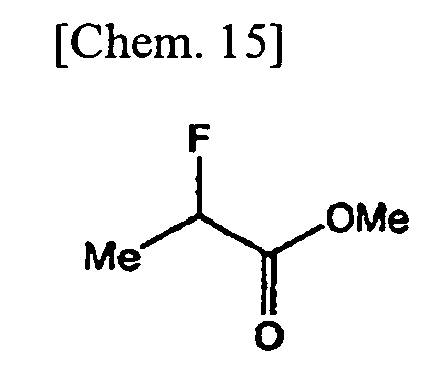

- To 400 g (3.77 mol, 2.01 eq) of methyl 2-fluoropropionate of the following formula, 335 g (1.88 mol, 1.00 eq) of N-bromosuccinimide (NBS) and 15.7 g (water content: 25%, 48.6 mmol, 0.03 eq) of benzoyl peroxide (BPO) were added.


- To 400 g (3.77 mol, 3.99 eq) of methyl 2-fluoropropionate of the following formula, 168 g (944 mmol, 1.00 eq) of N-bromosuccinimide (NBS) and 9.18 g (37.6 mmol, 0.04 eq) of 1,1'-azobis(cyclohexane-1-carbonitrile) (V-40) were added.


- Produced was 2.8 kg of a methyl 2-fluoropropionate solution containing methyl 2-bromo-2-fluoropropionate of the following formula in a similar manner with reference to Examples 1 to 7 (content amount of methyl 2-bromo-2-fluoropropionate: 1.05 kg (5.68 mol) as determined by 19F-NMR (quantification according to internal standard method), gas chromatographic purity: 24.9%).

The 1H-NMR and 19F-NMR data of the methyl 2-bromo-2-fluoropropionate are indicated below.
1H-NMR [reference material: (CH3)4Si, deuterated solvent: CDCl3] δ ppm; 2.27 (d, 19.6Hz, 3H), 3.90 (s, 3H).
19F-NMR [reference material: C6F6, deuterated solvent: CDCl3] δ ppm; 53.34 (q, 19.3Hz, 1F). - In each of Examples 9 to 14, 2-bromo-2-fluoropropionate was provided in a similar manner with reference to Examples 1 to 8.
- To 5 mL of N,N-dimethylformamide, 1.00 g (gas chromatographic purity: 84.1%, 4.55 mmol, 1.00 eq) of methyl 2-bromo-2-fluoropropionate of the following formula, 988 mg (6.49 mmol, 1.43 eq) of 1,8-diazabicyclo[5.4.0]undec-7-ene (DBU) and 10.0 mg (0.0502 mmol, 0.01 eq) of phenothiazine were added.


- To a tetrahydrofuran solution (solvent amount: 188 mL) containing 46.1 g (gas chromatographic purity: 88.2%, 204 mmol, 1.00 eq) of ethyl 2-bromo-2-fluoropropionate of the following formula, a tetrahydrofuran solution (solvent amount: 43 mL) containing 42.9 g (282 mmol, 1.38 eq) of 1,8-diazabicyclo[5.4.0]undec-7-ene (DBU) was gradually added.


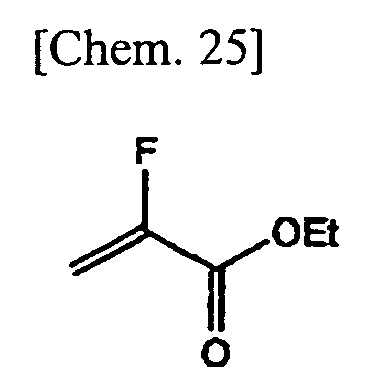
- To 160 mL of N,N-dimethylformamide, 30.0 g (gas chromatographic purity: 83.7%, 136 mmol, 1.00 eq) of methyl 2-bromo-2-fluoropropionate of the following formula, 1.22 g (8.01 mmol, 0.06 eq) of 1,8-diazabicyclo[5.4.0]undec-7-ene (DBU), 22.4 g (162 mmol, 1.19 eq) of potassium carbonate and 300 mg (1.36 mmol, 0.01 eq) of 2,6-di-tert-butyl-4-methylphenol (BHT) were added.


- To 5 mL of N,N-dimethylformamide, 1.00 g (gas chromatographic purity: 84.1 %, 4.55 mmol, 1.00 eq) of methyl 2-bromo-2-fluoropropionate of the following formula, 41.0 mg (0.269 mmol, 0.06 eq) of 1,8-diazabicyclo[5.4.0]undec-7-ene (DBU), 1.00 g (5.40 mmol, 1.19 eq) of tri-n-butylamine and 10.0 mg (0.0502 mmol, 0.01 eq) of phenothiazine were added.
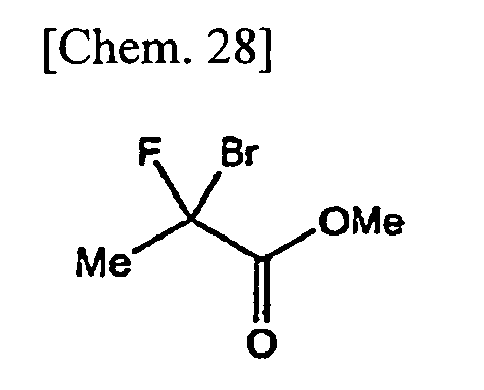

- To 5 mL of N,N-dimethylformamide, 1.00 g (gas chromatographic purity: 84.1%, 4.55 mmol, 1.00 eq) of methyl 2-bromo-2-fluoropropionate of the following formula, 82.0 mg (0.539 mmol, 0.12 eq) of 1,8-diazabicyclo[5.4.0]undec-7-ene (DBU), 750 mg (5.43 mmol, 1.19 eq) of potassium carbonate and 10.0 mg (0.0502 mmol, 0.01 eq) of phenothiazine were added.


- Produced was 854 g of a N,N-dimethylformamide solution containing methyl 2-fluoroacrylate of the following formula in a similar manner with reference to Examples 9 to 13 (content amount of methyl 2-fluoroacrylate: 89.8 g (863 mmol) as determined by 19F-NMR (quantification according to internal standard method), amount of methyl 2,2-difluoropropionate (estimated structure) generated as by-product: methyl 2-fluoroacrylate:methyl 2,2-difluoropropionate = 1:0.08 as determined by 19F-NMR, gas chromatographic purity: 10.6%).

The 1H-NMR and 19F-NMR data of the methyl 2-fluoroacrylate are indicated below. 1H-NMR [reference material: (CH3)4Si, deuterated solvent: CDCl3] δ ppm; 3.85 (s, 3H), 5.36 (dd, 13.2Hz, 3.2Hz, 1H), 5.69 (dd, 3.2Hz, 44.0Hz, 1H).
19F-NMR [reference material: C6F6, deuterated solvent: CDCl3] δ ppm; 44.67 (dd, 42.7Hz, 13.7Hz, 1F).
The 1H-NMR and 19F-NMR data and mass chromatography (MS) data of the methyl 2,2-difluoropropionate (estimated structure) are also indicated below.
1H-NMR [reference material: (CH3)4Si, deuterated solvent: CDCl3] δ ppm; 1.81 (t, 18.8Hz, 3H), 3.88 (s, 3H).
19F-NMR [reference material: C6F6, deuterated solvent: CDCl3] δ ppm; 62.90 (q, 18.3Hz, 2F).
MS; EI/ 124(M+), 81, 65, 59, CI/ 125(M+H). - To 170 L of α,α,α-trifluorotoluene (BTF), 85.0 kg (801 mol, 1.00 eq) of methyl (R)-2-fluoropropionate, 171 kg (961 mol, 1.20 eq) ofN-bromosuccinimide (NBS) and 1.17 kg (4.79 mol, 0.006 eq) of 1,1'-azobis(cyclohexane-1-carbonitrile) (V-40) were added.


- To 100 L of 1,3-dimethyl-2-imidazolidinone, 25.0 kg (135 mol, 1.00 eq) of methyl 2-bromo-2-fluoropropionate of the following formula produced in Example 15 and 250 g (1.25 mol, 0.009 eq) of phenothiazine were added. While controlling the inside temperature of the reaction system to be 35°C or lower, 21.2 kg (139 mol, 1.03 eq) of 1,8-diazabicyclo[5.4.0]undec-7-ene (DBU) was added to the reaction liquid.


The whole (8.44 kg) of the fraction 1 of the methyl 2-fluoroacrylate was dried by a molecular sieve 4A (5 wt%) for one night. (The amount of the methyl 2-fluoroacrylate contained in the fraction 1 was determined by 19F-NMR (quantification according to internal standard method) to be 7.17 kg (68.9 mol); the gas chromatographic purity of the methyl 2,2-difluoropropionate, methyl 2-fluoroacrylate and
1,3-dimethyl-2-imidazolidinone were 0.3%, 91.6% and 7.7%, respectively; and the water content of the fraction 1 was 0.15%.) The fraction 1 was then subjected to simple distillation using a rotary evaporator (flash distillation (500 ppm methyl 2-fluoroacrylate solution of 2,6-di-tert-butyl-4-methylphenol (BHT) was added to the liquid accumulation portion of the distillation column), setting temperature: up to 30°C, reduced pressure level: up to 20 kPa). There was thus obtained 7.52 kg of a purified product of the methyl 2-fluoroacrylate of the above formula. (The amount of product fraction exceeded the quantitative amount of charge due to accuracy errors in internal standard method;
2,6-di-tert-butyl-4-methylphenol (BHT) was added in advance to the receiver of the fraction in an amount of 200 ppm relative to the estimated fraction amount; and the fraction was recovered while stirring under ice cooling.) The gas chromatographic purity of the purified product was 99.3% (methyl 2,2-difluoropropionate (estimated structure): 0.3%, 1,3-dimethyl-2-imidazolidinone: 0.1%). The water content of the purified product was 0.08%. The concentration of the 2,6-di-tert-butyl-4-methylphenol (BHT) was 238 ppm (calculated value).
Further, the whole (11.2 kg) of the fraction 2 of the methyl 2-fluoroacrylate was treated twice by the same operation as that of the fraction 1. (The amount of the methyl 2-fluoroacrylate contained in the fraction 2 was determined by 19F-NMR (quantification according to internal standard method) to be 4.22 kg (40.5 mol); the gas chromatographic purity of the methyl 2,2-difluoropropionate, methyl 2-fluoroacrylate and
1,3-dimethyl-2-imidazolidinone were 0.2%, 38.3% and 61.0%, respectively; and the water content of the fraction 2 was 0.43%.) There was obtained 3.00 kg of a purified product of the methyl 2-fluoroacrylate of the above formula. The gas chromatographic purity of the purified product was 99.0% (methyl 2,2-difluoropropionate (estimated structure): 0.5%, 1,3-dimethyl-2-imidazolidinone: < 0.1%). The water content of the purified product was 0.09%. The concentration of the 2,6-di-tert-butyl-4-methylphenol (BHT) was 250 ppm (calculated value). The total amount of the purified product obtained from the fractions 1 and 2 was 10.5 kg. The total yield of the purified product was 74%.
The 1H-NMR and 19F-NMR data of the methyl 2-fluoroacrylate were the same as those of Example 14. - To distillation equipment, 128 g (1.23 mol, 1.00 eq) of methyl 2-fluoroacrylate of the following formula produced in a similar manner with reference to Examples 15 and 16 and 750 mg (3.40 mmol, 0.003 eq) of 2,6-di-tert-butyl-4-methylphenol (BHT) were added. (The gas chromatographic purity of the methyl 2-fluoroacrylate was 98.7%; and the concentration of 2,6-di-tert-butyl-4-methylphenol (BHT) in the methyl 2-fluoroacrylate was 227 ppm (calculated value).) The resulting liquid was placed under total reflux conditions (setting temperature: 72°C, bottom inside temperature: 53°C, reduced pressure level: 42.4 kPa, air introduction amount: 5 mL/min) for 8 hours and 55 minutes, and then, subjected to simple distillation (flash distillation (500 ppm methyl 2-fluoroacrylate solution of 2,6-di-tert-butyl-4-methylphenol (BHT) was not added to the liquid accumulation portion of the distillation column), setting temperature: 72°C, bottom inside temperature: 54°C, column top temperature: 50°C, reduced pressure level: 45.6 kPa, air introduction amount: 5 mL/min, time: 1 hour and 25 minutes). By this, 122 g of the methyl 2-fluoroacrylate was obtained. Herein, 2,6-di-tert-butyl-4-methylphenol (BHT) was added in advance to the receiver of the fraction in an amount of 200 ppm relative to the estimated fraction amount; and the fraction was recovered while stirring under ice cooling.)

- A crude product of methyl 2-fluoroacrylate of the following formula was produced in a similar manner with reference to Examples 15 and 16. (The purity of the crude product was at a level corresponding to that obtained by, after filtering out hydrobromate of 1,8-diazabicyclo[5.4.0]undec-7-ene (DBU·HBr) from the reaction terminated liquid after the dehydrobromination step, simple distillation of the filtrate.) The crude product was subjected to aeration distillation in a similar manner with reference to Example 17, thereby yielding a purified product of the methyl-2-fluoroacrylate. The gas chromatographic purity of the purified product was 99.0% or higher. There was not seen self-polymerization of the methyl 2-fluoroacrylate at all.


- Although the present invention has been described with reference to the above specific embodiments, the present invention is not limited to these exemplary embodiments. Various modifications and variations of the embodiments described above can be made without departing from the scope of the present invention.

Claims (11)
- A process of producing a 2-fluoroacrylic ester of the general formula [3], comprising:a bromination step of converting a 2-fluoropropionic ester of the general formula [1] to a 2-bromo-2-fluoropropionic ester of the general formula [2] by reaction of the 2-fluoropropionic ester with a nitrogen-bromine bond-containing brominating agent in the presence of a radical initiator; anda dehydrobromination step of reacting the 2-bromo-2-fluoropropionic ester with a base


- The process of producing the 2-fluoroacrylic ester according to claim 1, wherein, in an ester moiety of the ester, R is either a methyl group, an ethyl group, a 2,2,2-trifluoroethyl group or a 1,1,1,3,3,3-hexafluoroisopropyl group.
- The process of producing the 2-fluoroacrylic ester according to claim 1 or 2, wherein the nitrogen-bromine bond-containing brominating agent used in the bromination step is N-bromosuccinimide (NBS).
- The process of producing the 2-fluoroacrylic ester according to any one of claims 1 to 3, wherein the radical initiator used in the bromination step is either 2,2'-azobisisobutyronitrile (AIBN), 1,1'-azobis(cyclohexane-1-carbonitrile) (V-40) or benzoyl peroxide (BPO).
- The process of producing the 2-fluoroacrylic ester according to any one of claims 1 to 4, wherein an alkali metal carbonate is used stoichiometrically in the presence of a catalytic amount of 1,8-diazabicyclo[5.4.0]undec-7-ene (DBU) as the base in the dehydrobromination step.
- The process of producing the 2-fluoroacrylic ester according to any one of claims 1 to 4, wherein tri-n-butylamine is used stoichiometrically in the presence of a catalytic amount of 1,8-diazabicyclo[5.4.0]undec-7-ene (DBU) as the base in the dehydrobromination step.
- The process of producing the 2-fluoroacrylic ester according to any one of claims 1 to 6, wherein the dehydrobromination step is performed in the presence of a polymerization inhibitor.
- The process of producing the 2-fluoroacrylic ester according to claim 7, wherein the polymerization inhibitor is either phenothiazine, hydroquinone or 2,6-di-tert-butyl-4-methylphenol (BHT).
- The process of producing the 2-fluoroacrylic ester according to any one of claims 1 to 8, further comprising subjecting the 2-fluoroacrylic ester to distillation purification in the presence of a polymerization inhibitor.
- The process of producing the 2-fluoroacrylic ester according to claim 9, wherein the polymerization inhibitor is either phenothiazine, hydroquinone or 2,6-di-tert-butyl-4-methylphenol (BHT).
- The process of producing the 2-fluoroacrylic ester according to any one of claims 1 to 10, further comprising subjecting the 2-fluoroacrylic ester to distillation purification while entraining air or oxygen in the 2-fluoroacrylic ester.
Applications Claiming Priority (3)
| Application Number | Priority Date | Filing Date | Title |
|---|---|---|---|
| JP2009120478 | 2009-05-19 | ||
| JP2010041158A JP5521640B2 (en) | 2009-05-19 | 2010-02-26 | Method for producing 2-fluoroacrylic acid ester |
| PCT/JP2010/054914 WO2010134382A1 (en) | 2009-05-19 | 2010-03-23 | Process for preparation of 2-fluoroacrylic esters |
Publications (3)
| Publication Number | Publication Date |
|---|---|
| EP2444389A1 true EP2444389A1 (en) | 2012-04-25 |
| EP2444389A4 EP2444389A4 (en) | 2012-10-31 |
| EP2444389B1 EP2444389B1 (en) | 2014-07-16 |
Family
ID=43126071
Family Applications (1)
| Application Number | Title | Priority Date | Filing Date |
|---|---|---|---|
| EP10777617.1A Not-in-force EP2444389B1 (en) | 2009-05-19 | 2010-03-23 | Process for preparation of 2-fluoroacrylic esters |
Country Status (5)
| Country | Link |
|---|---|
| US (1) | US8450520B2 (en) |
| EP (1) | EP2444389B1 (en) |
| JP (1) | JP5521640B2 (en) |
| CN (1) | CN102428067B (en) |
| WO (1) | WO2010134382A1 (en) |
Families Citing this family (16)
| Publication number | Priority date | Publication date | Assignee | Title |
|---|---|---|---|---|
| CN106536472B (en) * | 2014-08-08 | 2019-01-01 | 优迈特株式会社 | Poly- fluoroolefins carboxylic acid or the mixture of its salt and preparation method thereof |
| JP6202037B2 (en) | 2015-04-09 | 2017-09-27 | ダイキン工業株式会社 | Composition |
| JP6160651B2 (en) | 2015-04-09 | 2017-07-12 | ダイキン工業株式会社 | Acrylic acid derivative-containing composition and method for stabilizing acrylic acid derivative |
| US10099997B2 (en) | 2015-04-09 | 2018-10-16 | Daikin Industries, Ltd. | Acrylic acid derivative-containing composition, and method for stabilizing acrylic acid derivative |
| CN104829450B (en) * | 2015-04-16 | 2018-08-03 | 巨化集团技术中心 | A kind of preparation method containing bromo-ester |
| CN104892409B (en) * | 2015-04-16 | 2018-08-28 | 巨化集团技术中心 | A kind of general formula is CH3The synthetic method containing bromo-ester of CXBrCOOR |
| EP3333150B1 (en) | 2015-08-07 | 2020-09-16 | Daikin Industries, Ltd. | Method for purifying acrylic acid derivative |
| HUE054524T2 (en) * | 2015-08-07 | 2021-09-28 | Daikin Ind Ltd | Water elimination method |
| JP6678986B2 (en) * | 2015-09-15 | 2020-04-15 | 国立大学法人島根大学 | Method for producing α-bromo-α-fluorocarboxylic acid esters |
| CN107417524B (en) * | 2017-06-28 | 2019-09-24 | 临海天宇药业有限公司 | A kind of preparation method of 2- fluorinated monomer |
| CN108344762B (en) * | 2018-02-23 | 2020-09-25 | 中国科学院长春应用化学研究所 | Method for detecting polylactic acid content in degradable plastic product |
| JP6489275B1 (en) * | 2018-08-14 | 2019-03-27 | セントラル硝子株式会社 | Distillation purification method of fluorine-containing polymerizable monomer |
| JP7375519B2 (en) * | 2019-12-17 | 2023-11-08 | Agc株式会社 | Method for producing halogenated acrylic acid ester |
| CN115427387A (en) * | 2020-04-20 | 2022-12-02 | 大金工业株式会社 | Method for producing alpha-fluoroacrylate |
| WO2021215450A1 (en) * | 2020-04-20 | 2021-10-28 | ダイキン工業株式会社 | METHOD FOR PRODUCING α-FLUOROACRYLIC ACID ESTER |
| WO2024059483A1 (en) * | 2022-09-13 | 2024-03-21 | The Johns Hopkins University | Negative-carbon cement (nc2) production |
Family Cites Families (6)
| Publication number | Priority date | Publication date | Assignee | Title |
|---|---|---|---|---|
| JP2001139519A (en) * | 1999-11-16 | 2001-05-22 | Nippon Mektron Ltd | Method for producing 2-bromo-2-fluoropropionic acid ester |
| JP2001139513A (en) * | 1999-11-16 | 2001-05-22 | Nippon Mektron Ltd | Method for producing 2-bromo-2-fluoropropionic acid |
| JP2001172223A (en) * | 1999-12-17 | 2001-06-26 | Nippon Mektron Ltd | Method for producing 2-fluoroacrylic acid or ester thereof |
| JP5109530B2 (en) | 2007-01-23 | 2012-12-26 | セントラル硝子株式会社 | Process for producing optically active α-fluorocarboxylic acid ester |
| JP5240078B2 (en) * | 2009-06-09 | 2013-07-17 | セントラル硝子株式会社 | Method for producing 2-fluoroacrylic acid ester |
| DE102009030681A1 (en) * | 2009-06-26 | 2010-12-30 | Saltigo Gmbh | Preparation of substituted 2-fluoroacrylic acid derivatives |
-
2010
- 2010-02-26 JP JP2010041158A patent/JP5521640B2/en not_active Expired - Fee Related
- 2010-03-23 CN CN2010800220124A patent/CN102428067B/en not_active Expired - Fee Related
- 2010-03-23 EP EP10777617.1A patent/EP2444389B1/en not_active Not-in-force
- 2010-03-23 WO PCT/JP2010/054914 patent/WO2010134382A1/en not_active Ceased
- 2010-03-23 US US13/266,008 patent/US8450520B2/en not_active Expired - Fee Related
Non-Patent Citations (2)
| Title |
|---|
| See also references of WO2010134382A1 * |
| TAKEUCHI, YOSHIO ET AL: "Synthetic studies for novel structure of .alpha.-nitrogenously functionalized .alpha.-fluorocarboxylic acids. Part 1. The first synthesis and reactions of N-protected .alpha.-fluoroglycines", JOURNAL OF THE CHEMICAL SOCIETY, PERKIN TRANSACTIONS 1: ORGANIC AND BIO-ORGANIC CHEMISTRY (1972-1999) , (1), 49-53 CODEN: JCPRB4; ISSN: 0300-922X, 1991, XP002683718, * |
Also Published As
| Publication number | Publication date |
|---|---|
| EP2444389A4 (en) | 2012-10-31 |
| US8450520B2 (en) | 2013-05-28 |
| CN102428067A (en) | 2012-04-25 |
| US20120059187A1 (en) | 2012-03-08 |
| CN102428067B (en) | 2013-12-25 |
| EP2444389B1 (en) | 2014-07-16 |
| JP5521640B2 (en) | 2014-06-18 |
| WO2010134382A1 (en) | 2010-11-25 |
| JP2011001340A (en) | 2011-01-06 |
Similar Documents
| Publication | Publication Date | Title |
|---|---|---|
| EP2444389B1 (en) | Process for preparation of 2-fluoroacrylic esters | |
| KR101961972B1 (en) | Production method for 4,4-difluoro-3,4-dihydroisoquinoline derivative | |
| US8283489B2 (en) | Process for producing optically active α-fluorocarboxylate | |
| JP2021147370A (en) | Method for producing (meth)acrylate compound containing hydroxyl group and method for producing (meth)acrylate compound containing phosphoric acid group | |
| EP2394979A1 (en) | Intermediate of cilastatin and preparation method thereof | |
| JP5659658B2 (en) | Process for producing α, α-difluoroesters | |
| KR100895191B1 (en) | Method for preparing 1,3-propenesultone | |
| EP0847974A1 (en) | Process for the preparation of cyclopropylacetylene and its derivatives | |
| JP5240078B2 (en) | Method for producing 2-fluoroacrylic acid ester | |
| EP0748804B1 (en) | Process for producing carboxylic acid derivative | |
| JP4736474B2 (en) | Process for producing fluorine-containing alkylsulfonylaminoethyl α-substituted acrylates | |
| WO2008075534A1 (en) | Process for producing fluoroalkane ester | |
| WO2024134671A1 (en) | Preparation of 3-ethylbicyclo[3.2.0]hept-3-en-6-one | |
| JP2010001273A (en) | Method of preparing fluorine-containing monomer | |
| US7094926B2 (en) | Process for producing optically active carboxylic acid substituted in 2-position | |
| US8524941B2 (en) | Process for producing monomer for fluorinated resist | |
| JP5600994B2 (en) | Method for producing 2-fluoroisobutyric acid ester | |
| JP2005255583A (en) | Method for producing lactone skeleton-containing (meth) acrylic acid ester | |
| JP2007153763A (en) | Method for producing 3-hydroxysulfolane and its ester | |
| JPH06279371A (en) | Production of unsaturated quaternary ammonium salt | |
| RU2778793C2 (en) | Method for production of glycerin carbonate methacrylate | |
| JP3838828B2 (en) | (Meth) acrylate and method for producing the same | |
| WO2008078340A1 (en) | Process for the separation of 4-bromomethyl-2'-substituted biphenyls from 4,4,-dibromomethyl-2'-substituted biphenyls | |
| JPH0967310A (en) | Purification of alpha-hydroxyalkyl acrylates | |
| JP2002088050A (en) | Method for producing trifluoromethanesulfonic anhydride |
Legal Events
| Date | Code | Title | Description |
|---|---|---|---|
| PUAI | Public reference made under article 153(3) epc to a published international application that has entered the european phase |
Free format text: ORIGINAL CODE: 0009012 |
|
| 17P | Request for examination filed |
Effective date: 20111028 |
|
| AK | Designated contracting states |
Kind code of ref document: A1 Designated state(s): AT BE BG CH CY CZ DE DK EE ES FI FR GB GR HR HU IE IS IT LI LT LU LV MC MK MT NL NO PL PT RO SE SI SK SM TR |
|
| DAX | Request for extension of the european patent (deleted) | ||
| RIC1 | Information provided on ipc code assigned before grant |
Ipc: C07C 69/653 20060101ALI20120920BHEP Ipc: C07C 67/317 20060101AFI20120920BHEP |
|
| A4 | Supplementary search report drawn up and despatched |
Effective date: 20120927 |
|
| GRAP | Despatch of communication of intention to grant a patent |
Free format text: ORIGINAL CODE: EPIDOSNIGR1 |
|
| INTG | Intention to grant announced |
Effective date: 20140203 |
|
| GRAS | Grant fee paid |
Free format text: ORIGINAL CODE: EPIDOSNIGR3 |
|
| GRAA | (expected) grant |
Free format text: ORIGINAL CODE: 0009210 |
|
| AK | Designated contracting states |
Kind code of ref document: B1 Designated state(s): AT BE BG CH CY CZ DE DK EE ES FI FR GB GR HR HU IE IS IT LI LT LU LV MC MK MT NL NO PL PT RO SE SI SK SM TR |
|
| REG | Reference to a national code |
Ref country code: GB Ref legal event code: FG4D |
|
| REG | Reference to a national code |
Ref country code: CH Ref legal event code: EP |
|
| REG | Reference to a national code |
Ref country code: IE Ref legal event code: FG4D |
|
| REG | Reference to a national code |
Ref country code: AT Ref legal event code: REF Ref document number: 677523 Country of ref document: AT Kind code of ref document: T Effective date: 20140815 |
|
| REG | Reference to a national code |
Ref country code: DE Ref legal event code: R096 Ref document number: 602010017562 Country of ref document: DE Effective date: 20140828 |
|
| REG | Reference to a national code |
Ref country code: NL Ref legal event code: VDEP Effective date: 20140716 |
|
| REG | Reference to a national code |
Ref country code: AT Ref legal event code: MK05 Ref document number: 677523 Country of ref document: AT Kind code of ref document: T Effective date: 20140716 |
|
| REG | Reference to a national code |
Ref country code: LT Ref legal event code: MG4D |
|
| PG25 | Lapsed in a contracting state [announced via postgrant information from national office to epo] |
Ref country code: PT Free format text: LAPSE BECAUSE OF FAILURE TO SUBMIT A TRANSLATION OF THE DESCRIPTION OR TO PAY THE FEE WITHIN THE PRESCRIBED TIME-LIMIT Effective date: 20141117 Ref country code: LT Free format text: LAPSE BECAUSE OF FAILURE TO SUBMIT A TRANSLATION OF THE DESCRIPTION OR TO PAY THE FEE WITHIN THE PRESCRIBED TIME-LIMIT Effective date: 20140716 Ref country code: BG Free format text: LAPSE BECAUSE OF FAILURE TO SUBMIT A TRANSLATION OF THE DESCRIPTION OR TO PAY THE FEE WITHIN THE PRESCRIBED TIME-LIMIT Effective date: 20141016 Ref country code: NO Free format text: LAPSE BECAUSE OF FAILURE TO SUBMIT A TRANSLATION OF THE DESCRIPTION OR TO PAY THE FEE WITHIN THE PRESCRIBED TIME-LIMIT Effective date: 20141016 Ref country code: GR Free format text: LAPSE BECAUSE OF FAILURE TO SUBMIT A TRANSLATION OF THE DESCRIPTION OR TO PAY THE FEE WITHIN THE PRESCRIBED TIME-LIMIT Effective date: 20141017 Ref country code: FI Free format text: LAPSE BECAUSE OF FAILURE TO SUBMIT A TRANSLATION OF THE DESCRIPTION OR TO PAY THE FEE WITHIN THE PRESCRIBED TIME-LIMIT Effective date: 20140716 Ref country code: SE Free format text: LAPSE BECAUSE OF FAILURE TO SUBMIT A TRANSLATION OF THE DESCRIPTION OR TO PAY THE FEE WITHIN THE PRESCRIBED TIME-LIMIT Effective date: 20140716 Ref country code: ES Free format text: LAPSE BECAUSE OF FAILURE TO SUBMIT A TRANSLATION OF THE DESCRIPTION OR TO PAY THE FEE WITHIN THE PRESCRIBED TIME-LIMIT Effective date: 20140716 |
|
| PG25 | Lapsed in a contracting state [announced via postgrant information from national office to epo] |
Ref country code: CY Free format text: LAPSE BECAUSE OF FAILURE TO SUBMIT A TRANSLATION OF THE DESCRIPTION OR TO PAY THE FEE WITHIN THE PRESCRIBED TIME-LIMIT Effective date: 20140716 Ref country code: NL Free format text: LAPSE BECAUSE OF FAILURE TO SUBMIT A TRANSLATION OF THE DESCRIPTION OR TO PAY THE FEE WITHIN THE PRESCRIBED TIME-LIMIT Effective date: 20140716 Ref country code: AT Free format text: LAPSE BECAUSE OF FAILURE TO SUBMIT A TRANSLATION OF THE DESCRIPTION OR TO PAY THE FEE WITHIN THE PRESCRIBED TIME-LIMIT Effective date: 20140716 Ref country code: IS Free format text: LAPSE BECAUSE OF FAILURE TO SUBMIT A TRANSLATION OF THE DESCRIPTION OR TO PAY THE FEE WITHIN THE PRESCRIBED TIME-LIMIT Effective date: 20141116 Ref country code: LV Free format text: LAPSE BECAUSE OF FAILURE TO SUBMIT A TRANSLATION OF THE DESCRIPTION OR TO PAY THE FEE WITHIN THE PRESCRIBED TIME-LIMIT Effective date: 20140716 Ref country code: PL Free format text: LAPSE BECAUSE OF FAILURE TO SUBMIT A TRANSLATION OF THE DESCRIPTION OR TO PAY THE FEE WITHIN THE PRESCRIBED TIME-LIMIT Effective date: 20140716 |
|
| REG | Reference to a national code |
Ref country code: DE Ref legal event code: R097 Ref document number: 602010017562 Country of ref document: DE |
|
| PG25 | Lapsed in a contracting state [announced via postgrant information from national office to epo] |
Ref country code: RO Free format text: LAPSE BECAUSE OF FAILURE TO SUBMIT A TRANSLATION OF THE DESCRIPTION OR TO PAY THE FEE WITHIN THE PRESCRIBED TIME-LIMIT Effective date: 20140716 Ref country code: CZ Free format text: LAPSE BECAUSE OF FAILURE TO SUBMIT A TRANSLATION OF THE DESCRIPTION OR TO PAY THE FEE WITHIN THE PRESCRIBED TIME-LIMIT Effective date: 20140716 Ref country code: DK Free format text: LAPSE BECAUSE OF FAILURE TO SUBMIT A TRANSLATION OF THE DESCRIPTION OR TO PAY THE FEE WITHIN THE PRESCRIBED TIME-LIMIT Effective date: 20140716 Ref country code: IT Free format text: LAPSE BECAUSE OF FAILURE TO SUBMIT A TRANSLATION OF THE DESCRIPTION OR TO PAY THE FEE WITHIN THE PRESCRIBED TIME-LIMIT Effective date: 20140716 Ref country code: EE Free format text: LAPSE BECAUSE OF FAILURE TO SUBMIT A TRANSLATION OF THE DESCRIPTION OR TO PAY THE FEE WITHIN THE PRESCRIBED TIME-LIMIT Effective date: 20140716 Ref country code: SK Free format text: LAPSE BECAUSE OF FAILURE TO SUBMIT A TRANSLATION OF THE DESCRIPTION OR TO PAY THE FEE WITHIN THE PRESCRIBED TIME-LIMIT Effective date: 20140716 |
|
| PLBE | No opposition filed within time limit |
Free format text: ORIGINAL CODE: 0009261 |
|
| STAA | Information on the status of an ep patent application or granted ep patent |
Free format text: STATUS: NO OPPOSITION FILED WITHIN TIME LIMIT |
|
| 26N | No opposition filed |
Effective date: 20150417 |
|
| PG25 | Lapsed in a contracting state [announced via postgrant information from national office to epo] |
Ref country code: LU Free format text: LAPSE BECAUSE OF FAILURE TO SUBMIT A TRANSLATION OF THE DESCRIPTION OR TO PAY THE FEE WITHIN THE PRESCRIBED TIME-LIMIT Effective date: 20150323 Ref country code: MC Free format text: LAPSE BECAUSE OF FAILURE TO SUBMIT A TRANSLATION OF THE DESCRIPTION OR TO PAY THE FEE WITHIN THE PRESCRIBED TIME-LIMIT Effective date: 20140716 |
|
| REG | Reference to a national code |
Ref country code: CH Ref legal event code: PL |
|
| PG25 | Lapsed in a contracting state [announced via postgrant information from national office to epo] |
Ref country code: SI Free format text: LAPSE BECAUSE OF FAILURE TO SUBMIT A TRANSLATION OF THE DESCRIPTION OR TO PAY THE FEE WITHIN THE PRESCRIBED TIME-LIMIT Effective date: 20140716 |
|
| REG | Reference to a national code |
Ref country code: IE Ref legal event code: MM4A |
|
| PG25 | Lapsed in a contracting state [announced via postgrant information from national office to epo] |
Ref country code: CH Free format text: LAPSE BECAUSE OF NON-PAYMENT OF DUE FEES Effective date: 20150331 Ref country code: IE Free format text: LAPSE BECAUSE OF NON-PAYMENT OF DUE FEES Effective date: 20150323 Ref country code: LI Free format text: LAPSE BECAUSE OF NON-PAYMENT OF DUE FEES Effective date: 20150331 |
|
| REG | Reference to a national code |
Ref country code: FR Ref legal event code: PLFP Year of fee payment: 7 |
|
| PG25 | Lapsed in a contracting state [announced via postgrant information from national office to epo] |
Ref country code: BE Free format text: LAPSE BECAUSE OF FAILURE TO SUBMIT A TRANSLATION OF THE DESCRIPTION OR TO PAY THE FEE WITHIN THE PRESCRIBED TIME-LIMIT Effective date: 20140716 |
|
| PG25 | Lapsed in a contracting state [announced via postgrant information from national office to epo] |
Ref country code: MT Free format text: LAPSE BECAUSE OF FAILURE TO SUBMIT A TRANSLATION OF THE DESCRIPTION OR TO PAY THE FEE WITHIN THE PRESCRIBED TIME-LIMIT Effective date: 20140716 |
|
| REG | Reference to a national code |
Ref country code: FR Ref legal event code: PLFP Year of fee payment: 8 |
|
| PG25 | Lapsed in a contracting state [announced via postgrant information from national office to epo] |
Ref country code: SM Free format text: LAPSE BECAUSE OF FAILURE TO SUBMIT A TRANSLATION OF THE DESCRIPTION OR TO PAY THE FEE WITHIN THE PRESCRIBED TIME-LIMIT Effective date: 20140716 Ref country code: HU Free format text: LAPSE BECAUSE OF FAILURE TO SUBMIT A TRANSLATION OF THE DESCRIPTION OR TO PAY THE FEE WITHIN THE PRESCRIBED TIME-LIMIT; INVALID AB INITIO Effective date: 20100323 |
|
| PG25 | Lapsed in a contracting state [announced via postgrant information from national office to epo] |
Ref country code: HR Free format text: LAPSE BECAUSE OF FAILURE TO SUBMIT A TRANSLATION OF THE DESCRIPTION OR TO PAY THE FEE WITHIN THE PRESCRIBED TIME-LIMIT Effective date: 20140716 |
|
| PG25 | Lapsed in a contracting state [announced via postgrant information from national office to epo] |
Ref country code: TR Free format text: LAPSE BECAUSE OF FAILURE TO SUBMIT A TRANSLATION OF THE DESCRIPTION OR TO PAY THE FEE WITHIN THE PRESCRIBED TIME-LIMIT Effective date: 20140716 |
|
| REG | Reference to a national code |
Ref country code: FR Ref legal event code: PLFP Year of fee payment: 9 |
|
| PG25 | Lapsed in a contracting state [announced via postgrant information from national office to epo] |
Ref country code: MK Free format text: LAPSE BECAUSE OF FAILURE TO SUBMIT A TRANSLATION OF THE DESCRIPTION OR TO PAY THE FEE WITHIN THE PRESCRIBED TIME-LIMIT Effective date: 20140716 |
|
| PGFP | Annual fee paid to national office [announced via postgrant information from national office to epo] |
Ref country code: GB Payment date: 20190320 Year of fee payment: 10 |
|
| PGFP | Annual fee paid to national office [announced via postgrant information from national office to epo] |
Ref country code: FR Payment date: 20190213 Year of fee payment: 10 |
|
| PG25 | Lapsed in a contracting state [announced via postgrant information from national office to epo] |
Ref country code: FR Free format text: LAPSE BECAUSE OF NON-PAYMENT OF DUE FEES Effective date: 20200331 |
|
| GBPC | Gb: european patent ceased through non-payment of renewal fee |
Effective date: 20200323 |
|
| PG25 | Lapsed in a contracting state [announced via postgrant information from national office to epo] |
Ref country code: GB Free format text: LAPSE BECAUSE OF NON-PAYMENT OF DUE FEES Effective date: 20200323 |
|
| PGFP | Annual fee paid to national office [announced via postgrant information from national office to epo] |
Ref country code: DE Payment date: 20210310 Year of fee payment: 12 |
|
| REG | Reference to a national code |
Ref country code: DE Ref legal event code: R119 Ref document number: 602010017562 Country of ref document: DE |
|
| PG25 | Lapsed in a contracting state [announced via postgrant information from national office to epo] |
Ref country code: DE Free format text: LAPSE BECAUSE OF NON-PAYMENT OF DUE FEES Effective date: 20221001 |