EP2444264A2 - A covering system - Google Patents
A covering system Download PDFInfo
- Publication number
- EP2444264A2 EP2444264A2 EP11250854A EP11250854A EP2444264A2 EP 2444264 A2 EP2444264 A2 EP 2444264A2 EP 11250854 A EP11250854 A EP 11250854A EP 11250854 A EP11250854 A EP 11250854A EP 2444264 A2 EP2444264 A2 EP 2444264A2
- Authority
- EP
- European Patent Office
- Prior art keywords
- container
- truck body
- covering system
- cover
- arm
- Prior art date
- Legal status (The legal status is an assumption and is not a legal conclusion. Google has not performed a legal analysis and makes no representation as to the accuracy of the status listed.)
- Withdrawn
Links
Images


Classifications
-
- B—PERFORMING OPERATIONS; TRANSPORTING
- B60—VEHICLES IN GENERAL
- B60J—WINDOWS, WINDSCREENS, NON-FIXED ROOFS, DOORS, OR SIMILAR DEVICES FOR VEHICLES; REMOVABLE EXTERNAL PROTECTIVE COVERINGS SPECIALLY ADAPTED FOR VEHICLES
- B60J7/00—Non-fixed roofs; Roofs with movable panels, e.g. rotary sunroofs
- B60J7/08—Non-fixed roofs; Roofs with movable panels, e.g. rotary sunroofs of non-sliding type, i.e. movable or removable roofs or panels, e.g. let-down tops or roofs capable of being easily detached or of assuming a collapsed or inoperative position
- B60J7/085—Non-fixed roofs; Roofs with movable panels, e.g. rotary sunroofs of non-sliding type, i.e. movable or removable roofs or panels, e.g. let-down tops or roofs capable of being easily detached or of assuming a collapsed or inoperative position winding up, e.g. for utility vehicles
Definitions
- This invention relates to a covering system for a container or truck body, particularly, though not exclusively, a commercial vehicle covering system.
- a covering system incorporated with a container or truck body, the container or truck body having a hollow support rail at the top of one or more upright walls thereof, the covering system comprising at least one arm located on a wall of the container or truck body, a sheet-like cover connected at one end to the or each arm and at the other end connected to a cover mounting, and a powering mechanism located in the region of the top rail, in vertical alignment therewith, which mechanism is arranged, in use, to apply a movable force to the or each arm such that in use the cover is selectively withdrawn from the cover mounting to extend over the a load within the container or truck body.
- the overall width of the structure can be kept within appropriate limits whilst maximising the width of the loading area.
- the powering mechanism is located internally within the void of the top rail. This offers still further advantages in terms of enclosing the powering mechanism and avoiding structural damage thereto.
- the covering system may comprise a pair of opposed arms interconnected by a crossbar to which the cover is connected.
- the cover mounting may be located on or adjacent a first end of the container or truck body and includes a shaft on which the cover is wound, the shaft extending across said first end, the cover being held under tension between the shaft and the or each arm by the powering mechanism which applies a biasing force on the arms in the direction of a second, opposite, end of the container or truck body.
- the shaft may be selectively rotatable in first and second directions by a winding control means so as to allow withdrawal of the cover from the mounting when rotated in the first direction and re-winding of the cover when rotated in the second direction, against the biasing force.
- the powering mechanism may comprise a coil spring which applies a rotational force to the or each arm by means of a rotatable shaft.
- a covering system incorporated with an open-top container or truck body, the container or truck body comprising substantially upright walls and a support rail provided at the uppermost edge of opposed lengthwise walls, the covering system comprising: opposed first and second arms connected to respective lengthwise walls; a sheet-like material mounted on a rotatable member connected to or adjacent a first widthways wall of the container, a free end of the material being connected to the arms; and a deployment mechanism connected to at least one of the lengthwise walls, in vertical alignment with the top support rail, which deployment mechanism is arranged in use to transmit a force to the arms to cause unwinding of the cover from the rotatable member as the free end is moved towards a second, opposite widthways wall.
- the deployment mechanism may be located internally within the void of the top support rail.
- the deployment mechanism may include a coil spring arranged to apply a biasing force on the arms through a rotatable shaft.
- the first and second arms may be interconnected by a crossbar extending across the widthways extent of the container or truck body, the free end of the cover being attached to the crossbar.
- a covering system for an open-top container or truck body having upright walls and a hollow top rail at the uppermost edge of at least one of the walls, the covering system comprising a driving mechanism housed at least partially within the void of one of the top rails, the driving mechanism being connected to an arm which is pivotally connected to a wall of the container or truck body, which arm extends upwardly from its pivotal connection to a position above the uppermost edges of the walls and is connected to a web of material, the driving mechanism being arranged in use to impart a rotational driving force on the arm such that the web of material can be drawn over the container or truck body.
- a method of fitting a covering system on an open-top container or truck body having upright walls and a hollow top rail at the uppermost edge of at least one of the walls comprising: fitting a driving mechanism at least partially within the void of one of the top rails, pivotally connecting a longitudinal arm to a wall of the container or truck body such that it extends upwardly from its pivotal connection to a position above the uppermost edges of the walls, connecting an upper part of the arm to a web of material, and connecting the driving mechanism to the longitudinal arm.
- the covering system can be powered by any means from within the top rail or rails of a truck body, trailer body, or demountable container such as a skip container, hook loaded waste container or cable loaded waste container, for the purpose of powering a set of framework arms from one side or end of the body or container in order to carry a tarpaulin or cover which is attached to the crossbar of the framework over the load.
- demountable container such as a skip container, hook loaded waste container or cable loaded waste container
- the covering system can be powered by any means such as a spring or springs or a hydraulic, electric or air drive mechanism from within the top rail or rails.
- the mechanism for powering the system can be mounted within the void of the top rail.
- the top rail of the truck body, trailer body or demountable container is the supporting rail that follows the top of the body or container.
- the mechanism for powering the system is mounted within the void of any top rail regardless of the rail's size, shape or design.
- the mechanism for powering the covering system transfers the power to the arms by means of a rotating shaft or bracket.
- the mechanism for powering the covering system can face and operate in any direction.
- the framework can face and operate in any direction.
- the tarpaulin or cover that is attached to the crossbar of the framework set of arms is also attached to a rotating shaft that can be powered by any means at one end of the truck body or container which will wind the tarpaulin around the shaft depending on the direction that the shaft is powered.
- the tarpaulin or cover will be released and retracted using the opposing forces of the powering mechanism that powers the arm framework and the powering mechanism that winds the tarpaulin or cover around the shaft.
- the rotating shaft at the front of the truck body or container can be powered by any means such as springs or a hydraulic, electric or air -driven mechanism.
- Embodiments described herein relate to a covering system incorporated as part of open-top vehicle body, trailer body or container, whether fixed or demountable from the vehicle, although for ease of explanation the term "container" will now be used throughout.
- Each container type comprises a top rail, which is an industry-standard term describing the longitudinal support member at the top edge of each upright wall.
- the top rail may be solid or hollow.
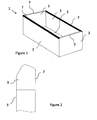
- Figure 1 shows a generalised form of vehicle container 1, comprising four upright walls 3 and a base 5. At the uppermost edge of each wall 3 is provided a top rail 7, the rails on the shorter, widthways walls sometimes being called headers.
- the front header is that which is located on the wall nearest the vehicle cab and the rear header is that which is on top of the opposite widthways wall, furthest from the cab.
- Figure 2 shows a typical top rail 7 in cross-section.
- the top rail 7 is hollow.
- the void 9 within the top rail facilitates a space into which is mounted part of a deployment mechanism for extending and retracting a cover over the open-top container 1.
- an open-top vehicle body or container 11 specifically one which comprises four generally rectangular upright walls, namely first and second lengthways walls 13, front and rear widthways walls 15a, 15b, and a base 17 (not shown).
- a top rail 19 is provided at the uppermost edge of each lengthways wall 13.
- Front and rear headers 21, 23 are provided at the uppermost edge of the front and rear walls 15, respectively. Together, the top rails 19 and headers 21, 23 provide a support structure.
- a cover mounting 27 is attached to the front header.
- the cover mounting 27 comprises an elongate housing in which is mounted a longitudinal roller 29 held between rotatable end holders (not shown).
- the roller 29 is mounted substantially parallel to the front wall 15a.
- a sheet-like tarpaulin cover 31 is wound over the roller 29 with a free end of the cover extending through a slot for connection to a deployment system, to be described below.
- the roller 29 is connected to an electric motor (or alternatively to a pneumatic or hydraulic motor)to allow selective rotation of the roller in the clockwise and counter-clockwise directions in accordance with an operating mode selectable by a user.
- the roller can also be locked stationary. It will therefore be appreciated that, in use, the cover can be wound and unwound from the roller depending on the operating mode.
- the deployment system comprises a framework made up of a pair of opposed arms 33, the arms being pivotally connected, at their lower ends, to a respective side 13 of the container 11 by means of a pivot shaft 35.
- the arms 33 are interconnected at or near their upper ends by means of a crossbar 37 to which is connected to a free end of the tarpaulin cover 31. It will therefore be appreciated that pivotal motion of the arms towards the rear wall 15b will deploy the cover 31 due to the consequential movement of the crossbar 37 over the container or body.
- each pivot shaft 35 is mounted horizontally through a respective top rail 19, a first end of the shaft being attached to a rotational mount 41 on the innermost upright wall of the rail, and the second end extending through, and slightly beyond, the opposite and outermost upright wall 13. The second end is fixed to the lower part of the pivotal arm 33.
- top rails 19 Within one or both top rails 19 is or are provided a plurality of coil springs 43, specifically torsion springs.
- five separate, torsion springs 43 are arranged side-by-side within the top rail 19, although in theory one may suffice.
- Each spring 43 follows a figure-of-eight type structure, defining two interior loops.
- a fixing shaft 47 extends through a first loop in order to fix the relative position of the springs within the rail 19.
- the pivot shaft 35 associated with each arm 33 extends through, and is connected to, the second, larger, loop of each spring 43.
- the purpose of the springs 43 is to impart a biased driving force on the framework so that it is ordinarily urged towards the rear wall 15b of the container or body.
- the cover 31 is therefore in tension between the roller 29 and the framework.
- An opposing force can be applied by the roller 29 when fixed stationary or rotated .
- the roller 29 When the roller 29 is rotated counter-clockwise, the framework moves towards the front wall 15a thereby uncovering the container 11 and storing energy in the springs 43.
- the roller 29 rotates clockwise and the springs 43 release their energy to move the framework automatically towards the rear wall 15a.
- the situation may be reversed with a motor provided in one or more of the top rails 19 and a spring provided in the cover mounting 27.
- crossbar 37 part of the framework can be avoided by attaching respective edges of the cover's free-end directly to the pivot arms 33.
- the springs 43 or indeed any driving system, wholly or partially within the void of the hollow rail 19, there is minimal protrusion of the deployment system from the side walls of the container 11.
- the driving system i.e. that part which applies energy to the arms 33, may be entirely enclosed within the void. It is only the material thickness of the pivotal arms 33 that protrude outside of the top rail 19 and therefore the overall width of the container can be maximised whilst complying with the relevant legislation with regard to container dimensions.
- the springs 43 are also stored substantially out-of-sight and are less likely to be damaged and/or affected by weather or environmental conditions.
- alternative driving means can be provided for imparting motion on the pivoting arms 33.
- a pneumatic or hydraulic piston and cylinder system can be employed in place of the springs.
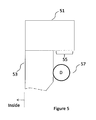
- the top rail 51 is of the type that extends outwardly of the underlying upright wall 53 to form a sort of lip 55.
- the powering mechanism 57 of the deployment system whether a spring or piston-and-cylinder type mechanism, can be placed below the lip 55, as indicated. Due to it being in vertical alignment with the top rail 51, similar advantages are present in terms of minimising the overall width of the container, including the covering mechanism.
Landscapes
- Engineering & Computer Science (AREA)
- Mechanical Engineering (AREA)
- Tents Or Canopies (AREA)
- Folding Of Thin Sheet-Like Materials, Special Discharging Devices, And Others (AREA)
Abstract
Description
- This invention relates to a covering system for a container or truck body, particularly, though not exclusively, a commercial vehicle covering system.
- There is a need for loads which are held within truck bodies, trailer bodies, and containers to be covered to avoid spillage and/or protect the load from adverse weather. For this purpose, various types of container covering systems are known, for example as disclosed in
EP1403115 . Such systems generally employ a sheet-like tarpaulin or cover, which is wound onto a roller provided at one end of the container or truck body, and a deployment mechanism separate from the container or truck body. - It is becoming common for legislation to limit the maximum width of truck bodies, trailer bodies and containers, this width having to take into account frameworks and mechanisms such as those provided with covering systems. For example, current European legislation has limited the maximum width to 2.55 metres. With conventional covering systems, therefore, it is necessary to limit the width of the container or body so that the both it and the external covering mechanism fall within the maximum width.
- In a first aspect, there is provided a covering system incorporated with a container or truck body, the container or truck body having a hollow support rail at the top of one or more upright walls thereof, the covering system comprising at least one arm located on a wall of the container or truck body, a sheet-like cover connected at one end to the or each arm and at the other end connected to a cover mounting, and a powering mechanism located in the region of the top rail, in vertical alignment therewith, which mechanism is arranged, in use, to apply a movable force to the or each arm such that in use the cover is selectively withdrawn from the cover mounting to extend over the a load within the container or truck body.
- By arranging for the powering mechanism to be incorporated on the container or truck body, in vertical alignment with the top rail, the overall width of the structure can be kept within appropriate limits whilst maximising the width of the loading area.
- Preferably, the powering mechanism is located internally within the void of the top rail. This offers still further advantages in terms of enclosing the powering mechanism and avoiding structural damage thereto.
- The covering system may comprise a pair of opposed arms interconnected by a crossbar to which the cover is connected.
- The cover mounting may be located on or adjacent a first end of the container or truck body and includes a shaft on which the cover is wound, the shaft extending across said first end, the cover being held under tension between the shaft and the or each arm by the powering mechanism which applies a biasing force on the arms in the direction of a second, opposite, end of the container or truck body.
- The shaft may be selectively rotatable in first and second directions by a winding control means so as to allow withdrawal of the cover from the mounting when rotated in the first direction and re-winding of the cover when rotated in the second direction, against the biasing force.
- The powering mechanism may comprise a coil spring which applies a rotational force to the or each arm by means of a rotatable shaft.
- According to a second aspect, there is provided a covering system incorporated with an open-top container or truck body, the container or truck body comprising substantially upright walls and a support rail provided at the uppermost edge of opposed lengthwise walls, the covering system comprising: opposed first and second arms connected to respective lengthwise walls; a sheet-like material mounted on a rotatable member connected to or adjacent a first widthways wall of the container, a free end of the material being connected to the arms; and a deployment mechanism connected to at least one of the lengthwise walls, in vertical alignment with the top support rail, which deployment mechanism is arranged in use to transmit a force to the arms to cause unwinding of the cover from the rotatable member as the free end is moved towards a second, opposite widthways wall.
- The deployment mechanism may be located internally within the void of the top support rail.
- The deployment mechanism may include a coil spring arranged to apply a biasing force on the arms through a rotatable shaft.
- The first and second arms may be interconnected by a crossbar extending across the widthways extent of the container or truck body, the free end of the cover being attached to the crossbar.
- According to a third aspect, there is provided a covering system for an open-top container or truck body having upright walls and a hollow top rail at the uppermost edge of at least one of the walls, the covering system comprising a driving mechanism housed at least partially within the void of one of the top rails, the driving mechanism being connected to an arm which is pivotally connected to a wall of the container or truck body, which arm extends upwardly from its pivotal connection to a position above the uppermost edges of the walls and is connected to a web of material, the driving mechanism being arranged in use to impart a rotational driving force on the arm such that the web of material can be drawn over the container or truck body.
- According to a fourth aspect, there is provided a method of fitting a covering system on an open-top container or truck body having upright walls and a hollow top rail at the uppermost edge of at least one of the walls, the method comprising: fitting a driving mechanism at least partially within the void of one of the top rails, pivotally connecting a longitudinal arm to a wall of the container or truck body such that it extends upwardly from its pivotal connection to a position above the uppermost edges of the walls, connecting an upper part of the arm to a web of material, and connecting the driving mechanism to the longitudinal arm.
- The invention will now be described, by way of example, with reference to the accompanying drawings, in which:
-
Figure 1 is a perspective view of a generalised container having top rails, which is useful for understanding the invention; -
Figure 2 is a cross-sectional view of a top rail ofFigure 1 ; -
Figure 3 is a perspective view of a truck or container body incorporating a covering system according to a first embodiment; -
Figure 4 is a cross-sectional view of a top rail having a driving mechanism therein, employed in the embodiment shown inFigure 3 ; and -
Figure 5 is a cross-sectional view of a top rail which is useful for explaining a second embodiment. - There is a general need for the loads held within truck bodies, trailer bodies and containers to be covered from ground level and within the width of the container or body. For this, we describe a powered covering system with framework arms to lift a web of material, such as tarpaulin, to cover over the load.
- The covering system can be powered by any means from within the top rail or rails of a truck body, trailer body, or demountable container such as a skip container, hook loaded waste container or cable loaded waste container, for the purpose of powering a set of framework arms from one side or end of the body or container in order to carry a tarpaulin or cover which is attached to the crossbar of the framework over the load.
- The covering system can be powered by any means such as a spring or springs or a hydraulic, electric or air drive mechanism from within the top rail or rails.
- The mechanism for powering the system can be mounted within the void of the top rail.
- The top rail of the truck body, trailer body or demountable container is the supporting rail that follows the top of the body or container.
- The mechanism for powering the system is mounted within the void of any top rail regardless of the rail's size, shape or design.
- The mechanism for powering the covering system transfers the power to the arms by means of a rotating shaft or bracket.
- The mechanism for powering the covering system can face and operate in any direction.
- The framework can face and operate in any direction.
- The tarpaulin or cover that is attached to the crossbar of the framework set of arms is also attached to a rotating shaft that can be powered by any means at one end of the truck body or container which will wind the tarpaulin around the shaft depending on the direction that the shaft is powered.
- The tarpaulin or cover will be released and retracted using the opposing forces of the powering mechanism that powers the arm framework and the powering mechanism that winds the tarpaulin or cover around the shaft.
- The rotating shaft at the front of the truck body or container can be powered by any means such as springs or a hydraulic, electric or air -driven mechanism.
- Embodiments described herein relate to a covering system incorporated as part of open-top vehicle body, trailer body or container, whether fixed or demountable from the vehicle, although for ease of explanation the term "container" will now be used throughout.
- Each container type comprises a top rail, which is an industry-standard term describing the longitudinal support member at the top edge of each upright wall. The top rail may be solid or hollow.
-
Figure 1 shows a generalised form ofvehicle container 1, comprising fourupright walls 3 and abase 5. At the uppermost edge of eachwall 3 is provided atop rail 7, the rails on the shorter, widthways walls sometimes being called headers. The front header is that which is located on the wall nearest the vehicle cab and the rear header is that which is on top of the opposite widthways wall, furthest from the cab. -
Figure 2 shows a typicaltop rail 7 in cross-section. In this case, thetop rail 7 is hollow. In a first embodiment, thevoid 9 within the top rail facilitates a space into which is mounted part of a deployment mechanism for extending and retracting a cover over the open-top container 1. - The first embodiment will now be described in detail with reference to
Figures 3 and4 . - Referring to
Figure 3 , there is shown an open-top vehicle body orcontainer 11, specifically one which comprises four generally rectangular upright walls, namely first andsecond lengthways walls 13, front andrear widthways walls top rail 19 is provided at the uppermost edge of eachlengthways wall 13. Front andrear headers top rails 19 andheaders - A
cover mounting 27 is attached to the front header. Thecover mounting 27 comprises an elongate housing in which is mounted alongitudinal roller 29 held between rotatable end holders (not shown). Theroller 29 is mounted substantially parallel to thefront wall 15a. A sheet-like tarpaulin cover 31 is wound over theroller 29 with a free end of the cover extending through a slot for connection to a deployment system, to be described below. - The
roller 29 is connected to an electric motor (or alternatively to a pneumatic or hydraulic motor)to allow selective rotation of the roller in the clockwise and counter-clockwise directions in accordance with an operating mode selectable by a user. The roller can also be locked stationary. It will therefore be appreciated that, in use, the cover can be wound and unwound from the roller depending on the operating mode. - The deployment system comprises a framework made up of a pair of
opposed arms 33, the arms being pivotally connected, at their lower ends, to arespective side 13 of thecontainer 11 by means of apivot shaft 35. Thearms 33 are interconnected at or near their upper ends by means of acrossbar 37 to which is connected to a free end of thetarpaulin cover 31. It will therefore be appreciated that pivotal motion of the arms towards therear wall 15b will deploy thecover 31 due to the consequential movement of thecrossbar 37 over the container or body. - Referring to
Figure 4 , eachpivot shaft 35 is mounted horizontally through a respectivetop rail 19, a first end of the shaft being attached to a rotational mount 41 on the innermost upright wall of the rail, and the second end extending through, and slightly beyond, the opposite and outermostupright wall 13. The second end is fixed to the lower part of thepivotal arm 33. - Within one or both
top rails 19 is or are provided a plurality of coil springs 43, specifically torsion springs. In this embodiment, five separate, torsion springs 43 are arranged side-by-side within thetop rail 19, although in theory one may suffice. Eachspring 43 follows a figure-of-eight type structure, defining two interior loops. A fixingshaft 47 extends through a first loop in order to fix the relative position of the springs within therail 19. Thepivot shaft 35 associated with eacharm 33 extends through, and is connected to, the second, larger, loop of eachspring 43. - The purpose of the
springs 43 is to impart a biased driving force on the framework so that it is ordinarily urged towards therear wall 15b of the container or body. Thecover 31 is therefore in tension between theroller 29 and the framework. An opposing force can be applied by theroller 29 when fixed stationary or rotated . When theroller 29 is rotated counter-clockwise, the framework moves towards thefront wall 15a thereby uncovering thecontainer 11 and storing energy in thesprings 43. When thecover 31 is to be deployed, theroller 29 rotates clockwise and thesprings 43 release their energy to move the framework automatically towards therear wall 15a. - In this embodiment, therefore, selective deployment is enabled by the electric motor in co-operation with the energy release of the
springs 43. - In an alternative arrangement, not shown, the situation may be reversed with a motor provided in one or more of the
top rails 19 and a spring provided in the cover mounting 27. - Further, the
crossbar 37 part of the framework can be avoided by attaching respective edges of the cover's free-end directly to thepivot arms 33. - Advantageously, by providing the
springs 43, or indeed any driving system, wholly or partially within the void of thehollow rail 19, there is minimal protrusion of the deployment system from the side walls of thecontainer 11. The driving system, i.e. that part which applies energy to thearms 33, may be entirely enclosed within the void. It is only the material thickness of thepivotal arms 33 that protrude outside of thetop rail 19 and therefore the overall width of the container can be maximised whilst complying with the relevant legislation with regard to container dimensions. Thesprings 43 are also stored substantially out-of-sight and are less likely to be damaged and/or affected by weather or environmental conditions. - As an alternative to using coil springs, alternative driving means can be provided for imparting motion on the pivoting
arms 33. For example, a pneumatic or hydraulic piston and cylinder system can be employed in place of the springs. - Although a pair of pivoting
arms 33 are used in the above-described embodiment, in theory, only one arm may be needed. - A second embodiment will now be described with reference to
Figure 5 . - In this embodiment, the
top rail 51 is of the type that extends outwardly of the underlyingupright wall 53 to form a sort oflip 55. In this case, the poweringmechanism 57 of the deployment system, whether a spring or piston-and-cylinder type mechanism, can be placed below thelip 55, as indicated. Due to it being in vertical alignment with thetop rail 51, similar advantages are present in terms of minimising the overall width of the container, including the covering mechanism.
Claims (12)
- A covering system for a container or truck body, the container or truck body having a support rail at the top of one or more upright walls thereof, the covering system comprising at least one arm connected to a wall of the container or truck body, a sheet-like cover connected by one part to the or each arm and by another part to a cover mounting, and a driving mechanism connected to the container or truck body in the region of the top rail, in vertical alignment therewith, which driving mechanism is arranged, in use, to apply a driving force to the or each arm such that in use the cover is selectively withdrawn from the cover mounting to extend over the a load within the container or truck body.
- A covering system according to claim 1, wherein the top rail is hollow and at least part of the driving mechanism is located internally within the void of the top rail.
- A covering system according to claim 1 or claim 2, comprising a pair of opposed arms interconnected by a crossbar to which the cover is connected at one end.
- A covering system according to any preceding claim, in which the cover mounting is located on or adjacent a first end of the container or truck body and includes a shaft on which the cover is wound, the shaft extending across said first end, the cover being held under tension between the shaft and the or each arm by the driving mechanism which applies a biasing force on the arms in the direction of a second, opposite, end of the container or truck body.
- A covering system according to claim 4, wherein the shaft is selectively rotatable in first and second directions by a winding control means so as to allow withdrawal of the cover from the mounting when rotated in the first direction and re-winding of the cover when rotated in the second direction, against the biasing force of the driving mechanism.
- A covering system according to any preceding claim, wherein the driving mechanism comprises a coil spring which applies a rotational force to the or each arm by means of a rotatable shaft.
- A covering system for an open-top container or truck body, the container or truck body comprising substantially upright walls and a support rail provided at the uppermost edge of opposed lengthwise walls, the covering system comprising. opposed first and second arms for connection to respective lengthwise walls; a sheet-like material mounted on a rotatable member connected to or adjacent a first widthways wall of the container or truck body, a free end of the material being connected to the arms; and a deployment mechanism connected to at least one of the lengthwise walls, in vertical alignment with the top support rail, which deployment mechanism is arranged in use to transmit a driving force to at least one of the arms to cause unwinding of the cover from the rotatable member as the free end is moved towards a second, opposite widthways wall.
- A covering system according to claim 7, wherein at least part of the deployment mechanism is located internally within the void of the top support rail.
- A covering system according to claim 7 or claim 8, wherein the deployment mechanism is a coil spring arranged to apply a biasing force on the arms through a rotatable shaft.
- A covering system according to any of claims 7 to 9, wherein the first and second arms are interconnected by a crossbar extending across the widthways extent of the container or truck body, the free end of the cover being attached to the crossbar.
- A covering system for an open-top container or truck body having upright walls and a hollow top rail at the uppermost edge of at least one of the walls, the covering system comprising a driving mechanism the majority of which is housed within the void of one of the top rails, the driving mechanism being connected to an arm which is pivotally connected to a wall of the container or truck body, which arm extends upwardly from its pivotal connection to a position above the uppermost edges of the walls and is connected to a web of material, the driving mechanism being arranged in use to impart a rotational driving force on the arm such that the web of material can be drawn over the container or truck body.
- A method of fitting a covering system on an open-top container or truck body having upright walls and a hollow top rail at the uppermost edge of at least one of the walls, the method comprising: fitting a driving mechanism at least partially within the void of one of the top rails, pivotally connecting a longitudinal arm to a wall of the container or truck body such that it extends upwardly from its pivotal connection to a position above the uppermost edges of the walls, connecting an upper part of the arm to a web of material, and connecting the driving mechanism to the longitudinal arm.
Applications Claiming Priority (2)
| Application Number | Priority Date | Filing Date | Title |
|---|---|---|---|
| GBGB1017635.2A GB201017635D0 (en) | 2010-10-19 | 2010-10-19 | Commercial vehicle covering system |
| GB1109200.4A GB2484766A (en) | 2010-10-19 | 2011-06-01 | A covering system for an open top container |
Publications (2)
| Publication Number | Publication Date |
|---|---|
| EP2444264A2 true EP2444264A2 (en) | 2012-04-25 |
| EP2444264A3 EP2444264A3 (en) | 2013-08-07 |
Family
ID=43334053
Family Applications (1)
| Application Number | Title | Priority Date | Filing Date |
|---|---|---|---|
| EP11250854.4A Withdrawn EP2444264A3 (en) | 2010-10-19 | 2011-10-18 | A covering system |
Country Status (2)
| Country | Link |
|---|---|
| EP (1) | EP2444264A3 (en) |
| GB (2) | GB201017635D0 (en) |
Citations (1)
| Publication number | Priority date | Publication date | Assignee | Title |
|---|---|---|---|---|
| EP1403115A1 (en) | 2002-09-24 | 2004-03-31 | John Donovan Enterprises Inc. | Container covering apparatus |
Family Cites Families (5)
| Publication number | Priority date | Publication date | Assignee | Title |
|---|---|---|---|---|
| US6273490B1 (en) * | 1998-02-24 | 2001-08-14 | Pioneer Consolidated Corporation | Reinforced pivot arm for truck covers |
| US6474718B1 (en) * | 2000-03-23 | 2002-11-05 | Aero Industries, Inc. | Heap climbing container cover system |
| US6659530B1 (en) * | 2002-12-11 | 2003-12-09 | Herbert R. Jones | Retractable cover for recreational vehicle |
| GB0316066D0 (en) * | 2003-07-09 | 2003-08-13 | Transcover Engineering Ltd | Cover apparatus for a container |
| EP1651459A1 (en) * | 2003-07-09 | 2006-05-03 | Transcover Engineering Limited | Cover apparatus for a container |
-
2010
- 2010-10-19 GB GBGB1017635.2A patent/GB201017635D0/en not_active Ceased
-
2011
- 2011-06-01 GB GB1109200.4A patent/GB2484766A/en not_active Withdrawn
- 2011-10-18 EP EP11250854.4A patent/EP2444264A3/en not_active Withdrawn
Patent Citations (1)
| Publication number | Priority date | Publication date | Assignee | Title |
|---|---|---|---|---|
| EP1403115A1 (en) | 2002-09-24 | 2004-03-31 | John Donovan Enterprises Inc. | Container covering apparatus |
Also Published As
| Publication number | Publication date |
|---|---|
| EP2444264A3 (en) | 2013-08-07 |
| GB2484766A (en) | 2012-04-25 |
| GB201017635D0 (en) | 2010-12-01 |
| GB201109200D0 (en) | 2011-07-13 |
Similar Documents
| Publication | Publication Date | Title |
|---|---|---|
| US6857682B2 (en) | Cover system for a side-dump container | |
| US4834445A (en) | Cover deployment apparatus | |
| US8882172B2 (en) | Tensioning bow assembly for a flexible cover system | |
| KR20110099565A (en) | Truck loading box cover automatic opening and closing device | |
| US10336168B2 (en) | Apparatus for covering a container load | |
| EP2444264A2 (en) | A covering system | |
| KR20220027165A (en) | transport cart for individual cargo | |
| US12431837B1 (en) | Deployable solar panel system for vehicles | |
| US11306449B2 (en) | Spool-less system for deployment, recovery, and manipulation of a traversable road covering track | |
| CN113460733A (en) | Material receiving device unloads | |
| KR200462915Y1 (en) | Covering device of cargo truck | |
| KR20020010331A (en) | roof rack device for automotive vehicle | |
| WO2016072239A1 (en) | Balloon storage box, balloon transportation device, and method for releasing anchored balloons | |
| FI111150B (en) | Device for covering a load on a vehicle surface | |
| CA2808833C (en) | System for covering a vehicle platform | |
| KR100982467B1 (en) | Vehicle mount-type supporting device for unwinding device of roll type electric pipes | |
| CN210174594U (en) | Winding and unwinding mechanism and automatic sun-shading device of automobile | |
| CN220465343U (en) | Tarpaulin winding and unwinding devices in transport vechicle carriage | |
| KR20040084042A (en) | A incline board for heavy equipment loading of trailer | |
| CN223973472U (en) | A wall-mounted protective device for loading and unloading materials | |
| RU223506U1 (en) | COVERED CARGO DOOR WITH RETURN MECHANISM | |
| KR101280297B1 (en) | Freight automatic cover device | |
| CA2842179C (en) | Tensioning bow member locking device for a flexible cover system | |
| KR20170047188A (en) | stacker cover device of Truck | |
| KR200318672Y1 (en) | A incline board for heavy equipment loading of trailer |
Legal Events
| Date | Code | Title | Description |
|---|---|---|---|
| AK | Designated contracting states |
Kind code of ref document: A2 Designated state(s): AL AT BE BG CH CY CZ DE DK EE ES FI FR GB GR HR HU IE IS IT LI LT LU LV MC MK MT NL NO PL PT RO RS SE SI SK SM TR |
|
| AX | Request for extension of the european patent |
Extension state: BA ME |
|
| PUAI | Public reference made under article 153(3) epc to a published international application that has entered the european phase |
Free format text: ORIGINAL CODE: 0009012 |
|
| PUAL | Search report despatched |
Free format text: ORIGINAL CODE: 0009013 |
|
| AK | Designated contracting states |
Kind code of ref document: A3 Designated state(s): AL AT BE BG CH CY CZ DE DK EE ES FI FR GB GR HR HU IE IS IT LI LT LU LV MC MK MT NL NO PL PT RO RS SE SI SK SM TR |
|
| AX | Request for extension of the european patent |
Extension state: BA ME |
|
| RIC1 | Information provided on ipc code assigned before grant |
Ipc: B60J 7/08 20060101AFI20130628BHEP |
|
| STAA | Information on the status of an ep patent application or granted ep patent |
Free format text: STATUS: THE APPLICATION IS DEEMED TO BE WITHDRAWN |
|
| 18D | Application deemed to be withdrawn |
Effective date: 20140208 |