EP2442444B1 - High power Doherty amplifier using multi-stage modules - Google Patents
High power Doherty amplifier using multi-stage modules Download PDFInfo
- Publication number
- EP2442444B1 EP2442444B1 EP12150378.3A EP12150378A EP2442444B1 EP 2442444 B1 EP2442444 B1 EP 2442444B1 EP 12150378 A EP12150378 A EP 12150378A EP 2442444 B1 EP2442444 B1 EP 2442444B1
- Authority
- EP
- European Patent Office
- Prior art keywords
- amplifier
- amplifier module
- stage
- peak
- module
- Prior art date
- Legal status (The legal status is an assumption and is not a legal conclusion. Google has not performed a legal analysis and makes no representation as to the accuracy of the status listed.)
- Active
Links
Images




Classifications
-
- H—ELECTRICITY
- H03—ELECTRONIC CIRCUITRY
- H03F—AMPLIFIERS
- H03F1/00—Details of amplifiers with only discharge tubes, only semiconductor devices or only unspecified devices as amplifying elements
- H03F1/02—Modifications of amplifiers to raise the efficiency, e.g. gliding Class A stages, use of an auxiliary oscillation
- H03F1/0205—Modifications of amplifiers to raise the efficiency, e.g. gliding Class A stages, use of an auxiliary oscillation in transistor amplifiers
- H03F1/0288—Modifications of amplifiers to raise the efficiency, e.g. gliding Class A stages, use of an auxiliary oscillation in transistor amplifiers using a main and one or several auxiliary peaking amplifiers whereby the load is connected to the main amplifier using an impedance inverter, e.g. Doherty amplifiers
Definitions
- This invention relates generally to RF power amplifiers, and more particularly the invention relates to a high power amplifier having improved efficiency and linearity using multiple stage modules.
- a power amplifier circuit design which provides improved efficiency in back-off power levels is the Doherty amplifier circuit, which combines power from a main amplifier and from a peak amplifier. See, W. H. Doherty, "A New High-Efficiency Power Amplifier for Modulated Waves," Proc. IRE Vol. 24, No. 9, pp. 1163-1182, 1936 .
- the main or carrier amplifier 10 and peak amplifier 12 are designed to deliver maximum power with optimum efficiency to a load R, as shown in FIG. 1A.
- the main or carrier amplifier is a normal Class B amplifier, while the peak amplifier is designed to only amplify signals which exceed some minimum threshold.
- the outputs of the two amplifiers are connected by a quarter-wave transmission line of characteristic impedance R, and a load of one-half of the optimum load R is attached to the output of the peak amplifier.
- the RF input power is divided equally with a quarter-wave delay at the input to the peak amplifier, thus assuring that the output power of the two amplifiers at the load R/2 will be in phase.
- the Doherty amplifier has employed discrete single stage amplifiers in the carrier and peak amplifier modules.
- the present invention realizes advantages not available when using discrete single stage amplifiers.
- the present invention provides a high power RF amplifier in accordance with claim 1.
- multi-stage amplifier modules are employed in a Doherty amplifier for both the main amplifier and the peak amplifier or peak amplifiers.
- the first sage of each amplifier module can include signal pre-distortion whereby the first stage compensates for distortion in both of the first and second stages.
- the design is simple and the results in a high efficiency amplifier with high gain.
- the present invention provides a high power Doherty amplifier with improved gain and linearity compared to conventional single stage Doherty amplifiers employing discrete transistors.
- a Doherty amplifier having a main or carrier amplifier and one or more peak amplifiers employs multi-stage amplifier units which can be manufactured in hybrid assemblies.
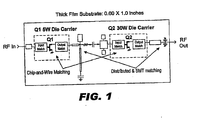
- Fig. 1 is a functional block diagram of a commercially available two stage thick film hybrid microelectronic amplifier (CREE PFM19030SM) which can advantageously be employed in a Doherty amplifier in accordance with an embodiment of the present invention.
- the first stage of the module includes a field effect transistor Q1 connected to a RF input through input matching circuitry and predistortion circuitry.
- the output of transistor Q1 is applied through an output matching network through distributed surface mount technology matching circuitry to the second stage including a second field effect transistor Q2.
- Transistor Q2 is connected to receive the output of Q1 through input matching circuitry and applies an amplified output through output matching circuitry to the RF output.
- the partitioning of this circuit places the devices with high power dissipation on metal interposers that constitute RF ground and also function as heat spreaders; while matching circuitry and bias injection and bypassing is realized using thick film microstrip circuits including SMT passive elements.
- the block diagram in Fig. 1 demonstrates the amplifier partitioning.
- Q1 and Q2 are LDMOS transistors, and each LDMOS transistor die exhibits input or output impedances on the order of 1-5 ohms (before adding chip and-wire matching).
- the combination of chip-and-wire matching and distributed circuit matching on the output of the 30W transistor (Q2) transforms the optimum powermatch impedance (for Class AB operation) to a nominal 20 Ohm level. This simplifies the off-module matching circuitry required for a Doherty amplifier subsystem.
- Each amplifier module assembly includes the two (5W and 30W) die carriers soldered to a bottom plate of copper (1.0 mm thick).
- the silicon LDMOS transistor die manufactured by Cree Microwave
- the bottom plate also supports a 0.5 mm thick single-layer alumina thick-film substrate which has cutouts where the die carriers are located.
- the alumina substrate is attached to the copper base with a conductive epoxy. The heat from the die is spread through the die carrier (interposer) and then through the thick copper base, before it encounters the external interface.
- the two-stage surface-mount module occupies only slightly more board space than would a single discrete-package 30W transistor (with conventional bolt-down metal flange).
- the first-stage drain and internal temperature compensation circuitry accessing the first-stage drain and internal temperature compensation circuitry.
- Bypass circuits are included internal to the module to support wide video bandwidths and thereby minimize memory effects.
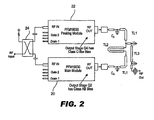
- Fig. 2 is a functional block diagram of a 2-way two stage Doherty amplifier in accordance with an embodiment of the present invention which employs two PFM19030SM modules of Fig. 1 .
- the amplifier includes a main module 20 and a peaking module 22 which receive an RF input signal through splitter 24.
- the main module 20 is biased for class AB operation, and the peak amplifier module is biased nominally for class C operation.
- Module inputs are connected directly to a 3 dB quadrature hybrid.
- the outputs are matched using short low impedance transmission line elements and shunt capacitors Cp and Cm. Because the output impedances of the modules are much higher than unmatched discrete LDMOS transistors, the additional matching circuitry is minimized.
- Cp and Cm are of different values (Cp ⁇ Cm) as is appropriate for the different operating modes (Class C vs. Class AB) of the 30W devices.
- transmission lines TL1 each side.
- the main module side TL2 section is nominally 90°, as is typical of classic 2-Way Doherty designs.
- the output section TL3 and associated capacitors constitute an impedance transformer. All element (transmission line and shunt capacitor) values are adjusted in the circuit analysis and optimization process. The validity and applications power of the CMC device models was confirmed by the experience that only capacitor values were adjusted in prototype circuitry to obtain reported results (transmission line lengths and widths were left at turn-on values).
- the capacitor values are adjusted primarily to achieve optimum peak power levels. Bias conditions are the most sensitive determinate of amplifier linearity and efficiency. By choosing Class AB & Class C, circuit linearity is optimized at some tradeoff in efficiency. Linearity is critical to the intended applications, in which further correction by pre-distortion can be anticipated. A major objective is to achieve system-level linearity standards with pre-distortion only (avoiding feed-forward losses). This strategy can potentially maximize system efficiency and reduce complexity.
- Gain and return loss for the two way, two stage amplifier of Fig. 2 are presented in Figure 3 .
- Gain is 26 ⁇ 0.2 dB over 1930-1960 MHz.
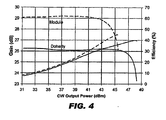
- Measured gain and efficiency versus CW output power are compared for the Doherty amplifier and an individual module operated with normal Class AB bias in Figure 4 .
- the Class AB module has a peak output capability on nominally 30 Watts (+44.8 dam), whereas the Doherty output is nominally 60 Watts (47.8 dam). Note that both circuits have device quiescent bias levels adjusted for optimum linearity, not for optimum peak power or for efficiency.
- the comparison of the shape of the efficiency versus output power characteristics is of particular interest. Even though the Doherty amplifier has twice the output power capability, its efficiency is similar to that of the individual module at low power levels.
- Figure 5 presents measured gain and relative phase versus output power (AM/PM) for the Doherty amplifier.
- AM/PM phase versus output power
- a characteristic of this 2-Way Doherty amplifier is the degradation of linearity as one deviates from the band center frequency. This is thought to be typical of 2-Way Doherty amplifiers in general. Center-band and band-edge measurements of CW 2-Tone 3rd order IMD products are included in Figure 7 . The 2-tone CW Imps show more dependence with frequency than do the 2-WCDMA signal tests.
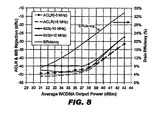
- Standard WCDMA testing involved two signals separated by 10 MHz (3GPP with 8.5 dB peak-to-average), centered at 1960 MHz. Measurements ( Fig 8 ) show that the IM3 products at 10 MHz offsets tend to be the dominant distortion, and a degree of IM3 asymmetry is evident at lower power levels (this also occurs for the individual modules operated in standard Class AB conditions). ACLR and IM3 rejection are plotted at three RF frequencies in Figure 9 . Measurement system dynamic range is limited to about -55 dab at low power( ⁇ -60 dab at higher power levels).
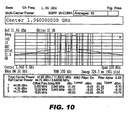
- Figure 10 shows 2-WCDMA signal data using a PMC-Sierra Paladin 15 digital pre-distortion to enhance the Doherty amplifier linearity.
- the signal in this case is two WCDMA signals with crestfactor reduction to 7.5 dB. Average output power is 12.5 Watts, and efficiency is 26.8%, with ACLR & IM3 at -51 & -54 dBc. Efficiency across the RF band varies from 28% to 26% (1930-1990), 1990), and ACLR is ⁇ 49 dBc and IM3 is ⁇ -50 dBc. IM3 asymmetry is very small after application of pre-D. This demonstrates excellent linearity and efficiency using this Doherty design in conjunction with pre-distortion.
- the two-way two stage Doherty amplifier in Fig.2 uses small surface-mount hybrid modules as the active elements in a 2-way 60W Doherty amplifier.
- the design demonstrates good efficiency (26%) for two 3GPP WCDMA signals at 10W average output, with ACLR of -40 dBc and IM3 of -38 dBc (uncorrected).
- 12.5W of WCDMA is produced at 26% efficiency & ACLR/IM3 rejections of -49 dBc/-50 dBc across the full 1930-1990 MHz band.
- the associated 26 dB gain and low input return loss simplifies system design.
- the transistors can be lateral DMOS silicon field effect transistors, MESFETs, HEMTs, HBTs, and bipolar transistors.
- the invention has been applicability to amplifiers having more than one peak amplifier and using modules with two or more stages. For example, a three way two stage amplifier using three CREE PFM19030 modules has been simulated for producing over 90 watts of single tone power with overall gain of 24 dB.
Landscapes
- Engineering & Computer Science (AREA)
- Power Engineering (AREA)
- Amplifiers (AREA)
- Transmitters (AREA)
Description
- This invention relates generally to RF power amplifiers, and more particularly the invention relates to a high power amplifier having improved efficiency and linearity using multiple stage modules.
- Power amplifiers in basestations often operate at output power levels much lower than peak power. Unfortunately, the back-off power level reduces the efficiency of the power amplifier in the transmitter. In a conventional amplifier there is a direct relationship between efficiency and the input drive level. Therefore, high efficiency (DC to RF conversion efficiency) is not obtained until the RF input power level becomes sufficiently high to drive the amplifier into compression or saturation. Since in multicarrier communication systems an amplifier must remain as linear as possible, this region of high efficiency cannot be used.
- A power amplifier circuit design which provides improved efficiency in back-off power levels is the Doherty amplifier circuit, which combines power from a main amplifier and from a peak amplifier. See, W. H. Doherty, "A New High-Efficiency Power Amplifier for Modulated Waves," Proc. IRE Vol. 24, No. 9, pp. 1163-1182, 1936. In the conventional Doherty configuration, the main or
carrier amplifier 10 andpeak amplifier 12 are designed to deliver maximum power with optimum efficiency to a load R, as shown in FIG. 1A. The main or carrier amplifier is a normal Class B amplifier, while the peak amplifier is designed to only amplify signals which exceed some minimum threshold. For an LDMOS power transistor, this can be accomplished by DC biasing the transistor below its pinch-off voltage for operation similar to Class C. The outputs of the two amplifiers are connected by a quarter-wave transmission line of characteristic impedance R, and a load of one-half of the optimum load R is attached to the output of the peak amplifier. The RF input power is divided equally with a quarter-wave delay at the input to the peak amplifier, thus assuring that the output power of the two amplifiers at the load R/2 will be in phase. - Heretofore, the Doherty amplifier has employed discrete single stage amplifiers in the carrier and peak amplifier modules. The present invention realizes advantages not available when using discrete single stage amplifiers.
- "Analysis and Design of a 200W LDMOS Based Doherty Amplifier for 3G Base Stations" (Gajadharsing, Bosma and Westen), Microwave Symposium Digest, , discloses a Doherty amplifier including two-stage amplification realised using separate amplifiers in the first and second stages. The amplifiers are designed using internally matched LDMOS transistors, with a two-stage class A-B main amplifier using two devices in the final stage and one device in the driver stage.
- The present invention provides a high power RF amplifier in accordance with
claim 1. - In accordance with the invention, multi-stage amplifier modules are employed in a Doherty amplifier for both the main amplifier and the peak amplifier or peak amplifiers.
- In one embodiment of a two-way two stage amplifier, the first sage of each amplifier module can include signal pre-distortion whereby the first stage compensates for distortion in both of the first and second stages. The design is simple and the results in a high efficiency amplifier with high gain.
- The invention and objects and features thereof will be more readily apparent from the following detailed description and appended claims when taken with the drawings.
-
-
Fig.1 is a functional block diagram of a prior art two stage hybrid amplifier module which can be used in an embodiment of the invention. -
Fig.2 is a functional block diagram of a 2-way two stage RF power amplifier employing hybrid amplifier modules ofFig.1 . -
Fig.3 is a plot of amplifier gain and input and output return loss versus frequency for one embodiment of the invention. -
Fig.4 is a graph illustrating Doherty amplifier and individual class AB module gain and efficiency versus CW power output. -
Fig.5 is a graph of Doherty amplifier and AM/PM versus CW power out. -
Fig.6 is a graph illustrating Doherty 2-Tone CW intermodulation products versus average output power. -
Fig.7 is a graph illustrating Doherty amplifier intermodulation products versus average power out at three frequencies. -
Fig.8 is a plot of Doherty amplifier 2-WCMDMA signal ACLR and intermodulation rejection versus average power output. -
Fig.9 is a graph of Doherty amplifier signal ACLR and IM3 rejection versus average power output for three frequencies. -
Fig. 10 is illustrates specifications for a Doherty amplifier with pre-distortion for a 12.5 watt 2WCDMA signal spectrum in accordance with an embodiment of the invention. - The present invention provides a high power Doherty amplifier with improved gain and linearity compared to conventional single stage Doherty amplifiers employing discrete transistors. In the present invention, a Doherty amplifier having a main or carrier amplifier and one or more peak amplifiers employs multi-stage amplifier units which can be manufactured in hybrid assemblies.
-
Fig. 1 is a functional block diagram of a commercially available two stage thick film hybrid microelectronic amplifier (CREE PFM19030SM) which can advantageously be employed in a Doherty amplifier in accordance with an embodiment of the present invention. The first stage of the module includes a field effect transistor Q1 connected to a RF input through input matching circuitry and predistortion circuitry. The output of transistor Q1 is applied through an output matching network through distributed surface mount technology matching circuitry to the second stage including a second field effect transistor Q2. Transistor Q2 is connected to receive the output of Q1 through input matching circuitry and applies an amplified output through output matching circuitry to the RF output. - The partitioning of this circuit places the devices with high power dissipation on metal interposers that constitute RF ground and also function as heat spreaders; while matching circuitry and bias injection and bypassing is realized using thick film microstrip circuits including SMT passive elements. The block diagram in
Fig. 1 demonstrates the amplifier partitioning. - Q1 and Q2 are LDMOS transistors, and each LDMOS transistor die exhibits input or output impedances on the order of 1-5 ohms (before adding chip and-wire matching). The combination of chip-and-wire matching and distributed circuit matching on the output of the 30W transistor (Q2) transforms the optimum powermatch impedance (for Class AB operation) to a nominal 20 Ohm level. This simplifies the off-module matching circuitry required for a Doherty amplifier subsystem.
- Each amplifier module assembly includes the two (5W and 30W) die carriers soldered to a bottom plate of copper (1.0 mm thick). The silicon LDMOS transistor die (manufactured by Cree Microwave) are eutectically attached to metal interposers. The bottom plate also supports a 0.5 mm thick single-layer alumina thick-film substrate which has cutouts where the die carriers are located. The alumina substrate is attached to the copper base with a conductive epoxy. The heat from the die is spread through the die carrier (interposer) and then through the thick copper base, before it encounters the external interface.
- When mounted on a PCB layout, the two-stage surface-mount module occupies only slightly more board space than would a single discrete-
package 30W transistor (with conventional bolt-down metal flange). In addition to the RF input and RF output leads, there are leads accessing the first-stage drain and internal temperature compensation circuitry. Bypass circuits are included internal to the module to support wide video bandwidths and thereby minimize memory effects. -
Fig. 2 is a functional block diagram of a 2-way two stage Doherty amplifier in accordance with an embodiment of the present invention which employs two PFM19030SM modules ofFig. 1 . As shown inFig. 2 , the amplifier includes amain module 20 and apeaking module 22 which receive an RF input signal throughsplitter 24. Themain module 20 is biased for class AB operation, and the peak amplifier module is biased nominally for class C operation. - Module inputs are connected directly to a 3 dB quadrature hybrid. The outputs are matched using short low impedance transmission line elements and shunt capacitors Cp and Cm. Because the output impedances of the modules are much higher than unmatched discrete LDMOS transistors, the additional matching circuitry is minimized. Cp and Cm are of different values (Cp << Cm) as is appropriate for the different operating modes (Class C vs. Class AB) of the 30W devices.
- Further impedance transformation is accomplished using transmission lines TL1 (each side). The main module side TL2 section is nominally 90°, as is typical of classic 2-Way Doherty designs. The output section TL3 and associated capacitors constitute an impedance transformer. All element (transmission line and shunt capacitor) values are adjusted in the circuit analysis and optimization process. The validity and applications power of the CMC device models was confirmed by the experience that only capacitor values were adjusted in prototype circuitry to obtain reported results (transmission line lengths and widths were left at turn-on values).
- The capacitor values are adjusted primarily to achieve optimum peak power levels. Bias conditions are the most sensitive determinate of amplifier linearity and efficiency. By choosing Class AB & Class C, circuit linearity is optimized at some tradeoff in efficiency. Linearity is critical to the intended applications, in which further correction by pre-distortion can be anticipated. A major objective is to achieve system-level linearity standards with pre-distortion only (avoiding feed-forward losses). This strategy can potentially maximize system efficiency and reduce complexity.
- Gain and return loss for the two way, two stage amplifier of
Fig. 2 are presented inFigure 3 . Gain is 26 ± 0.2 dB over 1930-1960 MHz. Measured gain and efficiency versus CW output power are compared for the Doherty amplifier and an individual module operated with normal Class AB bias inFigure 4 . The Class AB module has a peak output capability on nominally 30 Watts (+44.8 dam), whereas the Doherty output is nominally 60 Watts (47.8 dam). Note that both circuits have device quiescent bias levels adjusted for optimum linearity, not for optimum peak power or for efficiency. The comparison of the shape of the efficiency versus output power characteristics is of particular interest. Even though the Doherty amplifier has twice the output power capability, its efficiency is similar to that of the individual module at low power levels. -
Figure 5 presents measured gain and relative phase versus output power (AM/PM) for the Doherty amplifier. The very low AM/PM contributes to 2-tone CW and WCDMA linearity. - A characteristic of this 2-Way Doherty amplifier is the degradation of linearity as one deviates from the band center frequency. This is thought to be typical of 2-Way Doherty amplifiers in general. Center-band and band-edge measurements of CW 2-Tone 3rd order IMD products are included in
Figure 7 . The 2-tone CW Imps show more dependence with frequency than do the 2-WCDMA signal tests. - Standard WCDMA testing involved two signals separated by 10 MHz (3GPP with 8.5 dB peak-to-average), centered at 1960 MHz. Measurements (
Fig 8 ) show that the IM3 products at 10 MHz offsets tend to be the dominant distortion, and a degree of IM3 asymmetry is evident at lower power levels (this also occurs for the individual modules operated in standard Class AB conditions). ACLR and IM3 rejection are plotted at three RF frequencies inFigure 9 . Measurement system dynamic range is limited to about -55 dab at low power(~ -60 dab at higher power levels). - A key application objective is to further improve linearity by use of pre-distortion.
Figure 10 shows 2-WCDMA signal data using a PMC-Sierra Paladin 15 digital pre-distortion to enhance the Doherty amplifier linearity. - The signal in this case is two WCDMA signals with crestfactor reduction to 7.5 dB. Average output power is 12.5 Watts, and efficiency is 26.8%, with ACLR & IM3 at -51 & -54 dBc. Efficiency across the RF band varies from 28% to 26% (1930-1990), 1990), and ACLR is ≤49 dBc and IM3 is <-50 dBc. IM3 asymmetry is very small after application of pre-D. This demonstrates excellent linearity and efficiency using this Doherty design in conjunction with pre-distortion.
- The two-way two stage Doherty amplifier in
Fig.2 uses small surface-mount hybrid modules as the active elements in a 2-way 60W Doherty amplifier. The design demonstrates good efficiency (26%) for two 3GPP WCDMA signals at 10W average output, with ACLR of -40 dBc and IM3 of -38 dBc (uncorrected). When augmented by pre-distortion, 12.5W of WCDMA is produced at 26% efficiency & ACLR/IM3 rejections of -49 dBc/-50 dBc across the full 1930-1990 MHz band. The associated 26 dB gain and low input return loss simplifies system design. - While the invention has been described with reference to a specific embodiment, the description is illustrative of the invention and is not to be construed as limiting the invention. For example, the transistors can be lateral DMOS silicon field effect transistors, MESFETs, HEMTs, HBTs, and bipolar transistors. Further, the invention has been applicability to amplifiers having more than one peak amplifier and using modules with two or more stages. For example, a three way two stage amplifier using three CREE PFM19030 modules has been simulated for producing over 90 watts of single tone power with overall gain of 24 dB. Thus, various modifications and applications may occur to those skilled in the art without departing from the scope of the invention as defined by the appended claims.
Claims (5)
- A high power RF amplifier comprising:a) a main amplifier module (20) including at least two stages of amplification, a first stage of the main amplifier module including impedance matching and predistortion circuitry and an amplifier, and a second stage of the main amplifier module including impedance matching circuitry and an amplifier,b) at least one peak amplifier module (22) connected in parallel with the main amplifier module, the at least one peak amplifier module including at least two stages of amplification, a first stage of the at least one peak amplifier module including impedance matching and predistortion circuitry and an amplifier, and a second stage of the at least one peak amplifier module including impedance matching circuitry and an amplifier,c) a signal splitter (24) for receiving and splitting an input signal for the main amplifier module and the at least one peak amplifier module,d) first impedance matching circuitry for coupling signals from the signal splitter to inputs to the main amplifier module and to the at least one peak amplifier module, ande) second impedance matching circuitry for coupling amplified signals from the main amplifier module and from the at least one peak amplifier module to a common output, wherein the at least two stages of amplification in the main amplifier module and in the at least one peak amplifier module comprise serially connected transistors which are surface mounted on a substrate and are partitioned in a packaged thick-film hybrid microelectronic circuit; andwherein the at least one peak amplifier module (22) and the main amplifier module (20) each comprise a respective discrete module package including RF input and RF output leads.
- The high power RF amplifier as defined by claim 1 wherein the main amplifier is biased for class AB operation and the at least one peak amplifier is biased for class C operation.
- The high power RF amplifier as defined by claim 1 wherein the first stage of amplification is 5 watts and a second stage of amplification is 30 watts.
- The high power RF amplifier as defined by claim 3 wherein the RF amplifier comprises two way a two stage amplifier with a total of 60 watts of power.
- The high power RF amplifier as defined by claim 1 wherein each of the main amplifier module and the at least one peak amplifier module comprises a transistor selected from the group consisting of MESFETs, HEMTs, HBTs, and bipolar transistors.
Applications Claiming Priority (2)
| Application Number | Priority Date | Filing Date | Title |
|---|---|---|---|
| US11/090,577 US7193473B2 (en) | 2005-03-24 | 2005-03-24 | High power Doherty amplifier using multi-stage modules |
| EP06739337A EP1861920A4 (en) | 2005-03-24 | 2006-03-16 | High power doherty amplifier using multi-stage modules |
Related Parent Applications (2)
| Application Number | Title | Priority Date | Filing Date |
|---|---|---|---|
| EP06739337.1 Division | 2006-03-16 | ||
| EP06739337A Division EP1861920A4 (en) | 2005-03-24 | 2006-03-16 | High power doherty amplifier using multi-stage modules |
Publications (2)
| Publication Number | Publication Date |
|---|---|
| EP2442444A1 EP2442444A1 (en) | 2012-04-18 |
| EP2442444B1 true EP2442444B1 (en) | 2014-08-20 |
Family
ID=37024603
Family Applications (2)
| Application Number | Title | Priority Date | Filing Date |
|---|---|---|---|
| EP12150378.3A Active EP2442444B1 (en) | 2005-03-24 | 2006-03-16 | High power Doherty amplifier using multi-stage modules |
| EP06739337A Ceased EP1861920A4 (en) | 2005-03-24 | 2006-03-16 | High power doherty amplifier using multi-stage modules |
Family Applications After (1)
| Application Number | Title | Priority Date | Filing Date |
|---|---|---|---|
| EP06739337A Ceased EP1861920A4 (en) | 2005-03-24 | 2006-03-16 | High power doherty amplifier using multi-stage modules |
Country Status (5)
| Country | Link |
|---|---|
| US (1) | US7193473B2 (en) |
| EP (2) | EP2442444B1 (en) |
| JP (2) | JP2008535321A (en) |
| TW (1) | TWI377783B (en) |
| WO (1) | WO2006102466A2 (en) |
Cited By (2)
| Publication number | Priority date | Publication date | Assignee | Title |
|---|---|---|---|---|
| US11990871B2 (en) | 2017-04-24 | 2024-05-21 | Macom Technology Solutions Holdings, Inc. | Inverted Doherty power amplifier with large RF fractional and instantaneous bandwidths |
| US12028022B2 (en) | 2020-12-10 | 2024-07-02 | Macom Technology Solutions Holdings, Inc. | Hybrid power amplifier with GaN-on-Si and GaN-on-SiC circuits |
Families Citing this family (32)
| Publication number | Priority date | Publication date | Assignee | Title |
|---|---|---|---|---|
| WO2005093948A1 (en) * | 2004-03-26 | 2005-10-06 | Hitachi Kokusai Electric Inc. | Amplifier |
| US7847630B2 (en) * | 2004-11-05 | 2010-12-07 | Hitachi Kokusai Electric Inc. | Amplifier |
| US7362170B2 (en) * | 2005-12-01 | 2008-04-22 | Andrew Corporation | High gain, high efficiency power amplifier |
| US7541866B2 (en) * | 2006-09-29 | 2009-06-02 | Nortel Networks Limited | Enhanced doherty amplifier with asymmetrical semiconductors |
| DE102006057324A1 (en) * | 2006-12-05 | 2008-06-19 | Rohde & Schwarz Gmbh & Co. Kg | Doherty amplifier system |
| US9325280B2 (en) | 2007-09-03 | 2016-04-26 | Ampleon Netherlands B.V. | Multi-way doherty amplifier |
| US9479202B2 (en) * | 2008-02-19 | 2016-10-25 | Infineon Technologies Ag | System and method for burst mode amplifier |
| US7764120B2 (en) * | 2008-08-19 | 2010-07-27 | Cree, Inc. | Integrated circuit with parallel sets of transistor amplifiers having different turn on power levels |
| CN101582682B (en) * | 2009-06-12 | 2011-12-28 | 华为技术有限公司 | Power amplifier and transmitter |
| US8736364B2 (en) | 2009-10-13 | 2014-05-27 | Nec Corporation | Power amplifier and method of operation thereof |
| EP2393201A1 (en) | 2010-06-02 | 2011-12-07 | Nxp B.V. | Two stage doherty amplifier |
| DE102010034067A1 (en) * | 2010-08-12 | 2012-02-16 | Rohde & Schwarz Gmbh & Co. Kg | High frequency power amplifier with Doherty extension |
| US8611834B2 (en) | 2010-11-01 | 2013-12-17 | Cree, Inc. | Matching network for transmission circuitry |
| US9071211B1 (en) * | 2011-12-15 | 2015-06-30 | Anadigics, Inc. | Compact doherty combiner |
| US8698560B2 (en) * | 2012-05-09 | 2014-04-15 | Mstar Semiconductor, Inc. | Variable-gain low noise amplifier |
| US8754710B2 (en) * | 2012-06-22 | 2014-06-17 | Mstar Semiconductor, Inc. | Low-noise amplifiers for RF receiver |
| CN202818232U (en) | 2012-09-18 | 2013-03-20 | 中兴通讯股份有限公司 | Doherty power amplifying circuit |
| US9007126B2 (en) | 2013-02-25 | 2015-04-14 | Intel Mobile Communications GmbH | Multi-mode amplifier system |
| US9407214B2 (en) | 2013-06-28 | 2016-08-02 | Cree, Inc. | MMIC power amplifier |
| US9030260B2 (en) * | 2013-07-19 | 2015-05-12 | Alcatel Lucent | Dual-band high efficiency Doherty amplifiers with hybrid packaged power devices |
| US11233483B2 (en) | 2017-02-02 | 2022-01-25 | Macom Technology Solutions Holdings, Inc. | 90-degree lumped and distributed Doherty impedance inverter |
| EP3616320B1 (en) * | 2017-04-24 | 2023-11-08 | MACOM Technology Solutions Holdings, Inc. | Inverted doherty power amplifier with large rf and instantaneous bandwidths |
| CN110785927B (en) | 2017-04-24 | 2024-03-08 | 麦克姆技术解决方案控股有限公司 | Symmetrical Doherty Power Amplifier with Improved Efficiency |
| FR3070100A1 (en) | 2017-08-14 | 2019-02-15 | Macom Technology Solutions Holdings, Inc. | POWERFUL AMPLIFIER ARCHITECTURE WITHOUT MODULATION, BROADBAND AND HIGH EFFICIENCY |
| CN111480292B (en) | 2017-10-02 | 2024-03-29 | 镁可微波技术有限公司 | No-load modulation high-efficiency power amplifier |
| US10250197B1 (en) | 2017-11-06 | 2019-04-02 | Nxp Usa, Inc. | Multiple-stage power amplifiers implemented with multiple semiconductor technologies |
| EP3480945A1 (en) | 2017-11-06 | 2019-05-08 | NXP USA, Inc. | Multiple-stage power amplifiers implemented with multiple semiconductor technologies |
| US10530306B2 (en) | 2018-04-13 | 2020-01-07 | Nxp Usa, Inc. | Hybrid power amplifier circuit or system with combination low-pass and high-pass interstage circuitry and method of operating same |
| CN112640298A (en) | 2018-10-05 | 2021-04-09 | 镁可微波技术有限公司 | Low load modulation power amplifier |
| US12009788B2 (en) | 2019-03-28 | 2024-06-11 | Macom Technology Solutions Holdings, Inc. | In-transistor load modulation |
| WO2021137951A1 (en) | 2019-12-30 | 2021-07-08 | Macom Technology Solutions Holdings, Inc. | Low-load-modulation broadband amplifier |
| EP4297274A1 (en) | 2022-06-24 | 2023-12-27 | Wolfspeed, Inc. | Flip chip doherty amplifier devices |
Family Cites Families (17)
| Publication number | Priority date | Publication date | Assignee | Title |
|---|---|---|---|---|
| TW293899B (en) * | 1994-10-18 | 1996-12-21 | Seiko Epson Corp | |
| JP3135195B2 (en) * | 1994-10-26 | 2001-02-13 | 三菱電機株式会社 | Microwave integrated circuit |
| DE19681072T1 (en) * | 1995-11-30 | 1998-01-22 | Motorola Inc | Amplifier circuit and method for tuning the amplifier circuit |
| US5786727A (en) * | 1996-10-15 | 1998-07-28 | Motorola, Inc. | Multi-stage high efficiency linear power amplifier and method therefor |
| US6262629B1 (en) * | 1999-07-06 | 2001-07-17 | Motorola, Inc. | High efficiency power amplifier having reduced output matching networks for use in portable devices |
| EP1104093A1 (en) * | 1999-11-24 | 2001-05-30 | Telefonaktiebolaget Lm Ericsson | Method and apparatus for generation of a RF signal |
| US6320462B1 (en) * | 2000-04-12 | 2001-11-20 | Raytheon Company | Amplifier circuit |
| US6864742B2 (en) * | 2001-06-08 | 2005-03-08 | Northrop Grumman Corporation | Application of the doherty amplifier as a predistortion circuit for linearizing microwave amplifiers |
| US6791417B2 (en) * | 2002-01-28 | 2004-09-14 | Cree Microwave, Inc. | N-way RF power amplifier circuit with increased back-off capability and power added efficiency using selected phase lengths and output impedances |
| US6700444B2 (en) * | 2002-01-28 | 2004-03-02 | Cree Microwave, Inc. | N-way RF power amplifier with increased backoff power and power added efficiency |
| US6737922B2 (en) * | 2002-01-28 | 2004-05-18 | Cree Microwave, Inc. | N-way RF power amplifier circuit with increased back-off capability and power added efficiency using unequal input power division |
| KR100553252B1 (en) * | 2002-02-01 | 2006-02-20 | 아바고테크놀로지스코리아 주식회사 | Power amplifier of portable terminal |
| GB2393866A (en) * | 2002-09-06 | 2004-04-07 | Filtronic Plc | A class F Doherty amplifier using PHEMTs |
| US6822321B2 (en) * | 2002-09-30 | 2004-11-23 | Cree Microwave, Inc. | Packaged RF power transistor having RF bypassing/output matching network |
| KR100480496B1 (en) * | 2002-11-18 | 2005-04-07 | 학교법인 포항공과대학교 | Signal amplifier by using a doherty amplifier |
| US6798295B2 (en) * | 2002-12-13 | 2004-09-28 | Cree Microwave, Inc. | Single package multi-chip RF power amplifier |
| JP2004222151A (en) * | 2003-01-17 | 2004-08-05 | Nec Corp | Doherty amplifier |
-
2005
- 2005-03-24 US US11/090,577 patent/US7193473B2/en not_active Expired - Lifetime
-
2006
- 2006-03-16 JP JP2008503161A patent/JP2008535321A/en active Pending
- 2006-03-16 EP EP12150378.3A patent/EP2442444B1/en active Active
- 2006-03-16 EP EP06739337A patent/EP1861920A4/en not_active Ceased
- 2006-03-16 WO PCT/US2006/010498 patent/WO2006102466A2/en not_active Ceased
- 2006-03-21 TW TW095109664A patent/TWI377783B/en active
-
2009
- 2009-06-29 JP JP2009153975A patent/JP2009219161A/en active Pending
Cited By (2)
| Publication number | Priority date | Publication date | Assignee | Title |
|---|---|---|---|---|
| US11990871B2 (en) | 2017-04-24 | 2024-05-21 | Macom Technology Solutions Holdings, Inc. | Inverted Doherty power amplifier with large RF fractional and instantaneous bandwidths |
| US12028022B2 (en) | 2020-12-10 | 2024-07-02 | Macom Technology Solutions Holdings, Inc. | Hybrid power amplifier with GaN-on-Si and GaN-on-SiC circuits |
Also Published As
| Publication number | Publication date |
|---|---|
| TWI377783B (en) | 2012-11-21 |
| JP2008535321A (en) | 2008-08-28 |
| EP2442444A1 (en) | 2012-04-18 |
| EP1861920A2 (en) | 2007-12-05 |
| US20060214732A1 (en) | 2006-09-28 |
| WO2006102466A3 (en) | 2007-04-05 |
| EP1861920A4 (en) | 2009-12-02 |
| WO2006102466A2 (en) | 2006-09-28 |
| JP2009219161A (en) | 2009-09-24 |
| TW200703886A (en) | 2007-01-16 |
| US7193473B2 (en) | 2007-03-20 |
Similar Documents
| Publication | Publication Date | Title |
|---|---|---|
| EP2442444B1 (en) | High power Doherty amplifier using multi-stage modules | |
| JP2945833B2 (en) | Microwave Doherty amplifier | |
| Rostomyan et al. | 28 GHz Doherty power amplifier in CMOS SOI with 28% back-off PAE | |
| CN108512514B (en) | Multi-stage RF amplifier device | |
| Kang et al. | Design of bandwidth-enhanced Doherty power amplifiers for handset applications | |
| EP3014766B1 (en) | Mmic power amplifier | |
| US11515842B2 (en) | Doherty power amplifiers and devices with low voltage driver stage in carrier-path and high voltage driver stage in peaking-path | |
| US20220166384A1 (en) | No-load-modulation, high-efficiency power amplifier | |
| Van Der Heijden et al. | A 19W high-efficiency wide-band CMOS-GaN class-E Chireix RF outphasing power amplifier | |
| Wohlert et al. | 8-Watt linear three-stage GaN Doherty power amplifier for 28 GHz 5G applications | |
| CN110785926A (en) | Inverting Doherty Power Amplifier with Large RF Fraction and Instantaneous Bandwidth | |
| JPWO2009066353A1 (en) | Power amplifier | |
| Wei et al. | High efficiency linear GaAs MMIC amplifier for wireless base station and Femto cell applications | |
| Nakatani et al. | A Ka-band CW 15.5 W 15.6% fractional bandwidth GaN power amplifier MMIC using wideband BPF inter-stage matching network | |
| Jeong et al. | AlGaN/GaN based ultra‐wideband 15‐W high‐power amplifier with improved return loss | |
| Kimball et al. | High efficiency WCDMA envelope tracking base-station amplifier implemented with GaAs HVHBTs | |
| Darraji et al. | Generic load-pull-based design methodology for performance optimisation of Doherty amplifiers | |
| Crescenzi et al. | 60 Watt Doherty amplifiers using high gain 2-stage hybrid amplifier modules | |
| Katz et al. | GaN SSPA for UHF space applications | |
| US12155356B2 (en) | Monolithic microwave integrated circuit device with internal decoupling capacitor | |
| Samanta | High Power Wide-Band GaN Amplifiers: Industrial Design and Challenges | |
| Oka et al. | Enhanced linearity and efficiency of HBT power amplifiers for 5-GHz wireless-LANs | |
| Katz et al. | A linear GaN UHF SSPA with record high efficiency | |
| Katz et al. | UHF GaN SSPA for space applications | |
| Samanta | Integration and Packaging of UWB GaN Power Amplifier for Advanced Industrial Applications |
Legal Events
| Date | Code | Title | Description |
|---|---|---|---|
| PUAI | Public reference made under article 153(3) epc to a published international application that has entered the european phase |
Free format text: ORIGINAL CODE: 0009012 |
|
| AC | Divisional application: reference to earlier application |
Ref document number: 1861920 Country of ref document: EP Kind code of ref document: P |
|
| AK | Designated contracting states |
Kind code of ref document: A1 Designated state(s): AT BE BG CH CY CZ DE DK EE ES FI FR GB GR HU IE IS IT LI LT LU LV MC NL PL PT RO SE SI SK TR |
|
| 17P | Request for examination filed |
Effective date: 20121005 |
|
| 17Q | First examination report despatched |
Effective date: 20121023 |
|
| GRAP | Despatch of communication of intention to grant a patent |
Free format text: ORIGINAL CODE: EPIDOSNIGR1 |
|
| INTG | Intention to grant announced |
Effective date: 20140303 |
|
| GRAS | Grant fee paid |
Free format text: ORIGINAL CODE: EPIDOSNIGR3 |
|
| GRAA | (expected) grant |
Free format text: ORIGINAL CODE: 0009210 |
|
| AC | Divisional application: reference to earlier application |
Ref document number: 1861920 Country of ref document: EP Kind code of ref document: P |
|
| AK | Designated contracting states |
Kind code of ref document: B1 Designated state(s): AT BE BG CH CY CZ DE DK EE ES FI FR GB GR HU IE IS IT LI LT LU LV MC NL PL PT RO SE SI SK TR |
|
| REG | Reference to a national code |
Ref country code: GB Ref legal event code: FG4D |
|
| REG | Reference to a national code |
Ref country code: CH Ref legal event code: EP |
|
| REG | Reference to a national code |
Ref country code: AT Ref legal event code: REF Ref document number: 683920 Country of ref document: AT Kind code of ref document: T Effective date: 20140915 |
|
| REG | Reference to a national code |
Ref country code: IE Ref legal event code: FG4D |
|
| REG | Reference to a national code |
Ref country code: DE Ref legal event code: R096 Ref document number: 602006042814 Country of ref document: DE Effective date: 20141002 |
|
| REG | Reference to a national code |
Ref country code: SE Ref legal event code: TRGR |
|
| REG | Reference to a national code |
Ref country code: NL Ref legal event code: T3 |
|
| REG | Reference to a national code |
Ref country code: AT Ref legal event code: MK05 Ref document number: 683920 Country of ref document: AT Kind code of ref document: T Effective date: 20140820 |
|
| REG | Reference to a national code |
Ref country code: LT Ref legal event code: MG4D |
|
| PG25 | Lapsed in a contracting state [announced via postgrant information from national office to epo] |
Ref country code: ES Free format text: LAPSE BECAUSE OF FAILURE TO SUBMIT A TRANSLATION OF THE DESCRIPTION OR TO PAY THE FEE WITHIN THE PRESCRIBED TIME-LIMIT Effective date: 20140820 Ref country code: PT Free format text: LAPSE BECAUSE OF FAILURE TO SUBMIT A TRANSLATION OF THE DESCRIPTION OR TO PAY THE FEE WITHIN THE PRESCRIBED TIME-LIMIT Effective date: 20141222 Ref country code: GR Free format text: LAPSE BECAUSE OF FAILURE TO SUBMIT A TRANSLATION OF THE DESCRIPTION OR TO PAY THE FEE WITHIN THE PRESCRIBED TIME-LIMIT Effective date: 20141121 Ref country code: LT Free format text: LAPSE BECAUSE OF FAILURE TO SUBMIT A TRANSLATION OF THE DESCRIPTION OR TO PAY THE FEE WITHIN THE PRESCRIBED TIME-LIMIT Effective date: 20140820 Ref country code: BG Free format text: LAPSE BECAUSE OF FAILURE TO SUBMIT A TRANSLATION OF THE DESCRIPTION OR TO PAY THE FEE WITHIN THE PRESCRIBED TIME-LIMIT Effective date: 20141120 |
|
| PG25 | Lapsed in a contracting state [announced via postgrant information from national office to epo] |
Ref country code: IS Free format text: LAPSE BECAUSE OF FAILURE TO SUBMIT A TRANSLATION OF THE DESCRIPTION OR TO PAY THE FEE WITHIN THE PRESCRIBED TIME-LIMIT Effective date: 20141220 Ref country code: LV Free format text: LAPSE BECAUSE OF FAILURE TO SUBMIT A TRANSLATION OF THE DESCRIPTION OR TO PAY THE FEE WITHIN THE PRESCRIBED TIME-LIMIT Effective date: 20140820 Ref country code: AT Free format text: LAPSE BECAUSE OF FAILURE TO SUBMIT A TRANSLATION OF THE DESCRIPTION OR TO PAY THE FEE WITHIN THE PRESCRIBED TIME-LIMIT Effective date: 20140820 |
|
| PG25 | Lapsed in a contracting state [announced via postgrant information from national office to epo] |
Ref country code: RO Free format text: LAPSE BECAUSE OF FAILURE TO SUBMIT A TRANSLATION OF THE DESCRIPTION OR TO PAY THE FEE WITHIN THE PRESCRIBED TIME-LIMIT Effective date: 20140820 Ref country code: IT Free format text: LAPSE BECAUSE OF FAILURE TO SUBMIT A TRANSLATION OF THE DESCRIPTION OR TO PAY THE FEE WITHIN THE PRESCRIBED TIME-LIMIT Effective date: 20140820 Ref country code: EE Free format text: LAPSE BECAUSE OF FAILURE TO SUBMIT A TRANSLATION OF THE DESCRIPTION OR TO PAY THE FEE WITHIN THE PRESCRIBED TIME-LIMIT Effective date: 20140820 Ref country code: DK Free format text: LAPSE BECAUSE OF FAILURE TO SUBMIT A TRANSLATION OF THE DESCRIPTION OR TO PAY THE FEE WITHIN THE PRESCRIBED TIME-LIMIT Effective date: 20140820 Ref country code: SK Free format text: LAPSE BECAUSE OF FAILURE TO SUBMIT A TRANSLATION OF THE DESCRIPTION OR TO PAY THE FEE WITHIN THE PRESCRIBED TIME-LIMIT Effective date: 20140820 Ref country code: CZ Free format text: LAPSE BECAUSE OF FAILURE TO SUBMIT A TRANSLATION OF THE DESCRIPTION OR TO PAY THE FEE WITHIN THE PRESCRIBED TIME-LIMIT Effective date: 20140820 |
|
| REG | Reference to a national code |
Ref country code: DE Ref legal event code: R097 Ref document number: 602006042814 Country of ref document: DE |
|
| PG25 | Lapsed in a contracting state [announced via postgrant information from national office to epo] |
Ref country code: PL Free format text: LAPSE BECAUSE OF FAILURE TO SUBMIT A TRANSLATION OF THE DESCRIPTION OR TO PAY THE FEE WITHIN THE PRESCRIBED TIME-LIMIT Effective date: 20140820 |
|
| PLBE | No opposition filed within time limit |
Free format text: ORIGINAL CODE: 0009261 |
|
| STAA | Information on the status of an ep patent application or granted ep patent |
Free format text: STATUS: NO OPPOSITION FILED WITHIN TIME LIMIT |
|
| 26N | No opposition filed |
Effective date: 20150521 |
|
| PG25 | Lapsed in a contracting state [announced via postgrant information from national office to epo] |
Ref country code: MC Free format text: LAPSE BECAUSE OF FAILURE TO SUBMIT A TRANSLATION OF THE DESCRIPTION OR TO PAY THE FEE WITHIN THE PRESCRIBED TIME-LIMIT Effective date: 20140820 Ref country code: LU Free format text: LAPSE BECAUSE OF FAILURE TO SUBMIT A TRANSLATION OF THE DESCRIPTION OR TO PAY THE FEE WITHIN THE PRESCRIBED TIME-LIMIT Effective date: 20150316 |
|
| REG | Reference to a national code |
Ref country code: CH Ref legal event code: PL |
|
| GBPC | Gb: european patent ceased through non-payment of renewal fee |
Effective date: 20150316 |
|
| PG25 | Lapsed in a contracting state [announced via postgrant information from national office to epo] |
Ref country code: SI Free format text: LAPSE BECAUSE OF FAILURE TO SUBMIT A TRANSLATION OF THE DESCRIPTION OR TO PAY THE FEE WITHIN THE PRESCRIBED TIME-LIMIT Effective date: 20140820 |
|
| REG | Reference to a national code |
Ref country code: IE Ref legal event code: MM4A |
|
| PG25 | Lapsed in a contracting state [announced via postgrant information from national office to epo] |
Ref country code: LI Free format text: LAPSE BECAUSE OF NON-PAYMENT OF DUE FEES Effective date: 20150331 Ref country code: CH Free format text: LAPSE BECAUSE OF NON-PAYMENT OF DUE FEES Effective date: 20150331 Ref country code: IE Free format text: LAPSE BECAUSE OF NON-PAYMENT OF DUE FEES Effective date: 20150316 Ref country code: GB Free format text: LAPSE BECAUSE OF NON-PAYMENT OF DUE FEES Effective date: 20150316 |
|
| REG | Reference to a national code |
Ref country code: FR Ref legal event code: PLFP Year of fee payment: 11 |
|
| PG25 | Lapsed in a contracting state [announced via postgrant information from national office to epo] |
Ref country code: BE Free format text: LAPSE BECAUSE OF FAILURE TO SUBMIT A TRANSLATION OF THE DESCRIPTION OR TO PAY THE FEE WITHIN THE PRESCRIBED TIME-LIMIT Effective date: 20140820 |
|
| REG | Reference to a national code |
Ref country code: FR Ref legal event code: PLFP Year of fee payment: 12 |
|
| PG25 | Lapsed in a contracting state [announced via postgrant information from national office to epo] |
Ref country code: HU Free format text: LAPSE BECAUSE OF FAILURE TO SUBMIT A TRANSLATION OF THE DESCRIPTION OR TO PAY THE FEE WITHIN THE PRESCRIBED TIME-LIMIT; INVALID AB INITIO Effective date: 20060316 |
|
| PG25 | Lapsed in a contracting state [announced via postgrant information from national office to epo] |
Ref country code: CY Free format text: LAPSE BECAUSE OF FAILURE TO SUBMIT A TRANSLATION OF THE DESCRIPTION OR TO PAY THE FEE WITHIN THE PRESCRIBED TIME-LIMIT Effective date: 20140820 |
|
| PG25 | Lapsed in a contracting state [announced via postgrant information from national office to epo] |
Ref country code: TR Free format text: LAPSE BECAUSE OF FAILURE TO SUBMIT A TRANSLATION OF THE DESCRIPTION OR TO PAY THE FEE WITHIN THE PRESCRIBED TIME-LIMIT Effective date: 20140820 |
|
| REG | Reference to a national code |
Ref country code: FR Ref legal event code: PLFP Year of fee payment: 13 |
|
| REG | Reference to a national code |
Ref country code: NL Ref legal event code: HC Owner name: WOLFSPEED, INC.; US Free format text: DETAILS ASSIGNMENT: CHANGE OF OWNER(S), CHANGE OF OWNER(S) NAME; FORMER OWNER NAME: CREE MICROWAVE, INC. Effective date: 20240529 |
|
| REG | Reference to a national code |
Ref country code: DE Ref legal event code: R081 Ref document number: 602006042814 Country of ref document: DE Owner name: WOLFSPEED, INC., DURHAM, US Free format text: FORMER OWNER: CREE, INC., DURHAM, NC, US Ref country code: DE Ref legal event code: R081 Ref document number: 602006042814 Country of ref document: DE Owner name: WOLFSPEED, INC., DURHAM, US Free format text: FORMER OWNERS: CREE, INC., DURHAM, NC, US; CREE MICROWAVE, LLC, DURHAM, NC, US Ref country code: DE Ref legal event code: R081 Ref document number: 602006042814 Country of ref document: DE Owner name: WOLFSPEED, INC., DURHAM, US Free format text: FORMER OWNERS: CREE, INC., DURHAM, NC, US; CREE MICROWAVE, INC., DURHAM, NC, US Ref country code: DE Ref legal event code: R081 Ref document number: 602006042814 Country of ref document: DE Owner name: WOLFSPEED, INC., DURHAM, US Free format text: FORMER OWNERS: CREE, INC., DURHAM, N.C., US; CREE MICROWAVE, INC., SUNNYVALE, CALIF., US |
|
| REG | Reference to a national code |
Ref country code: NL Ref legal event code: PD Owner name: MACOM TECHNOLOGY SOLUTIONS HOLDINGS, INC.; US Free format text: DETAILS ASSIGNMENT: CHANGE OF OWNER(S), ASSIGNMENT; FORMER OWNER NAME: WOLFSPEED, INC. Effective date: 20250326 |
|
| PGFP | Annual fee paid to national office [announced via postgrant information from national office to epo] |
Ref country code: SE Payment date: 20250321 Year of fee payment: 20 |
|
| PGFP | Annual fee paid to national office [announced via postgrant information from national office to epo] |
Ref country code: DE Payment date: 20250319 Year of fee payment: 20 |
|
| PGFP | Annual fee paid to national office [announced via postgrant information from national office to epo] |
Ref country code: FI Payment date: 20250324 Year of fee payment: 20 Ref country code: NL Payment date: 20250319 Year of fee payment: 20 |
|
| PGFP | Annual fee paid to national office [announced via postgrant information from national office to epo] |
Ref country code: FR Payment date: 20250325 Year of fee payment: 20 |
|
| REG | Reference to a national code |
Ref country code: FI Ref legal event code: PCE Owner name: MACOM TECHNOLOGY SOLUTIONS HOLDINGS, INC.; CREE MICROWAVE, INC. |