EP2441761A1 - Oxetane-containing vinyl ether compounds and polymerizable compositions - Google Patents
Oxetane-containing vinyl ether compounds and polymerizable compositions Download PDFInfo
- Publication number
- EP2441761A1 EP2441761A1 EP11010299A EP11010299A EP2441761A1 EP 2441761 A1 EP2441761 A1 EP 2441761A1 EP 11010299 A EP11010299 A EP 11010299A EP 11010299 A EP11010299 A EP 11010299A EP 2441761 A1 EP2441761 A1 EP 2441761A1
- Authority
- EP
- European Patent Office
- Prior art keywords
- group
- groups
- vinyl ether
- ring
- carbon atoms
- Prior art date
- Legal status (The legal status is an assumption and is not a legal conclusion. Google has not performed a legal analysis and makes no representation as to the accuracy of the status listed.)
- Withdrawn
Links
- QYKIQEUNHZKYBP-UHFFFAOYSA-N Vinyl ether Chemical class C=COC=C QYKIQEUNHZKYBP-UHFFFAOYSA-N 0.000 title claims abstract description 43
- AHHWIHXENZJRFG-UHFFFAOYSA-N oxetane Chemical compound C1COC1 AHHWIHXENZJRFG-UHFFFAOYSA-N 0.000 title claims abstract description 35
- 239000000203 mixture Substances 0.000 title claims description 77
- -1 vinyl ether compound Chemical class 0.000 claims abstract description 137
- 125000003566 oxetanyl group Chemical group 0.000 claims abstract description 22
- 125000000391 vinyl group Chemical group [H]C([*])=C([H])[H] 0.000 claims abstract description 15
- 125000004432 carbon atom Chemical group C* 0.000 claims description 109
- 125000000217 alkyl group Chemical group 0.000 claims description 42
- 125000004435 hydrogen atom Chemical group [H]* 0.000 claims description 31
- 125000000962 organic group Chemical group 0.000 claims description 22
- 125000000113 cyclohexyl group Chemical group [H]C1([H])C([H])([H])C([H])([H])C([H])(*)C([H])([H])C1([H])[H] 0.000 claims description 19
- 239000003505 polymerization initiator Substances 0.000 claims description 9
- 125000003003 spiro group Chemical group 0.000 claims description 5
- 230000000379 polymerizing effect Effects 0.000 claims 1
- 150000001875 compounds Chemical class 0.000 description 65
- 229960000834 vinyl ether Drugs 0.000 description 58
- 150000002430 hydrocarbons Chemical group 0.000 description 48
- 238000006243 chemical reaction Methods 0.000 description 46
- 125000002723 alicyclic group Chemical group 0.000 description 44
- YXFVVABEGXRONW-UHFFFAOYSA-N Toluene Chemical compound CC1=CC=CC=C1 YXFVVABEGXRONW-UHFFFAOYSA-N 0.000 description 39
- 239000004593 Epoxy Substances 0.000 description 30
- 230000007704 transition Effects 0.000 description 26
- 125000001424 substituent group Chemical group 0.000 description 21
- 125000003118 aryl group Chemical group 0.000 description 19
- 229920001567 vinyl ester resin Polymers 0.000 description 19
- 125000004430 oxygen atom Chemical group O* 0.000 description 18
- 239000002253 acid Substances 0.000 description 17
- 229910052783 alkali metal Inorganic materials 0.000 description 16
- 125000003277 amino group Chemical group 0.000 description 16
- CDBYLPFSWZWCQE-UHFFFAOYSA-L Sodium Carbonate Chemical compound [Na+].[Na+].[O-]C([O-])=O CDBYLPFSWZWCQE-UHFFFAOYSA-L 0.000 description 14
- 150000001340 alkali metals Chemical class 0.000 description 14
- 125000002091 cationic group Chemical group 0.000 description 14
- 150000002440 hydroxy compounds Chemical class 0.000 description 14
- 229910052717 sulfur Inorganic materials 0.000 description 14
- 125000004434 sulfur atom Chemical group 0.000 description 14
- 125000002915 carbonyl group Chemical group [*:2]C([*:1])=O 0.000 description 13
- 238000000034 method Methods 0.000 description 13
- ZWEHNKRNPOVVGH-UHFFFAOYSA-N 2-Butanone Chemical compound CCC(C)=O ZWEHNKRNPOVVGH-UHFFFAOYSA-N 0.000 description 12
- HEMHJVSKTPXQMS-UHFFFAOYSA-M Sodium hydroxide Chemical compound [OH-].[Na+] HEMHJVSKTPXQMS-UHFFFAOYSA-M 0.000 description 12
- HEDRZPFGACZZDS-MICDWDOJSA-N Trichloro(2H)methane Chemical compound [2H]C(Cl)(Cl)Cl HEDRZPFGACZZDS-MICDWDOJSA-N 0.000 description 12
- XTXRWKRVRITETP-UHFFFAOYSA-N Vinyl acetate Chemical compound CC(=O)OC=C XTXRWKRVRITETP-UHFFFAOYSA-N 0.000 description 12
- 125000001931 aliphatic group Chemical group 0.000 description 12
- 125000002947 alkylene group Chemical group 0.000 description 12
- 125000002029 aromatic hydrocarbon group Chemical group 0.000 description 11
- 125000002496 methyl group Chemical group [H]C([H])([H])* 0.000 description 11
- 238000002834 transmittance Methods 0.000 description 11
- 239000004809 Teflon Substances 0.000 description 10
- 229920006362 Teflon® Polymers 0.000 description 10
- 239000002585 base Substances 0.000 description 10
- 125000000753 cycloalkyl group Chemical group 0.000 description 10
- 125000002887 hydroxy group Chemical group [H]O* 0.000 description 10
- 239000000463 material Substances 0.000 description 10
- BASFCYQUMIYNBI-UHFFFAOYSA-N platinum Chemical compound [Pt] BASFCYQUMIYNBI-UHFFFAOYSA-N 0.000 description 10
- XEKOWRVHYACXOJ-UHFFFAOYSA-N Ethyl acetate Chemical compound CCOC(C)=O XEKOWRVHYACXOJ-UHFFFAOYSA-N 0.000 description 9
- 238000004458 analytical method Methods 0.000 description 9
- KDLHZDBZIXYQEI-UHFFFAOYSA-N Palladium Chemical compound [Pd] KDLHZDBZIXYQEI-UHFFFAOYSA-N 0.000 description 8
- 125000001188 haloalkyl group Chemical group 0.000 description 8
- 125000000623 heterocyclic group Chemical group 0.000 description 8
- 229910052741 iridium Inorganic materials 0.000 description 8
- GKOZUEZYRPOHIO-UHFFFAOYSA-N iridium atom Chemical compound [Ir] GKOZUEZYRPOHIO-UHFFFAOYSA-N 0.000 description 8
- 229920000139 polyethylene terephthalate Polymers 0.000 description 8
- 239000005020 polyethylene terephthalate Substances 0.000 description 8
- 239000011541 reaction mixture Substances 0.000 description 8
- 125000002252 acyl group Chemical group 0.000 description 7
- 239000000460 chlorine Substances 0.000 description 7
- 238000000605 extraction Methods 0.000 description 7
- 239000000499 gel Substances 0.000 description 7
- 125000005843 halogen group Chemical group 0.000 description 7
- 239000012299 nitrogen atmosphere Substances 0.000 description 7
- 229910000029 sodium carbonate Inorganic materials 0.000 description 7
- 239000002904 solvent Substances 0.000 description 7
- 238000005160 1H NMR spectroscopy Methods 0.000 description 6
- WEVYAHXRMPXWCK-UHFFFAOYSA-N Acetonitrile Chemical compound CC#N WEVYAHXRMPXWCK-UHFFFAOYSA-N 0.000 description 6
- UHOVQNZJYSORNB-UHFFFAOYSA-N Benzene Chemical compound C1=CC=CC=C1 UHOVQNZJYSORNB-UHFFFAOYSA-N 0.000 description 6
- YMWUJEATGCHHMB-UHFFFAOYSA-N Dichloromethane Chemical compound ClCCl YMWUJEATGCHHMB-UHFFFAOYSA-N 0.000 description 6
- RTZKZFJDLAIYFH-UHFFFAOYSA-N Diethyl ether Chemical compound CCOCC RTZKZFJDLAIYFH-UHFFFAOYSA-N 0.000 description 6
- WMFOQBRAJBCJND-UHFFFAOYSA-M Lithium hydroxide Chemical compound [Li+].[OH-] WMFOQBRAJBCJND-UHFFFAOYSA-M 0.000 description 6
- ZMXDDKWLCZADIW-UHFFFAOYSA-N N,N-Dimethylformamide Chemical compound CN(C)C=O ZMXDDKWLCZADIW-UHFFFAOYSA-N 0.000 description 6
- KWYUFKZDYYNOTN-UHFFFAOYSA-M Potassium hydroxide Chemical compound [OH-].[K+] KWYUFKZDYYNOTN-UHFFFAOYSA-M 0.000 description 6
- ZMANZCXQSJIPKH-UHFFFAOYSA-N Triethylamine Chemical compound CCN(CC)CC ZMANZCXQSJIPKH-UHFFFAOYSA-N 0.000 description 6
- 229910052784 alkaline earth metal Inorganic materials 0.000 description 6
- 150000001342 alkaline earth metals Chemical class 0.000 description 6
- 239000012298 atmosphere Substances 0.000 description 6
- JFDZBHWFFUWGJE-UHFFFAOYSA-N benzonitrile Chemical compound N#CC1=CC=CC=C1 JFDZBHWFFUWGJE-UHFFFAOYSA-N 0.000 description 6
- 125000003178 carboxy group Chemical group [H]OC(*)=O 0.000 description 6
- 230000000052 comparative effect Effects 0.000 description 6
- 125000004093 cyano group Chemical group *C#N 0.000 description 6
- 125000001511 cyclopentyl group Chemical group [H]C1([H])C([H])([H])C([H])([H])C([H])(*)C1([H])[H] 0.000 description 6
- NNBZCPXTIHJBJL-UHFFFAOYSA-N decalin Chemical group C1CCCC2CCCCC21 NNBZCPXTIHJBJL-UHFFFAOYSA-N 0.000 description 6
- XBDQKXXYIPTUBI-UHFFFAOYSA-N dimethylselenoniopropionate Natural products CCC(O)=O XBDQKXXYIPTUBI-UHFFFAOYSA-N 0.000 description 6
- 239000011521 glass Substances 0.000 description 6
- 238000010438 heat treatment Methods 0.000 description 6
- 150000004679 hydroxides Chemical class 0.000 description 6
- VLKZOEOYAKHREP-UHFFFAOYSA-N n-Hexane Chemical compound CCCCCC VLKZOEOYAKHREP-UHFFFAOYSA-N 0.000 description 6
- 125000000449 nitro group Chemical group [O-][N+](*)=O 0.000 description 6
- 239000000126 substance Substances 0.000 description 6
- VYXHVRARDIDEHS-UHFFFAOYSA-N 1,5-cyclooctadiene Chemical compound C1CC=CCCC=C1 VYXHVRARDIDEHS-UHFFFAOYSA-N 0.000 description 5
- 239000004912 1,5-cyclooctadiene Substances 0.000 description 5
- JUJWROOIHBZHMG-UHFFFAOYSA-N Pyridine Chemical compound C1=CC=NC=C1 JUJWROOIHBZHMG-UHFFFAOYSA-N 0.000 description 5
- 229910052799 carbon Inorganic materials 0.000 description 5
- 238000004821 distillation Methods 0.000 description 5
- 125000003700 epoxy group Chemical group 0.000 description 5
- 238000004817 gas chromatography Methods 0.000 description 5
- 239000000976 ink Substances 0.000 description 5
- 125000004043 oxo group Chemical group O=* 0.000 description 5
- 238000006116 polymerization reaction Methods 0.000 description 5
- 230000008569 process Effects 0.000 description 5
- 125000000020 sulfo group Chemical group O=S(=O)([*])O[H] 0.000 description 5
- 125000005838 1,3-cyclopentylene group Chemical group [H]C1([H])C([H])([H])C([H])([*:2])C([H])([H])C1([H])[*:1] 0.000 description 4
- 125000004955 1,4-cyclohexylene group Chemical group [H]C1([H])C([H])([H])C([H])([*:1])C([H])([H])C([H])([H])C1([H])[*:2] 0.000 description 4
- 125000001140 1,4-phenylene group Chemical group [H]C1=C([H])C([*:2])=C([H])C([H])=C1[*:1] 0.000 description 4
- PAMIQIKDUOTOBW-UHFFFAOYSA-N 1-methylpiperidine Chemical compound CN1CCCCC1 PAMIQIKDUOTOBW-UHFFFAOYSA-N 0.000 description 4
- CSCPPACGZOOCGX-UHFFFAOYSA-N Acetone Chemical compound CC(C)=O CSCPPACGZOOCGX-UHFFFAOYSA-N 0.000 description 4
- HEDRZPFGACZZDS-UHFFFAOYSA-N Chloroform Chemical compound ClC(Cl)Cl HEDRZPFGACZZDS-UHFFFAOYSA-N 0.000 description 4
- YNQLUTRBYVCPMQ-UHFFFAOYSA-N Ethylbenzene Chemical compound CCC1=CC=CC=C1 YNQLUTRBYVCPMQ-UHFFFAOYSA-N 0.000 description 4
- XEEYBQQBJWHFJM-UHFFFAOYSA-N Iron Chemical compound [Fe] XEEYBQQBJWHFJM-UHFFFAOYSA-N 0.000 description 4
- IMNFDUFMRHMDMM-UHFFFAOYSA-N N-Heptane Chemical compound CCCCCCC IMNFDUFMRHMDMM-UHFFFAOYSA-N 0.000 description 4
- PXHVJJICTQNCMI-UHFFFAOYSA-N Nickel Chemical compound [Ni] PXHVJJICTQNCMI-UHFFFAOYSA-N 0.000 description 4
- KJTLSVCANCCWHF-UHFFFAOYSA-N Ruthenium Chemical compound [Ru] KJTLSVCANCCWHF-UHFFFAOYSA-N 0.000 description 4
- UIIMBOGNXHQVGW-UHFFFAOYSA-M Sodium bicarbonate Chemical compound [Na+].OC([O-])=O UIIMBOGNXHQVGW-UHFFFAOYSA-M 0.000 description 4
- WQDUMFSSJAZKTM-UHFFFAOYSA-N Sodium methoxide Chemical compound [Na+].[O-]C WQDUMFSSJAZKTM-UHFFFAOYSA-N 0.000 description 4
- WYURNTSHIVDZCO-UHFFFAOYSA-N Tetrahydrofuran Chemical compound C1CCOC1 WYURNTSHIVDZCO-UHFFFAOYSA-N 0.000 description 4
- 239000000853 adhesive Substances 0.000 description 4
- 230000001070 adhesive effect Effects 0.000 description 4
- 230000002411 adverse Effects 0.000 description 4
- 150000001298 alcohols Chemical class 0.000 description 4
- 150000004703 alkoxides Chemical class 0.000 description 4
- 125000003710 aryl alkyl group Chemical group 0.000 description 4
- 125000000732 arylene group Chemical group 0.000 description 4
- 125000000484 butyl group Chemical group [H]C([*])([H])C([H])([H])C([H])([H])C([H])([H])[H] 0.000 description 4
- 150000004649 carbonic acid derivatives Chemical class 0.000 description 4
- 239000003054 catalyst Substances 0.000 description 4
- 239000011248 coating agent Substances 0.000 description 4
- 125000001316 cycloalkyl alkyl group Chemical group 0.000 description 4
- 125000002993 cycloalkylene group Chemical group 0.000 description 4
- 125000001495 ethyl group Chemical group [H]C([H])([H])C([H])([H])* 0.000 description 4
- 150000007529 inorganic bases Chemical class 0.000 description 4
- 150000002504 iridium compounds Chemical class 0.000 description 4
- 125000000959 isobutyl group Chemical group [H]C([H])([H])C([H])(C([H])([H])[H])C([H])([H])* 0.000 description 4
- 125000001449 isopropyl group Chemical group [H]C([H])([H])C([H])(*)C([H])([H])[H] 0.000 description 4
- 239000003446 ligand Substances 0.000 description 4
- 125000001624 naphthyl group Chemical group 0.000 description 4
- 150000002825 nitriles Chemical class 0.000 description 4
- 150000007530 organic bases Chemical class 0.000 description 4
- 229910052762 osmium Inorganic materials 0.000 description 4
- SYQBFIAQOQZEGI-UHFFFAOYSA-N osmium atom Chemical compound [Os] SYQBFIAQOQZEGI-UHFFFAOYSA-N 0.000 description 4
- 125000000466 oxiranyl group Chemical group 0.000 description 4
- 239000003973 paint Substances 0.000 description 4
- 229910052763 palladium Inorganic materials 0.000 description 4
- 125000001997 phenyl group Chemical group [H]C1=C([H])C([H])=C(*)C([H])=C1[H] 0.000 description 4
- 229910052697 platinum Inorganic materials 0.000 description 4
- SCVFZCLFOSHCOH-UHFFFAOYSA-M potassium acetate Chemical compound [K+].CC([O-])=O SCVFZCLFOSHCOH-UHFFFAOYSA-M 0.000 description 4
- BWHMMNNQKKPAPP-UHFFFAOYSA-L potassium carbonate Chemical compound [K+].[K+].[O-]C([O-])=O BWHMMNNQKKPAPP-UHFFFAOYSA-L 0.000 description 4
- 125000001436 propyl group Chemical group [H]C([*])([H])C([H])([H])C([H])([H])[H] 0.000 description 4
- 125000006239 protecting group Chemical group 0.000 description 4
- 229910052703 rhodium Inorganic materials 0.000 description 4
- 239000010948 rhodium Substances 0.000 description 4
- MHOVAHRLVXNVSD-UHFFFAOYSA-N rhodium atom Chemical compound [Rh] MHOVAHRLVXNVSD-UHFFFAOYSA-N 0.000 description 4
- 229910052707 ruthenium Inorganic materials 0.000 description 4
- 150000003839 salts Chemical class 0.000 description 4
- 125000002914 sec-butyl group Chemical group [H]C([H])([H])C([H])([H])C([H])(*)C([H])([H])[H] 0.000 description 4
- 238000000926 separation method Methods 0.000 description 4
- 125000000999 tert-butyl group Chemical group [H]C([H])([H])C(*)(C([H])([H])[H])C([H])([H])[H] 0.000 description 4
- 125000000383 tetramethylene group Chemical group [H]C([H])([*:1])C([H])([H])C([H])([H])C([H])([H])[*:2] 0.000 description 4
- 239000002966 varnish Substances 0.000 description 4
- AUXMDDWCULHEKG-UHFFFAOYSA-N (6-methyl-7-oxabicyclo[4.1.0]heptan-3-yl)methanol Chemical compound C1CC(CO)CC2OC21C AUXMDDWCULHEKG-UHFFFAOYSA-N 0.000 description 3
- HOFHXVDIJXEBAV-UHFFFAOYSA-N 3,3-bis(ethenoxymethyl)oxetane Chemical compound C=COCC1(COC=C)COC1 HOFHXVDIJXEBAV-UHFFFAOYSA-N 0.000 description 3
- DRWCBIGRBNHTST-UHFFFAOYSA-N 3,4-bis(ethenoxymethyl)-7-oxabicyclo[4.1.0]heptane Chemical compound C1C(COC=C)C(COC=C)CC2OC21 DRWCBIGRBNHTST-UHFFFAOYSA-N 0.000 description 3
- 206010040880 Skin irritation Diseases 0.000 description 3
- 125000000640 cyclooctyl group Chemical group [H]C1([H])C([H])([H])C([H])([H])C([H])([H])C([H])(*)C([H])([H])C([H])([H])C1([H])[H] 0.000 description 3
- 229930195733 hydrocarbon Natural products 0.000 description 3
- UMRZSTCPUPJPOJ-KNVOCYPGSA-N norbornane Chemical group C1C[C@H]2CC[C@@H]1C2 UMRZSTCPUPJPOJ-KNVOCYPGSA-N 0.000 description 3
- 230000003287 optical effect Effects 0.000 description 3
- 150000002921 oxetanes Chemical class 0.000 description 3
- 239000000047 product Substances 0.000 description 3
- 235000019260 propionic acid Nutrition 0.000 description 3
- 238000000746 purification Methods 0.000 description 3
- IUVKMZGDUIUOCP-BTNSXGMBSA-N quinbolone Chemical compound O([C@H]1CC[C@H]2[C@H]3[C@@H]([C@]4(C=CC(=O)C=C4CC3)C)CC[C@@]21C)C1=CCCC1 IUVKMZGDUIUOCP-BTNSXGMBSA-N 0.000 description 3
- 230000036556 skin irritation Effects 0.000 description 3
- 231100000475 skin irritation Toxicity 0.000 description 3
- 238000003786 synthesis reaction Methods 0.000 description 3
- 125000002023 trifluoromethyl group Chemical group FC(F)(F)* 0.000 description 3
- TXBCFLDVMGKXEO-UHFFFAOYSA-N (4-methylcyclohex-3-en-1-yl)methanol Chemical compound CC1=CCC(CO)CC1 TXBCFLDVMGKXEO-UHFFFAOYSA-N 0.000 description 2
- MGAXYKDBRBNWKT-UHFFFAOYSA-N (5-oxooxolan-2-yl)methyl 4-methylbenzenesulfonate Chemical compound C1=CC(C)=CC=C1S(=O)(=O)OCC1OC(=O)CC1 MGAXYKDBRBNWKT-UHFFFAOYSA-N 0.000 description 2
- 0 *OOC1(*OI)CCC2(COC2)CC1 Chemical compound *OOC1(*OI)CCC2(COC2)CC1 0.000 description 2
- WSLDOOZREJYCGB-UHFFFAOYSA-N 1,2-Dichloroethane Chemical compound ClCCCl WSLDOOZREJYCGB-UHFFFAOYSA-N 0.000 description 2
- 125000006034 1,2-dimethyl-1-propenyl group Chemical group 0.000 description 2
- RYHBNJHYFVUHQT-UHFFFAOYSA-N 1,4-Dioxane Chemical compound C1COCCO1 RYHBNJHYFVUHQT-UHFFFAOYSA-N 0.000 description 2
- UEIPWOFSKAZYJO-UHFFFAOYSA-N 1-(2-ethenoxyethoxy)-2-[2-(2-ethenoxyethoxy)ethoxy]ethane Chemical compound C=COCCOCCOCCOCCOC=C UEIPWOFSKAZYJO-UHFFFAOYSA-N 0.000 description 2
- 125000006017 1-propenyl group Chemical group 0.000 description 2
- 125000004206 2,2,2-trifluoroethyl group Chemical group [H]C([H])(*)C(F)(F)F 0.000 description 2
- OVSKIKFHRZPJSS-UHFFFAOYSA-N 2,4-D Chemical compound OC(=O)COC1=CC=C(Cl)C=C1Cl OVSKIKFHRZPJSS-UHFFFAOYSA-N 0.000 description 2
- OZAIFHULBGXAKX-UHFFFAOYSA-N 2-(2-cyanopropan-2-yldiazenyl)-2-methylpropanenitrile Chemical compound N#CC(C)(C)N=NC(C)(C)C#N OZAIFHULBGXAKX-UHFFFAOYSA-N 0.000 description 2
- WVXLLHWEQSZBLW-UHFFFAOYSA-N 2-(4-acetyl-2-methoxyphenoxy)acetic acid Chemical compound COC1=CC(C(C)=O)=CC=C1OCC(O)=O WVXLLHWEQSZBLW-UHFFFAOYSA-N 0.000 description 2
- MFGOFGRYDNHJTA-UHFFFAOYSA-N 2-amino-1-(2-fluorophenyl)ethanol Chemical compound NCC(O)C1=CC=CC=C1F MFGOFGRYDNHJTA-UHFFFAOYSA-N 0.000 description 2
- MNJRLZXXSZEIHD-UHFFFAOYSA-N 2-methylprop-1-enyl acetate Chemical compound CC(C)=COC(C)=O MNJRLZXXSZEIHD-UHFFFAOYSA-N 0.000 description 2
- CFMIGCNXWJZTQW-UHFFFAOYSA-N 3-[(4-ethenoxycyclohexyl)oxymethyl]-3-ethyloxetane Chemical compound C1CC(OC=C)CCC1OCC1(CC)COC1 CFMIGCNXWJZTQW-UHFFFAOYSA-N 0.000 description 2
- NHQDETIJWKXCTC-UHFFFAOYSA-N 3-chloroperbenzoic acid Chemical compound OOC(=O)C1=CC=CC(Cl)=C1 NHQDETIJWKXCTC-UHFFFAOYSA-N 0.000 description 2
- XXANACGAALOEBT-UHFFFAOYSA-N 3-ethenoxy-6-methyl-7-oxabicyclo[4.1.0]heptane Chemical compound C1CC(OC=C)CC2OC21C XXANACGAALOEBT-UHFFFAOYSA-N 0.000 description 2
- LMIOYAVXLAOXJI-UHFFFAOYSA-N 3-ethyl-3-[[4-[(3-ethyloxetan-3-yl)methoxymethyl]phenyl]methoxymethyl]oxetane Chemical compound C=1C=C(COCC2(CC)COC2)C=CC=1COCC1(CC)COC1 LMIOYAVXLAOXJI-UHFFFAOYSA-N 0.000 description 2
- GFUSSNHNFRXUHB-UHFFFAOYSA-N 3-methylbut-2-en-2-yl acetate Chemical compound CC(C)=C(C)OC(C)=O GFUSSNHNFRXUHB-UHFFFAOYSA-N 0.000 description 2
- NITNLCXWLRKKKG-UHFFFAOYSA-N 4-(7-oxabicyclo[4.1.0]heptan-4-ylmethoxy)cyclohexan-1-ol Chemical compound C1CC(O)CCC1OCC1CC2OC2CC1 NITNLCXWLRKKKG-UHFFFAOYSA-N 0.000 description 2
- USDPMXCXWHHYHG-UHFFFAOYSA-N 4-(cyclohex-3-en-1-ylmethoxy)cyclohexan-1-ol Chemical compound C1CC(O)CCC1OCC1CC=CCC1 USDPMXCXWHHYHG-UHFFFAOYSA-N 0.000 description 2
- USWKGQJGOFQMSU-UHFFFAOYSA-N 4-[(3-ethyloxetan-3-yl)methoxy]cyclohexan-1-ol Chemical compound C1CC(O)CCC1OCC1(CC)COC1 USWKGQJGOFQMSU-UHFFFAOYSA-N 0.000 description 2
- IHWSZXCSEZWRFZ-UHFFFAOYSA-N 4-[(4-ethenoxycyclohexyl)oxymethyl]-7-oxabicyclo[4.1.0]heptane Chemical compound C1CC(OC=C)CCC1OCC1CC2OC2CC1 IHWSZXCSEZWRFZ-UHFFFAOYSA-N 0.000 description 2
- NIXOWILDQLNWCW-UHFFFAOYSA-N Acrylic acid Chemical compound OC(=O)C=C NIXOWILDQLNWCW-UHFFFAOYSA-N 0.000 description 2
- ROFVEXUMMXZLPA-UHFFFAOYSA-N Bipyridyl Chemical group N1=CC=CC=C1C1=CC=CC=N1 ROFVEXUMMXZLPA-UHFFFAOYSA-N 0.000 description 2
- DKPFZGUDAPQIHT-UHFFFAOYSA-N Butyl acetate Natural products CCCCOC(C)=O DKPFZGUDAPQIHT-UHFFFAOYSA-N 0.000 description 2
- ZAMOUSCENKQFHK-UHFFFAOYSA-N Chlorine atom Chemical compound [Cl] ZAMOUSCENKQFHK-UHFFFAOYSA-N 0.000 description 2
- XDTMQSROBMDMFD-UHFFFAOYSA-N Cyclohexane Chemical compound C1CCCCC1 XDTMQSROBMDMFD-UHFFFAOYSA-N 0.000 description 2
- XTHFKEDIFFGKHM-UHFFFAOYSA-N Dimethoxyethane Chemical compound COCCOC XTHFKEDIFFGKHM-UHFFFAOYSA-N 0.000 description 2
- PXGOKWXKJXAPGV-UHFFFAOYSA-N Fluorine Chemical compound FF PXGOKWXKJXAPGV-UHFFFAOYSA-N 0.000 description 2
- DGAQECJNVWCQMB-PUAWFVPOSA-M Ilexoside XXIX Chemical compound C[C@@H]1CC[C@@]2(CC[C@@]3(C(=CC[C@H]4[C@]3(CC[C@@H]5[C@@]4(CC[C@@H](C5(C)C)OS(=O)(=O)[O-])C)C)[C@@H]2[C@]1(C)O)C)C(=O)O[C@H]6[C@@H]([C@H]([C@@H]([C@H](O6)CO)O)O)O.[Na+] DGAQECJNVWCQMB-PUAWFVPOSA-M 0.000 description 2
- HETCEOQFVDFGSY-UHFFFAOYSA-N Isopropenyl acetate Chemical compound CC(=C)OC(C)=O HETCEOQFVDFGSY-UHFFFAOYSA-N 0.000 description 2
- FXHOOIRPVKKKFG-UHFFFAOYSA-N N,N-Dimethylacetamide Chemical compound CN(C)C(C)=O FXHOOIRPVKKKFG-UHFFFAOYSA-N 0.000 description 2
- KFSLWBXXFJQRDL-UHFFFAOYSA-N Peracetic acid Chemical compound CC(=O)OO KFSLWBXXFJQRDL-UHFFFAOYSA-N 0.000 description 2
- ISWSIDIOOBJBQZ-UHFFFAOYSA-N Phenol Chemical class OC1=CC=CC=C1 ISWSIDIOOBJBQZ-UHFFFAOYSA-N 0.000 description 2
- XBDQKXXYIPTUBI-UHFFFAOYSA-M Propionate Chemical compound CCC([O-])=O XBDQKXXYIPTUBI-UHFFFAOYSA-M 0.000 description 2
- VMHLLURERBWHNL-UHFFFAOYSA-M Sodium acetate Chemical compound [Na+].CC([O-])=O VMHLLURERBWHNL-UHFFFAOYSA-M 0.000 description 2
- DGEZNRSVGBDHLK-UHFFFAOYSA-N [1,10]phenanthroline Chemical compound C1=CN=C2C3=NC=CC=C3C=CC2=C1 DGEZNRSVGBDHLK-UHFFFAOYSA-N 0.000 description 2
- ADIQQQSEZSJAKG-UHFFFAOYSA-N [4-(hydroxymethyl)-6-methyl-7-oxabicyclo[4.1.0]heptan-3-yl]methanol Chemical compound C1C(CO)C(CO)CC2OC21C ADIQQQSEZSJAKG-UHFFFAOYSA-N 0.000 description 2
- SNFKAMATHQUJAZ-UHFFFAOYSA-N [4-(hydroxymethyl)-7-oxabicyclo[4.1.0]heptan-3-yl]methanol Chemical compound C1C(CO)C(CO)CC2OC21 SNFKAMATHQUJAZ-UHFFFAOYSA-N 0.000 description 2
- 150000001242 acetic acid derivatives Chemical class 0.000 description 2
- KXKVLQRXCPHEJC-UHFFFAOYSA-N acetic acid trimethyl ester Natural products COC(C)=O KXKVLQRXCPHEJC-UHFFFAOYSA-N 0.000 description 2
- 125000002777 acetyl group Chemical group [H]C([H])([H])C(*)=O 0.000 description 2
- 125000005073 adamantyl group Chemical group C12(CC3CC(CC(C1)C3)C2)* 0.000 description 2
- 239000000654 additive Substances 0.000 description 2
- 150000001338 aliphatic hydrocarbons Chemical class 0.000 description 2
- 125000003342 alkenyl group Chemical group 0.000 description 2
- 125000004450 alkenylene group Chemical group 0.000 description 2
- 125000005529 alkyleneoxy group Chemical group 0.000 description 2
- 125000000304 alkynyl group Chemical group 0.000 description 2
- 150000001408 amides Chemical class 0.000 description 2
- 150000001412 amines Chemical class 0.000 description 2
- MWPLVEDNUUSJAV-UHFFFAOYSA-N anthracene Chemical compound C1=CC=CC2=CC3=CC=CC=C3C=C21 MWPLVEDNUUSJAV-UHFFFAOYSA-N 0.000 description 2
- 239000012300 argon atmosphere Substances 0.000 description 2
- 150000004945 aromatic hydrocarbons Chemical class 0.000 description 2
- RQPZNWPYLFFXCP-UHFFFAOYSA-L barium dihydroxide Chemical compound [OH-].[OH-].[Ba+2] RQPZNWPYLFFXCP-UHFFFAOYSA-L 0.000 description 2
- 229910001863 barium hydroxide Inorganic materials 0.000 description 2
- 125000000649 benzylidene group Chemical group [H]C(=[*])C1=C([H])C([H])=C([H])C([H])=C1[H] 0.000 description 2
- 150000003842 bromide salts Chemical class 0.000 description 2
- 125000001246 bromo group Chemical group Br* 0.000 description 2
- ZOAIGCHJWKDIPJ-UHFFFAOYSA-M caesium acetate Chemical compound [Cs+].CC([O-])=O ZOAIGCHJWKDIPJ-UHFFFAOYSA-M 0.000 description 2
- ZMCUDHNSHCRDBT-UHFFFAOYSA-M caesium bicarbonate Chemical compound [Cs+].OC([O-])=O ZMCUDHNSHCRDBT-UHFFFAOYSA-M 0.000 description 2
- FJDQFPXHSGXQBY-UHFFFAOYSA-L caesium carbonate Chemical compound [Cs+].[Cs+].[O-]C([O-])=O FJDQFPXHSGXQBY-UHFFFAOYSA-L 0.000 description 2
- 229910000024 caesium carbonate Inorganic materials 0.000 description 2
- HUCVOHYBFXVBRW-UHFFFAOYSA-M caesium hydroxide Inorganic materials [OH-].[Cs+] HUCVOHYBFXVBRW-UHFFFAOYSA-M 0.000 description 2
- AXCZMVOFGPJBDE-UHFFFAOYSA-L calcium dihydroxide Chemical compound [OH-].[OH-].[Ca+2] AXCZMVOFGPJBDE-UHFFFAOYSA-L 0.000 description 2
- 239000000920 calcium hydroxide Substances 0.000 description 2
- 229910001861 calcium hydroxide Inorganic materials 0.000 description 2
- BVKZGUZCCUSVTD-UHFFFAOYSA-N carbonic acid Chemical class OC(O)=O BVKZGUZCCUSVTD-UHFFFAOYSA-N 0.000 description 2
- 239000000969 carrier Substances 0.000 description 2
- 239000007795 chemical reaction product Substances 0.000 description 2
- 229910052801 chlorine Inorganic materials 0.000 description 2
- 150000001805 chlorine compounds Chemical class 0.000 description 2
- 125000004218 chloromethyl group Chemical group [H]C([H])(Cl)* 0.000 description 2
- PMMYEEVYMWASQN-IMJSIDKUSA-N cis-4-Hydroxy-L-proline Chemical compound O[C@@H]1CN[C@H](C(O)=O)C1 PMMYEEVYMWASQN-IMJSIDKUSA-N 0.000 description 2
- 229910017052 cobalt Inorganic materials 0.000 description 2
- 239000010941 cobalt Substances 0.000 description 2
- GUTLYIVDDKVIGB-UHFFFAOYSA-N cobalt atom Chemical compound [Co] GUTLYIVDDKVIGB-UHFFFAOYSA-N 0.000 description 2
- 238000004440 column chromatography Methods 0.000 description 2
- 238000002425 crystallisation Methods 0.000 description 2
- 230000008025 crystallization Effects 0.000 description 2
- 125000000392 cycloalkenyl group Chemical group 0.000 description 2
- 125000001995 cyclobutyl group Chemical group [H]C1([H])C([H])([H])C([H])(*)C1([H])[H] 0.000 description 2
- DDTBPAQBQHZRDW-UHFFFAOYSA-N cyclododecane Chemical group C1CCCCCCCCCCC1 DDTBPAQBQHZRDW-UHFFFAOYSA-N 0.000 description 2
- ZWAJLVLEBYIOTI-UHFFFAOYSA-N cyclohexene oxide Chemical group C1CCCC2OC21 ZWAJLVLEBYIOTI-UHFFFAOYSA-N 0.000 description 2
- 125000004210 cyclohexylmethyl group Chemical group [H]C([H])(*)C1([H])C([H])([H])C([H])([H])C([H])([H])C([H])([H])C1([H])[H] 0.000 description 2
- 125000004851 cyclopentylmethyl group Chemical group C1(CCCC1)C* 0.000 description 2
- 125000001559 cyclopropyl group Chemical group [H]C1([H])C([H])([H])C1([H])* 0.000 description 2
- 125000004855 decalinyl group Chemical group C1(CCCC2CCCCC12)* 0.000 description 2
- 125000002704 decyl group Chemical group [H]C([H])([H])C([H])([H])C([H])([H])C([H])([H])C([H])([H])C([H])([H])C([H])([H])C([H])([H])C([H])([H])C([H])([H])* 0.000 description 2
- ZQMIGQNCOMNODD-UHFFFAOYSA-N diacetyl peroxide Chemical compound CC(=O)OOC(C)=O ZQMIGQNCOMNODD-UHFFFAOYSA-N 0.000 description 2
- IPZJQDSFZGZEOY-UHFFFAOYSA-N dimethylmethylene Chemical group C[C]C IPZJQDSFZGZEOY-UHFFFAOYSA-N 0.000 description 2
- 238000001035 drying Methods 0.000 description 2
- 238000006735 epoxidation reaction Methods 0.000 description 2
- 150000002148 esters Chemical class 0.000 description 2
- GFJVXXWOPWLRNU-UHFFFAOYSA-N ethenyl formate Chemical compound C=COC=O GFJVXXWOPWLRNU-UHFFFAOYSA-N 0.000 description 2
- UIWXSTHGICQLQT-UHFFFAOYSA-N ethenyl propanoate Chemical compound CCC(=O)OC=C UIWXSTHGICQLQT-UHFFFAOYSA-N 0.000 description 2
- 150000002170 ethers Chemical class 0.000 description 2
- 229940052303 ethers for general anesthesia Drugs 0.000 description 2
- 125000000219 ethylidene group Chemical group [H]C(=[*])C([H])([H])[H] 0.000 description 2
- 238000001914 filtration Methods 0.000 description 2
- 239000011737 fluorine Substances 0.000 description 2
- 229910052731 fluorine Inorganic materials 0.000 description 2
- 150000002222 fluorine compounds Chemical class 0.000 description 2
- 150000004820 halides Chemical class 0.000 description 2
- 150000008282 halocarbons Chemical class 0.000 description 2
- 125000005842 heteroatom Chemical group 0.000 description 2
- 125000004836 hexamethylene group Chemical group [H]C([H])([*:2])C([H])([H])C([H])([H])C([H])([H])C([H])([H])C([H])([H])[*:1] 0.000 description 2
- FUZZWVXGSFPDMH-UHFFFAOYSA-M hexanoate Chemical compound CCCCCC([O-])=O FUZZWVXGSFPDMH-UHFFFAOYSA-M 0.000 description 2
- 125000004051 hexyl group Chemical group [H]C([H])([H])C([H])([H])C([H])([H])C([H])([H])C([H])([H])C([H])([H])* 0.000 description 2
- 125000004029 hydroxymethyl group Chemical group [H]OC([H])([H])* 0.000 description 2
- 239000003112 inhibitor Substances 0.000 description 2
- 239000003999 initiator Substances 0.000 description 2
- 229910021432 inorganic complex Inorganic materials 0.000 description 2
- 150000002484 inorganic compounds Chemical class 0.000 description 2
- 229910010272 inorganic material Inorganic materials 0.000 description 2
- 239000010954 inorganic particle Substances 0.000 description 2
- 150000004694 iodide salts Chemical class 0.000 description 2
- 229910052742 iron Inorganic materials 0.000 description 2
- JMMWKPVZQRWMSS-UHFFFAOYSA-N isopropanol acetate Natural products CC(C)OC(C)=O JMMWKPVZQRWMSS-UHFFFAOYSA-N 0.000 description 2
- 125000000555 isopropenyl group Chemical group [H]\C([H])=C(\*)C([H])([H])[H] 0.000 description 2
- 229940011051 isopropyl acetate Drugs 0.000 description 2
- 125000000654 isopropylidene group Chemical group C(C)(C)=* 0.000 description 2
- GWYFCOCPABKNJV-UHFFFAOYSA-M isovalerate Chemical compound CC(C)CC([O-])=O GWYFCOCPABKNJV-UHFFFAOYSA-M 0.000 description 2
- 150000004715 keto acids Chemical class 0.000 description 2
- 150000002576 ketones Chemical class 0.000 description 2
- 229910052747 lanthanoid Inorganic materials 0.000 description 2
- 150000002602 lanthanoids Chemical class 0.000 description 2
- 150000002603 lanthanum Chemical class 0.000 description 2
- XIXADJRWDQXREU-UHFFFAOYSA-M lithium acetate Chemical compound [Li+].CC([O-])=O XIXADJRWDQXREU-UHFFFAOYSA-M 0.000 description 2
- XGZVUEUWXADBQD-UHFFFAOYSA-L lithium carbonate Chemical compound [Li+].[Li+].[O-]C([O-])=O XGZVUEUWXADBQD-UHFFFAOYSA-L 0.000 description 2
- 229910052808 lithium carbonate Inorganic materials 0.000 description 2
- 229910000032 lithium hydrogen carbonate Inorganic materials 0.000 description 2
- JILPJDVXYVTZDQ-UHFFFAOYSA-N lithium methoxide Chemical compound [Li+].[O-]C JILPJDVXYVTZDQ-UHFFFAOYSA-N 0.000 description 2
- HQRPHMAXFVUBJX-UHFFFAOYSA-M lithium;hydrogen carbonate Chemical compound [Li+].OC([O-])=O HQRPHMAXFVUBJX-UHFFFAOYSA-M 0.000 description 2
- UEGPKNKPLBYCNK-UHFFFAOYSA-L magnesium acetate Chemical compound [Mg+2].CC([O-])=O.CC([O-])=O UEGPKNKPLBYCNK-UHFFFAOYSA-L 0.000 description 2
- 239000011654 magnesium acetate Substances 0.000 description 2
- 235000011285 magnesium acetate Nutrition 0.000 description 2
- 229940069446 magnesium acetate Drugs 0.000 description 2
- ZLNQQNXFFQJAID-UHFFFAOYSA-L magnesium carbonate Chemical compound [Mg+2].[O-]C([O-])=O ZLNQQNXFFQJAID-UHFFFAOYSA-L 0.000 description 2
- 239000001095 magnesium carbonate Substances 0.000 description 2
- 229910000021 magnesium carbonate Inorganic materials 0.000 description 2
- VTHJTEIRLNZDEV-UHFFFAOYSA-L magnesium dihydroxide Chemical compound [OH-].[OH-].[Mg+2] VTHJTEIRLNZDEV-UHFFFAOYSA-L 0.000 description 2
- 239000000347 magnesium hydroxide Substances 0.000 description 2
- 229910001862 magnesium hydroxide Inorganic materials 0.000 description 2
- 238000005259 measurement Methods 0.000 description 2
- 229910052751 metal Inorganic materials 0.000 description 2
- 239000002184 metal Substances 0.000 description 2
- 150000002739 metals Chemical class 0.000 description 2
- 229910052759 nickel Inorganic materials 0.000 description 2
- 229910052757 nitrogen Inorganic materials 0.000 description 2
- 125000004433 nitrogen atom Chemical group N* 0.000 description 2
- 125000002868 norbornyl group Chemical group C12(CCC(CC1)C2)* 0.000 description 2
- TVMXDCGIABBOFY-UHFFFAOYSA-N octane Chemical compound CCCCCCCC TVMXDCGIABBOFY-UHFFFAOYSA-N 0.000 description 2
- 125000002347 octyl group Chemical group [H]C([*])([H])C([H])([H])C([H])([H])C([H])([H])C([H])([H])C([H])([H])C([H])([H])C([H])([H])[H] 0.000 description 2
- 150000007524 organic acids Chemical class 0.000 description 2
- 235000005985 organic acids Nutrition 0.000 description 2
- 150000002894 organic compounds Chemical class 0.000 description 2
- 239000011146 organic particle Substances 0.000 description 2
- 125000006340 pentafluoro ethyl group Chemical group FC(F)(F)C(F)(F)* 0.000 description 2
- 230000000737 periodic effect Effects 0.000 description 2
- 229920000642 polymer Polymers 0.000 description 2
- 235000011056 potassium acetate Nutrition 0.000 description 2
- 229910000028 potassium bicarbonate Inorganic materials 0.000 description 2
- 235000015497 potassium bicarbonate Nutrition 0.000 description 2
- 239000011736 potassium bicarbonate Substances 0.000 description 2
- 229910000027 potassium carbonate Inorganic materials 0.000 description 2
- 235000011181 potassium carbonates Nutrition 0.000 description 2
- RPDAUEIUDPHABB-UHFFFAOYSA-N potassium ethoxide Chemical compound [K+].CC[O-] RPDAUEIUDPHABB-UHFFFAOYSA-N 0.000 description 2
- TYJJADVDDVDEDZ-UHFFFAOYSA-M potassium hydrogencarbonate Chemical compound [K+].OC([O-])=O TYJJADVDDVDEDZ-UHFFFAOYSA-M 0.000 description 2
- 229940086066 potassium hydrogencarbonate Drugs 0.000 description 2
- 238000002360 preparation method Methods 0.000 description 2
- 125000006410 propenylene group Chemical group 0.000 description 2
- FVSKHRXBFJPNKK-UHFFFAOYSA-N propionitrile Chemical compound CCC#N FVSKHRXBFJPNKK-UHFFFAOYSA-N 0.000 description 2
- OSFBJERFMQCEQY-UHFFFAOYSA-N propylidene Chemical group [CH]CC OSFBJERFMQCEQY-UHFFFAOYSA-N 0.000 description 2
- UMJSCPRVCHMLSP-UHFFFAOYSA-N pyridine Natural products COC1=CC=CN=C1 UMJSCPRVCHMLSP-UHFFFAOYSA-N 0.000 description 2
- 230000035484 reaction time Effects 0.000 description 2
- 238000001953 recrystallisation Methods 0.000 description 2
- 238000010898 silica gel chromatography Methods 0.000 description 2
- 229910052708 sodium Inorganic materials 0.000 description 2
- 239000011734 sodium Substances 0.000 description 2
- 239000001632 sodium acetate Substances 0.000 description 2
- 235000017281 sodium acetate Nutrition 0.000 description 2
- 229910000030 sodium bicarbonate Inorganic materials 0.000 description 2
- 235000017557 sodium bicarbonate Nutrition 0.000 description 2
- QDRKDTQENPPHOJ-UHFFFAOYSA-N sodium ethoxide Chemical compound [Na+].CC[O-] QDRKDTQENPPHOJ-UHFFFAOYSA-N 0.000 description 2
- WBQTXTBONIWRGK-UHFFFAOYSA-N sodium;propan-2-olate Chemical compound [Na+].CC(C)[O-] WBQTXTBONIWRGK-UHFFFAOYSA-N 0.000 description 2
- 230000003595 spectral effect Effects 0.000 description 2
- 238000003756 stirring Methods 0.000 description 2
- 150000003467 sulfuric acid derivatives Chemical class 0.000 description 2
- 150000003512 tertiary amines Chemical class 0.000 description 2
- JRMUNVKIHCOMHV-UHFFFAOYSA-M tetrabutylammonium bromide Chemical compound [Br-].CCCC[N+](CCCC)(CCCC)CCCC JRMUNVKIHCOMHV-UHFFFAOYSA-M 0.000 description 2
- YLQBMQCUIZJEEH-UHFFFAOYSA-N tetrahydrofuran Natural products C=1C=COC=1 YLQBMQCUIZJEEH-UHFFFAOYSA-N 0.000 description 2
- 150000003568 thioethers Chemical class 0.000 description 2
- UIUWNILCHFBLEQ-NSCUHMNNSA-N trans-pent-3-enoic acid Chemical compound C\C=C\CC(O)=O UIUWNILCHFBLEQ-NSCUHMNNSA-N 0.000 description 2
- KOZCZZVUFDCZGG-UHFFFAOYSA-N vinyl benzoate Chemical compound C=COC(=O)C1=CC=CC=C1 KOZCZZVUFDCZGG-UHFFFAOYSA-N 0.000 description 2
- KAKZBPTYRLMSJV-UHFFFAOYSA-N vinyl-ethylene Natural products C=CC=C KAKZBPTYRLMSJV-UHFFFAOYSA-N 0.000 description 2
- 238000006886 vinylation reaction Methods 0.000 description 2
- XLYOFNOQVPJJNP-UHFFFAOYSA-N water Substances O XLYOFNOQVPJJNP-UHFFFAOYSA-N 0.000 description 2
- 239000008096 xylene Substances 0.000 description 2
- 150000003738 xylenes Chemical class 0.000 description 2
- NAWXUBYGYWOOIX-SFHVURJKSA-N (2s)-2-[[4-[2-(2,4-diaminoquinazolin-6-yl)ethyl]benzoyl]amino]-4-methylidenepentanedioic acid Chemical compound C1=CC2=NC(N)=NC(N)=C2C=C1CCC1=CC=C(C(=O)N[C@@H](CC(=C)C(O)=O)C(O)=O)C=C1 NAWXUBYGYWOOIX-SFHVURJKSA-N 0.000 description 1
- YQTCQNIPQMJNTI-UHFFFAOYSA-N 2,2-dimethylpropan-1-one Chemical group CC(C)(C)[C]=O YQTCQNIPQMJNTI-UHFFFAOYSA-N 0.000 description 1
- BTJPUDCSZVCXFQ-UHFFFAOYSA-N 2,4-diethylthioxanthen-9-one Chemical compound C1=CC=C2C(=O)C3=CC(CC)=CC(CC)=C3SC2=C1 BTJPUDCSZVCXFQ-UHFFFAOYSA-N 0.000 description 1
- WYGWHHGCAGTUCH-UHFFFAOYSA-N 2-[(2-cyano-4-methylpentan-2-yl)diazenyl]-2,4-dimethylpentanenitrile Chemical compound CC(C)CC(C)(C#N)N=NC(C)(C#N)CC(C)C WYGWHHGCAGTUCH-UHFFFAOYSA-N 0.000 description 1
- 125000006020 2-methyl-1-propenyl group Chemical group 0.000 description 1
- WXPPMKCUZAWUOL-UHFFFAOYSA-N 3,4-bis(ethenoxymethyl)-6-methyl-7-oxabicyclo[4.1.0]heptane Chemical compound C1C(COC=C)C(COC=C)CC2OC21C WXPPMKCUZAWUOL-UHFFFAOYSA-N 0.000 description 1
- UKLWXKWTXHHMFK-UHFFFAOYSA-N 3-(chloromethyl)-3-ethyloxetane Chemical compound CCC1(CCl)COC1 UKLWXKWTXHHMFK-UHFFFAOYSA-N 0.000 description 1
- SFBHUBQGECWONK-UHFFFAOYSA-N 4-(chloromethyl)cyclohexene Chemical compound ClCC1CCC=CC1 SFBHUBQGECWONK-UHFFFAOYSA-N 0.000 description 1
- YEJRWHAVMIAJKC-UHFFFAOYSA-N 4-Butyrolactone Chemical group O=C1CCCO1 YEJRWHAVMIAJKC-UHFFFAOYSA-N 0.000 description 1
- OZJPLYNZGCXSJM-UHFFFAOYSA-N 5-valerolactone Chemical group O=C1CCCCO1 OZJPLYNZGCXSJM-UHFFFAOYSA-N 0.000 description 1
- 239000004342 Benzoyl peroxide Substances 0.000 description 1
- OMPJBNCRMGITSC-UHFFFAOYSA-N Benzoylperoxide Chemical compound C=1C=CC=CC=1C(=O)OOC(=O)C1=CC=CC=C1 OMPJBNCRMGITSC-UHFFFAOYSA-N 0.000 description 1
- 239000004215 Carbon black (E152) Substances 0.000 description 1
- RWSOTUBLDIXVET-UHFFFAOYSA-N Dihydrogen sulfide Chemical class S RWSOTUBLDIXVET-UHFFFAOYSA-N 0.000 description 1
- LFQSCWFLJHTTHZ-UHFFFAOYSA-N Ethanol Chemical compound CCO LFQSCWFLJHTTHZ-UHFFFAOYSA-N 0.000 description 1
- YIVJZNGAASQVEM-UHFFFAOYSA-N Lauroyl peroxide Chemical compound CCCCCCCCCCCC(=O)OOC(=O)CCCCCCCCCCC YIVJZNGAASQVEM-UHFFFAOYSA-N 0.000 description 1
- XAERTMNBRLAGRW-UHFFFAOYSA-N [3-(ethenoxymethyl)oxetan-3-yl]methanol Chemical compound C=COCC1(CO)COC1 XAERTMNBRLAGRW-UHFFFAOYSA-N 0.000 description 1
- QSGREIXRTDCBHO-UHFFFAOYSA-N [3-(hydroxymethyl)oxetan-3-yl]methanol Chemical compound OCC1(CO)COC1 QSGREIXRTDCBHO-UHFFFAOYSA-N 0.000 description 1
- FYOZOUCKZTWZBL-UHFFFAOYSA-N [4-(ethenoxymethyl)-7-oxabicyclo[4.1.0]heptan-3-yl]methanol Chemical compound C1C(COC=C)C(CO)CC2OC21 FYOZOUCKZTWZBL-UHFFFAOYSA-N 0.000 description 1
- QKZNNPXTMNJEJA-UHFFFAOYSA-N [6-(hydroxymethyl)-4-methylcyclohex-3-en-1-yl]methanol Chemical compound CC1=CCC(CO)C(CO)C1 QKZNNPXTMNJEJA-UHFFFAOYSA-N 0.000 description 1
- FQCJBRVTYJVAEF-UHFFFAOYSA-N [6-(hydroxymethyl)cyclohex-3-en-1-yl]methanol Chemical compound OCC1CC=CCC1CO FQCJBRVTYJVAEF-UHFFFAOYSA-N 0.000 description 1
- ZVQOOHYFBIDMTQ-UHFFFAOYSA-N [methyl(oxido){1-[6-(trifluoromethyl)pyridin-3-yl]ethyl}-lambda(6)-sulfanylidene]cyanamide Chemical compound N#CN=S(C)(=O)C(C)C1=CC=C(C(F)(F)F)N=C1 ZVQOOHYFBIDMTQ-UHFFFAOYSA-N 0.000 description 1
- KYIKRXIYLAGAKQ-UHFFFAOYSA-N abcn Chemical compound C1CCCCC1(C#N)N=NC1(C#N)CCCCC1 KYIKRXIYLAGAKQ-UHFFFAOYSA-N 0.000 description 1
- 125000002339 acetoacetyl group Chemical group O=C([*])C([H])([H])C(=O)C([H])([H])[H] 0.000 description 1
- ORILYTVJVMAKLC-UHFFFAOYSA-N adamantane Chemical group C1C(C2)CC3CC1CC2C3 ORILYTVJVMAKLC-UHFFFAOYSA-N 0.000 description 1
- 239000003905 agrochemical Substances 0.000 description 1
- 125000003545 alkoxy group Chemical group 0.000 description 1
- 125000004453 alkoxycarbonyl group Chemical group 0.000 description 1
- 230000004075 alteration Effects 0.000 description 1
- WPYMKLBDIGXBTP-UHFFFAOYSA-N benzoic acid Chemical compound OC(=O)C1=CC=CC=C1 WPYMKLBDIGXBTP-UHFFFAOYSA-N 0.000 description 1
- RWCCWEUUXYIKHB-UHFFFAOYSA-N benzophenone Chemical compound C=1C=CC=CC=1C(=O)C1=CC=CC=C1 RWCCWEUUXYIKHB-UHFFFAOYSA-N 0.000 description 1
- 239000012965 benzophenone Substances 0.000 description 1
- 125000003236 benzoyl group Chemical group [H]C1=C([H])C([H])=C(C([H])=C1[H])C(*)=O 0.000 description 1
- 235000019400 benzoyl peroxide Nutrition 0.000 description 1
- AENNXXRRACDJAY-UHFFFAOYSA-N bis(2-dodecylphenyl)iodanium Chemical compound CCCCCCCCCCCCC1=CC=CC=C1[I+]C1=CC=CC=C1CCCCCCCCCCCC AENNXXRRACDJAY-UHFFFAOYSA-N 0.000 description 1
- 125000004063 butyryl group Chemical group O=C([*])C([H])([H])C([H])([H])C([H])([H])[H] 0.000 description 1
- 125000002837 carbocyclic group Chemical group 0.000 description 1
- 238000010538 cationic polymerization reaction Methods 0.000 description 1
- 238000000576 coating method Methods 0.000 description 1
- 238000013461 design Methods 0.000 description 1
- 125000004663 dialkyl amino group Chemical group 0.000 description 1
- 239000012955 diaryliodonium Substances 0.000 description 1
- 238000010894 electron beam technology Methods 0.000 description 1
- 238000006266 etherification reaction Methods 0.000 description 1
- 238000011156 evaluation Methods 0.000 description 1
- 125000002485 formyl group Chemical group [H]C(*)=O 0.000 description 1
- 231100000086 high toxicity Toxicity 0.000 description 1
- XMBWDFGMSWQBCA-UHFFFAOYSA-N hydrogen iodide Chemical class I XMBWDFGMSWQBCA-UHFFFAOYSA-N 0.000 description 1
- 238000011835 investigation Methods 0.000 description 1
- 125000000686 lactone group Chemical group 0.000 description 1
- 231100000053 low toxicity Toxicity 0.000 description 1
- 229910001507 metal halide Inorganic materials 0.000 description 1
- 150000005309 metal halides Chemical class 0.000 description 1
- 125000000956 methoxy group Chemical group [H]C([H])([H])O* 0.000 description 1
- 125000001160 methoxycarbonyl group Chemical group [H]C([H])([H])OC(*)=O 0.000 description 1
- 238000012986 modification Methods 0.000 description 1
- 230000004048 modification Effects 0.000 description 1
- 239000000178 monomer Substances 0.000 description 1
- 239000002105 nanoparticle Substances 0.000 description 1
- NFHFRUOZVGFOOS-UHFFFAOYSA-N palladium;triphenylphosphane Chemical compound [Pd].C1=CC=CC=C1P(C=1C=CC=CC=1)C1=CC=CC=C1.C1=CC=CC=C1P(C=1C=CC=CC=1)C1=CC=CC=C1.C1=CC=CC=C1P(C=1C=CC=CC=1)C1=CC=CC=C1.C1=CC=CC=C1P(C=1C=CC=CC=1)C1=CC=CC=C1 NFHFRUOZVGFOOS-UHFFFAOYSA-N 0.000 description 1
- 150000004714 phosphonium salts Chemical class 0.000 description 1
- 239000002244 precipitate Substances 0.000 description 1
- 125000001501 propionyl group Chemical group O=C([*])C([H])([H])C([H])([H])[H] 0.000 description 1
- 230000005855 radiation Effects 0.000 description 1
- 239000007870 radical polymerization initiator Substances 0.000 description 1
- 238000010526 radical polymerization reaction Methods 0.000 description 1
- 230000009257 reactivity Effects 0.000 description 1
- CIHOLLKRGTVIJN-UHFFFAOYSA-N tert‐butyl hydroperoxide Chemical compound CC(C)(C)OO CIHOLLKRGTVIJN-UHFFFAOYSA-N 0.000 description 1
- 238000012360 testing method Methods 0.000 description 1
- NHEJMCHRGUAKFT-UHFFFAOYSA-N tetrafluorophosphonium Chemical compound F[P+](F)(F)F NHEJMCHRGUAKFT-UHFFFAOYSA-N 0.000 description 1
Classifications
-
- C—CHEMISTRY; METALLURGY
- C07—ORGANIC CHEMISTRY
- C07D—HETEROCYCLIC COMPOUNDS
- C07D303/00—Compounds containing three-membered rings having one oxygen atom as the only ring hetero atom
- C07D303/02—Compounds containing oxirane rings
- C07D303/12—Compounds containing oxirane rings with hydrocarbon radicals, substituted by singly or doubly bound oxygen atoms
- C07D303/18—Compounds containing oxirane rings with hydrocarbon radicals, substituted by singly or doubly bound oxygen atoms by etherified hydroxyl radicals
- C07D303/20—Ethers with hydroxy compounds containing no oxirane rings
- C07D303/22—Ethers with hydroxy compounds containing no oxirane rings with monohydroxy compounds
-
- C—CHEMISTRY; METALLURGY
- C07—ORGANIC CHEMISTRY
- C07D—HETEROCYCLIC COMPOUNDS
- C07D305/00—Heterocyclic compounds containing four-membered rings having one oxygen atom as the only ring hetero atoms
- C07D305/02—Heterocyclic compounds containing four-membered rings having one oxygen atom as the only ring hetero atoms not condensed with other rings
- C07D305/04—Heterocyclic compounds containing four-membered rings having one oxygen atom as the only ring hetero atoms not condensed with other rings having no double bonds between ring members or between ring members and non-ring members
- C07D305/06—Heterocyclic compounds containing four-membered rings having one oxygen atom as the only ring hetero atoms not condensed with other rings having no double bonds between ring members or between ring members and non-ring members with only hydrogen atoms, hydrocarbon or substituted hydrocarbon radicals, directly attached to the ring atoms
-
- C—CHEMISTRY; METALLURGY
- C08—ORGANIC MACROMOLECULAR COMPOUNDS; THEIR PREPARATION OR CHEMICAL WORKING-UP; COMPOSITIONS BASED THEREON
- C08F—MACROMOLECULAR COMPOUNDS OBTAINED BY REACTIONS ONLY INVOLVING CARBON-TO-CARBON UNSATURATED BONDS
- C08F24/00—Homopolymers and copolymers of compounds having one or more unsaturated aliphatic radicals, each having only one carbon-to-carbon double bond, and at least one being terminated by a heterocyclic ring containing oxygen
Definitions
- the present invention relates to oxetane-containing vinyl ether compounds and alicyclic epoxy-containing vinyl ether compounds (these are hereinafter also synthetically referred to as vinyl ether compounds). It also relates to polymerizable compositions containing the vinyl ether compounds and cured articles derived from the polymerizable compositions. These vinyl ether compounds are useful as polymerizable compounds that will polymerize or cure by the application of light and/or heat and are usable in the fields typically of materials for pharmaceutical chemicals, agricultural chemicals, coating agents, inks, paints and varnishes, adhesives, resists, plate-making materials, optical waveguides, holograms, and nanoimprint compositions.
- Epoxy compounds have been used as the polymerizable compounds.
- Known epoxy compounds are disadvantageous in handleability and safety, since they have low reactivity in polymerization (curability) and show high skin irritation and high toxicity, although they give cured articles that excel in chemical resistance and adhesion.
- JP-A No. Hei 10-25262 and JP-A No. 2003-73321 disclose some alicyclic vinyl ether compounds as polymerizable compounds. These compounds, however, are still susceptible to improvements, since they do not sufficiently rapidly cure or they give cured articles having insufficient hardness when used as materials for coatings or inks, although they have low skin irritation and are improved in workability (handleability).
- JP-A No. Hei 10-316670 discloses a vinyl ether compound having an oxetane ring in the molecule. This compound, however, does not sufficiently rapidly cure, and it gives cured articles that are still insufficient in transparency and thermal stability.
- JP-A No. Hei 07-233112 and JP-A No. Hei 11-171967 disclose vinyl ether compounds each intramolecularly containing an alicyclic epoxy group composed of a cyclohexane ring attached to an oxirane ring. Even these compounds, however, do not sufficiently rapidly cure, and they give cured articles that are still insufficient in transparency and thermal stability.
- This oxetane-containing vinyl ether compound contains at least one carbocyclic ring and/or two or more vinyl ether structures per molecule.
- a specific vinyl ether compound containing an alicyclic epoxy group (1,2-epoxycyclohexyl group) sufficiently rapidly cures and gives a cured article that excels in transparency and thermal stability.
- This alicyclic epoxy-containing vinyl ether compound contains a non-aromatic carbocyclic ring in a specific position in the molecule and/or contains an alkyl group at a junction site between a cyclohexane ring constituting the alicyclic epoxy group and an oxirane ring.
- the present invention has been made based on these findings.
- an oxetane-containing vinyl ether compound which contains (a) at least one oxetane ring; and (b) one or more aromatic or non-aromatic carbocyclic rings and/or two or more vinyl ether structures per molecule.
- This oxetane-containing vinyl ether compound includes an oxetane-containing vinyl ether compound represented by following Formula (1): wherein Ring Z 1 may be present or absent in molecule and, if present, represents a non-aromatic carbocyclic ring that forms a spiro structure with oxetane ring; R a represents a substituted or unsubstituted vinyl group represented by following Formula (2): wherein each of R 1 , R 2 , and R 3 independently represents hydrogen atom or an alkyl group containing one to four carbon atoms; W a is a linkage connecting between a substituted or unsubstituted vinyloxy group (-OR a group) and oxetane ring or Ring Z 1 and represents a single bond or an organic group having a valence in the number of (m+1); X 1 is a substituent of oxetane ring and Ring Z 1 and represents a halogen atom, a substituted or un
- an alicyclic epoxy-containing vinyl ether compound which is represented by following Formula (3): wherein Ring Z 2 may be present or absent in molecule and, if present, represents a non-aromatic carbocyclic ring; R b represents a substituted or unsubstituted vinyl group represented by following Formula (4): wherein each of R 4 , R 5 and R 6 independently represents hydrogen atom or an alkyl group containing one to four carbon atoms; W b is a linkage connecting between a substituted or unsubstituted vinyloxy group (-OR b group) and cyclohexane ring or Ring Z 2 and represents a single bond or an organic group having a valence in the number of (r+1); each of R c and R d independently represents hydrogen atom or an alkyl group; "r” denotes 1 or 2; and “s” denotes 1 or 2, in which, when any of "r” and “s” is 2, corresponding two parenthesized
- a polymerizable composition which contains (i) the oxetane-containing vinyl ether compound and/or the alicyclic epoxy-containing vinyl ether compound, and (ii) a polymerization initiator.
- a cured article as a polymerized product derived from the polymerizable composition.
- vinyl ether compound and "vinyl ester compound” also include compounds in which hydrogen atom of whose vinyl group is substituted by a substituent.
- oxetane-containing vinyl ether compounds and alicyclic epoxy-containing vinyl ether compounds according to embodiments of the present invention when used as material monomers for polymers, sufficiently rapidly cure upon application of heat and/or light and give cured articles that excel in transparency and thermal stability. In addition, they show low toxicity and low skin irritation. They are therefore advantageously used in the fields typically of materials for coating agents, inks, paints and varnishes, adhesives, resists, plate-making materials, optical waveguides, holograms, and nanoimprint compositions.
- Oxetane-containing vinyl ether compounds according to an embodiment of the present invention are vinyl ether compounds which contain, in addition to an oxetane ring, one or more aromatic or non-aromatic carbocyclic rings and/or two or more vinyl ether structures per molecule.
- the vinyl ether compounds having this configuration are highly advantageous in that they sufficiently rapidly cure and give cured articles that excel in properties such as transparency and thermal stability.
- Examples of the aromatic carbocyclic ring include benzene ring and naphthalene ring.
- the non-aromatic carbocyclic ring include cycloalkane rings such as cyclopropane ring, cyclobutane ring, cyclopentane ring, cyclohexane ring, cyclooctane ring, and cyclododecane ring, of which cycloalkane rings containing three to fifteen members are preferred; and bridged alicyclic rings containing six to twenty carbon atoms, such as decahydronaphthalene ring, adamantane ring, and norbornane ring.
- the vinyl ether compounds may have two or more aromatic or non-aromatic carbocyclic rings per molecule.
- the aromatic or non-aromatic carbocyclic ring(s) may often exist at a linkage site connecting between a vinyl ether structure and oxetane ring.
- a non-aromatic carbocyclic ring, if present, may form a spiro structure with the oxetane ring.
- the oxetane-containing vinyl ether compounds may have one vinyl ether structure per molecule when they contain one or more aromatic or non-aromatic carbocyclic rings. They may contain no aromatic or non-aromatic carbocyclic ring when they have two or more vinyl ether structures. However, they may contain both one or more aromatic or non-aromatic carbocyclic rings and two or more vinyl ether structures per molecule.
- the oxetane-containing vinyl ether compounds include a compound of Formula (1).
- Ring Z 1 represents a non-aromatic carbocyclic ring that forms a spiro structure with oxetane ring. Ring Z 1 may be present or absent in the molecule. Examples of the non-aromatic carbocyclic ring in Ring Z 1 are as with the above-listed non-aromatic carbocyclic rings. Z 1 is preferably cyclopentane ring or cyclohexane ring.
- R a is a substituted or unsubstituted vinyl group of Formula (2).
- each of R 1 , R 2 , and R 3 is independently hydrogen atom or an alkyl group containing one to four carbon atoms.
- the alkyl group containing one to four carbon atoms include linear alkyl groups containing one to four carbon atoms, such as methyl, ethyl, propyl, and butyl, of which those containing one to three carbon atoms are preferred; branched alkyl groups containing one to four carbon atoms, such as isopropyl, isobutyl, s-butyl, and t-butyl, of which those containing one to three carbon atoms are preferred.
- Each of R 1 , R 2 , and R 3 is independently preferably hydrogen atom or methyl group.
- Representative examples of the group of Formula (2) include vinyl group, isopropenyl group, 1-propenyl group, 2-methyl-1-propenyl group, and 1,2-dimethyl-1-propenyl group.
- W a is a linkage connecting between a substituted or unsubstituted vinyloxy group (-OR a group) and oxetane ring or Ring Z 1 and represents a single bond or an organic group having a valence in the number of (m+1).
- the organic group may generally be a group that includes a carbon atom at a bonding site with an adjacent oxygen atom.
- Preferred examples as the organic group include (i) hydrocarbon groups, and (ii) groups each containing one or more hydrocarbon groups and at least one selected from oxygen atom (-O-), sulfur atom (-S-), carbonyl group (-CO-), and amino group (-NH-).
- the hydrocarbon groups include aliphatic hydrocarbon groups, alicyclic hydrocarbon groups, aromatic hydrocarbon groups, and hydrocarbon groups as an assembly of two or more of these groups.
- such hydrocarbon groups include linear or branched alkylene groups containing one to twenty carbon atoms, such as methylene, methylmethylene (ethylidene), ethylmethylene (propylidene), dimethylmethylene (isopropylidene), ethylmethylmethylene, ethylene, propylene, trimethylene, tetramethylene, and hexamethylene groups, of which those containing one to ten carbon atoms are preferred, and those containing one to six carbon atoms are more preferred; linear or branched alkenylene groups containing two to twenty carbon atoms, such as propenylene group, of which those containing two to ten carbon atoms are preferred, and those containing two to six carbon atoms are more preferred; cycloalkylene groups containing three to twenty members, such as 1,3-cyclopentylene, 1,2-cyclohexylene, 1,3-cyclohexylene, and 1,4-cyclohe
- the hydrocarbon groups may each have one or more substituents.
- substituents include protected or unprotected hydroxyl groups, protected or unprotected hydroxymethyl groups, protected or unprotected amino groups, protected or unprotected carboxyl groups, protected or unprotected sulfo groups, halogen atoms, oxo group, cyano group, nitro group, heterocyclic groups, hydrocarbon groups, and haloalkyl groups.
- Common protecting groups for use in organic synthesis can be utilized herein.
- heterocyclic groups as the substituents include heterocyclic groups that contain at least one hetero atom selected from nitrogen atom, oxygen atom, and sulfur atom and include three to fifteen members, of which heterocyclic groups containing five to eight members are preferred.
- the hydrocarbon groups as the substituents include aliphatic hydrocarbon groups, alicyclic hydrocarbon groups, aromatic hydrocarbon groups, and groups as an assembly of two or more of these groups.
- the aliphatic hydrocarbon groups include alkyl groups containing one to twenty carbon atoms, of which those containing one to ten carbon atoms are preferred, and those containing one to three carbon atoms are more preferred; alkenyl groups containing two to twenty carbon atoms, of which those containing two to ten carbon atoms are preferred, and those containing two or three carbon atoms are more preferred; and alkynyl groups containing two to twenty carbon atoms, of which those containing two to ten carbon atoms are preferred, and those containing two or three carbon atoms are more preferred.
- Examples of the alicyclic hydrocarbon groups include cycloalkyl groups containing three to twenty members, of which those containing three to fifteen members are preferred, and those containing five to eight members are more preferred; cycloalkenyl groups containing three to twenty members, of which those containing three to fifteen members are preferred, and those containing five to eight members are more preferred; and bridged hydrocarbon groups such as perhydronaphth-1-yl group, norbornyl, adamantyl, and tetracyclo[4.4.0.1 2,5 .1 7,10 ]dodec-3-yl groups.
- Examples of the aromatic hydrocarbon groups include aromatic hydrocarbon groups containing six to fourteen carbon atoms, of which those containing six to ten carbon atoms are preferred.
- hydrocarbon groups as an assembly of an aliphatic hydrocarbon group and an alicyclic hydrocarbon group include cycloalkyl-alkyl groups such as cyclopentylmethyl, cyclohexylmethyl, and 2-cyclohexylethyl groups, of which preferred are cycloalkyl-alkyl groups whose cycloalkyl moiety contains three to twenty carbon atoms and whose alkyl moiety contains one to four carbon atoms.
- hydrocarbon groups as an assembly of an aliphatic hydrocarbon group and an aromatic hydrocarbon group include aralkyl groups such as aralkyl groups containing seven to eighteen carbon atoms; and alkylsubstituted aryl groups such as phenyl group or naphthyl group on which one to four alkyl groups containing about one to about four carbon atoms are substituted.
- haloalkyl groups as the substituents include haloalkyl groups containing one to ten carbon atoms, such as chloromethyl, trifluoromethyl, 2,2,2-trifluoroethyl, and pentafluoroethyl groups, of which haloalkyl groups containing one to three carbon atoms are preferred.
- W a include a group represented by following Formula (6): wherein A 1 is a bivalent hydrocarbon group; Y 1 is an oxygen atom (-O-), sulfur atom (-S-), carbonyl group (-CO-), amino group (-NH-), or a group as an assembly of two or more of these; A 2 is a single bond or a hydrocarbon group having a valence in the number of (m+1) where A 2 is attached to -OR a ; each of "t” and “u” is independently 0 or 1; and "v” is an integer of 0 to 5.
- a 1 is a bivalent hydrocarbon group
- Y 1 is an oxygen atom (-O-), sulfur atom (-S-), carbonyl group (-CO-), amino group (-NH-), or a group as an assembly of two or more of these
- a 2 is a single bond or a hydrocarbon group having a valence in the number of (m+1) where A 2 is attached to -OR a ; each of
- bivalent hydrocarbon group as A 1 examples are as mentioned above.
- preferred as A 1 are linear or branched alkylene groups containing one to six carbon atoms, such as methylene, ethylene, propylene, isopropylidene, trimethylene, and tetramethylene groups.
- Y 1 include oxygen atom (-O-), sulfur atom (-S-), carbonyl group (-CO-), amino group (-NH-), -COO-, -OCO-, -CONH-, and -NHCO-.
- a 2 is preferably a single bond; or one of linear or branched alkylene groups containing one to six carbon atoms, such as methylene, ethylene, propylene, isopropylidene, trimethylene, and tetramethylene groups, cycloalkylene groups containing five to eight members, such as 1,3-cyclopentylene, 1,2-cyclohexylene, 1,3-cyclohexylene, and 1,4-cyclohexylene groups, cycloalkylidene groups containing five to eight members, such as cyclopropylidene, cyclopentylidene, and cyclohexylidene groups, and arylene groups such as 1,2-phenylene, 1,3-phenylene, and 1,4-phenylene groups, and groups as an assembly of two or more of these groups.
- W a is particularly preferably a single bond; a linear or branched alkylene group containing one to six carbon atoms; or a group as an assembly of the alkylene group with oxygen atom or sulfur atom.
- X 1 is a substituent of oxetane ring and Ring Z 1 and represents a halogen atom, a substituted or unsubstituted hydrocarbon group, a protected or unprotected hydroxyl group, a protected or unprotected amino group, a protected or unprotected carboxyl group, a protected or unprotected sulfo group, an oxo group, a nitro group, a cyano group, or a protected or unprotected acyl group.
- the protecting groups herein include common protecting groups for use in organic synthesis.
- Examples of the halogen atom as X 1 include fluorine, chlorine, and bromine atoms.
- Examples of the hydrocarbon group of the "substituted or unsubstituted hydrocarbon group" as X 1 include aliphatic hydrocarbon groups such as methyl, ethyl, propyl, isopropyl, butyl, isobutyl, s-butyl, t-butyl, hexyl, octyl, and decyl groups, of which alkyl groups containing one to ten carbon atoms are preferred, and alkyl groups containing one to five carbon atoms are more preferred; alicyclic hydrocarbon groups such as cyclopentyl and cyclohexyl groups, of which cycloalkyl groups containing three to fifteen members are preferred; aromatic hydrocarbon groups such as phenyl and naphthyl groups; and groups as an assembly of two or more of these groups.
- substituents which may be possessed by these hydrocarbon groups include halogen atoms such as fluorine, chlorine, and bromine atoms; alkyl groups containing one to four carbon atoms, such as methyl group; haloalkyl groups containing about one to about five carbon atoms, such as trifluoromethyl group; hydroxyl group; alkoxy groups containing one to four carbon atoms, such as methoxy group; amino group; dialkylamino group; carboxyl group; alkoxycarbonyl groups such as methoxycarbonyl group; nitro group; cyano group; and acyl groups such as acetyl group.
- halogen atoms such as fluorine, chlorine, and bromine atoms
- alkyl groups containing one to four carbon atoms such as methyl group
- hydroxyl group alkoxy groups containing one to four carbon atoms,
- acyl group as X 1 examples include aliphatic acyl groups containing one to six carbon atoms, such as formyl, acetyl, propionyl, butyryl, isobutyryl, and pivaloyl groups; acetoacetyl group; and aromatic acyl group such as benzoyl group.
- X 1 s When there are two or more X 1 s, they may be combined to form a ring with a carbon atom constituting Ring Z 1 or oxetane ring in Formula (1).
- ring examples include alicyclic carbocyclic rings such as cyclopentane ring, cyclohexane ring, and perhydronaphthalene ring (decahydronaphthalene ring); and lactone rings such as ⁇ -butyrolactone ring and ⁇ -valerolactone ring.
- m denotes 1 or 2 and is preferably 1;
- p denotes an integer of from 0 to 5 and is preferably an integer of from 0 to 3; and
- q denotes 1 or 2.
- Ring Z 1 is present, (2)
- X 1 contains one or more aromatic or non-aromatic carbocyclic rings, and (3)
- W a contains one or more aromatic or non-aromatic carbocyclic rings.
- oxetane-containing vinyl ether compounds include the following compounds.
- "n" is an integer of from 0 to 6.
- Oxetane-containing vinyl ether compounds according to embodiment of the present invention can be prepared utilizing one or more reactions known as processes for the preparation of vinyl ether compounds.
- oxetane-containing vinyl ether compounds are prepared by a process of reacting alcohols (hydroxy compounds) with vinyl ester compounds, each corresponding to the oxetane-containing vinyl ether compounds, in the presence of one or more transition element compounds.
- an oxetane-containing vinyl ether compound of Formula (1) can be prepared by reacting an alcohol (hydroxy compound) corresponding to Formula (1), except with R a being hydrogen atom, with a corresponding vinyl ester compound in the presence of a transition element compound.
- vinyl ester compound examples include a vinyl ester compound represented by following Formula (7) : wherein each of R 1 , R 2 and R 3 is independently hydrogen atom or an alkyl group containing one to four carbon atoms; and R 7 is hydrogen atom or an organic group.
- R 1 , R 2 , and R 3 are as described above.
- the organic group as R 7 can be any group that does not adversely affect the reaction, and examples thereof include the organic groups listed as the alkyl group containing one to four carbon atoms typically as R 1 .
- Representative examples of the vinyl ester compound of Formula (7) include vinyl acetate, isopropenyl acetate, 1-propenyl acetate, 2-methyl-l-propenyl acetate, 1,2-dimethyl-1-propenyl acetate, vinyl formate, vinyl propionate, and vinyl benzoate.
- transition element compounds including elementary transition elements
- transition element compounds can be used alone or in combination.
- the transition elements include, of the Periodic Table of Elements, elements belonging to Group IIIA, typified by lanthanoid elements (lanthanum series elements); elements belonging to Group VA; elements belonging to Group VIA; elements belonging to Group VIIA; elements belonging to Group VIII, such as iron, cobalt, nickel, ruthenium, rhodium, palladium, osmium, iridium, and platinum; and elements belonging to Group IB.
- elements belonging to Group VIII are preferred, of which platinum group elements (ruthenium, rhodium, palladium, osmium, iridium, and platinum) are more preferred, and iridium is particularly preferred.
- transition element compounds include inorganic compounds such as elementary transition elements (metals), oxides, sulfides, hydroxides, halides (fluorides, chlorides, bromides, and iodides), sulfates, oxo acids containing one or more transition elements, and salts thereof, and inorganic complexes; and organic compounds including cyanides, salts of organic acids (e.g., acetates), and organic complexes. Among them, organic complexes are preferred.
- Ligands of the complexes include known ligands.
- the valence of transition elements in these transition element compounds is about 0 to about 6, and preferably 0 to 3. In the case typically of iridium compounds, the valence is preferably 1 or 3.
- iridium compounds for use herein preferably contain monovalent or trivalent iridium. Such transition element compounds can be used as intact or as being supported by carriers.
- the amount of transition element compounds is, for example, about 0.0001 to about 1 mole, preferably about 0.001 to about 0.3 mole, and more preferably about 0.005 to about 0.1 mole, per 1 mole of the hydroxy compound used as a reaction component.
- the reaction between the vinyl ester compound of Formula (7) and the hydroxy compound is performed in the presence of or in the absence of a solvent.
- the solvent include aliphatic hydrocarbons such as hexane, heptane, and octane; alicyclic hydrocarbons such as cyclohexane; aromatic hydrocarbons such as benzene, toluene, xylenes, and ethylbenzene; halogenated hydrocarbons such as chloroform, dichloromethane, and 1,2-dichloroethane; ethers such as diethyl ether, dimethoxyethane, tetrahydrofuran, and dioxane; ketones such as acetone and methyl ethyl ketone; esters such as methyl acetate, ethyl acetate, isopropyl acetate, and butyl acetate; amides such as N,N-dimethylformamide and N,
- the amount of the vinyl ester compound of Formula (7) is, for example, about 0.8 to about 10 equivalents, preferably about 1 to about 8 equivalents, and more preferably about 1.5 to about 5 equivalents, to 1 equivalent of the hydroxy compound.
- the vinyl ester compound of Formula (7) may be used in large excess.
- the reaction can proceed more rapidly when the reaction system further contains a base.
- bases for use herein include inorganic bases and organic bases.
- the inorganic bases include hydroxides of alkali metals, such as lithium hydroxide, sodium hydroxide, potassium hydroxide, and cesium hydroxide; hydroxides of alkaline earth metals, such as magnesium hydroxide, calcium hydroxide, and barium hydroxide; carbonates of alkali metals, such as lithium carbonate, sodium carbonate, potassium carbonate, and cesium carbonate; carbonates of alkaline earth metals, such as magnesium carbonate; and hydrogen carbonates of alkali metals, such as lithium hydrogen carbonate, sodium hydrogen carbonate, potassium hydrogen carbonate, and cesium hydrogen carbonate.
- organic bases examples include organic acid salts of alkali metals, such as lithium acetate, sodium acetate, potassium acetate, and cesium acetate, of which alkali metal acetates are preferred; organic acid salts of alkaline earth metals, such as magnesium acetate; alkoxides of alkali metals, such as lithium methoxide, sodium methoxide, sodium ethoxide, sodium isopropoxide, and potassium ethoxide, of which alkoxides of alkali metals corresponding to the hydroxy compound are preferred; phenoxides of alkali metals such as sodium phenoxide; amines such as triethylamine and N-methylpiperidine, of which tertiary amines are preferred; and nitrogen-containing aromatic heterocyclic compounds such as pyridine, 2,2'-bipyridyl, and 1,10-phenanthroline.
- sodium-containing bases are preferred.
- the amount of the base is, for example, about 0.001 to about 3 moles, and preferably about 0.005 to about 2 moles, per 1 mole of the hydroxy compound.
- the reaction may be performed in the presence of a polymerization inhibitor.
- a reaction temperature can be set as appropriate according typically to types of reaction components and catalyst and is, for example, about 20°C to about 200°C, preferably about 50°C to about 150°C, and more preferably about 70°C to about 120°C.
- the reaction may be performed under normal pressure, under reduced pressure, or under pressure (under a load).
- the reaction atmosphere is not particularly limited, as long as not adversely affecting the reaction, and can be any atmosphere such as air atmosphere, nitrogen atmosphere, or argon atmosphere.
- the reaction can be performed according to any system such as a batch system, semibatch system, or continuous system.
- the progression of the vinylation reaction can be controlled by adjusting a reaction time period.
- a dihydroxy compound containing two hydroxyl groups per molecule gives a monovinyl compound with one vinyloxy group introduced thereto and one hydroxyl group remained in a reaction for a short time period such as about two hours, and it gives a divinyl compound with two vinyloxy groups introduced thereto in a reaction for a longer time period such as about five hours.
- reaction yields a corresponding oxetane-containing vinyl ether compound of Formula (1) under mild conditions.
- reaction products can be separated and purified by a separation procedure such as filtration, concentration, distillation, extraction, crystallization, recrystallization, or column chromatography, or any combination of these separation procedures.
- An alicyclic epoxy-containing vinyl ether compound according to another embodiment of the present invention is a compound of Formula (3).
- This compound is a vinyl ether compound that contains an alicyclic epoxy group (a group containing 1,2-epoxycyclohexane ring, i.e., 7-oxabicyclo[4.1.0]heptane ring) and further contains one or more non-aromatic carbocyclic ring at specific position in the molecule and/or contains an alkyl group at the junction site between cyclohexane ring constituting the alicyclic epoxy group and oxirane ring.
- Vinyl ether compounds of this type are much advantageous in that they sufficiently rapidly cure and give cured articles that excel in properties such as transparency and thermal stability.
- Ring Z 2 may be present or absent in the molecule, and, if present, represents a non-aromatic carbocyclic ring.
- the non-aromatic carbocyclic ring include cycloalkane rings such as cyclopropane ring, cyclobutane ring, cyclopentane ring, cyclohexane ring, cyclooctane ring, and cyclododecane ring, of which cycloalkane rings containing three to fifteen members are preferred; and bridged alicyclic rings containing six to twenty carbon atoms, such as decahydronaphthalene (perhydronaphthalene) ring and norbornane ring.
- cycloalkane rings such as cyclopropane ring, cyclobutane ring, cyclopentane ring, cyclohexane ring, cyclooctane ring, and cyclododecane ring,
- R b is a substituted or unsubstituted vinyl group of Formula (4) .
- each of R 4 , R 5 and R 6 is independently hydrogen atom or an alkyl group containing one to four carbon atoms.
- alkyl group containing one to four carbon atoms examples include linear alkyl groups containing one to four carbon atoms, such as methyl, ethyl, propyl, and butyl, of which those containing one to three carbon atoms are preferred; and branched alkyl groups containing one to four carbon atoms, such as isopropyl, isobutyl, s-butyl, and t-butyl, of which those containing one to three carbon atoms are preferred.
- Each of R 4 , R 5 , and R 6 is independently preferably hydrogen atom or methyl group.
- Representative examples of the group of Formula (4) include vinyl group, isopropenyl group, 1-propenyl group, 2-methyl-l-propenyl group, and 1,2-dimethyl-1-propenyl group.
- W b is a linkage connecting between a substituted or unsubstituted vinyloxy group (-OR b group) and cyclohexane ring or Ring Z 2 and represents a single bond or an organic group having a valence in the number of (r+1).
- the organic group may generally be a group that includes a carbon atom at a bonding site with an adjacent oxygen atom.
- Preferred examples as the organic group include (i) hydrocarbon groups, and (ii) groups each containing one or more hydrocarbon groups and at least one selected from oxygen atom (-O-), sulfur atom (-S-), carbonyl group (-CO-), and amino group (-NH-).
- the hydrocarbon groups (i) include aliphatic hydrocarbon groups, alicyclic hydrocarbon groups, aromatic hydrocarbon groups, and hydrocarbon groups as an assembly of two or more of these groups.
- such hydrocarbon groups include linear or branched alkylene groups containing one to twenty carbon atoms, such as methylene, methylmethylene (ethylidene), ethylmethylene (propylidene), dimethylmethylene (isopropylidene), ethylmethylmethylene, ethylene, propylene, trimethylene, tetramethylene, and hexamethylene groups, of which those containing one to ten carbon atoms are preferred, and those containing one to six carbon atoms are more preferred; linear or branched alkenylene groups containing two to twenty carbon atoms, such as propenylene group, of which those containing two to ten carbon atoms are preferred, and those containing two to six carbon atoms are more preferred; cycloalkylene groups containing three to twenty members, such as 1,3-cyclopentylene, 1,2-cyclohexylene, 1,3-cyclohexylene, and 1,4-cyclohe
- the hydrocarbon groups may each have one or more substituents.
- substituents include protected or unprotected hydroxyl groups, protected or unprotected hydroxymethyl groups, protected or unprotected amino groups, protected or unprotected carboxyl groups, protected or unprotected sulfo groups, halogen atoms, oxo group, cyano group, nitro group, heterocyclic groups, hydrocarbon groups, and haloalkyl groups.
- Common protecting groups for use in organic synthesis can be utilized herein.
- heterocyclic groups as the substituents include heterocyclic groups that contain at least one hetero atom selected from nitrogen atom, oxygen atom, and sulfur atom and include three to fifteen members, of which heterocyclic groups containing five to eight members are preferred.
- the hydrocarbon groups as the substituents include aliphatic hydrocarbon groups, alicyclic hydrocarbon groups, aromatic hydrocarbon groups, and groups as an assembly of two or more of these groups.
- the aliphatic hydrocarbon groups include alkyl groups containing one to twenty carbon atoms, of which those containing one to ten carbon atoms are preferred, and those containing one to three carbon atoms are more preferred; alkenyl groups containing two to twenty carbon atoms, of which those containing two to ten carbon atoms are preferred, and those containing two or three carbon atoms are more preferred; and alkynyl groups containing two to twenty carbon atoms, of which those containing two to ten carbon atoms are preferred, and those containing two or three carbon atoms are more preferred.
- Examples of the alicyclic hydrocarbon groups include cycloalkyl groups containing three to twenty members, of which those containing three to fifteen members are preferred, and those containing five to eight members are more preferred; cycloalkenyl groups containing three to twenty members, of which those containing three to fifteen members are preferred, and those containing five to eight members are more preferred; and bridged hydrocarbon groups such as perhydronaphth-1-yl group, norbornyl, adamantyl, and tetracyclo[4.4.0.1 2,5 .1 7,10 ]dodec-3-yl groups.
- Examples of the aromatic hydrocarbon groups include aromatic hydrocarbon groups containing six to fourteen carbon atoms, of which those containing six to ten carbon atoms are preferred.
- hydrocarbon groups as an assembly of an aliphatic hydrocarbon group and an alicyclic hydrocarbon group include cycloalkyl-alkyl groups such as cyclopentylmethyl, cyclohexylmethyl, and 2-cyclohexylethyl groups, of which preferred are cycloalkyl-alkyl groups whose cycloalkyl moiety contains three to twenty carbon atoms and whose alkyl moiety contains one to four carbon atoms.
- hydrocarbon groups as an assembly of an aliphatic hydrocarbon group and an aromatic hydrocarbon group include aralkyl groups such as aralkyl groups containing seven to eighteen carbon atoms; and alkylsubstituted aryl groups such as phenyl group or naphthyl group on which one to four alkyl groups containing one to four carbon atoms are substituted.
- haloalkyl groups as the substituents include haloalkyl groups containing one to ten carbon atoms, such as chloromethyl, trifluoromethyl, 2,2,2-trifluoroethyl, and pentafluoroethyl groups, of which those containing one to three carbon atoms are preferred.
- W b include a group represented by following Formula (8): wherein A 3 is a bivalent hydrocarbon group; Y 2 is an oxygen atom (-O-), sulfur atom (-S-), carbonyl group (-CO-), amino group (-NH-), or an assembly of two or more of these groups; A 4 is a single bond or a hydrocarbon group having a valence in the number of (r+1), where A 4 is attached to -OR b ; each of "x" and "y” is independently 0 or 1; and "z” is an integer of from 0 to 5.
- a 3 is a bivalent hydrocarbon group
- Y 2 is an oxygen atom (-O-), sulfur atom (-S-), carbonyl group (-CO-), amino group (-NH-), or an assembly of two or more of these groups
- a 4 is a single bond or a hydrocarbon group having a valence in the number of (r+1), where A 4 is attached to -OR b ; each of "x" and “
- bivalent hydrocarbon group as A 3 examples are as mentioned above.
- preferred as A 3 are linear or branched alkylene groups containing one to six carbon atoms, such as methylene, ethylene, propylene, isopropylidene, trimethylene, and tetramethylene groups.
- Y 2 include oxygen atom (-O-), sulfur atom (-S-), carbonyl group (-CO-), amino group (-NH-), -COO-, -OCO-, -CONH-, and -NHCO-.
- Examples of the hydrocarbon group having a valence in the number of (r+1) as A 4 are as mentioned above.
- preferred examples as A 4 include single bond; or a group selected from linear or branched alkylene groups containing one to six carbon atoms, such as methylene, ethylene, propylene, isopropylidene, trimethylene, and tetramethylene groups, cycloalkylene groups containing five to eight members, such as 1,3-cyclopentylene, 1,2-cyclohexylene, 1,3-cyclohexylene, and 1,4-cyclohexylene groups, cycloalkylidene groups containing five to eight members, such as cyclopropylidene, cyclopentylidene, and cyclohexylidene groups, arylene groups such as 1,2-phenylene, 1,3-phenylene, and 1,4-phenylene groups, and groups as an assembly of two or more of these groups.
- W b is particularly preferably a single bond; a linear or branched alkylene group containing one to t six carbon atoms; or a group as an assembly of the alkylene group with at least one group selected from oxygen atom (-O-), sulfur atom (-S-), and carbonyl group (-CO-).
- the bonding position of the group W b in the cyclohexane ring or Ring Z 2 is not particularly limited.
- W b is preferably bonded at the 4-position and/or the 5-position provided that the junction positions in cyclohexane ring with oxirane ring are defined as the 1-position and 2-position.
- each of R c and R d is independently hydrogen atom or an alkyl group.
- the alkyl group include linear or branched alkyl groups containing one to fifteen carbon atoms, such as methyl, ethyl, propyl, isopropyl, butyl, isobutyl, s-butyl, t-butyl, hexyl, octyl, and decyl groups.
- alkyl groups containing one to six carbon atoms are preferred, of which those containing one to three carbon atoms, such as methyl group, are more preferred.
- r denotes 1 or 2 and is preferably 1; and “s” denotes 1 or 2.
- corresponding two parenthesized substituents may be the same as or different from each other, and, provided that when R c and R d are both hydrogen atoms, satisfy at least one of following (i), (ii) , and (iii); (i) Ring Z 2 is present, (ii) W b is a group represented by preceding Formula (5) , (iii) "s" is 2 and "r” is 1 , and W b does not contain carbonyl group.
- W 1 is a single bond or a bivalent organic group.
- the bivalent organic group include bivalent hydrocarbon groups, and groups as an assembly of a bivalent hydrocarbon group with at least one selected from oxygen atom (-O-), sulfur atom (-S-), carbonyl group (-CO-), and amino group (-NH-).
- the bivalent hydrocarbon groups are as described above.
- W 1 is particularly preferably a single bond or an alkyleneoxy group containing one to six carbon atoms whose oxygen atom is attached to the cyclohexane group in the right hand in Formula (5).
- R d' is an alkyl group containing one to six carbon atoms
- Ring Z 2 , R b , R c , R d , W b , W 1 , "r", and "s" are as defined above, where W b in Formula (3a) connects between the -OR b group and Ring Z 2 , in Formula (3d) , W b' is a single bond; a bivalent hydrocarbon group containing one to six carbon atoms; or a bivalent organic group in which one or more hydrocarbon group containing one to six carbon atoms is connected with at least one selected from the group consisting of oxygen atom (-O-), sulfur atom (-S-), and amino group (-NH-).
- each of R c and R d is independently preferably hydrogen atom or an alkyl group containing one to six carbon atoms, and is more preferably hydrogen atom or an alkyl group containing one to three carbon atoms typified by methyl group. In another preferred embodiment, at least one of R c and R d is hydrogen atom.
- Ring Z 2 is preferably a cycloalkane ring containing five to twelve members, such as cyclopentane ring, cyclohexane ring, or cyclooctane ring; or a bridged alicyclic ring containing eight to fifteen carbon atoms, such as decahydronaphthalene ring or norbornane ring.
- W b is particularly preferably a single bond; a hydrocarbon group containing one to fifteen carbon atoms; or a group as an assembly of one or more hydrocarbon groups containing one to fifteen carbon atoms with at least one selected from oxygen atom (-O-), sulfur atom (-S-), carbonyl group (-CO-), and amino group (-NH-).
- each of R c and R d is preferably independently hydrogen atom or an alkyl group containing one to six carbon atoms and is more preferably hydrogen atom or an alkyl group containing one to three carbon atoms, such as methyl group. In another preferred embodiment, at least one of R c and R d is hydrogen atom.
- W 1 is particularly preferably a single bond or an alkyleneoxy group containing one to six carbon atoms, whose oxygen atom is attached to the cyclohexane ring in the right hand in Formula (3b).
- R c is preferably hydrogen atom or an alkyl group containing one to six carbon atoms, more preferably hydrogen atom or an alkyl group containing one to three carbon atoms, and particularly preferably hydrogen atom.
- R d is preferably an alkyl group containing one to three carbon atoms, and more preferably methyl group.
- W b is preferably a single bond, a hydrocarbon group containing one to fifteen carbon atoms, or a group as an assembly of one or more hydrocarbon groups containing one to fifteen carbon atoms with at least one selected from oxygen atom (-O-), sulfur atom (-S-), carbonyl group (-CO-), and amino group (-NH-).
- W b' is preferably a single bond; a bivalent hydrocarbon group containing one to six carbon atoms.
- Representative examples of the alicyclic epoxy-containing vinyl ether compounds according to embodiments of the present invention include following compounds.
- "1" is 0 or 1; and
- a 5 is a linear or branched alkylene group containing two to ten carbon atoms and is preferably a linear or branched alkylene group containing two to six carbon atoms.
- Alicyclic epoxy-containing vinyl ether compounds can be prepared utilizing one or more reactions known as preparation processes for vinyl ether compounds.
- alicyclic epoxy-containing vinyl ether compounds are prepared by a process of reacting alcohols (hydroxy compounds) with vinyl ester compounds, each corresponding to the alicyclic epoxy-containing vinyl ether compounds, in the presence of one or more transition element compounds.
- the alicyclic epoxy-containing vinyl ether compounds of Formula (3) can be prepared by reacting alcohols (hydroxy compounds) corresponding to Formula (3), except with R b being hydrogen atom, with corresponding vinyl ester compounds in the presence of one or more transition element compounds.
- Such alcohols (hydroxy compounds) corresponding to the alicyclic epoxy-containing vinyl ether compounds can be synthetically prepared from known compounds utilizing known reactions.
- vinyl ester compounds include a vinyl ester compound represented by following Formula (9): wherein each of R 4 , R 5 , and R 6 is independently hydrogen atom or an alkyl group containing one to four carbon atoms; and R 8 is hydrogen atom or an organic group.
- R 4 , R 5 , and R 6 are as defined above.
- the organic group as R 8 can be any group that does not adversely affect the reaction, and examples thereof include the organic groups listed as the alkyl groups containing one to four carbon atoms typically as R 4 .
- Representative examples of the vinyl ester compounds of Formula (9) include vinyl acetate, isopropenyl acetate, 1-propenyl acetate, 2-methyl-1-propenyl acetate, 1,2-dimethyl-1-propenyl acetate, vinyl formate, vinyl propionate, and vinyl benzoate.
- a reaction can proceed under mild conditions according to the above-mentioned process, since one or more transition element compounds (including elementary transition elements) are used as a catalyst.
- transition element compounds can be used alone or in combination.
- the transition elements include, of the Periodic Table of Elements, elements belonging to Group IIIA typified by lanthanoid elements (lanthanum series elements); elements belonging to Group VA; elements belonging to Group VIA; elements belonging to Group VIIA; elements belonging to Group VIII, such as iron, cobalt, nickel, ruthenium, rhodium, palladium, osmium, iridium, and platinum; and elements belonging to Group IB.
- elements belonging to Group VIII are preferred, of which platinum group elements (ruthenium, rhodium, palladium, osmium, iridium, and platinum) are more preferred, and iridium is particularly preferred.
- transition element compounds include inorganic compounds such as elementary transition elements (metals), oxides, sulfides, hydroxides, halides (fluorides, chlorides, bromides, and iodides), sulfates, oxo acids containing one or more transition elements, and salts thereof, and inorganic complexes; and organic compounds including cyanides, salts of organic acids (e.g., acetates), and organic complexes. Among them, organic complexes are preferred.
- Ligands of the complexes include known ligands.
- the valence of transition elements in these transition element compounds is about 0 to about 6, and preferably 0 to 3. In the case typically of iridium compounds, the valence is preferably 1 or 3.
- iridium compounds for use herein preferably contain monovalent or trivalent iridium. Such transition element compounds can be used as intact or as being supported by carriers.
- the amount of transition element compounds is, for example, about 0.0001 to about 1 mole, preferably 0.001 to about 0.3 mole, and more preferably 0.005 to about 0.1 mole, per 1 mole of the hydroxy compound used as a reaction component.
- the reaction between the vinyl ester compound of Formula (9) and the hydroxy compound is performed in the presence of or in the absence of a solvent.
- the solvent include aliphatic hydrocarbons such as hexane, heptane, and octane; alicyclic hydrocarbons such as cyclohexane; aromatic hydrocarbons such as benzene, toluene, xylenes, and ethylbenzene; halogenated hydrocarbons such as chloroform, dichloromethane, and 1,2-dichloroethane; ethers such as diethyl ether, dimethoxyethane, tetrahydrofuran, and dioxane; ketones such as acetone and methyl ethyl ketone; esters such as methyl acetate, ethyl acetate, isopropyl acetate, and butyl acetate; amides such as N,N-dimethylformamide and N,
- the amount of the vinyl ester compound of Formula (9) is, for example, about 0.8 to about 10 equivalents, preferably about 1 to about 8 equivalents, and more preferably about 1.5 to about 5 equivalents, to 1 equivalent of the hydroxy compound.
- the vinyl ester compound of Formula (9) may be used in large excess.
- the reaction can proceed more rapidly when the reaction system further includes a base.
- bases for use herein include inorganic bases and organic bases.
- the inorganic bases include hydroxides of alkali metals, such as lithium hydroxide, sodium hydroxide, potassium hydroxide, and cesium hydroxide; hydroxides of alkaline earth metals, such as magnesium hydroxide, calcium hydroxide, and barium hydroxide; carbonates of alkali metals, such as lithium carbonate, sodium carbonate, potassium carbonate, and cesium carbonate; carbonates of alkaline earth metals, such as magnesium carbonate; hydrogen carbonates of alkali metals, such as lithium hydrogen carbonate, sodium hydrogen carbonate, potassium hydrogen carbonate, and cesium hydrogen carbonate.
- organic bases examples include organic acid salts of alkali metals, such as lithium acetate, sodium acetate, potassium acetate, and cesium acetate, of which alkali metal acetates are preferred; organic acid salts of alkaline earth metals, such as magnesium acetate; alkoxides of alkali metals, such as lithium methoxide, sodium methoxide, sodium ethoxide, sodium isopropoxide, and potassium ethoxide, of which alkoxides of alkali metals corresponding to the oxgen-containig polycyclic hydroxy compound are preferred; phenoxides of alkali metals, such as sodium phenoxide; amines such as triethylamine and N-methylpiperidine, of which tertiary amines are preferred; and nitrogen-containing aromatic heterocyclic compounds such as pyridine, 2,2'-bipyridyl, and 1,10-phenanthroline.
- sodium-containing bases are examples of alkal
- the amount of the base is, for example, about 0.001 to about 3 moles, and preferably about 0.005 to about 2 moles, per 1 mole of the hydroxy compound.
- the reaction may be performed in the presence of a polymerization inhibitor.
- a reaction temperature can be set as appropriate according typically to types of reaction components and catalyst and is, for example, about 20°C to about 200°C, preferably about 50°C to about 150°C, and more preferably about 70°C to about 120°C.
- the reaction may be performed under normal pressure, under reduced pressure, or under pressure (under a load).
- the reaction atmosphere is not particularly limited, as long as not adversely affecting the reaction, and can be any atmosphere such as air atmosphere, nitrogen atmosphere, or argon atmosphere.
- the reaction can be performed according to any system such as a batch system, semibatch system, or continuous system.
- the progression of the vinylation reaction can be controlled by adjusting a reaction time period.
- a dihydroxy compound containing two hydroxyl groups per molecule gives a monovinyl compound with one vinyloxy group introduced thereto and one hydroxyl group remained in a reaction for a short period of time typically of about two hours, and it gives a divinyl compound with two vinyloxy groups introduced thereto in a reaction for a longer period of time typically of about five hours.
- reaction yields a corresponding alicyclic epoxy-containing vinyl ether compound of Formula (3) under mild conditions.
- reaction products can be separated and purified by a separation procedure such as filtration, concentration, distillation, extraction, crystallization, recrystallization, or column chromatography, or any combination of these separation procedures.
- a polymerizable composition according to an embodiment of the present invention contains the oxetane-containing vinyl ether compound and/or alicyclic epoxy-containing vinyl ether compound each according to an embodiment of the present invention; and a polymerization initiator.
- the polymerization initiator can be any one that can induce or cause free-radical polymerization or ionic (cationic) polymerization, such as a thermal initiator, photo-induced free-radical polymerization initiator, or photo-induced cationic polymerization initiator.
- known polymerization initiators and light-activatable acid generators can be used herein.
- thermal initiators for use herein include benzoyl peroxide, acetyl peroxide, lauroyl peroxide, t-butyl hydroperoxide, azobisisobutyronitrile, azobis-(2,4-dimethylvaleronitrile), and azobis(cyclohexanecarbonitrile).
- photoinitiators examples include 2,4-diethylthioxanthone, benzophenone, 4-dimethylaminoisoamyl benzoate, and 4-dimethylaminoethyl benzoate; sulfonium salts such as triarylsulfonium hexafluorophosphates and triarylsulfonium hexafluoroantimonates, iodonium salts such as diaryliodonium hexafluorophosphates, diphenyliodonium hexafluoroantimonate, and bis(dodecylphenyl)iodonium tetrakis(pentafluorophenyl)bo'rate, phosphonium salts such as tetrafluorophosphonium hexafluorophosphate, and pyridinium salts. Since the alicyclic epoxy-containing vinyl ether compound according to an embodiment of the present invention is likely to dissolve such a
- the amount of the polymerization initiator is generally 0.01 to 50 percent by weight, and preferably 0.1 to 20 percent by weight, relative to the oxetane-containing vinyl ether compound or alicyclic epoxy-containing vinyl ether compound.
- the polymerizable composition may further contain any of curable compounds other than the oxetane-containing vinyl ether compound and/or alicyclic epoxy-containing vinyl ether compound, as well as various additives, inorganic or organic particles, and fluorosilanes.
- curable compounds other than the oxetane-containing vinyl ether compound and/or alicyclic epoxy-containing vinyl ether compound, as well as various additives, inorganic or organic particles, and fluorosilanes.
- the other curable compounds include epoxy compounds, oxetane compounds, and vinyl ether compounds.
- the additives include sensitizers such as anthracene based sensitizers.
- inorganic or organic particles include nanoscale particles.
- the content of the oxetane-containing vinyl ether compound and/or alicyclic epoxy-containing vinyl ether compound based on the total amount of curable compounds contained in the polymerizable composition is, for example, 20 percent by weight or more, preferably 50 percent by weight or more, and more preferably 70 percent by weight or more.
- the curable compounds in the polymerizable composition may be substantially composed of the oxetane-containing vinyl ether compound and/or alicyclic epoxy-containing vinyl ether compound according to an embodiment of the present invention alone.
- the polymerizable composition according to an embodiment of the present invention sufficiently rapidly cure, since it contains the oxetane-containing vinyl ether compound and/or alicyclic epoxy-containing vinyl ether compound according to an embodiment of the present invention.
- a cured article according to an embodiment of the present invention can be obtained by applying electron beams, radiation, or heat to the polymerization composition containing the oxetane-containing vinyl ether compound and/or alicyclic epoxy-containing vinyl ether compound according to an embodiment of the present invention.
- the resulting cured article is satisfactorily transparent and highly thermally stable.
- the oxetane-containing vinyl ether compounds and alicyclic epoxy-containing vinyl ether compounds according to embodiments of the present invention can be used, as polymerizable compounds that cure or polymerize by the application of light or heat, in the fields typically of materials for coating agents, inks, paints and varnishes, adhesives, resists, plate-making materials, optical waveguides, holograms, and nanoimprint compositions.
- 4,5-di(hydroxymethyl)cyclohexene was epoxidized with m-chloroperbenzoic acid and thereby yielded 4,5-di(hydroxymethyl)cyclohexene oxide (cis-trans mixture).
- a mixture (280 mL) of sodium carbonate 24.9 g (0.23 mol) and toluene was heated to 95°C, and 1.4 g of propionic acid was added to the mixture.
- 4,5-di(hydroxymethyl)-1-methylcyclohexene was epoxidized with m-chloroperbenzoic acid and thereby yielded 4,5-di(hydroxymethyl)-1-methylcyclohexene oxide.
- a mixture (280 mL) of sodium carbonate 24.9 g (0.23 mol) and toluene was heated to 95°C, and 1.4 g of propionic acid was added dropwise to the mixture.
- a curable composition (polymerizable composition) was prepared by admixing and dissolving (A) a vinyl ether compound, (B) a cyclic ether compound, and (C) a cationic light-activatable acid generator in amounts listed in Table 1.
- a shape corresponding to a sample was cut out of a Teflon (registered trademark) plate with a thickness of 1 mm or 200 ⁇ m, both sides of the Teflon plate were sandwiched between a Teflon (registered trademark)-coated poly(ethylene terephthalate) (PET) film and a glass plate respectively in this order, to yield a laminate (glass plate/PET/Teflon (registered trademark)/PET/glass plate).
- the above-prepared curable composition was injected into the cut-out portion to be the sample shape with an injector, and then irradiated with ultraviolet rays (UV) using a conveyor-system ultraviolet irradiator under after-mentioned conditions.
- UV ultraviolet rays
- Epoxidation of 12.6 g (0.1 mol) of (4-methylcyclohex-3-enyl)methanol was carried out with a 5 percent by weight solution of peracetic acid in ethyl acetate at 65°C. Purification of the product by distillation yielded 12 g of (6-methyl-7-oxabicyclo[4.1.0]hept-3-yl)methanol with a purity of 98%.
- Epoxidation was conducted by the procedure of Example 1, except for using above-prepared 4-(cyclohex-3-enylmethoxy)cyclohexanol instead of (4-methylcyclohex-3-enyl)methanol, and thereby yielded 8 g of 4-(7-oxabicyclo[4.1.0]hept-3-ylmethoxy)cyclohexanol.
- a curable composition (polymerizable composition) was prepared by admixing and dissolving (D) a vinyl ether compound, (B) a cyclic ether compound, and (C) a cationic light-activatable acid generator in amounts listed in Table 2.
- a shape corresponding to a sample was cut out of a Teflon (registered trademark) plate with a thickness of 1 mm or 200 ⁇ m, both sides of the Teflon plate were sandwiched between a Teflon (registered trademark)-coated poly(ethylene terephthalate) (PET) film and a glass plate respectively in this order, to yield a laminate (glass plate/PET/Teflon (registered trademark)/PET/glass plate).
- the above-prepared curable composition was injected into the cut-out portion to be the sample shape with an injector, and then irradiated with ultraviolet rays (UV) with a conveyor-system ultraviolet irradiator under after-mentioned conditions.
- UV ultraviolet rays
- a conveyor-system ultraviolet irradiator under after-mentioned conditions.
- the cationic light-activatable acid generator (C) was added in an amount shown in Table 1 or 2 to the vinyl ether compound (A) or (D), or to a mixture of the vinyl ether compound (A) or (D) with the cyclic ether compound (B) to yield a composition, the composition was stirred for a period of fifteen minutes, visually observed, and the solubility of light-activatable acid generator was rated according to the following criteria:
- the curable composition was cured using the conveyor-system ultraviolet irradiator, and whether or not a cured article is obtained was observed. Good: A cured article was obtained. Poor: The composition was thickened and was not solidified (cured).
- Transmittance (%) at wavelengths of 400 nm, 550 nm, 700 nm, and 850 nm was measured on each of the cured articles with a thickness of 1 mm prepared in Examples and Comparative Examples. The measurement was done immediately after curing (initial) and after a heat treatment of the cured articles at 120°C for one hour (after heating), using the Spectrophotometer "U-3300" (supplied by Hitachi Ltd.). The results are shown in “Initial transmittance” and “Transmittance after heating” in Tables 1 and 2.
- oxetane-containing vinyl ether compounds and alicyclic epoxy-containing vinyl ether compounds that sufficiently rapidly cure and yield cured articles that excel in transparency and thermal stability.
Landscapes
- Chemical & Material Sciences (AREA)
- Organic Chemistry (AREA)
- Health & Medical Sciences (AREA)
- Chemical Kinetics & Catalysis (AREA)
- Medicinal Chemistry (AREA)
- Polymers & Plastics (AREA)
- Epoxy Compounds (AREA)
- Addition Polymer Or Copolymer, Post-Treatments, Or Chemical Modifications (AREA)
Abstract
Disclosed is an oxetane-containing vinyl ether compound comprising:
(a) at least one oxetane ring; and
(b) two or more vinyl ether structures,
per molecule,
wherein the oxetane-containing vinyl ether compound is represented by the following Formula (1b): 
wherein Ra respresents a substituted or unsubstitued vinyl group represented by the following Formula (2):
(a) at least one oxetane ring; and
(b) two or more vinyl ether structures,
per molecule,
wherein the oxetane-containing vinyl ether compound is represented by the following Formula (1b):
Description
- The present invention relates to oxetane-containing vinyl ether compounds and alicyclic epoxy-containing vinyl ether compounds (these are hereinafter also synthetically referred to as vinyl ether compounds). It also relates to polymerizable compositions containing the vinyl ether compounds and cured articles derived from the polymerizable compositions. These vinyl ether compounds are useful as polymerizable compounds that will polymerize or cure by the application of light and/or heat and are usable in the fields typically of materials for pharmaceutical chemicals, agricultural chemicals, coating agents, inks, paints and varnishes, adhesives, resists, plate-making materials, optical waveguides, holograms, and nanoimprint compositions.
- Polymerizable compounds that will polymerize or cure by the application of light and/or heat are widely utilized as materials for polymers typically in coating agents, inks, paints and varnishes, adhesives, resists, and plate-making materials. Epoxy compounds have been used as the polymerizable compounds. Known epoxy compounds are disadvantageous in handleability and safety, since they have low reactivity in polymerization (curability) and show high skin irritation and high toxicity, although they give cured articles that excel in chemical resistance and adhesion.
- On the other hand, Japanese Unexamined Patent Application Publication (JP-A) No.
Hei 10-25262 2003-73321 Hei 10-316670 - JP-A No.
Hei 07-233112 Hei 11-171967 - Under such circumstances, it is desirable to provide a novel oxetane-containing vinyl ether compound or a novel alicyclic epoxy-containing vinyl ether compound; a polymerizable composition containing the vinyl ether compound; and a cured article derived from the polymerizable composition.
- It is also desirable to provide an oxetane-containing vinyl ether compound or an alicyclic epoxy-containing vinyl ether compound which rapidly cures and gives a cured article that excels in transparency and thermal stability; a polymerizable composition containing the vinyl ether compound; and a cured article derived from the polymerizable composition.
- After intensive investigations, the present inventors have found that a specific vinyl ether compound containing an oxetane ring sufficiently rapidly cures and gives a cured article that excels in transparency and thermal stability. This oxetane-containing vinyl ether compound contains at least one carbocyclic ring and/or two or more vinyl ether structures per molecule.
- In addition, the present inventors also have found that a specific vinyl ether compound containing an alicyclic epoxy group (1,2-epoxycyclohexyl group) sufficiently rapidly cures and gives a cured article that excels in transparency and thermal stability. This alicyclic epoxy-containing vinyl ether compound contains a non-aromatic carbocyclic ring in a specific position in the molecule and/or contains an alkyl group at a junction site between a cyclohexane ring constituting the alicyclic epoxy group and an oxirane ring. The present invention has been made based on these findings.
- Specifically, according to an embodiment of the present invention, there is provided an oxetane-containing vinyl ether compound which contains (a) at least one oxetane ring; and (b) one or more aromatic or non-aromatic carbocyclic rings and/or two or more vinyl ether structures per molecule.
- This oxetane-containing vinyl ether compound includes an oxetane-containing vinyl ether compound represented by following Formula (1):


- According to another embodiment of the present invention, there is provided an alicyclic epoxy-containing vinyl ether compound which is represented by following Formula (3):


- According to still another embodiment of the present invention, there is provided a polymerizable composition which contains (i) the oxetane-containing vinyl ether compound and/or the alicyclic epoxy-containing vinyl ether compound, and (ii) a polymerization initiator.
- According to yet another embodiment of the present invention, there is provided a cured article as a polymerized product derived from the polymerizable composition.
- As used herein "vinyl ether compound" and "vinyl ester compound" also include compounds in which hydrogen atom of whose vinyl group is substituted by a substituent.
- These oxetane-containing vinyl ether compounds and alicyclic epoxy-containing vinyl ether compounds according to embodiments of the present invention, when used as material monomers for polymers, sufficiently rapidly cure upon application of heat and/or light and give cured articles that excel in transparency and thermal stability. In addition, they show low toxicity and low skin irritation. They are therefore advantageously used in the fields typically of materials for coating agents, inks, paints and varnishes, adhesives, resists, plate-making materials, optical waveguides, holograms, and nanoimprint compositions.
- Oxetane-containing vinyl ether compounds according to an embodiment of the present invention are vinyl ether compounds which contain, in addition to an oxetane ring, one or more aromatic or non-aromatic carbocyclic rings and/or two or more vinyl ether structures per molecule. The vinyl ether compounds having this configuration are highly advantageous in that they sufficiently rapidly cure and give cured articles that excel in properties such as transparency and thermal stability.
- Examples of the aromatic carbocyclic ring include benzene ring and naphthalene ring. Examples of the non-aromatic carbocyclic ring include cycloalkane rings such as cyclopropane ring, cyclobutane ring, cyclopentane ring, cyclohexane ring, cyclooctane ring, and cyclododecane ring, of which cycloalkane rings containing three to fifteen members are preferred; and bridged alicyclic rings containing six to twenty carbon atoms, such as decahydronaphthalene ring, adamantane ring, and norbornane ring. The vinyl ether compounds may have two or more aromatic or non-aromatic carbocyclic rings per molecule. The aromatic or non-aromatic carbocyclic ring(s) may often exist at a linkage site connecting between a vinyl ether structure and oxetane ring. A non-aromatic carbocyclic ring, if present, may form a spiro structure with the oxetane ring.
- The oxetane-containing vinyl ether compounds may have one vinyl ether structure per molecule when they contain one or more aromatic or non-aromatic carbocyclic rings. They may contain no aromatic or non-aromatic carbocyclic ring when they have two or more vinyl ether structures. However, they may contain both one or more aromatic or non-aromatic carbocyclic rings and two or more vinyl ether structures per molecule.
- In an embodiment, the oxetane-containing vinyl ether compounds include a compound of Formula (1). In Formula (1), Ring Z1 represents a non-aromatic carbocyclic ring that forms a spiro structure with oxetane ring. Ring Z1 may be present or absent in the molecule. Examples of the non-aromatic carbocyclic ring in Ring Z1 are as with the above-listed non-aromatic carbocyclic rings. Z1 is preferably cyclopentane ring or cyclohexane ring.
- In Formula (1), Ra is a substituted or unsubstituted vinyl group of Formula (2). In Formula (2), each of R1, R2, and R3 is independently hydrogen atom or an alkyl group containing one to four carbon atoms. Examples of the alkyl group containing one to four carbon atoms include linear alkyl groups containing one to four carbon atoms, such as methyl, ethyl, propyl, and butyl, of which those containing one to three carbon atoms are preferred; branched alkyl groups containing one to four carbon atoms, such as isopropyl, isobutyl, s-butyl, and t-butyl, of which those containing one to three carbon atoms are preferred. Each of R1, R2, and R3 is independently preferably hydrogen atom or methyl group. Representative examples of the group of Formula (2) include vinyl group, isopropenyl group, 1-propenyl group, 2-methyl-1-propenyl group, and 1,2-dimethyl-1-propenyl group.
- In Formula (1), Wa is a linkage connecting between a substituted or unsubstituted vinyloxy group (-ORa group) and oxetane ring or Ring Z1 and represents a single bond or an organic group having a valence in the number of (m+1). The organic group may generally be a group that includes a carbon atom at a bonding site with an adjacent oxygen atom. Preferred examples as the organic group include (i) hydrocarbon groups, and (ii) groups each containing one or more hydrocarbon groups and at least one selected from oxygen atom (-O-), sulfur atom (-S-), carbonyl group (-CO-), and amino group (-NH-).
- The hydrocarbon groups include aliphatic hydrocarbon groups, alicyclic hydrocarbon groups, aromatic hydrocarbon groups, and hydrocarbon groups as an assembly of two or more of these groups.
- Taking bivalent hydrocarbon groups as an example, such hydrocarbon groups include linear or branched alkylene groups containing one to twenty carbon atoms, such as methylene, methylmethylene (ethylidene), ethylmethylene (propylidene), dimethylmethylene (isopropylidene), ethylmethylmethylene, ethylene, propylene, trimethylene, tetramethylene, and hexamethylene groups, of which those containing one to ten carbon atoms are preferred, and those containing one to six carbon atoms are more preferred; linear or branched alkenylene groups containing two to twenty carbon atoms, such as propenylene group, of which those containing two to ten carbon atoms are preferred, and those containing two to six carbon atoms are more preferred; cycloalkylene groups containing three to twenty members, such as 1,3-cyclopentylene, 1,2-cyclohexylene, 1,3-cyclohexylene, and 1,4-cyclohexylene groups, of which those containing three to fifteen members are preferred, and those containing five to eight members are more preferred; cycloalkylidene groups containing three to twenty members, such as cyclopropylidene, cyclopentylidene, and cyclohexylidene groups, of which those containing three to fifteen members are preferred, and those containing five to eight members are more preferred; arylene groups such as 1,2-phenylene, 1,3-phenylene, and 1,4-phenylene groups; and benzylidene group.
- The hydrocarbon groups may each have one or more substituents. Examples of the substituents include protected or unprotected hydroxyl groups, protected or unprotected hydroxymethyl groups, protected or unprotected amino groups, protected or unprotected carboxyl groups, protected or unprotected sulfo groups, halogen atoms, oxo group, cyano group, nitro group, heterocyclic groups, hydrocarbon groups, and haloalkyl groups. Common protecting groups for use in organic synthesis can be utilized herein.
- Examples of the heterocyclic groups as the substituents include heterocyclic groups that contain at least one hetero atom selected from nitrogen atom, oxygen atom, and sulfur atom and include three to fifteen members, of which heterocyclic groups containing five to eight members are preferred.
- The hydrocarbon groups as the substituents include aliphatic hydrocarbon groups, alicyclic hydrocarbon groups, aromatic hydrocarbon groups, and groups as an assembly of two or more of these groups. Examples of the aliphatic hydrocarbon groups include alkyl groups containing one to twenty carbon atoms, of which those containing one to ten carbon atoms are preferred, and those containing one to three carbon atoms are more preferred; alkenyl groups containing two to twenty carbon atoms, of which those containing two to ten carbon atoms are preferred, and those containing two or three carbon atoms are more preferred; and alkynyl groups containing two to twenty carbon atoms, of which those containing two to ten carbon atoms are preferred, and those containing two or three carbon atoms are more preferred. Examples of the alicyclic hydrocarbon groups include cycloalkyl groups containing three to twenty members, of which those containing three to fifteen members are preferred, and those containing five to eight members are more preferred; cycloalkenyl groups containing three to twenty members, of which those containing three to fifteen members are preferred, and those containing five to eight members are more preferred; and bridged hydrocarbon groups such as perhydronaphth-1-yl group, norbornyl, adamantyl, and tetracyclo[4.4.0.12,5.17,10]dodec-3-yl groups. Examples of the aromatic hydrocarbon groups include aromatic hydrocarbon groups containing six to fourteen carbon atoms, of which those containing six to ten carbon atoms are preferred. Examples of hydrocarbon groups as an assembly of an aliphatic hydrocarbon group and an alicyclic hydrocarbon group include cycloalkyl-alkyl groups such as cyclopentylmethyl, cyclohexylmethyl, and 2-cyclohexylethyl groups, of which preferred are cycloalkyl-alkyl groups whose cycloalkyl moiety contains three to twenty carbon atoms and whose alkyl moiety contains one to four carbon atoms. Examples of hydrocarbon groups as an assembly of an aliphatic hydrocarbon group and an aromatic hydrocarbon group include aralkyl groups such as aralkyl groups containing seven to eighteen carbon atoms; and alkylsubstituted aryl groups such as phenyl group or naphthyl group on which one to four alkyl groups containing about one to about four carbon atoms are substituted.
- Examples of the haloalkyl groups as the substituents include haloalkyl groups containing one to ten carbon atoms, such as chloromethyl, trifluoromethyl, 2,2,2-trifluoroethyl, and pentafluoroethyl groups, of which haloalkyl groups containing one to three carbon atoms are preferred.
- Preferred examples of Wa include a group represented by following Formula (6):

- Examples of the bivalent hydrocarbon group as A1 are as mentioned above. Among them, preferred as A1 are linear or branched alkylene groups containing one to six carbon atoms, such as methylene, ethylene, propylene, isopropylidene, trimethylene, and tetramethylene groups.
- Preferred examples as Y1 include oxygen atom (-O-), sulfur atom (-S-), carbonyl group (-CO-), amino group (-NH-), -COO-, -OCO-, -CONH-, and -NHCO-.
- Examples of the hydrocarbon group having a valence in the number of (m+1) as A2 are as mentioned above. Among them, A2 is preferably a single bond; or one of linear or branched alkylene groups containing one to six carbon atoms, such as methylene, ethylene, propylene, isopropylidene, trimethylene, and tetramethylene groups, cycloalkylene groups containing five to eight members, such as 1,3-cyclopentylene, 1,2-cyclohexylene, 1,3-cyclohexylene, and 1,4-cyclohexylene groups, cycloalkylidene groups containing five to eight members, such as cyclopropylidene, cyclopentylidene, and cyclohexylidene groups, and arylene groups such as 1,2-phenylene, 1,3-phenylene, and 1,4-phenylene groups, and groups as an assembly of two or more of these groups.
- Wa is particularly preferably a single bond; a linear or branched alkylene group containing one to six carbon atoms; or a group as an assembly of the alkylene group with oxygen atom or sulfur atom.
- In Formula (1), X1 is a substituent of oxetane ring and Ring Z1 and represents a halogen atom, a substituted or unsubstituted hydrocarbon group, a protected or unprotected hydroxyl group, a protected or unprotected amino group, a protected or unprotected carboxyl group, a protected or unprotected sulfo group, an oxo group, a nitro group, a cyano group, or a protected or unprotected acyl group. Examples of the protecting groups herein include common protecting groups for use in organic synthesis.
- Examples of the halogen atom as X1 include fluorine, chlorine, and bromine atoms. Examples of the hydrocarbon group of the "substituted or unsubstituted hydrocarbon group" as X1 include aliphatic hydrocarbon groups such as methyl, ethyl, propyl, isopropyl, butyl, isobutyl, s-butyl, t-butyl, hexyl, octyl, and decyl groups, of which alkyl groups containing one to ten carbon atoms are preferred, and alkyl groups containing one to five carbon atoms are more preferred; alicyclic hydrocarbon groups such as cyclopentyl and cyclohexyl groups, of which cycloalkyl groups containing three to fifteen members are preferred; aromatic hydrocarbon groups such as phenyl and naphthyl groups; and groups as an assembly of two or more of these groups. Examples of substituents which may be possessed by these hydrocarbon groups include halogen atoms such as fluorine, chlorine, and bromine atoms; alkyl groups containing one to four carbon atoms, such as methyl group; haloalkyl groups containing about one to about five carbon atoms, such as trifluoromethyl group; hydroxyl group; alkoxy groups containing one to four carbon atoms, such as methoxy group; amino group; dialkylamino group; carboxyl group; alkoxycarbonyl groups such as methoxycarbonyl group; nitro group; cyano group; and acyl groups such as acetyl group.
- Examples of the acyl group as X1 include aliphatic acyl groups containing one to six carbon atoms, such as formyl, acetyl, propionyl, butyryl, isobutyryl, and pivaloyl groups; acetoacetyl group; and aromatic acyl group such as benzoyl group.
- When there are two or more X1s, they may be combined to form a ring with a carbon atom constituting Ring Z1 or oxetane ring in Formula (1). Examples of such ring include alicyclic carbocyclic rings such as cyclopentane ring, cyclohexane ring, and perhydronaphthalene ring (decahydronaphthalene ring); and lactone rings such as γ-butyrolactone ring and δ-valerolactone ring.
- In Formula (1), "m" denotes 1 or 2 and is preferably 1; "p" denotes an integer of from 0 to 5 and is preferably an integer of from 0 to 3; and "q" denotes 1 or 2. When any of "m", "p", and "q" is 2 (or more), corresponding two (or more) parenthesized substituents may be the same as or different from each other. When "m" and "q" are both 1, at least one of following conditions (1), (2), and (3) is satisfied: (1) Ring Z1 is present, (2) X1 contains one or more aromatic or non-aromatic carbocyclic rings, and (3) Wa contains one or more aromatic or non-aromatic carbocyclic rings.
- Of compounds of Formula (1), preferred are compounds respectively represented by following Formulae (1a), (1b), (1c), and (1d):


- Representative examples of oxetane-containing vinyl ether compounds according to embodiments of the present invention include the following compounds. In these formulae (1-1) , (1-2) , "n" is an integer of from 0 to 6.

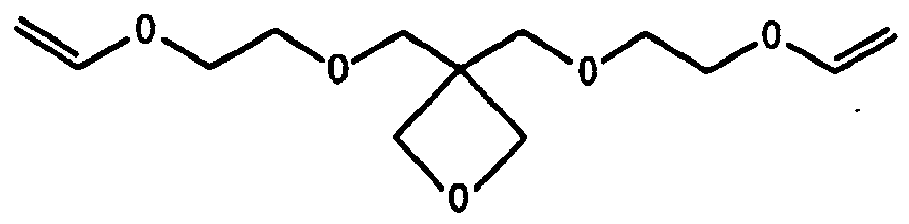


- Oxetane-containing vinyl ether compounds according to embodiment of the present invention can be prepared utilizing one or more reactions known as processes for the preparation of vinyl ether compounds. In a preferred embodiment, oxetane-containing vinyl ether compounds are prepared by a process of reacting alcohols (hydroxy compounds) with vinyl ester compounds, each corresponding to the oxetane-containing vinyl ether compounds, in the presence of one or more transition element compounds. Typically, an oxetane-containing vinyl ether compound of Formula (1) can be prepared by reacting an alcohol (hydroxy compound) corresponding to Formula (1), except with Ra being hydrogen atom, with a corresponding vinyl ester compound in the presence of a transition element compound.
- Representative examples of the vinyl ester compound include a vinyl ester compound represented by following Formula (7) :

- In the vinyl ester compound of Formula (7), R1, R2, and R3 are as described above. The organic group as R7 can be any group that does not adversely affect the reaction, and examples thereof include the organic groups listed as the alkyl group containing one to four carbon atoms typically as R1. Representative examples of the vinyl ester compound of Formula (7) include vinyl acetate, isopropenyl acetate, 1-propenyl acetate, 2-methyl-l-propenyl acetate, 1,2-dimethyl-1-propenyl acetate, vinyl formate, vinyl propionate, and vinyl benzoate.
- A reaction can proceed under mild conditions according to the above-mentioned process, since one or more transition element compounds (including elementary transition elements) are used as a catalyst. Each of transition element compounds can be used alone or in combination. Examples of the transition elements include, of the Periodic Table of Elements, elements belonging to Group IIIA, typified by lanthanoid elements (lanthanum series elements); elements belonging to Group VA; elements belonging to Group VIA; elements belonging to Group VIIA; elements belonging to Group VIII, such as iron, cobalt, nickel, ruthenium, rhodium, palladium, osmium, iridium, and platinum; and elements belonging to Group IB. Among them, elements belonging to Group VIII are preferred, of which platinum group elements (ruthenium, rhodium, palladium, osmium, iridium, and platinum) are more preferred, and iridium is particularly preferred.
- Examples of transition element compounds include inorganic compounds such as elementary transition elements (metals), oxides, sulfides, hydroxides, halides (fluorides, chlorides, bromides, and iodides), sulfates, oxo acids containing one or more transition elements, and salts thereof, and inorganic complexes; and organic compounds including cyanides, salts of organic acids (e.g., acetates), and organic complexes. Among them, organic complexes are preferred. Ligands of the complexes include known ligands. The valence of transition elements in these transition element compounds is about 0 to about 6, and preferably 0 to 3. In the case typically of iridium compounds, the valence is preferably 1 or 3. Namely, iridium compounds for use herein preferably contain monovalent or trivalent iridium. Such transition element compounds can be used as intact or as being supported by carriers.
- The amount of transition element compounds is, for example, about 0.0001 to about 1 mole, preferably about 0.001 to about 0.3 mole, and more preferably about 0.005 to about 0.1 mole, per 1 mole of the hydroxy compound used as a reaction component.
- The reaction between the vinyl ester compound of Formula (7) and the hydroxy compound is performed in the presence of or in the absence of a solvent. Examples of the solvent include aliphatic hydrocarbons such as hexane, heptane, and octane; alicyclic hydrocarbons such as cyclohexane; aromatic hydrocarbons such as benzene, toluene, xylenes, and ethylbenzene; halogenated hydrocarbons such as chloroform, dichloromethane, and 1,2-dichloroethane; ethers such as diethyl ether, dimethoxyethane, tetrahydrofuran, and dioxane; ketones such as acetone and methyl ethyl ketone; esters such as methyl acetate, ethyl acetate, isopropyl acetate, and butyl acetate; amides such as N,N-dimethylformamide and N,N-dimethylacetamide; and nitriles such as acetonitrile, propionitrile, and benzonitrile. Each of these solvents can be used alone or in combination.
- The amount of the vinyl ester compound of Formula (7) is, for example, about 0.8 to about 10 equivalents, preferably about 1 to about 8 equivalents, and more preferably about 1.5 to about 5 equivalents, to 1 equivalent of the hydroxy compound. The vinyl ester compound of Formula (7) may be used in large excess.
- In general, the reaction can proceed more rapidly when the reaction system further contains a base. Such bases for use herein include inorganic bases and organic bases. Examples of the inorganic bases include hydroxides of alkali metals, such as lithium hydroxide, sodium hydroxide, potassium hydroxide, and cesium hydroxide; hydroxides of alkaline earth metals, such as magnesium hydroxide, calcium hydroxide, and barium hydroxide; carbonates of alkali metals, such as lithium carbonate, sodium carbonate, potassium carbonate, and cesium carbonate; carbonates of alkaline earth metals, such as magnesium carbonate; and hydrogen carbonates of alkali metals, such as lithium hydrogen carbonate, sodium hydrogen carbonate, potassium hydrogen carbonate, and cesium hydrogen carbonate.
- Examples of the organic bases include organic acid salts of alkali metals, such as lithium acetate, sodium acetate, potassium acetate, and cesium acetate, of which alkali metal acetates are preferred; organic acid salts of alkaline earth metals, such as magnesium acetate; alkoxides of alkali metals, such as lithium methoxide, sodium methoxide, sodium ethoxide, sodium isopropoxide, and potassium ethoxide, of which alkoxides of alkali metals corresponding to the hydroxy compound are preferred; phenoxides of alkali metals such as sodium phenoxide; amines such as triethylamine and N-methylpiperidine, of which tertiary amines are preferred; and nitrogen-containing aromatic heterocyclic compounds such as pyridine, 2,2'-bipyridyl, and 1,10-phenanthroline. Among these bases, sodium-containing bases are preferred.
- The amount of the base is, for example, about 0.001 to about 3 moles, and preferably about 0.005 to about 2 moles, per 1 mole of the hydroxy compound.
- The reaction may be performed in the presence of a polymerization inhibitor. A reaction temperature can be set as appropriate according typically to types of reaction components and catalyst and is, for example, about 20°C to about 200°C, preferably about 50°C to about 150°C, and more preferably about 70°C to about 120°C. The reaction may be performed under normal pressure, under reduced pressure, or under pressure (under a load). The reaction atmosphere is not particularly limited, as long as not adversely affecting the reaction, and can be any atmosphere such as air atmosphere, nitrogen atmosphere, or argon atmosphere. The reaction can be performed according to any system such as a batch system, semibatch system, or continuous system. The progression of the vinylation reaction can be controlled by adjusting a reaction time period. Typically, a dihydroxy compound containing two hydroxyl groups per molecule gives a monovinyl compound with one vinyloxy group introduced thereto and one hydroxyl group remained in a reaction for a short time period such as about two hours, and it gives a divinyl compound with two vinyloxy groups introduced thereto in a reaction for a longer time period such as about five hours.
- The reaction yields a corresponding oxetane-containing vinyl ether compound of Formula (1) under mild conditions. After the completion of reaction, reaction products can be separated and purified by a separation procedure such as filtration, concentration, distillation, extraction, crystallization, recrystallization, or column chromatography, or any combination of these separation procedures.
- An alicyclic epoxy-containing vinyl ether compound according to another embodiment of the present invention is a compound of Formula (3). This compound is a vinyl ether compound that contains an alicyclic epoxy group (a group containing 1,2-epoxycyclohexane ring, i.e., 7-oxabicyclo[4.1.0]heptane ring) and further contains one or more non-aromatic carbocyclic ring at specific position in the molecule and/or contains an alkyl group at the junction site between cyclohexane ring constituting the alicyclic epoxy group and oxirane ring. Vinyl ether compounds of this type are much advantageous in that they sufficiently rapidly cure and give cured articles that excel in properties such as transparency and thermal stability.
- In Formula (3), Ring Z2 may be present or absent in the molecule, and, if present, represents a non-aromatic carbocyclic ring. Examples of the non-aromatic carbocyclic ring include cycloalkane rings such as cyclopropane ring, cyclobutane ring, cyclopentane ring, cyclohexane ring, cyclooctane ring, and cyclododecane ring, of which cycloalkane rings containing three to fifteen members are preferred; and bridged alicyclic rings containing six to twenty carbon atoms, such as decahydronaphthalene (perhydronaphthalene) ring and norbornane ring.
- In Formula (3), Rb is a substituted or unsubstituted vinyl group of Formula (4) . In Formula (4) , each of R4, R5 and R6 is independently hydrogen atom or an alkyl group containing one to four carbon atoms. Examples of the alkyl group containing one to four carbon atoms include linear alkyl groups containing one to four carbon atoms, such as methyl, ethyl, propyl, and butyl, of which those containing one to three carbon atoms are preferred; and branched alkyl groups containing one to four carbon atoms, such as isopropyl, isobutyl, s-butyl, and t-butyl, of which those containing one to three carbon atoms are preferred. Each of R4, R5, and R6 is independently preferably hydrogen atom or methyl group. Representative examples of the group of Formula (4) include vinyl group, isopropenyl group, 1-propenyl group, 2-methyl-l-propenyl group, and 1,2-dimethyl-1-propenyl group.
- In Formula (3), Wb is a linkage connecting between a substituted or unsubstituted vinyloxy group (-ORb group) and cyclohexane ring or Ring Z2 and represents a single bond or an organic group having a valence in the number of (r+1). The organic group may generally be a group that includes a carbon atom at a bonding site with an adjacent oxygen atom. Preferred examples as the organic group include (i) hydrocarbon groups, and (ii) groups each containing one or more hydrocarbon groups and at least one selected from oxygen atom (-O-), sulfur atom (-S-), carbonyl group (-CO-), and amino group (-NH-).
- The hydrocarbon groups (i) include aliphatic hydrocarbon groups, alicyclic hydrocarbon groups, aromatic hydrocarbon groups, and hydrocarbon groups as an assembly of two or more of these groups.
- Taking bivalent hydrocarbon groups as an example, such hydrocarbon groups include linear or branched alkylene groups containing one to twenty carbon atoms, such as methylene, methylmethylene (ethylidene), ethylmethylene (propylidene), dimethylmethylene (isopropylidene), ethylmethylmethylene, ethylene, propylene, trimethylene, tetramethylene, and hexamethylene groups, of which those containing one to ten carbon atoms are preferred, and those containing one to six carbon atoms are more preferred; linear or branched alkenylene groups containing two to twenty carbon atoms, such as propenylene group, of which those containing two to ten carbon atoms are preferred, and those containing two to six carbon atoms are more preferred; cycloalkylene groups containing three to twenty members, such as 1,3-cyclopentylene, 1,2-cyclohexylene, 1,3-cyclohexylene, and 1,4-cyclohexylene groups, of which those containing three to fifteen members are preferred, and those containing five to eight members are more preferred; cycloalkylidene groups containing three to twenty members, such as cyclopropylidene, cyclopentylidene, and cyclohexylidene groups, of which those containing three to fifteen members are preferred, and those containing five to eight members are more preferred; arylene groups such as 1,2-phenylene, 1,3-phenylene, and 1,4-phenylene groups; and benzylidene group.
- The hydrocarbon groups may each have one or more substituents. Examples of the substituents include protected or unprotected hydroxyl groups, protected or unprotected hydroxymethyl groups, protected or unprotected amino groups, protected or unprotected carboxyl groups, protected or unprotected sulfo groups, halogen atoms, oxo group, cyano group, nitro group, heterocyclic groups, hydrocarbon groups, and haloalkyl groups. Common protecting groups for use in organic synthesis can be utilized herein. Examples of the heterocyclic groups as the substituents include heterocyclic groups that contain at least one hetero atom selected from nitrogen atom, oxygen atom, and sulfur atom and include three to fifteen members, of which heterocyclic groups containing five to eight members are preferred.
- The hydrocarbon groups as the substituents include aliphatic hydrocarbon groups, alicyclic hydrocarbon groups, aromatic hydrocarbon groups, and groups as an assembly of two or more of these groups. Examples of the aliphatic hydrocarbon groups include alkyl groups containing one to twenty carbon atoms, of which those containing one to ten carbon atoms are preferred, and those containing one to three carbon atoms are more preferred; alkenyl groups containing two to twenty carbon atoms, of which those containing two to ten carbon atoms are preferred, and those containing two or three carbon atoms are more preferred; and alkynyl groups containing two to twenty carbon atoms, of which those containing two to ten carbon atoms are preferred, and those containing two or three carbon atoms are more preferred. Examples of the alicyclic hydrocarbon groups include cycloalkyl groups containing three to twenty members, of which those containing three to fifteen members are preferred, and those containing five to eight members are more preferred; cycloalkenyl groups containing three to twenty members, of which those containing three to fifteen members are preferred, and those containing five to eight members are more preferred; and bridged hydrocarbon groups such as perhydronaphth-1-yl group, norbornyl, adamantyl, and tetracyclo[4.4.0.12,5.17,10]dodec-3-yl groups. Examples of the aromatic hydrocarbon groups include aromatic hydrocarbon groups containing six to fourteen carbon atoms, of which those containing six to ten carbon atoms are preferred. Examples of hydrocarbon groups as an assembly of an aliphatic hydrocarbon group and an alicyclic hydrocarbon group include cycloalkyl-alkyl groups such as cyclopentylmethyl, cyclohexylmethyl, and 2-cyclohexylethyl groups, of which preferred are cycloalkyl-alkyl groups whose cycloalkyl moiety contains three to twenty carbon atoms and whose alkyl moiety contains one to four carbon atoms. Examples of hydrocarbon groups as an assembly of an aliphatic hydrocarbon group and an aromatic hydrocarbon group include aralkyl groups such as aralkyl groups containing seven to eighteen carbon atoms; and alkylsubstituted aryl groups such as phenyl group or naphthyl group on which one to four alkyl groups containing one to four carbon atoms are substituted.
- Examples of the haloalkyl groups as the substituents include haloalkyl groups containing one to ten carbon atoms, such as chloromethyl, trifluoromethyl, 2,2,2-trifluoroethyl, and pentafluoroethyl groups, of which those containing one to three carbon atoms are preferred.
- Preferred examples of Wb include a group represented by following Formula (8):

- Examples of the bivalent hydrocarbon group as A3 are as mentioned above. Among them, preferred as A3 are linear or branched alkylene groups containing one to six carbon atoms, such as methylene, ethylene, propylene, isopropylidene, trimethylene, and tetramethylene groups.
- Preferred examples as Y2 include oxygen atom (-O-), sulfur atom (-S-), carbonyl group (-CO-), amino group (-NH-), -COO-, -OCO-, -CONH-, and -NHCO-.
- Examples of the hydrocarbon group having a valence in the number of (r+1) as A4 are as mentioned above. Among them, preferred examples as A4 include single bond; or a group selected from linear or branched alkylene groups containing one to six carbon atoms, such as methylene, ethylene, propylene, isopropylidene, trimethylene, and tetramethylene groups, cycloalkylene groups containing five to eight members, such as 1,3-cyclopentylene, 1,2-cyclohexylene, 1,3-cyclohexylene, and 1,4-cyclohexylene groups, cycloalkylidene groups containing five to eight members, such as cyclopropylidene, cyclopentylidene, and cyclohexylidene groups, arylene groups such as 1,2-phenylene, 1,3-phenylene, and 1,4-phenylene groups, and groups as an assembly of two or more of these groups.
- Wb is particularly preferably a single bond; a linear or branched alkylene group containing one to t six carbon atoms; or a group as an assembly of the alkylene group with at least one group selected from oxygen atom (-O-), sulfur atom (-S-), and carbonyl group (-CO-).
- The bonding position of the group Wb in the cyclohexane ring or Ring Z2 is not particularly limited. When Ring Z2 is absent, Wb is preferably bonded at the 4-position and/or the 5-position provided that the junction positions in cyclohexane ring with oxirane ring are defined as the 1-position and 2-position.
- In Formula (3) , each of Rc and Rd is independently hydrogen atom or an alkyl group. Examples of the alkyl group include linear or branched alkyl groups containing one to fifteen carbon atoms, such as methyl, ethyl, propyl, isopropyl, butyl, isobutyl, s-butyl, t-butyl, hexyl, octyl, and decyl groups. Among them, alkyl groups containing one to six carbon atoms are preferred, of which those containing one to three carbon atoms, such as methyl group, are more preferred.
- In Formula (3), "r" denotes 1 or 2 and is preferably 1; and "s" denotes 1 or 2. When any of "r" and "s" is 2, corresponding two parenthesized substituents may be the same as or different from each other, and, provided that when Rc and Rd are both hydrogen atoms, satisfy at least one of following (i), (ii) , and (iii); (i) Ring Z2 is present, (ii) Wb is a group represented by preceding Formula (5) , (iii) "s" is 2 and "r" is 1 , and Wb does not contain carbonyl group.
- In Formula (5), W1 is a single bond or a bivalent organic group. Examples of the bivalent organic group include bivalent hydrocarbon groups, and groups as an assembly of a bivalent hydrocarbon group with at least one selected from oxygen atom (-O-), sulfur atom (-S-), carbonyl group (-CO-), and amino group (-NH-). The bivalent hydrocarbon groups are as described above. W1 is particularly preferably a single bond or an alkyleneoxy group containing one to six carbon atoms whose oxygen atom is attached to the cyclohexane group in the right hand in Formula (5).
- Of compounds of Formula (3), preferred are compounds respectively represented by following Formulae (3a), (3b), (3c) and (3d):


- In Formula (3a) , each of Rc and Rd is independently preferably hydrogen atom or an alkyl group containing one to six carbon atoms, and is more preferably hydrogen atom or an alkyl group containing one to three carbon atoms typified by methyl group. In another preferred embodiment, at least one of Rc and Rd is hydrogen atom. Ring Z2 is preferably a cycloalkane ring containing five to twelve members, such as cyclopentane ring, cyclohexane ring, or cyclooctane ring; or a bridged alicyclic ring containing eight to fifteen carbon atoms, such as decahydronaphthalene ring or norbornane ring. Wb is particularly preferably a single bond; a hydrocarbon group containing one to fifteen carbon atoms; or a group as an assembly of one or more hydrocarbon groups containing one to fifteen carbon atoms with at least one selected from oxygen atom (-O-), sulfur atom (-S-), carbonyl group (-CO-), and amino group (-NH-).
- In Formula (3b), each of Rc and Rd is preferably independently hydrogen atom or an alkyl group containing one to six carbon atoms and is more preferably hydrogen atom or an alkyl group containing one to three carbon atoms, such as methyl group. In another preferred embodiment, at least one of Rc and Rd is hydrogen atom. W1 is particularly preferably a single bond or an alkyleneoxy group containing one to six carbon atoms, whose oxygen atom is attached to the cyclohexane ring in the right hand in Formula (3b).
- In Formula (3c), Rc is preferably hydrogen atom or an alkyl group containing one to six carbon atoms, more preferably hydrogen atom or an alkyl group containing one to three carbon atoms, and particularly preferably hydrogen atom. Rd is preferably an alkyl group containing one to three carbon atoms, and more preferably methyl group. Wb is preferably a single bond, a hydrocarbon group containing one to fifteen carbon atoms, or a group as an assembly of one or more hydrocarbon groups containing one to fifteen carbon atoms with at least one selected from oxygen atom (-O-), sulfur atom (-S-), carbonyl group (-CO-), and amino group (-NH-).
- In Formula (3d), Wb' is preferably a single bond; a bivalent hydrocarbon group containing one to six carbon atoms.
- Representative examples of the alicyclic epoxy-containing vinyl ether compounds according to embodiments of the present invention include following compounds. In the following formulae, (3-1), (3-2) , "1" is 0 or 1; and A5 is a linear or branched alkylene group containing two to ten carbon atoms and is preferably a linear or branched alkylene group containing two to six carbon atoms.


- Alicyclic epoxy-containing vinyl ether compounds according to embodiments of the present invention can be prepared utilizing one or more reactions known as preparation processes for vinyl ether compounds. In a preferred embodiment, alicyclic epoxy-containing vinyl ether compounds are prepared by a process of reacting alcohols (hydroxy compounds) with vinyl ester compounds, each corresponding to the alicyclic epoxy-containing vinyl ether compounds, in the presence of one or more transition element compounds. Specifically, the alicyclic epoxy-containing vinyl ether compounds of Formula (3) can be prepared by reacting alcohols (hydroxy compounds) corresponding to Formula (3), except with Rb being hydrogen atom, with corresponding vinyl ester compounds in the presence of one or more transition element compounds. Such alcohols (hydroxy compounds) corresponding to the alicyclic epoxy-containing vinyl ether compounds can be synthetically prepared from known compounds utilizing known reactions.
- Representative examples of the vinyl ester compounds include a vinyl ester compound represented by following Formula (9):
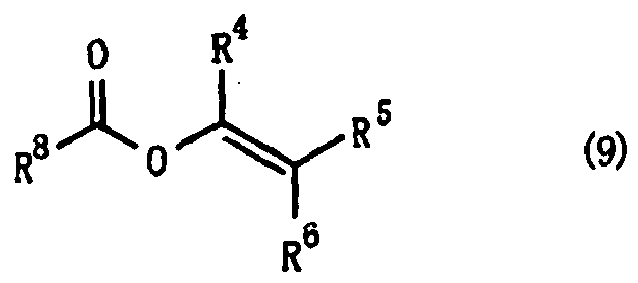
- In the vinyl ester compounds of Formula (9), R4, R5, and R6 are as defined above. The organic group as R8 can be any group that does not adversely affect the reaction, and examples thereof include the organic groups listed as the alkyl groups containing one to four carbon atoms typically as R4. Representative examples of the vinyl ester compounds of Formula (9) include vinyl acetate, isopropenyl acetate, 1-propenyl acetate, 2-methyl-1-propenyl acetate, 1,2-dimethyl-1-propenyl acetate, vinyl formate, vinyl propionate, and vinyl benzoate.
- A reaction can proceed under mild conditions according to the above-mentioned process, since one or more transition element compounds (including elementary transition elements) are used as a catalyst. Each of transition element compounds can be used alone or in combination. Examples of the transition elements include, of the Periodic Table of Elements, elements belonging to Group IIIA typified by lanthanoid elements (lanthanum series elements); elements belonging to Group VA; elements belonging to Group VIA; elements belonging to Group VIIA; elements belonging to Group VIII, such as iron, cobalt, nickel, ruthenium, rhodium, palladium, osmium, iridium, and platinum; and elements belonging to Group IB. Among them, elements belonging to Group VIII are preferred, of which platinum group elements (ruthenium, rhodium, palladium, osmium, iridium, and platinum) are more preferred, and iridium is particularly preferred.
- Examples of transition element compounds include inorganic compounds such as elementary transition elements (metals), oxides, sulfides, hydroxides, halides (fluorides, chlorides, bromides, and iodides), sulfates, oxo acids containing one or more transition elements, and salts thereof, and inorganic complexes; and organic compounds including cyanides, salts of organic acids (e.g., acetates), and organic complexes. Among them, organic complexes are preferred. Ligands of the complexes include known ligands. The valence of transition elements in these transition element compounds is about 0 to about 6, and preferably 0 to 3. In the case typically of iridium compounds, the valence is preferably 1 or 3. Namely, iridium compounds for use herein preferably contain monovalent or trivalent iridium. Such transition element compounds can be used as intact or as being supported by carriers.
- The amount of transition element compounds is, for example, about 0.0001 to about 1 mole, preferably 0.001 to about 0.3 mole, and more preferably 0.005 to about 0.1 mole, per 1 mole of the hydroxy compound used as a reaction component.
- The reaction between the vinyl ester compound of Formula (9) and the hydroxy compound is performed in the presence of or in the absence of a solvent. Examples of the solvent include aliphatic hydrocarbons such as hexane, heptane, and octane; alicyclic hydrocarbons such as cyclohexane; aromatic hydrocarbons such as benzene, toluene, xylenes, and ethylbenzene; halogenated hydrocarbons such as chloroform, dichloromethane, and 1,2-dichloroethane; ethers such as diethyl ether, dimethoxyethane, tetrahydrofuran, and dioxane; ketones such as acetone and methyl ethyl ketone; esters such as methyl acetate, ethyl acetate, isopropyl acetate, and butyl acetate; amides such as N,N-dimethylformamide and N,N-dimethylacetamide; and nitriles such as acetonitrile, propionitrile, and benzonitrile. Each of these solvents can be used alone or in combination.
- The amount of the vinyl ester compound of Formula (9) is, for example, about 0.8 to about 10 equivalents, preferably about 1 to about 8 equivalents, and more preferably about 1.5 to about 5 equivalents, to 1 equivalent of the hydroxy compound. The vinyl ester compound of Formula (9) may be used in large excess.
- In general, the reaction can proceed more rapidly when the reaction system further includes a base. Such bases for use herein include inorganic bases and organic bases. Examples of the inorganic bases include hydroxides of alkali metals, such as lithium hydroxide, sodium hydroxide, potassium hydroxide, and cesium hydroxide; hydroxides of alkaline earth metals, such as magnesium hydroxide, calcium hydroxide, and barium hydroxide; carbonates of alkali metals, such as lithium carbonate, sodium carbonate, potassium carbonate, and cesium carbonate; carbonates of alkaline earth metals, such as magnesium carbonate; hydrogen carbonates of alkali metals, such as lithium hydrogen carbonate, sodium hydrogen carbonate, potassium hydrogen carbonate, and cesium hydrogen carbonate.
- Examples of the organic bases include organic acid salts of alkali metals, such as lithium acetate, sodium acetate, potassium acetate, and cesium acetate, of which alkali metal acetates are preferred; organic acid salts of alkaline earth metals, such as magnesium acetate; alkoxides of alkali metals, such as lithium methoxide, sodium methoxide, sodium ethoxide, sodium isopropoxide, and potassium ethoxide, of which alkoxides of alkali metals corresponding to the oxgen-containig polycyclic hydroxy compound are preferred; phenoxides of alkali metals, such as sodium phenoxide; amines such as triethylamine and N-methylpiperidine, of which tertiary amines are preferred; and nitrogen-containing aromatic heterocyclic compounds such as pyridine, 2,2'-bipyridyl, and 1,10-phenanthroline. Among these bases, sodium-containing bases are preferred.
- The amount of the base is, for example, about 0.001 to about 3 moles, and preferably about 0.005 to about 2 moles, per 1 mole of the hydroxy compound.
- The reaction may be performed in the presence of a polymerization inhibitor. A reaction temperature can be set as appropriate according typically to types of reaction components and catalyst and is, for example, about 20°C to about 200°C, preferably about 50°C to about 150°C, and more preferably about 70°C to about 120°C. The reaction may be performed under normal pressure, under reduced pressure, or under pressure (under a load). The reaction atmosphere is not particularly limited, as long as not adversely affecting the reaction, and can be any atmosphere such as air atmosphere, nitrogen atmosphere, or argon atmosphere. The reaction can be performed according to any system such as a batch system, semibatch system, or continuous system. The progression of the vinylation reaction can be controlled by adjusting a reaction time period. Typically, a dihydroxy compound containing two hydroxyl groups per molecule gives a monovinyl compound with one vinyloxy group introduced thereto and one hydroxyl group remained in a reaction for a short period of time typically of about two hours, and it gives a divinyl compound with two vinyloxy groups introduced thereto in a reaction for a longer period of time typically of about five hours.
- The reaction yields a corresponding alicyclic epoxy-containing vinyl ether compound of Formula (3) under mild conditions. After the completion of reaction, reaction products can be separated and purified by a separation procedure such as filtration, concentration, distillation, extraction, crystallization, recrystallization, or column chromatography, or any combination of these separation procedures.
- A polymerizable composition according to an embodiment of the present invention contains the oxetane-containing vinyl ether compound and/or alicyclic epoxy-containing vinyl ether compound each according to an embodiment of the present invention; and a polymerization initiator. The polymerization initiator can be any one that can induce or cause free-radical polymerization or ionic (cationic) polymerization, such as a thermal initiator, photo-induced free-radical polymerization initiator, or photo-induced cationic polymerization initiator. Typically, known polymerization initiators and light-activatable acid generators can be used herein. Examples of thermal initiators for use herein include benzoyl peroxide, acetyl peroxide, lauroyl peroxide, t-butyl hydroperoxide, azobisisobutyronitrile, azobis-(2,4-dimethylvaleronitrile), and azobis(cyclohexanecarbonitrile). Examples of photoinitiators include 2,4-diethylthioxanthone, benzophenone, 4-dimethylaminoisoamyl benzoate, and 4-dimethylaminoethyl benzoate; sulfonium salts such as triarylsulfonium hexafluorophosphates and triarylsulfonium hexafluoroantimonates, iodonium salts such as diaryliodonium hexafluorophosphates, diphenyliodonium hexafluoroantimonate, and bis(dodecylphenyl)iodonium tetrakis(pentafluorophenyl)bo'rate, phosphonium salts such as tetrafluorophosphonium hexafluorophosphate, and pyridinium salts. Since the alicyclic epoxy-containing vinyl ether compound according to an embodiment of the present invention is likely to dissolve such a polymerization initiator therein, the polymerizable composition can be easily prepared.
- The amount of the polymerization initiator is generally 0.01 to 50 percent by weight, and preferably 0.1 to 20 percent by weight, relative to the oxetane-containing vinyl ether compound or alicyclic epoxy-containing vinyl ether compound.
- The polymerizable composition may further contain any of curable compounds other than the oxetane-containing vinyl ether compound and/or alicyclic epoxy-containing vinyl ether compound, as well as various additives, inorganic or organic particles, and fluorosilanes. Examples of the other curable compounds include epoxy compounds, oxetane compounds, and vinyl ether compounds. Examples of the additives include sensitizers such as anthracene based sensitizers. Examples of inorganic or organic particles include nanoscale particles. The content of the oxetane-containing vinyl ether compound and/or alicyclic epoxy-containing vinyl ether compound based on the total amount of curable compounds contained in the polymerizable composition is, for example, 20 percent by weight or more, preferably 50 percent by weight or more, and more preferably 70 percent by weight or more. The curable compounds in the polymerizable composition may be substantially composed of the oxetane-containing vinyl ether compound and/or alicyclic epoxy-containing vinyl ether compound according to an embodiment of the present invention alone.
- The polymerizable composition according to an embodiment of the present invention sufficiently rapidly cure, since it contains the oxetane-containing vinyl ether compound and/or alicyclic epoxy-containing vinyl ether compound according to an embodiment of the present invention.
- A cured article according to an embodiment of the present invention can be obtained by applying electron beams, radiation, or heat to the polymerization composition containing the oxetane-containing vinyl ether compound and/or alicyclic epoxy-containing vinyl ether compound according to an embodiment of the present invention. The resulting cured article is satisfactorily transparent and highly thermally stable. Accordingly, the oxetane-containing vinyl ether compounds and alicyclic epoxy-containing vinyl ether compounds according to embodiments of the present invention can be used, as polymerizable compounds that cure or polymerize by the application of light or heat, in the fields typically of materials for coating agents, inks, paints and varnishes, adhesives, resists, plate-making materials, optical waveguides, holograms, and nanoimprint compositions.
- The present invention further comprises the following embodiments:
- 1. An oxetane-containing vinyl ether compound comprising:
- (a) at least one oxetane ring; and
- (b) one or more aromatic or non-aromatic carbocyclic rings,
two or more vinyl ether structures, or
one or more aromatic or non-aromatic carbocyclic rings and two or more vinyl ether structures, per molecule.
- 2. The oxetane-containing vinyl ether compound according to the first embodiment, which is represented by following Formula (1) :

Ra represents a substituted or unsubstituted vinyl group represented by following Formula (2):
Wa is a linkage connecting between a substituted or unsubstituted vinyloxy group (-ORa group) and oxetane ring or Ring Z1 and represents a single bond or an organic group having a valence in the number of (m+1);
X1 is a substituent of oxetane ring and Ring Z1 and represents a halogen atom, a substituted or unsubstituted hydrocarbon group, a protected or unprotected hydroxyl group, a protected or unprotected amino group, a protected or unprotected carboxyl group, a protected or unprotected sulfo group, oxo group, nitro group, cyano group, or a protected or unprotected acyl group;
"m" denotes 1 or 2;
"p" denotes an integer of from 0 to 5; and
"q" denotes 1 or 2,
wherein, when any of "m", "p", and "q" is 2 (or more), corresponding two (or more) parenthesized substituents may be the same as or different from each other, and
wherein, when "m" and "q" are both 1, at least one of following conditions (1), (2), and (3) is satisfied: (1) Ring Z1 is present, (2) X1 contains one or more aromatic or non-aromatic carbocyclic rings, and (3) Wa contains one or more aromatic or non-aromatic carbocyclic rings. - 3. An alicyclic epoxy-containing vinyl ether compound represented by following Formula (3):

Rb represents a substituted or unsubstituted vinyl group represented by following Formula (4):
Wb is a linkage connecting between a substituted or unsubstituted vinyloxy group (-ORb group) and cyclohexane ring or Ring Z2 and represents a single bond or an organic group having a valence in the number of (r+1);
each of Rc and Rd independently represents hydrogen atom or an alkyl group;
"r" denotes 1 or 2; and
"s" denotes 1 or 2,
wherein, when any of "r" and "s" is 2, corresponding two parenthesized substituents may be the same as or different from each other, and
provided that when Rc and Rd are both hydrogen atoms, satisfy at least one of following (i), (ii), and (iii)- (i) Ring Z2 is present
- (ii) Wb is a group represented by following Formula (5) :

wherein a carbon atom constituting cyclohexane ring is attached to -ORb group - (iii) "s" is 2 and "r" is 1 , and Wb does not contain carbonyl group.
- 4. A polymerizable composition comprising:
- (i) the oxetane-containing vinyl ether compound of embodiments 1 or 2 and/or the alicyclic epoxy-containing vinyl ether compound of embodiment 3; and
- (ii) a polymerization initiator.
- 5. A cured article as a polymerized product of the polymerizable composition of embodiment 4.
- The present invention will be illustrated in further detail with reference to several examples below. It should be noted, however, these are illustrated only by way of example and never construed to limit the scope of the present invention.
- A mixture (280 mL) of 24.9 g (0.23 mol) of sodium carbonate and toluene was heated to a temperature of 95°C, and 1.4 g of propionic acid was added dropwise to the mixture. Next, maintaining the temperature of the reaction mixture, 16 g of vinyl acetate was added dropwise to the mixture, and fifteen minutes later, further the mixture was combined with 1.27 g (1.9 mmol) of di-µ-chlorobis(1,5-cyclooctadiene)diiridium(I) [Ir(cod)Cl]2. Next, 40 g (0.19 mol) of oxetane-3,3-dimethanol was added dropwise for three hours; and a reaction was carried out in a nitrogen atmosphere while adding dropwise 79.8 g of vinyl acetate and maintaining the temperature of the reaction mixture. After the completion of dropwise addition, the mixture was stirred for one hour. As the result of gas chromatography analysis of the mixture, it is confirmed that there were produced 3,3-bis(vinyloxymethyl)oxetane represented by following Formula (10) in a yield of 90% and (3-vinyloxymethyloxetan-3-yl)methanol in a yield of 2%. Purification of the reaction mixture by distillation yielded 31 g of 3,3-bis(vinyloxymethyl)oxetane with a purity of 99%.
- 1H-NMR (CDCl3) δ: 6.5 (2H, dd), 4.53 (4H, s), 4.2 (2H, d), 4.05 (2H, d), 3. 93 (4H, s) :

- To toluene (500 g) were added 3-chloromethyl-3-ethyloxetane (0.1 mol), 1,4-cyclohexanediol (0.5 mol), and tetrabutylammonium bromide (0.01 mol), the mixture was heated to 90°C, was combined with a 5 N aqueous sodium hydroxide solution (100 g) added dropwise, followed by stirring for five hours. The toluene solution (toluene layer) was washed with water, concentrated, purified by silica gel chromatography, and thereby yielded 4-(3-ethyloxetan-3-yl-methoxy)cyclohexanol with a purity of 99%.
- A mixture (100 mL) of sodium carbonate (0.06 mol) and toluene was heated to 95°C. Maintaining the temperature of the reaction mixture, 4.2 g of vinyl acetate was added dropwise to the mixture, and fifteen minutes later, further the mixture was combined with di-µ-chlorobis(1,5-cyclooctadiene)diiridium(I) [Ir(cod)Cl]2 (0.5 mmol). Next, 4-(3-ethyloxetan-3-yl-methoxy)cyclohexanol (0.05 mol) was added dropwise for two hours, and a reaction was then carried out in a nitrogen atmosphere while adding dropwise 12.6 g of vinyl acetate and holding the reaction temperature at 95°C. After the completion of dropwise addition, the mixture was stirred for one hour. As the result of gas chromatography analysis of the mixture, it is confirmed that there was produced 3-ethyl-3-(4-vinyloxycyclohexyloxymethyl) oxetane represented by following Formula (11) in a yield of 92%. In 1H-NMR (CDCl3) analysis, signals specific to vinyl group were observed at 6.5 ppm, 4.2 ppm, and 4.04 ppm as in Example 1.

- 4,5-di(hydroxymethyl)cyclohexene was epoxidized with m-chloroperbenzoic acid and thereby yielded 4,5-di(hydroxymethyl)cyclohexene oxide (cis-trans mixture). A mixture (280 mL) of sodium carbonate 24.9 g (0.23 mol) and toluene was heated to 95°C, and 1.4 g of propionic acid was added to the mixture. Maintaining the temperature of the reaction mixture, the mixture was combined with 19 g of vinyl acetate added dropwise, and fifteen minutes later, further combined with 1.27 g (1.9 mmol) of di-µ-chlorobis(1,5-cyclooctadiene)diiridium(I) [Ir(cod)Cl]2. Next, 30 g (0.19 mol) of 4,5-di(hydroxymethyl)cyclohexene oxide (cis-trans mixture) was added dropwise for three hours, and a reaction was carried out in a nitrogen atmosphere while adding dropwise 62 g of vinyl acetate and holding the reaction temperature at 95°C. After the completion of dropwise addition, the mixture was stirred for one hour. As the result of gas chromatography analysis of the mixture, it is confirmed that there were produced 4, 5-di(vinyloxymethyl)cyclohexene oxide (cis-trans mixture) represented by following Formula (12) in a yield of 82% and 4-vinyloxymethyl-5-hydroxymethyl cyclohexene oxide (cis-trans mixture) in a yield of 4%. Purification of the reaction mixture by distillation yielded 31 g of 4, 5-di-(vinyloxymethyl)cyclohexene oxide (cis-trans mixture) with a purity of 98%.
- 1H-NMR (CDCl3) δ cis-trans mixture: 6.46-6.26(4H, m), 4.32-4.14(4H, m), 4.18-4.14(2H, m), 4.03-3.98(6H, m), 3.91-3.90(2H, m), 3.73-3.70(2H, m), 3.49-3.47(4H, m), 2.45-2.13 (2H, m), 2.23-1.7 9(2H, m), 1.78-1.44(2H, m): Cis form was attributed to the following signals. 6.46-6.42(2H, dd, J=6.7 and 7.9) 2.45-2.43(2H, m) 2.23-2.20(2H, dd, J=6.1 and 6.7) 1.78-1.75(2H, m) Trans form was attributed to the following signals. 6.30-6.26(2H, dd, J=6.7 and 7.3) 2.15-2.13(2H, m) 1.83-1.79(2H, dd, J=6.1 and 6.7) 1.50-1.44(2H, m) 1.50-1.44(2H, m) :

- 4,5-di(hydroxymethyl)-1-methylcyclohexene was epoxidized with m-chloroperbenzoic acid and thereby yielded 4,5-di(hydroxymethyl)-1-methylcyclohexene oxide. A mixture (280 mL) of sodium carbonate 24.9 g (0.23 mol) and toluene was heated to 95°C, and 1.4 g of propionic acid was added dropwise to the mixture. Maintaining the temperature of the reaction mixture, the mixture was combined with 19 g of vinyl acetate added dropwise, and fifteen minutes later, further combined with 1.27 g (1.9 mmol) of di-µ-chlorobis(1,5-cyclooctadiene)diiridium(I) [Ir(cod)Cl]2 . Next, 30 g (0.19 mol) of 4,5-di(hydroxymethyl)-1-methylcyclohexene oxide was added dropwise for three hours, and a reaction was carried out in a nitrogen atmosphere while adding dropwise 62 g of vinyl acetate and holding the reaction temperature at 95°C. After the completion of dropwise addition, the mixture was stirred for one hour. As the result of gas chromatography analysis of the mixture, it is confirmed that there were produced 4, 5-di(vinyloxymethyl)-1-methylcyclohexene oxide represented by following Formula (13) in a yield of 80%. In 1H-NMR (CDCl3) analysis, signals specific to vinyl group were observed at 6.2-6.5 ppm, 4.1-4.3 ppm, as an isomer mixture.

- In these examples and comparative examples, a curable composition (polymerizable composition) was prepared by admixing and dissolving (A) a vinyl ether compound, (B) a cyclic ether compound, and (C) a cationic light-activatable acid generator in amounts listed in Table 1.
- A shape corresponding to a sample was cut out of a Teflon (registered trademark) plate with a thickness of 1 mm or 200 µm, both sides of the Teflon plate were sandwiched between a Teflon (registered trademark)-coated poly(ethylene terephthalate) (PET) film and a glass plate respectively in this order, to yield a laminate (glass plate/PET/Teflon (registered trademark)/PET/glass plate). The above-prepared curable composition was injected into the cut-out portion to be the sample shape with an injector, and then irradiated with ultraviolet rays (UV) using a conveyor-system ultraviolet irradiator under after-mentioned conditions. Thus, cured articles with a thickness of 1 mm and 200 µm, respectively, corresponding to the Teflon (registered trademark) plate used were obtained.
- According to methods mentioned later, determinations were made on solubility of the cationic light-activatable acid generator (C) in the vinyl ether compound (A) or in a mixture of the vinyl ether compound (A) and the cyclic ether compound (B); curing rate of the prepared curable composition; and gel fraction, transmittance, and thermal stability of the prepared cured articles. The results are shown in Table 1.
- Epoxidation of 12.6 g (0.1 mol) of (4-methylcyclohex-3-enyl)methanol was carried out with a 5 percent by weight solution of peracetic acid in ethyl acetate at 65°C. Purification of the product by distillation yielded 12 g of (6-methyl-7-oxabicyclo[4.1.0]hept-3-yl)methanol with a purity of 98%.
- A mixture (100 mL) of sodium carbonate (0.06 mol) and toluene was heated to 95°C. 4.2 g of vinyl acetate was added dropwise to the mixture. Next, maintaining the temperature of the reaction mixture, and fifteen minutes later, further the mixture was combined with di-µ-chlorobis(1,5-cyclooctadiene)diiridium(I) [Ir(cod)Cl]2 (0.5 mmol). Next, (6-methyl-7-oxabicyclo[4.1.0]hept-3-yl)methanol (0.05 mol) was added dropwise over for two hours, and a reaction was carried out in a nitrogen atmosphere while adding dropwise 12.6 g of vinyl acetate and holding the reaction temperature at 95°C. After the completion of dropwise addition, the mixture was stirred for one hour. As the result of gas chromatography analysis of the mixture, it is confirmed that there was produced 1-methyl-4-vinyloxy-7-oxabicyclo[4.1.0]heptane represented by following Formula (14) in a yield of 95%. In 1H-NMR (CDCl3) analysis, signals specific to vinyl group were observed at 6.5 ppm, 4.2 ppm, and 4.05 ppm.

- To toluene (500 g) were added 4-chloromethylcyclohexene (0.1 mol), 1,4-cyclohexanediol (0.5 mol), and tetrabutylammonium bromide (0.01 mol), and the mixture was heated to 90°C and combined with a 5 N aqueous sodium hydroxide solution (100 g) added dropwise, followed by stirring for a for hours. The toluene solution (toluene layer) was washed with water, concentrated, purified by silica gel chromatography, and thereby yielded 13 g of 4-(cyclohex-3-enylmethoxy)cyclohexanol with a purity of 99%.
- Epoxidation was conducted by the procedure of Example 1, except for using above-prepared 4-(cyclohex-3-enylmethoxy)cyclohexanol instead of (4-methylcyclohex-3-enyl)methanol, and thereby yielded 8 g of 4-(7-oxabicyclo[4.1.0]hept-3-ylmethoxy)cyclohexanol.
- In addition, vinyl-etherification was conducted by the procedure of Example 1, except for using above-prepared 4-(7-oxabicyclo[4.1.0]hept-3-ylmethoxy)cyclohexanol instead of (6-methyl-7-oxabicyclo[4.1.0]hept-3-yl)methanol, and thereby yielded 3-(4-vinyloxycyclohexyloxymethyl)-7-oxabicyclo[4.1.0]heptane represented by following Formula (15). In 1H-NMR (CDCl3) analysis, signals specific to vinyl group were observed at 6.5 ppm, 4.2 ppm, and 4.04 ppm.

- In these examples and comparative examples, a curable composition (polymerizable composition) was prepared by admixing and dissolving (D) a vinyl ether compound, (B) a cyclic ether compound, and (C) a cationic light-activatable acid generator in amounts listed in Table 2.
- A shape corresponding to a sample was cut out of a Teflon (registered trademark) plate with a thickness of 1 mm or 200 µm, both sides of the Teflon plate were sandwiched between a Teflon (registered trademark)-coated poly(ethylene terephthalate) (PET) film and a glass plate respectively in this order, to yield a laminate (glass plate/PET/Teflon (registered trademark)/PET/glass plate). The above-prepared curable composition was injected into the cut-out portion to be the sample shape with an injector, and then irradiated with ultraviolet rays (UV) with a conveyor-system ultraviolet irradiator under after-mentioned conditions. Thus, cured articles with a thickness of 1 mm and 200 µm, respectively, corresponding to the Teflon (registered trademark) plate used were obtained.
- According to methods mentioned later, determinations were made on solubility of the cationic light-activatable acid generator (C) in the vinyl ether compound (D) or in a mixture of the vinyl ether compound (D) and the cyclic ether compound (B); curing rate of the prepared curable composition; and gel fraction, transmittance, and thermal stability of the prepared cured articles.
- Conditions for Curing by Ultraviolet Rays:
- UV irradiator: Ultraviolet irradiator "UVC-0251651-AA02" supplied by Ushio Inc., with a metal halide lamp
- Irradiation power: 160 W
- Conveyor speed: 2 meters per minutes
- Irradiation time: Once
- The symbols in the vinyl ether compound (A), cyclic ether compound (B), and cationic light-activatable acid generator (C) in Table 1 are as follows:
- Vinyl ether compound (A)
- (A1): 3,3-Bis(vinyloxymethyl)oxetane prepared in Example 1
- (A2): 3-Ethyl-3-(4-vinyloxycyclohexyloxymethyl)oxetane prepared in Example 2
- (A3): 1,4-Cyclohexanedimethanol divinyl ether (supplied by Aldrich)
- (A4): Tetraethylene glycol divinyl ether (supplied by Aldrich)
- Cyclic ether compound (B)
- (B1): "Celloxide 2021P" supplied by Daicel Chemical Industries, Ltd.
- (B2): "ARON OXETANE OXT-121" supplied by Toagosei Co., Ltd.
- Cationic light-activatable acid generator (C)
- (C1): "Irgacure 250" supplied by Ciba Specialty Chemicals Corporation
- (C2): "PI 2074" supplied by Rhodia
The symbols in the vinyl ether compound (D), cyclic ether compound (B), and cationic light-activatable acid generator (C) in Table 2 are as follows:
- Vinyl ether compound (D)
- (D1): 1-Methyl-4-vinyloxy-7-oxabicyclo[4.1.0]heptane prepared in Example 10
- (D2): 3-(4-Vinyloxycyclohexyloxymethyl)-7-oxabicyclo[4.1.0]heptane prepared in Example 11
- (D3): 1,4-Cyclohexanedimethanol divinyl ether (supplied by Aldrich)
- (D4): Tetraethylene glycol divinyl ether (supplied by Aldrich)
- Cyclic ether compound (B)
- (B1): "Celloxide 2021P" supplied by Daicel Chemical Industries, Ltd.
- (B2): "ARON OXETANE OXT-121" supplied by Toagosei Co., Ltd.
- Cationic light-activatable acid generator (C)
- (C1): "Irgacure 250" supplied by Ciba Specialty Chemicals Corporation
- (C2): "PI2074" supplied by Rhodia
- The cationic light-activatable acid generator (C) was added in an amount shown in Table 1 or 2 to the vinyl ether compound (A) or (D), or to a mixture of the vinyl ether compound (A) or (D) with the cyclic ether compound (B) to yield a composition, the composition was stirred for a period of fifteen minutes, visually observed, and the solubility of light-activatable acid generator was rated according to the following criteria:
- Good: The cationic light-activatable acid generator (C) fully dissolved to yield a transparent curable composition.
- Poor: The resulting composition was opaque or included precipitates of the cationic light-activatable acid generator (C).
- The curable composition was cured using the conveyor-system ultraviolet irradiator, and whether or not a cured article is obtained was observed.
Good: A cured article was obtained.
Poor: The composition was thickened and was not solidified (cured). - Each of the cured articles with a thickness of 200 µm prepared according to Examples and Comparative Examples was placed in methyl ethyl ketone (MEK) as a solvent for extraction, the initial weight before extraction and the weight after extraction and drying were measured, and the gel fraction was determined by calculation according to the following equation:

- Transmittance (%) at wavelengths of 400 nm, 550 nm, 700 nm, and 850 nm was measured on each of the cured articles with a thickness of 1 mm prepared in Examples and Comparative Examples. The measurement was done immediately after curing (initial) and after a heat treatment of the cured articles at 120°C for one hour (after heating), using the Spectrophotometer "U-3300" (supplied by Hitachi Ltd.). The results are shown in "Initial transmittance" and "Transmittance after heating" in Tables 1 and 2.
- The sample used in the measurement of transmittance was further placed in an oven at 200°C for two hours, the loss in weight of the sample after this heat treatment was measured, and the thermal stability of the sample was rated according to the following criteria:
Good: Loss in weight was 5% or less.
Fair: Loss in weight was more than 5% and equal to or less than 10%.
Poor: Loss in weight was more than 10%.TABLE 1 Ex. 5 Ex. 6 Ex. 7 Ex. 8 Ex. 9 Com. Ex. 1 Com. Ex. 2 Com. Ex. 3 Com. Ex. 4 Composition (parts by weight) Vinyl ether compound (A) (A1) 100 100 80 80 (A2) 100 (A3) 100 100 50 (A4) 100 Cyclic ether compound (B) (B1) 20 50 (B2) 20 Cationic light-activalable acid generator (C) (C1) 5 5 5 5 5 5 5 (C2) 5 5 Results Solubility of light-activatable acid generator Good Good Good Good Good Poor Good Good Good Curing rate Good Good Good Good Good - Good Good Good Gel fraction (%) 95 94 95 94 95 - 92 93 90 Initial transmittance (%) 400 nm 89 88 89 88 88 - 10 88 12 550 nm 90 90 90 90 90 - 5 90 45 700 nm 90 90 90 90 90 - 87 90 83 850 nm 90 90 90 90 90 - 87 90 86 Transmittance after heating (%) 400 nm 87 86 88 86 86 - 1 86 1 550 nm 90 90 90 90 90 - 40 90 65 700 nm 90 90 90 90 90 - 87 90 70 850 nm 90 90 90 90 90 - 88 90 73 Thermal stability Good Good Good Good Good - Fair Fair Poor TABLE 2 Ex. 12 Ex. 13 Ex 14 Com. Ex. 5 Cam. Ex. 6 Com. Ex. 7 Com. Ex. 8 Composition (parts by weight) Vinyl ether compound (D) (D1) 100 (D2) 100 80 (D3) 100 100 50 (D4) 100 Cyclic ether compound (B) (B1) 20 50 (B2) Cationic light-activatable add generator (C) (C1) 5 5 5 5 5 5 (C2) 5 Results Solubility of light-activatable acid generator Good Good Good Poor Good Good Good Curing rate Good Good Good - Good Good Good Gel fraction (%) 93 92 94 - 92 93 90 Initial transmittance (%) 400 nm 88 88 90 - 10 88 12 550 nm 90 90 91 - 45 90 45 700 nm 90 90 91 - 87 90 83 850 nm 90 90 91 - 87 90 86 Transmittance after heating (%) 400 nm 86 86 87 - 1 88 1 550 nm 90 90 90 - 40 90 65 700 nm 90 90 91 - 87 90 70 850 nm 90 90 91 - 88 90 73 Thermal stability Good Good Good - Fair Fair Poor - As is described above, according to embodiments of the present invention, there are provided oxetane-containing vinyl ether compounds and alicyclic epoxy-containing vinyl ether compounds that sufficiently rapidly cure and yield cured articles that excel in transparency and thermal stability.
- While there has been described what is at present considered to be preferred embodiments of the present invention, it should be understood by those skilled in the art that various modifications, combinations, subcombinations, and alterations may occur depending on design requirements and other factors insofar as they are within the scope of the appended claims or the equivalents thereof.
Claims (3)
- An oxetane-containing vinyl ether compound comprising:(a) at least one oxetane ring; and(b) two or more vinyl ether structures,
per molecule,
wherein the oxetane-containing vinyl ether compound is represented by the following Formula (1b):

Wa is a linkage connecting between the substituted or unsubstituted vinyloxy group (-ORa group) and the oxetane ring or the cyclohexane ring that forms a spiro structure with the oxetane ring, and represents a single bond or an organic group. - A polymerizable composition comprising:(i) the oxetane-containing vinyl ether compound of claim 1; and(ii) a polymerization initiator.
- A product obtainable by polymerizing the polymerizable composition of claim 2.
Applications Claiming Priority (3)
| Application Number | Priority Date | Filing Date | Title |
|---|---|---|---|
| JP2007076219 | 2007-03-23 | ||
| JP2007078858 | 2007-03-26 | ||
| EP08004955A EP1972622A3 (en) | 2007-03-23 | 2008-03-17 | Vinyl ether compounds and polymerizable compositions |
Related Parent Applications (1)
| Application Number | Title | Priority Date | Filing Date |
|---|---|---|---|
| EP08004955.4 Division | 2008-03-17 |
Publications (1)
| Publication Number | Publication Date |
|---|---|
| EP2441761A1 true EP2441761A1 (en) | 2012-04-18 |
Family
ID=39640359
Family Applications (3)
| Application Number | Title | Priority Date | Filing Date |
|---|---|---|---|
| EP11010299A Withdrawn EP2441761A1 (en) | 2007-03-23 | 2008-03-17 | Oxetane-containing vinyl ether compounds and polymerizable compositions |
| EP10005647A Withdrawn EP2233475A1 (en) | 2007-03-23 | 2008-03-17 | Epoxycyclohexane vinyl ether compounds and their use in polymerizable compositions |
| EP08004955A Withdrawn EP1972622A3 (en) | 2007-03-23 | 2008-03-17 | Vinyl ether compounds and polymerizable compositions |
Family Applications After (2)
| Application Number | Title | Priority Date | Filing Date |
|---|---|---|---|
| EP10005647A Withdrawn EP2233475A1 (en) | 2007-03-23 | 2008-03-17 | Epoxycyclohexane vinyl ether compounds and their use in polymerizable compositions |
| EP08004955A Withdrawn EP1972622A3 (en) | 2007-03-23 | 2008-03-17 | Vinyl ether compounds and polymerizable compositions |
Country Status (2)
| Country | Link |
|---|---|
| US (1) | US7985866B2 (en) |
| EP (3) | EP2441761A1 (en) |
Families Citing this family (6)
| Publication number | Priority date | Publication date | Assignee | Title |
|---|---|---|---|---|
| CN102209939A (en) * | 2008-11-08 | 2011-10-05 | 大赛璐化学工业株式会社 | Photosensitive composition for volume hologram recording and method for producing same |
| JP5684460B2 (en) * | 2009-04-06 | 2015-03-11 | 株式会社ダイセル | Cationic polymerizable resin composition and cured product thereof |
| JP5457078B2 (en) * | 2009-06-05 | 2014-04-02 | 株式会社ダイセル | Cationic polymerizable resin composition and cured product thereof |
| TWI519560B (en) | 2014-11-24 | 2016-02-01 | 財團法人工業技術研究院 | Resin and resin composition containing oxetane group and epoxy group |
| CN114509914B (en) * | 2020-11-16 | 2025-06-27 | 常州强力先端电子材料有限公司 | Photocurable composition, optical film, preparation method thereof and optical product |
| EP4137475A1 (en) * | 2021-08-20 | 2023-02-22 | Henkel AG & Co. KGaA | Chemical process for vinyl ether synthesis |
Citations (4)
| Publication number | Priority date | Publication date | Assignee | Title |
|---|---|---|---|---|
| US3417102A (en) * | 1965-03-29 | 1968-12-17 | Du Pont | Oxetane compounds |
| JPH0717958A (en) * | 1993-06-30 | 1995-01-20 | Rensselaer Polytechnic Inst | Oxetane compound |
| EP1095938A1 (en) * | 1998-07-09 | 2001-05-02 | JSR Corporation | Oxetane compounds, oxetane copolymer, and process for producing oxetane compounds |
| WO2006107803A2 (en) * | 2005-04-04 | 2006-10-12 | National Starch And Chemical Investment Holding Corporation | Radiation-or thermally-curable oxetane barrier sealants |
Family Cites Families (10)
| Publication number | Priority date | Publication date | Assignee | Title |
|---|---|---|---|---|
| CH452201A (en) * | 1965-04-01 | 1968-05-31 | Ciba Geigy | Process for the preparation of new polymers containing oxetane groups |
| US3673216A (en) * | 1970-05-01 | 1972-06-27 | Gen Electric | Alkoxyoxetanes |
| JP2787326B2 (en) * | 1989-03-03 | 1998-08-13 | 関西ペイント株式会社 | Curable composition |
| ATE193532T1 (en) * | 1993-09-16 | 2000-06-15 | Ciba Sc Holding Ag | VINYL ETHER COMPOUNDS WITH ADDITIONAL FUNCTIONAL GROUPS DIFFERENT FROM VINYL ETHER GROUPS AND THEIR USE FOR FORMULING CURRABLE COMPOSITIONS |
| JP3736817B2 (en) | 1996-07-12 | 2006-01-18 | 日本化薬株式会社 | Polyfunctional vinyl ether, polymerizable composition and cured product thereof |
| JPH10316670A (en) | 1997-05-16 | 1998-12-02 | Nippon Kayaku Co Ltd | New oxetane vinyl ether, polymerizable composition and its hardened product |
| JP3778470B2 (en) | 1997-12-16 | 2006-05-24 | 日本化薬株式会社 | Novel alicyclic epoxy vinyl ether, polymerizable composition and cured product thereof |
| JP4856826B2 (en) | 2001-08-30 | 2012-01-18 | 株式会社ダイセル | Production method of vinyl ether compounds |
| JP2005221716A (en) * | 2004-02-05 | 2005-08-18 | Konica Minolta Medical & Graphic Inc | Photosensitive composition, photosensitive lithographic printing plate and recording method for lithographic printing plate |
| JP2007076049A (en) * | 2005-09-12 | 2007-03-29 | Fujifilm Corp | Ink jet recording head and ink jet recording apparatus using the same |
-
2008
- 2008-03-17 EP EP11010299A patent/EP2441761A1/en not_active Withdrawn
- 2008-03-17 EP EP10005647A patent/EP2233475A1/en not_active Withdrawn
- 2008-03-17 EP EP08004955A patent/EP1972622A3/en not_active Withdrawn
- 2008-03-20 US US12/076,625 patent/US7985866B2/en not_active Expired - Fee Related
Patent Citations (4)
| Publication number | Priority date | Publication date | Assignee | Title |
|---|---|---|---|---|
| US3417102A (en) * | 1965-03-29 | 1968-12-17 | Du Pont | Oxetane compounds |
| JPH0717958A (en) * | 1993-06-30 | 1995-01-20 | Rensselaer Polytechnic Inst | Oxetane compound |
| EP1095938A1 (en) * | 1998-07-09 | 2001-05-02 | JSR Corporation | Oxetane compounds, oxetane copolymer, and process for producing oxetane compounds |
| WO2006107803A2 (en) * | 2005-04-04 | 2006-10-12 | National Starch And Chemical Investment Holding Corporation | Radiation-or thermally-curable oxetane barrier sealants |
Non-Patent Citations (1)
| Title |
|---|
| DATABASE CA [online] CHEMICAL ABSTRACTS SERVICE, COLUMBUS, OHIO, US; 1995, CRINELLO, JAMES VINCENT ET AL: "Oxetanes, their ultraviolet-hardenable compositions,and their crosslinked polymers", XP002670799, retrieved from STN Database accession no. 1995:623409 * |
Also Published As
| Publication number | Publication date |
|---|---|
| EP1972622A2 (en) | 2008-09-24 |
| US20080234455A1 (en) | 2008-09-25 |
| EP1972622A3 (en) | 2009-07-01 |
| EP2233475A1 (en) | 2010-09-29 |
| US7985866B2 (en) | 2011-07-26 |
Similar Documents
| Publication | Publication Date | Title |
|---|---|---|
| US7985866B2 (en) | Vinyl ether compounds and polymerizable compositions | |
| US9035018B2 (en) | Furan-based curable compound derived from biomass, solvent-free curable composition, and method for preparing same | |
| JP5330717B2 (en) | Oxetane ring-containing vinyl ether compound and polymerizable composition | |
| JP5158430B2 (en) | Epoxy compounds and epoxy cured products | |
| JP5312827B2 (en) | Alicyclic epoxy group-containing vinyl ether compound and polymerizable composition | |
| KR20120030080A (en) | Cationically polymerizable resin composition and cured object obtained therefrom | |
| US6015914A (en) | Compound having oxetanyl group, process for producing same, and curing composition | |
| JP6248526B2 (en) | New epoxy compounds | |
| CN109305947A (en) | A kind of oxetane monomers compound and preparation method thereof | |
| JP5792070B2 (en) | Oxetane ring-containing (meth) acrylic acid ester compounds | |
| JP2011052116A (en) | Epoxy resin composition, transparent composite sheet and substrate for display element | |
| TWI887706B (en) | Cyclic diol compound, resin modifier, resin using the resin modifier, and use of the resin | |
| KR20120126661A (en) | Novel oxetane compound, method for preparing thereof, composite sheet for display device comprising the same | |
| US9422305B2 (en) | Method for preparing curable bicyclic compound derived from biomass | |
| KR20020091087A (en) | Unsaturated monocarboxylic ester compound, process for producing the same, and composition curable with actinic energy ray | |
| US5276174A (en) | Alk-1-enyloxy carbonates | |
| JP5699835B2 (en) | Curable composition, coating composition using the same, and cured products thereof | |
| DE3885940T2 (en) | Fluorine-containing alicyclic and aromatic compounds, processes for their preparation and adhesive compositions containing them. | |
| JP4045881B2 (en) | Siloxane derivatives having an oxetane ring | |
| JP2001040085A (en) | Cation curable composition | |
| WO2010114122A1 (en) | Olefin compound, epoxy resin, curable resin composition and cured product thereof, and led device | |
| JP2010006754A (en) | Method for producing alicyclic epoxy group-containing ester compound | |
| EP1719769B1 (en) | Process for producing alicyclic oxetane compound | |
| KR20100014679A (en) | Adamantane derivative, resin composition using the same, and resin cured product | |
| JP4610264B2 (en) | Alkoxy group-containing cyclic compound, polymerizable composition and cured product thereof |
Legal Events
| Date | Code | Title | Description |
|---|---|---|---|
| PUAI | Public reference made under article 153(3) epc to a published international application that has entered the european phase |
Free format text: ORIGINAL CODE: 0009012 |
|
| AC | Divisional application: reference to earlier application |
Ref document number: 1972622 Country of ref document: EP Kind code of ref document: P |
|
| AK | Designated contracting states |
Kind code of ref document: A1 Designated state(s): DE FR GB |
|
| 17P | Request for examination filed |
Effective date: 20121011 |
|
| STAA | Information on the status of an ep patent application or granted ep patent |
Free format text: STATUS: THE APPLICATION IS DEEMED TO BE WITHDRAWN |
|
| 18D | Application deemed to be withdrawn |
Effective date: 20141001 |