EP2439952A2 - Videokomprimierung unter mehreren Verzerrungsnebenbedingungen - Google Patents
Videokomprimierung unter mehreren Verzerrungsnebenbedingungen Download PDFInfo
- Publication number
- EP2439952A2 EP2439952A2 EP11182314A EP11182314A EP2439952A2 EP 2439952 A2 EP2439952 A2 EP 2439952A2 EP 11182314 A EP11182314 A EP 11182314A EP 11182314 A EP11182314 A EP 11182314A EP 2439952 A2 EP2439952 A2 EP 2439952A2
- Authority
- EP
- European Patent Office
- Prior art keywords
- modes
- distortion
- video
- coding
- lagrangian cost
- Prior art date
- Legal status (The legal status is an assumption and is not a legal conclusion. Google has not performed a legal analysis and makes no representation as to the accuracy of the status listed.)
- Withdrawn
Links
- 238000007906 compression Methods 0.000 title abstract description 19
- 230000006835 compression Effects 0.000 title abstract description 19
- 238000012545 processing Methods 0.000 claims abstract description 110
- 238000005516 engineering process Methods 0.000 claims abstract description 30
- 230000002123 temporal effect Effects 0.000 claims abstract description 28
- 238000013461 design Methods 0.000 claims abstract description 27
- 230000006870 function Effects 0.000 claims description 239
- 238000000034 method Methods 0.000 claims description 149
- 238000005457 optimization Methods 0.000 claims description 138
- 238000004590 computer program Methods 0.000 claims description 48
- 230000008569 process Effects 0.000 claims description 32
- 238000005259 measurement Methods 0.000 claims description 29
- 238000010586 diagram Methods 0.000 description 32
- 230000000875 corresponding effect Effects 0.000 description 13
- 238000003860 storage Methods 0.000 description 10
- 238000004891 communication Methods 0.000 description 7
- 239000000203 mixture Substances 0.000 description 7
- 239000013598 vector Substances 0.000 description 7
- 238000009472 formulation Methods 0.000 description 6
- 238000013139 quantization Methods 0.000 description 6
- 230000000007 visual effect Effects 0.000 description 6
- 238000004422 calculation algorithm Methods 0.000 description 5
- 238000005286 illumination Methods 0.000 description 4
- 230000003287 optical effect Effects 0.000 description 4
- 238000012360 testing method Methods 0.000 description 4
- 230000008859 change Effects 0.000 description 3
- 230000008901 benefit Effects 0.000 description 2
- 230000005540 biological transmission Effects 0.000 description 2
- 230000015572 biosynthetic process Effects 0.000 description 2
- 230000003993 interaction Effects 0.000 description 2
- 238000013515 script Methods 0.000 description 2
- 238000000926 separation method Methods 0.000 description 2
- 238000013459 approach Methods 0.000 description 1
- 230000000903 blocking effect Effects 0.000 description 1
- 230000001427 coherent effect Effects 0.000 description 1
- 238000012937 correction Methods 0.000 description 1
- 230000002596 correlated effect Effects 0.000 description 1
- 238000009826 distribution Methods 0.000 description 1
- 238000011156 evaluation Methods 0.000 description 1
- 230000002349 favourable effect Effects 0.000 description 1
- 230000006872 improvement Effects 0.000 description 1
- 239000004973 liquid crystal related substance Substances 0.000 description 1
- 238000004519 manufacturing process Methods 0.000 description 1
- 238000012986 modification Methods 0.000 description 1
- 230000004048 modification Effects 0.000 description 1
- 230000000644 propagated effect Effects 0.000 description 1
- 239000004065 semiconductor Substances 0.000 description 1
- 230000001953 sensory effect Effects 0.000 description 1
- 239000000758 substrate Substances 0.000 description 1
- 238000012546 transfer Methods 0.000 description 1
Images





Classifications
-
- H—ELECTRICITY
- H04—ELECTRIC COMMUNICATION TECHNIQUE
- H04N—PICTORIAL COMMUNICATION, e.g. TELEVISION
- H04N19/00—Methods or arrangements for coding, decoding, compressing or decompressing digital video signals
- H04N19/10—Methods or arrangements for coding, decoding, compressing or decompressing digital video signals using adaptive coding
- H04N19/189—Methods or arrangements for coding, decoding, compressing or decompressing digital video signals using adaptive coding characterised by the adaptation method, adaptation tool or adaptation type used for the adaptive coding
- H04N19/19—Methods or arrangements for coding, decoding, compressing or decompressing digital video signals using adaptive coding characterised by the adaptation method, adaptation tool or adaptation type used for the adaptive coding using optimisation based on Lagrange multipliers
-
- H—ELECTRICITY
- H04—ELECTRIC COMMUNICATION TECHNIQUE
- H04N—PICTORIAL COMMUNICATION, e.g. TELEVISION
- H04N19/00—Methods or arrangements for coding, decoding, compressing or decompressing digital video signals
- H04N19/10—Methods or arrangements for coding, decoding, compressing or decompressing digital video signals using adaptive coding
- H04N19/102—Methods or arrangements for coding, decoding, compressing or decompressing digital video signals using adaptive coding characterised by the element, parameter or selection affected or controlled by the adaptive coding
- H04N19/103—Selection of coding mode or of prediction mode
-
- H—ELECTRICITY
- H04—ELECTRIC COMMUNICATION TECHNIQUE
- H04N—PICTORIAL COMMUNICATION, e.g. TELEVISION
- H04N19/00—Methods or arrangements for coding, decoding, compressing or decompressing digital video signals
- H04N19/10—Methods or arrangements for coding, decoding, compressing or decompressing digital video signals using adaptive coding
- H04N19/102—Methods or arrangements for coding, decoding, compressing or decompressing digital video signals using adaptive coding characterised by the element, parameter or selection affected or controlled by the adaptive coding
- H04N19/124—Quantisation
-
- H—ELECTRICITY
- H04—ELECTRIC COMMUNICATION TECHNIQUE
- H04N—PICTORIAL COMMUNICATION, e.g. TELEVISION
- H04N19/00—Methods or arrangements for coding, decoding, compressing or decompressing digital video signals
- H04N19/10—Methods or arrangements for coding, decoding, compressing or decompressing digital video signals using adaptive coding
- H04N19/134—Methods or arrangements for coding, decoding, compressing or decompressing digital video signals using adaptive coding characterised by the element, parameter or criterion affecting or controlling the adaptive coding
- H04N19/146—Data rate or code amount at the encoder output
- H04N19/147—Data rate or code amount at the encoder output according to rate distortion criteria
-
- H—ELECTRICITY
- H04—ELECTRIC COMMUNICATION TECHNIQUE
- H04N—PICTORIAL COMMUNICATION, e.g. TELEVISION
- H04N19/00—Methods or arrangements for coding, decoding, compressing or decompressing digital video signals
- H04N19/10—Methods or arrangements for coding, decoding, compressing or decompressing digital video signals using adaptive coding
- H04N19/134—Methods or arrangements for coding, decoding, compressing or decompressing digital video signals using adaptive coding characterised by the element, parameter or criterion affecting or controlling the adaptive coding
- H04N19/164—Feedback from the receiver or from the transmission channel
-
- H—ELECTRICITY
- H04—ELECTRIC COMMUNICATION TECHNIQUE
- H04N—PICTORIAL COMMUNICATION, e.g. TELEVISION
- H04N19/00—Methods or arrangements for coding, decoding, compressing or decompressing digital video signals
- H04N19/10—Methods or arrangements for coding, decoding, compressing or decompressing digital video signals using adaptive coding
- H04N19/169—Methods or arrangements for coding, decoding, compressing or decompressing digital video signals using adaptive coding characterised by the coding unit, i.e. the structural portion or semantic portion of the video signal being the object or the subject of the adaptive coding
- H04N19/17—Methods or arrangements for coding, decoding, compressing or decompressing digital video signals using adaptive coding characterised by the coding unit, i.e. the structural portion or semantic portion of the video signal being the object or the subject of the adaptive coding the unit being an image region, e.g. an object
- H04N19/176—Methods or arrangements for coding, decoding, compressing or decompressing digital video signals using adaptive coding characterised by the coding unit, i.e. the structural portion or semantic portion of the video signal being the object or the subject of the adaptive coding the unit being an image region, e.g. an object the region being a block, e.g. a macroblock
-
- H—ELECTRICITY
- H04—ELECTRIC COMMUNICATION TECHNIQUE
- H04N—PICTORIAL COMMUNICATION, e.g. TELEVISION
- H04N19/00—Methods or arrangements for coding, decoding, compressing or decompressing digital video signals
- H04N19/60—Methods or arrangements for coding, decoding, compressing or decompressing digital video signals using transform coding
- H04N19/61—Methods or arrangements for coding, decoding, compressing or decompressing digital video signals using transform coding in combination with predictive coding
Definitions
- the present disclosure relates generally to video technology. More particularly, embodiments of the present invention relate to video compression under multiple distortion constraints.
- image feature may refer to one or more picture elements (e.g., one or more pixels) within a field.
- source field may refer to a field from which information relating to an image feature may be determined or derived.
- intermediate field may refer to a field, which may temporally follow or lead a source field in a video sequence, in which information relating to an image feature may be described with reference to the source field.
- disarity estimation may refer to techniques for computing motion vectors or other parametric values with which motion, e.g., between two or more fields of a video sequence, may efficiently be predicted, modeled or described.
- disparity estimation can be motion estimation.
- the term “disparity estimate” may refer to a motion vector or another estimated parametric motion related value.
- the term “disparity compensation” may refer to techniques with which a motion estimate or another parameter may be used to compute a spatial shift in the location of an image feature in a source field to describe the motion or some parameter of the image feature in one or more intermediate fields of a video sequence.
- An example of disparity compensation can be motion compensation. The above terms may also be used in conjunction with other video coding concepts (e.g., intra prediction and illumination compensation).
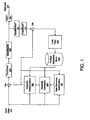
- FIG. 1 depicts a diagram of an example of a video encoder.
- FIG. 2 depicts a diagram of an example of a video decoder.
- FIG. 3 is a diagram of an example of a Lagrangian optimization function.
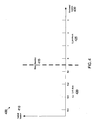
- FIG. 4 is an illustration of an example Mean Square Difference of Slope (MSDS) metric along block boundaries.
- MSDS Mean Square Difference of Slope
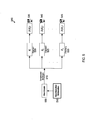
- FIG. 5 depicts a diagram of an example of a video compression scheme under multiple rate constraints.
- FIG. 6 depicts a diagram of an example of a video compression scheme under multiple distortion constraints.
- FIG. 7A depicts a diagram for an example of parallel optimization.
- FIG. 7B depicts a flow diagram for illustrating an example process for implementing parallel optimization.
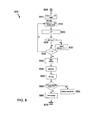
- FIG. 8 depicts a diagram for illustrating an example of sequential optimization.
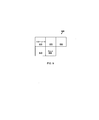
- FIG. 9 depicts a diagram for illustrating an example of threshold decision under sequential optimization.
- FIG. 10A depicts a diagram of an example video coding optimization scheme using hybrid optimization under multiple distortion constraints.
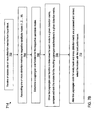
- FIG. 10B depicts a flow diagram illustrating an example of a hybrid optimization technique.
- FIG. 11A depicts a diagram of an example video coding scheme using cascaded optimization under multiple distortion constraints.
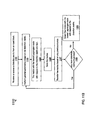
- FIG. 11B depicts a flow diagram of an example process for implementing cascaded optimization.
- FIG. 12 depicts a system diagram with the disclosed techniques for video compression under multiple distortion constraints.
- Example embodiments relating to video compression under multiple distortion constraints are described herein.
- numerous specific details are set forth in order to provide a thorough understanding of the present invention. It will be apparent, however, that embodiments of the present invention may be practiced without these specific details. In other instances, well-known structures and devices are shown in block diagram form in order to avoid unnecessarily obscuring the present invention.
- aspects of the disclosed techniques involve video coding optimizations under multiple distortion constraints.
- the optimization methods presented in this disclosure can be used to optimize various mode decisions in video compression systems, such as the selection of quantization parameters, motion vectors, intra prediction modes, coding block (e.g., macroblock) sizes, transforms, entropy coding, among others.
- coding block e.g., macroblock
- some embodiments feature a method for video coding involves determining a first set of Lagrangian cost values for multiple coding modes using a first distortion metric, and determining a second set of Lagrangian cost values for the multiple coding modes using a second distortion metric. The method involves selecting one of the coding modes based on the first set of Lagrangian cost values and the second set of Lagrangian cost values, and encoding a pixel block using the selected coding mode.
- the first and second Lagrangian cost values can include different bit target rates.
- the distortion metrics can include information associated with characteristics of a video display, in which the characteristics of the video display can include screen display size, a measurement of video processing performance of the video display, a distortion characteristic of a display, a temporal characteristic of the video display, or a spatial characteristic of the video display.
- the distortion metrics can also have information associated with characteristics of multiple video displays, the characteristics of the multiple video displays include parameters for usage of the video displays, parameters for indicating the importance of the video displays, parameters for types of design for the video displays, parameters for types of display technologies for the video displays, and parameters for ranking the video displays using any combination of the characteristics.
- the selection of the mode can involve selecting the first subset of distortion metrics based on associating the distortion metrics' information for the characteristic of the video display with a similar characteristic of the video display.
- the selection of the mode can involve ranking the multiple coding modes.
- the method may also involve determining a third set of Lagrangian cost values for the coding modes using a third distortion metric, and determining a fourth set of Lagrangian cost values for the coding modes using a fourth distortion metric.
- the method can also include selecting one of the coding modes based on the sets of Lagrangian cost values, and encoding a second pixel block using the selected coding mode.
- some embodiments feature a method for video coding that includes sending a compressed bit stream from a video encoder to multiple channels, in which the channels include a target bit rate and multiple distortion metrics.
- the method involves matching one of the distortion metrics from one of the channels to a characteristic of a first video display, and sending video data to the first video display with the distortion metric that matches the characteristic of the first video display.
- the distortion metrics can include information associated with characteristics of a video display, in which the characteristics include screen display size, a measurement of video processing performance of the video display, a distortion characteristic of a display, a temporal characteristic of the video display, or a spatial characteristic of the video display.
- the distortion metrics can also include information associated with characteristics of multiple video displays, the characteristics of the video displays can include parameters for usage of the multiple video displays, parameters for indicating the importance of one or more of the video displays, parameters for types of design for the video displays, parameters for types of display technologies for the video displays, and parameters for ranking the video displays using any combination of the characteristics.
- the method can also involve, before sending the compressed bit stream, encoding a pixel block using a Lagrangian cost function, in which the Lagrangian cost function can include distortion information from the encoding that includes multiple modes with the distortion metrics that has the corresponding bit target rates.
- the method can include ranking the distortion metrics in each channel based on associating the distortion metrics' information for the characteristic of the video display with a similar characteristic of the first video display, in which the matching of the one distortion metric from the one channel includes selecting a highest ranked distortion metric.
- the method may also involve eliminating the distortion metrics that are unmatched.
- some embodiments feature a method of video coding under multiple distortion constraints, in which the method includes associating distortion metrics to multiple candidate modes.
- Each of the distortion metrics are associated with a group of candidate modes.
- the method involves concurrently processing the candidate modes with a respective Lagrangian cost function, and for each distortion metric, ranking the candidate modes within each group according to the Lagrangian cost functions.
- the method involves comparing the ranking of the candidate modes amongst each group of candidate modes, selecting the group of candidate modes with a highest ranking, and selecting a target mode for a video display based on selecting a highest-ranking candidate mode within the selected group of candidate modes.
- the rankings can be based on associating a characteristic of the video display with a distortion metric characteristic.
- the distortion metrics can include information associated with video display characteristics, in which the video display characteristics can involve screen display size, a measurement of video processing performance, a distortion characteristic, a temporal characteristic, or a spatial characteristic.
- the distortion metrics may also include information associated with characteristics of multiple video displays, in which the characteristics of the multiple video displays can include parameters for usage of the multiple video displays, parameters for indicating the importance of the video displays, parameters for types of design for the video displays, parameters for types of display technologies for the video displays, and parameters for ranking the video displays using any combination of the characteristics.
- some embodiments include features for a method of video coding under multiple distortion constraints, in which the method involves processing a bit stream of video information to determine a first Lagrangian cost function for a first mode with a first distortion metric.
- the method includes comparing the first Lagrangian cost function with a threshold, and if the first Lagrangian cost function is greater than the threshold, eliminating the mode with the first distortion metric. If the first Lagrangian cost function is less than the threshold, the method involves determining a second Lagrangian cost function for a first mode with a second distortion metric.
- the method can include comparing the second Lagrangian cost function with the threshold. If the second Lagrangian cost function is greater than the threshold, the method can involve eliminating the mode with the second distortion metric. If the second Lagrangian cost function is less than the threshold, the method can involve determining a third Lagrangian cost function for a first mode with a third distortion metric by processing the video information.
- some embodiments include features for a method of video coding under multiple distortion constraints, in which the method involves, for a number of modes with multiple distortion metrics for each of the modes, processing a bit stream of video information to determine a Lagrangian cost function with a distortion metric for each mode.
- the method involves comparing each Lagrangian cost function with a threshold, and if the respective Lagrangian cost function is greater than the threshold, the method involves eliminating the respective mode with the respective distortion metric. If the respective Lagrangian cost function is less than the threshold, the method involves determining a subsequent Lagrangian cost function for a respective mode with a subsequent distortion metric.
- the respective Lagrangian cost functions are serially determined and compared with the threshold until all distortion metrics for all modes have been compared and/or eliminated.
- the distortion metrics can include information associated with video display characteristics, in which the video display characteristics can include screen display size, a measurement of video processing performance, a distortion characteristic, a temporal characteristic, and/or a spatial characteristic.
- the distortion metrics can also include information associated with characteristics of multiple video displays, the characteristics of the multiple video displays includes parameters for usage of the video displays, parameters for indicating an importance of one or more of the video displays, parameters for types of design for the video displays, parameters for types of display technologies for the video displays, and parameters for ranking the multiple video displays using any combination of the characteristics.
- the method can involve selecting a subset of the modes with the distortion metrics that were kept to output to a component associated with presenting the video information on a video display.
- the method can include adjusting a value of the threshold for one or more modes or for one or more distortion metrics.
- the threshold can be a function of a distortion associated with a macroblock, in which the threshold function can include a measure of a correlation of distortion for macroblocks that are neighbors of the macroblock.
- some embodiments can feature a video coding method that includes using statistics to identify one or more coding modes that are statistically unlikely to be selected for parallel optimization coding. For the one or more coding modes that are statistically likely to be selected, the method involves processing the one or more coding modes according to the parallel optimization coding. For the one or more modes that are statistically unlikely to be selected, the method involves employing sequential optimization coding, and using a performance criteria to select a subset of modes from the parallel optimization coding and the sequential optimization coding.
- the sequential optimization coding can include, for a number of distortion metrics for one or more coding modes, processing video information to determine a Lagrangian cost function with a distortion metric for each of the coding modes.
- the method involves comparing each respective Lagrangian cost function with a threshold, and if the respective Lagrangian cost function is greater than the threshold, the method involves eliminating the respective coding mode with the respective distortion metric. If the respective Lagrangian cost function is less than the threshold, the method involves determining a subsequent Lagrangian cost function for a respective coding mode with a subsequent distortion metric.
- the respective Lagrangian cost functions are serially determined and compared with the threshold until all distortion metrics for all coding modes have been compared or eliminated.
- the parallel optimization coding can include concurrently accessing one or more modes with multiple distortion metrics, and associating the multiple distortion metrics to a number of candidate modes.
- Each of the multiple distortion metrics can be associated with a group of candidate modes.
- the method can include concurrently processing the candidate modes with a respective Lagrangian cost function. For each distortion metric, the method can involve ranking the candidate modes within each group according to the Lagrangian cost functions, comparing the ranking of the candidate modes amongst each group of candidate modes, selecting the group of candidate modes with a highest ranking; and selecting a target mode for a video display based on selecting a highest-ranking candidate mode within the selected group of candidate modes.
- the distortion metrics can include information associated with video display characteristics, in which the video display characteristics includes screen display size, a measurement of video processing performance, a distortion characteristic, a temporal characteristic, or a spatial characteristic.
- the distortion metrics can include information associated with characteristics of multiple video displays, in which the characteristics of the multiple video displays includes parameters for usage of the video displays, parameters for indicating an importance of any of the video displays, parameters for types of design for the video displays, parameters for types of display technologies for the video displays, and parameters for ranking the video displays using any combination of the characteristics.
- some embodiments include features for a video coding method that includes accessing a bit stream, including a first distortion metric, concurrently processing Lagrangian cost functions for a first set of modes associated with the first distortion metric, comparing the Lagrangian cost functions of the first set of modes, in which the comparison involves a ranking of the Lagrangian cost functions of first set of modes.
- the method involves selecting a first subset of modes from the first set modes based on the comparison, and arranging an order of the first subset of modes based on data from a previous mode ranking.
- the method also involves concurrently processing Lagrangian cost functions for the first subset of modes using a second distortion metric, and comparing the Lagrangian cost functions of the first subset of modes.
- the comparison involves a ranking of the Lagrangian cost functions of the first subset of modes.
- the method involves selecting a second subset of modes from the first set modes based on the ranking of the Lagrangian cost functions of the first subset of modes, and arranging an order of the second subset of modes based on data from a previous mode ranking.
- the distortion metrics can include information associated with video display characteristics, in which the video display characteristics includes screen display size, a measurement of video processing performance, a distortion characteristic, a temporal characteristic, and/or a spatial characteristic.
- the distortion metrics can also include information associated with characteristics of a multiple video displays, in which the characteristics of the multiple video displays include parameters for usage of the video displays, parameters for indicating an importance of any of the video displays, parameters for types of design for the video displays, parameters for types of display technologies for the video displays, and parameters for ranking the video displays using any combination of the characteristics.
- each channel can have a distortion metric that suits the distortion requirements, processing features, screen size, and display characteristics of particular end displays.
- the distortion metrics for a first channel can have a first distortion metric suited for the characteristics of a particular mid-size display monitor, a second distortion metric suited for the characteristics of a display for a hand-held device, and a third distortion metric suited for the characteristics of a large, flat-screen television.
- any of the methods and techniques described herein can also be implemented in a system, an apparatus or device, a machine, a computer program product, in software, in hardware, or in any combination thereof.
- the computer program product can be tangibly encoded on a computer-readable medium, and can include instructions to cause a data processing apparatus (e.g., a data processor) to perform one or more operations for any of the methods described herein.
- example video coding optimization techniques depicted and described herein include parallel optimization techniques, sequential optimization techniques, hybrid optimization techniques, and cascaded optimization techniques.
- Video compression systems and standards e.g., ISO MPEG-1, MPEG-2, MPEG-4, MPEG-4 AVC/ITU-T H.264, H.261, H.263, and VC-1) including scalable (e.g., SVC) and multiview coding systems (e.g., MVC) can provide an approach to store and deliver video contents at a reasonable cost.
- Video coding optimization can be a component of video compression systems. Video coding optimization can provide high coding efficiency with a quality visual experience.
- FIG. 1 depicts a diagram of an example of a video encoder 100.
- the encoder 100 may be an encoder for the advanced video coding standard (AVC), otherwise referred to as MPEG-4 AVC or ITU-T H.264.
- AVC advanced video coding standard
- the input video 102 is sent to an adder 116 that sums the input video frame 102 with an output of a disparity compensation (e.g., motion/illumination change compensation and/or intra-prediction) component 160.
- the output from the adder 116 is coupled to a transform component 104, followed by a quantization component 106.
- the output of the quantization component 106 is coupled to a variable length coding (VLC) component 108 and an inverse quantization component 110.
- VLC variable length coding
- the bit stream 120 results from the VLC component 108.
- Information about the encoding process such as the number of bits required to encode a block, region, or image, and the distortion introduced by such decision, are sent to the
- the disparity compensation component 160 can generate a prediction signal given information/decisions from the disparity estimation component 162.
- the disparity estimation component 162 can perform tasks that may include: (a) determining the appropriate prediction parameters such as motion vectors, illumination change parameters, and/or intra prediction modes, (b) selectively enabling and disabling motion-compensation block-sizes; (c) using certain pictures as motion-compensation references; (d) adjusting the motion estimation search range, refinement patterns, and/or the number of motion estimation iterations ; and (e) limiting the number of coding modes to be tested given some predefined conditions or information about the image, among others.
- the loop filter component 166 can perform tasks that may include: (a) adjusting the parameters of the in-loop deblocking filter; (b) switching-off the deblocking filter, among others.
- the rate distortion optimization component 180 receives the input video 102 and the output from the disparity compensation component 160 to send rate distortion optimization information to the disparity estimation component 162.
- Disparity estimation can be characterized by a balance between minimizing the motion compensation (or prediction) error, while maximizing the coherence of the motion field.
- the coherence of the motion field can be expressed in terms of the motion field's smoothness.
- the motion for coherent objects is expected to be smooth with each object so that the motion field is only discontinuous at object boundaries. These object boundaries can be referred to as contour edges or silhouette edges.
- the inverse transform component 112 receives an input from the inverse quantization component 110 and sends an output to an adder 126.
- the adder 126 receives the signal from the inverse transform component 112 and the disparity compensation component 160, and sends a summed signal to a loop filter 166.
- a picture reference store 164 receives an input from the loop filter 166, and sends an output to the disparity compensation component 160 and the disparity estimation component 162.
- the disparity estimation component 162 also receives an input from the rate control component (not shown).
- the loop filter 166 also receives an input from the rate control component.
- the input video 102 is also sent to an input of the disparity compensation component 160 and the disparity estimation component 262.
- FIG. 2 depicts a diagram of an example video decoder 200.
- the decoder 200 may function in substantial conformity with the H.264/AVC standard.
- the decoder 200 receives the bit stream 120, and decodes the bit stream using an entropy (variable length) decoder 205, one or multiple inverse quantizers 230, one or multiple inverse transform components 235, and a disparity compensation component 210.
- the entropy decoder 205 may extract both header information, including disparity information such as modes, motion vectors, illumination change parameters, intra prediction modes, among others, and quantized and transformed residual data.
- Disparity compensation and more specifically prediction of the signal, is performed in the disparity compensation component 210 using the header information, while the residual data are first dequantized using the inverse quantizer 230 and then inverse transformed using the inverse transform component 235.
- An adder 255 adds the output of the inverse transform 255 and the disparity compensator 210, and sends the summed result to a loop filter 225.
- the output of the loop filter 225 is coupled to a reference picture buffer 220, which can be used for storing pictures for reference and delivering an output 250.
- Lagrangian Optimization can be used as a video coding optimization technique.
- Lagrangian Optimization formulates the video coding optimization issue as the minimization of the Lagrangian cost function.
- FIG. 3 is a diagram 300 depicting an example of a Lagrangian optimization function.
- the index i is of one of the N blocks or groups of blocks to be optimized
- ⁇ j i is the different coding modes, such as different quantizers or prediction modes
- d i ⁇ ⁇ j i is the distortion of encoding the block with mode ⁇ j i , with r i ⁇ ⁇ j i as the corresponding rate
- ⁇ is referred to as the Lagrangian multiplier, which is a nonnegative real number.
- ⁇ * represents the optimal modes, where the overall Lagrangian cost functions are minimized.
- Diagram 300 depicts a plot of distortion D 315 versus rate R 320, where the minimization of the Lagrangian cost function 325 is depicted with plane waves representing the slope of the Lagrangian multiplier 330.
- FIG. 3 can indicate an optimal solution when minimizing a Lagrangian cost function given a certain Lagrangian multiplier ⁇ .
- a minimum point of the Lagrangian cost function 325 is at d i ⁇ ⁇ j i 340 for the distortion of encoding the block with mode ⁇ j i with r i ⁇ ⁇ j i 345 as the corresponding rate, where ⁇ ⁇ r i ⁇ ⁇ j i 335 is upper distortion range of one of the plane waves.
- the rate is generally counted by bits.
- SAD Sum of Absolute Differences
- SSD Squared Difference
- JND Just Noticeable Difference
- MSDS Mean Square Difference of Slope
- FIG. 4 is a diagram 400 depicting an example Mean Square Difference of Slope (MSDS) metric 400 along block boundaries.
- MSDS is the square of the difference between the slopes across two adjacent blocks and the average between the slopes of each of the two blocks close to their boundaries.
- Diagram 400 depicts a block boundary 415 for a vertical location 410 versus a horizontal location 430, where the block boundary 415 separates the upper blocks (e.g., blocks 0, 1, 2, 3, etc.) from the lower blocks (e.g., N-1, N-2, N-3, N-4, etc.).
- Additional metrics e.g., such as display and/or distortion metrics
- Equation 7 can represent a Lagrangian function with K + 1 degrees of freedom, where ⁇ k can be the reciprocal of a corresponding Lagrangian multiplier ⁇ k .
- the Lagrangian cost function When a combined distortion metric is considered in the Lagrangian cost function, there can be tuning requirements (e.g., requirements for sophisticated processing and computations) for the Lagrangian multipliers because different distortion metrics may not present a magnitude of the distortion in a common unit.
- the common unit correlates or normalizes different metrics so that the different metrics can relate to each other on a similar scale or manner.
- aspects of this disclosure present an optimization methodology that considers different distortion constraints with multiple Lagrangian cost functions.
- two types of Lagrangian cost functions are expressed in Equations 8 and 9.
- FIG. 5 depicts a diagram of an example of a video compression scheme 500 using multiple rate constraints using a single distortion constraint.
- the rate distortion optimization component 510 sends information to a video encoder 505, which sends a compressed bit stream 515 to multiple channels 520-530.
- Each channel 520, 525, 530 has one distortion metric 535, 540, 545, respectively. Similar to Equation 9, the distortion can be measured with the same distortion metric D(R) and the difference in distortion values may be caused by the different target rates, R 1 , R 2 ,...R L . The different rates in Equation 9 may share the same common measurement unit.
- FIG. 6 depicts a diagram of an example of a video compression scheme 600 using multiple distortion constraints for a given rate constraint.
- a bit stream is not only optimized for different bit rate budgets, but also for different target devices, e.g., different size, resolution, or display types including LED, Plasma, OLED, and/or DLP displays, each with its own display characteristics, and therefore, its own distortion metric.
- Information from the rate distortion optimization component 510 is sent to a video encoder 505, which sends a compressed bit stream 515 to multiple channels 620-630, with each channel having its own rate constraint and various end display distortion metrics 635-670.
- each channel can have a distortion metric that suits the distortion requirements, processing features, display screen size, and display characteristics of particular end displays.
- the distortion metrics for a channel 635 with target bit rate R 2 can have a first distortion metric D 2 ( R 2 ) 645 suited for the characteristics of a particular mid-size display monitor, a second distortion metric D m ( R 2 ) 650 suited for the characteristics of a display for a hand-held device, and a third distortion metric D n ( R 1 ) 655 suited for the characteristics of a large, flat-screen television.
- multiple distortion metrics for a given rate constraint can be employed in various application scenarios.
- One such application can be a video encoder that jointly optimizes the bit streams that are subsequently streamed to mobile devices with small display screens and home entertainment devices, which may have much bigger display screens.
- Such vast differences in display screen sizes, as well as brightness and display technology among others, can lead to very different visual evaluation criteria. For instance, it is possible that certain coding artifacts within an encoded image may be unnoticeable or appear as minor on a small display screen (e.g., a mobile phone screen or a hand-held device display screen) but can be noticeable when the same content is displayed on larger display screens (e.g., a large LCD monitor, Plasma, or DLP display).
- DSP digital signal processing
- Equation 8 Lagrangian cost formulation that can be expansive and extensive (Equation 8) at least because this type of formulation (Equation 8) can take into account various distortion metrics D k .
- This formulation (Equation 8) may correspond to the example shown in FIG. 6 , and can take into account display characteristics (e.g., display screen size, resolution), processing characteristics (e.g., DSP), and distortion characteristics (e.g., distortion from processing macroblocks or other features).
- the different distortion values in Equation 8 may be caused by different target rates and/or different distortion metrics.
- the different distortions in Equation 8 can be measured by different distortion metrics and do not necessarily have to share a common measurement unit.
- the selected distortion metrics can be suited for particular distortion attributes for the various end displays.
- one distortion metric can improve a temporal quality of a first type of display
- a second distortion metric can correspond to a spatial quality of a second type of display
- a third distortion metric can be oriented towards a type of color quantity or sharpness of a third type of display.
- the distortion metrics can also be suited for multiple bit rate targets, and can take into account various types of display characteristics and distortion requirements.
- Video coding optimizations using multiple distortion constraints can be implemented in a number of ways. To illustrate, at least four examples are depicted and described below.
- the video coding optimization examples include parallel optimization techniques, sequential optimization techniques, hybrid optimization techniques, and cascaded optimization techniques. Each of these methods can be characterized by different configurations and combinations of multiple optimization levels, allowing different performance and complexity tradeoffs. Although these four examples may primarily involve the type of Lagrangian cost functions of Equation 8, they may also include a combination of both of the types of Lagrangian cost functions expressed in Equation 8 and Equation 9. That is, at any optimization step multiple distortion costs can be considered instead of only a single one.
- Equation 8 may be able to decouple the decision of each distortion metric and its corresponding Lagrangian cost function.
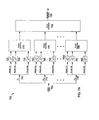
- FIG. 7A depicts a diagram of an example video coding optimization scheme 700 employing parallel optimization under multiple distortion constraints.
- an optimal mode is selected from M candidate modes and there are K different distortion metrics.
- Scheme 700 can perform Lagrangian optimization on each of the distortion metrics simultaneously.
- the input block 705 sends distortion metrics 710, 715, 720 to respective candidate modes (1, 2, ...M).
- D 1 710 for example, Lagrangian cost functions 725, 730, 735, are processed for modes 1, 2, M, respectively.
- Lagrangian cost function ranking modules 770, 775, 780 operate for each given distortion metric 710, 715, 720, respectively.
- An example of such mode ranking can involve scoring each mode for a given distortion metric based on their Lagrangian cost function.
- the mode with the smallest Lagrangian cost function can have score 1
- the mode with the second smallest Lagrangian cost function can have score 2, and so on.
- a final mode selection module 785 chooses the mode with the best performance.
- the model selection module 785 can compute an overall score for each mode and choose the module with the lowest score, or it can use more complicated weighting system to decide the best mode.
- FIG. 7B depicts a flow diagram showing an example process 714 for implementing parallel optimization.
- the techniques in FIG. 7B involve receiving or accessing one or more distortion metrics from input block (702), associating or sending one or more distortion metrics to respective candidate modes (1, 2, ...M) (704), and determining a Lagrangian cost function for the respective candidate modes (706).
- process 700 includes comparing and ranking the resulting Lagrangian cost functions in a given distortion metric (708).
- the techniques include selecting the modes with the best performance (712). In some cases, the best performance can refer to the overall best ranking given certain constraints of the optimization process.
- the mode selection 785 can take the output of ranked modes 770, 775, 780, for which, in some embodiments, may generally be the ranked results (or "score") instead of the Lagrangian cost.
- the Lagrangian cost may not be addable with respect to different distortion metrics, and the ranked results may provide another way to compare the overall performance.
- the selected modes can optionally be ranked or further ranked according to some other parameter or ranking scheme.
- FIG. 8 depicts a diagram showing an example optimization process 800 employing sequential optimization under multiple distortion constraints.
- T k a threshold
- this mode is discarded and no longer considered as a candidate mode (830).
- This discarded candidate mode can be referred to as a candidate mode that is subject to an "early termination.”
- the Lagrangian cost function is smaller than the threshold (825)
- the Lagrangian cost function corresponding to the next distortion metric can be determined (835). Such procedure continues until the mode is terminated early (830) or the Lagrangian cost functions for all distortion metrics have been computed (835).
- mode(j) is kept, the k loop ends for the distortion metric (845), and the j loop ends for the modes (850). If the number of remaining modes is not greater than zero, then the mode decision is backed up (860). If the number of remaining modes is greater than zero, then the mode selection is performed (865) and the selected modes can be made available (870) for outputting to another system component.
- the threshold T i can be predefined by the user or it can be estimated adaptively and/or adjusted during the encoding.
- a final mode decision module is used to select a mode or a set of modes for this block (865, 870).
- One example of such final mode decision module can be ranking the remaining modes with respect to one or more distortion metrics that have been computed in previous steps.
- a back-up mode decision module is used (860).
- One example of such a back-up mode decision module involves simply selecting a preset default mode.
- Another example of a back-up mode decision module involves reducing the thresholds and comparing the Lagrangian cost functions again with the new thresholds until there is at least one mode that passes all the threshold tests.
- the module can choose one optimal mode that minimizes the Lagrangian cost function with respect to only one preset distortion metric.
- the thresholds can be used to eliminate certain modes and/or distortion metrics, and can be used to find an optimal mode and/or distortion metric.
- a first threshold can be compared to a first distortion measurement, and if the resulted distortion is greater than a predetermined acceptable range (assuming a minimization formulation) or lesser than a predetermined acceptable range (assuming a maximization formation), then the distortion metric can be considered an outlier and can be eliminated. Then, a second distortion metric can be compared to the threshold.
- the second distortion metric is not greater than a predetermined acceptable range (assuming a minimization formulation) or lesser than a predetermined acceptable range (assuming a maximization formation), then it can be kept and processed further to determine if it should be used in a subsequent selection.
- a group of multiple distortion metrics are concurrently compared to a threshold, and the distortion metrics that are far away from the threshold can be discarded.
- FIG. 9 depicts a diagram 900 for illustrating an example of threshold decision under sequential optimization.
- a threshold T i can be determined using knowledge of previous encoded and neighboring blocks. After each block ( k , l ) is encoded, the block's true distortion D i ( k,l ) can be computed with respect to distortion metric D i .
- the neighboring blocks are D i (m-1,n-1) 910, D i (m, n-1) 920, D i (m+1, n-1) 930, and D i (m-1,n) 940, where the distortion of the neighboring blocks can have correlated information that can be used to find a distortion correlation for a current block ( m , n ) 950.
- the threshold could specify if the distortion computation should be terminated immediately, or could specify how many and which additional distortion metrics should be considered. For example, if the distortion of the current block ( m , n ) 950 differs greatly from the distortion of its neighboring blocks, then the distortion of the current block ( m , n ) 950 can be considered an outlier, and can be eliminated from the optimization method to save processing resources and speed up system computations.
- multiple thresholds can be used for each distortion metric, where the corresponding Lagrangian cost function can be compared with each of the thresholds in a multi-stage manner.
- the sequence of the distortion metrics can be tested, of which, thresholds can be used that depend on values from other previously tested thresholds.
- the thresholds can be based on local and/or global characteristics, or the thresholds can be adaptively adjusted to new threshold values during the optimization process. For example, if multiple thresholds are used, the various thresholds can be adjusted or reordered during the processing to help eliminate distortion metrics that are unlikely to be selected in the optimization process. The likelihood of selection may be based on statistics that were developed before the selection process. This embodiment can also save processing resources.
- the weights, a and b can be adjusted based on a refresh rate of a display, or a number of cycles that should be used during processing the optimization algorithm.
- Some distortion metrics can be selected based on the importance of the distortion metric. For example, if a first distortion metric is suited for a large-screen TV display and a second distortion metric is suited for a display of a hand-held device, the second distortion metric can be selected as the more important distortion metric if a certain percentage (e.g., over 50%) of the use of the metric will likely be on a display of a hand-held device. As a result, the optimization will be based on the second distortion metric for the display of the hand-held device.
- a certain percentage e.g., over 50%
- FIG. 10A depicts a diagram of an example video coding optimization scheme 1000 using hybrid optimization under multiple distortion constraints.
- the sequential optimization mode subset 1065 has modes that are less likely to be selected and used with the sequential optimization 1070.
- the distortion metrics D 1 1003, D 2 1006, D k 1009, from the input block 1001 are used in various modes 1... M , Lagrangian costs functions 1005-1060, and mode ranking 1075, as described above in FIGS. 7A-7B .
- the modes from the mode ranking 1075-1085, and the sequential optimization are taken into account during mode selection 1090 for the selected modes 1095.
- the mode selection 1090 can consider the modes from the parallel optimization first, and then consider the modes, if any, from the sequential optimization second. In other embodiments, the modes from the parallel optimization will always be ranked and selected higher than the modes from the sequential optimization.
- FIG. 10B depicts a flow diagram illustrating an example of a hybrid optimization technique.
- one or more modes can be identified that are generally less likely to be selected (1002). These modes can be assigned in a separate sequential optimization mode compared to higher likelihood modes (1004). For the modes that are less likely selected, the Lagrangian cost function for each distortion metric can be compared with a preset threshold (1007). If the cost is greater than the corresponding threshold, this mode is discarded and no longer considered for the optimization of this block (1008). All other modes can be examined using the parallel optimization system as described above in FIGS. 7A-B (1012). Then the best modes from the parallel and sequential optimization are selected (1014).
- FIG. 11A depicts a diagram of an example video coding scheme 1100 using cascaded optimization under multiple distortion constraints.
- scheme 1100 combines the parallel optimization and sequential optimization in a cascaded manner.
- the Lagrangian cost functions 1110-1120 for all M 1 modes from an input block 1105 are computed with respect to distortion metric D 1 and compared.
- the M 2 modes with the lowest Lagrangian costs with respect to D1 are kept, with M 2 ⁇ 1.
- These M 2 modes can be ranked and/or eliminated 1145, and then re-ordered based on the results previous rounds 1160, if any.
- These M 2 modes are then passed to distortion metric D 2 , where a similar procedure is performed for a subset 1125 for that metric.
- parallel optimization 1130 is performed, with the Lagrangian cost functions for all modes being computed and compared.
- the modes with the lowest Lagrangian costs with respect to the distortion metric are kept (e.g., the M 3 modes with the lowest Lagrangian cost with respect to D 2 are kept), and then ranked and/or eliminated 1150, and then re-ordered based on any previous rounds, such as the prior round with distortion metric D 1 .
- the optimization can be by hybrid optimization 1140.
- the optimization can be another parallel or sequential-type optimization.
- the modes with the lowest Lagrangian costs with respect to the distortion metric are kept are selected 1155 and the selected modes 1170 are made available.
- the process can terminate early with each step eliminating a certain number of modes until there is only one mode left.
- FIG. 11B depicts a flow diagram of an example process 1112 for implementing cascaded optimization.
- Process 1112 invokes of receiving or accessing a distortion metric from an input block (1102), and performing parallel (or hybrid) optimization based on the distortion metric (1103).
- the modes with the lowest Lagrangian costs with respect to the distortion metric are kept (1104).
- the modes are then ranked (1106) and reordered based on results from previous rounds, if any (1107). If there are any more distortion metrics to process (1108), then the parallel (or hybrid) optimization is performed on those other distortion metrics. If there are not any more distortion metrics to process (1108), then the modes with the lowest Lagrangian costs with respect to the distortion metric are kept and selected (1109).
- this step 1109 may also be described as selecting the modes with the best performance. The modes can be selected based on the performance of the modes of the remaining distortion metric.
- FIG. 12 depicts a system diagram that can employ any (and any combination) of the disclosed techniques for video compression under multiple distortion constraints.
- the disclosed techniques can be used on one or more computers 1205A, 1205B.
- One or more methods and/or algorithms and/or processes herein can be implemented with, or employed in computers and/or video display 1220, transmission, processing, and playback systems.
- the computers described herein may be any kind of computer, either general purpose, or some specific purpose computer such as a workstation.
- the computer 1205B may be, e.g., an Intel or AMD based computer, running Windows XP, Vista, or Linux, or may be a Macintosh computer.
- the computer can also be, e.g., a handheld computer, such as a PDA 1215, cell phone 1215, or laptop 1205A.
- the computer may also refer to machines or parts of a machine for image recording or reception 1225, 1230, 1235, processing, storage 1240, and distribution of data, in particular video data.
- Computer and/or graphic programs may be written in C or Python, or Java, Brew or any other programming language.
- the programs may be resident on a storage medium, e.g., magnetic or optical, e.g. the computer hard drive, a removable disk or media such as a memory stick or SD media, wired or wireless network based or Bluetooth based Network Attached Storage (NAS), or other removable medium.
- the programs may also be run over a network 1250, for example, with a server or other machine sending communications to the local machine, which allows the local machine to carry out the operations described herein.
- Embodiments of the subj ect matter and the functional operations described in this specification can be implemented in digital electronic circuitry, or in computer software, firmware, or hardware, including the structures disclosed in this specification and their structural equivalents, or in combinations of one or more of them.
- Embodiments of the subject matter described in this specification can be implemented as one or more computer program products, e.g., one or more modules of computer program instructions encoded on a computer readable medium for execution by, or to control the operation of, data processing apparatus.
- the computer readable medium can be a machine-readable storage device 1240, a machine-readable storage substrate, a memory device, a composition of matter effecting a machine-readable propagated, processed communication, or a combination of one or more of them.
- data processing apparatus encompasses all apparatus, devices, and machines for processing data, including by way of example a programmable processor, a computer, or multiple processors or computers.
- the apparatus can include, in addition to hardware, code that creates an execution environment for the computer program in question, e.g., code that constitutes processor firmware, a protocol stack, a graphical system, a database management system, an operating system, or a combination of one or more of them.
- a computer program (also known as a program, software, software application, script, or code) can be written in any form of programming language, including compiled or interpreted languages, and it can be deployed in any form, including as a stand alone program or as a module, component, subroutine, or other unit suitable for use in a computing environment.
- a computer program does not necessarily correspond to a file in a file system.
- a program can be stored in a portion of a file that holds other programs or data (e.g., one or more scripts stored in a markup language document), in a single file dedicated to the program in question, or in multiple coordinated files (e.g., files that store one or more modules, sub programs, or portions of code).
- a computer program can be deployed to be executed on one computer or on multiple computers that are located at one site or distributed across multiple sites and interconnected by a communication network.
- the processes and logic flows and figures described and depicted in this specification can be performed by one or more programmable processors executing one or more computer programs to perform functions by operating on input data and generating output.
- the processes and logic flows can also be performed by, and apparatus can also be implemented as, special purpose logic circuitry, e.g., an FPGA (field programmable gate array) or another programmable logic device (PLD) such as a microcontroller, or an ASIC (application specific integrated circuit).
- FPGA field programmable gate array
- PLD programmable logic device
- ASIC application specific integrated circuit
- processors suitable for the execution of a computer program include, by way of example, both general and special purpose microprocessors, and any one or more processors of any kind of digital computer.
- a processor can receive instructions and data from a read only memory or a random access memory or both.
- the essential elements of a computer are a processor for performing instructions and one or more memory devices for storing instructions and data.
- a computer can also include, or be operatively coupled to receive data from or transfer data to, or both, one or more mass storage devices for storing data, e.g., magnetic, magneto optical disks, or optical disks.
- mass storage devices for storing data, e.g., magnetic, magneto optical disks, or optical disks.
- a computer need not have such devices.
- a computer can be embedded in another device, e.g., a mobile telephone, a personal digital assistant (PDA), a mobile audio player, a Global Positioning System (GPS) receiver, to name just a few.
- Computer readable media suitable for storing computer program instructions and data include all forms of non volatile memory, media and memory devices, including by way of example semiconductor memory devices, e.g., EPROM, EEPROM, and flash memory devices; magnetic disks, e.g., internal hard disks or removable disks; magneto optical disks; and CD ROM and DVD-ROM disks.
- the processor and the memory can be supplemented by, or incorporated in, special purpose logic circuitry.
- some embodiments of the subject matter described in this specification can be implemented on a computer having a display device, e.g., a CRT (cathode ray tube), LCD (liquid crystal display), or plasma display monitor 1220, for displaying information to the user and a keyboard and a selector, e.g., a pointing device, a mouse, or a trackball, by which the user can provide input to the computer.
- a display device e.g., a CRT (cathode ray tube), LCD (liquid crystal display), or plasma display monitor 1220
- a keyboard and a selector e.g., a pointing device, a mouse, or a trackball
- Other kinds of devices can be used to provide for interaction with a user as well; for example, feedback provided to the user can be any form of sensory feedback, e.g., visual feedback, auditory feedback, or tactile feedback; and input from the user can be received in any form, including acoustic, speech, or tactile input.
- Some embodiments of the subject matter described in this specification can be implemented in a computing system that includes a back end component, e.g., as a data server, or that includes a middleware component, e.g., an application server, or that includes a front end component, e.g., a client computer having a graphical user interface or a Web browser through which a user can interact with an embodiment of the subject matter described is this specification, or any combination of one or more such back end, middleware, or front end components.
- the components of the system can be interconnected by any form or medium of digital data communication, e.g., a communication network. Examples of communication networks include a local area network (“LAN”) and a wide area network (“WAN”), e.g., the Internet.
- LAN local area network
- WAN wide area network
- the computing system can include clients and servers.
- a client and server are generally remote from each other and typically interact through a communication network.
- the relationship of client and server arises by virtue of computer programs running on the respective computers and having a client-server relationship to each other.
- an algorithm can refer to steps, methods, processes, schemes, procedures, operations, programs, guidelines, techniques, sequences, and/or a set of rules or instructions to achieve the results described herein.
- an algorithm can be a set of video processing instructions for a hardware and/or software video processor.
- the disclosed algorithms can be related to video and can be generated, implemented, associated, and/or employed in video-related systems and/or any devices, machines, hardware, and/or articles of manufacture for the processing, compression, storage, transmission, reception, testing, calibration, display, and/or any improvement, in any combination, for video data.
- Lagrangian cost formulations presented in this disclosure can take into account various display, processing, and/or distortion characteristics.
- Embodiments of the present invention may relate to one or more of the following enumerated example embodiments.
Landscapes
- Engineering & Computer Science (AREA)
- Multimedia (AREA)
- Signal Processing (AREA)
- Compression Or Coding Systems Of Tv Signals (AREA)
Applications Claiming Priority (2)
| Application Number | Priority Date | Filing Date | Title |
|---|---|---|---|
| US7443008P | 2008-06-20 | 2008-06-20 | |
| EP09767707A EP2297963B1 (de) | 2008-06-20 | 2009-06-18 | Videokomprimierung unter mehreren verzerrungsnebenbedingungen |
Related Parent Applications (2)
| Application Number | Title | Priority Date | Filing Date |
|---|---|---|---|
| EP09767707.4 Division | 2009-06-18 | ||
| WOPCT/US2009/047755 Previously-Filed-Application | 2009-06-18 |
Publications (2)
| Publication Number | Publication Date |
|---|---|
| EP2439952A2 true EP2439952A2 (de) | 2012-04-11 |
| EP2439952A3 EP2439952A3 (de) | 2013-11-27 |
Family
ID=41011911
Family Applications (3)
| Application Number | Title | Priority Date | Filing Date |
|---|---|---|---|
| EP11182309.2A Withdrawn EP2439951A3 (de) | 2008-06-20 | 2009-06-18 | Videokomprimierung unter mehreren Verzerrungsnebenbedingungen |
| EP11182314.2A Withdrawn EP2439952A3 (de) | 2008-06-20 | 2009-06-18 | Videokomprimierung unter mehreren Verzerrungsnebenbedingungen |
| EP09767707A Not-in-force EP2297963B1 (de) | 2008-06-20 | 2009-06-18 | Videokomprimierung unter mehreren verzerrungsnebenbedingungen |
Family Applications Before (1)
| Application Number | Title | Priority Date | Filing Date |
|---|---|---|---|
| EP11182309.2A Withdrawn EP2439951A3 (de) | 2008-06-20 | 2009-06-18 | Videokomprimierung unter mehreren Verzerrungsnebenbedingungen |
Family Applications After (1)
| Application Number | Title | Priority Date | Filing Date |
|---|---|---|---|
| EP09767707A Not-in-force EP2297963B1 (de) | 2008-06-20 | 2009-06-18 | Videokomprimierung unter mehreren verzerrungsnebenbedingungen |
Country Status (6)
| Country | Link |
|---|---|
| US (1) | US8594178B2 (de) |
| EP (3) | EP2439951A3 (de) |
| JP (1) | JP5253571B2 (de) |
| CN (2) | CN102905131A (de) |
| AT (1) | ATE536048T1 (de) |
| WO (1) | WO2009155398A1 (de) |
Families Citing this family (28)
| Publication number | Priority date | Publication date | Assignee | Title |
|---|---|---|---|---|
| EP2229786B1 (de) * | 2008-01-18 | 2012-07-25 | Thomson Licensing | Verfahren zur bestimmung einer wahrnehmungsqualität |
| US9538176B2 (en) | 2008-08-08 | 2017-01-03 | Dolby Laboratories Licensing Corporation | Pre-processing for bitdepth and color format scalable video coding |
| US20100149301A1 (en) * | 2008-12-15 | 2010-06-17 | Microsoft Corporation | Video Conferencing Subscription Using Multiple Bit Rate Streams |
| CN101778275B (zh) * | 2009-01-09 | 2012-05-02 | 深圳市融创天下科技股份有限公司 | 一种自适应时间域和空间域分辨率框架的图像处理方法 |
| KR101418104B1 (ko) * | 2010-03-08 | 2014-07-16 | 에스케이 텔레콤주식회사 | 움직임 벡터 해상도 조합을 이용한 움직임 벡터 부호화/복호화 방법 및 장치와 그를 이용한 영상 부호화/복호화 방법 및 장치 |
| US8947492B2 (en) * | 2010-06-18 | 2015-02-03 | Microsoft Corporation | Combining multiple bit rate and scalable video coding |
| US9237328B2 (en) * | 2010-07-27 | 2016-01-12 | Electronics And Telecommunications Research Institute | 3D image processing apparatus and method thereof using connection status and glass type selection icons |
| US20130194386A1 (en) * | 2010-10-12 | 2013-08-01 | Dolby Laboratories Licensing Corporation | Joint Layer Optimization for a Frame-Compatible Video Delivery |
| WO2012122421A1 (en) * | 2011-03-10 | 2012-09-13 | Dolby Laboratories Licensing Corporation | Joint rate distortion optimization for bitdepth color format scalable video coding |
| US9338463B2 (en) | 2011-10-06 | 2016-05-10 | Synopsys, Inc. | Visual quality measure for real-time video processing |
| US9781449B2 (en) * | 2011-10-06 | 2017-10-03 | Synopsys, Inc. | Rate distortion optimization in image and video encoding |
| US8923388B2 (en) * | 2011-11-21 | 2014-12-30 | Texas Instruments Incorporated | Early stage slice cap decision in video coding |
| US9756353B2 (en) | 2012-01-09 | 2017-09-05 | Dolby Laboratories Licensing Corporation | Hybrid reference picture reconstruction method for single and multiple layered video coding systems |
| EP2828822B1 (de) | 2012-03-21 | 2018-07-11 | Dolby Laboratories Licensing Corporation | Systeme und verfahren zur leistungsreduktion für anzeigen |
| US9491475B2 (en) * | 2012-03-29 | 2016-11-08 | Magnum Semiconductor, Inc. | Apparatuses and methods for providing quantized coefficients for video encoding |
| US9392286B2 (en) | 2013-03-15 | 2016-07-12 | Magnum Semiconductor, Inc. | Apparatuses and methods for providing quantized coefficients for video encoding |
| US9730136B2 (en) * | 2013-11-26 | 2017-08-08 | Telefonaktiebolaget L M Ericsson (Publ) | Distributed routing in wireless networks |
| US9794575B2 (en) | 2013-12-18 | 2017-10-17 | Magnum Semiconductor, Inc. | Apparatuses and methods for optimizing rate-distortion costs in video encoding |
| US9866853B2 (en) * | 2014-04-15 | 2018-01-09 | Qualcomm Incorporated | System and method for lagrangian parameter calculation for display stream compression (DSC) |
| US9924175B2 (en) | 2014-06-11 | 2018-03-20 | Qualcomm Incorporated | Determining application of deblocking filtering to palette coded blocks in video coding |
| US10136141B2 (en) | 2014-06-11 | 2018-11-20 | Qualcomm Incorporated | Determining quantization parameter (QP) values and delta QP values for palette coded blocks in video coding |
| US10264269B2 (en) | 2014-10-13 | 2019-04-16 | Apple Inc. | Metadata hints to support best effort decoding for green MPEG applications |
| FR3029055B1 (fr) * | 2014-11-24 | 2017-01-13 | Ateme | Procede d'encodage d'image et equipement pour la mise en oeuvre du procede |
| WO2020171046A1 (en) * | 2019-02-20 | 2020-08-27 | Panasonic Intellectual Property Corporation Of America | Image encoder and image decoder |
| US11272192B2 (en) | 2019-03-04 | 2022-03-08 | Comcast Cable Communications, Llc | Scene classification and learning for video compression |
| US11363306B2 (en) * | 2019-04-05 | 2022-06-14 | Comcast Cable Communications, Llc | Methods, systems, and apparatuses for processing video by adaptive rate distortion optimization |
| US11856205B2 (en) * | 2019-11-22 | 2023-12-26 | Intel Corporation | Subjective visual quality enhancement for high spatial and temporal complexity video encode |
| CN113850879B (zh) * | 2021-06-01 | 2025-05-16 | 天翼数字生活科技有限公司 | 一种基于背景建模技术提高静态背景视频压缩率的方法 |
Family Cites Families (22)
| Publication number | Priority date | Publication date | Assignee | Title |
|---|---|---|---|---|
| US5550590A (en) * | 1994-03-04 | 1996-08-27 | Kokusai Denshin Denwa Kabushiki Kaisha | Bit rate controller for multiplexer of encoded video |
| US5506686A (en) * | 1994-11-23 | 1996-04-09 | Motorola, Inc. | Method and device for determining bit allocation in a video compression system |
| US6614845B1 (en) * | 1996-12-24 | 2003-09-02 | Verizon Laboratories Inc. | Method and apparatus for differential macroblock coding for intra-frame data in video conferencing systems |
| US5841413A (en) * | 1997-06-13 | 1998-11-24 | Matsushita Electric Industrial Co., Ltd. | Method and apparatus for moving pixel distortion removal for a plasma display panel using minimum MPD distance code |
| US6754241B1 (en) * | 1999-01-06 | 2004-06-22 | Sarnoff Corporation | Computer system for statistical multiplexing of bitstreams |
| US6925120B2 (en) * | 2001-09-24 | 2005-08-02 | Mitsubishi Electric Research Labs, Inc. | Transcoder for scalable multi-layer constant quality video bitstreams |
| US6973128B2 (en) * | 2003-02-21 | 2005-12-06 | Mitsubishi Electric Research Labs, Inc. | Multi-path transmission of fine-granular scalability video streams |
| US7471724B2 (en) * | 2003-06-23 | 2008-12-30 | Vichip Corp. Limited | Method and apparatus for adaptive multiple-dimensional signal sequences encoding/decoding |
| KR100556340B1 (ko) * | 2004-01-13 | 2006-03-03 | (주)씨앤에스 테크놀로지 | 영상 부호화 장치 |
| EP1578131A1 (de) * | 2004-03-18 | 2005-09-21 | STMicroelectronics S.r.l. | Kodierung/Dekodierungsverfahren und Vorrichtungen, Computerprogrammprodukt dafür |
| WO2005099275A2 (en) * | 2004-04-02 | 2005-10-20 | Thomson Licensing | Complexity scalable video decoding |
| KR100586882B1 (ko) * | 2004-04-13 | 2006-06-08 | 삼성전자주식회사 | 모션 스케일러빌리티를 지원하는 코딩 방법 및 장치 |
| CN101432981A (zh) * | 2004-10-27 | 2009-05-13 | Eg技术有限公司 | 用于信道组的最优速率分配 |
| US8300693B2 (en) * | 2005-01-18 | 2012-10-30 | Ecole Polytechnique Federale De Lausanne | Image transform for video coding |
| US7751478B2 (en) * | 2005-01-21 | 2010-07-06 | Seiko Epson Corporation | Prediction intra-mode selection in an encoder |
| JP2007081474A (ja) * | 2005-09-09 | 2007-03-29 | Toshiba Corp | 画像符号化装置及び方法 |
| US8155195B2 (en) * | 2006-04-07 | 2012-04-10 | Microsoft Corporation | Switching distortion metrics during motion estimation |
| US8861597B2 (en) * | 2006-09-18 | 2014-10-14 | Sharp Laboratories Of America, Inc. | Distributed channel time allocation for video streaming over wireless networks |
| US8467448B2 (en) * | 2006-11-15 | 2013-06-18 | Motorola Mobility Llc | Apparatus and method for fast intra/inter macro-block mode decision for video encoding |
| US7813564B2 (en) | 2007-03-30 | 2010-10-12 | Eastman Kodak Company | Method for controlling the amount of compressed data |
| US8160150B2 (en) * | 2007-04-10 | 2012-04-17 | Texas Instruments Incorporated | Method and system for rate distortion optimization |
| KR101394151B1 (ko) | 2007-10-04 | 2014-05-14 | 삼성전자주식회사 | 시감 특성을 이용한 영상 부호화 장치 및 방법 |
-
2009
- 2009-06-18 AT AT09767707T patent/ATE536048T1/de active
- 2009-06-18 CN CN2012103796644A patent/CN102905131A/zh active Pending
- 2009-06-18 EP EP11182309.2A patent/EP2439951A3/de not_active Withdrawn
- 2009-06-18 EP EP11182314.2A patent/EP2439952A3/de not_active Withdrawn
- 2009-06-18 CN CN2009801228934A patent/CN102067603B/zh not_active Expired - Fee Related
- 2009-06-18 JP JP2011514800A patent/JP5253571B2/ja not_active Expired - Fee Related
- 2009-06-18 WO PCT/US2009/047755 patent/WO2009155398A1/en not_active Ceased
- 2009-06-18 US US12/999,419 patent/US8594178B2/en not_active Expired - Fee Related
- 2009-06-18 EP EP09767707A patent/EP2297963B1/de not_active Not-in-force
Non-Patent Citations (1)
| Title |
|---|
| None |
Also Published As
| Publication number | Publication date |
|---|---|
| EP2297963B1 (de) | 2011-11-30 |
| US20110103473A1 (en) | 2011-05-05 |
| CN102067603B (zh) | 2012-11-14 |
| EP2297963A1 (de) | 2011-03-23 |
| US8594178B2 (en) | 2013-11-26 |
| WO2009155398A1 (en) | 2009-12-23 |
| JP2011525332A (ja) | 2011-09-15 |
| CN102067603A (zh) | 2011-05-18 |
| JP5253571B2 (ja) | 2013-07-31 |
| EP2439951A2 (de) | 2012-04-11 |
| EP2439951A3 (de) | 2013-11-27 |
| EP2439952A3 (de) | 2013-11-27 |
| ATE536048T1 (de) | 2011-12-15 |
| CN102905131A (zh) | 2013-01-30 |
Similar Documents
| Publication | Publication Date | Title |
|---|---|---|
| EP2297963B1 (de) | Videokomprimierung unter mehreren verzerrungsnebenbedingungen | |
| US9426494B2 (en) | Systems and methods with early variance measure used to optimize video encoding | |
| US8654835B2 (en) | Adaptive video encoder control | |
| EP2553935B1 (de) | Videoqualitätsmessung | |
| US8165204B2 (en) | Resource allocation for frame-based controller | |
| US7751478B2 (en) | Prediction intra-mode selection in an encoder | |
| CN111182300B (zh) | 编码参数的确定方法、装置、设备及存储介质 | |
| CN101223791A (zh) | 在流式图像系统中转变压缩级别 | |
| EP2875640B1 (de) | Videoqualitätsbestimmung auf bitstrom-ebene | |
| US8275033B2 (en) | Picture mode selection for video transcoding | |
| AU2013377642A1 (en) | Method and apparatus for context-based video quality assessment | |
| Nia | Explore cross-codec quality-rate convex hulls relation for adaptive streaming | |
| EP2888877B1 (de) | Verfahren und vorrichtung zur schätzung einer inhaltskomplexität zur videoqualitätsbewertung | |
| KR20150052049A (ko) | 비디오 품질 평가를 위해 모션 균일성을 추정하기 위한 방법 및 장치 | |
| WO2013159275A1 (en) | Perceived video quality estimation considering visual attention | |
| US20180316932A1 (en) | Method and apparatus for reducing flicker | |
| Chen et al. | Basic Unit Layer Rate Control Algorithm for H. 264 Based on Human Visual System | |
| KR20160002659A (ko) | 비디오 품질 평가를 위해 콘텐츠 복잡성을 추정하기 위한 방법 및 장치 |
Legal Events
| Date | Code | Title | Description |
|---|---|---|---|
| AC | Divisional application: reference to earlier application |
Ref document number: 2297963 Country of ref document: EP Kind code of ref document: P |
|
| AK | Designated contracting states |
Kind code of ref document: A2 Designated state(s): AT BE BG CH CY CZ DE DK EE ES FI FR GB GR HR HU IE IS IT LI LT LU LV MC MK MT NL NO PL PT RO SE SI SK TR |
|
| PUAI | Public reference made under article 153(3) epc to a published international application that has entered the european phase |
Free format text: ORIGINAL CODE: 0009012 |
|
| RAP1 | Party data changed (applicant data changed or rights of an application transferred) |
Owner name: DOLBY LABORATORIES LICENSING CORPORATION |
|
| RIN1 | Information on inventor provided before grant (corrected) |
Inventor name: TOURAPIS, ALEXANDROS Inventor name: LI, ZHEN |
|
| PUAL | Search report despatched |
Free format text: ORIGINAL CODE: 0009013 |
|
| AK | Designated contracting states |
Kind code of ref document: A3 Designated state(s): AT BE BG CH CY CZ DE DK EE ES FI FR GB GR HR HU IE IS IT LI LT LU LV MC MK MT NL NO PL PT RO SE SI SK TR |
|
| RIC1 | Information provided on ipc code assigned before grant |
Ipc: H04N 7/50 20060101ALI20131023BHEP Ipc: H04N 7/26 20060101AFI20131023BHEP |
|
| STAA | Information on the status of an ep patent application or granted ep patent |
Free format text: STATUS: THE APPLICATION IS DEEMED TO BE WITHDRAWN |
|
| 18D | Application deemed to be withdrawn |
Effective date: 20140528 |