EP2439069A2 - Resin composition for laser engraving, relief printing plate precursor for laser engraving and process for producing the same, and relief printing plate and process for making the same - Google Patents
Resin composition for laser engraving, relief printing plate precursor for laser engraving and process for producing the same, and relief printing plate and process for making the same Download PDFInfo
- Publication number
- EP2439069A2 EP2439069A2 EP11175168A EP11175168A EP2439069A2 EP 2439069 A2 EP2439069 A2 EP 2439069A2 EP 11175168 A EP11175168 A EP 11175168A EP 11175168 A EP11175168 A EP 11175168A EP 2439069 A2 EP2439069 A2 EP 2439069A2
- Authority
- EP
- European Patent Office
- Prior art keywords
- group
- relief
- component
- laser engraving
- printing plate
- Prior art date
- Legal status (The legal status is an assumption and is not a legal conclusion. Google has not performed a legal analysis and makes no representation as to the accuracy of the status listed.)
- Withdrawn
Links
- 238000010147 laser engraving Methods 0.000 title claims abstract description 182
- 239000011342 resin composition Substances 0.000 title claims abstract description 132
- 238000007639 printing Methods 0.000 title claims description 189
- 239000002243 precursor Substances 0.000 title claims description 86
- 238000000034 method Methods 0.000 title claims description 68
- 230000008569 process Effects 0.000 title claims description 28
- 150000001875 compounds Chemical class 0.000 claims abstract description 120
- 239000003795 chemical substances by application Substances 0.000 claims abstract description 33
- 125000003808 silyl group Chemical group [H][Si]([H])([H])[*] 0.000 claims abstract description 26
- 239000004593 Epoxy Substances 0.000 claims abstract description 24
- 125000005372 silanol group Chemical group 0.000 claims abstract description 20
- 125000005587 carbonate group Chemical group 0.000 claims abstract description 14
- 125000003566 oxetanyl group Chemical group 0.000 claims abstract description 14
- 238000006243 chemical reaction Methods 0.000 claims description 85
- 238000004132 cross linking Methods 0.000 claims description 67
- 229920000642 polymer Polymers 0.000 claims description 66
- 125000002887 hydroxy group Chemical group [H]O* 0.000 claims description 44
- 229920005989 resin Polymers 0.000 claims description 29
- 239000011347 resin Substances 0.000 claims description 29
- 125000000524 functional group Chemical group 0.000 claims description 26
- 125000003545 alkoxy group Chemical group 0.000 claims description 25
- 229920002037 poly(vinyl butyral) polymer Polymers 0.000 claims description 23
- 125000003396 thiol group Chemical group [H]S* 0.000 claims description 23
- 239000011230 binding agent Substances 0.000 claims description 22
- 239000000203 mixture Substances 0.000 claims description 16
- 125000003178 carboxy group Chemical group [H]OC(*)=O 0.000 claims description 13
- 125000005843 halogen group Chemical group 0.000 claims description 13
- ISWSIDIOOBJBQZ-UHFFFAOYSA-N phenol group Chemical group C1(=CC=CC=C1)O ISWSIDIOOBJBQZ-UHFFFAOYSA-N 0.000 claims description 13
- 125000003158 alcohol group Chemical group 0.000 claims description 12
- 125000002924 primary amino group Chemical group [H]N([H])* 0.000 claims description 12
- 125000004018 acid anhydride group Chemical group 0.000 claims description 11
- 229910052710 silicon Inorganic materials 0.000 claims description 11
- 229920000178 Acrylic resin Polymers 0.000 claims description 9
- 239000004925 Acrylic resin Substances 0.000 claims description 9
- 125000004429 atom Chemical group 0.000 claims description 9
- 125000000467 secondary amino group Chemical group [H]N([*:1])[*:2] 0.000 claims description 9
- 230000009477 glass transition Effects 0.000 claims description 8
- 239000003054 catalyst Substances 0.000 claims description 7
- 239000010410 layer Substances 0.000 description 199
- -1 aliphatic epoxides Chemical class 0.000 description 65
- 239000003822 epoxy resin Substances 0.000 description 34
- 239000007788 liquid Substances 0.000 description 34
- 229920000647 polyepoxide Polymers 0.000 description 34
- 239000000976 ink Substances 0.000 description 27
- LYCAIKOWRPUZTN-UHFFFAOYSA-N ethylene glycol Natural products OCCO LYCAIKOWRPUZTN-UHFFFAOYSA-N 0.000 description 26
- LFQSCWFLJHTTHZ-UHFFFAOYSA-N Ethanol Chemical compound CCO LFQSCWFLJHTTHZ-UHFFFAOYSA-N 0.000 description 23
- 239000006087 Silane Coupling Agent Substances 0.000 description 22
- 125000005647 linker group Chemical group 0.000 description 22
- CURLTUGMZLYLDI-UHFFFAOYSA-N Carbon dioxide Chemical compound O=C=O CURLTUGMZLYLDI-UHFFFAOYSA-N 0.000 description 21
- MTHSVFCYNBDYFN-UHFFFAOYSA-N diethylene glycol Chemical compound OCCOCCO MTHSVFCYNBDYFN-UHFFFAOYSA-N 0.000 description 21
- YRKCREAYFQTBPV-UHFFFAOYSA-N acetylacetone Chemical compound CC(=O)CC(C)=O YRKCREAYFQTBPV-UHFFFAOYSA-N 0.000 description 20
- 229910000077 silane Inorganic materials 0.000 description 19
- 239000000126 substance Substances 0.000 description 19
- XLYOFNOQVPJJNP-UHFFFAOYSA-N water Substances O XLYOFNOQVPJJNP-UHFFFAOYSA-N 0.000 description 19
- 125000003277 amino group Chemical group 0.000 description 18
- 239000011248 coating agent Substances 0.000 description 18
- 238000000576 coating method Methods 0.000 description 18
- 239000000975 dye Substances 0.000 description 18
- 239000002904 solvent Substances 0.000 description 18
- GQHTUMJGOHRCHB-UHFFFAOYSA-N 2,3,4,6,7,8,9,10-octahydropyrimido[1,2-a]azepine Chemical compound C1CCCCN2CCCN=C21 GQHTUMJGOHRCHB-UHFFFAOYSA-N 0.000 description 17
- 230000015572 biosynthetic process Effects 0.000 description 17
- DHKHKXVYLBGOIT-UHFFFAOYSA-N 1,1-Diethoxyethane Chemical compound CCOC(C)OCC DHKHKXVYLBGOIT-UHFFFAOYSA-N 0.000 description 16
- 125000002947 alkylene group Chemical group 0.000 description 16
- 230000035945 sensitivity Effects 0.000 description 16
- RIOQSEWOXXDEQQ-UHFFFAOYSA-N triphenylphosphine Chemical compound C1=CC=CC=C1P(C=1C=CC=CC=1)C1=CC=CC=C1 RIOQSEWOXXDEQQ-UHFFFAOYSA-N 0.000 description 16
- 229920002554 vinyl polymer Polymers 0.000 description 16
- CSCPPACGZOOCGX-UHFFFAOYSA-N Acetone Chemical compound CC(C)=O CSCPPACGZOOCGX-UHFFFAOYSA-N 0.000 description 15
- PEDCQBHIVMGVHV-UHFFFAOYSA-N Glycerine Chemical compound OCC(O)CO PEDCQBHIVMGVHV-UHFFFAOYSA-N 0.000 description 15
- 230000000694 effects Effects 0.000 description 15
- 150000003839 salts Chemical class 0.000 description 15
- BLRPTPMANUNPDV-UHFFFAOYSA-N Silane Chemical compound [SiH4] BLRPTPMANUNPDV-UHFFFAOYSA-N 0.000 description 14
- 150000001241 acetals Chemical class 0.000 description 14
- 239000007787 solid Substances 0.000 description 14
- ZTQSAGDEMFDKMZ-UHFFFAOYSA-N Butyraldehyde Chemical compound CCCC=O ZTQSAGDEMFDKMZ-UHFFFAOYSA-N 0.000 description 13
- 230000000052 comparative effect Effects 0.000 description 13
- 230000008878 coupling Effects 0.000 description 13
- 238000010168 coupling process Methods 0.000 description 13
- 238000005859 coupling reaction Methods 0.000 description 13
- 239000000463 material Substances 0.000 description 13
- QTBSBXVTEAMEQO-UHFFFAOYSA-N Acetic acid Chemical compound CC(O)=O QTBSBXVTEAMEQO-UHFFFAOYSA-N 0.000 description 12
- DNIAPMSPPWPWGF-UHFFFAOYSA-N Propylene glycol Chemical compound CC(O)CO DNIAPMSPPWPWGF-UHFFFAOYSA-N 0.000 description 12
- 125000004432 carbon atom Chemical group C* 0.000 description 12
- 229910002092 carbon dioxide Inorganic materials 0.000 description 12
- 239000004065 semiconductor Substances 0.000 description 12
- 239000002253 acid Substances 0.000 description 11
- 239000007795 chemical reaction product Substances 0.000 description 11
- 229920003986 novolac Polymers 0.000 description 11
- 238000002360 preparation method Methods 0.000 description 11
- MFRIHAYPQRLWNB-UHFFFAOYSA-N sodium tert-butoxide Chemical compound [Na+].CC(C)(C)[O-] MFRIHAYPQRLWNB-UHFFFAOYSA-N 0.000 description 11
- 125000000217 alkyl group Chemical group 0.000 description 10
- IISBACLAFKSPIT-UHFFFAOYSA-N bisphenol A Chemical compound C=1C=C(O)C=CC=1C(C)(C)C1=CC=C(O)C=C1 IISBACLAFKSPIT-UHFFFAOYSA-N 0.000 description 10
- GYZLOYUZLJXAJU-UHFFFAOYSA-N diglycidyl ether Chemical class C1OC1COCC1CO1 GYZLOYUZLJXAJU-UHFFFAOYSA-N 0.000 description 10
- 125000005842 heteroatom Chemical group 0.000 description 10
- 238000010189 synthetic method Methods 0.000 description 10
- JOXIMZWYDAKGHI-UHFFFAOYSA-N toluene-4-sulfonic acid Chemical compound CC1=CC=C(S(O)(=O)=O)C=C1 JOXIMZWYDAKGHI-UHFFFAOYSA-N 0.000 description 10
- 238000012546 transfer Methods 0.000 description 10
- 238000001035 drying Methods 0.000 description 9
- 229920001971 elastomer Polymers 0.000 description 9
- 239000003999 initiator Substances 0.000 description 9
- RLSSMJSEOOYNOY-UHFFFAOYSA-N m-cresol Chemical compound CC1=CC=CC(O)=C1 RLSSMJSEOOYNOY-UHFFFAOYSA-N 0.000 description 9
- 150000002989 phenols Chemical class 0.000 description 9
- 125000001424 substituent group Chemical group 0.000 description 9
- RMVRSNDYEFQCLF-UHFFFAOYSA-N thiophenol Chemical compound SC1=CC=CC=C1 RMVRSNDYEFQCLF-UHFFFAOYSA-N 0.000 description 9
- OKTJSMMVPCPJKN-UHFFFAOYSA-N Carbon Chemical compound [C] OKTJSMMVPCPJKN-UHFFFAOYSA-N 0.000 description 8
- VEXZGXHMUGYJMC-UHFFFAOYSA-N Hydrochloric acid Chemical compound Cl VEXZGXHMUGYJMC-UHFFFAOYSA-N 0.000 description 8
- 239000006229 carbon black Substances 0.000 description 8
- 239000001569 carbon dioxide Substances 0.000 description 8
- 239000007809 chemical reaction catalyst Substances 0.000 description 8
- TYYXSAFYWXHYTF-UHFFFAOYSA-K ethyl 3-bis[(4-ethoxy-4-oxobut-2-en-2-yl)oxy]alumanyloxybut-2-enoate Chemical compound CCOC(=O)C=C(C)O[Al](OC(C)=CC(=O)OCC)OC(C)=CC(=O)OCC TYYXSAFYWXHYTF-UHFFFAOYSA-K 0.000 description 8
- LNEPOXFFQSENCJ-UHFFFAOYSA-N haloperidol Chemical compound C1CC(O)(C=2C=CC(Cl)=CC=2)CCN1CCCC(=O)C1=CC=C(F)C=C1 LNEPOXFFQSENCJ-UHFFFAOYSA-N 0.000 description 8
- 125000002496 methyl group Chemical group [H]C([H])([H])* 0.000 description 8
- 239000000049 pigment Substances 0.000 description 8
- XUIMIQQOPSSXEZ-UHFFFAOYSA-N Silicon Chemical group [Si] XUIMIQQOPSSXEZ-UHFFFAOYSA-N 0.000 description 7
- 239000007859 condensation product Substances 0.000 description 7
- 239000000835 fiber Substances 0.000 description 7
- 150000008282 halocarbons Chemical group 0.000 description 7
- 238000004519 manufacturing process Methods 0.000 description 7
- 229910052751 metal Inorganic materials 0.000 description 7
- 239000000178 monomer Substances 0.000 description 7
- 150000007524 organic acids Chemical class 0.000 description 7
- 239000003960 organic solvent Substances 0.000 description 7
- HWCKGOZZJDHMNC-UHFFFAOYSA-M tetraethylammonium bromide Chemical compound [Br-].CC[N+](CC)(CC)CC HWCKGOZZJDHMNC-UHFFFAOYSA-M 0.000 description 7
- VPWNQTHUCYMVMZ-UHFFFAOYSA-N 4,4'-sulfonyldiphenol Chemical compound C1=CC(O)=CC=C1S(=O)(=O)C1=CC=C(O)C=C1 VPWNQTHUCYMVMZ-UHFFFAOYSA-N 0.000 description 6
- ULKLGIFJWFIQFF-UHFFFAOYSA-N 5K8XI641G3 Chemical compound CCC1=NC=C(C)N1 ULKLGIFJWFIQFF-UHFFFAOYSA-N 0.000 description 6
- OKKJLVBELUTLKV-UHFFFAOYSA-N Methanol Chemical compound OC OKKJLVBELUTLKV-UHFFFAOYSA-N 0.000 description 6
- LRHPLDYGYMQRHN-UHFFFAOYSA-N N-Butanol Chemical compound CCCCO LRHPLDYGYMQRHN-UHFFFAOYSA-N 0.000 description 6
- NBIIXXVUZAFLBC-UHFFFAOYSA-N Phosphoric acid Chemical compound OP(O)(O)=O NBIIXXVUZAFLBC-UHFFFAOYSA-N 0.000 description 6
- HEMHJVSKTPXQMS-UHFFFAOYSA-M Sodium hydroxide Chemical compound [OH-].[Na+] HEMHJVSKTPXQMS-UHFFFAOYSA-M 0.000 description 6
- ZMANZCXQSJIPKH-UHFFFAOYSA-N Triethylamine Chemical compound CCN(CC)CC ZMANZCXQSJIPKH-UHFFFAOYSA-N 0.000 description 6
- 239000012790 adhesive layer Substances 0.000 description 6
- 229910052782 aluminium Inorganic materials 0.000 description 6
- PXKLMJQFEQBVLD-UHFFFAOYSA-N bisphenol F Chemical compound C1=CC(O)=CC=C1CC1=CC=C(O)C=C1 PXKLMJQFEQBVLD-UHFFFAOYSA-N 0.000 description 6
- 229910052796 boron Inorganic materials 0.000 description 6
- 229910052799 carbon Inorganic materials 0.000 description 6
- CREMABGTGYGIQB-UHFFFAOYSA-N carbon carbon Chemical compound C.C CREMABGTGYGIQB-UHFFFAOYSA-N 0.000 description 6
- 239000011203 carbon fibre reinforced carbon Substances 0.000 description 6
- 125000001309 chloro group Chemical group Cl* 0.000 description 6
- SWXVUIWOUIDPGS-UHFFFAOYSA-N diacetone alcohol Chemical compound CC(=O)CC(C)(C)O SWXVUIWOUIDPGS-UHFFFAOYSA-N 0.000 description 6
- 230000006870 function Effects 0.000 description 6
- 235000011187 glycerol Nutrition 0.000 description 6
- 125000004435 hydrogen atom Chemical group [H]* 0.000 description 6
- 239000002184 metal Substances 0.000 description 6
- 239000005011 phenolic resin Substances 0.000 description 6
- 229920003023 plastic Polymers 0.000 description 6
- 239000004033 plastic Substances 0.000 description 6
- 229920000768 polyamine Polymers 0.000 description 6
- 239000005060 rubber Substances 0.000 description 6
- 239000007858 starting material Substances 0.000 description 6
- 239000004094 surface-active agent Substances 0.000 description 6
- 239000010936 titanium Substances 0.000 description 6
- IMROMDMJAWUWLK-UHFFFAOYSA-N Ethenol Chemical group OC=C IMROMDMJAWUWLK-UHFFFAOYSA-N 0.000 description 5
- MHAJPDPJQMAIIY-UHFFFAOYSA-N Hydrogen peroxide Chemical compound OO MHAJPDPJQMAIIY-UHFFFAOYSA-N 0.000 description 5
- KFZMGEQAYNKOFK-UHFFFAOYSA-N Isopropanol Chemical compound CC(C)O KFZMGEQAYNKOFK-UHFFFAOYSA-N 0.000 description 5
- 239000000654 additive Substances 0.000 description 5
- 150000001412 amines Chemical class 0.000 description 5
- 125000003710 aryl alkyl group Chemical group 0.000 description 5
- 125000003118 aryl group Chemical group 0.000 description 5
- 150000004696 coordination complex Chemical class 0.000 description 5
- 150000002170 ethers Chemical class 0.000 description 5
- 125000001495 ethyl group Chemical group [H]C([H])([H])C([H])([H])* 0.000 description 5
- 125000001841 imino group Chemical group [H]N=* 0.000 description 5
- 230000006872 improvement Effects 0.000 description 5
- 150000007522 mineralic acids Chemical class 0.000 description 5
- 229920001225 polyester resin Polymers 0.000 description 5
- 239000004645 polyester resin Substances 0.000 description 5
- 229920001451 polypropylene glycol Polymers 0.000 description 5
- LLHKCFNBLRBOGN-UHFFFAOYSA-N propylene glycol methyl ether acetate Chemical compound COCC(C)OC(C)=O LLHKCFNBLRBOGN-UHFFFAOYSA-N 0.000 description 5
- 230000005855 radiation Effects 0.000 description 5
- 125000004434 sulfur atom Chemical group 0.000 description 5
- 125000000101 thioether group Chemical group 0.000 description 5
- 229910052719 titanium Inorganic materials 0.000 description 5
- MECNWXGGNCJFQJ-UHFFFAOYSA-N 3-piperidin-1-ylpropane-1,2-diol Chemical compound OCC(O)CN1CCCCC1 MECNWXGGNCJFQJ-UHFFFAOYSA-N 0.000 description 4
- RTZKZFJDLAIYFH-UHFFFAOYSA-N Diethyl ether Chemical compound CCOCC RTZKZFJDLAIYFH-UHFFFAOYSA-N 0.000 description 4
- IAYPIBMASNFSPL-UHFFFAOYSA-N Ethylene oxide Chemical compound C1CO1 IAYPIBMASNFSPL-UHFFFAOYSA-N 0.000 description 4
- AFVFQIVMOAPDHO-UHFFFAOYSA-N Methanesulfonic acid Chemical compound CS(O)(=O)=O AFVFQIVMOAPDHO-UHFFFAOYSA-N 0.000 description 4
- 239000004793 Polystyrene Substances 0.000 description 4
- 239000004372 Polyvinyl alcohol Substances 0.000 description 4
- QAOWNCQODCNURD-UHFFFAOYSA-N Sulfuric acid Chemical compound OS(O)(=O)=O QAOWNCQODCNURD-UHFFFAOYSA-N 0.000 description 4
- WYURNTSHIVDZCO-UHFFFAOYSA-N Tetrahydrofuran Chemical compound C1CCOC1 WYURNTSHIVDZCO-UHFFFAOYSA-N 0.000 description 4
- RTAQQCXQSZGOHL-UHFFFAOYSA-N Titanium Chemical compound [Ti] RTAQQCXQSZGOHL-UHFFFAOYSA-N 0.000 description 4
- 239000007983 Tris buffer Substances 0.000 description 4
- XAGFODPZIPBFFR-UHFFFAOYSA-N aluminium Chemical compound [Al] XAGFODPZIPBFFR-UHFFFAOYSA-N 0.000 description 4
- 125000003368 amide group Chemical group 0.000 description 4
- 125000004104 aryloxy group Chemical group 0.000 description 4
- 125000002529 biphenylenyl group Chemical group C1(=CC=CC=2C3=CC=CC=C3C12)* 0.000 description 4
- 125000001246 bromo group Chemical group Br* 0.000 description 4
- 150000001721 carbon Chemical group 0.000 description 4
- BVKZGUZCCUSVTD-UHFFFAOYSA-N carbonic acid Chemical compound OC(O)=O BVKZGUZCCUSVTD-UHFFFAOYSA-N 0.000 description 4
- 238000007334 copolymerization reaction Methods 0.000 description 4
- 239000000539 dimer Substances 0.000 description 4
- WNAHIZMDSQCWRP-UHFFFAOYSA-N dodecane-1-thiol Chemical compound CCCCCCCCCCCCS WNAHIZMDSQCWRP-UHFFFAOYSA-N 0.000 description 4
- 125000003700 epoxy group Chemical group 0.000 description 4
- 238000010438 heat treatment Methods 0.000 description 4
- SYECJBOWSGTPLU-UHFFFAOYSA-N hexane-1,1-diamine Chemical compound CCCCCC(N)N SYECJBOWSGTPLU-UHFFFAOYSA-N 0.000 description 4
- 229920001477 hydrophilic polymer Polymers 0.000 description 4
- JVTAAEKCZFNVCJ-UHFFFAOYSA-N lactic acid Chemical compound CC(O)C(O)=O JVTAAEKCZFNVCJ-UHFFFAOYSA-N 0.000 description 4
- 238000005259 measurement Methods 0.000 description 4
- YWFWDNVOPHGWMX-UHFFFAOYSA-N n,n-dimethyldodecan-1-amine Chemical compound CCCCCCCCCCCCN(C)C YWFWDNVOPHGWMX-UHFFFAOYSA-N 0.000 description 4
- 125000000962 organic group Chemical group 0.000 description 4
- 125000000466 oxiranyl group Chemical group 0.000 description 4
- 239000002245 particle Substances 0.000 description 4
- 125000000843 phenylene group Chemical group C1(=C(C=CC=C1)*)* 0.000 description 4
- 239000004014 plasticizer Substances 0.000 description 4
- 229920001223 polyethylene glycol Polymers 0.000 description 4
- 229920000139 polyethylene terephthalate Polymers 0.000 description 4
- 239000005020 polyethylene terephthalate Substances 0.000 description 4
- 229920002223 polystyrene Polymers 0.000 description 4
- 229920005749 polyurethane resin Polymers 0.000 description 4
- 229920002451 polyvinyl alcohol Polymers 0.000 description 4
- RPDAUEIUDPHABB-UHFFFAOYSA-N potassium ethoxide Chemical compound [K+].CC[O-] RPDAUEIUDPHABB-UHFFFAOYSA-N 0.000 description 4
- 239000000047 product Substances 0.000 description 4
- BDERNNFJNOPAEC-UHFFFAOYSA-N propan-1-ol Chemical compound CCCO BDERNNFJNOPAEC-UHFFFAOYSA-N 0.000 description 4
- 150000003242 quaternary ammonium salts Chemical class 0.000 description 4
- 239000000243 solution Substances 0.000 description 4
- 239000000758 substrate Substances 0.000 description 4
- 229910052717 sulfur Inorganic materials 0.000 description 4
- 230000008961 swelling Effects 0.000 description 4
- 150000003512 tertiary amines Chemical class 0.000 description 4
- RKHXQBLJXBGEKF-UHFFFAOYSA-M tetrabutylphosphanium;bromide Chemical compound [Br-].CCCC[P+](CCCC)(CCCC)CCCC RKHXQBLJXBGEKF-UHFFFAOYSA-M 0.000 description 4
- 238000005979 thermal decomposition reaction Methods 0.000 description 4
- SGUVLZREKBPKCE-UHFFFAOYSA-N 1,5-diazabicyclo[4.3.0]-non-5-ene Chemical compound C1CCN=C2CCCN21 SGUVLZREKBPKCE-UHFFFAOYSA-N 0.000 description 3
- ZWEHNKRNPOVVGH-UHFFFAOYSA-N 2-Butanone Chemical compound CCC(C)=O ZWEHNKRNPOVVGH-UHFFFAOYSA-N 0.000 description 3
- ZCUJYXPAKHMBAZ-UHFFFAOYSA-N 2-phenyl-1h-imidazole Chemical compound C1=CNC(C=2C=CC=CC=2)=N1 ZCUJYXPAKHMBAZ-UHFFFAOYSA-N 0.000 description 3
- WEVYAHXRMPXWCK-UHFFFAOYSA-N Acetonitrile Chemical compound CC#N WEVYAHXRMPXWCK-UHFFFAOYSA-N 0.000 description 3
- NIXOWILDQLNWCW-UHFFFAOYSA-M Acrylate Chemical compound [O-]C(=O)C=C NIXOWILDQLNWCW-UHFFFAOYSA-M 0.000 description 3
- LCFVJGUPQDGYKZ-UHFFFAOYSA-N Bisphenol A diglycidyl ether Chemical compound C=1C=C(OCC2OC2)C=CC=1C(C)(C)C(C=C1)=CC=C1OCC1CO1 LCFVJGUPQDGYKZ-UHFFFAOYSA-N 0.000 description 3
- XEKOWRVHYACXOJ-UHFFFAOYSA-N Ethyl acetate Chemical compound CCOC(C)=O XEKOWRVHYACXOJ-UHFFFAOYSA-N 0.000 description 3
- WSFSSNUMVMOOMR-UHFFFAOYSA-N Formaldehyde Chemical compound O=C WSFSSNUMVMOOMR-UHFFFAOYSA-N 0.000 description 3
- LSDPWZHWYPCBBB-UHFFFAOYSA-N Methanethiol Chemical compound SC LSDPWZHWYPCBBB-UHFFFAOYSA-N 0.000 description 3
- SJRJJKPEHAURKC-UHFFFAOYSA-N N-Methylmorpholine Chemical compound CN1CCOCC1 SJRJJKPEHAURKC-UHFFFAOYSA-N 0.000 description 3
- 239000000020 Nitrocellulose Substances 0.000 description 3
- 241000282320 Panthera leo Species 0.000 description 3
- 239000004698 Polyethylene Substances 0.000 description 3
- 239000002202 Polyethylene glycol Substances 0.000 description 3
- KWYUFKZDYYNOTN-UHFFFAOYSA-M Potassium hydroxide Chemical compound [OH-].[K+] KWYUFKZDYYNOTN-UHFFFAOYSA-M 0.000 description 3
- YXFVVABEGXRONW-UHFFFAOYSA-N Toluene Chemical compound CC1=CC=CC=C1 YXFVVABEGXRONW-UHFFFAOYSA-N 0.000 description 3
- XTXRWKRVRITETP-UHFFFAOYSA-N Vinyl acetate Chemical group CC(=O)OC=C XTXRWKRVRITETP-UHFFFAOYSA-N 0.000 description 3
- 125000003668 acetyloxy group Chemical group [H]C([H])([H])C(=O)O[*] 0.000 description 3
- NIXOWILDQLNWCW-UHFFFAOYSA-N acrylic acid group Chemical group C(C=C)(=O)O NIXOWILDQLNWCW-UHFFFAOYSA-N 0.000 description 3
- 125000003647 acryloyl group Chemical group O=C([*])C([H])=C([H])[H] 0.000 description 3
- 230000009471 action Effects 0.000 description 3
- 125000002723 alicyclic group Chemical group 0.000 description 3
- 125000001931 aliphatic group Chemical group 0.000 description 3
- 229910000147 aluminium phosphate Inorganic materials 0.000 description 3
- MQPPCKJJFDNPHJ-UHFFFAOYSA-K aluminum;3-oxohexanoate Chemical compound [Al+3].CCCC(=O)CC([O-])=O.CCCC(=O)CC([O-])=O.CCCC(=O)CC([O-])=O MQPPCKJJFDNPHJ-UHFFFAOYSA-K 0.000 description 3
- 239000000987 azo dye Substances 0.000 description 3
- 239000002585 base Substances 0.000 description 3
- XUCHXOAWJMEFLF-UHFFFAOYSA-N bisphenol F diglycidyl ether Chemical compound C1OC1COC(C=C1)=CC=C1CC(C=C1)=CC=C1OCC1CO1 XUCHXOAWJMEFLF-UHFFFAOYSA-N 0.000 description 3
- 239000003086 colorant Substances 0.000 description 3
- VILAVOFMIJHSJA-UHFFFAOYSA-N dicarbon monoxide Chemical compound [C]=C=O VILAVOFMIJHSJA-UHFFFAOYSA-N 0.000 description 3
- 239000000806 elastomer Substances 0.000 description 3
- 238000005516 engineering process Methods 0.000 description 3
- 238000011156 evaluation Methods 0.000 description 3
- 230000009969 flowable effect Effects 0.000 description 3
- 125000001153 fluoro group Chemical group F* 0.000 description 3
- KWIUHFFTVRNATP-UHFFFAOYSA-N glycine betaine Chemical class C[N+](C)(C)CC([O-])=O KWIUHFFTVRNATP-UHFFFAOYSA-N 0.000 description 3
- 150000002430 hydrocarbons Chemical group 0.000 description 3
- WGCNASOHLSPBMP-UHFFFAOYSA-N hydroxyacetaldehyde Natural products OCC=O WGCNASOHLSPBMP-UHFFFAOYSA-N 0.000 description 3
- 239000003112 inhibitor Substances 0.000 description 3
- 150000007529 inorganic bases Chemical group 0.000 description 3
- 239000012948 isocyanate Substances 0.000 description 3
- 239000003273 ketjen black Substances 0.000 description 3
- 239000003446 ligand Substances 0.000 description 3
- 230000014759 maintenance of location Effects 0.000 description 3
- 238000000691 measurement method Methods 0.000 description 3
- 230000007246 mechanism Effects 0.000 description 3
- 125000000956 methoxy group Chemical group [H]C([H])([H])O* 0.000 description 3
- 125000001570 methylene group Chemical group [H]C([H])([*:1])[*:2] 0.000 description 3
- 229920001220 nitrocellulos Polymers 0.000 description 3
- 125000005702 oxyalkylene group Chemical group 0.000 description 3
- 125000006353 oxyethylene group Chemical group 0.000 description 3
- 150000004714 phosphonium salts Chemical group 0.000 description 3
- 229920000767 polyaniline Polymers 0.000 description 3
- LPNYRYFBWFDTMA-UHFFFAOYSA-N potassium tert-butoxide Chemical compound [K+].CC(C)(C)[O-] LPNYRYFBWFDTMA-UHFFFAOYSA-N 0.000 description 3
- 150000004756 silanes Chemical class 0.000 description 3
- QDRKDTQENPPHOJ-UHFFFAOYSA-N sodium ethoxide Chemical compound [Na+].CC[O-] QDRKDTQENPPHOJ-UHFFFAOYSA-N 0.000 description 3
- 238000003756 stirring Methods 0.000 description 3
- 150000005846 sugar alcohols Polymers 0.000 description 3
- 238000003786 synthesis reaction Methods 0.000 description 3
- 239000008399 tap water Substances 0.000 description 3
- 235000020679 tap water Nutrition 0.000 description 3
- LIXPXSXEKKHIRR-UHFFFAOYSA-M tetraethylphosphanium;bromide Chemical compound [Br-].CC[P+](CC)(CC)CC LIXPXSXEKKHIRR-UHFFFAOYSA-M 0.000 description 3
- DDFYFBUWEBINLX-UHFFFAOYSA-M tetramethylammonium bromide Chemical compound [Br-].C[N+](C)(C)C DDFYFBUWEBINLX-UHFFFAOYSA-M 0.000 description 3
- ZTXFOCMYRCGSMU-UHFFFAOYSA-M tetramethylphosphanium;bromide Chemical compound [Br-].C[P+](C)(C)C ZTXFOCMYRCGSMU-UHFFFAOYSA-M 0.000 description 3
- 238000012719 thermal polymerization Methods 0.000 description 3
- 150000003573 thiols Chemical class 0.000 description 3
- 238000005406 washing Methods 0.000 description 3
- DNIAPMSPPWPWGF-VKHMYHEASA-N (+)-propylene glycol Chemical compound C[C@H](O)CO DNIAPMSPPWPWGF-VKHMYHEASA-N 0.000 description 2
- KNDQHSIWLOJIGP-UMRXKNAASA-N (3ar,4s,7r,7as)-rel-3a,4,7,7a-tetrahydro-4,7-methanoisobenzofuran-1,3-dione Chemical compound O=C1OC(=O)[C@@H]2[C@H]1[C@]1([H])C=C[C@@]2([H])C1 KNDQHSIWLOJIGP-UMRXKNAASA-N 0.000 description 2
- QGKMIGUHVLGJBR-UHFFFAOYSA-M (4z)-1-(3-methylbutyl)-4-[[1-(3-methylbutyl)quinolin-1-ium-4-yl]methylidene]quinoline;iodide Chemical compound [I-].C12=CC=CC=C2N(CCC(C)C)C=CC1=CC1=CC=[N+](CCC(C)C)C2=CC=CC=C12 QGKMIGUHVLGJBR-UHFFFAOYSA-M 0.000 description 2
- KYVBNYUBXIEUFW-UHFFFAOYSA-N 1,1,3,3-tetramethylguanidine Chemical compound CN(C)C(=N)N(C)C KYVBNYUBXIEUFW-UHFFFAOYSA-N 0.000 description 2
- YPFDHNVEDLHUCE-UHFFFAOYSA-N 1,3-propanediol Substances OCCCO YPFDHNVEDLHUCE-UHFFFAOYSA-N 0.000 description 2
- RXYPXQSKLGGKOL-UHFFFAOYSA-N 1,4-dimethylpiperazine Chemical compound CN1CCN(C)CC1 RXYPXQSKLGGKOL-UHFFFAOYSA-N 0.000 description 2
- ARXJGSRGQADJSQ-UHFFFAOYSA-N 1-methoxypropan-2-ol Chemical compound COCC(C)O ARXJGSRGQADJSQ-UHFFFAOYSA-N 0.000 description 2
- PAMIQIKDUOTOBW-UHFFFAOYSA-N 1-methylpiperidine Chemical compound CN1CCCCC1 PAMIQIKDUOTOBW-UHFFFAOYSA-N 0.000 description 2
- AVFZOVWCLRSYKC-UHFFFAOYSA-N 1-methylpyrrolidine Chemical compound CN1CCCC1 AVFZOVWCLRSYKC-UHFFFAOYSA-N 0.000 description 2
- KJCVRFUGPWSIIH-UHFFFAOYSA-N 1-naphthol Chemical compound C1=CC=C2C(O)=CC=CC2=C1 KJCVRFUGPWSIIH-UHFFFAOYSA-N 0.000 description 2
- RUFPHBVGCFYCNW-UHFFFAOYSA-N 1-naphthylamine Chemical compound C1=CC=C2C(N)=CC=CC2=C1 RUFPHBVGCFYCNW-UHFFFAOYSA-N 0.000 description 2
- VILCJCGEZXAXTO-UHFFFAOYSA-N 2,2,2-tetramine Chemical compound NCCNCCNCCN VILCJCGEZXAXTO-UHFFFAOYSA-N 0.000 description 2
- LHJGJYXLEPZJPM-UHFFFAOYSA-N 2,4,5-trichlorophenol Chemical compound OC1=CC(Cl)=C(Cl)C=C1Cl LHJGJYXLEPZJPM-UHFFFAOYSA-N 0.000 description 2
- AHDSRXYHVZECER-UHFFFAOYSA-N 2,4,6-tris[(dimethylamino)methyl]phenol Chemical compound CN(C)CC1=CC(CN(C)C)=C(O)C(CN(C)C)=C1 AHDSRXYHVZECER-UHFFFAOYSA-N 0.000 description 2
- HFZWRUODUSTPEG-UHFFFAOYSA-N 2,4-dichlorophenol Chemical compound OC1=CC=C(Cl)C=C1Cl HFZWRUODUSTPEG-UHFFFAOYSA-N 0.000 description 2
- UFBJCMHMOXMLKC-UHFFFAOYSA-N 2,4-dinitrophenol Chemical compound OC1=CC=C([N+]([O-])=O)C=C1[N+]([O-])=O UFBJCMHMOXMLKC-UHFFFAOYSA-N 0.000 description 2
- JECYNCQXXKQDJN-UHFFFAOYSA-N 2-(2-methylhexan-2-yloxymethyl)oxirane Chemical compound CCCCC(C)(C)OCC1CO1 JECYNCQXXKQDJN-UHFFFAOYSA-N 0.000 description 2
- HZAXFHJVJLSVMW-UHFFFAOYSA-N 2-Aminoethan-1-ol Chemical compound NCCO HZAXFHJVJLSVMW-UHFFFAOYSA-N 0.000 description 2
- AOBIOSPNXBMOAT-UHFFFAOYSA-N 2-[2-(oxiran-2-ylmethoxy)ethoxymethyl]oxirane Chemical compound C1OC1COCCOCC1CO1 AOBIOSPNXBMOAT-UHFFFAOYSA-N 0.000 description 2
- CDAWCLOXVUBKRW-UHFFFAOYSA-N 2-aminophenol Chemical compound NC1=CC=CC=C1O CDAWCLOXVUBKRW-UHFFFAOYSA-N 0.000 description 2
- ISPYQTSUDJAMAB-UHFFFAOYSA-N 2-chlorophenol Chemical compound OC1=CC=CC=C1Cl ISPYQTSUDJAMAB-UHFFFAOYSA-N 0.000 description 2
- BKCCAYLNRIRKDJ-UHFFFAOYSA-N 2-phenyl-4,5-dihydro-1h-imidazole Chemical compound N1CCN=C1C1=CC=CC=C1 BKCCAYLNRIRKDJ-UHFFFAOYSA-N 0.000 description 2
- 125000003903 2-propenyl group Chemical group [H]C([*])([H])C([H])=C([H])[H] 0.000 description 2
- UIDDPPKZYZTEGS-UHFFFAOYSA-N 3-(2-ethyl-4-methylimidazol-1-yl)propanenitrile Chemical compound CCC1=NC(C)=CN1CCC#N UIDDPPKZYZTEGS-UHFFFAOYSA-N 0.000 description 2
- HORNXRXVQWOLPJ-UHFFFAOYSA-N 3-chlorophenol Chemical compound OC1=CC=CC(Cl)=C1 HORNXRXVQWOLPJ-UHFFFAOYSA-N 0.000 description 2
- FNYWFRSQRHGKJT-UHFFFAOYSA-N 3-ethyl-3-[(3-ethyloxetan-3-yl)methoxymethyl]oxetane Chemical compound C1OCC1(CC)COCC1(CC)COC1 FNYWFRSQRHGKJT-UHFFFAOYSA-N 0.000 description 2
- LMIOYAVXLAOXJI-UHFFFAOYSA-N 3-ethyl-3-[[4-[(3-ethyloxetan-3-yl)methoxymethyl]phenyl]methoxymethyl]oxetane Chemical compound C=1C=C(COCC2(CC)COC2)C=CC=1COCC1(CC)COC1 LMIOYAVXLAOXJI-UHFFFAOYSA-N 0.000 description 2
- YBRVSVVVWCFQMG-UHFFFAOYSA-N 4,4'-diaminodiphenylmethane Chemical compound C1=CC(N)=CC=C1CC1=CC=C(N)C=C1 YBRVSVVVWCFQMG-UHFFFAOYSA-N 0.000 description 2
- IPNDIMIIGZSERC-UHFFFAOYSA-N 4-(2-sulfanylacetyl)oxybutyl 2-sulfanylacetate Chemical compound SCC(=O)OCCCCOC(=O)CS IPNDIMIIGZSERC-UHFFFAOYSA-N 0.000 description 2
- PLIKAWJENQZMHA-UHFFFAOYSA-N 4-aminophenol Chemical compound NC1=CC=C(O)C=C1 PLIKAWJENQZMHA-UHFFFAOYSA-N 0.000 description 2
- WXNZTHHGJRFXKQ-UHFFFAOYSA-N 4-chlorophenol Chemical compound OC1=CC=C(Cl)C=C1 WXNZTHHGJRFXKQ-UHFFFAOYSA-N 0.000 description 2
- BTJIUGUIPKRLHP-UHFFFAOYSA-N 4-nitrophenol Chemical compound OC1=CC=C([N+]([O-])=O)C=C1 BTJIUGUIPKRLHP-UHFFFAOYSA-N 0.000 description 2
- PAYRUJLWNCNPSJ-UHFFFAOYSA-N Aniline Chemical compound NC1=CC=CC=C1 PAYRUJLWNCNPSJ-UHFFFAOYSA-N 0.000 description 2
- NOWKCMXCCJGMRR-UHFFFAOYSA-N Aziridine Chemical compound C1CN1 NOWKCMXCCJGMRR-UHFFFAOYSA-N 0.000 description 2
- IAZDPXIOMUYVGZ-UHFFFAOYSA-N Dimethylsulphoxide Chemical compound CS(C)=O IAZDPXIOMUYVGZ-UHFFFAOYSA-N 0.000 description 2
- BRLQWZUYTZBJKN-UHFFFAOYSA-N Epichlorohydrin Chemical compound ClCC1CO1 BRLQWZUYTZBJKN-UHFFFAOYSA-N 0.000 description 2
- JLTDJTHDQAWBAV-UHFFFAOYSA-N N,N-dimethylaniline Chemical compound CN(C)C1=CC=CC=C1 JLTDJTHDQAWBAV-UHFFFAOYSA-N 0.000 description 2
- FFDGPVCHZBVARC-UHFFFAOYSA-N N,N-dimethylglycine Chemical compound CN(C)CC(O)=O FFDGPVCHZBVARC-UHFFFAOYSA-N 0.000 description 2
- SECXISVLQFMRJM-UHFFFAOYSA-N N-Methylpyrrolidone Chemical compound CN1CCCC1=O SECXISVLQFMRJM-UHFFFAOYSA-N 0.000 description 2
- UEEJHVSXFDXPFK-UHFFFAOYSA-N N-dimethylaminoethanol Chemical compound CN(C)CCO UEEJHVSXFDXPFK-UHFFFAOYSA-N 0.000 description 2
- AHVYPIQETPWLSZ-UHFFFAOYSA-N N-methyl-pyrrolidine Natural products CN1CC=CC1 AHVYPIQETPWLSZ-UHFFFAOYSA-N 0.000 description 2
- GLUUGHFHXGJENI-UHFFFAOYSA-N Piperazine Chemical compound C1CNCCN1 GLUUGHFHXGJENI-UHFFFAOYSA-N 0.000 description 2
- 229920000954 Polyglycolide Polymers 0.000 description 2
- 239000004743 Polypropylene Substances 0.000 description 2
- GOOHAUXETOMSMM-UHFFFAOYSA-N Propylene oxide Chemical compound CC1CO1 GOOHAUXETOMSMM-UHFFFAOYSA-N 0.000 description 2
- KYQCOXFCLRTKLS-UHFFFAOYSA-N Pyrazine Chemical compound C1=CN=CC=N1 KYQCOXFCLRTKLS-UHFFFAOYSA-N 0.000 description 2
- JUJWROOIHBZHMG-UHFFFAOYSA-N Pyridine Chemical compound C1=CC=NC=C1 JUJWROOIHBZHMG-UHFFFAOYSA-N 0.000 description 2
- SMWDFEZZVXVKRB-UHFFFAOYSA-N Quinoline Chemical compound N1=CC=CC2=CC=CC=C21 SMWDFEZZVXVKRB-UHFFFAOYSA-N 0.000 description 2
- WQDUMFSSJAZKTM-UHFFFAOYSA-N Sodium methoxide Chemical compound [Na+].[O-]C WQDUMFSSJAZKTM-UHFFFAOYSA-N 0.000 description 2
- 229910000831 Steel Inorganic materials 0.000 description 2
- LINDOXZENKYESA-UHFFFAOYSA-N TMG Natural products CNC(N)=NC LINDOXZENKYESA-UHFFFAOYSA-N 0.000 description 2
- FDLQZKYLHJJBHD-UHFFFAOYSA-N [3-(aminomethyl)phenyl]methanamine Chemical compound NCC1=CC=CC(CN)=C1 FDLQZKYLHJJBHD-UHFFFAOYSA-N 0.000 description 2
- IUGGRDVCAVUMLN-UHFFFAOYSA-K [Zr+3].CCCC(=O)CC([O-])=O.CCCC(=O)CC([O-])=O.CCCC(=O)CC([O-])=O Chemical compound [Zr+3].CCCC(=O)CC([O-])=O.CCCC(=O)CC([O-])=O.CCCC(=O)CC([O-])=O IUGGRDVCAVUMLN-UHFFFAOYSA-K 0.000 description 2
- 238000005299 abrasion Methods 0.000 description 2
- 238000010521 absorption reaction Methods 0.000 description 2
- 230000002378 acidificating effect Effects 0.000 description 2
- 230000000996 additive effect Effects 0.000 description 2
- 239000000853 adhesive Substances 0.000 description 2
- 230000001070 adhesive effect Effects 0.000 description 2
- WNLRTRBMVRJNCN-UHFFFAOYSA-N adipic acid Chemical compound OC(=O)CCCCC(O)=O WNLRTRBMVRJNCN-UHFFFAOYSA-N 0.000 description 2
- 150000001298 alcohols Chemical class 0.000 description 2
- 150000001414 amino alcohols Chemical class 0.000 description 2
- 239000002280 amphoteric surfactant Substances 0.000 description 2
- 230000008901 benefit Effects 0.000 description 2
- 229960003237 betaine Drugs 0.000 description 2
- NIDNOXCRFUCAKQ-UHFFFAOYSA-N bicyclo[2.2.1]hept-5-ene-2,3-dicarboxylic acid Chemical compound C1C2C=CC1C(C(=O)O)C2C(O)=O NIDNOXCRFUCAKQ-UHFFFAOYSA-N 0.000 description 2
- WTEOIRVLGSZEPR-UHFFFAOYSA-N boron trifluoride Chemical compound FB(F)F WTEOIRVLGSZEPR-UHFFFAOYSA-N 0.000 description 2
- HQABUPZFAYXKJW-UHFFFAOYSA-N butan-1-amine Chemical compound CCCCN HQABUPZFAYXKJW-UHFFFAOYSA-N 0.000 description 2
- WQAQPCDUOCURKW-UHFFFAOYSA-N butanethiol Chemical compound CCCCS WQAQPCDUOCURKW-UHFFFAOYSA-N 0.000 description 2
- 239000006227 byproduct Substances 0.000 description 2
- 125000003917 carbamoyl group Chemical group [H]N([H])C(*)=O 0.000 description 2
- 125000002915 carbonyl group Chemical group [*:2]C([*:1])=O 0.000 description 2
- 125000004181 carboxyalkyl group Chemical group 0.000 description 2
- 150000001735 carboxylic acids Chemical class 0.000 description 2
- 230000008859 change Effects 0.000 description 2
- 238000004040 coloring Methods 0.000 description 2
- 238000009833 condensation Methods 0.000 description 2
- 229920001940 conductive polymer Polymers 0.000 description 2
- 239000000470 constituent Substances 0.000 description 2
- HGCIXCUEYOPUTN-UHFFFAOYSA-N cyclohexene Chemical compound C1CCC=CC1 HGCIXCUEYOPUTN-UHFFFAOYSA-N 0.000 description 2
- OIWOHHBRDFKZNC-UHFFFAOYSA-N cyclohexyl 2-methylprop-2-enoate Chemical compound CC(=C)C(=O)OC1CCCCC1 OIWOHHBRDFKZNC-UHFFFAOYSA-N 0.000 description 2
- ZZNQQQWFKKTOSD-UHFFFAOYSA-N diethoxy(diphenyl)silane Chemical compound C=1C=CC=CC=1[Si](OCC)(OCC)C1=CC=CC=C1 ZZNQQQWFKKTOSD-UHFFFAOYSA-N 0.000 description 2
- JJQZDUKDJDQPMQ-UHFFFAOYSA-N dimethoxy(dimethyl)silane Chemical compound CO[Si](C)(C)OC JJQZDUKDJDQPMQ-UHFFFAOYSA-N 0.000 description 2
- AHUXYBVKTIBBJW-UHFFFAOYSA-N dimethoxy(diphenyl)silane Chemical compound C=1C=CC=CC=1[Si](OC)(OC)C1=CC=CC=C1 AHUXYBVKTIBBJW-UHFFFAOYSA-N 0.000 description 2
- YYLGKUPAFFKGRQ-UHFFFAOYSA-N dimethyldiethoxysilane Chemical compound CCO[Si](C)(C)OCC YYLGKUPAFFKGRQ-UHFFFAOYSA-N 0.000 description 2
- 150000002009 diols Chemical class 0.000 description 2
- ZUOUZKKEUPVFJK-UHFFFAOYSA-N diphenyl Chemical compound C1=CC=CC=C1C1=CC=CC=C1 ZUOUZKKEUPVFJK-UHFFFAOYSA-N 0.000 description 2
- 150000002148 esters Chemical class 0.000 description 2
- 125000001301 ethoxy group Chemical group [H]C([H])([H])C([H])([H])O* 0.000 description 2
- LZCLXQDLBQLTDK-UHFFFAOYSA-N ethyl 2-hydroxypropanoate Chemical compound CCOC(=O)C(C)O LZCLXQDLBQLTDK-UHFFFAOYSA-N 0.000 description 2
- XYIBRDXRRQCHLP-UHFFFAOYSA-N ethyl acetoacetate Chemical compound CCOC(=O)CC(C)=O XYIBRDXRRQCHLP-UHFFFAOYSA-N 0.000 description 2
- 229940093858 ethyl acetoacetate Drugs 0.000 description 2
- 239000004744 fabric Substances 0.000 description 2
- 239000000945 filler Substances 0.000 description 2
- 229910052731 fluorine Inorganic materials 0.000 description 2
- 125000003709 fluoroalkyl group Chemical group 0.000 description 2
- CTHCTLCNUREAJV-UHFFFAOYSA-N heptane-2,4,6-trione Chemical compound CC(=O)CC(=O)CC(C)=O CTHCTLCNUREAJV-UHFFFAOYSA-N 0.000 description 2
- ILPNRWUGFSPGAA-UHFFFAOYSA-N heptane-2,4-dione Chemical compound CCCC(=O)CC(C)=O ILPNRWUGFSPGAA-UHFFFAOYSA-N 0.000 description 2
- VKYKSIONXSXAKP-UHFFFAOYSA-N hexamethylenetetramine Chemical compound C1N(C2)CN3CN1CN2C3 VKYKSIONXSXAKP-UHFFFAOYSA-N 0.000 description 2
- 230000007062 hydrolysis Effects 0.000 description 2
- 238000006460 hydrolysis reaction Methods 0.000 description 2
- OUUQCZGPVNCOIJ-UHFFFAOYSA-N hydroperoxyl Chemical compound O[O] OUUQCZGPVNCOIJ-UHFFFAOYSA-N 0.000 description 2
- 125000002768 hydroxyalkyl group Chemical group 0.000 description 2
- 150000002460 imidazoles Chemical class 0.000 description 2
- 150000002466 imines Chemical class 0.000 description 2
- 125000002346 iodo group Chemical group I* 0.000 description 2
- JEIPFZHSYJVQDO-UHFFFAOYSA-N iron(III) oxide Inorganic materials O=[Fe]O[Fe]=O JEIPFZHSYJVQDO-UHFFFAOYSA-N 0.000 description 2
- ZXEKIIBDNHEJCQ-UHFFFAOYSA-N isobutanol Chemical compound CC(C)CO ZXEKIIBDNHEJCQ-UHFFFAOYSA-N 0.000 description 2
- QQVIHTHCMHWDBS-UHFFFAOYSA-N isophthalic acid Chemical compound OC(=O)C1=CC=CC(C(O)=O)=C1 QQVIHTHCMHWDBS-UHFFFAOYSA-N 0.000 description 2
- 239000004310 lactic acid Substances 0.000 description 2
- 235000014655 lactic acid Nutrition 0.000 description 2
- 239000002923 metal particle Substances 0.000 description 2
- 229940098779 methanesulfonic acid Drugs 0.000 description 2
- BDAGIHXWWSANSR-UHFFFAOYSA-N methanoic acid Natural products OC=O BDAGIHXWWSANSR-UHFFFAOYSA-N 0.000 description 2
- VYKXQOYUCMREIS-UHFFFAOYSA-N methylhexahydrophthalic anhydride Chemical compound C1CCCC2C(=O)OC(=O)C21C VYKXQOYUCMREIS-UHFFFAOYSA-N 0.000 description 2
- BFXIKLCIZHOAAZ-UHFFFAOYSA-N methyltrimethoxysilane Chemical compound CO[Si](C)(OC)OC BFXIKLCIZHOAAZ-UHFFFAOYSA-N 0.000 description 2
- NXPPAOGUKPJVDI-UHFFFAOYSA-N naphthalene-1,2-diol Chemical compound C1=CC=CC2=C(O)C(O)=CC=C21 NXPPAOGUKPJVDI-UHFFFAOYSA-N 0.000 description 2
- 125000000449 nitro group Chemical group [O-][N+](*)=O 0.000 description 2
- 239000002736 nonionic surfactant Substances 0.000 description 2
- QWVGKYWNOKOFNN-UHFFFAOYSA-N o-cresol Chemical compound CC1=CC=CC=C1O QWVGKYWNOKOFNN-UHFFFAOYSA-N 0.000 description 2
- 239000003921 oil Substances 0.000 description 2
- 150000002894 organic compounds Chemical class 0.000 description 2
- 229910052760 oxygen Inorganic materials 0.000 description 2
- IWDCLRJOBJJRNH-UHFFFAOYSA-N p-cresol Chemical compound CC1=CC=C(O)C=C1 IWDCLRJOBJJRNH-UHFFFAOYSA-N 0.000 description 2
- VLTRZXGMWDSKGL-UHFFFAOYSA-N perchloric acid Chemical compound OCl(=O)(=O)=O VLTRZXGMWDSKGL-UHFFFAOYSA-N 0.000 description 2
- ZQBAKBUEJOMQEX-UHFFFAOYSA-N phenyl salicylate Chemical compound OC1=CC=CC=C1C(=O)OC1=CC=CC=C1 ZQBAKBUEJOMQEX-UHFFFAOYSA-N 0.000 description 2
- WVDDGKGOMKODPV-ZQBYOMGUSA-N phenyl(114C)methanol Chemical compound O[14CH2]C1=CC=CC=C1 WVDDGKGOMKODPV-ZQBYOMGUSA-N 0.000 description 2
- XNGIFLGASWRNHJ-UHFFFAOYSA-N phthalic acid Chemical compound OC(=O)C1=CC=CC=C1C(O)=O XNGIFLGASWRNHJ-UHFFFAOYSA-N 0.000 description 2
- 230000000704 physical effect Effects 0.000 description 2
- 229920002239 polyacrylonitrile Polymers 0.000 description 2
- 229920001515 polyalkylene glycol Polymers 0.000 description 2
- 229920006122 polyamide resin Polymers 0.000 description 2
- 229920001707 polybutylene terephthalate Polymers 0.000 description 2
- 229920001610 polycaprolactone Polymers 0.000 description 2
- 239000004632 polycaprolactone Substances 0.000 description 2
- 229920005668 polycarbonate resin Polymers 0.000 description 2
- 239000004431 polycarbonate resin Substances 0.000 description 2
- 229920000728 polyester Polymers 0.000 description 2
- 229920000573 polyethylene Polymers 0.000 description 2
- 239000004633 polyglycolic acid Substances 0.000 description 2
- 238000006116 polymerization reaction Methods 0.000 description 2
- 229920001296 polysiloxane Polymers 0.000 description 2
- 229920000166 polytrimethylene carbonate Polymers 0.000 description 2
- 229920002689 polyvinyl acetate Polymers 0.000 description 2
- 239000011118 polyvinyl acetate Substances 0.000 description 2
- 229920000915 polyvinyl chloride Polymers 0.000 description 2
- 239000004800 polyvinyl chloride Substances 0.000 description 2
- 239000000843 powder Substances 0.000 description 2
- 230000001737 promoting effect Effects 0.000 description 2
- 125000001436 propyl group Chemical group [H]C([*])([H])C([H])([H])C([H])([H])[H] 0.000 description 2
- 125000006239 protecting group Chemical group 0.000 description 2
- CYIDZMCFTVVTJO-UHFFFAOYSA-N pyromellitic acid Chemical compound OC(=O)C1=CC(C(O)=O)=C(C(O)=O)C=C1C(O)=O CYIDZMCFTVVTJO-UHFFFAOYSA-N 0.000 description 2
- YGSDEFSMJLZEOE-UHFFFAOYSA-N salicylic acid Chemical compound OC(=O)C1=CC=CC=C1O YGSDEFSMJLZEOE-UHFFFAOYSA-N 0.000 description 2
- CXMXRPHRNRROMY-UHFFFAOYSA-N sebacic acid Chemical compound OC(=O)CCCCCCCCC(O)=O CXMXRPHRNRROMY-UHFFFAOYSA-N 0.000 description 2
- 125000006850 spacer group Chemical group 0.000 description 2
- 239000010959 steel Substances 0.000 description 2
- JRMUNVKIHCOMHV-UHFFFAOYSA-M tetrabutylammonium bromide Chemical compound [Br-].CCCC[N+](CCCC)(CCCC)CCCC JRMUNVKIHCOMHV-UHFFFAOYSA-M 0.000 description 2
- YLQBMQCUIZJEEH-UHFFFAOYSA-N tetrahydrofuran Natural products C=1C=COC=1 YLQBMQCUIZJEEH-UHFFFAOYSA-N 0.000 description 2
- 229920002725 thermoplastic elastomer Polymers 0.000 description 2
- CPUDPFPXCZDNGI-UHFFFAOYSA-N triethoxy(methyl)silane Chemical compound CCO[Si](C)(OCC)OCC CPUDPFPXCZDNGI-UHFFFAOYSA-N 0.000 description 2
- JCVQKRGIASEUKR-UHFFFAOYSA-N triethoxy(phenyl)silane Chemical compound CCO[Si](OCC)(OCC)C1=CC=CC=C1 JCVQKRGIASEUKR-UHFFFAOYSA-N 0.000 description 2
- ARCGXLSVLAOJQL-UHFFFAOYSA-N trimellitic acid Chemical compound OC(=O)C1=CC=C(C(O)=O)C(C(O)=O)=C1 ARCGXLSVLAOJQL-UHFFFAOYSA-N 0.000 description 2
- ZNOCGWVLWPVKAO-UHFFFAOYSA-N trimethoxy(phenyl)silane Chemical compound CO[Si](OC)(OC)C1=CC=CC=C1 ZNOCGWVLWPVKAO-UHFFFAOYSA-N 0.000 description 2
- GETQZCLCWQTVFV-UHFFFAOYSA-N trimethylamine Chemical compound CN(C)C GETQZCLCWQTVFV-UHFFFAOYSA-N 0.000 description 2
- 229930195735 unsaturated hydrocarbon Natural products 0.000 description 2
- 229910052726 zirconium Inorganic materials 0.000 description 2
- DGVVWUTYPXICAM-UHFFFAOYSA-N β‐Mercaptoethanol Chemical compound OCCS DGVVWUTYPXICAM-UHFFFAOYSA-N 0.000 description 2
- GDIYMWAMJKRXRE-UHFFFAOYSA-N (2z)-2-[(2e)-2-[2-chloro-3-[(z)-2-(1,3,3-trimethylindol-1-ium-2-yl)ethenyl]cyclohex-2-en-1-ylidene]ethylidene]-1,3,3-trimethylindole Chemical compound CC1(C)C2=CC=CC=C2N(C)C1=CC=C1C(Cl)=C(C=CC=2C(C3=CC=CC=C3[N+]=2C)(C)C)CCC1 GDIYMWAMJKRXRE-UHFFFAOYSA-N 0.000 description 1
- WYTZZXDRDKSJID-UHFFFAOYSA-N (3-aminopropyl)triethoxysilane Chemical compound CCO[Si](OCC)(OCC)CCCN WYTZZXDRDKSJID-UHFFFAOYSA-N 0.000 description 1
- MUTGBJKUEZFXGO-OLQVQODUSA-N (3as,7ar)-3a,4,5,6,7,7a-hexahydro-2-benzofuran-1,3-dione Chemical compound C1CCC[C@@H]2C(=O)OC(=O)[C@@H]21 MUTGBJKUEZFXGO-OLQVQODUSA-N 0.000 description 1
- KMOUUZVZFBCRAM-OLQVQODUSA-N (3as,7ar)-3a,4,7,7a-tetrahydro-2-benzofuran-1,3-dione Chemical compound C1C=CC[C@@H]2C(=O)OC(=O)[C@@H]21 KMOUUZVZFBCRAM-OLQVQODUSA-N 0.000 description 1
- BJEPYKJPYRNKOW-REOHCLBHSA-N (S)-malic acid Chemical compound OC(=O)[C@@H](O)CC(O)=O BJEPYKJPYRNKOW-REOHCLBHSA-N 0.000 description 1
- QGLWBTPVKHMVHM-KTKRTIGZSA-N (z)-octadec-9-en-1-amine Chemical compound CCCCCCCC\C=C/CCCCCCCCN QGLWBTPVKHMVHM-KTKRTIGZSA-N 0.000 description 1
- JYEUMXHLPRZUAT-UHFFFAOYSA-N 1,2,3-triazine Chemical group C1=CN=NN=C1 JYEUMXHLPRZUAT-UHFFFAOYSA-N 0.000 description 1
- USGYMDAUQBQWFU-UHFFFAOYSA-N 1,2,5,6-diepoxycyclooctane Chemical compound C1CC2OC2CCC2OC12 USGYMDAUQBQWFU-UHFFFAOYSA-N 0.000 description 1
- VYMPLPIFKRHAAC-UHFFFAOYSA-N 1,2-ethanedithiol Chemical compound SCCS VYMPLPIFKRHAAC-UHFFFAOYSA-N 0.000 description 1
- LFKLPJRVSHJZPL-UHFFFAOYSA-N 1,2:7,8-diepoxyoctane Chemical compound C1OC1CCCCC1CO1 LFKLPJRVSHJZPL-UHFFFAOYSA-N 0.000 description 1
- OUPZKGBUJRBPGC-UHFFFAOYSA-N 1,3,5-tris(oxiran-2-ylmethyl)-1,3,5-triazinane-2,4,6-trione Chemical compound O=C1N(CC2OC2)C(=O)N(CC2OC2)C(=O)N1CC1CO1 OUPZKGBUJRBPGC-UHFFFAOYSA-N 0.000 description 1
- RYHBNJHYFVUHQT-UHFFFAOYSA-N 1,4-Dioxane Chemical compound C1COCCO1 RYHBNJHYFVUHQT-UHFFFAOYSA-N 0.000 description 1
- FQUYSHZXSKYCSY-UHFFFAOYSA-N 1,4-diazepane Chemical compound C1CNCCNC1 FQUYSHZXSKYCSY-UHFFFAOYSA-N 0.000 description 1
- DDPRYTUJYNYJKV-UHFFFAOYSA-N 1,4-diethylpiperazine Chemical compound CCN1CCN(CC)CC1 DDPRYTUJYNYJKV-UHFFFAOYSA-N 0.000 description 1
- CBCKQZAAMUWICA-UHFFFAOYSA-N 1,4-phenylenediamine Chemical compound NC1=CC=C(N)C=C1 CBCKQZAAMUWICA-UHFFFAOYSA-N 0.000 description 1
- SRZXCOWFGPICGA-UHFFFAOYSA-N 1,6-Hexanedithiol Chemical compound SCCCCCCS SRZXCOWFGPICGA-UHFFFAOYSA-N 0.000 description 1
- PGTWZHXOSWQKCY-UHFFFAOYSA-N 1,8-Octanedithiol Chemical compound SCCCCCCCCS PGTWZHXOSWQKCY-UHFFFAOYSA-N 0.000 description 1
- GJRCLMJHPWCJEI-UHFFFAOYSA-N 1,9-Nonanedithiol Chemical compound SCCCCCCCCCS GJRCLMJHPWCJEI-UHFFFAOYSA-N 0.000 description 1
- GPRYKVSEZCQIHD-UHFFFAOYSA-N 1-(4-aminophenyl)ethanone Chemical compound CC(=O)C1=CC=C(N)C=C1 GPRYKVSEZCQIHD-UHFFFAOYSA-N 0.000 description 1
- HOMDJHGZAAKUQV-UHFFFAOYSA-N 1-(propoxymethoxy)propane Chemical compound CCCOCOCCC HOMDJHGZAAKUQV-UHFFFAOYSA-N 0.000 description 1
- ZFPGARUNNKGOBB-UHFFFAOYSA-N 1-Ethyl-2-pyrrolidinone Chemical compound CCN1CCCC1=O ZFPGARUNNKGOBB-UHFFFAOYSA-N 0.000 description 1
- OXHNLMTVIGZXSG-UHFFFAOYSA-N 1-Methylpyrrole Chemical compound CN1C=CC=C1 OXHNLMTVIGZXSG-UHFFFAOYSA-N 0.000 description 1
- IWDFHWZHHOSSGR-UHFFFAOYSA-N 1-ethylimidazole Chemical compound CCN1C=CN=C1 IWDFHWZHHOSSGR-UHFFFAOYSA-N 0.000 description 1
- VPUAYOJTHRDUTK-UHFFFAOYSA-N 1-ethylpyrrole Chemical compound CCN1C=CC=C1 VPUAYOJTHRDUTK-UHFFFAOYSA-N 0.000 description 1
- PMUPSYZVABJEKC-UHFFFAOYSA-N 1-methylcyclohexane-1,2-dicarboxylic acid Chemical compound OC(=O)C1(C)CCCCC1C(O)=O PMUPSYZVABJEKC-UHFFFAOYSA-N 0.000 description 1
- HDBBJZUTSSSISL-UHFFFAOYSA-N 1-n,1-n,3-n,3-n,4-pentamethylbenzene-1,3-diamine Chemical class CN(C)C1=CC=C(C)C(N(C)C)=C1 HDBBJZUTSSSISL-UHFFFAOYSA-N 0.000 description 1
- FPGWXJKFFMCNAX-UHFFFAOYSA-N 1-n,1-n,3-n,3-n-tetraethyl-4-methylbenzene-1,3-diamine Chemical class CCN(CC)C1=CC=C(C)C(N(CC)CC)=C1 FPGWXJKFFMCNAX-UHFFFAOYSA-N 0.000 description 1
- JRHPOFJADXHYBR-UHFFFAOYSA-N 1-n,2-n-dimethylcyclohexane-1,2-diamine Chemical compound CNC1CCCCC1NC JRHPOFJADXHYBR-UHFFFAOYSA-N 0.000 description 1
- 238000001644 13C nuclear magnetic resonance spectroscopy Methods 0.000 description 1
- MTZVWTOVHGKLOX-UHFFFAOYSA-N 2,2-bis(sulfanylmethyl)propane-1,3-dithiol Chemical compound SCC(CS)(CS)CS MTZVWTOVHGKLOX-UHFFFAOYSA-N 0.000 description 1
- SGLYOTGYKDFSSC-UHFFFAOYSA-N 2,2-dimethylpropane-1,3-dithiol Chemical compound SCC(C)(C)CS SGLYOTGYKDFSSC-UHFFFAOYSA-N 0.000 description 1
- RXMTUVIKZRXSSM-UHFFFAOYSA-N 2,2-diphenylethanamine Chemical compound C=1C=CC=CC=1C(CN)C1=CC=CC=C1 RXMTUVIKZRXSSM-UHFFFAOYSA-N 0.000 description 1
- TWWSEEHCVDRRRI-UHFFFAOYSA-N 2,3-Butanedithiol Chemical compound CC(S)C(C)S TWWSEEHCVDRRRI-UHFFFAOYSA-N 0.000 description 1
- NSMWYRLQHIXVAP-UHFFFAOYSA-N 2,5-dimethylpiperazine Chemical compound CC1CNC(C)CN1 NSMWYRLQHIXVAP-UHFFFAOYSA-N 0.000 description 1
- WQOWBWVMZPPPGX-UHFFFAOYSA-N 2,6-diaminoanthracene-9,10-dione Chemical compound NC1=CC=C2C(=O)C3=CC(N)=CC=C3C(=O)C2=C1 WQOWBWVMZPPPGX-UHFFFAOYSA-N 0.000 description 1
- CNDCQWGRLNGNNO-UHFFFAOYSA-N 2-(2-sulfanylethoxy)ethanethiol Chemical compound SCCOCCS CNDCQWGRLNGNNO-UHFFFAOYSA-N 0.000 description 1
- SPAAESPYCDSRIW-UHFFFAOYSA-N 2-(2-sulfanylethyldisulfanyl)ethanethiol Chemical compound SCCSSCCS SPAAESPYCDSRIW-UHFFFAOYSA-N 0.000 description 1
- KSJBMDCFYZKAFH-UHFFFAOYSA-N 2-(2-sulfanylethylsulfanyl)ethanethiol Chemical compound SCCSCCS KSJBMDCFYZKAFH-UHFFFAOYSA-N 0.000 description 1
- GHTVHGGJFHMYBA-UHFFFAOYSA-N 2-(7-oxabicyclo[4.1.0]heptane-4-carbonyloxy)ethyl 7-oxabicyclo[4.1.0]heptane-4-carboxylate Chemical compound C1CC2OC2CC1C(=O)OCCOC(=O)C1CC2OC2CC1 GHTVHGGJFHMYBA-UHFFFAOYSA-N 0.000 description 1
- FALRKNHUBBKYCC-UHFFFAOYSA-N 2-(chloromethyl)pyridine-3-carbonitrile Chemical compound ClCC1=NC=CC=C1C#N FALRKNHUBBKYCC-UHFFFAOYSA-N 0.000 description 1
- YHZCTZGJKHNVQY-UHFFFAOYSA-N 2-(diethylazaniumyl)propanoate Chemical compound CCN(CC)C(C)C(O)=O YHZCTZGJKHNVQY-UHFFFAOYSA-N 0.000 description 1
- SYEWHONLFGZGLK-UHFFFAOYSA-N 2-[1,3-bis(oxiran-2-ylmethoxy)propan-2-yloxymethyl]oxirane Chemical compound C1OC1COCC(OCC1OC1)COCC1CO1 SYEWHONLFGZGLK-UHFFFAOYSA-N 0.000 description 1
- LOSJLAVLYJUGJO-UHFFFAOYSA-N 2-[1,3-bis(sulfanyl)propan-2-ylsulfanyl]propane-1,3-dithiol Chemical compound SCC(CS)SC(CS)CS LOSJLAVLYJUGJO-UHFFFAOYSA-N 0.000 description 1
- GMOUFZQRQCICEI-UHFFFAOYSA-N 2-[10-(oxiran-2-yl)decyl]oxirane Chemical compound C1OC1CCCCCCCCCCC1CO1 GMOUFZQRQCICEI-UHFFFAOYSA-N 0.000 description 1
- MXTOXODEXBYZFX-UHFFFAOYSA-N 2-[2-(2-sulfanylethylsulfanyl)ethylsulfanyl]ethanethiol Chemical compound SCCSCCSCCS MXTOXODEXBYZFX-UHFFFAOYSA-N 0.000 description 1
- SHKUUQIDMUMQQK-UHFFFAOYSA-N 2-[4-(oxiran-2-ylmethoxy)butoxymethyl]oxirane Chemical compound C1OC1COCCCCOCC1CO1 SHKUUQIDMUMQQK-UHFFFAOYSA-N 0.000 description 1
- WTYYGFLRBWMFRY-UHFFFAOYSA-N 2-[6-(oxiran-2-ylmethoxy)hexoxymethyl]oxirane Chemical compound C1OC1COCCCCCCOCC1CO1 WTYYGFLRBWMFRY-UHFFFAOYSA-N 0.000 description 1
- WKJYBARSSHPINT-UHFFFAOYSA-N 2-amino-1-ethoxyethanol Chemical compound CCOC(O)CN WKJYBARSSHPINT-UHFFFAOYSA-N 0.000 description 1
- CLYSXPATVRJHKO-UHFFFAOYSA-N 2-benzyl-3-phenylprop-1-en-1-amine Chemical compound C=1C=CC=CC=1CC(=CN)CC1=CC=CC=C1 CLYSXPATVRJHKO-UHFFFAOYSA-N 0.000 description 1
- WBIQQQGBSDOWNP-UHFFFAOYSA-N 2-dodecylbenzenesulfonic acid Chemical compound CCCCCCCCCCCCC1=CC=CC=C1S(O)(=O)=O WBIQQQGBSDOWNP-UHFFFAOYSA-N 0.000 description 1
- TZLVUWBGUNVFES-UHFFFAOYSA-N 2-ethyl-5-methylpyrazol-3-amine Chemical compound CCN1N=C(C)C=C1N TZLVUWBGUNVFES-UHFFFAOYSA-N 0.000 description 1
- LTHNHFOGQMKPOV-UHFFFAOYSA-N 2-ethylhexan-1-amine Chemical compound CCCCC(CC)CN LTHNHFOGQMKPOV-UHFFFAOYSA-N 0.000 description 1
- 125000000954 2-hydroxyethyl group Chemical group [H]C([*])([H])C([H])([H])O[H] 0.000 description 1
- KXGFMDJXCMQABM-UHFFFAOYSA-N 2-methoxy-6-methylphenol Chemical compound [CH]OC1=CC=CC([CH])=C1O KXGFMDJXCMQABM-UHFFFAOYSA-N 0.000 description 1
- TULVMDKDVJGVFG-UHFFFAOYSA-N 2-methyl-2-(sulfanylmethyl)propane-1,3-dithiol Chemical compound SCC(C)(CS)CS TULVMDKDVJGVFG-UHFFFAOYSA-N 0.000 description 1
- KXJIIWGGVZEGBD-UHFFFAOYSA-N 2-methyl-n,n-bis(2-methylphenyl)aniline Chemical class CC1=CC=CC=C1N(C=1C(=CC=CC=1)C)C1=CC=CC=C1C KXJIIWGGVZEGBD-UHFFFAOYSA-N 0.000 description 1
- VOVPLPCWGSMEQH-UHFFFAOYSA-N 2-methyl-n,n-dipropylaniline Chemical class CCCN(CCC)C1=CC=CC=C1C VOVPLPCWGSMEQH-UHFFFAOYSA-N 0.000 description 1
- BGCQOUJDESLVAJ-UHFFFAOYSA-N 2-methyloctane-1,8-dithiol Chemical compound SCC(C)CCCCCCS BGCQOUJDESLVAJ-UHFFFAOYSA-N 0.000 description 1
- JOMNTHCQHJPVAZ-UHFFFAOYSA-N 2-methylpiperazine Chemical compound CC1CNCCN1 JOMNTHCQHJPVAZ-UHFFFAOYSA-N 0.000 description 1
- NYTPAANIMXKHJA-UHFFFAOYSA-N 2-methylprop-1-en-1-amine Chemical compound CC(C)=CN NYTPAANIMXKHJA-UHFFFAOYSA-N 0.000 description 1
- UFMBOFGKHIXOTA-UHFFFAOYSA-N 2-methylterephthalic acid Chemical compound CC1=CC(C(O)=O)=CC=C1C(O)=O UFMBOFGKHIXOTA-UHFFFAOYSA-N 0.000 description 1
- GSGIPGAVRITRKU-UHFFFAOYSA-N 2-propylpent-1-en-1-amine Chemical class CCCC(=CN)CCC GSGIPGAVRITRKU-UHFFFAOYSA-N 0.000 description 1
- WMRCTEPOPAZMMN-UHFFFAOYSA-N 2-undecylpropanedioic acid Chemical compound CCCCCCCCCCCC(C(O)=O)C(O)=O WMRCTEPOPAZMMN-UHFFFAOYSA-N 0.000 description 1
- KISZTEOELCMZPY-UHFFFAOYSA-N 3,3-diphenylpropylamine Chemical class C=1C=CC=CC=1C(CCN)C1=CC=CC=C1 KISZTEOELCMZPY-UHFFFAOYSA-N 0.000 description 1
- SQTMWMRJFVGAOW-UHFFFAOYSA-N 3-[2,3-bis(sulfanyl)propylsulfanyl]propane-1,2-dithiol Chemical compound SCC(S)CSCC(S)CS SQTMWMRJFVGAOW-UHFFFAOYSA-N 0.000 description 1
- HXLAEGYMDGUSBD-UHFFFAOYSA-N 3-[diethoxy(methyl)silyl]propan-1-amine Chemical compound CCO[Si](C)(OCC)CCCN HXLAEGYMDGUSBD-UHFFFAOYSA-N 0.000 description 1
- MBNRBJNIYVXSQV-UHFFFAOYSA-N 3-[diethoxy(methyl)silyl]propane-1-thiol Chemical compound CCO[Si](C)(OCC)CCCS MBNRBJNIYVXSQV-UHFFFAOYSA-N 0.000 description 1
- OXYZDRAJMHGSMW-UHFFFAOYSA-N 3-chloropropyl(trimethoxy)silane Chemical compound CO[Si](OC)(OC)CCCCl OXYZDRAJMHGSMW-UHFFFAOYSA-N 0.000 description 1
- KNTKCYKJRSMRMZ-UHFFFAOYSA-N 3-chloropropyl-dimethoxy-methylsilane Chemical compound CO[Si](C)(OC)CCCCl KNTKCYKJRSMRMZ-UHFFFAOYSA-N 0.000 description 1
- RCPTXQHBPWHDKY-UHFFFAOYSA-N 3-methylpentane-1,5-dithiol Chemical compound SCCC(C)CCS RCPTXQHBPWHDKY-UHFFFAOYSA-N 0.000 description 1
- GBQYMXVQHATSCC-UHFFFAOYSA-N 3-triethoxysilylpropanenitrile Chemical compound CCO[Si](OCC)(OCC)CCC#N GBQYMXVQHATSCC-UHFFFAOYSA-N 0.000 description 1
- SJECZPVISLOESU-UHFFFAOYSA-N 3-trimethoxysilylpropan-1-amine Chemical compound CO[Si](OC)(OC)CCCN SJECZPVISLOESU-UHFFFAOYSA-N 0.000 description 1
- UUEWCQRISZBELL-UHFFFAOYSA-N 3-trimethoxysilylpropane-1-thiol Chemical compound CO[Si](OC)(OC)CCCS UUEWCQRISZBELL-UHFFFAOYSA-N 0.000 description 1
- WYEPBHZLDUPIOD-UHFFFAOYSA-N 4,6-dioxoheptanoic acid Chemical compound CC(=O)CC(=O)CCC(O)=O WYEPBHZLDUPIOD-UHFFFAOYSA-N 0.000 description 1
- OSWFIVFLDKOXQC-UHFFFAOYSA-N 4-(3-methoxyphenyl)aniline Chemical compound COC1=CC=CC(C=2C=CC(N)=CC=2)=C1 OSWFIVFLDKOXQC-UHFFFAOYSA-N 0.000 description 1
- RRXFVFZYPPCDAW-UHFFFAOYSA-N 4-(7-oxabicyclo[4.1.0]heptan-4-ylmethoxymethyl)-7-oxabicyclo[4.1.0]heptane Chemical compound C1CC2OC2CC1COCC1CC2OC2CC1 RRXFVFZYPPCDAW-UHFFFAOYSA-N 0.000 description 1
- HYYPKCMPDGCDHE-UHFFFAOYSA-N 4-(7-oxabicyclo[4.1.0]heptan-4-ylmethyl)-7-oxabicyclo[4.1.0]heptane Chemical compound C1CC2OC2CC1CC1CC2OC2CC1 HYYPKCMPDGCDHE-UHFFFAOYSA-N 0.000 description 1
- BEKFRNOZJSYWKZ-UHFFFAOYSA-N 4-[2-(4-aminophenyl)-1,1,1,3,3,3-hexafluoropropan-2-yl]aniline Chemical compound C1=CC(N)=CC=C1C(C(F)(F)F)(C(F)(F)F)C1=CC=C(N)C=C1 BEKFRNOZJSYWKZ-UHFFFAOYSA-N 0.000 description 1
- HVCNXQOWACZAFN-UHFFFAOYSA-N 4-ethylmorpholine Chemical compound CCN1CCOCC1 HVCNXQOWACZAFN-UHFFFAOYSA-N 0.000 description 1
- SXIFAEWFOJETOA-UHFFFAOYSA-N 4-hydroxy-butyl Chemical group [CH2]CCCO SXIFAEWFOJETOA-UHFFFAOYSA-N 0.000 description 1
- QSJHFVISBQRPRU-UHFFFAOYSA-N 4-hydroxyheptan-2-one Chemical compound CCCC(O)CC(C)=O QSJHFVISBQRPRU-UHFFFAOYSA-N 0.000 description 1
- PCYZZYAEGNVNMH-UHFFFAOYSA-N 4-hydroxypentan-2-one Chemical compound CC(O)CC(C)=O PCYZZYAEGNVNMH-UHFFFAOYSA-N 0.000 description 1
- JOOXCMJARBKPKM-UHFFFAOYSA-N 4-oxopentanoic acid Chemical compound CC(=O)CCC(O)=O JOOXCMJARBKPKM-UHFFFAOYSA-N 0.000 description 1
- OECTYKWYRCHAKR-UHFFFAOYSA-N 4-vinylcyclohexene dioxide Chemical compound C1OC1C1CC2OC2CC1 OECTYKWYRCHAKR-UHFFFAOYSA-N 0.000 description 1
- JOQHEPMHRUHJFD-UHFFFAOYSA-N 5,7-dioxooctanoic acid Chemical compound CC(=O)CC(=O)CCCC(O)=O JOQHEPMHRUHJFD-UHFFFAOYSA-N 0.000 description 1
- PDGUDBZIXFKFGP-UHFFFAOYSA-N 6-hydroxyhexane-2,4-dione Chemical compound CC(=O)CC(=O)CCO PDGUDBZIXFKFGP-UHFFFAOYSA-N 0.000 description 1
- RBHIUNHSNSQJNG-UHFFFAOYSA-N 6-methyl-3-(2-methyloxiran-2-yl)-7-oxabicyclo[4.1.0]heptane Chemical compound C1CC2(C)OC2CC1C1(C)CO1 RBHIUNHSNSQJNG-UHFFFAOYSA-N 0.000 description 1
- GJEZBVHHZQAEDB-UHFFFAOYSA-N 6-oxabicyclo[3.1.0]hexane Chemical class C1CCC2OC21 GJEZBVHHZQAEDB-UHFFFAOYSA-N 0.000 description 1
- RREANTFLPGEWEN-MBLPBCRHSA-N 7-[4-[[(3z)-3-[4-amino-5-[(3,4,5-trimethoxyphenyl)methyl]pyrimidin-2-yl]imino-5-fluoro-2-oxoindol-1-yl]methyl]piperazin-1-yl]-1-cyclopropyl-6-fluoro-4-oxoquinoline-3-carboxylic acid Chemical compound COC1=C(OC)C(OC)=CC(CC=2C(=NC(\N=C/3C4=CC(F)=CC=C4N(CN4CCN(CC4)C=4C(=CC=5C(=O)C(C(O)=O)=CN(C=5C=4)C4CC4)F)C\3=O)=NC=2)N)=C1 RREANTFLPGEWEN-MBLPBCRHSA-N 0.000 description 1
- PVOGAQUJPPPZRF-UHFFFAOYSA-N 7-hydroxyheptane-2,4-dione Chemical compound CC(=O)CC(=O)CCCO PVOGAQUJPPPZRF-UHFFFAOYSA-N 0.000 description 1
- LPEKGGXMPWTOCB-UHFFFAOYSA-N 8beta-(2,3-epoxy-2-methylbutyryloxy)-14-acetoxytithifolin Natural products COC(=O)C(C)O LPEKGGXMPWTOCB-UHFFFAOYSA-N 0.000 description 1
- WDJHALXBUFZDSR-UHFFFAOYSA-N Acetoacetic acid Natural products CC(=O)CC(O)=O WDJHALXBUFZDSR-UHFFFAOYSA-N 0.000 description 1
- 229910015900 BF3 Inorganic materials 0.000 description 1
- 229930185605 Bisphenol Natural products 0.000 description 1
- 229920002799 BoPET Polymers 0.000 description 1
- KZMGYPLQYOPHEL-UHFFFAOYSA-N Boron trifluoride etherate Chemical compound FB(F)F.CCOCC KZMGYPLQYOPHEL-UHFFFAOYSA-N 0.000 description 1
- 235000011960 Brassica ruvo Nutrition 0.000 description 1
- DKPFZGUDAPQIHT-UHFFFAOYSA-N Butyl acetate Natural products CCCCOC(C)=O DKPFZGUDAPQIHT-UHFFFAOYSA-N 0.000 description 1
- REIYHFWZISXFKU-UHFFFAOYSA-N Butyl acetoacetate Chemical compound CCCCOC(=O)CC(C)=O REIYHFWZISXFKU-UHFFFAOYSA-N 0.000 description 1
- 239000004215 Carbon black (E152) Substances 0.000 description 1
- 239000005046 Chlorosilane Substances 0.000 description 1
- RYGMFSIKBFXOCR-UHFFFAOYSA-N Copper Chemical compound [Cu] RYGMFSIKBFXOCR-UHFFFAOYSA-N 0.000 description 1
- WVDYBOADDMMFIY-UHFFFAOYSA-N Cyclopentanethiol Chemical compound SC1CCCC1 WVDYBOADDMMFIY-UHFFFAOYSA-N 0.000 description 1
- FBPFZTCFMRRESA-FSIIMWSLSA-N D-Glucitol Natural products OC[C@H](O)[C@H](O)[C@@H](O)[C@H](O)CO FBPFZTCFMRRESA-FSIIMWSLSA-N 0.000 description 1
- FBPFZTCFMRRESA-JGWLITMVSA-N D-glucitol Chemical compound OC[C@H](O)[C@@H](O)[C@H](O)[C@H](O)CO FBPFZTCFMRRESA-JGWLITMVSA-N 0.000 description 1
- FEWJPZIEWOKRBE-JCYAYHJZSA-N Dextrotartaric acid Chemical compound OC(=O)[C@H](O)[C@@H](O)C(O)=O FEWJPZIEWOKRBE-JCYAYHJZSA-N 0.000 description 1
- MQIUGAXCHLFZKX-UHFFFAOYSA-N Di-n-octyl phthalate Natural products CCCCCCCCOC(=O)C1=CC=CC=C1C(=O)OCCCCCCCC MQIUGAXCHLFZKX-UHFFFAOYSA-N 0.000 description 1
- RPNUMPOLZDHAAY-UHFFFAOYSA-N Diethylenetriamine Chemical compound NCCNCCN RPNUMPOLZDHAAY-UHFFFAOYSA-N 0.000 description 1
- RWSOTUBLDIXVET-UHFFFAOYSA-N Dihydrogen sulfide Chemical compound S RWSOTUBLDIXVET-UHFFFAOYSA-N 0.000 description 1
- GYCKQBWUSACYIF-UHFFFAOYSA-N Ethyl salicylate Chemical compound CCOC(=O)C1=CC=CC=C1O GYCKQBWUSACYIF-UHFFFAOYSA-N 0.000 description 1
- PIICEJLVQHRZGT-UHFFFAOYSA-N Ethylenediamine Chemical compound NCCN PIICEJLVQHRZGT-UHFFFAOYSA-N 0.000 description 1
- YCKRFDGAMUMZLT-UHFFFAOYSA-N Fluorine atom Chemical compound [F] YCKRFDGAMUMZLT-UHFFFAOYSA-N 0.000 description 1
- WOBHKFSMXKNTIM-UHFFFAOYSA-N Hydroxyethyl methacrylate Chemical compound CC(=C)C(=O)OCCO WOBHKFSMXKNTIM-UHFFFAOYSA-N 0.000 description 1
- CERQOIWHTDAKMF-UHFFFAOYSA-N Methacrylic acid Chemical class CC(=C)C(O)=O CERQOIWHTDAKMF-UHFFFAOYSA-N 0.000 description 1
- NTIZESTWPVYFNL-UHFFFAOYSA-N Methyl isobutyl ketone Chemical compound CC(C)CC(C)=O NTIZESTWPVYFNL-UHFFFAOYSA-N 0.000 description 1
- UIHCLUNTQKBZGK-UHFFFAOYSA-N Methyl isobutyl ketone Natural products CCC(C)C(C)=O UIHCLUNTQKBZGK-UHFFFAOYSA-N 0.000 description 1
- VVQNEPGJFQJSBK-UHFFFAOYSA-N Methyl methacrylate Chemical compound COC(=O)C(C)=C VVQNEPGJFQJSBK-UHFFFAOYSA-N 0.000 description 1
- WRQNANDWMGAFTP-UHFFFAOYSA-N Methylacetoacetic acid Chemical compound COC(=O)CC(C)=O WRQNANDWMGAFTP-UHFFFAOYSA-N 0.000 description 1
- CJKRXEBLWJVYJD-UHFFFAOYSA-N N,N'-diethylethylenediamine Chemical compound CCNCCNCC CJKRXEBLWJVYJD-UHFFFAOYSA-N 0.000 description 1
- KWYHDKDOAIKMQN-UHFFFAOYSA-N N,N,N',N'-tetramethylethylenediamine Chemical compound CN(C)CCN(C)C KWYHDKDOAIKMQN-UHFFFAOYSA-N 0.000 description 1
- FXHOOIRPVKKKFG-UHFFFAOYSA-N N,N-Dimethylacetamide Chemical compound CN(C)C(C)=O FXHOOIRPVKKKFG-UHFFFAOYSA-N 0.000 description 1
- SGXDXUYKISDCAZ-UHFFFAOYSA-N N,N-diethylglycine Chemical compound CCN(CC)CC(O)=O SGXDXUYKISDCAZ-UHFFFAOYSA-N 0.000 description 1
- QCYOIFVBYZNUNW-BYPYZUCNSA-N N,N-dimethyl-L-alanine Chemical compound CN(C)[C@@H](C)C(O)=O QCYOIFVBYZNUNW-BYPYZUCNSA-N 0.000 description 1
- DJEQZVQFEPKLOY-UHFFFAOYSA-N N,N-dimethylbutylamine Chemical class CCCCN(C)C DJEQZVQFEPKLOY-UHFFFAOYSA-N 0.000 description 1
- SVYKKECYCPFKGB-UHFFFAOYSA-N N,N-dimethylcyclohexylamine Chemical compound CN(C)C1CCCCC1 SVYKKECYCPFKGB-UHFFFAOYSA-N 0.000 description 1
- VGGLHLAESQEWCR-UHFFFAOYSA-N N-(hydroxymethyl)urea Chemical compound NC(=O)NCO VGGLHLAESQEWCR-UHFFFAOYSA-N 0.000 description 1
- GSCCALZHGUWNJW-UHFFFAOYSA-N N-Cyclohexyl-N-methylcyclohexanamine Chemical compound C1CCCCC1N(C)C1CCCCC1 GSCCALZHGUWNJW-UHFFFAOYSA-N 0.000 description 1
- CNCOEDDPFOAUMB-UHFFFAOYSA-N N-Methylolacrylamide Chemical compound OCNC(=O)C=C CNCOEDDPFOAUMB-UHFFFAOYSA-N 0.000 description 1
- HTLZVHNRZJPSMI-UHFFFAOYSA-N N-ethylpiperidine Chemical compound CCN1CCCCC1 HTLZVHNRZJPSMI-UHFFFAOYSA-N 0.000 description 1
- 229930192627 Naphthoquinone Natural products 0.000 description 1
- GRYLNZFGIOXLOG-UHFFFAOYSA-N Nitric acid Chemical compound O[N+]([O-])=O GRYLNZFGIOXLOG-UHFFFAOYSA-N 0.000 description 1
- CBENFWSGALASAD-UHFFFAOYSA-N Ozone Chemical compound [O-][O+]=O CBENFWSGALASAD-UHFFFAOYSA-N 0.000 description 1
- PCNDJXKNXGMECE-UHFFFAOYSA-N Phenazine Natural products C1=CC=CC2=NC3=CC=CC=C3N=C21 PCNDJXKNXGMECE-UHFFFAOYSA-N 0.000 description 1
- YGYAWVDWMABLBF-UHFFFAOYSA-N Phosgene Chemical compound ClC(Cl)=O YGYAWVDWMABLBF-UHFFFAOYSA-N 0.000 description 1
- ABLZXFCXXLZCGV-UHFFFAOYSA-N Phosphorous acid Chemical compound OP(O)=O ABLZXFCXXLZCGV-UHFFFAOYSA-N 0.000 description 1
- LGRFSURHDFAFJT-UHFFFAOYSA-N Phthalic anhydride Natural products C1=CC=C2C(=O)OC(=O)C2=C1 LGRFSURHDFAFJT-UHFFFAOYSA-N 0.000 description 1
- 239000005062 Polybutadiene Substances 0.000 description 1
- 239000004695 Polyether sulfone Substances 0.000 description 1
- 229920002396 Polyurea Polymers 0.000 description 1
- OFOBLEOULBTSOW-UHFFFAOYSA-N Propanedioic acid Natural products OC(=O)CC(O)=O OFOBLEOULBTSOW-UHFFFAOYSA-N 0.000 description 1
- 235000010842 Sarcandra glabra Nutrition 0.000 description 1
- 240000004274 Sarcandra glabra Species 0.000 description 1
- PJANXHGTPQOBST-VAWYXSNFSA-N Stilbene Natural products C=1C=CC=CC=1/C=C/C1=CC=CC=C1 PJANXHGTPQOBST-VAWYXSNFSA-N 0.000 description 1
- KDYFGRWQOYBRFD-UHFFFAOYSA-N Succinic acid Natural products OC(=O)CCC(O)=O KDYFGRWQOYBRFD-UHFFFAOYSA-N 0.000 description 1
- NINIDFKCEFEMDL-UHFFFAOYSA-N Sulfur Chemical group [S] NINIDFKCEFEMDL-UHFFFAOYSA-N 0.000 description 1
- LSNNMFCWUKXFEE-UHFFFAOYSA-N Sulfurous acid Chemical compound OS(O)=O LSNNMFCWUKXFEE-UHFFFAOYSA-N 0.000 description 1
- FEWJPZIEWOKRBE-UHFFFAOYSA-N Tartaric acid Natural products [H+].[H+].[O-]C(=O)C(O)C(O)C([O-])=O FEWJPZIEWOKRBE-UHFFFAOYSA-N 0.000 description 1
- BOTDANWDWHJENH-UHFFFAOYSA-N Tetraethyl orthosilicate Chemical compound CCO[Si](OCC)(OCC)OCC BOTDANWDWHJENH-UHFFFAOYSA-N 0.000 description 1
- GSEJCLTVZPLZKY-UHFFFAOYSA-N Triethanolamine Chemical compound OCCN(CCO)CCO GSEJCLTVZPLZKY-UHFFFAOYSA-N 0.000 description 1
- ZJCCRDAZUWHFQH-UHFFFAOYSA-N Trimethylolpropane Chemical compound CCC(CO)(CO)CO ZJCCRDAZUWHFQH-UHFFFAOYSA-N 0.000 description 1
- QYKIQEUNHZKYBP-UHFFFAOYSA-N Vinyl ether Chemical group C=COC=C QYKIQEUNHZKYBP-UHFFFAOYSA-N 0.000 description 1
- TVXBFESIOXBWNM-UHFFFAOYSA-N Xylitol Natural products OCCC(O)C(O)C(O)CCO TVXBFESIOXBWNM-UHFFFAOYSA-N 0.000 description 1
- MBHRHUJRKGNOKX-UHFFFAOYSA-N [(4,6-diamino-1,3,5-triazin-2-yl)amino]methanol Chemical compound NC1=NC(N)=NC(NCO)=N1 MBHRHUJRKGNOKX-UHFFFAOYSA-N 0.000 description 1
- ISKQADXMHQSTHK-UHFFFAOYSA-N [4-(aminomethyl)phenyl]methanamine Chemical compound NCC1=CC=C(CN)C=C1 ISKQADXMHQSTHK-UHFFFAOYSA-N 0.000 description 1
- UVQMNEZUPNDFBJ-UHFFFAOYSA-N [5-(sulfanylmethyl)-1,4-dioxan-2-yl]methanethiol Chemical compound SCC1COC(CS)CO1 UVQMNEZUPNDFBJ-UHFFFAOYSA-N 0.000 description 1
- COYTVZAYDAIHDK-UHFFFAOYSA-N [5-(sulfanylmethyl)-1,4-dithian-2-yl]methanethiol Chemical compound SCC1CSC(CS)CS1 COYTVZAYDAIHDK-UHFFFAOYSA-N 0.000 description 1
- SDOHAVVPADTOPX-UHFFFAOYSA-N [Zr].OC(=O)C1=CC=CC=C1.OC(=O)C1=CC=CC=C1.OC(=O)C1=CC=CC=C1 Chemical compound [Zr].OC(=O)C1=CC=CC=C1.OC(=O)C1=CC=CC=C1.OC(=O)C1=CC=CC=C1 SDOHAVVPADTOPX-UHFFFAOYSA-N 0.000 description 1
- TVJPBVNWVPUZBM-UHFFFAOYSA-N [diacetyloxy(methyl)silyl] acetate Chemical compound CC(=O)O[Si](C)(OC(C)=O)OC(C)=O TVJPBVNWVPUZBM-UHFFFAOYSA-N 0.000 description 1
- 239000011354 acetal resin Substances 0.000 description 1
- 239000006230 acetylene black Substances 0.000 description 1
- 150000007513 acids Chemical group 0.000 description 1
- 150000003926 acrylamides Chemical class 0.000 description 1
- 125000002252 acyl group Chemical group 0.000 description 1
- 239000001361 adipic acid Substances 0.000 description 1
- 235000011037 adipic acid Nutrition 0.000 description 1
- 150000001299 aldehydes Chemical class 0.000 description 1
- 229910052783 alkali metal Inorganic materials 0.000 description 1
- 150000001339 alkali metal compounds Chemical class 0.000 description 1
- 150000008044 alkali metal hydroxides Chemical class 0.000 description 1
- 229910000272 alkali metal oxide Inorganic materials 0.000 description 1
- 229910052977 alkali metal sulfide Inorganic materials 0.000 description 1
- 150000001340 alkali metals Chemical class 0.000 description 1
- 150000001341 alkaline earth metal compounds Chemical class 0.000 description 1
- 229910001860 alkaline earth metal hydroxide Inorganic materials 0.000 description 1
- 229910000287 alkaline earth metal oxide Inorganic materials 0.000 description 1
- 125000004183 alkoxy alkyl group Chemical group 0.000 description 1
- 125000005370 alkoxysilyl group Chemical group 0.000 description 1
- 150000003973 alkyl amines Chemical class 0.000 description 1
- 125000005157 alkyl carboxy group Chemical group 0.000 description 1
- 229920013820 alkyl cellulose Polymers 0.000 description 1
- BJEPYKJPYRNKOW-UHFFFAOYSA-N alpha-hydroxysuccinic acid Natural products OC(=O)C(O)CC(O)=O BJEPYKJPYRNKOW-UHFFFAOYSA-N 0.000 description 1
- 150000001448 anilines Chemical class 0.000 description 1
- 239000003945 anionic surfactant Substances 0.000 description 1
- YCSBALJAGZKWFF-UHFFFAOYSA-N anthracen-2-amine Chemical compound C1=CC=CC2=CC3=CC(N)=CC=C3C=C21 YCSBALJAGZKWFF-UHFFFAOYSA-N 0.000 description 1
- 239000001000 anthraquinone dye Substances 0.000 description 1
- 230000003466 anti-cipated effect Effects 0.000 description 1
- 239000003963 antioxidant agent Substances 0.000 description 1
- 230000003078 antioxidant effect Effects 0.000 description 1
- QVGXLLKOCUKJST-UHFFFAOYSA-N atomic oxygen Chemical compound [O] QVGXLLKOCUKJST-UHFFFAOYSA-N 0.000 description 1
- 125000000656 azaniumyl group Chemical group [H][N+]([H])([H])[*] 0.000 description 1
- 125000000751 azo group Chemical group [*]N=N[*] 0.000 description 1
- 229910052788 barium Inorganic materials 0.000 description 1
- DSAJWYNOEDNPEQ-UHFFFAOYSA-N barium atom Chemical compound [Ba] DSAJWYNOEDNPEQ-UHFFFAOYSA-N 0.000 description 1
- 230000006399 behavior Effects 0.000 description 1
- JUHORIMYRDESRB-UHFFFAOYSA-N benzathine Chemical compound C=1C=CC=CC=1CNCCNCC1=CC=CC=C1 JUHORIMYRDESRB-UHFFFAOYSA-N 0.000 description 1
- SRSXLGNVWSONIS-UHFFFAOYSA-N benzenesulfonic acid Chemical compound OS(=O)(=O)C1=CC=CC=C1 SRSXLGNVWSONIS-UHFFFAOYSA-N 0.000 description 1
- 229940092714 benzenesulfonic acid Drugs 0.000 description 1
- UUZYBYIOAZTMGC-UHFFFAOYSA-M benzyl(trimethyl)azanium;bromide Chemical compound [Br-].C[N+](C)(C)CC1=CC=CC=C1 UUZYBYIOAZTMGC-UHFFFAOYSA-M 0.000 description 1
- KXHPPCXNWTUNSB-UHFFFAOYSA-M benzyl(trimethyl)azanium;chloride Chemical compound [Cl-].C[N+](C)(C)CC1=CC=CC=C1 KXHPPCXNWTUNSB-UHFFFAOYSA-M 0.000 description 1
- VTQLZQMNJYFXIZ-UHFFFAOYSA-M benzyl(trimethyl)phosphanium;bromide Chemical compound [Br-].C[P+](C)(C)CC1=CC=CC=C1 VTQLZQMNJYFXIZ-UHFFFAOYSA-M 0.000 description 1
- TXXACRDXEHKXKD-UHFFFAOYSA-M benzyl(trimethyl)phosphanium;chloride Chemical compound [Cl-].C[P+](C)(C)CC1=CC=CC=C1 TXXACRDXEHKXKD-UHFFFAOYSA-M 0.000 description 1
- 125000000051 benzyloxy group Chemical group [H]C1=C([H])C([H])=C(C([H])=C1[H])C([H])([H])O* 0.000 description 1
- 125000003180 beta-lactone group Chemical group 0.000 description 1
- 230000008033 biological extinction Effects 0.000 description 1
- 239000004305 biphenyl Substances 0.000 description 1
- 235000010290 biphenyl Nutrition 0.000 description 1
- BJQHLKABXJIVAM-UHFFFAOYSA-N bis(2-ethylhexyl) phthalate Chemical compound CCCCC(CC)COC(=O)C1=CC=CC=C1C(=O)OCC(CC)CCCC BJQHLKABXJIVAM-UHFFFAOYSA-N 0.000 description 1
- ZLSMCQSGRWNEGX-UHFFFAOYSA-N bis(4-aminophenyl)methanone Chemical compound C1=CC(N)=CC=C1C(=O)C1=CC=C(N)C=C1 ZLSMCQSGRWNEGX-UHFFFAOYSA-N 0.000 description 1
- DJUWPHRCMMMSCV-UHFFFAOYSA-N bis(7-oxabicyclo[4.1.0]heptan-4-ylmethyl) hexanedioate Chemical compound C1CC2OC2CC1COC(=O)CCCCC(=O)OCC1CC2OC2CC1 DJUWPHRCMMMSCV-UHFFFAOYSA-N 0.000 description 1
- LMMDJMWIHPEQSJ-UHFFFAOYSA-N bis[(3-methyl-7-oxabicyclo[4.1.0]heptan-4-yl)methyl] hexanedioate Chemical compound C1C2OC2CC(C)C1COC(=O)CCCCC(=O)OCC1CC2OC2CC1C LMMDJMWIHPEQSJ-UHFFFAOYSA-N 0.000 description 1
- 238000010504 bond cleavage reaction Methods 0.000 description 1
- 229910052795 boron group element Inorganic materials 0.000 description 1
- SMTOKHQOVJRXLK-UHFFFAOYSA-N butane-1,4-dithiol Chemical compound SCCCCS SMTOKHQOVJRXLK-UHFFFAOYSA-N 0.000 description 1
- KDYFGRWQOYBRFD-NUQCWPJISA-N butanedioic acid Chemical compound O[14C](=O)CC[14C](O)=O KDYFGRWQOYBRFD-NUQCWPJISA-N 0.000 description 1
- 125000005569 butenylene group Chemical group 0.000 description 1
- 125000004106 butoxy group Chemical group [*]OC([H])([H])C([H])([H])C(C([H])([H])[H])([H])[H] 0.000 description 1
- JHIWVOJDXOSYLW-UHFFFAOYSA-N butyl 2,2-difluorocyclopropane-1-carboxylate Chemical compound CCCCOC(=O)C1CC1(F)F JHIWVOJDXOSYLW-UHFFFAOYSA-N 0.000 description 1
- 125000000484 butyl group Chemical group [H]C([*])([H])C([H])([H])C([H])([H])C([H])([H])[H] 0.000 description 1
- SXPLZNMUBFBFIA-UHFFFAOYSA-N butyl(trimethoxy)silane Chemical compound CCCC[Si](OC)(OC)OC SXPLZNMUBFBFIA-UHFFFAOYSA-N 0.000 description 1
- 229910052791 calcium Inorganic materials 0.000 description 1
- 239000004202 carbamide Substances 0.000 description 1
- 125000005626 carbonium group Chemical group 0.000 description 1
- 150000001728 carbonyl compounds Chemical class 0.000 description 1
- 238000005266 casting Methods 0.000 description 1
- 230000015556 catabolic process Effects 0.000 description 1
- 230000003197 catalytic effect Effects 0.000 description 1
- 239000003093 cationic surfactant Substances 0.000 description 1
- 239000006231 channel black Substances 0.000 description 1
- FPOSCXQHGOVVPD-UHFFFAOYSA-N chloromethyl(trimethoxy)silane Chemical compound CO[Si](CCl)(OC)OC FPOSCXQHGOVVPD-UHFFFAOYSA-N 0.000 description 1
- KOPOQZFJUQMUML-UHFFFAOYSA-N chlorosilane Chemical compound Cl[SiH3] KOPOQZFJUQMUML-UHFFFAOYSA-N 0.000 description 1
- PMMYEEVYMWASQN-IMJSIDKUSA-N cis-4-Hydroxy-L-proline Chemical compound O[C@@H]1CN[C@H](C(O)=O)C1 PMMYEEVYMWASQN-IMJSIDKUSA-N 0.000 description 1
- 238000004891 communication Methods 0.000 description 1
- 239000004020 conductor Substances 0.000 description 1
- 229920000547 conjugated polymer Polymers 0.000 description 1
- 230000008602 contraction Effects 0.000 description 1
- 229920001577 copolymer Polymers 0.000 description 1
- 229910052802 copper Inorganic materials 0.000 description 1
- 239000010949 copper Substances 0.000 description 1
- LDHQCZJRKDOVOX-NSCUHMNNSA-N crotonic acid Chemical class C\C=C\C(O)=O LDHQCZJRKDOVOX-NSCUHMNNSA-N 0.000 description 1
- 125000004093 cyano group Chemical group *C#N 0.000 description 1
- 125000004122 cyclic group Chemical group 0.000 description 1
- 150000001925 cycloalkenes Chemical group 0.000 description 1
- PDXRQENMIVHKPI-UHFFFAOYSA-N cyclohexane-1,1-diol Chemical class OC1(O)CCCCC1 PDXRQENMIVHKPI-UHFFFAOYSA-N 0.000 description 1
- QSAWQNUELGIYBC-UHFFFAOYSA-N cyclohexane-1,2-dicarboxylic acid Chemical compound OC(=O)C1CCCCC1C(O)=O QSAWQNUELGIYBC-UHFFFAOYSA-N 0.000 description 1
- GEQHKFFSPGPGLN-UHFFFAOYSA-N cyclohexane-1,3-diamine Chemical compound NC1CCCC(N)C1 GEQHKFFSPGPGLN-UHFFFAOYSA-N 0.000 description 1
- QQKBIYRSRXCROF-UHFFFAOYSA-N cyclohexane-1,4-dithiol Chemical compound SC1CCC(S)CC1 QQKBIYRSRXCROF-UHFFFAOYSA-N 0.000 description 1
- CMKBCTPCXZNQKX-UHFFFAOYSA-N cyclohexanethiol Chemical compound SC1CCCCC1 CMKBCTPCXZNQKX-UHFFFAOYSA-N 0.000 description 1
- 125000000596 cyclohexenyl group Chemical group C1(=CCCCC1)* 0.000 description 1
- MEWFSXFFGFDHGV-UHFFFAOYSA-N cyclohexyl(trimethoxy)silane Chemical compound CO[Si](OC)(OC)C1CCCCC1 MEWFSXFFGFDHGV-UHFFFAOYSA-N 0.000 description 1
- 125000002433 cyclopentenyl group Chemical group C1(=CCCC1)* 0.000 description 1
- UFULAYFCSOUIOV-UHFFFAOYSA-N cysteamine Chemical compound NCCS UFULAYFCSOUIOV-UHFFFAOYSA-N 0.000 description 1
- UOQACRNTVQWTFF-UHFFFAOYSA-N decane-1,10-dithiol Chemical compound SCCCCCCCCCCS UOQACRNTVQWTFF-UHFFFAOYSA-N 0.000 description 1
- 238000000354 decomposition reaction Methods 0.000 description 1
- KQAHMVLQCSALSX-UHFFFAOYSA-N decyl(trimethoxy)silane Chemical compound CCCCCCCCCC[Si](OC)(OC)OC KQAHMVLQCSALSX-UHFFFAOYSA-N 0.000 description 1
- HXWGXXDEYMNGCT-UHFFFAOYSA-M decyl(trimethyl)azanium;chloride Chemical compound [Cl-].CCCCCCCCCC[N+](C)(C)C HXWGXXDEYMNGCT-UHFFFAOYSA-M 0.000 description 1
- DGNHDBUVMYPHPP-UHFFFAOYSA-M decyl(trimethyl)phosphanium;bromide Chemical compound [Br-].CCCCCCCCCC[P+](C)(C)C DGNHDBUVMYPHPP-UHFFFAOYSA-M 0.000 description 1
- GAMJBUWBZFGZEA-UHFFFAOYSA-M decyl(trimethyl)phosphanium;chloride Chemical compound [Cl-].CCCCCCCCCC[P+](C)(C)C GAMJBUWBZFGZEA-UHFFFAOYSA-M 0.000 description 1
- PLMFYJJFUUUCRZ-UHFFFAOYSA-M decyltrimethylammonium bromide Chemical compound [Br-].CCCCCCCCCC[N+](C)(C)C PLMFYJJFUUUCRZ-UHFFFAOYSA-M 0.000 description 1
- 238000006731 degradation reaction Methods 0.000 description 1
- WOWBFOBYOAGEEA-UHFFFAOYSA-N diafenthiuron Chemical compound CC(C)C1=C(NC(=S)NC(C)(C)C)C(C(C)C)=CC(OC=2C=CC=CC=2)=C1 WOWBFOBYOAGEEA-UHFFFAOYSA-N 0.000 description 1
- 239000012954 diazonium Substances 0.000 description 1
- 150000001989 diazonium salts Chemical class 0.000 description 1
- PUFGCEQWYLJYNJ-UHFFFAOYSA-N didodecyl benzene-1,2-dicarboxylate Chemical compound CCCCCCCCCCCCOC(=O)C1=CC=CC=C1C(=O)OCCCCCCCCCCCC PUFGCEQWYLJYNJ-UHFFFAOYSA-N 0.000 description 1
- ZBCBWPMODOFKDW-UHFFFAOYSA-N diethanolamine Chemical compound OCCNCCO ZBCBWPMODOFKDW-UHFFFAOYSA-N 0.000 description 1
- OTARVPUIYXHRRB-UHFFFAOYSA-N diethoxy-methyl-[3-(oxiran-2-ylmethoxy)propyl]silane Chemical compound CCO[Si](C)(OCC)CCCOCC1CO1 OTARVPUIYXHRRB-UHFFFAOYSA-N 0.000 description 1
- VSYLGGHSEIWGJV-UHFFFAOYSA-N diethyl(dimethoxy)silane Chemical compound CC[Si](CC)(OC)OC VSYLGGHSEIWGJV-UHFFFAOYSA-N 0.000 description 1
- PQZTVWVYCLIIJY-UHFFFAOYSA-N diethyl(propyl)amine Chemical class CCCN(CC)CC PQZTVWVYCLIIJY-UHFFFAOYSA-N 0.000 description 1
- 239000003085 diluting agent Substances 0.000 description 1
- 238000010790 dilution Methods 0.000 description 1
- 239000012895 dilution Substances 0.000 description 1
- DIJRHOZMLZRNLM-UHFFFAOYSA-N dimethoxy-methyl-(3,3,3-trifluoropropyl)silane Chemical compound CO[Si](C)(OC)CCC(F)(F)F DIJRHOZMLZRNLM-UHFFFAOYSA-N 0.000 description 1
- CVQVSVBUMVSJES-UHFFFAOYSA-N dimethoxy-methyl-phenylsilane Chemical compound CO[Si](C)(OC)C1=CC=CC=C1 CVQVSVBUMVSJES-UHFFFAOYSA-N 0.000 description 1
- XKRPWHZLROBLDI-UHFFFAOYSA-N dimethoxy-methyl-propylsilane Chemical compound CCC[Si](C)(OC)OC XKRPWHZLROBLDI-UHFFFAOYSA-N 0.000 description 1
- NKDDWNXOKDWJAK-UHFFFAOYSA-N dimethoxymethane Chemical compound COCOC NKDDWNXOKDWJAK-UHFFFAOYSA-N 0.000 description 1
- XXBDWLFCJWSEKW-UHFFFAOYSA-N dimethylbenzylamine Chemical compound CN(C)CC1=CC=CC=C1 XXBDWLFCJWSEKW-UHFFFAOYSA-N 0.000 description 1
- 108700003601 dimethylglycine Proteins 0.000 description 1
- IPZJQDSFZGZEOY-UHFFFAOYSA-N dimethylmethylene Chemical compound C[C]C IPZJQDSFZGZEOY-UHFFFAOYSA-N 0.000 description 1
- SZXQTJUDPRGNJN-UHFFFAOYSA-N dipropylene glycol Chemical compound OCCCOCCCO SZXQTJUDPRGNJN-UHFFFAOYSA-N 0.000 description 1
- KPUWHANPEXNPJT-UHFFFAOYSA-N disiloxane Chemical group [SiH3]O[SiH3] KPUWHANPEXNPJT-UHFFFAOYSA-N 0.000 description 1
- 239000002270 dispersing agent Substances 0.000 description 1
- 239000006185 dispersion Substances 0.000 description 1
- NVUDVUDVVXAWGV-UHFFFAOYSA-N dodecane-1,12-dithiol Chemical compound SCCCCCCCCCCCCS NVUDVUDVVXAWGV-UHFFFAOYSA-N 0.000 description 1
- 229940060296 dodecylbenzenesulfonic acid Drugs 0.000 description 1
- ODQWQRRAPPTVAG-GZTJUZNOSA-N doxepin Chemical compound C1OC2=CC=CC=C2C(=C/CCN(C)C)/C2=CC=CC=C21 ODQWQRRAPPTVAG-GZTJUZNOSA-N 0.000 description 1
- 238000010894 electron beam technology Methods 0.000 description 1
- KLKFAASOGCDTDT-UHFFFAOYSA-N ethoxymethoxyethane Chemical compound CCOCOCC KLKFAASOGCDTDT-UHFFFAOYSA-N 0.000 description 1
- 229940116333 ethyl lactate Drugs 0.000 description 1
- 229940005667 ethyl salicylate Drugs 0.000 description 1
- SBRXLTRZCJVAPH-UHFFFAOYSA-N ethyl(trimethoxy)silane Chemical compound CC[Si](OC)(OC)OC SBRXLTRZCJVAPH-UHFFFAOYSA-N 0.000 description 1
- HTSRFYSEWIPFNI-UHFFFAOYSA-N ethyl-dimethoxy-methylsilane Chemical compound CC[Si](C)(OC)OC HTSRFYSEWIPFNI-UHFFFAOYSA-N 0.000 description 1
- 125000000816 ethylene group Chemical group [H]C([H])([*:1])C([H])([H])[*:2] 0.000 description 1
- 230000002349 favourable effect Effects 0.000 description 1
- 239000011152 fibreglass Substances 0.000 description 1
- 239000010946 fine silver Substances 0.000 description 1
- 239000011737 fluorine Substances 0.000 description 1
- 235000019253 formic acid Nutrition 0.000 description 1
- 239000003205 fragrance Substances 0.000 description 1
- 239000006232 furnace black Substances 0.000 description 1
- ANSXAPJVJOKRDJ-UHFFFAOYSA-N furo[3,4-f][2]benzofuran-1,3,5,7-tetrone Chemical compound C1=C2C(=O)OC(=O)C2=CC2=C1C(=O)OC2=O ANSXAPJVJOKRDJ-UHFFFAOYSA-N 0.000 description 1
- 125000002541 furyl group Chemical group 0.000 description 1
- 229910052733 gallium Inorganic materials 0.000 description 1
- 239000011521 glass Substances 0.000 description 1
- PCHJSUWPFVWCPO-UHFFFAOYSA-N gold Chemical compound [Au] PCHJSUWPFVWCPO-UHFFFAOYSA-N 0.000 description 1
- 229910052737 gold Inorganic materials 0.000 description 1
- 239000010931 gold Substances 0.000 description 1
- 229910021480 group 4 element Inorganic materials 0.000 description 1
- 229910021478 group 5 element Inorganic materials 0.000 description 1
- RVVRZLSZZKMJCB-UHFFFAOYSA-N heptane-1,7-dithiol Chemical compound SCCCCCCCS RVVRZLSZZKMJCB-UHFFFAOYSA-N 0.000 description 1
- 239000011964 heteropoly acid Substances 0.000 description 1
- 239000004312 hexamethylene tetramine Substances 0.000 description 1
- 235000010299 hexamethylene tetramine Nutrition 0.000 description 1
- XXMIOPMDWAUFGU-UHFFFAOYSA-N hexane-1,6-diol Chemical compound OCCCCCCO XXMIOPMDWAUFGU-UHFFFAOYSA-N 0.000 description 1
- NDOGLIPWGGRQCO-UHFFFAOYSA-N hexane-2,4-dione Chemical compound CCC(=O)CC(C)=O NDOGLIPWGGRQCO-UHFFFAOYSA-N 0.000 description 1
- FUZZWVXGSFPDMH-UHFFFAOYSA-M hexanoate Chemical compound CCCCCC([O-])=O FUZZWVXGSFPDMH-UHFFFAOYSA-M 0.000 description 1
- CZWLNMOIEMTDJY-UHFFFAOYSA-N hexyl(trimethoxy)silane Chemical compound CCCCCC[Si](OC)(OC)OC CZWLNMOIEMTDJY-UHFFFAOYSA-N 0.000 description 1
- 229930195733 hydrocarbon Natural products 0.000 description 1
- 150000002483 hydrogen compounds Chemical class 0.000 description 1
- 229910000037 hydrogen sulfide Inorganic materials 0.000 description 1
- 230000003301 hydrolyzing effect Effects 0.000 description 1
- 229920013821 hydroxy alkyl cellulose Polymers 0.000 description 1
- 238000007654 immersion Methods 0.000 description 1
- 238000007373 indentation Methods 0.000 description 1
- 150000002484 inorganic compounds Chemical class 0.000 description 1
- 229910010272 inorganic material Inorganic materials 0.000 description 1
- 229910003480 inorganic solid Inorganic materials 0.000 description 1
- 230000002452 interceptive effect Effects 0.000 description 1
- 230000001678 irradiating effect Effects 0.000 description 1
- 229940035429 isobutyl alcohol Drugs 0.000 description 1
- ZFSLODLOARCGLH-UHFFFAOYSA-N isocyanuric acid Chemical compound OC1=NC(O)=NC(O)=N1 ZFSLODLOARCGLH-UHFFFAOYSA-N 0.000 description 1
- 125000003253 isopropoxy group Chemical group [H]C([H])([H])C([H])(O*)C([H])([H])[H] 0.000 description 1
- 150000002576 ketones Chemical class 0.000 description 1
- 229960000448 lactic acid Drugs 0.000 description 1
- 238000010030 laminating Methods 0.000 description 1
- 239000006233 lamp black Substances 0.000 description 1
- 238000011068 loading method Methods 0.000 description 1
- 229910052749 magnesium Inorganic materials 0.000 description 1
- VZCYOOQTPOCHFL-UPHRSURJSA-N maleic acid Chemical compound OC(=O)\C=C/C(O)=O VZCYOOQTPOCHFL-UPHRSURJSA-N 0.000 description 1
- 239000011976 maleic acid Substances 0.000 description 1
- FPYJFEHAWHCUMM-UHFFFAOYSA-N maleic anhydride Chemical compound O=C1OC(=O)C=C1 FPYJFEHAWHCUMM-UHFFFAOYSA-N 0.000 description 1
- 239000001630 malic acid Substances 0.000 description 1
- 235000011090 malic acid Nutrition 0.000 description 1
- 229940099690 malic acid Drugs 0.000 description 1
- 239000003550 marker Substances 0.000 description 1
- 238000002844 melting Methods 0.000 description 1
- 230000008018 melting Effects 0.000 description 1
- HEBKCHPVOIAQTA-UHFFFAOYSA-N meso ribitol Natural products OCC(O)C(O)C(O)CO HEBKCHPVOIAQTA-UHFFFAOYSA-N 0.000 description 1
- 229940100630 metacresol Drugs 0.000 description 1
- 229910044991 metal oxide Inorganic materials 0.000 description 1
- 150000004706 metal oxides Chemical class 0.000 description 1
- 150000002739 metals Chemical class 0.000 description 1
- 125000001434 methanylylidene group Chemical group [H]C#[*] 0.000 description 1
- 229940057867 methyl lactate Drugs 0.000 description 1
- HLXDKGBELJJMHR-UHFFFAOYSA-N methyl-tri(propan-2-yloxy)silane Chemical compound CC(C)O[Si](C)(OC(C)C)OC(C)C HLXDKGBELJJMHR-UHFFFAOYSA-N 0.000 description 1
- SNVLJLYUUXKWOJ-UHFFFAOYSA-N methylidenecarbene Chemical compound C=[C] SNVLJLYUUXKWOJ-UHFFFAOYSA-N 0.000 description 1
- 238000002156 mixing Methods 0.000 description 1
- PJUIMOJAAPLTRJ-UHFFFAOYSA-N monothioglycerol Chemical compound OCC(O)CS PJUIMOJAAPLTRJ-UHFFFAOYSA-N 0.000 description 1
- 238000000465 moulding Methods 0.000 description 1
- MFIGJRRHGZYPDD-UHFFFAOYSA-N n,n'-di(propan-2-yl)ethane-1,2-diamine Chemical compound CC(C)NCCNC(C)C MFIGJRRHGZYPDD-UHFFFAOYSA-N 0.000 description 1
- KVKFRMCSXWQSNT-UHFFFAOYSA-N n,n'-dimethylethane-1,2-diamine Chemical compound CNCCNC KVKFRMCSXWQSNT-UHFFFAOYSA-N 0.000 description 1
- JDEJGVSZUIJWBM-UHFFFAOYSA-N n,n,2-trimethylaniline Chemical class CN(C)C1=CC=CC=C1C JDEJGVSZUIJWBM-UHFFFAOYSA-N 0.000 description 1
- DIHKMUNUGQVFES-UHFFFAOYSA-N n,n,n',n'-tetraethylethane-1,2-diamine Chemical compound CCN(CC)CCN(CC)CC DIHKMUNUGQVFES-UHFFFAOYSA-N 0.000 description 1
- DYEXLJYLVSZHOP-UHFFFAOYSA-N n,n-bis(ethenyl)-2-methylaniline Chemical class CC1=CC=CC=C1N(C=C)C=C DYEXLJYLVSZHOP-UHFFFAOYSA-N 0.000 description 1
- ZARXZEARBRXKMO-UHFFFAOYSA-N n,n-bis(ethenyl)aniline Chemical compound C=CN(C=C)C1=CC=CC=C1 ZARXZEARBRXKMO-UHFFFAOYSA-N 0.000 description 1
- TVYQYOWWDPJXTI-UHFFFAOYSA-N n,n-bis(ethenyl)ethanamine Chemical compound CCN(C=C)C=C TVYQYOWWDPJXTI-UHFFFAOYSA-N 0.000 description 1
- VIJMMQUAJQEELS-UHFFFAOYSA-N n,n-bis(ethenyl)ethenamine Chemical compound C=CN(C=C)C=C VIJMMQUAJQEELS-UHFFFAOYSA-N 0.000 description 1
- CJIPLMHXHKPZGM-UHFFFAOYSA-N n,n-bis(prop-2-enyl)aniline Chemical compound C=CCN(CC=C)C1=CC=CC=C1 CJIPLMHXHKPZGM-UHFFFAOYSA-N 0.000 description 1
- KWBRAQJMAQRVMS-UHFFFAOYSA-N n,n-di(cyclooctyl)cyclooctanamine Chemical compound C1CCCCCCC1N(C1CCCCCCC1)C1CCCCCCC1 KWBRAQJMAQRVMS-UHFFFAOYSA-N 0.000 description 1
- MXHTZQSKTCCMFG-UHFFFAOYSA-N n,n-dibenzyl-1-phenylmethanamine Chemical compound C=1C=CC=CC=1CN(CC=1C=CC=CC=1)CC1=CC=CC=C1 MXHTZQSKTCCMFG-UHFFFAOYSA-N 0.000 description 1
- GLTWVHIDASLSDF-UHFFFAOYSA-N n,n-dibenzylcyclohexanamine Chemical compound C=1C=CC=CC=1CN(C1CCCCC1)CC1=CC=CC=C1 GLTWVHIDASLSDF-UHFFFAOYSA-N 0.000 description 1
- WBGPDYJIPNTOIB-UHFFFAOYSA-N n,n-dibenzylethanamine Chemical compound C=1C=CC=CC=1CN(CC)CC1=CC=CC=C1 WBGPDYJIPNTOIB-UHFFFAOYSA-N 0.000 description 1
- FRQONEWDWWHIPM-UHFFFAOYSA-N n,n-dicyclohexylcyclohexanamine Chemical compound C1CCCCC1N(C1CCCCC1)C1CCCCC1 FRQONEWDWWHIPM-UHFFFAOYSA-N 0.000 description 1
- NILJCGYQNXKIRL-UHFFFAOYSA-N n,n-dicyclopentylcyclopentanamine Chemical compound C1CCCC1N(C1CCCC1)C1CCCC1 NILJCGYQNXKIRL-UHFFFAOYSA-N 0.000 description 1
- YQYUUNRAPYPAPC-UHFFFAOYSA-N n,n-diethyl-2-methylaniline Chemical class CCN(CC)C1=CC=CC=C1C YQYUUNRAPYPAPC-UHFFFAOYSA-N 0.000 description 1
- QQWSFINPSFBGMA-UHFFFAOYSA-N n,n-diethylbut-1-en-1-amine Chemical class CCC=CN(CC)CC QQWSFINPSFBGMA-UHFFFAOYSA-N 0.000 description 1
- ORSUTASIQKBEFU-UHFFFAOYSA-N n,n-diethylbutan-1-amine Chemical class CCCCN(CC)CC ORSUTASIQKBEFU-UHFFFAOYSA-N 0.000 description 1
- CIXSDMKDSYXUMJ-UHFFFAOYSA-N n,n-diethylcyclohexanamine Chemical compound CCN(CC)C1CCCCC1 CIXSDMKDSYXUMJ-UHFFFAOYSA-N 0.000 description 1
- JXTVGCKOOZTWSW-UHFFFAOYSA-N n,n-diethylcyclohexen-1-amine Chemical class CCN(CC)C1=CCCCC1 JXTVGCKOOZTWSW-UHFFFAOYSA-N 0.000 description 1
- ZURPXDWBEOCXSO-UHFFFAOYSA-N n,n-diethylcyclopentanamine Chemical compound CCN(CC)C1CCCC1 ZURPXDWBEOCXSO-UHFFFAOYSA-N 0.000 description 1
- NOQSJCRGHHHDMD-UHFFFAOYSA-N n,n-diethylcyclopenten-1-amine Chemical class CCN(CC)C1=CCCC1 NOQSJCRGHHHDMD-UHFFFAOYSA-N 0.000 description 1
- WBLHLVMVXYAVKM-UHFFFAOYSA-N n,n-diethylhex-1-en-1-amine Chemical class CCCCC=CN(CC)CC WBLHLVMVXYAVKM-UHFFFAOYSA-N 0.000 description 1
- XHDKYWMKOLURNK-UHFFFAOYSA-N n,n-diethylhexan-1-amine Chemical class CCCCCCN(CC)CC XHDKYWMKOLURNK-UHFFFAOYSA-N 0.000 description 1
- XLEMRIJDZGESRG-UHFFFAOYSA-N n,n-diethylnaphthalen-1-amine Chemical class C1=CC=C2C(N(CC)CC)=CC=CC2=C1 XLEMRIJDZGESRG-UHFFFAOYSA-N 0.000 description 1
- ALBRXPHYSYYIGX-UHFFFAOYSA-N n,n-diethylpent-1-en-1-amine Chemical class CCCC=CN(CC)CC ALBRXPHYSYYIGX-UHFFFAOYSA-N 0.000 description 1
- YZULHOOBWDXEOT-UHFFFAOYSA-N n,n-diethylpentan-1-amine Chemical class CCCCCN(CC)CC YZULHOOBWDXEOT-UHFFFAOYSA-N 0.000 description 1
- JWAJUTZQGZBKFS-UHFFFAOYSA-N n,n-diethylprop-2-en-1-amine Chemical compound CCN(CC)CC=C JWAJUTZQGZBKFS-UHFFFAOYSA-N 0.000 description 1
- DIAIBWNEUYXDNL-UHFFFAOYSA-N n,n-dihexylhexan-1-amine Chemical class CCCCCCN(CCCCCC)CCCCCC DIAIBWNEUYXDNL-UHFFFAOYSA-N 0.000 description 1
- AJUXDFHPVZQOGF-UHFFFAOYSA-N n,n-dimethyl-1-naphthylamine Chemical class C1=CC=C2C(N(C)C)=CC=CC2=C1 AJUXDFHPVZQOGF-UHFFFAOYSA-N 0.000 description 1
- XWAKKPDDQPWGAQ-UHFFFAOYSA-N n,n-dimethylbut-1-en-1-amine Chemical class CCC=CN(C)C XWAKKPDDQPWGAQ-UHFFFAOYSA-N 0.000 description 1
- YQMFWWIHWNGOEK-UHFFFAOYSA-N n,n-dimethylcyclohexen-1-amine Chemical class CN(C)C1=CCCCC1 YQMFWWIHWNGOEK-UHFFFAOYSA-N 0.000 description 1
- ZEFLPHRHPMEVPM-UHFFFAOYSA-N n,n-dimethylcyclopentanamine Chemical compound CN(C)C1CCCC1 ZEFLPHRHPMEVPM-UHFFFAOYSA-N 0.000 description 1
- GSHGEYWHRWQIPA-UHFFFAOYSA-N n,n-dimethylcyclopenten-1-amine Chemical class CN(C)C1=CCCC1 GSHGEYWHRWQIPA-UHFFFAOYSA-N 0.000 description 1
- DAZXVJBJRMWXJP-UHFFFAOYSA-N n,n-dimethylethylamine Chemical compound CCN(C)C DAZXVJBJRMWXJP-UHFFFAOYSA-N 0.000 description 1
- 229940078490 n,n-dimethylglycine Drugs 0.000 description 1
- QMHNQZGXPNCMCO-UHFFFAOYSA-N n,n-dimethylhexan-1-amine Chemical class CCCCCCN(C)C QMHNQZGXPNCMCO-UHFFFAOYSA-N 0.000 description 1
- XHWXHSMVXPBLAN-UHFFFAOYSA-N n,n-dimethylpent-1-en-1-amine Chemical class CCCC=CN(C)C XHWXHSMVXPBLAN-UHFFFAOYSA-N 0.000 description 1
- IDFANOPDMXWIOP-UHFFFAOYSA-N n,n-dimethylpentan-1-amine Chemical class CCCCCN(C)C IDFANOPDMXWIOP-UHFFFAOYSA-N 0.000 description 1
- GBCKRQRXNXQQPW-UHFFFAOYSA-N n,n-dimethylprop-2-en-1-amine Chemical compound CN(C)CC=C GBCKRQRXNXQQPW-UHFFFAOYSA-N 0.000 description 1
- ZUHZZVMEUAUWHY-UHFFFAOYSA-N n,n-dimethylpropan-1-amine Chemical class CCCN(C)C ZUHZZVMEUAUWHY-UHFFFAOYSA-N 0.000 description 1
- RSEWHUCBUSTXQW-UHFFFAOYSA-N n,n-dimethylthiophen-2-amine Chemical compound CN(C)C1=CC=CS1 RSEWHUCBUSTXQW-UHFFFAOYSA-N 0.000 description 1
- OOHAUGDGCWURIT-UHFFFAOYSA-N n,n-dipentylpentan-1-amine Chemical class CCCCCN(CCCCC)CCCCC OOHAUGDGCWURIT-UHFFFAOYSA-N 0.000 description 1
- MMFBQHXDINNBMW-UHFFFAOYSA-N n,n-dipropylaniline Chemical class CCCN(CCC)C1=CC=CC=C1 MMFBQHXDINNBMW-UHFFFAOYSA-N 0.000 description 1
- WWOOWPONZPEAJF-UHFFFAOYSA-N n,n-dipropylbut-1-en-1-amine Chemical class CCCN(CCC)C=CCC WWOOWPONZPEAJF-UHFFFAOYSA-N 0.000 description 1
- VJIRBKSBSKOOLV-UHFFFAOYSA-N n,n-dipropylbutan-1-amine Chemical class CCCCN(CCC)CCC VJIRBKSBSKOOLV-UHFFFAOYSA-N 0.000 description 1
- JONZUVQOOJCVFT-UHFFFAOYSA-N n,n-dipropylcyclohexanamine Chemical class CCCN(CCC)C1CCCCC1 JONZUVQOOJCVFT-UHFFFAOYSA-N 0.000 description 1
- GOOAHTAFUTZZPP-UHFFFAOYSA-N n,n-dipropylcyclohexen-1-amine Chemical class CCCN(CCC)C1=CCCCC1 GOOAHTAFUTZZPP-UHFFFAOYSA-N 0.000 description 1
- MUEPHGXZGYDATR-UHFFFAOYSA-N n,n-dipropylcyclopentanamine Chemical class CCCN(CCC)C1CCCC1 MUEPHGXZGYDATR-UHFFFAOYSA-N 0.000 description 1
- OZYPKHDCGMCGSB-UHFFFAOYSA-N n,n-dipropylcyclopenten-1-amine Chemical class CCCN(CCC)C1=CCCC1 OZYPKHDCGMCGSB-UHFFFAOYSA-N 0.000 description 1
- KFXHGBDFXUDEBP-UHFFFAOYSA-N n,n-dipropylhexan-1-amine Chemical class CCCCCCN(CCC)CCC KFXHGBDFXUDEBP-UHFFFAOYSA-N 0.000 description 1
- CZMVATBYRWGFRA-UHFFFAOYSA-N n,n-dipropylnaphthalen-1-amine Chemical class C1=CC=C2C(N(CCC)CCC)=CC=CC2=C1 CZMVATBYRWGFRA-UHFFFAOYSA-N 0.000 description 1
- CQHCAESRELTRNA-UHFFFAOYSA-N n,n-dipropylpentan-1-amine Chemical class CCCCCN(CCC)CCC CQHCAESRELTRNA-UHFFFAOYSA-N 0.000 description 1
- KBJFYLLAMSZSOG-UHFFFAOYSA-N n-(3-trimethoxysilylpropyl)aniline Chemical compound CO[Si](OC)(OC)CCCNC1=CC=CC=C1 KBJFYLLAMSZSOG-UHFFFAOYSA-N 0.000 description 1
- IJMNWCZWNIISJN-UHFFFAOYSA-N n-(cyclopenten-1-yl)-n-ethylcyclopenten-1-amine Chemical class C=1CCCC=1N(CC)C1=CCCC1 IJMNWCZWNIISJN-UHFFFAOYSA-N 0.000 description 1
- UIPPPWRDODOBAW-UHFFFAOYSA-N n-(cyclopenten-1-yl)-n-methylcyclopenten-1-amine Chemical class C=1CCCC=1N(C)C1=CCCC1 UIPPPWRDODOBAW-UHFFFAOYSA-N 0.000 description 1
- HRIXYGZGJADVOI-UHFFFAOYSA-N n-(cyclopenten-1-yl)-n-propylcyclopenten-1-amine Chemical class C=1CCCC=1N(CCC)C1=CCCC1 HRIXYGZGJADVOI-UHFFFAOYSA-N 0.000 description 1
- ZWRDBWDXRLPESY-UHFFFAOYSA-N n-benzyl-n-ethylethanamine Chemical compound CCN(CC)CC1=CC=CC=C1 ZWRDBWDXRLPESY-UHFFFAOYSA-N 0.000 description 1
- WYZDCUGWXKHESN-UHFFFAOYSA-N n-benzyl-n-methyl-1-phenylmethanamine Chemical compound C=1C=CC=CC=1CN(C)CC1=CC=CC=C1 WYZDCUGWXKHESN-UHFFFAOYSA-N 0.000 description 1
- YLFDIUNVGXCCPV-UHFFFAOYSA-N n-benzyl-n-propylpropan-1-amine Chemical class CCCN(CCC)CC1=CC=CC=C1 YLFDIUNVGXCCPV-UHFFFAOYSA-N 0.000 description 1
- SSIPETIQQYMQCO-UHFFFAOYSA-N n-but-1-enyl-n-methylbut-1-en-1-amine Chemical class CCC=CN(C)C=CCC SSIPETIQQYMQCO-UHFFFAOYSA-N 0.000 description 1
- BBDGYADAMYMJNO-UHFFFAOYSA-N n-butyl-n-ethylbutan-1-amine Chemical class CCCCN(CC)CCCC BBDGYADAMYMJNO-UHFFFAOYSA-N 0.000 description 1
- VBCHBQPSMZOZAV-UHFFFAOYSA-N n-butyl-n-ethylhexan-1-amine Chemical class CCCCCCN(CC)CCCC VBCHBQPSMZOZAV-UHFFFAOYSA-N 0.000 description 1
- TXUAOCJQCRHQAT-UHFFFAOYSA-N n-butyl-n-ethylpentan-1-amine Chemical class CCCCCN(CC)CCCC TXUAOCJQCRHQAT-UHFFFAOYSA-N 0.000 description 1
- BIQZXMMUGUJHNJ-UHFFFAOYSA-N n-butyl-n-hexylhexan-1-amine Chemical class CCCCCCN(CCCC)CCCCCC BIQZXMMUGUJHNJ-UHFFFAOYSA-N 0.000 description 1
- MTHFROHDIWGWFD-UHFFFAOYSA-N n-butyl-n-methylbutan-1-amine Chemical class CCCCN(C)CCCC MTHFROHDIWGWFD-UHFFFAOYSA-N 0.000 description 1
- SQJUBMOLQOKPMB-UHFFFAOYSA-N n-butyl-n-pentylhexan-1-amine Chemical class CCCCCCN(CCCC)CCCCC SQJUBMOLQOKPMB-UHFFFAOYSA-N 0.000 description 1
- MBFFDRCECCIDSD-UHFFFAOYSA-N n-butyl-n-pentylpentan-1-amine Chemical class CCCCCN(CCCC)CCCCC MBFFDRCECCIDSD-UHFFFAOYSA-N 0.000 description 1
- VEBPYKMCKZTFPJ-UHFFFAOYSA-N n-butyl-n-propylbutan-1-amine Chemical class CCCCN(CCC)CCCC VEBPYKMCKZTFPJ-UHFFFAOYSA-N 0.000 description 1
- AWJZDRQHILWXQG-UHFFFAOYSA-N n-butyl-n-propylhexan-1-amine Chemical class CCCCCCN(CCC)CCCC AWJZDRQHILWXQG-UHFFFAOYSA-N 0.000 description 1
- UUDHGBLSKBREHI-UHFFFAOYSA-N n-butyl-n-propylpentan-1-amine Chemical class CCCCCN(CCC)CCCC UUDHGBLSKBREHI-UHFFFAOYSA-N 0.000 description 1
- XRKQMIFKHDXFNQ-UHFFFAOYSA-N n-cyclohexyl-n-ethylcyclohexanamine Chemical compound C1CCCCC1N(CC)C1CCCCC1 XRKQMIFKHDXFNQ-UHFFFAOYSA-N 0.000 description 1
- CRYMTEHEKQNKEB-UHFFFAOYSA-N n-cyclopentyl-n-ethylcyclopentanamine Chemical compound C1CCCC1N(CC)C1CCCC1 CRYMTEHEKQNKEB-UHFFFAOYSA-N 0.000 description 1
- JNMBQGIZTCTCRT-UHFFFAOYSA-N n-cyclopentyl-n-methylcyclopentanamine Chemical compound C1CCCC1N(C)C1CCCC1 JNMBQGIZTCTCRT-UHFFFAOYSA-N 0.000 description 1
- IQFXJRXOTKFGPN-UHFFFAOYSA-N n-ethenyl-n-ethylethanamine Chemical compound CCN(CC)C=C IQFXJRXOTKFGPN-UHFFFAOYSA-N 0.000 description 1
- MPAMXJNEIAPUEL-UHFFFAOYSA-N n-ethenyl-n-methylethenamine Chemical compound C=CN(C)C=C MPAMXJNEIAPUEL-UHFFFAOYSA-N 0.000 description 1
- ZBZSKMOKRUBBGC-UHFFFAOYSA-N n-ethyl-n-hexylhexan-1-amine Chemical class CCCCCCN(CC)CCCCCC ZBZSKMOKRUBBGC-UHFFFAOYSA-N 0.000 description 1
- WOLFCKKMHUVEPN-UHFFFAOYSA-N n-ethyl-n-methylbutan-1-amine Chemical class CCCCN(C)CC WOLFCKKMHUVEPN-UHFFFAOYSA-N 0.000 description 1
- GNVRJGIVDSQCOP-UHFFFAOYSA-N n-ethyl-n-methylethanamine Chemical compound CCN(C)CC GNVRJGIVDSQCOP-UHFFFAOYSA-N 0.000 description 1
- GSVWUPPSQAZZTF-UHFFFAOYSA-N n-ethyl-n-methylhexan-1-amine Chemical class CCCCCCN(C)CC GSVWUPPSQAZZTF-UHFFFAOYSA-N 0.000 description 1
- SMBYUOXUISCLCF-UHFFFAOYSA-N n-ethyl-n-methylpropan-1-amine Chemical class CCCN(C)CC SMBYUOXUISCLCF-UHFFFAOYSA-N 0.000 description 1
- PXAVTVNEDPAYJP-UHFFFAOYSA-N n-ethyl-n-pentylpentan-1-amine Chemical class CCCCCN(CC)CCCCC PXAVTVNEDPAYJP-UHFFFAOYSA-N 0.000 description 1
- BGDTWOQNFJNCKH-UHFFFAOYSA-N n-ethyl-n-prop-2-enylprop-2-en-1-amine Chemical compound C=CCN(CC)CC=C BGDTWOQNFJNCKH-UHFFFAOYSA-N 0.000 description 1
- YXSVUUUKWBDCAD-UHFFFAOYSA-N n-ethyl-n-propylbutan-1-amine Chemical compound CCCCN(CC)CCC YXSVUUUKWBDCAD-UHFFFAOYSA-N 0.000 description 1
- XWCCTMBMQUCLSI-UHFFFAOYSA-N n-ethyl-n-propylpropan-1-amine Chemical class CCCN(CC)CCC XWCCTMBMQUCLSI-UHFFFAOYSA-N 0.000 description 1
- POMGZMHIXYRARC-UHFFFAOYSA-N n-hexyl-n-methylhexan-1-amine Chemical class CCCCCCN(C)CCCCCC POMGZMHIXYRARC-UHFFFAOYSA-N 0.000 description 1
- KJIBTTXZCNWBIH-UHFFFAOYSA-N n-hexyl-n-pentylhexan-1-amine Chemical class CCCCCCN(CCCCC)CCCCCC KJIBTTXZCNWBIH-UHFFFAOYSA-N 0.000 description 1
- SIVCKVUIBHDQIP-UHFFFAOYSA-N n-hexyl-n-propylhexan-1-amine Chemical class CCCCCCN(CCC)CCCCCC SIVCKVUIBHDQIP-UHFFFAOYSA-N 0.000 description 1
- JJRDPNRWFSHHKJ-UHFFFAOYSA-N n-methyl-n-pentylpentan-1-amine Chemical class CCCCCN(C)CCCCC JJRDPNRWFSHHKJ-UHFFFAOYSA-N 0.000 description 1
- DYFFAVRFJWYYQO-UHFFFAOYSA-N n-methyl-n-phenylaniline Chemical compound C=1C=CC=CC=1N(C)C1=CC=CC=C1 DYFFAVRFJWYYQO-UHFFFAOYSA-N 0.000 description 1
- WGESLFUSXZBFQF-UHFFFAOYSA-N n-methyl-n-prop-2-enylprop-2-en-1-amine Chemical compound C=CCN(C)CC=C WGESLFUSXZBFQF-UHFFFAOYSA-N 0.000 description 1
- CUIPDDJPSUECRB-UHFFFAOYSA-N n-methyl-n-propylbutan-1-amine Chemical class CCCCN(C)CCC CUIPDDJPSUECRB-UHFFFAOYSA-N 0.000 description 1
- ULIWAAKRAPNNEJ-UHFFFAOYSA-N n-methyl-n-propylhexan-1-amine Chemical class CCCCCCN(C)CCC ULIWAAKRAPNNEJ-UHFFFAOYSA-N 0.000 description 1
- UVBMZKBIZUWTLV-UHFFFAOYSA-N n-methyl-n-propylpropan-1-amine Chemical class CCCN(C)CCC UVBMZKBIZUWTLV-UHFFFAOYSA-N 0.000 description 1
- DQCCZIHHKAGIHK-UHFFFAOYSA-N n-pentyl-n-propylpentan-1-amine Chemical class CCCCCN(CCC)CCCCC DQCCZIHHKAGIHK-UHFFFAOYSA-N 0.000 description 1
- PXKCSKRXWAZGFK-UHFFFAOYSA-N n-propylcyclohexanamine Chemical class CCCNC1CCCCC1 PXKCSKRXWAZGFK-UHFFFAOYSA-N 0.000 description 1
- OPZNSPHUHIXVGR-UHFFFAOYSA-N n-propylcyclopentanamine Chemical class CCCNC1CCCC1 OPZNSPHUHIXVGR-UHFFFAOYSA-N 0.000 description 1
- KYTZHLUVELPASH-UHFFFAOYSA-N naphthalene-1,2-dicarboxylic acid Chemical compound C1=CC=CC2=C(C(O)=O)C(C(=O)O)=CC=C21 KYTZHLUVELPASH-UHFFFAOYSA-N 0.000 description 1
- XTBLDMQMUSHDEN-UHFFFAOYSA-N naphthalene-2,3-diamine Chemical compound C1=CC=C2C=C(N)C(N)=CC2=C1 XTBLDMQMUSHDEN-UHFFFAOYSA-N 0.000 description 1
- 150000002791 naphthoquinones Chemical class 0.000 description 1
- SLCVBVWXLSEKPL-UHFFFAOYSA-N neopentyl glycol Chemical compound OCC(C)(C)CO SLCVBVWXLSEKPL-UHFFFAOYSA-N 0.000 description 1
- 229910052758 niobium Inorganic materials 0.000 description 1
- 229910017604 nitric acid Inorganic materials 0.000 description 1
- 229910052757 nitrogen Inorganic materials 0.000 description 1
- HDKLIZDXVUCLHQ-UHFFFAOYSA-N non-3-en-2-one Chemical compound CCCCCC=CC(C)=O HDKLIZDXVUCLHQ-UHFFFAOYSA-N 0.000 description 1
- IOQPZZOEVPZRBK-UHFFFAOYSA-N octan-1-amine Chemical compound CCCCCCCCN IOQPZZOEVPZRBK-UHFFFAOYSA-N 0.000 description 1
- 239000013307 optical fiber Substances 0.000 description 1
- 235000005985 organic acids Nutrition 0.000 description 1
- 239000011368 organic material Substances 0.000 description 1
- 230000010355 oscillation Effects 0.000 description 1
- 239000007800 oxidant agent Substances 0.000 description 1
- TWNQGVIAIRXVLR-UHFFFAOYSA-N oxo(oxoalumanyloxy)alumane Chemical compound O=[Al]O[Al]=O TWNQGVIAIRXVLR-UHFFFAOYSA-N 0.000 description 1
- 239000001301 oxygen Substances 0.000 description 1
- 125000004430 oxygen atom Chemical group O* 0.000 description 1
- BHAAPTBBJKJZER-UHFFFAOYSA-N p-anisidine Chemical compound COC1=CC=C(N)C=C1 BHAAPTBBJKJZER-UHFFFAOYSA-N 0.000 description 1
- FJKROLUGYXJWQN-UHFFFAOYSA-N papa-hydroxy-benzoic acid Natural products OC(=O)C1=CC=C(O)C=C1 FJKROLUGYXJWQN-UHFFFAOYSA-N 0.000 description 1
- KMTUBAIXCBHPIZ-UHFFFAOYSA-N pentane-1,5-dithiol Chemical compound SCCCCCS KMTUBAIXCBHPIZ-UHFFFAOYSA-N 0.000 description 1
- RIPZIAOLXVVULW-UHFFFAOYSA-N pentane-2,4-dione Chemical compound CC(=O)CC(C)=O.CC(=O)CC(C)=O RIPZIAOLXVVULW-UHFFFAOYSA-N 0.000 description 1
- 239000013500 performance material Substances 0.000 description 1
- 230000000737 periodic effect Effects 0.000 description 1
- 150000002978 peroxides Chemical class 0.000 description 1
- 150000004965 peroxy acids Chemical class 0.000 description 1
- 229920001568 phenolic resin Polymers 0.000 description 1
- 125000000951 phenoxy group Chemical group [H]C1=C([H])C([H])=C(O*)C([H])=C1[H] 0.000 description 1
- 125000001997 phenyl group Chemical group [H]C1=C([H])C([H])=C(*)C([H])=C1[H] 0.000 description 1
- 229960000969 phenyl salicylate Drugs 0.000 description 1
- IEQIEDJGQAUEQZ-UHFFFAOYSA-N phthalocyanine Chemical compound N1C(N=C2C3=CC=CC=C3C(N=C3C4=CC=CC=C4C(=N4)N3)=N2)=C(C=CC=C2)C2=C1N=C1C2=CC=CC=C2C4=N1 IEQIEDJGQAUEQZ-UHFFFAOYSA-N 0.000 description 1
- 239000001007 phthalocyanine dye Substances 0.000 description 1
- 239000005014 poly(hydroxyalkanoate) Substances 0.000 description 1
- 229920000747 poly(lactic acid) Polymers 0.000 description 1
- 229920002492 poly(sulfone) Polymers 0.000 description 1
- 229920002857 polybutadiene Polymers 0.000 description 1
- 238000006068 polycondensation reaction Methods 0.000 description 1
- 229920006393 polyether sulfone Polymers 0.000 description 1
- 229920001721 polyimide Polymers 0.000 description 1
- 239000009719 polyimide resin Substances 0.000 description 1
- 229920001195 polyisoprene Polymers 0.000 description 1
- 239000004626 polylactic acid Substances 0.000 description 1
- 239000003505 polymerization initiator Substances 0.000 description 1
- 230000000379 polymerizing effect Effects 0.000 description 1
- 229920000098 polyolefin Polymers 0.000 description 1
- 229920006324 polyoxymethylene Polymers 0.000 description 1
- 229920001155 polypropylene Polymers 0.000 description 1
- 229920005990 polystyrene resin Polymers 0.000 description 1
- 229920000123 polythiophene Polymers 0.000 description 1
- BDAWXSQJJCIFIK-UHFFFAOYSA-N potassium methoxide Chemical compound [K+].[O-]C BDAWXSQJJCIFIK-UHFFFAOYSA-N 0.000 description 1
- 238000003825 pressing Methods 0.000 description 1
- 239000010734 process oil Substances 0.000 description 1
- ZJLMKPKYJBQJNH-UHFFFAOYSA-N propane-1,3-dithiol Chemical compound SCCCS ZJLMKPKYJBQJNH-UHFFFAOYSA-N 0.000 description 1
- 125000006410 propenylene group Chemical group 0.000 description 1
- 125000002572 propoxy group Chemical group [*]OC([H])([H])C(C([H])([H])[H])([H])[H] 0.000 description 1
- 235000013772 propylene glycol Nutrition 0.000 description 1
- 125000004805 propylene group Chemical group [H]C([H])([H])C([H])([*:1])C([H])([H])[*:2] 0.000 description 1
- JEXVQSWXXUJEMA-UHFFFAOYSA-N pyrazol-3-one Chemical compound O=C1C=CN=N1 JEXVQSWXXUJEMA-UHFFFAOYSA-N 0.000 description 1
- PBMFSQRYOILNGV-UHFFFAOYSA-N pyridazine Chemical compound C1=CC=NN=C1 PBMFSQRYOILNGV-UHFFFAOYSA-N 0.000 description 1
- UMJSCPRVCHMLSP-UHFFFAOYSA-N pyridine Natural products COC1=CC=CN=C1 UMJSCPRVCHMLSP-UHFFFAOYSA-N 0.000 description 1
- ZDYVRSLAEXCVBX-UHFFFAOYSA-N pyridinium p-toluenesulfonate Chemical compound C1=CC=[NH+]C=C1.CC1=CC=C(S([O-])(=O)=O)C=C1 ZDYVRSLAEXCVBX-UHFFFAOYSA-N 0.000 description 1
- WVIICGIFSIBFOG-UHFFFAOYSA-N pyrylium Chemical class C1=CC=[O+]C=C1 WVIICGIFSIBFOG-UHFFFAOYSA-N 0.000 description 1
- JWVCLYRUEFBMGU-UHFFFAOYSA-N quinazoline Chemical compound N1=CN=CC2=CC=CC=C21 JWVCLYRUEFBMGU-UHFFFAOYSA-N 0.000 description 1
- 239000001008 quinone-imine dye Substances 0.000 description 1
- SBYHFKPVCBCYGV-UHFFFAOYSA-N quinuclidine Chemical compound C1CC2CCN1CC2 SBYHFKPVCBCYGV-UHFFFAOYSA-N 0.000 description 1
- 238000010526 radical polymerization reaction Methods 0.000 description 1
- 239000002994 raw material Substances 0.000 description 1
- 230000009257 reactivity Effects 0.000 description 1
- 238000007142 ring opening reaction Methods 0.000 description 1
- LMHHRCOWPQNFTF-UHFFFAOYSA-N s-propan-2-yl azepane-1-carbothioate Chemical compound CC(C)SC(=O)N1CCCCCC1 LMHHRCOWPQNFTF-UHFFFAOYSA-N 0.000 description 1
- 229960004889 salicylic acid Drugs 0.000 description 1
- 230000007017 scission Effects 0.000 description 1
- 239000010703 silicon Substances 0.000 description 1
- UQMGAWUIVYDWBP-UHFFFAOYSA-N silyl acetate Chemical compound CC(=O)O[SiH3] UQMGAWUIVYDWBP-UHFFFAOYSA-N 0.000 description 1
- 239000000344 soap Substances 0.000 description 1
- APSBXTVYXVQYAB-UHFFFAOYSA-M sodium docusate Chemical group [Na+].CCCCC(CC)COC(=O)CC(S([O-])(=O)=O)C(=O)OCC(CC)CCCC APSBXTVYXVQYAB-UHFFFAOYSA-M 0.000 description 1
- 239000011973 solid acid Substances 0.000 description 1
- 239000011343 solid material Substances 0.000 description 1
- 239000000600 sorbitol Substances 0.000 description 1
- 229910001220 stainless steel Inorganic materials 0.000 description 1
- 239000010935 stainless steel Substances 0.000 description 1
- 238000010561 standard procedure Methods 0.000 description 1
- PJANXHGTPQOBST-UHFFFAOYSA-N stilbene Chemical compound C=1C=CC=CC=1C=CC1=CC=CC=C1 PJANXHGTPQOBST-UHFFFAOYSA-N 0.000 description 1
- 235000021286 stilbenes Nutrition 0.000 description 1
- 238000003860 storage Methods 0.000 description 1
- 238000005728 strengthening Methods 0.000 description 1
- 229910052712 strontium Inorganic materials 0.000 description 1
- 229920003048 styrene butadiene rubber Polymers 0.000 description 1
- 229920001935 styrene-ethylene-butadiene-styrene Polymers 0.000 description 1
- 125000005504 styryl group Chemical group 0.000 description 1
- 229940014800 succinic anhydride Drugs 0.000 description 1
- 229940117986 sulfobetaine Drugs 0.000 description 1
- 150000003460 sulfonic acids Chemical class 0.000 description 1
- 239000011593 sulfur Substances 0.000 description 1
- 230000002194 synthesizing effect Effects 0.000 description 1
- 229920003051 synthetic elastomer Polymers 0.000 description 1
- 239000005061 synthetic rubber Substances 0.000 description 1
- 239000011975 tartaric acid Substances 0.000 description 1
- 235000002906 tartaric acid Nutrition 0.000 description 1
- 229960001367 tartaric acid Drugs 0.000 description 1
- 125000004213 tert-butoxy group Chemical group [H]C([H])([H])C(O*)(C([H])([H])[H])C([H])([H])[H] 0.000 description 1
- 238000012360 testing method Methods 0.000 description 1
- FAGUFWYHJQFNRV-UHFFFAOYSA-N tetraethylenepentamine Chemical compound NCCNCCNCCNCCN FAGUFWYHJQFNRV-UHFFFAOYSA-N 0.000 description 1
- LFQCEHFDDXELDD-UHFFFAOYSA-N tetramethyl orthosilicate Chemical compound CO[Si](OC)(OC)OC LFQCEHFDDXELDD-UHFFFAOYSA-N 0.000 description 1
- 125000000383 tetramethylene group Chemical group [H]C([H])([*:1])C([H])([H])C([H])([H])C([H])([H])[*:2] 0.000 description 1
- 239000006234 thermal black Substances 0.000 description 1
- 229920001169 thermoplastic Polymers 0.000 description 1
- 125000001544 thienyl group Chemical group 0.000 description 1
- 229940035024 thioglycerol Drugs 0.000 description 1
- 150000007944 thiolates Chemical class 0.000 description 1
- DVKJHBMWWAPEIU-UHFFFAOYSA-N toluene 2,4-diisocyanate Chemical compound CC1=CC=C(N=C=O)C=C1N=C=O DVKJHBMWWAPEIU-UHFFFAOYSA-N 0.000 description 1
- VZCYOOQTPOCHFL-UHFFFAOYSA-N trans-butenedioic acid Natural products OC(=O)C=CC(O)=O VZCYOOQTPOCHFL-UHFFFAOYSA-N 0.000 description 1
- 125000005369 trialkoxysilyl group Chemical group 0.000 description 1
- VPYJNCGUESNPMV-UHFFFAOYSA-N triallylamine Chemical compound C=CCN(CC=C)CC=C VPYJNCGUESNPMV-UHFFFAOYSA-N 0.000 description 1
- 125000005106 triarylsilyl group Chemical group 0.000 description 1
- IMFACGCPASFAPR-UHFFFAOYSA-N tributylamine group Chemical class C(CCC)N(CCCC)CCCC IMFACGCPASFAPR-UHFFFAOYSA-N 0.000 description 1
- JXUKBNICSRJFAP-UHFFFAOYSA-N triethoxy-[3-(oxiran-2-ylmethoxy)propyl]silane Chemical compound CCO[Si](OCC)(OCC)CCCOCC1CO1 JXUKBNICSRJFAP-UHFFFAOYSA-N 0.000 description 1
- IMNIMPAHZVJRPE-UHFFFAOYSA-N triethylenediamine Chemical compound C1CN2CCN1CC2 IMNIMPAHZVJRPE-UHFFFAOYSA-N 0.000 description 1
- SRPWOOOHEPICQU-UHFFFAOYSA-N trimellitic anhydride Chemical compound OC(=O)C1=CC=C2C(=O)OC(=O)C2=C1 SRPWOOOHEPICQU-UHFFFAOYSA-N 0.000 description 1
- JLGNHOJUQFHYEZ-UHFFFAOYSA-N trimethoxy(3,3,3-trifluoropropyl)silane Chemical compound CO[Si](OC)(OC)CCC(F)(F)F JLGNHOJUQFHYEZ-UHFFFAOYSA-N 0.000 description 1
- NMEPHPOFYLLFTK-UHFFFAOYSA-N trimethoxy(octyl)silane Chemical compound CCCCCCCC[Si](OC)(OC)OC NMEPHPOFYLLFTK-UHFFFAOYSA-N 0.000 description 1
- HQYALQRYBUJWDH-UHFFFAOYSA-N trimethoxy(propyl)silane Chemical compound CCC[Si](OC)(OC)OC HQYALQRYBUJWDH-UHFFFAOYSA-N 0.000 description 1
- DQZNLOXENNXVAD-UHFFFAOYSA-N trimethoxy-[2-(7-oxabicyclo[4.1.0]heptan-4-yl)ethyl]silane Chemical compound C1C(CC[Si](OC)(OC)OC)CCC2OC21 DQZNLOXENNXVAD-UHFFFAOYSA-N 0.000 description 1
- BPSIOYPQMFLKFR-UHFFFAOYSA-N trimethoxy-[3-(oxiran-2-ylmethoxy)propyl]silane Chemical compound CO[Si](OC)(OC)CCCOCC1CO1 BPSIOYPQMFLKFR-UHFFFAOYSA-N 0.000 description 1
- QXJQHYBHAIHNGG-UHFFFAOYSA-N trimethylolethane Chemical compound OCC(C)(CO)CO QXJQHYBHAIHNGG-UHFFFAOYSA-N 0.000 description 1
- JSPLKZUTYZBBKA-UHFFFAOYSA-N trioxidane Chemical class OOO JSPLKZUTYZBBKA-UHFFFAOYSA-N 0.000 description 1
- ODHXBMXNKOYIBV-UHFFFAOYSA-N triphenylamine Chemical compound C1=CC=CC=C1N(C=1C=CC=CC=1)C1=CC=CC=C1 ODHXBMXNKOYIBV-UHFFFAOYSA-N 0.000 description 1
- YFTHZRPMJXBUME-UHFFFAOYSA-N tripropylamine Chemical class CCCN(CCC)CCC YFTHZRPMJXBUME-UHFFFAOYSA-N 0.000 description 1
- OLTVTFUBQOLTND-UHFFFAOYSA-N tris(2-methoxyethoxy)-methylsilane Chemical compound COCCO[Si](C)(OCCOC)OCCOC OLTVTFUBQOLTND-UHFFFAOYSA-N 0.000 description 1
- KYJXEJLEWKXHOC-UHFFFAOYSA-N tris(3-methoxypropoxy)-methylsilane Chemical compound COCCCO[Si](C)(OCCCOC)OCCCOC KYJXEJLEWKXHOC-UHFFFAOYSA-N 0.000 description 1
- 229910052720 vanadium Inorganic materials 0.000 description 1
- 125000000391 vinyl group Chemical group [H]C([*])=C([H])[H] 0.000 description 1
- 238000004017 vitrification Methods 0.000 description 1
- 238000005303 weighing Methods 0.000 description 1
- 239000000811 xylitol Substances 0.000 description 1
- HEBKCHPVOIAQTA-SCDXWVJYSA-N xylitol Chemical compound OC[C@H](O)[C@@H](O)[C@H](O)CO HEBKCHPVOIAQTA-SCDXWVJYSA-N 0.000 description 1
- 235000010447 xylitol Nutrition 0.000 description 1
- 229960002675 xylitol Drugs 0.000 description 1
Classifications
-
- B—PERFORMING OPERATIONS; TRANSPORTING
- B41—PRINTING; LINING MACHINES; TYPEWRITERS; STAMPS
- B41C—PROCESSES FOR THE MANUFACTURE OR REPRODUCTION OF PRINTING SURFACES
- B41C1/00—Forme preparation
- B41C1/02—Engraving; Heads therefor
- B41C1/04—Engraving; Heads therefor using heads controlled by an electric information signal
- B41C1/05—Heat-generating engraving heads, e.g. laser beam, electron beam
-
- B—PERFORMING OPERATIONS; TRANSPORTING
- B41—PRINTING; LINING MACHINES; TYPEWRITERS; STAMPS
- B41N—PRINTING PLATES OR FOILS; MATERIALS FOR SURFACES USED IN PRINTING MACHINES FOR PRINTING, INKING, DAMPING, OR THE LIKE; PREPARING SUCH SURFACES FOR USE AND CONSERVING THEM
- B41N1/00—Printing plates or foils; Materials therefor
- B41N1/12—Printing plates or foils; Materials therefor non-metallic other than stone, e.g. printing plates or foils comprising inorganic materials in an organic matrix
Definitions
- the present invention relates to a resin composition for laser engraving, relief printing plate precursor for laser engraving and a process for producing the same, and a relief printing plate and a process for making the same.
- a large number of so-called "direct engraving CTP methods”, in which a relief-forming layer is directly engraved by means of a laser are proposed.
- a laser light is directly irradiated to a flexographic printing plate precursor to cause thermal decomposition and volatilization by photothermal conversion, thereby forming a concave part.
- the direct engraving CTP method can control freely relief shapes. Consequently, when such image as an outline character is to be formed, it is also possible to engrave that region deeper than other regions, or, in the case of a fine halftone dot image, it is possible, taking into consideration resistance to printing pressure, to engrave while adding a shoulder.
- a high-power carbon dioxide laser is generally used.
- the carbon dioxide laser all organic compounds can absorb the irradiation energy and convert it into heat.
- inexpensive and small-sized semiconductor lasers have been developed, wherein, since they emit visible lights and near infrared lights, it is necessary to absorb the laser light and convert it into heat.
- JP-A-2010-100048 JP-A denotes a Japanese unexamined patent application publication
- JP-A-2009-262370 JP-A-2009-262370
- International Patent Application WO 2005-070691 JP-A-2009-262370
- a resin composition for laser engraving capable of giving a relief printing plate excellent in film elasticity, printing durability and aqueous ink transfer properties, a relief printing plate precursor using the resin composition for laser engraving, a process for making a relief printing plate using the same, and a relief printing plate obtained thereby.
- the resin composition for laser engraving of the present invention (hereinafter, also simply called “the resin composition”) comprises (Component A) a compound having two or more ring structures selected from the group consisting of an epoxy ring, an oxetane ring and five-membered carbonate ring, (Component B) a curing agent capable of reacting with Component A to thus form a crosslinked structure, and (Component C) a compound having at least one of a hydrolyzable silyl group and a silanol group.
- the description of "from the lower limit to the upper limit” showing the range of numerical values shows “from not less than the lower limit to not more than the upper limit,” and the description of “from the upper limit to the lower limit” shows “from not more than the upper limit to not less than the lower limit.” That is, the description shows the range of numerical values including the upper limit and the lower limit.
- the resin composition in the present invention includes not only compositions containing a resin but also compositions containing a compound capable of forming a resin.
- the resin composition for laser engraving of the present invention can be widely applied to other applications without particular limitations.
- the composition can be applied not only to the relief-forming layer of a printing plate precursor in which a convex relief is formed by laser engraving to be described in detail below, but also to other material in which asperities or apertures are formed on the surface, for example, to the formation of various printing plates and various formed bodies in which images are formed by laser engraving such as an intaglio plate, a stencil plate, and a stamp.
- a silane coupling group (a hydrolyzable silyl group and/or a silanol group) of (C-1) a silane coupling agent brings about the alcohol exchange reaction with a hydroxyl group (-OH) of the reaction product of coexisting Component A and Component B, and, as the result, molecules of the reaction product of Component A and Component B are three-dimensionally crosslinked each other by the silane coupling agent.
- the existence of a hetero atom in a linking group linking silane coupling groups each other in the silane coupling agent can give, too, (III) an effect of improvement of the engraving sensitivity caused by the hetero atom and the effect of the sensitivity improvement is significant when a S atom is contained as the hetero atom.
- the crosslinking of the binders each other with the silane coupling agent has enlarged the molecular weight of the polymer compound itself constituting the film that comprises the resin composition before the engraving, and that the residue generated in the laser engraving becomes a residue formed into powder in which the stickiness due to a low molecular weight liquid component is suppressed to give rinsing properties of being removed easily with tap water.
- reaction products of Component A and Component B are directly crosslinked each other via (C-1) a silane coupling agent to form a three-dimensionally crosslinked structure in the molecule to satisfy the condition of expressing rubber elasticity to thus show apparent behaviors like rubber, and that, as the result, the effect (II) of improving film elasticity can be obtained.
- C-1 a silane coupling agent to form a three-dimensionally crosslinked structure in the molecule to satisfy the condition of expressing rubber elasticity to thus show apparent behaviors like rubber
- the effect (II) of improving film elasticity can be obtained. Accordingly, it is presumed that, when the resin composition of the present invention is formed into a film to produce the relief-forming layer, the relief layer obtained thereby has an improved film elasticity, and that, even in a state where printing pressure is applied repeatedly in printing over a long period, plastic deformation is suppressed to realize excellent ink transfer properties and to better the printing durability, too.
- the resin composition of the present invention comprising (C-1) a silane coupling agent, and the reaction product resulted from the reaction of Component A with Component B
- (C-1) a silane coupling agent and the hydroxy group in the reaction product resulted from the reaction of Component A with Component B react to form the crosslinked structure in the preparation and film formation of the composition, and thus the composition expresses various excellent physical properties.
- the effect results from the reaction of functional groups each other that lie in each of Component C, and the reaction product resulted from the reaction of Component A with Component B, and that have interactive properties.
- the silane coupling group and the hydroxyl group are exemplified, but other functional groups also show similar action mechanism.
- the electronic circumstance of a carbon atom directly bonded to an OH group in the reaction product resulted from the reaction of Component A with Component B changes before and after the reaction with (C-1) a silane coupling agent, and, along with this, the peak position shifts.
- the actual progress of the alcohol exchange reaction and an approximate reaction ratio can be known by comparing respective peak intensities derived from the carbon atom directly bonded to an unreacted OH group and derived from the carbon atom formed into an alkoxy group after the reaction with (C-1), before and after the closslinking.
- the degree of the shift of the peak position differs depending on the structure of the reaction product used resulted from the reaction of Component A with Component B, and the change is a relative index.
- a method in which films before and after the crosslinking are immersed in a solvent and the change in the appearance of films is observed visually.
- the progress of the crosslinking may also be known by the method.
- the resin composition is formed into a film, which is immersed in acetone at room temperature (25°C) for 24 hr, and the appearance is observed visually.
- the film dissolves in the acetone and deforms to such degree that the appearance can not be distinguished, or dissolves to give a state in which the solid material can not be observed visually.
- the film is insolubilized and has a state in which the appearance before the acetone immersion is left undisturbed.
- the relief-forming layer means a crosslinkable layer comprising Component A to Component C, having a flat surface as an image-forming layer to be offered for the laser engraving and having been not crosslinked
- the crosslinked relief-forming layer means a layer obtained by crosslinking the relief-forming layer
- the relief layer means a layer in which concave and convex portions have been formed on the surface by the laser engraving.
- Component A a compound having two or more ring structures selected from the group consisting of an epoxy ring, an oxetane ring and a five-membered carbonate ring
- the resin composition for laser engraving of the present invention comprises (Component A) a compound having two or more ring structures selected from the group consisting of an epoxy ring, an oxetane ring and a five-membered carbonate ring.
- Component A may have any shape of monomer, oligomer and polymer, and, except for having two or more ring structures selected from the group consisting of an epoxy ring, an oxetane ring and a five-membered carbonate ring, the molecular weight and molecular structure are not particularly limited.
- Component A is preferably a compound having a molecular weight of less than 1,000.
- Component A is preferably a compound having two or more epoxy rings from the viewpoint of printing durability, and is preferably a compound having two or more ring structures selected from the group consisting of an oxetane ring and a five-membered carbonate ring from the viewpoint of aqueous ink durability.
- Component A is preferably a compound not having an acid group, a hydroxyl group, an amide group or an amino group.
- Component A may be used singly or in combination of two or more compounds.
- Examples of the epoxy compounds having two or more epoxy rings that can be used in the invention include polyfunctional aliphatic epoxides, polyfunctional aromatic epoxides and polyfunctional alicyclic epoxides.
- aromatic epoxide examples include di- or polyglycidyl ethers produced by a reaction between epichlorohydrin and a polyhydric phenol having at least one aromatic nucleus or an alkylene oxide adduct thereof.
- Specific examples include di- or polyglycidyl ethers of bisphenol A or an alkylene oxide adduct thereof, di- or polyglycidyl ethers of hydrogenated bisphenol A or an alkylene oxide adduct thereof, and novolac type epoxy resins.
- alkylene oxide above examples include ethylene oxide and propylene oxide.
- Examples of the alicyclic epoxides include two or more cyclohexene oxides- and cyclopentene oxides-containing compounds obtained by epoxidizing a compound having at least two cycloalkene rings such as a cyclohexene ring or a cyclopentene ring with an appropriate oxidizing agent such as hydrogen peroxide or a peracid.
- Examples of the aliphatic epoxides include di- or polyglycidyl ethers of an aliphatic polyhydric alcohol or an alkylene oxide adduct thereof.
- Representative examples thereof include diglycidyl ethers of an alkylene glycol such as the diglycidyl ether of ethylene glycol, the diglycidyl ether of propylene glycol, and the diglycidyl ether of 1,6-hexanediol, polyglycidyl ethers of a polyhydric alcohol such as the di- or triglycidyl ether of glycerol or an alkylene oxide adduct thereof, and diglycidyl ethers of a polyalkylene glycol such as the diglycidyl ether of polyethylene glycol or an alkylene oxide adduct thereof and the diglycidyl ether of polypropylene glycol or an alkylene oxide adduct thereof.
- Examples of the alkylene oxide above include
- examples of polyfunctional epoxy compounds include bisphenol A diglycidyl ether, bisphenol F diglycidyl ether, bisphenol S diglycidyl ether, brominated bisphenol A diglycidyl ether, brominated bisphenol F diglycidyl ether, brominated bisphenol S diglycidyl ether, epoxy novolac resins, hydrogenated bisphenol A diglycidyl ether, hydrogenated bisphenol F diglycidyl ether, hydrogenated bisphenol S diglycidyl ether, 3,4-epoxycyclohexenylmethyl-3',4'-epoxycyclohexenecarboxylate, 2-(3,4-epoxycyclohexyl-5,5-spiro-3,4-epoxy)cyclohexane-meta-dioxane, bis(3,4-epoxycyclohexylmethyl) adipate, vinylcyclohexene dioxide, 4-vinyfepoxycyclohexane, bis
- Examples of the epoxy polymers having two or more epoxy rings that can be used in the invention include crystalline epoxy resins such as a biphenyl type epoxy resin, a bisphenol F type epoxy resin, a bisphenol F type epoxy resin, and a stilbene type epoxy resin; novolak epoxy resins such as a phenolic novolak type epoxy resin, a cresolic novolak type epoxy resin, and a naphtholic novolak type epoxy resin; polyfunctional epoxy resins such as a triphenolmethane type epoxy resin, and an alkyl-modified triphenolmethane type epoxy resin; aralkyl type resins such as a phenolic aralkyl type epoxy resin having a phenylene skeleton, a phenolic aralkyl type epoxy resin having a biphenylene skeleton, a naphtholic aralkyl type epoxy resin having a phenylene skeleton, a naphtholic aralkyl type epoxy resin having a biphenylene skeleton, and
- a compoud having two or more oxetane rings that can be used in the invention is not particularly limited, and examples of the compounds thereof include the compounds listed below.
- Examples of compounds having two oxetane rings that can be used in the invention include compounds represented by Formula (Ox-1) or Formula (Ox-2) below.
- R a1 and R a2 independently denote a hydrogen atom, an alkyl group having 1 to 6 carbons, a fluoroalkyl group having 1 to 6 carbons, an allyl group, an aryl group, a furyl group, or a thienyl group.
- alkyl group examples include a methyl group, an ethyl group, a propyl group, and a butyl group
- fluoroalkyl group examples include those obtained by substituting any of the hydrogen atoms of the above alkyl groups with a fluorine atom.
- R a3 denotes a linear or branched alkylene group, a linear or branched poly(alkyleneoxy) group, a linear or branched unsaturated hydrocarbon group, a carbonyl group, a carbonyl group-containing alkylene group, a carboxyl group-containing alkylene group, a carbamoyl group-containing alkylene group, or a group shown below.
- the alkylene group include an ethylene group, a propylene group, and a butylene group
- examples of the poly(alkyleneoxy) group include a poly(ethyleneoxy) group and a poly(propyleneoxy) group.
- the unsaturated hydrocarbon group include a propenylene group, a methylpropenylene group, and a butenylene group.
- R a4 denotes a hydrogen atom, an alkyl group having 1 to 4 carbons, an alkoxy group having 1 to 4 carbons, a halogen atom, a nitro group, a cyano group, a mercapto group, a lower alkylcarboxyl group, a carboxyl group, or a carbamoyl group.
- R a5 denotes an oxygen atom, a sulfur atom, a methylene group, NH, SO, SO 2 , C(CF 3 ) 2 , or, C(CH 3 ) 2 .
- R a6 denotes an alkyl group having 1 to 4 carbons or an aryl group, and n is an integer of 0 to 2,000.
- R a7 denotes an alkyl group having 1 to 4 carbons, an aryl group, or a monovalent group having the structure below.
- R a8 denotes an alkyl group having 1 to 4 carbons or an aryl group, and m is an integer of 0 to 100.
- Preferable examples of the compound represented by Formula (Ox-1) include 1,4-bis[(3-ethyl-3-oxetanylmethoxy)methyl]benzene (OXT-121: manufactured by Toagosei Co., Ltd.),
- Preferable examples of the compound represented by Formula (Ox-2) include bis(3-ethyl-3-oxetanylmethyl) ether (OXT-221: manufactured by Toagosei Co., Ltd.).
- Examples of the compound having 3 to 4 oxetane rings in the molecule include compounds represented by Formula (Ox-3) below.
- R a1 denotes the same as in Formulae (Ox-1) and (Ox-2) above.
- R a9 which is a polyvalent linking group, include a branched alkylene group having 1 to 12 carbons such as a group represented by A to C below, a branched poly(alkyleneoxy) group such as a group represented by D below, and a branched polysiloxane group such as a group represented by E below.
- j is 3 or 4.
- R a10 denotes a methyl group, an ethyl group, or a propyl group. Furthermore, in the above D, p is an integer of 1 to 10.
- the compounds having two or more five-membered carbonate rings usable in the invention include a compound formed by converting epoxy rings in a compound having two or more epoxy rings into five-membered carbonate rings.
- the compound having two or more five-membered carbonate rings can be synthesized, for example, using such reactions as a reaction of a corresponding diol with phosgene, a reaction of a corresponding oxirane with ⁇ -lactone, and a reaction of a corresponding oxirane with carbon dioxide.
- Specific examples of the compounds having two or more five-membered carbonate rings include preferably compounds below.
- Component A examples include compounds shown below, but the present invention is not limited to these compounds.
- the content of Component A is preferably 0.05 to 60 wt%, more preferably 1 to 50 wt%, and yet more preferably 2 to 40 wt%.
- Component B a curing agent capable of reacting with Component A to thus form a crosslinked structure
- the resin composition for laser engraving of the present invention comprises (Component B) a curing agent capable of reacting with Component A to thus form a crosslinked structure.
- Component B is preferably a compound having one or more functional groups selected from the group consisting of a primary amino group and an acid anhydride group, or a compound having two or more functional groups selected from the group consisting of a secondary amino group, a mercapto group, a carboxyl group, a phenolic hydroxyl group and a hydroxyl group, more preferably a compound having one or more functional groups selected from the group consisting of a primary amino group and an acid anhydride group, or a compound having two or more functional groups selected from the group consisting of a secondary amino group and a mercapto group, and yet more preferably a compound having one or more functional groups selected from the group consisting of a primary amino group and an acid anhydride group.
- Component B may be singly or in combination of two or more compounds.
- the compound having at least one primary amino group is not particularly limited, and various types thereof may be used.
- Examples thereof include primary alkylamines such as butylamine, octylamine, oleylamine and 2-ethylhexylamine, primary anilines such as aniline, 4-aminoacetophenone, p -anisidine, 2-aminoanthracene and 1-naphthylamine, primary alkanolamines such as monoethanolamine, 2-ethoxyethanolamine and 2-hydroxypropanolamine, aliphatic polyamines such as hexanediamine, ethylenediamine, diethylenetriamine, triethylenetetramine, tetraethylenepentamine, m -xylenediamine and p -xylenediamine, alicyclic polyamines such as 1,3-diaminocyclohexane and isoholondiamine, polyanilines such as 1,4-phenylenediamine, 2,3-diaminonaphthalene, 2,6-diaminoanthraquinone
- aliphatic polyamines aliphatic polyamines, alicyclic polyamines, and polyanilines are preferable, and, in particular, hexanediamine, triethylenetetramine, m -xylenediamine and 4,4'-diaminodiphenylmethane are more preferable.
- the compound having at least two secondary amino groups is not particularly limited, and various types thereof may be used.
- Examples thereof include N,N '-dimethylethylenediamine, N,N'- diethylethylenediamine, N,N '-dibenzylethylenediamine, N,N'- diisopropylethylenediamine, 2,5-dimethylpiperazine, N,N' -dimethylcyclohexane-1,2-diamine, piperazine, homopiperazine, 2-methylpiperazine, etc.
- the compound having at least one acid anhydride group is not particularly limited, and various types thereof may be used.
- Suitable examples thereof include acid anhydride compounds such as succinic anhydride, maleic anhydride, phthalic anhydride, hexahydrophthalic anhydride, methylhexahydrophthalic anhydride, nadic anhydride, hydrogenated nadic anhydride, trimellitic anhydride, and pyromellitic anhydride.
- acid anhydride compounds such as succinic anhydride, maleic anhydride, phthalic anhydride, hexahydrophthalic anhydride, methylhexahydrophthalic anhydride, nadic anhydride, hydrogenated nadic anhydride, trimellitic anhydride, and pyromellitic anhydride.
- the use of methylhexahydrophthalic anhydride is particularly preferable, which gives a cured film that shows a little curing contraction and has transparency and high strength.
- the compound having at least two mercapto groups is not particularly limited, and various types thereof may be used.
- alkanedithiols such as 1,2-ethanedithiol, 1,3-propanedithiol, 1,4-butanedithiol, 1,5-pentanedithiol, 1,6-hexanedithiol, 1,7-heptanedithiol, 1,8-octanedithiol, 1,9-nonanedithiol, 1,10-decanedithiol, 1,12-dodecanedithiol, 2,2-dimethyl-1,3-propanedithiol, 3-methyl-1,5-pentanedithiol and 2-methyl-1,8-octanedithiol, cycloalkanedithiols such as 1,4-cyclohexanedithiol, alkanedithiols containing a hetero atom in a carbon chain such as bis(2-mercaptoethyl)ether, bis(2-mercaptoethyl)sulfide,
- the compound having at least two carboxyl groups is not particularly limited, and various types thereof may be used.
- Examples thereof include succinic acid, maleic acid, phthalic acid, hexahydrophthalic acid, methylhexahydrophthalic acid, nadic acid, hydrogenated nadic acid, trimellitic acid, pyromellitic acid, adipic acid, sebacic acid, dodecanedicarboxylic acid, isophthalic acid, 2-methylterephthalic acid, naphthalenedicarboxylic acid, etc.
- the compound having at least two phenolic hydroxyl groups is not particularly limited, and various types thereof may be used.
- novolac type resins such as phenolnovolac resin, cresolnovolac resin and naphtholnovolac resin
- polyfunctional type phenol resins such as triphenolmethane type resin
- modified phenol resins such as dicyclopentanediene-modified phenol resin and terpene-modified phenol resin
- aralkyl type resins such as phenolaralkyl resin having a phenylene skeleton, phenolaralkyl resin having a biphenylene skeleton, naphtholaralkyl resin having a phenylene skeleton and naphtholaralkyl resin having a biphenylene skeleton
- bisphenol compounds such as bisphenol A and bisphenol F
- a sulfur atom-contaning type phenol resins such as bisphenol S, etc.
- Examples thereof include ethylene glycol, diethylene glycol, propylene glycol, dipropylene glycol, trymethylene glycol, 1,4-tetramethylenediol, 1,3-tetramethylenediol, 2-methyl-1,3-trymethylenediol, 1,5-pentamethylenediol, neopentyl glycol, 1,6-hexamethylenediol, 3-methyl-1,5-pentamethylenediol, 2,4-diethyl-1,5-pentamethylenediol, glycerin, trimethylolpropane, trimethylolethane, cyclohexanediols (such as 1,4-cyclohexanediol), bisphenols (such as bisphenol A), sugar alcohols (such as xylitol and sorbitol), polyalkylene glycols such as polyethylene glycol, polypropylene glycol and polytetramethylene glycol, etc.
- ethylene glycol
- preferable Component B examples include compounds shown below, but the present invention is not limited to these compounds.
- the content of Component B is preferably 0.05 to 40 wt%, more preferably 1 to 30 wt%, and yet more preferably 2 to 20 wt%.
- the total content of Component A and Component B is preferably 0.1 to 80 wt%, more preferably 5 to 60 wt%, and most preferably 10 to 40 wt%.
- Component A is a compound having two or more epoxy rings or oxetane rings and Component B is a compound having one or more functional groups selected from the group consisting of a primary amino group and an acid anhydride group, or a compound having two or more functional groups selected from the group consisting of a secondary amino group, a mercapto group, a carboxyl group, a phenolic hydroxyl group and a hydroxyl group, more preferably Component A is a compound having two or more epoxy rings and Component B is a compound having one or more functional groups selected from the group consisting of a primary amino group and an acid anhydride group, or a compound having two or more functional groups selected from the group consisting of a secondary amino group, a mercapto group, a carboxyl group, a phenolic hydroxyl group and a hydroxyl group, and particularly preferably Component
- Component C a compound having at least one of a hydrolyzable silyl group and a silanol group
- the resin composition for laser engraving of the present invention comprises (Component C) a compound having at least one of a hydrolyzable silyl group and a silanol group.
- the 'hydrolyzable silyl group' of Component C used in the resin composition for laser engraving of the present invention is a silyl group that is hydrolyzable; examples of hydrolyzable groups include an alkoxy group, a mercapto group, a halogen atom, an amide group, an acetoxy group, an amino group, and an isopropenoxy group.
- a silyl group is hydrolyzed to become a silanol group, and a silanol group undergoes dehydration-condensation to form a siloxane bond.
- Such a hydrolyzable silyl group or silanol group is preferably one represented by Formula (1) below.
- R 1 to R 3 denote independently a hydrolyzable group selected from the group consisting of an alkoxy group, an aryloxy group, a mercapto group, a halogen atom, an amide group, an acetoxy group, an amino group, and an isopropenoxy group, or a hydroxy group, a hydrogen atom, or a monovalent organic group.
- At least one of R 1 to R 3 denotes a hydrolyzable group selected from the group consisting of an alkoxy group, an aryloxy group, a mercapto group, a halogen atom, an amide group, an acetoxy group, an amino group, and an isopropenoxy group, or a hydroxy group.
- R 1 to R 3 denote a monovalent organic group
- an organic group is preferably an alkyl group having 1 to 30 carbon atoms.
- the hydrolyzable group bonded to the silicon atom is particularly preferably an alkoxy group or a halogen atom.
- the alkoxy group is preferably an alkoxy group having 1 to 30 carbon atoms, more preferably an alkoxy group having 1 to 15 carbon atoms, yet more preferably an alkoxy group having 1 to 5 carbon atoms, particularly preferably an alkoxy group having 1 to 3 carbon atoms.
- halogen atom examples include a F atom, a Cl atom, a Br atom, and a I atom, and from the viewpoint of ease of synthesis and stability it is preferably a Cl atom or a Br atom, and more preferably a Cl atom.
- a compound having at least one of a hydrolyzable silyl group and a silanol group' in the present invention is preferably a compound having one or more groups represented by Formula (1) above, and more preferably a compound having two or more.
- a compound having two or more hydrolyzable silyl groups is particularly preferably used. That is, a compound having in the molecule two or more silicon atoms having a hydrolyzable group bonded thereto is preferably used.
- the number of silicon atoms having a hydrolyzable group bond thereto contained in the compound is preferably at least 2 but no greater than 6, and most preferably 2 or 3.
- a range of 1 to 3 of the hydrolyzable groups may bond to one silicon atom, and the total number of hydrolyzable groups in Formula (1) is preferably in a range of 2 or 3. It is particularly preferable that three hydrolyzable groups are bonded to a silicon atom. When two or more hydrolyzable groups are bonded to a silicon atom, they may be identical to or different from each other.
- alkoxy group examples include a methoxy group, an ethoxy group, a propoxy group, an isopropoxy group, a butoxy group, a tert-butoxy group, and a benzyloxy group.
- alkoxysilyl group having an alkoxy group bonded thereto include a trialkoxysilyl group such as a trimethoxysilyl group, a triethoxysilyl group, a triisopropoxysilyl group, or a triphenoxysilyl group; a dialkoxymonoalkylsilyl group such as a dimethoxymethylsilyl group or a diethoxymethylsilyl group; and a monoalkoxydialkylsilyl group such as a methoxydimethylsilyl group or an ethoxydimethylsilyl group.
- a plurality of each of these alkoxy groups may be used in combination, or a plurality of different alkoxy groups may be used in combination.
- Examples of the aryloxy group include phenoxy group.
- Examples of the aryloxysilyl group having an aryloxy group bonded thereto include a triarylsilyl group such as a triphenylsilyl group.
- Component C in the present invention there can be cited a compound in which a plurality of groups represented by Formula (1) above are bonded via a divalent linking group, and from the viewpoint of the effect, such a divalent linking group is preferably a linking group having a sulfide group, an imino group or a ureylene group.
- a representative synthetic method for a Component C containing a linking group having a sulfide group, an imino group or a ureylene group is shown below.
- a synthetic method for a Component C having a sulfide group as a linking group (hereinafter, called as appropriate a 'sulfide linking group-containing Component C') is not particularly limited, but can be synthesized by one of a synthetic method selected from the group comprising reaction of a Component C having a halogenated hydrocarbon group with an alkali metal sulfide, reaction of a Component C having a mercapto group with a halogenated hydrocarbon, reaction of a Component C having a mercapto group with a Component C having a halogenated hydrocarbon group, reaction of a Component C having a halogenated hydrocarbon group with a mercaptan, reaction of a Component C having an ethylenically unsaturated double bond with a mercaptan, reaction of a Component C having an ethylenically unsaturated double bond with a Component C having a mercapto group, reaction of a
- a synthetic method for a Component C having an imino group as a linking group (hereinafter, called as appropriate an 'imino linking group-containing Component C') is not particularly limited, but can be synthesized by one of a synthetic method selected from the group comprising reaction of a Component C having an amino group with a halogenated hydrocarbon, reaction of a Component C having an amino group with a Component C having a halogenated hydrocarbon group, reaction of a Component C having a halogenated hydrocarbon group with an amine, reaction of a Component C having an amino group with an oxirane, reaction of a Component C having an amino group with a Component C having an oxirane group, reaction of an amine with a Component C having an oxirane group, reaction of a Component C having an amino group with an aziridine, reaction of a Component C having an ethylenically unsaturated double bond with an amine, reaction of a Component C having an e
- a synthetic method for Component C having an ureylene group (hereinafter, called as appropriate a 'ureylene linking group-containing Component C') as a linking group is not particularly limited, but can be synthesized by one of a synthetic method selected from the group comprising reaction of a Component C having an amino group with an isocyanate ester, reaction of a Component C having an amino group with a Component C having an isocyanate ester, and reaction of an amine with a Component C having an isocyanate ester.
- silane coupling group a functional group in which at least one alkoxy group or halogeno group (halogen atom) is directly bonded to a Si atom
- silane coupling agent a compound having one or more silane coupling groups in a molecule.
- Silane coupling groups having two or more alkoxy groups or halogen atoms directly bonded to a Si atom are preferable, and those having three or more of these directly bonded are particularly preferable.
- a silane coupling agent initiates the alcohol exchange reaction with the reactive functional group in the reaction product of Component A and Component B or the binder polymer, for example, when it is a hydroxy group (-OH), with the hydroxyl group to thus form the crosslinked structure.
- a silane coupling agent initiates the alcohol exchange reaction with the reactive functional group in the reaction product of Component A and Component B or the binder polymer, for example, when it is a hydroxy group (-OH), with the hydroxyl group to thus form the crosslinked structure.
- molecules of the binder polymer are crosslinked each other three dimensionally via the silane coupling agent.
- (C-1) a silane coupling agent, which is a preferable embodiment of Component C in the present invention, has indispensably at least one functional group of an alkoxy group and a halogen atom directly bonded to a Si atom as the functional group, and, from the viewpoint of easy handling of the compound, one having an alkoxy group is preferable.
- the alkoxy group has preferably 1 to 30 carbon atoms, more preferably 1 to 15 carbon atoms, and particularly preferably 1 to 5 carbon atoms.
- the halogen atom includes a F atom, a Cl atom, a Br atom and an I atom, and, from the viewpoint of the easiness of synthesis and stability, a Cl atom and a Br atom are preferable, and a Cl atom is more preferable.
- the silane coupling agent in the present invention contains the silane coupling group preferably at least 1 but no greater than 10 in the molecule, more preferably at least 1 but no greater than 5, and particularly preferably at least 2 but no greater than 4.
- the silane coupling groups are linked each other by a linking group.
- a linking group di- or more valent organic groups that may have such substituent as a hetero atom or a hydrocarbon are cited, and, from the viewpoint of a high engraving sensitivity, an embodiment containing a hetero atom (N, S, O) is preferable, and a linking group containing a S atom is particularly preferable.
- silane coupling agent in the present invention a compound, which has two silane coupling groups having a methoxy group or an ethoxy group, particularly a methoxy group bonded to a Si atom as an alkoxy group in the molecule and these silane coupling groups are bonded via an alkylene group containing a hetero atom (particularly preferably a S atom), is preferable. More specifically, one having a linking group containing a sulfide group is preferable.
- Examples of another preferable embodiment of the linking group linking silane coupling groups each other include a linking group having an oxyalkylene group.
- the linking group contains an oxyalkylene group, the rinsing properties of engraving residue after the laser engraving is improved.
- the oxyalkylene group an oxyethylene group is preferable, and a polyoxyethylene chain formed by linking plural oxyethylene groups is more preferable.
- the total number of oxyethylene groups in the polyoxyethylene chain is preferably 2 to 50, more preferably 3 to 30, and particularly preferably 4 to 15.
- R denotes a partial structure selected from the structures below.
- Rs and R 1 s may be identical to or different from each other, and are preferably identical to each other in terms of synthetic suitability.
- Et denotes an ethyl group and Me denotes a methyl group.
- R denotes a partial structure shown below, R 1 is the same as defined above.
- R 1 is the same as defined above.
- Component C may be obtained by synthesis as appropriate, but use of a commercially available product is preferable in terms of cost. Since Component C corresponds to for example commercially available silane products or silane coupling agents from Shin-Etsu Chemical Co., Ltd., Dow Corning Toray, Momentive Performance Materials Inc., Chisso Corporation, etc., the resin composition of the present invention may employ such a commercially available product by appropriate selection according to the intended application.
- a partial hydrolysis-condensation product obtained using one type of compound having a hydrolyzable silyl group and/or a silanol group or a partial cohydrolysis-condensation product obtained using two or more types may be used.
- these compounds may be called 'partial (co)hydrolysis-condensation products'.
- partial (co)hydrolysis condensates include a partial (co)hydrolysis condensate obtained by using, as a precursor, one or more selected from the group of silane compounds consisting of alkoxysilane or acetyloxysilane such as tetramethoxysilane, tetraethoxysilane, methyltrimethoxysilane, methyltriethoxysilane, methyltriisopropoxysilane, methyltriacetoxysilane, methyltris(methoxyethoxy)silane, methyltris(methoxypropoxy)silane, ethyltrimethoxysilane, propyltrimethoxysilane, butyltrimethoxysilane, hexyltrimethoxysilane, octyltrimethoxysilane, decyltrimethoxysilane, cyclohexyltrimethoxysilane, phen
- silane compounds as partial (co)hydrolysis-condensation product precursors, from the viewpoint of versatility, cost, and film compatibility, a silane compound having a substituent selected from a methyl group and a phenyl group as a substituent on the silicon is preferable, and specific preferred examples of the precursor include methyltrimethoxysilane, methyltriethoxysilane, phenyltrimethoxysilane, phenyltriethoxysilane, dimethyldimethoxysilane, dimethyldiethoxysilane, diphenyldimethoxysilane, and diphenyldiethoxysilane.
- a dimer (2 moles of silane compound is reacted with 1 mole of water to eliminate 2 moles of alcohol, thus giving a disiloxane unit) to 100-mer of the above-mentioned silane compound, preferably a dimer to 50-mer, and yet more preferably a dimer to 30-mer, and it is also possible to use a partial cohydrolysis-condensation product formed using two or more types of silane compounds as starting materials.
- silicone alkoxy oligomers may be used (e.g. those from Shin-Etsu Chemical Co., Ltd.) or ones that are produced in accordance with a standard method by reacting a hydrolyzable silane compound with less than an equivalent of hydrolytic water and then removing by-products such as alcohol and hydrochloric acid may be used.
- partial hydrolysis-condensation may be carried out using as a reaction catalyst an acid such as hydrochloric acid or sulfuric acid, an alkali metal or alkaline earth metal hydroxide such as sodium hydroxide or potassium hydroxide, or an alkaline organic material such as triethylamine, and when the production is carried out directly from a chlorosilane, water and alcohol may be reacted using hydrochloric acid by-product as a catalyst.
- an acid such as hydrochloric acid or sulfuric acid
- an alkali metal or alkaline earth metal hydroxide such as sodium hydroxide or potassium hydroxide
- an alkaline organic material such as triethylamine
- Component C examples include compounds shown below, but the present invention is not limited to these compounds.
- Et denotes an ethyl group and Me denotes a methyl group.
- Component C in the resin composition of the present invention only one type may be used or two or more types may be used in combination.
- the content of Component C contained in the resin composition of the present invention is preferably in the range of 0.1 to 80 wt% on a solids content basis, more preferably in the range of 1 to 50 wt%, and most preferably in the range of 5 to 40 wt%.
- the resin composition for laser engraving of the present invention preferably further comprises (Component D) a curing accelerator.
- examples of the curing accelerators include phenols, alcohols, thiols, organic or inorganic acids, triphenylphosphine etc.
- acidic compounds form a salt with an amine compound to suppress the reaction of the amine compound with carbon dioxide or moisture in air.
- One having no reactivity with an epoxy group functions as a diluent, and the plasticizing effect thereof can retard the vitrification that leads to the termination of the curing reaction to thus improve the reaction ratio of the epoxy group.
- examples of the curing accelerators include tertiary amines, imidazoles, quaternary ammonium salts, quaternary phosphonium salts, organic or inorganic acids, inorganic bases, triphenylphosphine etc.
- the compound is used as it is, or used in a state dissolved in a solvent such as water or an organic solvent.
- concentration when it is dissolved in a solvent is not particularly limited, and may be selected appropriately in accordance with characteristics of the curing accelerator to be used, the intended content thereof etc.
- phenols, organic acids and thiols are preferable, and m-cresol and dodecanethiol are particularly preferable.
- a curing agent having an acid anhydride group is used as Component B
- a tertiary amine and salts thereof are preferable, and 1,8-diazabicyclo[5.4.0]undeca-7-ene (DBU) and salts thereof are particularly preferable.
- DBU 1,8-diazabicyclo[5.4.0]undeca-7-ene
- a curing agent having a mercapto group is used as Component B
- a tertiary amine and salts thereof are preferable, and DBU and salts thereof are particularly preferable.
- quaternary ammonium salts and organic or inorganic acids are preferable, and tetraethylammonium bromide and p-toluenesulfonic acid are particularly preferable.
- quaternary ammonium salts quaternary phosphonium salts and triphenylphosphine are preferable, and triphenylphosphine is particularly preferable.
- Component B when a curing agent having a hydroxyl group is used as Component B, as the curing accelerator, inorganic bases, and organic or inorganic acids are preferable, and sodium t-butoxide, potassium t-butoxide, sodium ethoxide and potassium ethoxide are particularly preferable.
- curing accelerator usable in the resin composition for laser engraving of the present invention types thereof are not particularly limited, and examples thereof include compounds shown below.
- phenols examples include phenol, o -cresol, m -cresol, p -cresol, o- chlorophenol, m -chlorophenol, p -chlorophenol, p -nitrophenol, 2,4-dinitrophenol, 2,4-dichlorophenol, o -aminophenol, p-aminophenol, 2,4,5-trichlorophenol etc.
- m -cresol, o -chlorophenol, m -chlorophenol, p -chlorophenol, p- nitrophenol, 2,4-dinitrophenol, 2,4-dichlorophenol and 2,4,5-trichlorophenol are preferable, and, furthermore among these, m -cresol that is easy to handle is more preferable.
- Examples of the alcohols include methanol, ethanol, propanol, isopropanol, n -butylalcohol, isobutylalcohol, ethylene glycol, 1,3-propanediol, glycerin, propylene glycol, benzyl alcohol, diethylene glycol etc.
- benzyl alcohol, ethylene glycol, diethylene glycol and glycerin are preferable, and, furthermore among these, diethylene glycol is more preferable from the viewpoint of softness of the film.
- thiols examples include thiophenol, 1-butanethiol, 2-mercaptoethanol, thioglycerol, dodecanethiol, 2-aminoethanethiol, 1,4-butanethiol, 2,3-butanedithiol, 1,4-butanediolbis(thioglycolate), cyclopentanethiol, cyclohexanethiol etc.
- thiophenol, dodecanethiol, 1,4-butanediolbis(thioglycolate) are preferable, and, furthermore among these, dodecanethiol that is easy to handle is more preferable.
- organic or inorganic acids examples include halogenated hydrogen such as hydrochloric acid, nitric acid, sulfuric acid, sulfurous acid, hydrogen sulfide, perchloric acid, hydrogen peroxide, carbonic acid, carboxylic acids such as formic acid and acetic acid, substituted carboxylic acids in which R of a structural formula represented by RCOOH is substituted by another element or substituent, sulfonic acids such as benzenesulfonic acid, phosphoric acid, heteropoly acid, inorganic solid acid etc.
- halogenated hydrogen such as hydrochloric acid, nitric acid, sulfuric acid, sulfurous acid, hydrogen sulfide, perchloric acid, hydrogen peroxide, carbonic acid, carboxylic acids such as formic acid and acetic acid, substituted carboxylic acids in which R of a structural formula represented by RCOOH is substituted by another element or substituent, sulfonic acids such as benzenesulfonic acid, phosphoric acid,
- methanesulfonic acid, p -toluenesulfonic acid, pyridinium-p-toluene sulfonate, dodecylbenzenesulfonic acid, phosphoric acid, phosphonic acid and acetic acid are preferable, and, from the viewpoint of the film strength after the thermal crosslinking, methanesulfonic acid, p-toluenesulfonic acid and phosphoric acid are particularly preferable.
- tertiary amines and imidazoles examples include trimethylamine, triethylamine, tripropylamines, tributylamines, tripentylamines, trihexylamines, dimethylethylamine, dimethylpropylamines, dimethylbutylamines, dimethylpentylamines, dimethylhexylamines, diethylpropylamines, diethylbutylamines, diethylpentylamines, diethylhexylamines, dipropylbutylamines, dipropylpentylamines, dipropylhexylamines, dibutylpentylamines, dibutylhexylamines, dipentylhexylamines, methyldiethylamine, methyldipropylamines, methyldibutylamines, methyldipentylamines, methyldihexylamines,
- 2-ethyl-4-methylimidazole, 2-phenylimidazole, 1-(2-cyanoethyl)-2-ethyl-4-methylimidazole, 2-phenylimidazoline, 1,8-diazabicyclo[5.4.0]undeca-7-ene, 1,5-diazabicyclo[4.3.0]nona-5-ene and 1,1,3,3-tetramethylguanidine are preferable, and 2-ethyl-4-methylimidazole, 2-phenylimidazole, 1,8-diazabicyclo[5.4.0]undeca-7-ene and 1,5-diazabicyclo[4.3.0]nona-5-ene are particularly preferable.
- Examples of the inorganic bases include alkali metal hydroxides, alkali metal alkoxides and alkaline earth oxides.
- alkali metal hydroxides alkali metal alkoxides and alkaline earth oxides.
- sodium t-butoxide, potassium t-butoxide, sodium methoxide, potassium methoxide, sodium ethoxide and potassium ethoxide are preferable, sodium t -butoxide, potassium t-butoxide, sodium ethoxide and potassium ethoxide are more preferable.
- Examples of the quaternary ammonium salts include tetramethylammonium bromide, tetraethylammonium bromide, tetrabutylammonium bromide, tetramethylammonium bromide, benzyltrimethylammonium chloride, benzyltrimethylammonium bromide, decyltrimethylammonium chloride and decyltrimethylammonium bromide etc.
- tetramethylammonium bromide, tetraethylammonium bromide and tetrabutylammonium bromide are preferable, and tetraethylammonium bromide is more preferable.
- Examples of the quaternary phosphonium salts include tetramethylphosphonium bromide, tetraethylphosphonium bromide, tetrabutylphosphonium bromide, tetramethylphosphonium bromide, benzyltrimethylphosphonium chloride, benzyltrimethylphosphonium bromide, decyltrimethylphosphonium chloride and decyltrimethylphosphonium bromide.
- tetramethylphosphonium bromide, tetraethylphosphonium bromide and tetrabutylphosphonium bromide are preferable, and tetraethylphosphonium bromide is more preferable.
- Component D only one type may be used or two or more types may be used in combination.
- the content of Component D contained in the resin composition of the present invention is preferably 0.01 to 20 wt% relative to the total solids content, and more preferably 0.1 to 10 wt%.
- the resin composition for laser engraving of the present invention preferably further comprises (Component E) a binder polymer (hereinafter, also referred to as a "binder").
- the binder polymer (Component E) may be added to the resin composition of the present invention for the purpose of improving the film strength and printing durability.
- the binder polymer that can be used in the present invention is not particularly limited, but preferably comprises a binder polymer containing a functional group, in a molecule, capable of forming a crosslinked structure as the result of the reaction with at least one of the hydrolyzable silyl group and the silanol group in Component C in point of forming a high three-dimensional crosslinking.
- the binder is a polymer component contained in the resin composition for laser engraving, and may appropriately be selected a general polymer, and only one type thereof may be used or two or more types thereof may be used in combination.
- the resin composition for laser engraving is used as the printing plate precursor, it is necessary to select the polymer while considering various performances such as laser engraving properties, ink acceptance properties and engraving residue dispersibility.
- a material selected from polystyrene resin, polyester resin, polyamide resin, polyurea resin, polyamidoimide resin, polyurethane resin, polysulfone resin, polyethersulfone resin, polyimide resin, polycarbonate resin, hydrophilic polymers containing a hydroxyethylene unit, acrylic resin, acetal resin, epoxy resin, polycarbonate resin, rubber, thermoplastic elastomer etc. may be used.
- said polymer is preferably a polymer containing a partial structure that thermally decomposes upon exposure to light or heating.
- Preferred examples of such a polymer include those described in paragraph 0038 of JP-A-2008-163081 .
- a soft resin or a thermoplastic elastomer is selected. They are described in detail in paragraphs 0039 and 0040 of JP-A-2008-163081 .
- a hydrophilic or alcoholphilic polymer is preferably used.
- a hydrophilic polymer those described in detail in paragraph 0041 of JP-A-2008-163081 may be used.
- the polymer that can be used on its own or in combination with the crosslinking polymers when it is used for the purpose of curing by heat or light exposure and improving strength, a polymer having a carbon-carbon unsaturated bond in the molecule is preferably used.
- SI polystyrene-polyisoprene
- SB polystyrene-polybutadiene
- SBS polystyrene-polybutadiene-polystyrene
- SIS polystyrene-polyisoprene-polystyrene
- SEBS polystyrene-polyethylene/polybutylene-polystyrene
- a polymer having a carbon-carbon unsaturated bond in a side chain may be obtained by introducing, into a side chain of the skeleton of the above-mentioned polymer, a carbon-carbon unsaturated bond such as an allyl group, an acryloyl group, a methacryloyl group, a styryl group, or a vinyl ether group.
- a method for introducing a carbon-carbon unsaturated bond into a polymer side chain a known method such as (1) a method in which a polymer is copolymerized with a structural unit having a polymerizable group precursor formed by bonding a protecting group to a polymerizable group, and the protecting group is removed to give a polymerizable group or (2) a method in which a polymer compound having a plurality of reactive groups such as hydroxy groups, amino groups, epoxy groups, or carboxy groups is prepared and a polymer reaction is carried out with a compound having a carbon-carbon unsaturated bond and a group that reacts with these reactive groups may be employed.
- the amount of unsaturated bond and polymerizable group introduced into the polymer compound can be controlled.
- the binder As the binder, the use of a polymer having a hydroxyl group (-OH) (hereinafter, also referred to as the "specific polymer”) is particularly preferable.
- a polymer having a hydroxyl group hereinafter, also referred to as the "specific polymer”
- the skeleton of the specific polymer although not particularly limited, an acrylic resin, an epoxy resin, hydrophilic polymers containing a hydroxyethylene unit, a polyvinylacetal resin, a polyester resin and a polyurethane resin are preferable.
- acrylic monomers used for synthesizing an acrylic resin having a hydroxyl group include preferably (meth)acrylic acid esters, crotonic acid esters and (meth)acrylamides having a hydroxyl group in the molecule.
- Specific examples of such monomers include 2-hydroxyethyl (meth)acrylate, 2-hydroxypropyl (meth)acrylate, 4-hydroxybutyl (meth)acrylate etc.
- Copolymers obtained by copolymerizing these with a known (meth)acrylic-based monomer or vinyl-based monomer are used preferably.
- an epoxy resin having a hydroxyl group on the side chain may also be possible.
- an epoxy resin obtained by polymerizing an adduct of bisphenol A and epichlorohydrin as raw material monomers is cited.
- polyester resin a polyester resin containing a hydroxycarboxylic acid unit such as polylactic acid is preferably used.
- the polyester resin selected from the group consisting of polyhydroxy alkanoate (PHA), lactic acid-based polymer, polyglycolic acid (PGA), polycaprolactone (PCL), poly(butylenesuccinic acid), derivatives and mixtures thereof is preferable.
- a polymer having an atom and/or a group capable of reacting with the above-mentioned compound (I) is preferable, and a binder polymer that has an atom and/or a group capable of reacting with the compound (I) and is insoluble in water and soluble in an alcohol having 1 to 4 carbon atoms is more preferable.
- Examples of the atom and/or the group capable of reacting with the compound (I) include, although not particularly limited, an ethylenically unsaturated bond, an epoxy group, an amino group, a (meth)acryloyl group, a mercapto group and a hydroxyl group, and, among these, a hydroxyl group is exemplified preferably.
- Examples of preferable specific polymers in the present invention include polyvinyl butyral (PVB), acrylic resin having a hydroxyl group on the side chain, epoxy resin having a hydroxyl group on the side chain etc., from the viewpoint of having high engraving sensitivity and good film performance while satisfying both the aptitude for an aqueous ink and the aptitude for a UV ink.
- PVB polyvinyl butyral
- acrylic resin having a hydroxyl group on the side chain acrylic resin having a hydroxyl group on the side chain
- the specific polymer usable for the present invention gives particularly preferably a glass transition temperature (Tg) of at least 20°C, when combined with a photothermal conversion agent capable of absorbing light having a wavelength of 700 to 1,300 nm to be described later, which is a preferable combining component of the resin composition for laser engraving constituting the recording layer in the present invention, because the engraving sensitivity is improved.
- Tg glass transition temperature
- the polymer having such glass transition temperature is referred to as a non-elastomer.
- the elastomer is generally defined scientifically as a polymer having a glass transition temperature that is no greater than normal temperature (20°C) (see Kagaku Daijiten (comprehensive dictionary of science), P154, second edition, edited by Foundation for Advancement of International Science, published by Maruzen Co., Ltd.). Accordingly, the non-elastomer denotes polymers having a glass transition temperature that is greater than ordinary temperature.
- the upper limit of the glass transition temperature of the specific polymer is not particularly limited, it is preferably no greater than 200°C from the viewpoint of handling properties, and more preferably at least 25°C but no greater than 120°C.
- binder that can be preferably used in the present invention are shown below.
- Polyvinyl acetal is a compound obtained by converting polyvinyl alcohol (obtained by saponifying polyvinyl acetate) into a cyclic acetal.
- a polyvinyl acetal derivative is a polymer that polyvinyl acetal is modified, or a polyvinyl acetal having another copolymerization component.
- the acetal content in the polyvinyl acetal (mole% of vinyl alcohol units converted into acetal with the total number of moles of vinyl acetate monomer starting material as 100 %) is preferably 30 to 90 %, more preferably 50 to 85 %, and particularly preferably 55 to 78 %.
- the vinyl alcohol unit in the polyvinyl acetal is preferably 10 to 70 mole% relative to the total number of moles of the vinyl acetate monomer starting material, more preferably 15 to 50 mole%, and particularly preferably 22 to 45 mole%.
- the polyvinyl acetal may have a vinyl acetate unit as another component, and the content thereof is preferably 0.01 to 20 mole%, and more preferably 0.1 to 10 mole%.
- the polyvinyl acetal derivative may further have another copolymerization unit.
- polyvinyl acetal examples include polyvinyl butyral, polyvinyl propylal, polyvinyl ethylal, and polyvinyl methylal. Among them, polyvinyl butyral (PVB) is preferable.
- Polyvinyl butyral is a polymer obtained by a reaction polyvinyl alcohol and butyl aldehyde.
- a polyvinyl butyral derivative may be used.
- polyvinyl butyral derivatives examples include an acid-modified PVB in which at least some of the hydroxy groups of the hydroxyethylene units are modified with an acid group such as a carboxy group, a modified PVB in which some of the hydroxy groups are modified with a (meth)acryloyl group, a modified PVB in which at least some of the hydroxy groups are modified with an amino group, and a modified PVB in which at least some of the hydroxy groups have introduced thereinto ethylene glycol, propylene glycol, or a multimer thereof.
- the molecular weight of the polyvinyl acetal is preferably 5,000 to 800,000 as the weight-average molecular weight, more preferably 8,000 to 500,000 and, from the viewpoint of improvement of rinsing properties for engraving residue, particularly preferably 50,000 to 300,000.
- polyvinyl acetal Particularly preferable examples of the polyvinyl acetal are explained below by polyvinyl butyral (PVB) and the derivatives therof, but the polyvinyl acetal should not be construed as being limited to the Examples.
- PVB polyvinyl butyral
- Polyvinyl butyral derivatives are commercially available and preferable examples from viewpoint of solubility in alcohol, particularly in ethanol, are the 'E-LEC B' series and the 'E-LEC K (KS)' series manufactured by Sekisui Chemical co., Ltd., the Denka Butyral series manufactured by Denki Kagaku Kogyo Kabushiki Kaisha.
- the polyvinyl butyral is preferably the 'S-LEC B' series and the 'S-LEC K(KS)' series manufactured by Sekisui Chemical Co., Ltd.
- the 'S-LEC B' series manufactured by Sekisui Chemical Co., Ltd. and 'Denka Butyral' manufactured by Denki Kagaku Kogyo Kabushiki Kaisha are more preferable; among the 'S-LEC B' series, 'BL-1', 'BL-1H', 'BL-2', 'BL-5', 'BL-S', 'BX-L', 'BM-S', and 'BH-S' are particularly preferable, and among the 'Denka Butyral' manufactured by Denki Kagaku Kogyo Kabushiki Kaisha '#3000-1', '#3000-2', '#3000-4', '#4000-2', '#6000-C', '#6000-EP', '#6000-CS', and '#6000-AS' are particularly preferable.
- the specific polymer it is also possible to use an acrylic resin that is obtained by using a known acrylic monomer and has a hydroxyl group in a molecule. Furthermore, as the specific polymer, a novolac resin that is a resin obtained by condensing phenols and aldehydes under an acidic condition may also be used. Moreover, as the specific polymer, an epoxy resin having a hydroxyl group on a side chain may also be used.
- polyvinyl butyral and derivatives thereof are particularly preferable from the viewpoint of rinsing properties and printing durability when made into a recording layer.
- the content of a hydroxyl group contained in the specific polymer in the present invention is preferably 0.1 to 15 mmol/g, and more preferably 0.5 to 7 mmol/g, in the polymer of any embodiment described above.
- binder in the resin composition only one type may be used or two or more types may be used in combination.
- the weight average molecular weight of the binder that can be used in the present invention is preferably 5,000 to 1,000,000, more preferably 8,000 to 750,000, and most preferably 10,000 to 500,000.
- the content of the specific polymer in the resin composition employable in the present invention is, in the total solids content, preferably 2 to 95 wt%, more preferably 5 to 80 wt%, and particularly preferably 10 to 60 wt%,
- the content of Component E is, relative to the total solids content of the resin composition, preferably in a range of 0 to 80 wt%, more preferably in a range of 5 to 60 wt%, and particularly preferably in a range of 10 to 40 wt%.
- the resin composition for laser engraving of the present invention preferably further comprises (Component F) a photothermal conversion agent. That is, It is surmised that the photothermal conversion agent in the present invention absorbs laser light and generates heat thus promoting thermal decomposition of a cured material of the resin composition for laser engraving of the present invention. Because of this, it is preferable to select a photothermal conversion agent that absorbs light having the wavelength of the laser that is used for engraving.
- photothermal conversion agent in the present invention various types of dye or pigment are used.
- examples of dyes that can be used include commercial dyes and known dyes described in publications such as 'Senryo Binran' (Dye Handbook) (Ed. by The Society of Synthetic Organic Chemistry, Japan, 1970 ).
- dyes having a maximum absorption wavelength at 700 to 1,300 nm such as azo dyes, metal complex salt azo dyes, pyrazolone azo dyes, naphthoquinone dyes, anthraquinone dyes, phthalocyanine dyes, carbonium dyes, diimmonium compounds, quinone imine dyes, methine dyes, cyanine dyes, squarylium dyes, pyrylium salts, and metal thiolate complexes.
- cyanine-based dyes such as heptamethine cyanine dyes, oxonol-based dyes such as pentamethine oxono! dyes, and phthalocyanine-based dyes are preferably used. Examples include dyes described in paragraphs 0124 to 0137 of JP-A-2008-63554 .
- examples of pigments include commercial pigments and pigments described in the Color Index (C.I.) Handbook, 'Saishin Ganryo Binran' (Latest Pigments Handbook) (Ed. by Nippon Ganryo Gijutsu Kyokai, 1977 ), 'Saisin Ganryo Ouyogijutsu' (Latest Applications of Pigment Technology) (CMC Publishing, 1986 ), 'Insatsu lnki Gijutsu' (Printing Ink Technology) CMC Publishing, 1984 ).
- carbon black is preferable.
- Carbon black regardless of classification by ASTM and application (e.g. for coloring, for rubber, for dry cell, etc.), may be used as long as dispersibility, etc. in the composition is stable.
- Carbon black includes for example furnace black, thermal black, channel black, lamp black, and acetylene black.
- a black colorant such as carbon black may be used as color chips or a color paste by dispersing it in nitrocellulose or a binder in advance using, as necessary, a dispersant, and such chips and paste are readily available as commercial products. Examples of carbon black include those described in paragraphs 0130 to 0134 of JP-A-2009-178869 .
- the content of the photothermal conversion agent in the resin composition for laser engraving of the present invention largely depends on the size of the molecular extinction coefficient characteristic to the molecule, and is preferably 0.01 to 230 wt % relative to the total weight of the solids content of the resin composition, more preferably 0.05 to 20 wt %, and yet more preferably 0.1 to 10 wt %.
- the resin composition of the present invention preferably further comprises (Component G) an alcohol exchange reaction catalyst.
- the alcohol exchange reaction catalyst is a compound that can promote a reaction between a hydrolyzable silyl group and/or a silanol group in Component C, and hydroxyl group, and examples threof preferably include an acidic or basic catalyst and a metal complex catalyst.
- Component B or Component D When Component B or Component D is an acid or a base, these may be function as Component G.
- the metal complex catalyst that can be used as an alcohol exchange reaction catalyst in the present invention is preferably constituted from a metal element selected from Groups 2, 4, 5, and 13 of the periodic table and an oxo or hydroxy oxygen compound selected from ⁇ -diketones, ketoesters, hydroxycarboxylic acids and esters thereof, amino alcohols, and enolic active hydrogen compounds.
- a Group 2 element such as Mg, Ca, Sr, or Ba
- a Group 4 element such as Ti or Zr
- a Group 5 element such as V, Nb, or Ta
- a Group 13 element such as Al or Ga
- a complex obtained from Zr, Al, or Ti is excellent and preferable, ethyl orthotitanate, etc. is more preferable.
- examples of the oxo or hydroxy oxygen-containing compound constituting a ligand of the above-mentioned metal complex include ⁇ -diketones such as acetylacetone (2,4-pentanedione) and 2,4-heptanedione, ketoesters such as methyl acetoacetate, ethyl acetoacetate, and butyl acetoacetate, hydroxycarboxylic acids and esters thereof such as lactic acid, methyl lactate, salicylic acid, ethyl salicylate, phenyl salicylate, malic acid, tartaric acid, and methyl tartarate, ketoalcohols such as 4-hydroxy-4-methyl-2-pentanone, 4-hydroxy-2-pentanone, 4-hydroxy-4-methyl-2-pentanone, and 4-hydroxy-2-heptanone, amino alcohols such as monoethanolamine, N,N -dimethylethanolamine, N -methylmonaethanolamine, diethanolamine, and tri
- a preferred ligand is an acetylacetone derivative
- the acetylacetone derivative in the present invention means a compound having a substituent on the methyl group, methylene group, or carbonyl carbon of acetylacetone.
- the substituent with which the methyl group of acetylacetone is substituted is a straight-chain or branched alkyl group, acyl group, hydroxyalkyl group, carboxyalkyl group, alkoxy group, or alkoxyalkyl group that all have 1 to 3 carbon atoms
- the substituent with which the methylene carbon of acetylacetone is substituted is a carboxy group or a straight-chain or branched carboxyalkyl group or hydroxyalkyl group having 1 to 3 carbon atoms
- the substituent with which the carbonyl carbon of acetylacetone is substituted is an alkyl group having 1 to 3 carbon atoms, and in this case the carbonyl oxygen turns into a hydroxy group by addition of
- acetylacetone derivative examples include acetylacetone, ethylcarbonylacetone, n -propylcarbonylacetone, i- propylcarbonylacetone, diacetylacetone, 1-acetyl-1-propionylacetylacetone, hydroxyethylcarbonylacetone, hydroxypropylcarbonylacetone, acetoacetic acid, acetopropionic acid, diacetoacetic acid, 3,3-diacetopropionic acid, 4,4-diacetobutyric acid, carboxyethylcarbonylacetone, carboxypropylcarbonylacetone, and diacetone alcohol, and among them acetylacetone and diacetylacetone are preferable.
- the complex of the acetylacetone derivative and the metal element is a mononuclear complex in which 1 to 4 molecules of acetylacetone derivative coordinate to one metal element, and when the number of coordinatable sites of the metal element is larger than the total number of coordinatable bond sites of the acetylacetone derivative, a ligand that is usually used in a normal complex, such as a water molecule, a halide ion, a nitro group, or an ammonio group may coordinate thereto.
- the metal complex include a tris(acetylacetonato)aluminum complex salt, a di(acetylacetonato)aluminum-aqua complex salt, a mono(acetylacetonato)aluminum-chloro complex salt, a di(diacetylacetonato)aluminum complex salt, ethyl acetoacetate aluminum diisopropylate, aluminum tris(ethyl acetoacetate), cyclic aluminum oxide isopropylate, a tris(acetylacetonato)barium complex salt, a di(acetylacetonato)titanium complex salt, a tris(acetylacetonato)titanium complex salt, a di-i-propoxy-bis(acetylacetonato)titanium complex salt, zirconium tris(ethyl acetoacetate), and a zirconium tris(
- the resin composition of the present invention may employ only one type of (Component G) an alcohol exchange reaction catalyst or two or more types thereof in combination.
- the content of (Component G) an alcohol exchange reaction catalyst in the resin composition is not particularly limited, and may be selected appropriately in accordance with characteristics of the alcohol exchange reaction catalyst to be used.
- the resin composition of the present invention may comprise a solvent.
- aprotic organic solvent examples include acetonitrile, tetrahydrofuran, dioxane, toluene, propylene glycol monomethyl ether acetate, methyl ethyl ketone, acetone, methyl isobutyl ketone, ethyl acetate, butyl acetate, ethyl lactate, N,N-dimethylacetamide, N-methylpyrrolidone, and dimethyl sulfoxide.
- protic organic solvent examples include methanol, ethanol, 1-propanol, 2-propanol, 1-butanol, 1-methoxy-2-propanol, ethylene glycol, diethylene glycol, and 1,3-propanediol.
- propylene glycol monomethyl ether acetate is preferable.
- additives other than Component A to Component G may be added suitably in a range that does not hinder the effect of the present invention.
- examples thereof include a fragrance, a polymerizable compound, a polymerization initiator, a filler, a plasticizer, wax, a process oil, an organic acid, a metal oxide, an ozone decomposition inhibitor, an antioxidant, a thermal polymerization inhibitor, a colorant etc.
- a fragrance e.g., a fragrance, a polymerizable compound, a polymerization initiator, a filler, a plasticizer, wax, a process oil, an organic acid, a metal oxide, an ozone decomposition inhibitor, an antioxidant, a thermal polymerization inhibitor, a colorant etc.
- the resin composition for laser engraving of the present invention contains preferably a plasticizer.
- the plasticizer is a material having the function of softening the film formed with the resin composition for laser engraving, and has necessarily a good compatibility relative to the binder polymer.
- plasticizer for example, dioctyl phthalate, didodecyl phthalate, polyethylene glycols, and polypropylene glycols (such as monool type and diol type) are used preferably.
- the resin composition for laser engraving of the present invention preferably comprises, as an additive for improving engraving sensitivity, nitrocellulose or a high thermal conductivity material. Since nitrocellulose is a self-reactive compound, it generates heat during laser engraving, thus assisting thermal decomposition of a coexisting binder polymer such as a hydrophilic polymer. It is surmised that as a result, the engraving sensitivity improves.
- a high thermal conductivity material is added for the purpose of assisting heat transfer, and examples of thermally conductive materials include inorganic compounds such as metal particles and organic compounds such as a conductive polymer. As the metal particles, fine gold particles, fine silver particles, and fine copper particles having a particle diameter of on the order of a micrometer or a few nanometers are preferable.
- the conductive polymer a conjugated polymer is particularly preferable, and specific examples thereof include polyaniline and polythiophene.
- the use of a cosensitizer can furthermore improve the sensitivity in curing the resin composition for laser engraving with light.
- thermal polymerization inhibitor is added preferably for the purpose of hindering unnecessary thermal polymerization of a polymerizable compound during the production or storage of the composition.
- a colorant such as a dye or a pigment may be added. This enables properties such as visibility of an image area or suitability for an image densitometer to improve.
- a known additive such as a filler may be added.
- a first embodiment of the relief printing plate precursor for laser engraving of the present invention comprises a relief-forming layer formed from the resin composition for laser engraving of the present invention.
- a second embodiment of the relief printing plate precursor for laser engraving of the present invention comprises a crosslinked relief-forming layer formed by crosslinking a relief-forming layer formed from the resin composition for laser engraving of the present invention.
- the 'relief printing plate precursor for laser engraving means both or one of a plate having a crosslinkable relief-forming layer formed from the resin composition for laser engraving in a state before being crosslinked and a plate in a state in which it is cured by light and/or heat.
- the relief printing plate precursor for laser engraving of the present invention is preferably a relief printing plate precursor having crosslinked relief-forming layer crosslinked by heat.
- the 'relief-forming layer' means a layer in a state before being crosslinked, that is, a layer formed from the resin composition for laser engraving of the present invention, which may be dried as necessary.
- the 'crosslinked relief-forming layer' means a layer formed by crosslinking the relief-forming layer.
- the crosslinking is preferably carried out by means of heat and/or light.
- the crosslinking is not particularly limited as long as it is a reaction by which the resin composition is cured, and it is a concept that includes a structure crosslinked due to reactions between Component A's, Component A and B and/or Component A to C, and the crosslinking may be form a crosslinked structure by a reaction between Component A to C and other Component.
- the crossliking include a crosslinking by polymerization.
- the 'relief printing plate' is prepared by laser engraving a printing plate precursor having a crosslinked relief-forming layer.
- the 'relief layer' means a layer of the relief printing plate formed by engraving using a laser, that is, the crosslinked relief-forming layer after laser engraving.
- a relief printing plate precursor for laser engraving of the present invention comprises a relief-forming layer formed from the resin composition for laser engraving of the present invention, which has the above-mentioned components.
- the (crosslinked) relief-forming layer is preferably provided above a support.
- the (crosslinked) relief printing plate precursor for laser engraving may further comprise, as necessary, an adhesive layer between the support and the (crosslinked) relief-forming layer and, above the relief-forming layer, a slip coat layer and a protection film.
- the relief-forming layer is a layer formed from the resin composition for laser engraving of the present invention and is a crosslinkable layer.
- a mode in which a relief printing plate is prepared using the relief printing plate precursor for laser engraving a mode in which a relief printing plate is prepared by crosslinking a relief-forming layer to thus form a relief printing plate precursor having a crosslinked relief-forming layer, and the crosslinked relief-forming layer (hard relief-forming layer) is then laser-engraved to thus form a relief layer is preferable.
- crosslinking the relief-forming layer it is possible to prevent abrasion of the relief layer during printing, and it is possible to obtain a relief printing plate having a relief layer with a sharp shape after laser engraving.
- the relief-forming layer may be formed by molding the resin composition for laser engraving that has the above-mentioned components for a relief-forming layer into a sheet shape or a sleeve shape.
- the relief-forming layer is usually provided above a support, which is described later, but it may be formed directly on the surface of a member such as a cylinder of equipment for plate making or printing or may be placed and immobilized thereon, and a support is not always required.
- a material used for the support of the relief printing plate precursor for laser engraving is not particularly limited, but one having high dimensional stability is preferably used, and examples thereof include metals such as steel, stainless steel, or aluminum, plastic resins such as a polyester (e.g. PET (polyethylene terephthalate), PBT (polybutylene terephthalate), or PAN (polyacrylonitrile)) or polyvinyl chloride, synthetic rubbers such as styrenebutadiene rubber, and glass fiber-reinforced plastic resins (epoxy resin, phenolic resin, etc.).
- plastic resins such as a polyester (e.g. PET (polyethylene terephthalate), PBT (polybutylene terephthalate), or PAN (polyacrylonitrile)) or polyvinyl chloride, synthetic rubbers such as styrenebutadiene rubber, and glass fiber-reinforced plastic resins (epoxy resin, phenolic resin, etc.).
- An adhesive layer may be provided between the relief-forming layer and the support for the purpose of strengthening the adhesion between the two layers.
- materials that can be used in the adhesive layer include those described in 'Handbook of Adhesives', Second Edition, Ed by I. Skeist, (1977 ).
- a protection film may be provided on the relief-forming layer surface or the crosslinked relief-forming layer surface.
- the thickness of the protection film is preferably 25 to 500 ⁇ m, and more preferably 50 to 200 ⁇ m.
- the protection film may employ, for example, a polyester-based film such as PET or a polyolefin-based film such as PE (polyethylene) or PP (polypropylene).
- PE polyethylene
- PP polypropylene
- the surface of the film may be made matte.
- the protection film is preferably peelable.
- a slip coat layer may be provided between the two layers.
- the material used in the slip coat layer preferably employs as a main component a resin that is soluble or dispersible in water and has little tackiness, such as polyvinyl alcohol, polyvinyl acetate, partially saponified polyvinyl alcohol, a hydroxyalkylcellulose, an alkylcellulose, or a polyamide resin.
- Formation of a relief-forming layer in the relief printing plate precursor for laser engraving is not particularly limited, and examples thereof include a method in which the resin composition for laser engraving is prepared, solvent is removed as necessary from this resin composition for laser engraving, and it is melt-extruded onto a support. Alternatively, a method may be employed in which the resin composition for laser engraving is cast onto a support, and this is dried in an oven to thus remove solvent from the resin composition.
- the process for making a relief printing plate for laser engraving of the present invention is preferably a production process comprising a layer formation step of forming a relief-forming layer from the resin composition for laser engraving of the present invention and a crosslinking step of crosslinking the relief-forming layer by means of heat and/or light to thus obtain a relief printing plate precursor having a crosslinked relief-forming layer, and more preferably a production process comprising a layer formation step of forming a relief-forming layer from the resin composition for laser engraving of the present invention and a crosslinking step of crosslinking the relief-forming layer by means of heat to thus obtain a relief printing plate precursor having a crosslinked relief-forming layer.
- a protection film may be laminated on the relief-forming layer. Laminating may be carried out by compression-bonding the protection film and the relief-forming layer by means of heated calendar rollers, etc. or putting a protection film into intimate contact with a relief-forming layer whose surface is impregnated with a small amount of solvent.
- a method in which a relief-forming layer is first layered on a protection film and a support is then laminated may be employed.
- an adhesive layer When an adhesive layer is provided, it may be dealt with by use of a support coated with an adhesive layer.
- a slip coat layer When a slip coat layer is provided, it may be dealt with by use of a protection film coated with a slip coat layer.
- the process for making the relief printing plate for laser engraving of the present invention preferably comprises a layer formation step of forming a relief-forming layer from the resin composition for laser engraving of the present invention.
- Preferred examples of a method for forming a relief-forming layer include a method in which the resin composition for laser engraving of the present invention is prepared, solvent is removed as necessary from this resin composition for laser engraving, and it is then melt-extruded onto a support and a method in which the resin composition for laser engraving of the present invention is prepared, the resin composition for laser engraving of the present invention is cast onto a support, and this is dried in an oven to thus remove the solvent.
- the resin composition for laser engraving may be preferably produced by, for example, dissolving Component A and C, and as optional components Component D to G etc. in an appropriate solvent, and then dissolving Component B.
- the thickness of the (crosslinked) relief-forming layer in the relief printing plate precursor for laser engraving before and after crosslinking is preferably at least 0.05 mm but no greater than 10 mm, more preferably at least 0.05 mm but no greater than 7 mm, and yet more preferably at least 0.05 mm but no greater than 3 mm.
- the process for producing a relief printing plate precursor for laser engraving of the present invention is preferably a production process comprising a crosslinking step of crosslinking the relief-forming layer by means of light and/or heat to thus obtain a relief printing plate precursor having a crosslinked relief-forming layer.
- the relief-forming layer comprises a photopolymerization initiator
- the relief-forming layer may be crosslinked by irradiating the relief-forming layer with actinic radiation that triggers the photopolymerization initiator.
- the light also called 'actinic radiation'
- examples of the light include visible light, UV light, and an electron beam, but UV light is most preferably used.
- the side where there is a substrate, such as a relief-forming layer support, for fixing the relief-forming layer is defined as the reverse face
- only the front face need be irradiated with light, but when the support is a transparent film through which actinic radiation passes, it is preferable to further irradiate the reverse face with light as well.
- a protection film is present, irradiation from the front face may be carried out with the protection film as it is or after peeling off the protection film. Since there is a possibility of polymerization being inhibited in the presence of oxygen, irradiation with actinic radiation may be carried out after superimposing a polyvinyl chloride sheet on the relief-forming layer and evacuating.
- the relief-forming layer may be crosslinked by heating the relief printing plate precursor for laser engraving (step of crosslinking by means of heat).
- heating means there can be cited a method in which a printing plate precursor is heated in a hot air oven or a far-infrared oven for a predetermined period of time and a method in which it is put into contact with a heated roller for a predetermined period of time.
- crosslinking the relief-forming layer from the viewpoint of the relief-forming layer being uniformly curable (crosslinkable) from the surface into the interior, crosslinking by heat is preferable.
- a relief formed after laser engraving becomes sharp and, secondly, tackiness of engraving residue formed when laser engraving is suppressed.
- an uncrosslinked relief-forming layer is laser-engraved, residual heat transmitted to an area around a laser-irradiated part easily causes melting or deformation of a part that is not targeted, and a sharp relief layer cannot be obtained in some cases.
- the lower the molecular weight the more easily it becomes a liquid rather than a solid, that is, there is a tendency for tackiness to be stronger.
- Engraving residue formed when engraving a relief-forming layer tends to have higher tackiness the more that low-molecular-weight materials are used. Since a polymerizable compound, which is a low-molecular-weight material, becomes a polymer by crosslinking, the tackiness of the engraving residue formed tends to decrease.
- the crosslinking step is a step of carrying out crosslinking by light, although equipment for applying actinic radiation is relatively expensive, since a printing plate precursor does not reach a high temperature, there are hardly any restrictions on starting materials for the printing plate precursor.
- the crosslinking step is a step of carrying out crosslinking by heat, although there is the advantage that particularly expensive equipment is not needed, since a printing plate precursor reaches a high temperature, it is necessary to carefully select the starting materials used while taking into consideration the possibility that a thermoplastic polymer, which becomes soft at high temperature, will deform during heating, etc.
- thermopolymerization initiator a commercial thermopolymerization initiator for free radical polymerization may be used. Examples of such a thermopolymerization initiator include an appropriate peroxide, hydroperoxide, and azo group-containing compound. A representative vulcanizing agent may also be used for crosslinking. Thermal crosslinking may also be carried out by adding a heat-curable resin such as for example an epoxy resin as a crosslinking component to a layer.
- the process for making a relief printing plate of the present invention preferably comprises a layer formation step of forming a relief-forming layer from the resin composition for laser engraving of the present invention, a crosslinking step of crosslinking the relief-forming layer by means of heat and/or light to thus obtain a relief printing plate precursor having a crosslinked relief-forming layer, and an engraving step of laser-engraving the relief printing plate precursor having the crosslinked relief-forming layer, and more preferably comprises a layer formation step of forming a relief-forming layer from the resin composition for laser engraving of the present invention, a crosslinking step of crosslinking the relief-forming layer by means of heat to thus obtain a relief printing plate precursor having a crosslinked relief-forming layer, and an engraving step of laser-engraving the relief printing plate precursor having the crosslinked relief-forming layer.
- the relief printing plate of the present invention is a relief printing plate having a relief layer obtained by crosslinking and laser-engraving a layer formed from the resin composition for laser engraving of the present invention, and is preferably a relief printing plate made by the process for making a relief printing plate of the present invention.
- the layer formation step and the crosslinking step in the process for making a relief printing plate of the present invention mean the same as the layer formation step and the crosslinking step in the above-mentioned process for producing a relief printing plate precursor for laser engraving, and preferred ranges are also the same.
- the process for making a relief printing plate of the present invention preferably comprises an engraving step of laser-engraving the relief printing plate precursor having a crosslinked relief-forming layer.
- the engraving step is a step of laser-engraving a crosslinked relief-forming layer that has been crosslinked in the crosslinking step to thus form a relief layer. Specifically, it is preferable to engrave a crosslinked relief-forming layer that has been crosslinked by irradiation with laser light according to a desired image, thus forming a relief layer. Furthermore, a step in which a crosslinked relief-forming layer is subjected to scanning irradiation by controlling a laser head using a computer in accordance with digital data of a desired image can preferably be cited.
- This engraving step preferably employs an infrared laser.
- an infrared laser When irradiated with an infrared laser, molecules in the crosslinked relief-forming layer undergo molecular vibration, thus generating heat.
- a high power laser such as a carbon dioxide laser or a YAG laser is used as the infrared laser, a large quantity of heat is generated in the laser-irradiated area, and molecules in the crosslinked relief-forming layer undergo molecular scission or ionization, thus being selectively removed, that is, engraved.
- the advantage of laser engraving is that, since the depth of engraving can be set freely, it is possible to control the structure three-dimensionally.
- a carbon dioxide laser (a CO 2 laser) or a semiconductor laser is preferable.
- a fiber-coupled semiconductor infrared laser (FC-LD) is preferably used.
- a semiconductor laser compared with a CO 2 laser, a semiconductor laser has higher efficiency laser oscillation, is less expensive, and can be made smaller. Furthermore, it is easy to form an array due to the small size. Moreover, the shape of the beam can be controlled by treatment of the fiber.
- one having a wavelength of 700 to 1,300 nm is preferable, one having a wavelength of 800 to 1,200 nm is more preferable, one having a wavelength of 860 to 1,200 nm is futher preferable, and one having a wavelength of 900 to 1,100 nm is particularly preferable.
- the fiber-coupled semiconductor laser can output laser light efficiently by being equipped with optical fiber, and this is effective in the engraving step in the present invention.
- the shape of the beam can be controlled by treatment of the fiber.
- the beam profile may be a top hat shape, and energy can be applied stably to the plate face. Details of semiconductor lasers are described in 'Laser Handbook 2nd Edition' The Laser Society of Japan , and 'Applied Laser Technology' The Institute of Electronics and Communication Engineers, etc .
- plate making equipment comprising a fiber-coupled semiconductor laser that can be used suitably in the process for making a relief printing plate employing the relief printing plate precursor of the present invention
- those described in detail in JP-A-2009-172658 and JP-A-2009-214334 can be cited.
- the process for making a relief printing plate of the present invention may as necessary further comprise, subsequent to the engraving step, a rinsing step, a drying step, and/or a post-crosslinking step, which are shown below.
- Rinsing step a step of rinsing the engraved surface by rinsing the engraved relief layer surface with water or a liquid containing water as a main component.
- Drying step a step of drying the engraved relief layer.
- Post-crosslinking step a step of further crosslinking the relief layer by applying energy to the engraved relief layer.
- a rinsing step of washing off engraving residue by rinsing the engraved surface with water or a liquid containing water as a main component may be added.
- rinsing means include a method in which washing is carried out with tap water, a method in which high pressure water is spray-jetted, and a method in which the engraved surface is brushed in the presence of mainly water using a batch or conveyor brush type washout machine known as a photosensitive resin relief printing plate precursor, and when slime due to engraving residue cannot be eliminated, a rinsing liquid to which a soap or a surfactant is added may be used.
- the rinsing step of rinsing the engraved surface it is preferable to add a drying step of drying an engraved relief-forming layer so as to evaporate rinsing liquid.
- a post-crosslinking step for further crosslinking the relief-forming layer may be added.
- a post-crosslinking step which is an additional crosslinking step, it is possible to further strengthen the relief formed by engraving.
- the pH of the rinsing liquid that can be used in the present invention is preferably at least 6, more preferably at least 6.5, and yet more preferably at least 11.
- the pH of the rinsing liquid is preferably no greater than 14, more preferably no greater than 13.5, yet more preferably no greater than 13.1. When in the above-mentioned range, handling is easy.
- the pH may be adjusted using an acid and/or a base as appropriate, and the acid or base used is not particularly limited.
- the rinsing liquid that can be used in the present invention preferably comprises water as a main component.
- the rinsing liquid may contain as a solvent other than water a water-miscible solvent such as an alcohol, acetone, or tetrahydrofuran.
- the rinsing liquid preferably comprises a surfactant.
- betaine compounds such as a carboxybetaine compound, a sulfobetaine compound, a phosphobetaine compound, an amine oxide compound, and a phosphine oxide compound.
- examples of the surfactant also include known anionic surfactants, cationic surfactants, amphoteric surfactants, and nonionic surfactants.
- a fluorine-based or silicone-based nonionic surfactant may also be used in the same manner.
- one type may be used on its own or two or more types may be used in combination.
- surfactant used it is not necessary to particularly limit the amount of surfactant used, but it is preferably 0.01 to 20 weight % relative to the total weight of the rinsing liquid, and more preferably 0.05 to 10 weight %.
- the relief printing plate of the present invention having a relief layer on the surface of any substrate such as a surpport etc. may be produced as described above.
- the thickness of the relief layer of the relief printing plate is preferably at least 0.05 mm but no greater than 10 mm, more preferably at least 0.05 mm but no greater than 7 mm, and yet more preferably at least 0.05 mm but no greater than 3 mm.
- the Shore A hardness at 25°C of the relief layer of the relief printing plate is preferably at least 50° but no greater than 90°.
- the Shore A hardness of the relief layer is at least 50°, even if fine halftone dots formed by engraving receive a strong printing pressure from a letterpress printer, they do not collapse and close up, and normal printing can be carried out.
- the Shore A hardness of the relief layer is no greater than 90°, even for flexographic printing with kiss touch printing pressure it is possible to prevent patchy printing in a solid printed part.
- the Shore A hardness in the present specification is a value measured at 25°C by a durometer (a spring type rubber hardness meter) that presses an indenter (called a pressing needle or indenter) into the surface of a measurement target so as to deform it, measures the amount of deformation (indentation depth), and converts it into a numerical value.
- a durometer a spring type rubber hardness meter
- the relief printing plate of the present invention is particularly suitable for printing by a flexographic printer using an aqueous ink, but printing is also possible when it is carried out by a relief printer using any of aqueous, oil-based, and UV inks, and printing is also possible when it is carried out by a flexographic printer using a UV ink.
- the relief printing plate of the present invention has excellent rinsing properties, there is no engraving residue, since a relief layer obtained has excellent elasticity aqueous ink transfer properties and printing durability are excellent, and printing can be carried out for a long period of time without plastic deformation of the relief layer or degradation of printing durability.
- the weight-average molecular weight (Mw) of a polymer in the Examples is a value measured by a GPC method unless otherwise specified.
- a three-necked flask provided with a stirring blade and a condenser was charged with 46 parts of trimethylolpropane triglycidyl ether (Aldrich) (A-1) as Component A, 51 parts of propylene glycol monomethyl ether acetate as a solvent, 30 parts of the compound (S-1) as Component C, and 3 parts of ketjen black EC600JD (carbon black, Lion Corporation) as a photothermal conversion agent (Component F), which was stirred at 25°C for 10 min.
- Component B 21 parts of hexanediamine (Tokyo Chemical Industry, meanwhile, also functions as Component G) (B-1-1) was charged, which was stirred at 40°C for 10 min. This operation gave a flowable coating liquid 1 (resin composition for laser engraving) for a crosslinkable relief-forming layer.
- a spacer (frame) having a predetermined thickness was placed on a PET substrate, the coating solution 1 for a crosslinkable relief-forming layer obtained above was cast gently so that it did not overflow from the spacer (frame), and dried in an oven at 90°C for 1.5 hr to provide a relief-forming layer having a thickness of about 1 mm, thus preparing a relief printing plate precursor 1 for laser engraving.
- the relief-forming layer of the plate precursor thus obtained was heated at 100°C for 5 hr to thus thermally crosslink furthermore the relief-forming layer.
- the crosslinked relief-forming layer after the crosslinking was subjected to engraving by two types of lasers below.
- a carbon dioxide laser engraving machine As a carbon dioxide laser engraving machine, a high-definition CO 2 laser marker ML-9100 series (Keyence Corporation) was used. After a protection film was peeled off from the printing plate precursor 1 for laser engraving, a solid print portion of 1 cm square was raster-engraved using the carbon dioxide laser engraving machine under conditions of an output of 12 W, a head speed of 200 mm/sec, and a pitch setting of 2,400 DPI.
- FC-LD fiber-coupled semiconductor laser
- JDSU wavelength 915 nm
- a solid print portion of 1 cm square was raster-engraved using the semiconductor laser engraving machine under conditions of a laser output of 7.5 W, a head speed of 409 mm/sec, and a pitch setting of 2,400 DPI.
- the thickness of the relief layer of the relief printing plate was about 1 mm.
- Component B 10 parts of hexanediamine (meanwhile, also acts as Component G) (B-1-1) was charged, which was stirred at 40°C for 10 min. This operation gave a flowable coating liquid 2 (resin composition for laser engraving) for a crosslinkable relief-forming layer.
- the thickness of the relief layer of the relief printing plate was about 1 mm.
- Example 2 The same procedure as that in Example 2 was repeated except for replacing Component A, Component B and Component E used in Example 2 with Component A, Component B and Component E listed in Table 1 below, respectively, (meanwhile, the molar equivalent ratio of functional groups of Component A and Component B was set to be constant) to thus prepare coating liquids for crosslinkable relief-forming layers (resin compositions for laser engraving) 3 to 11, and relief printing plate precursors for laser engraving and relief printing plates were prepared.
- the thickness of the relief layers in the relief printing plates was about 1 mm.
- the thickness of the relief layer in the relief printing plate was about 1 mm. Moreover, when the Shore A hardness of the relief layer was measured by the above-mentioned measurement method, it was found to be 85°.
- the thickness of the relief layer in the relief printing plate was about 1 mm.
- Example 12 The same procedure as that in Example 12 was repeated except for replacing Component B and Component D used in Example 12 with Component B and Component D listed in Table 1 below, respectively, (meanwhile, the molar equivalent ratio of functional groups of Component A and Component B was set to be constant) to thus prepare coating liquids for crosslinkable relief-forming layers (resin compositions for laser engraving) 13 to 26, and relief printing plate precursors for laser engraving and relief printing plates were prepared.
- Example 2 The same procedure as that in Example 2 was repeated except for adding 1 part of Component D listed in Table 1 below, respectively, to Example 2 at the same time as Component B to thus prepare coating liquids for crosslinkable relief-forming layers (resin compositions for laser engraving) 27 to 29, and relief printing plate precursors for laser engraving and relief printing plates were prepared.
- Example 2 The same procedure as that in Example 2 was repeated except for adding 5 parts of Component D listed in Table 1 below, respectively, to Examples 2 at the same time as Component B, to thus prepare coating liquids for crosslinkable relief-forming layers (resin compositions for laser engraving) 30 and 31, and relief printing plate precursors for laser engraving and relief printing plates were prepared.
- Example 2 The same procedure as that in Example 2 was repeated except for replacing Component C used in Example 2 with Component C listed in Table 1, respectively, and adding 2 parts of Component G to thus prepare coating liquids for crosslinkable relief-forming layers (resin compositions for laser engraving) 32 to 35, and relief printing plate precursors for laser engraving and relief printing plates were prepared.
- Example 2 The same procedure as that in Example 1 was repeated except for removing Component C used in Example 1 to thus prepare a coating liquid for a crosslinkable relief-forming layer (resin composition for laser engraving) C1, and a relief printing plate precursor for laser engraving and a relief printing plate were prepared.
- Example 2 The same procedure as that in Example 2 was repeated except for removing Component C used in Example 2 to thus prepare a coating liquid for a crosslinkable relief-forming layer (resin composition for laser engraving) C2, and a relief printing plate precursor for laser engraving and a relief printing plate were prepared.
- a crosslinkable relief-forming layer resin composition for laser engraving
- Example 12 The same procedure as that in Example 12 was repeated except for removing Component A, Component B and Component E used in Example 12 to thus prepare a coating liquid for a crosslinkable relief-forming layer (resin composition for laser engraving) C3, and a relief printing plate precursor for laser engraving and a relief printing plate were prepared.
- a crosslinkable relief-forming layer resin composition for laser engraving
- Example 12 The same procedure as that in Example 12 was repeated except for removing Component A and Component B used in Example 12 to thus prepare a coating liquid for a crosslinkable relief-forming layer (resin composition for laser engraving) C4, and a relief printing plate precursor for laser engraving and a relief printing plate were prepared.
- a crosslinkable relief-forming layer resin composition for laser engraving
- Example 12 The same procedure as that in Example 12 was repeated except for removing Component B and Component E used in Example 12 to thus prepare a coating liquid for a crosslinkable relief-forming layer (resin composition for laser engraving) C5, and a relief printing plate precursor for laser engraving and a relief printing plate were prepared.
- a crosslinkable relief-forming layer resin composition for laser engraving
- a relief printing plate precursor for laser engraving and a relief printing plate were prepared.
- Example 16 The same procedure as that in Example 16 was repeated except for removing Component B used in Example 16 to thus prepare a coating liquid for a crosslinkable relief-forming layer (resin composition for laser engraving) C6, and a relief printing plate precursor for laser engraving and a relief printing plate were prepared.
- a crosslinkable relief-forming layer resin composition for laser engraving
- a relief printing plate precursor for laser engraving and a relief printing plate were prepared.
- Example 1 The same procedure as that in Example 1 was repeated except for replacing Component A used in Example 1 with those listed in Table 1 below, respectively, to thus prepare coating liquids for crosslinkable relief-forming layers (resin compositions for laser engraving) C7 to C9, and relief printing plate precursors for laser engraving and relief printing plates were prepared.
- coating liquids for crosslinkable relief-forming layers resin compositions for laser engraving
- Example 1 The same procedure as that in Example 1 was repeated except for replacing Component B, Component D and Component G used in Example 1 with those listed in Table below, respectively, to thus prepare coating liquids for crosslinkable relief-forming layers (resin compositions for laser engraving) C10 to C14, and relief printing plate precursors for laser engraving and relief printing plates were prepared.
- coating liquids for crosslinkable relief-forming layers resin compositions for laser engraving
- “Depth of engraving” of relief layers obtained by subjecting relief-forming layers of relief printing plate precursors 1 to 35, and G1 to C14 to the laser engraving were measured as follows.
- the "depth of engraving” means the difference between the position (height) having been engraved and the position (height) of not engraved, when the cross-section of the relief layer is observed.
- the "depth of engraving” in Examples and Comparative Examples were measured by observing the cross-section of the relief layer with an ultra-deep color 3-D profile measuring microscope VK9510 (Keyence Corporation). A larger depth of engraving means a higher engraving sensitivity. Results are shown in Table 2 for every type of lasers used for the engraving.
- a rinsing liquid was prepared by mixing water, a 10 wt% aqueous sodium hydroxide solution, and a betaine compound (1-B) below so that pH was 13.1 and the content of the betaine compound (1-B) was 1 wt% relative to the total rinsing liquid.
- the prepared rinsing liquid was dropped (about 100 ml/m 2 ) with a dropper onto respective plate materials engraved by the above-mentioned method so as to wet uniformly the surface of the plate, which was left at rest for 1 min, and the surface was scrubbed 20 times (30 sec) in parallel to the plate using a toothbrush (Clinica Toothbrush Flat, Lion Corporation) with a load of 200 g. After that, the plate surface was washed with flowing water, moisture of the plate surface was removed, which was naturally dried for around 1 hr.
- a residue-free plate is denoted by A
- B a plate with little residue
- C a plate with a small amount of residue
- D a plate from which residue is not removed
- the film elasticity of relief-forming layers in relief printing plate precursors 1 to 35 and C1 to C14 was measured using a micro hardness tester (dynamic hardness tester (Shimadzu)) under conditions of a test load: 1.0 mN, a loading rate: 0.023699 mN/sec, retention time: 5 sec, and a variation scale: 10 ⁇ m. Results were represented by a plastic deformation ratio before and after the push. The measurement was performed three times, and the average thereof is listed.
- the obtained relief printing plate was set on a printing machine (Model ITM-4, IYO KIKAI SEISAKUSHO Co., Ltd.), and, while using an aqueous ink, Aqua SPZ16 rouge (Toyo Ink Mfg. Co., Ltd.) without dilution as an ink and using full color form M 70 (thickness 100 ⁇ m, Nippon Paper industries Co., Ltd.) as printing paper, the printing was continued, and highlights 1 to 10% were checked in a printed matter. Timing when a part with a not printed dot occurred was defined as the end of the printing, and the length (meter) of the paper printed until the end of the printing was used as an index. It is evaluated that a larger numeral means better printing durability.
- Results were evaluated by five steps, that is, a printed matter unevenness-free and uniform in density was denoted by A, the matter with unevenness was denoted by C, and intermediate levels were denoted by AB, B, and BC in this order from A side.
- Residual film ratio weight after drying / weight before operation ⁇ 100
- A-1 to A-4, B-1-1 to B-6-2, and S-1 to S-4 in Table 1 used in respective Examples and Comparative Examples are the same compounds as those described above.
- AC-1 to AC-3, and BC-1 to BC-5 in Table 1 is compounds shown below.
Landscapes
- Engineering & Computer Science (AREA)
- Physics & Mathematics (AREA)
- Optics & Photonics (AREA)
- Plasma & Fusion (AREA)
- Manufacturing & Machinery (AREA)
- Printing Plates And Materials Therefor (AREA)
- Manufacture Or Reproduction Of Printing Formes (AREA)
Abstract
A resin composition for laser engraving, comprising (Component A) a compound having two or more ring structures selected from the group consisting of an epoxy ring, an oxetane ring and a five-membered carbonate ring, (Component B) a curing agent capable of reacting with Component A to thus form a crosslinked structure, and (Component C) a compound having at least one of a hydrolyzable silyl group and a silanol group.
Description
- The present invention relates to a resin composition for laser engraving, relief printing plate precursor for laser engraving and a process for producing the same, and a relief printing plate and a process for making the same.
- A large number of so-called "direct engraving CTP methods", in which a relief-forming layer is directly engraved by means of a laser are proposed. In the method, a laser light is directly irradiated to a flexographic printing plate precursor to cause thermal decomposition and volatilization by photothermal conversion, thereby forming a concave part. Differing from a relief formation using an original image film, the direct engraving CTP method can control freely relief shapes. Consequently, when such image as an outline character is to be formed, it is also possible to engrave that region deeper than other regions, or, in the case of a fine halftone dot image, it is possible, taking into consideration resistance to printing pressure, to engrave while adding a shoulder. With regard to the laser for use in the method, a high-power carbon dioxide laser is generally used. In the case of the carbon dioxide laser, all organic compounds can absorb the irradiation energy and convert it into heat. On the other hand, inexpensive and small-sized semiconductor lasers have been developed, wherein, since they emit visible lights and near infrared lights, it is necessary to absorb the laser light and convert it into heat.
- As the relief printing plate precursor for laser engraving, those described in
JP-A-2010-100048 JP-A-2009-262370 WO 2005-070691 are known. - It is an object of the present invention to provide a resin composition for laser engraving that can give a relief printing plate having excellent film elasticity, printing durability and aqueous ink transfer properties, a relief printing plate precursor using the resin composition for laser engraving, a process for making a relief printing plate using the same, and a relief printing plate obtained thereby.
- The above-mentioned object of the present invention has been achieved by means described in <1>, <12>, <13>, <15>, <17>, or <19> below. They are described below together with <2> to <11>, <14>, <16>, <18>, <20>, and <21> which are preferred embodiments.
- <1> A resin composition for laser engraving, comprising (Component A) a compound having two or more ring structures selected from the group consisting of an epoxy ring, an oxetane ring and a five-membered carbonate ring, (Component B) a curing agent capable of reacting with Component A to thus form a crosslinked structure, and (Component C) a compound having at least one of a hydrolyzable silyl group and a silanol group,
- <2> the resin composition for laser engraving according to <1> above, wherein Component B is a compound having one or more functional groups selected from the group consisting of a primary amino group and an acid anhydride group, or a compound having two or more functional groups selected from the group consisting of a secondary amino group, a mercapto group, a carboxyl group, a phenolic hydroxyl group and a hydroxyl group,
- <3> the resin composition for laser engraving according to <1> or <2> above, wherein Component C is a compound having a total of two or more hydrolyzable silyl groups and silanol groups,
- <4> the resin composition for laser engraving according to any one of <1> to <3> above, wherein the hydrolyzable silyl group in Component C is a hydrolyzable silyl group having at least one of an alkoxy group and a halogen atom bonded to a Si atom,
- <5> the resin composition for laser engraving according to any one of <1> to <4> above, wherein Component A is a compound having two or more epoxy rings,
- <6> the resin composition for laser engraving according to any one of <1> to <5> above, wherein the composition further comprises (Component D) a curing accelerator,
- <7> the resin composition for laser engraving according to any one of <1> to <6> above, wherein the composition further comprises (Component E) a binder polymer,
- <8> the resin composition for laser engraving according to <7> above, wherein the glass transition temperature (Tg) of Component E is at least 20°C but less than 200°C.
- <9> the resin composition for laser engraving according to <7> or <8> above, wherein Component E is one or more resins selected from the group consisting of an acrylic resin, polyvinyl butyral and derivatives thereof,
- <10> the resin composition for laser engraving according to any one of <1> to <9> above, wherein the composition further comprises (Component F) a photothermal conversion agent capable of absorbing light having a wavelength of 700 to 1,300 nm,
- <11> the resin composition for laser engraving according to any one of <1> to <10> above, wherein the composition further comprises (Component G) a catalyst for an alcohol exchange reaction,
- <12> a relief printing plate precursor for laser engraving, comprising a relief-forming layer comprising the resin composition for laser engraving according to any one of <1> to <11> above over a support,
- <13> a relief printing plate precursor for laser engraving, comprising a crosslinked relief-forming layer formed by crosslinking the relief-forming layer comprising the resin composition for laser engraving according to any one of <1> to <11> above by light and/or heat over a support,
- <14> the relief printing plate precursor for laser engraving according to <13> above, wherein the crosslinked relief-forming layer is a crosslinked relief-forming layer crosslinked by heat,
- <15> a process for producing a relief printing plate precursor for laser engraving, comprising a layer forming step of a relief-forming layer comprising the resin composition for laser engraving according to any one of <1> to <11> above, and a crosslinking step of crosslinking the relief-forming layer by light and/or heat to thus obtain a relief printing plate precursor having a crosslinked relief-forming layer,
- <16> a process for producing the relief printing plate precursor for laser engraving according to <15> above, wherein the crosslinking step is a step of crosslingking the relief-forming layer by heat to thus obtain a relief printing plate precursor having a crosslinked relief-forming layer,
- <17> a process for making a relief printing plate, comprising a layer forming step of a relief-forming layer comprising the resin composition for laser engraving according to any one of <1> to <11> above, a crosslinking step of crosslinking the relief-forming layer by light and/or heat to thus obtain a relief printing plate precursor having a crosslinked relief-forming layer, and an engraving step of laser engraving the relief printing plate precursor having the crosslinked relief-forming layer to thus form a relief layer,
- <18> the process for making the relief printing plate according to <17> above, wherein the crosslinking step is a step of crosslinking the relief-forming layer by heat to thus obtain a relief printing plate precursor having a crosslinked relief-forming layer,
- <19> a relief printing plate having a relief layer manufactured by the process for making a printing plate according to <17> or <18> above,
- <20> the relief printing plate according to <19> above, wherein the thickness of the relief layer is at least 0.05 mm but no greater than 10 mm,
- <21> the relief printing plate according to <19> or <20> above, wherein the Shore A hardness of the relief layer is at least 50° but no greater than 90°.
- In accordance with the present invention, there can be provided a resin composition for laser engraving capable of giving a relief printing plate excellent in film elasticity, printing durability and aqueous ink transfer properties, a relief printing plate precursor using the resin composition for laser engraving, a process for making a relief printing plate using the same, and a relief printing plate obtained thereby.
- The present invention is explained in detail below.
- The resin composition for laser engraving of the present invention (hereinafter, also simply called "the resin composition") comprises (Component A) a compound having two or more ring structures selected from the group consisting of an epoxy ring, an oxetane ring and five-membered carbonate ring, (Component B) a curing agent capable of reacting with Component A to thus form a crosslinked structure, and (Component C) a compound having at least one of a hydrolyzable silyl group and a silanol group.
- Meanwhile, in the present invention, the description of "from the lower limit to the upper limit" showing the range of numerical values shows "from not less than the lower limit to not more than the upper limit," and the description of "from the upper limit to the lower limit" shows "from not more than the upper limit to not less than the lower limit." That is, the description shows the range of numerical values including the upper limit and the lower limit. Moreover, "the resin composition" in the present invention includes not only compositions containing a resin but also compositions containing a compound capable of forming a resin.
- In addition to the application to the relief-forming layer of the relief printing plate precursor, to which the laser engraving is to be given, the resin composition for laser engraving of the present invention can be widely applied to other applications without particular limitations. For example, the composition can be applied not only to the relief-forming layer of a printing plate precursor in which a convex relief is formed by laser engraving to be described in detail below, but also to other material in which asperities or apertures are formed on the surface, for example, to the formation of various printing plates and various formed bodies in which images are formed by laser engraving such as an intaglio plate, a stencil plate, and a stamp.
- Of these, the application to the relief-forming layer disposed over an appropriate support is a preferable embodiment.
- The action mechanism in the use of Component A, Component B and Component C in combination in the resin composition of the present invention is explained, for example, a silane coupling agent, which is described later, and a reaction product obtained by the reaction of Component A with Component B. Although the action mechanism thereof is not certain, it is presumed as follows.
- It is presumed that the reaction of Component A with Component B causes the ring-opening of the epoxy ring, the oxetane ring or the five-membered carbonate ring in Component A to generate a hydroxyl group.
- In the resin composition, a silane coupling group (a hydrolyzable silyl group and/or a silanol group) of (C-1) a silane coupling agent brings about the alcohol exchange reaction with a hydroxyl group (-OH) of the reaction product of coexisting Component A and Component B, and, as the result, molecules of the reaction product of Component A and Component B are three-dimensionally crosslinked each other by the silane coupling agent. As a result, there are (I) an effect of improving rinsing properties due to engraving residue formed by laser engraving turning from a liquid state into a powder state and becoming removable not only when washed with an alkaline washing liquid but also when merely rinsed with tap water and (II) an effect of resistance to plastic deformation due to improved breaking strength and elasticity of the film when formed using the resin composition. The effect (II) of improved breaking strength and elasticity of the film also brings about an effect of improving ink transfer properties and printing durability of a printing plate formed when the resin composition of the present invention has application as a relief-forming layer. In a preferable embodiment of the present invention, the existence of a hetero atom in a linking group linking silane coupling groups each other in the silane coupling agent can give, too, (III) an effect of improvement of the engraving sensitivity caused by the hetero atom and the effect of the sensitivity improvement is significant when a S atom is contained as the hetero atom.
- With regard to (I) the improvement effect of rinsing properties, it is considered that the crosslinking of the binders each other with the silane coupling agent has enlarged the molecular weight of the polymer compound itself constituting the film that comprises the resin composition before the engraving, and that the residue generated in the laser engraving becomes a residue formed into powder in which the stickiness due to a low molecular weight liquid component is suppressed to give rinsing properties of being removed easily with tap water. Moreover, it is considered that the reaction products of Component A and Component B are directly crosslinked each other via (C-1) a silane coupling agent to form a three-dimensionally crosslinked structure in the molecule to satisfy the condition of expressing rubber elasticity to thus show apparent behaviors like rubber, and that, as the result, the effect (II) of improving film elasticity can be obtained. Accordingly, it is presumed that, when the resin composition of the present invention is formed into a film to produce the relief-forming layer, the relief layer obtained thereby has an improved film elasticity, and that, even in a state where printing pressure is applied repeatedly in printing over a long period, plastic deformation is suppressed to realize excellent ink transfer properties and to better the printing durability, too.
- Moreover, when (C-1) a silane coupling agent has a linking group having a heteroatom bonding to a carbon in the molecule, the carbon atom adjacent to the heteroatom is in an electronic state in which covalent electrons are biased toward the heteroatom and is energetically easily cleaved. It is thought that, as a result, it is easily thermally decomposed by laser engraving and (III) engraving sensitivity improves.
- As described above, in the resin composition of the present invention comprising (C-1) a silane coupling agent, and the reaction product resulted from the reaction of Component A with Component B, (C-1) a silane coupling agent and the hydroxy group in the reaction product resulted from the reaction of Component A with Component B react to form the crosslinked structure in the preparation and film formation of the composition, and thus the composition expresses various excellent physical properties. The effect results from the reaction of functional groups each other that lie in each of Component C, and the reaction product resulted from the reaction of Component A with Component B, and that have interactive properties. Here, the silane coupling group and the hydroxyl group are exemplified, but other functional groups also show similar action mechanism.
- It is possible to confirm the formation of the crosslinked structure resulted from the progress of the reaction of (C-1) a silane coupling agent with the reaction product resulted from the reaction of Component A and Component B in the resin composition of the present invention by a method below.
- It may be identified for the crosslinked film using "solid state 13C-NMR."
- The electronic circumstance of a carbon atom directly bonded to an OH group in the reaction product resulted from the reaction of Component A with Component B changes before and after the reaction with (C-1) a silane coupling agent, and, along with this, the peak position shifts. The actual progress of the alcohol exchange reaction and an approximate reaction ratio can be known by comparing respective peak intensities derived from the carbon atom directly bonded to an unreacted OH group and derived from the carbon atom formed into an alkoxy group after the reaction with (C-1), before and after the closslinking. The degree of the shift of the peak position differs depending on the structure of the reaction product used resulted from the reaction of Component A with Component B, and the change is a relative index.
- As another method, in addition, a method may be denoted, in which films before and after the crosslinking are immersed in a solvent and the change in the appearance of films is observed visually. The progress of the crosslinking may also be known by the method.
- Specifically, the resin composition is formed into a film, which is immersed in acetone at room temperature (25°C) for 24 hr, and the appearance is observed visually. When the crosslinked structure is not formed, or the crosslinked structure is formed slightly, the film dissolves in the acetone and deforms to such degree that the appearance can not be distinguished, or dissolves to give a state in which the solid material can not be observed visually. But, when it has the crosslinked structure, the film is insolubilized and has a state in which the appearance before the acetone immersion is left undisturbed.
- In the specification, with regard to the explanation of the relief printing plate precursor, the relief-forming layer means a crosslinkable layer comprising Component A to Component C, having a flat surface as an image-forming layer to be offered for the laser engraving and having been not crosslinked, the crosslinked relief-forming layer means a layer obtained by crosslinking the relief-forming layer, and the relief layer means a layer in which concave and convex portions have been formed on the surface by the laser engraving.
- Constituent components of the resin composition for laser engraving are explained below.
- The resin composition for laser engraving of the present invention comprises (Component A) a compound having two or more ring structures selected from the group consisting of an epoxy ring, an oxetane ring and a five-membered carbonate ring.
- Component A may have any shape of monomer, oligomer and polymer, and, except for having two or more ring structures selected from the group consisting of an epoxy ring, an oxetane ring and a five-membered carbonate ring, the molecular weight and molecular structure are not particularly limited.
- Component A is preferably a compound having a molecular weight of less than 1,000.
- Component A is preferably a compound having two or more epoxy rings from the viewpoint of printing durability, and is preferably a compound having two or more ring structures selected from the group consisting of an oxetane ring and a five-membered carbonate ring from the viewpoint of aqueous ink durability.
- Component A is preferably a compound not having an acid group, a hydroxyl group, an amide group or an amino group.
- Component A may be used singly or in combination of two or more compounds.
- Examples of the epoxy compounds having two or more epoxy rings that can be used in the invention include polyfunctional aliphatic epoxides, polyfunctional aromatic epoxides and polyfunctional alicyclic epoxides.
- Examples of the aromatic epoxide include di- or polyglycidyl ethers produced by a reaction between epichlorohydrin and a polyhydric phenol having at least one aromatic nucleus or an alkylene oxide adduct thereof. Specific examples include di- or polyglycidyl ethers of bisphenol A or an alkylene oxide adduct thereof, di- or polyglycidyl ethers of hydrogenated bisphenol A or an alkylene oxide adduct thereof, and novolac type epoxy resins. Examples of the alkylene oxide above include ethylene oxide and propylene oxide.
- Examples of the alicyclic epoxides include two or more cyclohexene oxides- and cyclopentene oxides-containing compounds obtained by epoxidizing a compound having at least two cycloalkene rings such as a cyclohexene ring or a cyclopentene ring with an appropriate oxidizing agent such as hydrogen peroxide or a peracid.
- Examples of the aliphatic epoxides include di- or polyglycidyl ethers of an aliphatic polyhydric alcohol or an alkylene oxide adduct thereof. Representative examples thereof include diglycidyl ethers of an alkylene glycol such as the diglycidyl ether of ethylene glycol, the diglycidyl ether of propylene glycol, and the diglycidyl ether of 1,6-hexanediol, polyglycidyl ethers of a polyhydric alcohol such as the di- or triglycidyl ether of glycerol or an alkylene oxide adduct thereof, and diglycidyl ethers of a polyalkylene glycol such as the diglycidyl ether of polyethylene glycol or an alkylene oxide adduct thereof and the diglycidyl ether of polypropylene glycol or an alkylene oxide adduct thereof. Examples of the alkylene oxide above include ethylene oxide and propylene oxide.
- Furthermore, examples of polyfunctional epoxy compounds include bisphenol A diglycidyl ether, bisphenol F diglycidyl ether, bisphenol S diglycidyl ether, brominated bisphenol A diglycidyl ether, brominated bisphenol F diglycidyl ether, brominated bisphenol S diglycidyl ether, epoxy novolac resins, hydrogenated bisphenol A diglycidyl ether, hydrogenated bisphenol F diglycidyl ether, hydrogenated bisphenol S diglycidyl ether, 3,4-epoxycyclohexenylmethyl-3',4'-epoxycyclohexenecarboxylate, 2-(3,4-epoxycyclohexyl-5,5-spiro-3,4-epoxy)cyclohexane-meta-dioxane, bis(3,4-epoxycyclohexylmethyl) adipate, vinylcyclohexene dioxide, 4-vinyfepoxycyclohexane, bis(3,4-epoxy-6-methylcyclohexylmethyl) adipate, 3,4-epoxy-6-methylcyclohexenyl 3',4'-epoxy-6'-methylcyclohexenecarboxylate, methylenebis(3,4-epoxycyclohexane), dicyclopentadiene diepoxide, the di(3,4-epoxycyclohexylmethyl) ether of ethylene glycol, ethylene bis(3,4-epoxycyclohexanecarboxylate), dioctyl epoxyhexahydrophthalate, di-2-ethylhexyl epoxyhexahydrophthalate, 1,4-butanediol diglycidyl ether, 1,6-hexanediol diglycidyl ether, glycerol triglycidyl ether, trimethylolpropane triglycidyl ether, polyethylene glycol diglycidyl ether, polypropylene glycol diglycidyl ether, 1,13-tetradecadiene dioxide, limonene dioxide, 1,2,7,8-diepoxyoctane, and 1,2,5,6-diepoxycyclooctane.
- Examples of the epoxy polymers having two or more epoxy rings that can be used in the invention include crystalline epoxy resins such as a biphenyl type epoxy resin, a bisphenol F type epoxy resin, a bisphenol F type epoxy resin, and a stilbene type epoxy resin; novolak epoxy resins such as a phenolic novolak type epoxy resin, a cresolic novolak type epoxy resin, and a naphtholic novolak type epoxy resin; polyfunctional epoxy resins such as a triphenolmethane type epoxy resin, and an alkyl-modified triphenolmethane type epoxy resin; aralkyl type resins such as a phenolic aralkyl type epoxy resin having a phenylene skeleton, a phenolic aralkyl type epoxy resin having a biphenylene skeleton, a naphtholic aralkyl type epoxy resin having a phenylene skeleton, a naphtholic aralkyl type epoxy resin having a biphenylene skeleton, and a naphtholic aralkyl type epoxy resin; naphthol type epoxy resins such as a dihydroxynaphthalene type epoxy resin, and a epoxy resin obtained by glycidyletherification a dimmer of a hydroxynaphthalene and/or a dihydroxynaphthalene; triazine core-containing epoxy resins such as triglycidyl isocyanurate, and monoallyl diglycidyl isocyanurate; bridged cyclic hydrocarbon compound-modified phenol type epoxy resins such as a dicyclopentadiene-modified phenol type epoxy resin; sulfur atom-containing type epoxy resins such as a bisphenol S type epoxy resin.
- A compoud having two or more oxetane rings that can be used in the invention is not particularly limited, and examples of the compounds thereof include the compounds listed below.
- Examples of compounds having two oxetane rings that can be used in the invention include compounds represented by Formula (Ox-1) or Formula (Ox-2) below.


- Ra1 and Ra2 independently denote a hydrogen atom, an alkyl group having 1 to 6 carbons, a fluoroalkyl group having 1 to 6 carbons, an allyl group, an aryl group, a furyl group, or a thienyl group.
- Examples of the alkyl group include a methyl group, an ethyl group, a propyl group, and a butyl group, and preferred examples of the fluoroalkyl group include those obtained by substituting any of the hydrogen atoms of the above alkyl groups with a fluorine atom.
- Ra3 denotes a linear or branched alkylene group, a linear or branched poly(alkyleneoxy) group, a linear or branched unsaturated hydrocarbon group, a carbonyl group, a carbonyl group-containing alkylene group, a carboxyl group-containing alkylene group, a carbamoyl group-containing alkylene group, or a group shown below. Examples of the alkylene group include an ethylene group, a propylene group, and a butylene group, and examples of the poly(alkyleneoxy) group include a poly(ethyleneoxy) group and a poly(propyleneoxy) group. Examples of the unsaturated hydrocarbon group include a propenylene group, a methylpropenylene group, and a butenylene group.


- When Ra3 is the above-mentioned polyvalent group, Ra4 denotes a hydrogen atom, an alkyl group having 1 to 4 carbons, an alkoxy group having 1 to 4 carbons, a halogen atom, a nitro group, a cyano group, a mercapto group, a lower alkylcarboxyl group, a carboxyl group, or a carbamoyl group.
- Ra5 denotes an oxygen atom, a sulfur atom, a methylene group, NH, SO, SO2, C(CF3)2, or, C(CH3)2.
- Ra6 denotes an alkyl group having 1 to 4 carbons or an aryl group, and n is an integer of 0 to 2,000. Ra7 denotes an alkyl group having 1 to 4 carbons, an aryl group, or a monovalent group having the structure below. In the formula, Ra8 denotes an alkyl group having 1 to 4 carbons or an aryl group, and m is an integer of 0 to 100.

- Preferable examples of the compound represented by Formula (Ox-1) include 1,4-bis[(3-ethyl-3-oxetanylmethoxy)methyl]benzene (OXT-121: manufactured by Toagosei Co., Ltd.), Preferable examples of the compound represented by Formula (Ox-2) include bis(3-ethyl-3-oxetanylmethyl) ether (OXT-221: manufactured by Toagosei Co., Ltd.).
- Examples of the compound having 3 to 4 oxetane rings in the molecule include compounds represented by Formula (Ox-3) below.

- In Formula (Ox-3), Ra1 denotes the same as in Formulae (Ox-1) and (Ox-2) above. Furthermore, examples of Ra9, which is a polyvalent linking group, include a branched alkylene group having 1 to 12 carbons such as a group represented by A to C below, a branched poly(alkyleneoxy) group such as a group represented by D below, and a branched polysiloxane group such as a group represented by E below. j is 3 or 4.


- In the above A, Ra10 denotes a methyl group, an ethyl group, or a propyl group. Furthermore, in the above D, p is an integer of 1 to 10.
- Preferable examples of the compounds having two or more five-membered carbonate rings usable in the invention include a compound formed by converting epoxy rings in a compound having two or more epoxy rings into five-membered carbonate rings.
- The compound having two or more five-membered carbonate rings can be synthesized, for example, using such reactions as a reaction of a corresponding diol with phosgene, a reaction of a corresponding oxirane with β-lactone, and a reaction of a corresponding oxirane with carbon dioxide.
- Specific examples of the compounds having two or more five-membered carbonate rings include preferably compounds below.

- Preferable examples of Component A include compounds shown below, but the present invention is not limited to these compounds.


- Relative to the total solids content, the content of Component A is preferably 0.05 to 60 wt%, more preferably 1 to 50 wt%, and yet more preferably 2 to 40 wt%.
- The resin composition for laser engraving of the present invention comprises (Component B) a curing agent capable of reacting with Component A to thus form a crosslinked structure.
- Since the reaction proceeds rapidly and a film having high strength is obtained, Component B is preferably a compound having one or more functional groups selected from the group consisting of a primary amino group and an acid anhydride group, or a compound having two or more functional groups selected from the group consisting of a secondary amino group, a mercapto group, a carboxyl group, a phenolic hydroxyl group and a hydroxyl group, more preferably a compound having one or more functional groups selected from the group consisting of a primary amino group and an acid anhydride group, or a compound having two or more functional groups selected from the group consisting of a secondary amino group and a mercapto group, and yet more preferably a compound having one or more functional groups selected from the group consisting of a primary amino group and an acid anhydride group.
- Component B may be singly or in combination of two or more compounds.
- The compound having at least one primary amino group is not particularly limited, and various types thereof may be used.
- Examples thereof include primary alkylamines such as butylamine, octylamine, oleylamine and 2-ethylhexylamine, primary anilines such as aniline, 4-aminoacetophenone, p-anisidine, 2-aminoanthracene and 1-naphthylamine, primary alkanolamines such as monoethanolamine, 2-ethoxyethanolamine and 2-hydroxypropanolamine, aliphatic polyamines such as hexanediamine, ethylenediamine, diethylenetriamine, triethylenetetramine, tetraethylenepentamine, m-xylenediamine and p-xylenediamine, alicyclic polyamines such as 1,3-diaminocyclohexane and isoholondiamine, polyanilines such as 1,4-phenylenediamine, 2,3-diaminonaphthalene, 2,6-diaminoanthraquinone, 2,2-bis(4-aminophenyl)hexafluoropropane, 4,4'-diaminobenzophenone and 4,4'-diaminodiphenylmethane, Mannich bases consisting of a polycondensate of polyamines, an aldehyde compound, mono- or polyvalent phenols, and polyamidopolyamines obtained by the reaction of polyamines with polycarboxylic acid or dimer acid.
- Among these, because of the suitability for forming a high degree of three dimensional crosslinking, aliphatic polyamines, alicyclic polyamines, and polyanilines are preferable, and, in particular, hexanediamine, triethylenetetramine, m-xylenediamine and 4,4'-diaminodiphenylmethane are more preferable.
- The compound having at least two secondary amino groups is not particularly limited, and various types thereof may be used.
- Examples thereof include N,N'-dimethylethylenediamine, N,N'-diethylethylenediamine, N,N'-dibenzylethylenediamine, N,N'-diisopropylethylenediamine, 2,5-dimethylpiperazine, N,N'-dimethylcyclohexane-1,2-diamine, piperazine, homopiperazine, 2-methylpiperazine, etc.
- The compound having at least one acid anhydride group is not particularly limited, and various types thereof may be used.
- Usable examples thereof include acid anhydride compounds such as succinic anhydride, maleic anhydride, phthalic anhydride, hexahydrophthalic anhydride, methylhexahydrophthalic anhydride, nadic anhydride, hydrogenated nadic anhydride, trimellitic anhydride, and pyromellitic anhydride. Among these, the use of methylhexahydrophthalic anhydride is particularly preferable, which gives a cured film that shows a little curing contraction and has transparency and high strength.
- The compound having at least two mercapto groups is not particularly limited, and various types thereof may be used.
- Examples thereof include alkanedithiols such as 1,2-ethanedithiol, 1,3-propanedithiol, 1,4-butanedithiol, 1,5-pentanedithiol, 1,6-hexanedithiol, 1,7-heptanedithiol, 1,8-octanedithiol, 1,9-nonanedithiol, 1,10-decanedithiol, 1,12-dodecanedithiol, 2,2-dimethyl-1,3-propanedithiol, 3-methyl-1,5-pentanedithiol and 2-methyl-1,8-octanedithiol, cycloalkanedithiols such as 1,4-cyclohexanedithiol, alkanedithiols containing a hetero atom in a carbon chain such as bis(2-mercaptoethyl)ether, bis(2-mercaptoethyl)sulfide, bis(2-mercaptoethyl)disulfide and 2,2'-(ethylenedithio)diethanethiol, alkanedithiols containing a hetero atom and an alicyclic structure in a carbon chain such as 2,5-bis(mercaptomethyl)-1,4-dioxane and 2,5-bis(mercaptomethyl)-1,4-dithiane, alkanetrithiols such as 1,1,1-tris(mercaptomethyl)ethane, 2-ether-2-mercaptomethyl-1,3-propanedithiol and 1,8-mercapto-4-mercaptomethyl-3,6-thiaoctane, alkanetetrathiols such as tetrakis(mercaptomethyl)methane, 3,3'-thiobis(propane-1,2-dithiol), 2,2'-thiobis(propane-1,3-dithiol), etc.
- The compound having at least two carboxyl groups is not particularly limited, and various types thereof may be used.
- Examples thereof include succinic acid, maleic acid, phthalic acid, hexahydrophthalic acid, methylhexahydrophthalic acid, nadic acid, hydrogenated nadic acid, trimellitic acid, pyromellitic acid, adipic acid, sebacic acid, dodecanedicarboxylic acid, isophthalic acid, 2-methylterephthalic acid, naphthalenedicarboxylic acid, etc.
- The compound having at least two phenolic hydroxyl groups is not particularly limited, and various types thereof may be used.
- Examples thereof include novolac type resins such as phenolnovolac resin, cresolnovolac resin and naphtholnovolac resin; polyfunctional type phenol resins such as triphenolmethane type resin; modified phenol resins such as dicyclopentanediene-modified phenol resin and terpene-modified phenol resin; aralkyl type resins such as phenolaralkyl resin having a phenylene skeleton, phenolaralkyl resin having a biphenylene skeleton, naphtholaralkyl resin having a phenylene skeleton and naphtholaralkyl resin having a biphenylene skeleton; bisphenol compounds such as bisphenol A and bisphenol F; a sulfur atom-contaning type phenol resins such as bisphenol S, etc.
- As the compound having at least two hydroxyl groups, various kinds may be used, without particular limitations,
- Examples thereof include ethylene glycol, diethylene glycol, propylene glycol, dipropylene glycol, trymethylene glycol, 1,4-tetramethylenediol, 1,3-tetramethylenediol, 2-methyl-1,3-trymethylenediol, 1,5-pentamethylenediol, neopentyl glycol, 1,6-hexamethylenediol, 3-methyl-1,5-pentamethylenediol, 2,4-diethyl-1,5-pentamethylenediol, glycerin, trimethylolpropane, trimethylolethane, cyclohexanediols (such as 1,4-cyclohexanediol), bisphenols (such as bisphenol A), sugar alcohols (such as xylitol and sorbitol), polyalkylene glycols such as polyethylene glycol, polypropylene glycol and polytetramethylene glycol, etc.
- Specific examples of preferable Component B include compounds shown below, but the present invention is not limited to these compounds.


- Relative to the total solids content of the resin composition, the content of Component B is preferably 0.05 to 40 wt%, more preferably 1 to 30 wt%, and yet more preferably 2 to 20 wt%.
- Moreover, relative to the total solids content of the resin composition, the total content of Component A and Component B is preferably 0.1 to 80 wt%, more preferably 5 to 60 wt%, and most preferably 10 to 40 wt%.
- Furthermore, the ratio of the total molar amount of the epoxy ring, the oxetane ring and the five-membered carbonate ring in Component A and the total molar amount of functional groups capable of reacting with Component A to thus form the crosslinked structure in Component B such as the primary amino group is preferably in the range of functional group of Component A/functional group of Component B = 0.5 to 2.0, more preferably in the range of 0.7 to 1.5, and most preferably 0.8 to 1.2.
- From the viewpoint of causing the effect of the present invention to be exerted more, as the combination of Component A and Component B, preferably Component A is a compound having two or more epoxy rings or oxetane rings and Component B is a compound having one or more functional groups selected from the group consisting of a primary amino group and an acid anhydride group, or a compound having two or more functional groups selected from the group consisting of a secondary amino group, a mercapto group, a carboxyl group, a phenolic hydroxyl group and a hydroxyl group, more preferably Component A is a compound having two or more epoxy rings and Component B is a compound having one or more functional groups selected from the group consisting of a primary amino group and an acid anhydride group, or a compound having two or more functional groups selected from the group consisting of a secondary amino group, a mercapto group, a carboxyl group, a phenolic hydroxyl group and a hydroxyl group, and particularly preferably Component A is a compound having two or more epoxy rings and Component B is a compound having one or more functional groups selected from the group consisting of a primary amino group and an acid anhydride group.
- The resin composition for laser engraving of the present invention comprises (Component C) a compound having at least one of a hydrolyzable silyl group and a silanol group.
- The 'hydrolyzable silyl group' of Component C used in the resin composition for laser engraving of the present invention is a silyl group that is hydrolyzable; examples of hydrolyzable groups include an alkoxy group, a mercapto group, a halogen atom, an amide group, an acetoxy group, an amino group, and an isopropenoxy group. A silyl group is hydrolyzed to become a silanol group, and a silanol group undergoes dehydration-condensation to form a siloxane bond. Such a hydrolyzable silyl group or silanol group is preferably one represented by Formula (1) below.

- In Formula (1) above, R1 to R3 denote independently a hydrolyzable group selected from the group consisting of an alkoxy group, an aryloxy group, a mercapto group, a halogen atom, an amide group, an acetoxy group, an amino group, and an isopropenoxy group, or a hydroxy group, a hydrogen atom, or a monovalent organic group. At least one of R1 to R3 denotes a hydrolyzable group selected from the group consisting of an alkoxy group, an aryloxy group, a mercapto group, a halogen atom, an amide group, an acetoxy group, an amino group, and an isopropenoxy group, or a hydroxy group.
- When R1 to R3 denote a monovalent organic group, from the viewpoint that solubility in various types of organic solvents can be given, an organic group is preferably an alkyl group having 1 to 30 carbon atoms.
- In Formula (1) above, the hydrolyzable group bonded to the silicon atom is particularly preferably an alkoxy group or a halogen atom.
- From the viewpoint of rinsing properties and printing durability, the alkoxy group is preferably an alkoxy group having 1 to 30 carbon atoms, more preferably an alkoxy group having 1 to 15 carbon atoms, yet more preferably an alkoxy group having 1 to 5 carbon atoms, particularly preferably an alkoxy group having 1 to 3 carbon atoms.
- Furthermore, examples of the halogen atom include a F atom, a Cl atom, a Br atom, and a I atom, and from the viewpoint of ease of synthesis and stability it is preferably a Cl atom or a Br atom, and more preferably a Cl atom.
- '(Component C) a compound having at least one of a hydrolyzable silyl group and a silanol group' in the present invention is preferably a compound having one or more groups represented by Formula (1) above, and more preferably a compound having two or more. A compound having two or more hydrolyzable silyl groups is particularly preferably used. That is, a compound having in the molecule two or more silicon atoms having a hydrolyzable group bonded thereto is preferably used. The number of silicon atoms having a hydrolyzable group bond thereto contained in the compound is preferably at least 2 but no greater than 6, and most preferably 2 or 3.
- A range of 1 to 3 of the hydrolyzable groups may bond to one silicon atom, and the total number of hydrolyzable groups in Formula (1) is preferably in a range of 2 or 3. It is particularly preferable that three hydrolyzable groups are bonded to a silicon atom. When two or more hydrolyzable groups are bonded to a silicon atom, they may be identical to or different from each other.
- Examples of the alkoxy group include a methoxy group, an ethoxy group, a propoxy group, an isopropoxy group, a butoxy group, a tert-butoxy group, and a benzyloxy group. Examples of the alkoxysilyl group having an alkoxy group bonded thereto include a trialkoxysilyl group such as a trimethoxysilyl group, a triethoxysilyl group, a triisopropoxysilyl group, or a triphenoxysilyl group; a dialkoxymonoalkylsilyl group such as a dimethoxymethylsilyl group or a diethoxymethylsilyl group; and a monoalkoxydialkylsilyl group such as a methoxydimethylsilyl group or an ethoxydimethylsilyl group. A plurality of each of these alkoxy groups may be used in combination, or a plurality of different alkoxy groups may be used in combination.
- Examples of the aryloxy group include phenoxy group. Examples of the aryloxysilyl group having an aryloxy group bonded thereto include a triarylsilyl group such as a triphenylsilyl group.
- As specific preferred examples of Component C in the present invention, there can be cited a compound in which a plurality of groups represented by Formula (1) above are bonded via a divalent linking group, and from the viewpoint of the effect, such a divalent linking group is preferably a linking group having a sulfide group, an imino group or a ureylene group.
- A representative synthetic method for a Component C containing a linking group having a sulfide group, an imino group or a ureylene group is shown below.
- A synthetic method for a Component C having a sulfide group as a linking group (hereinafter, called as appropriate a 'sulfide linking group-containing Component C') is not particularly limited, but can be synthesized by one of a synthetic method selected from the group comprising reaction of a Component C having a halogenated hydrocarbon group with an alkali metal sulfide, reaction of a Component C having a mercapto group with a halogenated hydrocarbon, reaction of a Component C having a mercapto group with a Component C having a halogenated hydrocarbon group, reaction of a Component C having a halogenated hydrocarbon group with a mercaptan, reaction of a Component C having an ethylenically unsaturated double bond with a mercaptan, reaction of a Component C having an ethylenically unsaturated double bond with a Component C having a mercapto group, reaction of a compound having an ethylenically unsaturated double bond with a Component C having a mercapto group, reaction of a ketone with a Component C having a mercapto group, reaction of a diazonium salt with a Component C having a mercapto group, reaction of a Component C having a mercapto group with an oxirane, reaction of a Component C having a mercapto group with a Component C having an oxirane group, reaction of a mercaptan with a Component C having an oxirane group, and reaction of a Component C having a mercapto group with an aziridine.
- A synthetic method for a Component C having an imino group as a linking group (hereinafter, called as appropriate an 'imino linking group-containing Component C') is not particularly limited, but can be synthesized by one of a synthetic method selected from the group comprising reaction of a Component C having an amino group with a halogenated hydrocarbon, reaction of a Component C having an amino group with a Component C having a halogenated hydrocarbon group, reaction of a Component C having a halogenated hydrocarbon group with an amine, reaction of a Component C having an amino group with an oxirane, reaction of a Component C having an amino group with a Component C having an oxirane group, reaction of an amine with a Component C having an oxirane group, reaction of a Component C having an amino group with an aziridine, reaction of a Component C having an ethylenically unsaturated double bond with an amine, reaction of a Component C having an ethylenically unsaturated double bond with a Component C having an amino group, reaction of a compound having an ethylenically unsaturated double bond with a Component C having an amino group, reaction of a compound having an acetylenically unsaturated triple bond with a Component C having an amino group, reaction of a Component C having an imine-based unsaturated double bond with an organic alkali metal compound, reaction of a Component C having an imine-based unsaturated double bond with an organic alkaline earth metal compound, and reaction of a carbonyl compound with a Component C having an amino group.
- A synthetic method for Component C having an ureylene group (hereinafter, called as appropriate a 'ureylene linking group-containing Component C') as a linking group is not particularly limited, but can be synthesized by one of a synthetic method selected from the group comprising reaction of a Component C having an amino group with an isocyanate ester, reaction of a Component C having an amino group with a Component C having an isocyanate ester, and reaction of an amine with a Component C having an isocyanate ester.
- As Component C in the present invention, the use of (C-1) a silane coupling agent is preferable.
- In the present invention, a functional group in which at least one alkoxy group or halogeno group (halogen atom) is directly bonded to a Si atom is called a silane coupling group, and a compound having one or more silane coupling groups in a molecule is called a silane coupling agent. Silane coupling groups having two or more alkoxy groups or halogen atoms directly bonded to a Si atom are preferable, and those having three or more of these directly bonded are particularly preferable.
- In the resin composition of the present invention, at least one of the hydrolyzable silyl group and the silanol group in Component C, preferably the silane coupling group in (C-1) a silane coupling agent initiates the alcohol exchange reaction with the reactive functional group in the reaction product of Component A and Component B or the binder polymer, for example, when it is a hydroxy group (-OH), with the hydroxyl group to thus form the crosslinked structure. As the result, molecules of the binder polymer are crosslinked each other three dimensionally via the silane coupling agent.
- (C-1) a silane coupling agent, which is a preferable embodiment of Component C in the present invention, has indispensably at least one functional group of an alkoxy group and a halogen atom directly bonded to a Si atom as the functional group, and, from the viewpoint of easy handling of the compound, one having an alkoxy group is preferable.
- Here, from the viewpoint of rinsing properties and printing durability, the alkoxy group has preferably 1 to 30 carbon atoms, more preferably 1 to 15 carbon atoms, and particularly preferably 1 to 5 carbon atoms.
- The halogen atom includes a F atom, a Cl atom, a Br atom and an I atom, and, from the viewpoint of the easiness of synthesis and stability, a Cl atom and a Br atom are preferable, and a Cl atom is more preferable.
- From the viewpoint of maintaining the good balance of the crosslinking level and softness of the film, the silane coupling agent in the present invention contains the silane coupling group preferably at least 1 but no greater than 10 in the molecule, more preferably at least 1 but no greater than 5, and particularly preferably at least 2 but no greater than 4.
- When two or more silane coupling groups are contained, preferably the silane coupling groups are linked each other by a linking group. As the linking group, di- or more valent organic groups that may have such substituent as a hetero atom or a hydrocarbon are cited, and, from the viewpoint of a high engraving sensitivity, an embodiment containing a hetero atom (N, S, O) is preferable, and a linking group containing a S atom is particularly preferable.
- From such viewpoint, as the silane coupling agent in the present invention, a compound, which has two silane coupling groups having a methoxy group or an ethoxy group, particularly a methoxy group bonded to a Si atom as an alkoxy group in the molecule and these silane coupling groups are bonded via an alkylene group containing a hetero atom (particularly preferably a S atom), is preferable. More specifically, one having a linking group containing a sulfide group is preferable.
- Examples of another preferable embodiment of the linking group linking silane coupling groups each other include a linking group having an oxyalkylene group. As the result that the linking group contains an oxyalkylene group, the rinsing properties of engraving residue after the laser engraving is improved. As the oxyalkylene group, an oxyethylene group is preferable, and a polyoxyethylene chain formed by linking plural oxyethylene groups is more preferable. The total number of oxyethylene groups in the polyoxyethylene chain is preferably 2 to 50, more preferably 3 to 30, and particularly preferably 4 to 15.


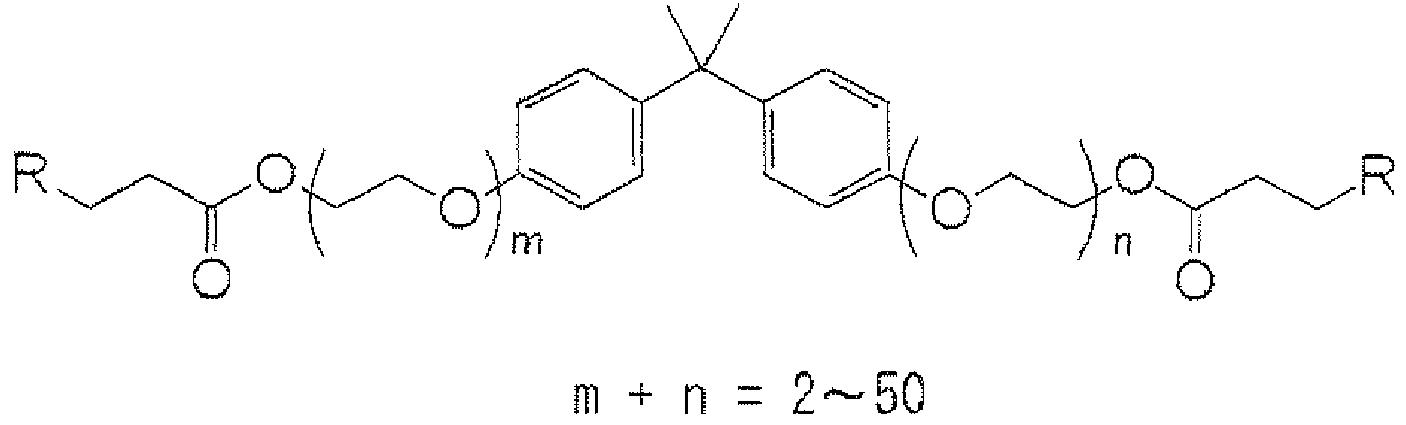


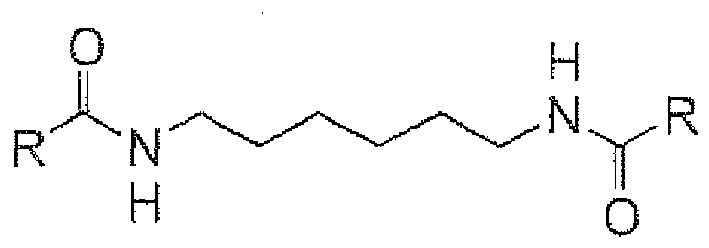
- In each of the formulae above, R denotes a partial structure selected from the structures below. When a plurality of Rs and R1s are present in the molecule, they may be identical to or different from each other, and are preferably identical to each other in terms of synthetic suitability. In the chemical structural formulae below, Et denotes an ethyl group and Me denotes a methyl group.


- In each of the formulae above, R denotes a partial structure shown below, R1 is the same as defined above. When a plurality of Rs and R1s are present in the molecule, they may be identical to or different from each other, and in terms of synthetic suitability are preferably identical to each other.

- Component C may be obtained by synthesis as appropriate, but use of a commercially available product is preferable in terms of cost. Since Component C corresponds to for example commercially available silane products or silane coupling agents from Shin-Etsu Chemical Co., Ltd., Dow Corning Toray, Momentive Performance Materials Inc., Chisso Corporation, etc., the resin composition of the present invention may employ such a commercially available product by appropriate selection according to the intended application.
- As a silane coupling agent in the present invention, other than the above-mentioned compounds, a partial hydrolysis-condensation product obtained using one type of compound having a hydrolyzable silyl group and/or a silanol group or a partial cohydrolysis-condensation product obtained using two or more types may be used. Hereinafter, these compounds may be called 'partial (co)hydrolysis-condensation products'.
- Specific examples of such partial (co)hydrolysis condensates include a partial (co)hydrolysis condensate obtained by using, as a precursor, one or more selected from the group of silane compounds consisting of alkoxysilane or acetyloxysilane such as tetramethoxysilane, tetraethoxysilane, methyltrimethoxysilane, methyltriethoxysilane, methyltriisopropoxysilane, methyltriacetoxysilane, methyltris(methoxyethoxy)silane, methyltris(methoxypropoxy)silane, ethyltrimethoxysilane, propyltrimethoxysilane, butyltrimethoxysilane, hexyltrimethoxysilane, octyltrimethoxysilane, decyltrimethoxysilane, cyclohexyltrimethoxysilane, phenyltrimethoxysilane, phenyltriethoxysilane, tolyltrimethoxysilane, chloromethyltrimethoxysilane, γ-chloropropyltrimethoxysilane, 3,3,3-trifluoropropyltrimethoxysilane, cyanoethyltriethoxysilane, γ-glycidoxypropyltrimethoxysilane, γ-glycidoxypropyltriethoxysilane, β-(3,4-epoxycyclohexyl)ethyltrimethoxysilane, γ-aminopropyltrimethoxysilane, γ-aminopropyltriethoxysilane, N-β-(aminoethyl)-γ-aminopropyltrimethoxysilane, N-phenyl-γ-aminopropyltrimethoxysilane, γ-mercaptopropyltrimethoxysilane, dimethyldimethoxysilane, dimethyldiethoxysilane, diethyldimethoxysilane, methylethyldimethoxysilane, methylpropyldimethoxysilane, diphenyldimethoxysilane, diphenyldiethoxysilane, methylphenyldimethoxysilane, γ-chloropropylmethyldimethoxysilane, 3,3,3-trifluoropropylmethyldimethoxysilane, γ-glycidoxypropylmethyldiethoxysilane, γ-aminopropylmethyldiethoxysilane, N-β-(aminoethyl)-γ-aminopropylmethyldimethoxysilane and γ-mercaptopropylmethyldiethoxysilane, and acyloxysilane such as ethoxalyloxysilane.
- Among these silane compounds as partial (co)hydrolysis-condensation product precursors, from the viewpoint of versatility, cost, and film compatibility, a silane compound having a substituent selected from a methyl group and a phenyl group as a substituent on the silicon is preferable, and specific preferred examples of the precursor include methyltrimethoxysilane, methyltriethoxysilane, phenyltrimethoxysilane, phenyltriethoxysilane, dimethyldimethoxysilane, dimethyldiethoxysilane, diphenyldimethoxysilane, and diphenyldiethoxysilane.
- In this case, as a partial (co)hydrolysis-condensation product, it is desirable to use a dimer (2 moles of silane compound is reacted with 1 mole of water to eliminate 2 moles of alcohol, thus giving a disiloxane unit) to 100-mer of the above-mentioned silane compound, preferably a dimer to 50-mer, and yet more preferably a dimer to 30-mer, and it is also possible to use a partial cohydrolysis-condensation product formed using two or more types of silane compounds as starting materials.
- As such a partial (co)hydrolysis-condensation product, ones commercially available as silicone alkoxy oligomers may be used (e.g. those from Shin-Etsu Chemical Co., Ltd.) or ones that are produced in accordance with a standard method by reacting a hydrolyzable silane compound with less than an equivalent of hydrolytic water and then removing by-products such as alcohol and hydrochloric acid may be used. When the production employs, for example, an acyloxysilane or an alkoxysilane described above as a hydrolyzable silane compound starting material, which is a precursor, partial hydrolysis-condensation may be carried out using as a reaction catalyst an acid such as hydrochloric acid or sulfuric acid, an alkali metal or alkaline earth metal hydroxide such as sodium hydroxide or potassium hydroxide, or an alkaline organic material such as triethylamine, and when the production is carried out directly from a chlorosilane, water and alcohol may be reacted using hydrochloric acid by-product as a catalyst.
- Preferable examples of Component C include compounds shown below, but the present invention is not limited to these compounds. In the chemical structural formulae below, Et denotes an ethyl group and Me denotes a methyl group.

- With regard to Component C in the resin composition of the present invention, only one type may be used or two or more types may be used in combination.
- The content of Component C contained in the resin composition of the present invention is preferably in the range of 0.1 to 80 wt% on a solids content basis, more preferably in the range of 1 to 50 wt%, and most preferably in the range of 5 to 40 wt%.
- The resin composition for laser engraving of the present invention preferably further comprises (Component D) a curing accelerator.
- When a primary or secondary amino group is used as the curing agent, examples of the curing accelerators include phenols, alcohols, thiols, organic or inorganic acids, triphenylphosphine etc. Among these, acidic compounds form a salt with an amine compound to suppress the reaction of the amine compound with carbon dioxide or moisture in air. One having no reactivity with an epoxy group functions as a diluent, and the plasticizing effect thereof can retard the vitrification that leads to the termination of the curing reaction to thus improve the reaction ratio of the epoxy group.
- When an acid anhydride group, a carboxyl group, a mercapto group, a phenol group or a hydroxyl group is used as the curing agent, examples of the curing accelerators include tertiary amines, imidazoles, quaternary ammonium salts, quaternary phosphonium salts, organic or inorganic acids, inorganic bases, triphenylphosphine etc.
- As the curing accelerator, the compound is used as it is, or used in a state dissolved in a solvent such as water or an organic solvent. The concentration when it is dissolved in a solvent is not particularly limited, and may be selected appropriately in accordance with characteristics of the curing accelerator to be used, the intended content thereof etc.
- When a curing agent having a primary or secondary amino group is used as Component B, as the curing accelerator, phenols, organic acids and thiols are preferable, and m-cresol and dodecanethiol are particularly preferable.
- When a curing agent having an acid anhydride group is used as Component B, as the curing accelerator, a tertiary amine and salts thereof are preferable, and 1,8-diazabicyclo[5.4.0]undeca-7-ene (DBU) and salts thereof are particularly preferable.
- When a curing agent having a mercapto group is used as Component B, as the curing accelerator, a tertiary amine and salts thereof are preferable, and DBU and salts thereof are particularly preferable.
- When a curing agent having a carboxyl group is used as Component B, as the curing accelerator, quaternary ammonium salts and organic or inorganic acids are preferable, and tetraethylammonium bromide and p-toluenesulfonic acid are particularly preferable.
- When a curing agent having a phenolic hydroxyl group is used as Component B, as the curing accelerator, quaternary ammonium salts, quaternary phosphonium salts and triphenylphosphine are preferable, and triphenylphosphine is particularly preferable.
- When a curing agent having a hydroxyl group is used as Component B, as the curing accelerator, inorganic bases, and organic or inorganic acids are preferable, and sodium t-butoxide, potassium t-butoxide, sodium ethoxide and potassium ethoxide are particularly preferable.
- As the curing accelerator usable in the resin composition for laser engraving of the present invention, types thereof are not particularly limited, and examples thereof include compounds shown below.
- Examples of the phenols include phenol, o-cresol, m-cresol, p-cresol, o-chlorophenol, m-chlorophenol, p-chlorophenol, p-nitrophenol, 2,4-dinitrophenol, 2,4-dichlorophenol, o-aminophenol, p-aminophenol, 2,4,5-trichlorophenol etc. Among these, m-cresol, o-chlorophenol, m-chlorophenol, p-chlorophenol, p-nitrophenol, 2,4-dinitrophenol, 2,4-dichlorophenol and 2,4,5-trichlorophenol are preferable, and, furthermore among these, m-cresol that is easy to handle is more preferable.
- Examples of the alcohols include methanol, ethanol, propanol, isopropanol, n-butylalcohol, isobutylalcohol, ethylene glycol, 1,3-propanediol, glycerin, propylene glycol, benzyl alcohol, diethylene glycol etc. Among these, benzyl alcohol, ethylene glycol, diethylene glycol and glycerin are preferable, and, furthermore among these, diethylene glycol is more preferable from the viewpoint of softness of the film.
- Examples of the thiols include thiophenol, 1-butanethiol, 2-mercaptoethanol, thioglycerol, dodecanethiol, 2-aminoethanethiol, 1,4-butanethiol, 2,3-butanedithiol, 1,4-butanediolbis(thioglycolate), cyclopentanethiol, cyclohexanethiol etc. Among these, thiophenol, dodecanethiol, 1,4-butanediolbis(thioglycolate) are preferable, and, furthermore among these, dodecanethiol that is easy to handle is more preferable.
- Examples of the organic or inorganic acids include halogenated hydrogen such as hydrochloric acid, nitric acid, sulfuric acid, sulfurous acid, hydrogen sulfide, perchloric acid, hydrogen peroxide, carbonic acid, carboxylic acids such as formic acid and acetic acid, substituted carboxylic acids in which R of a structural formula represented by RCOOH is substituted by another element or substituent, sulfonic acids such as benzenesulfonic acid, phosphoric acid, heteropoly acid, inorganic solid acid etc. Among these, methanesulfonic acid, p-toluenesulfonic acid, pyridinium-p-toluene sulfonate, dodecylbenzenesulfonic acid, phosphoric acid, phosphonic acid and acetic acid are preferable, and, from the viewpoint of the film strength after the thermal crosslinking, methanesulfonic acid, p-toluenesulfonic acid and phosphoric acid are particularly preferable.
- Examples of the tertiary amines and imidazoles include trimethylamine, triethylamine, tripropylamines, tributylamines, tripentylamines, trihexylamines, dimethylethylamine, dimethylpropylamines, dimethylbutylamines, dimethylpentylamines, dimethylhexylamines, diethylpropylamines, diethylbutylamines, diethylpentylamines, diethylhexylamines, dipropylbutylamines, dipropylpentylamines, dipropylhexylamines, dibutylpentylamines, dibutylhexylamines, dipentylhexylamines, methyldiethylamine, methyldipropylamines, methyldibutylamines, methyldipentylamines, methyldihexylamines, ethyldipropylamines, ethyldibutylamines, ethyldipentylamines, ethyldihexylamines, propyldibutylamines, propyldipentylamines, propyldihexylamines, butyldipentylamines, butyldihexylamines, pentyldihexylamines, methylethylpropylamines, methylethylbutylamines, methylethylhexylamines, methylpropylbutylamines, methylpropylhexylamines, ethylpropylbutylamine, ethylbutylpentylamines, ethylbutylhexylamines, propylbutylpentylamines, propylbutylhexylamines, butylpentylhexylamines, trivinylamine, triallylamine, tributenylamines, tripentenylamines, trihexenylamines, dimethylvinylamine, dimethylallylamine, dimethylbutenylamines, dimethylpentenylamines, diethylvinylamine, diethylallylamine, diethylbutenylamines, diethylpentenylamines, diethylhexenylamines, dipropylvinylamines, dipropylallylamines, dipropylbutenylamines, methyldivinylamine, methyldiallylamine, methyldibutenylamines,
- ethyldivinylamine, ethyldiallylamine, tricyclopentylamine, tricyclohexylamine, tricyclooctylamine, tricyclopentenylamine, tricyclohexenylamine, tricyclopentadienylamine, tricyclohexadienylamines, dimethylcyclopentylamine, diethylcyclopentylamine, dipropylcyclopentylamines, dibutylcyclopentylamines, dimethylcyclohexylamine, diethylcyclohexylamine, dipropylcyclohexylamines, dimethylcyclopentenylamines, diethylcyclopentenylamines, dipropylcyclopentenylamines, dimethylcyclohexenylamines, diethylcyclohexenylamines, dipropylcyclohexenylamines, methyldicyclopentylamine, ethyldicyclopentylamine, propylcyclopentylamines, methyldicyclohexylamine, ethyldicyclohexylamine, propylcyclohexylamines, methyldicyclopentenylamines, ethyldicyclopentenylamines, propyldicyclopentenylamines, N,N-dimethylaniline, N,N-dimethylbenzylamine, N,N-dimethyltoluidines, N,N-dimethylnaphthylamines, N,N-diethylanline, N,N-diethylbenzylamine, N,N-diethyltoluidines, N,N-diethylnaphthylamines, N,N-dipropylanilines, N,N-dipropylbenzylamines, N,N-dipropyltoluidines, N,N-dipropylnaphthylamines, N,N-divinylaniline, N,N-diallylaniiine, N,N-divinyltoluidines, N,N-diallylaniline, diphenylmethylamine, diphenylethylamine, diphenylpropylamines, dibenzylmethylamine, dibenzylethylamine, dibenzylcyclohexylamine, dibenzylvinylamine, dibenzylallylamine, ditolylmethylamines, ditolylethylamines, ditolylcyclohexylamines, ditolylvinylamines, triphenylamine, tribenzylamine, tri(tolyl)amines, trinaphthylamines, N,N,N',N'-tetramethylethylenediamine, N,N,N',N'-tetraethylethylenediamine, N, N, N', N'-tetramethyltolylenediamines, N,N,N',N'-tetraethyltolylenediamines,
- N-methylpyrrole, N-methylpyrrolidine, 2-ethyl-4-methylimidazole, 2-phenylimidazole, 1-(2-cyanoethyl)-2-ethyl-4-methylimidazole, 2-phenylimidazoline, N,N'-dimethylpiperazine, N-methylpiperidine, N-ethylpyrrole, N-methylpyrrolidine, N-ethylimidazole, N,N'-diethylpiperazine, N-ethylpiperidine, pyridine, pyridazine, pyrazine, quinoline, quinazoline, quinuclidine, N-methylpyrrolidone, N-methylmorpholine, N-ethylpyrrolidone, N-ethylmorpholine, N,N-dimethylanisole, N,N-diethylanisole, N,N-dimethylglycine, N,N-diethylglycine, N, N-dimethylalanine, N,N-diethylalanine, N, N-dimethylethanolamine, N, N-dimethylaminothiophene, 1,1,3,3-tetramethylguanidine, 1,8-diazabicyclo[5.4.0]undeca-7-ene, 1,5-diazabicyclo[4.3.0]nona-5-ene, 1,4-diazabicyclo[2.2.2]octane and hexamethylenetetramine etc.
- From the viewpoint of the film strength after the thermal crosslinking, 2-ethyl-4-methylimidazole, 2-phenylimidazole, 1-(2-cyanoethyl)-2-ethyl-4-methylimidazole, 2-phenylimidazoline, 1,8-diazabicyclo[5.4.0]undeca-7-ene, 1,5-diazabicyclo[4.3.0]nona-5-ene and 1,1,3,3-tetramethylguanidine are preferable, and 2-ethyl-4-methylimidazole, 2-phenylimidazole, 1,8-diazabicyclo[5.4.0]undeca-7-ene and 1,5-diazabicyclo[4.3.0]nona-5-ene are particularly preferable.
- Examples of the inorganic bases include alkali metal hydroxides, alkali metal alkoxides and alkaline earth oxides. Among these, sodium t-butoxide, potassium t-butoxide, sodium methoxide, potassium methoxide, sodium ethoxide and potassium ethoxide are preferable, sodium t-butoxide, potassium t-butoxide, sodium ethoxide and potassium ethoxide are more preferable.
- Examples of the quaternary ammonium salts include tetramethylammonium bromide, tetraethylammonium bromide, tetrabutylammonium bromide, tetramethylammonium bromide, benzyltrimethylammonium chloride, benzyltrimethylammonium bromide, decyltrimethylammonium chloride and decyltrimethylammonium bromide etc. Among these, tetramethylammonium bromide, tetraethylammonium bromide and tetrabutylammonium bromide are preferable, and tetraethylammonium bromide is more preferable.
- Examples of the quaternary phosphonium salts include tetramethylphosphonium bromide, tetraethylphosphonium bromide, tetrabutylphosphonium bromide, tetramethylphosphonium bromide, benzyltrimethylphosphonium chloride, benzyltrimethylphosphonium bromide, decyltrimethylphosphonium chloride and decyltrimethylphosphonium bromide. Among these, tetramethylphosphonium bromide, tetraethylphosphonium bromide and tetrabutylphosphonium bromide are preferable, and tetraethylphosphonium bromide is more preferable.
- With regard to Component D, only one type may be used or two or more types may be used in combination.
- The content of Component D contained in the resin composition of the present invention is preferably 0.01 to 20 wt% relative to the total solids content, and more preferably 0.1 to 10 wt%.
- The resin composition for laser engraving of the present invention preferably further comprises (Component E) a binder polymer (hereinafter, also referred to as a "binder").
- The binder polymer (Component E) may be added to the resin composition of the present invention for the purpose of improving the film strength and printing durability.
- The binder polymer that can be used in the present invention is not particularly limited, but preferably comprises a binder polymer containing a functional group, in a molecule, capable of forming a crosslinked structure as the result of the reaction with at least one of the hydrolyzable silyl group and the silanol group in Component C in point of forming a high three-dimensional crosslinking.
- The binder is a polymer component contained in the resin composition for laser engraving, and may appropriately be selected a general polymer, and only one type thereof may be used or two or more types thereof may be used in combination. In particular, when the resin composition for laser engraving is used as the printing plate precursor, it is necessary to select the polymer while considering various performances such as laser engraving properties, ink acceptance properties and engraving residue dispersibility.
- As the binder, a material selected from polystyrene resin, polyester resin, polyamide resin, polyurea resin, polyamidoimide resin, polyurethane resin, polysulfone resin, polyethersulfone resin, polyimide resin, polycarbonate resin, hydrophilic polymers containing a hydroxyethylene unit, acrylic resin, acetal resin, epoxy resin, polycarbonate resin, rubber, thermoplastic elastomer etc. may be used.
- For example, from the viewpoint of laser engraving sensitivity, said polymer is preferably a polymer containing a partial structure that thermally decomposes upon exposure to light or heating. Preferred examples of such a polymer include those described in paragraph 0038 of
JP-A-2008-163081 JP-A-2008-163081 JP-A-2008-163081 - Similarly, as the polymer that can be used on its own or in combination with the crosslinking polymers, when it is used for the purpose of curing by heat or light exposure and improving strength, a polymer having a carbon-carbon unsaturated bond in the molecule is preferably used.
- As a polymer having a carbon-carbon unsaturated bond in the main chain, SI (polystyrene-polyisoprene), SB (polystyrene-polybutadiene), SBS (polystyrene-polybutadiene-polystyrene), SIS (polystyrene-polyisoprene-polystyrene), SEBS (polystyrene-polyethylene/polybutylene-polystyrene), etc. can be cited. Among them, SI is preferably used.
- A polymer having a carbon-carbon unsaturated bond in a side chain may be obtained by introducing, into a side chain of the skeleton of the above-mentioned polymer, a carbon-carbon unsaturated bond such as an allyl group, an acryloyl group, a methacryloyl group, a styryl group, or a vinyl ether group. As a method for introducing a carbon-carbon unsaturated bond into a polymer side chain, a known method such as (1) a method in which a polymer is copolymerized with a structural unit having a polymerizable group precursor formed by bonding a protecting group to a polymerizable group, and the protecting group is removed to give a polymerizable group or (2) a method in which a polymer compound having a plurality of reactive groups such as hydroxy groups, amino groups, epoxy groups, or carboxy groups is prepared and a polymer reaction is carried out with a compound having a carbon-carbon unsaturated bond and a group that reacts with these reactive groups may be employed. In accordance with these methods, the amount of unsaturated bond and polymerizable group introduced into the polymer compound can be controlled.
- As the binder, the use of a polymer having a hydroxyl group (-OH) (hereinafter, also referred to as the "specific polymer") is particularly preferable. As the skeleton of the specific polymer, although not particularly limited, an acrylic resin, an epoxy resin, hydrophilic polymers containing a hydroxyethylene unit, a polyvinylacetal resin, a polyester resin and a polyurethane resin are preferable.
- Examples of the acrylic monomers used for synthesizing an acrylic resin having a hydroxyl group include preferably (meth)acrylic acid esters, crotonic acid esters and (meth)acrylamides having a hydroxyl group in the molecule. Specific examples of such monomers include 2-hydroxyethyl (meth)acrylate, 2-hydroxypropyl (meth)acrylate, 4-hydroxybutyl (meth)acrylate etc. Copolymers obtained by copolymerizing these with a known (meth)acrylic-based monomer or vinyl-based monomer are used preferably.
- As the specific polymer, the use of an epoxy resin having a hydroxyl group on the side chain may also be possible. As a preferable specific example, an epoxy resin obtained by polymerizing an adduct of bisphenol A and epichlorohydrin as raw material monomers is cited.
- As the polyester resin, a polyester resin containing a hydroxycarboxylic acid unit such as polylactic acid is preferably used. Specifically, the polyester resin selected from the group consisting of polyhydroxy alkanoate (PHA), lactic acid-based polymer, polyglycolic acid (PGA), polycaprolactone (PCL), poly(butylenesuccinic acid), derivatives and mixtures thereof is preferable.
- As the specific polymer, a polymer having an atom and/or a group capable of reacting with the above-mentioned compound (I) is preferable, and a binder polymer that has an atom and/or a group capable of reacting with the compound (I) and is insoluble in water and soluble in an alcohol having 1 to 4 carbon atoms is more preferable.
- Examples of the atom and/or the group capable of reacting with the compound (I) include, although not particularly limited, an ethylenically unsaturated bond, an epoxy group, an amino group, a (meth)acryloyl group, a mercapto group and a hydroxyl group, and, among these, a hydroxyl group is exemplified preferably.
- Examples of preferable specific polymers in the present invention include polyvinyl butyral (PVB), acrylic resin having a hydroxyl group on the side chain, epoxy resin having a hydroxyl group on the side chain etc., from the viewpoint of having high engraving sensitivity and good film performance while satisfying both the aptitude for an aqueous ink and the aptitude for a UV ink.
- The specific polymer usable for the present invention gives particularly preferably a glass transition temperature (Tg) of at least 20°C, when combined with a photothermal conversion agent capable of absorbing light having a wavelength of 700 to 1,300 nm to be described later, which is a preferable combining component of the resin composition for laser engraving constituting the recording layer in the present invention, because the engraving sensitivity is improved. Hereinafter, the polymer having such glass transition temperature is referred to as a non-elastomer. That is, the elastomer is generally defined scientifically as a polymer having a glass transition temperature that is no greater than normal temperature (20°C) (see Kagaku Daijiten (comprehensive dictionary of science), P154, second edition, edited by Foundation for Advancement of International Science, published by Maruzen Co., Ltd.). Accordingly, the non-elastomer denotes polymers having a glass transition temperature that is greater than ordinary temperature. Although the upper limit of the glass transition temperature of the specific polymer is not particularly limited, it is preferably no greater than 200°C from the viewpoint of handling properties, and more preferably at least 25°C but no greater than 120°C.
- When a polymer having a glass transition temperature of 20°C (normal temperature) or greater is used, the specific polymer is in a glass state at normal temperature. Because of this, compared with a case of the rubber state, thermal molecular motion is suppressed. In laser engraving, in addition to the heat given by a laser during laser irradiation, heat generated by the function of a photothermal conversion agent added as desired is transmitted to the surrounding specific polymer, and this polymer is thermally decomposed and disappears, thereby forming an engraved recess.
- When the specific polymer is used, it is surmised that when a photothermal conversion agent is present in a state in which thermal molecular motion of the specific polymer is suppressed, heat transfer to and thermal decomposition of the specific polymer occur effectively. It is anticipated that such an effect further increases the engraving sensitivity.
- Examples of the binder that can be preferably used in the present invention are shown below.
- Polyvinyl acetal is a compound obtained by converting polyvinyl alcohol (obtained by saponifying polyvinyl acetate) into a cyclic acetal. A polyvinyl acetal derivative is a polymer that polyvinyl acetal is modified, or a polyvinyl acetal having another copolymerization component.
- The acetal content in the polyvinyl acetal (mole% of vinyl alcohol units converted into acetal with the total number of moles of vinyl acetate monomer starting material as 100 %) is preferably 30 to 90 %, more preferably 50 to 85 %, and particularly preferably 55 to 78 %.
- The vinyl alcohol unit in the polyvinyl acetal is preferably 10 to 70 mole% relative to the total number of moles of the vinyl acetate monomer starting material, more preferably 15 to 50 mole%, and particularly preferably 22 to 45 mole%.
- Furthermore, the polyvinyl acetal may have a vinyl acetate unit as another component, and the content thereof is preferably 0.01 to 20 mole%, and more preferably 0.1 to 10 mole%. The polyvinyl acetal derivative may further have another copolymerization unit.
- Examples of the polyvinyl acetal include polyvinyl butyral, polyvinyl propylal, polyvinyl ethylal, and polyvinyl methylal. Among them, polyvinyl butyral (PVB) is preferable.
- Polyvinyl butyral is a polymer obtained by a reaction polyvinyl alcohol and butyl aldehyde. A polyvinyl butyral derivative may be used.
- Examples of the polyvinyl butyral derivatives include an acid-modified PVB in which at least some of the hydroxy groups of the hydroxyethylene units are modified with an acid group such as a carboxy group, a modified PVB in which some of the hydroxy groups are modified with a (meth)acryloyl group, a modified PVB in which at least some of the hydroxy groups are modified with an amino group, and a modified PVB in which at least some of the hydroxy groups have introduced thereinto ethylene glycol, propylene glycol, or a multimer thereof.
- From the viewpoint of a balance being achieved between engraving sensitivity and film formation properties, the molecular weight of the polyvinyl acetal is preferably 5,000 to 800,000 as the weight-average molecular weight, more preferably 8,000 to 500,000 and, from the viewpoint of improvement of rinsing properties for engraving residue, particularly preferably 50,000 to 300,000.
- Particularly preferable examples of the polyvinyl acetal are explained below by polyvinyl butyral (PVB) and the derivatives therof, but the polyvinyl acetal should not be construed as being limited to the Examples.
- Polyvinyl butyral derivatives are commercially available and preferable examples from viewpoint of solubility in alcohol, particularly in ethanol, are the 'E-LEC B' series and the 'E-LEC K (KS)' series manufactured by Sekisui Chemical co., Ltd., the Denka Butyral series manufactured by Denki Kagaku Kogyo Kabushiki Kaisha. From the viewpoint of alcohol solubility (particularly in ethanol), the polyvinyl butyral is preferably the 'S-LEC B' series and the 'S-LEC K(KS)' series manufactured by Sekisui Chemical Co., Ltd. From the viewpoint of alcohol solubility (particularly in ethanol), the 'S-LEC B' series manufactured by Sekisui Chemical Co., Ltd. and 'Denka Butyral' manufactured by Denki Kagaku Kogyo Kabushiki Kaisha are more preferable; among the 'S-LEC B' series, 'BL-1', 'BL-1H', 'BL-2', 'BL-5', 'BL-S', 'BX-L', 'BM-S', and 'BH-S' are particularly preferable, and among the 'Denka Butyral' manufactured by Denki Kagaku Kogyo Kabushiki Kaisha '#3000-1', '#3000-2', '#3000-4', '#4000-2', '#6000-C', '#6000-EP', '#6000-CS', and '#6000-AS' are particularly preferable.
- When manufacturing a relief-forming layer from PVB as the specific polymer, casting and drying of a solution in a solvent is preferable from viewpoint of flatness of the film surface.
- In addition to the polyvinylacetal and derivatives thereof, as the specific polymer, it is also possible to use an acrylic resin that is obtained by using a known acrylic monomer and has a hydroxyl group in a molecule. Furthermore, as the specific polymer, a novolac resin that is a resin obtained by condensing phenols and aldehydes under an acidic condition may also be used. Moreover, as the specific polymer, an epoxy resin having a hydroxyl group on a side chain may also be used.
- Among the specific polymers, polyvinyl butyral and derivatives thereof are particularly preferable from the viewpoint of rinsing properties and printing durability when made into a recording layer.
- The content of a hydroxyl group contained in the specific polymer in the present invention is preferably 0.1 to 15 mmol/g, and more preferably 0.5 to 7 mmol/g, in the polymer of any embodiment described above.
- With regard to the binder in the resin composition, only one type may be used or two or more types may be used in combination.
- The weight average molecular weight of the binder that can be used in the present invention (on a polystyrene basis by GPC measurement) is preferably 5,000 to 1,000,000, more preferably 8,000 to 750,000, and most preferably 10,000 to 500,000.
- From the viewpoint of satisfying the shape retention, water resistance and engraving sensitivity of the coated film in a balanced manner, the content of the specific polymer in the resin composition employable in the present invention is, in the total solids content, preferably 2 to 95 wt%, more preferably 5 to 80 wt%, and particularly preferably 10 to 60 wt%,
- From the viewpoint of satisfying the shape retention, water resistance and engraving sensitivity of the coated film in a balanced manner, the content of Component E is, relative to the total solids content of the resin composition, preferably in a range of 0 to 80 wt%, more preferably in a range of 5 to 60 wt%, and particularly preferably in a range of 10 to 40 wt%.
- The resin composition for laser engraving of the present invention preferably further comprises (Component F) a photothermal conversion agent. That is, It is surmised that the photothermal conversion agent in the present invention absorbs laser light and generates heat thus promoting thermal decomposition of a cured material of the resin composition for laser engraving of the present invention. Because of this, it is preferable to select a photothermal conversion agent that absorbs light having the wavelength of the laser that is used for engraving.
- When a laser (a YAG laser, a semiconductor laser, a fiber laser, a surface emitting laser, etc.) emitting infrared at a wavelength of 700 to 1,300 nm is used as a light source for laser engraving, it is preferable for the relief-forming layer in the present invention to comprise a photothermal conversion agent that can absorb light having a wavelength of 700 to 1,300 nm.
- As the photothermal conversion agent in the present invention, various types of dye or pigment are used.
- With regard to the photothermal conversion agent, examples of dyes that can be used include commercial dyes and known dyes described in publications such as 'Senryo Binran' (Dye Handbook) (Ed. by The Society of Synthetic Organic Chemistry, Japan, 1970). Specific examples include dyes having a maximum absorption wavelength at 700 to 1,300 nm, such as azo dyes, metal complex salt azo dyes, pyrazolone azo dyes, naphthoquinone dyes, anthraquinone dyes, phthalocyanine dyes, carbonium dyes, diimmonium compounds, quinone imine dyes, methine dyes, cyanine dyes, squarylium dyes, pyrylium salts, and metal thiolate complexes. In particular, cyanine-based dyes such as heptamethine cyanine dyes, oxonol-based dyes such as pentamethine oxono! dyes, and phthalocyanine-based dyes are preferably used. Examples include dyes described in paragraphs 0124 to 0137 of
JP-A-2008-63554 - With regard to the photothermal conversion agent used in the present invention, examples of pigments include commercial pigments and pigments described in the Color Index (C.I.) Handbook, 'Saishin Ganryo Binran' (Latest Pigments Handbook) (Ed. by Nippon Ganryo Gijutsu Kyokai, 1977), 'Saisin Ganryo Ouyogijutsu' (Latest Applications of Pigment Technology) (CMC Publishing, 1986), 'Insatsu lnki Gijutsu' (Printing Ink Technology) CMC Publishing, 1984).
- Among these pigments, carbon black is preferable.
- Any carbon black, regardless of classification by ASTM and application (e.g. for coloring, for rubber, for dry cell, etc.), may be used as long as dispersibility, etc. in the composition is stable. Carbon black includes for example furnace black, thermal black, channel black, lamp black, and acetylene black. In order to make dispersion easy, a black colorant such as carbon black may be used as color chips or a color paste by dispersing it in nitrocellulose or a binder in advance using, as necessary, a dispersant, and such chips and paste are readily available as commercial products. Examples of carbon black include those described in paragraphs 0130 to 0134 of
JP-A-2009-178869 - The content of the photothermal conversion agent in the resin composition for laser engraving of the present invention largely depends on the size of the molecular extinction coefficient characteristic to the molecule, and is preferably 0.01 to 230 wt % relative to the total weight of the solids content of the resin composition, more preferably 0.05 to 20 wt %, and yet more preferably 0.1 to 10 wt %.
- The resin composition of the present invention preferably further comprises (Component G) an alcohol exchange reaction catalyst. The alcohol exchange reaction catalyst is a compound that can promote a reaction between a hydrolyzable silyl group and/or a silanol group in Component C, and hydroxyl group, and examples threof preferably include an acidic or basic catalyst and a metal complex catalyst.
- When Component B or Component D is an acid or a base, these may be function as Component G.
- The metal complex catalyst that can be used as an alcohol exchange reaction catalyst in the present invention is preferably constituted from a metal element selected from Groups 2, 4, 5, and 13 of the periodic table and an oxo or hydroxy oxygen compound selected from β-diketones, ketoesters, hydroxycarboxylic acids and esters thereof, amino alcohols, and enolic active hydrogen compounds.
- Furthermore, among the constituent metal elements, a Group 2 element such as Mg, Ca, Sr, or Ba, a Group 4 element such as Ti or Zr, a Group 5 element such as V, Nb, or Ta, and a Group 13 element such as Al or Ga are preferable, and they form a complex having an excellent catalytic effect. Among them, a complex obtained from Zr, Al, or Ti is excellent and preferable, ethyl orthotitanate, etc. is more preferable.
- In the present invention, examples of the oxo or hydroxy oxygen-containing compound constituting a ligand of the above-mentioned metal complex include β-diketones such as acetylacetone (2,4-pentanedione) and 2,4-heptanedione, ketoesters such as methyl acetoacetate, ethyl acetoacetate, and butyl acetoacetate, hydroxycarboxylic acids and esters thereof such as lactic acid, methyl lactate, salicylic acid, ethyl salicylate, phenyl salicylate, malic acid, tartaric acid, and methyl tartarate, ketoalcohols such as 4-hydroxy-4-methyl-2-pentanone, 4-hydroxy-2-pentanone, 4-hydroxy-4-methyl-2-pentanone, and 4-hydroxy-2-heptanone, amino alcohols such as monoethanolamine, N,N-dimethylethanolamine, N-methylmonaethanolamine, diethanolamine, and triethanolamine, enolic active compounds such as methylolmelamine, methylolurea, methylolacrylamide, and diethyl malonate ester, and compounds having a substituent on the methyl group, methylene group, or carbonyl carbon of acetylacetone.
- A preferred ligand is an acetylacetone derivative, and the acetylacetone derivative in the present invention means a compound having a substituent on the methyl group, methylene group, or carbonyl carbon of acetylacetone. The substituent with which the methyl group of acetylacetone is substituted is a straight-chain or branched alkyl group, acyl group, hydroxyalkyl group, carboxyalkyl group, alkoxy group, or alkoxyalkyl group that all have 1 to 3 carbon atoms, the substituent with which the methylene carbon of acetylacetone is substituted is a carboxy group or a straight-chain or branched carboxyalkyl group or hydroxyalkyl group having 1 to 3 carbon atoms, and the substituent with which the carbonyl carbon of acetylacetone is substituted is an alkyl group having 1 to 3 carbon atoms, and in this case the carbonyl oxygen turns into a hydroxy group by addition of a hydrogen atom.
- Specific preferred examples of the acetylacetone derivative include acetylacetone, ethylcarbonylacetone, n-propylcarbonylacetone, i-propylcarbonylacetone, diacetylacetone, 1-acetyl-1-propionylacetylacetone, hydroxyethylcarbonylacetone, hydroxypropylcarbonylacetone, acetoacetic acid, acetopropionic acid, diacetoacetic acid, 3,3-diacetopropionic acid, 4,4-diacetobutyric acid, carboxyethylcarbonylacetone, carboxypropylcarbonylacetone, and diacetone alcohol, and among them acetylacetone and diacetylacetone are preferable. The complex of the acetylacetone derivative and the metal element is a mononuclear complex in which 1 to 4 molecules of acetylacetone derivative coordinate to one metal element, and when the number of coordinatable sites of the metal element is larger than the total number of coordinatable bond sites of the acetylacetone derivative, a ligand that is usually used in a normal complex, such as a water molecule, a halide ion, a nitro group, or an ammonio group may coordinate thereto.
- Preferred examples of the metal complex include a tris(acetylacetonato)aluminum complex salt, a di(acetylacetonato)aluminum-aqua complex salt, a mono(acetylacetonato)aluminum-chloro complex salt, a di(diacetylacetonato)aluminum complex salt, ethyl acetoacetate aluminum diisopropylate, aluminum tris(ethyl acetoacetate), cyclic aluminum oxide isopropylate, a tris(acetylacetonato)barium complex salt, a di(acetylacetonato)titanium complex salt, a tris(acetylacetonato)titanium complex salt, a di-i-propoxy-bis(acetylacetonato)titanium complex salt, zirconium tris(ethyl acetoacetate), and a zirconium tris(benzoic acid) complex salt. They are excellent in terms of stability in an aqueous coating solution and an effect in promoting gelling in a sol-gel reaction when thermally drying, and among them ethyl acetoacetate aluminum diisopropylate, aluminium tris(ethyl acetoacetate), a di(acetylacetonato)titanium complex salt, and zirconium tris(ethyl acetoacetate) are particularly preferable.
- The resin composition of the present invention may employ only one type of (Component G) an alcohol exchange reaction catalyst or two or more types thereof in combination.
- The content of (Component G) an alcohol exchange reaction catalyst in the resin composition is not particularly limited, and may be selected appropriately in accordance with characteristics of the alcohol exchange reaction catalyst to be used.
- The resin composition of the present invention may comprise a solvent.
- From the viewpoint of solubility of each components, a solvent used when preparing the resin composition for laser engraving of the present invention is preferably mainly an aprotic organic solvent. More specifically, they are used preferably at aprotic organic solvent/protic organic solvent = 100/0 to 50/50 (ratio by weight), more preferably 100/0 to 70/30, and particularly preferably 100/0 to 90/10.
- Specific preferred examples of the aprotic organic solvent include acetonitrile, tetrahydrofuran, dioxane, toluene, propylene glycol monomethyl ether acetate, methyl ethyl ketone, acetone, methyl isobutyl ketone, ethyl acetate, butyl acetate, ethyl lactate, N,N-dimethylacetamide, N-methylpyrrolidone, and dimethyl sulfoxide.
- Specific preferred examples of the protic organic solvent include methanol, ethanol, 1-propanol, 2-propanol, 1-butanol, 1-methoxy-2-propanol, ethylene glycol, diethylene glycol, and 1,3-propanediol.
- Among them, propylene glycol monomethyl ether acetate is preferable.
- To the resin composition for laser engraving of the present invention, additives other than Component A to Component G may be added suitably in a range that does not hinder the effect of the present invention. Examples thereof include a fragrance, a polymerizable compound, a polymerization initiator, a filler, a plasticizer, wax, a process oil, an organic acid, a metal oxide, an ozone decomposition inhibitor, an antioxidant, a thermal polymerization inhibitor, a colorant etc. With regard to these additives, only one type may be used or two or more types may be used in combination.
- The resin composition for laser engraving of the present invention contains preferably a plasticizer. The plasticizer is a material having the function of softening the film formed with the resin composition for laser engraving, and has necessarily a good compatibility relative to the binder polymer.
- As the plasticizer, for example, dioctyl phthalate, didodecyl phthalate, polyethylene glycols, and polypropylene glycols (such as monool type and diol type) are used preferably.
- The resin composition for laser engraving of the present invention preferably comprises, as an additive for improving engraving sensitivity, nitrocellulose or a high thermal conductivity material. Since nitrocellulose is a self-reactive compound, it generates heat during laser engraving, thus assisting thermal decomposition of a coexisting binder polymer such as a hydrophilic polymer. It is surmised that as a result, the engraving sensitivity improves. A high thermal conductivity material is added for the purpose of assisting heat transfer, and examples of thermally conductive materials include inorganic compounds such as metal particles and organic compounds such as a conductive polymer. As the metal particles, fine gold particles, fine silver particles, and fine copper particles having a particle diameter of on the order of a micrometer or a few nanometers are preferable. As the conductive polymer, a conjugated polymer is particularly preferable, and specific examples thereof include polyaniline and polythiophene.
- Moreover, the use of a cosensitizer can furthermore improve the sensitivity in curing the resin composition for laser engraving with light.
- Furthermore, a small amount of thermal polymerization inhibitor is added preferably for the purpose of hindering unnecessary thermal polymerization of a polymerizable compound during the production or storage of the composition.
- For the purpose of coloring the resin composition for laser engraving, a colorant such as a dye or a pigment may be added. This enables properties such as visibility of an image area or suitability for an image densitometer to improve.
- Furthermore, in order to improve physical properties of a cured film of the resin composition for laser engraving, a known additive such as a filler may be added.
- A first embodiment of the relief printing plate precursor for laser engraving of the present invention comprises a relief-forming layer formed from the resin composition for laser engraving of the present invention.
- A second embodiment of the relief printing plate precursor for laser engraving of the present invention comprises a crosslinked relief-forming layer formed by crosslinking a relief-forming layer formed from the resin composition for laser engraving of the present invention.
- In the present invention, the 'relief printing plate precursor for laser engraving' means both or one of a plate having a crosslinkable relief-forming layer formed from the resin composition for laser engraving in a state before being crosslinked and a plate in a state in which it is cured by light and/or heat.
- The relief printing plate precursor for laser engraving of the present invention is preferably a relief printing plate precursor having crosslinked relief-forming layer crosslinked by heat.
- In the present invention, the 'relief-forming layer' means a layer in a state before being crosslinked, that is, a layer formed from the resin composition for laser engraving of the present invention, which may be dried as necessary.
- In the present invention, the 'crosslinked relief-forming layer' means a layer formed by crosslinking the relief-forming layer. The crosslinking is preferably carried out by means of heat and/or light. Furthermore, the crosslinking is not particularly limited as long as it is a reaction by which the resin composition is cured, and it is a concept that includes a structure crosslinked due to reactions between Component A's, Component A and B and/or Component A to C, and the crosslinking may be form a crosslinked structure by a reaction between Component A to C and other Component. When polymerizable compound is used, the crossliking include a crosslinking by polymerization.
- The 'relief printing plate' is prepared by laser engraving a printing plate precursor having a crosslinked relief-forming layer.
- Moreover, in the present invention, the 'relief layer' means a layer of the relief printing plate formed by engraving using a laser, that is, the crosslinked relief-forming layer after laser engraving.
- A relief printing plate precursor for laser engraving of the present invention comprises a relief-forming layer formed from the resin composition for laser engraving of the present invention, which has the above-mentioned components. The (crosslinked) relief-forming layer is preferably provided above a support.
- The (crosslinked) relief printing plate precursor for laser engraving may further comprise, as necessary, an adhesive layer between the support and the (crosslinked) relief-forming layer and, above the relief-forming layer, a slip coat layer and a protection film.
- The relief-forming layer is a layer formed from the resin composition for laser engraving of the present invention and is a crosslinkable layer.
- As a mode in which a relief printing plate is prepared using the relief printing plate precursor for laser engraving, a mode in which a relief printing plate is prepared by crosslinking a relief-forming layer to thus form a relief printing plate precursor having a crosslinked relief-forming layer, and the crosslinked relief-forming layer (hard relief-forming layer) is then laser-engraved to thus form a relief layer is preferable. By crosslinking the relief-forming layer, it is possible to prevent abrasion of the relief layer during printing, and it is possible to obtain a relief printing plate having a relief layer with a sharp shape after laser engraving.
- The relief-forming layer may be formed by molding the resin composition for laser engraving that has the above-mentioned components for a relief-forming layer into a sheet shape or a sleeve shape. The relief-forming layer is usually provided above a support, which is described later, but it may be formed directly on the surface of a member such as a cylinder of equipment for plate making or printing or may be placed and immobilized thereon, and a support is not always required.
- A case in which the relief-forming layer is mainly formed in a sheet shape is explained as an Example below.
- A material used for the support of the relief printing plate precursor for laser engraving is not particularly limited, but one having high dimensional stability is preferably used, and examples thereof include metals such as steel, stainless steel, or aluminum, plastic resins such as a polyester (e.g. PET (polyethylene terephthalate), PBT (polybutylene terephthalate), or PAN (polyacrylonitrile)) or polyvinyl chloride, synthetic rubbers such as styrenebutadiene rubber, and glass fiber-reinforced plastic resins (epoxy resin, phenolic resin, etc.). As the support, a PET film or a steel substrate is preferably used. The configuration of the support depends on whether the relief-forming layer is in a sheet shape or a sleeve shape.
- An adhesive layer may be provided between the relief-forming layer and the support for the purpose of strengthening the adhesion between the two layers. Examples of materials (adhesives) that can be used in the adhesive layer include those described in 'Handbook of Adhesives', Second Edition, Ed by I. Skeist, (1977).
- For the purpose of preventing scratches or dents in the relief-forming layer surface or the crosslinked relief-forming layer surface, a protection film may be provided on the relief-forming layer surface or the crosslinked relief-forming layer surface. The thickness of the protection film is preferably 25 to 500 µm, and more preferably 50 to 200 µm. The protection film may employ, for example, a polyester-based film such as PET or a polyolefin-based film such as PE (polyethylene) or PP (polypropylene). The surface of the film may be made matte. The protection film is preferably peelable.
- When the protection film is not peelable or conversely has poor adhesion to the relief-forming layer, a slip coat layer may be provided between the two layers. The material used in the slip coat layer preferably employs as a main component a resin that is soluble or dispersible in water and has little tackiness, such as polyvinyl alcohol, polyvinyl acetate, partially saponified polyvinyl alcohol, a hydroxyalkylcellulose, an alkylcellulose, or a polyamide resin.
- Formation of a relief-forming layer in the relief printing plate precursor for laser engraving is not particularly limited, and examples thereof include a method in which the resin composition for laser engraving is prepared, solvent is removed as necessary from this resin composition for laser engraving, and it is melt-extruded onto a support. Alternatively, a method may be employed in which the resin composition for laser engraving is cast onto a support, and this is dried in an oven to thus remove solvent from the resin composition.
- Among them, the process for making a relief printing plate for laser engraving of the present invention is preferably a production process comprising a layer formation step of forming a relief-forming layer from the resin composition for laser engraving of the present invention and a crosslinking step of crosslinking the relief-forming layer by means of heat and/or light to thus obtain a relief printing plate precursor having a crosslinked relief-forming layer, and more preferably a production process comprising a layer formation step of forming a relief-forming layer from the resin composition for laser engraving of the present invention and a crosslinking step of crosslinking the relief-forming layer by means of heat to thus obtain a relief printing plate precursor having a crosslinked relief-forming layer.
- Subsequently, as necessary, a protection film may be laminated on the relief-forming layer. Laminating may be carried out by compression-bonding the protection film and the relief-forming layer by means of heated calendar rollers, etc. or putting a protection film into intimate contact with a relief-forming layer whose surface is impregnated with a small amount of solvent.
- When a protection film is used, a method in which a relief-forming layer is first layered on a protection film and a support is then laminated may be employed.
- When an adhesive layer is provided, it may be dealt with by use of a support coated with an adhesive layer. When a slip coat layer is provided, it may be dealt with by use of a protection film coated with a slip coat layer.
- The process for making the relief printing plate for laser engraving of the present invention preferably comprises a layer formation step of forming a relief-forming layer from the resin composition for laser engraving of the present invention.
- Preferred examples of a method for forming a relief-forming layer include a method in which the resin composition for laser engraving of the present invention is prepared, solvent is removed as necessary from this resin composition for laser engraving, and it is then melt-extruded onto a support and a method in which the resin composition for laser engraving of the present invention is prepared, the resin composition for laser engraving of the present invention is cast onto a support, and this is dried in an oven to thus remove the solvent.
- The resin composition for laser engraving may be preferably produced by, for example, dissolving Component A and C, and as optional components Component D to G etc. in an appropriate solvent, and then dissolving Component B.
- The thickness of the (crosslinked) relief-forming layer in the relief printing plate precursor for laser engraving before and after crosslinking is preferably at least 0.05 mm but no greater than 10 mm, more preferably at least 0.05 mm but no greater than 7 mm, and yet more preferably at least 0.05 mm but no greater than 3 mm.
- The process for producing a relief printing plate precursor for laser engraving of the present invention is preferably a production process comprising a crosslinking step of crosslinking the relief-forming layer by means of light and/or heat to thus obtain a relief printing plate precursor having a crosslinked relief-forming layer.
- When the relief-forming layer comprises a photopolymerization initiator, the relief-forming layer may be crosslinked by irradiating the relief-forming layer with actinic radiation that triggers the photopolymerization initiator.
- It is preferable to apply light to the entire surface of the relief-forming layer. Examples of the light (also called 'actinic radiation') include visible light, UV light, and an electron beam, but UV light is most preferably used. When the side where there is a substrate, such as a relief-forming layer support, for fixing the relief-forming layer, is defined as the reverse face, only the front face need be irradiated with light, but when the support is a transparent film through which actinic radiation passes, it is preferable to further irradiate the reverse face with light as well. When a protection film is present, irradiation from the front face may be carried out with the protection film as it is or after peeling off the protection film. Since there is a possibility of polymerization being inhibited in the presence of oxygen, irradiation with actinic radiation may be carried out after superimposing a polyvinyl chloride sheet on the relief-forming layer and evacuating.
- When the relief-forming layer comprises a thermopolymerization initiator (it being possible for the above-mentioned photopolymerization initiator to function also as a thermopolymerization initiator), the relief-forming layer may be crosslinked by heating the relief printing plate precursor for laser engraving (step of crosslinking by means of heat). As heating means, there can be cited a method in which a printing plate precursor is heated in a hot air oven or a far-infrared oven for a predetermined period of time and a method in which it is put into contact with a heated roller for a predetermined period of time.
- As a method for crosslinking the relief-forming layer, from the viewpoint of the relief-forming layer being uniformly curable (crosslinkable) from the surface into the interior, crosslinking by heat is preferable.
- Due to the relief-forming layer being crosslinked, firstly, a relief formed after laser engraving becomes sharp and, secondly, tackiness of engraving residue formed when laser engraving is suppressed. If an uncrosslinked relief-forming layer is laser-engraved, residual heat transmitted to an area around a laser-irradiated part easily causes melting or deformation of a part that is not targeted, and a sharp relief layer cannot be obtained in some cases. Furthermore, in terms of the general properties of a material, the lower the molecular weight, the more easily it becomes a liquid rather than a solid, that is, there is a tendency for tackiness to be stronger. Engraving residue formed when engraving a relief-forming layer tends to have higher tackiness the more that low-molecular-weight materials are used. Since a polymerizable compound, which is a low-molecular-weight material, becomes a polymer by crosslinking, the tackiness of the engraving residue formed tends to decrease.
- When the crosslinking step is a step of carrying out crosslinking by light, although equipment for applying actinic radiation is relatively expensive, since a printing plate precursor does not reach a high temperature, there are hardly any restrictions on starting materials for the printing plate precursor.
- When the crosslinking step is a step of carrying out crosslinking by heat, although there is the advantage that particularly expensive equipment is not needed, since a printing plate precursor reaches a high temperature, it is necessary to carefully select the starting materials used while taking into consideration the possibility that a thermoplastic polymer, which becomes soft at high temperature, will deform during heating, etc.
- During thermal crosslinking, it is preferable to add a thermopolymerization initiator. As the thermopolymerization initiator, a commercial thermopolymerization initiator for free radical polymerization may be used. Examples of such a thermopolymerization initiator include an appropriate peroxide, hydroperoxide, and azo group-containing compound. A representative vulcanizing agent may also be used for crosslinking. Thermal crosslinking may also be carried out by adding a heat-curable resin such as for example an epoxy resin as a crosslinking component to a layer.
- The process for making a relief printing plate of the present invention preferably comprises a layer formation step of forming a relief-forming layer from the resin composition for laser engraving of the present invention, a crosslinking step of crosslinking the relief-forming layer by means of heat and/or light to thus obtain a relief printing plate precursor having a crosslinked relief-forming layer, and an engraving step of laser-engraving the relief printing plate precursor having the crosslinked relief-forming layer, and more preferably comprises a layer formation step of forming a relief-forming layer from the resin composition for laser engraving of the present invention, a crosslinking step of crosslinking the relief-forming layer by means of heat to thus obtain a relief printing plate precursor having a crosslinked relief-forming layer, and an engraving step of laser-engraving the relief printing plate precursor having the crosslinked relief-forming layer.
- The relief printing plate of the present invention is a relief printing plate having a relief layer obtained by crosslinking and laser-engraving a layer formed from the resin composition for laser engraving of the present invention, and is preferably a relief printing plate made by the process for making a relief printing plate of the present invention.
- The layer formation step and the crosslinking step in the process for making a relief printing plate of the present invention mean the same as the layer formation step and the crosslinking step in the above-mentioned process for producing a relief printing plate precursor for laser engraving, and preferred ranges are also the same.
- The process for making a relief printing plate of the present invention preferably comprises an engraving step of laser-engraving the relief printing plate precursor having a crosslinked relief-forming layer.
- The engraving step is a step of laser-engraving a crosslinked relief-forming layer that has been crosslinked in the crosslinking step to thus form a relief layer. Specifically, it is preferable to engrave a crosslinked relief-forming layer that has been crosslinked by irradiation with laser light according to a desired image, thus forming a relief layer. Furthermore, a step in which a crosslinked relief-forming layer is subjected to scanning irradiation by controlling a laser head using a computer in accordance with digital data of a desired image can preferably be cited.
- This engraving step preferably employs an infrared laser. When irradiated with an infrared laser, molecules in the crosslinked relief-forming layer undergo molecular vibration, thus generating heat. When a high power laser such as a carbon dioxide laser or a YAG laser is used as the infrared laser, a large quantity of heat is generated in the laser-irradiated area, and molecules in the crosslinked relief-forming layer undergo molecular scission or ionization, thus being selectively removed, that is, engraved. The advantage of laser engraving is that, since the depth of engraving can be set freely, it is possible to control the structure three-dimensionally. For example, for an area where fine halftone dots are printed, carrying out engraving shallowly or with a shoulder prevents the relief from collapsing due to printing pressure, and for a groove area where a fine outline character is printed, carrying out engraving deeply makes it difficult for ink the groove to be blocked with ink, thus enabling breakup of an outline character to be suppressed.
- In particular, when engraving is carried out using an infrared laser that corresponds to the absorption wavelength of the photothermal conversion agent, it becomes possible to selectively remove the crosslinked relief-forming layer at higher sensitivity, thus giving a relief layer having a sharp image.
- As the infrared laser used in the engraving step, from the viewpoint of productivity, cost, etc., a carbon dioxide laser (a CO2 laser) or a semiconductor laser is preferable. In particular, a fiber-coupled semiconductor infrared laser (FC-LD) is preferably used. In general, compared with a CO2 laser, a semiconductor laser has higher efficiency laser oscillation, is less expensive, and can be made smaller. Furthermore, it is easy to form an array due to the small size. Moreover, the shape of the beam can be controlled by treatment of the fiber.
- With regard to the semiconductor laser, one having a wavelength of 700 to 1,300 nm is preferable, one having a wavelength of 800 to 1,200 nm is more preferable, one having a wavelength of 860 to 1,200 nm is futher preferable, and one having a wavelength of 900 to 1,100 nm is particularly preferable.
- Furthermore, the fiber-coupled semiconductor laser can output laser light efficiently by being equipped with optical fiber, and this is effective in the engraving step in the present invention. Moreover, the shape of the beam can be controlled by treatment of the fiber. For example, the beam profile may be a top hat shape, and energy can be applied stably to the plate face. Details of semiconductor lasers are described in 'Laser Handbook 2nd Edition' The Laser Society of Japan, and 'Applied Laser Technology' The Institute of Electronics and Communication Engineers, etc.
- Moreover, as plate making equipment comprising a fiber-coupled semiconductor laser that can be used suitably in the process for making a relief printing plate employing the relief printing plate precursor of the present invention, those described in detail in
JP-A-2009-172658 JP-A-2009-214334 - The process for making a relief printing plate of the present invention may as necessary further comprise, subsequent to the engraving step, a rinsing step, a drying step, and/or a post-crosslinking step, which are shown below.
- Rinsing step: a step of rinsing the engraved surface by rinsing the engraved relief layer surface with water or a liquid containing water as a main component.
- Drying step: a step of drying the engraved relief layer.
- Post-crosslinking step: a step of further crosslinking the relief layer by applying energy to the engraved relief layer.
- After the above-mentioned step, since engraving residue is attached to the engraved surface, a rinsing step of washing off engraving residue by rinsing the engraved surface with water or a liquid containing water as a main component may be added. Examples of rinsing means include a method in which washing is carried out with tap water, a method in which high pressure water is spray-jetted, and a method in which the engraved surface is brushed in the presence of mainly water using a batch or conveyor brush type washout machine known as a photosensitive resin relief printing plate precursor, and when slime due to engraving residue cannot be eliminated, a rinsing liquid to which a soap or a surfactant is added may be used.
- When the rinsing step of rinsing the engraved surface is carried out, it is preferable to add a drying step of drying an engraved relief-forming layer so as to evaporate rinsing liquid.
- Furthermore, as necessary, a post-crosslinking step for further crosslinking the relief-forming layer may be added. By carrying out a post-crosslinking step, which is an additional crosslinking step, it is possible to further strengthen the relief formed by engraving.
- The pH of the rinsing liquid that can be used in the present invention is preferably at least 6, more preferably at least 6.5, and yet more preferably at least 11. The pH of the rinsing liquid is preferably no greater than 14, more preferably no greater than 13.5, yet more preferably no greater than 13.1. When in the above-mentioned range, handling is easy.
- In order to set the pH of the rinsing liquid in the above-mentioned range, the pH may be adjusted using an acid and/or a base as appropriate, and the acid or base used is not particularly limited.
- The rinsing liquid that can be used in the present invention preferably comprises water as a main component.
- The rinsing liquid may contain as a solvent other than water a water-miscible solvent such as an alcohol, acetone, or tetrahydrofuran.
- The rinsing liquid preferably comprises a surfactant.
- From the viewpoint of removability of engraving residue and little influence on a relief printing plate, preferred examples of the surfactant that can be used in the present invention include betaine compounds (amphoteric surfactants) such as a carboxybetaine compound, a sulfobetaine compound, a phosphobetaine compound, an amine oxide compound, and a phosphine oxide compound.
- Furthermore, examples of the surfactant also include known anionic surfactants, cationic surfactants, amphoteric surfactants, and nonionic surfactants. Moreover, a fluorine-based or silicone-based nonionic surfactant may also be used in the same manner.
- With regard to the surfactant, one type may be used on its own or two or more types may be used in combination.
- It is not necessary to particularly limit the amount of surfactant used, but it is preferably 0.01 to 20 weight % relative to the total weight of the rinsing liquid, and more preferably 0.05 to 10 weight %.
- The relief printing plate of the present invention having a relief layer on the surface of any substrate such as a surpport etc. may be produced as described above.
- From the viewpoint of satisfying suitability for various aspects of printing, such as abrasion resistance and ink transfer properties, the thickness of the relief layer of the relief printing plate is preferably at least 0.05 mm but no greater than 10 mm, more preferably at least 0.05 mm but no greater than 7 mm, and yet more preferably at least 0.05 mm but no greater than 3 mm.
- Furthermore, the Shore A hardness at 25°C of the relief layer of the relief printing plate is preferably at least 50° but no greater than 90°. When the Shore A hardness of the relief layer is at least 50°, even if fine halftone dots formed by engraving receive a strong printing pressure from a letterpress printer, they do not collapse and close up, and normal printing can be carried out. Furthermore, when the Shore A hardness of the relief layer is no greater than 90°, even for flexographic printing with kiss touch printing pressure it is possible to prevent patchy printing in a solid printed part.
- The Shore A hardness in the present specification is a value measured at 25°C by a durometer (a spring type rubber hardness meter) that presses an indenter (called a pressing needle or indenter) into the surface of a measurement target so as to deform it, measures the amount of deformation (indentation depth), and converts it into a numerical value.
- The relief printing plate of the present invention is particularly suitable for printing by a flexographic printer using an aqueous ink, but printing is also possible when it is carried out by a relief printer using any of aqueous, oil-based, and UV inks, and printing is also possible when it is carried out by a flexographic printer using a UV ink. The relief printing plate of the present invention has excellent rinsing properties, there is no engraving residue, since a relief layer obtained has excellent elasticity aqueous ink transfer properties and printing durability are excellent, and printing can be carried out for a long period of time without plastic deformation of the relief layer or degradation of printing durability.
- The present invention is explained in further detail below by reference to Examples, but the present invention should not be construed as being limited to these Examples.
- The weight-average molecular weight (Mw) of a polymer in the Examples is a value measured by a GPC method unless otherwise specified.
- A three-necked flask provided with a stirring blade and a condenser was charged with 46 parts of trimethylolpropane triglycidyl ether (Aldrich) (A-1) as Component A, 51 parts of propylene glycol monomethyl ether acetate as a solvent, 30 parts of the compound (S-1) as Component C, and 3 parts of ketjen black EC600JD (carbon black, Lion Corporation) as a photothermal conversion agent (Component F), which was stirred at 25°C for 10 min. After that, as Component B, 21 parts of hexanediamine (Tokyo Chemical Industry, meanwhile, also functions as Component G) (B-1-1) was charged, which was stirred at 40°C for 10 min. This operation gave a flowable coating liquid 1 (resin composition for laser engraving) for a crosslinkable relief-forming layer.
- A spacer (frame) having a predetermined thickness was placed on a PET substrate, the coating solution 1 for a crosslinkable relief-forming layer obtained above was cast gently so that it did not overflow from the spacer (frame), and dried in an oven at 90°C for 1.5 hr to provide a relief-forming layer having a thickness of about 1 mm, thus preparing a relief printing plate precursor 1 for laser engraving.
- The relief-forming layer of the plate precursor thus obtained was heated at 100°C for 5 hr to thus thermally crosslink furthermore the relief-forming layer.
- The crosslinked relief-forming layer after the crosslinking was subjected to engraving by two types of lasers below.
- As a carbon dioxide laser engraving machine, a high-definition CO2 laser marker ML-9100 series (Keyence Corporation) was used. After a protection film was peeled off from the printing plate precursor 1 for laser engraving, a solid print portion of 1 cm square was raster-engraved using the carbon dioxide laser engraving machine under conditions of an output of 12 W, a head speed of 200 mm/sec, and a pitch setting of 2,400 DPI.
- As a semiconductor laser engraving machine, laser recording equipment provided with a fiber-coupled semiconductor laser (FC-LD) SDL-6390 (JDSU, wavelength 915 nm) with a maximum power of 8.0 W was used. A solid print portion of 1 cm square was raster-engraved using the semiconductor laser engraving machine under conditions of a laser output of 7.5 W, a head speed of 409 mm/sec, and a pitch setting of 2,400 DPI.
- The thickness of the relief layer of the relief printing plate was about 1 mm.
- Furthermore, when the Shore A hardness of the relief layer was measured by the above-mentioned measurement method, it was found to be 55°. Measurement of the Shore hardness A was carried out in the same manner in each of the Examples and Comparative Examples described below.
- A three-necked flask provided with a stirring blade and a condenser was charged with 30 parts of "Denka Butyral #3000-2" (Denki Kagaku Kogyo K.K., polyvinyl butyral derivative, Mw = 90,000) as Component E, 23 parts of trimethylolpropanetriglycidyl ether (Aldrich) (A-1) as Component A, 51 parts of propylene glycol monomethyl ether acetate as a solvent, furthermore 30 parts of the compound (S-1) as Component C, and 3 parts of ketjen black EC600JD (carbon black, Lion Corporation) as a photothermal conversion agent (Component F), which was stirred at 25°C for 10 min. After that, as Component B, 10 parts of hexanediamine (meanwhile, also acts as Component G) (B-1-1) was charged, which was stirred at 40°C for 10 min. This operation gave a flowable coating liquid 2 (resin composition for laser engraving) for a crosslinkable relief-forming layer.
- It was prepared in the same manner as that in Example 1.
- It was prepared in the same manner as that in Example 1. The thickness of the relief layer of the relief printing plate was about 1 mm.
- Furthermore, when the Shore A hardness of the relief layer was measured by the above-mentioned measurement method, it was found to be 75°.
- The same procedure as that in Example 2 was repeated except for replacing Component A, Component B and Component E used in Example 2 with Component A, Component B and Component E listed in Table 1 below, respectively, (meanwhile, the molar equivalent ratio of functional groups of Component A and Component B was set to be constant) to thus prepare coating liquids for crosslinkable relief-forming layers (resin compositions for laser engraving) 3 to 11, and relief printing plate precursors for laser engraving and relief printing plates were prepared. The thickness of the relief layers in the relief printing plates was about 1 mm.
- A three-necked flask provided with a stirring blade and a condenser was charged with 30 parts of "Denka Butyral #3000-2" (Denki Kagaku Kogyo K.K., polyvinyl butyral derivative, Mw = 90,000) as Component E, 13 parts of trimethylolpropanetriglycidyl ether (Aldrich) (A-1) as Component A, 51 parts of propylene glycol monomethyl ether acetate as a solvent, furthermore 30 parts of the compound (S-1) (available from Shin-Etsu Chemical Co., Ltd. as a trade name KBE-846) as Component C, and 3 parts of ketjen black EC600JD (carbon black, Lion Corporation) as a photothermal conversion agent (Component F), which was stirred at 25°C for 10 min. After that, 17 parts of tetrahydrophthalic anhydride (New Japan Chemical Co., Ltd.) (B-2-1) was charged as Component B, and, as Component D, 7 parts of 1,8-diazabicyclo[5.4.0]-7-undecene (DBU) (Tokyo Chemical Industry, meanwhile it acts as Component G) was charged, which was stirred at 40°C for 10 min. This operation gave a flowable coating liquid 13 (resin composition for laser engraving) for a crosslinkable relief-forming layer.
- It was prepared in the same manner as that in Example 1.
- It was prepared in the same manner as that in Example 1. The thickness of the relief layer in the relief printing plate was about 1 mm. Moreover, when the Shore A hardness of the relief layer was measured by the above-mentioned measurement method, it was found to be 85°.
- In any of following Examples and Comparative Examples, the thickness of the relief layer in the relief printing plate was about 1 mm.
- The same procedure as that in Example 12 was repeated except for replacing Component B and Component D used in Example 12 with Component B and Component D listed in Table 1 below, respectively, (meanwhile, the molar equivalent ratio of functional groups of Component A and Component B was set to be constant) to thus prepare coating liquids for crosslinkable relief-forming layers (resin compositions for laser engraving) 13 to 26, and relief printing plate precursors for laser engraving and relief printing plates were prepared.
- The same procedure as that in Example 2 was repeated except for adding 1 part of Component D listed in Table 1 below, respectively, to Example 2 at the same time as Component B to thus prepare coating liquids for crosslinkable relief-forming layers (resin compositions for laser engraving) 27 to 29, and relief printing plate precursors for laser engraving and relief printing plates were prepared.
- The same procedure as that in Example 2 was repeated except for adding 5 parts of Component D listed in Table 1 below, respectively, to Examples 2 at the same time as Component B, to thus prepare coating liquids for crosslinkable relief-forming layers (resin compositions for laser engraving) 30 and 31, and relief printing plate precursors for laser engraving and relief printing plates were prepared.
- The same procedure as that in Example 2 was repeated except for replacing Component C used in Example 2 with Component C listed in Table 1, respectively, and adding 2 parts of Component G to thus prepare coating liquids for crosslinkable relief-forming layers (resin compositions for laser engraving) 32 to 35, and relief printing plate precursors for laser engraving and relief printing plates were prepared.
- The same procedure as that in Example 1 was repeated except for removing Component C used in Example 1 to thus prepare a coating liquid for a crosslinkable relief-forming layer (resin composition for laser engraving) C1, and a relief printing plate precursor for laser engraving and a relief printing plate were prepared.
- The same procedure as that in Example 2 was repeated except for removing Component C used in Example 2 to thus prepare a coating liquid for a crosslinkable relief-forming layer (resin composition for laser engraving) C2, and a relief printing plate precursor for laser engraving and a relief printing plate were prepared.
- The same procedure as that in Example 12 was repeated except for removing Component A, Component B and Component E used in Example 12 to thus prepare a coating liquid for a crosslinkable relief-forming layer (resin composition for laser engraving) C3, and a relief printing plate precursor for laser engraving and a relief printing plate were prepared.
- The same procedure as that in Example 12 was repeated except for removing Component A and Component B used in Example 12 to thus prepare a coating liquid for a crosslinkable relief-forming layer (resin composition for laser engraving) C4, and a relief printing plate precursor for laser engraving and a relief printing plate were prepared.
- The same procedure as that in Example 12 was repeated except for removing Component B and Component E used in Example 12 to thus prepare a coating liquid for a crosslinkable relief-forming layer (resin composition for laser engraving) C5, and a relief printing plate precursor for laser engraving and a relief printing plate were prepared.
- The same procedure as that in Example 16 was repeated except for removing Component B used in Example 16 to thus prepare a coating liquid for a crosslinkable relief-forming layer (resin composition for laser engraving) C6, and a relief printing plate precursor for laser engraving and a relief printing plate were prepared.
- The same procedure as that in Example 1 was repeated except for replacing Component A used in Example 1 with those listed in Table 1 below, respectively, to thus prepare coating liquids for crosslinkable relief-forming layers (resin compositions for laser engraving) C7 to C9, and relief printing plate precursors for laser engraving and relief printing plates were prepared.
- The same procedure as that in Example 1 was repeated except for replacing Component B, Component D and Component G used in Example 1 with those listed in Table below, respectively, to thus prepare coating liquids for crosslinkable relief-forming layers (resin compositions for laser engraving) C10 to C14, and relief printing plate precursors for laser engraving and relief printing plates were prepared.
- The performance of relief printing plates was evaluated on items below. Results are shown in Table 2.
- "Depth of engraving" of relief layers obtained by subjecting relief-forming layers of relief printing plate precursors 1 to 35, and G1 to C14 to the laser engraving were measured as follows. Here, the "depth of engraving" means the difference between the position (height) having been engraved and the position (height) of not engraved, when the cross-section of the relief layer is observed. The "depth of engraving" in Examples and Comparative Examples were measured by observing the cross-section of the relief layer with an ultra-deep color 3-D profile measuring microscope VK9510 (Keyence Corporation). A larger depth of engraving means a higher engraving sensitivity. Results are shown in Table 2 for every type of lasers used for the engraving.
- A rinsing liquid was prepared by mixing water, a 10 wt% aqueous sodium hydroxide solution, and a betaine compound (1-B) below so that pH was 13.1 and the content of the betaine compound (1-B) was 1 wt% relative to the total rinsing liquid.

- The prepared rinsing liquid was dropped (about 100 ml/m2) with a dropper onto respective plate materials engraved by the above-mentioned method so as to wet uniformly the surface of the plate, which was left at rest for 1 min, and the surface was scrubbed 20 times (30 sec) in parallel to the plate using a toothbrush (Clinica Toothbrush Flat, Lion Corporation) with a load of 200 g. After that, the plate surface was washed with flowing water, moisture of the plate surface was removed, which was naturally dried for around 1 hr.
- The surface of the plate after the rinsing was observed with a microscope having a magnification of 100 (Keyence Corporation) to evaluate left behind residues. A residue-free plate is denoted by A, a plate with little residue is denoted by B, a plate with a small amount of residue is denoted by C, and a plate from which residue is not removed is denoted by D.
- The film elasticity of relief-forming layers in relief printing plate precursors 1 to 35 and C1 to C14 was measured using a micro hardness tester (dynamic hardness tester (Shimadzu)) under conditions of a test load: 1.0 mN, a loading rate: 0.023699 mN/sec, retention time: 5 sec, and a variation scale: 10 µm. Results were represented by a plastic deformation ratio before and after the push. The measurement was performed three times, and the average thereof is listed.
- The obtained relief printing plate was set on a printing machine (Model ITM-4, IYO KIKAI SEISAKUSHO Co., Ltd.), and, while using an aqueous ink, Aqua SPZ16 rouge (Toyo Ink Mfg. Co., Ltd.) without dilution as an ink and using full color form M 70 (thickness 100 µm, Nippon Paper industries Co., Ltd.) as printing paper, the printing was continued, and highlights 1 to 10% were checked in a printed matter. Timing when a part with a not printed dot occurred was defined as the end of the printing, and the length (meter) of the paper printed until the end of the printing was used as an index. It is evaluated that a larger numeral means better printing durability.
- in the evaluation of the printing durability above, the level of ink adherence in a solid part was compared visually on printed matters at 500 m and 1,000 m from the start of the printing.
- Results were evaluated by five steps, that is, a printed matter unevenness-free and uniform in density was denoted by A, the matter with unevenness was denoted by C, and intermediate levels were denoted by AB, B, and BC in this order from A side.
- The obtained relief printing plate precursors 1 to 35, and C1 to C14 were weighed, immersed in an aqueous ink Aqua SPZ16 rouge (Toyo Ink Mfg. Co., Ltd.) for 120 min, and washed. Furthermore, the moisture on the surface was removed sufficiently with a dry cloth, and the weight was measured. The swelling ratio is shown by a formula below.

- It is evaluated that a numeral nearer to 100 means a better aqueous ink resistance.
- The samples after the weighing above were dried at 120°C for 60 min and weighed. The residual film ratio is shown by a formula below.

- It is evaluated that a numeral nearer to 100 means a better aqueous ink resistance.
(Table 1) Component A Component B Component C Component D Component E Component G Example 1 A-1 B-1-1 S-1 - None - Example 2 A-1 B-1-1 S-1 - #3000-2 - Example 3 A-1 B-1-2 S-1 - #3000-2 - Example 4 A-1 B-1-3 S-1 - #3000-2 - Example 5 A-1 B-1-4 S-1 - #3000-2 - Example 6 A-2 B-1-1 S-1 - #3000-2 - Example 7 A-3 B-1-1 S-1 - #3000-2 - Example 8 A-4 B-1-1 S-1 - #3000-2 - Example 9 A-1 B-1-1 S-1 - Acylic resin 1 - Example 10 A-1 B-1-1 S-1 - Acylic resin 2 - Example 11 A-1 B-1-1 S-1 - Polyurethane resin - Example 12 A-1 B-2-1 S-1 DBU #3000-2 - Example 13 A-1 B-2-2 S-1 DBU #3000-2 - Example 14 A-1 B-2-3 S-1 DBU #3000-2 - Example 15 A-1 B-2-4 S-1 DBU #3000-2 - Example 16 A-1 B-2-1 S-1 2-ethyl-4-methylimidazole #3000-2 - Example 17 A-1 B-2-1 S-1 N,N-dimethyldodecylamine #3000-2 - Example 18 A-1 B-2-1 S-1 tetrabutylphosphonium bromide #3000-2 - Example 19 A-1 B-3-1 S-1 2,4.6-tris(dimethylaminomethyl) phenol #3000-2 - Example 20 A-1 B-3-2 S-1 N,N-dimethyldodecylamine #3000-2 - Example 21 A-1 B-4-1 S-1 tetraethylammonium bromide #3000-2 - Example 22 A-1 B-4-2 S-1 p-toluenesulfonic acid #3000-2 - Example 23 A-1 B-5-1 S-1 triphenylphosphine #3000-2 - Example 24 A-1 Novolac resin S-1 triphenylphosphine #3000-2 - Example 25 A-1 B-6-1 S-1 t-BuONa #3000-2 - Example 26 A-1 B-6-2 S-1 EtOK #3000-2 - Example 27 A-1 B-1-1 S-1 Acetic acid #3000-2 - Example 28 A-1 B-1-1 S-1 dodecanethiol #3000-2 - Examples 29 A-1 B-1-1 S-1 metha-cresol #3000-2 - Example 30 A-1 B-1-1 S-1 diethylene glycol #3000-2 - Example 31 A-1 B-1-1 S-1 glycerol #3000-2 - Example 32 A-1 B-1-1 S-1 - #3000-2 ATC-30 Example 33 A-1 B-1-1 S-2 - #3000-2 ATC-30 Example 34 A-1 B-1-1 S-3 - #3000-2 ATC-30 Example 35 A-1 B-1-1 S-4 - #3000-2 ATC-30 Comp. Ex 1 A-1 B-1-1 None - None - Comp. Ex 2 A-1 B-1-1 None - #3000-2 - Comp. Ex 3 None None S-1 DBU None - Comp. Ex. 4 None None S-1 DBU #3000-2 - Comp. Ex 5 A-1 None S-1 DBU None - Comp. Ex. 6 A-1 None S-1 2-ethyl-4-methylimidazole #3000-2 - Comp. Ex. 7 AC-1 B-1-1 S-1 - None - Comp. Ex. 8 AC-2 B-1-1 S-1 - None - Comp. Ex. 9 AC-3 B-1-1 S-1 - None - Comp Ex. 10 A-1 BC-1 S-1 - None - Comp. Ex. 11 A-1 BC-2 S-1 N,N-dimethyldodecylamine None - Comp Ex. 12 A-1 BC-3 S-1 tetraethylammonium bromide None ATC-30 Comp Ex. 13 A-1 BC-4 S-1 triphenylphosphine None ATC-30 Comp Ex. 14 A-1 BC-5 S-1 t-BuONa None ATC-30 ATC-30: aluminum tris(ethylacetoacetate) (Table 2) Rinsing properties Aqueous ink resistance Elastisity (Plastic deformation ratio) Printing durability (m) Ink transfer properties Depth of engraving (µm) (FC-LD) Depth of engraving (µm) (CO2 laser) Residual film ratio (%) Swelling ratio (%) Example 1 B 95 105 10 1,200 A 390 310 Example 2 A 98 104 7 1,800 A 420 340 Example 3 A 98 104 8 1,700 A 410 330 Example 4 A 100 100 5 2.000 AB 420 330 Example 5 A 100 100 5 2,050 AB 420 325 Examples 6 A 100 100 5 2,050 AB 410 340 Example 7 A 99 103 7 1,600 A 410 340 Example 8 A 100 103 7 1,500 A 410 340 Example 9 B 99 101 8 1,600 A 390 290 Example 10 C 96 104 10 1,350 A 380 304 Example 11 C 95 105 9 1,500 A 370 300 Example 12 A 97 103 6 1,900 A 400 310 Example 13 A 98 104 6 1,950 A 405 315 Example 14 A 99 101 5 2,050 AB 410 320 Example 15 A 99 101 5 2,000 AB 422 338 Example 16 A 97 103 6 1,950 A 420 333 Example 17 A 95 105 6 1,900 A 425 340 Example 18 A 97 102 6 1,950 A 425 330 Example 19 A 95 105 8 1,700 A 430 340 Example 20 A 99 101 8 1,750 A 430 340 Example 21 B 98 104 8 1,600 A 390 305 Example 22 B 97 105 8 1,650 A 398 310 Example 23 B 96 105 7 1,800 AB 380 310 Example 24 B 98 103 7 1,850 AB 380 305 Example 25 B 94 108 10 1,250 A 365 309 Example 26 B 93 108 10 1,300 A 360 300 Example 27 A 98 104 6 1,950 A 420 340 Example 28 A 98 104 6 1,950 A 425 345 Example 29 A 98 104 6 1.950 A 410 330 Example 30 A 91 111 6 1,900 A 400 330 Example 31 A 92 110 6 1,900 A 390 300 Example 32 A 100 101 6 1,950 A 440 360 Example 33 B 98 102 8 1,650 A 445 365 Example 34 A 100 100 6 1,900 A 430 350 Example 35 A 100 100 6 1,900 A 440 350 Comp. Ex. 1 D 80 125 38 300 BC 340 280 Comp Ex. 2 D 85 118 30 600 C 350 290 Comp Ex. 3 D 90 110 37 300 BC 345 280 Comp. Ex, 4 C 95 106 35 400 C 330 260 Comp. Ex 5 D 90 110 32 500 BC 350 290 Comp. Ex. 6 C 91 109 30 600 C 350 290 Comp. Ex. 7 D 84 116 38 500 BC 390 310 Comp Ex. 8 D 85 115 37 300 BC 345 280 Comp Ex. 9 D 90 110 38 300 BC 330 260 Comp Ex. 10 D 80 120 37 300 BC 350 290 Comp Ex. 11 D 81 121 37 200 BC 340 290 Gomp. Ex. 12 D 80 120 39 300 BC 330 295 Comp. Ex. 13 D 77 125 40 200 BC 334 301 Comp. Ex 14 D 75 135 42 200 BC 330 307 - A-1 to A-4, B-1-1 to B-6-2, and S-1 to S-4 in Table 1 used in respective Examples and Comparative Examples are the same compounds as those described above.
- The novolac resin used in Example 24 is a novolac resin (Mw = 20,000) obtained from octylphenol and formaldehyde (50/50 mol%).
- AC-1 to AC-3, and BC-1 to BC-5 in Table 1 is compounds shown below.

- The following shows the details of a binder polymer (Component E) in Table 1 used in respective Examples and Comparative Examples.
- #3000-2: Denka Butyral #3000-2 (Denki Kagaku Kogyo K.K., Polyvinyl butyral derivative, Mw = 90,000)
- Acrylic resin 1: cyclohexyl methacrylate/2-hydroxyethyl methacrylate, copolymerization ratio: 70/30 (mol%), Mw = 50,000)
- Acrylic resin 2: cyclohexyl methacrylate/methyl methacrylate, copolymerization ratio: 70/30 (mol%), Mw = 60,000)
- Polyurethane resin: tolylene diisocyanate/polypropylene glycol (average molecular weight: 2,000), polycondensation ratio: 50/50 (mol%), Mw = 90,000)
- The following shows Component D and Component G listed in Table 1. "1,8-diazabicyclo[5.4.0]-7-undecene (DBU) (Wako Pure Chemical industries, Ltd.)," "2-ethyl-4-methylimidazole (Tokyo Chemical Industry)," "N,N-dimethyldodecylamine (Tokyo Chemical Industry)," "tetrabutylphosphonium bromide (Tokyo Chemical Industry)," "2,4,6-tris(dimethylaminomethyl)phenol (Tokyo Chemical Industry)," "tetraethylammonium bromide (Tokyo Chemical Industry)," "p-toluenesulfonic acid (Wako Pure Chemical Industries, Ltd.)," "triphenylphosphine (Tokyo Chemical Industry," "sodium tert-butoxide (t-BuONa) (Tokyo Chemical industry," "boron trifluoride/ethyl ether complex (BF3OEt2 (Tokyo Chemical Industry," "acetic acid (Wako Pure Chemical Industries, Ltd.)," "thiophenol (Tokyo Chemical Industry)," "meta-cresol (Tokyo Chemical Industry)," "diethylene glycol (Tokyo Chemical Industry)," "glycerol (Tokyo Chemical Industry)," "tris(ethylacetoacetate) aluminum (Kawaken Fine Chemicals Co., Ltd.)"
Claims (18)
- A resin composition for laser engraving, comprising:(Component A) a compound having two or more ring structures selected from the group consisting of an epoxy ring, an oxetane ring and a five-membered carbonate ring,(Component B) a curing agent capable of reacting with Component A to thus form a crosslinked structure, and(Component C) a compound having at least one of a hydrolyzable silyl group and a silanol group.
- The resin composition for laser engraving according to Claims 1, wherein Component B is a compound having one or more functional groups selected from the group consisting of a primary amino group and an acid anhydride group, or a compound having two or more functional groups selected from the group consisting of a secondary amino group, a mercapto group, a carboxyl group, a phenolic hydroxyl group and a hydroxyl group.
- The resin composition for laser engraving according to Claim 1 or 2, wherein Component C is a compound having a total of two or more hydrolyzable silyl groups and silanol groups.
- The resin composition for laser engraving according to any one of Claims 1 to 3, wherein the hydrolyzable silyl group in Component C is a hydrolyzable silyl group having at least one of an alkoxy group and a halogen atom bonded to a Si atom.
- The resin composition for laser engraving according to any one of Claims 1 to 4, wherein Component A is a compound having two or more epoxy rings.
- The resin composition for laser engraving according to any one of Claims 1 to 5, wherein the composition further comprises (Component D) a curing accelerator.
- The resin composition for laser engraving according to any one of Claims 1 to 6, wherein the composition further comprises (Component E) a binder polymer.
- The resin composition for laser engraving according to Claim 7, wherein the glass transition temperature (Tg) of Component E is at least 20°C but less than 200°C.
- The resin composition for laser engraving according to Claim 7 or 8, wherein Component E is one or more resins selected from the group consisting of an acrylic resin, polyvinyl butyral and derivatives thereof.
- The resin composition for laser engraving according to any one of Claims 1 to 9, wherein the composition further comprises (Component F) a photothermal conversion agent capable of absorbing light having a wavelength of 700 to 1,300 nm.
- The resin composition for laser engraving according to any one of Claims 1 to 10, wherein the composition further comprises (Component G) a catalyst for an alcohol exchange reaction.
- A relief printing plate precursor for laser engraving, comprising(i) a relief-forming layer comprising the resin composition for laser engraving according to any one of Claims 1 to 11 over a support, or(ii) a crosslinked relief-forming layer formed by crosslinking the relief-forming layer comprising the resin composition for laser engraving according to any one of Claims 1 to 11 by light and/or heat over a support.
- The relief printing plate precursor for laser engraving according to Claim 12, embodiment (ii), wherein the crosslinked relief-forming layer is a crosslinked relief-forming layer crosslinked by heat.
- A process for producing a relief printing plate precursor for laser engraving or for making a relief printing plate, comprising:a layer forming step of a relief-forming layer comprising the resin composition for laser engraving according to any one of Claims 1 to 11, anda crosslinking step of crosslinking the relief-forming layer by light and/or heat to thus obtain a relief printing plate precursor having a crosslinked relief-forming layer and, if the process is a process for making a relief printing plate, an engraving step of laser engraving the relief printing plate precursor having the crosslinked relief-forming layer to thus form a relief layer.
- The process for producing the relief printing plate precursor for laser engraving or for making a relief printing plate according to Claim 14, wherein the crosslinking step is a step of crosslinking the relief-forming layer by heat to thus obtain a relief printing plate precursor having a crosslinked relief-forming layer.
- A relief printing plate having a relief layer manufactured by the process for making a printing plate according to Claim 14 or 15.
- The relief printing plate according to Claim 16, wherein the thickness of the relief layer is at least 0.05 mm but no greater than 10 mm.
- The relief printing plate according to Claim 16 or 17, wherein the Shore A hardness of the relief layer is at least 50° but no greater than 90°.
Applications Claiming Priority (1)
| Application Number | Priority Date | Filing Date | Title |
|---|---|---|---|
| JP2010168527A JP5462099B2 (en) | 2010-07-27 | 2010-07-27 | Resin composition for laser engraving, relief printing plate precursor for laser engraving and method for producing the same, and relief printing plate and plate making method therefor |
Publications (1)
| Publication Number | Publication Date |
|---|---|
| EP2439069A2 true EP2439069A2 (en) | 2012-04-11 |
Family
ID=44719198
Family Applications (1)
| Application Number | Title | Priority Date | Filing Date |
|---|---|---|---|
| EP11175168A Withdrawn EP2439069A2 (en) | 2010-07-27 | 2011-07-25 | Resin composition for laser engraving, relief printing plate precursor for laser engraving and process for producing the same, and relief printing plate and process for making the same |
Country Status (4)
| Country | Link |
|---|---|
| US (1) | US20120024224A1 (en) |
| EP (1) | EP2439069A2 (en) |
| JP (1) | JP5462099B2 (en) |
| CN (1) | CN102436139A (en) |
Families Citing this family (10)
| Publication number | Priority date | Publication date | Assignee | Title |
|---|---|---|---|---|
| JP5174134B2 (en) * | 2010-11-29 | 2013-04-03 | 富士フイルム株式会社 | Resin composition for laser engraving, relief printing plate precursor for laser engraving, plate making method of relief printing plate and relief printing plate |
| US20130155713A1 (en) * | 2011-12-20 | 2013-06-20 | Calvin Chuen Kam Law | Flexible Light Bar With Epoxy |
| JP5695726B1 (en) | 2013-12-18 | 2015-04-08 | 日新製鋼株式会社 | Printing material |
| EP3201619B1 (en) * | 2014-09-30 | 2021-02-17 | Pécsi Tudományegyetem | P-nitrophenyl/formaldehyde condensed polymer for ph measurement, method of production and use |
| US11286335B2 (en) | 2018-05-17 | 2022-03-29 | Evonik Operations Gmbh | Fast-curing epoxy systems |
| EP3569630B1 (en) | 2018-05-17 | 2022-08-03 | Evonik Operations GmbH | Fast curing epoxy systems |
| EP3569629B1 (en) | 2018-05-17 | 2022-07-06 | Evonik Operations GmbH | Fast curing epoxy systems |
| US11359048B2 (en) | 2018-05-17 | 2022-06-14 | Evonik Operations Gmbh | Fast-curing epoxy systems |
| JP6907393B1 (en) * | 2020-08-05 | 2021-07-21 | 信越化学工業株式会社 | Thermosetting resin composition and semiconductor device |
| JPWO2023149328A1 (en) * | 2022-02-01 | 2023-08-10 |
Citations (8)
| Publication number | Priority date | Publication date | Assignee | Title |
|---|---|---|---|---|
| WO2005070691A1 (en) | 2004-01-27 | 2005-08-04 | Asahi Kasei Chemicals Corporation | Photosensitive resin composition for printing substrate capable of laser sculpture |
| JP2008063554A (en) | 2006-08-11 | 2008-03-21 | Fujifilm Corp | Decomposable resin composition, pattern forming material, and pattern forming method |
| JP2008163081A (en) | 2006-12-27 | 2008-07-17 | Fujifilm Corp | Laser decomposable resin composition, pattern forming material using the same, and laser engraving type flexographic printing plate precursor |
| JP2009172658A (en) | 2008-01-25 | 2009-08-06 | Fujifilm Corp | Exposure equipment |
| JP2009178869A (en) | 2008-01-29 | 2009-08-13 | Fujifilm Corp | Resin composition for laser engraving, relief printing plate precursor for laser engraving, relief printing plate and method for producing relief printing plate |
| JP2009214334A (en) | 2008-03-07 | 2009-09-24 | Fujifilm Corp | Printing plate making device and manufacturing method of printing plate |
| JP2009262370A (en) | 2008-04-23 | 2009-11-12 | Asahi Kasei E-Materials Corp | Original printing plate for laser engraving and resin composition used for manufacturing this original printing plate |
| JP2010100048A (en) | 2008-09-24 | 2010-05-06 | Fujifilm Corp | Relief printing original plate for laser engraving, method of producing the same, relief printing plate obtained from the original plate, and method of producing relief printing plate |
Family Cites Families (6)
| Publication number | Priority date | Publication date | Assignee | Title |
|---|---|---|---|---|
| JPH0249638B2 (en) * | 1982-03-15 | 1990-10-30 | Crosfield Electronics Ltd | INSATSUBUZAIOYOBISONOKEISEIHO |
| JP3858522B2 (en) * | 1999-06-30 | 2006-12-13 | 凸版印刷株式会社 | Multilayer printed wiring board and manufacturing method thereof |
| EP1359198A1 (en) * | 2002-05-03 | 2003-11-05 | SigmaKalon Group B.V. | Epoxy-modified polysiloxane resin based compositions useful for coatings |
| JP2009098681A (en) * | 2007-09-28 | 2009-05-07 | Fujifilm Corp | Photosensitive resin composition, polymer compound, pattern manufacturing method, and electronic device |
| EP2058123B1 (en) * | 2007-11-08 | 2012-09-26 | FUJIFILM Corporation | Resin printing plate precursor for laser engraving, relief printing plate and method for production of relief printing plate |
| JP5322575B2 (en) * | 2008-03-28 | 2013-10-23 | 富士フイルム株式会社 | Resin composition for laser engraving, image forming material, relief printing plate precursor for laser engraving, relief printing plate, and method for producing relief printing plate |
-
2010
- 2010-07-27 JP JP2010168527A patent/JP5462099B2/en not_active Expired - Fee Related
-
2011
- 2011-07-19 US US13/185,815 patent/US20120024224A1/en not_active Abandoned
- 2011-07-25 EP EP11175168A patent/EP2439069A2/en not_active Withdrawn
- 2011-07-27 CN CN2011102116511A patent/CN102436139A/en active Pending
Patent Citations (8)
| Publication number | Priority date | Publication date | Assignee | Title |
|---|---|---|---|---|
| WO2005070691A1 (en) | 2004-01-27 | 2005-08-04 | Asahi Kasei Chemicals Corporation | Photosensitive resin composition for printing substrate capable of laser sculpture |
| JP2008063554A (en) | 2006-08-11 | 2008-03-21 | Fujifilm Corp | Decomposable resin composition, pattern forming material, and pattern forming method |
| JP2008163081A (en) | 2006-12-27 | 2008-07-17 | Fujifilm Corp | Laser decomposable resin composition, pattern forming material using the same, and laser engraving type flexographic printing plate precursor |
| JP2009172658A (en) | 2008-01-25 | 2009-08-06 | Fujifilm Corp | Exposure equipment |
| JP2009178869A (en) | 2008-01-29 | 2009-08-13 | Fujifilm Corp | Resin composition for laser engraving, relief printing plate precursor for laser engraving, relief printing plate and method for producing relief printing plate |
| JP2009214334A (en) | 2008-03-07 | 2009-09-24 | Fujifilm Corp | Printing plate making device and manufacturing method of printing plate |
| JP2009262370A (en) | 2008-04-23 | 2009-11-12 | Asahi Kasei E-Materials Corp | Original printing plate for laser engraving and resin composition used for manufacturing this original printing plate |
| JP2010100048A (en) | 2008-09-24 | 2010-05-06 | Fujifilm Corp | Relief printing original plate for laser engraving, method of producing the same, relief printing plate obtained from the original plate, and method of producing relief printing plate |
Non-Patent Citations (2)
| Title |
|---|
| "Dye Handbook", 1970, THE SOCIETY OF SYNTHETIC ORGANIC CHEMISTRY |
| "Handbook of Adhesives", 1977 |
Also Published As
| Publication number | Publication date |
|---|---|
| US20120024224A1 (en) | 2012-02-02 |
| JP5462099B2 (en) | 2014-04-02 |
| JP2012025125A (en) | 2012-02-09 |
| CN102436139A (en) | 2012-05-02 |
Similar Documents
| Publication | Publication Date | Title |
|---|---|---|
| US20120024224A1 (en) | Resin composition for laser engraving, relief printing plate precursor for laser engraving and process for producing the same, and relief printing plate and process for making the same | |
| JP5566713B2 (en) | Relief printing plate precursor for laser engraving, relief printing plate and method for producing relief printing plate | |
| US20110156318A1 (en) | Resin composition for laser engraving, relief printing plate precursor for laser engraving and process for producing same, and relief printing plate and process for making same | |
| EP2305465B1 (en) | Resin composition and relief printing plate precursor for laser engraving, and method for producing the same | |
| EP2481583B1 (en) | Resin composition for laser engraving, relief printing plate precursor for laser engraving, and relief printing plate and process for making the same | |
| US20120146264A1 (en) | Resin composition for laser engraving, relief printing plate precursor for laser engraving and process for producing same, and process for making relief printing plate | |
| US20120145669A1 (en) | Process for making relief printing plate and rinsing liquid for making relief printing plate | |
| US8618208B2 (en) | Resin composition for laser engraving, relief printing plate precursor for laser engraving and process for producing the same, and relief printing plate and process for making the same | |
| US8431637B2 (en) | Resin composition for laser engraving, relief printing plate precursor for laser engraving, process for producing relief printing plate and relief printing plate | |
| US20140130693A1 (en) | Resin composition for laser engraving, relief printing plate precursor for laser engraving, process for producing relief printing plate precursor for laser engraving, process for making relief printing plate, and relief printing plate | |
| US8663896B2 (en) | Resin composition for laser engraving, relief printing plate precursor for laser engraving and process for producing same, and relief printing plate and process for making same | |
| EP2565046A2 (en) | Resin composition for laser engraving, relief printing plate precursor for laser engraving and process for producing same, process for making relief printing plate, and relief printing plate | |
| EP2492296B1 (en) | Resin composition for laser engraving, relief printing plate precursor and process for producing the same, and relief printing plate | |
| US8546480B2 (en) | Relief printing plate precursor for laser engraving and method for producing relief printing plate | |
| US20150114243A1 (en) | Cylindrical printing plate precursor and process for producing same, and cylindrical printing plate and process for making same | |
| WO2011093166A1 (en) | Method for producing relief printing plate | |
| US8859669B2 (en) | Process for producing relief printing plate precursor for laser engraving, relief printing plate precursor for laser engraving, process for making relief printing plate, and relief printing plate | |
| JP2012111148A (en) | Resin composition for laser engraving, relief printing original plate for laser engraving, plate making method of relief printing plate, and relief printing plate |
Legal Events
| Date | Code | Title | Description |
|---|---|---|---|
| AK | Designated contracting states |
Kind code of ref document: A2 Designated state(s): AL AT BE BG CH CY CZ DE DK EE ES FI FR GB GR HR HU IE IS IT LI LT LU LV MC MK MT NL NO PL PT RO RS SE SI SK SM TR |
|
| AX | Request for extension of the european patent |
Extension state: BA ME |
|
| PUAI | Public reference made under article 153(3) epc to a published international application that has entered the european phase |
Free format text: ORIGINAL CODE: 0009012 |
|
| STAA | Information on the status of an ep patent application or granted ep patent |
Free format text: STATUS: THE APPLICATION HAS BEEN WITHDRAWN |
|
| 18W | Application withdrawn |
Effective date: 20160530 |