EP2438989A1 - Asymmetric hydrogenation catalyst - Google Patents
Asymmetric hydrogenation catalyst Download PDFInfo
- Publication number
- EP2438989A1 EP2438989A1 EP10783418A EP10783418A EP2438989A1 EP 2438989 A1 EP2438989 A1 EP 2438989A1 EP 10783418 A EP10783418 A EP 10783418A EP 10783418 A EP10783418 A EP 10783418A EP 2438989 A1 EP2438989 A1 EP 2438989A1
- Authority
- EP
- European Patent Office
- Prior art keywords
- group
- substituent
- optically active
- mentioned
- atom
- Prior art date
- Legal status (The legal status is an assumption and is not a legal conclusion. Google has not performed a legal analysis and makes no representation as to the accuracy of the status listed.)
- Granted
Links
- 239000003054 catalyst Substances 0.000 title claims abstract description 50
- 238000009876 asymmetric hydrogenation reaction Methods 0.000 title claims abstract description 39
- -1 cyclic nitrogen-containing compound Chemical class 0.000 claims abstract description 361
- WTEVQBCEXWBHNA-JXMROGBWSA-N geranial Chemical compound CC(C)=CCC\C(C)=C\C=O WTEVQBCEXWBHNA-JXMROGBWSA-N 0.000 claims abstract description 79
- WTEVQBCEXWBHNA-UHFFFAOYSA-N Citral Natural products CC(C)=CCCC(C)=CC=O WTEVQBCEXWBHNA-UHFFFAOYSA-N 0.000 claims abstract description 48
- 150000001728 carbonyl compounds Chemical class 0.000 claims abstract description 42
- 229910052751 metal Inorganic materials 0.000 claims abstract description 42
- 239000002184 metal Substances 0.000 claims abstract description 42
- 239000000126 substance Substances 0.000 claims abstract description 41
- 239000002253 acid Substances 0.000 claims abstract description 31
- 150000002576 ketones Chemical class 0.000 claims abstract description 19
- 241000134874 Geraniales Species 0.000 claims abstract description 18
- 229940043350 citral Drugs 0.000 claims abstract description 17
- 239000000843 powder Substances 0.000 claims abstract description 16
- WTEVQBCEXWBHNA-YFHOEESVSA-N citral B Natural products CC(C)=CCC\C(C)=C/C=O WTEVQBCEXWBHNA-YFHOEESVSA-N 0.000 claims abstract description 13
- 150000002739 metals Chemical class 0.000 claims abstract description 13
- 230000000737 periodic effect Effects 0.000 claims abstract description 11
- 238000004519 manufacturing process Methods 0.000 claims abstract description 7
- KDLHZDBZIXYQEI-UHFFFAOYSA-N Palladium Chemical compound [Pd] KDLHZDBZIXYQEI-UHFFFAOYSA-N 0.000 claims description 177
- 125000001424 substituent group Chemical group 0.000 claims description 146
- 125000000217 alkyl group Chemical group 0.000 claims description 67
- 125000004432 carbon atom Chemical group C* 0.000 claims description 54
- 150000001875 compounds Chemical class 0.000 claims description 45
- 125000003118 aryl group Chemical group 0.000 claims description 28
- 238000000034 method Methods 0.000 claims description 24
- 125000003342 alkenyl group Chemical group 0.000 claims description 22
- 125000006615 aromatic heterocyclic group Chemical group 0.000 claims description 22
- 125000003710 aryl alkyl group Chemical group 0.000 claims description 20
- 229910052799 carbon Inorganic materials 0.000 claims description 19
- 229910052757 nitrogen Inorganic materials 0.000 claims description 19
- 125000001931 aliphatic group Chemical group 0.000 claims description 18
- 125000000623 heterocyclic group Chemical group 0.000 claims description 18
- 125000003545 alkoxy group Chemical group 0.000 claims description 15
- 125000004435 hydrogen atom Chemical group [H]* 0.000 claims description 15
- 125000000753 cycloalkyl group Chemical group 0.000 claims description 14
- BASFCYQUMIYNBI-UHFFFAOYSA-N platinum Chemical compound [Pt] BASFCYQUMIYNBI-UHFFFAOYSA-N 0.000 claims description 14
- 125000004429 atom Chemical group 0.000 claims description 12
- 229910052717 sulfur Inorganic materials 0.000 claims description 11
- 125000004433 nitrogen atom Chemical group N* 0.000 claims description 10
- 125000004430 oxygen atom Chemical group O* 0.000 claims description 10
- 125000004434 sulfur atom Chemical group 0.000 claims description 10
- PXHVJJICTQNCMI-UHFFFAOYSA-N Nickel Chemical compound [Ni] PXHVJJICTQNCMI-UHFFFAOYSA-N 0.000 claims description 9
- 125000004453 alkoxycarbonyl group Chemical group 0.000 claims description 9
- 229910052763 palladium Inorganic materials 0.000 claims description 8
- 125000003368 amide group Chemical group 0.000 claims description 7
- 125000003178 carboxy group Chemical group [H]OC(*)=O 0.000 claims description 7
- 125000004469 siloxy group Chemical group [SiH3]O* 0.000 claims description 6
- 239000010948 rhodium Substances 0.000 claims description 5
- MHOVAHRLVXNVSD-UHFFFAOYSA-N rhodium atom Chemical compound [Rh] MHOVAHRLVXNVSD-UHFFFAOYSA-N 0.000 claims description 5
- KJTLSVCANCCWHF-UHFFFAOYSA-N Ruthenium Chemical compound [Ru] KJTLSVCANCCWHF-UHFFFAOYSA-N 0.000 claims description 4
- GKOZUEZYRPOHIO-UHFFFAOYSA-N iridium atom Chemical compound [Ir] GKOZUEZYRPOHIO-UHFFFAOYSA-N 0.000 claims description 4
- 229910052697 platinum Inorganic materials 0.000 claims description 4
- 229910052703 rhodium Inorganic materials 0.000 claims description 4
- 229910052741 iridium Inorganic materials 0.000 claims description 3
- 229910052759 nickel Inorganic materials 0.000 claims description 3
- 229910052707 ruthenium Inorganic materials 0.000 claims description 3
- 125000004437 phosphorous atom Chemical group 0.000 claims description 2
- NEHNMFOYXAPHSD-UHFFFAOYSA-N citronellal Chemical compound O=CCC(C)CCC=C(C)C NEHNMFOYXAPHSD-UHFFFAOYSA-N 0.000 abstract description 55
- 229930003633 citronellal Natural products 0.000 abstract description 26
- 235000000983 citronellal Nutrition 0.000 abstract description 26
- 150000001299 aldehydes Chemical class 0.000 abstract description 16
- 239000000796 flavoring agent Substances 0.000 abstract description 4
- 235000019634 flavors Nutrition 0.000 abstract description 4
- 239000003205 fragrance Substances 0.000 abstract description 4
- 239000011541 reaction mixture Substances 0.000 abstract 1
- 238000006243 chemical reaction Methods 0.000 description 88
- WYURNTSHIVDZCO-UHFFFAOYSA-N Tetrahydrofuran Chemical compound C1CCOC1 WYURNTSHIVDZCO-UHFFFAOYSA-N 0.000 description 62
- YXFVVABEGXRONW-UHFFFAOYSA-N Toluene Chemical compound CC1=CC=CC=C1 YXFVVABEGXRONW-UHFFFAOYSA-N 0.000 description 54
- DTQVDTLACAAQTR-UHFFFAOYSA-N Trifluoroacetic acid Chemical compound OC(=O)C(F)(F)F DTQVDTLACAAQTR-UHFFFAOYSA-N 0.000 description 53
- 230000015572 biosynthetic process Effects 0.000 description 53
- 238000003786 synthesis reaction Methods 0.000 description 53
- 238000003756 stirring Methods 0.000 description 49
- 239000000243 solution Substances 0.000 description 41
- OKKJLVBELUTLKV-UHFFFAOYSA-N Methanol Chemical compound OC OKKJLVBELUTLKV-UHFFFAOYSA-N 0.000 description 39
- RWRDLPDLKQPQOW-UHFFFAOYSA-N Pyrrolidine Chemical compound C1CCNC1 RWRDLPDLKQPQOW-UHFFFAOYSA-N 0.000 description 33
- 239000012044 organic layer Substances 0.000 description 23
- 239000002904 solvent Substances 0.000 description 21
- UFHFLCQGNIYNRP-UHFFFAOYSA-N Hydrogen Chemical compound [H][H] UFHFLCQGNIYNRP-UHFFFAOYSA-N 0.000 description 20
- 238000001914 filtration Methods 0.000 description 19
- 229910052739 hydrogen Inorganic materials 0.000 description 19
- 239000001257 hydrogen Substances 0.000 description 19
- 230000003287 optical effect Effects 0.000 description 19
- 239000000758 substrate Substances 0.000 description 19
- IJGRMHOSHXDMSA-UHFFFAOYSA-N Atomic nitrogen Chemical compound N#N IJGRMHOSHXDMSA-UHFFFAOYSA-N 0.000 description 18
- 239000000706 filtrate Substances 0.000 description 15
- HEDRZPFGACZZDS-MICDWDOJSA-N Trichloro(2H)methane Chemical compound [2H]C(Cl)(Cl)Cl HEDRZPFGACZZDS-MICDWDOJSA-N 0.000 description 14
- PNEYBMLMFCGWSK-UHFFFAOYSA-N aluminium oxide Inorganic materials [O-2].[O-2].[O-2].[Al+3].[Al+3] PNEYBMLMFCGWSK-UHFFFAOYSA-N 0.000 description 14
- 125000001997 phenyl group Chemical group [H]C1=C([H])C([H])=C(*)C([H])=C1[H] 0.000 description 14
- XLYOFNOQVPJJNP-UHFFFAOYSA-N water Substances O XLYOFNOQVPJJNP-UHFFFAOYSA-N 0.000 description 14
- HEDRZPFGACZZDS-UHFFFAOYSA-N Chloroform Chemical compound ClC(Cl)Cl HEDRZPFGACZZDS-UHFFFAOYSA-N 0.000 description 12
- 239000007864 aqueous solution Substances 0.000 description 12
- 238000000605 extraction Methods 0.000 description 12
- 238000005160 1H NMR spectroscopy Methods 0.000 description 11
- PMZURENOXWZQFD-UHFFFAOYSA-L Sodium Sulfate Chemical compound [Na+].[Na+].[O-]S([O-])(=O)=O PMZURENOXWZQFD-UHFFFAOYSA-L 0.000 description 11
- 239000013078 crystal Substances 0.000 description 11
- HPALAKNZSZLMCH-UHFFFAOYSA-M sodium;chloride;hydrate Chemical class O.[Na+].[Cl-] HPALAKNZSZLMCH-UHFFFAOYSA-M 0.000 description 11
- 239000011777 magnesium Substances 0.000 description 10
- 238000010992 reflux Methods 0.000 description 10
- 238000001308 synthesis method Methods 0.000 description 10
- UHOVQNZJYSORNB-UHFFFAOYSA-N Benzene Chemical compound C1=CC=CC=C1 UHOVQNZJYSORNB-UHFFFAOYSA-N 0.000 description 9
- 0 C(C1)*NC1C(c1cccc(-c2ccccc2)c1)C(C=CC1)=CC1c1ccccc1 Chemical compound C(C1)*NC1C(c1cccc(-c2ccccc2)c1)C(C=CC1)=CC1c1ccccc1 0.000 description 9
- RTZKZFJDLAIYFH-UHFFFAOYSA-N Diethyl ether Chemical compound CCOCC RTZKZFJDLAIYFH-UHFFFAOYSA-N 0.000 description 9
- XEKOWRVHYACXOJ-UHFFFAOYSA-N Ethyl acetate Chemical compound CCOC(C)=O XEKOWRVHYACXOJ-UHFFFAOYSA-N 0.000 description 9
- 125000002496 methyl group Chemical group [H]C([H])([H])* 0.000 description 9
- VLKZOEOYAKHREP-UHFFFAOYSA-N n-Hexane Chemical compound CCCCCC VLKZOEOYAKHREP-UHFFFAOYSA-N 0.000 description 9
- OXOBKZZXZVFOBB-INIZCTEOSA-N (2s)-2-benzhydrylpyrrolidine Chemical compound C1CCN[C@@H]1C(C=1C=CC=CC=1)C1=CC=CC=C1 OXOBKZZXZVFOBB-INIZCTEOSA-N 0.000 description 8
- NLXLAEXVIDQMFP-UHFFFAOYSA-N Ammonia chloride Chemical class [NH4+].[Cl-] NLXLAEXVIDQMFP-UHFFFAOYSA-N 0.000 description 8
- OKKJLVBELUTLKV-MZCSYVLQSA-N Deuterated methanol Chemical compound [2H]OC([2H])([2H])[2H] OKKJLVBELUTLKV-MZCSYVLQSA-N 0.000 description 8
- FYYHWMGAXLPEAU-UHFFFAOYSA-N Magnesium Chemical compound [Mg] FYYHWMGAXLPEAU-UHFFFAOYSA-N 0.000 description 8
- VYPSYNLAJGMNEJ-UHFFFAOYSA-N Silicium dioxide Chemical compound O=[Si]=O VYPSYNLAJGMNEJ-UHFFFAOYSA-N 0.000 description 8
- 150000001721 carbon Chemical group 0.000 description 8
- 238000001035 drying Methods 0.000 description 8
- 125000005842 heteroatom Chemical group 0.000 description 8
- 229910052749 magnesium Inorganic materials 0.000 description 8
- ONIBWKKTOPOVIA-BYPYZUCNSA-N L-Proline Chemical compound OC(=O)[C@@H]1CCCN1 ONIBWKKTOPOVIA-BYPYZUCNSA-N 0.000 description 7
- DKGAVHZHDRPRBM-UHFFFAOYSA-N Tert-Butanol Chemical compound CC(C)(C)O DKGAVHZHDRPRBM-UHFFFAOYSA-N 0.000 description 7
- GWEVSGVZZGPLCZ-UHFFFAOYSA-N Titan oxide Chemical compound O=[Ti]=O GWEVSGVZZGPLCZ-UHFFFAOYSA-N 0.000 description 7
- 125000001797 benzyl group Chemical group [H]C1=C([H])C([H])=C(C([H])=C1[H])C([H])([H])* 0.000 description 7
- 125000000113 cyclohexyl group Chemical group [H]C1([H])C([H])([H])C([H])([H])C([H])(*)C([H])([H])C1([H])[H] 0.000 description 7
- 125000005843 halogen group Chemical group 0.000 description 7
- 238000010898 silica gel chromatography Methods 0.000 description 7
- QAOWNCQODCNURD-UHFFFAOYSA-N Sulfuric acid Chemical compound OS(O)(=O)=O QAOWNCQODCNURD-UHFFFAOYSA-N 0.000 description 6
- MCMNRKCIXSYSNV-UHFFFAOYSA-N Zirconium dioxide Chemical compound O=[Zr]=O MCMNRKCIXSYSNV-UHFFFAOYSA-N 0.000 description 6
- 125000005530 alkylenedioxy group Chemical group 0.000 description 6
- 125000000304 alkynyl group Chemical group 0.000 description 6
- 125000002102 aryl alkyloxo group Chemical group 0.000 description 6
- 125000004104 aryloxy group Chemical group 0.000 description 6
- TZCXTZWJZNENPQ-UHFFFAOYSA-L barium sulfate Chemical compound [Ba+2].[O-]S([O-])(=O)=O TZCXTZWJZNENPQ-UHFFFAOYSA-L 0.000 description 6
- 239000011203 carbon fibre reinforced carbon Substances 0.000 description 6
- 125000001511 cyclopentyl group Chemical group [H]C1([H])C([H])([H])C([H])([H])C([H])(*)C1([H])[H] 0.000 description 6
- 125000001495 ethyl group Chemical group [H]C([H])([H])C([H])([H])* 0.000 description 6
- 238000004817 gas chromatography Methods 0.000 description 6
- 125000005553 heteroaryloxy group Chemical group 0.000 description 6
- ZYTMANIQRDEHIO-KXUCPTDWSA-N isopulegol Chemical compound C[C@@H]1CC[C@@H](C(C)=C)[C@H](O)C1 ZYTMANIQRDEHIO-KXUCPTDWSA-N 0.000 description 6
- 239000010410 layer Substances 0.000 description 6
- 239000003960 organic solvent Substances 0.000 description 6
- 125000003367 polycyclic group Chemical group 0.000 description 6
- BWHMMNNQKKPAPP-UHFFFAOYSA-L potassium carbonate Chemical compound [K+].[K+].[O-]C([O-])=O BWHMMNNQKKPAPP-UHFFFAOYSA-L 0.000 description 6
- WKBOTKDWSSQWDR-UHFFFAOYSA-N Bromine atom Chemical group [Br] WKBOTKDWSSQWDR-UHFFFAOYSA-N 0.000 description 5
- LFQSCWFLJHTTHZ-UHFFFAOYSA-N Ethanol Chemical compound CCO LFQSCWFLJHTTHZ-UHFFFAOYSA-N 0.000 description 5
- VEXZGXHMUGYJMC-UHFFFAOYSA-N Hydrochloric acid Chemical compound Cl VEXZGXHMUGYJMC-UHFFFAOYSA-N 0.000 description 5
- 125000003277 amino group Chemical group 0.000 description 5
- 125000005428 anthryl group Chemical group [H]C1=C([H])C([H])=C2C([H])=C3C(*)=C([H])C([H])=C([H])C3=C([H])C2=C1[H] 0.000 description 5
- 125000006267 biphenyl group Chemical group 0.000 description 5
- 238000006555 catalytic reaction Methods 0.000 description 5
- 238000004587 chromatography analysis Methods 0.000 description 5
- 229940125898 compound 5 Drugs 0.000 description 5
- 125000001995 cyclobutyl group Chemical group [H]C1([H])C([H])([H])C([H])(*)C1([H])[H] 0.000 description 5
- 125000001559 cyclopropyl group Chemical group [H]C1([H])C([H])([H])C1([H])* 0.000 description 5
- 239000000203 mixture Substances 0.000 description 5
- 125000001624 naphthyl group Chemical group 0.000 description 5
- 125000005561 phenanthryl group Chemical group 0.000 description 5
- 239000002994 raw material Substances 0.000 description 5
- 239000000377 silicon dioxide Substances 0.000 description 5
- NOOLISFMXDJSKH-KXUCPTDWSA-N (-)-Menthol Chemical compound CC(C)[C@@H]1CC[C@@H](C)C[C@H]1O NOOLISFMXDJSKH-KXUCPTDWSA-N 0.000 description 4
- RATMDIXKNCIQOD-UHFFFAOYSA-N (1-methylcyclohexyl)benzene Chemical compound C=1C=CC=CC=1C1(C)CCCCC1 RATMDIXKNCIQOD-UHFFFAOYSA-N 0.000 description 4
- OXOBKZZXZVFOBB-MRXNPFEDSA-N (2r)-2-benzhydrylpyrrolidine Chemical compound C1CCN[C@H]1C(C=1C=CC=CC=1)C1=CC=CC=C1 OXOBKZZXZVFOBB-MRXNPFEDSA-N 0.000 description 4
- 125000004973 1-butenyl group Chemical group C(=CCC)* 0.000 description 4
- ZCYVEMRRCGMTRW-UHFFFAOYSA-N 7553-56-2 Chemical group [I] ZCYVEMRRCGMTRW-UHFFFAOYSA-N 0.000 description 4
- CSNNHWWHGAXBCP-UHFFFAOYSA-L Magnesium sulfate Chemical compound [Mg+2].[O-][S+2]([O-])([O-])[O-] CSNNHWWHGAXBCP-UHFFFAOYSA-L 0.000 description 4
- IMNFDUFMRHMDMM-UHFFFAOYSA-N N-Heptane Chemical compound CCCCCCC IMNFDUFMRHMDMM-UHFFFAOYSA-N 0.000 description 4
- 229910021536 Zeolite Inorganic materials 0.000 description 4
- 125000002252 acyl group Chemical group 0.000 description 4
- 125000000484 butyl group Chemical group [H]C([*])([H])C([H])([H])C([H])([H])C([H])([H])[H] 0.000 description 4
- 229910052801 chlorine Inorganic materials 0.000 description 4
- QMVPMAAFGQKVCJ-UHFFFAOYSA-N citronellol Chemical compound OCCC(C)CCC=C(C)C QMVPMAAFGQKVCJ-UHFFFAOYSA-N 0.000 description 4
- 238000001816 cooling Methods 0.000 description 4
- 229910052593 corundum Inorganic materials 0.000 description 4
- QDOXWKRWXJOMAK-UHFFFAOYSA-N dichromium trioxide Chemical compound O=[Cr]O[Cr]=O QDOXWKRWXJOMAK-UHFFFAOYSA-N 0.000 description 4
- 238000004821 distillation Methods 0.000 description 4
- 125000003187 heptyl group Chemical group [H]C([*])([H])C([H])([H])C([H])([H])C([H])([H])C([H])([H])C([H])([H])C([H])([H])[H] 0.000 description 4
- 229910052740 iodine Inorganic materials 0.000 description 4
- 125000001449 isopropyl group Chemical group [H]C([H])([H])C([H])(*)C([H])([H])[H] 0.000 description 4
- 125000002347 octyl group Chemical group [H]C([*])([H])C([H])([H])C([H])([H])C([H])([H])C([H])([H])C([H])([H])C([H])([H])C([H])([H])[H] 0.000 description 4
- 125000004193 piperazinyl group Chemical group 0.000 description 4
- 125000002755 pyrazolinyl group Chemical group 0.000 description 4
- 238000001953 recrystallisation Methods 0.000 description 4
- 125000003944 tolyl group Chemical group 0.000 description 4
- 125000000391 vinyl group Chemical group [H]C([*])=C([H])[H] 0.000 description 4
- 125000005023 xylyl group Chemical group 0.000 description 4
- 229910001845 yogo sapphire Inorganic materials 0.000 description 4
- 239000010457 zeolite Substances 0.000 description 4
- IEARORYJISZKGK-VQHVLOKHSA-N (e)-3-phenylbut-2-enal Chemical compound O=C\C=C(/C)C1=CC=CC=C1 IEARORYJISZKGK-VQHVLOKHSA-N 0.000 description 3
- 125000005924 2-methylpentyloxy group Chemical group 0.000 description 3
- 125000001331 3-methylbutoxy group Chemical group [H]C([H])([H])C([H])(C([H])([H])[H])C([H])([H])C([H])([H])O* 0.000 description 3
- 125000005925 3-methylpentyloxy group Chemical group 0.000 description 3
- 125000000439 4-methylpentoxy group Chemical group [H]C([H])([H])C([H])(C([H])([H])[H])C([H])([H])C([H])([H])C([H])([H])O* 0.000 description 3
- QTBSBXVTEAMEQO-UHFFFAOYSA-N Acetic acid Chemical compound CC(O)=O QTBSBXVTEAMEQO-UHFFFAOYSA-N 0.000 description 3
- WEVYAHXRMPXWCK-UHFFFAOYSA-N Acetonitrile Chemical compound CC#N WEVYAHXRMPXWCK-UHFFFAOYSA-N 0.000 description 3
- YMWUJEATGCHHMB-UHFFFAOYSA-N Dichloromethane Chemical compound ClCCl YMWUJEATGCHHMB-UHFFFAOYSA-N 0.000 description 3
- 229930182821 L-proline Natural products 0.000 description 3
- ZMXDDKWLCZADIW-UHFFFAOYSA-N N,N-Dimethylformamide Chemical compound CN(C)C=O ZMXDDKWLCZADIW-UHFFFAOYSA-N 0.000 description 3
- 229910019142 PO4 Inorganic materials 0.000 description 3
- 125000002521 alkyl halide group Chemical group 0.000 description 3
- 125000003785 benzimidazolyl group Chemical group N1=C(NC2=C1C=CC=C2)* 0.000 description 3
- 125000004618 benzofuryl group Chemical group O1C(=CC2=C1C=CC=C2)* 0.000 description 3
- 125000001164 benzothiazolyl group Chemical group S1C(=NC2=C1C=CC=C2)* 0.000 description 3
- 125000004196 benzothienyl group Chemical group S1C(=CC2=C1C=CC=C2)* 0.000 description 3
- 125000004541 benzoxazolyl group Chemical group O1C(=NC2=C1C=CC=C2)* 0.000 description 3
- WMWLMWRWZQELOS-UHFFFAOYSA-N bismuth(iii) oxide Chemical compound O=[Bi]O[Bi]=O WMWLMWRWZQELOS-UHFFFAOYSA-N 0.000 description 3
- 125000001309 chloro group Chemical group Cl* 0.000 description 3
- 125000000259 cinnolinyl group Chemical group N1=NC(=CC2=CC=CC=C12)* 0.000 description 3
- 230000000052 comparative effect Effects 0.000 description 3
- 239000002274 desiccant Substances 0.000 description 3
- 125000005805 dimethoxy phenyl group Chemical group 0.000 description 3
- 125000001301 ethoxy group Chemical group [H]C([H])([H])C([H])([H])O* 0.000 description 3
- 229910052731 fluorine Inorganic materials 0.000 description 3
- 125000001153 fluoro group Chemical group F* 0.000 description 3
- 125000001207 fluorophenyl group Chemical group 0.000 description 3
- 125000002541 furyl group Chemical group 0.000 description 3
- 239000002638 heterogeneous catalyst Substances 0.000 description 3
- 125000002883 imidazolyl group Chemical group 0.000 description 3
- JEIPFZHSYJVQDO-UHFFFAOYSA-N iron(III) oxide Inorganic materials O=[Fe]O[Fe]=O JEIPFZHSYJVQDO-UHFFFAOYSA-N 0.000 description 3
- 125000002510 isobutoxy group Chemical group [H]C([H])([H])C([H])(C([H])([H])[H])C([H])([H])O* 0.000 description 3
- 125000003253 isopropoxy group Chemical group [H]C([H])([H])C([H])(O*)C([H])([H])[H] 0.000 description 3
- 125000005956 isoquinolyl group Chemical group 0.000 description 3
- 125000000956 methoxy group Chemical group [H]C([H])([H])O* 0.000 description 3
- 239000012046 mixed solvent Substances 0.000 description 3
- JKQOBWVOAYFWKG-UHFFFAOYSA-N molybdenum trioxide Chemical compound O=[Mo](=O)=O JKQOBWVOAYFWKG-UHFFFAOYSA-N 0.000 description 3
- 125000002950 monocyclic group Chemical group 0.000 description 3
- 125000004573 morpholin-4-yl group Chemical group N1(CCOCC1)* 0.000 description 3
- 125000006606 n-butoxy group Chemical group 0.000 description 3
- 125000001298 n-hexoxy group Chemical group [H]C([H])([H])C([H])([H])C([H])([H])C([H])([H])C([H])([H])C([H])([H])O* 0.000 description 3
- 125000003935 n-pentoxy group Chemical group [H]C([H])([H])C([H])([H])C([H])([H])C([H])([H])C([H])([H])O* 0.000 description 3
- 125000003506 n-propoxy group Chemical group [H]C([H])([H])C([H])([H])C([H])([H])O* 0.000 description 3
- 150000007524 organic acids Chemical class 0.000 description 3
- 125000005968 oxazolinyl group Chemical group 0.000 description 3
- 125000000587 piperidin-1-yl group Chemical group [H]C1([H])N(*)C([H])([H])C([H])([H])C([H])([H])C1([H])[H] 0.000 description 3
- 229910000027 potassium carbonate Inorganic materials 0.000 description 3
- 239000000047 product Substances 0.000 description 3
- 125000001436 propyl group Chemical group [H]C([*])([H])C([H])([H])C([H])([H])[H] 0.000 description 3
- 125000003373 pyrazinyl group Chemical group 0.000 description 3
- 125000002098 pyridazinyl group Chemical group 0.000 description 3
- 125000004076 pyridyl group Chemical group 0.000 description 3
- 125000000714 pyrimidinyl group Chemical group 0.000 description 3
- 125000002294 quinazolinyl group Chemical group N1=C(N=CC2=CC=CC=C12)* 0.000 description 3
- 125000005493 quinolyl group Chemical group 0.000 description 3
- 125000001567 quinoxalinyl group Chemical group N1=C(C=NC2=CC=CC=C12)* 0.000 description 3
- GEHJYWRUCIMESM-UHFFFAOYSA-L sodium sulfite Chemical class [Na+].[Na+].[O-]S([O-])=O GEHJYWRUCIMESM-UHFFFAOYSA-L 0.000 description 3
- 125000004213 tert-butoxy group Chemical group [H]C([H])([H])C(O*)(C([H])([H])[H])C([H])([H])[H] 0.000 description 3
- 125000003718 tetrahydrofuranyl group Chemical group 0.000 description 3
- 125000001412 tetrahydropyranyl group Chemical group 0.000 description 3
- 125000005958 tetrahydrothienyl group Chemical group 0.000 description 3
- 125000002769 thiazolinyl group Chemical group 0.000 description 3
- 125000001544 thienyl group Chemical group 0.000 description 3
- 239000001871 (1R,2R,5S)-5-methyl-2-prop-1-en-2-ylcyclohexan-1-ol Substances 0.000 description 2
- QMVPMAAFGQKVCJ-SNVBAGLBSA-N (R)-(+)-citronellol Natural products OCC[C@H](C)CCC=C(C)C QMVPMAAFGQKVCJ-SNVBAGLBSA-N 0.000 description 2
- IWYDHOAUDWTVEP-SSDOTTSWSA-N (R)-mandelic acid Chemical compound OC(=O)[C@H](O)C1=CC=CC=C1 IWYDHOAUDWTVEP-SSDOTTSWSA-N 0.000 description 2
- IWYDHOAUDWTVEP-ZETCQYMHSA-N (S)-mandelic acid Chemical compound OC(=O)[C@@H](O)C1=CC=CC=C1 IWYDHOAUDWTVEP-ZETCQYMHSA-N 0.000 description 2
- 125000005919 1,2,2-trimethylpropyl group Chemical group 0.000 description 2
- 125000005918 1,2-dimethylbutyl group Chemical group 0.000 description 2
- YDMBXANYZBDOCB-UHFFFAOYSA-N 1-bromo-2-(4-tert-butylphenyl)benzene Chemical compound C1=CC(C(C)(C)C)=CC=C1C1=CC=CC=C1Br YDMBXANYZBDOCB-UHFFFAOYSA-N 0.000 description 2
- LEUQEQCGJJWUEI-UHFFFAOYSA-N 1-bromo-4-(1-methylcyclohexyl)benzene Chemical compound C=1C=C(Br)C=CC=1C1(C)CCCCC1 LEUQEQCGJJWUEI-UHFFFAOYSA-N 0.000 description 2
- 125000004972 1-butynyl group Chemical group [H]C([H])([H])C([H])([H])C#C* 0.000 description 2
- HLUWBNRDRWRXKM-UHFFFAOYSA-N 1-chloro-4-[2-(4-methylphenyl)propyl]benzene Chemical compound C=1C=C(C)C=CC=1C(C)CC1=CC=C(Cl)C=C1 HLUWBNRDRWRXKM-UHFFFAOYSA-N 0.000 description 2
- 125000006039 1-hexenyl group Chemical group 0.000 description 2
- CTMHWPIWNRWQEG-UHFFFAOYSA-N 1-methylcyclohexene Chemical compound CC1=CCCCC1 CTMHWPIWNRWQEG-UHFFFAOYSA-N 0.000 description 2
- 125000006023 1-pentenyl group Chemical group 0.000 description 2
- 125000006017 1-propenyl group Chemical group 0.000 description 2
- 125000000530 1-propynyl group Chemical group [H]C([H])([H])C#C* 0.000 description 2
- 125000004974 2-butenyl group Chemical group C(C=CC)* 0.000 description 2
- 125000006176 2-ethylbutyl group Chemical group [H]C([H])([H])C([H])([H])C([H])(C([H])([H])*)C([H])([H])C([H])([H])[H] 0.000 description 2
- 125000006040 2-hexenyl group Chemical group 0.000 description 2
- 125000004493 2-methylbut-1-yl group Chemical group CC(C*)CC 0.000 description 2
- 125000005916 2-methylpentyl group Chemical group 0.000 description 2
- 125000006024 2-pentenyl group Chemical group 0.000 description 2
- 125000000094 2-phenylethyl group Chemical group [H]C1=C([H])C([H])=C(C([H])=C1[H])C([H])([H])C([H])([H])* 0.000 description 2
- 125000005975 2-phenylethyloxy group Chemical group 0.000 description 2
- 125000003903 2-propenyl group Chemical group [H]C([*])([H])C([H])=C([H])[H] 0.000 description 2
- 125000001494 2-propynyl group Chemical group [H]C#CC([H])([H])* 0.000 description 2
- 125000004975 3-butenyl group Chemical group C(CC=C)* 0.000 description 2
- 125000000474 3-butynyl group Chemical group [H]C#CC([H])([H])C([H])([H])* 0.000 description 2
- 125000006041 3-hexenyl group Chemical group 0.000 description 2
- 125000003542 3-methylbutan-2-yl group Chemical group [H]C([H])([H])C([H])(*)C([H])(C([H])([H])[H])C([H])([H])[H] 0.000 description 2
- 125000005917 3-methylpentyl group Chemical group 0.000 description 2
- 125000005977 3-phenylpropyloxy group Chemical group 0.000 description 2
- 125000006042 4-hexenyl group Chemical group 0.000 description 2
- 125000003119 4-methyl-3-pentenyl group Chemical group [H]\C(=C(/C([H])([H])[H])C([H])([H])[H])C([H])([H])C([H])([H])* 0.000 description 2
- 125000003836 4-phenylbutoxy group Chemical group [H]C1=C([H])C([H])=C(C([H])=C1[H])C([H])([H])C([H])([H])C([H])([H])C([H])([H])O* 0.000 description 2
- 125000006043 5-hexenyl group Chemical group 0.000 description 2
- GOLCXWYRSKYTSP-UHFFFAOYSA-N Arsenious Acid Chemical compound O1[As]2O[As]1O2 GOLCXWYRSKYTSP-UHFFFAOYSA-N 0.000 description 2
- CPELXLSAUQHCOX-UHFFFAOYSA-M Bromide Chemical compound [Br-] CPELXLSAUQHCOX-UHFFFAOYSA-M 0.000 description 2
- OSQGYOJFKFAJNR-UHFFFAOYSA-N C(C1)CNC1C(c1ccccc1-c1ccccc1)c1ccccc1-c1ccccc1 Chemical compound C(C1)CNC1C(c1ccccc1-c1ccccc1)c1ccccc1-c1ccccc1 OSQGYOJFKFAJNR-UHFFFAOYSA-N 0.000 description 2
- VTYYLEPIZMXCLO-UHFFFAOYSA-L Calcium carbonate Chemical compound [Ca+2].[O-]C([O-])=O VTYYLEPIZMXCLO-UHFFFAOYSA-L 0.000 description 2
- OKTJSMMVPCPJKN-UHFFFAOYSA-N Carbon Chemical compound [C] OKTJSMMVPCPJKN-UHFFFAOYSA-N 0.000 description 2
- VEXZGXHMUGYJMC-UHFFFAOYSA-M Chloride anion Chemical compound [Cl-] VEXZGXHMUGYJMC-UHFFFAOYSA-M 0.000 description 2
- NOOLISFMXDJSKH-UHFFFAOYSA-N DL-menthol Natural products CC(C)C1CCC(C)CC1O NOOLISFMXDJSKH-UHFFFAOYSA-N 0.000 description 2
- KRHYYFGTRYWZRS-UHFFFAOYSA-N Fluorane Chemical compound F KRHYYFGTRYWZRS-UHFFFAOYSA-N 0.000 description 2
- DIIWSYPKAJVXBV-UHFFFAOYSA-N Hantzch dihydropyridine Natural products CCOC(=O)C1=CC(C(=O)OCC)=C(C)N=C1C DIIWSYPKAJVXBV-UHFFFAOYSA-N 0.000 description 2
- XEEYBQQBJWHFJM-UHFFFAOYSA-N Iron Chemical compound [Fe] XEEYBQQBJWHFJM-UHFFFAOYSA-N 0.000 description 2
- KFZMGEQAYNKOFK-UHFFFAOYSA-N Isopropanol Chemical compound CC(C)O KFZMGEQAYNKOFK-UHFFFAOYSA-N 0.000 description 2
- AFVFQIVMOAPDHO-UHFFFAOYSA-N Methanesulfonic acid Chemical compound CS(O)(=O)=O AFVFQIVMOAPDHO-UHFFFAOYSA-N 0.000 description 2
- BLBMOIUPLIASLK-UHFFFAOYSA-N O=C1Nc(cccc2)c2NC1Cc1c[nH]cn1 Chemical compound O=C1Nc(cccc2)c2NC1Cc1c[nH]cn1 BLBMOIUPLIASLK-UHFFFAOYSA-N 0.000 description 2
- SLBCOXSHUKTRKT-UHFFFAOYSA-N O=C1Nc(cccc2)c2NC1Cc1cc(cccc2)c2c2ccccc12 Chemical compound O=C1Nc(cccc2)c2NC1Cc1cc(cccc2)c2c2ccccc12 SLBCOXSHUKTRKT-UHFFFAOYSA-N 0.000 description 2
- NBIIXXVUZAFLBC-UHFFFAOYSA-N Phosphoric acid Chemical compound OP(O)(O)=O NBIIXXVUZAFLBC-UHFFFAOYSA-N 0.000 description 2
- 239000007868 Raney catalyst Substances 0.000 description 2
- 229910000564 Raney nickel Inorganic materials 0.000 description 2
- 229910020413 SiO2—MgO Inorganic materials 0.000 description 2
- CDBYLPFSWZWCQE-UHFFFAOYSA-L Sodium Carbonate Chemical compound [Na+].[Na+].[O-]C([O-])=O CDBYLPFSWZWCQE-UHFFFAOYSA-L 0.000 description 2
- UIIMBOGNXHQVGW-UHFFFAOYSA-M Sodium bicarbonate Chemical class [Na+].OC([O-])=O UIIMBOGNXHQVGW-UHFFFAOYSA-M 0.000 description 2
- 229910004369 ThO2 Inorganic materials 0.000 description 2
- 125000002777 acetyl group Chemical group [H]C([H])([H])C(*)=O 0.000 description 2
- 150000001339 alkali metal compounds Chemical class 0.000 description 2
- 229910000147 aluminium phosphate Inorganic materials 0.000 description 2
- VSCWAEJMTAWNJL-UHFFFAOYSA-K aluminium trichloride Chemical compound Cl[Al](Cl)Cl VSCWAEJMTAWNJL-UHFFFAOYSA-K 0.000 description 2
- LJCFOYOSGPHIOO-UHFFFAOYSA-N antimony pentoxide Inorganic materials O=[Sb](=O)O[Sb](=O)=O LJCFOYOSGPHIOO-UHFFFAOYSA-N 0.000 description 2
- 125000001204 arachidyl group Chemical group [H]C([*])([H])C([H])([H])C([H])([H])C([H])([H])C([H])([H])C([H])([H])C([H])([H])C([H])([H])C([H])([H])C([H])([H])C([H])([H])C([H])([H])C([H])([H])C([H])([H])C([H])([H])C([H])([H])C([H])([H])C([H])([H])C([H])([H])C([H])([H])[H] 0.000 description 2
- AYJRCSIUFZENHW-UHFFFAOYSA-L barium carbonate Chemical compound [Ba+2].[O-]C([O-])=O AYJRCSIUFZENHW-UHFFFAOYSA-L 0.000 description 2
- 125000002511 behenyl group Chemical group [H]C([*])([H])C([H])([H])C([H])([H])C([H])([H])C([H])([H])C([H])([H])C([H])([H])C([H])([H])C([H])([H])C([H])([H])C([H])([H])C([H])([H])C([H])([H])C([H])([H])C([H])([H])C([H])([H])C([H])([H])C([H])([H])C([H])([H])C([H])([H])C([H])([H])C([H])([H])[H] 0.000 description 2
- WPYMKLBDIGXBTP-UHFFFAOYSA-N benzoic acid Chemical compound OC(=O)C1=CC=CC=C1 WPYMKLBDIGXBTP-UHFFFAOYSA-N 0.000 description 2
- 125000003236 benzoyl group Chemical group [H]C1=C([H])C([H])=C(C([H])=C1[H])C(*)=O 0.000 description 2
- 125000000051 benzyloxy group Chemical group [H]C1=C([H])C([H])=C(C([H])=C1[H])C([H])([H])O* 0.000 description 2
- JGQFVRIQXUFPAH-UHFFFAOYSA-N beta-citronellol Natural products OCCC(C)CCCC(C)=C JGQFVRIQXUFPAH-UHFFFAOYSA-N 0.000 description 2
- GDTBXPJZTBHREO-UHFFFAOYSA-N bromine Substances BrBr GDTBXPJZTBHREO-UHFFFAOYSA-N 0.000 description 2
- 229910052794 bromium Inorganic materials 0.000 description 2
- 125000004063 butyryl group Chemical group O=C([*])C([H])([H])C([H])([H])C([H])([H])[H] 0.000 description 2
- ZCCIPPOKBCJFDN-UHFFFAOYSA-N calcium nitrate Chemical compound [Ca+2].[O-][N+]([O-])=O.[O-][N+]([O-])=O ZCCIPPOKBCJFDN-UHFFFAOYSA-N 0.000 description 2
- MVPPADPHJFYWMZ-UHFFFAOYSA-N chlorobenzene Chemical compound ClC1=CC=CC=C1 MVPPADPHJFYWMZ-UHFFFAOYSA-N 0.000 description 2
- 235000000484 citronellol Nutrition 0.000 description 2
- UBEWDCMIDFGDOO-UHFFFAOYSA-N cobalt(II,III) oxide Inorganic materials [O-2].[O-2].[O-2].[O-2].[Co+2].[Co+3].[Co+3] UBEWDCMIDFGDOO-UHFFFAOYSA-N 0.000 description 2
- 229910052681 coesite Inorganic materials 0.000 description 2
- 239000012141 concentrate Substances 0.000 description 2
- 229910052906 cristobalite Inorganic materials 0.000 description 2
- 125000006165 cyclic alkyl group Chemical group 0.000 description 2
- 125000004122 cyclic group Chemical group 0.000 description 2
- 125000000582 cycloheptyl group Chemical group [H]C1([H])C([H])([H])C([H])([H])C([H])([H])C([H])(*)C([H])([H])C1([H])[H] 0.000 description 2
- 125000002933 cyclohexyloxy group Chemical group C1(CCCCC1)O* 0.000 description 2
- 125000000640 cyclooctyl group Chemical group [H]C1([H])C([H])([H])C([H])([H])C([H])([H])C([H])(*)C([H])([H])C([H])([H])C1([H])[H] 0.000 description 2
- 125000001887 cyclopentyloxy group Chemical group C1(CCCC1)O* 0.000 description 2
- 125000002704 decyl group Chemical group [H]C([H])([H])C([H])([H])C([H])([H])C([H])([H])C([H])([H])C([H])([H])C([H])([H])C([H])([H])C([H])([H])C([H])([H])* 0.000 description 2
- 125000004772 dichloromethyl group Chemical group [H]C(Cl)(Cl)* 0.000 description 2
- LJXTYJXBORAIHX-UHFFFAOYSA-N diethyl 2,6-dimethyl-1,4-dihydropyridine-3,5-dicarboxylate Chemical compound CCOC(=O)C1=C(C)NC(C)=C(C(=O)OCC)C1 LJXTYJXBORAIHX-UHFFFAOYSA-N 0.000 description 2
- PPNKDDZCLDMRHS-UHFFFAOYSA-N dinitrooxybismuthanyl nitrate Chemical compound [Bi+3].[O-][N+]([O-])=O.[O-][N+]([O-])=O.[O-][N+]([O-])=O PPNKDDZCLDMRHS-UHFFFAOYSA-N 0.000 description 2
- 125000003438 dodecyl group Chemical group [H]C([H])([H])C([H])([H])C([H])([H])C([H])([H])C([H])([H])C([H])([H])C([H])([H])C([H])([H])C([H])([H])C([H])([H])C([H])([H])C([H])([H])* 0.000 description 2
- RIFGWPKJUGCATF-UHFFFAOYSA-N ethyl chloroformate Chemical compound CCOC(Cl)=O RIFGWPKJUGCATF-UHFFFAOYSA-N 0.000 description 2
- 125000002534 ethynyl group Chemical group [H]C#C* 0.000 description 2
- 238000010438 heat treatment Methods 0.000 description 2
- 125000000755 henicosyl group Chemical group [H]C([*])([H])C([H])([H])C([H])([H])C([H])([H])C([H])([H])C([H])([H])C([H])([H])C([H])([H])C([H])([H])C([H])([H])C([H])([H])C([H])([H])C([H])([H])C([H])([H])C([H])([H])C([H])([H])C([H])([H])C([H])([H])C([H])([H])C([H])([H])C([H])([H])[H] 0.000 description 2
- 125000006343 heptafluoro propyl group Chemical group 0.000 description 2
- 125000006038 hexenyl group Chemical group 0.000 description 2
- 125000004051 hexyl group Chemical group [H]C([H])([H])C([H])([H])C([H])([H])C([H])([H])C([H])([H])C([H])([H])* 0.000 description 2
- 125000005980 hexynyl group Chemical group 0.000 description 2
- 239000002815 homogeneous catalyst Substances 0.000 description 2
- 150000002431 hydrogen Chemical class 0.000 description 2
- 238000005984 hydrogenation reaction Methods 0.000 description 2
- 125000002887 hydroxy group Chemical group [H]O* 0.000 description 2
- YAMHXTCMCPHKLN-UHFFFAOYSA-N imidazolidin-2-one Chemical group O=C1NCCN1 YAMHXTCMCPHKLN-UHFFFAOYSA-N 0.000 description 2
- 125000000959 isobutyl group Chemical group [H]C([H])([H])C([H])(C([H])([H])[H])C([H])([H])* 0.000 description 2
- 125000004491 isohexyl group Chemical group C(CCC(C)C)* 0.000 description 2
- 125000001972 isopentyl group Chemical group [H]C([H])([H])C([H])(C([H])([H])[H])C([H])([H])C([H])([H])* 0.000 description 2
- HJOVHMDZYOCNQW-UHFFFAOYSA-N isophorone Chemical compound CC1=CC(=O)CC(C)(C)C1 HJOVHMDZYOCNQW-UHFFFAOYSA-N 0.000 description 2
- 229940095045 isopulegol Drugs 0.000 description 2
- MRELNEQAGSRDBK-UHFFFAOYSA-N lanthanum oxide Inorganic materials [O-2].[O-2].[O-2].[La+3].[La+3] MRELNEQAGSRDBK-UHFFFAOYSA-N 0.000 description 2
- GEYXPJBPASPPLI-UHFFFAOYSA-N manganese(III) oxide Inorganic materials O=[Mn]O[Mn]=O GEYXPJBPASPPLI-UHFFFAOYSA-N 0.000 description 2
- 125000002960 margaryl group Chemical group [H]C([*])([H])C([H])([H])C([H])([H])C([H])([H])C([H])([H])C([H])([H])C([H])([H])C([H])([H])C([H])([H])C([H])([H])C([H])([H])C([H])([H])C([H])([H])C([H])([H])C([H])([H])C([H])([H])C([H])([H])[H] 0.000 description 2
- 238000005259 measurement Methods 0.000 description 2
- 229940041616 menthol Drugs 0.000 description 2
- 125000000250 methylamino group Chemical group [H]N(*)C([H])([H])[H] 0.000 description 2
- UAEPNZWRGJTJPN-UHFFFAOYSA-N methylcyclohexane Chemical compound CC1CCCCC1 UAEPNZWRGJTJPN-UHFFFAOYSA-N 0.000 description 2
- 150000007522 mineralic acids Chemical class 0.000 description 2
- 239000011259 mixed solution Substances 0.000 description 2
- 238000002156 mixing Methods 0.000 description 2
- 125000001421 myristyl group Chemical group [H]C([*])([H])C([H])([H])C([H])([H])C([H])([H])C([H])([H])C([H])([H])C([H])([H])C([H])([H])C([H])([H])C([H])([H])C([H])([H])C([H])([H])C([H])([H])C([H])([H])[H] 0.000 description 2
- 125000004108 n-butyl group Chemical group [H]C([H])([H])C([H])([H])C([H])([H])C([H])([H])* 0.000 description 2
- 125000001280 n-hexyl group Chemical group C(CCCCC)* 0.000 description 2
- 125000000740 n-pentyl group Chemical group [H]C([H])([H])C([H])([H])C([H])([H])C([H])([H])C([H])([H])* 0.000 description 2
- 125000004123 n-propyl group Chemical group [H]C([H])([H])C([H])([H])C([H])([H])* 0.000 description 2
- 125000001038 naphthoyl group Chemical group C1(=CC=CC2=CC=CC=C12)C(=O)* 0.000 description 2
- 125000005186 naphthyloxy group Chemical group C1(=CC=CC2=CC=CC=C12)O* 0.000 description 2
- ZYTMANIQRDEHIO-UHFFFAOYSA-N neo-Isopulegol Natural products CC1CCC(C(C)=C)C(O)C1 ZYTMANIQRDEHIO-UHFFFAOYSA-N 0.000 description 2
- 125000001971 neopentyl group Chemical group [H]C([*])([H])C(C([H])([H])[H])(C([H])([H])[H])C([H])([H])[H] 0.000 description 2
- ZKATWMILCYLAPD-UHFFFAOYSA-N niobium pentoxide Chemical compound O=[Nb](=O)O[Nb](=O)=O ZKATWMILCYLAPD-UHFFFAOYSA-N 0.000 description 2
- 125000001196 nonadecyl group Chemical group [H]C([*])([H])C([H])([H])C([H])([H])C([H])([H])C([H])([H])C([H])([H])C([H])([H])C([H])([H])C([H])([H])C([H])([H])C([H])([H])C([H])([H])C([H])([H])C([H])([H])C([H])([H])C([H])([H])C([H])([H])C([H])([H])C([H])([H])[H] 0.000 description 2
- 125000001400 nonyl group Chemical group [H]C([*])([H])C([H])([H])C([H])([H])C([H])([H])C([H])([H])C([H])([H])C([H])([H])C([H])([H])C([H])([H])[H] 0.000 description 2
- 125000002801 octanoyl group Chemical group C(CCCCCCC)(=O)* 0.000 description 2
- GPNDARIEYHPYAY-UHFFFAOYSA-N palladium(II) nitrate Inorganic materials [Pd+2].[O-][N+]([O-])=O.[O-][N+]([O-])=O GPNDARIEYHPYAY-UHFFFAOYSA-N 0.000 description 2
- 125000000913 palmityl group Chemical group [H]C([*])([H])C([H])([H])C([H])([H])C([H])([H])C([H])([H])C([H])([H])C([H])([H])C([H])([H])C([H])([H])C([H])([H])C([H])([H])C([H])([H])C([H])([H])C([H])([H])C([H])([H])C([H])([H])[H] 0.000 description 2
- 125000002958 pentadecyl group Chemical group [H]C([*])([H])C([H])([H])C([H])([H])C([H])([H])C([H])([H])C([H])([H])C([H])([H])C([H])([H])C([H])([H])C([H])([H])C([H])([H])C([H])([H])C([H])([H])C([H])([H])C([H])([H])[H] 0.000 description 2
- 125000006340 pentafluoro ethyl group Chemical group FC(F)(F)C(F)(F)* 0.000 description 2
- 125000003538 pentan-3-yl group Chemical group [H]C([H])([H])C([H])([H])C([H])(*)C([H])([H])C([H])([H])[H] 0.000 description 2
- 125000002255 pentenyl group Chemical group C(=CCCC)* 0.000 description 2
- 125000006194 pentinyl group Chemical group 0.000 description 2
- 125000001147 pentyl group Chemical group C(CCCC)* 0.000 description 2
- VLTRZXGMWDSKGL-UHFFFAOYSA-N perchloric acid Chemical compound OCl(=O)(=O)=O VLTRZXGMWDSKGL-UHFFFAOYSA-N 0.000 description 2
- 125000000951 phenoxy group Chemical group [H]C1=C([H])C([H])=C(O*)C([H])=C1[H] 0.000 description 2
- 229920000642 polymer Polymers 0.000 description 2
- 125000001325 propanoyl group Chemical group O=C([*])C([H])([H])C([H])([H])[H] 0.000 description 2
- 125000004368 propenyl group Chemical group C(=CC)* 0.000 description 2
- 125000000719 pyrrolidinyl group Chemical group 0.000 description 2
- 125000002914 sec-butyl group Chemical group [H]C([H])([H])C([H])([H])C([H])(*)C([H])([H])[H] 0.000 description 2
- 239000011949 solid catalyst Substances 0.000 description 2
- 125000004079 stearyl group Chemical group [H]C([*])([H])C([H])([H])C([H])([H])C([H])([H])C([H])([H])C([H])([H])C([H])([H])C([H])([H])C([H])([H])C([H])([H])C([H])([H])C([H])([H])C([H])([H])C([H])([H])C([H])([H])C([H])([H])C([H])([H])C([H])([H])[H] 0.000 description 2
- 229910052682 stishovite Inorganic materials 0.000 description 2
- 125000000999 tert-butyl group Chemical group [H]C([H])([H])C(*)(C([H])([H])[H])C([H])([H])[H] 0.000 description 2
- 125000001973 tert-pentyl group Chemical group [H]C([H])([H])C([H])([H])C(*)(C([H])([H])[H])C([H])([H])[H] 0.000 description 2
- YLQBMQCUIZJEEH-UHFFFAOYSA-N tetrahydrofuran Natural products C=1C=COC=1 YLQBMQCUIZJEEH-UHFFFAOYSA-N 0.000 description 2
- XOLBLPGZBRYERU-UHFFFAOYSA-N tin dioxide Chemical compound O=[Sn]=O XOLBLPGZBRYERU-UHFFFAOYSA-N 0.000 description 2
- JOXIMZWYDAKGHI-UHFFFAOYSA-N toluene-4-sulfonic acid Chemical compound CC1=CC=C(S(O)(=O)=O)C=C1 JOXIMZWYDAKGHI-UHFFFAOYSA-N 0.000 description 2
- 125000005425 toluyl group Chemical group 0.000 description 2
- 125000005389 trialkylsiloxy group Chemical group 0.000 description 2
- YNJBWRMUSHSURL-UHFFFAOYSA-N trichloroacetic acid Chemical compound OC(=O)C(Cl)(Cl)Cl YNJBWRMUSHSURL-UHFFFAOYSA-N 0.000 description 2
- 125000002889 tridecyl group Chemical group [H]C([*])([H])C([H])([H])C([H])([H])C([H])([H])C([H])([H])C([H])([H])C([H])([H])C([H])([H])C([H])([H])C([H])([H])C([H])([H])C([H])([H])C([H])([H])[H] 0.000 description 2
- 229910052905 tridymite Inorganic materials 0.000 description 2
- 125000002023 trifluoromethyl group Chemical group FC(F)(F)* 0.000 description 2
- 125000002948 undecyl group Chemical group [H]C([*])([H])C([H])([H])C([H])([H])C([H])([H])C([H])([H])C([H])([H])C([H])([H])C([H])([H])C([H])([H])C([H])([H])C([H])([H])[H] 0.000 description 2
- SYTBZMRGLBWNTM-SNVBAGLBSA-N (R)-flurbiprofen Chemical compound FC1=CC([C@H](C(O)=O)C)=CC=C1C1=CC=CC=C1 SYTBZMRGLBWNTM-SNVBAGLBSA-N 0.000 description 1
- SCYULBFZEHDVBN-UHFFFAOYSA-N 1,1-Dichloroethane Chemical compound CC(Cl)Cl SCYULBFZEHDVBN-UHFFFAOYSA-N 0.000 description 1
- POPHMOPNVVKGRW-UHFFFAOYSA-N 1,2,3,4,4a,5,6,7-octahydronaphthalene Chemical group C1CCC2CCCCC2=C1 POPHMOPNVVKGRW-UHFFFAOYSA-N 0.000 description 1
- KEIFWROAQVVDBN-UHFFFAOYSA-N 1,2-dihydronaphthalene Chemical group C1=CC=C2C=CCCC2=C1 KEIFWROAQVVDBN-UHFFFAOYSA-N 0.000 description 1
- XXBQLHATYQHJQC-UHFFFAOYSA-N 1,2-dihydroquinoxaline Chemical group C1=CC=C2N=CCNC2=C1 XXBQLHATYQHJQC-UHFFFAOYSA-N 0.000 description 1
- WNXJIVFYUVYPPR-UHFFFAOYSA-N 1,3-dioxolane Chemical compound C1COCO1 WNXJIVFYUVYPPR-UHFFFAOYSA-N 0.000 description 1
- RYHBNJHYFVUHQT-UHFFFAOYSA-N 1,4-Dioxane Chemical compound C1COCCO1 RYHBNJHYFVUHQT-UHFFFAOYSA-N 0.000 description 1
- ILMIGHNDMAUUFU-UHFFFAOYSA-N 1-(4-chloro-3-phenylphenyl)adamantane Chemical compound ClC1=CC=C(C23CC4CC(CC(C4)C2)C3)C=C1C1=CC=CC=C1 ILMIGHNDMAUUFU-UHFFFAOYSA-N 0.000 description 1
- ZRZHXNCATOYMJH-UHFFFAOYSA-N 1-(chloromethyl)-4-ethenylbenzene Chemical compound ClCC1=CC=C(C=C)C=C1 ZRZHXNCATOYMJH-UHFFFAOYSA-N 0.000 description 1
- TYRRGBCAWZPPSY-UHFFFAOYSA-N 1-bromo-2-(4-propylphenyl)benzene Chemical compound C(CC)C1=CC=C(C=C1)C1=C(C=CC=C1)Br TYRRGBCAWZPPSY-UHFFFAOYSA-N 0.000 description 1
- ISNRIDMBTQIKJT-UHFFFAOYSA-N 1-bromo-2-[4-(trifluoromethyl)phenyl]benzene Chemical compound C1=CC(C(F)(F)F)=CC=C1C1=CC=CC=C1Br ISNRIDMBTQIKJT-UHFFFAOYSA-N 0.000 description 1
- QSSXJPIWXQTSIX-UHFFFAOYSA-N 1-bromo-2-methylbenzene Chemical compound CC1=CC=CC=C1Br QSSXJPIWXQTSIX-UHFFFAOYSA-N 0.000 description 1
- PKJBWOWQJHHAHG-UHFFFAOYSA-N 1-bromo-4-phenylbenzene Chemical group C1=CC(Br)=CC=C1C1=CC=CC=C1 PKJBWOWQJHHAHG-UHFFFAOYSA-N 0.000 description 1
- OJQPHIZTBKZOTI-UHFFFAOYSA-N 2-tert-butyl-3-methylimidazolidin-4-one Chemical compound CN1C(C(C)(C)C)NCC1=O OJQPHIZTBKZOTI-UHFFFAOYSA-N 0.000 description 1
- BMYNFMYTOJXKLE-UHFFFAOYSA-N 3-azaniumyl-2-hydroxypropanoate Chemical compound NCC(O)C(O)=O BMYNFMYTOJXKLE-UHFFFAOYSA-N 0.000 description 1
- HLHNOIAOWQFNGW-UHFFFAOYSA-N 3-bromo-4-hydroxybenzonitrile Chemical compound OC1=CC=C(C#N)C=C1Br HLHNOIAOWQFNGW-UHFFFAOYSA-N 0.000 description 1
- ZIIGSRYPZWDGBT-UHFFFAOYSA-N 610-30-0 Chemical compound OC(=O)C1=CC=C([N+]([O-])=O)C=C1[N+]([O-])=O ZIIGSRYPZWDGBT-UHFFFAOYSA-N 0.000 description 1
- 229910016341 Al2O3 ZrO2 Inorganic materials 0.000 description 1
- 229910016350 Al2O3—MoO3 Inorganic materials 0.000 description 1
- 239000005711 Benzoic acid Substances 0.000 description 1
- HEGRKPOHRYJKIP-ABLWVSNPSA-N C=PCC([C@H]1NCCC1)c1ccccc1 Chemical compound C=PCC([C@H]1NCCC1)c1ccccc1 HEGRKPOHRYJKIP-ABLWVSNPSA-N 0.000 description 1
- UXVMQQNJUSDDNG-UHFFFAOYSA-L Calcium chloride Chemical compound [Cl-].[Cl-].[Ca+2] UXVMQQNJUSDDNG-UHFFFAOYSA-L 0.000 description 1
- 239000004215 Carbon black (E152) Substances 0.000 description 1
- BVKZGUZCCUSVTD-UHFFFAOYSA-L Carbonate Chemical compound [O-]C([O-])=O BVKZGUZCCUSVTD-UHFFFAOYSA-L 0.000 description 1
- LRLRAYMYEXQKID-UHFFFAOYSA-N Cc1ccc(C(F)(F)F)cc1 Chemical compound Cc1ccc(C(F)(F)F)cc1 LRLRAYMYEXQKID-UHFFFAOYSA-N 0.000 description 1
- ZAMOUSCENKQFHK-UHFFFAOYSA-N Chlorine atom Chemical compound [Cl] ZAMOUSCENKQFHK-UHFFFAOYSA-N 0.000 description 1
- 229910021591 Copper(I) chloride Inorganic materials 0.000 description 1
- XDTMQSROBMDMFD-UHFFFAOYSA-N Cyclohexane Chemical compound C1CCCCC1 XDTMQSROBMDMFD-UHFFFAOYSA-N 0.000 description 1
- ONIBWKKTOPOVIA-SCSAIBSYSA-N D-Proline Chemical compound OC(=O)[C@H]1CCCN1 ONIBWKKTOPOVIA-SCSAIBSYSA-N 0.000 description 1
- 229930182820 D-proline Natural products 0.000 description 1
- ZAFNJMIOTHYJRJ-UHFFFAOYSA-N Diisopropyl ether Chemical compound CC(C)OC(C)C ZAFNJMIOTHYJRJ-UHFFFAOYSA-N 0.000 description 1
- XTHFKEDIFFGKHM-UHFFFAOYSA-N Dimethoxyethane Chemical compound COCCOC XTHFKEDIFFGKHM-UHFFFAOYSA-N 0.000 description 1
- VMPCKFQSBUWPHP-UHFFFAOYSA-N FC(C1NCCC1)(c(cc1)ccc1-c1ccccc1)c(cc1)ccc1-c1ccccc1 Chemical compound FC(C1NCCC1)(c(cc1)ccc1-c1ccccc1)c(cc1)ccc1-c1ccccc1 VMPCKFQSBUWPHP-UHFFFAOYSA-N 0.000 description 1
- SPLOMXMDGFFXCW-UFXYQILXSA-N FC([C@H]1NCCC1)(c(cc1)ccc1-c1ccccc1)C(CC=C1)=CC=C1c1ccccc1 Chemical compound FC([C@H]1NCCC1)(c(cc1)ccc1-c1ccccc1)C(CC=C1)=CC=C1c1ccccc1 SPLOMXMDGFFXCW-UFXYQILXSA-N 0.000 description 1
- DGAQECJNVWCQMB-PUAWFVPOSA-M Ilexoside XXIX Chemical compound C[C@@H]1CC[C@@]2(CC[C@@]3(C(=CC[C@H]4[C@]3(CC[C@@H]5[C@@]4(CC[C@@H](C5(C)C)OS(=O)(=O)[O-])C)C)[C@@H]2[C@]1(C)O)C)C(=O)O[C@H]6[C@@H]([C@H]([C@@H]([C@H](O6)CO)O)O)O.[Na+] DGAQECJNVWCQMB-PUAWFVPOSA-M 0.000 description 1
- WHXSMMKQMYFTQS-UHFFFAOYSA-N Lithium Chemical compound [Li] WHXSMMKQMYFTQS-UHFFFAOYSA-N 0.000 description 1
- YNAVUWVOSKDBBP-UHFFFAOYSA-N Morpholine Chemical group C1COCCN1 YNAVUWVOSKDBBP-UHFFFAOYSA-N 0.000 description 1
- KKCBUQHMOMHUOY-UHFFFAOYSA-N Na2O Inorganic materials [O-2].[Na+].[Na+] KKCBUQHMOMHUOY-UHFFFAOYSA-N 0.000 description 1
- 229910020350 Na2WO4 Inorganic materials 0.000 description 1
- GRYLNZFGIOXLOG-UHFFFAOYSA-N Nitric acid Chemical compound O[N+]([O-])=O GRYLNZFGIOXLOG-UHFFFAOYSA-N 0.000 description 1
- CTQNGGLPUBDAKN-UHFFFAOYSA-N O-Xylene Chemical compound CC1=CC=CC=C1C CTQNGGLPUBDAKN-UHFFFAOYSA-N 0.000 description 1
- SNMMCOWTPGBJRR-UHFFFAOYSA-N O=C1NC(CCC=C2)=C2NC1Cc1c(cccc2)c2cc2ccccc12 Chemical compound O=C1NC(CCC=C2)=C2NC1Cc1c(cccc2)c2cc2ccccc12 SNMMCOWTPGBJRR-UHFFFAOYSA-N 0.000 description 1
- QXHBXBDANTYDQI-UHFFFAOYSA-N O=C1Nc(cccc2)c2NC1Cc1c(cccc2)c2cc2ccccc12 Chemical compound O=C1Nc(cccc2)c2NC1Cc1c(cccc2)c2cc2ccccc12 QXHBXBDANTYDQI-UHFFFAOYSA-N 0.000 description 1
- ZJPOIFBMJSKCAH-UHFFFAOYSA-N O=C1Nc(cccc2)c2NC1Cc1c(cccc2)c2ccc1 Chemical compound O=C1Nc(cccc2)c2NC1Cc1c(cccc2)c2ccc1 ZJPOIFBMJSKCAH-UHFFFAOYSA-N 0.000 description 1
- KJLYKZGXNLUUQD-UHFFFAOYSA-N O=C1Nc(cccc2)c2NC1Cc1ccc(cccc2)c2c1 Chemical compound O=C1Nc(cccc2)c2NC1Cc1ccc(cccc2)c2c1 KJLYKZGXNLUUQD-UHFFFAOYSA-N 0.000 description 1
- XVXPLXCXVQSSHM-MRXNPFEDSA-N O=C1Nc(cccc2)c2N[C@@H]1Cc1cc(cccc2)c2[nH]1 Chemical compound O=C1Nc(cccc2)c2N[C@@H]1Cc1cc(cccc2)c2[nH]1 XVXPLXCXVQSSHM-MRXNPFEDSA-N 0.000 description 1
- KJLYKZGXNLUUQD-GOSISDBHSA-N O=C1Nc(cccc2)c2N[C@@H]1Cc1cc(cccc2)c2cc1 Chemical compound O=C1Nc(cccc2)c2N[C@@H]1Cc1cc(cccc2)c2cc1 KJLYKZGXNLUUQD-GOSISDBHSA-N 0.000 description 1
- ZJPOIFBMJSKCAH-SFHVURJKSA-N O=C1Nc(cccc2)c2N[C@H]1Cc1cccc2ccccc12 Chemical compound O=C1Nc(cccc2)c2N[C@H]1Cc1cccc2ccccc12 ZJPOIFBMJSKCAH-SFHVURJKSA-N 0.000 description 1
- MJFBSMXNXCPGFS-BHWOMJMDSA-N OC1Nc(cccc2)c2N[C@H]1Cc1cc2ccccc2[nH]1 Chemical compound OC1Nc(cccc2)c2N[C@H]1Cc1cc2ccccc2[nH]1 MJFBSMXNXCPGFS-BHWOMJMDSA-N 0.000 description 1
- 229910020692 Pd-TiO2 Inorganic materials 0.000 description 1
- OAICVXFJPJFONN-UHFFFAOYSA-N Phosphorus Chemical compound [P] OAICVXFJPJFONN-UHFFFAOYSA-N 0.000 description 1
- ZLMJMSJWJFRBEC-UHFFFAOYSA-N Potassium Chemical compound [K] ZLMJMSJWJFRBEC-UHFFFAOYSA-N 0.000 description 1
- ONIBWKKTOPOVIA-UHFFFAOYSA-N Proline Natural products OC(=O)C1CCCN1 ONIBWKKTOPOVIA-UHFFFAOYSA-N 0.000 description 1
- 229910020418 SiO2—MoO3 Inorganic materials 0.000 description 1
- 229910020442 SiO2—TiO2 Inorganic materials 0.000 description 1
- 229910021607 Silver chloride Inorganic materials 0.000 description 1
- NINIDFKCEFEMDL-UHFFFAOYSA-N Sulfur Chemical compound [S] NINIDFKCEFEMDL-UHFFFAOYSA-N 0.000 description 1
- 229910010062 TiCl3 Inorganic materials 0.000 description 1
- 229910010442 TiO2-SnO2 Inorganic materials 0.000 description 1
- 229910003316 TiO2–CdO Inorganic materials 0.000 description 1
- 229910010257 TiO2—SnO2 Inorganic materials 0.000 description 1
- 229910010250 TiO2—V2O5 Inorganic materials 0.000 description 1
- 229910010252 TiO3 Inorganic materials 0.000 description 1
- 229910021626 Tin(II) chloride Inorganic materials 0.000 description 1
- 229910008243 Zr3(PO4)4 Inorganic materials 0.000 description 1
- HYBCYWYBDZYYLS-UHFFFAOYSA-O [AlH2]C(C1[NH2+]CCC1)[AlH2] Chemical compound [AlH2]C(C1[NH2+]CCC1)[AlH2] HYBCYWYBDZYYLS-UHFFFAOYSA-O 0.000 description 1
- 125000000738 acetamido group Chemical group [H]C([H])([H])C(=O)N([H])[*] 0.000 description 1
- 125000003668 acetyloxy group Chemical group [H]C([H])([H])C(=O)O[*] 0.000 description 1
- 150000007513 acids Chemical class 0.000 description 1
- 239000000654 additive Substances 0.000 description 1
- 150000001338 aliphatic hydrocarbons Chemical class 0.000 description 1
- 150000001350 alkyl halides Chemical group 0.000 description 1
- 229910000329 aluminium sulfate Inorganic materials 0.000 description 1
- DIZPMCHEQGEION-UHFFFAOYSA-H aluminium sulfate (anhydrous) Chemical compound [Al+3].[Al+3].[O-]S([O-])(=O)=O.[O-]S([O-])(=O)=O.[O-]S([O-])(=O)=O DIZPMCHEQGEION-UHFFFAOYSA-H 0.000 description 1
- CKRHKYHOTKICCR-UHFFFAOYSA-K aluminum;2,6-diphenylphenolate Chemical compound [Al+3].[O-]C1=C(C=2C=CC=CC=2)C=CC=C1C1=CC=CC=C1.[O-]C1=C(C=2C=CC=CC=2)C=CC=C1C1=CC=CC=C1.[O-]C1=C(C=2C=CC=CC=2)C=CC=C1C1=CC=CC=C1 CKRHKYHOTKICCR-UHFFFAOYSA-K 0.000 description 1
- 150000001413 amino acids Chemical class 0.000 description 1
- BFNBIHQBYMNNAN-UHFFFAOYSA-N ammonium sulfate Chemical compound N.N.OS(O)(=O)=O BFNBIHQBYMNNAN-UHFFFAOYSA-N 0.000 description 1
- 229910052921 ammonium sulfate Inorganic materials 0.000 description 1
- 238000004458 analytical method Methods 0.000 description 1
- 229910052925 anhydrite Inorganic materials 0.000 description 1
- 150000004945 aromatic hydrocarbons Chemical class 0.000 description 1
- QVGXLLKOCUKJST-UHFFFAOYSA-N atomic oxygen Chemical compound [O] QVGXLLKOCUKJST-UHFFFAOYSA-N 0.000 description 1
- 125000002393 azetidinyl group Chemical group 0.000 description 1
- 125000004069 aziridinyl group Chemical group 0.000 description 1
- 229910001632 barium fluoride Inorganic materials 0.000 description 1
- 125000000043 benzamido group Chemical group [H]N([*])C(=O)C1=C([H])C([H])=C([H])C([H])=C1[H] 0.000 description 1
- 235000010233 benzoic acid Nutrition 0.000 description 1
- 125000001231 benzoyloxy group Chemical group C(C1=CC=CC=C1)(=O)O* 0.000 description 1
- 229910000149 boron phosphate Inorganic materials 0.000 description 1
- QCUOBSQYDGUHHT-UHFFFAOYSA-L cadmium sulfate Chemical compound [Cd+2].[O-]S([O-])(=O)=O QCUOBSQYDGUHHT-UHFFFAOYSA-L 0.000 description 1
- 229910000369 cadmium(II) sulfate Inorganic materials 0.000 description 1
- 229910052792 caesium Inorganic materials 0.000 description 1
- TVFDJXOCXUVLDH-UHFFFAOYSA-N caesium atom Chemical compound [Cs] TVFDJXOCXUVLDH-UHFFFAOYSA-N 0.000 description 1
- 229910000019 calcium carbonate Inorganic materials 0.000 description 1
- 239000001110 calcium chloride Substances 0.000 description 1
- 229910001628 calcium chloride Inorganic materials 0.000 description 1
- WUKWITHWXAAZEY-UHFFFAOYSA-L calcium difluoride Chemical compound [F-].[F-].[Ca+2] WUKWITHWXAAZEY-UHFFFAOYSA-L 0.000 description 1
- 229910001634 calcium fluoride Inorganic materials 0.000 description 1
- OSGAYBCDTDRGGQ-UHFFFAOYSA-L calcium sulfate Chemical compound [Ca+2].[O-]S([O-])(=O)=O OSGAYBCDTDRGGQ-UHFFFAOYSA-L 0.000 description 1
- 229910052923 celestite Inorganic materials 0.000 description 1
- CETPSERCERDGAM-UHFFFAOYSA-N ceric oxide Chemical compound O=[Ce]=O CETPSERCERDGAM-UHFFFAOYSA-N 0.000 description 1
- 229910000422 cerium(IV) oxide Inorganic materials 0.000 description 1
- 239000000460 chlorine Substances 0.000 description 1
- 229910001914 chlorine tetroxide Inorganic materials 0.000 description 1
- FOCAUTSVDIKZOP-UHFFFAOYSA-N chloroacetic acid Chemical compound OC(=O)CCl FOCAUTSVDIKZOP-UHFFFAOYSA-N 0.000 description 1
- 229940106681 chloroacetic acid Drugs 0.000 description 1
- 229910000151 chromium(III) phosphate Inorganic materials 0.000 description 1
- KMPWYEUPVWOPIM-UHFFFAOYSA-N cinchonidine Natural products C1=CC=C2C(C(C3N4CCC(C(C4)C=C)C3)O)=CC=NC2=C1 KMPWYEUPVWOPIM-UHFFFAOYSA-N 0.000 description 1
- KMPWYEUPVWOPIM-KODHJQJWSA-N cinchonidine Chemical compound C1=CC=C2C([C@H]([C@H]3[N@]4CC[C@H]([C@H](C4)C=C)C3)O)=CC=NC2=C1 KMPWYEUPVWOPIM-KODHJQJWSA-N 0.000 description 1
- KTVIXTQDYHMGHF-UHFFFAOYSA-L cobalt(2+) sulfate Chemical compound [Co+2].[O-]S([O-])(=O)=O KTVIXTQDYHMGHF-UHFFFAOYSA-L 0.000 description 1
- 238000004440 column chromatography Methods 0.000 description 1
- OXBLHERUFWYNTN-UHFFFAOYSA-M copper(I) chloride Chemical compound [Cu]Cl OXBLHERUFWYNTN-UHFFFAOYSA-M 0.000 description 1
- 229910000153 copper(II) phosphate Inorganic materials 0.000 description 1
- ARUVKPQLZAKDPS-UHFFFAOYSA-L copper(II) sulfate Chemical compound [Cu+2].[O-][S+2]([O-])([O-])[O-] ARUVKPQLZAKDPS-UHFFFAOYSA-L 0.000 description 1
- 229910000366 copper(II) sulfate Inorganic materials 0.000 description 1
- 125000001162 cycloheptenyl group Chemical group C1(=CCCCCC1)* 0.000 description 1
- 125000000596 cyclohexenyl group Chemical group C1(=CCCCC1)* 0.000 description 1
- 125000002433 cyclopentenyl group Chemical group C1(=CCCC1)* 0.000 description 1
- 238000006264 debenzylation reaction Methods 0.000 description 1
- 125000004855 decalinyl group Chemical group C1(CCCC2CCCCC12)* 0.000 description 1
- 238000011161 development Methods 0.000 description 1
- PBWZKZYHONABLN-UHFFFAOYSA-N difluoroacetic acid Chemical compound OC(=O)C(F)F PBWZKZYHONABLN-UHFFFAOYSA-N 0.000 description 1
- HNPSIPDUKPIQMN-UHFFFAOYSA-N dioxosilane;oxo(oxoalumanyloxy)alumane Chemical compound O=[Si]=O.O=[Al]O[Al]=O HNPSIPDUKPIQMN-UHFFFAOYSA-N 0.000 description 1
- 125000005982 diphenylmethyl group Chemical group [H]C1=C([H])C([H])=C(C([H])=C1[H])C([H])(*)C1=C([H])C([H])=C([H])C([H])=C1[H] 0.000 description 1
- 239000011982 enantioselective catalyst Substances 0.000 description 1
- 125000003754 ethoxycarbonyl group Chemical group C(=O)(OCC)* 0.000 description 1
- 125000004494 ethyl ester group Chemical group 0.000 description 1
- QZQVBEXLDFYHSR-UHFFFAOYSA-N gallium(III) oxide Inorganic materials O=[Ga]O[Ga]=O QZQVBEXLDFYHSR-UHFFFAOYSA-N 0.000 description 1
- 239000007789 gas Substances 0.000 description 1
- 150000008282 halocarbons Chemical class 0.000 description 1
- XLYOFNOQVPJJNP-ZSJDYOACSA-N heavy water Substances [2H]O[2H] XLYOFNOQVPJJNP-ZSJDYOACSA-N 0.000 description 1
- 229930195733 hydrocarbon Natural products 0.000 description 1
- XMBWDFGMSWQBCA-UHFFFAOYSA-N hydrogen iodide Chemical compound I XMBWDFGMSWQBCA-UHFFFAOYSA-N 0.000 description 1
- 229940071870 hydroiodic acid Drugs 0.000 description 1
- 125000002632 imidazolidinyl group Chemical group 0.000 description 1
- 125000003392 indanyl group Chemical group C1(CCC2=CC=CC=C12)* 0.000 description 1
- 125000003454 indenyl group Chemical group C1(C=CC2=CC=CC=C12)* 0.000 description 1
- 125000003387 indolinyl group Chemical group N1(CCC2=CC=CC=C12)* 0.000 description 1
- 239000011261 inert gas Substances 0.000 description 1
- 239000011630 iodine Substances 0.000 description 1
- PNDPGZBMCMUPRI-UHFFFAOYSA-N iodine Chemical compound II PNDPGZBMCMUPRI-UHFFFAOYSA-N 0.000 description 1
- 229910052742 iron Inorganic materials 0.000 description 1
- BAUYGSIQEAFULO-UHFFFAOYSA-L iron(2+) sulfate (anhydrous) Chemical compound [Fe+2].[O-]S([O-])(=O)=O BAUYGSIQEAFULO-UHFFFAOYSA-L 0.000 description 1
- WBJZTOZJJYAKHQ-UHFFFAOYSA-K iron(3+) phosphate Chemical compound [Fe+3].[O-]P([O-])([O-])=O WBJZTOZJJYAKHQ-UHFFFAOYSA-K 0.000 description 1
- 229910000359 iron(II) sulfate Inorganic materials 0.000 description 1
- VCJMYUPGQJHHFU-UHFFFAOYSA-N iron(III) nitrate Inorganic materials [Fe+3].[O-][N+]([O-])=O.[O-][N+]([O-])=O.[O-][N+]([O-])=O VCJMYUPGQJHHFU-UHFFFAOYSA-N 0.000 description 1
- 229910000399 iron(III) phosphate Inorganic materials 0.000 description 1
- 229910000360 iron(III) sulfate Inorganic materials 0.000 description 1
- 125000005929 isobutyloxycarbonyl group Chemical group [H]C([H])([H])C([H])(C([H])([H])[H])C([H])([H])OC(*)=O 0.000 description 1
- 125000005928 isopropyloxycarbonyl group Chemical group [H]C([H])([H])C([H])(OC(*)=O)C([H])([H])[H] 0.000 description 1
- 229910052744 lithium Inorganic materials 0.000 description 1
- 229910052943 magnesium sulfate Inorganic materials 0.000 description 1
- 229910001507 metal halide Inorganic materials 0.000 description 1
- 150000005309 metal halides Chemical class 0.000 description 1
- 229910001960 metal nitrate Inorganic materials 0.000 description 1
- 229910044991 metal oxide Inorganic materials 0.000 description 1
- 150000004706 metal oxides Chemical class 0.000 description 1
- 229910001463 metal phosphate Inorganic materials 0.000 description 1
- 229910052976 metal sulfide Inorganic materials 0.000 description 1
- 229940098779 methanesulfonic acid Drugs 0.000 description 1
- 125000001160 methoxycarbonyl group Chemical group [H]C([H])([H])OC(*)=O 0.000 description 1
- GYNNXHKOJHMOHS-UHFFFAOYSA-N methyl-cycloheptane Natural products CC1CCCCCC1 GYNNXHKOJHMOHS-UHFFFAOYSA-N 0.000 description 1
- 238000012986 modification Methods 0.000 description 1
- 230000004048 modification Effects 0.000 description 1
- LGQLOGILCSXPEA-UHFFFAOYSA-L nickel sulfate Chemical compound [Ni+2].[O-]S([O-])(=O)=O LGQLOGILCSXPEA-UHFFFAOYSA-L 0.000 description 1
- 229910000363 nickel(II) sulfate Inorganic materials 0.000 description 1
- 229910017604 nitric acid Inorganic materials 0.000 description 1
- 125000002560 nitrile group Chemical group 0.000 description 1
- 125000000449 nitro group Chemical group [O-][N+](*)=O 0.000 description 1
- TVMXDCGIABBOFY-UHFFFAOYSA-N octane Chemical compound CCCCCCCC TVMXDCGIABBOFY-UHFFFAOYSA-N 0.000 description 1
- 125000004043 oxo group Chemical group O=* 0.000 description 1
- KTUFCUMIWABKDW-UHFFFAOYSA-N oxo(oxolanthaniooxy)lanthanum Chemical compound O=[La]O[La]=O KTUFCUMIWABKDW-UHFFFAOYSA-N 0.000 description 1
- 229910052760 oxygen Inorganic materials 0.000 description 1
- 239000001301 oxygen Substances 0.000 description 1
- VLTRZXGMWDSKGL-UHFFFAOYSA-M perchlorate Chemical compound [O-]Cl(=O)(=O)=O VLTRZXGMWDSKGL-UHFFFAOYSA-M 0.000 description 1
- 229910052698 phosphorus Inorganic materials 0.000 description 1
- 239000011574 phosphorus Substances 0.000 description 1
- 125000003386 piperidinyl group Chemical group 0.000 description 1
- 125000005936 piperidyl group Chemical group 0.000 description 1
- 229910052700 potassium Inorganic materials 0.000 description 1
- 239000011591 potassium Substances 0.000 description 1
- 239000011736 potassium bicarbonate Substances 0.000 description 1
- 229910000028 potassium bicarbonate Inorganic materials 0.000 description 1
- CHKVPAROMQMJNQ-UHFFFAOYSA-M potassium bisulfate Chemical compound [K+].OS([O-])(=O)=O CHKVPAROMQMJNQ-UHFFFAOYSA-M 0.000 description 1
- 229910000343 potassium bisulfate Inorganic materials 0.000 description 1
- TYJJADVDDVDEDZ-UHFFFAOYSA-M potassium hydrogencarbonate Chemical compound [K+].OC([O-])=O TYJJADVDDVDEDZ-UHFFFAOYSA-M 0.000 description 1
- 229910052939 potassium sulfate Inorganic materials 0.000 description 1
- OTYBMLCTZGSZBG-UHFFFAOYSA-L potassium sulfate Chemical compound [K+].[K+].[O-]S([O-])(=O)=O OTYBMLCTZGSZBG-UHFFFAOYSA-L 0.000 description 1
- BDERNNFJNOPAEC-UHFFFAOYSA-N propan-1-ol Chemical compound CCCO BDERNNFJNOPAEC-UHFFFAOYSA-N 0.000 description 1
- 125000003072 pyrazolidinyl group Chemical group 0.000 description 1
- 125000001422 pyrrolinyl group Chemical group 0.000 description 1
- 230000035484 reaction time Effects 0.000 description 1
- 230000000630 rising effect Effects 0.000 description 1
- HKZLPVFGJNLROG-UHFFFAOYSA-M silver monochloride Chemical compound [Cl-].[Ag+] HKZLPVFGJNLROG-UHFFFAOYSA-M 0.000 description 1
- 239000011734 sodium Substances 0.000 description 1
- 229910052708 sodium Inorganic materials 0.000 description 1
- 229910000029 sodium carbonate Inorganic materials 0.000 description 1
- 235000010265 sodium sulphite Nutrition 0.000 description 1
- XMVONEAAOPAGAO-UHFFFAOYSA-N sodium tungstate Chemical compound [Na+].[Na+].[O-][W]([O-])(=O)=O XMVONEAAOPAGAO-UHFFFAOYSA-N 0.000 description 1
- 229910000018 strontium carbonate Inorganic materials 0.000 description 1
- LEDMRZGFZIAGGB-UHFFFAOYSA-L strontium carbonate Chemical compound [Sr+2].[O-]C([O-])=O LEDMRZGFZIAGGB-UHFFFAOYSA-L 0.000 description 1
- BDHFUVZGWQCTTF-UHFFFAOYSA-M sulfonate Chemical compound [O-]S(=O)=O BDHFUVZGWQCTTF-UHFFFAOYSA-M 0.000 description 1
- 239000011593 sulfur Substances 0.000 description 1
- 125000005931 tert-butyloxycarbonyl group Chemical group [H]C([H])([H])C(OC(*)=O)(C([H])([H])[H])C([H])([H])[H] 0.000 description 1
- 125000003039 tetrahydroisoquinolinyl group Chemical group C1(NCCC2=CC=CC=C12)* 0.000 description 1
- 125000005329 tetralinyl group Chemical group C1(CCCC2=CC=CC=C12)* 0.000 description 1
- 125000001984 thiazolidinyl group Chemical group 0.000 description 1
- BRNULMACUQOKMR-UHFFFAOYSA-N thiomorpholine Chemical group C1CSCCN1 BRNULMACUQOKMR-UHFFFAOYSA-N 0.000 description 1
- AXZWODMDQAVCJE-UHFFFAOYSA-L tin(II) chloride (anhydrous) Chemical compound [Cl-].[Cl-].[Sn+2] AXZWODMDQAVCJE-UHFFFAOYSA-L 0.000 description 1
- YONPGGFAJWQGJC-UHFFFAOYSA-K titanium(iii) chloride Chemical compound Cl[Ti](Cl)Cl YONPGGFAJWQGJC-UHFFFAOYSA-K 0.000 description 1
- 238000012546 transfer Methods 0.000 description 1
- 238000013519 translation Methods 0.000 description 1
- ITMCEJHCFYSIIV-UHFFFAOYSA-N triflic acid Chemical compound OS(=O)(=O)C(F)(F)F ITMCEJHCFYSIIV-UHFFFAOYSA-N 0.000 description 1
- 125000000026 trimethylsilyl group Chemical group [H]C([H])([H])[Si]([*])(C([H])([H])[H])C([H])([H])[H] 0.000 description 1
- 125000002221 trityl group Chemical group [H]C1=C([H])C([H])=C([H])C([H])=C1C([*])(C1=C(C(=C(C(=C1[H])[H])[H])[H])[H])C1=C([H])C([H])=C([H])C([H])=C1[H] 0.000 description 1
- 239000002699 waste material Substances 0.000 description 1
- 239000008096 xylene Substances 0.000 description 1
- ONDPHDOFVYQSGI-UHFFFAOYSA-N zinc nitrate Inorganic materials [Zn+2].[O-][N+]([O-])=O.[O-][N+]([O-])=O ONDPHDOFVYQSGI-UHFFFAOYSA-N 0.000 description 1
- 229910000165 zinc phosphate Inorganic materials 0.000 description 1
- NWONKYPBYAMBJT-UHFFFAOYSA-L zinc sulfate Chemical compound [Zn+2].[O-]S([O-])(=O)=O NWONKYPBYAMBJT-UHFFFAOYSA-L 0.000 description 1
- 229910000368 zinc sulfate Inorganic materials 0.000 description 1
- 239000011686 zinc sulphate Substances 0.000 description 1
Classifications
-
- C—CHEMISTRY; METALLURGY
- C07—ORGANIC CHEMISTRY
- C07D—HETEROCYCLIC COMPOUNDS
- C07D207/00—Heterocyclic compounds containing five-membered rings not condensed with other rings, with one nitrogen atom as the only ring hetero atom
- C07D207/02—Heterocyclic compounds containing five-membered rings not condensed with other rings, with one nitrogen atom as the only ring hetero atom with only hydrogen or carbon atoms directly attached to the ring nitrogen atom
- C07D207/04—Heterocyclic compounds containing five-membered rings not condensed with other rings, with one nitrogen atom as the only ring hetero atom with only hydrogen or carbon atoms directly attached to the ring nitrogen atom having no double bonds between ring members or between ring members and non-ring members
- C07D207/06—Heterocyclic compounds containing five-membered rings not condensed with other rings, with one nitrogen atom as the only ring hetero atom with only hydrogen or carbon atoms directly attached to the ring nitrogen atom having no double bonds between ring members or between ring members and non-ring members with radicals, containing only hydrogen and carbon atoms, attached to ring carbon atoms
-
- B—PERFORMING OPERATIONS; TRANSPORTING
- B01—PHYSICAL OR CHEMICAL PROCESSES OR APPARATUS IN GENERAL
- B01J—CHEMICAL OR PHYSICAL PROCESSES, e.g. CATALYSIS OR COLLOID CHEMISTRY; THEIR RELEVANT APPARATUS
- B01J31/00—Catalysts comprising hydrides, coordination complexes or organic compounds
- B01J31/16—Catalysts comprising hydrides, coordination complexes or organic compounds containing coordination complexes
- B01J31/18—Catalysts comprising hydrides, coordination complexes or organic compounds containing coordination complexes containing nitrogen, phosphorus, arsenic or antimony as complexing atoms, e.g. in pyridine ligands, or in resonance therewith, e.g. in isocyanide ligands C=N-R or as complexed central atoms
- B01J31/1805—Catalysts comprising hydrides, coordination complexes or organic compounds containing coordination complexes containing nitrogen, phosphorus, arsenic or antimony as complexing atoms, e.g. in pyridine ligands, or in resonance therewith, e.g. in isocyanide ligands C=N-R or as complexed central atoms the ligands containing nitrogen
- B01J31/181—Cyclic ligands, including e.g. non-condensed polycyclic ligands, comprising at least one complexing nitrogen atom as ring member, e.g. pyridine
-
- C—CHEMISTRY; METALLURGY
- C07—ORGANIC CHEMISTRY
- C07B—GENERAL METHODS OF ORGANIC CHEMISTRY; APPARATUS THEREFOR
- C07B53/00—Asymmetric syntheses
-
- C—CHEMISTRY; METALLURGY
- C07—ORGANIC CHEMISTRY
- C07C—ACYCLIC OR CARBOCYCLIC COMPOUNDS
- C07C45/00—Preparation of compounds having >C = O groups bound only to carbon or hydrogen atoms; Preparation of chelates of such compounds
- C07C45/61—Preparation of compounds having >C = O groups bound only to carbon or hydrogen atoms; Preparation of chelates of such compounds by reactions not involving the formation of >C = O groups
- C07C45/62—Preparation of compounds having >C = O groups bound only to carbon or hydrogen atoms; Preparation of chelates of such compounds by reactions not involving the formation of >C = O groups by hydrogenation of carbon-to-carbon double or triple bonds
-
- C—CHEMISTRY; METALLURGY
- C07—ORGANIC CHEMISTRY
- C07D—HETEROCYCLIC COMPOUNDS
- C07D207/00—Heterocyclic compounds containing five-membered rings not condensed with other rings, with one nitrogen atom as the only ring hetero atom
- C07D207/02—Heterocyclic compounds containing five-membered rings not condensed with other rings, with one nitrogen atom as the only ring hetero atom with only hydrogen or carbon atoms directly attached to the ring nitrogen atom
- C07D207/04—Heterocyclic compounds containing five-membered rings not condensed with other rings, with one nitrogen atom as the only ring hetero atom with only hydrogen or carbon atoms directly attached to the ring nitrogen atom having no double bonds between ring members or between ring members and non-ring members
- C07D207/08—Heterocyclic compounds containing five-membered rings not condensed with other rings, with one nitrogen atom as the only ring hetero atom with only hydrogen or carbon atoms directly attached to the ring nitrogen atom having no double bonds between ring members or between ring members and non-ring members with hydrocarbon radicals, substituted by hetero atoms, attached to ring carbon atoms
-
- C—CHEMISTRY; METALLURGY
- C07—ORGANIC CHEMISTRY
- C07D—HETEROCYCLIC COMPOUNDS
- C07D207/00—Heterocyclic compounds containing five-membered rings not condensed with other rings, with one nitrogen atom as the only ring hetero atom
- C07D207/02—Heterocyclic compounds containing five-membered rings not condensed with other rings, with one nitrogen atom as the only ring hetero atom with only hydrogen or carbon atoms directly attached to the ring nitrogen atom
- C07D207/04—Heterocyclic compounds containing five-membered rings not condensed with other rings, with one nitrogen atom as the only ring hetero atom with only hydrogen or carbon atoms directly attached to the ring nitrogen atom having no double bonds between ring members or between ring members and non-ring members
- C07D207/10—Heterocyclic compounds containing five-membered rings not condensed with other rings, with one nitrogen atom as the only ring hetero atom with only hydrogen or carbon atoms directly attached to the ring nitrogen atom having no double bonds between ring members or between ring members and non-ring members with hetero atoms or with carbon atoms having three bonds to hetero atoms with at the most one bond to halogen, e.g. ester or nitrile radicals, directly attached to ring carbon atoms
- C07D207/16—Carbon atoms having three bonds to hetero atoms with at the most one bond to halogen, e.g. ester or nitrile radicals
-
- C—CHEMISTRY; METALLURGY
- C07—ORGANIC CHEMISTRY
- C07D—HETEROCYCLIC COMPOUNDS
- C07D233/00—Heterocyclic compounds containing 1,3-diazole or hydrogenated 1,3-diazole rings, not condensed with other rings
- C07D233/04—Heterocyclic compounds containing 1,3-diazole or hydrogenated 1,3-diazole rings, not condensed with other rings having one double bond between ring members or between a ring member and a non-ring member
- C07D233/28—Heterocyclic compounds containing 1,3-diazole or hydrogenated 1,3-diazole rings, not condensed with other rings having one double bond between ring members or between a ring member and a non-ring member with hetero atoms or with carbon atoms having three bonds to hetero atoms with at the most one bond to halogen, e.g. ester or nitrile radicals, directly attached to ring carbon atoms
- C07D233/30—Oxygen or sulfur atoms
- C07D233/32—One oxygen atom
-
- C—CHEMISTRY; METALLURGY
- C07—ORGANIC CHEMISTRY
- C07D—HETEROCYCLIC COMPOUNDS
- C07D241/00—Heterocyclic compounds containing 1,4-diazine or hydrogenated 1,4-diazine rings
- C07D241/36—Heterocyclic compounds containing 1,4-diazine or hydrogenated 1,4-diazine rings condensed with carbocyclic rings or ring systems
- C07D241/38—Heterocyclic compounds containing 1,4-diazine or hydrogenated 1,4-diazine rings condensed with carbocyclic rings or ring systems with only hydrogen or carbon atoms directly attached to the ring nitrogen atoms
- C07D241/40—Benzopyrazines
- C07D241/44—Benzopyrazines with hetero atoms or with carbon atoms having three bonds to hetero atoms with at the most one bond to halogen, e.g. ester or nitrile radicals, directly attached to carbon atoms of the hetero ring
-
- C—CHEMISTRY; METALLURGY
- C07—ORGANIC CHEMISTRY
- C07D—HETEROCYCLIC COMPOUNDS
- C07D405/00—Heterocyclic compounds containing both one or more hetero rings having oxygen atoms as the only ring hetero atoms, and one or more rings having nitrogen as the only ring hetero atom
- C07D405/02—Heterocyclic compounds containing both one or more hetero rings having oxygen atoms as the only ring hetero atoms, and one or more rings having nitrogen as the only ring hetero atom containing two hetero rings
- C07D405/04—Heterocyclic compounds containing both one or more hetero rings having oxygen atoms as the only ring hetero atoms, and one or more rings having nitrogen as the only ring hetero atom containing two hetero rings directly linked by a ring-member-to-ring-member bond
-
- B—PERFORMING OPERATIONS; TRANSPORTING
- B01—PHYSICAL OR CHEMICAL PROCESSES OR APPARATUS IN GENERAL
- B01J—CHEMICAL OR PHYSICAL PROCESSES, e.g. CATALYSIS OR COLLOID CHEMISTRY; THEIR RELEVANT APPARATUS
- B01J2231/00—Catalytic reactions performed with catalysts classified in B01J31/00
- B01J2231/60—Reduction reactions, e.g. hydrogenation
- B01J2231/64—Reductions in general of organic substrates, e.g. hydride reductions or hydrogenations
- B01J2231/641—Hydrogenation of organic substrates, i.e. H2 or H-transfer hydrogenations, e.g. Fischer-Tropsch processes
- B01J2231/645—Hydrogenation of organic substrates, i.e. H2 or H-transfer hydrogenations, e.g. Fischer-Tropsch processes of C=C or C-C triple bonds
-
- B—PERFORMING OPERATIONS; TRANSPORTING
- B01—PHYSICAL OR CHEMICAL PROCESSES OR APPARATUS IN GENERAL
- B01J—CHEMICAL OR PHYSICAL PROCESSES, e.g. CATALYSIS OR COLLOID CHEMISTRY; THEIR RELEVANT APPARATUS
- B01J2531/00—Additional information regarding catalytic systems classified in B01J31/00
- B01J2531/80—Complexes comprising metals of Group VIII as the central metal
- B01J2531/82—Metals of the platinum group
- B01J2531/821—Ruthenium
-
- B—PERFORMING OPERATIONS; TRANSPORTING
- B01—PHYSICAL OR CHEMICAL PROCESSES OR APPARATUS IN GENERAL
- B01J—CHEMICAL OR PHYSICAL PROCESSES, e.g. CATALYSIS OR COLLOID CHEMISTRY; THEIR RELEVANT APPARATUS
- B01J2531/00—Additional information regarding catalytic systems classified in B01J31/00
- B01J2531/80—Complexes comprising metals of Group VIII as the central metal
- B01J2531/82—Metals of the platinum group
- B01J2531/822—Rhodium
-
- B—PERFORMING OPERATIONS; TRANSPORTING
- B01—PHYSICAL OR CHEMICAL PROCESSES OR APPARATUS IN GENERAL
- B01J—CHEMICAL OR PHYSICAL PROCESSES, e.g. CATALYSIS OR COLLOID CHEMISTRY; THEIR RELEVANT APPARATUS
- B01J2531/00—Additional information regarding catalytic systems classified in B01J31/00
- B01J2531/80—Complexes comprising metals of Group VIII as the central metal
- B01J2531/82—Metals of the platinum group
- B01J2531/824—Palladium
-
- B—PERFORMING OPERATIONS; TRANSPORTING
- B01—PHYSICAL OR CHEMICAL PROCESSES OR APPARATUS IN GENERAL
- B01J—CHEMICAL OR PHYSICAL PROCESSES, e.g. CATALYSIS OR COLLOID CHEMISTRY; THEIR RELEVANT APPARATUS
- B01J2531/00—Additional information regarding catalytic systems classified in B01J31/00
- B01J2531/80—Complexes comprising metals of Group VIII as the central metal
- B01J2531/82—Metals of the platinum group
- B01J2531/827—Iridium
-
- B—PERFORMING OPERATIONS; TRANSPORTING
- B01—PHYSICAL OR CHEMICAL PROCESSES OR APPARATUS IN GENERAL
- B01J—CHEMICAL OR PHYSICAL PROCESSES, e.g. CATALYSIS OR COLLOID CHEMISTRY; THEIR RELEVANT APPARATUS
- B01J2531/00—Additional information regarding catalytic systems classified in B01J31/00
- B01J2531/80—Complexes comprising metals of Group VIII as the central metal
- B01J2531/82—Metals of the platinum group
- B01J2531/828—Platinum
-
- B—PERFORMING OPERATIONS; TRANSPORTING
- B01—PHYSICAL OR CHEMICAL PROCESSES OR APPARATUS IN GENERAL
- B01J—CHEMICAL OR PHYSICAL PROCESSES, e.g. CATALYSIS OR COLLOID CHEMISTRY; THEIR RELEVANT APPARATUS
- B01J2531/00—Additional information regarding catalytic systems classified in B01J31/00
- B01J2531/80—Complexes comprising metals of Group VIII as the central metal
- B01J2531/84—Metals of the iron group
- B01J2531/847—Nickel
-
- C—CHEMISTRY; METALLURGY
- C07—ORGANIC CHEMISTRY
- C07B—GENERAL METHODS OF ORGANIC CHEMISTRY; APPARATUS THEREFOR
- C07B2200/00—Indexing scheme relating to specific properties of organic compounds
- C07B2200/07—Optical isomers
Definitions
- This invention relates to a method for producing an optically active carbonyl compound, namely an optically active aldehyde or an optically active ketone, by conducting selective asymmetric hydrogenation of carbon-carbon double bond of an ⁇ , ⁇ -unsaturated carbonyl compound using a catalyst for asymmetric hydrogenation.
- optically active citronellal can be obtained by conducting selective asymmetric hydrogenation of ⁇ , ⁇ -unsaturated carbon-carbon double bond of geranial, neral or citral (a mixture of geranial and neral).
- the optically active citronellal is not only useful by itself as a flavor or fragrance but is also an important raw material of optically active citronellol, optically active isopulegol and optically active menthol.
- Patent Documents 1 and 2 Since these methods are methods for hydrogenating carbon-carbon double bond with hydrogen gas using a small amount of a homogeneous catalyst, auxiliaries are not required so that a large amount of waste is not generated.
- Non-Patent Documents 1 to 5 There have been reported an asymmetric hydrogenation of carbon-carbon double bond of ⁇ , ⁇ -unsaturated ketone using a combination ofPd black, Pd/C or Pd/TiO 2 and (-)-dihydroapovincamic acid ethyl ester, proline or cinchonidine.
- Patent Document 3 Non-Patent Document 6
- the catalyst used by the methods of Patent Documents 1 and 2 is a homogeneous catalyst which uses expensive rhodium metals and the like, and it is difficult to recover the catalyst because it dissolves in the reaction solution.
- Non-Patent Document 6 and Patent Document 3 are economically disadvantageous as a method for producing an optically active aldehyde or an optically active ketone, because a catalyst quantity of about 20% by mol based on the raw material unsaturated aldehyde or unsaturated ketone is required and the Hantzsch ester as the substrate of hydrogenation is required in an amount of equal to or larger than the raw material unsaturated aldehyde or unsaturated ketone. Accordingly, concern has been directed toward the development of a method for easily recovering a catalyst by the use of heterogeneous catalyst such as a solid catalyst which does not dissolve in the reaction solution. In addition, an asymmetric hydrogenation reaction of an ⁇ , ⁇ -unsaturated aldehyde using heterogeneous catalyst such as a solid catalyst has not been known.
- An object of the invention relates to a method for conducting asymmetric hydrogenation of carbon-carbon double bond of an ⁇ , ⁇ -unsaturated carbonyl compound using, as a catalyst for asymmetric hydrogenation, a heterogeneous catalyst which can be easily separated from the reaction solution and thereby obtaining corresponding optically active aldehyde or optically active ketone.
- a method for obtaining optically active citronellal by hydrogenating citral, geranial or neral by asymmetric hydrogenation reaction is particularly, it relates to a method for obtaining optically active citronellal by hydrogenating citral, geranial or neral by asymmetric hydrogenation reaction.
- the inventors have conducted intensive studies with the aim of solving the above-mentioned problems and found as a result that a corresponding optically active aldehyde or optically active ketone can be obtained by conducting asymmetric hydrogenation of an ⁇ , ⁇ -unsaturated carbonyl compound using a specified metal powder or metal-supported substance, an optically active cyclic nitrogen-containing compound and an acid, thereby resulting in the accomplishment of the invention.
- the optically active nitrogen-containing compound and metal powder or metal-supported substance can be easily recovered from the reaction system and reused again as the catalyst for asymmetric hydrogenation.
- the invention includes the following respective inventions.
- ring A is a three- to seven-membered ring which may have a substituent, comprises at least one kind of atom selected from the group consisting of a carbon atom, a nitrogen atom, a sulfur atom, an oxygen atom and a phosphorous atom, and may be a fused ring structure;
- R 1 and R 2 each independently represent an hydrogen atom, an alkyl group which may have a substituent, a cycloalkyl group which may have a substituent, an alkenyl group which may have a substituent, an aryl group which may have a substituent, an aralkyl group which may have a substituent, an alkoxy group which may have a substituent, a carboxyl group which may have a substituent, alkoxycarbonyl group which may have a substituent, an amido group which may have a substituent, a siloxy group which may have a substituent, an aromatic heterocyclic group which may have a substituent or an alipha
- R 3 , R 4 , R 5 and R 6 are the same as defined in the following formula (2), and two * mean that at least one * represents an asymmetric carbon atom, wherein the method comprises conducting asymmetric hydrogenation of an ⁇ , ⁇ -unsaturated carbonyl compound represented by the following general formula (2) by using the catalyst for asymmetric hydrogenation according to any one of [1] to [3]:
- R 3 , R 4 , R 5 and R 6 each independently represent an hydrogen atom, an alkyl group which may have a substituent, a cycloalkyl group which may have a substituent, an alkenyl group which may have a substituent, an aryl group which may have a substituent, or an aralkyl group which may have a substituent, and a ring may be formed by R 3 and R 4 , R 3 and R 5 , R 3 and R 6 , R 4 and R 6 , or R 5 and R 6 ; and when a ring is not formed by R 3 and R 4 , or R 3 and R 5 , and R 4 does not represent a hydrogen atom, R 5 and R 6 may be the same or different from each other; and when a ring is not formed by R 3 and R 4 , or R 3 and R 5 , and R 4 represents a hydrogen atom, R 5 and R 6 do not represent a hydrogen atom and are different from each other.
- the invention uses an optically active cyclic nitrogen-containing compound and an acid as additives which contribute to the enantio-selectivity, together with a metal powder or metal-supported substance.
- the asymmetric hydrogenation catalyst of the invention does not require a reaction step for preparing a catalyst like the conventional asymmetric hydrogenation catalyst.
- asymmetric hydrogenation is carried out by simply mixing a raw material compound, an optically active cyclic nitrogen-containing compound, a metal powder or metal-supported substance and an acid.
- the operation is convenient and the metal powder or metal-supported substance and optically active cyclic nitrogen-containing compound can be recovered and reused, which is industrially advantageous.
- each of a Z-configuration or E-configuration compound regarding the ⁇ -position and ⁇ -position double bond of the ⁇ , ⁇ -unsaturated carbonyl compound when using the catalyst of the invention, the configuration of the formed optically active carbonyl compound depends on the configuration of the optically active cyclic nitrogen-containing compound to be used.
- an optically active carbonyl compound having the same configuration can be produced.
- an ⁇ , ⁇ -unsaturated carbonyl compound is used as the substrate, and an optically active aldehyde or an optically active ketone, which is an optically active carbonyl compound, is produced by subjecting this to asymmetric hydrogenation using the catalyst of the invention.
- ⁇ , ⁇ -unsaturated carbonyl compound to be used as the substrate a compound represented by the following general formula (2) can, for example, be mentioned, though not particularly limited thereto.
- a compound represented by the following general formula (2) can, for example, be mentioned, though not particularly limited thereto.
- Z-configuration and E-configuration regarding the ⁇ -position and ⁇ -position double bond of the ⁇ , ⁇ -unsaturated carbonyl compound all of them are included therein.
- R 3 , R 4 , R 5 and R 6 each independently represent a hydrogen atom, an alkyl group which may have a substituent group, a cycloalkyl group which may have a substituent group, an alkenyl group which may have a substituent group, an aryl group which may have a substituent group or an aralkyl group which may have a substituent group.
- R 3 and R 4 , R 3 and R 5 , R 3 and R 6 , R 4 and R 6 or R 5 and R 6 may form a ring.
- R 5 and R 6 may be same or different from each other and when R 4 represents a hydrogen atom, R 5 and R 6 are other than hydrogen atom and different from each other.
- An optically active aldehyde or an optically active ketone which is an optically active carbonyl compound represented by the following formula (3), is produced by subjecting a compound represented by the aforementioned formula (2), namely an ⁇ , ⁇ -unsaturated aldehyde or an ⁇ , ⁇ -unsaturated ketone, to asymmetric hydrogenation using the catalyst of the invention.
- R 3 , R 4 , R 5 and R 6 are the same as the definition of the formula (2).
- Two * mean that at least one * represents an asymmetric carbon atom.
- the groups represented by R 3 , R 4 , R 5 and R 6 namely the alkyl group, cycloalkyl group, alkenyl group, aryl group and aralkyl group, are described. Each of these groups may have a substituent group.
- alkyl group a straight chain or branched chain alkyl group, for example, having from 1 to 30 carbon atoms, preferably from 1 to 10 carbon atoms, can be mentioned, and illustratively, there may be mentioned methyl group, ethyl group, n-propyl group, isopropyl group, n-butyl group, 2-butyl group, isobutyl group, tert-butyl group, n-pentyl group, 2-pentyl group, 3-pentyl group, tert-pentyl group, 2-methylbutyl group, 3-methylbutyl group, 2,2-dimethylpropyl group, 1,2-dimethylpropyl group, n-hexyl group, 2-hexyl group, 3-hexyl group, 2-methylpentyl group, 3-methylpentyl group, 4-methylpentyl group, 1,1-dimethylbutyl group, 1,2-dimethylbutyl group, 1,3-d
- these alkyl groups may have a substituent group, and as said substituent group of alkyl groups, for example, there may be mentioned an alkenyl group, an alkynyl group, an aryl group, an aliphatic heterocyclic group, an aromatic heterocyclic group, an alkoxy group, an alkylenedioxy group, an aryloxy group, an aralkyloxy group, a heteroaryloxy group, a substituted amino group, nitro group, nitrile group, a halogen atom, an alkyl halide group and the like.
- alkenyl group as a substituent group of alkyl group, there may be mentioned a straight chain or branched chain alkenyl group having, for example, from 2 to 20 carbon atoms, preferably from 2 to 10 carbon atoms, more preferably from 2 to 6 carbon atoms, and illustratively, vinyl group, propenyl group, 1-butenyl group, pentenyl group, hexenyl group and the like can be mentioned.
- alkynyl group which substitutes on alkyl group there may be mentioned a straight chain or branched chain alkynyl group having, for example, from 2 to 15 carbon atoms, preferably from 2 to 10 carbon atoms, more preferably from 2 to 6 carbon atoms, and illustratively, ethynyl group, 1-propynyl group, 2-propynyl group, 1-butynyl group, 3-butynyl group, pentinyl group, hexynyl group and the like can be mentioned.
- aryl group as a substituent group of alkyl group, an aryl group having, for example, from 6 to 14 carbon atoms can be mentioned, and illustratively, phenyl group, naphthyl group, anthryl group, phenanthryl group, biphenyl group, tolyl group, xylyl group, mesityl group, methoxyphenyl group, dimethoxyphenyl group, fluorophenyl group and the like can be mentioned.
- aliphatic heterocyclic group as a substituent group of alkyl group, there may be mentioned a group which has, for example, from 2 to 14 carbon atoms and contains, as heterogeneous atoms, at least one, preferably from 1 to 3 hetero atoms such as nitrogen atom, oxygen atom and sulfur atom.
- a 5- or 6-membered monocyclic aliphatic heterocyclic group and a polycyclic or condensed ring aliphatic heterocyclic group can be mentioned.
- aliphatic heterocyclic group for example, 2-oxo-1-pyrrolidinyl group, piperidino group, piperazinyl group, morpholino group, tetrahydrofuryl group, tetrahydropyranyl group, tetrahydrothienyl group and the like can be mentioned.
- aromatic heterocyclic group as a substituent group of alkyl group, there may be mentioned a group which has, for example, from 2 to 15 carbon atoms and contains, heterogeneous atoms, at least one, preferably from 1 to 3 hetero atoms such as nitrogen atom, oxygen atom and sulfur atom.
- a 5- or 6-membered monocyclic aromatic heterocyclic group and a polycyclic or condensed ring aromatic heterocyclic group can be mentioned.
- the aromatic heterocyclic group for example, there may be mentioned furyl group, thienyl group, pyridyl group, pyrimidinyl group, pyrazinyl group, pyridazinyl group, pyrazolinyl group, imidazolyl group, oxazolinyl group, thiazolinyl group, benzofuryl group, benzothienyl group, quinolyl group, isoquinolyl group, quinoxalinyl group, phtharazinyl group, quinazolinyl group, naphthylidinyl group, cinnolinyl group, benzimidazolyl group, benzoxazolyl group, benzothiazolyl group and the like.
- alkoxy group as a substituent group of alkyl group, a straight chain or branched chain alkoxy group having, for example, from 1 to 6 carbon atoms can be mentioned, and illustratively, methoxy group, ethoxy group, n-propoxy group, isopropoxy group, n-butoxy group, 2-butoxy group, isobutoxy group, tert-butoxy group, n-pentyloxy group, 2-methylbutoxy group, 3-methylbutoxy group, 2,2-dimethylpropoxy group, n-hexyloxy group, 2-methylpentyloxy group, 3-methylpentyloxy group, 4-methylpentyloxy group, 5-methylpentyloxy group and the like can be mentioned.
- alkylenedioxy group as a substituent group of alkyl group, an alkylenedioxy group having, for example, from 1 to 3 carbon atoms can be mentioned, illustratively, methylenedioxy group, ethylenedioxy group, propylenedioxy group, isopropylidenedioxy group and the like can be mentioned.
- aryloxy group as a substituent group of alkyl group, an aryloxy group having, for example, from 6 to 14 carbon atoms can be mentioned, and illustratively, phenoxy group, naphthyloxy group, anthryloxy group and the like can be mentioned.
- aralkyloxy group as a substituent group of alkyl group, for example, an aralkyloxy group having from 7 to 12 carbon atom can be mentioned, and illustratively, there may be mentioned benzyloxy group, 2-phenylethoxy group, 1-phenylpropoxy group, 2-phenylpropoxy group, 3-phenylpropoxy group, 1-phenylbutoxy group, 2-phenylbutoxy group, 3-phenylbutoxy group, 4-phenylbutoxy group, 1-phenylpentyloxy group, 2-phenylpentyloxy group, 3-phenylpentyloxy group, 4-phenylpentyloxy group, 5-phenylpentyloxy group, 1-phenylhexyloxy group, 2-phenylhexyloxy group, 3-phenylhexyloxy group, 4-phenylhexyloxy group, 5-phenylhexyloxy group, 6-phenylhexyloxy group and the like.
- heteroaryloxy group as a substituent group of alkyl group, there may be mentioned a heteroaryloxy group which has, for example, from 2 to 14 carbon atoms and contains, as heterogeneous atoms, at least one, preferably from 1 to 3 hetero atoms such as nitrogen atom, oxygen atom and sulfur atom, and illustratively, 2-pyridyloxy group, 2-pyrazyloxy group, 2-pyrimidyloxy group, 2-quinolyloxy group and the like can be mentioned.
- substituted amino group as a substituent group of alkyl group, for example, there may be mentioned mono- or di-alkylamino groups such as N-methylamino group, N,N-dimethylamino group, N,N-diethylamino group, N,N-diisopropylamino group and N-cyclohexylamino group; mono- or di-arylamino group such as N-phenylamino group, N,N-diphenylamino group, N-naphthylamino group and N-naphthyl-N-phenylamino group; mono- or di-aralkylamino group such as N-benzylamino group and N,N-dibenzylamino group.
- mono- or di-alkylamino groups such as N-methylamino group, N,N-dimethylamino group, N,N-diethylamino group, N,N-diisopropyla
- halogen atom substituting the alkyl group for example, fluorine atom, chlorine atom, bromine atom, iodine atom and the like can be mentioned.
- a perhalogenoalkyl group is desirable, and for example, trifluoromethyl group, pentafluoroethyl group, heptafluoropropyl group, undecafluoropentyl group, heptadecafluorooctyl group, undecafluorocyclohexyl group, dichloromethyl group and the like can be mentioned.
- cycloalkyl group for example, cyclopropyl group, cyclobutyl group, cyclopentyl group, cyclohexyl group and the like can be mentioned.
- These cycloalkyl groups may have a substituent group, and as said substituent group, the substituent groups described in the aforementioned description on the substituent group of alkyl group can be mentioned.
- alkenyl group a straight or branched chain or cyclic alkenyl group having, for example, from 2 to 20 carbon atoms, preferably from 2 to 10 carbon atoms, can be mentioned.
- alkenyl groups for example, vinyl group, 1-propenyl group, 2-propenyl group, 1-butenyl group, 2-butenyl group, 3-butenyl group, 1-pentenyl group, 2-pentenyl group, 3-pentenyl group, 4-pentenyl group, 1-cyclopentenyl group, 3-cyclopentenyl group, 1-hexenyl group, 2-hexenyl group, 3-hexenyl group, 4-hexenyl group, 5-hexenyl group, 4-methyl-3-pentenyl group, 4,8-dimethyl-3,7-nonadienyl group, 1-cyclohexenyl group, 3-cyclohexenyl group and the like can be mentioned.
- These alkenyl groups may have
- aryl group an aryl group having, for example, from 6 to 14 carbon atoms can be mentioned, and illustratively, phenyl group, naphthyl group, anthryl group, phenanthryl group, biphenyl group and the like can be mentioned.
- aryl groups may have a substituent group, and as said substituent group, the groups described in the description on the substituent group of alkyl group can be mentioned.
- an aralkyl group having, for example, from 7 to 12 carbon atoms is desirable, and illustratively, benzyl group, 2-phenylethyl group, 1-phenylpropyl group, 3-naphthylpropyl group and the like can be mentioned.
- These aralkyl groups may have a substituent group, and as said substituent group, the groups described in the description on the substituent group of alkyl group can be mentioned.
- cyclopentane ring for example, there may be mentioned cyclopentane ring, cyclohexane ring, indane ring, tetralin ring, cyclopentene ring, cyclohexene ring, cycloheptene ring, indene ring, dihydronaphthalene ring, octahydronaphthalene ring, decahydronaphthalene ring and the like.
- These rings may be substituted with the aforementioned alkyl group or the acyl group described in the following.
- acyl group for example, acetyl group, propanoyl group, butanoyl group, octanoyl group, benzoyl group, toluoyl group, xyloyl group, naphthoyl group, phenanthroyl group, anthroyl group and the like can be mentioned.
- the following compounds can be mentioned.
- Z-configuration and E-configuration regarding the ⁇ -position and ⁇ -position double bond of the ⁇ , ⁇ -unsaturated aldehyde, all of them are included therein.
- the wavy line in the following compounds represents Z-configuration and E-configuration or a mixture thereof.
- Me represents methyl group
- Bn represents benzyl group
- ⁇ , ⁇ -unsaturated ketone to be used as the substrate in the invention 5- to 16-membered ketones are desirable.
- the following compounds can, for example, be mentioned.
- the wavy line in the following compounds represents Z-configuration and E-configuration or a mixture thereof.
- Me represents methyl group
- Ph represents phenyl group
- Et represents ethyl group
- Bu represents butyl group
- Pr represents propyl group
- Bn represents benzyl group.
- the catalyst of the invention is a catalyst for asymmetric hydrogenation of an ⁇ , ⁇ -unsaturated carbonyl compound, which comprises a powder of at least one metal selected from metals belonging to Group 8 to Group 10 of the Periodic Table, or a metal-supported substance in which at least one metal selected from metals belonging to Group 8 to Group 10 of the Periodic Table is supported on a support, an optically active cyclic nitrogen-containing compound and an acid.
- the following describes the powder of at least one metal selected from metals belonging to Group 8 to Group 10 of the Periodic Table and the metal-supported substance in which at least one metal selected from metals belonging to Group 8 to Group 10 of the Periodic Table is supported on a support.
- the metals belonging to Group 8 to Group 10 of the Periodic Table Ni (nickel), Ru (ruthenium), Rh (rhodium), Ir (iridium), Pd (palladium) and Pt (platinum) are desirable, of which particularly desirable metal is Pd.
- Pd black, Pt black and the like can, for example, be mentioned.
- metal-supported substance those in which the above-mentioned metals are supported on a support are used, and those in which these metals are supported on supports such as carbon, silica, alumina, silica-alumina, zeolite, a metal oxide, a metal halide, a metal sulfide, a metal sulfonate, a metal nitrate, a metal carbonate or a metal phosphate are suitably used.
- a substance in which palladium or platinum is supported on a support is desirable.
- optically active cyclic nitrogen-containing compound to be used as a catalyst component of the invention is described.
- an optically active cyclic nitrogen-containing compound represented by the general formula (1) can be mentioned.
- ring A is a 3- to 7-membered ring, may have a substituent group, contains at least one atom selected from the group consisting of carbon, nitrogen, sulfur, oxygen and phosphorus, is preferably constituted from said atoms and may form a fused ring structure;
- R 1 and R 2 each independently represent a hydrogen atom, an alkyl group which may have a substituent group, a cycloalkyl group which may have a substituent group, an alkenyl group which may have a substituent group, an aryl group which may have a substituent group, an aralkyl group which may have a substituent group, an alkoxy group which may have a substituent group, a carboxyl group which may have a substituent group, an alkoxycarbonyl group which may have a substituent group, an amido group which may have a substituent group, a siloxy group which may have a substituent group, an aromatic heterocyclic group which may have a substituent group;
- skeleton of the ring A for example, aziridine skeleton, azetidine skeleton, pyrrolidine skeleton, pyrroline skeleton, pyrazolidine skeleton, imidazolidine skeleton, imidazolidinone skeleton, pyrazoline skeleton, thiazolidine skeleton, piperidine skeleton, piperazine skeleton, morpholine skeleton, thiomorpholine skeleton and the like can be mentioned.
- a substituent group may be present in these basic skeletons.
- ring A is a fused ring structure by benzene ring or the like
- indoline skeleton dihydroquinoxaline skeleton, tetrahydroisoquinoline skeleton, dihydroquinoxalinone skeleton and the like
- a substituent group may be present in these basic skeletons.
- a hydroxyl group, an oxo group, a halogen atom, an alkyl group, an alkoxy group, an amino group, an alkoxycarbonyl group, an acyl group, an aryl group, an aralkyl group, an aromatic heterocyclic group and an aliphatic heterocyclic group can be mentioned.
- alkyl group alkoxy group, alkoxycarbonyl group, aryl group, aralkyl group, aromatic heterocyclic group and aliphatic heterocyclic group, the groups which are enumerated in the description of R 1 and R 2 can be mentioned.
- halogen atom fluorine atom, chlorine atom, bromine atom, iodine atom and the like can, for example, be mentioned.
- acyl group for example, acetyl group, propanoyl group, butanoyl group, octanoyl group, benzoyl group, toluoyl group, xyloyl group, naphthoyl group, phenanthroyl group, anthroyl group and the like can be mentioned.
- pyrrolidine skeleton which may have a substituent group imidazolidinone skeleton which may have a substituent group and dihydroquinoxalinone skeletons which may have a substituent group are desirable.
- an alkyl group which may have a substituent group, an aralkyl group which may have a substituent group and an aromatic heterocyclic group which may have a substituent group can be mentioned.
- alkyl group, cycloalkyl group, alkenyl group, aryl group, aralkyl group, alkoxy group, carboxyl group, alkoxycarbonyl group, amido group, siloxy group, aromatic heterocyclic group and aliphatic heterocyclic group, as the groups represented by R 1 and R 2 , are described. Each of these groups may have a substituent group.
- alkyl group a straight chain or branched chain alkyl group having, for example, from 1 to 30 carbon atoms, preferably from 1 to 10 carbon atoms, can be mentioned, and illustratively, there may be mentioned methyl group, ethyl group, n-propyl group, isopropyl group, n-butyl group, 2-butyl group, isobutyl group, tert-butyl group, n-pentyl group, 2-pentyl group, 3-pentyl group, tert-pentyl group, 2-methylbutyl group, 3-methylbutyl group, 2,2-dimethylpropyl group, 1,2-dimethylpropyl group, n-hexyl group, 2-hexyl group, 3-hexyl group, 2-methylpentyl group, 3-methylpentyl group, 4-methylpentyl group, 1,1-dimethylbutyl group, 1,2-dimethylbutyl group, 1,3-d
- these alkyl groups may have a substituent group, and as said substituent group of alkyl groups, for example, there may be mentioned an alkenyl group, an alkynyl group, an aryl group, an aliphatic heterocyclic group, an aromatic heterocyclic group, an alkoxy group, a trialkylsiloxy group, an alkylenedioxy group, an aryloxy group, an aralkyloxy group, a heteroaryloxy group, a substituted amino group, an alkyl halide group, a cycloalkyl group, a hydroxyl group, a halogen atom and the like.
- alkenyl group as a substituent group of alkyl group, there may be mentioned a straight chain or branched chain alkenyl group having, for example, from 2 to 20 carbon atoms, preferably from 2 to 10 carbon atoms, more preferably from 2 to 6 carbon atoms, and illustratively, vinyl group, propenyl group, 1-butenyl group, pentenyl group, hexenyl group and the like can be mentioned.
- alkynyl group which substitutes on alkyl group there may be mentioned a straight chain or branched chain alkynyl group having, for example, from 2 to 15 carbon atoms, preferably from 2 to 10 carbon atoms, more preferably from 2 to 6 carbon atoms, and illustratively, ethynyl group, 1-propynyl group, 2-propynyl group, 1-butynyl group, 3-butynyl group, pentinyl group, hexynyl group and the like can be mentioned.
- aryl group as a substituent group of alkyl group, an aryl group having, for example, from 6 to 20 carbon atoms can be mentioned, and illustratively, phenyl group, tolyl group, isopropylphenyl group, xylyl group, t-butylphenyl group, cyclohexyl group, 1-methylcyclohexyl group, adamantylphenyl group, trifluoromethylphenyl group, naphthyl group, anthryl group, phenanthryl group, biphenyl group, 4-(2'-p-tolylpropyl)phenyl group, mesityl group, methoxyphenyl group, dimethoxyphenyl group, 4-(3',4',5',6',7',8',9',10'-heptadecafluorodecyl)phenyl group, fluorophenyl group and the like can be mentioned.
- aliphatic heterocyclic group as a substituent group of alkyl group, there may be mentioned a group which has, for example, from 2 to 14 carbon atoms and contains, as heterogeneous atoms, at least one, preferably from 1 to 3 hetero atoms such as nitrogen atom, oxygen atom and sulfur atom.
- a 5- or 6-membered monocyclic aliphatic heterocyclic group and a polycyclic or condensed ring aliphatic heterocyclic group can be mentioned.
- aliphatic heterocyclic group for example, 2-oxo-1-pyrrolidinyl group, piperidino group, piperazinyl group, morpholino group, tetrahydrofuryl group, tetrahydropyranyl group, tetrahydrothienyl group and the like can be mentioned.
- aromatic heterocyclic group as a substituent group of alkyl group, there may be mentioned a group which has, for example, from 2 to 15 carbon atoms and contains, as heterogeneous atoms, at least one, preferably from 1 to 3 hetero atoms such as nitrogen atom, oxygen atom and sulfur atom.
- a 5- or 6-membered monocyclic aromatic heterocyclic group and a polycyclic or condensed ring aromatic heterocyclic group can be mentioned.
- the aromatic heterocyclic group for example, there may be mentioned furyl group, methylfuryl group, thienyl group, pyridyl group, pyrimidinyl group, pyrazinyl group, pyridazinyl group, pyrazolinyl group, imidazolyl group, oxazolinyl group, thiazolinyl group, benzofuryl group, benzothienyl group, quinolyl group, isoquinolyl group, quinoxalinyl group, phtharazinyl group, quinazolinyl group, naphthylidinyl group, cinnolinyl group, benzimidazolyl group, benzoxazolyl group, benzothiazolyl group and the like.
- alkoxy group as a substituent group of alkyl group, a straight chain or branched chain alkoxy group having, for example, from 1 to 8 carbon atoms can be mentioned, and illustratively, methoxy group, ethoxy group, n-propoxy group, isopropoxy group, n-butoxy group, 2-butoxy group, isobutoxy group, tert-butoxy group, n-pentyloxy group, 2-methylbutoxy group, 3-methylbutoxy group, 2,2-dimethylpropoxy group, n-hexyloxy group, 2-methylpentyloxy group, 3-methylpentyloxy group, 4-methylpentyloxy group, 5-methylpentyloxy group, cyclopentyloxy group, cyclohexyloxy group and the like can be mentioned.
- trialkylsiloxy group as a substituent group of alkyl group, for example, trimethylsiloxy group, triethylsiloxy group, dimethyl-tert-butylsiloxy group and the like can be mentioned.
- alkylenedioxy group as a substituent group of alkyl group, an alkylenedioxy group having, for example, from 1 to 3 carbon atoms can be mentioned, illustratively, methylenedioxy group, ethylenedioxy group, propylenedioxy group, isopropylidenedioxy group and the like can be mentioned.
- aryloxy group as a substituent group of alkyl group, an aryloxy group having, for example, from 6 to 15 carbon atoms can be mentioned, and illustratively, phenoxy group, naphthyloxy group, anthryloxy group, tolyloxy group, xylyloxy group, 4-phenylphenoxy group, 3,5-diphenylphenoxy group, 4-mesitylphenoxy group, 3,5-bis(trifluoromethyl)phenoxy group and the like can be mentioned.
- aralkyloxy group as a substituent group of alkyl group, for example, an aralkyloxy group having from 7 to 12 carbon atom can be mentioned, and illustratively, there may be mentioned benzyloxy group, 2-phenylethoxy group, 1-phenylpropoxy group, 2-phenylpropoxy group, 3-phenylpropoxy group, 1-phenylbutoxy group, 2-phenylbutoxy group, 3-phenylbutoxy group, 4-phenylbutoxy group, 1-phenylpentyloxy group, 2-phenylpentyloxy group, 3-phenylpentyloxy group, 4-phenylpentyloxy group, 5-phenylpentyloxy group, 1-phenylhexyloxy group, 2-phenylhexyloxy group, 3-phenylhexyloxy group, 4-phenylhexyloxy group, 5-phenylhexyloxy group, 6-phenylhexyloxy group and the like.
- heteroaryloxy group as a substituent group of alkyl group, there may be mentioned a heteroaryloxy group which has, for example, from 2 to 14 carbon atoms and contains, as heterogeneous atoms, at least one, preferably from 1 to 3 hetero atoms such as nitrogen atom, oxygen atom and sulfur atom, and illustratively, 2-pyridyloxy group, 2-pyrazyloxy group, 2-pyrimidyloxy group, 2-quinolyloxy group and the like can be mentioned.
- substituted amino group as a substituent group of alkyl group, for example, there may be mentioned mono- or di-alkylamino groups such as N-methylamino group, N,N-dimethylamino group, N,N-diethylamino group, N,N-diisopropylamino group, N-cyclohexylamino group, pyrrolidyl group, piperidyl group and morpholyl group; mono- or di-arylamino group such as N-phenylamino group, N,N-diphenylamino group, N-naphthylamino group and N-naphthyl-N-phenylamino group; mono- or di-aralkylamino group such as N-benzylamino group and N,N-dibenzylamino group; and the like.
- mono- or di-alkylamino groups such as N-methylamino group, N,N-dimethylamin
- a perhalogenoalkyl group is desirable, and for example, trifluoromethyl group, pentafluoroethyl group, heptafluoropropyl group, undecafluoropentyl group, heptadecafluorooctyl group, undecafluorocyclohexyl group, dichloromethyl group and the like can be mentioned.
- cycloalkyl group substituting the alkyl group for example, cyclopropyl group, cyclobutyl group, cyclopentyl group, cyclohexyl group and the like can be mentioned.
- halogen atom substituting the alkyl group for example, fluorine atom, chlorine atom, bromine atom, iodine atom and the like can be mentioned.
- cycloalkyl group for example, cyclopropyl group, cyclobutyl group, cyclopentyl group, cyclohexyl group and the like can be mentioned.
- These cycloalkyl groups may have a substituent group, and as said substituent group, the substituent groups described in the aforementioned description on the substituent group of alkyl group can be mentioned.
- alkenyl group a straight or branched chain or cyclic alkenyl group having, for example, from 2 to 20 carbon atoms, preferably from 2 to 10 carbon atoms, can be mentioned.
- alkenyl groups for example, vinyl group, 1-propenyl group, 2-propenyl group, 1-butenyl group, 2-butenyl group, 3-butenyl group, 1-pentenyl group, 2-pentenyl group, 3-pentenyl group, 4-pentenyl group, 1-cyclopentenyl group, 3-cyclopentenyl group, 1-hexenyl group, 2-hexenyl group, 3-hexenyl group, 4-hexenyl group, 5-hexenyl group, 4-methyl-3-pentenyl group, 4,8-dimethyl-3,7-nonadienyl group, 1-cyclohexenyl group, 3-cyclohexenyl group and the like can be mentioned.
- These alkenyl groups may have
- aryl group an aryl group having, for example, from 6 to 20 carbon atoms can be mentioned, and illustratively, phenyl group, tolyl group, isopropylphenyl group, xylyl group, t-butylphenyl group, cyclohexyl group, 1-methylcyclohexyl group, adamantylphenyl group, trifluoromethylphenyl group, naphthyl group, anthryl group, phenanthryl group, biphenyl group, 4-(2'-p-tolylpropyl)phenyl group, mesityl group, methoxyphenyl group, dimethoxyphenyl group, 4-(3',4',5',6',7',8',9',10'-heptadecafluorodecyl)phenyl group, fluorophenyl group and the like can be mentioned.
- These aryl groups may have a substituent group, and as
- an aralkyl group having, for example, from 7 to 45 carbon atoms is desirable, and illustratively, there may be mentioned benzyl group, tolylmethyl group, xylylmethyl group, mesitylmethyl group, 4-phenylphenylmethyl group, 3-phenylphenylmethyl group, 2-phenylphenylmethyl group, 4-mesitylphenylmethyl group, 1-naphthylmethyl group, 2-naphthylmethyl group, 9-anthrylmethyl group, 9-phenanthrylmethyl group, 3,5-diphenylphenylmethyl group, 2-phenylethyl group, 1-phenylpropyl group, 3-naphthylpropyl group, diphenylmethyl group, ditolylmethyl group, dixylylmethyl group, dimesitylmethyl group, di(4-phenylphenyl)methyl group, di(3-phenylphenyl)methyl group, di(2-phenylphen
- an alkoxy group having, for example, from 1 to 30 carbon atoms is desirable, and illustratively, methoxy group, ethoxy group, n-propoxy group, isopropoxy group, n-butoxy group, 2-butoxy group, isobutoxy group, tert-butoxy group, n-pentyloxy group, 2-methylbutoxy group, 3-methylbutoxy group, 2,2-dimethylpropoxy group, n-hexyloxy group, 2-methylpentyloxy group, 3-methylpentyloxy group, 4-methylpentyloxy group, 5-methylpentyloxy group, cyclopentyloxy group, cyclohexyloxy group, dicyclopentylmethoxy group, dicyclohexylmethoxy group, tricyclopentyl methoxy group, tricyclohexylmethoxy group, phenylmethoxy group, diphenylmethoxy group, triphenylmethoxy group and the
- a carboxyl group having, for example, from 1 to 30 carbon atoms is desirable, and illustratively, acetoxy group, n-propanoyloxy group, isopropanoyloxy group, n-butanoyloxy group, 2-butanoyloxy group, isobutanoyloxy group, tert-butanoyloxy group, n-pentanoyloxy group, 2-methylbutanoyloxy group, 3-methylbutanoyloxy group, 2,2-dimethylpropanoyloxy group, n-hexanoyloxy group, 2-methylpentanoyloxy group, 3-methylpentanoyloxy group, 4-methylpentanoyloxy group, 5-methylpentanoyloxy group, cyclopentanoyloxy group, cyclohexanoyloxy group, dicyclopentylacetoxy group, dicyclohexylacetoxy group, tricyclopenty
- an alkoxycarbonyl group having, for example, from 1 to 30 carbon atoms is desirable, and illustratively, methoxycarbonyl group, ethoxycarbonyl group, n-propoxycarbonyl group, isopropoxycarbonyl group, n-butoxycarbonyl group, 2-butoxycarbonyl group, isobutoxycarbonyl group, tert-butoxycarbonyl group, n-pentyloxycarbonyl group, 2-methylbutoxycarbonyl group, 3-methylbutoxycarbonyl group, 2,2-dimethylpropoxycarbonyl group, n-hexyloxycarbonyl group, 2-methylpentyloxycarbonyl group, 3-methylpentyloxycarbonyl group, 4-methylpentyloxycarbonyl group, 5-methylpentyloxycarbonyl group, cyclopentyloxycarbonyl group, cyclohexyloxycarbonyl group, dicyclopentylmethoxycarbony
- amido group an amido group having, for example, from 1 to 30 carbon atoms is desirable, and illustratively, acetamido group, n-propionamido group, isopropionamido group, n-butanamido group, 2-butanamido group, isobutanamido group, tert-butanamido group, n-pentanamido group, 2-methylbutanamido group, 3-methylbutanamido group, 2,2-dimethyl propionamido group, n-hexanamido group, 2-methylpentanamido group, 3-methylpentanamido group, 4-methylpentanamido group, 5-methylpentanamido group, cyclopentanamido group, cyclohexanamido group, dicyclopentylacetamido group, dicyclohexylacetamido group, tricyclopentylacetamido group, tricyclohexylace
- siloxy group trimethylsiloxy group, triethylsiloxy group, dimethyl-tert-butylsiloxy group and the like can be mentioned.
- These siloxy groups may have a substituent group, and as said substituent group, the groups described in the description on the substituent group of alkyl group can be mentioned.
- aromatic heterocyclic group there may be mentioned a group which has, for example, from 2 to 15 carbon atoms and contains, as heterogeneous atoms, at least one, preferably from 1 to 3 hetero atoms such as nitrogen atom, oxygen atom and sulfur atom.
- a 5- or 6-membered monocyclic aromatic heterocyclic group and a polycyclic or condensed ring aromatic heterocyclic group can be mentioned.
- aromatic heterocyclic group for example, there may be mentioned furyl group, methylfuryl group, thienyl group, pyridyl group, pyrimidinyl group, pyrazinyl group, pyridazinyl group, pyrazolinyl group, imidazolyl group, oxazolinyl group, thiazolinyl group, benzofuryl group, benzothienyl group, quinolyl group, isoquinolyl group, quinoxalinyl group, phtharazinyl group, quinazolinyl group, naphthylidinyl group, cinnolinyl group, benzimidazolyl group, benzoxazolyl group, benzothiazolyl group and the like.
- aromatic heterocyclic groups may have a substituent group, and as said substituent group, the groups described in the description on the substituent group of alkyl group can be mentioned.
- aliphatic heterocyclic group there may be mentioned a group which has, for example, from 2 to 14 carbon atoms and contains, as heterogeneous atoms, at least one, preferably from 1 to 3 hetero atoms such as nitrogen atom, oxygen atom and sulfur atom.
- a 5- or 6-membered monocyclic aliphatic heterocyclic group and a polycyclic or condensed ring aliphatic heterocyclic group can be mentioned.
- aliphatic heterocyclic group for example, 2-oxo-1-pyrrolidinyl group, piperidino group, piperazinyl group, morpholino group, tetrahydrofuryl group, tetrahydropyranyl group, tetrahydrothienyl group and the like can be mentioned.
- These aliphatic heterocyclic groups may have a substituent group, and as said substituent group, the groups described in the description on the substituent group of alkyl group can be mentioned.
- R 1 and R 2 hydrogen, an alkyl group which may have a substituent group and an aralkyl group which may have a substituent group can be mentioned.
- amino acids do not meet the optically active cyclic nitrogen-containing compound of the invention.
- optically active cyclic nitrogen-containing compounds the following compounds can, for example, be mentioned.
- Me represents methyl group
- Ph represents phenyl group
- Bu represents butyl group
- Bn represents benzyl group
- Et represents ethyl group
- TMS trimethylsilyl group
- polymer represents a polymer chain.
- optically active cyclic nitrogen-containing compounds to be used in the invention are commercially available or can also be synthesized.
- production method of optically active diarylmethylpyrrolidine compounds is described.
- the optically active diarylmethylpyrrolidine compounds can be synthesized, for example, in accordance with the method described in Tetrahedron, 1993, 49, 5127 - 5132 , and Tetrahedron: Asymmetry, 1997, 8, 149 - 153 . Said method can be shown by the following Scheme 1.
- the compound 5 can be synthesized in accordance with the method described in Tetrahedron, 1993, 49, 5127 - 5132 .
- Synthesis of the compound 5 can be carried out by adding a chlorocarbonic acid ester compound represented by the general formula ClCO 2 R 7 , dropwise at a temperature within the range of from 0 to 30°C, to a solution prepared by dissolving (R)- or (S)-proline (compound 4) and an alkali metal compound represented by the general formula M 2 CO 3 in an alcohol compound represented by the general formula R 8 OH.
- amount of the solvent is, for example, from 10 to 30 times volume (ml) [ml/g], preferably from 15 to 25 times volume (ml) [ml/g], based on the weight (g) of (R)- or (S)-proline as the substrate.
- the compound 5 obtained as described in the above can be isolated and purified by generally used operations such as extraction, recrystallization, various types of chromatography and the like.
- alkyl groups having from 1 to 8 carbon atoms such as methyl group, ethyl group, propyl group, isopropyl group, butyl group, pentyl group, hexyl group, heptyl group and octyl group; cyclic alkyl groups having from 1 to 8 carbon atoms such as cyclopropyl group, cyclobutyl group, cyclopentyl group, cycloheptyl group and cyclooctyl group; aralkyl groups having from 7 to 10 carbon atoms such as benzyl group and p-methylbenzyl group, and the like.
- alkyl groups having from 1 to 8 carbon atoms such as methyl group, ethyl group, propyl group, isopropyl group, butyl group, pentyl group, hexyl group, heptyl group and octyl group; cyclic alkyl groups having from 1 to 8 carbon atoms such as cyclopropyl group, cyclobutyl group, cyclopentyl group, cycloheptyl group and cyclooctyl group; aralkyl groups having from 7 to 10 carbon atoms such as benzyl group and p-methylbenzyl group, and the like.
- the compound 6 ca be synthesized in accordance with the method described in Tetrahedron: Asymmetry, 1997, 8, 149 - 153 .
- Synthesis of the compound 6 is carried out by adding ether solution, such as a THF, of a Grignard compound represented by the general formula ArMgX dropwise to ether solution, such as a THF, of the compound 5, under an atmosphere of an inert gas at a temperature of from -5 to 20°C, and rising the reaction temperature finally to about 70°C and keeping it for a period of from 3 to 6 hours.
- ether solution such as a THF
- ArMgX a Grignard compound represented by the general formula ArMgX
- amount of the solvent is, for example, from 1 to 10 times volume (ml) [ml/g], preferably from 2 to 3 times volume (ml) [ml/g], based on the weight (g) of the compound 5 as the substrate.
- the compound 6 obtained as described in the above can be isolated and purified by generally used operations such as extraction, recrystallization, various types of chromatography and the like.
- aryl group represented by Ar in the Grignard compound represented by the general formula ArMgX an aryl group having, for example, from 6 to 20 carbon atoms, which may have a substituent group, can be mentioned.
- the aryl group the aryl groups enumerated in the description of R 1 and R 2 of the optically active cyclic nitrogen-containing compounds can be mentioned.
- the substituent group substituting the aryl group the groups described in the description on the substituent group of alkyl group enumerated in the description of R 1 and R 2 of the optically active cyclic nitrogen-containing compounds can be mentioned.
- aryl group for example, phenyl group, tolyl group, isopropylphenyl group, xylyl group, t-butylphenyl group, cyclohexyl group, 1-methylcyclohexyl group, adamantylphenyl group, trifluoromethylphenyl group, naphthyl group, anthryl group, phenanthryl group, biphenyl group, 4-(2'-p-tolylpropyl)phenyl group and the like can be mentioned.
- halogen atom represented by X in the Grignard compound represented by the general formula ArMgX for example, chlorine, bromine and iodine can be mentioned.
- the optically active diarylmethylpyrrolidine compounds represented by the compound 7 can be synthesized in accordance with the method described in Tetrahedron: Asymmetry, 1997, 8, 149 - 153 .
- Synthesis of the compound 7 is carried out by debenzylating the compound 6 at a temperature of from 20 to 80°C for a period of from 1 day to 10 days in a hydrogen atmosphere of approximately from 0.1 MPa to 1 MPa, in the alcohol solvent represented by R 8 OH, THF or a mixed solvent thereof in the presence of palladium catalyst in an amount of from 0.1 to 40% by weight based on the compound 6.
- amount of the solvent is, for example, from 5 to 50 times volume (ml) [ml/g], preferably from 20 to 40 times volume (ml) [ml/g], based on the weight (g) of the substrate compound 6.
- the optically active diarylmethylpyrrolidine compound of compound 7 obtained as described in the above can be isolated and purified by generally used operations such as extraction, recrystallization, various types of chromatography and the like.
- the palladium catalyst represented by the general formula Pd cat. is selected from debenzylation catalysts such as Pd/C.
- the * in Scheme 1 represents asymmetric carbon atom.
- an acid is included as another catalyst component.
- an organic acid or an inorganic acid can be used, but an organic acid is desirable.
- organic acid there will be mentioned acetic acid, chloroacetic acid, difluoroacetic acid, trifluoroacetic acid, trichloroacetic acid, tribromoacetic acid, benzoic acid, 2,4-dinitrobenzoic acid, p-toluenesulfonic acid, methanesulfonic acid, L-mandelic acid, D-mandelic acid, trifluoromethanesulfonic acid and the like.
- inorganic acid there will be mentioned hydrofluoric acid, hydrochloric acid, hydrobromic acid, hydroiodic acid, sulfuric acid, perchloric acid, phosphoric acid, nitric acid and the like.
- an optically active carbonyl compound such as an optically active aldehyde or an optically active ketone can be obtained by subjecting an ⁇ , ⁇ -unsaturated carbonyl compound to asymmetric hydrogenation reaction in the presence of the aforementioned catalyst.
- Using amounts of the metal powder and metal-supported substance to be used as catalyst components of the invention vary depending on various reaction conditions, but total weight of the metal powder and total weight of the metal-supported substance are, for example, from 0.01 to 10% by weight, preferably from 0.1 to 5% by weight, based on the weight of the ⁇ , ⁇ -unsaturated carbonyl compound as the substrate.
- amount of the optically active cyclic nitrogen-containing compound to be used as a catalyst component of the invention vary depending on various reaction conditions, but is, for example, from 0.01 to 20% by weight, preferably from 0.1 to 5% by weight, based on the ⁇ , ⁇ -unsaturated carbonyl compound as the substrate.
- amount of the acid to be used as catalyst components of the invention vary depending on various reaction conditions, but is, for example, 0.01 to 10 times by mol, preferably 0.2 to 4 times by mol based on the optically active cyclic nitrogen-containing compound.
- an optically active carbonyl compound When an optically active carbonyl compound is produced by carrying out asymmetric hydrogenation of the ⁇ , ⁇ -unsaturated carbonyl compound using the catalyst of the invention, it can be carried out in the presence or absence of a solvent, but it is desirable to carry it out in the presence of a solvent.
- aliphatic hydrocarbon-based organic solvents such as hexane, heptane and octane
- alicyclic hydrocarbon-based organic solvents such as cyclohexane and methylcyclohexane
- aromatic hydrocarbon-based organic solvents such as benzene, toluene and xylene
- ether-based organic solvents such as diethyl ether, diisopropyl ether, dimethoxyethane, tetrahydrofuran, dioxane and dioxolan
- water alcohol-based organic solvents such as methanol, ethanol, propanol, isopropanol and tertiary butanol
- halogenated hydrocarbon-based organic solvents such as dichloromethane, dichloroethane, chlorobenzene and bromotoluene; dimethylformamide, acetonitrile and the like are desirable, and a mixed solvent of
- heptane, toluene, tetrahydrofuran, t-butanol and hydrous t-butanol are particularly desirable.
- amount of the solvent can be optionally selected based on the reaction conditions and the like, but is, for example, from 0 to 20 times volume (ml) [(ml/g)], preferably from 0 to 5 times volume (ml) [(ml/g)], based on the weight (g) of the ⁇ , ⁇ -unsaturated carbonyl compound as the substrate.
- the method of the invention is carried out using hydrogen gas as the hydrogen source, and its hydrogen pressure is from 0.01 MPa to 10 MPa, preferably from 0.1 MPa to 1 MPa.
- the reaction temperature is from -78 to 100°C, preferably from 10 to 70°C.
- the reaction time varies depending on the reaction conditions, but is generally from 1 to 30 hours.
- optically active carbonyl compound obtained as described in the above can be isolated and purified by generally used operations such as extraction, recrystallization, various types of chromatography and the like.
- configuration of the thus obtained optically active carbonyl compound its d-form or 1-form (R-form or S-form) can be produced by optionally selecting configuration of the optically active cyclic nitrogen-containing compound.
- optically active cyclic nitrogen-containing compounds the compounds used in Examples 48 to 56 and 58 to 61 were synthesized by the following methods. In the other Examples, compounds manufactured by Aldlich Corporation were used.
- a mixed solution of 75.0 ml (632 mmol) of 1-methyl-1-cyclohexene and 56.4 ml (632 mmol) of benzene was added at 0°C dropwise to 225.6 ml (2.53 mol) benzene solution of 231 g (2.36 mol) of sulfuric acid spending 1.5 hours, followed by stirring at 0°C for 1.5 hours.
- the reaction solution was quenched by adding 300 ml of water, and the water layer was separated. The thus obtained organic layer was washed with 100 ml of saturated sodium hydrogen carbonate aqueous solution, 100 ml of water and 100 ml of saturated brine and dried with anhydrous sodium sulfate.
- a mixed solution of 21.5 ml (150 mmol) of p-chloromethylstyrene and 20 ml (280 mmol) of toluene was added dropwise at 0°C and spending 1 hour to 59.9 ml (470 mmol) toluene solution of 44.1 g (450 mmol) of sulfuric acid, followed by stirring at 0°C for 2.0 hours.
- the reaction solution was quenched by adding 100 ml of water, and the water layer was separated. The thus obtained organic layer was washed with 50 ml of saturated sodium hydrogen carbonate aqueous solution and 50 ml of water and dried with anhydrous sodium sulfate.
- the resulting filtrate was analyzed by a gas chromatography to find that conversion ratio of geranial into citronellal was 91 %, the thus obtained citronellal was d-form and its optical purity was 67.65% e.e.
- the resulting filtrate was analyzed by a gas chromatography to find that conversion ratio from citral into citronellal was 51 %, the thus obtained citronellal was d-form and its optical purity was 84.91% e.e.
- a 500.0 g (3.28 mol) portion of citral, 6.25 g of 5% by weight Pd-silica-alumina (1.25% by weight based on citral), 12.5 g (52.7 mmol, 2.5% by weight based on citral) of (R)-2-(diphenylmethyl)pyrrolidine, 6 g (52.7 mmol) of trifluoroacetic acid and 1 liter of toluene were put into a 3 liter capacity reaction flask, followed by stirring under an atmosphere of hydrogen (0.1 MPa (atmospheric pressure)).
- the catalyst for asymmetric hydrogenation to be used in the invention which is prepared by simply mixing a metal powder or metal-supported substance, an optically active cyclic nitrogen-containing compound and an acid, can produce an optically active ⁇ , ⁇ -carbonyl compound by conveniently carrying out asymmetric hydrogenation of its substrate, an ⁇ , ⁇ -unsaturated carbonyl compound. That is, optically active citronellal can be obtained by conducting selective asymmetric hydrogenation of ⁇ , ⁇ -carbon-carbon double bond of citral (a mixture of geranial and neral), geranial or neral.
- optically active citronellal is not only useful by itself as a flavor or fragrance but is also an important raw material of optically active citronellol, optically active isopulegol and optically active menthol.
- the catalyst of the invention since the catalyst of the invention is not soluble in the reaction solution, the metal or metal-supported substance and optically active cyclic nitrogen-containing compound can be easily recovered and recycled, which is industrially advantageous.
Landscapes
- Chemical & Material Sciences (AREA)
- Organic Chemistry (AREA)
- Chemical Kinetics & Catalysis (AREA)
- Inorganic Chemistry (AREA)
- Engineering & Computer Science (AREA)
- Materials Engineering (AREA)
- Catalysts (AREA)
- Organic Low-Molecular-Weight Compounds And Preparation Thereof (AREA)
- Low-Molecular Organic Synthesis Reactions Using Catalysts (AREA)
Abstract
Description
- This invention relates to a method for producing an optically active carbonyl compound, namely an optically active aldehyde or an optically active ketone, by conducting selective asymmetric hydrogenation of carbon-carbon double bond of an α,β-unsaturated carbonyl compound using a catalyst for asymmetric hydrogenation. Particularly, optically active citronellal can be obtained by conducting selective asymmetric hydrogenation of α,β-unsaturated carbon-carbon double bond of geranial, neral or citral (a mixture of geranial and neral). The optically active citronellal is not only useful by itself as a flavor or fragrance but is also an important raw material of optically active citronellol, optically active isopulegol and optically active menthol.
- Conventionally, there have been made an attempt for conducting asymmetric hydrogenation of carbon-carbon double bond of α,β-unsaturated aldehyde using hydrogen gas, and there is known a method for conducting asymmetric hydrogenation of neral or geranial for the purpose of obtaining optically active citronellal which is particularly important as a flavor or fragrance (Patent Documents 1 and 2). Since these methods are methods for hydrogenating carbon-carbon double bond with hydrogen gas using a small amount of a homogeneous catalyst, auxiliaries are not required so that a large amount of waste is not generated.
- There have been reported an asymmetric hydrogenation of carbon-carbon double bond of α,β-unsaturated ketone using a combination ofPd black, Pd/C or Pd/TiO2 and (-)-dihydroapovincamic acid ethyl ester, proline or cinchonidine (Non-Patent Documents 1 to 5).
In addition, there has been reported a hydrogen transfer type asymmetric hydrogenation reaction of an α,β-unsaturated compound using an organic asymmetric catalyst and Hantzsch ester (Patent Document 3, Non-Patent Document 6). -
- Patent Document 1:
JP-A-54-14911 - Patent Document 2:
JP-T-2008-515843 - Patent Document 3:
US 2006/0161024 -
- Non-Patent Document 1: Journal of Molecular Catalysis A: Chemical 1999, 138, 123 - 127
- Non-Patent Document 2: Journal of Molecular Catalysis A: Chemical 2001, 170, 101 - 107
- Non-Patent Document 3: Journal of Molecular Catalysis A: Chemical 2002, 179, 101 - 106
- Non-Patent Document 4: Journal of Molecular Catalysis A: Chemical 2002, 179, 107 - 112
- Non-Patent Document 5: Journal of Molecular Catalysis A: Chemical 2003, 192, 189 - 194
- Non-Patent Document 6: Acc. Chem. Res., 2007, 40, 1327 - 1339
- However, the catalyst used by the methods of Patent Documents 1 and 2 is a homogeneous catalyst which uses expensive rhodium metals and the like, and it is difficult to recover the catalyst because it dissolves in the reaction solution.
In the methods of Non-Patent Documents 1 to 5, there are only isophorone and a special exocyclic ketone and the catalyst system of the invention is not used.
The methods of using organic catalyst described in Non-Patent Document 6 and Patent Document 3 are economically disadvantageous as a method for producing an optically active aldehyde or an optically active ketone, because a catalyst quantity of about 20% by mol based on the raw material unsaturated aldehyde or unsaturated ketone is required and the Hantzsch ester as the substrate of hydrogenation is required in an amount of equal to or larger than the raw material unsaturated aldehyde or unsaturated ketone.
Accordingly, concern has been directed toward the development of a method for easily recovering a catalyst by the use of heterogeneous catalyst such as a solid catalyst which does not dissolve in the reaction solution.
In addition, an asymmetric hydrogenation reaction of an α,β-unsaturated aldehyde using heterogeneous catalyst such as a solid catalyst has not been known. - An object of the invention relates to a method for conducting asymmetric hydrogenation of carbon-carbon double bond of an α,β-unsaturated carbonyl compound using, as a catalyst for asymmetric hydrogenation, a heterogeneous catalyst which can be easily separated from the reaction solution and thereby obtaining corresponding optically active aldehyde or optically active ketone. Particularly, it relates to a method for obtaining optically active citronellal by hydrogenating citral, geranial or neral by asymmetric hydrogenation reaction.
- The inventors have conducted intensive studies with the aim of solving the above-mentioned problems and found as a result that a corresponding optically active aldehyde or optically active ketone can be obtained by conducting asymmetric hydrogenation of an α,β-unsaturated carbonyl compound using a specified metal powder or metal-supported substance, an optically active cyclic nitrogen-containing compound and an acid, thereby resulting in the accomplishment of the invention. In addition, after completion of the reaction, the optically active nitrogen-containing compound and metal powder or metal-supported substance can be easily recovered from the reaction system and reused again as the catalyst for asymmetric hydrogenation.
- That is, the invention includes the following respective inventions.
- [1] A catalyst for asymmetric hydrogenation of an α,β-unsaturated carbonyl compound, which comprises:
- a powder of at least one metal selected from metals belonging to Group 8 to Group 10 of the Periodic Table, or a metal-supported substance in which at least one metal selected from metals belonging to Group 8 to Group 10 of the Periodic Table is supported on a support; an optically active cyclic nitrogen-containing compound; and an acid.
- [2] The catalyst for asymmetric hydrogenation according to [1], wherein the optically active cyclic nitrogen-containing compound is a compound represented by the following general formula (1):
-

- wherein ring A is a three- to seven-membered ring which may have a substituent, comprises at least one kind of atom selected from the group consisting of a carbon atom, a nitrogen atom, a sulfur atom, an oxygen atom and a phosphorous atom, and may be a fused ring structure; R1 and R2 each independently represent an hydrogen atom, an alkyl group which may have a substituent, a cycloalkyl group which may have a substituent, an alkenyl group which may have a substituent, an aryl group which may have a substituent, an aralkyl group which may have a substituent, an alkoxy group which may have a substituent, a carboxyl group which may have a substituent, alkoxycarbonyl group which may have a substituent, an amido group which may have a substituent, a siloxy group which may have a substituent, an aromatic heterocyclic group which may have a substituent or an aliphatic heterocyclic group which may have a substituent, wherein R1 and R2 do not represent a same substituent, and either R1 or R2 may be bonded to the ring A to further form a ring; and * represents an asymmetric carbon atom.
- [3] The catalyst for asymmetric hydrogenation according to [1] or [2], wherein the metal is selected from the group consisting of nickel, ruthenium, rhodium, iridium, palladium and platinum.
- [4] A method for manufacturing an optically active carbonyl compound represented by the following general formula (3):
-

- wherein R3, R4, R5 and R6 are the same as defined in the following formula (2), and two * mean that at least one * represents an asymmetric carbon atom,
wherein the method comprises conducting asymmetric hydrogenation of an α, β-unsaturated carbonyl compound represented by the following general formula (2) by using the catalyst for asymmetric hydrogenation according to any one of [1] to [3]:
- wherein R3, R4, R5 and R6 each independently represent an hydrogen atom, an alkyl group which may have a substituent, a cycloalkyl group which may have a substituent, an alkenyl group which may have a substituent, an aryl group which may have a substituent, or an aralkyl group which may have a substituent, and a ring may be formed by R3 and R4, R3 and R5, R3 and R6, R4 and R6, or R5 and R6; and when a ring is not formed by R3 and R4, or R3 and R5, and R4 does not represent a hydrogen atom, R5 and R6 may be the same or different from each other; and when a ring is not formed by R3 and R4, or R3 and R5, and R4 represents a hydrogen atom, R5 and R6 do not represent a hydrogen atom and are different from each other.
- [5] The method according to claim [4], wherein the α, β-unsaturated carbonyl compound is geranial, neral or citral.
- [6] The method according to claim [4], wherein the α,β-unsaturated carbonyl compound is ketones having a five- to sixteen-membered ring.
- As described in the foregoing, as the catalyst of the asymmetric hydrogenation reaction, the invention uses an optically active cyclic nitrogen-containing compound and an acid as additives which contribute to the enantio-selectivity, together with a metal powder or metal-supported substance.
The asymmetric hydrogenation catalyst of the invention does not require a reaction step for preparing a catalyst like the conventional asymmetric hydrogenation catalyst. In the invention, asymmetric hydrogenation is carried out by simply mixing a raw material compound, an optically active cyclic nitrogen-containing compound, a metal powder or metal-supported substance and an acid. Thus, the operation is convenient and the metal powder or metal-supported substance and optically active cyclic nitrogen-containing compound can be recovered and reused, which is industrially advantageous. - In addition, in case of using, as a substance, each of a Z-configuration or E-configuration compound regarding the α-position and β-position double bond of the α,β-unsaturated carbonyl compound, when using the catalyst of the invention, the configuration of the formed optically active carbonyl compound depends on the configuration of the optically active cyclic nitrogen-containing compound to be used. Thus, according to the invention, even when a mixture of the Z-configuration compound and E-configuration compound is used as the substrate, an optically active carbonyl compound having the same configuration can be produced.
- The following describes the invention in detail.
- According to the invention, an α,β-unsaturated carbonyl compound is used as the substrate, and an optically active aldehyde or an optically active ketone, which is an optically active carbonyl compound, is produced by subjecting this to asymmetric hydrogenation using the catalyst of the invention.
- As the α,β-unsaturated carbonyl compound to be used as the substrate, a compound represented by the following general formula (2) can, for example, be mentioned, though not particularly limited thereto. In this connection, in the case of the presence of Z-configuration and E-configuration regarding the α-position and β-position double bond of the α,β-unsaturated carbonyl compound, all of them are included therein.
- General formula (2)
-

- (In the formula (2), R3, R4, R5 and R6 each independently represent a hydrogen atom, an alkyl group which may have a substituent group, a cycloalkyl group which may have a substituent group, an alkenyl group which may have a substituent group, an aryl group which may have a substituent group or an aralkyl group which may have a substituent group. In addition, R3 and R4, R3 and R5, R3 and R6, R4 and R6 or R5 and R6 may form a ring. However, in case that a ring is not formed by R3 and R4 or R3 and R5, when R4 does not represent a hydrogen atom, R5 and R6 may be same or different from each other and when R4 represents a hydrogen atom, R5 and R6 are other than hydrogen atom and different from each other.)
- An optically active aldehyde or an optically active ketone, which is an optically active carbonyl compound represented by the following formula (3), is produced by subjecting a compound represented by the aforementioned formula (2), namely an α,β-unsaturated aldehyde or an α,β-unsaturated ketone, to asymmetric hydrogenation using the catalyst of the invention.
-

- (In the formula (3), R3, R4, R5 and R6 are the same as the definition of the formula (2). Two * mean that at least one * represents an asymmetric carbon atom.)
- Regarding the α,β-unsaturated carbonyl compound represented by the general formula (2) and the optically active carbonyl compound represented by the general formula (3), the groups represented by R3, R4, R5 and R6, namely the alkyl group, cycloalkyl group, alkenyl group, aryl group and aralkyl group, are described. Each of these groups may have a substituent group.
- As the alkyl group, a straight chain or branched chain alkyl group, for example, having from 1 to 30 carbon atoms, preferably from 1 to 10 carbon atoms, can be mentioned, and illustratively, there may be mentioned methyl group, ethyl group, n-propyl group, isopropyl group, n-butyl group, 2-butyl group, isobutyl group, tert-butyl group, n-pentyl group, 2-pentyl group, 3-pentyl group, tert-pentyl group, 2-methylbutyl group, 3-methylbutyl group, 2,2-dimethylpropyl group, 1,2-dimethylpropyl group, n-hexyl group, 2-hexyl group, 3-hexyl group, 2-methylpentyl group, 3-methylpentyl group, 4-methylpentyl group, 1,1-dimethylbutyl group, 1,2-dimethylbutyl group, 1,3-dimethylbutyl group, 2,2-dimethylbutyl group, 2,3-dimethylbutyl group, 3,3-dimethylbutyl group, 2-ethylbutyl group, 1,1,2-trimethylpropyl group, 1,2,2-trimethylpropyl group, 1-ethyl-1-methylpropyl group, 1-ethyl-2-methylpropyl group, heptyl group, octyl group, nonyl group, decyl group, undecyl group, dodecyl group, tridecyl group, tetradecyl group, pentadecyl group, hexadecyl group, heptadecyl group, octadecyl group, nonadecyl group, eicosyl group, heneicosyl group, docosyl group and the like.
- In addition, these alkyl groups may have a substituent group, and as said substituent group of alkyl groups, for example, there may be mentioned an alkenyl group, an alkynyl group, an aryl group, an aliphatic heterocyclic group, an aromatic heterocyclic group, an alkoxy group, an alkylenedioxy group, an aryloxy group, an aralkyloxy group, a heteroaryloxy group, a substituted amino group, nitro group, nitrile group, a halogen atom, an alkyl halide group and the like.
- As the alkenyl group as a substituent group of alkyl group, there may be mentioned a straight chain or branched chain alkenyl group having, for example, from 2 to 20 carbon atoms, preferably from 2 to 10 carbon atoms, more preferably from 2 to 6 carbon atoms, and illustratively, vinyl group, propenyl group, 1-butenyl group, pentenyl group, hexenyl group and the like can be mentioned.
- As the alkynyl group which substitutes on alkyl group, there may be mentioned a straight chain or branched chain alkynyl group having, for example, from 2 to 15 carbon atoms, preferably from 2 to 10 carbon atoms, more preferably from 2 to 6 carbon atoms, and illustratively, ethynyl group, 1-propynyl group, 2-propynyl group, 1-butynyl group, 3-butynyl group, pentinyl group, hexynyl group and the like can be mentioned.
- As the aryl group as a substituent group of alkyl group, an aryl group having, for example, from 6 to 14 carbon atoms can be mentioned, and illustratively, phenyl group, naphthyl group, anthryl group, phenanthryl group, biphenyl group, tolyl group, xylyl group, mesityl group, methoxyphenyl group, dimethoxyphenyl group, fluorophenyl group and the like can be mentioned.
- As the aliphatic heterocyclic group as a substituent group of alkyl group, there may be mentioned a group which has, for example, from 2 to 14 carbon atoms and contains, as heterogeneous atoms, at least one, preferably from 1 to 3 hetero atoms such as nitrogen atom, oxygen atom and sulfur atom. Preferably, a 5- or 6-membered monocyclic aliphatic heterocyclic group and a polycyclic or condensed ring aliphatic heterocyclic group can be mentioned. As illustrative examples of the aliphatic heterocyclic group, for example, 2-oxo-1-pyrrolidinyl group, piperidino group, piperazinyl group, morpholino group, tetrahydrofuryl group, tetrahydropyranyl group, tetrahydrothienyl group and the like can be mentioned.
- As the aromatic heterocyclic group as a substituent group of alkyl group, there may be mentioned a group which has, for example, from 2 to 15 carbon atoms and contains, heterogeneous atoms, at least one, preferably from 1 to 3 hetero atoms such as nitrogen atom, oxygen atom and sulfur atom. Preferably, a 5- or 6-membered monocyclic aromatic heterocyclic group and a polycyclic or condensed ring aromatic heterocyclic group can be mentioned. As illustrative examples of the aromatic heterocyclic group, for example, there may be mentioned furyl group, thienyl group, pyridyl group, pyrimidinyl group, pyrazinyl group, pyridazinyl group, pyrazolinyl group, imidazolyl group, oxazolinyl group, thiazolinyl group, benzofuryl group, benzothienyl group, quinolyl group, isoquinolyl group, quinoxalinyl group, phtharazinyl group, quinazolinyl group, naphthylidinyl group, cinnolinyl group, benzimidazolyl group, benzoxazolyl group, benzothiazolyl group and the like.
- As the alkoxy group as a substituent group of alkyl group, a straight chain or branched chain alkoxy group having, for example, from 1 to 6 carbon atoms can be mentioned, and illustratively, methoxy group, ethoxy group, n-propoxy group, isopropoxy group, n-butoxy group, 2-butoxy group, isobutoxy group, tert-butoxy group, n-pentyloxy group, 2-methylbutoxy group, 3-methylbutoxy group, 2,2-dimethylpropoxy group, n-hexyloxy group, 2-methylpentyloxy group, 3-methylpentyloxy group, 4-methylpentyloxy group, 5-methylpentyloxy group and the like can be mentioned.
- As the alkylenedioxy group as a substituent group of alkyl group, an alkylenedioxy group having, for example, from 1 to 3 carbon atoms can be mentioned, illustratively, methylenedioxy group, ethylenedioxy group, propylenedioxy group, isopropylidenedioxy group and the like can be mentioned.
- As the aryloxy group as a substituent group of alkyl group, an aryloxy group having, for example, from 6 to 14 carbon atoms can be mentioned, and illustratively, phenoxy group, naphthyloxy group, anthryloxy group and the like can be mentioned.
- As the aralkyloxy group as a substituent group of alkyl group, for example, an aralkyloxy group having from 7 to 12 carbon atom can be mentioned, and illustratively, there may be mentioned benzyloxy group, 2-phenylethoxy group, 1-phenylpropoxy group, 2-phenylpropoxy group, 3-phenylpropoxy group, 1-phenylbutoxy group, 2-phenylbutoxy group, 3-phenylbutoxy group, 4-phenylbutoxy group, 1-phenylpentyloxy group, 2-phenylpentyloxy group, 3-phenylpentyloxy group, 4-phenylpentyloxy group, 5-phenylpentyloxy group, 1-phenylhexyloxy group, 2-phenylhexyloxy group, 3-phenylhexyloxy group, 4-phenylhexyloxy group, 5-phenylhexyloxy group, 6-phenylhexyloxy group and the like.
- As the heteroaryloxy group as a substituent group of alkyl group, there may be mentioned a heteroaryloxy group which has, for example, from 2 to 14 carbon atoms and contains, as heterogeneous atoms, at least one, preferably from 1 to 3 hetero atoms such as nitrogen atom, oxygen atom and sulfur atom, and illustratively, 2-pyridyloxy group, 2-pyrazyloxy group, 2-pyrimidyloxy group, 2-quinolyloxy group and the like can be mentioned.
- As the substituted amino group as a substituent group of alkyl group, for example, there may be mentioned mono- or di-alkylamino groups such as N-methylamino group, N,N-dimethylamino group, N,N-diethylamino group, N,N-diisopropylamino group and N-cyclohexylamino group; mono- or di-arylamino group such as N-phenylamino group, N,N-diphenylamino group, N-naphthylamino group and N-naphthyl-N-phenylamino group; mono- or di-aralkylamino group such as N-benzylamino group and N,N-dibenzylamino group.
- As the halogen atom substituting the alkyl group, for example, fluorine atom, chlorine atom, bromine atom, iodine atom and the like can be mentioned.
- As the alkyl halide group substituting the alkyl group, a perhalogenoalkyl group is desirable, and for example, trifluoromethyl group, pentafluoroethyl group, heptafluoropropyl group, undecafluoropentyl group, heptadecafluorooctyl group, undecafluorocyclohexyl group, dichloromethyl group and the like can be mentioned.
- As the cycloalkyl group, for example, cyclopropyl group, cyclobutyl group, cyclopentyl group, cyclohexyl group and the like can be mentioned.
These cycloalkyl groups may have a substituent group, and as said substituent group, the substituent groups described in the aforementioned description on the substituent group of alkyl group can be mentioned. - As the alkenyl group, a straight or branched chain or cyclic alkenyl group having, for example, from 2 to 20 carbon atoms, preferably from 2 to 10 carbon atoms, can be mentioned. As illustrative alkenyl groups, for example, vinyl group, 1-propenyl group, 2-propenyl group, 1-butenyl group, 2-butenyl group, 3-butenyl group, 1-pentenyl group, 2-pentenyl group, 3-pentenyl group, 4-pentenyl group, 1-cyclopentenyl group, 3-cyclopentenyl group, 1-hexenyl group, 2-hexenyl group, 3-hexenyl group, 4-hexenyl group, 5-hexenyl group, 4-methyl-3-pentenyl group, 4,8-dimethyl-3,7-nonadienyl group, 1-cyclohexenyl group, 3-cyclohexenyl group and the like can be mentioned.
These alkenyl groups may have a substituent group, and as said substituent group, the groups described in the aforementioned description on the substituent group of alkyl group can be mentioned. - As the aryl group, an aryl group having, for example, from 6 to 14 carbon atoms can be mentioned, and illustratively, phenyl group, naphthyl group, anthryl group, phenanthryl group, biphenyl group and the like can be mentioned. These aryl groups may have a substituent group, and as said substituent group, the groups described in the description on the substituent group of alkyl group can be mentioned.
- As the aralkyl group, an aralkyl group having, for example, from 7 to 12 carbon atoms is desirable, and illustratively, benzyl group, 2-phenylethyl group, 1-phenylpropyl group, 3-naphthylpropyl group and the like can be mentioned.
These aralkyl groups may have a substituent group, and as said substituent group, the groups described in the description on the substituent group of alkyl group can be mentioned. - Regarding the ring formed by R3 and R4, R3 and R5, R3 and R6, R4 and R6 or R5 and Rb in the α,β-unsaturated carbonyl compound represented by the general formula (2) and the optically active carbonyl compound represented by the general formula (3), for example, there may be mentioned cyclopentane ring, cyclohexane ring, indane ring, tetralin ring, cyclopentene ring, cyclohexene ring, cycloheptene ring, indene ring, dihydronaphthalene ring, octahydronaphthalene ring, decahydronaphthalene ring and the like. These rings may be substituted with the aforementioned alkyl group or the acyl group described in the following.
- As the acyl group, for example, acetyl group, propanoyl group, butanoyl group, octanoyl group, benzoyl group, toluoyl group, xyloyl group, naphthoyl group, phenanthroyl group, anthroyl group and the like can be mentioned.
- As illustrative examples of the α,β-unsaturated aldehyde to be used as the substrate in the invention, for example, the following compounds can be mentioned.
In this connection, in the case of the presence of Z-configuration and E-configuration regarding the α-position and β-position double bond of the α,β-unsaturated aldehyde, all of them are included therein. The wavy line in the following compounds represents Z-configuration and E-configuration or a mixture thereof. - In the following compounds, Me represents methyl group, and Bn represents benzyl group.
-

- Among the aforementioned α,β-unsaturated aldehydes, geranial (the following A), neral (the following B) and citral can be mentioned as particularly desirable compounds.
-

- As the α,β-unsaturated ketone to be used as the substrate in the invention, 5- to 16-membered ketones are desirable.
As illustrative examples of the α,β-unsaturated ketone, the following compounds can, for example, be mentioned. In this connection, in the case of the presence of Z-configuration and E-configuration regarding the α-position and β-position double bond of the α,β-unsaturated ketone, all of them are included therein. The wavy line in the following compounds represents Z-configuration and E-configuration or a mixture thereof.
In the following compounds, Me represents methyl group, and Ph represents phenyl group, Et represents ethyl group, Bu represents butyl group, Pr represents propyl group and Bn represents benzyl group. -


- Next, the catalyst of the invention is described.
The catalyst of the invention is a catalyst for asymmetric hydrogenation of an α,β-unsaturated carbonyl compound, which comprises a powder of at least one metal selected from metals belonging to Group 8 to Group 10 of the Periodic Table, or a metal-supported substance in which at least one metal selected from metals belonging to Group 8 to Group 10 of the Periodic Table is supported on a support, an optically active cyclic nitrogen-containing compound and an acid. - The following describes the powder of at least one metal selected from metals belonging to Group 8 to Group 10 of the Periodic Table and the metal-supported substance in which at least one metal selected from metals belonging to Group 8 to Group 10 of the Periodic Table is supported on a support.
As the metals belonging to Group 8 to Group 10 of the Periodic Table, Ni (nickel), Ru (ruthenium), Rh (rhodium), Ir (iridium), Pd (palladium) and Pt (platinum) are desirable, of which particularly desirable metal is Pd. - As the metal powder, Pd black, Pt black and the like can, for example, be mentioned.
- As the metal-supported substance, those in which the above-mentioned metals are supported on a support are used, and those in which these metals are supported on supports such as carbon, silica, alumina, silica-alumina, zeolite, a metal oxide, a metal halide, a metal sulfide, a metal sulfonate, a metal nitrate, a metal carbonate or a metal phosphate are suitably used. Among these, a substance in which palladium or platinum is supported on a support is desirable.
- As illustrative metal-supported substance, Raney nickel, Ru/C, Rh/C, Pd/C, Ir/C, Pt/C, Pd/Al2O3, Pd/SiO2, Pd/TiO2, Pd/ZrO2, Pd/CeO2, Pd/ZnO, Pd/CdO, Pd/TiO2, Pd/SnO2, Pd/PbO, Pd/As2O3, Pd/Bi2O3, Pd/Sb2O5, Pd/V2O5, Pd/Nb2O5, Pd/Cr2O3, Pd/MoO3, Pd/WO3, Pd/BeO, Pd/MgO, Pd/CaO, Pd/SrO, Pd/BaO, Pd/Y2O3, Pd/La2O3, Pd/Na2O, Pd/K2O, Pd/CdS, Pd/ZnS, Pd/MgSO4, Pd/CaSO4, Pd/SrSO4, Pd/BaSO4, Pd/CuSO4, Pd/ZnSO4, Pd/CdSO4, Pd/Al2(SO4)3, Pd/FeSO4, Pd/Fe2(SO4)3, Pd/CoSO4, Pd/NiSO4, Pd/Cr2(SO4)3, Pd/KHSO4, Pd/K2SO4, Pd/(NH4)2SO4, Pd/Zn(NO3)2, Pd/Ca(NO3)2, Pd/Bi(NO3)3, Pd/Fe(NO3)3, Pd/Na2CO3, Pd/K2CO3, Pd/KHCO3, Pd/KNaCO3, Pd/CaCO3, Pd/SrCO3, Pd/BaCO3, Pd/(NH4)2CO3, Pd/Na2WO4·2H2O, Pd/KCN, Pd/BPO4, Pd/AlPO4, Pd/CrPO4, Pd/FePO4, Pd/Cu3(PO4)2, Pd/Zn3(PO4)2, Pd/Mg3(PO4)2, Pd/Ti3(PO4)4, Pd/Zr3(PO4)4, Pd/Nb(PO4)2, Pd/AgCl, Pd/CuCl, Pd/CaCl2, Pd/AlCl3, Pd/TiCl3, Pd/SnCl2, Pd/CaF2, Pd/BaF2, Pd/AgClO4, Pd/Mg(ClO4)2, Pd/Zeolite, Pd/SiO2-AlO3, Pd/SiO2-TiO3, Pd/SiO2-ZrO2, Pd/SiO2-BeO, Pd/SiO2-MgO, Pd/SiO2-CaO, Pd/SiO2-SrO, Pd/SiO2-BaO, Pd/SiO2-ZnO, Pd/SiO2-TiO2, Pd/SiO2-ZrO2, Pd/SiO2-Ga2O3, Pd/SiO2-Y2O3, Pd/SiO2-La2O3, Pd/SiO2-MoO3, Pd/SiO2-WO3, Pd/SiO2-V2O5, Pd/SiO2-ThO2, Pd/Al2O3-MgO, Pd/Al2O3-ZnO, Pd/Al2O3-CdO, Pd/Al2O3-B2O3, Pd/Al2O3-ThO2, Pd/Al2O3-TiO2, Pd/Al2O3-ZrO2, Pd/Al2O3-V2O5, Pd/Al2O3-MoO3, Pd/Al2O3-WO3, Pd/Al2O3-Cr2O3, Pd/Al2O3-Mn2O3, Pd/Al2O3-Fe2O3, Pd/Al2O3-Co3O4, - Pd/Al2O3-NiO, Pd/TiO2-CuO, Pd/TiO2-MgO, Pd/TiO2-ZnO, Pd/TiO2-CdO, Pd/TiO2-ZrO2, Pd/TiO2-SnO2, Pd/TiO2-Bi2O3, Pd/TiO2-Sb2O5 Pd/TiO2-V2O5, Pd/TiO2-Cr2O3, Pd/TiO2-MoO3, Pd/TiO2-WO3, Pd/TiO2-Mn2O3, Pd/TiO2-Fe2O3, Pd/TiO2-Co3O4, Pd/TiO2-NiO, Pd/ZrO2-CdO, Pd/ZnO-MgO, Pd/ZnO-Fe2O3, Pd/MoO3-CoO-Al2O3, Pd/MoO3-NiO-Al2O3, Pd/TiO2-SiO2-MgO, Pd/MoO3-Al2O3-MgO, Pd/Heteropoly acids, Pt/SiO2, Pt/Al2O3, Pt/Zeolite, Rh/Al2O3 and the like can be mentioned.
- Next, the optically active cyclic nitrogen-containing compound to be used as a catalyst component of the invention is described.
As the optically active cyclic nitrogen-containing compound, for example, an optically active cyclic nitrogen-containing compound represented by the general formula (1) can be mentioned. -
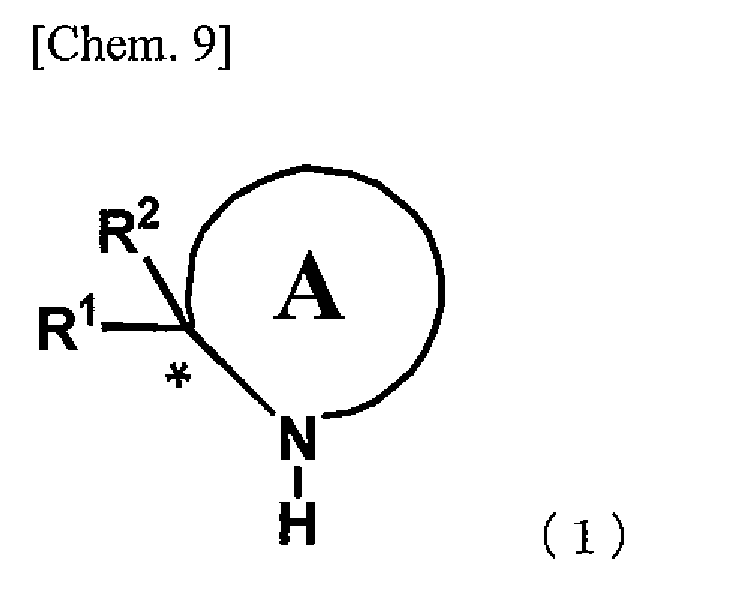
- (In the formula (1), ring A is a 3- to 7-membered ring, may have a substituent group, contains at least one atom selected from the group consisting of carbon, nitrogen, sulfur, oxygen and phosphorus, is preferably constituted from said atoms and may form a fused ring structure; R1 and R2 each independently represent a hydrogen atom, an alkyl group which may have a substituent group, a cycloalkyl group which may have a substituent group, an alkenyl group which may have a substituent group, an aryl group which may have a substituent group, an aralkyl group which may have a substituent group, an alkoxy group which may have a substituent group, a carboxyl group which may have a substituent group, an alkoxycarbonyl group which may have a substituent group, an amido group which may have a substituent group, a siloxy group which may have a substituent group, an aromatic heterocyclic group which may have a substituent group or an aliphatic heterocyclic group which may have a substituent group, wherein R1 and R2 do not represent a same substituent group, and either R1 or R2 may be bonded to the ring A to further form a ring; and * represents an asymmetric carbon atom.)
- As basic skeleton of the ring A, for example, aziridine skeleton, azetidine skeleton, pyrrolidine skeleton, pyrroline skeleton, pyrazolidine skeleton, imidazolidine skeleton, imidazolidinone skeleton, pyrazoline skeleton, thiazolidine skeleton, piperidine skeleton, piperazine skeleton, morpholine skeleton, thiomorpholine skeleton and the like can be mentioned. A substituent group may be present in these basic skeletons.
As basic skeleton in the case that the ring A is a fused ring structure by benzene ring or the like, for example, indoline skeleton, dihydroquinoxaline skeleton, tetrahydroisoquinoline skeleton, dihydroquinoxalinone skeleton and the like can be mentioned. A substituent group may be present in these basic skeletons. - As the substituent group, a hydroxyl group, an oxo group, a halogen atom, an alkyl group, an alkoxy group, an amino group, an alkoxycarbonyl group, an acyl group, an aryl group, an aralkyl group, an aromatic heterocyclic group and an aliphatic heterocyclic group can be mentioned. As the alkyl group, alkoxy group, alkoxycarbonyl group, aryl group, aralkyl group, aromatic heterocyclic group and aliphatic heterocyclic group, the groups which are enumerated in the description of R1 and R2 can be mentioned. As the halogen atom, fluorine atom, chlorine atom, bromine atom, iodine atom and the like can, for example, be mentioned. As the acyl group, for example, acetyl group, propanoyl group, butanoyl group, octanoyl group, benzoyl group, toluoyl group, xyloyl group, naphthoyl group, phenanthroyl group, anthroyl group and the like can be mentioned.
- As the ring A and fused ring A, among these, pyrrolidine skeleton which may have a substituent group, imidazolidinone skeleton which may have a substituent group and dihydroquinoxalinone skeletons which may have a substituent group are desirable.
As suitable examples of the substituent group of ring A and fused ring A, an alkyl group which may have a substituent group, an aralkyl group which may have a substituent group and an aromatic heterocyclic group which may have a substituent group can be mentioned. - Next, the alkyl group, cycloalkyl group, alkenyl group, aryl group, aralkyl group, alkoxy group, carboxyl group, alkoxycarbonyl group, amido group, siloxy group, aromatic heterocyclic group and aliphatic heterocyclic group, as the groups represented by R1 and R2, are described. Each of these groups may have a substituent group.
- As the alkyl group, a straight chain or branched chain alkyl group having, for example, from 1 to 30 carbon atoms, preferably from 1 to 10 carbon atoms, can be mentioned, and illustratively, there may be mentioned methyl group, ethyl group, n-propyl group, isopropyl group, n-butyl group, 2-butyl group, isobutyl group, tert-butyl group, n-pentyl group, 2-pentyl group, 3-pentyl group, tert-pentyl group, 2-methylbutyl group, 3-methylbutyl group, 2,2-dimethylpropyl group, 1,2-dimethylpropyl group, n-hexyl group, 2-hexyl group, 3-hexyl group, 2-methylpentyl group, 3-methylpentyl group, 4-methylpentyl group, 1,1-dimethylbutyl group, 1,2-dimethylbutyl group, 1,3-dimethylbutyl group, 2,2-dimethylbutyl group, 2,3-dimethylbutyl group, 3,3-dimethylbutyl group, 2-ethylbutyl group, 1,1,2-trimethylpropyl group, 1,2,2-trimethylpropyl group, 1-ethyl-1-methylpropyl group, 1-ethyl-2-methylpxopyl group, heptyl group, octyl group, nonyl group, decyl group, undecyl group, dodecyl group, tridecyl group, tetradecyl group, pentadecyl group, hexadecyl group, heptadecyl group, octadecyl group, nonadecyl group, eicosyl group, heneicosyl group, docosyl group and the like.
- In addition, these alkyl groups may have a substituent group, and as said substituent group of alkyl groups, for example, there may be mentioned an alkenyl group, an alkynyl group, an aryl group, an aliphatic heterocyclic group, an aromatic heterocyclic group, an alkoxy group, a trialkylsiloxy group, an alkylenedioxy group, an aryloxy group, an aralkyloxy group, a heteroaryloxy group, a substituted amino group, an alkyl halide group, a cycloalkyl group, a hydroxyl group, a halogen atom and the like.
- As the alkenyl group as a substituent group of alkyl group, there may be mentioned a straight chain or branched chain alkenyl group having, for example, from 2 to 20 carbon atoms, preferably from 2 to 10 carbon atoms, more preferably from 2 to 6 carbon atoms, and illustratively, vinyl group, propenyl group, 1-butenyl group, pentenyl group, hexenyl group and the like can be mentioned.
- As the alkynyl group which substitutes on alkyl group, there may be mentioned a straight chain or branched chain alkynyl group having, for example, from 2 to 15 carbon atoms, preferably from 2 to 10 carbon atoms, more preferably from 2 to 6 carbon atoms, and illustratively, ethynyl group, 1-propynyl group, 2-propynyl group, 1-butynyl group, 3-butynyl group, pentinyl group, hexynyl group and the like can be mentioned.
- As the aryl group as a substituent group of alkyl group, an aryl group having, for example, from 6 to 20 carbon atoms can be mentioned, and illustratively, phenyl group, tolyl group, isopropylphenyl group, xylyl group, t-butylphenyl group, cyclohexyl group, 1-methylcyclohexyl group, adamantylphenyl group, trifluoromethylphenyl group, naphthyl group, anthryl group, phenanthryl group, biphenyl group, 4-(2'-p-tolylpropyl)phenyl group, mesityl group, methoxyphenyl group, dimethoxyphenyl group, 4-(3',4',5',6',7',8',9',10'-heptadecafluorodecyl)phenyl group, fluorophenyl group and the like can be mentioned.
- As the aliphatic heterocyclic group as a substituent group of alkyl group, there may be mentioned a group which has, for example, from 2 to 14 carbon atoms and contains, as heterogeneous atoms, at least one, preferably from 1 to 3 hetero atoms such as nitrogen atom, oxygen atom and sulfur atom. Preferably, a 5- or 6-membered monocyclic aliphatic heterocyclic group and a polycyclic or condensed ring aliphatic heterocyclic group can be mentioned. As illustrative examples of the aliphatic heterocyclic group, for example, 2-oxo-1-pyrrolidinyl group, piperidino group, piperazinyl group, morpholino group, tetrahydrofuryl group, tetrahydropyranyl group, tetrahydrothienyl group and the like can be mentioned.
- As the aromatic heterocyclic group as a substituent group of alkyl group, there may be mentioned a group which has, for example, from 2 to 15 carbon atoms and contains, as heterogeneous atoms, at least one, preferably from 1 to 3 hetero atoms such as nitrogen atom, oxygen atom and sulfur atom. Preferably, a 5- or 6-membered monocyclic aromatic heterocyclic group and a polycyclic or condensed ring aromatic heterocyclic group can be mentioned. As illustrative examples of the aromatic heterocyclic group, for example, there may be mentioned furyl group, methylfuryl group, thienyl group, pyridyl group, pyrimidinyl group, pyrazinyl group, pyridazinyl group, pyrazolinyl group, imidazolyl group, oxazolinyl group, thiazolinyl group, benzofuryl group, benzothienyl group, quinolyl group, isoquinolyl group, quinoxalinyl group, phtharazinyl group, quinazolinyl group, naphthylidinyl group, cinnolinyl group, benzimidazolyl group, benzoxazolyl group, benzothiazolyl group and the like.
- As the alkoxy group as a substituent group of alkyl group, a straight chain or branched chain alkoxy group having, for example, from 1 to 8 carbon atoms can be mentioned, and illustratively, methoxy group, ethoxy group, n-propoxy group, isopropoxy group, n-butoxy group, 2-butoxy group, isobutoxy group, tert-butoxy group, n-pentyloxy group, 2-methylbutoxy group, 3-methylbutoxy group, 2,2-dimethylpropoxy group, n-hexyloxy group, 2-methylpentyloxy group, 3-methylpentyloxy group, 4-methylpentyloxy group, 5-methylpentyloxy group, cyclopentyloxy group, cyclohexyloxy group and the like can be mentioned.
- As the trialkylsiloxy group as a substituent group of alkyl group, for example, trimethylsiloxy group, triethylsiloxy group, dimethyl-tert-butylsiloxy group and the like can be mentioned.
- As the alkylenedioxy group as a substituent group of alkyl group, an alkylenedioxy group having, for example, from 1 to 3 carbon atoms can be mentioned, illustratively, methylenedioxy group, ethylenedioxy group, propylenedioxy group, isopropylidenedioxy group and the like can be mentioned.
- As the aryloxy group as a substituent group of alkyl group, an aryloxy group having, for example, from 6 to 15 carbon atoms can be mentioned, and illustratively, phenoxy group, naphthyloxy group, anthryloxy group, tolyloxy group, xylyloxy group, 4-phenylphenoxy group, 3,5-diphenylphenoxy group, 4-mesitylphenoxy group, 3,5-bis(trifluoromethyl)phenoxy group and the like can be mentioned.
- As the aralkyloxy group as a substituent group of alkyl group, for example, an aralkyloxy group having from 7 to 12 carbon atom can be mentioned, and illustratively, there may be mentioned benzyloxy group, 2-phenylethoxy group, 1-phenylpropoxy group, 2-phenylpropoxy group, 3-phenylpropoxy group, 1-phenylbutoxy group, 2-phenylbutoxy group, 3-phenylbutoxy group, 4-phenylbutoxy group, 1-phenylpentyloxy group, 2-phenylpentyloxy group, 3-phenylpentyloxy group, 4-phenylpentyloxy group, 5-phenylpentyloxy group, 1-phenylhexyloxy group, 2-phenylhexyloxy group, 3-phenylhexyloxy group, 4-phenylhexyloxy group, 5-phenylhexyloxy group, 6-phenylhexyloxy group and the like.
- As the heteroaryloxy group as a substituent group of alkyl group, there may be mentioned a heteroaryloxy group which has, for example, from 2 to 14 carbon atoms and contains, as heterogeneous atoms, at least one, preferably from 1 to 3 hetero atoms such as nitrogen atom, oxygen atom and sulfur atom, and illustratively, 2-pyridyloxy group, 2-pyrazyloxy group, 2-pyrimidyloxy group, 2-quinolyloxy group and the like can be mentioned.
- As the substituted amino group as a substituent group of alkyl group, for example, there may be mentioned mono- or di-alkylamino groups such as N-methylamino group, N,N-dimethylamino group, N,N-diethylamino group, N,N-diisopropylamino group, N-cyclohexylamino group, pyrrolidyl group, piperidyl group and morpholyl group; mono- or di-arylamino group such as N-phenylamino group, N,N-diphenylamino group, N-naphthylamino group and N-naphthyl-N-phenylamino group; mono- or di-aralkylamino group such as N-benzylamino group and N,N-dibenzylamino group; and the like.
- As the alkyl halide substituting the alkyl group, a perhalogenoalkyl group is desirable, and for example, trifluoromethyl group, pentafluoroethyl group, heptafluoropropyl group, undecafluoropentyl group, heptadecafluorooctyl group, undecafluorocyclohexyl group, dichloromethyl group and the like can be mentioned.
As the cycloalkyl group substituting the alkyl group, for example, cyclopropyl group, cyclobutyl group, cyclopentyl group, cyclohexyl group and the like can be mentioned. - As the halogen atom substituting the alkyl group, for example, fluorine atom, chlorine atom, bromine atom, iodine atom and the like can be mentioned.
- As the cycloalkyl group, for example, cyclopropyl group, cyclobutyl group, cyclopentyl group, cyclohexyl group and the like can be mentioned.
These cycloalkyl groups may have a substituent group, and as said substituent group, the substituent groups described in the aforementioned description on the substituent group of alkyl group can be mentioned. - As the alkenyl group, a straight or branched chain or cyclic alkenyl group having, for example, from 2 to 20 carbon atoms, preferably from 2 to 10 carbon atoms, can be mentioned. As illustrative alkenyl groups, for example, vinyl group, 1-propenyl group, 2-propenyl group, 1-butenyl group, 2-butenyl group, 3-butenyl group, 1-pentenyl group, 2-pentenyl group, 3-pentenyl group, 4-pentenyl group, 1-cyclopentenyl group, 3-cyclopentenyl group, 1-hexenyl group, 2-hexenyl group, 3-hexenyl group, 4-hexenyl group, 5-hexenyl group, 4-methyl-3-pentenyl group, 4,8-dimethyl-3,7-nonadienyl group, 1-cyclohexenyl group, 3-cyclohexenyl group and the like can be mentioned.
These alkenyl groups may have a substituent group, and as said substituent group, the groups described in the aforementioned description on the substituent group of alkyl group can be mentioned. - As the aryl group, an aryl group having, for example, from 6 to 20 carbon atoms can be mentioned, and illustratively, phenyl group, tolyl group, isopropylphenyl group, xylyl group, t-butylphenyl group, cyclohexyl group, 1-methylcyclohexyl group, adamantylphenyl group, trifluoromethylphenyl group, naphthyl group, anthryl group, phenanthryl group, biphenyl group, 4-(2'-p-tolylpropyl)phenyl group, mesityl group, methoxyphenyl group, dimethoxyphenyl group, 4-(3',4',5',6',7',8',9',10'-heptadecafluorodecyl)phenyl group, fluorophenyl group and the like can be mentioned.
These aryl groups may have a substituent group, and as said substituent group, the groups described in the description on the substituent group of alkyl group can be mentioned. - As the aralkyl group, an aralkyl group having, for example, from 7 to 45 carbon atoms is desirable, and illustratively, there may be mentioned benzyl group, tolylmethyl group, xylylmethyl group, mesitylmethyl group, 4-phenylphenylmethyl group, 3-phenylphenylmethyl group, 2-phenylphenylmethyl group, 4-mesitylphenylmethyl group, 1-naphthylmethyl group, 2-naphthylmethyl group, 9-anthrylmethyl group, 9-phenanthrylmethyl group, 3,5-diphenylphenylmethyl group, 2-phenylethyl group, 1-phenylpropyl group, 3-naphthylpropyl group, diphenylmethyl group, ditolylmethyl group, dixylylmethyl group, dimesitylmethyl group, di(4-phenylphenyl)methyl group, di(3-phenylphenyl)methyl group, di(2-phenylphenyl)methyl group, di(4-mesitylphenyl)methyl group, di-1-naphthylmethyl group, di-2-naphthylmethyl group, di-9-anthrylmethyl group, di-9-phenanthrylmethyl group, bis(3,5-diphenylphenyl)methyl group, triphenylmethyl group, tritolylmethyl group, trixylylmethyl group, trimesitylmethyl group, tri(4-phenylphenyl)methyl group, tri(3-phenylphenyl)methyl group, tri(2-phenylphenyl)methyl group, tri(4-mesitylphenyl)methyl group, tri-1-naphthyl methyl group, tri-2-naphthylmethyl group, tri-9-anthrylmethyl group, tri-9-phenanthrylmethyl group, tris(3,5-diphenylphenyl)methyl group, trimethylsiloxyphenylmethyl group, trimethylsiloxydiphenyl methyl group, trimethylsiloxyditolyl methyl group, trimethyl siloxydi(4-t-butylphenyl)methyl group, trimethylsiloxydixylylmethyl group, trimethylsiloxydi(2-phenylphenyl)methyl group, trimethylsiloxydi(3-phenylphenyl)methyl group, trimethylsiloxydi(4-phenylphenyl)methyl group, trimethylsiloxybis(3,5-diphenylphenyl)methyl group, trimethylsiloxydi(4-mesitylphenyl)methyl group, trimethylsiloxybis(3,5-ditrifluoromethylphenyl)methyl group and the like.
These aralkyl groups may have a substituent group, and as said substituent group, the groups described in the description on the substituent group of alkyl group can be mentioned. - As the alkoxy group, an alkoxy group having, for example, from 1 to 30 carbon atoms is desirable, and illustratively, methoxy group, ethoxy group, n-propoxy group, isopropoxy group, n-butoxy group, 2-butoxy group, isobutoxy group, tert-butoxy group, n-pentyloxy group, 2-methylbutoxy group, 3-methylbutoxy group, 2,2-dimethylpropoxy group, n-hexyloxy group, 2-methylpentyloxy group, 3-methylpentyloxy group, 4-methylpentyloxy group, 5-methylpentyloxy group, cyclopentyloxy group, cyclohexyloxy group, dicyclopentylmethoxy group, dicyclohexylmethoxy group, tricyclopentyl methoxy group, tricyclohexylmethoxy group, phenylmethoxy group, diphenylmethoxy group, triphenylmethoxy group and the like can be mentioned.
These alkoxy groups may have a substituent group, and as said substituent group, the groups described in the description on the substituent group of alkyl group can be mentioned. - As the carboxyl group, a carboxyl group having, for example, from 1 to 30 carbon atoms is desirable, and illustratively, acetoxy group, n-propanoyloxy group, isopropanoyloxy group, n-butanoyloxy group, 2-butanoyloxy group, isobutanoyloxy group, tert-butanoyloxy group, n-pentanoyloxy group, 2-methylbutanoyloxy group, 3-methylbutanoyloxy group, 2,2-dimethylpropanoyloxy group, n-hexanoyloxy group, 2-methylpentanoyloxy group, 3-methylpentanoyloxy group, 4-methylpentanoyloxy group, 5-methylpentanoyloxy group, cyclopentanoyloxy group, cyclohexanoyloxy group, dicyclopentylacetoxy group, dicyclohexylacetoxy group, tricyclopentylacetoxy group, tricyclohexylacetoxy group, phenylacetoxy group, diphenylacetoxy group, triphenylacetoxy group, benzoyloxy group, naphthoyloxy group and the like can be mentioned.
These carboxyl groups may have a substituent group, and as said substituent group, the groups described in the description on the substituent group of alkyl group can be mentioned. - As the alkoxycarbonyl group, an alkoxycarbonyl group having, for example, from 1 to 30 carbon atoms is desirable, and illustratively, methoxycarbonyl group, ethoxycarbonyl group, n-propoxycarbonyl group, isopropoxycarbonyl group, n-butoxycarbonyl group, 2-butoxycarbonyl group, isobutoxycarbonyl group, tert-butoxycarbonyl group, n-pentyloxycarbonyl group, 2-methylbutoxycarbonyl group, 3-methylbutoxycarbonyl group, 2,2-dimethylpropoxycarbonyl group, n-hexyloxycarbonyl group, 2-methylpentyloxycarbonyl group, 3-methylpentyloxycarbonyl group, 4-methylpentyloxycarbonyl group, 5-methylpentyloxycarbonyl group, cyclopentyloxycarbonyl group, cyclohexyloxycarbonyl group, dicyclopentylmethoxycarbonyl group, dicyclohexylmethoxycarbonyl group, tricyclopentylmethoxycarbonyl group, tricyclohexylmethoxycarbonyl group, phenylmethoxycarbonyl group, diphenylmethoxycarbonyl group, triphenylmethoxycarbonyl group and the like can be mentioned.
These alkoxycarbonyl groups may have a substituent group, and as said substituent group, the groups described in the description on the substituent group of alkyl group can be mentioned. - As the amido group, an amido group having, for example, from 1 to 30 carbon atoms is desirable, and illustratively, acetamido group, n-propionamido group, isopropionamido group, n-butanamido group, 2-butanamido group, isobutanamido group, tert-butanamido group, n-pentanamido group, 2-methylbutanamido group, 3-methylbutanamido group, 2,2-dimethyl propionamido group, n-hexanamido group, 2-methylpentanamido group, 3-methylpentanamido group, 4-methylpentanamido group, 5-methylpentanamido group, cyclopentanamido group, cyclohexanamido group, dicyclopentylacetamido group, dicyclohexylacetamido group, tricyclopentylacetamido group, tricyclohexylacetamido group, phenylacetamido group, diphenylacetamido group, triphenylacetamido group, benzamido group, naphthalenamido group and the like can be mentioned.
These amido groups may have a substituent group, and as said substituent group, the groups described in the description on the substituent group of alkyl group can be mentioned. - As the siloxy group, trimethylsiloxy group, triethylsiloxy group, dimethyl-tert-butylsiloxy group and the like can be mentioned.
These siloxy groups may have a substituent group, and as said substituent group, the groups described in the description on the substituent group of alkyl group can be mentioned. - As the aromatic heterocyclic group, there may be mentioned a group which has, for example, from 2 to 15 carbon atoms and contains, as heterogeneous atoms, at least one, preferably from 1 to 3 hetero atoms such as nitrogen atom, oxygen atom and sulfur atom. Preferably, a 5- or 6-membered monocyclic aromatic heterocyclic group and a polycyclic or condensed ring aromatic heterocyclic group can be mentioned. As illustrative examples of the aromatic heterocyclic group, for example, there may be mentioned furyl group, methylfuryl group, thienyl group, pyridyl group, pyrimidinyl group, pyrazinyl group, pyridazinyl group, pyrazolinyl group, imidazolyl group, oxazolinyl group, thiazolinyl group, benzofuryl group, benzothienyl group, quinolyl group, isoquinolyl group, quinoxalinyl group, phtharazinyl group, quinazolinyl group, naphthylidinyl group, cinnolinyl group, benzimidazolyl group, benzoxazolyl group, benzothiazolyl group and the like.
These aromatic heterocyclic groups may have a substituent group, and as said substituent group, the groups described in the description on the substituent group of alkyl group can be mentioned. - As the aliphatic heterocyclic group, there may be mentioned a group which has, for example, from 2 to 14 carbon atoms and contains, as heterogeneous atoms, at least one, preferably from 1 to 3 hetero atoms such as nitrogen atom, oxygen atom and sulfur atom. Preferably, a 5- or 6-membered monocyclic aliphatic heterocyclic group and a polycyclic or condensed ring aliphatic heterocyclic group can be mentioned. As illustrative examples of the aliphatic heterocyclic group, for example, 2-oxo-1-pyrrolidinyl group, piperidino group, piperazinyl group, morpholino group, tetrahydrofuryl group, tetrahydropyranyl group, tetrahydrothienyl group and the like can be mentioned.
These aliphatic heterocyclic groups may have a substituent group, and as said substituent group, the groups described in the description on the substituent group of alkyl group can be mentioned. - As preferred examples of the groups represented by R1 and R2, hydrogen, an alkyl group which may have a substituent group and an aralkyl group which may have a substituent group can be mentioned.
In this connection, amino acids do not meet the optically active cyclic nitrogen-containing compound of the invention. - As illustrative optically active cyclic nitrogen-containing compounds, the following compounds can, for example, be mentioned.
In the following compounds, Me represents methyl group, and Ph represents phenyl group, Bu represents butyl group, Bn represents benzyl group, Et represents ethyl group, TMS represents trimethylsilyl group and polymer represents a polymer chain. -


-


-


-


-


-

-


-

-

-


-

-


-

-

-
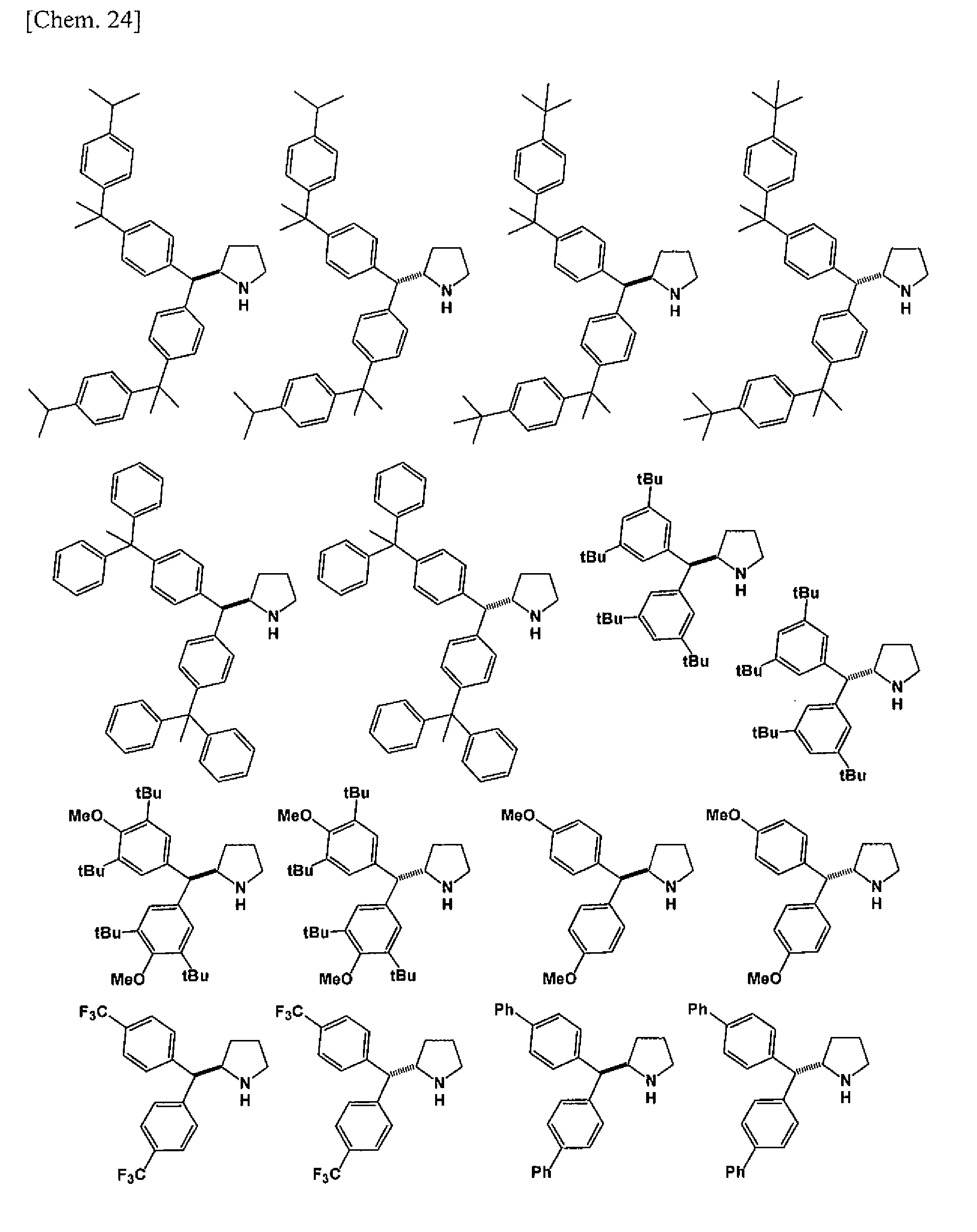
-


-


-


-


-


-


-


-

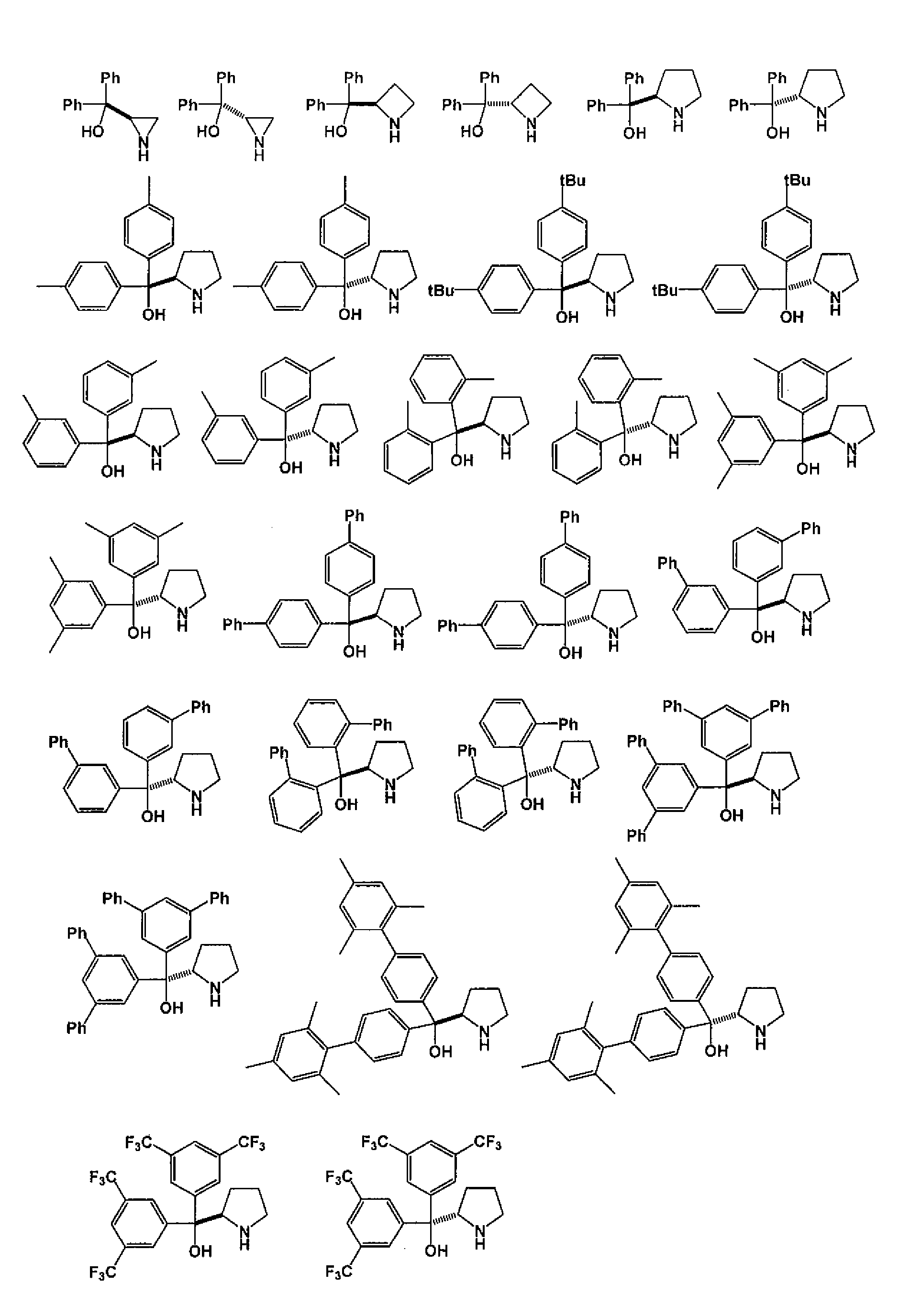
-

-

-

-


- The optically active cyclic nitrogen-containing compounds to be used in the invention are commercially available or can also be synthesized. Among the optically active cyclic nitrogen-containing compounds, production method of optically active diarylmethylpyrrolidine compounds is described.
The optically active diarylmethylpyrrolidine compounds can be synthesized, for example, in accordance with the method described in Tetrahedron, 1993, 49, 5127 - 5132, and Tetrahedron: Asymmetry, 1997, 8, 149 - 153. Said method can be shown by the following Scheme 1. -

- In Scheme 1, the compound 5 can be synthesized in accordance with the method described in Tetrahedron, 1993, 49, 5127 - 5132.
Synthesis of the compound 5 can be carried out by adding a chlorocarbonic acid ester compound represented by the general formula ClCO2R7, dropwise at a temperature within the range of from 0 to 30°C, to a solution prepared by dissolving (R)- or (S)-proline (compound 4) and an alkali metal compound represented by the general formula M2CO3 in an alcohol compound represented by the general formula R8OH. Using amount of the solvent is, for example, from 10 to 30 times volume (ml) [ml/g], preferably from 15 to 25 times volume (ml) [ml/g], based on the weight (g) of (R)- or (S)-proline as the substrate.
The compound 5 obtained as described in the above can be isolated and purified by generally used operations such as extraction, recrystallization, various types of chromatography and the like. - As the group represented by R7 in the chlorocarbonic acid ester compound represented by the general formula ClCO2R7, there may be mentioned alkyl groups having from 1 to 8 carbon atoms such as methyl group, ethyl group, propyl group, isopropyl group, butyl group, pentyl group, hexyl group, heptyl group and octyl group; cyclic alkyl groups having from 1 to 8 carbon atoms such as cyclopropyl group, cyclobutyl group, cyclopentyl group, cycloheptyl group and cyclooctyl group; aralkyl groups having from 7 to 10 carbon atoms such as benzyl group and p-methylbenzyl group, and the like.
As the metal represented by M in the alkali metal compound represented by the general formula M2CO3, lithium, sodium, potassium, cesium and the like can be mentioned.
As the group represented by R8 in the alcohol compound represented by the general formula R8OH, there may be mentioned alkyl groups having from 1 to 8 carbon atoms such as methyl group, ethyl group, propyl group, isopropyl group, butyl group, pentyl group, hexyl group, heptyl group and octyl group; cyclic alkyl groups having from 1 to 8 carbon atoms such as cyclopropyl group, cyclobutyl group, cyclopentyl group, cycloheptyl group and cyclooctyl group; aralkyl groups having from 7 to 10 carbon atoms such as benzyl group and p-methylbenzyl group, and the like. - The compound 6 ca be synthesized in accordance with the method described in Tetrahedron: Asymmetry, 1997, 8, 149 - 153.
Synthesis of the compound 6 is carried out by adding ether solution, such as a THF, of a Grignard compound represented by the general formula ArMgX dropwise to ether solution, such as a THF, of the compound 5, under an atmosphere of an inert gas at a temperature of from -5 to 20°C, and rising the reaction temperature finally to about 70°C and keeping it for a period of from 3 to 6 hours. Using amount of the solvent is, for example, from 1 to 10 times volume (ml) [ml/g], preferably from 2 to 3 times volume (ml) [ml/g], based on the weight (g) of the compound 5 as the substrate.
The compound 6 obtained as described in the above can be isolated and purified by generally used operations such as extraction, recrystallization, various types of chromatography and the like. - As the aryl group represented by Ar in the Grignard compound represented by the general formula ArMgX, an aryl group having, for example, from 6 to 20 carbon atoms, which may have a substituent group, can be mentioned.
As illustrative examples of the aryl group, the aryl groups enumerated in the description of R1 and R2 of the optically active cyclic nitrogen-containing compounds can be mentioned.
As illustrative examples of the substituent group substituting the aryl group, the groups described in the description on the substituent group of alkyl group enumerated in the description of R1 and R2 of the optically active cyclic nitrogen-containing compounds can be mentioned.
As the aryl group, for example, phenyl group, tolyl group, isopropylphenyl group, xylyl group, t-butylphenyl group, cyclohexyl group, 1-methylcyclohexyl group, adamantylphenyl group, trifluoromethylphenyl group, naphthyl group, anthryl group, phenanthryl group, biphenyl group, 4-(2'-p-tolylpropyl)phenyl group and the like can be mentioned.
As the halogen atom represented by X in the Grignard compound represented by the general formula ArMgX, for example, chlorine, bromine and iodine can be mentioned. - The optically active diarylmethylpyrrolidine compounds represented by the compound 7 can be synthesized in accordance with the method described in Tetrahedron: Asymmetry, 1997, 8, 149 - 153.
Synthesis of the compound 7 is carried out by debenzylating the compound 6 at a temperature of from 20 to 80°C for a period of from 1 day to 10 days in a hydrogen atmosphere of approximately from 0.1 MPa to 1 MPa, in the alcohol solvent represented by R8OH, THF or a mixed solvent thereof in the presence of palladium catalyst in an amount of from 0.1 to 40% by weight based on the compound 6. Using amount of the solvent is, for example, from 5 to 50 times volume (ml) [ml/g], preferably from 20 to 40 times volume (ml) [ml/g], based on the weight (g) of the substrate compound 6.
The optically active diarylmethylpyrrolidine compound of compound 7 obtained as described in the above can be isolated and purified by generally used operations such as extraction, recrystallization, various types of chromatography and the like. - The palladium catalyst represented by the general formula Pd cat. is selected from debenzylation catalysts such as Pd/C.
In this connection, the * in Scheme 1 represents asymmetric carbon atom. - In addition, according to the invention, an acid is included as another catalyst component.
As the acid, an organic acid or an inorganic acid can be used, but an organic acid is desirable. - As illustrative examples of the organic acid, there will be mentioned acetic acid, chloroacetic acid, difluoroacetic acid, trifluoroacetic acid, trichloroacetic acid, tribromoacetic acid, benzoic acid, 2,4-dinitrobenzoic acid, p-toluenesulfonic acid, methanesulfonic acid, L-mandelic acid, D-mandelic acid, trifluoromethanesulfonic acid and the like.
As illustrative examples of the inorganic acid, there will be mentioned hydrofluoric acid, hydrochloric acid, hydrobromic acid, hydroiodic acid, sulfuric acid, perchloric acid, phosphoric acid, nitric acid and the like. - According to the invention, an optically active carbonyl compound such as an optically active aldehyde or an optically active ketone can be obtained by subjecting an α,β-unsaturated carbonyl compound to asymmetric hydrogenation reaction in the presence of the aforementioned catalyst.
- Using amounts of the metal powder and metal-supported substance to be used as catalyst components of the invention vary depending on various reaction conditions, but total weight of the metal powder and total weight of the metal-supported substance are, for example, from 0.01 to 10% by weight, preferably from 0.1 to 5% by weight, based on the weight of the α,β-unsaturated carbonyl compound as the substrate.
- Using amount of the optically active cyclic nitrogen-containing compound to be used as a catalyst component of the invention vary depending on various reaction conditions, but is, for example, from 0.01 to 20% by weight, preferably from 0.1 to 5% by weight, based on the α,β-unsaturated carbonyl compound as the substrate.
- Using amount of the acid to be used as catalyst components of the invention vary depending on various reaction conditions, but is, for example, 0.01 to 10 times by mol, preferably 0.2 to 4 times by mol based on the optically active cyclic nitrogen-containing compound.
- When an optically active carbonyl compound is produced by carrying out asymmetric hydrogenation of the α,β-unsaturated carbonyl compound using the catalyst of the invention, it can be carried out in the presence or absence of a solvent, but it is desirable to carry it out in the presence of a solvent.
- As the illustrative solvent to be used, aliphatic hydrocarbon-based organic solvents such as hexane, heptane and octane; alicyclic hydrocarbon-based organic solvents such as cyclohexane and methylcyclohexane; aromatic hydrocarbon-based organic solvents such as benzene, toluene and xylene; ether-based organic solvents such as diethyl ether, diisopropyl ether, dimethoxyethane, tetrahydrofuran, dioxane and dioxolan; water; alcohol-based organic solvents such as methanol, ethanol, propanol, isopropanol and tertiary butanol; halogenated hydrocarbon-based organic solvents such as dichloromethane, dichloroethane, chlorobenzene and bromotoluene; dimethylformamide, acetonitrile and the like are desirable, and a mixed solvent of these solvents can also be used in response to the necessity. Among these solvents, heptane, toluene, tetrahydrofuran, t-butanol and hydrous t-butanol are particularly desirable.
Using amount of the solvent can be optionally selected based on the reaction conditions and the like, but is, for example, from 0 to 20 times volume (ml) [(ml/g)], preferably from 0 to 5 times volume (ml) [(ml/g)], based on the weight (g) of the α,β-unsaturated carbonyl compound as the substrate. - The method of the invention is carried out using hydrogen gas as the hydrogen source, and its hydrogen pressure is from 0.01 MPa to 10 MPa, preferably from 0.1 MPa to 1 MPa. The reaction temperature is from -78 to 100°C, preferably from 10 to 70°C. The reaction time varies depending on the reaction conditions, but is generally from 1 to 30 hours.
- The optically active carbonyl compound obtained as described in the above can be isolated and purified by generally used operations such as extraction, recrystallization, various types of chromatography and the like. In addition, regarding configuration of the thus obtained optically active carbonyl compound, its d-form or 1-form (R-form or S-form) can be produced by optionally selecting configuration of the optically active cyclic nitrogen-containing compound.
- The following describes the invention further illustratively based on examples and comparative examples, though the invention is not restricted thereby.
- Measurement of the products was carried out by a gas chromatographic method (GLC). Its conditions are as described in the following.
The used instrument for analysis: G2010 gas chromatography manufactured by Shimadzu Corp. - Column: DB-WAX (0.25 mm × 30 m) manufactured by Agilent for conversion ratio measurement
- β-dEX-225 (0.25 mm × 30 m) manufactured by SUPELCO for optical purity
- Among the optically active cyclic nitrogen-containing compounds, the compounds used in Examples 48 to 56 and 58 to 61 were synthesized by the following methods. In the other Examples, compounds manufactured by Aldlich Corporation were used.
-


- This was carried out in accordance with the synthesis method of Tetrahedron, Vol. 49, No. 23, 5127-5132.
A 35.54 g (0.3 mol) portion of (R)-proline, 600 ml of anhydrous methanol and 41.46 g of potassium carbonate were put into a 2 liter capacity four neck flask, followed by stirring. Under ice-cooling, 71.62 g (0.66 mmol) of ethyl chlorocarbonate was added dropwise thereto at 25°C or less, followed by stirring at 0°C for 12 hours. Thereafter, methanol was evaporated, the residue was mixed with 300 ml of water and extracted with 450 ml of chloroform, and the water layer was further extracted twice with 450 ml of chloroform. The thus obtained organic layer was washed with saturated brine, dried with anhydrous magnesium sulfate and filtered, and then the solvent was evaporated to obtain 52.85 g of the product of interest with a yield of 87.5%. -

- This was carried out in accordance with the synthesis method of Tetrahedron, Vol. 49, No. 23, 5127-5132.
A 23.03 g (0.2 mol) portion of (S)-proline, 400 ml of anhydrous methanol and 27.64 g of potassium carbonate were put into a 1 liter capacity four neck flask, followed by stirring. Under ice-cooling, 47.75 g (0.44 mmol) of ethyl chlorocarbonate was added dropwise thereto at 25°C or less, followed by stirring at 0°C for 12 hours. Thereafter, methanol was evaporated, the residue was mixed with 200 ml of water and extracted with 300 ml of chloroform, and the water layer was further extracted twice with 300 ml of chloroform. The thus obtained organic layer was washed with saturated brine, dried with anhydrous magnesium sulfate and filtered, and then the solvent was evaporated to obtain 35.85 g of the product of interest with a yield of 89.1%. -

- This was synthesized in accordance with the synthesis method of (S)-2-(diphenylmethyl)pyrrolidine described in Tetrahedron: Asymmetry, Vol. 8, No. 1, 149 - 153.
Under a stream of nitrogen, 12.55 g (469 mmol) of magnesium and 50 ml of anhydrous THF were put into a nitrogen-replaced 1 liter capacity reaction flask, followed by stirring. At room temperature, a 500 ml THF solution of 100 g (469 mmol) of 4-t-butylphenylbromobenzene was added dropwise thereto, followed by stirring at room temperature for 1 hour (synthesis of a Grignard compound).
Next, the above-mentioned solution was cooled to 5°C or less, and a 200 ml THF solution of 47.2 g (235 mmol) of the (R)-proline-N-ethyl carbamate methyl ester obtained in Synthesis Example 1 was added dropwise thereto at 10°C or less and allowed to undergo the reaction. Thereafter, this was heated under reflux for 3 hours and then cooled, and the reaction solution was added to 500 ml of saturated ammonium chloride aqueous solution, mixed with 500 ml of toluene for extraction, followed by stirring for 1 hour. This was transferred to a separating funnel, the organic layer was separated and the water layer was extracted twice with 500 ml of toluene, and the organic layers were combined and washed twice with saturated brine. After drying the organic layer with anhydrous sodium sulfate, the solvent was evaporated, and the thus obtained crystals were dissolved with heating in 1,200 ml of toluene. After cooling, the thus obtained crystals were collected by filtration and then dried under a reduced pressure to obtain 65.8 g of (5R)-[3,3,0]-1-aza-2-oxo-3-oxa-4,4-bis-(4'-t-butylphenyl)-bicyclooctane.
A 460 ml portion of methanol, 460 ml of THF and 2.63 g of 10% Pd-C were added to the thus obtained (5R)-[3,3,0]-1-aza-2-oxo-3-oxa-4,4-bis-(4'-t-butylphenyl)-bicyclooctane, followed by stirring to carry out hydrogen replacement. After carrying out the reaction as such at room temperature for 10 days, Pd-C was removed by filtration and the filtrate was concentrated and purified by a silica gel column chromatography, thereby obtaining 43.6 g of the specified substance as colorless crystals with a yield of 74.3%.
1H-NMR (CD3OD): δ = 1.10 to 1.50, m, 19H δ = 1.60 to 1.85, m, 3H δ = 2.65 to 2.80, m, 1H δ = 2.80 to 2.95, m, 1H δ = 3.65, d, 1H δ = 3.70 to 3.85, m, 1H δ = 7.10 to 7.35, m, 8H -

- This was synthesized in accordance with the synthesis method of (S)-2-(diphenylmethyl)pyrrolidine described in Tetrahedron: Asymmetry, Vol. 8, No. 1, 149-153.
Under a stream of nitrogen, 2.55 g (105 mmol) of magnesium and 50 ml of anhydrous THF were put into a nitrogen-replaced 300 ml capacity reaction flask, followed by stirring. At room temperature, a 30 ml THF solution of 21.31 g (100 mmol) of 4-t-butylphenylbromobenzene was added dropwise thereto, followed by stirring at room temperature for 1 hour (synthesis of a Grignard compound).
Next, the above-mentioned solution was cooled to 5°C or less, and 10.05 g (50 mmol) of the (S)-proline-N-ethyl carbamate methyl ester obtained in Synthesis Example 2 was added dropwise thereto at 10°C or less and allowed to undergo the reaction. Thereafter, this was heated under reflux for 3 hours and then cooled, and the reaction solution was added to 100 ml of saturated ammonium chloride aqueous solution, mixed with 100 ml of toluene for extraction, followed by stirring for 1 hour. This was transferred to a separating funnel, the organic layer was separated and the water layer was extracted twice with 100 ml of toluene, and the organic layers were combined and washed twice with saturated brine. After drying the organic layer with anhydrous sodium sulfate, the solvent was evaporated, and the thus obtained crystals were dissolved with heating in 140 ml of ethyl acetate. After cooling, the thus obtained crystals were collected by filtration and then dried under a reduced pressure to obtain 9.13 g of (5S)-[3,3,0]-1-aza-2-oxo-3-oxa-4,4-bis-(4'-t-butylphenyl)-bicyclooctane.
A 100 ml portion of methanol, 100 ml of THF and 365 mg of 10% Pd-C were added to the thus obtained (5S)-[3,3,0]-1-aza-2-oxo-3-oxa-4,4-bis-(4'-t-butylphenyl)-bicyclooctane, followed by stirring to carry out hydrogen replacement. After carrying out the reaction as such at room temperature for 4 days, Pd-C was removed by filtration and the filtrate was concentrated and purified by a silica gel column chromatography, thereby obtaining 3.48 g of the specified substance as colorless crystals with a yield of 19.93%.
1H-NMR(CD3OD); δ = 1.10 to 1.50, m, 19H δ = 1.60 to 1.85, m, 3H δ = 2.65 to 2.80,m, 1H δ = 2.80 to 2.95, m, 1H δ = 3.65, d, 1H δ = 3.70 to 3.85, m, 1H δ = 7.10 to 7.35, m, 8H -

- This was synthesized in accordance with the synthesis method of (S)-2-(diphenylmethyl)pyrrolidine described in Tetrahedron: Asymmetry, Vol. 8, No. 1, 149 - 153.
Under a stream of nitrogen, 2.55 g (105 mmol) of magnesium and 50 ml of anhydrous THF were put into a nitrogen-replaced 300 ml capacity reaction flask, followed by stirring. At room temperature, a 30 ml THF solution of 19.91 g (100 mmol) of 4-i-propylphenylbromobenzene was added dropwise thereto, followed by stirring at room temperature for 1 hour (synthesis of a Grignard compound).
Next, the above-mentioned solution was cooled to 5°C or less, and 10.05 g (50 mmol) of the (S)-proline-N-ethyl carbamate methyl ester obtained in Synthesis Example 2 was added dropwise thereto at 10°C or less and allowed to undergo the reaction. Thereafter, this was heated under reflux for 3 hours and then cooled, and the reaction solution was added to 100 ml of saturated ammonium chloride aqueous solution, mixed with 100 ml of toluene for extraction, followed by stirring for 1 hour. This was transferred to a separating funnel, and the organic layer was separated and washed twice with saturated brine. After drying the organic layer with anhydrous sodium sulfate, the solvent was evaporated to obtain 16.22 g of (5S)-[3,3,0]-1-aza-2-oxo-3-oxa-4,4-bis-(4'-i-propylphenyl)-bicyciooctane.
A 100 ml portion of methanol, 50 ml of THF and 650 mg of 10% Pd-C were added to the thus obtained (5S)-[3,3,0]-1-aza-2-oxo-3-oxa-4,4-bis-(4'-i-propylphenyl)-bicyclooctane, followed by stirring to carry out hydrogen replacement. After carrying out the reaction as such at room temperature for 4 days, Pd-C was removed by filtration and the filtrate was concentrated and purified by a silica gel column chromatography, thereby obtaining 2.71 g of the specified substance as colorless crystals with a yield of 16.86%.
1H-NMR (CD3OD): δ = 1.05 to 1.20, m, 12H δ = 1.20 to 1.35, m, 1H δ = 1.60 to 1.80,m,3H δ = 2.65 to 2.95, m, 4H δ = 3.60, d, 1H δ = 3.70 to 3.85, m, 1H δ = 7.00 to 7.30, m, 8H -

- A mixed solution of 75.0 ml (632 mmol) of 1-methyl-1-cyclohexene and 56.4 ml (632 mmol) of benzene was added at 0°C dropwise to 225.6 ml (2.53 mol) benzene solution of 231 g (2.36 mol) of sulfuric acid spending 1.5 hours, followed by stirring at 0°C for 1.5 hours. The reaction solution was quenched by adding 300 ml of water, and the water layer was separated. The thus obtained organic layer was washed with 100 ml of saturated sodium hydrogen carbonate aqueous solution, 100 ml of water and 100 ml of saturated brine and dried with anhydrous sodium sulfate. After filtering the desiccant, the filtrate was concentrated to obtain crude 1-methylcyclohexylbenzene. By purifying the thus obtained crude 1-methylcyclohexylbenzene by distillation under a reduced pressure (from 110 to 113°C/10 mmHg), 40.2 g of the specified substance was obtained with a yield of 36.5%.
1H-NMR (CDCl3): δ = 1.20, s, 3H δ = 1.30 to 1.70, m, 8H δ = 1.90 to 2.10, m, 2H δ = 7.10 to 7.40, m, 5H - To 20.0 g (115 mmol) of the 1-methylcyclohexylbenzene obtained in the above-mentioned (1) were added 279 mg (5.00 mmol) of iron and 198 mg (0.78 mmol) of iodine, and 17.8 g (111 mmol) of bromine was slowly added dropwise at 0°C spending 1.5 hours, followed by stirring at the same temperature for 1.5 hours and then at room temperature for 20 hours. The reaction solution was cooled and then quenched with 30 ml of saturated sodium sulfite aqueous solution and extracted three times with 50 ml of hexane. The combined organic layers were washed with 30 ml of sodium sulfite aqueous solution and 30 ml of water and dried with anhydrous sodium sulfate. After filtration of the desiccant, the solvent was recovered under a reduced pressure to obtain 27.9 g of crude bromide. By purifying the thus obtained crude bromide by distillation under a reduced pressure (from 117 to 120°C/2 mmHg), the specified substance was obtained with a yield of 80.3%.
1H-NMR(CDCl3): δ = 1.15, s, 3H δ = 1.30 to 1.70, m, 8H δ = 1.90 to 2.10, m, 2H 2H δ = 7.15 to 7.50, m, 4H - This was synthesized in accordance with the synthesis method of (S)-2-(diphenylmethyl)pyrrolidine described in Tetrahedron: Asymmetry, Vol. 8, No.1, 149-153.
Under a stream of nitrogen, 535 mg (22.0 mmol) of magnesium and 4 ml of anhydrous THF were put into a nitrogen-replaced 100 ml capacity reaction flask, followed by stirring. A 25 ml portion of THF solution of 5.06 g (20 mmol) of the 4-(1'-methylcyclohexyl)bromobenzene obtained in the above-mentioned (2) was added dropwise thereto at room temperature, followed by stirring at room temperature for 1 hour (synthesis of a Grignard compound).
Next, the above-mentioned solution was cooled to 5°C or less, and 16 ml THF solution of 2.01 g (10 mmol) of the (R)-proline-N-ethyl carbamate methyl ester obtained in Synthesis Example 1 was added dropwise thereto at 10°C or less and allowed to undergo the reaction. Thereafter, this was heated under reflux for 3 hours and then cooled, and the reaction solution was put into 25 ml of saturated ammonium chloride aqueous solution, mixed with 50 ml of chloroform for extraction, followed by stirring for 1 hour. This was transferred into a separating funnel, and the organic layer was separated and washed twice with saturated brine. After drying the organic layer with anhydrous sodium sulfate, the solvent was evaporated to obtain 4.76 g of a concentrate. By recrystallizing it from ethyl acetate, 2.37 g of (5R)-[3,3,0]-1-aza-2-oxo-3-oxa-4,4-bis-(4'-(1"-methylcylohexyl)phenyl)-bicylooctane was obtained.
A 35 ml portion of methanol, 35 ml of THF and 1.10 g of 10% Pd-C were added to the thus obtained (5R)-[3,3,0]-1-aza-2-oxo-3-oxa-4,4-bis-(4'-(1"-methylcylohexyl)phenyl)-bicylooctane, followed by stirring to carry out hydrogen replacement. After carrying out 7.5 hours of the reaction at 50°C, Pd-C was removed by filtration and the filtrate was concentrated and purified by a silica gel column chromatography to obtain 1.50 g of colorless crystals of the specified substance with a yield of 35.0%.
1H-NMR (CDCl3): δ = 1.10 to 1.20, s, 6H δ = 1.25 to 2.20, m, 24H δ = 2.70 to 3.00, m, 2H δ = 3.70 to 3.95, m, 2H δ = 7.10 to 7.40, m, 8H -

- This was synthesized in accordance with the synthesis method of (S)-2-(diphenylmethyl)pyrrolidine described in Tetrahedron: Asymmetry, Vol. 8, No. 1, 49 - 153.
Under a stream of nitrogen, 0.591 g (24.3 mmol) of magnesium and 10 ml of anhydrous THF were put into a nitrogen-replaced 200 ml capacity reaction flask, followed by stirring. A 30 ml portion of THF solution of 5.00 g (20.3 mmol) of p-1-adamantylphenylchlorobenzene was added thereto at room temperature, followed by stirring at room temperature for 1 hour (synthesis of a Grignard compound).
Next, the above-mentioned solution was cooled to 5°C or less, and 2.04 g (10.1 mmol) of the (R)-proline-N-ethyl carbamate methyl ester obtained in Synthesis Example 1 was added dropwise thereto at 10°C or less and allowed to undergo the reaction. Thereafter, this was heated under reflux for 3 hours and then cooled, and the reaction solution was put into 100 ml of saturated ammonium chloride aqueous solution, mixed with 300 ml of THF for extraction, followed by stirring for 1 hour. This was transferred into a separating funnel, and the organic layer was separated and washed once with saturated brine. After drying the organic layer with anhydrous sodium sulfate, the solvent was evaporated to obtain 2.37 g of (5R)-[3,3,0]-1-aza-2-oxo-3-oxa-4,4-bis-(p-1'-adamantylphenyl)-bicyclooctane.
A 36 ml portion of methanol, 36 ml of THF and 1.18 g of 10% Pd-C were added to the thus obtained (5R)-[3,3,0]-1-aza-2-oxo-3-oxa-4,4-bis-(p-1'-adamantylphenyl)-bicyclooctane, followed by stirring to carry out hydrogen replacement. After carrying out 70 hours of the reaction at from 50 to 60°C, Pd-C was removed by filtration and the filtrate was concentrated and purified by an alumina column chromatography to obtain 1.45 g of colorless crystals of the specified substance with a yield of 31.6%.
1H-NMR (CDCl3): δ = 1.40 to 2.20, m, 30H δ = 2.60 to 2.80, br, 1H δ = 3.05 to 3.90, m, 2H δ = 4.10 to 4.90, m, 2H δ = 7.00 to 7.50, m, 8H -


- A mixed solution of 21.5 ml (150 mmol) of p-chloromethylstyrene and 20 ml (280 mmol) of toluene was added dropwise at 0°C and spending 1 hour to 59.9 ml (470 mmol) toluene solution of 44.1 g (450 mmol) of sulfuric acid, followed by stirring at 0°C for 2.0 hours. The reaction solution was quenched by adding 100 ml of water, and the water layer was separated. The thus obtained organic layer was washed with 50 ml of saturated sodium hydrogen carbonate aqueous solution and 50 ml of water and dried with anhydrous sodium sulfate. After filtering the desiccant, the filtrate was concentrated to obtain a crude chloride. By purifying the thus obtained crude chloride by distillation under a reduced pressure (from 120 to 130°C/1 mmHg), 31.8 g of the specified substance was obtained with a yield of 86.7%.
1H-NMR (CDCl3): δ = 1.80, s, 6H δ = 2.45, s, 3H δ = 7.20 to 7.45, m, 8H - This was synthesized in accordance with the synthesis method of (S)-2-(diphenylmethyl)pyrrolidine described in Tetrahedron: Asymmetry, Vol. 8, No. 1, 149 - 153.
Under a stream of nitrogen, 535 mg (22.0 mmol) of magnesium and 4 ml of anhydrous THF were put into a nitrogen-replaced 100 ml capacity reaction flask, followed by stirring, A 20 ml portion of THF solution of 4.90 g (20 mmol) of the 4-(2'-p-tolylpropyl)chlorobenzene obtained in the above-mentioned (1) was slowly added dropwise thereto under a reflux condition, followed by stirring under a reflux condition for 6 hours (synthesis of a Grignard compound).
Next, the above-mentioned solution was cooled to 5°C or less, and 16 ml THF solution of 2.01 g (10 mmol) of the (R)-proline-N-ethyl carbamate methyl ester obtained in Synthesis Example 1 was added dropwise thereto at 10°C or less and allowed to undergo the reaction. Thereafter, this was heated under reflux for 3 hours and then cooled, and the reaction solution was put into 25 ml of saturated ammonium chloride aqueous solution, mixed with 50 ml of chloroform for extraction, followed by stirring for 1 hour. This was transferred into a separating funnel, and the organic layer was separated and washed twice with saturated brine. After drying the organic layer with anhydrous sodium sulfate, the solvent was evaporated to obtain a concentrate containing the specified substance. By recrystallizing it from a hexane/ethyl acetate mixed solvent, 2.90 g of (5R)-[3,3,0]-1-aza-2-oxo-3-oxa-4,4-bis-(4'-(2"-p-tolylpropyl)phenyl)-bicyclooctane was obtained.
A 29 ml portion of methanol, 29 ml of THF and 1.45 g of 10% Pd-C were added to the thus obtained (5R)-[3,3,0]-1-aza-2-oxo-3-oxa-4,4-bis-(4'-(2"-p-tolylpropyl)phenyl)-bicyclooctane, followed by stirring to carry out hydrogen replacement. After carrying out 15 hours of the reaction at 50°C, Pd-C was removed by filtration and the filtrate was concentrated and purified by a silica gel column chromatography to obtain 1.86 g of colorless crystals of the specified substance with a yield of 24.7%.
1H-NMR (CDCl3): δ = 1.30 to 2.00, m, 4H δ = 1.60, s, 12H δ = 2.30, s, 6H δ = 2.70 to 3.00, m, 2H δ = 3.75 to 3.90, m, 2H δ = 7.00 to 7.30, m, 16H -


- This was synthesized in accordance with the synthesis method of (S)-2-(diphenylmethyl)pyrrolidine described in Tetrahedron: Asymmetry, Vol. 8, No. 1, 149 - 153.
Under a stream of nitrogen, 2.55 g (105 mmol) of magnesium and 50 ml of anhydrous THF were put into a nitrogen-replaced 300 ml capacity reaction flask, followed by stirring. A 30 ml portion of THF solution of 22.5 g (100 mmol) of 4-trifluoromethylphenylbromobenzene was added dropwise thereto at room temperature, followed by stirring at room temperature for 1 hour (synthesis of a Grignard compound).
Next, the above-mentioned solution was cooled to 5°C or less, and 10.05 g (50 mmol) of the (S)-proline-N-ethyl carbamate methyl ester obtained in Synthesis Example 2 was added dropwise thereto at 10°C or less and allowed to undergo the reaction. Thereafter, this was heated under reflux for 3 hours and then cooled, and the reaction solution was put into 100 ml of saturated ammonium chloride aqueous solution, mixed with 100 ml of toluene for extraction, followed by stirring for 1 hour. This was transferred into a separating funnel, and the organic layer was separated and washed twice with saturated brine. After drying the organic layer with anhydrous sodium sulfate, the solvent was evaporated to obtain 12.87 g of (5S)-[3,3,0]-1-aza-2-oxo-3-oxa-4,4-bis-(4'-trifluoromethylphenyl)-bicyclooctane.
A 130 ml portion of methanol and 514 mg of 10% Pd-C were added to the thus obtained (5S)-[3,3,0]-1-aza-2-oxo-3-oxa-4,4-bis-(4'-trifluoromethylphenyl)-bicyclooctane, followed by stirring to carry out hydrogen replacement. After carrying out 4 days of the reaction as such at room temperature, Pd-C was removed by filtration and the filtrate was concentrated and purified by a silica gel column chromatography to obtain 6.74 g of the pale yellow oily specified substance with a yield of 36.11%.
1H-NMR (CD3OD): δ = 1.25 to 1.50, m, 1H δ = 1.70 to 1.95, m, 3H δ = 2.80 to 2.90, m, 1H δ = 2.90 to 3.05, m, 1H δ = 3.90 to 4.05, m, 1H δ = 7.45 to 7.65, m, 8H -

- This was synthesized in accordance with the synthesis method of (S)-2-(diphenylmethyl)pyrrolidine described in Tetrahedron: Asymmetry, Vol. 8, No. 1, 149 - 153.
Under a stream of nitrogen, 2.13 g (87.5 mmol) of magnesium and 10 ml of anhydrous THF were put into a nitrogen-replaced 300 ml capacity reaction flask, followed by stirring. A 54 ml portion of THF solution of 19.1 g (81.9 mmol) of p-bromobiphenyl was added dropwise thereto at room temperature, followed by stirring at room temperature for 1 hour (synthesis of a Grignard compound).
Next, the above-mentioned solution was cooled to 5°C or less, and 8.00 g (39.8 mmol) of the (S)-proline-N-ethyl carbamate methyl ester obtained in Synthesis Example 2 was added dropwise thereto at 10°C or less and allowed to undergo the reaction. Thereafter, this was heated under reflux for 3 hours and then cooled, and the reaction solution was put into 100 ml of saturated ammonium chloride aqueous solution, mixed with 100 ml of toluene for extraction, followed by stirring for 1 hour. This was transferred into a separating funnel, and the organic layer was separated and washed twice with saturated brine. After drying the organic layer with anhydrous sodium sulfate, the solvent was evaporated to obtain 6.71 g of (5S)-[3,3,0]-1-aza-2-oxo-3-oxa-4,4-bis-(p-biphenyl)-bicyclooctane.
A 130 ml portion of methanol and 335 mg of 10% Pd-C were added to the thus obtained (5S)-[3,3,0]-1-aza-2-oxo-3-oxa-4,4-bis-(p-biphcnyl)-bicyclooctane and stirred to carry out hydrogen replacement. After carrying out 4 days of the reaction as such at room temperature, Pd-C was removed by filtration and the filtrate was concentrated and purified by a silica gel column chromatography to obtain 1.52 g of colorless crystals of the specified substance with a yield of 25.1%.
1H-NMR (CDCl3): δ = 1.43 to 1.89, m, 5H δ = 2.86 to 3.12, m, 2H δ = 3.85 to 3.89, m, 2H δ = 7.25 to 7.56, m, 18H - 1 gram (6.57 mmol) of geranial, 25 mg of 5% by weight Pd-C (2.5% by weight based on geranial), 25 mg (0.11 mmol, 2.5% by weight based on geranial) of (R)-2-(diphenylmethyl)pyrrolidine, 12 mg (0.11 mmol) of trifluoroacetic acid and 2 ml of toluene were put into a 10 ml capacity reaction flask, followed by stirring under an atmosphere of hydrogen (0.1 MPa (atmospheric pressure)). After stirring at room temperature for 21 hours and subsequent removal of the catalyst by filtration, the resulting filtrate was analyzed by a gas chromatography to find that conversion ratio of geranial into citronellal was 91 %, the thus obtained citronellal was d-form and its optical purity was 67.65% e.e.
- Reactions were carried out in the same manner as in Example 1, except that the optically active cyclic nitrogen-containing compound and acid were changed. In this connection, 25 mg of each optically active cyclic nitrogen-containing compound and the same mol of each acid based on the optically active cyclic nitrogen-containing compound were used. The results are shown in Table 1 and Table 2.
In the tables, TFA represents trifluoroacetic acid, and TCA represents trichloroacetic acid. The same shall apply hereinafter. -
[Table 1] Example Optically active cyclic nitrogen-containing compound Acid Conversion ratio (%) Configuration of citronellal Optical purity (%e.e.) 1 
TFA 91.98 d 67.65 2 
TCA 58.43 d 47.24 3 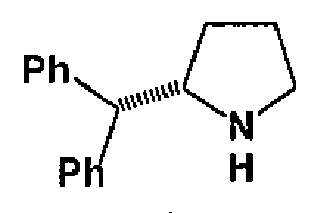
TFA 60.30 l 60.03 4 
TFA 71.05 d 18.08 5 
TFA 97.45 l 14.02 6 
HCl 17.42 d 2.77 -
[Table 2] Example Optically active cyclic nitrogen-containing compound Acid Conversion ratio (%) Configuration of citronellal Optical purity (%e.e.) 7 
TFA 63.99 l 11.10 8 
TFA 61.35 l 24.23 9 
TFA 41.46 d 10.54 10 
HCl 17.64 l 5.89 11 
TFA 53.01 d 2.78 12 
TFA 88.29 d 25.95 - Reactions were carried out in the same manner as in Example 1, except that neral was used as the reaction substrate and the optically active cyclic nitrogen-containing compound and acid were changed. In this connection, 25 mg of each optically active cyclic nitrogen-containing compound and the same mol of each acid based on the optically active cyclic nitrogen-containing compound were used. The results are shown in Table 3 and Table 4.
-
[Table 3] Example Optically active cyclic nitrogen-containing compound Acid Conversion ratio (%) Configuration of citronellal Optical purity (%e.e.) 13 
TFA 95.41 d 61.10 14 
TFA 89.71 l 56.22 15 
TFA 85.06 d 5.90 16 
HCl 39.34 l 4.99 17 
TFA 99.83 l 12.27 18 
TFA 100 l 6.41 19 
TFA 51.30 l 11.10 -
[Table 4] Example Optically active cyclic nitrogen-containing compound Acid Conversion ratio (%) Configuration of citronellal Optical purity (%e.e.) 20 
HCI 33.56 d 3,34 21 
HCI 60.87 d 3.91 22 
TFA 68.57 l 0.15 23 
TFA 99.53 l 28.20 24 
TFA 53.76 d 9.21 25 
TFA 68.01 d 25.42 - The reaction was carried out in the same manner as in Example 1, except that neral was used as the reaction substrate, the optically active cyclic nitrogen-containing compound was changed and the acid was not added. The results are shown in Table 5.
-
[Table 5] Comparative Example Optically active cyclic nitrogen-containing compound Acid Conversion ratio (%) Configuration of citronellal Optical purity (%e.e.) 1 
None 100 d 5.64 - Reactions were carried out in the same manner as in Example 1, except that citral was used as the reaction substrate and the optically active cyclic nitrogen-containing compound and acid were changed. In this connection, 25 mg of each optically active cyclic nitrogen-containing compound and the same mol of each acid based on the optically active cyclic nitrogen-containing compound were used. The results are shown in Table 6.
-
[Table 6] Example Optically active cyclic nitrogen-containing compound Acid Conversion ratio (%) Configuration of citronellal Optical purity (%e.e.) 26 
TFA 80.41 d 58.46 27 
TFA 89.21 l 69.20 28 
TFA 44.67 l 13.08 29 
TFA 66.93 d 12.87 - 1 gram (6.57 mmol) of geranial, 12.5 mg of 5% by weight Pd-silica (1.25% by weight based on geranial), 25 mg (0.11 mmol, 2.5% by weight based on geranial) of (R)-2-(diphenylmethyl)pyrrolidine, 12 mg (0.11 mmol) of trifluoroacetic acid and 2 ml of toluene were put into a 10 ml capacity reaction flask, followed by stirring under an atmosphere of hydrogen (0.1 MPa (atmospheric pressure)). After stirring at room temperature for 21 hours and subsequent removal of the catalyst by filtration, the resulting filtrate was analyzed by a gas chromatography to find that conversion ratio of geranial into citronellal was 42.28%, the thus obtained citronellal was d-form and its optical purity was 70.79% e.e.
- Reactions were carried out in the same manner as in Example 30, except that the metal powder or metal-supported substance was changed. The results are shown in Table 7.
-
[Table 7] Example Metal powder or metal-supported substance Conversion ratio (%) Configuration of citronellal Optical purity (% e.e.) 30 5% by weight Pd-silica 42.28 d 70.79 31 5% by weight Pd-silica-alumina 81.06 d 71.63 32 Pd-black 97.23 d 65.12 33 5% by weight Pd-alumina 69.69 d 37.01 34 5% by weight Pd-zirconia 100 d 40.51 35 5% by weight Pd-zeolite 72.03 d 73.13 36 5% by weight Pd-barium sulfate 82.20 d 73.95 37 5% by weight Rh-carbon 39.04 d 55.69 38 5% by weight Rh-alumina 82.12 d 47.67 39 5% by weight Ru-carbon 11.00 d 42.01 40 5% by weight Pt-carbon 21.88 d 4.13 41 5% by weight Pt-alumina 42.44 d 0.47 - Reactions were carried out in the same manner as in Example 30, except that citral was used as the substrate and the metal-supported substance was changed. The results are shown in Table 8.
-
[Table 8] Example Metal-supported substance Conversion ratio (%) Configuration of citronellal Optical purity (% e.e.) 42 5% by weight Pd-silica-alumina 44.04 d 75.08 43 5% by weight Pd-zeolite 74.51 d 71.31 44 5% by weight Pd-barium sulfate 60.21 d 72.76 - Reactions were carried out in the same manner as in Example 30, except that neral was used as the substrate and the metal-supported substance was changed. The results are shown in Table 9.
-
[Table 9] Example Metal-supported substance Conversion ratio (%) Configuration of citronellal Optical purity (% e.e.) 45 5% by weight Pd-silica-alumina 73.29 d 68.17 46 5% by weight Pd-zeolite 70.24 d 70.02 47 5% by weight Pd-barium sulfate 63.59 d 74.46 - 2 grams (13.14 mmol) of citral, 25 mg of 5% by weight Pd-barium sulfate (1.25% by weight based on citral), 80 mg (0.23 mmol, 4.0% by weight based on citral) of (R)-2-(bis-(4'-t-butylphenyl)methyl)pyrrolidine, 26.1 mg (0.23 mmol) of trifluoroacetic acid and 4 ml of 10% by weight aqueous t-BuOH were put into a 10 ml capacity reaction flask, followed by stirring under an atmosphere of hydrogen (0.1 MPa (atmospheric pressure)). After stirring at 40°C for 21 hours and subsequent removal of the catalyst by filtration, the resulting filtrate was analyzed by a gas chromatography to find that conversion ratio from citral into citronellal was 51 %, the thus obtained citronellal was d-form and its optical purity was 84.91% e.e.
- Reactions were carried out in the same manner as in Example 48, except that the reaction was carried out at 25°C in Example 49, at 50°C in Example 50, at 60°C in Example 51 and at 25°C in toluene in Examples 61 and 62, and the optically active cyclic nitrogen-containing compound and acid were changed as other conditions. In this connection, 80 mg of each optically active cyclic nitrogen-containing compound and the same mol of each acid based on the optically active cyclic nitrogen-containing compound were used. The results are shown in Tables 10 to 12.
-
[Table 10] Example Optically active cyclic nitrogen-containing compound Acid Conversion ratio (%) Configuration of citronellal Optical purity (%e.e.) 48 
TFA 51.36 d 84.91 49 
TFA 25.90 d 73.04 50 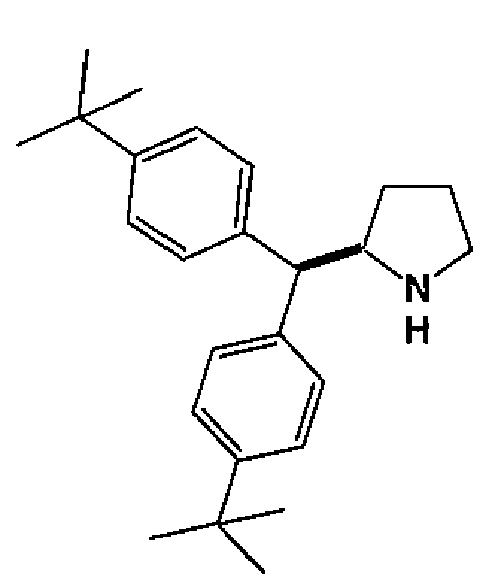
TFA 98.66 d 80.37 51 
TFA 99.71 d 83.82 52 
L-Mandelic acid 100 d 69.31 53 
D-Mandelic acid 100 d 71.45 -
[Table 11] Examples Optically active cyclic nitrogen-containing compound Acid Conversion ratio (%) Configuration of citronellal Optical purity (%e.e.) 54 
TFA 39.85 l 83.67 55 
TFA 35.90 l 83.65 56 
TFA 91.77 d 83.18 57 
TFA 66.72 l 76.91 58 
TFA 11.44 d 73.43 -
[Table 12] Example Optically active cyclic nitrogen-containing compound Acid Conversion ratio (%) Configuration of citronellal Optical purity (%e.e.) 59 
TFA 22.41 d 82.81 60 
TFA 71.49 l 76.16 61 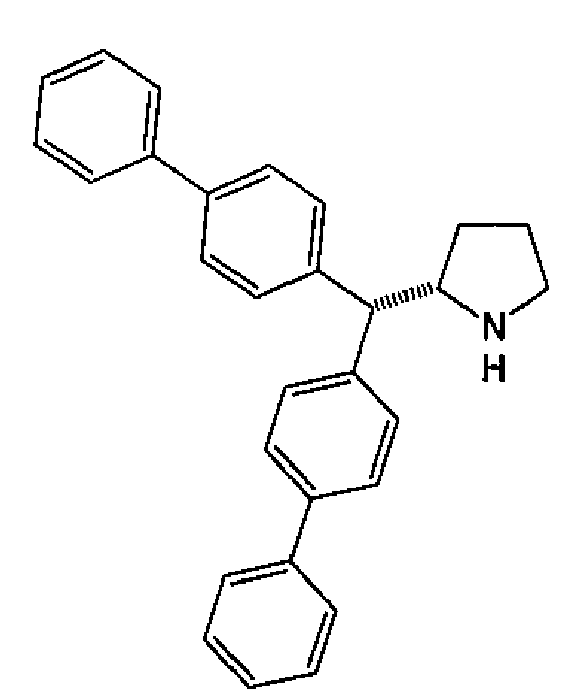
TFA 28.24 l 68.75 62 
TFA 49.61 d 51.86 63 
TFA 32.43 l 7.97 64 
TFA 91.36 d 7.09 - 1 gram (6.84 mmol) of β-methylcinnamaldehyde, 50 mg of 5% by weight Pd-C (5% by weight based on β-methylcinnamaldehyde), 25 mg (0.11 mmol, 2.5% by weight based on β-methylcinnamaldehyde) of (R)-2-(diphenylmethyl)pyrrolidine, 12 mg (0.11 mmol) of trifluoroacetic acid and 2 ml of toluene were put into a 10 ml capacity reaction flask, followed by stirring under an atmosphere of hydrogen (0.1 MPa (atmospheric pressure)). After stirring at room temperature for 21 hours and subsequent removal of the catalyst by filtration, the resulting filtrate was analyzed by a gas chromatography to find that the conversion ratio was 89% and optical purity of the thus obtained (S)-3-phenylbutylaldehyde was 34.88% e.e.
- The reaction was carried out in the same manner as in Example 65, except that (R)-2-(tert-butyl)-3-methyl-4-imidazolidinone was used as the optically active cyclic nitrogen-containing compound. The conversion ratio was 82% and optical purity of the thus obtained (S)-3-phenylbutylaldehyde was 26.81% e.e.
- A 500.0 g (3.28 mol) portion of citral, 6.25 g of 5% by weight Pd-silica-alumina (1.25% by weight based on citral), 12.5 g (52.7 mmol, 2.5% by weight based on citral) of (R)-2-(diphenylmethyl)pyrrolidine, 6 g (52.7 mmol) of trifluoroacetic acid and 1 liter of toluene were put into a 3 liter capacity reaction flask, followed by stirring under an atmosphere of hydrogen (0.1 MPa (atmospheric pressure)). After stirring at room temperature for 21 hours and subsequent removal of the catalyst by filtration, the resulting filtrate was analyzed by a gas chromatography to find that conversion ratio from citral into citronellal was 80.4% and its optical purity 70.66% e.e. The thus obtained crude d-citronellal was distilled to obtain 320 g (2.07 mol, yield 63.1%) of d-citronellal having a purity of 98%.
- A 15.26 g (20 mmol) portion of the tris(2,6-diphenylphenoxy)aluminum catalyst described in
JP-A-2002-212121 - By adding 0.45 g of Raney nickel to 283.8 g of the thus obtained 1-isopulegol, 10 hours of hydrogenation was carried out at 70°C under a hydrogen pressure of 2.5 MPa. By carrying out filtration and distillation of the reaction solution, 273.5 g (1.75 mol, 71.24% e.e.) of 1-menthol was obtained.
- While the invention has been described in detail and with reference to specific embodiments thereof, it will be apparent to one skilled in the art that various changes and modifications can be made therein without departing from the spirit and scope of the invention. This application is based on Japanese Patent Application No.
2009-134161 filed on June 3, 2009 - The catalyst for asymmetric hydrogenation to be used in the invention, which is prepared by simply mixing a metal powder or metal-supported substance, an optically active cyclic nitrogen-containing compound and an acid, can produce an optically active α,β-carbonyl compound by conveniently carrying out asymmetric hydrogenation of its substrate, an α,β-unsaturated carbonyl compound.
That is, optically active citronellal can be obtained by conducting selective asymmetric hydrogenation of α,β-carbon-carbon double bond of citral (a mixture of geranial and neral), geranial or neral. The optically active citronellal is not only useful by itself as a flavor or fragrance but is also an important raw material of optically active citronellol, optically active isopulegol and optically active menthol.
In addition, since the catalyst of the invention is not soluble in the reaction solution, the metal or metal-supported substance and optically active cyclic nitrogen-containing compound can be easily recovered and recycled, which is industrially advantageous.
Claims (6)
- A catalyst for asymmetric hydrogenation of an α, β-unsaturated carbonyl compound, which comprises:a powder of at least one metal selected from metals belonging to Group 8 to Group 10 of the Periodic Table, or a metal-supported substance in which at least one metal selected from metals belonging to Group 8 to Group 10 of the Periodic Table is supported on a support;an optically active cyclic nitrogen-containing compound; andan acid.
- The catalyst for asymmetric hydrogenation according to claim 1, wherein the optically active cyclic nitrogen-containing compound is a compound represented by the following general formula (1):

- The catalyst for asymmetric hydrogenation according to claim 1 or 2,
wherein the metal is selected from the group consisting of nickel, ruthenium, rhodium, iridium, palladium and platinum. - A method for manufacturing an optically active carbonyl compound represented by the following general formula (3):

wherein the method comprises conducting asymmetric hydrogenation of an α,
β-unsaturated carbonyl compound represented by the following general formula (2) by using the catalyst for asymmetric hydrogenation according to any one of claims 1 to 3:
- The method according to claim 4, wherein the α, β-unsaturated carbonyl compound is geranial, neral or citral.
- The method according to claim 4, wherein the α, β-unsaturated carbonyl compound is ketones having a five- to sixteen-membered ring.
Applications Claiming Priority (2)
| Application Number | Priority Date | Filing Date | Title |
|---|---|---|---|
| JP2009134161 | 2009-06-03 | ||
| PCT/JP2010/059387 WO2010140636A1 (en) | 2009-06-03 | 2010-06-02 | Asymmetric hydrogenation catalyst |
Publications (3)
| Publication Number | Publication Date |
|---|---|
| EP2438989A1 true EP2438989A1 (en) | 2012-04-11 |
| EP2438989A4 EP2438989A4 (en) | 2014-03-26 |
| EP2438989B1 EP2438989B1 (en) | 2016-04-13 |
Family
ID=43297769
Family Applications (1)
| Application Number | Title | Priority Date | Filing Date |
|---|---|---|---|
| EP10783418.6A Not-in-force EP2438989B1 (en) | 2009-06-03 | 2010-06-02 | Use of asymmetric hydrogenation catalyst |
Country Status (5)
| Country | Link |
|---|---|
| US (1) | US8217204B2 (en) |
| EP (1) | EP2438989B1 (en) |
| JP (1) | JP5663791B2 (en) |
| CN (1) | CN102458659B (en) |
| WO (1) | WO2010140636A1 (en) |
Families Citing this family (20)
| Publication number | Priority date | Publication date | Assignee | Title |
|---|---|---|---|---|
| WO2011108672A2 (en) * | 2010-03-04 | 2011-09-09 | 高砂香料工業株式会社 | Homogeneous asymmetric hydrogenation catalyst |
| JP5560464B2 (en) * | 2010-11-29 | 2014-07-30 | 高砂香料工業株式会社 | Asymmetric hydrogenation catalyst |
| US9000192B2 (en) | 2010-11-29 | 2015-04-07 | Takasago International Corporation | Catalyst for asymmetric hydrogenation and method for manufacturing optically active carbonyl compound using the same |
| JP5780933B2 (en) | 2010-12-01 | 2015-09-16 | 高砂香料工業株式会社 | Method for producing optically active menthol |
| WO2013065189A1 (en) * | 2011-11-04 | 2013-05-10 | 高砂香料工業株式会社 | Method for preventing decrease in optical purity |
| CA2879268C (en) | 2012-07-16 | 2018-05-08 | Rhodes Technologies | Process for improved opioid synthesis |
| SG11201407988UA (en) | 2012-07-16 | 2015-01-29 | Rhodes Technologies | Process for improved opioid synthesis |
| EP2774674A1 (en) * | 2013-03-06 | 2014-09-10 | Sonja Jost | Water-insoluble Ruthenium catalyst composition for use in aqueous hydrogenation reactions |
| CN103433076B (en) * | 2013-09-02 | 2015-06-24 | 浙江新和成股份有限公司 | Immobilized asymmetric catalyst and application thereof in asymmetric hydrogenation reaction |
| AU2015207733A1 (en) | 2014-01-15 | 2016-07-14 | Rhodes Technologies | Process for improved oxycodone synthesis |
| MX379406B (en) * | 2014-01-15 | 2025-03-11 | Rhodes Tech | Process for improved oxymorphone synthesis |
| GB201501593D0 (en) * | 2015-01-30 | 2015-03-18 | Cambrex Karlskoga Ab | New compounds and processes |
| CN105541579B (en) | 2015-12-30 | 2018-07-17 | 浙江新和成股份有限公司 | A method of preparing optically active carbonyl compounds |
| CN106256816B (en) * | 2016-07-04 | 2019-03-05 | 万华化学集团股份有限公司 | A kind of method for preparing Z-isomer from E-isomer of α,β-unsaturated carbonyl compound |
| CN110963902B (en) * | 2019-12-05 | 2023-01-13 | 万华化学集团股份有限公司 | Method for synthesizing R-citronellal by water-oil two-phase asymmetric hydrogenation and catalyst used in method |
| WO2022208545A1 (en) * | 2021-03-31 | 2022-10-06 | Council Of Scientific & Industrial Research | Hydrogenation of imines by palladium based catalyst |
| EP4319756A4 (en) | 2021-04-09 | 2025-02-26 | Nimbus Clio, Inc. | CBL-B MODULATORS AND THEIR USES |
| CN114558572B (en) * | 2022-03-10 | 2023-12-19 | 万华化学集团股份有限公司 | Hydrogenation catalyst, preparation method thereof and method for preparing citronellol |
| CN116003462B (en) * | 2022-12-02 | 2024-06-11 | 南开大学 | Silicon-based substituted chiral amine and preparation method and application thereof |
| CN120094638B (en) * | 2025-05-07 | 2025-07-22 | 山东新和成药业有限公司 | Double bond isomerization catalyst, preparation method thereof and double bond isomerization method |
Family Cites Families (7)
| Publication number | Priority date | Publication date | Assignee | Title |
|---|---|---|---|---|
| US6016A (en) * | 1849-01-09 | Improvement in corn-planters | ||
| JPS5314911A (en) | 1976-07-26 | 1978-02-10 | Mizutani Fastener | Method of making concrete sill for house |
| FR2396735A1 (en) | 1977-07-04 | 1979-02-02 | Rhone Poulenc Ind | OPTICALLY ACTIVE CITRONELLAL PREPARATION PROCESS |
| JP4676617B2 (en) | 2001-01-18 | 2011-04-27 | 高砂香料工業株式会社 | Method for producing isopulegol |
| DE102004049631A1 (en) * | 2004-10-11 | 2006-04-20 | Basf Ag | Process for the preparation of optically active carbonyl compounds |
| US7323604B2 (en) * | 2004-11-19 | 2008-01-29 | California Institute Of Technology | Hydride reduction of α,β-unsaturated carbonyl compounds using chiral organic catalysts |
| JP2009134161A (en) | 2007-11-30 | 2009-06-18 | Konica Minolta Business Technologies Inc | Cleaning member for fixing device, and cleaning method of the fixing device |
-
2010
- 2010-06-02 EP EP10783418.6A patent/EP2438989B1/en not_active Not-in-force
- 2010-06-02 JP JP2011518481A patent/JP5663791B2/en not_active Expired - Fee Related
- 2010-06-02 US US12/792,016 patent/US8217204B2/en not_active Expired - Fee Related
- 2010-06-02 WO PCT/JP2010/059387 patent/WO2010140636A1/en not_active Ceased
- 2010-06-02 CN CN201080024495.1A patent/CN102458659B/en not_active Expired - Fee Related
Non-Patent Citations (8)
| Title |
|---|
| DIETER ENDERS, HELMUT KIPPHARDT, PETER GERDES, LEONARDO J. BREÑA-VALLE AND VIDYA BHUSHAN: "Large scale preparation of versatile chiral auxiliaries derived from (S)-proline", BULLETIN DES SOCIÉTÉS CHIMIQUES BELGES, vol. 97, no. 8-9, 1988, page 691-704, XP002719520, * |
| É. SIPOS ET AL: "(S)-Proline based chiral modifiers", JOURNAL OF MOLECULAR CATALYSIS A: CHEMICAL, vol. 198, no. 1-2, 1 May 2003 (2003-05-01) , pages 167-173, XP055098749, ISSN: 1381-1169, DOI: 10.1016/S1381-1169(02)00684-2 * |
| É. SIPOS ET AL: "New substrates and modifiers in the enantioselective heterogeneous catalytic hydrogenation of the CC double bond", JOURNAL OF MOLECULAR CATALYSIS A: CHEMICAL, vol. 216, no. 2, 1 July 2004 (2004-07-01), pages 171-180, XP055098738, ISSN: 1381-1169, DOI: 10.1016/j.molcata.2004.03.018 * |
| ÉVA SÍPOS ET AL: "Solvent and support effects in enantioselective hydrogenation of isophorone with (S)-[alpha],[alpha]-diphenyl-2-pyrrolidine methanol modified palladium", REACTION KINETICS AND CATALYSIS LETTERS, SPRINGER SCIENCE+BUSINESS MEDIA, DORDRECHT, NL, vol. 79, no. 1, 1 May 2003 (2003-05-01), pages 101-109, XP019265043, ISSN: 1588-2837 * |
| KAZUO ACHIWA: "Asymmetric hydrogenation with new chiral functionalized bisphosphine-rhodium complexes", JOURNAL OF THE AMERICAN CHEMICAL SOCIETY, vol. 98, no. 25, 1 December 1976 (1976-12-01), pages 8265-8266, XP055099465, ISSN: 0002-7863, DOI: 10.1021/ja00441a064 * |
| KORTVELYESSY G: "Preparation of derivatives of citronellal", ACTA CHIMICA HUNGARICA, vol. 119, no. 4, 1985, page 347-354, XP9175831, * |
| MIKE SCHMITKAMP ET AL: "Enantioselective catalysis with tropos ligands in chiral ionic liquids", CHEMICAL COMMUNICATIONS, no. 39, 1 January 2007 (2007-01-01), pages 4012-4014, XP055099077, ISSN: 1359-7345, DOI: 10.1039/b712068k * |
| See also references of WO2010140636A1 * |
Also Published As
| Publication number | Publication date |
|---|---|
| US20100324338A1 (en) | 2010-12-23 |
| JPWO2010140636A1 (en) | 2012-11-22 |
| JP5663791B2 (en) | 2015-02-04 |
| EP2438989A4 (en) | 2014-03-26 |
| WO2010140636A1 (en) | 2010-12-09 |
| CN102458659B (en) | 2014-07-09 |
| US8217204B2 (en) | 2012-07-10 |
| CN102458659A (en) | 2012-05-16 |
| EP2438989B1 (en) | 2016-04-13 |
Similar Documents
| Publication | Publication Date | Title |
|---|---|---|
| EP2438989B1 (en) | Use of asymmetric hydrogenation catalyst | |
| US9061959B2 (en) | Method for manufacturing optically active menthol | |
| US9000192B2 (en) | Catalyst for asymmetric hydrogenation and method for manufacturing optically active carbonyl compound using the same | |
| CN102177170B (en) | Novel ruthenium carbonyl complex having a tridentate ligand and manufacturing method and usage thereof | |
| US3933919A (en) | Hydroformylation of mono-α-olefins and mono-α-acetylenes | |
| Tanaka et al. | Reductive amination of ketonic compounds catalyzed by Cp* Ir (III) complexes bearing a picolinamidato ligand | |
| US7534921B2 (en) | Method for the production of optically active carbonyl | |
| JP5711209B2 (en) | Homogeneous asymmetric hydrogenation catalyst | |
| JPWO2010061909A1 (en) | Asymmetric hydrogenation catalyst | |
| US8674144B2 (en) | Catalyst for asymmetric hydrogenation and method for manufacturing optically active carbonyl compound using the same | |
| JP4590353B2 (en) | Novel transition metal complex and method for producing optically active alcohol using the complex | |
| EP3199513B1 (en) | Process for producing alcohol analogue | |
| Komiya et al. | 10 Group 8 (Fe, Ru, Os) Metal Compounds | |
| Ylioja | Rhodium catalysed hydroacylation reactions in the synthesis of heterocycles |
Legal Events
| Date | Code | Title | Description |
|---|---|---|---|
| PUAI | Public reference made under article 153(3) epc to a published international application that has entered the european phase |
Free format text: ORIGINAL CODE: 0009012 |
|
| 17P | Request for examination filed |
Effective date: 20111130 |
|
| AK | Designated contracting states |
Kind code of ref document: A1 Designated state(s): AL AT BE BG CH CY CZ DE DK EE ES FI FR GB GR HR HU IE IS IT LI LT LU LV MC MK MT NL NO PL PT RO SE SI SK SM TR |
|
| DAX | Request for extension of the european patent (deleted) | ||
| RIC1 | Information provided on ipc code assigned before grant |
Ipc: C07D 207/08 20060101ALI20140211BHEP Ipc: C07C 45/62 20060101ALI20140211BHEP Ipc: C07D 233/32 20060101ALI20140211BHEP Ipc: C07B 53/00 20060101ALI20140211BHEP Ipc: B01J 31/28 20060101AFI20140211BHEP Ipc: C07D 207/16 20060101ALI20140211BHEP Ipc: C07D 405/04 20060101ALI20140211BHEP Ipc: C07D 207/06 20060101ALI20140211BHEP Ipc: C07D 207/09 20060101ALI20140211BHEP Ipc: C07B 61/00 20060101ALI20140211BHEP Ipc: C07D 241/44 20060101ALI20140211BHEP Ipc: C07C 47/21 20060101ALI20140211BHEP |
|
| A4 | Supplementary search report drawn up and despatched |
Effective date: 20140224 |
|
| 17Q | First examination report despatched |
Effective date: 20150601 |
|
| GRAP | Despatch of communication of intention to grant a patent |
Free format text: ORIGINAL CODE: EPIDOSNIGR1 |
|
| INTG | Intention to grant announced |
Effective date: 20151113 |
|
| GRAS | Grant fee paid |
Free format text: ORIGINAL CODE: EPIDOSNIGR3 |
|
| GRAA | (expected) grant |
Free format text: ORIGINAL CODE: 0009210 |
|
| AK | Designated contracting states |
Kind code of ref document: B1 Designated state(s): AL AT BE BG CH CY CZ DE DK EE ES FI FR GB GR HR HU IE IS IT LI LT LU LV MC MK MT NL NO PL PT RO SE SI SK SM TR |
|
| REG | Reference to a national code |
Ref country code: GB Ref legal event code: FG4D |
|
| REG | Reference to a national code |
Ref country code: AT Ref legal event code: REF Ref document number: 789529 Country of ref document: AT Kind code of ref document: T Effective date: 20160415 Ref country code: CH Ref legal event code: EP |
|
| REG | Reference to a national code |
Ref country code: IE Ref legal event code: FG4D |
|
| REG | Reference to a national code |
Ref country code: DE Ref legal event code: R096 Ref document number: 602010032287 Country of ref document: DE |
|
| REG | Reference to a national code |
Ref country code: LT Ref legal event code: MG4D |
|
| REG | Reference to a national code |
Ref country code: AT Ref legal event code: MK05 Ref document number: 789529 Country of ref document: AT Kind code of ref document: T Effective date: 20160413 |
|
| REG | Reference to a national code |
Ref country code: NL Ref legal event code: MP Effective date: 20160413 |
|
| PG25 | Lapsed in a contracting state [announced via postgrant information from national office to epo] |
Ref country code: NO Free format text: LAPSE BECAUSE OF FAILURE TO SUBMIT A TRANSLATION OF THE DESCRIPTION OR TO PAY THE FEE WITHIN THE PRESCRIBED TIME-LIMIT Effective date: 20160713 Ref country code: LT Free format text: LAPSE BECAUSE OF FAILURE TO SUBMIT A TRANSLATION OF THE DESCRIPTION OR TO PAY THE FEE WITHIN THE PRESCRIBED TIME-LIMIT Effective date: 20160413 Ref country code: NL Free format text: LAPSE BECAUSE OF FAILURE TO SUBMIT A TRANSLATION OF THE DESCRIPTION OR TO PAY THE FEE WITHIN THE PRESCRIBED TIME-LIMIT Effective date: 20160413 Ref country code: PL Free format text: LAPSE BECAUSE OF FAILURE TO SUBMIT A TRANSLATION OF THE DESCRIPTION OR TO PAY THE FEE WITHIN THE PRESCRIBED TIME-LIMIT Effective date: 20160413 Ref country code: FI Free format text: LAPSE BECAUSE OF FAILURE TO SUBMIT A TRANSLATION OF THE DESCRIPTION OR TO PAY THE FEE WITHIN THE PRESCRIBED TIME-LIMIT Effective date: 20160413 |
|
| PG25 | Lapsed in a contracting state [announced via postgrant information from national office to epo] |
Ref country code: ES Free format text: LAPSE BECAUSE OF FAILURE TO SUBMIT A TRANSLATION OF THE DESCRIPTION OR TO PAY THE FEE WITHIN THE PRESCRIBED TIME-LIMIT Effective date: 20160413 Ref country code: AT Free format text: LAPSE BECAUSE OF FAILURE TO SUBMIT A TRANSLATION OF THE DESCRIPTION OR TO PAY THE FEE WITHIN THE PRESCRIBED TIME-LIMIT Effective date: 20160413 Ref country code: SE Free format text: LAPSE BECAUSE OF FAILURE TO SUBMIT A TRANSLATION OF THE DESCRIPTION OR TO PAY THE FEE WITHIN THE PRESCRIBED TIME-LIMIT Effective date: 20160413 Ref country code: GR Free format text: LAPSE BECAUSE OF FAILURE TO SUBMIT A TRANSLATION OF THE DESCRIPTION OR TO PAY THE FEE WITHIN THE PRESCRIBED TIME-LIMIT Effective date: 20160714 Ref country code: LV Free format text: LAPSE BECAUSE OF FAILURE TO SUBMIT A TRANSLATION OF THE DESCRIPTION OR TO PAY THE FEE WITHIN THE PRESCRIBED TIME-LIMIT Effective date: 20160413 Ref country code: HR Free format text: LAPSE BECAUSE OF FAILURE TO SUBMIT A TRANSLATION OF THE DESCRIPTION OR TO PAY THE FEE WITHIN THE PRESCRIBED TIME-LIMIT Effective date: 20160413 Ref country code: PT Free format text: LAPSE BECAUSE OF FAILURE TO SUBMIT A TRANSLATION OF THE DESCRIPTION OR TO PAY THE FEE WITHIN THE PRESCRIBED TIME-LIMIT Effective date: 20160816 |
|
| PG25 | Lapsed in a contracting state [announced via postgrant information from national office to epo] |
Ref country code: BE Free format text: LAPSE BECAUSE OF FAILURE TO SUBMIT A TRANSLATION OF THE DESCRIPTION OR TO PAY THE FEE WITHIN THE PRESCRIBED TIME-LIMIT Effective date: 20160413 Ref country code: IT Free format text: LAPSE BECAUSE OF FAILURE TO SUBMIT A TRANSLATION OF THE DESCRIPTION OR TO PAY THE FEE WITHIN THE PRESCRIBED TIME-LIMIT Effective date: 20160413 |
|
| REG | Reference to a national code |
Ref country code: DE Ref legal event code: R119 Ref document number: 602010032287 Country of ref document: DE |
|
| PG25 | Lapsed in a contracting state [announced via postgrant information from national office to epo] |
Ref country code: EE Free format text: LAPSE BECAUSE OF FAILURE TO SUBMIT A TRANSLATION OF THE DESCRIPTION OR TO PAY THE FEE WITHIN THE PRESCRIBED TIME-LIMIT Effective date: 20160413 Ref country code: RO Free format text: LAPSE BECAUSE OF FAILURE TO SUBMIT A TRANSLATION OF THE DESCRIPTION OR TO PAY THE FEE WITHIN THE PRESCRIBED TIME-LIMIT Effective date: 20160413 Ref country code: DK Free format text: LAPSE BECAUSE OF FAILURE TO SUBMIT A TRANSLATION OF THE DESCRIPTION OR TO PAY THE FEE WITHIN THE PRESCRIBED TIME-LIMIT Effective date: 20160413 Ref country code: SK Free format text: LAPSE BECAUSE OF FAILURE TO SUBMIT A TRANSLATION OF THE DESCRIPTION OR TO PAY THE FEE WITHIN THE PRESCRIBED TIME-LIMIT Effective date: 20160413 Ref country code: MC Free format text: LAPSE BECAUSE OF FAILURE TO SUBMIT A TRANSLATION OF THE DESCRIPTION OR TO PAY THE FEE WITHIN THE PRESCRIBED TIME-LIMIT Effective date: 20160413 Ref country code: CZ Free format text: LAPSE BECAUSE OF FAILURE TO SUBMIT A TRANSLATION OF THE DESCRIPTION OR TO PAY THE FEE WITHIN THE PRESCRIBED TIME-LIMIT Effective date: 20160413 |
|
| REG | Reference to a national code |
Ref country code: CH Ref legal event code: PL |
|
| PLBE | No opposition filed within time limit |
Free format text: ORIGINAL CODE: 0009261 |
|
| STAA | Information on the status of an ep patent application or granted ep patent |
Free format text: STATUS: NO OPPOSITION FILED WITHIN TIME LIMIT |
|
| PG25 | Lapsed in a contracting state [announced via postgrant information from national office to epo] |
Ref country code: SM Free format text: LAPSE BECAUSE OF FAILURE TO SUBMIT A TRANSLATION OF THE DESCRIPTION OR TO PAY THE FEE WITHIN THE PRESCRIBED TIME-LIMIT Effective date: 20160413 |
|
| 26N | No opposition filed |
Effective date: 20170116 |
|
| GBPC | Gb: european patent ceased through non-payment of renewal fee |
Effective date: 20160713 |
|
| REG | Reference to a national code |
Ref country code: IE Ref legal event code: MM4A |
|
| REG | Reference to a national code |
Ref country code: FR Ref legal event code: ST Effective date: 20170228 |
|
| PG25 | Lapsed in a contracting state [announced via postgrant information from national office to epo] |
Ref country code: DE Free format text: LAPSE BECAUSE OF NON-PAYMENT OF DUE FEES Effective date: 20170103 Ref country code: CH Free format text: LAPSE BECAUSE OF NON-PAYMENT OF DUE FEES Effective date: 20160630 Ref country code: LI Free format text: LAPSE BECAUSE OF NON-PAYMENT OF DUE FEES Effective date: 20160630 Ref country code: FR Free format text: LAPSE BECAUSE OF NON-PAYMENT OF DUE FEES Effective date: 20160630 |
|
| PG25 | Lapsed in a contracting state [announced via postgrant information from national office to epo] |
Ref country code: SI Free format text: LAPSE BECAUSE OF FAILURE TO SUBMIT A TRANSLATION OF THE DESCRIPTION OR TO PAY THE FEE WITHIN THE PRESCRIBED TIME-LIMIT Effective date: 20160413 Ref country code: IE Free format text: LAPSE BECAUSE OF NON-PAYMENT OF DUE FEES Effective date: 20160602 Ref country code: GB Free format text: LAPSE BECAUSE OF NON-PAYMENT OF DUE FEES Effective date: 20160713 |
|
| PG25 | Lapsed in a contracting state [announced via postgrant information from national office to epo] |
Ref country code: HU Free format text: LAPSE BECAUSE OF FAILURE TO SUBMIT A TRANSLATION OF THE DESCRIPTION OR TO PAY THE FEE WITHIN THE PRESCRIBED TIME-LIMIT; INVALID AB INITIO Effective date: 20100602 Ref country code: CY Free format text: LAPSE BECAUSE OF FAILURE TO SUBMIT A TRANSLATION OF THE DESCRIPTION OR TO PAY THE FEE WITHIN THE PRESCRIBED TIME-LIMIT Effective date: 20160413 |
|
| PG25 | Lapsed in a contracting state [announced via postgrant information from national office to epo] |
Ref country code: MT Free format text: LAPSE BECAUSE OF NON-PAYMENT OF DUE FEES Effective date: 20160630 Ref country code: LU Free format text: LAPSE BECAUSE OF NON-PAYMENT OF DUE FEES Effective date: 20160602 Ref country code: IS Free format text: LAPSE BECAUSE OF FAILURE TO SUBMIT A TRANSLATION OF THE DESCRIPTION OR TO PAY THE FEE WITHIN THE PRESCRIBED TIME-LIMIT Effective date: 20160413 Ref country code: MK Free format text: LAPSE BECAUSE OF FAILURE TO SUBMIT A TRANSLATION OF THE DESCRIPTION OR TO PAY THE FEE WITHIN THE PRESCRIBED TIME-LIMIT Effective date: 20160413 Ref country code: TR Free format text: LAPSE BECAUSE OF FAILURE TO SUBMIT A TRANSLATION OF THE DESCRIPTION OR TO PAY THE FEE WITHIN THE PRESCRIBED TIME-LIMIT Effective date: 20160413 |
|
| PG25 | Lapsed in a contracting state [announced via postgrant information from national office to epo] |
Ref country code: BG Free format text: LAPSE BECAUSE OF FAILURE TO SUBMIT A TRANSLATION OF THE DESCRIPTION OR TO PAY THE FEE WITHIN THE PRESCRIBED TIME-LIMIT Effective date: 20160413 |
|
| PG25 | Lapsed in a contracting state [announced via postgrant information from national office to epo] |
Ref country code: AL Free format text: LAPSE BECAUSE OF FAILURE TO SUBMIT A TRANSLATION OF THE DESCRIPTION OR TO PAY THE FEE WITHIN THE PRESCRIBED TIME-LIMIT Effective date: 20160413 |