EP2434527A2 - Method and apparatus for tandem time-of-flight mass spectrometry - Google Patents
Method and apparatus for tandem time-of-flight mass spectrometry Download PDFInfo
- Publication number
- EP2434527A2 EP2434527A2 EP11181276A EP11181276A EP2434527A2 EP 2434527 A2 EP2434527 A2 EP 2434527A2 EP 11181276 A EP11181276 A EP 11181276A EP 11181276 A EP11181276 A EP 11181276A EP 2434527 A2 EP2434527 A2 EP 2434527A2
- Authority
- EP
- European Patent Office
- Prior art keywords
- ions
- time
- ion
- flight
- mass
- Prior art date
- Legal status (The legal status is an assumption and is not a legal conclusion. Google has not performed a legal analysis and makes no representation as to the accuracy of the status listed.)
- Withdrawn
Links
Images


Classifications
-
- H—ELECTRICITY
- H01—ELECTRIC ELEMENTS
- H01J—ELECTRIC DISCHARGE TUBES OR DISCHARGE LAMPS
- H01J49/00—Particle spectrometers or separator tubes
- H01J49/0027—Methods for using particle spectrometers
-
- H—ELECTRICITY
- H01—ELECTRIC ELEMENTS
- H01J—ELECTRIC DISCHARGE TUBES OR DISCHARGE LAMPS
- H01J49/00—Particle spectrometers or separator tubes
- H01J49/004—Combinations of spectrometers, tandem spectrometers, e.g. MS/MS, MSn
-
- H—ELECTRICITY
- H01—ELECTRIC ELEMENTS
- H01J—ELECTRIC DISCHARGE TUBES OR DISCHARGE LAMPS
- H01J49/00—Particle spectrometers or separator tubes
- H01J49/004—Combinations of spectrometers, tandem spectrometers, e.g. MS/MS, MSn
- H01J49/0045—Combinations of spectrometers, tandem spectrometers, e.g. MS/MS, MSn characterised by the fragmentation or other specific reaction
- H01J49/0059—Combinations of spectrometers, tandem spectrometers, e.g. MS/MS, MSn characterised by the fragmentation or other specific reaction by a photon beam, photo-dissociation
-
- H—ELECTRICITY
- H01—ELECTRIC ELEMENTS
- H01J—ELECTRIC DISCHARGE TUBES OR DISCHARGE LAMPS
- H01J49/00—Particle spectrometers or separator tubes
- H01J49/02—Details
- H01J49/06—Electron- or ion-optical arrangements
- H01J49/061—Ion deflecting means, e.g. ion gates
-
- H—ELECTRICITY
- H01—ELECTRIC ELEMENTS
- H01J—ELECTRIC DISCHARGE TUBES OR DISCHARGE LAMPS
- H01J49/00—Particle spectrometers or separator tubes
- H01J49/02—Details
- H01J49/10—Ion sources; Ion guns
- H01J49/16—Ion sources; Ion guns using surface ionisation, e.g. field-, thermionic- or photo-emission
- H01J49/161—Ion sources; Ion guns using surface ionisation, e.g. field-, thermionic- or photo-emission using photoionisation, e.g. by laser
- H01J49/164—Laser desorption/ionisation, e.g. matrix-assisted laser desorption/ionisation [MALDI]
-
- H—ELECTRICITY
- H01—ELECTRIC ELEMENTS
- H01J—ELECTRIC DISCHARGE TUBES OR DISCHARGE LAMPS
- H01J49/00—Particle spectrometers or separator tubes
- H01J49/26—Mass spectrometers or separator tubes
- H01J49/34—Dynamic spectrometers
- H01J49/40—Time-of-flight spectrometers
-
- H—ELECTRICITY
- H01—ELECTRIC ELEMENTS
- H01J—ELECTRIC DISCHARGE TUBES OR DISCHARGE LAMPS
- H01J49/00—Particle spectrometers or separator tubes
- H01J49/26—Mass spectrometers or separator tubes
- H01J49/34—Dynamic spectrometers
- H01J49/40—Time-of-flight spectrometers
- H01J49/403—Time-of-flight spectrometers characterised by the acceleration optics and/or the extraction fields
Definitions
- the present invention relates to a method of tandem time-of-flight mass spectrometry used in quantitative analysis and quantitative simultaneous analysis of trace compounds and also in structural analysis of sample ions.
- TOF-MS is an instrument for finding the mass-to-charge ratio of an ion by imparting a given amount of energy to the ion to accelerate it such that it travels and by measuring the time taken until the ion reaches a detector.
- an ion is accelerated with a given pulsed voltage V a .
- V a pulsed voltage
- m is the mass of the ion
- q the electric charge of the ion
- e the elementary charge.
- the ion reaches a detector, placed at a given distance of L, in a flight time T.
- TOF-MS is an instrument that separates masses by making use of the fact that the flight time T differs according to different ion mass m as indicated by Eq. (3).
- Fig. 1 One example of linear TOF-MS is shown in Fig. 1 .
- reflectron TOF mass spectrometers capable of providing improved energy focusing and elongating the flight distance by placing a reflectron field between an ion source and a detector are widely used.
- reflectron TOF-MS is shown in Fig. 2 .
- increasing the total flight time T i.e., increasing the total flight distance
- a multi-pass time-of-flight mass spectrometer has been developed to realize high mass resolution while avoiding an increase in instrumental size (non-patent document 1). This instrument uses four toroidal electric fields each consisting of a combination of a cylindrical electric field and a Matsuda plate.
- the total fight time T can be lengthened by accomplishing multiple turns in an 8-shaped circulating orbit.
- the spatial and temporal spread at the detection surface has been successfully converged up to the first-order term using the initial position, initial angle, and initial kinetic energy.
- the spiral-trajectory TOF-MS has been devised to solve this problem.
- the spiral-trajectory TOF-MS is characterized in that the starting and ending points of a closed trajectory are shifted from the closed trajectory plane in the vertical direction.
- ions are made to impinge obliquely from the beginning (patent document 1).
- the starting and ending points of the closed trajectory are shifted in the vertical direction using a deflector (patent document 2).
- laminated toroidal electric fields are used (patent document 3).
- MALDI-TOFMS Matrix-assisted laser desorption/ionization
- a sample is mixed and dissolved in a matrix (liquid, crystalline compound, metal powder, or the like) having an absorption band at the used laser light wavelength and solidified.
- the solidified sample is irradiated with laser light to vaporize or ionize the sample.
- a laser-induced ionization process typified by the MALDI method, the initial energy distribution occurring when ions are created is wide.
- delayed extraction is employed in most cases. This process consists of applying a pulsed voltage after a delay of hundreds of nanoseconds since laser irradiation.
- the performance of the MALDI-TOFMS has been improved greatly by adoption of the delayed extraction.
- a general MALDI ion source and delayed extraction are conceptually illustrated in Fig. 3 .
- a sample is mixed and dissolved in a matrix (such as liquid, crystalline compound, or metal powder) and solidified.
- the solid sample is placed on a sample plate.
- lens 2, mirror 2, and a CCD camera are disposed. Laser light is directed at the sample through lens 1 and mirror 1 to vaporize or ionize the sample.
- the created ions are accelerated by voltages applied to accelerating electrode 1 and a base electrode (accelerating electrode 2) and introduced into a mass analyzer.
- the sequence of TOF measurement steps employing delayed extraction is also illustrated in Fig. 3 .
- the accelerating electrode 1 and the sample plate are placed at the same potential of Vs.
- a signal indicating laser oscillation is received from the laser.
- the potential Vs on the accelerating electrode 1 is quickly varied to V1 to create a potential gradient between the sample plate and accelerating electrode 1, for accelerating the resulting ions.
- the starting time of measurement of a flight time is synchronized with the rise time of a pulser.
- MS mass spectroscopy
- MS/MS measurements the m/z values of precursor ions, the m/z values of product ions generated in plural fragmentation paths, and information about their relative intensity information are obtained and so structural information about the precursor ions can be obtained ( Fig. 5 ).
- An MS/MS instrument in which two TOF-MS units are connected in tandem is generally known as a TOF-TOF instrument and mainly used in equipment using a MALDI ion source.
- a linear TOF-MS unit is adopted as a first TOF-MS unit and a reflectron TOF-MS unit is adopted as a second TOF-MS unit as shown in Fig. 6 .
- An ion gate for selecting precursor ions is disposed between the first and second TOF-MS units.
- an electric field is normally applied to the ion gate. Under this condition, no ions are allowed to pass. The electric field is de-energized only when precursor ions to be selected pass. The precursor ions spontaneously fragment or are forced to fragment in a collision cell positioned before the reflectron field of the first or second TOF-MS unit.
- the performance of the MALDI method has been improved by the employment of a delayed extraction technique.
- the delayed extraction technique has the disadvantage that the focal point differs slightly depending on the m/z value of ion.
- the focal point is present at the starting point of the second TOF-MS unit. Ion positions are distributed differently according to different m/z values. For example, if ions with some m/z value are focused at the starting point of the second TOF-MS unit, positions are distributed more widely as the m/z value goes away from that m/z value.
- the instrumental conditions are so set that the ion mass resolution is enhanced at some m/z value, the ion mass resolution deteriorates with going away from that m/z value.
- the precursor ions be focused in the direction of axis of flight at the starting point of the second TOF-MS unit. Therefore, it is necessary to modify the instrumental conditions for each m/z value of precursor ions.
- MALDI-TOFMS employing delayed extraction, and permits an ion gate to be time set optimally at all times if the instrumental conditions are varied.
- the present invention provides a method of tandem time-of-flight mass spectrometry, the method being implemented by a tandem time-of-flight mass spectrometer having: an ion source for ionizing a sample by irradiating it with pulsed laser light to generate ions; acceleration means for extracting the generated ions in a pulsed manner and accelerating the ions by a pulsed accelerating voltage under certain delayed extraction conditions; a first time-of-flight ion optical system permitting the accelerated ions to travel; an ion gate for selecting only ions having a desired mass-to-charge ratio as precursor ions from among the ions mass-separated by the firsttime-of-flight ionoptical system; fragmentation means for fragmenting the selected precursor ions into product ions; a second time-of-flight ion optical system disposed behind the fragmentation means and permitting the product ions to travel; and a detector for detecting ions passed through the second time-of-flight ion optical system
- a data table is drawn up in preparation for measurements of productions which are generated by selecting desired precursor ions by the ion gate and fragmenting the precursor ions.
- Optimum delayed extraction conditions for the mass-to-charge ratios of plural reference substances and optimum values of the time for which the ion gate is opened are measured and stored in the data table.
- Delayed extraction conditions and ion gate open time which optimize the mass resolution at the mass-to-charge ratio of the desired precursor ions are found based on the values stored in the table.
- the found optimum values of the delayed extraction conditions and ion gate open time are set into the tandem time-of-flight mass spectrometer.
- the delayed extraction conditions include an ion acceleration voltage or a delay time from laser irradiation to the instant at which the ions are accelerated.
- delayed conditions and ion gate open time adapted for desired ions are calculated by connecting points stored in the table by broken lines and interpolating between the points.
- delayed conditions and ion gate open time adapted for desired ions are calculated by approximating spaces between the points stored in the table by a polynomial equation and interpolating between the points.
- delayed conditions and ion gate open time adapted for desired ions are calculated by partitioning each space between any two adjacent ones of the points stored in the table into two subspaces and assigning respective ones of the m/z values stored in the table to the subspaces.
- laser intensity or a detector voltage of the mass spectrometer is included as fine adjustment conditions, in addition to the delayed extraction conditions and ion gate open time.
- the laser intensity or the detector voltage of the mass spectrometer is finely adjusted in step with the intensity of the precursor ions.
- the ion source is a MALDI ion source.
- the first time-of-flight ion optical system is a time-of-flight ion optical system having precursor ion selectivity that has been enhanced by making use of a reflectron field or sector field.
- the mass positions of the precursor ions that have deviated due to setting of the delayed extraction conditions are corrected so as to conform with their original values based on m/z values of the precursor ions observed within a product ion spectrum.
- a tandem time-of-flight mass spectrometer associated with the present invention has: an ion source for ionizing a sample by irradiating it with pulsed laser light to generate ions; acceleration means for extracting the generated ions in a pulsed manner and accelerating the ions by a pulsed accelerating voltage under certain delayed extraction conditions; a first time-of-flight ion optical system permitting the accelerated ions to travel; an ion gate for selecting only ions having a desired mass-to-charge ratio as precursor ions from among the ions mass-separated by the first time-of-flight ion optical system; fragmentation means for fragmenting the selected precursor ions into product ions; a second time-of-flight ion optical system disposed behind the fragmentation means and permitting the product ions to travel; and a detector for detecting ions passed through the second time-of-flight ion optical system.
- the tandem flight-of-time mass spectrometer comprises: a data table in which measured optimum values of delayed extraction conditions for mass-to-charge ratios of plural reference substances and measured optimum values of open time of the ion gate are stored; means for finding delayed extraction conditions and ion gate open time which optimize mass resolution for each mass-to-charge ratio of the precursor ions based on values stored in the table; and means for setting the optimum values of the delayed extraction conditions and ion gate open time into the tandem time-of-flight mass spectrometer according to the value of the mass-to-charge ratio of the selected precursor ions.
- a method of tandem time-of-flight mass spectrometry associated with the present invention is implemented by a tandem time-of-flight mass spectrometer having: an ion source for ionizing a sample by irradiating it with pulsed laser light to generate ions; acceleration means for extracting the generated ions in a pulsed manner and accelerating the ions by a pulsed accelerating voltage under certain delayed extraction conditions; a first time-of-flight ion optical system permitting the accelerated ions to fly (or travel); an ion gate for selecting only ions having a desired mass-to-charge ratio as precursor ions from among the ions mass-separated by the first time-of-flight ion optical system; fragmentation means for fragmenting the selected precursor ions into product ions; a second time-of-flight ion optical system disposed behind the fragmentation means and permitting the product ions to travel; and a detector for detecting ions passed through the second time-of-flight ion optical system.
- the method starts with drawing up a data table in preparation for measurements of product ions which are generated by selecting desired precursor ions by the ion gate and fragmenting the precursor ions.
- Optimum conditions under which plural reference substances having different mass-to-charge ratios are subjected to delayed extraction and optimum values of the time for which the ion gate is opened are measured and stored in the data table.
- Delayed extraction conditions and ion gate open time which optimize the mass resolution at the mass-to-charge ratio of the desired precursor ions are found based on values stored in the table.
- the found optimum values of the delayed extraction conditions and ion gate open time are set into the tandem time-of-flight mass spectrometer. Consequently, if the instrumental conditions of the MALDI-TOFMS instrument utilizing delayed extraction are varied, a method of tandem time-of-flight mass spectrometry can be offered which permits the ion gate to be time set optimally at all times.
- a tandem time-of-flight mass spectrometer associated with the present invention has: an ion source for ionizing a sample by irradiating it with pulsed laser light to generate ions; acceleration means for extracting the generated ions in a pulsed manner and accelerating the ions by a pulsed accelerating voltage under certain delayed extraction conditions; a first time-of-flight ion optical system permitting the accelerated ions to travel; an ion gate for selecting only ions having a desired mass-to-charge ratio as precursor ions from among the ions mass-separated by the first time-of-flight ion optical system; fragmentation means for fragmenting the selected precursor ions into product ions; a second time-of-flight ion optical system disposed behind the fragmentation means and permitting the product ions to travel; and a detector for detecting ions passed through the second time-of-flight ion optical system.
- the tandem time-of-flight mass spectrometer comprises: a data table in which measured optimum values of delayed extraction conditions for mass-to-charge ratios of plural reference substances and measured optimum values of open time of the ion gate are stored; means for finding delayed extraction conditions and ion gate open time which optimize the mass resolution for each mass-to-charge ratio of the precursor ions based on values stored in the table; and means for setting optimum values of the delayed extraction conditions and ion gate open time into the tandem time-of-flight mass spectrometer according to the value of the mass-to-charge ratio of the selectedprecursor ions. Consequently, if the instrumental conditions of the MALDI-TOFMS employing delayed extraction are varied, a tandem time-of-flight mass spectrometer can be offered which permits the ion gate to be time set optimally at all times.
- the instrumental configuration of the present invention is applicable to every type of TOF/TOF instrument.
- the advantages of the invention can be enhanced in a case where the instrument is so designed that the flight distance of the first TOF-MS unit is elongated by a reflectron field or sector field to achieve higher precursor ion selectivity.
- variable instrumental parameter is the ratio of the sample plate voltage to the pulsed voltage, the ratio being associated with the delayed extraction method. Another example is the delay time itself.
- a method of setting an ion gate is described.
- a time Tg _ M for which the ion gate is opened to select ions having an m/z value of M can be represented using Eq. (6) by converting the m/z value into a flight time using a calibration equation and using the value k of the ratio of the distance from the ion source to the ion gate to the distance from the ion source to the detector.
- Tg _ M k ⁇ C - 1 M
- the coefficient k is so adjusted that monoisotopic ions of the precursor ions are selected in a case where the precursor ions are precursor ions A with m/z value of Ma providing a reference.
- one conceivable procedure is as follows.
- Tg_M 0 k ⁇ C - 1 ⁇ M 0 + ⁇ ⁇ M
- the adjustable parameter that has adjusted the instrumental conditions and the ion gate-adjusting value are recorded and used as one set of adjustment values stored in the table.
- an unknown sample is measured in practice.
- a mass spectrum is measured.
- a list of m/z values of precursor ions to be measured by MS/MS is made.
- the precursor ions in the list are successively measured by MS/MS.
- instrumental parameters and ion gate-correcting values are calculated according to the m/z values of the ions from the adjustment table already drawn up and are set into the instrument.
- Fig. 8 Several methods are available as the method for the calculations. Some of them are exemplified in Fig. 8 .
- a first method the spaces between reference values indicating the relations of the instrumental parameters contained in the adjustment table to the m/z values of ions are interpolated by broken lines. Ion gate-correcting values conforming to the m/z values of the ions are calculated.
- a second method the spaces between reference values indicating the relations of the instrumental parameters contained in the adjustment table to the m/z values of the ions are interpolated by an approximation equation, and ion gate-correcting values conforming to the m/z values of the ions are calculated.
- reference values themselves indicating the relations of the instrumental parameters contained in the adjustment table to the m/z values of the ions are regarded as effective within a given range of m/z, and ion gate-correcting values conforming to the m/z values of ions are computed.
- a detector voltage or laser intensity that is an instrumental parameter associated with the ionization efficiency may be used as an additional adjustable parameter. This makes it possible to measure spectra of more uniform quality.
- the present invention can be widely used in tandem measurements performed by a time-of-flight mass spectrometer.
Landscapes
- Chemical & Material Sciences (AREA)
- Analytical Chemistry (AREA)
- Physics & Mathematics (AREA)
- Optics & Photonics (AREA)
- Engineering & Computer Science (AREA)
- Plasma & Fusion (AREA)
- Chemical Kinetics & Catalysis (AREA)
- Electron Tubes For Measurement (AREA)
- Other Investigation Or Analysis Of Materials By Electrical Means (AREA)
Abstract
Description
- The present invention relates to a method of tandem time-of-flight mass spectrometry used in quantitative analysis and quantitative simultaneous analysis of trace compounds and also in structural analysis of sample ions.
- TOF-MS is an instrument for finding the mass-to-charge ratio of an ion by imparting a given amount of energy to the ion to accelerate it such that it travels and by measuring the time taken until the ion reaches a detector. In TOF-MS, an ion is accelerated with a given pulsed voltage Va . At this time, from the law of conservation of energy, the velocity v of the ion is given by


where m is the mass of the ion, q is the electric charge of the ion, and e is the elementary charge. The ion reaches a detector, placed at a given distance of L, in a flight time T. The flight time is given by
- TOF-MS is an instrument that separates masses by making use of the fact that the flight time T differs according to different ion mass m as indicated by Eq. (3). One example of linear TOF-MS is shown in
Fig. 1 . Furthermore, reflectron TOF mass spectrometers capable of providing improved energy focusing and elongating the flight distance by placing a reflectron field between an ion source and a detector are widely used. One example of reflectron TOF-MS is shown inFig. 2 . - The mass resolution of TOF-MS is defined to be

where T is the total flight time and ΔT is a peak width. That is, if the peak width ΔT is made constant and the total flight time T can be lengthened, the mass resolution can be improved. However, in the related art linear or reflectron type TOF-MS, increasing the total flight time T (i.e., increasing the total flight distance) will lead directly to an increase in instrumental size. A multi-pass time-of-flight mass spectrometer has been developed to realize high mass resolution while avoiding an increase in instrumental size (non-patent document 1). This instrument uses four toroidal electric fields each consisting of a combination of a cylindrical electric field and a Matsuda plate. The total fight time T can be lengthened by accomplishing multiple turns in an 8-shaped circulating orbit. In this apparatus, the spatial and temporal spread at the detection surface has been successfully converged up to the first-order term using the initial position, initial angle, and initial kinetic energy. - However, the TOF-MS in which ions revolve many times around a closed trajectory suffers from the problem of overtaking. That is, because ions revolve multiple times round a closed trajectory, lighter ions moving at higher speeds overtake heavier ions moving at smaller speeds. Consequently, the fundamental concept of TOF-MS that ions arrive at the detection surface in turn from the lightest one does not hold.
- The spiral-trajectory TOF-MS has been devised to solve this problem. The spiral-trajectory TOF-MS is characterized in that the starting and ending points of a closed trajectory are shifted from the closed trajectory plane in the vertical direction. To achieve this, in one method, ions are made to impinge obliquely from the beginning (patent document 1). In another method, the starting and ending points of the closed trajectory are shifted in the vertical direction using a deflector (patent document 2). In a further method, laminated toroidal electric fields are used (patent document 3).
- Another TOF-MS has been devised which is based on a similar concept but in which the trajectory of the multi-turn TOF-MS (patent document 4) where overtaking occurs is zigzagged (patent document 5) .
- Matrix-assisted laser desorption/ionization (MALDI) is available as one type of ion source for TOF-MS. An instrument in which the MALDI method and TOF-MS are combined is referred to as MALDI-TOFMS. In the MALDI method, a sample is mixed and dissolved in a matrix (liquid, crystalline compound, metal powder, or the like) having an absorption band at the used laser light wavelength and solidified. The solidified sample is irradiated with laser light to vaporize or ionize the sample. In a laser-induced ionization process typified by the MALDI method, the initial energy distribution occurring when ions are created is wide. In order to converge the distribution in terms of time, delayed extraction is employed in most cases. This process consists of applying a pulsed voltage after a delay of hundreds of nanoseconds since laser irradiation. The performance of the MALDI-TOFMS has been improved greatly by adoption of the delayed extraction.
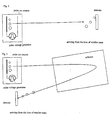
- A general MALDI ion source and delayed extraction are conceptually illustrated in
Fig. 3 . A sample is mixed and dissolved in a matrix (such as liquid, crystalline compound, or metal powder) and solidified. The solid sample is placed on a sample plate. To permit the state of the sample to be observed,lens 2,mirror 2, and a CCD camera are disposed. Laser light is directed at the sample throughlens 1 andmirror 1 to vaporize or ionize the sample. - The created ions are accelerated by voltages applied to accelerating
electrode 1 and a base electrode (accelerating electrode 2) and introduced into a mass analyzer. - The sequence of TOF measurement steps employing delayed extraction is also illustrated in
Fig. 3 . First, the acceleratingelectrode 1 and the sample plate are placed at the same potential of Vs. Then, a signal indicating laser oscillation is received from the laser. After a delay of hundreds of nsec, the potential Vs on the acceleratingelectrode 1 is quickly varied to V1 to create a potential gradient between the sample plate and acceleratingelectrode 1, for accelerating the resulting ions. The starting time of measurement of a flight time is synchronized with the rise time of a pulser. - In general mass analysis, ions generated by an ion source are separated according to their m/z by a mass analyzer and detected. The results are represented in the form of a mass spectrum in which m/z values and relative intensity of each ion are graphed. Information obtained at this time is only about masses. This measurement is herein referred to as an MS measurement in contrast with an MS/MS measurement in which certain ions (precursor ions) generated by an ion source are selected by a first stage of mass analyzer (MS1 in
Fig. 4 ), the ions spontaneously fragment or are caused to fragment, and the generated ions (product ions) are mass analyzed by a subsequent stage of mass analyzer (MS2). An instrument enabling this is referred to as an MS/MS instrument. - In MS/MS measurements, the m/z values of precursor ions, the m/z values of product ions generated in plural fragmentation paths, and information about their relative intensity information are obtained and so structural information about the precursor ions can be obtained (
Fig. 5 ). An MS/MS instrument in which two TOF-MS units are connected in tandem is generally known as a TOF-TOF instrument and mainly used in equipment using a MALDI ion source. In a related-art TOF-TOF instrument, a linear TOF-MS unit is adopted as a first TOF-MS unit and a reflectron TOF-MS unit is adopted as a second TOF-MS unit as shown inFig. 6 . An ion gate for selecting precursor ions is disposed between the first and second TOF-MS units. In the case of TOF-TOF, an electric field is normally applied to the ion gate. Under this condition, no ions are allowed to pass. The electric field is de-energized only when precursor ions to be selected pass. The precursor ions spontaneously fragment or are forced to fragment in a collision cell positioned before the reflectron field of the first or second TOF-MS unit. -
- [Non-patent document 1] M. Toyoda, D. Okumura, M. Ishihara and I. Katakuse, J. Mass Spectrom., 2003, 38, pp. 1125-1142.
-
- [Patent document 1]
JP-A-2000-243345 - [Patent document 2]
JP-A-2003-86129 - [Patent document 3]
JP-A-2003-12782 - [Patent document 4]
GB2080021 - [Patent document 5]
WO 2005/001878 pamphlet - [Patent document 6]
JP-A-2005-302728 - The performance of the MALDI method has been improved by the employment of a delayed extraction technique. However, the delayed extraction technique has the disadvantage that the focal point differs slightly depending on the m/z value of ion. In the case of TOF-TOF, the focal point is present at the starting point of the second TOF-MS unit. Ion positions are distributed differently according to different m/z values. For example, if ions with some m/z value are focused at the starting point of the second TOF-MS unit, positions are distributed more widely as the m/z value goes away from that m/z value.
- That is, if the instrumental conditions are so set that the ion mass resolution is enhanced at some m/z value, the ion mass resolution deteriorates with going away from that m/z value. In order to obtain a product ion spectrum of higher quality, it is important that the precursor ions be focused in the direction of axis of flight at the starting point of the second TOF-MS unit. Therefore, it is necessary to modify the instrumental conditions for each m/z value of precursor ions.
- However, modifying the instrumental conditions affects the observed flight time. Consequently, the set value of the ion gate needs to be finely adjusted accordingly. In an instrument capable of providing especially high precursor ion selectivity, if only ions with a quite restricted range of m/z values are selected such as monoisotopic ions within precursor ions, it is quite important to adjust the time setting of the ion gate.
- In view of the foregoing, it is desirable to provide a method and apparatus which is adapted for use in tandem time-of-flight mass spectrometry, is MALDI-TOFMS employing delayed extraction, and permits an ion gate to be time set optimally at all times if the instrumental conditions are varied.
- The present invention according to
claim 1 provides a method of tandem time-of-flight mass spectrometry, the method being implemented by a tandem time-of-flight mass spectrometer having: an ion source for ionizing a sample by irradiating it with pulsed laser light to generate ions; acceleration means for extracting the generated ions in a pulsed manner and accelerating the ions by a pulsed accelerating voltage under certain delayed extraction conditions; a first time-of-flight ion optical system permitting the accelerated ions to travel; an ion gate for selecting only ions having a desired mass-to-charge ratio as precursor ions from among the ions mass-separated by the firsttime-of-flight ionoptical system; fragmentation means for fragmenting the selected precursor ions into product ions; a second time-of-flight ion optical system disposed behind the fragmentation means and permitting the product ions to travel; and a detector for detecting ions passed through the second time-of-flight ion optical system. A data table is drawn up in preparation for measurements of productions which are generated by selecting desired precursor ions by the ion gate and fragmenting the precursor ions. Optimum delayed extraction conditions for the mass-to-charge ratios of plural reference substances and optimum values of the time for which the ion gate is opened are measured and stored in the data table. Delayed extraction conditions and ion gate open time which optimize the mass resolution at the mass-to-charge ratio of the desired precursor ions are found based on the values stored in the table. The found optimum values of the delayed extraction conditions and ion gate open time are set into the tandem time-of-flight mass spectrometer. - In one feature of this method, the delayed extraction conditions include an ion acceleration voltage or a delay time from laser irradiation to the instant at which the ions are accelerated.
- In another feature of the method, with respect to the delayed extraction conditions and ion gate open time, delayed conditions and ion gate open time adapted for desired ions are calculated by connecting points stored in the table by broken lines and interpolating between the points.
- In a further feature of the method, with respect to the delayed extraction conditions and ion gate open time, delayed conditions and ion gate open time adapted for desired ions are calculated by approximating spaces between the points stored in the table by a polynomial equation and interpolating between the points.
- In a yet other feature of the method, with respect to the delayed extraction conditions and ion gate open time, delayed conditions and ion gate open time adapted for desired ions are calculated by partitioning each space between any two adjacent ones of the points stored in the table into two subspaces and assigning respective ones of the m/z values stored in the table to the subspaces.
- In a still other feature of the method, laser intensity or a detector voltage of the mass spectrometer is included as fine adjustment conditions, in addition to the delayed extraction conditions and ion gate open time.
- In an additional feature of the method, the laser intensity or the detector voltage of the mass spectrometer is finely adjusted in step with the intensity of the precursor ions.
- In a still further feature of the method, the ion source is a MALDI ion source.
- In yet additional feature of the method, the first time-of-flight ion optical system is a time-of-flight ion optical system having precursor ion selectivity that has been enhanced by making use of a reflectron field or sector field.
- In a yet another feature of the method, after a measurement, the mass positions of the precursor ions that have deviated due to setting of the delayed extraction conditions are corrected so as to conform with their original values based on m/z values of the precursor ions observed within a product ion spectrum.
- A tandem time-of-flight mass spectrometer associated with the present invention has: an ion source for ionizing a sample by irradiating it with pulsed laser light to generate ions; acceleration means for extracting the generated ions in a pulsed manner and accelerating the ions by a pulsed accelerating voltage under certain delayed extraction conditions; a first time-of-flight ion optical system permitting the accelerated ions to travel; an ion gate for selecting only ions having a desired mass-to-charge ratio as precursor ions from among the ions mass-separated by the first time-of-flight ion optical system; fragmentation means for fragmenting the selected precursor ions into product ions; a second time-of-flight ion optical system disposed behind the fragmentation means and permitting the product ions to travel; and a detector for detecting ions passed through the second time-of-flight ion optical system. The tandem flight-of-time mass spectrometer comprises: a data table in which measured optimum values of delayed extraction conditions for mass-to-charge ratios of plural reference substances and measured optimum values of open time of the ion gate are stored; means for finding delayed extraction conditions and ion gate open time which optimize mass resolution for each mass-to-charge ratio of the precursor ions based on values stored in the table; and means for setting the optimum values of the delayed extraction conditions and ion gate open time into the tandem time-of-flight mass spectrometer according to the value of the mass-to-charge ratio of the selected precursor ions.
- A method of tandem time-of-flight mass spectrometry associated with the present invention is implemented by a tandem time-of-flight mass spectrometer having: an ion source for ionizing a sample by irradiating it with pulsed laser light to generate ions; acceleration means for extracting the generated ions in a pulsed manner and accelerating the ions by a pulsed accelerating voltage under certain delayed extraction conditions; a first time-of-flight ion optical system permitting the accelerated ions to fly (or travel); an ion gate for selecting only ions having a desired mass-to-charge ratio as precursor ions from among the ions mass-separated by the first time-of-flight ion optical system; fragmentation means for fragmenting the selected precursor ions into product ions; a second time-of-flight ion optical system disposed behind the fragmentation means and permitting the product ions to travel; and a detector for detecting ions passed through the second time-of-flight ion optical system. The method starts with drawing up a data table in preparation for measurements of product ions which are generated by selecting desired precursor ions by the ion gate and fragmenting the precursor ions. Optimum conditions under which plural reference substances having different mass-to-charge ratios are subjected to delayed extraction and optimum values of the time for which the ion gate is opened are measured and stored in the data table. Delayed extraction conditions and ion gate open time which optimize the mass resolution at the mass-to-charge ratio of the desired precursor ions are found based on values stored in the table. The found optimum values of the delayed extraction conditions and ion gate open time are set into the tandem time-of-flight mass spectrometer. Consequently, if the instrumental conditions of the MALDI-TOFMS instrument utilizing delayed extraction are varied, a method of tandem time-of-flight mass spectrometry can be offered which permits the ion gate to be time set optimally at all times.
- A tandem time-of-flight mass spectrometer associated with the present invention has: an ion source for ionizing a sample by irradiating it with pulsed laser light to generate ions; acceleration means for extracting the generated ions in a pulsed manner and accelerating the ions by a pulsed accelerating voltage under certain delayed extraction conditions; a first time-of-flight ion optical system permitting the accelerated ions to travel; an ion gate for selecting only ions having a desired mass-to-charge ratio as precursor ions from among the ions mass-separated by the first time-of-flight ion optical system; fragmentation means for fragmenting the selected precursor ions into product ions; a second time-of-flight ion optical system disposed behind the fragmentation means and permitting the product ions to travel; and a detector for detecting ions passed through the second time-of-flight ion optical system. The tandem time-of-flight mass spectrometer comprises: a data table in which measured optimum values of delayed extraction conditions for mass-to-charge ratios of plural reference substances and measured optimum values of open time of the ion gate are stored; means for finding delayed extraction conditions and ion gate open time which optimize the mass resolution for each mass-to-charge ratio of the precursor ions based on values stored in the table; and means for setting optimum values of the delayed extraction conditions and ion gate open time into the tandem time-of-flight mass spectrometer according to the value of the mass-to-charge ratio of the selectedprecursor ions. Consequently, if the instrumental conditions of the MALDI-TOFMS employing delayed extraction are varied, a tandem time-of-flight mass spectrometer can be offered which permits the ion gate to be time set optimally at all times.
- Other features and advantages of the present invention will become apparent from the following more detailed description, taken in conjunction with the accompanying drawings, which illustrate, by way of example, the principles of the invention.
-
-
Fig. 1 illustrates one related art linear TOF-MS instrument; -
Fig. 2 illustrates one related art reflectron TOF-MS instrument; -
Fig. 3 illustrates one related art MALDI ion source; -
Fig. 4 is a block diagram of one related art MS/MS instrument; -
Fig. 5 is a conceptual diagram of related art MS/MS measurements; -
Fig. 6 is a schematic view of one related art TOF/TOF instrument; -
Fig. 7 is an adjustment table associated with the present invention; and -
Fig. 8 illustrates a method of using the adjustment table associated with the invention. - The preferred embodiments of the present invention are hereinafter described with reference with the drawings. First, terms used herein are defined as follows (1-3).
- 1. Instrumental parameters: parameters actually set into an instrument and including fixed parameters in addition to parameters described below.
- 2. Adjustable parameters: instrumental parameters modified for each m/z value of precursor ions that is adjusted utilizing a known substance.
- 3. Adj ustable parameter table (adjustment table) : a table containing plural adjustable parameters.
- The instrumental configuration of the present invention is applicable to every type of TOF/TOF instrument. The advantages of the invention can be enhanced in a case where the instrument is so designed that the flight distance of the first TOF-MS unit is elongated by a reflectron field or sector field to achieve higher precursor ion selectivity. One conceivable example of variable instrumental parameter is the ratio of the sample plate voltage to the pulsed voltage, the ratio being associated with the delayed extraction method. Another example is the delay time itself.
- First, a method of setting an ion gate is described. In TOF-MS, a calibration is performed to convert the flight time T into m/z values, using a formula given by

Often, this conversion equation C(x) is a polynomial equation. A time Tg_M for which the ion gate is opened to select ions having an m/z value of M can be represented using Eq. (6) by converting the m/z value into a flight time using a calibration equation and using the value k of the ratio of the distance from the ion source to the ion gate to the distance from the ion source to the detector.
The coefficient k is so adjusted that monoisotopic ions of the precursor ions are selected in a case where the precursor ions are precursor ions A with m/z value of Ma providing a reference. For example, one conceivable procedure is as follows. - 1. First, m/z value of Ma to be selected is set.
- 2. After obtaining a spectrum, it is confirmed that monoisotopic ions have been selected.
- 3. In a case where the ion gate opening time is out of order and cannot be appropriately selected, a parameter (ion gate-adjusting value) permitting adjustment of the ion gate open time is modified and then it is confirmed that the time has been appropriately selected.
- 4. After the confirmation, C (x) is so corrected that the observed m/z value agrees with Ma.
- 5. The coefficient k is adjusted from the currently set ion gate open time Tg_M and from the adjusted C(x).

- 6. After the adjustment, the ion gate-adjusting value is set to 0.
- Then, plural known substances (e.g., ions having m/z values of M0 and Mc; M0 < Ma < Mc) which cover a mass range to be measured are measured. At this time, the optimum focusing conditions differ according to different m/z value and so it is necessary to adjust the instrumental conditions for each different ion. Where the instrumental conditions are adjusted, if the same calibration conversion equation as used for Ma is used, the observed m/z value will vary. Consequently, the time for which the ion gate is opened must be set taking account of the amount of variation.
- For example, let ΔM be an adjustment value for the ion gate open time. The ion gate open time Tg_M0 of the ion with mass M0 is given by

- The adjustable parameter that has adjusted the instrumental conditions and the ion gate-adjusting value are recorded and used as one set of adjustment values stored in the table.
- Then, an unknown sample is measured in practice. First, a mass spectrum is measured. A list of m/z values of precursor ions to be measured by MS/MS is made. The precursor ions in the list are successively measured by MS/MS. At this time, instrumental parameters and ion gate-correcting values are calculated according to the m/z values of the ions from the adjustment table already drawn up and are set into the instrument.
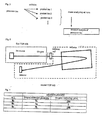
- Several methods are available as the method for the calculations. Some of them are exemplified in
Fig. 8 . In a first method, the spaces between reference values indicating the relations of the instrumental parameters contained in the adjustment table to the m/z values of ions are interpolated by broken lines. Ion gate-correcting values conforming to the m/z values of the ions are calculated. In a second method, the spaces between reference values indicating the relations of the instrumental parameters contained in the adjustment table to the m/z values of the ions are interpolated by an approximation equation, and ion gate-correcting values conforming to the m/z values of the ions are calculated. In a third method, reference values themselves indicating the relations of the instrumental parameters contained in the adjustment table to the m/z values of the ions are regarded as effective within a given range of m/z, and ion gate-correcting values conforming to the m/z values of ions are computed. - Generally, as the molecular weight of precursor ions increases, the ionization efficiency deteriorates or the number of fragmentation paths increases. For these and other reasons, the number of ions per fragmentation path tends to decrease. Therefore, a detector voltage or laser intensity that is an instrumental parameter associated with the ionization efficiency may be used as an additional adjustable parameter. This makes it possible to measure spectra of more uniform quality.
- When precursor ions are selected after measurement of a mass spectrum, relative intensity information about the precursor ions can be obtained in advance. Accordingly, regarding ions with a small amount of precursor ions, a detector voltage or laser intensity that is an instrumental parameter is used as an additional adjustable parameter. Thus, spectra of more uniform quality can be measured.
- Since the mass positions of precursor ions deviate due to variations in instrumental conditions, it is possible to make a correction such that the m/z value of the precursor ions observed within the product ion spectrum conforms to a preset value after a measurement.
- The present invention can be widely used in tandem measurements performed by a time-of-flight mass spectrometer.
Claims (11)
- A method of tandem time-of-flight mass spectrometry implemented by a tandem time-of-flight mass spectrometer having: an ion source for ionizing a sample by irradiating it with pulsed laser light to generate ions, acceleration means for extracting the generated ions in a pulsed manner and accelerating the ions by a pulsed accelerating voltage under certain delayed extraction conditions, a first time-of-flight ion optical system permitting the accelerated ions to travel, an ion gate for selecting only ions having a desired mass-to-charge ratio as precursor ions from among the ionsmass-separatedbythe first time-of-flight ion optical system, fragmentation means for fragmenting the selected precursor ions into product ions, a second time-of-flight ion optical system disposed behind the fragmentation means and permitting the product ions to travel, and a detector for detecting ions passed through the secondtime-of-flight ion optical system, said method comprising the steps of:drawing up a data table in preparation for measurements of product ions which are generated by selecting desired precursor ions by the ion gate and fragmenting the precursor ions, the table storing measured optimum values of delayed extraction conditions for the mass-to-charge ratios of plural reference substances and measured optimum values of the time for which the ion gate is opened;finding delayed extraction conditions and open time of the ion gate which optimize mass resolution at the mass-to-charge ratio of the desired precursor ions based on values stored in the table; andsetting the found optimum values of the delayed extraction conditions and ion gate open time into the tandem time-of-flight mass spectrometer.
- A method of tandem time-of-flight mass spectrometry as set forth in claim 1, wherein said delayed extraction conditions include an ion acceleration voltage or a delay time from laser irradiation to the instant at which the ions are accelerated.
- A method of tandem time-of-flight mass spectrometry as set forth in any one of claims 1 and 2, wherein with respect to the delayed extraction conditions and ion gate open time, delayed conditions and ion gate open time adapted for desired ions are calculated by connecting points stored in the table by broken lines and interpolating between the points.
- A method of tandem time-of-flight mass spectrometry as set forth in any one of claims 1 and 2, wherein with respect to the delayed extraction conditions and ion gate open time, delayed conditions and ion gate open time adapted for desired ions are calculated by approximating spaces between the points stored in the table by a polynomial equation and interpolating between the points.
- A method of tandem time-of-flight mass spectrometry as set forth in any one of claims 1 and 2, wherein with respect to the delayed extraction conditions and ion gate open time, delayed conditions and ion gate open time adapted for desired ions are calculated by partitioning each space between any two adjacent ones of the points stored in the table into two subspaces and assigning respective ones of the m/z values stored in the table to the subspaces.
- A method of tandem time-of-flight mass spectrometry as set forth in any one of claims 3, 4, and 5, wherein laser intensity or a detector voltage of the mass spectrometer is included as conditions to be set, in addition to the delayed extraction conditions and ion gate open time.
- A method of tandem time-of-flight mass spectrometry as set forth in claim 6, wherein the laser intensity or the detector voltage of the mass spectrometer is set according to the intensity of the precursor ions.
- A method of tandem time-of-flight mass spectrometry as set forth in any one of claims 1 to 7, wherein said ion source is a MALDI ion source.
- A method of tandem time-of-flight mass spectrometry as set forth in any one of claims 1 to 8, wherein said first time-of-flight ion optical system is a time-of-flight ion optical system having precursor ion selectivity that has been enhanced by making use of a reflectron field or sector field.
- A method of tandem time-of-flight mass spectrometry as set forth in any one of claims 1 to 9, wherein after a measurement, the mass positions of the precursor ions that have deviated due to setting of the delayed extraction conditions are corrected so as to conform with their original values based on m/z values of the precursor ions observed within a product ion spectrum.
- A tandem time-of-flight mass spectrometer having an ion source for ionizing a sample by irradiating it with pulsed laser light to generate ions, acceleration means for extracting the generated ions in a pulsed manner and accelerating the ions by a pulsed accelerating voltage under certain delayed extraction conditions, a first time-of-flight ion optical system permitting the accelerated ions to travel, an ion gate for selecting only ions having a desired mass-to-charge ratio as precursor ions from among the ions mass-separatedby the first time-of-flight ion optical system, fragmentation means for fragmenting the selected precursor ions into product ions, a second time-of-flight ion optical system disposed behind the fragmentation means and permitting the product ions to travel, and a detector for detecting ions passed through the second time-of-flight ion optical system, said tandem flight-of-time mass spectrometer comprising:a data table in which measured optimum values of delayed extraction conditions for mass-to-charge ratios of plural reference substances and measured optimum values of open time of the ion gate are stored;means for finding delayed extraction conditions and ion gate open time which optimize mass resolution for each mass-to-charge ratio of the precursor ions based on values stored in the table; andmeans for setting optimum values of the delayed extraction conditions and ion gate open time into the tandem time-of-flight mass spectrometer according to the value of the mass-to-charge ratio of the selected precursor ions.
Applications Claiming Priority (1)
| Application Number | Priority Date | Filing Date | Title |
|---|---|---|---|
| JP2010211827A JP5555582B2 (en) | 2010-09-22 | 2010-09-22 | Tandem time-of-flight mass spectrometry and apparatus |
Publications (2)
| Publication Number | Publication Date |
|---|---|
| EP2434527A2 true EP2434527A2 (en) | 2012-03-28 |
| EP2434527A3 EP2434527A3 (en) | 2017-10-04 |
Family
ID=44677717
Family Applications (1)
| Application Number | Title | Priority Date | Filing Date |
|---|---|---|---|
| EP11181276.4A Withdrawn EP2434527A3 (en) | 2010-09-22 | 2011-09-14 | Method and apparatus for tandem time-of-flight mass spectrometry |
Country Status (3)
| Country | Link |
|---|---|
| US (1) | US8330100B2 (en) |
| EP (1) | EP2434527A3 (en) |
| JP (1) | JP5555582B2 (en) |
Cited By (2)
| Publication number | Priority date | Publication date | Assignee | Title |
|---|---|---|---|---|
| CN104508792A (en) * | 2012-06-18 | 2015-04-08 | 莱克公司 | Tandem time-of-flight mass spectrometry using non-uniform sampling |
| GB2533010A (en) * | 2014-06-11 | 2016-06-08 | Micromass Ltd | Two dimensional MSMS acquisition modes |
Families Citing this family (23)
| Publication number | Priority date | Publication date | Assignee | Title |
|---|---|---|---|---|
| JP2012243667A (en) * | 2011-05-23 | 2012-12-10 | Jeol Ltd | Device and method for time-of-flight mass spectrometry |
| JP5972662B2 (en) * | 2012-05-15 | 2016-08-17 | 日本電子株式会社 | Tandem time-of-flight mass spectrometer |
| EP3588534B1 (en) * | 2013-03-06 | 2025-04-30 | Micromass UK Limited | Improved lock component corrections |
| CN103399081B (en) * | 2013-08-15 | 2016-12-28 | 中国科学院地质与地球物理研究所 | A kind of method utilizing many reception secondary ion mass spectrum to carry out Zircon U lead dating |
| WO2015189544A1 (en) | 2014-06-11 | 2015-12-17 | Micromass Uk Limited | Two dimensional ms/ms acquisition modes |
| GB201613988D0 (en) | 2016-08-16 | 2016-09-28 | Micromass Uk Ltd And Leco Corp | Mass analyser having extended flight path |
| GB2567794B (en) | 2017-05-05 | 2023-03-08 | Micromass Ltd | Multi-reflecting time-of-flight mass spectrometers |
| GB2563571B (en) | 2017-05-26 | 2023-05-24 | Micromass Ltd | Time of flight mass analyser with spatial focussing |
| CN111164731B (en) | 2017-08-06 | 2022-11-18 | 英国质谱公司 | Ion implantation into a multichannel mass spectrometer |
| WO2019030475A1 (en) | 2017-08-06 | 2019-02-14 | Anatoly Verenchikov | Multi-pass mass spectrometer |
| US11817303B2 (en) | 2017-08-06 | 2023-11-14 | Micromass Uk Limited | Accelerator for multi-pass mass spectrometers |
| WO2019030471A1 (en) | 2017-08-06 | 2019-02-14 | Anatoly Verenchikov | Ion guide within pulsed converters |
| WO2019030472A1 (en) | 2017-08-06 | 2019-02-14 | Anatoly Verenchikov | Ion mirror for multi-reflecting mass spectrometers |
| US11049712B2 (en) | 2017-08-06 | 2021-06-29 | Micromass Uk Limited | Fields for multi-reflecting TOF MS |
| EP3662502A1 (en) | 2017-08-06 | 2020-06-10 | Micromass UK Limited | Printed circuit ion mirror with compensation |
| GB201806507D0 (en) | 2018-04-20 | 2018-06-06 | Verenchikov Anatoly | Gridless ion mirrors with smooth fields |
| GB201807626D0 (en) | 2018-05-10 | 2018-06-27 | Micromass Ltd | Multi-reflecting time of flight mass analyser |
| GB201807605D0 (en) | 2018-05-10 | 2018-06-27 | Micromass Ltd | Multi-reflecting time of flight mass analyser |
| GB201808530D0 (en) | 2018-05-24 | 2018-07-11 | Verenchikov Anatoly | TOF MS detection system with improved dynamic range |
| GB201810573D0 (en) | 2018-06-28 | 2018-08-15 | Verenchikov Anatoly | Multi-pass mass spectrometer with improved duty cycle |
| GB201901411D0 (en) | 2019-02-01 | 2019-03-20 | Micromass Ltd | Electrode assembly for mass spectrometer |
| GB201903779D0 (en) | 2019-03-20 | 2019-05-01 | Micromass Ltd | Multiplexed time of flight mass spectrometer |
| JP2024022199A (en) * | 2022-08-05 | 2024-02-16 | 株式会社島津製作所 | mass spectrometry system |
Citations (6)
| Publication number | Priority date | Publication date | Assignee | Title |
|---|---|---|---|---|
| GB2080021A (en) | 1980-07-08 | 1982-01-27 | Wollnik Hermann | Time-of-flight Mass Spectrometer |
| JP2000243345A (en) | 1999-02-19 | 2000-09-08 | Jeol Ltd | Ion optical system of time-of-flight mass spectrometer |
| JP2003012782A (en) | 2001-04-24 | 2003-01-15 | Showa Denko Kk | New (meth)allyl ester compound, method for producing the same, composition for plastic lens containing the compound, plastic lens obtained by curing the composition and method for producing the plastic lens |
| JP2003086129A (en) | 2001-09-12 | 2003-03-20 | Jeol Ltd | Ion optical system of time-of-flight mass spectrometer |
| WO2005001878A2 (en) | 2003-06-21 | 2005-01-06 | Leco Corporation | Multi reflecting time-of-flight mass spectrometer and a method of use |
| JP2005302728A (en) | 2004-04-13 | 2005-10-27 | Kratos Analytical Ltd | Ion selector |
Family Cites Families (11)
| Publication number | Priority date | Publication date | Assignee | Title |
|---|---|---|---|---|
| JP2546459B2 (en) * | 1991-10-31 | 1996-10-23 | 株式会社島津製作所 | Mass spectrometer |
| US5625184A (en) * | 1995-05-19 | 1997-04-29 | Perseptive Biosystems, Inc. | Time-of-flight mass spectrometry analysis of biomolecules |
| US6348688B1 (en) * | 1998-02-06 | 2002-02-19 | Perseptive Biosystems | Tandem time-of-flight mass spectrometer with delayed extraction and method for use |
| EP1196940A2 (en) * | 1999-06-11 | 2002-04-17 | Perseptive Biosystems, Inc. | Tandem time-of-flight mass spectometer with damping in collision cell and method for use |
| JP2002157972A (en) * | 2001-09-17 | 2002-05-31 | Hitachi Ltd | Mass spectrometer and mass spectrometry method |
| JP2005011652A (en) * | 2003-06-18 | 2005-01-13 | Shimadzu Corp | Mass spectrometer |
| JP4980583B2 (en) | 2004-05-21 | 2012-07-18 | 日本電子株式会社 | Time-of-flight mass spectrometry method and apparatus |
| CA2611183A1 (en) * | 2005-06-08 | 2006-12-14 | Mds Inc., Doing Business Through Its Mds Sciex Division | Dynamic background signal exclusion in chromatography/mass spectrometry data-dependent data acquisition |
| DE102005041655B4 (en) * | 2005-09-02 | 2010-05-20 | Bruker Daltonik Gmbh | Generation of multiply charged ions for tandem mass spectrometry |
| JP5259169B2 (en) * | 2007-01-10 | 2013-08-07 | 日本電子株式会社 | Tandem time-of-flight mass spectrometer and method |
| JP5226292B2 (en) * | 2007-12-25 | 2013-07-03 | 日本電子株式会社 | Tandem time-of-flight mass spectrometry |
-
2010
- 2010-09-22 JP JP2010211827A patent/JP5555582B2/en active Active
-
2011
- 2011-08-31 US US13/221,976 patent/US8330100B2/en active Active
- 2011-09-14 EP EP11181276.4A patent/EP2434527A3/en not_active Withdrawn
Patent Citations (6)
| Publication number | Priority date | Publication date | Assignee | Title |
|---|---|---|---|---|
| GB2080021A (en) | 1980-07-08 | 1982-01-27 | Wollnik Hermann | Time-of-flight Mass Spectrometer |
| JP2000243345A (en) | 1999-02-19 | 2000-09-08 | Jeol Ltd | Ion optical system of time-of-flight mass spectrometer |
| JP2003012782A (en) | 2001-04-24 | 2003-01-15 | Showa Denko Kk | New (meth)allyl ester compound, method for producing the same, composition for plastic lens containing the compound, plastic lens obtained by curing the composition and method for producing the plastic lens |
| JP2003086129A (en) | 2001-09-12 | 2003-03-20 | Jeol Ltd | Ion optical system of time-of-flight mass spectrometer |
| WO2005001878A2 (en) | 2003-06-21 | 2005-01-06 | Leco Corporation | Multi reflecting time-of-flight mass spectrometer and a method of use |
| JP2005302728A (en) | 2004-04-13 | 2005-10-27 | Kratos Analytical Ltd | Ion selector |
Cited By (3)
| Publication number | Priority date | Publication date | Assignee | Title |
|---|---|---|---|---|
| CN104508792A (en) * | 2012-06-18 | 2015-04-08 | 莱克公司 | Tandem time-of-flight mass spectrometry using non-uniform sampling |
| GB2533010A (en) * | 2014-06-11 | 2016-06-08 | Micromass Ltd | Two dimensional MSMS acquisition modes |
| GB2533010B (en) * | 2014-06-11 | 2018-08-22 | Micromass Ltd | Two dimensional MSMS acquisition modes |
Also Published As
| Publication number | Publication date |
|---|---|
| JP2012069318A (en) | 2012-04-05 |
| JP5555582B2 (en) | 2014-07-23 |
| EP2434527A3 (en) | 2017-10-04 |
| US20120068062A1 (en) | 2012-03-22 |
| US8330100B2 (en) | 2012-12-11 |
Similar Documents
| Publication | Publication Date | Title |
|---|---|---|
| US8330100B2 (en) | Method and apparatus for tandem time-of-flight mass spectrometry | |
| US8604423B2 (en) | Method for enhancement of mass resolution over a limited mass range for time-of-flight spectrometry | |
| US7399962B2 (en) | All-mass MS/MS method and apparatus | |
| US7755036B2 (en) | Instrument and method for tandem time-of-flight mass spectrometry | |
| CN103650099B (en) | The targeting analysis of tandem mass spectrometry | |
| US9536727B2 (en) | Time-of-flight mass spectrometer and method of controlling same | |
| US9704696B2 (en) | High duty cycle ion spectrometer | |
| DE112015001566B4 (en) | Multiple reflection and time-of-flight mass spectrometer with axially pulsed converter | |
| US20130289892A1 (en) | Time-of-Flight Mass Spectrometer and Data Compression Method Therefor | |
| US8653451B2 (en) | Apparatus and method for time-of-flight mass spectrometry | |
| JP4540230B2 (en) | Tandem time-of-flight mass spectrometer | |
| JP5596031B2 (en) | TOF mass spectrometer and related methods for astigmatism imaging | |
| JP5226292B2 (en) | Tandem time-of-flight mass spectrometry | |
| US5861623A (en) | Nth order delayed extraction | |
| EP3020064B1 (en) | Time-of-flight mass spectrometers with cassini reflector | |
| US9048071B2 (en) | Imaging mass spectrometer and method of controlling same | |
| Oh et al. | Tandem time-of-flight mass spectrometer for photodissociation of biopolymer ions generated by matrix-assisted laser desorption ionization (MALDI-TOF-PD-TOF) using a linear-plus-quadratic potential reflectron | |
| US7910878B2 (en) | Method and apparatus for ion axial spatial distribution focusing | |
| EP2439764A2 (en) | Tandem time-of-flight mass spectrometer | |
| US8766175B2 (en) | Tandem time-of-flight mass spectrometer and method of mass spectrometry using the same | |
| Sarugaku et al. | Space focusing extensively spread ions in time-of-flight mass spectrometry by nonlinear ion acceleration | |
| Bromirski | UV and IR matrix assisted laser desorption/ionization using axial and orthogonal injection time-of-flight mass spectrometers | |
| AU2011237721A1 (en) | Method for enhancement of mass resolution over a limited mass range for time-of-flight spectrometry |
Legal Events
| Date | Code | Title | Description |
|---|---|---|---|
| PUAI | Public reference made under article 153(3) epc to a published international application that has entered the european phase |
Free format text: ORIGINAL CODE: 0009012 |
|
| AK | Designated contracting states |
Kind code of ref document: A2 Designated state(s): AL AT BE BG CH CY CZ DE DK EE ES FI FR GB GR HR HU IE IS IT LI LT LU LV MC MK MT NL NO PL PT RO RS SE SI SK SM TR |
|
| AX | Request for extension of the european patent |
Extension state: BA ME |
|
| PUAL | Search report despatched |
Free format text: ORIGINAL CODE: 0009013 |
|
| AK | Designated contracting states |
Kind code of ref document: A3 Designated state(s): AL AT BE BG CH CY CZ DE DK EE ES FI FR GB GR HR HU IE IS IT LI LT LU LV MC MK MT NL NO PL PT RO RS SE SI SK SM TR |
|
| AX | Request for extension of the european patent |
Extension state: BA ME |
|
| RIC1 | Information provided on ipc code assigned before grant |
Ipc: H01J 49/00 20060101ALI20170830BHEP Ipc: H01J 49/40 20060101AFI20170830BHEP Ipc: H01J 49/16 20060101ALI20170830BHEP Ipc: H01J 49/06 20060101ALI20170830BHEP |
|
| STAA | Information on the status of an ep patent application or granted ep patent |
Free format text: STATUS: THE APPLICATION IS DEEMED TO BE WITHDRAWN |
|
| 18D | Application deemed to be withdrawn |
Effective date: 20180405 |