EP2429692B1 - Reactor for exothermic or endothermic catalytic reactions - Google Patents
Reactor for exothermic or endothermic catalytic reactions Download PDFInfo
- Publication number
- EP2429692B1 EP2429692B1 EP10721686.3A EP10721686A EP2429692B1 EP 2429692 B1 EP2429692 B1 EP 2429692B1 EP 10721686 A EP10721686 A EP 10721686A EP 2429692 B1 EP2429692 B1 EP 2429692B1
- Authority
- EP
- European Patent Office
- Prior art keywords
- reactor
- closing element
- reaction
- catalyst
- monolithic
- Prior art date
- Legal status (The legal status is an assumption and is not a legal conclusion. Google has not performed a legal analysis and makes no representation as to the accuracy of the status listed.)
- Active
Links
Images


Classifications
-
- B—PERFORMING OPERATIONS; TRANSPORTING
- B01—PHYSICAL OR CHEMICAL PROCESSES OR APPARATUS IN GENERAL
- B01J—CHEMICAL OR PHYSICAL PROCESSES, e.g. CATALYSIS OR COLLOID CHEMISTRY; THEIR RELEVANT APPARATUS
- B01J19/00—Chemical, physical or physico-chemical processes in general; Their relevant apparatus
- B01J19/24—Stationary reactors without moving elements inside
- B01J19/248—Reactors comprising multiple separated flow channels
- B01J19/2485—Monolithic reactors
-
- B—PERFORMING OPERATIONS; TRANSPORTING
- B01—PHYSICAL OR CHEMICAL PROCESSES OR APPARATUS IN GENERAL
- B01J—CHEMICAL OR PHYSICAL PROCESSES, e.g. CATALYSIS OR COLLOID CHEMISTRY; THEIR RELEVANT APPARATUS
- B01J8/00—Chemical or physical processes in general, conducted in the presence of fluids and solid particles; Apparatus for such processes
- B01J8/02—Chemical or physical processes in general, conducted in the presence of fluids and solid particles; Apparatus for such processes with stationary particles, e.g. in fixed beds
- B01J8/06—Chemical or physical processes in general, conducted in the presence of fluids and solid particles; Apparatus for such processes with stationary particles, e.g. in fixed beds in tube reactors; the solid particles being arranged in tubes
- B01J8/067—Heating or cooling the reactor
-
- C—CHEMISTRY; METALLURGY
- C10—PETROLEUM, GAS OR COKE INDUSTRIES; TECHNICAL GASES CONTAINING CARBON MONOXIDE; FUELS; LUBRICANTS; PEAT
- C10G—CRACKING HYDROCARBON OILS; PRODUCTION OF LIQUID HYDROCARBON MIXTURES, e.g. BY DESTRUCTIVE HYDROGENATION, OLIGOMERISATION, POLYMERISATION; RECOVERY OF HYDROCARBON OILS FROM OIL-SHALE, OIL-SAND, OR GASES; REFINING MIXTURES MAINLY CONSISTING OF HYDROCARBONS; REFORMING OF NAPHTHA; MINERAL WAXES
- C10G2/00—Production of liquid hydrocarbon mixtures of undefined composition from oxides of carbon
- C10G2/30—Production of liquid hydrocarbon mixtures of undefined composition from oxides of carbon from carbon monoxide with hydrogen
- C10G2/32—Production of liquid hydrocarbon mixtures of undefined composition from oxides of carbon from carbon monoxide with hydrogen with the use of catalysts
- C10G2/34—Apparatus, reactors
- C10G2/341—Apparatus, reactors with stationary catalyst bed
-
- B—PERFORMING OPERATIONS; TRANSPORTING
- B01—PHYSICAL OR CHEMICAL PROCESSES OR APPARATUS IN GENERAL
- B01J—CHEMICAL OR PHYSICAL PROCESSES, e.g. CATALYSIS OR COLLOID CHEMISTRY; THEIR RELEVANT APPARATUS
- B01J2219/00—Chemical, physical or physico-chemical processes in general; Their relevant apparatus
- B01J2219/24—Stationary reactors without moving elements inside
- B01J2219/2401—Reactors comprising multiple separate flow channels
- B01J2219/2402—Monolithic-type reactors
- B01J2219/2425—Construction materials
- B01J2219/2427—Catalysts
- B01J2219/2428—Catalysts coated on the surface of the monolith channels
-
- B—PERFORMING OPERATIONS; TRANSPORTING
- B01—PHYSICAL OR CHEMICAL PROCESSES OR APPARATUS IN GENERAL
- B01J—CHEMICAL OR PHYSICAL PROCESSES, e.g. CATALYSIS OR COLLOID CHEMISTRY; THEIR RELEVANT APPARATUS
- B01J2219/00—Chemical, physical or physico-chemical processes in general; Their relevant apparatus
- B01J2219/24—Stationary reactors without moving elements inside
- B01J2219/2401—Reactors comprising multiple separate flow channels
- B01J2219/2402—Monolithic-type reactors
- B01J2219/2425—Construction materials
- B01J2219/2427—Catalysts
- B01J2219/243—Catalyst in granular form in the channels
-
- B—PERFORMING OPERATIONS; TRANSPORTING
- B01—PHYSICAL OR CHEMICAL PROCESSES OR APPARATUS IN GENERAL
- B01J—CHEMICAL OR PHYSICAL PROCESSES, e.g. CATALYSIS OR COLLOID CHEMISTRY; THEIR RELEVANT APPARATUS
- B01J2219/00—Chemical, physical or physico-chemical processes in general; Their relevant apparatus
- B01J2219/24—Stationary reactors without moving elements inside
- B01J2219/2401—Reactors comprising multiple separate flow channels
- B01J2219/2402—Monolithic-type reactors
- B01J2219/2425—Construction materials
- B01J2219/2433—Construction materials of the monoliths
- B01J2219/2434—Metals or alloys
-
- B—PERFORMING OPERATIONS; TRANSPORTING
- B01—PHYSICAL OR CHEMICAL PROCESSES OR APPARATUS IN GENERAL
- B01J—CHEMICAL OR PHYSICAL PROCESSES, e.g. CATALYSIS OR COLLOID CHEMISTRY; THEIR RELEVANT APPARATUS
- B01J2219/00—Chemical, physical or physico-chemical processes in general; Their relevant apparatus
- B01J2219/24—Stationary reactors without moving elements inside
- B01J2219/2401—Reactors comprising multiple separate flow channels
- B01J2219/2402—Monolithic-type reactors
- B01J2219/2441—Other constructional details
- B01J2219/2444—Size aspects
- B01J2219/2445—Sizes
-
- B—PERFORMING OPERATIONS; TRANSPORTING
- B01—PHYSICAL OR CHEMICAL PROCESSES OR APPARATUS IN GENERAL
- B01J—CHEMICAL OR PHYSICAL PROCESSES, e.g. CATALYSIS OR COLLOID CHEMISTRY; THEIR RELEVANT APPARATUS
- B01J2219/00—Chemical, physical or physico-chemical processes in general; Their relevant apparatus
- B01J2219/24—Stationary reactors without moving elements inside
- B01J2219/2401—Reactors comprising multiple separate flow channels
- B01J2219/2402—Monolithic-type reactors
- B01J2219/2441—Other constructional details
- B01J2219/2444—Size aspects
- B01J2219/2446—Cell density
-
- B—PERFORMING OPERATIONS; TRANSPORTING
- B01—PHYSICAL OR CHEMICAL PROCESSES OR APPARATUS IN GENERAL
- B01J—CHEMICAL OR PHYSICAL PROCESSES, e.g. CATALYSIS OR COLLOID CHEMISTRY; THEIR RELEVANT APPARATUS
- B01J2219/00—Chemical, physical or physico-chemical processes in general; Their relevant apparatus
- B01J2219/32—Details relating to packing elements in the form of grids or built-up elements for forming a unit of module inside the apparatus for mass or heat transfer
- B01J2219/322—Basic shape of the elements
- B01J2219/32296—Honeycombs
-
- B—PERFORMING OPERATIONS; TRANSPORTING
- B01—PHYSICAL OR CHEMICAL PROCESSES OR APPARATUS IN GENERAL
- B01J—CHEMICAL OR PHYSICAL PROCESSES, e.g. CATALYSIS OR COLLOID CHEMISTRY; THEIR RELEVANT APPARATUS
- B01J2219/00—Chemical, physical or physico-chemical processes in general; Their relevant apparatus
- B01J2219/32—Details relating to packing elements in the form of grids or built-up elements for forming a unit of module inside the apparatus for mass or heat transfer
- B01J2219/324—Composition or microstructure of the elements
- B01J2219/32408—Metal
-
- B—PERFORMING OPERATIONS; TRANSPORTING
- B01—PHYSICAL OR CHEMICAL PROCESSES OR APPARATUS IN GENERAL
- B01J—CHEMICAL OR PHYSICAL PROCESSES, e.g. CATALYSIS OR COLLOID CHEMISTRY; THEIR RELEVANT APPARATUS
- B01J2219/00—Chemical, physical or physico-chemical processes in general; Their relevant apparatus
- B01J2219/32—Details relating to packing elements in the form of grids or built-up elements for forming a unit of module inside the apparatus for mass or heat transfer
- B01J2219/324—Composition or microstructure of the elements
- B01J2219/32466—Composition or microstructure of the elements comprising catalytically active material
Definitions
- the present invention relates to a reactor for exothermic or endothermic catalytic reactions.
- the present invention relates to a reactor for exothermic or endothermic catalytic reactions, also multiphase.
- the present invention relates to a reactor for Fischer-Tropsch reaction.
- a Fischer-Tropsch reaction is a chemical reaction which proceeds in substantially three-phase systems in which a gaseous phase flows in contact with a solid catalyst, the reaction product mainly consisting of liquid and gaseous hydrocarbons.
- the reacting gaseous phase is a mixture of hydrogen and carbon monoxide (synthesis gas), with a H 2 /CO molar ratio ranging from 1 to 3, the liquid phase essentially consisting of linear hydrocarbons (paraffin waxes) with a high number of carbon atoms, the solid phase being represented by the catalyst.
- US 4378 336 A discloses a reactor suitable for fueling an internal combustion engine comprising a monolithic substrate and catalytic material.
- GB 2 322 633 discloses a reactor comprising a monolithic solid body arranged in discrete and continuous channels.
- the walls of the channels 24 contain a conventional Fischer-Tropsch catalyst.
- US 2002/038066 A1 discloses a reactor suitable for exothermic and/or endothermic catalytic reactions comprising a vessel equipped with feeding and discharging means of a heat exchange fluid.
- reaction system must be run under appropriate fluid dynamic conditions, in order to have a homogeneous dispersion of the catalyst.
- last-generation industrial reactors for the Fischer-Tropsch synthesis in particular those which adopt the "Slurry Bubble Column” technology, have large dimensions. There can be cylindrical constructions 60 meters high and with a diameter in the order of 10 meters, for example.
- the management of these reactors and in particular their maintenance, for example the maintenance of the tubes of the heat exchange device, can be difficult.
- the simple substitution of a damaged tube of the heat exchange device, in fact, in a reactor 40-60 metres high, or more, may be a not simple operation.
- Slurry Bubble Column reactors An alternative to "Slurry Bubble Column” reactors is represented by fixed bed reactors. These reactors essentially consist of a device including a casing or shell and a pair of upper and lower closing elements, in which there are normally feeding means of the reagents and means for discharging the reaction products. A plurality of tubes is inserted inside the shell, each filled with the catalyst, in the form of pellets, for example.
- the reagent gas for example synthesis gas, flows inside the tubes, comes into contact with the catalytic particles and reacts.
- reaction heat is removed by a continuous flow of a cooling fluid, for example water, which occupies the free volume inside the shell.
- a cooling fluid for example water
- the main limits of the fixed bed configuration substantially depend on the intraparticle mass transfer resistance (responsible, for example, for a low activity and selectivity towards the liquid product, in the case of Fischer-Tropsch reaction) and radial heat transfer inside the reactor (which can generate local "hot spots" with a potential deactivation of part of the catalyst). Furthermore, pressure drops, even considerably high, can also occur, depending on how the fixed bed is structured and, in particular, on the ratio between the height and diameter of the tubes and the dimensions of the catalyst particles. In conclusion, fixed bed reactors are characterized by a very low specific productivity (per unit of volume of the catalyst used), and for this reason, in order to increase it, particularly high quantities of catalyst must be used and therefore large reactor dimensions.
- exothermic reactions such as the selective catalytic oxidation of benzene or n-butane to maleic anhydride, the oxidation of o-xylene to phthalic anhydride, or the Fischer-Tropsch synthesis, or endothermic reactions, such as the steam reforming of hydrocarbons to synthesis gas (H 2 and CO) can be carried out in multi-tubular reactors loaded with conductive monolithic catalysts.
- These reactors comprise a vessel inside which a plurality of tubes are placed.
- Each tube of the tube bundle incorporates the catalyst consisting of a metallic monolithic honeycomb structure which supports the catalyst.
- each tube consists of a continuous cylindrical body inside which there is a plurality of parallel channels. These monolithic structures are also described, for example, in US patent 6,881,703 .
- the catalytic material is distributed on the internal walls of the monolith channels by means of the "washcoating" technique, so as to be in contact with the reagents flowing in each channel of the monolith.
- the monolithic structure guarantees a good heat exchange with the thermo-regulation fluid circulating in the vessel outside the tubes, as the material of the monolith, being characterized by a good thermal conductivity, favours the radial transfer of heat.
- the limit of multi-tubular reactors with "washcoated" monolithic catalysts lies in the fact that the availability of catalytic active phase per unit of volume of the reactor is smaller than that of traditional reactors. For this reason, the reaction volumes must be increased in order to have an appreciable productivity.
- the Applicant has now found that the solution to the above problems can be to avail of a reactor having smaller dimensions thanks to a higher volumetric density of the active phase of the catalyst and a more efficient system for the removal of the reaction heat.
- the reactors of the present invention therefore have smaller dimensions with respect to traditional reactors or reactors of the known art.
- This characteristic allows the reactors described in the present invention, to be positioned onboard ships and/or on specific land transportation vehicles to be transported to remote positions, where there are sources of raw materials for synthesis gas, for example offshore and/or onshore natural gas fields, for which the use of large-sized reactors, such as fixed bed "Slurry Bubble Column” reactors, fixed bed reactors or multi-tubular reactors loaded with conventional monolithic catalysts, is not convenient or possible.
- An object of the present invention therefore relates to a reactor according to claim 1 for exothermic or endothermic chemical reactions, in the presence of a solid catalyst, for example a reactor for Fischer-Tropsch reaction, wherein the catalyst consists of packed bodies (for example, spheres, cylinders, rings, etc.) or structured bodies (for example, foams, gauzes, wires, etc.) which are loaded and encaged in a plurality of elements having a monolithic structure, with a high thermal conductivity, capable of favouring the reaction heat transfer to/from a refrigerating/heating fluid circulating inside the reactor jacket and in which the monolithic structures are immersed.
- a solid catalyst for example a reactor for Fischer-Tropsch reaction
- the catalyst consists of packed bodies (for example, spheres, cylinders, rings, etc.) or structured bodies (for example, foams, gauzes, wires, etc.) which are loaded and encaged in a plurality of elements having a monolithic structure, with
- the reactor object of the present invention is particularly and preferably suitable for the Fischer-Tropsch reaction which develops in a three-phase system, essentially consisting of a reagent gaseous phase, a reacted liquid phase and a solid catalytic phase consisting of packed bodies (for example, spheres, cylinders, rings, etc.) or structured bodies (for example, foams, gauzes, wires, etc.) inserted inside the channels of the monolith structure.
- packed bodies for example, spheres, cylinders, rings, etc.
- structured bodies for example, foams, gauzes, wires, etc.
- the vessel is substantially cylindrical and can have any dimension but is preferably characterized by a height ranging, for example, from 1 to 10 m and a diameter ranging from 1 to 5 m.
- the substantially cylindrical vessel and the upper and lower closing elements are normally made of carbon steel, corrosion-resistant steel or consist of steel bound to metals selected from those of Groups 5-10, such as vanadium, niobium, chromium, molybdenum, tungsten, manganese, nickel, etc..
- the thicknesses of the body wall depend on the temperature and pressure at which the reaction takes place, but can generally range from 20 to 100 mm.
- the reactor, object of the present invention can be arranged either vertically or horizontally.
- the plurality of monolithic structures is inserted inside the substantially cylindrical vessel, as such or inserted inside tubular structures.
- These monolithic structures are in the form of a tube bundle, distanced between each other, inserted inside the cylindrical vessel and immersed in the thermoregulation liquid of the reaction temperature, for example water, in the case of exothermic reactions, or diathermic oil in the case of endothermic reactions.
- the bundle has a diameter substantially equal to the inner diameter of the cylindrical container (a), or slightly smaller, and occupies a volume of between 50 and 90% of the total volume of the body (a), preferably between 60 and 80%.
- the bundle comprises a number of monolithic structures varying from 10 to 20,000, preferably from 100 to 10,000, more preferably from 1,000 to 8,000.
- Each monolithic structure consists of a substantially cylindrical body, having a diameter ranging from 1 to 10 cm, having a continuous honeycomb structure, thermally connected, which, in the operating phase, allows the reaction heat to be disposed of, in the case of exothermic reaction, or to receive heat, in the case of endothermic reaction, with a high radial heat exchange coefficient.
- the continuous honeycomb monolithic structure therefore appears as a plurality of longitudinal channels, with a cross section, in the form of a square or a rectangular with a side length of 0.5 to 5 mm, immersed in a continuous body.
- the monolithic structure, used in the reactor of the present invention does not act as a carrier of the catalyst, but must favour the efficient removal of the reaction heat. For this reason, it is made of a material having an intrinsic heat conductivity of over 10 W/m/K, preferably ranging from 100 to 400 W/m/K.
- the material is selected from metals such as steel, of the same type as the cylindrical body, aluminium, aluminium alloy or copper.
- the metal is preferably aluminium or an aluminium alloy.
- thermally conductive ceramic materials can be used, such as silicon carbide.
- the catalyst in the form of packed bodies (for example, spheres, cylinders, rings, etc.) or structured bodies (for example, rigid foams, gauzes, wires, etc.), is positioned inside each channel of the monolithic structure, so as to fill the volume for a filling factor, catalyst Volume/Volume of the longitudinal channel, ranging from 0.2 to 0.8.
- the reactor, object of the present invention can be used, in particular, for exothermic catalytic reactions, such as Fischer-Tropsch reaction, wherein a gaseous reagent phase, consisting of a mixture of CO and H 2 (synthesis gas), flows coming in contact with a substantially fixed bed of catalyst, for example granules, forming a liquid/vapour phase, at the reaction temperature and pressure, consisting of paraffin waxes.
- exothermic catalytic reactions such as Fischer-Tropsch reaction, wherein a gaseous reagent phase, consisting of a mixture of CO and H 2 (synthesis gas), flows coming in contact with a substantially fixed bed of catalyst, for example granules, forming a liquid/vapour phase, at the reaction temperature and pressure, consisting of paraffin waxes.
- the reactor for reactions of the Fischer-Tropsch type is a reactor in which chemical reactions take place, which develop in three-phase systems, wherein a gaseous/vapour phase flows in contact with the solid phase and generates a vapour phase and a liquid phase which wets the catalyst.
- the gaseous/vapour phase essentially consists of synthesis gas and light reaction products
- the vapour/liquid phase is the heavy reaction product, i.e. hydrocarbons essentially with a high number of carbon atoms
- the solid phase is represented by the catalyst.
- the synthesis gas preferably comes from the steam reforming and/or partial oxygenation of natural gas or other hydrocarbons, on the basis of the reactions described, for example, in US patent 5,645,613 .
- the synthesis gas can come from other production techniques, such as, for example, from autothermal reforming, CPO (Catalytic Partial Oxidation) or from the gasification of coal, or other carbonaceous products, with high-temperature water vapour as described in " Catalysis Science and Technology", vol. 1 Springer-Verlag. New York, 1981 .
- Two phases are substantially produced by the Fischer-Tropsch reaction, a lighter vapour phase, essentially consisting of a mixture of light hydrocarbons, with a number of carbon atoms ranging from 1 to 25 and a boiling point at atmospheric pressure, for the C 5 -C 25 fraction, equal to or lower than about 150°C, and reaction by-products, such as water vapour, CO 2 , alcohols, etc..
- the second phase produced essentially consists of paraffinic waxes, liquid at the reaction temperature, comprising mixtures of linear, branched hydrocarbons, saturated and unsaturated hydrocarbons with a high number of carbon atoms. These are generally hydrocarbon mixtures which have a boiling point, at atmospheric pressure, higher than 150°C, for example between 160 and 380°C.
- the Fischer-Tropsch reaction is carried out at temperatures equal to or higher than 150°C, for example ranging from 200 to 350°C, maintaining a pressure ranging from 0.5 to 30 MPa inside the reactor. More significant details on the Fischer-Tropsch reaction can be found in "Catalysis Science and Technology" mentioned above.
- the catalyst is generally based on cobalt or iron supported on an inert solid.
- the catalyst which is preferably adapted to the reactor according to the present invention, is based on cobalt dispersed on a solid carrier consisting of at least one oxide selected from one or more of the following elements Si, Ti, Al, Zr, Mg.
- Preferred carriers are silica, alumina or titania.
- the cobalt is present in the catalyst in quantities ranging from 1 to 50% by weight, generally from 5 to 35%, with respect to the total weight.
- the catalyst used can comprise further additional elements. It can comprise, for example, with respect to the total weight, from 0.05 to 5% by weight, preferably from 0.1 to 3%, of ruthenium and from 0.05 to 5% by weight, preferably from 0.1 to 3%, of at least a third element selected from those belonging to group 3 (IUPAC regulation). Catalysts of this type are known in literature and described, together with their preparation, in European patent 756,895 .
- catalysts are again based on cobalt but containing tantalum, as promoter element, in quantities of 0.05-5% by weight, with respect to the total weight, preferably 0.1-3%.
- These catalysts are prepared beforehand by depositing a cobalt salt on the inert carrier (silica or alumina), for example by means of the wet impregnation technique, followed by a calcination step and, optionally, a reduction and passivation step of the calcined product.
- a derivative of tantalum is deposited on the catalytic precursor thus obtained, preferably with the wet impregnation technique followed by calcination and, optionally, reduction and passivation.
- the catalyst is used in structured or particle form, for example of spherical granules with an average dimension of from 0.3 mm to less than 3 mm, preferably from 0.3 to 1 mm.
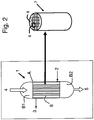
- drawing 1 of the Figure schematically represents a longitudinal section of the reactor whereas drawings 2 and 3 represent the details of one of the monolithic structures situated in its interior and the catalyst present therein.
- the reactor 1 essentially consists of a cylindrical vessel A and two closing elements B1 and B2.
- the cylindrical body A is equipped with an inlet (2) and outlet (3) of the thermoregulation fluid of the chemical reaction involved, whereas the closing elements B1 and B2 are equipped with an inlet (4) and/or outlet (5) of the reagents and reaction products.
- the inlet and outlet can be inverted.
- Each monolithic structure (7) consists of a cylindrical body (8) whose interior comprises a plurality of channels (9) immersed in the continuous body (10).
- the catalyst for example in the form of a bed (11) packed with granules, is arranged inside the channels, as shown in the drawing of Figure 3 .
- a monotubular reactor cooled externally, is first considered, consisting of a honeycomb monolith with square channels 1 metre long, made of aluminium, having an external diameter equal to 25.4 mm and a cell density of 4 cells per square centimetre.
- the channels of this monolith having a vacuum void fraction equal to 0.57, were coated (by washcoating) with a layer of catalyst for the Fischer-Tropsch synthesis, based on cobalt supported on alumina, having a thickness equal to 50 ⁇ m.
- the reactor operates with a pressure at the head equal to 20 bar, feeding 5,000 Ncm 3 /h/g cat of a mixture of CO and H 2 preheated to 235°C and having a ratio between the two species equal to 2.1 moles of H 2 per mole of CO.
- the cooling fluid is kept at a constant temperature of 235°C.
- the total specific productivity of this reactor is equal to 35 kg/h/m 3 and the pressure drop is negligible.
- the same monotubular reactor, cooled externally, is then considered, consisting of a honeycomb monolith with square channels 1 metre long, made of aluminium, having an external diameter equal to 25.4 mm and a cell density of 4 cells per square centimetre.
- the channels of the monolith are filled with catalytic particles packed with cobalt supported on alumina having an external diameter of 500 ⁇ m.
- the reactor operates with a pressure at the head equal to 20 bar, feeding 5,000 Ncm 3 /h/g cat of a mixture of CO and H 2 preheated to 228°C and having a ratio between the two species equal to 2.1 moles of H 2 per mole of CO.
- the cooling fluid is kept at a constant temperature of 228°C.
- the total specific productivity of this reactor is equal to 264 kg/h/m 3 and the pressure drop, slightly higher than those of the previous case, is still acceptable, being equal to 0.76 bar.
Landscapes
- Chemical & Material Sciences (AREA)
- Organic Chemistry (AREA)
- Chemical Kinetics & Catalysis (AREA)
- Oil, Petroleum & Natural Gas (AREA)
- Engineering & Computer Science (AREA)
- General Chemical & Material Sciences (AREA)
- Catalysts (AREA)
- Devices And Processes Conducted In The Presence Of Fluids And Solid Particles (AREA)
- Low-Molecular Organic Synthesis Reactions Using Catalysts (AREA)
- Organic Low-Molecular-Weight Compounds And Preparation Thereof (AREA)
- Physical Or Chemical Processes And Apparatus (AREA)
Description
- The present invention relates to a reactor for exothermic or endothermic catalytic reactions.
- More specifically, the present invention relates to a reactor for exothermic or endothermic catalytic reactions, also multiphase.
- Even more specifically, the present invention relates to a reactor for Fischer-Tropsch reaction.
- In the present text, all the information and operative and non-operative conditions mentioned should be intended as preferred, even when not expressly indicated.
- As is known, a Fischer-Tropsch reaction is a chemical reaction which proceeds in substantially three-phase systems in which a gaseous phase flows in contact with a solid catalyst, the reaction product mainly consisting of liquid and gaseous hydrocarbons. In particular, the reacting gaseous phase is a mixture of hydrogen and carbon monoxide (synthesis gas), with a H2/CO molar ratio ranging from 1 to 3, the liquid phase essentially consisting of linear hydrocarbons (paraffin waxes) with a high number of carbon atoms, the solid phase being represented by the catalyst.
- The exothermic nature of Fischer-Tropsch reaction (35-45 kcal/mol) makes it necessary to adopt thermal exchange devices for the temperature control within the operative limits of the reaction, and to prevent the formation of local "hot spots" responsible for the deterioration of the catalyst.
-
US 4378 336 A discloses a reactor suitable for fueling an internal combustion engine comprising a monolithic substrate and catalytic material. -
GB 2 322 633 -
US 2002/038066 A1 discloses a reactor suitable for exothermic and/or endothermic catalytic reactions comprising a vessel equipped with feeding and discharging means of a heat exchange fluid. - International patent application
WO 2008/074496 , for example, proposes to carry out the Fischer-Tropsch reaction in reactors defined as "Slurry Bubble Column" in which the Fischer-Tropsch reaction proceeds in three-phase systems in which the synthesis gas gurgles, in the form of bubbles, in a catalyst suspension in the reaction liquid. The reaction system, continuously stirred by the ascending gas flow, allows the reaction heat to be easily removed by means of a thermal exchange tube system, immersed in the liquid, in which a cooling fluid circulates, for example water. - Even if "Slurry Bubble Column" reactors allow extremely favourable reaction yields to be obtained together with an effective temperature control, they have a series of operative problems. First of all, the reaction product must be separated from the catalyst: a suspension of catalyst in the reaction liquid is collected from the reactor, making it necessary to effect a separation step, either inside or outside the reactor itself.
- Secondly, the reaction system must be run under appropriate fluid dynamic conditions, in order to have a homogeneous dispersion of the catalyst.
- Finally, last-generation industrial reactors for the Fischer-Tropsch synthesis, in particular those which adopt the "Slurry Bubble Column" technology, have large dimensions. There can be cylindrical constructions 60 meters high and with a diameter in the order of 10 meters, for example. The management of these reactors and in particular their maintenance, for example the maintenance of the tubes of the heat exchange device, can be difficult. The simple substitution of a damaged tube of the heat exchange device, in fact, in a reactor 40-60 metres high, or more, may be a not simple operation.
- An alternative to "Slurry Bubble Column" reactors is represented by fixed bed reactors. These reactors essentially consist of a device including a casing or shell and a pair of upper and lower closing elements, in which there are normally feeding means of the reagents and means for discharging the reaction products. A plurality of tubes is inserted inside the shell, each filled with the catalyst, in the form of pellets, for example.
- The reagent gas, for example synthesis gas, flows inside the tubes, comes into contact with the catalytic particles and reacts.
- The reaction heat is removed by a continuous flow of a cooling fluid, for example water, which occupies the free volume inside the shell.
- The main limits of the fixed bed configuration substantially depend on the intraparticle mass transfer resistance (responsible, for example, for a low activity and selectivity towards the liquid product, in the case of Fischer-Tropsch reaction) and radial heat transfer inside the reactor (which can generate local "hot spots" with a potential deactivation of part of the catalyst). Furthermore, pressure drops, even considerably high, can also occur, depending on how the fixed bed is structured and, in particular, on the ratio between the height and diameter of the tubes and the dimensions of the catalyst particles. In conclusion, fixed bed reactors are characterized by a very low specific productivity (per unit of volume of the catalyst used), and for this reason, in order to increase it, particularly high quantities of catalyst must be used and therefore large reactor dimensions.
- An alternative solution to traditional fixed bed or slurry bubble reactors is represented by multi-tubular reactors with monolithic catalysts. An example of this solution can be found in the published
US patent application 2005/0142049 A1 . - According to what is described in this patent application, exothermic reactions, such as the selective catalytic oxidation of benzene or n-butane to maleic anhydride, the oxidation of o-xylene to phthalic anhydride, or the Fischer-Tropsch synthesis, or endothermic reactions, such as the steam reforming of hydrocarbons to synthesis gas (H2 and CO) can be carried out in multi-tubular reactors loaded with conductive monolithic catalysts. These reactors comprise a vessel inside which a plurality of tubes are placed. Each tube of the tube bundle incorporates the catalyst consisting of a metallic monolithic honeycomb structure which supports the catalyst.
- The monolithic structure included in each tube consists of a continuous cylindrical body inside which there is a plurality of parallel channels. These monolithic structures are also described, for example, in
US patent 6,881,703 . - The catalytic material is distributed on the internal walls of the monolith channels by means of the "washcoating" technique, so as to be in contact with the reagents flowing in each channel of the monolith.
- The monolithic structure guarantees a good heat exchange with the thermo-regulation fluid circulating in the vessel outside the tubes, as the material of the monolith, being characterized by a good thermal conductivity, favours the radial transfer of heat.
- The limit of multi-tubular reactors with "washcoated" monolithic catalysts, lies in the fact that the availability of catalytic active phase per unit of volume of the reactor is smaller than that of traditional reactors. For this reason, the reaction volumes must be increased in order to have an appreciable productivity.
- The Applicant has now found that the solution to the above problems can be to avail of a reactor having smaller dimensions thanks to a higher volumetric density of the active phase of the catalyst and a more efficient system for the removal of the reaction heat. The reactors of the present invention therefore have smaller dimensions with respect to traditional reactors or reactors of the known art. This characteristic allows the reactors described in the present invention, to be positioned onboard ships and/or on specific land transportation vehicles to be transported to remote positions, where there are sources of raw materials for synthesis gas, for example offshore and/or onshore natural gas fields, for which the use of large-sized reactors, such as fixed bed "Slurry Bubble Column" reactors, fixed bed reactors or multi-tubular reactors loaded with conventional monolithic catalysts, is not convenient or possible.
- An object of the present invention therefore relates to a reactor according to
claim 1 for exothermic or endothermic chemical reactions, in the presence of a solid catalyst, for example a reactor for Fischer-Tropsch reaction, wherein the catalyst consists of packed bodies (for example, spheres, cylinders, rings, etc.) or structured bodies (for example, foams, gauzes, wires, etc.) which are loaded and encaged in a plurality of elements having a monolithic structure, with a high thermal conductivity, capable of favouring the reaction heat transfer to/from a refrigerating/heating fluid circulating inside the reactor jacket and in which the monolithic structures are immersed. - The reactor object of the present invention is particularly and preferably suitable for the Fischer-Tropsch reaction which develops in a three-phase system, essentially consisting of a reagent gaseous phase, a reacted liquid phase and a solid catalytic phase consisting of packed bodies (for example, spheres, cylinders, rings, etc.) or structured bodies (for example, foams, gauzes, wires, etc.) inserted inside the channels of the monolith structure.
- According to the present invention, the vessel is substantially cylindrical and can have any dimension but is preferably characterized by a height ranging, for example, from 1 to 10 m and a diameter ranging from 1 to 5 m. The substantially cylindrical vessel and the upper and lower closing elements are normally made of carbon steel, corrosion-resistant steel or consist of steel bound to metals selected from those of Groups 5-10, such as vanadium, niobium, chromium, molybdenum, tungsten, manganese, nickel, etc.. The thicknesses of the body wall depend on the temperature and pressure at which the reaction takes place, but can generally range from 20 to 100 mm. The reactor, object of the present invention, can be arranged either vertically or horizontally.
- The plurality of monolithic structures is inserted inside the substantially cylindrical vessel, as such or inserted inside tubular structures. These monolithic structures are in the form of a tube bundle, distanced between each other, inserted inside the cylindrical vessel and immersed in the thermoregulation liquid of the reaction temperature, for example water, in the case of exothermic reactions, or diathermic oil in the case of endothermic reactions.
- The bundle has a diameter substantially equal to the inner diameter of the cylindrical container (a), or slightly smaller, and occupies a volume of between 50 and 90% of the total volume of the body (a), preferably between 60 and 80%. The bundle comprises a number of monolithic structures varying from 10 to 20,000, preferably from 100 to 10,000, more preferably from 1,000 to 8,000.
- Each monolithic structure consists of a substantially cylindrical body, having a diameter ranging from 1 to 10 cm, having a continuous honeycomb structure, thermally connected, which, in the operating phase, allows the reaction heat to be disposed of, in the case of exothermic reaction, or to receive heat, in the case of endothermic reaction, with a high radial heat exchange coefficient. The continuous honeycomb monolithic structure therefore appears as a plurality of longitudinal channels, with a cross section, in the form of a square or a rectangular with a side length of 0.5 to 5 mm, immersed in a continuous body.
- The monolithic structure, used in the reactor of the present invention, does not act as a carrier of the catalyst, but must favour the efficient removal of the reaction heat. For this reason, it is made of a material having an intrinsic heat conductivity of over 10 W/m/K, preferably ranging from 100 to 400 W/m/K. For dimensional stability at the reaction temperatures, the material is selected from metals such as steel, of the same type as the cylindrical body, aluminium, aluminium alloy or copper. The metal is preferably aluminium or an aluminium alloy. Alternatively, thermally conductive ceramic materials can be used, such as silicon carbide.
- An example of the preparation of a monolithic structure according to the present invention is provided in
US patent 6,881,703 , or in the international patent applicationWO 2005/011889 . - The catalyst, in the form of packed bodies (for example, spheres, cylinders, rings, etc.) or structured bodies (for example, rigid foams, gauzes, wires, etc.), is positioned inside each channel of the monolithic structure, so as to fill the volume for a filling factor, catalyst Volume/Volume of the longitudinal channel, ranging from 0.2 to 0.8. With this arrangement of the catalyst, an optimum compromise can be obtained between the pressure drops of the flows along the reactor, the availability of suitable quantities of catalyst per volume unit of the reactor and an efficient removal of the reaction heat, thanks to the continuous, conductive monolithic structure.
- The reactor, object of the present invention can be used, in particular, for exothermic catalytic reactions, such as Fischer-Tropsch reaction, wherein a gaseous reagent phase, consisting of a mixture of CO and H2 (synthesis gas), flows coming in contact with a substantially fixed bed of catalyst, for example granules, forming a liquid/vapour phase, at the reaction temperature and pressure, consisting of paraffin waxes.
- In particular, the reactor for reactions of the Fischer-Tropsch type is a reactor in which chemical reactions take place, which develop in three-phase systems, wherein a gaseous/vapour phase flows in contact with the solid phase and generates a vapour phase and a liquid phase which wets the catalyst. In this case, the gaseous/vapour phase essentially consists of synthesis gas and light reaction products, the vapour/liquid phase is the heavy reaction product, i.e. hydrocarbons essentially with a high number of carbon atoms, and the solid phase is represented by the catalyst.
- The synthesis gas preferably comes from the steam reforming and/or partial oxygenation of natural gas or other hydrocarbons, on the basis of the reactions described, for example, in
US patent 5,645,613 . Alternatively, the synthesis gas can come from other production techniques, such as, for example, from autothermal reforming, CPO (Catalytic Partial Oxidation) or from the gasification of coal, or other carbonaceous products, with high-temperature water vapour as described in "Catalysis Science and Technology", vol. 1 Springer-Verlag. New York, 1981. - Two phases are substantially produced by the Fischer-Tropsch reaction, a lighter vapour phase, essentially consisting of a mixture of light hydrocarbons, with a number of carbon atoms ranging from 1 to 25 and a boiling point at atmospheric pressure, for the C5-C25 fraction, equal to or lower than about 150°C, and reaction by-products, such as water vapour, CO2, alcohols, etc..
- The second phase produced essentially consists of paraffinic waxes, liquid at the reaction temperature, comprising mixtures of linear, branched hydrocarbons, saturated and unsaturated hydrocarbons with a high number of carbon atoms. These are generally hydrocarbon mixtures which have a boiling point, at atmospheric pressure, higher than 150°C, for example between 160 and 380°C.
- The Fischer-Tropsch reaction is carried out at temperatures equal to or higher than 150°C, for example ranging from 200 to 350°C, maintaining a pressure ranging from 0.5 to 30 MPa inside the reactor. More significant details on the Fischer-Tropsch reaction can be found in "Catalysis Science and Technology" mentioned above.
- The catalyst is generally based on cobalt or iron supported on an inert solid. The catalyst, which is preferably adapted to the reactor according to the present invention, is based on cobalt dispersed on a solid carrier consisting of at least one oxide selected from one or more of the following elements Si, Ti, Al, Zr, Mg. Preferred carriers are silica, alumina or titania.
- The cobalt is present in the catalyst in quantities ranging from 1 to 50% by weight, generally from 5 to 35%, with respect to the total weight. The catalyst used, moreover, can comprise further additional elements. It can comprise, for example, with respect to the total weight, from 0.05 to 5% by weight, preferably from 0.1 to 3%, of ruthenium and from 0.05 to 5% by weight, preferably from 0.1 to 3%, of at least a third element selected from those belonging to group 3 (IUPAC regulation). Catalysts of this type are known in literature and described, together with their preparation, in European patent
756,895 - Further examples of catalysts are again based on cobalt but containing tantalum, as promoter element, in quantities of 0.05-5% by weight, with respect to the total weight, preferably 0.1-3%. These catalysts are prepared beforehand by depositing a cobalt salt on the inert carrier (silica or alumina), for example by means of the wet impregnation technique, followed by a calcination step and, optionally, a reduction and passivation step of the calcined product.
- A derivative of tantalum (particularly tantalum alcoholates) is deposited on the catalytic precursor thus obtained, preferably with the wet impregnation technique followed by calcination and, optionally, reduction and passivation.
- Whatever its chemical composition may be, the catalyst is used in structured or particle form, for example of spherical granules with an average dimension of from 0.3 mm to less than 3 mm, preferably from 0.3 to 1 mm.
- For a better understanding of the reactor for exothermic/endothermic chemical reactions, object of the present invention, reference will be made to the drawings of the enclosed Figure which represent an illustrative and non-limiting embodiment. In particular, drawing 1 of the Figure schematically represents a longitudinal section of the reactor whereas
drawings - According to the Figure, the
reactor 1 essentially consists of a cylindrical vessel A and two closing elements B1 and B2. The cylindrical body A is equipped with an inlet (2) and outlet (3) of the thermoregulation fluid of the chemical reaction involved, whereas the closing elements B1 and B2 are equipped with an inlet (4) and/or outlet (5) of the reagents and reaction products. Alternatively, the inlet and outlet can be inverted. - The bundle (6) of monolithic structures is situated inside the cylindrical vessel A, whose details can be seen in the drawing of
Figure 2 . Each monolithic structure (7) consists of a cylindrical body (8) whose interior comprises a plurality of channels (9) immersed in the continuous body (10). The catalyst, for example in the form of a bed (11) packed with granules, is arranged inside the channels, as shown in the drawing ofFigure 3 . - The functioning of the reactor, for example for the Fischer-Tropsch exothermic reaction, is clear from the above description and drawings. Once the catalyst (11) has been charged into the monolithic structures, synthesis gas is fed, for example through the inlet duct (4). As they flow inside the channels filled with the monolithic structures, the reagent gases come into contact with the catalyst and react forming the vapour/liquid phase, essentially consisting of high-molecular weight paraffinic waxes. The reaction product is discharged through the outlet duct (5) together with the reaction by-products, hydrocarbon gases/ vapours and non-reacted reagents. During the reaction, there is the production of heat which is removed by a cooling fluid fed and discharged through (2) and (3). Thanks to the monolithic structure and thermally conductive material of which the monoliths are made, the reaction heat is transferred by conduction to the cooling fluid with a higher efficiency with respect to the case of a traditional fixed bed reactor.
- In order to demonstrate the improved heat exchange efficiency and enhanced productivity associated with the present invention, an applicative example is provided hereunder for the sole purpose of representing but not limiting the invention.
- A monotubular reactor, cooled externally, is first considered, consisting of a honeycomb monolith with
square channels 1 metre long, made of aluminium, having an external diameter equal to 25.4 mm and a cell density of 4 cells per square centimetre. - The channels of this monolith, having a vacuum void fraction equal to 0.57, were coated (by washcoating) with a layer of catalyst for the Fischer-Tropsch synthesis, based on cobalt supported on alumina, having a thickness equal to 50 µm.
- The reactor operates with a pressure at the head equal to 20 bar, feeding 5,000 Ncm3/h/gcat of a mixture of CO and H2 preheated to 235°C and having a ratio between the two species equal to 2.1 moles of H2 per mole of CO. The cooling fluid is kept at a constant temperature of 235°C.
- The total specific productivity of this reactor is equal to 35 kg/h/m3 and the pressure drop is negligible. The temperature profile of the monolith is practically flat and differs from the temperature of the cooling fluid by less than 2°C (Tmax = 237°C)
- The same monotubular reactor, cooled externally, is then considered, consisting of a honeycomb monolith with
square channels 1 metre long, made of aluminium, having an external diameter equal to 25.4 mm and a cell density of 4 cells per square centimetre. In this case, however, the channels of the monolith are filled with catalytic particles packed with cobalt supported on alumina having an external diameter of 500 µm. - The reactor operates with a pressure at the head equal to 20 bar, feeding 5,000 Ncm3/h/gcat of a mixture of CO and H2 preheated to 228°C and having a ratio between the two species equal to 2.1 moles of H2 per mole of CO. The cooling fluid is kept at a constant temperature of 228°C.
- The total specific productivity of this reactor is equal to 264 kg/h/m3 and the pressure drop, slightly higher than those of the previous case, is still acceptable, being equal to 0.76 bar. The temperature profile of the monolith, although being more marked than the previous profile, also has a temperature difference again remaining below 3°C and differs from the temperature of the cooling fluid by not more than 11°C (Tmax = 239°C)
Claims (6)
- A reactor for exothermic/endothermic chemical reactions which are effected in the presence of a solid catalyst, which comprises:a. a substantially cylindrical vessel equipped with feeding and discharge means of a thermoregulation fluid of the chemical reaction;b. an upper closing element and a lower closing element respectively positioned at the top and at the bottom of the vessel;c. feeding means of the reagent gaseous phase positioned in the upper closing element and/or in the lower closing element;d. discharge means of the reacted phase positioned in the upper closing element and/or in the lower closing element;e. a plurality of honeycomb monolithic structures, as such or coaxially inserted inside tubular structures, inserted inside the substantially cylindrical vessel (a) between the upper closing element and the lower closing element, each monolithic structure consisting of a substantially cylindrical continuous body having a diameter from 1 to 10 cm, inside which there is a series of parallel axial channels, with a square or rectangular cross section having a length of the sides ranging from 0.5 to 5 mm, which extend from one end to the other, separated by the continuous honeycomb matrix, and filled with the catalyst, consisting of packed bodies or structured bodies with an average dimension of from 0.3 mm to less than 3 mm positioned inside each channel, so as to fill the volume for a filling factor, wherein the filling factor is defined as catalyst volume/volume of the longitudinal channel, ranging from 0.2 to 0.8, wherein said monolithic structure is made of a material having an intrinsic thermal conductivity higher than 10 W/m/K; wherein said monolithic structures are in the form of a tube bundle, distanced between each other, and immersed in said thermoregulation liquid.
- The reactor according to claim 1, wherein the series of monolithic structures forms a bundle which has a diameter which is substantially equal to the internal diameter of the cylindrical vessel (a), or slightly less, and occupies a volume ranging from 50 to 90% of the total volume of the body (a).
- The reactor according to claim 2, wherein the bundle comprises from 10 to 20,000 monolithic structures.
- The reactor according to any of the previous claims, wherein the monolithic structure is made of a material having an intrinsic thermal conductivity ranging from 100 to 400 W/m/K.
- A process for carrying out exothermic/endothermic catalytic reactions, which comprises feeding the reagents to a reactor according to any of the claims from 1 to 4.
- The process according to claim 5, wherein the reaction is a Fischer-Tropsch reaction.
Applications Claiming Priority (2)
| Application Number | Priority Date | Filing Date | Title |
|---|---|---|---|
| ITMI2009A000826A IT1394068B1 (en) | 2009-05-13 | 2009-05-13 | REACTOR FOR EXOTHERMIC OR ENDOTHERMAL CATALYTIC REACTIONS |
| PCT/EP2010/002871 WO2010130399A1 (en) | 2009-05-13 | 2010-05-10 | Reactor for exothermic or endothermic catalytic reactions |
Publications (2)
| Publication Number | Publication Date |
|---|---|
| EP2429692A1 EP2429692A1 (en) | 2012-03-21 |
| EP2429692B1 true EP2429692B1 (en) | 2020-09-30 |
Family
ID=42112037
Family Applications (1)
| Application Number | Title | Priority Date | Filing Date |
|---|---|---|---|
| EP10721686.3A Active EP2429692B1 (en) | 2009-05-13 | 2010-05-10 | Reactor for exothermic or endothermic catalytic reactions |
Country Status (9)
| Country | Link |
|---|---|
| US (1) | US9387456B2 (en) |
| EP (1) | EP2429692B1 (en) |
| CN (1) | CN102481539B (en) |
| AP (1) | AP3532A (en) |
| AU (1) | AU2010246584B2 (en) |
| EA (1) | EA025397B1 (en) |
| IT (1) | IT1394068B1 (en) |
| TN (1) | TN2011000567A1 (en) |
| WO (1) | WO2010130399A1 (en) |
Families Citing this family (15)
| Publication number | Priority date | Publication date | Assignee | Title |
|---|---|---|---|---|
| JP5165076B2 (en) | 2011-01-31 | 2013-03-21 | シャープ株式会社 | Video display device |
| BR112014020373A2 (en) * | 2012-02-17 | 2019-09-24 | Ceram Inc | advanced fischer tropsch system |
| CA2864514C (en) | 2012-02-21 | 2020-01-07 | Coorstek, Inc. | Compact fischer tropsch system with integrated primary and secondary bed temperature control |
| EP2817389A4 (en) | 2012-02-21 | 2016-01-20 | Ceramatec Inc | FT COMPACT COMBINED WITH A MICRO-POROUS NANO-CATALYST |
| ITMI20122251A1 (en) * | 2012-12-28 | 2014-06-29 | Eni Spa | MULTI-TEXTURED REACTOR FOR CHEMICAL PROCESSES WITH HIGH HEAT EXCHANGE |
| ITMI20131439A1 (en) | 2013-09-03 | 2015-03-04 | Eni Spa | BED TUBULAR REACTOR, PACKED FOR EXOTHERMIC OR ENDOTHERMAL CATHALTIC REACTIONS |
| GB2527592A (en) * | 2014-06-27 | 2015-12-30 | Compactgtl Ltd | Catalytic reactors |
| DE102015111059A1 (en) * | 2015-07-08 | 2017-01-12 | Karlsruher Institut für Technologie | Process for applying at least one catalyst to surfaces |
| CN106378067B (en) * | 2015-08-04 | 2019-04-26 | 中国石化工程建设有限公司 | A kind of micro- catalysis reaction member of axial direction and application thereof |
| CA2904477A1 (en) | 2015-09-14 | 2017-03-14 | Nova Chemicals Corporation | Heat dissipating diluent in fixed bed reactors |
| JP7021226B2 (en) * | 2016-12-21 | 2022-02-16 | エクソンモービル アップストリーム リサーチ カンパニー | Self-supporting structure with foamed geometry and active material |
| US10544371B2 (en) | 2018-05-11 | 2020-01-28 | Intramicron, Inc. | Channel reactors |
| CN110605020A (en) * | 2019-10-18 | 2019-12-24 | 中国科学院过程工程研究所 | A gas purification device |
| CN114832731B (en) * | 2022-04-05 | 2023-09-05 | 华东理工大学 | Spiral reactor for coupling efficient compact strong endothermic/exothermic reaction |
| CN116726807B (en) * | 2023-08-15 | 2023-12-22 | 北京拓川科研设备股份有限公司 | Temperature pulling system applied to fixed bed reactor |
Citations (2)
| Publication number | Priority date | Publication date | Assignee | Title |
|---|---|---|---|---|
| WO2001081242A1 (en) * | 2000-04-14 | 2001-11-01 | Shell Internationale Research Maatschappij B.V. | Process for the selective oxidation of carbon monoxide |
| US20050142049A1 (en) * | 2003-12-31 | 2005-06-30 | Amsden Jeffrey M. | Multi-tubular reactors with monolithic catalysts |
Family Cites Families (15)
| Publication number | Priority date | Publication date | Assignee | Title |
|---|---|---|---|---|
| US3957619A (en) * | 1974-02-11 | 1976-05-18 | Gulf Research & Development Company | Process for the conversion of carbonaceous materials |
| US4101287A (en) * | 1977-01-21 | 1978-07-18 | Exxon Research & Engineering Co. | Combined heat exchanger reactor |
| US4378336A (en) * | 1979-12-18 | 1983-03-29 | Conoco Inc. | Monolith reactor |
| GB2322633A (en) | 1997-02-28 | 1998-09-02 | Norske Stats Oljeselskap | Fischer-Tropsch reactor |
| CA2325435A1 (en) * | 1998-03-23 | 1999-09-30 | Abb Lummus Global Inc. | Fixed catalytic bed reactor |
| US20030012711A1 (en) * | 1999-11-17 | 2003-01-16 | Conoco Inc. | Honeycomb monolith catalyst support for catalytic distillation reactor |
| US6881703B2 (en) * | 2001-08-08 | 2005-04-19 | Corning Incorporated | Thermally conductive honeycombs for chemical reactors |
| US6593377B1 (en) * | 2002-02-26 | 2003-07-15 | Blue Star Sustainable Technologies Corporation | Method and apparatus for producing high molecular weight liquid hydrocarbons from methane and/or natural gas |
| US20040102530A1 (en) * | 2002-11-22 | 2004-05-27 | Blue Star Sustainable Technologies Corporation | Multistage compact fischer-tropsch reactor |
| WO2005011889A1 (en) * | 2003-07-30 | 2005-02-10 | Corning Incorporated | Metal honeycomb substrates for chemical and thermal applications |
| US7432310B2 (en) * | 2003-08-22 | 2008-10-07 | Sasol Technology (Proprietary) Limited | Process for synthesising hydrocarbons |
| US7481983B2 (en) * | 2004-08-23 | 2009-01-27 | Basf Catalysts Llc | Zone coated catalyst to simultaneously reduce NOx and unreacted ammonia |
| WO2007047922A2 (en) * | 2005-10-19 | 2007-04-26 | Smartcells, Inc. | Polymer-drug conjugates |
| DE102007045123A1 (en) * | 2007-09-20 | 2009-04-02 | Bayer Technology Services Gmbh | Reactor and process for its production |
| US20090184293A1 (en) * | 2008-01-18 | 2009-07-23 | Han Pat A | Process for reforming hydrocarbons |
-
2009
- 2009-05-13 IT ITMI2009A000826A patent/IT1394068B1/en active
-
2010
- 2010-05-10 US US13/319,930 patent/US9387456B2/en active Active
- 2010-05-10 EA EA201190279A patent/EA025397B1/en not_active IP Right Cessation
- 2010-05-10 WO PCT/EP2010/002871 patent/WO2010130399A1/en not_active Ceased
- 2010-05-10 AP AP2011006024A patent/AP3532A/en active
- 2010-05-10 CN CN201080027347.5A patent/CN102481539B/en active Active
- 2010-05-10 EP EP10721686.3A patent/EP2429692B1/en active Active
- 2010-05-10 AU AU2010246584A patent/AU2010246584B2/en active Active
-
2011
- 2011-11-10 TN TNP2011000567A patent/TN2011000567A1/en unknown
Patent Citations (2)
| Publication number | Priority date | Publication date | Assignee | Title |
|---|---|---|---|---|
| WO2001081242A1 (en) * | 2000-04-14 | 2001-11-01 | Shell Internationale Research Maatschappij B.V. | Process for the selective oxidation of carbon monoxide |
| US20050142049A1 (en) * | 2003-12-31 | 2005-06-30 | Amsden Jeffrey M. | Multi-tubular reactors with monolithic catalysts |
Also Published As
| Publication number | Publication date |
|---|---|
| CN102481539B (en) | 2015-06-17 |
| AU2010246584A1 (en) | 2011-12-15 |
| US9387456B2 (en) | 2016-07-12 |
| EA201190279A1 (en) | 2012-06-29 |
| ITMI20090826A1 (en) | 2010-11-14 |
| AU2010246584B2 (en) | 2015-01-29 |
| EP2429692A1 (en) | 2012-03-21 |
| IT1394068B1 (en) | 2012-05-25 |
| EA025397B1 (en) | 2016-12-30 |
| AP2011006024A0 (en) | 2011-12-31 |
| TN2011000567A1 (en) | 2013-05-24 |
| US20120184631A1 (en) | 2012-07-19 |
| AP3532A (en) | 2016-01-13 |
| WO2010130399A1 (en) | 2010-11-18 |
| CN102481539A (en) | 2012-05-30 |
Similar Documents
| Publication | Publication Date | Title |
|---|---|---|
| US9387456B2 (en) | Reactor for exothermic or endothermic catalytic reactions | |
| EP3041602B1 (en) | Packed-bed tubular reactor for heterogeneous exothermic or endothermic catalytic reactions | |
| US6797243B2 (en) | Structured Fischer-Tropsch catalyst system and method | |
| US6211255B1 (en) | Fischer-tropsch synthesis | |
| WO2002092216A1 (en) | Honeycomb monolith catalyst support for catalytic distillation reactor | |
| US8092747B2 (en) | Modular reactor for exothermic/endothermic chemical reactions | |
| US11666879B2 (en) | Small channel short fixed bed adiabatic reactor for oxidative coupling of methane | |
| KR20050013609A (en) | Process for the preparation of hydrocarbons | |
| CN101208408B (en) | Process for converting synthesis gas to hydrocarbons in the presence of SiC foam | |
| US10011776B2 (en) | Multi-structured reactor made of monolithic adjacent thermoconductive bodies for chemical processes with a high heat exchange | |
| US10737236B2 (en) | Structural catalyst with internal heat transfer system for exothermic and endothermic reactions | |
| Visconti et al. | Honeycomb supports with high thermal conductivity for the Tischer-Tropsch synthesis |
Legal Events
| Date | Code | Title | Description |
|---|---|---|---|
| PUAI | Public reference made under article 153(3) epc to a published international application that has entered the european phase |
Free format text: ORIGINAL CODE: 0009012 |
|
| 17P | Request for examination filed |
Effective date: 20111109 |
|
| AK | Designated contracting states |
Kind code of ref document: A1 Designated state(s): AL AT BE BG CH CY CZ DE DK EE ES FI FR GB GR HR HU IE IS IT LI LT LU LV MC MK MT NL NO PL PT RO SE SI SK SM TR |
|
| DAX | Request for extension of the european patent (deleted) | ||
| STAA | Information on the status of an ep patent application or granted ep patent |
Free format text: STATUS: EXAMINATION IS IN PROGRESS |
|
| 17Q | First examination report despatched |
Effective date: 20180717 |
|
| GRAP | Despatch of communication of intention to grant a patent |
Free format text: ORIGINAL CODE: EPIDOSNIGR1 |
|
| STAA | Information on the status of an ep patent application or granted ep patent |
Free format text: STATUS: GRANT OF PATENT IS INTENDED |
|
| INTG | Intention to grant announced |
Effective date: 20200423 |
|
| GRAS | Grant fee paid |
Free format text: ORIGINAL CODE: EPIDOSNIGR3 |
|
| GRAA | (expected) grant |
Free format text: ORIGINAL CODE: 0009210 |
|
| STAA | Information on the status of an ep patent application or granted ep patent |
Free format text: STATUS: THE PATENT HAS BEEN GRANTED |
|
| AK | Designated contracting states |
Kind code of ref document: B1 Designated state(s): AL AT BE BG CH CY CZ DE DK EE ES FI FR GB GR HR HU IE IS IT LI LT LU LV MC MK MT NL NO PL PT RO SE SI SK SM TR |
|
| REG | Reference to a national code |
Ref country code: CH Ref legal event code: EP Ref country code: GB Ref legal event code: FG4D |
|
| REG | Reference to a national code |
Ref country code: AT Ref legal event code: REF Ref document number: 1318235 Country of ref document: AT Kind code of ref document: T Effective date: 20201015 |
|
| REG | Reference to a national code |
Ref country code: DE Ref legal event code: R096 Ref document number: 602010065554 Country of ref document: DE |
|
| REG | Reference to a national code |
Ref country code: IE Ref legal event code: FG4D |
|
| PG25 | Lapsed in a contracting state [announced via postgrant information from national office to epo] |
Ref country code: FI Free format text: LAPSE BECAUSE OF FAILURE TO SUBMIT A TRANSLATION OF THE DESCRIPTION OR TO PAY THE FEE WITHIN THE PRESCRIBED TIME-LIMIT Effective date: 20200930 Ref country code: BG Free format text: LAPSE BECAUSE OF FAILURE TO SUBMIT A TRANSLATION OF THE DESCRIPTION OR TO PAY THE FEE WITHIN THE PRESCRIBED TIME-LIMIT Effective date: 20201230 Ref country code: SE Free format text: LAPSE BECAUSE OF FAILURE TO SUBMIT A TRANSLATION OF THE DESCRIPTION OR TO PAY THE FEE WITHIN THE PRESCRIBED TIME-LIMIT Effective date: 20200930 Ref country code: GR Free format text: LAPSE BECAUSE OF FAILURE TO SUBMIT A TRANSLATION OF THE DESCRIPTION OR TO PAY THE FEE WITHIN THE PRESCRIBED TIME-LIMIT Effective date: 20201231 Ref country code: HR Free format text: LAPSE BECAUSE OF FAILURE TO SUBMIT A TRANSLATION OF THE DESCRIPTION OR TO PAY THE FEE WITHIN THE PRESCRIBED TIME-LIMIT Effective date: 20200930 |
|
| REG | Reference to a national code |
Ref country code: AT Ref legal event code: MK05 Ref document number: 1318235 Country of ref document: AT Kind code of ref document: T Effective date: 20200930 Ref country code: NO Ref legal event code: T2 Effective date: 20200930 |
|
| PG25 | Lapsed in a contracting state [announced via postgrant information from national office to epo] |
Ref country code: LV Free format text: LAPSE BECAUSE OF FAILURE TO SUBMIT A TRANSLATION OF THE DESCRIPTION OR TO PAY THE FEE WITHIN THE PRESCRIBED TIME-LIMIT Effective date: 20200930 |
|
| REG | Reference to a national code |
Ref country code: NL Ref legal event code: MP Effective date: 20200930 |
|
| REG | Reference to a national code |
Ref country code: LT Ref legal event code: MG4D |
|
| PG25 | Lapsed in a contracting state [announced via postgrant information from national office to epo] |
Ref country code: RO Free format text: LAPSE BECAUSE OF FAILURE TO SUBMIT A TRANSLATION OF THE DESCRIPTION OR TO PAY THE FEE WITHIN THE PRESCRIBED TIME-LIMIT Effective date: 20200930 Ref country code: SM Free format text: LAPSE BECAUSE OF FAILURE TO SUBMIT A TRANSLATION OF THE DESCRIPTION OR TO PAY THE FEE WITHIN THE PRESCRIBED TIME-LIMIT Effective date: 20200930 Ref country code: NL Free format text: LAPSE BECAUSE OF FAILURE TO SUBMIT A TRANSLATION OF THE DESCRIPTION OR TO PAY THE FEE WITHIN THE PRESCRIBED TIME-LIMIT Effective date: 20200930 Ref country code: PT Free format text: LAPSE BECAUSE OF FAILURE TO SUBMIT A TRANSLATION OF THE DESCRIPTION OR TO PAY THE FEE WITHIN THE PRESCRIBED TIME-LIMIT Effective date: 20210201 Ref country code: LT Free format text: LAPSE BECAUSE OF FAILURE TO SUBMIT A TRANSLATION OF THE DESCRIPTION OR TO PAY THE FEE WITHIN THE PRESCRIBED TIME-LIMIT Effective date: 20200930 Ref country code: EE Free format text: LAPSE BECAUSE OF FAILURE TO SUBMIT A TRANSLATION OF THE DESCRIPTION OR TO PAY THE FEE WITHIN THE PRESCRIBED TIME-LIMIT Effective date: 20200930 Ref country code: CZ Free format text: LAPSE BECAUSE OF FAILURE TO SUBMIT A TRANSLATION OF THE DESCRIPTION OR TO PAY THE FEE WITHIN THE PRESCRIBED TIME-LIMIT Effective date: 20200930 |
|
| PG25 | Lapsed in a contracting state [announced via postgrant information from national office to epo] |
Ref country code: IS Free format text: LAPSE BECAUSE OF FAILURE TO SUBMIT A TRANSLATION OF THE DESCRIPTION OR TO PAY THE FEE WITHIN THE PRESCRIBED TIME-LIMIT Effective date: 20210130 Ref country code: ES Free format text: LAPSE BECAUSE OF FAILURE TO SUBMIT A TRANSLATION OF THE DESCRIPTION OR TO PAY THE FEE WITHIN THE PRESCRIBED TIME-LIMIT Effective date: 20200930 Ref country code: AT Free format text: LAPSE BECAUSE OF FAILURE TO SUBMIT A TRANSLATION OF THE DESCRIPTION OR TO PAY THE FEE WITHIN THE PRESCRIBED TIME-LIMIT Effective date: 20200930 Ref country code: AL Free format text: LAPSE BECAUSE OF FAILURE TO SUBMIT A TRANSLATION OF THE DESCRIPTION OR TO PAY THE FEE WITHIN THE PRESCRIBED TIME-LIMIT Effective date: 20200930 Ref country code: PL Free format text: LAPSE BECAUSE OF FAILURE TO SUBMIT A TRANSLATION OF THE DESCRIPTION OR TO PAY THE FEE WITHIN THE PRESCRIBED TIME-LIMIT Effective date: 20200930 |
|
| PG25 | Lapsed in a contracting state [announced via postgrant information from national office to epo] |
Ref country code: SK Free format text: LAPSE BECAUSE OF FAILURE TO SUBMIT A TRANSLATION OF THE DESCRIPTION OR TO PAY THE FEE WITHIN THE PRESCRIBED TIME-LIMIT Effective date: 20200930 |
|
| REG | Reference to a national code |
Ref country code: DE Ref legal event code: R097 Ref document number: 602010065554 Country of ref document: DE |
|
| PLBE | No opposition filed within time limit |
Free format text: ORIGINAL CODE: 0009261 |
|
| STAA | Information on the status of an ep patent application or granted ep patent |
Free format text: STATUS: NO OPPOSITION FILED WITHIN TIME LIMIT |
|
| PG25 | Lapsed in a contracting state [announced via postgrant information from national office to epo] |
Ref country code: DK Free format text: LAPSE BECAUSE OF FAILURE TO SUBMIT A TRANSLATION OF THE DESCRIPTION OR TO PAY THE FEE WITHIN THE PRESCRIBED TIME-LIMIT Effective date: 20200930 |
|
| 26N | No opposition filed |
Effective date: 20210701 |
|
| PG25 | Lapsed in a contracting state [announced via postgrant information from national office to epo] |
Ref country code: SI Free format text: LAPSE BECAUSE OF FAILURE TO SUBMIT A TRANSLATION OF THE DESCRIPTION OR TO PAY THE FEE WITHIN THE PRESCRIBED TIME-LIMIT Effective date: 20200930 |
|
| REG | Reference to a national code |
Ref country code: CH Ref legal event code: PL |
|
| PG25 | Lapsed in a contracting state [announced via postgrant information from national office to epo] |
Ref country code: CH Free format text: LAPSE BECAUSE OF NON-PAYMENT OF DUE FEES Effective date: 20210531 Ref country code: LI Free format text: LAPSE BECAUSE OF NON-PAYMENT OF DUE FEES Effective date: 20210531 Ref country code: MC Free format text: LAPSE BECAUSE OF FAILURE TO SUBMIT A TRANSLATION OF THE DESCRIPTION OR TO PAY THE FEE WITHIN THE PRESCRIBED TIME-LIMIT Effective date: 20200930 Ref country code: LU Free format text: LAPSE BECAUSE OF NON-PAYMENT OF DUE FEES Effective date: 20210510 |
|
| REG | Reference to a national code |
Ref country code: BE Ref legal event code: MM Effective date: 20210531 |
|
| PG25 | Lapsed in a contracting state [announced via postgrant information from national office to epo] |
Ref country code: IE Free format text: LAPSE BECAUSE OF NON-PAYMENT OF DUE FEES Effective date: 20210510 |
|
| PG25 | Lapsed in a contracting state [announced via postgrant information from national office to epo] |
Ref country code: IS Free format text: LAPSE BECAUSE OF FAILURE TO SUBMIT A TRANSLATION OF THE DESCRIPTION OR TO PAY THE FEE WITHIN THE PRESCRIBED TIME-LIMIT Effective date: 20210130 |
|
| PG25 | Lapsed in a contracting state [announced via postgrant information from national office to epo] |
Ref country code: BE Free format text: LAPSE BECAUSE OF NON-PAYMENT OF DUE FEES Effective date: 20210531 |
|
| PG25 | Lapsed in a contracting state [announced via postgrant information from national office to epo] |
Ref country code: HU Free format text: LAPSE BECAUSE OF FAILURE TO SUBMIT A TRANSLATION OF THE DESCRIPTION OR TO PAY THE FEE WITHIN THE PRESCRIBED TIME-LIMIT; INVALID AB INITIO Effective date: 20100510 Ref country code: CY Free format text: LAPSE BECAUSE OF FAILURE TO SUBMIT A TRANSLATION OF THE DESCRIPTION OR TO PAY THE FEE WITHIN THE PRESCRIBED TIME-LIMIT Effective date: 20200930 |
|
| P01 | Opt-out of the competence of the unified patent court (upc) registered |
Effective date: 20230530 |
|
| PG25 | Lapsed in a contracting state [announced via postgrant information from national office to epo] |
Ref country code: MK Free format text: LAPSE BECAUSE OF FAILURE TO SUBMIT A TRANSLATION OF THE DESCRIPTION OR TO PAY THE FEE WITHIN THE PRESCRIBED TIME-LIMIT Effective date: 20200930 |
|
| PG25 | Lapsed in a contracting state [announced via postgrant information from national office to epo] |
Ref country code: MT Free format text: LAPSE BECAUSE OF FAILURE TO SUBMIT A TRANSLATION OF THE DESCRIPTION OR TO PAY THE FEE WITHIN THE PRESCRIBED TIME-LIMIT Effective date: 20200930 |
|
| PGFP | Annual fee paid to national office [announced via postgrant information from national office to epo] |
Ref country code: DE Payment date: 20250519 Year of fee payment: 16 |
|
| PGFP | Annual fee paid to national office [announced via postgrant information from national office to epo] |
Ref country code: GB Payment date: 20250522 Year of fee payment: 16 |
|
| PGFP | Annual fee paid to national office [announced via postgrant information from national office to epo] |
Ref country code: NO Payment date: 20250520 Year of fee payment: 16 |
|
| PGFP | Annual fee paid to national office [announced via postgrant information from national office to epo] |
Ref country code: IT Payment date: 20250530 Year of fee payment: 16 |
|
| PGFP | Annual fee paid to national office [announced via postgrant information from national office to epo] |
Ref country code: FR Payment date: 20250523 Year of fee payment: 16 |
|
| PG25 | Lapsed in a contracting state [announced via postgrant information from national office to epo] |
Ref country code: TR Free format text: LAPSE BECAUSE OF FAILURE TO SUBMIT A TRANSLATION OF THE DESCRIPTION OR TO PAY THE FEE WITHIN THE PRESCRIBED TIME-LIMIT Effective date: 20200930 |