EP2429013A1 - Nonaqueous-electrolyte secondary battery and method of manufacturing the same - Google Patents
Nonaqueous-electrolyte secondary battery and method of manufacturing the same Download PDFInfo
- Publication number
- EP2429013A1 EP2429013A1 EP11192088A EP11192088A EP2429013A1 EP 2429013 A1 EP2429013 A1 EP 2429013A1 EP 11192088 A EP11192088 A EP 11192088A EP 11192088 A EP11192088 A EP 11192088A EP 2429013 A1 EP2429013 A1 EP 2429013A1
- Authority
- EP
- European Patent Office
- Prior art keywords
- package
- secondary battery
- nonaqueous
- sealing member
- sealing
- Prior art date
- Legal status (The legal status is an assumption and is not a legal conclusion. Google has not performed a legal analysis and makes no representation as to the accuracy of the status listed.)
- Granted
Links
Images

Classifications
-
- H—ELECTRICITY
- H01—ELECTRIC ELEMENTS
- H01M—PROCESSES OR MEANS, e.g. BATTERIES, FOR THE DIRECT CONVERSION OF CHEMICAL ENERGY INTO ELECTRICAL ENERGY
- H01M10/00—Secondary cells; Manufacture thereof
- H01M10/05—Accumulators with non-aqueous electrolyte
- H01M10/052—Li-accumulators
- H01M10/0525—Rocking-chair batteries, i.e. batteries with lithium insertion or intercalation in both electrodes; Lithium-ion batteries
-
- H—ELECTRICITY
- H01—ELECTRIC ELEMENTS
- H01M—PROCESSES OR MEANS, e.g. BATTERIES, FOR THE DIRECT CONVERSION OF CHEMICAL ENERGY INTO ELECTRICAL ENERGY
- H01M10/00—Secondary cells; Manufacture thereof
- H01M10/05—Accumulators with non-aqueous electrolyte
- H01M10/056—Accumulators with non-aqueous electrolyte characterised by the materials used as electrolytes, e.g. mixed inorganic/organic electrolytes
- H01M10/0564—Accumulators with non-aqueous electrolyte characterised by the materials used as electrolytes, e.g. mixed inorganic/organic electrolytes the electrolyte being constituted of organic materials only
- H01M10/0565—Polymeric materials, e.g. gel-type or solid-type
-
- H—ELECTRICITY
- H01—ELECTRIC ELEMENTS
- H01M—PROCESSES OR MEANS, e.g. BATTERIES, FOR THE DIRECT CONVERSION OF CHEMICAL ENERGY INTO ELECTRICAL ENERGY
- H01M10/00—Secondary cells; Manufacture thereof
- H01M10/05—Accumulators with non-aqueous electrolyte
- H01M10/058—Construction or manufacture
-
- H—ELECTRICITY
- H01—ELECTRIC ELEMENTS
- H01M—PROCESSES OR MEANS, e.g. BATTERIES, FOR THE DIRECT CONVERSION OF CHEMICAL ENERGY INTO ELECTRICAL ENERGY
- H01M50/00—Constructional details or processes of manufacture of the non-active parts of electrochemical cells other than fuel cells, e.g. hybrid cells
- H01M50/10—Primary casings; Jackets or wrappings
- H01M50/116—Primary casings; Jackets or wrappings characterised by the material
- H01M50/117—Inorganic material
- H01M50/119—Metals
-
- H—ELECTRICITY
- H01—ELECTRIC ELEMENTS
- H01M—PROCESSES OR MEANS, e.g. BATTERIES, FOR THE DIRECT CONVERSION OF CHEMICAL ENERGY INTO ELECTRICAL ENERGY
- H01M50/00—Constructional details or processes of manufacture of the non-active parts of electrochemical cells other than fuel cells, e.g. hybrid cells
- H01M50/10—Primary casings; Jackets or wrappings
- H01M50/116—Primary casings; Jackets or wrappings characterised by the material
- H01M50/121—Organic material
-
- H—ELECTRICITY
- H01—ELECTRIC ELEMENTS
- H01M—PROCESSES OR MEANS, e.g. BATTERIES, FOR THE DIRECT CONVERSION OF CHEMICAL ENERGY INTO ELECTRICAL ENERGY
- H01M50/00—Constructional details or processes of manufacture of the non-active parts of electrochemical cells other than fuel cells, e.g. hybrid cells
- H01M50/10—Primary casings; Jackets or wrappings
- H01M50/116—Primary casings; Jackets or wrappings characterised by the material
- H01M50/124—Primary casings; Jackets or wrappings characterised by the material having a layered structure
- H01M50/126—Primary casings; Jackets or wrappings characterised by the material having a layered structure comprising three or more layers
-
- H—ELECTRICITY
- H01—ELECTRIC ELEMENTS
- H01M—PROCESSES OR MEANS, e.g. BATTERIES, FOR THE DIRECT CONVERSION OF CHEMICAL ENERGY INTO ELECTRICAL ENERGY
- H01M2300/00—Electrolytes
- H01M2300/0085—Immobilising or gelification of electrolyte
-
- H—ELECTRICITY
- H01—ELECTRIC ELEMENTS
- H01M—PROCESSES OR MEANS, e.g. BATTERIES, FOR THE DIRECT CONVERSION OF CHEMICAL ENERGY INTO ELECTRICAL ENERGY
- H01M50/00—Constructional details or processes of manufacture of the non-active parts of electrochemical cells other than fuel cells, e.g. hybrid cells
- H01M50/10—Primary casings; Jackets or wrappings
- H01M50/116—Primary casings; Jackets or wrappings characterised by the material
- H01M50/124—Primary casings; Jackets or wrappings characterised by the material having a layered structure
-
- H—ELECTRICITY
- H01—ELECTRIC ELEMENTS
- H01M—PROCESSES OR MEANS, e.g. BATTERIES, FOR THE DIRECT CONVERSION OF CHEMICAL ENERGY INTO ELECTRICAL ENERGY
- H01M6/00—Primary cells; Manufacture thereof
- H01M6/14—Cells with non-aqueous electrolyte
- H01M6/18—Cells with non-aqueous electrolyte with solid electrolyte
- H01M6/181—Cells with non-aqueous electrolyte with solid electrolyte with polymeric electrolytes
-
- Y—GENERAL TAGGING OF NEW TECHNOLOGICAL DEVELOPMENTS; GENERAL TAGGING OF CROSS-SECTIONAL TECHNOLOGIES SPANNING OVER SEVERAL SECTIONS OF THE IPC; TECHNICAL SUBJECTS COVERED BY FORMER USPC CROSS-REFERENCE ART COLLECTIONS [XRACs] AND DIGESTS
- Y02—TECHNOLOGIES OR APPLICATIONS FOR MITIGATION OR ADAPTATION AGAINST CLIMATE CHANGE
- Y02E—REDUCTION OF GREENHOUSE GAS [GHG] EMISSIONS, RELATED TO ENERGY GENERATION, TRANSMISSION OR DISTRIBUTION
- Y02E60/00—Enabling technologies; Technologies with a potential or indirect contribution to GHG emissions mitigation
- Y02E60/10—Energy storage using batteries
-
- Y—GENERAL TAGGING OF NEW TECHNOLOGICAL DEVELOPMENTS; GENERAL TAGGING OF CROSS-SECTIONAL TECHNOLOGIES SPANNING OVER SEVERAL SECTIONS OF THE IPC; TECHNICAL SUBJECTS COVERED BY FORMER USPC CROSS-REFERENCE ART COLLECTIONS [XRACs] AND DIGESTS
- Y02—TECHNOLOGIES OR APPLICATIONS FOR MITIGATION OR ADAPTATION AGAINST CLIMATE CHANGE
- Y02P—CLIMATE CHANGE MITIGATION TECHNOLOGIES IN THE PRODUCTION OR PROCESSING OF GOODS
- Y02P70/00—Climate change mitigation technologies in the production process for final industrial or consumer products
- Y02P70/50—Manufacturing or production processes characterised by the final manufactured product
-
- Y—GENERAL TAGGING OF NEW TECHNOLOGICAL DEVELOPMENTS; GENERAL TAGGING OF CROSS-SECTIONAL TECHNOLOGIES SPANNING OVER SEVERAL SECTIONS OF THE IPC; TECHNICAL SUBJECTS COVERED BY FORMER USPC CROSS-REFERENCE ART COLLECTIONS [XRACs] AND DIGESTS
- Y10—TECHNICAL SUBJECTS COVERED BY FORMER USPC
- Y10T—TECHNICAL SUBJECTS COVERED BY FORMER US CLASSIFICATION
- Y10T29/00—Metal working
- Y10T29/49—Method of mechanical manufacture
- Y10T29/49002—Electrical device making
- Y10T29/49108—Electric battery cell making
-
- Y—GENERAL TAGGING OF NEW TECHNOLOGICAL DEVELOPMENTS; GENERAL TAGGING OF CROSS-SECTIONAL TECHNOLOGIES SPANNING OVER SEVERAL SECTIONS OF THE IPC; TECHNICAL SUBJECTS COVERED BY FORMER USPC CROSS-REFERENCE ART COLLECTIONS [XRACs] AND DIGESTS
- Y10—TECHNICAL SUBJECTS COVERED BY FORMER USPC
- Y10T—TECHNICAL SUBJECTS COVERED BY FORMER US CLASSIFICATION
- Y10T29/00—Metal working
- Y10T29/49—Method of mechanical manufacture
- Y10T29/49002—Electrical device making
- Y10T29/49108—Electric battery cell making
- Y10T29/4911—Electric battery cell making including sealing
-
- Y—GENERAL TAGGING OF NEW TECHNOLOGICAL DEVELOPMENTS; GENERAL TAGGING OF CROSS-SECTIONAL TECHNOLOGIES SPANNING OVER SEVERAL SECTIONS OF THE IPC; TECHNICAL SUBJECTS COVERED BY FORMER USPC CROSS-REFERENCE ART COLLECTIONS [XRACs] AND DIGESTS
- Y10—TECHNICAL SUBJECTS COVERED BY FORMER USPC
- Y10T—TECHNICAL SUBJECTS COVERED BY FORMER US CLASSIFICATION
- Y10T29/00—Metal working
- Y10T29/49—Method of mechanical manufacture
- Y10T29/49002—Electrical device making
- Y10T29/49108—Electric battery cell making
- Y10T29/49114—Electric battery cell making including adhesively bonding
Definitions
- the present invention relates to a lithium ion battery such as a lithium ion polymer secondary battery having a gel-type or plastic macromolecular electrolyte layer, and a method of manufacturing the same.
- the lithium ion secondary battery has characteristics capable of outputting stable electric power despite its small size, lightweight and thinness, and has been studied and developed for the purpose of being employed as a foldable secondary battery by taking advantage of suitable structural characteristics for its thin size.
- a technique capable of achieving the above-mentioned thin size and foldable shape, and of gaining superior characteristics free of leakage unlike the case of employing liquid electrolyte as a dry cell, it is suggested that a technique employs a gel-type electrolyte including a plasticizer realizing flexibility, and a technique employs a macromolecular solid electrolyte, in which a lithium salt is dissolved in a macromolecular material.
- a laminating structure is formed by laminating a positive electrode, a positive electrode active material layer, a gel-type macromolecular solid electrolyte layer, a separator, a negative electrode, a negative electrode active material layer.
- a positive electrode lead and a negative lead electrode are in contact with the corresponding electrodes in the laminating structure.
- the laminating structure is covered with package members made of aluminum/polypropylene laminate pack material, and sealed ends.
- Plastic materials employed here are abbreviated as follows: polyethylene terephthalate;PET, fused polypropylene;PP, cast polypropylene;CPP, polyethylene;PE, low-density polyethylene;LDPE, high-density polyethylene;HDPE, linear low-density polyethylene;LLDPE, nylon;Ny.
- AL aluminum, which is a metal material employed as a barrier film having moisture permeability resistance, is abbreviated as AL.
- the most typical structure is a combination such that a package member, a metal film and a sealant layer are respectively PET, AL, and PE.
- Other typical laminating structures can also be employed instead of this combination.
- Such combinations are:PET/AL/CPP, PET/AL/PET/CPP, PET/Ny/AL/CPP, PET/Ny/AL/Ny/CPP, PET/Ny/AL/Ny/PE, Ny/PE/AL/LLDPE, PET/PE/AL/PET/LDPE, or PET/Ny/AL/LDPE/CPP.
- the above-exemplified PE, LDPE, HDPE, LLDPE, PP, and CPP and the like can be employed, and the thickness of the sealant layer is preferably in a range of 20 ⁇ m - 100 ⁇ m based on the observed results.
- the fusion temperature of the materials employed as the sealant layer are generally as mentioned hereinafter.
- the fusion temperatures of PE, LDPE, HDPE and LLDPE are within a range of 120 -150 °C, that of PP and CPP are about 180 °C, and the fusion temperature of PET employed as the package layer is over 230 °C.
- materials employed as a barrier film having moisture permeability resistance although aluminum is exemplified in the above example, it is not limited, and materials capable of forming thin films by means of sputtering can be employed. As for such materials, alumina (Al 2 O 3 ), silicon oxide (SiO 2 ), and silicon nitride (SiNx) can be employed.
- adhesive material with high adhesion for the metal material and the package members of the lead electrodes is applied on a position where the ends of the package members are sealed, and pressure is applied on the position to be sealed.
- the adhesive material is only applied to surfaces of the sealed positions in each of the lead electrodes and a pressure is applied to the ends of the package members to each of the lead electrodes so as to seal the part.
- the invention has been achieved in consideration of the above problems and its object is to provide a lithium ion battery with high productivity and excellent hermeticity inside the battery covered with a package member by means of preventing sealing failures caused by gaps occurring between sides of a lead electrode and the package member, and a method of manufacturing the same.
- a nonaqueous-electrolyte secondary battery comprises a laminating structure, in which at least a positive electrode and a negative electrode are laminated, a film-like or sheet-like package member for covering the laminating structure, a lead electrode whose one end joints to the laminating structure and the other end protrudes toward the outside from an end of the package member, and a sealing member, which is inserted between the end of the package member and the lead electrode by fusing a thermoplastic material, and seals the gap therebetween.
- a method of manufacturing a nonaqueous-electrolyte secondary battery according to the present invention comprises, a step of sealing a gap between a lead electrode and an end of a package member, whereby a sealing member made of a thermoplastic material is inserted between the lead electrode and the end of the package member, wherein the electrode whose one end connects to the laminating structure and the other end protrudes from the end of the package member toward the outside, and the sealing member fuses in order to seal the gap therebetween.
- a method of manufacturing another nonaqueous-electrolyte secondary battery according to the present invention comprises a step of sealing a gap between a lead electrode and an end of a package member, whereby a sealing member made of a thermoplastic material is inserted between a lead electrode and the end of the package member, wherein the electrode whose one end joints to a laminating structure and the other end protrudes from an end of a package member toward the outside, a heater is applied to heat to the ends of the sealing member for fusion at temperature over its fusion temperature from the outer side.
- a method of manufacturing another nonaqueous-electrolyte secondary battery according to the present invention comprises a step of sealing a gap between a lead electrode and an end of a package member, whereby the sealing member made of a thermoplastic material is inserted between the end of the package member and the lead electrode whose one end joints to the laminating structure and the other end protrudes from the end of the package member toward the outside, a heater applies pressure to at least the end of the package member from the outside, a stripping sheet made of a material such that at least its surface does not adhere to the sealing member, is inserted, then the heater generates heating to the sealing member at temperature over its fusion temperature for fusion.
- a method of manufacturing another nonaqueous-electrolyte secondary battery according to the present invention comprises the steps of fusing a sealing member, whereby the sealing member is inserted between a lead electrode whose one end joints to the laminating structure, and the other end protrudes from an end of the package member, at least pressure is applied to the end of the package member from the outside, a stripping sheet made of a material such that at least its surface does not adhere to a sealing member, is inserted between a heater and the package member, or the sealing member, and of separating the stripping sheet from the package member, or the sealing member whereby after the sealing member has been able to spread between the lead electrode and the package member without a gap after heating and fusing the sealing member, the stripping sheet is separated from the heater, then the fused sealing member re-solidifies to be made in a solid state.
- a method of manufacturing another nonaqueous-electrolyte battery according to the present invention comprises steps of fusing a sealing member, whereby the sealing member made of a thermoplastic material is disposed in a predetermined position of a lead electrode, pressure is applied to at least the sealing member from the outside, a stripping sheet made of a material such that at least its surface does not adhere to the sealing member, is inserted between the heater and the sealing member, and of separating the stripping sheet from the package member, whereby after the sealing member has been able to spread between the lead electrode and the package member without a gap by heating and fusing the sealing member, the stripping sheet is separated from the heater, and then the fused sealing member re-solidifies to be made in a solid state.
- a sealing member made of a thermoplastic material is fused and inserted between an end of a package member and a lead electrode for sealing a gap, the sealing member can spread therebetween. Since the sealing member adheres to the lead electrode by fusing the sealing member, the sealing member adheres to the lead electrode without a gap.
- a nonaqueous-electrolyte secondary battery In a method of manufacturing a nonaqueous-electrolyte secondary battery according to the present invention, during a step of sealing a gap between an end of a package member and a lead electrode by fusing and inserting a sealing member, since a stripping sheet made of a material such that at least its surface does not adhere to the sealing member, is inserted into the package member or the sealing member and the heater, the heater is applied pressure and generates heating to the package member or the sealing member, so that even if the fused sealing member is leaked or forced out from the end of the package member toward the outside, it does not adhere to a surface of the heater.
- the heater presses the stripping sheet in a manner of shaping along with a concave-convex shape of the sealing member, thereby, even if after the sealing member fuses and spreads between the package member, the package member and the sealing member are soon stripped from the heater with the stripping sheet, the shape of the sealing member and the state of the lead electrode can be maintained until the sealing member re-solidifies to be made in a solid state.
- the heater presses the package member and the sealing member in order to fuse the sealing member, then when the sealing member has fused enough, the heater is separated from the package member covered with the stripping sheet and the sealing member, which gives the time when the sealing member cools and re-solidifies at room temperature, or by forced cooling wind. This also maintains the shape of the sealing member even if the heater is apart when the sealing member does not solidify yet. From this point, the stripping sheet is desirably used in a sheet-like state, which can be separated from the heater, rather than coated on the surface of the heater.
- the above-mentioned lithium ion battery comprises a solid electrolyte, or a gel-type electrolyte
- a macromolecule material employed for macromolecular solid electrolyte silicon gel, acryl gel, acrylonitrite gel, polyphosphazen denatured polymer, polyethylene oxide, polypropylene oxide, and composite polymer of the above-mentioned materials, cross-linked polymer of the above-mentioned materials, denatured polymer of the above-mentioned materials
- fluorine polymer for example, poly(vinylidenefluororide), poly(vinylidenefluororide-co-hexafluoropylene), poly(vinylidenefluororide-co-tetrafluoroethylene), poly(vinylidenefluororide-co-trifluoroethylene) and mixture of the above-mentioned materials can be employed.
- various materials can be also employed as the same as the above-ment
- solid electrolyte, or gel-type electrolyte stacked on a positive electrode active layer, or a negative electrode active layer preferable materials are made by the following processes.
- a solution comprising a macromolecular compound, an electrolyte salt, and a solvent, is impregnated into the positive electrode active material, or the negative electrode active material in order to remove the solvent, and solidifies.
- the solid electrolyte, or the gel-type electrolyte stacked on the positive electrode active layer, or the negative electrode active layer is impregnated into the positive electrode active layer or the negative electrode active layer, and solidifies.
- a cross-linked material after the above-mentioned processes, light or heat is applied to conduct cross-linking to solidify.
- the gel-type electrolyte is made of plasticizer including a lithium salt and a matrix macromolecule in the range of equal to or more than 2 percentage by weight and equal to or less than 3 percentage by weight.
- plasticizer including a lithium salt and a matrix macromolecule in the range of equal to or more than 2 percentage by weight and equal to or less than 3 percentage by weight.
- esters, ethers, and carbonic acid esters can be employed independently, or as one component of plasticizer.
- fluorine macromolecules such as poly(vinylidenefluororide), poly(vinylidenefluororide-co-hexafluoropropylene) are preferably employed from reduction-oxidation stability point of view.
- the macromolecular electrolyte is made of the lithium salt and the macromolecular compound, in which the lithium salt is dissolved.
- ether macromolecule such as poly(ethylene oxide) and cross-linked polyethylene oxide, poly(methercrylateester), acrylates
- fluorine macromolecules such as poly(vinylidenefluororide), poly(vinylidenefluororide-co-hexafluoropropylene) can be employed independently, or as a mixture among the above-mentioned materials.
- the fluorine macromolecules such as poly(vinylidenefluororide) or poly(vinylidenefluororide-co-hexafluoropropylene) can be employed.
- a lithium salt used for typical electrolyte as a battery can be employed. More specifically, the following materials are considered: lithium chloride; lithium bromide; lithium iodide; chloric lithium; lithium perchlorate; lithium bromate; lithium iodate; lithium nitrate; tetrafluorolithiumborate; hexafluorophosphoriclithium; lithium acetate; bis(trifluoromethanesulfonil)imidelithium, LiAd s F 6 , LiCF 3 SO 3 , LiC(SO 2 CF 3 ) 3 , LiAlCl 4 , LiSiF 6 .
- preferable dissolution density of the lithium salt is in the range of 0.1 to 3.0 mol in plasticizer, more preferably, in the range of 0.5 to 2.0 mol. Additionally, the kinds of the lithium salt, or its dissolution density is not limited by the above-mentioned materials and dissolution density.
- a material capable of doping or un-doping lithium is preferable.
- a material for example, a non-graphitizing carbon material, or a graphite material is preferably employed. More specifically, pyrocarbons, cokes (pitch coke, needle coke, petroleum coke), graphites, glassy carbons, organic macromolecular compound calcinated materials (materials such that phenolic resin, furan resin and the like are calcinated at proper temperature), carbon fiber, carbonaceous materials such as activated carbon can be employed. As for other materials, macromolecules such as polyacetylene, polypyrrole or oxide such as SnO 2 can be employed. In a case of forming a negative electrode using such materials, well-known binders may be doped.
- a positive electrode can be formed using metal oxide, metal sulfide or specific macromolecules as positive electrode active materials, depending on the kind of achieved batteries.
- metal sulfide or metal oxide such as TiS 2 , MoS 2 , NbSe 2 , V 2 O 5 which includes no lithium, or lithium complex oxide mainly including LiMO 2 and the like can be employed, as the positive electrode active material.
- transition metal M forming lithium complex oxide Co, Ni, Mn are preferable.
- LiCoO 2 , LiNiO 2 , LiNiyCol-yO 2 and the like can be considered as specific examples of such lithium complex oxide.
- M represents equal to or more than one kind of transition metal
- x is a value satisfying in accord with a discharge state of the battery, typically in the range of 0.05 to 1.10
- y is a value satisfying by formula: 0 ⁇ y ⁇ 1.
- These lithium complex oxide are capable of generating high voltage, which forms the positive electrode active material having excellent characteristics in energy density.
- a plurality of the positive electrode active materials may be used for the positive electrode by mixing.
- well-known conducting agents or binders can be doped.
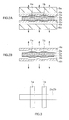
- Figs. 1A-1C and 2A-2B are schematic views showing a method of manufacturing a lithium ion polymer secondary battery relative to an embodiment of the present invention.
- Figs. 1A-1C and 2A-2B shows a condition observed in a direction shown as an arrow A in Fig. 4 .
- Fig. 3 is a view showing a two-dimensional schematic structure of sealed ends of sealing package members observed in a direction shown as an arrow B in Fig. 4 .
- the structure of a sealed part of the lithium ion polymer secondary battery relative to the embodiment of the present invention is also explained hereinafter because it is embodied by the manufacturing method relative to the embodiment of the present invention. Additionally, in Figs.
- Sealing members 2a and 2b which are made of a thermoplastic material such as cast polypropylene and are not applied to heat for fusion yet, are disposed in a manner that predetermined sealed positions of lead electrodes 1a and 1b are sandwiched from positions above and beneath the positions respectively. Disposed above and beneath the sealing members 2a and 2b are respectively ends of package members 3a and 3b formed by laminating rolled aluminum foil to polypropylene films. Outside the ends of the package members 3a and 3b, stripping sheets 4a and 4b made of Teflon sheets are disposed (see Fig. 1A ).
- the lead electrodes 1a and 1b are connected to a laminating structure, or spiral electrode units, in which a positive electrode, a negative electrode, and a separator are laminated and formed as a structure inside a thin and flat battery.
- heaters 6a and 6b are applied pressure to the predetermined positions, in which the package members 3a and 3b with the sealing members 2a and 2b disposed therebetween are to be sealed.
- the sealing members 2a and 2b are not fused yet, gaps 5a, 5b, 5c, 5d, 5e and the like shown on Fig. 1B are likely to exist between the sealing members (2a and 2b) and the lead electrodes (1a and 1b) or between the sealing members (2a and 2b) and the package members (3a and 3b).
- the fused sealing members 2a and 2b can spread between the lead electrodes (1a and 1b) and the package members (3a and 3b) as shown in Fig. 1C .
- the stripping sheets 4a and 4b made of Teflon sheet are disposed between the sealing members (2a and 2b) and the heaters (6a and 6b), it prevents that the forced-out sealing members 2a and 2b fuse and adhere on surfaces of the heaters 6a and 6b.
- Teflon sheet is a material, which prevents the fused sealing members 2a and 2b from adhering.
- the whole body covered with the stripping sheets 4a and 4b is stripped from the heaters 6a and 6b together with the stripping sheets 4a and 4b as shown in Fig. 2A .
- the stripping sheets 4a and 4b have been forced to heat under pressure with the heaters 6a and 6b, and even if the heaters 6a and 6b are removed, the stripping sheets 4a and 4b hold a shape along with concavo-concave shapes of the lead electrodes 1a and 1b or the package members 3a and 3b, which allows the whole body to cool down until the sealing members 2a and 2b re-solidifies as keeping a condition that the package members 3a and 3b, or the sealing members 2a and 2b, the lead electrodes 1a and 1b are sandwiched between the stripping sheets 4a and 4b.
- a cooling fan may be used for air-cooling, or a cooling may be conducted at room temperature. Either ways can be selected depending on a speed at which the sealing members 2a and 2b re-solidifies.
- the stripping sheets 4a and 4b are apart from the package members 3a and 3b.
- the package members 3a and 3b can be completely sealed by means of the sealing members 2a and 2b, which results in enhancing durability of the battery and increasing its productivity.
- the sealing members 2a and 2b adhere to the lead electrodes 1a and 1b without gaps, and also adhere to the package members 3a and 3b without gaps for sealing the ends of the package members 3a and 3b by means of a single step employing the heaters 6a and 6b, the present invention is not limited by the embodiment.
- the similar technique to the previous step can be applied to a manufacturing step such that after the sealing members 2a and 2b adhere to the lead electrodes 1a and 1b without gaps by means of a single step employing the heaters 6a and 6b, in another step, the ends of the package members 3a and 3b adhere to the surfaces of the sealing members 2a and 2b , which seals the parts to be sealed.
- the stripping sheets 4a and 4b are disposed in a manner of directly contacting the sealing members 2a and 2b, then from the outside of the stripping sheets 4a and 4b, heat is applied under pressure with the heaters 6a and 6b in order that the sealing members 2a and 2b adhere to the lead electrodes 1a and 1b without gaps.
- the ends of the package members 3a and 3b adhere to the surfaces of the sealing members 2a and 2b with thermocompression bonding or adhesion materials, thereby enabling the ends of the package members 3a and 3b to be sealed.
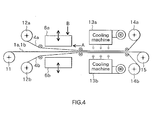
- Such a step of adhering the fused sealing members 2a and 2b to the lead electrodes 1a and 1b can be conducted by a manufacturing apparatus whose main part is schematically shown in Fig. 4 .
- the lead electrodes 1a and 1b are supplied in a manner of unreeling from a lead roll 11, which has the belt-shaped lead electrodes 1a and 1b in a rolled way.
- the stripping sheets 4a and 4b are supplied from stripping sheet rolls 12a and 12b.
- the stripping sheets 4a and 4b are accommodated in a rolled shape by winding magazines 14a and 14b after a forced cooling step, which will be described later.
- the sealing members 2a and 2b which do not fuse yet, are provisionally positioned on the lead electrodes 1a and 1b with a predetermined interval, are sandwiched between the heaters 6a and 6b with the stripping sheets 4a and 4b in-between.
- the sealing members (2a and 2b) and the lead electrodes 1a and 1b are applied to heat under pressure.
- the sealing members 2a and 2b fuse at temperature over 160°, which is fusion temperature of the sealing members 2a and 2b.
- the heaters 6a and 6b are removed from the sealing members (2a and 2b) and the lead electrodes 1a and 1b. At this moment, the sealing members 2a and 2b are not stripped from the stripping sheets 4a and 4b, and keep a laminated state.
- the parts, in which the sealing members 2a and 2b fuse and adhere to the lead electrodes 1a and 1b, are conveyed to the cooling machines 13a and 13b for conducting forced air-cooling.
- the stripping sheets 4a and 4b are stripped from the sealing members 2a and 2b and accommodated by the winding magazines 14a and 14b in a rolled shape after the sealing members 2a and 2b have re-solidified, the lead electrodes 1a and 1b, to which the sealing members 2a and 2b completely adhere, are rolled and accommodated by a winding magazine 15.
- the sealing members 2a and 2b can completely adhere to the lead electrodes 1a and 1b without gaps.
- Teflon sheet is employed as the stripping sheets
- materials which have the following quality can be preferably employed. Materials do not fuse or are ablaze even if heat holds temperature over the fusion temperature of the sealing members; additionally materials have physical strength, which are not prove to failures even if pressure is applied with the heaters; and materials do not fuse and adhere or remain residuum to the sealing members.
- stripping sheets sheet-like sheets can be employed beside the above-mentioned rolled type sheets.
- the sealing members are not limited by cast polypropylene as mentioned above. As for materials of the sealing members, materials having acceptable adhesion to the package members and the lead electrodes, and excellent in durability, are desirable.
- the present invention was applied to a lithium ion secondary battery
- the present invention is not limited by the embodiment, it can be applied to a thin lithium ion secondary battery having the above-mentioned structure or a manufacturing process such that the corresponding parts of the lead electrodes are sealed by the sealing members.
- the sealing members can spread between the lead electrodes and the package members without gaps. Furthermore, according to the method of manufacturing the lithium ion battery of the present invention, the sealing members can adhere to the lead electrodes without gaps. As a result, sealing failures caused by gaps generated between sides of the lead electrodes and the package members and gaps generated in the sides of the lead electrodes, can be prevented, which leads to high productivity and excellent hermeticity inside the battery covered with the package members, thereby, durability of the battery increases.
- the stripping sheets made of materials such that the fused sealing members do not adhere are inserted, thereby enabling the fused sealing members to adhere to the surfaces of the heaters even if the fused sealing members are leaked, or forced out from the ends of the package members, which achieves enhancement in productivity.
- the sealing members can cool without disfiguring their shape even if the heaters are removed when the sealing members are not yet made in a solid state, thereby simplifying the heating process and the cooling process with the heaters and furthermore, the failure ratio caused in the covering process employing the sealing members, can decrease, which brings productivity increment drastically.
Landscapes
- Chemical & Material Sciences (AREA)
- Chemical Kinetics & Catalysis (AREA)
- Electrochemistry (AREA)
- General Chemical & Material Sciences (AREA)
- Engineering & Computer Science (AREA)
- Manufacturing & Machinery (AREA)
- Inorganic Chemistry (AREA)
- Physics & Mathematics (AREA)
- Condensed Matter Physics & Semiconductors (AREA)
- Dispersion Chemistry (AREA)
- General Physics & Mathematics (AREA)
- Materials Engineering (AREA)
- Secondary Cells (AREA)
- Sealing Battery Cases Or Jackets (AREA)
- Connection Of Batteries Or Terminals (AREA)
Abstract
Description
- The present invention relates to a lithium ion battery such as a lithium ion polymer secondary battery having a gel-type or plastic macromolecular electrolyte layer, and a method of manufacturing the same.
- In recent years, in a situation where portable small electric equipments such as small, lightweight cellular phones or portable computers have been popularized, second batteries having small, reliable output characteristics and capable of longtime-use by re-charging many times such as nickel-cadmium batteries, nickel-hydrogen batteries and lithium ion batteries have been studied and developed vastly as an electric source for supplying electric power to drive the electric equipment.
- Among the secondary batteries, the lithium ion secondary battery has characteristics capable of outputting stable electric power despite its small size, lightweight and thinness, and has been studied and developed for the purpose of being employed as a foldable secondary battery by taking advantage of suitable structural characteristics for its thin size.
- Furthermore, as a technique capable of achieving the above-mentioned thin size and foldable shape, and of gaining superior characteristics free of leakage unlike the case of employing liquid electrolyte as a dry cell, it is suggested that a technique employs a gel-type electrolyte including a plasticizer realizing flexibility, and a technique employs a macromolecular solid electrolyte, in which a lithium salt is dissolved in a macromolecular material.
- In such lithium ion secondary batteries with a thin structure, generally, the main part of the battery is formed in the following manner. A laminating structure is formed by laminating a positive electrode, a positive electrode active material layer, a gel-type macromolecular solid electrolyte layer, a separator, a negative electrode, a negative electrode active material layer. A positive electrode lead and a negative lead electrode are in contact with the corresponding electrodes in the laminating structure. After this, the laminating structure is covered with package members made of aluminum/polypropylene laminate pack material, and sealed ends.
- As for materials used for the above-mentioned schematic structure, for instance, materials described later can be preferably used. Plastic materials employed here are abbreviated as follows: polyethylene terephthalate;PET, fused polypropylene;PP, cast polypropylene;CPP, polyethylene;PE, low-density polyethylene;LDPE, high-density polyethylene;HDPE, linear low-density polyethylene;LLDPE, nylon;Ny. Additionally, aluminum, which is a metal material employed as a barrier film having moisture permeability resistance, is abbreviated as AL.
- The most typical structure is a combination such that a package member, a metal film and a sealant layer are respectively PET, AL, and PE. Other typical laminating structures can also be employed instead of this combination. Such combinations are:PET/AL/CPP, PET/AL/PET/CPP, PET/Ny/AL/CPP, PET/Ny/AL/Ny/CPP, PET/Ny/AL/Ny/PE, Ny/PE/AL/LLDPE, PET/PE/AL/PET/LDPE, or PET/Ny/AL/LDPE/CPP.
- As for materials employed as the sealant layer of a laminating film, the above-exemplified PE, LDPE, HDPE, LLDPE, PP, and CPP and the like can be employed, and the thickness of the sealant layer is preferably in a range of 20 µm - 100 µm based on the observed results. The fusion temperature of the materials employed as the sealant layer are generally as mentioned hereinafter. The fusion temperatures of PE, LDPE, HDPE and LLDPE are within a range of 120 -150 °C, that of PP and CPP are about 180 °C, and the fusion temperature of PET employed as the package layer is over 230 °C.
- As materials employed as a barrier film having moisture permeability resistance, although aluminum is exemplified in the above example, it is not limited, and materials capable of forming thin films by means of sputtering can be employed. As for such materials, alumina (Al2O3), silicon oxide (SiO2), and silicon nitride (SiNx) can be employed.
- In a conventional means for sealing the ends of the package members of the lithium ion secondary battery with a thin structure, generally, adhesive material with high adhesion for the metal material and the package members of the lead electrodes, is applied on a position where the ends of the package members are sealed, and pressure is applied on the position to be sealed. In another means, the adhesive material is only applied to surfaces of the sealed positions in each of the lead electrodes and a pressure is applied to the ends of the package members to each of the lead electrodes so as to seal the part.
- However, in the conventional sealing structure and method of manufacturing the same using the adhesive material as described above, there are problems such that even if the package members can be completely sealed to principal surfaces of the lead electrodes, gaps are easy to be produced between sides of the lead electrodes and the package members, which causes an incomplete sealing state (or hermeticity decrease), thereby, insides of the batteries are susceptible to influence of temperature variations or influence from the outside, and by long term change in the batteries, the insides of the batteries deteriorate rapidly, which results in decrease of electromotive force and reduction of durability. Additionally, such batteries having gaps causing degradation of battery capability, must be treated as nonconforming batteries, which results in a productivity decrease.
- The invention has been achieved in consideration of the above problems and its object is to provide a lithium ion battery with high productivity and excellent hermeticity inside the battery covered with a package member by means of preventing sealing failures caused by gaps occurring between sides of a lead electrode and the package member, and a method of manufacturing the same.
- A nonaqueous-electrolyte secondary battery according to the present invention comprises a laminating structure, in which at least a positive electrode and a negative electrode are laminated, a film-like or sheet-like package member for covering the laminating structure, a lead electrode whose one end joints to the laminating structure and the other end protrudes toward the outside from an end of the package member, and a sealing member, which is inserted between the end of the package member and the lead electrode by fusing a thermoplastic material, and seals the gap therebetween.
- A method of manufacturing a nonaqueous-electrolyte secondary battery according to the present invention comprises, a step of sealing a gap between a lead electrode and an end of a package member, whereby a sealing member made of a thermoplastic material is inserted between the lead electrode and the end of the package member, wherein the electrode whose one end connects to the laminating structure and the other end protrudes from the end of the package member toward the outside, and the sealing member fuses in order to seal the gap therebetween.
- Furthermore, a method of manufacturing another nonaqueous-electrolyte secondary battery according to the present invention comprises a step of sealing a gap between a lead electrode and an end of a package member, whereby a sealing member made of a thermoplastic material is inserted between a lead electrode and the end of the package member, wherein the electrode whose one end joints to a laminating structure and the other end protrudes from an end of a package member toward the outside, a heater is applied to heat to the ends of the sealing member for fusion at temperature over its fusion temperature from the outer side.
- Furthermore, a method of manufacturing another nonaqueous-electrolyte secondary battery according to the present invention comprises a step of sealing a gap between a lead electrode and an end of a package member, whereby the sealing member made of a thermoplastic material is inserted between the end of the package member and the lead electrode whose one end joints to the laminating structure and the other end protrudes from the end of the package member toward the outside, a heater applies pressure to at least the end of the package member from the outside, a stripping sheet made of a material such that at least its surface does not adhere to the sealing member, is inserted, then the heater generates heating to the sealing member at temperature over its fusion temperature for fusion.
- A method of manufacturing another nonaqueous-electrolyte secondary battery according to the present invention comprises the steps of fusing a sealing member, whereby the sealing member is inserted between a lead electrode whose one end joints to the laminating structure, and the other end protrudes from an end of the package member, at least pressure is applied to the end of the package member from the outside, a stripping sheet made of a material such that at least its surface does not adhere to a sealing member, is inserted between a heater and the package member, or the sealing member, and of separating the stripping sheet from the package member, or the sealing member whereby after the sealing member has been able to spread between the lead electrode and the package member without a gap after heating and fusing the sealing member, the stripping sheet is separated from the heater, then the fused sealing member re-solidifies to be made in a solid state.
- A method of manufacturing another nonaqueous-electrolyte battery according to the present invention comprises steps of fusing a sealing member, whereby the sealing member made of a thermoplastic material is disposed in a predetermined position of a lead electrode, pressure is applied to at least the sealing member from the outside, a stripping sheet made of a material such that at least its surface does not adhere to the sealing member, is inserted between the heater and the sealing member, and of separating the stripping sheet from the package member, whereby after the sealing member has been able to spread between the lead electrode and the package member without a gap by heating and fusing the sealing member, the stripping sheet is separated from the heater, and then the fused sealing member re-solidifies to be made in a solid state.
- In a nonaqueous-electrolyte secondary battery and a method of manufacturing the same, since a sealing member made of a thermoplastic material is fused and inserted between an end of a package member and a lead electrode for sealing a gap, the sealing member can spread therebetween. Since the sealing member adheres to the lead electrode by fusing the sealing member, the sealing member adheres to the lead electrode without a gap.
- In a method of manufacturing a nonaqueous-electrolyte secondary battery according to the present invention, during a step of sealing a gap between an end of a package member and a lead electrode by fusing and inserting a sealing member, since a stripping sheet made of a material such that at least its surface does not adhere to the sealing member, is inserted into the package member or the sealing member and the heater, the heater is applied pressure and generates heating to the package member or the sealing member, so that even if the fused sealing member is leaked or forced out from the end of the package member toward the outside, it does not adhere to a surface of the heater.
- Additionally, since the stripping sheet has a sheet-like shape unlike the case it is annexed to the surface of the heater in a flat shape, the heater presses the stripping sheet in a manner of shaping along with a concave-convex shape of the sealing member, thereby, even if after the sealing member fuses and spreads between the package member, the package member and the sealing member are soon stripped from the heater with the stripping sheet, the shape of the sealing member and the state of the lead electrode can be maintained until the sealing member re-solidifies to be made in a solid state.
- For this reason, without letting the heater to repeatedly heat and cool itself, when heating is necessary, the heater presses the package member and the sealing member in order to fuse the sealing member, then when the sealing member has fused enough, the heater is separated from the package member covered with the stripping sheet and the sealing member, which gives the time when the sealing member cools and re-solidifies at room temperature, or by forced cooling wind. This also maintains the shape of the sealing member even if the heater is apart when the sealing member does not solidify yet. From this point, the stripping sheet is desirably used in a sheet-like state, which can be separated from the heater, rather than coated on the surface of the heater.
- In the case where the above-mentioned lithium ion battery comprises a solid electrolyte, or a gel-type electrolyte, as a macromolecule material employed for macromolecular solid electrolyte, silicon gel, acryl gel, acrylonitrite gel, polyphosphazen denatured polymer, polyethylene oxide, polypropylene oxide, and composite polymer of the above-mentioned materials, cross-linked polymer of the above-mentioned materials, denatured polymer of the above-mentioned materials can be employed, as for fluorine polymer, for example, poly(vinylidenefluororide), poly(vinylidenefluororide-co-hexafluoropylene), poly(vinylidenefluororide-co-tetrafluoroethylene), poly(vinylidenefluororide-co-trifluoroethylene) and mixture of the above-mentioned materials can be employed. Additionally, various materials can be also employed as the same as the above-mentioned materials.
- As for solid electrolyte, or gel-type electrolyte stacked on a positive electrode active layer, or a negative electrode active layer, preferable materials are made by the following processes. First, a solution comprising a macromolecular compound, an electrolyte salt, and a solvent, is impregnated into the positive electrode active material, or the negative electrode active material in order to remove the solvent, and solidifies. The solid electrolyte, or the gel-type electrolyte stacked on the positive electrode active layer, or the negative electrode active layer is impregnated into the positive electrode active layer or the negative electrode active layer, and solidifies. In case of a cross-linked material, after the above-mentioned processes, light or heat is applied to conduct cross-linking to solidify.
- The gel-type electrolyte is made of plasticizer including a lithium salt and a matrix macromolecule in the range of equal to or more than 2 percentage by weight and equal to or less than 3 percentage by weight. At this moment, esters, ethers, and carbonic acid esters can be employed independently, or as one component of plasticizer.
- When adjusting the gel-typed electrolyte, as for the matrix macromolecule gelling the above-mentioned carbonic acid esters, although various macromolecules employed for forming the gel-type electrolyte, fluorine macromolecules such as poly(vinylidenefluororide), poly(vinylidenefluororide-co-hexafluoropropylene) are preferably employed from reduction-oxidation stability point of view.
- The macromolecular electrolyte is made of the lithium salt and the macromolecular compound, in which the lithium salt is dissolved. As for the macromolecular electrolyte, ether macromolecule such as poly(ethylene oxide) and cross-linked polyethylene oxide, poly(methercrylateester), acrylates, fluorine macromolecules such as poly(vinylidenefluororide), poly(vinylidenefluororide-co-hexafluoropropylene) can be employed independently, or as a mixture among the above-mentioned materials. From reduction-oxidation stability point of view, preferably, the fluorine macromolecules such as poly(vinylidenefluororide) or poly(vinylidenefluororide-co-hexafluoropropylene) can be employed.
- As the lithium salt included in the gel-type electrolyte or the macromolecular solid electrolyte, a lithium salt used for typical electrolyte as a battery can be employed. More specifically, the following materials are considered: lithium chloride; lithium bromide; lithium iodide; chloric lithium; lithium perchlorate; lithium bromate; lithium iodate; lithium nitrate; tetrafluorolithiumborate; hexafluorophosphoriclithium; lithium acetate; bis(trifluoromethanesulfonil)imidelithium, LiAdsF6, LiCF3SO3, LiC(SO2CF3)3, LiAlCl4, LiSiF6. In case of the gel-type electrolyte, preferable dissolution density of the lithium salt is in the range of 0.1 to 3.0 mol in plasticizer, more preferably, in the range of 0.5 to 2.0 mol. Additionally, the kinds of the lithium salt, or its dissolution density is not limited by the above-mentioned materials and dissolution density.
- As a negative electrode material, a material capable of doping or un-doping lithium is preferable. As such a material, for example, a non-graphitizing carbon material, or a graphite material is preferably employed. More specifically, pyrocarbons, cokes (pitch coke, needle coke, petroleum coke), graphites, glassy carbons, organic macromolecular compound calcinated materials (materials such that phenolic resin, furan resin and the like are calcinated at proper temperature), carbon fiber, carbonaceous materials such as activated carbon can be employed. As for other materials, macromolecules such as polyacetylene, polypyrrole or oxide such as SnO2 can be employed. In a case of forming a negative electrode using such materials, well-known binders may be doped.
- On the other hand, a positive electrode can be formed using metal oxide, metal sulfide or specific macromolecules as positive electrode active materials, depending on the kind of achieved batteries. In the case where lithium ion batteries are formed, for instance, metal sulfide or metal oxide such as TiS2, MoS2, NbSe2, V2O5 which includes no lithium, or lithium complex oxide mainly including LiMO2 and the like can be employed, as the positive electrode active material. As for transition metal M forming lithium complex oxide, Co, Ni, Mn are preferable. LiCoO2, LiNiO2, LiNiyCol-yO2 and the like can be considered as specific examples of such lithium complex oxide. In the formula described before, M represents equal to or more than one kind of transition metal, x is a value satisfying in accord with a discharge state of the battery, typically in the range of 0.05 to 1.10, y is a value satisfying by formula: 0<y<1. These lithium complex oxide are capable of generating high voltage, which forms the positive electrode active material having excellent characteristics in energy density. A plurality of the positive electrode active materials may be used for the positive electrode by mixing. When forming a positive electrode using the positive electrode active material, well-known conducting agents or binders can be doped.
- Other and further objects, features and advantages of the invention will appear more fully from the following description.
- These and other objects and features of the present invention will become clear from the following description of the preferred embodiments given with reference to the accompanying drawings, in which:
-
Fig. 1A-1C are schematic views showing a method of manufacturing a lithium ion polymer battery relative to the embodiment of the present invention; -
Fig. 2A and 2B are schematic views showing the method of manufacturing the lithium ion polymer battery relative to the embodiment of the present invention; -
Fig. 3 is a plain view showing a schematic structure of sealed ends of package members; -
Fig. 4 is a schematic view showing a main part of a manufacturing process allowing that the sealing members fuse and adhere to lead electrodes without gaps. - Embodiments of the invention will be described in detail hereinbelow by referring to the drawings.
-
Figs. 1A-1C and2A-2B are schematic views showing a method of manufacturing a lithium ion polymer secondary battery relative to an embodiment of the present invention.Figs. 1A-1C and2A-2B shows a condition observed in a direction shown as an arrow A inFig. 4 .Fig. 3 is a view showing a two-dimensional schematic structure of sealed ends of sealing package members observed in a direction shown as an arrow B inFig. 4 . The structure of a sealed part of the lithium ion polymer secondary battery relative to the embodiment of the present invention is also explained hereinafter because it is embodied by the manufacturing method relative to the embodiment of the present invention. Additionally, inFigs. 1A-1C ,2A-2B and detailed explanation based on the above-mentioned drawings, for avoiding complicated drawings and explanation, a sealing step in the method of manufacturing the lithium ion polymer secondary battery is only described in detail, and other steps such as a forming step of a laminating structure or a cutting step of a lead electrode, are omitted. -
Sealing members lead electrodes members package members package members sheets Fig. 1A ). Although illustrations are omitted, thelead electrodes - Following this, from the outside of the stripping
sheets members lead electrodes package members heaters package members members members gaps Fig. 1B are likely to exist between the sealing members (2a and 2b) and the lead electrodes (1a and 1b) or between the sealing members (2a and 2b) and the package members (3a and 3b). - As the positions in which the ends of the
package members sealing members Fig. 1C . At this moment, although there is a case such that theexcess sealing members package members sheets sealing members heaters sealing members - As mentioned above, after the
sealing members sheets heaters sheets Fig. 2A . In this time, the strippingsheets heaters heaters sheets lead electrodes package members members package members members lead electrodes sheets sealing members - After the
sealing members Fig. 2B , the strippingsheets package members - As described above, the
package members members - Although in the sealing process relative to the above-mentioned embodiment, it is described that the sealing
members lead electrodes package members package members heaters sealing members lead electrodes heaters package members members - In a manufacturing process employing the heaters (6a and 6b) and the stripping
sheets Figs. 1A-1C and2A-2B , without thepackage members sheets members sheets heaters members lead electrodes package members members package members - Such a step of adhering the fused
sealing members lead electrodes Fig. 4 . - Initially, the
lead electrodes lead roll 11, which has the belt-shapedlead electrodes sheets sheets magazines - In a heat-fusion step employing the
heaters members lead electrodes heaters sheets heaters sheets lead electrodes members members - After a lapsed time enough for the sealing
members lead electrodes heaters lead electrodes members sheets - After this, in the forced air-cooling step employing
cooling machines sealing members lead electrodes cooling machines sheets members magazines sealing members lead electrodes sealing members magazine 15. - With the above-mentioned procedures, the sealing
members lead electrodes - Although in the above-mentioned embodiment, the case that Teflon sheet is employed as the stripping sheets was described, materials, which have the following quality can be preferably employed. Materials do not fuse or are ablaze even if heat holds temperature over the fusion temperature of the sealing members; additionally materials have physical strength, which are not prove to failures even if pressure is applied with the heaters; and materials do not fuse and adhere or remain residuum to the sealing members. As the stripping sheets, sheet-like sheets can be employed beside the above-mentioned rolled type sheets.
- The sealing members are not limited by cast polypropylene as mentioned above. As for materials of the sealing members, materials having acceptable adhesion to the package members and the lead electrodes, and excellent in durability, are desirable.
- Although in the above-mentioned embodiment, the present invention was applied to a lithium ion secondary battery, the present invention is not limited by the embodiment, it can be applied to a thin lithium ion secondary battery having the above-mentioned structure or a manufacturing process such that the corresponding parts of the lead electrodes are sealed by the sealing members.
- As mentioned above, according to the lithium ion battery and the method of manufacturing the same of the present invention, the sealing members can spread between the lead electrodes and the package members without gaps. Furthermore, according to the method of manufacturing the lithium ion battery of the present invention, the sealing members can adhere to the lead electrodes without gaps. As a result, sealing failures caused by gaps generated between sides of the lead electrodes and the package members and gaps generated in the sides of the lead electrodes, can be prevented, which leads to high productivity and excellent hermeticity inside the battery covered with the package members, thereby, durability of the battery increases.
- Furthermore, according to the method of manufacturing the lithium ion of the secondary battery, when heat is applied to the package members or the sealing members under pressure with the heaters, between the heaters and the package members, or between the heaters and the sealing members, the stripping sheets made of materials such that the fused sealing members do not adhere, are inserted, thereby enabling the fused sealing members to adhere to the surfaces of the heaters even if the fused sealing members are leaked, or forced out from the ends of the package members, which achieves enhancement in productivity.
- Still further, according to the method of manufacturing the lithium ion battery of the present invention, the sealing members can cool without disfiguring their shape even if the heaters are removed when the sealing members are not yet made in a solid state, thereby simplifying the heating process and the cooling process with the heaters and furthermore, the failure ratio caused in the covering process employing the sealing members, can decrease, which brings productivity increment drastically.
- Obviously many modifications and variations of the present invention are possible in the light of the above teachings. It is therefore to be understood that within the scope of the appended claims the invention may be practiced otherwise than as specifically described.
-
- 1. A nonaqueous-electrolyte secondary battery comprising:
- a laminating structure, in which at least a positive electrode and a negative electrode (1a, 1b) are laminated;
- a film-like or sheet-like package member (3a, 3b) covering the laminating structure;
- a lead electrode (1a, 1b), which is joined to the laminating structure and protrudes from an end of the package member (3a, 3b) toward the outside; and
- a sealing member (2a, 2b), which is inserted into a gap between the end of the package member (3a, 3b) and the lead electrode (1a, 1b), and seals the gap by fusing a thermoplasticity material.
- 2. A nonaqueous-electrolyte secondary battery according to
clause 1, wherein it is covered with a package member employing a metal laminate pack material comprising a package resin, a metal film, and a sealant layer, and is sealed in its end. - 3. A nonaqueous-electrolyte secondary battery according to
clause 1, wherein the positive electrode comprises lithium mix oxide whose main base is LiMO2 (the transition metal M is a material selected from a group of Co, Ni, Mn); and
the negative electrode comprises a non-graphitizing carbon material or a graphite material. - 4. A nonaqueous-electrolyte secondary battery according to
clause 1, wherein a solid electrolyte or a gel-type electrolyte is employed. - 5. A nonaqueous-electrolyte secondary battery according to clause 4, wherein the electrolyte is a gel-type electrolyte.
- 6. A nonaqueous-electrolyte secondary battery according to clause 5, wherein the gel-type electrolyte is made of a fluorine macromolecule containing an electrolyte salt and a solvent.
- 7. A method of manufacturing a nonaqueous-electrolyte secondary battery including a step of covering a laminating structure, in which at least a positive electrode and a negative electrode (1a, 1b) are laminated, with a film-like or sheet-like package member (3a, 3b), comprising a step of :
- sealing a gap (5a, 5d) between a lead electrode (1a, 1b) and an end of the package member (3a, 3b) by fusing a sealing member (2a, 2b);
- whereby the sealing member (2a, 2b) made of a thermoplastic material is inserted between the lead electrode (1a, 1b) and the end of the package member (3a, 3b),
- wherein the lead electrode (1a, 1b) connects to the said laminating structure and protrudes from an end of the package member (3a, 3b) toward the outside.
- 8. A method of manufacturing a nonaqueous-electrolyte secondary battery including a step of covering a laminating structure, in which at least a positive electrode and a negative electrode (1a, 1b) are laminated, and formed in a flat shape with a film-like or sheet-like package member (3a, 3b), comprising a step of:
- sealing a gap (5a, 5d) between a lead electrode (1a, 1b) and an end of the package member (3a, 3b);
- whereby the sealing member (2a, 2b) made of a thermoplastic material is inserted between the end of the package member (3a, 3b) and the lead electrode (1a, 1b) whose one end connects to the said laminating structure and the other end protrudes from the end of the package members (3a, 3b) toward the outside, a heater (6a, 6b) is applied pressure at least to the end of the package member (3a, 3b) from the outer side at temperature over the fusion temperature for heating and fusing the sealing member (2a, 2b).
- 9. A nonaqueous-electrolyte secondary battery including a step of covering a laminating structure, in which at least a positive electrode and a negative electrode (1a, 1b) are laminated, and formed in a flat shape with a film-like or sheet-like package member (3a, 3b), comprising a step of:
- sealing a gap (5a, 5d) between a lead electrode (1a, 1b) and an end of the package member (3a, 3b);
- whereby the sealing member (2a, 2b) made of a thermoplastic material is inserted between the end of the package member (3a, 3b) and the lead electrode (1a, 1b) whose one end connects to the said laminating structure and the other end protrudes from the end of the package member (3a, 3b) toward the outside, a heater (6a, 6b) is applied pressure at least to the end of the package member (3a, 3b) from the outer side, a stripping sheet (4a, 4b) made of a material such that at least its surface does not fuse and adhere to the sealing member (2a, 2b), is inserted, then the heater (6a, 6b) is applied to heat to the sealing member (2a, 2b) at temperature over the fusion temperature for fusing the sealing member (2a, 2b).
- 10. A method of manufacturing a nonaqueous-electrolyte secondary battery including a step of covering a laminating structure comprising at least a positive electrode and a negative electrode (1a, 1b), and formed in a flat shape, comprising the steps of:
- fusing a sealing member (2a, 2b);
- whereby the sealing member (2a, 2b) is inserted between a lead electrode (1a, 1b) whose one end connects to the said laminating structure and the other end protrudes from an end of the package member (3a, 3b) toward the outside, a heater (6a, 6b) applies pressure at least to the end of the package member (3a, 3b) from the outside, a stripping sheet (4a, 4b) made of a material such that at least its surface does not fuse and adhere to the sealing member (2a, 2b), is inserted between the heater (6a, 6b) and the package member (3a, 3b), or the heater (6a, 6b) and the sealing member (2a, 2b); and
- stripping the stripping sheet (4a, 4b) from the package member (3a, 3b), or the sealing member (2a, 2b);
- whereby after the sealing member (2a, 2b) can spread between the lead electrode (1a, 1b) and the package member (3a, 3b) without a gap by heating and fusing the sealing member (2a, 2b), the stripping sheet (4a, 4b) is stripped from the heater (6a, 6b), then the fused sealing member (2a, 2b) re-solidifies, and is made in a solid state.
- 11. A nonaqueous-electrolyte secondary battery according to clause 10, wherein the sheet-like package member (3a, 3b) comprises a metal laminate pack material comprising a package resin, a metal film, and a sealant layer, and sealed in its end.
- 12. A method of manufacturing a nonaqueous-electrolyte secondary battery according to
clause 11, wherein the positive electrode comprises a transition metal chalcogen compound as an active material; and
the negative electrode comprises a material capable of doping and un-doping lithium as an active material. - 13. A nonaqueous-electrolyte secondary battery according to clause 12, wherein the positive electrode comprises lithium mix oxide whose main base is LiMO2 (transition metal M is a material selected from a group of Co, Ni, Mn), and
the negative electrode comprises a non-graphitizing carbon material, or a graphite material. - 14. A method of manufacturing a nonaqueous-electrolyte secondary battery according to clause 10, wherein a solid electrolyte, or a gel-type electrolyte is included.
- 15. A method of manufacturing a nonaqueous-electrolyte secondary battery according to clause 14, wherein the electrolyte is a gel-type electrolyte.
- 16. A method of manufacturing a nonaqueous-electrolyte secondary battery according to
clause 15, wherein the gel-type electrolyte made of a fluorine macromolecular material includes an electrolyte salt and a solvent. - 17. A method of manufacturing a nonaqueous-electrolyte secondary battery, comprising the steps of :
- fusing a sealing member (2a, 2b) by heating at a temperature over the fusion temperature of the sealing member (2a, 2b) with a heater (6a, 6b);
- whereby a sealing member (2a, 2b) made of a thermoplastic material is disposed in a predetermined position in a lead electrode (1a, 1b), and a heater (6a, 6b) applies pressure at least to the sealing member (2a, 2b) from the outside, a stripping sheet (4a, 4b) made of a material such that at least its surface does not adhere to the sealing member (2a, 2b), is inserted between the heater (6a, 6b) and the sealing member (2a, 2b);
- separating the stripping sheet (4a, 4b) from the package member (3a, 3b), or the sealing member (2a, 2b);
- whereby after the sealing member (2a, 2b) has been able to spread between the lead electrode (1a, 1b) and the package member (3a, 3b) without a gap by heating and fusing the sealing member (2a, 2b), the stripping sheet (4a, 4b) is separated from the heater (6a, 6b), then the fused sealing member (2a, 2b) re-solidifies, and is made in a solid state.
- 18. A method of manufacturing a nonaqueous-electrolyte secondary battery according to clause 17, wherein the sheet-like sealing member (2a, 2b) is covered with the package member (3a, 3b) made of a metal laminate pack material comprising a package resin, a metal film, and a sealant layer, and is sealed in its end.
- 19. A method of manufacturing a nonaqueous-electrolyte secondary battery according to clause 18, wherein the positive electrode comprises a transition metal chalcogen compound as an active material; and
the negative electrode comprises a material capable of doping or un-doping lithium as an active material. - 20. A method of manufacturing a nonaqueous-electrolyte secondary battery according to clause 19, wherein the positive electrode comprises lithium complex oxide, whose main base is LiMO2 (transition metal M is a material selected form a group of Co, Ni, Mn); and
the negative electrode comprises a non-graphitizing material, or a graphite material. - 21. A method of manufacturing a nonaqueous-electrolyte secondary battery according to clause 20, wherein a solid electrolyte, or a gel-type electrolyte is included.
- 22. A method of manufacturing a nonaqueous-electrolyte secondary battery according to clause 21, wherein the electrolyte is a gel-type electrolyte.
- 23. A method of manufacturing a nonaqueous-electrolyte secondary battery according to clause 22, wherein the gel-type electrolyte is made of a fluorine macromolecular material including an electrolyte salt and a solvent.
Claims (11)
- A nonaqueous-electrolyte secondary battery comprising:a laminating structure, in which at least a positive electrode and a negative electrode (1a, 1b) are laminated;a package member (3a, 3b) covering the laminating structure;a lead electrode (1a, 1b), which joints to the laminating structure and protrudes from the package member (3a, 3b) toward the outside; anda sealing member (2a, 2b), which is inserted between the package member (3a, 3b) and the lead electrode (1a, 1b), and the sealing member is a thermoplasticity material.
- A nonaqueous-electrolyte secondary battery according to claim 1, wherein
the sealing member having a top sealing member (2a) and a bottom sealing member (2b) and the package member having a top package member (3a) and a bottom package member (3b),
the top sealing member (2a) is located between the top package member (3a) and a top side of the lead electrode (1a, 1b),
the bottom sealing member (2b) is located between the bottom package member (3b) and a bottom side of the lead electrode (1a, 1b). - A nonaqueous-electrolyte secondary battery according to claim 2, wherein
the top and the bottom sealing members (2a, 2b) adhere to the lead electrode without gaps. - A nonaqueous-electrolyte secondary battery according to claim 3, wherein
the top sealing member (2a) adhere to the top package member (3a) and the bottom sealing member (2b) adhere to the bottom package member (3b) without gaps. - A nonaqueous-electrolyte secondary battery according to any of claims 2 to 4, wherein
the top and the bottom sealing member (2a, 2b) each being a stripe-shaped sealing member extending to the width of an end of the package member (3a, 3b). - A nonaqueous-electrolyte secondary battery according to any of claims 1 to 5, wherein the package member comprises a metal laminate pack material comprising package resin, a metal film, and a sealant layer.
- A nonaqueous-electrolyte secondary battery according to claim 6, wherein the sealant layer having a fusion temperature within a range of 120∼150 °C.
- A nonaqueous-electrolyte secondary battery according to any of claims 1 to 7, wherein the laminating structure further comprising an electrolyte.
- A nonaqueous-electrolyte secondary battery according to claim 8, wherein the electrolyte is a solid electrolyte or gel-type electrolyte.
- A nonaqueous-electrolyte secondary battery according to any of claims 1 to 9, wherein the positive electrode comprising lithium mix oxide whose main base is LiMO.sub.2 (the transition metal M is a material selected from a group of Co, Ni, Mn).
- A nonaqueous-electrolyte secondary battery according to any of claims 1 to 9, wherein the negative electrode comprising a non-graphitizing carbon material or a graphite material.
Applications Claiming Priority (2)
| Application Number | Priority Date | Filing Date | Title |
|---|---|---|---|
| JP2000081578A JP2001266952A (en) | 2000-03-23 | 2000-03-23 | Lithium ion battery and method of manufacturing the same |
| EP01400770A EP1137093B1 (en) | 2000-03-23 | 2001-03-23 | Method of manufacturing a nonaqueous-electrolyte secondary battery |
Related Parent Applications (1)
| Application Number | Title | Priority Date | Filing Date |
|---|---|---|---|
| EP01400770.2 Division | 2001-03-23 |
Publications (2)
| Publication Number | Publication Date |
|---|---|
| EP2429013A1 true EP2429013A1 (en) | 2012-03-14 |
| EP2429013B1 EP2429013B1 (en) | 2013-05-08 |
Family
ID=18598495
Family Applications (2)
| Application Number | Title | Priority Date | Filing Date |
|---|---|---|---|
| EP11192088.0A Expired - Lifetime EP2429013B1 (en) | 2000-03-23 | 2001-03-23 | Nonaqueous-electrolyte secondary battery and method of manufacturing the same |
| EP01400770A Expired - Lifetime EP1137093B1 (en) | 2000-03-23 | 2001-03-23 | Method of manufacturing a nonaqueous-electrolyte secondary battery |
Family Applications After (1)
| Application Number | Title | Priority Date | Filing Date |
|---|---|---|---|
| EP01400770A Expired - Lifetime EP1137093B1 (en) | 2000-03-23 | 2001-03-23 | Method of manufacturing a nonaqueous-electrolyte secondary battery |
Country Status (5)
| Country | Link |
|---|---|
| US (2) | US6689177B2 (en) |
| EP (2) | EP2429013B1 (en) |
| JP (1) | JP2001266952A (en) |
| CN (1) | CN1189970C (en) |
| MX (1) | MXPA01002970A (en) |
Families Citing this family (32)
| Publication number | Priority date | Publication date | Assignee | Title |
|---|---|---|---|---|
| CN1288769C (en) * | 2001-01-18 | 2006-12-06 | 大日本印刷株式会社 | Battery device and lead wire film |
| JP2002304916A (en) * | 2001-04-03 | 2002-10-18 | Honda Motor Co Ltd | Wiring material and solar cell module including the same |
| JP2003086170A (en) * | 2001-09-10 | 2003-03-20 | Mitsubishi Chemicals Corp | Lead parts |
| US6952959B2 (en) * | 2003-06-20 | 2005-10-11 | Kazuo Hishinuma | Method of designing a heat seal width |
| JP4687862B2 (en) * | 2003-07-22 | 2011-05-25 | トヨタ自動車株式会社 | Secondary battery and manufacturing method thereof |
| DE10346310A1 (en) | 2003-10-06 | 2005-05-04 | Fraunhofer Ges Forschung | Battery, in particular micro-battery, and their production by means of wafer-level technology |
| US10629947B2 (en) | 2008-08-05 | 2020-04-21 | Sion Power Corporation | Electrochemical cell |
| JP4788116B2 (en) * | 2004-07-12 | 2011-10-05 | ソニー株式会社 | Battery manufacturing method |
| KR100686815B1 (en) * | 2005-04-26 | 2007-02-26 | 삼성에스디아이 주식회사 | Polymer battery packs and manufacturing methods thereof |
| JP5023391B2 (en) * | 2007-08-06 | 2012-09-12 | Necエナジーデバイス株式会社 | Manufacturing method of laminated battery |
| US9105938B2 (en) | 2008-08-05 | 2015-08-11 | Sion Power Corporation | Application of force in electrochemical cells |
| JP5549192B2 (en) * | 2009-11-18 | 2014-07-16 | ソニー株式会社 | Solid electrolyte battery and positive electrode active material |
| KR20110066448A (en) * | 2009-12-11 | 2011-06-17 | 삼성에스디아이 주식회사 | Lithium secondary battery |
| EP2721665B1 (en) | 2011-06-17 | 2021-10-27 | Sion Power Corporation | Plating technique for electrode |
| WO2013148211A1 (en) | 2012-03-30 | 2013-10-03 | The Trustees Of Columbia University In The City Of New York | Solid-state materials formed of molecular clusters and method of forming same |
| WO2014123164A1 (en) * | 2013-02-06 | 2014-08-14 | 大日本印刷株式会社 | Battery packaging material |
| US20150010850A1 (en) * | 2013-07-02 | 2015-01-08 | U.S. Army Research Laboratory ATTN:RDRL-LOC-I | Electrochemical device |
| KR101947149B1 (en) * | 2015-12-16 | 2019-02-13 | 주식회사 엘지화학 | Sealing Apparatus for Battery Case with Improved Application Area of Pressurization and Heat |
| CN107293652B (en) * | 2016-04-11 | 2020-10-02 | 宁德新能源科技有限公司 | Packaging sealing structure and preparation method thereof, and flexible packaging battery |
| CN109417203B (en) | 2016-04-11 | 2021-05-18 | 宁德新能源科技有限公司 | Packaging sealing structure and preparation method thereof, and flexible packaging battery |
| JP2017069218A (en) * | 2016-12-05 | 2017-04-06 | 油化電子株式会社 | Method for manufacturing laminate film for battery outer packaging |
| KR102148928B1 (en) * | 2016-12-09 | 2020-08-28 | 가부시키가이샤 인비젼 에이이에스씨 재팬 | Method for manufacturing film-covered battery and film-covered battery |
| US10868306B2 (en) | 2017-05-19 | 2020-12-15 | Sion Power Corporation | Passivating agents for electrochemical cells |
| JP7210475B2 (en) | 2017-05-19 | 2023-01-23 | シオン・パワー・コーポレーション | Electrochemical cell passivator |
| WO2020257414A1 (en) | 2019-06-21 | 2020-12-24 | Sion Power Corporation | Methods, systems, and devices for applying forces to electrochemical devices |
| US11984575B2 (en) | 2019-11-19 | 2024-05-14 | Sion Power Corporation | Battery alignment, and associated systems and methods |
| US11978917B2 (en) | 2019-11-19 | 2024-05-07 | Sion Power Corporation | Batteries with components including carbon fiber, and associated systems and methods |
| US11791511B2 (en) | 2019-11-19 | 2023-10-17 | Sion Power Corporation | Thermally insulating compressible components for battery packs |
| US11824228B2 (en) | 2019-11-19 | 2023-11-21 | Sion Power Corporation | Compression systems for batteries |
| CN115175815A (en) * | 2020-03-03 | 2022-10-11 | 凸版印刷株式会社 | Gas barrier laminate and packaging bag |
| EP4118701A1 (en) | 2020-03-13 | 2023-01-18 | Sion Power Corporation | Application of pressure to electrochemical devices including deformable solids, and related systems |
| CN113097617A (en) * | 2021-03-30 | 2021-07-09 | 宁德新能源科技有限公司 | Electrochemical device and electronic device |
Citations (3)
| Publication number | Priority date | Publication date | Assignee | Title |
|---|---|---|---|---|
| JPS62188161A (en) * | 1986-02-13 | 1987-08-17 | Matsushita Electric Ind Co Ltd | Manufacture of sealed lead-acid battery |
| EP0938145A2 (en) * | 1998-02-24 | 1999-08-25 | Sony Corporation | Lead for use with lithium-ion secondary cell, lead ribbon, lithium-ion secondary cell and method of sealing container of lithium-ion secondary cell |
| EP1043785A1 (en) * | 1998-10-30 | 2000-10-11 | Sony Corporation | Non-aqueous electrolytic cell and production method therefor |
Family Cites Families (15)
| Publication number | Priority date | Publication date | Assignee | Title |
|---|---|---|---|---|
| JPH09270250A (en) * | 1996-04-02 | 1997-10-14 | Sumitomo Electric Ind Ltd | Lead wire for non-aqueous electrolyte battery |
| JP3767151B2 (en) * | 1997-02-26 | 2006-04-19 | ソニー株式会社 | Thin battery |
| JP3588225B2 (en) * | 1997-04-16 | 2004-11-10 | 三洋電機株式会社 | Thin sealed battery |
| DE69802134T2 (en) * | 1997-04-23 | 2002-03-07 | Hydro-Quebec, Montreal | Thin film solid lithium cells and method of manufacture |
| US5895731A (en) * | 1997-05-15 | 1999-04-20 | Nelson E. Smith | Thin-film lithium battery and process |
| JPH11121043A (en) * | 1997-10-15 | 1999-04-30 | Toshiba Battery Co Ltd | Manufacture of polymer secondary battery |
| JP3655076B2 (en) * | 1998-01-07 | 2005-06-02 | 株式会社エヌ・ピー・シー | Laminating equipment |
| JPH11204090A (en) * | 1998-01-07 | 1999-07-30 | Toshiba Battery Co Ltd | Sheet battery |
| JPH11213964A (en) * | 1998-01-21 | 1999-08-06 | Sanyo Electric Co Ltd | Thin battery and its manufacture |
| JP4237286B2 (en) * | 1998-02-18 | 2009-03-11 | パナソニック株式会社 | Battery with laminate sheet as outer case |
| JPH11260328A (en) * | 1998-03-12 | 1999-09-24 | Mitsubishi Materials Corp | Sheet-shaped battery excellent in sealing property and method for manufacturing the same |
| JPH11329382A (en) * | 1998-05-21 | 1999-11-30 | Furukawa Electric Co Ltd:The | Film battery |
| JP3260323B2 (en) * | 1998-06-01 | 2002-02-25 | ティーディーケイ株式会社 | Sheet type electrochemical element and method of manufacturing the same |
| JP3802250B2 (en) * | 1998-11-20 | 2006-07-26 | 三洋電機株式会社 | Thin non-aqueous electrolyte battery |
| JP2000348695A (en) * | 1999-03-31 | 2000-12-15 | Sanyo Electric Co Ltd | Thin battery and method for manufacturing the same |
-
2000
- 2000-03-23 JP JP2000081578A patent/JP2001266952A/en active Pending
-
2001
- 2001-03-22 MX MXPA01002970A patent/MXPA01002970A/en unknown
- 2001-03-22 US US09/814,632 patent/US6689177B2/en not_active Expired - Lifetime
- 2001-03-23 EP EP11192088.0A patent/EP2429013B1/en not_active Expired - Lifetime
- 2001-03-23 CN CNB011190221A patent/CN1189970C/en not_active Expired - Lifetime
- 2001-03-23 EP EP01400770A patent/EP1137093B1/en not_active Expired - Lifetime
-
2003
- 2003-10-21 US US10/690,069 patent/US7270913B2/en not_active Expired - Lifetime
Patent Citations (3)
| Publication number | Priority date | Publication date | Assignee | Title |
|---|---|---|---|---|
| JPS62188161A (en) * | 1986-02-13 | 1987-08-17 | Matsushita Electric Ind Co Ltd | Manufacture of sealed lead-acid battery |
| EP0938145A2 (en) * | 1998-02-24 | 1999-08-25 | Sony Corporation | Lead for use with lithium-ion secondary cell, lead ribbon, lithium-ion secondary cell and method of sealing container of lithium-ion secondary cell |
| EP1043785A1 (en) * | 1998-10-30 | 2000-10-11 | Sony Corporation | Non-aqueous electrolytic cell and production method therefor |
Also Published As
| Publication number | Publication date |
|---|---|
| US20040081887A1 (en) | 2004-04-29 |
| CN1189970C (en) | 2005-02-16 |
| US20020012834A1 (en) | 2002-01-31 |
| US7270913B2 (en) | 2007-09-18 |
| MXPA01002970A (en) | 2004-07-30 |
| EP1137093A3 (en) | 2009-05-27 |
| CN1316788A (en) | 2001-10-10 |
| EP1137093A2 (en) | 2001-09-26 |
| EP2429013B1 (en) | 2013-05-08 |
| US6689177B2 (en) | 2004-02-10 |
| EP1137093B1 (en) | 2011-12-07 |
| JP2001266952A (en) | 2001-09-28 |
Similar Documents
| Publication | Publication Date | Title |
|---|---|---|
| EP1137093B1 (en) | Method of manufacturing a nonaqueous-electrolyte secondary battery | |
| KR100661429B1 (en) | Non-aqueous Electrolyte Cell | |
| KR100742109B1 (en) | Nonaqueous-electrolyte secondary battery and method of manufacturing the same | |
| KR100619654B1 (en) | Nonaqueous Electrolyte Battery and Manufacturing Method Thereof | |
| US7972722B2 (en) | Lead sealant film and non-aqueous electrolyte battery | |
| US7163762B2 (en) | Polymer electrolyte battery and method of producing same | |
| EP0938145B1 (en) | Method of sealing a container of a lithium-ion secondary cell | |
| EP0997954B1 (en) | Non-aqueous electrolyte cell | |
| EP1981101B1 (en) | Battery pack | |
| US5716421A (en) | Multilayered gel electrolyte bonded rechargeable electrochemical cell and method of making same | |
| US8192862B2 (en) | Battery pack and method of manufacturing the same | |
| US6682853B2 (en) | Nonaqueous electrolyte secondary battery and method of manufacturing the same | |
| US6617074B1 (en) | Lithium ion polymer secondary battery and gelatinous polymer electrolyte for sheet battery | |
| EP1445806B1 (en) | Electric cell | |
| JPWO2000026976A1 (en) | Nonaqueous electrolyte battery and method of manufacturing the same | |
| CN110476293A (en) | Battery and manufacturing method thereof, assembled battery, and electronic equipment | |
| KR101724620B1 (en) | Pouch for Secondary Battery and Flexible Secondary Battery using The Same | |
| JP4782266B2 (en) | Non-aqueous electrolyte battery | |
| KR101147605B1 (en) | Method of Preparing Secondary Battery | |
| WO2003100901A1 (en) | Lithium secondary battery and its fabrication |
Legal Events
| Date | Code | Title | Description |
|---|---|---|---|
| 17P | Request for examination filed |
Effective date: 20111206 |
|
| AC | Divisional application: reference to earlier application |
Ref document number: 1137093 Country of ref document: EP Kind code of ref document: P |
|
| AK | Designated contracting states |
Kind code of ref document: A1 Designated state(s): FR |
|
| PUAI | Public reference made under article 153(3) epc to a published international application that has entered the european phase |
Free format text: ORIGINAL CODE: 0009012 |
|
| RIC1 | Information provided on ipc code assigned before grant |
Ipc: H01M 2/06 20060101ALI20120716BHEP Ipc: H01M 10/058 20100101ALI20120716BHEP Ipc: H01M 10/0565 20100101ALI20120716BHEP Ipc: H01M 2/02 20060101AFI20120716BHEP Ipc: H01M 10/0525 20100101ALI20120716BHEP |
|
| GRAP | Despatch of communication of intention to grant a patent |
Free format text: ORIGINAL CODE: EPIDOSNIGR1 |
|
| GRAS | Grant fee paid |
Free format text: ORIGINAL CODE: EPIDOSNIGR3 |
|
| GRAA | (expected) grant |
Free format text: ORIGINAL CODE: 0009210 |
|
| AC | Divisional application: reference to earlier application |
Ref document number: 1137093 Country of ref document: EP Kind code of ref document: P |
|
| AK | Designated contracting states |
Kind code of ref document: B1 Designated state(s): FR |
|
| PLBE | No opposition filed within time limit |
Free format text: ORIGINAL CODE: 0009261 |
|
| STAA | Information on the status of an ep patent application or granted ep patent |
Free format text: STATUS: NO OPPOSITION FILED WITHIN TIME LIMIT |
|
| 26N | No opposition filed |
Effective date: 20140211 |
|
| REG | Reference to a national code |
Ref country code: FR Ref legal event code: PLFP Year of fee payment: 16 |
|
| REG | Reference to a national code |
Ref country code: FR Ref legal event code: PLFP Year of fee payment: 17 |
|
| REG | Reference to a national code |
Ref country code: FR Ref legal event code: PLFP Year of fee payment: 18 |
|
| REG | Reference to a national code |
Ref country code: FR Ref legal event code: TP Owner name: MURATA MANUFACTURING CO., LTD., JP Effective date: 20180829 |
|
| PGFP | Annual fee paid to national office [announced via postgrant information from national office to epo] |
Ref country code: FR Payment date: 20200320 Year of fee payment: 20 |