EP2428867A1 - System and method for controlling a display according display characteristics - Google Patents
System and method for controlling a display according display characteristics Download PDFInfo
- Publication number
- EP2428867A1 EP2428867A1 EP10175977A EP10175977A EP2428867A1 EP 2428867 A1 EP2428867 A1 EP 2428867A1 EP 10175977 A EP10175977 A EP 10175977A EP 10175977 A EP10175977 A EP 10175977A EP 2428867 A1 EP2428867 A1 EP 2428867A1
- Authority
- EP
- European Patent Office
- Prior art keywords
- content
- display
- block
- power
- modified
- Prior art date
- Legal status (The legal status is an assumption and is not a legal conclusion. Google has not performed a legal analysis and makes no representation as to the accuracy of the status listed.)
- Ceased
Links
Images








Classifications
-
- G—PHYSICS
- G06—COMPUTING OR CALCULATING; COUNTING
- G06F—ELECTRIC DIGITAL DATA PROCESSING
- G06F3/00—Input arrangements for transferring data to be processed into a form capable of being handled by the computer; Output arrangements for transferring data from processing unit to output unit, e.g. interface arrangements
- G06F3/14—Digital output to display device ; Cooperation and interconnection of the display device with other functional units
- G06F3/147—Digital output to display device ; Cooperation and interconnection of the display device with other functional units using display panels
-
- G—PHYSICS
- G06—COMPUTING OR CALCULATING; COUNTING
- G06F—ELECTRIC DIGITAL DATA PROCESSING
- G06F1/00—Details not covered by groups G06F3/00 - G06F13/00 and G06F21/00
- G06F1/26—Power supply means, e.g. regulation thereof
- G06F1/32—Means for saving power
- G06F1/3203—Power management, i.e. event-based initiation of a power-saving mode
-
- G—PHYSICS
- G06—COMPUTING OR CALCULATING; COUNTING
- G06F—ELECTRIC DIGITAL DATA PROCESSING
- G06F1/00—Details not covered by groups G06F3/00 - G06F13/00 and G06F21/00
- G06F1/26—Power supply means, e.g. regulation thereof
- G06F1/32—Means for saving power
- G06F1/3203—Power management, i.e. event-based initiation of a power-saving mode
- G06F1/3234—Power saving characterised by the action undertaken
- G06F1/325—Power saving in peripheral device
- G06F1/3265—Power saving in display device
-
- G—PHYSICS
- G06—COMPUTING OR CALCULATING; COUNTING
- G06F—ELECTRIC DIGITAL DATA PROCESSING
- G06F3/00—Input arrangements for transferring data to be processed into a form capable of being handled by the computer; Output arrangements for transferring data from processing unit to output unit, e.g. interface arrangements
- G06F3/14—Digital output to display device ; Cooperation and interconnection of the display device with other functional units
-
- H—ELECTRICITY
- H04—ELECTRIC COMMUNICATION TECHNIQUE
- H04W—WIRELESS COMMUNICATION NETWORKS
- H04W52/00—Power management, e.g. Transmission Power Control [TPC] or power classes
- H04W52/02—Power saving arrangements
- H04W52/0209—Power saving arrangements in terminal devices
- H04W52/0261—Power saving arrangements in terminal devices managing power supply demand, e.g. depending on battery level
- H04W52/0267—Power saving arrangements in terminal devices managing power supply demand, e.g. depending on battery level by controlling user interface components
- H04W52/027—Power saving arrangements in terminal devices managing power supply demand, e.g. depending on battery level by controlling user interface components by controlling a display operation or backlight unit
-
- G—PHYSICS
- G09—EDUCATION; CRYPTOGRAPHY; DISPLAY; ADVERTISING; SEALS
- G09G—ARRANGEMENTS OR CIRCUITS FOR CONTROL OF INDICATING DEVICES USING STATIC MEANS TO PRESENT VARIABLE INFORMATION
- G09G2320/00—Control of display operating conditions
- G09G2320/06—Adjustment of display parameters
- G09G2320/0626—Adjustment of display parameters for control of overall brightness
-
- G—PHYSICS
- G09—EDUCATION; CRYPTOGRAPHY; DISPLAY; ADVERTISING; SEALS
- G09G—ARRANGEMENTS OR CIRCUITS FOR CONTROL OF INDICATING DEVICES USING STATIC MEANS TO PRESENT VARIABLE INFORMATION
- G09G2330/00—Aspects of power supply; Aspects of display protection and defect management
- G09G2330/02—Details of power systems and of start or stop of display operation
- G09G2330/021—Power management, e.g. power saving
-
- G—PHYSICS
- G09—EDUCATION; CRYPTOGRAPHY; DISPLAY; ADVERTISING; SEALS
- G09G—ARRANGEMENTS OR CIRCUITS FOR CONTROL OF INDICATING DEVICES USING STATIC MEANS TO PRESENT VARIABLE INFORMATION
- G09G2340/00—Aspects of display data processing
- G09G2340/04—Changes in size, position or resolution of an image
- G09G2340/0407—Resolution change, inclusive of the use of different resolutions for different screen areas
- G09G2340/0428—Gradation resolution change
-
- G—PHYSICS
- G09—EDUCATION; CRYPTOGRAPHY; DISPLAY; ADVERTISING; SEALS
- G09G—ARRANGEMENTS OR CIRCUITS FOR CONTROL OF INDICATING DEVICES USING STATIC MEANS TO PRESENT VARIABLE INFORMATION
- G09G2370/00—Aspects of data communication
- G09G2370/02—Networking aspects
- G09G2370/022—Centralised management of display operation, e.g. in a server instead of locally
-
- G—PHYSICS
- G09—EDUCATION; CRYPTOGRAPHY; DISPLAY; ADVERTISING; SEALS
- G09G—ARRANGEMENTS OR CIRCUITS FOR CONTROL OF INDICATING DEVICES USING STATIC MEANS TO PRESENT VARIABLE INFORMATION
- G09G2370/00—Aspects of data communication
- G09G2370/04—Exchange of auxiliary data, i.e. other than image data, between monitor and graphics controller
-
- G—PHYSICS
- G09—EDUCATION; CRYPTOGRAPHY; DISPLAY; ADVERTISING; SEALS
- G09G—ARRANGEMENTS OR CIRCUITS FOR CONTROL OF INDICATING DEVICES USING STATIC MEANS TO PRESENT VARIABLE INFORMATION
- G09G3/00—Control arrangements or circuits, of interest only in connection with visual indicators other than cathode-ray tubes
- G09G3/20—Control arrangements or circuits, of interest only in connection with visual indicators other than cathode-ray tubes for presentation of an assembly of a number of characters, e.g. a page, by composing the assembly by combination of individual elements arranged in a matrix no fixed position being assigned to or needed to be assigned to the individual characters or partial characters
- G09G3/22—Control arrangements or circuits, of interest only in connection with visual indicators other than cathode-ray tubes for presentation of an assembly of a number of characters, e.g. a page, by composing the assembly by combination of individual elements arranged in a matrix no fixed position being assigned to or needed to be assigned to the individual characters or partial characters using controlled light sources
- G09G3/30—Control arrangements or circuits, of interest only in connection with visual indicators other than cathode-ray tubes for presentation of an assembly of a number of characters, e.g. a page, by composing the assembly by combination of individual elements arranged in a matrix no fixed position being assigned to or needed to be assigned to the individual characters or partial characters using controlled light sources using electroluminescent panels
- G09G3/32—Control arrangements or circuits, of interest only in connection with visual indicators other than cathode-ray tubes for presentation of an assembly of a number of characters, e.g. a page, by composing the assembly by combination of individual elements arranged in a matrix no fixed position being assigned to or needed to be assigned to the individual characters or partial characters using controlled light sources using electroluminescent panels semiconductive, e.g. using light-emitting diodes [LED]
- G09G3/3208—Control arrangements or circuits, of interest only in connection with visual indicators other than cathode-ray tubes for presentation of an assembly of a number of characters, e.g. a page, by composing the assembly by combination of individual elements arranged in a matrix no fixed position being assigned to or needed to be assigned to the individual characters or partial characters using controlled light sources using electroluminescent panels semiconductive, e.g. using light-emitting diodes [LED] organic, e.g. using organic light-emitting diodes [OLED]
- G09G3/3225—Control arrangements or circuits, of interest only in connection with visual indicators other than cathode-ray tubes for presentation of an assembly of a number of characters, e.g. a page, by composing the assembly by combination of individual elements arranged in a matrix no fixed position being assigned to or needed to be assigned to the individual characters or partial characters using controlled light sources using electroluminescent panels semiconductive, e.g. using light-emitting diodes [LED] organic, e.g. using organic light-emitting diodes [OLED] using an active matrix
-
- Y—GENERAL TAGGING OF NEW TECHNOLOGICAL DEVELOPMENTS; GENERAL TAGGING OF CROSS-SECTIONAL TECHNOLOGIES SPANNING OVER SEVERAL SECTIONS OF THE IPC; TECHNICAL SUBJECTS COVERED BY FORMER USPC CROSS-REFERENCE ART COLLECTIONS [XRACs] AND DIGESTS
- Y02—TECHNOLOGIES OR APPLICATIONS FOR MITIGATION OR ADAPTATION AGAINST CLIMATE CHANGE
- Y02D—CLIMATE CHANGE MITIGATION TECHNOLOGIES IN INFORMATION AND COMMUNICATION TECHNOLOGIES [ICT], I.E. INFORMATION AND COMMUNICATION TECHNOLOGIES AIMING AT THE REDUCTION OF THEIR OWN ENERGY USE
- Y02D10/00—Energy efficient computing, e.g. low power processors, power management or thermal management
-
- Y—GENERAL TAGGING OF NEW TECHNOLOGICAL DEVELOPMENTS; GENERAL TAGGING OF CROSS-SECTIONAL TECHNOLOGIES SPANNING OVER SEVERAL SECTIONS OF THE IPC; TECHNICAL SUBJECTS COVERED BY FORMER USPC CROSS-REFERENCE ART COLLECTIONS [XRACs] AND DIGESTS
- Y02—TECHNOLOGIES OR APPLICATIONS FOR MITIGATION OR ADAPTATION AGAINST CLIMATE CHANGE
- Y02D—CLIMATE CHANGE MITIGATION TECHNOLOGIES IN INFORMATION AND COMMUNICATION TECHNOLOGIES [ICT], I.E. INFORMATION AND COMMUNICATION TECHNOLOGIES AIMING AT THE REDUCTION OF THEIR OWN ENERGY USE
- Y02D30/00—Reducing energy consumption in communication networks
- Y02D30/70—Reducing energy consumption in communication networks in wireless communication networks
Definitions
- the present specification relates generally to computing devices and more specifically relates to a system and method for controlling a display according to display characteristics.
- LCD Light Crystal Display
- OLED Organic Light Emitting Diode
- An aspect of this specification provides a method comprising: detecting presence of an active-matrix organic light-emitting diode display in a handheld mobile device; receiving content for generation on the display; determining a portion of the content having a first power drain characteristic; generating modified content by modifying the portion into a format that has a second power drain characteristic; the second power drain characteristic causing less drain on a power supply than the first power drain characteristic; and controlling the display to generate the modified content.
- the first power drain characteristic can result from the portion comprising a light color.
- the second power drain characteristic can result from the portion comprising a color that is darker than the light color.
- Generating the modified content can comprise deleting the portion of the content.
- the method can further comprise waiting a predetermined time period before generating the modified content.
- the predetermined time period can be based on a unique tag embedded into the content that indicates a duration of the predetermined time period and the portion associated with the duration of the predefined time period.
- the content can be in hypertext markup language format (HTML).
- HTML hypertext markup language
- the first power drain characteristic can be identified by a unique tag embedded into the content.
- the generating of the modified content can be based on a determination of an importance of various portions of the content in relation to other portions of the content.
- the importance can be determined based on unique tags embedded into the content respective to each of the various portions of the content.
- the content can comprise one of a graphic image, text, a photograph, or a video.
- the content can be stored in a memory of said handheld mobile device.
- the method can further comprise determining a portion of the content that requires power above a threshold amount of power; and modifying the portion of the graphic image that requires power above the threshold amount of power to require power below the threshold amount of power.
- Another aspect of this specification provides an electronic device comprising: a display; a processor connected to said display and configured to control said display; storage connected to said processor and configured to store content; said processor configured to according to any of the foregoing methods.
- Another aspect of this specification provides a server having a processor configured to perform one or more of the detecting, determining and modifying according to any of the foregoing methods, and in communication with an electronic device configured to perform a remainder of the method.
- a server having a processor configured to perform one or more of the detecting, determining and modifying according to any of the foregoing methods, and in communication with an electronic device configured to perform a remainder of the method.
- a combined system of server and electronic device is also contemplated.
- Figure 1 is a schematic representation of a front view of a portable electronic device.
- Figure 2 is a schematic representation of a rear view of a portable electronic device.
- Figure 3 is a block diagram of the electronic components of the device shown in Figures 1 and 2 .
- Figure 4 shows a system comprising the device of Figure 1 connected to a network and server.
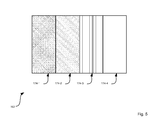
- Figure 5 shows an example of content that can be stored on the server of Figure 4 , as such content would be displayed on a traditional web browser.
- Figure 6 shows a flowchart depicting a method of controlling a display according to display characteristics.
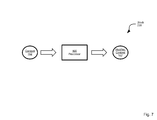
- Figure 7 shows exemplary performance of one of the blocks of the method of Figure 6 .
- Figure 8 shows an example of a modified version of the content of Figure 5 , which has been modified according the method of Figure 6 .
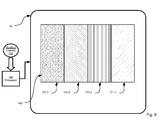
- Figure 9 shows the modified version of content from Figure 8 being generated on the display of the device from Figure 1 .
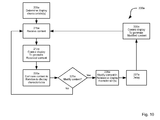
- Figure 10 shows another method for controlling a display according to display characteristics.
- Figure 11 shows blocks which provide an example of one possible way of performing one of the blocks from the method of Figure 10 .
- Figure 12 shows another method for controlling a display according to display characteristics.
- Figure 13 shows an example of a modified version of the content of Figure 8 , which has been modified according the method of Figure 12 .
- Figure 14 shows a modified version of the system of Figure 4 .
- Figure 15 shows another modified version of the system of Figure 4 .
- Figure 16 shows another modified version of the system of Figure 4 .
- Figure 17 shows another modified version of the system of Figure 4 .
- Figure 18 shows another example of unmodified content.
- Figure 19 shows an example of modified content generated from the unmodified content of Figure 18 .
- Figure 20 shows another example of unmodified content and corresponding modified content.
- Figure 21 shows another example of unmodified content and corresponding modified content.
- Figure 22 shows another example of unmodified content and corresponding modified content.
- FIG. 1 shows a schematic representation of a non-limiting example of a portable electronic device 50 which is configured for device setting management via a plurality of interfaces, as discussed in greater detail below.
- portable electronic device 50 is purely exemplary, and it will be apparent to those skilled in the art that a variety of different portable electronic device structures are contemplated. Indeed variations on portable electronic device 50 can include, without limitation, a cellular telephone, a portable email paging device, a camera, a portable music player, a portable video player, and a portable video game player. Other contemplated variations include devices which are not necessarily portable, such as desktop computers.
- device 50 comprises a chassis 54 that supports a display 58.
- Display 58 can comprise one or more light emitters such as an array of liquid crystals, plasma cells, or organic light emitting diodes (OLED). Other types of light emitters are contemplated.
- display 58 comprises an active matrix of OLEDs (AMOLED).
- Chassis 54 also supports a keyboard 62. It is to be understood that this specification is not limited to any particular structure, spacing, pitch or shape of keyboard 62, and the depiction in Figure 1 is purely exemplary. For example, full or reduced "QWERTY" keyboards are contemplated. Other types of keyboards are contemplated.
- Device 50 also comprises a pointing device 64 which can be implemented as a touch-pad, joystick, trackball, track-wheel, or as a touch sensitive membrane on display 58.
- Device 50 also comprises a speaker 66 for generating audio output, and a microphone 68 for receiving audio input.
- device 50 is also shown as comprising a flash 72 and an optical capture unit 76.
- optical as used in relation to optical capture unit 76 is not directed to a lens structure or the like, but rather to refer to an array of charge couple devices (CCD) (or a functionally equivalent transducer structure) that is configured, in association with a lens structure, to receive an image in the form of electro-magnetic energy substantially within the visible spectrum, and to convert that energy into an electronic signal which can be further processed.
- CCD charge couple devices
- the electronic signal is digitized for storage. The stored digitized image can be further processed and can be generated on display 58.
- Optical capture unit 76 that will be discussed in greater detail below. Flash 72 can activate to provide additional lighting to assist the capture of energy by optical capture 76.
- optical capture unit 76 can, if desired, be implemented, or based on, a digital camera function as commonly incorporated into portable electronic devices.
- a battery compartment cover 80 is also shown in Figure 2 , with a tab 82 that can be manipulated to unlock cover 80 from chassis 54 and so that cover 80 can be detached from chassis 54.
- Figure 3 shows a schematic block diagram of the electronic components of device 50. It should be emphasized that the structure in Figure 3 is purely exemplary.
- Device 50 includes a plurality of input devices which in a present implementation includes keyboard 62, pointing device 64, and microphone 68, in addition to optical capture unit 76. Other input devices are contemplated. Input from keyboard 62, pointing device 64 and microphone 68 and optical capture unit 76 is received at processor 100.
- Processor 100 (which can be implemented as a plurality of single core or multi-core processors) can be configured to execute different programming instructions that can be responsive to the input received via input devices. To fulfill its programming functions, processor 100 is also configured to communicate with a non-volatile storage unit 104 (e.g.
- EEPROM Erase Electronic Programmable Read Only Memory
- Flash Memory Flash Memory
- volatile storage unit 108 e.g. random access memory (“RAM”).
- Programming instructions that implement the functional teachings of device 50 as described herein are typically maintained, persistently, in non-volatile storage unit 104 and used by processor 100 which makes appropriate utilization of volatile storage 108 during the execution of such programming instructions.
- Processor 100 in turn is also configured to control display 58, speaker 66 and flash 72, also in accordance with different programming instructions and optionally responsive to different input receive from the input devices.
- Processor 100 also connects to a network interface 112, which can be implemented in a present implementation as a radio configured to communicate over a wireless link, although in variants device 50 can also include a network interface for communicating over a wired link.
- Network interface 112 can thus be generalized as a further input/output device that can be utilized by processor 100 to fulfill various programming instructions. It will be understood that interface 112 is configured to correspond with the network architecture that defines such a link.
- GSM Global System for Mobile communication
- GPRS General Packet Relay Service
- EDGE Enhanced Data Rates for GSM Evolution
- 3G High Speed Packet Access
- HSPA High Speed Packet Access
- CDMA Code Division Multiple Access
- EVDO Evolution-Data Optimized
- IEEE Institute of Electrical and Electronic Engineers
- BluetoothTM BluetoothTM or any of their variants or successors.
- each network interface 112 can include multiple radios to accommodate the different protocols that may be used to implement different types of links.
- interface 112 is configured to provide 3G, Wifi and BluetoothTM links.
- Device 50 also comprises at least one power supply 116 such as a battery that connects to a bus that interconnects the various components of device 50 and supplies electrical energy to those components.
- power supply 116 is only shown as connecting to the bus that connects processor 100 to the input devices, but it is to be understood that power supply 116 connects to all the busses of device 50 that are needed to supply power to each component of device 50.
- device 50 can be implemented with different configurations than described, omitting certain input devices or including extra input devices, and likewise omitting certain output devices or including extra input devices.
- device 54 is also configured to maintain, within non-volatile storage 104, a content generation application 120, a transcoder 124, and, typically, a plurality of other applications 136.
- Content generation application 120 can be any application that, when executed by processor 100, configures processor 100 to control display 58 so that content is generated on display 58.
- device 54 is configured to display content that is locally stored on device 54 or content available via network interface 112.
- Display 58 like other components in device 54, draws power from power supply 116 as part of its regular operation.
- Transcoder 124 is an application that is configured to intercept content destined for browser application 120 and, according to certain criteria, modify that content prior to forwarding that content to browser application 120 for generation on display 58.
- Transcoder application 124 can be integrated within content generation application 120, or transcoder application 124 can be a stand-alone application. Transcoder 124 will be discussed in greater detail below.
- a system is indicated generally at 150, which comprises a network 154 that interconnects device 50 and a content server 158 hosting content 162.
- a first link 166 connects server 158 to network 154, and a second link 170 connects network 154 to device 50.
- network 154 and links 166 and 170 associated therewith are not particularly limited and are, in general, based on any combination of architectures that will support interactions between device 50 and server 158, including delivery of content 162 to device 50. Accordingly, links 166 and 170 between network 66 and the interconnected components are complementary to functional requirements of those components.
- link 170 between device 50 and network 154 may be based in a present implementation on core mobile network infrastructure (e.g. Global System for Mobile communications ("GSM”); Code Division Multiple Access (“CDMA”); CDMA 2000; 3G; Evolution-Data Optimized (“EV-DO”), Universal Mobile Telecommunications System (“UMTS”), High Speed Packet Access (“HSPA”)) or on wireless local area network (“WLAN”) infrastructures such as the Institute for Electrical and Electronic Engineers (“IEEE”) 802.11 Standard (and its variants) or Bluetooth® or the like or hybrids thereof.
- GSM Global System for Mobile communications
- CDMA Code Division Multiple Access
- CDMA 2000 Code Division Multiple Access 2000
- 3G Evolution-Data Optimized
- UMTS Universal Mobile Telecommunications System
- HSPA High Speed Packet Access
- WLAN wireless local area network
- device 50 may be other types of client machines whereby link 170 is a wired connection.
- Link 166 may be based on a T1, T3, 03 or any other suitable wired or wireless connection between server 158
- Server 158 may be based on any well-known server environment including a module that houses one or more central processing units, volatile memory (e.g. random access memory), persistent memory (e.g. hard disk devices) and network interfaces to allow server 158 to communicate over network 154.
- server 158 may be a Sun Fire V480 running a UNIX operating system, from Sun Microsystems, Inc. of Palo Alto Calif., and having four central processing units each operating at about nine-hundred megahertz and having about sixteen gigabytes of random access memory.
- this particular server is merely exemplary, and a vast array of other types of computing environments for servers 158 is contemplated.
- content generation application 120 is a browser that is configured to provide basic web-browsing functionality on device 54.
- Browser application 120 may be referred to as a mini-browser, in the sense that it is provided on client machine 54 which has a form factor that is "miniaturized", at least in relation to the form factor of a desk top computer.
- browser application 120 is configured to generate web-pages on the relatively small display of device 54, and generate those web-pages in a format that conveys substantially the same information, as if those web-pages had been generated on a traditional desktop browser such as Internet Explorer® (from Microsoft Corporation, One Microsoft Way, Redmond, Washington) or Firefox® (from Mozilla Foundation, 1981 Landings Drive, Building K, Mountain View, CA 94043-0801, USA.).
- Browser application 120 thus provides basic hyper text markup language (HTML) and other web-browsing capability, such as Java script.
- server 158 is a web server and content 162 is a web page
- network 154 comprises the Internet.
- content 162 is shown as it would be generated on a traditional desktop browser according to its inherent programming and as stored on server 158.
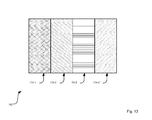
- Content 162 comprises a plurality of elements 174-1, 174-2, 174-3, 174-4. (Collectively referred to as elements 174 and generically as element 174. This nomenclature is used elsewhere herein).
- elements 174 are shown, with each element being a vertical bar each having a unique colour and brightness. It is to be understood that any number and arrangement of elements 174 can be incorporated into content 162 to cause processor 100 to control display 58 to generate content 162 thereon.
- content 162 can include, for example text, images, video or any combination of them.
- Table I shows a non-limiting example of colours and brightness levels for each element 174.
- Each element 174 constitutes a portion of content 162.
- Each element 174 or portion of content has its own, and different, power dower drain characteristic on power supply 116.
- element 174-4 has a first power drain characteristic whereby element 174-4 consumes more power than the other elements 174. It should be understood that other metrics or factors, in addition to, or in lieu of colour and brightness, can be used to characterize content.
- method 200 can be implemented on device 50, but variations on method 200 and device 50 are contemplated. In a specific non-limiting implementation, it is contemplated that method 200 can be incorporated into content generation application 120 and transcoder 124 on device 50.
- Block 205 comprises determining display characteristic(s).
- Block 205 can be performed by transcoder 124 sending an electronic query to processor 100 or display 58 to ascertain one or more characteristics of display 58.
- Such characteristic(s) can be encoded into transcoder 124 at the time of manufacture of device 50.
- Such characteristic(s) can include, for example, whether display 58 comprises liquid crystals, plasma cells, or organic light emitting diodes (OLED).
- OLED organic light emitting diodes
- display 58 comprises an AMOLED, and accordingly, as part of block 205, such a characteristic is made available to transcoder 124.
- More characteristics can include, for example, a current rate of consumption of power from power supply 116 or a current level of power available to cause emission of light from control display 58. This will be discussed further below).
- Block 215 comprises receiving content.
- block 215 can be effected by content generation application 120, in the form of a browser, retrieving content 162, in the form of a web page, from server 158.
- Block 220 comprises comparing the content received at block 215 with the display characteristics from block 205.
- content received at block 215 is parsed into constituent elements. Assuming that content 162 is received at block 215, and using the example in relation to Table I, block 220 can comprise examining content 162 in order to obtain the contents of Table I.
- Block 225 comprises determining whether to modify the content received at block 215 based on the comparison at block 220.
- the determination at block 225 can be based on a single criterion or a plurality of criteria.
- the criteria can comprise whether or not display 58 is an AMOLED display and whether or not there are any elements 174 that are white and have a brightness level of one-hundred.
- the determining can be based on a unique tag (e.g. an HTML tag) embedded into the content that identifies whether a particular element 174 has power drain characteristic that qualifies that element 174 for modification according to the method 200.
- the criteria can comprise different colours, or combinations of colours, and different brightness levels. Other criteria will now occur to those skilled in the art.
- method 200 moves to block 230 at which point display 58 is controlled to generate content 162, in its unmodified form and as shown in Figure 5 .
- a "yes" determination will be made at block 220 because element 174-4 satisfies the criterion or criteria.
- method 200 moves to block 235, at which point the content received at block 225 is modified in accordance with the display characteristics.
- Exemplary performance of block 235 is represented in Figure 7 , as processor 100 is shown as receiving content 162 and generating modified content 162'.
- Modified content 162' is shown in Figure 8 .
- the modification is performed in order to reduce power consumption by AMOLED display 58, and accordingly, elements 174 that have the colour white and a brightness of one-hundred are modified in order to have a different colour and a brightness level that is lower than one-hundred.
- element 174-4 is replaced with modified element 174-4', as shown in Figure 8 , which has a colour of light gray and a brightness level of 85.
- block 235 comprises modifying at least a portion of content 162, (e.g.
- element 174-4) which has a first power drain characteristic, into a format (e.g. modified element 174-4') that has a second power drain characteristic that causes less drain on power supply 116 than the first power drain characteristic.
- Table II shows the result of block 235, Table II being a modified version of Table I where element 174-1, element 174-2 and element 174-3 remain unmodified, but element 174-4 has been modified into element 174-4'.
- Block 230 comprises controlling the display to generate content. Where block 230 is reached directly from block 225 then content as received at block 215 is generated, and where block 230 is reached from block 235 then content is generated as modified at block 235.
- Figure 9 represents exemplary performance of block 230 when block 230 is reached from block 235 according to the specific example discussed above and in relation to Figure 8 and Table II. More specifically, modified content 162' is shown as being generated on display 58.
- method 200 can return to block 215 from block 230, although other progressions from block 230 are contemplated, including the termination of method 200 altogether. Indeed, other variations to method 200 are contemplated, including changing the sequence in which various blocks are performed, or the addition of other blocks, such as that shown as method 200a in Figure 10 .
- Method 200a is a variation on method 200 and so like blocks bear like references, except followed by the suffix "a". Thus, block 205a, block 215a, block 220a, block 225a, block 235a and block 230a in method 200a can be performed in substantially the same manner as their respective counterparts in method 200.
- method 200a also includes block 217a whereby the display is controlled to generate the received content even before any determination is made whether or not to modify the content.
- display 58 is controlled to generate content 162 as shown in Figure 5 on display 58.
- a delay block 227a is also added whereby the unmodified content as generated at block 217a remains generated on display 217a for a period of time at least equivalent to the delay period established at block 227a, at which point block 230a is invoked and the modified content is generated.
- the means by which the delay at block 217a is determined is not particularly limited. It can be based on, for example, a simple predefined time period, such that the unmodified content is generated for that time period prior to generation of the modified content. Where content is provided in the form of HTML, then the delay or duration of the time period can be determined by, for example, a unique tag (e.g. an HTML tag) embedded into the content that indicates the length of the delay. Furthermore, the delay 227a can also comprise a dissolve operation, whereby unmodified content 162 is gradually replaced with modified content 162'.
- the delay at block 227a can also be based on an operation that considers the level of power within power supply 116, a non-limiting example of which is shown in Figure 11 .
- block 228a can comprise determining a level of power (e.g. expressed as voltage, or remaining milliamp hours before complete drain, or other power level metric) for power supply 116, and block 229a can comprise determining whether that power level is below a predefined threshold.
- a "no" determination at block 229a results in a return to block 228a.
- a "yes" at block 229a results in an advance to block 230a where modified content 162' is generated which consumes less power from power supply 116 than content 162.
- method 200b Another variation on method 200 is shown in Figure 12 as method 200b. Note that aspects of method 200, method 200a and method 200b and other aspects thereof can be combined as part of the contemplated variations herein.
- block 205b, block 215b, block 217b, block 220b, block 225b, block 230b are substantially the same as their counterparts in method 200a.
- method 200b does not include delay block 227a, although delay block 227a can be included in method 200b.
- method 200b comprises block 231 b which comprises determining a level of power, and block 232b comprises determining if that level of power has fallen below a predefined threshold.
- Block 231 b and block 232b can be performed in substantially the same manner as block 228a and block 229a as discussed above, except the result of their performance is somewhat different.
- block 235b is configured to modify content based on changing levels of power as determined at block 231 b. For example, during successive performances of block 235b as block 235b is reached from block 232b, content 162 will be continually modified to consume less power from power supply 116. As a specific example, during an initial performance of block 235b, as reached from block 225b, the result of block 235b can be the generation of modified content 162' as shown in Figure 8 .
- a further modified content 162" can be generated, as shown in Figure 13 .
- Further modified content 162" thus comprises original element 174-1 and original element 174-2, but also comprises a modified element 174-3' as well as a further modified element 174-4".
- Table III shows the result of block 235b after such a second exemplary performance of block 235b, Table III being a modified version of Table II where element 174-1 and element 174-2 remain unmodified, but element 174-3 has been modified into element 174-3', and element 174-4' has been modified into element 174-4".
- Such modified content 162" is then generated on display 50 at block 230b.
- method 200b can be interrupted at any point by, for example, invocation of another application on device 50 or as a result of some other input is provided via keyboard 62 or pointing device 64 that otherwise interrupts performance of method 200b.
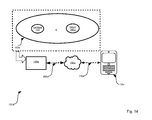
- system 150a comprises substantially the same components as system 150, and accordingly like elements bear like references except followed by the suffix "a".
- system 150a comprises content 163a instead of content 162.
- Content 163a is an enhanced version of content 162 which can assist device 50a and thereby reduce its processing burden.
- Various configurations of enhanced content are contemplated.
- content 163a comprises content 162 as well as a predefined time period 165a for the delay contemplated at block 227a in Figure 10 can be preconfigured within content 163a. Where content 163a is HTML, then the predefined time period 165a can be encoded into HTML. Where content 163a is not HTML, then the predefined time period 165a can be encoded in any other suitable manner.
- System 150b comprises substantially the same components as system 150a, and accordingly like elements bear like references except followed by the suffix "b".
- system 150b comprises content 163b instead of content 163a.
- Content 163b is an enhanced version of content 162 which can assist device 50a and thereby reduce its processing burden.
- Content 163b comprises content 162, content 162' and content 162".
- System 150b reduces or obviates the need for device 50b to actually transcode the content, and rather permits device 50b to simply download the appropriate version of content (i.e. content 162, content 162' or content 162" or combinations of them).
- aspects of system 150b can be combined with aspects of system 150 or system 150a or either of them.
- System 150c comprises substantially the same components as system 150a, and accordingly like elements bear like references except followed by the suffix "c".
- system 150c comprises server 158c hosting content 162 in an unenhanced form.
- system 150c comprises an intermediation server 159c which hosts transcoder 124, and thereby obviating the need for inclusion of transcoder 124 on device 50c.
- content 162 is delivered to device 50c, content 162 is intercepted and modified to generate modified content 162' and modified content 162' is sent to device 50c.
- System 150c also reduces or obviates the need for device 50c to actually transcode the content.
- system 150c can of course be combined with aspects of system 150 or system 150a or system 150b or any of them.
- block 205 block 215, block 220, block 225, block 235 are performed by intermediation server 159c, while block 230 is performed by device 50c.
- an extra block is included whereby unmodified content 162, or modified content 162' (whichever is appropriate as determined by block 225) is sent according to the circumstances, to device 50c.
- Block 205 can be performed in system 150c by a request to device 50c, or by server 159c maintaining a record indicating the display characteristics of device 50c.
- Aspects of system 150c can be combined with aspects of system 150 or system 150a or system 150b or any of them.
- System 150d comprises substantially the same components as system 150a, and accordingly like elements bear like references except followed by the suffix "d".
- system 150d comprises a plurality of content servers 158d.
- Each content server 158d hosts, in substance, the same content 163d, except content server 158d-1 hosts unmodified content 163d, while content server 158d-n hosts modified content 163d'.
- system 150d comprises an intermediation server 159c which intercepts a content request for content 163d from content server 158d-1 (indicated as request 171d) and, if appropriate according to determination similar to the determination at block 225 from method 200, fulfills request 171 d by retrieving modified content 163d' from server 158d-n in place of content 163d, and forwards modified content 163d' to device 50d.
- intermediation server 159c which intercepts a content request for content 163d from content server 158d-1 (indicated as request 171d) and, if appropriate according to determination similar to the determination at block 225 from method 200, fulfills request 171 d by retrieving modified content 163d' from server 158d-n in place of content 163d, and forwards modified content 163d' to device 50d.
- Aspects of system 150d can of course be combined with aspects of system 150 or system 150a or system 150b or system 150c or any of them.
- block 205 block 215, block 220, block 225, block 235 are performed by intermediation server 159d, while block 230 is performed by device 50d.
- method 200 is performed on system 150d, an extra block is included whereby unmodified content 163d, or modified content 163d' (whichever is appropriate as determined by block 225) is sent according to the circumstances, to device 50d.
- Block 205 can be performed in system 150d by a request to device 50d, or by server 159d maintaining a record indicating the display characteristics of device 50d.
- Aspects of system 150c can be combined with aspects of system 150 or system 150a or system 150b or any of them.
- device 50d can be configured to perform a search request for content available on network 154d, indicated as search request 181 d in Figure 18 .
- server 159d can return a list of search results 183d that rank each result according to the amount of expected power drain that particular result would have on display 58.
- modified content 163d' would be ranked more highly than content 163d on the search results generated on display 58d, thereby urging selection of modified content 163d' instead of content 163d.
- content 163d and modified content 163d' are not particularly limited. Indeed, content 163d can correspond exactly to content 162, and modified content 163d' can correspond exactly to content 162' or content 162". As another non-limiting example, however, unmodified content 163d can appear as shown in Figure 19 which shows a search engine home screen which is predominantly white, and modified content 163d' can appear as shown in Figure 20 which shows a modified search engine home screen, that uses the same underlying search engine but is predominantly black rather than white, and thereby consumes less power from power supply 116.
- unmodified content 163d is roughly analogous to the GoogleTM home page of Google Inc., Mountain View California, while modified content 163d" is roughly analogous to the BlackleTM home page of Heap Media of Sydney Australia, which offers a Google custom search.
- content 163d may be analogous to a first search engine provider (e.g. GoogleTM), while content 163d" may be analogous to a second search engine provider (e.g. YahooTM), where the generation of the home screen for the second search engine provider is known to consume less power from power supply 116 than from the first search engine provider.
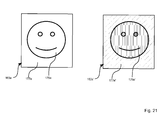
- FIG. 21 shows another example of unmodified content 163e and an example of modified content 163e' that can be generated from unmodified content 163e.
- Unmodified content 163e comprises a white background 177e and a white graphic 179e.
- Modified content 163e' comprises a light grey background 177e' and a dark grey graphic 179e'.
- graphic 179e is shown as a simple icon, it is contemplated that graphics can encompass color photographs, or even color videos, where the brightness is reduced in a modified version of that content.
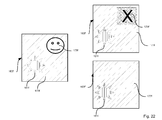
- Figure 22 shows another example of unmodified content 163f and a first non-limiting example of modified content 163f' that can be generated from unmodified content 163f, and a non-limiting second example of modified content 163f" that can be generated from unmodified content 163f.
- Unmodified content 163e comprises a gray background 177f, a dark gray graphic 181f and a white graphic 179f.
- Modified content 163f' comprises also gray background 177f, dark gray graphic 181 f, and a modified graphic 179f', the modified graphic being in the form of an image place holder having a dark color.
- Modified content 163f" comprises also gray background 177f, dark gray graphic 181 f, but white graphic 179f is deleted altogether.
- unmodified content 163f, modified content 163f', and modified content 163f" can be generated according to any of the foregoing, it is specifically contemplated that it can be desired to generate modified content 163f' or modified content 163f" using a method that incorporates delay block 227a or a variation thereof, so that initially, white graphic 179f is visible, before it is actually deleted.
- content such as content 162, or content 163f
- indicators for element thereon can be embedded with indicators for element thereon.
- each graphic 181f and graphic 179f can be assigned an indicator that represents a relative importance of that graphic. (Of course such rankings of importance can also be applied to other types of content).
- method 200 (or its variants) can be configured to modify dark gray graphic 181 f but not to modify white graphic 179f, notwithstanding the fact that white graphic 179f will result in a greater power drain on power supply 116.
- such indicators can be implemented by, for example, unique HTML tags that are embedded into the content.
Landscapes
- Engineering & Computer Science (AREA)
- Theoretical Computer Science (AREA)
- Physics & Mathematics (AREA)
- General Engineering & Computer Science (AREA)
- General Physics & Mathematics (AREA)
- Human Computer Interaction (AREA)
- Computer Networks & Wireless Communication (AREA)
- Signal Processing (AREA)
- Control Of Indicators Other Than Cathode Ray Tubes (AREA)
Abstract
Description
- The present specification relates generally to computing devices and more specifically relates to a system and method for controlling a display according to display characteristics.
- Mobile electronic devices continue apace to provide greater functionality. Advances in display technology are one area of constant improvement. Light Crystal Display (LCD) display technology is the incumbent technology, but Organic Light Emitting Diode (OLED) display technologies have a promising future.
- An aspect of this specification provides a method comprising: detecting presence of an active-matrix organic light-emitting diode display in a handheld mobile device; receiving content for generation on the display; determining a portion of the content having a first power drain characteristic; generating modified content by modifying the portion into a format that has a second power drain characteristic; the second power drain characteristic causing less drain on a power supply than the first power drain characteristic; and controlling the display to generate the modified content.
- The first power drain characteristic can result from the portion comprising a light color.
- The second power drain characteristic can result from the portion comprising a color that is darker than the light color.
- Generating the modified content can comprise deleting the portion of the content.
- The method can further comprise waiting a predetermined time period before generating the modified content. The predetermined time period can be based on a unique tag embedded into the content that indicates a duration of the predetermined time period and the portion associated with the duration of the predefined time period.
- The content can be in hypertext markup language format (HTML).
- The first power drain characteristic can be identified by a unique tag embedded into the content.
- The generating of the modified content can be based on a determination of an importance of various portions of the content in relation to other portions of the content. The importance can be determined based on unique tags embedded into the content respective to each of the various portions of the content.
- The content can comprise one of a graphic image, text, a photograph, or a video.
- The content can be stored in a memory of said handheld mobile device.
- The method can further comprise determining a portion of the content that requires power above a threshold amount of power; and modifying the portion of the graphic image that requires power above the threshold amount of power to require power below the threshold amount of power.
- Another aspect of this specification provides an electronic device comprising: a display; a processor connected to said display and configured to control said display; storage connected to said processor and configured to store content; said processor configured to according to any of the foregoing methods.
- Another aspect of this specification provides a server having a processor configured to perform one or more of the detecting, determining and modifying according to any of the foregoing methods, and in communication with an electronic device configured to perform a remainder of the method. A combined system of server and electronic device is also contemplated.
-
Figure 1 is a schematic representation of a front view of a portable electronic device. -
Figure 2 is a schematic representation of a rear view of a portable electronic device. -
Figure 3 is a block diagram of the electronic components of the device shown inFigures 1 and2 . -
Figure 4 shows a system comprising the device ofFigure 1 connected to a network and server. -
Figure 5 shows an example of content that can be stored on the server ofFigure 4 , as such content would be displayed on a traditional web browser. -
Figure 6 shows a flowchart depicting a method of controlling a display according to display characteristics. -
Figure 7 shows exemplary performance of one of the blocks of the method ofFigure 6 . -
Figure 8 shows an example of a modified version of the content ofFigure 5 , which has been modified according the method ofFigure 6 . -
Figure 9 shows the modified version of content fromFigure 8 being generated on the display of the device fromFigure 1 . -
Figure 10 shows another method for controlling a display according to display characteristics. -
Figure 11 shows blocks which provide an example of one possible way of performing one of the blocks from the method ofFigure 10 . -
Figure 12 shows another method for controlling a display according to display characteristics. -
Figure 13 shows an example of a modified version of the content ofFigure 8 , which has been modified according the method ofFigure 12 . -
Figure 14 shows a modified version of the system ofFigure 4 . -
Figure 15 shows another modified version of the system ofFigure 4 . -
Figure 16 shows another modified version of the system ofFigure 4 . -
Figure 17 shows another modified version of the system ofFigure 4 . -
Figure 18 shows another example of unmodified content. -
Figure 19 shows an example of modified content generated from the unmodified content ofFigure 18 . -
Figure 20 shows another example of unmodified content and corresponding modified content. -
Figure 21 shows another example of unmodified content and corresponding modified content. -
Figure 22 shows another example of unmodified content and corresponding modified content. - Referring now to
Figure 1 , shows a schematic representation of a non-limiting example of a portableelectronic device 50 which is configured for device setting management via a plurality of interfaces, as discussed in greater detail below. It is to be understood that portableelectronic device 50 is purely exemplary, and it will be apparent to those skilled in the art that a variety of different portable electronic device structures are contemplated. Indeed variations on portableelectronic device 50 can include, without limitation, a cellular telephone, a portable email paging device, a camera, a portable music player, a portable video player, and a portable video game player. Other contemplated variations include devices which are not necessarily portable, such as desktop computers. - Referring to
Figure 1 ,device 50 comprises achassis 54 that supports adisplay 58.Display 58 can comprise one or more light emitters such as an array of liquid crystals, plasma cells, or organic light emitting diodes (OLED). Other types of light emitters are contemplated. In a present non-limiting implementation, as will be discussed further below,display 58 comprises an active matrix of OLEDs (AMOLED).Chassis 54 also supports akeyboard 62. It is to be understood that this specification is not limited to any particular structure, spacing, pitch or shape ofkeyboard 62, and the depiction inFigure 1 is purely exemplary. For example, full or reduced "QWERTY" keyboards are contemplated. Other types of keyboards are contemplated.Device 50 also comprises apointing device 64 which can be implemented as a touch-pad, joystick, trackball, track-wheel, or as a touch sensitive membrane ondisplay 58.Device 50 also comprises aspeaker 66 for generating audio output, and amicrophone 68 for receiving audio input. - Referring to
Figure 2 , a rear view ofdevice 50 is shown. InFigure 2 ,device 50 is also shown as comprising aflash 72 and anoptical capture unit 76. It is to be understood that the term "optical" as used in relation tooptical capture unit 76 is not directed to a lens structure or the like, but rather to refer to an array of charge couple devices (CCD) (or a functionally equivalent transducer structure) that is configured, in association with a lens structure, to receive an image in the form of electro-magnetic energy substantially within the visible spectrum, and to convert that energy into an electronic signal which can be further processed. Typically, the electronic signal is digitized for storage. The stored digitized image can be further processed and can be generated ondisplay 58.Optical capture unit 76 that will be discussed in greater detail below.Flash 72 can activate to provide additional lighting to assist the capture of energy byoptical capture 76. In general, it will now be understood thatoptical capture unit 76 can, if desired, be implemented, or based on, a digital camera function as commonly incorporated into portable electronic devices. Abattery compartment cover 80 is also shown inFigure 2 , with atab 82 that can be manipulated to unlockcover 80 fromchassis 54 and so thatcover 80 can be detached fromchassis 54. -
Figure 3 shows a schematic block diagram of the electronic components ofdevice 50. It should be emphasized that the structure inFigure 3 is purely exemplary.Device 50 includes a plurality of input devices which in a present implementation includeskeyboard 62, pointingdevice 64, andmicrophone 68, in addition tooptical capture unit 76. Other input devices are contemplated. Input fromkeyboard 62, pointingdevice 64 andmicrophone 68 andoptical capture unit 76 is received atprocessor 100. Processor 100 (which can be implemented as a plurality of single core or multi-core processors) can be configured to execute different programming instructions that can be responsive to the input received via input devices. To fulfill its programming functions,processor 100 is also configured to communicate with a non-volatile storage unit 104 (e.g. Erase Electronic Programmable Read Only Memory ("EEPROM"), Flash Memory) and a volatile storage unit 108 (e.g. random access memory ("RAM")). Programming instructions that implement the functional teachings ofdevice 50 as described herein are typically maintained, persistently, innon-volatile storage unit 104 and used byprocessor 100 which makes appropriate utilization ofvolatile storage 108 during the execution of such programming instructions. -
Processor 100 in turn is also configured to controldisplay 58,speaker 66 andflash 72, also in accordance with different programming instructions and optionally responsive to different input receive from the input devices. -
Processor 100 also connects to anetwork interface 112, which can be implemented in a present implementation as a radio configured to communicate over a wireless link, although invariants device 50 can also include a network interface for communicating over a wired link.Network interface 112 can thus be generalized as a further input/output device that can be utilized byprocessor 100 to fulfill various programming instructions. It will be understood thatinterface 112 is configured to correspond with the network architecture that defines such a link. Present, commonly employed network architectures for such a link include, but are not limited to, Global System for Mobile communication ("GSM"), General Packet Relay Service ("GPRS"), Enhanced Data Rates for GSM Evolution ("EDGE"), 3G, High Speed Packet Access ("HSPA"), Code Division Multiple Access ("CDMA"), Evolution-Data Optimized ("EVDO"), Institute of Electrical and Electronic Engineers (IEEE) standard 802.11 (Wifi), Bluetooth™ or any of their variants or successors. It is also contemplated eachnetwork interface 112 can include multiple radios to accommodate the different protocols that may be used to implement different types of links. In the specific, non-limiting example,interface 112 is configured to provide 3G, Wifi and Bluetooth™ links. -
Device 50 also comprises at least onepower supply 116 such as a battery that connects to a bus that interconnects the various components ofdevice 50 and supplies electrical energy to those components. For convenience,power supply 116 is only shown as connecting to the bus that connectsprocessor 100 to the input devices, but it is to be understood thatpower supply 116 connects to all the busses ofdevice 50 that are needed to supply power to each component ofdevice 50. - As will become apparent further below,
device 50 can be implemented with different configurations than described, omitting certain input devices or including extra input devices, and likewise omitting certain output devices or including extra input devices. - In a present implementation,
device 54 is also configured to maintain, withinnon-volatile storage 104, acontent generation application 120, atranscoder 124, and, typically, a plurality ofother applications 136. -
Content generation application 120 can be any application that, when executed byprocessor 100, configuresprocessor 100 to controldisplay 58 so that content is generated ondisplay 58. In general,device 54 is configured to display content that is locally stored ondevice 54 or content available vianetwork interface 112.Display 58, like other components indevice 54, draws power frompower supply 116 as part of its regular operation. -
Transcoder 124 is an application that is configured to intercept content destined forbrowser application 120 and, according to certain criteria, modify that content prior to forwarding that content tobrowser application 120 for generation ondisplay 58.Transcoder application 124 can be integrated withincontent generation application 120, ortranscoder application 124 can be a stand-alone application.Transcoder 124 will be discussed in greater detail below. - Referring now to
Figure 4 , a system is indicated generally at 150, which comprises anetwork 154 that interconnectsdevice 50 and acontent server 158 hostingcontent 162. Afirst link 166 connectsserver 158 tonetwork 154, and asecond link 170 connectsnetwork 154 todevice 50. - The nature of
network 154 andlinks device 50 andserver 158, including delivery ofcontent 162 todevice 50. Accordingly,links network 66 and the interconnected components are complementary to functional requirements of those components. - More specifically, link 170 between
device 50 andnetwork 154 may be based in a present implementation on core mobile network infrastructure (e.g. Global System for Mobile communications ("GSM"); Code Division Multiple Access ("CDMA"); CDMA 2000; 3G; Evolution-Data Optimized ("EV-DO"), Universal Mobile Telecommunications System ("UMTS"), High Speed Packet Access ("HSPA")) or on wireless local area network ("WLAN") infrastructures such as the Institute for Electrical and Electronic Engineers ("IEEE") 802.11 Standard (and its variants) or Bluetooth® or the like or hybrids thereof. Note that in an exemplary variation ofsystem 150 it is contemplated thatdevice 50 may be other types of client machines whereby link 170 is a wired connection.Link 166 may be based on a T1, T3, 03 or any other suitable wired or wireless connection betweenserver 158 andnetwork 154. -
Server 158 may be based on any well-known server environment including a module that houses one or more central processing units, volatile memory (e.g. random access memory), persistent memory (e.g. hard disk devices) and network interfaces to allowserver 158 to communicate overnetwork 154. For example,server 158 may be a Sun Fire V480 running a UNIX operating system, from Sun Microsystems, Inc. of Palo Alto Calif., and having four central processing units each operating at about nine-hundred megahertz and having about sixteen gigabytes of random access memory. However, it is to be emphasized that this particular server is merely exemplary, and a vast array of other types of computing environments forservers 158 is contemplated. - In a present, non-limiting implementation,
content generation application 120 is a browser that is configured to provide basic web-browsing functionality ondevice 54.Browser application 120 may be referred to as a mini-browser, in the sense that it is provided onclient machine 54 which has a form factor that is "miniaturized", at least in relation to the form factor of a desk top computer. As will be explained further below,browser application 120 is configured to generate web-pages on the relatively small display ofdevice 54, and generate those web-pages in a format that conveys substantially the same information, as if those web-pages had been generated on a traditional desktop browser such as Internet Explorer® (from Microsoft Corporation, One Microsoft Way, Redmond, Washington) or Firefox® (from Mozilla Foundation, 1981 Landings Drive, Building K, Mountain View, CA 94043-0801, USA.).Browser application 120 thus provides basic hyper text markup language (HTML) and other web-browsing capability, such as Java script. Also in this non-limiting implementation,server 158 is a web server andcontent 162 is a web page,network 154 comprises the Internet. - Referring now to
Figure 5 , a non-limiting example ofcontent 162 is shown. For convenience,content 162 is shown as it would be generated on a traditional desktop browser according to its inherent programming and as stored onserver 158.Content 162 comprises a plurality of elements 174-1, 174-2, 174-3, 174-4. (Collectively referred to as elements 174 and generically as element 174. This nomenclature is used elsewhere herein). In the example ofFigure 5 , only four elements 174 are shown, with each element being a vertical bar each having a unique colour and brightness. It is to be understood that any number and arrangement of elements 174 can be incorporated intocontent 162 to causeprocessor 100 to controldisplay 58 to generatecontent 162 thereon. Without limiting the generality of the foregoing, it is contemplated thatcontent 162 can include, for example text, images, video or any combination of them. Table I shows a non-limiting example of colours and brightness levels for each element 174.Table I Colour and Brightness for Elements 174 within Content 162Element Colour Brightness
(0=least bright; 100=brightest)174-1 Black 0 174-2 Dark Blue 25 174-3 Light Red 75 174-4 White 100 - Each element 174 constitutes a portion of
content 162. Each element 174 or portion of content has its own, and different, power dower drain characteristic onpower supply 116. As As a specific example, element 174-4 has a first power drain characteristic whereby element 174-4 consumes more power than the other elements 174. It should be understood that other metrics or factors, in addition to, or in lieu of colour and brightness, can be used to characterize content. - Referring now to
Figure 6 , a flowchart depicting a method for controlling a display according to display characteristics is indicated generally at 200. It is contemplated thatmethod 200 can be implemented ondevice 50, but variations onmethod 200 anddevice 50 are contemplated. In a specific non-limiting implementation, it is contemplated thatmethod 200 can be incorporated intocontent generation application 120 andtranscoder 124 ondevice 50. -
Block 205 comprises determining display characteristic(s). Block 205 can be performed bytranscoder 124 sending an electronic query toprocessor 100 ordisplay 58 to ascertain one or more characteristics ofdisplay 58. Alternatively, such characteristic(s) can be encoded intotranscoder 124 at the time of manufacture ofdevice 50. Such characteristic(s) can include, for example, whetherdisplay 58 comprises liquid crystals, plasma cells, or organic light emitting diodes (OLED). In a present example implementation, it is assumed thatdisplay 58 comprises an AMOLED, and accordingly, as part ofblock 205, such a characteristic is made available totranscoder 124. (Other characteristics can include, for example, a current rate of consumption of power frompower supply 116 or a current level of power available to cause emission of light fromcontrol display 58. This will be discussed further below). -
Block 215 comprises receiving content. Referring briefly back toFigure 4 , block 215 can be effected bycontent generation application 120, in the form of a browser, retrievingcontent 162, in the form of a web page, fromserver 158. -
Block 220 comprises comparing the content received atblock 215 with the display characteristics fromblock 205. In one non-limiting implementation, as part ofblock 220, content received atblock 215 is parsed into constituent elements. Assuming thatcontent 162 is received atblock 215, and using the example in relation to Table I, block 220 can comprise examiningcontent 162 in order to obtain the contents of Table I. -
Block 225 comprises determining whether to modify the content received atblock 215 based on the comparison atblock 220. The determination atblock 225 can be based on a single criterion or a plurality of criteria. In a present non-limiting example, the criteria can comprise whether or not display 58 is an AMOLED display and whether or not there are any elements 174 that are white and have a brightness level of one-hundred. (In a variation, the determining can be based on a unique tag (e.g. an HTML tag) embedded into the content that identifies whether a particular element 174 has power drain characteristic that qualifies that element 174 for modification according to themethod 200. In a still further variation, it will be understood that the criteria can comprise different colours, or combinations of colours, and different brightness levels. Other criteria will now occur to those skilled in the art.) - Assuming the determination is "no", then
method 200 moves to block 230 at whichpoint display 58 is controlled to generatecontent 162, in its unmodified form and as shown inFigure 5 . However, consistent with the specific example being discussed, a "yes" determination will be made atblock 220 because element 174-4 satisfies the criterion or criteria. On reaching a "yes" determination atblock 225,method 200 moves to block 235, at which point the content received atblock 225 is modified in accordance with the display characteristics. - Exemplary performance of
block 235 is represented inFigure 7 , asprocessor 100 is shown as receivingcontent 162 and generating modified content 162'. Modified content 162' is shown inFigure 8 . In a present example, the modification is performed in order to reduce power consumption byAMOLED display 58, and accordingly, elements 174 that have the colour white and a brightness of one-hundred are modified in order to have a different colour and a brightness level that is lower than one-hundred. The result is that element 174-4 is replaced with modified element 174-4', as shown inFigure 8 , which has a colour of light gray and a brightness level of 85. (Expressed another way, block 235 comprises modifying at least a portion ofcontent 162, (e.g. element 174-4) which has a first power drain characteristic, into a format (e.g. modified element 174-4') that has a second power drain characteristic that causes less drain onpower supply 116 than the first power drain characteristic.) Table II shows the result ofblock 235, Table II being a modified version of Table I where element 174-1, element 174-2 and element 174-3 remain unmodified, but element 174-4 has been modified into element 174-4'.Table II Colour and Brightness for Elements 174 within Content 162' Element Colour Brightness
(0=least bright; 100=brightest)174-1 Black 0 174-2 Dark Blue 25 174-3 Light Red 75 174-4' Light Gray 85 -
Block 230, as discussed above, comprises controlling the display to generate content. Whereblock 230 is reached directly fromblock 225 then content as received atblock 215 is generated, and where block 230 is reached fromblock 235 then content is generated as modified atblock 235.Figure 9 represents exemplary performance ofblock 230 whenblock 230 is reached fromblock 235 according to the specific example discussed above and in relation toFigure 8 and Table II. More specifically, modified content 162' is shown as being generated ondisplay 58. - As shown in
Figure 6 ,method 200 can return to block 215 fromblock 230, although other progressions fromblock 230 are contemplated, including the termination ofmethod 200 altogether. Indeed, other variations tomethod 200 are contemplated, including changing the sequence in which various blocks are performed, or the addition of other blocks, such as that shown asmethod 200a inFigure 10 .Method 200a is a variation onmethod 200 and so like blocks bear like references, except followed by the suffix "a". Thus,block 205a,block 215a,block 220a,block 225a, block 235a and block 230a inmethod 200a can be performed in substantially the same manner as their respective counterparts inmethod 200. However,method 200a also includesblock 217a whereby the display is controlled to generate the received content even before any determination is made whether or not to modify the content. In the specific example above, atblock 217a,display 58 is controlled to generatecontent 162 as shown inFigure 5 ondisplay 58. - Furthermore, assuming a "yes" determination is made at
block 225a (i.e. to modify the content received atblock 215a) then adelay block 227a is also added whereby the unmodified content as generated atblock 217a remains generated ondisplay 217a for a period of time at least equivalent to the delay period established atblock 227a, at whichpoint block 230a is invoked and the modified content is generated. - The means by which the delay at
block 217a is determined is not particularly limited. It can be based on, for example, a simple predefined time period, such that the unmodified content is generated for that time period prior to generation of the modified content. Where content is provided in the form of HTML, then the delay or duration of the time period can be determined by, for example, a unique tag (e.g. an HTML tag) embedded into the content that indicates the length of the delay. Furthermore, thedelay 227a can also comprise a dissolve operation, wherebyunmodified content 162 is gradually replaced with modified content 162'. - The delay at
block 227a can also be based on an operation that considers the level of power withinpower supply 116, a non-limiting example of which is shown inFigure 11 . For example, block 228a can comprise determining a level of power (e.g. expressed as voltage, or remaining milliamp hours before complete drain, or other power level metric) forpower supply 116, and block 229a can comprise determining whether that power level is below a predefined threshold. A "no" determination atblock 229a results in a return to block 228a. A "yes" atblock 229a results in an advance to block 230a where modified content 162' is generated which consumes less power frompower supply 116 thancontent 162. - It will now be noted that if another application on
device 50 is invoked or some other input is provided viakeyboard 62 orpointing device 64 that otherwise interrupts performance ofmethod 200a, then block 230a may never be reached. - Another variation on
method 200 is shown inFigure 12 asmethod 200b. Note that aspects ofmethod 200,method 200a andmethod 200b and other aspects thereof can be combined as part of the contemplated variations herein. Inmethod 200b, block 205b, block 215b, block 217b, block 220b, block 225b,block 230b are substantially the same as their counterparts inmethod 200a. Of note is thatmethod 200b does not includedelay block 227a, althoughdelay block 227a can be included inmethod 200b. Also of note is thatmethod 200b comprises block 231 b which comprises determining a level of power, and block 232b comprises determining if that level of power has fallen below a predefined threshold. Block 231 b andblock 232b can be performed in substantially the same manner asblock 228a and block 229a as discussed above, except the result of their performance is somewhat different. Of particular note inmethod 200b is thatblock 235b is configured to modify content based on changing levels of power as determined atblock 231 b. For example, during successive performances ofblock 235b asblock 235b is reached fromblock 232b,content 162 will be continually modified to consume less power frompower supply 116. As a specific example, during an initial performance ofblock 235b, as reached fromblock 225b, the result ofblock 235b can be the generation of modified content 162' as shown inFigure 8 . However, during a subsequent performance ofblock 235b as reached fromblock 232b, a further modifiedcontent 162" can be generated, as shown inFigure 13 . Further modifiedcontent 162" thus comprises original element 174-1 and original element 174-2, but also comprises a modified element 174-3' as well as a further modified element 174-4". Table III shows the result ofblock 235b after such a second exemplary performance ofblock 235b, Table III being a modified version of Table II where element 174-1 and element 174-2 remain unmodified, but element 174-3 has been modified into element 174-3', and element 174-4' has been modified into element 174-4".Table III Color and Brightness for Elements 174 within Further modified content 162"Element Color Brightness
(0=least bright; 100=brightest)174-1 Black 0 174-2 Dark Blue 25 174-3' Red 50 174-4" Gray 60 - Such modified
content 162" is then generated ondisplay 50 atblock 230b. Again, it will be noted thatmethod 200b can be interrupted at any point by, for example, invocation of another application ondevice 50 or as a result of some other input is provided viakeyboard 62 orpointing device 64 that otherwise interrupts performance ofmethod 200b. - It should also be understood that
method 200,method 200a andmethod 200b can be performed on variations ofsystem 150 or on variations of components therein. Referring now toFigure 14 , a modified version ofsystem 150 is indicated generally at 150a.System 150a comprises substantially the same components assystem 150, and accordingly like elements bear like references except followed by the suffix "a". Of note is thatsystem 150a comprises content 163a instead ofcontent 162. Content 163a is an enhanced version ofcontent 162 which can assistdevice 50a and thereby reduce its processing burden. Various configurations of enhanced content are contemplated. As a simple example, content 163a comprisescontent 162 as well as a predefined time period 165a for the delay contemplated atblock 227a inFigure 10 can be preconfigured within content 163a. Where content 163a is HTML, then the predefined time period 165a can be encoded into HTML. Where content 163a is not HTML, then the predefined time period 165a can be encoded in any other suitable manner. - Referring now to
Figure 15 , another modified version ofsystem 150 is indicated generally at 150b.System 150b comprises substantially the same components assystem 150a, and accordingly like elements bear like references except followed by the suffix "b". Of note is thatsystem 150b comprises content 163b instead of content 163a. Content 163b is an enhanced version ofcontent 162 which can assistdevice 50a and thereby reduce its processing burden. Content 163b comprisescontent 162, content 162' andcontent 162".System 150b reduces or obviates the need fordevice 50b to actually transcode the content, and rather permitsdevice 50b to simply download the appropriate version of content (i.e.content 162, content 162' orcontent 162" or combinations of them). Aspects ofsystem 150b can be combined with aspects ofsystem 150 orsystem 150a or either of them. - Referring now to
Figure 16 , another modified version ofsystem 150 is indicated generally at 150c.System 150c comprises substantially the same components assystem 150a, and accordingly like elements bear like references except followed by the suffix "c". Of note is thatsystem 150c comprisesserver 158c hosting content 162 in an unenhanced form. Further,system 150c comprises anintermediation server 159c which hoststranscoder 124, and thereby obviating the need for inclusion oftranscoder 124 ondevice 50c. Whencontent 162 is delivered todevice 50c,content 162 is intercepted and modified to generate modified content 162' and modified content 162' is sent todevice 50c.System 150c also reduces or obviates the need fordevice 50c to actually transcode the content. Aspects ofsystem 150c can of course be combined with aspects ofsystem 150 orsystem 150a orsystem 150b or any of them. Those skilled in the art will now recognize that insystem 150c block 205, block 215, block 220, block 225, block 235 are performed byintermediation server 159c, whileblock 230 is performed bydevice 50c. Whenmethod 200 is performed onsystem 150c, an extra block is included wherebyunmodified content 162, or modified content 162' (whichever is appropriate as determined by block 225) is sent according to the circumstances, todevice 50c. Block 205 can be performed insystem 150c by a request todevice 50c, or byserver 159c maintaining a record indicating the display characteristics ofdevice 50c. Aspects ofsystem 150c can be combined with aspects ofsystem 150 orsystem 150a orsystem 150b or any of them. - Referring now to
Figure 17 , another modified version ofsystem 150 is indicated generally at 150c.System 150d comprises substantially the same components assystem 150a, and accordingly like elements bear like references except followed by the suffix "d". Of note is thatsystem 150d comprises a plurality ofcontent servers 158d. Eachcontent server 158d hosts, in substance, thesame content 163d, exceptcontent server 158d-1 hostsunmodified content 163d, whilecontent server 158d-n hosts modifiedcontent 163d'. Further,system 150d comprises anintermediation server 159c which intercepts a content request forcontent 163d fromcontent server 158d-1 (indicated asrequest 171d) and, if appropriate according to determination similar to the determination atblock 225 frommethod 200, fulfillsrequest 171 d by retrieving modifiedcontent 163d' fromserver 158d-n in place ofcontent 163d, and forwards modifiedcontent 163d' todevice 50d. Aspects ofsystem 150d can of course be combined with aspects ofsystem 150 orsystem 150a orsystem 150b orsystem 150c or any of them. Those skilled in the art will now recognize that insystem 150d blockintermediation server 159d, whileblock 230 is performed bydevice 50d. Whenmethod 200 is performed onsystem 150d, an extra block is included wherebyunmodified content 163d, or modifiedcontent 163d' (whichever is appropriate as determined by block 225) is sent according to the circumstances, todevice 50d. Block 205 can be performed insystem 150d by a request todevice 50d, or byserver 159d maintaining a record indicating the display characteristics ofdevice 50d. Aspects ofsystem 150c can be combined with aspects ofsystem 150 orsystem 150a orsystem 150b or any of them. - In another implementation of
system 150d, shown inFigure 18 ,device 50d can be configured to perform a search request for content available onnetwork 154d, indicated assearch request 181 d inFigure 18 . As a result of that search,server 159d can return a list ofsearch results 183d that rank each result according to the amount of expected power drain that particular result would have ondisplay 58. In this manner, modifiedcontent 163d' would be ranked more highly than content 163d on the search results generated on display 58d, thereby urging selection of modifiedcontent 163d' instead of content 163d. - Again, the nature of
content 163d and modifiedcontent 163d' are not particularly limited. Indeed,content 163d can correspond exactly tocontent 162, and modifiedcontent 163d' can correspond exactly to content 162' orcontent 162". As another non-limiting example, however,unmodified content 163d can appear as shown inFigure 19 which shows a search engine home screen which is predominantly white, and modifiedcontent 163d' can appear as shown inFigure 20 which shows a modified search engine home screen, that uses the same underlying search engine but is predominantly black rather than white, and thereby consumes less power frompower supply 116. Those skilled in the art will now recognize thatunmodified content 163d is roughly analogous to the Google™ home page of Google Inc., Mountain View California, while modifiedcontent 163d" is roughly analogous to the Blackle™ home page of Heap Media of Sydney Australia, which offers a Google custom search. A further variation is that content 163d may be analogous to a first search engine provider (e.g. Google™), whilecontent 163d" may be analogous to a second search engine provider (e.g. Yahoo™), where the generation of the home screen for the second search engine provider is known to consume less power frompower supply 116 than from the first search engine provider. - It is to be understood that, in addition to the specific examples given in relation to
content 162, modified content 162', modifiedcontent 162",content 163d, and modifiedcontent 163d', the types of content modification contemplated are not particularly limited.Figure 21 shows another example ofunmodified content 163e and an example of modifiedcontent 163e' that can be generated fromunmodified content 163e.Unmodified content 163e comprises awhite background 177e and a white graphic 179e.Modified content 163e' comprises alight grey background 177e' and a dark grey graphic 179e'. Also, while graphic 179e is shown as a simple icon, it is contemplated that graphics can encompass color photographs, or even color videos, where the brightness is reduced in a modified version of that content. -
Figure 22 shows another example ofunmodified content 163f and a first non-limiting example of modifiedcontent 163f' that can be generated fromunmodified content 163f, and a non-limiting second example of modifiedcontent 163f" that can be generated fromunmodified content 163f.Unmodified content 163e comprises agray background 177f, a dark gray graphic 181f and a white graphic 179f.Modified content 163f' comprises alsogray background 177f, dark gray graphic 181 f, and a modified graphic 179f', the modified graphic being in the form of an image place holder having a dark color.Modified content 163f" comprises alsogray background 177f, dark gray graphic 181 f, but white graphic 179f is deleted altogether. Whileunmodified content 163f, modifiedcontent 163f', and modifiedcontent 163f" can be generated according to any of the foregoing, it is specifically contemplated that it can be desired to generate modifiedcontent 163f' or modifiedcontent 163f" using a method that incorporatesdelay block 227a or a variation thereof, so that initially, white graphic 179f is visible, before it is actually deleted. - It is also contemplated that content, such as
content 162, orcontent 163f, can be embedded with indicators for element thereon. For example, in relation tocontent 163f, each graphic 181f and graphic 179f can be assigned an indicator that represents a relative importance of that graphic. (Of course such rankings of importance can also be applied to other types of content). For example, if white graphic 179f was given a higher importance indicator than dark gray graphic 181 f, then method 200 (or its variants) can be configured to modify dark gray graphic 181 f but not to modify white graphic 179f, notwithstanding the fact that white graphic 179f will result in a greater power drain onpower supply 116. Where content is provided in the form of HTML, such indicators can be implemented by, for example, unique HTML tags that are embedded into the content. - While the foregoing provides certain non-limiting exemplary implementations, it is to be understood that combinations, subsets, and variations of the foregoing are contemplated. The monopoly sought is defined by the claims.
Claims (15)
- A method comprising:detecting presence of an active-matrix organic light-emitting diode display in a handheld mobile device;receiving content for generation on the display;determining a portion of the content having a first power drain characteristic;generating modified content by modifying the portion into a format that has a second power drain characteristic; the second power drain characteristic causing less drain on a power supply than the first power drain characteristic; andcontrolling the display to generate the modified content.
- The method of claim 1 wherein the first power drain characteristic results from the portion comprising a light color.
- The method of claim 2 wherein the second power drain characteristic results from the portion comprising a color that is darker than the light color.
- The method of claim 1 wherein generating the modified content comprises deleting the portion of the content.
- The method of claim 1 further comprising waiting a predetermined time period before generating the modified content.
- The method of claim 5 wherein the predetermined time period is based on a unique tag embedded into the content that indicates a duration of the predetermined time period and the portion associated with the duration of the predefined time period.
- The method of any one of claims 1-6 wherein the content is HTML.
- The method of claim 1 wherein the first power drain characteristic is identified by a unique tag embedded into the content.
- The method of any one of claims 1-8 wherein the generating the modified content is based on a determination of an importance of various portions of the content in relation to other portions of the content.
- The method of claim 9 wherein the importance is determined based on unique tags embedded into the content respective to each of the various portions of the content.
- The method of any one of claims 1-10 wherein the content comprises one of a graphic image, text, a photograph, or a video.
- The method of any one of claims 1-11 wherein the content is stored in a memory of said handheld mobile device.
- The method of any one of claims 1-12 further comprising:determining a portion of the content that requires power above a threshold amount of power; andmodifying the portion of the graphic image that requires power above the threshold amount of power to require power below the threshold amount of power.
- An electronic device comprising:a display; a processor connected to said display and configured to control said display; storage connected to said processor and configured to store content; said processor configured to according to the method according to claims 1-13.
- A server having a processor configured to perform one or more of the detecting, determining and modifying according to any one of claims 1-13 and in communication with an electronic device configured to perform a remainder of the method of claims 1-13.
Priority Applications (2)
| Application Number | Priority Date | Filing Date | Title |
|---|---|---|---|
| EP10175977A EP2428867A1 (en) | 2010-09-09 | 2010-09-09 | System and method for controlling a display according display characteristics |
| CA2751973A CA2751973A1 (en) | 2010-09-09 | 2011-09-08 | System and method for controlling a display according display characteristics |
Applications Claiming Priority (1)
| Application Number | Priority Date | Filing Date | Title |
|---|---|---|---|
| EP10175977A EP2428867A1 (en) | 2010-09-09 | 2010-09-09 | System and method for controlling a display according display characteristics |
Publications (1)
| Publication Number | Publication Date |
|---|---|
| EP2428867A1 true EP2428867A1 (en) | 2012-03-14 |
Family
ID=43048830
Family Applications (1)
| Application Number | Title | Priority Date | Filing Date |
|---|---|---|---|
| EP10175977A Ceased EP2428867A1 (en) | 2010-09-09 | 2010-09-09 | System and method for controlling a display according display characteristics |
Country Status (2)
| Country | Link |
|---|---|
| EP (1) | EP2428867A1 (en) |
| CA (1) | CA2751973A1 (en) |
Citations (4)
| Publication number | Priority date | Publication date | Assignee | Title |
|---|---|---|---|---|
| EP1308921A2 (en) * | 2001-11-01 | 2003-05-07 | Eastman Kodak Company | A method for reducing the power used by emissive display devices |
| US20050052446A1 (en) * | 2003-07-16 | 2005-03-10 | Plut William J. | Spatial-based power savings |
| US20050057487A1 (en) * | 2003-09-11 | 2005-03-17 | Haruki Takata | Display system and display panel and signal processing apparatus for use with display system |
| US20060101293A1 (en) * | 2004-11-10 | 2006-05-11 | Microsoft Corporation | Advanced power management for computer displays |
-
2010
- 2010-09-09 EP EP10175977A patent/EP2428867A1/en not_active Ceased
-
2011
- 2011-09-08 CA CA2751973A patent/CA2751973A1/en not_active Abandoned
Patent Citations (4)
| Publication number | Priority date | Publication date | Assignee | Title |
|---|---|---|---|---|
| EP1308921A2 (en) * | 2001-11-01 | 2003-05-07 | Eastman Kodak Company | A method for reducing the power used by emissive display devices |
| US20050052446A1 (en) * | 2003-07-16 | 2005-03-10 | Plut William J. | Spatial-based power savings |
| US20050057487A1 (en) * | 2003-09-11 | 2005-03-17 | Haruki Takata | Display system and display panel and signal processing apparatus for use with display system |
| US20060101293A1 (en) * | 2004-11-10 | 2006-05-11 | Microsoft Corporation | Advanced power management for computer displays |
Also Published As
| Publication number | Publication date |
|---|---|
| CA2751973A1 (en) | 2012-03-09 |
Similar Documents
| Publication | Publication Date | Title |
|---|---|---|
| US12141710B2 (en) | Methods and system for managing predictive models | |
| US20150067534A1 (en) | Method and apparatus for sharing contents of electronic device | |
| US20150278026A1 (en) | Application Management | |
| US10049624B1 (en) | Context sensitive backlight | |
| US9218068B2 (en) | Sharing data inputs between multiple peripheral devices and host by converting inputs into operating system independent or specific format(s) based on input device | |
| US9250691B2 (en) | Method, apparatus and system for power management through backlight and other peripheral controls | |
| CN1774938A (en) | Method and device for controlling and applying standby screen resources on mobile communication terminal | |
| EP2434384A2 (en) | Interface for application management in an electronic device | |
| WO2021222307A1 (en) | An artificially intelligent request and suggestion card | |
| CN106547844B (en) | A kind for the treatment of method and apparatus of user interface | |
| CN101120313A (en) | Maintenance of Shortcut Keys in Mobile Devices | |
| CN1867897A (en) | System and method for extending capabilities and execution efficiency of script based applications | |
| US20120151374A1 (en) | Portable electronic apparatus and control method thereof | |
| CN116931855A (en) | Rich media information processing method, system and related device | |
| US9886076B2 (en) | User scheduled portable device power management | |
| WO2019128588A1 (en) | Process processing method and apparatus, electronic device, computer readable storage medium | |
| CN113126952A (en) | Volume adjusting method and device, electronic equipment and storage medium | |
| CN116088781A (en) | Display control method and display device | |
| CN113138940B (en) | Memory reclamation methods, devices, electronic devices, and storage media | |
| US20120084630A1 (en) | Generating Behavior Information For a Link | |
| CN114528187A (en) | Power consumption management method and device | |
| WO2023207682A1 (en) | Text editing method and electronic device | |
| US20120062606A1 (en) | System and method for controlling a display according display characteristics | |
| EP2428867A1 (en) | System and method for controlling a display according display characteristics | |
| CN1684035A (en) | Priority binding |
Legal Events
| Date | Code | Title | Description |
|---|---|---|---|
| 17P | Request for examination filed |
Effective date: 20100909 |
|
| AK | Designated contracting states |
Kind code of ref document: A1 Designated state(s): AL AT BE BG CH CY CZ DE DK EE ES FI FR GB GR HR HU IE IS IT LI LT LU LV MC MK MT NL NO PL PT RO SE SI SK SM TR |
|
| AX | Request for extension of the european patent |
Extension state: BA ME RS |
|
| PUAI | Public reference made under article 153(3) epc to a published international application that has entered the european phase |
Free format text: ORIGINAL CODE: 0009012 |
|
| RAP1 | Party data changed (applicant data changed or rights of an application transferred) |
Owner name: BLACKBERRY LIMITED |
|
| RAP1 | Party data changed (applicant data changed or rights of an application transferred) |
Owner name: BLACKBERRY LIMITED |
|
| STAA | Information on the status of an ep patent application or granted ep patent |
Free format text: STATUS: THE APPLICATION HAS BEEN REFUSED |
|
| 18R | Application refused |
Effective date: 20131105 |