EP2428527A1 - Carbazole polymer and method of manufacturing same - Google Patents
Carbazole polymer and method of manufacturing same Download PDFInfo
- Publication number
- EP2428527A1 EP2428527A1 EP11180636A EP11180636A EP2428527A1 EP 2428527 A1 EP2428527 A1 EP 2428527A1 EP 11180636 A EP11180636 A EP 11180636A EP 11180636 A EP11180636 A EP 11180636A EP 2428527 A1 EP2428527 A1 EP 2428527A1
- Authority
- EP
- European Patent Office
- Prior art keywords
- chemical structure
- group
- boronic acid
- represented
- polymer
- Prior art date
- Legal status (The legal status is an assumption and is not a legal conclusion. Google has not performed a legal analysis and makes no representation as to the accuracy of the status listed.)
- Granted
Links
Images


Classifications
-
- C—CHEMISTRY; METALLURGY
- C08—ORGANIC MACROMOLECULAR COMPOUNDS; THEIR PREPARATION OR CHEMICAL WORKING-UP; COMPOSITIONS BASED THEREON
- C08G—MACROMOLECULAR COMPOUNDS OBTAINED OTHERWISE THAN BY REACTIONS ONLY INVOLVING UNSATURATED CARBON-TO-CARBON BONDS
- C08G61/00—Macromolecular compounds obtained by reactions forming a carbon-to-carbon link in the main chain of the macromolecule
- C08G61/12—Macromolecular compounds containing atoms other than carbon in the main chain of the macromolecule
- C08G61/122—Macromolecular compounds containing atoms other than carbon in the main chain of the macromolecule derived from five- or six-membered heterocyclic compounds, other than imides
- C08G61/123—Macromolecular compounds containing atoms other than carbon in the main chain of the macromolecule derived from five- or six-membered heterocyclic compounds, other than imides derived from five-membered heterocyclic compounds
- C08G61/124—Macromolecular compounds containing atoms other than carbon in the main chain of the macromolecule derived from five- or six-membered heterocyclic compounds, other than imides derived from five-membered heterocyclic compounds with a five-membered ring containing one nitrogen atom in the ring
-
- C—CHEMISTRY; METALLURGY
- C09—DYES; PAINTS; POLISHES; NATURAL RESINS; ADHESIVES; COMPOSITIONS NOT OTHERWISE PROVIDED FOR; APPLICATIONS OF MATERIALS NOT OTHERWISE PROVIDED FOR
- C09K—MATERIALS FOR MISCELLANEOUS APPLICATIONS, NOT PROVIDED FOR ELSEWHERE
- C09K11/00—Luminescent materials, e.g. electroluminescent or chemiluminescent
- C09K11/06—Luminescent materials, e.g. electroluminescent or chemiluminescent containing organic luminescent materials
-
- H—ELECTRICITY
- H05—ELECTRIC TECHNIQUES NOT OTHERWISE PROVIDED FOR
- H05B—ELECTRIC HEATING; ELECTRIC LIGHT SOURCES NOT OTHERWISE PROVIDED FOR; CIRCUIT ARRANGEMENTS FOR ELECTRIC LIGHT SOURCES, IN GENERAL
- H05B33/00—Electroluminescent light sources
- H05B33/12—Light sources with substantially two-dimensional [2D] radiating surfaces
- H05B33/14—Light sources with substantially two-dimensional [2D] radiating surfaces characterised by the chemical or physical composition or the arrangement of the electroluminescent material, or by the simultaneous addition of the electroluminescent material in or onto the light source
-
- C—CHEMISTRY; METALLURGY
- C08—ORGANIC MACROMOLECULAR COMPOUNDS; THEIR PREPARATION OR CHEMICAL WORKING-UP; COMPOSITIONS BASED THEREON
- C08G—MACROMOLECULAR COMPOUNDS OBTAINED OTHERWISE THAN BY REACTIONS ONLY INVOLVING UNSATURATED CARBON-TO-CARBON BONDS
- C08G2261/00—Macromolecular compounds obtained by reactions forming a carbon-to-carbon link in the main chain of the macromolecule
- C08G2261/10—Definition of the polymer structure
- C08G2261/12—Copolymers
- C08G2261/124—Copolymers alternating
-
- C—CHEMISTRY; METALLURGY
- C08—ORGANIC MACROMOLECULAR COMPOUNDS; THEIR PREPARATION OR CHEMICAL WORKING-UP; COMPOSITIONS BASED THEREON
- C08G—MACROMOLECULAR COMPOUNDS OBTAINED OTHERWISE THAN BY REACTIONS ONLY INVOLVING UNSATURATED CARBON-TO-CARBON BONDS
- C08G2261/00—Macromolecular compounds obtained by reactions forming a carbon-to-carbon link in the main chain of the macromolecule
- C08G2261/10—Definition of the polymer structure
- C08G2261/14—Side-groups
- C08G2261/148—Side-chains having aromatic units
-
- C—CHEMISTRY; METALLURGY
- C08—ORGANIC MACROMOLECULAR COMPOUNDS; THEIR PREPARATION OR CHEMICAL WORKING-UP; COMPOSITIONS BASED THEREON
- C08G—MACROMOLECULAR COMPOUNDS OBTAINED OTHERWISE THAN BY REACTIONS ONLY INVOLVING UNSATURATED CARBON-TO-CARBON BONDS
- C08G2261/00—Macromolecular compounds obtained by reactions forming a carbon-to-carbon link in the main chain of the macromolecule
- C08G2261/30—Monomer units or repeat units incorporating structural elements in the main chain
- C08G2261/32—Monomer units or repeat units incorporating structural elements in the main chain incorporating heteroaromatic structural elements in the main chain
- C08G2261/324—Monomer units or repeat units incorporating structural elements in the main chain incorporating heteroaromatic structural elements in the main chain condensed
- C08G2261/3241—Monomer units or repeat units incorporating structural elements in the main chain incorporating heteroaromatic structural elements in the main chain condensed containing one or more nitrogen atoms as the only heteroatom, e.g. carbazole
-
- C—CHEMISTRY; METALLURGY
- C08—ORGANIC MACROMOLECULAR COMPOUNDS; THEIR PREPARATION OR CHEMICAL WORKING-UP; COMPOSITIONS BASED THEREON
- C08G—MACROMOLECULAR COMPOUNDS OBTAINED OTHERWISE THAN BY REACTIONS ONLY INVOLVING UNSATURATED CARBON-TO-CARBON BONDS
- C08G2261/00—Macromolecular compounds obtained by reactions forming a carbon-to-carbon link in the main chain of the macromolecule
- C08G2261/30—Monomer units or repeat units incorporating structural elements in the main chain
- C08G2261/34—Monomer units or repeat units incorporating structural elements in the main chain incorporating partially-aromatic structural elements in the main chain
- C08G2261/344—Monomer units or repeat units incorporating structural elements in the main chain incorporating partially-aromatic structural elements in the main chain containing heteroatoms
-
- C—CHEMISTRY; METALLURGY
- C08—ORGANIC MACROMOLECULAR COMPOUNDS; THEIR PREPARATION OR CHEMICAL WORKING-UP; COMPOSITIONS BASED THEREON
- C08G—MACROMOLECULAR COMPOUNDS OBTAINED OTHERWISE THAN BY REACTIONS ONLY INVOLVING UNSATURATED CARBON-TO-CARBON BONDS
- C08G2261/00—Macromolecular compounds obtained by reactions forming a carbon-to-carbon link in the main chain of the macromolecule
- C08G2261/40—Polymerisation processes
- C08G2261/41—Organometallic coupling reactions
- C08G2261/411—Suzuki reactions
-
- C—CHEMISTRY; METALLURGY
- C08—ORGANIC MACROMOLECULAR COMPOUNDS; THEIR PREPARATION OR CHEMICAL WORKING-UP; COMPOSITIONS BASED THEREON
- C08G—MACROMOLECULAR COMPOUNDS OBTAINED OTHERWISE THAN BY REACTIONS ONLY INVOLVING UNSATURATED CARBON-TO-CARBON BONDS
- C08G2261/00—Macromolecular compounds obtained by reactions forming a carbon-to-carbon link in the main chain of the macromolecule
- C08G2261/50—Physical properties
- C08G2261/52—Luminescence
- C08G2261/522—Luminescence fluorescent
- C08G2261/5222—Luminescence fluorescent electrofluorescent
-
- C—CHEMISTRY; METALLURGY
- C09—DYES; PAINTS; POLISHES; NATURAL RESINS; ADHESIVES; COMPOSITIONS NOT OTHERWISE PROVIDED FOR; APPLICATIONS OF MATERIALS NOT OTHERWISE PROVIDED FOR
- C09K—MATERIALS FOR MISCELLANEOUS APPLICATIONS, NOT PROVIDED FOR ELSEWHERE
- C09K2211/00—Chemical nature of organic luminescent or tenebrescent compounds
- C09K2211/14—Macromolecular compounds
- C09K2211/1441—Heterocyclic
- C09K2211/1466—Heterocyclic containing nitrogen as the only heteroatom
-
- H—ELECTRICITY
- H10—SEMICONDUCTOR DEVICES; ELECTRIC SOLID-STATE DEVICES NOT OTHERWISE PROVIDED FOR
- H10K—ORGANIC ELECTRIC SOLID-STATE DEVICES
- H10K50/00—Organic light-emitting devices
- H10K50/10—OLEDs or polymer light-emitting diodes [PLED]
- H10K50/11—OLEDs or polymer light-emitting diodes [PLED] characterised by the electroluminescent [EL] layers
-
- H—ELECTRICITY
- H10—SEMICONDUCTOR DEVICES; ELECTRIC SOLID-STATE DEVICES NOT OTHERWISE PROVIDED FOR
- H10K—ORGANIC ELECTRIC SOLID-STATE DEVICES
- H10K85/00—Organic materials used in the body or electrodes of devices covered by this subclass
- H10K85/10—Organic polymers or oligomers
- H10K85/111—Organic polymers or oligomers comprising aromatic, heteroaromatic, or aryl chains, e.g. polyaniline, polyphenylene or polyphenylene vinylene
Definitions
- the present invention relates to a carbazole polymer for an organic electroluminescent (EL) element and a method of manufacturing the carbazole polymer.
- EL organic electroluminescent
- Organic thin-layer electroluminescent (EL) components are attractive and research into their commercialization has continued because their self-luminescence provides advantages such as superior view angle dependency and visibility as well as space savings because the organic thin-layer EL components are a thin-layer type complete solid state component. At present, however, many areas requiring improvement remain, such as energy conversion efficiency, luminescent quantum efficiency, and stability (device durability).
- organic thin-layer EL components using a low molecular weight compound or a polymer have been reported.
- efficiency is improved by employing various laminate structures and durability is improved by suitably controlling the doping method.
- the layer state changes over a long time, which means that the organic thin-layer EL components using a low molecular weight compound has a fundamental problem with the stability of the layer.
- an excellent EL component can be structured if a high fluorescence quantum yield is imparted.
- a vacuum deposition method is generally used for the low molecular weight compound case
- a coating method is used for the polymer material, which is preferable in terms of cost. As described above, each has its own merits and demerits.
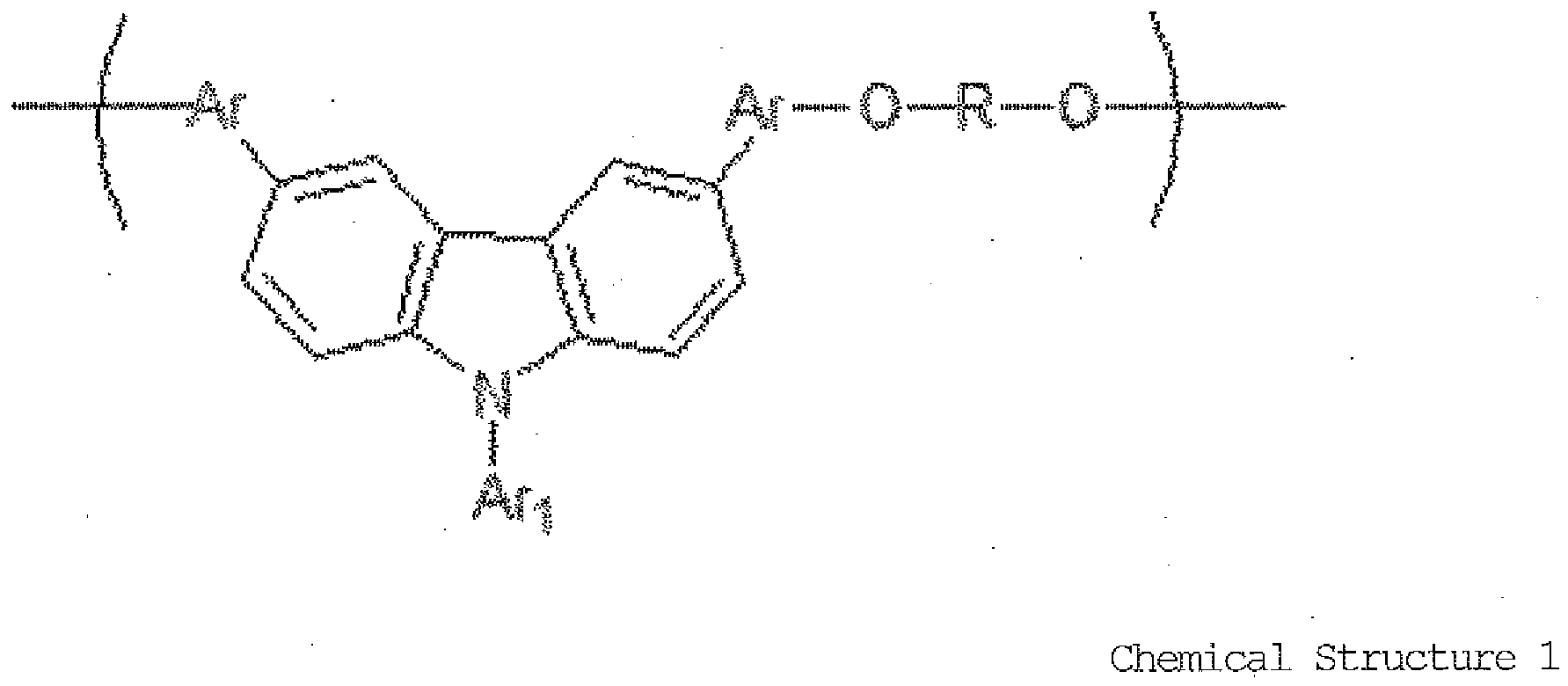
- the present invention provides a novel carbazole polymer that contains a repeating unit represented by a chemical structure 1:
- R represents an aliphatic or alicyclic bifunctional group
- Ar represents an aromatic hydrocarbon or heterocyclic ring bifunctional group
- Ar 1 represents an aromatic hydrocarbon or heterocyclic ring monofunctional group
- carbazole polymer mentioned above is manufactured by reaction between a dihalogen compound represented by the chemical structure 2 and a boronic acid derivative represented by the chemical structure 3:
- X represents a halogen atom.
- Y represents a boronic acid or an ester thereof.
- carbazole polymer mentioned above is represented by the chemical structure 4:
- R 1 represents a hydrogen atom, a substituted or non-substituted alkyl group, a substituted or non-substituted alkoxy group, a halogen atom, a cyano group, a nitro group, or an aromatic hydrocarbon group and n represents an integer of 1 or higher.
- a method of manufacturing the carbazole mentioned above including reacting a dihalogen compound represented by a chemical structure 2 with a boronic acid derivative represented by a chemical structure 3:
- X represents a halogen atom
- Y represents a boronic acid or an ester thereof.
- the carbazole polymer of the present disclosure represented by the chemical structure 1 is manufactured by, for example, the following method.
- the carbazole polymer represented by the chemical structure 1 is manufactured by reacting a dihalogen compound represented by the chemical structure 2 with a boronic acid derivative represented by the chemical structure 3.
- R represents an aliphatic or alicyclic bifunctional group
- Ar represents an aromatic hydrocarbon or heterocyclic ring bifunctional group
- Ar 1 represents an aromatic hydrocarbon or heterocyclic ring monofunctional group
- X represents a halogen atom and Ar 1 represents an aromatic hydrocarbon or heterocyclic ring monofunctional group.
- R represents an aliphatic bifunctional group and a cyclic aliphatic bifunctional group
- Ar represents an aromatic hydrocarbon or heterocyclic ring bifunctional group
- Y represents a boronic acid or an ester thereof.
- the dihalogen compound represented by the chemical structure 2 and the boronic acid derivative represented by the chemical structure 3 is based on Suzuki-Miyaura reaction ( A. Chem. Rev. 95, 2457 published in 1995, authored by Miyaura N. and Suzuki A. ), which is known as a cross-coupling reaction of an aryl boron compound and an organic halogen compound using a palladium catalyst.
- a preferable halogen atom in the dihalogen compound represented by the chemical structure 2 is iodine or a bromine in terms of reactivity.
- an aryl boronic acid ester synthesized from a halogenized aryl using a bis(pinacolato)diboron which is thermally stable and easily handled in the air can be also used in addition to an aryl boronic acid.
- the selection of the palladium catalyst There is no specific limitation on the selection of the palladium catalyst. Specific examples thereof include, but are not limited to, Pd(PPh 3 ) 4 , PdCl 2 (PPh 3 ) 2 , Pd(OAc) 2 , and PdCl 2 . Among them, Pd(PPh 3 ) 4 is most commonly used.
- This reaction requires a base and preferably a relatively weak base such as Na 2 CO 3 and NaHCO 3 .
- a strong base such as Ba(OH) 2 and K 3 PO 4 is preferable.
- the other bases include, but are not limited to, sodium hydroxide, potassium hydroxide, and a metal alkoxide such as potassium t-butoxide, sodium t-butoxide, lithium t-butoxide, potassium 2-methyl-2-butoxide, sodium 2-methyl-2-butoxide, sodium methoxide, sodium ethoxide, potassium ethoxide, and potassium methoxide.
- a metal alkoxide such as potassium t-butoxide, sodium t-butoxide, lithium t-butoxide, potassium 2-methyl-2-butoxide, sodium 2-methyl-2-butoxide, sodium methoxide, sodium ethoxide, potassium ethoxide, and potassium methoxide.
- an organic base such as triethyl amine can be used as the base.
- reaction solvent examples include, but are not limited to, alcohol- or ether-based solvents such as methanol, ethanol, isopropanol, butanol, 2-methoxyethanol, 1,2-dimethoxyethane, bis(2-methoxyethyl)ether, cyclic ether solvents such as dioxane and tetrahydrofuran, benzene, toluene, xylene, dimethylsulfoxide, N,N-dimethylformamide, N-methyl pyrrolidone, and 1,3-dimethyl-2-imidazolidinone.
- alcohol- or ether-based solvents such as methanol, ethanol, isopropanol, butanol, 2-methoxyethanol, 1,2-dimethoxyethane, bis(2-methoxyethyl)ether, cyclic ether solvents such as dioxane and tetrahydrofuran, benzene, toluene, xylene,
- the reaction temperature, the reaction time, and the reaction concentration are set based on the reactivity and the solubility of the dihalogen compound represented by the chemical structure 2 or the boronic acid derivative represented by the chemical structure 2.
- the carbazole polymer of the present disclosure may have an end where a substitution group based on the terminating agent is connected.
- the molecular weight of the polymer of the present disclosure is preferably from 1,000 to 1,000,000 and more preferably from 2,000 to 500,000 in polystyrene conversion number average molecular weight.
- the molecular weight is too small, cracking tends to occur, there by degrading the filming property and practicality.
- the solubility of such a polymer in a typical organic solvent tends to deteriorate, thereby increasing the viscosity of the solution, which also leads to a practicality problem.
- the polymerization degree varies depending on the solubility of monomers for use in the reaction, that is, the dihalogen compound represented by the chemical structure 2 or the boronic acid derivative represented by the chemical structure 3. Therefore, the dihalogen compound represented by the chemical structure 2 or the boronic acid derivative represented by the chemical structure 3 should be selected considering the objective.
- the thus-obtained carbazole polymer is used after removing impurities such as the catalyst used in polymerization, non-reacted remaining monomers, and a terminating agent.
- impurities such as the catalyst used in polymerization, non-reacted remaining monomers, and a terminating agent.
- any of known methods can be used such as a reprecipitation method, a chromatography method, an adsorption method, an extraction method, a soxhlet extraction method, an ultrafiltration method, artificial dialysis, and a use of a scavenger to remove catalysts
- the polymer of the present disclosure manufactured by the manufacturing methods specified above can form a thin-layer having an excellent strength, toughness, and durability without cracking by a known film forming method such as a spin coating method, a cast method, a dip method, an inkjet method, a doctor blade method, and a screen printing and can be used as various kinds of functional element materials for a photoelectric conversion element , a thin-layer transistor element, a luminous element , etc.
- a known film forming method such as a spin coating method, a cast method, a dip method, an inkjet method, a doctor blade method, and a screen printing and can be used as various kinds of functional element materials for a photoelectric conversion element , a thin-layer transistor element, a luminous element , etc.
- a specific example is an alkoxy group in which an oxygen atom is inserted at the bonding position of the alkyl group specified above.
- Ar1 is an aromatic hydrocarbon or a heterocyclic ring
- Ar1 represents the aromatic hydrocarbon or heterocyclic ring monofunctional group specified for Ar.
- R is an aliphatic or aliclyclic bifunctional group
- R is identical to the substituted or non-substituted bifunctional alkyl group defined as the substitution group on the specified aromatic hydrocarbons or heterocyclic ring.
- polymer represented by chemical structure 1 is preferably a polymer represented by the following chemical structure 4.
- R 1 in the chemical structure 4 represents a substituted or non-substituted alkyl or alkoxy group, a halogen atom, a cyano group, a nitro group, or an aromatic hydrocarbon group.
- Specific examples of the substituted or non-substituted alkyl or alkoxy group are identical to the substitution groups defined as the substitution groups on the specified aromatic hydrocarbons or heterocyclic rings.
- the aromatic hydrocarbon group is identical to the aromatic hydrocarbon monofunctional group defined as specified above.
- Fig. 1 is a graph of infrared absorption spectrum (NaCl cast film) of the polymer having a number average molecular weight (Mn) of 6,972 and a weight average molecular weight (Mw) of 16,509 in polystyrene conversion molecular weight measured by gel permeation chromatography.
- Example 2 represented by the chemical structure 7 of the present disclosure is obtained in the same manner as in Example 1 except that the boronic acid ester is exchanged with a boronic acid ester represented by the following chemical structure 8.
- Example 3 represented by the chemical structure 9 of the present disclosure is obtained in the same manner as in Example 1 except that the boronic acid ester is exchanged with a boronic acid ester represented by the following chemical structure 10.
- Polystyrene conversion molecular weight by gel permeation chromatography - (The polymer is not soluble in tetrahydrofuran and thus the molecular weight thereof is not measured).
- Example 4 represented by the chemical structure 11 shown in Table 2 is obtained in the same manner as in Example 1 except that 3,6-dibromo-N-(p-n-butylphenyl carbazole) is used instead of 3,6-dibromo-N-phenyl carbazole and the boronic acid ester in Table 1 is used instead.
- Fig. 2 is a diagram illustrating an infra-red spectrum (NaCl cast film) of the polymer obtained in Example 4.
- Example 5 shown in Table 2 A polymer of Example 5 shown in Table 2 is obtained in the same manner as in Example 1 except that 3,6-dibromo-N-(p-n-butylphenyl carbazole) is used instead of 3,6-dibromo-N-phenyl carbazole and the boronic acid ester in Table 1 is used instead.
- Example 6 shown in Table 2 A polymer of Example 6 shown in Table 2 is obtained in the same manner as in Example 1 except that 3,6-dibromo-N-(p-n-butylphenyl carbazole) is used instead of 3,6-dibromo-N-phenyl carbazole and the boronic acid ester in Table 1 is used instead.
- Example 7 shown in Table 2 A polymer of Example 7 shown in Table 2 is obtained in the same manner as in Example 1 except that 3,6-dibromo-N-(p-n-butylphenyl carbazole) is used instead of 3,6-dibromo-N-phenyl carbazole and the boronic acid ester in Table 1 is used instead.
- Example Dihalogen compound Boronic acid ester derivative 4 5 Same as Example 4 6 Same as Example 4 7 Same as Example 4 Table 2
- Example Mn Mw Element Analysis (%) Actual (Calculated) C H N 4 7001 16501 84.65 (85.00) 7.93 (7.92) 1.65 (2.16) 5 3349 6818 84.62 (84.94) 7.30 (7.31) 1.94 (2.36) 6 3875 8182 84.73 (84.91) 6.94 (6.96) 2.08 (2.48) 7 2232 4066 83.38 (84.83) 5.93 (6.14) 2.20 (2.75) Measuring of Carrier Mobility
- Carrier mobility is obtained by Time of Flight (TOF) method.
- TOF Time of Flight
- the crossing time of the carrier of the organic semiconductor material through the film is measured. That is, optical carriers are generated by irradiating one side of the material with pulse light by a nitrogen laser beam and the displacement current obtained when an electric field is provided between the two gold electrodes is converted into a voltage by a resistance, which is recorded by an oscilloscope.
- the time (Tr) of the carrier travelling the distance (L) between the electrodes is obtained by the waveform of the photocurrent.
- Fig. 3 is a diagram illustrating the hole mobility of the polymer of the present disclosure of Example 4.
Landscapes
- Chemical & Material Sciences (AREA)
- Organic Chemistry (AREA)
- Engineering & Computer Science (AREA)
- Materials Engineering (AREA)
- Health & Medical Sciences (AREA)
- Chemical Kinetics & Catalysis (AREA)
- Medicinal Chemistry (AREA)
- Polymers & Plastics (AREA)
- Polyoxymethylene Polymers And Polymers With Carbon-To-Carbon Bonds (AREA)
- Electroluminescent Light Sources (AREA)
Abstract
Description
- The present invention relates to a carbazole polymer for an organic electroluminescent (EL) element and a method of manufacturing the carbazole polymer.
- Organic thin-layer electroluminescent (EL) components are attractive and research into their commercialization has continued because their self-luminescence provides advantages such as superior view angle dependency and visibility as well as space savings because the organic thin-layer EL components are a thin-layer type complete solid state component. At present, however, many areas requiring improvement remain, such as energy conversion efficiency, luminescent quantum efficiency, and stability (device durability).
- Until now, organic thin-layer EL components using a low molecular weight compound or a polymer have been reported. With regard to the organic thin-layer EL components using a low molecular weight compound, it is reported that efficiency is improved by employing various laminate structures and durability is improved by suitably controlling the doping method.
- However, in the case of low molecular aggregations, the layer state changes over a long time, which means that the organic thin-layer EL components using a low molecular weight compound has a fundamental problem with the stability of the layer.
- With regard to the organic thin-layer EL components using polymer materials, poly-p-phenylenevinylene (PPV) series, poly-thiophenes, etc. have been studied extensively. However, these materials have difficulties about improving the purity and are fundamentally low in fluorescence quantum yield. Therefore, no EL component using these materials that demonstrates high performance has been obtained yet.
- Considering that the polymer materials are essentially stable in a glass state, an excellent EL component can be structured if a high fluorescence quantum yield is imparted.
- In addition, with regard to the layer forming method, while a vacuum deposition method is generally used for the low molecular weight compound case, a coating method is used for the polymer material, which is preferable in terms of cost. As described above, each has its own merits and demerits.
- In addition, improvement of the efficiency using triplet exciton has been studied extensively (for example, refer to T. Tsutsui et.al. JPN. J. Appl. Phys. Vol. 38 L1502, published in 1999) and it is found that the luminance efficiency can be significantly improved. Accordingly, the number of reports on host materials for use in the luminous layer has been increasing. Among these, a representative example is 4,4'-bis(carbazolyl-9)biphenyl (CBP) represented by the following chemical structure.

- Based on follow-up studies, however, it became clear that crystallization of CBP proceeds in the luminous layer, thereby shortening the life of the device (for example, refer to
WO 01/72927-A1 - To avoid this problem, other carbazole compounds instead of CBP have been studied (for example, refer to Japanese patent application number
2005-158691 JP-2005-158691-A - In addition, polymer materials having a carbazole structure have been studied (for examples, refer to
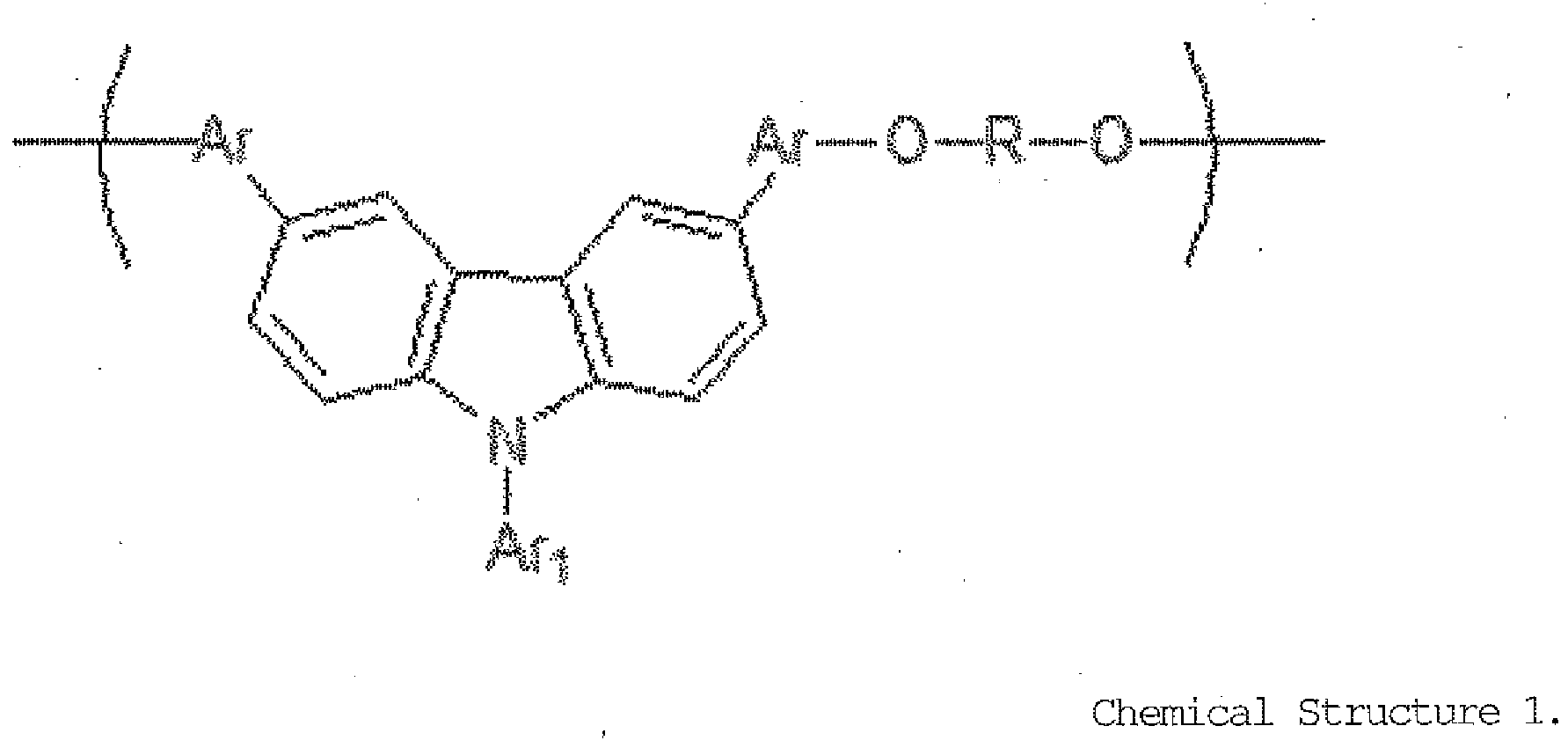
JP-2004-339432-A JP-2007-262219-A - In view of the foregoing, the present invention provides a novel carbazole polymer that contains a repeating unit represented by a chemical structure 1:
- In the
chemical structure 1, R represents an aliphatic or alicyclic bifunctional group, Ar represents an aromatic hydrocarbon or heterocyclic ring bifunctional group, and Ar1 represents an aromatic hydrocarbon or heterocyclic ring monofunctional group. - It is preferred that the carbazole polymer mentioned above is manufactured by reaction between a dihalogen compound represented by the
chemical structure 2 and a boronic acid derivative represented by the chemical structure 3:
- In the
chemical structure 2, X represents a halogen atom.
Y-Ar-O-R-O-Ar-Y Chemical Structure 3.
- In the chemical structure 3, Y represents a boronic acid or an ester thereof.
- It is still further preferred that the carbazole polymer mentioned above is represented by the chemical structure 4:

- In the chemical structure 4, R1 represents a hydrogen atom, a substituted or non-substituted alkyl group, a substituted or non-substituted alkoxy group, a halogen atom, a cyano group, a nitro group, or an aromatic hydrocarbon group and n represents an integer of 1 or higher.
- As another aspect of the present invention, a method of manufacturing the carbazole mentioned above including reacting a dihalogen compound represented by a
chemical structure 2 with a boronic acid derivative represented by a chemical structure 3:
- In the
chemical structure 2, X represents a halogen atom; and
Y-Ar-O-R-O-Ar-Y Chemical Structure 3
- In the chemical structure 3, Y represents a boronic acid or an ester thereof.
- Various other objects, features and attendant advantages of the present invention will be more fully appreciated as the same becomes better understood from the detailed description when considered in connection with the accompanying drawings in which like reference characters designate like corresponding parts throughout and wherein:
-
Fig. 1 is a diagram illustrating an infra-red spectrum (NaCl cast film) of a carbazole polymer obtained in Example 1 described later; -
Fig. 2 is a diagram illustrating an infra-red spectrum (NaCl cast film) of a carbazole polymer obtained in Example 4 described later; and -
Fig. 3 is a diagram illustrating the hole mobility of the polymer of the present disclosure obtained in Example 4 described later. - The present disclosure is described below in detail with reference to accompanying drawings.
- The carbazole polymer of the present disclosure represented by the
chemical structure 1 is manufactured by, for example, the following method. - That is, the carbazole polymer represented by the
chemical structure 1 is manufactured by reacting a dihalogen compound represented by thechemical structure 2 with a boronic acid derivative represented by the chemical structure 3.

- In the
chemical structure 1, R represents an aliphatic or alicyclic bifunctional group, Ar represents an aromatic hydrocarbon or heterocyclic ring bifunctional group, and Ar1 represents an aromatic hydrocarbon or heterocyclic ring monofunctional group. - In the
chemical structure 2, X represents a halogen atom and Ar1 represents an aromatic hydrocarbon or heterocyclic ring monofunctional group.
Y-Ar-O-R-O-Ar-Y Chemical Structure 3
- In the chemical structure 3, R represents an aliphatic bifunctional group and a cyclic aliphatic bifunctional group, Ar represents an aromatic hydrocarbon or heterocyclic ring bifunctional group, and Y represents a boronic acid or an ester thereof.
- The dihalogen compound represented by the
chemical structure 2 and the boronic acid derivative represented by the chemical structure 3 is based on Suzuki-Miyaura reaction (A. Chem. Rev. 95, 2457 published in 1995, authored by Miyaura N. and Suzuki A.), which is known as a cross-coupling reaction of an aryl boron compound and an organic halogen compound using a palladium catalyst. - A preferable halogen atom in the dihalogen compound represented by the
chemical structure 2 is iodine or a bromine in terms of reactivity. - In addition, as the boronic acid derivative represented by the chemical structure 3, an aryl boronic acid ester synthesized from a halogenized aryl using a bis(pinacolato)diboron which is thermally stable and easily handled in the air can be also used in addition to an aryl boronic acid.
- There is no specific limitation on the selection of the palladium catalyst. Specific examples thereof include, but are not limited to, Pd(PPh3)4, PdCl2(PPh3)2, Pd(OAc)2, and PdCl2. Among them, Pd(PPh3)4 is most commonly used.
- This reaction requires a base and preferably a relatively weak base such as Na2CO3 and NaHCO3. In addition, considering the impact of steric barrier, a strong base such as Ba(OH)2 and K3PO4 is preferable.
- Specific examples of the other bases include, but are not limited to, sodium hydroxide, potassium hydroxide, and a metal alkoxide such as potassium t-butoxide, sodium t-butoxide, lithium t-butoxide, potassium 2-methyl-2-butoxide, sodium 2-methyl-2-butoxide, sodium methoxide, sodium ethoxide, potassium ethoxide, and potassium methoxide.
- In addition, an organic base such as triethyl amine can be used as the base.
- Specific examples of the reaction solvent include, but are not limited to, alcohol- or ether-based solvents such as methanol, ethanol, isopropanol, butanol, 2-methoxyethanol, 1,2-dimethoxyethane, bis(2-methoxyethyl)ether, cyclic ether solvents such as dioxane and tetrahydrofuran, benzene, toluene, xylene, dimethylsulfoxide, N,N-dimethylformamide, N-methyl pyrrolidone, and 1,3-dimethyl-2-imidazolidinone.
- With regard to the polymerization reaction, the reaction temperature, the reaction time, and the reaction concentration are set based on the reactivity and the solubility of the dihalogen compound represented by the
chemical structure 2 or the boronic acid derivative represented by thechemical structure 2. - In addition, in the polymerization operation, a molecular weight control agent to control the molecular weight and a terminating agent to cap the end of the polymer as a terminal modifying group can be added before, during, or after the reaction. Therefore, the carbazole polymer of the present disclosure may have an end where a substitution group based on the terminating agent is connected.
- The molecular weight of the polymer of the present disclosure is preferably from 1,000 to 1,000,000 and more preferably from 2,000 to 500,000 in polystyrene conversion number average molecular weight. When the molecular weight is too small, cracking tends to occur, there by degrading the filming property and practicality. When the molecular weight is too large, the solubility of such a polymer in a typical organic solvent tends to deteriorate, thereby increasing the viscosity of the solution, which also leads to a practicality problem.
- In addition, the polymerization degree varies depending on the solubility of monomers for use in the reaction, that is, the dihalogen compound represented by the
chemical structure 2 or the boronic acid derivative represented by the chemical structure 3. Therefore, the dihalogen compound represented by thechemical structure 2 or the boronic acid derivative represented by the chemical structure 3 should be selected considering the objective. - The thus-obtained carbazole polymer is used after removing impurities such as the catalyst used in polymerization, non-reacted remaining monomers, and a terminating agent. For these refinement operations, any of known methods can be used such as a reprecipitation method, a chromatography method, an adsorption method, an extraction method, a soxhlet extraction method, an ultrafiltration method, artificial dialysis, and a use of a scavenger to remove catalysts
- The polymer of the present disclosure manufactured by the manufacturing methods specified above can form a thin-layer having an excellent strength, toughness, and durability without cracking by a known film forming method such as a spin coating method, a cast method, a dip method, an inkjet method, a doctor blade method, and a screen printing and can be used as various kinds of functional element materials for a photoelectric conversion element , a thin-layer transistor element, a luminous element , etc.
- Specific examples of the thus-obtained carbazole polymers represented by the
chemical structure 1 include, but are not limited to, the following: - Among the polymers represented by the
chemical structure 1, when Ar represents an aromatic hydrocarbon or heterocyclic ring bifunctional group, specific examples thereof include, but are not limited to, the following: bifunctional groups such as benzene, naphthalene, biphenyl, terphenyl, pyrene, fluorene, 9,9-dimethyl fluorene, azulene, anthracene, triphenylene, chrysene, 9-benzylidene fluorene, 5H-dibenzo[a,d]cycloheptene, [2,2]-paracyclophane, triphenyl amine, thiophene, benzothiophene, dithienyl benzene, furane, benzo furane, carbazole. These can have a substituted or non-substituted alkyl group, alkoxy group as substitution groups. Specific examples of the substituted or non-substituted alkyl groups include, but are not limited to, straight chain, branch chain, or cyclic alkyl groups having 1 to 25 carbon atoms and these alkyl groups may have a fluorine atom, a cyano group, or a phenyl group, and a phenyl group which is substituted by a halogen atom or a straight chain or branch chain alkyl group. Specific examples thereof include, but are not limited to, methyl group, ethyl group, n-propyl group, i-propyl group, t-butyl group, s-butyl group, n-butyl group, i-butyl group, pentyl group, hexyl group, heptyl group, octyl group, nonyl group, decyl group, 3,7-dimethyloctyl group, 2-ethylhexyl group, trifluoromethyl group, 2-cyanoethyl group, benzyl group, 4-chlorobenzyl group, 4-methylbenzyl group, cyclopentyl group, and cyclohexyl group. - In addition, in the case of a substituted or non-substituted alkoxy group, a specific example is an alkoxy group in which an oxygen atom is inserted at the bonding position of the alkyl group specified above.
- In the
chemical structure 1, in the case in which Ar1 is an aromatic hydrocarbon or a heterocyclic ring, it represents the aromatic hydrocarbon or heterocyclic ring monofunctional group specified for Ar. - In the
chemical structure 1, in the case in which R is an aliphatic or aliclyclic bifunctional group, it is identical to the substituted or non-substituted bifunctional alkyl group defined as the substitution group on the specified aromatic hydrocarbons or heterocyclic ring. - In addition, the polymer represented by
chemical structure 1 is preferably a polymer represented by the following chemical structure 4.
- R1 in the chemical structure 4 represents a substituted or non-substituted alkyl or alkoxy group, a halogen atom, a cyano group, a nitro group, or an aromatic hydrocarbon group. Specific examples of the substituted or non-substituted alkyl or alkoxy group are identical to the substitution groups defined as the substitution groups on the specified aromatic hydrocarbons or heterocyclic rings. In addition, the aromatic hydrocarbon group is identical to the aromatic hydrocarbon monofunctional group defined as specified above.
- The boronic acid ester derivatives for use in Examples are described in
JP-2010-37509 - Mix 0.80 g of 3,6-dibromo-N-phenylcarbazole, 1.21 g of a boronic acid ester represented by the following chemical structure 5, 11.6 mg of tetrakis(triphenylphosphine)palladium, and 20 mg of tricapryl methyl ammonium chloride (Aliquat 336, manufactured by Sigma-Aldrich Co. LLC.). Subsequent to nitrogen substitution, add 12 ml of degassed toluene and 5.2 ml of 2M sodium carbonate to the mixture followed by reflux with heat for 13 hours;


- C: 84.60 % (84.94 %); H 7.30 % (7.31 %): N 1.92 % (2.36 %)
-
Fig. 1 is a graph of infrared absorption spectrum (NaCl cast film) of the polymer having a number average molecular weight (Mn) of 6,972 and a weight average molecular weight (Mw) of 16,509 in polystyrene conversion molecular weight measured by gel permeation chromatography. - A polymer of Example 2 represented by the chemical structure 7 of the present disclosure is obtained in the same manner as in Example 1 except that the boronic acid ester is exchanged with a boronic acid ester represented by the following chemical structure 8.


- C: 84.79 % (84.87 %); H 6.60 % (6.57 %): N 2.20 % (2.61 %)
- A number average molecular weight (Mn) of 3,130 and a weight average molecular weight (Mw) of 6,697 in polystyrene conversion molecular weight measured by gel permeation chromatography.
- A polymer of Example 3 represented by the chemical structure 9 of the present disclosure is obtained in the same manner as in Example 1 except that the boronic acid ester is exchanged with a boronic acid ester represented by the following chemical structure 10.


- C: 84.60 % (84.93 %); H 6.00 % (6.11 %): N 2.42 % (2.75 %)
- Polystyrene conversion molecular weight by gel permeation chromatography: - (The polymer is not soluble in tetrahydrofuran and thus the molecular weight thereof is not measured).
- A polymer of Example 4 represented by the chemical structure 11 shown in Table 2 is obtained in the same manner as in Example 1 except that 3,6-dibromo-N-(p-n-butylphenyl carbazole) is used instead of 3,6-dibromo-N-phenyl carbazole and the boronic acid ester in Table 1 is used instead.

-
Fig. 2 is a diagram illustrating an infra-red spectrum (NaCl cast film) of the polymer obtained in Example 4. - A polymer of Example 5 shown in Table 2 is obtained in the same manner as in Example 1 except that 3,6-dibromo-N-(p-n-butylphenyl carbazole) is used instead of 3,6-dibromo-N-phenyl carbazole and the boronic acid ester in Table 1 is used instead.
- A polymer of Example 6 shown in Table 2 is obtained in the same manner as in Example 1 except that 3,6-dibromo-N-(p-n-butylphenyl carbazole) is used instead of 3,6-dibromo-N-phenyl carbazole and the boronic acid ester in Table 1 is used instead.
- A polymer of Example 7 shown in Table 2 is obtained in the same manner as in Example 1 except that 3,6-dibromo-N-(p-n-butylphenyl carbazole) is used instead of 3,6-dibromo-N-phenyl carbazole and the boronic acid ester in Table 1 is used instead.
Table 1 Example Dihalogen compound Boronic acid ester derivative 4 

5 Same as Example 4 
6 Same as Example 4 
7 Same as Example 4 
Table 2 Example Mn Mw Element Analysis (%) Actual (Calculated) C H N 4 7001 16501 84.65 (85.00) 7.93 (7.92) 1.65 (2.16) 5 3349 6818 84.62 (84.94) 7.30 (7.31) 1.94 (2.36) 6 3875 8182 84.73 (84.91) 6.94 (6.96) 2.08 (2.48) 7 2232 4066 83.38 (84.83) 5.93 (6.14) 2.20 (2.75) Measuring of Carrier Mobility - 10 % by weight of toluene solution of the polymer prepared in Example 4 of the present disclosure is applied by blade to an aluminum substrate followed by drying at 120 °C for 30 minutes to form an organic semiconductor film having a thickness of about 7 µm. Thereafter, gold electrodes are deposited on the semiconductor film to form a material for evaluation.
- Carrier mobility is obtained by Time of Flight (TOF) method. In the carrier mobility measuring by TOF method, the crossing time of the carrier of the organic semiconductor material through the film is measured. That is, optical carriers are generated by irradiating one side of the material with pulse light by a nitrogen laser beam and the displacement current obtained when an electric field is provided between the two gold electrodes is converted into a voltage by a resistance, which is recorded by an oscilloscope. The time (Tr) of the carrier travelling the distance (L) between the electrodes is obtained by the waveform of the photocurrent. Thereafter, the speed of the carrier is represented by the relationship: V (applied voltage) = L / Tr. When the applied voltage V is uniform between the electrodes, the carrier mobility is calculated by the following relationship using the electric field E (= V / L):

-
Fig. 3 is a diagram illustrating the hole mobility of the polymer of the present disclosure of Example 4. - This document claims priority and contains subject matter related to Japanese Patent Application no.
2010-201624, filed on September 9, 2010
Claims (3)
- A carbazole polymer characterized by comprising:a repeating unit represented by a chemical structure 1:

- The carbazole polymer according to Claim 1, manufactured by reaction between a dihalogen compound represented by a chemical structure 2 and a boronic acid derivative represented by a chemical structure 3:

Y-Ar-O-R-O-Ar-Y Chemical Structure 3
where Y represents a boronic acid or an ester thereof. - The carbazole polymer according to Claim 1, characterized in that the repeating unit is represented by a chemical structure 4:

A method of manufacturing the carbazole polymers according to Claim 1, characterized by comprising reacting a dihalogen compound represented by a chemical structure 2 with a boronic acid derivative represented by a chemical structure 3:
Y-Ar-O-R-O-Ar-Y Chemical Structure 3
where Y represents a boronic acid or an ester thereof.
Applications Claiming Priority (1)
| Application Number | Priority Date | Filing Date | Title |
|---|---|---|---|
| JP2010201624 | 2010-09-09 |
Publications (2)
| Publication Number | Publication Date |
|---|---|
| EP2428527A1 true EP2428527A1 (en) | 2012-03-14 |
| EP2428527B1 EP2428527B1 (en) | 2015-08-05 |
Family
ID=44772774
Family Applications (1)
| Application Number | Title | Priority Date | Filing Date |
|---|---|---|---|
| EP11180636.0A Not-in-force EP2428527B1 (en) | 2010-09-09 | 2011-09-08 | Carbazole polymer and method of manufacturing same |
Country Status (4)
| Country | Link |
|---|---|
| US (1) | US8765903B2 (en) |
| EP (1) | EP2428527B1 (en) |
| JP (1) | JP2012077293A (en) |
| CN (1) | CN102408546B (en) |
Families Citing this family (3)
| Publication number | Priority date | Publication date | Assignee | Title |
|---|---|---|---|---|
| JP5842630B2 (en) * | 2011-03-16 | 2016-01-13 | 株式会社リコー | Carbazole derivatives and semiconductor nanocrystals |
| JP6085914B2 (en) | 2011-11-28 | 2017-03-01 | 株式会社リコー | Electrochromic compound, electrochromic composition, and display element |
| GB2508410A (en) * | 2012-11-30 | 2014-06-04 | Cambridge Display Tech Ltd | Polymer and organic electronic device |
Citations (7)
| Publication number | Priority date | Publication date | Assignee | Title |
|---|---|---|---|---|
| WO2001072927A1 (en) | 2000-03-27 | 2001-10-04 | Idemitsu Kosan Co., Ltd. | Organic electroluminescence device |
| JP2004339432A (en) | 2003-05-19 | 2004-12-02 | Fujitsu Ltd | N-phenylcarbazole derivative polymer, organic light emitting element, and organic light emitting device |
| JP2005158691A (en) | 2003-10-31 | 2005-06-16 | Ricoh Co Ltd | Electroluminescent device |
| JP2007262219A (en) | 2006-03-28 | 2007-10-11 | Mitsubishi Chemicals Corp | Polymer compound, composition for organic electroluminescence device, thin film for organic electroluminescence device, and organic electroluminescence device |
| CN101063035A (en) * | 2006-04-29 | 2007-10-31 | 长兴化学工业股份有限公司 | Organic light-emitting materials and their uses |
| JP2010037509A (en) | 2008-08-08 | 2010-02-18 | Ricoh Co Ltd | Polymer |
| JP2010201624A (en) | 2009-02-27 | 2010-09-16 | Toyota Auto Body Co Ltd | Fixture for arranging resin material |
Family Cites Families (8)
| Publication number | Priority date | Publication date | Assignee | Title |
|---|---|---|---|---|
| US4672149A (en) | 1985-01-18 | 1987-06-09 | Ricoh Co., Ltd. | Photoelectric transducer element |
| US7166689B2 (en) | 2003-02-13 | 2007-01-23 | Ricoh Company, Ltd. | Aryl amine polymer, thin film transistor using the aryl amine polymer, and method of manufacturing the thin film transistor |
| JP4498773B2 (en) | 2003-07-18 | 2010-07-07 | 株式会社リコー | Aromatic polycarbonate resin |
| JP2006306997A (en) * | 2005-04-28 | 2006-11-09 | Jsr Corp | Carbazole-based polymer and method for producing the same, polymer composition for organic electroluminescence device, and organic electroluminescence device |
| TWI300436B (en) * | 2005-05-20 | 2008-09-01 | Eternal Chemical Co Ltd | Organic light emitting materials and use thereof |
| WO2007072240A1 (en) * | 2005-12-20 | 2007-06-28 | Koninklijke Philips Electronics N.V. | Polymeric carbazole compounds |
| JP2007201190A (en) * | 2006-01-26 | 2007-08-09 | Fuji Xerox Co Ltd | Organic electroluminescence device |
| KR101226296B1 (en) | 2007-09-13 | 2013-01-24 | 가부시키가이샤 리코 | Novel arylamine polymer, method for producing the same, ink composition, film, electronic device, organic thin-film transistor, and display device |
-
2011
- 2011-08-31 JP JP2011189524A patent/JP2012077293A/en active Pending
- 2011-09-07 US US13/226,992 patent/US8765903B2/en not_active Expired - Fee Related
- 2011-09-08 EP EP11180636.0A patent/EP2428527B1/en not_active Not-in-force
- 2011-09-08 CN CN201110272503.0A patent/CN102408546B/en not_active Expired - Fee Related
Patent Citations (7)
| Publication number | Priority date | Publication date | Assignee | Title |
|---|---|---|---|---|
| WO2001072927A1 (en) | 2000-03-27 | 2001-10-04 | Idemitsu Kosan Co., Ltd. | Organic electroluminescence device |
| JP2004339432A (en) | 2003-05-19 | 2004-12-02 | Fujitsu Ltd | N-phenylcarbazole derivative polymer, organic light emitting element, and organic light emitting device |
| JP2005158691A (en) | 2003-10-31 | 2005-06-16 | Ricoh Co Ltd | Electroluminescent device |
| JP2007262219A (en) | 2006-03-28 | 2007-10-11 | Mitsubishi Chemicals Corp | Polymer compound, composition for organic electroluminescence device, thin film for organic electroluminescence device, and organic electroluminescence device |
| CN101063035A (en) * | 2006-04-29 | 2007-10-31 | 长兴化学工业股份有限公司 | Organic light-emitting materials and their uses |
| JP2010037509A (en) | 2008-08-08 | 2010-02-18 | Ricoh Co Ltd | Polymer |
| JP2010201624A (en) | 2009-02-27 | 2010-09-16 | Toyota Auto Body Co Ltd | Fixture for arranging resin material |
Non-Patent Citations (5)
| Title |
|---|
| DATABASE CA [online] CHEMICAL ABSTRACTS SERVICE, COLUMBUS, OHIO, US; 18 February 2010 (2010-02-18), OKADA, TAKASHI ET AL: "Polymers having thiophene-based units for organic electronic materials", XP002662252, retrieved from STN Database accession no. 2010:205408 * |
| DATABASE CA [online] CHEMICAL ABSTRACTS SERVICE, COLUMBUS, OHIO, US; 7 November 2007 (2007-11-07), CHEN, JUI TANG: "Application of organic light-emitting material", XP002662251, retrieved from STN Database accession no. 2007:1261968 * |
| MIYAURA N., SUZUKI A., A. CHEM. REV., vol. 95, 1995, pages 2457 |
| T. TSUTSUI, JPN. J. APPL. PHYS., vol. 38, 1999, pages L1502 |
| VAITKEVICIENE V ET AL: "Hole-transporting [3,3']bicarbazolyl-based polymers and well-defined model compounds", EUROPEAN POLYMER JOURNAL, PERGAMON PRESS LTD. OXFORD, GB, vol. 42, no. 10, 1 October 2006 (2006-10-01), pages 2254 - 2260, XP025170484, ISSN: 0014-3057, [retrieved on 20061001], DOI: 10.1016/J.EURPOLYMJ.2006.06.023 * |
Also Published As
| Publication number | Publication date |
|---|---|
| CN102408546A (en) | 2012-04-11 |
| US8765903B2 (en) | 2014-07-01 |
| EP2428527B1 (en) | 2015-08-05 |
| CN102408546B (en) | 2013-06-19 |
| US20120065353A1 (en) | 2012-03-15 |
| JP2012077293A (en) | 2012-04-19 |
Similar Documents
| Publication | Publication Date | Title |
|---|---|---|
| KR101072098B1 (en) | Organic electronic material, organic electronic device and organic electroluminescent device | |
| TWI460202B (en) | Porphyrin polymer compound and light-emitting element using the same | |
| JP5504563B2 (en) | Composition and light-emitting device using the composition | |
| CN101516962B (en) | Polymer compound and polymer light-emitting device using the same | |
| KR20040044536A (en) | Conjugated polymers containing spirobifluorene units and the use thereof | |
| WO2007043495A9 (en) | Copolymer and polymer light emitting devices made by using the same | |
| WO2003099901A1 (en) | Polymer and polymeric luminescent element comprising the same | |
| CN101024633A (en) | Tricyclic arylamine monomer and polymers and devices thereof | |
| TWI518106B (en) | Polymer compound having carbon cluster structure and organic device using the same | |
| TW200301271A (en) | Copolymer, polymer composition and polymer light-emitting device | |
| US20080265755A1 (en) | Biscarbazol-9-Yl-Substituted Triarylamine-Containing Polymers and Electronic Devices | |
| CN114901719B (en) | Polymer and organic light emitting device including the same | |
| KR20090118921A (en) | A pyrimidine compound-containing composition and a light emitting device using the composition | |
| JP2024037956A (en) | Ionic compound, organic electronic material, organic layer, organic electronic device, organic electroluminescent device, display device, lighting device, and method for producing an organic electronic device | |
| JP2008056910A (en) | Polymer compound and polymer light emitting device using the same | |
| EP2428527B1 (en) | Carbazole polymer and method of manufacturing same | |
| WO2006137436A1 (en) | Polymer material and polymer light-emitting device | |
| JP2009132882A (en) | Polymer compound and polymer light emitting device using the same | |
| KR102819365B1 (en) | Novel polymer and organic light emitting device comprising the same | |
| CN100422220C (en) | Hindered amine-terminated conjugated molecular material and its preparation method and application | |
| KR102863103B1 (en) | Novel polymer and organic light emitting device comprising the same | |
| WO2006070911A1 (en) | Polymer and polymeric luminescent element employing the same | |
| KR20110049827A (en) | A composition comprising a phosphorescent compound and a light emitting device using the composition | |
| JP2009132883A (en) | Polymer compound and polymer light emitting device using the same | |
| KR102858769B1 (en) | Novel polymer and organic light emitting device comprising the same |
Legal Events
| Date | Code | Title | Description |
|---|---|---|---|
| 17P | Request for examination filed |
Effective date: 20110908 |
|
| AK | Designated contracting states |
Kind code of ref document: A1 Designated state(s): AL AT BE BG CH CY CZ DE DK EE ES FI FR GB GR HR HU IE IS IT LI LT LU LV MC MK MT NL NO PL PT RO RS SE SI SK SM TR |
|
| AX | Request for extension of the european patent |
Extension state: BA ME |
|
| PUAI | Public reference made under article 153(3) epc to a published international application that has entered the european phase |
Free format text: ORIGINAL CODE: 0009012 |
|
| RIC1 | Information provided on ipc code assigned before grant |
Ipc: H05B 33/14 20060101ALI20141216BHEP Ipc: H01L 51/50 20060101ALI20141216BHEP Ipc: H01L 51/00 20060101ALI20141216BHEP Ipc: C08G 61/12 20060101AFI20141216BHEP Ipc: C09K 11/06 20060101ALI20141216BHEP |
|
| GRAP | Despatch of communication of intention to grant a patent |
Free format text: ORIGINAL CODE: EPIDOSNIGR1 |
|
| INTG | Intention to grant announced |
Effective date: 20150216 |
|
| GRAS | Grant fee paid |
Free format text: ORIGINAL CODE: EPIDOSNIGR3 |
|
| GRAA | (expected) grant |
Free format text: ORIGINAL CODE: 0009210 |
|
| AK | Designated contracting states |
Kind code of ref document: B1 Designated state(s): AL AT BE BG CH CY CZ DE DK EE ES FI FR GB GR HR HU IE IS IT LI LT LU LV MC MK MT NL NO PL PT RO RS SE SI SK SM TR |
|
| REG | Reference to a national code |
Ref country code: GB Ref legal event code: FG4D |
|
| REG | Reference to a national code |
Ref country code: CH Ref legal event code: EP |
|
| REG | Reference to a national code |
Ref country code: AT Ref legal event code: REF Ref document number: 740691 Country of ref document: AT Kind code of ref document: T Effective date: 20150815 |
|
| REG | Reference to a national code |
Ref country code: IE Ref legal event code: FG4D |
|
| REG | Reference to a national code |
Ref country code: DE Ref legal event code: R096 Ref document number: 602011018412 Country of ref document: DE |
|
| REG | Reference to a national code |
Ref country code: FR Ref legal event code: PLFP Year of fee payment: 5 |
|
| REG | Reference to a national code |
Ref country code: AT Ref legal event code: MK05 Ref document number: 740691 Country of ref document: AT Kind code of ref document: T Effective date: 20150805 |
|
| REG | Reference to a national code |
Ref country code: LT Ref legal event code: MG4D |
|
| REG | Reference to a national code |
Ref country code: NL Ref legal event code: MP Effective date: 20150805 |
|
| PG25 | Lapsed in a contracting state [announced via postgrant information from national office to epo] |
Ref country code: GR Free format text: LAPSE BECAUSE OF FAILURE TO SUBMIT A TRANSLATION OF THE DESCRIPTION OR TO PAY THE FEE WITHIN THE PRESCRIBED TIME-LIMIT Effective date: 20151106 Ref country code: NO Free format text: LAPSE BECAUSE OF FAILURE TO SUBMIT A TRANSLATION OF THE DESCRIPTION OR TO PAY THE FEE WITHIN THE PRESCRIBED TIME-LIMIT Effective date: 20151105 Ref country code: LV Free format text: LAPSE BECAUSE OF FAILURE TO SUBMIT A TRANSLATION OF THE DESCRIPTION OR TO PAY THE FEE WITHIN THE PRESCRIBED TIME-LIMIT Effective date: 20150805 Ref country code: FI Free format text: LAPSE BECAUSE OF FAILURE TO SUBMIT A TRANSLATION OF THE DESCRIPTION OR TO PAY THE FEE WITHIN THE PRESCRIBED TIME-LIMIT Effective date: 20150805 Ref country code: LT Free format text: LAPSE BECAUSE OF FAILURE TO SUBMIT A TRANSLATION OF THE DESCRIPTION OR TO PAY THE FEE WITHIN THE PRESCRIBED TIME-LIMIT Effective date: 20150805 |
|
| PG25 | Lapsed in a contracting state [announced via postgrant information from national office to epo] |
Ref country code: PT Free format text: LAPSE BECAUSE OF FAILURE TO SUBMIT A TRANSLATION OF THE DESCRIPTION OR TO PAY THE FEE WITHIN THE PRESCRIBED TIME-LIMIT Effective date: 20151207 Ref country code: ES Free format text: LAPSE BECAUSE OF FAILURE TO SUBMIT A TRANSLATION OF THE DESCRIPTION OR TO PAY THE FEE WITHIN THE PRESCRIBED TIME-LIMIT Effective date: 20150805 Ref country code: SE Free format text: LAPSE BECAUSE OF FAILURE TO SUBMIT A TRANSLATION OF THE DESCRIPTION OR TO PAY THE FEE WITHIN THE PRESCRIBED TIME-LIMIT Effective date: 20150805 Ref country code: AT Free format text: LAPSE BECAUSE OF FAILURE TO SUBMIT A TRANSLATION OF THE DESCRIPTION OR TO PAY THE FEE WITHIN THE PRESCRIBED TIME-LIMIT Effective date: 20150805 Ref country code: PL Free format text: LAPSE BECAUSE OF FAILURE TO SUBMIT A TRANSLATION OF THE DESCRIPTION OR TO PAY THE FEE WITHIN THE PRESCRIBED TIME-LIMIT Effective date: 20150805 Ref country code: IS Free format text: LAPSE BECAUSE OF FAILURE TO SUBMIT A TRANSLATION OF THE DESCRIPTION OR TO PAY THE FEE WITHIN THE PRESCRIBED TIME-LIMIT Effective date: 20151205 Ref country code: RS Free format text: LAPSE BECAUSE OF FAILURE TO SUBMIT A TRANSLATION OF THE DESCRIPTION OR TO PAY THE FEE WITHIN THE PRESCRIBED TIME-LIMIT Effective date: 20150805 Ref country code: HR Free format text: LAPSE BECAUSE OF FAILURE TO SUBMIT A TRANSLATION OF THE DESCRIPTION OR TO PAY THE FEE WITHIN THE PRESCRIBED TIME-LIMIT Effective date: 20150805 |
|
| PG25 | Lapsed in a contracting state [announced via postgrant information from national office to epo] |
Ref country code: NL Free format text: LAPSE BECAUSE OF FAILURE TO SUBMIT A TRANSLATION OF THE DESCRIPTION OR TO PAY THE FEE WITHIN THE PRESCRIBED TIME-LIMIT Effective date: 20150805 |
|
| PG25 | Lapsed in a contracting state [announced via postgrant information from national office to epo] |
Ref country code: IT Free format text: LAPSE BECAUSE OF FAILURE TO SUBMIT A TRANSLATION OF THE DESCRIPTION OR TO PAY THE FEE WITHIN THE PRESCRIBED TIME-LIMIT Effective date: 20150805 Ref country code: DK Free format text: LAPSE BECAUSE OF FAILURE TO SUBMIT A TRANSLATION OF THE DESCRIPTION OR TO PAY THE FEE WITHIN THE PRESCRIBED TIME-LIMIT Effective date: 20150805 Ref country code: EE Free format text: LAPSE BECAUSE OF FAILURE TO SUBMIT A TRANSLATION OF THE DESCRIPTION OR TO PAY THE FEE WITHIN THE PRESCRIBED TIME-LIMIT Effective date: 20150805 Ref country code: SK Free format text: LAPSE BECAUSE OF FAILURE TO SUBMIT A TRANSLATION OF THE DESCRIPTION OR TO PAY THE FEE WITHIN THE PRESCRIBED TIME-LIMIT Effective date: 20150805 Ref country code: CZ Free format text: LAPSE BECAUSE OF FAILURE TO SUBMIT A TRANSLATION OF THE DESCRIPTION OR TO PAY THE FEE WITHIN THE PRESCRIBED TIME-LIMIT Effective date: 20150805 |
|
| REG | Reference to a national code |
Ref country code: CH Ref legal event code: PL |
|
| REG | Reference to a national code |
Ref country code: DE Ref legal event code: R097 Ref document number: 602011018412 Country of ref document: DE |
|
| PG25 | Lapsed in a contracting state [announced via postgrant information from national office to epo] |
Ref country code: RO Free format text: LAPSE BECAUSE OF FAILURE TO SUBMIT A TRANSLATION OF THE DESCRIPTION OR TO PAY THE FEE WITHIN THE PRESCRIBED TIME-LIMIT Effective date: 20150805 Ref country code: MC Free format text: LAPSE BECAUSE OF FAILURE TO SUBMIT A TRANSLATION OF THE DESCRIPTION OR TO PAY THE FEE WITHIN THE PRESCRIBED TIME-LIMIT Effective date: 20150805 |
|
| PLBE | No opposition filed within time limit |
Free format text: ORIGINAL CODE: 0009261 |
|
| STAA | Information on the status of an ep patent application or granted ep patent |
Free format text: STATUS: NO OPPOSITION FILED WITHIN TIME LIMIT |
|
| REG | Reference to a national code |
Ref country code: IE Ref legal event code: MM4A |
|
| 26N | No opposition filed |
Effective date: 20160509 |
|
| PG25 | Lapsed in a contracting state [announced via postgrant information from national office to epo] |
Ref country code: LI Free format text: LAPSE BECAUSE OF NON-PAYMENT OF DUE FEES Effective date: 20150930 Ref country code: IE Free format text: LAPSE BECAUSE OF NON-PAYMENT OF DUE FEES Effective date: 20150908 Ref country code: CH Free format text: LAPSE BECAUSE OF NON-PAYMENT OF DUE FEES Effective date: 20150930 |
|
| PG25 | Lapsed in a contracting state [announced via postgrant information from national office to epo] |
Ref country code: SI Free format text: LAPSE BECAUSE OF FAILURE TO SUBMIT A TRANSLATION OF THE DESCRIPTION OR TO PAY THE FEE WITHIN THE PRESCRIBED TIME-LIMIT Effective date: 20150805 |
|
| REG | Reference to a national code |
Ref country code: FR Ref legal event code: PLFP Year of fee payment: 6 |
|
| PG25 | Lapsed in a contracting state [announced via postgrant information from national office to epo] |
Ref country code: BE Free format text: LAPSE BECAUSE OF FAILURE TO SUBMIT A TRANSLATION OF THE DESCRIPTION OR TO PAY THE FEE WITHIN THE PRESCRIBED TIME-LIMIT Effective date: 20150805 |
|
| PG25 | Lapsed in a contracting state [announced via postgrant information from national office to epo] |
Ref country code: MT Free format text: LAPSE BECAUSE OF FAILURE TO SUBMIT A TRANSLATION OF THE DESCRIPTION OR TO PAY THE FEE WITHIN THE PRESCRIBED TIME-LIMIT Effective date: 20150805 |
|
| PG25 | Lapsed in a contracting state [announced via postgrant information from national office to epo] |
Ref country code: HU Free format text: LAPSE BECAUSE OF FAILURE TO SUBMIT A TRANSLATION OF THE DESCRIPTION OR TO PAY THE FEE WITHIN THE PRESCRIBED TIME-LIMIT; INVALID AB INITIO Effective date: 20110908 Ref country code: SM Free format text: LAPSE BECAUSE OF FAILURE TO SUBMIT A TRANSLATION OF THE DESCRIPTION OR TO PAY THE FEE WITHIN THE PRESCRIBED TIME-LIMIT Effective date: 20150805 Ref country code: BG Free format text: LAPSE BECAUSE OF FAILURE TO SUBMIT A TRANSLATION OF THE DESCRIPTION OR TO PAY THE FEE WITHIN THE PRESCRIBED TIME-LIMIT Effective date: 20150805 |
|
| PG25 | Lapsed in a contracting state [announced via postgrant information from national office to epo] |
Ref country code: CY Free format text: LAPSE BECAUSE OF FAILURE TO SUBMIT A TRANSLATION OF THE DESCRIPTION OR TO PAY THE FEE WITHIN THE PRESCRIBED TIME-LIMIT Effective date: 20150805 |
|
| PG25 | Lapsed in a contracting state [announced via postgrant information from national office to epo] |
Ref country code: TR Free format text: LAPSE BECAUSE OF FAILURE TO SUBMIT A TRANSLATION OF THE DESCRIPTION OR TO PAY THE FEE WITHIN THE PRESCRIBED TIME-LIMIT Effective date: 20150805 |
|
| REG | Reference to a national code |
Ref country code: FR Ref legal event code: PLFP Year of fee payment: 7 |
|
| PG25 | Lapsed in a contracting state [announced via postgrant information from national office to epo] |
Ref country code: LU Free format text: LAPSE BECAUSE OF NON-PAYMENT OF DUE FEES Effective date: 20150908 |
|
| PG25 | Lapsed in a contracting state [announced via postgrant information from national office to epo] |
Ref country code: MK Free format text: LAPSE BECAUSE OF FAILURE TO SUBMIT A TRANSLATION OF THE DESCRIPTION OR TO PAY THE FEE WITHIN THE PRESCRIBED TIME-LIMIT Effective date: 20150805 |
|
| REG | Reference to a national code |
Ref country code: FR Ref legal event code: PLFP Year of fee payment: 8 |
|
| PG25 | Lapsed in a contracting state [announced via postgrant information from national office to epo] |
Ref country code: AL Free format text: LAPSE BECAUSE OF FAILURE TO SUBMIT A TRANSLATION OF THE DESCRIPTION OR TO PAY THE FEE WITHIN THE PRESCRIBED TIME-LIMIT Effective date: 20150805 |
|
| PGFP | Annual fee paid to national office [announced via postgrant information from national office to epo] |
Ref country code: GB Payment date: 20200922 Year of fee payment: 10 Ref country code: FR Payment date: 20200914 Year of fee payment: 10 Ref country code: DE Payment date: 20200925 Year of fee payment: 10 |
|
| REG | Reference to a national code |
Ref country code: DE Ref legal event code: R119 Ref document number: 602011018412 Country of ref document: DE |
|
| GBPC | Gb: european patent ceased through non-payment of renewal fee |
Effective date: 20210908 |
|
| PG25 | Lapsed in a contracting state [announced via postgrant information from national office to epo] |
Ref country code: GB Free format text: LAPSE BECAUSE OF NON-PAYMENT OF DUE FEES Effective date: 20210908 Ref country code: FR Free format text: LAPSE BECAUSE OF NON-PAYMENT OF DUE FEES Effective date: 20210930 Ref country code: DE Free format text: LAPSE BECAUSE OF NON-PAYMENT OF DUE FEES Effective date: 20220401 |