EP2428383A1 - Power transmission mechanism for parallel hybrid vehicle - Google Patents
Power transmission mechanism for parallel hybrid vehicle Download PDFInfo
- Publication number
- EP2428383A1 EP2428383A1 EP09844329A EP09844329A EP2428383A1 EP 2428383 A1 EP2428383 A1 EP 2428383A1 EP 09844329 A EP09844329 A EP 09844329A EP 09844329 A EP09844329 A EP 09844329A EP 2428383 A1 EP2428383 A1 EP 2428383A1
- Authority
- EP
- European Patent Office
- Prior art keywords
- motor
- gear
- brake
- engine
- output shaft
- Prior art date
- Legal status (The legal status is an assumption and is not a legal conclusion. Google has not performed a legal analysis and makes no representation as to the accuracy of the status listed.)
- Withdrawn
Links
Images


Classifications
-
- B—PERFORMING OPERATIONS; TRANSPORTING
- B60—VEHICLES IN GENERAL
- B60K—ARRANGEMENT OR MOUNTING OF PROPULSION UNITS OR OF TRANSMISSIONS IN VEHICLES; ARRANGEMENT OR MOUNTING OF PLURAL DIVERSE PRIME-MOVERS IN VEHICLES; AUXILIARY DRIVES FOR VEHICLES; INSTRUMENTATION OR DASHBOARDS FOR VEHICLES; ARRANGEMENTS IN CONNECTION WITH COOLING, AIR INTAKE, GAS EXHAUST OR FUEL SUPPLY OF PROPULSION UNITS IN VEHICLES
- B60K6/00—Arrangement or mounting of plural diverse prime-movers for mutual or common propulsion, e.g. hybrid propulsion systems comprising electric motors and internal combustion engines
- B60K6/20—Arrangement or mounting of plural diverse prime-movers for mutual or common propulsion, e.g. hybrid propulsion systems comprising electric motors and internal combustion engines the prime-movers consisting of electric motors and internal combustion engines, e.g. HEVs
- B60K6/42—Arrangement or mounting of plural diverse prime-movers for mutual or common propulsion, e.g. hybrid propulsion systems comprising electric motors and internal combustion engines the prime-movers consisting of electric motors and internal combustion engines, e.g. HEVs characterised by the architecture of the hybrid electric vehicle
- B60K6/48—Parallel type
-
- B—PERFORMING OPERATIONS; TRANSPORTING
- B60—VEHICLES IN GENERAL
- B60K—ARRANGEMENT OR MOUNTING OF PROPULSION UNITS OR OF TRANSMISSIONS IN VEHICLES; ARRANGEMENT OR MOUNTING OF PLURAL DIVERSE PRIME-MOVERS IN VEHICLES; AUXILIARY DRIVES FOR VEHICLES; INSTRUMENTATION OR DASHBOARDS FOR VEHICLES; ARRANGEMENTS IN CONNECTION WITH COOLING, AIR INTAKE, GAS EXHAUST OR FUEL SUPPLY OF PROPULSION UNITS IN VEHICLES
- B60K6/00—Arrangement or mounting of plural diverse prime-movers for mutual or common propulsion, e.g. hybrid propulsion systems comprising electric motors and internal combustion engines
- B60K6/20—Arrangement or mounting of plural diverse prime-movers for mutual or common propulsion, e.g. hybrid propulsion systems comprising electric motors and internal combustion engines the prime-movers consisting of electric motors and internal combustion engines, e.g. HEVs
- B60K6/22—Arrangement or mounting of plural diverse prime-movers for mutual or common propulsion, e.g. hybrid propulsion systems comprising electric motors and internal combustion engines the prime-movers consisting of electric motors and internal combustion engines, e.g. HEVs characterised by apparatus, components or means specially adapted for HEVs
- B60K6/36—Arrangement or mounting of plural diverse prime-movers for mutual or common propulsion, e.g. hybrid propulsion systems comprising electric motors and internal combustion engines the prime-movers consisting of electric motors and internal combustion engines, e.g. HEVs characterised by apparatus, components or means specially adapted for HEVs characterised by the transmission gearings
- B60K6/365—Arrangement or mounting of plural diverse prime-movers for mutual or common propulsion, e.g. hybrid propulsion systems comprising electric motors and internal combustion engines the prime-movers consisting of electric motors and internal combustion engines, e.g. HEVs characterised by apparatus, components or means specially adapted for HEVs characterised by the transmission gearings with the gears having orbital motion
-
- B—PERFORMING OPERATIONS; TRANSPORTING
- B60—VEHICLES IN GENERAL
- B60K—ARRANGEMENT OR MOUNTING OF PROPULSION UNITS OR OF TRANSMISSIONS IN VEHICLES; ARRANGEMENT OR MOUNTING OF PLURAL DIVERSE PRIME-MOVERS IN VEHICLES; AUXILIARY DRIVES FOR VEHICLES; INSTRUMENTATION OR DASHBOARDS FOR VEHICLES; ARRANGEMENTS IN CONNECTION WITH COOLING, AIR INTAKE, GAS EXHAUST OR FUEL SUPPLY OF PROPULSION UNITS IN VEHICLES
- B60K6/00—Arrangement or mounting of plural diverse prime-movers for mutual or common propulsion, e.g. hybrid propulsion systems comprising electric motors and internal combustion engines
- B60K6/20—Arrangement or mounting of plural diverse prime-movers for mutual or common propulsion, e.g. hybrid propulsion systems comprising electric motors and internal combustion engines the prime-movers consisting of electric motors and internal combustion engines, e.g. HEVs
- B60K6/22—Arrangement or mounting of plural diverse prime-movers for mutual or common propulsion, e.g. hybrid propulsion systems comprising electric motors and internal combustion engines the prime-movers consisting of electric motors and internal combustion engines, e.g. HEVs characterised by apparatus, components or means specially adapted for HEVs
- B60K6/38—Arrangement or mounting of plural diverse prime-movers for mutual or common propulsion, e.g. hybrid propulsion systems comprising electric motors and internal combustion engines the prime-movers consisting of electric motors and internal combustion engines, e.g. HEVs characterised by apparatus, components or means specially adapted for HEVs characterised by the driveline clutches
- B60K6/387—Actuated clutches, i.e. clutches engaged or disengaged by electric, hydraulic or mechanical actuating means
-
- B—PERFORMING OPERATIONS; TRANSPORTING
- B60—VEHICLES IN GENERAL
- B60K—ARRANGEMENT OR MOUNTING OF PROPULSION UNITS OR OF TRANSMISSIONS IN VEHICLES; ARRANGEMENT OR MOUNTING OF PLURAL DIVERSE PRIME-MOVERS IN VEHICLES; AUXILIARY DRIVES FOR VEHICLES; INSTRUMENTATION OR DASHBOARDS FOR VEHICLES; ARRANGEMENTS IN CONNECTION WITH COOLING, AIR INTAKE, GAS EXHAUST OR FUEL SUPPLY OF PROPULSION UNITS IN VEHICLES
- B60K6/00—Arrangement or mounting of plural diverse prime-movers for mutual or common propulsion, e.g. hybrid propulsion systems comprising electric motors and internal combustion engines
- B60K6/20—Arrangement or mounting of plural diverse prime-movers for mutual or common propulsion, e.g. hybrid propulsion systems comprising electric motors and internal combustion engines the prime-movers consisting of electric motors and internal combustion engines, e.g. HEVs
- B60K6/50—Architecture of the driveline characterised by arrangement or kind of transmission units
- B60K6/54—Transmission for changing ratio
- B60K6/547—Transmission for changing ratio the transmission being a stepped gearing
-
- B—PERFORMING OPERATIONS; TRANSPORTING
- B60—VEHICLES IN GENERAL
- B60L—PROPULSION OF ELECTRICALLY-PROPELLED VEHICLES; SUPPLYING ELECTRIC POWER FOR AUXILIARY EQUIPMENT OF ELECTRICALLY-PROPELLED VEHICLES; ELECTRODYNAMIC BRAKE SYSTEMS FOR VEHICLES IN GENERAL; MAGNETIC SUSPENSION OR LEVITATION FOR VEHICLES; MONITORING OPERATING VARIABLES OF ELECTRICALLY-PROPELLED VEHICLES; ELECTRIC SAFETY DEVICES FOR ELECTRICALLY-PROPELLED VEHICLES
- B60L50/00—Electric propulsion with power supplied within the vehicle
- B60L50/10—Electric propulsion with power supplied within the vehicle using propulsion power supplied by engine-driven generators, e.g. generators driven by combustion engines
- B60L50/16—Electric propulsion with power supplied within the vehicle using propulsion power supplied by engine-driven generators, e.g. generators driven by combustion engines with provision for separate direct mechanical propulsion
-
- B—PERFORMING OPERATIONS; TRANSPORTING
- B60—VEHICLES IN GENERAL
- B60L—PROPULSION OF ELECTRICALLY-PROPELLED VEHICLES; SUPPLYING ELECTRIC POWER FOR AUXILIARY EQUIPMENT OF ELECTRICALLY-PROPELLED VEHICLES; ELECTRODYNAMIC BRAKE SYSTEMS FOR VEHICLES IN GENERAL; MAGNETIC SUSPENSION OR LEVITATION FOR VEHICLES; MONITORING OPERATING VARIABLES OF ELECTRICALLY-PROPELLED VEHICLES; ELECTRIC SAFETY DEVICES FOR ELECTRICALLY-PROPELLED VEHICLES
- B60L7/00—Electrodynamic brake systems for vehicles in general
- B60L7/10—Dynamic electric regenerative braking
- B60L7/18—Controlling the braking effect
-
- B—PERFORMING OPERATIONS; TRANSPORTING
- B60—VEHICLES IN GENERAL
- B60L—PROPULSION OF ELECTRICALLY-PROPELLED VEHICLES; SUPPLYING ELECTRIC POWER FOR AUXILIARY EQUIPMENT OF ELECTRICALLY-PROPELLED VEHICLES; ELECTRODYNAMIC BRAKE SYSTEMS FOR VEHICLES IN GENERAL; MAGNETIC SUSPENSION OR LEVITATION FOR VEHICLES; MONITORING OPERATING VARIABLES OF ELECTRICALLY-PROPELLED VEHICLES; ELECTRIC SAFETY DEVICES FOR ELECTRICALLY-PROPELLED VEHICLES
- B60L7/00—Electrodynamic brake systems for vehicles in general
- B60L7/24—Electrodynamic brake systems for vehicles in general with additional mechanical or electromagnetic braking
- B60L7/26—Controlling the braking effect
-
- B—PERFORMING OPERATIONS; TRANSPORTING
- B60—VEHICLES IN GENERAL
- B60K—ARRANGEMENT OR MOUNTING OF PROPULSION UNITS OR OF TRANSMISSIONS IN VEHICLES; ARRANGEMENT OR MOUNTING OF PLURAL DIVERSE PRIME-MOVERS IN VEHICLES; AUXILIARY DRIVES FOR VEHICLES; INSTRUMENTATION OR DASHBOARDS FOR VEHICLES; ARRANGEMENTS IN CONNECTION WITH COOLING, AIR INTAKE, GAS EXHAUST OR FUEL SUPPLY OF PROPULSION UNITS IN VEHICLES
- B60K6/00—Arrangement or mounting of plural diverse prime-movers for mutual or common propulsion, e.g. hybrid propulsion systems comprising electric motors and internal combustion engines
- B60K6/20—Arrangement or mounting of plural diverse prime-movers for mutual or common propulsion, e.g. hybrid propulsion systems comprising electric motors and internal combustion engines the prime-movers consisting of electric motors and internal combustion engines, e.g. HEVs
- B60K6/22—Arrangement or mounting of plural diverse prime-movers for mutual or common propulsion, e.g. hybrid propulsion systems comprising electric motors and internal combustion engines the prime-movers consisting of electric motors and internal combustion engines, e.g. HEVs characterised by apparatus, components or means specially adapted for HEVs
- B60K6/38—Arrangement or mounting of plural diverse prime-movers for mutual or common propulsion, e.g. hybrid propulsion systems comprising electric motors and internal combustion engines the prime-movers consisting of electric motors and internal combustion engines, e.g. HEVs characterised by apparatus, components or means specially adapted for HEVs characterised by the driveline clutches
- B60K2006/381—Arrangement or mounting of plural diverse prime-movers for mutual or common propulsion, e.g. hybrid propulsion systems comprising electric motors and internal combustion engines the prime-movers consisting of electric motors and internal combustion engines, e.g. HEVs characterised by apparatus, components or means specially adapted for HEVs characterised by the driveline clutches characterized by driveline brakes
-
- B—PERFORMING OPERATIONS; TRANSPORTING
- B60—VEHICLES IN GENERAL
- B60L—PROPULSION OF ELECTRICALLY-PROPELLED VEHICLES; SUPPLYING ELECTRIC POWER FOR AUXILIARY EQUIPMENT OF ELECTRICALLY-PROPELLED VEHICLES; ELECTRODYNAMIC BRAKE SYSTEMS FOR VEHICLES IN GENERAL; MAGNETIC SUSPENSION OR LEVITATION FOR VEHICLES; MONITORING OPERATING VARIABLES OF ELECTRICALLY-PROPELLED VEHICLES; ELECTRIC SAFETY DEVICES FOR ELECTRICALLY-PROPELLED VEHICLES
- B60L2200/00—Type of vehicles
- B60L2200/26—Rail vehicles
-
- B—PERFORMING OPERATIONS; TRANSPORTING
- B60—VEHICLES IN GENERAL
- B60L—PROPULSION OF ELECTRICALLY-PROPELLED VEHICLES; SUPPLYING ELECTRIC POWER FOR AUXILIARY EQUIPMENT OF ELECTRICALLY-PROPELLED VEHICLES; ELECTRODYNAMIC BRAKE SYSTEMS FOR VEHICLES IN GENERAL; MAGNETIC SUSPENSION OR LEVITATION FOR VEHICLES; MONITORING OPERATING VARIABLES OF ELECTRICALLY-PROPELLED VEHICLES; ELECTRIC SAFETY DEVICES FOR ELECTRICALLY-PROPELLED VEHICLES
- B60L2270/00—Problem solutions or means not otherwise provided for
- B60L2270/10—Emission reduction
- B60L2270/14—Emission reduction of noise
- B60L2270/145—Structure borne vibrations
-
- Y—GENERAL TAGGING OF NEW TECHNOLOGICAL DEVELOPMENTS; GENERAL TAGGING OF CROSS-SECTIONAL TECHNOLOGIES SPANNING OVER SEVERAL SECTIONS OF THE IPC; TECHNICAL SUBJECTS COVERED BY FORMER USPC CROSS-REFERENCE ART COLLECTIONS [XRACs] AND DIGESTS
- Y02—TECHNOLOGIES OR APPLICATIONS FOR MITIGATION OR ADAPTATION AGAINST CLIMATE CHANGE
- Y02T—CLIMATE CHANGE MITIGATION TECHNOLOGIES RELATED TO TRANSPORTATION
- Y02T10/00—Road transport of goods or passengers
- Y02T10/60—Other road transportation technologies with climate change mitigation effect
- Y02T10/62—Hybrid vehicles
-
- Y—GENERAL TAGGING OF NEW TECHNOLOGICAL DEVELOPMENTS; GENERAL TAGGING OF CROSS-SECTIONAL TECHNOLOGIES SPANNING OVER SEVERAL SECTIONS OF THE IPC; TECHNICAL SUBJECTS COVERED BY FORMER USPC CROSS-REFERENCE ART COLLECTIONS [XRACs] AND DIGESTS
- Y02—TECHNOLOGIES OR APPLICATIONS FOR MITIGATION OR ADAPTATION AGAINST CLIMATE CHANGE
- Y02T—CLIMATE CHANGE MITIGATION TECHNOLOGIES RELATED TO TRANSPORTATION
- Y02T10/00—Road transport of goods or passengers
- Y02T10/60—Other road transportation technologies with climate change mitigation effect
- Y02T10/70—Energy storage systems for electromobility, e.g. batteries
-
- Y—GENERAL TAGGING OF NEW TECHNOLOGICAL DEVELOPMENTS; GENERAL TAGGING OF CROSS-SECTIONAL TECHNOLOGIES SPANNING OVER SEVERAL SECTIONS OF THE IPC; TECHNICAL SUBJECTS COVERED BY FORMER USPC CROSS-REFERENCE ART COLLECTIONS [XRACs] AND DIGESTS
- Y02—TECHNOLOGIES OR APPLICATIONS FOR MITIGATION OR ADAPTATION AGAINST CLIMATE CHANGE
- Y02T—CLIMATE CHANGE MITIGATION TECHNOLOGIES RELATED TO TRANSPORTATION
- Y02T10/00—Road transport of goods or passengers
- Y02T10/60—Other road transportation technologies with climate change mitigation effect
- Y02T10/7072—Electromobility specific charging systems or methods for batteries, ultracapacitors, supercapacitors or double-layer capacitors
Definitions
- the present application relates to a power transmission mechanism for hybrid vehicle, more particularly, to a power transmission mechanism for parallel hybrid vehicle using powers of an engine and a motor/generator in combination.
- Non-patent Document 1 With the aim of improving mileage by reducing a load applied to an engine in a commercial vehicle such as a truck, there has recently been proposed a parallel hybrid system using an assisting power of a motor during driving where a load is applied to the engine such as during start-up or during uphill driving.
- the arrangement of a driving system of the above hybrid system is such that an engine 1, a main clutch (single plate clutch) 3, a motor (motor/generator) 5, a transmission 7, and a final reduction gear 9 are all arranged coaxially in the order mentioned.
- a rotor 1 3 of the motor 5 is attached to an engine drive shaft system 11 extending from the main clutch 3 to the transmission 7, and a propeller shaft 15 is coupled between the transmission 7 and the final gear 9.
- the aforesaid hybrid system starts only with a driving force of the motor 5 with the clutch 3 being disconnected, and when the vehicle reaches a prescribed speed (in the vicinity of about 5 to 6 km/h), it synchronizes the rotations of the engine 1 and the motor 5, connects the clutch 3, and starts driving only with the engine 1.
- the system enters high-power driving where the engine 1 and the motor 5 are used in combination according to a depression amount of an accel pedal, and during deceleration/braking, according to the situation, the clutch 3 is disconnected and the motor 5 is reversely operated, whereby a regenerative brake corresponding to an engine brake is applied, and a regenerative energy is stored in batteries.
- a power transmission mechanism of the aforesaid hybrid system has a drawback that during the driving only with the driving force of the engine 1, a mechanical loss occurs due to an influence of a magnet put on the rotor 13. Further, supplying electricity to a stator 17 of the motor 5 in order to cancel such a load loss newly causes the occurrence of an electric loss.
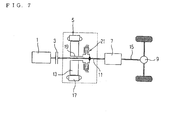
- Non-patent Document 2 discloses an art in which a motor output shaft 19 is structured separately from an engine drive shaft system 11 and a clutch mechanism 21 formed by a dog clutch is mounted between the motor output shaft 19 and the engine drive shaft system 11, as illustrated in Fig. 7 .
- the power transmission mechanism of the hybrid system in Fig. 7 is structured on assumption that it is mounted on a small two to three ton truck, and if it is to be applied to a heavy-duty truck requiring a high motor power, there is a concern about insufficient strength and insufficient durability of the dog clutch.
- the present application was devised in consideration of the above circumstances and a proposition thereof is to provide a power transmission mechanism for parallel hybrid vehicle that is capable of smoothly combining and separating input/output powers of a motor and an engine, and that is applicable to a large hybrid vehicle having a load capacity over 10 tons by ensuring sufficient strength of a mechanism for combining and separating the input/output powers.
- an embodiment according to claim 1 is a power transmission mechanism for parallel hybrid vehicle in which an engine, a main clutch, a motor/generator, a transmission, and a final reduction gear are arranged coaxially and powers of the engine and the motor/generator are used in combination, the power transmission mechanism including a motor output shaft of the motor/generator rotatable separately from an engine drive shaft system extending from the main clutch to the transmission, a motor-brake mounted on one end side of the motor output shaft to release/fix the motor output shaft, a planetary gear mechanism mounted between another end side of the motor output shaft and the engine drive shaft system and including a sun gear provided on the other end side of the motor output shaft, an outer gear provided on the engine drive shaft system and having a gear ratio to the sun gear of 1 : 1, a plurality of planetary gears with which the sun gear and the outer gear are engaged, and a planetary carrier picking up orbital motions of the planetary gears, and a gear brake mounted on one end side of the power transmission mechanism including a motor
- the motor output shaft is fixed and thus does not rotate, which has an advantage that a mechanical loss and an electric loss can be more reduced than conventionally and a load of the engine is reduced, resulting in improved mileage.
- the planetary gear mechanism of constant mesh type is adopted for the power transmission between the motor output shaft and the engine drive shaft system, it is possible to smoothly connect and disconnect the both shafts with/from each other, and in addition, the planetary gear mechanism can have sufficient strength, which enables the application to a heavy-duty truck requiring a high motor power.
- Fig. 1 to Fig. 4 illustrate a first embodiment of a power transmission mechanism of a parallel hybrid vehicle according to claim 1, and as in the conventional example in Fig. 6 , the arrangement of a driving system of a hybrid system according to this embodiment is such that an engine 21, a main clutch (single plate clutch) 23, a motor (motor/generator) 25, a transmission 27, and a final reduction gear 29 are all arranged coaxially in the order mentioned.
- An engine drive shaft system 31 extends from the main clutch 23 to the transmission 27, and a propeller shaft 33 is coupled between the transmission 27 and the final gear 29.
- 35 denotes a motor output shaft attached to a rotor 37 of the motor 25, and the motor output shaft 35 is structured separately from the engine drive shaft system 31 and is rotatably supported by a not-illustrated motor body via a bearing.
- a motor-brake 39 releasing/fixing the motor output shaft 35 is mounted on one end, of the motor output shaft 35, closer to the main clutch 23.
- the motor-brake 39 has a structure similar to a disk brake, for instance, and when a brake disk 41 provided on the motor output shaft 35 is sandwiched by not-illustrated brake pads or the like (the motor-brake 39 is fixed), the rotation of the motor output shaft 35 is braked, so that the motor output shaft 35 is fixed, and when the brake pads or the like separate from the brake disk 41 (the motor-brake 39 is released), the braking to the motor output shaft 35 is cancelled.
- a planetary gear mechanism 43 is provided between the other end side of the motor output shaft 35 and the engine drive shaft system 31 .
- the planetary gear mechanism 43 includes: a sun gear 45 provided on the other end side of the motor output shaft 35; an outer gear 47 attached to the engine drive shaft system 31 to face the sun gear 45; a plurality of planetary gears 49 with which the sun gear 45 and the outer gear 47 are engaged; and a planetary carrier 51 picking up orbital motions of the planetary gears 49, and the sun gear 45 and the outer gear 47 are formed as if they are a pair of right and left differential side gears of a conventionally-known differential gear, and their gear ratio is set to 1 : 1, meaning that their radii of rotation are equal. Therefore, as illustrated in the drawing, rotation shafts of the planetary gears 49 attached to the planetary carrier 51 are set at a right angle to the motor output shaft 35.
- a gear brake 53 is provided to release/fix the planetary carrier 51 to release/fix the orbital rotation of the planetary gears 49.
- the gear brake 35 also has a structure similar to a disk brake, for instance, and when a brake disk 55 provided on the other end side of the planetary gears 49 is sandwiched by not-illustrated brake pads or the like (the gear brake 53 is fixed), the rotation of the planetary carrier 51 is braked, so that the orbital rotation of the planetary gears 49 is fixed, and when the brake pads or the like separate from the brake disk 55 (the gear brake 53 is released), the braking to the planetary carrier 51 is cancelled, so that the planetary gears 49 are again capable of orbital rotation.
- the power transmission mechanism 57 according to this embodiment is structured as described above, and the operation thereof will be described next.
- the gear brake 53 (the planetary carrier 51) is "fixed", the main clutch 23 is disconnected, and the motor-brake 39 (the motor output shaft 35) is "released” by having the brake pads or the like separate from the brake disk 41 as illustrated in Fig. 3 , so that the orbital rotation of the planetary gears 49 is restricted, and consequently only the driving force of the motor 25 is transmitted from the engine drive shaft system 31 to the transmission via the sun gear 45, the planetary gears 49, and the outer gear 47 and the vehicle starts only with the driving force of the motor 25. Then, connecting the main clutch 23 at an instant when the vehicle reaches a prescribed speed as illustrated in Fig.
- the motor-brake 39 (the motor output shaft 35) is “fixed” by having the brake pads or the like sandwich the brake disk 41, and the gear brake 53 (the planetary carrier 51) is “released” by having the brake pads or the like separate from the brake disk 55 as illustrated in Fig. 4 , the motor 25 stops and the planetary gears 49 make the orbital rotation while rotating on their axes, so that the planetary gears 49 and the planetary carrier 51 rotate free and the vehicle drives only with the driving force of the engine 21.
- a controller (not illustrated) to release/fix the motor-brake 39 and the gear brake 53 as in Fig. 2 to Fig. 4 according to the situation such as whether the vehicle is in a driving state where a load is applied to the engine 21, such as the uphill driving, and based on the detection of a battery volume and a depression amount of the accel pedal when, for example, the vehicle starts driving,
- the controller operates the main clutch 23, the motor-brake 39, and the gear brake 53 to the state in Fig. 3 , so that the regenerative brake corresponding to the foot brake and the engine brake is applied to suddenly brake the vehicle.
- this embodiment can reduce a mechanical loss and an electric loss more than the conventional example illustrated in Fig. 6 because of the structure where the motor output shaft 35 is fixed when the motor 25 is in non-operation as illustrated in Fig. 4 , which has an advantage that a load of the engine 21 is reduced and mileage is improved.
- the planetary gear mechanism 43 of constant mesh type is adopted instead of the clutch mechanism 21 formed by the dog clutch in Fig. 7 , it is possible to smoothly connect and disconnect the both shafts 35, 31 with/from each other, and the planetary gear mechanism 43 can have sufficient strength, which enables the application to a heavy-duty truck requiring a high motor power.
- the sun gear 45 and the outer gear 47 of the planetary gear mechanism 43 are formed as if they are a pair of right and left differential side gears of a differential gear, with their gear ratio being 1 : 1, meaning that their radii of rotation are equal, and the rotation shafts of the planetary gears 49 attached to the planetary carrier 51 are set at a right angle to the motor output shaft 35, but another alternative structure may be such that, as illustrated in Fig.
- a sun gear 63 and an outer gear 65 of a planetary gear mechanism 61 are formed as a spur gear system whose gear ratio is 1 : 1
- planetary gears 67 engaged with both of the gears 63, 65 are formed as a spur gear system
- rotation shafts of the planetary gears 67 attached to a planetary carrier 69 are set parallel to the motor output shaft 35.
- the other structure is the same as that of the embodiment in Fig. 1 , and therefore, the same components are denoted by the same reference numerals and description thereof will be omitted.
- a power transmission mechanism 71 according to this embodiment is thus structured, and similarly to the aforesaid embodiment, this embodiment can also attain the desired propositions, that is, it is possible to smoothly connect and disconnect the motor output shaft 35 and the engine drive shaft system 31 with/from each other, and the planetary gear mechanism 61 can have sufficient strength, which enables the application to a heavy-duty truck requiring a high motor power.
Landscapes
- Engineering & Computer Science (AREA)
- Transportation (AREA)
- Mechanical Engineering (AREA)
- Chemical & Material Sciences (AREA)
- Combustion & Propulsion (AREA)
- Power Engineering (AREA)
- Physics & Mathematics (AREA)
- Electromagnetism (AREA)
- Electric Propulsion And Braking For Vehicles (AREA)
- Hybrid Electric Vehicles (AREA)
Abstract
Description
- The present application relates to a power transmission mechanism for hybrid vehicle, more particularly, to a power transmission mechanism for parallel hybrid vehicle using powers of an engine and a motor/generator in combination.
- As disclosed in Non-patent Document 1, with the aim of improving mileage by reducing a load applied to an engine in a commercial vehicle such as a truck, there has recently been proposed a parallel hybrid system using an assisting power of a motor during driving where a load is applied to the engine such as during start-up or during uphill driving.
- As illustrated in
Fig. 6 , the arrangement of a driving system of the above hybrid system is such that an engine 1, a main clutch (single plate clutch) 3, a motor (motor/generator) 5, atransmission 7, and afinal reduction gear 9 are all arranged coaxially in the order mentioned. A rotor 1 3 of themotor 5 is attached to an engine drive shaft system 11 extending from themain clutch 3 to thetransmission 7, and apropeller shaft 15 is coupled between thetransmission 7 and thefinal gear 9. - With this structure, the aforesaid hybrid system starts only with a driving force of the
motor 5 with theclutch 3 being disconnected, and when the vehicle reaches a prescribed speed (in the vicinity of about 5 to 6 km/h), it synchronizes the rotations of the engine 1 and themotor 5, connects theclutch 3, and starts driving only with the engine 1. - Then, during the driving where a load is applied, such as during uphill driving, the system enters high-power driving where the engine 1 and the
motor 5 are used in combination according to a depression amount of an accel pedal, and during deceleration/braking, according to the situation, theclutch 3 is disconnected and themotor 5 is reversely operated, whereby a regenerative brake corresponding to an engine brake is applied, and a regenerative energy is stored in batteries. - However, a power transmission mechanism of the aforesaid hybrid system has a drawback that during the driving only with the driving force of the engine 1, a mechanical loss occurs due to an influence of a magnet put on the
rotor 13. Further, supplying electricity to astator 17 of themotor 5 in order to cancel such a load loss newly causes the occurrence of an electric loss. - As a power transmission mechanism of a hybrid system realizing a reduction of such a loss, Non-patent Document 2 discloses an art in which a
motor output shaft 19 is structured separately from an engine drive shaft system 11 and aclutch mechanism 21 formed by a dog clutch is mounted between themotor output shaft 19 and the engine drive shaft system 11, as illustrated inFig. 7 . -
- Non-patent Document 1: "Monthly Automotive Engineering" published by Tetsudo-Nipponsha Co., Ltd., October, 2006
- Non-patent Document 2: "Isuzu Technical Report" published by Isuzu Motors Ltd., No. 113, 2005
- However, smooth connection/disconnection of the dog clutch forming the
aforesaid clutch mechanism 21 requires highly precise and complicated synchronization control of the rotation speeds. - Further, the power transmission mechanism of the hybrid system in
Fig. 7 is structured on assumption that it is mounted on a small two to three ton truck, and if it is to be applied to a heavy-duty truck requiring a high motor power, there is a concern about insufficient strength and insufficient durability of the dog clutch. - The present application was devised in consideration of the above circumstances and a proposition thereof is to provide a power transmission mechanism for parallel hybrid vehicle that is capable of smoothly combining and separating input/output powers of a motor and an engine, and that is applicable to a large hybrid vehicle having a load capacity over 10 tons by ensuring sufficient strength of a mechanism for combining and separating the input/output powers.
- To attain such a proposition, an embodiment according to claim 1 is a power transmission mechanism for parallel hybrid vehicle in which an engine, a main clutch, a motor/generator, a transmission, and a final reduction gear are arranged coaxially and powers of the engine and the motor/generator are used in combination, the power transmission mechanism including a motor output shaft of the motor/generator rotatable separately from an engine drive shaft system extending from the main clutch to the transmission, a motor-brake mounted on one end side of the motor output shaft to release/fix the motor output shaft, a planetary gear mechanism mounted between another end side of the motor output shaft and the engine drive shaft system and including a sun gear provided on the other end side of the motor output shaft, an outer gear provided on the engine drive shaft system and having a gear ratio to the sun gear of 1 : 1, a plurality of planetary gears with which the sun gear and the outer gear are engaged, and a planetary carrier picking up orbital motions of the planetary gears, and a gear brake mounted on one end side of the planetary carrier to release/fix the planetary carrier, in which, when the main clutch and the gear brake are fixed and the motor-brake is released, a driving force of the motor/generator is transmitted from the planetary gear mechanism to the engine drive shaft system to be combined with a driving force of the engine, when the main clutch and the motor-brake are released and the gear brake is fixed, only the driving force of the motor/generator is transmitted from the engine drive shaft system to the transmission, and the motor/generator reversely operates to apply a regenerative brake during braking of the vehicle, and when the main clutch and the motor-brake are fixed and the gear brake is released, only the driving force of the engine is transmitted from the engine drive shaft system to the transmission.
- According to the embodiment according to claim 1, when the motor/generator is in non-operation, the motor output shaft is fixed and thus does not rotate, which has an advantage that a mechanical loss and an electric loss can be more reduced than conventionally and a load of the engine is reduced, resulting in improved mileage.
- Further, since the planetary gear mechanism of constant mesh type is adopted for the power transmission between the motor output shaft and the engine drive shaft system, it is possible to smoothly connect and disconnect the both shafts with/from each other, and in addition, the planetary gear mechanism can have sufficient strength, which enables the application to a heavy-duty truck requiring a high motor power.
-
-
Fig. 1 is a schematic block diagram of a power transmission mechanism according to a first embodiment of claim 1. -
Fig. 2 is a schematic block diagram of the power transmission mechanism when an engine and a motor are used in combination. -
Fig. 3 is a schematic block diagram of the power transmission mechanism when only a driving force of the motor is used for driving. -
Fig. 4 is a schematic block diagram of the power transmission mechanism when only a driving force of the engine is used for driving. -
Fig. 5 is a schematic block diagram of a power transmission mechanism according to a second embodiment of claim 1. -
Fig. 6 is a schematic block diagram of a conventional power transmission mechanism. -
Fig. 7 is a schematic block diagram of another conventional power transmission mechanism. - Hereinafter, embodiments of the present invention will be described in detail based on the drawings.
-
Fig. 1 to Fig. 4 illustrate a first embodiment of a power transmission mechanism of a parallel hybrid vehicle according to claim 1, and as in the conventional example inFig. 6 , the arrangement of a driving system of a hybrid system according to this embodiment is such that anengine 21, a main clutch (single plate clutch) 23, a motor (motor/generator) 25, atransmission 27, and afinal reduction gear 29 are all arranged coaxially in the order mentioned. An enginedrive shaft system 31 extends from themain clutch 23 to thetransmission 27, and apropeller shaft 33 is coupled between thetransmission 27 and thefinal gear 29. - Further, in the drawings, 35 denotes a motor output shaft attached to a
rotor 37 of themotor 25, and themotor output shaft 35 is structured separately from the enginedrive shaft system 31 and is rotatably supported by a not-illustrated motor body via a bearing. A motor-brake 39 releasing/fixing themotor output shaft 35 is mounted on one end, of themotor output shaft 35, closer to themain clutch 23. - The motor-
brake 39 has a structure similar to a disk brake, for instance, and when abrake disk 41 provided on themotor output shaft 35 is sandwiched by not-illustrated brake pads or the like (the motor-brake 39 is fixed), the rotation of themotor output shaft 35 is braked, so that themotor output shaft 35 is fixed, and when the brake pads or the like separate from the brake disk 41 (the motor-brake 39 is released), the braking to themotor output shaft 35 is cancelled. - Between the other end side of the
motor output shaft 35 and the enginedrive shaft system 31, aplanetary gear mechanism 43 is provided. - As illustrated in
Fig. 1 , theplanetary gear mechanism 43 includes: asun gear 45 provided on the other end side of themotor output shaft 35; anouter gear 47 attached to the enginedrive shaft system 31 to face thesun gear 45; a plurality ofplanetary gears 49 with which thesun gear 45 and theouter gear 47 are engaged; and aplanetary carrier 51 picking up orbital motions of theplanetary gears 49, and thesun gear 45 and theouter gear 47 are formed as if they are a pair of right and left differential side gears of a conventionally-known differential gear, and their gear ratio is set to 1 : 1, meaning that their radii of rotation are equal. Therefore, as illustrated in the drawing, rotation shafts of theplanetary gears 49 attached to theplanetary carrier 51 are set at a right angle to themotor output shaft 35. - On the other end side of the
planetary carrier 51, agear brake 53 is provided to release/fix theplanetary carrier 51 to release/fix the orbital rotation of theplanetary gears 49. - Similarly to the motor-
brake 39, thegear brake 35 also has a structure similar to a disk brake, for instance, and when abrake disk 55 provided on the other end side of theplanetary gears 49 is sandwiched by not-illustrated brake pads or the like (thegear brake 53 is fixed), the rotation of theplanetary carrier 51 is braked, so that the orbital rotation of theplanetary gears 49 is fixed, and when the brake pads or the like separate from the brake disk 55 (thegear brake 53 is released), the braking to theplanetary carrier 51 is cancelled, so that theplanetary gears 49 are again capable of orbital rotation. - The
power transmission mechanism 57 according to this embodiment is structured as described above, and the operation thereof will be described next. - First, as illustrated in
Fig. 2 , for instance, when themain clutch 23 is connected to be "fixed", the gear brake 53 (the planetary gears 49) is "fixed" by having the brake pads or the like sandwich thebrake disk 55, and the motor-brake 39 (the motor output shaft 35) is "released" by having the brake pads or the like separate from thebrake disk 41, the orbital rotation of theplanetary gears 49 is restricted and they are only capable of rotating on their axes. - As a result, the
motor 25 and the enginedrive shaft system 31 are connected, the driving force of themotor 25 is transmitted from thesun gear 45 via theplanetary gears 49 and theouter gear 47 to the enginedrive shaft system 31, resulting in what is called "motor full, engine assist" where the driving force of themotor 25 is used in combination with the driving force of theengine 21. - Further, for example, where the vehicle is started only with the driving force of the
motor 25 without using theengine 21, the gear brake 53 (the planetary carrier 51) is "fixed", themain clutch 23 is disconnected, and the motor-brake 39 (the motor output shaft 35) is "released" by having the brake pads or the like separate from thebrake disk 41 as illustrated inFig. 3 , so that the orbital rotation of theplanetary gears 49 is restricted, and consequently only the driving force of themotor 25 is transmitted from the enginedrive shaft system 31 to the transmission via thesun gear 45, theplanetary gears 49, and theouter gear 47 and the vehicle starts only with the driving force of themotor 25. Then, connecting themain clutch 23 at an instant when the vehicle reaches a prescribed speed as illustrated inFig. 2 results in the aforesaid "motor full, engine assist", and at the time of the braking of the vehicle, when themain clutch 23 is disconnected from the state inFig. 2 as illustrated inFig. 3 , a torque fromtires 59 is input to themotor 25 via theplanetary gear mechanism 43 to cause the reverse operation of themotor 25, so that a regenerative brake corresponding to an engine brake is applied and a regenerative energy is stored in batteries. - On the other hand, when the
main clutch 23 is connected to be "fixed", the motor-brake 39 (the motor output shaft 35) is "fixed" by having the brake pads or the like sandwich thebrake disk 41, and the gear brake 53 (the planetary carrier 51) is "released" by having the brake pads or the like separate from thebrake disk 55 as illustrated inFig. 4 , themotor 25 stops and theplanetary gears 49 make the orbital rotation while rotating on their axes, so that theplanetary gears 49 and theplanetary carrier 51 rotate free and the vehicle drives only with the driving force of theengine 21. - Therefore, it is only necessary for a controller (not illustrated) to release/fix the motor-
brake 39 and thegear brake 53 as inFig. 2 to Fig. 4 according to the situation such as whether the vehicle is in a driving state where a load is applied to theengine 21, such as the uphill driving, and based on the detection of a battery volume and a depression amount of the accel pedal when, for example, the vehicle starts driving, - [1] when the accel pedal is strongly pressed down because of hill start and there is a sufficient battery volume, the controller "fixes" the
gear brake 53 and "releases" the motor-brake 39 as inFig. 2 , which results in high-power driving where the driving forces of theengine 21 and themotor 25 are used in combination. - Further, for example,
- [2] when the battery volume is not large enough to drive the
motor 25 even though the accelerator is strongly pressed down because of the hill start, the controller "releases" thegear brake 53 and "fixes" the motor-brake 39 as illustrated inFig. 4 , so that the vehicle drives only with the driving force of theengine 21. - Further,
- [3] when the accel pedal is pressed down slightly because of the start on a flat road and the battery volume is sufficient, the controller "fixes" the
gear brake 53 and "releases" the motor-brake 39 as illustrated inFig. 3 , so that the vehicle starts only with the driving force of themotor 25 as previously described. Then, when the vehicle reaches a prescribed speed, the driver's connection of the main clutch 23 as illustrated inFig. 2 results in "motor full, engine assist" inFig. 2 , and at the time of the braking of the vehicle, when the controller determines that the battery volume is insufficient to disconnect the main clutch 23 from the state inFig. 2 as illustrated inFig. 3 , the regenerative brake corresponding to the engine brake is applied to themotor 25 and the regenerative energy is stored in the batteries. - Further, when the detection of the depression amount of the brake pedal indicates that the brake pedal is pressed down strongly, the controller operates the main clutch 23, the motor-
brake 39, and thegear brake 53 to the state inFig. 3 , so that the regenerative brake corresponding to the foot brake and the engine brake is applied to suddenly brake the vehicle. - As described above, this embodiment can reduce a mechanical loss and an electric loss more than the conventional example illustrated in
Fig. 6 because of the structure where themotor output shaft 35 is fixed when themotor 25 is in non-operation as illustrated inFig. 4 , which has an advantage that a load of theengine 21 is reduced and mileage is improved. - Further, in this embodiment, since, for the power transmission between the
motor output shaft 35 and the enginedrive shaft system 31, theplanetary gear mechanism 43 of constant mesh type is adopted instead of theclutch mechanism 21 formed by the dog clutch inFig. 7 , it is possible to smoothly connect and disconnect the bothshafts planetary gear mechanism 43 can have sufficient strength, which enables the application to a heavy-duty truck requiring a high motor power. - As described above, in the above embodiment, the
sun gear 45 and theouter gear 47 of theplanetary gear mechanism 43 are formed as if they are a pair of right and left differential side gears of a differential gear, with their gear ratio being 1 : 1, meaning that their radii of rotation are equal, and the rotation shafts of theplanetary gears 49 attached to theplanetary carrier 51 are set at a right angle to themotor output shaft 35, but another alternative structure may be such that, as illustrated inFig. 5 , asun gear 63 and anouter gear 65 of aplanetary gear mechanism 61 are formed as a spur gear system whose gear ratio is 1 : 1,planetary gears 67 engaged with both of thegears planetary gears 67 attached to aplanetary carrier 69 are set parallel to themotor output shaft 35. The other structure is the same as that of the embodiment inFig. 1 , and therefore, the same components are denoted by the same reference numerals and description thereof will be omitted. - A
power transmission mechanism 71 according to this embodiment is thus structured, and similarly to the aforesaid embodiment, this embodiment can also attain the desired propositions, that is, it is possible to smoothly connect and disconnect themotor output shaft 35 and the enginedrive shaft system 31 with/from each other, and theplanetary gear mechanism 61 can have sufficient strength, which enables the application to a heavy-duty truck requiring a high motor power. -
- 21
- engine
- 23
- main clutch
- 25
- motor (motor/generator)
- 27
- transmission
- 29
- final reduction gear
- 31
- engine drive shaft system
- 33
- propeller shaft
- 35
- motor output shaft
- 37
- rotor
- 39
- motor-brake
- 41, 55
- brake disk
- 43, 61
- planetary gear mechanism
- 45, 63
- sun gear
- 47,65
- outer gear
- 49, 67
- planetary gear
- 51, 69
- planetary carrier
- 53
- gear brake
- 57, 71
- power transmission mechanism
- 59
- tire
Claims (1)
- A power transmission mechanism for parallel hybrid vehicle in which an engine, a main clutch, a motor/generator, a transmission, and a final reduction gear are arranged coaxially and powers of the engine and the motor/generator are used in combination, the power transmission mechanism comprising:a motor output shaft of the motor/generator rotatable separately from an engine drive shaft system extending from the main clutch to the transmission;a motor-brake mounted on one end side of the motor output shaft to release/fix the motor output shaft;a planetary gear mechanism provided between another end side of the motor output shaft and the engine drive shaft system and including a sun gear provided on the other end side of the motor output shaft, an outer gear provided on the engine drive shaft system and having a gear ratio to the the sun gear of 1 : 1, a plurality of planetary gears with which the sun gear and the outer gear are engaged, and a planetary carrier picking up orbital motions of the planetary gears; anda gear brake mounted on one end side of the planetary carrier to release/fix the planetary carrier, wherein:when the main clutch and the gear brake are fixed and the motor-brake is released, a driving force of the motor/generator is transmitted from the planetary gear mechanism to the engine drive shaft system to be combined with a driving force of the engine;when the main clutch and the motor-brake are released and the gear brake is fixed, only the driving force of the motor/generator is transmitted from the engine drive shaft system to the transmission, and the motor/generator reversely operates to apply a regenerative brake during braking of the vehicle; andwhen the main clutch and the motor-brake are fixed and the gear brake is released, only the driving force of the engine is transmitted from the engine drive shaft system to the transmission.
Applications Claiming Priority (2)
| Application Number | Priority Date | Filing Date | Title |
|---|---|---|---|
| JP2009112749A JP5133935B2 (en) | 2009-05-07 | 2009-05-07 | Power transmission mechanism of parallel hybrid vehicle |
| PCT/JP2009/006187 WO2010128542A1 (en) | 2009-05-07 | 2009-11-18 | Power transmission mechanism for parallel hybrid vehicle |
Publications (2)
| Publication Number | Publication Date |
|---|---|
| EP2428383A1 true EP2428383A1 (en) | 2012-03-14 |
| EP2428383A4 EP2428383A4 (en) | 2013-10-09 |
Family
ID=43050055
Family Applications (1)
| Application Number | Title | Priority Date | Filing Date |
|---|---|---|---|
| EP09844329.4A Withdrawn EP2428383A4 (en) | 2009-05-07 | 2009-11-18 | Power transmission mechanism for parallel hybrid vehicle |
Country Status (5)
| Country | Link |
|---|---|
| US (1) | US8430777B2 (en) |
| EP (1) | EP2428383A4 (en) |
| JP (1) | JP5133935B2 (en) |
| CN (1) | CN102421618B (en) |
| WO (1) | WO2010128542A1 (en) |
Families Citing this family (22)
| Publication number | Priority date | Publication date | Assignee | Title |
|---|---|---|---|---|
| JP5133935B2 (en) * | 2009-05-07 | 2013-01-30 | Udトラックス株式会社 | Power transmission mechanism of parallel hybrid vehicle |
| JP2010269765A (en) * | 2009-05-25 | 2010-12-02 | Ud Trucks Corp | Power transmitting mechanism for hybrid vehicle |
| JP5310937B2 (en) * | 2010-03-30 | 2013-10-09 | トヨタ自動車株式会社 | Drive control apparatus for hybrid vehicle |
| US8784248B2 (en) * | 2010-03-30 | 2014-07-22 | Toyota Jidosha Kabushiki Kaisha | Engine start control device of hybrid vehicle |
| WO2012053596A1 (en) * | 2010-10-22 | 2012-04-26 | 日野自動車株式会社 | Vehicle, control method, and program |
| KR101999876B1 (en) * | 2012-02-03 | 2019-07-12 | 지이 하이브리드 테크놀로지스, 엘엘씨 | Apparatus and method for delivering power in a hybrid vehicle |
| US20140031158A1 (en) * | 2012-07-30 | 2014-01-30 | SCHAEFFLER TECHOLOGIES AG & Co. KG | Planetary hybrid transmission |
| US9551400B2 (en) * | 2012-09-14 | 2017-01-24 | Toyota Jidosha Kabushiki Kaisha | Power transmission device of hybrid vehicle and hybrid system |
| DE102012220827A1 (en) * | 2012-11-15 | 2014-05-15 | Zf Friedrichshafen Ag | Drive unit for a hybrid vehicle and method for operating the same |
| GB2508670A (en) * | 2012-12-10 | 2014-06-11 | Jaguar Land Rover Ltd | Hybrid vehicle and boost control for gradients |
| US9108505B2 (en) * | 2013-05-28 | 2015-08-18 | Ford Global Technologies, Llc | Powersplit powertrain for a hybrid electric vehicle |
| US9150219B2 (en) | 2014-02-21 | 2015-10-06 | Ford Global Technologies, Llc | Hybrid electric vehicle and method of starting engine |
| CN105465296B (en) * | 2014-07-28 | 2020-01-03 | 舍弗勒技术股份两合公司 | Electric stepless speed variator |
| KR20160038142A (en) * | 2014-09-29 | 2016-04-07 | 현대자동차주식회사 | Power train for hybrid vehicle |
| KR20160073234A (en) * | 2014-12-16 | 2016-06-24 | 현대자동차주식회사 | Hybrid powertrain |
| TWI539100B (en) | 2014-12-22 | 2016-06-21 | 財團法人工業技術研究院 | Powertrain for hybird electric vehicle |
| CN105235493A (en) * | 2015-09-29 | 2016-01-13 | 江苏金源锻造股份有限公司 | Hybrid power coupling system with flanged shaft |
| CN107323245B (en) * | 2017-08-15 | 2023-04-28 | 吉林省晟林汽车传动科技有限公司 | 4DHT hybrid electric vehicle transmission |
| CN107599820A (en) * | 2017-10-24 | 2018-01-19 | 广西玉柴机器股份有限公司 | Hybrid drive train |
| CN108032724B (en) * | 2018-01-10 | 2023-08-22 | 沈阳大学 | Double-planetary-gear-system type automobile hybrid power system |
| CN111923717B (en) * | 2020-07-03 | 2021-05-18 | 北方汤臣传动科技有限公司 | Variable speed ratio hybrid power driving system for mining truck |
| CN112297820B (en) * | 2020-11-02 | 2022-08-12 | 奇瑞汽车股份有限公司 | Hybrid power system |
Family Cites Families (24)
| Publication number | Priority date | Publication date | Assignee | Title |
|---|---|---|---|---|
| JP2857535B2 (en) * | 1992-05-19 | 1999-02-17 | 株式会社エクォス・リサーチ | Hybrid vehicle |
| JP3409522B2 (en) * | 1995-07-11 | 2003-05-26 | アイシン・エィ・ダブリュ株式会社 | Control device for vehicle drive unit |
| US5801499A (en) | 1995-07-11 | 1998-09-01 | Aisin Aw Co., Ltd. | Control system for a vehicular drive unit |
| DE19915926B4 (en) * | 1998-09-05 | 2004-05-13 | Zf Sachs Ag | Drive arrangement for a motor vehicle |
| FR2782958B1 (en) * | 1998-09-05 | 2005-11-04 | Mannesmann Sachs Ag | DRIVE SYSTEM FOR A MOTOR VEHICLE WITH INTERNAL COMBUSTION ENGINE AND ELECTRIC MOTOR |
| EP1918150B1 (en) | 2001-12-26 | 2012-11-21 | Toyota Jidosha Kabushiki Kaisha | Drive apparatus for hybrid vehicle |
| JP3536837B2 (en) | 2001-12-26 | 2004-06-14 | トヨタ自動車株式会社 | Drive unit for hybrid vehicle |
| JP2004248382A (en) * | 2003-02-12 | 2004-09-02 | Mitsubishi Motors Corp | Hybrid car |
| JP4127123B2 (en) * | 2003-06-06 | 2008-07-30 | アイシン・エィ・ダブリュ株式会社 | Hybrid vehicle drive control apparatus and hybrid vehicle drive control method |
| JP4218593B2 (en) * | 2003-12-26 | 2009-02-04 | トヨタ自動車株式会社 | Vehicle drive device |
| CN1778587A (en) * | 2004-11-26 | 2006-05-31 | 比亚迪股份有限公司 | Hybrid Vehicle Drive System |
| FR2907382B1 (en) * | 2006-10-23 | 2009-05-08 | Renault Sas | INFINITELY VARIABLE HYBRID TRANSMISSION AND POWER DERIVING POWER UNIT COMPRISING THREE EPICYCLOIDAL TRAINS ON A SINGLE LINE. |
| DE102006059591A1 (en) * | 2006-12-16 | 2008-06-19 | Zf Friedrichshafen Ag | Hybrid powertrain of a motor vehicle |
| JP2008168783A (en) * | 2007-01-11 | 2008-07-24 | Hitachi Ltd | Vehicle drive device |
| JP4450017B2 (en) * | 2007-06-22 | 2010-04-14 | トヨタ自動車株式会社 | Power output apparatus and hybrid vehicle equipped with the same |
| DE102007042949A1 (en) * | 2007-09-10 | 2009-04-02 | Georg Hienz | Automatic electro-mechanical gear for hybrid vehicles or vehicles with internal combustion engine drive, has output shaft of internal combustion engine, which is connected with gear ring of planetary gear and with input shaft of double gear |
| US20090071733A1 (en) * | 2007-09-18 | 2009-03-19 | Zhihui Duan | Hybrid electric vehicle |
| US7980980B2 (en) * | 2007-11-14 | 2011-07-19 | GM Global Technology Operations LLC | Hybrid powertrain |
| JP5133935B2 (en) * | 2009-05-07 | 2013-01-30 | Udトラックス株式会社 | Power transmission mechanism of parallel hybrid vehicle |
| DE102010061824B4 (en) * | 2010-11-24 | 2023-08-24 | Zf Friedrichshafen Ag | Power train and method of operating the same |
| US9156344B2 (en) * | 2010-12-13 | 2015-10-13 | GM Global Technology Operations LLC | Motor-assisted transmission |
| US9028362B2 (en) * | 2011-02-01 | 2015-05-12 | Jing He | Powertrain and method for a kinetic hybrid vehicle |
| US8469849B2 (en) * | 2011-03-25 | 2013-06-25 | Delphi Technologies, Inc. | Hybrid vehicle system and controller |
| KR101282721B1 (en) * | 2011-04-01 | 2013-07-04 | 한국과학기술원 | Gear transmission having multiple input axles and transmission device using the same |
-
2009
- 2009-05-07 JP JP2009112749A patent/JP5133935B2/en not_active Expired - Fee Related
- 2009-11-18 WO PCT/JP2009/006187 patent/WO2010128542A1/en not_active Ceased
- 2009-11-18 CN CN200980159126.0A patent/CN102421618B/en not_active Expired - Fee Related
- 2009-11-18 US US13/318,612 patent/US8430777B2/en not_active Expired - Fee Related
- 2009-11-18 EP EP09844329.4A patent/EP2428383A4/en not_active Withdrawn
Also Published As
| Publication number | Publication date |
|---|---|
| US8430777B2 (en) | 2013-04-30 |
| JP2010260438A (en) | 2010-11-18 |
| WO2010128542A1 (en) | 2010-11-11 |
| US20120115659A1 (en) | 2012-05-10 |
| CN102421618B (en) | 2014-01-08 |
| JP5133935B2 (en) | 2013-01-30 |
| EP2428383A4 (en) | 2013-10-09 |
| CN102421618A (en) | 2012-04-18 |
Similar Documents
| Publication | Publication Date | Title |
|---|---|---|
| US8430777B2 (en) | Power transmission mechanism for parallel hybrid vehicle | |
| US8585523B2 (en) | Power transmitting mechanism for hybrid vehicle | |
| US7572201B2 (en) | Electric hybrid powertrain system | |
| KR101725882B1 (en) | Hybrid powertrain with a gearbox and method to control such a hybrid drivetrain | |
| CN103003082B (en) | The power assembly system of motor vehicles and operation method thereof | |
| US8480525B2 (en) | Hybrid vehicle transmission | |
| JP3384341B2 (en) | Drive unit for hybrid vehicles | |
| US20100038157A1 (en) | Power output apparatus and hybrid vehicle | |
| US8152671B2 (en) | Single clutch, two planetary hybrid architecture | |
| CN104010873A (en) | Vehicle control system | |
| GB2455507A (en) | Electric motor vehicle emergency braking system | |
| CN101434193A (en) | Series-parallel connection type hybrid power drive system and coach with the same | |
| US8790216B2 (en) | Device and method for operating a drive having an electrically drivable axle | |
| CN216279223U (en) | Hybrid power system and speed change assembly | |
| CN216507868U (en) | Automobile hybrid power transmission device and automobile | |
| CN112937284A (en) | Hybrid power transmission device | |
| KR101475873B1 (en) | Electric power device for vehicle | |
| JP2009023372A (en) | Hybrid vehicle power transmission mechanism | |
| KR101491221B1 (en) | Hybrid powertrain | |
| JP2005238922A (en) | Control device for hybrid vehicle | |
| CN113232515A (en) | Device for realizing low-speed braking energy recovery and integration | |
| CN201176122Y (en) | A hybrid drive system and passenger car with the drive system | |
| CN114851828A (en) | Variable speed transmission system and vehicle | |
| CN121316536A (en) | Driving system of vehicle and vehicle | |
| JP2023028077A (en) | Hybrid vehicle transmission control device |
Legal Events
| Date | Code | Title | Description |
|---|---|---|---|
| PUAI | Public reference made under article 153(3) epc to a published international application that has entered the european phase |
Free format text: ORIGINAL CODE: 0009012 |
|
| 17P | Request for examination filed |
Effective date: 20111107 |
|
| AK | Designated contracting states |
Kind code of ref document: A1 Designated state(s): AT BE BG CH CY CZ DE DK EE ES FI FR GB GR HR HU IE IS IT LI LT LU LV MC MK MT NL NO PL PT RO SE SI SK SM TR |
|
| DAX | Request for extension of the european patent (deleted) | ||
| A4 | Supplementary search report drawn up and despatched |
Effective date: 20130911 |
|
| RIC1 | Information provided on ipc code assigned before grant |
Ipc: B60K 6/547 20071001ALI20130905BHEP Ipc: B60K 6/387 20071001ALI20130905BHEP Ipc: B60K 6/48 20071001ALI20130905BHEP Ipc: B60K 6/365 20071001AFI20130905BHEP |
|
| GRAP | Despatch of communication of intention to grant a patent |
Free format text: ORIGINAL CODE: EPIDOSNIGR1 |
|
| INTG | Intention to grant announced |
Effective date: 20160603 |
|
| STAA | Information on the status of an ep patent application or granted ep patent |
Free format text: STATUS: GRANT OF PATENT IS INTENDED |
|
| STAA | Information on the status of an ep patent application or granted ep patent |
Free format text: STATUS: THE APPLICATION IS DEEMED TO BE WITHDRAWN |
|
| 18D | Application deemed to be withdrawn |
Effective date: 20161014 |