EP2425850A2 - Bispecific single chain FV antibody molecules and methods of use thereof - Google Patents
Bispecific single chain FV antibody molecules and methods of use thereof Download PDFInfo
- Publication number
- EP2425850A2 EP2425850A2 EP11177829A EP11177829A EP2425850A2 EP 2425850 A2 EP2425850 A2 EP 2425850A2 EP 11177829 A EP11177829 A EP 11177829A EP 11177829 A EP11177829 A EP 11177829A EP 2425850 A2 EP2425850 A2 EP 2425850A2
- Authority
- EP
- European Patent Office
- Prior art keywords
- antibody
- antibodies
- bispecific
- bispecific antibody
- seq
- Prior art date
- Legal status (The legal status is an assumption and is not a legal conclusion. Google has not performed a legal analysis and makes no representation as to the accuracy of the status listed.)
- Granted
Links
- 238000000034 method Methods 0.000 title description 34
- 206010028980 Neoplasm Diseases 0.000 claims abstract description 89
- 201000011510 cancer Diseases 0.000 claims abstract description 55
- 102000052116 epidermal growth factor receptor activity proteins Human genes 0.000 claims abstract 2
- 108700015053 epidermal growth factor receptor activity proteins Proteins 0.000 claims abstract 2
- 210000004027 cell Anatomy 0.000 claims description 83
- 101710100969 Receptor tyrosine-protein kinase erbB-3 Proteins 0.000 claims description 61
- 102100029986 Receptor tyrosine-protein kinase erbB-3 Human genes 0.000 claims description 61
- 101150029707 ERBB2 gene Proteins 0.000 claims description 52
- 230000027455 binding Effects 0.000 claims description 51
- 150000007523 nucleic acids Chemical group 0.000 claims description 48
- 108090000765 processed proteins & peptides Proteins 0.000 claims description 39
- 102000004196 processed proteins & peptides Human genes 0.000 claims description 23
- 229920001184 polypeptide Polymers 0.000 claims description 20
- 239000013612 plasmid Substances 0.000 claims description 14
- 210000004881 tumor cell Anatomy 0.000 claims description 14
- 238000011282 treatment Methods 0.000 claims description 13
- 230000015572 biosynthetic process Effects 0.000 claims description 8
- 239000003937 drug carrier Substances 0.000 claims description 8
- 230000019491 signal transduction Effects 0.000 claims description 8
- 230000011664 signaling Effects 0.000 claims description 8
- 108091028043 Nucleic acid sequence Proteins 0.000 claims description 7
- 230000004614 tumor growth Effects 0.000 claims description 7
- 241000700605 Viruses Species 0.000 claims description 6
- 239000003112 inhibitor Substances 0.000 claims description 6
- 230000000973 chemotherapeutic effect Effects 0.000 claims description 5
- 239000013604 expression vector Substances 0.000 claims description 5
- 230000009885 systemic effect Effects 0.000 claims description 4
- 230000009702 cancer cell proliferation Effects 0.000 claims description 2
- 102100035360 Cerebellar degeneration-related antigen 1 Human genes 0.000 claims 3
- 101100112922 Candida albicans CDR3 gene Proteins 0.000 claims 2
- 102100035361 Cerebellar degeneration-related protein 2 Human genes 0.000 claims 2
- 101000737793 Homo sapiens Cerebellar degeneration-related antigen 1 Proteins 0.000 claims 2
- 101000737796 Homo sapiens Cerebellar degeneration-related protein 2 Proteins 0.000 claims 2
- 101001012157 Homo sapiens Receptor tyrosine-protein kinase erbB-2 Proteins 0.000 claims 1
- 102100030086 Receptor tyrosine-protein kinase erbB-2 Human genes 0.000 claims 1
- 210000004978 chinese hamster ovary cell Anatomy 0.000 claims 1
- YOHYSYJDKVYCJI-UHFFFAOYSA-N n-[3-[[6-[3-(trifluoromethyl)anilino]pyrimidin-4-yl]amino]phenyl]cyclopropanecarboxamide Chemical compound FC(F)(F)C1=CC=CC(NC=2N=CN=C(NC=3C=C(NC(=O)C4CC4)C=CC=3)C=2)=C1 YOHYSYJDKVYCJI-UHFFFAOYSA-N 0.000 claims 1
- 230000002018 overexpression Effects 0.000 abstract description 7
- 230000008901 benefit Effects 0.000 abstract description 6
- 102000001301 EGF receptor Human genes 0.000 description 92
- 108060006698 EGF receptor Proteins 0.000 description 92
- 108090000623 proteins and genes Proteins 0.000 description 76
- 101710100963 Receptor tyrosine-protein kinase erbB-4 Proteins 0.000 description 75
- 102100029981 Receptor tyrosine-protein kinase erbB-4 Human genes 0.000 description 75
- 102000004169 proteins and genes Human genes 0.000 description 59
- 235000018102 proteins Nutrition 0.000 description 54
- 125000005647 linker group Chemical group 0.000 description 46
- 102000039446 nucleic acids Human genes 0.000 description 37
- 108020004707 nucleic acids Proteins 0.000 description 37
- 239000000203 mixture Substances 0.000 description 27
- 229940024606 amino acid Drugs 0.000 description 21
- 235000001014 amino acid Nutrition 0.000 description 21
- 230000014509 gene expression Effects 0.000 description 18
- 239000013598 vector Substances 0.000 description 18
- 206010006187 Breast cancer Diseases 0.000 description 17
- 208000026310 Breast neoplasm Diseases 0.000 description 17
- 150000001413 amino acids Chemical class 0.000 description 17
- 108020004414 DNA Proteins 0.000 description 16
- 239000012636 effector Substances 0.000 description 15
- 239000003795 chemical substances by application Substances 0.000 description 14
- 239000003814 drug Substances 0.000 description 14
- 230000008685 targeting Effects 0.000 description 14
- 239000002502 liposome Substances 0.000 description 13
- 102000005962 receptors Human genes 0.000 description 13
- 108020003175 receptors Proteins 0.000 description 13
- 238000009396 hybridization Methods 0.000 description 12
- 239000003446 ligand Substances 0.000 description 12
- 231100000599 cytotoxic agent Toxicity 0.000 description 11
- 238000001514 detection method Methods 0.000 description 11
- 239000000463 material Substances 0.000 description 11
- 108091032973 (ribonucleotides)n+m Proteins 0.000 description 10
- 108010021625 Immunoglobulin Fragments Proteins 0.000 description 10
- 239000000427 antigen Substances 0.000 description 10
- 108091007433 antigens Proteins 0.000 description 10
- 102000036639 antigens Human genes 0.000 description 10
- 229940127089 cytotoxic agent Drugs 0.000 description 10
- 238000002360 preparation method Methods 0.000 description 10
- 239000000243 solution Substances 0.000 description 10
- 230000001225 therapeutic effect Effects 0.000 description 10
- 102000008394 Immunoglobulin Fragments Human genes 0.000 description 9
- 125000003275 alpha amino acid group Chemical group 0.000 description 9
- 238000009472 formulation Methods 0.000 description 9
- 239000002773 nucleotide Substances 0.000 description 9
- 125000003729 nucleotide group Chemical group 0.000 description 9
- -1 such as Substances 0.000 description 9
- 241000699670 Mus sp. Species 0.000 description 8
- 108091034117 Oligonucleotide Proteins 0.000 description 8
- 210000000481 breast Anatomy 0.000 description 8
- 150000001875 compounds Chemical class 0.000 description 8
- 230000009260 cross reactivity Effects 0.000 description 8
- 229940079593 drug Drugs 0.000 description 8
- 230000000694 effects Effects 0.000 description 8
- 239000007924 injection Substances 0.000 description 8
- 238000002347 injection Methods 0.000 description 8
- 150000003839 salts Chemical group 0.000 description 8
- 239000000126 substance Substances 0.000 description 8
- XLYOFNOQVPJJNP-UHFFFAOYSA-N water Substances O XLYOFNOQVPJJNP-UHFFFAOYSA-N 0.000 description 8
- 206010061535 Ovarian neoplasm Diseases 0.000 description 7
- 206010061902 Pancreatic neoplasm Diseases 0.000 description 7
- FAPWRFPIFSIZLT-UHFFFAOYSA-M Sodium chloride Chemical compound [Na+].[Cl-] FAPWRFPIFSIZLT-UHFFFAOYSA-M 0.000 description 7
- 239000002246 antineoplastic agent Substances 0.000 description 7
- 238000003556 assay Methods 0.000 description 7
- 208000029742 colonic neoplasm Diseases 0.000 description 7
- 230000000295 complement effect Effects 0.000 description 7
- 231100000433 cytotoxic Toxicity 0.000 description 7
- 239000002254 cytotoxic agent Substances 0.000 description 7
- 230000001472 cytotoxic effect Effects 0.000 description 7
- 230000002357 endometrial effect Effects 0.000 description 7
- 230000002496 gastric effect Effects 0.000 description 7
- 230000002611 ovarian Effects 0.000 description 7
- 239000008194 pharmaceutical composition Substances 0.000 description 7
- 230000035755 proliferation Effects 0.000 description 7
- 238000002560 therapeutic procedure Methods 0.000 description 7
- 108010047041 Complementarity Determining Regions Proteins 0.000 description 6
- 206010014759 Endometrial neoplasm Diseases 0.000 description 6
- 102000004190 Enzymes Human genes 0.000 description 6
- 108090000790 Enzymes Proteins 0.000 description 6
- 241000588724 Escherichia coli Species 0.000 description 6
- PEDCQBHIVMGVHV-UHFFFAOYSA-N Glycerine Chemical compound OCC(O)CO PEDCQBHIVMGVHV-UHFFFAOYSA-N 0.000 description 6
- 241001465754 Metazoa Species 0.000 description 6
- 206010060862 Prostate cancer Diseases 0.000 description 6
- 208000004337 Salivary Gland Neoplasms Diseases 0.000 description 6
- 208000005718 Stomach Neoplasms Diseases 0.000 description 6
- 238000013459 approach Methods 0.000 description 6
- 230000010261 cell growth Effects 0.000 description 6
- 210000001072 colon Anatomy 0.000 description 6
- 230000001419 dependent effect Effects 0.000 description 6
- 229940088598 enzyme Drugs 0.000 description 6
- 230000012010 growth Effects 0.000 description 6
- 230000004048 modification Effects 0.000 description 6
- 238000012986 modification Methods 0.000 description 6
- 230000002829 reductive effect Effects 0.000 description 6
- 239000000523 sample Substances 0.000 description 6
- 210000001519 tissue Anatomy 0.000 description 6
- MTCFGRXMJLQNBG-REOHCLBHSA-N (2S)-2-Amino-3-hydroxypropansäure Chemical compound OC[C@H](N)C(O)=O MTCFGRXMJLQNBG-REOHCLBHSA-N 0.000 description 5
- 206010033128 Ovarian cancer Diseases 0.000 description 5
- 239000002775 capsule Substances 0.000 description 5
- 125000003178 carboxy group Chemical group [H]OC(*)=O 0.000 description 5
- 239000002619 cytotoxin Substances 0.000 description 5
- 239000012634 fragment Substances 0.000 description 5
- 238000001727 in vivo Methods 0.000 description 5
- 230000001965 increasing effect Effects 0.000 description 5
- 239000000546 pharmaceutical excipient Substances 0.000 description 5
- 239000000843 powder Substances 0.000 description 5
- 239000011780 sodium chloride Substances 0.000 description 5
- 239000003826 tablet Substances 0.000 description 5
- YBJHBAHKTGYVGT-ZKWXMUAHSA-N (+)-Biotin Chemical compound N1C(=O)N[C@@H]2[C@H](CCCCC(=O)O)SC[C@@H]21 YBJHBAHKTGYVGT-ZKWXMUAHSA-N 0.000 description 4
- FWMNVWWHGCHHJJ-SKKKGAJSSA-N 4-amino-1-[(2r)-6-amino-2-[[(2r)-2-[[(2r)-2-[[(2r)-2-amino-3-phenylpropanoyl]amino]-3-phenylpropanoyl]amino]-4-methylpentanoyl]amino]hexanoyl]piperidine-4-carboxylic acid Chemical compound C([C@H](C(=O)N[C@H](CC(C)C)C(=O)N[C@H](CCCCN)C(=O)N1CCC(N)(CC1)C(O)=O)NC(=O)[C@H](N)CC=1C=CC=CC=1)C1=CC=CC=C1 FWMNVWWHGCHHJJ-SKKKGAJSSA-N 0.000 description 4
- 108091026890 Coding region Proteins 0.000 description 4
- 206010009944 Colon cancer Diseases 0.000 description 4
- 101710112752 Cytotoxin Proteins 0.000 description 4
- 206010014733 Endometrial cancer Diseases 0.000 description 4
- HNDVDQJCIGZPNO-YFKPBYRVSA-N L-histidine Chemical compound OC(=O)[C@@H](N)CC1=CN=CN1 HNDVDQJCIGZPNO-YFKPBYRVSA-N 0.000 description 4
- 108700008625 Reporter Genes Proteins 0.000 description 4
- 206010061934 Salivary gland cancer Diseases 0.000 description 4
- 229920002472 Starch Polymers 0.000 description 4
- 125000000539 amino acid group Chemical group 0.000 description 4
- 230000000692 anti-sense effect Effects 0.000 description 4
- 239000002585 base Substances 0.000 description 4
- 239000000872 buffer Substances 0.000 description 4
- 210000004899 c-terminal region Anatomy 0.000 description 4
- 102200002501 c.98G>A Human genes 0.000 description 4
- 239000000969 carrier Substances 0.000 description 4
- 238000010367 cloning Methods 0.000 description 4
- 230000000875 corresponding effect Effects 0.000 description 4
- 239000000412 dendrimer Substances 0.000 description 4
- 229920000736 dendritic polymer Polymers 0.000 description 4
- 239000000539 dimer Substances 0.000 description 4
- 239000000839 emulsion Substances 0.000 description 4
- 108020001507 fusion proteins Proteins 0.000 description 4
- 102000037865 fusion proteins Human genes 0.000 description 4
- 206010017758 gastric cancer Diseases 0.000 description 4
- 238000000338 in vitro Methods 0.000 description 4
- 238000011534 incubation Methods 0.000 description 4
- 238000002955 isolation Methods 0.000 description 4
- 239000007788 liquid Substances 0.000 description 4
- 208000015486 malignant pancreatic neoplasm Diseases 0.000 description 4
- 238000004519 manufacturing process Methods 0.000 description 4
- 201000002528 pancreatic cancer Diseases 0.000 description 4
- 208000008443 pancreatic carcinoma Diseases 0.000 description 4
- 229920000642 polymer Polymers 0.000 description 4
- 238000010837 poor prognosis Methods 0.000 description 4
- 230000006337 proteolytic cleavage Effects 0.000 description 4
- 230000005855 radiation Effects 0.000 description 4
- 230000002285 radioactive effect Effects 0.000 description 4
- 239000007787 solid Substances 0.000 description 4
- 201000011549 stomach cancer Diseases 0.000 description 4
- 239000000725 suspension Substances 0.000 description 4
- 238000013268 sustained release Methods 0.000 description 4
- 239000012730 sustained-release form Substances 0.000 description 4
- 230000001988 toxicity Effects 0.000 description 4
- 231100000419 toxicity Toxicity 0.000 description 4
- 230000004544 DNA amplification Effects 0.000 description 3
- BWGNESOTFCXPMA-UHFFFAOYSA-N Dihydrogen disulfide Chemical compound SS BWGNESOTFCXPMA-UHFFFAOYSA-N 0.000 description 3
- LFQSCWFLJHTTHZ-UHFFFAOYSA-N Ethanol Chemical compound CCO LFQSCWFLJHTTHZ-UHFFFAOYSA-N 0.000 description 3
- 108010010803 Gelatin Proteins 0.000 description 3
- DHMQDGOQFOQNFH-UHFFFAOYSA-N Glycine Chemical compound NCC(O)=O DHMQDGOQFOQNFH-UHFFFAOYSA-N 0.000 description 3
- 102000009465 Growth Factor Receptors Human genes 0.000 description 3
- 108010009202 Growth Factor Receptors Proteins 0.000 description 3
- 241000282412 Homo Species 0.000 description 3
- 101000798015 Homo sapiens RAC-beta serine/threonine-protein kinase Proteins 0.000 description 3
- 108060003951 Immunoglobulin Proteins 0.000 description 3
- 108700005091 Immunoglobulin Genes Proteins 0.000 description 3
- XUJNEKJLAYXESH-REOHCLBHSA-N L-Cysteine Chemical compound SC[C@H](N)C(O)=O XUJNEKJLAYXESH-REOHCLBHSA-N 0.000 description 3
- WHUUTDBJXJRKMK-VKHMYHEASA-N L-glutamic acid Chemical compound OC(=O)[C@@H](N)CCC(O)=O WHUUTDBJXJRKMK-VKHMYHEASA-N 0.000 description 3
- KDXKERNSBIXSRK-YFKPBYRVSA-N L-lysine Chemical compound NCCCC[C@H](N)C(O)=O KDXKERNSBIXSRK-YFKPBYRVSA-N 0.000 description 3
- AYFVYJQAPQTCCC-GBXIJSLDSA-N L-threonine Chemical compound C[C@@H](O)[C@H](N)C(O)=O AYFVYJQAPQTCCC-GBXIJSLDSA-N 0.000 description 3
- GUBGYTABKSRVRQ-QKKXKWKRSA-N Lactose Natural products OC[C@H]1O[C@@H](O[C@H]2[C@H](O)[C@@H](O)C(O)O[C@@H]2CO)[C@H](O)[C@@H](O)[C@H]1O GUBGYTABKSRVRQ-QKKXKWKRSA-N 0.000 description 3
- 238000000134 MTT assay Methods 0.000 description 3
- 231100000002 MTT assay Toxicity 0.000 description 3
- 102000004022 Protein-Tyrosine Kinases Human genes 0.000 description 3
- 108090000412 Protein-Tyrosine Kinases Proteins 0.000 description 3
- 102000052575 Proto-Oncogene Human genes 0.000 description 3
- 108700020978 Proto-Oncogene Proteins 0.000 description 3
- 102100032315 RAC-beta serine/threonine-protein kinase Human genes 0.000 description 3
- ZMANZCXQSJIPKH-UHFFFAOYSA-N Triethylamine Chemical compound CCN(CC)CC ZMANZCXQSJIPKH-UHFFFAOYSA-N 0.000 description 3
- 230000001594 aberrant effect Effects 0.000 description 3
- 239000002253 acid Substances 0.000 description 3
- 238000010171 animal model Methods 0.000 description 3
- 238000004113 cell culture Methods 0.000 description 3
- 230000004663 cell proliferation Effects 0.000 description 3
- 230000001413 cellular effect Effects 0.000 description 3
- 239000013522 chelant Substances 0.000 description 3
- 238000004587 chromatography analysis Methods 0.000 description 3
- 238000010276 construction Methods 0.000 description 3
- 230000002596 correlated effect Effects 0.000 description 3
- 230000008878 coupling Effects 0.000 description 3
- 238000010168 coupling process Methods 0.000 description 3
- 238000005859 coupling reaction Methods 0.000 description 3
- 239000000824 cytostatic agent Substances 0.000 description 3
- 230000001085 cytostatic effect Effects 0.000 description 3
- 238000011161 development Methods 0.000 description 3
- 230000018109 developmental process Effects 0.000 description 3
- 230000029087 digestion Effects 0.000 description 3
- 239000003085 diluting agent Substances 0.000 description 3
- 239000002552 dosage form Substances 0.000 description 3
- 239000003623 enhancer Substances 0.000 description 3
- 125000000524 functional group Chemical group 0.000 description 3
- 229920000159 gelatin Polymers 0.000 description 3
- 239000008273 gelatin Substances 0.000 description 3
- 235000019322 gelatine Nutrition 0.000 description 3
- 235000011852 gelatine desserts Nutrition 0.000 description 3
- 239000003102 growth factor Substances 0.000 description 3
- 229940022353 herceptin Drugs 0.000 description 3
- 229960002885 histidine Drugs 0.000 description 3
- 230000002209 hydrophobic effect Effects 0.000 description 3
- 238000003384 imaging method Methods 0.000 description 3
- 238000001597 immobilized metal affinity chromatography Methods 0.000 description 3
- 102000018358 immunoglobulin Human genes 0.000 description 3
- 238000009169 immunotherapy Methods 0.000 description 3
- 239000000797 iron chelating agent Substances 0.000 description 3
- 229940075525 iron chelating agent Drugs 0.000 description 3
- 239000008101 lactose Substances 0.000 description 3
- 150000002632 lipids Chemical class 0.000 description 3
- 230000007935 neutral effect Effects 0.000 description 3
- 239000003921 oil Substances 0.000 description 3
- 235000019198 oils Nutrition 0.000 description 3
- 230000026731 phosphorylation Effects 0.000 description 3
- 238000006366 phosphorylation reaction Methods 0.000 description 3
- 238000003752 polymerase chain reaction Methods 0.000 description 3
- 235000013855 polyvinylpyrrolidone Nutrition 0.000 description 3
- 239000001267 polyvinylpyrrolidone Substances 0.000 description 3
- 229920000036 polyvinylpyrrolidone Polymers 0.000 description 3
- 125000002924 primary amino group Chemical group [H]N([H])* 0.000 description 3
- 230000009467 reduction Effects 0.000 description 3
- 230000000717 retained effect Effects 0.000 description 3
- 238000010561 standard procedure Methods 0.000 description 3
- 239000008107 starch Substances 0.000 description 3
- 235000019698 starch Nutrition 0.000 description 3
- 235000000346 sugar Nutrition 0.000 description 3
- 238000002198 surface plasmon resonance spectroscopy Methods 0.000 description 3
- 230000004083 survival effect Effects 0.000 description 3
- 208000024891 symptom Diseases 0.000 description 3
- 238000003786 synthesis reaction Methods 0.000 description 3
- 238000012360 testing method Methods 0.000 description 3
- 229940124597 therapeutic agent Drugs 0.000 description 3
- 231100000331 toxic Toxicity 0.000 description 3
- 230000002588 toxic effect Effects 0.000 description 3
- 230000009466 transformation Effects 0.000 description 3
- 239000003981 vehicle Substances 0.000 description 3
- VBICKXHEKHSIBG-UHFFFAOYSA-N 1-monostearoylglycerol Chemical compound CCCCCCCCCCCCCCCCCC(=O)OCC(O)CO VBICKXHEKHSIBG-UHFFFAOYSA-N 0.000 description 2
- VOXZDWNPVJITMN-ZBRFXRBCSA-N 17β-estradiol Chemical compound OC1=CC=C2[C@H]3CC[C@](C)([C@H](CC4)O)[C@@H]4[C@@H]3CCC2=C1 VOXZDWNPVJITMN-ZBRFXRBCSA-N 0.000 description 2
- 101150106774 9 gene Proteins 0.000 description 2
- GUBGYTABKSRVRQ-XLOQQCSPSA-N Alpha-Lactose Chemical compound O[C@@H]1[C@@H](O)[C@@H](O)[C@@H](CO)O[C@H]1O[C@@H]1[C@@H](CO)O[C@H](O)[C@H](O)[C@H]1O GUBGYTABKSRVRQ-XLOQQCSPSA-N 0.000 description 2
- 108090001008 Avidin Proteins 0.000 description 2
- CURLTUGMZLYLDI-UHFFFAOYSA-N Carbon dioxide Chemical compound O=C=O CURLTUGMZLYLDI-UHFFFAOYSA-N 0.000 description 2
- 108020004705 Codon Proteins 0.000 description 2
- 102000053602 DNA Human genes 0.000 description 2
- RTZKZFJDLAIYFH-UHFFFAOYSA-N Diethyl ether Chemical compound CCOCC RTZKZFJDLAIYFH-UHFFFAOYSA-N 0.000 description 2
- IAZDPXIOMUYVGZ-UHFFFAOYSA-N Dimethylsulphoxide Chemical compound CS(C)=O IAZDPXIOMUYVGZ-UHFFFAOYSA-N 0.000 description 2
- AOJJSUZBOXZQNB-TZSSRYMLSA-N Doxorubicin Chemical compound O([C@H]1C[C@@](O)(CC=2C(O)=C3C(=O)C=4C=CC=C(C=4C(=O)C3=C(O)C=21)OC)C(=O)CO)[C@H]1C[C@H](N)[C@H](O)[C@H](C)O1 AOJJSUZBOXZQNB-TZSSRYMLSA-N 0.000 description 2
- 241000196324 Embryophyta Species 0.000 description 2
- LYCAIKOWRPUZTN-UHFFFAOYSA-N Ethylene glycol Chemical compound OCCO LYCAIKOWRPUZTN-UHFFFAOYSA-N 0.000 description 2
- WQZGKKKJIJFFOK-GASJEMHNSA-N Glucose Natural products OC[C@H]1OC(O)[C@H](O)[C@@H](O)[C@@H]1O WQZGKKKJIJFFOK-GASJEMHNSA-N 0.000 description 2
- 108010067060 Immunoglobulin Variable Region Proteins 0.000 description 2
- ODKSFYDXXFIFQN-BYPYZUCNSA-N L-arginine Chemical compound OC(=O)[C@@H](N)CCCN=C(N)N ODKSFYDXXFIFQN-BYPYZUCNSA-N 0.000 description 2
- ZDXPYRJPNDTMRX-VKHMYHEASA-N L-glutamine Chemical compound OC(=O)[C@@H](N)CCC(N)=O ZDXPYRJPNDTMRX-VKHMYHEASA-N 0.000 description 2
- ROHFNLRQFUQHCH-YFKPBYRVSA-N L-leucine Chemical compound CC(C)C[C@H](N)C(O)=O ROHFNLRQFUQHCH-YFKPBYRVSA-N 0.000 description 2
- COLNVLDHVKWLRT-QMMMGPOBSA-N L-phenylalanine Chemical compound OC(=O)[C@@H](N)CC1=CC=CC=C1 COLNVLDHVKWLRT-QMMMGPOBSA-N 0.000 description 2
- OUYCCCASQSFEME-QMMMGPOBSA-N L-tyrosine Chemical compound OC(=O)[C@@H](N)CC1=CC=C(O)C=C1 OUYCCCASQSFEME-QMMMGPOBSA-N 0.000 description 2
- KZSNJWFQEVHDMF-BYPYZUCNSA-N L-valine Chemical compound CC(C)[C@H](N)C(O)=O KZSNJWFQEVHDMF-BYPYZUCNSA-N 0.000 description 2
- 108020004711 Nucleic Acid Probes Proteins 0.000 description 2
- 108020004511 Recombinant DNA Proteins 0.000 description 2
- CZMRCDWAGMRECN-UGDNZRGBSA-N Sucrose Chemical compound O[C@H]1[C@H](O)[C@@H](CO)O[C@@]1(CO)O[C@@H]1[C@H](O)[C@@H](O)[C@H](O)[C@@H](CO)O1 CZMRCDWAGMRECN-UGDNZRGBSA-N 0.000 description 2
- 229930006000 Sucrose Natural products 0.000 description 2
- JLCPHMBAVCMARE-UHFFFAOYSA-N [3-[[3-[[3-[[3-[[3-[[3-[[3-[[3-[[3-[[3-[[3-[[5-(2-amino-6-oxo-1H-purin-9-yl)-3-[[3-[[3-[[3-[[3-[[3-[[5-(2-amino-6-oxo-1H-purin-9-yl)-3-[[5-(2-amino-6-oxo-1H-purin-9-yl)-3-hydroxyoxolan-2-yl]methoxy-hydroxyphosphoryl]oxyoxolan-2-yl]methoxy-hydroxyphosphoryl]oxy-5-(5-methyl-2,4-dioxopyrimidin-1-yl)oxolan-2-yl]methoxy-hydroxyphosphoryl]oxy-5-(6-aminopurin-9-yl)oxolan-2-yl]methoxy-hydroxyphosphoryl]oxy-5-(6-aminopurin-9-yl)oxolan-2-yl]methoxy-hydroxyphosphoryl]oxy-5-(6-aminopurin-9-yl)oxolan-2-yl]methoxy-hydroxyphosphoryl]oxy-5-(6-aminopurin-9-yl)oxolan-2-yl]methoxy-hydroxyphosphoryl]oxyoxolan-2-yl]methoxy-hydroxyphosphoryl]oxy-5-(5-methyl-2,4-dioxopyrimidin-1-yl)oxolan-2-yl]methoxy-hydroxyphosphoryl]oxy-5-(4-amino-2-oxopyrimidin-1-yl)oxolan-2-yl]methoxy-hydroxyphosphoryl]oxy-5-(5-methyl-2,4-dioxopyrimidin-1-yl)oxolan-2-yl]methoxy-hydroxyphosphoryl]oxy-5-(5-methyl-2,4-dioxopyrimidin-1-yl)oxolan-2-yl]methoxy-hydroxyphosphoryl]oxy-5-(6-aminopurin-9-yl)oxolan-2-yl]methoxy-hydroxyphosphoryl]oxy-5-(6-aminopurin-9-yl)oxolan-2-yl]methoxy-hydroxyphosphoryl]oxy-5-(4-amino-2-oxopyrimidin-1-yl)oxolan-2-yl]methoxy-hydroxyphosphoryl]oxy-5-(4-amino-2-oxopyrimidin-1-yl)oxolan-2-yl]methoxy-hydroxyphosphoryl]oxy-5-(4-amino-2-oxopyrimidin-1-yl)oxolan-2-yl]methoxy-hydroxyphosphoryl]oxy-5-(6-aminopurin-9-yl)oxolan-2-yl]methoxy-hydroxyphosphoryl]oxy-5-(4-amino-2-oxopyrimidin-1-yl)oxolan-2-yl]methyl [5-(6-aminopurin-9-yl)-2-(hydroxymethyl)oxolan-3-yl] hydrogen phosphate Polymers Cc1cn(C2CC(OP(O)(=O)OCC3OC(CC3OP(O)(=O)OCC3OC(CC3O)n3cnc4c3nc(N)[nH]c4=O)n3cnc4c3nc(N)[nH]c4=O)C(COP(O)(=O)OC3CC(OC3COP(O)(=O)OC3CC(OC3COP(O)(=O)OC3CC(OC3COP(O)(=O)OC3CC(OC3COP(O)(=O)OC3CC(OC3COP(O)(=O)OC3CC(OC3COP(O)(=O)OC3CC(OC3COP(O)(=O)OC3CC(OC3COP(O)(=O)OC3CC(OC3COP(O)(=O)OC3CC(OC3COP(O)(=O)OC3CC(OC3COP(O)(=O)OC3CC(OC3COP(O)(=O)OC3CC(OC3COP(O)(=O)OC3CC(OC3COP(O)(=O)OC3CC(OC3COP(O)(=O)OC3CC(OC3COP(O)(=O)OC3CC(OC3CO)n3cnc4c(N)ncnc34)n3ccc(N)nc3=O)n3cnc4c(N)ncnc34)n3ccc(N)nc3=O)n3ccc(N)nc3=O)n3ccc(N)nc3=O)n3cnc4c(N)ncnc34)n3cnc4c(N)ncnc34)n3cc(C)c(=O)[nH]c3=O)n3cc(C)c(=O)[nH]c3=O)n3ccc(N)nc3=O)n3cc(C)c(=O)[nH]c3=O)n3cnc4c3nc(N)[nH]c4=O)n3cnc4c(N)ncnc34)n3cnc4c(N)ncnc34)n3cnc4c(N)ncnc34)n3cnc4c(N)ncnc34)O2)c(=O)[nH]c1=O JLCPHMBAVCMARE-UHFFFAOYSA-N 0.000 description 2
- 150000007513 acids Chemical class 0.000 description 2
- 239000013543 active substance Substances 0.000 description 2
- 239000000654 additive Substances 0.000 description 2
- 230000000996 additive effect Effects 0.000 description 2
- 239000002671 adjuvant Substances 0.000 description 2
- 239000000443 aerosol Substances 0.000 description 2
- 239000003708 ampul Substances 0.000 description 2
- 230000000340 anti-metabolite Effects 0.000 description 2
- 229940100197 antimetabolite Drugs 0.000 description 2
- 239000002256 antimetabolite Substances 0.000 description 2
- 230000001580 bacterial effect Effects 0.000 description 2
- WQZGKKKJIJFFOK-VFUOTHLCSA-N beta-D-glucose Chemical compound OC[C@H]1O[C@@H](O)[C@H](O)[C@@H](O)[C@@H]1O WQZGKKKJIJFFOK-VFUOTHLCSA-N 0.000 description 2
- 229960002685 biotin Drugs 0.000 description 2
- 235000020958 biotin Nutrition 0.000 description 2
- 239000011616 biotin Substances 0.000 description 2
- 150000001720 carbohydrates Chemical class 0.000 description 2
- 235000014633 carbohydrates Nutrition 0.000 description 2
- 239000001913 cellulose Substances 0.000 description 2
- 229920002678 cellulose Polymers 0.000 description 2
- 239000002738 chelating agent Substances 0.000 description 2
- 238000006243 chemical reaction Methods 0.000 description 2
- 239000003153 chemical reaction reagent Substances 0.000 description 2
- 230000030609 dephosphorylation Effects 0.000 description 2
- 238000006209 dephosphorylation reaction Methods 0.000 description 2
- 238000005516 engineering process Methods 0.000 description 2
- 108700020302 erbB-2 Genes Proteins 0.000 description 2
- 230000004927 fusion Effects 0.000 description 2
- 239000000499 gel Substances 0.000 description 2
- 238000001415 gene therapy Methods 0.000 description 2
- 230000002068 genetic effect Effects 0.000 description 2
- 238000004128 high performance liquid chromatography Methods 0.000 description 2
- HNDVDQJCIGZPNO-UHFFFAOYSA-N histidine Natural products OC(=O)C(N)CC1=CN=CN1 HNDVDQJCIGZPNO-UHFFFAOYSA-N 0.000 description 2
- 125000000487 histidyl group Chemical group [H]N([H])C(C(=O)O*)C([H])([H])C1=C([H])N([H])C([H])=N1 0.000 description 2
- 238000003018 immunoassay Methods 0.000 description 2
- 238000000099 in vitro assay Methods 0.000 description 2
- 238000001802 infusion Methods 0.000 description 2
- 239000004615 ingredient Substances 0.000 description 2
- 230000002401 inhibitory effect Effects 0.000 description 2
- 230000005764 inhibitory process Effects 0.000 description 2
- 230000003834 intracellular effect Effects 0.000 description 2
- 230000002147 killing effect Effects 0.000 description 2
- 231100000518 lethal Toxicity 0.000 description 2
- 230000001665 lethal effect Effects 0.000 description 2
- 230000014759 maintenance of location Effects 0.000 description 2
- 238000013507 mapping Methods 0.000 description 2
- 239000003550 marker Substances 0.000 description 2
- 230000000116 mitigating effect Effects 0.000 description 2
- 238000010369 molecular cloning Methods 0.000 description 2
- 239000000178 monomer Substances 0.000 description 2
- 239000002853 nucleic acid probe Substances 0.000 description 2
- 239000002777 nucleoside Substances 0.000 description 2
- 238000011275 oncology therapy Methods 0.000 description 2
- 210000001322 periplasm Anatomy 0.000 description 2
- 238000002823 phage display Methods 0.000 description 2
- 239000006187 pill Substances 0.000 description 2
- 230000036470 plasma concentration Effects 0.000 description 2
- 238000002264 polyacrylamide gel electrophoresis Methods 0.000 description 2
- 238000000164 protein isolation Methods 0.000 description 2
- 230000017854 proteolysis Effects 0.000 description 2
- 238000000746 purification Methods 0.000 description 2
- 230000001105 regulatory effect Effects 0.000 description 2
- 230000010076 replication Effects 0.000 description 2
- 238000011160 research Methods 0.000 description 2
- 108091008146 restriction endonucleases Proteins 0.000 description 2
- 238000001542 size-exclusion chromatography Methods 0.000 description 2
- 239000003381 stabilizer Substances 0.000 description 2
- 238000007920 subcutaneous administration Methods 0.000 description 2
- 239000005720 sucrose Substances 0.000 description 2
- 238000011287 therapeutic dose Methods 0.000 description 2
- 239000003053 toxin Substances 0.000 description 2
- 231100000765 toxin Toxicity 0.000 description 2
- 108700012359 toxins Proteins 0.000 description 2
- 230000002103 transcriptional effect Effects 0.000 description 2
- 230000001960 triggered effect Effects 0.000 description 2
- 238000012800 visualization Methods 0.000 description 2
- 238000001262 western blot Methods 0.000 description 2
- LNAZSHAWQACDHT-XIYTZBAFSA-N (2r,3r,4s,5r,6s)-4,5-dimethoxy-2-(methoxymethyl)-3-[(2s,3r,4s,5r,6r)-3,4,5-trimethoxy-6-(methoxymethyl)oxan-2-yl]oxy-6-[(2r,3r,4s,5r,6r)-4,5,6-trimethoxy-2-(methoxymethyl)oxan-3-yl]oxyoxane Chemical compound CO[C@@H]1[C@@H](OC)[C@H](OC)[C@@H](COC)O[C@H]1O[C@H]1[C@H](OC)[C@@H](OC)[C@H](O[C@H]2[C@@H]([C@@H](OC)[C@H](OC)O[C@@H]2COC)OC)O[C@@H]1COC LNAZSHAWQACDHT-XIYTZBAFSA-N 0.000 description 1
- RCFNNLSZHVHCEK-IMHLAKCZSA-N (7s,9s)-7-(4-amino-6-methyloxan-2-yl)oxy-6,9,11-trihydroxy-9-(2-hydroxyacetyl)-4-methoxy-8,10-dihydro-7h-tetracene-5,12-dione;hydrochloride Chemical compound [Cl-].O([C@H]1C[C@@](O)(CC=2C(O)=C3C(=O)C=4C=CC=C(C=4C(=O)C3=C(O)C=21)OC)C(=O)CO)C1CC([NH3+])CC(C)O1 RCFNNLSZHVHCEK-IMHLAKCZSA-N 0.000 description 1
- DDMOUSALMHHKOS-UHFFFAOYSA-N 1,2-dichloro-1,1,2,2-tetrafluoroethane Chemical compound FC(F)(Cl)C(F)(F)Cl DDMOUSALMHHKOS-UHFFFAOYSA-N 0.000 description 1
- IXPNQXFRVYWDDI-UHFFFAOYSA-N 1-methyl-2,4-dioxo-1,3-diazinane-5-carboximidamide Chemical compound CN1CC(C(N)=N)C(=O)NC1=O IXPNQXFRVYWDDI-UHFFFAOYSA-N 0.000 description 1
- MIJDSYMOBYNHOT-UHFFFAOYSA-N 2-(ethylamino)ethanol Chemical compound CCNCCO MIJDSYMOBYNHOT-UHFFFAOYSA-N 0.000 description 1
- HZLCGUXUOFWCCN-UHFFFAOYSA-N 2-hydroxynonadecane-1,2,3-tricarboxylic acid Chemical compound CCCCCCCCCCCCCCCCC(C(O)=O)C(O)(C(O)=O)CC(O)=O HZLCGUXUOFWCCN-UHFFFAOYSA-N 0.000 description 1
- YIMDLWDNDGKDTJ-QLKYHASDSA-N 3'-deamino-3'-(3-cyanomorpholin-4-yl)doxorubicin Chemical compound N1([C@H]2C[C@@H](O[C@@H](C)[C@H]2O)O[C@H]2C[C@@](O)(CC=3C(O)=C4C(=O)C=5C=CC=C(C=5C(=O)C4=C(O)C=32)OC)C(=O)CO)CCOCC1C#N YIMDLWDNDGKDTJ-QLKYHASDSA-N 0.000 description 1
- UPALIKSFLSVKIS-UHFFFAOYSA-N 5-amino-2-[2-(dimethylamino)ethyl]benzo[de]isoquinoline-1,3-dione Chemical compound NC1=CC(C(N(CCN(C)C)C2=O)=O)=C3C2=CC=CC3=C1 UPALIKSFLSVKIS-UHFFFAOYSA-N 0.000 description 1
- STQGQHZAVUOBTE-UHFFFAOYSA-N 7-Cyan-hept-2t-en-4,6-diinsaeure Natural products C1=2C(O)=C3C(=O)C=4C(OC)=CC=CC=4C(=O)C3=C(O)C=2CC(O)(C(C)=O)CC1OC1CC(N)C(O)C(C)O1 STQGQHZAVUOBTE-UHFFFAOYSA-N 0.000 description 1
- FUXVKZWTXQUGMW-FQEVSTJZSA-N 9-Aminocamptothecin Chemical compound C1=CC(N)=C2C=C(CN3C4=CC5=C(C3=O)COC(=O)[C@]5(O)CC)C4=NC2=C1 FUXVKZWTXQUGMW-FQEVSTJZSA-N 0.000 description 1
- 101150056589 A5 gene Proteins 0.000 description 1
- 229920001817 Agar Polymers 0.000 description 1
- 229920000936 Agarose Polymers 0.000 description 1
- IPWKGIFRRBGCJO-IMJSIDKUSA-N Ala-Ser Chemical compound C[C@H]([NH3+])C(=O)N[C@@H](CO)C([O-])=O IPWKGIFRRBGCJO-IMJSIDKUSA-N 0.000 description 1
- NMKUAEKKJQYLHK-UHFFFAOYSA-N Allocolchicine Natural products CC(=O)NC1CCC2=CC(OC)=C(OC)C(OC)=C2C2=CC=C(C(=O)OC)C=C21 NMKUAEKKJQYLHK-UHFFFAOYSA-N 0.000 description 1
- QGZKDVFQNNGYKY-UHFFFAOYSA-O Ammonium Chemical compound [NH4+] QGZKDVFQNNGYKY-UHFFFAOYSA-O 0.000 description 1
- 108010032595 Antibody Binding Sites Proteins 0.000 description 1
- SONUFGRSSMFHFN-IMJSIDKUSA-N Asn-Ser Chemical compound NC(=O)C[C@H](N)C(=O)N[C@@H](CO)C(O)=O SONUFGRSSMFHFN-IMJSIDKUSA-N 0.000 description 1
- 241000416162 Astragalus gummifer Species 0.000 description 1
- 206010055113 Breast cancer metastatic Diseases 0.000 description 1
- COVZYZSDYWQREU-UHFFFAOYSA-N Busulfan Chemical compound CS(=O)(=O)OCCCCOS(C)(=O)=O COVZYZSDYWQREU-UHFFFAOYSA-N 0.000 description 1
- 101100314454 Caenorhabditis elegans tra-1 gene Proteins 0.000 description 1
- OYPRJOBELJOOCE-UHFFFAOYSA-N Calcium Chemical compound [Ca] OYPRJOBELJOOCE-UHFFFAOYSA-N 0.000 description 1
- KLWPJMFMVPTNCC-UHFFFAOYSA-N Camptothecin Natural products CCC1(O)C(=O)OCC2=C1C=C3C4Nc5ccccc5C=C4CN3C2=O KLWPJMFMVPTNCC-UHFFFAOYSA-N 0.000 description 1
- 108090000565 Capsid Proteins Proteins 0.000 description 1
- 102000000844 Cell Surface Receptors Human genes 0.000 description 1
- 108010001857 Cell Surface Receptors Proteins 0.000 description 1
- 102100023321 Ceruloplasmin Human genes 0.000 description 1
- 229920002101 Chitin Polymers 0.000 description 1
- 108020004635 Complementary DNA Proteins 0.000 description 1
- 229920002261 Corn starch Polymers 0.000 description 1
- 241000557626 Corvus corax Species 0.000 description 1
- FBPFZTCFMRRESA-FSIIMWSLSA-N D-Glucitol Natural products OC[C@H](O)[C@H](O)[C@@H](O)[C@H](O)CO FBPFZTCFMRRESA-FSIIMWSLSA-N 0.000 description 1
- FBPFZTCFMRRESA-KVTDHHQDSA-N D-Mannitol Chemical compound OC[C@@H](O)[C@@H](O)[C@H](O)[C@H](O)CO FBPFZTCFMRRESA-KVTDHHQDSA-N 0.000 description 1
- CKLJMWTZIZZHCS-UHFFFAOYSA-N D-OH-Asp Natural products OC(=O)C(N)CC(O)=O CKLJMWTZIZZHCS-UHFFFAOYSA-N 0.000 description 1
- FBPFZTCFMRRESA-JGWLITMVSA-N D-glucitol Chemical compound OC[C@H](O)[C@@H](O)[C@H](O)[C@H](O)CO FBPFZTCFMRRESA-JGWLITMVSA-N 0.000 description 1
- 229940123780 DNA topoisomerase I inhibitor Drugs 0.000 description 1
- 229940124087 DNA topoisomerase II inhibitor Drugs 0.000 description 1
- 239000004338 Dichlorodifluoromethane Substances 0.000 description 1
- 102000016607 Diphtheria Toxin Human genes 0.000 description 1
- 108010053187 Diphtheria Toxin Proteins 0.000 description 1
- 238000002965 ELISA Methods 0.000 description 1
- 241000792859 Enema Species 0.000 description 1
- 102400001368 Epidermal growth factor Human genes 0.000 description 1
- 101800003838 Epidermal growth factor Proteins 0.000 description 1
- 102000009109 Fc receptors Human genes 0.000 description 1
- 108010087819 Fc receptors Proteins 0.000 description 1
- 241000724791 Filamentous phage Species 0.000 description 1
- WHUUTDBJXJRKMK-UHFFFAOYSA-N Glutamic acid Natural products OC(=O)C(N)CCC(O)=O WHUUTDBJXJRKMK-UHFFFAOYSA-N 0.000 description 1
- 102000005720 Glutathione transferase Human genes 0.000 description 1
- 108010070675 Glutathione transferase Proteins 0.000 description 1
- 239000004471 Glycine Substances 0.000 description 1
- DGAQECJNVWCQMB-PUAWFVPOSA-M Ilexoside XXIX Chemical compound C[C@@H]1CC[C@@]2(CC[C@@]3(C(=CC[C@H]4[C@]3(CC[C@@H]5[C@@]4(CC[C@@H](C5(C)C)OS(=O)(=O)[O-])C)C)[C@@H]2[C@]1(C)O)C)C(=O)O[C@H]6[C@@H]([C@H]([C@@H]([C@H](O6)CO)O)O)O.[Na+] DGAQECJNVWCQMB-PUAWFVPOSA-M 0.000 description 1
- 108010058683 Immobilized Proteins Proteins 0.000 description 1
- 102000017727 Immunoglobulin Variable Region Human genes 0.000 description 1
- 241000712431 Influenza A virus Species 0.000 description 1
- 102000005755 Intercellular Signaling Peptides and Proteins Human genes 0.000 description 1
- 108010070716 Intercellular Signaling Peptides and Proteins Proteins 0.000 description 1
- CKLJMWTZIZZHCS-UWTATZPHSA-N L-Aspartic acid Natural products OC(=O)[C@H](N)CC(O)=O CKLJMWTZIZZHCS-UWTATZPHSA-N 0.000 description 1
- 235000019766 L-Lysine Nutrition 0.000 description 1
- FFEARJCKVFRZRR-UHFFFAOYSA-N L-Methionine Natural products CSCCC(N)C(O)=O FFEARJCKVFRZRR-UHFFFAOYSA-N 0.000 description 1
- QNAYBMKLOCPYGJ-REOHCLBHSA-N L-alanine Chemical compound C[C@H](N)C(O)=O QNAYBMKLOCPYGJ-REOHCLBHSA-N 0.000 description 1
- 150000008575 L-amino acids Chemical group 0.000 description 1
- 229930064664 L-arginine Natural products 0.000 description 1
- 235000014852 L-arginine Nutrition 0.000 description 1
- 150000008536 L-asparagines Chemical class 0.000 description 1
- CKLJMWTZIZZHCS-REOHCLBHSA-N L-aspartic acid Chemical compound OC(=O)[C@@H](N)CC(O)=O CKLJMWTZIZZHCS-REOHCLBHSA-N 0.000 description 1
- 239000004201 L-cysteine Substances 0.000 description 1
- 235000013878 L-cysteine Nutrition 0.000 description 1
- 229930182816 L-glutamine Natural products 0.000 description 1
- AGPKZVBTJJNPAG-WHFBIAKZSA-N L-isoleucine Chemical compound CC[C@H](C)[C@H](N)C(O)=O AGPKZVBTJJNPAG-WHFBIAKZSA-N 0.000 description 1
- 229930182844 L-isoleucine Natural products 0.000 description 1
- 239000004395 L-leucine Substances 0.000 description 1
- 235000019454 L-leucine Nutrition 0.000 description 1
- FFEARJCKVFRZRR-BYPYZUCNSA-N L-methionine Chemical compound CSCC[C@H](N)C(O)=O FFEARJCKVFRZRR-BYPYZUCNSA-N 0.000 description 1
- 229930195722 L-methionine Natural products 0.000 description 1
- FBOZXECLQNJBKD-ZDUSSCGKSA-N L-methotrexate Chemical compound C=1N=C2N=C(N)N=C(N)C2=NC=1CN(C)C1=CC=C(C(=O)N[C@@H](CCC(O)=O)C(O)=O)C=C1 FBOZXECLQNJBKD-ZDUSSCGKSA-N 0.000 description 1
- 229930182821 L-proline Natural products 0.000 description 1
- 239000004472 Lysine Substances 0.000 description 1
- KDXKERNSBIXSRK-UHFFFAOYSA-N Lysine Natural products NCCCCC(N)C(O)=O KDXKERNSBIXSRK-UHFFFAOYSA-N 0.000 description 1
- 235000019759 Maize starch Nutrition 0.000 description 1
- 101710175625 Maltose/maltodextrin-binding periplasmic protein Proteins 0.000 description 1
- 229930195725 Mannitol Natural products 0.000 description 1
- 102000018697 Membrane Proteins Human genes 0.000 description 1
- 108010052285 Membrane Proteins Proteins 0.000 description 1
- 241000699666 Mus <mouse, genus> Species 0.000 description 1
- 101710135898 Myc proto-oncogene protein Proteins 0.000 description 1
- 102100038895 Myc proto-oncogene protein Human genes 0.000 description 1
- GXCLVBGFBYZDAG-UHFFFAOYSA-N N-[2-(1H-indol-3-yl)ethyl]-N-methylprop-2-en-1-amine Chemical compound CN(CCC1=CNC2=C1C=CC=C2)CC=C GXCLVBGFBYZDAG-UHFFFAOYSA-N 0.000 description 1
- 206010061309 Neoplasm progression Diseases 0.000 description 1
- 238000000636 Northern blotting Methods 0.000 description 1
- 108091005461 Nucleic proteins Proteins 0.000 description 1
- 240000007594 Oryza sativa Species 0.000 description 1
- 235000007164 Oryza sativa Nutrition 0.000 description 1
- 238000012408 PCR amplification Methods 0.000 description 1
- 229930012538 Paclitaxel Natural products 0.000 description 1
- 235000019483 Peanut oil Nutrition 0.000 description 1
- 102000057297 Pepsin A Human genes 0.000 description 1
- 108090000284 Pepsin A Proteins 0.000 description 1
- 102000035195 Peptidases Human genes 0.000 description 1
- 108091005804 Peptidases Proteins 0.000 description 1
- 108091093037 Peptide nucleic acid Proteins 0.000 description 1
- ZLMJMSJWJFRBEC-UHFFFAOYSA-N Potassium Chemical compound [K] ZLMJMSJWJFRBEC-UHFFFAOYSA-N 0.000 description 1
- 101000762949 Pseudomonas aeruginosa (strain ATCC 15692 / DSM 22644 / CIP 104116 / JCM 14847 / LMG 12228 / 1C / PRS 101 / PAO1) Exotoxin A Proteins 0.000 description 1
- 240000004808 Saccharomyces cerevisiae Species 0.000 description 1
- XUDRHBPSPAPDJP-SRVKXCTJSA-N Ser-Lys-Leu Chemical compound CC(C)C[C@@H](C(O)=O)NC(=O)[C@H](CCCCN)NC(=O)[C@@H](N)CO XUDRHBPSPAPDJP-SRVKXCTJSA-N 0.000 description 1
- VYPSYNLAJGMNEJ-UHFFFAOYSA-N Silicium dioxide Chemical compound O=[Si]=O VYPSYNLAJGMNEJ-UHFFFAOYSA-N 0.000 description 1
- 238000002105 Southern blotting Methods 0.000 description 1
- 108091081024 Start codon Proteins 0.000 description 1
- FEWJPZIEWOKRBE-UHFFFAOYSA-N Tartaric Acid Chemical class [H+].[H+].[O-]C(=O)C(O)C(O)C([O-])=O FEWJPZIEWOKRBE-UHFFFAOYSA-N 0.000 description 1
- GXDLGHLJTHMDII-WISUUJSJSA-N Thr-Ser Chemical compound C[C@@H](O)[C@H](N)C(=O)N[C@@H](CO)C(O)=O GXDLGHLJTHMDII-WISUUJSJSA-N 0.000 description 1
- 239000004473 Threonine Substances 0.000 description 1
- 239000000365 Topoisomerase I Inhibitor Substances 0.000 description 1
- 239000000317 Topoisomerase II Inhibitor Substances 0.000 description 1
- 229920001615 Tragacanth Polymers 0.000 description 1
- 101710150448 Transcriptional regulator Myc Proteins 0.000 description 1
- 102000044209 Tumor Suppressor Genes Human genes 0.000 description 1
- 108700025716 Tumor Suppressor Genes Proteins 0.000 description 1
- JXLYSJRDGCGARV-WWYNWVTFSA-N Vinblastine Natural products O=C(O[C@H]1[C@](O)(C(=O)OC)[C@@H]2N(C)c3c(cc(c(OC)c3)[C@]3(C(=O)OC)c4[nH]c5c(c4CCN4C[C@](O)(CC)C[C@H](C3)C4)cccc5)[C@@]32[C@H]2[C@@]1(CC)C=CCN2CC3)C JXLYSJRDGCGARV-WWYNWVTFSA-N 0.000 description 1
- DPXJVFZANSGRMM-UHFFFAOYSA-N acetic acid;2,3,4,5,6-pentahydroxyhexanal;sodium Chemical compound [Na].CC(O)=O.OCC(O)C(O)C(O)C(O)C=O DPXJVFZANSGRMM-UHFFFAOYSA-N 0.000 description 1
- QAWIHIJWNYOLBE-OKKQSCSOSA-N acivicin Chemical compound OC(=O)[C@@H](N)[C@@H]1CC(Cl)=NO1 QAWIHIJWNYOLBE-OKKQSCSOSA-N 0.000 description 1
- 229950008427 acivicin Drugs 0.000 description 1
- 230000009471 action Effects 0.000 description 1
- 238000001042 affinity chromatography Methods 0.000 description 1
- 239000008272 agar Substances 0.000 description 1
- 235000010419 agar Nutrition 0.000 description 1
- 229940040563 agaric acid Drugs 0.000 description 1
- 238000000246 agarose gel electrophoresis Methods 0.000 description 1
- 150000001298 alcohols Chemical class 0.000 description 1
- PPQRONHOSHZGFQ-LMVFSUKVSA-N aldehydo-D-ribose 5-phosphate Chemical group OP(=O)(O)OC[C@@H](O)[C@@H](O)[C@@H](O)C=O PPQRONHOSHZGFQ-LMVFSUKVSA-N 0.000 description 1
- 235000010443 alginic acid Nutrition 0.000 description 1
- 239000000783 alginic acid Substances 0.000 description 1
- 229920000615 alginic acid Polymers 0.000 description 1
- 229960001126 alginic acid Drugs 0.000 description 1
- 150000004781 alginic acids Chemical class 0.000 description 1
- 229940100198 alkylating agent Drugs 0.000 description 1
- 239000002168 alkylating agent Substances 0.000 description 1
- 230000004075 alteration Effects 0.000 description 1
- 150000001412 amines Chemical class 0.000 description 1
- 125000003277 amino group Chemical group 0.000 description 1
- 229960004701 amonafide Drugs 0.000 description 1
- 229950000242 ancitabine Drugs 0.000 description 1
- KZOWNALBTMILAP-JBMRGDGGSA-N ancitabine hydrochloride Chemical compound Cl.N=C1C=CN2[C@@H]3O[C@H](CO)[C@@H](O)[C@@H]3OC2=N1 KZOWNALBTMILAP-JBMRGDGGSA-N 0.000 description 1
- 150000001450 anions Chemical class 0.000 description 1
- 229940045799 anthracyclines and related substance Drugs 0.000 description 1
- 230000002424 anti-apoptotic effect Effects 0.000 description 1
- 230000002927 anti-mitotic effect Effects 0.000 description 1
- 230000000259 anti-tumor effect Effects 0.000 description 1
- 230000000890 antigenic effect Effects 0.000 description 1
- 229940041181 antineoplastic drug Drugs 0.000 description 1
- 230000001640 apoptogenic effect Effects 0.000 description 1
- 230000005775 apoptotic pathway Effects 0.000 description 1
- 230000006907 apoptotic process Effects 0.000 description 1
- 239000007864 aqueous solution Substances 0.000 description 1
- 229960005261 aspartic acid Drugs 0.000 description 1
- 230000004888 barrier function Effects 0.000 description 1
- 239000011230 binding agent Substances 0.000 description 1
- 238000004166 bioassay Methods 0.000 description 1
- 230000003115 biocidal effect Effects 0.000 description 1
- 239000003124 biologic agent Substances 0.000 description 1
- 230000004071 biological effect Effects 0.000 description 1
- 239000012472 biological sample Substances 0.000 description 1
- 229960002092 busulfan Drugs 0.000 description 1
- 239000011575 calcium Substances 0.000 description 1
- 229910052791 calcium Inorganic materials 0.000 description 1
- 102000028861 calmodulin binding Human genes 0.000 description 1
- 108091000084 calmodulin binding Proteins 0.000 description 1
- 229940127093 camptothecin Drugs 0.000 description 1
- VSJKWCGYPAHWDS-FQEVSTJZSA-N camptothecin Chemical compound C1=CC=C2C=C(CN3C4=CC5=C(C3=O)COC(=O)[C@]5(O)CC)C4=NC2=C1 VSJKWCGYPAHWDS-FQEVSTJZSA-N 0.000 description 1
- 230000005907 cancer growth Effects 0.000 description 1
- 229910002092 carbon dioxide Inorganic materials 0.000 description 1
- 239000001569 carbon dioxide Substances 0.000 description 1
- 229960004424 carbon dioxide Drugs 0.000 description 1
- 239000001768 carboxy methyl cellulose Substances 0.000 description 1
- 150000001732 carboxylic acid derivatives Chemical class 0.000 description 1
- 150000001768 cations Chemical class 0.000 description 1
- 230000024245 cell differentiation Effects 0.000 description 1
- 210000000170 cell membrane Anatomy 0.000 description 1
- 238000002512 chemotherapy Methods 0.000 description 1
- 229940110456 cocoa butter Drugs 0.000 description 1
- 235000019868 cocoa butter Nutrition 0.000 description 1
- 230000005757 colony formation Effects 0.000 description 1
- 239000003086 colorant Substances 0.000 description 1
- 230000009137 competitive binding Effects 0.000 description 1
- 238000013329 compounding Methods 0.000 description 1
- 239000012141 concentrate Substances 0.000 description 1
- 235000008504 concentrate Nutrition 0.000 description 1
- 230000001268 conjugating effect Effects 0.000 description 1
- 239000006071 cream Substances 0.000 description 1
- 238000004132 cross linking Methods 0.000 description 1
- DMSZORWOGDLWGN-UHFFFAOYSA-N ctk1a3526 Chemical compound NP(N)(N)=O DMSZORWOGDLWGN-UHFFFAOYSA-N 0.000 description 1
- 230000001086 cytosolic effect Effects 0.000 description 1
- 229960000975 daunorubicin Drugs 0.000 description 1
- STQGQHZAVUOBTE-VGBVRHCVSA-N daunorubicin Chemical compound O([C@H]1C[C@@](O)(CC=2C(O)=C3C(=O)C=4C=CC=C(C=4C(=O)C3=C(O)C=21)OC)C(C)=O)[C@H]1C[C@H](N)[C@H](O)[C@H](C)O1 STQGQHZAVUOBTE-VGBVRHCVSA-N 0.000 description 1
- 230000034994 death Effects 0.000 description 1
- 230000003247 decreasing effect Effects 0.000 description 1
- 239000003405 delayed action preparation Substances 0.000 description 1
- 238000001212 derivatisation Methods 0.000 description 1
- 239000008121 dextrose Substances 0.000 description 1
- 238000003745 diagnosis Methods 0.000 description 1
- 238000010586 diagram Methods 0.000 description 1
- PXBRQCKWGAHEHS-UHFFFAOYSA-N dichlorodifluoromethane Chemical compound FC(F)(Cl)Cl PXBRQCKWGAHEHS-UHFFFAOYSA-N 0.000 description 1
- 235000019404 dichlorodifluoromethane Nutrition 0.000 description 1
- 229940042935 dichlorodifluoromethane Drugs 0.000 description 1
- 229940087091 dichlorotetrafluoroethane Drugs 0.000 description 1
- NAGJZTKCGNOGPW-UHFFFAOYSA-K dioxido-sulfanylidene-sulfido-$l^{5}-phosphane Chemical compound [O-]P([O-])([S-])=S NAGJZTKCGNOGPW-UHFFFAOYSA-K 0.000 description 1
- 239000002270 dispersing agent Substances 0.000 description 1
- VSJKWCGYPAHWDS-UHFFFAOYSA-N dl-camptothecin Natural products C1=CC=C2C=C(CN3C4=CC5=C(C3=O)COC(=O)C5(O)CC)C4=NC2=C1 VSJKWCGYPAHWDS-UHFFFAOYSA-N 0.000 description 1
- 229960004679 doxorubicin Drugs 0.000 description 1
- 239000008298 dragée Substances 0.000 description 1
- 238000013399 early diagnosis Methods 0.000 description 1
- 238000004520 electroporation Methods 0.000 description 1
- 239000003995 emulsifying agent Substances 0.000 description 1
- 230000001804 emulsifying effect Effects 0.000 description 1
- 239000007920 enema Substances 0.000 description 1
- 229940079360 enema for constipation Drugs 0.000 description 1
- 230000002708 enhancing effect Effects 0.000 description 1
- 230000007613 environmental effect Effects 0.000 description 1
- 230000002255 enzymatic effect Effects 0.000 description 1
- 238000001976 enzyme digestion Methods 0.000 description 1
- 229940116977 epidermal growth factor Drugs 0.000 description 1
- 210000002919 epithelial cell Anatomy 0.000 description 1
- 229960005309 estradiol Drugs 0.000 description 1
- 230000001747 exhibiting effect Effects 0.000 description 1
- 239000000945 filler Substances 0.000 description 1
- 239000000796 flavoring agent Substances 0.000 description 1
- 235000013312 flour Nutrition 0.000 description 1
- 238000000684 flow cytometry Methods 0.000 description 1
- ODKNJVUHOIMIIZ-RRKCRQDMSA-N floxuridine Chemical compound C1[C@H](O)[C@@H](CO)O[C@H]1N1C(=O)NC(=O)C(F)=C1 ODKNJVUHOIMIIZ-RRKCRQDMSA-N 0.000 description 1
- 235000013355 food flavoring agent Nutrition 0.000 description 1
- 230000037406 food intake Effects 0.000 description 1
- 239000012458 free base Substances 0.000 description 1
- 239000008103 glucose Substances 0.000 description 1
- 229960002989 glutamic acid Drugs 0.000 description 1
- 125000005456 glyceride group Chemical group 0.000 description 1
- YQEMORVAKMFKLG-UHFFFAOYSA-N glycerine monostearate Natural products CCCCCCCCCCCCCCCCCC(=O)OC(CO)CO YQEMORVAKMFKLG-UHFFFAOYSA-N 0.000 description 1
- SVUQHVRAGMNPLW-UHFFFAOYSA-N glycerol monostearate Natural products CCCCCCCCCCCCCCCCC(=O)OCC(O)CO SVUQHVRAGMNPLW-UHFFFAOYSA-N 0.000 description 1
- 150000002334 glycols Chemical class 0.000 description 1
- 239000003979 granulating agent Substances 0.000 description 1
- 230000009036 growth inhibition Effects 0.000 description 1
- PKWIYNIDEDLDCJ-UHFFFAOYSA-N guanazole Chemical compound NC1=NNC(N)=N1 PKWIYNIDEDLDCJ-UHFFFAOYSA-N 0.000 description 1
- 201000010536 head and neck cancer Diseases 0.000 description 1
- 208000014829 head and neck neoplasm Diseases 0.000 description 1
- 239000000833 heterodimer Substances 0.000 description 1
- 238000005734 heterodimerization reaction Methods 0.000 description 1
- 229920001519 homopolymer Polymers 0.000 description 1
- 238000001794 hormone therapy Methods 0.000 description 1
- 210000004408 hybridoma Anatomy 0.000 description 1
- 150000004679 hydroxides Chemical class 0.000 description 1
- 125000002887 hydroxy group Chemical group [H]O* 0.000 description 1
- WGCNASOHLSPBMP-UHFFFAOYSA-N hydroxyacetaldehyde Natural products OCC=O WGCNASOHLSPBMP-UHFFFAOYSA-N 0.000 description 1
- 239000001866 hydroxypropyl methyl cellulose Substances 0.000 description 1
- 235000010979 hydroxypropyl methyl cellulose Nutrition 0.000 description 1
- 229920003088 hydroxypropyl methyl cellulose Polymers 0.000 description 1
- UFVKGYZPFZQRLF-UHFFFAOYSA-N hydroxypropyl methyl cellulose Chemical compound OC1C(O)C(OC)OC(CO)C1OC1C(O)C(O)C(OC2C(C(O)C(OC3C(C(O)C(O)C(CO)O3)O)C(CO)O2)O)C(CO)O1 UFVKGYZPFZQRLF-UHFFFAOYSA-N 0.000 description 1
- 125000001841 imino group Chemical group [H]N=* 0.000 description 1
- 230000002163 immunogen Effects 0.000 description 1
- 229940072221 immunoglobulins Drugs 0.000 description 1
- 238000003364 immunohistochemistry Methods 0.000 description 1
- 238000002513 implantation Methods 0.000 description 1
- 239000012535 impurity Substances 0.000 description 1
- 238000005462 in vivo assay Methods 0.000 description 1
- 230000006882 induction of apoptosis Effects 0.000 description 1
- 239000003999 initiator Substances 0.000 description 1
- 230000000977 initiatory effect Effects 0.000 description 1
- 230000003993 interaction Effects 0.000 description 1
- 238000007918 intramuscular administration Methods 0.000 description 1
- 239000007927 intramuscular injection Substances 0.000 description 1
- 238000010255 intramuscular injection Methods 0.000 description 1
- 238000007912 intraperitoneal administration Methods 0.000 description 1
- 239000007928 intraperitoneal injection Substances 0.000 description 1
- 238000007913 intrathecal administration Methods 0.000 description 1
- 238000001990 intravenous administration Methods 0.000 description 1
- XMBWDFGMSWQBCA-OIOBTWANSA-N iodane Chemical compound [124IH] XMBWDFGMSWQBCA-OIOBTWANSA-N 0.000 description 1
- 238000004255 ion exchange chromatography Methods 0.000 description 1
- 239000003456 ion exchange resin Substances 0.000 description 1
- 229920003303 ion-exchange polymer Polymers 0.000 description 1
- 229960000310 isoleucine Drugs 0.000 description 1
- JJWLVOIRVHMVIS-UHFFFAOYSA-N isopropylamine Chemical compound CC(C)N JJWLVOIRVHMVIS-UHFFFAOYSA-N 0.000 description 1
- 238000005304 joining Methods 0.000 description 1
- 238000002372 labelling Methods 0.000 description 1
- 238000011005 laboratory method Methods 0.000 description 1
- 229960003136 leucine Drugs 0.000 description 1
- 230000007774 longterm Effects 0.000 description 1
- 239000006210 lotion Substances 0.000 description 1
- 239000007937 lozenge Substances 0.000 description 1
- 239000008176 lyophilized powder Substances 0.000 description 1
- 238000012423 maintenance Methods 0.000 description 1
- 210000004962 mammalian cell Anatomy 0.000 description 1
- 239000000594 mannitol Substances 0.000 description 1
- 235000010355 mannitol Nutrition 0.000 description 1
- 238000004949 mass spectrometry Methods 0.000 description 1
- 238000005259 measurement Methods 0.000 description 1
- 230000007246 mechanism Effects 0.000 description 1
- 238000002844 melting Methods 0.000 description 1
- 230000008018 melting Effects 0.000 description 1
- 239000012528 membrane Substances 0.000 description 1
- 229910052751 metal Inorganic materials 0.000 description 1
- 239000002184 metal Substances 0.000 description 1
- 230000001394 metastastic effect Effects 0.000 description 1
- 206010061289 metastatic neoplasm Diseases 0.000 description 1
- MYWUZJCMWCOHBA-VIFPVBQESA-N methamphetamine Chemical compound CN[C@@H](C)CC1=CC=CC=C1 MYWUZJCMWCOHBA-VIFPVBQESA-N 0.000 description 1
- 229960004452 methionine Drugs 0.000 description 1
- 229960000485 methotrexate Drugs 0.000 description 1
- NMKUAEKKJQYLHK-KRWDZBQOSA-N methyl (7s)-7-acetamido-1,2,3-trimethoxy-6,7-dihydro-5h-dibenzo[5,3-b:1',2'-e][7]annulene-9-carboxylate Chemical compound CC(=O)N[C@H]1CCC2=CC(OC)=C(OC)C(OC)=C2C2=CC=C(C(=O)OC)C=C21 NMKUAEKKJQYLHK-KRWDZBQOSA-N 0.000 description 1
- 229920000609 methyl cellulose Polymers 0.000 description 1
- 239000001923 methylcellulose Substances 0.000 description 1
- 235000010981 methylcellulose Nutrition 0.000 description 1
- 238000000520 microinjection Methods 0.000 description 1
- 239000002480 mineral oil Substances 0.000 description 1
- 235000010446 mineral oil Nutrition 0.000 description 1
- 150000007522 mineralic acids Chemical class 0.000 description 1
- 230000011278 mitosis Effects 0.000 description 1
- 229960001156 mitoxantrone Drugs 0.000 description 1
- KKZJGLLVHKMTCM-UHFFFAOYSA-N mitoxantrone Chemical compound O=C1C2=C(O)C=CC(O)=C2C(=O)C2=C1C(NCCNCCO)=CC=C2NCCNCCO KKZJGLLVHKMTCM-UHFFFAOYSA-N 0.000 description 1
- 238000002156 mixing Methods 0.000 description 1
- 230000035772 mutation Effects 0.000 description 1
- 239000006199 nebulizer Substances 0.000 description 1
- 230000017066 negative regulation of growth Effects 0.000 description 1
- 231100000956 nontoxicity Toxicity 0.000 description 1
- 238000007899 nucleic acid hybridization Methods 0.000 description 1
- 238000001668 nucleic acid synthesis Methods 0.000 description 1
- 150000003833 nucleoside derivatives Chemical class 0.000 description 1
- 239000002674 ointment Substances 0.000 description 1
- 230000006548 oncogenic transformation Effects 0.000 description 1
- 230000003287 optical effect Effects 0.000 description 1
- 239000003960 organic solvent Substances 0.000 description 1
- 239000006179 pH buffering agent Substances 0.000 description 1
- 229960001592 paclitaxel Drugs 0.000 description 1
- 239000002245 particle Substances 0.000 description 1
- 230000001575 pathological effect Effects 0.000 description 1
- 230000037361 pathway Effects 0.000 description 1
- 239000000312 peanut oil Substances 0.000 description 1
- 229940111202 pepsin Drugs 0.000 description 1
- 239000003208 petroleum Substances 0.000 description 1
- 229940124531 pharmaceutical excipient Drugs 0.000 description 1
- 239000000825 pharmaceutical preparation Substances 0.000 description 1
- 230000000144 pharmacologic effect Effects 0.000 description 1
- 229960005190 phenylalanine Drugs 0.000 description 1
- 239000002504 physiological saline solution Substances 0.000 description 1
- 210000002706 plastid Anatomy 0.000 description 1
- 229910052697 platinum Inorganic materials 0.000 description 1
- BASFCYQUMIYNBI-UHFFFAOYSA-N platinum Substances [Pt] BASFCYQUMIYNBI-UHFFFAOYSA-N 0.000 description 1
- 230000008488 polyadenylation Effects 0.000 description 1
- 108091033319 polynucleotide Proteins 0.000 description 1
- 102000040430 polynucleotide Human genes 0.000 description 1
- 239000002157 polynucleotide Substances 0.000 description 1
- 239000011591 potassium Substances 0.000 description 1
- 229910052700 potassium Inorganic materials 0.000 description 1
- 229920001592 potato starch Polymers 0.000 description 1
- 230000003389 potentiating effect Effects 0.000 description 1
- 239000002243 precursor Substances 0.000 description 1
- 239000003755 preservative agent Substances 0.000 description 1
- MFDFERRIHVXMIY-UHFFFAOYSA-N procaine Chemical compound CCN(CC)CCOC(=O)C1=CC=C(N)C=C1 MFDFERRIHVXMIY-UHFFFAOYSA-N 0.000 description 1
- 229960004919 procaine Drugs 0.000 description 1
- 230000008569 process Effects 0.000 description 1
- 238000012545 processing Methods 0.000 description 1
- 229960002429 proline Drugs 0.000 description 1
- 239000003380 propellant Substances 0.000 description 1
- QQONPFPTGQHPMA-UHFFFAOYSA-N propylene Natural products CC=C QQONPFPTGQHPMA-UHFFFAOYSA-N 0.000 description 1
- 125000004805 propylene group Chemical group [H]C([H])([H])C([H])([*:1])C([H])([H])[*:2] 0.000 description 1
- 210000002307 prostate Anatomy 0.000 description 1
- 235000019833 protease Nutrition 0.000 description 1
- 238000001243 protein synthesis Methods 0.000 description 1
- 230000002797 proteolythic effect Effects 0.000 description 1
- 239000003586 protic polar solvent Substances 0.000 description 1
- 230000002685 pulmonary effect Effects 0.000 description 1
- 238000003127 radioimmunoassay Methods 0.000 description 1
- 238000001959 radiotherapy Methods 0.000 description 1
- 238000003259 recombinant expression Methods 0.000 description 1
- 230000022532 regulation of transcription, DNA-dependent Effects 0.000 description 1
- 239000011347 resin Substances 0.000 description 1
- 229920005989 resin Polymers 0.000 description 1
- 238000012552 review Methods 0.000 description 1
- 150000003290 ribose derivatives Chemical group 0.000 description 1
- 235000009566 rice Nutrition 0.000 description 1
- 229940100486 rice starch Drugs 0.000 description 1
- 210000003079 salivary gland Anatomy 0.000 description 1
- 238000012216 screening Methods 0.000 description 1
- 229960001153 serine Drugs 0.000 description 1
- 210000002966 serum Anatomy 0.000 description 1
- 108010048397 seryl-lysyl-leucine Proteins 0.000 description 1
- 239000008159 sesame oil Substances 0.000 description 1
- 235000011803 sesame oil Nutrition 0.000 description 1
- 239000000741 silica gel Substances 0.000 description 1
- 229910002027 silica gel Inorganic materials 0.000 description 1
- 235000020183 skimmed milk Nutrition 0.000 description 1
- 239000002002 slurry Substances 0.000 description 1
- 239000011734 sodium Substances 0.000 description 1
- 229910052708 sodium Inorganic materials 0.000 description 1
- 235000010413 sodium alginate Nutrition 0.000 description 1
- 239000000661 sodium alginate Substances 0.000 description 1
- 229940005550 sodium alginate Drugs 0.000 description 1
- 235000019812 sodium carboxymethyl cellulose Nutrition 0.000 description 1
- 229920001027 sodium carboxymethylcellulose Polymers 0.000 description 1
- RYYKJJJTJZKILX-UHFFFAOYSA-M sodium octadecanoate Chemical compound [Na+].CCCCCCCCCCCCCCCCCC([O-])=O RYYKJJJTJZKILX-UHFFFAOYSA-M 0.000 description 1
- 239000007909 solid dosage form Substances 0.000 description 1
- 239000000600 sorbitol Substances 0.000 description 1
- 239000003549 soybean oil Substances 0.000 description 1
- 235000012424 soybean oil Nutrition 0.000 description 1
- 241000894007 species Species 0.000 description 1
- 230000009870 specific binding Effects 0.000 description 1
- 239000007921 spray Substances 0.000 description 1
- 230000006641 stabilisation Effects 0.000 description 1
- 238000011105 stabilization Methods 0.000 description 1
- 230000000087 stabilizing effect Effects 0.000 description 1
- 239000008227 sterile water for injection Substances 0.000 description 1
- 238000003860 storage Methods 0.000 description 1
- 150000008163 sugars Chemical class 0.000 description 1
- 239000000829 suppository Substances 0.000 description 1
- 239000002511 suppository base Substances 0.000 description 1
- 238000001356 surgical procedure Methods 0.000 description 1
- 239000000375 suspending agent Substances 0.000 description 1
- 239000006188 syrup Substances 0.000 description 1
- 235000020357 syrup Nutrition 0.000 description 1
- 238000007910 systemic administration Methods 0.000 description 1
- 239000000454 talc Substances 0.000 description 1
- 229910052623 talc Inorganic materials 0.000 description 1
- 235000002906 tartaric acid Nutrition 0.000 description 1
- RCINICONZNJXQF-MZXODVADSA-N taxol Chemical compound O([C@@H]1[C@@]2(C[C@@H](C(C)=C(C2(C)C)[C@H](C([C@]2(C)[C@@H](O)C[C@H]3OC[C@]3([C@H]21)OC(C)=O)=O)OC(=O)C)OC(=O)[C@H](O)[C@@H](NC(=O)C=1C=CC=CC=1)C=1C=CC=CC=1)O)C(=O)C1=CC=CC=C1 RCINICONZNJXQF-MZXODVADSA-N 0.000 description 1
- WFWLQNSHRPWKFK-ZCFIWIBFSA-N tegafur Chemical compound O=C1NC(=O)C(F)=CN1[C@@H]1OCCC1 WFWLQNSHRPWKFK-ZCFIWIBFSA-N 0.000 description 1
- 229960001674 tegafur Drugs 0.000 description 1
- 231100001274 therapeutic index Toxicity 0.000 description 1
- RYYWUUFWQRZTIU-UHFFFAOYSA-K thiophosphate Chemical compound [O-]P([O-])([O-])=S RYYWUUFWQRZTIU-UHFFFAOYSA-K 0.000 description 1
- 229960002898 threonine Drugs 0.000 description 1
- 238000004448 titration Methods 0.000 description 1
- 230000000699 topical effect Effects 0.000 description 1
- 238000013518 transcription Methods 0.000 description 1
- 230000035897 transcription Effects 0.000 description 1
- 238000001890 transfection Methods 0.000 description 1
- 230000014616 translation Effects 0.000 description 1
- 230000005945 translocation Effects 0.000 description 1
- 238000011269 treatment regimen Methods 0.000 description 1
- CYRMSUTZVYGINF-UHFFFAOYSA-N trichlorofluoromethane Chemical compound FC(Cl)(Cl)Cl CYRMSUTZVYGINF-UHFFFAOYSA-N 0.000 description 1
- 229940029284 trichlorofluoromethane Drugs 0.000 description 1
- NOYPYLRCIDNJJB-UHFFFAOYSA-N trimetrexate Chemical compound COC1=C(OC)C(OC)=CC(NCC=2C(=C3C(N)=NC(N)=NC3=CC=2)C)=C1 NOYPYLRCIDNJJB-UHFFFAOYSA-N 0.000 description 1
- 229960001099 trimetrexate Drugs 0.000 description 1
- 239000001226 triphosphate Substances 0.000 description 1
- 235000011178 triphosphate Nutrition 0.000 description 1
- 230000005751 tumor progression Effects 0.000 description 1
- 229960004441 tyrosine Drugs 0.000 description 1
- 238000011144 upstream manufacturing Methods 0.000 description 1
- VBEQCZHXXJYVRD-GACYYNSASA-N uroanthelone Chemical compound C([C@@H](C(=O)N[C@H](C(=O)N[C@@H](CS)C(=O)N[C@@H](CC(N)=O)C(=O)N[C@@H](CS)C(=O)N[C@H](C(=O)N[C@@H]([C@@H](C)CC)C(=O)NCC(=O)N[C@@H](CC=1C=CC(O)=CC=1)C(=O)N[C@@H](CO)C(=O)NCC(=O)N[C@@H](CC(O)=O)C(=O)N[C@@H](CCCNC(N)=N)C(=O)N[C@@H](CS)C(=O)N[C@@H](CCC(N)=O)C(=O)N[C@@H]([C@@H](C)O)C(=O)N[C@@H](CCCNC(N)=N)C(=O)N[C@@H](CC(O)=O)C(=O)N[C@@H](CC(C)C)C(=O)N[C@@H](CCCNC(N)=N)C(=O)N[C@@H](CC=1C2=CC=CC=C2NC=1)C(=O)N[C@@H](CC=1C2=CC=CC=C2NC=1)C(=O)N[C@@H](CCC(O)=O)C(=O)N[C@@H](CC(C)C)C(=O)N[C@@H](CCCNC(N)=N)C(O)=O)C(C)C)[C@@H](C)O)NC(=O)[C@H](CO)NC(=O)[C@H](CC(O)=O)NC(=O)[C@H](CC(C)C)NC(=O)[C@H](CO)NC(=O)[C@H](CCC(O)=O)NC(=O)[C@@H](NC(=O)[C@H](CC=1NC=NC=1)NC(=O)[C@H](CCSC)NC(=O)[C@H](CS)NC(=O)[C@@H](NC(=O)CNC(=O)CNC(=O)[C@H](CC(N)=O)NC(=O)[C@H](CC(C)C)NC(=O)[C@H](CS)NC(=O)[C@H](CC=1C=CC(O)=CC=1)NC(=O)CNC(=O)[C@H](CC(O)=O)NC(=O)[C@H](CC=1C=CC(O)=CC=1)NC(=O)[C@H](CO)NC(=O)[C@H](CO)NC(=O)[C@H]1N(CCC1)C(=O)[C@H](CS)NC(=O)CNC(=O)[C@H]1N(CCC1)C(=O)[C@H](CC=1C=CC(O)=CC=1)NC(=O)[C@H](CO)NC(=O)[C@@H](N)CC(N)=O)C(C)C)[C@@H](C)CC)C1=CC=C(O)C=C1 VBEQCZHXXJYVRD-GACYYNSASA-N 0.000 description 1
- 229960004295 valine Drugs 0.000 description 1
- 235000013311 vegetables Nutrition 0.000 description 1
- 229960003048 vinblastine Drugs 0.000 description 1
- JXLYSJRDGCGARV-XQKSVPLYSA-N vincaleukoblastine Chemical compound C([C@@H](C[C@]1(C(=O)OC)C=2C(=CC3=C([C@]45[C@H]([C@@]([C@H](OC(C)=O)[C@]6(CC)C=CCN([C@H]56)CC4)(O)C(=O)OC)N3C)C=2)OC)C[C@@](C2)(O)CC)N2CCC2=C1NC1=CC=CC=C21 JXLYSJRDGCGARV-XQKSVPLYSA-N 0.000 description 1
- OGWKCGZFUXNPDA-XQKSVPLYSA-N vincristine Chemical compound C([N@]1C[C@@H](C[C@]2(C(=O)OC)C=3C(=CC4=C([C@]56[C@H]([C@@]([C@H](OC(C)=O)[C@]7(CC)C=CCN([C@H]67)CC5)(O)C(=O)OC)N4C=O)C=3)OC)C[C@@](C1)(O)CC)CC1=C2NC2=CC=CC=C12 OGWKCGZFUXNPDA-XQKSVPLYSA-N 0.000 description 1
- 229960004528 vincristine Drugs 0.000 description 1
- OGWKCGZFUXNPDA-UHFFFAOYSA-N vincristine Natural products C1C(CC)(O)CC(CC2(C(=O)OC)C=3C(=CC4=C(C56C(C(C(OC(C)=O)C7(CC)C=CCN(C67)CC5)(O)C(=O)OC)N4C=O)C=3)OC)CN1CCC1=C2NC2=CC=CC=C12 OGWKCGZFUXNPDA-UHFFFAOYSA-N 0.000 description 1
- 238000009736 wetting Methods 0.000 description 1
- 239000000080 wetting agent Substances 0.000 description 1
- 229940100445 wheat starch Drugs 0.000 description 1
Images








Classifications
-
- A—HUMAN NECESSITIES
- A61—MEDICAL OR VETERINARY SCIENCE; HYGIENE
- A61K—PREPARATIONS FOR MEDICAL, DENTAL OR TOILETRY PURPOSES
- A61K39/00—Medicinal preparations containing antigens or antibodies
- A61K39/395—Antibodies; Immunoglobulins; Immune serum, e.g. antilymphocytic serum
-
- A—HUMAN NECESSITIES
- A61—MEDICAL OR VETERINARY SCIENCE; HYGIENE
- A61K—PREPARATIONS FOR MEDICAL, DENTAL OR TOILETRY PURPOSES
- A61K51/00—Preparations containing radioactive substances for use in therapy or testing in vivo
- A61K51/02—Preparations containing radioactive substances for use in therapy or testing in vivo characterised by the carrier, i.e. characterised by the agent or material covalently linked or complexing the radioactive nucleus
- A61K51/04—Organic compounds
- A61K51/08—Peptides, e.g. proteins, carriers being peptides, polyamino acids, proteins
- A61K51/10—Antibodies or immunoglobulins; Fragments thereof, the carrier being an antibody, an immunoglobulin or a fragment thereof, e.g. a camelised human single domain antibody or the Fc fragment of an antibody
- A61K51/1084—Antibodies or immunoglobulins; Fragments thereof, the carrier being an antibody, an immunoglobulin or a fragment thereof, e.g. a camelised human single domain antibody or the Fc fragment of an antibody the antibody being a hybrid immunoglobulin
- A61K51/109—Antibodies or immunoglobulins; Fragments thereof, the carrier being an antibody, an immunoglobulin or a fragment thereof, e.g. a camelised human single domain antibody or the Fc fragment of an antibody the antibody being a hybrid immunoglobulin immunoglobulins having two or more different antigen-binding sites or multifunctional antibodies
-
- A—HUMAN NECESSITIES
- A61—MEDICAL OR VETERINARY SCIENCE; HYGIENE
- A61P—SPECIFIC THERAPEUTIC ACTIVITY OF CHEMICAL COMPOUNDS OR MEDICINAL PREPARATIONS
- A61P31/00—Antiinfectives, i.e. antibiotics, antiseptics, chemotherapeutics
-
- A—HUMAN NECESSITIES
- A61—MEDICAL OR VETERINARY SCIENCE; HYGIENE
- A61P—SPECIFIC THERAPEUTIC ACTIVITY OF CHEMICAL COMPOUNDS OR MEDICINAL PREPARATIONS
- A61P35/00—Antineoplastic agents
-
- C—CHEMISTRY; METALLURGY
- C07—ORGANIC CHEMISTRY
- C07K—PEPTIDES
- C07K16/00—Immunoglobulins [IGs], e.g. monoclonal or polyclonal antibodies
- C07K16/18—Immunoglobulins [IGs], e.g. monoclonal or polyclonal antibodies against material from animals or humans
- C07K16/28—Immunoglobulins [IGs], e.g. monoclonal or polyclonal antibodies against material from animals or humans against receptors, cell surface antigens or cell surface determinants
- C07K16/2863—Immunoglobulins [IGs], e.g. monoclonal or polyclonal antibodies against material from animals or humans against receptors, cell surface antigens or cell surface determinants against receptors for growth factors, growth regulators
-
- C—CHEMISTRY; METALLURGY
- C07—ORGANIC CHEMISTRY
- C07K—PEPTIDES
- C07K16/00—Immunoglobulins [IGs], e.g. monoclonal or polyclonal antibodies
- C07K16/18—Immunoglobulins [IGs], e.g. monoclonal or polyclonal antibodies against material from animals or humans
- C07K16/32—Immunoglobulins [IGs], e.g. monoclonal or polyclonal antibodies against material from animals or humans against translation products of oncogenes
-
- A—HUMAN NECESSITIES
- A61—MEDICAL OR VETERINARY SCIENCE; HYGIENE
- A61K—PREPARATIONS FOR MEDICAL, DENTAL OR TOILETRY PURPOSES
- A61K39/00—Medicinal preparations containing antigens or antibodies
- A61K2039/505—Medicinal preparations containing antigens or antibodies comprising antibodies
-
- C—CHEMISTRY; METALLURGY
- C07—ORGANIC CHEMISTRY
- C07K—PEPTIDES
- C07K2317/00—Immunoglobulins specific features
- C07K2317/30—Immunoglobulins specific features characterized by aspects of specificity or valency
- C07K2317/31—Immunoglobulins specific features characterized by aspects of specificity or valency multispecific
-
- C—CHEMISTRY; METALLURGY
- C07—ORGANIC CHEMISTRY
- C07K—PEPTIDES
- C07K2317/00—Immunoglobulins specific features
- C07K2317/60—Immunoglobulins specific features characterized by non-natural combinations of immunoglobulin fragments
- C07K2317/62—Immunoglobulins specific features characterized by non-natural combinations of immunoglobulin fragments comprising only variable region components
- C07K2317/622—Single chain antibody (scFv)
-
- G—PHYSICS
- G01—MEASURING; TESTING
- G01N—INVESTIGATING OR ANALYSING MATERIALS BY DETERMINING THEIR CHEMICAL OR PHYSICAL PROPERTIES
- G01N2333/00—Assays involving biological materials from specific organisms or of a specific nature
- G01N2333/435—Assays involving biological materials from specific organisms or of a specific nature from animals; from humans
- G01N2333/705—Assays involving receptors, cell surface antigens or cell surface determinants
- G01N2333/71—Assays involving receptors, cell surface antigens or cell surface determinants for growth factors; for growth regulators
Definitions
- the present invention relates to the fields of immunology and oncology, and more specifically, to bispecific antibody molecules (e.g . bs scFv) that can be used to advantage in the detection and/or treatment of various cancers that overexpress the Epidermal Growth Factor Receptor (EGFR) family of proteins.
- bispecific antibody molecules e.g . bs scFv
- EGFR Epidermal Growth Factor Receptor
- Certain illustrative bispecific scFv antibody molecules of the invention have binding specificities for either two distinct epitopes of a single member of the EGFR family or alternatively specificity for two distinct members of the EGFR family.
- EGFR Epidermal Growth Factor Receptor
- EGFR also known as erb-bl
- erb-bl is a member of a family of four genes that also includes HER2/ neu (erb-b2), HER3 (erb-b3) and HER4 (erb-b4).
- EGFR is expressed in a wide range of solid tumors, including colon cancers, head and neck cancers, pancreatic cancers, ovarian cancers, and breast cancers.
- HER2/ neu is a cell surface receptor protein with tyrosine kinase activity.
- the complete protein consists of three parts: an intracellular cytoplasmic domain, a short hydrophobic transmembrane segment and an extracellular domain (ECD) that is responsible for ligand binding.
- ECD extracellular domain
- This receptor protein is expressed on the cell membrane of a variety of epithelial cell types and, through binding of specific growth factors, regulates various aspects of cell growth division.
- Her2/ neu the gene that encodes for the HER2/ neu protein, is a member of a group of genes known as proto-oncogenes.
- Proto-oncogenes encode important proteins, such as growth factors, growth factor receptors,a nd apoptotic proteins, that are involved in normal cell growth and differentiation. When proto-oncogenes are altered by point mutation, translocation or gene amplification, they produce growth signals that may lead to aberrant cellular transformation and the development of cancer.
- Her2/ neu can be expressed at low levels in many normal cells, it is typically overexpressed in a variety of cancers. Overexpression of Her2/ neu is caused in most cases by an increase in copy number of the gene (gene amplification) and/or by an increase in expression level of the Her2/ neu genes in the cell. Overexpression of this growth factor receptor plays a key role in tumor progression by causing a higher rate of cell growth and oncogenic transformation. Gene amplification of the Her2/ neu gene has been observed in a variety of cancer types, including, breast, ovarian, endometrial, gastric, pancreatic, prostate and salivary gland ( Hynes and Stern (1994) Biochim Biophys Acta., 1198: 165-184 ).
- HER2/ neu has also been shown to be of clinical importance as it is associated with poor prognosis, tumor recurrence and shortened survival in breast cancer patients ( Seshadri et al. (1993) J Clin. Oncol., 11: 1936-1942 ; Berger et al. (1988) Cancer Res., 48: 1238-1243 ; O'Reilly et al (1991) Br. J. Cancer, 63: 444-446 ).
- antibody-based cancer therapy A major goal of antibody-based cancer therapy is to specifically deliver toxic payloads such as radioisotopes, toxins or drugs to tumors.
- the most prominent determinant of the above targeting properties is the size of the antibody-based molecule relative to the renal threshold for first pass clearance.
- Another important feature of antibody-based molecules is valence, as significantly greater tumor retention has been associated with multivalent binding to target antigen ( Milenic et al. (199I) J. Cancer Res. 51: 6363-6371 ; Adams et al. (1993) Cancer Res. 53: 4026-4034 ; Adams et al. (1996) Proc. Amer. Assoc. Cancer Res. 37: 472 ; Wolf et al. (1993) Cancer Res. 53: 2560-2565 ).
- Herceptin 7 a new form of immunotherapy targeting breast cancer, was recently developed to target cancer cells that overexpress Her2/neu. This treatment has been shown in clinical trials to provide effective treatment for patients with HER2/ neu positive metastatic breast cancer. However, this drug treatment is costly and is associated with significant morbidity and mortality.
- Her2/ neu Several other types of therapy have been shown to be more or less effective in breast cancer patients whose tumors express elevated levels of Her2/ neu. These include, anthracycline therapy which is thought to be more effective in patients with amplified Her2/ neu expression, and hormonal therapy which is less effective in patients whose level of Her2/ neu expression is high.
- This invention pertains to the identification of bispecific (or polyspecific) antibody molecules (e.g . bs scFv) that can be used to advantage in the detection and/or treatment of various cancers that overexpress the Epidermal Growth Factor Receptor (EGFR) family of proteins.
- bispecific antibody molecules e.g . bs scFv
- EGFR Epidermal Growth Factor Receptor
- this invention provides a bispecific antibody comprising an first antibody and a second antibody joined (directly or through a linker) to each other where the first antibody and the second antibody bind specifically to different epitopes and the first antibody has binding specificity for (specifically binds) at least one epitope on a member of the Epidermal Growth Factor Receptor protein family, ( e.g ., EGFR, HER2 / neu, HER3, HER4), and the second antibody has binding specificity for (specifically binds) a second epitope on a member of the Epidermal Growth Factor Receptor protein family which is different from the first epitope is an epitope on a protein selected from the group consisting of EGFR, HER2/ neu, HER3 and HER4.
- a member of the Epidermal Growth Factor Receptor protein family e.g ., EGFR, HER2 / neu, HER3, HER4
- the second antibody has binding specificity for (specifically binds)
- the antibodies are joined by a linker, more preferably by a peptide linker, and most preferably by a peptide linker that lacks a proteolytic cleavage site (e.g ., a linker having the amino acid sequence of SEQ ID NO: 37).
- a linker more preferably by a peptide linker, and most preferably by a peptide linker that lacks a proteolytic cleavage site (e.g ., a linker having the amino acid sequence of SEQ ID NO: 37).
- the first and/or the second antibody specifically binds an epitope specifically bound by an antibody selected from the group consisting of C6.5, C6ML3-9, C6MH3-B1, C6-B1D2, F5, HER3.A5, HER3.F4, HER3.H1, HER3.H3, HER3.E12, HER3.B12, EGFR.E12, EGFR.C10, EGFR.B11, EGFR8, HER4.B4, HER4.G4, HER4.F4, HER4.A8, HER4.B6, HER4.D4, HER4.D7, HER4.D11, HER4.D12, HER4.E3, HER4.E7, HER4.F8 and HER4.C7.
- an antibody selected from the group consisting of C6.5, C6ML3-9, C6MH3-B1, C6-B1D2, F5, HER3.A5, HER3.F4, HER3.H1, HER3.H3, HER3.E12, HER3.B12, EGFR.E
- the first and/or the second antibody comprise one, two, or all complementarity determining region(s) of an antibody selected from the group consisting of C6.5, C6ML3-9, C6MH3-B1, C6-B1D2, F5, HER3.A5, HER3.F4, HER3.H1, HER3.H3, HER3.E12, HER3.B12, EGFR.E12, EGFR.C10, EGFR.B11, EGFR.E8, HER4.B4, HER4.G4, HER4.F4, HER4.A8, HER4.B6, HER4.D4, HER4.D7, HER4.D11, HER4.D12, HER4.E3, HER4.E7, HER4.F8 and HER4.C7.
- an antibody selected from the group consisting of C6.5, C6ML3-9, C6MH3-B1, C6-B1D2, F5, HER3.A5, HER3.F4, HER3.H1, HER3.H3, HER3.E12, HER3.
- the bispecific antibody or polyspecific antibody is encoded by a vector comprising a nucleic acid that encodes a polypeptide sequence selected from the group consisting of SEQ ID NO: 1, SEQ ID NO: 2, SEQ ID NO: 3, SEQ ID NO: 4, SEQ ID NO: 5, SEQ ID NO: 6, SEQ ID NO: 7, SEQ ID NO: 8, SEQ ID NO: 9, SEQ ID NO: 10, SEQ ID NO: 14, SEQ ID NO:20, and SEQ ID NO: 22.
- the bispecific or polyspecific antibody is encoded by a vector comprising the nucleic acid sequences encoding polypeptides encoded by two nucleic acid sequences as described herein, e.g ., independently selected from the group consisting of SEQ ID NO: 1, SEQ ID NO: 2, SEQ ID NO: 3, SEQ ID NO: 4, SEQ ID NO: 5, SEQ ID NO: 6, SEQ ID NO: 7, SEQ ID NO: 8, SEQ ID NO: 9, SEQ ID NO: 10, SEQ ID NO:20, and SEQ ID NO:22.
- the bispecific antibody is encoded by a vector comprising, in certain instances, at least one, and in certain instances at least two nucleic acid nucleic acid sequence as described herein, e.g ., selected from the group consisting of SEQ ID NO: 1, SEQ ID NO: 2, SEQ ID NO: 3, SEQ ID NO: 4, SEQ ID NO: 5, SEQ ID NO: 6, SEQ ID NO: 7, SEQ ID NO: 8, SEQ ID NO: 9, SEQ ID NO: 10, SEQ ID NO: 14, SEQ ID NO:20, and SEQ ID NO:22.
- the vector further comprises a nucleic acid sequence encoding a polypeptide having the sequence of SEQ ID NO:37.
- the first and/or second antibodies are single-chain antibodies (e.g . sc Fv antibodies).
- the antibodies are preferably directly attached (to form a single polypeptide) or attached through a linker, more preferably through a peptide linker (e.g . a peptide linker lacking a proteolytic cleavage site) to form a single chain bispecific or polyspecific antibody (e.g . bs-scFv).
- bispecific (or polyspecific) antibody is a single chain antibody and said second antibody is a single chain antibody and said first antibody is coupled to said second antibody by a peptide linker.
- this invention includes a composition comprising a bispecific or polyspecific antibody as disclosed and/or claimed herein and a pharmaceutically acceptable carrier.
- This invention also provides a method for treating cancer (e.g . mitigating one or more symptoms of cancer).
- the method typically involves administering to a patient (human or non-human animal) in need thereof a therapeutically effective amount of a bispecific or polyspecific antibody as disclosed and/or claimed herein and a pharmaceutically acceptable carrier.
- the cancer can include, but is not limited to a cancer is selected from the group consisting of breast, colon, ovarian, endometrial, gastric, pancreatic, prostate and salivary gland cancer.
- the administration can be by any of a variety of convenient methods including systemic injectable administration, injection into a tumor or cancerous tissue, oral administration, and the like.
- this invention provides a method for treating cancer (e.g . mitigating one or more symptoms of cancer).
- the method typically involves administering to a patient (human or non-human animal) in need thereof a therapeutically effective amount of a bispecific or polyspecific antibody as disclosed and/or claimed herein and a pharmaceutically acceptable carrier, in combination with an other cytotoxic agent selected from the group consisting of a chemotherapeutic agent, external beam radiation, a targeted radioisotope, and a signal transduction inhibitor.
- the cancer can include, but is not limited to a cancer selected from the group consisting of breast, colon, ovarian, endometrial, gastric, pancreatic, prostate and salivary gland cancer.
- the administration can be by any of a variety of convenient methods including systemic injectable administration, injection into a tumor or cancerous tissue, oral administration, and the like.
- this invention provides a chimeric moiety comprising of a bispecific or polyspecific antibody as disclosed and/or claimed herein coupled to an effector.
- Preferred effectors include, but are not limited to a cytotoxin, a label, a radionuclide, a drug, a liposome, a ligand, and an antibody.
- the chimeric moiety is a fusion protein, preferably a recombinantly expressed fusion protein.
- This invention also provides a method of specifically delivering or targeting an effector molecule to a cell bearing a receptor from Epidermal Growth Factor Receptor protein family (e.g ., EGFR, HER2/ neu , HER3 HER4).
- the method involves providing a chimeric moiety as described and/or claimed herein, and contacting the cell with the chimeric moiety, whereby the chimeric moiety specifically binds to the cell.
- Preferred effectors include, but are not limited to a cytotoxin, a label, a radionuclide, a drug, a liposome, a ligand, an antibody, etc.
- the chimeric moiety is a fusion protein.
- the cell is a cancer cell, preferably a cancer cell that overexpress one or more members of the EGFR protein family.
- cancer cells include, but are not limited to breast, colon, ovarian, endometrial, gastric, pancreatic, prostate and salivary gland cancer cells.
- the method typically involves providing a chimeric moiety as described and/or claimed herein attached to a cytoxic or cytostatic effector (e.g . an a cytotoxin, a radioactive moiety, and a liposome comprising a cytotoxic or cytostatic agent, and the like).; and contacting said cell with the chimeric moiety, whereby the chimeric moiety specifically binds to the cell resulting in the death and/or inhibition of growth and/or proliferation of the cell.
- a cytoxic or cytostatic effector e.g a cytotoxin, a radioactive moiety, and a liposome comprising a cytotoxic or cytostatic agent, and the like.
- the chimeric moiety is a fusion protein.
- the cell is a cancer cell, preferably a cancer cell that overexpress one or more members of the EGFR protein family.
- cancer cells include, but are not limited to breast, colon, ovarian, endometrial, gastric, pancreatic, prostate and salivary gland cancer cells.
- novel bispecific single chain Fv antibody molecules having binding affinity for members of the EGFR protein family are provided.
- the bs-scFv antibodies have a first and second arm that have binding affinity for two distinct epitopes on different members of the EGFR protein family (e.g., EGFR, HER2/ neu , HER3 and HER4) or for two distinct epitopes on a single member of the EGFR protein family, and are operably linked via a novel linker molecule which lacks proteolytic cleavage sites.
- This linker constitutes an aspect of the present invention.
- the arms that are paired together to form the bs-scFv antibodies may be any one of the following arms including C6.5, C6ML3-9, C6MH3-B1, C6-B1D2, F5, HER3.A5, HER3.F4, HER3.H1, HER3.H3, HER3.E12, HER3.B12, EGFR.E12, EGFR.C10, EGFR.B11, EGFR.E8, HER4.B4, HER4.G4, HER4.F4, HER4.A8, HER4.B6, HER4.D4, HER4.D7, HER4.D11, HER4.D12, HER4.E3, HER4.E7, HER4.F8 and HER4.C7.
- the arms are linked together with a linker molecule having the amino acid sequence of SEQ ID NO: 11.
- Vectors and transformants comprising the nucleic acid sequences encoding the scFv arms and the linker molecule are also provided.
- An exemplary bs-scFv antibody that has binding affinity for two members of the EGFR protein family is ALM which has one a[pi]n that has binding specificity for HER3 and a second arm that has binding specificity for HER2/ neu.
- An exemplary bs-scFv antibody that has binding affinity for two epitopes on a single member of the EGFR protein family is ALF, which has one arm with binding specificity for an epitope on HER3 and a second arm with binding specificity for a different epitope on HER3.
- the bs-scFv antibodies have binding affinity for members of the EGFR protein family that are overexpressed by tumor cells.
- compositions and methods for treating cancer wherein a patient is administered a therapeutically effective amount of a bs-scFv antibody molecule of the invention in a pharmaceutically acceptable carrier, either alone or in combination with other cytotoxic agents, such as, chemotherapeutic agents, external beam radiation, targeted radioisotopes and signal transduction inhibitors.
- cytotoxic agents such as, chemotherapeutic agents, external beam radiation, targeted radioisotopes and signal transduction inhibitors.
- polypeptide polypeptide
- peptide protein
- protein polymer of amino acid residues.
- the terms apply to amino acid polymers in which one or more amino acid residue is an artificial chemical analogue of a corresponding naturally occurring amino acid, as well as to naturally occurring amino acid polymers.
- the term also includes variants on the traditional peptide linkage joining the amino acids making up the polypeptide.
- Preferred “peptides”, “polypeptides”, and “proteins” are chains of amino acids whose ⁇ carbons are linked through peptide bonds.
- amino terminus refers to the free ⁇ -amino group on an amino acid at the amino terminal of a peptide or to the ⁇ -amino group (imino group when participating in a peptide bond) of an amino acid at any other location within the peptide.
- carboxy terminus refers to the free carboxyl group on the carboxy terminus of a peptide or the carboxyl group of an amino acid at any other location within the peptide.
- Peptides also include essentially any polyamino acid including, but not limited to peptide mimetics such as amino acids joined by an ether as opposed to an amide bond.
- an “antibody” refers to a protein consisting of one or more polypeptides substantially encoded by immunoglobulin genes or fragments of immunoglobulin genes.
- the recognized immunoglobulin genes include the kappa, lambda, alpha, gamma, delta, epsilon and mu constant region genes, as well as myriad immunoglobulin variable region genes.
- Light chains are classified as either kappa or lambda.
- Heavy chains are classified as gamma, mu, alpha, delta, or epsilon, which in turn define the immunoglobulin classes, IgG, IgM, IgA, IgD and IgE, respectively.
- a typical immunoglobulin (antibody) structural unit is known to comprise a tetramer.
- E sourceramer is composed of two identical pairs of polypeptide chains, each pair having one "light” (about 25 kD) and one "heavy” chain (about 50-70 kD).
- the N-terminus of each chain defines a variable region of about 100 to 110 or more amino acids primarily responsible for antigen recognition.
- the terms variable light chain (VL) and variable heavy chain (VH) refer to these light and heavy chains respectively.
- Antibodies exist as intact immunoglobulins or as a number of well characterized fragments produced by digestion with various peptidases.
- pepsin digests an antibody below the disulfide linkages in the hinge region to produce F(ab)'2 a dimer of Fab which itself is a light chain joined to V H -C H 1 by a disulfide bond.
- the F(ab)' 2 may be reduced under mild conditions to break the disulfide linkage in the hinge region thereby converting the (Fab') 2 dimer into a Fab' monomer.
- the Fab' monomer is essentially a Fab with part of the hinge region ( see , Fundamental Immunology, W.E. Paul, ed., Raven Press, N.Y.
- antibody as used herein also includes whole antibodies, antibody fragments either produced by the modification of whole antibodies or synthesized de novo using recombinant DNA methodologies.
- Preferred antibodies include single chain antibodies (antibodies that exist as a single polypeptide chain), more preferably single chain Fv antibodies (scFv) in which a variable heavy and a variable light chain are joined together (directly or through a peptide linker) to form a continuous polypeptide.
- the single chain Fv antibody is a covalently linked V H .V L heterodimer which may be expressed from a nucleic acid including V H - and V L - encoding sequences either joined directly or joined by a peptide-encoding linker.
- the first functional antibody molecules to be expressed on the surface of filamentous phage were single-chain Fv's (scFv), however, alternative expression strategies have also been successful.
- Fab molecules can be displayed on phage if one of the chains (heavy or light) is fused to g3 capsid protein and the complementary chain exported to the periplasm as a soluble molecule.
- the two chains can be encoded on the same or on different replicons; the important point is that the two antibody chains in each Fab molecule assemble post-translationally and the dimer is incorporated into the phage particle via linkage of one of the chains to, e.g ., g 3p ( see , e.g ., U.S. Patent No: 5,733,743 ).
- scFv antibodies and a number of other structures converting the naturally aggregated, but chemically separated light and heavy polypeptide chains from an antibody V region into a molecule that folds into a three dimensional structure substantially similar to the structure of an antigen-binding site are known to those of skill in the art (see e.g ., U.S. Patent Nos. 5,091,513 , 5,132,405 , and 4,956,778 ).
- Particularly preferred antibodies should include all that have been displayed on phage ( e.g ., sc Fv, Fv, Fab and disulfide linked Fv ( Reiter et al. (1995) Protein Eng. 8: 1323-1331 ), and also include bispecific, trispecific, quadraspecific, and generally polyspecific antibodies ( e.g . bs scFv).
- the term “immunologically specific” “specifically binds” refers to antibodies that bind to one or more epitopes of a protein of interest (e.g., HER2/ neu ), but which do not substantially recognize and bind other molecules in a sample containing a mixed population of antigenic biological molecules.
- a protein of interest e.g., HER2/ neu
- bispecific antibody refers to an antibody comprising two antigen-binding sites, a first binding site having affinity for a first antigen or epitope and a second binding site having binding affinity for a second antigen or epitope distinct from the first.
- nucleic acid or “oligonucleotide” or grammatical equivalents herein refer to at least two nucleotides covalently linked together.
- a nucleic acid of the present invention is preferably single-stranded or double stranded and will generally contain phosphodiester bonds, although in some cases, as outlined below, nucleic acid analogs are included that may have alternate backbones, comprising, for example, phosphoramide ( Beaucage et al. (1993) Tetrahedron 49(10): 1925 ) and references therein; Letsinger (1970) J. Org. Chem. 35:3800 ; Sblul et al. (1977) Eur. J Biochem.
- hybridizing specifically to and “specific hybridization” and “selectively hybridize to,” as used herein refer to the binding, duplexing, or hybridizing of a nucleic acid molecule preferentially to a particular nucleotide sequence under stringent conditions.
- stringent conditions refers to conditions under which a probe will hybridize preferentially to its target subsequence, and to a lesser extent to, or not at all to, other sequences.
- Stringent hybridization and stringent hybridization wash conditions in the context of nucleic acid hybridization are sequence dependent, and are different under different environmental parameters.
- Very stringent conditions are selected to be equal to the T m for a particular probe.
- An example of stringent hybridization conditions for hybridization of complementary nucleic acids which have more than 100 complementary residues on an array or on a filter in a Southern or northern blot is 42°C using standard hybridization solutions (see, e.g., Sambrook (1989) Molecular Cloning: A Laboratory Manual (2nd ed) Vol. 1-3, Cold Spring Harbor Laboratory, Cold Spring Harbor Press, NY , and detailed discussion, below), with the hybridization being carried out overnight.
- An example of highly stringent wash conditions is 0.15 M NaCl at 72°C for about 15 minutes.
- An example of stringent wash conditions is a 0.2x SSC wash at 65°C for 15 minutes ( see , e.g ., Sambrook supra .) for a description of SSC buffer). Often, a high stringency wash is preceded by a low stringency wash to remove background probe signal.
- An example medium stringency wash for a duplex of, e.g., more than 100 nucleotides, is Ix SSC at 45°C for 15 minutes.
- An example of a low stringency wash for a duplex of, e.g., more than 100 nucleotides is 4x to 6x SSC at 4O°C for 15 minutes.
- isolated nucleic acid refers primarily to an RNA molecule encoded by an isolated DNA molecule as defined above. Alternatively, the term may refer to an RNA molecule that has been sufficiently separated from other nucleic acids with which it would be associated in its natural state (i.e., in cells or tissues).
- isolated nucleic acid (either DNA or RNA) may further represent a molecule produced directly by biological or synthetic means and separated from other components present during its production.
- a “replicon” is any genetic element, for example, a plasmid, cosmid, bacmid, plastid, phage or virus, that is capable of replication largely under its own control.
- a replicon may be either RNA or DNA and may be single or double stranded.
- a “vector” is a replicon, such as a plasmid, cosmid, bacmid, phage or virus, to which another genetic sequence or element (either DNA or RNA) may be attached so as to bring about the replication of the attached sequence or element.
- an "expression operon” refers to a nucleic acid segment that may possess transcriptional and translational control sequences, such as promoters, enhancers, translational start signals (e.g., ATG or AUG codons), polyadenylation signals, terminators, and the like, and which facilitate the expression of a polypeptide coding sequence in a host cell or organism.
- transcriptional and translational control sequences such as promoters, enhancers, translational start signals (e.g., ATG or AUG codons), polyadenylation signals, terminators, and the like, and which facilitate the expression of a polypeptide coding sequence in a host cell or organism.
- primer refers to an oligonucleotide, either RNA or DNA, either single-stranded or double-stranded, either derived from a biological system, generated by restriction enzyme digestion, or produced synthetically which, when placed in the proper environment, is able to functionally act as an initiator of template-dependent nucleic acid synthesis.
- suitable nucleoside triphosphate precursors of nucleic acids, a polymerase enzyme, suitable cofactors and conditions such as appropriate temperature and pH
- the primer can be extended at its 3' terminus by the addition of nucleotides by the action of a polymerase or similar activity to yield a primer extension product.
- the primer can vary in length depending on the particular conditions and requirement of the application. Often primers range from about 15 to about 25 or more nucleotides in length.
- the primer are typically of sufficient complementarity to the desired template to prime the synthesis of the desired extension product. In other words, the primers are able to anneal with the desired template strand in a manner sufficient to provide the 3' hydroxyl moiety of the primer in appropriate juxtaposition for use in the initiation of synthesis by a polymerase or similar enzyme. It is not required that the primer sequence represent an exact complement of the desired template. For example, a non-complementary nucleotide sequence may be attached to the 5' end of an otherwise complementary primer.
- non-complementary bases can be interspersed within the oligonucleotide primer sequence, provided that the primer sequence has sufficient complementarity with the sequence of the desired template strand to functionally provide a template-primer complex for the synthesis of the extension product.
- PCR Polymerase chain reaction
- reporter As used herein, the terms “reporter,” “reporter system”, “reporter gene,” or “reporter gene product” shall mean an operative genetic system in which a nucleic acid comprises a gene that encodes a product that when expressed produces a reporter signal that is a readily measurable, e.g., by biological assay, immunoassay, radio immunoassay, or by colorimetric, fluorogenic, chemiluminescent or other methods.
- the nucleic acid can be either RNA or DNA, linear or circular, single or double stranded, antisense or sense polarity, and is operatively linked to the necessary control elements for the expression of the reporter gene product.
- control elements will vary according to the nature of the reporter system and whether the reporter gene is in the form of DNA or RNA, but may include, but not be limited to, such elements as promoters, enhancers, translational control sequences, poly A addition signals, transcriptional termination signals and the like.
- transform shall refer to any method or means by which a nucleic acid is introduced into a cell or host organism and may be used interchangeably to convey the same meaning. Such methods include, but are not limited to, transfection, electroporation, microinjection, PEG-fusion and the like.
- the introduced nucleic acid may or may not be integrated (covalently linked) into nucleic acid of the recipient cell or organism.
- the introduced nucleic acid may be maintained as an episomal element or independent replicon such as a plasmid.
- the introduced nucleic acid may become integrated into the nucleic acid of the recipient cell or organism and be stably maintained in that cell or organism and further passed on or inherited to progeny cells or organisms of the recipient cell or organism.
- the introduced nucleic acid may exist in the recipient cell or host organism only transiently.
- selectable marker gene refers to a gene that when expressed confers a selectable phenotype, such as antibiotic resistance, on a transformed cell or plant.
- operably linked means that the regulatory sequences necessary for expression of the coding sequence are placed in the DNA molecule in the appropriate positions relative to the coding sequence so as to effect expression of the coding sequence. This same definition is sometimes applied to the arrangement of transcription units and other transcription control elements (e.g. enhancers) in an expression vector.
- specifically target/deliver when used, for example with reference to a chimeric moiety of this invention refers to specific binding of the moiety to a target (e.g. a cell overexpressing the target protein(s)) this results in an increase in local duration and/or concentration of the moiety at or within the cell as compared to that which would be obtained without "specific" targeting.
- the specificity need not be absolute, but simply detectably greater/measurably avidity/affinity than that observed for a cell expressing the target protein(s) at normal (e.g., wildtype) or than that observed for a cell that does not express the target protein(s).
- Amino acid residues are identified in the present application according to standard 3-letter or 1 -letter abbreviations (e.g. as set forth in WIPO standard ST 25) and/or as set forth in Table 1. Table 1 . Amino acid abbreviations. Amino Acid 3 Letter Abbreviation 1 Letter Abbreviation L- Alanine Ala A L-Arginine Arg R L-Asparagines Asn N L-AsparticAcid Asp D L-Cysteine Cys C L-Glutamine Gln Q L-GlutamicAcid Glu E Glycine Gly G L-Histidine His H L-Isoleucine Ile I L-Leucine Leu L L-Methionine Met M L-Phenylalanine Phe F L-Proline Pro P L-Serine Ser S L-Threonine Thr T L-Typtophan Trp W L-Tyrosine Tyr Y L-Valine Val V L-Lysine Lys K
- Enantiomeric amino acids described herein are preferred to be in the "L” isomeric form. However, residues in the "D” isomeric form can be substituted for any L-amino acid residue, provided the desired properties of the polypeptide are retained. All amino-acid residue sequences represented herein conform to the conventional left-to-right amino-terminus to carboxy-terminus orientation.
- isolated protein or “isolated and purified protein” is sometimes used herein. This term refers primarily to a protein produced by expression of an isolated nucleic acid molecule of the invention. Alternatively, this term may refer to a protein that has been sufficiently separated from other proteins with which it would naturally be associated, so as to exist in “substantially pure” form. "Isolated” is not meant to exclude artificial or synthetic mixtures with other compounds or materials, or the presence of impurities that do not interfere with the fundamental activity, and that may be present, for example, due to incomplete purification, addition of stabilizers, or compounding into, for example, immunogenic preparations or pharmaceutically acceptable preparations.
- substantially pure refers to a preparation comprising at least 50-60% by weight of a given material (e.g., nucleic acid, oligonucleotide, protein, etc.). More preferably, the preparation comprises at least 75% by weight, and most preferably 90-95% by weight of the given compound. Purity is measured by methods appropriate for the given compound (e.g. chromatographic methods, agarose or polyacrylamide gel electrophoresis, HPLC analysis, and the like).
- phrases "consisting essentially of when referring to a particular nucleotide or amino acid means a sequence having the properties of a given SEQ ID NO.
- the phrase when used in reference to an amino acid sequence, the phrase includes the sequence per se and molecular modifications that would not affect the basic and novel characteristics of the sequence.
- tag refers to a chemical moiety, either a nucleotide, oligonucleotide, polynucleotide or an amino acid, peptide or protein or other chemical, that when added to another sequence, provides additional utility or confers useful properties, particularly in the detection or isolation, of that sequence.
- a homopolymer nucleic acid sequence or a nucleic acid sequence complementary to a capture oligonucleotide may be added to a primer or probe sequence to facilitate the subsequent isolation of an extension product or hybridized product.
- histidine residues may be added to either the amino- or carboxy-terminus of a protein to facilitate protein isolation by chelating metal chromatography.
- amino acid sequences, peptides, proteins or fusion partners representing epitopes or binding determinants reactive with specific antibody molecules or other molecules (e.g., flag epitope, c-myc epitope, transmembrane epitope of the influenza A virus hemaglutinin protein, protein A, cellulose binding domain, calmodulin binding protein, maltose binding protein, chitin binding domain, glutathione S-transferase, and the like) may be added to proteins to facilitate protein isolation by procedures such as affinity or immunoaffinity chromatography.
- Chemical tag moieties include such molecules as biotin, which may be added to either nucleic acids or proteins and facilitates isolation or detection by interaction with avidin reagents, and the like. Numerous other tag moieties are known to, and can be envisioned by the trained artisan, and are contemplated to be within the scope of this definition.
- a “clone” or “clonal cell population” is a population of cells derived from a single cell or common ancestor, e.g ., by mitosis.
- a "cell line” is a clone of a primary cell or cell population that is capable of stable growth in vitro for many generations.
- Tumors often overexpress growth factor receptors that bind various ligands ligand and facilitate unrestricted tumor growth.
- growth factor receptors is the Epidermal Growth Factor Receptor (EGFR) protein family.
- EGFR Epidermal Growth Factor Receptor
- This receptor family is comprised of four membrane-bound proteins: EGFR, HER2/ neu , HER3 and HER4. Overexpression of these proteins has been correlated with a poor prognosis in a number of types of cancer, including, but not limited to, breast, colon, ovarian, endometrial, gastric, pancreatic, prostate and salivary gland cancers. While a number of groups have developed strategies to target individual members of the EGFR protein family (e.g., HER2 / neu or EGFR) to inhibit tumor growth, none of the treatments has been proven to ultimately cure these forms of cancer.
- novel antibody constructs have been developed that are capable of simultaneously targeting multiple members multiple members (or multiple sites on a given member) of the EGFR protein family.
- the antibody constructs typically comprise a first antibody and a second antibody joined to each other where the first antibody and the second antibody bind specifically to different epitopes on the same or different members of the EGFR protein family.
- the bispecific antibody constructs are bispecific single chain molecules (e.g ., bispecific single chain Fv (bs-scFv)), but the constructs need not be so limited.
- bs-scFv bispecific single chain Fv
- chemically conjugated whole antibodies, or antibody fragments are also contemplated within the scope of this invention.
- bi-specif[iota]c antibodies are described herein, it will be appreciated that trispecfic, or more generally polyspecific antibodies are also contemplated.
- the bispecific antibodies of this invention bind to selected members of the EGFR protein family (e.g ., EGFR, HER2/ neu , HER3, HER4) to prevent ligand induced signaling and/or to trigger cytostatic and/or cytotoxic effects.
- the bispecific antibodies can also be used to specifically label cancer cells, solid tumors, and the like, and, more generally, to specifically target/deliver any conjugated or otherwise coupled effector (e.g . radioisotope, label, cytotoxin, drug, liposome, antibody, nucleic acid, dendrimer, etc.) to cancer cells including but not limited to isolated cancer cells, metastatic cells, solid tumor cells, and the like.
- the bispecific antibodies of this invention are bispecific single chain Fv antibodies (bs-scFv).
- Single chain Fv antibody fragments are engineered antibody derivatives that include both a heavy and a light chain variable region joined by a peptide linker molecule and are potentially more effective than unmodified IgG antibodies because their reduced size permits them to penetrate tissues and solid tumors more readily than IgG antibodies.
- the bispecific antibodies of this invention comprise two domains that provide two distinct binding specificities.
- a first domain has binding specificity for an epitope on one member of the EGFR protein family and the second domain has binding specificity for an epitope on a second member of the EGFR protein family.
- An exemplary bs-scFv molecule of the invention is "ALM"; a bispecific antibody that was created with one arm (domain) that exhibits binding specificity to an epitope on HER2/ neu and a second arm (domain) that exihibits binding specificity to an epitope on HER3.
- the bispecific antibodies of the invention can be generated such that one domain has binding specificity for one epitope on a member of the EGFR protein family and a second domain has binding specificity for a second distinct epitope on the same member of the EGFR protein family.
- An exemplary bs-scFv of this type is "ALF" which is composed of two distinct scFV molecules, both with a specificity for HER3.
- the bispecific or polyspecific antibodies of this invention typically comprise two or more binding domains at least two of which are specific to different epitopes of the EGFR protein family.
- Preferred antibodies of this invention comprise domains specific to epitopes of EGFR, HER2/ neu, HER3 and HER4.
- Each arm can be paired with a different arm to form either a bs-scFv antibody with binding specificity for two distinct epitopes on different members of the EGFR protein family or a bs-scFv antibody with binding specificity for two distinct epitopes on the same member of the EGFR protein family. Table 2 .
- Anti -HER2/neu* Anti-HER3** : C6.5*** HER3.A5 C6ML3-9 (ML3.9 or C6ML3.9)
- HER3.F4 SEQ ID NO: 2 protein
- C6MH3-B1 B1 or C6MH3.B1
- H1 SEQ ID No.
- each of the antibodies listed in Table 2 and/or Figures 13 or 14 identifies an epitope of a member of the EGFR protein family and these antibodies can readily be used to identify other antibodies that bind to the same epitopes.
- the bispecific or polyspecific antibodies of this invention comprise one or more domains that specifically bind an epitope specifically bound by an antibody of Table 2 and/or Figures 13 or 14 (e.g .,an antibody selected from the group consisting of C6.5, C6ML3-9, C6MH3-B 1, C6-B1D2, F5, HER3.A5, HER3.F4, HER3.H1, HER3.H3, HER3.E12, HER3.B12, EGFR.E12, EGFR.C10, EGFR.B11, EGFR.E8, HER4.B4, HER4.G4, HER4.F4, HER4.A8, HER4.86, HER4.D4, HER4.D7, HER4.D11, HER4.D12, HER4.E3, HER4.E7, HER4.F8 and HER4.C7).
- an antibody e.g .,an antibody selected from the group consisting of C6.5, C6ML3-9, C6MH3-B 1, C6-B1D2, F
- Such antibodies are readily identified by screening whole antibodies, antibody fragments, or single chain antibodies for their ability to compete with the antibodies listed in Table 2 for their ability to bind to a protein comprising the target epitope.
- candidate antibodies can be screened for cross-reactivity with the antibodies listed in Table 2 and/or Figures 13 or 14 against the target protein in the EGFR protein family.
- the antibodies of this invention specifically bind to one or more epitopes recognized by antibodies listed in Table 2 and/or Figures 13 or 14 .
- particularly preferred antibodies are cross-reactive with one of more of these antibodies.
- Means of assaying for cross-reactivity are well known to those of skill in the art (see, e.g., Dowbenko et al. (1988) J. Virol. 62: 4703-4711 ).
- cross-reactivity can be ascertained by providing an isolated EGFR family member ⁇ e.g ., EGFR, HER2/ neu , HER3 and HER4 or a fragment thereof) attached to a solid support and assaying the ability of a test antibody to compete with one or more of the antibodies listed in Table 2 for binding to the target protein.
- immunoassays in a competitive binding format are can be used for crossreactivity determinations.
- the EGFR family member polypeptide is immobilized to a solid support.
- Antibodies to be tested e.g .
- test antibodies generated by selection from a phage-display library, or generated in a whole antibody library are added to the assay compete with one or more of the antibodies listed in Table 2 and/or Figures 13 or 14 for binding to the immobilized polypeptide.
- the percent crossreactivity above proteins can then calculated, using standard calculations.
- test antibody competes with one or more of the Table 2 and/or Figures 13 or 14 antibodies and has a binding affinity comparable to or greater than about 1 x 10 -8 M, more preferably greater than 1 x 10 -9 , or 1 x 10 -10 , or more generally with an affinity equal to or greater than the corresponding (competing) antibody, e. g , of Table 2 then the antibody is well suited for use in the present invention.
- cross-reactivity is performed by using surface plasmon resonance in a BIAcore.
- a BIAcore flow cell the EGFR protein is coupled to a sensor chip. With a typical flow rate of 5 (1/min, a titration of 100 nM to 1 (M antibody is injected over the flow cell surface for about 5 minutes to determine an antibody concentration that results in near saturation of the surface. Epitope mapping or cross-reactivity is then evaluated using pairs of antibodies at concentrations resulting in near saturation and at least 100 RU of antibody bound. The amount of antibody bound is determined for each member of a pair, and then the two antibodies are mixed together to give a final concentration equal to the concentration used for measurements of the individual antibodies.
- Antibodies recognizing different epitopes show an essentially additive increase in the RU bound when injected together, while antibodies recognizing identical epitopes show only a minimal increase in RU.
- antibodies are said to be cross- reactive if, when "injected” together they show an essentially additive increase (preferably an increase by at least a factor of about 1.4, more preferably an increase by at least a factor of about 1.6, and most preferably an increase by at least a factor of about 1.8 or 2.
- the antibodies listed in Table 2 can readily be used to generate or identify other antibodies (full length, antibody fragments, single- chain, and the like) that bind to the same epitope. Similarly, the antibodies listed in Table 2 can readily be utilized to generate other antibodies that have the same or similar complementarity determining regions (CDRs).
- CDRs complementarity determining regions
- the antibodies directed to epitopes found on members of the EGFR protein family can be used to prepare bispecific or polyspecific antibodies of this invention.
- the two (or more) antibodies can be prepared using a variety of methods.
- the antibodies can be prepared separately (e.g . using chemical protein synthesis, recombinant expression methods, hybridoma technology, etc.) and then chemically attached to each other, either directly or through a linker.
- the bispecific or polyspecific molecule can be chemically synthesized, or more preferably is recombinantly expressed.
- Polypeptides typically contain variety of functional groups; e.g ., carboxylic acid (COOH) or free amine (-NH 2 ) groups, that are available for reaction with a suitable functional groups on the corresponding antibody or on a linker.
- functional groups e.g ., carboxylic acid (COOH) or free amine (-NH 2 ) groups, that are available for reaction with a suitable functional groups on the corresponding antibody or on a linker.
- the antibodies can be derivatized to expose or attach additional reactive functional groups.
- the derivatization can involve attachment of any of a number of linker molecules such as those available from Pierce Chemical Company, Rockford Illinois.
- linker molecules such as those available from Pierce Chemical Company, Rockford Illinois.
- suitable linkers are known to those of skill in the art (see, e.g ., European Patent Application No. 188,256 ; U.S. Patent Nos. 4,671,958 , 4,659,839 , 4,414,148 , 4,699,784 ; 4,680,338 ; 4,569,789 ; and 4,589,071 ; and Borlinghaus et al. (1987) Cancer Res. 47: 4071-4075 ) and suitable linkers are also described below with respect to the coupling of effectors to bispecific antibodies.
- the bs-scFv antibody molecules are produced by expression of recombinant antibody fragments produced in host cells.
- the genes for several of the scFv molecules that target various epitopes on members of the EGFR protein family have been cloned (see, e.g., Appendix A and Schier et al. (1996) J. Mol. Biol, (1): 28-43 ) and pairs (or other combinations) of these scFv genes can be operably linked directly or via a linker molecule.
- the resulting nucleic acid molecules encoding the bs-scFv antibody fragments are inserted into expression vectors and introduced into host cells.
- the resulting bs-scFv antibody molecules are then isolated and purified from the expression system.
- the scFv antibody molecules are paired together with a novel linker molecule designed to protect against proteolytic degradation of the bs-scFv antibody molecules.
- This linker typically lacks a proteolytic cleavage site and is typically characterized by containing primarily neutral (non-charged) amino acids.
- One such linker sequence i has the sequence: Asn Ser GIy Ala GIy Thr Ser GIy Ser GIy Ala Ser GIy GIu GIy Ser GIy Ser Lys Leu (SEQ ID NO:37).
- the scFv provided in Table 2 are incorporated into new bs-scFv based upon the following factors: (1) descending affinity for a given target, (2) the lack of cross-reactive epitopes (as determined by binding inhibition and sandwich assays on a BIAcore), (3) combinations that target EGFR family member pairs that have not yet been paired, and (4) inclusion of scFv arms that have led to growth inhibition and altered signal transduction when employed in other bs-scFv combinations.
- the purity of the bs-scFv antibody molecules of the invention may be assessed using standard methods known to those of skill in the art, including, but not limited to, ELISA, immunohistochemistry, ion-exchange chromatography, affinity chromatography, immobilized metal affinity chromatography (IMAC), size exclusion chromatography, polyacrylamide gel electrophoresis (PAGE), western blotting, surface plasmon resonance and mass spectroscopy.
- bispecific or polypspecific antibodes of this invention can be recombinantly expressed using routine methods such as those set forth in Sambrook et al. (1989) Molecular Cloning, Cold Spring Harbor Laboratory , or Ausubel et al. (eds) (1997) Current Protocols in Molecular Biology, John Wiley & Sons N. Y ,.
- routine methods such as those set forth in Sambrook et al. (1989) Molecular Cloning, Cold Spring Harbor Laboratory , or Ausubel et al. (eds) (1997) Current Protocols in Molecular Biology, John Wiley & Sons N. Y ,.
- illustrative methods of producing recombinant bispecific single chain antibodies of this invention are set forth in the Examples. To the extent that specific materials are mentioned, it is merely for purposes of illustration and is not intended to limit the invention.
- Bispecific antibodies having affinity for two distinct antigens have broad applications in therapy and diagnosis.
- the bs- antibody molecules of the invention e.g ., bs-scFv.
- the bs- antibody molecules of the invention can be used:(1) to directly alter the growth of tumors that overexpress members of the EGFR protein family; (2) in combination with other cytotoxic agents (e.g., chemotherapeutic agents, external beam radiation, targeted radioisotopes, and other antibodies or signal transduction inhibitors); and (3) to recruit a variety of different cytotoxic agents or effector cells directly to targeted tumor cells that express members of the EGFR protein family.
- cytotoxic agents e.g., chemotherapeutic agents, external beam radiation, targeted radioisotopes, and other antibodies or signal transduction inhibitors
- Targeting cytotoxic agents or effector cells to specific tumor cells utilizing the bs-scFv antibody molecules of the invention provides added tumor-directed specificity due to the increased expression of these targets on tumor cells relative to normal tissue.
- the bispecific antibodies can bind to multiple receptors or receptor components, thereby cross-linking receptors or receptor components producing a cytotoxic and/or cytostatic effect.
- Antibody-based agents that only bind to one target on normal tissue will typically not crosslink the receptors and trigger cytotoxic results.
- monospecific antibodies typically show lower avidity to the target cell.
- bispecific antibodies of this invention show higher avidity to the target cell(s) which helps stablilize the antibody/target complex and provide long-term association of the antibody with the cell, thus providing added specificity for the agent on tumor cells that overexpress both targets.
- the bispecific antibody molecules of the invention can also be used in gene therapy for direct targeting and internalization of nucleic acids encoding therapeutic agents (e.g. pseudomonas exotoxin, diphtheria toxin, various tumor suppressor genes, various labels, etc .),
- therapeutic agents e.g. pseudomonas exotoxin, diphtheria toxin, various tumor suppressor genes, various labels, etc .
- the bispecific antibodies can be conjugated, e.g. via a chelate to cytotoxic radioactivedmoieties (e.g. 211 At), to radiation enhancing agents, and to various detectable labels (e.g. radio opaque labels).
- the bispecific antibody molecules can be coupled to lipids, liposomes, dendrimers, and the like.
- the lipids, liposomes and dendrimers can combine with and/or encapsulate various therapeutic moieties (e.g . anticancer drugs including, but not limited to, alkylating agents such as busulfan, chlorambuicl, cis-platinum, cyanomorpholinodoxorubicin, etc ., antimitotic agentss uch as allocolchicine, cohchicine, taxol, vinblastine, vincristine, and the like, topoisomerase I inhibitors such as camptothecin, aminocamptothecin, and the like, topoisomerase II inhibitors such as doxorubicin, amonafide, daunorubicin, deoxydoxorubicin, mitoxantrone, and the like, RNA/DNA antimetabolites such as acivicin, ftorafur, methotrexate, trimetrexate, and the like; DNA antimetabolites such as 2'deoxy-5-fluorouridine, cycl
- bispecific or polyspecific antibody targeted liposomes or other therapeutic vesicles show increased exposure (duration/concentration) to target tumors.
- liposomes can be studded by the bs-scFv antibody molecules of the invention to facilitate tumor specific targeting.
- Anti-cancer agents such as chemotherapeutic agents, antibodies, antisense molecules and/or radioisotopes may be encapsulated in liposomes so modified.
- the bispecific or poylyspecific antibody (e.g ., bs- scFv antibody) molecules can be used to direct gene therapy vectors, including but not limited to modified viruses, to cells that express both target antigens.
- Viruses can also be utilized to deliver the genes for these bs-scFv antibody molecules to tumor cells where they could be produced and secreted into the cellular microenvironment or, through the addition of additional intracellular targeting sequences, they could be turned into intrabodies that localize to specific cellular compartments and knockout the expression of their targets.
- the bispecific or poylyspecific antibody (e.g ., bs-scFv antibody) molecules of the invention can be used to advantage to detect aberrant expression of members of the EGFR protein family. Such detection can lead to early diagnosis of cancers associated with aberrant tumor growth facilitated by these cell surface proteins.
- the detection of immunocomplex formation is well known in the art and can be achieved through the application of numerous approaches. These methods are generally based upon the detection of a label or marker, such as any radioactive, fluorescent, biological or enzymatic tags or labels of standard use in the art.
- U.S. Patents concerning the use of such labels include U.S. Pat. Nos.
- Bispecific antibodies or bs-scFv antibody molecules or chimeric moieties include bulk drug compositions useful in the manufacture of non-pharmaceutical compositions (e.g ., impure or non-sterile compositions), and pharmaceutical compositions (i.e ., compositions that are suitable for administration to a subject or patient ( i.e ., human or non-human subject) that can be used directly and/or in the preparation of unit dosage forms.
- such compositions comprise a therapeutically effective amount of one or more therapeutic agents (e.g . bispecific and/or polyspecific antibodies, and/or chimeric moieties comprising such antibodies) and a pharmaceutically acceptable carrier.
- the agents of this invention can be used in a wide variety of contexts including, but not limited to the detection and/or imaging of tumors or cancer cells, inhibition of tumor growth and/or cancer cell growth and/or proliferation, and the like.
- One or more bispecific antibodies, and/or functionalized bispecific antibodies, and/or chimeric moieties of this invention can be administered by injection, that is, intravenously, intramuscularly, intracutaneously, subcutaneously, intraduodenally, or intraperitoneally.
- the compounds can be administered by inhalation, for example, intranasally. Additionally, certain compounds can be administered orally, or transdermally.
- the term "pharmaceutically acceptable” means approved by a regulatory agency of the Federal or a state government or listed in the U.S. Pharmacopeia or other generally recognized pharmacopeia for use in animals, and more particularly in humans, or suitable for administration to an animal or human.
- carrier or refers to a diluent, adjuvant (e.g ., Freund's adjuvant (complete and incomplete)), excipient, or vehicle with which the therapeutic is administered.
- Such pharmaceutical carriers can be sterile liquids, such as water and oils, including those of petroleum, animal, vegetable or synthetic origin, such as peanut oil, soybean oil, mineral oil, sesame oil and the like. Water is a preferred carrier when the pharmaceutical composition is administered intravenously.
- Saline solutions and aqueous dextrose and glycerol solutions can also be employed as liquid carriers, particularly for injectable solutions.
- suitable pharmaceutical excipients include starch, glucose, lactose, sucrose, gelatin, malt, rice, flour, chalk, silica gel, sodium stearate, glycerol monostearate, talc, sodium chloride, dried skim milk, glycerol, propylene, glycol, water, ethanol and the like.
- the composition if desired, can also contain minor amounts of wetting or emulsifying agents, or pH buffering agents. These compositions can take the form of solutions, suspensions, emulsion, tablets, pills, capsules, powders, sustained-release formulations and the like.
- the ingredients of the compositions of the invention are supplied either separately or mixed together in unit dosage form, for example, as a dry lyophilized powder or water free concentrate in a hermetically sealed container such as an ampoule or sachette indicating the quantity of active agent.
- a hermetically sealed container such as an ampoule or sachette indicating the quantity of active agent.
- the composition is to be administered by infusion, it can be dispensed with an infusion bottle containing sterile pharmaceutical grade water or saline.
- an ampoule of sterile water for injection or saline can be provided so that the ingredients may be mixed prior to administration.
- compositions of the invention can be provided as neutral or salt forms.
- Pharmaceutically acceptable salts include those formed with anions such as those derived from hydrochloric, phosphoric, acetic, oxalic, tartaric acids, etc ., and those formed with cations such as those derived from sodium, potassium, ammonium, calcium, ferric hydroxides, isopropylamine, triethylamine, 2-ethylamino ethanol, histidine, procaine, etc.
- compositions comprising the bispecific antibodies, and/or functionalized bispecific antibodies, and/or chimeric moieties of this invention can be manufactured by means of conventional mixing, dissolving, granulating, dragee-making, levigating, emulsifying, encapsulating, entrapping or lyophilizing processes.
- Pharmaceutical compositions may be formulated in conventional manner using one or more physiologically acceptable carriers, diluents, excipients or auxiliaries that facilitate processing of the molecules into preparations that can be used pharmaceutically. Proper formulation is dependent upon the route of administration chosen.
- bispecific antibodies, and/or functionalized bispecific antibodies, and/or chimeric moieties of this invention can be formulated as solutions, gels, ointments, creams, lotion, emulsion, suspensions, etc . as are well-known in the art.
- Systemic formulations include those designed for administration by injection, e.g. subcutaneous, intravenous, intramuscular, intrathecal or intraperitoneal injection, as well as those designed for transdermal, transmucosal, inhalation, oral or pulmonary administration.
- the bispecific antibodies, and/or functionalized bispecific antibodies, and/or chimeric moieties of this invention can be formulated in aqueous solutions, preferably in physiologically compatible buffers such as Hanks's solution, Ringer's solution, or physiological saline buffer.
- physiologically compatible buffers such as Hanks's solution, Ringer's solution, or physiological saline buffer.
- the solution can contain formulatory agents such as suspending, stabilizing and/or dispersing agents.
- compositions comprising the iron chelating agent(s) can be in powder form for constitution with a suitable vehicle, e.g. , sterile pyrogen-free water, before use.
- penetrants appropriate to the barrier to be permeated are used in the formulation.
- penetrants are generally known in the art.
- the bispecific antibodies, and/or functionalized bispecific antibodies, and/or chimeric moieties of this invention can be readily formulated by combining the agent(s) with pharmaceutically acceptable carriers well known in the art.
- Such carriers enable the agent(s) to be formulated as tablets, pills, dragees, capsules, liquids, gels, syrups, slurries, suspensions and the like, for oral ingestion by a patient to be treated.
- suitable excipients include fillers such as sugars, e.g .
- lactose sucrose, mannitol and sorbitol
- cellulose preparations such as maize starch, wheat starch, rice starch, potato starch, gelatin, gum tragacanth, methyl cellulose, hydroxypropylmethyl-cellulose, sodium carboxymethylcellulose, and/or polyvinylpyrrolidone (PVP); granulating agents; and binding agents.
- disintegrating agents may be added, such as the cross-linked polyvinylpyrrolidone, agar, or alginic acid or a salt thereof such as sodium alginate.
- solid dosage forms may be sugar-coated or enteric-coated using standard techniques.
- suitable carriers, excipients or diluents include water, glycols, oils, alcohols, etc. Additionally, flavoring agents, preservatives, coloring agents and the like can be added.
- the iron chelating agent(s) can take the form of tablets, lozenges, etc. formulated in conventional manner.
- bispecific antibodies, and/or functionalized bispecific antibodies, and/or chimeric moieties of this invention are conveniently delivered in the form of an aerosol spray from pressurized packs or a nebulizer, with the use of a suitable propellant, e.g ., dichlorodifluoromethane, trichlorofluoromethane, dichlorotetrafluoroethane, carbon dioxide or other suitable gas.
- a suitable propellant e.g ., dichlorodifluoromethane, trichlorofluoromethane, dichlorotetrafluoroethane, carbon dioxide or other suitable gas.
- the dosage unit may be determined by providing a valve to deliver a metered amount.
- Capsules and cartridges of gelatin for use in an inhaler or insufflator may be formulated containing a powder mix of the iron chelating agent(s) and a suitable powder base such as lactose or starch.
- bispecific antibodies, and/or functionalized bispecific antibodies, and/or chimeric moieties of this invention can also be formulated in rectal or vaginal compositions such as suppositories or retention enemas, e.g , containing conventional suppository bases such as cocoa butter or other glycerides.
- the bispecific antibodies, and/or functionalized bispecific antibodies, and/or chimeric moieties of this invention can also be formulated as a depot preparation.
- Such long acting formulations may be administered by implantation (for example subcutaneously or intramuscularly) or by intramuscular injection.
- the agent(s) of this invention can be formulated with suitable polymeric or hydrophobic materials (for example as an emulsion in an acceptable oil) or ion exchange resins, or as sparingly soluble derivatives, for example, as a sparingly soluble salt.
- Liposomes and emulsions are well known examples of delivery vehicles that may be used to deliver the bispecific antibodies, and/or functionalized bispecif[iota]c antibodies, and/or chimeric moieties of this invention.
- Certain organic solvents such as dimethylsulfoxide also may be employed, although usually at the cost of greater toxicity.
- the bispecific antibodies, and/or functionalized bispecific antibodies, and/or chimeric moieties of this invention can be delivered using a sustained-release system, such as semipermeable matrices of solid polymers containing the therapeutic agent.
- sustained-release materials have been established and are well known by those skilled in the art.
- Sustained- release capsules may, depending on their chemical nature, can release the active agent(s) for a few days, a few weeks, or up to over 100 days. Depending on the chemical nature and the biological stability of the agent(s) additional strategies for stabilization can be employed.
- bispecific antibodies, and/or functionalized bispecific antibodies, and/or chimeric moieties of this invention may contain charged side chains or termini, they can be included in any of the above-described formulations as the free acids or bases or as pharmaceutically acceptable salts.
- Pharmaceutically acceptable salts are those salts which substantially retain the biological activity of the free bases and which are prepared by reaction with inorganic acids. Pharmaceutical salts tend to be more soluble in aqueous and other protic solvents than are the corresponding free base forms.
- bispecific antibodies, and/or functionalized bispecific antibodies, and/or chimeric moieties of this invention will generally be used in an amount effective to achieve the intended purpose (e.g . to image a tumor or cancer cell, to inhibit growth and/or proliferation of cancer cells, etc .).
- the bispecific antibodies, and/or functionalized bispecific antibodies, and/or chimeric moieties utilized in the methods of this invention are administered at a dose that is effective to partially or fully inhibit cancer cell proliferation and/or growth, or to enable visualization of a cancer cell or tumor characterized by overexpression of an EGFR family protein.
- dosages are selected that inhibit cancer cell growth and/or proliferation at at the 90%, more preferably at the 95%, and most preferably at the 98% or 99% confidence level.
- Preferred effective amounts are those that reduce or prevent tumor growth or that facilitate cancer cell detection and/or visualization.
- the compounds can also be used prophalactically at the same dose levels.
- bispecific antibodies, and/or functionalized bispecific antibodies, and/or chimeric moieties of this invention, or pharmaceutical compositions thereof are administered or applied in a therapeutically effective amount.
- a therapeutically effective amount is an amount effective to reduce or prevent the onset or progression (e.g , growth and/or proliferation) of a cancer cell and/or a tumor. Determination of a therapeutically effective amount is well within the capabilities of those skilled in the art, especially in light of the detailed disclosure provided herein.
- a therapeutically effective dose can be estimated initially from in vitro assays.
- a dose can be formulated in animal models to achieve a circulating concentration range that includes the IC 50 as determined in cell culture. Such information can be used to more accurately determine useful doses in humans.
- Initial dosages can also be estimated from in vivo data, e.g ., animal models, using techniques that are well known in the art. One skilled in the art could readily optimize administration to humans based on animal data.
- Dosage amount and interval can be adjusted individually to provide plasma levels of the inhibitors which are sufficient to maintain therapeutic effect.
- Dosages for typical therapeutics are known to those of skill in the art. Moreover, such dosages are typically advisorial in nature and may be adjusted depending on the particular therapeutic context, patient tolerance, etc. Single or multiple administrations of the compositions may be administered depending on the dosage and frequency as required and tolerated by the patient.
- an initial dosage of about 1 ⁇ g, preferably from about 1 mg to about 1000 mg per kilogram daily will be effective.
- a daily dose range of about 5 to about 75 mg is preferred.
- the dosages can be varied depending upon the requirements of the patient, the severity of the condition being treated, and the compound being employed. Determination of the proper dosage for a particular situation is within the skill of the art. Generally, treatment is initiated with smaller dosages that are less than the optimum dose of the compound. Thereafter, the dosage is increased by small increments until the optimum effect under the circumstance is reached. For convenience, the total daily dosage can be divided and administered in portions during the day if desired. Typical dosages will be from about 0.1 to about 500 mg/kg, and ideally about 25 to about 250 mg/kg.
- the effective local concentration of the bispecific antibodies and/or chimeric molecules may not be related to plasma concentration.
- One skilled in the art will be able to optimize therapeutically effective local dosages without undue experimentation.
- the amount of antibody and/or chimeric moiety will, of course, be dependent on the subject being treated, on the subject's weight, the severity of the affliction, the manner of administration and the judgment of the prescribing physician.
- the therapy can be repeated intermittently.
- the pharmaceutical preparation comprising the bispecific antibody molecules cam be administered at appropriate intervals, for example, at least twice a day or more until the pathological symptoms are reduced or alleviated, after which the dosage may be reduced to a maintenance level.
- the appropriate interval in a particular case would normally depend on the condition of the patient.
- the therapy can be provided alone or in combination with other drugs, and/or radiotherapy, and/or surgical procedures.
- a therapeutically effective dose of bispecific antibodies, and/or functionalized bispecific antibodies, and/or chimeric moieties of this invention described herein will provide therapeutic benefit without causing substantial toxicity.
- Toxicity of the agents described herein can be determined by standard pharmaceutical procedures in cell cultures or experimental animals, e.g ., by determining the LD 50 (the dose lethal to 50% of the population) or the LD 100 (the dose lethal to 100% of the population).
- the dose ratio between toxic and therapeutic effect is the therapeutic index.
- Agents that exhibit high therapeutic indices are preferred.
- Data obtained from cell culture assays and animal studies can be used in formulating a dosage range that is not toxic for use in human.
- the dosage of the bispecific antibodies, and/or functionalized bispecific antibodies, and/or chimeric moieties of this invention preferably lie within a range of circulating concentrations that include the effective dose with little or no toxicity. The dosage can vary within this range depending upon the dosage form employed and the route of administration utilized.
- kits for use in detecting cells expressing or overexpressing members of the EGFR protein family in vivo, and/or in biological samples are also provided for in inhibiting the growth and/or proliferation of cells expressing or overexpressing members of the Epidermal Growth Factor Family (e.g . cancer cells).
- kits comprise one or more bispecific and/or poly specific antibodies of this invention specific for at least two epitopes on members of the EGFR protein family.
- the antibodies are bispecific scFv antibodies.
- the antibodies can be functionalized with linkers and/or chelators for coupling to an effector (e.g . a radioactive moiety, a liposome, a cytoxin, another antibody, etc .) as described herein.
- kits can comprise the, e.g . bs-scFv antibody molecules of the invention specific for members of the EGFR protein family as well as buffers and other compositions to be used for detection of the bs-scFv antibody molecules.
- kits can also include instructional materials teaching the use of the antibodies for detecting, e.g . cancer cells, and/or teaching the combination of the antibodies with functionalizing reagents or teaching the use of functionalized antibodies for imaging and/or therapeutic applications.
- the antibody is provided functionalized with a linker and/or a chelator (in one container) along with one or more effectors, e.g. cytotoxins, radioactive labels (in a second container) such that the two components can be separately administered ( e.g . in pre-targeting approaches) or such that the two components can be administered shortly before use.
- instructional materials will provide recommended dosage regimen, counter indications, and the like. While the instructional materials typically comprise written or printed materials they are not limited to such. Any medium capable of storing such instructions and communicating them to an end user is contemplated by this invention. Such media include, but are not limited to electronic storage media (e.g., magnetic discs, tapes, cartridges, chips), optical media (e.g., CD ROM), and the like. Such media may include addresses to internet sites that provide such.
- EGFR and HER2/ neu Overexpression of EGFR and HER2/ neu has been correlated with a poor prognosis in many solid tumors.
- Antibodies that perturb signaling through these receptors such as Herceptin 7 (anti-HER2) and C225 (anti-EGFR), have demonstrated significant utility in the treatment of cancer.
- Signal transduction through members of the EGFR family EGFR, Her-2/ neu, Her3 and Her4 is dependent upon the formation of homodimers, heterodimers or heterogenous multimers of these receptors triggered by the binding of ligand.
- Bispecific scFv antibody molecules that engage multiple epitope pairs of these receptor proteins have been generated as described hereinbelow for use in preventing formation of these signaling complexes in cancerous tumor cells.
- scFv single chain Fv
- EGFR epidermal growth factor receptor
- HER2/ neu epidermal growth factor receptor
- HER3, HER4 epidermal growth factor receptor 4
- the scFv genes were isolated from large naive human scFv libraries.
- the scFv genes specific for the EGFR proteins were isolated by selection against the extracellular domains of these proteins. All of the scFv genes were provided as inserts in a pUC119myc/his vector, between the Ncol and Notl restriction sites. Sequences for these arms are set forth in Appendix A (SEQ ID NOS: 1-10, 19, and 21).
- Hybridization of these oligonucleotides formed a "sticky" ends linker with EcoRI and HindIII digested ends.
- This product was inserted into the pET20b(+) vector previously digested with EcoRI and HindIII. Plasmid DNA was generated from transformed DH5 ⁇ E. coli using a commercially available kit for DNA plasmid isolation and purification (Qiagen or Gibco BRL Co.) and was subsequently named "pET20b(+)/Linker".
- the linker molecule is encoded by the following nucleic acid sequence: 5'-AAT TCA GGT GCT GGT ACT TCA GGT TCA GGT GCT TCA GGT GAA GGT TCA GGT TCA AAG CTA->3 (SEQ ID NO: 14), and the resulting linker molecule has the following amino acid sequence: NSG AGT SGS GAS GEG SGS KL (SEQ ID NO: 11).
- the amplified product and vector, pET20b(+)/Linker were both digested with Ncol and EcoRI enzymes, ligated and transformed into competent DH5 ⁇ E. coli for plasmid DNA production. Selected enzymes directed the A5 gene upstream from the linker. The new plasmid, called "pET20b(+)A5/Linker", was then isolated and purified.
- the PCR amplified product and plasmid DNA, pET20b(+)A5/Linker were digested with HindIII and Xhol restriction enzymes, ligated and transformed into competent DHS ⁇ E. coli for production of the new plasmid DNA, pET20b(+)A5/Linker/ML3.9. Selected enzymes directed the ML3.9 gene downstream from the linker sequence.
- the new plasmid, called ApET20b(+)Ag/Linker/ML3.9 w as then isolated and purified.
- the nucleic acid molecule encoding the bs-scFv product from pET20b(+) was cloned into a pUCl 19myc/his vector.
- a (histidine) 6 tag and one "stop" codon, which are part of the pET vector, were amplified together with the A5/Linker/ML3.9 nucleic acid construct.
- pUC/ALM was transformed into E. coli strain, TGl, and the clones producing the A5/Linker/ML3.9 bs-scFv antibody molecules were isolated as follows.
- the bs-scFv molecules were dialyzed overnight, purified by immobilized metal affinity chromatography using Ni-NTA resin (Qiagen), followed by size- exclusion chromatography on an HPLC system using a Superdex-75 column (Pharmacia).
- ALM A5 scFv
- ML3.9 scFv which specifically binds to both HER3 and HER2/ neu, respectively.
- AF The second bs-scFv antibody molecule, named "ALF” was composed of two distinct scFv molecules, A5 and F4, both with a specificity for HER3. Both bs-scFv antibody molecules were cloned and expressed from E. coli.
- ALM was evaluated in a series of in vitro and in vivo assays. Its ability to simultaneously bind to both HER3 and HER2/ neu, individually and simultaneously, was demonstrated by surface plasmon resonance on a BIAcore instrument ( Figures 2 , 3 and 4 ).
- in vitro incubation of ALM with human BT-474 breast cancer cells overexpressing both HER3 and HER2/ neu lead to reduced cell surface expression of HER2/ neu and HER 3 ( Figure 5 ), decreased proliferation in MTT assays ( Figure 6 ), reduced survival in a clonogenicity assay ( Figure 7 ) and increased phosphorylation followed by marked dephosphorylation of AKT2 ( Figure 8 ), an important protein in the apoptotic pathway.
- MTT assay MTT assay
- Figure 7 reduced survival in a clonogenicity assay
- Figure 8 increased phosphorylation followed by marked dephosphorylation of AKT2
- radioiodinated ALM exhibited enhanced specific tumor targeting within 24 hours after administration to immunodeficient mice bearing s.c. human BT-474 tumor xenografts ( Figure 9 ).
- the novel bs-scFv antibody molecules can be used alone or in combination with existing chemotherapeutic methods to treat a variety of cancers including, but not limited to breast, colon, ovarian, endometrial, gastric, pancreatic, prostate and salivary gland cancers.
- HER2 / neu is a compelling target for combined chemoptheray approaches as it is overexpressed in a variety of tumors and its overexpression has been correlated with a poor prognosis. While HER2/ neu lacks a ligand that can trigger signaling through its tyrosine kinase domain, when overexpressed at high concentrations, HER2/ neu can spontaneously form homodimers ( Yarden and Sliwkowski (2001) Nature Reviews, Molecular Cell Biology 2: 127-137 ). HER3 is in many ways the opposite of HER2/ neu. It actively binds to ligand but lacks a functional tyrosine kinase domain, thus requiring heterodimerization with HER2/ neu for signaling. In fact, this combination is believed by many to be the most potent of the signaling complexes formed by the members of the EGFR family ( Lohrisch and Piccart (2001) Sem. Oncology (28) Suppl 18: 3-11 ).
- chemoterapeutic agents lead to damage that in a normal cell will trigger apoptosis.
- some tumor cells have abberrent signaling that interferes with the normal apoptosis signaling pathway.
- the phosphorylation of AKT2 in HER2/ neu overexpressing tumor cells leads to an anti-apoptotic cascade that could interfere with the antitumor effects of chemotherapeutic or biological agents ( Zhou et al. (2000) J. Biol. Chem., 275: 8027-8031 ).
- targeting HER2/neu with bs-scFv antibody molecules in combination with existing chemotherapeutic treatments will be more effective in killing the tumor cells than chemotherapy alone.
- mice Four days before injection of BT474 breast cancer cells, mice were implanted with a ⁇ -estradiol tablet. On day zero, the mice were injected with 5 x 10 6 BT474 breast cancer cells. On day 14, the first therapeutic dose of 211 AT conjugated bispecific antibody (ALM) was administered i.p. at a high dose of 80 ⁇ g and at a low dose of 10 ⁇ g. Subsequent therapeutic doses were administered on day 16 and on day 18. Tumor volume was then tracked as shown in Figures 1 IA through 11C.
- ALM AT conjugated bispecific antibody
- Tumor volume was generally lower in the treated animals ( Figures 1 IB and 11C) as compared to the untreated control ( Figure 1 IA).
- Figure 12 shows a PET-CT image of two mice using Iodine- 124 labeled ALM bispecific single-chain Fv.
- the mice were injected i.v. with 50 microCuries (50 micrograms) of labeled ALM and were imaged 48 hours later.
Landscapes
- Health & Medical Sciences (AREA)
- Chemical & Material Sciences (AREA)
- Life Sciences & Earth Sciences (AREA)
- Medicinal Chemistry (AREA)
- Organic Chemistry (AREA)
- Immunology (AREA)
- General Health & Medical Sciences (AREA)
- Proteomics, Peptides & Aminoacids (AREA)
- Animal Behavior & Ethology (AREA)
- Public Health (AREA)
- Pharmacology & Pharmacy (AREA)
- Veterinary Medicine (AREA)
- Biochemistry (AREA)
- Molecular Biology (AREA)
- Genetics & Genomics (AREA)
- Biophysics (AREA)
- Epidemiology (AREA)
- Oncology (AREA)
- Optics & Photonics (AREA)
- Physics & Mathematics (AREA)
- General Chemical & Material Sciences (AREA)
- Chemical Kinetics & Catalysis (AREA)
- Nuclear Medicine, Radiotherapy & Molecular Imaging (AREA)
- Mycology (AREA)
- Microbiology (AREA)
- Bioinformatics & Cheminformatics (AREA)
- Engineering & Computer Science (AREA)
- Communicable Diseases (AREA)
- Peptides Or Proteins (AREA)
- Medicines Containing Antibodies Or Antigens For Use As Internal Diagnostic Agents (AREA)
- Micro-Organisms Or Cultivation Processes Thereof (AREA)
- Preparation Of Compounds By Using Micro-Organisms (AREA)
- Nitrogen And Oxygen Or Sulfur-Condensed Heterocyclic Ring Systems (AREA)
Abstract
Description
- The present invention relates to the fields of immunology and oncology, and more specifically, to bispecific antibody molecules (e.g. bs scFv) that can be used to advantage in the detection and/or treatment of various cancers that overexpress the Epidermal Growth Factor Receptor (EGFR) family of proteins. Certain illustrative bispecific scFv antibody molecules of the invention have binding specificities for either two distinct epitopes of a single member of the EGFR family or alternatively specificity for two distinct members of the EGFR family.
- The Epidermal Growth Factor Receptor (EGFR) signaling pathway plays an important role in the development and spread of cancer throughout the body. EGFR, also known as erb-bl, is a member of a family of four genes that also includes HER2/neu (erb-b2), HER3 (erb-b3) and HER4 (erb-b4). EGFR is expressed in a wide range of solid tumors, including colon cancers, head and neck cancers, pancreatic cancers, ovarian cancers, and breast cancers.
- HER2/neu is a cell surface receptor protein with tyrosine kinase activity. The complete protein consists of three parts: an intracellular cytoplasmic domain, a short hydrophobic transmembrane segment and an extracellular domain (ECD) that is responsible for ligand binding. This receptor protein is expressed on the cell membrane of a variety of epithelial cell types and, through binding of specific growth factors, regulates various aspects of cell growth division.
- Her2/neu, the gene that encodes for the HER2/neu protein, is a member of a group of genes known as proto-oncogenes. Proto-oncogenes encode important proteins, such as growth factors, growth factor receptors,a nd apoptotic proteins, that are involved in normal cell growth and differentiation. When proto-oncogenes are altered by point mutation, translocation or gene amplification, they produce growth signals that may lead to aberrant cellular transformation and the development of cancer.
- While Her2/neu can be expressed at low levels in many normal cells, it is typically overexpressed in a variety of cancers. Overexpression of Her2/neu is caused in most cases by an increase in copy number of the gene (gene amplification) and/or by an increase in expression level of the Her2/neu genes in the cell. Overexpression of this growth factor receptor plays a key role in tumor progression by causing a higher rate of cell growth and oncogenic transformation. Gene amplification of the Her2/neu gene has been observed in a variety of cancer types, including, breast, ovarian, endometrial, gastric, pancreatic, prostate and salivary gland (Hynes and Stern (1994) Biochim Biophys Acta., 1198: 165-184). In breast cancer patients, HER2/neu has also been shown to be of clinical importance as it is associated with poor prognosis, tumor recurrence and shortened survival in breast cancer patients (Seshadri et al. (1993) J Clin. Oncol., 11: 1936-1942; Berger et al. (1988) Cancer Res., 48: 1238-1243; O'Reilly et al (1991) Br. J. Cancer, 63: 444-446).
- Currently, a great deal of attention has focused on the development of novel immunotherapy strategies for the treatment of cancer. One such strategy is antibody-based cancer therapy. A major goal of antibody-based cancer therapy is to specifically deliver toxic payloads such as radioisotopes, toxins or drugs to tumors. The size range of antibody binding site-based molecules includes: IgM (1000 kDa), IgG (150 kDa), F(ab=)2 (100 kDa), Fab (50 kDa), (scFv=)2 (55 kDa) and scFv (25 kDa). In immunodeficient mice, larger molecules such as IgG and F(ab=)2 fragments are retained at high levels in human tumor xenografts with a low degree of specificity (Adams et al. (1992) Antibody, Immimoconj. Radiopharm., 5: 81-95; Milenic et al. (1991) J. Cancer Res. 51: 6363-6371), while smaller molecules such as scFv, (scFv=)2 and Fab are retained in tumors at comparatively lower levels with greatly improved specificity (Milenic et al. (199I) J. Cancer Res. 51: 6363- 6371; Adams et al. (1993) Cancer Res. 53: 4026-4034; Beaumier et al. (1985) J Nucl. Med. 26: 1172-1179; Colcher et al. (1990) J. Natl. Cancer Inst. 82: 1191-1197).
- The most prominent determinant of the above targeting properties is the size of the antibody-based molecule relative to the renal threshold for first pass clearance. Another important feature of antibody-based molecules is valence, as significantly greater tumor retention has been associated with multivalent binding to target antigen (Milenic et al. (199I) J. Cancer Res. 51: 6363-6371; Adams et al. (1993) Cancer Res. 53: 4026-4034; Adams et al. (1996) Proc. Amer. Assoc. Cancer Res. 37: 472; Wolf et al. (1993) Cancer Res. 53: 2560-2565).
- Herceptin7, a new form of immunotherapy targeting breast cancer, was recently developed to target cancer cells that overexpress Her2/neu. This treatment has been shown in clinical trials to provide effective treatment for patients with HER2/neu positive metastatic breast cancer. However, this drug treatment is costly and is associated with significant morbidity and mortality.
- Several other types of therapy have been shown to be more or less effective in breast cancer patients whose tumors express elevated levels of Her2/neu. These include, anthracycline therapy which is thought to be more effective in patients with amplified Her2/neu expression, and hormonal therapy which is less effective in patients whose level of Her2/neu expression is high.
- Attention has also focused upon the generation of bivalent single chain Fv-based antibody molecules with molecular weights in the range of the renal threshold for first pass clearance. These include 50 kDa diabodies (Holliger et al. (1993) Proc. Natl. Acad. Sci. USA, 90: 6444-6448), 55 kDa (scFv=)2 (Adams et al. (1993) Cancer Res. 53: 4026- 4034), 60-65 kDa amphipathic helix-based scFv dimers (Pack et al. (1993) Bio/Technology 11: 1271-1277; Pack (1992) Biochemistry 31: 1579-1584), and 80 kDa (scFv-CH3)2 LD minibodies and Flex minibodies (Hu et al (1996) Cancer Res. 56: 3055-3061). While each of these proteins is capable of binding two antigen molecules, they differ in the orientation, flexibility and the span of their binding sites. It is believed that these new and innovative immunotherapies will help improve outcomes in breast and other cancers which too frequently recur or progress despite aggressive multi-modality therapy.
- This invention pertains to the identification of bispecific (or polyspecific) antibody molecules (e.g. bs scFv) that can be used to advantage in the detection and/or treatment of various cancers that overexpress the Epidermal Growth Factor Receptor (EGFR) family of proteins. Thus, in one embodiment this invention provides a bispecific antibody comprising an first antibody and a second antibody joined (directly or through a linker) to each other where the first antibody and the second antibody bind specifically to different epitopes and the first antibody has binding specificity for (specifically binds) at least one epitope on a member of the Epidermal Growth Factor Receptor protein family, (e.g., EGFR, HER2/neu, HER3, HER4), and the second antibody has binding specificity for (specifically binds) a second epitope on a member of the Epidermal Growth Factor Receptor protein family which is different from the first epitope is an epitope on a protein selected from the group consisting of EGFR, HER2/neu, HER3 and HER4. In certain embodiments, the antibodies are joined by a linker, more preferably by a peptide linker, and most preferably by a peptide linker that lacks a proteolytic cleavage site (e.g., a linker having the amino acid sequence of SEQ ID NO: 37). In certain embodiments, the first and/or the second antibody specifically binds an epitope specifically bound by an antibody selected from the group consisting of C6.5, C6ML3-9, C6MH3-B1, C6-B1D2, F5, HER3.A5, HER3.F4, HER3.H1, HER3.H3, HER3.E12, HER3.B12, EGFR.E12, EGFR.C10, EGFR.B11, EGFR8, HER4.B4, HER4.G4, HER4.F4, HER4.A8, HER4.B6, HER4.D4, HER4.D7, HER4.D11, HER4.D12, HER4.E3, HER4.E7, HER4.F8 and HER4.C7. In certain embodiments, the first and/or the second antibody comprise one, two, or all complementarity determining region(s) of an antibody selected from the group consisting of C6.5, C6ML3-9, C6MH3-B1, C6-B1D2, F5, HER3.A5, HER3.F4, HER3.H1, HER3.H3, HER3.E12, HER3.B12, EGFR.E12, EGFR.C10, EGFR.B11, EGFR.E8, HER4.B4, HER4.G4, HER4.F4, HER4.A8, HER4.B6, HER4.D4, HER4.D7, HER4.D11, HER4.D12, HER4.E3, HER4.E7, HER4.F8 and HER4.C7. In certain embodiments, the bispecific antibody or polyspecific antibody is encoded by a vector comprising a nucleic acid that encodes a polypeptide sequence selected from the group consisting of SEQ ID NO: 1, SEQ ID NO: 2, SEQ ID NO: 3, SEQ ID NO: 4, SEQ ID NO: 5, SEQ ID NO: 6, SEQ ID NO: 7, SEQ ID NO: 8, SEQ ID NO: 9, SEQ ID NO: 10, SEQ ID NO: 14, SEQ ID NO:20, and SEQ ID NO: 22. In certain embodiments, the bispecific or polyspecific antibody is encoded by a vector comprising the nucleic acid sequences encoding polypeptides encoded by two nucleic acid sequences as described herein, e.g., independently selected from the group consisting of SEQ ID NO: 1, SEQ ID NO: 2, SEQ ID NO: 3, SEQ ID NO: 4, SEQ ID NO: 5, SEQ ID NO: 6, SEQ ID NO: 7, SEQ ID NO: 8, SEQ ID NO: 9, SEQ ID NO: 10, SEQ ID NO:20, and SEQ ID NO:22. In certain instances, the bispecific antibody is encoded by a vector comprising, in certain instances, at least one, and in certain instances at least two nucleic acid nucleic acid sequence as described herein, e.g., selected from the group consisting of SEQ ID NO: 1, SEQ ID NO: 2, SEQ ID NO: 3, SEQ ID NO: 4, SEQ ID NO: 5, SEQ ID NO: 6, SEQ ID NO: 7, SEQ ID NO: 8, SEQ ID NO: 9, SEQ ID NO: 10, SEQ ID NO: 14, SEQ ID NO:20, and SEQ ID NO:22. In certain instances the vector further comprises a nucleic acid sequence encoding a polypeptide having the sequence of SEQ ID NO:37.
- In certain embodiments, the first and/or second antibodies (e.g. the antibodies described above) are single-chain antibodies (e.g. sc Fv antibodies). Where both the first and second antibodies are both single chain antibodies, the antibodies are preferably directly attached (to form a single polypeptide) or attached through a linker, more preferably through a peptide linker (e.g. a peptide linker lacking a proteolytic cleavage site) to form a single chain bispecific or polyspecific antibody (e.g. bs-scFv). bispecific (or polyspecific) antibody is a single chain antibody and said second antibody is a single chain antibody and said first antibody is coupled to said second antibody by a peptide linker.
- In another embodiment, this invention includes a composition comprising a bispecific or polyspecific antibody as disclosed and/or claimed herein and a pharmaceutically acceptable carrier.
- This invention also provides a method for treating cancer (e.g. mitigating one or more symptoms of cancer). The method typically involves administering to a patient (human or non-human animal) in need thereof a therapeutically effective amount of a bispecific or polyspecific antibody as disclosed and/or claimed herein and a pharmaceutically acceptable carrier. The cancer can include, but is not limited to a cancer is selected from the group consisting of breast, colon, ovarian, endometrial, gastric, pancreatic, prostate and salivary gland cancer. The administration can be by any of a variety of convenient methods including systemic injectable administration, injection into a tumor or cancerous tissue, oral administration, and the like.
- In still another embodiment, this invention provides a method for treating cancer (e.g. mitigating one or more symptoms of cancer). The method typically involves administering to a patient (human or non-human animal) in need thereof a therapeutically effective amount of a bispecific or polyspecific antibody as disclosed and/or claimed herein and a pharmaceutically acceptable carrier, in combination with an other cytotoxic agent selected from the group consisting of a chemotherapeutic agent, external beam radiation, a targeted radioisotope, and a signal transduction inhibitor. The cancer can include, but is not limited to a cancer selected from the group consisting of breast, colon, ovarian, endometrial, gastric, pancreatic, prostate and salivary gland cancer. The administration can be by any of a variety of convenient methods including systemic injectable administration, injection into a tumor or cancerous tissue, oral administration, and the like.
- In yet another embodiment, this invention provides a chimeric moiety comprising of a bispecific or polyspecific antibody as disclosed and/or claimed herein coupled to an effector. Preferred effectors include, but are not limited to a cytotoxin, a label, a radionuclide, a drug, a liposome, a ligand, and an antibody. In certain instances, where the effector is a polypeptide, the chimeric moiety is a fusion protein, preferably a recombinantly expressed fusion protein.
- This invention also provides a method of specifically delivering or targeting an effector molecule to a cell bearing a receptor from Epidermal Growth Factor Receptor protein family (e.g., EGFR, HER2/neu, HER3 HER4). The method involves providing a chimeric moiety as described and/or claimed herein, and contacting the cell with the chimeric moiety, whereby the chimeric moiety specifically binds to the cell. Preferred effectors include, but are not limited to a cytotoxin, a label, a radionuclide, a drug, a liposome, a ligand, an antibody, etc. In certain embodiments, the chimeric moiety is a fusion protein. In certain embodiments, the cell is a cancer cell, preferably a cancer cell that overexpress one or more members of the EGFR protein family. Particularly preferred cancer cells include, but are not limited to breast, colon, ovarian, endometrial, gastric, pancreatic, prostate and salivary gland cancer cells.
- Also provided is a method of specifically killing and/or inhibiting the growth or proliferation of a a cell bearing a receptor from Epidermal Growth Factor Receptor protein family (e.g. EGFR, HER2/neu, HER3, HER4). The method typically involves providing a chimeric moiety as described and/or claimed herein attached to a cytoxic or cytostatic effector (e.g. an a cytotoxin, a radioactive moiety, and a liposome comprising a cytotoxic or cytostatic agent, and the like).; and contacting said cell with the chimeric moiety, whereby the chimeric moiety specifically binds to the cell resulting in the death and/or inhibition of growth and/or proliferation of the cell. In certain embodiments, the chimeric moiety is a fusion protein. In certain embodiments, the cell is a cancer cell, preferably a cancer cell that overexpress one or more members of the EGFR protein family. Particularly preferred cancer cells include, but are not limited to breast, colon, ovarian, endometrial, gastric, pancreatic, prostate and salivary gland cancer cells.
- In accordance with the present invention, in certain embodiments, novel bispecific single chain Fv antibody molecules (bs-scFv) having binding affinity for members of the EGFR protein family are provided.
- In certain preferred embodiments of the invention, the bs-scFv antibodies have a first and second arm that have binding affinity for two distinct epitopes on different members of the EGFR protein family (e.g., EGFR, HER2/neu, HER3 and HER4) or for two distinct epitopes on a single member of the EGFR protein family, and are operably linked via a novel linker molecule which lacks proteolytic cleavage sites. This linker constitutes an aspect of the present invention. The arms that are paired together to form the bs-scFv antibodies may be any one of the following arms including C6.5, C6ML3-9, C6MH3-B1, C6-B1D2, F5, HER3.A5, HER3.F4, HER3.H1, HER3.H3, HER3.E12, HER3.B12, EGFR.E12, EGFR.C10, EGFR.B11, EGFR.E8, HER4.B4, HER4.G4, HER4.F4, HER4.A8, HER4.B6, HER4.D4, HER4.D7, HER4.D11, HER4.D12, HER4.E3, HER4.E7, HER4.F8 and HER4.C7. In a particularly preferred embodiment, the arms are linked together with a linker molecule having the amino acid sequence of SEQ ID NO: 11. Vectors and transformants comprising the nucleic acid sequences encoding the scFv arms and the linker molecule are also provided.
- An exemplary bs-scFv antibody that has binding affinity for two members of the EGFR protein family is ALM which has one a[pi]n that has binding specificity for HER3 and a second arm that has binding specificity for HER2/neu. An exemplary bs-scFv antibody that has binding affinity for two epitopes on a single member of the EGFR protein family is ALF, which has one arm with binding specificity for an epitope on HER3 and a second arm with binding specificity for a different epitope on HER3.
- In another embodiment of the invention, the bs-scFv antibodies have binding affinity for members of the EGFR protein family that are overexpressed by tumor cells.
- In yet another embodiment of the invention, compositions and methods for treating cancer are provided wherein a patient is administered a therapeutically effective amount of a bs-scFv antibody molecule of the invention in a pharmaceutically acceptable carrier, either alone or in combination with other cytotoxic agents, such as, chemotherapeutic agents, external beam radiation, targeted radioisotopes and signal transduction inhibitors.
- The terms "polypeptide", "peptide" and "protein" are used interchangeably herein to refer to a polymer of amino acid residues. The terms apply to amino acid polymers in which one or more amino acid residue is an artificial chemical analogue of a corresponding naturally occurring amino acid, as well as to naturally occurring amino acid polymers. The term also includes variants on the traditional peptide linkage joining the amino acids making up the polypeptide. Preferred "peptides", "polypeptides", and "proteins" are chains of amino acids whose α carbons are linked through peptide bonds. The terminal amino acid at one end of the chain (amino terminal) therefore has a free amino group, while the terminal amino acid at the other end of the chain (carboxy terminal) has a free carboxyl group. As used herein, the term "amino terminus" (abbreviated N-terminus) refers to the free α-amino group on an amino acid at the amino terminal of a peptide or to the α-amino group (imino group when participating in a peptide bond) of an amino acid at any other location within the peptide. Similarly, the term "carboxy terminus" refers to the free carboxyl group on the carboxy terminus of a peptide or the carboxyl group of an amino acid at any other location within the peptide. Peptides also include essentially any polyamino acid including, but not limited to peptide mimetics such as amino acids joined by an ether as opposed to an amide bond.
- As used herein, an "antibody" refers to a protein consisting of one or more polypeptides substantially encoded by immunoglobulin genes or fragments of immunoglobulin genes. The recognized immunoglobulin genes include the kappa, lambda, alpha, gamma, delta, epsilon and mu constant region genes, as well as myriad immunoglobulin variable region genes. Light chains are classified as either kappa or lambda. Heavy chains are classified as gamma, mu, alpha, delta, or epsilon, which in turn define the immunoglobulin classes, IgG, IgM, IgA, IgD and IgE, respectively.
- A typical immunoglobulin (antibody) structural unit is known to comprise a tetramer. Eachtetramer is composed of two identical pairs of polypeptide chains, each pair having one "light" (about 25 kD) and one "heavy" chain (about 50-70 kD). The N-terminus of each chain defines a variable region of about 100 to 110 or more amino acids primarily responsible for antigen recognition. The terms variable light chain (VL) and variable heavy chain (VH) refer to these light and heavy chains respectively.
- Antibodies exist as intact immunoglobulins or as a number of well characterized fragments produced by digestion with various peptidases. Thus, for example, pepsin digests an antibody below the disulfide linkages in the hinge region to produce F(ab)'2 a dimer of Fab which itself is a light chain joined to VH-
C H1 by a disulfide bond. The F(ab)'2 may be reduced under mild conditions to break the disulfide linkage in the hinge region thereby converting the (Fab')2 dimer into a Fab' monomer. The Fab' monomer is essentially a Fab with part of the hinge region (see, Fundamental Immunology, W.E. Paul, ed., Raven Press, N.Y. (1993), for a more detailed description of other antibody fragments). While various antibody fragments are defined in terms of the digestion of an intact antibody, one of skill will appreciate that such Fab' fragments may be synthesized de novo either chemically or by utilizing recombinant DNA methodology. Thus, the term antibody, as used herein also includes whole antibodies, antibody fragments either produced by the modification of whole antibodies or synthesized de novo using recombinant DNA methodologies. Preferred antibodies include single chain antibodies (antibodies that exist as a single polypeptide chain), more preferably single chain Fv antibodies (scFv) in which a variable heavy and a variable light chain are joined together (directly or through a peptide linker) to form a continuous polypeptide. The single chain Fv antibody is a covalently linked VH.VL heterodimer which may be expressed from a nucleic acid including VH- and VL- encoding sequences either joined directly or joined by a peptide-encoding linker. Huston, et al. (1988) Proc. Nat. Acad Sci USA, 85: 5879-5883. While the VH and VL are connected to each as a single polypeptide chain, the VH and VL domains associate non-covalently. The first functional antibody molecules to be expressed on the surface of filamentous phage were single-chain Fv's (scFv), however, alternative expression strategies have also been successful. For example Fab molecules can be displayed on phage if one of the chains (heavy or light) is fused to g3 capsid protein and the complementary chain exported to the periplasm as a soluble molecule. The two chains can be encoded on the same or on different replicons; the important point is that the two antibody chains in each Fab molecule assemble post-translationally and the dimer is incorporated into the phage particle via linkage of one of the chains to, e.g., g 3p (see, e.g.,U.S. Patent No: 5,733,743 ). The scFv antibodies and a number of other structures converting the naturally aggregated, but chemically separated light and heavy polypeptide chains from an antibody V region into a molecule that folds into a three dimensional structure substantially similar to the structure of an antigen-binding site are known to those of skill in the art (see e.g.,U.S. Patent Nos. 5,091,513 ,5,132,405 , and4,956,778 ). Particularly preferred antibodies should include all that have been displayed on phage (e.g., sc Fv, Fv, Fab and disulfide linked Fv (Reiter et al. (1995) Protein Eng. 8: 1323-1331), and also include bispecific, trispecific, quadraspecific, and generally polyspecific antibodies (e.g. bs scFv). - With respect to antibodies of the invention, the term "immunologically specific" "specifically binds" refers to antibodies that bind to one or more epitopes of a protein of interest (e.g., HER2/neu), but which do not substantially recognize and bind other molecules in a sample containing a mixed population of antigenic biological molecules.
- The term "bispecific antibody" as used herein refers to an antibody comprising two antigen-binding sites, a first binding site having affinity for a first antigen or epitope and a second binding site having binding affinity for a second antigen or epitope distinct from the first.
- The terms "nucleic acid" or "oligonucleotide" or grammatical equivalents herein refer to at least two nucleotides covalently linked together. A nucleic acid of the present invention is preferably single-stranded or double stranded and will generally contain phosphodiester bonds, although in some cases, as outlined below, nucleic acid analogs are included that may have alternate backbones, comprising, for example, phosphoramide (Beaucage et al. (1993) Tetrahedron 49(10): 1925) and references therein; Letsinger (1970) J. Org. Chem. 35:3800; Sprinzl et al. (1977) Eur. J Biochem. 81 : 579; Letsinger et al. (1986) Nucl. Acids Res. 14: 3487; Sawai et al. (\9U) Chem. Lett. 805, Letsinger et al. (1988) J. Am. Chem. Soc. 110: 4470; and Pauwels et al. (1986) Chemica Scripta 26: 141 9), phosphorothioate (Mag et al. (1991) Nucleic Acids Res. 19: 1437; and
U.S. Patent No. 5,644,048 ), phosphorodithioate (Briu et al. (1989) J. Am. Chem. Soc. 111 :2321, O-methylphophoroamidite linkages (see Eckstein, Oligonucleotides and Analogues: A Practical Approach, Oxford University Press), and peptide nucleic acid backbones and linkages (see Egholm (1992) J. Am. Chem. Soc. 114:1895; Meier et al. (1992) Chem. Int. Ed. Engl. 31: 1008; Nielsen (1993) Nature, 365: 566; Carlsson et al. (1996) Nature 380: 207). Other analog nucleic acids include those with positive backbones (Denpcy et al. (1995) Proc. Natl. Acad ScL USA 92: 6097; non-ionic backbones (U.S. Patent Nos. 5,386,023 ,5,637,684 ,5,602,240 ,5,216,141 and4,469,863 ; Angew. (1991) Chem. Intl. Ed. English 30: 423; Letsinger et al. (1988) J. Am. Chem. Soc. 110:4470; Letsinger et al. (1994) Nucleoside & Nucleotide 13:1597; ; Mesmaeker et al. (1994), Bioorganic & Medicinal Chem. Lett. 4: 395; Jeffs et al. (1994) J. Biomolecular NMR 34:17; Tetrahedron Lett. 37:743 (1996)) and non-ribose backbones, including those described inU.S. Patent Nos. 5,235,033 and5,034,506 , and Chapters 6 and 7, ASC Symposium Series 580, Carbohydrate Modifications in Antisense Research, Ed. Y.S. Sanghui and P. Dan Cook. Nucleic acids containing one or more carbocyclic sugars are also included within the definition of nucleic acids (see Jenkins et al. (1995), Chem. Soc. Rev. pp 169- 176). Several nucleic acid analogs are described in Rawls, C & E News June 2, 1997 page 35. These modifications of the ribose-phosphate backbone may be done to facilitate the addition of additional moieties such as labels, or to increase the stability and half-life of such molecules in physiological environments. - The terms "hybridizing specifically to" and "specific hybridization" and "selectively hybridize to," as used herein refer to the binding, duplexing, or hybridizing of a nucleic acid molecule preferentially to a particular nucleotide sequence under stringent conditions. The term "stringent conditions" refers to conditions under which a probe will hybridize preferentially to its target subsequence, and to a lesser extent to, or not at all to, other sequences. Stringent hybridization and stringent hybridization wash conditions in the context of nucleic acid hybridization are sequence dependent, and are different under different environmental parameters. An extensive guide to the hybridization of nucleic acids is found in, e.g., Tij ssen (1993) Laboratory Techniques in Biochemistry and Molecular Biology- Hybridization with Nucleic Acid Probes part I, en ). Generally, highly stringent hybridization and wash conditions are selected to be about 5<0>C lower than the thermal melting point (Tm) for the specific sequence at a defined ionic strength and pH. The Tm is the temperature (under defined ionic strength and pH) at which 50% of the target sequence hybridizes to a perfectly matched probe. Very stringent conditions are selected to be equal to the Tm for a particular probe. An example of stringent hybridization conditions for hybridization of complementary nucleic acids which have more than 100 complementary residues on an array or on a filter in a Southern or northern blot is 42°C using standard hybridization solutions (see, e.g., Sambrook (1989) Molecular Cloning: A Laboratory Manual (2nd ed) Vol. 1-3, Cold Spring Harbor Laboratory, Cold Spring Harbor Press, NY, and detailed discussion, below), with the hybridization being carried out overnight. An example of highly stringent wash conditions is 0.15 M NaCl at 72°C for about 15 minutes. An example of stringent wash conditions is a 0.2x SSC wash at 65°C for 15 minutes (see, e.g., Sambrook supra.) for a description of SSC buffer). Often, a high stringency wash is preceded by a low stringency wash to remove background probe signal. An example medium stringency wash for a duplex of, e.g., more than 100 nucleotides, is Ix SSC at 45°C for 15 minutes. An example of a low stringency wash for a duplex of, e.g., more than 100 nucleotides, is 4x to 6x SSC at 4O°C for 15 minutes.
- When applied to RNA, the term "isolated nucleic acid" refers primarily to an RNA molecule encoded by an isolated DNA molecule as defined above. Alternatively, the term may refer to an RNA molecule that has been sufficiently separated from other nucleic acids with which it would be associated in its natural state (i.e., in cells or tissues). An "isolated nucleic acid" (either DNA or RNA) may further represent a molecule produced directly by biological or synthetic means and separated from other components present during its production.
- A "replicon" is any genetic element, for example, a plasmid, cosmid, bacmid, plastid, phage or virus, that is capable of replication largely under its own control. A replicon may be either RNA or DNA and may be single or double stranded.
- A "vector" is a replicon, such as a plasmid, cosmid, bacmid, phage or virus, to which another genetic sequence or element (either DNA or RNA) may be attached so as to bring about the replication of the attached sequence or element.
- An "expression operon" refers to a nucleic acid segment that may possess transcriptional and translational control sequences, such as promoters, enhancers, translational start signals (e.g., ATG or AUG codons), polyadenylation signals, terminators, and the like, and which facilitate the expression of a polypeptide coding sequence in a host cell or organism.
- The term "primer" as used herein refers to an oligonucleotide, either RNA or DNA, either single-stranded or double-stranded, either derived from a biological system, generated by restriction enzyme digestion, or produced synthetically which, when placed in the proper environment, is able to functionally act as an initiator of template-dependent nucleic acid synthesis. When presented with an appropriate nucleic acid template, suitable nucleoside triphosphate precursors of nucleic acids, a polymerase enzyme, suitable cofactors and conditions such as appropriate temperature and pH, the primer can be extended at its 3' terminus by the addition of nucleotides by the action of a polymerase or similar activity to yield a primer extension product. The primer can vary in length depending on the particular conditions and requirement of the application. Often primers range from about 15 to about 25 or more nucleotides in length. The primer are typically of sufficient complementarity to the desired template to prime the synthesis of the desired extension product. In other words, the primers are able to anneal with the desired template strand in a manner sufficient to provide the 3' hydroxyl moiety of the primer in appropriate juxtaposition for use in the initiation of synthesis by a polymerase or similar enzyme. It is not required that the primer sequence represent an exact complement of the desired template. For example, a non-complementary nucleotide sequence may be attached to the 5' end of an otherwise complementary primer. Alternatively, non-complementary bases can be interspersed within the oligonucleotide primer sequence, provided that the primer sequence has sufficient complementarity with the sequence of the desired template strand to functionally provide a template-primer complex for the synthesis of the extension product.
- Polymerase chain reaction (PCR) has been described in
US Patents 4,683,195 ,4,800,195 , and4,965,188 , the entire disclosures of which are incorporated by reference herein. - As used herein, the terms "reporter," "reporter system", "reporter gene," or "reporter gene product" shall mean an operative genetic system in which a nucleic acid comprises a gene that encodes a product that when expressed produces a reporter signal that is a readily measurable, e.g., by biological assay, immunoassay, radio immunoassay, or by colorimetric, fluorogenic, chemiluminescent or other methods. The nucleic acid can be either RNA or DNA, linear or circular, single or double stranded, antisense or sense polarity, and is operatively linked to the necessary control elements for the expression of the reporter gene product. The control elements will vary according to the nature of the reporter system and whether the reporter gene is in the form of DNA or RNA, but may include, but not be limited to, such elements as promoters, enhancers, translational control sequences, poly A addition signals, transcriptional termination signals and the like.
- The terms "transform", "transfect", "transduce", shall refer to any method or means by which a nucleic acid is introduced into a cell or host organism and may be used interchangeably to convey the same meaning. Such methods include, but are not limited to, transfection, electroporation, microinjection, PEG-fusion and the like. The introduced nucleic acid may or may not be integrated (covalently linked) into nucleic acid of the recipient cell or organism. In bacterial, yeast, plant and mammalian cells, for example, the introduced nucleic acid may be maintained as an episomal element or independent replicon such as a plasmid. Alternatively, the introduced nucleic acid may become integrated into the nucleic acid of the recipient cell or organism and be stably maintained in that cell or organism and further passed on or inherited to progeny cells or organisms of the recipient cell or organism. Finally, the introduced nucleic acid may exist in the recipient cell or host organism only transiently.
- The term "selectable marker gene" refers to a gene that when expressed confers a selectable phenotype, such as antibiotic resistance, on a transformed cell or plant.
- The term "operably linked" means that the regulatory sequences necessary for expression of the coding sequence are placed in the DNA molecule in the appropriate positions relative to the coding sequence so as to effect expression of the coding sequence. This same definition is sometimes applied to the arrangement of transcription units and other transcription control elements (e.g. enhancers) in an expression vector.
- The phrase "specifically target/deliver" when used, for example with reference to a chimeric moiety of this invention refers to specific binding of the moiety to a target (e.g. a cell overexpressing the target protein(s)) this results in an increase in local duration and/or concentration of the moiety at or within the cell as compared to that which would be obtained without "specific" targeting. The specificity need not be absolute, but simply detectably greater/measurably avidity/affinity than that observed for a cell expressing the target protein(s) at normal (e.g., wildtype) or than that observed for a cell that does not express the target protein(s).
- Amino acid residues are identified in the present application according to standard 3-letter or 1 -letter abbreviations (e.g. as set forth in WIPO standard ST 25) and/or as set forth in Table 1.
Table 1. Amino acid abbreviations. Amino Acid 3 Letter Abbreviation 1 Letter Abbreviation L- Alanine Ala A L-Arginine Arg R L-Asparagines Asn N L-AsparticAcid Asp D L-Cysteine Cys C L-Glutamine Gln Q L-GlutamicAcid Glu E Glycine Gly G L-Histidine His H L-Isoleucine Ile I L-Leucine Leu L L-Methionine Met M L-Phenylalanine Phe F L-Proline Pro P L-Serine Ser S L-Threonine Thr T L-Typtophan Trp W L-Tyrosine Tyr Y L-Valine Val V L-Lysine Lys K - Enantiomeric amino acids described herein are preferred to be in the "L" isomeric form. However, residues in the "D" isomeric form can be substituted for any L-amino acid residue, provided the desired properties of the polypeptide are retained. All amino-acid residue sequences represented herein conform to the conventional left-to-right amino-terminus to carboxy-terminus orientation.
- The term "isolated protein" or "isolated and purified protein" is sometimes used herein. This term refers primarily to a protein produced by expression of an isolated nucleic acid molecule of the invention. Alternatively, this term may refer to a protein that has been sufficiently separated from other proteins with which it would naturally be associated, so as to exist in "substantially pure" form. "Isolated" is not meant to exclude artificial or synthetic mixtures with other compounds or materials, or the presence of impurities that do not interfere with the fundamental activity, and that may be present, for example, due to incomplete purification, addition of stabilizers, or compounding into, for example, immunogenic preparations or pharmaceutically acceptable preparations.
- The term "substantially pure" refers to a preparation comprising at least 50-60% by weight of a given material (e.g., nucleic acid, oligonucleotide, protein, etc.). More preferably, the preparation comprises at least 75% by weight, and most preferably 90-95% by weight of the given compound. Purity is measured by methods appropriate for the given compound (e.g. chromatographic methods, agarose or polyacrylamide gel electrophoresis, HPLC analysis, and the like).
- The term "functional" as used herein implies that the nucleic or amino acid sequence is functional for the recited assay or purpose.
- The phrase "consisting essentially of when referring to a particular nucleotide or amino acid means a sequence having the properties of a given SEQ ID NO. For example, when used in reference to an amino acid sequence, the phrase includes the sequence per se and molecular modifications that would not affect the basic and novel characteristics of the sequence.
- The term "tag," "tag sequence" or "protein tag" refers to a chemical moiety, either a nucleotide, oligonucleotide, polynucleotide or an amino acid, peptide or protein or other chemical, that when added to another sequence, provides additional utility or confers useful properties, particularly in the detection or isolation, of that sequence. Thus, for example, a homopolymer nucleic acid sequence or a nucleic acid sequence complementary to a capture oligonucleotide may be added to a primer or probe sequence to facilitate the subsequent isolation of an extension product or hybridized product. In the case of protein tags, histidine residues (e.g., 4 to 8 consecutive histidine residues) may be added to either the amino- or carboxy-terminus of a protein to facilitate protein isolation by chelating metal chromatography. Alternatively, amino acid sequences, peptides, proteins or fusion partners representing epitopes or binding determinants reactive with specific antibody molecules or other molecules (e.g., flag epitope, c-myc epitope, transmembrane epitope of the influenza A virus hemaglutinin protein, protein A, cellulose binding domain, calmodulin binding protein, maltose binding protein, chitin binding domain, glutathione S-transferase, and the like) may be added to proteins to facilitate protein isolation by procedures such as affinity or immunoaffinity chromatography. Chemical tag moieties include such molecules as biotin, which may be added to either nucleic acids or proteins and facilitates isolation or detection by interaction with avidin reagents, and the like. Numerous other tag moieties are known to, and can be envisioned by the trained artisan, and are contemplated to be within the scope of this definition.
- A "clone" or "clonal cell population" is a population of cells derived from a single cell or common ancestor, e.g., by mitosis.
- A "cell line" is a clone of a primary cell or cell population that is capable of stable growth in vitro for many generations.
-
-
Figure 1 shows a schematic diagram of the pUC/ALM vector. -
Figure 2 shows a graph illustrating the binding of ALM proteins to the HER3 extracellular domain on a BIAcore chip. -
Figure 3 shows a graph illustrating the binding of ALM proteins to the HER2/neu extracellular domain on a BIAcore chip. -
Figure 4 shows a graph illustrating the simultaneous binding of ALM proteins to HER3 and HER2/neu on a BIAcore chip. -
Figures 5A and 5B show graphs of flow cytometry results displaying a reduction in cell surface HER2/neu and HER3 following in vitro incubation of ALM with human BT-474 breast cancer cells expressing both HER2/neu and HER3. -
Figure 6 Shows a graph of the results of an MTT assay demonstrating that ALM diminishes proliferation of BT-474 breast cancer cells expressing both HER2/neu and HER3. -
Figure 7 shows a graph illustrating the results of a 17 day clonogenicity assay demonstrating that incubation of BT-474 cells with ALM at a concentration that is equalimolar with cell surface HER2/neu expression leads to a 50% reduction in colony formation (cell survival). -
Figure 8 shows a western blot analysis exhibiting alterations in phosphorylation of AKT over 48 hours following in vitro incubation of different concentrations of ALM with human BT-474 breast cancer cells expressing both HER2/neu and HER3. -
Figure 9 shows a graph mapping the biodistribution of I-labeled ALM over 48 hours in immunodeficient mice. -
Figure 10 illustrates a chelate 211 At-SAPS used to label a bispecific antibody according to this invention. -
Figures 11A through 11C show the effects of 211 At-conjugated ALM at low dosage of 10 µg (Figure 11C ) and at high a dose of 80 µg (Figure 11B ) as compared to untreated controls (Figure 11A ). -
Figure 12 illustrates specific tumor labeling in a mouse using a 124I-labeled bispecific antibody (ALM). PET(upper right) and CT (upper left) images of scid mice with SK-OV -3 ovarian carcinoma xenograft expressing HER2/neu and HER3 antigens and imaged 48 hours post-injection on a G,E. Discovery LS at FCCC. The CT slide thickness is 0.63 mm. Image fusion (lower right) performed with MIM software. -
Figure 13 shows the sequences of ScFv light and heavy chains as determined by the Adams Lab and used in the construction of certain bs-scFv molecules. Sequences are given for C6.5 heavy chain (SEQ ID NO:38), G98A heavy chain (SEQ ID NO:39), ML3-9 heavy chain (SEQ ID NO:40),H3B 1 heavy chain (SEQ ID NO:41), B1D2 heavy chain (SEQ ID NO:42),C6.5 light chain (SEQ ID NO:43), G98A light chain (SEQ ID NO:44), ML3-9 light chain (SEQ ID NO:45),H3B 1 light chain (SEQ ID NO:46), and B1D2 light chain (SEQ ID NO:47). -
Figure 14 shows deduced protein sequences of heavy and light chain variable regions of all IgG produced in IDEC vector provided by the Marks lab. In certain embodiments the sequence of scFvs can differ from this. Sequences are given for C6.5 heavy chain (SEQ ID NO:48), G98A heavy chain (SEQ ID NO:49), ML3-9 heavy chain (SEQ ID NO:50), H3B1 heavy chain (SEQ ID NO:51), B1D2 heavy chain (SEQ ID NO: 52), C6.5 light chain (SEQ ID NO:53), G98A light chain (SEQ ID NO: 54), ML3-9 light chain (SEQ ID NO:55), H3B1 light chain (SEQ ID NO:56), and B1D2 light chain (SEQ ID NO:57). - Tumors often overexpress growth factor receptors that bind various ligands ligand and facilitate unrestricted tumor growth. One example of such growth factor receptors is the Epidermal Growth Factor Receptor (EGFR) protein family.
- Signal transduction through members of the Epidermal Growth Factor Receptor (EGFR) protein family is dependent upon the formation of homodimers or heterodimers triggered by the binding of ligand. This receptor family is comprised of four membrane-bound proteins: EGFR, HER2/neu, HER3 and HER4. Overexpression of these proteins has been correlated with a poor prognosis in a number of types of cancer, including, but not limited to, breast, colon, ovarian, endometrial, gastric, pancreatic, prostate and salivary gland cancers. While a number of groups have developed strategies to target individual members of the EGFR protein family (e.g., HER2/neu or EGFR) to inhibit tumor growth, none of the treatments has been proven to ultimately cure these forms of cancer.
- In accordance with the present invention, novel antibody constructs have been developed that are capable of simultaneously targeting multiple members multiple members (or multiple sites on a given member) of the EGFR protein family. The antibody constructs typically comprise a first antibody and a second antibody joined to each other where the first antibody and the second antibody bind specifically to different epitopes on the same or different members of the EGFR protein family. In certain embodiments, the bispecific antibody constructs are bispecific single chain molecules (e.g., bispecific single chain Fv (bs-scFv)), but the constructs need not be so limited. Thus, for example, chemically conjugated whole antibodies, or antibody fragments are also contemplated within the scope of this invention. In general, where bi-specif[iota]c antibodies are described herein, it will be appreciated that trispecfic, or more generally polyspecific antibodies are also contemplated.
- The bispecific antibodies of this invention bind to selected members of the EGFR protein family (e.g., EGFR, HER2/neu, HER3, HER4) to prevent ligand induced signaling and/or to trigger cytostatic and/or cytotoxic effects. The bispecific antibodies can also be used to specifically label cancer cells, solid tumors, and the like, and, more generally, to specifically target/deliver any conjugated or otherwise coupled effector (e.g. radioisotope, label, cytotoxin, drug, liposome, antibody, nucleic acid, dendrimer, etc.) to cancer cells including but not limited to isolated cancer cells, metastatic cells, solid tumor cells, and the like.
- In certain preferred embodiments, the bispecific antibodies of this invention are bispecific single chain Fv antibodies (bs-scFv). Single chain Fv antibody fragments are engineered antibody derivatives that include both a heavy and a light chain variable region joined by a peptide linker molecule and are potentially more effective than unmodified IgG antibodies because their reduced size permits them to penetrate tissues and solid tumors more readily than IgG antibodies.
- In one embodiment the bispecific antibodies of this invention (e.g. the bs-scFv antibody molecules) comprise two domains that provide two distinct binding specificities. A first domain has binding specificity for an epitope on one member of the EGFR protein family and the second domain has binding specificity for an epitope on a second member of the EGFR protein family. An exemplary bs-scFv molecule of the invention is "ALM"; a bispecific antibody that was created with one arm (domain) that exhibits binding specificity to an epitope on HER2/neu and a second arm (domain) that exihibits binding specificity to an epitope on HER3.
- Alternatively, the bispecific antibodies of the invention can be generated such that one domain has binding specificity for one epitope on a member of the EGFR protein family and a second domain has binding specificity for a second distinct epitope on the same member of the EGFR protein family. An exemplary bs-scFv of this type is "ALF" which is composed of two distinct scFV molecules, both with a specificity for HER3.
- As indicated above, the bispecific or polyspecific antibodies of this invention typically comprise two or more binding domains at least two of which are specific to different epitopes of the EGFR protein family. Preferred antibodies of this invention comprise domains specific to epitopes of EGFR, HER2/neu, HER3 and HER4.
- Using phage display approaches, a number of single chain antibodies have been raised that are specific to various epitopes on these members of the EGFR protein family. These single chain Fv antibodies can be used as domains/arms to construct a bispecific or polyspecific antibody according to this invention. A number of these antibodies are provided, below, in Table 2 and in
Figures 13 and14 . Each arm (antibody) can be paired with a different arm to form either a bs-scFv antibody with binding specificity for two distinct epitopes on different members of the EGFR protein family or a bs-scFv antibody with binding specificity for two distinct epitopes on the same member of the EGFR protein family.Table 2. Single-chain Fv antibodies directed against epitopes of the EGFR protein family. Anti -HER2/neu*: Anti-HER3**: C6.5*** HER3.A5 C6ML3-9 (ML3.9 or C6ML3.9) HER3.F4 (SEQ ID NO: 2 protein) C6MH3-B1 (B1 or C6MH3.B1) HER3. H1 (SEQ ID No. 3 protein) C6-B1D2 (B1D2 or C6MH3-B1D2 HER3.H3 (SEQ ID NO: 4 protein) F5(SEQ ID NO: 1 protein)** HER3.E12 (SEQ ID NO: 5 protein) HER3.B 12 (SEQ ID NO: 6 protein Anti-EGFR**: Anti-HER4: EGFR.E12 (SEQ ID NO: 7 protein) HER4.B4 EGFR.C10 HER4.G4 EGFR.B 11 (SEQ NO: 9 protein) HER4.F4 EGFR.E8 (SEQ ID NO: 10 protein) HER4.A8 HER4.B6 (SEQ ID NO: 19 protein) HER4.D4 HER4.D7 HER4.D11 HER4.D12 HER4.E3 (SEQ ID NO:21 protein) HER4.E7 HER4.F8 HER4.C7 *Sequences are disclosed in Schier et al (1996). J. Mol. Biol., 25 5(1):28-43. See also Schier et al (1995) Immunotechnology, 1: 73-81.
** Sequences are provided in Appendix A hereinbelow;
*** Sequences are also shown inFigures 13 and14 . - The bispecifc or polyspecific antibodes of this invention, however need not be limited to the use of the particular antibodies enumerated in Table 2 and/or
Figures 13 or14 . In effect, each of the antibodies listed in Table 2 and/orFigures 13 or14 identifies an epitope of a member of the EGFR protein family and these antibodies can readily be used to identify other antibodies that bind to the same epitopes. Thus, in certain embodiments, the bispecific or polyspecific antibodies of this invention comprise one or more domains that specifically bind an epitope specifically bound by an antibody of Table 2 and/orFigures 13 or14 (e.g.,an antibody selected from the group consisting of C6.5, C6ML3-9, C6MH3-B 1, C6-B1D2, F5, HER3.A5, HER3.F4, HER3.H1, HER3.H3, HER3.E12, HER3.B12, EGFR.E12, EGFR.C10, EGFR.B11, EGFR.E8, HER4.B4, HER4.G4, HER4.F4, HER4.A8, HER4.86, HER4.D4, HER4.D7, HER4.D11, HER4.D12, HER4.E3, HER4.E7, HER4.F8 and HER4.C7). - Such antibodies are readily identified by screening whole antibodies, antibody fragments, or single chain antibodies for their ability to compete with the antibodies listed in Table 2 for their ability to bind to a protein comprising the target epitope. In other words, candidate antibodies can be screened for cross-reactivity with the antibodies listed in Table 2 and/or
Figures 13 or14 against the target protein in the EGFR protein family. - In a preferred embodiment, the antibodies of this invention specifically bind to one or more epitopes recognized by antibodies listed in Table 2 and/or
Figures 13 or14 . In other words, particularly preferred antibodies are cross-reactive with one of more of these antibodies. Means of assaying for cross-reactivity are well known to those of skill in the art (see, e.g., Dowbenko et al. (1988) J. Virol. 62: 4703-4711). - For example, in certain embodiments, cross-reactivity can be ascertained by providing an isolated EGFR family member {e.g., EGFR, HER2/neu, HER3 and HER4 or a fragment thereof) attached to a solid support and assaying the ability of a test antibody to compete with one or more of the antibodies listed in Table 2 for binding to the target protein. Thus, immunoassays in a competitive binding format are can be used for crossreactivity determinations. For example, in one embodiment, the EGFR family member polypeptide is immobilized to a solid support. Antibodies to be tested (e.g. generated by selection from a phage-display library, or generated in a whole antibody library) are added to the assay compete with one or more of the antibodies listed in Table 2 and/or
Figures 13 or14 for binding to the immobilized polypeptide. The ability of test antibodies to compete with the binding of the antibodies of Table 2 and/orFigures 13 or14 to the immobilized protein are compared. The percent crossreactivity above proteins can then calculated, using standard calculations. If the test antibody competes with one or more of the Table 2 and/orFigures 13 or14 antibodies and has a binding affinity comparable to or greater than about 1 x 10⁻⁸ M, more preferably greater than 1 x 10⁻⁹, or 1 x 10⁻¹⁰, or more generally with an affinity equal to or greater than the corresponding (competing) antibody,e. g, of Table 2 then the antibody is well suited for use in the present invention. - In a particularly preferred embodiment, cross-reactivity is performed by using surface plasmon resonance in a BIAcore. In a BIAcore flow cell, the EGFR protein is coupled to a sensor chip. With a typical flow rate of 5 (1/min, a titration of 100 nM to 1 (M antibody is injected over the flow cell surface for about 5 minutes to determine an antibody concentration that results in near saturation of the surface. Epitope mapping or cross-reactivity is then evaluated using pairs of antibodies at concentrations resulting in near saturation and at least 100 RU of antibody bound. The amount of antibody bound is determined for each member of a pair, and then the two antibodies are mixed together to give a final concentration equal to the concentration used for measurements of the individual antibodies. Antibodies recognizing different epitopes show an essentially additive increase in the RU bound when injected together, while antibodies recognizing identical epitopes show only a minimal increase in RU. In a particularly preferred embodiment, antibodies are said to be cross- reactive if, when "injected" together they show an essentially additive increase (preferably an increase by at least a factor of about 1.4, more preferably an increase by at least a factor of about 1.6, and most preferably an increase by at least a factor of about 1.8 or 2.
- Cross-reactivity at the epitopes recognized by the antibodies listed in Table 2 and/or
Figures 13 or14 can ascertained by a number of other standard techniques (see, e.g., Geysen et al (1987) J. Immunol. Meth. 102: 259-274). - In addition, number of the antibodies identified in Table 2 have been sequenced (see, e.g.,
Figures 13 and14 ). The amino acid sequences comprising the complementarity determining regions (CDRs) are therefore known. Using this sequence information, the same or similar complementarity determining regions can be engineered into other antibodies to produce chimeric full size antibodies and/or antibody fragments, e.g. to ensure species compatibility, to increase serum half-life, and the like. A large number of methods of generating chimeric antibodies are well known to those of skill in the art (see, e.g.,U.S. Patent Nos: 5,502,167 ,5,500,362 ,5,491,088 ,5,482,856 ,5,472,693 ,5,354,847 ,5,292,867 ,5,231,026 ,5,204,244 ,5,202,238 ,5,169,939 ,5,081,235 ,5,075,431 , and4,975,369 ). - In short, using routine methods, the antibodies listed in Table 2 can readily be used to generate or identify other antibodies (full length, antibody fragments, single- chain, and the like) that bind to the same epitope. Similarly, the antibodies listed in Table 2 can readily be utilized to generate other antibodies that have the same or similar complementarity determining regions (CDRs).
- The antibodies directed to epitopes found on members of the EGFR protein family (e.g. the antibodies listed in Table 2) can be used to prepare bispecific or polyspecific antibodies of this invention. The two (or more) antibodies can be prepared using a variety of methods. For example, the antibodies can be prepared separately (e.g. using chemical protein synthesis, recombinant expression methods, hybridoma technology, etc.) and then chemically attached to each other, either directly or through a linker. Where both antibodies are single chain antibodies either directly joined at the termini or through a peptide linker, the bispecific or polyspecific molecule can be chemically synthesized, or more preferably is recombinantly expressed.
- Means of chemically conjugating molecules are well known to those of skill in the art. The procedures for chemically coupling two antibodies are straightforward. Polypeptides typically contain variety of functional groups; e.g., carboxylic acid (COOH) or free amine (-NH2) groups, that are available for reaction with a suitable functional groups on the corresponding antibody or on a linker.
- Alternatively, the antibodies can be derivatized to expose or attach additional reactive functional groups. The derivatization can involve attachment of any of a number of linker molecules such as those available from Pierce Chemical Company, Rockford Illinois. A variety of suitable linkers are known to those of skill in the art (see, e.g., European Patent Application No.
188,256 U.S. Patent Nos. 4,671,958 ,4,659,839 ,4,414,148 ,4,699,784 ;4,680,338 ;4,569,789 ; and4,589,071 ; and Borlinghaus et al. (1987) Cancer Res. 47: 4071-4075) and suitable linkers are also described below with respect to the coupling of effectors to bispecific antibodies. - In certain preferred embodiments of the invention, the bs-scFv antibody molecules are produced by expression of recombinant antibody fragments produced in host cells. The genes for several of the scFv molecules that target various epitopes on members of the EGFR protein family have been cloned (see, e.g., Appendix A and Schier et al. (1996) J. Mol. Biol, (1): 28-43) and pairs (or other combinations) of these scFv genes can be operably linked directly or via a linker molecule. The resulting nucleic acid molecules encoding the bs-scFv antibody fragments are inserted into expression vectors and introduced into host cells. The resulting bs-scFv antibody molecules are then isolated and purified from the expression system.
- In certain preferred embodiments of the invention, the scFv antibody molecules are paired together with a novel linker molecule designed to protect against proteolytic degradation of the bs-scFv antibody molecules. This linker typically lacks a proteolytic cleavage site and is typically characterized by containing primarily neutral (non-charged) amino acids. One such linker sequence i has the sequence: Asn Ser GIy Ala GIy Thr Ser GIy Ser GIy Ala Ser GIy GIu GIy Ser GIy Ser Lys Leu (SEQ ID NO:37).
- The scFv provided in Table 2 are incorporated into new bs-scFv based upon the following factors: (1) descending affinity for a given target, (2) the lack of cross-reactive epitopes (as determined by binding inhibition and sandwich assays on a BIAcore), (3) combinations that target EGFR family member pairs that have not yet been paired, and (4) inclusion of scFv arms that have led to growth inhibition and altered signal transduction when employed in other bs-scFv combinations.
- The purity of the bs-scFv antibody molecules of the invention may be assessed using standard methods known to those of skill in the art, including, but not limited to, ELISA, immunohistochemistry, ion-exchange chromatography, affinity chromatography, immobilized metal affinity chromatography (IMAC), size exclusion chromatography, polyacrylamide gel electrophoresis (PAGE), western blotting, surface plasmon resonance and mass spectroscopy.
- Using the antibodies, nucleic acid sequences, and other teaching provided herein, bispecific or polypspecific antibodes of this invention can be recombinantly expressed using routine methods such as those set forth in Sambrook et al. (1989) Molecular Cloning, Cold Spring Harbor Laboratory, or Ausubel et al. (eds) (1997) Current Protocols in Molecular Biology, John Wiley & Sons N. Y,. In addition illustrative methods of producing recombinant bispecific single chain antibodies of this invention are set forth in the Examples. To the extent that specific materials are mentioned, it is merely for purposes of illustration and is not intended to limit the invention.
- Bispecific antibodies having affinity for two distinct antigens have broad applications in therapy and diagnosis. Specifically, the bs- antibody molecules of the invention (e.g., bs-scFv)., can be used:(1) to directly alter the growth of tumors that overexpress members of the EGFR protein family; (2) in combination with other cytotoxic agents (e.g., chemotherapeutic agents, external beam radiation, targeted radioisotopes, and other antibodies or signal transduction inhibitors); and (3) to recruit a variety of different cytotoxic agents or effector cells directly to targeted tumor cells that express members of the EGFR protein family.
- Targeting cytotoxic agents or effector cells to specific tumor cells utilizing the bs-scFv antibody molecules of the invention provides added tumor-directed specificity due to the increased expression of these targets on tumor cells relative to normal tissue. In addition, the bispecific antibodies can bind to multiple receptors or receptor components, thereby cross-linking receptors or receptor components producing a cytotoxic and/or cytostatic effect. Antibody-based agents that only bind to one target on normal tissue will typically not crosslink the receptors and trigger cytotoxic results.
- In addition, monospecific antibodies typically show lower avidity to the target cell. In contrast, the bispecific antibodies of this invention show higher avidity to the target cell(s) which helps stablilize the antibody/target complex and provide long-term association of the antibody with the cell, thus providing added specificity for the agent on tumor cells that overexpress both targets.
- In addition, the binding of antibodies to the members of the EGFR protein family often triggers the internalization of these proteins, making these antibodies effective platforms for the delivery of toxins, drugs, radioisotopes or other cytotoxic agents. ALM mediates a reduction in the quantity of HER2/neu and HER3 on the surface of tumor cells, suggesting a similar internalization mechanism. Therefore, the combination of these bs- scFv molecules with cytotoxic or other agents (effectors), e.g. in a chimeric moiety, will result in effective delivery to cells that overexpress both targets, thus increasing the specificity and efficacy of the therapy. By incorporating additional sequences (e.g., Fc receptor targeting arms) that interact with effector cells, a similar increase in targeting specificity can also be incorporated into effector cell-based treatment strategies.
- The bispecific antibody molecules of the invention can also be used in gene therapy for direct targeting and internalization of nucleic acids encoding therapeutic agents (e.g. pseudomonas exotoxin, diphtheria toxin, various tumor suppressor genes, various labels, etc.), In addition, the bispecific antibodies can be conjugated, e.g. via a chelate to cytotoxic radioactivedmoieties (e.g. 211At), to radiation enhancing agents, and to various detectable labels (e.g. radio opaque labels). In addition, the bispecific antibody molecules can be coupled to lipids, liposomes, dendrimers, and the like. The lipids, liposomes and dendrimers can combine with and/or encapsulate various therapeutic moieties (e.g. anticancer drugs including, but not limited to, alkylating agents such as busulfan, chlorambuicl, cis-platinum, cyanomorpholinodoxorubicin, etc., antimitotic agentss uch as allocolchicine, cohchicine, taxol, vinblastine, vincristine, and the like, topoisomerase I inhibitors such as camptothecin, aminocamptothecin, and the like, topoisomerase II inhibitors such as doxorubicin, amonafide, daunorubicin, deoxydoxorubicin, mitoxantrone, and the like, RNA/DNA antimetabolites such as acivicin, ftorafur, methotrexate, trimetrexate, and the like; DNA antimetabolites such as 2'deoxy-5-fluorouridine, cyclocytidine, guanazole, and the like). Lipids, liposomes and dendrimers can also complex with protein therapeutics, nucleic acids encoding, e.g. therapeutic moieties, and the like.
- Thus, for example, bispecific or polyspecific antibody targeted liposomes or other therapeutic vesicles (liposomes, viruses etc.) show increased exposure (duration/concentration) to target tumors. In an exemplary embodiment, liposomes can be studded by the bs-scFv antibody molecules of the invention to facilitate tumor specific targeting. Anti-cancer agents such as chemotherapeutic agents, antibodies, antisense molecules and/or radioisotopes may be encapsulated in liposomes so modified.
- In another embodiment, the bispecific or poylyspecific antibody (e.g., bs- scFv antibody) molecules can be used to direct gene therapy vectors, including but not limited to modified viruses, to cells that express both target antigens. Viruses can also be utilized to deliver the genes for these bs-scFv antibody molecules to tumor cells where they could be produced and secreted into the cellular microenvironment or, through the addition of additional intracellular targeting sequences, they could be turned into intrabodies that localize to specific cellular compartments and knockout the expression of their targets.
- In addition, the bispecific or poylyspecific antibody (e.g., bs-scFv antibody) molecules of the invention can be used to advantage to detect aberrant expression of members of the EGFR protein family. Such detection can lead to early diagnosis of cancers associated with aberrant tumor growth facilitated by these cell surface proteins. In general, the detection of immunocomplex formation is well known in the art and can be achieved through the application of numerous approaches. These methods are generally based upon the detection of a label or marker, such as any radioactive, fluorescent, biological or enzymatic tags or labels of standard use in the art. U.S. Patents concerning the use of such labels include
U.S. Pat. Nos. 3,817,837 ;3,850,752 ;3,939,350 ;3,996,345 ;4,277,437 ;4,275,149 and4,366,241 . Of course, one may find additional advantages through the use of a secondary binding ligand such as a second antibody or a biotin/avidin ligand binding arrangement, as is known in the art. - Bispecific antibodies or bs-scFv antibody molecules or chimeric moieties, as described herein, include bulk drug compositions useful in the manufacture of non-pharmaceutical compositions (e.g., impure or non-sterile compositions), and pharmaceutical compositions (i.e., compositions that are suitable for administration to a subject or patient (i.e., human or non-human subject) that can be used directly and/or in the preparation of unit dosage forms. In certain embodiments, such compositions comprise a therapeutically effective amount of one or more therapeutic agents (e.g. bispecific and/or polyspecific antibodies, and/or chimeric moieties comprising such antibodies) and a pharmaceutically acceptable carrier.
- As indicated above, the agents of this invention can be used in a wide variety of contexts including, but not limited to the detection and/or imaging of tumors or cancer cells, inhibition of tumor growth and/or cancer cell growth and/or proliferation, and the like. One or more bispecific antibodies, and/or functionalized bispecific antibodies, and/or chimeric moieties of this invention can be administered by injection, that is, intravenously, intramuscularly, intracutaneously, subcutaneously, intraduodenally, or intraperitoneally. Also, in certain embodiments, the compounds can be administered by inhalation, for example, intranasally. Additionally, certain compounds can be administered orally, or transdermally.
- In a specific embodiment, the term "pharmaceutically acceptable " means approved by a regulatory agency of the Federal or a state government or listed in the U.S. Pharmacopeia or other generally recognized pharmacopeia for use in animals, and more particularly in humans, or suitable for administration to an animal or human. The term "carrier" or refers to a diluent, adjuvant (e.g., Freund's adjuvant (complete and incomplete)), excipient, or vehicle with which the therapeutic is administered. Such pharmaceutical carriers can be sterile liquids, such as water and oils, including those of petroleum, animal, vegetable or synthetic origin, such as peanut oil, soybean oil, mineral oil, sesame oil and the like. Water is a preferred carrier when the pharmaceutical composition is administered intravenously. Saline solutions and aqueous dextrose and glycerol solutions can also be employed as liquid carriers, particularly for injectable solutions. Suitable pharmaceutical excipients include starch, glucose, lactose, sucrose, gelatin, malt, rice, flour, chalk, silica gel, sodium stearate, glycerol monostearate, talc, sodium chloride, dried skim milk, glycerol, propylene, glycol, water, ethanol and the like. The composition, if desired, can also contain minor amounts of wetting or emulsifying agents, or pH buffering agents. These compositions can take the form of solutions, suspensions, emulsion, tablets, pills, capsules, powders, sustained-release formulations and the like.
- Generally, the ingredients of the compositions of the invention are supplied either separately or mixed together in unit dosage form, for example, as a dry lyophilized powder or water free concentrate in a hermetically sealed container such as an ampoule or sachette indicating the quantity of active agent. Where the composition is to be administered by infusion, it can be dispensed with an infusion bottle containing sterile pharmaceutical grade water or saline. Where the composition is administered by injection, an ampoule of sterile water for injection or saline can be provided so that the ingredients may be mixed prior to administration.
- The compositions of the invention can be provided as neutral or salt forms. Pharmaceutically acceptable salts include those formed with anions such as those derived from hydrochloric, phosphoric, acetic, oxalic, tartaric acids, etc., and those formed with cations such as those derived from sodium, potassium, ammonium, calcium, ferric hydroxides, isopropylamine, triethylamine, 2-ethylamino ethanol, histidine, procaine, etc.
- Pharmaceutical compositions comprising the bispecific antibodies, and/or functionalized bispecific antibodies, and/or chimeric moieties of this invention can be manufactured by means of conventional mixing, dissolving, granulating, dragee-making, levigating, emulsifying, encapsulating, entrapping or lyophilizing processes. Pharmaceutical compositions may be formulated in conventional manner using one or more physiologically acceptable carriers, diluents, excipients or auxiliaries that facilitate processing of the molecules into preparations that can be used pharmaceutically. Proper formulation is dependent upon the route of administration chosen.
- For topical or transdermal administration, the bispecific antibodies, and/or functionalized bispecific antibodies, and/or chimeric moieties of this invention can be formulated as solutions, gels, ointments, creams, lotion, emulsion, suspensions, etc. as are well-known in the art. Systemic formulations include those designed for administration by injection, e.g. subcutaneous, intravenous, intramuscular, intrathecal or intraperitoneal injection, as well as those designed for transdermal, transmucosal, inhalation, oral or pulmonary administration.
- For injection, the bispecific antibodies, and/or functionalized bispecific antibodies, and/or chimeric moieties of this invention can be formulated in aqueous solutions, preferably in physiologically compatible buffers such as Hanks's solution, Ringer's solution, or physiological saline buffer. The solution can contain formulatory agents such as suspending, stabilizing and/or dispersing agents. Alternatively, compositions comprising the iron chelating agent(s) can be in powder form for constitution with a suitable vehicle, e.g., sterile pyrogen-free water, before use.
- For transmucosal administration, penetrants appropriate to the barrier to be permeated are used in the formulation. Such penetrants are generally known in the art.
- For oral administration, the bispecific antibodies, and/or functionalized bispecific antibodies, and/or chimeric moieties of this invention can be readily formulated by combining the agent(s) with pharmaceutically acceptable carriers well known in the art. Such carriers enable the agent(s) to be formulated as tablets, pills, dragees, capsules, liquids, gels, syrups, slurries, suspensions and the like, for oral ingestion by a patient to be treated. For oral solid formulations such as, for example, powders, capsules and tablets, suitable excipients include fillers such as sugars, e.g. lactose, sucrose, mannitol and sorbitol; cellulose preparations such as maize starch, wheat starch, rice starch, potato starch, gelatin, gum tragacanth, methyl cellulose, hydroxypropylmethyl-cellulose, sodium carboxymethylcellulose, and/or polyvinylpyrrolidone (PVP); granulating agents; and binding agents. If desired, disintegrating agents may be added, such as the cross-linked polyvinylpyrrolidone, agar, or alginic acid or a salt thereof such as sodium alginate.
- If desired, solid dosage forms may be sugar-coated or enteric-coated using standard techniques.
- For oral liquid preparations such as, for example, suspensions, elixirs and solutions, suitable carriers, excipients or diluents include water, glycols, oils, alcohols, etc. Additionally, flavoring agents, preservatives, coloring agents and the like can be added.
- For buccal administration, the iron chelating agent(s) can take the form of tablets, lozenges, etc. formulated in conventional manner.
- For administration by inhalation, bispecific antibodies, and/or functionalized bispecific antibodies, and/or chimeric moieties of this invention are conveniently delivered in the form of an aerosol spray from pressurized packs or a nebulizer, with the use of a suitable propellant, e.g., dichlorodifluoromethane, trichlorofluoromethane, dichlorotetrafluoroethane, carbon dioxide or other suitable gas. In the case of a pressurized aerosol, the dosage unit may be determined by providing a valve to deliver a metered amount. Capsules and cartridges of gelatin for use in an inhaler or insufflator may be formulated containing a powder mix of the iron chelating agent(s) and a suitable powder base such as lactose or starch.
- The bispecific antibodies, and/or functionalized bispecific antibodies, and/or chimeric moieties of this invention (can also be formulated in rectal or vaginal compositions such as suppositories or retention enemas, e.g, containing conventional suppository bases such as cocoa butter or other glycerides.
- In addition to the formulations described previously, the bispecific antibodies, and/or functionalized bispecific antibodies, and/or chimeric moieties of this invention can also be formulated as a depot preparation. Such long acting formulations may be administered by implantation (for example subcutaneously or intramuscularly) or by intramuscular injection. Thus, for example, the agent(s) of this invention can be formulated with suitable polymeric or hydrophobic materials (for example as an emulsion in an acceptable oil) or ion exchange resins, or as sparingly soluble derivatives, for example, as a sparingly soluble salt.
- Oher pharmaceutical delivery systems can also be employed. Liposomes and emulsions are well known examples of delivery vehicles that may be used to deliver the bispecific antibodies, and/or functionalized bispecif[iota]c antibodies, and/or chimeric moieties of this invention. Certain organic solvents such as dimethylsulfoxide also may be employed, although usually at the cost of greater toxicity. Additionally, the bispecific antibodies, and/or functionalized bispecific antibodies, and/or chimeric moieties of this invention can be delivered using a sustained-release system, such as semipermeable matrices of solid polymers containing the therapeutic agent. Various sustained-release materials have been established and are well known by those skilled in the art. Sustained- release capsules may, depending on their chemical nature, can release the active agent(s) for a few days, a few weeks, or up to over 100 days. Depending on the chemical nature and the biological stability of the agent(s) additional strategies for stabilization can be employed.
- As the bispecific antibodies, and/or functionalized bispecific antibodies, and/or chimeric moieties of this invention may contain charged side chains or termini, they can be included in any of the above-described formulations as the free acids or bases or as pharmaceutically acceptable salts. Pharmaceutically acceptable salts are those salts which substantially retain the biological activity of the free bases and which are prepared by reaction with inorganic acids. Pharmaceutical salts tend to be more soluble in aqueous and other protic solvents than are the corresponding free base forms.
- The bispecific antibodies, and/or functionalized bispecific antibodies, and/or chimeric moieties of this invention will generally be used in an amount effective to achieve the intended purpose (e.g. to image a tumor or cancer cell, to inhibit growth and/or proliferation of cancer cells, etc.). In certain preferred embodiments, the bispecific antibodies, and/or functionalized bispecific antibodies, and/or chimeric moieties utilized in the methods of this invention are administered at a dose that is effective to partially or fully inhibit cancer cell proliferation and/or growth, or to enable visualization of a cancer cell or tumor characterized by overexpression of an EGFR family protein. In certain embodiments, dosages are selected that inhibit cancer cell growth and/or proliferation at at the 90%, more preferably at the 95%, and most preferably at the 98% or 99% confidence level. Preferred effective amounts are those that reduce or prevent tumor growth or that facilitate cancer cell detection and/or visualization. With respect to inhibitors of cell growth and proliferation, the compounds can also be used prophalactically at the same dose levels.
- Typically, bispecific antibodies, and/or functionalized bispecific antibodies, and/or chimeric moieties of this invention, or pharmaceutical compositions thereof, are administered or applied in a therapeutically effective amount. A therapeutically effective amount is an amount effective to reduce or prevent the onset or progression (e.g, growth and/or proliferation) of a cancer cell and/or a tumor. Determination of a therapeutically effective amount is well within the capabilities of those skilled in the art, especially in light of the detailed disclosure provided herein.
- For systemic administration, a therapeutically effective dose can be estimated initially from in vitro assays. For example, a dose can be formulated in animal models to achieve a circulating concentration range that includes the IC50 as determined in cell culture. Such information can be used to more accurately determine useful doses in humans.
- Initial dosages can also be estimated from in vivo data, e.g., animal models, using techniques that are well known in the art. One skilled in the art could readily optimize administration to humans based on animal data.
- Dosage amount and interval can be adjusted individually to provide plasma levels of the inhibitors which are sufficient to maintain therapeutic effect.
- Dosages for typical therapeutics are known to those of skill in the art. Moreover, such dosages are typically advisorial in nature and may be adjusted depending on the particular therapeutic context, patient tolerance, etc. Single or multiple administrations of the compositions may be administered depending on the dosage and frequency as required and tolerated by the patient.
- In certain embodiments, an initial dosage of about 1 µg, preferably from about 1 mg to about 1000 mg per kilogram daily will be effective. A daily dose range of about 5 to about 75 mg is preferred. The dosages, however, can be varied depending upon the requirements of the patient, the severity of the condition being treated, and the compound being employed. Determination of the proper dosage for a particular situation is within the skill of the art. Generally, treatment is initiated with smaller dosages that are less than the optimum dose of the compound. Thereafter, the dosage is increased by small increments until the optimum effect under the circumstance is reached. For convenience, the total daily dosage can be divided and administered in portions during the day if desired. Typical dosages will be from about 0.1 to about 500 mg/kg, and ideally about 25 to about 250 mg/kg.
- In cases of local administration or selective uptake, the effective local concentration of the bispecific antibodies and/or chimeric molecules may not be related to plasma concentration. One skilled in the art will be able to optimize therapeutically effective local dosages without undue experimentation. The amount of antibody and/or chimeric moiety will, of course, be dependent on the subject being treated, on the subject's weight, the severity of the affliction, the manner of administration and the judgment of the prescribing physician.
- The therapy can be repeated intermittently. In certain embodiments, the pharmaceutical preparation comprising the bispecific antibody molecules cam be administered at appropriate intervals, for example, at least twice a day or more until the pathological symptoms are reduced or alleviated, after which the dosage may be reduced to a maintenance level. The appropriate interval in a particular case would normally depend on the condition of the patient. The therapy can be provided alone or in combination with other drugs, and/or radiotherapy, and/or surgical procedures.
- Preferably, a therapeutically effective dose of bispecific antibodies, and/or functionalized bispecific antibodies, and/or chimeric moieties of this invention described herein will provide therapeutic benefit without causing substantial toxicity.
- Toxicity of the agents described herein can be determined by standard pharmaceutical procedures in cell cultures or experimental animals, e.g., by determining the LD50 (the dose lethal to 50% of the population) or the LD100 (the dose lethal to 100% of the population). The dose ratio between toxic and therapeutic effect is the therapeutic index. Agents that exhibit high therapeutic indices are preferred. Data obtained from cell culture assays and animal studies can be used in formulating a dosage range that is not toxic for use in human. The dosage of the bispecific antibodies, and/or functionalized bispecific antibodies, and/or chimeric moieties of this invention preferably lie within a range of circulating concentrations that include the effective dose with little or no toxicity. The dosage can vary within this range depending upon the dosage form employed and the route of administration utilized. The exact formulation, route of administration and dosage can be chosen by the individual physician in view of the patient's condition (see, e.g., F ingl et al. (1975) In: The Pharmacological Basis of Therapeutics, Ch.1, p.1).
- The present invention further encompasses kits for use in detecting cells expressing or overexpressing members of the EGFR protein family in vivo, and/or in biological samples. Kits are also provided for in inhibiting the growth and/or proliferation of cells expressing or overexpressing members of the Epidermal Growth Factor Family (e.g. cancer cells).
- In certain embodiments, the kits comprise one or more bispecific and/or poly specific antibodies of this invention specific for at least two epitopes on members of the EGFR protein family. In certain preferred embodiments, the antibodies are bispecific scFv antibodies. Depending on use, the antibodies can be functionalized with linkers and/or chelators for coupling to an effector (e.g. a radioactive moiety, a liposome, a cytoxin, another antibody, etc.) as described herein.
- In certain embodiments, the kits can comprise the, e.g. bs-scFv antibody molecules of the invention specific for members of the EGFR protein family as well as buffers and other compositions to be used for detection of the bs-scFv antibody molecules.
- The kits can also include instructional materials teaching the use of the antibodies for detecting, e.g. cancer cells, and/or teaching the combination of the antibodies with functionalizing reagents or teaching the use of functionalized antibodies for imaging and/or therapeutic applications. In certain embodiments, the antibody is provided functionalized with a linker and/or a chelator (in one container) along with one or more effectors, e.g. cytotoxins, radioactive labels (in a second container) such that the two components can be separately administered (e.g. in pre-targeting approaches) or such that the two components can be administered shortly before use.
- Certain instructional materials will provide recommended dosage regimen, counter indications, and the like. While the instructional materials typically comprise written or printed materials they are not limited to such. Any medium capable of storing such instructions and communicating them to an end user is contemplated by this invention. Such media include, but are not limited to electronic storage media (e.g., magnetic discs, tapes, cartridges, chips), optical media (e.g., CD ROM), and the like. Such media may include addresses to internet sites that provide such.
- The following examples are offered to illustrate, but not to limit the claimed invention.
- Overexpression of EGFR and HER2/neu has been correlated with a poor prognosis in many solid tumors. Antibodies that perturb signaling through these receptors, such as Herceptin7 (anti-HER2) and C225 (anti-EGFR), have demonstrated significant utility in the treatment of cancer. Signal transduction through members of the EGFR family (EGFR, Her-2/neu, Her3 and Her4) is dependent upon the formation of homodimers, heterodimers or heterogenous multimers of these receptors triggered by the binding of ligand. Bispecific scFv antibody molecules that engage multiple epitope pairs of these receptor proteins have been generated as described hereinbelow for use in preventing formation of these signaling complexes in cancerous tumor cells.
- The following materials and methods are provided to facilitate the practice of the present invention:
- All of the genes coding for single chain Fv (scFv) antibody molecules specific for the different members of the EGFR family (EGFR, HER2/neu, HER3, HER4) were obtained from Dr. Jim Marks (University of California San Francisco). The scFv genes were isolated from large naive human scFv libraries. The scFv genes specific for the EGFR proteins were isolated by selection against the extracellular domains of these proteins. All of the scFv genes were provided as inserts in a pUC119myc/his vector, between the Ncol and Notl restriction sites. Sequences for these arms are set forth in Appendix A (SEQ ID NOS: 1-10, 19, and 21).
- Proteolytic degradation of the bs-scFv antibody molecules in circulation may limit their effectiveness. Thus, a novel 20 amino acid linker that was devoid of all known proteolytic sites was designed and synthesized. The amino acids employed in the construction of the linker were selected to be primarily neutral (not charged, hydrophobic or hydrophilic) to facilitate efficient transport of the protein into the bacterial periplasmic space. The following two primers were synthesized which encode the new linker molecule: LW583 (5=-AAT TCA GGT GCT GGT ACT TCA GGT TCA GGT GCT TCA GGT GAA GGT TCA GGT TCAA- 3=, SEQ ID NO: 12); and LW584(5=-AGC TTT GAA CCT GAA CCTTCA CCT GAA GCA CCT GAA CCT GAA GTA CCA GCA CCT G- 3=,SEQ IDNO: 13).
- Hybridization of these oligonucleotides formed a "sticky" ends linker with EcoRI and HindIII digested ends. This product was inserted into the pET20b(+) vector previously digested with EcoRI and HindIII. Plasmid DNA was generated from transformed DH5α E. coli using a commercially available kit for DNA plasmid isolation and purification (Qiagen or Gibco BRL Co.) and was subsequently named "pET20b(+)/Linker". The linker molecule is encoded by the following nucleic acid sequence: 5'-AAT TCA GGT GCT GGT ACT TCA GGT TCA GGT GCT TCA GGT GAA GGT TCA GGT TCA AAG CTA->3 (SEQ ID NO: 14), and the resulting linker molecule has the following amino acid sequence: NSG AGT SGS GAS GEG SGS KL (SEQ ID NO: 11).
- The gene coding for the anti-HER3 scFv antibody molecule, A5, was amplified from the A5-pUCl 19myc/his plasmid with the following two primers: LW687 (5=-CGA CCA TGG CCC AGG TGC AGC TGG TGC AG- 3', SEQ ID NO: 15); and LW688 (5=-CGA ATT CAC CTA GGA CGG TCA GCT TGG-3=, SEQ ID NO: 16).
- The amplified product and vector, pET20b(+)/Linker, were both digested with Ncol and EcoRI enzymes, ligated and transformed into competent DH5α E. coli for plasmid DNA production. Selected enzymes directed the A5 gene upstream from the linker. The new plasmid, called "pET20b(+)A5/Linker", was then isolated and purified.
- The gene coding for the anti- HER2/neu scFv antibody molecule, ML3.9, was amplified from the ML3.9-pUC 119myc/his plasmid using the following two primers : LW697 (5= -GGG AAG CTT CAG GTG CAG CTG GTG CAG TCT GG-3=,SEQ ID NO: 17); and LW698 (5=-GGG CTC GAG ACC TAG GAC GGT CAG CTT GGT TCC-3=, SEQ ID NO: 18)
- The PCR amplified product and plasmid DNA, pET20b(+)A5/Linker, were digested with HindIII and Xhol restriction enzymes, ligated and transformed into competent DHSα E. coli for production of the new plasmid DNA, pET20b(+)A5/Linker/ML3.9. Selected enzymes directed the ML3.9 gene downstream from the linker sequence. The new plasmid, called ApET20b(+)Ag/Linker/ML3.9",w as then isolated and purified.
- The nucleic acid molecule encoding the bs-scFv product from pET20b(+) was cloned into a pUCl 19myc/his vector. A (histidine)6 tag and one "stop" codon, which are part of the pET vector, were amplified together with the A5/Linker/ML3.9 nucleic acid construct. PCR amplification was performed using the following two primers: LW687 (5=-CGA CCA TGG CCC AGG TGC AGC TGG TGC AG- 3', SEQ IDNO: 5); and LW686 (5=-GATATA ATG CGG CCG CTC AGT GGT GGT GGT GGTG-3=,SEQ ID NO: 9)
- Digestion of the pUC 119myc/his vector and amplified product with Ncol and Notl enzymes was followed by a ligation step and transformation of the DH5α E. coli. The resulting plasmid DNA ,called "pUC/ALM",w as then purified and isolated (
Figure 1 ). - pUC/ALM was transformed into E. coli strain, TGl, and the clones producing the A5/Linker/ML3.9 bs-scFv antibody molecules were isolated as follows. The bs-scFv molecules were dialyzed overnight, purified by immobilized metal affinity chromatography using Ni-NTA resin (Qiagen), followed by size- exclusion chromatography on an HPLC system using a Superdex-75 column (Pharmacia).
- As a proof of concept, two different bs-scFv antibody molecules were created. The first, named "ALM", was composed of the A5 scFv and the ML3.9 scFv which specifically binds to both HER3 and HER2/neu, respectively. The second bs-scFv antibody molecule, named "ALF", was composed of two distinct scFv molecules, A5 and F4, both with a specificity for HER3. Both bs-scFv antibody molecules were cloned and expressed from E. coli.
- ALM was evaluated in a series of in vitro and in vivo assays. Its ability to simultaneously bind to both HER3 and HER2/neu, individually and simultaneously, was demonstrated by surface plasmon resonance on a BIAcore instrument (
Figures 2 ,3 and4 ). In vitro, incubation of ALM with human BT-474 breast cancer cells overexpressing both HER3 and HER2/neu lead to reduced cell surface expression of HER2/neu and HER 3 (Figure 5 ), decreased proliferation in MTT assays (Figure 6 ), reduced survival in a clonogenicity assay (Figure 7 ) and increased phosphorylation followed by marked dephosphorylation of AKT2 (Figure 8 ), an important protein in the apoptotic pathway. These effects were comparable (MTT assay) or greater (dephosphorylation of AKT2) than those observed using Herceptin7 (data not shown). - In vivo, radioiodinated ALM exhibited enhanced specific tumor targeting within 24 hours after administration to immunodeficient mice bearing s.c. human BT-474 tumor xenografts (
Figure 9 ). - These results demonstrate the utility of the bs-scFv antibody molecules of the invention for the treatment of tumor cells that overexpress EGFR proteins. The novel bs-scFv antibody molecules can be used alone or in combination with existing chemotherapeutic methods to treat a variety of cancers including, but not limited to breast, colon, ovarian, endometrial, gastric, pancreatic, prostate and salivary gland cancers.
- HER2/neu is a compelling target for combined chemoptheray approaches as it is overexpressed in a variety of tumors and its overexpression has been correlated with a poor prognosis. While HER2/neu lacks a ligand that can trigger signaling through its tyrosine kinase domain, when overexpressed at high concentrations, HER2/neu can spontaneously form homodimers (Yarden and Sliwkowski (2001) Nature Reviews, Molecular Cell Biology 2: 127-137). HER3 is in many ways the opposite of HER2/neu. It actively binds to ligand but lacks a functional tyrosine kinase domain, thus requiring heterodimerization with HER2/neu for signaling. In fact, this combination is believed by many to be the most potent of the signaling complexes formed by the members of the EGFR family (Lohrisch and Piccart (2001) Sem. Oncology (28) Suppl 18: 3-11).
- Many chemoterapeutic agents lead to damage that in a normal cell will trigger apoptosis. However, some tumor cells have abberrent signaling that interferes with the normal apoptosis signaling pathway. The phosphorylation of AKT2 in HER2/neu overexpressing tumor cells leads to an anti-apoptotic cascade that could interfere with the antitumor effects of chemotherapeutic or biological agents (Zhou et al. (2000) J. Biol. Chem., 275: 8027-8031). Thus, targeting HER2/neu with bs-scFv antibody molecules in combination with existing chemotherapeutic treatments will be more effective in killing the tumor cells than chemotherapy alone.
- An in vivo study was conducted to evaluate the efficacy of211 At labeled bispecific scFv against tumors. The bispecific antibody as labeled using211 At-SAPS chelate (N-(4-[211At] astatophenethyl) succinimate) (see, e.g.,
Figure 10 ). - Four days before injection of BT474 breast cancer cells, mice were implanted with a β-estradiol tablet. On day zero, the mice were injected with 5 x 10⁶ BT474 breast cancer cells. On day 14, the first therapeutic dose of 211 AT conjugated bispecific antibody (ALM) was administered i.p. at a high dose of 80 µg and at a low dose of 10 µg. Subsequent therapeutic doses were administered on day 16 and on day 18. Tumor volume was then tracked as shown in
Figures 1 IA through 11C. - Tumor volume was generally lower in the treated animals (
Figures 1 IB and 11C) as compared to the untreated control (Figure 1 IA). -
Figure 12 shows a PET-CT image of two mice using Iodine- 124 labeled ALM bispecific single-chain Fv. The mice were injected i.v. with 50 microCuries (50 micrograms) of labeled ALM and were imaged 48 hours later. - This should illustrates the efficacy of the bispecific antibodies of this invention for the detection of cancer.
- It is understood that the examples and embodiments described herein are for illustrative purposes only and that various modifications or changes in light thereof will be suggested to persons skilled in the art and are to be included within the purview of this application and the scope of the appended claims. All publications, patents, and patent applications cited herein and accompanying appendices are hereby incorporated by reference in their entirety for all purposes.


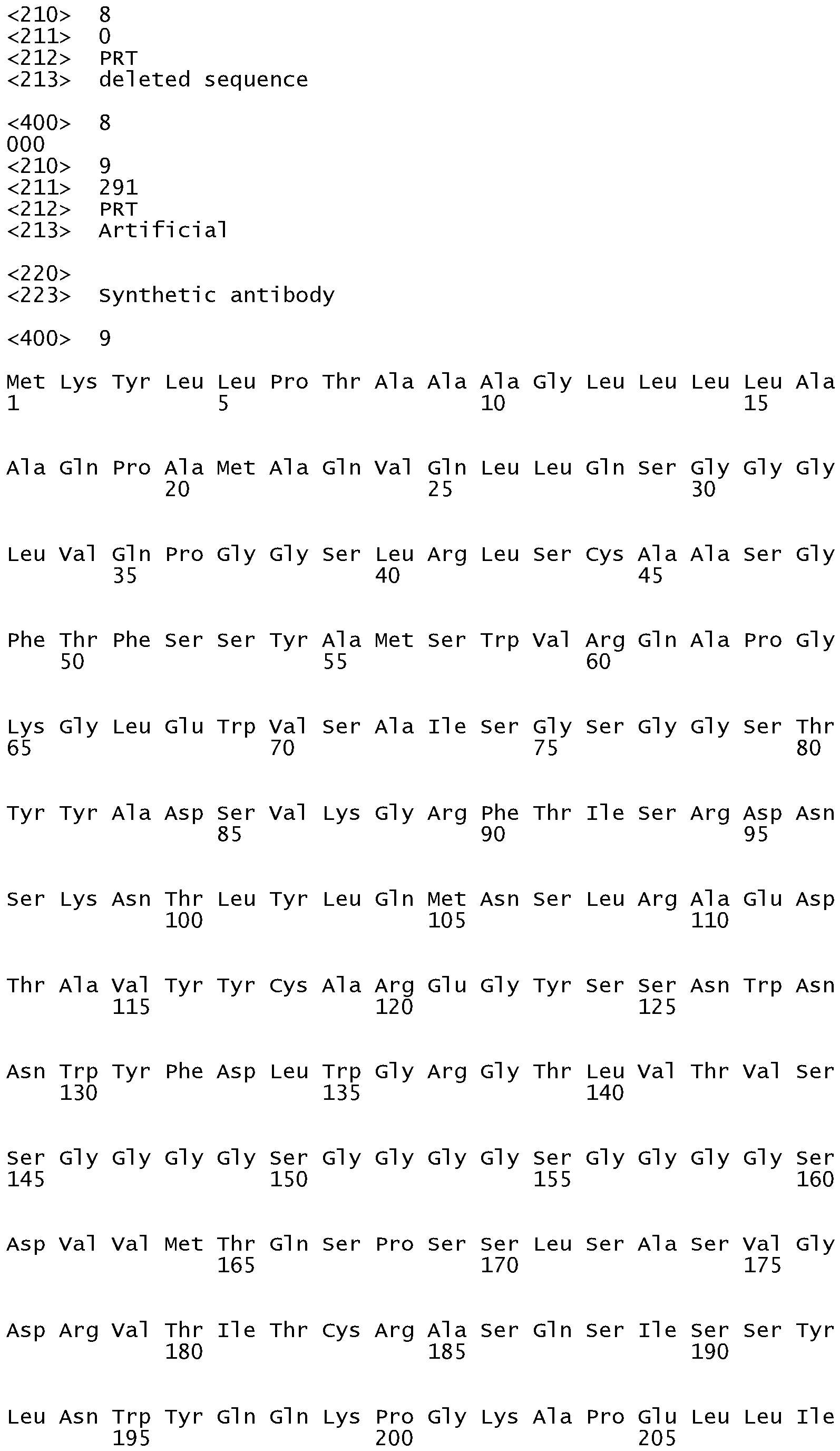


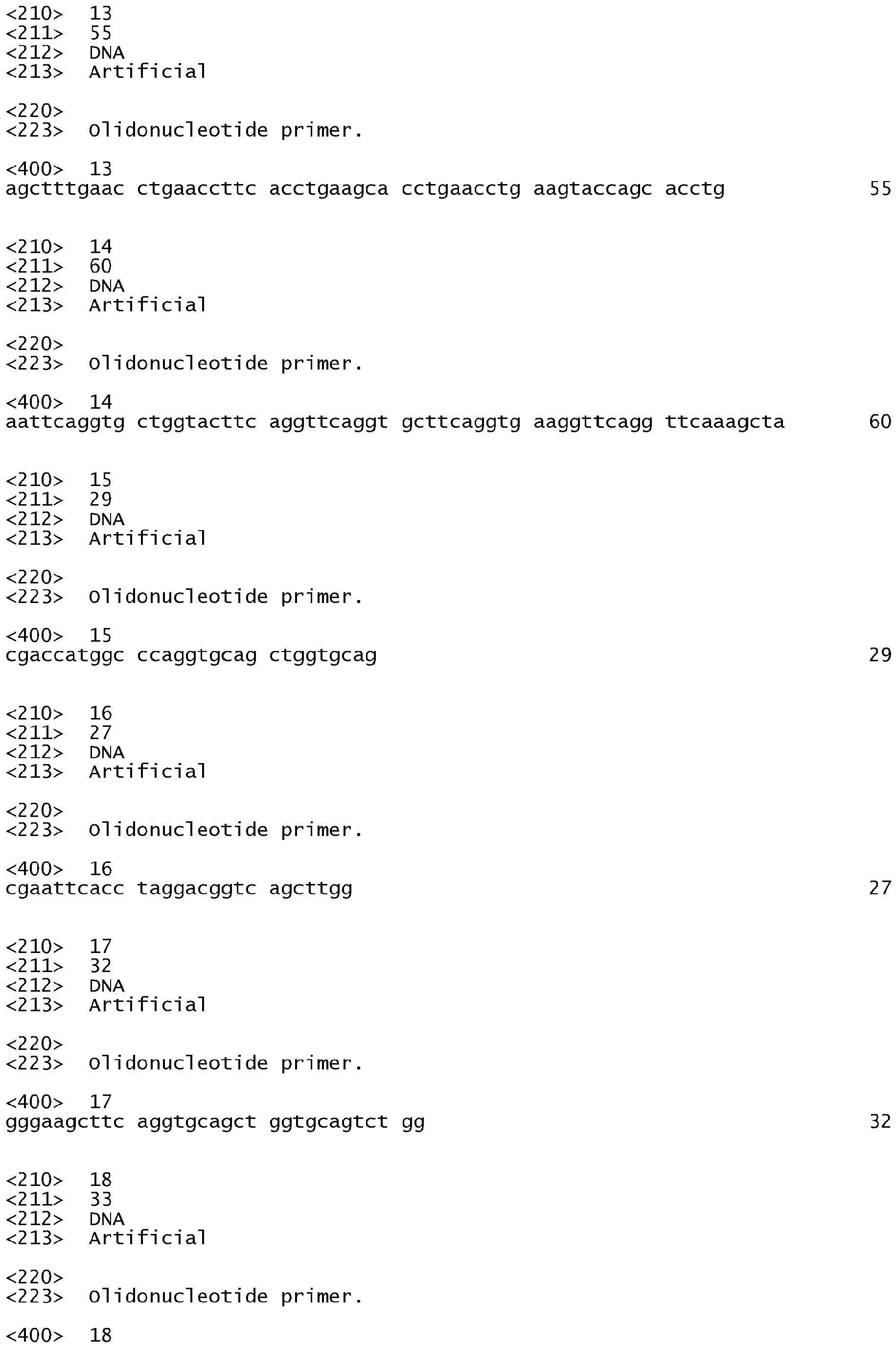


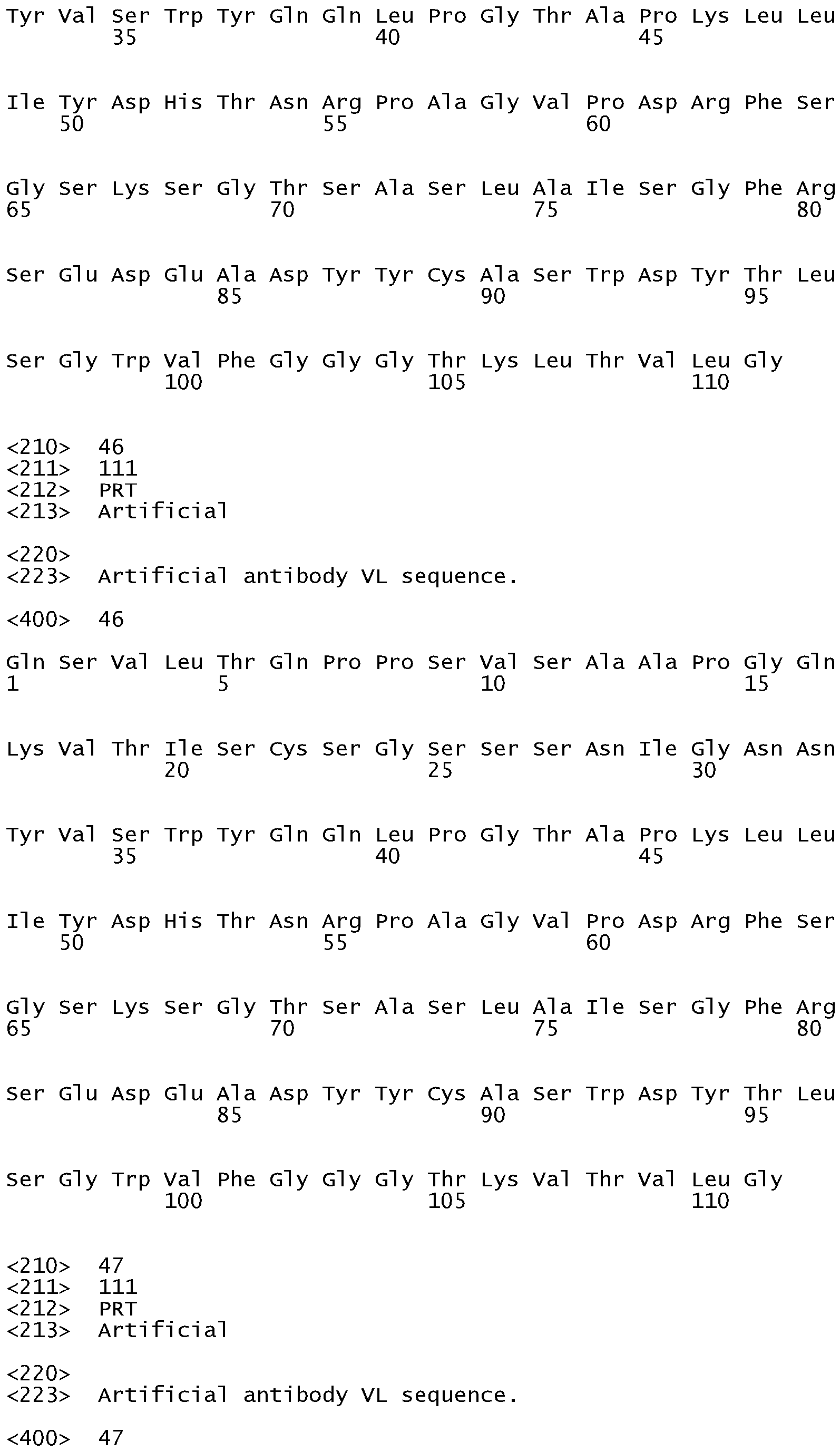
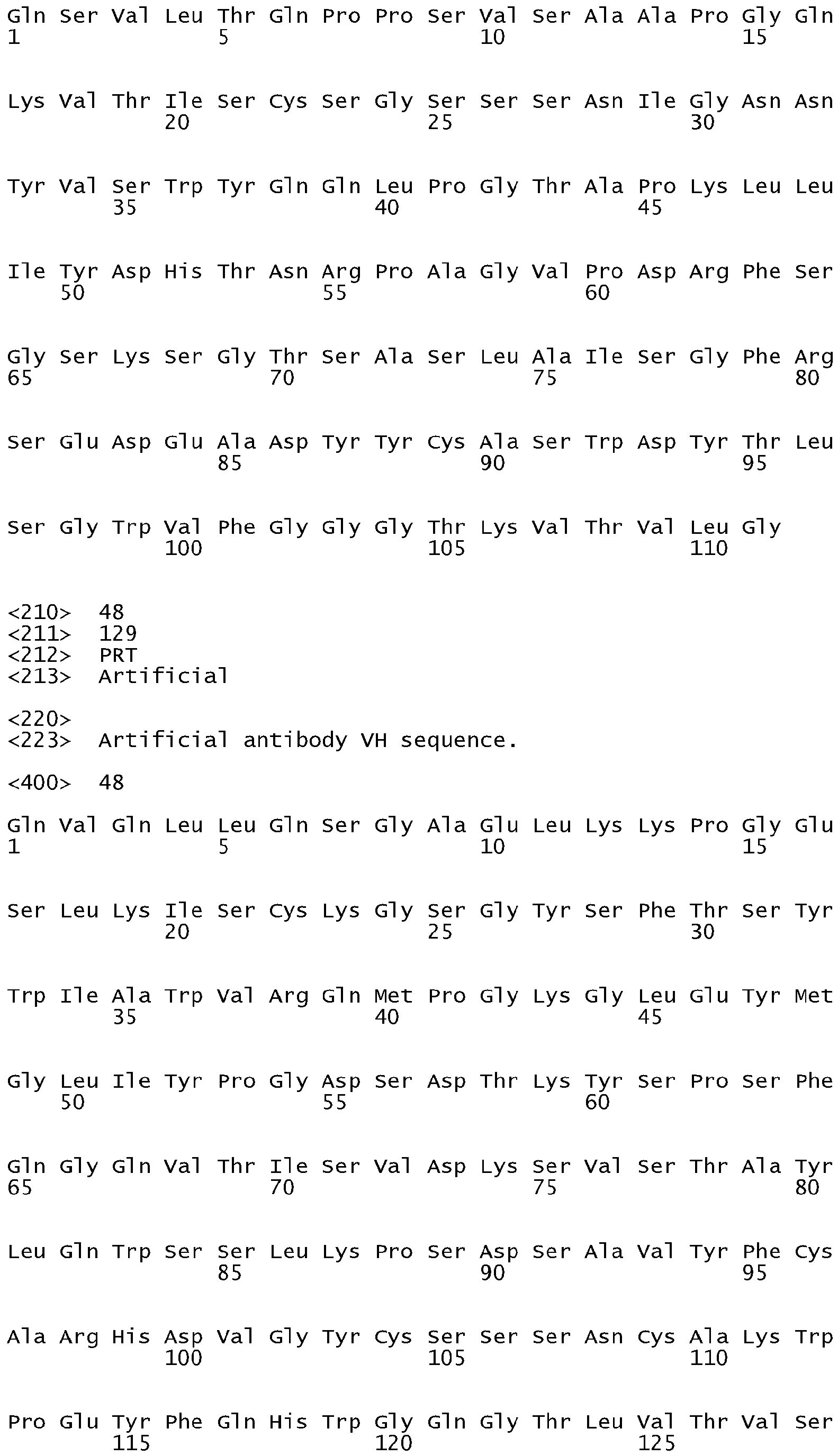
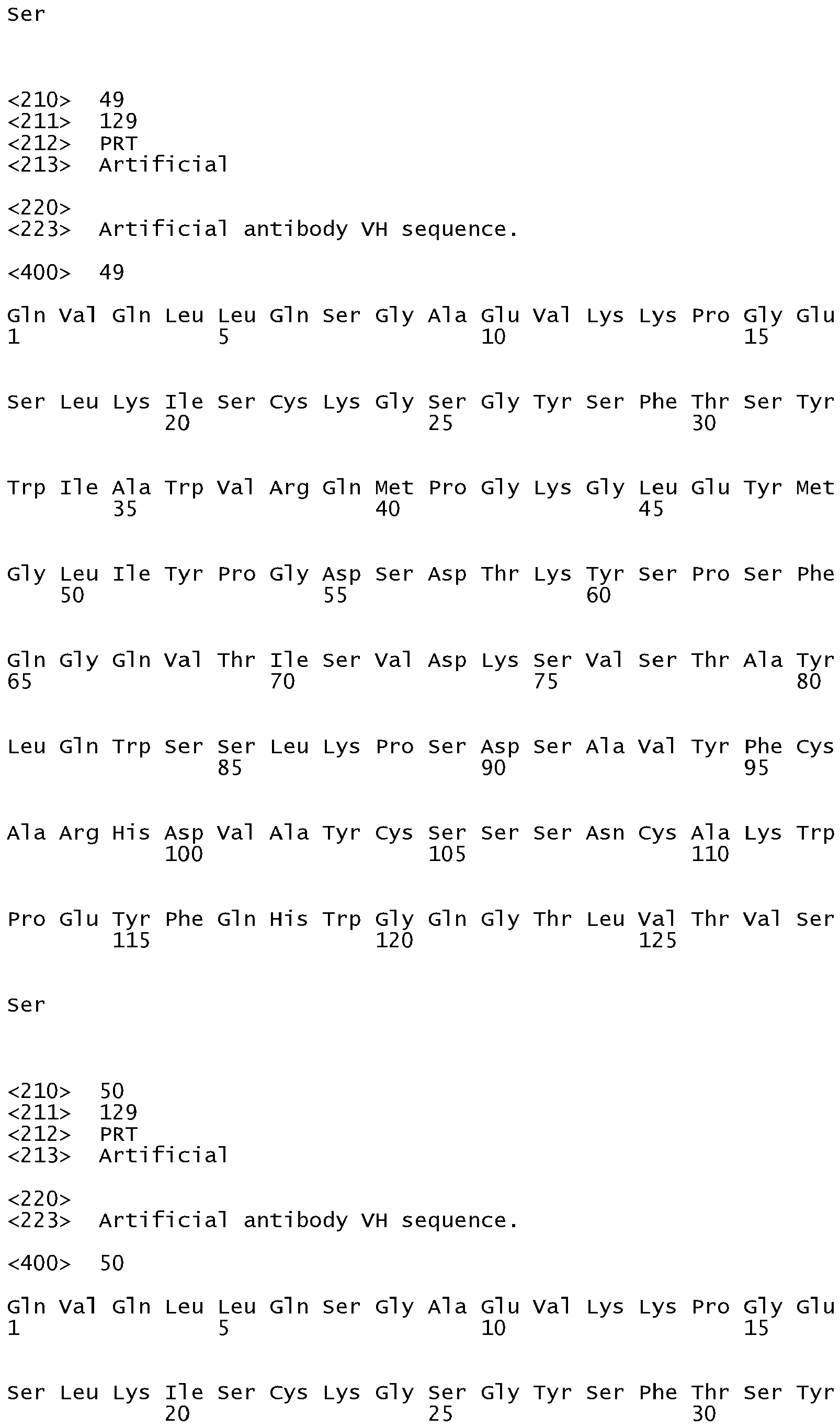
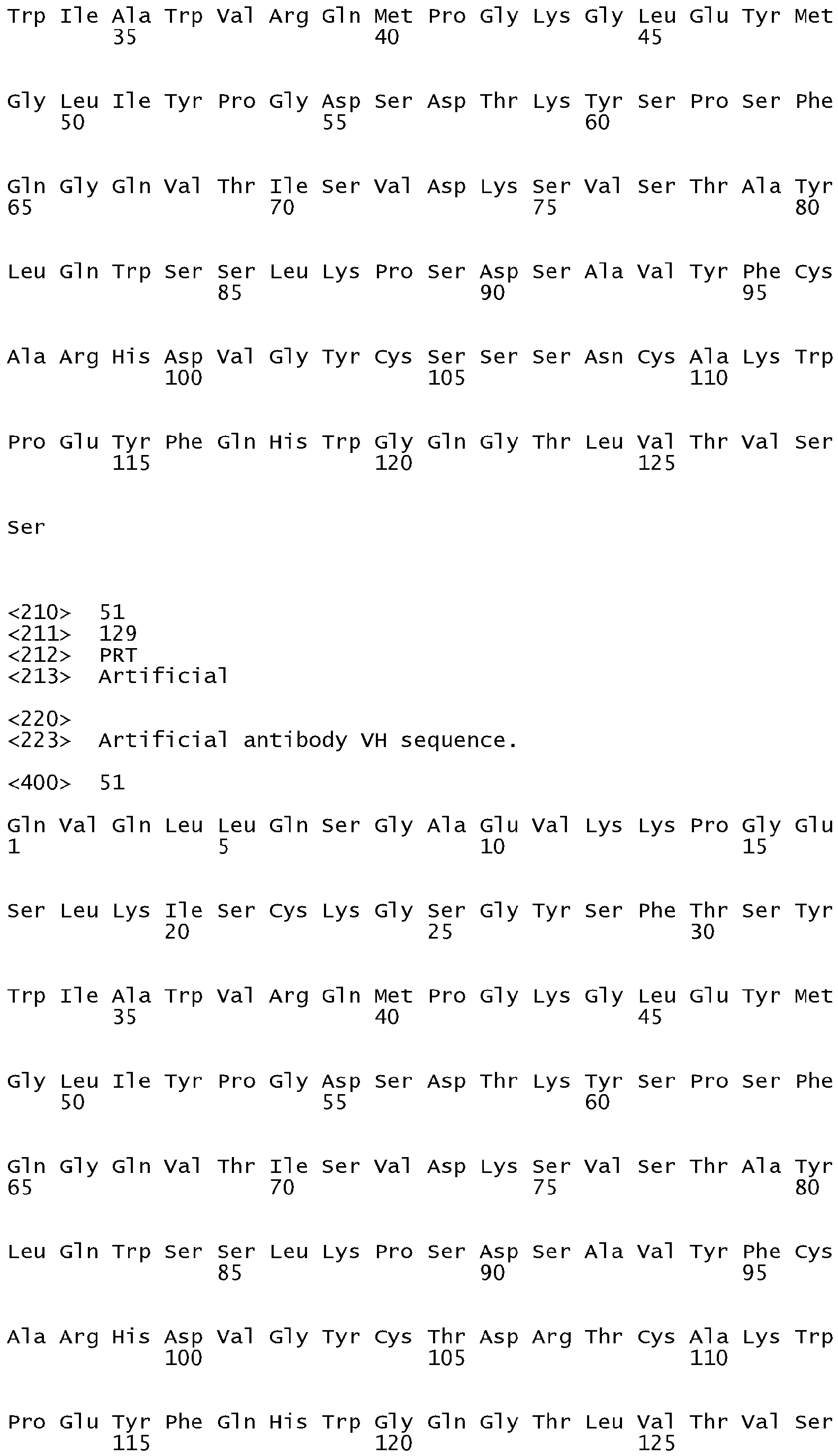
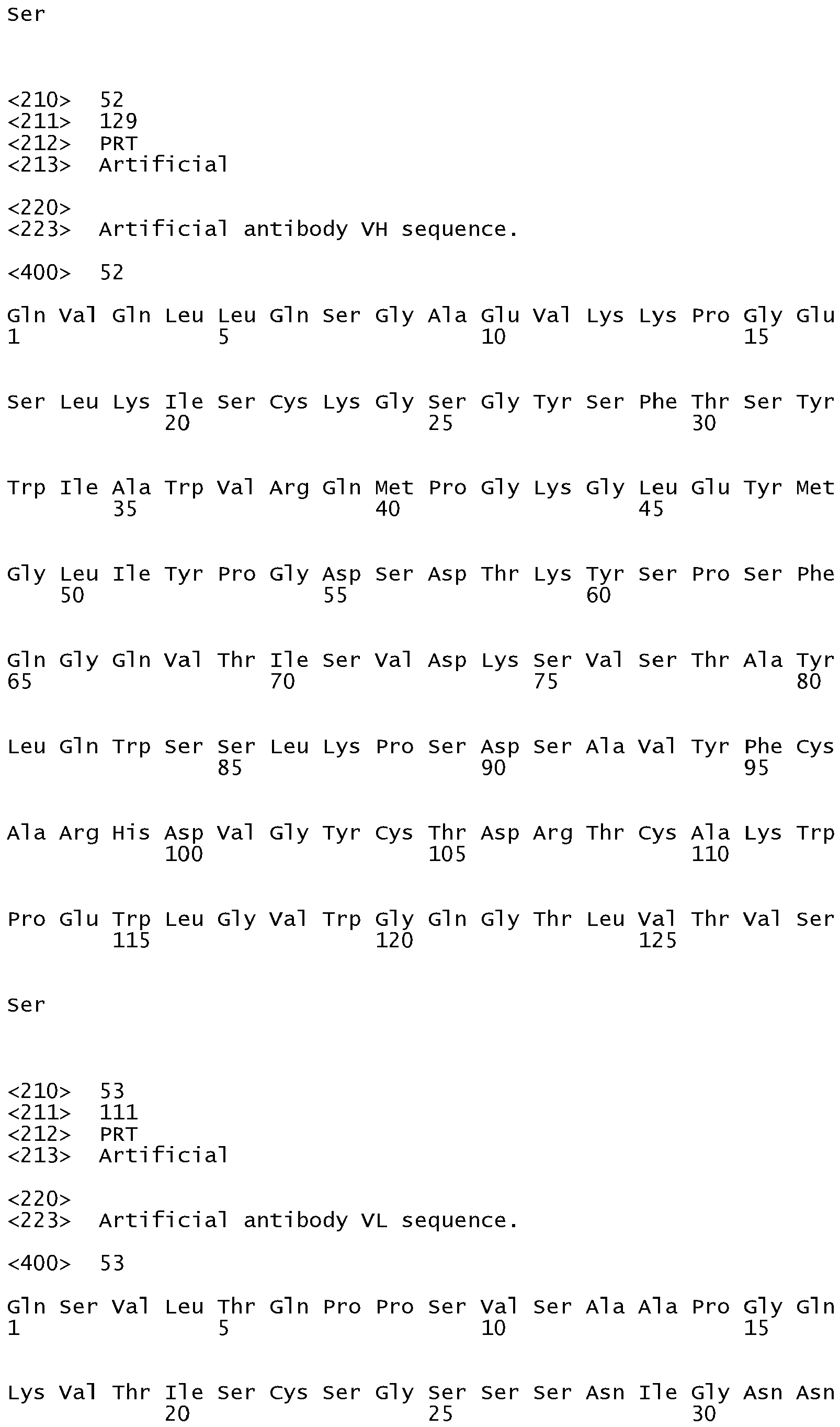


Claims (15)
- A bispecific antibody comprising a first antibody and a second antibody joined to each other wherein said first antibody has binding specificity for at least one epitope on HER2/neu, and the second antibody has binding specificity for a second epitope on HER3, and wherein said first antibody comprises:a VH domain comprising the C6B1D2 VH CDR1 sequence SYWIA, the C6B1D2 VH CDR2 sequence LIYPGDSDTKYSPSFQG, and the C6B1D2 VH CDR3 sequence HDVGYCTDRTCAKWPEWLGV; anda VL domain comprising C6B1D2 VL CDR1 sequence SGSSSNIGNNYVS, the C6B1D2 VL CDR2 sequence DHTNRPA, and the C6B1D2 VL CDR3 sequence ASWDYTLSGWV; andfurther wherein said second antibody comprises the CDRs of the antibody HER3.H3 (SEQ ID NO: 4).
- The bispecific antibody of claim 1 wherein said first antibody is a single chain Fv joined by a polypeptide to said second antibody which is a single chain Fv.
- A bispecific antibody according to claim 1 or 2, in a pharmaceutically acceptable carrier suitable for systemic injectable administration, for use in the treatment of cancer.
- The bispecific antibody of claim 3 wherein the cancer is a cancer that overexpresses HER2.
- The bispecific antibody according to claim 3 or 4 wherein the bispecific antibody prevents formation of EGFR family signaling complexes in cancerous tumor cells.
- The bispecific antibody according to any one of claims 3 to 5 wherein the bispecific antibody inhibits cancer cell proliferation.
- The bispecific antibody according to any one of claims 3 to 6 wherein the bispecific antibody inhibits tumor growth.
- The bispecific antibody according to any of claims 3-7 for use in combination with chemotherapeutic treatment.
- The bispecific antibody according to any of claims 3-8 for use in combination with another antibody.
- The bispecific antibody of claim 9 wherein the other antibody is Herceptin™ or C225.
- The bispecific antibody of any of claims 3-10 wherein the bispecific antibody is used in combination with another signal transduction inhibitor.
- An expression vector comprising a nucleic acid sequence encoding the bispecific antibody according to claim 2.
- The expression vector of claim 12, which is selected from the group consisting of a plasmid, cosmid, phage and virus.
- A eukaryotic host cell comprising the expression vector of claim 12 or 13.
- A eukaryotic host cell according to claim 14 wherein the cell is optionally a CHO cell.
Applications Claiming Priority (2)
| Application Number | Priority Date | Filing Date | Title |
|---|---|---|---|
| US11/154,103 US7332585B2 (en) | 2002-04-05 | 2005-06-15 | Bispecific single chain Fv antibody molecules and methods of use thereof |
| EP06784990A EP1912674B8 (en) | 2005-06-15 | 2006-06-14 | Bispecific single chain fv antibody molecules and methods of use thereof |
Related Parent Applications (2)
| Application Number | Title | Priority Date | Filing Date |
|---|---|---|---|
| EP06784990A Division EP1912674B8 (en) | 2005-06-15 | 2006-06-14 | Bispecific single chain fv antibody molecules and methods of use thereof |
| EP06784990.1 Division | 2006-06-14 |
Publications (4)
| Publication Number | Publication Date |
|---|---|
| EP2425850A2 true EP2425850A2 (en) | 2012-03-07 |
| EP2425850A8 EP2425850A8 (en) | 2012-04-25 |
| EP2425850A3 EP2425850A3 (en) | 2012-05-23 |
| EP2425850B1 EP2425850B1 (en) | 2016-05-18 |
Family
ID=38288069
Family Applications (2)
| Application Number | Title | Priority Date | Filing Date |
|---|---|---|---|
| EP06784990A Not-in-force EP1912674B8 (en) | 2005-06-15 | 2006-06-14 | Bispecific single chain fv antibody molecules and methods of use thereof |
| EP11177829.6A Not-in-force EP2425850B1 (en) | 2005-06-15 | 2006-06-14 | Bispecific single chain FV antibody molecules and methods of use thereof |
Family Applications Before (1)
| Application Number | Title | Priority Date | Filing Date |
|---|---|---|---|
| EP06784990A Not-in-force EP1912674B8 (en) | 2005-06-15 | 2006-06-14 | Bispecific single chain fv antibody molecules and methods of use thereof |
Country Status (11)
| Country | Link |
|---|---|
| US (3) | US7332585B2 (en) |
| EP (2) | EP1912674B8 (en) |
| JP (1) | JP4945557B2 (en) |
| CN (1) | CN101355966B (en) |
| AT (1) | ATE530195T1 (en) |
| AU (1) | AU2006336279B2 (en) |
| BR (1) | BRPI0611829A2 (en) |
| CA (1) | CA2612467A1 (en) |
| DK (1) | DK1912674T3 (en) |
| ES (1) | ES2377098T3 (en) |
| WO (1) | WO2007084181A2 (en) |
Cited By (2)
| Publication number | Priority date | Publication date | Assignee | Title |
|---|---|---|---|---|
| US9657104B2 (en) | 2013-03-29 | 2017-05-23 | Samsung Electronics Co., Ltd. | Anti-c-Met/anti-EGFR bispecific antibodies |
| CN109789164A (en) * | 2016-08-30 | 2019-05-21 | 亘喜生物科技(上海)有限公司 | Chimeric antigen receptor with GITR intracellular domain as costimulatory domain |
Families Citing this family (107)
| Publication number | Priority date | Publication date | Assignee | Title |
|---|---|---|---|---|
| US7563874B2 (en) * | 1998-08-31 | 2009-07-21 | The Regents Of The University Of California | Therapeutic monoclonal antibodies that neutralize botulinum neurotoxins |
| US7754208B2 (en) | 2001-01-17 | 2010-07-13 | Trubion Pharmaceuticals, Inc. | Binding domain-immunoglobulin fusion proteins |
| US7332585B2 (en) * | 2002-04-05 | 2008-02-19 | The Regents Of The California University | Bispecific single chain Fv antibody molecules and methods of use thereof |
| AU2003256299A1 (en) * | 2002-07-01 | 2004-01-19 | Human Genome Sciences, Inc. | Antibodies that specifically bind to reg iv |
| US8505468B2 (en) * | 2002-11-19 | 2013-08-13 | Sharp Kabushiki Kaisha | Substrate accommodating tray |
| KR101201464B1 (en) * | 2004-05-05 | 2012-11-14 | 메리맥 파마슈티컬즈, 인크. | Bispecific binding agents for modulating biological activity |
| TWI296930B (en) * | 2005-05-11 | 2008-05-21 | Dev Center Biotechnology | Recombinant enterovirus 71 neutralizing antibodies and use thereof |
| UA97469C2 (en) | 2005-07-25 | 2012-02-27 | Емерджент Продакт Дівелопмент Сіетл, Елелсі | Humanized cd37-specific binding immunoglobulin molecule |
| US20070116825A1 (en) * | 2005-11-23 | 2007-05-24 | The Coca-Cola Company | Confection with High-Potency Sweetener |
| MX363905B (en) * | 2006-06-12 | 2019-04-08 | Aptevo Res & Development Llc | Single-chain multivalent binding proteins with effector function. |
| EP2091975A4 (en) * | 2006-11-21 | 2013-05-22 | Univ California | ANTI-EGFR FAMILY ANTIBODIES, BISPECIFIC ANTI-EGFR FAMILY ANTIBODIES AND METHODS OF USE THEREOF |
| AU2007325838B2 (en) | 2006-11-22 | 2013-09-19 | Bristol-Myers Squibb Company | Targeted therapeutics based on engineered proteins for tyrosine kinases receptors, including IGF-IR |
| EP2134749B1 (en) | 2007-03-22 | 2013-11-06 | The Regents of the University of California | Therapeutic monoclonal antibodies that neutralize botulinum neurotoxins |
| JP2010532764A (en) * | 2007-07-06 | 2010-10-14 | トゥルビオン・ファーマシューティカルズ・インコーポレーテッド | Binding peptide having a specific binding domain located at the C-terminus |
| CA2698419C (en) * | 2007-09-07 | 2019-11-12 | Edward Dolk | Binding molecules with multiple binding sites, compositions comprising the same and uses thereof |
| JP5591701B2 (en) | 2007-09-21 | 2014-09-17 | ザ リージェンツ オブ ザ ユニバーシティ オブ カリフォルニア | Targeted interferon with potent apoptotic and antitumor activity |
| US20090162359A1 (en) | 2007-12-21 | 2009-06-25 | Christian Klein | Bivalent, bispecific antibodies |
| US9266967B2 (en) | 2007-12-21 | 2016-02-23 | Hoffmann-La Roche, Inc. | Bivalent, bispecific antibodies |
| BRPI0821906B1 (en) * | 2008-01-03 | 2022-06-07 | The Scripps Research Institute | Isolated full-length antibody, its use, polynucleotide, vector, and host cell |
| WO2009102421A2 (en) | 2008-02-14 | 2009-08-20 | Bristol-Myers Squibb Company | Targeted therapeutics based on engineered proteins that bind egfr |
| NZ589086A (en) * | 2008-04-11 | 2012-09-28 | Merrimack Pharmaceuticals Inc | Human serum albumin (HSA) linkers and conjugates thereof |
| NZ621443A (en) | 2008-04-11 | 2015-09-25 | Emergent Product Dev Seattle | Cd37 immunotherapeutic and combination with bifunctional chemotherapeutic thereof |
| PE20091931A1 (en) | 2008-05-22 | 2009-12-31 | Bristol Myers Squibb Co | MULTIVALENT FIBRONECTIN-BASED FRAME DOMAIN PROTEINS |
| WO2010014854A2 (en) * | 2008-07-31 | 2010-02-04 | The Regents Of The University Of California | Antibodies that neutralize botulinum neurotoxins |
| MX2011004467A (en) | 2008-10-31 | 2011-07-28 | Biogen Idec Inc | Light targeting molecules and uses thereof. |
| US8927694B2 (en) | 2008-11-18 | 2015-01-06 | Merrimack Pharmaceuticals, Inc. | Human serum albumin linkers and conjugates thereof |
| AR075896A1 (en) * | 2009-03-20 | 2011-05-04 | Genentech Inc | ANTI-HER ANTIBODIES (EPIDERMAL GROWTH FACTOR) |
| PE20120591A1 (en) | 2009-04-02 | 2012-05-23 | Roche Glycart Ag | MULTI-SPECIFIC ANTIBODIES INCLUDING FULL-LENGTH ANTIBODIES AND SINGLE-CHAIN FAB FRAGMENTS |
| EP2417156B1 (en) | 2009-04-07 | 2015-02-11 | Roche Glycart AG | Trivalent, bispecific antibodies |
| US9676845B2 (en) | 2009-06-16 | 2017-06-13 | Hoffmann-La Roche, Inc. | Bispecific antigen binding proteins |
| AU2010296018B2 (en) | 2009-09-16 | 2016-05-05 | Genentech, Inc. | Coiled coil and/or tether containing protein complexes and uses thereof |
| CA2775573A1 (en) * | 2009-10-09 | 2011-04-14 | Merck Sharp & Dohme Corp. | Generation, characterization and uses thereof of anti-her 3 antibodies |
| US10208128B2 (en) * | 2009-11-04 | 2019-02-19 | Affibody Ab | HER3 binding polypeptides |
| WO2011072240A1 (en) | 2009-12-10 | 2011-06-16 | Cedars-Sinai Medical Center | Drug delivery of temozolomide for systemic based treatment of cancer |
| KR101798679B1 (en) | 2010-03-11 | 2017-11-16 | 메리맥 파마슈티컬즈, 인크. | Use of erbb3 inhibitors in the treatment of triple negative and basal-like breast cancers |
| AR080793A1 (en) | 2010-03-26 | 2012-05-09 | Roche Glycart Ag | BISPECIFIC ANTIBODIES |
| EP2569334A4 (en) * | 2010-05-13 | 2014-01-22 | Fox Chase Cancer Ct | RECOMBINANTLY PRODUCED ANTIBODIES TARGETING ERBB SIGNALING MOLECULES AND METHODS OF USE FOR THE DIAGNOSIS AND TREATMENT OF DISEASE |
| JP6320753B2 (en) | 2010-05-27 | 2018-05-09 | ゲンマブ エー/エス | Monoclonal antibody against HER2 |
| EP2575880B1 (en) | 2010-05-27 | 2019-01-16 | Genmab A/S | Monoclonal antibodies against her2 epitope |
| WO2012024659A2 (en) * | 2010-08-20 | 2012-02-23 | Massachusetts Institute Of Technology | Antibody-based constructs directed against tyrosine kinase receptors |
| JP5758004B2 (en) | 2010-08-24 | 2015-08-05 | エフ.ホフマン−ラ ロシュ アーゲーF. Hoffmann−La Roche Aktiengesellschaft | Bispecific antibodies comprising Fv fragments stabilized by disulfides |
| WO2012025525A1 (en) * | 2010-08-24 | 2012-03-01 | Roche Glycart Ag | Activatable bispecific antibodies |
| WO2012047427A2 (en) | 2010-08-31 | 2012-04-12 | The Regents Of The University Of California | Antibodies for botulinum neurotoxins |
| TW201302793A (en) | 2010-09-03 | 2013-01-16 | Glaxo Group Ltd | Novel antigen binding protein |
| SG191153A1 (en) | 2010-12-23 | 2013-07-31 | Hoffmann La Roche | Polypeptide-polynucleotide-complex and its use in targeted effector moiety delivery |
| US9623041B2 (en) | 2010-12-30 | 2017-04-18 | Cedars-Sinai Medical Center | Polymalic acid-based nanobiopolymer compositions |
| JP2014504591A (en) * | 2010-12-30 | 2014-02-24 | セダーズ−シナイ メディカル センター | Polymalic acid-based nanobiopolymer compositions and methods for treating cancer |
| CN102153650B (en) * | 2011-01-27 | 2012-07-04 | 中国人民解放军军事医学科学院生物工程研究所 | Anti-EGFR (epidemic growth factor receptor) humanized antibody L2-H3 and coding gene and application thereof |
| MX341921B (en) | 2011-02-28 | 2016-09-07 | Hoffmann La Roche | Antigen binding proteins. |
| RU2013141078A (en) | 2011-02-28 | 2015-04-10 | Ф. Хоффманн-Ля Рош Аг | SINGLE VALVE ANTI-BINDING PROTEINS |
| CN103562226A (en) | 2011-03-11 | 2014-02-05 | 梅里麦克制药股份有限公司 | Using inhibitors of EGFR family receptors to treat hormone-refractory breast cancer |
| JP2014509593A (en) | 2011-03-15 | 2014-04-21 | メリマック ファーマシューティカルズ インコーポレーティッド | Overcoming resistance to ErbB pathway inhibitors |
| CN105884900A (en) | 2011-04-19 | 2016-08-24 | 梅里麦克制药股份有限公司 | Monospecific and bispecific anti-IGF-1R and anti-ERBB3 antibodies |
| WO2012143524A2 (en) | 2011-04-20 | 2012-10-26 | Genmab A/S | Bispecific antibodies against her2 and cd3 |
| CA2832387A1 (en) * | 2011-04-20 | 2012-10-26 | Genmab A/S | Bispecifc antibodies against her2 |
| CN103857699B (en) | 2011-05-24 | 2016-08-31 | 泽恩格尼亚股份有限公司 | Multivalent and monovalent multispecific complexes and uses thereof |
| WO2012166579A1 (en) * | 2011-05-31 | 2012-12-06 | Fox Chase Cancer Center | Synergistic inhibition of erbb2/erbb3 signal pathways in the treatment of cancer |
| US9273143B2 (en) | 2011-09-30 | 2016-03-01 | Regeneron Pharmaceuticals, Inc. | Methods and compositions comprising a combination of an anti-ErbB3 antibody and an anti-EGFR antibody |
| AU2012316402B2 (en) | 2011-09-30 | 2017-04-20 | Regeneron Pharmaceuticals, Inc. | Anti-ErbB3 antibodies and uses thereof |
| EP3559049B1 (en) | 2011-10-28 | 2025-06-11 | Teva Pharmaceuticals Australia Pty Ltd | Polypeptide constructs and uses thereof |
| LT2782598T (en) * | 2011-11-23 | 2020-07-27 | In3Bio Ltd. | Recombinant proteins and their therapeutic uses |
| EP2797957B1 (en) | 2011-11-23 | 2019-06-19 | MedImmune, LLC | Binding molecules specific for her3 and uses thereof |
| PT2790668T (en) * | 2011-12-13 | 2020-11-10 | Engeneic Molecular Delivery Pty Ltd | Bacterially derived, intact minicells for delivery of therapeutic agents to brain tumors |
| KR101963230B1 (en) | 2011-12-26 | 2019-03-29 | 삼성전자주식회사 | Protein complex comprising multi-specific monoclonal antibodies |
| RU2644341C2 (en) | 2012-02-10 | 2018-02-08 | Дженентек, Инк. | Single-chain antibodies and other heteromultimers |
| EP2638916A1 (en) * | 2012-03-16 | 2013-09-18 | Covagen AG | Novel binding molecules with antitumoral activity |
| MX354717B (en) * | 2012-03-16 | 2018-03-16 | Covagen Ag | Novel binding molecules with antitumoral activity. |
| JP6203838B2 (en) | 2012-06-27 | 2017-09-27 | エフ.ホフマン−ラ ロシュ アーゲーF. Hoffmann−La Roche Aktiengesellschaft | Method for selecting and creating tailor-made highly selective and multispecific targeting entities comprising at least two different binding entities and uses thereof |
| EP2867254B1 (en) | 2012-06-27 | 2017-10-25 | F. Hoffmann-La Roche AG | Method for making antibody fc-region conjugates comprising at least one binding entity that specifically binds to a target and uses thereof |
| WO2014036520A1 (en) | 2012-08-30 | 2014-03-06 | Merrimack Pharmaceuticals, Inc. | Combination therapies comprising anti-erbb3 agents |
| AU2013328881B2 (en) * | 2012-10-12 | 2018-03-15 | Arizona Board Of Regents, On Behalf Of Arizona State University | Antibody based reagents that specifically recognize toxic oligomeric forms of tau |
| KR101911438B1 (en) | 2012-10-31 | 2018-10-24 | 삼성전자주식회사 | Bispecific antigen binding protein complex and preparation methods of bispecific antibodies |
| JP6461603B2 (en) * | 2012-11-02 | 2019-01-30 | ローム株式会社 | Chip capacitors, circuit assemblies, and electronics |
| KR20150063565A (en) * | 2012-11-08 | 2015-06-09 | 에프. 호프만-라 로슈 아게 | Anti-her3/her4 antigen binding proteins binding to the beta-hairpin of her3 and the beta-hairpin of her4 |
| US11117975B2 (en) | 2013-04-29 | 2021-09-14 | Teva Pharmaceuticals Australia Pty Ltd | Anti-CD38 antibodies and fusions to attenuated interferon alpha-2B |
| CN103509117B (en) * | 2013-05-06 | 2016-03-09 | 江苏匡亚生物医药科技有限公司 | Bi-specific antibody of anti-human HER2 and people IGF-IR and its production and use |
| EP2994164B1 (en) | 2013-05-08 | 2020-08-05 | Zymeworks Inc. | Bispecific her2 and her3 antigen binding constructs |
| WO2015048008A2 (en) | 2013-09-24 | 2015-04-02 | Medimmune, Llc | Binding molecules specific for her3 and uses thereof |
| RU2016115866A (en) | 2013-10-11 | 2017-11-16 | Ф. Хоффманн-Ля Рош Аг | MULTI-SPECIFIC ANTIBODIES WITH EXCHANGED DOMAINS AND SAME VARIABLE DOMAINS OF EASY CHAIN |
| JP6817064B2 (en) | 2013-11-27 | 2021-01-20 | ザイムワークス,インコーポレイテッド | Bispecific antigen-binding construct targeting HER2 |
| KR20160099087A (en) * | 2013-12-20 | 2016-08-19 | 에프. 호프만-라 로슈 아게 | Bispecific her2 antibodies and methods of use |
| WO2015100459A2 (en) | 2013-12-27 | 2015-07-02 | Merrimack Pharmaceuticals, Inc. | Biomarker profiles for predicting outcomes of cancer therapy with erbb3 inhibitors and/or chemotherapies |
| KR102127408B1 (en) * | 2014-01-29 | 2020-06-29 | 삼성전자주식회사 | Anti-Her3 scFv fragment and Bispecific anti-c-Met/anti-Her3 antibodies comprising the same |
| KR20150097304A (en) | 2014-02-18 | 2015-08-26 | 삼성전자주식회사 | Anti-EGFR/Anti-HER2 Bispecific Antibodies With Anti-EGFR DARPins |
| WO2015157634A1 (en) | 2014-04-11 | 2015-10-15 | Kolltan Pharmaceuticals, Inc. | Anti-erbb antibodies and methods of use thereof |
| UA119352C2 (en) | 2014-05-01 | 2019-06-10 | Тева Фармасьютикалз Острейліа Пті Лтд | COMBINATION OF LENALIDOMIDE OR POMALIDOMIDE AND STRUCTURES OF ANTI-CD38 ANTIBODY-ATHENED INTERPHERONE ALPHA-2B AND METHOD OF TREATMENT38 |
| KR102223502B1 (en) | 2014-05-09 | 2021-03-05 | 삼성전자주식회사 | Anti-cMET/anti-EGFR/anti-HER3 multipecific antibodies and uses thereof |
| JP6695812B2 (en) | 2014-05-14 | 2020-05-20 | エフ・ホフマン−ラ・ロシュ・アクチェンゲゼルシャフト | HER3 / HER2 bispecific antibody that binds to the beta hairpin of HER3 and domain II of HER2 |
| EA037749B1 (en) | 2014-10-29 | 2021-05-18 | Тева Фармасьютикалз Острэйлиа Пти Лтд | INTERFERON 2b VARIANTS |
| JP6721590B2 (en) | 2014-12-03 | 2020-07-15 | エフ.ホフマン−ラ ロシュ アーゲーF. Hoffmann−La Roche Aktiengesellschaft | Multispecific antibody |
| US12428483B2 (en) | 2014-12-22 | 2025-09-30 | Systimmune, Inc. | Bispecific tetravalent antibodies and methods of making and using thereof |
| EP3237005B1 (en) * | 2014-12-22 | 2024-09-18 | Systimmune, Inc. | Bispecific tetravalent antibodies and methods of making and using thereof |
| KR20180025865A (en) | 2015-07-06 | 2018-03-09 | 리제너론 파마슈티칼스 인코포레이티드 | Multispecific antigen binding molecules and uses thereof |
| CN108367004B (en) | 2015-09-21 | 2022-09-13 | 阿帕特夫研究和发展有限公司 | CD3 binding polypeptides |
| MA43416A (en) | 2015-12-11 | 2018-10-17 | Regeneron Pharma | METHODS TO SLOW OR PREVENT THE GROWTH OF TUMORS RESISTANT TO BLOCKING EGFR AND / OR ERBB3 |
| EP3448891A1 (en) | 2016-04-28 | 2019-03-06 | Regeneron Pharmaceuticals, Inc. | Methods of making multispecific antigen-binding molecules |
| WO2018014067A1 (en) | 2016-07-19 | 2018-01-25 | Teva Pharmaceuticals Australia Pty Ltd | Anti-cd47 combination therapy |
| CN110809583A (en) | 2017-06-07 | 2020-02-18 | 瑞泽恩制药公司 | Compositions and methods for internalizing enzymes |
| KR102611853B1 (en) | 2017-06-30 | 2023-12-08 | 자임워크스 비씨 인코포레이티드 | Stabilized chimeric FABS |
| CN111132998B (en) | 2017-09-25 | 2024-01-30 | 苏州丁孚靶点生物技术有限公司 | Methods and compositions for cancer treatment |
| JP7328990B2 (en) | 2018-04-30 | 2023-08-17 | リジェネロン・ファーマシューティカルズ・インコーポレイテッド | Antibodies and bispecific antigen binding molecules that bind to HER2 and/or APLP2, and conjugates and uses thereof |
| CA3100021A1 (en) | 2018-05-17 | 2019-11-21 | Regeneron Pharmaceuticals, Inc. | Anti-cd63 antibodies, conjugates, and uses thereof |
| CN110577604A (en) * | 2018-06-07 | 2019-12-17 | 亘喜生物科技(上海)有限公司 | Chimeric antigen receptor T cell carrying GITR costimulatory signal targeting EGFR |
| WO2023021319A1 (en) * | 2021-08-19 | 2023-02-23 | Oncoquest Pharmaceuticals Inc. | Monoclonal antibodies against her2/neu and uses thereof |
| US20230070306A1 (en) * | 2021-08-19 | 2023-03-09 | Oncoquest Pharmaceuticals Inc. | Monoclonal antibodies against her2/neu and uses thereof |
| CA3265449A1 (en) * | 2022-08-22 | 2024-02-29 | Abdera Therapeutics Inc. | Multivalent immunoconjugates for targeted radioisotope therapy |
| TW202423979A (en) | 2022-08-22 | 2024-06-16 | 美商雅博得樂醫療公司 | Dll3 binding molecules and uses thereof |
Citations (43)
| Publication number | Priority date | Publication date | Assignee | Title |
|---|---|---|---|---|
| US3817837A (en) | 1971-05-14 | 1974-06-18 | Syva Corp | Enzyme amplification assay |
| US3850752A (en) | 1970-11-10 | 1974-11-26 | Akzona Inc | Process for the demonstration and determination of low molecular compounds and of proteins capable of binding these compounds specifically |
| US3939350A (en) | 1974-04-29 | 1976-02-17 | Board Of Trustees Of The Leland Stanford Junior University | Fluorescent immunoassay employing total reflection for activation |
| US3996345A (en) | 1974-08-12 | 1976-12-07 | Syva Company | Fluorescence quenching with immunological pairs in immunoassays |
| US4275149A (en) | 1978-11-24 | 1981-06-23 | Syva Company | Macromolecular environment control in specific receptor assays |
| US4277437A (en) | 1978-04-05 | 1981-07-07 | Syva Company | Kit for carrying out chemically induced fluorescence immunoassay |
| US4366241A (en) | 1980-08-07 | 1982-12-28 | Syva Company | Concentrating zone method in heterogeneous immunoassays |
| US4414148A (en) | 1981-04-15 | 1983-11-08 | Sanofi | Anti-cancer drugs for the treatment of melanomas and method for preparing thereof |
| US4469863A (en) | 1980-11-12 | 1984-09-04 | Ts O Paul O P | Nonionic nucleic acid alkyl and aryl phosphonates and processes for manufacture and use thereof |
| US4569789A (en) | 1984-08-29 | 1986-02-11 | Dana-Farber Cancer Institute, Inc. | Acid-cleavable compound, use in protein conjugates and drug delivery systems |
| US4589071A (en) | 1982-04-19 | 1986-05-13 | Nissan Motor Co., Ltd. | Method and apparatus for controlling reduction ratio of continuously variable transmission with acceleration compensation |
| EP0188256A2 (en) | 1985-01-14 | 1986-07-23 | NeoRx | Metal radionuclide labeled proteins for diagnosis and therapy |
| US4659839A (en) | 1984-10-10 | 1987-04-21 | Mallinckrodt, Inc. | Coupling agents for radiolabeled antibody fragments |
| US4671958A (en) | 1982-03-09 | 1987-06-09 | Cytogen Corporation | Antibody conjugates for the delivery of compounds to target sites |
| US4680338A (en) | 1985-10-17 | 1987-07-14 | Immunomedics, Inc. | Bifunctional linker |
| US4683195A (en) | 1986-01-30 | 1987-07-28 | Cetus Corporation | Process for amplifying, detecting, and/or-cloning nucleic acid sequences |
| US4699784A (en) | 1986-02-25 | 1987-10-13 | Center For Molecular Medicine & Immunology | Tumoricidal methotrexate-antibody conjugate |
| US4800195A (en) | 1982-10-19 | 1989-01-24 | The Dow Chemical Company | Substituted azo N-phenyl-N'benzoylureas and their use as insecticides and acaricides |
| US4956778A (en) | 1987-07-02 | 1990-09-11 | Mitsubishi Denki Kabushiki Kaisha | Constant speed holding device |
| US4965188A (en) | 1986-08-22 | 1990-10-23 | Cetus Corporation | Process for amplifying, detecting, and/or cloning nucleic acid sequences using a thermostable enzyme |
| US4975369A (en) | 1988-04-21 | 1990-12-04 | Eli Lilly And Company | Recombinant and chimeric KS1/4 antibodies directed against a human adenocarcinoma antigen |
| US5034506A (en) | 1985-03-15 | 1991-07-23 | Anti-Gene Development Group | Uncharged morpholino-based polymers having achiral intersubunit linkages |
| US5075431A (en) | 1989-07-26 | 1991-12-24 | City Of Hope | Chimeric anti-CEA antibody |
| US5081235A (en) | 1989-07-26 | 1992-01-14 | City Of Hope | Chimeric anti-cea antibody |
| US5091513A (en) | 1987-05-21 | 1992-02-25 | Creative Biomolecules, Inc. | Biosynthetic antibody binding sites |
| US5132405A (en) | 1987-05-21 | 1992-07-21 | Creative Biomolecules, Inc. | Biosynthetic antibody binding sites |
| US5169939A (en) | 1985-05-21 | 1992-12-08 | Massachusetts Institute Of Technology & Pres. & Fellows Of Harvard College | Chimeric antibodies |
| US5202238A (en) | 1987-10-27 | 1993-04-13 | Oncogen | Production of chimeric antibodies by homologous recombination |
| US5204244A (en) | 1987-10-27 | 1993-04-20 | Oncogen | Production of chimeric antibodies by homologous recombination |
| US5216141A (en) | 1988-06-06 | 1993-06-01 | Benner Steven A | Oligonucleotide analogs containing sulfur linkages |
| US5231026A (en) | 1987-12-31 | 1993-07-27 | Tanox Biosystems, Inc. | DNA encoding murine-human chimeric antibodies specific for antigenic epitopes of IgE present on the extracellular segment of the membrane domain of membrane-bound IgE |
| US5235033A (en) | 1985-03-15 | 1993-08-10 | Anti-Gene Development Group | Alpha-morpholino ribonucleoside derivatives and polymers thereof |
| US5292867A (en) | 1988-11-16 | 1994-03-08 | Tanox Biosystems, Inc. | Chimeric monoclonal antibodies which bind to the extracellular segment of the membrane-bound domain of a human membrane-bound immunoglobulin |
| US5354847A (en) | 1986-10-27 | 1994-10-11 | Bristol-Myers Squibb Company | Chimeric antibody with specificity to human tumor antigen |
| US5386023A (en) | 1990-07-27 | 1995-01-31 | Isis Pharmaceuticals | Backbone modified oligonucleotide analogs and preparation thereof through reductive coupling |
| US5472693A (en) | 1993-02-16 | 1995-12-05 | The Dow Chemical Company | Family of anti-carcinoembryonic antigen chimeric antibodies |
| US5491088A (en) | 1989-06-30 | 1996-02-13 | Oncogen Limited Partnership | Monoclonal antibody BR 96 and chimeric monoclonal antibodies having the variable region of MAB BR96, which bind to a variant of ley antigen on human carcimona cells |
| US5500362A (en) | 1987-01-08 | 1996-03-19 | Xoma Corporation | Chimeric antibody with specificity to human B cell surface antigen |
| US5502167A (en) | 1991-12-06 | 1996-03-26 | Waldmann; Herman | CDR grafted humanised chimeric T-cell antibodies |
| US5602240A (en) | 1990-07-27 | 1997-02-11 | Ciba Geigy Ag. | Backbone modified oligonucleotide analogs |
| US5637684A (en) | 1994-02-23 | 1997-06-10 | Isis Pharmaceuticals, Inc. | Phosphoramidate and phosphorothioamidate oligomeric compounds |
| US5644048A (en) | 1992-01-10 | 1997-07-01 | Isis Pharmaceuticals, Inc. | Process for preparing phosphorothioate oligonucleotides |
| US5733743A (en) | 1992-03-24 | 1998-03-31 | Cambridge Antibody Technology Limited | Methods for producing members of specific binding pairs |
Family Cites Families (31)
| Publication number | Priority date | Publication date | Assignee | Title |
|---|---|---|---|---|
| CU22545A1 (en) * | 1994-11-18 | 1999-03-31 | Centro Inmunologia Molecular | OBTAINING A CHEMICAL AND HUMANIZED ANTIBODY AGAINST THE RECEPTOR OF THE EPIDERMAL GROWTH FACTOR FOR DIAGNOSTIC AND THERAPEUTIC USE |
| US4444878A (en) * | 1981-12-21 | 1984-04-24 | Boston Biomedical Research Institute, Inc. | Bispecific antibody determinants |
| US5292668A (en) * | 1981-12-21 | 1994-03-08 | Boston Biomedical Research Institute, Inc. | Bispecific antibody determinants |
| US4902505A (en) * | 1986-07-30 | 1990-02-20 | Alkermes | Chimeric peptides for neuropeptide delivery through the blood-brain barrier |
| US4801575A (en) * | 1986-07-30 | 1989-01-31 | The Regents Of The University Of California | Chimeric peptides for neuropeptide delivery through the blood-brain barrier |
| US6010902A (en) * | 1988-04-04 | 2000-01-04 | Bristol-Meyers Squibb Company | Antibody heteroconjugates and bispecific antibodies for use in regulation of lymphocyte activity |
| US5601819A (en) * | 1988-08-11 | 1997-02-11 | The General Hospital Corporation | Bispecific antibodies for selective immune regulation and for selective immune cell binding |
| DE3909708A1 (en) * | 1989-03-23 | 1990-09-27 | Boehringer Mannheim Gmbh | METHOD FOR PRODUCING BISPECIFIC ANTIBODIES |
| WO1992008802A1 (en) * | 1990-10-29 | 1992-05-29 | Cetus Oncology Corporation | Bispecific antibodies, method of production, and uses thereof |
| US6287792B1 (en) | 1991-06-17 | 2001-09-11 | The Regents Of The University Of California | Drug delivery of antisense oligonucleotides and peptides to tissues in vivo and to cells using avidin-biotin technology |
| US5932448A (en) * | 1991-11-29 | 1999-08-03 | Protein Design Labs., Inc. | Bispecific antibody heterodimers |
| US6129914A (en) * | 1992-03-27 | 2000-10-10 | Protein Design Labs, Inc. | Bispecific antibody effective to treat B-cell lymphoma and cell line |
| WO1994012520A1 (en) * | 1992-11-20 | 1994-06-09 | Enzon, Inc. | Linker for linked fusion polypeptides |
| IT1276662B1 (en) * | 1995-04-04 | 1997-11-03 | Uni Degli Studi Camerino | POLYNUCLEOTIDIC VACCINES |
| EP0873363B1 (en) * | 1995-06-14 | 2010-10-06 | The Regents of The University of California | High affinity human antibodies to tumor antigens |
| DK0826695T3 (en) * | 1996-09-03 | 2002-04-15 | Gsf Forschungszentrum Umwelt | Destruction of contaminating tumor cells in stem cell grafts with bispecific antibodies |
| JP4672092B2 (en) | 1996-11-20 | 2011-04-20 | イェール ユニバーシティ | Survivin, a protein that inhibits cell apoptosis, and its regulation |
| WO1998038513A1 (en) * | 1997-02-26 | 1998-09-03 | Khaw Ban An | Signal enhancement of bispecific antibody-polymer probe for immunoassay use |
| US6794128B2 (en) * | 1998-04-24 | 2004-09-21 | The Regents Of The University Of California | Methods of selecting internalizing antibodies |
| ATE473242T1 (en) * | 1998-05-20 | 2010-07-15 | Immunomedics Inc | THERAPEUTIC AGENTS CONTAINING A BISPECIFIC ANTI-HLA CLASS II INVARIANT CHAIN X ANTI-PATHOGEN ANTIBODIES |
| US6723538B2 (en) * | 1999-03-11 | 2004-04-20 | Micromet Ag | Bispecific antibody and chemokine receptor constructs |
| AUPQ105799A0 (en) | 1999-06-18 | 1999-07-08 | Victor Chang Cardiac Research Institute, The | Cell growth inhibition |
| JP2003531149A (en) * | 2000-04-13 | 2003-10-21 | ザ・ロツクフエラー・ユニバーシテイ | Enhancement of antibody-derived immune response |
| GB0027328D0 (en) * | 2000-06-23 | 2000-12-27 | Aventis Pharma Inc | Bioengineered vehicles for targeted nucleic acid delivery |
| US7332580B2 (en) * | 2002-04-05 | 2008-02-19 | The Regents Of The University Of California | Bispecific single chain Fv antibody molecules and methods of use thereof |
| US7332585B2 (en) | 2002-04-05 | 2008-02-19 | The Regents Of The California University | Bispecific single chain Fv antibody molecules and methods of use thereof |
| KR100494239B1 (en) | 2002-09-11 | 2005-06-13 | 한국기계연구원 | Process for Manufacturing Aluminium Matrix Composite Sheets Reinforced with High Volume Fraction of SiC |
| PL210545B1 (en) * | 2002-10-10 | 2012-01-31 | Merck Patent Gmbh | Pharmaceutical compositions directed to erb-b1 receptors |
| KR20070114765A (en) | 2005-02-23 | 2007-12-04 | 메리맥 파마슈티컬즈, 인크. | Bispecific Binders for Modulating Biological Activity |
| EP2091975A4 (en) | 2006-11-21 | 2013-05-22 | Univ California | ANTI-EGFR FAMILY ANTIBODIES, BISPECIFIC ANTI-EGFR FAMILY ANTIBODIES AND METHODS OF USE THEREOF |
| US8927694B2 (en) | 2008-11-18 | 2015-01-06 | Merrimack Pharmaceuticals, Inc. | Human serum albumin linkers and conjugates thereof |
-
2005
- 2005-06-15 US US11/154,103 patent/US7332585B2/en not_active Expired - Fee Related
-
2006
- 2006-06-14 WO PCT/US2006/023479 patent/WO2007084181A2/en not_active Ceased
- 2006-06-14 BR BRPI0611829-1A patent/BRPI0611829A2/en not_active Application Discontinuation
- 2006-06-14 AU AU2006336279A patent/AU2006336279B2/en not_active Ceased
- 2006-06-14 CN CN200680029687.5A patent/CN101355966B/en not_active Expired - Fee Related
- 2006-06-14 JP JP2008517139A patent/JP4945557B2/en not_active Expired - Fee Related
- 2006-06-14 EP EP06784990A patent/EP1912674B8/en not_active Not-in-force
- 2006-06-14 CA CA002612467A patent/CA2612467A1/en not_active Abandoned
- 2006-06-14 EP EP11177829.6A patent/EP2425850B1/en not_active Not-in-force
- 2006-06-19 AT AT06784990T patent/ATE530195T1/en not_active IP Right Cessation
- 2006-06-19 DK DK06784990.1T patent/DK1912674T3/en active
- 2006-06-19 ES ES06784990T patent/ES2377098T3/en active Active
-
2007
- 2007-11-20 US US11/943,367 patent/US8329873B2/en not_active Expired - Fee Related
-
2012
- 2012-12-10 US US13/710,146 patent/US8980258B2/en not_active Expired - Fee Related
Patent Citations (46)
| Publication number | Priority date | Publication date | Assignee | Title |
|---|---|---|---|---|
| US3850752A (en) | 1970-11-10 | 1974-11-26 | Akzona Inc | Process for the demonstration and determination of low molecular compounds and of proteins capable of binding these compounds specifically |
| US3817837A (en) | 1971-05-14 | 1974-06-18 | Syva Corp | Enzyme amplification assay |
| US3939350A (en) | 1974-04-29 | 1976-02-17 | Board Of Trustees Of The Leland Stanford Junior University | Fluorescent immunoassay employing total reflection for activation |
| US3996345A (en) | 1974-08-12 | 1976-12-07 | Syva Company | Fluorescence quenching with immunological pairs in immunoassays |
| US4277437A (en) | 1978-04-05 | 1981-07-07 | Syva Company | Kit for carrying out chemically induced fluorescence immunoassay |
| US4275149A (en) | 1978-11-24 | 1981-06-23 | Syva Company | Macromolecular environment control in specific receptor assays |
| US4366241B1 (en) | 1980-08-07 | 1988-10-18 | ||
| US4366241A (en) | 1980-08-07 | 1982-12-28 | Syva Company | Concentrating zone method in heterogeneous immunoassays |
| US4469863A (en) | 1980-11-12 | 1984-09-04 | Ts O Paul O P | Nonionic nucleic acid alkyl and aryl phosphonates and processes for manufacture and use thereof |
| US4414148A (en) | 1981-04-15 | 1983-11-08 | Sanofi | Anti-cancer drugs for the treatment of melanomas and method for preparing thereof |
| US4671958A (en) | 1982-03-09 | 1987-06-09 | Cytogen Corporation | Antibody conjugates for the delivery of compounds to target sites |
| US4589071A (en) | 1982-04-19 | 1986-05-13 | Nissan Motor Co., Ltd. | Method and apparatus for controlling reduction ratio of continuously variable transmission with acceleration compensation |
| US4800195A (en) | 1982-10-19 | 1989-01-24 | The Dow Chemical Company | Substituted azo N-phenyl-N'benzoylureas and their use as insecticides and acaricides |
| US4569789A (en) | 1984-08-29 | 1986-02-11 | Dana-Farber Cancer Institute, Inc. | Acid-cleavable compound, use in protein conjugates and drug delivery systems |
| US4659839A (en) | 1984-10-10 | 1987-04-21 | Mallinckrodt, Inc. | Coupling agents for radiolabeled antibody fragments |
| EP0188256A2 (en) | 1985-01-14 | 1986-07-23 | NeoRx | Metal radionuclide labeled proteins for diagnosis and therapy |
| US5235033A (en) | 1985-03-15 | 1993-08-10 | Anti-Gene Development Group | Alpha-morpholino ribonucleoside derivatives and polymers thereof |
| US5034506A (en) | 1985-03-15 | 1991-07-23 | Anti-Gene Development Group | Uncharged morpholino-based polymers having achiral intersubunit linkages |
| US5169939A (en) | 1985-05-21 | 1992-12-08 | Massachusetts Institute Of Technology & Pres. & Fellows Of Harvard College | Chimeric antibodies |
| US4680338A (en) | 1985-10-17 | 1987-07-14 | Immunomedics, Inc. | Bifunctional linker |
| US4683195A (en) | 1986-01-30 | 1987-07-28 | Cetus Corporation | Process for amplifying, detecting, and/or-cloning nucleic acid sequences |
| US4683195B1 (en) | 1986-01-30 | 1990-11-27 | Cetus Corp | |
| US4699784A (en) | 1986-02-25 | 1987-10-13 | Center For Molecular Medicine & Immunology | Tumoricidal methotrexate-antibody conjugate |
| US4965188A (en) | 1986-08-22 | 1990-10-23 | Cetus Corporation | Process for amplifying, detecting, and/or cloning nucleic acid sequences using a thermostable enzyme |
| US5354847A (en) | 1986-10-27 | 1994-10-11 | Bristol-Myers Squibb Company | Chimeric antibody with specificity to human tumor antigen |
| US5500362A (en) | 1987-01-08 | 1996-03-19 | Xoma Corporation | Chimeric antibody with specificity to human B cell surface antigen |
| US5091513A (en) | 1987-05-21 | 1992-02-25 | Creative Biomolecules, Inc. | Biosynthetic antibody binding sites |
| US5132405A (en) | 1987-05-21 | 1992-07-21 | Creative Biomolecules, Inc. | Biosynthetic antibody binding sites |
| US4956778A (en) | 1987-07-02 | 1990-09-11 | Mitsubishi Denki Kabushiki Kaisha | Constant speed holding device |
| US5482856A (en) | 1987-10-27 | 1996-01-09 | Oncogen Inc. | Production of chimeric antibodies by homologous recombination |
| US5204244A (en) | 1987-10-27 | 1993-04-20 | Oncogen | Production of chimeric antibodies by homologous recombination |
| US5202238A (en) | 1987-10-27 | 1993-04-13 | Oncogen | Production of chimeric antibodies by homologous recombination |
| US5231026A (en) | 1987-12-31 | 1993-07-27 | Tanox Biosystems, Inc. | DNA encoding murine-human chimeric antibodies specific for antigenic epitopes of IgE present on the extracellular segment of the membrane domain of membrane-bound IgE |
| US4975369A (en) | 1988-04-21 | 1990-12-04 | Eli Lilly And Company | Recombinant and chimeric KS1/4 antibodies directed against a human adenocarcinoma antigen |
| US5216141A (en) | 1988-06-06 | 1993-06-01 | Benner Steven A | Oligonucleotide analogs containing sulfur linkages |
| US5292867A (en) | 1988-11-16 | 1994-03-08 | Tanox Biosystems, Inc. | Chimeric monoclonal antibodies which bind to the extracellular segment of the membrane-bound domain of a human membrane-bound immunoglobulin |
| US5491088A (en) | 1989-06-30 | 1996-02-13 | Oncogen Limited Partnership | Monoclonal antibody BR 96 and chimeric monoclonal antibodies having the variable region of MAB BR96, which bind to a variant of ley antigen on human carcimona cells |
| US5081235A (en) | 1989-07-26 | 1992-01-14 | City Of Hope | Chimeric anti-cea antibody |
| US5075431A (en) | 1989-07-26 | 1991-12-24 | City Of Hope | Chimeric anti-CEA antibody |
| US5386023A (en) | 1990-07-27 | 1995-01-31 | Isis Pharmaceuticals | Backbone modified oligonucleotide analogs and preparation thereof through reductive coupling |
| US5602240A (en) | 1990-07-27 | 1997-02-11 | Ciba Geigy Ag. | Backbone modified oligonucleotide analogs |
| US5502167A (en) | 1991-12-06 | 1996-03-26 | Waldmann; Herman | CDR grafted humanised chimeric T-cell antibodies |
| US5644048A (en) | 1992-01-10 | 1997-07-01 | Isis Pharmaceuticals, Inc. | Process for preparing phosphorothioate oligonucleotides |
| US5733743A (en) | 1992-03-24 | 1998-03-31 | Cambridge Antibody Technology Limited | Methods for producing members of specific binding pairs |
| US5472693A (en) | 1993-02-16 | 1995-12-05 | The Dow Chemical Company | Family of anti-carcinoembryonic antigen chimeric antibodies |
| US5637684A (en) | 1994-02-23 | 1997-06-10 | Isis Pharmaceuticals, Inc. | Phosphoramidate and phosphorothioamidate oligomeric compounds |
Non-Patent Citations (55)
| Title |
|---|
| "Carbohydrate Modifications in Antisense Research", ASC SYMPOSIUM SERIES 580 |
| "Current Protocols in Molecular Biology", 1997, JOHN WILEY & SONS |
| "Fundamental Immunology", 1993, RAVEN PRESS |
| ADAMS ET AL., ANTIBODY, IMMIMOCONJ. RADIOPHARM., vol. 5, 1992, pages 81 - 95 |
| ADAMS ET AL., CANCER RES., vol. 53, 1993, pages 4026 - 4034 |
| ADAMS ET AL., PROC. AMER. ASSOC. CANCER RES., vol. 37, 1996, pages 472 |
| ANGEW., CHEM. INTL. ED ENGLISH, vol. 30, 1991, pages 423 |
| BEAUCAGE ET AL., TETRAHEDRON, vol. 49, no. 10, 1993, pages 1925 |
| BEAUMIER ET AL., JNUCL. MED., vol. 26, 1985, pages 1172 - 1179 |
| BERGER ET AL., CANCER RES., vol. 48, 1988, pages 1238 - 1243 |
| BORLINGHAUS ET AL., CANCER RES., vol. 47, 1987, pages 4071 - 4075 |
| BRIU ET AL., J AM. CHEM. SOC., vol. 111, 1989, pages 2321 |
| CARLSSON ET AL., NATURE, vol. 380, 1996, pages 207 |
| COLCHER ET AL., J NATL. CANCER INST., vol. 82, 1990, pages 1191 - 1197 |
| DENPCY ET AL., PROC. NATL. ACAD SCL USA, vol. 92, 1995, pages 6097 |
| DOWBENKO ET AL., J VIROL., vol. 62, 1988, pages 4703 - 4711 |
| ECKSTEIN: "Oligonucleotides and Analogues: A Practical Approach", OXFORD UNIVERSITY PRESS |
| EGHOLM, J AM. CHEM. SOC., vol. 114, 1992, pages 1895 |
| F INGL ET AL.: "The Pharmacological Basis of Therapeutics", 1975, pages: 1 |
| GEYSEN ET AL., J IMMUNOL. METH., vol. 102, 1987, pages 259 - 274 |
| HOLLIGER ET AL., PROC. NATL. ACAD SCI. USA, vol. 90, 1993, pages 6444 - 6448 |
| HU ET AL., CANCER RES., vol. 56, 1996, pages 3055 - 3061 |
| HUSTON ET AL., PROC. NAT. ACAD SCI USA, vol. 85, 1988, pages 5879 - 5883 |
| HYNES, STERN, BIOCHIM BIOPHYS ACTA, vol. 1198, 1994, pages 165 - 184 |
| JEFFS ET AL., J BIOMOLECULAR NMR, vol. 34, 1994, pages 17 |
| JENKINS ET AL., CHEM. SOC. REV., 1995, pages 169 - 176 |
| LETSINGER ET AL., J AM. CHEM. SOC., vol. 110, 1988, pages 4470 |
| LETSINGER ET AL., JAM. CHEM. SOC., vol. 110, 1988, pages 4470 |
| LETSINGER ET AL., NUCL. ACIDS RES., vol. 14, 1986, pages 3487 |
| LETSINGER ET AL., NUCLEOSIDE & NUCLEOTIDE, vol. 13, 1994, pages 1597 |
| LETSINGER, J ORG. CHEM., vol. 35, 1970, pages 3800 |
| LOHRISCH, PICCART, SEM. ONCOLOGY, vol. 28, no. 18, 2001, pages 3 - 11 |
| MAG ET AL., NUCLEIC ACIDS RES., vol. 19, 1991, pages 1437 |
| MEIER ET AL., CHEM. INT. ED ENGL., vol. 31, 1992, pages 1008 |
| MESMAEKER ET AL., BIOORGANIC & MEDICINAL CHEM. LETT., vol. 4, 1994, pages 395 |
| MILENIC ET AL., J CANCER RES., vol. 51, 1991, pages 6363 - 6371 |
| MILENIC ET AL., J. CANCER RES., vol. 51, 1991, pages 6363 - 6371 |
| NIELSEN, NATURE, vol. 365, 1993, pages 566 |
| O'REILLY ET AL., BR. J CANCER, vol. 63, 1991, pages 444 - 446 |
| PACK ET AL., BIOLTECHNOLOGY, vol. 11, 1993, pages 1271 - 1277 |
| PACK, BIOCHEMISTRY, vol. 31, 1992, pages 1579 - 1584 |
| PAUWELS ET AL., CHEMICA SCRIPTA, vol. 26, 1986, pages 141 9 |
| RAWLS, C & E NEWS, 2 June 1997 (1997-06-02), pages 35 |
| REITER ET AL., PROTEIN ENG., vol. 8, 1995, pages 1323 - 1331 |
| SAMBROOK ET AL.: "Molecular Cloning", 1989, COLD SPRING HARBOR LABORATORY |
| SAMBROOK: "Molecular Cloning: A Laboratory Manual", vol. 1-3, 1989, COLD SPRING HARBOR LABORATORY |
| SAWAI ET AL., CHEM. LETT., pages 805 |
| SCHIER ET AL., J MOI. BIOL, vol. 1, 1996, pages 28 - 43 |
| SESHADRI ET AL., J CLIN. ONCOL., vol. 11, 1993, pages 1936 - 1942 |
| SPRINZL ET AL., EUR. J BIOCHEM., vol. 81, 1977, pages 579 |
| TETRAHEDRON LETT., vol. 37, 1996, pages 743 |
| TIJ SSEN: "Laboratory Techniques in Biochemistry andmolecular Biology- Hybridization with Nucleic Acid Probes part I, chapt 2, Overview of principles of hybridization and the strategy of nucleic acid probe assays", 1993, ELSEVIER |
| WOLF ET AL., CANCER RES., vol. 53, 1993, pages 2560 - 2565 |
| YARDEN, SLIWKOWSKI: "Nature Reviews", MOLECULAR CELL BIOLOGY, vol. 2, 2001, pages 127 - 137 |
| ZHOU ET AL., J BIOL. CHEM., vol. 275, 2000, pages 8027 - 8031 |
Cited By (2)
| Publication number | Priority date | Publication date | Assignee | Title |
|---|---|---|---|---|
| US9657104B2 (en) | 2013-03-29 | 2017-05-23 | Samsung Electronics Co., Ltd. | Anti-c-Met/anti-EGFR bispecific antibodies |
| CN109789164A (en) * | 2016-08-30 | 2019-05-21 | 亘喜生物科技(上海)有限公司 | Chimeric antigen receptor with GITR intracellular domain as costimulatory domain |
Also Published As
| Publication number | Publication date |
|---|---|
| WO2007084181A3 (en) | 2008-08-28 |
| EP1912674A2 (en) | 2008-04-23 |
| US7332585B2 (en) | 2008-02-19 |
| US20060099205A1 (en) | 2006-05-11 |
| AU2006336279B2 (en) | 2012-05-17 |
| US8329873B2 (en) | 2012-12-11 |
| EP1912674A4 (en) | 2009-05-27 |
| CN101355966B (en) | 2014-06-25 |
| US20130202603A1 (en) | 2013-08-08 |
| ATE530195T1 (en) | 2011-11-15 |
| DK1912674T3 (en) | 2012-02-13 |
| CN101355966A (en) | 2009-01-28 |
| EP2425850A3 (en) | 2012-05-23 |
| WO2007084181A2 (en) | 2007-07-26 |
| EP2425850B1 (en) | 2016-05-18 |
| HK1128624A1 (en) | 2009-11-06 |
| EP1912674B1 (en) | 2011-10-26 |
| EP2425850A8 (en) | 2012-04-25 |
| US8980258B2 (en) | 2015-03-17 |
| ES2377098T3 (en) | 2012-03-22 |
| US20090010840A1 (en) | 2009-01-08 |
| AU2006336279A1 (en) | 2007-07-26 |
| BRPI0611829A2 (en) | 2010-09-28 |
| JP2009500005A (en) | 2009-01-08 |
| EP1912674B8 (en) | 2012-04-25 |
| JP4945557B2 (en) | 2012-06-06 |
| CA2612467A1 (en) | 2007-07-26 |
Similar Documents
| Publication | Publication Date | Title |
|---|---|---|
| EP2425850B1 (en) | Bispecific single chain FV antibody molecules and methods of use thereof | |
| US7332580B2 (en) | Bispecific single chain Fv antibody molecules and methods of use thereof | |
| US8580263B2 (en) | Anti-EGFR family antibodies, bispecific anti-EGFR family antibodies and methods of use thereof | |
| JP4398644B2 (en) | ErbB interfacial peptide mimics and methods of use thereof | |
| KR102904453B1 (en) | Antibody-drug conjugates targeting claudin 18.2 | |
| JP2005536181A (en) | Novel anti-IGF-IR antibodies and uses thereof | |
| KR102005452B1 (en) | Pharmaceutical composition for prognosing or treating cancer | |
| KR20190065259A (en) | The antigen binding protein for HER3 | |
| KR102783248B1 (en) | A Novel Antibody Specific for CD55 and Use Thereof | |
| KR102055936B1 (en) | Monoclonal Antibodies Specific to Claudin 3 and 4, and The Use Thereof | |
| KR102728505B1 (en) | Asymmetric antibody with enhanced target cell clearance | |
| US20240383998A1 (en) | Asymmetric antibody with improved cytotoxicity against cancer cells | |
| US20240141061A1 (en) | Novel antibody against cd55 and use thereof | |
| KR20180108550A (en) | Monoclonal Antibodies Specific to Claudin 3 and 4, and The Use Thereof | |
| KR20220116962A (en) | Antibodies for binding to g-protein coupled receptor 87 | |
| HK1128624B (en) | Bispecific single chain fv antibody molecules and methods of use thereof |
Legal Events
| Date | Code | Title | Description |
|---|---|---|---|
| AC | Divisional application: reference to earlier application |
Ref document number: 1912674 Country of ref document: EP Kind code of ref document: P |
|
| AK | Designated contracting states |
Kind code of ref document: A2 Designated state(s): AT BE BG CH CY CZ DE DK EE ES FI FR GB GR HU IE IS IT LI LT LU LV MC NL PL PT RO SE SI SK TR |
|
| PUAI | Public reference made under article 153(3) epc to a published international application that has entered the european phase |
Free format text: ORIGINAL CODE: 0009012 |
|
| PUAL | Search report despatched |
Free format text: ORIGINAL CODE: 0009013 |
|
| AK | Designated contracting states |
Kind code of ref document: A3 Designated state(s): AT BE BG CH CY CZ DE DK EE ES FI FR GB GR HU IE IS IT LI LT LU LV MC NL PL PT RO SE SI SK TR |
|
| RIC1 | Information provided on ipc code assigned before grant |
Ipc: C07K 16/28 20060101ALI20120413BHEP Ipc: A61K 39/395 20060101AFI20120413BHEP Ipc: C07K 16/32 20060101ALI20120413BHEP Ipc: C07K 16/44 20060101ALI20120413BHEP |
|
| 17P | Request for examination filed |
Effective date: 20121122 |
|
| 17Q | First examination report despatched |
Effective date: 20140110 |
|
| GRAP | Despatch of communication of intention to grant a patent |
Free format text: ORIGINAL CODE: EPIDOSNIGR1 |
|
| INTG | Intention to grant announced |
Effective date: 20150824 |
|
| GRAS | Grant fee paid |
Free format text: ORIGINAL CODE: EPIDOSNIGR3 |
|
| INTG | Intention to grant announced |
Effective date: 20160226 |
|
| GRAA | (expected) grant |
Free format text: ORIGINAL CODE: 0009210 |
|
| AC | Divisional application: reference to earlier application |
Ref document number: 1912674 Country of ref document: EP Kind code of ref document: P |
|
| AK | Designated contracting states |
Kind code of ref document: B1 Designated state(s): AT BE BG CH CY CZ DE DK EE ES FI FR GB GR HU IE IS IT LI LT LU LV MC NL PL PT RO SE SI SK TR |
|
| REG | Reference to a national code |
Ref country code: GB Ref legal event code: FG4D |
|
| REG | Reference to a national code |
Ref country code: CH Ref legal event code: EP |
|
| REG | Reference to a national code |
Ref country code: IE Ref legal event code: FG4D Ref country code: AT Ref legal event code: REF Ref document number: 799830 Country of ref document: AT Kind code of ref document: T Effective date: 20160615 |
|
| REG | Reference to a national code |
Ref country code: DE Ref legal event code: R096 Ref document number: 602006049161 Country of ref document: DE |
|
| REG | Reference to a national code |
Ref country code: FR Ref legal event code: PLFP Year of fee payment: 11 |
|
| REG | Reference to a national code |
Ref country code: NL Ref legal event code: MP Effective date: 20160518 |
|
| REG | Reference to a national code |
Ref country code: LT Ref legal event code: MG4D |
|
| PG25 | Lapsed in a contracting state [announced via postgrant information from national office to epo] |
Ref country code: LT Free format text: LAPSE BECAUSE OF FAILURE TO SUBMIT A TRANSLATION OF THE DESCRIPTION OR TO PAY THE FEE WITHIN THE PRESCRIBED TIME-LIMIT Effective date: 20160518 Ref country code: NL Free format text: LAPSE BECAUSE OF FAILURE TO SUBMIT A TRANSLATION OF THE DESCRIPTION OR TO PAY THE FEE WITHIN THE PRESCRIBED TIME-LIMIT Effective date: 20160518 Ref country code: FI Free format text: LAPSE BECAUSE OF FAILURE TO SUBMIT A TRANSLATION OF THE DESCRIPTION OR TO PAY THE FEE WITHIN THE PRESCRIBED TIME-LIMIT Effective date: 20160518 |
|
| PGFP | Annual fee paid to national office [announced via postgrant information from national office to epo] |
Ref country code: GB Payment date: 20160727 Year of fee payment: 11 Ref country code: DE Payment date: 20160826 Year of fee payment: 11 |
|
| REG | Reference to a national code |
Ref country code: AT Ref legal event code: MK05 Ref document number: 799830 Country of ref document: AT Kind code of ref document: T Effective date: 20160518 |
|
| PG25 | Lapsed in a contracting state [announced via postgrant information from national office to epo] |
Ref country code: PT Free format text: LAPSE BECAUSE OF FAILURE TO SUBMIT A TRANSLATION OF THE DESCRIPTION OR TO PAY THE FEE WITHIN THE PRESCRIBED TIME-LIMIT Effective date: 20160919 Ref country code: ES Free format text: LAPSE BECAUSE OF FAILURE TO SUBMIT A TRANSLATION OF THE DESCRIPTION OR TO PAY THE FEE WITHIN THE PRESCRIBED TIME-LIMIT Effective date: 20160518 Ref country code: GR Free format text: LAPSE BECAUSE OF FAILURE TO SUBMIT A TRANSLATION OF THE DESCRIPTION OR TO PAY THE FEE WITHIN THE PRESCRIBED TIME-LIMIT Effective date: 20160819 Ref country code: LV Free format text: LAPSE BECAUSE OF FAILURE TO SUBMIT A TRANSLATION OF THE DESCRIPTION OR TO PAY THE FEE WITHIN THE PRESCRIBED TIME-LIMIT Effective date: 20160518 Ref country code: SE Free format text: LAPSE BECAUSE OF FAILURE TO SUBMIT A TRANSLATION OF THE DESCRIPTION OR TO PAY THE FEE WITHIN THE PRESCRIBED TIME-LIMIT Effective date: 20160518 |
|
| PGFP | Annual fee paid to national office [announced via postgrant information from national office to epo] |
Ref country code: FR Payment date: 20160825 Year of fee payment: 11 |
|
| PG25 | Lapsed in a contracting state [announced via postgrant information from national office to epo] |
Ref country code: IT Free format text: LAPSE BECAUSE OF FAILURE TO SUBMIT A TRANSLATION OF THE DESCRIPTION OR TO PAY THE FEE WITHIN THE PRESCRIBED TIME-LIMIT Effective date: 20160518 Ref country code: BE Free format text: LAPSE BECAUSE OF NON-PAYMENT OF DUE FEES Effective date: 20160630 |
|
| PG25 | Lapsed in a contracting state [announced via postgrant information from national office to epo] |
Ref country code: SK Free format text: LAPSE BECAUSE OF FAILURE TO SUBMIT A TRANSLATION OF THE DESCRIPTION OR TO PAY THE FEE WITHIN THE PRESCRIBED TIME-LIMIT Effective date: 20160518 Ref country code: CZ Free format text: LAPSE BECAUSE OF FAILURE TO SUBMIT A TRANSLATION OF THE DESCRIPTION OR TO PAY THE FEE WITHIN THE PRESCRIBED TIME-LIMIT Effective date: 20160518 Ref country code: RO Free format text: LAPSE BECAUSE OF FAILURE TO SUBMIT A TRANSLATION OF THE DESCRIPTION OR TO PAY THE FEE WITHIN THE PRESCRIBED TIME-LIMIT Effective date: 20160518 Ref country code: EE Free format text: LAPSE BECAUSE OF FAILURE TO SUBMIT A TRANSLATION OF THE DESCRIPTION OR TO PAY THE FEE WITHIN THE PRESCRIBED TIME-LIMIT Effective date: 20160518 Ref country code: DK Free format text: LAPSE BECAUSE OF FAILURE TO SUBMIT A TRANSLATION OF THE DESCRIPTION OR TO PAY THE FEE WITHIN THE PRESCRIBED TIME-LIMIT Effective date: 20160518 |
|
| REG | Reference to a national code |
Ref country code: CH Ref legal event code: PL |
|
| REG | Reference to a national code |
Ref country code: DE Ref legal event code: R097 Ref document number: 602006049161 Country of ref document: DE |
|
| PG25 | Lapsed in a contracting state [announced via postgrant information from national office to epo] |
Ref country code: AT Free format text: LAPSE BECAUSE OF FAILURE TO SUBMIT A TRANSLATION OF THE DESCRIPTION OR TO PAY THE FEE WITHIN THE PRESCRIBED TIME-LIMIT Effective date: 20160518 Ref country code: PL Free format text: LAPSE BECAUSE OF FAILURE TO SUBMIT A TRANSLATION OF THE DESCRIPTION OR TO PAY THE FEE WITHIN THE PRESCRIBED TIME-LIMIT Effective date: 20160518 Ref country code: BE Free format text: LAPSE BECAUSE OF FAILURE TO SUBMIT A TRANSLATION OF THE DESCRIPTION OR TO PAY THE FEE WITHIN THE PRESCRIBED TIME-LIMIT Effective date: 20160518 |
|
| REG | Reference to a national code |
Ref country code: IE Ref legal event code: MM4A |
|
| PLBE | No opposition filed within time limit |
Free format text: ORIGINAL CODE: 0009261 |
|
| STAA | Information on the status of an ep patent application or granted ep patent |
Free format text: STATUS: NO OPPOSITION FILED WITHIN TIME LIMIT |
|
| PG25 | Lapsed in a contracting state [announced via postgrant information from national office to epo] |
Ref country code: MC Free format text: LAPSE BECAUSE OF FAILURE TO SUBMIT A TRANSLATION OF THE DESCRIPTION OR TO PAY THE FEE WITHIN THE PRESCRIBED TIME-LIMIT Effective date: 20160518 |
|
| 26N | No opposition filed |
Effective date: 20170221 |
|
| PG25 | Lapsed in a contracting state [announced via postgrant information from national office to epo] |
Ref country code: LI Free format text: LAPSE BECAUSE OF NON-PAYMENT OF DUE FEES Effective date: 20160630 Ref country code: CH Free format text: LAPSE BECAUSE OF NON-PAYMENT OF DUE FEES Effective date: 20160630 |
|
| PG25 | Lapsed in a contracting state [announced via postgrant information from national office to epo] |
Ref country code: SI Free format text: LAPSE BECAUSE OF FAILURE TO SUBMIT A TRANSLATION OF THE DESCRIPTION OR TO PAY THE FEE WITHIN THE PRESCRIBED TIME-LIMIT Effective date: 20160518 Ref country code: IE Free format text: LAPSE BECAUSE OF NON-PAYMENT OF DUE FEES Effective date: 20160614 |
|
| REG | Reference to a national code |
Ref country code: DE Ref legal event code: R119 Ref document number: 602006049161 Country of ref document: DE |
|
| GBPC | Gb: european patent ceased through non-payment of renewal fee |
Effective date: 20170614 |
|
| REG | Reference to a national code |
Ref country code: FR Ref legal event code: ST Effective date: 20180228 |
|
| PG25 | Lapsed in a contracting state [announced via postgrant information from national office to epo] |
Ref country code: GB Free format text: LAPSE BECAUSE OF NON-PAYMENT OF DUE FEES Effective date: 20170614 Ref country code: DE Free format text: LAPSE BECAUSE OF NON-PAYMENT OF DUE FEES Effective date: 20180103 |
|
| PG25 | Lapsed in a contracting state [announced via postgrant information from national office to epo] |
Ref country code: FR Free format text: LAPSE BECAUSE OF NON-PAYMENT OF DUE FEES Effective date: 20170630 Ref country code: CY Free format text: LAPSE BECAUSE OF FAILURE TO SUBMIT A TRANSLATION OF THE DESCRIPTION OR TO PAY THE FEE WITHIN THE PRESCRIBED TIME-LIMIT Effective date: 20160518 Ref country code: HU Free format text: LAPSE BECAUSE OF FAILURE TO SUBMIT A TRANSLATION OF THE DESCRIPTION OR TO PAY THE FEE WITHIN THE PRESCRIBED TIME-LIMIT; INVALID AB INITIO Effective date: 20060614 |
|
| PG25 | Lapsed in a contracting state [announced via postgrant information from national office to epo] |
Ref country code: TR Free format text: LAPSE BECAUSE OF FAILURE TO SUBMIT A TRANSLATION OF THE DESCRIPTION OR TO PAY THE FEE WITHIN THE PRESCRIBED TIME-LIMIT Effective date: 20160518 Ref country code: IS Free format text: LAPSE BECAUSE OF FAILURE TO SUBMIT A TRANSLATION OF THE DESCRIPTION OR TO PAY THE FEE WITHIN THE PRESCRIBED TIME-LIMIT Effective date: 20160518 Ref country code: LU Free format text: LAPSE BECAUSE OF NON-PAYMENT OF DUE FEES Effective date: 20160614 |
|
| PG25 | Lapsed in a contracting state [announced via postgrant information from national office to epo] |
Ref country code: BG Free format text: LAPSE BECAUSE OF FAILURE TO SUBMIT A TRANSLATION OF THE DESCRIPTION OR TO PAY THE FEE WITHIN THE PRESCRIBED TIME-LIMIT Effective date: 20160518 |