EP2424313B1 - Verfahren zur Steuerung der Übertragungsenergie eines drahtlosen Endgeräts - Google Patents
Verfahren zur Steuerung der Übertragungsenergie eines drahtlosen Endgeräts Download PDFInfo
- Publication number
- EP2424313B1 EP2424313B1 EP20100290454 EP10290454A EP2424313B1 EP 2424313 B1 EP2424313 B1 EP 2424313B1 EP 20100290454 EP20100290454 EP 20100290454 EP 10290454 A EP10290454 A EP 10290454A EP 2424313 B1 EP2424313 B1 EP 2424313B1
- Authority
- EP
- European Patent Office
- Prior art keywords
- threshold
- transmission power
- wireless terminal
- retransmission
- base station
- Prior art date
- Legal status (The legal status is an assumption and is not a legal conclusion. Google has not performed a legal analysis and makes no representation as to the accuracy of the status listed.)
- Not-in-force
Links
- 230000005540 biological transmission Effects 0.000 title claims description 201
- 238000000034 method Methods 0.000 title claims description 25
- 230000003247 decreasing effect Effects 0.000 claims description 39
- 238000005259 measurement Methods 0.000 claims description 14
- 238000004891 communication Methods 0.000 claims description 12
- 238000001514 detection method Methods 0.000 claims description 7
- 230000001419 dependent effect Effects 0.000 claims description 6
- 238000012545 processing Methods 0.000 claims description 5
- 230000001413 cellular effect Effects 0.000 claims description 4
- 238000010586 diagram Methods 0.000 description 13
- 230000007423 decrease Effects 0.000 description 7
- 230000006870 function Effects 0.000 description 5
- 238000012937 correction Methods 0.000 description 2
- 230000003993 interaction Effects 0.000 description 1
- 230000007704 transition Effects 0.000 description 1
Images


Classifications
-
- H—ELECTRICITY
- H04—ELECTRIC COMMUNICATION TECHNIQUE
- H04L—TRANSMISSION OF DIGITAL INFORMATION, e.g. TELEGRAPHIC COMMUNICATION
- H04L1/00—Arrangements for detecting or preventing errors in the information received
- H04L1/12—Arrangements for detecting or preventing errors in the information received by using return channel
- H04L1/16—Arrangements for detecting or preventing errors in the information received by using return channel in which the return channel carries supervisory signals, e.g. repetition request signals
- H04L1/18—Automatic repetition systems, e.g. Van Duuren systems
- H04L1/1825—Adaptation of specific ARQ protocol parameters according to transmission conditions
-
- H—ELECTRICITY
- H04—ELECTRIC COMMUNICATION TECHNIQUE
- H04L—TRANSMISSION OF DIGITAL INFORMATION, e.g. TELEGRAPHIC COMMUNICATION
- H04L1/00—Arrangements for detecting or preventing errors in the information received
- H04L1/0001—Systems modifying transmission characteristics according to link quality, e.g. power backoff
- H04L1/0015—Systems modifying transmission characteristics according to link quality, e.g. power backoff characterised by the adaptation strategy
- H04L1/0019—Systems modifying transmission characteristics according to link quality, e.g. power backoff characterised by the adaptation strategy in which mode-switching is based on a statistical approach
- H04L1/0021—Systems modifying transmission characteristics according to link quality, e.g. power backoff characterised by the adaptation strategy in which mode-switching is based on a statistical approach in which the algorithm uses adaptive thresholds
-
- H—ELECTRICITY
- H04—ELECTRIC COMMUNICATION TECHNIQUE
- H04W—WIRELESS COMMUNICATION NETWORKS
- H04W52/00—Power management, e.g. Transmission Power Control [TPC] or power classes
- H04W52/04—Transmission power control [TPC]
- H04W52/06—TPC algorithms
- H04W52/10—Open loop power control
-
- H—ELECTRICITY
- H04—ELECTRIC COMMUNICATION TECHNIQUE
- H04W—WIRELESS COMMUNICATION NETWORKS
- H04W52/00—Power management, e.g. Transmission Power Control [TPC] or power classes
- H04W52/04—Transmission power control [TPC]
- H04W52/06—TPC algorithms
- H04W52/14—Separate analysis of uplink or downlink
- H04W52/146—Uplink power control
-
- H—ELECTRICITY
- H04—ELECTRIC COMMUNICATION TECHNIQUE
- H04W—WIRELESS COMMUNICATION NETWORKS
- H04W52/00—Power management, e.g. Transmission Power Control [TPC] or power classes
- H04W52/04—Transmission power control [TPC]
- H04W52/18—TPC being performed according to specific parameters
- H04W52/24—TPC being performed according to specific parameters using SIR [Signal to Interference Ratio] or other wireless path parameters
- H04W52/241—TPC being performed according to specific parameters using SIR [Signal to Interference Ratio] or other wireless path parameters taking into account channel quality metrics, e.g. SIR, SNR, CIR or Eb/lo
-
- H—ELECTRICITY
- H04—ELECTRIC COMMUNICATION TECHNIQUE
- H04W—WIRELESS COMMUNICATION NETWORKS
- H04W52/00—Power management, e.g. Transmission Power Control [TPC] or power classes
- H04W52/04—Transmission power control [TPC]
- H04W52/30—Transmission power control [TPC] using constraints in the total amount of available transmission power
- H04W52/36—Transmission power control [TPC] using constraints in the total amount of available transmission power with a discrete range or set of values, e.g. step size, ramping or offsets
- H04W52/367—Power values between minimum and maximum limits, e.g. dynamic range
-
- H—ELECTRICITY
- H04—ELECTRIC COMMUNICATION TECHNIQUE
- H04W—WIRELESS COMMUNICATION NETWORKS
- H04W52/00—Power management, e.g. Transmission Power Control [TPC] or power classes
- H04W52/04—Transmission power control [TPC]
- H04W52/38—TPC being performed in particular situations
- H04W52/48—TPC being performed in particular situations during retransmission after error or non-acknowledgment
-
- H—ELECTRICITY
- H04—ELECTRIC COMMUNICATION TECHNIQUE
- H04L—TRANSMISSION OF DIGITAL INFORMATION, e.g. TELEGRAPHIC COMMUNICATION
- H04L1/00—Arrangements for detecting or preventing errors in the information received
- H04L1/12—Arrangements for detecting or preventing errors in the information received by using return channel
- H04L1/16—Arrangements for detecting or preventing errors in the information received by using return channel in which the return channel carries supervisory signals, e.g. repetition request signals
- H04L1/18—Automatic repetition systems, e.g. Van Duuren systems
- H04L1/1812—Hybrid protocols; Hybrid automatic repeat request [HARQ]
-
- H—ELECTRICITY
- H04—ELECTRIC COMMUNICATION TECHNIQUE
- H04W—WIRELESS COMMUNICATION NETWORKS
- H04W52/00—Power management, e.g. Transmission Power Control [TPC] or power classes
- H04W52/04—Transmission power control [TPC]
- H04W52/30—Transmission power control [TPC] using constraints in the total amount of available transmission power
- H04W52/34—TPC management, i.e. sharing limited amount of power among users or channels or data types, e.g. cell loading
- H04W52/343—TPC management, i.e. sharing limited amount of power among users or channels or data types, e.g. cell loading taking into account loading or congestion level
Definitions
- the invention relates to a method for controlling transmission power of a wireless terminal in a cell of a wireless telecommunication network and for controlling a number of data re-transmissions in the wireless telecommunication network.
- a base station sends power control commands to a wireless terminal. With these power control commands the transmission power of the wireless terminal is controlled.
- the transmission power of the wireless terminal has to be high enough for enabling the wireless terminal to transmit signals to the base station. A too high transmission power is not wanted because of possible interferences between different wireless terminals.
- a common re-transmission scheme is hybrid automatic repeat request (HARQ).
- HARQ hybrid automatic repeat request
- bits are added to data to be transmitted from the wireless terminal to the base station.
- forward error correction bits are also added to already existing error detection bits.
- the forward error correction bits and the error detection bits help the base station to receive data transmitted from the wireless terminal under poor signal conditions. If the channel quality is good enough, all transmission errors should be correctable, and the base station can obtain the correct data block transmitted by the wireless terminal. If the channel quality is bad, and not all transmission errors can be corrected by the base station, the base station will detect this situation using the error detection code. Then the received coded data block is discarded and a re-transmission is requested by the base station. Re-transmissions are requested until the base station has successfully obtained the correct data block. Thus, in poor channel conditions several data re-transmissions are requested, while in perfect channel conditions no re-transmission is requested by the base station.
- the invention provides a transmission method between a wireless terminal and a base station in a wireless cellular network.
- the wireless terminal and the base station are in a communication session whereby the wireless terminal transmits data packets to the base station in acknowledged mode with retransmission of data packets not correctly received.
- the transmission power of the wireless terminal is controlled by a power control algorithm which dynamically adjusts a signal-to-noise ratio (SNR) reference for the communication session responsive to the comparison of the number of retransmission of a data packet with a retransmission threshold.
- the method comprises the step of adjusting the retransmission threshold responsive to detection that the transmission power of the wireless terminal meets a predetermined power limitation criterion.
- the retransmission threshold is related to a signal-to-noise ratio (SNR) reference.
- the SNR reference is the reference value of the signal-to-noise ratio of the communication connection between the wireless terminal and the base station.
- the SNR reference is set by an outer loop power control in a radio network controller (RNC).
- RNC changes the SNR reference depending on the number of re-transmissions required by the base station when receiving data from the wireless terminal.
- the SNR reference is increased, if data from the wireless terminal is correctly received at the base station after more than M re-transmissions.
- M is herein a reference value for the number of re-transmissions. If the actual number of data re-transmissions is lower than M, the SNR reference is decreased.
- the HARQ scheme is used for data re-transmissions preferably the HARQ scheme is used.
- the SNR reference is increased when channel quality is poor and decreased when the signal is expected to cause too much interference with other signals.
- the SNR reference is changed by the algorithm in the RNC in order to obtain a fixed number of M target retransmissions on average.
- the control of the SNR reference may also be referred to as an outer loop power control (OLPC).
- An inner loop power control is performed in the base station.
- the target of the inner loop power control is to keep the SNR of the received signal at the SNR reference.
- the inner loop power control has also to increase transmission power of the wireless terminal.
- the inner loop power control decreases the transmission power of the wireless terminal.
- decreasing the transmission power of the wireless terminal more data re-transmissions are needed for correctly receiving the data.
- increasing the transmission power of the wireless terminal less data re-transmissions are needed for correctly receiving the data.
- the retransmission threshold is related to the transmission power of the wireless terminal.
- the transmission power of the wireless terminal shall be decreased and vice versa.
- the retransmission threshold is increased in a loaded cell in order to decrease the SNR reference.
- a loaded cell is herein understood as a cell with a cell load above a cell load threshold.
- the cell load is herein understood as the traffic load of a cell. The more wireless data is exchanged in the cell between wireless terminals and the base station the higher the cell load is. If the retransmission threshold is increased and the SNR reference is decreased, the wireless terminal is allowed to use larger transport block sizes, which increases the aggregated cell throughput.
- the retransmission threshold is decreased. This allows the wireless terminal to achieve its peak throughput. Decreasing the retransmission threshold results in increasing the SNR reference and in increasing the transmission power of the wireless terminal. In this way the cell and the user's throughput are optimized simultaneously.
- the above mentioned algorithms are performed in unloaded and loaded cells of the wireless telecommunication network, one exception of the above mentioned rules of increasing and decreasing the desired number of data retransmissions is made. If the cell load is below the cell load threshold and if the transmission power of the wireless terminal is above a first transmission power threshold, the retransmission threshold is increased instead of decreasing it. Normally, in a cell load below the cell load threshold the retransmission threshold would be decreased. But in this exception, when the transmission power of the wireless terminal is above the first transmission power threshold, the retransmission threshold is increased. This is advantageous for a scenario, where the wireless terminal is located at the cell edge and the cell load is below the cell load threshold.
- the fact that the wireless terminal is located at the cell edge is determined by determining that the transmission power of the wireless terminal is above the first transmission power threshold.
- a wireless terminal at the cell edge has to transmit with a high transmission power.
- the first transmission power threshold is preferably near the maximum transmission power of the wireless terminal.
- the first transmission power threshold is between 1 and 2 dB below the maximum wireless transmission power.
- the reason for increasing the retransmission threshold in this case is that decreasing the retransmission threshold would result in increasing the transmission power of the wireless terminal. Because the wireless terminal is located at the cell edge and the wireless terminal is already transmitting with a transmission power above the first transmission power threshold, the transmission power of the wireless terminal cannot be increased significantly. It may even be the case that the transmission power of the wireless terminal is the maximum transmission power and hence cannot be further increased.
- the SNR reference is decreased and the transmission power of the wireless terminal is also decreased. This is especially advantageous when the wireless terminal moves from the cell center to the cell edge in a cell with a cell load below the cell load threshold.
- the wireless terminal has a relatively high SNR reference and a relatively low retransmission threshold.
- the transmission power of the wireless terminal has to be increased in order to keep the SNR reference and the retransmission threshold.
- the wireless terminal would get power limited because it has reached its maximum transmission power. This is avoided by the method according to the invention, because the retransmission threshold is increased in a cell with a cell load below the cell load threshold, when the wireless terminal's transmission power exceeds the first transmission power threshold.
- the wireless terminal will get a large scheduling grant and will be able to use possible transport blocks as large as possible so that it achieves its peak throughput at cell center.
- the transmission power of the wireless terminal exceeds the first transmission power threshold and the retransmission threshold is increased, which decreases the SNR reference and increases the transport block size used for the transmission. This has a positive impact on the throughput of the wireless terminal.
- the method comprises further the following steps.
- a signal-to-noise ratio reference is determined for a connection of the wireless terminal with the base station. Afterwards the transmission power of the wireless terminal is set dependent on the signal-to-noise ratio reference.
- the retransmission threshold is determined for the connection of the wireless terminal with the base station. An actual number of retransmissions for the connection of the wireless terminal with the base station is determined.
- the signal-to-noise ratio reference is increased, if the actual number of retransmissions is higher than the retransmission threshold. In contrast, the signal-to-noise ratio reference is decreased, if the actual number of retransmissions is lower than the retransmission threshold. Further, the cell load of the cell is determined.
- the cell load is indicative of the overall wireless telecommunication traffic in the cell. Afterwards the transmission power of the wireless terminal is determined. If the transmission power of the wireless terminal is above the first transmission power threshold, the retransmission threshold is increased. In contrast, if the cell load is below the cell load threshold and if the transmission power of the wireless terminal is below the first transmission power threshold, the retransmission threshold is decreased. The retransmission threshold is also increased, if the cell load is below the cell load threshold and if the transmission power of the wireless terminal is above the first transmission power threshold.
- the transmission power of the wireless terminal may for example be determined by measurement reports transmitted from the wireless terminal to the base station.
- the data re-transmission is performed according to a hybrid automatic repeat request scheme (HARQ).
- HARQ hybrid automatic repeat request scheme
- the size of data transport blocks is increased when the signal to interference ratio is decreased.
- the wireless terminal transmits measurement reports to the base station.
- the measurement reports are indicative of the transmission power.
- the retransmission threshold is decreased, only if the transmission power of the wireless terminal is below a second transmission power threshold.
- the second transmission power threshold is lower than the first transmission power threshold.
- the first and the second transmission power threshold are advantageous when the actual transmission power of the wireless terminal oscillates around the first transmission power threshold. By the hysteresis formed by the first and the second transmission power threshold, switching between increasing and decreasing the retransmission threshold is avoided.
- the retransmission threshold is decreased, only if the transmission power of the wireless terminal falls below the second transmission power threshold.
- the retransmission threshold is increased, only if the transmission power of the wireless terminal is above the first transmission power threshold for at least a first time period. This is also advantageous for avoiding a fast switching between decreasing and increasing the desired number of data re-transmissions.
- the retransmission threshold is decreased, only if the transmission power of the wireless terminal is below the second transmission power threshold for at least a second time period. This is also advantageous for avoiding switching between increasing and decreasing the retransmission threshold over a short time.
- the wireless terminal transmits scheduling information reports to the base station.
- the scheduling information reports are indicative of the first and/or the second transmission power threshold.
- a data transmission is established between the wireless terminal and the base station.
- the wireless terminal is instructed by the base station to perform measurements and to transmit measurement reports to the base station.
- the base station determines, if the transmission power of the wireless terminal is above the first transmission power threshold. If so, the data throughput of the wireless connection between the wireless terminal and the base station is determined. Afterwards, the base station determines if the data throughput is below a first data throughput threshold. If not, the retransmission threshold is set to a first value. If the data throughput is below the first data throughput threshold, it is determined if the data throughput is below a second data throughput threshold. The second data throughput threshold is lower than the first data throughput threshold.
- the retransmission threshold is set to a second value.
- the second value is higher than the first value.
- the retransmission threshold is set to a third value.
- the third value is higher than the first value but lower than the second value. Afterwards, it is determined if the transmission power is above the first transmission power threshold after having set the retransmission threshold. If the transmission power is below the first transmission power threshold after having set the retransmission threshold, the retransmission threshold is reset to the first value.
- the invention in another aspect relates to a data transmission control module, in a wireless cellular network, comprising processing means for executing a power control algorithm which dynamically adjusts a signal-to-noise ratio (SNR) reference for a communication session between a wireless terminal and a base station.
- the processing means may for example be a processor.
- the wireless terminal transmits data packets to the base station in acknowledged mode. Data packets not correctly received are retransmitted responsive to the comparison of the number of retransmission of a data packet with a retransmission threshold.
- the processing means are further adapted for adjusting the retransmission threshold with respect to a communication session established between a wireless terminal and a base station. Adjusting the retransmission threshold is performed responsive to a detection that a transmission power of the wireless terminal meets a predetermined power limitation criterion.
- the data transmission control module comprises means for determining a signal-to-noise ratio reference for a connection of the wireless terminal with the base station.
- the data transmission control module further comprises means for setting the transmission power of the wireless terminal dependent on the signal-to-noise ratio reference.
- the data transmission control module comprises means for determining a retransmission threshold for the connection of the wireless terminal with the base station.
- the data transmission control module comprises means for determining an actual number of retransmissions for the connection of the wireless terminal with the base station.
- the data transmission control module further comprises means for adjusting the signal-to-noise ratio reference.
- the means for adjusting the signal-to-noise ratio reference are adapted for increasing the signal-to-noise ratio reference, if the actual number of retransmissions is higher than the retransmission threshold.
- the means for adjusting the signal-to-noise ratio reference are further adapted for decreasing the signal-to-noise ratio reference, if the actual number of retransmissions is lower than the retransmission threshold.
- Means for determining a cell load of the cell is also comprised by the data transmission control module.
- the cell load is indicative of the overall wireless telecommunication traffic in the cell.
- the data transmission control module comprises means for determining if the transmission power of the wireless terminal is above a first transmission power threshold. Another means is adapted for increasing the retransmission threshold, if the cell load is above a cell load threshold. Yet another means is adapted for decreasing the retransmission threshold, if the cell load is below the cell load threshold and if the transmission power of the wireless terminal is below the first transmission power threshold. Further means is adapted for increasing the retransmission threshold, if the cell load is below the cell load threshold and if the transmission power of the wireless terminal is above the first transmission power threshold.
- Fig. 1 is a schematic view of a wireless terminal 100, a base station 102, and a radio network controller (RNC) 104.
- the radio network controller 104 comprises a data transmission control module 105.
- the data transmission control module 105 comprises a processor 108.
- the base station 102 and the wireless terminal communicate with each other in a cell of a wireless telecommunication network.
- Data 110 is transmitted from the wireless terminal to base station 102, which forwards the data to the RNC 104.
- the processor 108 performs the outer loop power control. This means, that the processor 108 in the data transmission control module 105 determines the signal-to-noise (SNR) reference.
- the SNR reference setting 116 is transmitted to the base station 102 from the RNC 104.
- SNR signal-to-noise
- a processor 106 performs the inner loop power control (ILPC).
- the inner loop power control determines the transmission power of the wireless terminal 100 based on the SNR reference setting 116 received from RNC 104.
- Base station 102 transmits the transmission power control command 114 to base station 102.
- Transmission power control command 114 is indicative of the transmission power to be used by wireless terminal 100 for the telecommunication with base station 102.
- Processor 108 in the data transmission control module determines the SNR reference setting based on cell load and transmission power of wireless terminal 100. Optionally, the processor 108 also considers the data throughput of the wireless terminal 100.
- Processor 106 in base station 102 always determines the transmission power to be used by wireless terminal 100 based on the SNR reference setting 116 received from RNC 104.
- the SNR reference setting 116 always influences transmission power of wireless terminal 100 and the retransmission threshold. If the retransmission threshold is increased, the SNR reference is decreased and vice versa.
- Fig. 2 is a diagram of the wireless terminal's transmission power dependent on time. This is only exemplary for a wireless terminal being located in a cell with a cell load below the cell load threshold moving from the cell center to the cell edge and back in direction to the cell center.
- the wireless terminal's transmission power is denoted as UE TX power on the Y-axis and the time is denoted on the X-axis.
- Two thresholds 200 and 204 are transmission power thresholds.
- the first transmission power threshold 200 is higher than the second transmission power threshold 202.
- the transmission power of the wireless terminal exceeds the first transmission power threshold 200 at time point 204. Afterwards when the wireless terminal is moved again in direction to the cell center the transmission power of the wireless terminal is decreased so that it falls below the second threshold 202 at time point 206.
- the transmission power of the wireless terminal first increases in time so that it exceeds the first transmission power threshold 200 at time point 204. Afterwards, the transmission power reaches a maximum value before the transmission power decreases again so that it falls below the second transmission power threshold 202 at time point 206.
- the increasing transmission power is related to a movement of the wireless terminal away from the cell center towards the cell edge.
- the decreasing transmission power of the wireless terminal is related to a movement of the wireless terminal from the cell edge towards the cell center.
- the wireless terminal transmits its transmission power in measurement reports to base station 102, which forwards the actual transmission power of the wireless terminal to the RNC.
- the RNC controls the SNR reference independency on the transmission power of the wireless terminal.
- the SNR reference is decreased in order to increase the retransmission threshold when the transmission power of the wireless terminal exceeds the first transmission power threshold 200 at time point 204.
- the retransmission threshold is increased at time point 204 and decreased at time point 206, when the transmission power of the wireless terminal falls below the second transmission power threshold 202 because of the movement of the wireless terminal towards the cell center.
- the first transmission power threshold 200 may for example be set about 1.5 dB below the maximum transmission power of the wireless terminal. This is only an exemplary value.
- the first transmission power threshold 200 is set to a value between 1 and 2 dB below the maximum transmission power of the wireless terminal.
- the second transmission power threshold 202 is advantageous for avoiding fast fluctuations in the retransmission threshold and the SNR reference setting.
- Each increasing and decreasing of the retransmission threshold and the SNR reference may be combined with a time to trigger.
- a time to trigger is a time, where the power must be larger than the first transmission power threshold 200 for the time specified by the time to trigger. This can also be used to eliminate the impact from fast fluctuations in transmission power of the wireless terminal.
- Fig. 3 is a diagram of the user throughput independency of the path loss.
- the user throughput is equivalent to the throughput of the user's wireless terminal.
- the path loss is an indicator of the distance between the base station and the wireless terminal. The higher the path loss is, the bigger the distance between the wireless terminal and the base station.
- eight different curves are shown for different desired numbers of data re-transmissions.
- a first curve for example has a retransmission threshold of 7%. This means that in 7% of transmissions one retransmissions is requested on average.
- a second curve denoted as 0.3 is the curve for 30% as the retransmission threshold.
- Fig. 4 is a flow diagram of an exemplary call performed by a wireless terminal connected to a base station.
- the call is started at block 400.
- the base station configures measurements which shall be performed by the wireless terminal. The measurements are for example performed regularly in time.
- the transmission power of the wireless terminal, which is transmitted to the base station in the measurement reports is determined. It is further determined in step 404, if the transmission power the wireless terminal is above the first transmission power threshold. If the transmission power is not above the first transmission power threshold step 404 is performed again. If the transmission power of the wireless terminal is above the first transmission power threshold step 406 is performed.
- Step 406 comprises determining, if the transmission power of the wireless terminal is below the second transmission power threshold.
- Step 406 is performed for avoiding fast fluctuations in changing the retransmission threshold. If the transmission power of the wireless terminal is below the second transmission power threshold the retransmission threshold is set to a first value in step 408.
- the first value is preferably the retransmission threshold being set before performing step 404 for the first time. After performing step 408 step 404 is performed again.
- step 410 is performed.
- step 410 the user throughput of the wireless terminal is determined.
- step 412 the determined user throughput of the wireless terminal is compared to a first throughput threshold. If the throughput is not below the first throughput threshold the retransmission threshold is set in step 414 to the retransmission threshold before performing step 404 for the first time.
- step 414 is comparable to step 408. This is advantageous because a wireless terminal with a data throughput above the first data throughput threshold does not need to have a different retransmission threshold than the retransmission threshold being valid before performing step 404 for the first time. In other words, when step 414 is performed after performing step 412 for the first time nothing is changed in the wireless telecommunication system with regard to the situation before step 404.
- Step 416 consists of determining if the data throughput is below a second data throughput threshold. If the data throughput is lower than the second data throughput threshold step 418 is performed. Step 418 consists of setting the retransmission threshold to a second value. The second value is higher than the first value of steps 408 and 414. If the data throughput is not below the second data throughput threshold step 420 is performed. 420 consists of setting the retransmission threshold to a third value. The third value is higher than the first value set in steps 408 and 414 but lower than the second value set in step 418.
- the first value for the retransmission threshold is set for a wireless terminal with a data throughput higher than the first and the second data throughput thresholds.
- the second value for the retransmission threshold is set for a wireless terminal with a data throughput value below the first and the second data throughput threshold.
- the second value is the highest value of the retransmission threshold.
- step 406 is performed again.
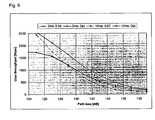
- Fig. 5 is a diagram of the user throughput independency of the path loss.
- the user throughput is equivalent to the data throughput of the wireless terminal and the path loss is indicative of the distance between the base station and the wireless terminal. The higher the path loss is the bigger the distance is between the base station and the wireless terminal.
- the four curves in the diagram of Fig. 5 represent the throughput independency of the path loss for different transmission time intervals. The chosen time intervals are 2 milliseconds and 10 milliseconds.
- Dashed curves represent the user throughput of a wireless terminal with an inner loop power control and an outer loop power control according to state of the art algorithms.
- the solid lines represent the user throughput for wireless terminals being controlled by an inner loop power control and an outer loop power control according to embodiments of the invention. It is clearly visible that the user throughput is in both cases higher for the wireless terminals being controlled by the inner loop power control and the outer loop power control according to embodiments of the invention.
- processors may be provided through the use of dedicated hardware as well as hardware capable of executing software in association with appropriate software.
- the functions may be provided by a single dedicated processor, by a single shared processor, or by a plurality of individual processors, some of which may be shared.
- explicit use of the term "processor” or “controller” should not be construed to refer exclusively to hardware capable of executing software, and may implicitly include, without limitation, digital signal processor (DSP) hardware, network processor, application specific integrated circuit (ASIC), field programmable gate array (FPGA), read only memory (ROM) for storing software, random access memory (RAM), and non volatile storage.
- DSP digital signal processor
- ASIC application specific integrated circuit
- FPGA field programmable gate array
- ROM read only memory
- RAM random access memory
- any switches shown in the FIGS. are conceptual only. Their function may be carried out through the operation of program logic, through dedicated logic, through the interaction of program control and dedicated logic, or even manually, the particular technique being selectable by the implementer as more specifically understood from the context.
- any block diagrams herein represent conceptual views of illustrative circuitry embodying the principles of the invention.
- any flow charts, flow diagrams, state transition diagrams, pseudo code, and the like represent various processes which may be substantially represented in computer readable medium and so executed by a computer or processor, whether or not such computer or processor is explicitly shown.
- Wireless terminal 102
- Base station 104
- RNC 105
- Data transmission control module 106
- Processor 110
- Data 114
- Power control command 116
- Signal-to-interference reference setting 200
- First transmission power threshold 202
- Second transmission power threshold 204
- Time point 206
- Call start 402
- Configure measurements 404 Transmission power above first transmission power threshold?
- 406 Transmission power below second transmission power threshold?
- Determining user throughput 412 Determining if user throughput is below the first data throughput threshold 414
- Setting retransmission threshold to the first value 416 Determining if user throughput is below the second data throughput threshold 418
- Setting retransmission threshold to second value 420
Landscapes
- Engineering & Computer Science (AREA)
- Computer Networks & Wireless Communication (AREA)
- Signal Processing (AREA)
- Quality & Reliability (AREA)
- Artificial Intelligence (AREA)
- Physics & Mathematics (AREA)
- Probability & Statistics with Applications (AREA)
- Mobile Radio Communication Systems (AREA)
Claims (13)
- Verfahren zur Übertragung von Daten zwischen einem drahtlosen Endgerät (100) und einer Basisstation (102) in einem zellularen drahtlosen Netzwerk,
wobei sich das drahtlose Endgerät (100) und die Basisstation (102) in einer Kommunikationssitzung befinden, wobei das drahtlose Endgerät (100) Datenpakete mit Empfangsbestätigung an die Basisstation (102) überträgt, wobei nicht korrekt empfangene Datenpakete erneut übertragen werden; und
wobei die Sendeleistung des drahtlosen Endgeräts (100) anhand eines Leistungsregelungsalgorithmus gesteuert wird, welcher eine Signal-Rausch-Verhältnis- bzw. SNR-Referenz für die Kommunikationssitzung in Reaktion auf den Vergleich der Anzahl der Neuübertragungen eines Datenpakets mit einem Neuübertragungsgrenzwert dynamisch anpasst, wobei das Verfahren den Schritt des Anpassens des Neuübertragungsgrenzwerts in Reaktion auf das Erkennen, dass die Sendeleistung des drahtlosen Endgeräts ein vorgegebenes Leistungsbeschränkungskriterium erfüllt, umfasst, und
Erhöhen einer gewünschten Anzahl der Neuübertragungen, wenn die Zellenauslastung der Zelle einen Zellenauslastungsgrenzwert unterschreitet, und wenn die Sendeleistung des drahtlosen Endgeräts (100) einen ersten Sendeleistungsgrenzwert (200) überschreitet. - Verfahren nach Anspruch 1, wobei die Neuübertragung gemäß einem Hybridwiederholungsaufforderungsschema erfolgt.
- Verfahren nach einem beliebigen der vorstehenden Ansprüche, wobei die Größe der Datentransportblöcke erhöht wird, wenn sich das Signal-Rausch-Verhältnis verringert.
- Verfahren nach einem beliebigen der vorstehenden Ansprüche, wobei das drahtlose Endgerät (100) Messberichte an die Basisstation (102) überträgt, wobei die Messberichte für die Sendeleistung indikativ sind.
- Verfahren nach einem beliebigen der vorstehenden Ansprüche, wobei der Neuübertragungsgrenzwert nur dann verringert wird, wenn die Sendeleistung des drahtlosen Endgeräts (100) einen zweiten Sendeleistungsgrenzwert (202) unterschreitet, wobei der zweite Sendeleistungsgrenzwert niedriger als der erste Sendeleistungsgrenzwert ist.
- Verfahren nach einem beliebigen der vorstehenden Ansprüche, wobei der Neuübertragungsgrenzwert nur dann erhöht wird, wenn die Sendeleistung des drahtlosen Endgeräts (100) den ersten Sendeleistungsgrenzwert (200) für mindestens eine erste Zeitspanne überschreitet.
- Verfahren nach einem beliebigen der Ansprüche 5 oder 6, wobei der Neuübertragungsgrenzwert nur dann gesenkt wird, wenn die Sendeleistung des drahtlosen Endgeräts (100) den zweiten Sendeleistungsgrenzwert (202) für mindestens eine zweite Zeitspanne unterschreitet.
- Verfahren nach einem beliebigen der vorstehenden Ansprüche, wobei das drahtlose Endgerät (100) Planungsinformationsberichte an die Basisstation (102) überträgt, wobei die Planungsinformationsberichte für den ersten (200) und/oder den zweiten Sendeleistungsgrenzwert (202) indikativ sind.
- Verfahren nach einem beliebigen der Ansprüche 1-8, wobei das Verfahren weiterhin die folgenden Schritte umfasst:- Anweisen (402) des drahtlosen Endgeräts (100), Messungen durchzuführen und Messberichte an die Basisstation (102) zu übertragen;- Ermitteln (404), ob die Sendeleistung den ersten Sendeleistungsgrenzwert (200) überschreitet;- wenn dies der Fall ist, Bestimmen (410) des Datendurchsatzes der drahtlosen Verbindung zwischen dem drahtlosen Endgerät (100) und der Basisstation (102);- Ermitteln (412), ob der Datendurchsatz einen ersten Datendurchsatzgrenzwert (200) unterschreitet;- wenn dies nicht der Fall ist, Einstellen (414) des Neuübertragungsgrenzwerts auf einen ersten Wert;- wenn der Datendurchsatz den ersten Datendurchsatzgrenzwert unterschreitet, Ermitteln (416), ob der Datendurchsatz einen zweiten Datendurchsatzgrenzwert unterschreitet, wobei der zweite Datendurchsatzgrenzwert niedriger als der erste Datendurchsatzgrenzwert ist;- wenn dies der Fall ist, Einstellen (418) des Neuübertragungsgrenzwerts auf einen zweiten Wert, wobei der zweite Wert höher als der erste Wert ist;- wenn dies nicht der Fall ist, Einstellen (420) des Neuübertragungsgrenzwerts auf einen dritten Wert, wobei der dritte Wert höher als der erste Wert, jedoch niedriger als der zweite Wert ist;- Ermitteln, ob die Sendeleistung den ersten Sendeleistungsgrenzwert (200) überschreitet, nachdem der Neuübertragungsgrenzwert eingestellt wurde;- wenn die Sendeleistung den ersten Sendeleistungsgrenzwert (200) unterschreitet, nachdem der Neuübertragungsgrenzwert eingestellt wurde, Rücksetzen (408) des Neuübertragungsgrenzwerts auf den ersten Wert.
- Verfahren nach einem beliebigen der Ansprüche 1-9, wobei das Verfahren das Bestimmen einer Signal-Rausch-Verhältnis-Referenz für eine Verbindung des drahtlosen Endgeräts (100) mit der Basisstation (102) umfasst, wobei das Verfahren weiterhin umfasst:- Einstellen der Sendeleistung des drahtlosen Endgeräts (100) gemäß der Signal-Rausch-Verhältnis-Referenz;- Bestimmen des Neuübertragungsgrenzwerts für die Verbindung des drahtlosen Endgeräts (100) mit der Basisstation (102);- Ermitteln einer aktuellen Anzahl von Neuübertragungen für die Verbindung des drahtlosen Endgeräts (100) mit der Basisstation (102);- Erhöhen der Signal-Rausch-Verhältnis-Referenz, wenn die aktuelle Anzahl von Neuübertragungen den Neuübertragungsgrenzwert überschreitet;- Verringern der Signal-Rausch-Verhältnis-Referenz, wenn die aktuelle Anzahl von Neuübertragungen den Neuübertragungsgrenzwert unterschreitet;- Ermitteln der Zellenauslastung der Zelle, wobei die Zellenauslastung für den gesamten drahtlosen Telekommunikationsverkehr in der Zelle indikativ ist;- Ermitteln, ob die Sendeleistung des drahtlosen Endgeräts (100) den ersten Sendeleistungsgrenzwert (200) überschreitet;- Erhöhen des Neuübertragungsgrenzwerts, wenn die Zellenauslastung den Zellenauslastungsgrenzwert überschreitet;- Verringern des Neuübertragungsgrenzwerts, wenn die Zellenauslastung den Zellenauslastungsgrenzwert unterschreitet und die Sendeleistung des drahtlosen Endgeräts den ersten Sendeleistungsgrenzwert unterschreitet; und- Erhöhen des Neuübertragungsgrenzwerts, wenn die Zellenauslastung den Zellenauslastungsgrenzwert unterschreitet und die Sendeleistung des drahtlosen Endgeräts (100) den ersten Sendeleistungsgrenzwert (200) überschreitet.
- Modul (104) zur Steuerung der Datenübertragung in einem zellularen drahtlosen Netzwerk, umfassend Verarbeitungsmittel (108) zum Ausführen eines Leistungsregelungsalgorithmus, welcher eine Signal-Rausch-Verhältnis- bzw. SNR-Referenz für eine Kommunikationssitzung zwischen einem drahtlosen Endgerät (100) und einer Basisstation (102) dynamisch anpasst, wobei das drahtlose Endgerät (100) Datenpakete mit Empfangsbestätigung an die Basisstation (102) überträgt und diese neu überträgt, wenn sie nicht korrekt empfangen werden, in Reaktion auf den Vergleich der Anzahl der Neuübertragungen eines Datenpakets mit einem Neuübertragungsgrenzwert, wobei die besagten Verarbeitungsmittel (108) weiterhin für das Anpassen des Neuübertragungsgrenzwerts in Bezug auf eine zwischen einem drahtlosen Endgerät (100) und einer Basisstation (102) hergestellten Kommunikationssitzung in Reaktion auf das Erkennen, dass eine Sendeleistung des drahtlosen Endgeräts (100) ein vorgegebenes Leistungsbeschränkungskriterium erfüllt, ausgelegt sind, und wobei der Leistungsregelungsalgorithmus das Erhöhen einer gewünschten Anzahl von Neuübertragungen umfasst, wenn die Zellenauslastung einen Zellenauslastungsgrenzwert unterschreitet und die Sendeleistung des drahtlosen Endgeräts (100) einen ersten Sendeleistungsgrenzwert (200) überschreitet.
- Modul zur Steuerung der Datenübertragung nach Anspruch 11, wobei das Modul zur Steuerung der Datenübertragung weiterhin umfasst:- Mittel (108) zum Bestimmen der Signal-Rausch-Verhältnis-Referenz für die Kommunikationssitzung;- Mittel zum Einstellen der Sendeleistung des drahtlosen Endgeräts (100) gemäß der Signal-Rausch-Verhältnis-Referenz;- Mittel (108) zum Bestimmen eines Neuübertragungsgrenzwerts für die Kommunikationssitzung;- Mittel zum Ermitteln einer aktuellen Anzahl von Neuübertragungen für die Kommunikationssitzung;- Mittel zum Ermitteln der Zellenauslastung der Zelle, wobei die Zellenauslastung für den gesamten drahtlosen Telekommunikationsverkehr in der Zelle indikativ ist;- Mittel zum Ermitteln, of die Sendeleistung des drahtlosen Endgeräts (100) einen ersten Sendeleistungsgrenzwert (200) überschreitet;- Mittel (108) zum Erhöhen des Neuübertragungsgrenzwerts, wenn die Zellenauslastung einen Zellenauslastungsgrenzwert überschreitet;- Mittel (108) zum Verringern des Neuübertragungsgrenzwerts, wenn die Zellenauslastung den Zellenauslastungsgrenzwert unterschreitet und die Sendeleistung des drahtlosen Endgeräts (100) den ersten Sendeleistungsgrenzwert (200) unterschreitet; und- Mittel (108) zum Erhöhen des Neuübertragungsgrenzwerts, wenn die Zellenauslastung den Zellenauslastungsgrenzwert unterschreitet und die Sendeleistung des drahtlosen Endgeräts (100) den ersten Sendeleistungsgrenzwert (200) überschreitet;wobei die Mittel zum Anpassen der Signal-Rausch-Verhältnis-Referenz dazu ausgelegt sind, die Signal-Rausch-Verhältnis-Referenz zu erhöhen, wenn die aktuelle Anzahl der Neuübertragungen den Neuübertragungsgrenzwert überschreitet, und wobei die Mittel zum Anpassen der Signal-Rausch-Verhältnis-Referenz dazu ausgelegt sind, die Signal-Rausch-Verhältnis-Referenz zu verringern, wenn die aktuelle Anzahl der Neuübertragungen den Neuübertragungsgrenzwert unterschreitet
- Funknetzwerk-Controller (104) mit einem Modul (105) zur Steuerung der Datenübertragung gemäß einem beliebigen der Ansprüche 11 oder 12.
Priority Applications (1)
| Application Number | Priority Date | Filing Date | Title |
|---|---|---|---|
| EP20100290454 EP2424313B1 (de) | 2010-08-25 | 2010-08-25 | Verfahren zur Steuerung der Übertragungsenergie eines drahtlosen Endgeräts |
Applications Claiming Priority (1)
| Application Number | Priority Date | Filing Date | Title |
|---|---|---|---|
| EP20100290454 EP2424313B1 (de) | 2010-08-25 | 2010-08-25 | Verfahren zur Steuerung der Übertragungsenergie eines drahtlosen Endgeräts |
Publications (2)
| Publication Number | Publication Date |
|---|---|
| EP2424313A1 EP2424313A1 (de) | 2012-02-29 |
| EP2424313B1 true EP2424313B1 (de) | 2013-02-13 |
Family
ID=43479483
Family Applications (1)
| Application Number | Title | Priority Date | Filing Date |
|---|---|---|---|
| EP20100290454 Not-in-force EP2424313B1 (de) | 2010-08-25 | 2010-08-25 | Verfahren zur Steuerung der Übertragungsenergie eines drahtlosen Endgeräts |
Country Status (1)
| Country | Link |
|---|---|
| EP (1) | EP2424313B1 (de) |
Families Citing this family (2)
| Publication number | Priority date | Publication date | Assignee | Title |
|---|---|---|---|---|
| CN111247856B (zh) * | 2018-09-28 | 2023-05-05 | 联发科技股份有限公司 | 侧边链路车联网通信方法及其用户设备 |
| CN110149131B (zh) * | 2019-05-14 | 2022-05-17 | 维沃移动通信有限公司 | 一种天线确定方法及移动终端 |
Family Cites Families (4)
| Publication number | Priority date | Publication date | Assignee | Title |
|---|---|---|---|---|
| SE0101281D0 (sv) * | 2001-04-06 | 2001-04-06 | Ericsson Telefon Ab L M | Method and system of link control |
| US7697469B2 (en) * | 2004-05-12 | 2010-04-13 | Telefonaktiebolaget Lm Ericsson (Publ) | Method and apparatus to improve communication performance in ARQ networks |
| ATE447797T1 (de) * | 2007-11-23 | 2009-11-15 | Alcatel Lucent | Adaptive leistungssteuerung für edch |
| US8413003B2 (en) * | 2008-05-05 | 2013-04-02 | Telefonaktiebolaget L M Ericsson (Publ) | Uplink coverage via autonomous retransmission |
-
2010
- 2010-08-25 EP EP20100290454 patent/EP2424313B1/de not_active Not-in-force
Also Published As
| Publication number | Publication date |
|---|---|
| EP2424313A1 (de) | 2012-02-29 |
Similar Documents
| Publication | Publication Date | Title |
|---|---|---|
| US7155249B2 (en) | Modified power control for hybrid ARQ on the reverse link | |
| EP1584155B1 (de) | Betrieb eines vorwärtsstrecken-bestätigungskanals für die rückwärtsstreckendaten | |
| JP4445490B2 (ja) | ワイヤレスリンクを介して送信する方法 | |
| JP5341917B2 (ja) | 無線通信システムにおける方法と構成 | |
| JP6132830B2 (ja) | アップリンクダイバーシチ送信の方法及び装置 | |
| US7903559B2 (en) | Apparatus and method for transmitting reverse packet data in mobile communication system | |
| US20080081651A1 (en) | Communication Control Method, Radio Communication System, Base Station, and Mobile Station | |
| US20020027897A1 (en) | Method for the communication of information and apparatus employing the method | |
| US20050250500A1 (en) | Communication method, packet radio system, controller and user terminal | |
| EP1487161A1 (de) | Funkkommunikationsnetz, Station und Verfahren zur Anpassung der Packetlänge | |
| KR102549780B1 (ko) | 무선 통신 시스템에서 상향 링크 전력 제어 장치 및 방법 | |
| CN101179309A (zh) | 无线电通信系统 | |
| EP2080306A1 (de) | Dynamische einstellung des leistungsoffsets für ue/bs auf der basis eines fehlerereignisses von nack zu ack | |
| TWI401984B (zh) | 行動電信網路 | |
| EP2424313B1 (de) | Verfahren zur Steuerung der Übertragungsenergie eines drahtlosen Endgeräts | |
| JP4015877B2 (ja) | 移動体通信システム及び無線通信制御方法 | |
| WO2006083152A1 (en) | A method of scheduling uplink channel of a mobile station that is in soft handover in a mobile wireless communication system | |
| KR100808392B1 (ko) | 정보 통신을 위한 방법 및 그 방법을 채용한 장치 | |
| KR20190025213A (ko) | 상향링크 harq 동작 방법 및 이를 이용하는 기지국 |
Legal Events
| Date | Code | Title | Description |
|---|---|---|---|
| AK | Designated contracting states |
Kind code of ref document: A1 Designated state(s): AL AT BE BG CH CY CZ DE DK EE ES FI FR GB GR HR HU IE IS IT LI LT LU LV MC MK MT NL NO PL PT RO SE SI SK SM TR |
|
| AX | Request for extension of the european patent |
Extension state: BA ME RS |
|
| PUAI | Public reference made under article 153(3) epc to a published international application that has entered the european phase |
Free format text: ORIGINAL CODE: 0009012 |
|
| 17P | Request for examination filed |
Effective date: 20120210 |
|
| GRAP | Despatch of communication of intention to grant a patent |
Free format text: ORIGINAL CODE: EPIDOSNIGR1 |
|
| RIC1 | Information provided on ipc code assigned before grant |
Ipc: H04W 52/10 20090101ALI20120924BHEP Ipc: H04W 52/24 20090101ALN20120924BHEP Ipc: H04L 1/18 20060101ALN20120924BHEP Ipc: H04W 52/14 20090101ALN20120924BHEP Ipc: H04W 52/48 20090101AFI20120924BHEP Ipc: H04L 1/00 20060101ALI20120924BHEP Ipc: H04W 52/20 20090101ALN20120924BHEP Ipc: H04W 52/36 20090101ALI20120924BHEP |
|
| GRAS | Grant fee paid |
Free format text: ORIGINAL CODE: EPIDOSNIGR3 |
|
| GRAA | (expected) grant |
Free format text: ORIGINAL CODE: 0009210 |
|
| AK | Designated contracting states |
Kind code of ref document: B1 Designated state(s): AL AT BE BG CH CY CZ DE DK EE ES FI FR GB GR HR HU IE IS IT LI LT LU LV MC MK MT NL NO PL PT RO SE SI SK SM TR |
|
| REG | Reference to a national code |
Ref country code: GB Ref legal event code: FG4D |
|
| REG | Reference to a national code |
Ref country code: AT Ref legal event code: REF Ref document number: 597060 Country of ref document: AT Kind code of ref document: T Effective date: 20130215 |
|
| REG | Reference to a national code |
Ref country code: IE Ref legal event code: FG4D |
|
| REG | Reference to a national code |
Ref country code: DE Ref legal event code: R096 Ref document number: 602010004983 Country of ref document: DE Effective date: 20130411 |
|
| REG | Reference to a national code |
Ref country code: AT Ref legal event code: MK05 Ref document number: 597060 Country of ref document: AT Kind code of ref document: T Effective date: 20130213 |
|
| REG | Reference to a national code |
Ref country code: NL Ref legal event code: VDEP Effective date: 20130213 |
|
| REG | Reference to a national code |
Ref country code: LT Ref legal event code: MG4D |
|
| PG25 | Lapsed in a contracting state [announced via postgrant information from national office to epo] |
Ref country code: SE Free format text: LAPSE BECAUSE OF FAILURE TO SUBMIT A TRANSLATION OF THE DESCRIPTION OR TO PAY THE FEE WITHIN THE PRESCRIBED TIME-LIMIT Effective date: 20130213 Ref country code: BG Free format text: LAPSE BECAUSE OF FAILURE TO SUBMIT A TRANSLATION OF THE DESCRIPTION OR TO PAY THE FEE WITHIN THE PRESCRIBED TIME-LIMIT Effective date: 20130513 Ref country code: NO Free format text: LAPSE BECAUSE OF FAILURE TO SUBMIT A TRANSLATION OF THE DESCRIPTION OR TO PAY THE FEE WITHIN THE PRESCRIBED TIME-LIMIT Effective date: 20130513 Ref country code: LT Free format text: LAPSE BECAUSE OF FAILURE TO SUBMIT A TRANSLATION OF THE DESCRIPTION OR TO PAY THE FEE WITHIN THE PRESCRIBED TIME-LIMIT Effective date: 20130213 Ref country code: AT Free format text: LAPSE BECAUSE OF FAILURE TO SUBMIT A TRANSLATION OF THE DESCRIPTION OR TO PAY THE FEE WITHIN THE PRESCRIBED TIME-LIMIT Effective date: 20130213 Ref country code: IS Free format text: LAPSE BECAUSE OF FAILURE TO SUBMIT A TRANSLATION OF THE DESCRIPTION OR TO PAY THE FEE WITHIN THE PRESCRIBED TIME-LIMIT Effective date: 20130613 Ref country code: ES Free format text: LAPSE BECAUSE OF FAILURE TO SUBMIT A TRANSLATION OF THE DESCRIPTION OR TO PAY THE FEE WITHIN THE PRESCRIBED TIME-LIMIT Effective date: 20130524 |
|
| PG25 | Lapsed in a contracting state [announced via postgrant information from national office to epo] |
Ref country code: BE Free format text: LAPSE BECAUSE OF FAILURE TO SUBMIT A TRANSLATION OF THE DESCRIPTION OR TO PAY THE FEE WITHIN THE PRESCRIBED TIME-LIMIT Effective date: 20130213 Ref country code: SI Free format text: LAPSE BECAUSE OF FAILURE TO SUBMIT A TRANSLATION OF THE DESCRIPTION OR TO PAY THE FEE WITHIN THE PRESCRIBED TIME-LIMIT Effective date: 20130213 Ref country code: PT Free format text: LAPSE BECAUSE OF FAILURE TO SUBMIT A TRANSLATION OF THE DESCRIPTION OR TO PAY THE FEE WITHIN THE PRESCRIBED TIME-LIMIT Effective date: 20130613 Ref country code: FI Free format text: LAPSE BECAUSE OF FAILURE TO SUBMIT A TRANSLATION OF THE DESCRIPTION OR TO PAY THE FEE WITHIN THE PRESCRIBED TIME-LIMIT Effective date: 20130213 Ref country code: GR Free format text: LAPSE BECAUSE OF FAILURE TO SUBMIT A TRANSLATION OF THE DESCRIPTION OR TO PAY THE FEE WITHIN THE PRESCRIBED TIME-LIMIT Effective date: 20130514 Ref country code: PL Free format text: LAPSE BECAUSE OF FAILURE TO SUBMIT A TRANSLATION OF THE DESCRIPTION OR TO PAY THE FEE WITHIN THE PRESCRIBED TIME-LIMIT Effective date: 20130213 Ref country code: LV Free format text: LAPSE BECAUSE OF FAILURE TO SUBMIT A TRANSLATION OF THE DESCRIPTION OR TO PAY THE FEE WITHIN THE PRESCRIBED TIME-LIMIT Effective date: 20130213 |
|
| PG25 | Lapsed in a contracting state [announced via postgrant information from national office to epo] |
Ref country code: HR Free format text: LAPSE BECAUSE OF FAILURE TO SUBMIT A TRANSLATION OF THE DESCRIPTION OR TO PAY THE FEE WITHIN THE PRESCRIBED TIME-LIMIT Effective date: 20130213 |
|
| PG25 | Lapsed in a contracting state [announced via postgrant information from national office to epo] |
Ref country code: SK Free format text: LAPSE BECAUSE OF FAILURE TO SUBMIT A TRANSLATION OF THE DESCRIPTION OR TO PAY THE FEE WITHIN THE PRESCRIBED TIME-LIMIT Effective date: 20130213 Ref country code: CZ Free format text: LAPSE BECAUSE OF FAILURE TO SUBMIT A TRANSLATION OF THE DESCRIPTION OR TO PAY THE FEE WITHIN THE PRESCRIBED TIME-LIMIT Effective date: 20130213 Ref country code: DK Free format text: LAPSE BECAUSE OF FAILURE TO SUBMIT A TRANSLATION OF THE DESCRIPTION OR TO PAY THE FEE WITHIN THE PRESCRIBED TIME-LIMIT Effective date: 20130213 Ref country code: EE Free format text: LAPSE BECAUSE OF FAILURE TO SUBMIT A TRANSLATION OF THE DESCRIPTION OR TO PAY THE FEE WITHIN THE PRESCRIBED TIME-LIMIT Effective date: 20130213 Ref country code: NL Free format text: LAPSE BECAUSE OF FAILURE TO SUBMIT A TRANSLATION OF THE DESCRIPTION OR TO PAY THE FEE WITHIN THE PRESCRIBED TIME-LIMIT Effective date: 20130213 Ref country code: RO Free format text: LAPSE BECAUSE OF FAILURE TO SUBMIT A TRANSLATION OF THE DESCRIPTION OR TO PAY THE FEE WITHIN THE PRESCRIBED TIME-LIMIT Effective date: 20130213 |
|
| PLBE | No opposition filed within time limit |
Free format text: ORIGINAL CODE: 0009261 |
|
| REG | Reference to a national code |
Ref country code: FR Ref legal event code: GC Effective date: 20131120 |
|
| STAA | Information on the status of an ep patent application or granted ep patent |
Free format text: STATUS: NO OPPOSITION FILED WITHIN TIME LIMIT |
|
| PG25 | Lapsed in a contracting state [announced via postgrant information from national office to epo] |
Ref country code: IT Free format text: LAPSE BECAUSE OF FAILURE TO SUBMIT A TRANSLATION OF THE DESCRIPTION OR TO PAY THE FEE WITHIN THE PRESCRIBED TIME-LIMIT Effective date: 20130213 |
|
| 26N | No opposition filed |
Effective date: 20131114 |
|
| REG | Reference to a national code |
Ref country code: DE Ref legal event code: R097 Ref document number: 602010004983 Country of ref document: DE Effective date: 20131114 |
|
| PG25 | Lapsed in a contracting state [announced via postgrant information from national office to epo] |
Ref country code: MC Free format text: LAPSE BECAUSE OF FAILURE TO SUBMIT A TRANSLATION OF THE DESCRIPTION OR TO PAY THE FEE WITHIN THE PRESCRIBED TIME-LIMIT Effective date: 20130213 |
|
| REG | Reference to a national code |
Ref country code: IE Ref legal event code: MM4A |
|
| PG25 | Lapsed in a contracting state [announced via postgrant information from national office to epo] |
Ref country code: IE Free format text: LAPSE BECAUSE OF NON-PAYMENT OF DUE FEES Effective date: 20130825 |
|
| REG | Reference to a national code |
Ref country code: CH Ref legal event code: PCOW Free format text: NEW ADDRESS: 148/152 ROUTE DE LA REINE, 92100 BOULOGNE-BILLANCOURT (FR) |
|
| REG | Reference to a national code |
Ref country code: FR Ref legal event code: RG Effective date: 20141016 |
|
| REG | Reference to a national code |
Ref country code: CH Ref legal event code: PL |
|
| PG25 | Lapsed in a contracting state [announced via postgrant information from national office to epo] |
Ref country code: LI Free format text: LAPSE BECAUSE OF NON-PAYMENT OF DUE FEES Effective date: 20140831 Ref country code: CH Free format text: LAPSE BECAUSE OF NON-PAYMENT OF DUE FEES Effective date: 20140831 |
|
| PG25 | Lapsed in a contracting state [announced via postgrant information from national office to epo] |
Ref country code: SM Free format text: LAPSE BECAUSE OF FAILURE TO SUBMIT A TRANSLATION OF THE DESCRIPTION OR TO PAY THE FEE WITHIN THE PRESCRIBED TIME-LIMIT Effective date: 20130213 |
|
| PG25 | Lapsed in a contracting state [announced via postgrant information from national office to epo] |
Ref country code: TR Free format text: LAPSE BECAUSE OF FAILURE TO SUBMIT A TRANSLATION OF THE DESCRIPTION OR TO PAY THE FEE WITHIN THE PRESCRIBED TIME-LIMIT Effective date: 20130213 Ref country code: MT Free format text: LAPSE BECAUSE OF FAILURE TO SUBMIT A TRANSLATION OF THE DESCRIPTION OR TO PAY THE FEE WITHIN THE PRESCRIBED TIME-LIMIT Effective date: 20130213 Ref country code: CY Free format text: LAPSE BECAUSE OF FAILURE TO SUBMIT A TRANSLATION OF THE DESCRIPTION OR TO PAY THE FEE WITHIN THE PRESCRIBED TIME-LIMIT Effective date: 20130213 |
|
| PG25 | Lapsed in a contracting state [announced via postgrant information from national office to epo] |
Ref country code: HU Free format text: LAPSE BECAUSE OF FAILURE TO SUBMIT A TRANSLATION OF THE DESCRIPTION OR TO PAY THE FEE WITHIN THE PRESCRIBED TIME-LIMIT; INVALID AB INITIO Effective date: 20100825 Ref country code: MK Free format text: LAPSE BECAUSE OF FAILURE TO SUBMIT A TRANSLATION OF THE DESCRIPTION OR TO PAY THE FEE WITHIN THE PRESCRIBED TIME-LIMIT Effective date: 20130213 Ref country code: LU Free format text: LAPSE BECAUSE OF NON-PAYMENT OF DUE FEES Effective date: 20130825 |
|
| REG | Reference to a national code |
Ref country code: FR Ref legal event code: PLFP Year of fee payment: 6 |
|
| REG | Reference to a national code |
Ref country code: FR Ref legal event code: PLFP Year of fee payment: 7 |
|
| REG | Reference to a national code |
Ref country code: FR Ref legal event code: PLFP Year of fee payment: 8 |
|
| PGFP | Annual fee paid to national office [announced via postgrant information from national office to epo] |
Ref country code: DE Payment date: 20170822 Year of fee payment: 8 Ref country code: GB Payment date: 20170822 Year of fee payment: 8 Ref country code: FR Payment date: 20170822 Year of fee payment: 8 |
|
| PG25 | Lapsed in a contracting state [announced via postgrant information from national office to epo] |
Ref country code: AL Free format text: LAPSE BECAUSE OF FAILURE TO SUBMIT A TRANSLATION OF THE DESCRIPTION OR TO PAY THE FEE WITHIN THE PRESCRIBED TIME-LIMIT Effective date: 20130213 |
|
| REG | Reference to a national code |
Ref country code: DE Ref legal event code: R119 Ref document number: 602010004983 Country of ref document: DE |
|
| GBPC | Gb: european patent ceased through non-payment of renewal fee |
Effective date: 20180825 |
|
| REG | Reference to a national code |
Ref country code: GB Ref legal event code: 732E Free format text: REGISTERED BETWEEN 20190429 AND 20190502 |
|
| REG | Reference to a national code |
Ref country code: DE Ref legal event code: R082 Ref document number: 602010004983 Country of ref document: DE Representative=s name: MENZIETTI WETZEL, DE Ref country code: DE Ref legal event code: R081 Ref document number: 602010004983 Country of ref document: DE Owner name: PROVENANCE ASSET GROUP LLC, PITTSFORD, US Free format text: FORMER OWNER: ALCATEL LUCENT, PARIS, FR |
|
| PG25 | Lapsed in a contracting state [announced via postgrant information from national office to epo] |
Ref country code: DE Free format text: LAPSE BECAUSE OF NON-PAYMENT OF DUE FEES Effective date: 20190301 |
|
| PG25 | Lapsed in a contracting state [announced via postgrant information from national office to epo] |
Ref country code: FR Free format text: LAPSE BECAUSE OF NON-PAYMENT OF DUE FEES Effective date: 20180831 |
|
| PG25 | Lapsed in a contracting state [announced via postgrant information from national office to epo] |
Ref country code: GB Free format text: LAPSE BECAUSE OF NON-PAYMENT OF DUE FEES Effective date: 20180825 |