EP2423014A1 - Track-bound vehicle, in particular rail vehicle, and method of operating the same - Google Patents
Track-bound vehicle, in particular rail vehicle, and method of operating the same Download PDFInfo
- Publication number
- EP2423014A1 EP2423014A1 EP10090008A EP10090008A EP2423014A1 EP 2423014 A1 EP2423014 A1 EP 2423014A1 EP 10090008 A EP10090008 A EP 10090008A EP 10090008 A EP10090008 A EP 10090008A EP 2423014 A1 EP2423014 A1 EP 2423014A1
- Authority
- EP
- European Patent Office
- Prior art keywords
- compartment
- passenger
- vehicle
- energy
- passengers
- Prior art date
- Legal status (The legal status is an assumption and is not a legal conclusion. Google has not performed a legal analysis and makes no representation as to the accuracy of the status listed.)
- Granted
Links
Images

Classifications
-
- B—PERFORMING OPERATIONS; TRANSPORTING
- B60—VEHICLES IN GENERAL
- B60H—ARRANGEMENTS OF HEATING, COOLING, VENTILATING OR OTHER AIR-TREATING DEVICES SPECIALLY ADAPTED FOR PASSENGER OR GOODS SPACES OF VEHICLES
- B60H1/00—Heating, cooling or ventilating devices
- B60H1/00642—Control systems or circuits; Control members or indication devices for heating, cooling or ventilating devices
- B60H1/00735—Control systems or circuits characterised by their input, i.e. by the detection, measurement or calculation of particular conditions, e.g. signal treatment, dynamic models
- B60H1/00742—Control systems or circuits characterised by their input, i.e. by the detection, measurement or calculation of particular conditions, e.g. signal treatment, dynamic models by detection of the vehicle occupants' presence; by detection of conditions relating to the body of occupants, e.g. using radiant heat detectors
-
- B—PERFORMING OPERATIONS; TRANSPORTING
- B60—VEHICLES IN GENERAL
- B60H—ARRANGEMENTS OF HEATING, COOLING, VENTILATING OR OTHER AIR-TREATING DEVICES SPECIALLY ADAPTED FOR PASSENGER OR GOODS SPACES OF VEHICLES
- B60H1/00—Heating, cooling or ventilating devices
- B60H1/00357—Air-conditioning arrangements specially adapted for particular vehicles
- B60H1/00371—Air-conditioning arrangements specially adapted for particular vehicles for vehicles carrying large numbers of passengers, e.g. buses
-
- B—PERFORMING OPERATIONS; TRANSPORTING
- B60—VEHICLES IN GENERAL
- B60Q—ARRANGEMENT OF SIGNALLING OR LIGHTING DEVICES, THE MOUNTING OR SUPPORTING THEREOF OR CIRCUITS THEREFOR, FOR VEHICLES IN GENERAL
- B60Q3/00—Arrangement of lighting devices for vehicle interiors; Lighting devices specially adapted for vehicle interiors
- B60Q3/40—Arrangement of lighting devices for vehicle interiors; Lighting devices specially adapted for vehicle interiors specially adapted for specific vehicle types
- B60Q3/41—Arrangement of lighting devices for vehicle interiors; Lighting devices specially adapted for vehicle interiors specially adapted for specific vehicle types for mass transit vehicles, e.g. buses
- B60Q3/47—Circuits; Control arrangements
Definitions
- Track-bound vehicle in particular rail vehicle, and method of operating the same
- the invention relates to a track-bound vehicle, in particular a rail vehicle, having a plurality of passenger compartments. Furthermore, the invention relates to a method of operating such a vehicle.
- a passenger compartment is understood to be a space in which passengers may travel within the vehicle, for example while sitting or standing.
- the compartment may be, for example, a classical compartment having six or eight seats, or may be a compartment having more seats, such as in modern saloon coaches.
- the upper deck and the lower deck may form separate compartments, for example.
- the compartment may be divided in sub-compartments. It is also possible that the compartment may correspond to a complete coach of the vehicle.
- the vehicle may be a train having a plurality of coaches which are coupled to each other.
- the control is performed in such a manner that the energy consumption of the systems and/or devices is reduced.
- US 5,485,347 describes for a train having a plurality of cars to automatically count a number of persons entering and a number of persons exiting each of a plurality of enclosed areas of the train. However, this information is only used to inform passengers waiting for the train at the next train station about the occupational status of the train. Such a system for automatically determining the number of persons or passengers within the enclosed areas, i.e. within the compartments, can be used to obtain and/or to determine the passenger number for the purposes according to the present invention.
- the expected passenger number may be received from a central passenger ticket booking system of the vehicle operator.
- Still another type of input information for making the decision whether energy consumption can be reduced is information input by the vehicle staff, in particular the driver. He or she may input the level of passenger occupation, for example "half the vehicle will be occupied". The different types of information can be combined. It is also possible that the vehicle staff directly inputs a request to take at least one compartment out of service, which automatically triggers the reduction of the energy consumption for operating this compartment.
- coaches and/or compartment at the end or at another part of a train may be taken out of service if the number of passengers within the respective coach is small or zero. However, the coach may stay part of the vehicle (e.g. the train). If the coach - or more generally speaking the compartment - is out of service, the respective devices and systems which are operated to provide comfort to the passengers (such as heating, ventilation and/or air conditioning systems, lights and passenger information systems) can be switched off or can be switched to standby. A set temperature of the heating system may be reduced. A set temperature of the air conditioning system may be increased.
- the invention has the advantage that the vehicle can continue travelling while at least one compartment is out of service and, as a result, the energy consumption is reduced.
- a vehicle which is in the process of being prepared for travelling on a route can be prepared to provide space for the maximum expected number of passengers only, but comprises at least one additional compartment for additional passengers during later phases of the travel.
- at least one specific compartment may be out of service when the travel starts at the first station on the route.
- a compartment, which is out of service is set to standby, so that the time required for putting the compartment in "ready for service" mode is small.
- the heating system may be set to a temperature smaller than the service temperature or the air-conditioning system may be set to a temperature higher than the service temperature.
- this compartment is in standby mode so that it can be prepared for service within a short period of time.
- a track-bound vehicle in particular a rail vehicle, having a plurality of passenger compartments, wherein:
- a method of operating a track-bound vehicle is proposed, in particular a rail vehicle, having a plurality of passenger compartments, wherein:
- the passenger number which is used to determine if it fulfils a first and/or second predetermined condition can be the actual passenger number, a predicted passenger number, a combination of the numbers or information which is determined using one or more than one of these numbers.
- Reduction of the energy consumption does not necessarily mean a reduction of the energy which is actually consumed. It also includes the preparation of the compartment for service, wherein the energy-consuming devices are not or not fully operated. Therefore the energy consumed is reduced compared to the hypothetical case that the energy-consuming devices are operated at full energy consumption. Stopping the energy consumption of the least one energy-consuming device also includes the case that operation of the energy-consuming device is not started.
- the following information may be used to determine the passenger number of a compartment:
- the first predetermined condition may be, for example, the condition that the actual or expected passenger number, in particular the passenger number within the respective compartment, is smaller than a predetermined threshold value, such as two or one.
- a predetermined threshold value such as two or one.
- the control device may be adapted to automatically generate and output an indication for informing passengers and/or vehicle staff that the compartment is withdrawn from service, if the passenger number of the compartment fulfils the first predetermined condition and/or the second predetermined condition.
- the second predetermined condition may be fulfilled and the indication is made.
- the remaining passengers within the compartment may be required by the indication to leave the compartment.
- the passenger number determining device may detect that the remaining passengers leave the compartment and then the first predetermined condition may be fulfilled.
- control device outputs a control signal which automatically results in the doors to the compartment being locked (preferably locked for entrance, but not for exit) so that no person can re-enter the compartment.
- Compartment-external indicators in particular coach-external indicators, may indicate that the compartment is not in service.
- the control device may transmit a message to a vehicle-external system (such as a vehicle fleet control system) that the compartment is out of service.
- a vehicle-external system such as a vehicle fleet control system
- the information about the compartments which are in service and which are out of service may be communicated to vehicle-external devices and systems and may be influenced by these vehicle-external devices and systems.
- this information or part of this information may be communicated to persons who are travelling with the vehicle in other compartments or in a compartment which is to be taken out of service or to persons outside of the vehicle who intend to enter the vehicle and, for example, are waiting for the vehicle at the next station.
- an on-board system which comprises a camera or a plurality of cameras may evaluate pictures taken of a specific compartment in order to check if there is no passenger in the compartment, before the compartment is taken out of service, in particular before the doors are locked.
- Fig. 2 shows the resulting situation.
- the two passengers P of coach C3 have left the coach and the coach C3 is withdrawn from service, but continues to be part of the train.
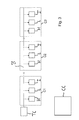
- Fig. 3 schematically shows energy consuming devices which are operated to maintain comfort for passengers travelling within the respective coach.
- each coach C1, C2, C3 comprises a heating system H, a light system L and a passenger information system I.
- These systems may be parts of a train-wide system.
- the central control of the heating system may be located in a locomotive or in the first coach C1.
- the passenger information system may be located in a locomotive or in the first coach C1.
- the systems H, L, I are connected to a central control device TC via a data bus B.
- the central control device TC may also be adapted to evaluate the passenger number information provided by the passenger number determining device.
- the central control device TC may receive from another control device the information that a specific coach has been withdrawn from service.
- the central control device TC outputs control signals to reduce energy consumption of the systems H, L, I in the respective coach.
- the coach C3 has been withdrawn from service.
- the central control device TC outputs control signals to the heating system H, the light system L and the passenger information system I in coach C3 so that the systems H, L, I are switched off or switched to standby.
- the heating system may be controlled to reduce the temperature within the passenger compartment to a smaller room temperature.
- the light system may be switched off, optionally with the exception of emergency light.
- the passenger information system in coach C3 may be switched off completely.
- the central control device TC may transmit a message to a stationary control centre CC, which is not located within the train and which is preferably the control centre of the operator of the vehicle fleet.
- the transmitted message comprises the information that a specific coach has been withdrawn from service, in particular coach C3.
- the message may optionally comprise information about the available space for passengers in the other coaches C1, C2.
Landscapes
- Engineering & Computer Science (AREA)
- Mechanical Engineering (AREA)
- Physics & Mathematics (AREA)
- Thermal Sciences (AREA)
- Air-Conditioning For Vehicles (AREA)
- Electric Propulsion And Braking For Vehicles (AREA)
Abstract
- at least one energy-consuming device (H, L, I), in particular a heating, ventilating and/or air conditioning system (H), a light system (L) for illuminating the compartment and/or a passenger information system (I),
- a passenger number determining device for each compartment and/or an interface for receiving information about the passenger number,
- a control device (TC) for controlling the energy-consuming devices wherein
- the control device is adapted to control the energy-consuming devices (H, L, I) in such a manner that their energy consumption is reduced or stopped, if the passenger number of the compartment fulfils a first predetermined condition.
Description
- Track-bound vehicle, in particular rail vehicle, and method of operating the same
- The invention relates to a track-bound vehicle, in particular a rail vehicle, having a plurality of passenger compartments. Furthermore, the invention relates to a method of operating such a vehicle.
- A passenger compartment is understood to be a space in which passengers may travel within the vehicle, for example while sitting or standing. The compartment may be, for example, a classical compartment having six or eight seats, or may be a compartment having more seats, such as in modern saloon coaches. In case of a double-deck coach the upper deck and the lower deck may form separate compartments, for example. Regardless of the type of coach, the compartment may be divided in sub-compartments. It is also possible that the compartment may correspond to a complete coach of the vehicle. The vehicle may be a train having a plurality of coaches which are coupled to each other.
- There are increasing requirements to reduce energy consumption during operation of track-bound vehicles, in particular rail vehicles. One option is to increase the efficiency of the systems and devices within the vehicle with respect to energy consumption. Another option is to indicate to the driver of the vehicle that he may drive the vehicle in a more energy effective way.
- It is an object of the present invention to reduce the energy consumption while operating a track-bound vehicle, in particular a rail vehicle.
- It is a basic idea of the present invention to use information about the number of passengers in the compartments of the vehicle to control the operation of systems and devices which are associated with the respective compartment and/or which are connected to the compartment. The control is performed in such a manner that the energy consumption of the systems and/or devices is reduced.
-
US 5,485,347 describes for a train having a plurality of cars to automatically count a number of persons entering and a number of persons exiting each of a plurality of enclosed areas of the train. However, this information is only used to inform passengers waiting for the train at the next train station about the occupational status of the train. Such a system for automatically determining the number of persons or passengers within the enclosed areas, i.e. within the compartments, can be used to obtain and/or to determine the passenger number for the purposes according to the present invention. - In addition or alternatively, statistical information about the expected number of passengers can be used. For example, numbers of passengers travelling on the same route at specific days during the week and/or at a specific season in the year may form a reliable basis for predicting the passenger number. In addition or alternatively, the expected passenger number may be received from a central passenger ticket booking system of the vehicle operator. Still another type of input information for making the decision whether energy consumption can be reduced is information input by the vehicle staff, in particular the driver. He or she may input the level of passenger occupation, for example "half the vehicle will be occupied". The different types of information can be combined. It is also possible that the vehicle staff directly inputs a request to take at least one compartment out of service, which automatically triggers the reduction of the energy consumption for operating this compartment.
- In particular, coaches and/or compartment at the end or at another part of a train may be taken out of service if the number of passengers within the respective coach is small or zero. However, the coach may stay part of the vehicle (e.g. the train). If the coach - or more generally speaking the compartment - is out of service, the respective devices and systems which are operated to provide comfort to the passengers (such as heating, ventilation and/or air conditioning systems, lights and passenger information systems) can be switched off or can be switched to standby. A set temperature of the heating system may be reduced. A set temperature of the air conditioning system may be increased.
- The invention has the advantage that the vehicle can continue travelling while at least one compartment is out of service and, as a result, the energy consumption is reduced.
- According to a further possible way of using the information about the passenger number a vehicle which is in the process of being prepared for travelling on a route can be prepared to provide space for the maximum expected number of passengers only, but comprises at least one additional compartment for additional passengers during later phases of the travel. For example, at least one specific compartment may be out of service when the travel starts at the first station on the route. However, it is possible that a compartment, which is out of service, is set to standby, so that the time required for putting the compartment in "ready for service" mode is small. For example, the heating system may be set to a temperature smaller than the service temperature or the air-conditioning system may be set to a temperature higher than the service temperature.
- In any case when a compartment is out of service, it is preferred that this compartment is in standby mode so that it can be prepared for service within a short period of time.
- In particular, the following is proposed: a track-bound vehicle, in particular a rail vehicle, having a plurality of passenger compartments, wherein:
- at least one energy-consuming device, in particular a heating, ventilating and/or air conditioning system, a light system for illuminating the compartment and/or a passenger information system, is associated with and/or connected to each passenger compartment,
- the vehicle comprises a passenger number determining device which is adapted to determine the number of passengers and/or comprises an interface for receiving information about the passenger number,
- the vehicle comprises a control device for controlling at least a part of the energy-consuming devices,
- the control device is connected to the passenger number determining device and/or to the interface and is adapted to control the energy-consuming devices in such a manner that the energy consumption of at least one energy-consuming device which is associated with and/or connected to a passenger compartment is reduced or stopped, if the passenger number, in particular the passenger number of the compartment, fulfils a first predetermined condition.
- Furthermore, a method of operating a track-bound vehicle is proposed, in particular a rail vehicle, having a plurality of passenger compartments, wherein:
- for each passenger compartment at least one energy-consuming device, in particular a heating, ventilating and/or air conditioning system, a light system for illuminating the compartment and/or a passenger information system, is operated in association with and/or while being connected to the respective passenger compartment,
- the number of passengers is automatically determined and/or information about the number of passengers is received,
- at least a part of the energy-consuming devices, which are operated in association with and/or while being connected to the respective passenger compartment, are automatically controlled in such a manner that the energy consumption of the least one energy-consuming device is reduced or stopped, if the passenger number, in particular the passenger number of the compartment, fulfils a first predetermined condition.
- The passenger number which is used to determine if it fulfils a first and/or second predetermined condition can be the actual passenger number, a predicted passenger number, a combination of the numbers or information which is determined using one or more than one of these numbers.
- Reduction of the energy consumption does not necessarily mean a reduction of the energy which is actually consumed. It also includes the preparation of the compartment for service, wherein the energy-consuming devices are not or not fully operated. Therefore the energy consumed is reduced compared to the hypothetical case that the energy-consuming devices are operated at full energy consumption. Stopping the energy consumption of the least one energy-consuming device also includes the case that operation of the energy-consuming device is not started.
- In particular, the following information may be used to determine the passenger number of a compartment:
- the actual passenger number counted by the on-board passenger number determining device, which is preferably counted for each compartment separately, so that the decision to withdraw the compartment from service can be based on the counted number of passengers within the compartment and - optionally - can be based as well on the counted passenger number within at least one other compartment (so that remaining passengers within the compartment can be re-seated or re-located);
- statistical information about passenger occupation. This statistical information may be output by the on-board passenger number determining device and may take into account passenger numbers counted and/or received in the past;
- information from a vehicle-external booking and/or reservation system, such as a system operated by the owner of a fleet of vehicles; and/or
- information about the actual passenger occupation. This information can be received, as mentioned, from the passenger number determining device on-board the vehicle.
- The first predetermined condition may be, for example, the condition that the actual or expected passenger number, in particular the passenger number within the respective compartment, is smaller than a predetermined threshold value, such as two or one. There may be a second predetermined condition. For example, this second predetermined condition may be that the actual passenger number within the respective compartment is smaller than a second predetermined threshold value, wherein the second predetermined threshold value may be larger than the first predetermined threshold value. The control device may be adapted to automatically generate and output an indication for informing passengers and/or vehicle staff that the compartment is withdrawn from service, if the passenger number of the compartment fulfils the first predetermined condition and/or the second predetermined condition. For example, if there are only four or five passengers within a saloon compartment, the second predetermined condition may be fulfilled and the indication is made. The remaining passengers within the compartment may be required by the indication to leave the compartment. The passenger number determining device may detect that the remaining passengers leave the compartment and then the first predetermined condition may be fulfilled.
- Preferably, the control device outputs a control signal which automatically results in the doors to the compartment being locked (preferably locked for entrance, but not for exit) so that no person can re-enter the compartment.
- Compartment-external indicators, in particular coach-external indicators, may indicate that the compartment is not in service.
- The control device may transmit a message to a vehicle-external system (such as a vehicle fleet control system) that the compartment is out of service. Of course, there should be a way of bringing back the compartment to service, for example by the vehicle staff or on receipt of a vehicle-external message. As a result, the information about the compartments which are in service and which are out of service may be communicated to vehicle-external devices and systems and may be influenced by these vehicle-external devices and systems. In particular, this information or part of this information (for example the information that a specific compartment is not in service) may be communicated to persons who are travelling with the vehicle in other compartments or in a compartment which is to be taken out of service or to persons outside of the vehicle who intend to enter the vehicle and, for example, are waiting for the vehicle at the next station.
- Optionally, an on-board system which comprises a camera or a plurality of cameras may evaluate pictures taken of a specific compartment in order to check if there is no passenger in the compartment, before the compartment is taken out of service, in particular before the doors are locked.
- Examples of the present invention will be described with reference to the attached figures. The figures show:
- Fig. 1
- schematically a train having three coaches, wherein only a few passengers are travelling in one of the coaches,
- Fig. 2
- the train of
Fig. 1 , wherein the remaining passengers have left the coach and the coach is withdrawn from service, - Fig. 3
- schematically devices and systems which are connected to the coaches of the train shown in
Fig. 1 and Fig. 2 , wherein the operation of the devices can be controlled by a central control device of the train. -
Fig. 2 shows the resulting situation. The two passengers P of coach C3 have left the coach and the coach C3 is withdrawn from service, but continues to be part of the train. -
Fig. 3 schematically shows energy consuming devices which are operated to maintain comfort for passengers travelling within the respective coach. In particular, each coach C1, C2, C3 comprises a heating system H, a light system L and a passenger information system I. These systems may be parts of a train-wide system. For example, the central control of the heating system may be located in a locomotive or in the first coach C1. The same applies to the passenger information system and, optionally, to the light system. There may be further devices or systems which are associated with one of the coaches. More generally speaking, all devices and systems or parts thereof can be switched off or can be switched to standby if there is no passenger in the coach. - The systems H, L, I are connected to a central control device TC via a data bus B. The central control device TC may also be adapted to evaluate the passenger number information provided by the passenger number determining device. Alternatively, the central control device TC may receive from another control device the information that a specific coach has been withdrawn from service. In this case, the central control device TC outputs control signals to reduce energy consumption of the systems H, L, I in the respective coach. For example, the coach C3 has been withdrawn from service. As a result, the central control device TC outputs control signals to the heating system H, the light system L and the passenger information system I in coach C3 so that the systems H, L, I are switched off or switched to standby. For example, the heating system may be controlled to reduce the temperature within the passenger compartment to a smaller room temperature. In addition, the light system may be switched off, optionally with the exception of emergency light. Furthermore, the passenger information system in coach C3 may be switched off completely.
- The central control device TC may transmit a message to a stationary control centre CC, which is not located within the train and which is preferably the control centre of the operator of the vehicle fleet. The transmitted message comprises the information that a specific coach has been withdrawn from service, in particular coach C3. Furthermore, the message may optionally comprise information about the available space for passengers in the other coaches C1, C2.
Claims (4)
- A track-bound vehicle, in particular a rail vehicle, having a plurality of passenger compartments (C1, C2, C3), wherein:- at least one energy-consuming device (H, L, I), in particular a heating, ventilating and/or air conditioning system (H), a light system (L) for illuminating the compartment (C1, C2, C3) and/or a passenger information system (I), is associated with and/or connected to each passenger compartment (C1, C2, C3),- the vehicle comprises a passenger number determining device which is adapted to determine the number of passengers in each compartment (C1, C2, C3) and/or comprises an interface for receiving information about the passenger number,- the vehicle comprises a control device (TC) for controlling at least a part of the energy-consuming devices (H, L, I),- the control device (TC) is connected to the passenger number determining device and/or to the interface and is adapted to control the energy-consuming devices (H, L, I) in such a manner that the energy consumption of at least one energy-consuming device (H, L, I) which is associated with and/or connected to a passenger compartment (C1, C2, C3) is reduced or stopped, if the passenger number, in particular the passenger number of the compartment (C1, C2, C3), fulfils a first predetermined condition.
- The vehicle of claim 1, wherein the control device is adapted to automatically generate and output an indication for informing passengers and/or vehicle staff that the compartment (C1, C2, C3) is withdrawn from service, if the passenger number of the compartment (C1, C2, C3) fulfils the first predetermined condition and/or a second predetermined condition.
- A method of operating a track-bound vehicle, in particular a rail vehicle, having a plurality of passenger compartments (C1, C2, C3), wherein:- for each passenger compartment (C1, C2, C3) at least one energy-consuming device (H, L, I), in particular a heating, ventilating and/or air conditioning system (H), a light system (L) for illuminating the compartment (C1, C2, C3) and/or a passenger information system (I), is operated in association with and/or while being connected to the respective passenger compartment (C1, C2, C3),- the number of passengers in each compartment (C1, C2, C3) is automatically determined and/or information about the number of passengers is received,- at least a part of the energy-consuming devices (H, L, I), which are operated in association with and/or while being connected to the respective passenger compartment (C1, C2, C3), are automatically controlled in such a manner that the energy consumption of the least one energy-consuming device (H, L, I) is reduced or stopped, if the passenger number, in particular the passenger number of the compartment (C1, C2, C3), fulfils a first predetermined condition.
- The method the preceding claim, wherein an indication for informing passengers and/or vehicle staff that the compartment (C1, C2, C3) is withdrawn from service, if the passenger number of the compartment (C1, C2, C3) fulfils the first predetermined condition and/or a second predetermined condition, is automatically generated and output.
Priority Applications (4)
| Application Number | Priority Date | Filing Date | Title |
|---|---|---|---|
| ES10090008T ES2407229T3 (en) | 2010-08-27 | 2010-08-27 | Vehicle linked to a track, in particular a railway vehicle, and its operating procedure |
| DK10090008.3T DK2423014T3 (en) | 2010-08-27 | 2010-08-27 | Rail vehicle, in particular a railway vehicle and method of operating the same |
| EP10090008A EP2423014B1 (en) | 2010-08-27 | 2010-08-27 | Track-bound vehicle, in particular rail vehicle, and method of operating the same |
| PL10090008T PL2423014T3 (en) | 2010-08-27 | 2010-08-27 | Track-bound vehicle, in particular rail vehicle, and method of operating the same |
Applications Claiming Priority (1)
| Application Number | Priority Date | Filing Date | Title |
|---|---|---|---|
| EP10090008A EP2423014B1 (en) | 2010-08-27 | 2010-08-27 | Track-bound vehicle, in particular rail vehicle, and method of operating the same |
Publications (2)
| Publication Number | Publication Date |
|---|---|
| EP2423014A1 true EP2423014A1 (en) | 2012-02-29 |
| EP2423014B1 EP2423014B1 (en) | 2013-03-13 |
Family
ID=43478433
Family Applications (1)
| Application Number | Title | Priority Date | Filing Date |
|---|---|---|---|
| EP10090008A Active EP2423014B1 (en) | 2010-08-27 | 2010-08-27 | Track-bound vehicle, in particular rail vehicle, and method of operating the same |
Country Status (4)
| Country | Link |
|---|---|
| EP (1) | EP2423014B1 (en) |
| DK (1) | DK2423014T3 (en) |
| ES (1) | ES2407229T3 (en) |
| PL (1) | PL2423014T3 (en) |
Cited By (9)
| Publication number | Priority date | Publication date | Assignee | Title |
|---|---|---|---|---|
| WO2017050510A1 (en) * | 2015-09-22 | 2017-03-30 | Siemens Aktiengesellschaft | Device for regulating a fresh air supply amount in a vehicle |
| EP3335919A1 (en) * | 2016-12-14 | 2018-06-20 | AURORA Konrad G. Schulz GmbH & Co. KG | Bus |
| CN112232712A (en) * | 2020-03-16 | 2021-01-15 | 叶平俊 | Running energy-saving method for urban rail vehicle |
| WO2021052889A1 (en) * | 2019-09-17 | 2021-03-25 | Bombardier Transportation Gmbh | Method for selectively controlling the temperature of passenger compartments of vehicle and vehicle for carrying out the method |
| EP3851306A1 (en) * | 2020-01-16 | 2021-07-21 | MAN Truck & Bus SE | Impurity detection in a vehicle |
| FR3115247A1 (en) * | 2020-10-21 | 2022-04-22 | Alstom Transport Technologies | Vehicle light management device , vehicle and related method |
| CN114905916A (en) * | 2021-02-08 | 2022-08-16 | 丰田自动车株式会社 | Vehicle and method for preventing infection |
| CN117227772A (en) * | 2023-10-27 | 2023-12-15 | 中车株洲电力机车有限公司 | Train lighting system control device and train |
| DE102023202400A1 (en) * | 2023-03-16 | 2024-02-29 | Zf Friedrichshafen Ag | Control system for an electrically powered transport vehicle |
Families Citing this family (2)
| Publication number | Priority date | Publication date | Assignee | Title |
|---|---|---|---|---|
| DE102020200702A1 (en) | 2020-01-22 | 2021-07-22 | Siemens Mobility GmbH | Method and system for processing data on the utilization of means of transport |
| DE102023121249A1 (en) * | 2023-08-09 | 2025-02-13 | Bayerische Motoren Werke Aktiengesellschaft | CONTROL ARRANGEMENT FOR AN ON-BOARD NETWORK IN A MOTOR VEHICLE |
Citations (5)
| Publication number | Priority date | Publication date | Assignee | Title |
|---|---|---|---|---|
| US4000400A (en) * | 1975-04-09 | 1976-12-28 | Elder Clarence L | Bidirectional monitoring and control system |
| EP0149450A2 (en) * | 1983-12-30 | 1985-07-24 | Alex. Friedmann Kommanditgesellschaft | Air conditioning device for railroad vehicles |
| US5485347A (en) | 1993-06-28 | 1996-01-16 | Matsushita Electric Industrial Co., Ltd. | Riding situation guiding management system |
| DE20311981U1 (en) * | 2003-08-02 | 2004-12-09 | Boeck, Lutz, Dipl.-Ing. | Rail air conditioning unit for compartment coach has air conditioners in individual compartments in parallel with brine circuit supplied with cooling brine |
| WO2009063148A1 (en) * | 2007-10-01 | 2009-05-22 | Alstom Transport Sa | Transport vehicle, in particular a railway carriage, comprising a passenger compartment lighting device |
-
2010
- 2010-08-27 ES ES10090008T patent/ES2407229T3/en active Active
- 2010-08-27 PL PL10090008T patent/PL2423014T3/en unknown
- 2010-08-27 DK DK10090008.3T patent/DK2423014T3/en active
- 2010-08-27 EP EP10090008A patent/EP2423014B1/en active Active
Patent Citations (5)
| Publication number | Priority date | Publication date | Assignee | Title |
|---|---|---|---|---|
| US4000400A (en) * | 1975-04-09 | 1976-12-28 | Elder Clarence L | Bidirectional monitoring and control system |
| EP0149450A2 (en) * | 1983-12-30 | 1985-07-24 | Alex. Friedmann Kommanditgesellschaft | Air conditioning device for railroad vehicles |
| US5485347A (en) | 1993-06-28 | 1996-01-16 | Matsushita Electric Industrial Co., Ltd. | Riding situation guiding management system |
| DE20311981U1 (en) * | 2003-08-02 | 2004-12-09 | Boeck, Lutz, Dipl.-Ing. | Rail air conditioning unit for compartment coach has air conditioners in individual compartments in parallel with brine circuit supplied with cooling brine |
| WO2009063148A1 (en) * | 2007-10-01 | 2009-05-22 | Alstom Transport Sa | Transport vehicle, in particular a railway carriage, comprising a passenger compartment lighting device |
Cited By (12)
| Publication number | Priority date | Publication date | Assignee | Title |
|---|---|---|---|---|
| WO2017050510A1 (en) * | 2015-09-22 | 2017-03-30 | Siemens Aktiengesellschaft | Device for regulating a fresh air supply amount in a vehicle |
| EP3335919A1 (en) * | 2016-12-14 | 2018-06-20 | AURORA Konrad G. Schulz GmbH & Co. KG | Bus |
| WO2021052889A1 (en) * | 2019-09-17 | 2021-03-25 | Bombardier Transportation Gmbh | Method for selectively controlling the temperature of passenger compartments of vehicle and vehicle for carrying out the method |
| EP3851306A1 (en) * | 2020-01-16 | 2021-07-21 | MAN Truck & Bus SE | Impurity detection in a vehicle |
| CN112232712A (en) * | 2020-03-16 | 2021-01-15 | 叶平俊 | Running energy-saving method for urban rail vehicle |
| FR3115247A1 (en) * | 2020-10-21 | 2022-04-22 | Alstom Transport Technologies | Vehicle light management device , vehicle and related method |
| CN114390758A (en) * | 2020-10-21 | 2022-04-22 | 阿尔斯通运输科技公司 | Vehicle light management device, related vehicle and method |
| EP3988419A1 (en) * | 2020-10-21 | 2022-04-27 | ALSTOM Transport Technologies | Device for managing the light for a vehicle, associated vehicle and method |
| US12084094B2 (en) | 2020-10-21 | 2024-09-10 | Alstom Transport Technologies | Vehicle light management device, associated vehicle and method |
| CN114905916A (en) * | 2021-02-08 | 2022-08-16 | 丰田自动车株式会社 | Vehicle and method for preventing infection |
| DE102023202400A1 (en) * | 2023-03-16 | 2024-02-29 | Zf Friedrichshafen Ag | Control system for an electrically powered transport vehicle |
| CN117227772A (en) * | 2023-10-27 | 2023-12-15 | 中车株洲电力机车有限公司 | Train lighting system control device and train |
Also Published As
| Publication number | Publication date |
|---|---|
| DK2423014T3 (en) | 2013-05-27 |
| PL2423014T3 (en) | 2013-08-30 |
| ES2407229T3 (en) | 2013-06-12 |
| EP2423014B1 (en) | 2013-03-13 |
Similar Documents
| Publication | Publication Date | Title |
|---|---|---|
| EP2423014B1 (en) | Track-bound vehicle, in particular rail vehicle, and method of operating the same | |
| CN108622142A (en) | A kind of train intelligent operation adjustment system and method based on real-time passenger flow | |
| US10388126B2 (en) | Method for guiding passengers | |
| US10482752B2 (en) | Seat occupancy monitor | |
| US20120197466A1 (en) | Operation support device and automatic operation device | |
| KR20120092834A (en) | Device for increasing ride comfort of train | |
| CN110400483A (en) | A kind of colleges and universities' school bus management method and device based on recognition of face and GIS platform | |
| CN109074072A (en) | automatic transport system | |
| JP7487820B2 (en) | Passenger management device, passenger management method, and program | |
| US9815482B2 (en) | Train-information management device and train-crew support method | |
| KR101737738B1 (en) | System for analysing and transmission of subway image information | |
| CN108609022A (en) | Combined haulage system and its application method | |
| JP2010237891A (en) | Bus boarding guidance system and bus boarding guidance method | |
| JP2020111186A (en) | Partition open/close system | |
| DE102023202400A1 (en) | Control system for an electrically powered transport vehicle | |
| CN117035862A (en) | Management method for quick station passing of spacecraft | |
| CN118138633A (en) | Network contract automobile management method and system applied to large public places | |
| CN112141173A (en) | Method and system for dredging passenger flow of rail transit | |
| JP3227052B2 (en) | Seating status display system | |
| TWI397873B (en) | Vehicle carrying information display system and method thereof | |
| WO2024055410A1 (en) | Passenger diversion method and system for multi-carriage passenger-carrying system | |
| JPH09190485A (en) | Information notification system and system control method thereof | |
| KR100852513B1 (en) | Passenger Management System and Method using RDF | |
| EP3792133A1 (en) | System and method for detecting seat occupancy on a railway car of a railway vehicle | |
| JP2026068539A (en) | In-vehicle monitoring system, safety status monitoring and control program |
Legal Events
| Date | Code | Title | Description |
|---|---|---|---|
| AK | Designated contracting states |
Kind code of ref document: A1 Designated state(s): AL AT BE BG CH CY CZ DE DK EE ES FI FR GB GR HR HU IE IS IT LI LT LU LV MC MK MT NL NO PL PT RO SE SI SK SM TR |
|
| AX | Request for extension of the european patent |
Extension state: BA ME RS |
|
| PUAI | Public reference made under article 153(3) epc to a published international application that has entered the european phase |
Free format text: ORIGINAL CODE: 0009012 |
|
| 17P | Request for examination filed |
Effective date: 20120829 |
|
| GRAP | Despatch of communication of intention to grant a patent |
Free format text: ORIGINAL CODE: EPIDOSNIGR1 |
|
| RIN1 | Information on inventor provided before grant (corrected) |
Inventor name: DE COEN, LUC Inventor name: CONAN, LOIC |
|
| GRAS | Grant fee paid |
Free format text: ORIGINAL CODE: EPIDOSNIGR3 |
|
| GRAA | (expected) grant |
Free format text: ORIGINAL CODE: 0009210 |
|
| AK | Designated contracting states |
Kind code of ref document: B1 Designated state(s): AL AT BE BG CH CY CZ DE DK EE ES FI FR GB GR HR HU IE IS IT LI LT LU LV MC MK MT NL NO PL PT RO SE SI SK SM TR |
|
| REG | Reference to a national code |
Ref country code: GB Ref legal event code: FG4D |
|
| REG | Reference to a national code |
Ref country code: AT Ref legal event code: REF Ref document number: 600576 Country of ref document: AT Kind code of ref document: T Effective date: 20130315 Ref country code: CH Ref legal event code: EP |
|
| REG | Reference to a national code |
Ref country code: IE Ref legal event code: FG4D |
|
| REG | Reference to a national code |
Ref country code: CH Ref legal event code: NV Representative=s name: PATENTANWALT DIPL.-ING. (UNI.) WOLFGANG HEISEL, CH |
|
| REG | Reference to a national code |
Ref country code: DE Ref legal event code: R096 Ref document number: 602010005366 Country of ref document: DE Effective date: 20130508 |
|
| REG | Reference to a national code |
Ref country code: DK Ref legal event code: T3 |
|
| REG | Reference to a national code |
Ref country code: ES Ref legal event code: FG2A Ref document number: 2407229 Country of ref document: ES Kind code of ref document: T3 Effective date: 20130612 |
|
| PG25 | Lapsed in a contracting state [announced via postgrant information from national office to epo] |
Ref country code: SE Free format text: LAPSE BECAUSE OF FAILURE TO SUBMIT A TRANSLATION OF THE DESCRIPTION OR TO PAY THE FEE WITHIN THE PRESCRIBED TIME-LIMIT Effective date: 20130313 Ref country code: BG Free format text: LAPSE BECAUSE OF FAILURE TO SUBMIT A TRANSLATION OF THE DESCRIPTION OR TO PAY THE FEE WITHIN THE PRESCRIBED TIME-LIMIT Effective date: 20130613 Ref country code: LT Free format text: LAPSE BECAUSE OF FAILURE TO SUBMIT A TRANSLATION OF THE DESCRIPTION OR TO PAY THE FEE WITHIN THE PRESCRIBED TIME-LIMIT Effective date: 20130313 Ref country code: NO Free format text: LAPSE BECAUSE OF FAILURE TO SUBMIT A TRANSLATION OF THE DESCRIPTION OR TO PAY THE FEE WITHIN THE PRESCRIBED TIME-LIMIT Effective date: 20130613 |
|
| REG | Reference to a national code |
Ref country code: NL Ref legal event code: T3 |
|
| REG | Reference to a national code |
Ref country code: LT Ref legal event code: MG4D |
|
| PG25 | Lapsed in a contracting state [announced via postgrant information from national office to epo] |
Ref country code: FI Free format text: LAPSE BECAUSE OF FAILURE TO SUBMIT A TRANSLATION OF THE DESCRIPTION OR TO PAY THE FEE WITHIN THE PRESCRIBED TIME-LIMIT Effective date: 20130313 Ref country code: SI Free format text: LAPSE BECAUSE OF FAILURE TO SUBMIT A TRANSLATION OF THE DESCRIPTION OR TO PAY THE FEE WITHIN THE PRESCRIBED TIME-LIMIT Effective date: 20130313 Ref country code: LV Free format text: LAPSE BECAUSE OF FAILURE TO SUBMIT A TRANSLATION OF THE DESCRIPTION OR TO PAY THE FEE WITHIN THE PRESCRIBED TIME-LIMIT Effective date: 20130313 Ref country code: GR Free format text: LAPSE BECAUSE OF FAILURE TO SUBMIT A TRANSLATION OF THE DESCRIPTION OR TO PAY THE FEE WITHIN THE PRESCRIBED TIME-LIMIT Effective date: 20130614 |
|
| REG | Reference to a national code |
Ref country code: PL Ref legal event code: T3 |
|
| PG25 | Lapsed in a contracting state [announced via postgrant information from national office to epo] |
Ref country code: BE Free format text: LAPSE BECAUSE OF FAILURE TO SUBMIT A TRANSLATION OF THE DESCRIPTION OR TO PAY THE FEE WITHIN THE PRESCRIBED TIME-LIMIT Effective date: 20130313 Ref country code: HR Free format text: LAPSE BECAUSE OF FAILURE TO SUBMIT A TRANSLATION OF THE DESCRIPTION OR TO PAY THE FEE WITHIN THE PRESCRIBED TIME-LIMIT Effective date: 20130313 |
|
| PG25 | Lapsed in a contracting state [announced via postgrant information from national office to epo] |
Ref country code: IS Free format text: LAPSE BECAUSE OF FAILURE TO SUBMIT A TRANSLATION OF THE DESCRIPTION OR TO PAY THE FEE WITHIN THE PRESCRIBED TIME-LIMIT Effective date: 20130713 Ref country code: PT Free format text: LAPSE BECAUSE OF FAILURE TO SUBMIT A TRANSLATION OF THE DESCRIPTION OR TO PAY THE FEE WITHIN THE PRESCRIBED TIME-LIMIT Effective date: 20130715 Ref country code: SK Free format text: LAPSE BECAUSE OF FAILURE TO SUBMIT A TRANSLATION OF THE DESCRIPTION OR TO PAY THE FEE WITHIN THE PRESCRIBED TIME-LIMIT Effective date: 20130313 Ref country code: RO Free format text: LAPSE BECAUSE OF FAILURE TO SUBMIT A TRANSLATION OF THE DESCRIPTION OR TO PAY THE FEE WITHIN THE PRESCRIBED TIME-LIMIT Effective date: 20130313 Ref country code: EE Free format text: LAPSE BECAUSE OF FAILURE TO SUBMIT A TRANSLATION OF THE DESCRIPTION OR TO PAY THE FEE WITHIN THE PRESCRIBED TIME-LIMIT Effective date: 20130313 |
|
| PLBE | No opposition filed within time limit |
Free format text: ORIGINAL CODE: 0009261 |
|
| STAA | Information on the status of an ep patent application or granted ep patent |
Free format text: STATUS: NO OPPOSITION FILED WITHIN TIME LIMIT |
|
| 26N | No opposition filed |
Effective date: 20131216 |
|
| REG | Reference to a national code |
Ref country code: DE Ref legal event code: R097 Ref document number: 602010005366 Country of ref document: DE Effective date: 20131216 |
|
| PG25 | Lapsed in a contracting state [announced via postgrant information from national office to epo] |
Ref country code: MC Free format text: LAPSE BECAUSE OF FAILURE TO SUBMIT A TRANSLATION OF THE DESCRIPTION OR TO PAY THE FEE WITHIN THE PRESCRIBED TIME-LIMIT Effective date: 20130313 |
|
| REG | Reference to a national code |
Ref country code: IE Ref legal event code: MM4A |
|
| PG25 | Lapsed in a contracting state [announced via postgrant information from national office to epo] |
Ref country code: IE Free format text: LAPSE BECAUSE OF NON-PAYMENT OF DUE FEES Effective date: 20130827 |
|
| GBPC | Gb: european patent ceased through non-payment of renewal fee |
Effective date: 20140827 |
|
| PG25 | Lapsed in a contracting state [announced via postgrant information from national office to epo] |
Ref country code: SM Free format text: LAPSE BECAUSE OF FAILURE TO SUBMIT A TRANSLATION OF THE DESCRIPTION OR TO PAY THE FEE WITHIN THE PRESCRIBED TIME-LIMIT Effective date: 20130313 |
|
| PG25 | Lapsed in a contracting state [announced via postgrant information from national office to epo] |
Ref country code: CY Free format text: LAPSE BECAUSE OF FAILURE TO SUBMIT A TRANSLATION OF THE DESCRIPTION OR TO PAY THE FEE WITHIN THE PRESCRIBED TIME-LIMIT Effective date: 20130313 Ref country code: MT Free format text: LAPSE BECAUSE OF FAILURE TO SUBMIT A TRANSLATION OF THE DESCRIPTION OR TO PAY THE FEE WITHIN THE PRESCRIBED TIME-LIMIT Effective date: 20130313 Ref country code: TR Free format text: LAPSE BECAUSE OF FAILURE TO SUBMIT A TRANSLATION OF THE DESCRIPTION OR TO PAY THE FEE WITHIN THE PRESCRIBED TIME-LIMIT Effective date: 20130313 |
|
| PG25 | Lapsed in a contracting state [announced via postgrant information from national office to epo] |
Ref country code: GB Free format text: LAPSE BECAUSE OF NON-PAYMENT OF DUE FEES Effective date: 20140827 Ref country code: MK Free format text: LAPSE BECAUSE OF FAILURE TO SUBMIT A TRANSLATION OF THE DESCRIPTION OR TO PAY THE FEE WITHIN THE PRESCRIBED TIME-LIMIT Effective date: 20130313 Ref country code: LU Free format text: LAPSE BECAUSE OF NON-PAYMENT OF DUE FEES Effective date: 20130827 Ref country code: HU Free format text: LAPSE BECAUSE OF FAILURE TO SUBMIT A TRANSLATION OF THE DESCRIPTION OR TO PAY THE FEE WITHIN THE PRESCRIBED TIME-LIMIT; INVALID AB INITIO Effective date: 20100827 |
|
| REG | Reference to a national code |
Ref country code: FR Ref legal event code: PLFP Year of fee payment: 7 |
|
| REG | Reference to a national code |
Ref country code: FR Ref legal event code: PLFP Year of fee payment: 8 |
|
| REG | Reference to a national code |
Ref country code: FR Ref legal event code: PLFP Year of fee payment: 9 |
|
| PG25 | Lapsed in a contracting state [announced via postgrant information from national office to epo] |
Ref country code: AL Free format text: LAPSE BECAUSE OF FAILURE TO SUBMIT A TRANSLATION OF THE DESCRIPTION OR TO PAY THE FEE WITHIN THE PRESCRIBED TIME-LIMIT Effective date: 20130313 |
|
| P01 | Opt-out of the competence of the unified patent court (upc) registered |
Effective date: 20230822 |
|
| PGFP | Annual fee paid to national office [announced via postgrant information from national office to epo] |
Ref country code: NL Payment date: 20250821 Year of fee payment: 16 |
|
| PGFP | Annual fee paid to national office [announced via postgrant information from national office to epo] |
Ref country code: ES Payment date: 20250925 Year of fee payment: 16 |
|
| PGFP | Annual fee paid to national office [announced via postgrant information from national office to epo] |
Ref country code: DK Payment date: 20250825 Year of fee payment: 16 Ref country code: DE Payment date: 20250820 Year of fee payment: 16 |
|
| PGFP | Annual fee paid to national office [announced via postgrant information from national office to epo] |
Ref country code: PL Payment date: 20250816 Year of fee payment: 16 Ref country code: IT Payment date: 20250825 Year of fee payment: 16 |
|
| PGFP | Annual fee paid to national office [announced via postgrant information from national office to epo] |
Ref country code: FR Payment date: 20250829 Year of fee payment: 16 Ref country code: AT Payment date: 20250821 Year of fee payment: 16 |
|
| PGFP | Annual fee paid to national office [announced via postgrant information from national office to epo] |
Ref country code: CH Payment date: 20250901 Year of fee payment: 16 |
|
| PGFP | Annual fee paid to national office [announced via postgrant information from national office to epo] |
Ref country code: CZ Payment date: 20250818 Year of fee payment: 16 |