EP2418286A1 - Improved method for isothermal amplification of nucleic acids - Google Patents
Improved method for isothermal amplification of nucleic acids Download PDFInfo
- Publication number
- EP2418286A1 EP2418286A1 EP10172400A EP10172400A EP2418286A1 EP 2418286 A1 EP2418286 A1 EP 2418286A1 EP 10172400 A EP10172400 A EP 10172400A EP 10172400 A EP10172400 A EP 10172400A EP 2418286 A1 EP2418286 A1 EP 2418286A1
- Authority
- EP
- European Patent Office
- Prior art keywords
- amplification
- matrix
- nucleic acids
- mesophilic
- enzyme
- Prior art date
- Legal status (The legal status is an assumption and is not a legal conclusion. Google has not performed a legal analysis and makes no representation as to the accuracy of the status listed.)
- Withdrawn
Links
- 150000007523 nucleic acids Chemical class 0.000 title claims abstract description 76
- 238000000034 method Methods 0.000 title claims abstract description 68
- 102000039446 nucleic acids Human genes 0.000 title claims abstract description 68
- 108020004707 nucleic acids Proteins 0.000 title claims abstract description 68
- 238000011901 isothermal amplification Methods 0.000 title claims abstract description 39
- 239000011159 matrix material Substances 0.000 claims abstract description 87
- 102000004190 Enzymes Human genes 0.000 claims abstract description 81
- 108090000790 Enzymes Proteins 0.000 claims abstract description 81
- 239000000203 mixture Substances 0.000 claims abstract description 28
- 238000003199 nucleic acid amplification method Methods 0.000 claims description 87
- 230000003321 amplification Effects 0.000 claims description 84
- 238000006243 chemical reaction Methods 0.000 claims description 76
- 108060004795 Methyltransferase Proteins 0.000 claims description 35
- 229920000936 Agarose Polymers 0.000 claims description 32
- 238000006073 displacement reaction Methods 0.000 claims description 21
- 108090000623 proteins and genes Proteins 0.000 claims description 21
- 102000004169 proteins and genes Human genes 0.000 claims description 19
- 230000000694 effects Effects 0.000 claims description 15
- 238000002844 melting Methods 0.000 claims description 15
- 238000011534 incubation Methods 0.000 claims description 13
- 239000011541 reaction mixture Substances 0.000 claims description 11
- 108090000364 Ligases Proteins 0.000 claims description 10
- 102000003960 Ligases Human genes 0.000 claims description 10
- 230000001419 dependent effect Effects 0.000 claims description 10
- 238000005215 recombination Methods 0.000 claims description 9
- 230000006798 recombination Effects 0.000 claims description 9
- 239000000017 hydrogel Substances 0.000 claims description 7
- 238000013518 transcription Methods 0.000 claims description 7
- 230000035897 transcription Effects 0.000 claims description 7
- 101710163270 Nuclease Proteins 0.000 claims description 6
- 238000005096 rolling process Methods 0.000 claims description 6
- 108700034637 EC 3.2.-.- Proteins 0.000 claims description 5
- 230000001404 mediated effect Effects 0.000 claims description 5
- 238000002156 mixing Methods 0.000 claims description 5
- 238000007711 solidification Methods 0.000 claims description 4
- 230000008023 solidification Effects 0.000 claims description 4
- 229920001059 synthetic polymer Polymers 0.000 claims description 4
- GJCOSYZMQJWQCA-UHFFFAOYSA-N 9H-xanthene Chemical compound C1=CC=C2CC3=CC=CC=C3OC2=C1 GJCOSYZMQJWQCA-UHFFFAOYSA-N 0.000 claims description 3
- 229920001817 Agar Polymers 0.000 claims description 3
- 229920000856 Amylose Polymers 0.000 claims description 3
- 241000206575 Chondrus crispus Species 0.000 claims description 3
- 244000007835 Cyamopsis tetragonoloba Species 0.000 claims description 3
- 229920002307 Dextran Polymers 0.000 claims description 3
- 239000001828 Gelatine Substances 0.000 claims description 3
- 241000206672 Gelidium Species 0.000 claims description 3
- 229920001202 Inulin Polymers 0.000 claims description 3
- 229920000161 Locust bean gum Polymers 0.000 claims description 3
- 239000004372 Polyvinyl alcohol Substances 0.000 claims description 3
- 108010091086 Recombinases Proteins 0.000 claims description 3
- 102000018120 Recombinases Human genes 0.000 claims description 3
- 235000010419 agar Nutrition 0.000 claims description 3
- 239000001913 cellulose Substances 0.000 claims description 3
- 229920002678 cellulose Polymers 0.000 claims description 3
- 229920000159 gelatin Polymers 0.000 claims description 3
- 235000019322 gelatine Nutrition 0.000 claims description 3
- 150000004676 glycans Chemical class 0.000 claims description 3
- JYJIGFIDKWBXDU-MNNPPOADSA-N inulin Chemical compound O[C@H]1[C@H](O)[C@@H](CO)O[C@@]1(CO)OC[C@]1(OC[C@]2(OC[C@]3(OC[C@]4(OC[C@]5(OC[C@]6(OC[C@]7(OC[C@]8(OC[C@]9(OC[C@]%10(OC[C@]%11(OC[C@]%12(OC[C@]%13(OC[C@]%14(OC[C@]%15(OC[C@]%16(OC[C@]%17(OC[C@]%18(OC[C@]%19(OC[C@]%20(OC[C@]%21(OC[C@]%22(OC[C@]%23(OC[C@]%24(OC[C@]%25(OC[C@]%26(OC[C@]%27(OC[C@]%28(OC[C@]%29(OC[C@]%30(OC[C@]%31(OC[C@]%32(OC[C@]%33(OC[C@]%34(OC[C@]%35(OC[C@]%36(O[C@@H]%37[C@@H]([C@@H](O)[C@H](O)[C@@H](CO)O%37)O)[C@H]([C@H](O)[C@@H](CO)O%36)O)[C@H]([C@H](O)[C@@H](CO)O%35)O)[C@H]([C@H](O)[C@@H](CO)O%34)O)[C@H]([C@H](O)[C@@H](CO)O%33)O)[C@H]([C@H](O)[C@@H](CO)O%32)O)[C@H]([C@H](O)[C@@H](CO)O%31)O)[C@H]([C@H](O)[C@@H](CO)O%30)O)[C@H]([C@H](O)[C@@H](CO)O%29)O)[C@H]([C@H](O)[C@@H](CO)O%28)O)[C@H]([C@H](O)[C@@H](CO)O%27)O)[C@H]([C@H](O)[C@@H](CO)O%26)O)[C@H]([C@H](O)[C@@H](CO)O%25)O)[C@H]([C@H](O)[C@@H](CO)O%24)O)[C@H]([C@H](O)[C@@H](CO)O%23)O)[C@H]([C@H](O)[C@@H](CO)O%22)O)[C@H]([C@H](O)[C@@H](CO)O%21)O)[C@H]([C@H](O)[C@@H](CO)O%20)O)[C@H]([C@H](O)[C@@H](CO)O%19)O)[C@H]([C@H](O)[C@@H](CO)O%18)O)[C@H]([C@H](O)[C@@H](CO)O%17)O)[C@H]([C@H](O)[C@@H](CO)O%16)O)[C@H]([C@H](O)[C@@H](CO)O%15)O)[C@H]([C@H](O)[C@@H](CO)O%14)O)[C@H]([C@H](O)[C@@H](CO)O%13)O)[C@H]([C@H](O)[C@@H](CO)O%12)O)[C@H]([C@H](O)[C@@H](CO)O%11)O)[C@H]([C@H](O)[C@@H](CO)O%10)O)[C@H]([C@H](O)[C@@H](CO)O9)O)[C@H]([C@H](O)[C@@H](CO)O8)O)[C@H]([C@H](O)[C@@H](CO)O7)O)[C@H]([C@H](O)[C@@H](CO)O6)O)[C@H]([C@H](O)[C@@H](CO)O5)O)[C@H]([C@H](O)[C@@H](CO)O4)O)[C@H]([C@H](O)[C@@H](CO)O3)O)[C@H]([C@H](O)[C@@H](CO)O2)O)[C@@H](O)[C@H](O)[C@@H](CO)O1 JYJIGFIDKWBXDU-MNNPPOADSA-N 0.000 claims description 3
- 229940029339 inulin Drugs 0.000 claims description 3
- 229920001277 pectin Polymers 0.000 claims description 3
- 239000001814 pectin Substances 0.000 claims description 3
- 235000010987 pectin Nutrition 0.000 claims description 3
- 229920001282 polysaccharide Polymers 0.000 claims description 3
- 239000005017 polysaccharide Substances 0.000 claims description 3
- 229920002451 polyvinyl alcohol Polymers 0.000 claims description 3
- 235000019422 polyvinyl alcohol Nutrition 0.000 claims description 3
- 229920001285 xanthan gum Polymers 0.000 claims description 3
- 239000003153 chemical reaction reagent Substances 0.000 claims description 2
- 238000004108 freeze drying Methods 0.000 claims description 2
- 229920002134 Carboxymethyl cellulose Polymers 0.000 claims 2
- 239000001768 carboxy methyl cellulose Substances 0.000 claims 2
- 235000010948 carboxy methyl cellulose Nutrition 0.000 claims 2
- 239000008112 carboxymethyl-cellulose Substances 0.000 claims 2
- 229940088598 enzyme Drugs 0.000 description 63
- 239000013615 primer Substances 0.000 description 41
- 108020004414 DNA Proteins 0.000 description 24
- 239000000523 sample Substances 0.000 description 23
- 238000001514 detection method Methods 0.000 description 16
- 230000008018 melting Effects 0.000 description 12
- 239000002987 primer (paints) Substances 0.000 description 12
- 239000000047 product Substances 0.000 description 9
- 102000053602 DNA Human genes 0.000 description 8
- 238000000137 annealing Methods 0.000 description 8
- 239000000243 solution Substances 0.000 description 7
- YBJHBAHKTGYVGT-ZKWXMUAHSA-N (+)-Biotin Chemical compound N1C(=O)N[C@@H]2[C@H](CCCCC(=O)O)SC[C@@H]21 YBJHBAHKTGYVGT-ZKWXMUAHSA-N 0.000 description 6
- 108091028043 Nucleic acid sequence Proteins 0.000 description 6
- 238000003752 polymerase chain reaction Methods 0.000 description 6
- 108091032973 (ribonucleotides)n+m Proteins 0.000 description 5
- 239000000872 buffer Substances 0.000 description 5
- 150000001875 compounds Chemical class 0.000 description 5
- 230000002779 inactivation Effects 0.000 description 5
- 125000003729 nucleotide group Chemical group 0.000 description 5
- XLYOFNOQVPJJNP-UHFFFAOYSA-N water Substances O XLYOFNOQVPJJNP-UHFFFAOYSA-N 0.000 description 5
- 206010018612 Gonorrhoea Diseases 0.000 description 4
- FAPWRFPIFSIZLT-UHFFFAOYSA-M Sodium chloride Chemical compound [Na+].[Cl-] FAPWRFPIFSIZLT-UHFFFAOYSA-M 0.000 description 4
- 238000004458 analytical method Methods 0.000 description 4
- SUYVUBYJARFZHO-RRKCRQDMSA-N dATP Chemical compound C1=NC=2C(N)=NC=NC=2N1[C@H]1C[C@H](O)[C@@H](COP(O)(=O)OP(O)(=O)OP(O)(O)=O)O1 SUYVUBYJARFZHO-RRKCRQDMSA-N 0.000 description 4
- SUYVUBYJARFZHO-UHFFFAOYSA-N dATP Natural products C1=NC=2C(N)=NC=NC=2N1C1CC(O)C(COP(O)(=O)OP(O)(=O)OP(O)(O)=O)O1 SUYVUBYJARFZHO-UHFFFAOYSA-N 0.000 description 4
- -1 e.g. Substances 0.000 description 4
- 239000002773 nucleotide Substances 0.000 description 4
- 229920000642 polymer Polymers 0.000 description 4
- 238000012360 testing method Methods 0.000 description 4
- 241000606153 Chlamydia trachomatis Species 0.000 description 3
- 230000004544 DNA amplification Effects 0.000 description 3
- 239000003155 DNA primer Substances 0.000 description 3
- IAZDPXIOMUYVGZ-UHFFFAOYSA-N Dimethylsulphoxide Chemical compound CS(C)=O IAZDPXIOMUYVGZ-UHFFFAOYSA-N 0.000 description 3
- 238000007397 LAMP assay Methods 0.000 description 3
- 108091093105 Nuclear DNA Proteins 0.000 description 3
- 108091034117 Oligonucleotide Proteins 0.000 description 3
- 108020004682 Single-Stranded DNA Proteins 0.000 description 3
- 235000020958 biotin Nutrition 0.000 description 3
- 229960002685 biotin Drugs 0.000 description 3
- 239000011616 biotin Substances 0.000 description 3
- 238000011161 development Methods 0.000 description 3
- 230000018109 developmental process Effects 0.000 description 3
- 230000014509 gene expression Effects 0.000 description 3
- 238000009396 hybridization Methods 0.000 description 3
- 238000007834 ligase chain reaction Methods 0.000 description 3
- 108020004999 messenger RNA Proteins 0.000 description 3
- 230000035772 mutation Effects 0.000 description 3
- 101150093628 opaD gene Proteins 0.000 description 3
- 230000008569 process Effects 0.000 description 3
- 230000035945 sensitivity Effects 0.000 description 3
- FZWGECJQACGGTI-UHFFFAOYSA-N 2-amino-7-methyl-1,7-dihydro-6H-purin-6-one Chemical compound NC1=NC(O)=C2N(C)C=NC2=N1 FZWGECJQACGGTI-UHFFFAOYSA-N 0.000 description 2
- OIVLITBTBDPEFK-UHFFFAOYSA-N 5,6-dihydrouracil Chemical compound O=C1CCNC(=O)N1 OIVLITBTBDPEFK-UHFFFAOYSA-N 0.000 description 2
- LRFVTYWOQMYALW-UHFFFAOYSA-N 9H-xanthine Chemical compound O=C1NC(=O)NC2=C1NC=N2 LRFVTYWOQMYALW-UHFFFAOYSA-N 0.000 description 2
- 108700028369 Alleles Proteins 0.000 description 2
- 108700035208 EC 7.-.-.- Proteins 0.000 description 2
- CSNNHWWHGAXBCP-UHFFFAOYSA-L Magnesium sulfate Chemical compound [Mg+2].[O-][S+2]([O-])([O-])[O-] CSNNHWWHGAXBCP-UHFFFAOYSA-L 0.000 description 2
- 108020005196 Mitochondrial DNA Proteins 0.000 description 2
- 241000187479 Mycobacterium tuberculosis Species 0.000 description 2
- 101710086015 RNA ligase Proteins 0.000 description 2
- 108091007415 Small Cajal body-specific RNA Proteins 0.000 description 2
- 102000039471 Small Nuclear RNA Human genes 0.000 description 2
- 108020003224 Small Nucleolar RNA Proteins 0.000 description 2
- 102000042773 Small Nucleolar RNA Human genes 0.000 description 2
- 108020004459 Small interfering RNA Proteins 0.000 description 2
- 102000015098 Tumor Suppressor Protein p53 Human genes 0.000 description 2
- 108010078814 Tumor Suppressor Protein p53 Proteins 0.000 description 2
- ISAKRJDGNUQOIC-UHFFFAOYSA-N Uracil Chemical compound O=C1C=CNC(=O)N1 ISAKRJDGNUQOIC-UHFFFAOYSA-N 0.000 description 2
- JLCPHMBAVCMARE-UHFFFAOYSA-N [3-[[3-[[3-[[3-[[3-[[3-[[3-[[3-[[3-[[3-[[3-[[5-(2-amino-6-oxo-1H-purin-9-yl)-3-[[3-[[3-[[3-[[3-[[3-[[5-(2-amino-6-oxo-1H-purin-9-yl)-3-[[5-(2-amino-6-oxo-1H-purin-9-yl)-3-hydroxyoxolan-2-yl]methoxy-hydroxyphosphoryl]oxyoxolan-2-yl]methoxy-hydroxyphosphoryl]oxy-5-(5-methyl-2,4-dioxopyrimidin-1-yl)oxolan-2-yl]methoxy-hydroxyphosphoryl]oxy-5-(6-aminopurin-9-yl)oxolan-2-yl]methoxy-hydroxyphosphoryl]oxy-5-(6-aminopurin-9-yl)oxolan-2-yl]methoxy-hydroxyphosphoryl]oxy-5-(6-aminopurin-9-yl)oxolan-2-yl]methoxy-hydroxyphosphoryl]oxy-5-(6-aminopurin-9-yl)oxolan-2-yl]methoxy-hydroxyphosphoryl]oxyoxolan-2-yl]methoxy-hydroxyphosphoryl]oxy-5-(5-methyl-2,4-dioxopyrimidin-1-yl)oxolan-2-yl]methoxy-hydroxyphosphoryl]oxy-5-(4-amino-2-oxopyrimidin-1-yl)oxolan-2-yl]methoxy-hydroxyphosphoryl]oxy-5-(5-methyl-2,4-dioxopyrimidin-1-yl)oxolan-2-yl]methoxy-hydroxyphosphoryl]oxy-5-(5-methyl-2,4-dioxopyrimidin-1-yl)oxolan-2-yl]methoxy-hydroxyphosphoryl]oxy-5-(6-aminopurin-9-yl)oxolan-2-yl]methoxy-hydroxyphosphoryl]oxy-5-(6-aminopurin-9-yl)oxolan-2-yl]methoxy-hydroxyphosphoryl]oxy-5-(4-amino-2-oxopyrimidin-1-yl)oxolan-2-yl]methoxy-hydroxyphosphoryl]oxy-5-(4-amino-2-oxopyrimidin-1-yl)oxolan-2-yl]methoxy-hydroxyphosphoryl]oxy-5-(4-amino-2-oxopyrimidin-1-yl)oxolan-2-yl]methoxy-hydroxyphosphoryl]oxy-5-(6-aminopurin-9-yl)oxolan-2-yl]methoxy-hydroxyphosphoryl]oxy-5-(4-amino-2-oxopyrimidin-1-yl)oxolan-2-yl]methyl [5-(6-aminopurin-9-yl)-2-(hydroxymethyl)oxolan-3-yl] hydrogen phosphate Polymers Cc1cn(C2CC(OP(O)(=O)OCC3OC(CC3OP(O)(=O)OCC3OC(CC3O)n3cnc4c3nc(N)[nH]c4=O)n3cnc4c3nc(N)[nH]c4=O)C(COP(O)(=O)OC3CC(OC3COP(O)(=O)OC3CC(OC3COP(O)(=O)OC3CC(OC3COP(O)(=O)OC3CC(OC3COP(O)(=O)OC3CC(OC3COP(O)(=O)OC3CC(OC3COP(O)(=O)OC3CC(OC3COP(O)(=O)OC3CC(OC3COP(O)(=O)OC3CC(OC3COP(O)(=O)OC3CC(OC3COP(O)(=O)OC3CC(OC3COP(O)(=O)OC3CC(OC3COP(O)(=O)OC3CC(OC3COP(O)(=O)OC3CC(OC3COP(O)(=O)OC3CC(OC3COP(O)(=O)OC3CC(OC3COP(O)(=O)OC3CC(OC3CO)n3cnc4c(N)ncnc34)n3ccc(N)nc3=O)n3cnc4c(N)ncnc34)n3ccc(N)nc3=O)n3ccc(N)nc3=O)n3ccc(N)nc3=O)n3cnc4c(N)ncnc34)n3cnc4c(N)ncnc34)n3cc(C)c(=O)[nH]c3=O)n3cc(C)c(=O)[nH]c3=O)n3ccc(N)nc3=O)n3cc(C)c(=O)[nH]c3=O)n3cnc4c3nc(N)[nH]c4=O)n3cnc4c(N)ncnc34)n3cnc4c(N)ncnc34)n3cnc4c(N)ncnc34)n3cnc4c(N)ncnc34)O2)c(=O)[nH]c1=O JLCPHMBAVCMARE-UHFFFAOYSA-N 0.000 description 2
- 210000004027 cell Anatomy 0.000 description 2
- 230000008859 change Effects 0.000 description 2
- 239000002299 complementary DNA Substances 0.000 description 2
- 238000003745 diagnosis Methods 0.000 description 2
- 201000010099 disease Diseases 0.000 description 2
- 208000037265 diseases, disorders, signs and symptoms Diseases 0.000 description 2
- 230000002255 enzymatic effect Effects 0.000 description 2
- FDGQSTZJBFJUBT-UHFFFAOYSA-N hypoxanthine Chemical compound O=C1NC=NC2=C1NC=N2 FDGQSTZJBFJUBT-UHFFFAOYSA-N 0.000 description 2
- 238000000338 in vitro Methods 0.000 description 2
- 230000002427 irreversible effect Effects 0.000 description 2
- 229910052943 magnesium sulfate Inorganic materials 0.000 description 2
- 244000052769 pathogen Species 0.000 description 2
- 150000004713 phosphodiesters Chemical class 0.000 description 2
- 239000013612 plasmid Substances 0.000 description 2
- 238000011002 quantification Methods 0.000 description 2
- 230000002285 radioactive effect Effects 0.000 description 2
- 239000011535 reaction buffer Substances 0.000 description 2
- 230000009467 reduction Effects 0.000 description 2
- 230000008439 repair process Effects 0.000 description 2
- 239000004055 small Interfering RNA Substances 0.000 description 2
- 108091029842 small nuclear ribonucleic acid Proteins 0.000 description 2
- 239000011780 sodium chloride Substances 0.000 description 2
- 238000005382 thermal cycling Methods 0.000 description 2
- 239000001226 triphosphate Substances 0.000 description 2
- 235000011178 triphosphate Nutrition 0.000 description 2
- ZAYHVCMSTBRABG-UHFFFAOYSA-N 5-Methylcytidine Natural products O=C1N=C(N)C(C)=CN1C1C(O)C(O)C(CO)O1 ZAYHVCMSTBRABG-UHFFFAOYSA-N 0.000 description 1
- ZAYHVCMSTBRABG-JXOAFFINSA-N 5-methylcytidine Chemical compound O=C1N=C(N)C(C)=CN1[C@H]1[C@H](O)[C@H](O)[C@@H](CO)O1 ZAYHVCMSTBRABG-JXOAFFINSA-N 0.000 description 1
- LRSASMSXMSNRBT-UHFFFAOYSA-N 5-methylcytosine Chemical compound CC1=CNC(=O)N=C1N LRSASMSXMSNRBT-UHFFFAOYSA-N 0.000 description 1
- OGHAROSJZRTIOK-KQYNXXCUSA-O 7-methylguanosine Chemical compound C1=2N=C(N)NC(=O)C=2[N+](C)=CN1[C@@H]1O[C@H](CO)[C@@H](O)[C@H]1O OGHAROSJZRTIOK-KQYNXXCUSA-O 0.000 description 1
- 239000004382 Amylase Substances 0.000 description 1
- 108010065511 Amylases Proteins 0.000 description 1
- 102000013142 Amylases Human genes 0.000 description 1
- KWIUHFFTVRNATP-UHFFFAOYSA-N Betaine Natural products C[N+](C)(C)CC([O-])=O KWIUHFFTVRNATP-UHFFFAOYSA-N 0.000 description 1
- 108090000994 Catalytic RNA Proteins 0.000 description 1
- 102000053642 Catalytic RNA Human genes 0.000 description 1
- 102100025064 Cellular tumor antigen p53 Human genes 0.000 description 1
- 102000008186 Collagen Human genes 0.000 description 1
- 108010035532 Collagen Proteins 0.000 description 1
- 102000029816 Collagenase Human genes 0.000 description 1
- 108060005980 Collagenase Proteins 0.000 description 1
- 108020004635 Complementary DNA Proteins 0.000 description 1
- FBPFZTCFMRRESA-FSIIMWSLSA-N D-Glucitol Natural products OC[C@H](O)[C@H](O)[C@@H](O)[C@H](O)CO FBPFZTCFMRRESA-FSIIMWSLSA-N 0.000 description 1
- 108020001019 DNA Primers Proteins 0.000 description 1
- 238000012270 DNA recombination Methods 0.000 description 1
- 230000006820 DNA synthesis Effects 0.000 description 1
- 102000016928 DNA-directed DNA polymerase Human genes 0.000 description 1
- 108010014303 DNA-directed DNA polymerase Proteins 0.000 description 1
- AHCYMLUZIRLXAA-SHYZEUOFSA-N Deoxyuridine 5'-triphosphate Chemical compound O1[C@H](COP(O)(=O)OP(O)(=O)OP(O)(O)=O)[C@@H](O)C[C@@H]1N1C(=O)NC(=O)C=C1 AHCYMLUZIRLXAA-SHYZEUOFSA-N 0.000 description 1
- 206010059866 Drug resistance Diseases 0.000 description 1
- 108060002716 Exonuclease Proteins 0.000 description 1
- 241000282326 Felis catus Species 0.000 description 1
- 230000010558 Gene Alterations Effects 0.000 description 1
- 208000031886 HIV Infections Diseases 0.000 description 1
- 108010003272 Hyaluronate lyase Proteins 0.000 description 1
- 102000001974 Hyaluronidases Human genes 0.000 description 1
- UGQMRVRMYYASKQ-UHFFFAOYSA-N Hypoxanthine nucleoside Natural products OC1C(O)C(CO)OC1N1C(NC=NC2=O)=C2N=C1 UGQMRVRMYYASKQ-UHFFFAOYSA-N 0.000 description 1
- 208000026350 Inborn Genetic disease Diseases 0.000 description 1
- UGQMRVRMYYASKQ-KQYNXXCUSA-N Inosine Chemical compound O[C@@H]1[C@H](O)[C@@H](CO)O[C@H]1N1C2=NC=NC(O)=C2N=C1 UGQMRVRMYYASKQ-KQYNXXCUSA-N 0.000 description 1
- 229930010555 Inosine Natural products 0.000 description 1
- 108700011259 MicroRNAs Proteins 0.000 description 1
- 241001302239 Mycobacterium tuberculosis complex Species 0.000 description 1
- 101100155954 Mycoplasma capricolum subsp. capricolum (strain California kid / ATCC 27343 / NCTC 10154) uvrD gene Proteins 0.000 description 1
- KWIUHFFTVRNATP-UHFFFAOYSA-O N,N,N-trimethylglycinium Chemical compound C[N+](C)(C)CC(O)=O KWIUHFFTVRNATP-UHFFFAOYSA-O 0.000 description 1
- BAWFJGJZGIEFAR-NNYOXOHSSA-N NAD zwitterion Chemical compound NC(=O)C1=CC=C[N+]([C@H]2[C@@H]([C@H](O)[C@@H](COP([O-])(=O)OP(O)(=O)OC[C@@H]3[C@H]([C@@H](O)[C@@H](O3)N3C4=NC=NC(N)=C4N=C3)O)O2)O)=C1 BAWFJGJZGIEFAR-NNYOXOHSSA-N 0.000 description 1
- 241000588653 Neisseria Species 0.000 description 1
- 206010028980 Neoplasm Diseases 0.000 description 1
- 102000043141 Nuclear RNA Human genes 0.000 description 1
- 108020003217 Nuclear RNA Proteins 0.000 description 1
- 229930185560 Pseudouridine Natural products 0.000 description 1
- PTJWIQPHWPFNBW-UHFFFAOYSA-N Pseudouridine C Natural products OC1C(O)C(CO)OC1C1=CNC(=O)NC1=O PTJWIQPHWPFNBW-UHFFFAOYSA-N 0.000 description 1
- 108020004422 Riboswitch Proteins 0.000 description 1
- 238000012300 Sequence Analysis Methods 0.000 description 1
- 101800001838 Serine protease/helicase NS3 Proteins 0.000 description 1
- 108020004566 Transfer RNA Proteins 0.000 description 1
- 102000006943 Uracil-DNA Glycosidase Human genes 0.000 description 1
- 108010072685 Uracil-DNA Glycosidase Proteins 0.000 description 1
- 108020005202 Viral DNA Proteins 0.000 description 1
- 108020000999 Viral RNA Proteins 0.000 description 1
- 239000002250 absorbent Substances 0.000 description 1
- 230000002745 absorbent Effects 0.000 description 1
- VJHCJDRQFCCTHL-UHFFFAOYSA-N acetic acid 2,3,4,5,6-pentahydroxyhexanal Chemical compound CC(O)=O.OCC(O)C(O)C(O)C(O)C=O VJHCJDRQFCCTHL-UHFFFAOYSA-N 0.000 description 1
- 108010045649 agarase Proteins 0.000 description 1
- 230000004075 alteration Effects 0.000 description 1
- 235000019418 amylase Nutrition 0.000 description 1
- 239000007864 aqueous solution Substances 0.000 description 1
- 239000011324 bead Substances 0.000 description 1
- 230000008901 benefit Effects 0.000 description 1
- SVPXDRXYRYOSEX-UHFFFAOYSA-N bentoquatam Chemical compound O.O=[Si]=O.O=[Al]O[Al]=O SVPXDRXYRYOSEX-UHFFFAOYSA-N 0.000 description 1
- WGDUUQDYDIIBKT-UHFFFAOYSA-N beta-Pseudouridine Natural products OC1OC(CN2C=CC(=O)NC2=O)C(O)C1O WGDUUQDYDIIBKT-UHFFFAOYSA-N 0.000 description 1
- 229960003237 betaine Drugs 0.000 description 1
- 210000000988 bone and bone Anatomy 0.000 description 1
- 239000006227 byproduct Substances 0.000 description 1
- 238000010804 cDNA synthesis Methods 0.000 description 1
- 229910052791 calcium Inorganic materials 0.000 description 1
- 201000011510 cancer Diseases 0.000 description 1
- 230000015556 catabolic process Effects 0.000 description 1
- 230000010307 cell transformation Effects 0.000 description 1
- 238000012512 characterization method Methods 0.000 description 1
- 238000007385 chemical modification Methods 0.000 description 1
- 239000013611 chromosomal DNA Substances 0.000 description 1
- 229920001436 collagen Polymers 0.000 description 1
- 229960002424 collagenase Drugs 0.000 description 1
- 230000000295 complement effect Effects 0.000 description 1
- 229910052802 copper Inorganic materials 0.000 description 1
- RGWHQCVHVJXOKC-SHYZEUOFSA-J dCTP(4-) Chemical compound O=C1N=C(N)C=CN1[C@@H]1O[C@H](COP([O-])(=O)OP([O-])(=O)OP([O-])([O-])=O)[C@@H](O)C1 RGWHQCVHVJXOKC-SHYZEUOFSA-J 0.000 description 1
- HAAZLUGHYHWQIW-KVQBGUIXSA-N dGTP Chemical compound C1=NC=2C(=O)NC(N)=NC=2N1[C@H]1C[C@H](O)[C@@H](COP(O)(=O)OP(O)(=O)OP(O)(O)=O)O1 HAAZLUGHYHWQIW-KVQBGUIXSA-N 0.000 description 1
- NHVNXKFIZYSCEB-XLPZGREQSA-N dTTP Chemical compound O=C1NC(=O)C(C)=CN1[C@@H]1O[C@H](COP(O)(=O)OP(O)(=O)OP(O)(O)=O)[C@@H](O)C1 NHVNXKFIZYSCEB-XLPZGREQSA-N 0.000 description 1
- 230000003247 decreasing effect Effects 0.000 description 1
- 238000006731 degradation reaction Methods 0.000 description 1
- 238000012217 deletion Methods 0.000 description 1
- 230000037430 deletion Effects 0.000 description 1
- 238000004925 denaturation Methods 0.000 description 1
- 230000036425 denaturation Effects 0.000 description 1
- 239000005549 deoxyribonucleoside Substances 0.000 description 1
- 238000009792 diffusion process Methods 0.000 description 1
- ZPTBLXKRQACLCR-XVFCMESISA-N dihydrouridine Chemical compound O[C@@H]1[C@H](O)[C@@H](CO)O[C@H]1N1C(=O)NC(=O)CC1 ZPTBLXKRQACLCR-XVFCMESISA-N 0.000 description 1
- 230000003292 diminished effect Effects 0.000 description 1
- 239000002612 dispersion medium Substances 0.000 description 1
- 230000008030 elimination Effects 0.000 description 1
- 238000003379 elimination reaction Methods 0.000 description 1
- 102000013165 exonuclease Human genes 0.000 description 1
- 238000010195 expression analysis Methods 0.000 description 1
- 239000007850 fluorescent dye Substances 0.000 description 1
- 239000000499 gel Substances 0.000 description 1
- 238000012252 genetic analysis Methods 0.000 description 1
- 208000016361 genetic disease Diseases 0.000 description 1
- 238000013412 genome amplification Methods 0.000 description 1
- 239000008240 homogeneous mixture Substances 0.000 description 1
- 229960002773 hyaluronidase Drugs 0.000 description 1
- 230000007062 hydrolysis Effects 0.000 description 1
- 238000006460 hydrolysis reaction Methods 0.000 description 1
- 150000002433 hydrophilic molecules Chemical class 0.000 description 1
- 229960003786 inosine Drugs 0.000 description 1
- 230000003993 interaction Effects 0.000 description 1
- 229910052742 iron Inorganic materials 0.000 description 1
- 229910052749 magnesium Inorganic materials 0.000 description 1
- 230000036210 malignancy Effects 0.000 description 1
- 230000003211 malignant effect Effects 0.000 description 1
- 229910052748 manganese Inorganic materials 0.000 description 1
- 239000000463 material Substances 0.000 description 1
- 239000002609 medium Substances 0.000 description 1
- 239000000155 melt Substances 0.000 description 1
- 229910021645 metal ion Inorganic materials 0.000 description 1
- 239000002679 microRNA Substances 0.000 description 1
- 108091064355 mitochondrial RNA Proteins 0.000 description 1
- 230000004048 modification Effects 0.000 description 1
- 238000012986 modification Methods 0.000 description 1
- 229950006238 nadide Drugs 0.000 description 1
- 229920005615 natural polymer Polymers 0.000 description 1
- 239000013642 negative control Substances 0.000 description 1
- 229910052759 nickel Inorganic materials 0.000 description 1
- 229930027945 nicotinamide-adenine dinucleotide Natural products 0.000 description 1
- 229910052758 niobium Inorganic materials 0.000 description 1
- 108091027963 non-coding RNA Proteins 0.000 description 1
- 102000042567 non-coding RNA Human genes 0.000 description 1
- 230000001717 pathogenic effect Effects 0.000 description 1
- 101150027434 pcrA gene Proteins 0.000 description 1
- 230000002974 pharmacogenomic effect Effects 0.000 description 1
- 125000002467 phosphate group Chemical group [H]OP(=O)(O[H])O[*] 0.000 description 1
- 108010004131 poly(beta-D-mannuronate) lyase Proteins 0.000 description 1
- 235000018102 proteins Nutrition 0.000 description 1
- PTJWIQPHWPFNBW-GBNDHIKLSA-N pseudouridine Chemical compound O[C@@H]1[C@H](O)[C@@H](CO)O[C@H]1C1=CNC(=O)NC1=O PTJWIQPHWPFNBW-GBNDHIKLSA-N 0.000 description 1
- 238000004451 qualitative analysis Methods 0.000 description 1
- 101150079601 recA gene Proteins 0.000 description 1
- 101150090832 recQ gene Proteins 0.000 description 1
- 238000011160 research Methods 0.000 description 1
- 230000000241 respiratory effect Effects 0.000 description 1
- 230000004044 response Effects 0.000 description 1
- 108091008146 restriction endonucleases Proteins 0.000 description 1
- 238000010839 reverse transcription Methods 0.000 description 1
- 239000002342 ribonucleoside Substances 0.000 description 1
- 108091092562 ribozyme Proteins 0.000 description 1
- 238000012163 sequencing technique Methods 0.000 description 1
- 230000005783 single-strand break Effects 0.000 description 1
- 239000007787 solid Substances 0.000 description 1
- 239000000600 sorbitol Substances 0.000 description 1
- 239000007858 starting material Substances 0.000 description 1
- 238000003860 storage Methods 0.000 description 1
- 230000002194 synthesizing effect Effects 0.000 description 1
- 101150015906 traI gene Proteins 0.000 description 1
- 125000002264 triphosphate group Chemical class [H]OP(=O)(O[H])OP(=O)(O[H])OP(=O)(O[H])O* 0.000 description 1
- 229940035893 uracil Drugs 0.000 description 1
- 101150073340 uvrD gene Proteins 0.000 description 1
- 101150108755 uvrD1 gene Proteins 0.000 description 1
- 239000011782 vitamin Substances 0.000 description 1
- 229940088594 vitamin Drugs 0.000 description 1
- 229930003231 vitamin Natural products 0.000 description 1
- 235000013343 vitamin Nutrition 0.000 description 1
- 229920003176 water-insoluble polymer Polymers 0.000 description 1
- 239000001993 wax Substances 0.000 description 1
- 229940075420 xanthine Drugs 0.000 description 1
Images


Classifications
-
- C—CHEMISTRY; METALLURGY
- C12—BIOCHEMISTRY; BEER; SPIRITS; WINE; VINEGAR; MICROBIOLOGY; ENZYMOLOGY; MUTATION OR GENETIC ENGINEERING
- C12Q—MEASURING OR TESTING PROCESSES INVOLVING ENZYMES, NUCLEIC ACIDS OR MICROORGANISMS; COMPOSITIONS OR TEST PAPERS THEREFOR; PROCESSES OF PREPARING SUCH COMPOSITIONS; CONDITION-RESPONSIVE CONTROL IN MICROBIOLOGICAL OR ENZYMOLOGICAL PROCESSES
- C12Q1/00—Measuring or testing processes involving enzymes, nucleic acids or microorganisms; Compositions therefor; Processes of preparing such compositions
- C12Q1/68—Measuring or testing processes involving enzymes, nucleic acids or microorganisms; Compositions therefor; Processes of preparing such compositions involving nucleic acids
- C12Q1/6844—Nucleic acid amplification reactions
-
- C—CHEMISTRY; METALLURGY
- C12—BIOCHEMISTRY; BEER; SPIRITS; WINE; VINEGAR; MICROBIOLOGY; ENZYMOLOGY; MUTATION OR GENETIC ENGINEERING
- C12Q—MEASURING OR TESTING PROCESSES INVOLVING ENZYMES, NUCLEIC ACIDS OR MICROORGANISMS; COMPOSITIONS OR TEST PAPERS THEREFOR; PROCESSES OF PREPARING SUCH COMPOSITIONS; CONDITION-RESPONSIVE CONTROL IN MICROBIOLOGICAL OR ENZYMOLOGICAL PROCESSES
- C12Q1/00—Measuring or testing processes involving enzymes, nucleic acids or microorganisms; Compositions therefor; Processes of preparing such compositions
- C12Q1/68—Measuring or testing processes involving enzymes, nucleic acids or microorganisms; Compositions therefor; Processes of preparing such compositions involving nucleic acids
- C12Q1/6844—Nucleic acid amplification reactions
- C12Q1/6848—Nucleic acid amplification reactions characterised by the means for preventing contamination or increasing the specificity or sensitivity of an amplification reaction
-
- C—CHEMISTRY; METALLURGY
- C12—BIOCHEMISTRY; BEER; SPIRITS; WINE; VINEGAR; MICROBIOLOGY; ENZYMOLOGY; MUTATION OR GENETIC ENGINEERING
- C12N—MICROORGANISMS OR ENZYMES; COMPOSITIONS THEREOF; PROPAGATING, PRESERVING, OR MAINTAINING MICROORGANISMS; MUTATION OR GENETIC ENGINEERING; CULTURE MEDIA
- C12N11/00—Carrier-bound or immobilised enzymes; Carrier-bound or immobilised microbial cells; Preparation thereof
- C12N11/02—Enzymes or microbial cells immobilised on or in an organic carrier
- C12N11/04—Enzymes or microbial cells immobilised on or in an organic carrier entrapped within the carrier, e.g. gel or hollow fibres
-
- C—CHEMISTRY; METALLURGY
- C12—BIOCHEMISTRY; BEER; SPIRITS; WINE; VINEGAR; MICROBIOLOGY; ENZYMOLOGY; MUTATION OR GENETIC ENGINEERING
- C12P—FERMENTATION OR ENZYME-USING PROCESSES TO SYNTHESISE A DESIRED CHEMICAL COMPOUND OR COMPOSITION OR TO SEPARATE OPTICAL ISOMERS FROM A RACEMIC MIXTURE
- C12P19/00—Preparation of compounds containing saccharide radicals
- C12P19/26—Preparation of nitrogen-containing carbohydrates
- C12P19/28—N-glycosides
- C12P19/30—Nucleotides
- C12P19/34—Polynucleotides, e.g. nucleic acids, oligoribonucleotides
Definitions
- the present invention relates to the field of molecular biology, particularly to the field of isothermal nucleic acid amplification.
- Nucleic acid analysis is useful for detection and identification of pathogens, detection of gene alteration leading to defined phenotypes, diagnosis of genetic diseases or the susceptibility to a disease, assessment of gene expression in development, diseases and in response to defined stimuli, as well as the various genome projects.
- Other applications of nucleic acid amplification methods are the detection of rare cells, detection of pathogens, and the detection of altered gene expression in malignancy, and the like.
- Nucleic acid amplification is potentially useful for both qualitative analysis, such as the detection of the presence of defined nucleic acid sequences, and quantification of defined gene sequences. The latter is useful for assessment of and amount of pathogenic sequences as well as the determination of gene multiplication or deletion, as often found in cell transformation from normal to malignant cell type.
- sequence alterations in a nucleic acid sequence is important for the detection of mutant genotypes, as relevant for genetic analysis, the detection of mutations leading to drug resistance, pharmacogenomics, etc.
- Various methods for the detection of specific mutations include allele specific primer extension, allele specific probe ligation, and differential probe hybridization.
- the method generally lacks sensitivity when low amounts of the nucleic acid sequence is present in the test sample, such as a few molecules.
- One solution to this obstacle was the development of methods for generation of multiple copies of the defined nucleic acid sequence, which are suitable for further analysis.
- the methods for generation of multiple copies of a specific nucleic acid sequence are generally defined as target amplification methods.
- nucleic acid amplification for example, exponential amplification, linked linear amplification, ligation-based amplification, and transcription-based amplification.
- An example of exponential nucleic acid amplification method is polymerase chain reaction (PCR) which has been disclosed in numerous publications (see, for example, Mullis et al. Cold Spring Harbor Symp. Quant. Biol. 5I :263-273 (1986 ); Mullis K. EP-B2 201 1 184 ; Mullis et al. US 4,582,788 ).
- ligation-based amplification are the ligation amplification reaction (LAR), disclosed by Wu et al. in Genomics 4:560 (1989 ) and the ligase chain reaction, disclosed in EP-Bl 0 320 308 .
- LAR ligation amplification reaction
- PCR me polymerase chain reaction
- LCR ligase chain reaction
- RCR repair chain reaction
- Target nucleic acid amplification in the thermal cycling based methods is carried out through multiple cycles of incubations at various temperatures. Although these methods are widely used, amplification methods that use a thermocycling process have the disadvantage of long lag times which are required for the thermocycling block to reach the "target" temperature for each cycle. Consequently, amplification reactions performed using thermocycling processes require a significant amount of time to reach completion.
- the isothermal target amplification methods do not require a thermocycler, and are thus easier to adapt to common instrumentation platform.
- the isothermal target amplification methods have several drawbacks. Isothermal amplification methods are error-prone. Besides the amplification of the target region unspecific amplification products appear due to mispairing of primers. To avoid the generation of these side products the reaction components are heated separately and mixed at higher temperatures, e.g. a mixture comprising primer, probe and target DNA is heated to the reaction temperature separately from a further mixture comprising buffer, polymerase, dNTPs and helicase. Such a method is laborious and complicated.
- the present invention provides a method for amplification of nucleic acids comprising the steps of:
- the present invention additionally relates to a kit for isothermal amplification of nucleic acids comprising:
- the present invention further relates to a composition
- a composition comprising:
- Also encompassed by the present invention is a method for embedding mesophilic enzymes for amplifying nucleic acids under isothermal conditions comprising the steps of :
- mesophilic means that an enzyme has an optimum temperature of 70°C or less.
- the at least one mesophilic enzyme for amplifying nucleic acids has an optimum temperature of 20°C to 70°C, preferably 30°C to 65°e, more preferably 37°C to 60°C.
- Mesophilic enzymes are in most cases not thermostable, i.e. they are irreversibly inactivated after incubation at high temperatures.
- the mesophilic enzyme of the present invention is not thermostable. In context with the irreversible inactivation of mesophilic enzyme at a high temperature means that the enzyme is incubated at temperatures above its optimum temperature.
- incubation at high temperature means incubation at a temperature of at least 50°C, preferably at a temperature of at least 60°C, more preferably at a temperature of at least 70°C.
- inactivation it is meant that a certain degree of enzyme activity is lost.
- the inactivation is not necessarily a complete inactivation, i.e. a residual enzyme activity of 70 % or less, preferably 40 % or less, more preferably 10 % or less can be observed after incubation of the mesophilic enzyme at high temperatures.
- the mesophilic enzyme is irreversibly inactivated after incubation at high temperatures for at least 30 s, preferably at least 1 min, more preferably at least 5 min, even more preferably at least 15 min.
- the method according to the present invention allows determining the starting point of an isothermal amplification reaction.
- an essential component of the reaction e.g. an enzyme
- the matrix according the present invention disintegrates at predetermined conditions, i.e. it releases embedded compounds when shifted to said conditions.
- the matrix may be for example disintegrated enzymatically, chemically or physically.
- the matrix disintegrates through a shift of the pH.
- the net charge of the matrix is changed by a change of the pH resulting in a release of the embedded essential component of the isothermal amplification reaction.
- the at least one reaction component embedded in the matrix is released by diffusion. This allows a constant release of the at least one embedded reaction component.
- the matrix is disintegrated by the addition of an enzyme selected from the group comprising collagenase, hyaluronidase, agarase, alginase and amylase.
- the matrix disintegrates at temperatures of 50°C or more, preferably 60°C or more, more preferably 65°C or more.
- the predetermined temperature at which the matrix disintegrates is higher than the annealing temperature, i.e. approximately T m , of the at least one primer, preferably of all primer. This allows a hot start isothermal amplification reaction, as the reaction does not start at temperatures at which the primers unspecifically bind to non target sequences. Thereby unspecific amplification products are diminished.
- Annealing temperature is the temperature above which the oligonucleotide primer and the DNA template melt or dissociate.
- the annealing temperature may vary with the sequence homology between the template and the primers and the length and the GC content of the primer and template.
- the annealing temperature at which 50 % of a primer is annealed to its template as well as an optimal annealing temperature for a specific reaction can be calculated, for example as described in Rychlik et al., Nucleic Acids Research, 18:6401-6412, 1990 .
- the annealing temperature of preferred primer is in the range from about 50°C to '75°C, preferably between 55°C and fi5°C, more preferably between 55°C and 60°C.
- matrixes suited for the present invention.
- the matrix is selected from the group comprising polysaccharides, proteins, waxes and synthetic polymers.
- the matrix is selected from the group comprising agarose, low-melting agarose, pectin, amylose, agar-agar, xanthan, carrageen, guar, carubin, inulin, dextran, gelatine, fibrillar proteins (e.g. collagen), polyvinylalcohol, derivates of cellulose (e.g. carboxymethylcellulose).
- the matrix is agarose (including low melting agarose).
- agarose including low melting agarose
- Different agarose with different melting points are commercially available.
- Low melting point agarose melts or disintegrates at temperatures approximately greater than 60°C.
- High melting point agarose disintegrates at temperatures approximately greater than 90°C.
- Other forms of agarose are commercially available which exhibit melting points between 50°C and 95°C (e.g. Sigma Aldrich GmbH, Germany).
- a variety of specific disintegration temperatures can be achieved, e.g. compositions having a disintegration temperature of 50°C or more, preferably 60°C or more, more preferably 65°C or more.
- a type of agarose having a melting point in the desired disintegration temperature range For example, if the desired disintegration temperature is approximately 63 °C, low melting point agarose with a melting point of 65°C is selected.
- Agarose solutions of various concentrations e.g. 0.1 % to 2.5 %) are prepared in aqueous solution, e.g., water or buffer, heated to melting and cooled to gelling point in a reaction tube. The agarose reaction tubes are then reheated and the disintegration temperature can be determined. In this way, an appropriate agarose and its concentration can be selected.
- the matrix is a hydrogel comprising 0.1 % to 4 % (w/v) agarose, preferably 0.5 % to 3 % (w/v), more preferably 1.0 % to 2 % (wlv).
- the matrix After disintegration of the matrix it preferably dissolves within the medium of the reaction, i.e. in the reaction buffer.
- the matrix forms a hydrogel.
- Hydrogel also called aquagel
- Hydrogel is a network of water insoluble polymer chains interlinked by covalent bonds and/or ionic interactions.
- the polymers comprise hydrophilic compounds.
- Hydrogels are highly absorbent natural or synthetic polymers with a water content of 50 % or more, preferably 70 % or more, more preferably 80% or more, even more preferably 90 % or more.
- the matrix disintegrates under predetermined conditions and forms a colloidal gel with water or buffer as the dispersion medium.
- the matrix disintegrates by melting.
- the matrix e.g., may be formed of a variety of materials, polymers, and the like, provided the matrix disintegrates at predetermined conditions and the matrix does not interfere with the isothermal amplification reaction.
- the method according to the present invention is carried out with a potential matrix material and/or over a range of different matrix concentrations. The method is monitored for interference as compared with a matrix-free control.
- At least one enzyme used in the methods, the kit or composition according to the present invention is a mesophilic enzyme.
- the matrix in which at least one essential compound is embedded disintegrates at relative high temperatures.
- Mesophilic enzymes often are irreversibly inactivated at temperatures which are above their optimum temperature.
- the incubation temperature under step ii) is 1°C to 50°C higher than the incubation temperature of step iii), preferably 5°C to 25 °C higher, more preferably 10°C to 20°C higher.
- the temperatures of step ii) and step iii) of the method of amplification according to the present invention are identical.
- isothermal amplification reaction in context of the present invention it is meant that the temperature does not significantly change during the reaction.
- the temperature of the isothermal amplification reaction does not deviate by more than 10°C, preferably by not more than 5°C, even more preferably not more than 2°C.
- helicase-dependent amplification (HDA) ( Vincent et al.; "Helicase-dependent isothermal DNA amplification", EMBO reports 5(8): 795-800 (2004 )), thermostable HDA (tHDA) ( An, et al., "Characterization of a Thermostable UvrD Helicase and Its Participation in Helicase-dependent Amplification", Jour. Biol. Chem.
- HDA helicase-dependent amplification
- tHDA thermostable HDA
- TMA transcription mediated amplification
- NASBA Nucleic Acid Sequence Based Amplfication
- Loop-mediated isothermal amplification (LAMP) [ Notomi, et al., "Loop-mediated isothermal amplification of DNA", NAR 28(12): e63 (2000 ))] wherein the at least one mesophilic enzyme for amplifying nucleic acids under isothermal conditions is selected from the group consisting of helicase, mesophilic polymerases, mesophilic polymerases having strand displacement activity, nicking enzymes, recombination proteins, ligases, glycosylases and nucleases.
- LAMP Loop-mediated isothermal amplification
- Helicases are known by those skilled in the art. They are proteins that move directionally along a nucleic acid phosphodiester backbone, separating two annealed nucleic acid strands (e.g. DNA, RNA, or RNA-DNA hybrid) using energy derived from hydrolysis of NTPs or dNTPs, preferably ATP or dATP. Based on the presence of defined helicase motifs, it is possible to attribute a helicase activity to a given protein. The skilled artisan is able to select suited enzymes with helicase activity for the use in a method according to the present invention. In a preferred embodiment the helicase is selected from the group comprising helicases from different families (superfamily I helicases (e.g.
- dda dda
- pcrA F-plasmid traI protein helicase
- uvrD superfamily II helicases
- superfamily III helicases e.g. AAV rep Helicase
- helicases from dnaB-like superfamily e.g. T7 phage helicase
- helicases form rho-like superfamily
- me mesophilic polymerase is selected from the group comprising phi29-polymerase, Bst-polynerase, Gst-polymerase, PyroPhage polymerase, Klenow polymerase, DisplaceAce Polymerase. All enzymes may be modified e.g. by eliminating nuclease activities or chemical modifications.
- Recombination proteins in context of the present invention are proteins that are important for DNA recombination and repair processes and are known by those skilled in the art. They may e.g. be selected from the group comprising SSB, T4gp32, recA, single-stranded DNA translocases, double-stranded DNA translocases, nucleases, helicases, polymerases, ligases, and their homologues from different organisms.
- glycosylases in context of the present invention are enzymes that remove a base from a DNA strand.
- the glycosylase is an uracil-N-glycosylase and removes uracil from a DNA strand.
- Nicking enzymes in context of the present invention are enzymes that hydrolyse (cut), one strand of a double-stranded nucleic acid at a specific recognition nucleotide, sequences known as a restriction site. Nicking enzymes only cut one strand of the double stranded nucleic acid and do not cleave the double strand. Nicking enzymes are known by those skilled in the art and may e.g.
- Nb.BbvCI Nb.BsmI, Nb.BsrDI, Nb.Btsl, Nt.AlwI, Nt.BbvCI, Nt.BsmAI, Nt.BspQI, Nt.BstNBI, Nt.CviPII.
- strand displacement activity it is meant that an enzyme is able to separate the strands of double stranded nucleic acids.
- the mesophilic enzyme is a polymerase having strand displacement activity, i.e. the polymerase is able to displace the complementary strand from the template strand and thereby allows continuous polymerisation of a new strand.
- polymerase having strand displacement activity are known by the person skilled in the art.
- the polymerase having strand displacement activity is selected from the group of polymerases of phages selected from the group comprising phi29, Cp-1, FRD-1, Phi 15, Phi 21, PZE, PZA, Nf, M2Y, B103, SF5, GA-1, Cp-5, Cp-7, PR4, PR5, PR722 and L 17, or the polymerases Bst-polymerase, Gst-polynerase, PyroPhage polymerase, Vent-Polyrnerase, Deep-Vent Poylmerase, Klenow Polymerase, DisplaceAce Polymerase.
- the displacement activity of polymerases may be increased by modification (e.g. by elimination of the 5'-3'exonuclease activity).
- “Ligases” in context of the present invention are enzymes that can covalently link two separate nucleic acid molecules at their sugar back bones, i.e. they link the 3' terminal OH of the first nucleic acid molecule covalently with the 5' terminal phosphate group of the second nucleic acid molecule to form a phosphodiester and thereby a continuous nucleic acid strand.
- Ligases can link single stranded nucleic acids as well as double stranded. Furthermore, ligases can close single strand breaks of double stranded nucleic acids, as for example generated by nicking enzymes.
- Ligases may be selected from the group comprising DNA-Iigases and RNA-ligases. Suited ligases are known by those skilled in the art and can, e.g., be selected from the group comprising T4-Ligase, RNA ligase and thermostable polymerases.
- thermophilic i.e. other enzymes used in the method may be thermophilic as long as at least one enzyme involved in the amplification reaction is not.
- a thermophilic polymerase may be used together with a helicase.
- the helicase is the at least one mesophilic enzyme.
- the method according to the present invention is astonishingly well suited for different isothermal amplification methods.
- the present invention provides an improved method for amplifying nucleic acid which overcomes the above-mentioned drawbacks of prior art methods.
- the method according to the present invention may be adapted for the desired isothermal amplification method.
- the method for isothermal amplification of nucleic acids is selected from the group comprising helicase-dependent amplification (HDA), thermostable HDA (tHDA), strand displacement amplification (SDA), multiple displacement amplification (MDA), rolling circle amplification, single primer isothermal amplification (SPIA), restriction aided RCA, transcription mediated amplification (TMA), and amplification reactions using nicking enzymes, nicking enzyme amplification reaction (NEAR), amplification reactions using recombination proteins, recombinase polymerase amplification (RPA), reverse transcription.
- HDA helicase-dependent amplification
- tHDA thermostable HDA
- SDA strand displacement amplification
- MDA multiple displacement amplification
- SPIA single primer isothermal amplification
- TMA transcription mediated amplification
- NEAR nicking enzyme amplification reaction
- RPA reverse transcription
- a specific class of nucleic acid may be, inter alia, RNA, DNA, cDNA (complementary DNA), LNA (locked nucleic acid), mRNA (messenger RNA), mtRNA (mitochondrial RNA), rRNA (ribosomal RNA), tRNA (transfer RNA), nRNA (nuclear RNA), siRNA (short interfering RNA), snRNA (small nuclear RNA), snoRNA (small nucleolar RNA), scaRNA (Small Cajal Body specific RNA), microRNA, dsRNA (doubled-stranded RNA), ribozyme, riboswitch, viral RNA, dsDNA (double-stranded DNA), ssDNA (single-stranded DNA), plasmid DNA, cosmid DNA, chromosomal DNA, viral DNA, mtDNA (mitochondrial DNA), nDNA (nuclear DNA), s
- Oligonucleotide primers may be prepared using any suitable method, such as, for example, the phosphotriester and phosphodiester methods or automated embodiments thereof.
- diethylophosphoramidites are used as starting materials and may be synthesized as described by Beaucage et al., Tetrahedron Letters, 22:1859-1862 (1981 ).
- One method for synthesizing oligonucleotides on a modified solid support is described in U.S. Pat. No. 4,458,006 .
- Preferred primers have a length of from about 6 to 100, more preferably about 20 to 50, most preferably about 20 to 40 bases.
- dNTP deoxyribonucleoside triphosphates.
- Non-limiting examples of such dNTPs are dATP, dGTP, dCTP, dTTP, dUTP, which may also be present in the form of labelled derivatives, for instance comprising a fluorescence label, a radioactive label, a biotin label.
- dNTPs with modified nucleotide bases are also encompassed, wherein the nucleotide bases are for example hypoxanthine, xanthine, 7-methylguanine, inosine, xanthinosine, 7-methylguanosine, 5,6-dihydrouracil, 5-methylcytosine, pseudouridine, dihydrouridine, 5-methylcytidine.
- nucleotide bases are for example hypoxanthine, xanthine, 7-methylguanine, inosine, xanthinosine, 7-methylguanosine, 5,6-dihydrouracil, 5-methylcytosine, pseudouridine, dihydrouridine, 5-methylcytidine.
- ddNTPs of the above-described molecules are encompassed in the present invention.
- NTP refers to ribonucleoside triphosphates.
- NTPs are ATP, GTP, CTP, TTP, UTP, which may also be present in the form of labelled derivatives, for instance comprising a fluorescence label, a radioactive label, a biotin label.
- Essential co-factors of isothermal amplification reactions are known by those skilled in the art and are dependent on the enzyme used. They may be organic or inorganic chemical compounds. Inorganic chemical compounds, for example, may be selected from the group comprising metal ions, Mg, Mn, Ca, Fe, Cu, Ni. Organic co-factors may be selected form the group of vitamins, proteins, biotin, nicotinamide adenine dinucleotide, and nucleotides, e.g. ATP.
- the matrix comprising said at least one essential component may be provided in different forms within the kit according to the present invention.
- it may be provided as beads or the matrix may be comprised within a reaction vessel, e.g. at its bottom, in which the reaction shall take place.
- the matrix comprising said at least one essential component for an isothermal amplification is lyophilised.
- the matrix comprising the embedded mesophilic enzyme may be further modified, e.g. to regulate the release rate of the mesophilic enzyme.
- the matrix could be coated with one or more further matrixes, e.g. matrixes of a lower disintegrating temperature, giving a multi-layered matrix.
- the matrix comprising at least one essential component for the isothermal amplification reaction is coated with a second matrix.
- further essential components of an isothermal amplification reaction are embedded in the second matrix. This allows multistep isothermal amplification reactions.
- the reaction mixture comprising the multi-layered matrix is first treated under conditions to disintegrate the second matrix resulting in the release of essential component(s) of the isothermal amplification reaction embedded therein, e.g. a first pair of primer. Thereafter, the reaction mixture is treated under conditions to allow amplification of the target nucleic acid by using the first pair of primer. After appropriate time, the mixture may be shifted to conditions under which the first matrix disintegrates and releases the therein embedded essential component(s), e.g. a second pair of primer (nested primer), followed by the incubation under conditions for the isothermal amplification reaction.
- the present invention provides a method for sequential isothermal amplification without the need to reopen the reaction vessel to add components of the different amplification steps, e.g. nested primer.
- the at least one component embedded in the matrix may be selected as desired.
- the skilled artisan is able adapt the present invention with respect to the embedded essential component of the isothermal amplification reaction.
- the essential component in the matrix is selected from the group comprising said mesophilic enzyme for amplifying nucleic acids under isothermal conditions, dNTP and/or NTPs, essential co-factors, and at least one primer for amplification of the target nucleic acid.
- the matrix is solubilised by incubation at temperatures of at least 40°C, preferably at least 50°C, more preferably at least 65°C. It will be acknowledged by those skilled in the art that the matrix can be solubilised at a relative high temperature, e.g. 65°C, but the mixing with said solution comprising at least one mesophilic enzyme may be performed at a lower temperature, provided that the matrix material does not solidify. In a preferred embodiment the mixing is performed at a temperature between 40°C to 70°C.
- the matrix and the solution comprising at least one mesophilic enzyme will form a homogeneous mixture. Thereafter, the matrix within said mixture shall solidify.
- the matrix-enzyme mixture is incubated under conditions that allow the solidification of the matrix to obtain the embedded mesophilic enzyme.
- the matrix-enzyme mixture is incubated at a temperature of 50°C or less, preferably 4fl°C or less, more preferably 30°C or less, even more preferably 20°C or less.
- the matrix may be further processed after me embedding of the mesophilic enzyme(s).
- the method for embedding further comprises the step of lyophilization of the embedded mesophilic enzyme.
- the present invention also relates to the use of a composition and/or a kit according to the present invention in a method selected from the group comprising isothermal nucleic acid amplification, helicase-dependent amplification (HDA), thermostable HDA (tHDA), strand displacement amplification (SDA), multiple displacement amplification (MDA), rolling circle amplification, single primer isothermal amplification (SPIA), restriction aided RCA, transcription mediated amplification (TMA), and nicking enzyme amplification reaction (NEAR), and a method according to the present invention.
- a method selected from the group comprising isothermal nucleic acid amplification, helicase-dependent amplification (HDA), thermostable HDA (tHDA), strand displacement amplification (SDA), multiple displacement amplification (MDA), rolling circle amplification, single primer isothermal amplification (SPIA), restriction aided RCA, transcription mediated amplification (TMA), and nicking enzyme amplification reaction (
- Example 1 Reduction of unspecific products by embedding primers in the matrix
- a solution comprising 2.0 % low melting agarose (Sigma Aldrich GmbH, Germany) was mixed with primers and probes specific for Clamydia trachomatis and Neisseria gonorrhoea (N. gonorrhoea specific primer: NG opaDv F1, NG opaDv R; C. trachomatis specific primer: CT-pl F9, CT-pl RI7; FAM-labelled C. trachomatis specific probe: CT-pl p6 FAM; TEX-labelled N. gonorrhoea specific probe: NG opaD b1 TEX).
- N. gonorrhoea specific primer NG opaDv F1, NG opaDv R
- C. trachomatis specific primer CT-pl F9, CT-pl RI7
- FAM-labelled C. trachomatis specific probe CT-pl p6 FAM
- tHDA reaction mixture was added to the reaction vessel to obtain a final concentration of 6 mM MgSO 4 , 4 mM NaCl, 0,6 mM dNTP, 6 mM dATP, 140 mM DMSO, 150 mM Sorbitol, Ix annealing buffer (BioHelix), primer and probes (concentration see below), 1,75 ⁇ l enzyme mix (enzyme mix comprised helicase and polymerase, provided with tHDA Kit from BioHelix).
- Target DNA 1000 copies) from C. trachomatis and N. gonorrhoea was added to the reaction tubes. Reaction mixtures without target DNA served as no template control (NTC). The reaction mixtures were heated to 65 °C and incubated for 90 min at this temperature resulting in the disintegration of the agarose and isothermal amplification of the target DNA.
- the background signal of the negative controls was tremendously decreased by applying primer and probes embedded in an agarose matrix. Furthermore, the fluorescence signals of the reactions containing target DNA and embedded primer and probes were significantly higher than the signals of the references. This clearly shows that specificity as well as sensitivity of isothermal amplification reactions are increased when essential components are embedded in a matrix disintegrating a predetermine condition, i.e. temperatures of 65°C or higher.
- Example 2 Reduction of unspecific products by embedding mesophilic enzymes in the matrix
- a solution comprising 2.0% low melting agarose (Sigma Aldrich GmbH, Germany) was melted and subsequently mixed with 0,5 ⁇ l Helicase (500 ng/ ⁇ l) and 1 ⁇ l Gst Polymerase (200 U/ ⁇ l). 9,5 ⁇ l of the received mixture was applied to a reaction vessel and cooled. A hydrogel comprising primer and probes fanned on the bottom of the vessel. The final agarose concentration of the matrix was 1.7 %. Reaction vessels containing the matrix without helicase and polymerase served as reference. After solidification of the matrix tHDA reaction mixture was applied to the vessel.
- the final concentration of the reaction mixture within the vessel was 3,5 mM MgS04, 40 mM NaCl, 0,4 mM dNTP, 3 mM dATP, 97 mM betaine, Ix annealing buffer (BioHelix) und EvaGreen (0,2x).
- Helicase and polymerase were additionally applied to the reference.
- TP53 for att tga tgc tgt ccc egg acg ata tt; SEQ ID NO. 7
- TP53 rev cat tct ggg agc ttc atc tgg ace tg; SEQ ID NO.
Landscapes
- Chemical & Material Sciences (AREA)
- Life Sciences & Earth Sciences (AREA)
- Organic Chemistry (AREA)
- Health & Medical Sciences (AREA)
- Engineering & Computer Science (AREA)
- Zoology (AREA)
- Wood Science & Technology (AREA)
- Proteomics, Peptides & Aminoacids (AREA)
- Chemical Kinetics & Catalysis (AREA)
- Genetics & Genomics (AREA)
- Bioinformatics & Cheminformatics (AREA)
- General Engineering & Computer Science (AREA)
- Microbiology (AREA)
- General Health & Medical Sciences (AREA)
- Biotechnology (AREA)
- Biochemistry (AREA)
- Molecular Biology (AREA)
- Analytical Chemistry (AREA)
- Biophysics (AREA)
- Immunology (AREA)
- Physics & Mathematics (AREA)
- Dispersion Chemistry (AREA)
- Biomedical Technology (AREA)
- General Chemical & Material Sciences (AREA)
- Measuring Or Testing Involving Enzymes Or Micro-Organisms (AREA)
Abstract
A method is disclosed for improved isothermal amplification of nucleic acids comprising the step of release of an essential component from a matrix under predetermined conditions. Furthermore, the invention relates to a kit comprising mesophilic enzyme and a matrix with embedded essential components for isothermal amplification. A composition comprising a matrix and a mesophilic enzyme and a method for embedding a mesophilic enzyme are disclosed as well.
Description
- The present invention relates to the field of molecular biology, particularly to the field of isothermal nucleic acid amplification.
- The developments of methods for nucleic acid amplification and detection of amplification products have advanced the detection, identification, quantification and sequence analyses of nucleic acid sequences in recent years.
- Nucleic acid analysis is useful for detection and identification of pathogens, detection of gene alteration leading to defined phenotypes, diagnosis of genetic diseases or the susceptibility to a disease, assessment of gene expression in development, diseases and in response to defined stimuli, as well as the various genome projects. Other applications of nucleic acid amplification methods are the detection of rare cells, detection of pathogens, and the detection of altered gene expression in malignancy, and the like. Nucleic acid amplification is potentially useful for both qualitative analysis, such as the detection of the presence of defined nucleic acid sequences, and quantification of defined gene sequences. The latter is useful for assessment of and amount of pathogenic sequences as well as the determination of gene multiplication or deletion, as often found in cell transformation from normal to malignant cell type. The detection of sequence alterations in a nucleic acid sequence is important for the detection of mutant genotypes, as relevant for genetic analysis, the detection of mutations leading to drug resistance, pharmacogenomics, etc. Various methods for the detection of specific mutations include allele specific primer extension, allele specific probe ligation, and differential probe hybridization.
- Although, detection of the presence of a defined nucleic acid sequence, and its sequence analysis, can be carried out by probe hybridization, the method generally lacks sensitivity when low amounts of the nucleic acid sequence is present in the test sample, such as a few molecules. One solution to this obstacle was the development of methods for generation of multiple copies of the defined nucleic acid sequence, which are suitable for further analysis. The methods for generation of multiple copies of a specific nucleic acid sequence are generally defined as target amplification methods.
- There are many variations of nucleic acid amplification, for example, exponential amplification, linked linear amplification, ligation-based amplification, and transcription-based amplification. An example of exponential nucleic acid amplification method is polymerase chain reaction (PCR) which has been disclosed in numerous publications (see, for example, Mullis et al. Cold Spring Harbor Symp. Quant. Biol. 5I :263-273 (1986);
Mullis K. EP-B2 201 1 184 ;Mullis et al. US 4,582,788 ). Examples of ligation-based amplification are the ligation amplification reaction (LAR), disclosed by Wu et al. in Genomics 4:560 (1989) and the ligase chain reaction, disclosed inEP- . Various methods of transcription-based amplification are disclosed.Bl 0 320 308 - The most commonly used target amplification method is me polymerase chain reaction (PCR), which is based on multiple cycles of denaturation, hybridization of two oligonucleotide primers, each to opposite strand of the target strands, and primer extension by a nucleotide polymerase to produce multiple double stranded copies of the target sequence. Many variations of PCR have been described, and the method is being used for amplification of DNA or RNA nucleic acid sequences, sequencing, mutation analysis and others. Thennocycling-based methods that employ a single primer have also been described. Other methods that are dependent on thermal cycling are the ligase chain reaction (LCR) and the related repair chain reaction (RCR). Target nucleic acid amplification in the thermal cycling based methods is carried out through multiple cycles of incubations at various temperatures. Although these methods are widely used, amplification methods that use a thermocycling process have the disadvantage of long lag times which are required for the thermocycling block to reach the "target" temperature for each cycle. Consequently, amplification reactions performed using thermocycling processes require a significant amount of time to reach completion.
- The isothermal target amplification methods do not require a thermocycler, and are thus easier to adapt to common instrumentation platform. However, the isothermal target amplification methods have several drawbacks. Isothermal amplification methods are error-prone. Besides the amplification of the target region unspecific amplification products appear due to mispairing of primers. To avoid the generation of these side products the reaction components are heated separately and mixed at higher temperatures, e.g. a mixture comprising primer, probe and target DNA is heated to the reaction temperature separately from a further mixture comprising buffer, polymerase, dNTPs and helicase. Such a method is laborious and complicated.
- Therefore, there is a need for improved nucleic acid amplification methods that overcome these drawbacks. The invention provided herein fulfils this need and provides additional benefits.
- The present invention provides a method for amplification of nucleic acids comprising the steps of:
- i) providing at least the following reaction components:
- a) a mesophilic enzyme for amplifying nucleic acids under isothermal conditions;
- b) one or more primer for amplifying a target nucleic acid;
- c) dNTPs and/or NTPs;
- d) essential co-factors and/or reagents of the at least one enzyme for amplifying nucleic acids under isothermal conditions;
- e) a target nucleic acid;
wherein said matrix disintegrates under predetermined conditions; - ii) incubating the reaction components under conditions which result in the disintegration of said matrix in order to obtain the reaction mixture;
- iii) incubating the reaction mixture under conditions suited for the isothermal amplification reaction.
- The present invention additionally relates to a kit for isothermal amplification of nucleic acids comprising:
- a mesophilic enzyme for amplifying nucleic acids under isothermal conditions,
- a matrix which disintegrates at predetermined conditions;
- The present invention further relates to a composition comprising:
- a matrix which disintegrates at predetermined conditions; and
- a mesophilic enzyme for amplifying nucleic acids under isothermal conditions.
- Also encompassed by the present invention is a method for embedding mesophilic enzymes for amplifying nucleic acids under isothermal conditions comprising the steps of :
- i) providing a solubilised matrix;
- ii) mixing said matrix with a solution comprising at least one mesophilic enzyme for amplifying nucleic acids under isothermal conditions to obtain a matrix-enzyme mixture;
- iii) incubating the matrix-enzyme mixture under conditions allowing the solidification of the matrix to obtain the embedded mesophilic enzyme.
- Herein "mesophilic" means that an enzyme has an optimum temperature of 70°C or less. In a preferred embodiment the at least one mesophilic enzyme for amplifying nucleic acids has an optimum temperature of 20°C to 70°C, preferably 30°C to 65°e, more preferably 37°C to 60°C. Mesophilic enzymes are in most cases not thermostable, i.e. they are irreversibly inactivated after incubation at high temperatures. In an embodiment the mesophilic enzyme of the present invention is not thermostable. In context with the irreversible inactivation of mesophilic enzyme at a high temperature means that the enzyme is incubated at temperatures above its optimum temperature. In one embodiment incubation at high temperature means incubation at a temperature of at least 50°C, preferably at a temperature of at least 60°C, more preferably at a temperature of at least 70°C. By "irreversible inactivation" it is meant that a certain degree of enzyme activity is lost. Furthermore, the inactivation is not necessarily a complete inactivation, i.e. a residual enzyme activity of 70 % or less, preferably 40 % or less, more preferably 10 % or less can be observed after incubation of the mesophilic enzyme at high temperatures. The skilled artisan will recognize that the inactivation of the mesophilic enzyme at high temperatures may be dependent on the time for which the incubation takes place. Thus, in a preferred embodiment the mesophilic enzyme is irreversibly inactivated after incubation at high temperatures for at least 30 s, preferably at least 1 min, more preferably at least 5 min, even more preferably at least 15 min.
- It will be understood by those skilled in the art that the method according to the present invention allows determining the starting point of an isothermal amplification reaction. As an essential component of the reaction, e.g. an enzyme, is embedded into the matrix, it is separated from the other reaction compounds in the reaction buffer, e.g. the template nucleic acid. This allows defining the time point and/or condition under which the reaction shall start by disintegration of the matrix. The matrix according the present invention disintegrates at predetermined conditions, i.e. it releases embedded compounds when shifted to said conditions. The matrix may be for example disintegrated enzymatically, chemically or physically.
- In one embodiment of the present invention the matrix disintegrates through a shift of the pH. In a preferred embodiment of the present invention the net charge of the matrix is changed by a change of the pH resulting in a release of the embedded essential component of the isothermal amplification reaction.
- In a preferred embodiment the at least one reaction component embedded in the matrix is released by diffusion. This allows a constant release of the at least one embedded reaction component.
- Furthermore, a constant release of the at least one embedded reaction component can be reached by enzymatic disintegration of the matrix. Thus, in a preferred embodiment of the present invention the matrix is disintegrated by the addition of an enzyme selected from the group comprising collagenase, hyaluronidase, agarase, alginase and amylase.
- In one embodiment of the invention the matrix disintegrates at predetermined temperatures. In a preferred embodiment the matrix disintegrates at temperatures of 50°C or more, preferably 60°C or more, more preferably 65°C or more. It is especially preferred that the predetermined temperature at which the matrix disintegrates is higher than the annealing temperature, i.e. approximately Tm, of the at least one primer, preferably of all primer. This allows a hot start isothermal amplification reaction, as the reaction does not start at temperatures at which the primers unspecifically bind to non target sequences. Thereby unspecific amplification products are diminished. Annealing temperature is the temperature above which the oligonucleotide primer and the DNA template melt or dissociate. The annealing temperature may vary with the sequence homology between the template and the primers and the length and the GC content of the primer and template. The annealing temperature at which 50 % of a primer is annealed to its template as well as an optimal annealing temperature for a specific reaction can be calculated, for example as described in Rychlik et al., Nucleic Acids Research, 18:6401-6412, 1990. The annealing temperature of preferred primer is in the range from about 50°C to '75°C, preferably between 55°C and fi5°C, more preferably between 55°C and 60°C.
- The skilled artisan knows matrixes suited for the present invention. In a preferred embodiment the matrix is selected from the group comprising polysaccharides, proteins, waxes and synthetic polymers, In a yet further preferred embodiment the matrix is selected from the group comprising agarose, low-melting agarose, pectin, amylose, agar-agar, xanthan, carrageen, guar, carubin, inulin, dextran, gelatine, fibrillar proteins (e.g. collagen), polyvinylalcohol, derivates of cellulose (e.g. carboxymethylcellulose).
- In preferred embodiment the matrix is agarose (including low melting agarose). Different agarose with different melting points are commercially available. Low melting point agarose melts or disintegrates at temperatures approximately greater than 60°C. High melting point agarose disintegrates at temperatures approximately greater than 90°C. Other forms of agarose are commercially available which exhibit melting points between 50°C and 95°C (e.g. Sigma Aldrich GmbH, Germany). By varying the type and/or concentration of a particular type of agarose, a variety of specific disintegration temperatures can be achieved, e.g. compositions having a disintegration temperature of 50°C or more, preferably 60°C or more, more preferably 65°C or more. To achieve a desired disintegration temperature of an agarose composition, a type of agarose having a melting point in the desired disintegration temperature range. For example, if the desired disintegration temperature is approximately 63 °C, low melting point agarose with a melting point of 65°C is selected. Agarose solutions of various concentrations (e.g. 0.1 % to 2.5 %) are prepared in aqueous solution, e.g., water or buffer, heated to melting and cooled to gelling point in a reaction tube. The agarose reaction tubes are then reheated and the disintegration temperature can be determined. In this way, an appropriate agarose and its concentration can be selected. This selection process may be utilized to select a specific matrix type and concentration to achieve a desired composition according to the present invention. In a preferred embodiment of the present invention the matrix is a hydrogel comprising 0.1 % to 4 % (w/v) agarose, preferably 0.5 % to 3 % (w/v), more preferably 1.0 % to 2 % (wlv).
- After disintegration of the matrix it preferably dissolves within the medium of the reaction, i.e. in the reaction buffer. In a preferred embodiment the matrix forms a hydrogel. Hydrogel (also called aquagel) is a network of water insoluble polymer chains interlinked by covalent bonds and/or ionic interactions. The polymers comprise hydrophilic compounds. Thus, in the presence of water the polymers soak water resulting in a volumetric expansion without loss of the integrity of the polymer network. Hydrogels are highly absorbent natural or synthetic polymers with a water content of 50 % or more, preferably 70 % or more, more preferably 80% or more, even more preferably 90 % or more. In one embodiment the matrix disintegrates under predetermined conditions and forms a colloidal gel with water or buffer as the dispersion medium. In a further embodiment the matrix disintegrates by melting.
- Variations of the above-described may be performed by those skilled in the art. The matrix, e.g., may be formed of a variety of materials, polymers, and the like, provided the matrix disintegrates at predetermined conditions and the matrix does not interfere with the isothermal amplification reaction. To test the compatibility of a matrix, the method according to the present invention is carried out with a potential matrix material and/or over a range of different matrix concentrations. The method is monitored for interference as compared with a matrix-free control.
- At least one enzyme used in the methods, the kit or composition according to the present invention is a mesophilic enzyme. However, the matrix in which at least one essential compound is embedded, disintegrates at relative high temperatures. Mesophilic enzymes often are irreversibly inactivated at temperatures which are above their optimum temperature. The inventors unexpectedly found that a hot start procedure is possible with the method according to the present invention. Thus, in a preferred embodiment of the present invention the incubation temperature under step ii) is 1°C to 50°C higher than the incubation temperature of step iii), preferably 5°C to 25 °C higher, more preferably 10°C to 20°C higher. However, in a further embodiment of the present invention the temperatures of step ii) and step iii) of the method of amplification according to the present invention are identical.
- By "isothermal amplification reaction" in context of the present invention it is meant that the temperature does not significantly change during the reaction. In a preferred embodiment the temperature of the isothermal amplification reaction does not deviate by more than 10°C, preferably by not more than 5°C, even more preferably not more than 2°C.
- Depending on the method of isothermal amplification of nucleic acids, different enzymes are required for the amplification reaction. Known isothermal methods for amplification of nucleic acids are e.g. helicase-dependent amplification (HDA) (Vincent et al.; "Helicase-dependent isothermal DNA amplification", EMBO reports 5(8): 795-800 (2004)), thermostable HDA (tHDA) (An, et al., "Characterization of a Thermostable UvrD Helicase and Its Participation in Helicase-dependent Amplification", Jour. Biol. Chem. 280(32): 28952-28958(2005)), strand displacement amplification (SDA) (Walker, et al., "Strand displacement ampIification--an isothermal, in vitro DNA amplification technxque," Nucleic Acids Res. 20(7):1691-6 (1992)), multiple displacement amplification (MDA) CDean, et al., "Comprehensive human genome amplification using multiple displacement amplification", PNAS 99(8): 5261-5266 (2002)), rolling circle amplification (Liu, et al., "Rolling circle DNA synthesis: Small circular oligonucleotides as efficient templates for DNA polymerases," J. Am. Chem. Soc. 118:1587-1594 (1996)), single primer isothermal amplification (SPIA) [Dafforn, et al., "Linear mRNA amplification from as little as 5 ng total RNA for global gene expression analysis", Biotechniques 37(5):854-7 (2004)) restriction aided RCA [Wang, et awl, "DNA amplification method tolerant to sample degradation", Genome Res. 14:2357-2366 (2004)], transcription mediated amplification (TMA) [Vuorinen, et al., "Direct detection of Mycobacterium tuberculosis complex in respiratory specimens by Gen-Probe Amplified Mycobacterium Tuberculosis Direct Test and Roche Amplicor PCR Mycobacterium Tuberculosis Test. J. Clin. Microbiol. 33: 1856-1859 (1995)], Nucleic Acid Sequence Based Amplfication (NASBA) [Kievits, et al., "NASBA, isothermal enzymatic in vitro nucleic acid amplification optimized for the diagnosis of HIV-1 infection. J. Virol. Methods 35:273-286 (1991)] and amplification reactions using nicking enzymes, nicking enzyme amplification reaction (NEAR) [Maples, et al., "Nicking and extension amplification reaction for the exponential amplification of nucleic acids",
US2009017453 ], amplification reactions using recombination proteins, recombinase polymerase amplification (RPA) [Piepenburg, et al., "DNA Detection Using Recombination Proteins", PLoS Biol. 4(7): e204 (2004)], and Loop-mediated isothermal amplification (LAMP) [Notomi, et al., "Loop-mediated isothermal amplification of DNA", NAR 28(12): e63 (2000))] wherein the at least one mesophilic enzyme for amplifying nucleic acids under isothermal conditions is selected from the group consisting of helicase, mesophilic polymerases, mesophilic polymerases having strand displacement activity, nicking enzymes, recombination proteins, ligases, glycosylases and nucleases. - "Helicases" are known by those skilled in the art. They are proteins that move directionally along a nucleic acid phosphodiester backbone, separating two annealed nucleic acid strands (e.g. DNA, RNA, or RNA-DNA hybrid) using energy derived from hydrolysis of NTPs or dNTPs, preferably ATP or dATP. Based on the presence of defined helicase motifs, it is possible to attribute a helicase activity to a given protein. The skilled artisan is able to select suited enzymes with helicase activity for the use in a method according to the present invention. In a preferred embodiment the helicase is selected from the group comprising helicases from different families (superfamily I helicases (e.g. dda, pcrA, F-plasmid traI protein helicase, uvrD, superfamily II helicases (e.g. recQ, NS3-helicase), superfamily III helicases (e.g. AAV rep Helicase), helicases from dnaB-like superfamily (e.g. T7 phage helicase) or helicases form rho-like superfamily
- In a preferred embodiment me mesophilic polymerase is selected from the group comprising phi29-polymerase, Bst-polynerase, Gst-polymerase, PyroPhage polymerase, Klenow polymerase, DisplaceAce Polymerase. All enzymes may be modified e.g. by eliminating nuclease activities or chemical modifications.
- "Recombination proteins" in context of the present invention are proteins that are important for DNA recombination and repair processes and are known by those skilled in the art. They may e.g. be selected from the group comprising SSB, T4gp32, recA, single-stranded DNA translocases, double-stranded DNA translocases, nucleases, helicases, polymerases, ligases, and their homologues from different organisms.
- "Glycosylases" in context of the present invention are enzymes that remove a base from a DNA strand. In a preferred embodiment the glycosylase is an uracil-N-glycosylase and removes uracil from a DNA strand.
- "Nicking enzymes" in context of the present invention are enzymes that hydrolyse (cut), one strand of a double-stranded nucleic acid at a specific recognition nucleotide, sequences known as a restriction site. Nicking enzymes only cut one strand of the double stranded nucleic acid and do not cleave the double strand. Nicking enzymes are known by those skilled in the art and may e.g. be chosen from the group comprising Nb.BbvCI, Nb.BsmI, Nb.BsrDI, Nb.Btsl, Nt.AlwI, Nt.BbvCI, Nt.BsmAI, Nt.BspQI, Nt.BstNBI, Nt.CviPII.
- By "strand displacement activity" it is meant that an enzyme is able to separate the strands of double stranded nucleic acids. In a preferred embodiment the mesophilic enzyme is a polymerase having strand displacement activity, i.e. the polymerase is able to displace the complementary strand from the template strand and thereby allows continuous polymerisation of a new strand. Several polymerases having strand displacement activity are known by the person skilled in the art. In a preferred embodiment of the present invention the polymerase having strand displacement activity is selected from the group of polymerases of phages selected from the group comprising phi29, Cp-1, FRD-1, Phi 15, Phi 21, PZE, PZA, Nf, M2Y, B103, SF5, GA-1, Cp-5, Cp-7, PR4, PR5, PR722 and L 17, or the polymerases Bst-polymerase, Gst-polynerase, PyroPhage polymerase, Vent-Polyrnerase, Deep-Vent Poylmerase, Klenow Polymerase, DisplaceAce Polymerase. The displacement activity of polymerases may be increased by modification (e.g. by elimination of the 5'-3'exonuclease activity).
- "Ligases" in context of the present invention are enzymes that can covalently link two separate nucleic acid molecules at their sugar back bones, i.e. they link the 3' terminal OH of the first nucleic acid molecule covalently with the 5' terminal phosphate group of the second nucleic acid molecule to form a phosphodiester and thereby a continuous nucleic acid strand. Ligases can link single stranded nucleic acids as well as double stranded. Furthermore, ligases can close single strand breaks of double stranded nucleic acids, as for example generated by nicking enzymes. Ligases may be selected from the group comprising DNA-Iigases and RNA-ligases. Suited ligases are known by those skilled in the art and can, e.g., be selected from the group comprising T4-Ligase, RNA ligase and thermostable polymerases.
- It will be understood by those skilled in the art that in context of the present invention at least one of the above-mentioned enzymes used is mesophilic, i.e. other enzymes used in the method may be thermophilic as long as at least one enzyme involved in the amplification reaction is not. For example a thermophilic polymerase may be used together with a helicase. In this case the helicase is the at least one mesophilic enzyme.
- The method according to the present invention is astonishingly well suited for different isothermal amplification methods. By embedding an essential component of the isothermal amplification reaction into the matrix the present invention provides an improved method for amplifying nucleic acid which overcomes the above-mentioned drawbacks of prior art methods. The method according to the present invention may be adapted for the desired isothermal amplification method. In a preferred embodiment of me present invention the method for isothermal amplification of nucleic acids is selected from the group comprising helicase-dependent amplification (HDA), thermostable HDA (tHDA), strand displacement amplification (SDA), multiple displacement amplification (MDA), rolling circle amplification, single primer isothermal amplification (SPIA), restriction aided RCA, transcription mediated amplification (TMA), and amplification reactions using nicking enzymes, nicking enzyme amplification reaction (NEAR), amplification reactions using recombination proteins, recombinase polymerase amplification (RPA), reverse transcription.
- In the context of the present invention, a specific class of nucleic acid may be, inter alia, RNA, DNA, cDNA (complementary DNA), LNA (locked nucleic acid), mRNA (messenger RNA), mtRNA (mitochondrial RNA), rRNA (ribosomal RNA), tRNA (transfer RNA), nRNA (nuclear RNA), siRNA (short interfering RNA), snRNA (small nuclear RNA), snoRNA (small nucleolar RNA), scaRNA (Small Cajal Body specific RNA), microRNA, dsRNA (doubled-stranded RNA), ribozyme, riboswitch, viral RNA, dsDNA (double-stranded DNA), ssDNA (single-stranded DNA), plasmid DNA, cosmid DNA, chromosomal DNA, viral DNA, mtDNA (mitochondrial DNA), nDNA (nuclear DNA), snDNA (small nuclear DNA) or the like or any other class or sub-class of nucleic acid which is distinguishable from the bulk nucleic acid in a sample.
- Oligonucleotide primers may be prepared using any suitable method, such as, for example, the phosphotriester and phosphodiester methods or automated embodiments thereof. In one such automated embodiment diethylophosphoramidites are used as starting materials and may be synthesized as described by Beaucage et al., Tetrahedron Letters, 22:1859-1862 (1981). One method for synthesizing oligonucleotides on a modified solid support is described in
U.S. Pat. No. 4,458,006 . It is also possible to use a primer which has been isolated from a biological source (such as a restriction endonuclease digest). Preferred primers have a length of from about 6 to 100, more preferably about 20 to 50, most preferably about 20 to 40 bases. - As used herein, the term "dNTP" refers to deoxyribonucleoside triphosphates. Non-limiting examples of such dNTPs are dATP, dGTP, dCTP, dTTP, dUTP, which may also be present in the form of labelled derivatives, for instance comprising a fluorescence label, a radioactive label, a biotin label. dNTPs with modified nucleotide bases are also encompassed, wherein the nucleotide bases are for example hypoxanthine, xanthine, 7-methylguanine, inosine, xanthinosine, 7-methylguanosine, 5,6-dihydrouracil, 5-methylcytosine, pseudouridine, dihydrouridine, 5-methylcytidine. Furthermore, ddNTPs of the above-described molecules are encompassed in the present invention.
- As used herein, the term "NTP" refers to ribonucleoside triphosphates. Non-limiting examples of such NTPs are ATP, GTP, CTP, TTP, UTP, which may also be present in the form of labelled derivatives, for instance comprising a fluorescence label, a radioactive label, a biotin label.
- Essential co-factors of isothermal amplification reactions are known by those skilled in the art and are dependent on the enzyme used. They may be organic or inorganic chemical compounds. Inorganic chemical compounds, for example, may be selected from the group comprising metal ions, Mg, Mn, Ca, Fe, Cu, Ni. Organic co-factors may be selected form the group of vitamins, proteins, biotin, nicotinamide adenine dinucleotide, and nucleotides, e.g. ATP.
- The matrix comprising said at least one essential component may be provided in different forms within the kit according to the present invention. For example it may be provided as beads or the matrix may be comprised within a reaction vessel, e.g. at its bottom, in which the reaction shall take place. In one embodiment of the present invention the matrix comprising said at least one essential component for an isothermal amplification is lyophilised.
- The matrix comprising the embedded mesophilic enzyme may be further modified, e.g. to regulate the release rate of the mesophilic enzyme. For example the matrix could be coated with one or more further matrixes, e.g. matrixes of a lower disintegrating temperature, giving a multi-layered matrix. Thus, in one embodiment the matrix comprising at least one essential component for the isothermal amplification reaction is coated with a second matrix. In a further embodiment further essential components of an isothermal amplification reaction are embedded in the second matrix. This allows multistep isothermal amplification reactions. For example the reaction mixture comprising the multi-layered matrix is first treated under conditions to disintegrate the second matrix resulting in the release of essential component(s) of the isothermal amplification reaction embedded therein, e.g. a first pair of primer. Thereafter, the reaction mixture is treated under conditions to allow amplification of the target nucleic acid by using the first pair of primer. After appropriate time, the mixture may be shifted to conditions under which the first matrix disintegrates and releases the therein embedded essential component(s), e.g. a second pair of primer (nested primer), followed by the incubation under conditions for the isothermal amplification reaction. Thereby, the present invention provides a method for sequential isothermal amplification without the need to reopen the reaction vessel to add components of the different amplification steps, e.g. nested primer.
- However, the at least one component embedded in the matrix may be selected as desired. The skilled artisan is able adapt the present invention with respect to the embedded essential component of the isothermal amplification reaction. For example he may choose essential components which are not sensitive to room temperature to embed in the matrix. This would allow the storage of the matrix at room temperature. However, in a preferred embodiment the essential component in the matrix is selected from the group comprising said mesophilic enzyme for amplifying nucleic acids under isothermal conditions, dNTP and/or NTPs, essential co-factors, and at least one primer for amplification of the target nucleic acid.
- In a preferred embodiment of the method for embedding mesophilic enzymes the matrix is solubilised by incubation at temperatures of at least 40°C, preferably at least 50°C, more preferably at least 65°C. It will be acknowledged by those skilled in the art that the matrix can be solubilised at a relative high temperature, e.g. 65°C, but the mixing with said solution comprising at least one mesophilic enzyme may be performed at a lower temperature, provided that the matrix material does not solidify. In a preferred embodiment the mixing is performed at a temperature between 40°C to 70°C.
- After appropriate mixing the matrix and the solution comprising at least one mesophilic enzyme will form a homogeneous mixture. Thereafter, the matrix within said mixture shall solidify. Thus, the matrix-enzyme mixture is incubated under conditions that allow the solidification of the matrix to obtain the embedded mesophilic enzyme. In a preferred embodiment the matrix-enzyme mixture is incubated at a temperature of 50°C or less, preferably 4fl°C or less, more preferably 30°C or less, even more preferably 20°C or less.
- The matrix may be further processed after me embedding of the mesophilic enzyme(s). In one embodiment of the present invention the method for embedding further comprises the step of lyophilization of the embedded mesophilic enzyme.
- The present invention also relates to the use of a composition and/or a kit according to the present invention in a method selected from the group comprising isothermal nucleic acid amplification, helicase-dependent amplification (HDA), thermostable HDA (tHDA), strand displacement amplification (SDA), multiple displacement amplification (MDA), rolling circle amplification, single primer isothermal amplification (SPIA), restriction aided RCA, transcription mediated amplification (TMA), and nicking enzyme amplification reaction (NEAR), and a method according to the present invention.
- A solution comprising 2.0 % low melting agarose (Sigma Aldrich GmbH, Germany) was mixed with primers and probes specific for Clamydia trachomatis and Neisseria gonorrhoea (N. gonorrhoea specific primer: NG opaDv F1, NG opaDv R; C. trachomatis specific primer: CT-pl F9, CT-pl RI7; FAM-labelled C. trachomatis specific probe: CT-pl p6 FAM; TEX-labelled N. gonorrhoea specific probe: NG opaD b1 TEX). The mixture is subsequently heated to 65°C to obtain melted agarose/primer/probe mixture. 15 µl of the melted agarose/primer/probe mixture was applied to a reaction vessel and cooled. Thereby a hydrogel comprising primer and probes formed on the bottom of the vessel. The final agarose concentration of the matrix was 1.0 %.). Reaction vessels containing the above mentioned primer and probes without agarose served as reference.
Table 1: Primer and probe sequences Name Sequence SEQ ID NO. NG opaDv F1 ACCCGATATAATCCGTCCTTCA 1 NG opaDv R CGGCTCCTTATTCGGTTTAACC 2 NG opaD b1 TEX CGTCCTTCAACATCAGTGAAAATCG 3 CT- pl F9 AGGCGATTTAAAAACCAAGGTCGATGT 4 CT-pl R17 GAAGAAATTGATCCAACACCCTTATCG 5 CT-pl p6 FAM CCGTATGTGGAATGTCGAACTCATCGG 6 - tHDA reaction mixture was added to the reaction vessel to obtain a final concentration of 6 mM MgSO4, 4 mM NaCl, 0,6 mM dNTP, 6 mM dATP, 140 mM DMSO, 150 mM Sorbitol, Ix annealing buffer (BioHelix), primer and probes (concentration see below), 1,75 µl enzyme mix (enzyme mix comprised helicase and polymerase, provided with tHDA Kit from BioHelix). Target DNA (1000 copies) from C. trachomatis and N. gonorrhoea was added to the reaction tubes. Reaction mixtures without target DNA served as no template control (NTC). The reaction mixtures were heated to 65 °C and incubated for 90 min at this temperature resulting in the disintegration of the agarose and isothermal amplification of the target DNA.
- The amount of amplified target DNA was determined using the fluorescent probes (
Figure 1 ).Table 2: Primer and probe concentrations Final concentration (µM) in tHDA reaction NG opaDv F9 TIB 0,04 NG opaDv R TIB 0,12 NG opaD b1 TIB TEX 0,06 CT- pl F9 TIB 0,04 CT- pl R17 TIB 0,12 CT-pI p6 FAM TIB 0,06 - The background signal of the negative controls was tremendously decreased by applying primer and probes embedded in an agarose matrix. Furthermore, the fluorescence signals of the reactions containing target DNA and embedded primer and probes were significantly higher than the signals of the references. This clearly shows that specificity as well as sensitivity of isothermal amplification reactions are increased when essential components are embedded in a matrix disintegrating a predetermine condition, i.e. temperatures of 65°C or higher.
- A solution comprising 2.0% low melting agarose (Sigma Aldrich GmbH, Germany) was melted and subsequently mixed with 0,5 µl Helicase (500 ng/µl) and 1 µl Gst Polymerase (200 U/µl). 9,5 µl of the received mixture was applied to a reaction vessel and cooled. A hydrogel comprising primer and probes fanned on the bottom of the vessel. The final agarose concentration of the matrix was 1.7 %. Reaction vessels containing the matrix without helicase and polymerase served as reference. After solidification of the matrix tHDA reaction mixture was applied to the vessel. The final concentration of the reaction mixture within the vessel was 3,5 mM MgS04, 40 mM NaCl, 0,4 mM dNTP, 3 mM dATP, 97 mM betaine, Ix annealing buffer (BioHelix) und EvaGreen (0,2x). Helicase and polymerase were additionally applied to the reference. For detection of p53 from human DNA primer "TP53 for" (att tga tgc tgt ccc egg acg ata tt; SEQ ID NO. 7) and "TP53 rev" (cat tct ggg agc ttc atc tgg ace tg; SEQ ID NO. 8) were used in a final concentration of 0,1 µM each. 100 ng of human DNA was applied to the reaction vessels except for no-template controls (NTC). The reaction vessels were incubated at 65°C for 90 minutes in a Real-time Cycler (BioRad CFX). The CT-values indicate the time point (min) at which the fluorescence signal was detectable over the threshold value. A high CT-value indicates low abundance of the amplification product while a low CT-value is indicative for high abundance of the amplification product. The difference between the CT-values of the reactions with template and the NTC reactions were used to determine the signal/noise ratio. Desirable is a high difference between the CT-values (Delta-CT).
- Higher Delta-CT values are observed in reaction where essential components (helicase and polymerase) were separated from the other reaction components by embedding in agarose (
Figure 2 ). This clearly shows that the signal/noise ratio, i.e. the sensitivity, of isothermal amplification reactions can be drastically enhanced by the method according to the present invention. -
-
Figure 1: Figure 1 shows the results of example 1. If the reaction is started with primers and probes embedded in agarose, the fluorescence is higher in those reactions comprising 1000 k of target DNA. The fluorescence is lower in the no-template-controls (NTC). This indicated that the signal-to-noise ration was increased if primers and probes were embedded in agarose. -
Figure 2: Figure 2 shows the result of example 2. The CT-values indicate the time point (min) at which the fluorescence signal was detectable over the threshold value. A high CT-value indicates low abundance of the amplification product while a low CT-value is indicative for high abundance of the amplification product. The difference between the CT-values of the reactions with template and the NTC reactions were used to determine the signal/noise ratio. Desirable is a high difference between the CT-values (Delta-CT).
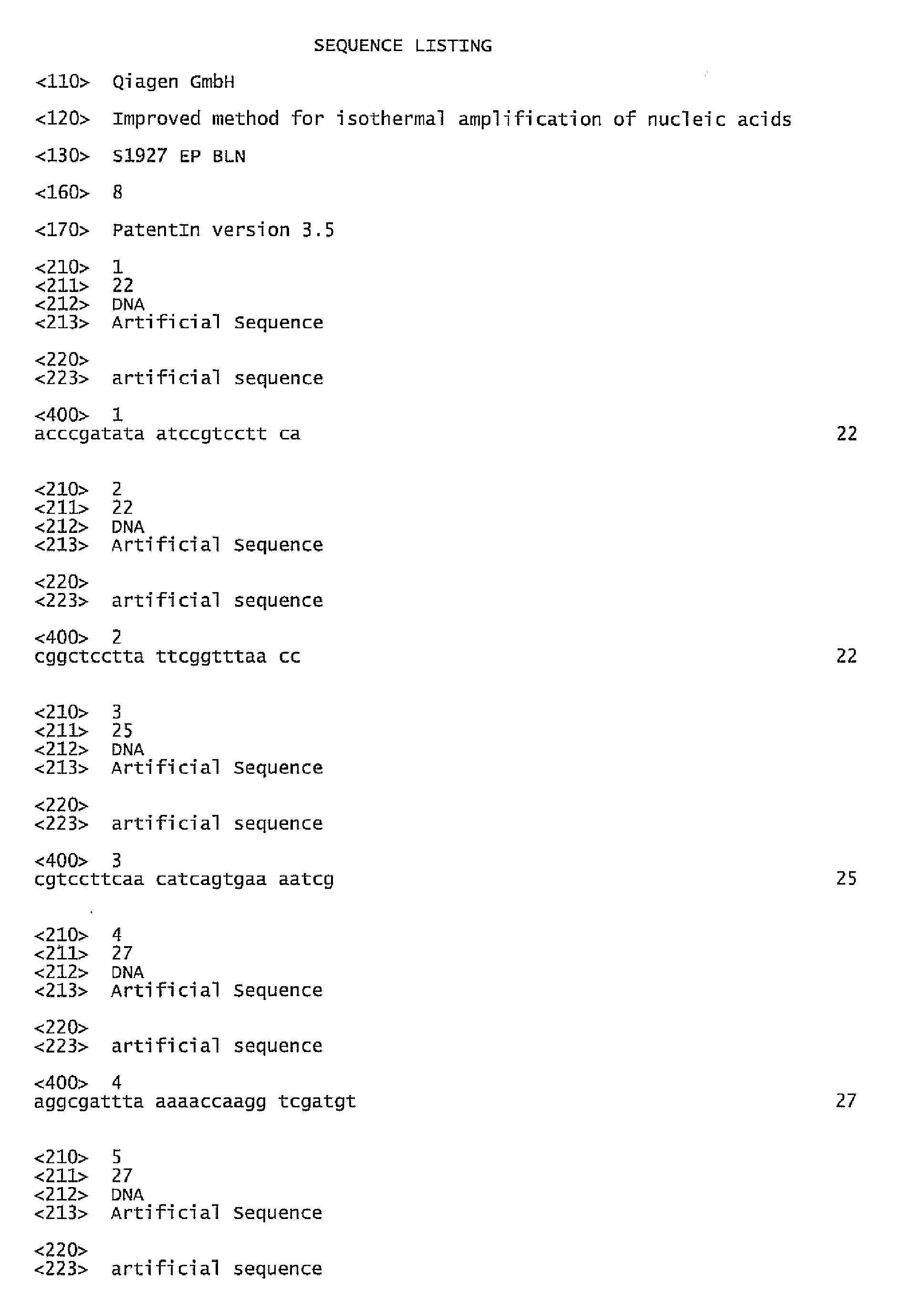

Claims (18)
- A method for isothermal amplification of nucleic acids comprising the steps of:i) providing at least the following reaction components:a) a mesophilic enzyme for amplifying nucleic acids under isothermal conditions;b) one or more primer for amplifying a target nucleic acid;c) dNTPs and/or NTPs;d) essential co-factors and/or reagents of the enzyme for amplifying nucleic acids under isothermal conditions;e) at least one target nucleic acid;wherein at least one of the reaction components a) to e) is embedded in a matrix, wherein said matrix disintegrates under predetermined conditions;ii) incubating the reaction components under conditions which result in the disintegration of said matrix in order to obtain the reaction mixture;iii) incubating the reaction mixture under conditions suited for the isotherx-rzal amplification reaction.
- The method according to claim 1, wherein the mesophilic enzyme for amplifying nucleic acids has an optimum temperature of 20°C to 70°C, preferably 30°C to 65°C, more preferably 37°C to 60°C.
- The method according to claim 1 or 2, wherein the matrix disintegrates at temperatures of 50°C or more, preferably 60°C or more, more preferably 65ºC or more.
- The method according to any one of claim 1 to 3, wherein the incubation temperature under step ii) is 1 °C to 50°C higher than the incubation temperature of step iii), preferably 5°C to 25 °C higher, more preferably 10°C to 20°C higher.
- The method according to any one of claims 1 to 4, wherein the matrix forms a hydrogel.
- The method according to any one oi` claims 1 to 5, wherein the matrix is selected from the group comprising polysaccharides (agarose, low-melting agarose, pectin, amylose, agar-agar, xanthan, carrageen, carboxymethylcellulose, guar, carubin, inulin, dextran), proteins (gelatine, fibrillar proteins), wax and synthetic polymers (polyvinylalcohol, derivates of cellulose).
- The method according to any one of claims 1 to 6, wherein the at least one mesophilic enzyme for amplifying nucleic acids under isothermal conditions is selected from the group comprising helicase, mesophilic polymerases, mesophilic polymerases having strand displacement activity, nicking enzymes, recombination proteins, ligases, glycosylases and nucleases.
- The method according to any one of claims 1 to 7, wherein the method for isothermal amplification of nucleic acids is selected from the group comprising helicase-dependent amplification (HDA), thermostable HDA (tHDA), strand displacement amplification (SDA), multiple displacement amplification (MDA), rolling circle amplification, single primer isothermal amplification (SPIA), restriction aided RCA, transcription mediated amplification (TMA), and amplification reactions using nicking enzymes, nicking enzyme amplification reaction (NEAR), amplification reactions using recombination proteins, recombinase polymerase amplification (RPA).
- A kit for isothermal amplification of nucleic acids comprising:- a mesophilic enzyme for amplifying nucleic acids under isothermal conditions,- a matrix which disintegrates at predetermined conditions;wherein at least one component which is essential for an isothermal amplification of nucleic acids is embedded in said matrix.
- The kit according to claim 9, wherein the component embedded in said matrix is selected from the group comprising said mesophilic enzyme for amplifying nucleic acids under isothermal conditions, dNTP and/or NTPs, essential co-factors, and one or more primer for amplification of the target nucleic acid.
- The kit according to claim 9 or 10, wherein the mesophilic enzyme for amplifying nucleic acids is selected from the group comprising helicase, mesophilic polymerases, mesophilic polymerases having strand displacement activity, nicking enzymes, recombination proteins, ligases, nucleases, and glycosylases.
- A composition comprising:- a matrix which disintegrates at predetermined conditions; and- at least one mesophilic enzyme for amplifying nucleic acids under isothermal conditions.
- The composition according to claim 12, wherein the matrix disintegrates at a temperature of at least 40°C, preferably at least 50°C, more preferably at least 65°C.
- The composition according to claim 12 or 13, wherein the matrix is selected from the group comprising polysaccharides (agarose, low-melting agarose, pectin, amylose, agar-agar, xanthan, carrageen, carboxymethylcellulose, guar, carubin, inulin, dextran), proteins (gelatine, fibrillar proteins), and synthetic polymers (polyvinylalcohol, derivates of cellulose).
- The composition according to any one of claims 12 to 14, wherein the mesophilic enzyme for amplifying nucleic acids under isothermal condition is selected from the group comprising helicase, mesophilic polymerase, mesophilic polymerases having strand displacement activity, nicking enzymes, recombination proteins, ligases, nucleases, and glycosylases.
- A method for embedding mesophilic enzymes for amplifying nucleic acids under isothermal conditions comprising the steps ofi) providing a solubilised matrix;ii) mixing said matrix with a solution comprising a mesophilic enzyme for amplifying nucleic acids under isothermal conditions to obtain a matrix-enzyme mixture;iii) incubating the matrix-enzyme mixture under conditions allowing the solidification of the matrix to obtain the embedded mesophilic enzyme.
- The method according to claim 1.6, further comprising the step of lyophilization of the embedded mesophilic enzyme.
- The use of a composition according to any one of claims 12 to 15 and/or a kit according to any one of claims 9 to i in a method selected from the group comprising isothermal nucleic acid amplification, helicase-dependent amplification (HDA), thermostable HDA (tHDA), strand displacement amplification (SDA), multiple displacement amplification (MDA), rolling circle amplification, single primer isothermal amplification (SPIA), restriction aided RCA, transcription mediated amplification (TMA), and nicking enzyme amplification reaction (NEAR), and a method according to any one of claims 1 to 8.
Priority Applications (6)
| Application Number | Priority Date | Filing Date | Title |
|---|---|---|---|
| EP10172400A EP2418286A1 (en) | 2010-08-10 | 2010-08-10 | Improved method for isothermal amplification of nucleic acids |
| US13/816,081 US9133508B2 (en) | 2010-08-10 | 2011-08-09 | Method for isothermal amplification of nucleic acids |
| PCT/EP2011/063686 WO2012020015A1 (en) | 2010-08-10 | 2011-08-09 | Improved method for isothermal amplification of nucleic acids |
| EP11751567.6A EP2603608B1 (en) | 2010-08-10 | 2011-08-09 | Improved method for isothermal amplification of nucleic acids |
| CN201711179875.2A CN107881220A (en) | 2010-08-10 | 2011-08-09 | Improved method for nucleic acid isothermal amplification |
| CN2011800358904A CN103025892A (en) | 2010-08-10 | 2011-08-09 | Improved method for isothermal amplification of nucleic acids |
Applications Claiming Priority (1)
| Application Number | Priority Date | Filing Date | Title |
|---|---|---|---|
| EP10172400A EP2418286A1 (en) | 2010-08-10 | 2010-08-10 | Improved method for isothermal amplification of nucleic acids |
Publications (1)
| Publication Number | Publication Date |
|---|---|
| EP2418286A1 true EP2418286A1 (en) | 2012-02-15 |
Family
ID=42853166
Family Applications (2)
| Application Number | Title | Priority Date | Filing Date |
|---|---|---|---|
| EP10172400A Withdrawn EP2418286A1 (en) | 2010-08-10 | 2010-08-10 | Improved method for isothermal amplification of nucleic acids |
| EP11751567.6A Not-in-force EP2603608B1 (en) | 2010-08-10 | 2011-08-09 | Improved method for isothermal amplification of nucleic acids |
Family Applications After (1)
| Application Number | Title | Priority Date | Filing Date |
|---|---|---|---|
| EP11751567.6A Not-in-force EP2603608B1 (en) | 2010-08-10 | 2011-08-09 | Improved method for isothermal amplification of nucleic acids |
Country Status (4)
| Country | Link |
|---|---|
| US (1) | US9133508B2 (en) |
| EP (2) | EP2418286A1 (en) |
| CN (2) | CN103025892A (en) |
| WO (1) | WO2012020015A1 (en) |
Cited By (2)
| Publication number | Priority date | Publication date | Assignee | Title |
|---|---|---|---|---|
| CN106755332A (en) * | 2016-11-29 | 2017-05-31 | 百奥森(江苏)食品安全科技有限公司 | A kind of Shigella detection method of content |
| CN109763172A (en) * | 2017-11-09 | 2019-05-17 | 深圳华大生命科学研究院 | A kind of mutant nucleic acid library construction method and obtained mutant nucleic acid library |
Families Citing this family (15)
| Publication number | Priority date | Publication date | Assignee | Title |
|---|---|---|---|---|
| CN103497947B (en) * | 2013-09-13 | 2015-08-12 | 浙江国际旅行卫生保健中心 | The reagent of a kind of external novel quick loop-mediated isothermal amplification method, vitro detection H1N1virus and method |
| CN103881989B (en) * | 2014-03-06 | 2016-11-02 | 中国农业科学院生物技术研究所 | A kind of archaeal dna polymerase with processivity and salt tolerance level |
| CN104673920B (en) * | 2015-03-03 | 2017-01-11 | 河北省食品检验研究院 | HDA ((helicase-dependent isothermal DNA amplification) primers for identifying walnut plant derived components in processed food and applications of HDA primers |
| CN104745577B (en) * | 2015-04-16 | 2017-07-21 | 潍坊科技学院 | Tetranychus urticae relies on unwindase DNA isothermal duplication quick detections primer, kit, detection method |
| US11299777B2 (en) | 2016-04-04 | 2022-04-12 | Nat Diagnostics, Inc. | Isothermal amplification components and processes |
| US9617587B1 (en) | 2016-04-04 | 2017-04-11 | Nat Diagnostics, Inc. | Isothermal amplification components and processes |
| CN106754900B (en) * | 2016-11-30 | 2019-12-10 | 博奥生物集团有限公司 | Nucleic acid packaging reagent and application thereof |
| CN106755419A (en) * | 2016-12-26 | 2017-05-31 | 广州和实生物技术有限公司 | The Constant Temperature Detection method and its kit of a kind of quick detection salmonella |
| CN108315216B (en) * | 2018-05-04 | 2021-08-03 | 邯郸市疾病预防控制中心 | An effective method for improving the false positive contamination problem of loop-mediated isothermal amplification technology |
| EP3814527B1 (en) * | 2018-06-26 | 2023-02-22 | Massachusetts Institute of Technology | Crispr effector system based amplification methods, systems, and diagnostics |
| CN111850172B (en) * | 2020-08-04 | 2023-05-26 | 深圳市梓健生物科技有限公司 | LAMP primer group and kit for detecting SARS-CoV-2 |
| CN113151414B (en) * | 2021-05-07 | 2022-06-21 | 军事科学院军事医学研究院环境医学与作业医学研究所 | Method and kit for detecting ricin by using relative DNA walker initiation index amplification based on freezing construction gold nanoprobe |
| CN113215314B (en) * | 2021-05-10 | 2021-12-03 | 江苏海洋大学 | Probe, primer set, kit and detection method for rapidly detecting SARS-CoV-2 by using L/RPA |
| CN114703259A (en) * | 2022-04-14 | 2022-07-05 | 苏州天隆生物科技有限公司 | Partition of nucleic acid detection test tube, detection test tube comprising partition and amplification method |
| CN121511311A (en) * | 2023-06-29 | 2026-02-10 | 柏锘(上海)医疗科技有限公司 | Nucleic acid testing methods and their applications |
Citations (12)
| Publication number | Priority date | Publication date | Assignee | Title |
|---|---|---|---|---|
| US4458006A (en) | 1982-06-21 | 1984-07-03 | Hoechst Aktiengesellschaft | Photopolymerizable mixture and photopolymerizable copying material prepared therewith |
| US4582788A (en) | 1982-01-22 | 1986-04-15 | Cetus Corporation | HLA typing method and cDNA probes used therein |
| EP0320308B1 (en) | 1987-12-11 | 1993-11-03 | Abbott Laboratories | Method for detecting a target nucleic acid sequence |
| US5643764A (en) * | 1992-02-13 | 1997-07-01 | Kosak; Kenneth M. | Reactions using heat-releasable reagents in wax beads |
| WO1998000530A1 (en) * | 1996-07-03 | 1998-01-08 | Molecular Biology Resources, Inc. | Method and formulation for stabilization of enzymes |
| EP0877094A2 (en) * | 1997-04-29 | 1998-11-11 | Robert Aaron Levine | Detection and quantification of one or more nucleotide sequence target analytes in a sample using spatially localized target analyte replication |
| EP0201184B2 (en) | 1985-03-28 | 2004-08-04 | F. Hoffmann-La Roche Ag | Process for amplifying nucleic acid sequences |
| US20060068398A1 (en) * | 2004-09-24 | 2006-03-30 | Cepheid | Universal and target specific reagent beads for nucleic acid amplification |
| WO2007120808A2 (en) * | 2006-04-14 | 2007-10-25 | Biohelix Corporation | A method of asymmetric helicase-dependent amplification for probe-based detection of targets |
| WO2008036544A1 (en) * | 2006-09-18 | 2008-03-27 | Ge Healthcare Bio-Sciences Corp. | Preparation of glassified biological reagents |
| WO2008090340A2 (en) * | 2007-01-23 | 2008-07-31 | Cambridge Enterprise Limited | Nucleic acid amplification and testing |
| US20090017453A1 (en) | 2007-07-14 | 2009-01-15 | Maples Brian K | Nicking and extension amplification reaction for the exponential amplification of nucleic acids |
Family Cites Families (9)
| Publication number | Priority date | Publication date | Assignee | Title |
|---|---|---|---|---|
| US4582789A (en) | 1984-03-21 | 1986-04-15 | Cetus Corporation | Process for labeling nucleic acids using psoralen derivatives |
| NZ277946A (en) * | 1993-11-30 | 1998-03-25 | Lxr Biotechnology Inc | Apoptosis modulating protein and nucleotide sequence compositions using bcl-2 homologs termed cdn-1, cdn-2 and cdn3 |
| US20030228616A1 (en) * | 1999-10-29 | 2003-12-11 | Stratagene | DNA polymerase mutants with reverse transcriptase activity |
| AU2001278783B2 (en) * | 2000-08-23 | 2006-04-27 | Takara Bio Inc. | Method of amplifying nucleic acid |
| EP1664328A2 (en) * | 2003-09-26 | 2006-06-07 | Circleamp, Inc. | Amplification of polynucleotides by rolling circle amplification |
| US20070117114A1 (en) * | 2005-07-07 | 2007-05-24 | Quanta Biosciences, Inc. | Compositions and methods for increasing amplification efficiency |
| CN101516337A (en) * | 2006-09-18 | 2009-08-26 | 通用电气医疗集团生物科学公司 | Preparation of glass-coated biological reagents |
| WO2009042143A1 (en) | 2007-09-24 | 2009-04-02 | Clark Equipment Company | Auxiliary hydraulic flow control system for a small loader |
| CN101413034B (en) * | 2008-11-21 | 2011-02-09 | 东南大学 | Method for preparing molecular cloning chip by high-throughput nucleic acid molecular cloning |
-
2010
- 2010-08-10 EP EP10172400A patent/EP2418286A1/en not_active Withdrawn
-
2011
- 2011-08-09 WO PCT/EP2011/063686 patent/WO2012020015A1/en not_active Ceased
- 2011-08-09 EP EP11751567.6A patent/EP2603608B1/en not_active Not-in-force
- 2011-08-09 CN CN2011800358904A patent/CN103025892A/en active Pending
- 2011-08-09 US US13/816,081 patent/US9133508B2/en active Active
- 2011-08-09 CN CN201711179875.2A patent/CN107881220A/en not_active Withdrawn
Patent Citations (12)
| Publication number | Priority date | Publication date | Assignee | Title |
|---|---|---|---|---|
| US4582788A (en) | 1982-01-22 | 1986-04-15 | Cetus Corporation | HLA typing method and cDNA probes used therein |
| US4458006A (en) | 1982-06-21 | 1984-07-03 | Hoechst Aktiengesellschaft | Photopolymerizable mixture and photopolymerizable copying material prepared therewith |
| EP0201184B2 (en) | 1985-03-28 | 2004-08-04 | F. Hoffmann-La Roche Ag | Process for amplifying nucleic acid sequences |
| EP0320308B1 (en) | 1987-12-11 | 1993-11-03 | Abbott Laboratories | Method for detecting a target nucleic acid sequence |
| US5643764A (en) * | 1992-02-13 | 1997-07-01 | Kosak; Kenneth M. | Reactions using heat-releasable reagents in wax beads |
| WO1998000530A1 (en) * | 1996-07-03 | 1998-01-08 | Molecular Biology Resources, Inc. | Method and formulation for stabilization of enzymes |
| EP0877094A2 (en) * | 1997-04-29 | 1998-11-11 | Robert Aaron Levine | Detection and quantification of one or more nucleotide sequence target analytes in a sample using spatially localized target analyte replication |
| US20060068398A1 (en) * | 2004-09-24 | 2006-03-30 | Cepheid | Universal and target specific reagent beads for nucleic acid amplification |
| WO2007120808A2 (en) * | 2006-04-14 | 2007-10-25 | Biohelix Corporation | A method of asymmetric helicase-dependent amplification for probe-based detection of targets |
| WO2008036544A1 (en) * | 2006-09-18 | 2008-03-27 | Ge Healthcare Bio-Sciences Corp. | Preparation of glassified biological reagents |
| WO2008090340A2 (en) * | 2007-01-23 | 2008-07-31 | Cambridge Enterprise Limited | Nucleic acid amplification and testing |
| US20090017453A1 (en) | 2007-07-14 | 2009-01-15 | Maples Brian K | Nicking and extension amplification reaction for the exponential amplification of nucleic acids |
Non-Patent Citations (17)
| Title |
|---|
| AN ET AL.: "Characterization of a Thennostable UvrD Helicase and Its Participation in Helicase-dependent Amplification", JOUR. BIOL. CHEM., vol. 280, no. 32, 2005, pages 28952 - 28958 |
| BEAUCAGE ET AL., TETRAHEDRON LETTERS, vol. 22, 1981, pages 1859 - 1862 |
| CHETVERINA H V ET AL: "Cloning of RNA molecules in vitro", NUCLEIC ACIDS RESEARCH, OXFORD UNIVERSITY PRESS, SURREY, GB, vol. 21, no. 10, 1 January 1993 (1993-01-01), pages 2349 - 2353, XP002200793, ISSN: 0305-1048 * |
| DAFFORN ET AL.: "Linear mRNA amplification from as little as 5 ng total RNA for global gene expression analysis", BIOTECHNIQUES, vol. 37, no. 5, 2004, pages 854 - 7 |
| DEAN ET AL.: "Comprehensive human genome amplification using multiple displacement amplification", PNAS, vol. 99, no. 8, 2002, pages 5261 - 5266 |
| KIEVITS ET AL.: "NASBA, isothermal enzymatic in vitro nucleic acid amplification optimized for the diagnosis of HIV-1 infection.", J. VIROL. METHODS, vol. 35, 1991, pages 273 - 286 |
| LIU ET AL.: "Rolling circle DNA synthesis: Small circular oligonucleotides as efficient templates for DNA polymerases", J. AM. CHEM. SOC., vol. 118, 1996, pages 1587 - 1594 |
| MULLIS ET AL., COLD SPRING HARBOR SYMP. QUANT. BIOL., vol. 51, 1986, pages 263 - 273 |
| NOTOMI ET AL.: "Loop-mediated isothermal amplification of DNA", NAR, vol. 28, no. 12, 2000, pages E63 |
| PIEPENBURG ET AL.: "DNA Detection Using Recombination Proteins", PLOS BIOL., vol. 4, no. 7, 2004, pages E204 |
| RYCHLIK ET AL., NUCLEIC ACIDS RESEARCH, vol. 18, 1990, pages 6401 - 6412 |
| VINCENT ET AL.: "Helicase-dependent isothermal DNA amplification", EMBO REPORTS, vol. 5, no. 8, 2004, pages 795 - 800 |
| VUORINEN ET AL.: "Direct detection of Mycobacterium tuberculosis complex in respiratory specimens by Gen-Probe Amplified Mycobacterium", MYCOBACTERIUM TUBERCULOSIS, vol. 33, 1995, pages 1856 - 1859 |
| WALKER ET AL.: "Strand displacement amplification--an isothermal, in vitro DNA amplification technique", NUCLEIC ACIDS RES., vol. 20, no. 7, 1992, pages 1691 - 6 |
| WANG: "DNA amplification method tolerant to sample degradation", GENOME RES., vol. 14, 2004, pages 2357 - 2366 |
| WU ET AL., GENOMICS, vol. 4, 1989, pages 560 |
| ZINTZ C B ET AL: "RAPID RE-AMPLIFICATION OF PCR PRODUCTS PURIFIED IN LOW MELTING POINT AGAROSE GELS", BIOTECHNIQUES, vol. 11, no. 2, 1991, pages 158, 160 - 162, XP008127978, ISSN: 0736-6205 * |
Cited By (2)
| Publication number | Priority date | Publication date | Assignee | Title |
|---|---|---|---|---|
| CN106755332A (en) * | 2016-11-29 | 2017-05-31 | 百奥森(江苏)食品安全科技有限公司 | A kind of Shigella detection method of content |
| CN109763172A (en) * | 2017-11-09 | 2019-05-17 | 深圳华大生命科学研究院 | A kind of mutant nucleic acid library construction method and obtained mutant nucleic acid library |
Also Published As
| Publication number | Publication date |
|---|---|
| CN107881220A (en) | 2018-04-06 |
| EP2603608A1 (en) | 2013-06-19 |
| EP2603608B1 (en) | 2016-09-28 |
| US20130224799A1 (en) | 2013-08-29 |
| WO2012020015A1 (en) | 2012-02-16 |
| US9133508B2 (en) | 2015-09-15 |
| CN103025892A (en) | 2013-04-03 |
Similar Documents
| Publication | Publication Date | Title |
|---|---|---|
| US9133508B2 (en) | Method for isothermal amplification of nucleic acids | |
| US8673567B2 (en) | Method and kit for nucleic acid sequence detection | |
| AU2001268725B2 (en) | Multiply-primed amplification of nucleic acid sequences | |
| US8486628B2 (en) | Method of normalized quantification of nucleic acids using anchor oligonucleotides and adapter oligonucleotides | |
| JP5680078B2 (en) | Nucleic acid normalized quantification method based on ligation | |
| EP1564303A2 (en) | Strand displacement amplification of RNA targets | |
| EP1423532B1 (en) | Nucleic acid amplification method | |
| EP2415878A1 (en) | Method of amplifying nucleic acid and method of detecting mutated nucleic acid using the same | |
| CN101935697A (en) | Method and kit for detecting nucleotide sequence | |
| EP2379753A2 (en) | Single-cell nucleic acid analysis | |
| EP3808843A1 (en) | Method and kit for synthesizing nucleic acid under constant temperature conditions | |
| JP2015033390A (en) | Method of normalized quantification of rna | |
| JP3090100B2 (en) | Strand displacement amplification using borated nucleotides | |
| CN102459632B (en) | Amplification of complex nucleic acids | |
| CN115698319A (en) | Methods and compositions for preparing nucleic acid libraries | |
| CN109415762B (en) | Method for detecting target nucleic acid sequence by multiplex amplification double signal amplification | |
| EP3735476B1 (en) | Method for determining the presence or absence of m. tuberculosis, m. bovis and m. bovis bcg in a sample | |
| CN118765333A (en) | Methods and compositions for nucleic acid amplification |
Legal Events
| Date | Code | Title | Description |
|---|---|---|---|
| AK | Designated contracting states |
Kind code of ref document: A1 Designated state(s): AL AT BE BG CH CY CZ DE DK EE ES FI FR GB GR HR HU IE IS IT LI LT LU LV MC MK MT NL NO PL PT RO SE SI SK SM TR |
|
| AX | Request for extension of the european patent |
Extension state: BA ME RS |
|
| PUAI | Public reference made under article 153(3) epc to a published international application that has entered the european phase |
Free format text: ORIGINAL CODE: 0009012 |
|
| STAA | Information on the status of an ep patent application or granted ep patent |
Free format text: STATUS: THE APPLICATION IS DEEMED TO BE WITHDRAWN |
|
| 18D | Application deemed to be withdrawn |
Effective date: 20120817 |