EP2417962A1 - Hair cosmetic - Google Patents
Hair cosmetic Download PDFInfo
- Publication number
- EP2417962A1 EP2417962A1 EP10761650A EP10761650A EP2417962A1 EP 2417962 A1 EP2417962 A1 EP 2417962A1 EP 10761650 A EP10761650 A EP 10761650A EP 10761650 A EP10761650 A EP 10761650A EP 2417962 A1 EP2417962 A1 EP 2417962A1
- Authority
- EP
- European Patent Office
- Prior art keywords
- hair
- ability
- hair cosmetic
- alcohol
- ether
- Prior art date
- Legal status (The legal status is an assumption and is not a legal conclusion. Google has not performed a legal analysis and makes no representation as to the accuracy of the status listed.)
- Withdrawn
Links
- 210000004209 hair Anatomy 0.000 title claims abstract description 170
- 239000002537 cosmetic Substances 0.000 title claims abstract description 40
- LFQSCWFLJHTTHZ-UHFFFAOYSA-N Ethanol Chemical compound CCO LFQSCWFLJHTTHZ-UHFFFAOYSA-N 0.000 claims abstract description 77
- 229920005989 resin Polymers 0.000 claims abstract description 45
- 239000011347 resin Substances 0.000 claims abstract description 45
- 239000000853 adhesive Substances 0.000 claims abstract description 32
- 230000001070 adhesive effect Effects 0.000 claims abstract description 32
- 239000000178 monomer Substances 0.000 claims abstract description 26
- 229920001296 polysiloxane Polymers 0.000 claims abstract description 21
- 150000005846 sugar alcohols Polymers 0.000 claims abstract description 16
- 239000003093 cationic surfactant Substances 0.000 claims abstract description 14
- 230000000379 polymerizing effect Effects 0.000 claims abstract description 6
- -1 OCH2CH3 Chemical group 0.000 claims description 30
- 125000004432 carbon atom Chemical group C* 0.000 claims description 5
- 125000005702 oxyalkylene group Chemical group 0.000 claims description 5
- 125000006353 oxyethylene group Chemical group 0.000 claims description 5
- 125000003976 glyceryl group Chemical group [H]C([*])([H])C(O[H])([H])C(O[H])([H])[H] 0.000 claims description 4
- 125000000956 methoxy group Chemical group [H]C([H])([H])O* 0.000 claims description 4
- 125000001997 phenyl group Chemical group [H]C1=C([H])C([H])=C(*)C([H])=C1[H] 0.000 claims description 4
- 125000000217 alkyl group Chemical group 0.000 claims description 3
- 125000006273 (C1-C3) alkyl group Chemical group 0.000 claims description 2
- 238000004519 manufacturing process Methods 0.000 description 70
- 230000000052 comparative effect Effects 0.000 description 46
- 239000000203 mixture Substances 0.000 description 39
- XLYOFNOQVPJJNP-UHFFFAOYSA-N water Substances O XLYOFNOQVPJJNP-UHFFFAOYSA-N 0.000 description 25
- DEXFNLNNUZKHNO-UHFFFAOYSA-N 6-[3-[4-[2-(2,3-dihydro-1H-inden-2-ylamino)pyrimidin-5-yl]piperidin-1-yl]-3-oxopropyl]-3H-1,3-benzoxazol-2-one Chemical compound C1C(CC2=CC=CC=C12)NC1=NC=C(C=N1)C1CCN(CC1)C(CCC1=CC2=C(NC(O2)=O)C=C1)=O DEXFNLNNUZKHNO-UHFFFAOYSA-N 0.000 description 22
- 229920000642 polymer Polymers 0.000 description 15
- HEMHJVSKTPXQMS-UHFFFAOYSA-M Sodium hydroxide Chemical compound [OH-].[Na+] HEMHJVSKTPXQMS-UHFFFAOYSA-M 0.000 description 12
- 239000003795 chemical substances by application Substances 0.000 description 12
- 238000003756 stirring Methods 0.000 description 12
- PUPZLCDOIYMWBV-UHFFFAOYSA-N (+/-)-1,3-Butanediol Chemical compound CC(O)CCO PUPZLCDOIYMWBV-UHFFFAOYSA-N 0.000 description 11
- PEDCQBHIVMGVHV-UHFFFAOYSA-N Glycerine Chemical compound OCC(O)CO PEDCQBHIVMGVHV-UHFFFAOYSA-N 0.000 description 11
- 238000011156 evaluation Methods 0.000 description 11
- DNIAPMSPPWPWGF-UHFFFAOYSA-N Propylene glycol Chemical compound CC(O)CO DNIAPMSPPWPWGF-UHFFFAOYSA-N 0.000 description 9
- 239000004205 dimethyl polysiloxane Substances 0.000 description 9
- 235000013870 dimethyl polysiloxane Nutrition 0.000 description 9
- 239000003205 fragrance Substances 0.000 description 9
- 239000004615 ingredient Substances 0.000 description 9
- 239000007788 liquid Substances 0.000 description 9
- 229920000435 poly(dimethylsiloxane) Polymers 0.000 description 9
- 125000003158 alcohol group Chemical group 0.000 description 8
- 239000000499 gel Substances 0.000 description 8
- VEXZGXHMUGYJMC-UHFFFAOYSA-M Chloride anion Chemical compound [Cl-] VEXZGXHMUGYJMC-UHFFFAOYSA-M 0.000 description 7
- 150000001298 alcohols Chemical class 0.000 description 6
- 229940008099 dimethicone Drugs 0.000 description 6
- 235000011187 glycerol Nutrition 0.000 description 6
- 125000004079 stearyl group Chemical group [H]C([*])([H])C([H])([H])C([H])([H])C([H])([H])C([H])([H])C([H])([H])C([H])([H])C([H])([H])C([H])([H])C([H])([H])C([H])([H])C([H])([H])C([H])([H])C([H])([H])C([H])([H])C([H])([H])C([H])([H])C([H])([H])[H] 0.000 description 6
- LCGLNKUTAGEVQW-UHFFFAOYSA-N Dimethyl ether Chemical compound COC LCGLNKUTAGEVQW-UHFFFAOYSA-N 0.000 description 5
- 229940105990 diglycerin Drugs 0.000 description 5
- GPLRAVKSCUXZTP-UHFFFAOYSA-N diglycerol Chemical compound OCC(O)COCC(O)CO GPLRAVKSCUXZTP-UHFFFAOYSA-N 0.000 description 5
- 229940058015 1,3-butylene glycol Drugs 0.000 description 4
- OZAIFHULBGXAKX-UHFFFAOYSA-N 2-(2-cyanopropan-2-yldiazenyl)-2-methylpropanenitrile Chemical compound N#CC(C)(C)N=NC(C)(C)C#N OZAIFHULBGXAKX-UHFFFAOYSA-N 0.000 description 4
- RTZKZFJDLAIYFH-UHFFFAOYSA-N Diethyl ether Chemical compound CCOCC RTZKZFJDLAIYFH-UHFFFAOYSA-N 0.000 description 4
- 235000019437 butane-1,3-diol Nutrition 0.000 description 4
- 238000001035 drying Methods 0.000 description 4
- 230000001953 sensory effect Effects 0.000 description 4
- 230000007928 solubilization Effects 0.000 description 4
- 238000005063 solubilization Methods 0.000 description 4
- 239000000243 solution Substances 0.000 description 4
- 239000002904 solvent Substances 0.000 description 4
- 238000012360 testing method Methods 0.000 description 4
- 239000001993 wax Substances 0.000 description 4
- QZKRHPLGUJDVAR-UHFFFAOYSA-K EDTA trisodium salt Chemical compound [Na+].[Na+].[Na+].OC(=O)CN(CC([O-])=O)CCN(CC([O-])=O)CC([O-])=O QZKRHPLGUJDVAR-UHFFFAOYSA-K 0.000 description 3
- LYCAIKOWRPUZTN-UHFFFAOYSA-N Ethylene glycol Chemical compound OCCO LYCAIKOWRPUZTN-UHFFFAOYSA-N 0.000 description 3
- 229920003171 Poly (ethylene oxide) Polymers 0.000 description 3
- 229920006322 acrylamide copolymer Polymers 0.000 description 3
- 125000005250 alkyl acrylate group Chemical group 0.000 description 3
- 239000004359 castor oil Substances 0.000 description 3
- 235000019438 castor oil Nutrition 0.000 description 3
- KRKNYBCHXYNGOX-UHFFFAOYSA-N citric acid Chemical compound OC(=O)CC(O)(C(O)=O)CC(O)=O KRKNYBCHXYNGOX-UHFFFAOYSA-N 0.000 description 3
- DTPCFIHYWYONMD-UHFFFAOYSA-N decaethylene glycol Chemical compound OCCOCCOCCOCCOCCOCCOCCOCCOCCOCCO DTPCFIHYWYONMD-UHFFFAOYSA-N 0.000 description 3
- MTHSVFCYNBDYFN-UHFFFAOYSA-N diethylene glycol Chemical compound OCCOCCO MTHSVFCYNBDYFN-UHFFFAOYSA-N 0.000 description 3
- 239000000839 emulsion Substances 0.000 description 3
- ZEMPKEQAKRGZGQ-XOQCFJPHSA-N glycerol triricinoleate Natural products CCCCCC[C@@H](O)CC=CCCCCCCCC(=O)OC[C@@H](COC(=O)CCCCCCCC=CC[C@@H](O)CCCCCC)OC(=O)CCCCCCCC=CC[C@H](O)CCCCCC ZEMPKEQAKRGZGQ-XOQCFJPHSA-N 0.000 description 3
- 239000003676 hair preparation Substances 0.000 description 3
- OMNKZBIFPJNNIO-UHFFFAOYSA-N n-(2-methyl-4-oxopentan-2-yl)prop-2-enamide Chemical compound CC(=O)CC(C)(C)NC(=O)C=C OMNKZBIFPJNNIO-UHFFFAOYSA-N 0.000 description 3
- IJGRMHOSHXDMSA-UHFFFAOYSA-N nitrogen Substances N#N IJGRMHOSHXDMSA-UHFFFAOYSA-N 0.000 description 3
- 229910052757 nitrogen Inorganic materials 0.000 description 3
- 229920001223 polyethylene glycol Polymers 0.000 description 3
- 238000010992 reflux Methods 0.000 description 3
- 239000007787 solid Substances 0.000 description 3
- 229960005066 trisodium edetate Drugs 0.000 description 3
- XDOFQFKRPWOURC-UHFFFAOYSA-N 16-methylheptadecanoic acid Chemical compound CC(C)CCCCCCCCCCCCCCC(O)=O XDOFQFKRPWOURC-UHFFFAOYSA-N 0.000 description 2
- SVTBMSDMJJWYQN-UHFFFAOYSA-N 2-methylpentane-2,4-diol Chemical compound CC(O)CC(C)(C)O SVTBMSDMJJWYQN-UHFFFAOYSA-N 0.000 description 2
- QCDWFXQBSFUVSP-UHFFFAOYSA-N 2-phenoxyethanol Chemical compound OCCOC1=CC=CC=C1 QCDWFXQBSFUVSP-UHFFFAOYSA-N 0.000 description 2
- CYDQOEWLBCCFJZ-UHFFFAOYSA-N 4-(4-fluorophenyl)oxane-4-carboxylic acid Chemical compound C=1C=C(F)C=CC=1C1(C(=O)O)CCOCC1 CYDQOEWLBCCFJZ-UHFFFAOYSA-N 0.000 description 2
- FBPFZTCFMRRESA-FSIIMWSLSA-N D-Glucitol Natural products OC[C@H](O)[C@H](O)[C@@H](O)[C@H](O)CO FBPFZTCFMRRESA-FSIIMWSLSA-N 0.000 description 2
- FBPFZTCFMRRESA-KVTDHHQDSA-N D-Mannitol Chemical compound OC[C@@H](O)[C@@H](O)[C@H](O)[C@H](O)CO FBPFZTCFMRRESA-KVTDHHQDSA-N 0.000 description 2
- FBPFZTCFMRRESA-JGWLITMVSA-N D-glucitol Chemical compound OC[C@H](O)[C@@H](O)[C@H](O)[C@H](O)CO FBPFZTCFMRRESA-JGWLITMVSA-N 0.000 description 2
- XTHFKEDIFFGKHM-UHFFFAOYSA-N Dimethoxyethane Chemical compound COCCOC XTHFKEDIFFGKHM-UHFFFAOYSA-N 0.000 description 2
- ZGTMUACCHSMWAC-UHFFFAOYSA-L EDTA disodium salt (anhydrous) Chemical compound [Na+].[Na+].OC(=O)CN(CC([O-])=O)CCN(CC(O)=O)CC([O-])=O ZGTMUACCHSMWAC-UHFFFAOYSA-L 0.000 description 2
- 239000004386 Erythritol Substances 0.000 description 2
- UNXHWFMMPAWVPI-UHFFFAOYSA-N Erythritol Natural products OCC(O)C(O)CO UNXHWFMMPAWVPI-UHFFFAOYSA-N 0.000 description 2
- 229930195725 Mannitol Natural products 0.000 description 2
- 229920002125 Sokalan® Polymers 0.000 description 2
- 229920002472 Starch Polymers 0.000 description 2
- TVXBFESIOXBWNM-UHFFFAOYSA-N Xylitol Natural products OCCC(O)C(O)C(O)CCO TVXBFESIOXBWNM-UHFFFAOYSA-N 0.000 description 2
- 239000001089 [(2R)-oxolan-2-yl]methanol Substances 0.000 description 2
- 229940053200 antiepileptics fatty acid derivative Drugs 0.000 description 2
- 239000008346 aqueous phase Substances 0.000 description 2
- OGBUMNBNEWYMNJ-UHFFFAOYSA-N batilol Chemical compound CCCCCCCCCCCCCCCCCCOCC(O)CO OGBUMNBNEWYMNJ-UHFFFAOYSA-N 0.000 description 2
- WERYXYBDKMZEQL-UHFFFAOYSA-N butane-1,4-diol Chemical compound OCCCCO WERYXYBDKMZEQL-UHFFFAOYSA-N 0.000 description 2
- 229920001577 copolymer Polymers 0.000 description 2
- 230000000694 effects Effects 0.000 description 2
- UNXHWFMMPAWVPI-ZXZARUISSA-N erythritol Chemical compound OC[C@H](O)[C@H](O)CO UNXHWFMMPAWVPI-ZXZARUISSA-N 0.000 description 2
- 235000019414 erythritol Nutrition 0.000 description 2
- 229940009714 erythritol Drugs 0.000 description 2
- XLLIQLLCWZCATF-UHFFFAOYSA-N ethylene glycol monomethyl ether acetate Natural products COCCOC(C)=O XLLIQLLCWZCATF-UHFFFAOYSA-N 0.000 description 2
- 230000002349 favourable effect Effects 0.000 description 2
- KWIUHFFTVRNATP-UHFFFAOYSA-N glycine betaine Chemical compound C[N+](C)(C)CC([O-])=O KWIUHFFTVRNATP-UHFFFAOYSA-N 0.000 description 2
- 239000008266 hair spray Substances 0.000 description 2
- 229920006007 hydrogenated polyisobutylene Polymers 0.000 description 2
- 239000000594 mannitol Substances 0.000 description 2
- 235000010355 mannitol Nutrition 0.000 description 2
- HEBKCHPVOIAQTA-UHFFFAOYSA-N meso ribitol Natural products OCC(O)C(O)C(O)CO HEBKCHPVOIAQTA-UHFFFAOYSA-N 0.000 description 2
- 239000011259 mixed solution Substances 0.000 description 2
- GLDOVTGHNKAZLK-UHFFFAOYSA-N octadecan-1-ol Chemical compound CCCCCCCCCCCCCCCCCCO GLDOVTGHNKAZLK-UHFFFAOYSA-N 0.000 description 2
- 239000012071 phase Substances 0.000 description 2
- 229960005323 phenoxyethanol Drugs 0.000 description 2
- 239000003505 polymerization initiator Substances 0.000 description 2
- YPFDHNVEDLHUCE-UHFFFAOYSA-N propane-1,3-diol Chemical compound OCCCO YPFDHNVEDLHUCE-UHFFFAOYSA-N 0.000 description 2
- 239000001540 sodium lactate Substances 0.000 description 2
- 229940005581 sodium lactate Drugs 0.000 description 2
- 235000011088 sodium lactate Nutrition 0.000 description 2
- 239000000600 sorbitol Substances 0.000 description 2
- 239000008107 starch Substances 0.000 description 2
- 235000019698 starch Nutrition 0.000 description 2
- 239000000811 xylitol Substances 0.000 description 2
- 235000010447 xylitol Nutrition 0.000 description 2
- HEBKCHPVOIAQTA-SCDXWVJYSA-N xylitol Chemical compound OC[C@H](O)[C@@H](O)[C@H](O)CO HEBKCHPVOIAQTA-SCDXWVJYSA-N 0.000 description 2
- 229960002675 xylitol Drugs 0.000 description 2
- ORTVZLZNOYNASJ-UPHRSURJSA-N (z)-but-2-ene-1,4-diol Chemical compound OC\C=C/CO ORTVZLZNOYNASJ-UPHRSURJSA-N 0.000 description 1
- 0 *C(C(N(*)*)=O)=C Chemical compound *C(C(N(*)*)=O)=C 0.000 description 1
- ZWVMLYRJXORSEP-UHFFFAOYSA-N 1,2,6-Hexanetriol Chemical compound OCCCCC(O)CO ZWVMLYRJXORSEP-UHFFFAOYSA-N 0.000 description 1
- LZDKZFUFMNSQCJ-UHFFFAOYSA-N 1,2-diethoxyethane Chemical compound CCOCCOCC LZDKZFUFMNSQCJ-UHFFFAOYSA-N 0.000 description 1
- QLAJNZSPVITUCQ-UHFFFAOYSA-N 1,3,2-dioxathietane 2,2-dioxide Chemical compound O=S1(=O)OCO1 QLAJNZSPVITUCQ-UHFFFAOYSA-N 0.000 description 1
- CUVLMZNMSPJDON-UHFFFAOYSA-N 1-(1-butoxypropan-2-yloxy)propan-2-ol Chemical compound CCCCOCC(C)OCC(C)O CUVLMZNMSPJDON-UHFFFAOYSA-N 0.000 description 1
- GDXHBFHOEYVPED-UHFFFAOYSA-N 1-(2-butoxyethoxy)butane Chemical compound CCCCOCCOCCCC GDXHBFHOEYVPED-UHFFFAOYSA-N 0.000 description 1
- OOWQBDFWEXAXPB-IBGZPJMESA-N 1-O-hexadecyl-sn-glycerol Chemical compound CCCCCCCCCCCCCCCCOC[C@@H](O)CO OOWQBDFWEXAXPB-IBGZPJMESA-N 0.000 description 1
- RWNUSVWFHDHRCJ-UHFFFAOYSA-N 1-butoxypropan-2-ol Chemical compound CCCCOCC(C)O RWNUSVWFHDHRCJ-UHFFFAOYSA-N 0.000 description 1
- RRQYJINTUHWNHW-UHFFFAOYSA-N 1-ethoxy-2-(2-ethoxyethoxy)ethane Chemical compound CCOCCOCCOCC RRQYJINTUHWNHW-UHFFFAOYSA-N 0.000 description 1
- CNJRPYFBORAQAU-UHFFFAOYSA-N 1-ethoxy-2-(2-methoxyethoxy)ethane Chemical compound CCOCCOCCOC CNJRPYFBORAQAU-UHFFFAOYSA-N 0.000 description 1
- JOLQKTGDSGKSKJ-UHFFFAOYSA-N 1-ethoxypropan-2-ol Chemical compound CCOCC(C)O JOLQKTGDSGKSKJ-UHFFFAOYSA-N 0.000 description 1
- LIPRQQHINVWJCH-UHFFFAOYSA-N 1-ethoxypropan-2-yl acetate Chemical compound CCOCC(C)OC(C)=O LIPRQQHINVWJCH-UHFFFAOYSA-N 0.000 description 1
- ARXJGSRGQADJSQ-UHFFFAOYSA-N 1-methoxypropan-2-ol Chemical compound COCC(C)O ARXJGSRGQADJSQ-UHFFFAOYSA-N 0.000 description 1
- VBICKXHEKHSIBG-UHFFFAOYSA-N 1-monostearoylglycerol Chemical compound CCCCCCCCCCCCCCCCCC(=O)OCC(O)CO VBICKXHEKHSIBG-UHFFFAOYSA-N 0.000 description 1
- QWWTXMUURQLKOT-UHFFFAOYSA-N 1-phenoxypropan-2-yl acetate Chemical compound CC(=O)OC(C)COC1=CC=CC=C1 QWWTXMUURQLKOT-UHFFFAOYSA-N 0.000 description 1
- DMFAHCVITRDZQB-UHFFFAOYSA-N 1-propoxypropan-2-yl acetate Chemical compound CCCOCC(C)OC(C)=O DMFAHCVITRDZQB-UHFFFAOYSA-N 0.000 description 1
- OWEGMIWEEQEYGQ-UHFFFAOYSA-N 100676-05-9 Natural products OC1C(O)C(O)C(CO)OC1OCC1C(O)C(O)C(O)C(OC2C(OC(O)C(O)C2O)CO)O1 OWEGMIWEEQEYGQ-UHFFFAOYSA-N 0.000 description 1
- OAYXUHPQHDHDDZ-UHFFFAOYSA-N 2-(2-butoxyethoxy)ethanol Chemical compound CCCCOCCOCCO OAYXUHPQHDHDDZ-UHFFFAOYSA-N 0.000 description 1
- VXQBJTKSVGFQOL-UHFFFAOYSA-N 2-(2-butoxyethoxy)ethyl acetate Chemical compound CCCCOCCOCCOC(C)=O VXQBJTKSVGFQOL-UHFFFAOYSA-N 0.000 description 1
- FPZWZCWUIYYYBU-UHFFFAOYSA-N 2-(2-ethoxyethoxy)ethyl acetate Chemical compound CCOCCOCCOC(C)=O FPZWZCWUIYYYBU-UHFFFAOYSA-N 0.000 description 1
- MTVLEKBQSDTQGO-UHFFFAOYSA-N 2-(2-ethoxypropoxy)propan-1-ol Chemical compound CCOC(C)COC(C)CO MTVLEKBQSDTQGO-UHFFFAOYSA-N 0.000 description 1
- SBASXUCJHJRPEV-UHFFFAOYSA-N 2-(2-methoxyethoxy)ethanol Chemical compound COCCOCCO SBASXUCJHJRPEV-UHFFFAOYSA-N 0.000 description 1
- CUDYYMUUJHLCGZ-UHFFFAOYSA-N 2-(2-methoxypropoxy)propan-1-ol Chemical compound COC(C)COC(C)CO CUDYYMUUJHLCGZ-UHFFFAOYSA-N 0.000 description 1
- FEVQEKNYIKQVIR-UHFFFAOYSA-N 2-(2-methylhexoxy)ethanol Chemical compound CCCCC(C)COCCO FEVQEKNYIKQVIR-UHFFFAOYSA-N 0.000 description 1
- NCHBYORVPVDWBJ-UHFFFAOYSA-N 2-(3-methylbutoxy)ethanol Chemical compound CC(C)CCOCCO NCHBYORVPVDWBJ-UHFFFAOYSA-N 0.000 description 1
- NMGPHUOPSWFUEB-UHFFFAOYSA-N 2-(butylamino)ethyl 2-methylprop-2-enoate Chemical compound CCCCNCCOC(=O)C(C)=C NMGPHUOPSWFUEB-UHFFFAOYSA-N 0.000 description 1
- RWLALWYNXFYRGW-UHFFFAOYSA-N 2-Ethyl-1,3-hexanediol Chemical compound CCCC(O)C(CC)CO RWLALWYNXFYRGW-UHFFFAOYSA-N 0.000 description 1
- XNWFRZJHXBZDAG-UHFFFAOYSA-N 2-METHOXYETHANOL Chemical compound COCCO XNWFRZJHXBZDAG-UHFFFAOYSA-N 0.000 description 1
- WFSMVVDJSNMRAR-UHFFFAOYSA-N 2-[2-(2-ethoxyethoxy)ethoxy]ethanol Chemical compound CCOCCOCCOCCO WFSMVVDJSNMRAR-UHFFFAOYSA-N 0.000 description 1
- POAOYUHQDCAZBD-UHFFFAOYSA-N 2-butoxyethanol Chemical compound CCCCOCCO POAOYUHQDCAZBD-UHFFFAOYSA-N 0.000 description 1
- NQBXSWAWVZHKBZ-UHFFFAOYSA-N 2-butoxyethyl acetate Chemical compound CCCCOCCOC(C)=O NQBXSWAWVZHKBZ-UHFFFAOYSA-N 0.000 description 1
- ZNQVEEAIQZEUHB-UHFFFAOYSA-N 2-ethoxyethanol Chemical compound CCOCCO ZNQVEEAIQZEUHB-UHFFFAOYSA-N 0.000 description 1
- SVONRAPFKPVNKG-UHFFFAOYSA-N 2-ethoxyethyl acetate Chemical compound CCOCCOC(C)=O SVONRAPFKPVNKG-UHFFFAOYSA-N 0.000 description 1
- UPGSWASWQBLSKZ-UHFFFAOYSA-N 2-hexoxyethanol Chemical compound CCCCCCOCCO UPGSWASWQBLSKZ-UHFFFAOYSA-N 0.000 description 1
- ZKYCLDTVJCJYIB-UHFFFAOYSA-N 2-methylidenedecanamide Chemical compound CCCCCCCCC(=C)C(N)=O ZKYCLDTVJCJYIB-UHFFFAOYSA-N 0.000 description 1
- WHFKYDMBUMLWDA-UHFFFAOYSA-N 2-phenoxyethyl acetate Chemical compound CC(=O)OCCOC1=CC=CC=C1 WHFKYDMBUMLWDA-UHFFFAOYSA-N 0.000 description 1
- CUZKCNWZBXLAJX-UHFFFAOYSA-N 2-phenylmethoxyethanol Chemical compound OCCOCC1=CC=CC=C1 CUZKCNWZBXLAJX-UHFFFAOYSA-N 0.000 description 1
- HCGFUIQPSOCUHI-UHFFFAOYSA-N 2-propan-2-yloxyethanol Chemical compound CC(C)OCCO HCGFUIQPSOCUHI-UHFFFAOYSA-N 0.000 description 1
- NRWMBHYHFFGEEC-MDZDMXLPSA-N 3-[(e)-octadec-9-enoxy]propane-1,2-diol Chemical compound CCCCCCCC\C=C\CCCCCCCCOCC(O)CO NRWMBHYHFFGEEC-MDZDMXLPSA-N 0.000 description 1
- QZPSOSOOLFHYRR-UHFFFAOYSA-N 3-hydroxypropyl prop-2-enoate Chemical compound OCCCOC(=O)C=C QZPSOSOOLFHYRR-UHFFFAOYSA-N 0.000 description 1
- GBSGXZBOFKJGMG-UHFFFAOYSA-N 3-propan-2-yloxypropan-1-ol Chemical compound CC(C)OCCCO GBSGXZBOFKJGMG-UHFFFAOYSA-N 0.000 description 1
- DBTMGCOVALSLOR-UHFFFAOYSA-N 32-alpha-galactosyl-3-alpha-galactosyl-galactose Natural products OC1C(O)C(O)C(CO)OC1OC1C(O)C(OC2C(C(CO)OC(O)C2O)O)OC(CO)C1O DBTMGCOVALSLOR-UHFFFAOYSA-N 0.000 description 1
- 239000005995 Aluminium silicate Substances 0.000 description 1
- 241000195940 Bryophyta Species 0.000 description 1
- RXVWSYJTUUKTEA-UHFFFAOYSA-N D-maltotriose Natural products OC1C(O)C(OC(C(O)CO)C(O)C(O)C=O)OC(CO)C1OC1C(O)C(O)C(O)C(CO)O1 RXVWSYJTUUKTEA-UHFFFAOYSA-N 0.000 description 1
- ROSDSFDQCJNGOL-UHFFFAOYSA-N Dimethylamine Chemical class CNC ROSDSFDQCJNGOL-UHFFFAOYSA-N 0.000 description 1
- 229930091371 Fructose Natural products 0.000 description 1
- 239000005715 Fructose Substances 0.000 description 1
- RFSUNEUAIZKAJO-ARQDHWQXSA-N Fructose Chemical compound OC[C@H]1O[C@](O)(CO)[C@@H](O)[C@@H]1O RFSUNEUAIZKAJO-ARQDHWQXSA-N 0.000 description 1
- WQZGKKKJIJFFOK-GASJEMHNSA-N Glucose Natural products OC[C@H]1OC(O)[C@H](O)[C@@H](O)[C@@H]1O WQZGKKKJIJFFOK-GASJEMHNSA-N 0.000 description 1
- HSRJKNPTNIJEKV-UHFFFAOYSA-N Guaifenesin Chemical compound COC1=CC=CC=C1OCC(O)CO HSRJKNPTNIJEKV-UHFFFAOYSA-N 0.000 description 1
- 239000004354 Hydroxyethyl cellulose Substances 0.000 description 1
- 229920000663 Hydroxyethyl cellulose Polymers 0.000 description 1
- GUBGYTABKSRVRQ-PICCSMPSSA-N Maltose Natural products O[C@@H]1[C@@H](O)[C@H](O)[C@@H](CO)O[C@@H]1O[C@@H]1[C@@H](CO)OC(O)[C@H](O)[C@H]1O GUBGYTABKSRVRQ-PICCSMPSSA-N 0.000 description 1
- YNAVUWVOSKDBBP-UHFFFAOYSA-N Morpholine Chemical class C1COCCN1 YNAVUWVOSKDBBP-UHFFFAOYSA-N 0.000 description 1
- AMQJEAYHLZJPGS-UHFFFAOYSA-N N-Pentanol Chemical compound CCCCCO AMQJEAYHLZJPGS-UHFFFAOYSA-N 0.000 description 1
- QOQAQGZFODYYLN-UHFFFAOYSA-N OCCO.OC(=O)CCCCC(O)=O.OC(=O)CCCCC(O)=O Chemical compound OCCO.OC(=O)CCCCC(O)=O.OC(=O)CCCCC(O)=O QOQAQGZFODYYLN-UHFFFAOYSA-N 0.000 description 1
- 229910019142 PO4 Inorganic materials 0.000 description 1
- ALQSHHUCVQOPAS-UHFFFAOYSA-N Pentane-1,5-diol Chemical compound OCCCCCO ALQSHHUCVQOPAS-UHFFFAOYSA-N 0.000 description 1
- 239000002202 Polyethylene glycol Substances 0.000 description 1
- 239000004349 Polyvinylpyrrolidone-vinyl acetate copolymer Substances 0.000 description 1
- VBIIFPGSPJYLRR-UHFFFAOYSA-M Stearyltrimethylammonium chloride Chemical compound [Cl-].CCCCCCCCCCCCCCCCCC[N+](C)(C)C VBIIFPGSPJYLRR-UHFFFAOYSA-M 0.000 description 1
- CZMRCDWAGMRECN-UGDNZRGBSA-N Sucrose Chemical compound O[C@H]1[C@H](O)[C@@H](CO)O[C@@]1(CO)O[C@@H]1[C@H](O)[C@@H](O)[C@H](O)[C@@H](CO)O1 CZMRCDWAGMRECN-UGDNZRGBSA-N 0.000 description 1
- 229930006000 Sucrose Natural products 0.000 description 1
- UWHCKJMYHZGTIT-UHFFFAOYSA-N Tetraethylene glycol, Natural products OCCOCCOCCOCCO UWHCKJMYHZGTIT-UHFFFAOYSA-N 0.000 description 1
- GSEJCLTVZPLZKY-UHFFFAOYSA-N Triethanolamine Chemical compound OCCN(CCO)CCO GSEJCLTVZPLZKY-UHFFFAOYSA-N 0.000 description 1
- ZJCCRDAZUWHFQH-UHFFFAOYSA-N Trimethylolpropane Chemical compound CCC(CO)(CO)CO ZJCCRDAZUWHFQH-UHFFFAOYSA-N 0.000 description 1
- 125000005211 alkyl trimethyl ammonium group Chemical group 0.000 description 1
- 235000012211 aluminium silicate Nutrition 0.000 description 1
- IWWCATWBROCMCW-UHFFFAOYSA-N batyl alcohol Natural products CCCCCCCCCCCCCCCCCCOC(O)CO IWWCATWBROCMCW-UHFFFAOYSA-N 0.000 description 1
- 229960000686 benzalkonium chloride Drugs 0.000 description 1
- 229960001950 benzethonium chloride Drugs 0.000 description 1
- UREZNYTWGJKWBI-UHFFFAOYSA-M benzethonium chloride Chemical compound [Cl-].C1=CC(C(C)(C)CC(C)(C)C)=CC=C1OCCOCC[N+](C)(C)CC1=CC=CC=C1 UREZNYTWGJKWBI-UHFFFAOYSA-M 0.000 description 1
- CADWTSSKOVRVJC-UHFFFAOYSA-N benzyl(dimethyl)azanium;chloride Chemical compound [Cl-].C[NH+](C)CC1=CC=CC=C1 CADWTSSKOVRVJC-UHFFFAOYSA-N 0.000 description 1
- WQZGKKKJIJFFOK-VFUOTHLCSA-N beta-D-glucose Chemical compound OC[C@H]1O[C@@H](O)[C@H](O)[C@@H](O)[C@@H]1O WQZGKKKJIJFFOK-VFUOTHLCSA-N 0.000 description 1
- GUBGYTABKSRVRQ-QUYVBRFLSA-N beta-maltose Chemical compound OC[C@H]1O[C@H](O[C@H]2[C@H](O)[C@@H](O)[C@H](O)O[C@@H]2CO)[C@H](O)[C@@H](O)[C@@H]1O GUBGYTABKSRVRQ-QUYVBRFLSA-N 0.000 description 1
- 229960003237 betaine Drugs 0.000 description 1
- 230000015572 biosynthetic process Effects 0.000 description 1
- BMRWNKZVCUKKSR-UHFFFAOYSA-N butane-1,2-diol Chemical compound CCC(O)CO BMRWNKZVCUKKSR-UHFFFAOYSA-N 0.000 description 1
- OWBTYPJTUOEWEK-UHFFFAOYSA-N butane-2,3-diol Chemical compound CC(O)C(C)O OWBTYPJTUOEWEK-UHFFFAOYSA-N 0.000 description 1
- UGDWJDYCTNYZEU-UHFFFAOYSA-N butanedioic acid;ethane-1,2-diol Chemical compound OCCO.OC(=O)CCC(O)=O.OC(=O)CCC(O)=O UGDWJDYCTNYZEU-UHFFFAOYSA-N 0.000 description 1
- 125000002091 cationic group Chemical group 0.000 description 1
- 229960000541 cetyl alcohol Drugs 0.000 description 1
- 229960001927 cetylpyridinium chloride Drugs 0.000 description 1
- YMKDRGPMQRFJGP-UHFFFAOYSA-M cetylpyridinium chloride Chemical compound [Cl-].CCCCCCCCCCCCCCCC[N+]1=CC=CC=C1 YMKDRGPMQRFJGP-UHFFFAOYSA-M 0.000 description 1
- 238000006243 chemical reaction Methods 0.000 description 1
- OOWQBDFWEXAXPB-UHFFFAOYSA-N chimyl alcohol Natural products CCCCCCCCCCCCCCCCOCC(O)CO OOWQBDFWEXAXPB-UHFFFAOYSA-N 0.000 description 1
- GVJHHUAWPYXKBD-UHFFFAOYSA-N d-alpha-tocopherol Natural products OC1=C(C)C(C)=C2OC(CCCC(C)CCCC(C)CCCC(C)C)(C)CCC2=C1C GVJHHUAWPYXKBD-UHFFFAOYSA-N 0.000 description 1
- 238000011161 development Methods 0.000 description 1
- 229940019778 diethylene glycol diethyl ether Drugs 0.000 description 1
- 229940028356 diethylene glycol monobutyl ether Drugs 0.000 description 1
- XXJWXESWEXIICW-UHFFFAOYSA-N diethylene glycol monoethyl ether Chemical compound CCOCCOCCO XXJWXESWEXIICW-UHFFFAOYSA-N 0.000 description 1
- 229940075557 diethylene glycol monoethyl ether Drugs 0.000 description 1
- SBZXBUIDTXKZTM-UHFFFAOYSA-N diglyme Chemical compound COCCOCCOC SBZXBUIDTXKZTM-UHFFFAOYSA-N 0.000 description 1
- REZZEXDLIUJMMS-UHFFFAOYSA-M dimethyldioctadecylammonium chloride Chemical compound [Cl-].CCCCCCCCCCCCCCCCCC[N+](C)(C)CCCCCCCCCCCCCCCCCC REZZEXDLIUJMMS-UHFFFAOYSA-M 0.000 description 1
- SZXQTJUDPRGNJN-UHFFFAOYSA-N dipropylene glycol Chemical compound OCCCOCCCO SZXQTJUDPRGNJN-UHFFFAOYSA-N 0.000 description 1
- 239000004664 distearyldimethylammonium chloride (DHTDMAC) Substances 0.000 description 1
- DDXLVDQZPFLQMZ-UHFFFAOYSA-M dodecyl(trimethyl)azanium;chloride Chemical compound [Cl-].CCCCCCCCCCCC[N+](C)(C)C DDXLVDQZPFLQMZ-UHFFFAOYSA-M 0.000 description 1
- 229960005082 etohexadiol Drugs 0.000 description 1
- 239000006260 foam Substances 0.000 description 1
- 239000008103 glucose Substances 0.000 description 1
- 229940075529 glyceryl stearate Drugs 0.000 description 1
- 238000010438 heat treatment Methods 0.000 description 1
- BXWNKGSJHAJOGX-UHFFFAOYSA-N hexadecan-1-ol Chemical compound CCCCCCCCCCCCCCCCO BXWNKGSJHAJOGX-UHFFFAOYSA-N 0.000 description 1
- IIRDTKBZINWQAW-UHFFFAOYSA-N hexaethylene glycol Chemical compound OCCOCCOCCOCCOCCOCCO IIRDTKBZINWQAW-UHFFFAOYSA-N 0.000 description 1
- 229940051250 hexylene glycol Drugs 0.000 description 1
- 125000004356 hydroxy functional group Chemical group O* 0.000 description 1
- 235000019447 hydroxyethyl cellulose Nutrition 0.000 description 1
- MTNDZQHUAFNZQY-UHFFFAOYSA-N imidazoline Chemical compound C1CN=CN1 MTNDZQHUAFNZQY-UHFFFAOYSA-N 0.000 description 1
- NLYAJNPCOHFWQQ-UHFFFAOYSA-N kaolin Chemical compound O.O.O=[Al]O[Si](=O)O[Si](=O)O[Al]=O NLYAJNPCOHFWQQ-UHFFFAOYSA-N 0.000 description 1
- 229940057995 liquid paraffin Drugs 0.000 description 1
- 239000000845 maltitol Substances 0.000 description 1
- VQHSOMBJVWLPSR-WUJBLJFYSA-N maltitol Chemical compound OC[C@H](O)[C@@H](O)[C@@H]([C@H](O)CO)O[C@H]1O[C@H](CO)[C@@H](O)[C@H](O)[C@H]1O VQHSOMBJVWLPSR-WUJBLJFYSA-N 0.000 description 1
- 235000010449 maltitol Nutrition 0.000 description 1
- 229940035436 maltitol Drugs 0.000 description 1
- FYGDTMLNYKFZSV-UHFFFAOYSA-N mannotriose Natural products OC1C(O)C(O)C(CO)OC1OC1C(CO)OC(OC2C(OC(O)C(O)C2O)CO)C(O)C1O FYGDTMLNYKFZSV-UHFFFAOYSA-N 0.000 description 1
- 239000004200 microcrystalline wax Substances 0.000 description 1
- 235000019808 microcrystalline wax Nutrition 0.000 description 1
- 238000002156 mixing Methods 0.000 description 1
- 235000011929 mousse Nutrition 0.000 description 1
- GOQYKNQRPGWPLP-UHFFFAOYSA-N n-heptadecyl alcohol Natural products CCCCCCCCCCCCCCCCCO GOQYKNQRPGWPLP-UHFFFAOYSA-N 0.000 description 1
- 238000006386 neutralization reaction Methods 0.000 description 1
- QJGQUHMNIGDVPM-UHFFFAOYSA-N nitrogen group Chemical group [N] QJGQUHMNIGDVPM-UHFFFAOYSA-N 0.000 description 1
- 239000003921 oil Substances 0.000 description 1
- JCGNDDUYTRNOFT-UHFFFAOYSA-N oxolane-2,4-dione Chemical compound O=C1COC(=O)C1 JCGNDDUYTRNOFT-UHFFFAOYSA-N 0.000 description 1
- 229940023750 peg-60 glyceryl isostearate Drugs 0.000 description 1
- WXZMFSXDPGVJKK-UHFFFAOYSA-N pentaerythritol Chemical compound OCC(CO)(CO)CO WXZMFSXDPGVJKK-UHFFFAOYSA-N 0.000 description 1
- NBIIXXVUZAFLBC-UHFFFAOYSA-K phosphate Chemical compound [O-]P([O-])([O-])=O NBIIXXVUZAFLBC-UHFFFAOYSA-K 0.000 description 1
- 239000010452 phosphate Substances 0.000 description 1
- 239000010773 plant oil Substances 0.000 description 1
- 229920001495 poly(sodium acrylate) polymer Polymers 0.000 description 1
- 229920001515 polyalkylene glycol Polymers 0.000 description 1
- 229920000768 polyamine Polymers 0.000 description 1
- 229940113116 polyethylene glycol 1000 Drugs 0.000 description 1
- 239000002952 polymeric resin Substances 0.000 description 1
- 238000006116 polymerization reaction Methods 0.000 description 1
- 229920001451 polypropylene glycol Polymers 0.000 description 1
- 229920002689 polyvinyl acetate Polymers 0.000 description 1
- 239000011118 polyvinyl acetate Substances 0.000 description 1
- 229920000036 polyvinylpyrrolidone Polymers 0.000 description 1
- 239000001267 polyvinylpyrrolidone Substances 0.000 description 1
- 235000013855 polyvinylpyrrolidone Nutrition 0.000 description 1
- 235000019448 polyvinylpyrrolidone-vinyl acetate copolymer Nutrition 0.000 description 1
- LLHKCFNBLRBOGN-UHFFFAOYSA-N propylene glycol methyl ether acetate Chemical compound COCC(C)OC(C)=O LLHKCFNBLRBOGN-UHFFFAOYSA-N 0.000 description 1
- 239000008213 purified water Substances 0.000 description 1
- 150000003242 quaternary ammonium salts Chemical class 0.000 description 1
- 150000003839 salts Chemical class 0.000 description 1
- NRWMBHYHFFGEEC-UHFFFAOYSA-N selachyl alcohol Natural products CCCCCCCCC=CCCCCCCCCOCC(O)CO NRWMBHYHFFGEEC-UHFFFAOYSA-N 0.000 description 1
- NNMHYFLPFNGQFZ-UHFFFAOYSA-M sodium polyacrylate Chemical compound [Na+].[O-]C(=O)C=C NNMHYFLPFNGQFZ-UHFFFAOYSA-M 0.000 description 1
- 238000010561 standard procedure Methods 0.000 description 1
- 238000006467 substitution reaction Methods 0.000 description 1
- 239000005720 sucrose Substances 0.000 description 1
- 229920003002 synthetic resin Polymers 0.000 description 1
- BSYVTEYKTMYBMK-UHFFFAOYSA-N tetrahydrofurfuryl alcohol Chemical compound OCC1CCCO1 BSYVTEYKTMYBMK-UHFFFAOYSA-N 0.000 description 1
- 229920002803 thermoplastic polyurethane Polymers 0.000 description 1
- 229960001295 tocopherol Drugs 0.000 description 1
- 229930003799 tocopherol Natural products 0.000 description 1
- 235000010384 tocopherol Nutrition 0.000 description 1
- 239000011732 tocopherol Substances 0.000 description 1
- ZIBGPFATKBEMQZ-UHFFFAOYSA-N triethylene glycol Chemical compound OCCOCCOCCO ZIBGPFATKBEMQZ-UHFFFAOYSA-N 0.000 description 1
- JLGLQAWTXXGVEM-UHFFFAOYSA-N triethylene glycol monomethyl ether Chemical compound COCCOCCOCCO JLGLQAWTXXGVEM-UHFFFAOYSA-N 0.000 description 1
- 229920003169 water-soluble polymer Polymers 0.000 description 1
- GVJHHUAWPYXKBD-IEOSBIPESA-N α-tocopherol Chemical compound OC1=C(C)C(C)=C2O[C@@](CCC[C@H](C)CCC[C@H](C)CCCC(C)C)(C)CCC2=C1C GVJHHUAWPYXKBD-IEOSBIPESA-N 0.000 description 1
- FYGDTMLNYKFZSV-BYLHFPJWSA-N β-1,4-galactotrioside Chemical compound O[C@@H]1[C@@H](O)[C@H](O)[C@@H](CO)O[C@H]1O[C@@H]1[C@H](CO)O[C@@H](O[C@@H]2[C@@H](O[C@@H](O)[C@H](O)[C@H]2O)CO)[C@H](O)[C@H]1O FYGDTMLNYKFZSV-BYLHFPJWSA-N 0.000 description 1
Classifications
-
- A—HUMAN NECESSITIES
- A61—MEDICAL OR VETERINARY SCIENCE; HYGIENE
- A61K—PREPARATIONS FOR MEDICAL, DENTAL OR TOILETRY PURPOSES
- A61K8/00—Cosmetics or similar toiletry preparations
- A61K8/18—Cosmetics or similar toiletry preparations characterised by the composition
- A61K8/72—Cosmetics or similar toiletry preparations characterised by the composition containing organic macromolecular compounds
- A61K8/81—Cosmetics or similar toiletry preparations characterised by the composition containing organic macromolecular compounds obtained by reactions involving only carbon-to-carbon unsaturated bonds
-
- C—CHEMISTRY; METALLURGY
- C08—ORGANIC MACROMOLECULAR COMPOUNDS; THEIR PREPARATION OR CHEMICAL WORKING-UP; COMPOSITIONS BASED THEREON
- C08F—MACROMOLECULAR COMPOUNDS OBTAINED BY REACTIONS ONLY INVOLVING CARBON-TO-CARBON UNSATURATED BONDS
- C08F220/00—Copolymers of compounds having one or more unsaturated aliphatic radicals, each having only one carbon-to-carbon double bond, and only one being terminated by only one carboxyl radical or a salt, anhydride ester, amide, imide or nitrile thereof
- C08F220/02—Monocarboxylic acids having less than ten carbon atoms; Derivatives thereof
- C08F220/10—Esters
-
- A—HUMAN NECESSITIES
- A61—MEDICAL OR VETERINARY SCIENCE; HYGIENE
- A61K—PREPARATIONS FOR MEDICAL, DENTAL OR TOILETRY PURPOSES
- A61K8/00—Cosmetics or similar toiletry preparations
- A61K8/18—Cosmetics or similar toiletry preparations characterised by the composition
- A61K8/30—Cosmetics or similar toiletry preparations characterised by the composition containing organic compounds
- A61K8/33—Cosmetics or similar toiletry preparations characterised by the composition containing organic compounds containing oxygen
- A61K8/34—Alcohols
-
- A—HUMAN NECESSITIES
- A61—MEDICAL OR VETERINARY SCIENCE; HYGIENE
- A61K—PREPARATIONS FOR MEDICAL, DENTAL OR TOILETRY PURPOSES
- A61K8/00—Cosmetics or similar toiletry preparations
- A61K8/18—Cosmetics or similar toiletry preparations characterised by the composition
- A61K8/30—Cosmetics or similar toiletry preparations characterised by the composition containing organic compounds
- A61K8/33—Cosmetics or similar toiletry preparations characterised by the composition containing organic compounds containing oxygen
- A61K8/34—Alcohols
- A61K8/347—Phenols
-
- A—HUMAN NECESSITIES
- A61—MEDICAL OR VETERINARY SCIENCE; HYGIENE
- A61K—PREPARATIONS FOR MEDICAL, DENTAL OR TOILETRY PURPOSES
- A61K8/00—Cosmetics or similar toiletry preparations
- A61K8/18—Cosmetics or similar toiletry preparations characterised by the composition
- A61K8/72—Cosmetics or similar toiletry preparations characterised by the composition containing organic macromolecular compounds
- A61K8/81—Cosmetics or similar toiletry preparations characterised by the composition containing organic macromolecular compounds obtained by reactions involving only carbon-to-carbon unsaturated bonds
- A61K8/8141—Compositions of homopolymers or copolymers of compounds having one or more unsaturated aliphatic radicals, each having only one carbon-to-carbon double bond, and at least one being terminated by only one carboxyl radical, or of salts, anhydrides, esters, amides, imides or nitriles thereof; Compositions of derivatives of such polymers
- A61K8/8158—Homopolymers or copolymers of amides or imides, e.g. (meth) acrylamide; Compositions of derivatives of such polymers
-
- A—HUMAN NECESSITIES
- A61—MEDICAL OR VETERINARY SCIENCE; HYGIENE
- A61K—PREPARATIONS FOR MEDICAL, DENTAL OR TOILETRY PURPOSES
- A61K8/00—Cosmetics or similar toiletry preparations
- A61K8/18—Cosmetics or similar toiletry preparations characterised by the composition
- A61K8/72—Cosmetics or similar toiletry preparations characterised by the composition containing organic macromolecular compounds
- A61K8/81—Cosmetics or similar toiletry preparations characterised by the composition containing organic macromolecular compounds obtained by reactions involving only carbon-to-carbon unsaturated bonds
- A61K8/817—Compositions of homopolymers or copolymers of compounds having one or more unsaturated aliphatic radicals, each having only one carbon-to-carbon double bond, and at least one being terminated by a single or double bond to nitrogen or by a heterocyclic ring containing nitrogen; Compositions or derivatives of such polymers, e.g. vinylimidazol, vinylcaprolactame, allylamines (Polyquaternium 6)
- A61K8/8182—Copolymers of vinyl-pyrrolidones. Compositions of derivatives of such polymers
-
- A—HUMAN NECESSITIES
- A61—MEDICAL OR VETERINARY SCIENCE; HYGIENE
- A61K—PREPARATIONS FOR MEDICAL, DENTAL OR TOILETRY PURPOSES
- A61K8/00—Cosmetics or similar toiletry preparations
- A61K8/18—Cosmetics or similar toiletry preparations characterised by the composition
- A61K8/72—Cosmetics or similar toiletry preparations characterised by the composition containing organic macromolecular compounds
- A61K8/84—Cosmetics or similar toiletry preparations characterised by the composition containing organic macromolecular compounds obtained by reactions otherwise than those involving only carbon-carbon unsaturated bonds
- A61K8/89—Polysiloxanes
- A61K8/891—Polysiloxanes saturated, e.g. dimethicone, phenyl trimethicone, C24-C28 methicone or stearyl dimethicone
-
- A—HUMAN NECESSITIES
- A61—MEDICAL OR VETERINARY SCIENCE; HYGIENE
- A61K—PREPARATIONS FOR MEDICAL, DENTAL OR TOILETRY PURPOSES
- A61K8/00—Cosmetics or similar toiletry preparations
- A61K8/18—Cosmetics or similar toiletry preparations characterised by the composition
- A61K8/72—Cosmetics or similar toiletry preparations characterised by the composition containing organic macromolecular compounds
- A61K8/84—Cosmetics or similar toiletry preparations characterised by the composition containing organic macromolecular compounds obtained by reactions otherwise than those involving only carbon-carbon unsaturated bonds
- A61K8/89—Polysiloxanes
- A61K8/891—Polysiloxanes saturated, e.g. dimethicone, phenyl trimethicone, C24-C28 methicone or stearyl dimethicone
- A61K8/892—Polysiloxanes saturated, e.g. dimethicone, phenyl trimethicone, C24-C28 methicone or stearyl dimethicone modified by a hydroxy group, e.g. dimethiconol
-
- A—HUMAN NECESSITIES
- A61—MEDICAL OR VETERINARY SCIENCE; HYGIENE
- A61K—PREPARATIONS FOR MEDICAL, DENTAL OR TOILETRY PURPOSES
- A61K8/00—Cosmetics or similar toiletry preparations
- A61K8/18—Cosmetics or similar toiletry preparations characterised by the composition
- A61K8/72—Cosmetics or similar toiletry preparations characterised by the composition containing organic macromolecular compounds
- A61K8/84—Cosmetics or similar toiletry preparations characterised by the composition containing organic macromolecular compounds obtained by reactions otherwise than those involving only carbon-carbon unsaturated bonds
- A61K8/89—Polysiloxanes
- A61K8/891—Polysiloxanes saturated, e.g. dimethicone, phenyl trimethicone, C24-C28 methicone or stearyl dimethicone
- A61K8/894—Polysiloxanes saturated, e.g. dimethicone, phenyl trimethicone, C24-C28 methicone or stearyl dimethicone modified by a polyoxyalkylene group, e.g. cetyl dimethicone copolyol
-
- A—HUMAN NECESSITIES
- A61—MEDICAL OR VETERINARY SCIENCE; HYGIENE
- A61K—PREPARATIONS FOR MEDICAL, DENTAL OR TOILETRY PURPOSES
- A61K8/00—Cosmetics or similar toiletry preparations
- A61K8/18—Cosmetics or similar toiletry preparations characterised by the composition
- A61K8/72—Cosmetics or similar toiletry preparations characterised by the composition containing organic macromolecular compounds
- A61K8/84—Cosmetics or similar toiletry preparations characterised by the composition containing organic macromolecular compounds obtained by reactions otherwise than those involving only carbon-carbon unsaturated bonds
- A61K8/89—Polysiloxanes
- A61K8/896—Polysiloxanes containing atoms other than silicon, carbon, oxygen and hydrogen, e.g. dimethicone copolyol phosphate
- A61K8/898—Polysiloxanes containing atoms other than silicon, carbon, oxygen and hydrogen, e.g. dimethicone copolyol phosphate containing nitrogen, e.g. amodimethicone, trimethyl silyl amodimethicone or dimethicone propyl PG-betaine
-
- A—HUMAN NECESSITIES
- A61—MEDICAL OR VETERINARY SCIENCE; HYGIENE
- A61Q—SPECIFIC USE OF COSMETICS OR SIMILAR TOILETRY PREPARATIONS
- A61Q5/00—Preparations for care of the hair
- A61Q5/06—Preparations for styling the hair, e.g. by temporary shaping or colouring
-
- C—CHEMISTRY; METALLURGY
- C08—ORGANIC MACROMOLECULAR COMPOUNDS; THEIR PREPARATION OR CHEMICAL WORKING-UP; COMPOSITIONS BASED THEREON
- C08F—MACROMOLECULAR COMPOUNDS OBTAINED BY REACTIONS ONLY INVOLVING CARBON-TO-CARBON UNSATURATED BONDS
- C08F220/00—Copolymers of compounds having one or more unsaturated aliphatic radicals, each having only one carbon-to-carbon double bond, and only one being terminated by only one carboxyl radical or a salt, anhydride ester, amide, imide or nitrile thereof
- C08F220/02—Monocarboxylic acids having less than ten carbon atoms; Derivatives thereof
- C08F220/10—Esters
- C08F220/12—Esters of monohydric alcohols or phenols
- C08F220/16—Esters of monohydric alcohols or phenols of phenols or of alcohols containing two or more carbon atoms
- C08F220/18—Esters of monohydric alcohols or phenols of phenols or of alcohols containing two or more carbon atoms with acrylic or methacrylic acids
- C08F220/1802—C2-(meth)acrylate, e.g. ethyl (meth)acrylate
-
- C—CHEMISTRY; METALLURGY
- C08—ORGANIC MACROMOLECULAR COMPOUNDS; THEIR PREPARATION OR CHEMICAL WORKING-UP; COMPOSITIONS BASED THEREON
- C08F—MACROMOLECULAR COMPOUNDS OBTAINED BY REACTIONS ONLY INVOLVING CARBON-TO-CARBON UNSATURATED BONDS
- C08F220/00—Copolymers of compounds having one or more unsaturated aliphatic radicals, each having only one carbon-to-carbon double bond, and only one being terminated by only one carboxyl radical or a salt, anhydride ester, amide, imide or nitrile thereof
- C08F220/02—Monocarboxylic acids having less than ten carbon atoms; Derivatives thereof
- C08F220/10—Esters
- C08F220/12—Esters of monohydric alcohols or phenols
- C08F220/16—Esters of monohydric alcohols or phenols of phenols or of alcohols containing two or more carbon atoms
- C08F220/18—Esters of monohydric alcohols or phenols of phenols or of alcohols containing two or more carbon atoms with acrylic or methacrylic acids
- C08F220/1804—C4-(meth)acrylate, e.g. butyl (meth)acrylate, isobutyl (meth)acrylate or tert-butyl (meth)acrylate
-
- C—CHEMISTRY; METALLURGY
- C08—ORGANIC MACROMOLECULAR COMPOUNDS; THEIR PREPARATION OR CHEMICAL WORKING-UP; COMPOSITIONS BASED THEREON
- C08F—MACROMOLECULAR COMPOUNDS OBTAINED BY REACTIONS ONLY INVOLVING CARBON-TO-CARBON UNSATURATED BONDS
- C08F220/00—Copolymers of compounds having one or more unsaturated aliphatic radicals, each having only one carbon-to-carbon double bond, and only one being terminated by only one carboxyl radical or a salt, anhydride ester, amide, imide or nitrile thereof
- C08F220/02—Monocarboxylic acids having less than ten carbon atoms; Derivatives thereof
- C08F220/52—Amides or imides
- C08F220/54—Amides, e.g. N,N-dimethylacrylamide or N-isopropylacrylamide
-
- C—CHEMISTRY; METALLURGY
- C08—ORGANIC MACROMOLECULAR COMPOUNDS; THEIR PREPARATION OR CHEMICAL WORKING-UP; COMPOSITIONS BASED THEREON
- C08F—MACROMOLECULAR COMPOUNDS OBTAINED BY REACTIONS ONLY INVOLVING CARBON-TO-CARBON UNSATURATED BONDS
- C08F220/00—Copolymers of compounds having one or more unsaturated aliphatic radicals, each having only one carbon-to-carbon double bond, and only one being terminated by only one carboxyl radical or a salt, anhydride ester, amide, imide or nitrile thereof
- C08F220/02—Monocarboxylic acids having less than ten carbon atoms; Derivatives thereof
- C08F220/52—Amides or imides
- C08F220/54—Amides, e.g. N,N-dimethylacrylamide or N-isopropylacrylamide
- C08F220/56—Acrylamide; Methacrylamide
Definitions
- the present invention relates to a hair cosmetic that has both the abilities to set and arrange hair (also including the ability to restyle hair) and is further excellent in moisture resistance. More specifically, the present invention relates to a hair cosmetic that is capable of setting hair based on fixation and restyling the hair and is excellent in the ability to retain set hairstyles, by virtue of a novel polymer contained therein and a setting resin further incorporated therein.
- Hair styling includes two functions: forming hairstyles and keeping the formed hairstyles.
- the principles on which these two functions are exerted are allegedly fixation and adhesion (Non-Patent Document 1).
- Hair styling based on fixation is to set hair by forming a solid film using a film-forming agent (polymer resin) called a setting agent.
- a film-forming agent polymer resin
- conventional hair gels or hair sprays are based mainly on a hair styling mechanism using a setting resin.
- Patent Document 1 discloses a hair cosmetic mainly comprising a film-forming polymer such as polyvinylpyrrolidone, sodium polyacrylate, or a polyvinylpyrrolidone-polyvinyl acetate copolymer as a setting resin.
- Patent Document 2 discloses a hair cosmetic comprising a silylated urethane resin as a setting resin, and has reported that this hair cosmetic forms a film having both softness and hardness and has natural textures and a high ability to keep hairstyles.
- the hair cosmetics obtained using the resins as described in Patent Documents 1 and 2 disadvantageously fails to restyle hair from a temporarily formed hairstyle due to a hard film formed by the setting resin and loses styling functions when the film is broken.
- a problem of styling agents based on fixation brought about by such a setting resin is the poor ability to arrange hair, though they are excellent in setting hair.
- styling based on adhesion is to allow hairs to adhere to one another by an oily ingredient.
- Hair liquids comprising an adhesive oily ingredient such as polyalkylene glycol as a main base, hair waxes that utilize the adhesiveness of a solid oil and have been preferred by the youth in recent years, and so on are known as such styling agents.
- Patent Document 3 discloses a cosmetic for hair that comprises waxes and a spinnable water-soluble polymer and is excellent in restyling hair.
- hair styling based on the adhesiveness of such an oily ingredient is characterized by being capable of restyling through fingers or a brush because the oily ingredient retains flowability and adhesiveness on the hair.
- a problem of this hair styling is that the ability to set hair (ability to keep hairstyles) as in hair cosmetics comprising a setting resin is not obtained, though it is excellent in the so-called ability to arrange hair.
- Non-Patent Document 1 " Development of Advanced Cosmetics II”, ed. by Masato Suzuki, published by CMC Publishing Co., Ltd., 1996, Chapter 10: Functions of Hair-styling Agents and State-of-the-Art Technology
- an object of the present invention is to provide a hair cosmetic that is capable of setting hair (hairstyle) based on fixation, is also excellent in the ability to arrange hair (also including the ability to restyle hair), and further imparts favorable feelings in use.
- the present inventors have conducted diligent studies to attain the object and consequently completed the present invention by finding that a hair cosmetic having both the abilities to set and arrange hair is obtained by incorporating, as a setting resin, a novel adhesive setting resin having moderate hardness and high adhesive strength during film formation, and by also finding that improved feelings in use without stickiness are achieved by further incorporating therein at least one selected from a cationic surfactant, a silicone derivative, and a polyhydric alcohol.
- the present invention provides a hair cosmetic comprising:
- a hair cosmetic of the present invention can have both the abilities to set and arrange hair, which are impossible to achieve for conventional setting resins, by incorporating therein the novel adhesive setting resin described above. Furthermore, the hair cosmetic of the present invention can impart improved feelings in use without stickiness by further incorporating at least one selected from a cationic surfactant, a silicone derivative, and a polyhydric alcohol, in addition to the adhesive setting resin.
- a hair cosmetic of the present invention comprises, as an essential ingredient, an adhesive setting resin obtained by polymerizing the monomers A and/or B, and C, and D described above. Specifically, for the adhesive setting resin of the present invention, it is essential to comprise the monomers C and D.
- the adhesive setting resin of the present invention can comprise any one of the monomers A and B, or both.
- a resin (polymer) that lacks the monomer C or D produces neither favorable adhesive strength nor the ability to arrange hair (ability to restyle hair).
- the adhesive setting resin used in the present invention should have a structure represented by the following formula (I):
- R1 to R9, n, m, p, and q are as defined in the formulas A to D.
- the terms in the present specification are used as usual meanings.
- an oxyethylene group (EO), an oxypropylene group (PO), and an oxybutylene group (BO) mean linear or branched oxyalkylene groups having 2, 3, and 4 carbon atoms, respectively.
- the percentage by mass of each monomer in the adhesive setting resin (polymer of the formula (I)) that satisfies the conditions described above is approximately as follows: 7.5 ⁇ A ⁇ 62.5, 20 ⁇ B ⁇ 45, 7.5 ⁇ C ⁇ 60, and 0 ⁇ D ⁇ 5.
- the adhesive setting resin of the present invention can be prepared by mixing the monomers A and/or B, and C, and D at an appropriate ratio and polymerizing the mixture through reaction using a standard method, if necessary, in an appropriate solvent.
- the adhesive setting resin can be obtained by thermally polymerizing the mixture at approximately 80°C for 8 hours using a polymerization initiator such as 2,2'-azobisisobutyronitrile in ethanol. The obtained polymer can be purified appropriately for use.
- the amount of the adhesive setting resin incorporated in the hair cosmetic of the present invention can vary depending on the product form thereof and is generally 0.1 to 30% by mass, preferably 1 to 20% by mass, more preferably 2 to 15% by mass. If the amount is less than 0.1% by mass, the ability to arrange hair may be insufficient. If the adhesive setting resin is incorporated in an amount exceeding 30% by mass, the resulting hair cosmetic may make hair bristly.
- the hair cosmetic of the present invention comprises at least one selected from a cationic surfactant, a silicone derivative, and a polyhydric alcohol, in addition to the adhesive setting resin.
- a cationic surfactant, the silicone derivative, and the polyhydric alcohol in the present invention are not particularly limited and can be any of those conventionally used in cosmetics or the like. Specific examples thereof can include the followings:
- Examples of the cationic surfactant include: alkyl trimethyl ammonium salts, for example, stearyl trimethyl ammonium chloride and lauryl trimethyl ammonium chloride; alkylpyridinium salts, for example, cetylpyridinium chloride; dialkyl dimethyl ammonium salts, for example, distearyl dimethyl ammonium chloride; dicocoylethylhydroxyethylammonium methosulfate; poly(N,N'-dimethyl-3,5-methylenepiperidinium) chloride; quaternary ammonium salts of alkyl; alkyl dimethylbenzyl ammonium salts; alkyl isoquinolinium salts; dialkyl morpholinium salts; POE-alkylamine; alkylamine salts; polyamine fatty acid derivatives; amyl alcohol fatty acid derivatives; benzalkonium chloride; and benzethonium chloride.
- the amount of the cationic surfactant incorporated in the hair cosmetic of the present invention is generally 0.1 to 10% by mass, preferably 0.2 to 5.0% by mass, more preferably 0.3 to 3.0% by mass. If the amount is less than 0.1% by mass, the resulting hair cosmetic may not impart smoothness to hair. If the cationic surfactant is incorporated in an amount exceeding 10% by mass, a problem in usability, such as stickiness, may arise.
- the silicone derivative is preferably dimethicone copolyol (polyether-modified silicone) that is uniformly dissolved in a water/alcohol system or an alcohol system.
- Examples thereof can include: Silicone SC1014M and Silicone KF-6017P (both from Shin-Etsu Chemical Co., Ltd.); SILWET-10E and SILWET-10P (both from Nippon Unicar Co., Ltd.); and Silicone SH-3771 (Dow Corning Toray Co., Ltd.).
- the amount of the silicone derivative incorporated in the hair cosmetic of the present invention is preferably 0.1 to 10% by mass, more preferably 0.1 to 5.0% by mass, with respect to the hair cosmetic. If the amount is less than 0.1% by mass, the resulting hair cosmetic may not impart smoothness to hair. If the silicone derivative is incorporated in an amount exceeding 10% by mass, a problem in usability, such as stickiness, may arise.
- polyhydric alcohol examples include: dihydric alcohols, for example, ethylene glycol, propylene glycol, trimethylene glycol, 1,2-butylene glycol, 1,3-butylene glycol, tetramethylene glycol, 2,3-butylene glycol, pentamethylene glycol, 2-butene-1,4-diol, hexylene glycol, and octylene glycol; trihydric alcohols, for example, glycerin and trimethylolpropane; tetrahydric alcohols, for example, pentaerythritol such as 1,2,6-hexanetriol; pentahydric alcohols, for example, xylitol; hexahydric alcohols, for example, sorbitol and mannitol; polyhydric alcohol polymers, for example, diethylene glycol, dipropylene glycol, triethylene glycol, polypropylene glycol, tetraethylene glycol, diglycerin, polyethylene glycol
- the amount of the polyhydric alcohol incorporated in the hair cosmetic of the present invention is 0.1 to 20% by mass, preferably 0.2 to 15% by mass, more preferably 0.3 to 10% by mass, with respect to the hair cosmetic. If the amount is less than 0.1% by mass, the resulting hair cosmetic may not impart smoothness to hair. If the polyhydric alcohol is incorporated in an amount exceeding 20% by mass, a problem in usability, such as stickiness, may arise.
- the hair cosmetic of the present invention comprises alcohol in addition to the adhesive setting resin and at least one selected from a cationic surfactant, a silicone derivative, and a polyhydric alcohol.
- a cationic surfactant such as ethanol
- the amount of the alcohol incorporated is not particularly limited and can vary depending on the form of the hair cosmetic.
- the alcohol is usually incorporated in an amount from the lower limit for use as a solvent in the adhesive setting resin to 80% by mass. Moreover, in some times, it is preferred that the amount of the alcohol incorporated should be adjusted according to the amount of water incorporated, in terms of controlling usability.
- the hair cosmetic of the present invention comprises the novel adhesive setting resin and further comprises at least one selected from a cationic surfactant, a silicone derivative, and a polyhydric alcohol.
- a cationic surfactant e.g., sodium EDTA
- a silicone derivative e.g., a silicone derivative
- a polyhydric alcohol e.g., a quaternary ammonium salt
- the hair cosmetic of the present invention exerts the abilities to set and arrange hair and imparts excellent feelings in use. Its form can be provided as various forms such as hair liquids, hair foams, hair mousse, hair sprays, hair mists, hair gels, and hair waxes.
- the hair cosmetic of the present invention may comprise, for example, other ingredients conventionally used in hair cosmetics such as water according to the form thereof, without impairing the effect of the present invention.
- Monomers were polymerized according to the composition shown in Table 1 below to prepare adhesive setting resins of the present invention (Production Examples 1 to 6), a monomer C-free resin of Comparative Production Example 1, and a monomer D-free resin of Comparative Production Example 2. Specifically, a mixture of monomers mixed in the total amount of 100 parts was prepared in advance. 100 parts of ethanol were added to a 1-L five-neck flask equipped with a dropping funnel containing this mixture, a reflux condenser, a thermometer, a tube for nitrogen substitution, and a stirrer.
- the resins of Production Examples and Comparative Production Examples were used to prepare samples.
- the samples were evaluated for the ability to arrange hair, the ability to set hair, the ability to restyle hair, the smoothness of hair, and the moist feeling of hair in use. Evaluation methods and evaluation criteria for each property are shown below.
- 0.5 g of the sample was applied to one bundle of black virgin hair (length: 20 cm, mass: 2 g). After drying at room temperature, the hair bundle was evaluated for ease of arrangement in a sensory test by 10 female expert panelists.
- 0.5 g of the sample was applied to one bundle of black virgin hair (length: 20 cm, mass: 2 g). After drying at room temperature, the hair bundle was evaluated for ease of restyling (ability to restyle hair) in a sensory test by 10 female expert panelists when the hair was styled immediately after the application and restyled one hour thereafter.
- 0.5 g of the sample was applied to one bundle of black virgin hair (length: 20 cm, mass: 2 g). After drying at room temperature, the hair bundle was evaluated for the smoothness of the hair in a sensory test by 10 female expert panelists.
- 0.5 g of the sample was applied to one bundle of black virgin hair (length: 20 cm, mass: 2 g). After drying at room temperature, the hair bundle was evaluated for the moist feeling of the hair in a sensory test by 10 female expert panelists.
- Samples were prepared according to the composition listed in Table 2 below.
- the samples were prepared as liquid hair-styling agents by adding (3) to (2), stirring the mixture, then adding (1) thereto, further stirring the mixture, then adding (4) thereto, and stirring the mixture. Subsequently, the properties of each sample were evaluated according to the criteria described above. The results are also shown in Table 2.
- the adhesive setting resin (Production Example 3)-free sample (Comparative Example 1) was much inferior in the ability to arrange hair, the ability to set hair, and the ability to restyle hair.
- the samples comprising both the adhesive setting resin and the cationic surfactant (stearyl trimonium chloride) (Examples 1 to 4) were improved in the smoothness of hair, compared with the cationic surfactant-free sample (Comparative Example 2).
- Samples were prepared according to the composition listed in Table 4 below.
- the samples were prepared by adding (3) to a mixed solution of (1) and (2), stirring the mixture, further adding (4) thereto, and stirring the mixture. Subsequently, the properties of each sample were evaluated according to the criteria described above. The results are also shown in Table 4.
- the adhesive setting resin (Production Example 3)-free sample (Comparative Example 5) was inferior in the ability to arrange hair, the ability to set hair, and the ability to restyle hair.
- the silicone derivative (PEG-10 methyl ether dimethicone)-free sample (Comparative Example 6) imparted a feeling in use that lacked the smoothness of hair.
- Samples were prepared according to the composition listed in Tables 6 and 7 below.
- the samples were prepared by adding (3) to a mixed solution of (1) and (2), stirring the mixture, further adding (4) thereto, and stirring the mixture. Subsequently, the properties of each sample were evaluated according to the criteria described above. The results are also shown in Tables 6 and 7.
- the adhesive setting resin (Production Example 3)-free samples (Comparative Examples 9 and 10) were inferior in the ability to arrange hair, the ability to set hair, and the ability to restyle hair.
- the polyhydric alcohol (butylene glycol or diglycerin)-free samples (Comparative Example 2) was inferior in a feeling in use (moist feeling of hair).
- Water-soluble ingredients (2) to (5) were added to water (1) and dissolved by stirring to prepare aqueous parts. Next, (7) was added to (6), and the mixture was stirred for solubilization. Then, (8) and (9) were added thereto, and the mixture was stirred to prepare alcohol parts. The aqueous parts and the alcohol parts were mixed, and (10) was added to the mixture to obtain a liquid styling agent.
- Water-soluble ingredients (2) to (5) and (11) were added to water (1) and dissolved by stirring to prepare aqueous parts. Next, (7) was added to (6), and the mixture was stirred for solubilization. Then, (8) and (9) were added thereto, and the mixture was stirred to prepare alcohol parts. The aqueous parts and the alcohol parts were mixed, and (10) was added to the mixture to obtain a liquid styling agent.
- a hair-styling gel was produced according to Example 40.
- a hair-styling gel was produced according to Example 40.
- (1) to (11) were dissolved by stirring at 85°C (oil-phase parts).
- (12) to (14) were dissolved by stirring at 75°C (aqueous-phase parts).
- the oil-phase parts were added to the aqueous-phase parts, and the mixture was emulsified.
- (15) was added to the emulsion.
- (16), (17) and (18) were added thereto, and the mixture was degassed and cooled.
Landscapes
- Health & Medical Sciences (AREA)
- Life Sciences & Earth Sciences (AREA)
- Public Health (AREA)
- Veterinary Medicine (AREA)
- Animal Behavior & Ethology (AREA)
- General Health & Medical Sciences (AREA)
- Epidemiology (AREA)
- Birds (AREA)
- Chemical & Material Sciences (AREA)
- Emergency Medicine (AREA)
- Chemical Kinetics & Catalysis (AREA)
- Medicinal Chemistry (AREA)
- Polymers & Plastics (AREA)
- Organic Chemistry (AREA)
- Cosmetics (AREA)
Abstract
Description
- The present invention relates to a hair cosmetic that has both the abilities to set and arrange hair (also including the ability to restyle hair) and is further excellent in moisture resistance. More specifically, the present invention relates to a hair cosmetic that is capable of setting hair based on fixation and restyling the hair and is excellent in the ability to retain set hairstyles, by virtue of a novel polymer contained therein and a setting resin further incorporated therein.
- Hair styling includes two functions: forming hairstyles and keeping the formed hairstyles. The principles on which these two functions are exerted are allegedly fixation and adhesion (Non-Patent Document 1).
- Hair styling based on fixation is to set hair by forming a solid film using a film-forming agent (polymer resin) called a setting agent. For example, conventional hair gels or hair sprays are based mainly on a hair styling mechanism using a setting resin. For example, Patent Document 1 discloses a hair cosmetic mainly comprising a film-forming polymer such as polyvinylpyrrolidone, sodium polyacrylate, or a polyvinylpyrrolidone-polyvinyl acetate copolymer as a setting resin. Patent Document 2 discloses a hair cosmetic comprising a silylated urethane resin as a setting resin, and has reported that this hair cosmetic forms a film having both softness and hardness and has natural textures and a high ability to keep hairstyles.
- However, the hair cosmetics obtained using the resins as described in Patent Documents 1 and 2 disadvantageously fails to restyle hair from a temporarily formed hairstyle due to a hard film formed by the setting resin and loses styling functions when the film is broken. Specifically, a problem of styling agents based on fixation brought about by such a setting resin is the poor ability to arrange hair, though they are excellent in setting hair.
- On the other hand, styling based on adhesion is to allow hairs to adhere to one another by an oily ingredient. Hair liquids comprising an adhesive oily ingredient such as polyalkylene glycol as a main base, hair waxes that utilize the adhesiveness of a solid oil and have been preferred by the youth in recent years, and so on are known as such styling agents. For example, Patent Document 3 discloses a cosmetic for hair that comprises waxes and a spinnable water-soluble polymer and is excellent in restyling hair.
- However, hair styling based on the adhesiveness of such an oily ingredient is characterized by being capable of restyling through fingers or a brush because the oily ingredient retains flowability and adhesiveness on the hair. A problem of this hair styling is that the ability to set hair (ability to keep hairstyles) as in hair cosmetics comprising a setting resin is not obtained, though it is excellent in the so-called ability to arrange hair.
- Non-Patent Document 1: "Development of Advanced Cosmetics II", ed. by Masato Suzuki, published by CMC Publishing Co., Ltd., 1996, Chapter 10: Functions of Hair-styling Agents and State-of-the-Art Technology
-
- Patent Document 1:
JP-A-2006-213706 - Patent Document 2:
JP-A-2003-171244 - Patent Document 3:
JP-A-Hei 10-45546 - Accordingly, an object of the present invention is to provide a hair cosmetic that is capable of setting hair (hairstyle) based on fixation, is also excellent in the ability to arrange hair (also including the ability to restyle hair), and further imparts favorable feelings in use.
The present inventors have conducted diligent studies to attain the object and consequently completed the present invention by finding that a hair cosmetic having both the abilities to set and arrange hair is obtained by incorporating, as a setting resin, a novel adhesive setting resin having moderate hardness and high adhesive strength during film formation, and by also finding that improved feelings in use without stickiness are achieved by further incorporating therein at least one selected from a cationic surfactant, a silicone derivative, and a polyhydric alcohol. - Specifically, the present invention provides a hair cosmetic comprising:
- (a) an adhesive setting resin obtained by polymerizing: at least one monomer represented by the following formula (A) (hereinafter, referred to as a "monomer A"):


and/or
at least one monomer represented by the following formula (B) (hereinafter, referred to as a "monomer B"):
and
at least one monomer represented by the following formula (C) (hereinafter, referred to as a "monomer C"):
and
at least one monomer represented by the following formula D (hereinafter, referred to as a "monomer D"):
- (b) at least one selected from a cationic surfactant, a silicone derivative, and a polyhydric alcohol, and
- (c) alcohol.
- A hair cosmetic of the present invention can have both the abilities to set and arrange hair, which are impossible to achieve for conventional setting resins, by incorporating therein the novel adhesive setting resin described above.
Furthermore, the hair cosmetic of the present invention can impart improved feelings in use without stickiness by further incorporating at least one selected from a cationic surfactant, a silicone derivative, and a polyhydric alcohol, in addition to the adhesive setting resin. - A hair cosmetic of the present invention comprises, as an essential ingredient, an adhesive setting resin obtained by polymerizing the monomers A and/or B, and C, and D described above. Specifically, for the adhesive setting resin of the present invention, it is essential to comprise the monomers C and D. The adhesive setting resin of the present invention can comprise any one of the monomers A and B, or both. A resin (polymer) that lacks the monomer C or D produces neither favorable adhesive strength nor the ability to arrange hair (ability to restyle hair).
- It is particularly preferred that the adhesive setting resin used in the present invention should have a structure represented by the following formula (I):

The percentage by mass of each monomer in the adhesive setting resin (polymer of the formula (I)) that satisfies the conditions described above is approximately as follows: 7.5 < A < 62.5, 20 ≤ B < 45, 7.5 < C < 60, and 0 < D < 5. - The adhesive setting resin of the present invention can be prepared by mixing the monomers A and/or B, and C, and D at an appropriate ratio and polymerizing the mixture through reaction using a standard method, if necessary, in an appropriate solvent. For example, the adhesive setting resin can be obtained by thermally polymerizing the mixture at approximately 80°C for 8 hours using a polymerization initiator such as 2,2'-azobisisobutyronitrile in ethanol. The obtained polymer can be purified appropriately for use.
- The amount of the adhesive setting resin incorporated in the hair cosmetic of the present invention can vary depending on the product form thereof and is generally 0.1 to 30% by mass, preferably 1 to 20% by mass, more preferably 2 to 15% by mass. If the amount is less than 0.1% by mass, the ability to arrange hair may be insufficient. If the adhesive setting resin is incorporated in an amount exceeding 30% by mass, the resulting hair cosmetic may make hair bristly.
- The hair cosmetic of the present invention comprises at least one selected from a cationic surfactant, a silicone derivative, and a polyhydric alcohol, in addition to the adhesive setting resin. The cationic surfactant, the silicone derivative, and the polyhydric alcohol in the present invention are not particularly limited and can be any of those conventionally used in cosmetics or the like. Specific examples thereof can include the followings:
- Examples of the cationic surfactant include: alkyl trimethyl ammonium salts, for example, stearyl trimethyl ammonium chloride and lauryl trimethyl ammonium chloride; alkylpyridinium salts, for example, cetylpyridinium chloride; dialkyl dimethyl ammonium salts, for example, distearyl dimethyl ammonium chloride; dicocoylethylhydroxyethylammonium methosulfate; poly(N,N'-dimethyl-3,5-methylenepiperidinium) chloride; quaternary ammonium salts of alkyl; alkyl dimethylbenzyl ammonium salts; alkyl isoquinolinium salts; dialkyl morpholinium salts; POE-alkylamine; alkylamine salts; polyamine fatty acid derivatives; amyl alcohol fatty acid derivatives; benzalkonium chloride; and benzethonium chloride.
- The amount of the cationic surfactant incorporated in the hair cosmetic of the present invention is generally 0.1 to 10% by mass, preferably 0.2 to 5.0% by mass, more preferably 0.3 to 3.0% by mass. If the amount is less than 0.1% by mass, the resulting hair cosmetic may not impart smoothness to hair. If the cationic surfactant is incorporated in an amount exceeding 10% by mass, a problem in usability, such as stickiness, may arise.
- The silicone derivative is preferably dimethicone copolyol (polyether-modified silicone) that is uniformly dissolved in a water/alcohol system or an alcohol system. Examples thereof can include: Silicone SC1014M and Silicone KF-6017P (both from Shin-Etsu Chemical Co., Ltd.); SILWET-10E and SILWET-10P (both from Nippon Unicar Co., Ltd.); and Silicone SH-3771 (Dow Corning Toray Co., Ltd.).
- The amount of the silicone derivative incorporated in the hair cosmetic of the present invention is preferably 0.1 to 10% by mass, more preferably 0.1 to 5.0% by mass, with respect to the hair cosmetic. If the amount is less than 0.1% by mass, the resulting hair cosmetic may not impart smoothness to hair. If the silicone derivative is incorporated in an amount exceeding 10% by mass, a problem in usability, such as stickiness, may arise.
- Examples of the polyhydric alcohol include: dihydric alcohols, for example, ethylene glycol, propylene glycol, trimethylene glycol, 1,2-butylene glycol, 1,3-butylene glycol, tetramethylene glycol, 2,3-butylene glycol, pentamethylene glycol, 2-butene-1,4-diol, hexylene glycol, and octylene glycol; trihydric alcohols, for example, glycerin and trimethylolpropane; tetrahydric alcohols, for example, pentaerythritol such as 1,2,6-hexanetriol; pentahydric alcohols, for example, xylitol; hexahydric alcohols, for example, sorbitol and mannitol; polyhydric alcohol polymers, for example, diethylene glycol, dipropylene glycol, triethylene glycol, polypropylene glycol, tetraethylene glycol, diglycerin, polyethylene glycol, triglycerin, tetraglycerin, and polyglycerin; dihydric alcohol alkyl ethers, for example, ethylene glycol monomethyl ether, ethylene glycol monoethyl ether, ethylene glycol mono butyl ether, ethylene glycol monophenyl ether, ethylene glycol monohexyl ether, ethylene glycol mono-2-methylhexyl ether, ethylene glycol isoamyl ether, ethylene glycol benzyl ether, ethylene glycol isopropyl ether, ethylene glycol dimethyl ether, ethylene glycol diethyl ether, and ethylene glycol dibutyl ether; dihydric alcohol alkyl ethers, for example, diethylene glycol monomethyl ether, diethylene glycol monoethyl ether, diethylene glycol mono butyl ether, diethylene glycol dimethyl ether, diethylene glycol diethyl ether, diethylene glycol butyl ether, diethylene glycol methylethyl ether, triethylene glycol monomethyl ether, triethylene glycol monoethyl ether, propylene glycol monomethyl ether, propylene glycol monoethyl ether, propylene glycol monobutyl ether, propylene glycol isopropyl ether, dipropylene glycol methyl ether, dipropylene glycol ethyl ether, and dipropylene glycol butyl ether; dihydric alcohol ether esters, for example, ethylene glycol monomethyl ether acetate, ethylene glycol monoethyl ether acetate, ethylene glycol monobutyl ether acetate, ethylene glycol monophenyl ether acetate, ethylene glycol diadipate, ethylene glycol disuccinate, diethylene glycol monoethyl ether acetate, diethylene glycol monobutyl ether acetate, propylene glycol monomethyl ether acetate, propylene glycol monoethyl ether acetate, propylene glycol monopropyl ether acetate, and propylene glycol monophenyl ether acetate; glycerin monoalkyl ethers, for example, chimyl alcohol, selachyl alcohol, and batyl alcohol; sugar alcohols, for example, sorbitol, maltitol, maltotriose, mannitol, sucrose, erythritol, glucose, fructose, sugar degraded from starch, maltose, xylitol, and alcohol reduced from sugar degraded from starch); Glysolid; tetrahydrofurfuryl alcohol; POE-tetrahydrofurfuryl alcohol; POP-butyl ether; POP/POE-butyl ether; tripolyoxypropylene glycerin ether; POP-glycerin ether; POP-glycerin, ether phosphate; and POP/POE-pentane erythritol ether, and polyglycerin.
- The amount of the polyhydric alcohol incorporated in the hair cosmetic of the present invention is 0.1 to 20% by mass, preferably 0.2 to 15% by mass, more preferably 0.3 to 10% by mass, with respect to the hair cosmetic. If the amount is less than 0.1% by mass, the resulting hair cosmetic may not impart smoothness to hair. If the polyhydric alcohol is incorporated in an amount exceeding 20% by mass, a problem in usability, such as stickiness, may arise.
- The hair cosmetic of the present invention comprises alcohol in addition to the adhesive setting resin and at least one selected from a cationic surfactant, a silicone derivative, and a polyhydric alcohol.
One or two or more selected from alcohols generally used in cosmetics, such as ethanol, can be selected appropriately and used as the alcohol in the hair cosmetic of the present invention. The amount of the alcohol incorporated is not particularly limited and can vary depending on the form of the hair cosmetic. The alcohol is usually incorporated in an amount from the lower limit for use as a solvent in the adhesive setting resin to 80% by mass. Moreover, in some times, it is preferred that the amount of the alcohol incorporated should be adjusted according to the amount of water incorporated, in terms of controlling usability. - The hair cosmetic of the present invention comprises the novel adhesive setting resin and further comprises at least one selected from a cationic surfactant, a silicone derivative, and a polyhydric alcohol. As a result, the hair cosmetic of the present invention exerts the abilities to set and arrange hair and imparts excellent feelings in use. Its form can be provided as various forms such as hair liquids, hair foams, hair mousse, hair sprays, hair mists, hair gels, and hair waxes.
- The hair cosmetic of the present invention may comprise, for example, other ingredients conventionally used in hair cosmetics such as water according to the form thereof, without impairing the effect of the present invention.
- Hereinafter, the present invention will be described in more detail with reference to specific examples. However, the present invention is not intended to be limited to Examples below. Moreover, the amount of each ingredient incorporated in Examples, etc., below represents % by mass, unless otherwise specified.
- Monomers were polymerized according to the composition shown in Table 1 below to prepare adhesive setting resins of the present invention (Production Examples 1 to 6), a monomer C-free resin of Comparative Production Example 1, and a monomer D-free resin of Comparative Production Example 2.
Specifically, a mixture of monomers mixed in the total amount of 100 parts was prepared in advance. 100 parts of ethanol were added to a 1-L five-neck flask equipped with a dropping funnel containing this mixture, a reflux condenser, a thermometer, a tube for nitrogen substitution, and a stirrer. At the point in time when the ethanol was in a reflux state (approximately 80°C) by heating under nitrogen flow, 1 part of a polymerization initiator (2,2'-azobisisobutyronitrile) was added into this ethanol, and the mixture was continuously added dropwise thereto for 2 hours. Then, the mixture was left for 8 hours in a reflux state to allow polymerization reaction to proceed. Next, the solvent was distilled off from the solution in the five-neck flask, and ethanol was added such that the solvent content in this solution was adjusted to obtain a hair cosmetic base solution having a 50% solid content. -

- The resins of Production Examples and Comparative Production Examples were used to prepare samples. The samples were evaluated for the ability to arrange hair, the ability to set hair, the ability to restyle hair, the smoothness of hair, and the moist feeling of hair in use.
Evaluation methods and evaluation criteria for each property are shown below. - 0.5 g of the sample was applied to one bundle of black virgin hair (length: 20 cm, mass: 2 g). After drying at room temperature, the hair bundle was evaluated for ease of arrangement in a sensory test by 10 female expert panelists.
-
- 5: The hair was considerably easily arranged.
- 4: The hair was slightly easily arranged.
- 3: Normal.
- 2: The hair was not much easily arranged.
- 1: The hair was difficult to arrange.
-
- ⊚: The total score was 40 or more.
- ○: The total score was 30 or more and less than 40.
- △: The total score was 20 or more and less than 30.
- ×: The total score was less than 20.
- 0.4 g of the sample was applied to black virgin hair (length: 15 cm, weight: 1 g), then spread over the hair using a comb, and styled such that the hair became straight. Five strands were prepared per sample. These strands were dried at 50°C for 1 hour and then hung on a graduated board. A length (b) of each bent strand was measured in a thermo-hygrostat with a temperature of 30°C and a humidity of 90% RH. The ability to set hair (ability to keep hairstyles) was determined according to a formula shown below using a length (a) of the bent strand measured in advance before application of the sample. A numeric value closer to 100% represents the higher ability to set hair and more excellent moisture resistance.

-
- ⊚: The value was 90% or more.
- ○: The value was 70% to less than 90%.
- △: The value was 50% to less than 70%.
- ×: The value was less than 50%.
- 0.5 g of the sample was applied to one bundle of black virgin hair (length: 20 cm, mass: 2 g). After drying at room temperature, the hair bundle was evaluated for ease of restyling (ability to restyle hair) in a sensory test by 10 female expert panelists when the hair was styled immediately after the application and restyled one hour thereafter.
-
- 5: Considerable ability to restyle hair.
- 4: Slight ability to restyle hair.
- 3: Normal.
- 2: Not much ability to restyle hair.
- 1: No ability to restyle hair.
-
- ⊚: The total score was 40 or more.
- ○: The total score was 30 or more and less than 40.
- △: The total score was 20 or more and less than 30.
- ×: The total score was less than 20.
- 0.5 g of the sample was applied to one bundle of black virgin hair (length: 20 cm, mass: 2 g). After drying at room temperature, the hair bundle was evaluated for the smoothness of the hair in a sensory test by 10 female expert panelists.
-
- 5: The hair felt considerably smooth.
- 4: The hair felt slightly smooth.
- 3: Normal.
- 2: The hair did not feel much smooth.
- 1: The hair did not feel smooth.
-
- ⊚: The total score was 40 or more.
- ○: The total score was 30 or more and less than 40.
- △: The total score was 20 or more and less than 30.
- ×: The total score was less than 20.
- 0.5 g of the sample was applied to one bundle of black virgin hair (length: 20 cm, mass: 2 g). After drying at room temperature, the hair bundle was evaluated for the moist feeling of the hair in a sensory test by 10 female expert panelists.
-
- 5: The hair felt considerably moist.
- 4: The hair felt slightly moist.
- 3: Normal.
- 2: The hair did not feel much moist.
- 1: The hair did not feel moist.
-
- ⊚: The total score was 40 or more.
- ○: The total score was 30 or more and less than 40.
- △: The total score was 20 or more and less than 30.
- ×: The total score was less than 20.
- Samples were prepared according to the composition listed in Table 2 below. The samples were prepared as liquid hair-styling agents by adding (3) to (2), stirring the mixture, then adding (1) thereto, further stirring the mixture, then adding (4) thereto, and stirring the mixture. Subsequently, the properties of each sample were evaluated according to the criteria described above. The results are also shown in Table 2.
-
[Table 2] Comparative Example 1 Comparative Example 2 Example 1 Example 2 Example 3 Example 4 (1) Water 64.1 60 64 63.1 59.1 54.1 (2) Ethanol 35 35 35 35 35 35 (3) Stearyl trimonium chloride 0.9 0.9 0.9 0.9 0.9 (4) Production Example 3 5 0.1 1 5 10 Total 100 100 100 100 100 100 Ability to arrange hair × ⊚ Δ ○ ⊚ ⊚ Ability to set hair × ○ Δ ○ ○ ○ Ability to restyle hair × ○ Δ ○ ○ ⊚ Smoothness of hair ⊚ Δ ⊚ ⊚ ⊚ ⊚ - As is evident from the results shown in Table 2, the adhesive setting resin (Production Example 3)-free sample (Comparative Example 1) was much inferior in the ability to arrange hair, the ability to set hair, and the ability to restyle hair. Moreover, the samples comprising both the adhesive setting resin and the cationic surfactant (stearyl trimonium chloride) (Examples 1 to 4) were improved in the smoothness of hair, compared with the cationic surfactant-free sample (Comparative Example 2).
- Samples were prepared according to the composition listed in Table 3 below, and the properties of each sample were evaluated according to the criteria described above. The results are also shown in Table 3.
-
[Table 3] Comparative Example 1 Comparative Example 3 Comparative Example 4 Example 5 Example 6 Example 3 Example 7 Example 8 Example 9 (1) Water 64.1 59.1 59.1 59.1 59.1 59.1 59.1 59.1 59.1 (2) Ethanol 35 35 35 35 35 35 35 35 35 (3) Stearyl trimonium chloride 0.9 0.9 0.9 0.9 0.9 0.9 0.9 0.9 0.9 (4) Comparative Production Example1 5 (4) Comparative Production Example2 5 (4) Production Example 1 5 (4) Production Example 2 5 (4) Production Example 3 5 (4) Production Example 4 5 (4) Production Example 5 5 (4) Production Example 6 5 Total 100 100 100 100 100 100 100 100 100 Ability to arrange hair × Δ Δ ○ ⊚ ⊚ ⊚ ○ ○ Ability to set hair × Δ Δ ○ ○ ○ ○ ○ ○ Ability to restyle hair × Δ Δ ○ ○ ○ ○ ○ ○ Smoothness of hair ⊚ ⊚ ⊚ ⊚ ⊚ ⊚ ⊚ ⊚ ⊚ - The adhesive setting resin (Production Examples 1 to 6)-free sample (Comparative Example 1) and the samples (Comparative Examples 3 and 4) comprising the monomer Cor D-free resin (Comparative Production Example 1 or 2) failed to produce the sufficient abilities to arrange, set, and restyle hair.
- Samples were prepared according to the composition listed in Table 4 below. The samples were prepared by adding (3) to a mixed solution of (1) and (2), stirring the mixture, further adding (4) thereto, and stirring the mixture. Subsequently, the properties of each sample were evaluated according to the criteria described above. The results are also shown in Table 4.
-
[Table 4] Comparative Example 5 Comparative Example 6 Example 10 Example 11 Example 12 Example 13 (1) Water 64 60 63.9 63 59 54 (2) Ethanol 35 35 35 35 35 35 (3) PEG-10 methyl ether dimethicone (SILWET-10E) 1 1 1 1 (4) Production Example 3 5 0.1 1 5 10 Total 100 100 100 100 100 100 Ability to arrange hair × ⊚ Δ ○ ⊚ ⊚ Ability to set hair × ○ Δ ○ ○ ○ Ability to restyle hair × ○ Δ ○ ○ ⊚ Smoothness of hair ⊚ △ ⊚ ⊚ ⊚ ⊚ - As is evident from the results shown in Table 4, the adhesive setting resin (Production Example 3)-free sample (Comparative Example 5) was inferior in the ability to arrange hair, the ability to set hair, and the ability to restyle hair. The silicone derivative (PEG-10 methyl ether dimethicone)-free sample (Comparative Example 6) imparted a feeling in use that lacked the smoothness of hair.
- Samples were prepared according to the composition listed in Table 5 below, and the properties of each sample were evaluated according to the criteria described above. The results are also shown in Table 5.
-
[Table 5] Comparative Example 5 Comparative Example 7 Comparative Example 8 Example 14 Example 15 Example 12 Example 16 Example 17 Example 18 (1) Water 64 59 59 59 59 59 59 59 59 (2) Ethanol 35 35 35 35 35 35 35 35 35 (3) PEG-10 methyl ether dimethicone 1 1 1 1 1 1 1 1 1 (4) Comparative Production Example1 5 (4) Comparative Production Example2 5 (4) Production Example 1 5 (4) Production Example 2 5 (4) Production Example 3 5 (4) Production Example 4 5 (4) Production Example 5 5 (4) Production Example 6 5 Total 100 100 100 100 100 100 100 100 100 Ability to arrange hair × Δ Δ ○ ⊚ ⊚ ⊚ ○ ○ Ability to set hair × Δ Δ ○ ○ ○ ○ ○ ○ Ability to restyle hair × Δ Δ ○ ○ ○ ○ ○ ○ Smoothness of hair ⊚ ⊚ ⊚ ⊚ ⊚ ⊚ ⊚ ⊚ ⊚ - The adhesive setting resin (Production Examples 1 to 6)-free sample (Comparative Example 5) and the samples (Examples 7 and 8) comprising the monomer C- or D-free resin (Comparative Production Example 1 or 2) failed to exert the sufficient abilities to arrange, set, and restyle hair.
- Samples were prepared according to the composition listed in Tables 6 and 7 below. The samples were prepared by adding (3) to a mixed solution of (1) and (2), stirring the mixture, further adding (4) thereto, and stirring the mixture. Subsequently, the properties of each sample were evaluated according to the criteria described above. The results are also shown in Tables 6 and 7.
-
[Table 6] Comparative Example 9 Comparative Example 2 Example 19 Example 20 Example 21 Example 22 (1) Water 60 60 59.9 59 55 50 (2) Ethanol 35 35 35 35 35 35 (3) Butylene glycol 5 5 5 5 5 (4) Production Example 3 5 0.1 1 5 10 Total 100 100 100 100 100 100 Ability to arrange hair × ⊚ Δ ○ ⊚ ⊚ Ability to set hair × ○ Δ ○ ○ ○ Ability to restyle hair × ○ Δ ○ ○ ⊚ Moist feeling of hair ○ Δ ○ ○ ○ ○ -
[Table 7] Comparative Example 10 Comparative Example 2 Example 23 Example 24 Example 25 Example 26 (1) Water 60 60 59.9 59 55 50 (2) Ethanol 35 35 35 35 35 35 (3)Diglycerin 5 5 5 5 5 (4) Production Example 3 5 0.1 1 5 10 Total 100 100 100 100 100 100 Ability to arrange hair × ⊚ Δ ○ ⊚ ⊚ Ability to set hair × ○ Δ ○ ○ ○ Ability to restyle hair × ○ Δ ○ ○ ⊚ Moist feeling of hair ○ Δ ○ ○ ○ ○ - As is evident from the results shown in Tables 6 and 7, the adhesive setting resin (Production Example 3)-free samples (Comparative Examples 9 and 10) were inferior in the ability to arrange hair, the ability to set hair, and the ability to restyle hair. The polyhydric alcohol (butylene glycol or diglycerin)-free samples (Comparative Example 2) was inferior in a feeling in use (moist feeling of hair).
- Samples were prepared according to the composition listed in Tables 8 and 9 below, and the properties of each sample were evaluated according to the criteria described above. The results are also shown in Tables 8 and 9.
[Table 8] Comparative Example 9 Comparative Example 11 Comparative Example 12 Example 27 Example 28 Example 21 Example 29 Example 30 Example 31 (1) Water 60 55 55 55 55 55 55 55 55 (2) Ethanol 35 35 35 35 35 35 35 35 35 (3) Butylene glycol 5 5 5 5 5 5 5 5 5 (4) Comparative Production Example1 5 (4) Comparative Production Example2 5 (4) Production Example 1 5 (4) Production Example 2 5 (4) Production Example 3 5 Production Example 4 (4) Production Examples 5 5 (4) Production Example 6 5 Total 100 100 100 100 100 100 100 100 100 Ability to arrange hair × Δ Δ ○ ⊚ ⊚ ⊚ ○ ○ Ability to set hair × Δ Δ ○ ○ ○ ○ ○ ○ Ability to restyle hair × Δ Δ ○ ○ ○ ○ ○ ○ Moist feeling of hair ○ ○ ○ ○ ○ ○ ○ ○ ○ -
[Table 9] Comparative Example 10 Comparative Example 13 Comparative Example 14 Example 32 Example 33 Example 25 Example 34 Example 35 Example 36 (1) Water 60 55 55 55 55 55 55 55 55 (2) Ethanol 35 35 35 35 35 35 35 35 35 (3) Diglycerin 5 5 5 5 5 5 5 5 5 (4) Comparative Production Example1 5 (4) Comparative Production Example2 5 (4) Production Example 1 5 (4) Production Example 2 5 (4) Production Example 3 5 z Production Example 4 5 (4) Production Example 5 5 (4) Production Example 6 5 Total 100 100 100 100 100 100 100 100 100 Ability to arrange hair × Δ Δ ○ ⊚ ⊚ ⊚ ○ ○ Ability to set hair × Δ Δ ○ ○ ○ ○ ○ ○ Ability to restyle hair × Δ Δ ○ ○ ○ ○ ○ ○ Moist feeling of hair ○ ○ ○ ○ ○ ○ ○ ○ ○ - The adhesive setting resin (Production Examples 1 to 6)-free sample (Comparative Examples 9 and 10) and the samples (Examples 11, 12, 13, and 14) comprising the monomer C- or D-free resin (Comparative Production Example 1 or 2) failed to exert the sufficient abilities to arrange and restyle hair.
- The other Examples are shown below.
-
(1) ion-exchanged water balance (2) Peg-6 5 (3) PEG-8 5 (4) PEG-32 5 (5) glycerin 5 (6) ethanol 35 (7) fragrance q.s. (8) polymer obtained in Production Example 3 5 (9) (alkyl acrylate/diacetone acrylamide) copolymer 2.5 (10) citric acid q.s. - Water-soluble ingredients (2) to (5) were added to water (1) and dissolved by stirring to prepare aqueous parts. Next, (7) was added to (6), and the mixture was stirred for solubilization. Then, (8) and (9) were added thereto, and the mixture was stirred to prepare alcohol parts. The aqueous parts and the alcohol parts were mixed, and (10) was added to the mixture to obtain a liquid styling agent.
-
(1) Ion-exchanged water balance (2) DPG 5 (3) Glycerin 0.5 (4) PEG-6 5 (5) PEG-32 5 (6) Ethanol 35 (7) Fragrance q.s. (8) Polymer obtained in Production Example 3 5 (9) Stearyl trimonium chloride 0.5 (10) EDTA-2Na q.s. (11) Sodium lactate q.s. - Water-soluble ingredients (2) to (5) and (11) were added to water (1) and dissolved by stirring to prepare aqueous parts. Next, (7) was added to (6), and the mixture was stirred for solubilization. Then, (8) and (9) were added thereto, and the mixture was stirred to prepare alcohol parts. The aqueous parts and the alcohol parts were mixed, and (10) was added to the mixture to obtain a liquid styling agent.
-
(1) Ethanol balance (2) Polymer obtained in Production Example 3 5 (3) Hydrogenated polyisobutene 5 (4) PEG/PPG-19/19 dimethicone 5 (5) Dimethicone 3 (6) PPG-70 polyglyceryl-10 6 (7) Fragrance q.s. - (7) was added to (1) and stirred for solubilization. Then, (2) to (6) were sequentially added thereto, and the mixture was well stirred to obtain a liquid styling agent.
-
(1) carboxyvinyl polymer 0.7 (2) polymer obtained in Production Example 3 5.0 (3) glycerin 2.5 (4) 1,3-butylene glycol 2.5 (5) polyoxyethylene octyldodecyl ether (20EO) 0.5 (6) polyether-modified dimethylpolysiloxane 1.0 (7) sodium hydroxide (adjusted to pH 7.5) q.s. (8) ethanol 20.0 (9) polyoxyethylene octyldodecyl ether 0.1 (10) fragrance 0.1 (11) trisodium edetate 0.03 (12) ion-exchanged water balance (13) (alkyl acrylate/diacetone acrylamide) copolymer 5.0 - (6) was added to (3), (4), (5), and a portion of (12), and the mixture was emulsified using a homo mixer. Subsequently, a portion of the remaining (12) was added to the emulsion to prepare emulsified parts. On the other hand, (1), (2), (7), (8), (9), (10), (11), and (13) were uniformly dissolved in the remaining portion of (12). To this solution, the emulsified parts were added to obtain a hair-styling gel emulsion.
-
(1) Hydroxyethylcellulose 0.7 (2) Polymer obtained in Production Example 3 12.0 (3) Propylene glycol 2.5 (4) 1,3-Butylene glycol 2.5 (5) Polyoxyethylene hydrogenated castor oil (40EO) 0.5 (6) Amino-modified high-molecular-weight silicone 1.0 (7) Sodium hydroxide (adjusted to pH 7.5) q.s. (8) Ethanol 20.0 (9) Polyoxyethylene octyldodecyl ether 0.1 (10) Fragrance 0.1 (11) Trisodium edetate 0.03 (12) Ion-exchanged water balance (13) (octylacrylamide/hydroxypropyl acrylate/butylaminoethyl methacrylate) copolymer 16.0 - A hair-styling gel was produced according to Example 40.
-
(1) (PEG-240/decyltetradeceth-20/HDI) copolymer 2.0 (2) polymer obtained in Production Example 3 1.0 (3) diglycerin 2.5 (4) polyethylene glycol 1000 2.5 (5) polyoxyethylene hydrogenated castor oil (40EO) 0.5 (6) ends dimethylpolysiloxane modified with hydroxy at both (1,000,000 mPa·s) 1.0 (7) sodium hydroxide (adjusted to pH 7.5) q.s. (8) ethanol 20.0 (9) polyoxyethylene octyldodecyl ether 0.1 (10) fragrance 0.1 (11) trisodium edetate 0.03 (12) ion-exchanged water balance (13) (alkyl acrylate/diacetone acrylamide) copolymer 1.0 - A hair-styling gel was produced according to Example 40.
-
(1) methylpolysiloxane 2.0 (2) microcrystalline wax 12.0 (3) liquid paraffin 3.5 (4) hydrogenated polyisobutene 3.5 (5) pentaerythrityl tetra-2-ethylhexanoate 3.0 (6) PEG-60 glyceryl isostearate 1.0 (7) glyceryl stearate 1.0 (8) deodorized cetanol (derived from plant oil) 3.3 (9) stearyl alcohol 0.9 (10) tocopherol 0.5 (11) fragrance 0.1 (12) ion-exchanged water balance (13) propylene glycol 8.0 (14) stearyl trimonium chloride 1.2 (15) kaolin 2.5 (16) triethanolamine 0.4 (17) polyvinylpyrrolidone-vinyl acetate copolymer 1.8 (18) polymer obtained in Production Example 3 5.0 - (1) to (11) were dissolved by stirring at 85°C (oil-phase parts). On the other hand, (12) to (14) were dissolved by stirring at 75°C (aqueous-phase parts). The oil-phase parts were added to the aqueous-phase parts, and the mixture was emulsified. Then, (15) was added to the emulsion. Subsequently, after neutralization by the addition of (16), (17) and (18) were added thereto, and the mixture was degassed and cooled.
-
(1) Ion-exchanged water balance (2) Ethanol 35.0 (3) Glycerin 2.0 (4) PG 1.0 (5) Stearyl trimonium chloride 0.9 (6) Sodium lactate q.s. (7) PEG/PPG-14/7 dimethyl ether 2.0 (8) Fragrance q.s. (9) Polymer obtained in Production Example 3 1.0 - (3) and (4) were added to water (1) and dissolved by stirring to prepare aqueous parts. Next, (8) was added to (2), and the mixture was stirred for solubilization. Then, (5), (7), and (9) were added thereto, and the mixture was stirred to prepare alcohol parts. The aqueous parts and the alcohol parts were mixed, and (6) was added to the mixture to obtain hair water.
-
(1) Volatile isoparaffin 10 (2) Dimethylpolysiloxane 1 (3) Ethanol 10 (4) 1,3-Butylene glycol 5 (5) Isostearic acid 0.5 (6) Polyoxyethylene hydrogenated castor oil 0.1 (7) 2-Alkyl-N-carboxymethyl-N-hydroxyethyl imidazolinium betaine 1 (8) Sodium hydroxide 0.3 (9) Highly polymerized methylpolysiloxane 2 (10) Carboxyvinyl polymer 0.8 (11) Phenoxy ethanol q.s. (12) EDTA-2Na q.s. (13) Polymer obtained in Production Example 3 0.5 (14) Purified water balance (15) Fragrance q.s. - (10) and (12) were added to (14) and stirred to prepare aqueous parts. Next, (15) and (11) were added to (3), and the mixture was well stirred to prepare alcohol parts, which were then added to the aqueous parts. (6) was added to (4), and the mixture was stirred. Then, a mixture of (2), (5), and (9) was gradually added thereto, and the mixture was treated with a homo mixer. Further, (7) and a portion of water (14) were added thereto, and the mixture was treated again with a homo mixer to prepare emulsified parts. The emulsified parts were added to the aqueous/alcohol parts, and the mixture was well stirred and then neutralized using (8). Finally, (13) was added thereto to obtain the out-bath treatment of interest.
Claims (3)
- A hair cosmetic comprising:(a) an adhesive setting resin obtained by polymerizing: at least one monomer represented by the following formula (A):

and/or
at least one monomer represented by the following formula (B):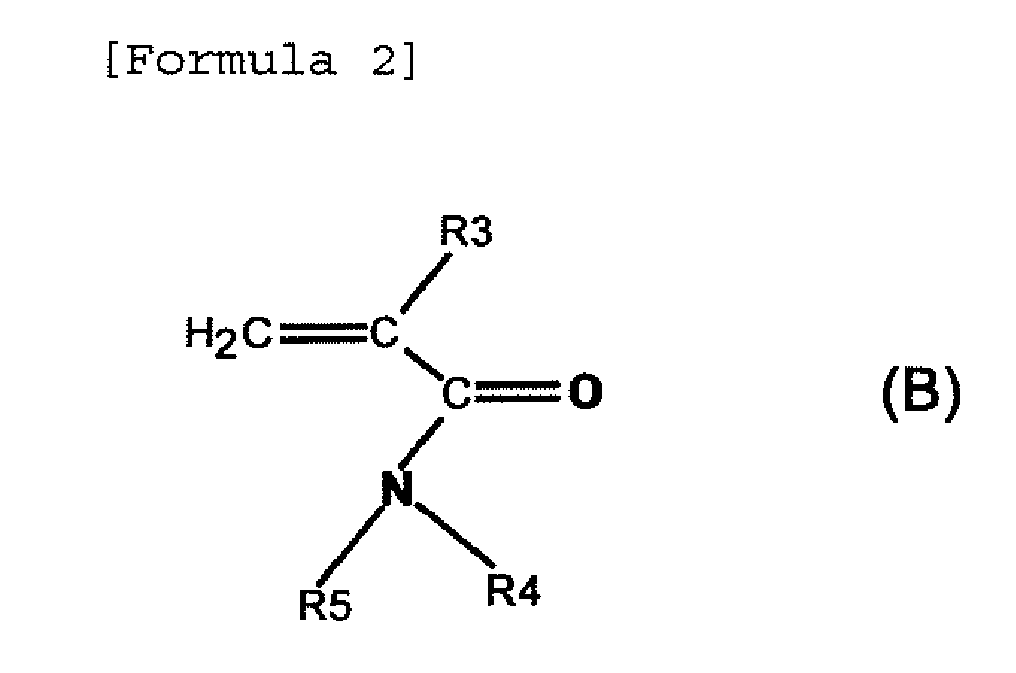
and
at least one monomer represented by the following formula (C) :
and
at least one monomer represented by the following formula D:
 (b) at least one selected from a cationic surfactant, a silicone derivative, and a polyhydric alcohol, and(c) alcohol.
 - The hair cosmetic according to claim 1, wherein the adhesive setting resin has a structure represented by the following formula (I):


- The hair cosmetic according to claim 1 or 2, wherein the silicone derivative is a polyether-modified silicone.
Applications Claiming Priority (2)
| Application Number | Priority Date | Filing Date | Title |
|---|---|---|---|
| JP2009093244 | 2009-04-07 | ||
| PCT/JP2010/056058 WO2010116951A1 (en) | 2009-04-07 | 2010-04-02 | Hair cosmetic |
Publications (2)
| Publication Number | Publication Date |
|---|---|
| EP2417962A1 true EP2417962A1 (en) | 2012-02-15 |
| EP2417962A4 EP2417962A4 (en) | 2012-10-31 |
Family
ID=42936235
Family Applications (1)
| Application Number | Title | Priority Date | Filing Date |
|---|---|---|---|
| EP10761650A Withdrawn EP2417962A4 (en) | 2009-04-07 | 2010-04-02 | Hair cosmetic |
Country Status (8)
| Country | Link |
|---|---|
| US (1) | US20120052033A1 (en) |
| EP (1) | EP2417962A4 (en) |
| JP (1) | JP5727926B2 (en) |
| KR (1) | KR20120001753A (en) |
| CN (1) | CN102458347A (en) |
| BR (1) | BRPI1011615A2 (en) |
| TW (1) | TW201039855A (en) |
| WO (1) | WO2010116951A1 (en) |
Cited By (1)
| Publication number | Priority date | Publication date | Assignee | Title |
|---|---|---|---|---|
| WO2013034527A3 (en) * | 2011-09-07 | 2013-10-24 | Akzo Nobel Chemicals International B.V. | Hair fixative compositions |
Families Citing this family (4)
| Publication number | Priority date | Publication date | Assignee | Title |
|---|---|---|---|---|
| KR20170048492A (en) * | 2014-09-08 | 2017-05-08 | 엘리멘티스 스페셜티즈, 인크. | Sulfate-free personal care compositions and methods |
| JP6662547B2 (en) * | 2016-05-20 | 2020-03-11 | 株式会社マンダム | Hairdressing composition |
| JP6162354B1 (en) * | 2016-12-22 | 2017-07-12 | 資生堂ホネケーキ工業株式会社 | Liquid detergent composition |
| CN112512498B (en) | 2018-07-27 | 2023-09-12 | 花王株式会社 | hair cosmetics |
Family Cites Families (10)
| Publication number | Priority date | Publication date | Assignee | Title |
|---|---|---|---|---|
| JPS6445546A (en) | 1987-08-14 | 1989-02-20 | Nippon Electric Ind | Data table change input device of factory automation controller |
| JP3032113B2 (en) * | 1994-04-13 | 2000-04-10 | 大阪有機化学工業株式会社 | Preparation of cationic thickener |
| US5700892A (en) * | 1996-03-12 | 1997-12-23 | Kao Corporation | Film-forming resin and hair cosmetic composition containing the same |
| US5733533A (en) * | 1997-06-25 | 1998-03-31 | Lambent Technologies Inc. | Reconstituted silicone wax esters |
| JP2002322219A (en) * | 2001-04-25 | 2002-11-08 | Lion Corp | Amphiphilic polymer compound and hair cosmetic |
| JP2003171244A (en) | 2001-11-30 | 2003-06-17 | Kose Corp | Hairdressing composition |
| US20040241130A1 (en) * | 2002-09-13 | 2004-12-02 | Krishnan Tamareselvy | Multi-purpose polymers, methods and compositions |
| JP4233918B2 (en) * | 2003-05-12 | 2009-03-04 | 花王株式会社 | Polymer particles |
| FR2872422B1 (en) * | 2004-07-02 | 2006-12-01 | Oreal | COSMETIC COMPOSITIONS CONTAINING AT LEAST ONE SURFACTANT AND AT LEAST ONE NEW ETHYLENE COPOLYMER HAVING POLYETHYLENE GLYCOL GRAFT |
| JP4699215B2 (en) | 2005-01-07 | 2011-06-08 | 株式会社資生堂 | Hair cosmetics |
-
2010
- 2010-04-02 CN CN2010800252483A patent/CN102458347A/en active Pending
- 2010-04-02 US US13/258,957 patent/US20120052033A1/en not_active Abandoned
- 2010-04-02 TW TW099110379A patent/TW201039855A/en unknown
- 2010-04-02 KR KR1020117023885A patent/KR20120001753A/en not_active Withdrawn
- 2010-04-02 EP EP10761650A patent/EP2417962A4/en not_active Withdrawn
- 2010-04-02 WO PCT/JP2010/056058 patent/WO2010116951A1/en not_active Ceased
- 2010-04-02 BR BRPI1011615A patent/BRPI1011615A2/en not_active IP Right Cessation
- 2010-04-02 JP JP2011508346A patent/JP5727926B2/en active Active
Cited By (1)
| Publication number | Priority date | Publication date | Assignee | Title |
|---|---|---|---|---|
| WO2013034527A3 (en) * | 2011-09-07 | 2013-10-24 | Akzo Nobel Chemicals International B.V. | Hair fixative compositions |
Also Published As
| Publication number | Publication date |
|---|---|
| US20120052033A1 (en) | 2012-03-01 |
| EP2417962A4 (en) | 2012-10-31 |
| JP5727926B2 (en) | 2015-06-03 |
| JPWO2010116951A1 (en) | 2012-10-18 |
| KR20120001753A (en) | 2012-01-04 |
| CN102458347A (en) | 2012-05-16 |
| WO2010116951A1 (en) | 2010-10-14 |
| TW201039855A (en) | 2010-11-16 |
| BRPI1011615A2 (en) | 2016-03-22 |
Similar Documents
| Publication | Publication Date | Title |
|---|---|---|
| JP5108817B2 (en) | Hair cosmetics | |
| EP2337555B1 (en) | Aminofunctional endblocked silicone polyether copolymers in personal care compositions | |
| WO2015072435A1 (en) | Hair cosmetic | |
| JP2003510260A (en) | Hair care composition | |
| JP3975907B2 (en) | Hair cosmetics | |
| EP2647367B1 (en) | Hair cosmetic | |
| US20120052033A1 (en) | Hair cosmetic | |
| EP2039343B1 (en) | Cosmetic compositions containing a cationic copolymer and a particular amino silicone and uses thereof | |
| US20230072395A1 (en) | Composition for keratin fibers | |
| EP3267972A1 (en) | Product and method for the temporary shaping of keratin-containing fibers | |
| EP2417966A1 (en) | Hair cosmetic | |
| CN104602667A (en) | Pearlescent conditioning composition and method for preparing the same | |
| TWI494128B (en) | Cosmetics for finishing hairstyles | |
| EP2039345A1 (en) | Cosmetic compositions containing a cationic copolymer and a particular triglyceride and uses thereof | |
| JP5900326B2 (en) | Hair cosmetics | |
| JP2011046619A (en) | Hair cosmetic | |
| HK1167087A (en) | Hair cosmetic | |
| JP3933821B2 (en) | Hair cosmetics | |
| HK1167088A (en) | Hair cosmetic | |
| KR20240076708A (en) | Aqueous cosmetics | |
| JP6284777B2 (en) | Hair cosmetics | |
| JP2024077458A (en) | Water-based cosmetics | |
| DE102018222047A1 (en) | Composition and method for temporarily deforming keratin fibers | |
| JP2011063577A (en) | Hair-dressing cosmetic | |
| HK1167089A (en) | Hair cosmetic |
Legal Events
| Date | Code | Title | Description |
|---|---|---|---|
| PUAI | Public reference made under article 153(3) epc to a published international application that has entered the european phase |
Free format text: ORIGINAL CODE: 0009012 |
|
| 17P | Request for examination filed |
Effective date: 20111025 |
|
| AK | Designated contracting states |
Kind code of ref document: A1 Designated state(s): AT BE BG CH CY CZ DE DK EE ES FI FR GB GR HR HU IE IS IT LI LT LU LV MC MK MT NL NO PL PT RO SE SI SK SM TR |
|
| DAX | Request for extension of the european patent (deleted) | ||
| A4 | Supplementary search report drawn up and despatched |
Effective date: 20121001 |
|
| RIC1 | Information provided on ipc code assigned before grant |
Ipc: A61Q 5/06 20060101ALI20120925BHEP Ipc: C08F 220/10 20060101ALI20120925BHEP Ipc: C08F 220/18 20060101ALI20120925BHEP Ipc: A61K 8/898 20060101ALI20120925BHEP Ipc: A61K 8/34 20060101AFI20120925BHEP Ipc: C08F 290/06 20060101ALI20120925BHEP Ipc: A61K 8/894 20060101ALI20120925BHEP Ipc: A61K 8/81 20060101ALI20120925BHEP |
|
| STAA | Information on the status of an ep patent application or granted ep patent |
Free format text: STATUS: THE APPLICATION IS DEEMED TO BE WITHDRAWN |
|
| 18D | Application deemed to be withdrawn |
Effective date: 20130430 |