EP2416488A1 - Electrode film for polymer actuator element, and polymer actuator element comprising same - Google Patents
Electrode film for polymer actuator element, and polymer actuator element comprising same Download PDFInfo
- Publication number
- EP2416488A1 EP2416488A1 EP10758201A EP10758201A EP2416488A1 EP 2416488 A1 EP2416488 A1 EP 2416488A1 EP 10758201 A EP10758201 A EP 10758201A EP 10758201 A EP10758201 A EP 10758201A EP 2416488 A1 EP2416488 A1 EP 2416488A1
- Authority
- EP
- European Patent Office
- Prior art keywords
- cation
- electrode film
- actuator element
- fluorine rubber
- polymer
- Prior art date
- Legal status (The legal status is an assumption and is not a legal conclusion. Google has not performed a legal analysis and makes no representation as to the accuracy of the status listed.)
- Granted
Links
Images


Classifications
-
- C—CHEMISTRY; METALLURGY
- C08—ORGANIC MACROMOLECULAR COMPOUNDS; THEIR PREPARATION OR CHEMICAL WORKING-UP; COMPOSITIONS BASED THEREON
- C08J—WORKING-UP; GENERAL PROCESSES OF COMPOUNDING; AFTER-TREATMENT NOT COVERED BY SUBCLASSES C08B, C08C, C08F, C08G or C08H
- C08J5/00—Manufacture of articles or shaped materials containing macromolecular substances
- C08J5/18—Manufacture of films or sheets
-
- C—CHEMISTRY; METALLURGY
- C08—ORGANIC MACROMOLECULAR COMPOUNDS; THEIR PREPARATION OR CHEMICAL WORKING-UP; COMPOSITIONS BASED THEREON
- C08L—COMPOSITIONS OF MACROMOLECULAR COMPOUNDS
- C08L27/00—Compositions of homopolymers or copolymers of compounds having one or more unsaturated aliphatic radicals, each having only one carbon-to-carbon double bond, and at least one being terminated by a halogen; Compositions of derivatives of such polymers
- C08L27/02—Compositions of homopolymers or copolymers of compounds having one or more unsaturated aliphatic radicals, each having only one carbon-to-carbon double bond, and at least one being terminated by a halogen; Compositions of derivatives of such polymers not modified by chemical after-treatment
- C08L27/12—Compositions of homopolymers or copolymers of compounds having one or more unsaturated aliphatic radicals, each having only one carbon-to-carbon double bond, and at least one being terminated by a halogen; Compositions of derivatives of such polymers not modified by chemical after-treatment containing fluorine atoms
- C08L27/16—Homopolymers or copolymers or vinylidene fluoride
-
- F—MECHANICAL ENGINEERING; LIGHTING; HEATING; WEAPONS; BLASTING
- F03—MACHINES OR ENGINES FOR LIQUIDS; WIND, SPRING, OR WEIGHT MOTORS; PRODUCING MECHANICAL POWER OR A REACTIVE PROPULSIVE THRUST, NOT OTHERWISE PROVIDED FOR
- F03G—SPRING, WEIGHT, INERTIA OR LIKE MOTORS; MECHANICAL-POWER PRODUCING DEVICES OR MECHANISMS, NOT OTHERWISE PROVIDED FOR OR USING ENERGY SOURCES NOT OTHERWISE PROVIDED FOR
- F03G7/00—Mechanical-power-producing mechanisms, not otherwise provided for or using energy sources not otherwise provided for
- F03G7/008—Mechanical-power-producing mechanisms, not otherwise provided for or using energy sources not otherwise provided for characterised by the actuating element
- F03G7/012—Electro-chemical actuators
- F03G7/0121—Electroactive polymers
-
- C—CHEMISTRY; METALLURGY
- C08—ORGANIC MACROMOLECULAR COMPOUNDS; THEIR PREPARATION OR CHEMICAL WORKING-UP; COMPOSITIONS BASED THEREON
- C08J—WORKING-UP; GENERAL PROCESSES OF COMPOUNDING; AFTER-TREATMENT NOT COVERED BY SUBCLASSES C08B, C08C, C08F, C08G or C08H
- C08J2327/00—Characterised by the use of homopolymers or copolymers of compounds having one or more unsaturated aliphatic radicals, each having only one carbon-to-carbon double bond, and at least one being terminated by a halogen; Derivatives of such polymers
- C08J2327/02—Characterised by the use of homopolymers or copolymers of compounds having one or more unsaturated aliphatic radicals, each having only one carbon-to-carbon double bond, and at least one being terminated by a halogen; Derivatives of such polymers not modified by chemical after-treatment
- C08J2327/12—Characterised by the use of homopolymers or copolymers of compounds having one or more unsaturated aliphatic radicals, each having only one carbon-to-carbon double bond, and at least one being terminated by a halogen; Derivatives of such polymers not modified by chemical after-treatment containing fluorine atoms
- C08J2327/16—Homopolymers or copolymers of vinylidene fluoride
-
- C—CHEMISTRY; METALLURGY
- C08—ORGANIC MACROMOLECULAR COMPOUNDS; THEIR PREPARATION OR CHEMICAL WORKING-UP; COMPOSITIONS BASED THEREON
- C08J—WORKING-UP; GENERAL PROCESSES OF COMPOUNDING; AFTER-TREATMENT NOT COVERED BY SUBCLASSES C08B, C08C, C08F, C08G or C08H
- C08J2427/00—Characterised by the use of homopolymers or copolymers of compounds having one or more unsaturated aliphatic radicals, each having only one carbon-to-carbon double bond, and at least one being terminated by a halogen; Derivatives of such polymers
- C08J2427/02—Characterised by the use of homopolymers or copolymers of compounds having one or more unsaturated aliphatic radicals, each having only one carbon-to-carbon double bond, and at least one being terminated by a halogen; Derivatives of such polymers not modified by chemical after-treatment
- C08J2427/12—Characterised by the use of homopolymers or copolymers of compounds having one or more unsaturated aliphatic radicals, each having only one carbon-to-carbon double bond, and at least one being terminated by a halogen; Derivatives of such polymers not modified by chemical after-treatment containing fluorine atoms
- C08J2427/16—Homopolymers or copolymers of vinylidene fluoride
-
- C—CHEMISTRY; METALLURGY
- C08—ORGANIC MACROMOLECULAR COMPOUNDS; THEIR PREPARATION OR CHEMICAL WORKING-UP; COMPOSITIONS BASED THEREON
- C08K—Use of inorganic or non-macromolecular organic substances as compounding ingredients
- C08K3/00—Use of inorganic substances as compounding ingredients
- C08K3/01—Use of inorganic substances as compounding ingredients characterized by their specific function
- C08K3/013—Fillers, pigments or reinforcing additives
-
- C—CHEMISTRY; METALLURGY
- C08—ORGANIC MACROMOLECULAR COMPOUNDS; THEIR PREPARATION OR CHEMICAL WORKING-UP; COMPOSITIONS BASED THEREON
- C08K—Use of inorganic or non-macromolecular organic substances as compounding ingredients
- C08K3/00—Use of inorganic substances as compounding ingredients
- C08K3/02—Elements
- C08K3/04—Carbon
-
- C—CHEMISTRY; METALLURGY
- C08—ORGANIC MACROMOLECULAR COMPOUNDS; THEIR PREPARATION OR CHEMICAL WORKING-UP; COMPOSITIONS BASED THEREON
- C08K—Use of inorganic or non-macromolecular organic substances as compounding ingredients
- C08K3/00—Use of inorganic substances as compounding ingredients
- C08K3/02—Elements
- C08K3/04—Carbon
- C08K3/041—Carbon nanotubes
-
- C—CHEMISTRY; METALLURGY
- C08—ORGANIC MACROMOLECULAR COMPOUNDS; THEIR PREPARATION OR CHEMICAL WORKING-UP; COMPOSITIONS BASED THEREON
- C08K—Use of inorganic or non-macromolecular organic substances as compounding ingredients
- C08K3/00—Use of inorganic substances as compounding ingredients
- C08K3/02—Elements
- C08K3/04—Carbon
- C08K3/044—Carbon nanohorns or nanobells
-
- C—CHEMISTRY; METALLURGY
- C08—ORGANIC MACROMOLECULAR COMPOUNDS; THEIR PREPARATION OR CHEMICAL WORKING-UP; COMPOSITIONS BASED THEREON
- C08K—Use of inorganic or non-macromolecular organic substances as compounding ingredients
- C08K3/00—Use of inorganic substances as compounding ingredients
- C08K3/02—Elements
- C08K3/04—Carbon
- C08K3/046—Carbon nanorods, nanowires, nanoplatelets or nanofibres
Definitions
- the present invention relates to electrode films for polymer actuator elements, and polymer actuator elements with the same.
- Polymer actuators have been proposed as one type of small-size actuator.
- the polymer actuators are roughly classified into two types, i.e., (1) one that makes use of expansion/contraction through reduction/oxidation of an electron conducting polymer such as polypyrrole and polyaniline in an electrolyte (electron-conducting polymer actuator), and (2) one that comprises an ion-exchange membrane and a junction electrode and can function as an actuator by applying an electric potential difference to the ion-exchange membrane in a water-containing state to cause flection or deformation of the ion-exchange membrane (ion-conducting polymer actuator).
- an electron conducting polymer such as polypyrrole and polyaniline in an electrolyte
- ion-conducting polymer actuator one that comprises an ion-exchange membrane and a junction electrode and can function as an actuator by applying an electric potential difference to the ion-exchange membrane in a water-containing state to cause flection or deformation of the ion-exchange
- actuator elements which can operate in air or in vacuum by using a gel of carbon nanotube and ionic liquid as a conductive expandable active layer. (See Non-Patent Literature 1).
- actuator elements for example, have a structure in which their conductive layers, which include conductive filler, an ionic liquid and a polymer, are adhered to both surfaces of a gel electrolyte film including a polymer and an ionic liquid.
- the ionic liquid When an electric potential difference is applied across the conductive layers, the ionic liquid is polarized, anions move toward a positive electrode and cations move toward a negative electrode.
- cation is bigger than anion, so that the negative electrode is expanded and the positive electrode is contracted. As a result, the actuator element is bent to the positive electrode.
- Patent Literature 1 an actuator element has been proposed in Patent Literature 1, which includes an electrode layer for the actuator element in which the electrode layer is a gel substance including a carbon nanotube, an ionic liquid, and a polymer.
- An object of the present invention is to provide an electrode film for a polymer actuator element that enables to provide a polymer actuator element that has a large displacement amount, a high displacement rate, and generates a large force as a result of the displacement.
- Another object of the present invention is to provide a polymer actuator element that has a large displacement amount, a high displacement rate, and generates a large force as a result of the displacement.
- the present invention relates to an electrode film for a polymer actuator element, comprising a fluororesin (A), a fluorine rubber (B), an ionic liquid (C), and a conductive filler (D).
- an electrode film for a polymer actuator element comprising an electrode film for a polymer actuator element, comprising a fluororesin (A), a fluorine rubber (B), an ionic liquid (C), and a conductive filler (D).
- the fluorine rubber (B) is a cross-linked fluorine rubber.
- At least one of the fluororesin (A) and the fluorine rubber (B) contains a vinylidene fluoride unit.
- a ratio of the vinylidene fluoride unit to the entire fluororesin (A) and fluorine rubber (B) is not less than 60 mole %.
- a weight ratio of the fluororesin (A) to the fluorine rubber (B) is from 80:20 to 20:80.
- the electrode film 5 to 70% by weight of the fluororesin (A) and the fluorine rubber (B) as a whole, 20 to 80% by weight of the ionic liquid (C), and 1 to 40% by weight of the conductive filler (D) are included.
- a polymer actuator element comprising an electrode film for a polymer actuator element can be used in air or in vacuum and has a large displacement amount, a high displacement rate, and generates a large force as a result of the displacement.
- the electrode film for a polymer actuator element of the present invention comprises a fluororesin (A), a fluorine rubber (B), an ionic liquid (C), and a conductive filler (D).
- Both the fluororesin (A) and fluorine rubber (B) are constituted by at least one of fluoride polymers. They are distinguished from each other by the fact that the fluororesin (A) does not show rubber elasticity and the fluorine rubber (B) shows the rubber elasticity, as commonly understood by a person of ordinary skill in the art.
- the fluororesin (A) includes crystalline resins having a melting point and/or noncrystalline resins having a rubber-transition temperature which is higher than room temperature. When the crystalline resins are used as the fluororesin (A), the fluororesin (A) can be distinguished from the fluorine rubber (B), which does not have a melting point, because the fluororesin (A) has a melting point.
- a mixture of the fluororesin (A) and fluorine rubber (B) should be compatible with the ionic liquid. Therefore, at least one of the fluororesin (A) and fluorine rubber (B) should have polarity. Preferably, both of the fluororesin (A) and fluorine rubber (B) have polarity.
- Resins may be polarized, for example, by containing a structural unit derived from a polar fluorine-containing olefin.
- the structural unit is a unit derived from vinylidene fluoride (VdF) which has a hydrogen atom.
- VdF vinylidene fluoride
- the structural unit derived from the vinylidene fluoride (VdF) is referred to as vinylidene fluoride unit in some cases.
- At least one of the fluororesin (A) and fluorine rubber (B) preferably contains the vinylidene fluoride unit, and more preferably both of the fluororesin (A) and fluorine rubber (B) contain the vinylidene fluoride unit.
- the ratio of the vinylidene fluoride unit to the entire fluororesin (A) and fluorine rubber (B), namely to total mole number of the entire structural units constituting the fluororesin (A) and the fluorine rubber (B), is preferably not less than 60 mole %, in view of compatibility with the ionic liquid. And, in view of displacement amount of the actuator element, the ratio is preferably not more than 95 mole %, and is more preferably not more than 90 mole %.
- an amount of the vinylidene fluoride unit by mole (mole %) is determined, for example, by NMR analysis.
- the amount of the vinylidene fluoride unit by mole is referred to as a VdF ratio in some cases.
- a polymer dissolved in acetone-d6 is analyzed based on 19 F-NMR analysis with trifluoroacetic acid as a reference material by using Varian NMR System400.
- Signals from -89ppm to -110ppm are defined as signals derived from VdF, and the VdF ratio is calculated based on a ratio of the intensity of the signals derived from VdF to the intensity of the other signals.
- the fluorine rubber (B) is cross-linked.
- the fact that cross-linked fluorine rubber (B) is contained in the electrode film for polymer actuator element of the present invention is identified, for example, through a presence of polymers insoluble in a polar solvent such as acetone, and through an inconstant viscosity that changes in the low frequency region in the measurement of frequency dependency of the viscosity.
- the fluororesin (A) is preferably compatible with an ionic liquid.
- Examples of the fluororesin (A) include polar fluororesins.
- polar fluororesins examples include fluorine-containing polymers and fluorine-containing copolymers, which contain structural units derived from polar fluorine-containing olefins. Among them, fluorine-containing polymers and fluorine-containing copolymers which contain vinylidene fluoride units are preferable.
- the amount of the vinylidene fluoride units in the fluororesin (A) is preferably not less than 40 mole %, and more preferably not less than 60 mole %, in view of compatibility with the ionic liquid.
- the amount is preferably not more than 95 mole %, and more preferably not more than 90 mole %, in view of displacement amount of the actuator element.
- the ratio of the vinylidene fluoride units in the fluororesin (A) is high when the ratio of the vinylidene fluoride units in the fluorine rubber (B) is low.
- the polar fluororesins preferably include groups selected from the group consisting of -OH, -COOH, -COOR (R represents hydrocarbons having 1 to 20 carbon atoms), iodine atom, epoxy group and (meth)acryloyl group in a polymer side chain and/or at an end of a polymer main chain, in view of compatibility with the ionic liquid.
- the main chain structure preferably contains a bond selected from the group consisting of ester bond, amide bond, ether bond and urethane bond.
- the fluororesin (A) includes crystalline resins having a melting point and/or noncrystalline resins having a rubber-transition temperature which is higher than room temperature. Among them, the crystalline resins are preferable.
- the compounds represented by the following formula (A1) are preferable. ⁇ formula A1> -(M a1 )-(N a1 )- (A1)
- M a1 represents a structural unit derived from vinylidene fluoride (m a1 )
- N a1 represents a structural unit derived from a monomer (n a1 ) copolymerizable with the monomer (m a1 ).
- the formula (A1) shows that the structure unit M a1 and the structure unit N a1 can be combined in any combination and any order.
- the amount of the structure unit M a1 is preferably from 40 to 95 mole %, and more preferably from 60 to 90 mole %, in the fluorine-containing polymers or fluorine-containing copolymers.
- Examples of the monomer (n a1 ) include any monomer as long as it is copolymerizable with the monomer (m a1 ), and for instance, may include a fluorine-containing monomer such as tetrafluoroethylene (TFE), chlorotrifluoroethylene (CTFE), trifluoroethylene, hexafluoropropylene (HFP), trifluoropropylene, tetrafluoropropylene, pentafluoropropylene, trifluorobutene, tetrafluoroisobutene, and perfluoro(alkyl vinyl ether) (PAVE); and a nonfluorine-containing monomer such as ethylene, propylene, and alkyl vinyl ether.
- TFE tetrafluoroethylene
- CTFE chlorotrifluoroethylene
- HFP hexafluoropropylene
- PAVE perfluoro(alkyl vinyl ether)
- the fluororesin (A) preferably has a melting point between room temperature and 200°C, inclusively. More preferably, the melting point is 80°C or more and 170°C or less. Also, the resin preferably has a tensile rupture strength of 10MPa or more and a tensile elastic modulus of 50MPa or more. Further, the resin is preferably dissolvable in an aprotic polar solvent such as methylpentanone.
- the fluororesin (A) is available as commercialized products such as Kynar Flex PPA 2801, 2501, 2751 (Arkema Co.), THV 220G, 415G, 500G (Dyneon Co.), or can be produced by common manufacturing processes.
- the fluorine rubber (B) is preferably compatible with an ionic liquid.
- the fluorine rubber (B) include nonperfluoro fluorine rubber containing a structural unit derived from polar olefin fluorides.
- the polar olefin fluorides include olefin fluorides having a hydrogen atom, such as vinylidene fluoride.
- the fluorine rubber (B) is preferably cross-linked. Any common processes known as fluorine rubber cross-linking processes are applicable to the cross-linking process of the fluorine rubber (B).
- examples of the cross-linking process include polyamine cross-linking, polyol cross-linking, peroxide cross-linking, and heterocyclic compound cross-linking. Among them, peroxide cross-linking is preferable because cross-linking reactivity thereof can be easily controlled.
- the cross-linking agent used in peroxide cross-linking can be any organic peroxide as long as it can easily generate a peroxy radical in the presence of heat or an oxidization-reduction system.
- examples of them include 1,1-bis(t-butylperoxy)-3,5,5-trimethylcyclohexane, 2,5-dimethylhexane-2,5-dihydroperoxide, di-t-butylperoxide, t-butylcumylperoxide, dicumylperoxide, ⁇ , ⁇ -bis(t-butylperoxy)-p-diisopropylbenzene, 2,5-dimethyl-2,5-di(t-butylperoxy)hexane, 2,5-dimethyl-2,5-di(t-butylperoxy)hexyne-3, benzoylperoxide, t-butylperoxybenzene, t-butylperoxy maleate and t-
- cross-linking agent used for peroxide cross-linking examples include triallyl cyanurate, triallyl isocyanurate (TAIC), triacrylformal, triallyl trimellitate, N,N'-m-phenylenebismaleimide, dipropargyl terephthalate, diallyl phthalate, tetraallylterephthalateamide, triallyl phosphate, bismaleimide, fluorinated triallyl isocyanurate (1,3,5-tris(2,3,3-trifluoro-2-propenyl)-1,3,5-triazine-2,4,6-trione), tris(diallylamine)-S-triazine, triallyl phosphite, N,N-diallylacrylamide and 1,6-divinyldodecafluorohexane, hexaallylphosphoramide, N,N,N',N'-tetraallylphthalamide, N,N,N',N'-tetra
- nonperfluoro fluorine rubber examples include vinylidene fluoride (VdF) fluorine rubber, tetrafluoroethylene (TFE)/propylene fluorine rubber, tetrafluoroethylene (TFE)/propylene/vinylidene fluoride (VdF) fluorine rubber, ethylene/hexafluoropropylene (HFP) fluorine rubber, ethylene/hexafluoropropylene (HFP)/vinylidene fluoride (VdF) fluorine rubber, ethylene/hexafluoropropylene (HFP)/tetrafluoroethylene (TFE) fluorine rubber, fluorosilicone fluorine rubber and fluorophosphazene fluorine rubber. These can be used alone or can be used in arbitrary combinations, as long as the effects of the present invention are not lost.
- vinylidene fluoride fluorine rubber is preferable in view of the advantage of the present invention.
- the amount of vinylidene fluoride unit in the vinylidene fluoride fluorine rubber is preferably 40 mole % or more, and more preferably, 60 mole % or more, in view of compatibility with an ionic liquid. Further, the amount is preferably 85 mole % or less so that the vinylidene fluoride fluorine rubber can be characterized as a rubber.
- the ratio of the vinylidene fluoride unit in the fluorine rubber (B) (vinylidene fluoride fluorine rubber) is high when the ratio of the vinylidene fluoride unit in the fluororesin (A) is low.
- vinylidene fluoride fluorine rubber is represented by the following formula (B1). -(M b1 )-(M b2 )-(N b1 )- (B1)
- M b1 represents a structural unit derived from vinylidene fluoride (m b1 )
- M b2 represents a structural unit derived from a fluorine-containing ethylene monomer (m b2 ) other than vinylidene fluoride
- N b1 represents a structural unit derived from a monomer (n b1 ) copolymerizable with the monomers (m b1 ) and (m b2 ).
- the structural unit (M b1 ), the structural unit (M b2 ) and the structural unit (N b1 ) can be combined in any combination and any order.
- the vinylidene fluoride fluorine rubber represented by the formula (B1) preferably contains 45-85 mole % of the structural unit M b1 and 55-15 mole % of the structural unit M b2 , and more preferably contains 60-80 mole % of the structural unit M b1 and 40-20 mole % of the structural unit M b2 .
- the structural unit N b1 is preferably 0-10 mole % to the total of the structural units M b1 and M b2 .
- One or two or more kinds of monomers can be used as the fluorine-containing ethylene monomer other than vinylidene fluoride (m b2 ).
- the monomer (m b2 ) include fluorine-containing monomers such as tetrafluoroethylene (TFE), chlorotrifluoroethylene (CTFE), trifluoroethylene, hexafluoropropylene (HFP), trifluoropropylene, tetrafluoropropylene, pentafluoropropylene, trifluorobutene, tetrafluoroisobutene, perfluoro(alkyl vinyl ether) (PAVE) and vinyl fluoride.
- TFE tetrafluoroethylene
- CTFE chlorotrifluoroethylene
- HFP hexafluoropropylene
- HPFP hexafluoropropylene
- PAVE tetrafluororoisobutene
- vinyl fluoride tetrafluor
- any monomer which can copolymerize with the monomer (m b1 ) and the monomer (m b2 ) can be used as the monomer (n b1 ).
- ethylene, propylene, alkyl vinyl ether or the like can be used as the monomer (n b1 ).
- monomers which can introduce cross-linkable sites are preferable as the monomer (n b1 ).
- Examples of the monomers which can introduce cross-linkable sites include iodine atom-containing monomers or bromine atom-containing monomers represented by the following formula (B2):
- Y b1 represents hydrogen atom, fluorine atom, or methyl group
- m is an integer 0-5
- n is an integer 1-3
- X b2 represents cyano group, carboxyl group, alkoxycarbonyl group, iodine atom or bromine atom.>, and further include monomers represented by the following formula (B4):
- iodine -containing monomers such as perfluoro(6,6-dihydro-6-iodo-3-oxa
- VdF vinylidene fluoride
- VdF/HFP rubber VdF/HFP/TFE rubber
- VdF/CTFE rubber VdF/CTFE/TFE rubber
- the fluorine rubber (B) may be available as commercialized products, or can be produced by known processes.
- Ionic liquid (C) used in the present invention is known as a normal temperature molten salt, or simply known as a molten salt or the like, and is a salt that exhibits a molten state within a wide temperature range including normal temperature (room temperature).
- ionic liquids While various known ionic liquids can be used, it is preferable to use those that are stable and exhibit a liquid state at normal temperature (room temperature) or a temperature as close to normal temperature as possible.
- normal temperature molten salts having electric conductivity of not less than 0.1 Sm -1 are preferable.
- Examples of the ionic liquid (C) include those comprising a cation (preferably imidazolium ion) represented by the following formulae (C1) to (C4) and an anion (X - ).
- R c represents: an alkyl group which may be substituted by one or more halogen atoms and has 1 to 12 carbon atoms; or an alkyl group which may be substituted by one or more halogen atoms, may have an ether bond instead of methylene group, and has the total number of carbon atoms and oxygen atoms of 3 to 12.
- R c1 represents a hydrogen atom or an alkyl group which may be substituted by one or more halogen atoms and has 1 to 4 carbon atoms.
- each x is an integer of 1 to 4.
- R c and R c1 are not the same.
- examples of the ionic liquid (C) include fluorine-containing imidazole salts comprising a cation (preferably imidazolium ion) represented by the following formula (C5) and an anion (X - ).
- R ca s may be the same or different, and each is a halogen atom, a functional group or an organic group;
- R cc1 , R cc2 and R cc3 may be the same or different, and each is
- Nonlimiting examples of cations represented by the formulae (C1) to (C5) include, for instance, non-fluorine-containing imidazole compound cations such as 1-ethyl-3-methylimidazolium cation, 1-methyl-3-propylimidazolium cation, 1-isopropyl-3-methylimidazolium cation, 1-butyl-3-methylimidazolium cation, 1-isobutyl-3-methylimidazolium cation, 1-sec-butyl-3-methylimidazolium cation, 1-methoxymethyl-3-methylimidazolium cation, 1-methoxyethyl-3-methylimidazolium cation, 1-ethyl-3-propylimidazolium cation, 1-ethyl-3-isopropylimidazolium cation, 1-ethyl-3-butylimidazolium cation, 1-ethyl-3-isobutylimid
- preferable examples of the cation represented by the formulae (C1) to (C5) include 1-ethyl-3-inethylimidazolium cation, 1-butyl-3-methylimidazolium cation, and 1,2-dimethyl-3-isobutylimidazolium cation.
- anion (X - ) it is preferable to select at least one from tetrafluoroboric acid anion, hexafluorophosphoric acid anion, bis(trifluoromethanesulfonyl)imidic acid anion, perchloric acid anion, tris(trifluoromethanesulfonyl)carbonic acid anion, trifluoromethanesulfonic acid anion, dicyanamide anion, trifluoroacetic acid anion, organic carboxylic acid anion and halogen ion.
- the salts containing the cation represented by the formulae (C1) to (C5) (preferably an imidazolium ion) and the anion (X - ) can be produced by known processes such as the known process described in JP-A- 2007-204682 or compatible processes therewith.
- Examples of the electroconductive nano-filler (D) include electroconductive nano carbon materials and nano particles of electroconductive metals. And at least one or two or more of them can be selected and used.
- nano-filler means a filler having a structure (in the form of particle, sheet, layer, needle, bar, fiber or tube) of nano level (0.1 mn. to 1,000 nm) in at least a part thereof.
- Fullerene is a carbon molecule having 60 or more carbon atoms and having a structure formed by bonds of carbon atoms in a spherical form.
- Carbon nano ball is a black or ivory black powder resulted from thermal decomposition of incomplete combustion product of hydrocarbon compound.
- Carbon nanofiber is synthesized through thermal decomposition of carbon sources of gaseous phase by using a metallic catalyst, such as iron and cobalt, under adequate conditions.
- a metallic catalyst such as iron and cobalt
- As the structure of a fibrous carbon there are three kinds of mainly known orientation of carbon network with respect to the fiber axis, that is, parallel (ribbon type), vertical (platelet type) and inclined (herringbone type).
- Carbon nanotube is a kind of carbon nanofiber. It is a kind of fullerene in which a six-member ring network (graphene sheet) formed by carbon atoms is in the form of a single layer or a coaxial tubular multilayer structure. Carbon nanotube having a single layer is called a single-wall nanotube (SWNT), and one having a multilayer structure is called a multi-wall nanotube (MWNT). Especially, one having two layers is called a double wall nanotube (DWNT).
- SWNT single-wall nanotube
- MWNT multi-wall nanotube
- DWNT double wall nanotube
- Carbon nanohorn is a kind of carbon nanofiber.
- Carbon nanohorn has a carbon structure in which six-member ring networks (graphene sheet) formed by carbon atoms are generally connected in a form of multi-layer horns.
- nano carbon materials examples include those disclosed in Chemical Industry Vol. 56, pp. 50-62 (2005 ) and Langmuir, Vol. 11, pp. 3,682-3,866 (1995 ).
- carbon nanofibers are preferable, and carbon nanotubes are especially preferable.
- Nano particles of electroconductive metal are metal particles having a particle size of 1 nn to 100 nm.
- suitable nano particles of metal include nano particles comprising a metal selected from gold, silver, copper, platinum, palladium, nickel, rhodium, aluminum, tin, zinc, lead, titanium and tantalum, and nano particles of alloy comprising two or more of metals selected from gold, silver, copper, platinum, palladium, nickel, rhodium, aluminum, tin, zinc, lead, titanium and tantalum and carbon. Nano particles of metal are appropriately selected according to purpose and applications.
- electroconductive nano-filler may be appropriately selected depending on environment where it is used, electroconductive nano carbon materials, and further carbon nanotubes, are preferable since they have a large surface area and a high conductivity due to quantum effect or the like.
- suitable carbon nanotube which has been put into practical use includes HiPco (available from Carbon Nanotechnology, Incorporated) which can be produced in a relatively large scale using carbon monoxide as a raw material.
- the electroconductive filler (D) may be available as commercialized products, or can be produced by common manufacturing processes.
- Electrode film for a polymer actuator element >
- the ratio of the vinylidene fluoride unit to the entire fluororesin (A) and fluorine rubber (B) is preferably not less than 60 mole %, in view of compatibility with the ionic liquid.
- the ratio is preferably not more than 90 mole %, and more preferably not more than 87 mole % in view of the displacement amount of the actuator element.
- the ratio can be adjusted with the ratio of the vinylidene fluoride unit to the fluororesin (A), the ratio of the vinylidene fluoride unit to the fluorine rubber (B), and the weight ratio of the fluororesin (A) to the fluorine rubber (B).
- the ratio of the produced electrode film for a polymer actuator element of the present invention can be determined through NMR analysis.
- the weight ratio of the fluororesin (A) to the fluorine rubber (B) is generally from 90:10 to 20:80, preferably from 80:20 to 20:80, and more preferably from 80:20 to 50:50.
- the higher ratio of the fluorine rubber (B) is preferable.
- the higher ratio of the fluororesin (A) is preferable.
- the electrode film for the polymer actuator element of the present invention preferably includes 5 to 70% by weight of the fluororesin (A) and fluorine rubber (B) as a whole, 20 to 80% by weight of the ionic liquid (C), and 1 to 40% by weight of the conductive filler (D).
- the thickness of the electrode film for the polymer actuator element of the present invention is preferably from 0.01mm to 0.5mm.
- a smaller thickness is preferable.
- a larger thickness is preferable.
- the polymer actuator element of the present invention includes the electrode film of the present invention explained above.
- Examples of the polymer actuator element of the present invention include one having at least two electrode films of the present invention, which are formed to be insulated from each other, on the surface of an ion conductive layer.
- flection or deformation of the element can be caused by applying an electrical potential difference to the electrode films (electrode films).
- examples of the polymer actuator element of the present invention include a polymer actuator element which is provided with a conductive layer formed on an outside surface, i.e. the opposite surface of the ion conductive layer, of the electrode film.
- the polymer actuator element of the present invention may be a three-layer structure which comprises an ion conductive layer 1 sandwiched between at least one pair of the electrode layers 2 of the present invention having carbon nanotubes, ion liquids, and polymers (see Figure 1 ).
- the polymer actuator element may be a five-layer structure which further comprises conductive layers 3 on the respective outside surfaces of the two electrode layers 2 (i.e., on the surfaces opposite to the ion conductive layer) (see Figure 2 )
- the ion conductive layer is preferably constituted with a composition in the form of gel.
- the composition preferably includes a polymer and an ionic liquid.
- the mass ratio of the hydrophilic ionic liquid to the polymer is preferably 1:4 to 4:1.
- the ratio of the hydrophilic ionic liquid to the polymer is more preferably 1:2 to 2:1.
- the actuator element of the present invention when a direct current voltage of 0.5 to 3 V is applied, a displacement of about 0.5 to 1 time the element length can be obtained within several seconds.
- This actuator element can operate flexibly in air or in vacuum.
- the theory behind the operation of such an actuator element is that, when an electric potential difference is applied across the pair of electrode layers 2 which are formed on the surfaces of the ion conductive layer 1 and are insulated from each other, an electric double layer is formed at an interface between the ionic liquid phase and the carbon nanotube phase in the electrode layers 2, and the electrode layers 2 undergo expansion and shrinkage due to a resulting interfacial stress.
- the reason why the actuator element of the present invention bends toward the positive electrode is that there is an effect of causing larger expansion of the carbon nanotube at the negative electrode side due to a quantum chemical effect and also that, in ionic liquids commonly used nowadays, an ionic radius of the cation is large and, due to its steric effect, the negative pole side undergoes larger expansion.
- an actuator element enables transportation by peristaltic movements and a micro manipulator can be realized.
- the shape of the actuator element of the present invention is not limited to a flat shape, and elements having arbitrary shapes can be easily produced.
- an actuator element shown in Fig. 4 is one having four electrode layers 2 along a circumference of the ion conductive layer 1 in the form of a rod having a diameter of about 1 mm. This element makes it possible to realize an actuator which can be inserted into a capillary tube.
- the thickness of the electrode film for the polymer actuator element of the present invention is preferably from 0.01mm to 0.5mm. In view of the displacement amount of the actuator element, a smaller thickness is preferable. On the other hand, in view of the force generated by the actuator element, a larger thickness is preferable.
- a method for producing the electrode film for the polymer actuator element of the present invention may be a method commonly used for producing polymer films.
- the solvent can be properly selected from solvents which can dissolve the fluororesin (A) and the like.
- the solvent is a solvent including hydrophilic solvents and hydrophobic solvents with arbitrary ratios.
- a method for producing the electrode film for a polymer actuator element of the present invention a method which includes a step of dissolving a fluororesin (A), a fluorine rubber (B), a cross-linking agent if needed, a cross-linking aid if needed, and an ionic liquid (C) to a solvent, a step of dispersing a conductive filler (D) in the solvent, a step of casting the obtained liquid to make a film, and a step of heating the film to cross-link the rubber components, is preferable because a uniform film can be produced.
- the polymer actuator element of the present invention can be produced by methods commonly used.
- films of each layer may be formed in order by a casting method using respective compositions, and a solvent is evaporated and the films are dried.
- films individually made can be layered and adhered by heater press.
- the solvent is preferably a solvent including hydrophilic solvents and hydrophobic solvents with arbitrary ratios.
- VdF ratios in electrode films and electrolyte films were determined through 19 F NMR measurements of the electrode films and electrolyte films dissolved in acetone-d6 with Varian NMR System400, by using trifluoroacetic acid as a reference substance.
- the signals from -89 ppm to -110 ppm were identified as the signals derived from VdF, and the VdF ratios were calculated based on the ratio of the intensity of the signals derived from VdF to the intensity of the other signals.
- the VdF ratio of the electrolyte film was determined as 85.8 mole % based on the NMR analysis.
- EXAMPLE 1 Electrode film 1: Kynar Flex PPA 2801 (70) / Polymer A (30) / butylmethylimidazolium tetrafluoroborate / HiPco carbon nanotube)
- the electrode film had the VdF ratio of 89.8 mole % as determined by the NMR analysis.
- EXAMPLE 2 Electrode film 2: Kynar Flex PPA 2801 (50) / Polymer A (50) / butylmethylimidazolium tetrafluoroborate / HIPCO carbon nanotube)
- the electrode film had the VdF ratio of 86.2 mole % as determined by the NMR analysis.
- EXAMPLE 3 Electrode film 3: Kynar Flex PPA 2801 (70) / Polymer A (30) / ethylmethylimidazolium tetrafluoroborate / HIPCO carbon nanotube)
- the electrode film had the VdF ratio of 89.8 mole % as determined by the NMR analysis.
- EXAMPLE 4 Electrode film 4: Kynar Flex PPA 2801 (50) / Polymer A (50) / ethylmethylimidazolium tetrafluoroborate / HIPCO carbon nanotube)
- the electrode film had the VdF ratio of 85.8 mole % as determined by the NMR analysis.
- EXAMPLE 5 Electrode film 5: Kynar Flex PPA 2801 (30) / Polymer A (70) / ethylmethylimidazolium tetrafluoroborate / HIPCO carbon nanotube)
- the electrode film had the VdF ratio of 81.8 mole % as determined by the NMR analysis.
- EXAMPLE 6 Electrode film 6: Kynar Flex PPA 2801 (30) / Polymer A (70) / ethylmethylimidazolium tetrafluoroborate / HIPCO carbon nanotube)
- the electrode film had the VdF ratio of 82.1 mole % as determined by the NMR analysis.
- EXAMPLE 7 Electrode film 7: Kynar Flex PPA 2801 (50) / Polymer A (50) / ethylmethylimidazolium tetrafluoroborate / HIPCO carbon nanotube)
- the electrode film had the VdF ratio of 86.2 mole % as determined by the NMR analysis.
- EXAMPLE 8 Electrode film 8: Kynar Flex PPA 2801 (70) / Polymer A (30) / ethylmethylimidazolium tetrafluoroborate / HIPCO carbon nanotube)
- the electrode film had the VdF ratio of 89.8 mole % as determined by the NMR analysis.
- EXAMPLE 9 (Element 1: Electrode film of Example 1 and Electrolyte film of Synthesis Example 2)
- Electrolyte film 1 was sandwiched between two Electrode films 1 (1 mm x 15mm), and the resultant was heater-pressed under no pressure at 80°C for 1 minute to be softened. Subsequently, the resultant was pressed with 135N at 80°C for 1 minute to obtain Element 1.
- EXAMPLE 10 (Element 2: Electrode film of Example 2 and Electrolyte film of Synthesis Example 2)
- Electrolyte film 1 was sandwiched between two Electrode films 2 (1mm x 15mm), and the resultant was heater-pressed under no pressure at 80°C for 1 minute to be softened. Subsequently, the resultant was pressed with 135N at 80°C for 1 minute to obtain Element 2.
- EXAMPLE 11 (Element 3: Electrode film of Example 3 and Electrolyte film of Synthesis Example 2)
- Electrolyte film 1 was sandwiched between two Electrode films 3 (1mm x 15mm), and the resultant was heater-pressed under no pressure at 80°C for 1 minute to be softened. Subsequently, the resultant was pressed with 135N at 80°C for 1 minute to obtain Element 3.
- EXAMPLE 12 (Element 4: Electrode film of Example 5 and Electrolyte film, of Synthesis Example 2)
- Electrolyte film 1 was sandwiched between two Electrode films 5 (1mm x 15mm), and the resultant was heater-pressed under no pressure at 80°C for 1 minute to be softened. Subsequently, the resultant was pressed with 135N at 80°C for 1 minute to obtain Element 4.
- EXAMPLE 13 (Element 5: Electrode film of Examples 6 and Electrolyte film of Synthesis Example 2)
- Electrolyte film 1 was sandwiched between two Electrode films 6 (1mm x 15mm), and the resultant was heater-pressed under no pressure at 80°C for 1 minute to be softened. Subsequently, the resultant was pressed with 135N at 80°C for 1 minute to obtain Element 5.
- EXAMPLE 14 (Element 6: Electrode film of Example 8 and Electrolyte film of Synthesis Example 2)
- Electrolyte film 1 was sandwiched between two Electrode films 8 (1mm x 15mm), and the resultant was heater-pressed under no pressure at 80°C for 1 minute to be softened. Subsequently, the resultant was pressed with 135N at 80°C for 1 minute to obtain Element 6.
- Electrolyte film 1 was sandwiched between two Electrode films 9 (1mm x 15mm), and the resultant was heater-pressed under no pressure at 80°C for 1 minute to be softened. Subsequently, the resultant was pressed with 135N at 80°C for 1 minute to obtain Element 7.
- Young's moduli of electrode films for polymer actuator elements produced in the above-mentioned Examples and Comparative Examples were obtained through measurements of their stress-strain characteristics with a tensile tester (TMA / SS6000, Seiko Instrument Co.).
- Example 1 Young's modulus of electrode films for polymer actuator elements ⁇ MPa>
- Example 2 Example 3
- Example 4 Example 5 182 56.5 39.1 58.0 30.6 32.0
- Example 6 Example 7
- Example 8 30.0 46.8 48.0
- displacement amounts of polymer actuator elements produced in the above-mentioned Examples and Comparative Examples were measured with a laser displacement meter (LC2100 / 2220; Keyence Co.). The elements were cut into 1mm x 15mm rectangles to obtain samples. The displacement amount of each sample, upon application of a voltage, was measured at a position corresponding to the 10 th mm of the 15mm-long sample.
- LC2100 / 2220 Keyence Co.
- the polymer actuator element comprising the electrode film for the polymer actuator element of the present invention can be used in air or in vacuum, and has a large displacement amount, a high displacement rate, and generates a large force at the time of displacement. Therefore, the polymer actuator element can be widely used in the fields of medical instruments, equipment for industrial use, personal robot, micromachine, and the like.
Landscapes
- Chemical & Material Sciences (AREA)
- Engineering & Computer Science (AREA)
- Manufacturing & Machinery (AREA)
- Chemical Kinetics & Catalysis (AREA)
- Medicinal Chemistry (AREA)
- Polymers & Plastics (AREA)
- Organic Chemistry (AREA)
- Health & Medical Sciences (AREA)
- Combustion & Propulsion (AREA)
- Analytical Chemistry (AREA)
- General Engineering & Computer Science (AREA)
- Mechanical Engineering (AREA)
- Materials Engineering (AREA)
- Compositions Of Macromolecular Compounds (AREA)
Abstract
Description
- The present invention relates to electrode films for polymer actuator elements, and polymer actuator elements with the same.
- Demand for small actuators has been increasing in the fields of medical instruments, equipment for industrial use, personal robot, micromachine, and the like.
- Polymer actuators have been proposed as one type of small-size actuator. The polymer actuators are roughly classified into two types, i.e., (1) one that makes use of expansion/contraction through reduction/oxidation of an electron conducting polymer such as polypyrrole and polyaniline in an electrolyte (electron-conducting polymer actuator), and (2) one that comprises an ion-exchange membrane and a junction electrode and can function as an actuator by applying an electric potential difference to the ion-exchange membrane in a water-containing state to cause flection or deformation of the ion-exchange membrane (ion-conducting polymer actuator).
- Both of the conventional electron-conducting polymer actuators and ion-conducting polymer actuators have been used mainly in an aqueous solution of electrolyte because an electrolyte is necessary for the operation thereof. This severely limits the applications of the polymer actuators. Therefore, development of an actuator element that may be driven in air is essential for allowing the polymer actuators to be practically used in a wider range of applications.
- In order to drive the polymer actuators in air, it is necessary to prevent evaporation of water. To make it happen, a method of coating resins has been proposed. However, with this method, it is difficult to coat the resins completely, the coating may be easily broken by a small amount of gas generated from electrode reactions, and the resistance against deformation response increases due to the coating. Therefore, the method has not come into practical use. Additionally, for example, organic solvents having a high boiling point, such as propylene carbonate, have been used instead of water. However, this method has the same problems as described above. Moreover, these solvents have smaller ion conductivity than water, so that a problem of lower responsiveness is caused. Further, another problem in terms of durability is caused because of oxidation/reduction reactions on electrode surfaces.
- In order to overcome these problems, actuator elements have been proposed, which can operate in air or in vacuum by using a gel of carbon nanotube and ionic liquid as a conductive expandable active layer. (See Non-Patent Literature 1).
- These actuator elements, for example, have a structure in which their conductive layers, which include conductive filler, an ionic liquid and a polymer, are adhered to both surfaces of a gel electrolyte film including a polymer and an ionic liquid. When an electric potential difference is applied across the conductive layers, the ionic liquid is polarized, anions move toward a positive electrode and cations move toward a negative electrode. In the ionic liquid conventionally used, cation is bigger than anion, so that the negative electrode is expanded and the positive electrode is contracted. As a result, the actuator element is bent to the positive electrode.
- For example, an actuator element has been proposed in
Patent Literature 1, which includes an electrode layer for the actuator element in which the electrode layer is a gel substance including a carbon nanotube, an ionic liquid, and a polymer. - However, it is still required to develop a polymer actuator element that has a large displacement amount, a high displacement rate, and generates a large force as a result of the displacement.
- An object of the present invention is to provide an electrode film for a polymer actuator element that enables to provide a polymer actuator element that has a large displacement amount, a high displacement rate, and generates a large force as a result of the displacement.
- Another object of the present invention is to provide a polymer actuator element that has a large displacement amount, a high displacement rate, and generates a large force as a result of the displacement.
- The present invention relates to an electrode film for a polymer actuator element, comprising a fluororesin (A), a fluorine rubber (B), an ionic liquid (C), and a conductive filler (D).
- Further, the present invention relates to an electrode film for a polymer actuator element comprising an electrode film for a polymer actuator element, comprising a fluororesin (A), a fluorine rubber (B), an ionic liquid (C), and a conductive filler (D).
- Preferably, the fluorine rubber (B) is a cross-linked fluorine rubber.
- Preferably, at least one of the fluororesin (A) and the fluorine rubber (B) contains a vinylidene fluoride unit.
- Also preferably, a ratio of the vinylidene fluoride unit to the entire fluororesin (A) and fluorine rubber (B) is not less than 60 mole %.
- Further preferably, a weight ratio of the fluororesin (A) to the fluorine rubber (B) is from 80:20 to 20:80.
- Further preferably, in the electrode film, 5 to 70% by weight of the fluororesin (A) and the fluorine rubber (B) as a whole, 20 to 80% by weight of the ionic liquid (C), and 1 to 40% by weight of the conductive filler (D) are included.
- In the present invention, a polymer actuator element comprising an electrode film for a polymer actuator element can be used in air or in vacuum and has a large displacement amount, a high displacement rate, and generates a large force as a result of the displacement.
-
-
Fig. 1 is a diagram showing an example of the polymer actuator element of the present invention. -
Fig. 2 is a diagram showing another example of the polymer actuator element of the present invention. -
Fig. 3 is a diagram showing another example of the polymer actuator element of the present invention. -
Fig. 4 is a diagram showing another example of the polymer actuator element of the present invention. -
Fig. 5 is a diagram explaining an equipment for measuring displacement of a polymer actuator element. - The electrode film for a polymer actuator element of the present invention comprises a fluororesin (A), a fluorine rubber (B), an ionic liquid (C), and a conductive filler (D).
- Both the fluororesin (A) and fluorine rubber (B) are constituted by at least one of fluoride polymers. They are distinguished from each other by the fact that the fluororesin (A) does not show rubber elasticity and the fluorine rubber (B) shows the rubber elasticity, as commonly understood by a person of ordinary skill in the art. As will become apparent below, the fluororesin (A) includes crystalline resins having a melting point and/or noncrystalline resins having a rubber-transition temperature which is higher than room temperature. When the crystalline resins are used as the fluororesin (A), the fluororesin (A) can be distinguished from the fluorine rubber (B), which does not have a melting point, because the fluororesin (A) has a melting point.
- A mixture of the fluororesin (A) and fluorine rubber (B) should be compatible with the ionic liquid. Therefore, at least one of the fluororesin (A) and fluorine rubber (B) should have polarity. Preferably, both of the fluororesin (A) and fluorine rubber (B) have polarity. Resins may be polarized, for example, by containing a structural unit derived from a polar fluorine-containing olefin. Preferably, the structural unit is a unit derived from vinylidene fluoride (VdF) which has a hydrogen atom. In this specification, the structural unit derived from the vinylidene fluoride (VdF) is referred to as vinylidene fluoride unit in some cases.
- Accordingly, at least one of the fluororesin (A) and fluorine rubber (B) preferably contains the vinylidene fluoride unit, and more preferably both of the fluororesin (A) and fluorine rubber (B) contain the vinylidene fluoride unit.
- The ratio of the vinylidene fluoride unit to the entire fluororesin (A) and fluorine rubber (B), namely to total mole number of the entire structural units constituting the fluororesin (A) and the fluorine rubber (B), is preferably not less than 60 mole %, in view of compatibility with the ionic liquid. And, in view of displacement amount of the actuator element, the ratio is preferably not more than 95 mole %, and is more preferably not more than 90 mole %.
- In the electrode film for the polymer actuator element in the present invention, an amount of the vinylidene fluoride unit by mole (mole %) is determined, for example, by NMR analysis. In this specification, the amount of the vinylidene fluoride unit by mole is referred to as a VdF ratio in some cases.
- Specifically, for example, a polymer dissolved in acetone-d6 is analyzed based on 19F-NMR analysis with trifluoroacetic acid as a reference material by using Varian NMR System400. Signals from -89ppm to -110ppm are defined as signals derived from VdF, and the VdF ratio is calculated based on a ratio of the intensity of the signals derived from VdF to the intensity of the other signals.
- As will become apparent below, it is preferable that the fluorine rubber (B) is cross-linked. The fact that cross-linked fluorine rubber (B) is contained in the electrode film for polymer actuator element of the present invention is identified, for example, through a presence of polymers insoluble in a polar solvent such as acetone, and through an inconstant viscosity that changes in the low frequency region in the measurement of frequency dependency of the viscosity.
- The fluororesin (A) is preferably compatible with an ionic liquid. Examples of the fluororesin (A) include polar fluororesins.
- Examples of the polar fluororesins include fluorine-containing polymers and fluorine-containing copolymers, which contain structural units derived from polar fluorine-containing olefins. Among them, fluorine-containing polymers and fluorine-containing copolymers which contain vinylidene fluoride units are preferable.
- The amount of the vinylidene fluoride units in the fluororesin (A) is preferably not less than 40 mole %, and more preferably not less than 60 mole %, in view of compatibility with the ionic liquid. The amount is preferably not more than 95 mole %, and more preferably not more than 90 mole %, in view of displacement amount of the actuator element.
- Further, in view of adjusting the ratio of the vinylidene fluoride units to the entire fluororesin (A) and fluorine rubber (B), it is preferable that the ratio of the vinylidene fluoride units in the fluororesin (A) is high when the ratio of the vinylidene fluoride units in the fluorine rubber (B) is low.
- Further, the polar fluororesins preferably include groups selected from the group consisting of -OH, -COOH, -COOR (R represents hydrocarbons having 1 to 20 carbon atoms), iodine atom, epoxy group and (meth)acryloyl group in a polymer side chain and/or at an end of a polymer main chain, in view of compatibility with the ionic liquid. Further, the main chain structure preferably contains a bond selected from the group consisting of ester bond, amide bond, ether bond and urethane bond.
- Further, as described above, the fluororesin (A) includes crystalline resins having a melting point and/or noncrystalline resins having a rubber-transition temperature which is higher than room temperature. Among them, the crystalline resins are preferable.
- Specifically, for the fluorine-containing polymers and fluorine-containing copolymers, the compounds represented by the following formula (A1) are preferable.
<formula A1> -(Ma1 )-(Na1)- (A1)
- In the formula, Ma1 represents a structural unit derived from vinylidene fluoride (ma1), and Na1 represents a structural unit derived from a monomer (na1) copolymerizable with the monomer (ma1).
- As is clear for a person of ordinary skill in the art, the formula (A1) shows that the structure unit Ma1 and the structure unit Na1 can be combined in any combination and any order.
- The amount of the structure unit Ma1 is preferably from 40 to 95 mole %, and more preferably from 60 to 90 mole %, in the fluorine-containing polymers or fluorine-containing copolymers.
- Examples of the monomer (na1) include any monomer as long as it is copolymerizable with the monomer (ma1), and for instance, may include a fluorine-containing monomer such as tetrafluoroethylene (TFE), chlorotrifluoroethylene (CTFE), trifluoroethylene, hexafluoropropylene (HFP), trifluoropropylene, tetrafluoropropylene, pentafluoropropylene, trifluorobutene, tetrafluoroisobutene, and perfluoro(alkyl vinyl ether) (PAVE); and a nonfluorine-containing monomer such as ethylene, propylene, and alkyl vinyl ether.
- The fluororesin (A) preferably has a melting point between room temperature and 200°C, inclusively. More preferably, the melting point is 80°C or more and 170°C or less. Also, the resin preferably has a tensile rupture strength of 10MPa or more and a tensile elastic modulus of 50MPa or more. Further, the resin is preferably dissolvable in an aprotic polar solvent such as methylpentanone.
- The fluororesin (A) is available as commercialized products such as Kynar Flex PPA 2801, 2501, 2751 (Arkema Co.), THV 220G, 415G, 500G (Dyneon Co.), or can be produced by common manufacturing processes.
- The fluorine rubber (B) is preferably compatible with an ionic liquid. Examples of the fluorine rubber (B) include nonperfluoro fluorine rubber containing a structural unit derived from polar olefin fluorides. Examples of the polar olefin fluorides include olefin fluorides having a hydrogen atom, such as vinylidene fluoride.
- Further, the fluorine rubber (B) is preferably cross-linked. Any common processes known as fluorine rubber cross-linking processes are applicable to the cross-linking process of the fluorine rubber (B). Specifically, examples of the cross-linking process include polyamine cross-linking, polyol cross-linking, peroxide cross-linking, and heterocyclic compound cross-linking. Among them, peroxide cross-linking is preferable because cross-linking reactivity thereof can be easily controlled.
- The cross-linking agent used in peroxide cross-linking can be any organic peroxide as long as it can easily generate a peroxy radical in the presence of heat or an oxidization-reduction system. Specifically, examples of them include 1,1-bis(t-butylperoxy)-3,5,5-trimethylcyclohexane, 2,5-dimethylhexane-2,5-dihydroperoxide, di-t-butylperoxide, t-butylcumylperoxide, dicumylperoxide, α, α-bis(t-butylperoxy)-p-diisopropylbenzene, 2,5-dimethyl-2,5-di(t-butylperoxy)hexane, 2,5-dimethyl-2,5-di(t-butylperoxy)hexyne-3, benzoylperoxide, t-butylperoxybenzene, t-butylperoxy maleate and t-butylperoxyisopropyl carbonate. Among them, 2,5-dimethyl-2,5-di(t-butylperoxy)hexane is preferable.
- Examples of the cross-linking agent used for peroxide cross-linking include triallyl cyanurate, triallyl isocyanurate (TAIC), triacrylformal, triallyl trimellitate, N,N'-m-phenylenebismaleimide, dipropargyl terephthalate, diallyl phthalate, tetraallylterephthalateamide, triallyl phosphate, bismaleimide, fluorinated triallyl isocyanurate (1,3,5-tris(2,3,3-trifluoro-2-propenyl)-1,3,5-triazine-2,4,6-trione), tris(diallylamine)-S-triazine, triallyl phosphite, N,N-diallylacrylamide and 1,6-divinyldodecafluorohexane, hexaallylphosphoramide, N,N,N',N'-tetraallylphthalamide, N,N,N',N'-tetraallylmalon amid, trivinylisocyanurate, 2,4,6-trivinylmethyltrisiloxane, tri(5-norbornene-2-methylene)cyanurate, triallylphosphite. Among them, triallyl isocyanurate (TAIC) is preferable in view of cross-linkability and the property of the cross-linked resultant.
- Examples of the nonperfluoro fluorine rubber include vinylidene fluoride (VdF) fluorine rubber, tetrafluoroethylene (TFE)/propylene fluorine rubber, tetrafluoroethylene (TFE)/propylene/vinylidene fluoride (VdF) fluorine rubber, ethylene/hexafluoropropylene (HFP) fluorine rubber, ethylene/hexafluoropropylene (HFP)/vinylidene fluoride (VdF) fluorine rubber, ethylene/hexafluoropropylene (HFP)/tetrafluoroethylene (TFE) fluorine rubber, fluorosilicone fluorine rubber and fluorophosphazene fluorine rubber. These can be used alone or can be used in arbitrary combinations, as long as the effects of the present invention are not lost.
- Among them, vinylidene fluoride fluorine rubber is preferable in view of the advantage of the present invention.
- The amount of vinylidene fluoride unit in the vinylidene fluoride fluorine rubber is preferably 40 mole % or more, and more preferably, 60 mole % or more, in view of compatibility with an ionic liquid. Further, the amount is preferably 85 mole % or less so that the vinylidene fluoride fluorine rubber can be characterized as a rubber.
- Further, in view of adjusting the ratio of the vinylidene fluoride unit to the total of the fluororesin (A) and the fluorine rubber (B), it is preferable that the ratio of the vinylidene fluoride unit in the fluorine rubber (B) (vinylidene fluoride fluorine rubber) is high when the ratio of the vinylidene fluoride unit in the fluororesin (A) is low.
- Specifically, preferable examples of the vinylidene fluoride fluorine rubber are represented by the following formula (B1).
-(Mb1)-(Mb2)-(Nb1)- (B1)
- In the formula, Mb1 represents a structural unit derived from vinylidene fluoride (mb1), Mb2 represents a structural unit derived from a fluorine-containing ethylene monomer (mb2) other than vinylidene fluoride, and Nb1 represents a structural unit derived from a monomer (nb1) copolymerizable with the monomers (mb1) and (mb2).
- As will be understood by a skilled person in the art, in the formula (B1), the structural unit (Mb1), the structural unit (Mb2) and the structural unit (Nb1) can be combined in any combination and any order.
- The vinylidene fluoride fluorine rubber represented by the formula (B1) preferably contains 45-85 mole % of the structural unit Mb1 and 55-15 mole % of the structural unit Mb2, and more preferably contains 60-80 mole % of the structural unit Mb1 and 40-20 mole % of the structural unit Mb2. The structural unit Nb1 is preferably 0-10 mole % to the total of the structural units Mb1 and Mb2.
- One or two or more kinds of monomers can be used as the fluorine-containing ethylene monomer other than vinylidene fluoride (mb2). Examples of the monomer (mb2) include fluorine-containing monomers such as tetrafluoroethylene (TFE), chlorotrifluoroethylene (CTFE), trifluoroethylene, hexafluoropropylene (HFP), trifluoropropylene, tetrafluoropropylene, pentafluoropropylene, trifluorobutene, tetrafluoroisobutene, perfluoro(alkyl vinyl ether) (PAVE) and vinyl fluoride. Of these, tetrafluoroethylene, hexafluoropropylene and perfluoro(alkyl vinyl ether) are preferably used.
- Any monomer which can copolymerize with the monomer (mb1) and the monomer (mb2) can be used as the monomer (nb1). For example, ethylene, propylene, alkyl vinyl ether or the like can be used as the monomer (nb1).
- Further, monomers which can introduce cross-linkable sites are preferable as the monomer (nb1).
- Examples of the monomers which can introduce cross-linkable sites include iodine atom-containing monomers or bromine atom-containing monomers represented by the following formula (B2):

- <In the formula, Yb1 represents hydrogen atom, fluorine atom, or methyl group;
- Rf b1 represents fluoroalkylene group, perfluoroalkylene group, fluoropolyoxialkylene group, or perfluoropolyoxialkylene group;
- Rb1 represents hydrogen atom, or methyl group; and
- Xb1 represents iodine atom or bromine atom.>,
- and include monomers represented by the following formula (B3):

- <In the formula, m is an integer 0-5, n is an integer 1-3, and Xb2 represents cyano group, carboxyl group, alkoxycarbonyl group, iodine atom or bromine atom.>,
and further include monomers represented by the following formula (B4):
- <In the formula, p is an integer 1-10.>,
and further include iodine -containing monomers such as perfluoro(6,6-dihydro-6-iodo-3-oxa-1-hexene) and perfluoro(5-iodo-3-oxa-1-pentene) described inJP-B-5-63482 JP-A-7-316234 JP-A-4-217936 JP-A-4-505341 JP-A-4-505345 JP-A-5-500070 - These can be used alone or in arbitrary combination.
- Specifically, preferable examples of the vinylidene fluoride (VdF) fluorine rubber include VdF/HFP rubber, VdF/HFP/TFE rubber, VdF/CTFE rubber, and VdF/CTFE/TFE rubber.
- The fluorine rubber (B) may be available as commercialized products, or can be produced by known processes.
- Ionic liquid (C) used in the present invention is known as a normal temperature molten salt, or simply known as a molten salt or the like, and is a salt that exhibits a molten state within a wide temperature range including normal temperature (room temperature).
- In the present invention, while various known ionic liquids can be used, it is preferable to use those that are stable and exhibit a liquid state at normal temperature (room temperature) or a temperature as close to normal temperature as possible. In the present invention, normal temperature molten salts having electric conductivity of not less than 0.1 Sm-1 are preferable.
- Examples of the ionic liquid (C) include those comprising a cation (preferably imidazolium ion) represented by the following formulae (C1) to (C4) and an anion (X-).


Formula (C3): [NRc xH4-x]+
Formula (C4): [PRc xH4-x]+
- In the formulae (C1) to (C4), Rc represents: an alkyl group which may be substituted by one or more halogen atoms and has 1 to 12 carbon atoms; or an alkyl group which may be substituted by one or more halogen atoms, may have an ether bond instead of methylene group, and has the total number of carbon atoms and oxygen atoms of 3 to 12. And in the formula (C1), Rc1 represents a hydrogen atom or an alkyl group which may be substituted by one or more halogen atoms and has 1 to 4 carbon atoms.
- Further, in the formulae (C3) and (C4), each x is an integer of 1 to 4.
- In the formula (C1), it is preferable that Rc and Rc1 are not the same.
- Further, examples of the ionic liquid (C) include fluorine-containing imidazole salts comprising a cation (preferably imidazolium ion) represented by the following formula (C5) and an anion (X-).


- In the formula, Rcas may be the same or different, and each is a halogen atom, a functional group or an organic group;
- nc5 is an integer of 0 to 3; Rcfc1 represents
- (1) a group represented by the following formula (c) or
- (2) a monovalent organic group which may be substituted by a residue obtained by excluding Rcfc1 group from the formula (C5):
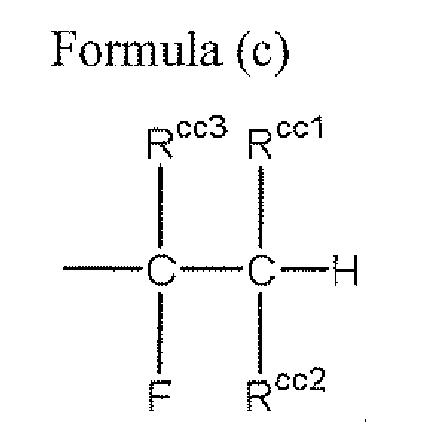
- <In the formula, Rcc1, Rcc2 and Rcc3 may be the same or different, and each is
- (a) a hydrogen atom,
- (b) a halogen atom,
- (c) a functional group, or
- (d) a monovalent organic group which may be substituted by a halogen atom and may have a polymerizable group which may have an ether bond>; and
- Nonlimiting examples of cations represented by the formulae (C1) to (C5) include, for instance, non-fluorine-containing imidazole compound cations such as 1-ethyl-3-methylimidazolium cation, 1-methyl-3-propylimidazolium cation, 1-isopropyl-3-methylimidazolium cation, 1-butyl-3-methylimidazolium cation, 1-isobutyl-3-methylimidazolium cation, 1-sec-butyl-3-methylimidazolium cation, 1-methoxymethyl-3-methylimidazolium cation, 1-methoxyethyl-3-methylimidazolium cation, 1-ethyl-3-propylimidazolium cation, 1-ethyl-3-isopropylimidazolium cation, 1-ethyl-3-butylimidazolium cation, 1-ethyl-3-isobutylimidazolium cation, 1-ethyl-3-sec-butylimidazolium cation, 1-ethyl-3-methoxymethylimidazolium cation, 1-ethyl-3-methoxyethylimidazolium cation, 1-methylimidazolimn cation, 1-ethylimidazolium cation, 1-propylimidazolium cation, 1-isopropylimidazoliun cation, 1-butylimidazolium cation, 1-isobutylimidazolium cation, 1-sec-butylimidazolium cation, 1-methoxymethylimidazolium cation, 1-methoxyethylimidazolium cation, 1,2-dimethyl-3-ethylimidazolium cation, 1,2-dimethyl-3-propylimidazolium cation, 1,2-dimethyl-3-isopropylimidazolium cation, 1,2-dimethyl-3-butylimidazolium cation, 1,2-dimethyl-3-isobutylimidazolium cation, 1,2-dimethyl-3-sec-butylimidazolium cation, 1,2-dimethyl-3-methoxymethylimidazolium cation and 1,2-dimethyl-3-methoxyethylimidazolium cation; and fluorine-containing imidazole compound cations such as 1-methyl-3-trifluoromethylimidazolium cation, 1-difluoromethyl-3-methylimidazolium cation, 1-methyl-3-perftafluoroethylimidazolium cation, 1-methyl-3-(2,2,2-trifluoroethyl)imidazolium cation, 1-(1,1-difluoroethyl)-3-methylimidazolium cation, 1-methyl-3-(1,1,2,2-tetrafluouoethyl)imidazolium cation, 1-(2-chloro-1,1,2-trifluoroethyl)-3-methylimidazolium cation, 1-heptafluoropropyl-3-methylimidazolium cation, 1-heptafluoroisopropyl-3-methylimidazolium cation, 1-(1,1,2,3,3,3-hexafluoropropyl)-3-methylimidazolium cation, 1-methyl-3-(1,1,2,3,3,4,4,4-octafluorobutyl)imidazolium cation, 1-methyl-3-(2-trifluoromethoxy-1,1,2-trifluoroethyl)imidazolium cation, 1-(2-heptafluoropropoxy-1,1,2-triftuoroethyl)-3-methylimidazolium cation, 1-ethyl-3-trifluoromethylimidazolium cation, 1-difluoromethyl-3-ethylimidazolium cation, 1-methyl-3-pentafluoroethylimidazolium cation, 1-ethyl-3-(2,2,2-trifluoroethyl)imidazolium cation, 1-(1,1-difluoroethyl)-3-ethylimidazolium cation, 1-ethyl-3-(1,1,2,2-tetrafluoroethyl)imidazolium cation, 1-(2-chloro-1,1,2-trifluoroethyl)-3-ethylimidazolium cation, 1-ethyl-3-heptafluoropropylimidazolium cation, 1-ethyl-3-heptafluoroisopropylimidazolium cation, 1-ethyl-3-(1,1,2,3,3,3-hexafluoropropyl)imidazolium cation, 1-ethyl-3-(1,1,2,3,3,4,4,4-octafluorobutyl)imidazolium cation, 1-ethyl-3-(2-trifluoromethoxy-1,1,2-trifluoroethyl)imidazolium cation, 1-methyl-3-(2-heptafluoropropoxy-1,1,2-trifluoroethyl)imidazolium cation, 1-trifluoromethylimidazolium cation, 1-difluoromethylimidazolium cation, 1-pentafluoroethylimidazolium cation, 1-(2,2,2-trifluoroethyl)imidazolium cation, 1-(1,1-difluoroethyl)imidazolium cation, 1-(1,1,2,2-tetrafluoroethyl)imidazolium cation, 1-(2-chloro-1,1,2-trifluoroethyl)imidazolium cation, 1-heptafluoropropylimidazolium cation, 1-heptafluoroisopropylimidazolium cation, 1-(1,1,2,3,3,3-hexafluoropropyl)imidazolium cation, 1-(1,1,2,3,3,4,4,4-octafluorobutyl)imidazolium cation, 1-(2-trifluoromethoxy-1,1,2-trifluoroethyl)imidazolium cation, 1-(2-heptafluoropropoxy-1,1,2-trifluoroethyl)imidazolium cation, 2-fluoro-1-ethyl-3-methylimidazolium cation, 2-fluoro-1-methyl-3-propylimidazolium cation, 2-fluoro-1-isopropyl-3-methylimidazolium cation, 2-fluoro-1-butyl-3-methylimidazolium cation, 2-fluoro-1-isobutyl-3-methylimidazolium cation, 2-fluoro-1-sec-butyl-3-methylimidazolium cation, 2-fluoro-1-methoxymethyl-3-methylimidazolium cation, 2-fluoro-1-methoxyethyl-3-methylimidazolium cation, 2-fluoro-1-methyl-3-trifluoromethylimidazolium cation, 2-fluoro-1-methyl-3-pentafluoroethylimidazolium cation, 2-fluoro-1-methyl-3-(2,2,2-trifluoroethyl)imidazolium cation, 2-fluoro-1-(1,1-difluoroethyl)-3-methylimidazolium cation, 2-fluoro-1-methyl-3-(1,1,2,2-tetrafluoroethyl)imidazolium cation, 1-(2-chloro-1,1,2-trifluoroethyl)-2-fluoro-3-methylimidazolium cation, 2-fluoro-1-heptafluoropropyl-3-methylimidazolium cation, 2-fluoro-1-heptafluoroisopropyl-3-methylimidazolium cation, 2-fluoro-1-(1,1,2,3,3,3-hexafluoropropyl)-3-methylimidazolium cation, 2-fluoro-1-methyl-3-(1,1,2,3,3,4,4,4-octafluorobutyl)imidazolium cation, 2-fluoro-1-methyl-3-(2-trifluoromethoxy-1,1,2-trifluoroethyl)imidazolimn cation, 2-fluoro-1-(2-heptafluoropropoxy-1,1,2-trifluoroethyl)-3-methylimidazolium cation, 1,2-dimethyl-3-trifluoromethylimidazolium cation, 1,2-dimethy-1-3-pentafluoroethylimidazolium cation, 1,2-dimethyl-3-(2,2,2-trifluoroethyl)imidazolium cation, 1,2-dimethyl-3-(1,1-difluoroethyl)imidazolium cation, 1,2-dimethyl-3-(1,1,2,2-tetrafluoroethyl)imidazolium cation, 1,2-dimethyl-3-(2-chloro-1,1,2-trifluoroethyl)imidazolium cation, 1,2-dimethyl-3-heptafluoropropylimidazolium cation, 1,2-dimethyl-3-heptafluoroisopropylimidazolium cation, 1,2-dimethyl-3-(1,1,2,3,3,3-hexafluoropropyl)imidazolium cation, 1,2-dimethyl-3-(1,1,2,3,3,4,4,4-octafluorobutyl)imidazolium cation, 1,2-dimethyl-3-(2-trifluoromethoxy-1,1,2-trifluoroethyl)imidazolium cation, and 1,2-dimethyl-3-(2-heptafluoropropoxy-1,1,2-trifluoroethyl)imidazolium cation.
- Among them, preferable examples of the cation represented by the formulae (C1) to (C5) include 1-ethyl-3-inethylimidazolium cation, 1-butyl-3-methylimidazolium cation, and 1,2-dimethyl-3-isobutylimidazolium cation.
- As the anion (X-), it is preferable to select at least one from tetrafluoroboric acid anion, hexafluorophosphoric acid anion, bis(trifluoromethanesulfonyl)imidic acid anion, perchloric acid anion, tris(trifluoromethanesulfonyl)carbonic acid anion, trifluoromethanesulfonic acid anion, dicyanamide anion, trifluoroacetic acid anion, organic carboxylic acid anion and halogen ion.
- The salts containing the cation represented by the formulae (C1) to (C5) (preferably an imidazolium ion) and the anion (X-) can be produced by known processes such as the known process described in
JP-A- 2007-204682 - Examples of the electroconductive nano-filler (D) include electroconductive nano carbon materials and nano particles of electroconductive metals. And at least one or two or more of them can be selected and used. Here, "nano-filler" means a filler having a structure (in the form of particle, sheet, layer, needle, bar, fiber or tube) of nano level (0.1 mn. to 1,000 nm) in at least a part thereof. Each of the electroconductive nano-fillers is explained below.
- Among compounds comprising carbon atoms and having a structure of nano level, those having conductivity are used, and examples thereof are as follows.
- Fullerene is a carbon molecule having 60 or more carbon atoms and having a structure formed by bonds of carbon atoms in a spherical form.
- Carbon nano ball is a black or ivory black powder resulted from thermal decomposition of incomplete combustion product of hydrocarbon compound.
- Carbon nanofiber is synthesized through thermal decomposition of carbon sources of gaseous phase by using a metallic catalyst, such as iron and cobalt, under adequate conditions. As the structure of a fibrous carbon, there are three kinds of mainly known orientation of carbon network with respect to the fiber axis, that is, parallel (ribbon type), vertical (platelet type) and inclined (herringbone type).
- Carbon nanotube is a kind of carbon nanofiber. It is a kind of fullerene in which a six-member ring network (graphene sheet) formed by carbon atoms is in the form of a single layer or a coaxial tubular multilayer structure. Carbon nanotube having a single layer is called a single-wall nanotube (SWNT), and one having a multilayer structure is called a multi-wall nanotube (MWNT). Especially, one having two layers is called a double wall nanotube (DWNT).
- Carbon nanohorn is a kind of carbon nanofiber. Carbon nanohorn has a carbon structure in which six-member ring networks (graphene sheet) formed by carbon atoms are generally connected in a form of multi-layer horns.
- Examples of these nano carbon materials include those disclosed in Chemical Industry Vol. 56, pp. 50-62 (2005) and Langmuir, Vol. 11, pp. 3,682-3,866 (1995). Among these nano carbon materials, carbon nanofibers are preferable, and carbon nanotubes are especially preferable.
- Nano particles of electroconductive metal are metal particles having a particle size of 1 nn to 100 nm. Examples of suitable nano particles of metal include nano particles comprising a metal selected from gold, silver, copper, platinum, palladium, nickel, rhodium, aluminum, tin, zinc, lead, titanium and tantalum, and nano particles of alloy comprising two or more of metals selected from gold, silver, copper, platinum, palladium, nickel, rhodium, aluminum, tin, zinc, lead, titanium and tantalum and carbon. Nano particles of metal are appropriately selected according to purpose and applications.
- While the electroconductive nano-filler may be appropriately selected depending on environment where it is used, electroconductive nano carbon materials, and further carbon nanotubes, are preferable since they have a large surface area and a high conductivity due to quantum effect or the like. Nonlimiting example of suitable carbon nanotube which has been put into practical use includes HiPco (available from Carbon Nanotechnology, Incorporated) which can be produced in a relatively large scale using carbon monoxide as a raw material.
- The electroconductive filler (D) may be available as commercialized products, or can be produced by common manufacturing processes.
- As described above, in the electrode film for the polymer actuator element of the present invention, the ratio of the vinylidene fluoride unit to the entire fluororesin (A) and fluorine rubber (B) is preferably not less than 60 mole %, in view of compatibility with the ionic liquid. The ratio is preferably not more than 90 mole %, and more preferably not more than 87 mole % in view of the displacement amount of the actuator element.
- The ratio can be adjusted with the ratio of the vinylidene fluoride unit to the fluororesin (A), the ratio of the vinylidene fluoride unit to the fluorine rubber (B), and the weight ratio of the fluororesin (A) to the fluorine rubber (B).
- The ratio of the produced electrode film for a polymer actuator element of the present invention can be determined through NMR analysis.
- In the electrode film for the polymer actuator element of the present invention, the weight ratio of the fluororesin (A) to the fluorine rubber (B) is generally from 90:10 to 20:80, preferably from 80:20 to 20:80, and more preferably from 80:20 to 50:50.
- In view of the displacement amount of the actuator element, the higher ratio of the fluorine rubber (B) is preferable. On the other hand, in view of the force generated, the higher ratio of the fluororesin (A) is preferable.
- The electrode film for the polymer actuator element of the present invention preferably includes 5 to 70% by weight of the fluororesin (A) and fluorine rubber (B) as a whole, 20 to 80% by weight of the ionic liquid (C), and 1 to 40% by weight of the conductive filler (D).
- The thickness of the electrode film for the polymer actuator element of the present invention is preferably from 0.01mm to 0.5mm.
- In view of the displacement amount of the actuator element, a smaller thickness is preferable. On the other hand, in view of the force generated, a larger thickness is preferable.
- The polymer actuator element of the present invention includes the electrode film of the present invention explained above.
- Examples of the polymer actuator element of the present invention include one having at least two electrode films of the present invention, which are formed to be insulated from each other, on the surface of an ion conductive layer.
- In the polymer actuator element of the present invention, flection or deformation of the element can be caused by applying an electrical potential difference to the electrode films (electrode films).
- Further, examples of the polymer actuator element of the present invention include a polymer actuator element which is provided with a conductive layer formed on an outside surface, i.e. the opposite surface of the ion conductive layer, of the electrode film.
- More specifically, for example, the polymer actuator element of the present invention may be a three-layer structure which comprises an ion
conductive layer 1 sandwiched between at least one pair of the electrode layers 2 of the present invention having carbon nanotubes, ion liquids, and polymers (seeFigure 1 ). Further, in order to increase the conductivity of the electrode surface, the polymer actuator element may be a five-layer structure which further comprisesconductive layers 3 on the respective outside surfaces of the two electrode layers 2 (i.e., on the surfaces opposite to the ion conductive layer) (seeFigure 2 ) - The ion conductive layer is preferably constituted with a composition in the form of gel. The composition preferably includes a polymer and an ionic liquid. The mass ratio of the hydrophilic ionic liquid to the polymer is preferably 1:4 to 4:1. The ratio of the hydrophilic ionic liquid to the polymer is more preferably 1:2 to 2:1.
- In the actuator element of the present invention, when a direct current voltage of 0.5 to 3 V is applied, a displacement of about 0.5 to 1 time the element length can be obtained within several seconds. This actuator element can operate flexibly in air or in vacuum. The theory behind the operation of such an actuator element is that, when an electric potential difference is applied across the pair of
electrode layers 2 which are formed on the surfaces of the ionconductive layer 1 and are insulated from each other, an electric double layer is formed at an interface between the ionic liquid phase and the carbon nanotube phase in the electrode layers 2, and the electrode layers 2 undergo expansion and shrinkage due to a resulting interfacial stress. It can be considered that the reason why the actuator element of the present invention bends toward the positive electrode (i.e., positive electrode side is contracted) is that there is an effect of causing larger expansion of the carbon nanotube at the negative electrode side due to a quantum chemical effect and also that, in ionic liquids commonly used nowadays, an ionic radius of the cation is large and, due to its steric effect, the negative pole side undergoes larger expansion. - Further, as shown in
Figure 3 , it is possible to cause the actuator to make a complicated movement by providingmultiple electrode layers 2 on the surfaces of the flat ionconductive layer 1. Such an actuator element enables transportation by peristaltic movements and a micro manipulator can be realized. Also, the shape of the actuator element of the present invention is not limited to a flat shape, and elements having arbitrary shapes can be easily produced. For example, an actuator element shown inFig. 4 is one having fourelectrode layers 2 along a circumference of the ionconductive layer 1 in the form of a rod having a diameter of about 1 mm. This element makes it possible to realize an actuator which can be inserted into a capillary tube. - The thickness of the electrode film for the polymer actuator element of the present invention is preferably from 0.01mm to 0.5mm. In view of the displacement amount of the actuator element, a smaller thickness is preferable. On the other hand, in view of the force generated by the actuator element, a larger thickness is preferable.
- A method for producing the electrode film for the polymer actuator element of the present invention, while not being limited specifically, may be a method commonly used for producing polymer films.
- Specifically, for example, the following methods can be used:
- (i) a method including a step of kneading a fluororesin (A), a fluorine rubber (B), a cross-linking agent if needed, a cross-linking aid if needed, and a conductive filler (D) at a temperature not less than the melting point of the fluororesin, a step of forming a film of the kneading resultant, and a step of impregnating the film with an ionic liquid (C);
- (ii) a method including a step of dissolving or dispersing polymers which can form a fluororesin (A) and/or a fluorine rubber (B), an ionic liquid (C), a conductive filler, a cross-linking agent, and a cross-linking aid if needed, in a solvent to make a film; or
- (iii) a method including a step of dispersing a cross-linked fluorine rubber particle and a conductive filler in a solution in which a fluororesin (A) and an ionic liquid (C) are dissolved in a solvent, and a step of casting the resultant to make a film.
- The solvent can be properly selected from solvents which can dissolve the fluororesin (A) and the like. Preferably, the solvent is a solvent including hydrophilic solvents and hydrophobic solvents with arbitrary ratios.
- In the method for producing the electrode film for a polymer actuator element of the present invention, a method which includes a step of dissolving a fluororesin (A), a fluorine rubber (B), a cross-linking agent if needed, a cross-linking aid if needed, and an ionic liquid (C) to a solvent, a step of dispersing a conductive filler (D) in the solvent, a step of casting the obtained liquid to make a film, and a step of heating the film to cross-link the rubber components, is preferable because a uniform film can be produced.
- The polymer actuator element of the present invention can be produced by methods commonly used. For example, films of each layer may be formed in order by a casting method using respective compositions, and a solvent is evaporated and the films are dried. Or, films individually made can be layered and adhered by heater press.
- In this case, similar to that described above, the solvent is preferably a solvent including hydrophilic solvents and hydrophobic solvents with arbitrary ratios.
- The present invention will now be explained in detail by means of Synthesis Examples, Examples, and Comparative Examples, but is not limited to them.
- VdF ratios in electrode films and electrolyte films were determined through 19F NMR measurements of the electrode films and electrolyte films dissolved in acetone-d6 with Varian NMR System400, by using trifluoroacetic acid as a reference substance. The signals from -89 ppm to -110 ppm were identified as the signals derived from VdF, and the VdF ratios were calculated based on the ratio of the intensity of the signals derived from VdF to the intensity of the other signals.
- 1500ml of pure water and 7.5g of perfluorooctanoic acid ammonium were placed into a pressure-resistant reactor having 3000ml of inner volume, and the inside space of the reactor was filled by a gas mixture of tetrafluoroethylene (TFE), vinylidene fluoride (VdF) and hexafluoropropylene (HFP) with the mole ratio of 11:19:70. After that, the pressure inside of the reactor was increased to 1.47 MPa (gage pressure) (15kg/cm2G), and 0.3ml (25°C) of I(CF2CF2)2 I was introduced into the reactor. Subsequently, 10 ml of an aqueous solution of ammonium persulfate (APS) having a concentration of 0.2% was injected at 80 °C while stirring. After the induced time of about a half of hour, the inside pressure was lowered. When the inside pressure was lowered to 1.27 MPa (gage pressure) (13kg/cm2G), the pressure inside of the reactor was again increased to 1.47 MPa (gage pressure) (15kg/cm2G) with a gas mixture of TFE, VdF and HFP with the mole ratio of 20:50:30. Thereafter, the polymerization was continued at the pressure within 1.27 to 1.47 MPa (gage pressure) (from 13kg/cm2 G to 15 kg/cm2 G) with the above mentioned processes. After 20 hours, the polymerization was stopped by rapid cooling and decreasing the pressure through discharge. The dispersion having solid content concentration of about 25 % was generated. The dispersion was precipitated with 7% aqua solution of aluminum potassium sulfate and, then, washed by water and dried so as to obtain the polymer. Hereinafter, the polymer is referred to as "Polymer A".
- 100mg /100mg of Kynar Flex PPA 2801 (a trade name; Arkema Co.) / ethylmethylimidazolium tetrafluoroborate, 3ml of methylpentanone, and 900mg of propylene carbonate (PC) were mixed together, and the mixture was stirred at 80°C for 24 hours. 0.3ml of the resulting solution was cast in a mould of 25mm x 25mm and dried at 40°C for 24 hours in vacuum to obtain an
electrolyte film 1. - 50mg / 50mg /100mg of Kynar Flex PPA 2801 / Polymer A / ethylmethylimidazolium tetrafluoroborate, 3ml of methylpentanone, and 900mg of propylene carbonate were mixed together, and the mixture was stirred at 80°C for 24 hours. 0.020g of perbuthyl O and 0.020g of TAIC were added to the obtained solution, and stirred at room temperature for 120 minutes. Subsequently, 0.3ml of the resulting solution was cast in a mould of 25mm x 25mm, dried at room temperature for 24 hours in vacuum, and cross-linked at 80°C for 180 minutes to obtain an
electrolyte film 2. - The VdF ratio of the electrolyte film was determined as 85.8 mole % based on the NMR analysis.
- 30mg of carbon nanotube of HiPco (a trade name; produced by Carbon Nanotechnology, Incorporated), 100mg of butylmethylimidazolium tetrafluoroborate, zirconia ball (two of 10mm and five of 5mm), and 2ml of methylpentanone were mixed together, and the mixture was compounded by a mixer at 400 rpm for 30 minutes to obtain a composite. 56mg / 24mg of Kynar Flex PPA 2801 / Polymer A and 2ml of methylpentanone were mixed together and dispersed by ultrasonic wave for 10 minutes to obtain a solution. The solution was further mixed and compounded with the composite by a mixer at 500 rpm for 30 minutes.
- 2ml of methylpentanone was added to the resultant and dispersed by ultrasonic wave for 180 minutes. 0.020g of peroxide (Perhexa25B (a trade name); produced by Nippon Oil & Fats Co., Ltd.) and 0.020g of TAIC were added to the obtained dispersion, and stirred at room temperature for 120 minutes. Subsequently, 3ml of the resulting dispersion was cast in a mould of 84mm x 12mm, dried at room temperature for 24 hours in vacuum, and cross-linked at 180°C for 3 minutes to obtain an
Electrode film 1. - The electrode film had the VdF ratio of 89.8 mole % as determined by the NMR analysis.
- 30mg of carbon nanotube of HIPCO, 100mg of butylmethylimidazolium tetrafluoroborate, zirconia ball (two of 10mm and five of 5mm), and 2ml of methylpentanone were mixed together, and the mixture was compounded by a mixer at 400 rpm for 30 minutes to obtain a composite. 40mg / 40mg of Kynar Flex PPA 2801 / Polymer A and 2ml of methylpentanone were mixed together and dispersed by ultrasonic wave for 10 minutes to obtain a solution. The solution was further mixed and compounded with the composite by a mixer at 500 rpm for 30 minutes.
- 2ml of methylpentanone was added to the resultant and dispersed by ultrasonic wave for 180 minutes. 0.020g of Perhexa 25B and 0.020g of TAIC were added to the obtained dispersion, and stirred at room temperature for 120 minutes. Subsequently, 3ml of the resulting dispersion was cast in a mould of 84mm x 12mm, dried at room temperature for 24 hours in vacuum, and cross-linked at 180°C for 3 minutes to obtain an
Electrode film 2. - The electrode film had the VdF ratio of 86.2 mole % as determined by the NMR analysis.
- 30mg of carbon nanotube of HIPCO, 100mg of ethylmethylimidazolium tetrafluoroborate, zirconia ball (two of 10mm and five of 5mm), 2ml of methylpentanone, and 900mg of propylene carbonate were mixed together, and the mixture was compounded by a mixer at 400 rpm for 30 minutes to obtain a composite. 56mg / 24mg of Kynar Flex PPA 2801 / Polymer A and 2ml of methylpentanone were mixed together and dispersed by ultrasonic wave for 10 minutes to obtain a solution. The solution was further mixed and compounded with the composite by a mixer at 500 rpm for 30 minutes.
- 2ml of methylpentanone was added to the resultant and dispersed by ultrasonic wave for 180 minutes. 0.020g of Perhexa 25B and 0.020g of TAIC were added to the obtained dispersion, and stirred at room temperature for 120 minutes. Subsequently, 3ml of the resulting dispersion was cast in a mould of 84mm x 12mm, dried at room temperature for 24 hours in vacuum, and cross-linked at 125°C for 10 minutes to obtain an
Electrode film 3. - The electrode film had the VdF ratio of 89.8 mole % as determined by the NMR analysis.
- 30mg of carbon nanotube of HIPCO, 100mg of ethylmethylimidazolium tetrafluoroborate, zirconia ball (two of 10mm and five of 5mm), 2ml of methylpentanone, and 900mg of propylene carbonete were mixed together, and the mixture was compounded by a mixer at 400 rpm for 30 minutes to obtain a composite. 40mg / 40mg of Kynar Flex PPA 2801 / Polymer A and 2ml of methylpentanone were mixed together and dispersed by ultrasonic wave for 10 minutes to obtain a solution. The solution was further mixed and compounded with the composite by a mixer at 500 rpm for 30 minutes.
- 2ml of methylpentanone was added to the resultant and dispersed by ultrasonic wave for 180 minutes. 0.020g of Perhexa 25B and 0.020g of TAIC were added to the obtained dispersion, and stirred at room temperature for 120 minutes. Subsequently, 3ml of the resulting dispersion was cast in a mould of 84mm x 12mm, dried at room temperature for 24 hours in vacuum, and cross-linked at 125°C for 10 minutes to obtain an Electrode film 4.
- The electrode film had the VdF ratio of 85.8 mole % as determined by the NMR analysis.
- 30mg of carbon nanotube of HIPCO, 100mg of ethylmethylimidazolium tetrafluoroborate, zirconia ball (two of 10mm and five of 5mm), 2ml of methylpentanone, and 900mg of propylene carbonete were mixed together, and the mixture was compounded by a mixer at 400 rpm for 30 minutes to obtain a composite. 24mg / 56mg of Kynar Flex PPA 2801 / Polymer A and 2ml of methylpentanone were mixed together and dispersed by ultrasonic wave for 10 minutes to obtain a solution. The solution was further mixed and compounded with the composite by a mixer at 500 rpm for 30 minutes.
- 2ml of methylpentanone was added to the resultant and dispersed by ultrasonic wave for 180 minutes. 0.020g of Perhexa 25B and 0.020g of TAIC were added to the obtained dispersion, and stirred at room temperature for 120 minutes. Subsequently, 3ml of the resulting dispersion was cast in a mould of 84mm x 12mm, dried at room temperature for 24 hours in vacuum, and cross-linked at 125°C for 10 minutes to obtain an Electrode film 5.
- The electrode film had the VdF ratio of 81.8 mole % as determined by the NMR analysis.
- 30mg of carbon nanotube of HIPCO, 100mg of ethylmethylimidazolium tetrafluoroborate, zirconia ball (two of 10mm and five of 5mm), 2ml of methylpentanone, and 900mg of propylene carbonete were mixed together, and the mixture was compounded by a mixer at 400 rpm for 30 minutes to obtain a composite. 24mg / 56mg of Kynar Flex PPA 2801 / Polymer A and 2ml of methylpentanone were mixed together and dispersed by ultrasonic wave for 10 minutes to obtain a solution. The solution was further mixed and compounded with the composite by a mixer at 500 rpm for 30 minutes.
- 2ml of methylpentanone was added to the resultant and dispersed by ultrasonic wave for 180 minutes. 0.020g of Perbuthyl O and 0.020g of TAIC were added to the obtained dispersion, and stirred at room temperature for 120 minutes. Subsequently, 3ml of the resulting dispersion was cast in a mould of 84mm x 12mm, dried at room temperature for 24 hours in vacuum, and cross-linked at 80°C for 180 minutes to obtain an Electrode film 6.
- The electrode film had the VdF ratio of 82.1 mole % as determined by the NMR analysis.
- 30mg of carbon nanotube of HIPCO, 100mg of ethylmethylimidazolium tetrafluoroborate, zirconia ball (two of 10mm and five of 5mm), 2ml of methylpentanone, and 900mg of propylene carbonete were mixed together, and the mixture was compounded by a mixer at 400 rpm for 30 minutes to obtain a composite. 40mg / 40mg of Kynar Flex PPA 2801 / Polymer A and 2ml of methylpentanone were mixed together and dispersed by ultrasonic wave for 10 minutes to obtain a solution. The solution was further mixed and compounded with the composite by a mixer at 500 rpm for 30 minutes.
- 2ml of methylpentanone was added to the resultant and dispersed by ultrasonic wave for 180 minutes. 0.020g of Perbuthyl O and 0.020g of TAIC were added to the obtained dispersion, and stirred at room temperature for 120 minutes. Subsequently, 3ml of the resulting dispersion was cast in a mould of 84mm x 12mm, dried at room temperature for 24 hours in vacuum, and cross-linked at 80°C for 180 minutes to obtain an Electrode film 7.
- The electrode film had the VdF ratio of 86.2 mole % as determined by the NMR analysis.
- 30mg of carbon nanotube of HIPCO, 100mg of ethylmethylimidazolium tetrafluoroborate, zirconia ball (two of 10mm and five of 5mm), 2ml of methylpentanone, and 900mg of propylene carbonete were mixed together, and the mixture was compounded by a mixer at 400 rpm for 30 minutes to obtain a composite. 56mg / 24mg of Kynar Flex PPA 2801 / Polymer A and 2ml of methylpentanone were mixed together and dispersed by ultrasonic wave for 10 minutes to obtain a solution. The solution was further mixed and compounded with the composite by a mixer at 500 rpm for 30 minutes.
- 2ml of methylpentanone was added to the resultant and dispersed by ultrasonic wave for 180 minutes. 0.020g of Perbuthyl O and 0.020g of TAIC were added to the obtained dispersion, and stirred at room temperature for 120 minutes. Subsequently, 3ml of the resulting dispersion was cast in a mould of 84mm x 12mm, dried at room temperature for 24 hours in vacuum, and cross-linked at 80°C for 180 minutes to obtain an Electrode film 8.
- The electrode film had the VdF ratio of 89.8 mole % as determined by the NMR analysis.
-
Electrolyte film 1 was sandwiched between two Electrode films 1 (1 mm x 15mm), and the resultant was heater-pressed under no pressure at 80°C for 1 minute to be softened. Subsequently, the resultant was pressed with 135N at 80°C for 1 minute to obtainElement 1. -
Electrolyte film 1 was sandwiched between two Electrode films 2 (1mm x 15mm), and the resultant was heater-pressed under no pressure at 80°C for 1 minute to be softened. Subsequently, the resultant was pressed with 135N at 80°C for 1 minute to obtainElement 2. -
Electrolyte film 1 was sandwiched between two Electrode films 3 (1mm x 15mm), and the resultant was heater-pressed under no pressure at 80°C for 1 minute to be softened. Subsequently, the resultant was pressed with 135N at 80°C for 1 minute to obtainElement 3. -
Electrolyte film 1 was sandwiched between two Electrode films 5 (1mm x 15mm), and the resultant was heater-pressed under no pressure at 80°C for 1 minute to be softened. Subsequently, the resultant was pressed with 135N at 80°C for 1 minute to obtain Element 4. -
Electrolyte film 1 was sandwiched between two Electrode films 6 (1mm x 15mm), and the resultant was heater-pressed under no pressure at 80°C for 1 minute to be softened. Subsequently, the resultant was pressed with 135N at 80°C for 1 minute to obtain Element 5. -
Electrolyte film 1 was sandwiched between two Electrode films 8 (1mm x 15mm), and the resultant was heater-pressed under no pressure at 80°C for 1 minute to be softened. Subsequently, the resultant was pressed with 135N at 80°C for 1 minute to obtain Element 6. - 30mg of carbon nanotube of HIPCO, 100mg of ethylmethylimidazolium tetrafluoroborate, zirconia ball (two of 10mm and five of 5mm), 2ml of methylpentanone, and 900mg of propylene carbonete were mixed together, and the mixture was compounded by a mixer at 400 rpm for 30 minutes to obtain a composite. 80mg of Kynar Flex PPA 2801 and 2ml of methylpcentanone were mixed together and dispersed by ultrasonic wave for 10 minutes to obtain a solution. The solution was further mixed and compounded with the composite by a mixer at 500 rpm for 30 minutes.
- 2ml of methylpentanone was added to the resultant and dispersed by ultrasonic wave for 180 minutes, and stirred at room temperature for 120 minutes. Subsequently, 3ml of the resulting dispersion was cast in a mould of 84mm x 12mm, dried at room temperature for 24 hours in vacuum, and dried at 60°C for 24 hours in vacuum to obtain an Electrode film 9.
- COMPARATIVE EXAMPLE 2 (Element 7: Electrode film of Comparative Example 1 and Electrolyte film of Synthesis Example 2)
-
Electrolyte film 1 was sandwiched between two Electrode films 9 (1mm x 15mm), and the resultant was heater-pressed under no pressure at 80°C for 1 minute to be softened. Subsequently, the resultant was pressed with 135N at 80°C for 1 minute to obtain Element 7. - TEST EXAMPLE 1 (Young's modulus test of electrode films for polymer actuator elements)
- Young's moduli of electrode films for polymer actuator elements produced in the above-mentioned Examples and Comparative Examples were obtained through measurements of their stress-strain characteristics with a tensile tester (TMA / SS6000, Seiko Instrument Co.).
- The results are shown in Table 1.
Table 1 (Young's modulus of electrode films for polymer actuator elements <MPa>) Comparative Example 1 Example 1 Example 2 Example 3 Example 4 Example 5 182 56.5 39.1 58.0 30.6 32.0 Example 6 Example 7 Example 8 30.0 46.8 48.0 - As shown in
Figure 5 , displacement amounts of polymer actuator elements produced in the above-mentioned Examples and Comparative Examples were measured with a laser displacement meter (LC2100 / 2220; Keyence Co.). The elements were cut into 1mm x 15mm rectangles to obtain samples. The displacement amount of each sample, upon application of a voltage, was measured at a position corresponding to the 10th mm of the 15mm-long sample. - The results are shown in Table 2.
Table 2 (Displacement amount of polymer actuator elements) Comparative Example 1 Example 1 Example 10 Example 11 Example 12 Example 13 Example 14 Displacement amount (mm) 0.1 Hz ±0.5V 0.2 0.2 0.3 0.4 0.5 0.3 0.2 ±1.0V 0.3 0.3 0.6 0.8 1.1 0.7 0.5 ±1.5V 0.5 0.5 1.0 1.4 2.0 1.3 1.0 ±2.0V 0.8 0.8 1.3 2.8 3.5 2.0 1.7 ±2.5V 1.1 1.0 1.7 4.8 5.5 2.9 2.8 0.01 Hz ±0.5V 0.3 0.7 0.8 0.5 0.6 0.4 0.3 ±1.0V 0.6 1.5 1.5 1.0 1.3 1.0 1.1 ±1.5V 1.2 2.2 2.3 1.9 3.1 2.9 3.5 ±2.0V 2.6 3.3 3.9 4.1 7.7 6.5 - ±2.5V 4.5 4.7 5.9 - - - - Thickness of Displacement Element Film (mm) 0.172 0.182 0.168 0.141 0.164 0.184 0.238 - The polymer actuator element comprising the electrode film for the polymer actuator element of the present invention can be used in air or in vacuum, and has a large displacement amount, a high displacement rate, and generates a large force at the time of displacement. Therefore, the polymer actuator element can be widely used in the fields of medical instruments, equipment for industrial use, personal robot, micromachine, and the like.
-
- 1
- Ion conductive layer
- 2
- Electrode film
- 3
- Conductive layer
-
- 1:
- Japanese Patent No.
4038685 -
- 1:
- Polymer Preprints, Japan, vol. 53, 2nd, 2004, pp.4816-4817, p.2355
Claims (7)
- An electrode film for a polymer actuator element, comprising:a fluororesin (A), a fluorine rubber (B), an ionic liquid (C), and a conductive filler (D).
- The electrode film of claim 1, wherein at least one of the fluororesin (A) and the fluorine rubber (B) contains a vinylidene fluoride unit.
- The electrode film of claim 1 or 2, wherein a ratio of the vinylidene fluoride unit to the entire fluororesin (A) and fluorine rubber (B) is not less than 60 mole %.
- The electrode film of any one of claims 1 to 3, wherein the fluorine rubber (B) is a cross-linked fluorine rubber.
- The electrode film of any one of claims 1 to 4, wherein a weight ratio of the fluororesin (A) to the fluorine rubber (B) is from 80:20 to 20:80.
- The electrode film of any one of claims 1 to 5, wherein 5 to 70% by weight of the fluororesin (A) and the fluorine rubber (B) as a whole, 20 to 80% by weight of the ionic liquid (C), and 1 to 40% by weight of the conductive filler (D) are included.
- A polymer actuator element comprising an electrode film according to any one of claims 1 to 6.
Applications Claiming Priority (2)
| Application Number | Priority Date | Filing Date | Title |
|---|---|---|---|
| JP2009088193 | 2009-03-31 | ||
| PCT/JP2010/001993 WO2010113416A1 (en) | 2009-03-31 | 2010-03-19 | Electrode film for polymer actuator element, and polymer actuator element comprising same |
Publications (3)
| Publication Number | Publication Date |
|---|---|
| EP2416488A1 true EP2416488A1 (en) | 2012-02-08 |
| EP2416488A4 EP2416488A4 (en) | 2017-05-03 |
| EP2416488B1 EP2416488B1 (en) | 2019-03-06 |
Family
ID=42827732
Family Applications (1)
| Application Number | Title | Priority Date | Filing Date |
|---|---|---|---|
| EP10758201.7A Not-in-force EP2416488B1 (en) | 2009-03-31 | 2010-03-19 | Electrode film for polymer actuator element, and polymer actuator element comprising same |
Country Status (5)
| Country | Link |
|---|---|
| US (1) | US8545732B2 (en) |
| EP (1) | EP2416488B1 (en) |
| JP (1) | JP5481671B2 (en) |
| CN (1) | CN102365816B (en) |
| WO (1) | WO2010113416A1 (en) |
Cited By (4)
| Publication number | Priority date | Publication date | Assignee | Title |
|---|---|---|---|---|
| WO2012006487A2 (en) | 2010-07-09 | 2012-01-12 | 3M Innovative Properties Company | Fluoropolymer blend and articles thereof |
| EP2945276A4 (en) * | 2012-12-27 | 2016-07-27 | Alps Electric Co Ltd | POLYMER ACTUATOR ELEMENT |
| WO2018055302A1 (en) * | 2016-09-23 | 2018-03-29 | Commissariat A L'energie Atomique Et Aux Energies Alternatives | Device with a suspended membrane having an increased amplitude of displacement |
| WO2022130063A1 (en) * | 2020-12-18 | 2022-06-23 | 3M Innovative Properties Company | Conductive curable fluoropolymer compositions, and fluoroelastomers therefrom |
Families Citing this family (19)
| Publication number | Priority date | Publication date | Assignee | Title |
|---|---|---|---|---|
| SG11201400988SA (en) * | 2011-10-21 | 2014-07-30 | Glaxosmithkline Llc | Compounds and methods for enhancing innate immune responses |
| JP5369217B2 (en) * | 2012-04-25 | 2013-12-18 | 株式会社潤工社 | Fluororesin composition |
| EP2895071B1 (en) * | 2012-09-17 | 2017-05-17 | Brains Online Holding B.V. | Rod shaped implantable biosensor |
| US20160008514A1 (en) * | 2013-03-15 | 2016-01-14 | Lifenet Health | Soft Tissue Pouch and Methods of Use Thereof |
| BR112015027757A2 (en) * | 2013-05-02 | 2017-07-25 | 3M Innovative Properties Co | partially fluorinated elastomers and methods for their production and use |
| JP6225726B2 (en) * | 2014-01-29 | 2017-11-08 | ダイキン工業株式会社 | Conductive fluorine-containing polymer composition |
| JP5954389B2 (en) * | 2014-11-05 | 2016-07-20 | セイコーエプソン株式会社 | Method for producing nano-particle dispersed ion gel |
| CN105111605B (en) * | 2015-09-30 | 2017-11-21 | 中国人民解放军国防科学技术大学 | High molecular nanometer laminated film and preparation method thereof |
| CN105655149B (en) * | 2016-03-17 | 2018-04-17 | 华东理工大学 | Fluorine-containing stretchable organogel electrolyte of flame retardant type and preparation method thereof |
| JP2017184586A (en) * | 2016-03-31 | 2017-10-05 | 旭化成株式会社 | Ion exchange type polymer actuator |
| WO2017183351A1 (en) * | 2016-04-20 | 2017-10-26 | アルプス電気株式会社 | Laminate structure, polymer actuator element, sensor element, and equipment |
| JP7122810B2 (en) * | 2017-04-14 | 2022-08-22 | 株式会社デンソー | Polymer actuator |
| JP6462082B1 (en) * | 2017-09-22 | 2019-01-30 | タツタ電線株式会社 | Conductive elastomer composition and conductive sheet using the same |
| JP6890081B2 (en) * | 2017-11-06 | 2021-06-18 | 三菱電線工業株式会社 | Rubber material for sealing material and sealing material using it |
| JP6942218B2 (en) * | 2017-11-06 | 2021-09-29 | 三菱電線工業株式会社 | Sealing material |
| JP2020128544A (en) * | 2020-04-27 | 2020-08-27 | 三菱電線工業株式会社 | Sealant |
| US12512512B2 (en) * | 2020-05-01 | 2025-12-30 | Daikin Industries, Ltd. | Polymer electrolyte including amorphous fluorine-containing elastomer and alkali metal salt, electrochemical device, polymer-based solid-state battery, and actuator including the same |
| CN116368958A (en) * | 2021-10-28 | 2023-06-30 | 京东方科技集团股份有限公司 | Quantum dot light-emitting device and its preparation method, display substrate and display device |
| DE102023202836A1 (en) * | 2023-03-28 | 2024-10-02 | Zf Friedrichshafen Ag | Transmission for a vehicle and drive train with such a transmission |
Family Cites Families (16)
| Publication number | Priority date | Publication date | Assignee | Title |
|---|---|---|---|---|
| JPH0660120B2 (en) | 1985-03-28 | 1994-08-10 | ダイキン工業株式会社 | New fluorovinyl ether |
| US4972038A (en) | 1989-05-19 | 1990-11-20 | E. I. Du Pont De Nemours And Company | Cyano-containing perfluoropolymers having iodine curesites |
| US4973634A (en) | 1989-05-19 | 1990-11-27 | E. I. Du Pont De Nemours And Company | Preparation of bromo-containing perfluoropolymers having iodine curesites |
| IT1269514B (en) | 1994-05-18 | 1997-04-01 | Ausimont Spa | VULCANIZABLE FLUOROELASTOMERS PEROXIDE, PARTICULARLY SUITABLE FOR O-RING MANUFACTURE |
| JP4038685B2 (en) * | 2003-12-08 | 2008-01-30 | 独立行政法人科学技術振興機構 | Actuator element |
| WO2006057331A1 (en) * | 2004-11-26 | 2006-06-01 | Daikin Industries, Ltd. | Thermoplastic polymer composition |
| CN101065440B (en) * | 2004-11-26 | 2012-01-18 | 大金工业株式会社 | Thermoplastic polymer composition |
| JP4873453B2 (en) * | 2005-03-31 | 2012-02-08 | 独立行政法人産業技術総合研究所 | Conductive thin film, actuator element and manufacturing method thereof |
| JP4570553B2 (en) * | 2005-11-18 | 2010-10-27 | 保土谷化学工業株式会社 | Composite material |
| JP4997773B2 (en) * | 2006-02-03 | 2012-08-08 | ダイキン工業株式会社 | Actuator element |
| WO2008026534A1 (en) * | 2006-08-30 | 2008-03-06 | Eamex Corporation | Polymer actuator element and method of producing the same |
| JP5004078B2 (en) * | 2007-04-24 | 2012-08-22 | 独立行政法人産業技術総合研究所 | Actuator element with highly oriented electrodes using high aspect ratio carbon nanotubes |
| JP5110574B2 (en) * | 2007-06-25 | 2012-12-26 | 独立行政法人産業技術総合研究所 | High-aspect-ratio carbon nanotubes and ionic liquids, conductive thin films and actuator elements |
| JP2007324146A (en) * | 2007-09-07 | 2007-12-13 | Mitsubishi Plastics Ind Ltd | Fuel cell separator |
| JP5063482B2 (en) | 2008-05-29 | 2012-10-31 | 株式会社サトー知識財産研究所 | Printer |
| JP5252405B2 (en) * | 2008-09-12 | 2013-07-31 | アルプス電気株式会社 | Polymer actuator |
-
2010
- 2010-03-19 EP EP10758201.7A patent/EP2416488B1/en not_active Not-in-force
- 2010-03-19 WO PCT/JP2010/001993 patent/WO2010113416A1/en not_active Ceased
- 2010-03-19 CN CN201080014926.6A patent/CN102365816B/en active Active
- 2010-03-19 US US13/260,766 patent/US8545732B2/en active Active
- 2010-03-19 JP JP2011506992A patent/JP5481671B2/en active Active
Cited By (8)
| Publication number | Priority date | Publication date | Assignee | Title |
|---|---|---|---|---|
| WO2012006487A2 (en) | 2010-07-09 | 2012-01-12 | 3M Innovative Properties Company | Fluoropolymer blend and articles thereof |
| EP2591051A4 (en) * | 2010-07-09 | 2014-02-26 | 3M Innovative Properties Co | FLUORINATED POLYMER MIXTURE AND ARTICLES MADE THEREFROM |
| US10358584B2 (en) | 2010-07-09 | 2019-07-23 | 3M Innovative Properties Company | Fluoropolymer blend and articles thereof |
| EP2945276A4 (en) * | 2012-12-27 | 2016-07-27 | Alps Electric Co Ltd | POLYMER ACTUATOR ELEMENT |
| WO2018055302A1 (en) * | 2016-09-23 | 2018-03-29 | Commissariat A L'energie Atomique Et Aux Energies Alternatives | Device with a suspended membrane having an increased amplitude of displacement |
| FR3056572A1 (en) * | 2016-09-23 | 2018-03-30 | Commissariat A L'energie Atomique Et Aux Energies Alternatives | SUSPENDED MEMBRANE DEVICE HAVING INCREASED DISPLACEMENT AMPLITUDE |
| US10954118B2 (en) | 2016-09-23 | 2021-03-23 | Commissariat A L'energie Atomique Et Aux Energies Alternatives | Device with a suspended membrane having an increased amplitude of displacement |
| WO2022130063A1 (en) * | 2020-12-18 | 2022-06-23 | 3M Innovative Properties Company | Conductive curable fluoropolymer compositions, and fluoroelastomers therefrom |
Also Published As
| Publication number | Publication date |
|---|---|
| US20120018680A1 (en) | 2012-01-26 |
| JP5481671B2 (en) | 2014-04-23 |
| WO2010113416A1 (en) | 2010-10-07 |
| CN102365816B (en) | 2015-06-24 |
| EP2416488A4 (en) | 2017-05-03 |
| JPWO2010113416A1 (en) | 2012-10-04 |
| EP2416488B1 (en) | 2019-03-06 |
| US8545732B2 (en) | 2013-10-01 |
| CN102365816A (en) | 2012-02-29 |
Similar Documents
| Publication | Publication Date | Title |
|---|---|---|
| EP2416488B1 (en) | Electrode film for polymer actuator element, and polymer actuator element comprising same | |
| JP4997773B2 (en) | Actuator element | |
| US20060257645A1 (en) | Electrically conductive film, actuator element and method for producing the same | |
| JP5046127B2 (en) | High-aspect-ratio carbon nanotubes and ionic liquids, conductive thin films and actuator elements | |
| JP7405074B2 (en) | Speaker diaphragm and medical catheter | |
| US8563657B2 (en) | Ionic liquids, functionalized particulates, and fluoropolymer composites | |
| JP5083911B2 (en) | Actuator element composed of carbon nanotube, polymerizable ionic liquid and ionic liquid | |
| JP2010531380A (en) | Composite material comprising nanotubes dispersed in a fluorinated polymer matrix | |
| US20130009514A1 (en) | Carbon nanofiber actuator | |
| JP6225726B2 (en) | Conductive fluorine-containing polymer composition | |
| EP3667682B1 (en) | Slurry for flexible electrodes, and flexible electrode using same | |
| Bertolini et al. | Fabrication and characterization of piezoresistive flexible pressure sensors based on poly (vinylidene fluoride)/thermoplastic polyurethane filled with carbon black‐polypyrrole | |
| Panwar et al. | Enhanced sensing performance of carboxyl graphene–ionic liquid attached ionic polymer–metal nanocomposite based polymer strain sensors | |
| JP6390694B2 (en) | Manufacturing method of electric wire, manufacturing method of molded product, and manufacturing method of resin material containing modified fluororesin | |
| EP3001429B1 (en) | Covering material for heat resistant electric wire, its production method, and electric wire | |
| Joshi et al. | Electrically conductive silicone/organic polymer composites | |
| JP2010234770A (en) | Method for producing flat membrane containing filler and polymer | |
| WO2022034903A1 (en) | Resin composition, molded body, composite body, and application of same | |
| JP2015034278A (en) | Fluororesin composition, melt-kneaded product, electric wire, method for producing melt-kneaded product, and method for producing wire coating material | |
| Pikhurov et al. | The effect of fullerene C 60 on the mechanical and dielectrical behavior of epoxy resins at low loading | |
| JP6107613B2 (en) | Method for producing fluorine-containing copolymer molded article, wire covering material, and sliding member | |
| JP2015096577A (en) | Resin composition for electric wire coating material and electric wire | |
| Ke | Piezoresistive Behavior of Carbon Nanotube based Poly (vinylidene fluoride) Nanocomposites towards Strain Sensing Applications | |
| Nguyen et al. | Formulated poly (butyl vinyl ether) adhesives as alternative materials for direct ink writing (DIW) 3D printing | |
| JP5665055B2 (en) | Actuator element driving method and manufacturing method |
Legal Events
| Date | Code | Title | Description |
|---|---|---|---|
| PUAI | Public reference made under article 153(3) epc to a published international application that has entered the european phase |
Free format text: ORIGINAL CODE: 0009012 |
|
| 17P | Request for examination filed |
Effective date: 20111028 |
|
| AK | Designated contracting states |
Kind code of ref document: A1 Designated state(s): AT BE BG CH CY CZ DE DK EE ES FI FR GB GR HR HU IE IS IT LI LT LU LV MC MK MT NL NO PL PT RO SE SI SK SM TR |
|
| DAX | Request for extension of the european patent (deleted) | ||
| RA4 | Supplementary search report drawn up and despatched (corrected) |
Effective date: 20170403 |
|
| RIC1 | Information provided on ipc code assigned before grant |
Ipc: C08K 3/00 20060101ALI20170328BHEP Ipc: C08L 27/16 20060101ALI20170328BHEP Ipc: H02N 11/00 20060101AFI20170328BHEP Ipc: C08L 27/12 20060101ALI20170328BHEP Ipc: F03G 7/00 20060101ALI20170328BHEP |
|
| STAA | Information on the status of an ep patent application or granted ep patent |
Free format text: STATUS: EXAMINATION IS IN PROGRESS |
|
| 17Q | First examination report despatched |
Effective date: 20180503 |
|
| GRAP | Despatch of communication of intention to grant a patent |
Free format text: ORIGINAL CODE: EPIDOSNIGR1 |
|
| STAA | Information on the status of an ep patent application or granted ep patent |
Free format text: STATUS: GRANT OF PATENT IS INTENDED |
|
| INTG | Intention to grant announced |
Effective date: 20180926 |
|
| GRAS | Grant fee paid |
Free format text: ORIGINAL CODE: EPIDOSNIGR3 |
|
| GRAA | (expected) grant |
Free format text: ORIGINAL CODE: 0009210 |
|
| STAA | Information on the status of an ep patent application or granted ep patent |
Free format text: STATUS: THE PATENT HAS BEEN GRANTED |
|
| AK | Designated contracting states |
Kind code of ref document: B1 Designated state(s): AT BE BG CH CY CZ DE DK EE ES FI FR GB GR HR HU IE IS IT LI LT LU LV MC MK MT NL NO PL PT RO SE SI SK SM TR |
|
| REG | Reference to a national code |
Ref country code: GB Ref legal event code: FG4D |
|
| REG | Reference to a national code |
Ref country code: CH Ref legal event code: EP Ref country code: AT Ref legal event code: REF Ref document number: 1105908 Country of ref document: AT Kind code of ref document: T Effective date: 20190315 |
|
| REG | Reference to a national code |
Ref country code: DE Ref legal event code: R096 Ref document number: 602010057402 Country of ref document: DE |
|
| REG | Reference to a national code |
Ref country code: IE Ref legal event code: FG4D |
|
| REG | Reference to a national code |
Ref country code: NL Ref legal event code: MP Effective date: 20190306 |
|
| REG | Reference to a national code |
Ref country code: LT Ref legal event code: MG4D |
|
| PG25 | Lapsed in a contracting state [announced via postgrant information from national office to epo] |
Ref country code: NO Free format text: LAPSE BECAUSE OF FAILURE TO SUBMIT A TRANSLATION OF THE DESCRIPTION OR TO PAY THE FEE WITHIN THE PRESCRIBED TIME-LIMIT Effective date: 20190606 Ref country code: FI Free format text: LAPSE BECAUSE OF FAILURE TO SUBMIT A TRANSLATION OF THE DESCRIPTION OR TO PAY THE FEE WITHIN THE PRESCRIBED TIME-LIMIT Effective date: 20190306 Ref country code: SE Free format text: LAPSE BECAUSE OF FAILURE TO SUBMIT A TRANSLATION OF THE DESCRIPTION OR TO PAY THE FEE WITHIN THE PRESCRIBED TIME-LIMIT Effective date: 20190306 Ref country code: LT Free format text: LAPSE BECAUSE OF FAILURE TO SUBMIT A TRANSLATION OF THE DESCRIPTION OR TO PAY THE FEE WITHIN THE PRESCRIBED TIME-LIMIT Effective date: 20190306 |
|
| PG25 | Lapsed in a contracting state [announced via postgrant information from national office to epo] |
Ref country code: HR Free format text: LAPSE BECAUSE OF FAILURE TO SUBMIT A TRANSLATION OF THE DESCRIPTION OR TO PAY THE FEE WITHIN THE PRESCRIBED TIME-LIMIT Effective date: 20190306 Ref country code: NL Free format text: LAPSE BECAUSE OF FAILURE TO SUBMIT A TRANSLATION OF THE DESCRIPTION OR TO PAY THE FEE WITHIN THE PRESCRIBED TIME-LIMIT Effective date: 20190306 Ref country code: LV Free format text: LAPSE BECAUSE OF FAILURE TO SUBMIT A TRANSLATION OF THE DESCRIPTION OR TO PAY THE FEE WITHIN THE PRESCRIBED TIME-LIMIT Effective date: 20190306 Ref country code: GR Free format text: LAPSE BECAUSE OF FAILURE TO SUBMIT A TRANSLATION OF THE DESCRIPTION OR TO PAY THE FEE WITHIN THE PRESCRIBED TIME-LIMIT Effective date: 20190607 Ref country code: BG Free format text: LAPSE BECAUSE OF FAILURE TO SUBMIT A TRANSLATION OF THE DESCRIPTION OR TO PAY THE FEE WITHIN THE PRESCRIBED TIME-LIMIT Effective date: 20190606 |
|
| REG | Reference to a national code |
Ref country code: AT Ref legal event code: MK05 Ref document number: 1105908 Country of ref document: AT Kind code of ref document: T Effective date: 20190306 |
|
| PG25 | Lapsed in a contracting state [announced via postgrant information from national office to epo] |
Ref country code: EE Free format text: LAPSE BECAUSE OF FAILURE TO SUBMIT A TRANSLATION OF THE DESCRIPTION OR TO PAY THE FEE WITHIN THE PRESCRIBED TIME-LIMIT Effective date: 20190306 Ref country code: RO Free format text: LAPSE BECAUSE OF FAILURE TO SUBMIT A TRANSLATION OF THE DESCRIPTION OR TO PAY THE FEE WITHIN THE PRESCRIBED TIME-LIMIT Effective date: 20190306 Ref country code: CZ Free format text: LAPSE BECAUSE OF FAILURE TO SUBMIT A TRANSLATION OF THE DESCRIPTION OR TO PAY THE FEE WITHIN THE PRESCRIBED TIME-LIMIT Effective date: 20190306 Ref country code: IT Free format text: LAPSE BECAUSE OF FAILURE TO SUBMIT A TRANSLATION OF THE DESCRIPTION OR TO PAY THE FEE WITHIN THE PRESCRIBED TIME-LIMIT Effective date: 20190306 Ref country code: ES Free format text: LAPSE BECAUSE OF FAILURE TO SUBMIT A TRANSLATION OF THE DESCRIPTION OR TO PAY THE FEE WITHIN THE PRESCRIBED TIME-LIMIT Effective date: 20190306 Ref country code: SK Free format text: LAPSE BECAUSE OF FAILURE TO SUBMIT A TRANSLATION OF THE DESCRIPTION OR TO PAY THE FEE WITHIN THE PRESCRIBED TIME-LIMIT Effective date: 20190306 Ref country code: PT Free format text: LAPSE BECAUSE OF FAILURE TO SUBMIT A TRANSLATION OF THE DESCRIPTION OR TO PAY THE FEE WITHIN THE PRESCRIBED TIME-LIMIT Effective date: 20190706 |
|
| REG | Reference to a national code |
Ref country code: CH Ref legal event code: PL |
|
| PG25 | Lapsed in a contracting state [announced via postgrant information from national office to epo] |
Ref country code: LU Free format text: LAPSE BECAUSE OF NON-PAYMENT OF DUE FEES Effective date: 20190319 Ref country code: PL Free format text: LAPSE BECAUSE OF FAILURE TO SUBMIT A TRANSLATION OF THE DESCRIPTION OR TO PAY THE FEE WITHIN THE PRESCRIBED TIME-LIMIT Effective date: 20190306 Ref country code: SM Free format text: LAPSE BECAUSE OF FAILURE TO SUBMIT A TRANSLATION OF THE DESCRIPTION OR TO PAY THE FEE WITHIN THE PRESCRIBED TIME-LIMIT Effective date: 20190306 |
|
| REG | Reference to a national code |
Ref country code: BE Ref legal event code: MM Effective date: 20190331 |
|
| REG | Reference to a national code |
Ref country code: DE Ref legal event code: R097 Ref document number: 602010057402 Country of ref document: DE |
|
| PG25 | Lapsed in a contracting state [announced via postgrant information from national office to epo] |
Ref country code: AT Free format text: LAPSE BECAUSE OF FAILURE TO SUBMIT A TRANSLATION OF THE DESCRIPTION OR TO PAY THE FEE WITHIN THE PRESCRIBED TIME-LIMIT Effective date: 20190306 Ref country code: IS Free format text: LAPSE BECAUSE OF FAILURE TO SUBMIT A TRANSLATION OF THE DESCRIPTION OR TO PAY THE FEE WITHIN THE PRESCRIBED TIME-LIMIT Effective date: 20190706 |
|
| PLBE | No opposition filed within time limit |
Free format text: ORIGINAL CODE: 0009261 |
|
| STAA | Information on the status of an ep patent application or granted ep patent |
Free format text: STATUS: NO OPPOSITION FILED WITHIN TIME LIMIT |
|
| PG25 | Lapsed in a contracting state [announced via postgrant information from national office to epo] |
Ref country code: LI Free format text: LAPSE BECAUSE OF NON-PAYMENT OF DUE FEES Effective date: 20190331 Ref country code: MC Free format text: LAPSE BECAUSE OF FAILURE TO SUBMIT A TRANSLATION OF THE DESCRIPTION OR TO PAY THE FEE WITHIN THE PRESCRIBED TIME-LIMIT Effective date: 20190306 Ref country code: IE Free format text: LAPSE BECAUSE OF NON-PAYMENT OF DUE FEES Effective date: 20190319 Ref country code: CH Free format text: LAPSE BECAUSE OF NON-PAYMENT OF DUE FEES Effective date: 20190331 Ref country code: DK Free format text: LAPSE BECAUSE OF FAILURE TO SUBMIT A TRANSLATION OF THE DESCRIPTION OR TO PAY THE FEE WITHIN THE PRESCRIBED TIME-LIMIT Effective date: 20190306 |
|
| 26N | No opposition filed |
Effective date: 20191209 |
|
| GBPC | Gb: european patent ceased through non-payment of renewal fee |
Effective date: 20190606 |
|
| PG25 | Lapsed in a contracting state [announced via postgrant information from national office to epo] |
Ref country code: SI Free format text: LAPSE BECAUSE OF FAILURE TO SUBMIT A TRANSLATION OF THE DESCRIPTION OR TO PAY THE FEE WITHIN THE PRESCRIBED TIME-LIMIT Effective date: 20190306 Ref country code: BE Free format text: LAPSE BECAUSE OF NON-PAYMENT OF DUE FEES Effective date: 20190331 |
|
| PG25 | Lapsed in a contracting state [announced via postgrant information from national office to epo] |
Ref country code: TR Free format text: LAPSE BECAUSE OF FAILURE TO SUBMIT A TRANSLATION OF THE DESCRIPTION OR TO PAY THE FEE WITHIN THE PRESCRIBED TIME-LIMIT Effective date: 20190306 |
|
| PG25 | Lapsed in a contracting state [announced via postgrant information from national office to epo] |
Ref country code: GB Free format text: LAPSE BECAUSE OF NON-PAYMENT OF DUE FEES Effective date: 20190606 |
|
| PG25 | Lapsed in a contracting state [announced via postgrant information from national office to epo] |
Ref country code: MT Free format text: LAPSE BECAUSE OF NON-PAYMENT OF DUE FEES Effective date: 20190319 Ref country code: FR Free format text: LAPSE BECAUSE OF NON-PAYMENT OF DUE FEES Effective date: 20190506 |
|
| PG25 | Lapsed in a contracting state [announced via postgrant information from national office to epo] |
Ref country code: CY Free format text: LAPSE BECAUSE OF FAILURE TO SUBMIT A TRANSLATION OF THE DESCRIPTION OR TO PAY THE FEE WITHIN THE PRESCRIBED TIME-LIMIT Effective date: 20190306 |
|
| PG25 | Lapsed in a contracting state [announced via postgrant information from national office to epo] |
Ref country code: HU Free format text: LAPSE BECAUSE OF FAILURE TO SUBMIT A TRANSLATION OF THE DESCRIPTION OR TO PAY THE FEE WITHIN THE PRESCRIBED TIME-LIMIT; INVALID AB INITIO Effective date: 20100319 |
|
| PG25 | Lapsed in a contracting state [announced via postgrant information from national office to epo] |
Ref country code: MK Free format text: LAPSE BECAUSE OF FAILURE TO SUBMIT A TRANSLATION OF THE DESCRIPTION OR TO PAY THE FEE WITHIN THE PRESCRIBED TIME-LIMIT Effective date: 20190306 |
|
| PGFP | Annual fee paid to national office [announced via postgrant information from national office to epo] |
Ref country code: DE Payment date: 20230321 Year of fee payment: 14 |
|
| P01 | Opt-out of the competence of the unified patent court (upc) registered |
Effective date: 20230525 |
|
| REG | Reference to a national code |
Ref country code: DE Ref legal event code: R119 Ref document number: 602010057402 Country of ref document: DE |
|
| PG25 | Lapsed in a contracting state [announced via postgrant information from national office to epo] |
Ref country code: DE Free format text: LAPSE BECAUSE OF NON-PAYMENT OF DUE FEES Effective date: 20241001 |
|
| PG25 | Lapsed in a contracting state [announced via postgrant information from national office to epo] |
Ref country code: DE Free format text: LAPSE BECAUSE OF NON-PAYMENT OF DUE FEES Effective date: 20241001 |