EP2415753B1 - Method for preparing dipeptidyl peptidase-iv inhibitor and intermediate - Google Patents
Method for preparing dipeptidyl peptidase-iv inhibitor and intermediate Download PDFInfo
- Publication number
- EP2415753B1 EP2415753B1 EP10759016.8A EP10759016A EP2415753B1 EP 2415753 B1 EP2415753 B1 EP 2415753B1 EP 10759016 A EP10759016 A EP 10759016A EP 2415753 B1 EP2415753 B1 EP 2415753B1
- Authority
- EP
- European Patent Office
- Prior art keywords
- chemical formula
- compound represented
- reaction solution
- added
- stirred
- Prior art date
- Legal status (The legal status is an assumption and is not a legal conclusion. Google has not performed a legal analysis and makes no representation as to the accuracy of the status listed.)
- Active
Links
- 0 *C[C@](**(cc(c(F)c1)P)c1C1=CC1)O Chemical compound *C[C@](**(cc(c(F)c1)P)c1C1=CC1)O 0.000 description 3
- MVGUXSQHSMMIJB-UHFFFAOYSA-N FC(CCC1F)CC1P Chemical compound FC(CCC1F)CC1P MVGUXSQHSMMIJB-UHFFFAOYSA-N 0.000 description 1
Classifications
-
- C—CHEMISTRY; METALLURGY
- C07—ORGANIC CHEMISTRY
- C07D—HETEROCYCLIC COMPOUNDS
- C07D241/00—Heterocyclic compounds containing 1,4-diazine or hydrogenated 1,4-diazine rings
- C07D241/02—Heterocyclic compounds containing 1,4-diazine or hydrogenated 1,4-diazine rings not condensed with other rings
- C07D241/06—Heterocyclic compounds containing 1,4-diazine or hydrogenated 1,4-diazine rings not condensed with other rings having one or two double bonds between ring members or between ring members and non-ring members
- C07D241/08—Heterocyclic compounds containing 1,4-diazine or hydrogenated 1,4-diazine rings not condensed with other rings having one or two double bonds between ring members or between ring members and non-ring members with oxygen atoms directly attached to ring carbon atoms
-
- A—HUMAN NECESSITIES
- A61—MEDICAL OR VETERINARY SCIENCE; HYGIENE
- A61P—SPECIFIC THERAPEUTIC ACTIVITY OF CHEMICAL COMPOUNDS OR MEDICINAL PREPARATIONS
- A61P3/00—Drugs for disorders of the metabolism
- A61P3/04—Anorexiants; Antiobesity agents
-
- A—HUMAN NECESSITIES
- A61—MEDICAL OR VETERINARY SCIENCE; HYGIENE
- A61P—SPECIFIC THERAPEUTIC ACTIVITY OF CHEMICAL COMPOUNDS OR MEDICINAL PREPARATIONS
- A61P3/00—Drugs for disorders of the metabolism
- A61P3/08—Drugs for disorders of the metabolism for glucose homeostasis
- A61P3/10—Drugs for disorders of the metabolism for glucose homeostasis for hyperglycaemia, e.g. antidiabetics
-
- A—HUMAN NECESSITIES
- A61—MEDICAL OR VETERINARY SCIENCE; HYGIENE
- A61P—SPECIFIC THERAPEUTIC ACTIVITY OF CHEMICAL COMPOUNDS OR MEDICINAL PREPARATIONS
- A61P43/00—Drugs for specific purposes, not provided for in groups A61P1/00-A61P41/00
-
- C—CHEMISTRY; METALLURGY
- C07—ORGANIC CHEMISTRY
- C07C—ACYCLIC OR CARBOCYCLIC COMPOUNDS
- C07C227/00—Preparation of compounds containing amino and carboxyl groups bound to the same carbon skeleton
- C07C227/02—Formation of carboxyl groups in compounds containing amino groups, e.g. by oxidation of amino alcohols
-
- C—CHEMISTRY; METALLURGY
- C07—ORGANIC CHEMISTRY
- C07C—ACYCLIC OR CARBOCYCLIC COMPOUNDS
- C07C241/00—Preparation of compounds containing chains of nitrogen atoms singly-bound to each other, e.g. hydrazines, triazanes
-
- C—CHEMISTRY; METALLURGY
- C07—ORGANIC CHEMISTRY
- C07C—ACYCLIC OR CARBOCYCLIC COMPOUNDS
- C07C247/00—Compounds containing azido groups
- C07C247/02—Compounds containing azido groups with azido groups bound to acyclic carbon atoms of a carbon skeleton
- C07C247/08—Compounds containing azido groups with azido groups bound to acyclic carbon atoms of a carbon skeleton being unsaturated
- C07C247/10—Compounds containing azido groups with azido groups bound to acyclic carbon atoms of a carbon skeleton being unsaturated and containing rings
-
- C—CHEMISTRY; METALLURGY
- C07—ORGANIC CHEMISTRY
- C07C—ACYCLIC OR CARBOCYCLIC COMPOUNDS
- C07C253/00—Preparation of carboxylic acid nitriles
-
- C—CHEMISTRY; METALLURGY
- C07—ORGANIC CHEMISTRY
- C07C—ACYCLIC OR CARBOCYCLIC COMPOUNDS
- C07C255/00—Carboxylic acid nitriles
- C07C255/01—Carboxylic acid nitriles having cyano groups bound to acyclic carbon atoms
- C07C255/32—Carboxylic acid nitriles having cyano groups bound to acyclic carbon atoms having cyano groups bound to acyclic carbon atoms of a carbon skeleton containing at least one six-membered aromatic ring
- C07C255/42—Carboxylic acid nitriles having cyano groups bound to acyclic carbon atoms having cyano groups bound to acyclic carbon atoms of a carbon skeleton containing at least one six-membered aromatic ring the carbon skeleton being further substituted by singly-bound nitrogen atoms, not being further bound to other hetero atoms
-
- C—CHEMISTRY; METALLURGY
- C07—ORGANIC CHEMISTRY
- C07C—ACYCLIC OR CARBOCYCLIC COMPOUNDS
- C07C255/00—Carboxylic acid nitriles
- C07C255/01—Carboxylic acid nitriles having cyano groups bound to acyclic carbon atoms
- C07C255/32—Carboxylic acid nitriles having cyano groups bound to acyclic carbon atoms having cyano groups bound to acyclic carbon atoms of a carbon skeleton containing at least one six-membered aromatic ring
- C07C255/42—Carboxylic acid nitriles having cyano groups bound to acyclic carbon atoms having cyano groups bound to acyclic carbon atoms of a carbon skeleton containing at least one six-membered aromatic ring the carbon skeleton being further substituted by singly-bound nitrogen atoms, not being further bound to other hetero atoms
- C07C255/44—Carboxylic acid nitriles having cyano groups bound to acyclic carbon atoms having cyano groups bound to acyclic carbon atoms of a carbon skeleton containing at least one six-membered aromatic ring the carbon skeleton being further substituted by singly-bound nitrogen atoms, not being further bound to other hetero atoms at least one of the singly-bound nitrogen atoms being acylated
-
- C—CHEMISTRY; METALLURGY
- C07—ORGANIC CHEMISTRY
- C07C—ACYCLIC OR CARBOCYCLIC COMPOUNDS
- C07C269/00—Preparation of derivatives of carbamic acid, i.e. compounds containing any of the groups, the nitrogen atom not being part of nitro or nitroso groups
- C07C269/06—Preparation of derivatives of carbamic acid, i.e. compounds containing any of the groups, the nitrogen atom not being part of nitro or nitroso groups by reactions not involving the formation of carbamate groups
-
- C—CHEMISTRY; METALLURGY
- C07—ORGANIC CHEMISTRY
- C07C—ACYCLIC OR CARBOCYCLIC COMPOUNDS
- C07C271/00—Derivatives of carbamic acids, i.e. compounds containing any of the groups, the nitrogen atom not being part of nitro or nitroso groups
- C07C271/06—Esters of carbamic acids
- C07C271/08—Esters of carbamic acids having oxygen atoms of carbamate groups bound to acyclic carbon atoms
- C07C271/10—Esters of carbamic acids having oxygen atoms of carbamate groups bound to acyclic carbon atoms with the nitrogen atoms of the carbamate groups bound to hydrogen atoms or to acyclic carbon atoms
- C07C271/22—Esters of carbamic acids having oxygen atoms of carbamate groups bound to acyclic carbon atoms with the nitrogen atoms of the carbamate groups bound to hydrogen atoms or to acyclic carbon atoms to carbon atoms of hydrocarbon radicals substituted by carboxyl groups
-
- C—CHEMISTRY; METALLURGY
- C07—ORGANIC CHEMISTRY
- C07C—ACYCLIC OR CARBOCYCLIC COMPOUNDS
- C07C29/00—Preparation of compounds having hydroxy or O-metal groups bound to a carbon atom not belonging to a six-membered aromatic ring
- C07C29/09—Preparation of compounds having hydroxy or O-metal groups bound to a carbon atom not belonging to a six-membered aromatic ring by hydrolysis
- C07C29/10—Preparation of compounds having hydroxy or O-metal groups bound to a carbon atom not belonging to a six-membered aromatic ring by hydrolysis of ethers, including cyclic ethers, e.g. oxiranes
- C07C29/103—Preparation of compounds having hydroxy or O-metal groups bound to a carbon atom not belonging to a six-membered aromatic ring by hydrolysis of ethers, including cyclic ethers, e.g. oxiranes of cyclic ethers
- C07C29/106—Preparation of compounds having hydroxy or O-metal groups bound to a carbon atom not belonging to a six-membered aromatic ring by hydrolysis of ethers, including cyclic ethers, e.g. oxiranes of cyclic ethers of oxiranes
-
- C—CHEMISTRY; METALLURGY
- C07—ORGANIC CHEMISTRY
- C07C—ACYCLIC OR CARBOCYCLIC COMPOUNDS
- C07C29/00—Preparation of compounds having hydroxy or O-metal groups bound to a carbon atom not belonging to a six-membered aromatic ring
- C07C29/36—Preparation of compounds having hydroxy or O-metal groups bound to a carbon atom not belonging to a six-membered aromatic ring increasing the number of carbon atoms by reactions with formation of hydroxy groups, which may occur via intermediates being derivatives of hydroxy, e.g. O-metal
-
- C—CHEMISTRY; METALLURGY
- C07—ORGANIC CHEMISTRY
- C07D—HETEROCYCLIC COMPOUNDS
- C07D203/00—Heterocyclic compounds containing three-membered rings with one nitrogen atom as the only ring hetero atom
- C07D203/04—Heterocyclic compounds containing three-membered rings with one nitrogen atom as the only ring hetero atom not condensed with other rings
- C07D203/06—Heterocyclic compounds containing three-membered rings with one nitrogen atom as the only ring hetero atom not condensed with other rings having no double bonds between ring members or between ring members and non-ring members
- C07D203/08—Heterocyclic compounds containing three-membered rings with one nitrogen atom as the only ring hetero atom not condensed with other rings having no double bonds between ring members or between ring members and non-ring members with only hydrogen atoms, hydrocarbon or substituted hydrocarbon radicals, directly attached to the ring nitrogen atom
-
- C—CHEMISTRY; METALLURGY
- C07—ORGANIC CHEMISTRY
- C07D—HETEROCYCLIC COMPOUNDS
- C07D203/00—Heterocyclic compounds containing three-membered rings with one nitrogen atom as the only ring hetero atom
- C07D203/04—Heterocyclic compounds containing three-membered rings with one nitrogen atom as the only ring hetero atom not condensed with other rings
- C07D203/06—Heterocyclic compounds containing three-membered rings with one nitrogen atom as the only ring hetero atom not condensed with other rings having no double bonds between ring members or between ring members and non-ring members
- C07D203/08—Heterocyclic compounds containing three-membered rings with one nitrogen atom as the only ring hetero atom not condensed with other rings having no double bonds between ring members or between ring members and non-ring members with only hydrogen atoms, hydrocarbon or substituted hydrocarbon radicals, directly attached to the ring nitrogen atom
- C07D203/10—Radicals substituted by singly bound oxygen atoms
-
- C—CHEMISTRY; METALLURGY
- C07—ORGANIC CHEMISTRY
- C07D—HETEROCYCLIC COMPOUNDS
- C07D203/00—Heterocyclic compounds containing three-membered rings with one nitrogen atom as the only ring hetero atom
- C07D203/04—Heterocyclic compounds containing three-membered rings with one nitrogen atom as the only ring hetero atom not condensed with other rings
- C07D203/06—Heterocyclic compounds containing three-membered rings with one nitrogen atom as the only ring hetero atom not condensed with other rings having no double bonds between ring members or between ring members and non-ring members
- C07D203/16—Heterocyclic compounds containing three-membered rings with one nitrogen atom as the only ring hetero atom not condensed with other rings having no double bonds between ring members or between ring members and non-ring members with acylated ring nitrogen atoms
- C07D203/18—Heterocyclic compounds containing three-membered rings with one nitrogen atom as the only ring hetero atom not condensed with other rings having no double bonds between ring members or between ring members and non-ring members with acylated ring nitrogen atoms by carboxylic acids, or by sulfur or nitrogen analogues thereof
-
- Y—GENERAL TAGGING OF NEW TECHNOLOGICAL DEVELOPMENTS; GENERAL TAGGING OF CROSS-SECTIONAL TECHNOLOGIES SPANNING OVER SEVERAL SECTIONS OF THE IPC; TECHNICAL SUBJECTS COVERED BY FORMER USPC CROSS-REFERENCE ART COLLECTIONS [XRACs] AND DIGESTS
- Y02—TECHNOLOGIES OR APPLICATIONS FOR MITIGATION OR ADAPTATION AGAINST CLIMATE CHANGE
- Y02P—CLIMATE CHANGE MITIGATION TECHNOLOGIES IN THE PRODUCTION OR PROCESSING OF GOODS
- Y02P20/00—Technologies relating to chemical industry
- Y02P20/50—Improvements relating to the production of bulk chemicals
- Y02P20/55—Design of synthesis routes, e.g. reducing the use of auxiliary or protecting groups
Definitions
- the present invention relates to an improved method for manufacturing dipeptidyl peptidase-IV inhibitor and an intermediate.
- DPP-IV is an enzyme functioned as a cleavage of N-terminal dipeptide of peptide having a terminal sequence of H-Xaa-Pro-Y (or H-Xaa-Ala-Y, where Xaa is any lipophilic amino acid, Pro is proline, and Ala is alanine) ( Heins J et al. Biophys Acta 1988; 161 ), and also called DP-IV, DP-4, or DAP-IV.
- GLP-1 glucagon-like protein-1
- 2008-0094604 discloses that when triazolo piperazine part of sitagliptin is substituted with piperazinone containing hetero atom, it has an excellent DPP-IV inhibition activity, and also a significantly improved bioavailability as compared to that of the conventional DPP-IV inhibitor; and provides a heterocyclic compound containing new beta-amino group represented by the following Chemical Formula 1, or pharmaceutically acceptable salt thereof, a method for manufacturing the same, and a pharmaceutical composition, which contains the same as an effective component, for preventing and treating diabetes or obesity.
- Korean Patent Publication No. 2008-0094604 discloses a method for manufacturing heterocyclic compound represented by Chemical Formula 1 with beta-amino group, the method comprising I) preparing a compound represented by Chemical Formula 4 bonded with peptide bond by reacting a compound with beta-amino group represented by Chemical Formula 2 and a substituted heterocyclic compound represented by Chemical Formula 3 using 1-hydroxybenzotriazol (HOBT), 1-ethyl-3-(3-dimethylaminopropyl)carbodiimide (EDC), and tertiary amine; and II) reacting the compound represented by Chemical Formula 4 under an acid condition: (In the above Reaction Formula A, PG is a protecting group.)
- the compound with beta-amino group represented by Chemical Formula 2 in the above Reaction Formula A may be used for manufacturing various DPP-IV inhibitors as disclosed in International Laying-Open Gazettes WO03/000181 , WO03/004498 , WO03/082817 , WO04/007468 , WO04/032836 , WO05/011581 , WO06/097175 , WO07/077508 , WO07/063928 , WO08/028662 , WO08/087560 , and the like, besides the production of DPP-IV inhibitor represented by the above Chemical Formula 1, and may be produced through various methods.
- the compound represented by the above Chemical Formula 2 may be produced by using the method as disclosed in J. Med. Chem. 2005;141 and Synthesis 1997;873 as shown in the following Reaction Formula:
- ester compound is obtained through an amine-protecting reaction after reacting (2S)-(+)-2,5-dihydro-3,6-dimethoxy-2-isopropylpirazine with 2,4,5-trifluorobenzyl bromide and acid-treating.
- the ester compound may be again hydrolyzed to obtain 3-(2,4,5-trifluorophenyl)-2-aminopropionic acid; then diazoketone may be formed by using isobutyl chloroformate, tertiary amine such as triethyl amine or diisopropylethyl amine, and diazomethane; and the compound represented by Chemical Formula2 may be produced by reacting the diazoketone with silver benzoate.
- the reaction as mentioned above has problems that it should be performed at low temperature (-78 °C), or should use an expensive alpha-amino acid and highly risky diazomethane.
- 2,4,5-trifluorophenyl acetic acid is activated using 1,1'-carbonylimidazole, and then reacted with monomethyl potassium malonate to produce beta-keto ester compound.
- the beta-keto ester compound is reacted with ammonium acetate and ammonium aqueous solution to produce enamine ester, and the ester compound is then reacted with chloro(1,5-cyclooctadiene)rhodium (I) dimer and chiral ferroceny ligand I through a high-pressure hydrogen reaction to produce the compound that is a beta-amino ester having chiral primary amine only. And then, the compound may be hydrolyzed to produce the compound represented by Chemical Formula 2.
- the above-described method has problem that the high-pressure hydrogen reaction should be performed by using an expensive metal catalyst.
- 2,4,5-trifluorophenyl acetic acid is reacted with 2,2-dimethyl-1,3-dioxane-4,6-dione and oxalyl chloride that are an acid activation reagent and then the resulting product is refluxed in methanol to produce a compound corresponding thereto.
- the corresponding compound is reacted with (s) -BINAP-RuCl 2 that is a reduction reagent with enantioselectivity through a hydrogen reaction to produce a compound with (S)-coordination, and then the resulting compound is again hydrolyzed and then is coupling-reacted with O-benzylhydroxyamine to produce an intermediate.
- the intermediate produced as mentioned above may be subjected to a ring condensation reaction in the presence of triphenylphosphine and diisopropylazodicarboxylate and treated with lithium hydroxide aqueous solution to produce the compound represented by Chemical Formula 2 with (R)-coordination also in which an amine group is protected with O-benzyl.
- the above method has a problem that an overall process is long and tedious so that the yield of reaction is low and the reaction should be performed for a long period.
- the conventionally known method for manufacturing the compound represented by Chemical Formula 2 has several problems such as use of an expensive reagent, long synthesizing time, and low yield, and thus it is not sufficient for a commercial mass-production.
- the compound represented by Chemical Formula 3 may be produced by using the following Reaction Formula as disclosed in Korean Patent Publication No. 2008-0094604 :
- D-serine methyl ester compound which is a starting material, is substituted with trityl chloride; then hydroxyl group is again substituted with mesyl group, and then refluxed to convert to aziridine compound.
- the trityl group is removed from the aziridine compound by using trifluoroacetic acid; then the aziridine compound is protected with benzyloxycarbonyl (Cbz), and then is reacted with t-buthanol; and Cbz is de-protected to obtain methyl 2-amino-3-substituted carbonate.
- Cbz benzyloxycarbonyl
- the intermediate may be produced by using the compound produced by protecting the secondary amine of the compound produced through reacting N-butyloxycarbonyl-2-amino acetaldehyde with a reduction reagent (sodiumcyanoborohydride, sodiumtriacetoxyborohydride, sodiumborohydride, and the like) and the compound, of which secondary amine is protected with benzyloxycarbonyl (Cbz), and the compound of which butyloxycarbonyl (Boc) is de-protected.
- a reduction reagent sodiumcyanoborohydride, sodiumtriacetoxyborohydride, sodiumborohydride, and the like
- the compound produced as mentioned above is subjected to a cyclization with trimethyl aluminum (or diisopropylethylamine/ethanol, sodium hydrogen carbonate/methanol, and the like) to de-protect Cbz so that the compound represented by Chemical Formula 3 may be obtained.
- the above method has a problem that it also uses an expensive reagent, the time for synthesizing is long, and the yield is low so that it is not suitable for a commercial mass-production.
- the present inventors completed the present invention by confirming that the compound represented by Chemical Formula 1 can be economically produced with high yield by using the new method for manufacturing the compounds represented by Chemical Formula 2 and Chemical Formula 3 during the study for a manufacturing method suitable for a commercial mass-production, in which the method uses cheaper reagents; is an economical method; and improves a yield.
- One object of the present invention is to provide a method for manufacturing a useful compound as an intermediate for manufacturing dipeptidyl peptidase-IV inhibitor.
- Another object of the present invention is to provide an improved method for manufacturing dipeptidyl peptidase-IV inhibitor.
- the present invention provides a new method for manufacturing an intermediate of dipeptidyl peptidase-IV inhibitor.
- the present invention also provides an improved method for manufacturing dipeptidyl peptidase-IV inhibitor.
- the present invention can be useful for mass-production through reducing the production cost by using cheaper reagents on the reaction and improving the yield.
- the present invention provides a new method for preparing an intermediate of dipeptidyl peptidase-IV inhibitor represented by Chemical Formula 2, the method comprising:
- Step a preparing a compound represented by Chemical Formula 6 by ring-opening of epoxide ring using Grinard reagent in a compound represented by Chemical Formula 5;
- Step b preparing a compound represented by Chemical Formula 7 by reacting the compound represented by Chemical Formula 6 with sodium azide;
- Step c preparing a compound represented by Chemical Formula 8 by reacting the compound represented by Chemical Formula 7 with triphenylphosphine;
- Step d preparing a compound represented by Chemical Formula 9 by ring-opening of aziridine ring using a cyanogen-based reagent in the compound represented by Chemical Formula 8; and
- Step e preparing a compound represented by Chemical Formula 2 by hydrolyzing the compound represented by Chemical Formula 9 using a base.
- X is a halogen and PG is a protecting group.
- a compound of Chemical Formula 6, which has been subjected to ring-opening of epoxide ring is prepared by reacting the compound represented by Chemical Formula 5 in Step a with a 2,4,5-trifluorophenyl magnesium bromide reagent in the presence of a copper (I) iodide catalyst.
- an azido compound represented by Chemical Formula 7 is prepared by reacting the compound represented by Chemical Formula 6 in Step b with sodium azide in the presence of a copper (I) iodide catalyst.
- triphenylphosphine is used in the compound represented by Chemical Formula 7 in Step c to prepare an aziridine ring compound, and then an amine-protecting group is introduced to prepare a compound represented by Chemical Formula 8.
- a compound represented by Chemical Formula 9 is prepared by reacting the compound represented by Chemical Formula 8 with a cyanogen-based reagent such as sodium cyanide, potassium cyanide, etc. under 18-crown-6 and ammonium chloride in Step d.
- a compound represented by Chemical Formula 2 is prepared by hydrolyzing the compound represented by Chemical Formula 9 with a base, and sodium hydroxide, potassium hydroxide, lithium hydroxide, etc. may be used as a preferable base.
- the present invention also provides a compound represented by the following Chemical Formula 8 or 9, wherein the compound is produced as an intermediate when producing the compound represented by Chemical Formula 2. (In the above Chemical Formulas 8 and 9, PG is a protecting group.)
- the compound represented by Chemical Formula 2 is commercially available or may be prepared by using a known method or the method described in Reaction Formula 1.
- Step a Preparation of (S)-1-chloro-3- (2,4,5-trifluorophenyl)propane-2-ol (Chemical Formula 6)
- Step b Preparation of (S)-1-azido-3- (2,4,5-trifluorophenyl)propane-2-ol (Chemical Formula 7)
- Step c Preparation of (R) -N-amine-protecting group 2-(2,4,5-trifluorobenzyl) aziridine (Chemical Formula 8)
- reaction solution was cooled to room temperature; 5.35 g of N,N-diisopropylethylamine, 0.43 g of 4-dimethylaminopyridine, and 3.0 g of acetylchloride were added to the cooled reaction solution; and then the resulting reaction solution was stirred for 2 hours. After completing the reaction, 0.4 g of hydrogen peroxide was added; and the resulting reaction solution was stirred for 1 hour and then concentrated under reduced pressure. 40 mL of n-hexane was added to the concentrated residue; and the resulting concentrated reside was stirred for 1 hour. The resulting solid was filtered out and the filtrate was concentrated under reduced pressure. The residue was purified with column chromatography to obtain 4.74 g of a title compound.
- reaction solution was cooled to room temperature; 5.35 g of N,N-diisopropylethylamine, 0.43 g of 4-dimethylaminopyridine, and 5.34 g of benzoylchloride were added to the cooled reaction solution; and then the resulting reaction solution was stirred for 2 hours. After completing the reaction, 0.4 g of hydrogen peroxide was added; and the resulting reaction solution was stirred for 1 hour and then concentrated under reduced pressure. 40 mL of n-hexane was added to the concentrated residue; and the resulting concentrated reside was stirred for 1 hour. The resulting solid was filtered out and the filtrate was concentrated under reduced pressure. The residue was purified with column chromatography to obtain 7.03 g of a title compound.
- reaction solution was cooled to room temperature; 5.35 g of N,N-diisopropylethylamine, 0.43 g of 4-dimethylaminopyridine, and 12.81 g of 9-fluoreneylmethoxycarbonylchloride were added to the cooled reaction solution; and then the resulting reaction solution was stirred for 2 hours. After completing the reaction, 0.4 g of hydrogen peroxide was added; and the resulting reaction solution was stirred for 1 hour and then concentrated under reduced pressure. 40 mL of n-hexane was added to the concentrated residue; and the resulting concentrated reside was stirred for 1 hour. The resulting solid was filtered out and the filtrate was concentrated under reduced pressure.
- reaction solution was cooled to 0 ⁇ 5 C; 5.35 g of N,N-diisopropylethylamine and 7.24 g of tosylchloride were added to the cooled reaction solution; the resulting reaction solution was stirred for 2 hours; and then concentrated under reduced pressure. 40 mL of isopropylether was added to the concentrated residue and then the resulting concentrated reside was stirred for 1 hour. The resulting solid was filtered out and the filtrate was concentrated under reduced pressure. The residue was purified with column chromatography to obtain 7.07 g of a title compound.
- Step d Preparation of (R)-N-amine-protecting group 2-(2,4,5-trifluorobenzyl)aziridine (Chemical Formula 9)
- Step e Preparation of (R)-3-amine-protecting group-amino -4-(2,4,5-trifluorophenyl)butanoic acid (Chemical Formula 2)
- the reaction solution was stirred for 12 hours, and then concentrated under reduced pressure.
- the concentrated residue was diluted with 200 mL of ethyl acetate, and then 200 mL of 5 % sodium hydrogen carbonate aqueous solution was slowly added and then stirred for 10 minutes.
- citric acid was added to an aqueous layer to adjust to pH 4 ⁇ 5.
- 200 mL of ethylacetate was added and stirred for 10 minutes to isolate an organic layer; dehydrated with sodium sulfate, and then concentrated under reduced pressure.
- Step b' Preparation of (R)-3-(t-butoxymethyl)piperazine-2-one (Chemical Formula 3)
- Step 1 Preparation of t-butyl (R)-4-[(R)-2-(t-butoxymethyl)-3-oxopiperazine-1-y1]-4-oxo-1-(2,4,5-trifluorophenyl)butane-2-ylcarbamate (Chemical Formula 4)
- reaction solution was cooled to 0 °C, and then a solution prepared by dissolving 5.6 g of (R)-3-(t-butoxymethyl)piperazine-2-one (Chemical Formula 3) produced in the above Example 2 to 40 mL of toluene, and 2.4 mL of pyridine were slowly added. After 30 minutes, the temperature of the reaction solution was increased to room temperature, and then stirred for further 1 hour. pH of the reaction solution was adjusted to 2.5 using saturated citric acid aqueous solution, and then diluted with 400 mL of ethyl acetate. The reaction solution was washed with brine in twice, and an organic layer was dehydration-concentrated with magnesium sulfate.
- Step 1 Preparation of (R)-4-[(R)-3-amino-4- (2,4,5-trifluorophenyl) butanoyl]-3-(t-butoxymethyl)piperazine-2-one (Chemical Formula 1)
- Step 2 Preparation of (R)-4-[(R)-3-amino-4-(2,4,5-trifluorophenyl) butanoyl]-3-(t-butoxymethyl)piperazine-2-one (Chemical Formula 1) tartrate
- Step 1 55 mg of the compound produced in the above Step 1 was dissolved in 0.56 mL of acetone; a solution prepared by dissolving 26 mg of L-tartaric acid to 0.35 mL of ethanol/water [9/1(v/v)] was slowly added; and then stirred for 30 minutes. 0.56 mL of 2-propanol was again added thereto, and stirred for 10 minutes to obtain 77 mg of a title compound as a solid.
Landscapes
- Chemical & Material Sciences (AREA)
- Organic Chemistry (AREA)
- Health & Medical Sciences (AREA)
- Chemical Kinetics & Catalysis (AREA)
- Diabetes (AREA)
- General Health & Medical Sciences (AREA)
- Nuclear Medicine, Radiotherapy & Molecular Imaging (AREA)
- General Chemical & Material Sciences (AREA)
- Pharmacology & Pharmacy (AREA)
- Life Sciences & Earth Sciences (AREA)
- Animal Behavior & Ethology (AREA)
- Engineering & Computer Science (AREA)
- Public Health (AREA)
- Veterinary Medicine (AREA)
- Bioinformatics & Cheminformatics (AREA)
- Medicinal Chemistry (AREA)
- Hematology (AREA)
- Obesity (AREA)
- Emergency Medicine (AREA)
- Endocrinology (AREA)
- Child & Adolescent Psychology (AREA)
- Pharmaceuticals Containing Other Organic And Inorganic Compounds (AREA)
- Organic Low-Molecular-Weight Compounds And Preparation Thereof (AREA)
- Peptides Or Proteins (AREA)
- Enzymes And Modification Thereof (AREA)
- Preparation Of Compounds By Using Micro-Organisms (AREA)
Description
- The present invention relates to an improved method for manufacturing dipeptidyl peptidase-IV inhibitor and an intermediate.
- DPP-IV is an enzyme functioned as a cleavage of N-terminal dipeptide of peptide having a terminal sequence of H-Xaa-Pro-Y (or H-Xaa-Ala-Y, where Xaa is any lipophilic amino acid, Pro is proline, and Ala is alanine) (Heins J et al. Biophys Acta 1988; 161), and also called DP-IV, DP-4, or DAP-IV. After finding out that DPP-IV degrades glucagon-like protein-1 (hereinafter, called as to GLP-1) that is known to have a powerful effect on a control function of insulin to blood glucose contents after dinner (Mentlein R et al. Eur J Biochem 1993:829-35), a possibility as very powerful therapeutic agent for Type II diabetes is presented, and then a study for developing DPP-IV inhibitor has become faster.
- Merck Company developed triazolo piperazine compound with beta-amino acid structure, sitagliptin, during an investigation about DPP-IV inhibitor. The compound is the first DPP-IV inhibitor for treating Type II diabetes and has now become commercially available under a trademark, Januvia™, around the world after obtaining the new medicine approval from U.S. FDA in 2006. On this matter, Korean Patent Publication No.
2008-0094604 

- As shown in the following Reaction Formula A, Korean Patent Publication No.
2008-0094604 

- At this time, the compound with beta-amino group represented by Chemical Formula 2 in the above Reaction Formula A may be used for manufacturing various DPP-IV inhibitors as disclosed in International Laying-Open Gazettes
WO03/000181 WO03/004498 WO03/082817 WO04/007468 WO04/032836 WO05/011581 WO06/097175 WO07/077508 WO07/063928 WO08/028662 WO08/087560 - For example, the compound represented by the above Chemical Formula 2 may be produced by using the method as disclosed in J. Med. Chem. 2005;141 and Synthesis 1997;873 as shown in the following Reaction Formula:

- Specifically, ester compound is obtained through an amine-protecting reaction after reacting (2S)-(+)-2,5-dihydro-3,6-dimethoxy-2-isopropylpirazine with 2,4,5-trifluorobenzyl bromide and acid-treating. The ester compound may be again hydrolyzed to obtain 3-(2,4,5-trifluorophenyl)-2-aminopropionic acid; then diazoketone may be formed by using isobutyl chloroformate, tertiary amine such as triethyl amine or diisopropylethyl amine, and diazomethane; and the compound represented by Chemical Formula2 may be produced by reacting the diazoketone with silver benzoate. However, the reaction as mentioned above has problems that it should be performed at low temperature (-78 °C), or should use an expensive alpha-amino acid and highly risky diazomethane.
- Other method for manufacturing the compound represented by the above Chemical Formula 2 is also known in Tetrahedron: Asymmetry 2006; 205 or similarly Bioorganic & Medicinal Chemistry Letters 2007; 2622, as shown in the following Reaction Formula:

- That is, 2,4,5-trifluorophenyl acetic acid is activated using 1,1'-carbonylimidazole, and then reacted with monomethyl potassium malonate to produce beta-keto ester compound. The beta-keto ester compound is reacted with ammonium acetate and ammonium aqueous solution to produce enamine ester, and the ester compound is then reacted with chloro(1,5-cyclooctadiene)rhodium (I) dimer and chiral ferroceny ligand I through a high-pressure hydrogen reaction to produce the compound that is a beta-amino ester having chiral primary amine only. And then, the compound may be hydrolyzed to produce the compound represented by Chemical Formula 2. However, the above-described method has problem that the high-pressure hydrogen reaction should be performed by using an expensive metal catalyst.
- In addition, the method for manufacturing the compound represented by Chemical Formula 2 is also disclosed in International Patent Publication No.
WO 04/87650 
- Specifically, 2,4,5-trifluorophenyl acetic acid is reacted with 2,2-dimethyl-1,3-dioxane-4,6-dione and oxalyl chloride that are an acid activation reagent and then the resulting product is refluxed in methanol to produce a compound corresponding thereto. The corresponding compound is reacted with (s) -BINAP-RuCl2 that is a reduction reagent with enantioselectivity through a hydrogen reaction to produce a compound with (S)-coordination, and then the resulting compound is again hydrolyzed and then is coupling-reacted with O-benzylhydroxyamine to produce an intermediate. The intermediate produced as mentioned above may be subjected to a ring condensation reaction in the presence of triphenylphosphine and diisopropylazodicarboxylate and treated with lithium hydroxide aqueous solution to produce the compound represented by Chemical Formula 2 with (R)-coordination also in which an amine group is protected with O-benzyl. However, the above method has a problem that an overall process is long and tedious so that the yield of reaction is low and the reaction should be performed for a long period.
- As mentioned above, the conventionally known method for manufacturing the compound represented by Chemical Formula 2 has several problems such as use of an expensive reagent, long synthesizing time, and low yield, and thus it is not sufficient for a commercial mass-production.
- Furthermore, the compound represented by Chemical Formula 3 may be produced by using the following Reaction Formula as disclosed in Korean Patent Publication No.
2008-0094604 
- Specifically, D-serine methyl ester compound, which is a starting material, is substituted with trityl chloride; then hydroxyl group is again substituted with mesyl group, and then refluxed to convert to aziridine compound.
- The trityl group is removed from the aziridine compound by using trifluoroacetic acid; then the aziridine compound is protected with benzyloxycarbonyl (Cbz), and then is reacted with t-buthanol; and Cbz is de-protected to obtain methyl 2-amino-3-substituted carbonate. The intermediate may be produced by using the compound produced by protecting the secondary amine of the compound produced through reacting N-butyloxycarbonyl-2-amino acetaldehyde with a reduction reagent (sodiumcyanoborohydride, sodiumtriacetoxyborohydride, sodiumborohydride, and the like) and the compound, of which secondary amine is protected with benzyloxycarbonyl (Cbz), and the compound of which butyloxycarbonyl (Boc) is de-protected. The compound produced as mentioned above is subjected to a cyclization with trimethyl aluminum (or diisopropylethylamine/ethanol, sodium hydrogen carbonate/methanol, and the like) to de-protect Cbz so that the compound represented by Chemical Formula 3 may be obtained.
- However, the above method has a problem that it also uses an expensive reagent, the time for synthesizing is long, and the yield is low so that it is not suitable for a commercial mass-production.
- Furthermore, since 1-hydroxybenzotriazol (HOBT) and 1-ethyl-3-(3-dimethylaminopropyl) carbodiimide (EDC) used for producing the conventional compound represented by Chemical Formula 1 are an expensive reagent, the cost for reaction is high so that it is not suitable for a commercial mass-production.
- For this reason, the present inventors completed the present invention by confirming that the compound represented by Chemical Formula 1 can be economically produced with high yield by using the new method for manufacturing the compounds represented by Chemical Formula 2 and Chemical Formula 3 during the study for a manufacturing method suitable for a commercial mass-production, in which the method uses cheaper reagents; is an economical method; and improves a yield.
- One object of the present invention is to provide a method for manufacturing a useful compound as an intermediate for manufacturing dipeptidyl peptidase-IV inhibitor.
- Another object of the present invention is to provide an improved method for manufacturing dipeptidyl peptidase-IV inhibitor.
- In order to achieve the objects, the present invention provides a new method for manufacturing an intermediate of dipeptidyl peptidase-IV inhibitor.
- The present invention also provides an improved method for manufacturing dipeptidyl peptidase-IV inhibitor.
- The present invention can be useful for mass-production through reducing the production cost by using cheaper reagents on the reaction and improving the yield.
- Hereinafter, the present invention will be fully described.
- The present invention, as shown in the following Reaction Formula 1, provides a new method for preparing an intermediate of dipeptidyl peptidase-IV inhibitor represented by Chemical Formula 2, the method comprising:
- (Step a) preparing a compound represented by Chemical Formula 6 by ring-opening of epoxide ring using Grinard reagent in a compound represented by Chemical Formula 5; (Step b) preparing a compound represented by Chemical Formula 7 by reacting the compound represented by Chemical Formula 6 with sodium azide; (Step c) preparing a compound represented by Chemical Formula 8 by reacting the compound represented by Chemical Formula 7 with triphenylphosphine; (Step d) preparing a compound represented by Chemical Formula 9 by ring-opening of aziridine ring using a cyanogen-based reagent in the compound represented by Chemical Formula 8; and (Step e) preparing a compound represented by Chemical Formula 2 by hydrolyzing the compound represented by Chemical Formula 9 using a base.

- Specifically, a compound of Chemical Formula 6, which has been subjected to ring-opening of epoxide ring, is prepared by reacting the compound represented by Chemical Formula 5 in Step a with a 2,4,5-trifluorophenyl magnesium bromide reagent in the presence of a copper (I) iodide catalyst. Next, an azido compound represented by Chemical Formula 7 is prepared by reacting the compound represented by Chemical Formula 6 in Step b with sodium azide in the presence of a copper (I) iodide catalyst. Next, triphenylphosphine is used in the compound represented by Chemical Formula 7 in Step c to prepare an aziridine ring compound, and then an amine-protecting group is introduced to prepare a compound represented by Chemical Formula 8. Then, butoxycarbonyl (Boc), benzyloxycarbonyl (Cbz), 9-fluorenylmethoxycarbonyl (Fmoc), acetyl, benzoyl, or tosyl may be used as the amine-protecting group. Subsequently, a compound represented by Chemical Formula 9 is prepared by reacting the compound represented by Chemical Formula 8 with a cyanogen-based reagent such as sodium cyanide, potassium cyanide, etc. under 18-crown-6 and ammonium chloride in Step d. Finally, a compound represented by Chemical Formula 2 is prepared by hydrolyzing the compound represented by Chemical Formula 9 with a base, and sodium hydroxide, potassium hydroxide, lithium hydroxide, etc. may be used as a preferable base.
- The present invention also provides a compound represented by the following Chemical Formula 8 or 9, wherein the compound is produced as an intermediate when producing the compound represented by Chemical Formula 2.
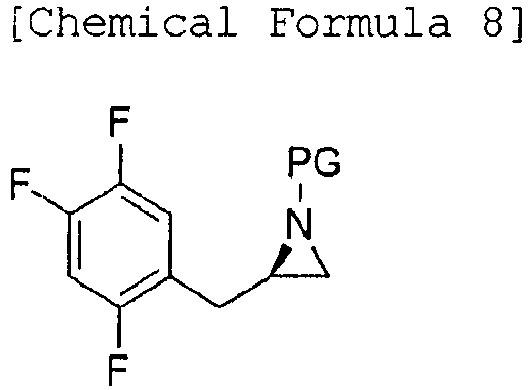

- In the present invention, the compound represented by Chemical Formula 2 is commercially available or may be prepared by using a known method or the method described in Reaction Formula 1.
- After compounds represented by Chemical Formula 2 prepared according to the present invention or intermediates thereof are prepared, their structures may be identified by infrared spectrometry, nuclear magnetic spectrum, mass spectrometry, liquid chromatography, X-ray structural crystallography, polarimetry, and comparison of calculated values and actually measured values in the element analysis of representative compounds.
- Hereinafter, the present invention will be described in more detail with reference to Examples. However, the following Examples are only for illustrating, but the present invention is not limited thereto.
- 84.4 g of 1-bromo-2,4,5-trifluorobenzene and 42.1 mL of tetrahydrofuran were added to 250 mL flask, and the resulting reaction solution was cooled to -15∼20 °C. Under nitrogen atmosphere, 20 mL of isopropylmagnesium chloride [2.0 M tetrahydrofuran solution] was dropped to the reaction solution, and stirred at 0∼5 °C for 2 hours to produce Grinard reagent. 31.6 mL of (S)-epichlorohydrin and 42.1 mL of tetrahydrofuran were added to another 250 mL flask; the resulting reaction solution was cooled to -15 - -20 °C; and then 7.6 g of copper iodide was added thereto. 42.1 mL of the Grinard reagent produced under nitrogen atmosphere was dropped, and stirred for 3 hours while the reaction temperature was maintained at -15 ∼ -20 °C. 297 mL of 2 N hydrochloric acid aqueous solution that was cooled at 0∼5 °C was dropped to the reaction solution, and then extracted with 297 mL of isopropylether. An organic layer was dehydrated with sodium sulfate, and then concentrated under reduced pressure to obtain 89.8 g of a title compound.
1H NMR (CDCl3, 400MHz) δ 7.14 (m, 1H), 6.92 (m, 1H), 4.17 (m, 1H), 3.72∼3.43 (m, 2H), 2.95∼2.74 (m, 2H), 2.66(m, 1H) - 89.9 g of (S) -1-chloro-3- (2,4,5-trifluorophenyl) propane-2-ol produced in the above Step a was added to 2 L flask; dissolved in 898 mL of dimethylformaldehyde; 6.0 g of sodium iodide and 52.0 g of sodium azide were added; the temperature of the resulting reaction solution was increased to 70 °C; and then stirred for 16 hours. After completing the reaction, the reaction solution was cooled to room temperature; 898 mL of isopropylether and 898 mL of water were added; and then stirred for 10 minutes. An organic layer was isolated; washed with 1 N hydrochloric acid aqueous solution and saturated sodium hydrogen carbonate aqueous solution in order; dehydrated with sodium sulfate; and then concentrated under reduced pressure to obtain 75.4 g of a title compound.
1H NMR (CDCl3, 400MHz) δ 7.13 (m, 1H), 6.92 (m, 1H), 4.00(m, 1H), 3.42∼3.23 (m, 2H), 2.86∼2.72 (m, 2H), 2.70(m, 1H) - 18.9 g of (S)-1-azido-3-(2,4,5-trifluorophenyl)propane-2-ol produced in the above Step b was dissolved in 188 mL of acetonitrile in 1 L flask, and then 21.4 g of triphenylphosphine was added thereto. After stirring the resulting reaction solution for 1.5 hours at room temperature, the temperature of the reaction solution was increased to 70 °C and then the reaction solution was stirred for 12 hours. The reaction solution was cooled to room temperature; 1.0 g of 4-dimethylaminopyridine and 17.8 g of di-t-butyl dicarbonate were added to the cooled reaction solution; and then the resulting reaction solution was stirred for 2 hours. After completing the reaction, 0.91 g of hydrogen peroxide was added; and the resulting reaction solution was stirred and then concentrated under reduced pressure. 180 mL of n-hexane was added to the concentrated residue; and the resulting concentrated reside was stirred for 1 hour. The resulting solid was filtered out and the filtrate was concentrated under reduced pressure to obtain 20.0 g of a title compound.
1H NMR (CDCl3, 400MHz) δ 7.38(m, 1H), 6.89(m, 1H), 2.94(dd, 1H), 2.65(dd, 2H), 2.60(m, 1H), 2.37(d, 1H), 2.01(d, 1H), 1.42(s, 9H) - 12.83 g of (S)-1-azido-3-(2,4,5-trifluorophenyl)propane-2-ol produced in the above Step b was dissolved in 130 mL of acetonitrile in 500 mL flask, and then 14.56 g of triphenylphosphine was added thereto. After stirring the resulting reaction solution for 1.5 hours at room temperature, the temperature of the reaction solution was increased to 70 °C and then the reaction solution was stirred for 21 hours. The reaction solution was cooled to 0∼5 C; 6.74 g of triethylamine and 9.47 g of benzyloxychloroformate were added to the cooled reaction solution; and then the resulting reaction solution was stirred for 1 hour. After completing the reaction, 0.63 g of hydrogen peroxide was added; and the resulting reaction solution was stirred for 1 hour and then concentrated under reduced pressure. 130 mL of isopropylether was added to the concentrated residue; and the resulting concentrated reside was stirred for 1 hour. The resulting solid was filtered out and the filtrate was concentrated under reduced pressure. The residue was purified with column chromatography to obtain 15.78 g of a title compound.
1H NMR (CDCl3, 400MHz) δ 7.41∼7.15 (m, 6H), 6.90 (m, 1H), 5.15(s, 2H), 2.90(m, 1H), 2.69(m, 2H), 2.40(d, 1H), 2.08(d, 1H) - 7.97 g of (S)-1-azido-3-(2,4,5-trifluorophenyl)propane-2-ol produced in the above Step b was dissolved in 80 mL of acetonitrile in 500 mL flask, and then 9.05 g of triphenylphosphine was added thereto. After stirring the resulting reaction solution for 1.5 hours at room temperature, the temperature of the reaction solution was increased to 70 °C and then the reaction solution was stirred for 20 hours. The reaction solution was cooled to room temperature; 5.35 g of N,N-diisopropylethylamine, 0.43 g of 4-dimethylaminopyridine, and 3.0 g of acetylchloride were added to the cooled reaction solution; and then the resulting reaction solution was stirred for 2 hours. After completing the reaction, 0.4 g of hydrogen peroxide was added; and the resulting reaction solution was stirred for 1 hour and then concentrated under reduced pressure. 40 mL of n-hexane was added to the concentrated residue; and the resulting concentrated reside was stirred for 1 hour. The resulting solid was filtered out and the filtrate was concentrated under reduced pressure. The residue was purified with column chromatography to obtain 4.74 g of a title compound.
1H NMR (CDCl3, 400MHz) δ 7.16 (m, 1H), 6.95(m, 1H), 2.92(dd, 1H), 2.76(dd, 1H), 2.66(m, 1H), 2.39(d, 1H), 2.05(d, 1H), 2.04(s, 3H) - 7.97 g of (S)-1-azido-3-(2,4,5-trifluorophenyl)propane-2-ol produced in the above Step b was dissolved in 80 mL of acetonitrile in 500 mL flask, and then 9.05 g of triphenylphosphine was added thereto. After stirring the resulting reaction solution for 1.5 hours at room temperature, the temperature of the reaction solution was increased to 70 °C and then the reaction solution was stirred for 21 hours. The reaction solution was cooled to room temperature; 5.35 g of N,N-diisopropylethylamine, 0.43 g of 4-dimethylaminopyridine, and 5.34 g of benzoylchloride were added to the cooled reaction solution; and then the resulting reaction solution was stirred for 2 hours. After completing the reaction, 0.4 g of hydrogen peroxide was added; and the resulting reaction solution was stirred for 1 hour and then concentrated under reduced pressure. 40 mL of n-hexane was added to the concentrated residue; and the resulting concentrated reside was stirred for 1 hour. The resulting solid was filtered out and the filtrate was concentrated under reduced pressure. The residue was purified with column chromatography to obtain 7.03 g of a title compound.
1H NMR (CDCl3, 400MHz) δ 8.0(m, 2H), 7.55(m, 1H), 7.45(m, 2H), 7.21 (m, 1H), 6.95 (m, 1H), 3.05 (dd, 1H), 2.90 (dd, 1H), 2.82(m, 1H), 2.53(d, 1H), 2.28(d, 1H) - 7.97 g of (S)-1-azido-3-(2,4,5-trifluorophenyl)propane-2-ol produced in the above Step b was dissolved in 80 mL of acetonitrile in 500 mL flask, and then 9.05 g of triphenylphosphine was added thereto. After stirring the resulting reaction solution for 1.5 hours at room temperature, the temperature of the reaction solution was increased to 70 °C and then the reaction solution was stirred for 20 hours. The reaction solution was cooled to room temperature; 5.35 g of N,N-diisopropylethylamine, 0.43 g of 4-dimethylaminopyridine, and 12.81 g of 9-fluoreneylmethoxycarbonylchloride were added to the cooled reaction solution; and then the resulting reaction solution was stirred for 2 hours. After completing the reaction, 0.4 g of hydrogen peroxide was added; and the resulting reaction solution was stirred for 1 hour and then concentrated under reduced pressure. 40 mL of n-hexane was added to the concentrated residue; and the resulting concentrated reside was stirred for 1 hour. The resulting solid was filtered out and the filtrate was concentrated under reduced pressure. The residue was purified with column chromatography to obtain 10.03 g of a title compound.
1H NMR (CDCl3, 400MHz) δ 7.67(d, 2H), 7.54(dd, 2H), 7.43(t, 2H), 7.32(t, 2H), 7.21(m, 1H), 6.93(m, 1H), 4.46(d, 2H), 4.20 (t, 1H), 2.85(dd, 1H), 2.68(dd, 1H), 2.54(m, 1H), 2.30(d, 1H), 2.06(d, 1H) - 7 .97 g of (S)-1-azido-3-(2,4,5-trifluorophenyl)propane-2-ol produced in the above Step b was dissolved in 80 mL of acetonitrile in 500 mL flask, and then 9.05 g of triphenylphosphine was added thereto. After stirring the resulting reaction solution for 1.5 hours at room temperature, the temperature of the reaction solution was increased to 70 °C and then the reaction solution was stirred for 20 hours. The reaction solution was cooled to 0∼5 C; 5.35 g of N,N-diisopropylethylamine and 7.24 g of tosylchloride were added to the cooled reaction solution; the resulting reaction solution was stirred for 2 hours; and then concentrated under reduced pressure. 40 mL of isopropylether was added to the concentrated residue and then the resulting concentrated reside was stirred for 1 hour. The resulting solid was filtered out and the filtrate was concentrated under reduced pressure. The residue was purified with column chromatography to obtain 7.07 g of a title compound.
1H NMR (CDCl3, 400MHz) δ 7.71∼7.58 (m, 2H), 7.25∼7.18 (m, 2H), 6.80(m, 1H), 6.05(m, 1H), 3.07(m, 1H), 2.80(m, 1H), 2.43(m, 4H), 2.11(d, 1H), 1.42(s, 3H) - 6.7 g of (R)-t-butyl 2-(2,4,5-trifluorobenzyl)aziridine-1-carboxylate was dissolved in 67 mL of dimethylsulfoxide in 250 mL flask; then 3.0 g of potassiumcyanide, 1.4 g of ammonium chloride, and 6.8 g of 18-crown-6 were added thereto in order; and then the resulting reaction solution was stirred for 2 hours at 80 °C. After completing the reaction, 100 mL of toluene and 100 mL of water were added to the reaction solution and then the resulting reaction solution was stirred for 10 minutes. An organic layer was isolated; washed with 1 N hydrochloric acid aqueous solution and saturated sodium hydrogen carbonate aqueous solution in order; dehydrated with sodium sulfate; and then concentrated under reduced pressure to obtain 75.4 g of a title compound. An aqueous layer was isolated; dehydrated with sodium sulfate; and then concentrated under reduced pressure. 100 mL of n-hexane was added to the concentrated residue and then the resulting concentrated residue was stirred for 1 hour at room temperature. The resulting solid was decompression-filtered and vacuum-dried to obtain 4.0 g of a title compound.
1H NMR (CDCl3, 400MHz) δ 7.08 (m, 1H), 6.94 (m, 1H), 4.80(m, 1H), 4.06(m, 1H), 2.88(m, 2H), 2.80∼2.50 (m, 2H), 1.39(s, 9H) - 15.78 g of (R)-benzyl 2-(2,4,5-trifluorobenzyl)aziridine-1-carboxylate was dissolved in 63.2 mL of dimethylsulfoxide and 15.8 mL of water in 250 mL flask; then 7.89 g of silicagel was added thereto. 6.40 g of potassiumcyanide was slowly added to the reaction solution, and the resulting reaction solution was stirred for 24 hours at 50 °C. The reaction solution was cooled to room temperature, and then 160 mL of dichloromethane and 800 mL of water were added to the cooled reaction solution in order. An organic layer was isolated; washed with 80 mL of water in twice; dehydrated with sodium sulfate; and then concentrated under reduced pressure. 80 mL of diisopropylether was added to the concentrated residue and then the resulting concentrated residue was stirred for 1 hour at room temperature. The resulting solid was decompression-filtered and vacuum-dried to obtain 14.66 g of a title compound.
1H NMR (CDCl3, 400MHz) δ 7.40∼7.10 (m, 5H), 7.91 (m, 1H), 6.77(m, 1H), 5.00(s, 2H), 4.95(m, 1H), 4.08(m, 1H), 2.89(m, 2H), 2.72 (dd, 1H), 2.53(dd, 1H) - 2.0 g of (R)-t-butyl 1-cyano-3-(2,4,5-trifluorophenyl)propane-2-ylcarbamate produced in the above Step d-1 was dissolved in 20 mL mixed solution of ethanol:water=1:1 in 250 mL flask; then 3.4 g of 85 % potassium hydroxide was added thereto; and then the resulting reaction solution was stirred for 12 hours at 80 °C. The reaction solution was cooled to room temperature; 8.0 g of oxalic acid dihydrate was slowly added to the cooled reaction solution. After completing the reaction, 40 mL of ethyl acetate and 20 mL of water were added and then the resulting reaction solution stirred for 20 minutes. An organic layer was isolated; dehydrated with magnesium sulfate; and then concentrated under reduced pressure. The concentrated residue was isolated with column chromatography (chloroform:methanol=10:1) and then concentrated under reduced pressure to obtain 1.10 g of a title compound.
1H NMR (CDCl3, 400MHz) δ 7.04 (m, 1H), 6.89 (m, 1H), 6.08(br, 1H), 5.04(br, 1H), 4.13(br, 1H), 2.88(br, 2H), 2.62 (m, 2H), 1.36 (s, 18H)
Mass (M+Na) : 356 - 40 g of (R)-benzyl 1-cyano-3-(2,4,5-trifluorophenyl)propane-2-ylcarbamate produced in the above Step d-2 was added to 1 L flask; the temperature of the resulting reaction solution was increased to 110 °C; and then the reaction solution was stirred for 4 hours. The reaction solution was cooled to room temperature; and then 500 mL of saturated sodium hydrogen carbonate aqueous solution was slowly dropped to the cooled reaction solution. After completing the dropping, the reaction solution was concentrated under reduced pressure, and 400 mL of methanol, 10.7 g of sodium hydrogen carbonate, and 63.5 g of N-(benzyloxycarbonyloxy)succinimide were added to the reaction solution in order. The reaction solution was stirred for 12 hours, and then concentrated under reduced pressure. The concentrated residue was diluted with 200 mL of ethyl acetate, and then 200 mL of 5 % sodium hydrogen carbonate aqueous solution was slowly added and then stirred for 10 minutes. After isolating a layer, citric acid was added to an aqueous layer to adjust to pH 4∼5. 200 mL of ethylacetate was added and stirred for 10 minutes to isolate an organic layer; dehydrated with sodium sulfate, and then concentrated under reduced pressure. The concentrated residue was isolated with column chromatography (chloroform:methanol=10:1), and then concentrated under reduced pressure to obtain 30.4 g of a title compound.
1H NMR (CDCl3, 400MHz) δ 7.45∼7.18(m, 5H), 7.05(m, 1H), 6.83(m, 1H), 5.37(d, 1H), 5.10(s, 2H), 4.52∼4.16(m, 1H), 3.01∼2.85(m, 2H), 2.78-2.42(m, 2H)
Mass (M+1) : 368 - 686.0 L of methylene chloride was added; 85.0 kg of (S)-methyl 2-bromo-3-hydroxypropanate was added to a reactor; and then stirred for 30 minutes. 1.3 kg of sulfuric acid was slowly added, and then isobutylene gas was bubbled for 43 hours while the reaction temperature was maintained at 20~35 °C. After completing the reaction, an aqueous solution prepared by dissolving 20 kg of sodium hydrogen carbonate to 400 L of water was slowly added, and then stirred for 30 minutes. An organic layer was isolated; 50 kg of sodium sulfate was added; stirred for further 30 minutes; and then filtered. A filtrate was concentrated under reduced pressure to obtain 98.7 kg of a title compound.
1H NMR (CDCl3, 400MHz) δ 4.21(m, 1H), 3.83(m, 1H), 3.77(s, 3H), 3.64(m, 1H), 1.17(H, 9H) - 691.0 L of 1,4-dioxane was added; 98.7 kg of (S)-methyl 2-bromo-3-t-butoxypropanate produced in the above Step a' was added to a reactor and dissolved; and then 121.4 kg of sodium hydrogen carbonate and 55.1 L of ethylenediamine were added in order. While an internal temperature was maintained at 45~50 °C, the resulting reaction solution was stirred for 24 hours. After completing the reaction, the reaction solution was cooled to room temperature, and then the resulting solid was filtered. After washing with 100 L of 1,4-dioxane, 20.0 kg of acetic acid was added to a filtrate and then stirred for 1 hour. The reaction solution was filtered (washed with 100 L of methanol), and then concentrated under reduced pressure. 80 L of isopropylether and 80 L of water were added to the concentrated residue, and then an aqueous layer was isolated in twice. 126 L mixed solution of methylene chloride/isopropanol (methylene chloride:isopropanol=5:1) was added, stirred, and then an organic layer was isolated (performing five times). 50 kg of sodium sulfate was added to the organic layer, stirred for 30 minutes and then filtered. A filtrate was concentrated under reduced pressure to obtain 45.2 kg of a title compound.
1H NMR (400 MHz, CDCl3) δ 6.41 (brs, 1H), 3.76 (m, 3H), 3.63 (m, 1H), 3.52(m, 1H), 3.42(m, 1H), 3.28(m, 1H), 3.16(m, 1H), 2.95(m, 1H), 2.45 (brs, 1H), 1.17 (s, 9H) - 10.0 g of (R)-3-t-butoxycarbonylamino-4-(2,4,5-trifluorophenyl)butanoic acid (Chemical Formula 2) produced in the above Example 1 was dissolved in 450 mL of toluene in 2 L flask; 13.0 g of bis(2,2'-benzothiazolyl)disulfide and 10.2 g of triphenylphosphine were added; and then the resulting reaction solution was cooled to 0 °C. While stirring the reaction solution, a solution prepared by dissolving 0.8 mL of triethylamine to 20 mL of toluene was added, and then stirred for 5 hours at room temperature. The reaction solution was cooled to 0 °C, and then a solution prepared by dissolving 5.6 g of (R)-3-(t-butoxymethyl)piperazine-2-one (Chemical Formula 3) produced in the above Example 2 to 40 mL of toluene, and 2.4 mL of pyridine were slowly added. After 30 minutes, the temperature of the reaction solution was increased to room temperature, and then stirred for further 1 hour. pH of the reaction solution was adjusted to 2.5 using saturated citric acid aqueous solution, and then diluted with 400 mL of ethyl acetate. The reaction solution was washed with brine in twice, and an organic layer was dehydration-concentrated with magnesium sulfate. A residue was purified with column chromatography to obtain 838 mg of a title compound.
1H NMR (400 MHz, CDCl3) δ 7.03(m, 1H), 6.88(m, 1H), 5.97(m, 1H), 5.48(m, 1H), 4.16∼4.07(m, 1H), 4.02-3.91(m, 1H), 3.74(m, 2H) 3.37(m, 2H), 3.24(m, 1H), 2.92(m, 2H), 2.80(m, 1H), 2.59(m, 2H), 1.34(d, 9H), 1.13(s, 9H) - 97 mg of t-butyl (R)-4-[(R)-2-(t-butoxymethyl)-3-oxopiperazine-1-yl]-4-oxo-1-(2,4,5-trifluorophenyl)butane-2-ylcarbamate produced in the above Step 1 was dissolved in 3 mL of methanol; 2 mL of 2 N-hydrochloric acid/diethyl ether was added; and then stirred for 3 hours at room temperature. The reaction mixture was concentrated and decompression-dried to obtain 64 mg of a title compound as a foaming solid.
1H NMR (400 MHz, CD3OD) δ 7.37(m, 1H), 7.23(m, 1H), 4.80(m, 1H), 4.59- 4.40(m, 1H), 3.93(m, 1H), 3.90∼3.83 (m, 2H), 3.70(m, 1H), 3.38(m, 2H), 3.27(m, 1H), 3.07(m, 2H), 2.89-2.66(m, 2H), 1.18(s, 3H), 1.11 (s, 6H)
Mass (M+1) : 402 - 10 mL of 5 % sodium hydrogen carbonate aqueous solution was added to 60 mg of hydrochloride compound represented by Chemical Formula 1 obtained in the above Example 3; the resulting reaction solution was extracted by using 10 mL of dichloromethane/2-propanol [4/1(v/v)] mixed solution in twice; and then an organic layer was decompression-dried to obtain 55 mg of a title compound as a solid.
1H NMR (400 MHz,CD3OD) δ 7.27 (m, 1H), 7.14(m, 1H), 4.56∼4.39 (m, 1H), 3.96∼3.81 (m, 3H), 3.70 (m, 1H), 3.46(m, 1H), 3.43∼3.32 (m, 1H), 2.83∼2.65 (m, 3H), 2.58∼2.40 (m, 2H), 1.16 (s, 3H), 1.11 (s, 6H)
Mass (M+1) : 402 - 55 mg of the compound produced in the above Step 1 was dissolved in 0.56 mL of acetone; a solution prepared by dissolving 26 mg of L-tartaric acid to 0.35 mL of ethanol/water [9/1(v/v)] was slowly added; and then stirred for 30 minutes. 0.56 mL of 2-propanol was again added thereto, and stirred for 10 minutes to obtain 77 mg of a title compound as a solid.
1H NMR (400 MHz, CD3OD) δ 7.38(m, 1H), 7.22(m, 1H), 4.80(m, 1H), 4.59- 4.40(m, 1H), 4.40 (s, 2H), 3.93(m, 1H), 3.90∼3.83 (m, 2H), 3.70 (m, 1H), 3.38(m, 2H), 3.27 (m, 1H), 3.07(m, 2H), 2.89- 2.66(m, 2H), 1.15(s, 3H), 1.11 (s, 6H)
Mass (M+1) : 402
Claims (4)
- A method for preparing an intermediate of dipeptidyl peptidase-IV inhibitor represented by Chemical Formula 2, as shown in the following Reaction Formula 1, the method comprising:(Step a) preparing a compound represented by Chemical Formula 6 by ring-opening of epoxide ring using Grignard reagent in a compound represented by Chemical Formula 5;(Step b) preparing a compound represented by Chemical Formula 7 by reacting the compound represented by Chemical Formula 6 with sodium azide;(Step c) preparing a compound represented by Chemical Formula 8 by reacting the compound represented by Chemical Formula 7 with triphenylphosphine;(Step d) preparing a compound represented by Chemical Formula 9 by ring-opening of aziridine ring using a cyanogen-based reagent in the compound represented by Chemical Formula 8; and(Step e) preparing a compound represented by Chemical Formula 2 by hydrolyzing the compound represented by Chemical Formula 9 using a base;

- The method as set forth in claim 1, wherein the amine-protecting group is selected from the group consisting of butoxycarbonyl (Boc), benzyloxycarbonyl (Cbz), 9-fluorenylmethoxycarbonyl (Fmoc), acetyl, benzoyl, and tosyl.
- A derivative represented by the following Chemical Formula 8, wherein the derivative is produced when producing the compound represented by Chemical Formula 2 as set forth in claim 1:

- A derivative represented by the following Chemical Formula 9, wherein the derivative is produced when producing the compound represented by Chemical Formula 2 as set forth in claim 1:

Priority Applications (2)
| Application Number | Priority Date | Filing Date | Title |
|---|---|---|---|
| EP13175341.0A EP2669265A3 (en) | 2009-03-30 | 2010-03-30 | Improved method for preparing dipeptidyl peptidase-IV inhibitor and intermediate |
| PL10759016T PL2415753T3 (en) | 2009-03-30 | 2010-03-30 | Method for preparing dipeptidyl peptidase-iv inhibitor and intermediate |
Applications Claiming Priority (2)
| Application Number | Priority Date | Filing Date | Title |
|---|---|---|---|
| KR20090027105 | 2009-03-30 | ||
| PCT/KR2010/001947 WO2010114291A2 (en) | 2009-03-30 | 2010-03-30 | Improved method for preparing dipeptidyl peptidase-iv inhibitor and intermediate |
Related Child Applications (2)
| Application Number | Title | Priority Date | Filing Date |
|---|---|---|---|
| EP13175341.0A Division EP2669265A3 (en) | 2009-03-30 | 2010-03-30 | Improved method for preparing dipeptidyl peptidase-IV inhibitor and intermediate |
| EP13175341.0A Division-Into EP2669265A3 (en) | 2009-03-30 | 2010-03-30 | Improved method for preparing dipeptidyl peptidase-IV inhibitor and intermediate |
Publications (3)
| Publication Number | Publication Date |
|---|---|
| EP2415753A2 EP2415753A2 (en) | 2012-02-08 |
| EP2415753A4 EP2415753A4 (en) | 2013-02-13 |
| EP2415753B1 true EP2415753B1 (en) | 2014-08-27 |
Family
ID=42828845
Family Applications (2)
| Application Number | Title | Priority Date | Filing Date |
|---|---|---|---|
| EP13175341.0A Withdrawn EP2669265A3 (en) | 2009-03-30 | 2010-03-30 | Improved method for preparing dipeptidyl peptidase-IV inhibitor and intermediate |
| EP10759016.8A Active EP2415753B1 (en) | 2009-03-30 | 2010-03-30 | Method for preparing dipeptidyl peptidase-iv inhibitor and intermediate |
Family Applications Before (1)
| Application Number | Title | Priority Date | Filing Date |
|---|---|---|---|
| EP13175341.0A Withdrawn EP2669265A3 (en) | 2009-03-30 | 2010-03-30 | Improved method for preparing dipeptidyl peptidase-IV inhibitor and intermediate |
Country Status (16)
| Country | Link |
|---|---|
| US (2) | US20120016125A1 (en) |
| EP (2) | EP2669265A3 (en) |
| JP (1) | JP5475863B2 (en) |
| KR (1) | KR101152899B1 (en) |
| CN (2) | CN102378751B (en) |
| AU (1) | AU2010232085B2 (en) |
| BR (1) | BRPI1014087B1 (en) |
| CA (2) | CA2756893C (en) |
| ES (1) | ES2523995T3 (en) |
| IL (2) | IL215290A (en) |
| MX (2) | MX344498B (en) |
| NZ (2) | NZ608028A (en) |
| PL (1) | PL2415753T3 (en) |
| RU (1) | RU2499792C2 (en) |
| SG (1) | SG174974A1 (en) |
| WO (1) | WO2010114291A2 (en) |
Families Citing this family (6)
| Publication number | Priority date | Publication date | Assignee | Title |
|---|---|---|---|---|
| KR101290029B1 (en) | 2011-01-20 | 2013-07-30 | 에스티팜 주식회사 | Preparation method of intermediate of sitagliptin |
| CN103910655A (en) * | 2014-04-11 | 2014-07-09 | 太原理工大学 | Ring opening method of aziridine compounds |
| KR101709127B1 (en) * | 2015-06-16 | 2017-02-22 | 경동제약 주식회사 | Novel intermediates for preparing DPP-IV inhibitors, preparing method thereof and preparing method of DPP-IV inhibitors using the same |
| CN105017081B (en) * | 2015-07-08 | 2017-03-08 | 和鼎(南京)医药技术有限公司 | A kind of preparation method of sitagliptin intermediate |
| KR101935636B1 (en) * | 2016-11-04 | 2019-01-07 | 에스티팜 주식회사 | A method for preparation of (S)-N1-(2-aminoethyl)-3-(4-alkoxyphenyl)propane-1,2-diamine trihydrocholoride |
| CN113816887A (en) * | 2021-08-31 | 2021-12-21 | 华中科技大学 | Aziridine compound and preparation method thereof |
Family Cites Families (23)
| Publication number | Priority date | Publication date | Assignee | Title |
|---|---|---|---|---|
| JPH11310568A (en) * | 1998-04-30 | 1999-11-09 | Nissan Chem Ind Ltd | Pentanoic amides |
| DE60209348T2 (en) | 2001-06-20 | 2006-10-12 | Merck & Co., Inc. | DIPEPTIDYLPEPTIDASE INHIBITORS FOR THE TREATMENT OF DIABETES |
| UA74912C2 (en) | 2001-07-06 | 2006-02-15 | Merck & Co Inc | Beta-aminotetrahydroimidazo-(1,2-a)-pyrazines and tetratriazolo-(4,3-a)-pyrazines as inhibitors of dipeptylpeptidase for the treatment or prevention of diabetes |
| SK3622004A3 (en) * | 2002-02-28 | 2005-02-04 | Prosidion Limited | Glutaminyl based DPIV inhibitors |
| EP1490335B1 (en) | 2002-03-25 | 2007-09-19 | Merck & Co., Inc. | Beta-amino heterocyclic dipeptidyl peptidase inhibitors for the treatment or prevention of diabetes |
| JP4530852B2 (en) | 2002-07-15 | 2010-08-25 | メルク・シャープ・エンド・ドーム・コーポレイション | Piperidinopyrimidine dipeptidyl peptidase inhibitors for the treatment of diabetes |
| ATE370141T1 (en) | 2002-10-07 | 2007-09-15 | Merck & Co Inc | ANTIDIABETIC HETEROCYCLIC BETA-AMINO COMPOUNDS AS INHIBITORS OF DIPEPTIDYLPEPTIDASE |
| WO2004083173A2 (en) * | 2003-03-18 | 2004-09-30 | Merck & Co., Inc. | Ketopiperazine derivatives as bradykinin antagonists |
| WO2004087650A2 (en) | 2003-03-27 | 2004-10-14 | Merck & Co. Inc. | Process and intermediates for the preparation of beta-amino acid amide dipeptidyl peptidase-iv inhibitors |
| AU2004261186A1 (en) | 2003-07-31 | 2005-02-10 | Merck & Co., Inc. | Hexahydrodiazepinones as dipeptidyl peptidase-IV inhibitors for the treatment or prevention of diabetes |
| JP2005206492A (en) * | 2004-01-21 | 2005-08-04 | Sankyo Co Ltd | Sulfonamide compound |
| WO2006098342A1 (en) * | 2005-03-16 | 2006-09-21 | Astellas Pharma Inc. | Piperazinyl compounds |
| EP1702916A1 (en) | 2005-03-18 | 2006-09-20 | Santhera Pharmaceuticals (Schweiz) GmbH | DPP-IV inhibitors |
| WO2007063928A1 (en) | 2005-11-30 | 2007-06-07 | Toray Industries, Inc. | Novel noncyclic amine carboxamide derivative and salt thereof |
| US20090156465A1 (en) | 2005-12-30 | 2009-06-18 | Sattigeri Jitendra A | Derivatives of beta-amino acid as dipeptidyl peptidase-iv inhibitors |
| WO2008028662A1 (en) | 2006-09-07 | 2008-03-13 | Santhera Pharmaceuticals (Schweiz) Ag | N-[1-(3-amino-4-phenyl-butyryl)-4-hydroxy-pyrrolidin-2-ylmethyl}-propionamide and related compounds as dpp-iv inhibitors for the treatment of type 2 diabetes mellitus |
| KR100848491B1 (en) | 2007-01-16 | 2008-07-28 | 영진약품공업주식회사 | 2-thiazolidine derivatives having a betaamino group, pharmaceutically acceptable salts thereof and preparation method thereof |
| DE102007014286A1 (en) * | 2007-03-19 | 2008-09-25 | Universität Tübingen | Fluorine-substituted amphetamines and amphetamine derivatives and their use |
| CN100516014C (en) * | 2007-04-04 | 2009-07-22 | 浙江永太科技股份有限公司 | The preparation method of 2,4,5-trifluorophenylacetic acid |
| ES2526338T3 (en) | 2007-04-19 | 2015-01-09 | Dong-A Pharm.Co., Ltd. | DPP-IV inhibitor that includes beta-amino group, method of preparation thereof and pharmaceutical composition containing it to prevent and treat diabetes or obesity |
| WO2008141021A1 (en) * | 2007-05-08 | 2008-11-20 | Concert Pharmaceuticals, Inc. | Deuterated derivatives of tetrahydrotriazolopyrazine compounds and their use as dpp-iv inhibitors |
| KR20090027105A (en) | 2007-09-11 | 2009-03-16 | 주식회사 하이닉스반도체 | Dual gate insulating film formation method |
| MX2011010205A (en) * | 2009-03-30 | 2011-10-17 | Dong A Pharm Co Ltd | Improved method for manufacturing dipeptidyl peptidase-iv inhibitor and intermediate. |
-
2010
- 2010-03-30 EP EP13175341.0A patent/EP2669265A3/en not_active Withdrawn
- 2010-03-30 BR BRPI1014087-5A patent/BRPI1014087B1/en active IP Right Grant
- 2010-03-30 EP EP10759016.8A patent/EP2415753B1/en active Active
- 2010-03-30 MX MX2012015019A patent/MX344498B/en unknown
- 2010-03-30 NZ NZ608028A patent/NZ608028A/en unknown
- 2010-03-30 ES ES10759016.8T patent/ES2523995T3/en active Active
- 2010-03-30 CN CN201080015010.2A patent/CN102378751B/en active Active
- 2010-03-30 PL PL10759016T patent/PL2415753T3/en unknown
- 2010-03-30 CA CA2756893A patent/CA2756893C/en active Active
- 2010-03-30 CA CA2800245A patent/CA2800245C/en active Active
- 2010-03-30 JP JP2012503324A patent/JP5475863B2/en active Active
- 2010-03-30 KR KR1020100028477A patent/KR101152899B1/en active Active
- 2010-03-30 MX MX2011010204A patent/MX2011010204A/en active IP Right Grant
- 2010-03-30 SG SG2011070919A patent/SG174974A1/en unknown
- 2010-03-30 NZ NZ595542A patent/NZ595542A/en unknown
- 2010-03-30 CN CN201410104035.XA patent/CN103922971B/en active Active
- 2010-03-30 WO PCT/KR2010/001947 patent/WO2010114291A2/en not_active Ceased
- 2010-03-30 RU RU2011141208/04A patent/RU2499792C2/en active
- 2010-03-30 AU AU2010232085A patent/AU2010232085B2/en active Active
- 2010-03-30 US US13/259,699 patent/US20120016125A1/en not_active Abandoned
-
2011
- 2011-09-21 IL IL215290A patent/IL215290A/en active IP Right Grant
-
2014
- 2014-09-02 IL IL234436A patent/IL234436A/en active IP Right Grant
- 2014-10-03 US US14/506,025 patent/US9249109B2/en active Active
Also Published As
Similar Documents
| Publication | Publication Date | Title |
|---|---|---|
| US9249109B2 (en) | Method for preparing dipeptidyl peptidase-IV inhibitor and intermediate | |
| EP2669266B1 (en) | Improved Method for Manufacturing Dipeptidyl Peptidase-IV Inhibitor and Intermediate | |
| US20180086765A1 (en) | Novel intermediates for preparing dpp-iv inhibitors, preparing method thereof and preparing method of dpp-iv inhibitors using the same | |
| AU2013200419B2 (en) | Improved method for preparing dipeptidyl peptidase-IV inhibitor and intermediate | |
| HK1168085B (en) | Improved method for preparing dipeptidyl peptidase-iv inhibitor and intermediate | |
| HK1168086B (en) | Improved method for manufacturing dipeptidyl peptidase-iv inhibitor and intermediate |
Legal Events
| Date | Code | Title | Description |
|---|---|---|---|
| PUAI | Public reference made under article 153(3) epc to a published international application that has entered the european phase |
Free format text: ORIGINAL CODE: 0009012 |
|
| 17P | Request for examination filed |
Effective date: 20110930 |
|
| AK | Designated contracting states |
Kind code of ref document: A2 Designated state(s): AT BE BG CH CY CZ DE DK EE ES FI FR GB GR HR HU IE IS IT LI LT LU LV MC MK MT NL NO PL PT RO SE SI SK SM TR |
|
| DAX | Request for extension of the european patent (deleted) | ||
| A4 | Supplementary search report drawn up and despatched |
Effective date: 20130115 |
|
| RIC1 | Information provided on ipc code assigned before grant |
Ipc: C07D 241/08 20060101ALI20130109BHEP Ipc: C07C 219/10 20060101ALI20130109BHEP Ipc: C07C 271/22 20060101ALI20130109BHEP Ipc: C07D 203/06 20060101ALI20130109BHEP Ipc: C07C 219/18 20060101ALI20130109BHEP Ipc: C07C 255/44 20060101ALI20130109BHEP Ipc: C07C 29/36 20060101ALI20130109BHEP Ipc: C07D 203/08 20060101ALI20130109BHEP Ipc: C07C 247/10 20060101ALI20130109BHEP Ipc: C07C 213/00 20060101AFI20130109BHEP Ipc: C07C 269/06 20060101ALI20130109BHEP |
|
| 17Q | First examination report despatched |
Effective date: 20130822 |
|
| GRAP | Despatch of communication of intention to grant a patent |
Free format text: ORIGINAL CODE: EPIDOSNIGR1 |
|
| RIC1 | Information provided on ipc code assigned before grant |
Ipc: C07C 269/06 20060101ALI20140214BHEP Ipc: C07C 29/36 20060101ALI20140214BHEP Ipc: C07C 255/44 20060101ALI20140214BHEP Ipc: C07C 271/22 20060101ALI20140214BHEP Ipc: C07C 219/10 20060101ALI20140214BHEP Ipc: C07C 213/00 20060101AFI20140214BHEP Ipc: C07C 247/10 20060101ALI20140214BHEP Ipc: C07D 203/06 20060101ALI20140214BHEP Ipc: C07D 241/08 20060101ALI20140214BHEP Ipc: C07D 203/08 20060101ALI20140214BHEP Ipc: C07C 219/18 20060101ALI20140214BHEP Ipc: C07D 203/18 20060101ALI20140214BHEP |
|
| INTG | Intention to grant announced |
Effective date: 20140310 |
|
| GRAS | Grant fee paid |
Free format text: ORIGINAL CODE: EPIDOSNIGR3 |
|
| GRAA | (expected) grant |
Free format text: ORIGINAL CODE: 0009210 |
|
| AK | Designated contracting states |
Kind code of ref document: B1 Designated state(s): AT BE BG CH CY CZ DE DK EE ES FI FR GB GR HR HU IE IS IT LI LT LU LV MC MK MT NL NO PL PT RO SE SI SK SM TR |
|
| REG | Reference to a national code |
Ref country code: GB Ref legal event code: FG4D |
|
| REG | Reference to a national code |
Ref country code: CH Ref legal event code: EP |
|
| REG | Reference to a national code |
Ref country code: AT Ref legal event code: REF Ref document number: 684444 Country of ref document: AT Kind code of ref document: T Effective date: 20140915 |
|
| REG | Reference to a national code |
Ref country code: IE Ref legal event code: FG4D |
|
| REG | Reference to a national code |
Ref country code: DE Ref legal event code: R096 Ref document number: 602010018571 Country of ref document: DE Effective date: 20141009 |
|
| REG | Reference to a national code |
Ref country code: ES Ref legal event code: FG2A Ref document number: 2523995 Country of ref document: ES Kind code of ref document: T3 Effective date: 20141203 |
|
| REG | Reference to a national code |
Ref country code: AT Ref legal event code: MK05 Ref document number: 684444 Country of ref document: AT Kind code of ref document: T Effective date: 20140827 |
|
| REG | Reference to a national code |
Ref country code: LT Ref legal event code: MG4D |
|
| REG | Reference to a national code |
Ref country code: NL Ref legal event code: VDEP Effective date: 20140827 |
|
| PG25 | Lapsed in a contracting state [announced via postgrant information from national office to epo] |
Ref country code: BG Free format text: LAPSE BECAUSE OF FAILURE TO SUBMIT A TRANSLATION OF THE DESCRIPTION OR TO PAY THE FEE WITHIN THE PRESCRIBED TIME-LIMIT Effective date: 20141127 Ref country code: NO Free format text: LAPSE BECAUSE OF FAILURE TO SUBMIT A TRANSLATION OF THE DESCRIPTION OR TO PAY THE FEE WITHIN THE PRESCRIBED TIME-LIMIT Effective date: 20141127 Ref country code: SE Free format text: LAPSE BECAUSE OF FAILURE TO SUBMIT A TRANSLATION OF THE DESCRIPTION OR TO PAY THE FEE WITHIN THE PRESCRIBED TIME-LIMIT Effective date: 20140827 Ref country code: PT Free format text: LAPSE BECAUSE OF FAILURE TO SUBMIT A TRANSLATION OF THE DESCRIPTION OR TO PAY THE FEE WITHIN THE PRESCRIBED TIME-LIMIT Effective date: 20141229 Ref country code: LT Free format text: LAPSE BECAUSE OF FAILURE TO SUBMIT A TRANSLATION OF THE DESCRIPTION OR TO PAY THE FEE WITHIN THE PRESCRIBED TIME-LIMIT Effective date: 20140827 Ref country code: FI Free format text: LAPSE BECAUSE OF FAILURE TO SUBMIT A TRANSLATION OF THE DESCRIPTION OR TO PAY THE FEE WITHIN THE PRESCRIBED TIME-LIMIT Effective date: 20140827 Ref country code: GR Free format text: LAPSE BECAUSE OF FAILURE TO SUBMIT A TRANSLATION OF THE DESCRIPTION OR TO PAY THE FEE WITHIN THE PRESCRIBED TIME-LIMIT Effective date: 20141128 |
|
| PG25 | Lapsed in a contracting state [announced via postgrant information from national office to epo] |
Ref country code: AT Free format text: LAPSE BECAUSE OF FAILURE TO SUBMIT A TRANSLATION OF THE DESCRIPTION OR TO PAY THE FEE WITHIN THE PRESCRIBED TIME-LIMIT Effective date: 20140827 Ref country code: LV Free format text: LAPSE BECAUSE OF FAILURE TO SUBMIT A TRANSLATION OF THE DESCRIPTION OR TO PAY THE FEE WITHIN THE PRESCRIBED TIME-LIMIT Effective date: 20140827 Ref country code: HR Free format text: LAPSE BECAUSE OF FAILURE TO SUBMIT A TRANSLATION OF THE DESCRIPTION OR TO PAY THE FEE WITHIN THE PRESCRIBED TIME-LIMIT Effective date: 20140827 Ref country code: IS Free format text: LAPSE BECAUSE OF FAILURE TO SUBMIT A TRANSLATION OF THE DESCRIPTION OR TO PAY THE FEE WITHIN THE PRESCRIBED TIME-LIMIT Effective date: 20141227 Ref country code: CY Free format text: LAPSE BECAUSE OF FAILURE TO SUBMIT A TRANSLATION OF THE DESCRIPTION OR TO PAY THE FEE WITHIN THE PRESCRIBED TIME-LIMIT Effective date: 20140827 |
|
| PG25 | Lapsed in a contracting state [announced via postgrant information from national office to epo] |
Ref country code: NL Free format text: LAPSE BECAUSE OF FAILURE TO SUBMIT A TRANSLATION OF THE DESCRIPTION OR TO PAY THE FEE WITHIN THE PRESCRIBED TIME-LIMIT Effective date: 20140827 |
|
| REG | Reference to a national code |
Ref country code: PL Ref legal event code: T3 |
|
| RAP2 | Party data changed (patent owner data changed or rights of a patent transferred) |
Owner name: DONG-A ST CO., LTD. |
|
| REG | Reference to a national code |
Ref country code: DE Ref legal event code: R082 Ref document number: 602010018571 Country of ref document: DE Representative=s name: MARKS & CLERK (LUXEMBOURG) LLP, LU |
|
| REG | Reference to a national code |
Ref country code: GB Ref legal event code: 732E Free format text: REGISTERED BETWEEN 20150326 AND 20150401 |
|
| PG25 | Lapsed in a contracting state [announced via postgrant information from national office to epo] |
Ref country code: SK Free format text: LAPSE BECAUSE OF FAILURE TO SUBMIT A TRANSLATION OF THE DESCRIPTION OR TO PAY THE FEE WITHIN THE PRESCRIBED TIME-LIMIT Effective date: 20140827 Ref country code: DK Free format text: LAPSE BECAUSE OF FAILURE TO SUBMIT A TRANSLATION OF THE DESCRIPTION OR TO PAY THE FEE WITHIN THE PRESCRIBED TIME-LIMIT Effective date: 20140827 Ref country code: EE Free format text: LAPSE BECAUSE OF FAILURE TO SUBMIT A TRANSLATION OF THE DESCRIPTION OR TO PAY THE FEE WITHIN THE PRESCRIBED TIME-LIMIT Effective date: 20140827 Ref country code: CZ Free format text: LAPSE BECAUSE OF FAILURE TO SUBMIT A TRANSLATION OF THE DESCRIPTION OR TO PAY THE FEE WITHIN THE PRESCRIBED TIME-LIMIT Effective date: 20140827 Ref country code: RO Free format text: LAPSE BECAUSE OF FAILURE TO SUBMIT A TRANSLATION OF THE DESCRIPTION OR TO PAY THE FEE WITHIN THE PRESCRIBED TIME-LIMIT Effective date: 20140827 |
|
| REG | Reference to a national code |
Ref country code: DE Ref legal event code: R082 Ref document number: 602010018571 Country of ref document: DE Representative=s name: MARKS & CLERK (LUXEMBOURG) LLP, LU Effective date: 20150414 Ref country code: DE Ref legal event code: R081 Ref document number: 602010018571 Country of ref document: DE Owner name: DONG-A ST CO., LTD., KR Free format text: FORMER OWNER: DONG-A PHARMACEUTICAL CO. LTD., SEOUL, KR Effective date: 20150414 |
|
| REG | Reference to a national code |
Ref country code: DE Ref legal event code: R097 Ref document number: 602010018571 Country of ref document: DE |
|
| PLBE | No opposition filed within time limit |
Free format text: ORIGINAL CODE: 0009261 |
|
| STAA | Information on the status of an ep patent application or granted ep patent |
Free format text: STATUS: NO OPPOSITION FILED WITHIN TIME LIMIT |
|
| 26N | No opposition filed |
Effective date: 20150528 |
|
| PG25 | Lapsed in a contracting state [announced via postgrant information from national office to epo] |
Ref country code: LU Free format text: LAPSE BECAUSE OF FAILURE TO SUBMIT A TRANSLATION OF THE DESCRIPTION OR TO PAY THE FEE WITHIN THE PRESCRIBED TIME-LIMIT Effective date: 20150330 Ref country code: MC Free format text: LAPSE BECAUSE OF FAILURE TO SUBMIT A TRANSLATION OF THE DESCRIPTION OR TO PAY THE FEE WITHIN THE PRESCRIBED TIME-LIMIT Effective date: 20140827 |
|
| REG | Reference to a national code |
Ref country code: CH Ref legal event code: PL |
|
| PG25 | Lapsed in a contracting state [announced via postgrant information from national office to epo] |
Ref country code: SI Free format text: LAPSE BECAUSE OF FAILURE TO SUBMIT A TRANSLATION OF THE DESCRIPTION OR TO PAY THE FEE WITHIN THE PRESCRIBED TIME-LIMIT Effective date: 20140827 |
|
| REG | Reference to a national code |
Ref country code: IE Ref legal event code: MM4A |
|
| PG25 | Lapsed in a contracting state [announced via postgrant information from national office to epo] |
Ref country code: CH Free format text: LAPSE BECAUSE OF NON-PAYMENT OF DUE FEES Effective date: 20150331 Ref country code: LI Free format text: LAPSE BECAUSE OF NON-PAYMENT OF DUE FEES Effective date: 20150331 Ref country code: IE Free format text: LAPSE BECAUSE OF NON-PAYMENT OF DUE FEES Effective date: 20150330 |
|
| REG | Reference to a national code |
Ref country code: FR Ref legal event code: PLFP Year of fee payment: 7 |
|
| PG25 | Lapsed in a contracting state [announced via postgrant information from national office to epo] |
Ref country code: BE Free format text: LAPSE BECAUSE OF FAILURE TO SUBMIT A TRANSLATION OF THE DESCRIPTION OR TO PAY THE FEE WITHIN THE PRESCRIBED TIME-LIMIT Effective date: 20140827 |
|
| PG25 | Lapsed in a contracting state [announced via postgrant information from national office to epo] |
Ref country code: MT Free format text: LAPSE BECAUSE OF FAILURE TO SUBMIT A TRANSLATION OF THE DESCRIPTION OR TO PAY THE FEE WITHIN THE PRESCRIBED TIME-LIMIT Effective date: 20140827 |
|
| REG | Reference to a national code |
Ref country code: FR Ref legal event code: PLFP Year of fee payment: 8 |
|
| PG25 | Lapsed in a contracting state [announced via postgrant information from national office to epo] |
Ref country code: SM Free format text: LAPSE BECAUSE OF FAILURE TO SUBMIT A TRANSLATION OF THE DESCRIPTION OR TO PAY THE FEE WITHIN THE PRESCRIBED TIME-LIMIT Effective date: 20140827 Ref country code: HU Free format text: LAPSE BECAUSE OF FAILURE TO SUBMIT A TRANSLATION OF THE DESCRIPTION OR TO PAY THE FEE WITHIN THE PRESCRIBED TIME-LIMIT; INVALID AB INITIO Effective date: 20100330 |
|
| PG25 | Lapsed in a contracting state [announced via postgrant information from national office to epo] |
Ref country code: TR Free format text: LAPSE BECAUSE OF FAILURE TO SUBMIT A TRANSLATION OF THE DESCRIPTION OR TO PAY THE FEE WITHIN THE PRESCRIBED TIME-LIMIT Effective date: 20140827 |
|
| REG | Reference to a national code |
Ref country code: FR Ref legal event code: PLFP Year of fee payment: 9 |
|
| PG25 | Lapsed in a contracting state [announced via postgrant information from national office to epo] |
Ref country code: MK Free format text: LAPSE BECAUSE OF FAILURE TO SUBMIT A TRANSLATION OF THE DESCRIPTION OR TO PAY THE FEE WITHIN THE PRESCRIBED TIME-LIMIT Effective date: 20140827 |
|
| PG25 | Lapsed in a contracting state [announced via postgrant information from national office to epo] |
Ref country code: MT Free format text: LAPSE BECAUSE OF FAILURE TO SUBMIT A TRANSLATION OF THE DESCRIPTION OR TO PAY THE FEE WITHIN THE PRESCRIBED TIME-LIMIT Effective date: 20150330 |
|
| PGFP | Annual fee paid to national office [announced via postgrant information from national office to epo] |
Ref country code: ES Payment date: 20250411 Year of fee payment: 16 |
|
| PGFP | Annual fee paid to national office [announced via postgrant information from national office to epo] |
Ref country code: GB Payment date: 20260223 Year of fee payment: 17 |
|
| PGFP | Annual fee paid to national office [announced via postgrant information from national office to epo] |
Ref country code: DE Payment date: 20260218 Year of fee payment: 17 |
|
| PGFP | Annual fee paid to national office [announced via postgrant information from national office to epo] |
Ref country code: IT Payment date: 20260226 Year of fee payment: 17 |
|
| PGFP | Annual fee paid to national office [announced via postgrant information from national office to epo] |
Ref country code: FR Payment date: 20260223 Year of fee payment: 17 |
|
| PGFP | Annual fee paid to national office [announced via postgrant information from national office to epo] |
Ref country code: PL Payment date: 20260217 Year of fee payment: 17 |