EP2415362A1 - Cigarette and method for treating cigarette material - Google Patents
Cigarette and method for treating cigarette material Download PDFInfo
- Publication number
- EP2415362A1 EP2415362A1 EP10758866A EP10758866A EP2415362A1 EP 2415362 A1 EP2415362 A1 EP 2415362A1 EP 10758866 A EP10758866 A EP 10758866A EP 10758866 A EP10758866 A EP 10758866A EP 2415362 A1 EP2415362 A1 EP 2415362A1
- Authority
- EP
- European Patent Office
- Prior art keywords
- cigarette
- acid
- transition metal
- organic acid
- iron
- Prior art date
- Legal status (The legal status is an assumption and is not a legal conclusion. Google has not performed a legal analysis and makes no representation as to the accuracy of the status listed.)
- Granted
Links
Images
Classifications
-
- A—HUMAN NECESSITIES
- A24—TOBACCO; CIGARS; CIGARETTES; SIMULATED SMOKING DEVICES; SMOKERS' REQUISITES
- A24B—MANUFACTURE OR PREPARATION OF TOBACCO FOR SMOKING OR CHEWING; TOBACCO; SNUFF
- A24B15/00—Chemical features or treatment of tobacco; Tobacco substitutes, e.g. in liquid form
- A24B15/18—Treatment of tobacco products or tobacco substitutes
- A24B15/28—Treatment of tobacco products or tobacco substitutes by chemical substances
-
- A—HUMAN NECESSITIES
- A24—TOBACCO; CIGARS; CIGARETTES; SIMULATED SMOKING DEVICES; SMOKERS' REQUISITES
- A24B—MANUFACTURE OR PREPARATION OF TOBACCO FOR SMOKING OR CHEWING; TOBACCO; SNUFF
- A24B15/00—Chemical features or treatment of tobacco; Tobacco substitutes, e.g. in liquid form
- A24B15/18—Treatment of tobacco products or tobacco substitutes
- A24B15/28—Treatment of tobacco products or tobacco substitutes by chemical substances
- A24B15/281—Treatment of tobacco products or tobacco substitutes by chemical substances the action of the chemical substances being delayed
- A24B15/282—Treatment of tobacco products or tobacco substitutes by chemical substances the action of the chemical substances being delayed by indirect addition of the chemical substances, e.g. in the wrapper, in the case
-
- A—HUMAN NECESSITIES
- A24—TOBACCO; CIGARS; CIGARETTES; SIMULATED SMOKING DEVICES; SMOKERS' REQUISITES
- A24B—MANUFACTURE OR PREPARATION OF TOBACCO FOR SMOKING OR CHEWING; TOBACCO; SNUFF
- A24B15/00—Chemical features or treatment of tobacco; Tobacco substitutes, e.g. in liquid form
- A24B15/18—Treatment of tobacco products or tobacco substitutes
- A24B15/28—Treatment of tobacco products or tobacco substitutes by chemical substances
- A24B15/30—Treatment of tobacco products or tobacco substitutes by chemical substances by organic substances
-
- A—HUMAN NECESSITIES
- A24—TOBACCO; CIGARS; CIGARETTES; SIMULATED SMOKING DEVICES; SMOKERS' REQUISITES
- A24D—CIGARS; CIGARETTES; TOBACCO SMOKE FILTERS; MOUTHPIECES OF CIGARS OR CIGARETTES; MANUFACTURE OF TOBACCO SMOKE FILTERS OR MOUTHPIECES
- A24D1/00—Cigars; Cigarettes
- A24D1/02—Cigars; Cigarettes with special covers
Definitions
- the present invention relates to a cigarette and a method for treating a cigarette material.
- a noble metal catalyst or a transition metal oxide catalyst is added to shredded tobacco, a cigarette paper or a filter to convert carbon monoxide into carbon dioxide.
- Patent Literature 1 discloses that a catalyst made of Fe 2 O 3 nano-particles is added to a tobacco cut filler. However, a complicated process is required to prepare the finely divided metal oxide nano-particles.
- Patent Literature 2 discloses that high-surface area carrier particles carrying nano-scale metal particles or metal oxide particles are added to a tobacco cut filler. However, in order to make high-surface area carrier particles that carry nano-scale metal particles or metal oxide particles, more complicated processes, for example, a process of deriving the high-surface area carrier particles from a colloidal solution, are required.
- Patent Literature 3 discloses that a metal oxyhydroxide is added to a cigarette paper, tobacco cut filler, filter or the like. Patent Literature 3 shows in Table 1 that the CO reduction rate when the metal oxyhydroxide is added is 29%. This is lower than the CO reduction rate of 33% obtained when a metal oxide and calcium carbonate are added from the start as shown in Table 1.
- a cigarette comprising a shredded tobacco rod and a cigarette paper that wraps the outer peripheral surface of the shredded tobacco rod, wherein the shredded tobacco and/or the cigarette paper contains a transition metal salt of an organic acid.
- a method for treating a cigarette material comprising treating shredded tobacco and/or cigarette paper with a transition metal salt of an organic acid.
- carbon monoxide in cigarette mainstream smoke can be reduced significantly.
- a cigarette according to the present invention comprises a shredded tobacco rod and a cigarette paper that wraps the outer peripheral surface of the rod.
- the shredded tobacco is cut or shredded tobacco material and may contain adequate additives.
- tobacco material tobacco leaves or stem of Burley tobaccos, flue-cured tobaccos or orient tobaccos, fermented tobacco, dark cured tobaccos or reconstituted tobacco materials or their combinations may be used.
- the additives may include natural or synthetic flavors; polyhydric alcohols such as glycerol and propylene glycol; sugar alcohols such as erythritol, xylitol and sorbitol; and hyaluronic acid.
- the cigarette paper that wraps the shredded tobacco rod is itself a cigarette paper used in ordinary cigarettes.
- agricultural byproduct fibers such as bagasse, non-wood fibers such as bamboos and the like besides flax and wood may be used.
- the cigarette paper may contain any one or more of aluminum hydroxide, aluminum sulfate, aluminum oxide, magnesium oxide, talc and titanium dioxide, and sodium, potassium, calcium or magnesium salts of carbonic acid, formic acid, acetic acid, malic acid, citric acid, tartaric acid, lactic acid or nitric acid as a white incineration agent and a burn adjusting agent.
- a transition metal salt of an organic acid is contained in the shredded tobacco and/or cigarette paper.
- the organic acid there may be exemplified, for example, fumaric acid, citric acid, oxalic acid, formic acid, benzoic acid, lactic acid and stearic acid.
- organic acids having a total of 2 to 7 carbon atoms are preferable, fumaric acid, citric acid and oxalic acid are more preferable and fumaric acid is particularly preferable.
- transition metal at least one metal selected from the group consisting of Ti, Mn, Fe, Co, Ni, Cu, Y, Zr, Nb, Mo, Ru, Rh, Pd, Ag, Ce, Ir, Pt and Au may be used.
- Fe, Cu and Mn are preferable, and Fe is particularly preferable.
- the organic acid transition metal salt added to the shredded tobacco and/or the cigarette paper is decomposed when tobacco is burned and converted into a transition metal oxide which exerts a catalytic action, leading to reduction in carbon monoxide in mainstream smoke.
- a catalyst is automatically produced by the combustion heat of a tobacco.
- the organic acid transition metal salt functions as a precursor of the carbon monoxide reduction catalyst and produces the catalyst by burning of the cigarette.
- the above organic acid transition metal salt is preferably contained in an amount of 1 to 50% by weight based on shredded tobacco.
- the amount is less than 1% by weight, the carbon monoxide reduction capability tends not to be exerted sufficiently.
- An amount exceeding 50% by weight makes it difficult to treat shredded tobacco and is therefore undesirable.
- the organic acid transition metal salt is contained in the cigarette paper
- the organic acid transition metal salt is preferably contained in an amount of 0.1 to 50 g/m 2 in the cigarette paper.
- the amount is less than 0.1 g/m 2 , the carbon monoxide reduction capability tends not to be exerted sufficiently.
- An amount exceeding 50 g/m 2 makes it difficult to treat cigarette paper.
- the organic acid transition metal salt When the organic acid transition metal salt is contained in the cigarette paper, it preferably has a particle diameter of 0.05 to 5 ⁇ m from the viewpoint of the smoothness of the cigarette paper and retainability in the cigarette paper.
- the present invention relates to a method for treating a cigarette material, comprising treating shredded tobacco and/or cigarette paper with the above organic acid transition metal salt.
- the method for treating a cigarette material according to the present invention may be carried out, for example, by spreading a solution in which the above organic acid transition metal salt is dispersed in an organic solvent (which does not dissolve the organic acid transition metal salt) onto the shredded tobacco and/or the cigarette paper.
- an organic solvent any organic solvent may be used, and alcohols such as ethanol may be mentioned.
- An aqueous solvent dissolves the above organic acid transition metal salt, making it difficult to spread the salt in an amount exceeding the amount to be absorbed in the cigarette paper.
- the emulsifier may be a known one which is used as a food additive, for example, lecithin.
- the emulsifier may be used in an amount of 1 to 50% of the weight of the organic acid transition metal salt. When the amount is less than 1%, only insufficient dispersing effect is developed, whereas when the amount exceeds 50%, this is a hindrance to the decomposition of the organic acid transition metal salt.
- the organic acid transition metal salt may be kneaded into the shredded tobacco or may be coated to the cigarette paper. Moreover, the organic acid transition metal salt may be furnished in the papermaking of cigarette paper.
- the method for treating a cigarette material of the present invention is such a very simple method that a cigarette material (shredded tobacco and/or cigarette paper) is treated with the organic acid transition metal salt.
- a simple method can more reduce carbon monoxide in mainstream smoke than an iron oxide nano-powder which is conventionally regarded as an excellent material.
- iron citrate manufactured by Nacalai Tesque, Inc. and other iron salts of organic acids manufactured by Wako Pure Chemical Industries, Ltd. were used.
- iron salt of the organic acid particles which passed through a 75 ⁇ m screen diameter were used.
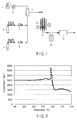
- FIG. 1 shows a device for analyzing the carbon monoxide reduction capability of an organic acid transition metal salt.
- the iron salt of the organic acid of Example 1 containing iron in the amount shown in the Table 1 below was filled in a reaction tube 9 disposed in a heating furnace 8.
- Carbon monoxide (CO) gas and carbon dioxide (CO 2 ) were supplied from gas cylinders 3 and 5 through mass flowmeters 4 and 6 respectively and water was weighed by an electronic balance 1 and supplied by a metering pump 2. The above water was made to flow through an evaporator 7 (200°C) together with the CO gas and CO 2 gas. The water was vaporized into water vapor.
- a model gas (CO concentration: 4 mol%, CO 2 concentration: 8 mol%, H 2 O concentration: 10 mol%, nitrogen: balance) was prepared in the evaporator 7.
- the flow rate of the model gas was set such that its space velocity (SV) was 500,000 h -1 and the model gas was made to flow through the layer of the iron salt of the organic acid filled in the reaction tube 9.
- the model gas was made to flow for 3.5 hours while heating the layer in the reaction tube 9 from 200 to 900°C.
- PG is a pressure gauge
- TIC is a temperature gauge used to measure the temperature of the tube wall of the reaction tube 9
- TI is a temperature gauge used to measure the temperature of the filled layer.
- the temperature measured by the temperature gauge TIC was used as a control monitor temperature when heating the reaction tube 9 by the furnace 8.
- the gas flowed out of the reaction tube 9 was made to flow through a cooling trap 10 and then, the carbon monoxide was quantitatively measured by an infrared gas analyzer 11 manufactured by Horiba Ltd. (VIA-510, according to the nondispersive infrared absorption method).
- the carbon monoxide removal rate was measured under the same conditions as in Example 1 except that an iron oxide (triiron tetraoxide) powder (manufactured by Sigma-Aldrich Corporation) was added in place of the organic acid iron salt.
- Table 1 Temp. °C Gas flow rate NL/h Space velocity h -1 Additive Filled additive amount a) CO oxidation amount b) % mmol-CO CO/Fe c) % CO removal rate d) (highest value) g-Fe Mmol-Fe % Temp.°C Ex.1 200 ⁇ 900 (temp.
- CO oxidation amount A value obtained by multiplying a difference (mol%) between the concentration of carbon monoxide in the model gas and the concentration of carbon monoxide in the gas discharged from the reaction tube by the flew rate (amount by mol per hour) of the model gas to integrate the obtained value with respect to time (3.5 hours).
- CO/Fe Co oxidation amount per mol of iron element a value obtained by multiplying a difference (mol%) between the concentration of carbon monoxide in the model gas and the concentration of carbon monoxide in the gas discharged from the reaction tube by the flew rate (amount by mol per hour) of the model gas to integrate the obtained value with respect to time (3.5 hours).
- CO/Fe Co oxidation amount per mol of iron element d
- the carbon monoxide reduction capability was investigated under the same conditions as in Example 1 except that organic acid copper salts or organic acid manganese salts were used in place of the organic acid iron salts.
- the results are shown in Tables 2 and 3.
- the organic acid transition metal salts ones manufactured by Wako Pure Chemical Industries, Ltd., were used.
- Table 2 Ex.2 Temp. °C Gas flow rate NL/h Space velocity h -1 Additive Filled additive amount a) CO oxidation amount b) mmol-CO CO/Cu c) % CO removal rate d) (highest value) g-Cu mmol-Cu % Temp.°C 200 ⁇ 900 (temp.
- CO oxidation amount A value obtained by multiplying a difference (mol%) between the concentration of carbon monoxide in the model gas and the concentration of carbon monoxide in the gas discharged from the reaction tube by the flow rate (amount by mol per hour) of the model gas to integrate the obtained value with respect to time (3.5 hours).
- CO/Fe Co oxidation amount per mol of copper element d) CO removal rate Conversion rate of CO into CO 2 .
- CO oxidation amount A value obtained by multiplying a difference (mol%) between the concentration of carbon monoxide in the model gas and the concentration of carbon monoxide in the gas discharged from the reaction tube by the flow rate (amount by mol per hour) of the model gas to integrate the obtained value with respect to time (3.5 hours).
- CO/Fe Co oxidation amount per mol of manganese element a value obtained by multiplying a difference (mol%) between the concentration of carbon monoxide in the model gas and the concentration of carbon monoxide in the gas discharged from the reaction tube by the flow rate (amount by mol per hour) of the model gas to integrate the obtained value with respect to time (3.5 hours).
- CO/Fe Co oxidation amount per mol of manganese element d
- the particle diameter of the iron fumarate particles is preferably 0.05 to 5 ⁇ m.
- iron fumarate was dispersed in 30 ml of the above-noted mixture solution of ethanol and lecithin to prepare a slurry. It was found that iron fumarate can be added to shredded tobacco by spraying the above slurry by an atomizer such that the amount of iron fumarate was 10% by weight based on the weight of the shredded tobacco.
Landscapes
- Health & Medical Sciences (AREA)
- General Health & Medical Sciences (AREA)
- Toxicology (AREA)
- Chemical & Material Sciences (AREA)
- Chemical Kinetics & Catalysis (AREA)
- General Chemical & Material Sciences (AREA)
- Cigarettes, Filters, And Manufacturing Of Filters (AREA)
- Manufacture Of Tobacco Products (AREA)
- Catalysts (AREA)
- Paper (AREA)
Abstract
Description
- The present invention relates to a cigarette and a method for treating a cigarette material.
- There have been proposed that, in order to remove carbon monoxide present in cigarette mainstream smoke, a noble metal catalyst or a transition metal oxide catalyst is added to shredded tobacco, a cigarette paper or a filter to convert carbon monoxide into carbon dioxide.
- For example,
Patent Literature 1 discloses that a catalyst made of Fe2O3 nano-particles is added to a tobacco cut filler. However, a complicated process is required to prepare the finely divided metal oxide nano-particles.Patent Literature 2 discloses that high-surface area carrier particles carrying nano-scale metal particles or metal oxide particles are added to a tobacco cut filler. However, in order to make high-surface area carrier particles that carry nano-scale metal particles or metal oxide particles, more complicated processes, for example, a process of deriving the high-surface area carrier particles from a colloidal solution, are required. -
Patent Literature 3 discloses that a metal oxyhydroxide is added to a cigarette paper, tobacco cut filler, filter or the like.Patent Literature 3 shows in Table 1 that the CO reduction rate when the metal oxyhydroxide is added is 29%. This is lower than the CO reduction rate of 33% obtained when a metal oxide and calcium carbonate are added from the start as shown in Table 1. -
- Patent Literature 1: Jpn. PCT National Publication No.
2005-522206 - Patent Literature 2: Jpn. PCT National Publication No.
2007-527698 - Patent Literature 3:
U.S. Patent Application Publication No. 2005/0155616 - It is an object of the present invention to provide a cigarette more reduced in carbon monoxide in mainstream smoke and a method for treating a cigarette material.
- According to a first aspect of the present invention, there is provided a cigarette, comprising a shredded tobacco rod and a cigarette paper that wraps the outer peripheral surface of the shredded tobacco rod, wherein the shredded tobacco and/or the cigarette paper contains a transition metal salt of an organic acid.
- According to a second aspect of the present invention, there is provided a method for treating a cigarette material, comprising treating shredded tobacco and/or cigarette paper with a transition metal salt of an organic acid.
- According to the present invention, carbon monoxide in cigarette mainstream smoke can be reduced significantly.
-
-
FIG. 1 is a block diagram of a device used to analyze the carbon monoxide reduction capability by using a model gas. -
FIG. 2 is a graph showing a heating temperature of a reaction tube filled with a transition metal salt of an organic acid and a concentration of carbon monoxide in the gas which has passed through the reaction tube. - The present invention will be explained in detail below.
- A cigarette according to the present invention comprises a shredded tobacco rod and a cigarette paper that wraps the outer peripheral surface of the rod.
- The shredded tobacco is cut or shredded tobacco material and may contain adequate additives. As the tobacco material, tobacco leaves or stem of Burley tobaccos, flue-cured tobaccos or orient tobaccos, fermented tobacco, dark cured tobaccos or reconstituted tobacco materials or their combinations may be used. Examples of the additives may include natural or synthetic flavors; polyhydric alcohols such as glycerol and propylene glycol; sugar alcohols such as erythritol, xylitol and sorbitol; and hyaluronic acid.
- The cigarette paper that wraps the shredded tobacco rod is itself a cigarette paper used in ordinary cigarettes. As the raw material of the cigarette paper, agricultural byproduct fibers such as bagasse, non-wood fibers such as bamboos and the like besides flax and wood may be used. Further, the cigarette paper may contain any one or more of aluminum hydroxide, aluminum sulfate, aluminum oxide, magnesium oxide, talc and titanium dioxide, and sodium, potassium, calcium or magnesium salts of carbonic acid, formic acid, acetic acid, malic acid, citric acid, tartaric acid, lactic acid or nitric acid as a white incineration agent and a burn adjusting agent.
- In the present invention, a transition metal salt of an organic acid is contained in the shredded tobacco and/or cigarette paper. As the organic acid, there may be exemplified, for example, fumaric acid, citric acid, oxalic acid, formic acid, benzoic acid, lactic acid and stearic acid. Among these acids, organic acids having a total of 2 to 7 carbon atoms are preferable, fumaric acid, citric acid and oxalic acid are more preferable and fumaric acid is particularly preferable.
- As the transition metal, at least one metal selected from the group consisting of Ti, Mn, Fe, Co, Ni, Cu, Y, Zr, Nb, Mo, Ru, Rh, Pd, Ag, Ce, Ir, Pt and Au may be used. Fe, Cu and Mn are preferable, and Fe is particularly preferable.
- It is considered that the organic acid transition metal salt added to the shredded tobacco and/or the cigarette paper is decomposed when tobacco is burned and converted into a transition metal oxide which exerts a catalytic action, leading to reduction in carbon monoxide in mainstream smoke. In other words, according to the present invention, a catalyst is automatically produced by the combustion heat of a tobacco. The organic acid transition metal salt functions as a precursor of the carbon monoxide reduction catalyst and produces the catalyst by burning of the cigarette.
- The above organic acid transition metal salt is preferably contained in an amount of 1 to 50% by weight based on shredded tobacco. When the amount is less than 1% by weight, the carbon monoxide reduction capability tends not to be exerted sufficiently. An amount exceeding 50% by weight makes it difficult to treat shredded tobacco and is therefore undesirable.
- When the organic acid transition metal salt is contained in the cigarette paper, the organic acid transition metal salt is preferably contained in an amount of 0.1 to 50 g/m2 in the cigarette paper. When the amount is less than 0.1 g/m2, the carbon monoxide reduction capability tends not to be exerted sufficiently. An amount exceeding 50 g/m2 makes it difficult to treat cigarette paper.
- When the organic acid transition metal salt is contained in the cigarette paper, it preferably has a particle diameter of 0.05 to 5 µm from the viewpoint of the smoothness of the cigarette paper and retainability in the cigarette paper.
- Further, the present invention relates to a method for treating a cigarette material, comprising treating shredded tobacco and/or cigarette paper with the above organic acid transition metal salt.
- The method for treating a cigarette material according to the present invention may be carried out, for example, by spreading a solution in which the above organic acid transition metal salt is dispersed in an organic solvent (which does not dissolve the organic acid transition metal salt) onto the shredded tobacco and/or the cigarette paper. As the organic solvent, any organic solvent may be used, and alcohols such as ethanol may be mentioned. An aqueous solvent dissolves the above organic acid transition metal salt, making it difficult to spread the salt in an amount exceeding the amount to be absorbed in the cigarette paper. When the organic acid transition metal salt is dispersed in an organic solvent, it is more preferable to further add an emulsifier to use it in a slurry state. The emulsifier may be a known one which is used as a food additive, for example, lecithin. The emulsifier may be used in an amount of 1 to 50% of the weight of the organic acid transition metal salt. When the amount is less than 1%, only insufficient dispersing effect is developed, whereas when the amount exceeds 50%, this is a hindrance to the decomposition of the organic acid transition metal salt.
- Moreover, the organic acid transition metal salt may be kneaded into the shredded tobacco or may be coated to the cigarette paper. Moreover, the organic acid transition metal salt may be furnished in the papermaking of cigarette paper.
- As mentioned above, the method for treating a cigarette material of the present invention is such a very simple method that a cigarette material (shredded tobacco and/or cigarette paper) is treated with the organic acid transition metal salt. As will be explained later, such a simple method can more reduce carbon monoxide in mainstream smoke than an iron oxide nano-powder which is conventionally regarded as an excellent material.
- Using a model gas, the carbon monoxide reduction capabilities of various transition metal salts of organic acids added to the cigarette of the present invention were investigated. Iron was used as the transition metal in Example 1.
- As the iron salt of an organic acid salt, iron citrate manufactured by Nacalai Tesque, Inc., and other iron salts of organic acids manufactured by Wako Pure Chemical Industries, Ltd. were used. As the iron salt of the organic acid, particles which passed through a 75 µm screen diameter were used.
-
FIG. 1 shows a device for analyzing the carbon monoxide reduction capability of an organic acid transition metal salt. The iron salt of the organic acid of Example 1 containing iron in the amount shown in the Table 1 below was filled in areaction tube 9 disposed in aheating furnace 8. Carbon monoxide (CO) gas and carbon dioxide (CO2) were supplied fromgas cylinders mass flowmeters electronic balance 1 and supplied by ametering pump 2. The above water was made to flow through an evaporator 7 (200°C) together with the CO gas and CO2 gas. The water was vaporized into water vapor. Thus, a model gas (CO concentration: 4 mol%, CO2 concentration: 8 mol%, H2O concentration: 10 mol%, nitrogen: balance) was prepared in theevaporator 7. The flow rate of the model gas was set such that its space velocity (SV) was 500,000 h-1 and the model gas was made to flow through the layer of the iron salt of the organic acid filled in thereaction tube 9. The model gas was made to flow for 3.5 hours while heating the layer in thereaction tube 9 from 200 to 900°C. InFIG. 1 , PG is a pressure gauge, TIC is a temperature gauge used to measure the temperature of the tube wall of thereaction tube 9 and TI is a temperature gauge used to measure the temperature of the filled layer. The temperature measured by the temperature gauge TIC was used as a control monitor temperature when heating thereaction tube 9 by thefurnace 8. The gas flowed out of thereaction tube 9 was made to flow through acooling trap 10 and then, the carbon monoxide was quantitatively measured by aninfrared gas analyzer 11 manufactured by Horiba Ltd. (VIA-510, according to the nondispersive infrared absorption method). - The carbon monoxide oxidation amount of each organic acid iron salt, carbon monoxide oxidation amount of each organic acid iron salt per mol of an iron element and carbon monoxide removal rate of each organic acid iron salt were measured. The results are shown in Table 1. In the Table, the organic acid iron salt is indicated as "Additive".
- The carbon monoxide removal rate was measured under the same conditions as in Example 1 except that an iron oxide (triiron tetraoxide) powder (manufactured by Sigma-Aldrich Corporation) was added in place of the organic acid iron salt. The results are shown in Table 1.
Table 1 Temp. °C Gas flow rate NL/h Space velocity h-1 Additive Filled additive amount a) CO oxidation amount b) % mmol-CO CO/Fe c) % CO removal rate d) (highest value) g-Fe Mmol-Fe % Temp.°C Ex.1 200→900 (temp. increase) 100 500,000 Iron (II) oxalate 0.23 69.97 53.90 77.0 27.7 634 Iron (II) fumarate 0.27 86.90 88.06 101.3 51.9 673 Iron (II) citrate 0.16 35.35 25.23 71.4 27.2 668 Iron (II) lactate 0.12 23.03 19.47 84.5 19.9 648 Iron (II) stearate 0.05 4.39 0.91 20.7 4.6 646 Comp. Ex.1 200→900 (temp. increase) 100 500.000 Iron oxide powder (triiron tetraoxide) 0.15 108.54 81.56 75.1 37.2 668 a) Filled additive amount Mass or mol of iron contained in the organic acid iron filled as an additives.
b) CO oxidation amount A value obtained by multiplying a difference (mol%) between the concentration of carbon monoxide in the model gas and the concentration of carbon monoxide in the gas discharged from the reaction tube by the flew rate (amount by mol per hour) of the model gas to integrate the obtained value with respect to time (3.5 hours).
c) CO/Fe Co oxidation amount per mol of iron element.
d) CO removal rate Conversion rate of CO into CO2. - The carbon monoxide reduction capability was investigated under the same conditions as in Example 1 except that organic acid copper salts or organic acid manganese salts were used in place of the organic acid iron salts. The results are shown in Tables 2 and 3. In these Examples, as the organic acid transition metal salts, ones manufactured by Wako Pure Chemical Industries, Ltd., were used.
Table 2 Ex.2 Temp. °C Gas flow rate NL/h Space velocity h-1 Additive Filled additive amount a) CO oxidation amount b) mmol-CO CO/Cu c) % CO removal rate d) (highest value) g-Cu mmol-Cu % Temp.° C 200→ 900 (temp. increase) 100 500,000 Copper (II) oxalate 0.28 108.83 18.70 17.2 14.4 460 Copper (II) tartarate 0.17 47.04 10.68 22.7 15.5 619 Copper (II) citrate 0.22 38.81 0.28 0.7 0.1 742 Copper (II) phthalate 0.15 41.87 5.19 12.4 17.2 645 a) Filled additive amount Mass or mol of copper contained in the organic acid iron filled as an additive.
b) CO oxidation amount A value obtained by multiplying a difference (mol%) between the concentration of carbon monoxide in the model gas and the concentration of carbon monoxide in the gas discharged from the reaction tube by the flow rate (amount by mol per hour) of the model gas to integrate the obtained value with respect to time (3.5 hours).
c) CO/Fe Co oxidation amount per mol of copper element
d) CO removal rate Conversion rate of CO into CO2.Table 3 Ex.3 Temp. °C Gas flow rate NL/h Space velocity h-1 Additive Filled additive amount a) CO oxidation amount b) mmol-CO CO/Mn c) % CO removal rate d) (highest value) g-Mn mmol-Mn % Temp.° C 200→ 900 (temp. increase) 100 500,000 Manganese (II) oxalate 0.22 67.53 11.08 16.4 9.3 858 Manganese (II) formate 0.20 60.71 16.23 26.7 10.9 754 Manganese (II) benzoate 0.17 25.29 5.21 20.6 2.7 765 a) Filled additive amount Mass or mol of manganese contained in the organic acid iron filled as an additive.
b) CO oxidation amount A value obtained by multiplying a difference (mol%) between the concentration of carbon monoxide in the model gas and the concentration of carbon monoxide in the gas discharged from the reaction tube by the flow rate (amount by mol per hour) of the model gas to integrate the obtained value with respect to time (3.5 hours).
c) CO/Fe Co oxidation amount per mol of manganese element.
d) CO removal rate Conversion rate of CO into CO2. - As is clear from Tables 1 to 3, it was found that carbon monoxide was oxidized. It was found from the results of Examples 1 to 3 that excellent carbon monoxide reduction capability was developed when iron was used as the transition metal. The CO oxidation amount per mol of an iron element in Example 1 was equal to or more than that in Comparative Example 1 though the number of moles of an iron element contained in the additives of Example 1 was smaller than that contained in the conventional iron oxide catalyst of Comparative Example 1. When iron fumarate was used in particular, it was found that it was superior to Comparative Example 1 in all of the carbon monoxide oxidation amount, carbon monoxide oxidation amount per mol of an iron element and carbon monoxide removal rate. Further, it was found that because the carbon monoxide removal rate and the like were largely deteriorated when iron stearate was used, it was preferable to use, as the organic acid, one having a total of about 2 to 7 carbon atoms.
- 145 g of iron fumarate as an organic acid transition metal salt and 15 g of flax pulp (manufactured by Rinsel Company) were dispersed in 2000 g of a mixture solution of ethanol and lecithin (weight ratio of ethanol : lecithin = 90 : 0.5) to prepare a slurry. This slurry was cast into a sheet form, or made to flow on a manual paper making tool having a 16-mesh stainless wire gauge superposed on a 200-mesh stainless wire gauge to manufacture cigarette paper having a basis weight of 50 g/m2.
- Here, it was found that if the particle diameter of iron fumarate was too large, the smoothness of the cigarette paper was deteriorated and iron fumarate particles were not uniformly dispersed, whereas if the particle diameter was too small, the iron fumarate particles passed through the manual paper making tool, so that the iron fumarate particles could not be carried on the cigarette paper. The particle diameter of the iron fumarate particles is preferably 0.05 to 5 µm.
- Further, iron fumarate was dispersed in 30 ml of the above-noted mixture solution of ethanol and lecithin to prepare a slurry. It was found that iron fumarate can be added to shredded tobacco by spraying the above slurry by an atomizer such that the amount of iron fumarate was 10% by weight based on the weight of the shredded tobacco.
- In this Example, the action mechanism of the organic acid transition metal salt will be discussed.
- 100 mg of shredded tobacco (2R4F) was mixed with 10 mg of iron fumarate and the mixture was filled in a sample tube. This sample tube was set to a catalyst analyzer (BELCAT, manufactured by BEL Japan, Inc.). A model gas (CO: 3.39 mol%, O2: 2.19 mol%, He: balance) was made to flow through the sample tube and heated to raise its temperature at a rate of 40°C/minute from 200 to 800°C to measure the concentration of CO. The results are shown in
FIG. 2 . As is clear fromFIG. 2 , it was found that after the shredded tobacco was oxidized/burned at about 600°C with temporary increase in carbon monoxide, carbon monoxide tended to decrease. This allows to infer that the heat treatment of iron fumarate at a temperature close to 600°C caused iron fumarate to be decomposed into iron oxide, which functioned as a catalyst.
Claims (10)
- A cigarette comprising a shredded tobacco rod and a cigarette paper that wraps the outer peripheral surface of the shredded tobacco rod, wherein the shredded tobacco and/or the cigarette paper contains a transition metal salt of an organic acid.
- The cigarette according to Claim 1, wherein the organic acid is fumaric acid, citric acid, oxalic acid, formic acid, benzoic acid, or lactic acid.
- The cigarette according to Claim 1, wherein the transition metal is at least one metal selected from the group consisting of Ti, Mn, Fe, Co, Ni, Cu, Y, Zr, Nb, Mo, Ru, Rh, Pd, Ag, Ce, Ir, Pt and Au.
- The cigarette according to Claim 1, wherein the transition metal salt of the organic acid is contained in an amount of 1 to 50% by weight in the shredded tobacco.
- The cigarette according to Claim 1, wherein the transition metal salt of the organic acid is contained in an amount of 0.1 to 50 g/m2 in the cigarette paper.
- A method for treating a cigarette material, comprising treating shredded tobacco and/or cigarette paper with a transition metal salt of an organic acid.
- The method according to Claim 6, wherein the organic acid is fumaric acid, citric acid, oxalic acid, formic acid, benzoic acid, or lactic acid.
- The method according to Claim 6, wherein the transition metal is at least one metal selected from the group consisting of Ti, Mn, Fe, Co, Ni, Cu, Y, Zr, Nb, Mo, Ru, Rh, Pd, Ag, Ce, Ir, Pt and Au.
- The method according to Claim 6, wherein a solution in which the transition metal salt of the organic acid dispersed in an organic solvent is spread onto the shredded tobacco and/or the cigarette paper.
- The method according to Claim 9, wherein the solution further contains an emulsifier.
Applications Claiming Priority (2)
| Application Number | Priority Date | Filing Date | Title |
|---|---|---|---|
| JP2009091209 | 2009-04-03 | ||
| PCT/JP2010/056020 WO2010114095A1 (en) | 2009-04-03 | 2010-04-01 | Cigarette and method for processing cigarette materials |
Publications (3)
| Publication Number | Publication Date |
|---|---|
| EP2415362A1 true EP2415362A1 (en) | 2012-02-08 |
| EP2415362A4 EP2415362A4 (en) | 2014-07-09 |
| EP2415362B1 EP2415362B1 (en) | 2016-09-14 |
Family
ID=42828384
Family Applications (1)
| Application Number | Title | Priority Date | Filing Date |
|---|---|---|---|
| EP10758866.7A Not-in-force EP2415362B1 (en) | 2009-04-03 | 2010-04-01 | Cigarette and method for treating cigarette material |
Country Status (6)
| Country | Link |
|---|---|
| US (1) | US20120024303A1 (en) |
| EP (1) | EP2415362B1 (en) |
| JP (1) | JP5250694B2 (en) |
| ES (1) | ES2593112T3 (en) |
| TW (1) | TW201043155A (en) |
| WO (1) | WO2010114095A1 (en) |
Cited By (1)
| Publication number | Priority date | Publication date | Assignee | Title |
|---|---|---|---|---|
| CN109577093A (en) * | 2018-10-29 | 2019-04-05 | 王景硕 | One kind is resistance to tear puckery fragrant cigarette paper |
Families Citing this family (12)
| Publication number | Priority date | Publication date | Assignee | Title |
|---|---|---|---|---|
| CN103564634B (en) * | 2013-11-26 | 2016-11-09 | 福建中烟工业有限责任公司 | A kind of method of reducing cigarette tar and reducing flavouring and the burnt flavouring cigarette of a kind of fall |
| CN106028845A (en) * | 2013-12-11 | 2016-10-12 | 施韦特-莫迪国际公司 | Wraps for smoking articles |
| JP7039562B2 (en) * | 2016-08-17 | 2022-03-22 | フィリップ・モーリス・プロダクツ・ソシエテ・アノニム | Aerosol-generating articles with new tobacco substrates |
| TW201936068A (en) * | 2018-02-26 | 2019-09-16 | 英商奈路迪亞有限公司 | A substitute smoking consumable |
| WO2019193894A1 (en) * | 2018-04-04 | 2019-10-10 | 日本たばこ産業株式会社 | Oral tobacco product, method for manufacturing packaging material for oral tobacco product, and method for manufacturing oral tobacco product |
| WO2020157935A1 (en) * | 2019-01-31 | 2020-08-06 | 日本たばこ産業株式会社 | Flavor generating segment, and flavor generating article and flavor suction system comprising same |
| US11311044B2 (en) | 2020-01-17 | 2022-04-26 | Good Tree International, Inc. | Hollow leaf tube with flavor capsule |
| US11700879B2 (en) | 2021-02-26 | 2023-07-18 | Good Tree International, Inc. | Smoking accessory with filter and filter having a flavor capsule |
| US11969008B2 (en) | 2021-03-24 | 2024-04-30 | Good Tree International, Inc. | Filters and elongated members formed of palm paper and having a flavor capsule |
| US11744281B2 (en) | 2021-03-24 | 2023-09-05 | Good Tree International, Inc. | Hollow conical member with flavor capsule |
| US12167747B2 (en) | 2021-10-26 | 2024-12-17 | Good Tree International, Inc. | Filter having a shaped rim structure and a flavor capsule |
| CN119699634B (en) * | 2024-12-02 | 2025-12-05 | 河南中烟工业有限责任公司 | A method for preparing tobacco essential oil and its application |
Family Cites Families (18)
| Publication number | Priority date | Publication date | Assignee | Title |
|---|---|---|---|---|
| GB1070437A (en) * | 1965-06-29 | 1967-06-01 | Martin Seldeen | Tobacco product |
| US3612063A (en) * | 1969-08-18 | 1971-10-12 | Sutton Res Corp | Oxidized cellulose smoking product |
| US4317460A (en) * | 1978-01-20 | 1982-03-02 | Gallaher Limited | Smoking products |
| US4605639A (en) * | 1985-07-17 | 1986-08-12 | Air Products And Chemicals, Inc. | Methods for making a supported iron-copper catalyst |
| US5112793A (en) * | 1990-08-15 | 1992-05-12 | The B. F. Goodrich Company | Catalyst composition for the preparation of ethylene from ethane |
| DE4244712C2 (en) * | 1992-02-14 | 1996-09-05 | Degussa | Coating dispersion for the production of coatings promoting an alkaline, structure-strengthening body |
| US5370139A (en) * | 1993-10-14 | 1994-12-06 | R. J. Reynolds Tobacco Company | Tobacco treatment process |
| JPH0986928A (en) * | 1994-10-04 | 1997-03-31 | Nissan Motor Co Ltd | A-site deficient perovskite composite oxide and catalyst using the same |
| JP3706422B2 (en) * | 1995-11-21 | 2005-10-12 | ダイセル化学工業株式会社 | Tobacco element and manufacturing method thereof |
| GB9605116D0 (en) * | 1996-03-07 | 1996-05-08 | British American Tobacco Co | Smokable filler material for smoking articles |
| US6769437B2 (en) * | 2002-04-08 | 2004-08-03 | Philip Morris Incorporated | Use of oxyhydroxide compounds for reducing carbon monoxide in the mainstream smoke of a cigarette |
| JP4388379B2 (en) | 2002-04-12 | 2009-12-24 | フィリップ・モーリス・プロダクツ・ソシエテ・アノニム | Partially reduced nanoparticle additives for reducing the amount of carbon monoxide and / or nitric oxide in cigarette mainstream smoke |
| US9107452B2 (en) | 2003-06-13 | 2015-08-18 | Philip Morris Usa Inc. | Catalyst to reduce carbon monoxide in the mainstream smoke of a cigarette |
| US20050005947A1 (en) * | 2003-07-11 | 2005-01-13 | Schweitzer-Mauduit International, Inc. | Smoking articles having reduced carbon monoxide delivery |
| TW200520698A (en) * | 2003-09-15 | 2005-07-01 | Rothmans Benson & Hedges | Treatment of mainstream smoke constituents by use of oxygen storage and donor metal oxide oxidation catalyst |
| US8701681B2 (en) | 2003-10-27 | 2014-04-22 | Philip Morris Usa Inc. | Use of oxyhydroxide compounds in cigarette paper for reducing carbon monoxide in the mainstream smoke of a cigarette |
| US9255361B2 (en) * | 2006-03-31 | 2016-02-09 | Philip Morris Usa Inc. | In situ formation of catalytic cigarette paper |
| JP2008173629A (en) * | 2006-12-20 | 2008-07-31 | Showa Denko Kk | Catalyst for acyloxylation reaction and its manufacturing method |
-
2010
- 2010-04-01 WO PCT/JP2010/056020 patent/WO2010114095A1/en not_active Ceased
- 2010-04-01 ES ES10758866.7T patent/ES2593112T3/en active Active
- 2010-04-01 EP EP10758866.7A patent/EP2415362B1/en not_active Not-in-force
- 2010-04-01 JP JP2011507290A patent/JP5250694B2/en active Active
- 2010-04-02 TW TW099110293A patent/TW201043155A/en unknown
-
2011
- 2011-09-30 US US13/250,117 patent/US20120024303A1/en not_active Abandoned
Cited By (1)
| Publication number | Priority date | Publication date | Assignee | Title |
|---|---|---|---|---|
| CN109577093A (en) * | 2018-10-29 | 2019-04-05 | 王景硕 | One kind is resistance to tear puckery fragrant cigarette paper |
Also Published As
| Publication number | Publication date |
|---|---|
| TW201043155A (en) | 2010-12-16 |
| ES2593112T3 (en) | 2016-12-05 |
| JPWO2010114095A1 (en) | 2012-10-11 |
| US20120024303A1 (en) | 2012-02-02 |
| EP2415362B1 (en) | 2016-09-14 |
| JP5250694B2 (en) | 2013-07-31 |
| WO2010114095A1 (en) | 2010-10-07 |
| EP2415362A4 (en) | 2014-07-09 |
Similar Documents
| Publication | Publication Date | Title |
|---|---|---|
| EP2415362B1 (en) | Cigarette and method for treating cigarette material | |
| DE602004009682T2 (en) | CATALYST FOR LOWERING CARBON MONOXIDE CONTENT IN THE MAIN POWER OF A CIGARETTE | |
| JP3936333B2 (en) | Oxidizer / catalyst nanoparticles for reducing carbon monoxide in cigarette mainstream smoke | |
| US6782892B2 (en) | Manganese oxide mixtures in nanoparticle form to lower the amount of carbon monoxide and/or nitric oxide in the mainstream smoke of a cigarette | |
| EP1494549B1 (en) | Use of oxyhydroxide compounds for reducing carbon monoxide in the mainstream smoke of a cigarette | |
| EP2077731B1 (en) | Cigarette components having encapsulated catalyst particles and methods of making and use thereof | |
| US8101540B2 (en) | Catalysts for low temperature oxidation of carbon monoxide | |
| CN1649519A (en) | Partially reduced nanoparticle additives to lower the amount of carbon monoxide and/or nitric oxide in the mainstream smoke of a cigarette | |
| JPWO2010053132A1 (en) | Smoking article, method for producing the same, and method for producing carbon monoxide reducing agent | |
| CN101596015B (en) | Additive for reducing cigarette smoke carbon monoxide (CO) and preparation method and application thereof | |
| US7856992B2 (en) | Tobacco catalyst and methods for reducing the amount of undesirable small molecules in tobacco smoke | |
| CN101611927B (en) | Catalyst capable of reducing carbon monoxide content in cigarette smoke, preparation method and application of same | |
| US7744846B2 (en) | Method for forming activated copper oxide catalysts | |
| EP2415519A1 (en) | Carbon monooxide-reducing catalyst for smoking article, and process for producing same | |
| CN106376970A (en) | Additive for reducing harmful substances in mainstream smoke of cigarette as well as preparation method and application thereof | |
| MX2008008857A (en) | Cigarette components having encapsulated catalyst particles and methods of making and use thereof | |
| HK1126937B (en) | Cigarette components having encapsulated catalyst particles and methods of making and use thereof |
Legal Events
| Date | Code | Title | Description |
|---|---|---|---|
| PUAI | Public reference made under article 153(3) epc to a published international application that has entered the european phase |
Free format text: ORIGINAL CODE: 0009012 |
|
| 17P | Request for examination filed |
Effective date: 20110930 |
|
| AK | Designated contracting states |
Kind code of ref document: A1 Designated state(s): AT BE BG CH CY CZ DE DK EE ES FI FR GB GR HR HU IE IS IT LI LT LU LV MC MK MT NL NO PL PT RO SE SI SK SM TR |
|
| DAX | Request for extension of the european patent (deleted) | ||
| A4 | Supplementary search report drawn up and despatched |
Effective date: 20140605 |
|
| RIC1 | Information provided on ipc code assigned before grant |
Ipc: A24B 15/28 20060101AFI20140530BHEP Ipc: A24B 15/30 20060101ALI20140530BHEP Ipc: A24D 1/02 20060101ALI20140530BHEP |
|
| 17Q | First examination report despatched |
Effective date: 20150928 |
|
| GRAP | Despatch of communication of intention to grant a patent |
Free format text: ORIGINAL CODE: EPIDOSNIGR1 |
|
| INTG | Intention to grant announced |
Effective date: 20160420 |
|
| GRAS | Grant fee paid |
Free format text: ORIGINAL CODE: EPIDOSNIGR3 |
|
| GRAA | (expected) grant |
Free format text: ORIGINAL CODE: 0009210 |
|
| AK | Designated contracting states |
Kind code of ref document: B1 Designated state(s): AT BE BG CH CY CZ DE DK EE ES FI FR GB GR HR HU IE IS IT LI LT LU LV MC MK MT NL NO PL PT RO SE SI SK SM TR |
|
| REG | Reference to a national code |
Ref country code: GB Ref legal event code: FG4D |
|
| REG | Reference to a national code |
Ref country code: CH Ref legal event code: EP |
|
| REG | Reference to a national code |
Ref country code: CH Ref legal event code: NV Representative=s name: NOVAGRAAF INTERNATIONAL SA, CH |
|
| REG | Reference to a national code |
Ref country code: IE Ref legal event code: FG4D |
|
| REG | Reference to a national code |
Ref country code: AT Ref legal event code: REF Ref document number: 827915 Country of ref document: AT Kind code of ref document: T Effective date: 20161015 |
|
| REG | Reference to a national code |
Ref country code: DE Ref legal event code: R096 Ref document number: 602010036428 Country of ref document: DE |
|
| REG | Reference to a national code |
Ref country code: ES Ref legal event code: FG2A Ref document number: 2593112 Country of ref document: ES Kind code of ref document: T3 Effective date: 20161205 |
|
| REG | Reference to a national code |
Ref country code: LT Ref legal event code: MG4D |
|
| REG | Reference to a national code |
Ref country code: NL Ref legal event code: MP Effective date: 20160914 |
|
| PG25 | Lapsed in a contracting state [announced via postgrant information from national office to epo] |
Ref country code: FI Free format text: LAPSE BECAUSE OF FAILURE TO SUBMIT A TRANSLATION OF THE DESCRIPTION OR TO PAY THE FEE WITHIN THE PRESCRIBED TIME-LIMIT Effective date: 20160914 Ref country code: LT Free format text: LAPSE BECAUSE OF FAILURE TO SUBMIT A TRANSLATION OF THE DESCRIPTION OR TO PAY THE FEE WITHIN THE PRESCRIBED TIME-LIMIT Effective date: 20160914 Ref country code: NO Free format text: LAPSE BECAUSE OF FAILURE TO SUBMIT A TRANSLATION OF THE DESCRIPTION OR TO PAY THE FEE WITHIN THE PRESCRIBED TIME-LIMIT Effective date: 20161214 Ref country code: HR Free format text: LAPSE BECAUSE OF FAILURE TO SUBMIT A TRANSLATION OF THE DESCRIPTION OR TO PAY THE FEE WITHIN THE PRESCRIBED TIME-LIMIT Effective date: 20160914 |
|
| REG | Reference to a national code |
Ref country code: FR Ref legal event code: PLFP Year of fee payment: 8 |
|
| REG | Reference to a national code |
Ref country code: AT Ref legal event code: MK05 Ref document number: 827915 Country of ref document: AT Kind code of ref document: T Effective date: 20160914 |
|
| PG25 | Lapsed in a contracting state [announced via postgrant information from national office to epo] |
Ref country code: NL Free format text: LAPSE BECAUSE OF FAILURE TO SUBMIT A TRANSLATION OF THE DESCRIPTION OR TO PAY THE FEE WITHIN THE PRESCRIBED TIME-LIMIT Effective date: 20160914 Ref country code: SE Free format text: LAPSE BECAUSE OF FAILURE TO SUBMIT A TRANSLATION OF THE DESCRIPTION OR TO PAY THE FEE WITHIN THE PRESCRIBED TIME-LIMIT Effective date: 20160914 Ref country code: GR Free format text: LAPSE BECAUSE OF FAILURE TO SUBMIT A TRANSLATION OF THE DESCRIPTION OR TO PAY THE FEE WITHIN THE PRESCRIBED TIME-LIMIT Effective date: 20161215 Ref country code: LV Free format text: LAPSE BECAUSE OF FAILURE TO SUBMIT A TRANSLATION OF THE DESCRIPTION OR TO PAY THE FEE WITHIN THE PRESCRIBED TIME-LIMIT Effective date: 20160914 |
|
| PG25 | Lapsed in a contracting state [announced via postgrant information from national office to epo] |
Ref country code: EE Free format text: LAPSE BECAUSE OF FAILURE TO SUBMIT A TRANSLATION OF THE DESCRIPTION OR TO PAY THE FEE WITHIN THE PRESCRIBED TIME-LIMIT Effective date: 20160914 Ref country code: RO Free format text: LAPSE BECAUSE OF FAILURE TO SUBMIT A TRANSLATION OF THE DESCRIPTION OR TO PAY THE FEE WITHIN THE PRESCRIBED TIME-LIMIT Effective date: 20160914 |
|
| PG25 | Lapsed in a contracting state [announced via postgrant information from national office to epo] |
Ref country code: BE Free format text: LAPSE BECAUSE OF FAILURE TO SUBMIT A TRANSLATION OF THE DESCRIPTION OR TO PAY THE FEE WITHIN THE PRESCRIBED TIME-LIMIT Effective date: 20160914 Ref country code: SK Free format text: LAPSE BECAUSE OF FAILURE TO SUBMIT A TRANSLATION OF THE DESCRIPTION OR TO PAY THE FEE WITHIN THE PRESCRIBED TIME-LIMIT Effective date: 20160914 Ref country code: BG Free format text: LAPSE BECAUSE OF FAILURE TO SUBMIT A TRANSLATION OF THE DESCRIPTION OR TO PAY THE FEE WITHIN THE PRESCRIBED TIME-LIMIT Effective date: 20161214 Ref country code: AT Free format text: LAPSE BECAUSE OF FAILURE TO SUBMIT A TRANSLATION OF THE DESCRIPTION OR TO PAY THE FEE WITHIN THE PRESCRIBED TIME-LIMIT Effective date: 20160914 Ref country code: CZ Free format text: LAPSE BECAUSE OF FAILURE TO SUBMIT A TRANSLATION OF THE DESCRIPTION OR TO PAY THE FEE WITHIN THE PRESCRIBED TIME-LIMIT Effective date: 20160914 Ref country code: PT Free format text: LAPSE BECAUSE OF FAILURE TO SUBMIT A TRANSLATION OF THE DESCRIPTION OR TO PAY THE FEE WITHIN THE PRESCRIBED TIME-LIMIT Effective date: 20170116 Ref country code: IS Free format text: LAPSE BECAUSE OF FAILURE TO SUBMIT A TRANSLATION OF THE DESCRIPTION OR TO PAY THE FEE WITHIN THE PRESCRIBED TIME-LIMIT Effective date: 20170114 Ref country code: SM Free format text: LAPSE BECAUSE OF FAILURE TO SUBMIT A TRANSLATION OF THE DESCRIPTION OR TO PAY THE FEE WITHIN THE PRESCRIBED TIME-LIMIT Effective date: 20160914 Ref country code: PL Free format text: LAPSE BECAUSE OF FAILURE TO SUBMIT A TRANSLATION OF THE DESCRIPTION OR TO PAY THE FEE WITHIN THE PRESCRIBED TIME-LIMIT Effective date: 20160914 |
|
| REG | Reference to a national code |
Ref country code: DE Ref legal event code: R097 Ref document number: 602010036428 Country of ref document: DE |
|
| PG25 | Lapsed in a contracting state [announced via postgrant information from national office to epo] |
Ref country code: IT Free format text: LAPSE BECAUSE OF FAILURE TO SUBMIT A TRANSLATION OF THE DESCRIPTION OR TO PAY THE FEE WITHIN THE PRESCRIBED TIME-LIMIT Effective date: 20160914 |
|
| PLBE | No opposition filed within time limit |
Free format text: ORIGINAL CODE: 0009261 |
|
| STAA | Information on the status of an ep patent application or granted ep patent |
Free format text: STATUS: NO OPPOSITION FILED WITHIN TIME LIMIT |
|
| PG25 | Lapsed in a contracting state [announced via postgrant information from national office to epo] |
Ref country code: DK Free format text: LAPSE BECAUSE OF FAILURE TO SUBMIT A TRANSLATION OF THE DESCRIPTION OR TO PAY THE FEE WITHIN THE PRESCRIBED TIME-LIMIT Effective date: 20160914 |
|
| 26N | No opposition filed |
Effective date: 20170615 |
|
| PG25 | Lapsed in a contracting state [announced via postgrant information from national office to epo] |
Ref country code: SI Free format text: LAPSE BECAUSE OF FAILURE TO SUBMIT A TRANSLATION OF THE DESCRIPTION OR TO PAY THE FEE WITHIN THE PRESCRIBED TIME-LIMIT Effective date: 20160914 |
|
| REG | Reference to a national code |
Ref country code: IE Ref legal event code: MM4A |
|
| PG25 | Lapsed in a contracting state [announced via postgrant information from national office to epo] |
Ref country code: MC Free format text: LAPSE BECAUSE OF FAILURE TO SUBMIT A TRANSLATION OF THE DESCRIPTION OR TO PAY THE FEE WITHIN THE PRESCRIBED TIME-LIMIT Effective date: 20160914 |
|
| REG | Reference to a national code |
Ref country code: FR Ref legal event code: PLFP Year of fee payment: 9 |
|
| PG25 | Lapsed in a contracting state [announced via postgrant information from national office to epo] |
Ref country code: LU Free format text: LAPSE BECAUSE OF NON-PAYMENT OF DUE FEES Effective date: 20170401 |
|
| PG25 | Lapsed in a contracting state [announced via postgrant information from national office to epo] |
Ref country code: IE Free format text: LAPSE BECAUSE OF NON-PAYMENT OF DUE FEES Effective date: 20170401 |
|
| PG25 | Lapsed in a contracting state [announced via postgrant information from national office to epo] |
Ref country code: MT Free format text: LAPSE BECAUSE OF NON-PAYMENT OF DUE FEES Effective date: 20170401 |
|
| PGFP | Annual fee paid to national office [announced via postgrant information from national office to epo] |
Ref country code: GB Payment date: 20190327 Year of fee payment: 10 |
|
| PGFP | Annual fee paid to national office [announced via postgrant information from national office to epo] |
Ref country code: FR Payment date: 20190213 Year of fee payment: 10 |
|
| PG25 | Lapsed in a contracting state [announced via postgrant information from national office to epo] |
Ref country code: HU Free format text: LAPSE BECAUSE OF FAILURE TO SUBMIT A TRANSLATION OF THE DESCRIPTION OR TO PAY THE FEE WITHIN THE PRESCRIBED TIME-LIMIT; INVALID AB INITIO Effective date: 20100401 |
|
| PGFP | Annual fee paid to national office [announced via postgrant information from national office to epo] |
Ref country code: ES Payment date: 20190506 Year of fee payment: 10 Ref country code: DE Payment date: 20190430 Year of fee payment: 10 |
|
| PGFP | Annual fee paid to national office [announced via postgrant information from national office to epo] |
Ref country code: CH Payment date: 20190430 Year of fee payment: 10 |
|
| PG25 | Lapsed in a contracting state [announced via postgrant information from national office to epo] |
Ref country code: CY Free format text: LAPSE BECAUSE OF NON-PAYMENT OF DUE FEES Effective date: 20160914 |
|
| PG25 | Lapsed in a contracting state [announced via postgrant information from national office to epo] |
Ref country code: MK Free format text: LAPSE BECAUSE OF FAILURE TO SUBMIT A TRANSLATION OF THE DESCRIPTION OR TO PAY THE FEE WITHIN THE PRESCRIBED TIME-LIMIT Effective date: 20160914 |
|
| PG25 | Lapsed in a contracting state [announced via postgrant information from national office to epo] |
Ref country code: TR Free format text: LAPSE BECAUSE OF FAILURE TO SUBMIT A TRANSLATION OF THE DESCRIPTION OR TO PAY THE FEE WITHIN THE PRESCRIBED TIME-LIMIT Effective date: 20160914 |
|
| REG | Reference to a national code |
Ref country code: DE Ref legal event code: R119 Ref document number: 602010036428 Country of ref document: DE |
|
| REG | Reference to a national code |
Ref country code: CH Ref legal event code: PL |
|
| PG25 | Lapsed in a contracting state [announced via postgrant information from national office to epo] |
Ref country code: DE Free format text: LAPSE BECAUSE OF NON-PAYMENT OF DUE FEES Effective date: 20201103 Ref country code: CH Free format text: LAPSE BECAUSE OF NON-PAYMENT OF DUE FEES Effective date: 20200430 Ref country code: LI Free format text: LAPSE BECAUSE OF NON-PAYMENT OF DUE FEES Effective date: 20200430 Ref country code: FR Free format text: LAPSE BECAUSE OF NON-PAYMENT OF DUE FEES Effective date: 20200430 |
|
| GBPC | Gb: european patent ceased through non-payment of renewal fee |
Effective date: 20200401 |
|
| PG25 | Lapsed in a contracting state [announced via postgrant information from national office to epo] |
Ref country code: GB Free format text: LAPSE BECAUSE OF NON-PAYMENT OF DUE FEES Effective date: 20200401 |
|
| REG | Reference to a national code |
Ref country code: ES Ref legal event code: FD2A Effective date: 20210826 |
|
| PG25 | Lapsed in a contracting state [announced via postgrant information from national office to epo] |
Ref country code: ES Free format text: LAPSE BECAUSE OF NON-PAYMENT OF DUE FEES Effective date: 20200402 |