EP2415357A1 - Food product with flavour encapsulate - Google Patents
Food product with flavour encapsulate Download PDFInfo
- Publication number
- EP2415357A1 EP2415357A1 EP10171579A EP10171579A EP2415357A1 EP 2415357 A1 EP2415357 A1 EP 2415357A1 EP 10171579 A EP10171579 A EP 10171579A EP 10171579 A EP10171579 A EP 10171579A EP 2415357 A1 EP2415357 A1 EP 2415357A1
- Authority
- EP
- European Patent Office
- Prior art keywords
- flavour
- food product
- core
- encapsulate
- water
- Prior art date
- Legal status (The legal status is an assumption and is not a legal conclusion. Google has not performed a legal analysis and makes no representation as to the accuracy of the status listed.)
- Withdrawn
Links
- 239000000796 flavoring agent Substances 0.000 title claims abstract description 227
- 235000019634 flavors Nutrition 0.000 title claims abstract description 214
- 235000013305 food Nutrition 0.000 title claims abstract description 94
- 238000000576 coating method Methods 0.000 claims abstract description 102
- 239000011248 coating agent Substances 0.000 claims abstract description 96
- XLYOFNOQVPJJNP-UHFFFAOYSA-N water Substances O XLYOFNOQVPJJNP-UHFFFAOYSA-N 0.000 claims abstract description 68
- 239000011159 matrix material Substances 0.000 claims abstract description 59
- 239000000203 mixture Substances 0.000 claims abstract description 47
- 230000009477 glass transition Effects 0.000 claims abstract description 12
- 239000002245 particle Substances 0.000 claims abstract description 12
- 238000000034 method Methods 0.000 claims description 18
- 239000012141 concentrate Substances 0.000 claims description 14
- 235000021487 ready-to-eat food Nutrition 0.000 claims description 14
- 239000001913 cellulose Substances 0.000 claims description 13
- 235000010980 cellulose Nutrition 0.000 claims description 13
- 229920002678 cellulose Polymers 0.000 claims description 13
- 230000003111 delayed effect Effects 0.000 claims description 13
- 235000000346 sugar Nutrition 0.000 claims description 11
- 239000001856 Ethyl cellulose Substances 0.000 claims description 10
- ZZSNKZQZMQGXPY-UHFFFAOYSA-N Ethyl cellulose Chemical compound CCOCC1OC(OC)C(OCC)C(OCC)C1OC1C(O)C(O)C(OC)C(CO)O1 ZZSNKZQZMQGXPY-UHFFFAOYSA-N 0.000 claims description 10
- 229920002472 Starch Polymers 0.000 claims description 10
- 235000019325 ethyl cellulose Nutrition 0.000 claims description 10
- 229920001249 ethyl cellulose Polymers 0.000 claims description 10
- 238000002360 preparation method Methods 0.000 claims description 10
- 235000019698 starch Nutrition 0.000 claims description 10
- 235000013882 gravy Nutrition 0.000 claims description 9
- 238000010438 heat treatment Methods 0.000 claims description 9
- 235000013372 meat Nutrition 0.000 claims description 9
- 235000014347 soups Nutrition 0.000 claims description 9
- 229920000609 methyl cellulose Polymers 0.000 claims description 8
- 235000010981 methylcellulose Nutrition 0.000 claims description 8
- 239000001923 methylcellulose Substances 0.000 claims description 8
- 229920000881 Modified starch Polymers 0.000 claims description 7
- 235000014448 bouillon/stock cubes Nutrition 0.000 claims description 7
- 229920000159 gelatin Polymers 0.000 claims description 7
- 235000019322 gelatine Nutrition 0.000 claims description 7
- 235000019426 modified starch Nutrition 0.000 claims description 7
- 235000011194 food seasoning agent Nutrition 0.000 claims description 6
- 150000002632 lipids Chemical class 0.000 claims description 6
- 235000021056 liquid food Nutrition 0.000 claims description 6
- 235000015067 sauces Nutrition 0.000 claims description 6
- 239000008107 starch Substances 0.000 claims description 6
- 239000001828 Gelatine Substances 0.000 claims description 5
- 150000008163 sugars Chemical class 0.000 claims description 5
- FHVDTGUDJYJELY-UHFFFAOYSA-N 6-{[2-carboxy-4,5-dihydroxy-6-(phosphanyloxy)oxan-3-yl]oxy}-4,5-dihydroxy-3-phosphanyloxane-2-carboxylic acid Chemical compound O1C(C(O)=O)C(P)C(O)C(O)C1OC1C(C(O)=O)OC(OP)C(O)C1O FHVDTGUDJYJELY-UHFFFAOYSA-N 0.000 claims description 4
- 229920001817 Agar Polymers 0.000 claims description 4
- 102000011632 Caseins Human genes 0.000 claims description 4
- 108010076119 Caseins Proteins 0.000 claims description 4
- 102000008186 Collagen Human genes 0.000 claims description 4
- 108010035532 Collagen Proteins 0.000 claims description 4
- 108010068370 Glutens Proteins 0.000 claims description 4
- 229920002907 Guar gum Polymers 0.000 claims description 4
- 108010073771 Soybean Proteins Proteins 0.000 claims description 4
- 102000007544 Whey Proteins Human genes 0.000 claims description 4
- 108010046377 Whey Proteins Proteins 0.000 claims description 4
- 235000010419 agar Nutrition 0.000 claims description 4
- 229940072056 alginate Drugs 0.000 claims description 4
- 235000010443 alginic acid Nutrition 0.000 claims description 4
- 229920000615 alginic acid Polymers 0.000 claims description 4
- 239000005018 casein Substances 0.000 claims description 4
- BECPQYXYKAMYBN-UHFFFAOYSA-N casein, tech. Chemical compound NCCCCC(C(O)=O)N=C(O)C(CC(O)=O)N=C(O)C(CCC(O)=N)N=C(O)C(CC(C)C)N=C(O)C(CCC(O)=O)N=C(O)C(CC(O)=O)N=C(O)C(CCC(O)=O)N=C(O)C(C(C)O)N=C(O)C(CCC(O)=N)N=C(O)C(CCC(O)=N)N=C(O)C(CCC(O)=N)N=C(O)C(CCC(O)=O)N=C(O)C(CCC(O)=O)N=C(O)C(COP(O)(O)=O)N=C(O)C(CCC(O)=N)N=C(O)C(N)CC1=CC=CC=C1 BECPQYXYKAMYBN-UHFFFAOYSA-N 0.000 claims description 4
- 235000021240 caseins Nutrition 0.000 claims description 4
- 229920001436 collagen Polymers 0.000 claims description 4
- 235000021312 gluten Nutrition 0.000 claims description 4
- 235000010417 guar gum Nutrition 0.000 claims description 4
- 239000000665 guar gum Substances 0.000 claims description 4
- 229960002154 guar gum Drugs 0.000 claims description 4
- 235000010987 pectin Nutrition 0.000 claims description 4
- 229920001277 pectin Polymers 0.000 claims description 4
- 239000001814 pectin Substances 0.000 claims description 4
- 235000018102 proteins Nutrition 0.000 claims description 4
- 102000004169 proteins and genes Human genes 0.000 claims description 4
- 108090000623 proteins and genes Proteins 0.000 claims description 4
- 229940001941 soy protein Drugs 0.000 claims description 4
- 235000021119 whey protein Nutrition 0.000 claims description 4
- 229920001285 xanthan gum Polymers 0.000 claims description 4
- 229920002148 Gellan gum Polymers 0.000 claims description 3
- 229920002153 Hydroxypropyl cellulose Polymers 0.000 claims description 3
- 229920000168 Microcrystalline cellulose Polymers 0.000 claims description 3
- 229920001800 Shellac Polymers 0.000 claims description 3
- 229920002494 Zein Polymers 0.000 claims description 3
- 239000008272 agar Substances 0.000 claims description 3
- 235000010492 gellan gum Nutrition 0.000 claims description 3
- 239000000216 gellan gum Substances 0.000 claims description 3
- 235000010977 hydroxypropyl cellulose Nutrition 0.000 claims description 3
- 239000001863 hydroxypropyl cellulose Substances 0.000 claims description 3
- 229940071676 hydroxypropylcellulose Drugs 0.000 claims description 3
- 235000019813 microcrystalline cellulose Nutrition 0.000 claims description 3
- 239000008108 microcrystalline cellulose Substances 0.000 claims description 3
- 229940016286 microcrystalline cellulose Drugs 0.000 claims description 3
- 238000002156 mixing Methods 0.000 claims description 3
- 239000004208 shellac Substances 0.000 claims description 3
- 235000013874 shellac Nutrition 0.000 claims description 3
- ZLGIYFNHBLSMPS-ATJNOEHPSA-N shellac Chemical compound OCCCCCC(O)C(O)CCCCCCCC(O)=O.C1C23[C@H](C(O)=O)CCC2[C@](C)(CO)[C@@H]1C(C(O)=O)=C[C@@H]3O ZLGIYFNHBLSMPS-ATJNOEHPSA-N 0.000 claims description 3
- 229940113147 shellac Drugs 0.000 claims description 3
- 239000005019 zein Substances 0.000 claims description 3
- 229940093612 zein Drugs 0.000 claims description 3
- PTHCMJGKKRQCBF-UHFFFAOYSA-N Cellulose, microcrystalline Chemical compound OC1C(O)C(OC)OC(CO)C1OC1C(O)C(O)C(OC)C(CO)O1 PTHCMJGKKRQCBF-UHFFFAOYSA-N 0.000 claims description 2
- 108010010803 Gelatin Proteins 0.000 claims description 2
- 239000008273 gelatin Substances 0.000 claims description 2
- 235000011852 gelatine desserts Nutrition 0.000 claims description 2
- 229960002900 methylcellulose Drugs 0.000 claims description 2
- 235000010676 Ocimum basilicum Nutrition 0.000 description 42
- 240000007926 Ocimum gratissimum Species 0.000 description 42
- 239000000463 material Substances 0.000 description 26
- 235000012054 meals Nutrition 0.000 description 25
- 238000010411 cooking Methods 0.000 description 24
- 240000002234 Allium sativum Species 0.000 description 19
- 235000004611 garlic Nutrition 0.000 description 19
- 239000000499 gel Substances 0.000 description 17
- 239000003925 fat Substances 0.000 description 16
- 150000001875 compounds Chemical class 0.000 description 14
- 238000004519 manufacturing process Methods 0.000 description 14
- LFQSCWFLJHTTHZ-UHFFFAOYSA-N Ethanol Chemical compound CCO LFQSCWFLJHTTHZ-UHFFFAOYSA-N 0.000 description 12
- 238000001184 proton transfer reaction mass spectrometry Methods 0.000 description 12
- 239000001993 wax Substances 0.000 description 12
- 240000007594 Oryza sativa Species 0.000 description 11
- 235000007164 Oryza sativa Nutrition 0.000 description 11
- 235000008504 concentrate Nutrition 0.000 description 11
- 235000009566 rice Nutrition 0.000 description 11
- 241001122767 Theaceae Species 0.000 description 10
- 239000008187 granular material Substances 0.000 description 10
- PEDCQBHIVMGVHV-UHFFFAOYSA-N Glycerine Chemical compound OCC(O)CO PEDCQBHIVMGVHV-UHFFFAOYSA-N 0.000 description 9
- 235000013361 beverage Nutrition 0.000 description 9
- 235000010979 hydroxypropyl methyl cellulose Nutrition 0.000 description 9
- 239000001866 hydroxypropyl methyl cellulose Substances 0.000 description 9
- 229920003088 hydroxypropyl methyl cellulose Polymers 0.000 description 9
- 235000011197 perejil Nutrition 0.000 description 9
- 239000000243 solution Substances 0.000 description 9
- 238000011156 evaluation Methods 0.000 description 8
- 238000001125 extrusion Methods 0.000 description 8
- UFVKGYZPFZQRLF-UHFFFAOYSA-N hydroxypropyl methyl cellulose Chemical compound OC1C(O)C(OC)OC(CO)C1OC1C(O)C(O)C(OC2C(C(O)C(OC3C(C(O)C(O)C(CO)O3)O)C(CO)O2)O)C(CO)O1 UFVKGYZPFZQRLF-UHFFFAOYSA-N 0.000 description 8
- 150000003505 terpenes Chemical class 0.000 description 8
- 235000007586 terpenes Nutrition 0.000 description 8
- 241000208317 Petroselinum Species 0.000 description 7
- VYPSYNLAJGMNEJ-UHFFFAOYSA-N Silicium dioxide Chemical compound O=[Si]=O VYPSYNLAJGMNEJ-UHFFFAOYSA-N 0.000 description 7
- 239000004615 ingredient Substances 0.000 description 7
- 230000002441 reversible effect Effects 0.000 description 7
- 244000046052 Phaseolus vulgaris Species 0.000 description 6
- 235000010627 Phaseolus vulgaris Nutrition 0.000 description 6
- 239000012530 fluid Substances 0.000 description 6
- 239000000155 melt Substances 0.000 description 6
- 229920001282 polysaccharide Polymers 0.000 description 6
- 239000005017 polysaccharide Substances 0.000 description 6
- 229920002774 Maltodextrin Polymers 0.000 description 5
- 239000007864 aqueous solution Substances 0.000 description 5
- 238000009835 boiling Methods 0.000 description 5
- 238000005516 engineering process Methods 0.000 description 5
- 238000001704 evaporation Methods 0.000 description 5
- 230000008020 evaporation Effects 0.000 description 5
- 230000008447 perception Effects 0.000 description 5
- 238000003860 storage Methods 0.000 description 5
- JGMPRNFEEAJLAJ-UHFFFAOYSA-N 3-methylsulfanyldisulfanylprop-1-ene Chemical compound CSSSCC=C JGMPRNFEEAJLAJ-UHFFFAOYSA-N 0.000 description 4
- SRBFZHDQGSBBOR-IOVATXLUSA-N D-xylopyranose Chemical compound O[C@@H]1COC(O)[C@H](O)[C@H]1O SRBFZHDQGSBBOR-IOVATXLUSA-N 0.000 description 4
- WQZGKKKJIJFFOK-GASJEMHNSA-N Glucose Natural products OC[C@H]1OC(O)[C@H](O)[C@@H](O)[C@@H]1O WQZGKKKJIJFFOK-GASJEMHNSA-N 0.000 description 4
- KFZMGEQAYNKOFK-UHFFFAOYSA-N Isopropanol Chemical compound CC(C)O KFZMGEQAYNKOFK-UHFFFAOYSA-N 0.000 description 4
- 239000005913 Maltodextrin Substances 0.000 description 4
- PYMYPHUHKUWMLA-UHFFFAOYSA-N arabinose Natural products OCC(O)C(O)C(O)C=O PYMYPHUHKUWMLA-UHFFFAOYSA-N 0.000 description 4
- SRBFZHDQGSBBOR-UHFFFAOYSA-N beta-D-Pyranose-Lyxose Natural products OC1COC(O)C(O)C1O SRBFZHDQGSBBOR-UHFFFAOYSA-N 0.000 description 4
- WQZGKKKJIJFFOK-VFUOTHLCSA-N beta-D-glucose Chemical compound OC[C@H]1O[C@@H](O)[C@H](O)[C@@H](O)[C@@H]1O WQZGKKKJIJFFOK-VFUOTHLCSA-N 0.000 description 4
- 238000001816 cooling Methods 0.000 description 4
- 239000003995 emulsifying agent Substances 0.000 description 4
- 238000005538 encapsulation Methods 0.000 description 4
- 150000004676 glycans Chemical class 0.000 description 4
- 229920000591 gum Polymers 0.000 description 4
- 229940035034 maltodextrin Drugs 0.000 description 4
- 235000015927 pasta Nutrition 0.000 description 4
- 238000007493 shaping process Methods 0.000 description 4
- 239000000126 substance Substances 0.000 description 4
- FBPFZTCFMRRESA-JGWLITMVSA-N D-glucitol Chemical compound OC[C@H](O)[C@@H](O)[C@H](O)[C@H](O)CO FBPFZTCFMRRESA-JGWLITMVSA-N 0.000 description 3
- OKKJLVBELUTLKV-UHFFFAOYSA-N Methanol Chemical compound OC OKKJLVBELUTLKV-UHFFFAOYSA-N 0.000 description 3
- KRKNYBCHXYNGOX-UHFFFAOYSA-N citric acid Chemical compound OC(=O)CC(O)(C(O)=O)CC(O)=O KRKNYBCHXYNGOX-UHFFFAOYSA-N 0.000 description 3
- 230000000052 comparative effect Effects 0.000 description 3
- 235000014113 dietary fatty acids Nutrition 0.000 description 3
- 239000008393 encapsulating agent Substances 0.000 description 3
- 238000013265 extended release Methods 0.000 description 3
- 239000000194 fatty acid Substances 0.000 description 3
- 229930195729 fatty acid Natural products 0.000 description 3
- 239000000017 hydrogel Substances 0.000 description 3
- 230000002209 hydrophobic effect Effects 0.000 description 3
- 235000014666 liquid concentrate Nutrition 0.000 description 3
- 235000015090 marinades Nutrition 0.000 description 3
- 239000003921 oil Substances 0.000 description 3
- 235000019198 oils Nutrition 0.000 description 3
- 239000000843 powder Substances 0.000 description 3
- 239000000377 silicon dioxide Substances 0.000 description 3
- 235000012239 silicon dioxide Nutrition 0.000 description 3
- 239000002904 solvent Substances 0.000 description 3
- 230000008961 swelling Effects 0.000 description 3
- 235000010493 xanthan gum Nutrition 0.000 description 3
- 239000000230 xanthan gum Substances 0.000 description 3
- 229940082509 xanthan gum Drugs 0.000 description 3
- HDTRYLNUVZCQOY-UHFFFAOYSA-N α-D-glucopyranosyl-α-D-glucopyranoside Natural products OC1C(O)C(O)C(CO)OC1OC1C(O)C(O)C(O)C(CO)O1 HDTRYLNUVZCQOY-UHFFFAOYSA-N 0.000 description 2
- SERLAGPUMNYUCK-DCUALPFSSA-N 1-O-alpha-D-glucopyranosyl-D-mannitol Chemical compound OC[C@@H](O)[C@@H](O)[C@H](O)[C@H](O)CO[C@H]1O[C@H](CO)[C@@H](O)[C@H](O)[C@H]1O SERLAGPUMNYUCK-DCUALPFSSA-N 0.000 description 2
- OWEGMIWEEQEYGQ-UHFFFAOYSA-N 100676-05-9 Natural products OC1C(O)C(O)C(CO)OC1OCC1C(O)C(O)C(O)C(OC2C(OC(O)C(O)C2O)CO)O1 OWEGMIWEEQEYGQ-UHFFFAOYSA-N 0.000 description 2
- 244000215068 Acacia senegal Species 0.000 description 2
- 241000234282 Allium Species 0.000 description 2
- 235000002732 Allium cepa var. cepa Nutrition 0.000 description 2
- GUBGYTABKSRVRQ-XLOQQCSPSA-N Alpha-Lactose Chemical compound O[C@@H]1[C@@H](O)[C@@H](O)[C@@H](CO)O[C@H]1O[C@@H]1[C@@H](CO)O[C@H](O)[C@H](O)[C@H]1O GUBGYTABKSRVRQ-XLOQQCSPSA-N 0.000 description 2
- 241000416162 Astragalus gummifer Species 0.000 description 2
- 229920002134 Carboxymethyl cellulose Polymers 0.000 description 2
- FBPFZTCFMRRESA-FSIIMWSLSA-N D-Glucitol Natural products OC[C@H](O)[C@H](O)[C@@H](O)[C@H](O)CO FBPFZTCFMRRESA-FSIIMWSLSA-N 0.000 description 2
- FBPFZTCFMRRESA-KVTDHHQDSA-N D-Mannitol Chemical compound OC[C@@H](O)[C@@H](O)[C@H](O)[C@H](O)CO FBPFZTCFMRRESA-KVTDHHQDSA-N 0.000 description 2
- HMFHBZSHGGEWLO-SOOFDHNKSA-N D-ribofuranose Chemical compound OC[C@H]1OC(O)[C@H](O)[C@@H]1O HMFHBZSHGGEWLO-SOOFDHNKSA-N 0.000 description 2
- 229920002307 Dextran Polymers 0.000 description 2
- 241000196324 Embryophyta Species 0.000 description 2
- 239000005715 Fructose Substances 0.000 description 2
- 229930091371 Fructose Natural products 0.000 description 2
- RFSUNEUAIZKAJO-ARQDHWQXSA-N Fructose Chemical compound OC[C@H]1O[C@](O)(CO)[C@@H](O)[C@@H]1O RFSUNEUAIZKAJO-ARQDHWQXSA-N 0.000 description 2
- 235000010469 Glycine max Nutrition 0.000 description 2
- 244000068988 Glycine max Species 0.000 description 2
- 229920000084 Gum arabic Polymers 0.000 description 2
- 229920000569 Gum karaya Polymers 0.000 description 2
- GUBGYTABKSRVRQ-QKKXKWKRSA-N Lactose Natural products OC[C@H]1O[C@@H](O[C@H]2[C@H](O)[C@@H](O)C(O)O[C@@H]2CO)[C@H](O)[C@@H](O)[C@H]1O GUBGYTABKSRVRQ-QKKXKWKRSA-N 0.000 description 2
- 229920000161 Locust bean gum Polymers 0.000 description 2
- 235000007688 Lycopersicon esculentum Nutrition 0.000 description 2
- GUBGYTABKSRVRQ-PICCSMPSSA-N Maltose Natural products O[C@@H]1[C@@H](O)[C@H](O)[C@@H](CO)O[C@@H]1O[C@@H]1[C@@H](CO)OC(O)[C@H](O)[C@H]1O GUBGYTABKSRVRQ-PICCSMPSSA-N 0.000 description 2
- 229930195725 Mannitol Natural products 0.000 description 2
- 229920003091 Methocel™ Polymers 0.000 description 2
- 240000009164 Petroselinum crispum Species 0.000 description 2
- 241001494501 Prosopis <angiosperm> Species 0.000 description 2
- 235000001560 Prosopis chilensis Nutrition 0.000 description 2
- 235000014460 Prosopis juliflora var juliflora Nutrition 0.000 description 2
- PYMYPHUHKUWMLA-LMVFSUKVSA-N Ribose Natural products OC[C@@H](O)[C@@H](O)[C@@H](O)C=O PYMYPHUHKUWMLA-LMVFSUKVSA-N 0.000 description 2
- FAPWRFPIFSIZLT-UHFFFAOYSA-M Sodium chloride Chemical compound [Na+].[Cl-] FAPWRFPIFSIZLT-UHFFFAOYSA-M 0.000 description 2
- 240000003768 Solanum lycopersicum Species 0.000 description 2
- CZMRCDWAGMRECN-UGDNZRGBSA-N Sucrose Chemical compound O[C@H]1[C@H](O)[C@@H](CO)O[C@@]1(CO)O[C@@H]1[C@H](O)[C@@H](O)[C@H](O)[C@@H](CO)O1 CZMRCDWAGMRECN-UGDNZRGBSA-N 0.000 description 2
- 229930006000 Sucrose Natural products 0.000 description 2
- GWEVSGVZZGPLCZ-UHFFFAOYSA-N Titan oxide Chemical compound O=[Ti]=O GWEVSGVZZGPLCZ-UHFFFAOYSA-N 0.000 description 2
- 229920001615 Tragacanth Polymers 0.000 description 2
- HDTRYLNUVZCQOY-WSWWMNSNSA-N Trehalose Natural products O[C@@H]1[C@@H](O)[C@@H](O)[C@@H](CO)O[C@@H]1O[C@@H]1[C@H](O)[C@@H](O)[C@@H](O)[C@@H](CO)O1 HDTRYLNUVZCQOY-WSWWMNSNSA-N 0.000 description 2
- TVXBFESIOXBWNM-UHFFFAOYSA-N Xylitol Natural products OCCC(O)C(O)C(O)CCO TVXBFESIOXBWNM-UHFFFAOYSA-N 0.000 description 2
- 240000008042 Zea mays Species 0.000 description 2
- 235000005824 Zea mays ssp. parviglumis Nutrition 0.000 description 2
- 235000002017 Zea mays subsp mays Nutrition 0.000 description 2
- 235000010489 acacia gum Nutrition 0.000 description 2
- 239000000205 acacia gum Substances 0.000 description 2
- HDTRYLNUVZCQOY-LIZSDCNHSA-N alpha,alpha-trehalose Chemical compound O[C@@H]1[C@@H](O)[C@H](O)[C@@H](CO)O[C@@H]1O[C@@H]1[C@H](O)[C@@H](O)[C@H](O)[C@@H](CO)O1 HDTRYLNUVZCQOY-LIZSDCNHSA-N 0.000 description 2
- HMFHBZSHGGEWLO-UHFFFAOYSA-N alpha-D-Furanose-Ribose Natural products OCC1OC(O)C(O)C1O HMFHBZSHGGEWLO-UHFFFAOYSA-N 0.000 description 2
- WQZGKKKJIJFFOK-PHYPRBDBSA-N alpha-D-galactose Chemical compound OC[C@H]1O[C@H](O)[C@H](O)[C@@H](O)[C@H]1O WQZGKKKJIJFFOK-PHYPRBDBSA-N 0.000 description 2
- PYMYPHUHKUWMLA-WDCZJNDASA-N arabinose Chemical compound OC[C@@H](O)[C@@H](O)[C@H](O)C=O PYMYPHUHKUWMLA-WDCZJNDASA-N 0.000 description 2
- GUBGYTABKSRVRQ-QUYVBRFLSA-N beta-maltose Chemical compound OC[C@H]1O[C@H](O[C@H]2[C@H](O)[C@@H](O)[C@H](O)O[C@@H]2CO)[C@H](O)[C@@H](O)[C@@H]1O GUBGYTABKSRVRQ-QUYVBRFLSA-N 0.000 description 2
- 230000015572 biosynthetic process Effects 0.000 description 2
- OSGAYBCDTDRGGQ-UHFFFAOYSA-L calcium sulfate Chemical compound [Ca+2].[O-]S([O-])(=O)=O OSGAYBCDTDRGGQ-UHFFFAOYSA-L 0.000 description 2
- 150000001720 carbohydrates Chemical class 0.000 description 2
- 235000005822 corn Nutrition 0.000 description 2
- 230000003247 decreasing effect Effects 0.000 description 2
- 239000008121 dextrose Substances 0.000 description 2
- 230000000694 effects Effects 0.000 description 2
- 210000000416 exudates and transudate Anatomy 0.000 description 2
- 150000004665 fatty acids Chemical class 0.000 description 2
- 239000000945 filler Substances 0.000 description 2
- 239000003205 fragrance Substances 0.000 description 2
- 235000013611 frozen food Nutrition 0.000 description 2
- 229930182830 galactose Natural products 0.000 description 2
- 239000008103 glucose Substances 0.000 description 2
- -1 hydroxyl propyl Chemical group 0.000 description 2
- 238000002347 injection Methods 0.000 description 2
- 239000007924 injection Substances 0.000 description 2
- 150000002500 ions Chemical class 0.000 description 2
- 239000000905 isomalt Substances 0.000 description 2
- 235000010439 isomalt Nutrition 0.000 description 2
- HPIGCVXMBGOWTF-UHFFFAOYSA-N isomaltol Natural products CC(=O)C=1OC=CC=1O HPIGCVXMBGOWTF-UHFFFAOYSA-N 0.000 description 2
- 235000010494 karaya gum Nutrition 0.000 description 2
- 239000000832 lactitol Substances 0.000 description 2
- 235000010448 lactitol Nutrition 0.000 description 2
- VQHSOMBJVWLPSR-JVCRWLNRSA-N lactitol Chemical compound OC[C@H](O)[C@@H](O)[C@@H]([C@H](O)CO)O[C@@H]1O[C@H](CO)[C@H](O)[C@H](O)[C@H]1O VQHSOMBJVWLPSR-JVCRWLNRSA-N 0.000 description 2
- 229960003451 lactitol Drugs 0.000 description 2
- 239000008101 lactose Substances 0.000 description 2
- 239000007788 liquid Substances 0.000 description 2
- 235000010420 locust bean gum Nutrition 0.000 description 2
- 239000000711 locust bean gum Substances 0.000 description 2
- 230000014759 maintenance of location Effects 0.000 description 2
- 239000000594 mannitol Substances 0.000 description 2
- 235000010355 mannitol Nutrition 0.000 description 2
- 229960001855 mannitol Drugs 0.000 description 2
- 238000005259 measurement Methods 0.000 description 2
- HEBKCHPVOIAQTA-UHFFFAOYSA-N meso ribitol Natural products OCC(O)C(O)C(O)CO HEBKCHPVOIAQTA-UHFFFAOYSA-N 0.000 description 2
- 230000000813 microbial effect Effects 0.000 description 2
- 239000003960 organic solvent Substances 0.000 description 2
- 150000002972 pentoses Chemical class 0.000 description 2
- 239000000419 plant extract Substances 0.000 description 2
- 230000002028 premature Effects 0.000 description 2
- 238000003825 pressing Methods 0.000 description 2
- 235000002639 sodium chloride Nutrition 0.000 description 2
- 239000000600 sorbitol Substances 0.000 description 2
- 229960002920 sorbitol Drugs 0.000 description 2
- 235000010356 sorbitol Nutrition 0.000 description 2
- 235000013599 spices Nutrition 0.000 description 2
- 239000005720 sucrose Substances 0.000 description 2
- 239000006188 syrup Substances 0.000 description 2
- 235000020357 syrup Nutrition 0.000 description 2
- 230000007704 transition Effects 0.000 description 2
- 239000000811 xylitol Substances 0.000 description 2
- 235000010447 xylitol Nutrition 0.000 description 2
- HEBKCHPVOIAQTA-SCDXWVJYSA-N xylitol Chemical compound OC[C@H](O)[C@@H](O)[C@H](O)CO HEBKCHPVOIAQTA-SCDXWVJYSA-N 0.000 description 2
- 229960002675 xylitol Drugs 0.000 description 2
- IIZPXYDJLKNOIY-JXPKJXOSSA-N 1-palmitoyl-2-arachidonoyl-sn-glycero-3-phosphocholine Chemical compound CCCCCCCCCCCCCCCC(=O)OC[C@H](COP([O-])(=O)OCC[N+](C)(C)C)OC(=O)CCC\C=C/C\C=C/C\C=C/C\C=C/CCCCC IIZPXYDJLKNOIY-JXPKJXOSSA-N 0.000 description 1
- 239000005995 Aluminium silicate Substances 0.000 description 1
- 235000002566 Capsicum Nutrition 0.000 description 1
- 229920000858 Cyclodextrin Polymers 0.000 description 1
- 239000004375 Dextrin Substances 0.000 description 1
- 229920001353 Dextrin Polymers 0.000 description 1
- 241000206672 Gelidium Species 0.000 description 1
- UFHFLCQGNIYNRP-UHFFFAOYSA-N Hydrogen Chemical compound [H][H] UFHFLCQGNIYNRP-UHFFFAOYSA-N 0.000 description 1
- 229920000663 Hydroxyethyl cellulose Polymers 0.000 description 1
- 239000006002 Pepper Substances 0.000 description 1
- 235000016761 Piper aduncum Nutrition 0.000 description 1
- 240000003889 Piper guineense Species 0.000 description 1
- 235000017804 Piper guineense Nutrition 0.000 description 1
- 235000008184 Piper nigrum Nutrition 0.000 description 1
- 239000002253 acid Substances 0.000 description 1
- 239000004480 active ingredient Substances 0.000 description 1
- 238000005054 agglomeration Methods 0.000 description 1
- 230000002776 aggregation Effects 0.000 description 1
- 150000001298 alcohols Chemical class 0.000 description 1
- PNEYBMLMFCGWSK-UHFFFAOYSA-N aluminium oxide Inorganic materials [O-2].[O-2].[O-2].[Al+3].[Al+3] PNEYBMLMFCGWSK-UHFFFAOYSA-N 0.000 description 1
- 235000012211 aluminium silicate Nutrition 0.000 description 1
- 239000003963 antioxidant agent Substances 0.000 description 1
- 239000012736 aqueous medium Substances 0.000 description 1
- 235000013871 bee wax Nutrition 0.000 description 1
- 239000012166 beeswax Substances 0.000 description 1
- 239000011230 binding agent Substances 0.000 description 1
- 230000009172 bursting Effects 0.000 description 1
- 239000001506 calcium phosphate Substances 0.000 description 1
- 229910000389 calcium phosphate Inorganic materials 0.000 description 1
- 235000011010 calcium phosphates Nutrition 0.000 description 1
- 239000001175 calcium sulphate Substances 0.000 description 1
- 235000011132 calcium sulphate Nutrition 0.000 description 1
- 239000002775 capsule Substances 0.000 description 1
- 239000004203 carnauba wax Substances 0.000 description 1
- 235000013869 carnauba wax Nutrition 0.000 description 1
- 229940082483 carnauba wax Drugs 0.000 description 1
- 235000010418 carrageenan Nutrition 0.000 description 1
- 239000000679 carrageenan Substances 0.000 description 1
- 229920001525 carrageenan Polymers 0.000 description 1
- 229940113118 carrageenan Drugs 0.000 description 1
- 239000000084 colloidal system Substances 0.000 description 1
- 238000010924 continuous production Methods 0.000 description 1
- 229940097362 cyclodextrins Drugs 0.000 description 1
- 230000006866 deterioration Effects 0.000 description 1
- 229960002086 dextran Drugs 0.000 description 1
- 235000019425 dextrin Nutrition 0.000 description 1
- GPLRAVKSCUXZTP-UHFFFAOYSA-N diglycerol Chemical class OCC(O)COCC(O)CO GPLRAVKSCUXZTP-UHFFFAOYSA-N 0.000 description 1
- 238000010790 dilution Methods 0.000 description 1
- 239000012895 dilution Substances 0.000 description 1
- 235000021186 dishes Nutrition 0.000 description 1
- 239000002612 dispersion medium Substances 0.000 description 1
- 238000001035 drying Methods 0.000 description 1
- 150000002148 esters Chemical class 0.000 description 1
- 235000010944 ethyl methyl cellulose Nutrition 0.000 description 1
- 239000001761 ethyl methyl cellulose Substances 0.000 description 1
- 230000003631 expected effect Effects 0.000 description 1
- 150000002191 fatty alcohols Chemical class 0.000 description 1
- 235000012041 food component Nutrition 0.000 description 1
- 235000013355 food flavoring agent Nutrition 0.000 description 1
- 239000005417 food ingredient Substances 0.000 description 1
- 239000012634 fragment Substances 0.000 description 1
- 239000008369 fruit flavor Substances 0.000 description 1
- 239000011521 glass Substances 0.000 description 1
- 125000005456 glyceride group Chemical group 0.000 description 1
- 235000008216 herbs Nutrition 0.000 description 1
- 239000001257 hydrogen Substances 0.000 description 1
- 229910052739 hydrogen Inorganic materials 0.000 description 1
- 239000008172 hydrogenated vegetable oil Substances 0.000 description 1
- 150000002433 hydrophilic molecules Chemical class 0.000 description 1
- 230000001788 irregular Effects 0.000 description 1
- NLYAJNPCOHFWQQ-UHFFFAOYSA-N kaolin Chemical compound O.O.O=[Al]O[Si](=O)O[Si](=O)O[Al]=O NLYAJNPCOHFWQQ-UHFFFAOYSA-N 0.000 description 1
- 235000010445 lecithin Nutrition 0.000 description 1
- 239000000787 lecithin Substances 0.000 description 1
- 229940067606 lecithin Drugs 0.000 description 1
- 239000000314 lubricant Substances 0.000 description 1
- 229940057917 medium chain triglycerides Drugs 0.000 description 1
- 230000002906 microbiologic effect Effects 0.000 description 1
- 239000004005 microsphere Substances 0.000 description 1
- 238000003801 milling Methods 0.000 description 1
- LPUQAYUQRXPFSQ-DFWYDOINSA-M monosodium L-glutamate Chemical compound [Na+].[O-]C(=O)[C@@H](N)CCC(O)=O LPUQAYUQRXPFSQ-DFWYDOINSA-M 0.000 description 1
- 235000013923 monosodium glutamate Nutrition 0.000 description 1
- 239000004223 monosodium glutamate Substances 0.000 description 1
- 230000003204 osmotic effect Effects 0.000 description 1
- 235000021485 packed food Nutrition 0.000 description 1
- 235000011837 pasties Nutrition 0.000 description 1
- 229920000223 polyglycerol Chemical class 0.000 description 1
- 229920000642 polymer Polymers 0.000 description 1
- 239000011148 porous material Substances 0.000 description 1
- 229920003124 powdered cellulose Polymers 0.000 description 1
- 235000019814 powdered cellulose Nutrition 0.000 description 1
- 239000003755 preservative agent Substances 0.000 description 1
- 238000012545 processing Methods 0.000 description 1
- 150000003839 salts Chemical class 0.000 description 1
- 230000035807 sensation Effects 0.000 description 1
- 235000019615 sensations Nutrition 0.000 description 1
- 239000011780 sodium chloride Substances 0.000 description 1
- GJBHGUUFMNITCI-QTNFYWBSSA-M sodium;(2s)-2-aminopentanedioate;hydron;hydrate Chemical compound O.[Na+].OC(=O)[C@@H](N)CCC([O-])=O GJBHGUUFMNITCI-QTNFYWBSSA-M 0.000 description 1
- 239000007921 spray Substances 0.000 description 1
- 239000003381 stabilizer Substances 0.000 description 1
- 230000002522 swelling effect Effects 0.000 description 1
- 239000000454 talc Substances 0.000 description 1
- 229910052623 talc Inorganic materials 0.000 description 1
- 235000012222 talc Nutrition 0.000 description 1
- 235000010491 tara gum Nutrition 0.000 description 1
- 239000000213 tara gum Substances 0.000 description 1
- 239000004408 titanium dioxide Substances 0.000 description 1
- QORWJWZARLRLPR-UHFFFAOYSA-H tricalcium bis(phosphate) Chemical compound [Ca+2].[Ca+2].[Ca+2].[O-]P([O-])([O-])=O.[O-]P([O-])([O-])=O QORWJWZARLRLPR-UHFFFAOYSA-H 0.000 description 1
- UFTFJSFQGQCHQW-UHFFFAOYSA-N triformin Chemical compound O=COCC(OC=O)COC=O UFTFJSFQGQCHQW-UHFFFAOYSA-N 0.000 description 1
- 235000015112 vegetable and seed oil Nutrition 0.000 description 1
- 239000008158 vegetable oil Substances 0.000 description 1
- 235000013311 vegetables Nutrition 0.000 description 1
- 210000005253 yeast cell Anatomy 0.000 description 1
- UHVMMEOXYDMDKI-JKYCWFKZSA-L zinc;1-(5-cyanopyridin-2-yl)-3-[(1s,2s)-2-(6-fluoro-2-hydroxy-3-propanoylphenyl)cyclopropyl]urea;diacetate Chemical compound [Zn+2].CC([O-])=O.CC([O-])=O.CCC(=O)C1=CC=C(F)C([C@H]2[C@H](C2)NC(=O)NC=2N=CC(=CC=2)C#N)=C1O UHVMMEOXYDMDKI-JKYCWFKZSA-L 0.000 description 1
Images



Classifications
-
- A—HUMAN NECESSITIES
- A23—FOODS OR FOODSTUFFS; TREATMENT THEREOF, NOT COVERED BY OTHER CLASSES
- A23L—FOODS, FOODSTUFFS OR NON-ALCOHOLIC BEVERAGES, NOT OTHERWISE PROVIDED FOR; PREPARATION OR TREATMENT THEREOF
- A23L23/00—Soups; Sauces; Preparation or treatment thereof
- A23L23/10—Soup concentrates, e.g. powders or cakes
-
- A—HUMAN NECESSITIES
- A23—FOODS OR FOODSTUFFS; TREATMENT THEREOF, NOT COVERED BY OTHER CLASSES
- A23L—FOODS, FOODSTUFFS OR NON-ALCOHOLIC BEVERAGES, NOT OTHERWISE PROVIDED FOR; PREPARATION OR TREATMENT THEREOF
- A23L23/00—Soups; Sauces; Preparation or treatment thereof
-
- A—HUMAN NECESSITIES
- A23—FOODS OR FOODSTUFFS; TREATMENT THEREOF, NOT COVERED BY OTHER CLASSES
- A23L—FOODS, FOODSTUFFS OR NON-ALCOHOLIC BEVERAGES, NOT OTHERWISE PROVIDED FOR; PREPARATION OR TREATMENT THEREOF
- A23L27/00—Spices; Flavouring agents or condiments; Artificial sweetening agents; Table salts; Dietetic salt substitutes; Preparation or treatment thereof
- A23L27/70—Fixation, conservation, or encapsulation of flavouring agents
-
- A—HUMAN NECESSITIES
- A23—FOODS OR FOODSTUFFS; TREATMENT THEREOF, NOT COVERED BY OTHER CLASSES
- A23P—SHAPING OR WORKING OF FOODSTUFFS, NOT FULLY COVERED BY A SINGLE OTHER SUBCLASS
- A23P20/00—Coating of foodstuffs; Coatings therefor; Making laminated, multi-layered, stuffed or hollow foodstuffs
- A23P20/10—Coating with edible coatings, e.g. with oils or fats
- A23P20/11—Coating with compositions containing a majority of oils, fats, mono/diglycerides, fatty acids, mineral oils, waxes or paraffins
-
- A—HUMAN NECESSITIES
- A23—FOODS OR FOODSTUFFS; TREATMENT THEREOF, NOT COVERED BY OTHER CLASSES
- A23P—SHAPING OR WORKING OF FOODSTUFFS, NOT FULLY COVERED BY A SINGLE OTHER SUBCLASS
- A23P30/00—Shaping or working of foodstuffs characterised by the process or apparatus
- A23P30/20—Extruding
Definitions
- the present invention relates to a food product comprising a flavour encapsulate.
- the consumer may flavour its dish during cooking by adding flavouring components, like cooking aids that provide a specific flavour and/or aroma or a mixture of desired flavours, i.e. taste and aroma components, to the dish.
- flavours added to the dish provided by either traditional spices or added flavour
- flavour disappears obviously, the dish may become less attractive.
- a food product which releases flavour during cooking and from which the flavour preferably slowly becomes available over an increased period of time during cooking or frying (so-called 'delayed' or 'extended release'), and not as a burst of flavour at the start of the cooking process or, in case the food product is a dry (e.g. concentrated) food product, immediately after addition of the food product to the dish, meat or water during cooking.
- the food product should preferably disintegrate, preferably be dissolvable in an aqueous environment.
- the food product should preferably provide good shelf life stability and the flavour in the food product should preferably be stable during production of the food product and storage of it.
- the prior art describes some flavouring agents, which however fail to meet the objectives of the present invention, when present in a food product.
- EP0852912 discloses a dry food base with encapsulated oil based flavour consisting of gum and/or lipid coating (0.05-0.5% (w/w)) around spray-dried granules which is effective for delaying the release of the flavour upon storage, but not upon cooking.
- WO00/16643 discloses a flavour capsule which has a coating consisting of a modified cellulose with a reversible gel formation when the temperature is increased. Due to the reversible gel, this product may release flavour prematurely in cold water, which may not be preferred when cooking is started with cold water. Furthermore, the majority of the flavour in the product has been released shortly upon addition during cooking.
- WO9818610 relates to a continuous process for producing particles with a release-rate controlled, hydrophobic component and a final moisture content of 8%. Both the encapsulants (active ingredients) and the encapsulates comprising the encapsulants may be coated. A relatively late release (with a so-called lag-time) of encapsulant that may show a 'late' burst in flavour profile may be achieved with a relatively thick coating of the particles.
- US2001/0021404 discloses an encapsulate which remain largely encapsulated in aqueous medium during a heat treatment and only dissolves during a subsequent cooling phase.
- This encapsulate has been coated with at least one layer of a fat or wax and also a layer of modified cellulose having reversible gel formation when the temperature is increased.
- flavour encapsulates comprising, based on the weight of the flavour encapsulates
- the invention further relates to a method to prepare a food product of the present invention comprising the step of combining a flavour encapsulate and a food product, wherein the flavour encapsulates comprises, based on the weight of the flavour encapsulates,
- the invention further relates to a method to produce a ready-to-eat food product, comprising the steps of:
- the invention further relates to a ready to eat food product obtainable by the method of the present invention.
- the food product of the present invention comprises encapsulates comprising from 99 wt.% to 50 wt.% of a melt-extruded core.
- the encapsulates comprise from 97 wt.% to 60 wt.%, more preferably of from 95 wt.% to 80 wt.% of a melt extruded core, based on the weight of the flavour encapsulates.
- Melt extrusion can for example be performed continuously and horizontally by a twin screw extruder in which a highly viscous melt of matrix materials is forced through the extruder die plate under high pressure.
- the extrudate is a strand which can be broken up in pieces immediately after the die with a rotating knife or by milling after cooling.
- Nedovi ⁇ (eds.), Encapsulation Technologies for Active Food Ingredients and Food Processing, New York: Springer, sections 5.3.5 and 5.3.6 for more information about melt extrusion and melt injection processes). Melt extrusion appeared to be essential, as this results in an encapsulate with the desired flavour release profile once coated. Without willing to be bound by theory, this result might be attributed to the smooth surfaces of the melt extruded core. For example, coating of conventional spray dried granulates, with or without agglomeration, is not desired for the present invention, as encapsulates prepared using this technique show rapid release of flavour in water.
- the melt-extruded core comprises from 99 wt.% to 40 wt.% of matrix material, preferably of from 95 wt.% to 80 wt.%, more preferably of from 90 wt.% to 70 wt.%, based on the weight of the core.
- the matrix material of the core comprises one of the group of matrix materials consisting of starches, starch derivatives, sugars, sugar derivatives, cellulose derivatives, proteins, lipids, gums, and mixtures thereof. More preferably, the matrix material of the core is selected from the group of matrix materials consisting of starches, starch derivatives, sugars, sugar derivatives, cellulose derivatives, proteins, lipids, gums, and mixtures thereof. Most preferably, the matrix material of the core comprises one of the group consisting of starches, starch derivatives, sugars and sugar derivatives and mixtures thereof.
- starch derivatives are selected from the group consisting of maltodextrins, modified starches, hydrogenated corn syrup, dextrins and mixtures thereof. More preferably, the starch derivative is a maltodextrin.
- sugars are selected from the group consisting of sucrose, glucose, lactose, fructose, maltose, ribose, dextrose, arabinose, pentose, xylose, galactose, trehalose and mixtures thereof.
- sugar derivatives are selected from the group consisting of isomalt, sorbitol, mannitol, xylitol, lactitol, malitol, pentatol and mixtures thereof.
- cellulose derivatives are selected from the group consisting of carboxymethyl cellulose (CMC), ethyl methylcellulose, hydropropyl methylcellulose (HPMC), hydroxyl ethylcellulose, hydroxy propyl cellulose, methyl cellulose, and mixtures thereof.
- CMC carboxymethyl cellulose
- HPMC hydropropyl methylcellulose
- hydroxyl ethylcellulose hydroxy propyl cellulose
- methyl cellulose and mixtures thereof.
- gums are selected from the group consisting of plant exudates and plant extracts; algae-polysaccharides; microbial polysaccharides; and mixtures thereof.
- Plant exudates and plant extracts are preferably selected from the group consisting of gum arabic, gum tragacanth, gum karaya, mesquite gum, locust bean gum, tara gum, guar gum, pectin, soluble soybean polysaccharide, and mixtures thereof.
- Algae-polysaccharides are preferably selected from the group of carrageenan, alginate, agar-agar, and mixtures thereof.
- Microbial polysaccharides are preferably selected from the group consisting of xanthan gum, gellan gum, dextran, and mixtures thereof.
- proteins are selected from the group consisting of gelatine, gluten, soy protein, whey protein, casein, collagen, and mixtures thereof.
- lipids are selected from the group consisting of fats, waxes, hydrogenated vegetable oils, lipid derivatives and mixtures thereof.
- the matrix material may further contain various optional ingredients such as are conventionally used in the art. These ingredients are preferably chosen from the group consisting of fillers, emulsifiers, preservatives, antioxidants, stabilizers, lubricants, and mixtures thereof. They may be each preferably present in an amount of e.g. from 0 to 10 wt.%, preferably from 1 to 5 wt.%, most preferably from 2 to 4 wt.% based on the weight of the matrix materials.
- Fillers may preferably include materials from the group consisting of silicon dioxide, titanium dioxide, alumina, talc, kaolin, powdered cellulose, microcrystalline cellulose, calcium phosphate, calcium sulphate, and mixtures thereof.
- emulsifiers include typically mono and diglycerol esters of fatty acids, polyglycerol esters, sorbitol esters, lecithin and mixtures thereof.
- these matrix materials of the core of the flavour encapsulate are present in a total amount of more than 50 wt.%, preferably of more than 70 wt.%, even more preferably more than 80 wt.%, even more preferably more than 90 wt.%, most preferably substantially 100wt.%, based on the weight of the matrix material, and can be present in an amount of from 50 to 100 wt. %, more preferably in an amount of from 70 wt.% to 95 wt.%, most preferably in an amount of from 80 wt.% to 90 wt.%, based on the weight of the matrix material.
- the majority of the matrix materials of the core is hydrophilic.
- a hydrophilic molecule or portion of a molecule is one that is typically charge-polarized and capable of hydrogen bonding.
- Hydrophilic material is preferably intended to mean that it is water-soluble or absorbs water and thereby preferably swells.
- Water-soluble' is preferably intended to mean that the core dissolves in water with a temperature of between 0°C and 100°C within 0 minutes and 1 hour.
- Coating of a preferably hydrophilic, water-soluble core with a water-insoluble coating according to the present invention results in an encapsulate that only slowly releases flavour in hot water of for example between 80°C and 100°C.
- flavour release is hard to control by coating, and that the skilled man would expect a rapid and complete loss of flavour when using a water-soluble core due to osmotic forces (See for example Ubbink, J., & Schoonman, A. (2003). Flavor delivery systems. In Kirk-Othmer Encyclopedia of Chemical Technology, on-line and fifth edition, volume 11. New York: Wiley-Interscience, p541 ).
- a hydrophilic core appeared to retain the flavour much better than a hydrophobic core.
- a hydrophobic core based on organically soluble cellulose forming a continuous phase with flavour compounds appeared to result in a flavour-loss of up to 90% during production, especially during a coating step of the encapsulate.
- the core of the flavour encapsulate comprises a hydrophilic, water-soluble matrix material.
- the core of the flavour encapsulate comprises preferably a hydrophilic, water-soluble matrix material in a total amount of more than 50 wt.%, preferably of more than 70 wt.%, even more preferably more than 80 wt.%, most preferably more than 90 wt.%, based on the weight of the matrix material, and can be present in an amount of from 50 to 100 wt.%, more preferably in an amount of from 70 to 95 wt.%, most preferably in an amount of from 80 to 90 wt.%, based on the weight of the matrix material.
- Preferred hydrophilic, water soluble matrix materials that can be used as matrix materials of the core in the present invention are starch, cellulose, sucrose, glucose, lactose, fructose, maltose, ribose, dextrose, isomalt, sorbitol, mannitol, xylitol, lactitol, malitol, pentatol, arabinose, pentose, xylose, galactose, trehalose, hydrogenated corn syrup, dextran, maltodextrin, alginate, gelatine, gluten, starch, agar, xanthan gum, gelan gum, pectin, gum arabic, guar gum, mesquite gum, gum karaya, gum tragacanth, methyl cellulose, carboxymethylcellulose (CMC), hydropropyl methylcellulose (HPMC), methyl cellulose, soluble soybean polysaccharide, soy protein, whey protein, casein
- the matrix material of the core may preferably comprise matrix material that has swelling properties, hereinafter called swellable matrix material.
- the swellable matrix material is preferably present in a total amount of between 1 wt.%, and 10 wt.%, more preferably of between 1 wt.% and 7 wt.% and most preferable of between 1 wt.% and 5 wt.% based on the weight of the matrix material, prior to uptake of water..
- Swellable matrix materials are expected to increase the release of flavour from the encapsulate, as the volume increase of the swelling material might contribute to the opening of the coated melt extrudate.
- the swellable material may be a hydrogel.
- a hydrogel is a colloidal gel in which the disperse phase (colloid) is a polymer and the disperse phase has combined with water as the dispersion medium or continuous phase to produce a viscous, jellylike network which is preferably elastic.
- the present invention may relate to a food product, wherein the swellable matrix material of the core of the flavour encapsulate comprises at least one of the group consisting of alginate, gelatine, gluten, starch, agar, xanthan gum, gellan gum, pectin, guar gum, hydropropyl methylcellulose (HPMC), hydroxyl propyl cellulose, methyl cellulose, microcrystalline cellulose, soy protein, whey protein, casein, collagen, gelatin and mixtures thereof.
- HPMC hydropropyl methylcellulose
- HPMC hydropropyl methylcellulose
- hydroxyl propyl cellulose hydroxyl propyl cellulose
- methyl cellulose methyl cellulose
- microcrystalline cellulose soy protein
- soy protein whey protein, casein, collagen, gelatin and mixtures thereof.
- the matrix material of the core is in an amorphous, glassy state, especially during the coating process, wherein the melt-extruded core is coated.
- Amorphous materials exhibit at least a rubbery, viscoelastic state and a glassy, brittle state.
- These two phases are separated by a so-called second-order phase transition, the glass-rubber transition, which is characterised by a so-called glass transition temperature. Below this temperature molecules may have little relative mobility similar to that of a crystalline phase. In contrast, molecules have a relatively high mobility at a temperature above the glass transition temperature when the material is in a rubbery state.
- Typical glass transition temperatures of melt-extrudates used in the art are between 30°C and 70°C.
- Typical coating temperatures used in the art are between 20°C and 50°C.
- the matrix material of the core is in a glassy state, especially during the coating process wherein the melt-extruded core is coated. Therefore, the matrix material of the core preferably has a glass transition temperature higher than 30°C, more preferably higher than 35°C, most preferably higher than 40°C.
- the glass transition temperature is lower than 70°C, preferably lower than 60°C.
- the water content of the core is preferably not too high.
- a too high water content results in an encapsulate wherein the flavouring is not kept in during the production process, especially not during a coating step of the production process.
- the water content of the core is lower than 8wt.%, based on the weight of the core.
- the water content is lower than 7 wt.%, more preferably the water content is lower than 6 wt.%, most preferably the water content is lower than 5 wt.%.
- the water content is between 0.5 and 8 wt.%, more preferably between 1 and 6 wt.%, most preferably between 2 and 4 wt.%.
- the core of the flavour encapsulate comprises from 1 wt.% to 60 wt.% of at least one flavour compound.
- the core comprises from 2 wt.% to 30 wt.%, more preferably from 5 wt.% to 15 wt.% of at least one flavour compound.
- Flavour compounds may be any type of flavour as used in the food industry.
- the flavour is one of the group consisting of garlic, basil, onion, parsley, fruit flavour and mixtures thereof.
- Flavour compounds traditionally show a relatively fast evaporation or deterioration during cooking of a food product, and the present invention provides a manner to keep these flavours available for an extended and delayed time during cooking.
- the flavour encapsulate which is present in the food product of the present invention comprises 1 to 50% of a coating.
- coating of a, preferably, hydrophilic core with a water-insoluble coating according to the present invention results in an encapsulate that releases flavour compounds in a gradual and delayed manner in hot water of for example between 80°C and 100°C.
- the encapsulate comprises a coating, which may be applied to the melt-extruded core by e.g. fluid bed coating, drum coating or pan coating, using for example a solvent solution, like an ethanol solution, comprising the coating material.
- the coating can be applied by for example using an Aeromatic-Fielder multiprocessor MP1 fluid bed from GEA Pharma Systems or suitable Wurster type fluid bed equipment.
- the encapsulate comprises from 50 wt.% to 1 wt.% of a water-insoluble coating around the core.
- Water-insoluble is preferably intended to mean that the coating does not dissolve within 30 minutes to 3 hours in aqueous solutions of 0°C to 100°C.
- the amount of water-insoluble coating is from 2 wt.% to 35 wt.%, more preferably from 4 wt.% to 30 wt.%, most preferably from 5 wt.% to 15 wt.%, based on the weight of the total flavour encapsulate.
- the coating preferably has a thickness of between 3 ⁇ m to 100 ⁇ m.
- the thickness should be construed as the thickness over substantially the entire surface of the core. At a smaller thickness the coating may break, which may result in a premature bursting release of the flavouring compound.
- at least 80% of the flavour encapsulates has an absolute thickness of the coating of between 3 ⁇ m and 100 ⁇ m, most preferably of between 10 ⁇ m to 60 ⁇ m, most preferably of between 15 ⁇ m and 50 ⁇ m.
- the idea of the present invention is that the flavour compounds from the encapsulate are not released at once (no 'burst release'), but that the flavour compounds are released in a gradual, delayed manner ('delayed' or 'extended release').
- this effect may preferably, be reached via small pores in the coating that are formed when the product of the present invention is in contact with a hot, aqueous solution above 50°C.
- a too high thickness of the coating may result in a situation that no flavour compound is released through the coating.
- at least 80% of the flavour encapsulates has a coating with an average thickness of between 3 and 80 ⁇ m.
- the coating has an average thickness of more than 3 ⁇ m, more preferably more than 5 ⁇ m, even more preferably more than 10 ⁇ m, and preferably less than 60 ⁇ m, more preferably less than 50 ⁇ m, more preferably less than 40 ⁇ m.
- the coating has an average thickness of more than 3 ⁇ m, more preferably more than 5 ⁇ m, even more preferably more than 10 ⁇ m, and preferably less than 60 ⁇ m, more preferably less than 50 ⁇ m, more preferably less than 40 ⁇ m.
- the thickness may preferably be between 3 and 10 ⁇ m.
- the thickness may preferably be between 10 and 30 ⁇ m. Preferred ranges may for example be from 3 ⁇ m to 60 ⁇ m, more preferably from 5 ⁇ m to 30 ⁇ m, even more preferably from 10 ⁇ m to 80 ⁇ m or from 10 ⁇ m to 40 ⁇ m, most preferably from 30 ⁇ m to 50 ⁇ m.
- the water-insoluble coating is preferably shape-stable when in contact with aqueous material, even when the flavour material has leaked out of the flavour encapsulate.
- the coating material is therefore preferably not in the form of a gel or forms a gel when in contact with an aqueous solution.
- the coating material is preferably not in the form of a gel, a reversible gel or gelling material or forms a gel, a reversible gel or gelling material when in contact with an aqueous solution of from 0°C to 100°C, as this type of coating may not provide the desired flavour release profile.
- a gel can be a stable network with water as the continuous phase and which is elastic, viscous and shape stable against stresses.
- a reversible gel is intended to mean here a gel that might be unstable or dissolve at other conditions, for example, a reversible gel can be formed in water at boiling conditions but may dissolve upon cooling.
- the water-insoluble coating is preferably not a fat-based coating. Fats or waxes are believed not to provide the flavour release profile as preferably aimed for by the present invention. In addition, it was observed that a fat-based coating may increase leakage of flavour from the core into the fat-based coating, in this way compromising the desired release profile. Hence the amount of fat and/or waxes is preferably as low as possible.
- the coating of the encapsulate as used in the present invention comprises lower than 10 wt.% of one of the group consisting of fat, wax, and mixtures thereof.
- the amount of fat and/or wax is lower than 5 wt.%, even more preferably, lower than 2 wt.% based on the weight of the coating, most preferably the coating of the encapsulate is substantially free from fat and/or wax.
- the amount of fat can be from 0 wt.% to 10 wt.%, preferably from 0.1 wt.% to 5 wt.%, more preferably of from 0.5 wt.% to 2 wt.%, based on the weight of the coating.
- 'fat' is intended to mean any mono, di- or triglyceride that can be used as at least part of a coating of a flavour encapsulate, and may comprise for example at least one of the group consisting of fatty acids, fatty alcohols, glycerides, phospholids and mixtures thereof.
- 'Wax' is intended to mean here any fatty acid esters of higher primary monovalent alcohols than glycerol that can be used as at least part of a coating of a flavour encapsulate, and may comprise for example at least one of the group consisting of beeswax, carnaubawax, candillia wax, and mixtures thereof.
- the coating of the encapsulate preferably is dissolvable in a solvent, such as for example an organic or aqueous organic solvent, to facilitate the coating preparation.
- a solvent such as for example an organic or aqueous organic solvent
- Preferred organic solvents are from the group consisting of methanol, ethanol, isopropanol and mixtures thereof.
- Another preferred option to enable the coating process is the use of coating material dispersed in water.
- the material of the coating comprises one of the group consisting of modified cellulose, zein, shellac and mixtures thereof.
- modified celluloses from the group consisting of ethyl cellulose, hydroxypropylmethylcellulose (HPMC) and mixtures thereof.
- HPMC hydroxypropylmethylcellulose
- these coating materials provide an encapsulate with optimal flavour release profiles for the present invention.
- the coating comprises ethyl cellulose.
- these coating materials are present in a total amount of at least 50 wt.%, more preferably more than 90 wt.%, even more preferably more than 95 wt.%, based on the weight of the coating, and can be preferably present in an amount of between 50 wt.% and 100 wt.%, preferably of between 70 wt.% and 95 wt.%, based on the weight of the coating.
- substantially all of the water-insoluble coating comprises of one of the group consisting of, modified cellulose, (preferably ethyl cellulose, hydroxypropylmethylcellulose (HPMC) or mixtures thereof), zein, shellac and mixtures thereof.
- the coating comprises of 100 wt.% ethyl cellulose, based on the weight of the coating.
- the coating as described is the only coating, i.e. the invention relates to a food product comprising flavour encapsulates, which flavour encapsulate comprises one coating. Additional coatings will make the production process more complex and may compromise the desired flavour release profile of the present invention.
- the average particle size of the flavour encapsulate is from 200 ⁇ m to 5000 ⁇ m.
- the size is from 300 ⁇ m to 2500 ⁇ m, preferably of from 400 ⁇ m to 2000 micron, more preferably of from 500 ⁇ m to 1500 ⁇ m.
- the size of the encapsulate is relevant, as a too high size may result in relatively low surface area and thus relatively high coating thickness, whereas a too small size may result in relatively large surface area and thus relatively low coating thickness.
- the present invention relates to a food product comprising flavour encapsulates.
- the flavour encapsulates are preferably present in an amount of from 0.0005 wt.% to 5 wt.%, more preferably in an amount of from 0.05 wt.% to 1 wt.%, most preferably in an amount of from 0.01 to 0.5 wt.%, based on the weight of the food product.
- Preferred food products according to the present invention are a concentrate for a bouillon, a concentrate for a soup or a concentrate for a gravy, a bouillon cube, a bouillon tablet, a bouillon granule, a bouillon, a soup, a sauce, a gravy, an instant meal, rice, beans, a frozen food, confectionary, a marinade, a beverage, an instant beverage, tea in tea bags, tea derived products, a seasoning, a ready-to-use meal, an instant meal, or a meal solution.
- 'Ready-to-use' or 'instant' meal or beverage is intended to mean here a pre-packed meal or beverage which can be cooked immediately with little or no further preparation (e.g.
- 'Meal solutions' are a pre-packed meal kit which consumers can use in combination with added meat and/or vegetable to cook a meal, often for 2-4 persons.
- the food product is rice or beans, it is intended that the rice or beans are mixed with encapsulated flavours. During preparation of the rice or beans or the instant meal, for example by cooking, the flavours are gradually released during the preparation process.
- the food product of the present invention is a dry food product.
- 'Dry' is preferably intended to mean here having a water content of lower than 10 wt.%.
- the present invention relates to a food product wherein the water content is lower than 8 wt.%, more preferably lower than 6 wt.%, most preferably, lower than 4 wt.%.
- the water content is higher than 0.5 wt.%, more preferably higher than 1 wt.%, most preferably higher than 3 wt.%.
- the water content hence is preferably between 0.5 wt.% and 8 wt.%, more preferably between 1 wt.% and 6wt.%, most preferably of between 3 wt.% and 4 wt.%.
- the food product is a dry food product selected from the group consisting of a concentrate for a bouillon, a concentrate for a soup or a concentrate for a gravy, a bouillon cube, a bouillon tablet, a bouillon granule, an instant meal, rice, beans, a frozen food, confectionary, a marinade, an instant beverage, tea in tea bags, tea derived products, a seasoning, a ready-to-use meal, an instant meal and a meal solution.
- liquid food products are liquid food products.
- a liquid food product may be for example oil-based (i.e. no or hardly any water is present) or water-based.
- the food product may preferably be pourable.
- the liquid food product is selected from the group of liquid food products consisting of a liquid concentrate for a bouillon, a liquid concentrate for a soup, a liquid concentrate for a gravy, a bouillon, a soup, a sauce, a gravy, an instant meal, a marinade, a beverage, tea derived products, a liquid seasoning, a ready-to-use meal, and a meal solution.
- the food product may preferably have the form of a paste or preferably of a gel, preferably of a shape-stable, elastic gel.
- the flavour encapsulates are preferably dispersed in the food product.
- the flavour encapsulates should preferably not be heated above 50°C during production and storage prior to use by the consumer.
- a water based food product is intended to have a water content of or higher than 10 wt.%, and may need to be pasteurised or sterilised to ensure microbiological safety.
- flavour encapsulates need to be added to the food product after such a heat treatment step in the food production process to avoid damage prior to use by the consumer (for example premature release of the flavour).
- the food product is a concentrated food product.
- a concentrated food product requires dilution in an aqueous liquid or a dish or meat to result in a ready-to-eat food product for consumption.
- a preferred concentrated food product is a beverage concentrate.
- the food product of the present invention is one of the group of concentrated food products consisting of a bouillon concentrate, a bouillon cube, a bouillon tablet, a soup concentrate, a sauce concentrate, a gravy concentrate, and a seasoning particle.
- the food product is a pasty bouillon cube, such as a bouillon cube produced by extrusion of a bouillon mass by a machine of e.g. Corazza. These products may be added to dishes that require relatively long cooking times.
- the flavour encapsulates may be mixed with other ingredients of the food product of the invention.
- a shaping step may be present to result in the food product with a final shape. Shaping may be done by pressing or extrusion of the mixture of ingredients which includes the flavour incapsulates.
- the food product might be packaged. Alternatively, the mixture of ingredients may be packaged in absence of a shaping step.
- Another preferred food product is a dry, instant beverage mixture, for example a tea in a tea bag.
- the food product is preferably a packaged food product.
- the present invention relates to a method to produce a ready-to-eat food product, comprising the steps of:
- the heating temperature is of between 70°C and 300°C, more preferably of between 80°C and 275°C, most preferably of between 100°C and 150°C.
- the ready-to-eat food product is a bouillon, a soup, a gravy, a beverage, or a seasoned dish, and the method preferably comprises heating the combination resulting from step a) at a temperature of between 50°C and 100°C, preferably of between 70°C and 100°C, most preferably of between 80°C and 100°C.
- the ready-to-eat food product may be for example a seasoned meat, and preferably, may comprise the step of combining a seasoning or marinate with meat followed by frying or baking.
- the method preferably comprises the step of heating the combination resulting from step a) at a temperature of between 50°C and 350°C, preferably of between 100°C and 300°C, most preferably of between 150°C and 275°C.
- the invention further relates to a ready-to-eat food product, obtainable by the method of the present invention.
- a ready-to-eat food product may preferably be a bouillon, a soup, a sauce, a gravy, a seasoned meal, a seasoned meat, a seasoned rice, seasoned beans, a tea, or a beverage.
- the amount of flavour encapsulates in the food product according to the invention is preferably of between 0.0005 and 5 wt.%, more preferably of between 0.05 and 1 wt.%, most preferably of between 0.01 and 0.5 wt.%, based on the weight of the ready to eat food product.
- the invention further relates to the use of a flavour encapsulate for providing a delayed flavour release or extended flavour release during preparation and/or consumption of a food product, wherein the flavour encapsulate comprises, based on the weight of the flavour encapsulate,
- flavouring encapsulate Preferred ingredients and amounts thereof used in the flavouring encapsulate are described above for the food product comprising the flavouring encapsulates, and apply equally to the flavouring encapsulate when used for providing a delayed flavour release or extended flavour release.
- the idea of the present invention relates to a food product comprising flavour encapsulates from which the flavour compounds from the encapsulate are not released at once (no 'burst release').
- the flavour is released gradually and is in balance with the evaporation of flavour from the cooking pot or from the dish when served, in this way providing a flavoured dish for an extended time period.
- preferably less than 50 wt.% of the flavour is released in less than 3 minutes, preferably in less than 5 minutes, more preferably in less than 10 minutes at 80°C to 100°C in water.
- the flavour compounds are released in a gradual, delayed manner ('delayed' or 'extended release').
- more than 90% of the flavour is released after 3 hours, more preferably after 1 hour, most preferably after 30 minutes at 80°C to 100°C in water.
- Another advantage of this invention that was observed was an enhanced storage stability of the flavour compounds in the food product upon storage.
- Example 1 Production of flavour encapsulates and flavour release in water or model broth
- Matrix materials according to Table 1 were dry blended and then fed into a first zone of a twin screw extruder. Extrusion conditions used are described in US 2007/0184163 .
- the melt extrudates core A, core B and core C are commercially available under the trade name CapLockTM Garlic, CapLockTM Basil and CapLockTM Parsley from International Flavors & Fragrances Inc. (New York, New York), respectively.
- Table 1 Composition of water-soluble cores.
- Core A Core B Core C Flavour Garlic flavour 5 0 0 Basil flavour 0 5 0 Parsley flavour 0 0 5
- Matrix materials according to Table 2 were dry blended and then fed into the first zone of a twin screw extruder. Extrusion conditions used are described in US 2007/0184163 .
- This core D is also commercially available as CapLockTM HM Basil from International Flavors & Fragrances Inc. (New York, New York).
- Table 2 Composition of water-swellable core.
- Core D Flavours Basil flavour 5
- Matrix materials Maltodextrin 45 Saccharides 40 Hydroxypropylcellulose 2.5 Emulsifiers 2.5 Silicon dioxide 2.5
- Encapsulates A, B, C, and D were made by coating of melt-extruded cores A, B, C and D (made as described above) via a fluid bed coating method using an ethanol solution containing 10 wt.% ethyl cellulose.
- the final amount of ethyl cellulose coating was 15 wt.%, based on the weight of the encapsulate.
- the flavour retention upon coating was in general more than 94% (w/w) of the original amount.
- Pre-granulates were made by mixing 100 g of spray-dried basil flavour powder with 20 g of 5% HPMC + 2% glycerol in water for 10 s in a high shear mixer (Philips Cucina food processor). This was repeated eight times. All fractions were collected and added into an Aeromatic-FielderTM Multiprocessor MP1 fluid bed from GEA Pharma Systems Ltd. Then an aqueous solution of 9% Methocel E5 + 4% glycerol was sprayed onto the pre-granulated powder as a binder solution at a product temperature of 40°C.
- the final Methocel E5 amount was 5% (w/w) and the obtained granulates were sieved into a 200-710 ⁇ m fraction to obtain spray-dried core E.
- Ethyl cellulose coating of this core E was performed by fluid bed coating using an ethanol solution of 10 wt.% ethyl cellulose, resulting in encapsulate E.
- the final amount of ethyl cellulose coating was 15 wt.%, based on the weight of the encapsulate Flavour release from encapsulates A, B, D and E in water or model broth
- Flavour release of the encapsulates A, B, D, and E in water or model broth at 80°C into the headspace was measured real-time by PTR-MS (Proton Transfer Reaction - Mass Spectrometry).
- the PTR-MS equipment used was a so-called High-Sensitivity PTR-MS from Ionicon Analytik Innsbruck, Austria.
- the composition of the model broth was 5 g of sodium chloride, 1.5 g of monosodium glutamate monohydrate, 1.5 g of starch (Colflu 67), 0.2 g of fat (medium chain triglycerides).
- the first minute of PTR-MS measurement recorded the base line without sample, and after 1 minute the sample was introduced in the water or model broth.
- a typical sample weight was approximately 20 mg of spray-dried flavour, and this was added into 100 ml of water or model broth at 80°C.
- the sample weights of the different encapsulates were increased compared to their core to correct for their coating weights and plotted against the same flavour amount.
- the PTR-MS measurements lasted for at least 30 minutes and recorded ion traces of the molecular weight of a flavour component + 1 (from the proton) and its major fragment ions as m/z values (mass divided by charge).
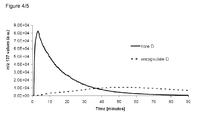
- the flavour release data are shown in figures 1 , 2 , 3 , 4 and 5 . Only one m/z profile is shown here for simplification reasons.
- FIG 1 shows that garlic flavour had a delayed release out of encapsulate A in model broth at 80°C, in contrast to the burst release when using spray-dried garlic flavour. The same was found when using basil flavour in water at 80°C (see Figure 2 ).
- Figure 3 shows that the basil flavour compounds into the headspace as measured by PTR-MS showed a similar pattern (compare Figure 3 with Figure 2 ).
- the basil flavour compounds showed a delayed release out of encapsulate B in model broth at 80°C, in contrast to the burst release when using spray-dried basil.
- Example 2 Preparation and panel evaluation of a food product with encapsulates A, B or C
- Garlic, basil or parsley flavour in coated melt extrudates encapsulates A, B and C, respectively, from Example 1 or the same flavour in spray-dried form were added to dry food product with pasta and dry tomato sauce (Spaghetteria Napoli, pasta in tomatosauce from Knorr, Unilever Bestfoods, Hamburg, Germany; contains 71 % pasta, tomato powder, sugar, salt, starch, vegetable oil, monosodium glutamate, herbs, onion, acid, citric acid and pepper).
- the meal was prepared according to the instructions on the pack.
- the product was mixed in cold water and brought to boil for 10 minutes.
- the total time from start of cooking in water (for 10 minutes) and serving was about 40 minutes.
- the flavour dose in the final meal is presented in Table 3.
- Rice was dry mixed with either encapsulate A or B (garlic or basil flavour in coated melt extrudates), or with one of the same flavours in spray-dried form.
- the flavoured rice product was added to boiling water and cooked for 10 minutes. The total time from start of cooking in water and serving was about 40 minutes.
- the flavour doses used and the results of the panel evaluations of the cooked rice with garlic or basil flavour are given in Table 4.
- the aroma perception when using encapsulate A was similar to the one of spray-dried garlic, although the latter flavour dose was three times higher than when using encapsulate A.
- the flavour perception was even more intense under these conditions when using coated melt extrudates than when using spray-dried flavour.
Landscapes
- Chemical & Material Sciences (AREA)
- Engineering & Computer Science (AREA)
- Life Sciences & Earth Sciences (AREA)
- Food Science & Technology (AREA)
- Polymers & Plastics (AREA)
- Health & Medical Sciences (AREA)
- Nutrition Science (AREA)
- Oil, Petroleum & Natural Gas (AREA)
- Manufacturing & Machinery (AREA)
- General Preparation And Processing Of Foods (AREA)
- Seasonings (AREA)
Abstract
Food product comprising flavour encapsulates, the flavour encapsulate comprising, based on the weight of the flavour encapsulate,
- from 99 to 50 wt.% of a melt-extruded core and
- from 50 to 1 wt.% of a water-insoluble coating around the core,
wherein the core comprises, based on the weight of the core:
- from 1 wt.% to 60 wt.% of at least one flavour compound,
- from 99 wt.% to 40 wt.% of a matrix material, and
wherein the water content of the core is lower than 8 wt.%, based on the weight of the core, and
wherein the matrix material has a glass transition temperature above 20°C, and wherein the water-insoluble coating comprises, based on the weight of the coating, less than 1 0wt.% of one of the group consisting of fat, wax, and mixtures thereof, and
wherein the average particle size of the flavour encapsulate is from 200 to 5000 µm.
- from 99 to 50 wt.% of a melt-extruded core and
- from 50 to 1 wt.% of a water-insoluble coating around the core,
wherein the core comprises, based on the weight of the core:
- from 1 wt.% to 60 wt.% of at least one flavour compound,
- from 99 wt.% to 40 wt.% of a matrix material, and
wherein the water content of the core is lower than 8 wt.%, based on the weight of the core, and
wherein the matrix material has a glass transition temperature above 20°C, and wherein the water-insoluble coating comprises, based on the weight of the coating, less than 1 0wt.% of one of the group consisting of fat, wax, and mixtures thereof, and
wherein the average particle size of the flavour encapsulate is from 200 to 5000 µm.
Description
- The present invention relates to a food product comprising a flavour encapsulate.
- Despite the current focus in the market on food products that aim at a fast preparation time, for many consumers meals that require 'traditional', or relatively long cooking times remain of interest. A trend in this respect is the so-called 'slow cooking', using recipes and cooking techniques which may use a relative long cooking time to provide an optimal cooked meal. Relatively long cooking times are also found for catering applications, wherein the food is heated or kept at a warm temperature during relatively long times, such as e.g. 5 minutes to 3 hours.
- Cooking processes and recipes nowadays do not rely solely on fresh ingredients or traditional dry spices. The consumer may flavour its dish during cooking by adding flavouring components, like cooking aids that provide a specific flavour and/or aroma or a mixture of desired flavours, i.e. taste and aroma components, to the dish.
- A problem that may be observed in these applications is that the flavours added to the dish, provided by either traditional spices or added flavour, become available immediately or rather quickly after addition to the dish, and then quickly disappear from the dish with progression of time. This disappearing may be the result of, for example, heat-deterioration or of evaporation of aroma components from the cooking pot during the cooking process. When flavour disappears, obviously, the dish may become less attractive.
- Hence, there is a need for a food product, which releases flavour during cooking and from which the flavour preferably slowly becomes available over an increased period of time during cooking or frying (so-called 'delayed' or 'extended release'), and not as a burst of flavour at the start of the cooking process or, in case the food product is a dry (e.g. concentrated) food product, immediately after addition of the food product to the dish, meat or water during cooking. Further, in case the food product is a dry food product, the food product should preferably disintegrate, preferably be dissolvable in an aqueous environment. Further, the food product should preferably provide good shelf life stability and the flavour in the food product should preferably be stable during production of the food product and storage of it.
The prior art describes some flavouring agents, which however fail to meet the objectives of the present invention, when present in a food product. -
EP0852912 discloses a dry food base with encapsulated oil based flavour consisting of gum and/or lipid coating (0.05-0.5% (w/w)) around spray-dried granules which is effective for delaying the release of the flavour upon storage, but not upon cooking. -
WO00/16643 -
WO9818610 -
US2001/0021404 discloses an encapsulate which remain largely encapsulated in aqueous medium during a heat treatment and only dissolves during a subsequent cooling phase. This encapsulate has been coated with at least one layer of a fat or wax and also a layer of modified cellulose having reversible gel formation when the temperature is increased. - Surprisingly the above mentioned problems could at least partly be solved by a food product comprising flavour encapsulates, the flavour encapsulates comprising, based on the weight of the flavour encapsulates,
- from 99 to 50 wt.% of a melt-extruded core and
- from 50 to 1 wt.% of a water-insoluble coating around the core,
- from 1 wt.% to 60 wt.% of at least one flavour compound,
- from 99 wt.% to 40 wt.% of a matrix material, and
- The invention further relates to a method to prepare a food product of the present invention comprising the step of combining a flavour encapsulate and a food product, wherein the flavour encapsulates comprises, based on the weight of the flavour encapsulates,
- from 99 to 50 wt.% of a melt-extruded core and
- from 50 to 1 wt.% of a water-insoluble coating around the core,
- from 1 wt.% to 60 wt.% of at least one flavour compound,
- from 99 wt.% to 40 wt.% of a matrix material, and
- The invention further relates to a method to produce a ready-to-eat food product, comprising the steps of:
- combining a concentrated food product of the present invention with at least one of the group consisting of water, meat, a dish and mixtures thereof,
- heating the combination resulting from step a) at a temperature of between 50°C and 350°C,
- The invention further relates to a ready to eat food product obtainable by the method of the present invention.
- The food product of the present invention comprises encapsulates comprising from 99 wt.% to 50 wt.% of a melt-extruded core. Preferably the encapsulates comprise from 97 wt.% to 60 wt.%, more preferably of from 95 wt.% to 80 wt.% of a melt extruded core, based on the weight of the flavour encapsulates.
Melt extrusion can for example be performed continuously and horizontally by a twin screw extruder in which a highly viscous melt of matrix materials is forced through the extruder die plate under high pressure. The extrudate is a strand which can be broken up in pieces immediately after the die with a rotating knife or by milling after cooling. After cooling, the pieces are generally in an amorphous, glassy state. An older, batch version of this technology (also called melt injection or vertical, screwless extrusion) is based on a pressing a melt of matrix materials through one or more orifices into a cold, dehydrating solvent, commonly isopropanol. (See for example Ubbink, J., & Schoonman, A. (2003). Flavor delivery systems. In Kirk-Othmer Encyclopedia of Chemical Technology, on-line and fifth edition, volume 11. New York: Wiley-Interscience, section 2.2 and N.J. Zuidam, E. Heinrich (2010). Encapsulation of aroma, N.J. Zuidam, V. Nedović (eds.), Encapsulation Technologies for Active Food Ingredients and Food Processing, New York: Springer, sections 5.3.5 and 5.3.6 for more information about melt extrusion and melt injection processes). Melt extrusion appeared to be essential, as this results in an encapsulate with the desired flavour release profile once coated. Without willing to be bound by theory, this result might be attributed to the smooth surfaces of the melt extruded core. For example, coating of conventional spray dried granulates, with or without agglomeration, is not desired for the present invention, as encapsulates prepared using this technique show rapid release of flavour in water. Other conventional flavour encapsulation techniques like the ones using complex coacervates, microspheres, yeast cells, cyclodextrins and silica particles may also show irregular shaped surfaces upon drying, which after coating may result in comparable problems with regard to rapid flavour release. Therefore, these alternative production techniques may not meet the desired objectives of the present invention. - The melt-extruded core comprises from 99 wt.% to 40 wt.% of matrix material, preferably of from 95 wt.% to 80 wt.%, more preferably of from 90 wt.% to 70 wt.%, based on the weight of the core.
- Preferably, the matrix material of the core comprises one of the group of matrix materials consisting of starches, starch derivatives, sugars, sugar derivatives, cellulose derivatives, proteins, lipids, gums, and mixtures thereof. More preferably, the matrix material of the core is selected from the group of matrix materials consisting of starches, starch derivatives, sugars, sugar derivatives, cellulose derivatives, proteins, lipids, gums, and mixtures thereof. Most preferably, the matrix material of the core comprises one of the group consisting of starches, starch derivatives, sugars and sugar derivatives and mixtures thereof.
- Preferably, starch derivatives are selected from the group consisting of maltodextrins, modified starches, hydrogenated corn syrup, dextrins and mixtures thereof. More preferably, the starch derivative is a maltodextrin.
- Preferably, sugars are selected from the group consisting of sucrose, glucose, lactose, fructose, maltose, ribose, dextrose, arabinose, pentose, xylose, galactose, trehalose and mixtures thereof.
- Preferably, sugar derivatives are selected from the group consisting of isomalt, sorbitol, mannitol, xylitol, lactitol, malitol, pentatol and mixtures thereof.
- Preferably, cellulose derivatives are selected from the group consisting of carboxymethyl cellulose (CMC), ethyl methylcellulose, hydropropyl methylcellulose (HPMC), hydroxyl ethylcellulose, hydroxy propyl cellulose, methyl cellulose, and mixtures thereof.
- Preferably, gums are selected from the group consisting of plant exudates and plant extracts; algae-polysaccharides; microbial polysaccharides; and mixtures thereof. Plant exudates and plant extracts are preferably selected from the group consisting of gum arabic, gum tragacanth, gum karaya, mesquite gum, locust bean gum, tara gum, guar gum, pectin, soluble soybean polysaccharide, and mixtures thereof. Algae-polysaccharides are preferably selected from the group of carrageenan, alginate, agar-agar, and mixtures thereof. Microbial polysaccharides are preferably selected from the group consisting of xanthan gum, gellan gum, dextran, and mixtures thereof.
- Preferably, proteins are selected from the group consisting of gelatine, gluten, soy protein, whey protein, casein, collagen, and mixtures thereof.
- Preferably, lipids are selected from the group consisting of fats, waxes, hydrogenated vegetable oils, lipid derivatives and mixtures thereof.
- The matrix material may further contain various optional ingredients such as are conventionally used in the art. These ingredients are preferably chosen from the group consisting of fillers, emulsifiers, preservatives, antioxidants, stabilizers, lubricants, and mixtures thereof. They may be each preferably present in an amount of e.g. from 0 to 10 wt.%, preferably from 1 to 5 wt.%, most preferably from 2 to 4 wt.% based on the weight of the matrix materials. Fillers may preferably include materials from the group consisting of silicon dioxide, titanium dioxide, alumina, talc, kaolin, powdered cellulose, microcrystalline cellulose, calcium phosphate, calcium sulphate, and mixtures thereof. Examples of emulsifiers include typically mono and diglycerol esters of fatty acids, polyglycerol esters, sorbitol esters, lecithin and mixtures thereof.
- Preferably, these matrix materials of the core of the flavour encapsulate are present in a total amount of more than 50 wt.%, preferably of more than 70 wt.%, even more preferably more than 80 wt.%, even more preferably more than 90 wt.%, most preferably substantially 100wt.%, based on the weight of the matrix material, and can be present in an amount of from 50 to 100 wt. %, more preferably in an amount of from 70 wt.% to 95 wt.%, most preferably in an amount of from 80 wt.% to 90 wt.%, based on the weight of the matrix material.
- Preferably, the majority of the matrix materials of the core is hydrophilic. A hydrophilic molecule or portion of a molecule is one that is typically charge-polarized and capable of hydrogen bonding. Hydrophilic material is preferably intended to mean that it is water-soluble or absorbs water and thereby preferably swells. 'Water-soluble' is preferably intended to mean that the core dissolves in water with a temperature of between 0°C and 100°C within 0 minutes and 1 hour. Coating of a preferably hydrophilic, water-soluble core with a water-insoluble coating according to the present invention results in an encapsulate that only slowly releases flavour in hot water of for example between 80°C and 100°C. This was a highly surprising and not expected effect, as the common knowledge indicates that flavour release is hard to control by coating, and that the skilled man would expect a rapid and complete loss of flavour when using a water-soluble core due to osmotic forces (See for example Ubbink, J., & Schoonman, A. (2003). Flavor delivery systems. In Kirk-Othmer Encyclopedia of Chemical Technology, on-line and fifth edition, volume 11. New York: Wiley-Interscience, p541).
- Moreover, during a coating process of the core, a hydrophilic core appeared to retain the flavour much better than a hydrophobic core. For example, a hydrophobic core based on organically soluble cellulose forming a continuous phase with flavour compounds appeared to result in a flavour-loss of up to 90% during production, especially during a coating step of the encapsulate.
- Preferably, the core of the flavour encapsulate comprises a hydrophilic, water-soluble matrix material.
The core of the flavour encapsulate comprises preferably a hydrophilic, water-soluble matrix material in a total amount of more than 50 wt.%, preferably of more than 70 wt.%, even more preferably more than 80 wt.%, most preferably more than 90 wt.%, based on the weight of the matrix material, and can be present in an amount of from 50 to 100 wt.%, more preferably in an amount of from 70 to 95 wt.%, most preferably in an amount of from 80 to 90 wt.%, based on the weight of the matrix material. - Preferred hydrophilic, water soluble matrix materials that can be used as matrix materials of the core in the present invention are starch, cellulose, sucrose, glucose, lactose, fructose, maltose, ribose, dextrose, isomalt, sorbitol, mannitol, xylitol, lactitol, malitol, pentatol, arabinose, pentose, xylose, galactose, trehalose, hydrogenated corn syrup, dextran, maltodextrin, alginate, gelatine, gluten, starch, agar, xanthan gum, gelan gum, pectin, gum arabic, guar gum, mesquite gum, gum karaya, gum tragacanth, methyl cellulose, carboxymethylcellulose (CMC), hydropropyl methylcellulose (HPMC), methyl cellulose, soluble soybean polysaccharide, soy protein, whey protein, casein, collagen, gelatine, and locust bean gum, and mixtures thereof.
- The matrix material of the core may preferably comprise matrix material that has swelling properties, hereinafter called swellable matrix material. The swellable matrix material is preferably present in a total amount of between 1 wt.%, and 10 wt.%, more preferably of between 1 wt.% and 7 wt.% and most preferable of between 1 wt.% and 5 wt.% based on the weight of the matrix material, prior to uptake of water.. Swellable matrix materials are expected to increase the release of flavour from the encapsulate, as the volume increase of the swelling material might contribute to the opening of the coated melt extrudate. Counter-intuitively, it was surprisingly found now that when the matrix material comprises a swellable material in the presence of water, the flavour release is even further delayed in the present invention. Preferably, the swellable material may be a hydrogel. A hydrogel is a colloidal gel in which the disperse phase (colloid) is a polymer and the disperse phase has combined with water as the dispersion medium or continuous phase to produce a viscous, jellylike network which is preferably elastic. Hence, preferably, the present invention may relate to a food product, wherein the swellable matrix material of the core of the flavour encapsulate comprises at least one of the group consisting of alginate, gelatine, gluten, starch, agar, xanthan gum, gellan gum, pectin, guar gum, hydropropyl methylcellulose (HPMC), hydroxyl propyl cellulose, methyl cellulose, microcrystalline cellulose, soy protein, whey protein, casein, collagen, gelatin and mixtures thereof. These swellable matrix materials can form a hydrogel when in contact with water.
- For optimal flavour retention during production of the flavour encapsulate, and to provide the desired flavour release profile, the matrix material of the core is in an amorphous, glassy state, especially during the coating process, wherein the melt-extruded core is coated.
- Amorphous materials exhibit at least a rubbery, viscoelastic state and a glassy, brittle state. (See Ubbink, J., & Schoonman, A. (2003), Flavor delivery systems, in Kirk-Othmer Encyclopedia of Chemical Technology, on-line and fifth edition, volume 11. New York: Wiley-Interscience, section 2.1 for more information about encapsulation in glass materials.) These two phases are separated by a so-called second-order phase transition, the glass-rubber transition, which is characterised by a so-called glass transition temperature. Below this temperature molecules may have little relative mobility similar to that of a crystalline phase. In contrast, molecules have a relatively high mobility at a temperature above the glass transition temperature when the material is in a rubbery state.
- Typical glass transition temperatures of melt-extrudates used in the art are between 30°C and 70°C. Typical coating temperatures used in the art are between 20°C and 50°C. For the present invention, preferably, the matrix material of the core is in a glassy state, especially during the coating process wherein the melt-extruded core is coated. Therefore, the matrix material of the core preferably has a glass transition temperature higher than 30°C, more preferably higher than 35°C, most preferably higher than 40°C. Preferably, the glass transition temperature is lower than 70°C, preferably lower than 60°C.
- It was observed that the water content of the core is preferably not too high. A too high water content results in an encapsulate wherein the flavouring is not kept in during the production process, especially not during a coating step of the production process. According to the present invention, the water content of the core is lower than 8wt.%, based on the weight of the core. Preferably, the water content is lower than 7 wt.%, more preferably the water content is lower than 6 wt.%, most preferably the water content is lower than 5 wt.%. Preferably, the water content is between 0.5 and 8 wt.%, more preferably between 1 and 6 wt.%, most preferably between 2 and 4 wt.%.
- The core of the flavour encapsulate comprises from 1 wt.% to 60 wt.% of at least one flavour compound. Preferably, the core comprises from 2 wt.% to 30 wt.%, more preferably from 5 wt.% to 15 wt.% of at least one flavour compound. Flavour compounds may be any type of flavour as used in the food industry. Preferably, the flavour is one of the group consisting of garlic, basil, onion, parsley, fruit flavour and mixtures thereof. Flavour compounds traditionally show a relatively fast evaporation or deterioration during cooking of a food product, and the present invention provides a manner to keep these flavours available for an extended and delayed time during cooking.
- The flavour encapsulate which is present in the food product of the present invention comprises 1 to 50% of a coating. Surprisingly, coating of a, preferably, hydrophilic core with a water-insoluble coating according to the present invention results in an encapsulate that releases flavour compounds in a gradual and delayed manner in hot water of for example between 80°C and 100°C.
The encapsulate comprises a coating, which may be applied to the melt-extruded core by e.g. fluid bed coating, drum coating or pan coating, using for example a solvent solution, like an ethanol solution, comprising the coating material. The coating can be applied by for example using an Aeromatic-Fielder multiprocessor MP1 fluid bed from GEA Pharma Systems or suitable Wurster type fluid bed equipment. The encapsulate comprises from 50 wt.% to 1 wt.% of a water-insoluble coating around the core. Water-insoluble is preferably intended to mean that the coating does not dissolve within 30 minutes to 3 hours in aqueous solutions of 0°C to 100°C. Preferably, the amount of water-insoluble coating is from 2 wt.% to 35 wt.%, more preferably from 4 wt.% to 30 wt.%, most preferably from 5 wt.% to 15 wt.%, based on the weight of the total flavour encapsulate. - The coating preferably has a thickness of between 3 µm to 100 µm. The thickness should be construed as the thickness over substantially the entire surface of the core. At a smaller thickness the coating may break, which may result in a premature bursting release of the flavouring compound. Preferably, at least 80% of the flavour encapsulates has an absolute thickness of the coating of between 3 µm and 100 µm, most preferably of between 10 µm to 60 µm, most preferably of between 15 µm and 50 µm. The idea of the present invention is that the flavour compounds from the encapsulate are not released at once (no 'burst release'), but that the flavour compounds are released in a gradual, delayed manner ('delayed' or 'extended release'). Without willing to be bound by theory, this effect may preferably, be reached via small pores in the coating that are formed when the product of the present invention is in contact with a hot, aqueous solution above 50°C. A too high thickness of the coating may result in a situation that no flavour compound is released through the coating. Preferably, at least 80% of the flavour encapsulates has a coating with an average thickness of between 3 and 80 µm. Preferably the coating has an average thickness of more than 3 µm, more preferably more than 5 µm, even more preferably more than 10 µm, and preferably less than 60 µm, more preferably less than 50 µm, more preferably less than 40 µm. Preferably, e.g. in case the core comprises swelling material, the thickness may preferably be between 3 and 10 µm. Preferably, e.g. in case the core comprises non-swelling material, the thickness may preferably be between 10 and 30 µm. Preferred ranges may for example be from 3 µm to 60 µm, more preferably from 5 µm to 30 µm, even more preferably from 10 µm to 80 µm or from 10 µm to 40 µm, most preferably from 30 µm to 50 µm.
- The water-insoluble coating is preferably shape-stable when in contact with aqueous material, even when the flavour material has leaked out of the flavour encapsulate. The coating material is therefore preferably not in the form of a gel or forms a gel when in contact with an aqueous solution. The coating material is preferably not in the form of a gel, a reversible gel or gelling material or forms a gel, a reversible gel or gelling material when in contact with an aqueous solution of from 0°C to 100°C, as this type of coating may not provide the desired flavour release profile. A gel can be a stable network with water as the continuous phase and which is elastic, viscous and shape stable against stresses. A reversible gel is intended to mean here a gel that might be unstable or dissolve at other conditions, for example, a reversible gel can be formed in water at boiling conditions but may dissolve upon cooling.
- The water-insoluble coating is preferably not a fat-based coating. Fats or waxes are believed not to provide the flavour release profile as preferably aimed for by the present invention. In addition, it was observed that a fat-based coating may increase leakage of flavour from the core into the fat-based coating, in this way compromising the desired release profile. Hence the amount of fat and/or waxes is preferably as low as possible. The coating of the encapsulate as used in the present invention comprises lower than 10 wt.% of one of the group consisting of fat, wax, and mixtures thereof. More preferably the amount of fat and/or wax is lower than 5 wt.%, even more preferably, lower than 2 wt.% based on the weight of the coating, most preferably the coating of the encapsulate is substantially free from fat and/or wax. The amount of fat can be from 0 wt.% to 10 wt.%, preferably from 0.1 wt.% to 5 wt.%, more preferably of from 0.5 wt.% to 2 wt.%, based on the weight of the coating. In the present context, 'fat' is intended to mean any mono, di- or triglyceride that can be used as at least part of a coating of a flavour encapsulate, and may comprise for example at least one of the group consisting of fatty acids, fatty alcohols, glycerides, phospholids and mixtures thereof. 'Wax' is intended to mean here any fatty acid esters of higher primary monovalent alcohols than glycerol that can be used as at least part of a coating of a flavour encapsulate, and may comprise for example at least one of the group consisting of beeswax, carnaubawax, candillia wax, and mixtures thereof.
- The coating of the encapsulate preferably is dissolvable in a solvent, such as for example an organic or aqueous organic solvent, to facilitate the coating preparation. Preferred organic solvents are from the group consisting of methanol, ethanol, isopropanol and mixtures thereof. Another preferred option to enable the coating process is the use of coating material dispersed in water.
- Preferably, the material of the coating comprises one of the group consisting of modified cellulose, zein, shellac and mixtures thereof. Preferred are modified celluloses from the group consisting of ethyl cellulose, hydroxypropylmethylcellulose (HPMC) and mixtures thereof. These coating materials provide an encapsulate with optimal flavour release profiles for the present invention. Most preferably, the coating comprises ethyl cellulose. Preferably, these coating materials are present in a total amount of at least 50 wt.%, more preferably more than 90 wt.%, even more preferably more than 95 wt.%, based on the weight of the coating, and can be preferably present in an amount of between 50 wt.% and 100 wt.%, preferably of between 70 wt.% and 95 wt.%, based on the weight of the coating. Most preferably, substantially all of the water-insoluble coating comprises of one of the group consisting of, modified cellulose, (preferably ethyl cellulose, hydroxypropylmethylcellulose (HPMC) or mixtures thereof), zein, shellac and mixtures thereof. Most preferably, the coating comprises of 100 wt.% ethyl cellulose, based on the weight of the coating.
- Preferably the coating as described is the only coating, i.e. the invention relates to a food product comprising flavour encapsulates, which flavour encapsulate comprises one coating. Additional coatings will make the production process more complex and may compromise the desired flavour release profile of the present invention.
- The average particle size of the flavour encapsulate is from 200 µm to 5000 µm. Preferably, the size is from 300 µm to 2500 µm, preferably of from 400 µm to 2000 micron, more preferably of from 500 µm to 1500 µm. The size of the encapsulate is relevant, as a too high size may result in relatively low surface area and thus relatively high coating thickness, whereas a too small size may result in relatively large surface area and thus relatively low coating thickness.
- The present invention relates to a food product comprising flavour encapsulates. The flavour encapsulates are preferably present in an amount of from 0.0005 wt.% to 5 wt.%, more preferably in an amount of from 0.05 wt.% to 1 wt.%, most preferably in an amount of from 0.01 to 0.5 wt.%, based on the weight of the food product.
- Preferred food products according to the present invention are a concentrate for a bouillon, a concentrate for a soup or a concentrate for a gravy, a bouillon cube, a bouillon tablet, a bouillon granule, a bouillon, a soup, a sauce, a gravy, an instant meal, rice, beans, a frozen food, confectionary, a marinade, a beverage, an instant beverage, tea in tea bags, tea derived products, a seasoning, a ready-to-use meal, an instant meal, or a meal solution. 'Ready-to-use' or 'instant' meal or beverage is intended to mean here a pre-packed meal or beverage which can be cooked immediately with little or no further preparation (e.g. some oil or water might be added). 'Meal solutions' are a pre-packed meal kit which consumers can use in combination with added meat and/or vegetable to cook a meal, often for 2-4 persons. In case of the food product is rice or beans, it is intended that the rice or beans are mixed with encapsulated flavours. During preparation of the rice or beans or the instant meal, for example by cooking, the flavours are gradually released during the preparation process.
- Preferably, the food product of the present invention is a dry food product. 'Dry' is preferably intended to mean here having a water content of lower than 10 wt.%. Preferably, the present invention relates to a food product wherein the water content is lower than 8 wt.%, more preferably lower than 6 wt.%, most preferably, lower than 4 wt.%. Preferably the water content is higher than 0.5 wt.%, more preferably higher than 1 wt.%, most preferably higher than 3 wt.%. The water content hence is preferably between 0.5 wt.% and 8 wt.%, more preferably between 1 wt.% and 6wt.%, most preferably of between 3 wt.% and 4 wt.%. Preferably, the food product is a dry food product selected from the group consisting of a concentrate for a bouillon, a concentrate for a soup or a concentrate for a gravy, a bouillon cube, a bouillon tablet, a bouillon granule, an instant meal, rice, beans, a frozen food, confectionary, a marinade, an instant beverage, tea in tea bags, tea derived products, a seasoning, a ready-to-use meal, an instant meal and a meal solution.
- Other additionally preferred food products are liquid food products. A liquid food product may be for example oil-based (i.e. no or hardly any water is present) or water-based. The food product may preferably be pourable. Preferably, the liquid food product is selected from the group of liquid food products consisting of a liquid concentrate for a bouillon, a liquid concentrate for a soup, a liquid concentrate for a gravy, a bouillon, a soup, a sauce, a gravy, an instant meal, a marinade, a beverage, tea derived products, a liquid seasoning, a ready-to-use meal, and a meal solution.
- Furthermore, the food product may preferably have the form of a paste or preferably of a gel, preferably of a shape-stable, elastic gel. In case of a liquid food product, a paste or a gel, the flavour encapsulates are preferably dispersed in the food product. In case of a water-based food product, the flavour encapsulates should preferably not be heated above 50°C during production and storage prior to use by the consumer. A water based food product is intended to have a water content of or higher than 10 wt.%, and may need to be pasteurised or sterilised to ensure microbiological safety. In case of such a heat treatment, flavour encapsulates need to be added to the food product after such a heat treatment step in the food production process to avoid damage prior to use by the consumer (for example premature release of the flavour).
- Preferably, the food product is a concentrated food product. Such a concentrated food product requires dilution in an aqueous liquid or a dish or meat to result in a ready-to-eat food product for consumption. A preferred concentrated food product is a beverage concentrate. More preferably, the food product of the present invention is one of the group of concentrated food products consisting of a bouillon concentrate, a bouillon cube, a bouillon tablet, a soup concentrate, a sauce concentrate, a gravy concentrate, and a seasoning particle. Most preferably, the food product is a pasty bouillon cube, such as a bouillon cube produced by extrusion of a bouillon mass by a machine of e.g. Corazza. These products may be added to dishes that require relatively long cooking times.
- During preparation of the food product, preferably of a dry food product such as for example a bouillon cube, the flavour encapsulates may be mixed with other ingredients of the food product of the invention. Following mixing, a shaping step may be present to result in the food product with a final shape. Shaping may be done by pressing or extrusion of the mixture of ingredients which includes the flavour incapsulates. After or during the shaping step, the food product might be packaged. Alternatively, the mixture of ingredients may be packaged in absence of a shaping step. Another preferred food product is a dry, instant beverage mixture, for example a tea in a tea bag. The food product is preferably a packaged food product.
- In a further aspect, the present invention relates to a method to produce a ready-to-eat food product, comprising the steps of:
- a) combining a concentrated food product of the present invention with at least one of the group consisting of water, meat, a dish and mixtures thereof,
- b) heating the combination resulting from step a) at a temperature of between 50°C and 350°C,
- Preferably, the heating temperature is of between 70°C and 300°C, more preferably of between 80°C and 275°C, most preferably of between 100°C and 150°C. Preferably, the ready-to-eat food product is a bouillon, a soup, a gravy, a beverage, or a seasoned dish, and the method preferably comprises heating the combination resulting from step a) at a temperature of between 50°C and 100°C, preferably of between 70°C and 100°C, most preferably of between 80°C and 100°C. In another preferred situation, the ready-to-eat food product may be for example a seasoned meat, and preferably, may comprise the step of combining a seasoning or marinate with meat followed by frying or baking. The method preferably comprises the step of heating the combination resulting from step a) at a temperature of between 50°C and 350°C, preferably of between 100°C and 300°C, most preferably of between 150°C and 275°C.
- The invention further relates to a ready-to-eat food product, obtainable by the method of the present invention. Such a ready-to-eat food product may preferably be a bouillon, a soup, a sauce, a gravy, a seasoned meal, a seasoned meat, a seasoned rice, seasoned beans, a tea, or a beverage. The amount of flavour encapsulates in the food product according to the invention is preferably of between 0.0005 and 5 wt.%, more preferably of between 0.05 and 1 wt.%, most preferably of between 0.01 and 0.5 wt.%, based on the weight of the ready to eat food product.
- The invention further relates to the use of a flavour encapsulate for providing a delayed flavour release or extended flavour release during preparation and/or consumption of a food product, wherein the flavour encapsulate comprises, based on the weight of the flavour encapsulate,
- from 99 to 50 wt.% of a melt-extruded core and
- from 50 to 1 wt.% of a water-insoluble coating around the core,
- from 1 wt.% to 60 wt.% of at least one flavour compound,
- from 99 wt.% to 40 wt.% of a matrix material, and
- Preferred ingredients and amounts thereof used in the flavouring encapsulate are described above for the food product comprising the flavouring encapsulates, and apply equally to the flavouring encapsulate when used for providing a delayed flavour release or extended flavour release.
- The idea of the present invention relates to a food product comprising flavour encapsulates from which the flavour compounds from the encapsulate are not released at once (no 'burst release'). Preferably, the flavour is released gradually and is in balance with the evaporation of flavour from the cooking pot or from the dish when served, in this way providing a flavoured dish for an extended time period. Hence, according to the present invention, preferably less than 50 wt.% of the flavour is released in less than 3 minutes, preferably in less than 5 minutes, more preferably in less than 10 minutes at 80°C to 100°C in water. The flavour compounds are released in a gradual, delayed manner ('delayed' or 'extended release'). Preferably, more than 90% of the flavour is released after 3 hours, more preferably after 1 hour, most preferably after 30 minutes at 80°C to 100°C in water. Another advantage of this invention that was observed was an enhanced storage stability of the flavour compounds in the food product upon storage.
- The invention will now be illustrated in the following, non-limiting examples.
- Matrix materials according to Table 1 were dry blended and then fed into a first zone of a twin screw extruder. Extrusion conditions used are described in
US 2007/0184163 . The melt extrudates core A, core B and core C are commercially available under the trade name CapLock™ Garlic, CapLock™ Basil and CapLock™ Parsley from International Flavors & Fragrances Inc. (New York, New York), respectively.Table 1: Composition of water-soluble cores. Core A Core B Core C Flavour Garlic flavour 5 0 0 Basil flavour 0 5 0 Parsley flavour 0 0 5 Matrix material Saccharides 50 50 50 Maltodextrin 40 40 40 Emulsifiers 2.5 2.5 2.5 Silicon dioxide 2.5 2.5 2.5 - Matrix materials according to Table 2 were dry blended and then fed into the first zone of a twin screw extruder. Extrusion conditions used are described in
US 2007/0184163 . This core D is also commercially available as CapLock™ HM Basil from International Flavors & Fragrances Inc. (New York, New York).Table 2: Composition of water-swellable core. Core D Flavours Basil flavour 5 Matrix materials Maltodextrin 45 Saccharides 40 Hydroxypropylcellulose 2.5 Emulsifiers 2.5 Silicon dioxide 2.5 - Encapsulates A, B, C, and D were made by coating of melt-extruded cores A, B, C and D (made as described above) via a fluid bed coating method using an ethanol solution containing 10 wt.% ethyl cellulose. The final amount of ethyl cellulose coating was 15 wt.%, based on the weight of the encapsulate. The flavour retention upon coating was in general more than 94% (w/w) of the original amount.
- Pre-granulates were made by mixing 100 g of spray-dried basil flavour powder with 20 g of 5% HPMC + 2% glycerol in water for 10 s in a high shear mixer (Philips Cucina food processor). This was repeated eight times. All fractions were collected and added into an Aeromatic-Fielder™ Multiprocessor MP1 fluid bed from GEA Pharma Systems Ltd. Then an aqueous solution of 9% Methocel E5 + 4% glycerol was sprayed onto the pre-granulated powder as a binder solution at a product temperature of 40°C. The final Methocel E5 amount was 5% (w/w) and the obtained granulates were sieved into a 200-710 µm fraction to obtain spray-dried core E. Ethyl cellulose coating of this core E was performed by fluid bed coating using an ethanol solution of 10 wt.% ethyl cellulose, resulting in encapsulate E. The final amount of ethyl cellulose coating was 15 wt.%, based on the weight of the encapsulate Flavour release from encapsulates A, B, D and E in water or model broth
- Flavour release of the encapsulates A, B, D, and E in water or model broth at 80°C into the headspace was measured real-time by PTR-MS (Proton Transfer Reaction - Mass Spectrometry). The PTR-MS equipment used was a so-called High-Sensitivity PTR-MS from Ionicon Analytik Innsbruck, Austria. The composition of the model broth was 5 g of sodium chloride, 1.5 g of monosodium glutamate monohydrate, 1.5 g of starch (Colflu 67), 0.2 g of fat (medium chain triglycerides). The first minute of PTR-MS measurement recorded the base line without sample, and after 1 minute the sample was introduced in the water or model broth. A typical sample weight was approximately 20 mg of spray-dried flavour, and this was added into 100 ml of water or model broth at 80°C. To compare equal flavour loads the sample weights of the different encapsulates were increased compared to their core to correct for their coating weights and plotted against the same flavour amount. The PTR-MS measurements lasted for at least 30 minutes and recorded ion traces of the molecular weight of a flavour component + 1 (from the proton) and its major fragment ions as m/z values (mass divided by charge). The flavour release data are shown in
figures 1 ,2 ,3 ,4 and5 . Only one m/z profile is shown here for simplification reasons. Other m/z profiles from the same sample, representing the other flavour compounds in that sample, showed a very similar release, and no clear effect of differences in chemical and physical characteristics of the flavour compounds used could be found. This indicates that the release was not related to the hydrophobicity or molecular weight of the flavour compound. -
Figure 1 shows that garlic flavour had a delayed release out of encapsulate A in model broth at 80°C, in contrast to the burst release when using spray-dried garlic flavour. The same was found when using basil flavour in water at 80°C (seeFigure 2 ).When a model broth was used instead of water, the releases of the basil flavour compounds into the headspace as measured by PTR-MS showed a similar pattern (compareFigure 3 withFigure 2 ). As inFigure 2 , the basil flavour compounds showed a delayed release out of encapsulate B in model broth at 80°C, in contrast to the burst release when using spray-dried basil. The release of basil flavour from melt extrudates with swellable material (core D) in water at 80°C showed a very similar, burst release as spray-dried basil (compareFigure 4 withFigure 2 ). However, the release of basil flavour from coated melt extrudate with swellable material (encapsulate D) was very slow compared to melt extrudates with non-swellable material (compareFigure 4 withFigure 2 ). The flavour release from coated spray-dried granulates (comparative example, encapsulate E) in water at 80°C was a burst one, seeFigure 5 . This release pattern is very close to the one of spray-dried flavour and completely different than the release from coated melt extrudates (compare -
Figure 5 withFigures 1-4 ; please note the shorter time axis ofFigure 5 compared to the other Figures). - Garlic, basil or parsley flavour in coated melt extrudates (encapsulates A, B and C, respectively, from Example 1) or the same flavour in spray-dried form were added to dry food product with pasta and dry tomato sauce (Spaghetteria Napoli, pasta in tomatosauce from Knorr, Unilever Bestfoods, Hamburg, Germany; contains 71 % pasta, tomato powder, sugar, salt, starch, vegetable oil, monosodium glutamate, herbs, onion, acid, citric acid and pepper). The meal was prepared according to the instructions on the pack. The product was mixed in cold water and brought to boil for 10 minutes. The total time from start of cooking in water (for 10 minutes) and serving was about 40 minutes. The flavour dose in the final meal is presented in Table 3. The results of the panel evaluation of the meal are also given in Table 3. Panel evaluation was performed using a logarithmic scoring scale from 0 (no sensation) to 100 (strongest imaginable). Weak and moderate scores are between 6.1 and 17.2, respectively. (Most products on the market are below moderate.)
Table 3: Dose and panel evaluation of garlic, basil and parsley flavour in food product. Flavour encapsulate Dose in final meal (ppm) Aroma score Flavour score encapsulate A (garlic in coated melt extrudates) 15 9.8 12.5 Garlic spray-dried 30 6.7 10.7 Encapsulate B (basil in coated melt extrudate) 30 11.1 13.1 Spray-dried basil 30 6.0 8.7 encapsulate C (parsley in coated melt extrudate) 12 7.6 9.4 Spray-dried parsley 12 3.9 5.1 - Trained panel evaluation of the use of encapsulate A (garlic flavour in coated melt extrudate) in Pasta Napoli upon boiling showed that the perceived aroma (by nose) and flavour (upon eating by tongue and nose) is much higher when using coated melt extrudates than when using conventional, spray-dried flavour. This is remarkable since the amount of garlic flavour used in the spray-dried form was two times higher than the amount used in encapsulate A. Apparently, when using spray-dried flavour, most of the flavour had been evaporated after 40 minutes, whereas with the coated melt-extruded flavour encapsulates the flavours were still released.
- A similar result was obtained with basil and parsley flavour (see Table 3). The aroma and flavour perceptions when using basil or parsley flavour in encapsulate B or C, respectively, was perceived more intense than when using spray-dried flavour at equal flavour dose.
- Rice was dry mixed with either encapsulate A or B (garlic or basil flavour in coated melt extrudates), or with one of the same flavours in spray-dried form. The flavoured rice product was added to boiling water and cooked for 10 minutes. The total time from start of cooking in water and serving was about 40 minutes. The flavour doses used and the results of the panel evaluations of the cooked rice with garlic or basil flavour are given in Table 4. The aroma perception when using encapsulate A was similar to the one of spray-dried garlic, although the latter flavour dose was three times higher than when using encapsulate A. The flavour perception was even more intense under these conditions when using coated melt extrudates than when using spray-dried flavour. The aroma and flavour perceptions when using basil flavour in coated melt extrudates (encapsulate B) was perceived more intense than when using spray-dried basil flavour, even when this latter was dosed two times more than when using coated melt extrudates. Interestingly, the coating of granules made from spray-dried basil flavour (Encapsulate E, a comparative example) did result in statistically not different aroma and flavour perception as spray-dried basil, indicating that the core properties is an important aspect of the present invention. Not only the water-insoluble coating but also the melt extruded core is an essential and surprising combined aspect.
Table 4: Flavour doses and panel evaluations upon boiling of garlic or basil flavoured rice product. Flavour encapsulate Dose in final meal (ppm) Aroma score Flavour score encapsulate A (Garlic in coated melt extrudates) 3.3 10.0 11.4 Garlic spray-dried 10 10.0 9.9 encapsulate B (Basil in coated melt extrudates) 6 10.2 12.2 Basil spray-dried 6 7.0 7.8 Basil spray-dried 12 9.3 10.6 Encapsulates E (Basil in coated spray-dried granules) 6 7.5 8.6 -
-
Figure 1 :- Release of methyl allyl trisulfide from encapsulate A and from spray-dried form in model broth at 80°C as measured by PTR-MS. The absolute counts shown here are the so-called m/
z 153 absolute intensities, representing methyl allyl trisulfide. Other flavour components of the garlic flavour had a similar release pattern from encapsulate A or spray-dried garlic. Upon addition of spray-dried flavours to model broth at 1 minute, the release of flavour from spray-dried encapsulates is a burst and complete one, and its maximum via the water phase into the headspace is measured at about 4-5 minutes. This indicates that all spray-dried flavour is then fully dissolved. Afterwards, the flavour amount in the headspace is decreased rapidly due to evaporation from the water phase. In contrast, the flavour release from the melt extruded encapsulate A after addition to model broth at 1 minute into the headspace was slow and reached a maximum at about 25 minutes. Afterwards, the flavour continued to leak slowly from encapsulates into the water phase and then into the headspace, which is indicated by the fact that the flavour decay was not so fast as obtained with fully dissolved spray-dried flavours. The amount of flavour coming from the encapsulates and the amount of flavour disappearing into the headspace was almost in balance here.
- Release of methyl allyl trisulfide from encapsulate A and from spray-dried form in model broth at 80°C as measured by PTR-MS. The absolute counts shown here are the so-called m/
-
Figure 2 :- Release of terpenes from encapsulate B or from spray-dried form in water at 80°C as measured by PTR-MS. The absolute counts shown here are the so-called m/
z 137 absolute intensities, representing the terpenes components of the basil flavour. Other basil flavour components had a similar release pattern from same encapsulate B or spray-dried basil. See the legend ofFigure 1 for detailed explanation of the flavour release curves.
- Release of terpenes from encapsulate B or from spray-dried form in water at 80°C as measured by PTR-MS. The absolute counts shown here are the so-called m/
-
Figure 3 :- Release of terpenes from encapsulate B or from spray-dried form in model broth at 80°C as measured by PTR-MS. The absolute counts shown here are the so-called m/
z 137 absolute intensities, representing the terpenes components of the basil flavour. Other basil flavour components had a similar release pattern from same encapsulate B or spray-dried basil. See the legend ofFigure 1 for detailed explanation of the flavour release curves.
- Release of terpenes from encapsulate B or from spray-dried form in model broth at 80°C as measured by PTR-MS. The absolute counts shown here are the so-called m/
-
Figure 4 :- Release of terpenes from core D (non-coated) or encapsulate D in water at 80°C as measured by PTR-MS. The absolute counts shown here are the so-called m/
z 137 absolute intensity, representing the terpenes components of the basil flavour. Other basil flavour components had a similar release pattern from encapsulate D or spray-dried basil. See the legend ofFigure 1 for detailed explanation of the flavour release curves.
- Release of terpenes from core D (non-coated) or encapsulate D in water at 80°C as measured by PTR-MS. The absolute counts shown here are the so-called m/
-
Figure 5 :- Release of terpenes from basil flavour from encapsulate E in water at 80°C as measured by PTR-MS. The absolute counts shown here are the so-called m/
z 137 absolute intensity, representing the terpenes components of the basil flavour. Other basil flavour components had a similar release pattern from encapsulate E. Upon addition of encapsulate E to water at 1 minute, the release of flavour is a burst and complete one, and its maximum via the water phase into the headspace is measured at about 3-4 minutes. This indicates that all spray-dried flavour is then fully dissolved. Afterwards, the flavour amount in the headspace is decreased rapidly due to evaporation from the water phase at a very similar speed as the spray-dried flavours (see alsoFigures 1-4 ).
- Release of terpenes from basil flavour from encapsulate E in water at 80°C as measured by PTR-MS. The absolute counts shown here are the so-called m/
wherein the matrix material has a glass transition temperature above 20°C, and wherein the water-insoluble coating comprises, based on the weight of the coating, less than 10wt.% of one of the group consisting of fat, wax, and mixtures thereof, and wherein the average particle size of the flavour encapsulate is from 200 to 5000 micron.
wherein the matrix material has a glass transition temperature above 20°C, and wherein the water-insoluble coating comprises, based on the weight of the coating, less than 10wt.% of one of the group consisting of fat, wax, and mixtures thereof, and wherein the average particle size of the flavour encapsulate is from 200 to 5000 micron.
wherein the matrix material has a glass transition temperature above 20°C, and wherein the water-insoluble coating comprises, based on the weight of the coating, less than 10wt.% of one of the group consisting of fat, wax, and mixtures thereof, and
wherein the average particle size of the flavour encapsulate is from 200 to 5000 µm.
Claims (17)
- Food product comprising flavour encapsulates, the flavour encapsulate comprising, based on the weight of the flavour encapsulate,- from 99 to 50 wt.% of a melt-extruded core and- from 50 to 1 wt.% of a water-insoluble coating around the core,wherein the core comprises, based on the weight of the core:- from 1 wt.% to 60 wt.% of at least one flavour compound,- from 99 wt.% to 40 wt.% of a matrix material, andwherein the water content of the core is lower than 8 wt.%, based on the weight of the core, and
wherein the matrix material has a glass transition temperature above 20°C, and wherein the water-insoluble coating comprises, based on the weight of the coating, less than 1 0wt.% of one of the group consisting of fat, wax, and mixtures thereof, and
wherein the average particle size of the flavour encapsulate is from 200 to 5000 µm. - Food product according to claim 1, wherein the matrix material comprises one of the group consisting of starches, starch derivatives, sugars, sugar derivatives, cellulose derivatives, proteins, lipids, gums, and mixtures thereof.
- Food product according to claim 1, wherein the core comprises a water-soluble matrix material.
- Food product according to any one of the preceding claims, wherein the matrix material of the core comprises a swellable matrix material.
- Food product according to claim 4, wherein the swellable matrix material is one of the group consisting of alginate, gelatine, gluten, starch, agar, xantham gum, gellan gum, pectin, guar gum, hydropropyl methylcellulose (HPMC), hydroxy propyl cellulose, methyl cellulose, microcrystalline cellulose, soy protein, whey protein, casein, collagen, gelatin and mixtures thereof.
- Food product according to any one of the preceding claims, wherein the coating comprises one of the group consisting of, modified cellulose, zein, shellac and mixtures thereof.
- Food product according to any one of the preceding claims, wherein the coating comprises ethyl cellulose.
- Food product according to any one of the preceding claims, wherein at least 80 wt.% of the flavour encapsulates has a coating with an average thickness of between 10 µm and 80 µm.
- Food product according to any one of the preceding claims, wherein the flavour encapsulates are present in an amount of from 0.0005 wt.% to 5 wt.%, based on the weight of the food product.
- Food product according to any one of the preceding claims, wherein the food product is a dry food product.
- Food product according to any one of claims 1 to 9, wherein the food product is a liquid food product.
- Food product according to any one of the preceding claims, wherein the food product is a concentrated food product.
- Food product according to claim 12, wherein the food product is selected from the group consisting of a bouillon concentrate, a bouillon cube, a bouillon tablet, a soup concentrate, a sauce concentrate, a gravy concentrate and a seasoning particle.
- Method to prepare a food product according to any one of claims 1 to 13, comprising the step of mixing a flavour encapsulate and a food product, wherein the flavour encapsulate comprises, based on the weight of the flavour encapsulate,- from 99 to 50 wt.% of a melt-extruded core and- from 50 to 1 wt.% of a water-insoluble coating around the core,wherein the core comprises, based on the weight of the core:- from 1 wt.% to 60 wt.% of at least one flavour compound,- from 99 wt.% to 40 wt.% of a matrix material, andwherein the water content of the core is lower than 8 wt.%, based on the weight of the core, and
wherein the matrix material has a glass transition temperature above 20°C, and wherein the water-insoluble coating comprises, based on the weight of the coating, less than 10wt.% of one of the group consisting of fat, wax, and mixtures thereof, and
wherein the average particle size of the flavour encapsulate is from 200 to 5000 µm. - Method to produce a ready-to-eat food product, comprising the steps of:a. combining a concentrated food product according to claim 12 or 13 with at least one of the group consisting of water, meat, a dish and mixtures thereof,b. heating the combination resulting from step a) at a temperature of between 50°C and 350°C,to obtain said ready-to-eat food product.
- Ready-to-eat food product obtainable by the method of claim 15.
- Use of a flavour encapsulate for providing a delayed flavour release or extended flavour release during preparation and/or consumption of a food product, wherein the flavour encapsulate comprises, based on the weight of the flavour encapsulate,- from 99 to 50 wt.% of a melt-extruded core and- from 50 to 1 wt.% of a water-insoluble coating around the core,wherein the core comprises, based on the weight of the core:- from 1 wt.% to 60 wt.% of at least one flavour compound,- from 99 wt.% to 40 wt.% of a matrix material, andwherein the water content of the core is lower than 8 wt.%, based on the weight of the core, and
wherein the matrix material has a glass transition temperature above 20°C, and wherein the water-insoluble coating comprises, based on the weight of the coating, less than 10wt.% of one of the group consisting of fat, wax, and mixtures thereof, and
wherein the average particle size of the flavour encapsulate is from 200 to 5000 µm.
Priority Applications (3)
| Application Number | Priority Date | Filing Date | Title |
|---|---|---|---|
| EP10171579A EP2415357A1 (en) | 2010-08-02 | 2010-08-02 | Food product with flavour encapsulate |
| PCT/EP2011/060719 WO2012016764A1 (en) | 2010-08-02 | 2011-06-27 | Food product with flavour encapsulate |
| ARP110102769A AR082433A1 (en) | 2010-08-02 | 2011-08-01 | FOOD PRODUCT WITH FLAVOR ENCAPSULATE |
Applications Claiming Priority (1)
| Application Number | Priority Date | Filing Date | Title |
|---|---|---|---|
| EP10171579A EP2415357A1 (en) | 2010-08-02 | 2010-08-02 | Food product with flavour encapsulate |
Publications (1)
| Publication Number | Publication Date |
|---|---|
| EP2415357A1 true EP2415357A1 (en) | 2012-02-08 |
Family
ID=43296985
Family Applications (1)
| Application Number | Title | Priority Date | Filing Date |
|---|---|---|---|
| EP10171579A Withdrawn EP2415357A1 (en) | 2010-08-02 | 2010-08-02 | Food product with flavour encapsulate |
Country Status (3)
| Country | Link |
|---|---|
| EP (1) | EP2415357A1 (en) |
| AR (1) | AR082433A1 (en) |
| WO (1) | WO2012016764A1 (en) |
Cited By (3)
| Publication number | Priority date | Publication date | Assignee | Title |
|---|---|---|---|---|
| WO2017032685A1 (en) * | 2015-08-25 | 2017-03-02 | Unilever N.V. | A shaped savoury concentrate article |
| WO2018149770A1 (en) * | 2017-02-14 | 2018-08-23 | Nestec S.A. | Dried hydrogel co-gel |
| US10383360B2 (en) * | 2013-12-20 | 2019-08-20 | Philip Morris Products S.A. | Wax encapsulated flavour delivery system for tobacco |
Citations (13)
| Publication number | Priority date | Publication date | Assignee | Title |
|---|---|---|---|---|
| US4610890A (en) * | 1984-07-16 | 1986-09-09 | Sunkist Growers, Inc. | Preparation of solid essential oil flavor composition |
| US4820534A (en) * | 1984-03-19 | 1989-04-11 | General Foods Corporation | Fixation of volatiles in extruded glass substrates |
| WO1998018610A1 (en) | 1996-10-28 | 1998-05-07 | Lengerich Bernhard H Van | Embedding and encapsulation of controlled release particles |
| EP0852912A2 (en) | 1996-12-20 | 1998-07-15 | Societe Des Produits Nestle S.A. | Encapsulated liquid product |
| WO2000016643A1 (en) * | 1998-09-18 | 2000-03-30 | Haarmann & Reimer Gmbh | Encapsulated odiferous substances and/or aromas with special releasing characteristics |
| US20010021404A1 (en) | 2000-03-13 | 2001-09-13 | Jens Uhlemann | Controlled release encapsulated substances |
| US20020044968A1 (en) * | 1996-10-28 | 2002-04-18 | General Mills, Inc. | Embedding and encapsulation of sensitive components into a matrix to obtain discrete controlled release particles |
| US6416799B1 (en) * | 1993-04-16 | 2002-07-09 | Mccormick & Company, Inc. | Encapsulation compositions |
| WO2005079598A1 (en) * | 2004-01-23 | 2005-09-01 | Firmenich Sa | Large glassy beads |
| US20050220981A1 (en) * | 2002-04-30 | 2005-10-06 | Karl-Heinz Renz | Aroma particles |
| US20070184163A1 (en) | 2006-02-07 | 2007-08-09 | International Flavors, & Fragrances Inc. | Non-hygroscopic flavor particles |
| WO2008155696A1 (en) * | 2007-06-19 | 2008-12-24 | Firmenich Sa | Extruded delivery system |
| US20090269447A1 (en) * | 2008-04-25 | 2009-10-29 | Karen Brimmer | Heat-triggered colorants and methods of making and using the same |
-
2010
- 2010-08-02 EP EP10171579A patent/EP2415357A1/en not_active Withdrawn
-
2011
- 2011-06-27 WO PCT/EP2011/060719 patent/WO2012016764A1/en not_active Ceased
- 2011-08-01 AR ARP110102769A patent/AR082433A1/en unknown
Patent Citations (14)
| Publication number | Priority date | Publication date | Assignee | Title |
|---|---|---|---|---|
| US4820534A (en) * | 1984-03-19 | 1989-04-11 | General Foods Corporation | Fixation of volatiles in extruded glass substrates |
| US4610890A (en) * | 1984-07-16 | 1986-09-09 | Sunkist Growers, Inc. | Preparation of solid essential oil flavor composition |
| US6416799B1 (en) * | 1993-04-16 | 2002-07-09 | Mccormick & Company, Inc. | Encapsulation compositions |
| WO1998018610A1 (en) | 1996-10-28 | 1998-05-07 | Lengerich Bernhard H Van | Embedding and encapsulation of controlled release particles |
| US6190591B1 (en) * | 1996-10-28 | 2001-02-20 | General Mills, Inc. | Embedding and encapsulation of controlled release particles |
| US20020044968A1 (en) * | 1996-10-28 | 2002-04-18 | General Mills, Inc. | Embedding and encapsulation of sensitive components into a matrix to obtain discrete controlled release particles |
| EP0852912A2 (en) | 1996-12-20 | 1998-07-15 | Societe Des Produits Nestle S.A. | Encapsulated liquid product |
| WO2000016643A1 (en) * | 1998-09-18 | 2000-03-30 | Haarmann & Reimer Gmbh | Encapsulated odiferous substances and/or aromas with special releasing characteristics |
| US20010021404A1 (en) | 2000-03-13 | 2001-09-13 | Jens Uhlemann | Controlled release encapsulated substances |
| US20050220981A1 (en) * | 2002-04-30 | 2005-10-06 | Karl-Heinz Renz | Aroma particles |
| WO2005079598A1 (en) * | 2004-01-23 | 2005-09-01 | Firmenich Sa | Large glassy beads |
| US20070184163A1 (en) | 2006-02-07 | 2007-08-09 | International Flavors, & Fragrances Inc. | Non-hygroscopic flavor particles |
| WO2008155696A1 (en) * | 2007-06-19 | 2008-12-24 | Firmenich Sa | Extruded delivery system |
| US20090269447A1 (en) * | 2008-04-25 | 2009-10-29 | Karen Brimmer | Heat-triggered colorants and methods of making and using the same |
Non-Patent Citations (1)
| Title |
|---|
| NICOLAAS JAN ZUIDAM AND EMMANUEL HEINRICH ED - EDS : N J ZUIDAM AND VIKTOR NEDOVIC: "CHAPTER 5: Encapsulation of Aroma", 1 January 2010, ENCAPSULATION TECHNOLOGIES FOR ACTIVE FOOD INGREDIENTS AND FOOD PROCESSING, SPRINGER, PAGE(S) 127 - 160, ISBN: 978-1-4419-1007-3, XP009142414 * |
Cited By (5)
| Publication number | Priority date | Publication date | Assignee | Title |
|---|---|---|---|---|
| US10383360B2 (en) * | 2013-12-20 | 2019-08-20 | Philip Morris Products S.A. | Wax encapsulated flavour delivery system for tobacco |
| WO2017032685A1 (en) * | 2015-08-25 | 2017-03-02 | Unilever N.V. | A shaped savoury concentrate article |
| WO2018149770A1 (en) * | 2017-02-14 | 2018-08-23 | Nestec S.A. | Dried hydrogel co-gel |
| CN110352012A (en) * | 2017-02-14 | 2019-10-18 | 雀巢产品有限公司 | dry hydrogel cogel |
| JP2020507310A (en) * | 2017-02-14 | 2020-03-12 | ソシエテ・デ・プロデュイ・ネスレ・エス・アー | Dried hydrogel cogel |
Also Published As
| Publication number | Publication date |
|---|---|
| WO2012016764A1 (en) | 2012-02-09 |
| AR082433A1 (en) | 2012-12-05 |
Similar Documents
| Publication | Publication Date | Title |
|---|---|---|
| JP5159631B2 (en) | Cooked rice quality improver and its application | |
| EP1252828A2 (en) | Coating agent and coated powder | |
| KR101962296B1 (en) | Method for manufacturing of shiitake mushroom snack and shiitake mushroom snack manufactured thereby | |
| CN103262931A (en) | Water-soluble lutein ester, preparation method thereof and hard candy containing same | |
| KR101903486B1 (en) | The yellow pollack snack and its manufacturing method | |
| KR101771703B1 (en) | Seasoned laver manufacture method of aronia powder that can extend shelf life | |
| EP3917325B1 (en) | Syrup binder system for preparing food, and preparation process and use thereof | |
| JP4733040B2 (en) | Edible products containing flavored microcapsules | |
| EP2415357A1 (en) | Food product with flavour encapsulate | |
| PL212991B1 (en) | Savoury food product and process for its preparation | |
| TWI593362B (en) | Looseness improving agent for processed cereal food | |
| CN115843907B (en) | Malt cocoa powder, preparation method and application thereof in nut kernels | |
| KR101435434B1 (en) | Snack comprising improved hygroscopicity seafood powder and manufacturing method thereof | |
| JP4243662B2 (en) | Granule food manufacturing method | |
| JP2015518375A (en) | Substance mixture | |
| JPH0223151B2 (en) | ||
| TWI607712B (en) | Green leaves of Gramineous plants and oligosaccharide containing surfaces | |
| JP3155467B2 (en) | Curry roe with low oil content | |
| JP2018068257A (en) | Food quality improver, method for producing the same and food of improved quality | |
| JP4624918B2 (en) | Tea-based alcoholic beverage made from processed tea leaves and method for producing the same | |
| JP2001095530A (en) | Method of producing health food containing bamboo charcoal powder | |
| KR102814041B1 (en) | Ramen containing parsnip and manufacturing method thereof | |
| JP7659693B1 (en) | Freeze-dried salt koji and salt-containing seasonings | |
| KR102852828B1 (en) | Noodles Dishes Containing Granular Tangerine, and Manufacturing Method Thereof | |
| KR102370865B1 (en) | Onion powder from which spiciness has been removed for use as food additive powder and manufacturing method thereof |
Legal Events
| Date | Code | Title | Description |
|---|---|---|---|
| AK | Designated contracting states |
Kind code of ref document: A1 Designated state(s): AL AT BE BG CH CY CZ DE DK EE ES FI FR GB GR HR HU IE IS IT LI LT LU LV MC MK MT NL NO PL PT RO SE SI SK SM TR |
|
| AX | Request for extension of the european patent |
Extension state: BA ME RS |
|
| PUAI | Public reference made under article 153(3) epc to a published international application that has entered the european phase |
Free format text: ORIGINAL CODE: 0009012 |
|
| STAA | Information on the status of an ep patent application or granted ep patent |
Free format text: STATUS: THE APPLICATION HAS BEEN WITHDRAWN |
|
| 18W | Application withdrawn |
Effective date: 20120214 |