EP2413615A2 - Vorrichtung und Verfahren zum Zusammenfügen akustischer Objektinformationen - Google Patents
Vorrichtung und Verfahren zum Zusammenfügen akustischer Objektinformationen Download PDFInfo
- Publication number
- EP2413615A2 EP2413615A2 EP11172306A EP11172306A EP2413615A2 EP 2413615 A2 EP2413615 A2 EP 2413615A2 EP 11172306 A EP11172306 A EP 11172306A EP 11172306 A EP11172306 A EP 11172306A EP 2413615 A2 EP2413615 A2 EP 2413615A2
- Authority
- EP
- European Patent Office
- Prior art keywords
- sound
- object information
- acoustic
- received
- merging
- Prior art date
- Legal status (The legal status is an assumption and is not a legal conclusion. Google has not performed a legal analysis and makes no representation as to the accuracy of the status listed.)
- Withdrawn
Links
Images


Classifications
-
- H—ELECTRICITY
- H04—ELECTRIC COMMUNICATION TECHNIQUE
- H04S—STEREOPHONIC SYSTEMS
- H04S7/00—Indicating arrangements; Control arrangements, e.g. balance control
- H04S7/30—Control circuits for electronic adaptation of the sound field
-
- H—ELECTRICITY
- H04—ELECTRIC COMMUNICATION TECHNIQUE
- H04R—LOUDSPEAKERS, MICROPHONES, GRAMOPHONE PICK-UPS OR LIKE ACOUSTIC ELECTROMECHANICAL TRANSDUCERS; DEAF-AID SETS; PUBLIC ADDRESS SYSTEMS
- H04R3/00—Circuits for transducers, loudspeakers or microphones
- H04R3/005—Circuits for transducers, loudspeakers or microphones for combining the signals of two or more microphones
-
- H—ELECTRICITY
- H04—ELECTRIC COMMUNICATION TECHNIQUE
- H04S—STEREOPHONIC SYSTEMS
- H04S2400/00—Details of stereophonic systems covered by H04S but not provided for in its groups
- H04S2400/15—Aspects of sound capture and related signal processing for recording or reproduction
Definitions
- AR Augmented Reality
- AR Augmented Reality
- Augmented reality is a kind of virtual reality (“VR”) that provides images in which a real world viewed by a user's eyes is merged with a virtual world providing additional information.
- AR is similar to existing VR.
- VR provides users with only virtual spaces and objects, whereas AR synthesizes virtual objects based on a real world to provide additional information that cannot be easily objected in the real world.
- AR combines virtual objects with a real environment to offer users a more realistic feel.
- AR has been studied in U.S. and Japan since the latter half of the 1990's.
- PDAs Personal Digital Assistants
- Exemplary embodiments of the present invention provide an apparatus and method for providing an Augmented Reality (“AR”) service in which real images are merged with sounds.
- AR Augmented Reality
- An exemplary embodiment of the present invention discloses an acoustic object information merging apparatus including: an acoustic objectization unit to estimate a direction and a location of a received sound, to classify a sound pattern for the received sound based on the estimated direction and location of the received sound, and to identify an object for the received sound based on the sound pattern of the received sound; an acoustic object information creator to acquire additional information about the identified object for the received sound, and to create acoustic object information therefrom; and a merging unit to merge the acoustic object information with a real image or real sound.
- An exemplary embodiment of the present invention discloses a method of creating acoustic object information associated with sounds and merging the acoustic object information with real images or sounds in a user terminal, the method includes: estimating a direction and a location of a sound received through a microphone array; classifying a sound pattern of the received sound based on the estimated direction and location of the received sound; identifying an object associated with a sound peak value of the sound pattern by referencing to a sound pattern database that stores sound peak values of a plurality of objects; acquiring additional information about the determined object to create acoustic object information for the received sound; and merging the acoustic object information with a real image or sound.
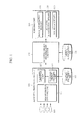
- FIG. 1 is a diagram illustrating an acoustic object information merging apparatus according to an exemplary embodiment.
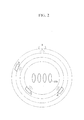
- FIG. 2 illustrates a microphone array of an acoustic object information merging apparatus according to an exemplary embodiment.
- FIG. 3 is a flowchart depicting an illustrative acoustic object information merging method according to an exemplary embodiment.
- FIG. 4 illustrates a merging of acoustic object information and a real image or sound according to an exemplary embodiment.
- FIG. 5 illustrates a merging of acoustic object information and a real image or sound according to an exemplary embodiment.
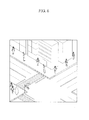
- FIG. 6 illustrates a merging of acoustic object information and a real image or sound according to an exemplary embodiment.
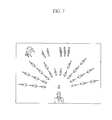
- FIG. 7 illustrates a merging of acoustic object information and a real image or sound according to an exemplary embodiment.
- FIG. 1 is a diagram illustrating an acoustic object information merging apparatus according to an exemplary embodiment.
- the acoustic object information merging apparatus (“AOIM apparatus”) includes an acoustic objectization unit 110, an acoustic object information creator 120 and a merging unit 130.
- the AOIM apparatus may be implemented in a terminal, for example, a cellular phone, PDA, desktop computer, tablet computer, laptop computer, etc.
- the acoustic objectization unit 110 estimates the directions and locations of a plurality of sounds that are received through a microphone array 100 to classify the sounds into a plurality of sound patterns and determines objects corresponding to the sounds according to the sound patterns.
- the acoustic objectization unit 110 determines objects corresponding to the received sounds according to sound patterns of the received sounds.
- the sound pattern of the received sound may be sound peak values.
- the acoustic objectization unit 110 may include a beamforming applying unit 111 and an acoustic object deciding unit 113.
- the beamforming applying unit 111 classifies sounds received through a microphone array 100 into a plurality of sound tones using a beamforming technique.
- FIG. 2 illustrates a microphone array of an acoustic object information merging apparatus according to an exemplary embodiment.
- the microphone array 100 may be a combination of a plurality of microphones, and may receive sounds and additional characteristics regarding directivity, such as the directions or locations of the sounds.
- the microphone array 100 receives sounds from different points a, b, c and d to determine the locations thereof, respectively.
- the sounds generated at points a, b, c and d forms a plurality of concentric circles centered on the microphone array. Accordingly, the microphone array 100 can obtain the angles and intensities of sounds received from the different points a, b, c and d. Sounds reach the microphone array 100 at different times because sounds are received from the points a, b, c and d at different times and accordingly the microphone array 100 can obtain the angles and intensities of the sounds generated at the points a, b, c and d.
- the beamforming applying unit 111 classifies the received sounds using a beamforming technique.
- the beamforming technique may be to adjust the directivity pattern of a microphone array to acquire only sounds in a desired direction from among the received sounds.
- the beamforming applying unit 111 acquires the directions and locations of a plurality of received sounds received by the microphone array 100, using the angles and intensities of the received sounds.
- the beamforming applying unit 111 classifies the sounds into a plurality of sound tones according to the directions and locations of the sounds.
- the acoustic object deciding unit 113 acquires sound peak values of the sound tones and acquires sound characteristic information associated with the sound peak values from a sound pattern database ("DB") 115.
- the sound pattern DB 115 stores sound peak values, which are sound characteristic information of various objects, such as a piano, cars, dogs and birds, etc. and information about the objects corresponding to the various sound peak values. However, aspects are not limited thereto such that the sound pattern DB 115 may be included in the AOIM apparatus and may be connected thereto in any suitable manner.
- the acoustic object deciding unit 113 acquires sound peak values of the individual sound tones classified by the beamforming applying unit 111 and objects corresponding to the sound peak values from the sound pattern DB 115.
- the acoustic object deciding unit 113 extracts the sound peak values of the sound tones using Discrete Fourier Transform ("DFT") or Fast Fourier Transform (“FFT"). After extracting the sound peak values of the sound tones, the acoustic object deciding unit 113 acquires objects corresponding to the sound peak values of the sound tones from the sound pattern DB 115. Thus, the acoustic object deciding unit may identify an object corresponding to each sound tone received by the microphone array.
- DFT Discrete Fourier Transform
- FFT Fast Fourier Transform
- the acoustic objectization unit 110 may determine an object corresponding to the sound by using a filtering applying unit 117.
- the acoustic object deciding unit 113 may fail to identify objects corresponding to the received sound when two or more different sounds generated at the same location are simultaneously inputted to the microphone array 100.
- the beamforming applying unit 111 may not distinguish the two or more different sounds from each other because the beamforming applying unit 111 may classify sounds received from the same location into one sound tone.
- the acoustic object deciding unit 113 may fail to identify objects corresponding to sound peak values of the individual two or more different sounds from the sound pattern DB 115.
- the filtering applying unit 117 causes a received sound to be separated into separate sound tones using frequency and amplitude information from the received sound.
- the filtering applying unit 117 may classify the sound into a secondary sound tone by using a band-pass filter.
- the acoustic object deciding unit 113 acquires a sound peak value of the secondary sound tone classified by the filtering applying unit 117 and identifies an object corresponding to the sound peak value from the sound pattern DB 115. By acquiring a sound peak value of a secondary sound tone, an object corresponding to the sound tone can be distinctly recognized even if the received sound is mixed with noise.
- the acoustic object information creator 120 acquires details and additional information about the identified objects to create acoustic object information.
- the AOIM apparatus may further include an object information DB 121 which stores details and additional information about a plurality of objects. However, aspects need not be limited thereto such that, the object information DB 121 may be independent of the AOIM apparatus and may be connected thereto in any suitable manner.
- the acoustic object information creator 120 acquires details and additional information about the objects from the object information DB 121 to create acoustic object information.
- the acoustic object information creator 120 acquires information about the car such as car model information type and car-related additional information from the object information DB 121.
- the acoustic object information creator 120 creates acoustic object information based on the car model information and car-related additional information received.
- the acoustic object information may be in the form of characters, pictures or moving pictures.
- the merging unit 130 is used to merge each piece of acoustic object information created by the acoustic object information creator 120 with a real image or sound.
- the merging unit 130 includes an image information merger 131, an acoustic information merger 133 and a sound canceller 135.
- the image information merger 131 merges a real image captured by a camera of a user terminal with acoustic object information associated with the real image and output the resultant image onto a display of the user terminal.
- the merging unit 130 may merge the real image and the acoustic object information in response to a request from a user. By way of example, in an image captured during a meeting where multiple people are speaking in a meeting room. As shown in FIG.
- the image information merger 131 merges the photographed real image with acoustic object information about the people who participated in the discussion.
- the image information merger 131 may output the resultant image onto a display of a user terminal connected to the AOIM apparatus.
- the acoustic object information may be in the form of speech bubbles merged with the real image.
- the acoustic information merger 133 outputs acoustic object information associated with a real sound or merges the acoustic object information with a real image.
- the real sound may be received by a microphone of a user terminal connected to the AOIM apparatus and the outputted acoustic object information may be outputted to the display of the user terminal.
- the received sound may be stored in a user terminal of connected to the AOIM apparatus.
- the real image may be a captured image captured by the camera of a user terminal connected to the AOIM apparatus and the image resulting from the merging may be outputted to the display of the user terminal, in response to a request from the user.
- the acoustic information merger 133 may output acoustic object information including information about the music to the display of the user terminal, or may merges the acoustic object information with a real image and then output the result of the merging to the display of the user terminal.
- the sound canceller 135 cancels sounds not corresponding to a selected object from among objects in an image.
- the user may choose the selected object image from images outputted to the display of a user terminal connected to the AOIM apparatus.
- a user may request, from an image of an orchestra performance captured by the camera of the user terminal, canceling of sounds corresponding to all musical instruments except the sounds of violins. If such a request is received, the sound canceller 135 then cancels sounds generated by the remaining musical instruments. Accordingly, the outputted acoustic object information the user may hear through the speaker of the user terminal may be the reproduction of the sounds of the violins.
- FIG. 3 is a flowchart depicting an illustrative acoustic object information merging method according to an exemplary embodiment.
- the AOIM apparatus uses a beamforming technique to estimate the directions and locations of the received sounds and classifies the sounds into a plurality of sound tones according to the directions and locations of the sounds.
- the beamforming technique may adjust the directivity pattern of the microphone array and acquire only desired sounds from among the received sounds.
- the AOIM apparatus uses the beamforming technique to determine the directions and locations of the sounds received by the microphone array, which may be, for example, based on the angles and intensities of the sounds, and thereby classifies the sounds into a plurality of sound tones.
- the AOIM apparatus acquires a sound peak value for each sound tone.
- the user terminal may extract a sound peak value for each sound tone using DFT or FFT.
- the AOIM apparatus identifies an object that corresponds to each extracted sound peak value by referencing a sound pattern DB in which sound peak values of various objects are stored.
- the AOIM apparatus determines whether objects have been identified for all the sound tones by referencing the sound pattern DB.
- the AOIM apparatus uses a band-pass filter to secondarily classify the sound whose associated object has not been determined. For example, when the AOIM apparatus receives two or more different sounds generated at or near the same location and time through the microphone array. In this case, the AOIM apparatus may fail to classify the different sounds into different sound tones using the beamforming technique. Accordingly, the AOIM apparatus may not have determined an object corresponding to the different sounds in operation 310. The AOIM apparatus classifies the sound whose associated object has not been identified into a sound tone based on the frequency and amplitude of the sound. Thereafter, the AOIM apparatus acquires sound peak values for each individual second sound tone classified by the band-pass filter. The AOIM apparatus then acquires objects having sound peak values corresponding to the sound peak values from the sound pattern DB. If at least one object is identified for a received sound, the method may proceed to operation 340.
- a band-pass filter to secondarily classify the sound whose associated object has not been determined. For example, when the
- the user terminal further acquires details and additional information about the objects determined to correspond to the individual sound tones to create acoustic object information.
- the AOIM apparatus acquires details and additional information about the identified objects determined to correspond to the individual sound tones by referencing an object information DB that stores such details and additional information about a plurality of objects.
- the object for a sound tone is determined to be a car
- the AOIM apparatus acquires the car model information and car- related additional information and creates acoustic object information according to the acquired car model information and car-related additional information.
- the acoustic object information may be in the form of characters, icons, pictures or moving pictures.
- the AOIM apparatus merges each piece of the acoustic object information with a real image or sound. For example, the AOIM apparatus determines whether there is a user's request for merging at least one piece of the acoustic object information with a real image or sound. If it is determined that there is a user's request for merging at least one piece of the acoustic object information with a real image, the AOIM apparatus merges a real image captured by a camera with acoustic object information associated with the real image.
- the real image may be an image captured by the camera of a user terminal connected to the AOIM apparatus and the image resulting from the merging may be outputted to a display of the user terminal.
- the image information merger merges the captured real image with acoustic object information about the people who participated in the discussion.
- the acoustic object information may be in the form of speech bubbles merged with the real image.
- the user terminal may output acoustic object information associated with the real sound received.
- the sound may be received through a microphone of a user terminal connected to the AOIM apparatus and stored in the user terminal of the AOIM apparatus.
- the acoustic object information may be projected onto a display of the user terminal.
- the user terminal when the sound of music on a street is received by the microphone of a user terminal connected to an exemplary AOIM apparatus, the user terminal outputs acoustic object information including information about the music onto the display of the user terminal.
- the AOIM apparatus may merge acoustic object information associated with a real sound with a real image and outputs the result of the merging onto the display of a user terminal connected to the AOIM apparatus.
- the AOIM apparatus may cancel sounds corresponding to objects in an image on the display of a user terminal connected to the AOIM apparatus, according to a user request.
- a user request for canceling sounds is received.
- the user request specifies violins, from an image of an orchestra performance captured by the camera of the user terminal, as objects whose sound is not to be canceled.
- the sound canceller 135 cancels sounds generated by the remaining musical instruments. Accordingly, the outputted acoustic object information the user may hears through the speaker of the user terminal is a reproduction of the sound of violins captured by the camera of the user terminal.
- FIG. 4 illustrates a merging of acoustic object information and a real image or sound, sound according to an exemplary embodiment.
- FIG. 4 corresponds to a case in which video for trial is captured by a camera of a user terminal connected to an exemplary AOIM apparatus.
- the AOIM apparatus objectizes participants participating in the trial based on the participants' voices. Then, the AOIM apparatus recognizes the objectized participants' voices using speech recognition to convert the voices into text, creates the text in a form of speech bubbles and then merges the speech bubbles with the trial video. Thereafter, if at least one participant is selected by a user from the merged trial video outputted onto the display of the user terminal, the AOIM apparatus may output speech bubbles created in association with the selected participant's voice onto the trial video and/or cancels voices of the remaining participants to output only the selected participant's voice through a speaker. Thus, the user can view or hear the speech of the participant through the display or speaker of the user terminal. However aspects are not limited thereto such that subtitles may be displayed on the display.
- FIG. 5 illustrates a merging of acoustic object information and a real image or sound according to an exemplary embodiment.
- a camera of a user terminal connected to an exemplary AMOI apparatus captures an image of an engine of a car.
- the AMOI apparatus objectizes sounds generated by the engine, which are received through a microphone array, merges acoustic object information (i.e., information about the engine parts) associated with the sounds with the real image photographed by the camera, and outputs acoustic object information corresponding to each part to a display of the user terminal.
- the AMOI apparatus may merge the real image showing the parts in the car with acoustic object information associated with the engine shown in the real image.
- the AMOI apparatus outputs the result of the merging and displays the acoustic object information near the location of the engine image on the display of the user terminal.
- the AMOI apparatus compares characteristic information about the received sounds of individual parts to characteristic information about sounds of parts stored in a database to determine whether the received sounds of the parts are in a normal state or in an abnormal state. Thus, the AMOI apparatus informs a user of the state of each part based on the result of the determination through a display on the user terminal connected to the AMOI apparatus. If it is determined that an engine sound from among the received sounds of the parts is in an abnormal state, the AMOI apparatus creates acoustic object information including a notice that the engine needs to be repaired.
- the AMOI apparatus merges the real image with the acoustic object information including the notice such that the acoustic object information appears near the engine image on the real image, and outputs the resultant image onto the display of the user terminal. Accordingly, the user can easily and quickly recognize the fact that there is something wrong with the engine.
- FIG. 6 illustrates a merging of acoustic object information and a real image or sound according to an exemplary embodiment.
- a user photographs the street along which he or she is walking using a camera in a user terminal connected to an exemplary AMOI apparatus.
- the AMOI apparatus classifies the plurality of pieces of music using the beamforming technique to obtain sound peak values for the pieces of music and identifies objects, such as music titles, corresponding to the obtained sound peak values.
- the AMOI apparatus further acquires details, such as singers, recording labels, etc. about the objects, i.e. the objectized pieces of music, to create acoustic object information.
- the AMOI apparatus merges the acoustic object information with the real image photographed by the camera and outputs the resultant image onto the display of the user terminal.
- the user terminal displays each piece of the acoustic object information near the corresponding store on the image displayed on the display. Accordingly, the user can use the AMOI apparatus to easily determine information about the music played by each store and may furthermore select a piece of music to download onto the user terminal.
- FIG. 7 illustrates a merging of acoustic object information and a real image or sound according to an exemplary embodiment.
- a user photographs an orchestra performance through a camera of a user terminal connected to an exemplary AMOI apparatus.
- the AMOI apparatus classifies the sounds of the musical instruments using the beamforming technique to obtain sound peak values for the received sounds of the musical instruments and identifies objects (i.e. musical instruments) corresponding to each sound peak value. Thereafter, the AMOI apparatus further acquires details and additional information about the objects to create acoustic object information.
- the AMOI apparatus merges the acoustic object information with the real image captured by the camera and outputs the resultant image onto a display of the user terminal.
- the user may acquire information about each musical instrument from the image displayed on the display of the user terminal.
- the AMOI apparatus cancels the sounds of the remaining musical instruments. Accordingly, the user may listen to the reproduced sounds of the particular musical instrument.
- a particular musical instrument e.g. violins
- the apparatus and method for merging acoustic object information disclosed herein provide an AR service in which real images are merged with sounds.
- Multiple sound tones received through a user terminal may be classified into objects, like images, and the individual objects may be merged with any reality that a user can feel.
- An apparatus and method for merging acoustic object information to provide an Augmented Reality (AR) service in which real images are merged with sounds includes an acoustic objectization unit, an acoustic object information creator and a merging unit.
- the method classifies sounds received in a microphone array to identify an object corresponding to the received sound.
- a band-pass filter is applied to secondarily classify the received sounds.
- Acoustic object information is created and merged with a captured image or recorded sound.
- the acoustic object information may include additional information about the object identified as corresponding to the received sound.
Landscapes
- Physics & Mathematics (AREA)
- Engineering & Computer Science (AREA)
- Acoustics & Sound (AREA)
- Signal Processing (AREA)
- User Interface Of Digital Computer (AREA)
- Circuit For Audible Band Transducer (AREA)
- Processing Or Creating Images (AREA)
Applications Claiming Priority (1)
| Application Number | Priority Date | Filing Date | Title |
|---|---|---|---|
| KR1020100073054A KR101285391B1 (ko) | 2010-07-28 | 2010-07-28 | 음향 객체 정보 융합 장치 및 방법 |
Publications (2)
| Publication Number | Publication Date |
|---|---|
| EP2413615A2 true EP2413615A2 (de) | 2012-02-01 |
| EP2413615A3 EP2413615A3 (de) | 2013-08-21 |
Family
ID=44851716
Family Applications (1)
| Application Number | Title | Priority Date | Filing Date |
|---|---|---|---|
| EP11172306.0A Withdrawn EP2413615A3 (de) | 2010-07-28 | 2011-07-01 | Vorrichtung und Verfahren zum Zusammenfügen akustischer Objektinformationen |
Country Status (4)
| Country | Link |
|---|---|
| US (1) | US20120027217A1 (de) |
| EP (1) | EP2413615A3 (de) |
| KR (1) | KR101285391B1 (de) |
| CN (1) | CN102404667A (de) |
Cited By (2)
| Publication number | Priority date | Publication date | Assignee | Title |
|---|---|---|---|---|
| EP2810454A1 (de) * | 2012-02-03 | 2014-12-10 | Sony Corporation | Informationsverarbeitungsvorrichtung, informationsverarbeitungsverfahren und programm |
| CN109314834A (zh) * | 2016-06-21 | 2019-02-05 | 诺基亚技术有限公司 | 改进介导现实中声音对象的感知 |
Families Citing this family (38)
| Publication number | Priority date | Publication date | Assignee | Title |
|---|---|---|---|---|
| US9838784B2 (en) | 2009-12-02 | 2017-12-05 | Knowles Electronics, Llc | Directional audio capture |
| US8798290B1 (en) | 2010-04-21 | 2014-08-05 | Audience, Inc. | Systems and methods for adaptive signal equalization |
| US9558755B1 (en) | 2010-05-20 | 2017-01-31 | Knowles Electronics, Llc | Noise suppression assisted automatic speech recognition |
| US10326978B2 (en) | 2010-06-30 | 2019-06-18 | Warner Bros. Entertainment Inc. | Method and apparatus for generating virtual or augmented reality presentations with 3D audio positioning |
| US10025381B2 (en) * | 2012-01-04 | 2018-07-17 | Tobii Ab | System for gaze interaction |
| US9197974B1 (en) * | 2012-01-06 | 2015-11-24 | Audience, Inc. | Directional audio capture adaptation based on alternative sensory input |
| US9640194B1 (en) | 2012-10-04 | 2017-05-02 | Knowles Electronics, Llc | Noise suppression for speech processing based on machine-learning mask estimation |
| CN104756526B (zh) * | 2012-11-02 | 2017-05-17 | 索尼公司 | 信号处理装置、信号处理方法、测量方法及测量装置 |
| US10102850B1 (en) * | 2013-02-25 | 2018-10-16 | Amazon Technologies, Inc. | Direction based end-pointing for speech recognition |
| KR20140114238A (ko) | 2013-03-18 | 2014-09-26 | 삼성전자주식회사 | 오디오와 결합된 이미지 표시 방법 |
| CN103338330A (zh) * | 2013-06-18 | 2013-10-02 | 腾讯科技(深圳)有限公司 | 一种图像处理方法、装置和终端 |
| US10129658B2 (en) * | 2013-07-22 | 2018-11-13 | Massachusetts Institute Of Technology | Method and apparatus for recovering audio signals from images |
| FR3011936B1 (fr) * | 2013-10-11 | 2021-09-17 | Snecma | Procede, systeme et programme d'ordinateur d'analyse acoustique d'une machine |
| KR102224568B1 (ko) | 2014-08-27 | 2021-03-08 | 삼성전자주식회사 | 오디오 데이터 처리 방법과 이를 지원하는 전자 장치 |
| CN106797512B (zh) | 2014-08-28 | 2019-10-25 | 美商楼氏电子有限公司 | 多源噪声抑制的方法、系统和非瞬时计算机可读存储介质 |
| US10388297B2 (en) | 2014-09-10 | 2019-08-20 | Harman International Industries, Incorporated | Techniques for generating multiple listening environments via auditory devices |
| US9978388B2 (en) | 2014-09-12 | 2018-05-22 | Knowles Electronics, Llc | Systems and methods for restoration of speech components |
| US9782672B2 (en) * | 2014-09-12 | 2017-10-10 | Voyetra Turtle Beach, Inc. | Gaming headset with enhanced off-screen awareness |
| DE112016000545B4 (de) | 2015-01-30 | 2019-08-22 | Knowles Electronics, Llc | Kontextabhängiges schalten von mikrofonen |
| US10354397B2 (en) | 2015-03-11 | 2019-07-16 | Massachusetts Institute Of Technology | Methods and apparatus for modeling deformations of an object |
| US9736580B2 (en) | 2015-03-19 | 2017-08-15 | Intel Corporation | Acoustic camera based audio visual scene analysis |
| DE102015210405A1 (de) * | 2015-06-05 | 2016-12-08 | Sennheiser Electronic Gmbh & Co. Kg | Audioverarbeitungssystem und Verfahren zum Verarbeiten eines Audiosignals |
| CN106303289B (zh) * | 2015-06-05 | 2020-09-04 | 福建凯米网络科技有限公司 | 一种将真实对象与虚拟场景融合显示的方法、装置及系统 |
| US10037609B2 (en) | 2016-02-01 | 2018-07-31 | Massachusetts Institute Of Technology | Video-based identification of operational mode shapes |
| JP6609383B2 (ja) | 2016-05-28 | 2019-11-20 | アコースティック ナレッジ,エルエルシー | オーディオ、ビジュアル及びモーション分析を備えたデジタルカメラ |
| US9906885B2 (en) * | 2016-07-15 | 2018-02-27 | Qualcomm Incorporated | Methods and systems for inserting virtual sounds into an environment |
| US10380745B2 (en) | 2016-09-01 | 2019-08-13 | Massachusetts Institute Of Technology | Methods and devices for measuring object motion using camera images |
| FI129137B (en) | 2016-09-22 | 2021-08-13 | Noiseless Acoustics Oy | An acoustic camera and a method for revealing acoustic emissions from various locations and devices |
| US10896544B2 (en) * | 2016-10-07 | 2021-01-19 | Htc Corporation | System and method for providing simulated environment |
| US11096004B2 (en) | 2017-01-23 | 2021-08-17 | Nokia Technologies Oy | Spatial audio rendering point extension |
| US10531219B2 (en) | 2017-03-20 | 2020-01-07 | Nokia Technologies Oy | Smooth rendering of overlapping audio-object interactions |
| US11074036B2 (en) | 2017-05-05 | 2021-07-27 | Nokia Technologies Oy | Metadata-free audio-object interactions |
| US10165386B2 (en) | 2017-05-16 | 2018-12-25 | Nokia Technologies Oy | VR audio superzoom |
| US11659322B1 (en) * | 2017-06-26 | 2023-05-23 | Wing Aviation Llc | Audio based aircraft detection |
| US11395087B2 (en) | 2017-09-29 | 2022-07-19 | Nokia Technologies Oy | Level-based audio-object interactions |
| CN108389584B (zh) * | 2018-01-31 | 2021-03-19 | 深圳市科迈爱康科技有限公司 | 声音分析方法及装置 |
| US10542368B2 (en) | 2018-03-27 | 2020-01-21 | Nokia Technologies Oy | Audio content modification for playback audio |
| US11494158B2 (en) | 2018-05-31 | 2022-11-08 | Shure Acquisition Holdings, Inc. | Augmented reality microphone pick-up pattern visualization |
Family Cites Families (9)
| Publication number | Priority date | Publication date | Assignee | Title |
|---|---|---|---|---|
| AU2003903414A0 (en) * | 2003-07-04 | 2003-07-17 | Vast Audio | An in-the-canal earphone for augmenting normal hearing with the capability of rendering virtual spatial audio concurrently with the real sound environment |
| KR100754385B1 (ko) | 2004-09-30 | 2007-08-31 | 삼성전자주식회사 | 오디오/비디오 센서를 이용한 위치 파악, 추적 및 분리장치와 그 방법 |
| CN101243392A (zh) * | 2005-08-15 | 2008-08-13 | 皇家飞利浦电子股份有限公司 | 用于终端用户编程的增强现实眼镜的系统、设备和方法 |
| US8111583B2 (en) * | 2007-08-21 | 2012-02-07 | Schwartz Adam L | Method and apparatus for determining and indicating direction and type of sound |
| KR20090022718A (ko) * | 2007-08-31 | 2009-03-04 | 삼성전자주식회사 | 음향처리장치 및 음향처리방법 |
| JP2011516830A (ja) * | 2008-03-20 | 2011-05-26 | フラウンホーファー−ゲゼルシャフト・ツール・フェルデルング・デル・アンゲヴァンテン・フォルシュング・アインゲトラーゲネル・フェライン | 聴覚的な表示のための装置及び方法 |
| US8170222B2 (en) * | 2008-04-18 | 2012-05-01 | Sony Mobile Communications Ab | Augmented reality enhanced audio |
| US20110096915A1 (en) * | 2009-10-23 | 2011-04-28 | Broadcom Corporation | Audio spatialization for conference calls with multiple and moving talkers |
| KR100962552B1 (ko) | 2010-01-20 | 2010-06-11 | (주)테슬라시스템 | 촬영된 영상에 음원 정보를 표시하는 카메라 시스템 |
-
2010
- 2010-07-28 KR KR1020100073054A patent/KR101285391B1/ko not_active Expired - Fee Related
-
2011
- 2011-06-20 US US13/164,429 patent/US20120027217A1/en not_active Abandoned
- 2011-07-01 EP EP11172306.0A patent/EP2413615A3/de not_active Withdrawn
- 2011-07-27 CN CN2011102119933A patent/CN102404667A/zh active Pending
Cited By (4)
| Publication number | Priority date | Publication date | Assignee | Title |
|---|---|---|---|---|
| EP2810454A1 (de) * | 2012-02-03 | 2014-12-10 | Sony Corporation | Informationsverarbeitungsvorrichtung, informationsverarbeitungsverfahren und programm |
| EP3525486A1 (de) * | 2012-02-03 | 2019-08-14 | Sony Corporation | Informationsverarbeitungsvorrichtung, informationsverarbeitungsverfahren und programm |
| CN109314834A (zh) * | 2016-06-21 | 2019-02-05 | 诺基亚技术有限公司 | 改进介导现实中声音对象的感知 |
| US10764705B2 (en) | 2016-06-21 | 2020-09-01 | Nokia Technologies Oy | Perception of sound objects in mediated reality |
Also Published As
| Publication number | Publication date |
|---|---|
| KR20120011280A (ko) | 2012-02-07 |
| EP2413615A3 (de) | 2013-08-21 |
| US20120027217A1 (en) | 2012-02-02 |
| CN102404667A (zh) | 2012-04-04 |
| KR101285391B1 (ko) | 2013-07-10 |
Similar Documents
| Publication | Publication Date | Title |
|---|---|---|
| EP2413615A2 (de) | Vorrichtung und Verfahren zum Zusammenfügen akustischer Objektinformationen | |
| US12069470B2 (en) | System and method for assisting selective hearing | |
| US10540986B2 (en) | Personalized, real-time audio processing | |
| US20230164509A1 (en) | System and method for headphone equalization and room adjustment for binaural playback in augmented reality | |
| US6882971B2 (en) | Method and apparatus for improving listener differentiation of talkers during a conference call | |
| CN102713935B (zh) | 会议室参与者辨识器 | |
| JP2019220848A (ja) | データ処理装置、データ処理方法及びプログラム | |
| US20230267942A1 (en) | Audio-visual hearing aid | |
| JP2021061527A (ja) | 情報処理装置、情報処理方法、及び情報処理プログラム | |
| JP2009301125A (ja) | 会議音声録音システム | |
| JP2010109898A (ja) | 撮影制御装置、撮影制御方法及びプログラム | |
| CN110348011A (zh) | 一种无纸化会议展示对象确定方法、装置和存储介质 | |
| Heittola et al. | Method for creating location-specific audio textures | |
| CN112331179A (zh) | 一种数据处理方法和耳机收纳装置 | |
| CN111696566A (zh) | 语音处理方法、装置和介质 | |
| JP6582024B2 (ja) | ショーのための情報支援システム | |
| JP6860178B1 (ja) | 映像処理装置及び映像処理方法 | |
| JP7339615B2 (ja) | 対話システム | |
| Ono et al. | Prediction method of Soundscape Impressions using Environmental Sounds and Aerial Photographs | |
| CN119790458A (zh) | 音频对象分离和处理音频 | |
| CN111696564A (zh) | 语音处理方法、装置和介质 | |
| CN119675934A (zh) | 语音重放攻击检测的设备鲁棒性评估方法、装置和系统 | |
| CN115910106A (zh) | 一种音视频处理方法、装置、设备及介质 |
Legal Events
| Date | Code | Title | Description |
|---|---|---|---|
| AK | Designated contracting states |
Kind code of ref document: A2 Designated state(s): AL AT BE BG CH CY CZ DE DK EE ES FI FR GB GR HR HU IE IS IT LI LT LU LV MC MK MT NL NO PL PT RO RS SE SI SK SM TR |
|
| AX | Request for extension of the european patent |
Extension state: BA ME |
|
| PUAI | Public reference made under article 153(3) epc to a published international application that has entered the european phase |
Free format text: ORIGINAL CODE: 0009012 |
|
| RIN1 | Information on inventor provided before grant (corrected) |
Inventor name: SON, JAE-KWAN Inventor name: JUN, HAE-JO |
|
| PUAL | Search report despatched |
Free format text: ORIGINAL CODE: 0009013 |
|
| RIC1 | Information provided on ipc code assigned before grant |
Ipc: H04R 3/00 20060101ALN20130710BHEP Ipc: H04S 7/00 20060101AFI20130710BHEP |
|
| AK | Designated contracting states |
Kind code of ref document: A3 Designated state(s): AL AT BE BG CH CY CZ DE DK EE ES FI FR GB GR HR HU IE IS IT LI LT LU LV MC MK MT NL NO PL PT RO RS SE SI SK SM TR |
|
| AX | Request for extension of the european patent |
Extension state: BA ME |
|
| STAA | Information on the status of an ep patent application or granted ep patent |
Free format text: STATUS: THE APPLICATION IS DEEMED TO BE WITHDRAWN |
|
| 18D | Application deemed to be withdrawn |
Effective date: 20140222 |