EP2413382A2 - Integral AC module grounding system - Google Patents
Integral AC module grounding system Download PDFInfo
- Publication number
- EP2413382A2 EP2413382A2 EP11174567A EP11174567A EP2413382A2 EP 2413382 A2 EP2413382 A2 EP 2413382A2 EP 11174567 A EP11174567 A EP 11174567A EP 11174567 A EP11174567 A EP 11174567A EP 2413382 A2 EP2413382 A2 EP 2413382A2
- Authority
- EP
- European Patent Office
- Prior art keywords
- voltage
- connector
- module
- grounding
- ground
- Prior art date
- Legal status (The legal status is an assumption and is not a legal conclusion. Google has not performed a legal analysis and makes no representation as to the accuracy of the status listed.)
- Granted
Links
Images




Classifications
-
- H—ELECTRICITY
- H02—GENERATION; CONVERSION OR DISTRIBUTION OF ELECTRIC POWER
- H02S—GENERATION OF ELECTRIC POWER BY CONVERSION OF INFRARED RADIATION, VISIBLE LIGHT OR ULTRAVIOLET LIGHT, e.g. USING PHOTOVOLTAIC [PV] MODULES
- H02S40/00—Components or accessories in combination with PV modules, not provided for in groups H02S10/00 - H02S30/00
- H02S40/30—Electrical components
- H02S40/32—Electrical components comprising DC/AC inverter means associated with the PV module itself, e.g. AC modules
-
- H—ELECTRICITY
- H02—GENERATION; CONVERSION OR DISTRIBUTION OF ELECTRIC POWER
- H02S—GENERATION OF ELECTRIC POWER BY CONVERSION OF INFRARED RADIATION, VISIBLE LIGHT OR ULTRAVIOLET LIGHT, e.g. USING PHOTOVOLTAIC [PV] MODULES
- H02S20/00—Supporting structures for PV modules
-
- F—MECHANICAL ENGINEERING; LIGHTING; HEATING; WEAPONS; BLASTING
- F24—HEATING; RANGES; VENTILATING
- F24S—SOLAR HEAT COLLECTORS; SOLAR HEAT SYSTEMS
- F24S25/00—Arrangement of stationary mountings or supports for solar heat collector modules
- F24S25/30—Arrangement of stationary mountings or supports for solar heat collector modules using elongate rigid mounting elements extending substantially along the supporting surface, e.g. for covering buildings with solar heat collectors
- F24S25/33—Arrangement of stationary mountings or supports for solar heat collector modules using elongate rigid mounting elements extending substantially along the supporting surface, e.g. for covering buildings with solar heat collectors forming substantially planar assemblies, e.g. of coplanar or stacked profiles
-
- H—ELECTRICITY
- H02—GENERATION; CONVERSION OR DISTRIBUTION OF ELECTRIC POWER
- H02J—ELECTRIC POWER NETWORKS; CIRCUIT ARRANGEMENTS OR SYSTEMS FOR SUPPLYING OR DISTRIBUTING ELECTRIC POWER; SYSTEMS FOR STORING ELECTRIC ENERGY
- H02J2101/00—Supply or distribution of decentralised, dispersed or local electric power generation
- H02J2101/20—Dispersed power generation using renewable energy sources
- H02J2101/22—Solar energy
-
- H—ELECTRICITY
- H02—GENERATION; CONVERSION OR DISTRIBUTION OF ELECTRIC POWER
- H02J—ELECTRIC POWER NETWORKS; CIRCUIT ARRANGEMENTS OR SYSTEMS FOR SUPPLYING OR DISTRIBUTING ELECTRIC POWER; SYSTEMS FOR STORING ELECTRIC ENERGY
- H02J2101/00—Supply or distribution of decentralised, dispersed or local electric power generation
- H02J2101/20—Dispersed power generation using renewable energy sources
- H02J2101/22—Solar energy
- H02J2101/24—Photovoltaics
-
- H—ELECTRICITY
- H02—GENERATION; CONVERSION OR DISTRIBUTION OF ELECTRIC POWER
- H02J—ELECTRIC POWER NETWORKS; CIRCUIT ARRANGEMENTS OR SYSTEMS FOR SUPPLYING OR DISTRIBUTING ELECTRIC POWER; SYSTEMS FOR STORING ELECTRIC ENERGY
- H02J3/00—Circuit arrangements for AC mains or AC distribution networks
- H02J3/38—Arrangements for feeding a single network from two or more generators or sources in parallel; Arrangements for feeding already energised networks from additional generators or sources in parallel
- H02J3/381—Dispersed generators
-
- Y—GENERAL TAGGING OF NEW TECHNOLOGICAL DEVELOPMENTS; GENERAL TAGGING OF CROSS-SECTIONAL TECHNOLOGIES SPANNING OVER SEVERAL SECTIONS OF THE IPC; TECHNICAL SUBJECTS COVERED BY FORMER USPC CROSS-REFERENCE ART COLLECTIONS [XRACs] AND DIGESTS
- Y02—TECHNOLOGIES OR APPLICATIONS FOR MITIGATION OR ADAPTATION AGAINST CLIMATE CHANGE
- Y02E—REDUCTION OF GREENHOUSE GAS [GHG] EMISSIONS, RELATED TO ENERGY GENERATION, TRANSMISSION OR DISTRIBUTION
- Y02E10/00—Energy generation through renewable energy sources
- Y02E10/50—Photovoltaic [PV] energy
- Y02E10/56—Power conversion systems, e.g. maximum power point trackers
Definitions
- the invention relates generally to photovoltaic (PV) systems and more particularly to a system and method of implementing intra-module dc grounding for a system of PV ac modules.
- PV photovoltaic
- PV systems Nearly all electrical systems in the U.S. are grounded to mitigate the impacts of lightning, line surges, or unintentional contact with high voltage lines.
- Most PV systems include modules with metal frames and metal mounting racks that are in exposed locations, e.g. rooftops where they are subject to lightning strikes, or are located near high voltage transmission lines that in the event of high winds, etc., can come into contact with PV arrays.
- the modules in a typical PV array have aluminum frames that are often anodized.
- the 2008-NEC code that has the same requirements as the draft 2010-NEC code and governs installation of PV systems requires exposed metal surfaces be grounded.
- a failure in the insulating material of the PV laminate could allow the frame to be energized up to 600V dc.
- the installer of a PV system is required to ground each module frame per the NEC code and UL standard 1703. This inter-module grounding must be met using a heavy, e.g. at least #10 gauge) copper wire and a 10-32 screw that can cut into the frame. Additional assurances are required even for frames having anodized surfaces. Washer/connectors in such cases are used to cut into the metal frame and provide the best electrical contact. These processes require additional components for installation and require a substantial level of effort to install mounting brackets and grounding wires.
- FIG. 1 illustrates a system of PV dc-voltage modules 10 configured to generate a desired dc output voltage that is known in the prior art.
- the system of PV dc-voltage modules 10 is a series configuration capable of generating up to 600V dc.
- a PV system installer is required to ground each module frame 12 per NEC code and UL standard 1703 as stated herein.
- Such frame-to-frame grounding is typically accomplished using a heavy gauge copper wire and a 10-32 screw that can cut into the frame(s). Further, washers/connectors are employed to ensure that reliable electrical contact is made and maintained, even for frames having anodized surfaces.
- FIG. 2 illustrates a system of PV ac-voltage modules 20 configured to generate a desired ac output voltage that is known in the prior art.
- Each ac-voltage module 22 comprises a dc-ac micro-inverter 24 integrated therewith to generate the desired ac output voltage.
- the availability of such compact and efficient micro-inverters 24 and their integration with individual dc-voltage PV modules 26 has led to the commercial realization of the ac module 22 which produces a 120V ac or 240V ac output.
- the 2005 NEC code section 960.6 addresses the ac module. Because all of the dc wiring requirements are now considered to be integral to the ac module and are not accessible, dc requirements in the NEC code are no longer applicable and installation is simplified in that there is no longer a requirement to provide a physical dc disconnect switch.
- micro-inverters 24 still require an equipment ground, meaning that all modules with metallic frames 28 and metal mounting systems have to be connected to a common earth ground through a low resistance path.
- Such inter-module ground connections are still be made using processes that require the use of metallic splices, lugs, penetrating washers, and wires. All of these methods require hands-in grounding connections be made at the time of installation and usually requires the presence of an experience electrician.
- a photovoltaic (PV) grounding system comprises:
- a photovoltaic (PV) grounding system comprises:
- All commercial systems that employ micro-inverters including products that integrate such micro-inverters onto a common aluminum module frame still require an equipment ground, meaning that all modules with metallic frames and metal mounting systems must be connected to a common earth ground through a low resistance path.
- Inter-module ground connections are still implemented using processes that require the use of metallic splices, lugs, penetrating washers, wires, and so on. These methods require hand-on grounding connections be made at the time of installation, and usually require the presence of an experience electrician.
- Grounding requirements based on the latest NEC codes are different for ac modules since the dc wiring is not external to the module. A system ground is no longer required. However, since the inverter case is still exposed metal, the case is required to be grounded.
- the case ground can be accomplished via any suitable equipment ground; and the conductor size need not be any larger than the size of the power conductors or pin sizes in the micro-inverter cables.
- the present inventors alone recognized that the equipment ground which also serves to ground the case can be accomplished by including a grounding pin in the ac cable recognizing that a four pin cable would be sufficient.
- Known ac-voltage micro-inverter architectures do not employ space in the power cable and connector for a ground pin and wire. Use of such a structure would advantageously allow exposed metal frames and rail to be grounded using the same pin by providing suitable connections.
- FIG. 3 illustrates a PV ac-voltage module grounding system 30 according to one embodiment of the invention.
- System 30 comprises a plurality of dc-ac micro-inverters 32.
- Each micro-inverter 32 is internally connected to a respective chassis ground or case 36 described in further detail herein with respect to Figure 4 .
- Each micro-inverter 32 is also integrated with a corresponding PV dc-voltage module 34 to provide a corresponding ac-voltage module 38.
- Each ac-voltage module 38 comprises a metallic enclosure or case 40 that includes a male ac-voltage plug and play connector 42 and a female ac-voltage plug and play connector 43.
- each male ac-voltage plug and play connector 42 comprises a pair of 120V ac-voltage pins 80, a neutral conductor pin 82 and a dc ground conductor pin 60 such as depicted in Figure 9 .
- Each corresponding female plug and play connector 43 comprises a pair of 102V ac-voltage slots 81, a neutral conductor slot 83 and a dc ground conductor slot 61 such as depicted in Figure 10 .
- Each plug and play connector dc ground conductor 60 is electrically connected internal to its corresponding micro-inverter 32 to a respective micro-inverter chassis/ground which may be, for example, the micro-inverter case 36.
- each micro-inverter 32 is mechanically and electrically attached to the metallic frame 40 of a corresponding ac-voltage module 38 via, for example, a metallic frame attachment bracket 44 to form a low resistance grounding contact between the micro-inverter metal case 36 and the corresponding ac-voltage module metallic frame 40.
- the micro-inverter dc inputs are connected to the ac-voltage module 38 through corresponding junction box 47 connectors 48.
- Each junction box 47 houses the normal +/- dc wiring/connectors of a PV module 34 and a micro-inverter 32. Since each micro-inverter case 36 is also electrically coupled to the metallic frame 40 of its corresponding ac-voltage module 38, the ground pin in each of the plug and play connectors 42, 43 automatically grounds all of the module frames 40 that are interconnected through the plug and play connectors 42, 43.
- a frame structure 46 comprising a metallic grounding rail 48 is configured to receive the plurality of ac-voltage modules 38 such that the plurality of ac-power plug and play connectors 42, 43 together carry a dc-voltage ground connection 60 from ac-voltage module 38 to ac-voltage module 38 through the plurality of ac-voltage modules via the plurality of plug and play connector dc-voltage ground conductors.
- the plug and play dc ground conductors 60 are electrically connected to a connection box 50 at the end of each row that is electrically grounded to the ac-voltage module frames 40.
- the corresponding grounding path is depicted in further detail herein with respect to Figure 4 .
- FIG 4 is a more detailed diagram illustrating the dc grounding conductor path 60 carried through ac-power plug and play connectors 42, 43 shown in Figure 3 .
- the plug and play connectors 42, 43 carry a dc-voltage ground connection from ac-voltage module 38 to ac-voltage module 38 through the plurality of ac-voltage modules 38.
- Each dc-ac micro-inverter 32 comprises a metallic case 36 that is mechanically connected or bonded to the metallic case of its corresponding PV dc-voltage module 34 via a metallic electrically conductive mounting bracket 44.
- Each ac-voltage module 38 comprises a male ac power connector 42 and a female ac power connector 43.
- Each power connector 42, 43 includes a dc grounding conductor that is connected to a corresponding micro-inverter 32 chassis/ground (case) 36 internal to its corresponding dc-ac micro-inverter 32 as shown.
- Each power connector 42, 43 further includes ac-voltage pins 62 and a neutral grounding pin 64 according to one embodiment. Since each micro-inverter case 36 is electrically coupled to the metallic frame 40 of its corresponding ac-voltage module 38, the ground pins in the plug and play power connectors 42, 43 automatically ground all of the module frames 40 via grounding path 60 when all of the ac-voltage modules 38 are installed into a frame structure such as illustrated in Figure 3 .
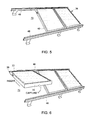
- FIG. 5 is a perspective diagram illustrating a rail structure for mounting a plurality of PV ac-voltage modules 38 according to one embodiment.
- Rail structure 70 includes a plurality of metallic, electrically conductive mounting rails 48.
- Each PV ac-voltage module 38 comprises a metallic/conductive frame 40 as stated herein.
- Figure 6 is a perspective diagram illustrating insertion of a PV ac-voltage module 38 into the rail structure 70.
- One edge 72 of the PV ac-voltage module 38 is first inserted into one of the mounting rails 48.
- the opposite edge 74 of the PV ac-voltage module 38 is then rotated toward and into the opposite mounting rail 48 to capture and hold the PV ac-voltage module 38 in place.
- FIG 7 is a perspective diagram illustrating inter-module coupling of individual PV ac-voltage modules 38 inserted into the rail structure 70.
- the newly inserted PV ac-voltage module 38 is slid along the mounting rails 48 toward a PV ac-voltage module 38 that is already installed in the rail structure 70 and that is closest to the newly inserted PV ac-voltage module 38 until it is substantially flush against the previously inserted module 38.
- Each PV ac-voltage module 38 comprises male and female micro-inverter ac-voltage connectors 42, 43 described for one embodiment in further detail herein with reference to Figures 9-10 .
- FIG 8 is a more detailed diagram illustrating mating male-female ac power connectors 42, 43 integrated with the PV ac-voltage modules 38 according to one embodiment.
- a male electrical connector 42 is integrated with the innermost side of a PV ac-voltage module frame 40, while the mating female electrical connector 43 is integrated with the outermost side of another PV ac-voltage module frame 40, or vice versa.
- the mating male-female electrical ac-power connectors 42, 43 thus implement intra-module dc grounding for a system of PV ac-modules 38 having metallic/conductive frames 40. While a conventional approach requires the attachment of grounding wires or conductive clips to individual modules during installation that is time consuming and adds to installation costs, the male-female electrical connectors 42, 43 circumvent such requirements by adding a grounding connector pin to the ac-voltage electrical connectors 42, 43 that provides for module 38 interconnections and by arranging the grounding connector pin to be electrically connected to a corresponding micro-inverter chassis, case or equipment ground 36 and for the case 36 of the micro-inverter 32 to be grounded to the module frame 40 upon its attachment.
- each male micro-inverter connector 42 comprises a pair of ac-voltage (e.g. 120V ac) pins 80, a neutral connector pin 82, and an equipment ground (dc-voltage ground) connector pin 60.
- the corresponding micro-inverter female connector 43 illustrated in Figure 10 comprises a pair of ac-voltage pin slots 81, a neutral connector pin slot 83 and an equipment ground connector pin slot 61.
- the male and female connectors 42, 43 are preferably keyed such as depicted according to one embodiment in Figures 9 and 10 to ensure proper electrical alignment when the plug and play modules 38 slide together.
- each micro-inverter 32 internally grounds its corresponding positive dc module conductor grounding pin 60.
- the internal grounding bond (via the dc ground fault protection circuits, NEC 690.5) requires that the inverter have a dc grounding electrode terminal that is located on the outside of the inverter case 36.
- the inverter case 36 is attached to the ac-voltage module frame 40 using a star washer or other attachment process that guarantees a low resistance, reliable ohmic contact, then the module frame 40 and inverter case 36 have a common equipment ground.
- the inverter electrical connectors 42, 43 provide a fourth conductor pin 60.
- Connecting the fourth conductor pin 60 to the inverter 32 internal grounding bond provides a grounding pathway between all of the modules 38 on a common insert and capture rail 70 when the connectors 42, 43 are mated together to implement a capture/plug and play solar electric system.
- electrical connectors 42, 43 each are configured with a chassis ground connection to ensure safe grounding when the electrical connection is made.
- the chassis ground connections are configured to maintain consistency with the National Electrical Code (NEC) that requires conformance with the make first, break last rule regarding the chassis ground connection.
- NEC National Electrical Code
Landscapes
- Inverter Devices (AREA)
Abstract
Description
- The invention relates generally to photovoltaic (PV) systems and more particularly to a system and method of implementing intra-module dc grounding for a system of PV ac modules.
- Nearly all electrical systems in the U.S. are grounded to mitigate the impacts of lightning, line surges, or unintentional contact with high voltage lines. Most PV systems include modules with metal frames and metal mounting racks that are in exposed locations, e.g. rooftops where they are subject to lightning strikes, or are located near high voltage transmission lines that in the event of high winds, etc., can come into contact with PV arrays.
- The modules in a typical PV array have aluminum frames that are often anodized. The 2008-NEC code that has the same requirements as the draft 2010-NEC code and governs installation of PV systems requires exposed metal surfaces be grounded. There are special dc wiring and grounding requirements that must be met specifically for dc module strings that can produce voltages at high as 600 volts. A failure in the insulating material of the PV laminate could allow the frame to be energized up to 600V dc.
- The installer of a PV system is required to ground each module frame per the NEC code and UL standard 1703. This inter-module grounding must be met using a heavy, e.g. at least #10 gauge) copper wire and a 10-32 screw that can cut into the frame. Additional assurances are required even for frames having anodized surfaces. Washer/connectors in such cases are used to cut into the metal frame and provide the best electrical contact. These processes require additional components for installation and require a substantial level of effort to install mounting brackets and grounding wires.
- Grounding continuity must also be addressed per the NEC code. The oldest NEC requirement necessitates making the ground connection first and breaking the ground connection last. Not all installations follow this practice. The circuit conductors should never be connected without a solid ground in place. GFI cannot prevent shock in this situation.
-
Figure 1 illustrates a system of PV dc-voltage modules 10 configured to generate a desired dc output voltage that is known in the prior art. The system of PV dc-voltage modules 10 is a series configuration capable of generating up to 600V dc. Thus, a failure in the insulating material of the PV laminate could allow the corresponding frames to be energized up to 600V dc. A PV system installer is required to ground eachmodule frame 12 per NEC code and UL standard 1703 as stated herein. Such frame-to-frame grounding is typically accomplished using a heavy gauge copper wire and a 10-32 screw that can cut into the frame(s). Further, washers/connectors are employed to ensure that reliable electrical contact is made and maintained, even for frames having anodized surfaces. -
Figure 2 illustrates a system of PV ac-voltage modules 20 configured to generate a desired ac output voltage that is known in the prior art. Each ac-voltage module 22 comprises a dc-ac micro-inverter 24 integrated therewith to generate the desired ac output voltage. The availability of such compact and efficient micro-inverters 24 and their integration with individual dc-voltage PV modules 26 has led to the commercial realization of theac module 22 which produces a 120V ac or 240V ac output. The 2005 NEC code section 960.6 addresses the ac module. Because all of the dc wiring requirements are now considered to be integral to the ac module and are not accessible, dc requirements in the NEC code are no longer applicable and installation is simplified in that there is no longer a requirement to provide a physical dc disconnect switch. - Presently, all commercial systems that employ micro-inverters 24 still require an equipment ground, meaning that all modules with
metallic frames 28 and metal mounting systems have to be connected to a common earth ground through a low resistance path. Such inter-module ground connections are still be made using processes that require the use of metallic splices, lugs, penetrating washers, and wires. All of these methods require hands-in grounding connections be made at the time of installation and usually requires the presence of an experience electrician. - In view of the foregoing, it would be advantageous to provide a system and method for implementing intra-module dc grounding for a system of PV ac modules, without necessitating use of metallic splices, screws, lugs, penetrating washers, brackets, wires and the like.
- Briefly, in accordance with one embodiment, a photovoltaic (PV) grounding system comprises:
- a plurality of dc-ac micro-inverters, each micro-inverter comprising a respective chassis ground, wherein each micro-inverter is configured together with a corresponding PV dc-voltage module to provide an ac-voltage module comprising a metallic enclosure and at least one ac-power connector, each ac-power connector comprising a dc-voltage ground conductor electrically connected to a corresponding chassis ground; and
- a frame structure comprising a metallic grounding frame configured to receive the plurality of ac-voltage modules such that the plurality of ac-power connectors together carry a dc-voltage ground connection from ac-voltage module to ac-voltage module through the plurality of ac-voltage modules via the plurality of dc-voltage ground conductors.
- A photovoltaic (PV) grounding system according to another embodiment comprises:
- a plurality of PV ac-voltage modules, each module comprising a metallic enclosure and at least one ac-power connector, each ac-power connector comprising a dc-voltage ground conductor; and
- a frame structure comprising a metallic grounding frame configured to receive the plurality of PV ac-voltage modules such that the plurality of ac-power connectors together carry a dc-voltage ground connection from ac-voltage module to ac-voltage module through the plurality of PV ac-voltage modules via the plurality of dc-voltage ground conductors.
- These and other features, aspects, and advantages of the present invention will become better understood when the following detailed description is read with reference to the accompanying drawings in which like characters represent like parts throughout the drawings, wherein:
-
Figure 1 illustrates a PV dc-voltage module grounding system that is known in the prior art; -
Figure 2 illustrates a PV ac-voltage module grounding system that is known in the art; -
Figure 3 illustrates a PV ac-voltage module grounding system according to one embodiment of the invention; -
Figure 4 is a more detailed diagram illustrating a plug and play ac-voltage power connector suitable for use with the system shown inFigure 3 to carry a dc-voltage ground connection from ac-voltage module to ac-voltage module through the plurality of ac-voltage modules; -
Figure 5 is a perspective diagram illustrating a rail structure for mounting a plurality of PV ac-voltage modules that employs the plug and play connectors illustrated inFigures 3 and4 ; -
Figure 6 is a perspective diagram illustrating insertion of a PV ac-voltage module into the rail structure depicted inFigure 5 ; -
Figure 7 is a perspective diagram illustrating inter-module coupling of individual PV ac-voltage modules inserted into the rail structure depicted inFigures 5 and 6 ; -
Figure 8 is a more detailed diagram illustrating mating ac power connectors integrated with the PV ac-voltage modules shown inFigures 3-6 ; -
Figure 9 illustrates a male ac power connector according to one embodiment suitable for use with the PV ac-voltage modules shown inFigures 3-6 ; and -
Figure 10 illustrates a female ac power connector according to one embodiment suitable for use with the PV ac-voltage modules shown inFigures 3-6 . - While the above-identified drawing figures set forth alternative embodiments, other embodiments of the present invention are also contemplated, as noted in the discussion. In all cases, this disclosure presents illustrated embodiments of the present invention by way of representation and not limitation. Numerous other modifications and embodiments can be devised by those skilled in the art which fall within the scope and spirit of the principles of this invention.
- All commercial systems that employ micro-inverters including products that integrate such micro-inverters onto a common aluminum module frame still require an equipment ground, meaning that all modules with metallic frames and metal mounting systems must be connected to a common earth ground through a low resistance path. Inter-module ground connections are still implemented using processes that require the use of metallic splices, lugs, penetrating washers, wires, and so on. These methods require hand-on grounding connections be made at the time of installation, and usually require the presence of an experience electrician.
- Grounding requirements based on the latest NEC codes are different for ac modules since the dc wiring is not external to the module. A system ground is no longer required. However, since the inverter case is still exposed metal, the case is required to be grounded. The case ground can be accomplished via any suitable equipment ground; and the conductor size need not be any larger than the size of the power conductors or pin sizes in the micro-inverter cables. The present inventors alone recognized that the equipment ground which also serves to ground the case can be accomplished by including a grounding pin in the ac cable recognizing that a four pin cable would be sufficient. Known ac-voltage micro-inverter architectures do not employ space in the power cable and connector for a ground pin and wire. Use of such a structure would advantageously allow exposed metal frames and rail to be grounded using the same pin by providing suitable connections.
-
Figure 3 illustrates a PV ac-voltage module grounding system 30 according to one embodiment of the invention. System 30 comprises a plurality of dc-ac micro-inverters 32. Each micro-inverter 32 is internally connected to a respective chassis ground orcase 36 described in further detail herein with respect toFigure 4 . Each micro-inverter 32 is also integrated with a corresponding PV dc-voltage module 34 to provide a corresponding ac-voltage module 38. Each ac-voltage module 38 comprises a metallic enclosure orcase 40 that includes a male ac-voltage plug andplay connector 42 and a female ac-voltage plug andplay connector 43. - According to one embodiment, each male ac-voltage plug and
play connector 42 comprises a pair of 120V ac-voltage pins 80, aneutral conductor pin 82 and a dcground conductor pin 60 such as depicted inFigure 9 . Each corresponding female plug andplay connector 43 comprises a pair of 102V ac-voltage slots 81, aneutral conductor slot 83 and a dcground conductor slot 61 such as depicted inFigure 10 . Each plug and play connectordc ground conductor 60 is electrically connected internal to itscorresponding micro-inverter 32 to a respective micro-inverter chassis/ground which may be, for example, themicro-inverter case 36. - The
metal case 36 of each micro-inverter 32 is mechanically and electrically attached to themetallic frame 40 of a corresponding ac-voltage module 38 via, for example, a metallicframe attachment bracket 44 to form a low resistance grounding contact between themicro-inverter metal case 36 and the corresponding ac-voltage modulemetallic frame 40. - The micro-inverter dc inputs are connected to the ac-
voltage module 38 through correspondingjunction box 47connectors 48. Eachjunction box 47 houses the normal +/- dc wiring/connectors of aPV module 34 and a micro-inverter 32. Since eachmicro-inverter case 36 is also electrically coupled to themetallic frame 40 of its corresponding ac-voltage module 38, the ground pin in each of the plug andplay connectors play connectors - A
frame structure 46 comprising ametallic grounding rail 48 is configured to receive the plurality of ac-voltage modules 38 such that the plurality of ac-power plug andplay connectors voltage ground connection 60 from ac-voltage module 38 to ac-voltage module 38 through the plurality of ac-voltage modules via the plurality of plug and play connector dc-voltage ground conductors. The plug and playdc ground conductors 60 are electrically connected to aconnection box 50 at the end of each row that is electrically grounded to the ac-voltage module frames 40. The corresponding grounding path is depicted in further detail herein with respect toFigure 4 . -
Figure 4 is a more detailed diagram illustrating the dcgrounding conductor path 60 carried through ac-power plug andplay connectors Figure 3 . The plug andplay connectors voltage module 38 to ac-voltage module 38 through the plurality of ac-voltage modules 38. Each dc-ac micro-inverter 32 comprises ametallic case 36 that is mechanically connected or bonded to the metallic case of its corresponding PV dc-voltage module 34 via a metallic electrically conductive mountingbracket 44. Each ac-voltage module 38 comprises a maleac power connector 42 and a femaleac power connector 43. Eachpower connector corresponding micro-inverter 32 chassis/ground (case) 36 internal to its corresponding dc-ac micro-inverter 32 as shown. Eachpower connector voltage pins 62 and aneutral grounding pin 64 according to one embodiment. Since eachmicro-inverter case 36 is electrically coupled to themetallic frame 40 of its corresponding ac-voltage module 38, the ground pins in the plug andplay power connectors path 60 when all of the ac-voltage modules 38 are installed into a frame structure such as illustrated inFigure 3 . -
Figure 5 is a perspective diagram illustrating a rail structure for mounting a plurality of PV ac-voltage modules 38 according to one embodiment.Rail structure 70 includes a plurality of metallic, electrically conductive mounting rails 48. Each PV ac-voltage module 38 comprises a metallic/conductive frame 40 as stated herein. -
Figure 6 is a perspective diagram illustrating insertion of a PV ac-voltage module 38 into therail structure 70. Oneedge 72 of the PV ac-voltage module 38 is first inserted into one of the mounting rails 48. Theopposite edge 74 of the PV ac-voltage module 38 is then rotated toward and into the opposite mountingrail 48 to capture and hold the PV ac-voltage module 38 in place. -
Figure 7 is a perspective diagram illustrating inter-module coupling of individual PV ac-voltage modules 38 inserted into therail structure 70. The newly inserted PV ac-voltage module 38 is slid along the mountingrails 48 toward a PV ac-voltage module 38 that is already installed in therail structure 70 and that is closest to the newly inserted PV ac-voltage module 38 until it is substantially flush against the previously insertedmodule 38. Each PV ac-voltage module 38 comprises male and female micro-inverter ac-voltage connectors Figures 9-10 . Sliding a pair of PV ac-voltage modules 38 together until substantially flush causes a corresponding male-female connector pair voltage modules 38. -
Figure 8 is a more detailed diagram illustrating mating male-femaleac power connectors voltage modules 38 according to one embodiment. A maleelectrical connector 42 is integrated with the innermost side of a PV ac-voltage module frame 40, while the mating femaleelectrical connector 43 is integrated with the outermost side of another PV ac-voltage module frame 40, or vice versa. - The mating male-female electrical ac-
power connectors modules 38 having metallic/conductive frames 40. While a conventional approach requires the attachment of grounding wires or conductive clips to individual modules during installation that is time consuming and adds to installation costs, the male-femaleelectrical connectors electrical connectors module 38 interconnections and by arranging the grounding connector pin to be electrically connected to a corresponding micro-inverter chassis, case orequipment ground 36 and for thecase 36 of the micro-inverter 32 to be grounded to themodule frame 40 upon its attachment. - According to one embodiment illustrated in
Figure 9 , each malemicro-inverter connector 42 comprises a pair of ac-voltage (e.g. 120V ac) pins 80, aneutral connector pin 82, and an equipment ground (dc-voltage ground)connector pin 60. The corresponding micro-inverterfemale connector 43 illustrated inFigure 10 comprises a pair of ac-voltage pin slots 81, a neutralconnector pin slot 83 and an equipment groundconnector pin slot 61. The male andfemale connectors Figures 9 and 10 to ensure proper electrical alignment when the plug andplay modules 38 slide together. - In summary explanation, each micro-inverter 32 internally grounds its corresponding positive dc module
conductor grounding pin 60. The internal grounding bond (via the dc ground fault protection circuits, NEC 690.5) requires that the inverter have a dc grounding electrode terminal that is located on the outside of theinverter case 36. When theinverter case 36 is attached to the ac-voltage module frame 40 using a star washer or other attachment process that guarantees a low resistance, reliable ohmic contact, then themodule frame 40 andinverter case 36 have a common equipment ground. The inverterelectrical connectors fourth conductor pin 60. Connecting thefourth conductor pin 60 to theinverter 32 internal grounding bond provides a grounding pathway between all of themodules 38 on a common insert and capturerail 70 when theconnectors - According to one aspect,
electrical connectors modules 38 when installing additional PV ac-voltage modules 38 into the capture/plug and play solar electric system that employs an earth grounded mounting rack/rails 48. - While only certain features of the invention have been illustrated and described herein, many modifications and changes will occur to those skilled in the art. It is, therefore, to be understood that the appended claims are intended to cover all such modifications and changes as fall within the true spirit of the invention.
Claims (15)
- A photovoltaic (PV) grounding system comprising:a plurality of dc-ac micro-inverters (32), each micro-inverter (32) comprising a respective chassis ground (44), wherein each micro-inverter (32) is configured together with a corresponding PV dc-voltage module (34) to provide an ac-voltage module (38) comprising a metallic enclosure (40) and at least one ac-power connector (42) (43), each ac-power connector (42) (43) comprising a dc-voltage ground conductor (60) electrically connected to a corresponding chassis ground (44); anda frame structure (46) comprising a metallic grounding frame (48) configured to receive the plurality of ac-voltage modules (38) such that the plurality of ac-power connectors (42) (43)together carry a dc-voltage ground connection from ac-voltage module (38) to ac-voltage module (38) through the plurality of ac-voltage modules (38) via the plurality of dc-voltage ground conductors (60).
- The PV grounding system according to claim 1, wherein each ac-voltage connector (42) (43) further comprises a neutral voltage conductor and one or more ac-voltage conductors.
- The PV grounding system according to claim 1 or claim 2, wherein the dc-voltage ground conductor comprises a make first, break last ground conductor.
- The PV grounding system according to any preceding claim, wherein each ac-voltage connector (42) (43) is selected from a 120V-ac connector and a 240V-ac connector.
- The PV grounding system according to any preceding claim, wherein each micro-inverter chassis ground (44) is electrically connected to its corresponding ac-voltage module enclosure (40) via a respective fixed non-insertable metallic grounding element (44).
- The PV grounding system according to any preceding claim, wherein at least one ac-voltage module enclosure (40) is electrically connected to the grounding frame (48) via a respective fixed non-insertable metallic grounding element (44).
- The PV grounding system according to any preceding claim, wherein at least one ac-voltage connector (42) (43) comprises a male connector (42) and at least one other ac-voltage connector comprises a female connector (43), wherein each male ac-voltage connector (42) is keyed to ensure proper electrical alignment with each female ac-voltage connector (43).
- A photovoltaic (PV) grounding system comprising:a plurality of PV ac-voltage modules (38), each module (38) comprising a metallic enclosure (40) and at least one ac-power connector (42) (43), each ac-power connector (42) (43) comprising a dc-voltage ground conductor; anda frame structure (46) comprising a metallic grounding frame (48) configured to receive the plurality of PV ac-voltage modules (38) such that the plurality of ac-power connectors (42) (43) together carry a dc-voltage ground connection (60) from ac-voltage module (38) to ac-voltage module (38) through the plurality of PV ac-voltage modules (38) via the plurality of dc-voltage ground conductors.
- The PV grounding system according to claim 8, wherein each PV ac-voltage module (38) further comprises:a PV dc-voltage module (34); anda dc-ac micro-inverter (32) comprising a chassis ground (44) electrically connected to a corresponding dc-voltage ground conductor (60), wherein the PV dc-voltage module (34) and the dc-ac micro-inverter (32) together are configured to generate a desired ac-voltage.
- The PV grounding system according to claim 8 or claim 9, wherein each dc-ac micro-inverter chassis ground (44) is electrically connected to its corresponding ac-voltage module enclosure (40) via a respective fixed non-insertable metallic grounding element (44).
- The PV grounding system according to any of claims 8 to 10, wherein at least one ac-voltage module enclosure is electrically connected to the grounding frame via a respective fixed non-insertable metallic grounding element.
- The PV grounding system according to any of claims 8 to 11, wherein each ac-voltage connector further comprises a neutral voltage conductor and one or more ac-voltage conductors.
- The PV grounding system according to any of claims 8 to 12, wherein the dc-voltage ground conductor comprises a make first, break last ground conductor.
- The PV grounding system according to ny of claims 8 to 13, wherein each ac-voltage connector is selected from a 120V-ac connector and a 240V-ac connector.
- The PV grounding system according to any of claims 8 to 14, wherein at least one ac-voltage connector comprises a male connector and at least one other ac-voltage connector comprises a female connector, wherein each male ac-voltage connector is keyed to ensure proper electrical alignment with each female ac-voltage connector.
Applications Claiming Priority (1)
| Application Number | Priority Date | Filing Date | Title |
|---|---|---|---|
| US12/846,057 US8455752B2 (en) | 2010-07-29 | 2010-07-29 | Integral ac module grounding system |
Publications (3)
| Publication Number | Publication Date |
|---|---|
| EP2413382A2 true EP2413382A2 (en) | 2012-02-01 |
| EP2413382A3 EP2413382A3 (en) | 2012-06-13 |
| EP2413382B1 EP2413382B1 (en) | 2020-06-10 |
Family
ID=44508819
Family Applications (1)
| Application Number | Title | Priority Date | Filing Date |
|---|---|---|---|
| EP11174567.5A Active EP2413382B1 (en) | 2010-07-29 | 2011-07-19 | Integral AC module grounding system |
Country Status (4)
| Country | Link |
|---|---|
| US (1) | US8455752B2 (en) |
| EP (1) | EP2413382B1 (en) |
| CN (1) | CN102347714B (en) |
| AU (1) | AU2011204837A1 (en) |
Cited By (4)
| Publication number | Priority date | Publication date | Assignee | Title |
|---|---|---|---|---|
| WO2014198856A1 (en) * | 2013-06-14 | 2014-12-18 | Phoenix Contact Gmbh & Co. Kg | Cable module for module inverters of a photovoltaic generator |
| WO2014204398A1 (en) * | 2013-06-18 | 2014-12-24 | Leaw Kok Beng | An ac solar module |
| US9343600B2 (en) | 2013-12-06 | 2016-05-17 | Haibo Zhang | Integrated microinverter housing for a PV AC module |
| EP3121959A1 (en) * | 2015-07-23 | 2017-01-25 | Lg Electronics Inc. | Photovoltaic module and photovoltaic system including the same |
Families Citing this family (27)
| Publication number | Priority date | Publication date | Assignee | Title |
|---|---|---|---|---|
| US8595996B2 (en) * | 2010-02-26 | 2013-12-03 | General Electric Company | Photovoltaic framed module array mount utilizing asymmetric rail |
| CN102832517A (en) * | 2012-04-06 | 2012-12-19 | 山亿新能源股份有限公司 | Adapter device for multiple inverters and three-phase power grid |
| US9273885B2 (en) * | 2013-06-13 | 2016-03-01 | Building Materials Investment Corporation | Roof integrated photovoltaic system |
| US10256765B2 (en) | 2013-06-13 | 2019-04-09 | Building Materials Investment Corporation | Roof integrated photovoltaic system |
| WO2015010245A1 (en) * | 2013-07-23 | 2015-01-29 | 浙江昱辉阳光能源有限公司 | Micro-inverter, photovoltaic module and photovoltaic module system |
| US9685904B2 (en) | 2013-10-16 | 2017-06-20 | General Electric Company | Photovoltaic system with improved DC connections and method of making same |
| US9847627B2 (en) * | 2013-10-19 | 2017-12-19 | Shoals Technologies Group, Llc | Modular photovoltaic power skid base system |
| KR102193870B1 (en) * | 2014-01-27 | 2020-12-22 | 엘지전자 주식회사 | Integral inverter and solar cell module including the same |
| US20150249426A1 (en) * | 2014-02-28 | 2015-09-03 | David Okawa | Photovoltaic module junction box |
| KR102377270B1 (en) | 2014-07-09 | 2022-03-22 | 엔페이즈 에너지, 인코포레이티드 | Apparatus and system for coupling power electronics to a photovoltaic module |
| AU2015364718B2 (en) | 2014-12-16 | 2019-11-28 | Marici Holdings The Netherlands B.V. | Energy panel arrangement power dissipation |
| DE202015000200U1 (en) * | 2015-01-16 | 2015-02-18 | Sigma Energy Systems Gmbh | Solar roof panel system |
| US10348094B2 (en) | 2015-01-28 | 2019-07-09 | Abb Schweiz Ag | Energy panel arrangement shutdown |
| WO2016134356A1 (en) | 2015-02-22 | 2016-08-25 | Abb Technology Ag | Photovoltaic string reverse polarity detection |
| US9455663B1 (en) * | 2015-05-29 | 2016-09-27 | Scott Carrington | Modular solar panel roof system |
| WO2016195718A1 (en) | 2015-06-05 | 2016-12-08 | Lumeta, Llc | Apparatus and method for solar panel on-board wiring |
| KR101772541B1 (en) * | 2015-10-22 | 2017-09-12 | 엘지전자 주식회사 | Power supply device, and power supply system including the same |
| US10511258B2 (en) | 2016-06-17 | 2019-12-17 | Sunpower Corporation | Photovoltaic assembly having corner-facing electrical connector port |
| US10371185B2 (en) | 2017-01-09 | 2019-08-06 | David Lynn | Magnetically-controlled connectors and methods of use |
| US10177551B1 (en) * | 2017-10-05 | 2019-01-08 | Cambria County Association For The Blind And Handicapped | Grounding system |
| US10651786B2 (en) | 2018-01-08 | 2020-05-12 | David Lynn | Panel with magnetically-controlled connectors for attachment to a support member |
| US10490682B2 (en) | 2018-03-14 | 2019-11-26 | National Mechanical Group Corp. | Frame-less encapsulated photo-voltaic solar panel supporting solar cell modules encapsulated within multiple layers of optically-transparent epoxy-resin materials |
| US10971870B2 (en) | 2018-08-17 | 2021-04-06 | David Lynn | Connection interface for a panel and support structure |
| KR102471339B1 (en) * | 2018-12-28 | 2022-11-29 | (주)엘엑스하우시스 | Solar panel assembly |
| KR102500609B1 (en) * | 2020-12-29 | 2023-02-16 | 한빅솔라(주) | Solar panel assembly |
| CN115133567B (en) * | 2021-03-27 | 2025-10-28 | 华为数字能源技术有限公司 | Photovoltaic system and leakage current control method of photovoltaic system |
| CN117691848B (en) * | 2024-02-02 | 2024-04-26 | 深圳市耐斯特能源科技有限公司 | A high-power photovoltaic energy storage inverter with the function of resisting instantaneous strong electric shock |
Family Cites Families (17)
| Publication number | Priority date | Publication date | Assignee | Title |
|---|---|---|---|---|
| US5582519A (en) * | 1994-12-15 | 1996-12-10 | The Whitaker Corporation | Make-first-break-last ground connections |
| US6111189A (en) * | 1998-07-28 | 2000-08-29 | Bp Solarex | Photovoltaic module framing system with integral electrical raceways |
| WO2002041407A1 (en) * | 2000-11-16 | 2002-05-23 | Kaneka Corporation | Solar battery module, photovoltaic power generation system, support block supporting solar battery module, and photovoltaic power generation system installation method |
| JP2003052185A (en) * | 2001-05-30 | 2003-02-21 | Canon Inc | Power converter, photovoltaic element module using the same, and power generator |
| US20040147172A1 (en) * | 2002-07-05 | 2004-07-29 | Brown Jacob E | Apparatus, system, and method of electrically coupling photovoltaic modules |
| US8141306B2 (en) * | 2004-10-22 | 2012-03-27 | Kyocera Corporation | Solar battery module device and method of installing the same |
| WO2008028151A2 (en) * | 2006-08-31 | 2008-03-06 | Pvt Solar, Inc. | Technique for electrically bonding solar modules and mounting assemblies |
| US20100147362A1 (en) * | 2007-03-07 | 2010-06-17 | Greenrey, Inc. | Multi-function frame and integrated mounting system for photovoltaic power generating laminates |
| US20080283118A1 (en) * | 2007-05-17 | 2008-11-20 | Larankelo, Inc. | Photovoltaic ac inverter mount and interconnect |
| US8813460B2 (en) * | 2007-09-21 | 2014-08-26 | Andalay Solar, Inc. | Mounting system for solar panels |
| WO2009088977A1 (en) | 2008-01-09 | 2009-07-16 | Petra Solar Inc. | Photovoltaic panel with hot plug connector |
| US8383943B2 (en) * | 2008-03-28 | 2013-02-26 | Greenray, Inc. | Electrical cable harness and assembly for transmitting AC electrical power |
| US20090314335A1 (en) | 2008-06-20 | 2009-12-24 | Mcclintock Meredith | Integral photovoltaic unit |
| US8171679B2 (en) | 2008-09-23 | 2012-05-08 | Architectural Glass And Aluminum Corporation, Inc. | Integrated electrical conduit for solar PV system |
| US20100194202A1 (en) * | 2009-01-31 | 2010-08-05 | David Sun | System and method for integrated solar power generator with micro inverters |
| US8207637B2 (en) * | 2009-10-09 | 2012-06-26 | Solarbridge Technologies, Inc. | System and apparatus for interconnecting an array of power generating assemblies |
| US8462518B2 (en) * | 2009-10-12 | 2013-06-11 | Solarbridge Technologies, Inc. | Power inverter docking system for photovoltaic modules |
-
2010
- 2010-07-29 US US12/846,057 patent/US8455752B2/en not_active Expired - Fee Related
-
2011
- 2011-07-19 EP EP11174567.5A patent/EP2413382B1/en active Active
- 2011-07-19 AU AU2011204837A patent/AU2011204837A1/en not_active Abandoned
- 2011-07-29 CN CN201110224360.6A patent/CN102347714B/en not_active Expired - Fee Related
Non-Patent Citations (1)
| Title |
|---|
| None |
Cited By (6)
| Publication number | Priority date | Publication date | Assignee | Title |
|---|---|---|---|---|
| WO2014198856A1 (en) * | 2013-06-14 | 2014-12-18 | Phoenix Contact Gmbh & Co. Kg | Cable module for module inverters of a photovoltaic generator |
| KR20160020507A (en) * | 2013-06-14 | 2016-02-23 | 피닉스 컨택트 게엠베하 & 컴퍼니 카게 | Cable module for module inverters of a photovoltaic generator |
| WO2014204398A1 (en) * | 2013-06-18 | 2014-12-24 | Leaw Kok Beng | An ac solar module |
| US9343600B2 (en) | 2013-12-06 | 2016-05-17 | Haibo Zhang | Integrated microinverter housing for a PV AC module |
| EP3121959A1 (en) * | 2015-07-23 | 2017-01-25 | Lg Electronics Inc. | Photovoltaic module and photovoltaic system including the same |
| US10658971B2 (en) | 2015-07-23 | 2020-05-19 | Lg Electronics Inc. | Photovoltaic module and photovoltaic system including the same |
Also Published As
| Publication number | Publication date |
|---|---|
| US20120024563A1 (en) | 2012-02-02 |
| EP2413382B1 (en) | 2020-06-10 |
| CN102347714B (en) | 2016-02-24 |
| CN102347714A (en) | 2012-02-08 |
| US8455752B2 (en) | 2013-06-04 |
| EP2413382A3 (en) | 2012-06-13 |
| AU2011204837A1 (en) | 2012-02-16 |
Similar Documents
| Publication | Publication Date | Title |
|---|---|---|
| US8455752B2 (en) | Integral ac module grounding system | |
| US20120255596A1 (en) | Photovoltaic mounting system with grounding bars and method of installing same | |
| US8922972B2 (en) | Integral module power conditioning system | |
| US8227942B2 (en) | System and apparatus for interconnecting an array of power generating assemblies | |
| US10812015B2 (en) | Micro-inverter assembly for use in a photovoltaic system and method of making same | |
| US20040147172A1 (en) | Apparatus, system, and method of electrically coupling photovoltaic modules | |
| US20160233822A1 (en) | Photovoltaic grounding system and method of making same | |
| CN101485240B (en) | Electronic module having a locking member and system including same | |
| US10044190B2 (en) | Distributed energy system with four conductor bipolar DC bus | |
| EP3235103B1 (en) | Modular uninterruptible power supply and power distribution system | |
| US20160149536A1 (en) | Solar Power Panels, Arrays and Connection Systems | |
| CN101039032A (en) | Device for parallel connection of a plurality of electrical feeder units | |
| US8422203B2 (en) | Low-resistance telecommunications power distribution panel | |
| US9893678B2 (en) | Photovoltaic system with improved AC connections and method of making same | |
| US20150280439A1 (en) | Apparatus for grounding interconnected electrical components and assemblies | |
| US20180269827A1 (en) | Parallel-connected solar power converter system | |
| EP1753110A1 (en) | Modular power distribution apparatus and methods with protective earth conductor | |
| EP3267539A1 (en) | Method of installing electrical device assembly, and electrical device assembly | |
| CN101345470B (en) | Current transformer | |
| US20250343385A1 (en) | Smart panel adapter for connecting a smart panel to an electrical meter socket | |
| WO2014204398A1 (en) | An ac solar module | |
| NZ756190B2 (en) | Off-grid electrical power system |
Legal Events
| Date | Code | Title | Description |
|---|---|---|---|
| AK | Designated contracting states |
Kind code of ref document: A2 Designated state(s): AL AT BE BG CH CY CZ DE DK EE ES FI FR GB GR HR HU IE IS IT LI LT LU LV MC MK MT NL NO PL PT RO RS SE SI SK SM TR |
|
| AX | Request for extension of the european patent |
Extension state: BA ME |
|
| PUAI | Public reference made under article 153(3) epc to a published international application that has entered the european phase |
Free format text: ORIGINAL CODE: 0009012 |
|
| PUAL | Search report despatched |
Free format text: ORIGINAL CODE: 0009013 |
|
| AK | Designated contracting states |
Kind code of ref document: A3 Designated state(s): AL AT BE BG CH CY CZ DE DK EE ES FI FR GB GR HR HU IE IS IT LI LT LU LV MC MK MT NL NO PL PT RO RS SE SI SK SM TR |
|
| AX | Request for extension of the european patent |
Extension state: BA ME |
|
| RIC1 | Information provided on ipc code assigned before grant |
Ipc: H02J 3/38 20060101ALI20120509BHEP Ipc: H01L 31/042 20060101AFI20120509BHEP |
|
| 17P | Request for examination filed |
Effective date: 20121213 |
|
| 17Q | First examination report despatched |
Effective date: 20130515 |
|
| STAA | Information on the status of an ep patent application or granted ep patent |
Free format text: STATUS: EXAMINATION IS IN PROGRESS |
|
| RAP1 | Party data changed (applicant data changed or rights of an application transferred) |
Owner name: ABB SCHWEIZ AG |
|
| REG | Reference to a national code |
Ref country code: DE Ref legal event code: R079 Ref document number: 602011067221 Country of ref document: DE Free format text: PREVIOUS MAIN CLASS: H01L0031042000 Ipc: H02S0020000000 |
|
| GRAP | Despatch of communication of intention to grant a patent |
Free format text: ORIGINAL CODE: EPIDOSNIGR1 |
|
| STAA | Information on the status of an ep patent application or granted ep patent |
Free format text: STATUS: GRANT OF PATENT IS INTENDED |
|
| RIC1 | Information provided on ipc code assigned before grant |
Ipc: H02J 3/38 20060101ALN20191129BHEP Ipc: H02S 40/32 20140101ALI20191129BHEP Ipc: H02S 20/00 20140101AFI20191129BHEP |
|
| INTG | Intention to grant announced |
Effective date: 20200107 |
|
| GRAS | Grant fee paid |
Free format text: ORIGINAL CODE: EPIDOSNIGR3 |
|
| GRAA | (expected) grant |
Free format text: ORIGINAL CODE: 0009210 |
|
| STAA | Information on the status of an ep patent application or granted ep patent |
Free format text: STATUS: THE PATENT HAS BEEN GRANTED |
|
| RAP1 | Party data changed (applicant data changed or rights of an application transferred) |
Owner name: ABB SCHWEIZ AG |
|
| AK | Designated contracting states |
Kind code of ref document: B1 Designated state(s): AL AT BE BG CH CY CZ DE DK EE ES FI FR GB GR HR HU IE IS IT LI LT LU LV MC MK MT NL NO PL PT RO RS SE SI SK SM TR |
|
| REG | Reference to a national code |
Ref country code: GB Ref legal event code: FG4D |
|
| REG | Reference to a national code |
Ref country code: CH Ref legal event code: EP Ref country code: AT Ref legal event code: REF Ref document number: 1279978 Country of ref document: AT Kind code of ref document: T Effective date: 20200615 |
|
| REG | Reference to a national code |
Ref country code: DE Ref legal event code: R096 Ref document number: 602011067221 Country of ref document: DE |
|
| REG | Reference to a national code |
Ref country code: IE Ref legal event code: FG4D |
|
| REG | Reference to a national code |
Ref country code: LT Ref legal event code: MG4D |
|
| PG25 | Lapsed in a contracting state [announced via postgrant information from national office to epo] |
Ref country code: FI Free format text: LAPSE BECAUSE OF FAILURE TO SUBMIT A TRANSLATION OF THE DESCRIPTION OR TO PAY THE FEE WITHIN THE PRESCRIBED TIME-LIMIT Effective date: 20200610 Ref country code: LT Free format text: LAPSE BECAUSE OF FAILURE TO SUBMIT A TRANSLATION OF THE DESCRIPTION OR TO PAY THE FEE WITHIN THE PRESCRIBED TIME-LIMIT Effective date: 20200610 Ref country code: SE Free format text: LAPSE BECAUSE OF FAILURE TO SUBMIT A TRANSLATION OF THE DESCRIPTION OR TO PAY THE FEE WITHIN THE PRESCRIBED TIME-LIMIT Effective date: 20200610 Ref country code: GR Free format text: LAPSE BECAUSE OF FAILURE TO SUBMIT A TRANSLATION OF THE DESCRIPTION OR TO PAY THE FEE WITHIN THE PRESCRIBED TIME-LIMIT Effective date: 20200911 Ref country code: NO Free format text: LAPSE BECAUSE OF FAILURE TO SUBMIT A TRANSLATION OF THE DESCRIPTION OR TO PAY THE FEE WITHIN THE PRESCRIBED TIME-LIMIT Effective date: 20200910 |
|
| REG | Reference to a national code |
Ref country code: NL Ref legal event code: MP Effective date: 20200610 |
|
| PG25 | Lapsed in a contracting state [announced via postgrant information from national office to epo] |
Ref country code: RS Free format text: LAPSE BECAUSE OF FAILURE TO SUBMIT A TRANSLATION OF THE DESCRIPTION OR TO PAY THE FEE WITHIN THE PRESCRIBED TIME-LIMIT Effective date: 20200610 Ref country code: BG Free format text: LAPSE BECAUSE OF FAILURE TO SUBMIT A TRANSLATION OF THE DESCRIPTION OR TO PAY THE FEE WITHIN THE PRESCRIBED TIME-LIMIT Effective date: 20200910 Ref country code: HR Free format text: LAPSE BECAUSE OF FAILURE TO SUBMIT A TRANSLATION OF THE DESCRIPTION OR TO PAY THE FEE WITHIN THE PRESCRIBED TIME-LIMIT Effective date: 20200610 Ref country code: LV Free format text: LAPSE BECAUSE OF FAILURE TO SUBMIT A TRANSLATION OF THE DESCRIPTION OR TO PAY THE FEE WITHIN THE PRESCRIBED TIME-LIMIT Effective date: 20200610 |
|
| REG | Reference to a national code |
Ref country code: AT Ref legal event code: MK05 Ref document number: 1279978 Country of ref document: AT Kind code of ref document: T Effective date: 20200610 |
|
| PG25 | Lapsed in a contracting state [announced via postgrant information from national office to epo] |
Ref country code: AL Free format text: LAPSE BECAUSE OF FAILURE TO SUBMIT A TRANSLATION OF THE DESCRIPTION OR TO PAY THE FEE WITHIN THE PRESCRIBED TIME-LIMIT Effective date: 20200610 Ref country code: NL Free format text: LAPSE BECAUSE OF FAILURE TO SUBMIT A TRANSLATION OF THE DESCRIPTION OR TO PAY THE FEE WITHIN THE PRESCRIBED TIME-LIMIT Effective date: 20200610 |
|
| PG25 | Lapsed in a contracting state [announced via postgrant information from national office to epo] |
Ref country code: EE Free format text: LAPSE BECAUSE OF FAILURE TO SUBMIT A TRANSLATION OF THE DESCRIPTION OR TO PAY THE FEE WITHIN THE PRESCRIBED TIME-LIMIT Effective date: 20200610 Ref country code: AT Free format text: LAPSE BECAUSE OF FAILURE TO SUBMIT A TRANSLATION OF THE DESCRIPTION OR TO PAY THE FEE WITHIN THE PRESCRIBED TIME-LIMIT Effective date: 20200610 Ref country code: SM Free format text: LAPSE BECAUSE OF FAILURE TO SUBMIT A TRANSLATION OF THE DESCRIPTION OR TO PAY THE FEE WITHIN THE PRESCRIBED TIME-LIMIT Effective date: 20200610 Ref country code: IT Free format text: LAPSE BECAUSE OF FAILURE TO SUBMIT A TRANSLATION OF THE DESCRIPTION OR TO PAY THE FEE WITHIN THE PRESCRIBED TIME-LIMIT Effective date: 20200610 Ref country code: CZ Free format text: LAPSE BECAUSE OF FAILURE TO SUBMIT A TRANSLATION OF THE DESCRIPTION OR TO PAY THE FEE WITHIN THE PRESCRIBED TIME-LIMIT Effective date: 20200610 Ref country code: RO Free format text: LAPSE BECAUSE OF FAILURE TO SUBMIT A TRANSLATION OF THE DESCRIPTION OR TO PAY THE FEE WITHIN THE PRESCRIBED TIME-LIMIT Effective date: 20200610 Ref country code: ES Free format text: LAPSE BECAUSE OF FAILURE TO SUBMIT A TRANSLATION OF THE DESCRIPTION OR TO PAY THE FEE WITHIN THE PRESCRIBED TIME-LIMIT Effective date: 20200610 Ref country code: PT Free format text: LAPSE BECAUSE OF FAILURE TO SUBMIT A TRANSLATION OF THE DESCRIPTION OR TO PAY THE FEE WITHIN THE PRESCRIBED TIME-LIMIT Effective date: 20201012 |
|
| PG25 | Lapsed in a contracting state [announced via postgrant information from national office to epo] |
Ref country code: SK Free format text: LAPSE BECAUSE OF FAILURE TO SUBMIT A TRANSLATION OF THE DESCRIPTION OR TO PAY THE FEE WITHIN THE PRESCRIBED TIME-LIMIT Effective date: 20200610 Ref country code: PL Free format text: LAPSE BECAUSE OF FAILURE TO SUBMIT A TRANSLATION OF THE DESCRIPTION OR TO PAY THE FEE WITHIN THE PRESCRIBED TIME-LIMIT Effective date: 20200610 Ref country code: IS Free format text: LAPSE BECAUSE OF FAILURE TO SUBMIT A TRANSLATION OF THE DESCRIPTION OR TO PAY THE FEE WITHIN THE PRESCRIBED TIME-LIMIT Effective date: 20201010 |
|
| REG | Reference to a national code |
Ref country code: CH Ref legal event code: PL |
|
| REG | Reference to a national code |
Ref country code: DE Ref legal event code: R097 Ref document number: 602011067221 Country of ref document: DE |
|
| PG25 | Lapsed in a contracting state [announced via postgrant information from national office to epo] |
Ref country code: MC Free format text: LAPSE BECAUSE OF FAILURE TO SUBMIT A TRANSLATION OF THE DESCRIPTION OR TO PAY THE FEE WITHIN THE PRESCRIBED TIME-LIMIT Effective date: 20200610 |
|
| PLBE | No opposition filed within time limit |
Free format text: ORIGINAL CODE: 0009261 |
|
| STAA | Information on the status of an ep patent application or granted ep patent |
Free format text: STATUS: NO OPPOSITION FILED WITHIN TIME LIMIT |
|
| REG | Reference to a national code |
Ref country code: BE Ref legal event code: MM Effective date: 20200731 |
|
| PG25 | Lapsed in a contracting state [announced via postgrant information from national office to epo] |
Ref country code: LU Free format text: LAPSE BECAUSE OF NON-PAYMENT OF DUE FEES Effective date: 20200719 Ref country code: DK Free format text: LAPSE BECAUSE OF FAILURE TO SUBMIT A TRANSLATION OF THE DESCRIPTION OR TO PAY THE FEE WITHIN THE PRESCRIBED TIME-LIMIT Effective date: 20200610 Ref country code: CH Free format text: LAPSE BECAUSE OF NON-PAYMENT OF DUE FEES Effective date: 20200731 Ref country code: LI Free format text: LAPSE BECAUSE OF NON-PAYMENT OF DUE FEES Effective date: 20200731 |
|
| 26N | No opposition filed |
Effective date: 20210311 |
|
| GBPC | Gb: european patent ceased through non-payment of renewal fee |
Effective date: 20200910 |
|
| PG25 | Lapsed in a contracting state [announced via postgrant information from national office to epo] |
Ref country code: BE Free format text: LAPSE BECAUSE OF NON-PAYMENT OF DUE FEES Effective date: 20200731 Ref country code: SI Free format text: LAPSE BECAUSE OF FAILURE TO SUBMIT A TRANSLATION OF THE DESCRIPTION OR TO PAY THE FEE WITHIN THE PRESCRIBED TIME-LIMIT Effective date: 20200610 |
|
| PG25 | Lapsed in a contracting state [announced via postgrant information from national office to epo] |
Ref country code: FR Free format text: LAPSE BECAUSE OF NON-PAYMENT OF DUE FEES Effective date: 20200810 |
|
| PG25 | Lapsed in a contracting state [announced via postgrant information from national office to epo] |
Ref country code: IE Free format text: LAPSE BECAUSE OF NON-PAYMENT OF DUE FEES Effective date: 20200719 Ref country code: GB Free format text: LAPSE BECAUSE OF NON-PAYMENT OF DUE FEES Effective date: 20200910 |
|
| PGFP | Annual fee paid to national office [announced via postgrant information from national office to epo] |
Ref country code: DE Payment date: 20210721 Year of fee payment: 11 |
|
| PG25 | Lapsed in a contracting state [announced via postgrant information from national office to epo] |
Ref country code: TR Free format text: LAPSE BECAUSE OF FAILURE TO SUBMIT A TRANSLATION OF THE DESCRIPTION OR TO PAY THE FEE WITHIN THE PRESCRIBED TIME-LIMIT Effective date: 20200610 Ref country code: MT Free format text: LAPSE BECAUSE OF FAILURE TO SUBMIT A TRANSLATION OF THE DESCRIPTION OR TO PAY THE FEE WITHIN THE PRESCRIBED TIME-LIMIT Effective date: 20200610 Ref country code: CY Free format text: LAPSE BECAUSE OF FAILURE TO SUBMIT A TRANSLATION OF THE DESCRIPTION OR TO PAY THE FEE WITHIN THE PRESCRIBED TIME-LIMIT Effective date: 20200610 |
|
| PG25 | Lapsed in a contracting state [announced via postgrant information from national office to epo] |
Ref country code: MK Free format text: LAPSE BECAUSE OF FAILURE TO SUBMIT A TRANSLATION OF THE DESCRIPTION OR TO PAY THE FEE WITHIN THE PRESCRIBED TIME-LIMIT Effective date: 20200610 |
|
| REG | Reference to a national code |
Ref country code: DE Ref legal event code: R119 Ref document number: 602011067221 Country of ref document: DE |
|
| PG25 | Lapsed in a contracting state [announced via postgrant information from national office to epo] |
Ref country code: DE Free format text: LAPSE BECAUSE OF NON-PAYMENT OF DUE FEES Effective date: 20230201 |