EP2412595A1 - Car-following controller and car-following control method - Google Patents
Car-following controller and car-following control method Download PDFInfo
- Publication number
- EP2412595A1 EP2412595A1 EP10774800A EP10774800A EP2412595A1 EP 2412595 A1 EP2412595 A1 EP 2412595A1 EP 10774800 A EP10774800 A EP 10774800A EP 10774800 A EP10774800 A EP 10774800A EP 2412595 A1 EP2412595 A1 EP 2412595A1
- Authority
- EP
- European Patent Office
- Prior art keywords
- vehicle
- preceding vehicle
- following
- control
- subject
- Prior art date
- Legal status (The legal status is an assumption and is not a legal conclusion. Google has not performed a legal analysis and makes no representation as to the accuracy of the status listed.)
- Granted
Links
Images


Classifications
-
- B—PERFORMING OPERATIONS; TRANSPORTING
- B60—VEHICLES IN GENERAL
- B60W—CONJOINT CONTROL OF VEHICLE SUB-UNITS OF DIFFERENT TYPE OR DIFFERENT FUNCTION; CONTROL SYSTEMS SPECIALLY ADAPTED FOR HYBRID VEHICLES; ROAD VEHICLE DRIVE CONTROL SYSTEMS FOR PURPOSES NOT RELATED TO THE CONTROL OF A PARTICULAR SUB-UNIT
- B60W10/00—Conjoint control of vehicle sub-units of different type or different function
- B60W10/04—Conjoint control of vehicle sub-units of different type or different function including control of propulsion units
- B60W10/06—Conjoint control of vehicle sub-units of different type or different function including control of propulsion units including control of combustion engines
-
- B—PERFORMING OPERATIONS; TRANSPORTING
- B60—VEHICLES IN GENERAL
- B60W—CONJOINT CONTROL OF VEHICLE SUB-UNITS OF DIFFERENT TYPE OR DIFFERENT FUNCTION; CONTROL SYSTEMS SPECIALLY ADAPTED FOR HYBRID VEHICLES; ROAD VEHICLE DRIVE CONTROL SYSTEMS FOR PURPOSES NOT RELATED TO THE CONTROL OF A PARTICULAR SUB-UNIT
- B60W10/00—Conjoint control of vehicle sub-units of different type or different function
- B60W10/18—Conjoint control of vehicle sub-units of different type or different function including control of braking systems
- B60W10/184—Conjoint control of vehicle sub-units of different type or different function including control of braking systems with wheel brakes
- B60W10/188—Conjoint control of vehicle sub-units of different type or different function including control of braking systems with wheel brakes hydraulic brakes
-
- B—PERFORMING OPERATIONS; TRANSPORTING
- B60—VEHICLES IN GENERAL
- B60W—CONJOINT CONTROL OF VEHICLE SUB-UNITS OF DIFFERENT TYPE OR DIFFERENT FUNCTION; CONTROL SYSTEMS SPECIALLY ADAPTED FOR HYBRID VEHICLES; ROAD VEHICLE DRIVE CONTROL SYSTEMS FOR PURPOSES NOT RELATED TO THE CONTROL OF A PARTICULAR SUB-UNIT
- B60W30/00—Purposes of road vehicle drive control systems not related to the control of a particular sub-unit, e.g. of systems using conjoint control of vehicle sub-units
- B60W30/14—Adaptive cruise control
- B60W30/16—Control of distance between vehicles, e.g. keeping a distance to preceding vehicle
- B60W30/17—Control of distance between vehicles, e.g. keeping a distance to preceding vehicle with provision for special action when the preceding vehicle comes to a halt, e.g. stop and go
-
- G—PHYSICS
- G08—SIGNALLING
- G08G—TRAFFIC CONTROL SYSTEMS
- G08G1/00—Traffic control systems for road vehicles
- G08G1/16—Anti-collision systems
- G08G1/166—Anti-collision systems for active traffic, e.g. moving vehicles, pedestrians, bikes
-
- B—PERFORMING OPERATIONS; TRANSPORTING
- B60—VEHICLES IN GENERAL
- B60W—CONJOINT CONTROL OF VEHICLE SUB-UNITS OF DIFFERENT TYPE OR DIFFERENT FUNCTION; CONTROL SYSTEMS SPECIALLY ADAPTED FOR HYBRID VEHICLES; ROAD VEHICLE DRIVE CONTROL SYSTEMS FOR PURPOSES NOT RELATED TO THE CONTROL OF A PARTICULAR SUB-UNIT
- B60W2554/00—Input parameters relating to objects
- B60W2554/80—Spatial relation or speed relative to objects
- B60W2554/801—Lateral distance
-
- B—PERFORMING OPERATIONS; TRANSPORTING
- B60—VEHICLES IN GENERAL
- B60W—CONJOINT CONTROL OF VEHICLE SUB-UNITS OF DIFFERENT TYPE OR DIFFERENT FUNCTION; CONTROL SYSTEMS SPECIALLY ADAPTED FOR HYBRID VEHICLES; ROAD VEHICLE DRIVE CONTROL SYSTEMS FOR PURPOSES NOT RELATED TO THE CONTROL OF A PARTICULAR SUB-UNIT
- B60W2554/00—Input parameters relating to objects
- B60W2554/80—Spatial relation or speed relative to objects
- B60W2554/804—Relative longitudinal speed
Definitions
- the present invention relates to a car-following controller that includes object detection means for detecting an object in the direction of travel of a subject vehicle, vehicle speed detection means for detecting a vehicle speed of the subject vehicle, control start command means for commanding starting of following control, preceding vehicle determination means for determining the state of travel, among objects detected by the object detection means, of a preceding vehicle that the subject vehicle is following, and following control means for carrying out acceleration/deceleration control and stop hold control of the subject vehicle based on the vehicle speed of the subject vehicle and the inter-vehicle distance with respect to the preceding vehicle when starting of following control is commanded by the control start command means.
- the present invention relates to a car-following control method in which the state of travel of a preceding vehicle that a subject vehicle is following is determined from information about an object in the direction of travel of the subject vehicle detected by object detection means and acceleration/deceleration control and stop hold control of the subject vehicle are carried out, based on the vehicle speed of the subject vehicle and the inter-vehicle distance with respect to the preceding vehicle, when starting of following control is commanded.
- Patent Document 1 With regard to a car-following controller that makes a subject vehicle follow a preceding vehicle that repeatedly stops and starts, while maintaining a constant inter-vehicle distance, so as to alleviate the burden of operation on a driver when there is congestion, etc., there is an arrangement known from Patent Document 1 below in which, for the purpose of dealing with a case in which it would be dangerous if the subject vehicle automatically started while following a preceding vehicle at an intersection, level crossing, etc., starting of the subject vehicle is prohibited unless the driver operates a start switch or depresses an accelerator pedal even when starting of the preceding vehicle is detected.
- FIG. 4 shows the operation of a conventional car-following controller in a normal situation; in FIG. 4 (A) when a preceding vehicle Vb decelerates and stops a subject vehicle Va follows and decelerates, and in the subsequent FIG. 4 (B) the subject vehicle Va stops just before the stopped preceding vehicle Vb. In FIG. 4 (C) , the subject vehicle Va maintains the stopped state without starting until the driver operates a start switch or depresses an accelerator pedal. In this case, the driver does not mistakenly think that the subject vehicle Va has the function of automatically starting.
- FIG. 5 shows the operation of the conventional car-following controller in a specific situation; in FIG. 5 (A) , when the preceding vehicle Vb decelerates and stops the subject vehicle Va follows and decelerates. If the preceding vehicle Vb has started before the subject vehicle Va has stopped as in the subsequent FIG. 5 (B) , in FIG. 5 (C) during deceleration the subject vehicle Va without stopping accelerates while following the preceding vehicle Vb. During this process, since the driver does not carry out operation of a start switch or depression of an accelerator pedal, the driver might mistakenly think that the subject vehicle Va has the function of automatically starting.
- the present invention has been accomplished under the above-mentioned circumstances, and it is an object thereof to prevent a driver from mistakenly thinking that, with regard to a car-following controller, a subject vehicle has a function of automatically starting while following starting of a preceding vehicle.
- a car-following controller comprising object detection means for detecting an object in the direction of travel of a subject vehicle, vehicle speed detection means for detecting a vehicle speed of the subject vehicle, control start command means for commanding the starting of following control, preceding vehicle determination means for determining the state of travel, among objects detected by the object detection means, of a preceding vehicle that the subject vehicle is following, and following control means for carrying out acceleration/deceleration control and stop hold control of the subject vehicle based on the vehicle speed of the subject vehicle and the inter-vehicle distance with respect to the preceding vehicle when starting of following control is commanded by the control start command means, characterized in that the following control means determines that stop determination conditions for the subject vehicle are fulfilled if the preceding vehicle determination means detects stopping of the preceding vehicle and, after the stop determination conditions are fulfilled, carries out temporary stop hold control after the subject vehicle is subjected to deceleration control regardless of whether or not the preceding vehicle has started
- control means determines that stop determination conditions for the subject vehicle are fulfilled if, when the preceding vehicle determination means detects stopping of the preceding vehicle, the inter-vehicle distance with respect to the preceding vehicle is less than a predetermined value and the vehicle speed of the subject vehicle is less than a predetermined value.
- control means sets a virtual preceding vehicle at the stop position of the preceding vehicle and carries out deceleration control and stop hold control with respect to the virtual preceding vehicle.
- the following control means releases the setting of the virtual preceding vehicle after stop hold control with respect to the virtual preceding vehicle is executed.
- a car-following control method in which the state of travel of a preceding vehicle that a subject vehicle is following is determined from information about an object, in the direction of travel of the subject vehicle, detected by object detection means, and acceleration/deceleration control and stop hold control of the subject vehicle are carried out based on a vehicle speed of the subject vehicle and an inter-vehicle distance with respect to the preceding vehicle when the starting of following control is commanded, characterized in that the method comprises a first step of determining that stop determination conditions for the subject vehicle are fulfilled if stopping of the preceding vehicle is detected, and a second step of, after the stop determination conditions are fulfilled, carrying out temporary stop hold control after the subject vehicle is subjected to deceleration control regardless of whether or not the preceding vehicle has started.
- stop determination conditions for the subject vehicle are fulfilled if in the first step the inter-vehicle distance with respect to the preceding vehicle when the preceding vehicle has stopped is less than a predetermined value and the vehicle speed of the subject vehicle is less than a predetermined value.
- a virtual preceding vehicle is set at the stop position of the preceding vehicle and deceleration control and stop hold control with respect to the virtual preceding vehicle are carried out.
- the setting of the virtual preceding vehicle is released after stop hold control with respect to the virtual preceding vehicle is executed.
- a start switch Sc of an embodiment corresponds to control start command means of the present invention.
- the preceding vehicle determination means determines, from an object detected by the object detection means, the state of travel of a preceding vehicle that the subject vehicle is following, and when the driver operates the control start command means the following control means carries out following control in which the subject vehicle is subjected to acceleration/deceleration and being held stopped based on the vehicle speed of the subject vehicle and the inter-vehicle distance with respect to the preceding vehicle.
- control means determines that stop determination conditions for the subject vehicle are fulfilled when the preceding vehicle determination means detects that the preceding vehicle has stopped, and after the stop determination conditions are fulfilled temporary stop hold control is carried out after the subject vehicle is subjected to deceleration control regardless of whether or not the preceding vehicle has started, if the preceding vehicle has started before the subject vehicle has stopped due to the preceding vehicle having stopped, the subject vehicle is always subjected to temporary stop hold control. Therefore, starting the subject vehicle requires the driver to operate the control start command means, and it is possible to prevent the driver from mistakenly thinking that the subject vehicle has a function of automatically starting while following starting of the preceding vehicle.
- control means determines that stop determination conditions for the subject vehicle are fulfilled when the inter-vehicle distance when the preceding vehicle has stopped is less than a predetermined value and the vehicle speed of the subject vehicle is less than a predetermined value, it is possible to prevent the subject vehicle from automatically stopping unnecessarily if the inter-vehicle distance when the preceding vehicle has stopped is sufficiently large and the driver would be given an uncomfortable sensation if the subject vehicle stopped, or if the vehicle speed of the subject vehicle when the preceding vehicle has stopped is sufficiently large and the driver has the intention of overtaking the preceding vehicle.
- the following control means carries out deceleration control and stop hold control with respect to the virtual preceding vehicle set at the stop position of the preceding vehicle when it determines that the stop determination conditions for the subject vehicle are fulfilled, even if the actual preceding vehicle has already started, the subject vehicle stops while following stopping of the virtual preceding vehicle and does not start until a start operation is carried out by the driver. Therefore it is possible to prevent the driver from mistakenly thinking that the subject vehicle has an automatic start function.
- the state of travel of the preceding vehicle that the subject vehicle is following is determined from information, detected by the object detection means, about an object in the direction of travel of the subject vehicle, and when the starting of following control is commanded acceleration/deceleration control and stop hold control of the subject vehicle are carried out based on the vehicle speed of the subject vehicle and the inter-vehicle distance with respect to the preceding vehicle.
- the sixth aspect of the present invention since in the first step it is determined that stop determination conditions for the subject vehicle are fulfilled when the inter-vehicle distance when the preceding vehicle has stopped is less than a predetermined value and the vehicle speed of the subject vehicle is less than a predetermined value, it is possible to prevent the subject vehicle from automatically stopping unnecessarily if the inter-vehicle distance when the preceding vehicle has stopped is sufficiently large and the driver would be given an uncomfortable sensation if the subject vehicle stopped, or if the vehicle speed of the subject vehicle when the preceding vehicle has stopped is sufficiently large and the driver has the intention of overtaking the preceding vehicle.
- the seventh aspect of the present invention since in the second step deceleration control and stop hold control with respect to the virtual preceding vehicle set at the stop position of the preceding vehicle are carried out when it is determined that the stop determination conditions for the subject vehicle are fulfilled, even if the actual preceding vehicle has already started, the subject vehicle stops while following stopping of the virtual preceding vehicle and does not start until a start operation is carried out by the driver. Therefore it is possible to prevent the driver from mistakenly thinking that the subject vehicle has an automatic start function.
- FIG. 1 to FIG. 3 A mode for carrying out the present invention is explained below by reference to FIG. 1 to FIG. 3 .
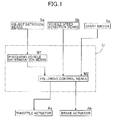
- an electronic control unit U of a car-following controller includes preceding vehicle determination means M1 and following control means M2.
- the preceding vehicle determination means M1 has connected thereto object detection means Sa, which is a radar device for detecting an object such as a preceding vehicle Vb in front of a subject vehicle Va
- the following control means M2 has connected thereto vehicle speed detection means Sb for detecting a vehicle speed of the subject vehicle Va and a start switch Sc that is operated by the driver when starting following control and also has connected thereto a throttle actuator Aa and a brake actuator Ab that automatically accelerate/decelerate and stop the subject vehicle Va in order to make the subject vehicle Va follow the preceding vehicle Vb.
- the preceding vehicle determination means M1 determines as a preceding vehicle Vb, among objects detected by the object detection means Sa, an object that is on the course of the subject vehicle Va, has a reflection level that is a predetermined value or greater, and has a relative speed within a predetermined range, and calculates a relative distance thereof (that is, an inter-vehicle distance) and a relative speed.
- the following control means M2 controls the operation of the throttle actuator Aa and the brake actuator Ab based on the inter-vehicle distance with respect to the preceding vehicle Vb determined by the preceding vehicle determination means M1, the vehicle speed of the subject vehicle Va detected by the vehicle speed detection means Sb, and operation of the start switch Sc by the driver, in order to make the subject vehicle Va follow the preceding vehicle Vb while maintaining a predetermined inter-vehicle distance.
- the subject vehicle Va stops during following control following control is temporarily terminated at that point, and following control is not restarted unless the driver carries out an ON operation for the start switch Sc.
- the reason therefor is to prevent the subject vehicle Va from automatically starting while following the starting of the preceding vehicle Vb when it is necessary for the subject vehicle Va to maintain a stopped state in order to secure safety at an intersection, level crossing, etc. even if the preceding vehicle Vb starts.
- a preceding vehicle Vb starts before a subject vehicle Va decelerates and stops while following the preceding vehicle Vb that has decelerated and stopped
- the subject vehicle Va during deceleration accelerates, without stopping, while following the preceding vehicle Vb, and the driver might mistakenly think that the subject vehicle Va has a function of automatically starting.
- control as shown in FIG. 2 is carried out. That is, as shown in FIG. 2 (A) , when the subject vehicle Va decelerates while following the preceding vehicle Vb that has stopped, a virtual preceding vehicle Vb' is set at a position where the preceding vehicle Vb has stopped, and the position of the virtual preceding vehicle Vb' is stored. As shown in FIG. 2 (B) , even if the preceding vehicle Vb has started before the subject vehicle Va has stopped, since the subject vehicle Va recognizes that the preceding vehicle Vb is stopped at the position of the virtual preceding vehicle Vb', it stops temporarily while following the virtual preceding vehicle Vb' that has stopped. Therefore, it is necessary for the driver to carry out an ON operation for the start switch Sc in order to start the subject vehicle Va, and it is possible to prevent the driver from mistakenly thinking that the subject vehicle Va has an automatic start function.
- step S1 when in step S1 the preceding vehicle Vb is stopped, the inter-vehicle distance with respect to the preceding vehicle Vb is less than a predetermined value (12 m in the embodiment), and the vehicle speed of the subject vehicle Va is less than a predetermined value (10 km/h in the embodiment), in step S2 a virtual preceding vehicle flag is set at 1 (the virtual preceding vehicle Vb' being present), and in step S3 a current inter-vehicle distance to the virtual preceding vehicle Vb' is stored as a provisional inter-vehicle distance.
- step S4 the driver carries out an ON operation for the start switch Sc in order to start following control, the subject vehicle Va is stopped by the following control, or the driver turns OFF the following controller, since setting of the virtual preceding vehicle Vb' is unnecessary, the virtual preceding vehicle flag is reset to 0 (the virtual preceding vehicle Vb' being not present).
- step S6 If in the subsequent step S6 the setting of the virtual preceding vehicle flag is 1, in step S7 the sign of the vehicle speed of the subject vehicle Va detected by the vehicle speed detection means Sb is reversed and the value is defined as a provisional relative speed with respect to the virtual preceding vehicle Vb', and in step S8 a provisional inter-vehicle distance with respect to the virtual preceding vehicle Vb' is calculated from provisional inter-vehicle distance ⁇ provisional inter-vehicle distance + provisional relative speed ⁇ 0.1 (sec).
- 0.1 (sec) is a sampling time with which the object detection means Sa detects an object.
- step S9 the inter-vehicle distance and the relative speed with respect to the preceding vehicle Vb are replaced by the provisional inter-vehicle distance and the provisional relative speed with respect to the virtual preceding vehicle Vb', and following control is executed thereafter while considering the virtual preceding vehicle Vb' as a preceding vehicle Vb.
- stop determination conditions for the subject vehicle Va are fulfilled if the inter-vehicle distance when the preceding vehicle Sb has stopped is less than 12 m and the vehicle speed of the subject vehicle Va is less than 10 km/h, and after the stop determination conditions are fulfilled temporary stop hold control is carried out after the subject vehicle Va is subjected to deceleration control regardless of whether or not the preceding vehicle Vb has started. Therefore, if the preceding vehicle Vb starts before the subject vehicle Va stops while following the preceding vehicle Vb that has stopped, the subject vehicle Va is always subjected to temporary stop hold control. This requires the driver to operate the start switch Sc in order for the subject vehicle Va to start, and it is possible to prevent the driver from mistakenly thinking that the subject vehicle Va has a function of automatically starting while following the starting of the preceding vehicle Vb.
- stop determination conditions for the subject vehicle Va include the inter-vehicle distance when the preceding vehicle Vb has stopped being less than 12 m and the vehicle speed of the subject vehicle Va when the preceding vehicle Vb has stopped being less than 10 km/h, it is possible to prevent the subject vehicle Va from automatically stopping unnecessarily if the inter-vehicle distance when the preceding vehicle has stopped is sufficiently large and the driver would be given an uncomfortable sensation if the subject vehicle stopped, or if the vehicle speed of the subject vehicle Va when the preceding vehicle Vb has stopped is sufficiently large and the driver has the intention of overtaking the preceding vehicle Vb.
- control start command means of the present invention is not limited to the start switch Sc of the embodiment, and may be a sensor that detects depression of an accelerator pedal by a driver.
Landscapes
- Engineering & Computer Science (AREA)
- Chemical & Material Sciences (AREA)
- Combustion & Propulsion (AREA)
- Transportation (AREA)
- Mechanical Engineering (AREA)
- Physics & Mathematics (AREA)
- General Physics & Mathematics (AREA)
- Automation & Control Theory (AREA)
- Control Of Driving Devices And Active Controlling Of Vehicle (AREA)
- Controls For Constant Speed Travelling (AREA)
- Control Of Vehicle Engines Or Engines For Specific Uses (AREA)
- Traffic Control Systems (AREA)
Abstract
Description
- The present invention relates to a car-following controller that includes object detection means for detecting an object in the direction of travel of a subject vehicle, vehicle speed detection means for detecting a vehicle speed of the subject vehicle, control start command means for commanding starting of following control, preceding vehicle determination means for determining the state of travel, among objects detected by the object detection means, of a preceding vehicle that the subject vehicle is following, and following control means for carrying out acceleration/deceleration control and stop hold control of the subject vehicle based on the vehicle speed of the subject vehicle and the inter-vehicle distance with respect to the preceding vehicle when starting of following control is commanded by the control start command means.
- Furthermore, the present invention relates to a car-following control method in which the state of travel of a preceding vehicle that a subject vehicle is following is determined from information about an object in the direction of travel of the subject vehicle detected by object detection means and acceleration/deceleration control and stop hold control of the subject vehicle are carried out, based on the vehicle speed of the subject vehicle and the inter-vehicle distance with respect to the preceding vehicle, when starting of following control is commanded.
- With regard to a car-following controller that makes a subject vehicle follow a preceding vehicle that repeatedly stops and starts, while maintaining a constant inter-vehicle distance, so as to alleviate the burden of operation on a driver when there is congestion, etc., there is an arrangement known from
Patent Document 1 below in which, for the purpose of dealing with a case in which it would be dangerous if the subject vehicle automatically started while following a preceding vehicle at an intersection, level crossing, etc., starting of the subject vehicle is prohibited unless the driver operates a start switch or depresses an accelerator pedal even when starting of the preceding vehicle is detected. - Patent Document 1: Japanese Patent Application Laid-open No.
10-147160 - In the above-mentioned conventional arrangement, starting of a subject vehicle is prohibited unless the driver operates a start switch or depresses an accelerator pedal, but the driver might mistakenly think that the subject vehicle has a function of automatically starting without requiring the operation of a start switch or depression of an accelerator pedal under the situation below.
-
FIG. 4 shows the operation of a conventional car-following controller in a normal situation; inFIG. 4 (A) when a preceding vehicle Vb decelerates and stops a subject vehicle Va follows and decelerates, and in the subsequentFIG. 4 (B) the subject vehicle Va stops just before the stopped preceding vehicle Vb. InFIG. 4 (C) , the subject vehicle Va maintains the stopped state without starting until the driver operates a start switch or depresses an accelerator pedal. In this case, the driver does not mistakenly think that the subject vehicle Va has the function of automatically starting. -
FIG. 5 shows the operation of the conventional car-following controller in a specific situation; inFIG. 5 (A) , when the preceding vehicle Vb decelerates and stops the subject vehicle Va follows and decelerates. If the preceding vehicle Vb has started before the subject vehicle Va has stopped as in the subsequentFIG. 5 (B) , inFIG. 5 (C) during deceleration the subject vehicle Va without stopping accelerates while following the preceding vehicle Vb. During this process, since the driver does not carry out operation of a start switch or depression of an accelerator pedal, the driver might mistakenly think that the subject vehicle Va has the function of automatically starting. - The present invention has been accomplished under the above-mentioned circumstances, and it is an object thereof to prevent a driver from mistakenly thinking that, with regard to a car-following controller, a subject vehicle has a function of automatically starting while following starting of a preceding vehicle.
- In order to attain the above object, according to a first aspect of the present invention, there is provided a car-following controller comprising object detection means for detecting an object in the direction of travel of a subject vehicle, vehicle speed detection means for detecting a vehicle speed of the subject vehicle, control start command means for commanding the starting of following control, preceding vehicle determination means for determining the state of travel, among objects detected by the object detection means, of a preceding vehicle that the subject vehicle is following, and following control means for carrying out acceleration/deceleration control and stop hold control of the subject vehicle based on the vehicle speed of the subject vehicle and the inter-vehicle distance with respect to the preceding vehicle when starting of following control is commanded by the control start command means, characterized in that the following control means determines that stop determination conditions for the subject vehicle are fulfilled if the preceding vehicle determination means detects stopping of the preceding vehicle and, after the stop determination conditions are fulfilled, carries out temporary stop hold control after the subject vehicle is subjected to deceleration control regardless of whether or not the preceding vehicle has started.
- Further, according to a second aspect of the present invention, in addition to the first aspect, the following control means determines that stop determination conditions for the subject vehicle are fulfilled if, when the preceding vehicle determination means detects stopping of the preceding vehicle, the inter-vehicle distance with respect to the preceding vehicle is less than a predetermined value and the vehicle speed of the subject vehicle is less than a predetermined value.
- Furthermore, according to a third aspect of the present invention, in addition to the first or second aspect of the present invention, if stop determination conditions for the subject vehicle are fulfilled, the following control means sets a virtual preceding vehicle at the stop position of the preceding vehicle and carries out deceleration control and stop hold control with respect to the virtual preceding vehicle.
- Moreover, according to a fourth aspect of the present invention, in addition to the third aspect, the following control means releases the setting of the virtual preceding vehicle after stop hold control with respect to the virtual preceding vehicle is executed.
- Further, according to a fifth aspect of the present invention, there is provided a car-following control method in which the state of travel of a preceding vehicle that a subject vehicle is following is determined from information about an object, in the direction of travel of the subject vehicle, detected by object detection means, and acceleration/deceleration control and stop hold control of the subject vehicle are carried out based on a vehicle speed of the subject vehicle and an inter-vehicle distance with respect to the preceding vehicle when the starting of following control is commanded, characterized in that the method comprises a first step of determining that stop determination conditions for the subject vehicle are fulfilled if stopping of the preceding vehicle is detected, and a second step of, after the stop determination conditions are fulfilled, carrying out temporary stop hold control after the subject vehicle is subjected to deceleration control regardless of whether or not the preceding vehicle has started.
- Furthermore, according to a sixth aspect of the present invention, in addition to the fifth aspect, it is determined that stop determination conditions for the subject vehicle are fulfilled if in the first step the inter-vehicle distance with respect to the preceding vehicle when the preceding vehicle has stopped is less than a predetermined value and the vehicle speed of the subject vehicle is less than a predetermined value.
- Moreover, according to a seventh aspect of the present invention, in addition to the fifth or sixth aspect, in the second step a virtual preceding vehicle is set at the stop position of the preceding vehicle and deceleration control and stop hold control with respect to the virtual preceding vehicle are carried out.
- Further, according to an eighth aspect, in addition to the seventh aspect, in the second step the setting of the virtual preceding vehicle is released after stop hold control with respect to the virtual preceding vehicle is executed.
- A start switch Sc of an embodiment corresponds to control start command means of the present invention.
- In accordance with the first aspect of the present invention, the preceding vehicle determination means determines, from an object detected by the object detection means, the state of travel of a preceding vehicle that the subject vehicle is following, and when the driver operates the control start command means the following control means carries out following control in which the subject vehicle is subjected to acceleration/deceleration and being held stopped based on the vehicle speed of the subject vehicle and the inter-vehicle distance with respect to the preceding vehicle. Since the following control means determines that stop determination conditions for the subject vehicle are fulfilled when the preceding vehicle determination means detects that the preceding vehicle has stopped, and after the stop determination conditions are fulfilled temporary stop hold control is carried out after the subject vehicle is subjected to deceleration control regardless of whether or not the preceding vehicle has started, if the preceding vehicle has started before the subject vehicle has stopped due to the preceding vehicle having stopped, the subject vehicle is always subjected to temporary stop hold control. Therefore, starting the subject vehicle requires the driver to operate the control start command means, and it is possible to prevent the driver from mistakenly thinking that the subject vehicle has a function of automatically starting while following starting of the preceding vehicle.
- Furthermore, in accordance with the second aspect of the present invention, since the following control means determines that stop determination conditions for the subject vehicle are fulfilled when the inter-vehicle distance when the preceding vehicle has stopped is less than a predetermined value and the vehicle speed of the subject vehicle is less than a predetermined value, it is possible to prevent the subject vehicle from automatically stopping unnecessarily if the inter-vehicle distance when the preceding vehicle has stopped is sufficiently large and the driver would be given an uncomfortable sensation if the subject vehicle stopped, or if the vehicle speed of the subject vehicle when the preceding vehicle has stopped is sufficiently large and the driver has the intention of overtaking the preceding vehicle.
- Moreover, in accordance with the third aspect of the present invention, since the following control means carries out deceleration control and stop hold control with respect to the virtual preceding vehicle set at the stop position of the preceding vehicle when it determines that the stop determination conditions for the subject vehicle are fulfilled, even if the actual preceding vehicle has already started, the subject vehicle stops while following stopping of the virtual preceding vehicle and does not start until a start operation is carried out by the driver. Therefore it is possible to prevent the driver from mistakenly thinking that the subject vehicle has an automatic start function.
- Furthermore, in accordance with the fourth aspect of the present invention, since the following control means releases the setting for the virtual preceding vehicle after stop hold control with respect to the virtual preceding vehicle is executed, following control with respect to the actual preceding vehicle can be carried out thereafter without problems.
- Moreover, in accordance with the fifth aspect of the present invention, the state of travel of the preceding vehicle that the subject vehicle is following is determined from information, detected by the object detection means, about an object in the direction of travel of the subject vehicle, and when the starting of following control is commanded acceleration/deceleration control and stop hold control of the subject vehicle are carried out based on the vehicle speed of the subject vehicle and the inter-vehicle distance with respect to the preceding vehicle. Since in the first step if stopping of the preceding vehicle is detected it is determined that stop determination conditions for the subject vehicle are fulfilled, and in the second step after the stop determination conditions are fulfilled temporary stop hold control is carried out after the subject vehicle is subjected to deceleration control regardless of whether or not the preceding vehicle has started, if the preceding vehicle has started before the subject vehicle has stopped due to the preceding vehicle having stopped, the subject vehicle is always subjected to temporary stop hold control. Therefore, starting the subject vehicle requires the driver to operate the control start command means, and it is possible to prevent the driver from mistakenly thinking that the subject vehicle has a function of automatically starting while following starting of the preceding vehicle.
- Furthermore, in accordance with the sixth aspect of the present invention, since in the first step it is determined that stop determination conditions for the subject vehicle are fulfilled when the inter-vehicle distance when the preceding vehicle has stopped is less than a predetermined value and the vehicle speed of the subject vehicle is less than a predetermined value, it is possible to prevent the subject vehicle from automatically stopping unnecessarily if the inter-vehicle distance when the preceding vehicle has stopped is sufficiently large and the driver would be given an uncomfortable sensation if the subject vehicle stopped, or if the vehicle speed of the subject vehicle when the preceding vehicle has stopped is sufficiently large and the driver has the intention of overtaking the preceding vehicle.
- Moreover, in accordance with the seventh aspect of the present invention, since in the second step deceleration control and stop hold control with respect to the virtual preceding vehicle set at the stop position of the preceding vehicle are carried out when it is determined that the stop determination conditions for the subject vehicle are fulfilled, even if the actual preceding vehicle has already started, the subject vehicle stops while following stopping of the virtual preceding vehicle and does not start until a start operation is carried out by the driver. Therefore it is possible to prevent the driver from mistakenly thinking that the subject vehicle has an automatic start function.
- Furthermore, in accordance with the eighth aspect of the present invention, since in the second step the setting for the virtual preceding vehicle is released after stop hold control with respect to the virtual preceding vehicle is executed, following control with respect to the actual preceding vehicle can be carried out thereafter without problems.
-
- [
FIG. 1] FIG. 1 is a block diagram showing the overall constitution of a car-following controller. (first embodiment) - [
FIG. 2] FIG. 2 is a diagram for explaining the operation of following control. (first embodiment) - [
FIG. 3] FIG. 3 is a flowchart for explaining the operation of following control. (first embodiment) - [
FIG. 4] FIG. 4 is a diagram for explaining the operation of a car-following controller in a normal situation. (conventional example) - [
FIG. 5] FIG. 5 is a diagram for explaining the operation of the car-following controller in a specific situation. (conventional example) -
- M1 Preceding vehicle determination means
- M2 Following control means
- Sa Object detection means
- Sb Vehicle speed detection means
- Sc Start switch (control start command means)
- Va Subject vehicle
- Vb Preceding vehicle
- Vb' Virtual preceding vehicle
- A mode for carrying out the present invention is explained below by reference to
FIG. 1 to FIG. 3 . - As shown in
FIG. 1 , an electronic control unit U of a car-following controller includes preceding vehicle determination means M1 and following control means M2. The preceding vehicle determination means M1 has connected thereto object detection means Sa, which is a radar device for detecting an object such as a preceding vehicle Vb in front of a subject vehicle Va, and the following control means M2 has connected thereto vehicle speed detection means Sb for detecting a vehicle speed of the subject vehicle Va and a start switch Sc that is operated by the driver when starting following control and also has connected thereto a throttle actuator Aa and a brake actuator Ab that automatically accelerate/decelerate and stop the subject vehicle Va in order to make the subject vehicle Va follow the preceding vehicle Vb. - The preceding vehicle determination means M1 determines as a preceding vehicle Vb, among objects detected by the object detection means Sa, an object that is on the course of the subject vehicle Va, has a reflection level that is a predetermined value or greater, and has a relative speed within a predetermined range, and calculates a relative distance thereof (that is, an inter-vehicle distance) and a relative speed.
- The following control means M2 controls the operation of the throttle actuator Aa and the brake actuator Ab based on the inter-vehicle distance with respect to the preceding vehicle Vb determined by the preceding vehicle determination means M1, the vehicle speed of the subject vehicle Va detected by the vehicle speed detection means Sb, and operation of the start switch Sc by the driver, in order to make the subject vehicle Va follow the preceding vehicle Vb while maintaining a predetermined inter-vehicle distance. In addition, if the subject vehicle Va stops during following control, following control is temporarily terminated at that point, and following control is not restarted unless the driver carries out an ON operation for the start switch Sc. The reason therefor is to prevent the subject vehicle Va from automatically starting while following the starting of the preceding vehicle Vb when it is necessary for the subject vehicle Va to maintain a stopped state in order to secure safety at an intersection, level crossing, etc. even if the preceding vehicle Vb starts.
- As already described by reference to
FIG. 5 , in a conventional car-following controller, if a preceding vehicle Vb starts before a subject vehicle Va decelerates and stops while following the preceding vehicle Vb that has decelerated and stopped, the subject vehicle Va during deceleration accelerates, without stopping, while following the preceding vehicle Vb, and the driver might mistakenly think that the subject vehicle Va has a function of automatically starting. - In order to eliminate such a problem, in the present embodiment control as shown in
FIG. 2 is carried out. That is, as shown inFIG. 2 (A) , when the subject vehicle Va decelerates while following the preceding vehicle Vb that has stopped, a virtual preceding vehicle Vb' is set at a position where the preceding vehicle Vb has stopped, and the position of the virtual preceding vehicle Vb' is stored. As shown inFIG. 2 (B) , even if the preceding vehicle Vb has started before the subject vehicle Va has stopped, since the subject vehicle Va recognizes that the preceding vehicle Vb is stopped at the position of the virtual preceding vehicle Vb', it stops temporarily while following the virtual preceding vehicle Vb' that has stopped. Therefore, it is necessary for the driver to carry out an ON operation for the start switch Sc in order to start the subject vehicle Va, and it is possible to prevent the driver from mistakenly thinking that the subject vehicle Va has an automatic start function. - The above-mentioned operation is explained in further detail by reference to the flowchart of
FIG. 3 . - First, when in step S1 the preceding vehicle Vb is stopped, the inter-vehicle distance with respect to the preceding vehicle Vb is less than a predetermined value (12 m in the embodiment), and the vehicle speed of the subject vehicle Va is less than a predetermined value (10 km/h in the embodiment), in step S2 a virtual preceding vehicle flag is set at 1 (the virtual preceding vehicle Vb' being present), and in step S3 a current inter-vehicle distance to the virtual preceding vehicle Vb' is stored as a provisional inter-vehicle distance.
- On the other hand, if the answer to step S1 above is NO, that is, when the preceding vehicle Vb is not stopped, the inter-vehicle distance with respect to the preceding vehicle Vb is not less than a predetermined value, or the vehicle speed of the subject vehicle Va is not less than a predetermined value, if in step S4 the driver carries out an ON operation for the start switch Sc in order to start following control, the subject vehicle Va is stopped by the following control, or the driver turns OFF the following controller, since setting of the virtual preceding vehicle Vb' is unnecessary, the virtual preceding vehicle flag is reset to 0 (the virtual preceding vehicle Vb' being not present).
- If in the subsequent step S6 the setting of the virtual preceding vehicle flag is 1, in step S7 the sign of the vehicle speed of the subject vehicle Va detected by the vehicle speed detection means Sb is reversed and the value is defined as a provisional relative speed with respect to the virtual preceding vehicle Vb', and in step S8 a provisional inter-vehicle distance with respect to the virtual preceding vehicle Vb' is calculated from provisional inter-vehicle distance ← provisional inter-vehicle distance + provisional relative speed × 0.1 (sec).
Here, 0.1 (sec) is a sampling time with which the object detection means Sa detects an object. In step S9 the inter-vehicle distance and the relative speed with respect to the preceding vehicle Vb are replaced by the provisional inter-vehicle distance and the provisional relative speed with respect to the virtual preceding vehicle Vb', and following control is executed thereafter while considering the virtual preceding vehicle Vb' as a preceding vehicle Vb. - As hereinbefore described, in accordance with the present embodiment, it is determined that stop determination conditions for the subject vehicle Va are fulfilled if the inter-vehicle distance when the preceding vehicle Sb has stopped is less than 12 m and the vehicle speed of the subject vehicle Va is less than 10 km/h, and after the stop determination conditions are fulfilled temporary stop hold control is carried out after the subject vehicle Va is subjected to deceleration control regardless of whether or not the preceding vehicle Vb has started. Therefore, if the preceding vehicle Vb starts before the subject vehicle Va stops while following the preceding vehicle Vb that has stopped, the subject vehicle Va is always subjected to temporary stop hold control. This requires the driver to operate the start switch Sc in order for the subject vehicle Va to start, and it is possible to prevent the driver from mistakenly thinking that the subject vehicle Va has a function of automatically starting while following the starting of the preceding vehicle Vb.
- Furthermore, since stop determination conditions for the subject vehicle Va include the inter-vehicle distance when the preceding vehicle Vb has stopped being less than 12 m and the vehicle speed of the subject vehicle Va when the preceding vehicle Vb has stopped being less than 10 km/h, it is possible to prevent the subject vehicle Va from automatically stopping unnecessarily if the inter-vehicle distance when the preceding vehicle has stopped is sufficiently large and the driver would be given an uncomfortable sensation if the subject vehicle stopped, or if the vehicle speed of the subject vehicle Va when the preceding vehicle Vb has stopped is sufficiently large and the driver has the intention of overtaking the preceding vehicle Vb.
- An embodiment of the present invention is explained above, but the present invention may be modified in a variety of ways as long as the modifications do not depart from the spirit and scope thereof.
- For example, the control start command means of the present invention is not limited to the start switch Sc of the embodiment, and may be a sensor that detects depression of an accelerator pedal by a driver.
Claims (8)
- A car-following controller comprising
object detection means (Sa) for detecting an object in the direction of travel of a subject vehicle (Va),
vehicle speed detection means (Sb) for detecting a vehicle speed of the subject vehicle (Va),
control start command means (Sc) for commanding the starting of following control, preceding vehicle determination means (M1) for determining the state of travel, among objects detected by the object detection means (Sa), of a preceding vehicle (Vb) that the subject vehicle (Va) is following, and
following control means (M2) for carrying out acceleration/deceleration control and stop hold control of the subject vehicle (Va) based on the vehicle speed of the subject vehicle (Va) and the inter-vehicle distance with respect to the preceding vehicle (Vb) when starting of following control is commanded by the control start command means (Sc),
characterized in that the following control means (M2) determines that stop determination conditions for the subject vehicle (Va) are fulfilled if the preceding vehicle determination means (M1) detects stopping of the preceding vehicle (Vb) and, after the stop determination conditions are fulfilled, carries out temporary stop hold control after the subject vehicle (Va) is subjected to deceleration control regardless of whether or not the preceding vehicle (Vb) has started. - The car-following controller according to Claim 1, wherein the following control means (M2) determines that stop determination conditions for the subject vehicle (Va) are fulfilled if, when the preceding vehicle determination means (M1) detects stopping of the preceding vehicle (Vb), the inter-vehicle distance with respect to the preceding vehicle (Vb) is less than a predetermined value and the vehicle speed of the subject vehicle (Va) is less than a predetermined value.
- The car-following controller according to Claim 1 or Claim 2, wherein if stop determination conditions for the subject vehicle (Va) are fulfilled, the following control means (M2) sets a virtual preceding vehicle (Vb') at the stop position of the preceding vehicle (Vb) and carries out deceleration control and stop hold control with respect to the virtual preceding vehicle (Vb').
- The car-following controller according to Claim 3, wherein the following control means (M2) releases the setting of the virtual preceding vehicle (Vb') after stop hold control with respect to the virtual preceding vehicle (Vb') is executed.
- A car-following control method in which the state of travel of a preceding vehicle (Vb) that a subject vehicle (Va) is following is determined from information about an object, in the direction of travel of the subject vehicle (Va), detected by object detection means (Sa), and acceleration/deceleration control and stop hold control of the subject vehicle (Va) are carried out based on a vehicle speed of the subject vehicle (Va) and an inter-vehicle distance with respect to the preceding vehicle (Vb) when the starting of following control is commanded, characterized in that the method comprises
a first step of determining that stop determination conditions for the subject vehicle (Va) are fulfilled if stopping of the preceding vehicle (Vb) is detected, and
a second step of, after the stop determination conditions are fulfilled, carrying out temporary stop hold control after the subject vehicle (Va) is subjected to deceleration control regardless of whether or not the preceding vehicle (Vb) has started. - The car-following control method according to Claim 5, wherein it is determined that stop determination conditions for the subject vehicle (Va) are fulfilled if in the first step the inter-vehicle distance with respect to the preceding vehicle (Vb) when the preceding vehicle (Vb) has stopped is less than a predetermined value and the vehicle speed of the subject vehicle (Va) is less than a predetermined value.
- The car-following control method according to Claim 5 or Claim 6, wherein in the second step a virtual preceding vehicle (Vb') is set at the stop position of the preceding vehicle (Vb) and deceleration control and stop hold control with respect to the virtual preceding vehicle (Vb') are carried out.
- The car-following control method according to Claim 7, wherein in the second step the setting of the virtual preceding vehicle (Vb') is released after stop hold control with respect to the virtual preceding vehicle (Vb') is executed.
Applications Claiming Priority (2)
| Application Number | Priority Date | Filing Date | Title |
|---|---|---|---|
| JP2009115224A JP4880011B2 (en) | 2009-05-12 | 2009-05-12 | Vehicle tracking control device |
| PCT/JP2010/056662 WO2010131542A1 (en) | 2009-05-12 | 2010-04-14 | Car-following controller and car-following control method |
Publications (3)
| Publication Number | Publication Date |
|---|---|
| EP2412595A1 true EP2412595A1 (en) | 2012-02-01 |
| EP2412595A4 EP2412595A4 (en) | 2013-05-22 |
| EP2412595B1 EP2412595B1 (en) | 2016-08-24 |
Family
ID=43084919
Family Applications (1)
| Application Number | Title | Priority Date | Filing Date |
|---|---|---|---|
| EP10774800.6A Not-in-force EP2412595B1 (en) | 2009-05-12 | 2010-04-14 | Car-following controller and car-following control method |
Country Status (6)
| Country | Link |
|---|---|
| US (1) | US8489305B2 (en) |
| EP (1) | EP2412595B1 (en) |
| JP (1) | JP4880011B2 (en) |
| CN (1) | CN102405166B (en) |
| MX (1) | MX2011010331A (en) |
| WO (1) | WO2010131542A1 (en) |
Cited By (2)
| Publication number | Priority date | Publication date | Assignee | Title |
|---|---|---|---|---|
| FR3100778A1 (en) * | 2019-09-18 | 2021-03-19 | Renault S.A.S | MOTOR VEHICLE CONTROL PROCEDURE |
| US12147233B2 (en) | 2019-11-08 | 2024-11-19 | Sony Group Corporation | Information processing device and information processing method |
Families Citing this family (36)
| Publication number | Priority date | Publication date | Assignee | Title |
|---|---|---|---|---|
| US10157422B2 (en) | 2007-05-10 | 2018-12-18 | Allstate Insurance Company | Road segment safety rating |
| US9932033B2 (en) | 2007-05-10 | 2018-04-03 | Allstate Insurance Company | Route risk mitigation |
| US8606512B1 (en) | 2007-05-10 | 2013-12-10 | Allstate Insurance Company | Route risk mitigation |
| US10096038B2 (en) | 2007-05-10 | 2018-10-09 | Allstate Insurance Company | Road segment safety rating system |
| JP5126336B2 (en) * | 2010-05-13 | 2013-01-23 | 株式会社デンソー | Vehicle speed control device |
| JP5668741B2 (en) * | 2012-10-04 | 2015-02-12 | 株式会社デンソー | Convoy travel device |
| KR102010738B1 (en) * | 2012-12-28 | 2019-08-14 | 현대모비스 주식회사 | Integration Interworking Control Method and System |
| JP2014173455A (en) * | 2013-03-07 | 2014-09-22 | Daihatsu Motor Co Ltd | Control device of idle stop vehicle |
| US9147353B1 (en) | 2013-05-29 | 2015-09-29 | Allstate Insurance Company | Driving analysis using vehicle-to-vehicle communication |
| JP2015123831A (en) * | 2013-12-26 | 2015-07-06 | 富士重工業株式会社 | Vehicle control apparatus and control method |
| US10096067B1 (en) | 2014-01-24 | 2018-10-09 | Allstate Insurance Company | Reward system related to a vehicle-to-vehicle communication system |
| US9355423B1 (en) | 2014-01-24 | 2016-05-31 | Allstate Insurance Company | Reward system related to a vehicle-to-vehicle communication system |
| US9390451B1 (en) | 2014-01-24 | 2016-07-12 | Allstate Insurance Company | Insurance system related to a vehicle-to-vehicle communication system |
| US9940676B1 (en) | 2014-02-19 | 2018-04-10 | Allstate Insurance Company | Insurance system for analysis of autonomous driving |
| US10783587B1 (en) | 2014-02-19 | 2020-09-22 | Allstate Insurance Company | Determining a driver score based on the driver's response to autonomous features of a vehicle |
| US10803525B1 (en) | 2014-02-19 | 2020-10-13 | Allstate Insurance Company | Determining a property of an insurance policy based on the autonomous features of a vehicle |
| US10796369B1 (en) | 2014-02-19 | 2020-10-06 | Allstate Insurance Company | Determining a property of an insurance policy based on the level of autonomy of a vehicle |
| US10783586B1 (en) | 2014-02-19 | 2020-09-22 | Allstate Insurance Company | Determining a property of an insurance policy based on the density of vehicles |
| US10414398B2 (en) * | 2014-11-27 | 2019-09-17 | Hitachi Automotive Systems, Ltd. | Vehicle travel control device that controls following of a vehicle |
| JP6014185B2 (en) * | 2015-02-16 | 2016-10-25 | 本田技研工業株式会社 | Vehicle travel control device, vehicle travel control method, and vehicle travel control program |
| WO2016134770A1 (en) * | 2015-02-26 | 2016-09-01 | Volvo Truck Corporation | Method of controlling inter-vehicle gap(s) in a platoon |
| US10269075B2 (en) | 2016-02-02 | 2019-04-23 | Allstate Insurance Company | Subjective route risk mapping and mitigation |
| US9672734B1 (en) * | 2016-04-08 | 2017-06-06 | Sivalogeswaran Ratnasingam | Traffic aware lane determination for human driver and autonomous vehicle driving system |
| DE102016207280A1 (en) * | 2016-04-28 | 2017-11-02 | Bayerische Motoren Werke Aktiengesellschaft | Start-stop device for initiating an automatic startup of an automatically shut down prime mover |
| KR101803648B1 (en) | 2016-06-08 | 2017-11-30 | 주식회사 만도 | Autonomous driving control apparatus and autonomous driving control method |
| CN107664957B (en) * | 2016-07-28 | 2019-11-22 | 比亚迪股份有限公司 | Emergency driving method, system and vehicle based on vehicle remote control |
| US20200050212A1 (en) * | 2016-11-04 | 2020-02-13 | Honda Motor Co., Ltd. | Vehicle control system, vehicle control method, and vehicle control program |
| JP6478338B2 (en) * | 2017-02-08 | 2019-03-06 | 株式会社Subaru | Vehicle start control device |
| CN108528452A (en) * | 2017-03-03 | 2018-09-14 | 奥迪股份公司 | Nervous drive assistance device, vehicle and its method |
| CN107103749B (en) * | 2017-05-19 | 2020-03-10 | 长安大学 | Following traffic flow characteristic modeling method under Internet of vehicles environment |
| CN107253480B (en) * | 2017-06-23 | 2019-10-25 | 北京新能源汽车股份有限公司 | vehicle control method and system |
| US10745007B2 (en) * | 2018-06-08 | 2020-08-18 | Denso International America, Inc. | Collision avoidance systems and methods |
| JP6871900B2 (en) * | 2018-12-26 | 2021-05-19 | 本田技研工業株式会社 | Vehicle control device |
| KR102716362B1 (en) * | 2019-04-11 | 2024-10-11 | 현대자동차주식회사 | Apparatus and method for providing user interface for platooning of vehicle |
| CN115042785A (en) * | 2022-01-19 | 2022-09-13 | 南京航空航天大学 | Car following method based on safe distance accelerator release |
| CN115230692B (en) * | 2022-08-11 | 2024-03-26 | 小米汽车科技有限公司 | Vehicle control method and device, vehicle and readable storage medium |
Family Cites Families (13)
| Publication number | Priority date | Publication date | Assignee | Title |
|---|---|---|---|---|
| US5091726A (en) * | 1990-08-23 | 1992-02-25 | Industrial Technology Resarch Institute | Vehicle anti-collision system |
| JP3358403B2 (en) * | 1995-09-11 | 2002-12-16 | トヨタ自動車株式会社 | Platoon running control device |
| JP3644777B2 (en) | 1996-11-18 | 2005-05-11 | 三菱電機株式会社 | Vehicle tracking control device |
| JP3732292B2 (en) * | 1996-11-27 | 2006-01-05 | 本田技研工業株式会社 | Vehicle group running control system |
| JP3584874B2 (en) | 2000-07-28 | 2004-11-04 | トヨタ自動車株式会社 | Vehicle tracking device |
| DE10349434A1 (en) * | 2002-10-25 | 2004-06-24 | Continental Teves Ag & Co. Ohg | Improving distance, following control (ACC) involves estimating vehicle speed and/or acceleration, recognizing stop and go maneuver, recognizing traffic situation, influencing/modifying intervention |
| DE10320722B4 (en) * | 2003-05-08 | 2015-02-19 | Robert Bosch Gmbh | Speed controller with stop function |
| DE102004019164A1 (en) * | 2004-04-21 | 2005-11-10 | Robert Bosch Gmbh | Method and device for the automatic longitudinal regulation of a motor vehicle |
| JP2007069727A (en) * | 2005-09-07 | 2007-03-22 | Nissan Motor Co Ltd | Travel control device |
| JP2007069729A (en) | 2005-09-07 | 2007-03-22 | Nissan Motor Co Ltd | Travel control device |
| DE102006034411A1 (en) * | 2006-07-25 | 2008-01-31 | Robert Bosch Gmbh | Device for speed and stopping control in motor vehicles |
| US8676466B2 (en) * | 2009-04-06 | 2014-03-18 | GM Global Technology Operations LLC | Fail-safe speed profiles for cooperative autonomous vehicles |
| JP5760835B2 (en) * | 2011-08-10 | 2015-08-12 | 株式会社デンソー | Driving support device and driving support system |
-
2009
- 2009-05-12 JP JP2009115224A patent/JP4880011B2/en active Active
-
2010
- 2010-04-14 US US13/260,006 patent/US8489305B2/en not_active Expired - Fee Related
- 2010-04-14 WO PCT/JP2010/056662 patent/WO2010131542A1/en not_active Ceased
- 2010-04-14 MX MX2011010331A patent/MX2011010331A/en active IP Right Grant
- 2010-04-14 EP EP10774800.6A patent/EP2412595B1/en not_active Not-in-force
- 2010-04-14 CN CN201080017639.0A patent/CN102405166B/en not_active Expired - Fee Related
Cited By (3)
| Publication number | Priority date | Publication date | Assignee | Title |
|---|---|---|---|---|
| FR3100778A1 (en) * | 2019-09-18 | 2021-03-19 | Renault S.A.S | MOTOR VEHICLE CONTROL PROCEDURE |
| WO2021052821A1 (en) * | 2019-09-18 | 2021-03-25 | Renault S.A.S | Method for driving a motor vehicle |
| US12147233B2 (en) | 2019-11-08 | 2024-11-19 | Sony Group Corporation | Information processing device and information processing method |
Also Published As
| Publication number | Publication date |
|---|---|
| WO2010131542A1 (en) | 2010-11-18 |
| CN102405166A (en) | 2012-04-04 |
| US8489305B2 (en) | 2013-07-16 |
| JP4880011B2 (en) | 2012-02-22 |
| US20120053808A1 (en) | 2012-03-01 |
| EP2412595A4 (en) | 2013-05-22 |
| MX2011010331A (en) | 2011-10-17 |
| JP2010264776A (en) | 2010-11-25 |
| CN102405166B (en) | 2014-09-03 |
| EP2412595B1 (en) | 2016-08-24 |
Similar Documents
| Publication | Publication Date | Title |
|---|---|---|
| US8489305B2 (en) | Car-following controller and car-following control method | |
| US8736483B2 (en) | Collision avoidance apparatus | |
| US9156448B2 (en) | Braking device for vehicle | |
| US7337056B2 (en) | Driving control apparatus | |
| KR20210018752A (en) | Drive assistance device | |
| JP2013513526A (en) | Emergency braking support system to assist the driver of the vehicle when making a call | |
| US11420622B2 (en) | Driving assistance apparatus | |
| CN108698599A (en) | Longitudinally guided driver assistance system in a motor vehicle | |
| CN106347364B (en) | Longitudinal guided driver assistance systems in motor vehicles | |
| US20190276025A1 (en) | Driving support system | |
| JP2008121583A (en) | Vehicle control device | |
| US11364912B2 (en) | Vehicle control device | |
| JP2008296887A (en) | Vehicle control device | |
| US11440558B2 (en) | Vehicle control device | |
| JP2017121861A (en) | Drive support apparatus | |
| EP3363696B1 (en) | Automated vehicle control system with multiple brake-pedal selected disengagement modes | |
| US6459983B1 (en) | Method and apparatus for controlling the speed and spacing of a motor vehicle | |
| US20200223441A1 (en) | Vehicle, apparatus for controlling same, and control method therefor | |
| JP2013071690A (en) | Running control apparatus | |
| KR20200059754A (en) | Brake system of vehicle using LiDAR sensor | |
| CN104340225A (en) | A vehicle accelerated velocity supporting device and a method | |
| KR20150121983A (en) | Adaptive cruise control system of vehicle and method thereof | |
| JP2012030744A (en) | Information processing apparatus for vehicle | |
| US20240300492A1 (en) | Vehicle control apparatus | |
| EP4620763A1 (en) | Vehicle control system |
Legal Events
| Date | Code | Title | Description |
|---|---|---|---|
| PUAI | Public reference made under article 153(3) epc to a published international application that has entered the european phase |
Free format text: ORIGINAL CODE: 0009012 |
|
| 17P | Request for examination filed |
Effective date: 20111018 |
|
| AK | Designated contracting states |
Kind code of ref document: A1 Designated state(s): AT BE BG CH CY CZ DE DK EE ES FI FR GB GR HR HU IE IS IT LI LT LU LV MC MK MT NL NO PL PT RO SE SI SK SM TR |
|
| DAX | Request for extension of the european patent (deleted) | ||
| A4 | Supplementary search report drawn up and despatched |
Effective date: 20130424 |
|
| RIC1 | Information provided on ipc code assigned before grant |
Ipc: B60W 10/18 20120101ALI20130418BHEP Ipc: B60K 31/00 20060101ALI20130418BHEP Ipc: B60W 30/16 20120101AFI20130418BHEP Ipc: B60W 30/00 20060101ALI20130418BHEP Ipc: B60W 10/04 20060101ALI20130418BHEP |
|
| GRAP | Despatch of communication of intention to grant a patent |
Free format text: ORIGINAL CODE: EPIDOSNIGR1 |
|
| INTG | Intention to grant announced |
Effective date: 20160406 |
|
| GRAS | Grant fee paid |
Free format text: ORIGINAL CODE: EPIDOSNIGR3 |
|
| GRAA | (expected) grant |
Free format text: ORIGINAL CODE: 0009210 |
|
| AK | Designated contracting states |
Kind code of ref document: B1 Designated state(s): AT BE BG CH CY CZ DE DK EE ES FI FR GB GR HR HU IE IS IT LI LT LU LV MC MK MT NL NO PL PT RO SE SI SK SM TR |
|
| REG | Reference to a national code |
Ref country code: GB Ref legal event code: FG4D |
|
| REG | Reference to a national code |
Ref country code: CH Ref legal event code: EP |
|
| REG | Reference to a national code |
Ref country code: AT Ref legal event code: REF Ref document number: 822749 Country of ref document: AT Kind code of ref document: T Effective date: 20160915 |
|
| REG | Reference to a national code |
Ref country code: IE Ref legal event code: FG4D |
|
| REG | Reference to a national code |
Ref country code: DE Ref legal event code: R096 Ref document number: 602010035830 Country of ref document: DE |
|
| REG | Reference to a national code |
Ref country code: LT Ref legal event code: MG4D |
|
| REG | Reference to a national code |
Ref country code: NL Ref legal event code: MP Effective date: 20160824 |
|
| REG | Reference to a national code |
Ref country code: AT Ref legal event code: MK05 Ref document number: 822749 Country of ref document: AT Kind code of ref document: T Effective date: 20160824 |
|
| PG25 | Lapsed in a contracting state [announced via postgrant information from national office to epo] |
Ref country code: NL Free format text: LAPSE BECAUSE OF FAILURE TO SUBMIT A TRANSLATION OF THE DESCRIPTION OR TO PAY THE FEE WITHIN THE PRESCRIBED TIME-LIMIT Effective date: 20160824 Ref country code: IT Free format text: LAPSE BECAUSE OF FAILURE TO SUBMIT A TRANSLATION OF THE DESCRIPTION OR TO PAY THE FEE WITHIN THE PRESCRIBED TIME-LIMIT Effective date: 20160824 Ref country code: LT Free format text: LAPSE BECAUSE OF FAILURE TO SUBMIT A TRANSLATION OF THE DESCRIPTION OR TO PAY THE FEE WITHIN THE PRESCRIBED TIME-LIMIT Effective date: 20160824 Ref country code: NO Free format text: LAPSE BECAUSE OF FAILURE TO SUBMIT A TRANSLATION OF THE DESCRIPTION OR TO PAY THE FEE WITHIN THE PRESCRIBED TIME-LIMIT Effective date: 20161124 Ref country code: FI Free format text: LAPSE BECAUSE OF FAILURE TO SUBMIT A TRANSLATION OF THE DESCRIPTION OR TO PAY THE FEE WITHIN THE PRESCRIBED TIME-LIMIT Effective date: 20160824 Ref country code: HR Free format text: LAPSE BECAUSE OF FAILURE TO SUBMIT A TRANSLATION OF THE DESCRIPTION OR TO PAY THE FEE WITHIN THE PRESCRIBED TIME-LIMIT Effective date: 20160824 |
|
| PG25 | Lapsed in a contracting state [announced via postgrant information from national office to epo] |
Ref country code: LV Free format text: LAPSE BECAUSE OF FAILURE TO SUBMIT A TRANSLATION OF THE DESCRIPTION OR TO PAY THE FEE WITHIN THE PRESCRIBED TIME-LIMIT Effective date: 20160824 Ref country code: SE Free format text: LAPSE BECAUSE OF FAILURE TO SUBMIT A TRANSLATION OF THE DESCRIPTION OR TO PAY THE FEE WITHIN THE PRESCRIBED TIME-LIMIT Effective date: 20160824 Ref country code: GR Free format text: LAPSE BECAUSE OF FAILURE TO SUBMIT A TRANSLATION OF THE DESCRIPTION OR TO PAY THE FEE WITHIN THE PRESCRIBED TIME-LIMIT Effective date: 20161125 Ref country code: AT Free format text: LAPSE BECAUSE OF FAILURE TO SUBMIT A TRANSLATION OF THE DESCRIPTION OR TO PAY THE FEE WITHIN THE PRESCRIBED TIME-LIMIT Effective date: 20160824 Ref country code: PT Free format text: LAPSE BECAUSE OF FAILURE TO SUBMIT A TRANSLATION OF THE DESCRIPTION OR TO PAY THE FEE WITHIN THE PRESCRIBED TIME-LIMIT Effective date: 20161226 Ref country code: ES Free format text: LAPSE BECAUSE OF FAILURE TO SUBMIT A TRANSLATION OF THE DESCRIPTION OR TO PAY THE FEE WITHIN THE PRESCRIBED TIME-LIMIT Effective date: 20160824 |
|
| PG25 | Lapsed in a contracting state [announced via postgrant information from national office to epo] |
Ref country code: EE Free format text: LAPSE BECAUSE OF FAILURE TO SUBMIT A TRANSLATION OF THE DESCRIPTION OR TO PAY THE FEE WITHIN THE PRESCRIBED TIME-LIMIT Effective date: 20160824 Ref country code: RO Free format text: LAPSE BECAUSE OF FAILURE TO SUBMIT A TRANSLATION OF THE DESCRIPTION OR TO PAY THE FEE WITHIN THE PRESCRIBED TIME-LIMIT Effective date: 20160824 |
|
| REG | Reference to a national code |
Ref country code: DE Ref legal event code: R097 Ref document number: 602010035830 Country of ref document: DE |
|
| PG25 | Lapsed in a contracting state [announced via postgrant information from national office to epo] |
Ref country code: PL Free format text: LAPSE BECAUSE OF FAILURE TO SUBMIT A TRANSLATION OF THE DESCRIPTION OR TO PAY THE FEE WITHIN THE PRESCRIBED TIME-LIMIT Effective date: 20160824 Ref country code: BG Free format text: LAPSE BECAUSE OF FAILURE TO SUBMIT A TRANSLATION OF THE DESCRIPTION OR TO PAY THE FEE WITHIN THE PRESCRIBED TIME-LIMIT Effective date: 20161124 Ref country code: SK Free format text: LAPSE BECAUSE OF FAILURE TO SUBMIT A TRANSLATION OF THE DESCRIPTION OR TO PAY THE FEE WITHIN THE PRESCRIBED TIME-LIMIT Effective date: 20160824 Ref country code: DK Free format text: LAPSE BECAUSE OF FAILURE TO SUBMIT A TRANSLATION OF THE DESCRIPTION OR TO PAY THE FEE WITHIN THE PRESCRIBED TIME-LIMIT Effective date: 20160824 Ref country code: BE Free format text: LAPSE BECAUSE OF FAILURE TO SUBMIT A TRANSLATION OF THE DESCRIPTION OR TO PAY THE FEE WITHIN THE PRESCRIBED TIME-LIMIT Effective date: 20160824 Ref country code: SM Free format text: LAPSE BECAUSE OF FAILURE TO SUBMIT A TRANSLATION OF THE DESCRIPTION OR TO PAY THE FEE WITHIN THE PRESCRIBED TIME-LIMIT Effective date: 20160824 Ref country code: CZ Free format text: LAPSE BECAUSE OF FAILURE TO SUBMIT A TRANSLATION OF THE DESCRIPTION OR TO PAY THE FEE WITHIN THE PRESCRIBED TIME-LIMIT Effective date: 20160824 |
|
| PLBE | No opposition filed within time limit |
Free format text: ORIGINAL CODE: 0009261 |
|
| STAA | Information on the status of an ep patent application or granted ep patent |
Free format text: STATUS: NO OPPOSITION FILED WITHIN TIME LIMIT |
|
| 26N | No opposition filed |
Effective date: 20170526 |
|
| PG25 | Lapsed in a contracting state [announced via postgrant information from national office to epo] |
Ref country code: SI Free format text: LAPSE BECAUSE OF FAILURE TO SUBMIT A TRANSLATION OF THE DESCRIPTION OR TO PAY THE FEE WITHIN THE PRESCRIBED TIME-LIMIT Effective date: 20160824 |
|
| REG | Reference to a national code |
Ref country code: CH Ref legal event code: PL |
|
| GBPC | Gb: european patent ceased through non-payment of renewal fee |
Effective date: 20170414 |
|
| REG | Reference to a national code |
Ref country code: IE Ref legal event code: MM4A |
|
| REG | Reference to a national code |
Ref country code: FR Ref legal event code: ST Effective date: 20171229 |
|
| PG25 | Lapsed in a contracting state [announced via postgrant information from national office to epo] |
Ref country code: FR Free format text: LAPSE BECAUSE OF NON-PAYMENT OF DUE FEES Effective date: 20170502 Ref country code: MC Free format text: LAPSE BECAUSE OF FAILURE TO SUBMIT A TRANSLATION OF THE DESCRIPTION OR TO PAY THE FEE WITHIN THE PRESCRIBED TIME-LIMIT Effective date: 20160824 |
|
| PG25 | Lapsed in a contracting state [announced via postgrant information from national office to epo] |
Ref country code: CH Free format text: LAPSE BECAUSE OF NON-PAYMENT OF DUE FEES Effective date: 20170430 Ref country code: LU Free format text: LAPSE BECAUSE OF NON-PAYMENT OF DUE FEES Effective date: 20170414 Ref country code: GB Free format text: LAPSE BECAUSE OF NON-PAYMENT OF DUE FEES Effective date: 20170414 Ref country code: LI Free format text: LAPSE BECAUSE OF NON-PAYMENT OF DUE FEES Effective date: 20170430 |
|
| PG25 | Lapsed in a contracting state [announced via postgrant information from national office to epo] |
Ref country code: IE Free format text: LAPSE BECAUSE OF NON-PAYMENT OF DUE FEES Effective date: 20170414 |
|
| PG25 | Lapsed in a contracting state [announced via postgrant information from national office to epo] |
Ref country code: MT Free format text: LAPSE BECAUSE OF NON-PAYMENT OF DUE FEES Effective date: 20170414 |
|
| PG25 | Lapsed in a contracting state [announced via postgrant information from national office to epo] |
Ref country code: HU Free format text: LAPSE BECAUSE OF FAILURE TO SUBMIT A TRANSLATION OF THE DESCRIPTION OR TO PAY THE FEE WITHIN THE PRESCRIBED TIME-LIMIT; INVALID AB INITIO Effective date: 20100414 |
|
| PG25 | Lapsed in a contracting state [announced via postgrant information from national office to epo] |
Ref country code: CY Free format text: LAPSE BECAUSE OF NON-PAYMENT OF DUE FEES Effective date: 20160824 |
|
| PG25 | Lapsed in a contracting state [announced via postgrant information from national office to epo] |
Ref country code: MK Free format text: LAPSE BECAUSE OF FAILURE TO SUBMIT A TRANSLATION OF THE DESCRIPTION OR TO PAY THE FEE WITHIN THE PRESCRIBED TIME-LIMIT Effective date: 20160824 |
|
| PG25 | Lapsed in a contracting state [announced via postgrant information from national office to epo] |
Ref country code: TR Free format text: LAPSE BECAUSE OF FAILURE TO SUBMIT A TRANSLATION OF THE DESCRIPTION OR TO PAY THE FEE WITHIN THE PRESCRIBED TIME-LIMIT Effective date: 20160824 |
|
| PG25 | Lapsed in a contracting state [announced via postgrant information from national office to epo] |
Ref country code: IS Free format text: LAPSE BECAUSE OF FAILURE TO SUBMIT A TRANSLATION OF THE DESCRIPTION OR TO PAY THE FEE WITHIN THE PRESCRIBED TIME-LIMIT Effective date: 20161224 |
|
| PGFP | Annual fee paid to national office [announced via postgrant information from national office to epo] |
Ref country code: DE Payment date: 20210316 Year of fee payment: 12 |
|
| REG | Reference to a national code |
Ref country code: DE Ref legal event code: R119 Ref document number: 602010035830 Country of ref document: DE |
|
| PG25 | Lapsed in a contracting state [announced via postgrant information from national office to epo] |
Ref country code: DE Free format text: LAPSE BECAUSE OF NON-PAYMENT OF DUE FEES Effective date: 20221103 |