EP2411390B1 - Composes biradicalaires de type dinitroxyde optimises pour la polarisation dynamique nucleaire (pdn) - Google Patents
Composes biradicalaires de type dinitroxyde optimises pour la polarisation dynamique nucleaire (pdn) Download PDFInfo
- Publication number
- EP2411390B1 EP2411390B1 EP10711212.0A EP10711212A EP2411390B1 EP 2411390 B1 EP2411390 B1 EP 2411390B1 EP 10711212 A EP10711212 A EP 10711212A EP 2411390 B1 EP2411390 B1 EP 2411390B1
- Authority
- EP
- European Patent Office
- Prior art keywords
- dinitroxide
- compounds
- biradical
- type according
- units
- Prior art date
- Legal status (The legal status is an assumption and is not a legal conclusion. Google has not performed a legal analysis and makes no representation as to the accuracy of the status listed.)
- Not-in-force
Links
- 150000001875 compounds Chemical class 0.000 title claims abstract description 89
- 230000010287 polarization Effects 0.000 title abstract description 47
- -1 nitroxide units Chemical group 0.000 claims abstract description 39
- 238000000034 method Methods 0.000 claims abstract description 21
- 238000005481 NMR spectroscopy Methods 0.000 claims abstract description 7
- 239000003795 chemical substances by application Substances 0.000 claims description 17
- 239000000203 mixture Substances 0.000 claims description 14
- 229910052757 nitrogen Inorganic materials 0.000 claims description 14
- 125000000217 alkyl group Chemical group 0.000 claims description 13
- 125000003118 aryl group Chemical group 0.000 claims description 13
- 125000003178 carboxy group Chemical group [H]OC(*)=O 0.000 claims description 13
- 125000003636 chemical group Chemical group 0.000 claims description 12
- 229910052717 sulfur Inorganic materials 0.000 claims description 9
- 125000000475 sulfinyl group Chemical group [*:2]S([*:1])=O 0.000 claims description 8
- 125000004433 nitrogen atom Chemical group N* 0.000 claims description 7
- 125000004178 (C1-C4) alkyl group Chemical group 0.000 claims description 6
- RAHZWNYVWXNFOC-UHFFFAOYSA-N Sulphur dioxide Chemical group O=S=O RAHZWNYVWXNFOC-UHFFFAOYSA-N 0.000 claims description 6
- 150000001412 amines Chemical class 0.000 claims description 6
- ISAOCJYIOMOJEB-UHFFFAOYSA-N benzoin Chemical compound C=1C=CC=CC=1C(O)C(=O)C1=CC=CC=C1 ISAOCJYIOMOJEB-UHFFFAOYSA-N 0.000 claims description 6
- 150000002148 esters Chemical class 0.000 claims description 6
- 229910052760 oxygen Inorganic materials 0.000 claims description 6
- 125000000656 azaniumyl group Chemical group [H][N+]([H])([H])[*] 0.000 claims description 5
- 238000002059 diagnostic imaging Methods 0.000 claims description 5
- 125000002887 hydroxy group Chemical group [H]O* 0.000 claims description 5
- 230000005433 particle physics related processes and functions Effects 0.000 claims description 5
- 125000001476 phosphono group Chemical group [H]OP(*)(=O)O[H] 0.000 claims description 5
- 150000003141 primary amines Chemical class 0.000 claims description 5
- 150000003335 secondary amines Chemical class 0.000 claims description 5
- 125000003396 thiol group Chemical group [H]S* 0.000 claims description 5
- 230000021615 conjugation Effects 0.000 claims description 4
- LFGREXWGYUGZLY-UHFFFAOYSA-N phosphoryl Chemical group [P]=O LFGREXWGYUGZLY-UHFFFAOYSA-N 0.000 claims description 4
- 125000000472 sulfonyl group Chemical group *S(*)(=O)=O 0.000 claims description 4
- OKTJSMMVPCPJKN-OUBTZVSYSA-N Carbon-13 Chemical compound [13C] OKTJSMMVPCPJKN-OUBTZVSYSA-N 0.000 claims description 3
- YZCKVEUIGOORGS-OUBTZVSYSA-N Deuterium Chemical compound [2H] YZCKVEUIGOORGS-OUBTZVSYSA-N 0.000 claims description 3
- 244000028419 Styrax benzoin Species 0.000 claims description 3
- 235000000126 Styrax benzoin Nutrition 0.000 claims description 3
- 235000008411 Sumatra benzointree Nutrition 0.000 claims description 3
- 229960002130 benzoin Drugs 0.000 claims description 3
- RWCCWEUUXYIKHB-UHFFFAOYSA-N benzophenone Chemical compound C=1C=CC=CC=1C(=O)C1=CC=CC=C1 RWCCWEUUXYIKHB-UHFFFAOYSA-N 0.000 claims description 3
- 239000012965 benzophenone Substances 0.000 claims description 3
- 150000001720 carbohydrates Chemical class 0.000 claims description 3
- 229910052805 deuterium Inorganic materials 0.000 claims description 3
- 235000019382 gum benzoic Nutrition 0.000 claims description 3
- 125000005027 hydroxyaryl group Chemical group 0.000 claims description 3
- 150000002632 lipids Chemical class 0.000 claims description 3
- 239000003504 photosensitizing agent Substances 0.000 claims description 3
- 108090000623 proteins and genes Proteins 0.000 claims description 3
- 102000004169 proteins and genes Human genes 0.000 claims description 3
- 210000003705 ribosome Anatomy 0.000 claims description 3
- YRHRIQCWCFGUEQ-UHFFFAOYSA-N thioxanthen-9-one Chemical compound C1=CC=C2C(=O)C3=CC=CC=C3SC2=C1 YRHRIQCWCFGUEQ-UHFFFAOYSA-N 0.000 claims description 3
- 125000003342 alkenyl group Chemical group 0.000 claims description 2
- 125000000304 alkynyl group Chemical group 0.000 claims description 2
- 229910052799 carbon Inorganic materials 0.000 claims description 2
- 125000000753 cycloalkyl group Chemical group 0.000 claims description 2
- 125000000592 heterocycloalkyl group Chemical group 0.000 claims description 2
- 230000005298 paramagnetic effect Effects 0.000 claims description 2
- 125000001424 substituent group Chemical group 0.000 claims description 2
- 229910018828 PO3H2 Inorganic materials 0.000 claims 2
- 125000001273 sulfonato group Chemical group [O-]S(*)(=O)=O 0.000 claims 2
- QGZKDVFQNNGYKY-OUBTZVSYSA-N Ammonia-15N Chemical compound [15NH3] QGZKDVFQNNGYKY-OUBTZVSYSA-N 0.000 claims 1
- 230000002165 photosensitisation Effects 0.000 claims 1
- 238000012546 transfer Methods 0.000 abstract description 11
- AVXURJPOCDRRFD-UHFFFAOYSA-N Hydroxylamine Chemical group ON AVXURJPOCDRRFD-UHFFFAOYSA-N 0.000 description 33
- 238000000655 nuclear magnetic resonance spectrum Methods 0.000 description 13
- 239000000243 solution Substances 0.000 description 9
- 239000004202 carbamide Substances 0.000 description 8
- XSQUKJJJFZCRTK-UHFFFAOYSA-N Urea Chemical compound NC(N)=O XSQUKJJJFZCRTK-UHFFFAOYSA-N 0.000 description 7
- GDOPTJXRTPNYNR-UHFFFAOYSA-N methyl-cyclopentane Natural products CC1CCCC1 GDOPTJXRTPNYNR-UHFFFAOYSA-N 0.000 description 7
- XLYOFNOQVPJJNP-UHFFFAOYSA-N water Substances O XLYOFNOQVPJJNP-UHFFFAOYSA-N 0.000 description 7
- YXFVVABEGXRONW-UHFFFAOYSA-N Toluene Chemical compound CC1=CC=CC=C1 YXFVVABEGXRONW-UHFFFAOYSA-N 0.000 description 6
- 239000000523 sample Substances 0.000 description 6
- RTZKZFJDLAIYFH-UHFFFAOYSA-N Diethyl ether Chemical compound CCOCC RTZKZFJDLAIYFH-UHFFFAOYSA-N 0.000 description 5
- 238000002474 experimental method Methods 0.000 description 5
- 239000007787 solid Substances 0.000 description 5
- IJGRMHOSHXDMSA-UHFFFAOYSA-N Atomic nitrogen Chemical compound N#N IJGRMHOSHXDMSA-UHFFFAOYSA-N 0.000 description 4
- LYCAIKOWRPUZTN-UHFFFAOYSA-N ethylene glycol Substances OCCO LYCAIKOWRPUZTN-UHFFFAOYSA-N 0.000 description 4
- 230000003993 interaction Effects 0.000 description 4
- 239000007788 liquid Substances 0.000 description 4
- 230000005291 magnetic effect Effects 0.000 description 4
- 239000007790 solid phase Substances 0.000 description 4
- 102000053602 DNA Human genes 0.000 description 3
- 108020004414 DNA Proteins 0.000 description 3
- HEMHJVSKTPXQMS-UHFFFAOYSA-M Sodium hydroxide Chemical compound [OH-].[Na+] HEMHJVSKTPXQMS-UHFFFAOYSA-M 0.000 description 3
- 238000002441 X-ray diffraction Methods 0.000 description 3
- 230000007246 mechanism Effects 0.000 description 3
- 239000002609 medium Substances 0.000 description 3
- 238000002360 preparation method Methods 0.000 description 3
- 229920002477 rna polymer Polymers 0.000 description 3
- LFQSCWFLJHTTHZ-UHFFFAOYSA-N Ethanol Chemical compound CCO LFQSCWFLJHTTHZ-UHFFFAOYSA-N 0.000 description 2
- 101100109871 Neurospora crassa (strain ATCC 24698 / 74-OR23-1A / CBS 708.71 / DSM 1257 / FGSC 987) aro-8 gene Proteins 0.000 description 2
- OFBQJSOFQDEBGM-UHFFFAOYSA-N Pentane Chemical compound CCCCC OFBQJSOFQDEBGM-UHFFFAOYSA-N 0.000 description 2
- JWUXJYZVKZKLTJ-UHFFFAOYSA-N Triacetonamine Chemical compound CC1(C)CC(=O)CC(C)(C)N1 JWUXJYZVKZKLTJ-UHFFFAOYSA-N 0.000 description 2
- 239000012736 aqueous medium Substances 0.000 description 2
- 230000001413 cellular effect Effects 0.000 description 2
- 238000005388 cross polarization Methods 0.000 description 2
- 239000013078 crystal Substances 0.000 description 2
- 150000004985 diamines Chemical class 0.000 description 2
- IAZDPXIOMUYVGZ-UHFFFAOYSA-N dimethyl sulfoxide Natural products CS(C)=O IAZDPXIOMUYVGZ-UHFFFAOYSA-N 0.000 description 2
- 230000002349 favourable effect Effects 0.000 description 2
- 239000007791 liquid phase Substances 0.000 description 2
- 238000002595 magnetic resonance imaging Methods 0.000 description 2
- 238000013421 nuclear magnetic resonance imaging Methods 0.000 description 2
- 239000002904 solvent Substances 0.000 description 2
- BDHFUVZGWQCTTF-UHFFFAOYSA-M sulfonate Chemical compound [O-]S(=O)=O BDHFUVZGWQCTTF-UHFFFAOYSA-M 0.000 description 2
- JOXIMZWYDAKGHI-UHFFFAOYSA-N toluene-4-sulfonic acid Chemical compound CC1=CC=C(S(O)(=O)=O)C=C1 JOXIMZWYDAKGHI-UHFFFAOYSA-N 0.000 description 2
- KWVGIHKZDCUPEU-UHFFFAOYSA-N 2,2-dimethoxy-2-phenylacetophenone Chemical compound C=1C=CC=CC=1C(OC)(OC)C(=O)C1=CC=CC=C1 KWVGIHKZDCUPEU-UHFFFAOYSA-N 0.000 description 1
- NHQDETIJWKXCTC-UHFFFAOYSA-N 3-chloroperbenzoic acid Chemical compound OOC(=O)C1=CC=CC(Cl)=C1 NHQDETIJWKXCTC-UHFFFAOYSA-N 0.000 description 1
- 0 CC(C[C@@]1OCC2(COC(CC3(C)C)(CC(C)(C)*3O)OC2)COC1CC1(C)C)C(C)*1OC Chemical compound CC(C[C@@]1OCC2(COC(CC3(C)C)(CC(C)(C)*3O)OC2)COC1CC1(C)C)C(C)*1OC 0.000 description 1
- KFZMGEQAYNKOFK-UHFFFAOYSA-N Isopropanol Chemical compound CC(C)O KFZMGEQAYNKOFK-UHFFFAOYSA-N 0.000 description 1
- VYPSYNLAJGMNEJ-UHFFFAOYSA-N Silicium dioxide Chemical compound O=[Si]=O VYPSYNLAJGMNEJ-UHFFFAOYSA-N 0.000 description 1
- YLFIGGHWWPSIEG-UHFFFAOYSA-N aminoxyl Chemical group [O]N YLFIGGHWWPSIEG-UHFFFAOYSA-N 0.000 description 1
- 238000004458 analytical method Methods 0.000 description 1
- 125000004429 atom Chemical group 0.000 description 1
- 230000003416 augmentation Effects 0.000 description 1
- WURBFLDFSFBTLW-UHFFFAOYSA-N benzil Chemical compound C=1C=CC=CC=1C(=O)C(=O)C1=CC=CC=C1 WURBFLDFSFBTLW-UHFFFAOYSA-N 0.000 description 1
- 230000000903 blocking effect Effects 0.000 description 1
- 238000004440 column chromatography Methods 0.000 description 1
- 238000001816 cooling Methods 0.000 description 1
- 238000002425 crystallisation Methods 0.000 description 1
- 230000008025 crystallization Effects 0.000 description 1
- 238000001514 detection method Methods 0.000 description 1
- 238000003745 diagnosis Methods 0.000 description 1
- 230000000694 effects Effects 0.000 description 1
- 238000001362 electron spin resonance spectrum Methods 0.000 description 1
- 239000003480 eluent Substances 0.000 description 1
- 230000002708 enhancing effect Effects 0.000 description 1
- 238000009472 formulation Methods 0.000 description 1
- 239000000499 gel Substances 0.000 description 1
- 238000002347 injection Methods 0.000 description 1
- 239000007924 injection Substances 0.000 description 1
- 230000000155 isotopic effect Effects 0.000 description 1
- 238000002372 labelling Methods 0.000 description 1
- 238000012423 maintenance Methods 0.000 description 1
- 238000002156 mixing Methods 0.000 description 1
- ODUCDPQEXGNKDN-UHFFFAOYSA-N nitroxyl Chemical group O=N ODUCDPQEXGNKDN-UHFFFAOYSA-N 0.000 description 1
- WXZMFSXDPGVJKK-UHFFFAOYSA-N pentaerythritol Chemical compound OCC(CO)(CO)CO WXZMFSXDPGVJKK-UHFFFAOYSA-N 0.000 description 1
- 239000003208 petroleum Substances 0.000 description 1
- 239000000546 pharmaceutical excipient Substances 0.000 description 1
- 229910052698 phosphorus Inorganic materials 0.000 description 1
- 239000011574 phosphorus Substances 0.000 description 1
- 239000002243 precursor Substances 0.000 description 1
- 238000000163 radioactive labelling Methods 0.000 description 1
- 238000001953 recrystallisation Methods 0.000 description 1
- 230000011664 signaling Effects 0.000 description 1
- 239000000741 silica gel Substances 0.000 description 1
- 229910002027 silica gel Inorganic materials 0.000 description 1
- 238000001228 spectrum Methods 0.000 description 1
- 239000000126 substance Substances 0.000 description 1
- 238000012360 testing method Methods 0.000 description 1
- 238000013518 transcription Methods 0.000 description 1
- 230000035897 transcription Effects 0.000 description 1
- 238000013519 translation Methods 0.000 description 1
Images


Classifications
-
- G—PHYSICS
- G01—MEASURING; TESTING
- G01N—INVESTIGATING OR ANALYSING MATERIALS BY DETERMINING THEIR CHEMICAL OR PHYSICAL PROPERTIES
- G01N1/00—Sampling; Preparing specimens for investigation
- G01N1/28—Preparing specimens for investigation including physical details of (bio-)chemical methods covered elsewhere, e.g. G01N33/50, C12Q
-
- C—CHEMISTRY; METALLURGY
- C07—ORGANIC CHEMISTRY
- C07D—HETEROCYCLIC COMPOUNDS
- C07D471/00—Heterocyclic compounds containing nitrogen atoms as the only ring hetero atoms in the condensed system, at least one ring being a six-membered ring with one nitrogen atom, not provided for by groups C07D451/00 - C07D463/00
- C07D471/12—Heterocyclic compounds containing nitrogen atoms as the only ring hetero atoms in the condensed system, at least one ring being a six-membered ring with one nitrogen atom, not provided for by groups C07D451/00 - C07D463/00 in which the condensed system contains three hetero rings
- C07D471/18—Bridged systems
-
- C—CHEMISTRY; METALLURGY
- C07—ORGANIC CHEMISTRY
- C07D—HETEROCYCLIC COMPOUNDS
- C07D491/00—Heterocyclic compounds containing in the condensed ring system both one or more rings having oxygen atoms as the only ring hetero atoms and one or more rings having nitrogen atoms as the only ring hetero atoms, not provided for by groups C07D451/00 - C07D459/00, C07D463/00, C07D477/00 or C07D489/00
- C07D491/22—Heterocyclic compounds containing in the condensed ring system both one or more rings having oxygen atoms as the only ring hetero atoms and one or more rings having nitrogen atoms as the only ring hetero atoms, not provided for by groups C07D451/00 - C07D459/00, C07D463/00, C07D477/00 or C07D489/00 in which the condensed system contains four or more hetero rings
-
- G—PHYSICS
- G01—MEASURING; TESTING
- G01R—MEASURING ELECTRIC VARIABLES; MEASURING MAGNETIC VARIABLES
- G01R33/00—Arrangements or instruments for measuring magnetic variables
- G01R33/20—Arrangements or instruments for measuring magnetic variables involving magnetic resonance
- G01R33/28—Details of apparatus provided for in groups G01R33/44 - G01R33/64
- G01R33/281—Means for the use of in vitro contrast agents
-
- G—PHYSICS
- G01—MEASURING; TESTING
- G01R—MEASURING ELECTRIC VARIABLES; MEASURING MAGNETIC VARIABLES
- G01R33/00—Arrangements or instruments for measuring magnetic variables
- G01R33/20—Arrangements or instruments for measuring magnetic variables involving magnetic resonance
- G01R33/44—Arrangements or instruments for measuring magnetic variables involving magnetic resonance using nuclear magnetic resonance [NMR]
- G01R33/48—NMR imaging systems
- G01R33/54—Signal processing systems, e.g. using pulse sequences ; Generation or control of pulse sequences; Operator console
- G01R33/56—Image enhancement or correction, e.g. subtraction or averaging techniques, e.g. improvement of signal-to-noise ratio and resolution
- G01R33/5601—Image enhancement or correction, e.g. subtraction or averaging techniques, e.g. improvement of signal-to-noise ratio and resolution involving use of a contrast agent for contrast manipulation, e.g. a paramagnetic, super-paramagnetic, ferromagnetic or hyperpolarised contrast agent
-
- Y—GENERAL TAGGING OF NEW TECHNOLOGICAL DEVELOPMENTS; GENERAL TAGGING OF CROSS-SECTIONAL TECHNOLOGIES SPANNING OVER SEVERAL SECTIONS OF THE IPC; TECHNICAL SUBJECTS COVERED BY FORMER USPC CROSS-REFERENCE ART COLLECTIONS [XRACs] AND DIGESTS
- Y10—TECHNICAL SUBJECTS COVERED BY FORMER USPC
- Y10T—TECHNICAL SUBJECTS COVERED BY FORMER US CLASSIFICATION
- Y10T436/00—Chemistry: analytical and immunological testing
- Y10T436/25—Chemistry: analytical and immunological testing including sample preparation
Definitions
- the present invention relates to the field of organic chemistry and in particular that of organic free radicals used as polarization agents in the Nuclear Dynamic Polarization (PDN) technique, which involves the transfer of a polarization of electronic spins towards nuclei. of a compound whose nuclear magnetic resonance spectrum (NMR) is observed. It relates to polarizing agents having a particular molecular structure for obtaining temperature-based and high-field optimal polarization transfer and optimal augmentation of the NMR / MAS signals of the polarized nuclei of the test compound.
- PDN Nuclear Dynamic Polarization
- polarizing agents having a particular molecular structure for obtaining temperature-based and high-field optimal polarization transfer and optimal augmentation of the NMR / MAS signals of the polarized nuclei of the test compound.
- MRI Nuclear Magnetic Resonance Imaging
- Stable nitroxides such as TEMPO are highly polarizing agents used in high-field solid phase PDN. With concentrations of the order of 40 mM TEMPO, factors of increase of the polarization, ⁇ , of about 40 were observed for the 13 C nucleus of urea. If the concentration is lowered, the increase factor drops rapidly because the dipole interaction S 1 / dipole S 2 becomes less efficient.
- RG Griffin showed ( RG Griffin et al .: J. Am. Chem. Soc. 126, 10844-10845. 2004 ) that if we introduce the two spins S 1 and S 2 in the same molecule, the nuclear polarization obtained is more effective and for lower concentrations of polarizing agent.
- He used various dinitroxides formed by two TEMPO units joined by different types of spaced arms, such as bis-TEMPO-n-ethylene glycol (BTnE) (n indicating the number of ethylene glycol units), bis-TEMPO-Urea (BTurea), bis- TEMPO-oxalamide (BTOXA) and in particular 1- (TEMPO-4-oxy) -3- (TEMPO-4-amino) propan-2-ol (TOTAPOL).
- BnE bis-TEMPO-n-ethylene glycol
- BTurea bis-TEMPO-Urea
- BTOXA bis- TEMPO-oxalamide
- TOPOTAPOL 1- (TEMPO-4-oxy) -3- (TEMPO-4-amino) propan-2-ol
- the object of the present invention is to provide dinitroxide compounds having a particular junction between the two rings whose characteristics ensure a constant optimum polarization transfer in PDN.
- the present invention thus meets the need for polarization agents to obtain optimal polarization transfer in PDN in order to increase the performance of solid or liquid phase NMR and MRI.
- nitroxide unit (s) and "aminoxyl group” refer to the entities described in US Pat. Figure 3 which represents two examples of nitroxide units and an aminoxyl group in its nodal plane P.
- the dinitroxide compounds of the present invention are characterized in that the junction connecting the nitroxide units makes it possible to obtain a stable conformation which maintains the angle between the nodal planes of the aminoxyl groups of the two. units P 1 and P 2 ( Figure 4 ) in a range of 65 ° to 115 °.
- the biradical compounds of dinitroxide type of the present invention are characterized in that their junction allows the maintenance of the nitrogen atoms of the aminoxyl groups, included in the nitroxide units, at a distance between 3 and 16 ⁇ .
- the nitroxide units constituting the dinitroxide biradical compounds of the present invention are selected from piperidinoxyl units, pyrrolidinoxyl, imidazolinoxyl, imidazolidinoxyl, oxazolidinoxyl and nitronylatroxide.
- the nitroxide biradical compounds of the present invention are characterized by the addition of at least one chemical group.
- the chemical group (s) added to the biradical compounds of the present invention facilitate the solubility in water of said biradical compounds and are selected from the group consisting, for example, of functions and groups.
- the biradical compounds of the present invention are characterized in that they contain at least one photosensitizer selected from, for example, thioxanthone, benzoin, benzil demethylketal or benzophenone.
- the chemical group (s) added to the biradical compounds of the present invention are reactive with respect to the characteristic groups: -SH, -NH 2 , -OH, -COOH, hydroxyaryl (ArOH) and allow the conjugation of said biradical compounds to molecules of interest.
- These chemical groups are activated esters having the following formulas given by way of non-exhaustive examples:
- the biradical compounds of dinitroxide type according to the present invention are characterized in that they are conjugated to biomolecules such as proteins, ribosomes, lipids, saccharides, DNA, RNA.
- the dinitroxide compounds according to the present invention are characterized by isotopic labeling.
- the dinitroxide compounds are labeled isotopically with Deuterium ( 2 H).
- dinitroxide compounds are isotopically labeled with Nitrogen ( 15 N).
- the dinitroxide compounds are labeled isotopically with Carbon 13 ( 13 C).
- the compounds of the present invention are paramagnetic compounds which comprise at least one dinitroxide unit composed of the two nitroxide units connected by a rigid junction as claimed in the present invention.
- the present invention also relates to a composition comprising at least one of the dinitroxide compounds mentioned in the preceding embodiments.
- the present invention also relates to the use of at least one of the dinitroxide compounds detailed in the previous embodiments as a polarization agent.
- the invention relates to the use of at least one of the dinitroxide compounds of the present invention as a polarization agent in the techniques of structural biology, nuclear magnetic resonance of the solid or applied to liquid samples, in the techniques of particle physics as well as in medical imaging techniques.
- the invention relates to the use of at least one of the dinitroxide compounds of the present invention as a polarizing agent in the PDN technique.
- nitroxide unit is meant a multi-atom ring comprising an aminoxyl group.
- biradical compounds of dinitroxyl type or dinitroxide compounds is meant compounds having two aminoxyl groups respectively included in two distinct nitroxide units as defined above.
- the nitroxide units constituting the dinitroxide biradical compounds of the present invention are selected from piperidinoxyl, pyrrolidinoxyl, imidazolinoxyl, imidazolidinoxyl, oxazolidinoxyl and nitronyl nitroxide units.
- the dinitroxide biradical compounds of the present invention may be homologous nitroxide units such as two piperidinoxyl units, two pyrrolidinoxyl units, two imidazolinoxyl units, two oxazolidinoxyl units, two imidazolidinoxyl units or two nitronyl nitroxide units.
- the biradical compounds of the present invention may consist of two tetramethylpiperidinoxyl units such as in the following compound:
- the nitroxide biradical compounds of the present invention may consist of heterologous nitroxide units selected from the nitroxide units mentioned above.
- the biradical compounds of the present invention may consist on the one hand of a tetramethylpiperidinoxyl unit and on the other hand of an oxazolidinoxyl unit.
- the dinitroxide biradical compounds of the present invention may be a unit included in a polynitroxide compound comprising three, four, five, ten, or n nitroxide units.
- the dinitroxide biradical compounds of the present invention are characterized by a rigid junction connecting the rings comprising the aminoxyl groups.
- the rigid junction in the biradical dinitroxide compounds between the two aminoxyl groups allows the blocking of the rings containing these groups, in a conformation which maintains the angle between their nodal planes P 1 and P 2 ( Figure 4 ) in a range of 68 ° to 115 °.
- This junction also makes it possible to maintain the nitrogen atoms of the two amine oxide groups at a distance of between 3 ⁇ and 16 ⁇ , which makes it possible to control the dipole-dipole interaction.
- the control of these two parameters in the dinitroxide compounds of the present invention makes it possible to obtain optimal conditions for the transfer of polarization.
- the rigid junction between the two aminoxyl groups according to the present invention comprises an odd number of spiral bonds.
- spiranic bond means a bond characterized by the presence of an atom included in two non-contiguous rings or rings. An illustration of this type of link is given below.
- This type of bond makes it possible to bind the rings containing the nitroxide units in the biradical compounds of the present invention.
- This type of connection makes it possible to form a rigid junction between the cycles of said units and to block them in a defined orientation and favorable to optimal polarization transfer.
- rigid junction characterizing the compounds of the present invention is also meant an odd number of successive spiranic bonds for maintaining the nitrogen atoms of the nitroxide units at a distance for optimal polarization transfer.
- the rigid junction constituted by one or more spiranic bonds makes it possible to maintain the nitrogen atoms of the nitroxide units at a distance of between 3 ⁇ and 16 ⁇ .
- the rigid junction is constituted by one, three or five successive spiral bonds. Even more preferably, the rigid junction is constituted by one or three successive spiral junctions.
- an arm having an odd number of spiranic bonds is meant the rigid junction which allows both to maintain the nitroxide units of the biradical compounds of the present invention in a given conformation and at a given distance.
- the rigid junction constituted by one or more spiranic bonds makes it possible to fix the nodal planes of the two aminoxyl groups of the dinitroxide-type biradical compounds of the present invention, relative to one another, at an angle between 65 ° and 115 °.
- this angle can be between 75 ° and 105 °, or 85 ° and 95 °. Even more Preferably, the nodal planes of the two aminoxyl groups of the dinitroxide biradical compounds of the present invention are orthogonal.
- the present invention proposes a type of rigid junction to serve an odd number of spiranic bonds making it possible to obtain dinitroxide-type biradical compounds consisting of rings containing the two nitroxide units whose nodal planes are maintained in a fixed orientation and favorable to a transfer optimal polarization.
- these three types of rigid junctions make it possible to fix the nodal planes of the two aminoxyl groups of the nitroxide units relatively to one another, at an angle of between 65 ° and 115 °, preferably between 75 ° and 105 °. , or between 85 ° and 95 °.
- the planes of the two nitroxide units of the compounds of the present invention are orthogonal.
- This type of rigid junction also makes it possible to maintain the nitrogen atoms of the two nitroxide units at a distance allowing optimal polarization transfer.
- these three types of junction make it possible to maintain the nitrogen atoms of the two nitroxide units at a distance of between 3 ⁇ and 16 ⁇ .
- a compound according to the present invention has the name bis-TEMPO-bis-Ketal (bTbK) and has the following formula:
- the present invention relates to biradical dinitroxide compounds characterized by the properties discussed above and by the fact that they also comprise chemical groups facilitating their solubility in water.
- These water solubility enhancing moieties permit the use of the biradical compounds of the present invention in aqueous media compatible with the use of the compounds of the present invention in aqueous media compatible with the use of the compounds of the present invention in the present invention. many biological applications.
- the present invention relates to dinitroxide-type biradical compounds characterized by the properties discussed above and by the fact that they also comprise chemical groups that are reactive with regard to the -SH, -NH 2 , - moieties. OH, -COOH and hydroxyaryl (ArOH).
- These chemical groups allow the conjugation of biradical compounds of the dimitroxide type of the present invention to simple or complex molecules for analytical purposes.
- simple molecules to which the biradical compounds of the present invention can be conjugated are meant molecules comprising at least one photosensitizer group such as, for example, thioxanthone, benzoin, benzil dimethylketal or benzophenone.
- complex molecules to which the biradical compounds of the present invention can be conjugated is meant mainly biomolecules such as proteins [structural, receptors, signaling, cellular transcription machinery (polymerases), cellular translation machinery (ribosomes )], lipids, saccharides, Deoxyribonucleic Acids (DNA) and Ribonucleic Acids (RNA).
- biomolecules such as proteins [structural, receptors, signaling, cellular transcription machinery (polymerases), cellular translation machinery (ribosomes )], lipids, saccharides, Deoxyribonucleic Acids (DNA) and Ribonucleic Acids (RNA).
- Isotopically-labeled compounds include all the derivatives of the dinitroxide-type biradical compounds concerned by the perimeter described above in the present invention, obtained by radioisotopic labeling with the different elements that are useful in nuclear dynamic polarization, structural biology and magnetic resonance techniques. Nuclear solid or applied to liquid samples, particle physics and in medical imaging techniques.
- the main elements which can mark the biradical compounds of the present invention are Deuterium ( 2 H), Nitrogen ( 15 N) and Carbon 13 ( 13 C). without this list being exhaustive.
- composition any solution or formulation for injection or not, assimilable or not, which contains one of the biradical compounds of dinitroxide type of the present invention in pure form or in combination with one or more other products, it is possible to say any mixture comprising a certain percentage of at least one of the biradical dinitroxide type units described in the present invention. It is understood that these mixtures and compositions relate to the derivatives of dinitroxide biradical compounds of the present invention such as derivatives having an added chemical moiety, derivatives conjugated to a molecule of interest or further the polynitroxide derivatives of these compounds. Mixtures formed of the compounds and / or derivatives of these compounds of the invention and excipients are also included in the scope of the invention as well as the forms of this mixture, liquid, solid, in the form of gels or other.
- the main use of the compounds of the invention concerns their use as polarization agents in techniques such as Nuclear Dynamic Polarization but also in techniques such as Nuclear Magnetic Resonance of the solid or applied to liquid samples.
- the use of the compounds of the present invention covers the fields of chemistry, biology through the techniques of structural biology but also the field of physics through particle physics techniques.
- the use of the compounds of the invention relates to the medical field, mainly that of medical imaging such as the use of the compounds of the present invention in NMRI but also that of the diagnosis.
- Example of preparation and use in nuclear dynamic polarization of a biradical dinitroxide compound of the present invention the case of bTbK.
- PDN experiments using bTbK as a polarizing agent were carried out in a magnetic field of 5 T, corresponding to a 140 GHz Larmor frequency for e - and 211 GHz for 1 H.
- the polarization of the 1 H is detected after its transfer to 13 C urea which is recorded the NMR signal.
- the experiment is carried out at 93 K in a PDN / NMR spectrometer equipped with a MAS probe triple resonance cryngenic (e - 1 H and 13 C).
- the irradiation of the sample is carried out using a gyrotron capable of producing millimeter waves of high power (> 10 mW) at a frequency of 139.662 GHz.
- the 5T superconducting magnet is equipped with a superconducting scanning coil which allows a field sweep of ⁇ 750G, in order to adjust the magnetic field to observe the maximum polarization.
- the samples for DNP support prepared from 9 mM solutions in bTbk and 2M in 13 C-labeled urea in a mixture of 6- DMSO / D 2 O / H 2 O (77/17/6).
- the high concentration of 13 C-arree makes it possible to optimize the NMR detection and to observe the NMR signal in a reasonable time in the absence of polarization.
- a typical curve of growth of the polarization of the 1 H of the medium is represented on the figure 6 , as well as NMR spectra recorded with or without irradiation at fields corresponding to maxima of the positive DNP (+) and negative DNP (-) polarizations.
- the polarization of the 1 H of the medium is followed by transferring it by a 13 C cross-polarization sequence of the urea.
- TOTAPOL HG Griffin et al: J. Am. Chem, Soc., 128, 13385-11390, 2006 ; J. Chem. Phys, 128, 053302-1 / 052302-17 2008 ), which until now was the best performing dinitroxide type biradical in this type of experiment, has a ⁇ + of 180.
Landscapes
- Chemical & Material Sciences (AREA)
- Organic Chemistry (AREA)
- Physics & Mathematics (AREA)
- General Physics & Mathematics (AREA)
- Optics & Photonics (AREA)
- Condensed Matter Physics & Semiconductors (AREA)
- Analytical Chemistry (AREA)
- Life Sciences & Earth Sciences (AREA)
- Health & Medical Sciences (AREA)
- Biochemistry (AREA)
- General Health & Medical Sciences (AREA)
- Immunology (AREA)
- Pathology (AREA)
- Organic Low-Molecular-Weight Compounds And Preparation Thereof (AREA)
- Medicines Containing Antibodies Or Antigens For Use As Internal Diagnostic Agents (AREA)
- Pharmaceuticals Containing Other Organic And Inorganic Compounds (AREA)
Description
- La présente invention relève du domaine de la chimie organique et en particulier celui des radicaux libres organiques utilisés comme agents de polarisation dans la technique de Polarisation Dynamique Nucléaire (PDN), qui met en jeu le transfert d'une polarisation de spins électroniques vers des noyaux d'un composé dont on observe le spectre de Résonance Magnétique Nucléaire (RMN). Elle concerne des agents de polarisation ayant une structure moléculaire particuliére permettant d'obtenir à base température et à haut champ un transfért de polarisation optimal et une augmentation optimale des signaux de RMN/MAS des noyaux polarisés du composé étudié. Lorsque l'èchantillon solide étudié a été polarisé, il peut être dissous et si la relaxation nucléaire n'est pas trop rapide, on obtient une soution «hyperpolarisée» de l'échantillon, qui peut être utilisée pour des observations de RMN en phase liquide on d'Imagerie pas Résonance Magnétique Nucléaire (IRM).
- Plusieurs mécanismes sont impliqués dans la PDN à basse température, parmi eux le «Cross Effect » (CE) et le «Thermal Mixing » sont ceux qui permettant d'obtenir la polarisation maximale et donc l'accroisement maximal des signaux RMN Ces deux mécanismes reposent essentiellement sur un processus à trois spins deux spine électroniques S1 et S2 couplés à travers une interation dipôle/dipôle et le spin 1 du noyau a que l'on cherche à polariser (
Figure 1 ). Si on pompe l'échantillon à la fréquence ω1/2π: et si la fréquence ω2/2π est telle que la différence (ω2/2π) - ω1/2π) est égale à la fréquence de Larmor (ω3/2π) des noyaux n, un mécanisme flip-flop impliquant les trois spins et conservant l'énergie conduira à la polarisation de ces noyaux. - Les nitroxydes stables comme le TEMPO sont des agents de polarisation trés utilisés en PDN en phase solide à haut champ. Avec des concentrations de l'ordre de 40 mM de TEMPO, des facteurs d'augmentation de la polarisation, a, de l'ordre de 40 ont été observés pour le noyau de 13C de l'urée. Si on baisse la concentration, le facteur d'augmentation chute rapidement car l'interaction dipôle S1/dipôle S2 devient moins efficace. R.G. Griffin a montré (R. G. Griffin et al.: J. Am. Chem. Soc. 126, 10844-10845. 2004) que si on introduit les deux spins S1 et S2 dans la même molécule, la polarisation nucléaire obtenue est plus efficace et ce, pour des concentrations plus faibles en agent polarisant. Il a utilisé divers dinitroxydes (
Figure 2 ) formés par deux unités TEMPO réunies par différents types de bras espacées, tels que bis-TEMPO-n-éthyléne glycol (BTnE) (n indiquant le nombre d'unités éthylène glycol), bis-TEMPO-Urée (BTurea), bis-TEMPO-oxalamide (BTOXA) et en particulier 1-(TEMPO-4-oxy)-3-(TEMPO-4-amino)propan-2-ol (TOTAPOL). - Les facteurs d'accroissemnt de la polarisation observés (à 90 K, pour un champ de 5 T et une puissance d'irradiation de 1,5 W) dans le cas du noyau de 13C de l'urée (R.G. Griffin et al ; J. Am. Chem. Soc., 128, 11385-11390, 2006 ; J. Chem. Phy. 128, 052302-1052302-17, 2008) vont de ε = 175 ≠ 20 avec le BT2B (5 mM) ou a = 190 ± 20 avec le TOTAPOL (5mM) alors que ε = 40 ± 5 seulement avec le TEMPO (40 mM).
- En théorie, pour ces dinitroxydes, dans les conditions de travail utilisées, l'égalité ω2/2π - ω1/2π = ωa/2π sera pratiquement vérifiée pour les molécules adoptant une conformation dans laquelle les plans nodaux des systémes a des deux groupes aminoxyde font entre eux un angle proche de 90°. Ceci est une conséquence de la forte anisotrope du facteur de Landé g du TEMPO (gxx =: 2,0090 ; gyy = 2,0061; gzz = 2,0021). Toutefois, dans ces molécules il n'existe pss de contraintes structurales particuliéres permettant de bolquer la géométrie moléculaire de façon à ce que les plans nodaux des deux groupes aminoxyle des deux unités nitroxyle fassent entre eux un angle proche de 90°. Ainsi, la flexibilité de la jonction entre les deux unités nitroxyde de ces diffèrents nitroxyde n'est pas propice à l'obtention d'une polarisation optimale. L'objet de la présente invention est de fournir des composés de type dinitroxyde présentant une jonction particuliére entre les deux cycles dont les caractéristiques assurent un transfert de polarisation optimal constant en PDN. La présente invention répond ainsi au besoin d'agents de polarisation permettant d'obtenir un transfert de polarisation optimal en PDN afin d'augmenter les performances de la RMN en phase solide ou liquide et de l'IRM.
- Dans la description de la présente invention les ternes « unité(s) nitroxyde » et « groupe aminoxyle » se rèférent aux entités décrites dans la
Figure 3 qui représente deux exemples d'unités nitroxyde et un groupe aminoxyle dans son plan nodal P. - La présente invention concerne des agents de polarisation de type dinitroxyde dans lesquels les deux groupes aminoxyle appartiennent à des cycles, de plus, la jonction entre les deux groupes aminoxyle constitue une jonction qui permet :
- de fixer la distance entre les deux groupe aminoxyle, ce qui permet de contrôler l'interaction dipôle-dipôle.
- de maintenir l'angle que font entre eux les plans nodaux des deux groupes aminoxyle à une valeur proche de 90° (
Figure 4 ). - Selon un premier objet, la présente invention concerne des composés biradicalaire de type dinitroxyde de formule générale :

dans lesquelles Y1 est une simple liaison, ou O, N, N(O), S, S(O), SO2, ou une chaîne (C1-C4) alkyle,
dans lesquelles Y2 est une simple liaison, ou O, N, N(O), S, S(O), SO2, ou une chaîne (C1-C4) alkyle,
dans lesquelles Z1 ou Z2 = -R1, et R2 est un éventuel substituant de R1, avec R1 étant une chaîne (C1-C17) alkyle, (C1-C17) alkényle, (C1-C17) alkynyle, (C1-C17) cycloalkyle, (C1-C17) hétérocycloalkyle, (C6-C 18) aryle et R2 = H ou est choisi parmi un hydroxyle (-OH), amine primaire (-NH2), amine secondaire(-NH), tertiaire(-N), ammonio (-N+), oxyde d'amine (-NO), carboxyle (-COOH), sulfanyle(-SH), sulfinyle (-SO), sulfonyle (-SO2), sulfonato (-SO3 -), phosphono (-PO3H2, -PO3(R)2 où R= (C1-C17) alkyle, (C6-C18) aryle), phosphoryle (-P(O)(R)2 où R= (C1-C17) alkyle, (C6-C18) aryle), phosphonio (-P+), ester phosphorique (-O-PO3), et Z1 et Z2 combinés ensemble avec le même atome de carbone cyclique auquel ils sont liés peuvent former un (C1-C17) spirocycloalkyle ou un (C1-C17) spirohétérocycloalkyle éventuellement substitué par R2. - En outre, les composés de type dinitroxyde de la présente invention sont caractérisés en ce que la jonction reliant les unités nitroxyde, permet l'obtention d'une conformation stable qui maintient l'angle que font entre eux les plans nodaux des groupes aminoxyle des deux unités P1 et P2 (
Figure 4 ), dans une plage comprise entre 65° et 115°. - De plus, les composés biradicalaires de type dinitroxyde de la prèsente invention sont caractérisés en ce que leur jonction permet le maintien des atomes d'azote des groupes aminoxyle, compris dans les unités nitroxyde, à une distance comprise entre 3 Ä et 16 Ä.
- De manière préférée, les unités nitroxyde constituant les composés biradicalaires dinitroxydes de la présente invention sont sélectionnées parmi des unités pipéridinoxyle, pyrrolidinoxyle, imidazolinoxyle, imidazolidinoxyle, oxazolidinoxyle et nitronylatroxide.
- Dans un autre mode préféré de l'invention, les composés biradicalaires de type nitroxyde de la présente invention sont caractérisés par l'adjonction d'au moins un groupement chimique. Dans un mode particulier de ce mode préféré, le/les groupements chimiques ajoutés aux composés biradicalaires de la présente invention facilitent la solubilité dans l'eau desdits composés biradicalaires et sont sélectionnés parmi le groupe constitué, à titre d'exemple, des fonctions et groupements suivants : hydroxyle ( -OH), amine primaire (-NH2), amine secondaire (-NH), tertiaire (-N), ammonio (-N+), oxyde d'amine (-NO), carboxyle (-COOH), sulfanyle(-SH) sulfinyle (-SO), sulfonyle (-SO2), solfonato (-SO3). phosphono (-PO3H2, -PO3R3 où R= (C1-C17) alkyle, (C6-C18) aryle), phosphoryle (. P(O)R2 où R= (C1-C17) alkyle (C6-C18) aryle), phosphonio (-P+), ester phosphorique P(O)R où R= (C1-C17) alkyle (C6/C18) aryle), (-P+), ester phosphorique (-O-PO3 -). Dans un autre mode particulier de ce mode préféré de l'invention, les composés biradicalaires de la présente invention sont caractérisés en ce qu'ils contiennent au moins un photosensibilisateur sélectionné parmi, par example, la thioxanthone, la benzoïne, le benzil déméthylcétal ou la benzophénone. Dans un autre mode particulier de l'invention, le/les groupements chimiques ajoutés aux composés biradicalaires de la présente invention sont réactifs vis à vis des groupements caractéristiques : -SH, -NH2, -OH, -COOH, hydroxyaryle (ArOH) et permettent la conjugaison desdits composés biradicalaires à des molécules d'intérêt. Ces groupements chimiques sont des esters activés présentant les formules suivantes données à titre d'exemples non exhaustifs :

- Dans un dernier mode particulier de ce mode préféré de l'invention, les composés biradicalaires de type dinitroxyde selon la présente invention sont caractérisés en ce qu'ils sont conjugués à des biomolécules telles que protéines, ribosomes, lipides, saccharides, ADN, ARN.
- Dans un autre mode préféré de l'invention, les composés dinitroxyde selon la présente invention sont caractérisés par un marquage isotopique. Dans un mode de réalisation préféré, les composés dinitroxyde sont marqués isotopiquement par le Deutérium (2H). Dans un autre mode de réalisation préféré, les composés dinitroxyde sont marqués isotopiquement par l'Azote 15 (15N). Dans un autre mode de réalisation préféré, les composés dinitroxyde sont marqués isotopiquement par le Carbon 13 (13C).
- Dans un dernier mode préféré de l'invention, les composés de la présente invention sont des composés paramagnétiques qui comprennent au moins un motif dinitroxyde composé des deux unités nitroxyde reliées par une jonction rigide telle que revendiquée dans la présente invention.
- Selon un second objet, la présente invention concerne également une composition comprenant un moins un des composés dinitroxyde mentionnés dans les modes de réalisation précédentes.
- Selon un troisième objet, la présente invention concerne également l'utilisation d'au moins un des composés dinitroxyde détaillés dans les modes de réalisation précédents, comme agent de polarisation. Dans un mode préféré, l'invention concerne l'utilisation d'au moins un des composés dinitroxyde de la présente invention comme agent de polarisation dans les techniques de biologie structurale, de Résonance Magnétique Nucléaire du solide ou appliquées à des échantillons liquides, dans les techniques de physique des particles ainsi que dans les techniques d'imagerie médicale. Dans un mode encore plus préféré, l'invention concerne l'utilisation d'au moins un des composés dinitroxyde de la présente invention comme agent de polarisation dans la technique de PDN.
-
-
Figure 1 : Spectre de RPE du radical TEMPO en phase solide et illustration d'un processus flip-flop à trois spins, avec conservation de l'énergie conduisant à la polarisation des moyens n de spin 1. -
Figure 2 : TEMPO et dinitroxydes utilisés par R. G. Griffin comme agents de polarisation, dans des expériences de PDN en phase solide à basse température (T ≤ 90 K). -
Figure 3 : Deux exemples d'unités nitroxyde et d'un groupe aminoxyle dans son plan nodal P. -
Figure 4 : Disposition des plans nodaux des groupes aminoxyle dans les composés de l'invention. -
Figure 5 : Structure du bTbK déterminée par diffraction des rayons X. -
Figure 6 : Courbe de croissance de la polarisation des 1H du milieu en présence de bTbK, enregistrée pour la valeur du champ magnétique correspondant à une polarisation positive (DNP(+)). La polarisation des 1H est détectée indirectement à travers le du 13C de l'urée par une séquence de polarisation croisée. Dans les encadrés sont représentés les spectres avec au sens irradiation, pour les valeurs du champ correspondant à DNP (+) et DNP(-). -
Figure 7 . Variation en fonction de la puissance d'irradiation, de l'accroisement de la polarisation maximale stationnaire (c+) pour le bTbK et le TOTAPOL enregistrée dans les mêmes conditions expérimentales. - Par unité nitroxyde, on entend un cycle à plusieurs atomes comprenant un groupe aminoxyle.
- Par composés biradicalaires de type dinitroxyle, ou composés dinitroxyde on entend des composés comportant deux groupes aminoxyle respectivement compris dans deux unités nitroxyde distinctes telles que précédemment définies.
- De manière préférée, les unités nitroxyde constituant les composés biradicalaires dinitroxyde de la présente invention sont sélectionnées parmi des unités pipéridinoxyle, pyrrolidinoxyle, imidazolinoxyle, imidazolidinoxyle, oxazolidinoxyle et nitronylnitroxide. Les composés biradicalaires de type dinitroxyde de la présente invention peuvent être constituée d'unités nitroxyde homologues telles que deux unités pipéridinoxyle, deux unités pyrrolidinoxyle, deux unités imidazolinoxyle, deux unités oxazolidinoxyle, deux unités imidazolidinoxyle ou deux unités nitronylnitroxide. Par exemple, les composés biradicalaires de la présente invention peuvent être constituées de deux unités tétraméthylpipéridinoxyle telles que dans le composé suivant :

- Les composés biradicalaires de type nitroxyde de la présente invention peuvent être constitués d'unités nitroxydes hétérologues sélectionnées parmi les unités nitroxydes mentionnées ci-dessus. Par exemple, les composés biradicalaires de la présente invention peuvent être constituées d'une part d'une unité tétraméthylpipéridinoxyle et d'autre part d'une unité oxazolidinoxyle.
- Les composés biradicalaires de type dinitroxyde de la présente invention peuvent constituer un motif inclus dans un composé polynitroxyde comprenant trois, quatre, cinq, dix, ou n unités nitroxyde.
- Les composés biradicalaires de type dinitroxyde de la présente invention sont caractérisés par une jonction rigide reliant les cycles comprenant les groupes aminoxyle. La jonction rigide dans les composés biradicalaires de type dinitroxyde entre les deux groupes aminoxyle permet le blocage des cycles contenant ces groupes, dans une conformation qui maintient l'angle que font entre eux leurs plans nodaux P1 et P2 (
Figure 4 ), dans une plage comprise entre 68° et 115°. Cette jonction permet également le maintien des atomes d'azote des deux groupes aminoxyde a une distance comprise entre 3 Å et 16 Å ce qui permet de contrôler l'interaction dipôle-dipôle. Le contrôle de ces deux paramètres dans les composés dinitroxyde de la présente invention permet d'obtenir des conditions optimales pour le transfert de polarisation. - La jonction rigide entre les deux groupes aminoxyle selon la presente invention comporte un nombre impair de liaisons spiramiques.
- Par liaison spiranique, on entend une liaison caractérisée par la présence d'un atome inclus dans deux cycles ou groupements cycliques non accolés. Une illustration de ce type de liaison est donnée ci-dessous.

- Ce type de liaison permet de lier les cycles contenant les unités nitroxyde dans les composés biradicalaires de la présente invention. Ce type de liaison permet de former une jonction rigide entre les cycles desdites unités et de bloquer celles-ci dans une orientation définie et favorable à un transfert de polarisation optimal. Par jonction rigide caractérisant les composés de la présente invention, on entend également un nombre impair de liaisons spiraniques successives permettant de maintenir les atomes d'azote des unités nitroxyde à une distance permettant un transfert de polarisation optimal. De manière préférée, la jonction rigide constituée par une ou plusieurs liaisons spiraniques permet de maintenir les atomes d'azote des unités nitroxyde à une distance comprise entre 3 Å et 16 Å.
- Dans un mode préféré de la présente invention, la jonction rigide est constituée par une, trois ou cinq liaisons spiraniques successives. De manière encore plus préfèrée, la jonction rigide est constituée par une ou trois jonctions spiramiques successive. Par un bras comportant un nombre impair de liaisons spiraniques, on entend la jonction rigide qui permet à la fois de maintenir les unités nitroxyde des composés biradicalaires de la prèsente invention dans une conformation donnée et à une distance donnée. Dans ce même mode de réalisation préféré, la jonction rigide constituée par une ou plusieurs liaisons spiraniques permet de fixer les plans nodaux des deux groupes aminoxyle des composés biradicalaires de type dinitroxyde de la présente invention, relativement l'un par rapport à l'autre, dans un angle compris entre 65° et 115°. Préférentiellement, cet angle peut être compris entre 75° et 105°, ou 85° et 95°. De manière encore plus préfèrentielle, les plans nodaux des deux groupes aminoxyle des composés biradicalaires de type dinitroxyde de la prèsente invention sont orthogonaux.
- Une illustration d'une jonction rigide constituée par trois liaisons spiraniques est donnée dans la formule ci-dessus ;

- La présente invention propose un type de jonction rigides à servir un nombre impair de liaisons spiraniques permettant d'obtenir des composés biradicalaires de type dinitroxyde, constitués par des cycles contenant les deux unités nitroxyde dont les plans nodaux sont maintenues dans une orientation fixe et favorable à un transfert optimal de polarisation. Préférentiellement, ces troix types de jonctions rigides permettent de fixer les plans nodaux des deux groupes aminoxyle des unités nitroxyde relativement l'un par rapport à l'autre, dans un angle compris entre 65° et 115°, préférentiellement entre 75° et 105°, ou entre 85° et 95°. D'une manière autrement préférée, les plans des deux unités nitroxyde des composés de la présente invention sont orthogonaux. Ce type de jonction rigide permet ègalement de maintenir les atomes d'azote des deux unités nitroxyde, à une distance permettant un transfert de polarisation optimal. Préférentiellement, ces trois types de jonction permettent de maintenir les atomes d'azote des deux unités nitroxyde à une distance comprise entre 3 Å et 16 Å.
- Dans un mode de réalisation préféré, un composé selon la présente invention possède la dénomination bis-TEMPO-bis-Ketal (bTbK) et présente la formule suivante :

- Dans un autre mode de réalisation la présente invention concerne des composés biradicalaires de type dinitroxyde caractérisés par les propriétés discutées précédemment et par le fait qu'ils comportent également des groupements chimiques facilitant leur solubilité dans l'eau. Ces groupements facilitant la solubilité dans l'eau permettent d'utiliser les composés biradicalaires de la présente invention dans des milieux aqueux compatibles avec l'utilisation des composés de la présente invention milieux aqueux compatibles avec l'utilisation des composés de la présente invention dans de nombreuses applications biologiques. Les composès biradicalaires de la présente invention contiennent au moins un tel groupement chimique sélectionné, à titre d'exemples, parmi les fonctions et groupements suivants : hydroxyle (-OH), amine primaire (-NH2), amine secondaire (-NH), tertiaire (-N), ammonio (-N+), oxyde d'amine (-NO), carboxyle (-COOH), sulfanyle (-SH), sulfinyle (-SO), sulfonyle (-SO2), sulfonato (-SO3), phosphono (-PO3H2, -PO3R2 où R= (C1-C17) alkyle, (C6-C18) aryle), phosphoryle (-P(O)R2 où R= (C1-C17) alkyle, (C6-C18) aryle), phosphonio (-P+), ester phosporique (-O-PO3 -).
- Dans un autre mode de réalisation, la prèsente invention concerne des composés biradicalaires de type dinitroxyde caractérisés par les propriétés discutées précédemment et par le fait qu'ils comportent également des groupements chimiques réactifs vis à vis de groupements caractéristiques -SH, -NH2, -OH, -COOH et hydroxyaryle (ArOH). Ces groupements chimiques permettent la conjugaison des composés biradicalaires de type dimitroxyde de la presente invention à des molécules simples ou complexes à des fins analytiques. Par molecules simples auxquelles peuvent être conjugués les composés biradicalaires de la présente invention, on entend des molécules comportant au moins un groupe photosensibilisateur tel que, par exemple, la thioxanthone, la benzoïne, le benzil dimethylcétal ou la benzophénone. Par molécules complexes auxquelles peuvent être conjugués les composés biradicalaires de la présente invention, on entend principalement les biomolécules telles que protéines [de structure, récepteurs, de signalisation, de la machinerie cellulaire de transcription (polymérases), de la machinerie cellulaire de traduction (ribosomes)], lipides, saccharides, Acides Deoxyribonucléiques (ADN) et Acides Ribonucléiques (ARN). Quatre exemples de groupements chimiques permettant la conjugaison des composés biradicalaires de la présente invention sont présentés ci-dessous sans que cette liste ne soit exhaustive:

- Par composés marqués isotopiquement, on comprend tous les dérivés des composés biradicalaires de type dinitroxyde concernés par le périmètre décrit précédémment dans la présente invention, obtenus par marquage radioisotopique aux différents éléments utiles dans les techniques de polarisation dynamique nucléaire, de biologie structurale, de Résonance Magnétique Nucléaire du solide ou appliquées à des échantillons liquides, de physique des particules et dans les techniques d'imagerie médicale. Les principaux éléments qui peuvent marquer les composés biradicalaires de la présente invention sont le Deutérium (2H), l'Azote 15 (15N) et le Carbone 13 (13C). sans que cette liste ne soit limitative.
- Par composition, on comprend toute solution ou toute formulation injectable ou non, assimilable ou non, qui contient l'un des composés biradicalaires de type dinitroxyde de la présente invention sous forme pure ou en association avec un ou plusieurs autres produits, c'est à dire tout mélange comprenant un certain pourcentage d'au moins l'un des motifs biradicalaires de type dinitroxyde décrit dans la présente invention. Il est entendu que ces mélanges et compositions concernent les dérivés des composés biradicalaires dinitroxyde de la présente invention tels que les dérivés présentant un groupement chimique ajouté, les dérivés conjugués à une molécule d'intérêt on encore les dérivés polynitroxyde de ces composés. Des mélanges formés des composés et/ou dérivés de ces composés de l'invention et d'excipients sont aussi compris dans le périmètre de l'invention ainsi que les formes de ce mélange, liquides, solides, sous forme de gels ou autres.
- Par utilisation on comprend toute utilisation qui peut être faite des composés compris dans le périmètre de l'invention. L'utilisation principale des composés de l'invention concerne leur utilisation comme agents de polarisation dans des techniques telles que la Polarisation Dynamique Nucléaire mais également dans des techniques telles que la Résonance Magnétique Nucléaire du solide ou appliquées à des échantillons liquides. L'utilisation des composés de la présente invention couvre les domaines de la chimie, de la biologie à travers les techniques de la biologie structurale mais également le domaine de la physique à travers les techniques de physique des particules. L'utilisation des composés de l'invention concerne le domaine médical, principalement celui de l'imagerie médicale telle que l'utilisation des composés de la présente invention en IRMN mais également celui du diagnostic.
-

- Un mélange de 2,2,6,6-tetraméthyl-4-pipéridone (2,00 g, 12,8 mmol), pentaerythritol (0,87 g, 6,4 mmol) et d'acide p-toluénesulfonique (2,21 g, 12,8 mmol) dans 50 ml de toluène est mis à reflux pendant 12 h, l'eau formée est éliminée grâce à un piège Dean-Stark. Après avoir refroidi le mélange, celui-ci est lavé avec une solution 1 N de NaOH (20 mL) puis 20 mL d'eau. La solution organique est séchée sur du Na2SO4 et le solvant est évaporé sous pression réduite. Une cristallisation dans un mélange toluéne/éther de pétrole (1 :1) fournit des cristaux incolores.
Rendement : 72%.
1H RMN (300 MHz, CDCl3) δ 3,76 (s, 8 H), 1,67 (s, 8 H), 1,20 (s, 24 H) ; 13C RMN (75 MHz, CDCl3) δ 99,8 (2 C), 63,7 (4 C), 54,5 (4 C), 51,3 (4 C), 43,2 (1C) 32,4 (8 C). ESI-HRMS m/z [M+H]+; calc: 411,3217, trouve 411,3217. - A une solution de la diamine (0,50 g, 1,2 mmol) dans 20 mL de CH2Cl2 on additionne à 0° C une solution de m-CPBA (1,5 eq., 1,8 mmol) dans 10 mL de CH2Cl2. Le mélange est agité pendant 1 h à température ambiante. Le mélange est lavé avec successivement une solution à 10 % de NaHCO3 (10 mL), une solution (0,1 N) de HCl et 10 mL d'eau. La solution organique est séchée sur du Na2SO4 puis le solvant est évaporé sous pression réduite. Le bTbK est purifié par chromatographie sur une colonne de gel de silice avec un mélange CH2Cl2/EtOH (98 :2) comme éluant. Une recristallisation dans un mélange pentane/diethyl ether (50 :50) fournit des cristaux légèrement orange de bTbK.
Rendement 50 %.
ESI-HRMS m/z [M+H]+: trouvé: 441, calculé: 440. - Une analyse par diffraction des rayons X a permis de determiner la géométrie exacte du bTbK (
Figure 5 ). La géométrie du bTbK déterminée par diffraction des rayons X a fourni les données suivantes concernant la disposition des deux unités nitroxyde : - DO-O = 13 À, DN-M = 10, 7 Å ce qui correspond à une distance moyenne de 11,8 Å entre les deux électrons célibataires des deux unités nitroxyde.
- L'angle que font entre eux les plans nodaux des groupes aminoxyle des deux unités nitroxyde est de 82°.
- Des experiences de PDN utilisant le bTbK comme agent de polarisation ont été effectuées dans un champ magnétique de 5 T, correspondant à une fréquence .de Larmor de 140 GHz pour e- et 211 GHz pour 1H. La polarisation des 1H est détectée après son transfert au 13C de l'urée dont on enregistre le signal de RMN. L'expérience est conduite à 93 K dans un spectromètre PDN/RMN équipée d'une sonde MAS cryngénique à triple résonance (e-. 1H et 13C). L'irradiation de l'échantillon est réalisée á l'aide d'un gyrotron capable de produire des ondes millimétriques de forte puissance (> 10 mW) à une fréquence de 139,662 GHz. L'aimant supraconducteur de 5 T est équipé d'une bobine de balayage supraconductrice qui permet de faire un balayage de champ de ± 750G, afin d'ajuster le champ magnétique pour observer la polarisation maximale. Les échantillons pour la DNP sout préparés à partir de solutions 9 mM en bTbk et 2M en urée marquée au 13C dans un mélange d6-DMSO/D2O/H2O (77/17/6). La forte concentration en 13C-arée permet d'optimiser la détection RMN et d'observer le signal RMN dans un délai raisonnable en l'absence de polarisation.
- Une courbe typique de croissance de la polarisation des 1H du milieu est prèsentée sur la
figure 6 , ainsi que les spectres de RMN enregistrés avec ou sans irradiation à des champs correspondants aux maxima des polarisations positives DNP(+) et négatives DNP(-). La polarisation des 1H du milieu est suivie en la transférant par une séquence de polarisation croisée au 13C de l'urée. A la température de 93 K, la constante de temps d'accroissement de la polarisation est de 7 s et l'état stationnaire atteint correspond à un facteur d'accroissement ε- = 250 pour les polarisations positives, pour une puissance d'irradiation de l'ordre de 2,5 W. - Dans les mêmes conditions expérimentales, le TOTAPOL (H. G. Griffin et al : J. Am. Chem, Soc., 128, 13385-11390, 2006 ; J. Chem. Phys, 128, 053302-1/052302-17 2008) qui était jusqu'à ce jour le biradical du type dinitroxyde le plus performant dans ce type d'expérience présente un ε+ de 180.
- La diffèrence d'efficacité entre le bTbK et le TOTAPOL se traduit également dans la valeur des coefficients d'accroissement de la polarisation pour ces deux agents polarisants, lorsque la valeur de la puissance d'irradiation tend vers l'infini (
Figure 7 ). Les valeurs trouvées poursont respectivement 230 et 325 pour le TOTAPOL et le bTbK.
- Ces expériences démontrent la supériorité de bTbK par rapport aux autres biradicalaires du type di-TEMPO testés précédemment. Les facteurs d'accroissement de la polarisation mesurés avec le bTbK sont environ 1,4 fois plus grande que ceux mesurés avec le TOTAPOL malgré une moins bonne solubilité dans l'eau qui limite ses performances.
Claims (14)
- Composés biradicalaires du type dinitroxyde comme agent de polarisation pour la mise en oeuvre de techniques de Résonance Magnétique Nucléaire du solide ou appliquées à des échantillons liquides, dans les techniques de physique des particules ainsi que dans les techniques d'imagerie médicale, caractérisés en ce qu'ils présentent entre les deux unités nitroxyde une jonction rigide maintenant une orientation et une distance particulières entre les deux groupes aminoxyle de ces unités, ladite jonction rigide étant un nombre impair de liaisons spiraniques, et en ce qu'ils sont de formule générale :
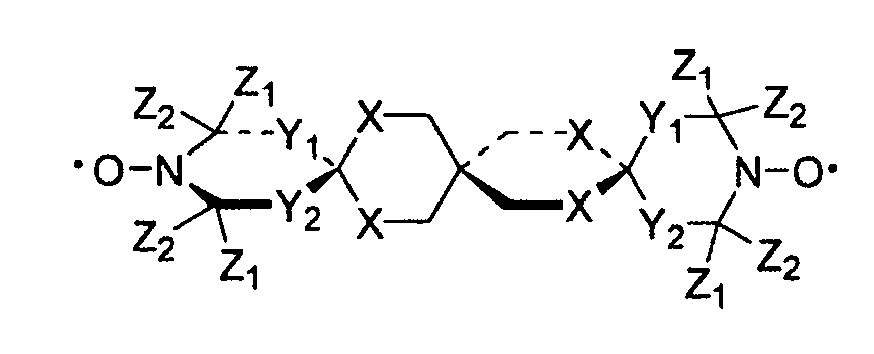
dans lesquelles Y1 est une simple liaison, ou O, N, N(O), S, S(O), SO2, ou une chaîne (C1-C4) alkyle,
dans lesquelles Y2 est une simple liaison, ou O, N, N(O), S, S(O), SO2, ou une chaîne (C1-C4) alkyle,
dans lesquelles Z1 ou Z2 = -R1, et R2 est un éventuel substituant de R1, avec R1 étant une chaîne (C1-C17) alkyle, (C1-C17) alkényle, (C1-C17) alkynyle, (C1-C17) cycloalkyle, (C1-C17) hétérocycloalkyle, (C6-C18) aryle et R2 = H ou est choisi parmi un hydroxyle (-OH), amine primaire (-NH2), amine secondaire(-NH), tertiaire(-N), ammonio (-N+), oxyde d'amine (-NO), carboxyle (-COOH), sulfanyle(-SH), sulfinyle (-SO), sulfonyle (-SO2), sulfonato (-SO3 -), phosphono (-PO3H2, -PO3(R)2 où R= (C1-C17) alkyle, (C6-C18) aryle), phosphoryle (-P(O)(R)2 où R= (C1-C17) alkyle, (C6-C18) aryle), phosphonio (-P+), ester phosphorique (-O-PO3), et Z1 et Z2 combinés ensemble avec le même atome de carbone cyclique auquel ils sont liés peuvent former un (C1-C17) spirocycloalkyle ou un (C1-C17) spirohétérocycloalkyle éventuellement substitué par R2. - Composés biradicalaires de type dinitroxyde selon la revendication 1, caractérisés en ce que la jonction entre les deux unités nitroxyde permet l'obtention d'une conformation stable dans laquelle les plans nodaux des groupes aminoxyle de ces deux unités font entre eux un angle compris entre 65° et 115°.
- Composés biradicalaires de type dinitroxyde selon la revendication 1, caractérisés en ce que la jonction entre les deux unités nitroxyde permet le maintien des atomes d'azote des groupes aminoxyle des unités nitroxyde à une distance comprise entre 3 et 16 Å.
- Composés biradicalaires de type dinitroxyde selon la revendication 1, caractérisés en ce que les unités nitroxyde sont sélectionnées parmi les unités pipéridinoxyle, pyrrolidinoxyle, imidazolinoxyle, imidazolidinoxyle, oxazolidinoxyle et nitronylnitroxide.
- Composés biradicalaires de type dinitroxyde selon les revendications 1 à 4, caractérisés par l'adjonction d'au moins un groupe photosensibilisateur sélectionné parmi la thioxanthone, la benzoïne, le benzyldiméthylcétal ou la benzophénone.
- Composés biradicalaires de type dinitroxyde selon les revendications 1 à 5, caractérisés par l'adjonction d'au moins un groupement chimique facilitant la solubilité, sélectionné parmi les fonctions et les groupements hydroxyle (-OH), amine primaire (-NH2), amine secondaire (-NH), tertiaire(-N), ammonio (-N+), oxyde d'amine (-NO), carboxyle (-COOH), sulfanyle (-SH),
sulfinyle (-SO), sulfonyle (-SO2), sulfonato (-SO3 -), phosphono (-PO3H2, -PO3 (R)2 où R= (C1-C17) alkyle, (C6-C18) aryle), phosphoryle (-P(O)(R)2 où R= (C1-C 17) alkyle, (C6-C 18) aryle), phosphonio (-P+), ester phosphorique (-O-PO3 --). - Composés biradicalaires de type dinitroxyde selon les revendications 1 à 6, caractérisés par l'adjonction d'au moins un groupement chimique réactif vis à vis des groupements -SH, -NH2, -NH-, -OH, -COOH, hydroxyaryle (-ArOH).
- Composés biradicalaires de type dinitroxyde selon la revendication 7, caractérisée en ce que ledit au moins un groupement chimique réactif est sélectionné dans le groupe comprenant :

- Composés biradicalaires de type dinitroxyde selon les revendications 1 à 8, caractérisés par leur conjugaison à des biomolécules sélectionnées parmi les protéines, ribosomes, lipides, saccharides, ADN, ARN.
- Composés biradicalaires de type dinitroxyde selon les revendications 1 à 9, caractérisés en ce qu'ils sont marqués isotopiquement par un composé sélectionné parmi le Deutérium (2H), le Carbone 13 (13C) et l'Azote 15 (15N).
- Composés biradicalaires de type dinitroxyde selon les revendications 1 à 10 comme agent de polarisation pour la mise en oeuvre des techniques de polarisation dynamique nucléaire.
- Composé biradicalaires de type dinitroxyde selon la revendication 11 de formule générale :

- Composés paramagnétiques comprenant au moins un motif dinitroxyde composé par les deux unités nitroxyde reliées par une jonction rigide selon l'une des revendications 1 à 12, comme agent de polarisation pour la mise en oeuvre de techniques de Résonance Magnétique Nucléaire du solide ou appliquées à des échantillons liquides, dans les techniques de physique des particules ainsi que dans les techniques d'imagerie médicale.
- Composition comprenant au moins un des composés biradicalaires de type dinitroxyde selon l'une des revendications 1 à 13.
Applications Claiming Priority (2)
| Application Number | Priority Date | Filing Date | Title |
|---|---|---|---|
| FR0901454A FR2943676B1 (fr) | 2009-03-26 | 2009-03-26 | Composes biradicalaires de type dinitroxyde optimises pour la polarisation dynamique nucleaire (pdn) |
| PCT/EP2010/053954 WO2010108995A1 (fr) | 2009-03-26 | 2010-03-25 | Composes biradicalaires de type dinitroxyde optimises pour la polarisation dynamique nucleaire (pdn) |
Publications (2)
| Publication Number | Publication Date |
|---|---|
| EP2411390A1 EP2411390A1 (fr) | 2012-02-01 |
| EP2411390B1 true EP2411390B1 (fr) | 2014-01-29 |
Family
ID=41838048
Family Applications (1)
| Application Number | Title | Priority Date | Filing Date |
|---|---|---|---|
| EP10711212.0A Not-in-force EP2411390B1 (fr) | 2009-03-26 | 2010-03-25 | Composes biradicalaires de type dinitroxyde optimises pour la polarisation dynamique nucleaire (pdn) |
Country Status (4)
| Country | Link |
|---|---|
| US (2) | US8648193B2 (fr) |
| EP (1) | EP2411390B1 (fr) |
| FR (1) | FR2943676B1 (fr) |
| WO (1) | WO2010108995A1 (fr) |
Cited By (1)
| Publication number | Priority date | Publication date | Assignee | Title |
|---|---|---|---|---|
| CN104458786A (zh) * | 2014-12-16 | 2015-03-25 | 上海微谱化工技术服务有限公司 | 偏磷酸盐的分析方法 |
Families Citing this family (3)
| Publication number | Priority date | Publication date | Assignee | Title |
|---|---|---|---|---|
| CN103665043B (zh) | 2012-08-30 | 2017-11-10 | 江苏豪森药业集团有限公司 | 一种替诺福韦前药及其在医药上的应用 |
| EP2789609A1 (fr) * | 2013-04-11 | 2014-10-15 | Bruker Biospin (SAS) | Agents de polarisation hautement efficace de polarisation nucléaire dynamique |
| FR3004450B1 (fr) * | 2013-04-15 | 2015-12-18 | Univ Aix Marseille | Composes biradicalaires du type dinitroxyde rigides utilises comme agents de polarisation perfectionnes pour les techniques de polarisation dynamique nucleaire (pdn) |
Family Cites Families (8)
| Publication number | Priority date | Publication date | Assignee | Title |
|---|---|---|---|---|
| FR1526656A (fr) * | 1966-06-15 | 1968-05-24 | Sankyo Co | Nouveaux composés 2, 2-diméthyl-4, 4, 6, 6-tétrasubstitué-pipéridine-1-oxydes et procédé pour leur préparation |
| NL154241C (fr) * | 1971-01-29 | 1900-01-01 | ||
| US5204473A (en) * | 1987-09-21 | 1993-04-20 | Ciba-Geigy Corporation | O-substituted N-hydroxy hindered amine stabilizers |
| US4921962A (en) * | 1988-10-19 | 1990-05-01 | Ciba-Geigy Corporation | Process for preparing N-hydrocarbyloxy derivatives of sterically hindered amines |
| JP2981022B2 (ja) * | 1991-06-10 | 1999-11-22 | 日産自動車株式会社 | フォトクロミック感光性材料 |
| TW557305B (en) | 2000-12-14 | 2003-10-11 | Ciba Sc Holding Ag | N-alkoxy-4,4-dioxy-polyalkyl-piperidine compounds, their corresponding n-oxides and controlled radical polymerization therewith |
| JP4362632B2 (ja) | 2003-03-28 | 2009-11-11 | 独立行政法人 宇宙航空研究開発機構 | パルス管冷凍機 |
| US7351402B2 (en) * | 2003-08-21 | 2008-04-01 | Massachusetts Institute Of Technology | Polarizing agents for dynamic nuclear polarization |
-
2009
- 2009-03-26 FR FR0901454A patent/FR2943676B1/fr not_active Expired - Fee Related
- 2009-05-29 US US12/474,326 patent/US8648193B2/en not_active Expired - Fee Related
-
2010
- 2010-03-25 EP EP10711212.0A patent/EP2411390B1/fr not_active Not-in-force
- 2010-03-25 WO PCT/EP2010/053954 patent/WO2010108995A1/fr not_active Ceased
-
2013
- 2013-10-30 US US14/066,797 patent/US9035054B2/en not_active Expired - Fee Related
Cited By (2)
| Publication number | Priority date | Publication date | Assignee | Title |
|---|---|---|---|---|
| CN104458786A (zh) * | 2014-12-16 | 2015-03-25 | 上海微谱化工技术服务有限公司 | 偏磷酸盐的分析方法 |
| CN104458786B (zh) * | 2014-12-16 | 2016-08-24 | 上海微谱化工技术服务有限公司 | 偏磷酸盐的分析方法 |
Also Published As
| Publication number | Publication date |
|---|---|
| US20100249386A1 (en) | 2010-09-30 |
| EP2411390A1 (fr) | 2012-02-01 |
| WO2010108995A1 (fr) | 2010-09-30 |
| US9035054B2 (en) | 2015-05-19 |
| FR2943676B1 (fr) | 2017-03-24 |
| US20140186969A1 (en) | 2014-07-03 |
| US8648193B2 (en) | 2014-02-11 |
| FR2943676A1 (fr) | 2010-10-01 |
Similar Documents
| Publication | Publication Date | Title |
|---|---|---|
| Dane et al. | Rigid orthogonal bis-TEMPO biradicals with improved solubility for dynamic nuclear polarization | |
| Mentink-Vigier et al. | Computationally assisted design of polarizing agents for dynamic nuclear polarization enhanced NMR: the AsymPol family | |
| Zhou et al. | Rapid analysis of organic compounds by proton-detected heteronuclear correlation NMR spectroscopy at 40 kHz magic-angle spinning | |
| Takahashi et al. | Towards structure determination of self-assembled peptides using dynamic nuclear polarization enhanced solid-state NMR spectroscopy | |
| Brus et al. | Through-bonds and through-space solid-state NMR correlations at natural isotopic abundance: Signal assignment and structural study of simvastatin | |
| Taratula et al. | Shorter synthesis of trifunctionalized cryptophane-A derivatives | |
| Qi et al. | Spacers for geometrically well-defined water-soluble molecular rulers and their application | |
| JP2007513977A (ja) | ラジカル・スカベンジャーとして有用な高フラーレン | |
| van der Zwan et al. | 19F MAS DNP for probing molecules in nanomolar concentrations: direct polarization as key for solid-state NMR spectra without solvent and matrix signals | |
| FR2943676A1 (fr) | Composes biradicalaires de type dinitroxyde optimises pour la polarisation dynamique nucleaire (pdn) | |
| Liu et al. | Water-soluble host–guest complexes between fullerenes and a sugar-functionalized tribenzotriquinacene assembling to microspheres | |
| Huber et al. | NMR study of optically active monosubstituted cryptophanes and their interaction with xenon | |
| Valera et al. | A modular approach for the synthesis of nanometer-sized polynitroxide multi-spin systems | |
| CN105777794A (zh) | 一种双光子氟离子荧光探针化合物的制备与应用 | |
| Braga et al. | A Solid− Gas Route to Polymorph Conversion in Crystalline [FeII (η5-C5H4COOH) 2]. A Diffraction and Solid-State NMR Study | |
| Caron et al. | One and two-dimensional NMR investigations of the inclusion of the monosulfonated triphenylphosphine in the β-cyclodextrin | |
| Yau et al. | Nitroxide-based triradical dopants for efficient low-temperature dynamic nuclear polarization in aqueous solutions over a broad pH range | |
| Biaso et al. | Formation and structure of a stable monoradical cation by reduction of a diphosphafulvenium salt | |
| Cao et al. | Synthesis, structure, and binding property of pentiptycene-based rigid tweezer-like molecules | |
| Hansen et al. | 13C 13C coupling constants and substituent effects on 13C chemical shifts in 13C labelled pyrene and pyrene derivatives | |
| CN112079860A (zh) | 氟硼二吡咯荧光探针及制备方法与其在粘度检测中的应用 | |
| CN116731054A (zh) | 一种含联苯的bodipy二聚体荧光探针db-bodipy及其制备方法 | |
| US20240400585A1 (en) | Trityl-nitroxide multiradicals as polarizing agents for dynmaic nuclear polarization | |
| EP2986613B1 (fr) | Composes biradicalaires du type dinitroxyde rigides utilises comme agents de polarisation perfectionnes pour les techniques de polarisation dynamique nucleaire | |
| WO2005097201A2 (fr) | Complexes d’inclusions comprenant du piroxicam, une cyclodextrine et l’arginine |
Legal Events
| Date | Code | Title | Description |
|---|---|---|---|
| PUAI | Public reference made under article 153(3) epc to a published international application that has entered the european phase |
Free format text: ORIGINAL CODE: 0009012 |
|
| 17P | Request for examination filed |
Effective date: 20110926 |
|
| AK | Designated contracting states |
Kind code of ref document: A1 Designated state(s): AT BE BG CH CY CZ DE DK EE ES FI FR GB GR HR HU IE IS IT LI LT LU LV MC MK MT NL NO PL PT RO SE SI SK SM TR |
|
| DAX | Request for extension of the european patent (deleted) | ||
| 17Q | First examination report despatched |
Effective date: 20120706 |
|
| REG | Reference to a national code |
Ref country code: DE Ref legal event code: R079 Ref document number: 602010013401 Country of ref document: DE Free format text: PREVIOUS MAIN CLASS: C07D0471180000 Ipc: G01R0033280000 |
|
| RAP1 | Party data changed (applicant data changed or rights of an application transferred) |
Owner name: MASSACHUSETTS INSTITUTE OF TECHNOLOGY Owner name: UNIVERSITE D'AIX MARSEILLE |
|
| RIC1 | Information provided on ipc code assigned before grant |
Ipc: G01R 33/28 20060101AFI20130613BHEP Ipc: G01R 33/56 20060101ALI20130613BHEP |
|
| GRAP | Despatch of communication of intention to grant a patent |
Free format text: ORIGINAL CODE: EPIDOSNIGR1 |
|
| INTG | Intention to grant announced |
Effective date: 20130815 |
|
| GRAS | Grant fee paid |
Free format text: ORIGINAL CODE: EPIDOSNIGR3 |
|
| GRAA | (expected) grant |
Free format text: ORIGINAL CODE: 0009210 |
|
| AK | Designated contracting states |
Kind code of ref document: B1 Designated state(s): AT BE BG CH CY CZ DE DK EE ES FI FR GB GR HR HU IE IS IT LI LT LU LV MC MK MT NL NO PL PT RO SE SI SK SM TR |
|
| REG | Reference to a national code |
Ref country code: GB Ref legal event code: FG4D Free format text: NOT ENGLISH |
|
| REG | Reference to a national code |
Ref country code: CH Ref legal event code: EP |
|
| REG | Reference to a national code |
Ref country code: AT Ref legal event code: REF Ref document number: 651621 Country of ref document: AT Kind code of ref document: T Effective date: 20140215 |
|
| REG | Reference to a national code |
Ref country code: IE Ref legal event code: FG4D Free format text: LANGUAGE OF EP DOCUMENT: FRENCH |
|
| REG | Reference to a national code |
Ref country code: DE Ref legal event code: R096 Ref document number: 602010013401 Country of ref document: DE Effective date: 20140313 |
|
| REG | Reference to a national code |
Ref country code: NL Ref legal event code: T3 |
|
| REG | Reference to a national code |
Ref country code: AT Ref legal event code: MK05 Ref document number: 651621 Country of ref document: AT Kind code of ref document: T Effective date: 20140129 |
|
| REG | Reference to a national code |
Ref country code: LT Ref legal event code: MG4D |
|
| PG25 | Lapsed in a contracting state [announced via postgrant information from national office to epo] |
Ref country code: LT Free format text: LAPSE BECAUSE OF FAILURE TO SUBMIT A TRANSLATION OF THE DESCRIPTION OR TO PAY THE FEE WITHIN THE PRESCRIBED TIME-LIMIT Effective date: 20140129 Ref country code: IS Free format text: LAPSE BECAUSE OF FAILURE TO SUBMIT A TRANSLATION OF THE DESCRIPTION OR TO PAY THE FEE WITHIN THE PRESCRIBED TIME-LIMIT Effective date: 20140529 Ref country code: NO Free format text: LAPSE BECAUSE OF FAILURE TO SUBMIT A TRANSLATION OF THE DESCRIPTION OR TO PAY THE FEE WITHIN THE PRESCRIBED TIME-LIMIT Effective date: 20140429 |
|
| PG25 | Lapsed in a contracting state [announced via postgrant information from national office to epo] |
Ref country code: CY Free format text: LAPSE BECAUSE OF FAILURE TO SUBMIT A TRANSLATION OF THE DESCRIPTION OR TO PAY THE FEE WITHIN THE PRESCRIBED TIME-LIMIT Effective date: 20140129 Ref country code: PT Free format text: LAPSE BECAUSE OF FAILURE TO SUBMIT A TRANSLATION OF THE DESCRIPTION OR TO PAY THE FEE WITHIN THE PRESCRIBED TIME-LIMIT Effective date: 20140529 Ref country code: FI Free format text: LAPSE BECAUSE OF FAILURE TO SUBMIT A TRANSLATION OF THE DESCRIPTION OR TO PAY THE FEE WITHIN THE PRESCRIBED TIME-LIMIT Effective date: 20140129 Ref country code: AT Free format text: LAPSE BECAUSE OF FAILURE TO SUBMIT A TRANSLATION OF THE DESCRIPTION OR TO PAY THE FEE WITHIN THE PRESCRIBED TIME-LIMIT Effective date: 20140129 Ref country code: SE Free format text: LAPSE BECAUSE OF FAILURE TO SUBMIT A TRANSLATION OF THE DESCRIPTION OR TO PAY THE FEE WITHIN THE PRESCRIBED TIME-LIMIT Effective date: 20140129 Ref country code: ES Free format text: LAPSE BECAUSE OF FAILURE TO SUBMIT A TRANSLATION OF THE DESCRIPTION OR TO PAY THE FEE WITHIN THE PRESCRIBED TIME-LIMIT Effective date: 20140129 |
|
| PG25 | Lapsed in a contracting state [announced via postgrant information from national office to epo] |
Ref country code: LV Free format text: LAPSE BECAUSE OF FAILURE TO SUBMIT A TRANSLATION OF THE DESCRIPTION OR TO PAY THE FEE WITHIN THE PRESCRIBED TIME-LIMIT Effective date: 20140129 Ref country code: HR Free format text: LAPSE BECAUSE OF FAILURE TO SUBMIT A TRANSLATION OF THE DESCRIPTION OR TO PAY THE FEE WITHIN THE PRESCRIBED TIME-LIMIT Effective date: 20140129 |
|
| REG | Reference to a national code |
Ref country code: DE Ref legal event code: R097 Ref document number: 602010013401 Country of ref document: DE |
|
| PG25 | Lapsed in a contracting state [announced via postgrant information from national office to epo] |
Ref country code: RO Free format text: LAPSE BECAUSE OF FAILURE TO SUBMIT A TRANSLATION OF THE DESCRIPTION OR TO PAY THE FEE WITHIN THE PRESCRIBED TIME-LIMIT Effective date: 20140129 Ref country code: CZ Free format text: LAPSE BECAUSE OF FAILURE TO SUBMIT A TRANSLATION OF THE DESCRIPTION OR TO PAY THE FEE WITHIN THE PRESCRIBED TIME-LIMIT Effective date: 20140129 Ref country code: LU Free format text: LAPSE BECAUSE OF FAILURE TO SUBMIT A TRANSLATION OF THE DESCRIPTION OR TO PAY THE FEE WITHIN THE PRESCRIBED TIME-LIMIT Effective date: 20140325 Ref country code: DK Free format text: LAPSE BECAUSE OF FAILURE TO SUBMIT A TRANSLATION OF THE DESCRIPTION OR TO PAY THE FEE WITHIN THE PRESCRIBED TIME-LIMIT Effective date: 20140129 Ref country code: EE Free format text: LAPSE BECAUSE OF FAILURE TO SUBMIT A TRANSLATION OF THE DESCRIPTION OR TO PAY THE FEE WITHIN THE PRESCRIBED TIME-LIMIT Effective date: 20140129 |
|
| PG25 | Lapsed in a contracting state [announced via postgrant information from national office to epo] |
Ref country code: PL Free format text: LAPSE BECAUSE OF FAILURE TO SUBMIT A TRANSLATION OF THE DESCRIPTION OR TO PAY THE FEE WITHIN THE PRESCRIBED TIME-LIMIT Effective date: 20140129 Ref country code: SK Free format text: LAPSE BECAUSE OF FAILURE TO SUBMIT A TRANSLATION OF THE DESCRIPTION OR TO PAY THE FEE WITHIN THE PRESCRIBED TIME-LIMIT Effective date: 20140129 |
|
| PLBE | No opposition filed within time limit |
Free format text: ORIGINAL CODE: 0009261 |
|
| STAA | Information on the status of an ep patent application or granted ep patent |
Free format text: STATUS: NO OPPOSITION FILED WITHIN TIME LIMIT |
|
| REG | Reference to a national code |
Ref country code: IE Ref legal event code: MM4A |
|
| 26N | No opposition filed |
Effective date: 20141030 |
|
| PG25 | Lapsed in a contracting state [announced via postgrant information from national office to epo] |
Ref country code: IE Free format text: LAPSE BECAUSE OF NON-PAYMENT OF DUE FEES Effective date: 20140325 |
|
| REG | Reference to a national code |
Ref country code: DE Ref legal event code: R097 Ref document number: 602010013401 Country of ref document: DE Effective date: 20141030 |
|
| PG25 | Lapsed in a contracting state [announced via postgrant information from national office to epo] |
Ref country code: SI Free format text: LAPSE BECAUSE OF FAILURE TO SUBMIT A TRANSLATION OF THE DESCRIPTION OR TO PAY THE FEE WITHIN THE PRESCRIBED TIME-LIMIT Effective date: 20140129 |
|
| PG25 | Lapsed in a contracting state [announced via postgrant information from national office to epo] |
Ref country code: MT Free format text: LAPSE BECAUSE OF FAILURE TO SUBMIT A TRANSLATION OF THE DESCRIPTION OR TO PAY THE FEE WITHIN THE PRESCRIBED TIME-LIMIT Effective date: 20140129 |
|
| REG | Reference to a national code |
Ref country code: FR Ref legal event code: PLFP Year of fee payment: 7 |
|
| PG25 | Lapsed in a contracting state [announced via postgrant information from national office to epo] |
Ref country code: SM Free format text: LAPSE BECAUSE OF FAILURE TO SUBMIT A TRANSLATION OF THE DESCRIPTION OR TO PAY THE FEE WITHIN THE PRESCRIBED TIME-LIMIT Effective date: 20140129 |
|
| PG25 | Lapsed in a contracting state [announced via postgrant information from national office to epo] |
Ref country code: MC Free format text: LAPSE BECAUSE OF FAILURE TO SUBMIT A TRANSLATION OF THE DESCRIPTION OR TO PAY THE FEE WITHIN THE PRESCRIBED TIME-LIMIT Effective date: 20140129 |
|
| PG25 | Lapsed in a contracting state [announced via postgrant information from national office to epo] |
Ref country code: GR Free format text: LAPSE BECAUSE OF FAILURE TO SUBMIT A TRANSLATION OF THE DESCRIPTION OR TO PAY THE FEE WITHIN THE PRESCRIBED TIME-LIMIT Effective date: 20140430 Ref country code: BG Free format text: LAPSE BECAUSE OF FAILURE TO SUBMIT A TRANSLATION OF THE DESCRIPTION OR TO PAY THE FEE WITHIN THE PRESCRIBED TIME-LIMIT Effective date: 20140129 Ref country code: IT Free format text: LAPSE BECAUSE OF FAILURE TO SUBMIT A TRANSLATION OF THE DESCRIPTION OR TO PAY THE FEE WITHIN THE PRESCRIBED TIME-LIMIT Effective date: 20140129 |
|
| PG25 | Lapsed in a contracting state [announced via postgrant information from national office to epo] |
Ref country code: HU Free format text: LAPSE BECAUSE OF FAILURE TO SUBMIT A TRANSLATION OF THE DESCRIPTION OR TO PAY THE FEE WITHIN THE PRESCRIBED TIME-LIMIT; INVALID AB INITIO Effective date: 20100325 Ref country code: TR Free format text: LAPSE BECAUSE OF FAILURE TO SUBMIT A TRANSLATION OF THE DESCRIPTION OR TO PAY THE FEE WITHIN THE PRESCRIBED TIME-LIMIT Effective date: 20140129 Ref country code: BE Free format text: LAPSE BECAUSE OF FAILURE TO SUBMIT A TRANSLATION OF THE DESCRIPTION OR TO PAY THE FEE WITHIN THE PRESCRIBED TIME-LIMIT Effective date: 20140331 |
|
| REG | Reference to a national code |
Ref country code: FR Ref legal event code: PLFP Year of fee payment: 8 |
|
| REG | Reference to a national code |
Ref country code: FR Ref legal event code: PLFP Year of fee payment: 9 |
|
| PG25 | Lapsed in a contracting state [announced via postgrant information from national office to epo] |
Ref country code: MK Free format text: LAPSE BECAUSE OF FAILURE TO SUBMIT A TRANSLATION OF THE DESCRIPTION OR TO PAY THE FEE WITHIN THE PRESCRIBED TIME-LIMIT Effective date: 20140129 |
|
| PGFP | Annual fee paid to national office [announced via postgrant information from national office to epo] |
Ref country code: NL Payment date: 20200325 Year of fee payment: 11 Ref country code: GB Payment date: 20200324 Year of fee payment: 11 Ref country code: DE Payment date: 20200326 Year of fee payment: 11 |
|
| PGFP | Annual fee paid to national office [announced via postgrant information from national office to epo] |
Ref country code: CH Payment date: 20200327 Year of fee payment: 11 |
|
| PGFP | Annual fee paid to national office [announced via postgrant information from national office to epo] |
Ref country code: FR Payment date: 20200316 Year of fee payment: 11 |
|
| REG | Reference to a national code |
Ref country code: DE Ref legal event code: R119 Ref document number: 602010013401 Country of ref document: DE |
|
| REG | Reference to a national code |
Ref country code: CH Ref legal event code: PL |
|
| REG | Reference to a national code |
Ref country code: NL Ref legal event code: MM Effective date: 20210401 |
|
| GBPC | Gb: european patent ceased through non-payment of renewal fee |
Effective date: 20210325 |
|
| PG25 | Lapsed in a contracting state [announced via postgrant information from national office to epo] |
Ref country code: CH Free format text: LAPSE BECAUSE OF NON-PAYMENT OF DUE FEES Effective date: 20210331 Ref country code: LI Free format text: LAPSE BECAUSE OF NON-PAYMENT OF DUE FEES Effective date: 20210331 Ref country code: NL Free format text: LAPSE BECAUSE OF NON-PAYMENT OF DUE FEES Effective date: 20210401 Ref country code: FR Free format text: LAPSE BECAUSE OF NON-PAYMENT OF DUE FEES Effective date: 20210331 Ref country code: GB Free format text: LAPSE BECAUSE OF NON-PAYMENT OF DUE FEES Effective date: 20210325 Ref country code: DE Free format text: LAPSE BECAUSE OF NON-PAYMENT OF DUE FEES Effective date: 20211001 |