EP2409595B1 - Improved contact lens case - Google Patents
Improved contact lens case Download PDFInfo
- Publication number
- EP2409595B1 EP2409595B1 EP11174457.9A EP11174457A EP2409595B1 EP 2409595 B1 EP2409595 B1 EP 2409595B1 EP 11174457 A EP11174457 A EP 11174457A EP 2409595 B1 EP2409595 B1 EP 2409595B1
- Authority
- EP
- European Patent Office
- Prior art keywords
- stem
- contact lens
- cap
- diaphragm
- lens case
- Prior art date
- Legal status (The legal status is an assumption and is not a legal conclusion. Google has not performed a legal analysis and makes no representation as to the accuracy of the status listed.)
- Active
Links
Images








Classifications
-
- A—HUMAN NECESSITIES
- A45—HAND OR TRAVELLING ARTICLES
- A45C—PURSES; LUGGAGE; HAND CARRIED BAGS
- A45C11/00—Receptacles for purposes not provided for in groups A45C1/00-A45C9/00
- A45C11/005—Contact lens cases
-
- A—HUMAN NECESSITIES
- A45—HAND OR TRAVELLING ARTICLES
- A45C—PURSES; LUGGAGE; HAND CARRIED BAGS
- A45C13/00—Details; Accessories
- A45C13/005—Hinges
-
- B—PERFORMING OPERATIONS; TRANSPORTING
- B43—WRITING OR DRAWING IMPLEMENTS; BUREAU ACCESSORIES
- B43K—IMPLEMENTS FOR WRITING OR DRAWING
- B43K23/00—Holders or connectors for writing implements; Means for protecting the writing-points
- B43K23/008—Holders comprising finger grips
-
- B—PERFORMING OPERATIONS; TRANSPORTING
- B65—CONVEYING; PACKING; STORING; HANDLING THIN OR FILAMENTARY MATERIAL
- B65D—CONTAINERS FOR STORAGE OR TRANSPORT OF ARTICLES OR MATERIALS, e.g. BAGS, BARRELS, BOTTLES, BOXES, CANS, CARTONS, CRATES, DRUMS, JARS, TANKS, HOPPERS, FORWARDING CONTAINERS; ACCESSORIES, CLOSURES, OR FITTINGS THEREFOR; PACKAGING ELEMENTS; PACKAGES
- B65D2585/00—Containers, packaging elements or packages specially adapted for particular articles or materials
- B65D2585/54—Containers, packaging elements or packages specially adapted for particular articles or materials for articles of special shape not otherwise provided for
- B65D2585/545—Contact lenses
-
- F—MECHANICAL ENGINEERING; LIGHTING; HEATING; WEAPONS; BLASTING
- F16—ENGINEERING ELEMENTS AND UNITS; GENERAL MEASURES FOR PRODUCING AND MAINTAINING EFFECTIVE FUNCTIONING OF MACHINES OR INSTALLATIONS; THERMAL INSULATION IN GENERAL
- F16C—SHAFTS; FLEXIBLE SHAFTS; ELEMENTS OR CRANKSHAFT MECHANISMS; ROTARY BODIES OTHER THAN GEARING ELEMENTS; BEARINGS
- F16C11/00—Pivots; Pivotal connections
- F16C11/04—Pivotal connections
- F16C11/10—Arrangements for locking
-
- Y—GENERAL TAGGING OF NEW TECHNOLOGICAL DEVELOPMENTS; GENERAL TAGGING OF CROSS-SECTIONAL TECHNOLOGIES SPANNING OVER SEVERAL SECTIONS OF THE IPC; TECHNICAL SUBJECTS COVERED BY FORMER USPC CROSS-REFERENCE ART COLLECTIONS [XRACs] AND DIGESTS
- Y10—TECHNICAL SUBJECTS COVERED BY FORMER USPC
- Y10S—TECHNICAL SUBJECTS COVERED BY FORMER USPC CROSS-REFERENCE ART COLLECTIONS [XRACs] AND DIGESTS
- Y10S134/00—Cleaning and liquid contact with solids
- Y10S134/901—Contact lens
Definitions
- the present invention generally relates to contact lens cases.
- U.S. Patent No. 3,770,113 discloses a prior art contact lens storage and disinfection cup system 10.
- the Thomas system is illustrated in FIG. 1 of the present application, and utilizes a planar central stem (12) that engages a cap (13).
- the stem (12) has dome features (14) on each side of the stem (12) and hinged containment cages (16) which pivot into a closed position over the domes (14) and parallel to the planar stem (12).
- Subsequent commercial cup disinfection and storage systems have generally followed the same layout with only minor differences in the ribbing of the cages or the form of the structure used to receive the contact lens.
- This layout of the lens retaining components has withstood the test of time in part due to the efficiency in which it utilizes space available within the cup.
- contact lens solution makers have settled upon the use of 10 cubic centimeters (cc's) of solution within the cup for purposes of disinfection or hydration.
- This volume of fluid may have been driven by the geometry of the cup design disclosed in the '113 patent in order to assure that lenses were fully immersed in solution: nevertheless the 10cc fluid volume has become standard within the lens care industry and as a consequence, subsequent lens cup designs have been driven by the need to keep contained contact lenses fully immersed in 10 cc's of fluid.
- dome feature (14) Users of these lens cases generally find it easier to deliver their lenses to the dome feature (14) instead of the cage (16). This is in part due to the tendency of the damp lens to adhere the dome surface (14) which has more surface area than the cage (16) and more closely resembles the shape of a human eyeball. Since contact lens wearers typically grasp the lens by its convex outer surface to remove it from their eye, the dome (14) provides a ready receptacle without having to change one's grasp on the lens. Contact lens wearers also show preference for larger lens-receiving structures and cages as opposed to smaller ones in which fingers must be more dexterous in order to place or retrieve lenses. This user preference may also be driven by an older population of contact lens wearers who may lack the dexterity of younger lens users.
- Another method to facilitate such reversal would be to reduce the diameter and depth of the lens cage, but this would be judged as user unfriendly by a large portion of lens wearers who find smaller lens cages difficult to use.
- the inner base diameter of commercial contact lens cases range from. 1.778 cm to 2.032 cm (0,70 inches to 0,80 inches), and this is what users are accustomed to using.
- the contact lens case configuration (10) disclosed in the '113 patent includes a latching mechanism (20) for holding the hinged members (16) closed in order to retain the lenses.
- the latching mechanism (20) disclosed in the '113 patent consists of latch arms (22) which are disposed on the hinged members (16) and which are configured to engage bottom surfaces (24) of the central stem member (12).
- latches such as that which is disclosed in the '113 patent have a tendency to cut lenses that are not properly aligned when the hinged member is moved into the closed, latched position.
- contact lens cases are made of plastic, using a molding process.
- the molding process used to produce plastic lens cases is generally paced by the speed at which heat can be removed from the molten plastic resin once it has been injected into the mold.
- Plastic resin must be sufficiently cooled and therefore hardened to prevent distortion upon ejection or handling.
- Overly thick sections of plastic slow down the molding process because they require more time to cool. In some instances, thick sections can warp or suffer from surface distortions known as sink, in which the molten plastic within the thick section pulls the hardened outside skin inwards as the molten resin shrinks during cooling.
- a contact lens case comprising: a cup; a cap which engages the cup; a stem; a diaphragm which is disposed between the cap and the stem; a first pivotable member engaged with the stem; a second pivotable member engaged with the stem; each of said first pivotable member and said second pivotable member being pivotable between an open position and a closed position, said first pivotable member comprising a first support ear having a first pin thereon and a second support ear having a second pin thereon, said first support ear and said second support ear being spaced apart from each other and configured to deflect away from each other and come back toward each other as the first pivotable member is moved between its closed position and its open position, wherein the first pin is received in a first receptacle on a first side of the stem, wherein the second pin is received in a second receptacle on a second side of the stem, said second side being opposite said first side, said second pivot
- the present invention provides an improved contact lens case which attends to the problem of preventing contamination from outside the lens case when inside and outside the lens case are at ambient pressure or when the external pressure is elevated.
- FIG. 7 illustrates a contact lens case (40) which is in accordance with the prior art.
- the contact lens case (40) includes a central stem (42) on which is disposed two back-to-back cages (44) (only one of the cages is visible in FIG. 7 , but see also FIGS. 2 , 4 and 6 ).
- the stem (42) is engaged with a cap (46), and a catalyst (48) is engaged with the stem (42) opposite the cap (46).
- the cap (46) engages the top (50) of a cylindrical cup (52), thereby forming an enclosed contact lens case.
- FIG.2 shows the stem (42) disengaged from the cap (46).
- the stem (42) is planar and has two, back-to-back cages (44) disposed thereon.
- the cages (44) may be engaged with the stem (42) in a snap-fit arrangement.
- the cages (44) may be integral with the stem (42) (for example, the stem (42) and cages (44) may be a single, plastic molded piece).
- the cages (44) are positioned in back-to-back orientation, with their convex sides (54) facing each other.
- one end (56) of the stem (42) is configured for engagement with the inside of the cap (46), while the opposite, distal end (58) of the stem (42) is configured to receive a catalyst (48).
- indentations (60) may be provided on the stem (42), near its distal end (58), for receiving and retaining a catalyst (48).
- FIG. 3 illustrates one possible shape of the catalyst (48) which can be used, and FIGS. 4 , 5 and 7 illustrate the catalyst (48) engaged with the stem (42). The catalyst will be described in more detail later hereinbelow.
- hinged members (62) are engaged with the stem (42) and each of the hinged members (62) includes a lens-receiving structure (64) such as a solid dome-shaped portion for retaining contact lenses thereon.
- the hinged members (62) are preferably non-planar (see FIG.
- each of the hinged members (62) is cylindrically-curved, having a cylindrically-curved shell form in which the axis of its curve is approximately parallel to the central axis of the central planar stem member (42). Specifically, the central axis of each lens cage is disposed parallel to the geometric plane described by the stem (42). Additionally, the central axis of pivoting for each hinged member (62) is perpendicular to the geometric plane described by the stem (42).
- Each hinged member (62) is configured to mount and pivot upon fixed hinge pin receptacles (66) formed upon a common center opposite one another on each side of the planar stem (42).
- Small inward facing pin structures (70) are provided on the hinged members (62) to serve as hinge pins which mount and pivot within the hinge pin receptacles (66) formed on the planar stem (42).
- the hinged member (62) can be pivoted closed, such that its lens-receiving structure (64) and the respective cage (44) on the stem (42) effectively mate, retaining a contact lens therebetween.
- FIG. 4 shows the stem (42) engaged with the cap (46), a catalyst (48) on the end (58) of the stem (42), and one of the hinged members (62) pivoted down, thereby exposing the lens-receiving structure (64) on the hinged member (62) (and a contact lens, if a contact lens were on the lens-receiving structure (64)).
- FIG. 5 shows both hinged members (62) pivoted closed, and FIG. 7 ( FIG. 2 only shows the hinged member (62) meant to be associated with the contact lens for the right eye), so that a user knows which contact lens is supposed to be engaged with that particular lens-receiving structure.
- FIG. 17 shows one of the hinged members (62) including the indicia "L", thereby indicating to the user that that particular hinged member (62) is meant for use with the contact which is placed in the left eye
- the other hinged member (62) includes the indicia "R”, thereby indicating to the user that that particular hinged member (62) is meant for use with the contact which is placed in the right eye.
- the fixed hinge elements (62) on the planar stem (42) are cylindrical in nature, each with slot interruptions (74) located 180 degrees from one another in a plane parallel to the center line of the planar stem (42) to allow flushing and drainage and avoid trapping fluid while in an upright or inverted position.
- an internal vent port (99) is provided at the base (98) of the stem (42).
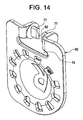
- a second potential hinging mechanism (75) for hinging employs inwardly opposed planar hinge pins (77) upon element (62) that are inserted as shown in FIG. 13 , into cylindrical receptacles (79) provided upon stem (42).
- cylindrical receptacles (79) are positioned perpendicular to the plane of stem (42) and share a common axis with one another on opposite sides of stem (42).
- Receptacles (79) each have aligned receiving slots (85) positioned to allow insertion of opposed hinge pins (77) into an inner cylindrical bore (88).
- FIG. 13 shows how the planar hinge pins (77) of element (62) are inserted into receiving slots (85).
- Assembly of the hinged member 62 utilizes a snap together method with retention of the planar hinge pins (77) being assured by means of the hinge pin retention ledge (87) shown in FIG. 10 .
- Retention ledges (87) result from a gap between tapered ends of opposed hinge pins (77) that is smaller than the width between the bottoms of adjacent receiving slots (85).
- Slots (85) in hinge receptacles (79) provide for drainage of fluid from within each hinge receptacle structure while the small surface area of planar hinge pins (77) remaining in contact with the cylindrical interior of hinge receptacles (79) serve to both facilitate this drainage and minimize fluid retention within the hinge assembly due to capillary attraction.
- latching mechanism commonly used to hold the hinged members closed in order to retain lenses have often followed the example demonstrated by the Thomas '113 patent. These latches however, have a reputation for cutting misplaced lenses and so it is desirable to utilize a remote latching mechanism.
- One example of such a mechanism is disclosed in U.S. Patent No. 4,807,750 .
- the lens case (40) disclosed herein also utilizes a latch mechanism (76) to hold each hinged member (62) closed and prevent lens damage.
- the latch mechanism (76) may comprise a feature located within each pair of cylindrical hinge receptacles 79 which supports a detent cam surface (81) shown in FIG. 11 , positioned to engage at least one planar hinge pin (77) of each hinged member (62) and thereby hold the hinged member (62) in a closed position.
- the same detent cam (81) is provided for each hinged member (62).
- the latch mechanism (76) also functions to hold the hinged members (62) open. Specifically, as a hinged member (62) is pivoted open, the planar hinge pin tip (83) rides across detent cam surface (81) and seats on the other side of the detent cam surface (81).
- the detent cam surface (81) and tip (83) of planar hinge pin (77) are configured such that in either position - whether the hinged member (62) is in the pen or closed position - the hinged member (62) tends to stay in that position unless intentionally pivoted by a user.
- each cage (44) and its respective hinged member (62) are preferably curved to match one another (see FIG. 6 ).
- planar central stem (42) with back-to-back lens cages (44) and mating curved hinged members (62) on either side results in a package that does not require as large a cup diameter to accommodate the internal components as would be required if the cages and lens-receiving structures were instead to be provided as having flat faces.
- the case is configured such that use of curved, lens-receiving structure-carrying hinged members (62) allows a desirable lens cage inner base diameter of 1.905 cm (0,75 inches) to be employed without losing full lens immersion with 10 cc's of lens solution.
- lens-receiving structure (64) an integral, thin-walled and continuous element of the hinged member (62) allows a precise lens-receiving structure form to be quickly molded in a repeatable reliable manner without distortion or sink.
- Lens-receiving structures formed in this manner can be designed to optimize features necessary for preferential retention of lenses during placement and after disinfection or storage.
- the contact lens case (40) disclosed herein utilizes a pressure venting mechanism, such as a vent membrane (80), to relieve excess pressure through a vent notch (103) in the cap (46), as well as a sealing means, such as a sealing gasket (80) portion of the vent membrane (80), at the cap-to-cup interface.
- the cap (46) includes a plug (105) having a post (107) for sealing of the vent notch (103).
- the membrane (80) provides a vent hole 109 in which the post (107) becomes disposed when the cap (46) is screwed on to the top (50) of the cup (52). When venting takes place, the membrane (80) moves away from the post (107) creating a gap, and venting then becomes possible through the vent notch (103) in the cap (46).
- the vent membrane (80) and sealing gasket (82) need not be separate pieces. They can be created simultaneously during the cap's molding process in which, as shown in FIG. 12 , a thermoplastic elastomer (91) is overmolded on the plastic cap structure (46) such that the thermoplastic elastomer (91) becomes effectively integral with the gasket (82) and vent vale (80).
- a thermoplastic elastomer (91) is overmolded on the plastic cap structure (46) such that the thermoplastic elastomer (91) becomes effectively integral with the gasket (82) and vent vale (80).
- an integrally molded cap gasket and elastomeric exterior cap surface are provide, as the thermoplastic elastomer (99) covers the exterior surface of the cap (46) and provides corners (93) to enhance wet grip and tactile feel.
- Contemplated herein also is a redesign of a reaction catalyst that may be attached to the distal end (58) of the planar stem (42).
- Companies such as Bausch and Lomb (easySEPT®), CIBA Vision Corporation (AOSept®) and Sauflon Pharmaceuticals Inc. (OneStep®) each offer Hydrogen Peroxide lens disinfection cup systems having Platinum based catalyst to break down the disinfectant.
- AMO Olysept®
- CIBA Vision Blue Sept®
- Hydrogen Peroxide systems which utilize tablets of catalase enzyme to break down the disinfectant.
- This orientation helps assure that the catalyst (48) does not inhibit user access to the lens-receiving structures (64). Height of this reconfigured catalyst would not be appreciably different from existing catalysts in the market place, the amount of active surface area and its orientation being the most important factors in determining final catalyst design.
- contact lens case (40) may include, but not be limited to:
- FIGS. 15-18 illustrate a contact lens case (140).
- the contact lens case (140) is very similar to the contact lens case (40) previously described, and so only the differences will be discussed in detail.
- the contact lens case (140) includes a stem (142) that has back-to-back cages (144) thereon, hinged members (162) that have lens-receiving structures (164) thereon, and a cup (152).
- the contact lens case (140) also includes a cap (146) which is part of a cap assembly (described in more detail later hereinbelow), and which engages the top (150) of the cylindrical cup (152), such as in a threaded engagement, thereby providing that the lens case (140) is an enclosed structure.
- a catalyst is engaged with the term (142) opposite the cap (146), and the catalyst may be a conventional catalyst or a catalyst (48) such as is shown in FIG. 3 and which has been described hereinabove.
- the stem (142) of lens case (140) has two, back-to-back cages (144) disposed thereon.
- the cages (144) may be engaged with the stem (142) in a snap-fit arrangement.
- the cages (144) may be integral with the stem (142) (for example, the stem (142) and cages (144) may be a single, plastic molded piece as shown in the figures).
- the cages (144) are positioned in back-to-back orientation, with their convex sides (154) facing each other.
- one end (156) of the stem (142) is configured for engagement with the inside (157) of the cap assembly (146).
- the end (156) of the stem (142) may provide a square-like shape profile which inserts in a corresponding recess (159) defined by an extended pin structure (177) on the inside surface (157) of the cap assembly (146).
- the end (156) of the stem (142) may provide a plurality of protrusions (161) which insert in corresponding apertures (163) formed in the pin structures (177) on the inside surface (157) of the cap assembly (146), in a snap-fit engagement.
- the opposite, distal end (158) of the stem (142) is configured to receive the catalyst (48).
- fingers (165) having indentations (160) may be provided on the stem (142), near its distal end (158), for receiving and retaining the catalyst (48).
- hinged members (162) are engaged with the stem (142) and each of the hinged members (162) includes a lens-receiving structure (164) such as a dome-shaped portion for retaining contact lenses thereon.
- the hinged members (162) are preferably non-planar (see FIGS.
- 21 and 22 which provides top and bottom views of one of the hinged members, with the other hinged member being virtually identical, but for a different indicia to indicate the other eye) which allows the lens-receiving structures (164) to be provided on the hinged members (162) rather than having to be on the stem (142), and allows the use of a deep larger diameter, back-to-back cages (144) on the stem (142), without having to resort to using more than 10 cc's of fluid to immerse contact lenses that are disposed on the lens-receiving structures (164), between each of the lens-receiving structures (164) and a respective cage (144).
- Each of the hinged members (162) is cylindrically-curved, having a cylindrically-curved shell form in which the axis of its curve is approximately parallel to the central axis of the central planar stem member (142). Specifically, the central axis of each lens cage is discposed parallel to the geometric plane described by the stem (142). Additionally, the central axis of pivoting for each hinged member (162) is perpendicular to the geometric plane described by the stem.
- Each hinged member (162) is configured to mount and pivot within fixed hinge pin receptacles (179) which are provided upon a common center opposite one another on each side of the stem (142).
- small inward facing pin structures (177) are provided on support ears (205) of the hinged members (162), and these pin structures (177) mount and rotate within the hinge pin receptacles (179) formed on the stem (142) as the hinged members (162) are being opened and closed.
- the cylindrical receptacles (179) are positioned perpendicular to the plane of stem (142) and share a common axis with one another on opposite sides of stem (142).
- the receptacles (179) each have aligned receiving slots (175) positioned to allow insertion of the pin structure (177) into an inner cylindrical bore (188) in the receptacles (179).
- the pin structures (177) are configured to snap into the pin receptacles (179).
- the pin structures (177) of the contact lens case (140) have been rotated 90 degrees (compare hinge pin (77) as shown in FIG. 14 to pin structures (177) as shown in FIG. 28 ) on their common axis such that when the hinged members (162) are installed, they are already in the natural closed position (as shown in FIGS. 15-18 ). This saves time during assembly and simplifies the process by eliminating any requirement to subsequently fold the hinged members (162) into their closed position after installation.
- This planar hinge pin orientation also serves to add extra resistance beyond the snap in feature against a hinged member (162) being accidentally pulled from its socket (179) while in an open position, since the pin structure (177) is traverse to its receiving receptacle (179) instead of being in line with it.
- each of the hinged members (162) preferably has a right/left indicator (172), so that a user knows which contact lens is supposed to be engaged with that particular lens-receiving structure.
- each hinged member (162) not only has a pin structure (177) but also cam followers (191) which are provided transverse to each pin structure (177).
- the cam followers (191) provide a cam action with regard to a hinge pin cam surface (181) which is on the face (167) of each cylindrical receptacle (179).
- the cam surface (181) of the lens case (140) is provided on the cylindrical face (167) of each cylindrical receptacle (179), thereby positioning each feature further from each hinge pin's rotational axis 169 (see FIG. 19 ). This allows more tolerance for variation of both the cam followers (191) and the hinge pin cam surface (181). Moving further from the rotational axis also provides better mechanical advantage for interacting detenting elements to retain hinged members (162) in both open and Closed positions.
- Each hinge pin cam surface (181) consists of a plurality of "V"-shaped cam notches (183), including a “hold open” cam notch (201) and “hold closed” ramps (203). As a hinged member (162) is pivoted open, the cam surfaces (191) ride across the “hold closed” ramps (203) into the "hold open” cam notch (201) (see FIGS. 27 and 35 ). Regardless of whether the hinged member (162) is in the open or closed position, the hinged member (162) tends to stay in that position unless intentionally pivoted by a user.
- the hinged members (162) may be held open by engaging a simple matching "V" shaped cam notch (201) (as previously described) appropriately positioned on the cylindrical receptacle's end face (167).
- a simple matching "V" shaped cam notch (201) as previously described
- Each of the four cam followers (191) provided transverse to adjoining planar pin structures (177) engages one of four appropriately placed closing cams provided on surface (181), thereby keeping torque loads balanced and preventing undesirable sustained twisting loads against the hinge pin support ears (205).
- each hold closed cam is equipped with a hold closed ramp (203) having extra travel allowance to assure sustained closure force, the deepest points of the hold open and hold closed cams are positioned greater than 90 degrees relative to one another.
- the cam followers (191) sit on the ramps (203) rather than in the notch (201) (i.e., in the lowest point of the cam).
- the hinge pin supporting ears (205) are preferably specifically designed for flexing in order to prevent an over-stressed condition leading to fracture, it is necessary to take care that the location and timing of the hold closed cam ramps (203) are such that only minimum sustained outward deflection is applied to the supporting ears (205) whilst in a closed position.
- the hinged elements (162) on the planar stem (142) are preferably cylindrical in nature, each with slot interruptions 174 (see FIGS. 19 , 20 , 26 and 28 located 180 degrees from one another in a plane perpendicular to the center line of the planar stem (142) to allow flushing and drainage and avoid trapping fluid while in an upright or inverted position. Additionally, as shown in FIG. 23 , preferably a top surface of the stem (142) is shaped such that it provides internal vent ports (199).
- each cage (144) and its respective hinged members (162) are curved to match one another.
- An assembly of the planar central stem (142) with back-to-back lens cages (144) and mating curved hinged members (162) on either side results in a package that does not require as large a cup diameter to accommodate the internal components as would be required if the cages and lens-receiving structures were instead to be provided as having flat faces.
- the case is configured such that use of curved, lens-receiving structure-carrying hinged members (162) allows a desirable lens cage inner base diameter of 1.905 cm (0,75 inches) to be employed without losing full lens immersion with 10 cc's of lens solution.
- lens-receiving structure (164) an integral, thin-walled and continuous element of the hinged member (162) allows a precise lens-receiving structure form to be quickly molded in a repeatable reliable manner without distortion or sink.
- Lens-receiving structures formed in this manner can be designed to optimize features necessary for preferential retention of lenses during placement and after disinfection or storage.
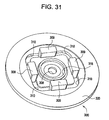
- FIGS. 31 and 32 Other components of the contact lens case (140) include a sealing gasket (300) (shown in FIGS. 31 and 32 ) with an integrally formed vent hole (308) and a plug (302) (shown in FIGS. 33 and 34 ).
- the sealing gasket 300 is molded in place, fused within the cap (146). As such, the gasket (300) does not exist as a separate component, separate from the cap (146). Nevertheless, for clarity with regard to understanding the shape of the gasket (300), the gasket (300) is shown alone in FIGS. 31 and 32 ).
- the plug (302) is configured to engage the gasket (300) such that the three components, when assembled, provide an overall cap assembly (a cross-sectional view of which is shown in FIG. 36 ).
- the cap (146) has a flat top surface (305) (for resting on a tabletop or counter), a threaded surface (304) for threadably engaging the top (150) of the cup (152), and a venting feature which will be described in more detail later hereinbelow.
- the cap (146) includes a center hole (306) as shown in FIGS. 29 and 30 .
- the gasket (300) includes four extending walls (309), and the walls (309) are formed in the apertures (163) in the cap (146) when the gasket (300) is molded and fused in place to the inside surface (157) of the cap (146). As these walls (309) are made out of elastomeric material, they compress and deflect out of the way of protrusions (161) (see FIG. 23 ) to allow a snap fit engagement.
- the gasket (300) also has a center vent hole (308), and openings (310) which are formed between the four extending walls (309). As shown in FIG.
- the plug (302) includes a stem (312) on its inner surface (314), and this stem (312) inserts in the center hole (306) of the cap (146) and in the center vent hole (308) of the gasket (300).
- a circular wall (316) Surrounding the stem (312) of the plug (302) is a circular wall (316), and this circular wall (316) extends through the center hole (306) of the cap (146) and seats against a corresponding circular wall (318) which is provided on the top (320) of the gasket (300) as shown in FIG. 31 .
- a vent hole (322) is provided on the plug (302), disposed in an area between the stem (312) and the circular wall (316), to provide a venting feature.
- the plug (302) seats in a recessed seat (334) which is provided on the cap (146), and the pin (312) extends through the center vent hole (308) in the gasket (300).
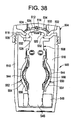
- FIGS. 37 and 38 illustrate the present invention, wherein the prevention of contaminant intrusion from outside the lens case is prevented.
- FIGS. 37 and 38 illustrate a contact lens case (500) which includes a member of diaphragm (502), such as an elastomeric member, which is disposed between the cap (504) and the stem (506).
- a member of diaphragm (502) such as an elastomeric member
- the diaphragm (502) effectively amounts to a combination gasket and vent component, because the diaphragm (502) not only seals with a top edge (508) of the cup (510) when the cap (504) is engaged with the cup (510), but the diaphragm (502) also includes a dome portion (512) that has a vent slit or notch (514) which is configured to open once the inside (516) of the cup (504) reaches a sufficient enough pressure, in order to vent the contact lens case (500).
- the diaphragm (502) preferably engages both the stem (506) and the cap (504) in a snap fit arrangement. Specifically, the diaphragm (502) is configured to snap onto the stem (506) and then snap into the underside (518) of the cap (504). In this manner, the diaphragm (502) not only provides gasket and venting features, but also functions to effectively secure the cap (504) and stem (506) together.
- the diaphragm (502) includes a stem-receiving pocket (520) and the top portion (522) of the stem (506) includes an upwardly extending member (524) which provides a circumferential shoulder (526) (see FIG. 39 ).
- An undercut (528) of the diaphragm (502) clears and engages under the shoulder (526), thereby providing that the diaphragm (502) is retained on the top portion (522) of the stem (506) in a snap fit arrangement
- the diaphragm (502) also includes a lip (530) around the dome portion (512) (see FIGS. 37 , 38 and 41 ) which is configured to receive fingers (532) (see FIG.
- the stem (506) remains effectively secured to the cap (504) (via diaphragm (502)) as the cap (504) is removed.
- the underside (518) of the cap (504) also includes structure (534), such as slotted depending cylinder segments, which is configured to arrest the diaphragm's upward excursion when the diaphragm (502) balloons under pressure.
- structure (534) such as slotted depending cylinder segments, which is configured to arrest the diaphragm's upward excursion when the diaphragm (502) balloons under pressure.
- Proximate the fingers (532) are openings (536) in the cap (504) through which the contact lens case (500) ultimately vents when the slit (514) in the diaphragm (502) opens under pressure.
- the top portion (522) of the stem (506) also includes passageways (537) which allow gas in the cup (510) to travel through the passageways (537) and exert pressure on the dome portion (512) of the diaphragm (502).
- the dome (512) rises and contacts the depending cylinder segments (534) on the underside (518) of the cap (504) which first arrest the dome's movement and the "ballooning" from internal pressure, and cause the level of pressure required to initiate venting to rise until tension from additional pressure forces the gas to escape through the notch (514) and a gap (537) between the depending cylindrical segments (534) and channel (535), and out the openings (536).
- Controlling the diaphragm's excursion in this manner also restricts how large the notch (514) can open and thus limits the rate of flow from the cup (510).
- peak pressure can easily be controlled to anywhere up to 3.447 bar (50psi) and possibly beyond.
- Elastomeric membranes having punctures to allow release of internal pressure from within a contact lens case have been utilized in prior art as shown by Iba in US Patent 5,143,104 .
- this type of venting system offers little in the way of resistance to conditions in which external pressure exceeded internal pressure such as might occur if a lens case was carried in an airplane when it landed and was therefore subjected to elevated ambient pressure. Under such conditions where elevated external pressure overcomes the vent to equalize internal pressure, reverse air flow through the vent can drive foreign matter and pathogens into the lens case and contaminate lenses stores inside.
- Kanner in US Patent 5,250,266 solves this problem by providing a supporting seat behind the slit elastomeric membrane to create a one way valve which prevents the slit from inverting under reverse pressure conditions and therefore stops external flow into the lens case.
- Vent notch (514) in domed portion (512) of diaphragm (502) prevent undesirable reverse flow without requiring provision of an additional supporting seat structure.
- domed portion (512) responds by forcing vent notch (514) tightly together as deflection of the domed shape in reaction to the external pressure is resisted by the circumferential constraint and support provided by receiving fingers (532) of cap (504). Therefore, as external pressure increases, compression upon vent notch (514) also increases thereby increasing its ability to resist reverse flow and intrusion of foreign matter or pathogens.
- FIG. 39 illustrates the situation where the lower portion (4540) of the stem (506) is provided as being a variation of that of the stems (42), (142) of the contact lens cases (40), (140) previously described.
- the lower portion (540) of the stem (506) can be provided as having relatively flattened back-to-back cages (542), wherein each cage (542) includes a lens-receiving button (544) and openings (545) to allow the passage of solution.
- the stem (506) can be provided as having a modified end portion (546) (see FIG. 39 ) for retaining a catalyst (548) (see FIGS. 37 and 38 ). More specifically, the end portion (546) of the stem (506) can be provided as being consistent with that which is disclosed in U.S. Patent No. 6,148,992 , which is hereby incorporated herein by reference in its entirety, and therefore having structure such as notches (561) for retaining a catalyst.
- the receptacles (550) on the stem (506) are identical to the receptacles (179) which are shown in FIG. 23 and which have been previously described.
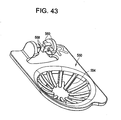
- FIG. 43 provides an exemplary Illustration of a possible hinged member configuration (550) which can be used with such a stem (506), where the other hinged member (552) (see FIGS. 37 and 38 ) would be effectively the same but provided for the left contact lens.
- each hinged member (550), (552) may include a dome (554) which curves outward, generally away from the lens-receiving button (544) on the stem (506) (rather than being curved inward as in the embodiments previously described), and which includes openings (556) for passage of solution.
- the hinged members (550), (552) include pins (558) and cam followers (560) identical to the pin structures (177) and cam followers (191) shown in FIG. 20 and function the same way with regard to the receptacles (550) on the stem (506).
Landscapes
- Apparatus For Disinfection Or Sterilisation (AREA)
- Eyeglasses (AREA)
- Purses, Travelling Bags, Baskets, Or Suitcases (AREA)
Priority Applications (1)
| Application Number | Priority Date | Filing Date | Title |
|---|---|---|---|
| PL11174457T PL2409595T3 (pl) | 2010-07-21 | 2011-07-19 | Ulepszony pojemnik na soczewki kontaktowe |
Applications Claiming Priority (2)
| Application Number | Priority Date | Filing Date | Title |
|---|---|---|---|
| US36644510P | 2010-07-21 | 2010-07-21 | |
| US12/944,478 US8141699B2 (en) | 2008-02-07 | 2010-11-11 | Contact lens case |
Publications (2)
| Publication Number | Publication Date |
|---|---|
| EP2409595A1 EP2409595A1 (en) | 2012-01-25 |
| EP2409595B1 true EP2409595B1 (en) | 2013-08-28 |
Family
ID=43779105
Family Applications (1)
| Application Number | Title | Priority Date | Filing Date |
|---|---|---|---|
| EP11174457.9A Active EP2409595B1 (en) | 2010-07-21 | 2011-07-19 | Improved contact lens case |
Country Status (4)
| Country | Link |
|---|---|
| US (1) | US8141699B2 (pl) |
| EP (1) | EP2409595B1 (pl) |
| ES (1) | ES2431077T3 (pl) |
| PL (1) | PL2409595T3 (pl) |
Families Citing this family (11)
| Publication number | Priority date | Publication date | Assignee | Title |
|---|---|---|---|---|
| USD753390S1 (en) * | 2012-01-18 | 2016-04-12 | Atrion Medical Products, Inc. | Contact lens case |
| USD714548S1 (en) * | 2012-10-25 | 2014-10-07 | Atrion Medical Products, Inc. | Contact lens case |
| US9532632B2 (en) | 2015-05-08 | 2017-01-03 | Better Vision Solutions LLC | Pressure-venting container for disinfection and storage of contact lenses |
| JP2018068871A (ja) * | 2016-11-02 | 2018-05-10 | 株式会社トーメーポート | ソフトコンタクトレンズ用収納ケース |
| USD965971S1 (en) | 2019-05-28 | 2022-10-11 | Da-Young Kim | Storage container for contact lens |
| USD965972S1 (en) | 2019-05-28 | 2022-10-11 | Da-Young Kim | Storage container for contact lens |
| USD908354S1 (en) * | 2019-05-28 | 2021-01-26 | Da-Young Kim | Storage case for contact lens container |
| USD913692S1 (en) * | 2019-05-28 | 2021-03-23 | Da-Young Kim | Storage case for contact lens container |
| USD908355S1 (en) * | 2019-05-28 | 2021-01-26 | Da-Young Kim | Storage case for contact lens container |
| USD912982S1 (en) * | 2019-05-28 | 2021-03-16 | Da-Young Kim | Storage container for contact lens |
| USD912981S1 (en) * | 2019-05-28 | 2021-03-16 | Da-Young Kim | Storage container for contact lens |
Family Cites Families (36)
| Publication number | Priority date | Publication date | Assignee | Title |
|---|---|---|---|---|
| US3770113A (en) | 1972-03-03 | 1973-11-06 | Mcd Corp | Contact lens holder |
| US4011941A (en) | 1975-04-28 | 1977-03-15 | Warner-Lambert Company | Contact lens capsule |
| US4013410A (en) | 1975-06-23 | 1977-03-22 | Ryder International Corporation | Contact lens sterilization process and apparatus |
| US4009777A (en) | 1975-12-29 | 1977-03-01 | Ryder International Corporation | Contact lens holder |
| US4200187A (en) | 1978-10-27 | 1980-04-29 | Ryder International Corporation | Lens case with oppositely hinged baskets |
| US4396583A (en) * | 1981-08-14 | 1983-08-02 | American Optical Corporation | Device for single solution contact lens sterilization |
| US4637919A (en) | 1984-11-05 | 1987-01-20 | Ryder International Corporation | Lens disinfecting appliance with improved venting feature |
| US4750610A (en) | 1986-12-29 | 1988-06-14 | Ryder International Corporation | Lens case with pressure sensitive venting system |
| US4817998A (en) | 1987-08-03 | 1989-04-04 | Ryder International Corporation | Instrument for handling contact lens disinfecting catalyst |
| US4807750A (en) | 1987-10-28 | 1989-02-28 | Ryder International Corporation | Latching structure for contact lens holder |
| US4889693A (en) | 1988-01-22 | 1989-12-26 | Ciba-Geigy Corporation | Apparatus for venting of gases from contact lens cases |
| US5059402A (en) | 1988-08-12 | 1991-10-22 | Seamons Kenneth R | Contact lens disinfection unit |
| US4981657A (en) | 1988-09-09 | 1991-01-01 | Ryder International Corporation | Contact lens case with raised, protective ribs |
| US4956156A (en) | 1988-11-07 | 1990-09-11 | Ryder International Corporation | Pressure venting system for lens cases |
| US4996027A (en) | 1989-04-07 | 1991-02-26 | Ciba Vision Corporation | Contact lens case having pressure venting gasket |
| US4890729A (en) | 1989-04-25 | 1990-01-02 | Ryder International Corporation | Lens retaining apparatus |
| US5196174A (en) | 1989-06-09 | 1993-03-23 | Ciba Vision Corporation | Apparatus for sterilizing contact lenses |
| US5306352A (en) | 1989-12-28 | 1994-04-26 | Ciba-Geigy Corporation | Peroxide disinfection method |
| US5468448A (en) | 1989-12-28 | 1995-11-21 | Ciba-Geigy Corporation | Peroxide disinfection method and devices therefor |
| AU8626991A (en) * | 1990-09-25 | 1992-04-15 | Allergan, Inc. | Apparatus and method for disinfecting a contact lens and detecting the presence of an oxidative disinfectant |
| AU655955B2 (en) | 1990-11-30 | 1995-01-19 | Ciba Vision Corporation | Contact lens case venting system |
| US5250266A (en) | 1990-11-30 | 1993-10-05 | Ciba Vision Corporation | Contact lens case venting system |
| US5143104A (en) | 1990-12-07 | 1992-09-01 | Allergan, Inc. | Vented apparatus for storing and cleaning an element |
| US5186317A (en) * | 1992-02-04 | 1993-02-16 | Ryder International Corporation | Lens case for contact lens disinfecting system |
| DK168746B1 (da) | 1992-07-06 | 1994-05-30 | Tom Buris Nielsen | Fremgangsmåde og etui til desinficering af kontaktlinser |
| US6148992A (en) | 1993-02-02 | 2000-11-21 | Atrion Medical Products, Inc. | Lens case for contact lens disinfecting |
| US5366078A (en) | 1993-09-28 | 1994-11-22 | Bausch & Lomb Incorporated | Vented carrying case for contact lenses |
| US5690211A (en) | 1994-11-07 | 1997-11-25 | Jao; Shu-Wen | Contact lens cleaner |
| US5558846A (en) | 1994-12-05 | 1996-09-24 | Ciba Geigy Corporation | Apparatus for disinfecting contact lenses having improved vent means |
| US5609837A (en) | 1995-08-16 | 1997-03-11 | Cerny; David E. | Disinfection apparatus |
| US6364098B2 (en) | 1999-04-09 | 2002-04-02 | Third Millenium Trust | Soft contact lens cleaning and storage system |
| TWI226227B (en) * | 2001-07-10 | 2005-01-11 | Novartis Ag | Contact lens container |
| US7540376B2 (en) | 2003-10-22 | 2009-06-02 | Novartis Ag | Contact lens case |
| US7178666B2 (en) | 2004-05-25 | 2007-02-20 | Joey Huang | Contact lens holder |
| US20060102496A1 (en) | 2004-11-12 | 2006-05-18 | Bruce Christy | Contact lens case having a lid with soft gripping surface |
| PL2114191T3 (pl) | 2007-02-07 | 2014-03-31 | Atrion Medical Products Inc | Ulepszony pojemnik na soczewki kontaktowe |
-
2010
- 2010-11-11 US US12/944,478 patent/US8141699B2/en active Active
-
2011
- 2011-07-19 EP EP11174457.9A patent/EP2409595B1/en active Active
- 2011-07-19 ES ES11174457T patent/ES2431077T3/es active Active
- 2011-07-19 PL PL11174457T patent/PL2409595T3/pl unknown
Also Published As
| Publication number | Publication date |
|---|---|
| EP2409595A1 (en) | 2012-01-25 |
| US20110073497A1 (en) | 2011-03-31 |
| ES2431077T3 (es) | 2013-11-25 |
| US8141699B2 (en) | 2012-03-27 |
| PL2409595T3 (pl) | 2014-01-31 |
Similar Documents
| Publication | Publication Date | Title |
|---|---|---|
| EP2409595B1 (en) | Improved contact lens case | |
| US8113341B2 (en) | Contact lens case | |
| US5143104A (en) | Vented apparatus for storing and cleaning an element | |
| US4956156A (en) | Pressure venting system for lens cases | |
| US5250266A (en) | Contact lens case venting system | |
| US5558846A (en) | Apparatus for disinfecting contact lenses having improved vent means | |
| US5609837A (en) | Disinfection apparatus | |
| WO2008120954A1 (en) | Contact lens storage case | |
| EP3495281A1 (en) | Beverage receptacle and valve for injection-via-bottom beverage receptacle | |
| US6945389B2 (en) | Contact lens container | |
| JP2005529032A (ja) | 通気される底部を有した流出漏れしないカップ集合体。 | |
| AU655955B2 (en) | Contact lens case venting system | |
| CN107995850B (zh) | 用于隐形眼镜的消毒和存储的压力排放容器 | |
| US4520923A (en) | Contact lens holder | |
| CN111169795B (zh) | 饮料容器及盖组件 | |
| JP2023096955A (ja) | 注出キャップ及び注出容器 | |
| KR960008091Y1 (ko) | 냉장고용 우레탄 발포용 캡 | |
| KR20090104315A (ko) | 수액팩용 밀봉캡 | |
| MXPA00009921A (en) | Device for packaging and treating bactericide for contact lenses |
Legal Events
| Date | Code | Title | Description |
|---|---|---|---|
| AK | Designated contracting states |
Kind code of ref document: A1 Designated state(s): AL AT BE BG CH CY CZ DE DK EE ES FI FR GB GR HR HU IE IS IT LI LT LU LV MC MK MT NL NO PL PT RO RS SE SI SK SM TR |
|
| AX | Request for extension of the european patent |
Extension state: BA ME |
|
| PUAI | Public reference made under article 153(3) epc to a published international application that has entered the european phase |
Free format text: ORIGINAL CODE: 0009012 |
|
| 17P | Request for examination filed |
Effective date: 20120704 |
|
| 17Q | First examination report despatched |
Effective date: 20130325 |
|
| GRAP | Despatch of communication of intention to grant a patent |
Free format text: ORIGINAL CODE: EPIDOSNIGR1 |
|
| GRAS | Grant fee paid |
Free format text: ORIGINAL CODE: EPIDOSNIGR3 |
|
| INTG | Intention to grant announced |
Effective date: 20130612 |
|
| GRAA | (expected) grant |
Free format text: ORIGINAL CODE: 0009210 |
|
| AK | Designated contracting states |
Kind code of ref document: B1 Designated state(s): AL AT BE BG CH CY CZ DE DK EE ES FI FR GB GR HR HU IE IS IT LI LT LU LV MC MK MT NL NO PL PT RO RS SE SI SK SM TR |
|
| REG | Reference to a national code |
Ref country code: GB Ref legal event code: FG4D |
|
| REG | Reference to a national code |
Ref country code: CH Ref legal event code: EP |
|
| REG | Reference to a national code |
Ref country code: AT Ref legal event code: REF Ref document number: 628802 Country of ref document: AT Kind code of ref document: T Effective date: 20130915 |
|
| REG | Reference to a national code |
Ref country code: IE Ref legal event code: FG4D |
|
| REG | Reference to a national code |
Ref country code: DE Ref legal event code: R096 Ref document number: 602011002807 Country of ref document: DE Effective date: 20131024 |
|
| REG | Reference to a national code |
Ref country code: ES Ref legal event code: FG2A Ref document number: 2431077 Country of ref document: ES Kind code of ref document: T3 Effective date: 20131125 |
|
| REG | Reference to a national code |
Ref country code: AT Ref legal event code: MK05 Ref document number: 628802 Country of ref document: AT Kind code of ref document: T Effective date: 20130828 |
|
| REG | Reference to a national code |
Ref country code: LT Ref legal event code: MG4D |
|
| REG | Reference to a national code |
Ref country code: NL Ref legal event code: VDEP Effective date: 20130828 |
|
| PG25 | Lapsed in a contracting state [announced via postgrant information from national office to epo] |
Ref country code: IS Free format text: LAPSE BECAUSE OF FAILURE TO SUBMIT A TRANSLATION OF THE DESCRIPTION OR TO PAY THE FEE WITHIN THE PRESCRIBED TIME-LIMIT Effective date: 20131228 Ref country code: NO Free format text: LAPSE BECAUSE OF FAILURE TO SUBMIT A TRANSLATION OF THE DESCRIPTION OR TO PAY THE FEE WITHIN THE PRESCRIBED TIME-LIMIT Effective date: 20131128 Ref country code: LT Free format text: LAPSE BECAUSE OF FAILURE TO SUBMIT A TRANSLATION OF THE DESCRIPTION OR TO PAY THE FEE WITHIN THE PRESCRIBED TIME-LIMIT Effective date: 20130828 Ref country code: HR Free format text: LAPSE BECAUSE OF FAILURE TO SUBMIT A TRANSLATION OF THE DESCRIPTION OR TO PAY THE FEE WITHIN THE PRESCRIBED TIME-LIMIT Effective date: 20130828 Ref country code: PT Free format text: LAPSE BECAUSE OF FAILURE TO SUBMIT A TRANSLATION OF THE DESCRIPTION OR TO PAY THE FEE WITHIN THE PRESCRIBED TIME-LIMIT Effective date: 20131230 Ref country code: CY Free format text: LAPSE BECAUSE OF FAILURE TO SUBMIT A TRANSLATION OF THE DESCRIPTION OR TO PAY THE FEE WITHIN THE PRESCRIBED TIME-LIMIT Effective date: 20130807 Ref country code: AT Free format text: LAPSE BECAUSE OF FAILURE TO SUBMIT A TRANSLATION OF THE DESCRIPTION OR TO PAY THE FEE WITHIN THE PRESCRIBED TIME-LIMIT Effective date: 20130828 Ref country code: SE Free format text: LAPSE BECAUSE OF FAILURE TO SUBMIT A TRANSLATION OF THE DESCRIPTION OR TO PAY THE FEE WITHIN THE PRESCRIBED TIME-LIMIT Effective date: 20130828 |
|
| REG | Reference to a national code |
Ref country code: PL Ref legal event code: T3 |
|
| REG | Reference to a national code |
Ref country code: NL Ref legal event code: VDEP Effective date: 20130828 |
|
| PG25 | Lapsed in a contracting state [announced via postgrant information from national office to epo] |
Ref country code: FI Free format text: LAPSE BECAUSE OF FAILURE TO SUBMIT A TRANSLATION OF THE DESCRIPTION OR TO PAY THE FEE WITHIN THE PRESCRIBED TIME-LIMIT Effective date: 20130828 Ref country code: LV Free format text: LAPSE BECAUSE OF FAILURE TO SUBMIT A TRANSLATION OF THE DESCRIPTION OR TO PAY THE FEE WITHIN THE PRESCRIBED TIME-LIMIT Effective date: 20130828 Ref country code: GR Free format text: LAPSE BECAUSE OF FAILURE TO SUBMIT A TRANSLATION OF THE DESCRIPTION OR TO PAY THE FEE WITHIN THE PRESCRIBED TIME-LIMIT Effective date: 20131129 Ref country code: SI Free format text: LAPSE BECAUSE OF FAILURE TO SUBMIT A TRANSLATION OF THE DESCRIPTION OR TO PAY THE FEE WITHIN THE PRESCRIBED TIME-LIMIT Effective date: 20130828 Ref country code: BE Free format text: LAPSE BECAUSE OF FAILURE TO SUBMIT A TRANSLATION OF THE DESCRIPTION OR TO PAY THE FEE WITHIN THE PRESCRIBED TIME-LIMIT Effective date: 20130828 |
|
| PG25 | Lapsed in a contracting state [announced via postgrant information from national office to epo] |
Ref country code: CY Free format text: LAPSE BECAUSE OF FAILURE TO SUBMIT A TRANSLATION OF THE DESCRIPTION OR TO PAY THE FEE WITHIN THE PRESCRIBED TIME-LIMIT Effective date: 20130828 |
|
| PG25 | Lapsed in a contracting state [announced via postgrant information from national office to epo] |
Ref country code: DK Free format text: LAPSE BECAUSE OF FAILURE TO SUBMIT A TRANSLATION OF THE DESCRIPTION OR TO PAY THE FEE WITHIN THE PRESCRIBED TIME-LIMIT Effective date: 20130828 Ref country code: SK Free format text: LAPSE BECAUSE OF FAILURE TO SUBMIT A TRANSLATION OF THE DESCRIPTION OR TO PAY THE FEE WITHIN THE PRESCRIBED TIME-LIMIT Effective date: 20130828 Ref country code: RO Free format text: LAPSE BECAUSE OF FAILURE TO SUBMIT A TRANSLATION OF THE DESCRIPTION OR TO PAY THE FEE WITHIN THE PRESCRIBED TIME-LIMIT Effective date: 20130828 Ref country code: CZ Free format text: LAPSE BECAUSE OF FAILURE TO SUBMIT A TRANSLATION OF THE DESCRIPTION OR TO PAY THE FEE WITHIN THE PRESCRIBED TIME-LIMIT Effective date: 20130828 Ref country code: NL Free format text: LAPSE BECAUSE OF FAILURE TO SUBMIT A TRANSLATION OF THE DESCRIPTION OR TO PAY THE FEE WITHIN THE PRESCRIBED TIME-LIMIT Effective date: 20130828 Ref country code: EE Free format text: LAPSE BECAUSE OF FAILURE TO SUBMIT A TRANSLATION OF THE DESCRIPTION OR TO PAY THE FEE WITHIN THE PRESCRIBED TIME-LIMIT Effective date: 20130828 |
|
| REG | Reference to a national code |
Ref country code: DE Ref legal event code: R097 Ref document number: 602011002807 Country of ref document: DE |
|
| PLBE | No opposition filed within time limit |
Free format text: ORIGINAL CODE: 0009261 |
|
| STAA | Information on the status of an ep patent application or granted ep patent |
Free format text: STATUS: NO OPPOSITION FILED WITHIN TIME LIMIT |
|
| 26N | No opposition filed |
Effective date: 20140530 |
|
| REG | Reference to a national code |
Ref country code: DE Ref legal event code: R097 Ref document number: 602011002807 Country of ref document: DE Effective date: 20140530 |
|
| PG25 | Lapsed in a contracting state [announced via postgrant information from national office to epo] |
Ref country code: LU Free format text: LAPSE BECAUSE OF FAILURE TO SUBMIT A TRANSLATION OF THE DESCRIPTION OR TO PAY THE FEE WITHIN THE PRESCRIBED TIME-LIMIT Effective date: 20140719 |
|
| REG | Reference to a national code |
Ref country code: CH Ref legal event code: PL |
|
| REG | Reference to a national code |
Ref country code: IE Ref legal event code: MM4A |
|
| PG25 | Lapsed in a contracting state [announced via postgrant information from national office to epo] |
Ref country code: CH Free format text: LAPSE BECAUSE OF NON-PAYMENT OF DUE FEES Effective date: 20140731 Ref country code: LI Free format text: LAPSE BECAUSE OF NON-PAYMENT OF DUE FEES Effective date: 20140731 |
|
| PG25 | Lapsed in a contracting state [announced via postgrant information from national office to epo] |
Ref country code: IE Free format text: LAPSE BECAUSE OF NON-PAYMENT OF DUE FEES Effective date: 20140719 |
|
| PG25 | Lapsed in a contracting state [announced via postgrant information from national office to epo] |
Ref country code: MC Free format text: LAPSE BECAUSE OF FAILURE TO SUBMIT A TRANSLATION OF THE DESCRIPTION OR TO PAY THE FEE WITHIN THE PRESCRIBED TIME-LIMIT Effective date: 20130828 Ref country code: SM Free format text: LAPSE BECAUSE OF FAILURE TO SUBMIT A TRANSLATION OF THE DESCRIPTION OR TO PAY THE FEE WITHIN THE PRESCRIBED TIME-LIMIT Effective date: 20130828 |
|
| PG25 | Lapsed in a contracting state [announced via postgrant information from national office to epo] |
Ref country code: RS Free format text: LAPSE BECAUSE OF NON-PAYMENT OF DUE FEES Effective date: 20130828 Ref country code: BG Free format text: LAPSE BECAUSE OF FAILURE TO SUBMIT A TRANSLATION OF THE DESCRIPTION OR TO PAY THE FEE WITHIN THE PRESCRIBED TIME-LIMIT Effective date: 20130828 Ref country code: MT Free format text: LAPSE BECAUSE OF FAILURE TO SUBMIT A TRANSLATION OF THE DESCRIPTION OR TO PAY THE FEE WITHIN THE PRESCRIBED TIME-LIMIT Effective date: 20130828 |
|
| REG | Reference to a national code |
Ref country code: FR Ref legal event code: PLFP Year of fee payment: 6 |
|
| PG25 | Lapsed in a contracting state [announced via postgrant information from national office to epo] |
Ref country code: HU Free format text: LAPSE BECAUSE OF FAILURE TO SUBMIT A TRANSLATION OF THE DESCRIPTION OR TO PAY THE FEE WITHIN THE PRESCRIBED TIME-LIMIT; INVALID AB INITIO Effective date: 20110719 Ref country code: TR Free format text: LAPSE BECAUSE OF FAILURE TO SUBMIT A TRANSLATION OF THE DESCRIPTION OR TO PAY THE FEE WITHIN THE PRESCRIBED TIME-LIMIT Effective date: 20130828 |
|
| REG | Reference to a national code |
Ref country code: FR Ref legal event code: PLFP Year of fee payment: 7 |
|
| REG | Reference to a national code |
Ref country code: FR Ref legal event code: PLFP Year of fee payment: 8 |
|
| PG25 | Lapsed in a contracting state [announced via postgrant information from national office to epo] |
Ref country code: MK Free format text: LAPSE BECAUSE OF FAILURE TO SUBMIT A TRANSLATION OF THE DESCRIPTION OR TO PAY THE FEE WITHIN THE PRESCRIBED TIME-LIMIT Effective date: 20130828 |
|
| PG25 | Lapsed in a contracting state [announced via postgrant information from national office to epo] |
Ref country code: AL Free format text: LAPSE BECAUSE OF FAILURE TO SUBMIT A TRANSLATION OF THE DESCRIPTION OR TO PAY THE FEE WITHIN THE PRESCRIBED TIME-LIMIT Effective date: 20130828 |
|
| PGFP | Annual fee paid to national office [announced via postgrant information from national office to epo] |
Ref country code: ES Payment date: 20250826 Year of fee payment: 15 |
|
| PGFP | Annual fee paid to national office [announced via postgrant information from national office to epo] |
Ref country code: DE Payment date: 20250722 Year of fee payment: 15 |
|
| PGFP | Annual fee paid to national office [announced via postgrant information from national office to epo] |
Ref country code: PL Payment date: 20250702 Year of fee payment: 15 Ref country code: IT Payment date: 20250724 Year of fee payment: 15 |
|
| PGFP | Annual fee paid to national office [announced via postgrant information from national office to epo] |
Ref country code: GB Payment date: 20250722 Year of fee payment: 15 |
|
| PGFP | Annual fee paid to national office [announced via postgrant information from national office to epo] |
Ref country code: FR Payment date: 20250725 Year of fee payment: 15 |