EP2408445B1 - Gold(iii) complexes with oligopeptides functionalized with sulfur donors and use thereof as antitumor agents - Google Patents
Gold(iii) complexes with oligopeptides functionalized with sulfur donors and use thereof as antitumor agents Download PDFInfo
- Publication number
- EP2408445B1 EP2408445B1 EP09779189.1A EP09779189A EP2408445B1 EP 2408445 B1 EP2408445 B1 EP 2408445B1 EP 09779189 A EP09779189 A EP 09779189A EP 2408445 B1 EP2408445 B1 EP 2408445B1
- Authority
- EP
- European Patent Office
- Prior art keywords
- iii
- sar
- pdtc
- complex
- type
- Prior art date
- Legal status (The legal status is an assumption and is not a legal conclusion. Google has not performed a legal analysis and makes no representation as to the accuracy of the status listed.)
- Not-in-force
Links
- 239000002246 antineoplastic agent Substances 0.000 title claims description 17
- 229910052717 sulfur Inorganic materials 0.000 title claims description 8
- 102000015636 Oligopeptides Human genes 0.000 title description 10
- 108010038807 Oligopeptides Proteins 0.000 title description 10
- NINIDFKCEFEMDL-UHFFFAOYSA-N Sulfur Chemical compound [S] NINIDFKCEFEMDL-UHFFFAOYSA-N 0.000 title description 5
- 239000011593 sulfur Substances 0.000 title description 5
- CBMIPXHVOVTTTL-UHFFFAOYSA-N gold(3+) Chemical class [Au+3] CBMIPXHVOVTTTL-UHFFFAOYSA-N 0.000 title 1
- 125000000999 tert-butyl group Chemical group [H]C([H])([H])C(*)(C([H])([H])[H])C([H])([H])[H] 0.000 claims description 52
- QGJOPFRUJISHPQ-UHFFFAOYSA-N Carbon disulfide Chemical compound S=C=S QGJOPFRUJISHPQ-UHFFFAOYSA-N 0.000 claims description 28
- XLYOFNOQVPJJNP-UHFFFAOYSA-N water Substances O XLYOFNOQVPJJNP-UHFFFAOYSA-N 0.000 claims description 24
- DHMQDGOQFOQNFH-UHFFFAOYSA-N Glycine Chemical compound NCC(O)=O DHMQDGOQFOQNFH-UHFFFAOYSA-N 0.000 claims description 18
- 229910052751 metal Inorganic materials 0.000 claims description 18
- 239000003446 ligand Substances 0.000 claims description 16
- 125000002496 methyl group Chemical group [H]C([H])([H])* 0.000 claims description 16
- 239000002184 metal Substances 0.000 claims description 15
- 108090000765 processed proteins & peptides Proteins 0.000 claims description 15
- VEXZGXHMUGYJMC-UHFFFAOYSA-N Hydrochloric acid Chemical compound Cl VEXZGXHMUGYJMC-UHFFFAOYSA-N 0.000 claims description 12
- 229910052739 hydrogen Inorganic materials 0.000 claims description 12
- 125000006528 (C2-C6) alkyl group Chemical group 0.000 claims description 10
- 125000005913 (C3-C6) cycloalkyl group Chemical group 0.000 claims description 10
- 125000001997 phenyl group Chemical group [H]C1=C([H])C([H])=C(*)C([H])=C1[H] 0.000 claims description 10
- COLNVLDHVKWLRT-QMMMGPOBSA-N L-phenylalanine Chemical compound OC(=O)[C@@H](N)CC1=CC=CC=C1 COLNVLDHVKWLRT-QMMMGPOBSA-N 0.000 claims description 9
- 229910052799 carbon Inorganic materials 0.000 claims description 9
- 230000015572 biosynthetic process Effects 0.000 claims description 8
- FSYKKLYZXJSNPZ-UHFFFAOYSA-N sarcosine Chemical compound C[NH2+]CC([O-])=O FSYKKLYZXJSNPZ-UHFFFAOYSA-N 0.000 claims description 8
- 150000001413 amino acids Chemical class 0.000 claims description 7
- 229910052794 bromium Inorganic materials 0.000 claims description 7
- 229910052801 chlorine Inorganic materials 0.000 claims description 7
- 235000001014 amino acid Nutrition 0.000 claims description 6
- 238000006243 chemical reaction Methods 0.000 claims description 6
- 238000000034 method Methods 0.000 claims description 6
- 238000003786 synthesis reaction Methods 0.000 claims description 6
- MTCFGRXMJLQNBG-REOHCLBHSA-N (2S)-2-Amino-3-hydroxypropansäure Chemical compound OC[C@H](N)C(O)=O MTCFGRXMJLQNBG-REOHCLBHSA-N 0.000 claims description 5
- 229910052736 halogen Inorganic materials 0.000 claims description 5
- 239000000203 mixture Substances 0.000 claims description 5
- 230000007170 pathology Effects 0.000 claims description 5
- 108010077895 Sarcosine Proteins 0.000 claims description 4
- 229940034982 antineoplastic agent Drugs 0.000 claims description 4
- 125000000816 ethylene group Chemical group [H]C([H])([*:1])C([H])([H])[*:2] 0.000 claims description 4
- 150000002367 halogens Chemical class 0.000 claims description 4
- 238000011065 in-situ storage Methods 0.000 claims description 4
- 125000000325 methylidene group Chemical group [H]C([H])=* 0.000 claims description 4
- COLNVLDHVKWLRT-UHFFFAOYSA-N phenylalanine Natural products OC(=O)C(N)CC1=CC=CC=C1 COLNVLDHVKWLRT-UHFFFAOYSA-N 0.000 claims description 4
- 229910052700 potassium Inorganic materials 0.000 claims description 4
- 229940043230 sarcosine Drugs 0.000 claims description 4
- 229910052708 sodium Inorganic materials 0.000 claims description 4
- MTCFGRXMJLQNBG-UHFFFAOYSA-N Serine Natural products OCC(N)C(O)=O MTCFGRXMJLQNBG-UHFFFAOYSA-N 0.000 claims description 3
- 125000000539 amino acid group Chemical group 0.000 claims description 3
- 125000001495 ethyl group Chemical group [H]C([H])([H])C([H])([H])* 0.000 claims description 3
- 229910052760 oxygen Inorganic materials 0.000 claims description 3
- 150000003839 salts Chemical class 0.000 claims description 3
- 239000004471 Glycine Substances 0.000 claims description 2
- QNAYBMKLOCPYGJ-REOHCLBHSA-N L-alanine Chemical compound C[C@H](N)C(O)=O QNAYBMKLOCPYGJ-REOHCLBHSA-N 0.000 claims description 2
- ONIBWKKTOPOVIA-UHFFFAOYSA-N Proline Natural products OC(=O)C1CCCN1 ONIBWKKTOPOVIA-UHFFFAOYSA-N 0.000 claims description 2
- 235000004279 alanine Nutrition 0.000 claims description 2
- 239000003085 diluting agent Substances 0.000 claims description 2
- CBOIHMRHGLHBPB-UHFFFAOYSA-N hydroxymethyl Chemical compound O[CH2] CBOIHMRHGLHBPB-UHFFFAOYSA-N 0.000 claims description 2
- 229910052740 iodine Inorganic materials 0.000 claims description 2
- 125000000959 isobutyl group Chemical group [H]C([H])([H])C([H])(C([H])([H])[H])C([H])([H])* 0.000 claims description 2
- 125000001449 isopropyl group Chemical group [H]C([H])([H])C([H])(*)C([H])([H])[H] 0.000 claims description 2
- 230000001613 neoplastic effect Effects 0.000 claims description 2
- 239000000546 pharmaceutical excipient Substances 0.000 claims description 2
- 238000000746 purification Methods 0.000 claims description 2
- 125000002914 sec-butyl group Chemical group [H]C([H])([H])C([H])([H])C([H])(*)C([H])([H])[H] 0.000 claims description 2
- 238000000926 separation method Methods 0.000 claims description 2
- RWRDLPDLKQPQOW-UHFFFAOYSA-N tetrahydropyrrole Substances C1CCNC1 RWRDLPDLKQPQOW-UHFFFAOYSA-N 0.000 claims description 2
- 125000004055 thiomethyl group Chemical group [H]SC([H])([H])* 0.000 claims description 2
- 150000001721 carbon Chemical group 0.000 claims 4
- -1 α-aminoisobutyric Chemical compound 0.000 claims 2
- ONIBWKKTOPOVIA-BYPYZUCNSA-N L-Proline Chemical compound OC(=O)[C@@H]1CCCN1 ONIBWKKTOPOVIA-BYPYZUCNSA-N 0.000 claims 1
- XLYOFNOQVPJJNP-UHFFFAOYSA-M hydroxide Chemical compound [OH-] XLYOFNOQVPJJNP-UHFFFAOYSA-M 0.000 claims 1
- 239000010931 gold Substances 0.000 description 44
- 210000004027 cell Anatomy 0.000 description 43
- BASFCYQUMIYNBI-UHFFFAOYSA-N platinum Substances [Pt] BASFCYQUMIYNBI-UHFFFAOYSA-N 0.000 description 36
- 229960004316 cisplatin Drugs 0.000 description 34
- DQLATGHUWYMOKM-UHFFFAOYSA-L cisplatin Chemical compound N[Pt](N)(Cl)Cl DQLATGHUWYMOKM-UHFFFAOYSA-L 0.000 description 34
- HEMHJVSKTPXQMS-UHFFFAOYSA-M sodium hydroxide Inorganic materials [OH-].[Na+] HEMHJVSKTPXQMS-UHFFFAOYSA-M 0.000 description 32
- 239000000243 solution Substances 0.000 description 29
- 150000001408 amides Chemical class 0.000 description 27
- 150000001875 compounds Chemical class 0.000 description 23
- 206010028980 Neoplasm Diseases 0.000 description 21
- 239000003814 drug Substances 0.000 description 21
- 229940079593 drug Drugs 0.000 description 18
- 238000003756 stirring Methods 0.000 description 18
- CSCPPACGZOOCGX-WFGJKAKNSA-N deuterated acetone Substances [2H]C([2H])([2H])C(=O)C([2H])([2H])[2H] CSCPPACGZOOCGX-WFGJKAKNSA-N 0.000 description 15
- FUOOLUPWFVMBKG-UHFFFAOYSA-N 2-Aminoisobutyric acid Chemical compound CC(C)(N)C(O)=O FUOOLUPWFVMBKG-UHFFFAOYSA-N 0.000 description 14
- 230000000694 effects Effects 0.000 description 14
- 231100000417 nephrotoxicity Toxicity 0.000 description 14
- 229910052697 platinum Inorganic materials 0.000 description 14
- 230000005764 inhibitory process Effects 0.000 description 13
- 206010006187 Breast cancer Diseases 0.000 description 12
- 208000026310 Breast neoplasm Diseases 0.000 description 12
- 230000002829 reductive effect Effects 0.000 description 12
- 238000000338 in vitro Methods 0.000 description 11
- 230000006907 apoptotic process Effects 0.000 description 10
- 238000001556 precipitation Methods 0.000 description 10
- 239000007787 solid Substances 0.000 description 10
- 238000005160 1H NMR spectroscopy Methods 0.000 description 9
- IAZDPXIOMUYVGZ-UHFFFAOYSA-N Dimethylsulphoxide Chemical compound CS(C)=O IAZDPXIOMUYVGZ-UHFFFAOYSA-N 0.000 description 9
- 238000004566 IR spectroscopy Methods 0.000 description 9
- 206010029155 Nephropathy toxic Diseases 0.000 description 9
- 239000007864 aqueous solution Substances 0.000 description 9
- 229960001760 dimethyl sulfoxide Drugs 0.000 description 9
- 238000000921 elemental analysis Methods 0.000 description 9
- 150000002148 esters Chemical class 0.000 description 9
- 230000007694 nephrotoxicity Effects 0.000 description 9
- 102000004121 Annexin A5 Human genes 0.000 description 8
- 108090000672 Annexin A5 Proteins 0.000 description 8
- 102000004245 Proteasome Endopeptidase Complex Human genes 0.000 description 8
- 108090000708 Proteasome Endopeptidase Complex Proteins 0.000 description 8
- KDLHZDBZIXYQEI-UHFFFAOYSA-N palladium Substances [Pd] KDLHZDBZIXYQEI-UHFFFAOYSA-N 0.000 description 8
- VOLGAXAGEUPBDM-UHFFFAOYSA-N $l^{1}-oxidanylethane Chemical group CC[O] VOLGAXAGEUPBDM-UHFFFAOYSA-N 0.000 description 7
- IAKOZHOLGAGEJT-UHFFFAOYSA-N 1,1,1-trichloro-2,2-bis(p-methoxyphenyl)-Ethane Chemical compound C1=CC(OC)=CC=C1C(C(Cl)(Cl)Cl)C1=CC=C(OC)C=C1 IAKOZHOLGAGEJT-UHFFFAOYSA-N 0.000 description 7
- 230000027455 binding Effects 0.000 description 7
- 210000000170 cell membrane Anatomy 0.000 description 7
- 230000001472 cytotoxic effect Effects 0.000 description 7
- 238000001644 13C nuclear magnetic resonance spectroscopy Methods 0.000 description 6
- 108091003079 Bovine Serum Albumin Proteins 0.000 description 6
- 108020004414 DNA Proteins 0.000 description 6
- 230000000259 anti-tumor effect Effects 0.000 description 6
- AUZONCFQVSMFAP-UHFFFAOYSA-N disulfiram Chemical compound CCN(CC)C(=S)SSC(=S)N(CC)CC AUZONCFQVSMFAP-UHFFFAOYSA-N 0.000 description 6
- 239000012091 fetal bovine serum Substances 0.000 description 6
- UCSJYZPVAKXKNQ-HZYVHMACSA-N streptomycin Chemical compound CN[C@H]1[C@H](O)[C@@H](O)[C@H](CO)O[C@H]1O[C@@H]1[C@](C=O)(O)[C@H](C)O[C@H]1O[C@@H]1[C@@H](NC(N)=N)[C@H](O)[C@@H](NC(N)=N)[C@H](O)[C@H]1O UCSJYZPVAKXKNQ-HZYVHMACSA-N 0.000 description 6
- 239000012298 atmosphere Substances 0.000 description 5
- 201000011510 cancer Diseases 0.000 description 5
- 238000001727 in vivo Methods 0.000 description 5
- 230000002401 inhibitory effect Effects 0.000 description 5
- 238000002844 melting Methods 0.000 description 5
- 230000008018 melting Effects 0.000 description 5
- 102000004196 processed proteins & peptides Human genes 0.000 description 5
- TZCPCKNHXULUIY-RGULYWFUSA-N 1,2-distearoyl-sn-glycero-3-phosphoserine Chemical compound CCCCCCCCCCCCCCCCCC(=O)OC[C@H](COP(O)(=O)OC[C@H](N)C(O)=O)OC(=O)CCCCCCCCCCCCCCCCC TZCPCKNHXULUIY-RGULYWFUSA-N 0.000 description 4
- 108050008874 Annexin Proteins 0.000 description 4
- 102000000412 Annexin Human genes 0.000 description 4
- ZWZWYGMENQVNFU-UHFFFAOYSA-N Glycerophosphorylserin Natural products OC(=O)C(N)COP(O)(=O)OCC(O)CO ZWZWYGMENQVNFU-UHFFFAOYSA-N 0.000 description 4
- 239000007760 Iscove's Modified Dulbecco's Medium Substances 0.000 description 4
- 241000699670 Mus sp. Species 0.000 description 4
- 206010033128 Ovarian cancer Diseases 0.000 description 4
- 206010034133 Pathogen resistance Diseases 0.000 description 4
- 206010060862 Prostate cancer Diseases 0.000 description 4
- 239000012980 RPMI-1640 medium Substances 0.000 description 4
- 229940041181 antineoplastic drug Drugs 0.000 description 4
- 230000001640 apoptogenic effect Effects 0.000 description 4
- 125000004432 carbon atom Chemical group C* 0.000 description 4
- 230000003833 cell viability Effects 0.000 description 4
- 230000037012 chymotrypsin-like activity Effects 0.000 description 4
- 229940127089 cytotoxic agent Drugs 0.000 description 4
- IPZJQDSFZGZEOY-UHFFFAOYSA-N dimethylmethylene Chemical compound C[C]C IPZJQDSFZGZEOY-UHFFFAOYSA-N 0.000 description 4
- PCHJSUWPFVWCPO-UHFFFAOYSA-N gold Chemical compound [Au] PCHJSUWPFVWCPO-UHFFFAOYSA-N 0.000 description 4
- 229910052737 gold Inorganic materials 0.000 description 4
- 230000003993 interaction Effects 0.000 description 4
- 229910052763 palladium Inorganic materials 0.000 description 4
- 230000004962 physiological condition Effects 0.000 description 4
- 230000003389 potentiating effect Effects 0.000 description 4
- XJMOSONTPMZWPB-UHFFFAOYSA-M propidium iodide Chemical compound [I-].[I-].C12=CC(N)=CC=C2C2=CC=C(N)C=C2[N+](CCC[N+](C)(CC)CC)=C1C1=CC=CC=C1 XJMOSONTPMZWPB-UHFFFAOYSA-M 0.000 description 4
- WGYKZJWCGVVSQN-UHFFFAOYSA-N propylamine Chemical compound CCCN WGYKZJWCGVVSQN-UHFFFAOYSA-N 0.000 description 4
- 102000004169 proteins and genes Human genes 0.000 description 4
- 108090000623 proteins and genes Proteins 0.000 description 4
- 239000000126 substance Substances 0.000 description 4
- 230000001225 therapeutic effect Effects 0.000 description 4
- 230000004614 tumor growth Effects 0.000 description 4
- 108010078791 Carrier Proteins Proteins 0.000 description 3
- 241000283973 Oryctolagus cuniculus Species 0.000 description 3
- 206010061535 Ovarian neoplasm Diseases 0.000 description 3
- 229930182555 Penicillin Natural products 0.000 description 3
- JGSARLDLIJGVTE-MBNYWOFBSA-N Penicillin G Chemical compound N([C@H]1[C@H]2SC([C@@H](N2C1=O)C(O)=O)(C)C)C(=O)CC1=CC=CC=C1 JGSARLDLIJGVTE-MBNYWOFBSA-N 0.000 description 3
- KWYUFKZDYYNOTN-UHFFFAOYSA-M Potassium hydroxide Chemical compound [OH-].[K+] KWYUFKZDYYNOTN-UHFFFAOYSA-M 0.000 description 3
- 108091006594 SLC15A1 Proteins 0.000 description 3
- 108091006593 SLC15A2 Proteins 0.000 description 3
- 102100021491 Solute carrier family 15 member 1 Human genes 0.000 description 3
- 102100021488 Solute carrier family 15 member 2 Human genes 0.000 description 3
- 230000001093 anti-cancer Effects 0.000 description 3
- 230000008901 benefit Effects 0.000 description 3
- 239000012148 binding buffer Substances 0.000 description 3
- 230000004071 biological effect Effects 0.000 description 3
- 230000001413 cellular effect Effects 0.000 description 3
- 230000004700 cellular uptake Effects 0.000 description 3
- 230000003013 cytotoxicity Effects 0.000 description 3
- 231100000135 cytotoxicity Toxicity 0.000 description 3
- 231100000263 cytotoxicity test Toxicity 0.000 description 3
- 238000013461 design Methods 0.000 description 3
- 239000012990 dithiocarbamate Substances 0.000 description 3
- 102000015694 estrogen receptors Human genes 0.000 description 3
- 108010038795 estrogen receptors Proteins 0.000 description 3
- 238000011156 evaluation Methods 0.000 description 3
- 230000009036 growth inhibition Effects 0.000 description 3
- 230000001939 inductive effect Effects 0.000 description 3
- 230000003834 intracellular effect Effects 0.000 description 3
- JEIPFZHSYJVQDO-UHFFFAOYSA-N iron(III) oxide Inorganic materials O=[Fe]O[Fe]=O JEIPFZHSYJVQDO-UHFFFAOYSA-N 0.000 description 3
- 230000007246 mechanism Effects 0.000 description 3
- 230000001338 necrotic effect Effects 0.000 description 3
- 229940049954 penicillin Drugs 0.000 description 3
- 108010082406 peptide permease Proteins 0.000 description 3
- 238000002360 preparation method Methods 0.000 description 3
- 125000002924 primary amino group Chemical group [H]N([H])* 0.000 description 3
- 230000008569 process Effects 0.000 description 3
- 201000001514 prostate carcinoma Diseases 0.000 description 3
- 230000004224 protection Effects 0.000 description 3
- 235000018102 proteins Nutrition 0.000 description 3
- 238000011160 research Methods 0.000 description 3
- 239000011734 sodium Substances 0.000 description 3
- 229960005322 streptomycin Drugs 0.000 description 3
- 239000000758 substrate Substances 0.000 description 3
- 238000002560 therapeutic procedure Methods 0.000 description 3
- 206010001197 Adenocarcinoma of the cervix Diseases 0.000 description 2
- 208000034246 Adenocarcinoma of the cervix uteri Diseases 0.000 description 2
- 206010005003 Bladder cancer Diseases 0.000 description 2
- 206010065553 Bone marrow failure Diseases 0.000 description 2
- 208000003174 Brain Neoplasms Diseases 0.000 description 2
- 206010008342 Cervix carcinoma Diseases 0.000 description 2
- 208000001333 Colorectal Neoplasms Diseases 0.000 description 2
- LFQSCWFLJHTTHZ-UHFFFAOYSA-N Ethanol Chemical compound CCO LFQSCWFLJHTTHZ-UHFFFAOYSA-N 0.000 description 2
- PWKSKIMOESPYIA-BYPYZUCNSA-N L-N-acetyl-Cysteine Chemical compound CC(=O)N[C@@H](CS)C(O)=O PWKSKIMOESPYIA-BYPYZUCNSA-N 0.000 description 2
- KJQFBVYMGADDTQ-CVSPRKDYSA-N L-buthionine-(S,R)-sulfoximine Chemical compound CCCCS(=N)(=O)CC[C@H](N)C(O)=O KJQFBVYMGADDTQ-CVSPRKDYSA-N 0.000 description 2
- ZDXPYRJPNDTMRX-VKHMYHEASA-N L-glutamine Chemical compound OC(=O)[C@@H](N)CCC(N)=O ZDXPYRJPNDTMRX-VKHMYHEASA-N 0.000 description 2
- 229930182816 L-glutamine Natural products 0.000 description 2
- 241001465754 Metazoa Species 0.000 description 2
- 241000699660 Mus musculus Species 0.000 description 2
- 206010029350 Neurotoxicity Diseases 0.000 description 2
- JUJWROOIHBZHMG-UHFFFAOYSA-N Pyridine Chemical group C1=CC=NC=C1 JUJWROOIHBZHMG-UHFFFAOYSA-N 0.000 description 2
- 206010041067 Small cell lung cancer Diseases 0.000 description 2
- FAPWRFPIFSIZLT-UHFFFAOYSA-M Sodium chloride Chemical compound [Na+].[Cl-] FAPWRFPIFSIZLT-UHFFFAOYSA-M 0.000 description 2
- 206010044221 Toxic encephalopathy Diseases 0.000 description 2
- 208000007097 Urinary Bladder Neoplasms Diseases 0.000 description 2
- 208000006105 Uterine Cervical Neoplasms Diseases 0.000 description 2
- 238000002835 absorbance Methods 0.000 description 2
- 238000009825 accumulation Methods 0.000 description 2
- 229960004308 acetylcysteine Drugs 0.000 description 2
- 230000002411 adverse Effects 0.000 description 2
- VSRXQHXAPYXROS-UHFFFAOYSA-N azanide;cyclobutane-1,1-dicarboxylic acid;platinum(2+) Chemical compound [NH2-].[NH2-].[Pt+2].OC(=O)C1(C(O)=O)CCC1 VSRXQHXAPYXROS-UHFFFAOYSA-N 0.000 description 2
- 230000006399 behavior Effects 0.000 description 2
- 210000004556 brain Anatomy 0.000 description 2
- DKVNPHBNOWQYFE-UHFFFAOYSA-N carbamodithioic acid Chemical compound NC(S)=S DKVNPHBNOWQYFE-UHFFFAOYSA-N 0.000 description 2
- 229960004562 carboplatin Drugs 0.000 description 2
- 238000004113 cell culture Methods 0.000 description 2
- 230000030833 cell death Effects 0.000 description 2
- 230000010261 cell growth Effects 0.000 description 2
- 230000004663 cell proliferation Effects 0.000 description 2
- 201000006662 cervical adenocarcinoma Diseases 0.000 description 2
- 201000010881 cervical cancer Diseases 0.000 description 2
- 230000008859 change Effects 0.000 description 2
- 238000012512 characterization method Methods 0.000 description 2
- 238000002784 cytotoxicity assay Methods 0.000 description 2
- 230000003247 decreasing effect Effects 0.000 description 2
- 230000001419 dependent effect Effects 0.000 description 2
- 238000011161 development Methods 0.000 description 2
- 230000018109 developmental process Effects 0.000 description 2
- 150000004659 dithiocarbamates Chemical class 0.000 description 2
- 231100000673 dose–response relationship Toxicity 0.000 description 2
- 238000002474 experimental method Methods 0.000 description 2
- 238000000684 flow cytometry Methods 0.000 description 2
- 230000007062 hydrolysis Effects 0.000 description 2
- 238000006460 hydrolysis reaction Methods 0.000 description 2
- 230000005918 in vitro anti-tumor Effects 0.000 description 2
- 230000005917 in vivo anti-tumor Effects 0.000 description 2
- 210000003734 kidney Anatomy 0.000 description 2
- 210000004072 lung Anatomy 0.000 description 2
- 230000010534 mechanism of action Effects 0.000 description 2
- 230000001404 mediated effect Effects 0.000 description 2
- 239000002609 medium Substances 0.000 description 2
- 150000002739 metals Chemical class 0.000 description 2
- 125000000956 methoxy group Chemical group [H]C([H])([H])O* 0.000 description 2
- 231100000228 neurotoxicity Toxicity 0.000 description 2
- 230000007135 neurotoxicity Effects 0.000 description 2
- 238000011580 nude mouse model Methods 0.000 description 2
- 230000002611 ovarian Effects 0.000 description 2
- 229960001756 oxaliplatin Drugs 0.000 description 2
- DWAFYCQODLXJNR-BNTLRKBRSA-L oxaliplatin Chemical compound O1C(=O)C(=O)O[Pt]11N[C@@H]2CCCC[C@H]2N1 DWAFYCQODLXJNR-BNTLRKBRSA-L 0.000 description 2
- 125000002577 pseudohalo group Chemical group 0.000 description 2
- BOLDJAUMGUJJKM-LSDHHAIUSA-N renifolin D Natural products CC(=C)[C@@H]1Cc2c(O)c(O)ccc2[C@H]1CC(=O)c3ccc(O)cc3O BOLDJAUMGUJJKM-LSDHHAIUSA-N 0.000 description 2
- 229960005399 satraplatin Drugs 0.000 description 2
- 190014017285 satraplatin Chemical compound 0.000 description 2
- 208000000587 small cell lung carcinoma Diseases 0.000 description 2
- 230000002381 testicular Effects 0.000 description 2
- 238000012360 testing method Methods 0.000 description 2
- 150000003573 thiols Chemical class 0.000 description 2
- 210000001519 tissue Anatomy 0.000 description 2
- 230000001988 toxicity Effects 0.000 description 2
- 231100000419 toxicity Toxicity 0.000 description 2
- 238000012546 transfer Methods 0.000 description 2
- 210000004881 tumor cell Anatomy 0.000 description 2
- 201000005112 urinary bladder cancer Diseases 0.000 description 2
- QUCFVNGGGFLOES-ACQYNFKHSA-N (4s)-5-[[(2s)-1-[[(2s)-1-[[(2r)-6-amino-1-[[(1s)-1-carboxy-2-phenylethyl]amino]-1-oxohexan-2-yl]amino]-1-oxo-3-phenylpropan-2-yl]amino]-3-(1h-imidazol-5-yl)-1-oxopropan-2-yl]amino]-4-[[(2s)-2-amino-4-methylsulfonylbutanoyl]amino]-5-oxopentanoic acid Chemical compound C([C@H](NC(=O)[C@H](CCC(O)=O)NC(=O)[C@@H](N)CCS(=O)(=O)C)C(=O)N[C@@H](CC=1C=CC=CC=1)C(=O)N[C@H](CCCCN)C(=O)N[C@@H](CC=1C=CC=CC=1)C(O)=O)C1=CN=CN1 QUCFVNGGGFLOES-ACQYNFKHSA-N 0.000 description 1
- 0 **C(*C(*)(*)N(*)C1S*(*)(*)S1)=O Chemical compound **C(*C(*)(*)N(*)C1S*(*)(*)S1)=O 0.000 description 1
- JKMHFZQWWAIEOD-UHFFFAOYSA-N 2-[4-(2-hydroxyethyl)piperazin-1-yl]ethanesulfonic acid Chemical compound OCC[NH+]1CCN(CCS([O-])(=O)=O)CC1 JKMHFZQWWAIEOD-UHFFFAOYSA-N 0.000 description 1
- QKNYBSVHEMOAJP-UHFFFAOYSA-N 2-amino-2-(hydroxymethyl)propane-1,3-diol;hydron;chloride Chemical compound Cl.OCC(N)(CO)CO QKNYBSVHEMOAJP-UHFFFAOYSA-N 0.000 description 1
- AZKSAVLVSZKNRD-UHFFFAOYSA-M 3-(4,5-dimethylthiazol-2-yl)-2,5-diphenyltetrazolium bromide Chemical compound [Br-].S1C(C)=C(C)N=C1[N+]1=NC(C=2C=CC=CC=2)=NN1C1=CC=CC=C1 AZKSAVLVSZKNRD-UHFFFAOYSA-M 0.000 description 1
- WOVKYSAHUYNSMH-RRKCRQDMSA-N 5-bromodeoxyuridine Chemical compound C1[C@H](O)[C@@H](CO)O[C@H]1N1C(=O)NC(=O)C(Br)=C1 WOVKYSAHUYNSMH-RRKCRQDMSA-N 0.000 description 1
- 206010000830 Acute leukaemia Diseases 0.000 description 1
- 208000031261 Acute myeloid leukaemia Diseases 0.000 description 1
- 201000004384 Alopecia Diseases 0.000 description 1
- WOVKYSAHUYNSMH-UHFFFAOYSA-N BROMODEOXYURIDINE Natural products C1C(O)C(CO)OC1N1C(=O)NC(=O)C(Br)=C1 WOVKYSAHUYNSMH-UHFFFAOYSA-N 0.000 description 1
- 206010051779 Bone marrow toxicity Diseases 0.000 description 1
- BHPQYMZQTOCNFJ-UHFFFAOYSA-N Calcium cation Chemical compound [Ca+2] BHPQYMZQTOCNFJ-UHFFFAOYSA-N 0.000 description 1
- UXVMQQNJUSDDNG-UHFFFAOYSA-L Calcium chloride Chemical compound [Cl-].[Cl-].[Ca+2] UXVMQQNJUSDDNG-UHFFFAOYSA-L 0.000 description 1
- 206010007269 Carcinogenicity Diseases 0.000 description 1
- VEXZGXHMUGYJMC-UHFFFAOYSA-M Chloride anion Chemical compound [Cl-] VEXZGXHMUGYJMC-UHFFFAOYSA-M 0.000 description 1
- 206010009944 Colon cancer Diseases 0.000 description 1
- JPVYNHNXODAKFH-UHFFFAOYSA-N Cu2+ Chemical compound [Cu+2] JPVYNHNXODAKFH-UHFFFAOYSA-N 0.000 description 1
- 230000006820 DNA synthesis Effects 0.000 description 1
- 230000004568 DNA-binding Effects 0.000 description 1
- 238000002965 ELISA Methods 0.000 description 1
- 102000004190 Enzymes Human genes 0.000 description 1
- 108090000790 Enzymes Proteins 0.000 description 1
- PIICEJLVQHRZGT-UHFFFAOYSA-N Ethylenediamine Chemical compound NCCN PIICEJLVQHRZGT-UHFFFAOYSA-N 0.000 description 1
- 206010059024 Gastrointestinal toxicity Diseases 0.000 description 1
- DGAQECJNVWCQMB-PUAWFVPOSA-M Ilexoside XXIX Chemical compound C[C@@H]1CC[C@@]2(CC[C@@]3(C(=CC[C@H]4[C@]3(CC[C@@H]5[C@@]4(CC[C@@H](C5(C)C)OS(=O)(=O)[O-])C)C)[C@@H]2[C@]1(C)O)C)C(=O)O[C@H]6[C@@H]([C@H]([C@@H]([C@H](O6)CO)O)O)O.[Na+] DGAQECJNVWCQMB-PUAWFVPOSA-M 0.000 description 1
- 206010061218 Inflammation Diseases 0.000 description 1
- 206010058467 Lung neoplasm malignant Diseases 0.000 description 1
- 206010025323 Lymphomas Diseases 0.000 description 1
- 102000019149 MAP kinase activity proteins Human genes 0.000 description 1
- 108040008097 MAP kinase activity proteins Proteins 0.000 description 1
- 241000124008 Mammalia Species 0.000 description 1
- 108010008364 Melanocortins Proteins 0.000 description 1
- 108010052285 Membrane Proteins Proteins 0.000 description 1
- XOGTZOOQQBDUSI-UHFFFAOYSA-M Mesna Chemical compound [Na+].[O-]S(=O)(=O)CCS XOGTZOOQQBDUSI-UHFFFAOYSA-M 0.000 description 1
- 206010027476 Metastases Diseases 0.000 description 1
- 241000699666 Mus <mouse, genus> Species 0.000 description 1
- 208000033776 Myeloid Acute Leukemia Diseases 0.000 description 1
- 238000005481 NMR spectroscopy Methods 0.000 description 1
- 206010028813 Nausea Diseases 0.000 description 1
- 108010038109 Org 2766 Proteins 0.000 description 1
- 206010033109 Ototoxicity Diseases 0.000 description 1
- 206010035226 Plasma cell myeloma Diseases 0.000 description 1
- 208000000236 Prostatic Neoplasms Diseases 0.000 description 1
- 230000006819 RNA synthesis Effects 0.000 description 1
- 208000001647 Renal Insufficiency Diseases 0.000 description 1
- 102000013090 Thioredoxin-Disulfide Reductase Human genes 0.000 description 1
- 108010079911 Thioredoxin-disulfide reductase Proteins 0.000 description 1
- PTFCDOFLOPIGGS-UHFFFAOYSA-N Zinc dication Chemical compound [Zn+2] PTFCDOFLOPIGGS-UHFFFAOYSA-N 0.000 description 1
- 230000001154 acute effect Effects 0.000 description 1
- 230000007059 acute toxicity Effects 0.000 description 1
- 231100000403 acute toxicity Toxicity 0.000 description 1
- 231100000360 alopecia Toxicity 0.000 description 1
- 230000003698 anagen phase Effects 0.000 description 1
- 238000004458 analytical method Methods 0.000 description 1
- 239000003098 androgen Substances 0.000 description 1
- 238000010171 animal model Methods 0.000 description 1
- 208000022531 anorexia Diseases 0.000 description 1
- 229940098194 antabuse Drugs 0.000 description 1
- 230000002221 antabuse Effects 0.000 description 1
- 230000002456 anti-arthritic effect Effects 0.000 description 1
- 230000003110 anti-inflammatory effect Effects 0.000 description 1
- 239000012131 assay buffer Substances 0.000 description 1
- 238000011717 athymic nude mouse Methods 0.000 description 1
- 125000004429 atom Chemical group 0.000 description 1
- 230000004888 barrier function Effects 0.000 description 1
- 230000000975 bioactive effect Effects 0.000 description 1
- 230000004791 biological behavior Effects 0.000 description 1
- 238000012925 biological evaluation Methods 0.000 description 1
- 229920001222 biopolymer Polymers 0.000 description 1
- 210000001185 bone marrow Anatomy 0.000 description 1
- 231100000366 bone marrow toxicity Toxicity 0.000 description 1
- 239000001110 calcium chloride Substances 0.000 description 1
- 229910001628 calcium chloride Inorganic materials 0.000 description 1
- 229910001424 calcium ion Inorganic materials 0.000 description 1
- 230000004611 cancer cell death Effects 0.000 description 1
- 231100000260 carcinogenicity Toxicity 0.000 description 1
- 230000007670 carcinogenicity Effects 0.000 description 1
- 239000000969 carrier Substances 0.000 description 1
- 238000005119 centrifugation Methods 0.000 description 1
- 230000001767 chemoprotection Effects 0.000 description 1
- 238000002512 chemotherapy Methods 0.000 description 1
- 229940044683 chemotherapy drug Drugs 0.000 description 1
- 210000002987 choroid plexus Anatomy 0.000 description 1
- 208000024207 chronic leukemia Diseases 0.000 description 1
- 208000034404 cisplatin toxicity Diseases 0.000 description 1
- 230000000052 comparative effect Effects 0.000 description 1
- 231100000433 cytotoxic Toxicity 0.000 description 1
- 206010061428 decreased appetite Diseases 0.000 description 1
- LMBWSYZSUOEYSN-UHFFFAOYSA-N diethyldithiocarbamic acid Chemical compound CCN(CC)C(S)=S LMBWSYZSUOEYSN-UHFFFAOYSA-N 0.000 description 1
- 229960002563 disulfiram Drugs 0.000 description 1
- 229950004394 ditiocarb Drugs 0.000 description 1
- 230000000546 effect on cell death Effects 0.000 description 1
- 210000002919 epithelial cell Anatomy 0.000 description 1
- MHMNJMPURVTYEJ-UHFFFAOYSA-N fluorescein-5-isothiocyanate Chemical compound O1C(=O)C2=CC(N=C=S)=CC=C2C21C1=CC=C(O)C=C1OC1=CC(O)=CC=C21 MHMNJMPURVTYEJ-UHFFFAOYSA-N 0.000 description 1
- 239000007850 fluorescent dye Substances 0.000 description 1
- 238000013467 fragmentation Methods 0.000 description 1
- 238000006062 fragmentation reaction Methods 0.000 description 1
- 230000002496 gastric effect Effects 0.000 description 1
- 231100000414 gastrointestinal toxicity Toxicity 0.000 description 1
- 210000001035 gastrointestinal tract Anatomy 0.000 description 1
- 231100000025 genetic toxicology Toxicity 0.000 description 1
- 230000001738 genotoxic effect Effects 0.000 description 1
- 150000002344 gold compounds Chemical class 0.000 description 1
- 230000012010 growth Effects 0.000 description 1
- 230000009422 growth inhibiting effect Effects 0.000 description 1
- 239000000383 hazardous chemical Substances 0.000 description 1
- 231100000206 health hazard Toxicity 0.000 description 1
- 150000003840 hydrochlorides Chemical class 0.000 description 1
- 230000001506 immunosuppresive effect Effects 0.000 description 1
- 230000006872 improvement Effects 0.000 description 1
- 230000002779 inactivation Effects 0.000 description 1
- 238000011534 incubation Methods 0.000 description 1
- 231100000405 induce cancer Toxicity 0.000 description 1
- 230000006698 induction Effects 0.000 description 1
- 230000004054 inflammatory process Effects 0.000 description 1
- 150000002500 ions Chemical class 0.000 description 1
- 201000006370 kidney failure Diseases 0.000 description 1
- 230000003907 kidney function Effects 0.000 description 1
- 230000003902 lesion Effects 0.000 description 1
- 231100001231 less toxic Toxicity 0.000 description 1
- 201000005202 lung cancer Diseases 0.000 description 1
- 208000020816 lung neoplasm Diseases 0.000 description 1
- 229920002521 macromolecule Polymers 0.000 description 1
- 210000005075 mammary gland Anatomy 0.000 description 1
- 239000003550 marker Substances 0.000 description 1
- 239000002865 melanocortin Substances 0.000 description 1
- 239000012528 membrane Substances 0.000 description 1
- 229960004635 mesna Drugs 0.000 description 1
- 229910021645 metal ion Inorganic materials 0.000 description 1
- 230000009401 metastasis Effects 0.000 description 1
- 230000001394 metastastic effect Effects 0.000 description 1
- 206010061289 metastatic neoplasm Diseases 0.000 description 1
- 210000003470 mitochondria Anatomy 0.000 description 1
- 230000002438 mitochondrial effect Effects 0.000 description 1
- 230000004898 mitochondrial function Effects 0.000 description 1
- 230000004660 morphological change Effects 0.000 description 1
- 201000000050 myeloid neoplasm Diseases 0.000 description 1
- VMGAPWLDMVPYIA-HIDZBRGKSA-N n'-amino-n-iminomethanimidamide Chemical compound N\N=C\N=N VMGAPWLDMVPYIA-HIDZBRGKSA-N 0.000 description 1
- 230000008693 nausea Effects 0.000 description 1
- 230000003589 nefrotoxic effect Effects 0.000 description 1
- 230000001607 nephroprotective effect Effects 0.000 description 1
- 231100000381 nephrotoxic Toxicity 0.000 description 1
- 231100000189 neurotoxic Toxicity 0.000 description 1
- 230000002887 neurotoxic effect Effects 0.000 description 1
- 239000002547 new drug Substances 0.000 description 1
- 229910052757 nitrogen Inorganic materials 0.000 description 1
- 230000004987 nonapoptotic effect Effects 0.000 description 1
- 239000012038 nucleophile Substances 0.000 description 1
- 231100000262 ototoxicity Toxicity 0.000 description 1
- 230000003647 oxidation Effects 0.000 description 1
- 238000007254 oxidation reaction Methods 0.000 description 1
- WXHIJDCHNDBCNY-UHFFFAOYSA-N palladium dihydride Chemical compound [PdH2] WXHIJDCHNDBCNY-UHFFFAOYSA-N 0.000 description 1
- 150000003904 phospholipids Chemical class 0.000 description 1
- 230000026731 phosphorylation Effects 0.000 description 1
- 238000006366 phosphorylation reaction Methods 0.000 description 1
- HRGDZIGMBDGFTC-UHFFFAOYSA-N platinum(2+) Chemical compound [Pt+2] HRGDZIGMBDGFTC-UHFFFAOYSA-N 0.000 description 1
- 230000035755 proliferation Effects 0.000 description 1
- 238000012342 propidium iodide staining Methods 0.000 description 1
- 210000002307 prostate Anatomy 0.000 description 1
- UMJSCPRVCHMLSP-UHFFFAOYSA-N pyridine Natural products COC1=CC=CN=C1 UMJSCPRVCHMLSP-UHFFFAOYSA-N 0.000 description 1
- 150000003254 radicals Chemical class 0.000 description 1
- 230000009257 reactivity Effects 0.000 description 1
- 230000009467 reduction Effects 0.000 description 1
- 230000029058 respiratory gaseous exchange Effects 0.000 description 1
- 238000012552 review Methods 0.000 description 1
- 206010039073 rheumatoid arthritis Diseases 0.000 description 1
- 125000003607 serino group Chemical group [H]N([H])[C@]([H])(C(=O)[*])C(O[H])([H])[H] 0.000 description 1
- 230000019491 signal transduction Effects 0.000 description 1
- 210000000813 small intestine Anatomy 0.000 description 1
- 239000011780 sodium chloride Substances 0.000 description 1
- AKHNMLFCWUSKQB-UHFFFAOYSA-L sodium thiosulfate Chemical compound [Na+].[Na+].[O-]S([O-])(=O)=S AKHNMLFCWUSKQB-UHFFFAOYSA-L 0.000 description 1
- 235000019345 sodium thiosulphate Nutrition 0.000 description 1
- 241000894007 species Species 0.000 description 1
- 238000010186 staining Methods 0.000 description 1
- 230000000707 stereoselective effect Effects 0.000 description 1
- 238000010254 subcutaneous injection Methods 0.000 description 1
- 231100000057 systemic toxicity Toxicity 0.000 description 1
- 230000008685 targeting Effects 0.000 description 1
- 238000005287 template synthesis Methods 0.000 description 1
- 229940124597 therapeutic agent Drugs 0.000 description 1
- 125000003396 thiol group Chemical group [H]S* 0.000 description 1
- 206010043554 thrombocytopenia Diseases 0.000 description 1
- 230000005945 translocation Effects 0.000 description 1
- 230000004565 tumor cell growth Effects 0.000 description 1
- 230000004580 weight loss Effects 0.000 description 1
- 229910006400 μ-Cl Inorganic materials 0.000 description 1
Images

Classifications
-
- A—HUMAN NECESSITIES
- A61—MEDICAL OR VETERINARY SCIENCE; HYGIENE
- A61K—PREPARATIONS FOR MEDICAL, DENTAL OR TOILETRY PURPOSES
- A61K31/00—Medicinal preparations containing organic active ingredients
- A61K31/33—Heterocyclic compounds
- A61K31/555—Heterocyclic compounds containing heavy metals, e.g. hemin, hematin, melarsoprol
-
- A—HUMAN NECESSITIES
- A61—MEDICAL OR VETERINARY SCIENCE; HYGIENE
- A61P—SPECIFIC THERAPEUTIC ACTIVITY OF CHEMICAL COMPOUNDS OR MEDICINAL PREPARATIONS
- A61P35/00—Antineoplastic agents
-
- C—CHEMISTRY; METALLURGY
- C07—ORGANIC CHEMISTRY
- C07K—PEPTIDES
- C07K5/00—Peptides containing up to four amino acids in a fully defined sequence; Derivatives thereof
- C07K5/04—Peptides containing up to four amino acids in a fully defined sequence; Derivatives thereof containing only normal peptide links
- C07K5/06—Dipeptides
- C07K5/06008—Dipeptides with the first amino acid being neutral
- C07K5/06017—Dipeptides with the first amino acid being neutral and aliphatic
- C07K5/06026—Dipeptides with the first amino acid being neutral and aliphatic the side chain containing 0 or 1 carbon atom, i.e. Gly or Ala
-
- C—CHEMISTRY; METALLURGY
- C07—ORGANIC CHEMISTRY
- C07K—PEPTIDES
- C07K5/00—Peptides containing up to four amino acids in a fully defined sequence; Derivatives thereof
- C07K5/04—Peptides containing up to four amino acids in a fully defined sequence; Derivatives thereof containing only normal peptide links
- C07K5/08—Tripeptides
- C07K5/0802—Tripeptides with the first amino acid being neutral
- C07K5/0804—Tripeptides with the first amino acid being neutral and aliphatic
- C07K5/0806—Tripeptides with the first amino acid being neutral and aliphatic the side chain containing 0 or 1 carbon atoms, i.e. Gly, Ala
Definitions
- the present invention relates to Au(III)-dithiocarbamato derivatives with oligopeptides, the preparation method and use for the treatment of tumor pathologies thereof.
- cisplatin cis -dichlorodiamminoplatinum(II), cis -[Pt II Cl 2 (NH 3 )2]
- FDA Food and Drug Administration
- cisplatin is one of the most effective drugs used for the treatment of testicular and, in combination with other chemotherapeutic agents, of ovarian, small-cell lung, bladder, cervical, brain and breast cancer.
- all chemotherapeutic drugs have drawbacks, and cisplatin is no exception.
- tumor resistance either acquired during cycles of therapy with cisplatin (occurring in patients with, for example, ovarian cancer) or intrinsic (observed in patients with, for example, colorectal, prostate, lung or breast cancer) [ L. Kelland, Nat. Rev. Cancer 2007, 7, 573-584 ].
- Carboplatin is essentially devoid of nephrotoxicity, less neurotoxic, and less toxic to the gastrointestinal tract. By contrast, myelosuppression, principally thrombocytopenia, is its dose-limiting factor. Oxaliplatin is especially interesting for tumors which do not or hardly respond to cisplatin, for instance colorectal tumors. Nevertheless, neurotoxicity was proved to be its major drawback. Satraplatin, a Pt(IV) compound which is reduced in vivo to some PT(II) analogues, was proved promising in terms of treatment regime since it can be administered without hospitalization.
- kidney toxicity limits the use of cisplatin and related platinum-based therapeutics. Nephrotoxicity may result from either too high administered doses or accumulation of cisplatin in the body.
- the effects of cisplatin on renal functions are not completely understood, but recent research has provided new insights on the mechanism of cisplatin nephrotoxicity, especially on the signaling pathways leading to tubular cell death and inflammation. It has been hypothesized that renal failure may be induced by platinum binding to and inactivation of thiol-containing enzymes [ N. Pabla, Z. Dong, Kidney Int. 2008, 73, 994-1007 ].
- sulfur-based chemoprotectants such as L-BSO (L-buthionine sulfoximine), disulfiram (or antabuse, tetraethylthiuram disulfide), NAC ( N- acetylcysteine), mesna ( S -mercaptoethane sulfonate sodium salt), sodium thiosulfate, and ORG-2766 (a melanocortin-derived peptide) have been tested to modulate cisplatin renal toxicity, and several showed promising for clinical use. However, a selective protection of normal tissues without inhibition of antitumor effects was proved challenging.
- L-BSO L-buthionine sulfoximine
- disulfiram or antabuse, tetraethylthiuram disulfide
- NAC N- acetylcysteine
- mesna S -mercaptoethane sulfonate sodium salt
- DEDTNa sodium diethyldithiocarbamate
- DEDTNa sodium diethyldithiocarbamate
- Its chemoprotective effect results from the capability to remove platinum from thiol groups of proteins without reversal of platinum-DNA adducts, responsible for its antitumor activity.
- Platinum-DNA adducts were shown to decrease by ca. 50% when cells were treated with DEDTNa soon after cisplatin administration, thus causing a loss of therapeutic effect, whereas no change in anticancer activity was observed when DEDTNa was administered 3 h after cisplatin.
- These species contain: (i) an amino ligand as most bioactive Pt(II) complexes, (ii) a good leaving group (chloride) which may undergo hydrolysis and bind DNA, thus resembling cisplatin mechanism of action, and (iii) an S,S '-chelating ligand (dithiocarbamate) potentially able to prevent interactions of the metal centre with sulfur-containing proteins, therefore reducing renal toxicity.
- Au(III) compounds are emerging as a new class of metal complexes with outstanding cytotoxic properties and are currently being evaluated as potential antitumor agents.
- gold compounds are a possible alternative to platinum drugs.
- their antiarthritic activity arises from the known immunosuppressive and antiinflammatory actions, thus establishing a connection, at least in principle, between the two therapies.
- Au(III) complexes show chemical features that are very close to those of clinically employed Pt(II) complexes, such as the preference for square-planar coordination and the typical d 8 electronic configuration, making them very attractive for testing as antineoplastic drugs.
- Peptide transporters are integral plasma membrane proteins that mediate the cellular uptake of di- and tri-peptides, and peptide-like drugs [ A. Biegel, S. Gebauera, B. Hartrodta, I. Knütter, K. Neuberta, M. Brandschb, I. Thondorf, Eur. J. Pharm. Sci. 2007, 32, 69-76 ].
- PEPT1 and PEPT2 Two peptide transporters, namely PEPT1 and PEPT2, have been identified in mammals [ Rubio-Aliaga, H. Daniel Trends Pharmacol. Sci. 2002, 23, 434-440 ]. They are present predominantly in epithelial cells of the small intestine, mammary glands, lung, choroid plexus and kidney, but are also found in other cell types. A unique feature is their capability for sequence-independent transport of all possible di- and tri-peptides, including differently charged species. These transporters are stereoselective toward peptides containing L-enantiomers of amino acids. Both PEPT1 and PEPT2 exhibit a similar substrate specificity but differ in structure, transport capacity, and binding affinity.
- PEPT1 is a low-affinity, high-capacity transporter, whereas PEPT2 acts with high affinity and low capacity.
- peptide transporters represent excellent targets for the delivery of pharmacologically active compounds because their substrate-binding site can accommodate a wide range of molecules of different size, hydrophobicity and charge.
- the purpose of the present invention is to provide Au(III) complexes characterized by suitable antitumor properties and lack of toxicity (in particular nephrotoxicity), and showing improved intracellular drug transfer and delivery.
- Another aim of the present invention is to provide Au(III) complexes that, together with the above mentioned suitable biological properties, might be easily obtainable and sufficiently stable, making their synthetic process profitable in bulk at industrial level.
- the Au(III) complexes object of the present invention are Au(III)-dithiocarbamato derivatives with oligopeptides [Au III X 2 (pdtc)] represented by the general formula (I) and pharmaceutically acceptable salts thereof wherein:
- the present invention further extends to the [Au III X 2 (pdtc)] complexes represented by the general formula ( I ) wherein:
- these complexes should exhibit an almost square-planar geometry and contain two cis -Au(III)-halogen or pseudo-halogen bonds that may undergo easy hydrolysis, the remaining coordination positions being occupied by a peptidedithiocarbamato ligand, the -NCSS moiety coordinating the metal center through the sulfur donating atoms in a bidentate symmetrical mode and lying in the same plane.
- the oligopeptide moiety of the ligand pdtc is a dithiocarbamato derivative of a peptide/esterified peptide consisting of 2 to 5 amino acids, either natural or synthetic showing, independently each other, S (L) or R (D) stereochemistry.
- the amino acids are selected in the group consisting of glycine (Gly), alanine (Ala), proline (Pro), serine (Ser) sarcosine (Sar), ⁇ -aminoisobutyric (Aib), phenylalanine (Phe).
- the pdtc ligand is selected from the group consisting of ( t -Bu)O-Gly-Sar-CSS, ( t -Bu)O-Aib-Sar-CSS, ( t -Bu)O-Phe-Sar-CSS, MeO-Gly-Sar-CSS, MeO-Aib-Sar-CSS, MeO-Ser-Sar-CSS, MeO-Phe-Sar-CSS, ( t- Bu)O-Aib 2 -Sar-CSS-, EtO-Gly-Aib 3 -Sar-CSS.
- the complexes according to the invention have shown a relevant in vitro cytotoxicity, associated to a capacity to induce apoptosis on human cancer cell lines, both effects significantly higher than the reference drug cisplatin.
- these complexes were capable to inhibit the proteosomal chymotrypsin-like activity on purified proteosome and on a whole tumor cell line extract, resulting two-fold more potent than the previously investigated Au(III)-dithiocarbamato analogues. Therefore, the Au(III) complexes of the invention can be usefully employed as antineoplastic agents for the treatment of tumor pathologies.
- the Au(III) complexes herein disclosed can be used on their own or in combination with other chemotherapeutic agents to treat neoplastic pathologies such as lymphomas, myelomas, acute and chronic leukemia, genitourinary, testicular and ovarian, small-cell lung, bladder, cervical, brain and breast cancer.
- the complexes can be used for the preparation of compositions in combination with pharmaceutically acceptable excipients and/or diluents suitable for parenteral, oral, local and transdermical administration.
- the compositions can be fast- or slow-release compositions ready for treatment or prepared at the time of administration.
- the compositions comprising the Au(III) complexes of the general formula ( I ) can be also administered by means of suitable device for general and local administration.
- the solid obtained at previous step 2 is separated by centrifugation, washed several times with water, and dried under reduced pressure with P 2 O 5 .
- a water solution (ca. 3 mL) of HCl-H-Sar-Gly-O( t -Bu) (1.42 mmol) cooled at 0°C was drop-wise treated under continuous stirring with cool CS 2 (1.43 mmol) and an aqueous solution (1 mL) of NaOH (1.42 mmol).
- pH turned from 11 to 6 after ca. 2 h the solution was slowly added under stirring to an aqueous cool (0°C) solution ( ca .
- a water solution ( ca . 3 mL) of HCl ⁇ H-Sar-Gly-O( t -Bu) (1.56 mmol) cooled at 0°C was drop-wise treated under continuous stirring with cool CS 2 (1.58 mmol) and an aqueous solution (1 mL) of NaOH (1.58 mmol).
- pH turned from 11 to 6 after ca. 2 h the solution was slowly added under stirring to an aqueous cool (0°C) solution ( ca .
- a water solution ( ca . 3 mL) of HCl ⁇ H-Sar-Aib-O( t -Bu) (1.43 mmol) cooled at 0°C was drop-wise treated under continuous stirring with cool CS 2 (1.43 mmol) and an aqueous solution (1 mL) of NaOH (1.42 mmol).
- pH turned from 11 to 6 after ca. 2.5 h the solution was slowly added under stirring to an aqueous cool (0°C) solution (ca.
- a water solution ( ca . 3 mL) of HCl.H-Sar-Aib-O( t -Bu) (1.58 mmol) cooled at 0°C was drop-wise treated under continuous stirring with cool CS 2 (1.58 mmol) and an aqueous solution (1 mL) of NaOH (1.59 mmol).
- pH turned from 11 to 6 after ca. 2.5 h the solution was slowly added under stirring to an aqueous cool (0°C) solution ( ca .
- a water solution ( ca . 3 mL) of HCl ⁇ H-Sar-Phe-O( t -Bu) (1.38 mmol) cooled at 0°C was drop-wise treated under continuous stirring with cool CS 2 (1.39 mmol) and an aqueous solution (1 mL) of NaOH (1.38 mmol).
- pH turned from 11 to 6 after ca. 1.5 h the solution was slowly added under stirring to an aqueous cool (0°C) solution ( ca .
- a water solution ( ca . 3 mL) of HCl ⁇ H-Sar-Phe-O( t -Bu) (1.62 mmol) cooled at 0°C was drop-wise treated under continuous stirring with cool CS 2 (1.64 mmol) and an aqueous solution (1 mL) of NaOH (1.61 mmol).
- pH turned from 11 to 6 after ca. 1.5 h the solution was slowly added under stirring to an aqueous cool (0°C) solution (ca.
- a water solution ( ca . 3 mL) of HCl ⁇ H-Sar-Aib 3 -Gly-OEt (0.84 mmol) cooled at 0°C was drop-wise treated under continuous stirring with cool CS 2 (0.86 mmol) and an aqueous solution (1 mL) of NaOH (0.84 mmol).
- pH turned from 11 to 6 after ca. 2 h the solution was slowly added under stirring to an aqueous cool (0°C) solution (ca.
- a water solution (ca. 3 mL) of HCl ⁇ H-Sar-Aib 2 -O( t -Bu) (1.58 mmol) cooled at 0°C was drop-wise treated under continuous stirring with cool CS 2 (1.58 mmol) and an aqueous solution (1 mL) of NaOH (1.60 mmol).
- pH turned from 11 to 6 after ca. 2.5 h the solution was slowly added under stirring to an aqueous cool (0°C) solution (ca.
- a water solution (ca. 3 mL) of HCl ⁇ H-Sar-Aib 2 -O(t-Bu) (1.67 mmol) cooled at 0°C was drop-wise treated under continuous stirring with cool CS 2 (1.68 mmol) and an aqueous solution (1 mL) of NaOH (1.67 mmol).
- pH turned from 11 to 6 after ca. 2.5 h the solution was slowly added under stirring to an aqueous cool (0°C) solution ( ca .
- Human prostate carcinoma PC3 cells (established from bone marrow metastasis and unresponsive to androgen treatment) were cultured in IMDM (Iscove's Modified Dulbecco's medium) supplemented with 10% heat-inactivated fetal bovine serum (FBS), penicillin (2 mg mL -1 ), streptomycin (2 mg mL -1 ), L-glutamine (0.1 % w/v) at 37°C in 5% CO 2 and moisture-enriched atmosphere.
- IMDM Iscove's Modified Dulbecco's medium
- FBS heat-inactivated fetal bovine serum
- penicillin 2 mg mL -1
- streptomycin 2 mg mL -1
- L-glutamine 0.1 % w/v
- [Au III X 2 (pdtc)] complexes (AUD6, AUD7, AUD8, AUD9) and cisplatin were dissolved in methyl sulfoxide (DMSO) just before the experiments. Calculated amounts of drug solutions were then added to the proper medium to a final concentration of 0.5% (v/v) DMSO which had no discernible effect on cell death. All the tested complexes were proved by 1 H NMR studies, to be stable in DMSO over 48 h.
- cytotoxicity assay For the cytotoxicity assay, cells (2.5 ⁇ 10 3 cells mL -l ) were seeded in 96-well flat-bottomed microplates in IMDM supplemented with 10% heat-inactivated FBS and incubated at 37°C in a 5% CO 2 atmosphere. The medium was then removed and replaced with a fresh one containing the compounds to be studied (previously dissolved in DMSO) at increasing concentrations (0.05-10 ⁇ M), thus exposing cells to the investigated compounds for 72 h. Triplicate cultures were established for each treatment. Cell viability was determined by a cell proliferation ELISA 5-bromo-2'-deoxyuridine colorimetric kit, according to the manufacturer's protocol.
- the percent cell viability was calculated by dividing the average absorbance of the cells treated with the tested compounds by that of the control, and plotted against drug concentration (logarithmic scale) to determine the IC 50 (drug concentration required to cause 50% cells growth inhibition relative to the control), the standard deviation being estimated from the average of three trials. For comparison purposes, the cytotoxicity of cisplatin was evaluated under the same experimental conditions.
- apoptosis The ability of the investigated compounds to induce apoptosis has been also investigated.
- One of the earliest features of apoptosis is a morphological change in the plasma membrane as a consequence of the translocation of the phospholipid phosphatidylserine (PS) membrane from the internal to the external layer of the cell membrane.
- PS phospholipid phosphatidylserine
- Annexin V has a high specificity and affinity for PS.
- a population of apoptotic cells may contain necrotic cells binding Annexin V as well, due to their damaged plasma membrane.
- the fluorescent dye propidium iodide (PI) is used since can cross damaged plasma membrane of necrotic cells only. Annexin-V binding and Propidium Iodide (PI) staining were detected by flow cytometry.
- PC3 cells in exponential growth phase were incubated in IMDM supplemented with 10% heat-inactivated FBS either in presence or without the investigated compounds (5 ⁇ M) for 24 h.
- Cells were then harvested and resuspended in 100 ⁇ l of binding buffer (10 mM Hepes/NaOH pH 7.4, 140 mM NaCl, 2.5 mM CaCl 2 ), incubated with 5 ⁇ l of Annexin V-fluorescein isothiocyanate (FITC), and 10 ⁇ L of PI (10 ⁇ g/mL in binding buffer) in the dark for 15 min, and assayed after the addition of 0.3 ⁇ L binding buffer to each sample.
- binding buffer (10 mM Hepes/NaOH pH 7.4, 140 mM NaCl, 2.5 mM CaCl 2 )
- FITC Annexin V-fluorescein isothiocyanate
- PI 10 ⁇ g/mL in binding buffer
- cytotoxicity assay cells were seeded in 96-well microplates in RPMI 1640 medium and grown to 70% to 80% confluency followed by addition of the compounds to be studied (previously dissolved in DMSO) at increasing concentrations (1-50 ⁇ M) and incubated at 37°C in a 5% CO 2 atmosphere, thus exposing cells to the investigated compounds for 22 h. Triplicate cultures were established for each treatment.
- Cell respiration was determined by the mitochondrial-dependent reduction of MTT (3-(4,5-dimethylthiazol-2-yl)-2,5-diphenyltetrazolium bromide) to formazan as previously described [ V. Milacic, D. Chen, L. Ronconi, K.R.
- proteasome As a biological target, purified rabbit 20S proteasome (35 ng) or MDA-MB-231 whole cell extract (10 ⁇ g) were incubated with 20 ⁇ M of the substrate (for proteasomal chymotryptic (CT) activity) in 100 ⁇ L assay buffer (20 mmol L -1 Tris-HCl (pH 7.5) in the presence of the compounds to be studied (previously dissolved in DMSO) at increasing concentrations (0.1-25 ⁇ M) or equivalent volume of neat DMSO as control. After 2 h incubation at 37°C, inhibition of each proteasomal chymotryptic activity was measured as previously described [V. Milacic et al. 2006, ref.
- CT proteasomal chymotryptic
- Estrogen receptor ⁇ -negative human breast cancer MDA-MB-231 cells were grown in RPMI 1640 medium supplemented with 10% fetal bovine serum, penicillin (100 units mL -1 ), and streptomycin (100 ⁇ g mL -1 ) at 37°C in 5% CO 2 and moisture-enriched atmosphere.
- Human breast tumor xenograft experiments Five week-old female athymic nude mice were purchased from Taconic Research Animal Services (Hudson) and housed according to protocols approved by the Institutional Laboratory Animal Care and Use Committee of Wayne State University.
- MDA-MB-231 cells (5.0x10 6 cells mL -1 suspended in 0.1 mL of serum-free RPMI 1640 medium) were inoculated subcutaneously ( s.c .) in right flank of each mouse (four mice per group). When tumors reached the size of ca. 120 mm 3 , mice were randomly grouped and treated daily with s.c . injection of either 1.0 mg kg -1 of AUD6 or AUD8, or vehicle [10% DMSO, 20% Cremophore/ethanol (3:1) and 70% PBS]. Tumor size was measured every other day using calipers and their volumes were calculated according to the formula width 2 x length / 2. Mice have being treated for 13 days. Initial tumor growth inhibition was analyzed.
Landscapes
- Chemical & Material Sciences (AREA)
- Health & Medical Sciences (AREA)
- Organic Chemistry (AREA)
- General Health & Medical Sciences (AREA)
- Medicinal Chemistry (AREA)
- Life Sciences & Earth Sciences (AREA)
- Genetics & Genomics (AREA)
- Molecular Biology (AREA)
- Proteomics, Peptides & Aminoacids (AREA)
- Biochemistry (AREA)
- Biophysics (AREA)
- Animal Behavior & Ethology (AREA)
- Public Health (AREA)
- Veterinary Medicine (AREA)
- Pharmacology & Pharmacy (AREA)
- Epidemiology (AREA)
- Chemical Kinetics & Catalysis (AREA)
- General Chemical & Material Sciences (AREA)
- Nuclear Medicine, Radiotherapy & Molecular Imaging (AREA)
- Medicines That Contain Protein Lipid Enzymes And Other Medicines (AREA)
- Acyclic And Carbocyclic Compounds In Medicinal Compositions (AREA)
- Pharmaceuticals Containing Other Organic And Inorganic Compounds (AREA)
- Peptides Or Proteins (AREA)
Description
- The present invention relates to Au(III)-dithiocarbamato derivatives with oligopeptides, the preparation method and use for the treatment of tumor pathologies thereof.
- In mid-60s Rosenberg serendipitously discovered the anticancer properties of cisplatin (cis-dichlorodiamminoplatinum(II), cis-[PtIICl2(NH3)2]). Following the encouraging results of these studies, it was approved by the Food and Drug Administration (FDA) at the end of 1978 for the treatment of genitourinary tumors. At present, cisplatin is one of the most effective drugs used for the treatment of testicular and, in combination with other chemotherapeutic agents, of ovarian, small-cell lung, bladder, cervical, brain and breast cancer. However, all chemotherapeutic drugs have drawbacks, and cisplatin is no exception. In fact, in spite of its therapeutic success in the treatment of several types of tumors, its high effectiveness is severely hindered by some adverse side-effects such as nausea, alopecia, ototoxicity, neurotoxicity, myelosuppression, and nephrotoxicity. A second major drawback is tumor resistance, either acquired during cycles of therapy with cisplatin (occurring in patients with, for example, ovarian cancer) or intrinsic (observed in patients with, for example, colorectal, prostate, lung or breast cancer) [L. Kelland, Nat. Rev. Cancer 2007, 7, 573-584]. Thus, much of the early effort in the design of new platinum drugs was aimed at making cisplatin-based therapy safer to patients, in particular, lessening or removing unpredictable and severe side-effects, providing oral bioavailability, and overcoming both intrinsic and acquired resistance. Efforts to mitigate the drawbacks have prompted chemists to synthesize a variety of analogues, but only a handful of new drugs were shown to be suitable for clinical application, amongst which carboplatin (cis-(1,1-cyclobutanedicarboxylato)diamminoplatinum(II)), oxaliplatin (eyhanedithioato-O,O')(R,R)-1,2-diaminocyclohexano-N,N')platinum(II)), and satraplatin (cis,trans,cis-dichlorobis(acetate-O)amino(cyclhexylamino)platinum(IV)). Carboplatin is essentially devoid of nephrotoxicity, less neurotoxic, and less toxic to the gastrointestinal tract. By contrast, myelosuppression, principally thrombocytopenia, is its dose-limiting factor. Oxaliplatin is especially interesting for tumors which do not or hardly respond to cisplatin, for instance colorectal tumors. Nevertheless, neurotoxicity was proved to be its major drawback. Satraplatin, a Pt(IV) compound which is reduced in vivo to some PT(II) analogues, was proved promising in terms of treatment regime since it can be administered without hospitalization.
- As previously stated, kidney toxicity limits the use of cisplatin and related platinum-based therapeutics. Nephrotoxicity may result from either too high administered doses or accumulation of cisplatin in the body. The effects of cisplatin on renal functions are not completely understood, but recent research has provided new insights on the mechanism of cisplatin nephrotoxicity, especially on the signaling pathways leading to tubular cell death and inflammation. It has been hypothesized that renal failure may be induced by platinum binding to and inactivation of thiol-containing enzymes [N. Pabla, Z. Dong, Kidney Int. 2008, 73, 994-1007]. Thus, a number of thiol-based and sulfur-containing nucleophiles have been tested as chemoprotectants to modulate cisplatin nephrotoxicity [R.T. Dorr, "A review of the modulation of cisplatin toxicities by chemoprotectants" in: H.M. Pinedo, J.H. Schornagel (Eds.), Platinum and Other Metal Coordination Compounds in Cancer Chemotherapy 2, Plenum Press, New York, 1996, pp. 131-154]. Two main issues have to take into account for the development of chemoprotectants: (i) the selective protection of non-tumor normal tissues, and (ii) the addition of little, if any, toxicity. Many sulfur-based chemoprotectants such as L-BSO (L-buthionine sulfoximine), disulfiram (or antabuse, tetraethylthiuram disulfide), NAC (N-acetylcysteine), mesna (S-mercaptoethane sulfonate sodium salt), sodium thiosulfate, and ORG-2766 (a melanocortin-derived peptide) have been tested to modulate cisplatin renal toxicity, and several showed promising for clinical use. However, a selective protection of normal tissues without inhibition of antitumor effects was proved challenging.
- In this regard, positive outcomes were obtained with sodium diethyldithiocarbamate (DEDTNa, Na((CH3CH2)2NCSS)). In fact, it was shown to provide protection against renal, gastrointestinal and bone marrow toxicity induced by cisplatin without decreasing its antitumor property. Its chemoprotective effect results from the capability to remove platinum from thiol groups of proteins without reversal of platinum-DNA adducts, responsible for its antitumor activity. Platinum-DNA adducts were shown to decrease by ca. 50% when cells were treated with DEDTNa soon after cisplatin administration, thus causing a loss of therapeutic effect, whereas no change in anticancer activity was observed when DEDTNa was administered 3 h after cisplatin.
- However, the overall nephroprotective benefits of DEDTNa are significantly limited by the acute toxicity profile of dithiocarbamates themselves. In fact, potential human health hazards associated with free (i.e. not coordinated) dithiocarbamates is still being investigated, including genotoxicity and possible carcinogenicity [R.T. Dorr et al. 1996, ref. cit.].
- Nevertheless, the wide success of platinum drugs promoted the development of both alternative platinum and other metal-based compounds that, at least in principle, might resemble its anticancer behavior.
- Based on these assumptions, Faraglia G. and co-workers [G. Faraglia, D. Fregona, S. Sitran, L. Giovagnini, C. Marzano, F. Baccichetti, U. Casellato, R. Graziani, J. Inorg. Biochem. 2001, 83, 31-40] have previously designed mixed dithiocarbamato/amino PT(II) and PD(II) complexes ([MII(µ-Cl)(ESDT)]2, M = Pt and Pd, ESDT = CH3CH2O(O)CCH2N(CH3)CSS; [MIICl(ESDT)(py)], M = Pt and Pd, ESDT = CH3CH2O(O)CCH2N(CH3)CSS, py = pyridine; [MIICl(ESDT)(n-pra)], M = Pd, ESDT = CH3CH2O(O)CCH2N(CH3)CSS, n-pra = n-propylamine; [MIICl(ESDT)(en)]Cl, M = Pt and Pd, ESDT = CH3CH2O(O)CCH2N(CH3)CSS, en = ethylenediamine; [MIICl(ESDT)(n-pra)2]Cl, M = Pd, ESDT = CH3CH2O(O)CCH2N(CH3)CSS, n-pra = n-propylamine) potentially able to combine the cytotoxic activity of the metal centers with lack of nephrotoxicity. These species contain: (i) an amino ligand as most bioactive Pt(II) complexes, (ii) a good leaving group (chloride) which may undergo hydrolysis and bind DNA, thus resembling cisplatin mechanism of action, and (iii) an S,S'-chelating ligand (dithiocarbamate) potentially able to prevent interactions of the metal centre with sulfur-containing proteins, therefore reducing renal toxicity.
- These complexes were evaluated for their in vitro cytotoxic activity toward human squamous cervical adenocarcinoma (HeLa) and human leukemic promyelocites (HL60) cells. Since complex [PtIICl(ESDT)(py)] showed the most promising cytotoxic properties, it was also evaluated on cisplatin-sensitive (2008) and - resistant (C13*) human ovarian carcinoma cells [C. Marzano, D. Fregona, F. Baccichetti, A. Trevisan, L. Giovagnini, F. Bordin, Chem. Biol. Interact. 2002, 140, 215-229]. Intriguingly, it induced a greater inhibition of tumor cell growth than cisplatin, and a complete lack of cross-resistance in C13* cells was observed. In addition, it was proved to be less efficient to platinate DNA, suggesting that its cytotoxic activity and the ability to overcome cisplatin resistance might be related to a different mechanism of interaction with DNA and/or with other key cellular components [C. Marzano et al. 2002, ref. cit.]. Finally, experimental results confirmed that [PtIICl(ESDT)(py)] was able to induce five-fold lower renal toxicity than cisplatin [C. Marzano, A. Trevisan, L. Giovagnini, D. Fregona, Toxicol. in Vitro 2002, 16, 413-419].
- Despite these encouraging results, further evaluation of [PtIICl(ESDT)(py)] as potential anticancer agent was dismissed due to its poor water solubility and relatively low stability under physiological conditions. Fregona D. and co-workers carried out further studies on a number of analogous mixed dithiocarbamato/amino Pt(II) and Pd(II) complexes that exhibited high in vitro cytotoxicity together with low or even lack of nephrotoxicity [V. Alverdi, L. Giovagnini, C. Marzano, R. Seraglia, F. Bettio, S. Sitran, R. Graziani, D. Fregona, J. Inorg. Biochem. 2004, 98, 1117-1128], but long synthetic routes and inadequate stability in physiological environment was the major drawback.
- In order to overcome these issues, Fregona D. and co-workers have recently explored alternative solutions, the most promising being the design of dithiocarbamato derivatives of metals other than platinum and palladium, such as Cu(II), Zn(II), and Ru(III) [L. Giovagnini, S. Sitran, M. Montopoli, L. Caparrotta, M. Corsini, C. Rosani, P. Zanello, Q.P. Dou, D. Fregona, Inorg. Chem. 2008, 47, 6336-6343; L. Giovagnini, S. Sitran, I. Castagliuolo, P. Brun, M. Corsini, P. Zanello, A. Zoleo, A. Maniero, B. Biondi, D. Fregona, Dalton Trans. 2008, 6699-6708].
- In this context, Au(III) compounds are emerging as a new class of metal complexes with outstanding cytotoxic properties and are currently being evaluated as potential antitumor agents. Given their traditional use in medicine in the treatment of rheumatoid arthritis, gold compounds are a possible alternative to platinum drugs. In fact, their antiarthritic activity arises from the known immunosuppressive and antiinflammatory actions, thus establishing a connection, at least in principle, between the two therapies. Au(III) complexes show chemical features that are very close to those of clinically employed Pt(II) complexes, such as the preference for square-planar coordination and the typical d8 electronic configuration, making them very attractive for testing as antineoplastic drugs. Surprisingly, despite this strict similarity, little literature data exist on the use of Au(III) complexes as anticancer agents, the paucity of data probably deriving from their high redox potential and relatively poor stability, which make their use rather problematic under physiological conditions. Recently, Fregona D. et al. have reported on some Au(III)-dithiocarbamato derivatives of the type [AuIIIX2(dtc)] (X = Cl, Br; dtc = various dithiocarbamato ligands: MSDT = CH3O(O)CCH2N(CH3)CSS; ESDT = CH3CH2O(O)CCH2N(CH3)CSS; DMDT = (CH3)2NCSS), which have been designed in such a way to reproduce very closely the main features of cisplatin. From comparative in vitro cytotoxicity studies of Pt(II)-, Pd(II)-, and Au(III)-MSDT (MSDT = CH3O(O)CCH2N(CH3)CSS derivatives on human squamous cervical adenocarcinoma (HeLa) and human leukemic promyelocites (HL60) cells, Au(III) complexes resulted to be significantly more active than both cisplatin and the Pt(II) and Pd(II) counter-parts under the same experimental conditions [L. Giovagnini, L. Ronconi, D. Aldinucci, D. Lorenzon, S. Sitran, D. Fregona, J. Med. Chem. 2005, 48, 1588-1595]. [AuIIIX2(MSDT)]-type compounds were proved to suppress, in a dose-dependent way, cell growth on a panel of acute myelogenous leukemia cell lines with IC50 values ca. 10-fold lower than the reference drug by inducing DNA fragmentation and cell apoptosis [D. Aldinucci, D. Lorenzon, L. Stefani, L. Giovagnini, A. Colombatti, D. Fregona, Anti-Cancer Drugs 2007, 18, 323-332]. On account of these encouraging results, Fregona D. and co-workers carried on the same way by developing other Au(III)-dithiocarbamato derivatives of the type [AuIIIX2(DMDT)] and [AuIIIX2(ESDT)] (X = Cl, Br; DMDT = (CH3)2NCSS; ESDT = CH3CH2O(O)CCH2N(CH3)CSS. These compounds were proved to be much more cytotoxic in vitro than cisplatin even towards human tumor cell lines intrinsically resistant to cisplatin itself. Moreover, they appeared to be much more active also on cisplatin-resistant cell lines, with activity levels comparable to those on the corresponding cisplatin-sensitive cell lines, ruling out the occurrence of cross-resistance phenomena [L. Ronconi, L. Giovagnini, C. Marzano, F. Bettio, R. Graziani, G. Pilloni, D. Fregona, Inorg. Chem. 2005, 44, 1867-1881].
- Their behavior under physiological conditions and DNA binding properties have been also evaluated [L. Ronconi, C. Marzano, P. Zanello, M. Corsini, G. Miolo, C. Macca, A. Trevisan, D. Fregona, J. Med. Chem. 2006, 49, 1648-1657]. These Au(III) complexes showed high reactivity toward some biologically-relevant isolated macromolecules, resulting in a dramatic inhibition of both DNA and RNA synthesis and inducing DNA lesions with faster kinetics than cisplatin, supporting the hypothesis of a different mechanism of action compared to platinum drugs.
- In this regard, the same research group have recently identified the proteasome as a major in vitro and in vivo target for these Au(III)-dithiocarbamato derivatives [V. Milacic, D. Chen, L. Ronconi, K.R. Landis-Piwowar, D. Fregona, Q.P. Dou, Cancer Res. 2006, 66, 10478-10486]. In particular, the authors showed that the inhibition of the proteasomal activity (especially, chymotrypsin-like activity) by [AuIIIBr2(DMDT)] is a strong apoptotic stimulus in the highly metastatic MDA-MB-231 breast cancer cell cultures and tumors. Fregona D. et al. also showed that treatment of MDA-MB-231 tumor-bearing nude mice with compound [AuIIIBr2(DMDT)] resulted in significant inhibition of tumor growth, as a consequence of proteasomal inhibition and apoptosis induction, together with lack of systemic toxicity, weight loss, decreased activity, or anorexia.
- Saggioro D. et al. have extended the biological evaluation to mitochondria as potential target of complexes [AuIIICl2(DMDT)], [AuIIIBr2(DMDT)], [AuIIICl2(ESDT)] and [AuIIIBr2(ESDT)] and found that they induce cancer cell death through both apoptotic and non-apoptotic mechanisms [D. Saggioro, M.P. Rigobello, L. Paloschi, A. Folda, S.A. Moggach, S. Parsons, L. Ronconi, D. Fregona, A. Bindoli, Chem. Biol. 2007, 14, 1128-1139]. They also inhibit thioredoxin reductase activity, generate free radicals, modify some mitochondrial functions, and increase ERK1/2 phosphorylation. In vivo antitumor activity as well as tolerability and nephrotoxicity of [AuIIIBr2(ESDT)] have been evaluated and promising results were obtained. Thus, considering the potential advantages in terms of noticeable in vitro and in vivo antitumor activity, lack of cross-resistance with cisplatin and reduced adverse side-effects, this kind of Au(III)-dithiocarbamato derivatives may be regarded as prospective metal-based anticancer drugs [V. Milacic, D. Fregona, Q.P. Dou, Histol. Histopathol. 2008, 23, 101-108].
- Notwithstanding these positive achieved outcomes, improvement of the therapeutic efficiency of this class of complexes is still an issue as far as the crossing of cell membrane is concerned.
- Actually, cellular uptake of therapeutic agents is still a challenging task because of the plasma membrane, which constitutes an impermeable barrier for most of these molecules. In order to circumvent this issue, several carrier-mediated delivery systems have been developed. Among them, much attention has recently given to the use of peptide-based delivery systems. Peptide transporters are integral plasma membrane proteins that mediate the cellular uptake of di- and tri-peptides, and peptide-like drugs [A. Biegel, S. Gebauera, B. Hartrodta, I. Knütter, K. Neuberta, M. Brandschb, I. Thondorf, Eur. J. Pharm. Sci. 2007, 32, 69-76]. Two peptide transporters, namely PEPT1 and PEPT2, have been identified in mammals [Rubio-Aliaga, H. Daniel Trends Pharmacol. Sci. 2002, 23, 434-440]. They are present predominantly in epithelial cells of the small intestine, mammary glands, lung, choroid plexus and kidney, but are also found in other cell types. A unique feature is their capability for sequence-independent transport of all possible di- and tri-peptides, including differently charged species. These transporters are stereoselective toward peptides containing L-enantiomers of amino acids. Both PEPT1 and PEPT2 exhibit a similar substrate specificity but differ in structure, transport capacity, and binding affinity. PEPT1 is a low-affinity, high-capacity transporter, whereas PEPT2 acts with high affinity and low capacity. Thus, peptide transporters represent excellent targets for the delivery of pharmacologically active compounds because their substrate-binding site can accommodate a wide range of molecules of different size, hydrophobicity and charge.
- Metal complexes of peptides have been widely used as models for the interaction between metal ions and proteins, most of these studies concerning Pt(II). Nevertheless, only a few Pt(II)-peptido complexes have been isolated, the major drawback being their kinetic inertness, and only very few studies concerning Au(III)-peptido derivatives with the avowed aim of investigating the direct interaction between Au3+ ion and biomolecules have been reported [M. Wienken, B. Lippert, E. Zangrando, L. Randaccio Inorg. Chem. 1992, 31, 1983-1985; S. Carotti, G. Marcon, M. Marussich, T. Mazzei, L. Messori, E. Mini, P. Orioli, Chem. Biol. Interact. 2000, 125, 29-38].
- The purpose of the present invention is to provide Au(III) complexes characterized by suitable antitumor properties and lack of toxicity (in particular nephrotoxicity), and showing improved intracellular drug transfer and delivery.
- Furthermore, another aim of the present invention is to provide Au(III) complexes that, together with the above mentioned suitable biological properties, might be easily obtainable and sufficiently stable, making their synthetic process profitable in bulk at industrial level.
- For these aims new Au(III)-dithiocarbamato derivatives of oligopeptides, as potential improved intracellular drug transfer and delivery systems supported by transporter proteins, have been identified as a possible class of compounds suitable to solve the herein above mentioned issue of cell targeting of the metal-based anticancer drugs.
- Therefore, in a first aspect the present invention relates to Au(III) complexes of the type [AuIIIX2(pdtc)] (X = halogen, pseudo-halogen; pdtc = peptide/esterified peptidedithiocarbamato) which are able to both maintain the antitumor properties and the lack of nephrotoxic side-effects of the previously reported Au(III)-dithiocarbamato complexes, together with an improved bioavailability through the peptide-mediated cellular internalization.
- The Au(III) complexes object of the present invention are Au(III)-dithiocarbamato derivatives with oligopeptides [AuIIIX2(pdtc)] represented by the general formula (I)

- X1, X2, equal or different each other, are selected from the group consisting of Cl, Br, I, CN, SCN;
- m is an integer comprised in a range from 2 to 5;
- the organic moieties [-C(=O)-Zn-C(R2)(R3)-N(R1)-] are amino acid residue equal or different each other, where R1, R2, R3 and Zn, equal or different each other, are:
- R1 is a residue selected from the group consisting of H, CH3, straight or branched C2-C6 alkyl, C3-C6 cycloalkyl, phenyl, CH2 bound to R3 where R3 is equal to (CH2)2;
- R2 is a residue selected from the group consisting of H, CH3, straight or branched C2-C6 alkyl, C3-C6 cycloalkyl, phenyl;
- R3 is a residue selected from the group consisting of H, CH3,


- Zn (n = 0, 1) is -C-(R5)(R6) where R5, R6, equal or different each other, are residues selected from the group consisting of H, CH3, straight or branched C2-C6 alkyl, C3-C6 cycloalkyl, phenyl;
- Y is selected from O, S, NR7, where R7 is a residue selected from the group consisting of H, CH3, straight or branched C2-C6 alkyl, C3-C6 cycloalkyl, phenyl;
- R4 is a residue selected from the group consisting of H, CH3, straight or branched C2-C6 alkyl, C3-C6 cycloalkyl, phenyl, (CH2CH2O)pH where p is an integer comprised from 1 to 4.
- The present invention further extends to the [AuIIIX2(pdtc)] complexes represented by the general formula (I) wherein:
- the chiral carbon atom bound to R2 and R3 has R stereochemistry;
- the chiral carbon atom bound to R2 and R3 has S stereochemistry;
- the chiral carbon atom bound to R5 and R6 has R stereochemistry;
- the chiral carbon atom bound to R5 and R6 has S stereochemistry;
- Further objects of the invention are the whole synthetic process leading to the formation of the [AuIIIX2(pdtc)] complexes of general formula (I) and use as antineoplastic agents for the treatment of tumor pathologies thereof.
- The aims and benefits of the new Au(III)-dithiocarbamato derivatives of oligopeptides [AuIIIX2(pdtc)] complexes as antineoplastic agents, object of the present invention, will be better understood while going through the following detailed description.
-
-
Figure 1 . Annexin V and Annexin V-PI analysis after treating human prostate carcinoma PC3 cells with some of the investigated Au(III)-dithiocarbamato complexes of the invention (5 µM) for 24 h. White bars: Annexin V (early apoptosis); black bars: Annexin V-PI (late apoptosis). -
Figure 2 . Inhibitory effect of AUD6 and AUD8 on the proliferation of estrogen receptor α-negative human breast cancer MDA-MB-231 cells. -
Figure 3 . Inhibition of proteasomal chymotrypsin-like activity induced by complexes AUD6 and AUD8 in A) purified rabbit 20S proteasome and B) MDA-MB-231 whole cell extract. -
Figure 4 . In vivo inhibitory effect of AUD6 and AUD8 on human breast cancer xenografts. Female nude mice bearing with human breast cancer MDA-MB-231 cells were s.c. treated with 1 mg/kg gold complex AuD6 or AuD8 or control vector (V) daily. - The enormous potential impact on the existing therapeutic need to have novel and more selective metal-based chemotherapeutic agents, with a possible site-specific delivery in localized cancers, has prompted the inventors to design new Au(III) complexes trying to strongly improve their cellular uptake and to minimize unwanted side-effects typical of the metal-based chemotherapeutic agents.
- Thus, the [AuIIIX2(pdtc)] complexes represented by the general formula (I) herein previously reported were designed in the attempt to reproduce very closely the main features of the reference drug cisplatin, and to improve the celluar uptake by using peptides (combined with the presence of a dithiocarbamato moiety as intrinsic chemoprotectant) directly bound to the Au(III) metal center as carriers for an enhanced intracellular delivery of the drug.
- In fact, these complexes should exhibit an almost square-planar geometry and contain two cis-Au(III)-halogen or pseudo-halogen bonds that may undergo easy hydrolysis, the remaining coordination positions being occupied by a peptidedithiocarbamato ligand, the -NCSS moiety coordinating the metal center through the sulfur donating atoms in a bidentate symmetrical mode and lying in the same plane.
- However, gold exhibits different oxidation states and has rich coordination chemistry. Thus, as well known for this kind of metals and for gold in particular, even little changes in its complexes can result in dramatic changes in their physico-chemical properties and, therefore, in their biological properties. Thus, moving from the previously reported Au(III) analogues containing a single amino acid dithiocarbamato ligand [L. Ronconi et al. 2005, ref. cit.] to the compounds object of the present invention a change in their chemical and biological behavior might have been expected. In fact, prolongation of the amino acid chain of the dithiocarbamato ligand might have led (and, for future compounds, might actually lead) to dramatic changes in their properties, such as stability under physiological conditions, antitumor activity, nephrotoxicity and cross-resistance, whose prediction is not trivial at all.
- In a first embodiment of the invention the oligopeptide moiety of the ligand pdtc is a dithiocarbamato derivative of a peptide/esterified peptide consisting of 2 to 5 amino acids, either natural or synthetic showing, independently each other, S (L) or R (D) stereochemistry. Preferably, the amino acids are selected in the group consisting of glycine (Gly), alanine (Ala), proline (Pro), serine (Ser) sarcosine (Sar), α-aminoisobutyric (Aib), phenylalanine (Phe).
- In the more preferred embodiments of the Au(III) complexes according to the general formula (I):
- X1 and X2 are halogens selected from Cl and Br;
- the oligopeptide residue of the ligand pdtc is selected from the group consisting of -[Gly]-[Sar]-, -[Aib]-[Sar]-,-[Phe]-[Sar]-, -[Ser]-[Sar]-, -[Aib]2-[Sar]-, -[Gly]-[Aib]3-[Sar]-;
- Y is O;
- R4 is selected from the group consisting of methyl, ethyl, t-butyl.
- As a most preferred embodiment the pdtc ligand is selected from the group consisting of (t-Bu)O-Gly-Sar-CSS, (t-Bu)O-Aib-Sar-CSS, (t-Bu)O-Phe-Sar-CSS, MeO-Gly-Sar-CSS, MeO-Aib-Sar-CSS, MeO-Ser-Sar-CSS, MeO-Phe-Sar-CSS, (t-Bu)O-Aib2-Sar-CSS-, EtO-Gly-Aib3-Sar-CSS.
- The complexes according to the invention have shown a relevant in vitro cytotoxicity, associated to a capacity to induce apoptosis on human cancer cell lines, both effects significantly higher than the reference drug cisplatin. In addition, these complexes were capable to inhibit the proteosomal chymotrypsin-like activity on purified proteosome and on a whole tumor cell line extract, resulting two-fold more potent than the previously investigated Au(III)-dithiocarbamato analogues. Therefore, the Au(III) complexes of the invention can be usefully employed as antineoplastic agents for the treatment of tumor pathologies. In particular, the Au(III) complexes herein disclosed can be used on their own or in combination with other chemotherapeutic agents to treat neoplastic pathologies such as lymphomas, myelomas, acute and chronic leukemia, genitourinary, testicular and ovarian, small-cell lung, bladder, cervical, brain and breast cancer.
- For this purpose the complexes can be used for the preparation of compositions in combination with pharmaceutically acceptable excipients and/or diluents suitable for parenteral, oral, local and transdermical administration. The compositions can be fast- or slow-release compositions ready for treatment or prepared at the time of administration. The compositions comprising the Au(III) complexes of the general formula (I) can be also administered by means of suitable device for general and local administration.
- The general synthetic process leading to the complexes of the type [AuIIIX2(pdtc)] (X = halogen, pseudo-halogen; pdtc= peptide-/esterified peptidedithiocarbamato) according to the invention may be summarized as follows steps by steps:
- 1) in situ template synthesis of the dithiocarbamato ligand by a 1:1:1 stoichiometric reaction between a selected peptide/esterified peptide hydrochloride (p·HCl), carbon disulfide (CS2) and sodium or potassium hydroxide (MOH, M = Na, K) in water at 0°C, leading to the formation of the corresponding dithiocarbamic acid (pdtcH = p-C(S)SH), according to the reaction

- 2) coordination of the dithiocarbamato ligand to the gold metal center by a 2:1 ligand-to metal reaction between the dithiocarbamato ligand generated in situ (previous step 1 ) and M[AuIIIX4] (M = Na, K) in water at 0°C, leading to the precipitation of the complex [AuIIIX2(pdtc)], according to the reaction

- 3) separation and optional purification of complex [AuIIIX2(pdtc)].
- The solid obtained at previous step 2 is separated by centrifugation, washed several times with water, and dried under reduced pressure with P2O5.
- Some Au(III)-dithiocarbamato derivatives of oligopeptides having the general formula (I) have been synthesized, purified and fully characterized. Non-limitative examples of the synthesis of these complexes and the in vitro antitumor activity thereof will be described herein below.
- The eight esterified peptides (P1-P9) below reported have been synthesized as hydrochlorides following well-established procedures previously reported in the literature [G.M. Bonora, C. Toniolo, ; M.K. Dhaon, R.K. Olsen, K. Ramasamy, J. Org. Chem. 1982, 47, 1962-1965; D.S. Jones, G.W. Kenner, J. Preston, R.C. Sheppard, J. Chem. Soc. 1965, 6227-6239], purified and fully characterized. When present, chiral amino acids have S (L) stereochemistry.
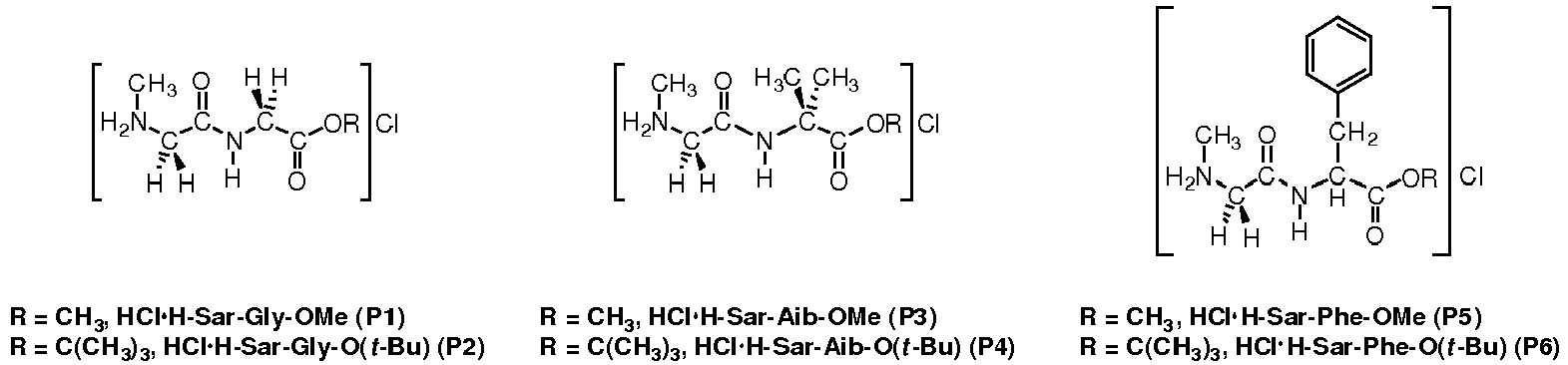

- Then, these oligopeptides were used for the synthesis and characterization of the Au(III)-dithiocarbamato derivatives of oligopeptides herein below reported both as chemical structures and synthesis


- A water solution (ca. 3 mL) of HCl-H-Sar-Gly-O(t-Bu) (1.42 mmol) cooled at 0°C was drop-wise treated under continuous stirring with cool CS2 (1.43 mmol) and an aqueous solution (1 mL) of NaOH (1.42 mmol). When pH turned from 11 to 6 after ca. 2 h, the solution was slowly added under stirring to an aqueous cool (0°C) solution (ca. 2 mL) of K[AuBr4] (0.70 mmol), leading to the immediate precipitation of a reddish-brown solid that was filtered off, washed with water, and dried under reduced pressure with P2O5, the final yield being 77.2%.
- Elemental analyses calculated for C10H17AuBr2N2O3S2: C, 18.94; H, 2.70; N, 4.42; S, 10.11 %. Found: C, 19.20; H, 2.88; N, 4.42; S, 10.25%.
- Melting point: the complex decomposes at 152.6°C.
- IR data (KBr, cm-1): 3352 (v, N-H); 1736 (ν, C=O ester); 1673 (ν, C=O amide); 1568 (ν, amide II + N-CSS); 1253 (ν, amide III); 1228 (ν, C-O(t-Bu)); 1161 (ν, (t Bu)-O); 1006, 556 (νa,s, S-C-S); 387 (νa,s, S-Au-S); 252, 227 (νa,s, Br-Au-Br). 1H NMR (300.13 MHz, acetone-D6, 298 K): δ (ppm) 1.45 (C(CH 3)3); 3.53, 3.57 (NCH 3); 3.95, 3.96 (CH 2 Gly); 4.71, 4.75 (CH 2 Sar); 7.96 (NH).
- 13C NMR (75.48 MHz, acetone-D6, 298 K): δ (ppm) 28.66 (C(CH3)3); 40.13, 41.12 (NCH3); 43.09 (CH2 Gly); 55.12, 58.98 (CH2 Sar); 82.59 (C(CH3)3); 165.06, 165.35 (NCO); 169.93 (COO); 196.74, 200.48 (CSS).
- A water solution (ca. 3 mL) of HCl·H-Sar-Gly-O(t-Bu) (1.56 mmol) cooled at 0°C was drop-wise treated under continuous stirring with cool CS2 (1.58 mmol) and an aqueous solution (1 mL) of NaOH (1.58 mmol). When pH turned from 11 to 6 after ca. 2 h, the solution was slowly added under stirring to an aqueous cool (0°C) solution (ca. 2 mL) of K[AuCl4] (0.77 mmol), leading to the immediate precipitation of a yellow-ochre solid that was filtered off, washed with water, and dried under reduced pressure with P2O5, the final yield being 76.9%.
- Elemental analyses calculated for C10H17AuCl2N2O3S2: C, 22.03; H, 3.14; N, 5.14; S, 11.76%. Found: C, 22.00; H, 3.23; N, 5.08; S, 11.96%.
- Melting point: the complex decomposes at 155.3°C.
- IR data (KBr, cm-1): 3349 (ν, N-H); 1737 (ν, C=O ester); 1672 (ν, C=O amide); 1561 (ν, amide II + N-CSS); 1253 (ν, amide III); 1229 (ν, C-O(t-Bu)); 1162 (ν, (t Bu)-O); 1006, 558 (νa,s, S-C-S); 384 (νa,s, S-Au-S); 358, 339 (νa,s, Cl-Au-Cl).
- 1H NMR (300.13 MHz, acetone-D6, 298 K): δ (ppm) 1.45 (C(CH 3)3); 3.56, 3.57 (NCH 3); 3.94, 3.97 (CH 2 Gly); 4.75 (CH 2 Sar); 7.92 (NH).
- 13C NMR (75.48 MHz, acetone-D6, 298 K): δ (ppm) 28.70 (C(CH3)3); 40.66, 41.10 (NCH3); 43.27 (CH2 Gly); 55.64 (CH2 Sar); 82.66 (C(CH3)3); 165.10 (NCO); 169.82 (COO); 195.45, 200.60 (CSS).
- A water solution (ca. 3 mL) of HCl·H-Sar-Aib-O(t-Bu) (1.43 mmol) cooled at 0°C was drop-wise treated under continuous stirring with cool CS2 (1.43 mmol) and an aqueous solution (1 mL) of NaOH (1.42 mmol). When pH turned from 11 to 6 after ca. 2.5 h, the solution was slowly added under stirring to an aqueous cool (0°C) solution (ca. 2 mL) of K[AuBr4] (0.71 mmol), leading to the immediate precipitation of a reddish-brown solid that was filtered off, washed with water, and dried under reduced pressure with P2O5, the final yield being 76.4%.
- Elemental analyses calculated for C12H21AuBr2N2O3S2: C, 21.76; H, 3.20; N, 4.23; S, 9.68%. Found: C, 22.03; H, 3.33; N, 4.34; S, 9.58%.
- M.p.: decomposes at 165.9°C
- IR data (KBr, cm-1): 3362 (ν, N-H); 1734 (ν, C=O ester); 1690 (ν, C=O amide); 1560 (ν, N-CSS); 1531 (ν, amide II); 1252 (ν, amide III); 1215 (ν, C-O(t-Bu)); 1144 (ν, (t-Bu)-O); 996, 545 (νa,s, S-C-S); 383 (νa,s, S-Au-S); 252, 223 (νa,s, Br-Au-Br). 1H NMR (300.13 MHz, acetone-D6, 298 K): δ (ppm) 1.44 (C(CH 3)3); 1.45, 1.46 (C(CH 3)2 Aib); 3.51, 3.54 (NCH 3); 4.62, 4.66 (CH 2 Sar); 7.90 (NH).
- 13C NMR (75.48 MHz, acetone-D6, 298 K): δ (ppm) 25.61 (C(CH3)2 Aib); 28.60 (C(CH3)3); 40.21, 41.20 (NCH3); 55.26, 56.15 (CH2 Sar); 58.35 (C(CH3)2 Aib); 81.91 (C(CH3)3); 164.00 (NCO); 173.73 (COO); 196.57, 200.26 (CSS).
- A water solution (ca. 3 mL) of HCl.H-Sar-Aib-O(t-Bu) (1.58 mmol) cooled at 0°C was drop-wise treated under continuous stirring with cool CS2 (1.58 mmol) and an aqueous solution (1 mL) of NaOH (1.59 mmol). When pH turned from 11 to 6 after ca. 2.5 h, the solution was slowly added under stirring to an aqueous cool (0°C) solution (ca. 2 mL) of K[AuCl4] (0.78 mmol), leading to the immediate precipitation of a yellow-ochre solid that was filtered off, washed with water, and dried under reduced pressure with P2O5, the final yield being 80.6%.
- Elemental analyses calculated for C12H21AuCl2N2O3S2: C, 25.14; H, 3.69; N, 4.89; S, 11.19%. Found: C, 25.11; H, 3.84; N, 4.84; S, 11.37%.
- Melting point: the complex decomposes at 166.6°C.
- IR data (KBr, cm-1): 3365 (ν, N-H); 1733 (ν, C=O ester); 1691 (ν, C=O amide); 1564 (ν, N-CSS); 1534 (ν, amide II); 1252 (ν, amide III); 1214 (ν, C-O(t-Bu)); 1146 (ν, (t-Bu)-O); 996, 547 (νa,s, S-C-S); 383 (νa,s, S-Au-S); 347 (νa,s, Cl-Au-Cl).
- 1H NMR (300.13 MHz, acetone-D6, 298 K): δ (ppm) 1.44 (C(CH 3)3); 1.45, 1.46 (C(CH 3)2 Aib); 3.54, 3.55 (NCH 3); 4.66 (CH 2 Sar); 7.89 (NH).
- 13C NMR (75.48 MHz, acetone-D6, 298 K): δ (ppm) 25.52 (C(CH3)2 Aib); 28.50 (C(CH3)3); 40.64, 41.04 (NCH3); 55.67 (CH2 Sar); 58.20 (C(CH3)2 Aib); 81.87 (C(CH3)3); 163.80 (NCO); 173.62 (COO); 195.09, 200.19 (CSS).
- A water solution (ca. 3 mL) of HCl·H-Sar-Phe-O(t-Bu) (1.38 mmol) cooled at 0°C was drop-wise treated under continuous stirring with cool CS2 (1.39 mmol) and an aqueous solution (1 mL) of NaOH (1.38 mmol). When pH turned from 11 to 6 after ca. 1.5 h, the solution was slowly added under stirring to an aqueous cool (0°C) solution (ca. 2 mL) of K[AuBr4] (0.69 mmol), leading to the immediate precipitation of a reddish-brown solid that was filtered off, washed with water, and dried under reduced pressure with P2O5, the final yield being 71.5%.
- Elemental analyses calculated for C17H23AuBr2N2O3S2: C, 28.19; H, 3.20; N, 3.87; S, 8.85%. Found: C, 28.34; H, 3.09; N, 3.87; S, 8.63%.
- Melting point: the complex decomposes at 124.3°C.
- IR data (KBr, cm-1): 3431 (ν, N-H); 1731 (ν, C=O ester); 1683 (ν, C=O amide); 1558 (ν, N-CSS); 1543 (ν, amide II); 1259 (ν, amide III); 1214 (ν, C-O(t-Bu)); 1155 (ν, (t-Bu)-O); 994, 562 (νa,s, S-C-S); 381 (νa,s, S-Au-S); 252, 221 (νa,s, Br-Au-Br). 1H NMR (300.13 MHz, acetone-D6, 298 K): δ (ppm) 1.43 (C(CH 3)3); 2.98-3.20 (CH 2-Ph); 3.45, 3.49 (NCH 3); 4.65, 4.70 (CH 2 Sar); 4.67-4.74 (CH); 7.25-7.33 (C6 H 5); 7.91 (NH).
- 13C NMR (75.48 MHz, acetone-D6, 298 K): δ (ppm) 28.11 (C(CH3)3); 38.50 (CH2-Ph); 39.74, 40.74 (NCH3); 54.65, 55.56 (CH2 Sar); 55.23 (CH); 82.56 (C(CH3)3); 127.86 (Ph, p-CH); 129.41 (Ph, m-CH); 130.43 (Ph, o-CH); 137.72 (Ph, CH2-C); 164.10, 164.33 (NCO); 170.75 (COO); 196.11, 199.33 (CSS).
- A water solution (ca. 3 mL) of HCl·H-Sar-Phe-O(t-Bu) (1.62 mmol) cooled at 0°C was drop-wise treated under continuous stirring with cool CS2 (1.64 mmol) and an aqueous solution (1 mL) of NaOH (1.61 mmol). When pH turned from 11 to 6 after ca. 1.5 h, the solution was slowly added under stirring to an aqueous cool (0°C) solution (ca. 2 mL) of K[AuCl4] (0.80 mmol), leading to the immediate precipitation of a light-brown solid that was filtered off, washed with water, and dried under reduced pressure with P2O5, the final yield being 81.7%.
- Elemental analyses calculated for C17H23AuCl2N2O3S2: C, 32.14; H, 3.65; N, 4.41; S, 10.09%. Found: C, 32.31; H, 3.54; N, 4.40; S, 9.95%.
- Melting point: the complex decomposes at 138.3°C.
- IR data (KBr, cm-1): 3342 (ν, N-H); 1733 (ν, C=O ester); 1684 (ν, C=O amide); 1559 (ν, N-CSS); 1542 (ν, amide II); 1256 (ν, amide III); 1213 (ν, C-O(t-Bu)); 1155 (ν, (t-Bu)-O); 994, 563 (νa,s, S-C-S); 383 (νa,s, S-Au-S); 359 (νa,s, Cl-Au-Cl).
- 1H NMR (300.13 MHz, acetone-D6, 298 K): δ (ppm) 1.43 (C(CH 3)3); 2.98-3.20 (CH 2-Ph); 3.49 (NCH 3); 4.70 (CH 2 Sar); 4.67-4.74 (CH); 7.25-7.33 (C6 H 5); 7.92 (NH).
- 13C NMR (75.48 MHz, acetone-D6, 298 K): δ (ppm) 27.86 (C(CH3)3); 38.29 (CH2-Ph); 40.49 (NCH3); 55.31 (CH2 Sar); 54.97 (CH); 82.33 (C(CH3)3); 127.50 (Ph, p-CH); 129.15 (Ph, m-CH); 130.40 (Ph, o-CH); 137.73 (Ph, CH2-C); 163.97, 164.10 (NCO); 170.93 (COO); 194.45, 199.61 (CSS).
- A water solution (ca. 3 mL) of HCl·H-Sar-Aib3-Gly-OEt (0.84 mmol) cooled at 0°C was drop-wise treated under continuous stirring with cool CS2 (0.86 mmol) and an aqueous solution (1 mL) of NaOH (0.84 mmol). When pH turned from 11 to 6 after ca. 2 h, the solution was slowly added under stirring to an aqueous cool (0°C) solution (ca. 2 mL) of K[AuBr4] (0.41 mmol), leading to the immediate precipitation of a reddish-brown solid that was filtered off, washed with water, and dried under reduced pressure with P2O5, the final yield being 78.9%.
- Elemental analyses calculated for C20H34AuBr2N5O6S2: C, 27.89; H, 3.98; N, 8.13; S, 7.44%. Found: C, 27.71; H, 4.10; N, 8.24; S, 7.58%.
- M.p.: decomposes at 160.3°C
- IR data (KBr, cm-1): 3358 (ν, N-H); 1741 (ν, C=O ester); 1689 (ν, C=O amide); 1563 (ν, N-CSS); 1533 (ν, amide II); 1253 (ν, amide III); 1240 (ν, C-OEt); 1098 (ν, Et-O); 998, 547 (νa,s, S-C-S); 384 (νa,s, S-Au-S); 253, 222 (νa,s, Br-Au-Br).
- 1H NMR (300.13 MHz, acetone-D6, 298 K): δ (ppm) 1.22 (CH 3 Et); 1.38-1.51 (C(CH 3)2 Aib); 3.54, 3.58 (NCH 3); 3.86, 3.90 (CH 2 Gly); 4.10 (CH 2 Et); 4.80, 4.83 (CH 2 Sar); 7.15-8.38 (NH).
- A water solution (ca. 3 mL) of HCl·H-Sar-Aib2-O(t-Bu) (1.58 mmol) cooled at 0°C was drop-wise treated under continuous stirring with cool CS2 (1.58 mmol) and an aqueous solution (1 mL) of NaOH (1.60 mmol). When pH turned from 11 to 6 after ca. 2.5 h, the solution was slowly added under stirring to an aqueous cool (0°C) solution (ca. 2 mL) of K[AuBr4] (0.78 mmol), leading to the immediate precipitation of a reddish-brown solid that was filtered off, washed with water, and dried under reduced pressure with P2O5, the final yield being 81.2%.
- Elemental analyses calculated for C16H28AuBr2N3O4S2: C, 25.71; H, 3.78; N, 5.62; S, 8.58%. Found: C, 25.79; H, 3.75; N, 5.48; S, 8.50%.
- M.p.: decomposes at 161.7°C
- IR data (KBr, cm-1): 3360 (ν, N-H); 1735 (ν, C=O ester); 1688 (ν, C=O amide); 1561 (ν, N-CSS); 1538 (ν, amide II); 1252 (ν, amide III); 1216 (ν, C-O(t-Bu)); 1145 (ν, (t-Bu)-O); 995, 545 (νa,s, S-C-S); 383 (νa,s, S-Au-S); 252, 222 (νa,s, Br-Au-Br). 1H NMR (300.13 MHz, acetone-D6, 298 K): δ (ppm) 1.87 (C(CH 3)3); 1.85-1.97 (C(CH 3)2 Aib); 3.96, 4.00 (NCH 3); 5.15, 5.20 (CH 2 Sar); 7.83-8.41 (NH).
- A water solution (ca. 3 mL) of HCl·H-Sar-Aib2-O(t-Bu) (1.67 mmol) cooled at 0°C was drop-wise treated under continuous stirring with cool CS2 (1.68 mmol) and an aqueous solution (1 mL) of NaOH (1.67 mmol). When pH turned from 11 to 6 after ca. 2.5 h, the solution was slowly added under stirring to an aqueous cool (0°C) solution (ca. 2 mL) of K[AuCl4] (0.83 mmol), leading to the immediate precipitation of a dark-ochre solid that was filtered off, washed with water, and dried under reduced pressure with P2O5, the final yield being 76.3%.
- Elemental analyses calculated for C16H28AuCl2N3O4S2: C, 29.19; H, 4.29; N, 6.38; S, 9.74%. Found: C, 29.02; H, 4.19; N, 6.48; S, 9.60%.
- M.p.: decomposes at 166.9°C
- IR data (KBr, cm-1): 3365 (ν, N-H); 1733 (ν, C=O ester); 1692 (v, C=O amide); 1563 (ν, N-CSS); 1535 (ν, amide II); 1252 (ν, amide III); 1213 (ν, C-O(t-Bu)); 1145 (ν, (t-Bu)-O); 995, 546 (νa,s, S-C-S); 384 (νa,s, S-Au-S); 351 (νa,s, Cl-Au-Cl).
- 1H NMR (300.13 MHz, acetone-D6, 298 K): δ (ppm) 1.87 (C(CH 3)3); 1.85-1.98 (C(CH 3)2 Aib); 4.00 (NCH 3); 5.18 (CH 2 Sar); 7.80-8.29 (NH).
- Preliminary in vitro cytotoxicity tests have been carried out for some of the example [AuIIIX2(pdtc)] complexes according to the invention.
- Human prostate carcinoma PC3 cells (established from bone marrow metastasis and unresponsive to androgen treatment) were cultured in IMDM (Iscove's Modified Dulbecco's medium) supplemented with 10% heat-inactivated fetal bovine serum (FBS), penicillin (2 mg mL-1), streptomycin (2 mg mL-1), L-glutamine (0.1 % w/v) at 37°C in 5% CO2 and moisture-enriched atmosphere.
- Before use, [AuIIIX2(pdtc)] complexes (AUD6, AUD7, AUD8, AUD9) and cisplatin were dissolved in methyl sulfoxide (DMSO) just before the experiments. Calculated amounts of drug solutions were then added to the proper medium to a final concentration of 0.5% (v/v) DMSO which had no discernible effect on cell death. All the tested complexes were proved by 1 H NMR studies, to be stable in DMSO over 48 h.
- For the cytotoxicity assay, cells (2.5×10³ cells mL-l) were seeded in 96-well flat-bottomed microplates in IMDM supplemented with 10% heat-inactivated FBS and incubated at 37°C in a 5% CO2 atmosphere. The medium was then removed and replaced with a fresh one containing the compounds to be studied (previously dissolved in DMSO) at increasing concentrations (0.05-10 µM), thus exposing cells to the investigated compounds for 72 h. Triplicate cultures were established for each treatment. Cell viability was determined by a cell proliferation ELISA 5-bromo-2'-deoxyuridine colorimetric kit, according to the manufacturer's protocol. The percent cell viability was calculated by dividing the average absorbance of the cells treated with the tested compounds by that of the control, and plotted against drug concentration (logarithmic scale) to determine the IC50 (drug concentration required to cause 50% cells growth inhibition relative to the control), the standard deviation being estimated from the average of three trials. For comparison purposes, the cytotoxicity of cisplatin was evaluated under the same experimental conditions.
- As reported in table 1, exposure of PC3 cells to increasing concentrations of AUD6, AUD7, AUD8, AUD9 complexes resulted in a remarkable dose-dependent growth inhibition with IC50 (the concentration of drug required to cause 50% growth inhibition) values, lower than the reference drug cisplatin, the most active being [AuIIIBr2((t-Bu)O-Aib-Sar-dtc)] (AUD8).
Table 1. Evaluation of in vitro cytotoxic activity (IC50 ± S.D. [µM]) of the Au(III)-dithiocarbamato derivatives AUD6, AUD7, AUD8 and AUD9 toward human prostate carcinoma PC3 cells. Compound IC50 ± S.D. [µM] PC3 AUD6 0.85 ± 0.07 AUD7 1.0 ± 0.1 AUD8 0.55 ± 0.05 AUD9 0.75 ± 0.06 cisplatin 2.6 ± 0.2 - The ability of the investigated compounds to induce apoptosis has been also investigated. One of the earliest features of apoptosis is a morphological change in the plasma membrane as a consequence of the translocation of the phospholipid phosphatidylserine (PS) membrane from the internal to the external layer of the cell membrane. In the presence of calcium ions, Annexin V has a high specificity and affinity for PS. Thus, the binding of Annexin V to cells with exposed PS provides a reliable and sensitive method to detect apoptosis. A population of apoptotic cells may contain necrotic cells binding Annexin V as well, due to their damaged plasma membrane. To distinguish between apoptotic and necrotic cells, the fluorescent dye propidium iodide (PI) is used since can cross damaged plasma membrane of necrotic cells only. Annexin-V binding and Propidium Iodide (PI) staining were detected by flow cytometry.
- PC3 cells in exponential growth phase were incubated in IMDM supplemented with 10% heat-inactivated FBS either in presence or without the investigated compounds (5 µM) for 24 h. Cells were then harvested and resuspended in 100 µl of binding buffer (10 mM Hepes/NaOH pH 7.4, 140 mM NaCl, 2.5 mM CaCl2), incubated with 5 µl of Annexin V-fluorescein isothiocyanate (FITC), and 10 µL of PI (10 µg/mL in binding buffer) in the dark for 15 min, and assayed after the addition of 0.3 µL binding buffer to each sample. Viable, Annexin V labeled cells were identified by flow cytometry according to their forward and right-angle scattering, electronically gated and analyzed on a FACScan flow cytometer.
- As clearly shown in
Figure 1 , all the tested Au(III)-dithiocarbamato complexes are able to induce apoptosis, as evaluated by the marker of early apoptosis Annexin, inducing a significant increase of Annexin V binding/PI staining. - The growth-inhibitory effect of AUD6 and AUD8 on estrogen receptor α-negative human breast cancer MDA-MB-231 cells has been also evaluated. Cells were grown in RPMI 1640 medium supplemented with 10% heat-inactivated fetal bovine serum, penicillin (100 units mL-1), streptomycin (100 µg mL-1), L-glutamine (0.1% w/v) at 37°C in 5% CO2 and moisture-enriched atmosphere. For the cytotoxicity assay, cells were seeded in 96-well microplates in RPMI 1640 medium and grown to 70% to 80% confluency followed by addition of the compounds to be studied (previously dissolved in DMSO) at increasing concentrations (1-50 µM) and incubated at 37°C in a 5% CO2 atmosphere, thus exposing cells to the investigated compounds for 22 h. Triplicate cultures were established for each treatment. Cell respiration, as an indicator of cell viability, was determined by the mitochondrial-dependent reduction of MTT (3-(4,5-dimethylthiazol-2-yl)-2,5-diphenyltetrazolium bromide) to formazan as previously described [V. Milacic, D. Chen, L. Ronconi, K.R. Landis-Piwowar, D. Fregona, Q.P. Dou, Cancer Res. 2006, 66, 10478-10486]. Cell viability was calculated by dividing the average absorbance of the cells treated with the test compounds by that of the control, the standard deviation being estimated from the average of three trials. As reported in
Figure 2 , AUD6 and AUD8 have similar inhibitory patterns, the latter showing slightly higher activity. Moreover, these results suggest that both compounds are similarly potent in inhibiting human breast cancer MDA-MB-231 cell growth as the previously investigated Au(III)-dithiocarbamato analogues [V. Milacic et al. 2006, ref. cit.]. - To investigate whether these compounds could also have the proteasome as a biological target, purified rabbit 20S proteasome (35 ng) or MDA-MB-231 whole cell extract (10 µg) were incubated with 20 µM of the substrate (for proteasomal chymotryptic (CT) activity) in 100 µL assay buffer (20 mmol L-1 Tris-HCl (pH 7.5) in the presence of the compounds to be studied (previously dissolved in DMSO) at increasing concentrations (0.1-25 µM) or equivalent volume of neat DMSO as control. After 2 h incubation at 37°C, inhibition of each proteasomal chymotryptic activity was measured as previously described [V. Milacic et al. 2006, ref. cit.]. All the Au(III) complexes (AUD 6, AUD 8) were proved to inhibit the proteasomal chymotrypsin-like activity of both purified rabbit 20S proteasome (
Figure 3A ) and MDA-MB-231 whole cell extract (Figure 3B ) in a concentration-dependent way resulting, again, two-fold more potent than the previously investigated Au(III)-dithiocarbamato analogues [V. Milacic et al.. 2006, ref. cit.]. - Further biological studies have been preliminarily showing that both investigated Au(III) complexes (AUD6, AUD8) induce accumulation of proteasome target proteins, such as Bax and p27, indicating that proteasome inhibition (associated with cell death) by AUD6 and AUD8 is functional and that the proteasome is a major cellular target.
- Cell culture and cell extract preparation. Estrogen receptor α-negative human breast cancer MDA-MB-231 cells were grown in RPMI 1640 medium supplemented with 10% fetal bovine serum, penicillin (100 units mL-1), and streptomycin (100 µg mL-1) at 37°C in 5% CO2 and moisture-enriched atmosphere. Human breast tumor xenograft experiments. Five week-old female athymic nude mice were purchased from Taconic Research Animal Services (Hudson) and housed according to protocols approved by the Institutional Laboratory Animal Care and Use Committee of Wayne State University. MDA-MB-231 cells (5.0x10⁶ cells mL-1 suspended in 0.1 mL of serum-free RPMI 1640 medium) were inoculated subcutaneously (s.c.) in right flank of each mouse (four mice per group). When tumors reached the size of ca. 120 mm3, mice were randomly grouped and treated daily with s.c. injection of either 1.0 mg kg-1 of AUD6 or AUD8, or vehicle [10% DMSO, 20% Cremophore/ethanol (3:1) and 70% PBS]. Tumor size was measured every other day using calipers and their volumes were calculated according to the formula width2 x length / 2. Mice have being treated for 13 days. Initial tumor growth inhibition was analyzed.
- The results obtained on the capability of both AUD6 and AUD8 complexes to inhibit the growth of human breast cancer (MDA-MB-231) xenografts in vivo are shown in
fig. 4 . A significant tumor growth inhibition was observed after 13 days in tumor-bearing mice treated with AUD8. Control tumors grew to an average size of 453 mm3, whereas AUD8-treated tumors grew to a much smaller average size, corresponding to >90% inhibition. Analogous treatment with AUD6 led to a moderate inhibition of tumor growth (ca. 33%). These results are consistent with the previously discussed in vitro studies, in which AUD8 was shown to be more potent than AUD6 in inhibiting MDA-MB-231 cells proliferation.
Claims (14)
- An Au(III) complex of the type [AuIIIX2(pdtc)] represented by the general formula (I)

wherein:- X1, X2, equal or different each other, are selected from the group consisting of Cl, Br, I, CN, SCN;- m is an integer comprised in a range from 2 to 5;- the organic moieties [-C(=O)-Zn-C(R2)(R3)-N(R1)-] are amino acid residue equal or different each other, where R1, R2, R3 and Zn, equal or different each other, are:- R1 is a residue selected from the group consisting of H, CH3, straight or branched C2-C6 alkyl, C3-C6 cycloalkyl, phenyl, CH2 bound to R3 where R3 is equal to (CH2)2;- R2 is a residue selected from the group consisting of H, CH3, straight or branched C2-C6 alkyl, C3-C6 cycloalkyl, phenyl;- R3 is a residue selected from the group consisting of H, CH3,
 - Zn (n = 0, 1) is -C-(R5)(R6) where R5, R6, equal or different each other, are residues selected from the group consisting of H, CH3, straight or branched C2-C6 alkyl, C3-C6 cycloalkyl, phenyl;- Y is selected from O, S, NR7, where R7 is a residue selected from the group consisting of H, CH3, straight or branched C2-C6 alkyl, C3-C6 cycloalkyl, phenyl;- R4 is a residue selected from the group consisting of H, CH3, straight or branched C2-C6 alkyl, C3-C6 cycloalkyl, phenyl, (CH2CH2O)pH where p is an integer comprised from 1 to 4.
 - The Au(III) complex of the type [AuIIIX2(pdtc)] according to claim 1, wherein the chiral carbon atom bound to R2 and R3 has R stereochemistry.
- The Au(III) complex of the type [AuIIIX2(pdtc)] according to claim 1, wherein the chiral carbon atom bound to R2 and R3 has S stereochemistry.
- The Au(III) complex of the type [AuIIIX2(pdtc)] according to claim 1, wherein the chiral carbon atom bound to R5 and R6 has R stereochemistry.
- The Au(III) complex of the type [AuIIIX2(pdtc)] according to claim 1, wherein the chiral carbon atom bound to R5 and R6 has S stereochemistry.
- The Au(III) complex of the type [AuIIIX2(pdtc)] according to claims 1-5, wherein the amino acid residues are selected in the group of amino acids consisting of glycine, alanine, proline, serine, sarcosine, α-aminoisobutyric, phenylalanine.
- The Au(III) complex of the type [AuIIIX2(pdtc)] according to claims 1-5, wherein X1 and X2 are a halogen selected from Cl and Br.
- The Au(III) complex of the type [AuIIIX2(pdtc)] according to claim 1-6, wherein the organic moiety [-C(=O)-Zn-C(R2)(R3)-N(R1)-] is selected from the group consisting of -[Gly]-[Sar]-, -[Aib]-[Sar]-, -[Phe]-[Sar]-, -[Ser]-[Sar]- -[Aib] 2 -[Sar]-, -[Gly]-[Aib] 3 -[Sar]-.
- The Au(III) complex of the type [AuIIIX2(pdtc)] according to claims 1-6, wherein Y is O.
- The Au(III) complex of the type [AuIIIX2(pdtc)] according to claims 1-6, wherein R4 is selected from the group consisting of methyl, ethyl, t- butyl.
- The Au(III) complex of the type [AuIIIX2(pdtc)] according to claims 8-10, wherein the ligand pdtc is selected from the group consisting of (t-Bu)O-Gly-Sar-CSS, (t-Bu)O-Aib-Sar-CSS, (t-Bu)O-Phe-Sar-CSS, MeO-Gly-Sar-CSS, MeO-Aib-Sar-CSS, MeO-Phe-Sar-CSS, MeO-Ser-Sar-CSS, (t-Bu)O-Aib2-Sar-CSS, EtO-Gly-Aib3-Sar-CSS.
- The Au(III) complex of the type [AuIIIX2(pdtc)] according to claims 1-11 for use as antineoplastic agent.
- A composition comprising at least one of the Au(III) complex of the type [AuIIIX2(pdtc)] according the claims 1-11 in combination with excipients and/or diluents pharmaceutically acceptable for treating neoplastic pathologies.
- The method for preparing Au(III) complexes of the type [AuIIIX2(pdtc)] according the claims 1-11 comprising at least the steps of:a) in situ synthesis of the dithiocarbamato ligand by 1:1:1 stoichiometric reaction between a selected peptide or esterified peptide hydrochloride (p·HCl), carbon disulfide (CS2) and a metal alkaline hydroxide (MOH, M = Na, K) in water at 0°C;b) [AuIIIX2(pdtc)] complex synthesis by coordination of the dithiocarbamato ligand to the Au(III) centre by a 2:1 ligand-to metal reaction between the dithiocarbamato ligand generated in situ to the previous step a) and M[AuIIIX4] (M = Na, K; X = Br, Cl) in a ratio 2:1 in water a 0°C;c) separation of the complex and optionally purification thereof.
Applications Claiming Priority (1)
| Application Number | Priority Date | Filing Date | Title |
|---|---|---|---|
| PCT/EP2009/053296 WO2010105691A1 (en) | 2009-03-20 | 2009-03-20 | Gold (iii) complexes with oligopeptides functionalized with sulfur donors and use thereof as antitumor agents |
Publications (2)
| Publication Number | Publication Date |
|---|---|
| EP2408445A1 EP2408445A1 (en) | 2012-01-25 |
| EP2408445B1 true EP2408445B1 (en) | 2014-11-19 |
Family
ID=40793697
Family Applications (1)
| Application Number | Title | Priority Date | Filing Date |
|---|---|---|---|
| EP09779189.1A Not-in-force EP2408445B1 (en) | 2009-03-20 | 2009-03-20 | Gold(iii) complexes with oligopeptides functionalized with sulfur donors and use thereof as antitumor agents |
Country Status (7)
| Country | Link |
|---|---|
| US (1) | US8481496B2 (en) |
| EP (1) | EP2408445B1 (en) |
| JP (1) | JP2012520833A (en) |
| CN (1) | CN102387797A (en) |
| CA (1) | CA2755722A1 (en) |
| MX (1) | MX2011009749A (en) |
| WO (1) | WO2010105691A1 (en) |
Families Citing this family (6)
| Publication number | Priority date | Publication date | Assignee | Title |
|---|---|---|---|---|
| US20150266909A1 (en) | 2014-03-19 | 2015-09-24 | King Abdulaziz City For Science And Technology | Gold(i) complexes with t-butyl phosphine and dialkyl dithiocarbamate ligands |
| KR102412203B1 (en) | 2014-06-11 | 2022-06-23 | 더 보드 오브 리젠츠 오브 더 유니버시티 오브 텍사스 시스템 | Texaphyrin-pt(iv) conjugates and compositions for use in overcoming platinum resistance |
| IT201600122406A1 (en) | 2016-12-02 | 2018-06-02 | Dolores Fregona | COMPOUNDS OF COORDINATION, SYNTHESIS, NANOFORMULATION AND USE OF THE SAME IN ONCOLOGY |
| IT201600122363A1 (en) | 2016-12-02 | 2018-06-02 | Dolores Fregona | COMPOUNDS OF COORDINATION, SYNTHESIS, NANOFORMULATION AND USE OF THE SAME IN ONCOLOGY |
| PL236093B1 (en) | 2017-07-04 | 2020-11-30 | Dominika Szczepaniak | Water-soluble intelligent gold complexes (III), method for producing water-soluble intelligent gold complexes (III) and their application |
| CN112625067B (en) * | 2020-12-17 | 2023-05-02 | 嘉兴学院 | Nickel-based complex containing PNP and ddtc ligand coordination, and preparation method and application thereof |
Family Cites Families (7)
| Publication number | Priority date | Publication date | Assignee | Title |
|---|---|---|---|---|
| GB2122194B (en) * | 1982-06-18 | 1985-10-02 | May & Baker Ltd | New metal complexes of nitro-substituted, pyrazoles, imidazoles and isothiazoles |
| JPS61186392A (en) * | 1985-02-12 | 1986-08-20 | エンゲルハード・コーポレーシヨン | Gold compound |
| EP0195147B1 (en) * | 1985-03-19 | 1989-11-08 | Engelhard Corporation | Trihalo(amine)gold(iii) complexes |
| US5627263A (en) * | 1993-11-24 | 1997-05-06 | La Jolla Cancer Research Foundation | Integrin-binding peptides |
| US5981478A (en) * | 1993-11-24 | 1999-11-09 | La Jolla Cancer Research Foundation | Integrin-binding peptides |
| US20050192242A1 (en) * | 1995-10-11 | 2005-09-01 | Neal Zane C. | Therapeutic fusion protein transgenes |
| CN101346388A (en) * | 2005-12-23 | 2009-01-14 | 马林克罗特公司 | Tripodal ligands with the coordinating motifs K2-bh2 or K3-BH3 relevant for biomedical applications of organometallic complexes |
-
2009
- 2009-03-20 US US13/257,684 patent/US8481496B2/en not_active Expired - Fee Related
- 2009-03-20 EP EP09779189.1A patent/EP2408445B1/en not_active Not-in-force
- 2009-03-20 WO PCT/EP2009/053296 patent/WO2010105691A1/en not_active Ceased
- 2009-03-20 CN CN2009801586493A patent/CN102387797A/en active Pending
- 2009-03-20 JP JP2012500083A patent/JP2012520833A/en active Pending
- 2009-03-20 MX MX2011009749A patent/MX2011009749A/en active IP Right Grant
- 2009-03-20 CA CA2755722A patent/CA2755722A1/en not_active Abandoned
Also Published As
| Publication number | Publication date |
|---|---|
| US8481496B2 (en) | 2013-07-09 |
| EP2408445A1 (en) | 2012-01-25 |
| WO2010105691A1 (en) | 2010-09-23 |
| CN102387797A (en) | 2012-03-21 |
| US20120101044A1 (en) | 2012-04-26 |
| MX2011009749A (en) | 2012-01-20 |
| JP2012520833A (en) | 2012-09-10 |
| CA2755722A1 (en) | 2010-09-23 |
Similar Documents
| Publication | Publication Date | Title |
|---|---|---|
| Marta Nagy et al. | Noble metal-dithiocarbamates precious allies in the fight against cancer | |
| Ronconi et al. | Latest insights into the anticancer activity of gold (III)-dithiocarbamato complexes | |
| Ronconi et al. | The Midas touch in cancer chemotherapy: from platinum-to gold-dithiocarbamato complexes | |
| US8481496B2 (en) | Gold (III) complexes with oligopeptides functionalized with sulfur donors and use thereof as antitumor agents | |
| Nardon et al. | Gold (III)-dithiocarbamato peptidomimetics in the forefront of the targeted anticancer therapy: Preclinical studies against human breast neoplasia | |
| Milacic et al. | Gold complexes as prospective metal-based anticancer drugs | |
| Tan | Filamentous tropical marine cyanobacteria: a rich source of natural products for anticancer drug discovery | |
| US9597410B2 (en) | FAP-activated proteasome inhibitors for treating solid tumors | |
| Gutiérrez et al. | Highly Cytotoxic Bioconjugated Gold (I) Complexes with Cysteine‐Containing Dipeptides | |
| Nardon et al. | Gold (III) complexes in the oncological preclinical arena: from aminoderivatives to peptidomimetics | |
| RU2275913C2 (en) | Pharmaceutical compositions comprising polysaccharide conjugates for inhibition of metastasis or prophylaxis in malignant tumor relapse | |
| EP1290011A1 (en) | Melphalan derivatives and their use as cancer chemotherapeutic drugs | |
| Huang et al. | Platinum (IV) complexes conjugated with phenstatin analogue as inhibitors of microtubule polymerization and reverser of multidrug resistance | |
| Trevisan et al. | Synthesis of a palladium (II)-dithiocarbamate complex: biological assay and nephrotoxicity in rats | |
| US9328141B2 (en) | Polypeptides for the treatment or prevention of cancer and uses thereof | |
| Ronconi et al. | Perspective gold (III)-dithiocarbamato anticancer therapeutics: Learning from the past, moving to the future | |
| EP2527008A2 (en) | Anticancerous polymeric agents | |
| US6630513B1 (en) | Arylsulfonanilide derivates | |
| US20040097421A1 (en) | Melphalan derivatives and their use as cancer chemotherapeutic drugs | |
| Andrejević et al. | Synthesis of Antiproliferative Gold Complexes | |
| Titilas | Metal-Based Glycoconjugates for the Targeted Anticancer Chemotherapy | |
| Śmiłowicz | Metal-peptide bioconjugates for targeted anti-cancer therapy | |
| CN102188716B (en) | Macromolecule vinblastine conjugate adopting amino acids or oligopeptides as connexons | |
| Brezar et al. | Evaluation of platinum (II) complexes with 8-Hydroxyquinoline derivative in Electrochemotherapy: Comparative sensitivity of different Cancer cell lines | |
| Adami | Synthesis and characterization of Au (I) NHCs complexes with biological molecules in the coordination sphere |
Legal Events
| Date | Code | Title | Description |
|---|---|---|---|
| PUAI | Public reference made under article 153(3) epc to a published international application that has entered the european phase |
Free format text: ORIGINAL CODE: 0009012 |
|
| 17P | Request for examination filed |
Effective date: 20111019 |
|
| AK | Designated contracting states |
Kind code of ref document: A1 Designated state(s): AT BE BG CH CY CZ DE DK EE ES FI FR GB GR HR HU IE IS IT LI LT LU LV MC MK MT NL NO PL PT RO SE SI SK TR |
|
| DAX | Request for extension of the european patent (deleted) | ||
| REG | Reference to a national code |
Ref country code: DE Ref legal event code: R079 Ref document number: 602009027871 Country of ref document: DE Free format text: PREVIOUS MAIN CLASS: A61K0031280000 Ipc: A61K0031555000 |
|
| RIC1 | Information provided on ipc code assigned before grant |
Ipc: C07K 5/083 20060101ALI20140214BHEP Ipc: A61K 31/555 20060101AFI20140214BHEP Ipc: C07K 5/062 20060101ALI20140214BHEP Ipc: A61P 35/00 20060101ALI20140214BHEP |
|
| GRAJ | Information related to disapproval of communication of intention to grant by the applicant or resumption of examination proceedings by the epo deleted |
Free format text: ORIGINAL CODE: EPIDOSDIGR1 |
|
| GRAP | Despatch of communication of intention to grant a patent |
Free format text: ORIGINAL CODE: EPIDOSNIGR1 |
|
| GRAP | Despatch of communication of intention to grant a patent |
Free format text: ORIGINAL CODE: EPIDOSNIGR1 |
|
| GRAJ | Information related to disapproval of communication of intention to grant by the applicant or resumption of examination proceedings by the epo deleted |
Free format text: ORIGINAL CODE: EPIDOSDIGR1 |
|
| INTG | Intention to grant announced |
Effective date: 20140403 |
|
| GRAP | Despatch of communication of intention to grant a patent |
Free format text: ORIGINAL CODE: EPIDOSNIGR1 |
|
| INTG | Intention to grant announced |
Effective date: 20140411 |
|
| GRAJ | Information related to disapproval of communication of intention to grant by the applicant or resumption of examination proceedings by the epo deleted |
Free format text: ORIGINAL CODE: EPIDOSDIGR1 |
|
| GRAP | Despatch of communication of intention to grant a patent |
Free format text: ORIGINAL CODE: EPIDOSNIGR1 |
|
| INTG | Intention to grant announced |
Effective date: 20140508 |
|
| INTG | Intention to grant announced |
Effective date: 20140530 |
|
| GRAS | Grant fee paid |
Free format text: ORIGINAL CODE: EPIDOSNIGR3 |
|
| GRAA | (expected) grant |
Free format text: ORIGINAL CODE: 0009210 |
|
| AK | Designated contracting states |
Kind code of ref document: B1 Designated state(s): AT BE BG CH CY CZ DE DK EE ES FI FR GB GR HR HU IE IS IT LI LT LU LV MC MK MT NL NO PL PT RO SE SI SK TR |
|
| REG | Reference to a national code |
Ref country code: GB Ref legal event code: FG4D |
|
| REG | Reference to a national code |
Ref country code: CH Ref legal event code: EP |
|
| REG | Reference to a national code |
Ref country code: AT Ref legal event code: REF Ref document number: 696591 Country of ref document: AT Kind code of ref document: T Effective date: 20141215 |
|
| REG | Reference to a national code |
Ref country code: IE Ref legal event code: FG4D |
|
| REG | Reference to a national code |
Ref country code: DE Ref legal event code: R096 Ref document number: 602009027871 Country of ref document: DE Effective date: 20141231 |
|
| REG | Reference to a national code |
Ref country code: NL Ref legal event code: VDEP Effective date: 20141119 |
|
| REG | Reference to a national code |
Ref country code: AT Ref legal event code: MK05 Ref document number: 696591 Country of ref document: AT Kind code of ref document: T Effective date: 20141119 |
|
| REG | Reference to a national code |
Ref country code: LT Ref legal event code: MG4D |
|
| PG25 | Lapsed in a contracting state [announced via postgrant information from national office to epo] |
Ref country code: NL Free format text: LAPSE BECAUSE OF FAILURE TO SUBMIT A TRANSLATION OF THE DESCRIPTION OR TO PAY THE FEE WITHIN THE PRESCRIBED TIME-LIMIT Effective date: 20141119 Ref country code: ES Free format text: LAPSE BECAUSE OF FAILURE TO SUBMIT A TRANSLATION OF THE DESCRIPTION OR TO PAY THE FEE WITHIN THE PRESCRIBED TIME-LIMIT Effective date: 20141119 Ref country code: LT Free format text: LAPSE BECAUSE OF FAILURE TO SUBMIT A TRANSLATION OF THE DESCRIPTION OR TO PAY THE FEE WITHIN THE PRESCRIBED TIME-LIMIT Effective date: 20141119 Ref country code: FI Free format text: LAPSE BECAUSE OF FAILURE TO SUBMIT A TRANSLATION OF THE DESCRIPTION OR TO PAY THE FEE WITHIN THE PRESCRIBED TIME-LIMIT Effective date: 20141119 Ref country code: NO Free format text: LAPSE BECAUSE OF FAILURE TO SUBMIT A TRANSLATION OF THE DESCRIPTION OR TO PAY THE FEE WITHIN THE PRESCRIBED TIME-LIMIT Effective date: 20150219 Ref country code: PT Free format text: LAPSE BECAUSE OF FAILURE TO SUBMIT A TRANSLATION OF THE DESCRIPTION OR TO PAY THE FEE WITHIN THE PRESCRIBED TIME-LIMIT Effective date: 20150319 Ref country code: IS Free format text: LAPSE BECAUSE OF FAILURE TO SUBMIT A TRANSLATION OF THE DESCRIPTION OR TO PAY THE FEE WITHIN THE PRESCRIBED TIME-LIMIT Effective date: 20150319 |
|
| PG25 | Lapsed in a contracting state [announced via postgrant information from national office to epo] |
Ref country code: PL Free format text: LAPSE BECAUSE OF FAILURE TO SUBMIT A TRANSLATION OF THE DESCRIPTION OR TO PAY THE FEE WITHIN THE PRESCRIBED TIME-LIMIT Effective date: 20141119 Ref country code: HR Free format text: LAPSE BECAUSE OF FAILURE TO SUBMIT A TRANSLATION OF THE DESCRIPTION OR TO PAY THE FEE WITHIN THE PRESCRIBED TIME-LIMIT Effective date: 20141119 Ref country code: SE Free format text: LAPSE BECAUSE OF FAILURE TO SUBMIT A TRANSLATION OF THE DESCRIPTION OR TO PAY THE FEE WITHIN THE PRESCRIBED TIME-LIMIT Effective date: 20141119 Ref country code: LV Free format text: LAPSE BECAUSE OF FAILURE TO SUBMIT A TRANSLATION OF THE DESCRIPTION OR TO PAY THE FEE WITHIN THE PRESCRIBED TIME-LIMIT Effective date: 20141119 Ref country code: GR Free format text: LAPSE BECAUSE OF FAILURE TO SUBMIT A TRANSLATION OF THE DESCRIPTION OR TO PAY THE FEE WITHIN THE PRESCRIBED TIME-LIMIT Effective date: 20150220 Ref country code: AT Free format text: LAPSE BECAUSE OF FAILURE TO SUBMIT A TRANSLATION OF THE DESCRIPTION OR TO PAY THE FEE WITHIN THE PRESCRIBED TIME-LIMIT Effective date: 20141119 Ref country code: CY Free format text: LAPSE BECAUSE OF FAILURE TO SUBMIT A TRANSLATION OF THE DESCRIPTION OR TO PAY THE FEE WITHIN THE PRESCRIBED TIME-LIMIT Effective date: 20141119 |
|
| PG25 | Lapsed in a contracting state [announced via postgrant information from national office to epo] |
Ref country code: DK Free format text: LAPSE BECAUSE OF FAILURE TO SUBMIT A TRANSLATION OF THE DESCRIPTION OR TO PAY THE FEE WITHIN THE PRESCRIBED TIME-LIMIT Effective date: 20141119 Ref country code: CZ Free format text: LAPSE BECAUSE OF FAILURE TO SUBMIT A TRANSLATION OF THE DESCRIPTION OR TO PAY THE FEE WITHIN THE PRESCRIBED TIME-LIMIT Effective date: 20141119 Ref country code: EE Free format text: LAPSE BECAUSE OF FAILURE TO SUBMIT A TRANSLATION OF THE DESCRIPTION OR TO PAY THE FEE WITHIN THE PRESCRIBED TIME-LIMIT Effective date: 20141119 Ref country code: RO Free format text: LAPSE BECAUSE OF FAILURE TO SUBMIT A TRANSLATION OF THE DESCRIPTION OR TO PAY THE FEE WITHIN THE PRESCRIBED TIME-LIMIT Effective date: 20141119 Ref country code: SK Free format text: LAPSE BECAUSE OF FAILURE TO SUBMIT A TRANSLATION OF THE DESCRIPTION OR TO PAY THE FEE WITHIN THE PRESCRIBED TIME-LIMIT Effective date: 20141119 |
|
| REG | Reference to a national code |
Ref country code: DE Ref legal event code: R097 Ref document number: 602009027871 Country of ref document: DE |
|
| PLBE | No opposition filed within time limit |
Free format text: ORIGINAL CODE: 0009261 |
|
| STAA | Information on the status of an ep patent application or granted ep patent |
Free format text: STATUS: NO OPPOSITION FILED WITHIN TIME LIMIT |
|
| REG | Reference to a national code |
Ref country code: DE Ref legal event code: R119 Ref document number: 602009027871 Country of ref document: DE |
|
| 26N | No opposition filed |
Effective date: 20150820 |
|
| PG25 | Lapsed in a contracting state [announced via postgrant information from national office to epo] |
Ref country code: MC Free format text: LAPSE BECAUSE OF FAILURE TO SUBMIT A TRANSLATION OF THE DESCRIPTION OR TO PAY THE FEE WITHIN THE PRESCRIBED TIME-LIMIT Effective date: 20141119 Ref country code: LU Free format text: LAPSE BECAUSE OF FAILURE TO SUBMIT A TRANSLATION OF THE DESCRIPTION OR TO PAY THE FEE WITHIN THE PRESCRIBED TIME-LIMIT Effective date: 20150320 |
|
| REG | Reference to a national code |
Ref country code: CH Ref legal event code: PL |
|
| GBPC | Gb: european patent ceased through non-payment of renewal fee |
Effective date: 20150320 |
|
| PG25 | Lapsed in a contracting state [announced via postgrant information from national office to epo] |
Ref country code: IT Free format text: LAPSE BECAUSE OF FAILURE TO SUBMIT A TRANSLATION OF THE DESCRIPTION OR TO PAY THE FEE WITHIN THE PRESCRIBED TIME-LIMIT Effective date: 20141119 |
|
| REG | Reference to a national code |
Ref country code: FR Ref legal event code: ST Effective date: 20151130 |
|
| REG | Reference to a national code |
Ref country code: IE Ref legal event code: MM4A |
|
| PG25 | Lapsed in a contracting state [announced via postgrant information from national office to epo] |
Ref country code: CH Free format text: LAPSE BECAUSE OF NON-PAYMENT OF DUE FEES Effective date: 20150331 Ref country code: IE Free format text: LAPSE BECAUSE OF NON-PAYMENT OF DUE FEES Effective date: 20150320 Ref country code: GB Free format text: LAPSE BECAUSE OF NON-PAYMENT OF DUE FEES Effective date: 20150320 Ref country code: DE Free format text: LAPSE BECAUSE OF NON-PAYMENT OF DUE FEES Effective date: 20151001 Ref country code: LI Free format text: LAPSE BECAUSE OF NON-PAYMENT OF DUE FEES Effective date: 20150331 |
|
| PG25 | Lapsed in a contracting state [announced via postgrant information from national office to epo] |
Ref country code: SI Free format text: LAPSE BECAUSE OF FAILURE TO SUBMIT A TRANSLATION OF THE DESCRIPTION OR TO PAY THE FEE WITHIN THE PRESCRIBED TIME-LIMIT Effective date: 20141119 Ref country code: FR Free format text: LAPSE BECAUSE OF NON-PAYMENT OF DUE FEES Effective date: 20150331 |
|
| PG25 | Lapsed in a contracting state [announced via postgrant information from national office to epo] |
Ref country code: MT Free format text: LAPSE BECAUSE OF FAILURE TO SUBMIT A TRANSLATION OF THE DESCRIPTION OR TO PAY THE FEE WITHIN THE PRESCRIBED TIME-LIMIT Effective date: 20141119 |
|
| PG25 | Lapsed in a contracting state [announced via postgrant information from national office to epo] |
Ref country code: BG Free format text: LAPSE BECAUSE OF FAILURE TO SUBMIT A TRANSLATION OF THE DESCRIPTION OR TO PAY THE FEE WITHIN THE PRESCRIBED TIME-LIMIT Effective date: 20141119 Ref country code: HU Free format text: LAPSE BECAUSE OF FAILURE TO SUBMIT A TRANSLATION OF THE DESCRIPTION OR TO PAY THE FEE WITHIN THE PRESCRIBED TIME-LIMIT; INVALID AB INITIO Effective date: 20090320 |
|
| PG25 | Lapsed in a contracting state [announced via postgrant information from national office to epo] |
Ref country code: TR Free format text: LAPSE BECAUSE OF FAILURE TO SUBMIT A TRANSLATION OF THE DESCRIPTION OR TO PAY THE FEE WITHIN THE PRESCRIBED TIME-LIMIT Effective date: 20141119 |
|
| PG25 | Lapsed in a contracting state [announced via postgrant information from national office to epo] |
Ref country code: BE Free format text: LAPSE BECAUSE OF FAILURE TO SUBMIT A TRANSLATION OF THE DESCRIPTION OR TO PAY THE FEE WITHIN THE PRESCRIBED TIME-LIMIT Effective date: 20141119 |
|
| PG25 | Lapsed in a contracting state [announced via postgrant information from national office to epo] |
Ref country code: MK Free format text: LAPSE BECAUSE OF FAILURE TO SUBMIT A TRANSLATION OF THE DESCRIPTION OR TO PAY THE FEE WITHIN THE PRESCRIBED TIME-LIMIT Effective date: 20141119 |