EP2407353A1 - A motor vehcile safety device - Google Patents
A motor vehcile safety device Download PDFInfo
- Publication number
- EP2407353A1 EP2407353A1 EP20100251282 EP10251282A EP2407353A1 EP 2407353 A1 EP2407353 A1 EP 2407353A1 EP 20100251282 EP20100251282 EP 20100251282 EP 10251282 A EP10251282 A EP 10251282A EP 2407353 A1 EP2407353 A1 EP 2407353A1
- Authority
- EP
- European Patent Office
- Prior art keywords
- tether
- safety device
- layers
- yarns
- thread
- Prior art date
- Legal status (The legal status is an assumption and is not a legal conclusion. Google has not performed a legal analysis and makes no representation as to the accuracy of the status listed.)
- Granted
Links
Images


Classifications
-
- B—PERFORMING OPERATIONS; TRANSPORTING
- B60—VEHICLES IN GENERAL
- B60R—VEHICLES, VEHICLE FITTINGS, OR VEHICLE PARTS, NOT OTHERWISE PROVIDED FOR
- B60R21/00—Arrangements or fittings on vehicles for protecting or preventing injuries to occupants or pedestrians in case of accidents or other traffic risks
- B60R21/02—Occupant safety arrangements or fittings, e.g. crash pads
- B60R21/16—Inflatable occupant restraints or confinements designed to inflate upon impact or impending impact, e.g. air bags
- B60R21/23—Inflatable members
- B60R21/231—Inflatable members characterised by their shape, construction or spatial configuration
- B60R21/2334—Expansion control features
- B60R21/2338—Tethers
-
- B—PERFORMING OPERATIONS; TRANSPORTING
- B60—VEHICLES IN GENERAL
- B60R—VEHICLES, VEHICLE FITTINGS, OR VEHICLE PARTS, NOT OTHERWISE PROVIDED FOR
- B60R21/00—Arrangements or fittings on vehicles for protecting or preventing injuries to occupants or pedestrians in case of accidents or other traffic risks
- B60R21/02—Occupant safety arrangements or fittings, e.g. crash pads
- B60R21/16—Inflatable occupant restraints or confinements designed to inflate upon impact or impending impact, e.g. air bags
- B60R21/23—Inflatable members
- B60R21/235—Inflatable members characterised by their material
-
- D—TEXTILES; PAPER
- D03—WEAVING
- D03D—WOVEN FABRICS; METHODS OF WEAVING; LOOMS
- D03D1/00—Woven fabrics designed to make specified articles
- D03D1/02—Inflatable articles
-
- D—TEXTILES; PAPER
- D03—WEAVING
- D03D—WOVEN FABRICS; METHODS OF WEAVING; LOOMS
- D03D11/00—Double or multi-ply fabrics not otherwise provided for
- D03D11/02—Fabrics formed with pockets, tubes, loops, folds, tucks or flaps
-
- D—TEXTILES; PAPER
- D10—INDEXING SCHEME ASSOCIATED WITH SUBLASSES OF SECTION D, RELATING TO TEXTILES
- D10B—INDEXING SCHEME ASSOCIATED WITH SUBLASSES OF SECTION D, RELATING TO TEXTILES
- D10B2403/00—Details of fabric structure established in the fabric forming process
- D10B2403/02—Cross-sectional features
- D10B2403/021—Lofty fabric with equidistantly spaced front and back plies, e.g. spacer fabrics
-
- Y—GENERAL TAGGING OF NEW TECHNOLOGICAL DEVELOPMENTS; GENERAL TAGGING OF CROSS-SECTIONAL TECHNOLOGIES SPANNING OVER SEVERAL SECTIONS OF THE IPC; TECHNICAL SUBJECTS COVERED BY FORMER USPC CROSS-REFERENCE ART COLLECTIONS [XRACs] AND DIGESTS
- Y10—TECHNICAL SUBJECTS COVERED BY FORMER USPC
- Y10T—TECHNICAL SUBJECTS COVERED BY FORMER US CLASSIFICATION
- Y10T428/00—Stock material or miscellaneous articles
- Y10T428/13—Hollow or container type article [e.g., tube, vase, etc.]
- Y10T428/1352—Polymer or resin containing [i.e., natural or synthetic]
- Y10T428/1369—Fiber or fibers wound around each other or into a self-sustaining shape [e.g., yarn, braid, fibers shaped around a core, etc.]
-
- Y—GENERAL TAGGING OF NEW TECHNOLOGICAL DEVELOPMENTS; GENERAL TAGGING OF CROSS-SECTIONAL TECHNOLOGIES SPANNING OVER SEVERAL SECTIONS OF THE IPC; TECHNICAL SUBJECTS COVERED BY FORMER USPC CROSS-REFERENCE ART COLLECTIONS [XRACs] AND DIGESTS
- Y10—TECHNICAL SUBJECTS COVERED BY FORMER USPC
- Y10T—TECHNICAL SUBJECTS COVERED BY FORMER US CLASSIFICATION
- Y10T428/00—Stock material or miscellaneous articles
- Y10T428/29—Coated or structually defined flake, particle, cell, strand, strand portion, rod, filament, macroscopic fiber or mass thereof
- Y10T428/2913—Rod, strand, filament or fiber
- Y10T428/2915—Rod, strand, filament or fiber including textile, cloth or fabric
-
- Y—GENERAL TAGGING OF NEW TECHNOLOGICAL DEVELOPMENTS; GENERAL TAGGING OF CROSS-SECTIONAL TECHNOLOGIES SPANNING OVER SEVERAL SECTIONS OF THE IPC; TECHNICAL SUBJECTS COVERED BY FORMER USPC CROSS-REFERENCE ART COLLECTIONS [XRACs] AND DIGESTS
- Y10—TECHNICAL SUBJECTS COVERED BY FORMER USPC
- Y10T—TECHNICAL SUBJECTS COVERED BY FORMER US CLASSIFICATION
- Y10T428/00—Stock material or miscellaneous articles
- Y10T428/29—Coated or structually defined flake, particle, cell, strand, strand portion, rod, filament, macroscopic fiber or mass thereof
- Y10T428/2913—Rod, strand, filament or fiber
- Y10T428/2933—Coated or with bond, impregnation or core
-
- Y—GENERAL TAGGING OF NEW TECHNOLOGICAL DEVELOPMENTS; GENERAL TAGGING OF CROSS-SECTIONAL TECHNOLOGIES SPANNING OVER SEVERAL SECTIONS OF THE IPC; TECHNICAL SUBJECTS COVERED BY FORMER USPC CROSS-REFERENCE ART COLLECTIONS [XRACs] AND DIGESTS
- Y10—TECHNICAL SUBJECTS COVERED BY FORMER USPC
- Y10T—TECHNICAL SUBJECTS COVERED BY FORMER US CLASSIFICATION
- Y10T442/00—Fabric [woven, knitted, or nonwoven textile or cloth, etc.]
- Y10T442/30—Woven fabric [i.e., woven strand or strip material]
- Y10T442/3146—Strand material is composed of two or more polymeric materials in physically distinct relationship [e.g., sheath-core, side-by-side, islands-in-sea, fibrils-in-matrix, etc.] or composed of physical blend of chemically different polymeric materials or a physical blend of a polymeric material and a filler material
Definitions
- THE PRESENT INVENTION relates to a safety device, and more particularly a safety device in the form of an inflatable element provided in a motor vehicle such as a motor car in order to afford protection for an occupant of the vehicle.
- the inflatable element into a plurality of interconnected "cells" by forming the element from two woven layers of fabric with selected regions of the two fabric layers being woven together by a so-called one-piece weaving technique in order to interconnect the two layers and thereby define the periphery of each of the cells.
- the interwoven regions which define the periphery of each of the cells may be relatively large, thereby reducing the overall volume of the inflatable cells and the volume of gas which is required to inflate the element such that the element may be inflated more quickly. Dividing these inflatable elements into a plurality of cells prevents the element from "ballooning" when inflated, thereby enabling the inflated shape of the element to be controlled.
- dividing the inflatable element into a plurality of cells by weaving together the two layers of fabric which form the element in selected regions also has certain disadvantages. It is not as easy to control the inflation of a large number of small cells as it is to control the inflation of one or two larger chambers. Thus, whilst the volume of gas required to inflate the element may be reduced, the regions where the two layers of fabric are woven together present obstructions to the natural flow of gas into the inflatable element during inflation and these interwoven regions may therefore impede the inflating flow of gas and result in the element inflating in a manner which is not exactly as desired.
- a conventional inflatable curtain of a one-piece woven construction for a motor car might contract in length by approximately 96mm as it inflates, whereas a comparable curtain of conventional tether weave construction can contract by as much as 135mm. As will be appreciated, this can significantly affect the coverage of the inflated curtain and hence its effectiveness in preventing injury.
- the present invention seeks to provide an improved safety device of the type described above.
- a safety device for a motor vehicle comprising an inflatable element formed from two opposing layers of fabric, the two layers of fabric being interconnected by a plurality of tether yarns extending between said layers within the inflatable element, wherein each said tether yarn is a composite yarn comprising an outer thread and a core thread, the outer thread being overfed on the core thread and having a higher breaking strength than the core thread.
- said tether yarns are configured such that their outer threads remain substantially intact but their core threads break upon inflation of said inflatable element, thereby permitting the outer threads to unravel and thus extend the effective length of the tether yarns between said layers.
- the outer thread of each tether yarn is provided over the core thread with an overfeed of at least 10%
- each tether yarn is provided over the core thread with an overfeed of approximately 15%.
- each tether yarn is twisted over and around the core thread.
- the outer thread of each tether yarn has a linear mass density at least 4 times that of the core thread.
- the core thread of each tether yarn has a linear mass density in the range 80-110 dtx.
- the outer thread of each tether yarn has a linear mass density in the range 450-1100 dtx.
- the outer thread of each tether yarn has a linear mass density of approximately 470 dtx.
- said tether yarns are grouped together so as to collectively define at least one tether interconnecting said layers of fabric at a predetermined position and disposed internally within the inflatable element.
- the tether may represent a loose collection of tether yarns rather than tightly bound or woven tether yarns.
- the safety device comprises a plurality of said tethers arranged to interconnect said layers of fabric at respective and discrete positions.
- said tether yarns are each woven into the weave of at least one said layer.
- said tether yarns are woven into both layers of fabric.
- said tether yarns have a different construction from the warp and weft yarns from which said layers of fabric are predominantly woven.
- said tether yarns are the only composite yarns.
- a safety device of the type defined above provided in a motor vehicle such that the inflatable element is configured to be disposed between an occupant of the vehicle and the side of the vehicle when inflated to afford protection in the event of a side impact or roll-over incident.
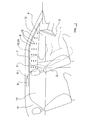
- a safety device which is intended to provide protection for an occupant 1 of a front seat 2 in a motor vehicle.
- the occupant 1 In a frontal impact in which the vehicle is caused to decelerate rapidly, the occupant 1 will tend to move forwardly relative to the vehicle towards the steering wheel 3, but will be restrained by a conventional seat-belt and airbag.
- a side impact or roll-over incident there is a risk that the head of the occupant 1 will strike the side of the vehicle and in particular the front side window 4, or that the head of the occupant 1 will strike the B-post 5 of the vehicle.
- the side window 4 breaks, the head of the occupant 1 may be thrown out of the window aperture, especially in the case of a roll-over incident.
- the safety device is shown in figure 1 in an operative, deployed condition in which an inflatable element 6 is positioned between the head of the occupant and the side of the vehicle. Prior to deployment of the safety device, the inflatable element 6 is retained in a recess 7 provided in the roof lining of the vehicle.
- the safety device comprises the inflatable element 6, a gas generator 8 which is fluidly connected to the inflatable element 6 by a hose or duct 9, and a sensor (not shown) which is configured to sense the occurrence or likely occurrence of a side impact or roll-over situation and which serves to activate the gas generator 8 in order to supply a large volume of inflating gas to the inflatable element 6.
- the inflatable element 6 is formed from two opposed layers of fabric 10, 11 which are interwoven at predetermined regions so as to form the periphery of the bag or enclosure constituting the inflatable element.
- the inflatable element 6 may be regarded has having a front part and rear part, each being formed from a woven layer of fabric.
- a technique for making an inflatable element 6 of interwoven fabric is described in more detail in International Patent Publication WO90/09295 .
- the upper edge of the inflatable element 6 is fixed to part of the roof of the vehicle and that it extends, when in the inflated condition as illustrated in figure 1 , downwardly from the roof line so as to be positioned between the head of the occupant 1 and the side of the vehicle.
- the inflatable element 6 is relatively thin the lateral direction, that is to say in a direction extending into the plane of the drawing of figure 1 , and may have a thickness of approximately 30 to 40 mm in that direction.
- the inflatable element 6 of the device illustrated in figure 1 extends rearwardly from the A-post 12 of the vehicle to a position slightly to the rear of the B-post 5 so that, when in the deployed configuration illustrated in figure 1 , the safety device affords protection against the head of the front-seat occupant 1 striking the front side window 4 and/or the B-post 5.
- the inflatable element extends rearwardly from the A-post 12 past the B-post and the rear side window 13 and all the way to the C-post 14, in order also to afford protection against the head of a rear seat occupant (not shown) striking the rear side window 13 and/or the C-post 14.
- the two opposed layers of fabric 10, 11 which form in the inflatable element are interconnected at selected positions 15 by way of tethers formed internally of the inflatable element.
- the construction of the tethers will be described in more detail below, but it can be seen from the location of the exemplary selected positions 15 illustrated in figure 1 , that whilst the tethers interconnect the opposed layers of fabric 10, 11, they do not serve to partition individual cells within the inflatable element.
- the locations of the tether positions 15 allow the inflatable element 6 to retain an open internal structure whilst still preventing ballooning by defining regions in which the two layers of fabric 10, 11 are tethered to one another.
- the gas generator 8 is activated and gas from the generator inflates the inflatable element 6, which moves from its initial stored position within the recess 7 to the inflated or operative condition shown in figure 1 .
- the open internal structure of the inflatable element 6 provided by the tethers (described in more detail below) at positions 15 permits gas to flow rapidly and easily into all regions of the inflatable element 6, whilst the tethers prevent excessive movement of the two fabric layers 10, 11 apart from one another which would result in ballooning.
- the two layers of fabric 10, 11 are each woven from warp yarns 16 and weft yarns 17 in a generally conventional manner.
- additional tether yarns 18 are also woven into the weave of the fabric, as illustrated most clearly in figure 3 but also shown schematically in figure 2 .
- the tether yarns 18 are woven so as to extend substantially parallel with the weft yarns 17 of the fabric, and pass over and under successive warp yarns 16.
- the tether yarns 18 have a different construction to the warp and weft yarns 16, 17 of the fabric layers, as will be described in more detail below.
- the tether yarns 18 pass out of the respective fabric layer 10, 11 in which they are woven and extend towards the opposing layer 11, 10.
- the tether yarns 18 each actually extend into the opposing fabric layer 11, 10 and are woven integrally with it.
- the tether yarns 18 are arranged to cross one another at the tether position 15, passing out of one fabric layer 10, 11 and extending into the other fabric layer 11, 10.
- the tether yarns 18 thus cooperate to define a tether 19 which serves to interconnect the two fabric layers 10, 11 within the inflatable element 6.
- each tether 19 may be defined by a plurality of tether yarns 18; in this case two pairs of crossing tether yarns 18. It is also to be noted that the tether 19 represents a somewhat loose collection of tether yarns 18 rather than a group of tightly bound or woven tether yarns.
- Figure 3 illustrates the two fabric layers 10, 11 located generally adjacent one another, as would be the situation in the uninflated condition of the inflatable element 6. As will be noted, the tether yarns 18 thus cooperate to resist further movement of the two layers 10, 11 apart from one another.
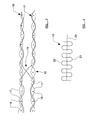
- Each tether yarn 18 takes the form of a composite yarn comprising a relatively weak core thread 20 over which is provided a relatively strong outer thread 21. More particularly, the core thread 20 is formed as a twisted or textured thread and the outer thread 21 is twisted around and over the core thread 20 in an overfeed manner so as to form a plurality of twists or ravels 22 along the length of the core thread 20. Thus, for any given length of the composite tether thread 18, the outer thread 21 is substantially longer than the core thread 20, and is initially bunched up along the core thread in twists or ravels 22.
- the outer thread 21 is furthermore configured so as to have a higher breaking strength in tension than the core thread 20. More particularly, the outer thread 21 is sufficiently strong not to break during inflation of the inflatable element 6, whilst the core thread is actually configured to break upon the application of tension as the inflatable element 6 is inflated and hence as the two fabric layers 10, 11 are driven further apart from the initial condition illustrated in figure 3 .
- Figures 5 and 6 illustrate the behaviour of the tether yarns 18 during inflation of the inflatable element. Having particular regard to Figure 6 , it can be seen that as the inflatable element increases in lateral thickness under inflation, the two layers 10, 11 will be driven apart. Initially, movement of the layers 10, 11 in this way will be resisted by the core threads 20 of the tether yarns, but as inflation continues a point is reached at which the strength of the core threads 20 is overcome by the internal pressure of the inflating gas within the inflatable element.
- the core threads 20 will break, as illustrated at 23 in figures 5 and 6 , whereupon the tether yarns 18 rapidly increase in length as the longer outer threads 21 unravel along the region of the tether yarns extending between the two fabric layers to take up the slack in the tether yarns 18.
- the longer outer threads 21 will eventually be drawn taught so as to define a limit to the movement of the fabric layers apart from one another, thereby preventing ballooning of the inflatable element 6.
- the composite construction of the tether yarns 18 makes them extendible in length, thereby preventing the regions of the tether yarns which are woven into the weave of the two fabric layers 10, 11 from being pulled through the fabric layers, which would result in longitudinal contraction of the fabric layers.
- the composite tether yarns 18 of the invention thus offer significant advantages over previously proposed "tether weave" arrangements because they allow a reduction in the amount of longitudinal contraction of the inflatable element which occurs as it increases in lateral thickness during inflation.
- the relative lengths of the core threads 20 and the outer threads 21 are largely dependant upon the actual dimensions and configuration of the inflatable element.
- the outer threads 21 will be applied to the core threads 21 with an overfeed of at least 20%, and most preferably 25%.
- the difference in strength between the core threads 20 and the outer threads 21 of each tether yarn 18 will be achieved by configuring the outer threads 21 to have a higher linear mass density than the core threads 20.
- the outer threads 21 preferably have a linear mass density which is at least 4 times that of the core threads. More particularly, it is proposed that the core thread of each tether yarn will have a linear mass density in the range 80-110 dtx, whilst the outer thread will have a linear mass density in the range 450-500 dtx, and preferably approximately 470 dtx.
- tether yarns 18 are grouped together to define discrete tethers 19 at selected positions 15 within the inflatable element
- other arrangements are also possible without departing from the scope of the present invention.
- a plurality of tether yarns 18 could be provided, each extending between the two fabric layers 10, 11 at regularly spaced-apart, or random, or quasi-random positions throughout the inflatable element.
- inflatable elements in the form of so-called “inflatable curtains” arranged for deployment between the head of a vehicle occupant and the side of the vehicle
- the invention could also find application in safety devices comprising other forms of inflatable element.
- the present invention could also be provided as part of an inflatable airbag intended for deployment elsewhere in or on a motor vehicle such as a frontal airbag or a knee airbag or the like, or even externally arranged pedestrian protection airbags.
- the invention is not restricted to so-called inflatable curtain arrangements.
Landscapes
- Engineering & Computer Science (AREA)
- Mechanical Engineering (AREA)
- Textile Engineering (AREA)
- Air Bags (AREA)
- Woven Fabrics (AREA)
Abstract
Description
- THE PRESENT INVENTION relates to a safety device, and more particularly a safety device in the form of an inflatable element provided in a motor vehicle such as a motor car in order to afford protection for an occupant of the vehicle.
- It has previously been proposed to provide an inflatable element or air bag in a motor vehicle in a position such that in the event of an accident involving a side impact or a roll-over incident, the inflated element is inflated so as to become disposed between the side of the vehicle and the head of a vehicle occupant in order to protect against the occupant's head coming into contact with or passing through a window in the side of the vehicle. Inflatable elements of this type are generally known as "inflatable curtains".
- It has been proposed to divide the inflatable element into a plurality of interconnected "cells" by forming the element from two woven layers of fabric with selected regions of the two fabric layers being woven together by a so-called one-piece weaving technique in order to interconnect the two layers and thereby define the periphery of each of the cells. The interwoven regions which define the periphery of each of the cells may be relatively large, thereby reducing the overall volume of the inflatable cells and the volume of gas which is required to inflate the element such that the element may be inflated more quickly. Dividing these inflatable elements into a plurality of cells prevents the element from "ballooning" when inflated, thereby enabling the inflated shape of the element to be controlled.
- However, dividing the inflatable element into a plurality of cells by weaving together the two layers of fabric which form the element in selected regions also has certain disadvantages. It is not as easy to control the inflation of a large number of small cells as it is to control the inflation of one or two larger chambers. Thus, whilst the volume of gas required to inflate the element may be reduced, the regions where the two layers of fabric are woven together present obstructions to the natural flow of gas into the inflatable element during inflation and these interwoven regions may therefore impede the inflating flow of gas and result in the element inflating in a manner which is not exactly as desired.
- In order to address these problems it has therefore been proposed to prevent ballooning and to control the inflated shape of such inflatable elements by means other than dividing them into cells by a one-piece weaving technique. One such proposal is to use a so-called "tether weave" to provide a number of discrete tethers between the two opposed layers of fabric defining the inflatable element. An arrangement of this type is proposed in
US 6,296,276 in which internal tethers are defined within the inflatable element by threads which form an integral part of the weave of the fabric layers. Such a tether is defined by threads which depart from the weave of one of the two layers of fabric and extend towards and into the weave of the other layer of fabric at discrete points. The resulting inflatable element has a more open internal structure than the one-piece-woven multiple-cell type, with the threads serving as tethers between the two layers of fabric to prevent ballooning but without representing significant obstacles to the flow of inflating gas. - However, it has been found that conventional "tether weave" arrangements of the type described above have their own problems. One such problem is that as the two fabric layers move apart from one another during inflation of the inflatable element, the threads defining the tethers are pulled through the weave of the two layers, thereby causing the inflatable element to contract in a longitudinal direction compared to its flat uninflated condition. In the case of a typical inflatable curtain arrangement, this contraction can be of the order of 25% of the uninflated length of the curtain. This is a problem which is more significant for tether weave arrangements than one-piece woven arrangements. For example, a conventional inflatable curtain of a one-piece woven construction for a motor car might contract in length by approximately 96mm as it inflates, whereas a comparable curtain of conventional tether weave construction can contract by as much as 135mm. As will be appreciated, this can significantly affect the coverage of the inflated curtain and hence its effectiveness in preventing injury.
- The present invention seeks to provide an improved safety device of the type described above.
- According to a first aspect of the present invention there is provided a safety device for a motor vehicle, the device comprising an inflatable element formed from two opposing layers of fabric, the two layers of fabric being interconnected by a plurality of tether yarns extending between said layers within the inflatable element, wherein each said tether yarn is a composite yarn comprising an outer thread and a core thread, the outer thread being overfed on the core thread and having a higher breaking strength than the core thread.
- Preferably, said tether yarns are configured such that their outer threads remain substantially intact but their core threads break upon inflation of said inflatable element, thereby permitting the outer threads to unravel and thus extend the effective length of the tether yarns between said layers.
- Advantageously, the outer thread of each tether yarn is provided over the core thread with an overfeed of at least 10%
- Conveniently, the outer thread of each tether yarn is provided over the core thread with an overfeed of approximately 15%.
- Preferably, the outer thread of each tether yarn is twisted over and around the core thread.
- Advantageously, the outer thread of each tether yarn has a linear mass density at least 4 times that of the core thread.
- Conveniently, the core thread of each tether yarn has a linear mass density in the range 80-110 dtx.
- Preferably, the outer thread of each tether yarn has a linear mass density in the range 450-1100 dtx.
- Advantageously, the outer thread of each tether yarn has a linear mass density of approximately 470 dtx.
- Conveniently, said tether yarns are grouped together so as to collectively define at least one tether interconnecting said layers of fabric at a predetermined position and disposed internally within the inflatable element. The tether may represent a loose collection of tether yarns rather than tightly bound or woven tether yarns.
- Advantageously, the safety device comprises a plurality of said tethers arranged to interconnect said layers of fabric at respective and discrete positions.
- Preferably, said tether yarns are each woven into the weave of at least one said layer.
- Advantageously, said tether yarns are woven into both layers of fabric.
- Conveniently, said tether yarns have a different construction from the warp and weft yarns from which said layers of fabric are predominantly woven.
- Preferably, said tether yarns are the only composite yarns.
- According to another aspect of the present invention, there is provided a safety device of the type defined above, provided in a motor vehicle such that the inflatable element is configured to be disposed between an occupant of the vehicle and the side of the vehicle when inflated to afford protection in the event of a side impact or roll-over incident.
- So that the invention may be more readily understood, and so that further features thereof may be appreciated, embodiments of the invention will now be described by way of example with reference to the accompanying drawings in which:
-
Figure 1 is a side view of part of the interior of a motor vehicle, illustrating a safety device in accordance with the present invention in an operative position; -
Figure 2 is a perspective view of a section through part of the inflatable element, showing an internal tether arrangement in accordance with the present invention; -
Figure 3 is a transverse cross-sectional view through part of the inflatable element, in an uninflated condition prior to deployment; -
Figure 4 is a schematic representation of a composite tether yarn in a first condition; -
Figure 5 is a schematic representation of the composite tether yarn in a second condition; and -
Figure 6 is view corresponding generally to that offigure 3 , but showing the inflatable element in an inflated condition after deployment. - Referring initially to
Figure 1 of the accompanying drawings, a safety device is illustrated which is intended to provide protection for an occupant 1 of afront seat 2 in a motor vehicle. In a frontal impact in which the vehicle is caused to decelerate rapidly, the occupant 1 will tend to move forwardly relative to the vehicle towards thesteering wheel 3, but will be restrained by a conventional seat-belt and airbag. In the case of a side impact or roll-over incident, however, there is a risk that the head of the occupant 1 will strike the side of the vehicle and in particular thefront side window 4, or that the head of the occupant 1 will strike the B-post 5 of the vehicle. There is also a risk that if theside window 4 breaks, the head of the occupant 1 may be thrown out of the window aperture, especially in the case of a roll-over incident. - The safety device is shown in
figure 1 in an operative, deployed condition in which aninflatable element 6 is positioned between the head of the occupant and the side of the vehicle. Prior to deployment of the safety device, theinflatable element 6 is retained in a recess 7 provided in the roof lining of the vehicle. - The safety device comprises the
inflatable element 6, agas generator 8 which is fluidly connected to theinflatable element 6 by a hose or duct 9, and a sensor (not shown) which is configured to sense the occurrence or likely occurrence of a side impact or roll-over situation and which serves to activate thegas generator 8 in order to supply a large volume of inflating gas to theinflatable element 6. Theinflatable element 6 is formed from two opposed layers offabric inflatable element 6 may be regarded has having a front part and rear part, each being formed from a woven layer of fabric. A technique for making aninflatable element 6 of interwoven fabric is described in more detail in International Patent PublicationWO90/09295 - It will be appreciated that the upper edge of the
inflatable element 6 is fixed to part of the roof of the vehicle and that it extends, when in the inflated condition as illustrated infigure 1 , downwardly from the roof line so as to be positioned between the head of the occupant 1 and the side of the vehicle. Theinflatable element 6 is relatively thin the lateral direction, that is to say in a direction extending into the plane of the drawing offigure 1 , and may have a thickness of approximately 30 to 40 mm in that direction. - It will be noted that the
inflatable element 6 of the device illustrated infigure 1 extends rearwardly from theA-post 12 of the vehicle to a position slightly to the rear of the B-post 5 so that, when in the deployed configuration illustrated infigure 1 , the safety device affords protection against the head of the front-seat occupant 1 striking thefront side window 4 and/or the B-post 5. However, it is to be appreciated that embodiments of the invention are also envisaged in which the inflatable element extends rearwardly from theA-post 12 past the B-post and therear side window 13 and all the way to the C-post 14, in order also to afford protection against the head of a rear seat occupant (not shown) striking therear side window 13 and/or the C-post 14. - In order to prevent the
inflatable element 6 from ballooning upon inflation, the two opposed layers offabric positions 15 by way of tethers formed internally of the inflatable element. The construction of the tethers will be described in more detail below, but it can be seen from the location of the exemplary selectedpositions 15 illustrated infigure 1 , that whilst the tethers interconnect the opposed layers offabric tether positions 15 allow theinflatable element 6 to retain an open internal structure whilst still preventing ballooning by defining regions in which the two layers offabric gas generator 8 is activated and gas from the generator inflates theinflatable element 6, which moves from its initial stored position within the recess 7 to the inflated or operative condition shown infigure 1 . The open internal structure of theinflatable element 6 provided by the tethers (described in more detail below) atpositions 15 permits gas to flow rapidly and easily into all regions of theinflatable element 6, whilst the tethers prevent excessive movement of the twofabric layers - Turning now to consider
figures 2 and3 , it will be noted that the two layers offabric warp yarns 16 and weftyarns 17 in a generally conventional manner. However, at selected positions throughout thelayers additional tether yarns 18 are also woven into the weave of the fabric, as illustrated most clearly infigure 3 but also shown schematically infigure 2 . Thetether yarns 18 are woven so as to extend substantially parallel with theweft yarns 17 of the fabric, and pass over and undersuccessive warp yarns 16. Thetether yarns 18 have a different construction to the warp andweft yarns - In the region of the
predetermined tether positions 15, thetether yarns 18 pass out of therespective fabric layer layer figures 2 and3 , thetether yarns 18 each actually extend into the opposingfabric layer figure 3 , thetether yarns 18 are arranged to cross one another at thetether position 15, passing out of onefabric layer other fabric layer tether yarns 18 thus cooperate to define atether 19 which serves to interconnect the twofabric layers inflatable element 6. As illustrated infigure 2 , eachtether 19 may be defined by a plurality oftether yarns 18; in this case two pairs of crossingtether yarns 18. It is also to be noted that thetether 19 represents a somewhat loose collection oftether yarns 18 rather than a group of tightly bound or woven tether yarns.Figure 3 illustrates the twofabric layers inflatable element 6. As will be noted, thetether yarns 18 thus cooperate to resist further movement of the twolayers - The construction of the
tether yarns 18 is an important aspect of the present invention, and will now be described with reference tofigures 4 and5 . - Each
tether yarn 18 takes the form of a composite yarn comprising a relativelyweak core thread 20 over which is provided a relatively strongouter thread 21. More particularly, thecore thread 20 is formed as a twisted or textured thread and theouter thread 21 is twisted around and over thecore thread 20 in an overfeed manner so as to form a plurality of twists orravels 22 along the length of thecore thread 20. Thus, for any given length of thecomposite tether thread 18, theouter thread 21 is substantially longer than thecore thread 20, and is initially bunched up along the core thread in twists or ravels 22. - The
outer thread 21 is furthermore configured so as to have a higher breaking strength in tension than thecore thread 20. More particularly, theouter thread 21 is sufficiently strong not to break during inflation of theinflatable element 6, whilst the core thread is actually configured to break upon the application of tension as theinflatable element 6 is inflated and hence as the twofabric layers figure 3 . -
Figures 5 and 6 illustrate the behaviour of thetether yarns 18 during inflation of the inflatable element. Having particular regard toFigure 6 , it can be seen that as the inflatable element increases in lateral thickness under inflation, the twolayers layers core threads 20 of the tether yarns, but as inflation continues a point is reached at which the strength of thecore threads 20 is overcome by the internal pressure of the inflating gas within the inflatable element. At this point thecore threads 20 will break, as illustrated at 23 infigures 5 and 6 , whereupon thetether yarns 18 rapidly increase in length as the longerouter threads 21 unravel along the region of the tether yarns extending between the two fabric layers to take up the slack in thetether yarns 18. The longerouter threads 21 will eventually be drawn taught so as to define a limit to the movement of the fabric layers apart from one another, thereby preventing ballooning of theinflatable element 6. - As will be appreciated, the composite construction of the
tether yarns 18 makes them extendible in length, thereby preventing the regions of the tether yarns which are woven into the weave of the twofabric layers composite tether yarns 18 of the invention thus offer significant advantages over previously proposed "tether weave" arrangements because they allow a reduction in the amount of longitudinal contraction of the inflatable element which occurs as it increases in lateral thickness during inflation. - As will be appreciated, the relative lengths of the
core threads 20 and theouter threads 21 are largely dependant upon the actual dimensions and configuration of the inflatable element. However, it is proposed that for inflatable elements provided in the form of so-called "inflatable curtains" for side-impact or roll-over protection, theouter threads 21 will be applied to thecore threads 21 with an overfeed of at least 20%, and most preferably 25%. - It is also proposed that the difference in strength between the
core threads 20 and theouter threads 21 of eachtether yarn 18 will be achieved by configuring theouter threads 21 to have a higher linear mass density than thecore threads 20. For example, theouter threads 21 preferably have a linear mass density which is at least 4 times that of the core threads. More particularly, it is proposed that the core thread of each tether yarn will have a linear mass density in the range 80-110 dtx, whilst the outer thread will have a linear mass density in the range 450-500 dtx, and preferably approximately 470 dtx. - It is to be appreciated that whilst the invention has been described above with specific reference to an embodiment in which
tether yarns 18 are grouped together to definediscrete tethers 19 at selectedpositions 15 within the inflatable element, other arrangements are also possible without departing from the scope of the present invention. For example, it is envisaged that a plurality oftether yarns 18 could be provided, each extending between the twofabric layers - Furthermore, whilst the invention has been described above with particular reference to inflatable elements in the form of so-called "inflatable curtains" arranged for deployment between the head of a vehicle occupant and the side of the vehicle, it is to be noted that the invention could also find application in safety devices comprising other forms of inflatable element. For example, it is envisaged that the present invention could also be provided as part of an inflatable airbag intended for deployment elsewhere in or on a motor vehicle such as a frontal airbag or a knee airbag or the like, or even externally arranged pedestrian protection airbags. The invention is not restricted to so-called inflatable curtain arrangements.
- When used in this specification and claims, the terms "comprises" and "comprising" and variations thereof mean that the specified features, steps or integers are included. The terms are not to be interpreted to exclude the presence of other features, steps or integers.
- The features disclosed in the foregoing description, or in the following claims, or in the accompanying drawings, expressed in their specific forms or in terms of a means for performing the disclosed function, or a method or process for obtaining the disclosed results, as appropriate, may, separately, or in any combination of such features, be utilised for realising the invention in diverse forms thereof.
- While the invention has been described in conjunction with the exemplary embodiments described above, many equivalent modifications and variations will be apparent to those skilled in the art when given this disclosure. Accordingly, the exemplary embodiments of the invention set forth above are considered to be illustrative and not limiting. Various changes to the described embodiments may be made without departing from the spirit and scope of the invention.
Claims (15)
- A safety device for a motor vehicle, the device comprising an inflatable element (6) formed from two opposing layers of fabric (10, 11), the two layers of fabric (10, 11) being interconnected by a plurality of tether yarns (18) extending between said layers within the inflatable element (6), the safety device being characterised in that each said tether yarn (18) is a composite yarn comprising an outer thread (21) and a core thread (20), the outer thread (21) being overfed on the core thread (20) and having a higher breaking strength than the core thread (20).
- A safety device according to claim 1, wherein said tether yarns (18) are configured such that their outer threads (21) remain substantially intact but their core threads (20) break upon inflation of said inflatable element (6), thereby permitting the outer threads (21) to unravel and thus extend the effective length of the tether yarns (18) between said layers (10, 11).
- A safety device according to claim 1 or claim 2, wherein the outer thread (21) of each tether yarn (18) is provided over the core thread (20) with an overfeed of at least 10%
- A safety device according to any preceding claim, wherein the outer thread (21) of each tether yarn (18) is provided over the core thread with an overfeed of approximately 15%.
- A safety device according to any preceding claim, wherein the outer thread (21) of each tether yarn (18) is twisted over and around the core thread (20).
- A safety device according to any preceding claim, wherein the outer thread (21) of each tether yarn (18) has a linear mass density at least 4 times that of the core thread (20).
- A safety device according to any preceding claim, wherein the core thread (20) of each tether yarn (18) has a linear mass density in the range 80-110 dtx.
- A safety device according to any preceding claim, wherein the outer thread (21) of each tether yarn (18) has a linear mass density in the range 450-1100 dtx.
- A safety device according to any preceding claim, wherein the outer thread (21) of each tether yarn (18) has a linear mass density of approximately 470 dtx.
- A safety device according to any preceding claim wherein said tether yarns (18) are grouped together so as to collectively define at least one tether (19) interconnecting said layers of fabric (10, 11) at predetermined positions and disposed internally within the inflatable element (6).
- A safety device according to claim 10, comprising a plurality of said tethers (19) arranged to interconnect said layers of fabric (10, 11) at respective and discrete positions (15).
- A safety device according to any preceding claim, wherein said tether yarns (18) are each woven into the weave of at least one said layer (10, 11).
- A safety device according to any preceding claim, wherein said tether yarns (18) have a different construction from the warp and weft yarns (16, 17) from which said layers of fabric (10, 11) are predominantly woven.
- A safety device according to claim 13, in which said tether yarns (18) are the only composite yarns.
- A safety device according to any preceding claim provided in a motor vehicle such that the inflatable element (6) is configured to be disposed between an occupant (1) of the vehicle and the side (4) of the vehicle when inflated to afford protection in the event of a side impact or roll-over incident.
Priority Applications (3)
| Application Number | Priority Date | Filing Date | Title |
|---|---|---|---|
| EP20100251282 EP2407353B1 (en) | 2010-07-16 | 2010-07-16 | A motor vehicle safety device |
| PCT/EP2011/003463 WO2012031643A1 (en) | 2010-07-16 | 2011-07-12 | A motor vehicle safety device |
| US13/809,755 US8622424B2 (en) | 2010-07-16 | 2011-07-12 | Motor vehicle safety device |
Applications Claiming Priority (1)
| Application Number | Priority Date | Filing Date | Title |
|---|---|---|---|
| EP20100251282 EP2407353B1 (en) | 2010-07-16 | 2010-07-16 | A motor vehicle safety device |
Publications (2)
| Publication Number | Publication Date |
|---|---|
| EP2407353A1 true EP2407353A1 (en) | 2012-01-18 |
| EP2407353B1 EP2407353B1 (en) | 2013-03-27 |
Family
ID=43431142
Family Applications (1)
| Application Number | Title | Priority Date | Filing Date |
|---|---|---|---|
| EP20100251282 Active EP2407353B1 (en) | 2010-07-16 | 2010-07-16 | A motor vehicle safety device |
Country Status (3)
| Country | Link |
|---|---|
| US (1) | US8622424B2 (en) |
| EP (1) | EP2407353B1 (en) |
| WO (1) | WO2012031643A1 (en) |
Cited By (7)
| Publication number | Priority date | Publication date | Assignee | Title |
|---|---|---|---|---|
| EP2769885A1 (en) * | 2013-02-22 | 2014-08-27 | Autoliv Development AB | An air-bag |
| WO2015057140A1 (en) * | 2013-10-15 | 2015-04-23 | Autoliv Development Ab | A safety device |
| US9873401B2 (en) | 2016-02-26 | 2018-01-23 | Autoliv Asp, Inc. | Airbag fabric including apertures and methods of forming the same |
| CN108136990A (en) * | 2015-10-16 | 2018-06-08 | 奥托里夫Asp股份有限公司 | Airbag including internal tether and method of forming same |
| DE102021129762A1 (en) | 2021-11-15 | 2023-05-17 | Autoliv Development Ab | An air bag |
| DE102021129766A1 (en) | 2021-11-15 | 2023-05-17 | Autoliv Development Ab | An air bag |
| DE102022134130A1 (en) | 2022-12-20 | 2024-06-20 | Autoliv Development Ab | AIRBAG |
Families Citing this family (14)
| Publication number | Priority date | Publication date | Assignee | Title |
|---|---|---|---|---|
| DE102012005790A1 (en) * | 2012-03-21 | 2013-09-26 | Global Safety Textiles Gmbh | Textile lever device |
| JP5204912B1 (en) * | 2012-04-23 | 2013-06-05 | 住商エアバッグ・システムズ株式会社 | Bag |
| DE102012008114A1 (en) * | 2012-04-25 | 2013-10-31 | Trw Automotive Gmbh | Airbag for a vehicle occupant restraint system |
| EP3020607B1 (en) * | 2013-07-09 | 2018-08-29 | Sumisho Airbag Systems Co., Ltd. | Air-bag |
| DE102015108423A1 (en) * | 2015-05-28 | 2015-09-17 | Takata AG | Airbag for an airbag module |
| JP6376704B2 (en) * | 2016-02-19 | 2018-08-22 | 住商エアバッグ・システムズ株式会社 | Bag |
| EP3263408B1 (en) * | 2016-06-29 | 2019-10-09 | Autoliv Development AB | A vehicle air-bag |
| DE102017117311A1 (en) * | 2017-07-31 | 2019-01-31 | Trw Automotive Gmbh | airbag |
| WO2019049930A1 (en) * | 2017-09-07 | 2019-03-14 | 住商エアバッグ・システムズ株式会社 | Airbag |
| TWI643767B (en) * | 2018-03-08 | 2018-12-11 | 劉俊男 | Window structure for preventing personnel from being thrown out |
| DE102018124099B3 (en) * | 2018-09-28 | 2019-08-22 | Global Safety Textiles Gmbh | In a piece woven airbag |
| DE102020206517B3 (en) * | 2020-05-26 | 2021-04-22 | Autoliv Development Ab | Belt strap for a seat belt device of a motor vehicle |
| DE102022103225A1 (en) | 2022-02-11 | 2023-08-17 | Zf Automotive Germany Gmbh | Gas bag for a vehicle occupant restraint system |
| KR20240040517A (en) * | 2022-09-21 | 2024-03-28 | 코오롱인더스트리 주식회사 | Gas inflatable fabric |
Citations (6)
| Publication number | Priority date | Publication date | Assignee | Title |
|---|---|---|---|---|
| WO1990009295A2 (en) | 1989-02-16 | 1990-08-23 | Airbags International Limited | Air bag |
| US5768875A (en) * | 1993-03-17 | 1998-06-23 | Rhone-Poulenc Viscosuisse S.A. | Filter fabric with core sheating thread, and a bag produced therefrom |
| US5997037A (en) * | 1997-09-22 | 1999-12-07 | Trw Vehicle Safety Systems Inc. | Air bag with tether |
| US6296276B1 (en) | 1999-09-01 | 2001-10-02 | Trw Occupant Restraint Systems Gmbh & Co. Kg | Gas bag |
| WO2007022147A2 (en) * | 2005-08-15 | 2007-02-22 | Safety Components Fabric Technologies, Inc. | One-piece woven air bag with tethers |
| US20070200329A1 (en) * | 2006-02-27 | 2007-08-30 | Key Safety Systems, Inc. | Woven air bag with integrally woven 3-D tethers |
Family Cites Families (13)
| Publication number | Priority date | Publication date | Assignee | Title |
|---|---|---|---|---|
| EP0586951B1 (en) * | 1992-08-26 | 1999-10-06 | Hoechst Aktiengesellschaft | Bicomponent looped yarns with a fine yarn count and high strength, method of production and their use as sewing and embroidery threads |
| EP0591827B1 (en) * | 1992-10-03 | 1999-08-25 | Hoechst Aktiengesellschaft | Core yarn comprising a core of high-strength polyester material and method of manufacturing the same |
| DE19953563A1 (en) * | 1998-11-09 | 2000-05-11 | Trw Repa Gmbh | Vehicle side airbag has retaining catch system of loose coiled threads between woven fabric layers to be pulled out on inflation and hold layers together with given gap between them |
| US6299965B1 (en) * | 1999-11-17 | 2001-10-09 | Milliken & Company | Inflatable fabrics comprising peel seams which become shear seams upon inflation |
| US6701703B2 (en) * | 2001-10-23 | 2004-03-09 | Gilbert Patrick | High performance yarns and method of manufacture |
| US6712389B2 (en) * | 2002-02-01 | 2004-03-30 | Trw Vehicle Safety Systems Inc. | Air bag with tether |
| DE10352666B3 (en) * | 2003-11-11 | 2005-04-14 | Trw Occupant Restraint Systems Gmbh & Co. Kg | Automotive air bag passenger head restraint system is held at readiness by crossed threads and rip thread |
| DE102004023904B3 (en) * | 2004-05-13 | 2005-09-08 | Trw Automotive Gmbh | Airbag for motor vehicle occupant restraint system has pair of fabric side panels defining entrance passage for gas into main bag |
| WO2006086247A2 (en) * | 2005-02-07 | 2006-08-17 | Safety Components Fabric Technologies, Inc. | Vehicle air bag constructed from a composite film |
| DE102005061351A1 (en) * | 2005-12-21 | 2007-07-05 | Bst Safety Textiles Gmbh | Production method for woven fabric of air bag of personnel restraint system in motor vehicles, involves preparing warp thread sheet of different yarn qualities with warp thread |
| US7770607B2 (en) * | 2006-08-21 | 2010-08-10 | Autoliv Asp, Inc. | Double weft/warp airbag fabric and related airbags and manufacturing methods |
| US8544883B2 (en) * | 2007-06-21 | 2013-10-01 | Trw Vehicle Safety Systems Inc. | Tear stitching for inflatable vehicle occupant protection devices |
| US10125436B2 (en) * | 2007-11-09 | 2018-11-13 | Invista North America S.A R.L. | High tenacity low shrinkage polyamide yarns |
-
2010
- 2010-07-16 EP EP20100251282 patent/EP2407353B1/en active Active
-
2011
- 2011-07-12 WO PCT/EP2011/003463 patent/WO2012031643A1/en not_active Ceased
- 2011-07-12 US US13/809,755 patent/US8622424B2/en active Active
Patent Citations (6)
| Publication number | Priority date | Publication date | Assignee | Title |
|---|---|---|---|---|
| WO1990009295A2 (en) | 1989-02-16 | 1990-08-23 | Airbags International Limited | Air bag |
| US5768875A (en) * | 1993-03-17 | 1998-06-23 | Rhone-Poulenc Viscosuisse S.A. | Filter fabric with core sheating thread, and a bag produced therefrom |
| US5997037A (en) * | 1997-09-22 | 1999-12-07 | Trw Vehicle Safety Systems Inc. | Air bag with tether |
| US6296276B1 (en) | 1999-09-01 | 2001-10-02 | Trw Occupant Restraint Systems Gmbh & Co. Kg | Gas bag |
| WO2007022147A2 (en) * | 2005-08-15 | 2007-02-22 | Safety Components Fabric Technologies, Inc. | One-piece woven air bag with tethers |
| US20070200329A1 (en) * | 2006-02-27 | 2007-08-30 | Key Safety Systems, Inc. | Woven air bag with integrally woven 3-D tethers |
Cited By (13)
| Publication number | Priority date | Publication date | Assignee | Title |
|---|---|---|---|---|
| EP2769885A1 (en) * | 2013-02-22 | 2014-08-27 | Autoliv Development AB | An air-bag |
| US10017147B2 (en) | 2013-10-15 | 2018-07-10 | Autoliv Development Ab | Safety device |
| WO2015057140A1 (en) * | 2013-10-15 | 2015-04-23 | Autoliv Development Ab | A safety device |
| EP3362324A4 (en) * | 2015-10-16 | 2019-06-12 | Autoliv ASP, Inc. | INFLATABLE SAFETY CUSHIONS COMPRISING INTERNAL ATTACHES AND METHODS OF FORMING THE SAME |
| CN108136990A (en) * | 2015-10-16 | 2018-06-08 | 奥托里夫Asp股份有限公司 | Airbag including internal tether and method of forming same |
| JP2018528897A (en) * | 2015-10-16 | 2018-10-04 | オートリブ エーエスピー,インコーポレイティド | Airbags including internal tethers and methods of forming them |
| US9873401B2 (en) | 2016-02-26 | 2018-01-23 | Autoliv Asp, Inc. | Airbag fabric including apertures and methods of forming the same |
| DE102021129762A1 (en) | 2021-11-15 | 2023-05-17 | Autoliv Development Ab | An air bag |
| DE102021129766A1 (en) | 2021-11-15 | 2023-05-17 | Autoliv Development Ab | An air bag |
| WO2023083551A1 (en) | 2021-11-15 | 2023-05-19 | Autoliv Development Ab | An airbag |
| WO2023083555A1 (en) | 2021-11-15 | 2023-05-19 | Autoliv Development Ab | An airbag |
| DE102022134130A1 (en) | 2022-12-20 | 2024-06-20 | Autoliv Development Ab | AIRBAG |
| WO2024132404A1 (en) | 2022-12-20 | 2024-06-27 | Autoliv Development Ab | An airbag |
Also Published As
| Publication number | Publication date |
|---|---|
| EP2407353B1 (en) | 2013-03-27 |
| US8622424B2 (en) | 2014-01-07 |
| US20130113195A1 (en) | 2013-05-09 |
| WO2012031643A1 (en) | 2012-03-15 |
Similar Documents
| Publication | Publication Date | Title |
|---|---|---|
| EP2407353B1 (en) | A motor vehicle safety device | |
| EP2086797B1 (en) | Airbag cover tear seam | |
| US6419263B1 (en) | Seatbelt system having seamless inflatable member | |
| EP3362324B1 (en) | Airbags including internal tethers and methods of forming the same | |
| US7458606B2 (en) | Air-bag | |
| EP3581441A1 (en) | A vehicle seat | |
| US8419059B2 (en) | Air-bag | |
| EP2607183B1 (en) | An inflatable airbag for a motor vehicle safety arrangement | |
| EP2520471B1 (en) | A pedestrian airbag arrangement | |
| GB2383306A (en) | Airbag with a fabric gas supply duct | |
| EP2862754B1 (en) | A safety device | |
| US9873401B2 (en) | Airbag fabric including apertures and methods of forming the same | |
| JP4451068B2 (en) | Airbag weaving method | |
| EP2452856B1 (en) | An inflatable airbag | |
| CN114514345A (en) | Multi-layer fabric | |
| KR200393134Y1 (en) | A structure of gas supply hose for vehicles air-bag device | |
| CN111051149A (en) | airbag | |
| JP2017087864A (en) | Head protection airbag | |
| KR20180121189A (en) | Air bags system comprising fabric with breaking area | |
| JP2009073219A (en) | Airbag |
Legal Events
| Date | Code | Title | Description |
|---|---|---|---|
| 17P | Request for examination filed |
Effective date: 20110726 |
|
| AK | Designated contracting states |
Kind code of ref document: A1 Designated state(s): AL AT BE BG CH CY CZ DE DK EE ES FI FR GB GR HR HU IE IS IT LI LT LU LV MC MK MT NL NO PL PT RO SE SI SK SM TR |
|
| AX | Request for extension of the european patent |
Extension state: BA ME RS |
|
| PUAI | Public reference made under article 153(3) epc to a published international application that has entered the european phase |
Free format text: ORIGINAL CODE: 0009012 |
|
| RTI1 | Title (correction) |
Free format text: A MOTOR VEHICLE SAFETY DEVICE |
|
| REG | Reference to a national code |
Ref country code: DE Ref legal event code: R079 Ref document number: 602010005779 Country of ref document: DE Free format text: PREVIOUS MAIN CLASS: B60R0021235000 Ipc: D03D0001020000 |
|
| GRAP | Despatch of communication of intention to grant a patent |
Free format text: ORIGINAL CODE: EPIDOSNIGR1 |
|
| RIC1 | Information provided on ipc code assigned before grant |
Ipc: D03D 11/02 20060101ALI20120724BHEP Ipc: D03D 1/02 20060101AFI20120724BHEP Ipc: B60R 21/2338 20110101ALI20120724BHEP Ipc: B60R 21/235 20060101ALI20120724BHEP |
|
| GRAP | Despatch of communication of intention to grant a patent |
Free format text: ORIGINAL CODE: EPIDOSNIGR1 |
|
| GRAS | Grant fee paid |
Free format text: ORIGINAL CODE: EPIDOSNIGR3 |
|
| GRAA | (expected) grant |
Free format text: ORIGINAL CODE: 0009210 |
|
| AK | Designated contracting states |
Kind code of ref document: B1 Designated state(s): AL AT BE BG CH CY CZ DE DK EE ES FI FR GB GR HR HU IE IS IT LI LT LU LV MC MK MT NL NO PL PT RO SE SI SK SM TR |
|
| REG | Reference to a national code |
Ref country code: GB Ref legal event code: FG4D |
|
| REG | Reference to a national code |
Ref country code: CH Ref legal event code: EP |
|
| REG | Reference to a national code |
Ref country code: AT Ref legal event code: REF Ref document number: 603483 Country of ref document: AT Kind code of ref document: T Effective date: 20130415 |
|
| REG | Reference to a national code |
Ref country code: IE Ref legal event code: FG4D |
|
| REG | Reference to a national code |
Ref country code: DE Ref legal event code: R096 Ref document number: 602010005779 Country of ref document: DE Effective date: 20130523 |
|
| PG25 | Lapsed in a contracting state [announced via postgrant information from national office to epo] |
Ref country code: SE Free format text: LAPSE BECAUSE OF FAILURE TO SUBMIT A TRANSLATION OF THE DESCRIPTION OR TO PAY THE FEE WITHIN THE PRESCRIBED TIME-LIMIT Effective date: 20130327 Ref country code: LT Free format text: LAPSE BECAUSE OF FAILURE TO SUBMIT A TRANSLATION OF THE DESCRIPTION OR TO PAY THE FEE WITHIN THE PRESCRIBED TIME-LIMIT Effective date: 20130327 Ref country code: BG Free format text: LAPSE BECAUSE OF FAILURE TO SUBMIT A TRANSLATION OF THE DESCRIPTION OR TO PAY THE FEE WITHIN THE PRESCRIBED TIME-LIMIT Effective date: 20130627 Ref country code: NO Free format text: LAPSE BECAUSE OF FAILURE TO SUBMIT A TRANSLATION OF THE DESCRIPTION OR TO PAY THE FEE WITHIN THE PRESCRIBED TIME-LIMIT Effective date: 20130627 |
|
| REG | Reference to a national code |
Ref country code: AT Ref legal event code: MK05 Ref document number: 603483 Country of ref document: AT Kind code of ref document: T Effective date: 20130327 |
|
| REG | Reference to a national code |
Ref country code: LT Ref legal event code: MG4D |
|
| PG25 | Lapsed in a contracting state [announced via postgrant information from national office to epo] |
Ref country code: GR Free format text: LAPSE BECAUSE OF FAILURE TO SUBMIT A TRANSLATION OF THE DESCRIPTION OR TO PAY THE FEE WITHIN THE PRESCRIBED TIME-LIMIT Effective date: 20130628 Ref country code: SI Free format text: LAPSE BECAUSE OF FAILURE TO SUBMIT A TRANSLATION OF THE DESCRIPTION OR TO PAY THE FEE WITHIN THE PRESCRIBED TIME-LIMIT Effective date: 20130327 Ref country code: LV Free format text: LAPSE BECAUSE OF FAILURE TO SUBMIT A TRANSLATION OF THE DESCRIPTION OR TO PAY THE FEE WITHIN THE PRESCRIBED TIME-LIMIT Effective date: 20130327 Ref country code: FI Free format text: LAPSE BECAUSE OF FAILURE TO SUBMIT A TRANSLATION OF THE DESCRIPTION OR TO PAY THE FEE WITHIN THE PRESCRIBED TIME-LIMIT Effective date: 20130327 |
|
| REG | Reference to a national code |
Ref country code: NL Ref legal event code: VDEP Effective date: 20130327 |
|
| PG25 | Lapsed in a contracting state [announced via postgrant information from national office to epo] |
Ref country code: HR Free format text: LAPSE BECAUSE OF FAILURE TO SUBMIT A TRANSLATION OF THE DESCRIPTION OR TO PAY THE FEE WITHIN THE PRESCRIBED TIME-LIMIT Effective date: 20130327 Ref country code: BE Free format text: LAPSE BECAUSE OF FAILURE TO SUBMIT A TRANSLATION OF THE DESCRIPTION OR TO PAY THE FEE WITHIN THE PRESCRIBED TIME-LIMIT Effective date: 20130327 |
|
| PG25 | Lapsed in a contracting state [announced via postgrant information from national office to epo] |
Ref country code: IS Free format text: LAPSE BECAUSE OF FAILURE TO SUBMIT A TRANSLATION OF THE DESCRIPTION OR TO PAY THE FEE WITHIN THE PRESCRIBED TIME-LIMIT Effective date: 20130727 Ref country code: NL Free format text: LAPSE BECAUSE OF FAILURE TO SUBMIT A TRANSLATION OF THE DESCRIPTION OR TO PAY THE FEE WITHIN THE PRESCRIBED TIME-LIMIT Effective date: 20130327 Ref country code: CZ Free format text: LAPSE BECAUSE OF FAILURE TO SUBMIT A TRANSLATION OF THE DESCRIPTION OR TO PAY THE FEE WITHIN THE PRESCRIBED TIME-LIMIT Effective date: 20130327 Ref country code: ES Free format text: LAPSE BECAUSE OF FAILURE TO SUBMIT A TRANSLATION OF THE DESCRIPTION OR TO PAY THE FEE WITHIN THE PRESCRIBED TIME-LIMIT Effective date: 20130708 Ref country code: SK Free format text: LAPSE BECAUSE OF FAILURE TO SUBMIT A TRANSLATION OF THE DESCRIPTION OR TO PAY THE FEE WITHIN THE PRESCRIBED TIME-LIMIT Effective date: 20130327 Ref country code: RO Free format text: LAPSE BECAUSE OF FAILURE TO SUBMIT A TRANSLATION OF THE DESCRIPTION OR TO PAY THE FEE WITHIN THE PRESCRIBED TIME-LIMIT Effective date: 20130327 Ref country code: EE Free format text: LAPSE BECAUSE OF FAILURE TO SUBMIT A TRANSLATION OF THE DESCRIPTION OR TO PAY THE FEE WITHIN THE PRESCRIBED TIME-LIMIT Effective date: 20130327 Ref country code: PT Free format text: LAPSE BECAUSE OF FAILURE TO SUBMIT A TRANSLATION OF THE DESCRIPTION OR TO PAY THE FEE WITHIN THE PRESCRIBED TIME-LIMIT Effective date: 20130729 Ref country code: AT Free format text: LAPSE BECAUSE OF FAILURE TO SUBMIT A TRANSLATION OF THE DESCRIPTION OR TO PAY THE FEE WITHIN THE PRESCRIBED TIME-LIMIT Effective date: 20130327 |
|
| PG25 | Lapsed in a contracting state [announced via postgrant information from national office to epo] |
Ref country code: PL Free format text: LAPSE BECAUSE OF FAILURE TO SUBMIT A TRANSLATION OF THE DESCRIPTION OR TO PAY THE FEE WITHIN THE PRESCRIBED TIME-LIMIT Effective date: 20130327 Ref country code: CY Free format text: LAPSE BECAUSE OF FAILURE TO SUBMIT A TRANSLATION OF THE DESCRIPTION OR TO PAY THE FEE WITHIN THE PRESCRIBED TIME-LIMIT Effective date: 20130327 |
|
| PG25 | Lapsed in a contracting state [announced via postgrant information from national office to epo] |
Ref country code: DK Free format text: LAPSE BECAUSE OF FAILURE TO SUBMIT A TRANSLATION OF THE DESCRIPTION OR TO PAY THE FEE WITHIN THE PRESCRIBED TIME-LIMIT Effective date: 20130327 |
|
| PLBE | No opposition filed within time limit |
Free format text: ORIGINAL CODE: 0009261 |
|
| STAA | Information on the status of an ep patent application or granted ep patent |
Free format text: STATUS: NO OPPOSITION FILED WITHIN TIME LIMIT |
|
| PG25 | Lapsed in a contracting state [announced via postgrant information from national office to epo] |
Ref country code: IT Free format text: LAPSE BECAUSE OF FAILURE TO SUBMIT A TRANSLATION OF THE DESCRIPTION OR TO PAY THE FEE WITHIN THE PRESCRIBED TIME-LIMIT Effective date: 20130327 Ref country code: MC Free format text: LAPSE BECAUSE OF FAILURE TO SUBMIT A TRANSLATION OF THE DESCRIPTION OR TO PAY THE FEE WITHIN THE PRESCRIBED TIME-LIMIT Effective date: 20130327 |
|
| 26N | No opposition filed |
Effective date: 20140103 |
|
| REG | Reference to a national code |
Ref country code: DE Ref legal event code: R097 Ref document number: 602010005779 Country of ref document: DE Effective date: 20140103 |
|
| REG | Reference to a national code |
Ref country code: IE Ref legal event code: MM4A |
|
| PG25 | Lapsed in a contracting state [announced via postgrant information from national office to epo] |
Ref country code: IE Free format text: LAPSE BECAUSE OF NON-PAYMENT OF DUE FEES Effective date: 20130716 |
|
| REG | Reference to a national code |
Ref country code: CH Ref legal event code: PL |
|
| PG25 | Lapsed in a contracting state [announced via postgrant information from national office to epo] |
Ref country code: LI Free format text: LAPSE BECAUSE OF NON-PAYMENT OF DUE FEES Effective date: 20140731 Ref country code: CH Free format text: LAPSE BECAUSE OF NON-PAYMENT OF DUE FEES Effective date: 20140731 |
|
| PG25 | Lapsed in a contracting state [announced via postgrant information from national office to epo] |
Ref country code: SM Free format text: LAPSE BECAUSE OF FAILURE TO SUBMIT A TRANSLATION OF THE DESCRIPTION OR TO PAY THE FEE WITHIN THE PRESCRIBED TIME-LIMIT Effective date: 20130327 |
|
| PG25 | Lapsed in a contracting state [announced via postgrant information from national office to epo] |
Ref country code: TR Free format text: LAPSE BECAUSE OF FAILURE TO SUBMIT A TRANSLATION OF THE DESCRIPTION OR TO PAY THE FEE WITHIN THE PRESCRIBED TIME-LIMIT Effective date: 20130327 Ref country code: MT Free format text: LAPSE BECAUSE OF FAILURE TO SUBMIT A TRANSLATION OF THE DESCRIPTION OR TO PAY THE FEE WITHIN THE PRESCRIBED TIME-LIMIT Effective date: 20130327 |
|
| PG25 | Lapsed in a contracting state [announced via postgrant information from national office to epo] |
Ref country code: LU Free format text: LAPSE BECAUSE OF NON-PAYMENT OF DUE FEES Effective date: 20130716 Ref country code: HU Free format text: LAPSE BECAUSE OF FAILURE TO SUBMIT A TRANSLATION OF THE DESCRIPTION OR TO PAY THE FEE WITHIN THE PRESCRIBED TIME-LIMIT; INVALID AB INITIO Effective date: 20100716 Ref country code: MK Free format text: LAPSE BECAUSE OF FAILURE TO SUBMIT A TRANSLATION OF THE DESCRIPTION OR TO PAY THE FEE WITHIN THE PRESCRIBED TIME-LIMIT Effective date: 20130327 |
|
| REG | Reference to a national code |
Ref country code: FR Ref legal event code: PLFP Year of fee payment: 7 |
|
| REG | Reference to a national code |
Ref country code: FR Ref legal event code: PLFP Year of fee payment: 8 |
|
| REG | Reference to a national code |
Ref country code: FR Ref legal event code: PLFP Year of fee payment: 9 |
|
| PG25 | Lapsed in a contracting state [announced via postgrant information from national office to epo] |
Ref country code: AL Free format text: LAPSE BECAUSE OF FAILURE TO SUBMIT A TRANSLATION OF THE DESCRIPTION OR TO PAY THE FEE WITHIN THE PRESCRIBED TIME-LIMIT Effective date: 20130327 |
|
| PGFP | Annual fee paid to national office [announced via postgrant information from national office to epo] |
Ref country code: GB Payment date: 20230725 Year of fee payment: 14 |
|
| GBPC | Gb: european patent ceased through non-payment of renewal fee |
Effective date: 20240716 |
|
| PG25 | Lapsed in a contracting state [announced via postgrant information from national office to epo] |
Ref country code: GB Free format text: LAPSE BECAUSE OF NON-PAYMENT OF DUE FEES Effective date: 20240716 |
|
| PGFP | Annual fee paid to national office [announced via postgrant information from national office to epo] |
Ref country code: DE Payment date: 20250728 Year of fee payment: 16 |
|
| PGFP | Annual fee paid to national office [announced via postgrant information from national office to epo] |
Ref country code: FR Payment date: 20250725 Year of fee payment: 16 |