EP2403868B1 - Cloning and recombinant production of vespula venom protease and methods of use thereof - Google Patents
Cloning and recombinant production of vespula venom protease and methods of use thereof Download PDFInfo
- Publication number
- EP2403868B1 EP2403868B1 EP10715674.7A EP10715674A EP2403868B1 EP 2403868 B1 EP2403868 B1 EP 2403868B1 EP 10715674 A EP10715674 A EP 10715674A EP 2403868 B1 EP2403868 B1 EP 2403868B1
- Authority
- EP
- European Patent Office
- Prior art keywords
- polypeptide
- ves
- vespula
- dna
- amino acid
- Prior art date
- Legal status (The legal status is an assumption and is not a legal conclusion. Google has not performed a legal analysis and makes no representation as to the accuracy of the status listed.)
- Not-in-force
Links
- 241000256838 Vespula Species 0.000 title claims description 130
- 238000000034 method Methods 0.000 title claims description 84
- 101710181748 Venom protease Proteins 0.000 title claims description 75
- 238000004519 manufacturing process Methods 0.000 title description 24
- 238000010367 cloning Methods 0.000 title description 9
- 108090000765 processed proteins & peptides Proteins 0.000 claims description 609
- 102000004196 processed proteins & peptides Human genes 0.000 claims description 588
- 229920001184 polypeptide Polymers 0.000 claims description 531
- 239000012634 fragment Substances 0.000 claims description 232
- 239000013566 allergen Substances 0.000 claims description 155
- 150000007523 nucleic acids Chemical class 0.000 claims description 145
- 102000039446 nucleic acids Human genes 0.000 claims description 129
- 108020004707 nucleic acids Proteins 0.000 claims description 129
- 210000001744 T-lymphocyte Anatomy 0.000 claims description 98
- 210000004027 cell Anatomy 0.000 claims description 96
- 231100000611 venom Toxicity 0.000 claims description 93
- 150000001413 amino acids Chemical class 0.000 claims description 80
- 125000003275 alpha amino acid group Chemical group 0.000 claims description 79
- 239000002435 venom Substances 0.000 claims description 76
- 210000001048 venom Anatomy 0.000 claims description 76
- 208000010668 atopic eczema Diseases 0.000 claims description 71
- 210000003719 b-lymphocyte Anatomy 0.000 claims description 69
- 230000000172 allergic effect Effects 0.000 claims description 68
- 239000002773 nucleotide Substances 0.000 claims description 66
- 125000003729 nucleotide group Chemical group 0.000 claims description 66
- 230000027455 binding Effects 0.000 claims description 55
- 125000000539 amino acid group Chemical group 0.000 claims description 54
- 210000002966 serum Anatomy 0.000 claims description 52
- 102000037865 fusion proteins Human genes 0.000 claims description 49
- 108020001507 fusion proteins Proteins 0.000 claims description 49
- FWMNVWWHGCHHJJ-SKKKGAJSSA-N 4-amino-1-[(2r)-6-amino-2-[[(2r)-2-[[(2r)-2-[[(2r)-2-amino-3-phenylpropanoyl]amino]-3-phenylpropanoyl]amino]-4-methylpentanoyl]amino]hexanoyl]piperidine-4-carboxylic acid Chemical compound C([C@H](C(=O)N[C@H](CC(C)C)C(=O)N[C@H](CCCCN)C(=O)N1CCC(N)(CC1)C(O)=O)NC(=O)[C@H](N)CC=1C=CC=CC=1)C1=CC=CC=C1 FWMNVWWHGCHHJJ-SKKKGAJSSA-N 0.000 claims description 47
- 206010020751 Hypersensitivity Diseases 0.000 claims description 43
- 208000026935 allergic disease Diseases 0.000 claims description 43
- 239000004365 Protease Substances 0.000 claims description 38
- 108091005804 Peptidases Proteins 0.000 claims description 37
- 230000004988 N-glycosylation Effects 0.000 claims description 34
- 239000008194 pharmaceutical composition Substances 0.000 claims description 34
- 230000007815 allergy Effects 0.000 claims description 33
- 238000011282 treatment Methods 0.000 claims description 30
- 239000002578 wasp venom Substances 0.000 claims description 25
- 239000013598 vector Substances 0.000 claims description 23
- 238000000338 in vitro Methods 0.000 claims description 22
- 102000005720 Glutathione transferase Human genes 0.000 claims description 19
- 108010070675 Glutathione transferase Proteins 0.000 claims description 19
- 101710175625 Maltose/maltodextrin-binding periplasmic protein Proteins 0.000 claims description 19
- 238000002965 ELISA Methods 0.000 claims description 17
- 238000002741 site-directed mutagenesis Methods 0.000 claims description 17
- 238000003556 assay Methods 0.000 claims description 16
- 238000006467 substitution reaction Methods 0.000 claims description 16
- 238000012360 testing method Methods 0.000 claims description 16
- 230000001225 therapeutic effect Effects 0.000 claims description 16
- 102000001974 Hyaluronidases Human genes 0.000 claims description 15
- 230000004048 modification Effects 0.000 claims description 15
- 238000012986 modification Methods 0.000 claims description 15
- 108010003272 Hyaluronate lyase Proteins 0.000 claims description 14
- 239000003937 drug carrier Substances 0.000 claims description 14
- 229960002773 hyaluronidase Drugs 0.000 claims description 14
- 102000003779 Dipeptidyl-peptidases and tripeptidyl-peptidases Human genes 0.000 claims description 13
- 108090000194 Dipeptidyl-peptidases and tripeptidyl-peptidases Proteins 0.000 claims description 13
- 239000003814 drug Substances 0.000 claims description 13
- 102000028554 IgE binding proteins Human genes 0.000 claims description 12
- 108091009324 IgE binding proteins Proteins 0.000 claims description 12
- 230000036961 partial effect Effects 0.000 claims description 11
- 230000003247 decreasing effect Effects 0.000 claims description 10
- 238000001514 detection method Methods 0.000 claims description 10
- 230000001965 increasing effect Effects 0.000 claims description 10
- 238000005516 engineering process Methods 0.000 claims description 9
- 239000012530 fluid Substances 0.000 claims description 9
- 229920002101 Chitin Polymers 0.000 claims description 8
- 102000004127 Cytokines Human genes 0.000 claims description 8
- 108090000695 Cytokines Proteins 0.000 claims description 8
- 101710099833 Venom protein Proteins 0.000 claims description 8
- 230000008105 immune reaction Effects 0.000 claims description 8
- 238000003119 immunoblot Methods 0.000 claims description 7
- 230000009467 reduction Effects 0.000 claims description 7
- 239000011324 bead Substances 0.000 claims description 6
- 238000000760 immunoelectrophoresis Methods 0.000 claims description 6
- 230000017854 proteolysis Effects 0.000 claims description 6
- 125000002924 primary amino group Chemical group [H]N([H])* 0.000 claims description 4
- 102100037486 Reverse transcriptase/ribonuclease H Human genes 0.000 claims 1
- 241000256834 Vespula vulgaris Species 0.000 description 661
- 108020004414 DNA Proteins 0.000 description 508
- 108090000623 proteins and genes Proteins 0.000 description 128
- 235000018102 proteins Nutrition 0.000 description 100
- 102000004169 proteins and genes Human genes 0.000 description 100
- 235000001014 amino acid Nutrition 0.000 description 89
- 229940024606 amino acid Drugs 0.000 description 77
- 229960004784 allergens Drugs 0.000 description 50
- 230000014509 gene expression Effects 0.000 description 45
- 239000000203 mixture Substances 0.000 description 44
- 238000004458 analytical method Methods 0.000 description 39
- 102000035195 Peptidases Human genes 0.000 description 36
- 241000256856 Vespidae Species 0.000 description 33
- 239000002299 complementary DNA Substances 0.000 description 32
- 241000238631 Hexapoda Species 0.000 description 28
- 235000019419 proteases Nutrition 0.000 description 25
- FAPWRFPIFSIZLT-UHFFFAOYSA-M Sodium chloride Chemical compound [Na+].[Cl-] FAPWRFPIFSIZLT-UHFFFAOYSA-M 0.000 description 22
- 102000007056 Recombinant Fusion Proteins Human genes 0.000 description 20
- 108010008281 Recombinant Fusion Proteins Proteins 0.000 description 20
- 238000013459 approach Methods 0.000 description 20
- 241000894007 species Species 0.000 description 20
- 208000034280 venom allergy Diseases 0.000 description 20
- 239000000427 antigen Substances 0.000 description 19
- 108091007433 antigens Proteins 0.000 description 19
- 102000036639 antigens Human genes 0.000 description 19
- 230000028993 immune response Effects 0.000 description 19
- 238000000746 purification Methods 0.000 description 19
- 230000004936 stimulating effect Effects 0.000 description 19
- 108091026890 Coding region Proteins 0.000 description 18
- 239000000463 material Substances 0.000 description 18
- 208000003014 Bites and Stings Diseases 0.000 description 17
- 238000009396 hybridization Methods 0.000 description 17
- 102000004190 Enzymes Human genes 0.000 description 16
- 108090000790 Enzymes Proteins 0.000 description 16
- 102000015636 Oligopeptides Human genes 0.000 description 16
- 108010038807 Oligopeptides Proteins 0.000 description 16
- 150000001875 compounds Chemical class 0.000 description 16
- 229940088598 enzyme Drugs 0.000 description 16
- 230000005764 inhibitory process Effects 0.000 description 16
- 230000004044 response Effects 0.000 description 16
- 238000006243 chemical reaction Methods 0.000 description 15
- 230000009257 reactivity Effects 0.000 description 15
- 239000000523 sample Substances 0.000 description 15
- 239000000243 solution Substances 0.000 description 15
- 241000701447 unidentified baculovirus Species 0.000 description 15
- 230000000890 antigenic effect Effects 0.000 description 14
- 239000013604 expression vector Substances 0.000 description 14
- 238000003752 polymerase chain reaction Methods 0.000 description 14
- 230000002829 reductive effect Effects 0.000 description 14
- 241000588724 Escherichia coli Species 0.000 description 13
- 238000009169 immunotherapy Methods 0.000 description 13
- 239000002919 insect venom Substances 0.000 description 13
- HEMHJVSKTPXQMS-UHFFFAOYSA-M Sodium hydroxide Chemical compound [OH-].[Na+] HEMHJVSKTPXQMS-UHFFFAOYSA-M 0.000 description 12
- DBMJMQXJHONAFJ-UHFFFAOYSA-M Sodium laurylsulphate Chemical compound [Na+].CCCCCCCCCCCCOS([O-])(=O)=O DBMJMQXJHONAFJ-UHFFFAOYSA-M 0.000 description 12
- 230000000694 effects Effects 0.000 description 12
- RAXXELZNTBOGNW-UHFFFAOYSA-N imidazole Natural products C1=CNC=N1 RAXXELZNTBOGNW-UHFFFAOYSA-N 0.000 description 12
- 239000011780 sodium chloride Substances 0.000 description 12
- 241000256844 Apis mellifera Species 0.000 description 11
- 241000196324 Embryophyta Species 0.000 description 11
- 241000257303 Hymenoptera Species 0.000 description 11
- 108010013563 Lipoprotein Lipase Proteins 0.000 description 11
- 102100022119 Lipoprotein lipase Human genes 0.000 description 11
- 108010022999 Serine Proteases Proteins 0.000 description 11
- 102000012479 Serine Proteases Human genes 0.000 description 11
- 108091028043 Nucleic acid sequence Proteins 0.000 description 10
- 108010076504 Protein Sorting Signals Proteins 0.000 description 10
- 238000002105 Southern blotting Methods 0.000 description 10
- 241000700605 Viruses Species 0.000 description 10
- 238000003745 diagnosis Methods 0.000 description 10
- 108091032973 (ribonucleotides)n+m Proteins 0.000 description 9
- 240000004808 Saccharomyces cerevisiae Species 0.000 description 9
- 235000014680 Saccharomyces cerevisiae Nutrition 0.000 description 9
- 230000008901 benefit Effects 0.000 description 9
- 150000001720 carbohydrates Chemical class 0.000 description 9
- 230000013595 glycosylation Effects 0.000 description 9
- 238000006206 glycosylation reaction Methods 0.000 description 9
- 238000001727 in vivo Methods 0.000 description 9
- 241000256837 Apidae Species 0.000 description 8
- 206010003402 Arthropod sting Diseases 0.000 description 8
- 102000053602 DNA Human genes 0.000 description 8
- 102000007079 Peptide Fragments Human genes 0.000 description 8
- 108010033276 Peptide Fragments Proteins 0.000 description 8
- 241001415096 Vespula germanica Species 0.000 description 8
- 230000003321 amplification Effects 0.000 description 8
- 210000003651 basophil Anatomy 0.000 description 8
- 239000000872 buffer Substances 0.000 description 8
- 235000014633 carbohydrates Nutrition 0.000 description 8
- 230000009260 cross reactivity Effects 0.000 description 8
- 210000004907 gland Anatomy 0.000 description 8
- 238000003199 nucleic acid amplification method Methods 0.000 description 8
- 239000000047 product Substances 0.000 description 8
- 238000012552 review Methods 0.000 description 8
- 238000012546 transfer Methods 0.000 description 8
- 102000008394 Immunoglobulin Fragments Human genes 0.000 description 7
- 108010021625 Immunoglobulin Fragments Proteins 0.000 description 7
- AYFVYJQAPQTCCC-GBXIJSLDSA-N L-threonine Chemical compound C[C@@H](O)[C@H](N)C(O)=O AYFVYJQAPQTCCC-GBXIJSLDSA-N 0.000 description 7
- MTCFGRXMJLQNBG-UHFFFAOYSA-N Serine Natural products OCC(N)C(O)=O MTCFGRXMJLQNBG-UHFFFAOYSA-N 0.000 description 7
- 241001164830 Vespa magnifica Species 0.000 description 7
- 238000000137 annealing Methods 0.000 description 7
- 230000001580 bacterial effect Effects 0.000 description 7
- 210000003527 eukaryotic cell Anatomy 0.000 description 7
- 238000002474 experimental method Methods 0.000 description 7
- 230000009610 hypersensitivity Effects 0.000 description 7
- 230000001900 immune effect Effects 0.000 description 7
- 210000004962 mammalian cell Anatomy 0.000 description 7
- 238000005259 measurement Methods 0.000 description 7
- 230000001404 mediated effect Effects 0.000 description 7
- 230000010807 negative regulation of binding Effects 0.000 description 7
- -1 phosphate ester Chemical class 0.000 description 7
- 208000024891 symptom Diseases 0.000 description 7
- YBJHBAHKTGYVGT-ZKWXMUAHSA-N (+)-Biotin Chemical compound N1C(=O)N[C@@H]2[C@H](CCCCC(=O)O)SC[C@@H]21 YBJHBAHKTGYVGT-ZKWXMUAHSA-N 0.000 description 6
- 108700028369 Alleles Proteins 0.000 description 6
- CIWBSHSKHKDKBQ-JLAZNSOCSA-N Ascorbic acid Chemical compound OC[C@H](O)[C@H]1OC(=O)C(O)=C1O CIWBSHSKHKDKBQ-JLAZNSOCSA-N 0.000 description 6
- 241000256866 Dolichovespula Species 0.000 description 6
- NTYJJOPFIAHURM-UHFFFAOYSA-N Histamine Chemical compound NCCC1=CN=CN1 NTYJJOPFIAHURM-UHFFFAOYSA-N 0.000 description 6
- 241001465754 Metazoa Species 0.000 description 6
- 108020004511 Recombinant DNA Proteins 0.000 description 6
- 208000037065 Subacute sclerosing leukoencephalitis Diseases 0.000 description 6
- 206010042297 Subacute sclerosing panencephalitis Diseases 0.000 description 6
- 108091008874 T cell receptors Proteins 0.000 description 6
- 102000016266 T-Cell Antigen Receptors Human genes 0.000 description 6
- AYFVYJQAPQTCCC-UHFFFAOYSA-N Threonine Natural products CC(O)C(N)C(O)=O AYFVYJQAPQTCCC-UHFFFAOYSA-N 0.000 description 6
- 239000004473 Threonine Substances 0.000 description 6
- 238000001042 affinity chromatography Methods 0.000 description 6
- 108010005774 beta-Galactosidase Proteins 0.000 description 6
- 239000012148 binding buffer Substances 0.000 description 6
- 239000003795 chemical substances by application Substances 0.000 description 6
- 230000000295 complement effect Effects 0.000 description 6
- 238000011161 development Methods 0.000 description 6
- RWSXRVCMGQZWBV-WDSKDSINSA-N glutathione Chemical compound OC(=O)[C@@H](N)CCC(=O)N[C@@H](CS)C(=O)NCC(O)=O RWSXRVCMGQZWBV-WDSKDSINSA-N 0.000 description 6
- 108020004999 messenger RNA Proteins 0.000 description 6
- 108091033319 polynucleotide Proteins 0.000 description 6
- 102000040430 polynucleotide Human genes 0.000 description 6
- 239000002157 polynucleotide Substances 0.000 description 6
- 210000003491 skin Anatomy 0.000 description 6
- 239000000725 suspension Substances 0.000 description 6
- 230000014616 translation Effects 0.000 description 6
- XLYOFNOQVPJJNP-UHFFFAOYSA-N water Chemical compound O XLYOFNOQVPJJNP-UHFFFAOYSA-N 0.000 description 6
- PZEUTLIKVUEDLB-UHFFFAOYSA-N 2-[[[2-[[6-amino-2-[[2-[[6-amino-2-[[2-[[2-[[2-[[2-[[2-[2-[[1-[2-[[2-[[2-[[2-[[2-[[2-[[6-amino-2-[[2-[[2-[2-[[2-[[2-[(2-aminoacetyl)amino]-3-methylpentanoyl]amino]acetyl]amino]propanoylamino]-3-methylbutanoyl]amino]-4-methylpentanoyl]amino]hexanoyl]amino]-3-methylbutanoyl]amino]-4-methylpentanoyl]amino]-3-hydroxybutanoyl]amino]-3-methylbutanoyl]amino]acetyl]amino]-4-methylpentanoyl]pyrrolidine-2-carbonyl]amino]propanoylamino]-4-methylpentanoyl]amino]-3-methylpentanoyl]amino]-3-hydroxypropanoyl]amino]-3-(1H-indol-3-yl)propanoyl]amino]-3-methylpentanoyl]amino]hexanoyl]amino]-5-carbamimidamidopentanoyl]amino]hexanoyl]amino]-3-(carbamoylamino)propanoyl]-(3-amino-3-oxopropyl)carbamoyl]amino]pentanediamide Chemical compound CCC(C)C(NC(=O)CN)C(=O)NCC(=O)NC(C)C(=O)NC(C(C)C)C(=O)NC(CC(C)C)C(=O)NC(CCCCN)C(=O)NC(C(C)C)C(=O)NC(CC(C)C)C(=O)NC(C(C)O)C(=O)NC(C(C)C)C(=O)NCC(=O)NC(CC(C)C)C(=O)N1CCCC1C(=O)NC(C)C(=O)NC(CC(C)C)C(=O)NC(C(C)CC)C(=O)NC(CO)C(=O)NC(Cc1c[nH]c2ccccc12)C(=O)NC(C(C)CC)C(=O)NC(CCCCN)C(=O)NC(CCCNC(N)=N)C(=O)NC(CCCCN)C(=O)NC(CNC(N)=O)C(=O)N(CCC(N)=O)C(=O)NC(CCC(N)=O)C(N)=O PZEUTLIKVUEDLB-UHFFFAOYSA-N 0.000 description 5
- 229920000936 Agarose Polymers 0.000 description 5
- 206010002198 Anaphylactic reaction Diseases 0.000 description 5
- 241000271566 Aves Species 0.000 description 5
- 241000894006 Bacteria Species 0.000 description 5
- 102100026189 Beta-galactosidase Human genes 0.000 description 5
- 101000819503 Homo sapiens 4-galactosyl-N-acetylglucosaminide 3-alpha-L-fucosyltransferase 9 Proteins 0.000 description 5
- 101001022183 Homo sapiens 4-galactosyl-N-acetylglucosaminide 3-alpha-L-fucosyltransferase FUT5 Proteins 0.000 description 5
- 101001022175 Homo sapiens 4-galactosyl-N-acetylglucosaminide 3-alpha-L-fucosyltransferase FUT6 Proteins 0.000 description 5
- 101000862183 Homo sapiens Alpha-(1,3)-fucosyltransferase 10 Proteins 0.000 description 5
- 101000862213 Homo sapiens Alpha-(1,3)-fucosyltransferase 11 Proteins 0.000 description 5
- 101000819497 Homo sapiens Alpha-(1,3)-fucosyltransferase 7 Proteins 0.000 description 5
- KZSNJWFQEVHDMF-BYPYZUCNSA-N L-valine Chemical compound CC(C)[C@H](N)C(O)=O KZSNJWFQEVHDMF-BYPYZUCNSA-N 0.000 description 5
- 241000124008 Mammalia Species 0.000 description 5
- 108091034117 Oligonucleotide Proteins 0.000 description 5
- 206010070834 Sensitisation Diseases 0.000 description 5
- 230000017274 T cell anergy Effects 0.000 description 5
- 230000005867 T cell response Effects 0.000 description 5
- 102000004887 Transforming Growth Factor beta Human genes 0.000 description 5
- 108090001012 Transforming Growth Factor beta Proteins 0.000 description 5
- KZSNJWFQEVHDMF-UHFFFAOYSA-N Valine Natural products CC(C)C(N)C(O)=O KZSNJWFQEVHDMF-UHFFFAOYSA-N 0.000 description 5
- 241000256855 Vespinae Species 0.000 description 5
- 239000011543 agarose gel Substances 0.000 description 5
- 230000002009 allergenic effect Effects 0.000 description 5
- 239000003659 bee venom Substances 0.000 description 5
- 239000003153 chemical reaction reagent Substances 0.000 description 5
- 230000007423 decrease Effects 0.000 description 5
- 230000004927 fusion Effects 0.000 description 5
- 239000000499 gel Substances 0.000 description 5
- ZDXPYRJPNDTMRX-UHFFFAOYSA-N glutamine Natural products OC(=O)C(N)CCC(N)=O ZDXPYRJPNDTMRX-UHFFFAOYSA-N 0.000 description 5
- 210000002443 helper t lymphocyte Anatomy 0.000 description 5
- 210000003630 histaminocyte Anatomy 0.000 description 5
- 229940066369 honey bee venom Drugs 0.000 description 5
- 230000003993 interaction Effects 0.000 description 5
- 230000005923 long-lasting effect Effects 0.000 description 5
- 239000003550 marker Substances 0.000 description 5
- 239000011159 matrix material Substances 0.000 description 5
- 239000012528 membrane Substances 0.000 description 5
- 230000003248 secreting effect Effects 0.000 description 5
- 238000002415 sodium dodecyl sulfate polyacrylamide gel electrophoresis Methods 0.000 description 5
- 229910000162 sodium phosphate Inorganic materials 0.000 description 5
- 230000009885 systemic effect Effects 0.000 description 5
- ZRKFYGHZFMAOKI-QMGMOQQFSA-N tgfbeta Chemical compound C([C@H](NC(=O)[C@H](C(C)C)NC(=O)CNC(=O)[C@H](CCC(O)=O)NC(=O)[C@H](CCCNC(N)=N)NC(=O)[C@H](CC(N)=O)NC(=O)[C@H](CC(C)C)NC(=O)[C@H]([C@@H](C)O)NC(=O)[C@H](CCC(O)=O)NC(=O)[C@H]([C@@H](C)O)NC(=O)[C@H](CC(C)C)NC(=O)CNC(=O)[C@H](C)NC(=O)[C@H](CO)NC(=O)[C@H](CCC(N)=O)NC(=O)[C@@H](NC(=O)[C@H](C)NC(=O)[C@H](C)NC(=O)[C@@H](NC(=O)[C@H](CC(C)C)NC(=O)[C@@H](N)CCSC)C(C)C)[C@@H](C)CC)C(=O)N[C@@H]([C@@H](C)O)C(=O)N[C@@H](C(C)C)C(=O)N[C@@H](CC=1C=CC=CC=1)C(=O)N[C@@H](C)C(=O)N1[C@@H](CCC1)C(=O)N[C@@H]([C@@H](C)O)C(=O)N[C@@H](CC(N)=O)C(=O)N[C@@H](CCC(O)=O)C(=O)N[C@@H](C)C(=O)N[C@@H](CC=1C=CC=CC=1)C(=O)N[C@@H](CCCNC(N)=N)C(=O)N[C@@H](C)C(=O)N[C@@H](CC(C)C)C(=O)N1[C@@H](CCC1)C(=O)N1[C@@H](CCC1)C(=O)N[C@@H](CCCNC(N)=N)C(=O)N[C@@H](CCC(O)=O)C(=O)N[C@@H](CCCNC(N)=N)C(=O)N[C@@H](CO)C(=O)N[C@@H](CCCNC(N)=N)C(=O)N[C@@H](CC(C)C)C(=O)N[C@@H](CC(C)C)C(O)=O)C1=CC=C(O)C=C1 ZRKFYGHZFMAOKI-QMGMOQQFSA-N 0.000 description 5
- 238000002560 therapeutic procedure Methods 0.000 description 5
- 239000004474 valine Substances 0.000 description 5
- 108020004705 Codon Proteins 0.000 description 4
- KCXVZYZYPLLWCC-UHFFFAOYSA-N EDTA Chemical compound OC(=O)CN(CC(O)=O)CCN(CC(O)=O)CC(O)=O KCXVZYZYPLLWCC-UHFFFAOYSA-N 0.000 description 4
- 241000206602 Eukaryota Species 0.000 description 4
- DHMQDGOQFOQNFH-UHFFFAOYSA-N Glycine Chemical compound NCC(O)=O DHMQDGOQFOQNFH-UHFFFAOYSA-N 0.000 description 4
- ZRALSGWEFCBTJO-UHFFFAOYSA-N Guanidine Chemical compound NC(N)=N ZRALSGWEFCBTJO-UHFFFAOYSA-N 0.000 description 4
- 102000006354 HLA-DR Antigens Human genes 0.000 description 4
- 108010058597 HLA-DR Antigens Proteins 0.000 description 4
- 102000001706 Immunoglobulin Fab Fragments Human genes 0.000 description 4
- 108010054477 Immunoglobulin Fab Fragments Proteins 0.000 description 4
- QNAYBMKLOCPYGJ-REOHCLBHSA-N L-alanine Chemical compound C[C@H](N)C(O)=O QNAYBMKLOCPYGJ-REOHCLBHSA-N 0.000 description 4
- HNDVDQJCIGZPNO-YFKPBYRVSA-N L-histidine Chemical compound OC(=O)[C@@H](N)CC1=CN=CN1 HNDVDQJCIGZPNO-YFKPBYRVSA-N 0.000 description 4
- AGPKZVBTJJNPAG-WHFBIAKZSA-N L-isoleucine Chemical compound CC[C@H](C)[C@H](N)C(O)=O AGPKZVBTJJNPAG-WHFBIAKZSA-N 0.000 description 4
- COLNVLDHVKWLRT-QMMMGPOBSA-N L-phenylalanine Chemical compound OC(=O)[C@@H](N)CC1=CC=CC=C1 COLNVLDHVKWLRT-QMMMGPOBSA-N 0.000 description 4
- QIVBCDIJIAJPQS-VIFPVBQESA-N L-tryptophane Chemical compound C1=CC=C2C(C[C@H](N)C(O)=O)=CNC2=C1 QIVBCDIJIAJPQS-VIFPVBQESA-N 0.000 description 4
- OUYCCCASQSFEME-QMMMGPOBSA-N L-tyrosine Chemical compound OC(=O)[C@@H](N)CC1=CC=C(O)C=C1 OUYCCCASQSFEME-QMMMGPOBSA-N 0.000 description 4
- 241001194992 Polistes dominula Species 0.000 description 4
- 241000256833 Polistinae Species 0.000 description 4
- QIVBCDIJIAJPQS-UHFFFAOYSA-N Tryptophan Natural products C1=CC=C2C(CC(N)C(O)=O)=CNC2=C1 QIVBCDIJIAJPQS-UHFFFAOYSA-N 0.000 description 4
- 239000006035 Tryptophane Substances 0.000 description 4
- 239000002253 acid Substances 0.000 description 4
- 235000004279 alanine Nutrition 0.000 description 4
- 208000003455 anaphylaxis Diseases 0.000 description 4
- 230000005875 antibody response Effects 0.000 description 4
- 210000004899 c-terminal region Anatomy 0.000 description 4
- 238000004364 calculation method Methods 0.000 description 4
- 239000000969 carrier Substances 0.000 description 4
- 238000004132 cross linking Methods 0.000 description 4
- 230000006735 deficit Effects 0.000 description 4
- 238000013461 design Methods 0.000 description 4
- 238000001962 electrophoresis Methods 0.000 description 4
- 238000011156 evaluation Methods 0.000 description 4
- 230000006870 function Effects 0.000 description 4
- HNDVDQJCIGZPNO-UHFFFAOYSA-N histidine Natural products OC(=O)C(N)CC1=CN=CN1 HNDVDQJCIGZPNO-UHFFFAOYSA-N 0.000 description 4
- 230000000774 hypoallergenic effect Effects 0.000 description 4
- 230000002519 immonomodulatory effect Effects 0.000 description 4
- 230000001976 improved effect Effects 0.000 description 4
- 230000001939 inductive effect Effects 0.000 description 4
- 208000015181 infectious disease Diseases 0.000 description 4
- 238000002955 isolation Methods 0.000 description 4
- AGPKZVBTJJNPAG-UHFFFAOYSA-N isoleucine Natural products CCC(C)C(N)C(O)=O AGPKZVBTJJNPAG-UHFFFAOYSA-N 0.000 description 4
- 229960000310 isoleucine Drugs 0.000 description 4
- COLNVLDHVKWLRT-UHFFFAOYSA-N phenylalanine Natural products OC(=O)C(N)CC1=CC=CC=C1 COLNVLDHVKWLRT-UHFFFAOYSA-N 0.000 description 4
- 239000013612 plasmid Substances 0.000 description 4
- 238000011533 pre-incubation Methods 0.000 description 4
- 238000002360 preparation method Methods 0.000 description 4
- 210000003289 regulatory T cell Anatomy 0.000 description 4
- 230000001105 regulatory effect Effects 0.000 description 4
- 238000012163 sequencing technique Methods 0.000 description 4
- 239000002904 solvent Substances 0.000 description 4
- 230000000638 stimulation Effects 0.000 description 4
- 238000007920 subcutaneous administration Methods 0.000 description 4
- 239000006228 supernatant Substances 0.000 description 4
- 238000004114 suspension culture Methods 0.000 description 4
- 238000013519 translation Methods 0.000 description 4
- 229960004799 tryptophan Drugs 0.000 description 4
- OUYCCCASQSFEME-UHFFFAOYSA-N tyrosine Natural products OC(=O)C(N)CC1=CC=C(O)C=C1 OUYCCCASQSFEME-UHFFFAOYSA-N 0.000 description 4
- 238000005406 washing Methods 0.000 description 4
- MTCFGRXMJLQNBG-REOHCLBHSA-N (2S)-2-Amino-3-hydroxypropansäure Chemical compound OC[C@H](N)C(O)=O MTCFGRXMJLQNBG-REOHCLBHSA-N 0.000 description 3
- 102100021333 Alpha-(1,3)-fucosyltransferase 7 Human genes 0.000 description 3
- 239000004475 Arginine Substances 0.000 description 3
- DCXYFEDJOCDNAF-UHFFFAOYSA-N Asparagine Natural products OC(=O)C(N)CC(N)=O DCXYFEDJOCDNAF-UHFFFAOYSA-N 0.000 description 3
- 241000972773 Aulopiformes Species 0.000 description 3
- 150000008574 D-amino acids Chemical group 0.000 description 3
- 102000004163 DNA-directed RNA polymerases Human genes 0.000 description 3
- 108090000626 DNA-directed RNA polymerases Proteins 0.000 description 3
- WSFSSNUMVMOOMR-UHFFFAOYSA-N Formaldehyde Chemical compound O=C WSFSSNUMVMOOMR-UHFFFAOYSA-N 0.000 description 3
- WQZGKKKJIJFFOK-GASJEMHNSA-N Glucose Natural products OC[C@H]1OC(O)[C@H](O)[C@@H](O)[C@@H]1O WQZGKKKJIJFFOK-GASJEMHNSA-N 0.000 description 3
- WHUUTDBJXJRKMK-UHFFFAOYSA-N Glutamic acid Natural products OC(=O)C(N)CCC(O)=O WHUUTDBJXJRKMK-UHFFFAOYSA-N 0.000 description 3
- 108010024636 Glutathione Proteins 0.000 description 3
- 102000018713 Histocompatibility Antigens Class II Human genes 0.000 description 3
- VEXZGXHMUGYJMC-UHFFFAOYSA-N Hydrochloric acid Chemical compound Cl VEXZGXHMUGYJMC-UHFFFAOYSA-N 0.000 description 3
- 108060003951 Immunoglobulin Proteins 0.000 description 3
- 102000003814 Interleukin-10 Human genes 0.000 description 3
- 108090000174 Interleukin-10 Proteins 0.000 description 3
- DCXYFEDJOCDNAF-REOHCLBHSA-N L-asparagine Chemical compound OC(=O)[C@@H](N)CC(N)=O DCXYFEDJOCDNAF-REOHCLBHSA-N 0.000 description 3
- WHUUTDBJXJRKMK-VKHMYHEASA-N L-glutamic acid Chemical compound OC(=O)[C@@H](N)CCC(O)=O WHUUTDBJXJRKMK-VKHMYHEASA-N 0.000 description 3
- FFEARJCKVFRZRR-BYPYZUCNSA-N L-methionine Chemical compound CSCC[C@H](N)C(O)=O FFEARJCKVFRZRR-BYPYZUCNSA-N 0.000 description 3
- 206010024769 Local reaction Diseases 0.000 description 3
- 208000002193 Pain Diseases 0.000 description 3
- 241000392928 Parachromis friedrichsthalii Species 0.000 description 3
- 241000256835 Polistes Species 0.000 description 3
- DNIAPMSPPWPWGF-UHFFFAOYSA-N Propylene glycol Chemical compound CC(O)CO DNIAPMSPPWPWGF-UHFFFAOYSA-N 0.000 description 3
- 238000012300 Sequence Analysis Methods 0.000 description 3
- 241000256251 Spodoptera frugiperda Species 0.000 description 3
- 241000255993 Trichoplusia ni Species 0.000 description 3
- 101710094292 Venom serine protease Proteins 0.000 description 3
- 241000256862 Vespa crabro Species 0.000 description 3
- 239000013543 active substance Substances 0.000 description 3
- 239000003242 anti bacterial agent Substances 0.000 description 3
- 230000000844 anti-bacterial effect Effects 0.000 description 3
- 229940121375 antifungal agent Drugs 0.000 description 3
- 239000003429 antifungal agent Substances 0.000 description 3
- 210000000612 antigen-presenting cell Anatomy 0.000 description 3
- ODKSFYDXXFIFQN-UHFFFAOYSA-N arginine Natural products OC(=O)C(N)CCCNC(N)=N ODKSFYDXXFIFQN-UHFFFAOYSA-N 0.000 description 3
- 235000010323 ascorbic acid Nutrition 0.000 description 3
- 229960005070 ascorbic acid Drugs 0.000 description 3
- 239000011668 ascorbic acid Substances 0.000 description 3
- 235000009582 asparagine Nutrition 0.000 description 3
- 229960001230 asparagine Drugs 0.000 description 3
- 208000010216 atopic IgE responsiveness Diseases 0.000 description 3
- WQZGKKKJIJFFOK-VFUOTHLCSA-N beta-D-glucose Chemical compound OC[C@H]1O[C@@H](O)[C@H](O)[C@@H](O)[C@@H]1O WQZGKKKJIJFFOK-VFUOTHLCSA-N 0.000 description 3
- 230000015572 biosynthetic process Effects 0.000 description 3
- 229960002685 biotin Drugs 0.000 description 3
- 235000020958 biotin Nutrition 0.000 description 3
- 239000011616 biotin Substances 0.000 description 3
- 230000000903 blocking effect Effects 0.000 description 3
- 239000002775 capsule Substances 0.000 description 3
- 238000000576 coating method Methods 0.000 description 3
- 238000012258 culturing Methods 0.000 description 3
- 238000012217 deletion Methods 0.000 description 3
- 230000037430 deletion Effects 0.000 description 3
- 230000003297 denaturating effect Effects 0.000 description 3
- 230000001419 dependent effect Effects 0.000 description 3
- 238000000586 desensitisation Methods 0.000 description 3
- 239000012636 effector Substances 0.000 description 3
- 210000003979 eosinophil Anatomy 0.000 description 3
- 239000003797 essential amino acid Substances 0.000 description 3
- 235000020776 essential amino acid Nutrition 0.000 description 3
- 238000009472 formulation Methods 0.000 description 3
- 229920000159 gelatin Polymers 0.000 description 3
- 235000019322 gelatine Nutrition 0.000 description 3
- 235000013922 glutamic acid Nutrition 0.000 description 3
- 239000004220 glutamic acid Substances 0.000 description 3
- 229960003180 glutathione Drugs 0.000 description 3
- 229960001340 histamine Drugs 0.000 description 3
- 230000005847 immunogenicity Effects 0.000 description 3
- 102000018358 immunoglobulin Human genes 0.000 description 3
- 230000002401 inhibitory effect Effects 0.000 description 3
- 150000002632 lipids Chemical class 0.000 description 3
- 229930182817 methionine Natural products 0.000 description 3
- 244000005700 microbiome Species 0.000 description 3
- 238000002703 mutagenesis Methods 0.000 description 3
- 231100000350 mutagenesis Toxicity 0.000 description 3
- 230000035772 mutation Effects 0.000 description 3
- 238000007899 nucleic acid hybridization Methods 0.000 description 3
- 210000004180 plasmocyte Anatomy 0.000 description 3
- 229920001223 polyethylene glycol Polymers 0.000 description 3
- 235000019515 salmon Nutrition 0.000 description 3
- AJPJDKMHJJGVTQ-UHFFFAOYSA-M sodium dihydrogen phosphate Chemical compound [Na+].OP(O)([O-])=O AJPJDKMHJJGVTQ-UHFFFAOYSA-M 0.000 description 3
- 239000007787 solid Substances 0.000 description 3
- 238000010186 staining Methods 0.000 description 3
- 239000000126 substance Substances 0.000 description 3
- 239000003826 tablet Substances 0.000 description 3
- 238000013518 transcription Methods 0.000 description 3
- 230000035897 transcription Effects 0.000 description 3
- 230000009261 transgenic effect Effects 0.000 description 3
- 238000001262 western blot Methods 0.000 description 3
- OWEGMIWEEQEYGQ-UHFFFAOYSA-N 100676-05-9 Natural products OC1C(O)C(O)C(CO)OC1OCC1C(O)C(O)C(O)C(OC2C(OC(O)C(O)C2O)CO)O1 OWEGMIWEEQEYGQ-UHFFFAOYSA-N 0.000 description 2
- 206010058284 Allergy to arthropod sting Diseases 0.000 description 2
- 241000256836 Apis Species 0.000 description 2
- 241001553178 Arachis glabrata Species 0.000 description 2
- 235000018185 Betula X alpestris Nutrition 0.000 description 2
- 235000018212 Betula X uliginosa Nutrition 0.000 description 2
- 241001136816 Bombus <genus> Species 0.000 description 2
- 241001136818 Bombus pensylvanicus Species 0.000 description 2
- 102100021935 C-C motif chemokine 26 Human genes 0.000 description 2
- CURLTUGMZLYLDI-UHFFFAOYSA-N Carbon dioxide Chemical compound O=C=O CURLTUGMZLYLDI-UHFFFAOYSA-N 0.000 description 2
- 241001454993 Cotesia rubecula Species 0.000 description 2
- 229920002307 Dextran Polymers 0.000 description 2
- 206010015150 Erythema Diseases 0.000 description 2
- ZHNUHDYFZUAESO-UHFFFAOYSA-N Formamide Chemical compound NC=O ZHNUHDYFZUAESO-UHFFFAOYSA-N 0.000 description 2
- 241000233866 Fungi Species 0.000 description 2
- 239000001828 Gelatine Substances 0.000 description 2
- CEAZRRDELHUEMR-URQXQFDESA-N Gentamicin Chemical compound O1[C@H](C(C)NC)CC[C@@H](N)[C@H]1O[C@H]1[C@H](O)[C@@H](O[C@@H]2[C@@H]([C@@H](NC)[C@@](C)(O)CO2)O)[C@H](N)C[C@@H]1N CEAZRRDELHUEMR-URQXQFDESA-N 0.000 description 2
- 229930182566 Gentamicin Natural products 0.000 description 2
- PEDCQBHIVMGVHV-UHFFFAOYSA-N Glycerine Chemical compound OCC(O)CO PEDCQBHIVMGVHV-UHFFFAOYSA-N 0.000 description 2
- 239000004471 Glycine Substances 0.000 description 2
- 108010027412 Histocompatibility Antigens Class II Proteins 0.000 description 2
- 241000282412 Homo Species 0.000 description 2
- 101000897493 Homo sapiens C-C motif chemokine 26 Proteins 0.000 description 2
- 102100037850 Interferon gamma Human genes 0.000 description 2
- 108010074328 Interferon-gamma Proteins 0.000 description 2
- 102000013462 Interleukin-12 Human genes 0.000 description 2
- 108010065805 Interleukin-12 Proteins 0.000 description 2
- 108090000978 Interleukin-4 Proteins 0.000 description 2
- XUJNEKJLAYXESH-REOHCLBHSA-N L-Cysteine Chemical compound SC[C@H](N)C(O)=O XUJNEKJLAYXESH-REOHCLBHSA-N 0.000 description 2
- ONIBWKKTOPOVIA-BYPYZUCNSA-N L-Proline Chemical compound OC(=O)[C@@H]1CCCN1 ONIBWKKTOPOVIA-BYPYZUCNSA-N 0.000 description 2
- ODKSFYDXXFIFQN-BYPYZUCNSA-P L-argininium(2+) Chemical compound NC(=[NH2+])NCCC[C@H]([NH3+])C(O)=O ODKSFYDXXFIFQN-BYPYZUCNSA-P 0.000 description 2
- CKLJMWTZIZZHCS-REOHCLBHSA-N L-aspartic acid Chemical compound OC(=O)[C@@H](N)CC(O)=O CKLJMWTZIZZHCS-REOHCLBHSA-N 0.000 description 2
- ZDXPYRJPNDTMRX-VKHMYHEASA-N L-glutamine Chemical compound OC(=O)[C@@H](N)CCC(N)=O ZDXPYRJPNDTMRX-VKHMYHEASA-N 0.000 description 2
- ROHFNLRQFUQHCH-YFKPBYRVSA-N L-leucine Chemical compound CC(C)C[C@H](N)C(O)=O ROHFNLRQFUQHCH-YFKPBYRVSA-N 0.000 description 2
- KDXKERNSBIXSRK-YFKPBYRVSA-N L-lysine Chemical compound NCCCC[C@H](N)C(O)=O KDXKERNSBIXSRK-YFKPBYRVSA-N 0.000 description 2
- GUBGYTABKSRVRQ-QKKXKWKRSA-N Lactose Natural products OC[C@H]1O[C@@H](O[C@H]2[C@H](O)[C@@H](O)C(O)O[C@@H]2CO)[C@H](O)[C@@H](O)[C@H]1O GUBGYTABKSRVRQ-QKKXKWKRSA-N 0.000 description 2
- ROHFNLRQFUQHCH-UHFFFAOYSA-N Leucine Natural products CC(C)CC(N)C(O)=O ROHFNLRQFUQHCH-UHFFFAOYSA-N 0.000 description 2
- KDXKERNSBIXSRK-UHFFFAOYSA-N Lysine Natural products NCCCCC(N)C(O)=O KDXKERNSBIXSRK-UHFFFAOYSA-N 0.000 description 2
- 239000004472 Lysine Substances 0.000 description 2
- 102100037611 Lysophospholipase Human genes 0.000 description 2
- 108091054438 MHC class II family Proteins 0.000 description 2
- TWRXJAOTZQYOKJ-UHFFFAOYSA-L Magnesium chloride Chemical compound [Mg+2].[Cl-].[Cl-] TWRXJAOTZQYOKJ-UHFFFAOYSA-L 0.000 description 2
- GUBGYTABKSRVRQ-PICCSMPSSA-N Maltose Natural products O[C@@H]1[C@@H](O)[C@H](O)[C@@H](CO)O[C@@H]1O[C@@H]1[C@@H](CO)OC(O)[C@H](O)[C@H]1O GUBGYTABKSRVRQ-PICCSMPSSA-N 0.000 description 2
- OVRNDRQMDRJTHS-UHFFFAOYSA-N N-acelyl-D-glucosamine Natural products CC(=O)NC1C(O)OC(CO)C(O)C1O OVRNDRQMDRJTHS-UHFFFAOYSA-N 0.000 description 2
- OVRNDRQMDRJTHS-RTRLPJTCSA-N N-acetyl-D-glucosamine Chemical compound CC(=O)N[C@H]1C(O)O[C@H](CO)[C@@H](O)[C@@H]1O OVRNDRQMDRJTHS-RTRLPJTCSA-N 0.000 description 2
- MBLBDJOUHNCFQT-LXGUWJNJSA-N N-acetylglucosamine Natural products CC(=O)N[C@@H](C=O)[C@@H](O)[C@H](O)[C@H](O)CO MBLBDJOUHNCFQT-LXGUWJNJSA-N 0.000 description 2
- CHJJGSNFBQVOTG-UHFFFAOYSA-N N-methyl-guanidine Natural products CNC(N)=N CHJJGSNFBQVOTG-UHFFFAOYSA-N 0.000 description 2
- 239000004677 Nylon Substances 0.000 description 2
- 229910019142 PO4 Inorganic materials 0.000 description 2
- 108010002747 Pfu DNA polymerase Proteins 0.000 description 2
- ISWSIDIOOBJBQZ-UHFFFAOYSA-N Phenol Chemical compound OC1=CC=CC=C1 ISWSIDIOOBJBQZ-UHFFFAOYSA-N 0.000 description 2
- 101000750404 Phoneutria keyserlingi CRISP-1 Proteins 0.000 description 2
- 102000015439 Phospholipases Human genes 0.000 description 2
- 108010064785 Phospholipases Proteins 0.000 description 2
- 108010058864 Phospholipases A2 Proteins 0.000 description 2
- 239000002202 Polyethylene glycol Substances 0.000 description 2
- 241001124612 Pompilidae Species 0.000 description 2
- ONIBWKKTOPOVIA-UHFFFAOYSA-N Proline Natural products OC(=O)C1CCCN1 ONIBWKKTOPOVIA-UHFFFAOYSA-N 0.000 description 2
- 101150050559 SOAT1 gene Proteins 0.000 description 2
- 229920002472 Starch Polymers 0.000 description 2
- 229930006000 Sucrose Natural products 0.000 description 2
- CZMRCDWAGMRECN-UGDNZRGBSA-N Sucrose Chemical compound O[C@H]1[C@H](O)[C@@H](CO)O[C@@]1(CO)O[C@@H]1[C@H](O)[C@@H](O)[C@H](O)[C@@H](CO)O1 CZMRCDWAGMRECN-UGDNZRGBSA-N 0.000 description 2
- IQFYYKKMVGJFEH-XLPZGREQSA-N Thymidine Chemical compound O=C1NC(=O)C(C)=CN1[C@@H]1O[C@H](CO)[C@@H](O)C1 IQFYYKKMVGJFEH-XLPZGREQSA-N 0.000 description 2
- 241000723873 Tobacco mosaic virus Species 0.000 description 2
- 101710120037 Toxin CcdB Proteins 0.000 description 2
- 108700009124 Transcription Initiation Site Proteins 0.000 description 2
- GLNADSQYFUSGOU-GPTZEZBUSA-J Trypan blue Chemical compound [Na+].[Na+].[Na+].[Na+].C1=C(S([O-])(=O)=O)C=C2C=C(S([O-])(=O)=O)C(/N=N/C3=CC=C(C=C3C)C=3C=C(C(=CC=3)\N=N\C=3C(=CC4=CC(=CC(N)=C4C=3O)S([O-])(=O)=O)S([O-])(=O)=O)C)=C(O)C2=C1N GLNADSQYFUSGOU-GPTZEZBUSA-J 0.000 description 2
- 241000256864 Vespa orientalis Species 0.000 description 2
- JLCPHMBAVCMARE-UHFFFAOYSA-N [3-[[3-[[3-[[3-[[3-[[3-[[3-[[3-[[3-[[3-[[3-[[5-(2-amino-6-oxo-1H-purin-9-yl)-3-[[3-[[3-[[3-[[3-[[3-[[5-(2-amino-6-oxo-1H-purin-9-yl)-3-[[5-(2-amino-6-oxo-1H-purin-9-yl)-3-hydroxyoxolan-2-yl]methoxy-hydroxyphosphoryl]oxyoxolan-2-yl]methoxy-hydroxyphosphoryl]oxy-5-(5-methyl-2,4-dioxopyrimidin-1-yl)oxolan-2-yl]methoxy-hydroxyphosphoryl]oxy-5-(6-aminopurin-9-yl)oxolan-2-yl]methoxy-hydroxyphosphoryl]oxy-5-(6-aminopurin-9-yl)oxolan-2-yl]methoxy-hydroxyphosphoryl]oxy-5-(6-aminopurin-9-yl)oxolan-2-yl]methoxy-hydroxyphosphoryl]oxy-5-(6-aminopurin-9-yl)oxolan-2-yl]methoxy-hydroxyphosphoryl]oxyoxolan-2-yl]methoxy-hydroxyphosphoryl]oxy-5-(5-methyl-2,4-dioxopyrimidin-1-yl)oxolan-2-yl]methoxy-hydroxyphosphoryl]oxy-5-(4-amino-2-oxopyrimidin-1-yl)oxolan-2-yl]methoxy-hydroxyphosphoryl]oxy-5-(5-methyl-2,4-dioxopyrimidin-1-yl)oxolan-2-yl]methoxy-hydroxyphosphoryl]oxy-5-(5-methyl-2,4-dioxopyrimidin-1-yl)oxolan-2-yl]methoxy-hydroxyphosphoryl]oxy-5-(6-aminopurin-9-yl)oxolan-2-yl]methoxy-hydroxyphosphoryl]oxy-5-(6-aminopurin-9-yl)oxolan-2-yl]methoxy-hydroxyphosphoryl]oxy-5-(4-amino-2-oxopyrimidin-1-yl)oxolan-2-yl]methoxy-hydroxyphosphoryl]oxy-5-(4-amino-2-oxopyrimidin-1-yl)oxolan-2-yl]methoxy-hydroxyphosphoryl]oxy-5-(4-amino-2-oxopyrimidin-1-yl)oxolan-2-yl]methoxy-hydroxyphosphoryl]oxy-5-(6-aminopurin-9-yl)oxolan-2-yl]methoxy-hydroxyphosphoryl]oxy-5-(4-amino-2-oxopyrimidin-1-yl)oxolan-2-yl]methyl [5-(6-aminopurin-9-yl)-2-(hydroxymethyl)oxolan-3-yl] hydrogen phosphate Polymers Cc1cn(C2CC(OP(O)(=O)OCC3OC(CC3OP(O)(=O)OCC3OC(CC3O)n3cnc4c3nc(N)[nH]c4=O)n3cnc4c3nc(N)[nH]c4=O)C(COP(O)(=O)OC3CC(OC3COP(O)(=O)OC3CC(OC3COP(O)(=O)OC3CC(OC3COP(O)(=O)OC3CC(OC3COP(O)(=O)OC3CC(OC3COP(O)(=O)OC3CC(OC3COP(O)(=O)OC3CC(OC3COP(O)(=O)OC3CC(OC3COP(O)(=O)OC3CC(OC3COP(O)(=O)OC3CC(OC3COP(O)(=O)OC3CC(OC3COP(O)(=O)OC3CC(OC3COP(O)(=O)OC3CC(OC3COP(O)(=O)OC3CC(OC3COP(O)(=O)OC3CC(OC3COP(O)(=O)OC3CC(OC3COP(O)(=O)OC3CC(OC3CO)n3cnc4c(N)ncnc34)n3ccc(N)nc3=O)n3cnc4c(N)ncnc34)n3ccc(N)nc3=O)n3ccc(N)nc3=O)n3ccc(N)nc3=O)n3cnc4c(N)ncnc34)n3cnc4c(N)ncnc34)n3cc(C)c(=O)[nH]c3=O)n3cc(C)c(=O)[nH]c3=O)n3ccc(N)nc3=O)n3cc(C)c(=O)[nH]c3=O)n3cnc4c3nc(N)[nH]c4=O)n3cnc4c(N)ncnc34)n3cnc4c(N)ncnc34)n3cnc4c(N)ncnc34)n3cnc4c(N)ncnc34)O2)c(=O)[nH]c1=O JLCPHMBAVCMARE-UHFFFAOYSA-N 0.000 description 2
- 230000002378 acidificating effect Effects 0.000 description 2
- 230000009471 action Effects 0.000 description 2
- 125000003295 alanine group Chemical group N[C@@H](C)C(=O)* 0.000 description 2
- 239000003963 antioxidant agent Substances 0.000 description 2
- 235000006708 antioxidants Nutrition 0.000 description 2
- 125000003118 aryl group Chemical group 0.000 description 2
- 235000003704 aspartic acid Nutrition 0.000 description 2
- 230000009286 beneficial effect Effects 0.000 description 2
- OQFSQFPPLPISGP-UHFFFAOYSA-N beta-carboxyaspartic acid Natural products OC(=O)C(N)C(C(O)=O)C(O)=O OQFSQFPPLPISGP-UHFFFAOYSA-N 0.000 description 2
- GUBGYTABKSRVRQ-QUYVBRFLSA-N beta-maltose Chemical compound OC[C@H]1O[C@H](O[C@H]2[C@H](O)[C@@H](O)[C@H](O)O[C@@H]2CO)[C@H](O)[C@@H](O)[C@@H]1O GUBGYTABKSRVRQ-QUYVBRFLSA-N 0.000 description 2
- 239000011230 binding agent Substances 0.000 description 2
- 239000013575 birch pollen allergen Substances 0.000 description 2
- 238000006664 bond formation reaction Methods 0.000 description 2
- 238000010804 cDNA synthesis Methods 0.000 description 2
- 238000001444 catalytic combustion detection Methods 0.000 description 2
- 238000004113 cell culture Methods 0.000 description 2
- 230000003833 cell viability Effects 0.000 description 2
- OSASVXMJTNOKOY-UHFFFAOYSA-N chlorobutanol Chemical compound CC(C)(O)C(Cl)(Cl)Cl OSASVXMJTNOKOY-UHFFFAOYSA-N 0.000 description 2
- 238000003776 cleavage reaction Methods 0.000 description 2
- 235000018417 cysteine Nutrition 0.000 description 2
- XUJNEKJLAYXESH-UHFFFAOYSA-N cysteine Natural products SCC(N)C(O)=O XUJNEKJLAYXESH-UHFFFAOYSA-N 0.000 description 2
- OPTASPLRGRRNAP-UHFFFAOYSA-N cytosine Chemical class NC=1C=CNC(=O)N=1 OPTASPLRGRRNAP-UHFFFAOYSA-N 0.000 description 2
- 239000008121 dextrose Substances 0.000 description 2
- SWSQBOPZIKWTGO-UHFFFAOYSA-N dimethylaminoamidine Natural products CN(C)C(N)=N SWSQBOPZIKWTGO-UHFFFAOYSA-N 0.000 description 2
- 239000002612 dispersion medium Substances 0.000 description 2
- 230000002222 downregulating effect Effects 0.000 description 2
- 241001493065 dsRNA viruses Species 0.000 description 2
- 230000002901 elastaselike Effects 0.000 description 2
- 238000004520 electroporation Methods 0.000 description 2
- 239000003623 enhancer Substances 0.000 description 2
- 230000002708 enhancing effect Effects 0.000 description 2
- 230000007613 environmental effect Effects 0.000 description 2
- 231100000321 erythema Toxicity 0.000 description 2
- 238000000605 extraction Methods 0.000 description 2
- 238000001415 gene therapy Methods 0.000 description 2
- 102000054766 genetic haplotypes Human genes 0.000 description 2
- 125000000404 glutamine group Chemical group N[C@@H](CCC(N)=O)C(=O)* 0.000 description 2
- 150000004676 glycans Chemical class 0.000 description 2
- 239000003783 hymenoptera venom Substances 0.000 description 2
- 230000003053 immunization Effects 0.000 description 2
- 238000002649 immunization Methods 0.000 description 2
- 238000000099 in vitro assay Methods 0.000 description 2
- 239000004615 ingredient Substances 0.000 description 2
- 239000008101 lactose Substances 0.000 description 2
- 239000007788 liquid Substances 0.000 description 2
- 210000004698 lymphocyte Anatomy 0.000 description 2
- HQKMJHAJHXVSDF-UHFFFAOYSA-L magnesium stearate Chemical compound [Mg+2].CCCCCCCCCCCCCCCCCC([O-])=O.CCCCCCCCCCCCCCCCCC([O-])=O HQKMJHAJHXVSDF-UHFFFAOYSA-L 0.000 description 2
- 239000002609 medium Substances 0.000 description 2
- 238000002844 melting Methods 0.000 description 2
- 230000008018 melting Effects 0.000 description 2
- 229910052751 metal Inorganic materials 0.000 description 2
- 239000002184 metal Substances 0.000 description 2
- OSWPMRLSEDHDFF-UHFFFAOYSA-N methyl salicylate Chemical compound COC(=O)C1=CC=CC=C1O OSWPMRLSEDHDFF-UHFFFAOYSA-N 0.000 description 2
- 108091005601 modified peptides Proteins 0.000 description 2
- 229920001778 nylon Polymers 0.000 description 2
- 239000002674 ointment Substances 0.000 description 2
- 230000002611 ovarian Effects 0.000 description 2
- 238000012261 overproduction Methods 0.000 description 2
- 210000005259 peripheral blood Anatomy 0.000 description 2
- 239000011886 peripheral blood Substances 0.000 description 2
- 239000000546 pharmaceutical excipient Substances 0.000 description 2
- 230000000144 pharmacologic effect Effects 0.000 description 2
- 235000021317 phosphate Nutrition 0.000 description 2
- 231100000614 poison Toxicity 0.000 description 2
- 239000002574 poison Substances 0.000 description 2
- 238000002264 polyacrylamide gel electrophoresis Methods 0.000 description 2
- 230000008488 polyadenylation Effects 0.000 description 2
- 229920000642 polymer Polymers 0.000 description 2
- 229920001282 polysaccharide Polymers 0.000 description 2
- 239000005017 polysaccharide Substances 0.000 description 2
- 239000000843 powder Substances 0.000 description 2
- 239000002243 precursor Substances 0.000 description 2
- 238000012545 processing Methods 0.000 description 2
- 210000001236 prokaryotic cell Anatomy 0.000 description 2
- 230000009465 prokaryotic expression Effects 0.000 description 2
- 230000035755 proliferation Effects 0.000 description 2
- 230000001681 protective effect Effects 0.000 description 2
- 238000001742 protein purification Methods 0.000 description 2
- 239000011541 reaction mixture Substances 0.000 description 2
- 230000007017 scission Effects 0.000 description 2
- 238000012216 screening Methods 0.000 description 2
- 230000035945 sensitivity Effects 0.000 description 2
- 230000008313 sensitization Effects 0.000 description 2
- 238000013207 serial dilution Methods 0.000 description 2
- 125000003607 serino group Chemical group [H]N([H])[C@]([H])(C(=O)[*])C(O[H])([H])[H] 0.000 description 2
- 239000012679 serum free medium Substances 0.000 description 2
- 239000001488 sodium phosphate Substances 0.000 description 2
- 238000001179 sorption measurement Methods 0.000 description 2
- 238000001228 spectrum Methods 0.000 description 2
- 238000010561 standard procedure Methods 0.000 description 2
- 239000008107 starch Substances 0.000 description 2
- 235000019698 starch Nutrition 0.000 description 2
- 239000005720 sucrose Substances 0.000 description 2
- 238000003239 susceptibility assay Methods 0.000 description 2
- 238000003786 synthesis reaction Methods 0.000 description 2
- 239000003053 toxin Substances 0.000 description 2
- 231100000765 toxin Toxicity 0.000 description 2
- 108700012359 toxins Proteins 0.000 description 2
- 230000002103 transcriptional effect Effects 0.000 description 2
- 238000001890 transfection Methods 0.000 description 2
- 230000009466 transformation Effects 0.000 description 2
- 230000032258 transport Effects 0.000 description 2
- RYFMWSXOAZQYPI-UHFFFAOYSA-K trisodium phosphate Chemical compound [Na+].[Na+].[Na+].[O-]P([O-])([O-])=O RYFMWSXOAZQYPI-UHFFFAOYSA-K 0.000 description 2
- 241001515965 unidentified phage Species 0.000 description 2
- 125000002987 valine group Chemical group [H]N([H])C([H])(C(*)=O)C([H])(C([H])([H])[H])C([H])([H])[H] 0.000 description 2
- 238000012795 verification Methods 0.000 description 2
- 238000002424 x-ray crystallography Methods 0.000 description 2
- 210000005253 yeast cell Anatomy 0.000 description 2
- DQJCDTNMLBYVAY-ZXXIYAEKSA-N (2S,5R,10R,13R)-16-{[(2R,3S,4R,5R)-3-{[(2S,3R,4R,5S,6R)-3-acetamido-4,5-dihydroxy-6-(hydroxymethyl)oxan-2-yl]oxy}-5-(ethylamino)-6-hydroxy-2-(hydroxymethyl)oxan-4-yl]oxy}-5-(4-aminobutyl)-10-carbamoyl-2,13-dimethyl-4,7,12,15-tetraoxo-3,6,11,14-tetraazaheptadecan-1-oic acid Chemical compound NCCCC[C@H](C(=O)N[C@@H](C)C(O)=O)NC(=O)CC[C@H](C(N)=O)NC(=O)[C@@H](C)NC(=O)C(C)O[C@@H]1[C@@H](NCC)C(O)O[C@H](CO)[C@H]1O[C@H]1[C@H](NC(C)=O)[C@@H](O)[C@H](O)[C@@H](CO)O1 DQJCDTNMLBYVAY-ZXXIYAEKSA-N 0.000 description 1
- IIZPXYDJLKNOIY-JXPKJXOSSA-N 1-palmitoyl-2-arachidonoyl-sn-glycero-3-phosphocholine Chemical compound CCCCCCCCCCCCCCCC(=O)OC[C@H](COP([O-])(=O)OCC[N+](C)(C)C)OC(=O)CCC\C=C/C\C=C/C\C=C/C\C=C/CCCCC IIZPXYDJLKNOIY-JXPKJXOSSA-N 0.000 description 1
- GZCWLCBFPRFLKL-UHFFFAOYSA-N 1-prop-2-ynoxypropan-2-ol Chemical compound CC(O)COCC#C GZCWLCBFPRFLKL-UHFFFAOYSA-N 0.000 description 1
- ZIIUUSVHCHPIQD-UHFFFAOYSA-N 2,4,6-trimethyl-N-[3-(trifluoromethyl)phenyl]benzenesulfonamide Chemical compound CC1=CC(C)=CC(C)=C1S(=O)(=O)NC1=CC=CC(C(F)(F)F)=C1 ZIIUUSVHCHPIQD-UHFFFAOYSA-N 0.000 description 1
- BHNQPLPANNDEGL-UHFFFAOYSA-N 2-(4-octylphenoxy)ethanol Chemical compound CCCCCCCCC1=CC=C(OCCO)C=C1 BHNQPLPANNDEGL-UHFFFAOYSA-N 0.000 description 1
- QKNYBSVHEMOAJP-UHFFFAOYSA-N 2-amino-2-(hydroxymethyl)propane-1,3-diol;hydron;chloride Chemical compound Cl.OCC(N)(CO)CO QKNYBSVHEMOAJP-UHFFFAOYSA-N 0.000 description 1
- HVCOBJNICQPDBP-UHFFFAOYSA-N 3-[3-[3,5-dihydroxy-6-methyl-4-(3,4,5-trihydroxy-6-methyloxan-2-yl)oxyoxan-2-yl]oxydecanoyloxy]decanoic acid;hydrate Chemical compound O.OC1C(OC(CC(=O)OC(CCCCCCC)CC(O)=O)CCCCCCC)OC(C)C(O)C1OC1C(O)C(O)C(O)C(C)O1 HVCOBJNICQPDBP-UHFFFAOYSA-N 0.000 description 1
- 101150033839 4 gene Proteins 0.000 description 1
- XZKIHKMTEMTJQX-UHFFFAOYSA-N 4-Nitrophenyl Phosphate Chemical compound OP(O)(=O)OC1=CC=C([N+]([O-])=O)C=C1 XZKIHKMTEMTJQX-UHFFFAOYSA-N 0.000 description 1
- QRXMUCSWCMTJGU-UHFFFAOYSA-N 5-bromo-4-chloro-3-indolyl phosphate Chemical compound C1=C(Br)C(Cl)=C2C(OP(O)(=O)O)=CNC2=C1 QRXMUCSWCMTJGU-UHFFFAOYSA-N 0.000 description 1
- 102000013563 Acid Phosphatase Human genes 0.000 description 1
- 108010051457 Acid Phosphatase Proteins 0.000 description 1
- HRPVXLWXLXDGHG-UHFFFAOYSA-N Acrylamide Chemical compound NC(=O)C=C HRPVXLWXLXDGHG-UHFFFAOYSA-N 0.000 description 1
- 241000251468 Actinopterygii Species 0.000 description 1
- 229920001817 Agar Polymers 0.000 description 1
- 102000002260 Alkaline Phosphatase Human genes 0.000 description 1
- 108020004774 Alkaline Phosphatase Proteins 0.000 description 1
- GUBGYTABKSRVRQ-XLOQQCSPSA-N Alpha-Lactose Chemical compound O[C@@H]1[C@@H](O)[C@@H](O)[C@@H](CO)O[C@H]1O[C@@H]1[C@@H](CO)O[C@H](O)[C@H](O)[C@H]1O GUBGYTABKSRVRQ-XLOQQCSPSA-N 0.000 description 1
- 102000006306 Antigen Receptors Human genes 0.000 description 1
- 108010083359 Antigen Receptors Proteins 0.000 description 1
- 101000641574 Apis mellifera Venom dipeptidyl peptidase 4 Proteins 0.000 description 1
- 241001551937 Apis mellifera scutellata Species 0.000 description 1
- 101100152731 Arabidopsis thaliana TH2 gene Proteins 0.000 description 1
- XQQVCUIBGYFKDC-OLHMAJIHSA-N Asn-Asp-Thr Chemical compound [H]N[C@@H](CC(N)=O)C(=O)N[C@@H](CC(O)=O)C(=O)N[C@@H]([C@@H](C)O)C(O)=O XQQVCUIBGYFKDC-OLHMAJIHSA-N 0.000 description 1
- SPIPSJXLZVTXJL-ZLUOBGJFSA-N Asn-Cys-Ser Chemical compound NC(=O)C[C@H](N)C(=O)N[C@@H](CS)C(=O)N[C@@H](CO)C(O)=O SPIPSJXLZVTXJL-ZLUOBGJFSA-N 0.000 description 1
- QRHYAUYXBVVDSB-LKXGYXEUSA-N Asn-Cys-Thr Chemical compound [H]N[C@@H](CC(N)=O)C(=O)N[C@@H](CS)C(=O)N[C@@H]([C@@H](C)O)C(O)=O QRHYAUYXBVVDSB-LKXGYXEUSA-N 0.000 description 1
- GMUOCGCDOYYWPD-FXQIFTODSA-N Asn-Pro-Ser Chemical compound [H]N[C@@H](CC(N)=O)C(=O)N1CCC[C@H]1C(=O)N[C@@H](CO)C(O)=O GMUOCGCDOYYWPD-FXQIFTODSA-N 0.000 description 1
- 101100136076 Aspergillus oryzae (strain ATCC 42149 / RIB 40) pel1 gene Proteins 0.000 description 1
- 241000416162 Astragalus gummifer Species 0.000 description 1
- 108091008875 B cell receptors Proteins 0.000 description 1
- DWRXFEITVBNRMK-UHFFFAOYSA-N Beta-D-1-Arabinofuranosylthymine Natural products O=C1NC(=O)C(C)=CN1C1C(O)C(O)C(CO)O1 DWRXFEITVBNRMK-UHFFFAOYSA-N 0.000 description 1
- 102000015081 Blood Coagulation Factors Human genes 0.000 description 1
- 108010039209 Blood Coagulation Factors Proteins 0.000 description 1
- 108010004032 Bromelains Proteins 0.000 description 1
- OYPRJOBELJOOCE-UHFFFAOYSA-N Calcium Chemical compound [Ca] OYPRJOBELJOOCE-UHFFFAOYSA-N 0.000 description 1
- 208000024172 Cardiovascular disease Diseases 0.000 description 1
- 108010078791 Carrier Proteins Proteins 0.000 description 1
- 244000020518 Carthamus tinctorius Species 0.000 description 1
- 235000003255 Carthamus tinctorius Nutrition 0.000 description 1
- VEXZGXHMUGYJMC-UHFFFAOYSA-M Chloride anion Chemical compound [Cl-] VEXZGXHMUGYJMC-UHFFFAOYSA-M 0.000 description 1
- 108020004638 Circular DNA Proteins 0.000 description 1
- 102000008186 Collagen Human genes 0.000 description 1
- 108010035532 Collagen Proteins 0.000 description 1
- 108091035707 Consensus sequence Proteins 0.000 description 1
- 229920002261 Corn starch Polymers 0.000 description 1
- 241000699802 Cricetulus griseus Species 0.000 description 1
- FBPFZTCFMRRESA-FSIIMWSLSA-N D-Glucitol Natural products OC[C@H](O)[C@H](O)[C@@H](O)[C@H](O)CO FBPFZTCFMRRESA-FSIIMWSLSA-N 0.000 description 1
- FBPFZTCFMRRESA-KVTDHHQDSA-N D-Mannitol Chemical compound OC[C@@H](O)[C@@H](O)[C@H](O)[C@H](O)CO FBPFZTCFMRRESA-KVTDHHQDSA-N 0.000 description 1
- FBPFZTCFMRRESA-JGWLITMVSA-N D-glucitol Chemical compound OC[C@H](O)[C@@H](O)[C@H](O)[C@H](O)CO FBPFZTCFMRRESA-JGWLITMVSA-N 0.000 description 1
- 108010061629 Dermatophagoides pteronyssinus antigen p 1 Proteins 0.000 description 1
- 244000007429 Dieffenbachia seguine Species 0.000 description 1
- 241000256867 Dolichovespula arenaria Species 0.000 description 1
- 241000703281 Dolichovespula media Species 0.000 description 1
- 241001672142 Dolichovespula sylvestris Species 0.000 description 1
- 241000255601 Drosophila melanogaster Species 0.000 description 1
- 241000792859 Enema Species 0.000 description 1
- 206010053172 Fatal outcomes Diseases 0.000 description 1
- 241000282326 Felis catus Species 0.000 description 1
- 229920001917 Ficoll Polymers 0.000 description 1
- 108010010803 Gelatin Proteins 0.000 description 1
- SXRSQZLOMIGNAQ-UHFFFAOYSA-N Glutaraldehyde Chemical compound O=CCCCC=O SXRSQZLOMIGNAQ-UHFFFAOYSA-N 0.000 description 1
- 229930186217 Glycolipid Natural products 0.000 description 1
- 108010015899 Glycopeptides Proteins 0.000 description 1
- 102000002068 Glycopeptides Human genes 0.000 description 1
- 102000003886 Glycoproteins Human genes 0.000 description 1
- 108090000288 Glycoproteins Proteins 0.000 description 1
- 229920000209 Hexadimethrine bromide Polymers 0.000 description 1
- 102000008949 Histocompatibility Antigens Class I Human genes 0.000 description 1
- 108010088652 Histocompatibility Antigens Class I Proteins 0.000 description 1
- 101001100327 Homo sapiens RNA-binding protein 45 Proteins 0.000 description 1
- 108050009363 Hyaluronidases Proteins 0.000 description 1
- 208000001718 Immediate Hypersensitivity Diseases 0.000 description 1
- 102100034343 Integrase Human genes 0.000 description 1
- 108010002350 Interleukin-2 Proteins 0.000 description 1
- 108010002616 Interleukin-5 Proteins 0.000 description 1
- 241000235058 Komagataella pastoris Species 0.000 description 1
- 150000008575 L-amino acids Chemical class 0.000 description 1
- 125000002842 L-seryl group Chemical group O=C([*])[C@](N([H])[H])([H])C([H])([H])O[H] 0.000 description 1
- 108010028921 Lipopeptides Proteins 0.000 description 1
- 241000721703 Lymantria dispar Species 0.000 description 1
- 108010074338 Lymphokines Proteins 0.000 description 1
- 102000008072 Lymphokines Human genes 0.000 description 1
- 102000043129 MHC class I family Human genes 0.000 description 1
- 108091054437 MHC class I family Proteins 0.000 description 1
- 102000043131 MHC class II family Human genes 0.000 description 1
- FYYHWMGAXLPEAU-UHFFFAOYSA-N Magnesium Chemical compound [Mg] FYYHWMGAXLPEAU-UHFFFAOYSA-N 0.000 description 1
- 229930195725 Mannitol Natural products 0.000 description 1
- PKVZBNCYEICAQP-UHFFFAOYSA-N Mecamylamine hydrochloride Chemical compound Cl.C1CC2C(C)(C)C(NC)(C)C1C2 PKVZBNCYEICAQP-UHFFFAOYSA-N 0.000 description 1
- 108010036176 Melitten Proteins 0.000 description 1
- 241001608711 Melo Species 0.000 description 1
- 244000246386 Mentha pulegium Species 0.000 description 1
- 235000016257 Mentha pulegium Nutrition 0.000 description 1
- 235000004357 Mentha x piperita Nutrition 0.000 description 1
- 229920000168 Microcrystalline cellulose Polymers 0.000 description 1
- 241001647769 Mirza Species 0.000 description 1
- 241001529936 Murinae Species 0.000 description 1
- 241000699666 Mus <mouse, genus> Species 0.000 description 1
- 241000699670 Mus sp. Species 0.000 description 1
- BACYUWVYYTXETD-UHFFFAOYSA-N N-Lauroylsarcosine Chemical compound CCCCCCCCCCCC(=O)N(C)CC(O)=O BACYUWVYYTXETD-UHFFFAOYSA-N 0.000 description 1
- 239000000020 Nitrocellulose Substances 0.000 description 1
- 108091005461 Nucleic proteins Chemical group 0.000 description 1
- 241000283973 Oryctolagus cuniculus Species 0.000 description 1
- 238000012408 PCR amplification Methods 0.000 description 1
- 241001465379 Parietaria judaica Species 0.000 description 1
- 241001124650 Polistes annularis Species 0.000 description 1
- 241000306319 Polistes apachus Species 0.000 description 1
- 241001124647 Polistes exclamans Species 0.000 description 1
- 241001415033 Polistes fuscatus Species 0.000 description 1
- 241001481401 Polistes gallicus Species 0.000 description 1
- 241000306409 Polistes metricus Species 0.000 description 1
- 241001481382 Polistes nimpha Species 0.000 description 1
- 229920002732 Polyanhydride Polymers 0.000 description 1
- 229920000954 Polyglycolide Polymers 0.000 description 1
- 229920001710 Polyorthoester Polymers 0.000 description 1
- 101710118538 Protease Proteins 0.000 description 1
- 102000004245 Proteasome Endopeptidase Complex Human genes 0.000 description 1
- 108090000708 Proteasome Endopeptidase Complex Proteins 0.000 description 1
- 102000006010 Protein Disulfide-Isomerase Human genes 0.000 description 1
- 108010029485 Protein Isoforms Proteins 0.000 description 1
- 102000001708 Protein Isoforms Human genes 0.000 description 1
- 230000004570 RNA-binding Effects 0.000 description 1
- 102100038823 RNA-binding protein 45 Human genes 0.000 description 1
- 108010092799 RNA-directed DNA polymerase Proteins 0.000 description 1
- 101800001554 RNA-directed RNA polymerase Proteins 0.000 description 1
- 206010038997 Retroviral infections Diseases 0.000 description 1
- 101710141795 Ribonuclease inhibitor Proteins 0.000 description 1
- 229940122208 Ribonuclease inhibitor Drugs 0.000 description 1
- 102100037968 Ribonuclease inhibitor Human genes 0.000 description 1
- VYPSYNLAJGMNEJ-UHFFFAOYSA-N Silicium dioxide Chemical compound O=[Si]=O VYPSYNLAJGMNEJ-UHFFFAOYSA-N 0.000 description 1
- DWAQJAXMDSEUJJ-UHFFFAOYSA-M Sodium bisulfite Chemical compound [Na+].OS([O-])=O DWAQJAXMDSEUJJ-UHFFFAOYSA-M 0.000 description 1
- 241000736128 Solenopsis invicta Species 0.000 description 1
- 108091081024 Start codon Proteins 0.000 description 1
- 241000589500 Thermus aquaticus Species 0.000 description 1
- 229920001615 Tragacanth Polymers 0.000 description 1
- 108020004566 Transfer RNA Proteins 0.000 description 1
- 108060005989 Tryptase Proteins 0.000 description 1
- 102000001400 Tryptase Human genes 0.000 description 1
- 206010045240 Type I hypersensitivity Diseases 0.000 description 1
- 241000700618 Vaccinia virus Species 0.000 description 1
- 101710123661 Venom allergen 5 Proteins 0.000 description 1
- 241001481304 Vespoidea Species 0.000 description 1
- 241000256840 Vespula maculifrons Species 0.000 description 1
- 241001415098 Vespula pensylvanica Species 0.000 description 1
- 241001415090 Vespula squamosa Species 0.000 description 1
- 238000002441 X-ray diffraction Methods 0.000 description 1
- 238000010521 absorption reaction Methods 0.000 description 1
- 150000001242 acetic acid derivatives Chemical class 0.000 description 1
- 150000007513 acids Chemical class 0.000 description 1
- 229940117913 acrylamide Drugs 0.000 description 1
- 230000004913 activation Effects 0.000 description 1
- 239000004480 active ingredient Substances 0.000 description 1
- 239000002671 adjuvant Substances 0.000 description 1
- 239000000443 aerosol Substances 0.000 description 1
- 239000008272 agar Substances 0.000 description 1
- 239000000783 alginic acid Substances 0.000 description 1
- 235000010443 alginic acid Nutrition 0.000 description 1
- 229920000615 alginic acid Polymers 0.000 description 1
- 229960001126 alginic acid Drugs 0.000 description 1
- 150000004781 alginic acids Chemical class 0.000 description 1
- 230000009285 allergic inflammation Effects 0.000 description 1
- 230000004075 alteration Effects 0.000 description 1
- 229960000723 ampicillin Drugs 0.000 description 1
- AVKUERGKIZMTKX-NJBDSQKTSA-N ampicillin Chemical compound C1([C@@H](N)C(=O)N[C@H]2[C@H]3SC([C@@H](N3C2=O)C(O)=O)(C)C)=CC=CC=C1 AVKUERGKIZMTKX-NJBDSQKTSA-N 0.000 description 1
- 230000002052 anaphylactic effect Effects 0.000 description 1
- 230000009830 antibody antigen interaction Effects 0.000 description 1
- 230000009833 antibody interaction Effects 0.000 description 1
- 239000003146 anticoagulant agent Substances 0.000 description 1
- 229940127219 anticoagulant drug Drugs 0.000 description 1
- 230000030741 antigen processing and presentation Effects 0.000 description 1
- 238000013528 artificial neural network Methods 0.000 description 1
- 125000000613 asparagine group Chemical group N[C@@H](CC(N)=O)C(=O)* 0.000 description 1
- 230000004888 barrier function Effects 0.000 description 1
- 230000006399 behavior Effects 0.000 description 1
- PXXJHWLDUBFPOL-UHFFFAOYSA-N benzamidine Chemical compound NC(=N)C1=CC=CC=C1 PXXJHWLDUBFPOL-UHFFFAOYSA-N 0.000 description 1
- WQZGKKKJIJFFOK-FPRJBGLDSA-N beta-D-galactose Chemical compound OC[C@H]1O[C@@H](O)[C@H](O)[C@@H](O)[C@H]1O WQZGKKKJIJFFOK-FPRJBGLDSA-N 0.000 description 1
- IQFYYKKMVGJFEH-UHFFFAOYSA-N beta-L-thymidine Natural products O=C1NC(=O)C(C)=CN1C1OC(CO)C(O)C1 IQFYYKKMVGJFEH-UHFFFAOYSA-N 0.000 description 1
- 239000003833 bile salt Substances 0.000 description 1
- 229940093761 bile salts Drugs 0.000 description 1
- 229920000249 biocompatible polymer Polymers 0.000 description 1
- 210000004369 blood Anatomy 0.000 description 1
- 239000008280 blood Substances 0.000 description 1
- 230000023555 blood coagulation Effects 0.000 description 1
- 239000003114 blood coagulation factor Substances 0.000 description 1
- 235000019835 bromelain Nutrition 0.000 description 1
- DQXBYHZEEUGOBF-UHFFFAOYSA-N but-3-enoic acid;ethene Chemical compound C=C.OC(=O)CC=C DQXBYHZEEUGOBF-UHFFFAOYSA-N 0.000 description 1
- 229910052791 calcium Inorganic materials 0.000 description 1
- 239000011575 calcium Substances 0.000 description 1
- 239000001569 carbon dioxide Substances 0.000 description 1
- 229910002092 carbon dioxide Inorganic materials 0.000 description 1
- 125000003178 carboxy group Chemical group [H]OC(*)=O 0.000 description 1
- 210000000748 cardiovascular system Anatomy 0.000 description 1
- 230000003197 catalytic effect Effects 0.000 description 1
- 210000004671 cell-free system Anatomy 0.000 description 1
- 239000002738 chelating agent Substances 0.000 description 1
- 238000007385 chemical modification Methods 0.000 description 1
- 229960004926 chlorobutanol Drugs 0.000 description 1
- 210000000349 chromosome Anatomy 0.000 description 1
- 150000001860 citric acid derivatives Chemical class 0.000 description 1
- 238000000975 co-precipitation Methods 0.000 description 1
- 239000011248 coating agent Substances 0.000 description 1
- 229940110456 cocoa butter Drugs 0.000 description 1
- 235000019868 cocoa butter Nutrition 0.000 description 1
- 238000002288 cocrystallisation Methods 0.000 description 1
- 229920001436 collagen Polymers 0.000 description 1
- 229940075614 colloidal silicon dioxide Drugs 0.000 description 1
- 238000004440 column chromatography Methods 0.000 description 1
- 229940025437 common wasp venom protein Drugs 0.000 description 1
- 230000024203 complement activation Effects 0.000 description 1
- 238000013329 compounding Methods 0.000 description 1
- 238000013270 controlled release Methods 0.000 description 1
- 239000008120 corn starch Substances 0.000 description 1
- 239000006071 cream Substances 0.000 description 1
- 239000013078 crystal Substances 0.000 description 1
- 125000000151 cysteine group Chemical class N[C@@H](CS)C(=O)* 0.000 description 1
- 230000034994 death Effects 0.000 description 1
- 231100000517 death Toxicity 0.000 description 1
- 230000003111 delayed effect Effects 0.000 description 1
- 238000004925 denaturation Methods 0.000 description 1
- 230000036425 denaturation Effects 0.000 description 1
- 239000005549 deoxyribonucleoside Substances 0.000 description 1
- 239000003599 detergent Substances 0.000 description 1
- 238000002405 diagnostic procedure Methods 0.000 description 1
- 230000004069 differentiation Effects 0.000 description 1
- 230000029087 digestion Effects 0.000 description 1
- UGMCXQCYOVCMTB-UHFFFAOYSA-K dihydroxy(stearato)aluminium Chemical compound CCCCCCCCCCCCCCCCCC(=O)O[Al](O)O UGMCXQCYOVCMTB-UHFFFAOYSA-K 0.000 description 1
- 239000003085 diluting agent Substances 0.000 description 1
- 239000006185 dispersion Substances 0.000 description 1
- 238000009826 distribution Methods 0.000 description 1
- 229940079593 drug Drugs 0.000 description 1
- 230000008030 elimination Effects 0.000 description 1
- 238000003379 elimination reaction Methods 0.000 description 1
- 239000007920 enema Substances 0.000 description 1
- 229940079360 enema for constipation Drugs 0.000 description 1
- ZMMJGEGLRURXTF-UHFFFAOYSA-N ethidium bromide Chemical compound [Br-].C12=CC(N)=CC=C2C2=CC=C(N)C=C2[N+](CC)=C1C1=CC=CC=C1 ZMMJGEGLRURXTF-UHFFFAOYSA-N 0.000 description 1
- 229960005542 ethidium bromide Drugs 0.000 description 1
- 239000005038 ethylene vinyl acetate Substances 0.000 description 1
- 239000000284 extract Substances 0.000 description 1
- 235000019688 fish Nutrition 0.000 description 1
- 239000000796 flavoring agent Substances 0.000 description 1
- 235000013355 food flavoring agent Nutrition 0.000 description 1
- 235000003599 food sweetener Nutrition 0.000 description 1
- 230000033581 fucosylation Effects 0.000 description 1
- 238000010230 functional analysis Methods 0.000 description 1
- IECPWNUMDGFDKC-MZJAQBGESA-N fusidic acid Chemical class O[C@@H]([C@@H]12)C[C@H]3\C(=C(/CCC=C(C)C)C(O)=O)[C@@H](OC(C)=O)C[C@]3(C)[C@@]2(C)CC[C@@H]2[C@]1(C)CC[C@@H](O)[C@H]2C IECPWNUMDGFDKC-MZJAQBGESA-N 0.000 description 1
- 239000008273 gelatin Substances 0.000 description 1
- 235000011852 gelatine desserts Nutrition 0.000 description 1
- 239000011521 glass Substances 0.000 description 1
- 239000008103 glucose Substances 0.000 description 1
- 125000005456 glyceride group Chemical group 0.000 description 1
- 235000011187 glycerol Nutrition 0.000 description 1
- 150000002334 glycols Chemical class 0.000 description 1
- 229930182470 glycoside Natural products 0.000 description 1
- 150000002338 glycosides Chemical class 0.000 description 1
- 230000036541 health Effects 0.000 description 1
- 235000001050 hortel pimenta Nutrition 0.000 description 1
- 230000028996 humoral immune response Effects 0.000 description 1
- 230000002209 hydrophobic effect Effects 0.000 description 1
- 230000002163 immunogen Effects 0.000 description 1
- 239000002955 immunomodulating agent Substances 0.000 description 1
- 230000001024 immunotherapeutic effect Effects 0.000 description 1
- 239000007943 implant Substances 0.000 description 1
- 239000012535 impurity Substances 0.000 description 1
- 238000005462 in vivo assay Methods 0.000 description 1
- 210000003000 inclusion body Anatomy 0.000 description 1
- 239000003701 inert diluent Substances 0.000 description 1
- 230000002757 inflammatory effect Effects 0.000 description 1
- 108091006086 inhibitor proteins Proteins 0.000 description 1
- 239000003999 initiator Substances 0.000 description 1
- 230000000977 initiatory effect Effects 0.000 description 1
- 239000007972 injectable composition Substances 0.000 description 1
- 238000003780 insertion Methods 0.000 description 1
- 230000037431 insertion Effects 0.000 description 1
- 230000010354 integration Effects 0.000 description 1
- 238000001155 isoelectric focusing Methods 0.000 description 1
- 239000007951 isotonicity adjuster Substances 0.000 description 1
- 238000002372 labelling Methods 0.000 description 1
- 230000002045 lasting effect Effects 0.000 description 1
- 239000000787 lecithin Substances 0.000 description 1
- 235000010445 lecithin Nutrition 0.000 description 1
- 229940067606 lecithin Drugs 0.000 description 1
- 230000021633 leukocyte mediated immunity Effects 0.000 description 1
- 238000001638 lipofection Methods 0.000 description 1
- 239000002502 liposome Substances 0.000 description 1
- 239000000314 lubricant Substances 0.000 description 1
- 239000006166 lysate Substances 0.000 description 1
- 210000003712 lysosome Anatomy 0.000 description 1
- 230000001868 lysosomic effect Effects 0.000 description 1
- 229910052749 magnesium Inorganic materials 0.000 description 1
- 239000011777 magnesium Substances 0.000 description 1
- 229910001629 magnesium chloride Inorganic materials 0.000 description 1
- 235000019359 magnesium stearate Nutrition 0.000 description 1
- 238000012423 maintenance Methods 0.000 description 1
- 230000014759 maintenance of location Effects 0.000 description 1
- 239000000594 mannitol Substances 0.000 description 1
- 235000010355 mannitol Nutrition 0.000 description 1
- 125000000311 mannosyl group Chemical group C1([C@@H](O)[C@@H](O)[C@H](O)[C@H](O1)CO)* 0.000 description 1
- 238000013507 mapping Methods 0.000 description 1
- 238000004949 mass spectrometry Methods 0.000 description 1
- 208000008585 mastocytosis Diseases 0.000 description 1
- VDXZNPDIRNWWCW-JFTDCZMZSA-N melittin Chemical compound NCC(=O)N[C@@H]([C@@H](C)CC)C(=O)NCC(=O)N[C@@H](C)C(=O)N[C@@H](C(C)C)C(=O)N[C@@H](CC(C)C)C(=O)N[C@@H](CCCCN)C(=O)N[C@@H](C(C)C)C(=O)N[C@@H](CC(C)C)C(=O)N[C@@H]([C@@H](C)O)C(=O)N[C@@H]([C@@H](C)O)C(=O)NCC(=O)N[C@@H](CC(C)C)C(=O)N1CCC[C@H]1C(=O)N[C@@H](C)C(=O)N[C@@H](CC(C)C)C(=O)N[C@@H]([C@@H](C)CC)C(=O)N[C@@H](CO)C(=O)N[C@H](C(=O)N[C@@H]([C@@H](C)CC)C(=O)N[C@@H](CCCCN)C(=O)N[C@@H](CCCNC(N)=N)C(=O)N[C@@H](CCCCN)C(=O)N[C@@H](CCCNC(N)=N)C(=O)N[C@@H](CCC(N)=O)C(=O)N[C@@H](CCC(N)=O)C(N)=O)CC1=CNC2=CC=CC=C12 VDXZNPDIRNWWCW-JFTDCZMZSA-N 0.000 description 1
- STZCRXQWRGQSJD-GEEYTBSJSA-M methyl orange Chemical compound [Na+].C1=CC(N(C)C)=CC=C1\N=N\C1=CC=C(S([O-])(=O)=O)C=C1 STZCRXQWRGQSJD-GEEYTBSJSA-M 0.000 description 1
- 229940012189 methyl orange Drugs 0.000 description 1
- 229960001047 methyl salicylate Drugs 0.000 description 1
- 235000019813 microcrystalline cellulose Nutrition 0.000 description 1
- 239000008108 microcrystalline cellulose Substances 0.000 description 1
- 229940016286 microcrystalline cellulose Drugs 0.000 description 1
- 238000000520 microinjection Methods 0.000 description 1
- 230000005012 migration Effects 0.000 description 1
- 238000013508 migration Methods 0.000 description 1
- 230000009456 molecular mechanism Effects 0.000 description 1
- 210000005087 mononuclear cell Anatomy 0.000 description 1
- 229940126619 mouse monoclonal antibody Drugs 0.000 description 1
- 239000002324 mouth wash Substances 0.000 description 1
- 229940051866 mouthwash Drugs 0.000 description 1
- 238000002887 multiple sequence alignment Methods 0.000 description 1
- 239000007922 nasal spray Substances 0.000 description 1
- 239000006218 nasal suppository Substances 0.000 description 1
- 239000006199 nebulizer Substances 0.000 description 1
- 239000013642 negative control Substances 0.000 description 1
- 210000000653 nervous system Anatomy 0.000 description 1
- 238000007857 nested PCR Methods 0.000 description 1
- FSVCQIDHPKZJSO-UHFFFAOYSA-L nitro blue tetrazolium dichloride Chemical compound [Cl-].[Cl-].COC1=CC(C=2C=C(OC)C(=CC=2)[N+]=2N(N=C(N=2)C=2C=CC=CC=2)C=2C=CC(=CC=2)[N+]([O-])=O)=CC=C1[N+]1=NC(C=2C=CC=CC=2)=NN1C1=CC=C([N+]([O-])=O)C=C1 FSVCQIDHPKZJSO-UHFFFAOYSA-L 0.000 description 1
- 229920001220 nitrocellulos Polymers 0.000 description 1
- 239000000346 nonvolatile oil Substances 0.000 description 1
- 238000006384 oligomerization reaction Methods 0.000 description 1
- 238000005457 optimization Methods 0.000 description 1
- 239000003960 organic solvent Substances 0.000 description 1
- 210000001672 ovary Anatomy 0.000 description 1
- 230000001590 oxidative effect Effects 0.000 description 1
- 238000002888 pairwise sequence alignment Methods 0.000 description 1
- 239000002245 particle Substances 0.000 description 1
- 230000001575 pathological effect Effects 0.000 description 1
- 101150040383 pel2 gene Proteins 0.000 description 1
- 101150050446 pelB gene Proteins 0.000 description 1
- 210000005105 peripheral blood lymphocyte Anatomy 0.000 description 1
- 210000003819 peripheral blood mononuclear cell Anatomy 0.000 description 1
- 230000002093 peripheral effect Effects 0.000 description 1
- 229960003742 phenol Drugs 0.000 description 1
- 239000010452 phosphate Substances 0.000 description 1
- 150000003013 phosphoric acid derivatives Chemical class 0.000 description 1
- 239000006187 pill Substances 0.000 description 1
- 239000004033 plastic Substances 0.000 description 1
- 229920003023 plastic Polymers 0.000 description 1
- 229920001200 poly(ethylene-vinyl acetate) Polymers 0.000 description 1
- 239000004633 polyglycolic acid Substances 0.000 description 1
- 238000006116 polymerization reaction Methods 0.000 description 1
- 230000004481 post-translational protein modification Effects 0.000 description 1
- 230000003389 potentiating effect Effects 0.000 description 1
- 238000002203 pretreatment Methods 0.000 description 1
- 230000002265 prevention Effects 0.000 description 1
- 230000037452 priming Effects 0.000 description 1
- 230000009696 proliferative response Effects 0.000 description 1
- 239000003380 propellant Substances 0.000 description 1
- 108020003519 protein disulfide isomerase Proteins 0.000 description 1
- 230000004850 protein–protein interaction Effects 0.000 description 1
- 230000002797 proteolythic effect Effects 0.000 description 1
- 210000001938 protoplast Anatomy 0.000 description 1
- 238000003259 recombinant expression Methods 0.000 description 1
- 238000005215 recombination Methods 0.000 description 1
- 230000006798 recombination Effects 0.000 description 1
- 230000004043 responsiveness Effects 0.000 description 1
- 108091008146 restriction endonucleases Proteins 0.000 description 1
- 210000001995 reticulocyte Anatomy 0.000 description 1
- 210000003660 reticulum Anatomy 0.000 description 1
- 238000010839 reverse transcription Methods 0.000 description 1
- 230000002441 reversible effect Effects 0.000 description 1
- 239000003161 ribonuclease inhibitor Substances 0.000 description 1
- 239000002342 ribonucleoside Substances 0.000 description 1
- CVHZOJJKTDOEJC-UHFFFAOYSA-N saccharin Chemical compound C1=CC=C2C(=O)NS(=O)(=O)C2=C1 CVHZOJJKTDOEJC-UHFFFAOYSA-N 0.000 description 1
- 229940081974 saccharin Drugs 0.000 description 1
- 235000019204 saccharin Nutrition 0.000 description 1
- 239000000901 saccharin and its Na,K and Ca salt Substances 0.000 description 1
- 108700004121 sarkosyl Proteins 0.000 description 1
- 238000007423 screening assay Methods 0.000 description 1
- 230000028327 secretion Effects 0.000 description 1
- 238000005204 segregation Methods 0.000 description 1
- 238000000926 separation method Methods 0.000 description 1
- 239000001509 sodium citrate Substances 0.000 description 1
- NLJMYIDDQXHKNR-UHFFFAOYSA-K sodium citrate Chemical compound O.O.[Na+].[Na+].[Na+].[O-]C(=O)CC(O)(CC([O-])=O)C([O-])=O NLJMYIDDQXHKNR-UHFFFAOYSA-K 0.000 description 1
- 235000010267 sodium hydrogen sulphite Nutrition 0.000 description 1
- 239000000600 sorbitol Substances 0.000 description 1
- 239000007921 spray Substances 0.000 description 1
- 230000001954 sterilising effect Effects 0.000 description 1
- 238000004659 sterilization and disinfection Methods 0.000 description 1
- 238000003860 storage Methods 0.000 description 1
- 238000012916 structural analysis Methods 0.000 description 1
- 239000000758 substrate Substances 0.000 description 1
- 235000000346 sugar Nutrition 0.000 description 1
- 150000005846 sugar alcohols Polymers 0.000 description 1
- 150000008163 sugars Chemical class 0.000 description 1
- 239000000829 suppository Substances 0.000 description 1
- 239000002511 suppository base Substances 0.000 description 1
- 239000004094 surface-active agent Substances 0.000 description 1
- 239000003765 sweetening agent Substances 0.000 description 1
- 230000002194 synthesizing effect Effects 0.000 description 1
- 230000008685 targeting Effects 0.000 description 1
- 230000004797 therapeutic response Effects 0.000 description 1
- 125000000341 threoninyl group Chemical group [H]OC([H])(C([H])([H])[H])C([H])(N([H])[H])C(*)=O 0.000 description 1
- 229940104230 thymidine Drugs 0.000 description 1
- 210000001519 tissue Anatomy 0.000 description 1
- 230000000699 topical effect Effects 0.000 description 1
- 231100000331 toxic Toxicity 0.000 description 1
- 230000002588 toxic effect Effects 0.000 description 1
- 231100000419 toxicity Toxicity 0.000 description 1
- 230000001988 toxicity Effects 0.000 description 1
- 230000005030 transcription termination Effects 0.000 description 1
- 230000001131 transforming effect Effects 0.000 description 1
- 230000000472 traumatic effect Effects 0.000 description 1
- 238000011269 treatment regimen Methods 0.000 description 1
- 108010036927 trypsin-like serine protease Proteins 0.000 description 1
- 230000001810 trypsinlike Effects 0.000 description 1
- 230000009959 type I hypersensitivity Effects 0.000 description 1
- 241000701161 unidentified adenovirus Species 0.000 description 1
- 238000011144 upstream manufacturing Methods 0.000 description 1
- 238000001291 vacuum drying Methods 0.000 description 1
- 238000009777 vacuum freeze-drying Methods 0.000 description 1
- 239000003981 vehicle Substances 0.000 description 1
- 238000012800 visualization Methods 0.000 description 1
- 239000008215 water for injection Substances 0.000 description 1
Images


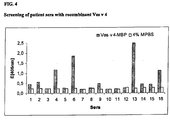



Classifications
-
- A—HUMAN NECESSITIES
- A61—MEDICAL OR VETERINARY SCIENCE; HYGIENE
- A61K—PREPARATIONS FOR MEDICAL, DENTAL OR TOILETRY PURPOSES
- A61K39/00—Medicinal preparations containing antigens or antibodies
- A61K39/35—Allergens
-
- A—HUMAN NECESSITIES
- A61—MEDICAL OR VETERINARY SCIENCE; HYGIENE
- A61P—SPECIFIC THERAPEUTIC ACTIVITY OF CHEMICAL COMPOUNDS OR MEDICINAL PREPARATIONS
- A61P37/00—Drugs for immunological or allergic disorders
- A61P37/08—Antiallergic agents
-
- C—CHEMISTRY; METALLURGY
- C12—BIOCHEMISTRY; BEER; SPIRITS; WINE; VINEGAR; MICROBIOLOGY; ENZYMOLOGY; MUTATION OR GENETIC ENGINEERING
- C12N—MICROORGANISMS OR ENZYMES; COMPOSITIONS THEREOF; PROPAGATING, PRESERVING, OR MAINTAINING MICROORGANISMS; MUTATION OR GENETIC ENGINEERING; CULTURE MEDIA
- C12N9/00—Enzymes; Proenzymes; Compositions thereof; Processes for preparing, activating, inhibiting, separating or purifying enzymes
- C12N9/14—Hydrolases (3)
- C12N9/48—Hydrolases (3) acting on peptide bonds (3.4)
- C12N9/50—Proteinases, e.g. Endopeptidases (3.4.21-3.4.25)
- C12N9/64—Proteinases, e.g. Endopeptidases (3.4.21-3.4.25) derived from animal tissue
- C12N9/6402—Proteinases, e.g. Endopeptidases (3.4.21-3.4.25) derived from animal tissue from non-mammals
- C12N9/6418—Proteinases, e.g. Endopeptidases (3.4.21-3.4.25) derived from animal tissue from non-mammals from snakes
Definitions
- the present invention relates to nucleic acids encoding a novel Vespula venom protease or fragments thereof, recombinant vectors comprising such nucleic acids, and host cells containing the recombinant vectors.
- the invention is further directed to expression of such nucleic acids to produce a recombinant Vespula venom protease, or recombinant fragments thereof, or synthetic peptides thereof.
- Such a protease or fragments thereof or synthetic peptides thereof are useful for diagnosis of insect venom allergy and for therapeutic treatment of insect venom allergy.
- Immunoglobulin E (IgE) -mediated insect sting allergy to Hymenoptera is of common occurrence.
- Hymenoptera stings are classified into normal local reactions, large local reactions, systemic anaphylactic reactions, systemic toxic reactions, and unusual reactions. The most frequent clinical patterns are large local and systemic anaphylactic reactions.
- the prevalence of large local sting reactions ranges from 2.4% and 26.4% (for a review, see Biló et al 2005). In children the prevalence yielded by one study is 19%.
- Nine epidemiologic studies report a prevalence of self-reported systemic anaphylactic sting reactions between 0.3% and 7.5% (for a review, see Biló et al 2005).
- an anaphylactic reaction after a sting is a very traumatic event resulting in an altered health-related quality of life.
- the anaphylactic reaction may cause death, and this fatal outcome can occur as the first manifestation after a sting (Barnard 1973).
- Risk factors influencing the outcome of an anaphylactic reaction include the time interval between stings, the number of stings, the severity of the preceding reaction, age, cardiovascular diseases and drug intake, insect type, elevated serum tryptase, and mastocytosis.
- Hymenoptera include the familiy Apidae consisting of the genera Apis (including the species Apis mellifera, honeybee) and Bombus (bumblebees), and the family Vespidae (vespids) consisting of the Vespinae and Polistinae subfamilies.
- the Vespinae subfamily includes the three genera Vespula (called wasps in Europe, yellow jackets in the USA), Dolichovespula (called hornets in the USA) and Vespa (called hornets in Europe and the USA). In the USA there are many species of Vespula, Dolichovespula and Polistes (called paper wasps in Europe and the USA) (King 1994).
- Vespine wasps are generally considered to be the most common source of stings, due to their abundance, aggressiveness and relatively large colony size (up to several thousand workers) of some species. In areas with mild winters, including Florida, California and Hawaii multiple queens may inhabit the same nest and produce enormous perennial colonies with a high potential for mass stinging (Greene and Breitsch 2005). Polistine wasps have small colonies of usually no more than a few dozen workers, but their nests can be extremely abundant around human habitations. The most pestiferous species is the recently arrived Polistis dominulus, an invasive European wasp (Greene and Breitsch 2005).
- honeybees are often invoked as a sting hazard, accidental disturbance of feral colonies in the US was rare until recently, because nests were typically located within tree cavities or structural voids.
- Africanized bees Apis mellifera scutellata
- This subspecies has an extremely low defensive response threshold and is capable of some of the most severe attacks known for any social insect (Greene and Breitsch 2005).
- Vespula species V. vulgaris and V. germanica are dominating.
- Dolichovespula the most common species in Europe are D. media, D. saxonia and D. sylvestris and in the genus Vespa, Vespa crabro (European hornet) is the most prevalent in Europe.
- Polistinae called paper wasps in Europe and the USA
- Polistes gallicus, P. nimpha and P. dominulus are widespread especially in the Mediterranean area.
- vespid mainly Vespula spp.
- honeybee stings are the most prevalent, whereas in the Mediterranean area stings from Polistes and Vespula are more frequent than honeybee stings, bumblebee stings are rare throughout Europe and more of an occupational hazard (Biló et al 2005).
- IgE-mediated (type I) sting allergic reactions are due to release of mediators (e.g. histamine) resulting from cross-linking of effector cell-bound IgE antibodies by venom allergens.
- mediators e.g. histamine
- SIT allergen-specific immunotherapy
- In vitro measurement of specific serum IgE antibodies can be performed by the radio-allergosorbent test (RAST), various enzyme-linked immunosorbent assays (ELISA) and other IgE-binding techniques such as immunoelectrophoresis, immunoblot, immunodotblotting, bead array technology and various fluid phase systems.
- the analytes can also be allergen-specific antibodies of the IgG4 or other IgG subclasses.
- basophil cells derived from patients or from basophil cell lines such as the KU812 have been used for the in vitro measurement of allergen-specific IgE antibodies in serum by in vitro mediator release assays (MRA).
- MRA in vitro mediator release assays
- in vivo tests for diagnosis of hymenoptera venom allergy are performed by skin prick or intradermal testing. Such tests are well known in the art (Biló et al 2005).
- Hymenoptera venoms contain a number of toxins, enzymes, and biologically active peptides. Since it was easy to obtain sufficient quantities of material, honeybee venom has been well studied. Honeybee venom contains at least 18 active substances.
- proteins and polypeptides in honeybee venom have been identified as hypersensitizing agents including phospholipase A2 (Api m 1), hyaluronidase (Api m 2), acid phosphatase (Api m 3), melittin (Api m 4), dipeptidylpeptidase (Api m 5; allergen C), Api m 6 polypeptides (4 isoforms), a 39 kDa protease (Api m 7), and a 70 kDa protease (Biló et al 2005; Winningham et al 2004, Blank et al 2008.
- Vespid venoms (venoms of the Vespidae family) are also complex mixtures of toxins, enzymes including phospholipases, hyaluronidases and proteases, and biologically active peptides. These venom components can act on the cardiovascular system, nervous system and immunological system of mammalians. Antikoagulant effects of vespid venom obtained from a hornet species ( Vespa orientalis ) was attributed to the proteolytic degradation of coagulation factors.
- the purified Protease migrated under reducing conditions as a double band (42 kDa and 44 kDa) on sodium dodecyl sulfate polyacrylamide gel electrophoresis (SDS-PAGE) (Haim et al 1999). Potential allergenic properties of this enzyme (or enzymes) have not been determined.
- magnvesin Another anticoagulant protease has been purified from the venom of a different hornet species (Vespa magnifica) (Han et al 2008).
- This protein named magnvesin, contains serine protease-like avitivity and inhibits blood coagulation.
- the cDNA of magnvesin cloned from the venom sac cDNA library of Vespa magnifica (GenBank accession EU267370) encodes a protein precursor of 305 amino acids and a mature protease of 242 amino acids with a molecular weight of 27.4 kDa (Han et al 2008). Potential allergenic properties of this enzyme have not been determined.
- protease of 244 amino acids (Winningham et al 2004). This protease contains 6 potential N-linked glycosylation sites, 4 of which appear to be glycosylated in the natural molecule. Due to its IgE binding activity the protease has been assigned the name Pol d 4 by the IUIS Allergen Nomenclature Subcommittee (Winningham et al 2004).
- protease prepared by benzamidine affinity chromatography from Polistis exclamans has been reported to migrate in SDS-PAGE with the phospholipase as a protease from Polistis gallicus (Winningham et al 2004), but for none of these proteases a molecular weight or sequence information is provided by the authors. All three proteases are claimed to be highly cross-reactive, although the identity of the proteases from Polistis exclamans and Polistis gallicus remains to be elucidated.
- elastase-like protein was purified from the venom of the solitary spider wasp Cyphonyx dorsalis of the family Pompilidae which is part of the Vespoidea superfamily (Yamamoto et al 2007).
- the cDNA cloned from total RNA of a whole body encodes a protein of 256 amino acids with a calculated molecular weight of 25.7 kDa (Yamamoto et al 2007).
- the result of a homology search showed a 30.1% homology with the elastase-like serine proteinase from the red fire ant Solenopsis invicta. Potential allergenic properties of this enzyme have not been determined.
- Vn50 A protein isolated from the venom of the endoparasitoid wasp Cotesia rubecula has been shown to be homologous to serine proteinase homologs (Asgari et al 2003).
- Vn50 contains two structural domains, a carboxy-terminal serine proteinase domain and an amino-terminal "clip" domain. However, the serine proteinase domain is not functional since it lacks a serine residue at the conserved site (Asgari et al 2003). Potential allergenic properties of this enzyme analog have not been determined.
- Vespula species V. vulgaris and V. germanica
- Vespula proteins and polypeptides have been identified as allergens so far including those in the venom of Vespula vulgaris, Ves v 1 (phospholipase A1), Ves v 2 (Hyaluronidase) and Ves v 5 (antigen 5) (for a review, see Biló et al 2005).
- the presence of proteases in the venom of Vespula species has not been reported and according to several publications there is no evidence for the presence of significant amounts of proteases in these venoms (Winningham et al 2004; King and Spangfort 2000; Hoffman 1985).
- the venom of Vespula species is likely to contain more than three allergens. Therefore, there is a need in the art to for more information about allergens in the venom of Vespula species to optimize accurate diagnosis and treatment of venom allergy caused by these species.
- T helper cells are activated when their T cell receptor binds to complexes of antigenic peptide-MHC class II molecule on the surface of APC.
- T helper cells are divided into two groups: TH1 cells producing IL-2 and IFN- ⁇ , and TH2 cells producing IL-4 and IL-5. These lymphokines in turn influence antigen-activated B cells to differentiate and proliferate into plasma cells secreting antibodies of different isotypes.
- IL-4 is one lymphokine known to influence IgE synthesis (Finkelman et al 1990).
- B cell epitopes of proteinaceous allergens can include native protein structures (conformational or discontinuous or topographic epitopes), linear peptides (linear epitopes) and carbohydrates.
- the conformational type consists of amino acid residues which are spatially adjacent but may or may not be sequentially adjacent.
- the vast majority of IgE epitopes has been reported to be of the conformational type (King 1990).
- the linear type consists of only sequentially adjacent residues. However, even linear B cell epitopes are often conformation-dependent, and antibody-antigen interactions are improved when the epitope is displayed in the context of the folded protein.
- DiscoTope is a method for discontinuous epitope prediction that uses protein 3D structural data as input. It is based on amino acid statistics, spatial information and surface accessibility for a set of discontinuous epitopes determined by X-ray crystallography of antibody-proteinaceous antigen-complexes.
- T cell epitopes consist of only the linear type since they are peptides that have been processed in the lysosomes of APC by proteases. Analysis of naturally processed antigenic peptides bound to MHC class II molecules indicates that their size ranges typically from about 13 to 25 amino acid residues, but analysis of synthetic peptide-MHC class II molecule complexes for their T cell proliferative response suggests a minimal size of about 9 amino acid residues (Rudensky et al 1991, Wang et al 2008). T cell epitopes are distributed throughout the entire protein molecule, and they may function as major or minor determinants depending on the MHC haplotype of the immunized host (O'Hehir 1991). MHC proteins are highly polymorphic and each binds to a limited set of peptides. Thus, the particular combination of MHC alleles present in a host limits the range of potential epitopes that are recognized.
- T cell epitopes of several allergens have been mapped (O'Hehir 1991).
- TEP transporter associated with processing
- MHC class II binding prediction provided by a publication in 2008 in Nucleic Acid Res. (Zhang et al) includes 4 methods, ARB, SMM_align, the method of Sturniolo which is also the basis of TEPITOPE, and a consensus approach, all of which have been identified as top performing ones.
- T cell epitopes are used to modulate allergen-specific immune responses. It has been observed in vivo in mice for the allergen Fel d 1 (cat hair), Der p 1 (acarian: Dematophagoides pterissimus ) and Bet v 1 (birch pollen) that the nasal, oral or subcutaneous administration of peptides carrying T cell epitopes of these allergens inhibits the activation of the specific T lymphocytes (Briner et al 1993; Hoyne et al 1993; Bauer et al 1997).
- allergen peptide fragments capable of stimulating T lymphocytes in allergic patients were evaluated in clinical sudies.
- Api m 1 fragments 50-69 and 83-97 have been described as being active during a study comprising a single patient (Dhillon et al. 1992).
- Api m 1 fragments 45-62, 81-92 and 113-124 proved to be active.
- these three fragments proved to be T cell epitopes for only 25 to 45% of the patients, pointing to the existence of other epitopes.
- B cell epitopes of allergens are modified to decrease the risk of potential systemic reactions.
- the aim of such allergen modification is to decrease the allergenicity while retaining its immunogenicity. Since allergenicity depends on the interaction of a multivalent allergen with basophil- or mast cell-bound IgE antibodies, allergenicity can be reduced by decreasing the density of B cell epitopes.
- One approach is by partial or complete denaturation of allergens on chemical modification because the vast majority of B cell epitopes are of the discontinuous type, being dependent on the native conformation of proteins. However, there are serious limitations to the use of such molecules.
- animal derived monoclonal allergen-specific antibodies can be useful to identify IgE epitopes.
- IgE epitopes For example, from a panel of mouse monoclonal antibodies that effectively inhibited binding of birch pollen allergen Bet v 1 to specific IgE, several monoclonal antibodies identified a continuous epitope within an exposed surface area of Bet v 1 that could be part of a discontinuous IgE epitope (Lebecque et al 1997) Provided such antibodies bind to Bet v 1 with high affinity, they represent useful tools for further structural analyses by X-ray diffraction of crystals obtained from allergen-antibody complexes.
- Another serious problem associated with the design of hypoallergenic molecules for an improved immunotherapy is the lack of understanding of the immune response that guarentees a lasting protection after specific immunotherapy.
- the aim to decrease the allergenicity of a given allergen while retaining its immunogenicity is widely accepted, but the term immunogenicity remains to be defined.
- Evaluation of modified recombinant allergens with a strongly reduced IgE reactivity that display the full spectrum of linear T cell epitopes but a different surface structure as compared to the corresponding natural allergen have demonstrated that such molecules are capable of reducing specific IgE development towards the native allergen (Niederberger et al 2004; Karamloo et al 2005). However, a long lasting protective effect after treatment with these molecules has not been demonstrated.
- the capacity of recombinant allergens to stimulate a long lasting protective allergen-specific non IgE antibody response requires also a surface structure that is closely related to that of the corresponding natural allergen. Since disruption of IgE epitopes is associated with a significant alteration of the surface structure, there is a need in the field to identify those surface structures of allergens that mediate an appropriate non-IgE response for a long lasting protection. There is a particular need in the field to identify those surface structures of allergens in the venom of Vespula species that mediate an appropriate non-IgE response for a long lasting protection.
- the invention is based, in part, on the discovery of a novel Vespula venom protease, which has been named Ves v 4.
- This protease or fragments, derivatives or analogs thereof can be used, e.g., for diagnosis of insect venom allergy and for therapeutic treatment of insect venom allergy.
- nucleic acid molecules of the invention encode polypeptide fragments containing one or more B cell epitopes of the Vespula venom protease.
- nucleic acid molecules of the invention encode T cell epitope-containing polypeptide fragments of the Vespula venom protease capable of stimulating T cells of subjects allergic to Ves v 4.
- nucleic acid molecules of the invention encode polypeptide fragments containing one or more T cell epitopes and one or more B cell epitopes of the Vespula venom protease.
- the polypeptide fragments are between 50-150 amino acids in length.
- nucleic acid molecules from any species of the family Vespidae which are hybridizable under moderate or high stringency conditions to a nucleic acid having the nucleotide sequence shown in SEQ ID NO: 1.
- the invention provides a nucleic acid molecule comprising the nucleotide sequence as shown in SEQ ID NO: 1. Also described are nucleic acids hybridizable to the nucleotide sequence as shown in SEQ ID NO: 1 under moderate or high stringency conditions, and fragments, derivatives, mutants and analogs thereof.
- the invention provides a nucleic acid molecule comprising the nucleotide sequence as shown in SEQ ID NO: 1 and nucleic acids that are at least 90% identical to the nucleotide sequence as shown in SEQ ID NO: 1 or isolated fragments of the nucleic acid molecule comprising the nucleotide sequence as shown in SEQ ID NO: 1, wherein said fragments are between 150 and 1172 nucleotides in length.
- the present invention further provides polypeptides encoded by the nucleic acids of the invention wherein the polypeptides comprise an amino acid sequence that is at least 90% identical, to the amino acid sequence of SEQ ID NO:2.
- the polypeptide of the invention comprises the amino acid sequence as shown in SEQ ID NO:2 and polypeptides that are at least 90% identical, more preferably more than 95% identical and most preferably more than 99% identical to the amino sequence as shown in SEQ ID NO: 2, or an isolated fragment of the amino acid sequence as shown in SEQ ID NO: 2, wherein said fragment is a partial segment of the polypeptide sequence shown in SEQ ID NO: 2 which is at least 50 amino acids long.
- the description provides polypeptide fragments of the Ves v 4 polypeptides of the invention, containing one or more B cell epitopes of the Vespula venom protease.
- the description provides T cell epitope-containing polypeptide fragments of the Vespula venom protease capable of stimulating T cells of subjects allergic to Ves v 4.
- the description provides polypeptide fragments containing one or more T cell epitopes and one or more B cell epitopes of the Vespula venom protease.
- the polypeptide fragments are at least 50 amino acids in length.
- the description provides T cell epitope-containing peptides of at least 9 amino acids corresponding to a consecutive amino acid sequence within the Vespula venom protease wherein the peptides are capable of stimulating T cells of subjects allergic to Ves v 4.
- Such peptides are preferably immunomodulatory peptides as well in that they induce T cell anergy when administered to a subject allergic to the Vespula venom protease, or otherwise affect the immune response of the subject.
- the present description provides methods for identification and modification via site-directed mutagenesis of those amino acid residues involved in the interaction of the polypeptides of this invention with human IgE and IgG antibodies, including IgG4 antibodies.
- the present description provides methods for decreasing the allergenicity (IgE reactivity) of the polypeptides of this description in a structure-based approach via mutagenesis of IgE epitopes with limited impairment of the residual surface structure important for IgG and IgG, including IgG4, immunological responses.
- the allergenicity of the polypeptides of this description is reduced by at least 50% while at least 50% of IgG epitopes, including IgG4 epitopes, are maintained.
- the allergenicity of the polypeptides of this description is reduced by at least 70% while at least 50% of IgG epitopes, including IgG4 epitopes, are maintained. In a most preferred embodiment allergenicity is reduced by at least 90% while at least 50% of IgG epitopes, including IgG4 epitopes, are maintained.
- the present description provides methods for modification of N-glycosylation of the polypeptides of this description.
- the present description provides polypeptides comprising N-linked glycosides without detectable core ⁇ (1,3)-fucosylation.
- the present description provides polypeptides comprising mutated N-glycosylation sites instead of N-glycosylation sites with Asn-Xaa-Ser/Thr sequences.
- the present description provides polypeptides lacking N-glycosylation.
- the present description further provides expression vectors comprising the nucleic acids of the invention operationally associated with a promoter.
- the present description also provides methods for producing the polypeptides encoded by the nucleic acids of the invention.
- the present description provides for culturing cells transformed with an expression vector of the description so that the Vespula venom protease, fragments thereof, or derivatives or analogs thereof are expressed by the cells, and recovering these polypeptides so expressed from the culture.
- the present description features a pharmaceutical composition that includes the Ves v 4 polypeptides of the description and a pharmaceutically acceptable carrier.
- the pharmaceutical composition includes an additional polypeptide, e.g., a second, third, fourth, or more Vespula venom polypeptide or polypeptides.
- the additional Vespula venom polypeptides can include, e.g., the Ves v 1 polypeptide (phospholipase A1), the Ves v 2a polypeptide (hyaluronidase), the Ves v 2b polypeptide, the Ves v 3 polypeptide (dipeptidylpeptidase), the Ves v 5 polypeptide, glycosylated IgE-binding proteins, or analogs or derivatives thereof.
- the Ves v 1 polypeptide phospholipase A1
- the Ves v 2a polypeptide hyaluronidase
- the Ves v 2b polypeptide the Ves v 3 polypeptide
- the Ves v 5 polypeptide glycosylated IgE-binding proteins, or analogs or derivatives thereof.
- the present description features a pharmaceutical composition
- a pharmaceutical composition comprising Ves v 4 polypeptide fragments of the invention, preferably between 20-150 amino acids in length, wherein each fragment contains one or more B cell epitopes and one or more T cell epitopes, and a pharmaceutically acceptable carrier.
- the composition comprises a set of polypeptide fragments that map the total length of the Ves v 4 polypeptide.
- the pharmaceutical composition includes polypeptide fragments derived from an additional polypeptide, e.g., a second, third, fourth, or more Vespula venom polypeptide or polypeptides.
- the additional Vespula venom polypeptides can include, e.g., the Ves v 1 polypeptide (phospholipase A1), the Ves v 2a polypeptide (hyaluronidase), the Ves v 2b polypeptide, the Ves v 3 polypeptide (dipeptidylpeptidase), the Ves v 5 polypeptide, glycosylated IgE-binding proteins, or analogs or derivatives thereof.
- the Ves v 1 polypeptide phospholipase A1
- the Ves v 2a polypeptide hyaluronidase
- the Ves v 2b polypeptide the Ves v 3 polypeptide
- the Ves v 5 polypeptide glycosylated IgE-binding proteins, or analogs or derivatives thereof.
- the present description features a pharmaceutical composition
- a pharmaceutical composition comprising T cell epitope containing peptides of at least 9 amino acids corresponding to a consecutive amino acid sequence within the Vespula venom protease (Ves v 4) wherein the peptides are capable of stimulating T cells of subjects allergic to Ves v 4.
- the composition comprises a set of T cell epitope-containing peptides capable of stimulating T cells of the great majority of subjects allergic to Ves v 4.
- the pharmaceutical composition includes T cell epitope-containing peptides of at least 9 amino acids corresponding to a consecutive amino acid sequence within an additional polypeptide, e.g., a second, third, fourth, or more Vespula venom polypeptide or polypeptides.
- the additional Vespula venom polypeptides can include, e.g., the Ves v 1 polypeptide (phospholipase A1), the Ves v 2a polypeptide (hyaluronidase), the Ves v 2b polypeptide, the Ves v 3 polypeptide (dipeptidylpeptidase), the Ves v 5 polypeptide, glycosylated IgE-binding proteins, or analogs or derivatives thereof.
- the Ves v 1 polypeptide phospholipase A1
- the Ves v 2a polypeptide hyaluronidase
- the Ves v 2b polypeptide the Ves v 3 polypeptide
- the Ves v 5 polypeptide glycosylated IgE-binding proteins, or analogs or derivatives thereof.
- the present description features a method of modulating an immune response.
- the method includes administering a Ves v 4 polypeptide of the description or a set of polypeptide fragments thereof wherein each of the polypeptide fragments contains one or more T cell epitopes and one or more B cell epitopes of the Vespula venom protease, to a subject in need thereof in an amount sufficient to inhibit an immune reaction by the subject against the Ves v 4 polypeptide.
- one or more additional Vespula venom polypeptides, or sets of fragments thereof may also be administered to the subject.
- the additional Vespula venom polypeptides can include, e.g., the Ves v 1 polypeptide (phospholipase A1), the Ves v 2a polypeptide (hyaluronidase), the Ves v 2b polypeptide, the Ves v 3 polypeptide (dipeptidylpeptidase), the Ves v 5 polypeptide, glycosylated IgE-binding proteins, or analogs or derivatives thereof.
- the Ves v 1 polypeptide phospholipase A1
- the Ves v 2a polypeptide hyaluronidase
- the Ves v 2b polypeptide the Ves v 3 polypeptide
- the Ves v 5 polypeptide glycosylated IgE-binding proteins, or analogs or derivatives thereof.
- the present description features a method of modulating an immune response by administering T cell epitope-containing peptides of at least 9 amino acids corresponding to a consecutive amino acid sequence within the Vespula venom protease (Ves v 4), to a
- T cell epitope-containing peptides of at least 9 amino acids corresponding to a consecutive amino acid sequence within one or more additional Vespula venom polypeptides may also be administered to the subject.
- the additional Vespula venom polypeptides can include, e.g., the Ves v 1 polypeptide (phospholipase A1), the Ves v 2a polypeptide (hyaluronidase), the Ves v 2b polypeptide, the Ves v 3 polypeptide (dipeptidylpeptidase), the Ves v 5 polypeptide, glycosylated IgE-binding proteins, or analogs or derivatives thereof.
- the Ves v 1 polypeptide phospholipase A1
- the Ves v 2a polypeptide hyaluronidase
- the Ves v 2b polypeptide the Ves v 3 polypeptide
- the Ves v 5 polypeptide glycosylated IgE-binding proteins, or analogs or derivatives thereof.
- the present description provides methods for identifying an individual at risk for Vespula venom hypersensitivity.
- One method includes administering to the individual the Ves v 4 polypeptide, or a set of polypeptide fragments thereof, and measuring an immune response raised against the polypeptide or fragments thereof. A detectable immune response indicates that the individual is at risk for Vespula venom hypersensitivity.
- the Ves v 4 polypeptide, or a set of polypeptide fragments thereof is administered intradermally.
- Another method includes in vitro measurement of Ves v 4-specific serum IgE antibodies by a variety of techniques, e.g., radio-allergosorbent test (RAST), enzyme-linked immunosorbent assays (ELISA), immunoelectrophoresis, immunoblot, immunodotblotting, bead array technology, fluid phase systems, and by in vitro mediator release assays (MRA).
- RAST radio-allergosorbent test
- ELISA enzyme-linked immunosorbent assays
- immunoelectrophoresis immunoblot
- immunodotblotting immunod array technology
- fluid phase systems fluid phase systems
- MRA in vitro mediator release assays
- the present description provides methods for evaluating the success of immunotherapeutical treatment of a subject allergic to Ves v 4 by in vitro measurement of the ratio of Ves v 4-specific serum IgE and IgG4 antibodies by a variety of techniques, e.g., radio-allergosorbent test (RAST), enzyme-linked immunosorbent assays (ELISA), immunoelectrophoresis, immunoblot, immunodotblotting, bead array technology, fluid phase systems, and by in vitro mediator release assays (MRA).
- RAST radio-allergosorbent test
- ELISA enzyme-linked immunosorbent assays
- MRA in vitro mediator release assays
- kits that includes, in one or more containers, a Ves v 4 polypeptide of the invention, or polypeptide fragments thereof, one or more anti-Ves v 4 antibodies (e.g., monoclonal or polyclonal), or a combination of these polypeptides, polypeptide fragments, and antibodies.
- a Ves v 4 polypeptide of the invention or polypeptide fragments thereof, one or more anti-Ves v 4 antibodies (e.g., monoclonal or polyclonal), or a combination of these polypeptides, polypeptide fragments, and antibodies.
- nucleic acid molecule refers to the phosphate ester polymeric form of ribonucleosides (RNA molecules) or deoxy ribonucleosides (DNA molecules) in either single stranded form, or double stranded form. Double strande DNA-DNA, DNA-RNA, and RNA-RNA helices are possible.
- the term nucleic acid molecule refers to the primary and secondary structure of the molecule, but does not limit it to any particular tertiary forms. Thus, this term includes double stranded DNA found in linear or circular DNA molecules (e.g., restriction fragments), viruses, plasmids, and chromosomes.
- DNA sequences may be described herein according to the normal convention of giving only the sequence in the 5' to 3' direction along the nontranscribed strand of DNA (i.e., the strand having a sequence homologous to the mRNA).
- a recombinant DNA molecule is a DNA molecule that has undergone a molecular biological manipulation.
- a DNA "coding sequence” is a double-stranded DNA sequence which is transcribed and translated into a polypeptide in vivo when placed under the control of appropriate regulatory sequences. The boundaries of the encoding sequence are determined by a start codon at the 5' (amino) terminus and a translation stop codon at the 3' (carboxyl) terminus.
- a coding sequence can include, but is not limited to, prokaryotic sequences, cDNA from eukaryotic mRNA, genomic DNA sequences from eukaryotic (e.g., mammalian) DNA, and even synthetic DNA sequences.
- Transcriptional and translational control sequences are DNA regulatory sequences, such as promoters, enhancers, terminators, and the like, that provide for the expression of a coding sequence in a host cell.
- a promotor sequence is a DNA regulatory region capable of binding RNA polymerase in a cell and initiating transcription of a downstream (3' direction) coding sequence.
- the promoter sequence is bounded at its 3' terminus by the transcription initiation site and extends upstream (5' direction) to include the minimum number of bases or elements to initiate transcription at levels detectable above background.
- RNA polymerase a transcription initiation site, as well as protein binding domains (consensus sequences) responsible for the binding of RNA polymerase.
- Eukaryotic promoters will often, but not always, contain "TATA” boxes and "CAT” boxes.
- a coding sequence is under the control of transcriptional and translational control sequences in a cell when RNA polymerase transcribes the coding sequence into mRNA, which is then translated into the protein encoded by the coding sequence.
- a signal sequence can be included before the coding sequence.
- This sequence encodes a signal peptide, N-terminal to the polypeptide, that directs the host cell to transport the polypeptide to the cell surface or secrete the polypeptide into the media, and this signal peptide is usually selectively degraded by the cell upon exportation.
- Signal sequences can be found associated with a variety of proteins native to prokaryotes and eukaryotes.
- coding region refers to the nucleotide sequences that encode the amino acid sequences found in the nascent polypeptide as a result of translation of an mRNA molecule.
- the coding region is bounded in eukaryotes, on the 5' side by the nucleotide triplet "ATG” that encodes the initiator methionine and on the 3' side by one of the three triplets which specify stop codons (i.e., TAA, TAG, and TGA).
- ATG nucleotide triplet
- encoding or “encodes” refers to said "coding sequence” and said "coding region”.
- amino acid sequence is recited herein to refer to an amino acid sequence of a protein molecule.
- amino acid sequence and like terms such as “polypeptide” or “protein” are not meant to limit the amino acid sequence to the complete, native amino acid sequence associated with the recited protein molecule. Rather the terms “amino acid sequence” and “protein” encompass partial sequences, fragments of the protein or polypeptide and modified sequences.
- wild type refers to a nucleic acid molecule, a gene or gene product that has the characteristics of that nucleic acid molecule, gene or gene product when isolated from a naturally occurring source.
- a wild type gene is that which is most frequently observed in a population and is thus arbitrarily designated the "normal” or "wild-type” form of the gene.
- the terms “modified,” “mutant”, and “comprising a mutation” refer to a nucleic acid molecule, gene or gene product that displays modifications in sequence and or functional properties ( i.e ., altered characteristics) when compared to the wild-type nucleic acid molecule, gene or gene product.
- the modification comprises at least one insertion, deletion, or substitution of one or more nucleotides or amino acids, respectively.
- a “mutation” in a nucleic acid sequence or gene can lead to an amino acid substitution in the corresponding amino acid sequence, wherein the amino acid substitution can be "conservative" or “non-conservative” or “random”.
- a “conservative amino acid substitution” is one in which the amino acid residue is replaced with an amino acid residue having a similar side chain.
- Families of amino acid residues having similar side chains have been defined in the art. These families include amino acids with basic side chains (e.g., lysine, arginine, histidine), acidic side chains (e.g., aspartic acid, glutamic acid), uncharged polar side chains (e.g., glycine, asparagine, glutamine, serine, threonine, tyrosine, cysteine), nonpolar side chains (e.g., alanine, valine, leucine, isoleucine, proline, phenylalanine, methionine, tryptophane), beta-branched side chains (e.g., threonine, valine, isoleucine), and aromatic side chains (e.g., tyrosine, phenylalanine, tryptophane, histidine).
- nucleic acid homology is equivalent to "nucleic acid identity”.
- amino acid homology is equivalent to "amino acid identity”.
- percent homology between two sequences is a function of the number of identical positions shared by the sequences (i.e., percent homology equals the number of identical positions divided by the total number of positions times 100). For comparison purposes the sequences are aligned, wherein gaps can be introduced in the sequence of a first amino acid sequence for optimal alignment with a second amino acid sequence.
- the term "vespid” is used according to the practice of those in the field of allergy, and refers to insects belonging to the worldwide familiy of Vespidae consisting of the Vespinae and Polistinae subfamilies.
- the Vespinae subfamily includes the three genera Vespula (called wasps in Europe, yellow jackets in the USA), Dolichovespula (called hornets in the USA) and Vespa (called hornets in Europe and the USA).
- Species in the genus Polistes (called paper wasps in Europe and the USA) include but are not limited to P. annularis (Linnaeus), P . exclamans (Viereck), P.
- Species in the genus Vespa include but are not limited to V. crabro (L.) and V. orientalis (Linnaeus).
- Species in the genus Dolichovespula include but are not limited to D. maculata (L.) and D. arenaria (Fab.).
- Species in the genus Vespula include but are not limited to V. germanica (Fab.), V. squamosa (Drury), V. maculifrons (Buysson), V. fiavopilosa (Jacobson), V . vulgaris (L.), and V. pensylvanica (Saussure).
- amino acid homology is equivalent to "amino acid identity”.
- percent homology is a function of the number of identical positions shared by the sequences (i.e., percent homology equals the number of identical positions divided by the total number of positions times 100).
- sequences are aligned, wherein gaps can be introduced in the sequence of a first amino acid sequence for optimal alignment with a second amino acid sequence.
- homology refers to a degree of complementarity. There may be partial homology or complete homology. One example of analyzing such homology is shown in Example 5 and in Figure 2 .
- a nucleic acid molecule is "hybridizable" to another acid molecule, such as cDNA, genomic DNA, or RNA, when a single stranded form of the nucleic acid molecule can anneal to the other nucleic acid molecule under the appropriate conditions of temperature and solution ionic strength.
- the conditions of temperature and solution ionic strength determine the "stringency" of the hybridization.
- Hybridization requires that the two nucleic acid molecules contain complementary sequences, although dependending on the stringency of the hybridization, mismatches between bases are possible.
- the appropriate stringency for hybridizing nucleic acids depends on the length of the nucleic acids and the degree of complementarity, variables well known in the art.
- hybridization is used in reference to the pairing of complementary nucleic acids. Hybridization and the strength of hybridization (i . e ., the strength of the association between the nucleic acids) is impacted by such factors as the degree of complementarity between the nucleic acids, stringency of the conditions involved, the T m ("melting temperature") of the formed hybrid, and the G:C ratio within the nucleic acids.
- stringency is used in reference to the conditions of temperature, ionic strength, and the presence of other compounds such as organic solvents, under which nucleic acid hybridizations are conducted.
- the term “stringency” can refer to e.g. conditions in PCR (such as in e.g. Example 1) or to conditions in Southern Blotting (such as in e.g. Example 11 and in e.g. Figure 8 ).
- PCR such as in e.g. Example 1
- Southern Blotting such as in e.g. Example 11 and in e.g. Figure 8 .
- nucleic acid base pairing will occur only between nucleic acid fragments that have a high frequency of complementary base sequences (e.g ., hybridization under “high stringency” conditions may occur between homologs with 85-100% identity, preferably 70-100% identity).
- nucleic acid base pairing will occur between nucleic acids with an intermediate frequency of complementary base sequences (e.g ., hybridization under "moderate stringency” conditions may occur between homologs with 50-70% identity).
- conditions of "weak” or “low” stringency are often required with nucleic acids that are derived from organisms that are genetically diverse, as the frequency of complementary sequences is usually less.
- Standard stringency conditions in general PCR can not be defined because of the variety of different polymerase molecules that can be employed for the reaction, having different optimal temperature conditions and buffer compositions.
- Standard reaction mix conditions for Taq ( Thermus aquaticus ) polymerase consist of: 10 mM Tris-HCl (pH 8.8 at 25 degree Celcius), 50 mM KCI, 0.08% Nonidet P40, 100 pM each primer, 200 ⁇ M each dNTP, 1.5 mM MgCl 2 , 1.25 U polymerase and 100 pg template DNA.
- Standard cycle conditions are: Denaturating step at 95 degree Celsius for 0.5-2 minutes.
- the temperature of the following annealing step is specified by the primers.
- the annealing time will be between 0.5-2 minutes.
- Each specific amplification primer exhibits an individual optimal hybridisation temperature based on oligonucleotide length and base sequence.
- Annealing temperature should be 5 degree Celsius lower than the calculated melting temperature (TM) of the primer with the lowest Tm.
- the extending step is performed at 72 degree Celsius temperature for 1 min each 1000 base pairs. The number of cycles will be between 25-35. Usually, a final extension step at 72 degree Celsius for 5-15 minutes is performed.
- stringency in PCR is related to the annealing temperature in relation to the theoretical Tm of the used primers and magnesium concentration in the buffer.
- the optimal stringency must be empirically determined, e.g. by temperature gradient experiments. Using shorter cycle times will result in the preferred amplification of smaller sequence fragments.
- Low stringency conditions can be defined by using standard buffer conditions and annealing temperatures below Tm-minus-5 degree Celsius.
- Standard stringency conditions will use standard buffer conditions and annealing temperatures between the theoretical Tm and Tm-minus-5 degree Celsius (Fermentas GmbH, St. Leon-Rot, Product Manual).
- High stringency conditions will use standard buffer conditions and annealing temperatures above the theoretical Tm, preferably 3 degree Celsius above Tm. If several calculation models for Tm exist, the accepted model with the highest resulting Tm should be used (Panjkovich and Melo 2005).
- High stringency conditions when used in reference to nucleic acid hybridization in Southern Blotting comprise conditions equivalent to binding or hybridization at 42°C in a solution comprising 5X SSPE (43,8 g/l NaCl, 6,9 g/l NaH 2 PO 4 H 2 O and 1,85 g/l EDTA, pH adjusted to 7,4 with NaOH), 0.5% SDS, 5X Denhardt's reagent and 100 ⁇ g/ml denatured salmon sperm DNA followed by washing in a solution comprising 0,1X SSPE, 1,0% SDS at 42°C when a probe of about 100 to about 1000 nucleotides in length is employed.
- 5X SSPE 43,8 g/l NaCl, 6,9 g/l NaH 2 PO 4 H 2 O and 1,85 g/l EDTA, pH adjusted to 7,4 with NaOH
- SDS 5X Denhardt's reagent
- 100 ⁇ g/ml denatured salmon sperm DNA followed by washing in a solution comprising
- Moderate stringency conditions when used in reference to nucleic acid hybridization in Southern Blotting comprise conditions equivalent to binding or hybridization at 42°C in a solution comprising 5X SSPE (43,8 g/l NaCl, 6,9 g/l NaH 2 PO 4 H 2 O and 1,85 g/l EDTA, pH adjusted to 7,4 with NaOH), 0,5% SDS, 5X Denhardt's reagent and 100 ⁇ g/ml denatured salmon sperm DNA followed by washing in a solution comprising 1,0X SSPE, 1,0% SDS at 42°C when a probe of about 100 to about 1000 nucleotides in length is employed.
- 5X SSPE 43,8 g/l NaCl, 6,9 g/l NaH 2 PO 4 H 2 O and 1,85 g/l EDTA, pH adjusted to 7,4 with NaOH
- SDS 5X Denhardt's reagent
- 100 ⁇ g/ml denatured salmon sperm DNA followed by washing in a solution
- Low stringency conditions comprise Southern Blotting conditions equivalent to binding or hybridization at 42°C in a solution comprising 5X SSPE (43,8 g/l NaCl, 6,9 g/l NaH 2 PO 4 H 2 O and 1,85 g/l EDTA, pH adjusted to 7,4 with NaOH), 0,1 % SDS, 5X Denhardt's reagent [50X Denhardt's contains per 500 ml: 5 g Ficoll (Type 400, Pharmacia), 5 g BSA (Fraction V; Sigma)] and 100 ⁇ g/ml denatured salmon sperm DNA followed by washing in a solution comprising 5X SSPE, 0,1% SDS at 42°C when a probe of about 100 to about 1000 nucleotides in length is employed.
- 5X SSPE 43,8 g/l NaCl, 6,9 g/l NaH 2 PO 4 H 2 O and 1,85 g/l EDTA, pH adjusted to 7,4 with NaOH
- the standard hybridization solution was 5xSSC, 0,1% N-Lauroylsarcosine w/v (liquid), 0,02% SDS, wherein the addition of 50% formamide allows hybridization at 42-45 degree Celsius.
- a 2x SSC solution was 300mM NaCl, 30 mM Sodium Citrate, adjusted with HCl to pH 7,0.
- a standard wash was done with 2x SSC, 0,1% SDS.
- Southern blot refers to the analysis of DNA on agarose or acrylamide gels to fractionate the DNA according to size followed by transfer of the DNA from the gel to a solid support, such as nitrocellulose or a nylon membrane.
- the immobilized DNA is then probed with a labeled probe to detect DNA species complementary to the probe used.
- the DNA may be cleaved with restriction enzymes prior to electrophoresis. Following electrophoresis, the DNA may be partially depurinated and denatured prior to or during transfer to the solid support.
- Southern blots are a standard tool of molecular biologists (Sambrook et al 1989 ).
- recombinant DNA molecule refers to a DNA molecule that is comprised of segments of DNA joined together by means of molecular biological techniques.
- recombinant protein or “recombinant polypeptide” or “recombinant antibody” as used herein refers to a protein molecule that is expressed from a recombinant DNA molecule.
- native protein refers to a protein that does not contain amino acid residues encoded by vector sequences. That is the native protein contains only those amino acids found in the protein as it occurs in nature.
- a native protein may be produced by recombinant means or may be isolated from a naturally occurring source.
- fragment when used in reference to a nucleotide sequence (as in “fragment of a given nucleotide sequence”) refers to partial segments of that sequence.
- the fragments may range in size from 4 nucleotides to the entire nucleotide sequence minus one nucleotide (10 nucleotides, 20, 30, 40, 50, 100, 200, etc.).
- fragment when used in reference to a polypeptide sequence refers to partial segments of that sequence.
- the fragment has an amino-terminal and/or carboxy-terminal deletion as compared to the native protein, but the remaining amino acid sequence is identical to the corresponding positions in the amino acid sequence deduced from a full-length cDNA sequence.
- Fragments are preferably at least 4 amino acids long, more preferably at least 15 amino acids long, more preferably at least 20 amino acids long and most preferably at least 50 amino acids long or longer (the entire amino acid sequence minus on amino acid).
- the invention provides polypeptide fragments of the Ves v 4 polypeptides of the invention as set forth in the claims containing one or more B cell epitopes of the Vespula venom protease.
- the invention provides T cell epitope-containing polypeptide fragments of the Vespula venom protease as set forth in the claims capable of stimulating T cells of subjects allergic to Ves v 4.
- the invention provides polypeptide fragments as set forth in the claims containing one or more T cell epitopes and one or more B cell epitopes of the Vespula venom protease.
- Fragments provide important advantages for the development of therapeutic approaches for the treatment of individuals allergic to Ves v 4. For example, recombinant fragments are easier to modify by site-directed mutagenesis than the full-length polypeptide, a fact that allows fast analysis of amino acid residues involved in the formation of B cell epitopes.
- Ves v 4 polyptide fragments are selected on the basis of their immunological features and structural characteristics.
- the evaluation of immunological features includes, but is not limited to, analysis of the reactivity of IgE and IgG antibodies obtained from subjects allergic to venom of an insect from the familiy of Vespidae, with the polypeptide fragment, a predictive analysis of B cell epitopes, and a predictive analysis of T cell epitopes.
- the term "derivative or analog thereof” refers to any nucleic acid related to the nucleic acid shown in SEQ ID NO: 1 and to any polyeptide related to the polypeptide shown in SEQ ID NO: 2.
- the structure of the polypeptide can be modified to increase resistance of, for example, the Ves v 4 polypeptide and fragments thereof to proteolytic degradation in vivo.
- amino acid residues of a polypeptide of the invention preferably the Ves v 4 polypeptide and fragments thereof, can be substituted by D-amino acids, non-natural amino acids or non-amino acid analogs, or such non-natural amino acids and analogs can be added to produce a modified peptide within the scope of the invention.
- a “derivative" according to the invention can be selected from the group consisting of chimeric or fusion protein, a mutant comprising one or more amino acid substitutions, a mutant comprising one or more amino acid substitutions that increase resistance of the polypeptide to proteolytic degradation and a mutant comprising one or more amino acid substitutions that introduce one or more canonical protease sensitive sites, and wherein the chimeric or fusion protein preferably comprises a non-Ves v 4 polypeptide selected from the group consisting of poly-Histidine tag (His tag), glutathione-S-transferase (GST), maltose binding protein (MBP), a chitin binding domain (CBD), ⁇ -galactosidase, an IgG-Fc, a therapeutic polypeptide, preferably a cytokine, and other vespid venom proteins or fragments thereof.
- the chimeric or fusion protein preferably comprises a non-Ves v 4 polypeptide selected from
- epitopope and antigenic determinant refer to that portion of an antigen that makes contact with a particular antibody and/or T cell receptor.
- epitopope and antigenic determinant can be used interchangeably.
- numerous regions of the protein may induce the production of antibodies that bind specifically to a given region or three-dimensional structure on the protein; these regions or structures are referred to as “epitopes” or “antigenic determinants”.
- Antigens which are generally very large and complex, are not recognized in their entirety by lymphocytes.
- both B and T lymphocytes recognize discrete sites on the antigen called “epitopes” or antigenic determinants” via their B-cell receptors (“antibodies”) and T-cell receptors, respectively.
- An epitope or antigenic determinant may compete with the intact antigen (i.e ., the "immunogen” used to elicit the immune response) for binding to an antibody.
- B cell epitope refers to an antigenic determinant (protein or carbohydrate) to which a single antibody molecule binds.
- B cell epitopes may comprise linear epitopes (amino acids adjacent to each other in the primary sequence) or conformational epitopes (moieties distant from each other in the primary sequence, but brought into close proximity of one another during folding of the antigen) of at least four amino acid residues.
- T cell epitope refers to an antigenic determinant presented by a MHC class I or a MHC class II molecule, for binding by a single T cell receptor.
- T cell epitopes are linear epitopes comprising at least seven amino acid residues.
- the term T cell epitope comprises a T helper cell epitope, an antigen fragment presented by an MHC class II molecule for binding to T cell receptor on the surface of a helper T cell ( e.g ., generally CD4 + ).
- epitope relates to the surface area of an allergen that is in contact to these antibodies upon binding to the allergen.
- the surface area of the allergen that is in contact with an antibody construct comprised in the composition of the invention that overlaps with the first-mentioned IgE epitope or IgG epitope, including IgG4 epitope", so binding of the antibody construct can inhibit binding of the human IgE or IgG, including IgG4; from the sera of patients allergic to the allergen (IgE related epitopes, IgG-related epitopes, IgG4 related epitopes).
- the epitopes overlap by 20% or more, 50% or more, 60% or more, 70% or more, or 80% or more. Most preferably, the epitopes overlap by 90 or 95% or more or are identical.
- the first-mentioned epitopes and the related epitopes are considered to represent the same epitopes.
- antigen and “antigenic” refer to any substance that is capable of inducing a specific humoral and/or cell-mediated immune response.
- An antigen generally contains at least one epitope.
- Antigens are exemplified by, but not restricted to molecules that contain a peptide, polysaccharide, nucleic acid sequence, and/or lipid. Complexes of peptides with lipids, polysaccharides, or with nucleic acid sequences are also contemplated, including (without limitation) glycopeptide, lipopeptide, glycolipid, etc.
- An "antigen” can be or can be present on an "allergen”.
- Antigens can be the polypeptides of the invention, such as the Ves v 4 polypeptide, or fragments derivatives and analogs thereof.
- the term "allergy” refers to an inappropriate immune reaction in response to an antigen, wherein the terms “allergy” and “hypersensitivity” can be used interchangeably.
- hypersensitive responses There are four types of hypersensitive responses (Type I, II, III and IV), wherein IgE-mediated allergy or hypersensitivity is termed "Type I hypersensitivity”.
- Immunoglobulin E (IgE) -mediated insect sting allergy to Hymenoptera is of common occurrence.
- the symptoms of IgE-mediated (type I) sting allergic reactions are due to release of mediators (e.g. histamine) resulting from cross-linking of effector cell-bound IgE antibodies by venom allergens.
- allergen-specific immunotherapy represents the only curative approach.
- a rise in allergen-blocking IgG antibodies, particularly of the IgG4 class, a reduction in the number of mast cells and eosinophils, and a decreased release of mediators are known to be associated with successful SIT.
- determination of the serum levels of allergen-specific IgE and IgG4 antibodies is useful to describe the immune status of an allergic patient.
- allergen describes an antigen that is capable of eliciting an allergic or hypersensitive reaction in a patient. Such an allergen can induce a humoral antibody response resulting in the generation of antibody-secreting plasma cells and memory cell, wherein the plasma cells secrete IgE.
- an allergen can be present in the venom of the family Vespidae (vespids), such as in the venom of Vespula vulgaris.
- vespids Vespidae
- Vespids Vespids
- Ves v 4 polypetide a specific polypetide.
- Other examples of allergens are shown in Tables 4 and 5.
- the term "allergenicity” can be used interchangeably with “IgE reactivity”, which can be described as the capability of a given antigen or allergen to bind to serum IgE in a patient.
- the present invention provides methods for decreasing the allergenicity (IgE reactivity) of the polypeptides of the invention in a structure-based approach via mutagenesis of IgE epitopes present on the polypeptide with limited impairment of the residual surface structure important for IgG immunological responses.
- the allergenicity of the polypeptides of the invention is reduced by at least 50% while at least 50% of IgG epitopes are maintained.
- the allergenicity of the polypeptides of the invention is reduced by at least 70% while at least 50% of IgG epitopes are maintained. In a most preferred embodiment allergenicity is reduced by at least 90% while at least 50% of IgG epitopes are maintained.
- One Example of detecting or measuring "allergenicity” or "IgE reactivity", respectively is shown in Example 10 and in Figure 4 .
- the "allergenicity” or "IgE reactivity" of a given allergen, such as an allergen from the venom of Vespula vulgaris, and such as the polypeptides of the invention, can be measured by standard ELISA techniques, e.g. as shown in Example 10 and in Figure 4 .
- chimeric protein or "fusion protein” as used herein refers to a protein formed by expression of a hybrid gene made by combining two gene sequences. Typically this is accomplished by cloning a cDNA into an expression vector in frame with an existing gene.
- the fusion partner may act as a reporter (e.g. , ⁇ -gal, ⁇ -galactosidase) or may provide a tool for isolation purposes (e.g ., GST).
- the chimeric or fusion protein preferably comprises a non-Ves v 4 polypeptide selected from the group consisting of poly-Histidine tag (His tag), glutathione-S-transferase (GST), maltose binding protein (MBP), a chitin binding domain (CBD), ⁇ -galactosidase, an IgG-Fc, a therapeutic polypeptide, preferably a cytokine, and other vespid venom proteins or fragments thereof.
- a non-Ves v 4 polypeptide selected from the group consisting of poly-Histidine tag (His tag), glutathione-S-transferase (GST), maltose binding protein (MBP), a chitin binding domain (CBD), ⁇ -galactosidase, an IgG-Fc, a therapeutic polypeptide, preferably a cytokine, and other vespid venom proteins or fragments thereof.
- Suitable systems for production of recombinant proteins include but are not limited to prokaryotic (e.g ., Escherichia coli ), yeast (e.g ., Saccaromyces cerevisiae ), insect (e.g ., baculovirus), mammalian (e.g ., Chinese hamster ovary), plant (e.g ., safflower), and cell-free systems (e.g ., rabbit reticulocyte lysate).
- prokaryotic e.g ., Escherichia coli
- yeast e.g ., Saccaromyces cerevisiae
- insect e.g baculovirus
- mammalian e.g ., Chinese hamster ovary
- plant e.g ., safflower
- cell-free systems e.g ., rabbit reticulocyte lysate
- T cell anergy refers to a state of nonresponsiveness of a given T cell clone.
- T H -cell recognition of an antigenic peptide-MHC complex can result in such state of nonresponsiveness, which is marked by the inability of the T cell to proliferate in response to the peptide-MHC complex.
- antigenic peptide capable of inducing T cell anergy can be an "immunomodulatory" peptide of the invention.
- polypeptides or peptides of the invention are preferably "immunomodulatory" peptides in that they induce T-cell anergy when administered to a subject allergic to the Vespula venom protease Ves v 4, or otherwise affect the immune response of the subject.
- vector is used in reference to nucleic acid molecules that 15 transfer DNA segment(s) from one cell to another.
- vehicle is sometimes used interchangeably with “vector.”
- expression vector refers to a recombinant DNA molecule containing a desired coding sequence and appropriate nucleic acid sequences necessary for the expression of the operably or operationally linked coding sequence in a particular host organism.
- Nucleic acid sequences necessary for expression in prokaryotes usually include a promoter, an operator (optional), and a ribosome-binding site, often along with other sequences.
- Eukaryotic cells are known to utilize promoters, enhancers, and termination and polyadenylation signals.
- the term "host cell” refers to any eukaryotic or prokaryotic cell (e.g ., bacterial cells such as E. coli, yeast cells, mammalian cells, avian cells, amphibian cells, plant cells, fish cells, and insect cells), whether located in vitro or in vivo.
- host cells may be located in a cell culture or in a transgenic animal.
- the invention can make use of eukaryotic expression systems including yeast, mammalian, plant, and insect cells for the production of the polypeptides of the present invention. Mammalian cells are also suitable for the production of the polypeptides of the present invention, but do not produce high yields.
- both intact plants and cell lines are suitable for the production of the polypeptides of the present invention.
- the recombinant polypeptides can be expressed by either transgenic technology or by infection with chimeric virus.
- the standard method to introduce foreign genes into plants is the well characterized single-stranded RNA virus, tobacco mosaic virus.
- "Host cells” can be insect cells which are utilized for the production of large quantities of the polypeptides of the present invention.
- the baculovirus system which provides all the advantages of higher eukaryotic organisms, is utilized.
- the host cells include, but are not limited to Spodoptera frugiperda ovarian cell lines SF9 and SF21 and the Trichoplusia ni egg-derived cell line High Five.
- transformation refers to the introduction of foreign DNA into prokaryotic or eukaryotic cells. Transformation maybe accomplished by a variety of means known to the art including calcium phosphate-DNA co-precipitation, DEAE-dextran-mediated transfection, polybrene-mediated transfection, electroporation, microinjection, liposome fusion, lipofection, protoplast fusion, retroviral infection, and biolistics.
- antibody refers to polyclonal and monoclonal antibodies. Polyclonal antibodies which are formed in the animal as the result of an immunological reaction against a protein of interest or a fragment thereof, can then be readily isolated from the blood using well-known methods and purified by column chromatography, for example. Monoclonal antibodies can also be prepared using known methods ( See , Winter and Milstein 1991). As used herein, the term “antibody” encompasses recombinantly prepared, and modified antibodies and antigen-binding fragments thereof, such as chimeric antibodies, humanized antibodies, multifunctional antibodies, bispecific or oligo-specific antibodies, single-stranded antibodies and F(ab) or F(ab) 2 fragments.
- a Ves v 4-reactive antibody when used in reference to an antibody indicates that the antibody is capable of binding an antigen of interest.
- a Ves v 4-reactive antibody may bind to one or more epitopes of the polypeptides of the invention, wherein such antibody can be a human IgE or human IgG antibody or a recombinant antibody.
- peptide refers to at least two amino acids or amino acid analogs, which are covalently linked by a peptide bond or an analog of a peptide bond.
- peptide includes oligomers ("oligopeptides") and polymers ("polypeptides") of amino acids or amino acid analogs.
- peptide also includes molecules commonly referred to as peptides, which generally contain from about two (2) to about twenty (20) amino acids.
- peptide also includes molecules commonly referred to as polypeptides, which generally contain from about twenty (20) to about fifty amino acids (50).
- peptide also includes molecules commonly referred to as proteins, which generally contain from about fifty (50) to about three thousand (3000) amino acids.
- a polypeptide or “protein” is the Ves v 4 polypetide, which is of a length of 390 amino acids, as can be seen in Figures 2 to 4 and 6 to 8 and in SEQ ID NO. 2.
- the amino acids of the peptide may be L-amino acids or D-amino acids.
- a peptide, polypeptide or protein may be synthetic, recombinant or naturally occurring.
- a synthetic peptide is a peptide produced by artificial means in vitro.
- a "polypeptide” according to the invention can be the Ves v 4 polypetide and fragments, derivatives and analogs thereof..
- carrier and “pharmaceutically acceptable carrier” as used herein refer to usually inactive accessory substances into which a pharmaceutical substance (e.g., a polypeptide of the invention, such as the Ves v 4 polypetide and fragments, derivatives and analogs thereof) is suspended.
- exemplary carriers include liquid carriers (such as water, saline, culture, medium, saline, aqueous dextrose, and glycols) and solid carriers (such as carbohydrates exemplified by starch, glucose, lactose, sucrose, and dextrans, anti-oxidants exemplified by ascorbic acid and glutathione, and hydrolyzed proteins.
- a "pharmaceutically acceptable carrier” is intended to include any and all solvents, dispersion media, coatings, antibacterial and antifungal agents, isotonic and adsorption delaying systems, and the like, compatible with the active compound and pharmaceutical administration.
- a pharmaceutically acceptable carrier is intended to include any and all solvents, dispersion media, coatings, antibacterial and antifungal agents, isotonic and adsorption delaying systems, and the like, compatible with the active compound and pharmaceutical administration.
- the use of such media and agents for pharmaceutically active substances is well known in the art.
- Supplementary active compounds can also be incorporated into the composition.
- the invention provides a novel Vespula venom protease, termed Ves v 4 that has been identified as Vespula venom allergen based on its reactivity to IgE antibodies in sera of individuals who are allergic to Vespula venom.
- the present invention provides a nucleic acid molecule encoding a novel Vespula venom protease, and fragments, derivatives and analogs thereof, all of which are useful in the diagnosis and therapy of vespid venom-specific allergy.
- the sequence of the nucleic acid encoding the Vespula venom protease including 1173 nucleotides is shown in SEQ ID NO:1.
- PCR polymerase chain reaction
- RACE rapid amplification of cDNA ends
- the primers are based on the nucleic acid sequence for the Vespula venom protease of the present invention.
- primers are prepared synthetically.
- Alternatives to isolating the genomic DNA or cDNA encoding the Vespula venom protease of the present invention include, but are not limited to, chemically synthesizing the gene sequence itself from the sequence provided herein.
- Example 1 One example of obtaining a nucleic acid encoding the Vespula venom protease Ves v 4 is shown in Example 1.
- the invention provides a nucleic acid molecule comprising the nucleotide sequence as shown in SEQ ID NO: 1. Further described are nucleic acids hybridizable to the nucleotide sequence as shown in SEQ ID NO: 1 under moderate or high stringency conditions, and fragments, derivatives, mutants and analogs thereof.
- the invention provides a nucleic acid molecule comprising the nucleotide sequence as shown in SEQ ID NO: 1 and nucleic acids that are more than 90% identical to the nucleotide sequence as shown in SEQ ID NO: 1, or isolated fragments of the nucleic acid molecule comprising the nucleotide sequence as shown in SEQ ID NO: 1, wherein said fragments are between 150 and 1172 nucleotides in length.
- the invention provides a nucleic acid molecule consisting of the nucleotide sequence as shown in SEQ ID NO: 1.
- the nucleotide sequence encodes the Vespula venom protease Ves v 4 or fragments, derivatives and analogs thereof.
- the nucleotide sequence encodes polypeptide fragments as set forth in the claims comprising one or more B cell eptiopes of the Vespula venom protease Ves v 4, one or more T cell eptiopes of the Vespula venom protease Ves v 4 or one or more B cell eptiopes and one or more T cell eptiopes of the Vespula venom protease Ves v 4.
- the description also provides a nucleic acid, which is a fragment having a length of more than 150 nucleotides of a nucleic acid encoding a polypeptide having a homology of at least 90%, to the amino acid sequence of SEQ ID NO:2, wherein the fragment encodes a polypeptide capable of binding to IgE or IgG from subjects allergic to venom of an insect from the familiy of Vespidae.
- the nucleic acid is a fragment having a length of more than 150 nucleotides of a nucleic acid encoding a polypeptide having the amino acid sequence of SEQ ID NO: 2, wherein the polynucleotide is selected from the group consisting of nucleotides 64 to 222, 223 to 405, 406 to 570, 571 to 720, 721 to 852, 853 to 1002, and 1003 to 1170 of said nucleic acid, wherein the numbering corresponds to the region encoding said polypeptide.
- said nucleic acid has the nucleotide sequence shown in SEQ ID NO: 1.
- the nucleic acid is a fragment having a length of more than 228 nucleotides of a nucleic acid encoding a polypeptide having the amino acid sequence of SEQ ID NO: 2, wherein the polynucleotide is selected from the group consisting of nucleotides 64 to 405, 406 to 696, 697 to 939, and 940 to 1170 of said nucleic acid.
- the nucleic acid is a fragment having a length of more than 357 nucleotides of a nucleic acid encoding a polypeptide having the amino acid sequence of SEQ ID NO: 2, wherein the polynucleotide is selected from the group consisting of nucleotides 64 to 444, 445 to 804, and 805 to 1170 of said nucleic acid.
- the description provides additional fragments of the above mentioned nucleic acid, having a length of more than 150 nucleotides and encoding a polypeptide having a homology of more than 90% to the amino acid sequence of SEQ ID NO:2, wherein the fragment encodes a polypeptide capable of binding to IgE from subjects allergic to venom of an insect from the familiy of Vespidae, overlapping with fragments from the preceding embodiment.
- the nucleic acid is a fragment having a length of more than 150 nucleotides of a nucleic acid encoding a polypeptide having the amino acid sequence of SEQ ID NO: 2, wherein the polynucleotide is selected from the group consisting of nucleotides 154 to 309, 310 to 480, 481 to 639, 640 to 804, 805 to 945, and 946 to 1089 of said nucleic acid, wherein the numbering corresponds to the region encoding said polypeptide.
- said nucleic acid has the nucleotide sequence shown in SEQ ID NO: 1.
- the nucleic acid is a fragment having a length of more than 267 nucleotides of a nucleic acid encoding a polypeptide having the amino acid sequence of SEQ ID NO: 2, wherein the polynucleotide is selected from the group consisting of nucleotides 274 to 576, 577 to 846, and 847 to 1116 of said nucleic acid.
- the nucleic acid is a fragment having a length of more than 357 nucleotides of a nucleic acid encoding a polypeptide having the amino acid sequence of SEQ ID NO: 2, wherein the polynucleotide is selected from the group consisting of nucleotides 295 to 711, and 712 to 1071 of said nucleic acid.
- nucleic acid fragment (oligonucleotide) that comprises at least 39 contiguous nucleotides of the nucleic acid encoding an oligopeptide having a homology of more than 70% to the amino acid sequence of SEQ ID NO: 2, wherein the fragment encodes an oligopeptide capable of stimulating T cells of subjects allergic to Ves v 4.
- the fragment is an oligopeptide capable of stimulating T cells of the great majority of subjects allergic to Ves v 4.
- the nucleic acid fragment encodes an oligopeptide having the amino acid sequence of SEQ ID NO: 2, wherein the oligonucleotide is selected from the group consisting of 45 contiguous nucleotides as defined in Tables 2 and 3 of said nucleic acid, wherein the numbering corresponds to the region encoding said polypeptide.
- said nucleic acid has the nucleotide sequence shown in SEQ ID NO: 1.
- the nucleic acid can be modified by site-directed mutagenesis, wherein the modification preferably affects one or more of the native N-glycosylation sites.
- the description also provides a nucleic acid encoding the Vespula venom protease, or fragments thereof, which is modified by site-directed mutagenesis.
- the present description provides a nucleic acid encoding a Ves v 4 polypeptide of the invention comprising at least one, preferably 2, or 3 mutated glycosylation sites instead of native N-glycosylation sites with Asn-Xaa-Ser/Thr sequences.
- all 4 putative N-glycosylation sites comprising nucleotides 205 to 213 of SEQ ID NO: 1 encoding the peptide sequence Asn-Cys-Thr, nucleotides 238 to 246 of SEQ ID NO:1 encoding the peptide sequence Asn-Cys-Ser, nucleotides 433 to 441 of SEQ ID NO:1 encoding the peptide sequence Asn-Pro-Ser, and nucleotides 646 to 654 of SEQ ID NO:1 encoding the peptide sequence Asn-Asp-Thr, are mutated.
- the nucleotide sequence encoding serine residues of the N-glycosylation sites is exchanged by site-directed mutagenesis to a nucleotide sequence encoding alanine residues.
- the nucleotide sequence encoding threonine residues of the N-glycosylation sites is exchanged by site-directed mutagenesis to a nucleotide sequence encoding valine residues.
- the nucleotide sequence encoding asparagine residues of the N-glycosylation sites is exchanged by site-directed mutagenesis to a nucleotide sequence encoding glutamine residues.
- nucleic acids of the description are for use as a medicament.
- nucleic acid comprising or consisting of SEQ ID NO: 1 and fragments, derivatives, mutants and analogs thereof are for use as a medicament.
- the nucleic acids of the description are for use in the treatment of allergy against Vespula venom, preferably of allergy against the Vespula venom Ves v 4 protease.
- nucleic acid comprising or consisting of SEQ ID NO: 1 and fragments, derivatives, mutants and analogs thereof that are for use in the treatment of allergy against Vespula venom, preferably of allergy against the Vespula venom Ves v 4 protease.
- the present invention provides a nucleic acid encoding a chimeric or fusion protein, as set forth in the claims wherein said chimeric or fusion protein preferably comprises one or more polypeptide(s) of the invention.
- the chimeric or fusion protein is a Ves v 4 chimeric or fusion protein.
- a Ves v 4 'chimeric protein' or 'fusion protein' comprises a Ves v 4 polypeptide of the invention operatively linked to a non-Ves v 4 polypeptide.
- a Ves v 4 polypeptide refers to a polypeptide having an amino acid sequence corresponding to Ves v 4 ( Vespula venom protease) or fragments thereof, whereas a 'non-Ves v 4 polypeptide' refers to an oligopeptide or polypeptide having an amino acid sequence which is not substantially homologous to the Ves v 4 polypeptides of the invention, e.g. a polypeptide which is different from the Ves v 4 polypeptides and which is derived from the same or different organism.
- the term 'operatively linked' is intended to indicate that the Ves v 4 polypeptide and the non-Ves v 4 polypeptide are fused in-frame to each other.
- the non-Ves v 4 polypeptide can be fused to the N-terminus or C-terminus of the Ves v 4 polypeptide.
- the non-Ves v 4 polypeptide can be selected from the group including, but not limited to a poly-Histidine tag (His tag), glutathione-S-transferase (GST), maltose binding protein (MBP), a chitin binding domain (CBD), ⁇ -galactosidase, and an IgG-Fc.
- non-Ves v 4 polypeptides that improve solubility of the poypeptides of the invention, e.g., GST or MBP, or simplify purification of the recombinant protein, e.g., a His tag, GST, MBP, CBD or IgG-Fc are employed.
- a corresponding affinity column can be used for purification, e.g., a Ni 2+ glutathione, maltose, or chitin affinity column.
- a protein A or protein G column is suitable. After purification of the protein the non-Ves v 4 polypeptide may be cleaved off chemically or by specific proteases.
- a fusion protein with a cytokine enhancing T H 1 and downregulating T H 2 responses or inducing class switch to IgG can improve efficiency of desensitisation.
- IgG immunoglobulin G
- the expression vector is used for gene therapy, it is envisaged to use sequences rich in CpG (unmethylated cytosine guanidine dinucleotides), which promote T H 1 responses.
- polypeptide of the invention can be linked to another polypeptide or protein, such as in the form of a fusion protein or as separate proteins expressed by the same vector.
- the further polypeptides or proteins are other vespid venom proteins or fragments thereof.
- the present description provides methods for isolating nucleic acid molecules from any species of the family Vespidae which are hybridizable under moderate or high stringency conditions to a nucleic acid having the nucleotide sequence shown in SEQ ID NO:1.
- nucleic acid homologue of the nucleic acid encoding the Vespula venom protease of the present description one can choose to synthesize several different degenerate primers for use, e.g., in PCR reactions. It is also possible to vary the stringency of hybridization conditions used in priming PCR reactions, to allow for greater or lesser degrees of nucleotide sequence similarity between a homologue of a vespid venom enzyme and the Vespula venom protease of the present invention. After successful amplification of a segment of a homologue, that segment may be cloned and sequenced, and utilized as probe to isolate the complete cDNA or genomic clone.
- genes encoding vespid venom enzymes homologous to the Vespula venom protease of the present description can be isolated from a suitable library by screening with a probe. Useful probes for isolating such genes can be generated from the sequence information provided herein.
- a suitable library can be constructed by methods known in the art.
- a cDNA library is prepared from cells or tissues that express vespid venom proteins, i.e, cells from the poison gland located near the venom sac. Sometimes, the poison gland is referred to as the acid gland.
- mRNA or total RNA can be isolated, cDNA is prepared and ligated into an expression vector (e.g., a plasmid or bacteriophage derivative) such that it is capable of being expressed by the host cell into which it is then introduced.
- an expression vector e.g., a plasmid or bacteriophage derivative
- Various screening assays can be used then to select for the positive clones.
- PCR with appropriate primers which can be synthesized based on the nucleic acid sequences provided herein, can be used. PCR is preferred as the amplified sequences can be detected easily, e.g., by ethidium bromide staining.
- labelled probes derived from the nucleic acid sequences provided herein can be used to screen the colonies.
- genes encoding vespid venom enzymes homologous to the Vespula venom protease of the present invention may be detected by assays based on the physical, chemical, or immunological properties of its expressed product.
- cDNA clones, or DNA clones which hybrid-select the proper mRNAs can be selected which produce a protein that, e.g., has similar or identical electrophoretic migration, isoelectric focussing behavior, proteolytic digestion maps, or antigenic properties as known for the Vespula venom protease of the present invention.
- the recombinant proteins are immunoreactive, e.g., reactive with IgE antibodies from sera of individuals allergic to vespid venom proteins, it is possible to select for positive clones by immunoblot.
- the specific catalytic activity of proteases can be used for selection, although bacterially expressed eukaryotic proteins may not fold in an active conformation.
- any method of screening for positive clones can be used.
- nucleic acid molecules from any species of the family Vespidae which are hybridizable under moderate or high stringency conditions to a nucleic acid having the nucleotide sequence shown in SEQ ID NO:1 is shown in Example 11 and in Figure 8 .
- Southern Blotting of a nucleic acid molecule of the invention, such as a Ves v 4 encoding nucleic acid fragment as a probe, with genomic DNA of another species of the family Vespidae as shown in Example 11 and in Figure 8 can be used to identify nucleic acid molecules from said family that are hybridisable to said nucleic acid molecule of the invention, such as the Ves v 4 encoding nucleic acid fragment.
- vector-host systems known in the art may be used.
- Possible vectors include, but are not limited to, plasmids or modified viruses, but the vector system must be compatible with the host cell used.
- Potential host-vector sytems include, but are not limited to mammalian cell systems infected with virus (e.g., vaccinia virus, adenovirus, etc.), insect cell systems infected with virus (e.g.; baculovirus), microorganisms such as yeast containing yeast vectors, or bacteria transformed with bacteriophages (e.g., lambda derivatives), DNA, plasmid DNA (e.g., various pBR322 derivatives), or cosmid DNA.
- the vector can be an expression vector.
- the expression elements of vectors vary in their strenghts and specificities. Depending on the host-vector system utilized, any one of a number of suitable transcription and translation elements may be used.
- the vector comprises one or more nucleic acid molecule(s) of the invention, wherein the one or more nucleic acid molecule(s) are operationally associated with a promoter.
- a recombinant Vespula venom protease of the present invention or a fragment, derivative or analogue thereof is expressed chromosomally, after integration after the coding sequence by recombination.
- any of a number of amplification systems may be used to achieve high levels of stable gene expression.
- the present invention further relates to a host cell comprising said expression vector.
- This host cell includes, but is not limited to a bacterial cell, a yeast cell, a mammalian cell, an insect cell, or a plant cell.
- the host cell comprises a vector comprising one or more nucleic acid molecule(s) of the invention.
- a cell-free expression system may be used.
- the development and optimization of specific methods as well as approaches to overcome a variety of problems associated with any of these expression systems have been published in many articles (for a review, see Schmidt and Hoffman 2002).
- the description provides a method for producing the polypeptides of the invention comprising the steps of a) transforming cells with a vector comprising one or more polypeptide(s) of the invention or fragment, derivative and analog thereof to give a transformed host cell, b) culturing said transformed host cells so that the polypeptide(s), fragment, derivative or analog thereof is expressed, and c) recovering the expressed polypeptide(s), fragment, derivative and analog from the culture.
- bacterial expression systems e.g E. coli
- E. coli e.g E. coli
- an expression system that secretes the polypeptides into the periplasmatic space can be used to improve solubility of said polypeptides.
- the periplasmatic space is an oxidizing environment that contains enzymes catalyzing disulfide bonds.
- Co-overproduction of protein disulfide isomerases may be applied to enhance disulfide bond formation.
- Other proper folding factors such as peptidyl-prolyl- cis / trans isomerise also have been demonstrated to be helpful in improving solubility.
- arginine codons AGA and AGG which are rare and inefficiently translated in prokaryotes, can be replaced by site-directed mutagenesis.
- special strains of E. coli with extra copies of the necessary tRNA genes suitable to circumvent this problem can be selected.
- eukaryotic expression systems including yeast, mammalian, plant, and insect cells are for the production of the polypeptides of the present invention.
- Eukaryotic cells offer the advantage of being able to perform posttranslational modifications including processing signal sequences, folding, disulfide bond formation, and glycosylation.
- the methylotrophic Pichia pastoris is capable to produce recombinant proteins in high yield and to add both O- and N-linked carbohydrates.
- a lower eukaryote it adds only mannose residues, but hyperglycosylation as observed in Saccharomyces cerevisiae occurs less frequently.
- Mammalian cells are also suitable for the production of the polypeptides of the present invention, but do not produce high yields.
- both intact plants and cell lines are suitable for the production of the polypeptides of the present invention.
- the recombinant polypeptides can be expressed by either transgenic technology or by infection with chimeric virus.
- the standard method to introduce foreign genes into plants is the well characterized single-stranded RNA virus, tobacco mosaic virus.
- insect cells are utilized for the production of large quantities of the polypeptides of the present invention.
- the baculovirus system which provides all the advantages of higher eukaryotic organisms, is utilized.
- the host cells include, but are not limited to Spodoptera frugiperda ovarian cell lines SF9 and SF21 and the Trichoplusia ni egg-derived cell line High Five.
- the invention provides a polypeptide encoded by a nucleic acid comprising the sequence shown in SEQ ID NO: 1 and fragments, derivatives and analogs thereof as set forth in the claims.
- the invention provides a polypeptide encoded by a nucleic acid consisting of the sequence shown in SEQ ID NO: 1.
- polypeptide' and 'protein' are used interchangeably, without any limitation as to the number of amino acids linked.
- the polypeptides may also comprise non-naturally occuring amino acids.
- the polypeptide is a full length protease from the venom of an insect from the family Vespidae.
- polypeptide consists of the amino acid sequence shown in SEQ ID NO:2.
- polypeptide of the invention comprises the amino acid sequence as shown in SEQ ID NO:2 and polypeptides that are at least 90% identical, more preferably more than 95% identical and most preferably more than 99% identical to the amino sequence as shown in SEQ ID NO: 2, and fragments, derivatives and analogs thereof as set forth in the claims.
- the polypeptide has an homology of more than 90%, more than 95% or more than 99% to the amino acid sequence of SEQ ID NO: 2. Most preferred is a polypeptide having the amino acid sequence of SEQ ID NO: 2.
- the Ves v 4 polypeptide having the amino acid sequence of SEQ ID NO: 2 has a predicted molecular weight of 44.4 kDa.
- the amino acid sequence of the Ves v 4 polypeptide differs significantly from amino acid sequences of other insect venom proteases.
- the venom serine protease Bom p 4 of Bombus pennsylvanicus with a molecular weight of 27 kDa shares an amino acid homology of only 18% with Ves v 4
- the venom protease Api m 7 of Apis mellifera with a molecular weight of 39 kDa shares an amino acid homology of 35% with Ves v 4.
- the venom serine protease Pol p 4 of Polistes dominulus with a molecular weight of 27 kDa shares an amino acid homology of 35% with Ves v 4.
- the venom serine protease magnvesin of Vespa magnifica with a molecular weight of 27.4 kDa (Han et al 2008) shares an amino acid homology of 69% with Ves v 4.
- venom proteases From all known insect venom proteases magnevesin shares the highest amino acid homology with Ves v 4. However, both venom proteases exhibit significant differences.
- the cDNA of magnvesin cloned from the venom sac cDNA library of Vespa magnifica encodes a protein precursor of 305 amino acids and a mature protease of 242 amino acids, whereas the Ves v 4 polypeptide comprises 369 amino acid residues due to an additional N-terminal CUB domain. This domain mediates protein-protein interactions during development and in interacting protein cascades like the classical complement pathway (Bork and Beckmann 1993).
- the invention provides polypeptide fragments of the Ves v 4 polypeptides of the invention containing one or more B cell epitopes of the Vespula venom protease Ves v 4.
- the invention provides T cell epitope-containing polypeptide fragments of the Vespula venom protease Ves v 4 capable of stimulating T cells of subjects allergic to Ves v 4.
- the invention provides polypeptide fragments containing one or more T cell epitopes and one or more B cell epitopes of the Vespula venom protease Ves v 4.
- the polypeptide according to the invention is the Vespula venom protease Ves v 4 and fragments, derivatives and analogs thereof, wherein the polypeptide preferably is capable of binding to IgE or IgG from subjects allergic to venom of an insect from the family of Vespidae.
- the polypeptide according to the description comprises one or more B cell eptiopes of the Vespula venom protease Ves v 4, one or more T cell eptiopes of the Vespula venom protease Ves v 4 or one or more B cell eptiopes and one or more T cell eptiopes of the Vespula venom protease Ves v 4.
- Said T cell epitopes can be selected from the group of oligopeptides of 15 contiguous amino acids in length listed in Tables 2 and 3, wherein said T cell epitope is preferably encoded by the group of oligonucleotides listed in Tables 2 and 3, wherein the numbering corresponds to the numbering as defined in SEQ ID NO: 1 and SEQ ID NO: 2, respectively.
- Said B cell epitopes can be selected from the group of amino acids and oligopeptides listed in Table 6, wherein the numbering corresponds to the numbering as defined in SEQ ID NO: 2. Such B cell epitopes can be determined as shown in Example 9.
- the polypeptide preferably is capable of stimulating T cells of subjects allergic to Ves v 4 or of the great majority of subjects allergic to Ves v 4.
- Fragments provide important advantages for the development of therapeutic approaches for the treatment of individuals allergic to Ves v 4. For example, recombinant fragments are easier to modify by site-directed mutagenesis than the full-length polypeptide, a fact that allows fast analysis of amino acid residues involved in the formation of B cell epitopes. In particular knowledge of conformational (discontinuous or topographic) epitopes recognized by IgE antibodies is important for the design of novel recombinant Ves v 4 molecules capable of mediating protection in specific immunotherapy with little or no risk of anaphylactic reactions.
- the polypeptide fragments according to the description are selected on the basis of their immunological features and structural characteristics.
- the evaluation of immunological features includes, but is not limited to, analysis of the reactivity of IgE and IgG antibodies obtained from subjects allergic to venom of an insect from the familiy of Vespidae, with the polypeptide fragment, a predictive analysis of B cell epitopes, and a predictive analysis of T cell epitopes.
- IgE and IgG antibodies obtained from subjects allergic to venom of an insect from the familiy of Vespidae
- Zhang et al 2008 For the prediction of T cell epitopes an abundance of methods is available (see, e.g., Zhang et al., 2008; Korber et al 2006). In particular four methods including ARB, SMM_align, the method of Sturniolo which is also the basis of TEPITOPE, and a consensus approach have been identified as top performing ones (Zhang et al 2008).
- the evaluation of structural characteristics include, but is not limited to, analysis of secondary structures (see, e.g., Chou and Fasman 1974) and hydrophilicity-hydrophobicity profiles (see, e.g., Hopp and Woods 1981). Other methods of structural analysis including, but not limited to, X-ray crystallography, mass spectroscopy, and computer modelling may also be used.
- the polypeptide fragments are 50-150 amino acids, in length.
- the invention provides a polypeptide fragment having a length of more than 50 amino acid residues of a polypeptide having the amino acid sequence as shown in SEQ ID NO: 2, wherein the polypeptide fragment is capable of binding to IgE or IgG from subjects allergic to Ves v 4, and capable of stimulating T cells of subjects allergic to Ves v 4.
- the polypeptide fragment has a length of more than 50 amino acid residues of a polypeptide having the amino acid sequence of SEQ ID NO: 2, wherein the polypeptide is selected from the group consisting of amino acid residues 22 to 74, 75 to 135, 136 to 190, 191 to 240, 241 to 284, 285 to 334, and 335 to 390 of said polypeptide, wherein the numbering corresponds to the region of said polypeptide having the sequence shown in SEQ ID NO: 2.
- the polypeptide fragment has a length of more than 76 amino acid residues of a polypeptide having the amino acid sequence of SEQ ID NO: 2, wherein the polypeptide is selected from the group consisting of amino acid residues 22 to 135, 136 to 232,233 to 313, and 314 to 390 of said polypeptide.
- the polypeptide fragment has a length of more than 119 amino acid residues of a polypeptide having the amino acid sequence of SEQ ID NO: 2, wherein the polypeptide is selected from the group consisting of amino acid residues 22 to 148, 149 to 268, and 269 to 390 of said polypeptide.
- polypeptide fragments selected from the group of polypeptide fragments listed in Table 1, wherein the amino acid numbering is according to the amino acid numbering as shown in SEQ ID NO: 2. These polyeptide fragments are referred to as "epitope fragments”.
- polypeptide fragment that is encoded by one of the nucleic acid fragments listed in Table 1, wherein the nucleic acid numbering is according to the nucleic acid numbering as shown in SEQ ID NO: 1. These polyeptide fragments are referred to as "epitope fragments”.
- the invention provides additional polypeptide fragments overlapping with polypeptide fragments from the preceding embodiment, having a length of more than 50 amino acid residues of a polypeptide having the amino acid sequence as shown in SEQ ID NO: 2, wherein the polypeptide fragment is capable of binding to IgE or IgG from subjects allergic to Ves v 4, and capable of stimulating T cells of subjects allergic to Ves v 4.
- the polypeptide fragment described here has a length of more than 50 amino acid residues of a polypeptide having the amino acid sequence as shown in SEQ ID NO: 2, wherein the polypeptide is selected from the group consisting of amino acid residues 52 to 103, 104 to 160, 161 to 213, 214 to 268, 269 to 315, and 316 to 363 of said polypeptide, wherein the numbering corresponds to the region of said polypeptide having the sequence shown in SEQ ID NO: 2.
- the polypeptide fragment has a length of more than 89 amino acid residues of a polypeptide having the amino acid sequence of SEQ ID NO: 2, wherein the polypeptide is selected from the group consisting of amino acid residues 92 to 192, 193 to 282, and 283 to 372 of said polypeptide.
- the polypeptide fragment has a length of more than 119 amino acid residues of a polypeptide having the amino acid sequence of SEQ ID NO: 2, wherein the polypeptide is selected from the group consisting of amino acid residues 99 to 237, and 238 to 357 of said polypeptide.
- the polypeptide domain has a length of more than 110 amino acid residues of a polypeptide having the amino acid sequence of SEQ ID NO: 2, wherein the polypeptide is selected from the group consisting of amino acid residues 26 to 136 (CUB domain), and 146 to 379 (trypsin-like domain) of said polypeptide, wherein the numbering corresponds to the region of said polypeptide having the sequence shown in SEQ ID NO: 2.
- T-cell epitope-containing oligopeptides of at least 9 amino acids corresponding to a consecutive amino acid sequence within the Vespula venom protease Ves v 4, wherein the peptides are capable of stimulating T-cells of subjects allergic to Ves v 4.
- Such peptides are preferably immunomodulatory peptides as well in that they induce T-cell anergy when administered to a subject allergic to the Vespula venom protease Ves v 4, or otherwise affect the immune response of the subject.
- the amino acid sequence of the T-cell epitope-containing oligopeptide corresponds to a consecutive amino acid sequence of a polypeptide comprising or consisting of the amino acid sequence as shown in SEQ ID NO: 2, wherein the T-cell epitope-containing oligopeptide is selected from the group consisting of 15 contiguous amino acid residues as defined in Tables 2 and 3 of said polypeptide, wherein the numbering corresponds to the region of said polypeptide.
- the description provides a T cell epitope selected from the group of oligopeptides of 15 contiguous amino acids in length listed in Tables 2 and 3, wherein said T cell epitope is preferably encoded by the group of oligonucleotides listed in Tables 2 and 3, wherein the numbering corresponds to the numbering as defined in SEQ ID NO: 1 and SEQ ID NO: 2, respectively.
- T-cell stimulating activity can be tested by culturing T-cells obtained from an individual sensitive to the Ves v 4 polypeptide, fragments, and analogs thereof described herein, with the Ves v 4 polypeptide, fragments, and analogs thereof, and determining the presence or absence of proliferation by the T-cells in response to the peptide as measured by, for example, uptake of tritriated thymidine.
- Stimulation indicies for responses by T-cells to peptides useful in methods of the invention can be calculated as the maximum counts per minute (cpm) taken up in response to the peptide divided by the cpm of the control medium.
- a peptide derived from a protein allergen may have a stimulation index of about 2.0.
- a stimulation index of at least 2.0 is generally considered positive for purposes of defining peptides useful as immunotherapeutic agents.
- Preferred peptides have a stimulation index of at least 2.5, more preferably at least 3.5 and most preferably at least 5.0.
- B cell epitope selected from the group of amino acids and oligopeptides listed in Table 6, wherein the numbering corresponds to the numbering as defined in SEQ ID NO: 2. Such B cell epitopes can be determined as shown in Example 9.
- V Modification of the N-glycosylation of the Ves v 4 polypeptide, fragments, and analogs thereof
- Ves v 4 shows that the protein comprises 4 putative N-glycosylation sites of the sequence Asn-Xaa-Ser/Thr.
- the protein is glycosylated (e.g., after expression in insect, yeast, plant or mammalian cells) or non-glycosylated (after expression in bacterial cells). Glycosylation can have profound effects on the binding of specific antibodies. It was shown that carbohydrates can represent IgE epitopes and contribute to observed non-specific cross-reactivity of allergens, e.g., between bee and wasp proteins, due to similar features of the carbohydrate chains.
- the glycosylation pattern can vary depending on the host cell used (for reviews, see Schmidt and Hoffman 2002) and can thus differ from the glycosylation pattern of natural Ves v 4 isolated from Vespula venom. Furthermore, eukaryotic expression systems exhibit drastic differences in their capability of core alpha(1,3)-fucosylation of N-glycan structures (for reviews, see Tomiya et al. 2004). For example, High Five insect cells are capable of modifying N-glycans by core alpha(1,3)-fucosylation.
- This core fucosylation involves an alpha(1,3)-fucose attachment to the innermost GlcNAc of an N-glycan that may or may not also include an alpha(1,6)-fucose linkage.
- SF9 insect cells do not possess detectable alpha(1,3)-fucosyltransferase activity.
- N-glycans of recombinant proteins expressed in SF9 cells exhibit only alpha(1,6)-fucose linkages.
- the absence of core alpha(1,3)-fucosylated N-glycans has also been reported for Ea4 insect cells and the gypsy moth cell line Ld652Y.
- alpha(1,3)-fucosyltransferase gene has been identified in the genome of Drosophila melanogaster Schneider 2 (S2) insect cells, but it is apparently not active in the S2 cell line. Core alpha(1,3)-fucosylation is also not present in mammalian cells.
- an insect cell expression system is selected which is capable of attaching N-glycans to the recombinant Ves v 4 polypeptide that are identical to the N-glycans of natural Ves v 4 isolated from Vespula venom.
- the N-glycosylation of the polypeptide has been modified, wherein the modified N-glycosylation preferably is selected from the group consisting of absence of detectable core alpha(1,3)-fucosylation, mutated N-glycosylation sites, and absence of N-glycosylation.
- insect cell lines lacking detectable alpha(1,3)-fucosyltransferase activity are utilized for the production of the polypeptides that display absence of detectable core alpha(1,3)-fucosylation in order to minimize non-specific cross-reactivity in IgE antibodies in assays for the diagnosis of insect venom allergy.
- insect cells with detectable alpha(1,3)-fucosyltransferase activity are utilized as expression system after inhibition of the alpha(1,3)-fucosyltransferase gene by inhibitory RNA or after introduction of a gene encoding an alpha(1,3)-fucosidase (for reviews, see Schmidt and Hoffman 2002).
- alpha(1,3)-fucosylated plant glycoproteins e.g., bromelain
- Reciprocal in vitro inhibition including non-venom inhibitor protein rich in CCDs is the method of choice currently to discriminate between double-sensitization and cross-reactivity.
- In vitro diagnosis can be markedly improved when recombinant Ves v 4 lacking CCDs are used for testing.
- the present invention provides polypeptides, preferablyVes v 4 polypeptides, fragments, derivatives and analogs thereof, that lack alpha(1,3)-fucosyl residues and, therefore, are suitable to discriminate between double-sensitization and cross-reactivity.
- the polypeptides of the description preferably Ves v 4 polypeptides o and fragments thereof are expressed in bacterial cells. Such polypeptides and fragments thereof lack glycosylation. Utilization of the non-glycosylated Ves v 4 polypeptide, fragments, and analogs thereof for diagnostic procedures eliminates false positive results due to cross-reactive carbohydrate determinants (CCD) and can therefore be used to advantage in diagnostic applications.
- CCD carbohydrate determinants
- the polypeptides of the description comprise mutated N-glycosylation sites instead of native N-glycosylation sites.
- the present invention provides a polypeptide, preferably a Ves v 4 polypeptide of the description, comprising at least one, preferably 2, or 3 mutated glycosylation sites instead of native N-glycosylation sites with Asn-Xaa-Ser/Thr sequences. Most preferably, all 4 putative N-glycosylation sites comprising amino acid residues 69-71 of SEQ ID NO: 2, amino acid residues 80-82 of SEQ ID NO: 2, amino acid residues 145-147 of SEQ ID NO: 2, and amino acid residues 216-218 of SEQ ID NO: 2, are mutated.
- the serine (Ser) residue of the N-glycosylation site is exchanged by an alanine (Ala) residue.
- the threonine (Thr) residue of the N-glycosylation sites is exchanged by a valine (Val) residue.
- the asparagine (Asn) residue of the N-glycosylation sites is exchanged by a glutamine (Gln) residue (Elbein 1991).
- the description provides a method for modification of N-glycosylation of a Ves v 4 polypeptide comprising the steps of a) providing a nucleic acid molecule of the invention or a nucleic acid molecule encoding a polypeptide of the description, preferably a Ves v 4 polypeptide, or fragments, derivatives and analogs thereof, b) applying site-directed mutagenesis to one or more of the native glycosylation site(s) of said nucleic acid molecule to give a modified nucleic acid molecule encoding a polypeptide having modified N-glycosylation.
- Said modified N-glycosylation can be selected from the group consisting of absence of detectable core alpha(1,3)-fucosylation, mutated N-glycosylation sites, and absence of N-glycosylation.
- conservative amino acid substitutions are made at one or more predicted non-essential amino acid residues.
- a "conservative amino acid substitution” is one in which the amino acid residue is replaced with an amino acid residue having a similar side chain. Families of amino acid residues having similar side chains have been defined in the art.
- amino acids with basic side chains e.g., lysine, arginine, histidine
- acidic side chains e.g., aspartic acid, glutamic acid
- uncharged polar side chains e.g., glycine, asparagine, glutamine, serine, threonine, tyrosine, cysteine
- nonpolar side chains e.g., alanine, valine, leucine, isoleucine, proline, phenylalanine, methionine, tryptophane
- beta-branched side chains e.g., threonine, valine, isoleucine
- aromatic side chains e.g., tyrosine, phenylalanine, tryptophane, histidine
- a predicted non-essential amino acid residue in a polypeptide of the invention preferably in the Ves v 4 polypeptide, fragments, and analogs thereof, is preferably replaced with another amino acid residue from the same side chain family.
- mutations can be introduced randomly along all or part of a Ves v 4-coding sequence, to identify mutants that retain activity, including IgE binding capability.
- non-Ves v 4 polypeptide refers to an oligopeptide or polypeptide having an amino acid sequence which is not substantially homologous to the Ves v 4 polypeptides of the invention, e.g. a polypeptide which is different from the Ves v 4 polypeptides and which is derived from the same or different organism.
- the non-Ves v 4 polypeptide can be fused to the N-terminus or C-terminus of the Ves v 4 polypeptide.
- the non-Ves v 4 polypeptide can be selected from the group including, but not limited to a poly-Histidine tag (His tag), glutathione-S-transferase (GST), maltose binding protein (MBP), a chitin binding domain (CBD), P-galactosidase, and an IgG-Fc.
- non-Ves v 4 polypeptides that improve solubility of the polypeptides of the invention, e.g., GST or MBP, or simplify purification of the recombinant protein, e.g., a His tag, GST, MBP, CBD or IgG-Fc are employed.
- a corresponding affinity column can be used for purification, e.g., a Ni 2+ glutathione, maltose, or chitin affinity column.
- a protein A or protein G column is suitable for purification of an IgG fusion protein.
- the non-Ves v 4 polypeptide may be cleaved off chemically or by specific proteases. Specific endoprotease cleavage sites can be introduced, if desired, between the Ves v 4 polypeptide and the non-Ves v 4 polypeptide to facilitate isolation of Ves v 4 polypeptides free of irrelevant sequences.
- Ves v 4 fragments and analogs thereof it may be necessary to increase the solubility of the Ves v 4 fragments and analogs thereof by not including hydrophobic regions. Furthermore, it is possible to increase the solubility of the Ves v 4 fragments and analogs thereof by modification with polyethylene glycol (PEG). Substitution of cysteine residues in Ves v 4 fragments and analogs thereof by alanine, or glutamic acid, or alternatively with serine or threonine is another example for increasing the solubility due to inhibition of potential oligomerization.
- PEG polyethylene glycol
- the structure of is modified to increase resistance of Ves v 4 polypeptide, fragments and analogs thereof to proteolytic degradation in vivo.
- amino acid residues of a polypeptide of the invention preferably the Ves v 4 polypeptide, fragments and analogs thereof, can be substituted by D-amino acids, non-natural amino acids or non-amino acid analogs, or such non-natural amino acids and analogs can be added to produce a modified peptide within the scope of this invention.
- canonical protease sensitive sites can be recombinantly or synthetically engineered between regions, each comprising at least one T-cell epitope.
- charged amino acid pairs such as KK or RR, can be introduced between T-cell epitope comprising regions.
- the polypeptide according to the invention preferably the Ves v 4 polypeptide, fragments and analogs thereof, linked to a therapeutic polypeptide, e.g. a cytokine.
- a fusion protein with a cytokine enhancing T H 1 and downregulating T H 2 responses or inducing class switch to IgG, such as IFN ⁇ , IL-10, IL-12 or TGF- ⁇ can improve efficiency of desensitisation.
- the expression vector is used for gene therapy, it is envisaged to use sequences rich in CpG (unmethylated cytosine guanidine dinucleotides), which promote T H 1 responses.
- the polypeptide of the invention preferably the Ves v 4 polypeptide, fragments and analogs thereof, can be linked to another polypeptide or protein, such as in the form of a fusion protein or as separate proteins expressed by the same vector.
- the further polypeptides or proteins are other vespid venom proteins or fragments thereof.
- the polypeptide preferably the Ves v 4 polypeptide is a derivative selected from the group consisting of chimeric or fusion protein, a mutant comprising one or more amino acid substitutions, a mutant comprising one or more amino acid substitutions that increase resistance of the polypeptide to proteolytic degradation and a mutant comprising one or more amino acid substitutions that introduce one or more canonical protease sensitive sites.
- the chimeric or fusion protein comprises a non-Ves v 4 polypeptide selected from the group consisting of poly-Histidine tag (His tag), glutathione-S-transferase (GST), maltose binding protein (MBP), a chitin binding domain (CBD), ⁇ -galactosidase, an IgG-Fc, a therapeutic polypeptide, preferably a cytokine, and other vespid venom proteins or fragments thereof.
- a non-Ves v 4 polypeptide selected from the group consisting of poly-Histidine tag (His tag), glutathione-S-transferase (GST), maltose binding protein (MBP), a chitin binding domain (CBD), ⁇ -galactosidase, an IgG-Fc, a therapeutic polypeptide, preferably a cytokine, and other vespid venom proteins or fragments thereof.
- the present description provides methods for identification and modification via site-directed mutagenesis of those amino acid residues involved in the interaction of the polypeptides of this invention with human IgE or IgG antibodies.
- the present description provides compositions comprising recombinant antibodies wherein each composition is capable of binding to all epitopes recognized by either human IgE or IgG antibodies, including IgG4 antibodies, a method of obtaining such a composition and the use of individual antibodies of such a composition as tools for the design of hypoallergenic molecules, preferably Ves v 4 molecules, for specific immunotherapy (SIT).
- antibody compositions capable of binding to all epitopes of the polypeptide of the description, preferably of the Ves v 4 polypeptide, fragments and analogs thereof that are recognized by human IgE antibodies, are utilized to identify and modify by site-directed mutagenesis those amino acid residues involved in the interaction with allergen-specific human IgE antibodies, thereby eliminating or decreasing the allergenicity of the Ves v 4 polypeptide, fragments and analogs thereof in a structure-based approach.
- site-directed mutagenesis of amino acid residues essential for the allergen-IgE antibody interaction IgE epitopes are eliminated with minimal impairment of the residual surface structure important for a non-IgE immunological response.
- antibody compositions capable of binding to all epitopes of the polypeptide of the invention, preferably of the Ves v 4 polypeptide that are recognized by human IgG antibodies, including IgG4 antibodies, are utilized to maintain those structures that mediate an appropriate non IgE response for a long lasting protection after specific immunotherapy (SIT).
- SIT specific immunotherapy
- Treg cells have been shown to differentiate from naive T cells in the periphery upon encountering antigens present at high concentrations, it can be assumed that Treg cells are also induced by high and increasing doses of allergens. Most important is the fact that IL-10 and TGF- ⁇ suppress directly or indirectly effector cells of allergic inflammation such as basophils and mast cells, and induce IgG4 from B cells as non-inflammatory immunoglobulin isotypes and suppress IgE production.
- antibody compositions capable of binding to all epitopes of the Ves v 4 polypeptide, fragments and analogs thereof that are recognized by human IgG and particularly by human IgG4 antibodies, are utilized to identify and maintain those amino acid residues involved in the interaction with allergen-specific human IgG antibodies.
- epitope relates to the surface area of an allergen that is in contact to these antibodies upon binding to the allergen.
- It also relates to the surface area of the allergen that is in contact with an antibody construct comprised in the composition of the description, that overlaps with the first-mentioned IgE epitope or IgG epitope, including IgG4 epitope", so binding of the antibody construct can inhibit binding of the human IgE or IgG, including IgG4; from the sera of patients allergic to the allergen (IgE related epitopes, IgG-related epitopes, IgG4 related epitopes).
- the epitopes overlap by 20% or more, 50% or more, 60% or more, 70% or more, or 80% or more
- the epitopes overlap by 90 or 95% or more or are identical.
- the first-mentioned epitopes and the related epitopes are considered to represent the same epitopes.
- the polypeptides of the invention can comprise or can be crossreactive with the B cell epitopes shown in Table 4.
- Table 5 summarizes allergens that have been examined for IgE binding structures with overlapping oligopeptides.
- overlapping oligopeptides e.g., decapeptides
- more potential IgE epitopes are identified than exist in reality, as the majority of IgE epitopes are discontinuous epitopes composed of at least two different areas of the molecule brought together by folding.
- Different relevant allergens such as Phospholipase A2 and the birch pollen allergens Bet v1, Bet v3 and Bet v4 exclusively have discontinuous epitopes (Valenta et al 1998).
- the identified linear epitopes probably only form part of these discontinuous epitopes, for estimation of the number of epitopes it is supposed that at least three linear IgE binding epitopes are, as partial structures, involved in forming a discontinuous IgE epitope. Therefore, the number of identified IgE binding peptides has been divided by three and related to the molecular weight of the allergen. A number of 0,06 to 0,19 epitopes per 1 kDa calculated on the basis of linear IgE binding peptides is preferred. The best estimation is possible on the basis of the number of 0,12 IgE epitopes per 1 kDa, which is possibly still too high but could be considered realistic.
- the preferred compositions correlate well with known data for Bet v 2 (17.4 kDa), which can be bound by three different monoclonal Fab fragments (without differentiating between IgG and IgE epitopes, Valenta et al 1998).
- Bet v 2 has at least two IgE epitopes, since it can induce in vivo cross-linking of surface bound IgE antibodies.
- the polypeptides of the invention including Ves v 4 polypeptides, fragments, derivatives and analogs thereof, including altered polypeptides or modified allergens, respectively, can comprise or can be crossreactive with the IgE epitopes shown in Table 5.
- the plurality of Ves v 4-specific monoclonal antibodies can be generated from different sources.
- Naturally occurring IgE antibodies represent ideal tools for structural analyses of IgE epitopes, but their availability is limited. Cloning and selecting allergen-specific IgE antibodies from the immune repertoire of peripheral blood mononuclear cells of allergic donors is extremely difficult. The low number of IgE-secreting B cells in the peripheral blood of allergic patients (MacKenzie and Dosch 1989) seriously hampers this approach for generating monoclonal IgE antibodies.
- Ves v 4-specific IgG antibodies including IgG4 antibodies, from the immune repertoire of peripheral mononuclear cells of allergic donors may be less difficult due to the significantly higher number of IgG-secreting B cells in the peripheral blood of allergic patients as compared to IgE-secreting B cells.
- IgG4 antibodies the availability of human monoclonal allergen-specific IgG4 antibodies is limited.
- composition comprising one or more antibodies capable of binding to one or more epitope(s) of the polypeptides of the invention, preferably to one or more epitope(s) of the Ves v 4 poylpeptides, fragments, analogs and derivatives thereof, wherein the one or more epitope(s) are recognized by human IgE or human IgG antibodies.
- Semisynthetic or synthetic immunolibraries e.g., scFv or Fab format
- IgY antibodies recognize other epitopes than mammalian antibodies. Therefore, a combination of immunolibraries from avian and mammalian species provides a significant advantage for generating a plurality of Ves v 4-specific high affinity monoclonal antibodies. If it should - unexpectedly - be found that the combination of all antibodies capable of binding to the Ves v 4 polypeptide is not sufficient to effect essentially complete inhibition of binding of Ves v 4 to antibodies in a pool serum of patients allergic to said allergen or obtained from said sera, it is recommended to additionally use further antibodies from a different library.
- compositions comprising one or more recombinant antibodies capable of binding to one or more epitope(s) of the polypeptides of the invention, preferably to one or more epitope(s) of the Ves v 4 poylpeptides, fragments, analogs and derivatives thereof, wherein the one or more epitope(s) are recognized by human IgE or human IgG antibodies.
- Each antibody composition is obtainable by a method for generating a composition comprising recombinant antibodies, comprising steps of
- inhibition of binding of the the Ves v 4 polypeptide to IgE can be determined by incubating IgE antibodies in a pool serum of patients allergic to the the Ves v 4 polypeptide or antibodies obtained from said serum with human basophils after stripping of said basophils, and with or without preincubation of the Ves v 4 polypeptide with the recombinant antibodies or recombinant antibody fragments or, for comparison, antibodies in a pool serum of patients allergic to said allergen or obtained from said serum, contacting said basophils with said allergen, and detecting release of histamine.
- inhibition can be determined by contacting anti IgE antibodies immobilized on a carrier with antibodies in a pool serum of patients allergic to the Ves v 4 polypeptide or obtained from said serum, and, with or without preincubation of labelled Ves v 4 polypeptide with the recombinant antibodies or recombinant antibody fragments or, for comparison, antibodies in a pool serum of patients allergic to said allergen or obtained from said serum, contacting the carrier with said allergen and detecting binding of the labelled Ves v 4 polypeptide to the carrier.
- the Ves v 4 polypeptide can be labelled with an enzyme, a radioisotope, biotin or a fluorescent marker.
- inhibition of binding of the Ves v 4 polypeptide to IgG can be determined by contacting anti IgG antibodies immobilized on a carrier with antibodies in a pool serum of patients allergic to the Ves v 4 polypeptide or obtained from said serum, and, with or without preincubation of labelled Ves v 4 polypeptide with the recombinant antibodies or recombinant antibody fragments or, for comparison, antibodies in a pool serum of patients allergic to said allergen or obtained from said serum, contacting the carrier with said allergen and detecting binding of the labelled Ves v 4 polypeptide to the carrier.
- the Ves v 4 polypeptide can be labelled with an enzyme, a radioisotope, biotin or a fluorescent marker.
- inhibition of binding of the Ves v 4 polypeptide to IgG4 can be determined by contacting anti IgG4 antibodies immobilized on a carrier with antibodies in a pool serum of patients allergic to the Ves v 4 polypeptide or obtained from said serum, and, with or without preincubation of labelled Ves v 4 polypeptide with the recombinant antibodies or recombinant antibody fragments or, for comparison, antibodies in a pool serum of patients allergic to said allergen or obtained from said serum, contacting the carrier with said allergen and detecting binding of the labelled Ves v 4 polypeptide to the carrier.
- the Ves v 4 polypeptide can be labelled with an enzyme, a radioisotope, biotin or a fluorescent marker.
- the inhibition by recombinant antibodies or recombinant antibody fragments is considered essentially complete if it is comparable to the inhibition by IgE, IgG or IgG4 antibodies in a pool serum of patients allergic to the Ves v 4 polypeptide or obtained from said serum, i.e. if it varies from that inhibition by 20% or less, preferably by 10% or less, or most preferably, by 5% or less.
- the pool serum used in the present description comprises serum from several patients allergic to the Ves v 4 polypeptide.
- said pool serum comprises the antibodies from the sera of at least 5 patients, at least 10 patients or at least 15 patients allergic to said allergen.
- patients are preferred that are highly sensitized to the allergen.
- IgG and IgG4 inhibition experiments patients after successful SIT are preferred.
- IgE antibodies can be obtained from the pool serum, e.g., by affinity chromatography using anti-human IgE antibodies.
- IgG antibodies are removed from the pool serum, e.g. by pre-treatment with a protein A matrix, such as a protein A column.
- This step is not essential, as sera of allergic patients in all probability only contain relatively low amounts of allergen-specific IgG antibodies, even though the serum level of IgG is about 10.000 times higher than the serum level of IgE.
- serum obtained fom a birch pollen allergic patients which was purified by affinity chromatography on immobilized Bet v 1 did not contain significant quantities of allergen specific IgG antibodies (Ganglberger et al 2000).
- IgG4 antibodies can also be obtained from the pool serum by affinity chromatography using anti-human IgG4 antibodies.
- the individual antibodies of a generated composition are used for structural analyses of IgE and IgG epitopes, including IgG4 epitopes. Since each composition effects essentially complete inhibition of binding of the Ves v 4-polypeptide to patient-derived IgE and IgG antibodies, including IgG4 antibodies, the individual antibodies of each generated composition are capable of identifying all epitopes on the Ves v 4 polypeptide that are accessible for patient-derived IgE and IgG antibodies, including IgG4 antibodies.
- the most potent Ves v 4-related hypoallergenic molecule for specificic immunotherapy is an allergen that does not exhibit allergenicity, contains an array of T cell epitopes that is comparable to that of the corresponding natural allergen, and displays a surface structure that is recognized by human IgG and particularly by human IgG4 antibodies with specificity for the corresponding natural allergen.
- the individual antibodies of the different antibody compositions are essential to maintain IgG epitopes upon modification of the IgE epitopes by a structure-based approach.
- the description provides a polypeptide, wherein one or more IgE epitope(s) present on said polypeptide are altered to reduce the allergenicity of said polypeptide to give an altered polypeptide or modified allergen, respectively.
- said one or more IgE epitope(s) present on said polypeptide are selected from the group of IgE epitopes listed in Table 4 and Table 5.
- the immunoreactivity, IgE-reactivity and allergenicity, respectively, of such altered polypeptide or modified allergen can be determined as shown in Figure 4 and Example 10.
- the present description provides methods for decreasing the allergenicity (IgE reactivity) of the polypeptides of this invention in a structure-based approach via mutagenesis of IgE epitopes with limited impairment of the residual surface structure important for IgG immunological responses.
- the allergenicity of the polypeptides of this invention is reduced by at least 50% while at least 50% of IgG epitopes are maintained. In a more preferred embodiment, the allergenicity of the polypeptides of this description is reduced by at least 70% while at least 50% of IgG epitopes are maintained. In a most preferred embodiment allergenicity is reduced by at least 90% while at least 50% of IgG epitopes are maintained.
- the description provides a method for decreasing the allergenicity of a polypeptide of the invention, preferably of a Ves v 4 polypeptide, or fragments, derivatives and analogs thereof, comprising the steps of a) providing a nucleic acid molecule of the invention or a nucleic acid molecule encoding a polypeptide of the invention or fragments, derivatives and analogs thereof, b) applying site-directed mutagenesis to said nucleic acid molecule so that one or more IgE epitope(s) on the encoded polypeptide is altered to give a modified allergen, and c) determining the reduction in allergenicity of said modified allergen.
- IgE epitope(s) present on a given polypeptide or allergen can be determined as shown in Example 10 and in Figure 4 .
- Such IgE epitope(s) can be selected from the group of IgE epitopes listed in Table 4 and Table 5.
- the immunoreactivity, IgE-reactivity and allergenicity, respectively, of such altered polypeptide or modified allergen can be determined as shown in Figure 4 and Example 10.
- such altered peptides or modified allergens can be used in the treatment of allergy or hypersensitivity, respectively, against the Vespula venom, preferably of allergy or hypersensitivity against the Vespula venom protease Ves v 4, wherein said altered peptides or modified allergens of the invention preferably cause less side effects as compared to the unaltered, wild-type polypeptide or allergen.
- the term diagnostic includes in vitro and in vivo diagnostic assays. Generally, such assays are designed to measure the level of IgE antibodies specific for a given allergen. However, determining the level of allergen-specific antibodies of different isotypes including, but not limited to, antibodies of the IgG and IgA class can also be useful to evaluate the immune status of an allergic patient. For example, a rise in allergen-blocking IgG antibodies, particularly of the IgG4 class (Reid et al 1986), a reduction in the number of mast cells and eosinophils, and a decreased release of mediators (Varney et al 1993) were found to be associated with successful SIT. Therefore, determination of the serum levels of allergen-specific IgE and IgG4 antibodies is useful to analyse the immune status of an allergic patient.
- the description provides a method for detecting serum IgE or IgG antibodies specific for the polypeptides of the invention, preferably specific for the Ves v 4 polypeptide, or fragments, derivatives and analogs thereof, comprising the step of a) providing serum from an allergic patient, and b) detecting said IgE or IgG antibodies in said serum by a detection method, wherein said detection method is selected from the group consisiting of radio-allergosorbent test (RAST), enzyme-linked immunosorbent assays (ELISA), immunoelectrophoresis, immunoblot, immunodotblotting, bead array technology, fluid phase systems, and in vitro mediator release assays (MRA), and wherein the IgG antibodies preferably are IgG4 antibodies.
- RAST radio-allergosorbent test
- ELISA enzyme-linked immunosorbent assays
- MRA in vitro mediator release assays
- said detecting comprises in vitro measuring the ratio of serum IgE and IgG4 antibodies specific for the polypeptides of the invention, preferably specific for the Ves v 4 polypeptide, or fragments, derivatives and analogs thereof, and wherein said method preferably further comprises the step of c) evaluating the success of immunotherapeutical treatment.
- Said immunotherapeutical treatment can be the use of the polypeptides of the invention, prefeably the Ves v 4 polypetides and fragments thereof as set forth in the claims for the generation of a medicament for the treatment of allergy against Vespula venom, preferably against the Vespula venom protease Ves v 4.
- In vitro assays for the measurement of allergen-specific serum IgE antibodies or other isotypes such as IgG, and in particular IgG4, include, but are not limited to the radio-allergosorbent test (RAST), various enzyme-linked immunosorbent assays (ELISA) and other IgE-binding techniques such as immunoelectrophoresis, immunoblot, immunodotblotting, bead array technology and various fluid phase systems, and the like.
- RAST radio-allergosorbent test
- ELISA enzyme-linked immunosorbent assays
- other IgE-binding techniques such as immunoelectrophoresis, immunoblot, immunodotblotting, bead array technology and various fluid phase systems, and the like.
- basophil cells derived from patients or from basophil cell lines such as the KU812 can be used for the in vitro measurement of allergen-specific IgE antibodies in serum by in vitro mediator release assays (MRA).
- MRA mediator release assays
- the present description provides pure Ves v 4 polypeptide, fragments, derivatives and analogs thereof, that are suitable for determining the serum levels of allergen-specific IgE antibodies and other isotypes.
- the availability of pure Ves v 4 polypeptide, fragments, derivatives and analogs thereof allows the measurement of serum IgE antibodies or other isotypes that bind specifically to Ves v 4 epitopes. Utilizing such a component resolved allergy test, assessment of sensitization of vespid venom allergic individuals towards Ves v 4 is possible, which in turn will have an impact on the potential immunotherapeutic treatment of these individuals.
- the present description provides in vitro diagnostic assays on peripheral blood lymphocytes useful for obtaining information on Ves v 4-specific T cell responses, the phenotype of the T cell response, and preferably the T cell epitope(s) of Ves v 4 involved in T cell responses.
- the immunodominant epitope(s) and the epitope(s) involved in IgE isotype class switch events can be detected, if they are not identical.
- the T cell epiotope(s) of Ves v 4 that stimulate proliferation and/or lymphokine secretion of T cells of a phenotype associated with IgE isotype class switching events can be identified for a specific individual, or for a class of individuals who share MHC haplotype or a predominant T cell receptor variable region expression, or both.
- In vivo assays for vespid venom allergy generally consist of skin prick sensitivity assays, in which serially diluted amounts of allergen are administered either subcutaneously or intradermally into a patient's skin, and wheel and erythema reactions are detected. Such tests are well known in the art (Biló et al 2005). As with in vitro assays, the availability of pure Ves v 4 allergen greatly increases the value of the results of the in vivo diagnostic assays since cross-reactivity with impurities in extracts prepared from vespid venom sacs can be avoided.
- the description provides a method for identifying an individual at risk for Vespula venom hypersensitivity or allergy, respectively, comprising the step of detecting an immune response raised against one or more of the polypeptides of the invention, preferably against the Ves v 4 polypeptide or fragments, derivatives and analogs thereof as set forth in the claims.
- said method can be performed as a skin prick sensitivity assay, in which preferably serially diluted amounts of one or more polypeptide(s) of the invention (i.e. the "allergen") is administered preferably either subcutaneously or intradermally into a patient's skin, and preferably wheel and erythema reactions are detected.
- one or more polypeptide(s) of the invention i.e. the "allergen”
- said detection of said immune response is indicative for a risk for Vespula venom hypersensitivity.
- said polypeptides are for intradermal administration. In another preferred embodiment, said polypeptides are for subcutaneous administration.
- said detection of an immune response is indicative for a risk for hypersensitivity or allergy, respectively, against the polypeptides of the invention, preferably against the Ves v 4 poylpeptide, or fragments, derivatives and analogs thereof.
- kits comprising the following components in one or more containers: a) one or more polypeptide(s) of the invention or fragments, derivatives and analogs thereof, and b) one or more antibodies against said polypeptides, fragments, derivatives and analogs thereof.
- polypeptides of the invention and fragments derivatives and analogs thereof as set forth in the claims are for use as a medicament.
- the Ves v 4 polypeptide, fragments, derivatives and analogs thereof as well as altered peptides and modified allergens are for use as a medicament.
- the Ves v 4 polypeptide, fragments, derivatives and analogs thereof of the invention are used in specific immunotherapy (SIT) of vespid venom allergy, also referred to as hyposensitization therapy of vespid venom allergy.
- SIT specific immunotherapy
- SIT has proven effective in allergic diseases, particular insect venom allergy.
- Such therapy may be particularly effective when the allergen or allergens to which the patient is sensitive have been specifically identified and the therapy is targeted to that allergen or those allergens. Therefore, the availability of pure allergen in large quantities is important for specific immunotherapy of allergy.
- the present description features a method of modulating an immune response by administering the Ves v 4 polypeptide, a fragment, a derivative or an analog thereof to a mammal (such as a human) sensitive to Ves v 4 in a form which results in a decrease in the T cell response of the mammal upon subsequent exposure to the protein allergen.
- a mammal such as a human
- one or more additional Vespula venom polypeptides, or sets of fragments thereof may also be administered to the subject.
- the additional Vespula venom polypeptides can include, e.g., the Ves v 1 polypeptide (phospholipase A1), the Ves v 2a polypeptide (hyaluronidase), the Ves v 2b polypeptide, the Ves v 3 polypeptide (dipeptidylpeptidase), the Ves v 5 polypeptide, glycosylated IgE-binding proteins, or analogs or derivatives thereof.
- the Ves v 1 polypeptide phospholipase A1
- the Ves v 2a polypeptide hyaluronidase
- the Ves v 2b polypeptide the Ves v 3 polypeptide
- the Ves v 5 polypeptide glycosylated IgE-binding proteins, or analogs or derivatives thereof.
- the present description features a method of modulating an immune response by administering T cell epitope-containing peptides of at least 9 amino acids corresponding to a consecutive amino acid sequence within the Vespula venom protease (Ves v 4), to a subject in need thereof in an amount sufficient to inhibit an immune reaction by the subject against the Ves v 4 polypeptide.
- T cell epitope-containing peptides of at least 9 amino acids corresponding to a consecutive amino acid sequence within one or more additional Vespula venom polypeptides may also be administered to the subject.
- the additional Vespula venom polypeptides can include, e.g., the Ves v 1 polypeptide (phospholipase A1), the Ves v 2a polypeptide (hyaluronidase), the Ves v 2b polypeptide, the Ves v 3 polypeptide (dipeptidylpeptidase), the Ves v 5 polypeptide, glycosylated IgE-binding proteins, or analogs or derivatives thereof.
- the Ves v 1 polypeptide phospholipase A1
- the Ves v 2a polypeptide hyaluronidase
- the Ves v 2b polypeptide the Ves v 3 polypeptide
- the Ves v 5 polypeptide glycosylated IgE-binding proteins, or analogs or derivatives thereof.
- a decrease or modification of the T cell response of a mammal sensitive to a protein allergen is defined as non-responsiveness or diminution in symptoms to the protein allergen in the mammal, as determined by standard clinical procedures (see e.g., Varney et al 1991).
- a diminution in symptoms to an allergen includes any reduction in the allergic response of a mammal (such as a human) to the allergen following a treatment regimen with a polypeptide as described herein. This diminution in symptoms may be determined subjectively in humans (e.g., the patient fells more comfortable upon exposure to the allergen), or clinically, such as with a standard skin test.
- polypeptides of the invention and fragments, derivatives and analogs thereof as well as as altered peptides and modified allergens as set forth in the claims are for use in the treatment of allergy against Vespula venom.
- polypeptides of the invention and fragments, derivatives and analogs thereof as well as as altered peptides and modified allergens are for use in the treatment of allergy against the Vespula venom protease Ves v 4.
- polypeptides, or fragments, derivatives and analogs thereof are administered in an amount sufficient to reduce or inhibit an immune reaction against the Ves v 4 polypeptide.
- polypeptides or fragments, derivatives and analogs thereof are administered over a period of time in gradually increasing doses.
- the invention provides a use of the polypeptides of the invention or fragments, derivatives and analogs thereof as well as as of altered peptides and modified allergens for the generation of a medicament for the treatment of allergy against the Vespula venom, preferably of allergy against the Vespula venom protease Ves v 4.
- altered peptides or modified allergens are used in the treatment of allergy or hypersensitivity, respectively, against the Vespula venom, preferably of allergy or hypersensitivity against the Vespula venom protease Ves v 4, said altered peptides or modified allergens of the invention preferably cause less side effects as compared to the unaltered, wild-type polypeptide or allergen.
- the Ves v 4 polypeptide, a fragment, a derivative and an analog thereof can be administered over a period of time in gradually increasing doses effective to reduce the allergic response of the individual to the protein allergen.
- routes of administration include parenteral (e.g., intraveneous), intradermal, subcutaneous, oral (e.g., sublingual or via inhalation), transdermal (topical), and rectal administrations.
- the effective amount of the Ves v 4 polypeptide, a fragment, a derivative and an analog thereof will vary according to factors such as the degree of sensitivity of the individual to Ves v 4, the age, sex, and weight of the individual, and the ability of the fragment, derivative, or analog thereof to elicit an antigenic response in the individual.
- the amount of Ves v 4 polypeptide administered to an individual corresponds to the amount of Ves v 4 in the venom of vespids that is injected into an individual by a sting.
- Dosage regimens may be adjusted to provide the optimum therapeutic response. For example, several divided doses may be administered daily.
- the poylpeptides of the invention are incorporated into pharmaceutical compositions suitable for administration.
- Such compositions typically comprise the Ves v 4 polypeptide, fragments, derivatives or analogs thereof, and a pharmaceutically acceptable carrier.
- a pharmaceutically acceptable carrier is intended to include any and all solvents, dispersion media, coatings, antibacterial and antifungal agents, isotonic and adsorption delaying systems, and the like, compatible with the active compound and pharmaceutical administration. The use of such media and agents for pharmaceutically active substances is well known in the art. Supplementary active compounds can also be incorporated into the composition.
- the description provides a pharmaceutical composition comprising one or more of the polypeptide(s) of the invention and fragments, derivatives and analogs thereof and a pharmaceutically acceptable carrier.
- the description provides a pharmaceutical composition
- a pharmaceutical composition comprising one or more of the polypeptide(s) of the invention and fragments, derivatives and analogs thereof and a pharmaceutically acceptable carrier, wherein the one or more polypeptide(s) map the total length of the Ves v 4 polypeptide.
- the description provides a pharmaceutical composition
- a pharmaceutical composition comprising one or more of the polypeptide(s) of the invention and fragments, derivatives and analogs thereof and a pharmaceutically acceptable carrier, further comprising one or more additional polypeptide(s) or fragments thereof.
- Said one or more additional polypeptide(s) or fragments thereof preferably are selected from the group consisting of Ves v 1 polypeptide (phospolipase A1), Ves v 2a polypeptide (hyaluronidase), Ves v 2b polypeptide, Ves v 3 polypeptide (dipeptidylpeptidase), Ves v 5 polypeptide, glycosylated IgE-binding proteins and analogs or derivatives thereof.
- the description provides a pharmaceutical composition
- a pharmaceutical composition comprising one or more of the polypeptide(s) of the invention and fragments, derivatives and analogs thereof and a pharmaceutically acceptable carrier, wherein the one or more polypeptide(s) comprises one or more T cell epitope-containing peptides of at least 9 amino acids corresponding to a consecutive amino acid sequence within the Vespula venom protease Ves v 4.
- compositions of the invention comprising one or more polypeptide(s) of the invention and fragments derivatives and analogs thereof as set forth in the claims are for use as a medicament.
- pharmaceutical compositions of the invention comprising the Ves v 4 polypeptide, fragments, derivatives and analogs thereof are for use as a medicament.
- compositions of the invention comprising one or more polypeptide(s) of the invention and fragments, derivatives and analogs thereof are for use in the treatment of allergy against Vespula venom, preferably of allergy against the Vespula venom protease Ves v 4.
- composition of the invention comprising one or more polypeptide(s) of the invention and fragments, derivatives and analogs thereof are administered in an amount sufficient to reduce or inhibit an immune reaction against the Ves v 4 polypeptide.
- compositions of the invention comprising one or more polypeptide(s) of the invention and fragments, derivatives and analogs thereof are administered over a period of time in gradually increasing doses.
- the invention provides a use of the pharmaceutical compositions of the invention comprising one or more polypeptide(s) of the invention or fragments, derivatives and analogs thereof for the generation of a medicament for the treatment of allergy against the Vespula venom, preferably of allergy against the Vespula venom protease Ves v 4.
- the pharmaceutical composition includes an additional polypeptide, e.g., a second, third, fourth, or more Vespula venom polypeptide or polypeptides.
- the additional Vespula venom polypeptides can include, e.g., the Ves v 1 polypeptide (phospholipase A1), the Ves v 2a polypeptide (hyaluronidase), the Ves v 2b polypeptide, the Ves v 3 polypeptide (dipeptidylpeptidase), the Ves v 5 polypeptide, glycosylated IgE-binding proteins, or analogs or derivatives thereof.
- the present description features a pharmaceutical composition
- a pharmaceutical composition comprising Ves v 4 polypeptide fragments of the invention, preferably between 20-150 amino acids in length, wherein each fragment contains one or more B cell epitopes and one or more T cell epitopes, and a pharmaceutically acceptable carrier.
- the composition comprises a set of polypeptide fragments that map the total length of the Ves v 4 polypeptide.
- the pharmaceutical composition includes polypeptide fragments derived from an additional polypeptide, e.g., a second, third, fourth, or more Vespula venom polypeptide or polypeptides.
- the additional Vespula venom polypeptides can include, e.g., the Ves v 1 polypeptide (phospholipase A1), the Ves v 2a polypeptide (hyaluronidase), the Ves v 2b polypeptide, the Ves v 3 polypeptide (dipeptidylpeptidase), the Ves v 5 polypeptide, glycosylated IgE-binding proteins, or analogs or derivatives thereof.
- the present description features a pharmaceutical composition
- a pharmaceutical composition comprising T cell epitope containing peptides of at least 9 amino acids corresponding to a consecutive amino acid sequence within the Vespula venom protease (Ves v 4) wherein the peptides are capable of stimulating T cells of subjects allergic to Ves v 4.
- the composition comprises a set of T cell epitope-containing peptides capable of stimulating T cells of the great majority of subjects allergic to Ves v 4.
- the pharmaceutical composition includes T cell epitope-containing peptides of at least 9 amino acids corresponding to a consecutive amino acid sequence within an additional polypeptide, e.g., a second, third, fourth, or more Vespula venom polypeptide or polypeptides.
- the additional Vespula venom polypeptides can include, e.g., the Ves v 1 polypeptide (phospholipase A1), the Ves v 2a polypeptide (hyaluronidase), the Ves v 2b polypeptide, the Ves v 3 polypeptide (dipeptidylpeptidase), the Ves v 5 polypeptide, glycosylated IgE-binding proteins, or analogs or derivatives thereof.
- the Ves v 1 polypeptide phospholipase A1
- the Ves v 2a polypeptide hyaluronidase
- the Ves v 2b polypeptide the Ves v 3 polypeptide
- the Ves v 5 polypeptide glycosylated IgE-binding proteins, or analogs or derivatives thereof.
- Solutions or suspensions used for parenteral, intradermal, or subcutaneous application can include the following components: a sterile diluent such as water for injection, saline solution, fixed oils, polyethylene glycols, glycerine, propylene glycol or other synthetic solvents, antioxidants such as ascorbic acid or sodium bisulfite, chelating agents such as ethylenediaminetetraacetic acid, buffers such as acetates, citrates or phosphates and agents for the adjustment of toxicity such as sodium chloride or dextrose.
- the pH can be adjusted with acids or bases, such as hydrochloric acid or sodium hydroxide.
- isotonic agents for example, sugars, polyalcohols such as mannitol, sorbitol, sodium chloride in the composition.
- the composition should be fluid to the extent that easy syringability exists. The proper fluidity can be maintained, for example, by the use of a coating such as lecithin, by the maintenance of the required particle size in the case dispersion and by use of surfactants.
- the composition must be stable under the conditions of manufacture and storage and must be preserved against the contaminating action of microorganisms such as bacteria and fungi.
- Prevention of the action of microorganisms can be achieved by various antibacterial and antifungal agents such as parabens, chlorobutanol, phenol, ascorbic acid, thimoseral, and the like. Delayed absorption of the injectable compositions can be achieved by including in the composition an agent such as aluminium monostearate and gelatin. In all cases, the composition must be sterile. Sterile injectable solutions can be prepared by filtered sterilization. In the case of sterile powders for the preparation of sterile injectable solutions, the preferred methods of preparation are vacuum drying and freeze-drying which yields a powder of the active ingredient plus any additional desired ingredient from a previously sterile-filtered solution thereof. The parenteral preparation can be enclosed in ampoules, disposable syringes or multiple dose vials made of glass or plastic.
- Oral compositions generally include an inert diluent or an edible carrier. They can be enclosed in gelatine capsules or compressed into tablets. For the purpose of oral therapeutic administration, the active compound can be incorporated with excipients and used in the form of tablets, troches, or capsules. Oral compositions can also be prepared using a fluid carrier for use as mouthwash, wherein the active compound in the fluid carrier is swished and expectorated or swallowed. Pharmaceutically compatible binding agents, and/or adjuvant materials can be included as part of the composition.
- the tablets, pills, capsules, troches and the like can contain any of the following ingredients, or compounds of a similar nature: a binder such as microcrystalline cellulose, gum tragacanth, or gelatine; an excipient such as starch or lactose; a disintegrating agent such as alginic acid, Primogel, or corn starch; a lubricant such as magnesium stearate or Sterotes; a glidant such as colloidal silicon dioxide; a sweetening agent such as sucrose or saccharin; or a flavouring agent such as peppermint, methyl salicylate, or orange flavouring.
- the active compounds are delivered in the form of an aerosol spray from a pressured container or dispenser which contains a suitable propellant, e.g. a gas such as carbon dioxide, or a nebulizer.
- penetrants appropriate to the barrier to be permeated are used in the formulation.
- penetrants are generally known in the art, and include for transmucosal administration, for example; detergents, bile salts, and fusidic acid derivatives.
- Transmucosal administration can be accomplished through the use of nasal sprays or suppositories. Suppositories can be prepared using conventional suppository base such as cocoa butter or other glycerides.
- the active compounds are formulated into ointments, salves, gels, or creams as generally known in the art.
- the compounds can also be prepared in the form of retention enemas.
- the active compounds are prepared with carriers that will protect the active compounds against rapid elimination from the body, such as controlled release formulation, including implants and microencapsulated delivery systems.
- carriers that will protect the active compounds against rapid elimination from the body, such as controlled release formulation, including implants and microencapsulated delivery systems.
- Biodegradable, biocompatible polymers can be used, such as ethylene vinyl acetate, polyanhydrides, polyglycolic acid, collagen, polyorthoesters, and polyacetic acid. Methods for preparation of such formulations will be apparent to those skilled in the art. The materials can also be obtained commercially. Liposomal suspensions can also be used as pharmaceutically acceptable carriers. These can be prepared according to methods known to those skilled in the art.
- Dosage unit form refers to physically discrete units suited as unitary dosages for the subject to be treated. Each unit contains a predetermined quantity of the active compound calculated to produce the desired therapeutic effect in association with the included pharmaceutical carrier.
- the specification for the dosage unit forms of the invention are dependent on the unique characteristics of the active compound and the particular therapeutic effect to be achieved, and the limitations inherent in the art of compounding such an active compound for the treatment of individuals.
- the pharmaceutical compositions can be included in a container, pack, or dispenser together with instructions for administration.
- SuperScript III Reverse Transcriptase (Invitrogen, Düsseldorf, Germany) was used to synthesize cDNA from the isolated total RNA.
- RNaseOutTM recombinant ribonuclease inhibitor (0.1 ⁇ l) (Invitrogen, Düsseldorf, Germany) was added to the standard 20 ⁇ l reaction mix containing 5 ⁇ l venom gland RNA. Reverse transcription was performed at 50 °C for 60 minutes. First strand cDNA was used as template for PCR amplification of Api m 5 and Ves v 3 DNA sequences.
- a fragment of the Ves v 4 ORF was amplified from Vespula vulgaris venom gland cDNA with Pfu DNA polymerase (Fermentas, St. Leon-Rot, Germany) using the degenerated primer 5'-NAC DGC KGC YCA YTG-3'.
- DNA from the PCR reaction was isolated from 1% agarose gels (peqGOLD universal agarose, Peqlab, Er Weg, Germany) using the peqGOLD Gel Extraction Kit (Peqlab). Subcloning for sequencing was done using Zero Blunt TOPO PCR Cloning Kit (Invitrogen) with pCR-Blunt II-TOPO vector.
- the ligated DNA was transformed into Escherichia coli of the strain XL1Blue by electroporation (2 mm cuvettes, EasyJect+; Eurogentec, Seraing, Belgium) and selected on ampicillin agar plates.
- the primer 5'-GGA TGT ACG ATT ATA TCA TCA ATA AG-3' was deduced from the sequence and used for cDNA synthesis as already described.
- the cDNA was used for 5'RACE employing the 5'/3'RACE Kit, Second Generation (Roche, Grenzach, Germany) according to the recommendations of the manufacturer.
- Subsequent nested PCR was performed using the primers 5'-CCT TTG TAT CGT TAA TTG GCC ATG-3' and 5'- GTT CTC CAA CAA CAA CTC CTA - 3'.
- cDNA fragments were used as basis for further sequence determination.
- Full length cDNA was then amplified using the forward primer 5'- ATG AAA TTA GAT AAT TTT TTT TTA ATA CTT TAT G-3' and the reverse primer 5'- TTA ATA CGC CTG ACA ATA TAT TTC-3'.
- the clone was used for secondary amplification of the coding region of the mature chain with Pfu DNA polymerase using primers incorporating 5' BamHI and 3' NotI restriction sites as well as a 3' V5 epitope and a 10 fold His-tag.
- the PCR product was subcloned into the BamHI and NotI digested baculovirus transfer vector pAcGP67-B after restriction digest with the respective enzymes.
- a fragment of the Ves v 4 gene was amplified from cDNA as shown in figure 1 box A. Depicted is the electrophoretic analysis in 1% agarose gel of the gene fragment derived from PCR with degenerated primers. An approximately 600 base pair fragment (lane 2) was generated, as estimated from comparison with the molecular size marker (Lambda DNA/Eco47I, Fermentas GmbH, St Leon-Rot) in lane 1. The fragment was subsequently used to perform 5'-RACE methods to generate and select a full length clone.
- the full length clone consists of a 1173 base pair DNA as shown in lane 2 of the electrophoretic analysis in 1% agarose gel in Figure 1 box B, in comparison to the molecular size standard in lane 1.
- the nucleic acid sequence was analysed and is given in SEQ ID NO: 1.
- Ves v 4 in E. coli the cDNA was cloned into the prokaryotic expression vector pMAL-c2x (NEB, Frankfurt, Germany). Expression in XL1 Blue E. coli cells and purification of the fusion protein was performed according to the recommendations of the manufacturers.
- Figure 1 box C shows the analysis of Western blotting and detection of recombinant proteins with anti-V5 antibodies derived from expression in E. coli as fusion to the glutathione-S-transferase (GST) domain (lane 2), fusion to the maltose-binding-protein (MBP) domain (lane 3).
- GST glutathione-S-transferase
- MBP maltose-binding-protein
- Ves v 4 The full length sequence of Ves v 4 was cloned, sequenced and used for successful expression of the recombinant proteins.
- the recombinant expression in prokaryotic systems revealed difficulties in obtaining suitable amounts of soluble protein which was subsequently improved by expression as fusion proteins with GST- or MBP-moieties. Purification was simplified by introduction of a His-Tag and metal affinity chromatography.
- EXAMPLE 3 Production of recombinant Ves v 4 in Sf9 cells and purification
- Spodoptera frugiperda cells (Sf9, Invitrogen, Düsseldorf, Germany) were grown at 27°C in serum-free medium (Express Five SFM, containing 16.5 mM glutamine and 10 ⁇ g/ml gentamycin; Invitrogen, Düsseldorf, Germany). Cell density was determined by haemocytometer counts, cell viability was evaluated by staining with Trypan Blue. Recombinant baculovirus was generated by cotransfection of Sf9 cells with BaculoGold bright DNA (BD Pharmingen, Heidelberg, Germany) and the baculovirus transfer vector pAcGP67-B Ves v 4 according to recommendations of the manufacturer.
- High titer stocks were produced by three rounds of virus amplification and optimal MOI for recombinant protein expression was determined empirically by infection of Sf9 cells in 100 ml suspension flask (1.5-2x10 6 cells/ml in 20 ml suspension culture) with serial dilutions of high titer virus stock.
- High titer stocks of recombinant baculovirus containing the Ves v 4-coding DNA were used to infect SF9 cells (1.5-2.0x10 6 cells per ml) in a 2000 ml suspension flask (400 ml suspension culture). For protein production the cells were incubated at 27 °C and 110 rpm for 72 h.
- the supernatant of baculovirus-infected cells was collected, adjusted to pH 8 and centrifuged at 4000 x g for 5 minutes. Supernatants were applied to a nickel-chelating affinity matrix (NTA-agarose, Qiagen, Hilden, Germany). The column was washed with NTA-binding buffer (50 mM sodium phosphate, pH 7.6, 500 mM NaCl) and pre-eluted with NTA-binding buffer containing 20 mM imidazole. The recombinant protein was eluted from the matrix with NTA-binding buffer containing 300 mM imidazole. Purification was confirmed by SDS-PAGE.
- Figure 1 box C shows the analysis of Western blotting and detection of recombinant proteins with anti-V5 antibodies derived from expression in insect cells by the Baculovirus system (lanes 4-6) after separation by 7.5% poly-acryl amide gel electrophoresis (PAGE).
- PAGE poly-acryl amide gel electrophoresis
- lane 4 the recombinant full-length protein with additional V5 and 10xHis-Tag is shown.
- lane 5 a truncated form without CUB domain is shown.
- lane 6 the PAGE analysis of full-length protein with additional GST-domain is shown.
- the full length sequence of Ves v 4 was cloned, sequenced and used for successful expression of the recombinant proteins.
- the protein is successfully expressed in eukaryotic expression system, like the Baculovirus system utilizing an insect cell culture. Purification was simplified by introduction of a His-Tag and metal affinity chromatography.
- EXAMPLE 4 Production of recombinant Ves v 4 in HighFive cells and purification
- Trichoplusia ni cells (HighFive, Invitrogen, Düsseldorf, Germany) were grown at 27°C in serum-free medium (Express Five SFM, containing 16.5 mM glutamine and 10 ⁇ g/ml gentamycin; Invitrogen, Düsseldorf, Germany). Cell density was determined by haemocytometer counts, cell viability was evaluated by staining with Trypan Blue. Recombinant baculovirus was generated by cotransfection of HighFive cells with BaculoGold bright DNA (BD Pharmingen, Heidelberg, Germany) and the baculovirus transfer vector pAcGP67-B Ves v 4 according to recommendations of the manufacturer.
- High titer stocks were produced by three rounds of virus amplification and optimal MOI for recombinant protein expression was determined empirically by infection of HighFive cells in 100 ml suspension flask (1.5-2x10 6 cells/ml in 20 ml) suspension culture) with serial dilutions of high titer virus stock.
- High titer stocks of recombinant baculovirus containing the Ves v 4-coding DNA were used to infect HighFive cells (1.5-2.0x10 6 cells per ml) in a 2000 ml suspension flask (400 ml suspension culture). For protein production the cells were incubated at 27 °C and 110 rpm for 72 h.
- the supernatant of baculovirus-infected cells was collected, adjusted to pH 8 and centrifuged at 4000 x g for 5 minutes. Supernatants were applied to a nickel-chelating affinity matrix (NTA-agarose, Qiagen, Hilden, Germany). The column was washed with NTA-binding buffer (50 mM sodium phosphate, pH 7.6, 500 mM NaCl) and pre-eluted with NTA-binding buffer containing 20 mM imidazole. The recombinant protein was eluted from the matrix with NTA-binding buffer containing 300 mM imidazole. Purification was confirmed by SDS-PAGE.
- the gene sequence is used to construct expression vectors to produce recombinant protein in eukaryotic cells, e.g. insect derived ( T . ni ) HighFive cells.
- the nucleic acid sequence of Ves v 4 was used for comparison with other known sequences.
- An online BLAST search (Altschul et al 1990; Morgulis et al 2008) was performed and sequences suitable for further analysis and alignment identified. The sequences were pairwise aligned using Align-X from the NTI Vector software package (Version 10, Invitrogen Inc) and the degree of sequence identity calculated.
- the ClustalW2 multiple sequence alignment programme (Higgins et al 1994; Lopez et al 1997; Larkin et al 2007), available from the EMBL-EBI web site, was used with standard settings to construct a multiple alignment of selected related sequences with Ves v 4.
- Ves v 4 Four proteins have been selected by identification of sequence similarity to Ves v 4.
- the nucleic acid and protein sequences of Ves v 4 have been aligned with Magnvesin from Vespa magnifica (Han et al 2008), Pol d 4 from Polistes dominulus (Winningham et al 2004), Api m 7 from Apis mellifera (Winningham et al, 2004) and Bom p 4 from Bombus pennsylvanicus (Hoffman and Jacobson 1996).
- the sequences have been retrieved from public domain sequence databases.
- Magnvesin from the venom of the hornet Vespa magnifica is a 28 kDa serine protease.
- a 1250 base pair full-length clone has been identified, coding a proprotein of 305 amino acids.
- the mature protein length is 242 amino acids.
- the sequence analysis revealed a N-terminal 48 amino acid domain with high homology to the CUB domain of Ves V 4, not seen in other venom proteases.
- the pairwise alignment reveals that the homology to Ves v 4 on DNA level, according to the given definition, is 72%, on protein level it is 69%.
- the pairwise alignment of Ves v 4 with Magnvesin is depicted in figure 2 .
- Pol d 4 is a serine protease from the venom of the European paper wasp.
- the theoretical molecular weight is 27 kDa.
- Higher homology in pairwise alignment to Ves v 4 can be found in the C-terminal protease domain and is 46% on DNA level and 35% on protein level for the whole sequence length.
- Api m 7 is a protease from the honeybee venom.
- the theoretical molecular weight is 39 kDa.
- the sequence shows N-terminal CUB and C-terminal protease domains.
- the most homology on protein level to Ves v 4 is seen in the protease domain, the difference is less on DNA level.
- the pairwise homology analysis with Ves v 4 shows 53% DNA level, and 35% on protein level.
- Bom p 4 is a serine protease from bumblebee venom.
- the protein has a theoretical molecular weight of 27 kDa and pairwise sequence alignment analysis shows limited homology to the protease domain. Homology to Ves v 4 on DNA level not known, on protein level it is 18%.
- Ves v 4 sequences Alignment of Ves v 4 sequences to known sequences showed the expected homology to serine proteases from other closely related species.
- the online bioinformatics tool SWISS-Model (Arnold et al, 2006) was used to predict the secondary structure of Ves v 4.
- the protein sequence was used as input with standard settings.
- the domain structure was analysed using the online bioinformatics tool InterProScan (Quevillon et al, 2005).
- SWISS-Model the protein sequence was used as input with standard settings.
- the analysis with the InterScanPro tool shows 3 motifs in the Ves v 4 sequence.
- a putative signal peptide sequence was identified within residues 1-21. Using the SignalP 3.0 server of the Technical University of Denmark (Emanuelsson et al, 2007) this signal peptide prediction has been verified.
- the second predicted motif is a CUB domain spanning residues 26-136.
- the third motif represents a serine protease-like domain. This domain includes the residues 146-379.
- the depiction of the position of predicted domain structures can be found in Figure 3 .
- Ves v 4 The analysis of the secondary structure of Ves v 4 reveals the expected domain of serine proteases, in alignment with the previous sequence homology analysis. In addition a CUB domain was identified, of which the function is unknown.
- fragments Based on the analysis of the secondary structure of Ves v 4, fragments have been selected to preserve structural motifs, representing possible conformational B cell epitopes and including linear T cell epitopes and covering the range of reactivities.
- the length of the fragments was selected to enable simplified cloning and expression (approximately 150 and 100 amino acids) or even chemical synthesis of the peptides (approximately 50 amino acid length) and usability for, e.g. different pharmaceutical applications.
- the secondary structure of Ves v 4 provided the basis for the selection of peptide fragments to provide the optimal presentation of B- and T-cell epitopes for diagnosis and therapeutic approaches in insect venom allergy.
- EXAMPLE 8 Analysis of T cell epitopes of Ves v 4
- the prediction tool NetMHCIIPAN (Nielsen et al 2008) on the CBS web site was used to predict T cell epitopes in a range of similar HLA-DR alleles using artificial neural networks. For the prediction 15 alleles from DRB1*01xx pool of alleles were used.
- the protein sequence of Ves v 4 (SEQ ID NO:2) without signal peptide was used as input for the prediction programme. According to the predicted affinity, putative 15mer T cell peptides were listed and are shown in Tables 2 and 3. Table 2 shows the results from the analysis in regard to the HLA-DR supertypes. Table 3 shows the more detailed results of the analysis within one HLR-DR supertype. Results were limited to peptides with predicted higher affinity to the corresponding MHC I molecules.
- T cell epitopes shows the restriction regarding to human MHC alleles and predicted affinity.
- the distribution of peptides spans nearly the whole length of the Ves v 4 molecule.
- the protein sequence of Ves v 4 was used for prediction of linear B cell epitopes employing the online server tool BepiPred 1.0b (Larsen et al 2006). The protein sequence was used as input with standard settings.
- EXAMPLE 11 Identification of nucleic acid molecules from the family Vespidae hybridizable to the nucleic acid encoding Ves v 4
- Ves v 4 ORF Fragments of the Ves v 4 ORF were amplified from venom gland cDNA from Vespula vulgaris and Vespula germanica. 1 ⁇ g of the isolated DNA was separated on a 1% agarose gel and blotted to a Hybond-NX nylon membrane (GE Healthcare) by alkaline transfer. After UV-crosslinking and blocking of the membrane with 1% blocking reagent (Roche) the membrane was incubated with the probe at 42°C overnight.
- 1% agarose gel blotted to a Hybond-NX nylon membrane (GE Healthcare) by alkaline transfer. After UV-crosslinking and blocking of the membrane with 1% blocking reagent (Roche) the membrane was incubated with the probe at 42°C overnight.
- the probe was genereated from DNA from the PCR reaction using Vespula vulgaris cDNA was isolated from 1 % agarose gels (peqGOLD universal agarose, Peqlab, Er Weg, Germany) using the peqGOLD Gel Extraction Kit (Peqlab). 1 ⁇ g of DNA was used for generation of a DIG labelled probe using the DIG DNA Labelling Kit (Roche) according to recommendations of the manufacturer. After washing with 2x SSC buffer, the membrane was blocked again and then incubated with anti-DIG-AP Fab fragments, diluted 1:10000 in 1 % blocking reagent for 30 minutes. Visualization of bound Fab fragments was performed with nitrotetrazolium blue and chloride/5-bromo-4-chloro-3-indoyl phosphate according to standard protocols.
- the probe derived from Vespula vulgaris also hybridised to the gene fragment derived from the species Vespula germanica, and could be detected.
- the strong signal in the Southern blot experiment shows that both sequences exhibit a significant degree of sequence identity.
- EXAMPLE 12 Recombinant bacterial expression and purification of Ves v 4 as a non-fusion protein
- Ves v 4 As a non-fusion protein in E. coli, the cDNA was cloned into the prokaryotic expression vector pET22-b(+) (Novagen, Germany) by concomitant deletion f the pelB leader sequence and introduction of a C-terminal 10 fold His-Tag and a V5 epitope.
- pET22-b(+) Novagen, Germany
- the insoluble protein was purified under denaturing conditions according to the recommendations of the manufacturers.
- the non-fusion protein of Ves v 4 could be obtained in insoluble form from expression in E. coli. Purification under denaturating conditions using IMAC resulted in purified protein of the expected molecular weight as proven by Western blotting with an anti-V5 antibody ( figure 9 ).
- the full length sequence of Ves v 4 was cloned, sequenced and used for successful expression of the recombinant non-fusion protein.
- the recombinant production of the non-fusion protein resulted in insoluble protein and no soluble protein could be observed.
- the recombinant protein could be purified via IMAC whereas the protein yield was low.
- EXAMPLE 13 Immunoreactivity of the recombinant Ves v 4 non-fusion protein
- the percentage of specific IgE immunoreactivity with the recombinant Ves v 4 non-fusion protein of 22 % is in accordance with the specific IgE immunoreactivity observed for the MBP fusion proteins of Ves v 4.
Landscapes
- Health & Medical Sciences (AREA)
- Life Sciences & Earth Sciences (AREA)
- Chemical & Material Sciences (AREA)
- Engineering & Computer Science (AREA)
- General Health & Medical Sciences (AREA)
- Bioinformatics & Cheminformatics (AREA)
- Medicinal Chemistry (AREA)
- Organic Chemistry (AREA)
- Wood Science & Technology (AREA)
- Biomedical Technology (AREA)
- Genetics & Genomics (AREA)
- Microbiology (AREA)
- Zoology (AREA)
- Pharmacology & Pharmacy (AREA)
- Public Health (AREA)
- Veterinary Medicine (AREA)
- Immunology (AREA)
- Animal Behavior & Ethology (AREA)
- Biochemistry (AREA)
- Molecular Biology (AREA)
- Biotechnology (AREA)
- Epidemiology (AREA)
- Mycology (AREA)
- General Engineering & Computer Science (AREA)
- Nuclear Medicine, Radiotherapy & Molecular Imaging (AREA)
- General Chemical & Material Sciences (AREA)
- Chemical Kinetics & Catalysis (AREA)
- Pulmonology (AREA)
- Peptides Or Proteins (AREA)
- Micro-Organisms Or Cultivation Processes Thereof (AREA)
- Enzymes And Modification Thereof (AREA)
Description
- The present invention relates to nucleic acids encoding a novel Vespula venom protease or fragments thereof, recombinant vectors comprising such nucleic acids, and host cells containing the recombinant vectors. The invention is further directed to expression of such nucleic acids to produce a recombinant Vespula venom protease, or recombinant fragments thereof, or synthetic peptides thereof. Such a protease or fragments thereof or synthetic peptides thereof are useful for diagnosis of insect venom allergy and for therapeutic treatment of insect venom allergy.
- Immunoglobulin E (IgE) -mediated insect sting allergy to Hymenoptera is of common occurrence. Hymenoptera stings are classified into normal local reactions, large local reactions, systemic anaphylactic reactions, systemic toxic reactions, and unusual reactions. The most frequent clinical patterns are large local and systemic anaphylactic reactions. Based on the results of four studies, the prevalence of large local sting reactions ranges from 2.4% and 26.4% (for a review, see Biló et al 2005). In children the prevalence yielded by one study is 19%. Nine epidemiologic studies report a prevalence of self-reported systemic anaphylactic sting reactions between 0.3% and 7.5% (for a review, see Biló et al 2005). For most venom-allergic patients an anaphylactic reaction after a sting is a very traumatic event resulting in an altered health-related quality of life. In some instances the anaphylactic reaction may cause death, and this fatal outcome can occur as the first manifestation after a sting (Barnard 1973). Risk factors influencing the outcome of an anaphylactic reaction include the time interval between stings, the number of stings, the severity of the preceding reaction, age, cardiovascular diseases and drug intake, insect type, elevated serum tryptase, and mastocytosis.
- Hymenoptera include the familiy Apidae consisting of the genera Apis (including the species Apis mellifera, honeybee) and Bombus (bumblebees), and the family Vespidae (vespids) consisting of the Vespinae and Polistinae subfamilies. The Vespinae subfamily includes the three genera Vespula (called wasps in Europe, yellow jackets in the USA), Dolichovespula (called hornets in the USA) and Vespa (called hornets in Europe and the USA). In the USA there are many species of Vespula, Dolichovespula and Polistes (called paper wasps in Europe and the USA) (King 1994). Vespine wasps are generally considered to be the most common source of stings, due to their abundance, aggressiveness and relatively large colony size (up to several thousand workers) of some species. In areas with mild winters, including Florida, California and Hawaii multiple queens may inhabit the same nest and produce enormous perennial colonies with a high potential for mass stinging (Greene and Breitsch 2005). Polistine wasps have small colonies of usually no more than a few dozen workers, but their nests can be extremely abundant around human habitations. The most pestiferous species is the recently arrived Polistis dominulus, an invasive European wasp (Greene and Breitsch 2005). Although honeybees are often invoked as a sting hazard, accidental disturbance of feral colonies in the US was rare until recently, because nests were typically located within tree cavities or structural voids. The arrival of Africanized bees (Apis mellifera scutellata) in 1990 markedly increased the stinging risk in several southwestern states, as this subspecies has an extremely low defensive response threshold and is capable of some of the most severe attacks known for any social insect (Greene and Breitsch 2005).
- In Europe Vespula species V. vulgaris and V. germanica are dominating. In the genus Dolichovespula the most common species in Europe are D. media, D. saxonia and D. sylvestris and in the genus Vespa, Vespa crabro (European hornet) is the most prevalent in Europe. Among Polistinae (called paper wasps in Europe and the USA), Polistes gallicus, P. nimpha and P. dominulus are widespread especially in the Mediterranean area. In central and northern Europe vespid (mainly Vespula spp.) and honeybee stings are the most prevalent, whereas in the Mediterranean area stings from Polistes and Vespula are more frequent than honeybee stings, bumblebee stings are rare throughout Europe and more of an occupational hazard (Biló et al 2005).
- The symptoms of IgE-mediated (type I) sting allergic reactions are due to release of mediators (e.g. histamine) resulting from cross-linking of effector cell-bound IgE antibodies by venom allergens. The symptoms can be suppressed by various pharmacologic treatments, but allergen-specific immunotherapy (SIT) represents the only curative approach. A rise in allergen-blocking IgG antibodies, particularly of the IgG4 class (Wetterwald et al 1985), a reduction in the number of mast cells and eosinophils, and a decreased release of mediators (Varney et al 1993) were found to be associated with successful SIT. Based on these observations, determination of the serum levels of allergen-specific IgE and IgG4 antibodies is useful to describe the immune status of an allergic patient.
- In vitro measurement of specific serum IgE antibodies can be performed by the radio-allergosorbent test (RAST), various enzyme-linked immunosorbent assays (ELISA) and other IgE-binding techniques such as immunoelectrophoresis, immunoblot, immunodotblotting, bead array technology and various fluid phase systems. The analytes can also be allergen-specific antibodies of the IgG4 or other IgG subclasses. As an alternative to the above listed assay systems, basophil cells derived from patients or from basophil cell lines such as the KU812 have been used for the in vitro measurement of allergen-specific IgE antibodies in serum by in vitro mediator release assays (MRA). Furthermore, in vivo tests for diagnosis of hymenoptera venom allergy are performed by skin prick or intradermal testing. Such tests are well known in the art (Biló et al 2005).
- Knowledge of the composition of venoms and structural as well as immunological features of individual venom allergens is a prerequisite for the accurate diagnosis and treatment of insect venom allergy. Hymenoptera venoms contain a number of toxins, enzymes, and biologically active peptides. Since it was easy to obtain sufficient quantities of material, honeybee venom has been well studied. Honeybee venom contains at least 18 active substances. Many of the proteins and polypeptides in honeybee venom have been identified as hypersensitizing agents including phospholipase A2 (Api m 1), hyaluronidase (Api m 2), acid phosphatase (Api m 3), melittin (Api m 4), dipeptidylpeptidase (Api
m 5; allergen C), Apim 6 polypeptides (4 isoforms), a 39 kDa protease (Api m 7), and a 70 kDa protease (Biló et al 2005; Winningham et al 2004, Blank et al 2008. Vespid venoms (venoms of the Vespidae family) are also complex mixtures of toxins, enzymes including phospholipases, hyaluronidases and proteases, and biologically active peptides. These venom components can act on the cardiovascular system, nervous system and immunological system of mammalians. Antikoagulant effects of vespid venom obtained from a hornet species (Vespa orientalis) was attributed to the proteolytic degradation of coagulation factors. The purified Protease migrated under reducing conditions as a double band (42 kDa and 44 kDa) on sodium dodecyl sulfate polyacrylamide gel electrophoresis (SDS-PAGE) (Haim et al 1999). Potential allergenic properties of this enzyme (or enzymes) have not been determined. - Another anticoagulant protease has been purified from the venom of a different hornet species (Vespa magnifica) (Han et al 2008). This protein, named magnvesin, contains serine protease-like avitivity and inhibits blood coagulation. The cDNA of magnvesin cloned from the venom sac cDNA library of Vespa magnifica (GenBank accession EU267370) encodes a protein precursor of 305 amino acids and a mature protease of 242 amino acids with a molecular weight of 27.4 kDa (Han et al 2008). Potential allergenic properties of this enzyme have not been determined.
- Proteases have been identified also in the venom of Polistis species. A cDNA cloned from the venom sac cDNA library of Polistis dominulus (GenBank accession AY285998) encodes a protease of 244 amino acids (Winningham et al 2004). This protease contains 6 potential N-linked glycosylation sites, 4 of which appear to be glycosylated in the natural molecule. Due to its IgE binding activity the protease has been assigned the name Pol d 4 by the IUIS Allergen Nomenclature Subcommittee (Winningham et al 2004). Another protease prepared by benzamidine affinity chromatography from Polistis exclamans, has been reported to migrate in SDS-PAGE with the phospholipase as a protease from Polistis gallicus (Winningham et al 2004), but for none of these proteases a molecular weight or sequence information is provided by the authors. All three proteases are claimed to be highly cross-reactive, although the identity of the proteases from Polistis exclamans and Polistis gallicus remains to be elucidated.
- An elastase-like protein was purified from the venom of the solitary spider wasp Cyphonyx dorsalis of the family Pompilidae which is part of the Vespoidea superfamily (Yamamoto et al 2007). The cDNA cloned from total RNA of a whole body (GenBank accession AB264172) encodes a protein of 256 amino acids with a calculated molecular weight of 25.7 kDa (Yamamoto et al 2007). The result of a homology search showed a 30.1% homology with the elastase-like serine proteinase from the red fire ant Solenopsis invicta. Potential allergenic properties of this enzyme have not been determined.
- A protein (Vn50) isolated from the venom of the endoparasitoid wasp Cotesia rubecula has been shown to be homologous to serine proteinase homologs (Asgari et al 2003). The cDNA cloned from total RNA from the venom gland of Cotesia rubecula encodes a protein of 388 amino acids. Vn50 contains two structural domains, a carboxy-terminal serine proteinase domain and an amino-terminal "clip" domain. However, the serine proteinase domain is not functional since it lacks a serine residue at the conserved site (Asgari et al 2003). Potential allergenic properties of this enzyme analog have not been determined.
- Although in Europe Vespula species (V. vulgaris and V. germanica) are dominating, only few Vespula proteins and polypeptides have been identified as allergens so far including those in the venom of Vespula vulgaris, Ves v 1 (phospholipase A1), Ves v 2 (Hyaluronidase) and Ves v 5 (antigen 5) (for a review, see Biló et al 2005). The presence of proteases in the venom of Vespula species has not been reported and according to several publications there is no evidence for the presence of significant amounts of proteases in these venoms (Winningham et al 2004; King and Spangfort 2000; Hoffman 1985). Considering the complex venom composition of honeybees, however, the venom of Vespula species is likely to contain more than three allergens. Therefore, there is a need in the art to for more information about allergens in the venom of Vespula species to optimize accurate diagnosis and treatment of venom allergy caused by these species.
- In order to fully address the basis for allergic response to Vespula venom allergens and the molecular mechanism of allergen-based immunotherapies, there is a particular need in the art to delineate B and helper T cell epitopes of Vespula venom allergens. Antibody responses to a protein require the collaboration of T helper and B lymphocytes and antigen presenting cells (APC). T helper cells are activated when their T cell receptor binds to complexes of antigenic peptide-MHC class II molecule on the surface of APC. On the basis of their patterns of lymphokine production, T helper cells are divided into two groups: TH1 cells producing IL-2 and IFN-γ, and TH2 cells producing IL-4 and IL-5. These lymphokines in turn influence antigen-activated B cells to differentiate and proliferate into plasma cells secreting antibodies of different isotypes. IL-4 is one lymphokine known to influence IgE synthesis (Finkelman et al 1990).
- B cell epitopes of proteinaceous allergens can include native protein structures (conformational or discontinuous or topographic epitopes), linear peptides (linear epitopes) and carbohydrates. The conformational type consists of amino acid residues which are spatially adjacent but may or may not be sequentially adjacent. The vast majority of IgE epitopes has been reported to be of the conformational type (King 1990). The linear type consists of only sequentially adjacent residues. However, even linear B cell epitopes are often conformation-dependent, and antibody-antigen interactions are improved when the epitope is displayed in the context of the folded protein. It is believed that the entire accessible surface of a protein molecule can be recognized as epitopes by the antigen receptor of B cells, although all epitopes are not necessarily recognized with equal likelihood (Benjamin et al 1984). Programs have been developed for the prediction of both linear and conformational B cell epitopes (Zhang et al 2008). For example, DiscoTope is a method for discontinuous epitope prediction that uses protein 3D structural data as input. It is based on amino acid statistics, spatial information and surface accessibility for a set of discontinuous epitopes determined by X-ray crystallography of antibody-proteinaceous antigen-complexes.
- T cell epitopes consist of only the linear type since they are peptides that have been processed in the lysosomes of APC by proteases. Analysis of naturally processed antigenic peptides bound to MHC class II molecules indicates that their size ranges typically from about 13 to 25 amino acid residues, but analysis of synthetic peptide-MHC class II molecule complexes for their T cell proliferative response suggests a minimal size of about 9 amino acid residues (Rudensky et al 1991, Wang et al 2008). T cell epitopes are distributed throughout the entire protein molecule, and they may function as major or minor determinants depending on the MHC haplotype of the immunized host (O'Hehir 1991). MHC proteins are highly polymorphic and each binds to a limited set of peptides. Thus, the particular combination of MHC alleles present in a host limits the range of potential epitopes that are recognized.
- Because of the central role of TH2 cells in determining the isotype switch event of B cells, the T cell epitopes of several allergens have been mapped (O'Hehir 1991). However, defining epitope sequence specificity for a particular host including cleavage of the polypeptide by the proteasome, transport of peptides into the endoplasmatic reticulum by the transporter associated with processing (TAP) and binding to MHC molecules poses serious problems. Therefore, an abundance of methods has been developed for the prediction of T cell epitopes (see, e.g., Zhang et al 2008; Korber et al 2006). The MHC class II binding prediction provided by a publication in 2008 in Nucleic Acid Res. (Zhang et al) includes 4 methods, ARB, SMM_align, the method of Sturniolo which is also the basis of TEPITOPE, and a consensus approach, all of which have been identified as top performing ones.
- In order to avoid undesirable systemic reactions on specific immunotherapy with natural allergens, there has been continued interest in the development of modified allergens with reduced allergenic activities for immunotherapy. In one approach T cell epitopes are used to modulate allergen-specific immune responses. It has been observed in vivo in mice for the allergen Fel d 1 (cat hair), Der p 1 (acarian: Dematophagoides pterissimus) and Bet v 1 (birch pollen) that the nasal, oral or subcutaneous administration of peptides carrying T cell epitopes of these allergens inhibits the activation of the specific T lymphocytes (Briner et al 1993; Hoyne et al 1993; Bauer et al 1997). Based on these results allergen peptide fragments capable of stimulating T lymphocytes in allergic patients were evaluated in clinical sudies. In the case of the major honeybee venom
allergen Api m 1 fragments 50-69 and 83-97 have been described as being active during a study comprising a single patient (Dhillon et al. 1992). In a study comprising forty patients (Carballido et al 1993)Api m 1 fragments 45-62, 81-92 and 113-124 proved to be active. However, these three fragments proved to be T cell epitopes for only 25 to 45% of the patients, pointing to the existence of other epitopes. Nevertheless, the three peptides have been used successfully for desentization of five allergic patients whose T lymphocytes proliferated in the presence of these peptides (Muller et al 1998). No serious systemic effect was observed and the patients became tolerant to honeybee stings. This demonstrates the benefit of using peptides for desensitization. Therefore, there is a need in the field to identify peptide fragments of allergens in vespid venoms capable of stimulating T lymphocytes in allergic patients, and in particular from allergens in the venom of Vespula species. - In another approach, B cell epitopes of allergens are modified to decrease the risk of potential systemic reactions. The aim of such allergen modification is to decrease the allergenicity while retaining its immunogenicity. Since allergenicity depends on the interaction of a multivalent allergen with basophil- or mast cell-bound IgE antibodies, allergenicity can be reduced by decreasing the density of B cell epitopes. One approach is by partial or complete denaturation of allergens on chemical modification because the vast majority of B cell epitopes are of the discontinuous type, being dependent on the native conformation of proteins. However, there are serious limitations to the use of such molecules. While linear T cell epitopes are preserved, the surface structure is not maintained and, thereby, the capacity of such molecules to stimulate an allergen-specific non IgE antibody response is severely limited. Similar considerations apply to an approach in which the accessibility of B cell epitopes is reduced by polymerization on formaldehyde or glutaraldehyde treatment or by attachment of nonimmunogenic polymers. Usually near-complete loss of the discontinuous B cell epitopes occurs when allergens are modified with >100-fold reduction in allergenicity.
- Using recombinant DNA technology well defined allergens can be produced which allow the determination of their three-dimensional structure and site-directed modifications of their surface structure. Unfortunately, however, knowledge of IgE-specific B cell epitopes is scarce and useful tools for reliabe identification of such epitopes are not available. While several IgE epitopes could be determined by mapping with synthetic overlapping peptides synthesized according to the allergen amino acid sequence, many relevant IgE epitopes could not be identified because peptides frequently fail to display conformations mimicking discontinuous epitopes. There is no doubt that naturally occurring IgE antibodies represent ideal tools for structural analyses of IgE epitopes. However, the number of monoclonal allergen-specific IgE antibodies isolated from blood lymphocytes of allergic patients so far is extremely limited. In an alternative approach, animal derived monoclonal allergen-specific antibodies can be useful to identify IgE epitopes. For example, from a panel of mouse monoclonal antibodies that effectively inhibited binding of birch pollen
allergen Bet v 1 to specific IgE, several monoclonal antibodies identified a continuous epitope within an exposed surface area ofBet v 1 that could be part of a discontinuous IgE epitope (Lebecque et al 1997) Provided such antibodies bind to Betv 1 with high affinity, they represent useful tools for further structural analyses by X-ray diffraction of crystals obtained from allergen-antibody complexes. Although the surface area recognized by animal-derived allergen-specific antibodies may not be identical with that recognized by human IgE antibodies, both areas are closely related as indicated by the inhibition experiments. Therefore, structural information obtained from the analysis of such allergen-antibody complexes provide a valuable basis for the modification of IgE epotopes by site-directed mutagenesis. One problem of this approach, however, is the need of a panel of high affinity antibodies with different epitope specificities for each allergen to allow for a detailed analysis of the total spectrum of potential IgE epitopes. Assuming that a B cell epitope takes up an area of approximately 900 A2, the vast majority of allergens is likely to display more than one IgE epitope, in the case of allergens with a molecular weight of >40 kDa most likely several IgE epitopes. Therefore, there is a need in the field to develop high affinity allergen-specific antibody panels that are capable of inhibiting IgE binding. - Another serious problem associated with the design of hypoallergenic molecules for an improved immunotherapy is the lack of understanding of the immune response that guarentees a lasting protection after specific immunotherapy. The aim to decrease the allergenicity of a given allergen while retaining its immunogenicity is widely accepted, but the term immunogenicity remains to be defined. Evaluation of modified recombinant allergens with a strongly reduced IgE reactivity that display the full spectrum of linear T cell epitopes but a different surface structure as compared to the corresponding natural allergen, have demonstrated that such molecules are capable of reducing specific IgE development towards the native allergen (Niederberger et al 2004; Karamloo et al 2005). However, a long lasting protective effect after treatment with these molecules has not been demonstrated. Apparently, the capacity of recombinant allergens to stimulate a long lasting protective allergen-specific non IgE antibody response requires also a surface structure that is closely related to that of the corresponding natural allergen. Since disruption of IgE epitopes is associated with a significant alteration of the surface structure, there is a need in the field to identify those surface structures of allergens that mediate an appropriate non-IgE response for a long lasting protection. There is a particular need in the field to identify those surface structures of allergens in the venom of Vespula species that mediate an appropriate non-IgE response for a long lasting protection.
- There is a further need to determine whether there is cross reaction of the B and T cell epitopes of vespid venom allergens with other environmental and/or homologous proteins. Thus, there is a need to determine whether vespid venom allergens share partial identity with environmental and/or homologous proteins, and more imporantly, to obtain the sequences of the regions of the partial identitiy, in particular the specific amino acid sequence of partial identity. There is a further need to determine the level of cross reactivity of vespid allergens with other proteins at the B cell and T cell level, the relevance of this cross reactivity, and whether such cross reactivity is pathological, i.e., involved in or responsible for allergy, or benficial, i.e., inhibitory of allergy.
- The invention is based, in part, on the discovery of a novel Vespula venom protease, which has been named
Ves v 4. This protease or fragments, derivatives or analogs thereof can be used, e.g., for diagnosis of insect venom allergy and for therapeutic treatment of insect venom allergy. - The present invention provides a nucleic acid molecule encoding a novel Vespula venom protease, fragments thereof, or derivatives or analogs thereof. In a specific embodiment, nucleic acid molecules of the invention encode polypeptide fragments containing one or more B cell epitopes of the Vespula venom protease. In another specific embodiment, nucleic acid molecules of the invention encode T cell epitope-containing polypeptide fragments of the Vespula venom protease capable of stimulating T cells of subjects allergic to
Ves v 4. In another specific embodiment, nucleic acid molecules of the invention encode polypeptide fragments containing one or more T cell epitopes and one or more B cell epitopes of the Vespula venom protease. In a preferred embodiment, the polypeptide fragments are between 50-150 amino acids in length. - Further described are methods for isolating nucleic acid molecules from any species of the family Vespidae which are hybridizable under moderate or high stringency conditions to a nucleic acid having the nucleotide sequence shown in SEQ ID NO: 1.
- In one embodiment the invention provides a nucleic acid molecule comprising the nucleotide sequence as shown in SEQ ID NO: 1. Also described are nucleic acids hybridizable to the nucleotide sequence as shown in SEQ ID NO: 1 under moderate or high stringency conditions, and fragments, derivatives, mutants and analogs thereof.
- In one embodiment the invention provides a nucleic acid molecule comprising the nucleotide sequence as shown in SEQ ID NO: 1 and nucleic acids that are at least 90% identical to the nucleotide sequence as shown in SEQ ID NO: 1 or isolated fragments of the nucleic acid molecule comprising the nucleotide sequence as shown in SEQ ID NO: 1, wherein said fragments are between 150 and 1172 nucleotides in length.
- The present invention further provides polypeptides encoded by the nucleic acids of the invention wherein the polypeptides comprise an amino acid sequence that is at least 90% identical, to the amino acid sequence of SEQ ID NO:2.
- In a further embodiment, the polypeptide of the invention comprises the amino acid sequence as shown in SEQ ID NO:2 and polypeptides that are at least 90% identical, more preferably more than 95% identical and most preferably more than 99% identical to the amino sequence as shown in SEQ ID NO: 2, or an isolated fragment of the amino acid sequence as shown in SEQ ID NO: 2, wherein said fragment is a partial segment of the polypeptide sequence shown in SEQ ID NO: 2 which is at least 50 amino acids long.
- In a specific embodiment, the description provides polypeptide fragments of the
Ves v 4 polypeptides of the invention, containing one or more B cell epitopes of the Vespula venom protease. In another specific embodiment, the description provides T cell epitope-containing polypeptide fragments of the Vespula venom protease capable of stimulating T cells of subjects allergic toVes v 4. In another specific embodiment, the description provides polypeptide fragments containing one or more T cell epitopes and one or more B cell epitopes of the Vespula venom protease. In a preferred embodiment, the polypeptide fragments are at least 50 amino acids in length. In still another specific embodiment, the description provides T cell epitope-containing peptides of at least 9 amino acids corresponding to a consecutive amino acid sequence within the Vespula venom protease wherein the peptides are capable of stimulating T cells of subjects allergic toVes v 4. Such peptides are preferably immunomodulatory peptides as well in that they induce T cell anergy when administered to a subject allergic to the Vespula venom protease, or otherwise affect the immune response of the subject. - In another embodiment, the present description provides methods for identification and modification via site-directed mutagenesis of those amino acid residues involved in the interaction of the polypeptides of this invention with human IgE and IgG antibodies, including IgG4 antibodies. In specific embodiments, the present description provides methods for decreasing the allergenicity (IgE reactivity) of the polypeptides of this description in a structure-based approach via mutagenesis of IgE epitopes with limited impairment of the residual surface structure important for IgG and IgG, including IgG4, immunological responses. In a preferred embodiment, the allergenicity of the polypeptides of this description is reduced by at least 50% while at least 50% of IgG epitopes, including IgG4 epitopes, are maintained. In a more preferred embodiment, the allergenicity of the polypeptides of this description is reduced by at least 70% while at least 50% of IgG epitopes, including IgG4 epitopes, are maintained. In a most preferred embodiment allergenicity is reduced by at least 90% while at least 50% of IgG epitopes, including IgG4 epitopes, are maintained.
- In another embodiment, the present description provides methods for modification of N-glycosylation of the polypeptides of this description. In a specific embodiment, the present description provides polypeptides comprising N-linked glycosides without detectable core α(1,3)-fucosylation. In another specific embodiment, the present description provides polypeptides comprising mutated N-glycosylation sites instead of N-glycosylation sites with Asn-Xaa-Ser/Thr sequences. In still another specific embodiment, the present description provides polypeptides lacking N-glycosylation.
- The present description further provides expression vectors comprising the nucleic acids of the invention operationally associated with a promoter. The present description also provides methods for producing the polypeptides encoded by the nucleic acids of the invention. In particular, the present description provides for culturing cells transformed with an expression vector of the description so that the Vespula venom protease, fragments thereof, or derivatives or analogs thereof are expressed by the cells, and recovering these polypeptides so expressed from the culture.
- In a further embodiment, the present description features a pharmaceutical composition that includes the
Ves v 4 polypeptides of the description and a pharmaceutically acceptable carrier. In some embodiments, the pharmaceutical composition includes an additional polypeptide, e.g., a second, third, fourth, or more Vespula venom polypeptide or polypeptides. The additional Vespula venom polypeptides can include, e.g., theVes v 1 polypeptide (phospholipase A1), the Ves v 2a polypeptide (hyaluronidase), the Ves v 2b polypeptide, theVes v 3 polypeptide (dipeptidylpeptidase), theVes v 5 polypeptide, glycosylated IgE-binding proteins, or analogs or derivatives thereof. - In a further embodiment, the present description features a pharmaceutical composition comprising
Ves v 4 polypeptide fragments of the invention, preferably between 20-150 amino acids in length, wherein each fragment contains one or more B cell epitopes and one or more T cell epitopes, and a pharmaceutically acceptable carrier. In a preferred embodiment, the composition comprises a set of polypeptide fragments that map the total length of theVes v 4 polypeptide. In some embodiments, the pharmaceutical composition includes polypeptide fragments derived from an additional polypeptide, e.g., a second, third, fourth, or more Vespula venom polypeptide or polypeptides. The additional Vespula venom polypeptides can include, e.g., theVes v 1 polypeptide (phospholipase A1), the Ves v 2a polypeptide (hyaluronidase), the Ves v 2b polypeptide, theVes v 3 polypeptide (dipeptidylpeptidase), theVes v 5 polypeptide, glycosylated IgE-binding proteins, or analogs or derivatives thereof. - In a further embodiment, the present description features a pharmaceutical composition comprising T cell epitope containing peptides of at least 9 amino acids corresponding to a consecutive amino acid sequence within the Vespula venom protease (Ves v 4) wherein the peptides are capable of stimulating T cells of subjects allergic to
Ves v 4. In a preferred embodiment, the composition comprises a set of T cell epitope-containing peptides capable of stimulating T cells of the great majority of subjects allergic toVes v 4. In some embodiments, the pharmaceutical composition includes T cell epitope-containing peptides of at least 9 amino acids corresponding to a consecutive amino acid sequence within an additional polypeptide, e.g., a second, third, fourth, or more Vespula venom polypeptide or polypeptides. The additional Vespula venom polypeptides can include, e.g., theVes v 1 polypeptide (phospholipase A1), the Ves v 2a polypeptide (hyaluronidase), the Ves v 2b polypeptide, theVes v 3 polypeptide (dipeptidylpeptidase), theVes v 5 polypeptide, glycosylated IgE-binding proteins, or analogs or derivatives thereof. - In another aspect, the present description features a method of modulating an immune response. The method includes administering a
Ves v 4 polypeptide of the description or a set of polypeptide fragments thereof wherein each of the polypeptide fragments contains one or more T cell epitopes and one or more B cell epitopes of the Vespula venom protease, to a subject in need thereof in an amount sufficient to inhibit an immune reaction by the subject against theVes v 4 polypeptide. If desired, one or more additional Vespula venom polypeptides, or sets of fragments thereof, may also be administered to the subject. The additional Vespula venom polypeptides can include, e.g., theVes v 1 polypeptide (phospholipase A1), the Ves v 2a polypeptide (hyaluronidase), the Ves v 2b polypeptide, theVes v 3 polypeptide (dipeptidylpeptidase), theVes v 5 polypeptide, glycosylated IgE-binding proteins, or analogs or derivatives thereof. - In another aspect, the present description features a method of modulating an immune response by administering T cell epitope-containing peptides of at least 9 amino acids corresponding to a consecutive amino acid sequence within the Vespula venom protease (Ves v 4), to a
- subject in need thereof in an amount sufficient to inhibit an immune reaction by the subject against the
Ves v 4 polypeptide. If desired, T cell epitope-containing peptides of at least 9 amino acids corresponding to a consecutive amino acid sequence within one or more additional Vespula venom polypeptides may also be administered to the subject. The additional Vespula venom polypeptides can include, e.g., theVes v 1 polypeptide (phospholipase A1), the Ves v 2a polypeptide (hyaluronidase), the Ves v 2b polypeptide, theVes v 3 polypeptide (dipeptidylpeptidase), theVes v 5 polypeptide, glycosylated IgE-binding proteins, or analogs or derivatives thereof. - In a further aspect, the present description provides methods for identifying an individual at risk for Vespula venom hypersensitivity. One method includes administering to the individual the
Ves v 4 polypeptide, or a set of polypeptide fragments thereof, and measuring an immune response raised against the polypeptide or fragments thereof. A detectable immune response indicates that the individual is at risk for Vespula venom hypersensitivity. In preferred embodiments, theVes v 4 polypeptide, or a set of polypeptide fragments thereof, is administered intradermally. Another method includes in vitro measurement of Ves v 4-specific serum IgE antibodies by a variety of techniques, e.g., radio-allergosorbent test (RAST), enzyme-linked immunosorbent assays (ELISA), immunoelectrophoresis, immunoblot, immunodotblotting, bead array technology, fluid phase systems, and by in vitro mediator release assays (MRA). - In a further aspect, the present description provides methods for evaluating the success of immunotherapeutical treatment of a subject allergic to
Ves v 4 by in vitro measurement of the ratio of Ves v 4-specific serum IgE and IgG4 antibodies by a variety of techniques, e.g., radio-allergosorbent test (RAST), enzyme-linked immunosorbent assays (ELISA), immunoelectrophoresis, immunoblot, immunodotblotting, bead array technology, fluid phase systems, and by in vitro mediator release assays (MRA). - Also provided by the description is a kit that includes, in one or more containers, a
Ves v 4 polypeptide of the invention, or polypeptide fragments thereof, one or moreanti-Ves v 4 antibodies (e.g., monoclonal or polyclonal), or a combination of these polypeptides, polypeptide fragments, and antibodies. - Unless otherwise defined, all technical and scientific terms used herein have the same meaning as commonly understood by one of ordinary skill in the art to which this invention belongs. Although methods and materials similar or equivalent to those described herein can be used in practicing or testing the present invention, suitable methods and materials are described below.
- Other features and advantages of the invention will be apparent from the following detailed description and claims.
-
-
Figure 1 shows the cloning and expression ofVes v 4, as explained in Example 1 (Figures 1A and 1B) and in Examples 2 and 3 (Figure 1C). -
Figure 2 shows a multiple alignment of the protease sequences of Magnvesin,Pol d 4,Api m 7 andBom p 4 withVes v 4, as explained in Example 5. -
Figure 3 shows the amino acid sequence ofVes v 4 with highlighted secondary structures as predicted in Example 6. -
Figure 4 shows the detection of Ves v 4-MBP produced in E.coli with IgE from several sera of yellow jacket venom-allergic individuals, as explained in Example 10. -
Figure 5 is a graphical overview of peptide fragments F1-F5 ofVes v 4 as explained in Example 7. The selection of fragments and position in theVes v 4 molecule with the respective fragment length is given in Table 1. -
Figure 6 is a graphical overview of peptide fragments F6-F12 ofVes v 4 as explained in Example 7. The selection of fragments and position in theVes v 4 molecule with the respective fragment length is given in Table 1. -
Figure 7 is a graphical overview of peptide fragments F13-F25 ofVes v 4 as explained in Example 7. The selection of fragments and position in theVes v 4 molecule with the respective fragment length is given in Table 1. -
Figure 8 shows a Southern Blot of theVes v 4 fragment as a probe with the genomic DNA from Vespula germanica, as explained in Example 11. - Table 1 shows the position of peptide fragments F1-F25 on the
Ves v 4 poylpeptide and on the encoding Vesv 4 nucleic acid, as explained in Example 7 and as shown inFigures 5 ,6 and7 . - Tables 2 and 3 show predicted T cell epitopes on the
Ves v 4 poylpeptide and on the encoding Vesv 4 nucleic acid, as explained in Example 8. - Table 4 shows a calculation of putative surface IgE epitopes for a number of antigens per protein size ratio, as explained in section VII.
- Table 5 shows a calculation of the average number of IgE epitopes on a number of allergens, as explained in section VII.
- Table 6 shows a prediction of linear B cell epitopes on the
Ves v 4 polypeptide, as explained in Example 9. - A "nucleic acid molecule" refers to the phosphate ester polymeric form of ribonucleosides (RNA molecules) or deoxy ribonucleosides (DNA molecules) in either single stranded form, or double stranded form. Double strande DNA-DNA, DNA-RNA, and RNA-RNA helices are possible. The term nucleic acid molecule refers to the primary and secondary structure of the molecule, but does not limit it to any particular tertiary forms. Thus, this term includes double stranded DNA found in linear or circular DNA molecules (e.g., restriction fragments), viruses, plasmids, and chromosomes. DNA sequences may be described herein according to the normal convention of giving only the sequence in the 5' to 3' direction along the nontranscribed strand of DNA (i.e., the strand having a sequence homologous to the mRNA). A recombinant DNA molecule is a DNA molecule that has undergone a molecular biological manipulation.
- A DNA "coding sequence" is a double-stranded DNA sequence which is transcribed and translated into a polypeptide in vivo when placed under the control of appropriate regulatory sequences. The boundaries of the encoding sequence are determined by a start codon at the 5' (amino) terminus and a translation stop codon at the 3' (carboxyl) terminus. A coding sequence can include, but is not limited to, prokaryotic sequences, cDNA from eukaryotic mRNA, genomic DNA sequences from eukaryotic (e.g., mammalian) DNA, and even synthetic DNA sequences. If the coding sequence is intended for expression in a eukaryotic cell, a polyadenylation signal and transcription termination sequence will usually be located 3' to the coding sequence. Transcriptional and translational control sequences are DNA regulatory sequences, such as promoters, enhancers, terminators, and the like, that provide for the expression of a coding sequence in a host cell. A promotor sequence is a DNA regulatory region capable of binding RNA polymerase in a cell and initiating transcription of a downstream (3' direction) coding sequence. For purposes of the present invention, the promoter sequence is bounded at its 3' terminus by the transcription initiation site and extends upstream (5' direction) to include the minimum number of bases or elements to initiate transcription at levels detectable above background. Within the promoter sequence will be found a transcription initiation site, as well as protein binding domains (consensus sequences) responsible for the binding of RNA polymerase. Eukaryotic promoters will often, but not always, contain "TATA" boxes and "CAT" boxes. A coding sequence is under the control of transcriptional and translational control sequences in a cell when RNA polymerase transcribes the coding sequence into mRNA, which is then translated into the protein encoded by the coding sequence. A signal sequence can be included before the coding sequence. This sequence encodes a signal peptide, N-terminal to the polypeptide, that directs the host cell to transport the polypeptide to the cell surface or secrete the polypeptide into the media, and this signal peptide is usually selectively degraded by the cell upon exportation. Signal sequences can be found associated with a variety of proteins native to prokaryotes and eukaryotes. In accordance with the present invention there may be employed conventional molecular biology, microbiology, and recombinant DNA techniques within the skill of the art. Such techniques are explained fully in the literature.
- As used herein, the term "coding region" refers to the nucleotide sequences that encode the amino acid sequences found in the nascent polypeptide as a result of translation of an mRNA molecule. The coding region is bounded in eukaryotes, on the 5' side by the nucleotide triplet "ATG" that encodes the initiator methionine and on the 3' side by one of the three triplets which specify stop codons (i.e., TAA, TAG, and TGA). The term "encoding" or "encodes" refers to said "coding sequence" and said "coding region".
- As used herein, the term "amino acid sequence" is recited herein to refer to an amino acid sequence of a protein molecule. The term "amino acid sequence" and like terms such as "polypeptide" or "protein" are not meant to limit the amino acid sequence to the complete, native amino acid sequence associated with the recited protein molecule. Rather the terms "amino acid sequence" and "protein" encompass partial sequences, fragments of the protein or polypeptide and modified sequences.
- The term "wild type" refers to a nucleic acid molecule, a gene or gene product that has the characteristics of that nucleic acid molecule, gene or gene product when isolated from a naturally occurring source. A wild type gene is that which is most frequently observed in a population and is thus arbitrarily designated the "normal" or "wild-type" form of the gene.
- In contrast, the terms "modified," "mutant", and "comprising a mutation" refer to a nucleic acid molecule, gene or gene product that displays modifications in sequence and or functional properties (i.e., altered characteristics) when compared to the wild-type nucleic acid molecule, gene or gene product. In some embodiments, the modification comprises at least one insertion, deletion, or substitution of one or more nucleotides or amino acids, respectively. A "mutation" in a nucleic acid sequence or gene can lead to an amino acid substitution in the corresponding amino acid sequence, wherein the amino acid substitution can be "conservative" or "non-conservative" or "random".
- A "conservative amino acid substitution" is one in which the amino acid residue is replaced with an amino acid residue having a similar side chain. Families of amino acid residues having similar side chains have been defined in the art. These families include amino acids with basic side chains (e.g., lysine, arginine, histidine), acidic side chains (e.g., aspartic acid, glutamic acid), uncharged polar side chains (e.g., glycine, asparagine, glutamine, serine, threonine, tyrosine, cysteine), nonpolar side chains (e.g., alanine, valine, leucine, isoleucine, proline, phenylalanine, methionine, tryptophane), beta-branched side chains (e.g., threonine, valine, isoleucine), and aromatic side chains (e.g., tyrosine, phenylalanine, tryptophane, histidine). Thus, a predicted non-essential amino acid residue in a polypeptide according to the invention, preferably the
Ves v 4 polypeptide, fragments, and analogs thereof is preferably replaced with another amino acid residue from the same side chain family. - In the context of the present invention, the term "nucleic acid homology" is equivalent to "nucleic acid identity". In the context of the present invention, the term "amino acid homology" is equivalent to "amino acid identity". The percent homology between two sequences is a function of the number of identical positions shared by the sequences (i.e., percent homology equals the number of identical positions divided by the total number of positions times 100). For comparison purposes the sequences are aligned, wherein gaps can be introduced in the sequence of a first amino acid sequence for optimal alignment with a second amino acid sequence.
- As used herein, the term "vespid" is used according to the practice of those in the field of allergy, and refers to insects belonging to the worldwide familiy of Vespidae consisting of the Vespinae and Polistinae subfamilies. The Vespinae subfamily includes the three genera Vespula (called wasps in Europe, yellow jackets in the USA), Dolichovespula (called hornets in the USA) and Vespa (called hornets in Europe and the USA). Species in the genus Polistes (called paper wasps in Europe and the USA) include but are not limited to P. annularis (Linnaeus), P. exclamans (Viereck), P. metricus (Say), P. fuscatus (Fabricius), and P. apachus (Saussure). Species in the genus Vespa include but are not limited to V. crabro (L.) and V. orientalis (Linnaeus). Species in the genus Dolichovespula include but are not limited to D. maculata (L.) and D. arenaria (Fab.). Species in the genus Vespula include but are not limited to V. germanica (Fab.), V. squamosa (Drury), V. maculifrons (Buysson), V. fiavopilosa (Jacobson), V. vulgaris (L.), and V. pensylvanica (Saussure).
- In the context of the present invention, the term "amino acid homology" is equivalent to "amino acid identity". The percent homology between two sequences is a function of the number of identical positions shared by the sequences (i.e., percent homology equals the number of identical positions divided by the total number of positions times 100). For comparison purposes the sequences are aligned, wherein gaps can be introduced in the sequence of a first amino acid sequence for optimal alignment with a second amino acid sequence.
- The term "homology" refers to a degree of complementarity. There may be partial homology or complete homology. One example of analyzing such homology is shown in Example 5 and in
Figure 2 . - A nucleic acid molecule is "hybridizable" to another acid molecule, such as cDNA, genomic DNA, or RNA, when a single stranded form of the nucleic acid molecule can anneal to the other nucleic acid molecule under the appropriate conditions of temperature and solution ionic strength. The conditions of temperature and solution ionic strength determine the "stringency" of the hybridization. Hybridization requires that the two nucleic acid molecules contain complementary sequences, although dependending on the stringency of the hybridization, mismatches between bases are possible. The appropriate stringency for hybridizing nucleic acids depends on the length of the nucleic acids and the degree of complementarity, variables well known in the art.
- As used herein, the term "hybridization" is used in reference to the pairing of complementary nucleic acids. Hybridization and the strength of hybridization (i.e., the strength of the association between the nucleic acids) is impacted by such factors as the degree of complementarity between the nucleic acids, stringency of the conditions involved, the Tm ("melting temperature") of the formed hybrid, and the G:C ratio within the nucleic acids.
- As used herein the term "stringency" is used in reference to the conditions of temperature, ionic strength, and the presence of other compounds such as organic solvents, under which nucleic acid hybridizations are conducted. The term "stringency" can refer to e.g. conditions in PCR (such as in e.g. Example 1) or to conditions in Southern Blotting (such as in e.g. Example 11 and in e.g.
Figure 8 ). Those skilled in the art will recognize that "stringency" conditions may be altered by varying the parameters just described either individually or in concert. - With "high stringency" conditions, nucleic acid base pairing will occur only between nucleic acid fragments that have a high frequency of complementary base sequences (e.g., hybridization under "high stringency" conditions may occur between homologs with 85-100% identity, preferably 70-100% identity).
- With moderate stringency conditions, nucleic acid base pairing will occur between nucleic acids with an intermediate frequency of complementary base sequences (e.g., hybridization under "moderate stringency" conditions may occur between homologs with 50-70% identity).
- Thus, conditions of "weak" or "low" stringency are often required with nucleic acids that are derived from organisms that are genetically diverse, as the frequency of complementary sequences is usually less.
- Standard stringency conditions in general PCR can not be defined because of the variety of different polymerase molecules that can be employed for the reaction, having different optimal temperature conditions and buffer compositions.
- Standard reaction mix conditions for Taq (Thermus aquaticus) polymerase consist of: 10 mM Tris-HCl (pH 8.8 at 25 degree Celcius), 50 mM KCI, 0.08% Nonidet P40, 100 pM each primer, 200 µM each dNTP, 1.5 mM MgCl2, 1.25 U polymerase and 100 pg template DNA.
- Standard cycle conditions are: Denaturating step at 95 degree Celsius for 0.5-2 minutes. The temperature of the following annealing step is specified by the primers. The annealing time will be between 0.5-2 minutes. Each specific amplification primer exhibits an individual optimal hybridisation temperature based on oligonucleotide length and base sequence. Annealing temperature should be 5 degree Celsius lower than the calculated melting temperature (TM) of the primer with the lowest Tm. The extending step is performed at 72 degree Celsius temperature for 1 min each 1000 base pairs. The number of cycles will be between 25-35. Usually, a final extension step at 72 degree Celsius for 5-15 minutes is performed.
- In general, stringency in PCR is related to the annealing temperature in relation to the theoretical Tm of the used primers and magnesium concentration in the buffer. The optimal stringency must be empirically determined, e.g. by temperature gradient experiments. Using shorter cycle times will result in the preferred amplification of smaller sequence fragments. Low stringency conditions can be defined by using standard buffer conditions and annealing temperatures below Tm-minus-5 degree Celsius. Standard stringency conditions will use standard buffer conditions and annealing temperatures between the theoretical Tm and Tm-minus-5 degree Celsius (Fermentas GmbH, St. Leon-Rot, Product Manual). High stringency conditions will use standard buffer conditions and annealing temperatures above the theoretical Tm, preferably 3 degree Celsius above Tm. If several calculation models for Tm exist, the accepted model with the highest resulting Tm should be used (Panjkovich and Melo 2005).
- "High stringency conditions" when used in reference to nucleic acid hybridization in Southern Blotting comprise conditions equivalent to binding or hybridization at 42°C in a solution comprising 5X SSPE (43,8 g/l NaCl, 6,9 g/l NaH2PO4 H2O and 1,85 g/l EDTA, pH adjusted to 7,4 with NaOH), 0.5% SDS, 5X Denhardt's reagent and 100 µg/ml denatured salmon sperm DNA followed by washing in a solution comprising 0,1X SSPE, 1,0% SDS at 42°C when a probe of about 100 to about 1000 nucleotides in length is employed.
- "Moderate stringency conditions" when used in reference to nucleic acid hybridization in Southern Blotting comprise conditions equivalent to binding or hybridization at 42°C in a solution comprising 5X SSPE (43,8 g/l NaCl, 6,9 g/l NaH2PO4 H2O and 1,85 g/l EDTA, pH adjusted to 7,4 with NaOH), 0,5% SDS, 5X Denhardt's reagent and 100 µg/ml denatured salmon sperm DNA followed by washing in a solution comprising 1,0X SSPE, 1,0% SDS at 42°C when a probe of about 100 to about 1000 nucleotides in length is employed.
- "Low stringency conditions" comprise Southern Blotting conditions equivalent to binding or hybridization at 42°C in a solution comprising 5X SSPE (43,8 g/l NaCl, 6,9 g/l NaH2PO4 H2O and 1,85 g/l EDTA, pH adjusted to 7,4 with NaOH), 0,1 % SDS, 5X Denhardt's reagent [50X Denhardt's contains per 500 ml: 5 g Ficoll (
Type 400, Pharmacia), 5 g BSA (Fraction V; Sigma)] and 100 µg/ml denatured salmon sperm DNA followed by washing in a solution comprising 5X SSPE, 0,1% SDS at 42°C when a probe of about 100 to about 1000 nucleotides in length is employed. - Standard hybridization as done in e.g. Example 11 and in e.g.
Figure 8 was carried out in SSC buffer (SSC = Saline Sodium Chloride). The standard hybridization solution was 5xSSC, 0,1% N-Lauroylsarcosine w/v (liquid), 0,02% SDS, wherein the addition of 50% formamide allows hybridization at 42-45 degree Celsius. A 2x SSC solution was 300mM NaCl, 30 mM Sodium Citrate, adjusted with HCl topH 7,0. A standard wash was done with 2x SSC, 0,1% SDS. - For "low stringency conditions" the wash was done in 2x SSC, 0,1% SDS ("Low stringency wash").
- For "moderate stringency conditions" the wash was done in 0,5x SSC, 0,1% SDS ("Moderate stringency wash").
- For "increased stringency conditions" the wash was done in 0,1x SSC, 0,1% SDS ("Increased stringency wash").
- For "high stringency conditions" the wash was done in 0,01x SSC, 0,1% SDS ("High stringency wash").
- The term "Southern blot," refers to the analysis of DNA on agarose or acrylamide gels to fractionate the DNA according to size followed by transfer of the DNA from the gel to a solid support, such as nitrocellulose or a nylon membrane. The immobilized DNA is then probed with a labeled probe to detect DNA species complementary to the probe used. The DNA may be cleaved with restriction enzymes prior to electrophoresis. Following electrophoresis, the DNA may be partially depurinated and denatured prior to or during transfer to the solid support. Southern blots are a standard tool of molecular biologists (Sambrook et al 1989).
- The term "recombinant DNA molecule" as used herein refers to a DNA molecule that is comprised of segments of DNA joined together by means of molecular biological techniques. Similarly, the
- term "recombinant protein" or "recombinant polypeptide" or "recombinant antibody" as used herein refers to a protein molecule that is expressed from a recombinant DNA molecule.
- The term "native protein" as used herein refers to a protein that does not contain amino acid residues encoded by vector sequences. That is the native protein contains only those amino acids found in the protein as it occurs in nature. A native protein may be produced by recombinant means or may be isolated from a naturally occurring source.
- The term "fragment" when used in reference to a nucleotide sequence (as in "fragment of a given nucleotide sequence") refers to partial segments of that sequence. The fragments may range in size from 4 nucleotides to the entire nucleotide sequence minus one nucleotide (10 nucleotides, 20, 30, 40, 50, 100, 200, etc.).
- Similarly, the term "fragment" when used in reference to a polypeptide sequence refers to partial segments of that sequence. In some embodiments, the fragment has an amino-terminal and/or carboxy-terminal deletion as compared to the native protein, but the remaining amino acid sequence is identical to the corresponding positions in the amino acid sequence deduced from a full-length cDNA sequence. Fragments are preferably at least 4 amino acids long, more preferably at least 15 amino acids long, more preferably at least 20 amino acids long and most preferably at least 50 amino acids long or longer (the entire amino acid sequence minus on amino acid).
- In one embodiment, the invention provides polypeptide fragments of the
Ves v 4 polypeptides of the invention as set forth in the claims containing one or more B cell epitopes of the Vespula venom protease. In another embodiment, the invention provides T cell epitope-containing polypeptide fragments of the Vespula venom protease as set forth in the claims capable of stimulating T cells of subjects allergic toVes v 4. In a preferred embodiment, the invention provides polypeptide fragments as set forth in the claims containing one or more T cell epitopes and one or more B cell epitopes of the Vespula venom protease. - Fragments provide important advantages for the development of therapeutic approaches for the treatment of individuals allergic to
Ves v 4. For example, recombinant fragments are easier to modify by site-directed mutagenesis than the full-length polypeptide, a fact that allows fast analysis of amino acid residues involved in the formation of B cell epitopes. - In a preferred embodiment,
Ves v 4 polyptide fragments are selected on the basis of their immunological features and structural characteristics. The evaluation of immunological features includes, but is not limited to, analysis of the reactivity of IgE and IgG antibodies obtained from subjects allergic to venom of an insect from the familiy of Vespidae, with the polypeptide fragment, a predictive analysis of B cell epitopes, and a predictive analysis of T cell epitopes. - As used herein, the term "derivative or analog thereof" refers to any nucleic acid related to the nucleic acid shown in SEQ ID NO: 1 and to any polyeptide related to the polypeptide shown in SEQ ID NO: 2. In a derivative or analog according to the invention, the structure of the polypeptide can be modified to increase resistance of, for example, the
Ves v 4 polypeptide and fragments thereof to proteolytic degradation in vivo. For this purpose, amino acid residues of a polypeptide of the invention, preferably theVes v 4 polypeptide and fragments thereof, can be substituted by D-amino acids, non-natural amino acids or non-amino acid analogs, or such non-natural amino acids and analogs can be added to produce a modified peptide within the scope of the invention. - A "derivative" according to the invention can be selected from the group consisting of chimeric or fusion protein, a mutant comprising one or more amino acid substitutions, a mutant comprising one or more amino acid substitutions that increase resistance of the polypeptide to proteolytic degradation and a mutant comprising one or more amino acid substitutions that introduce one or more canonical protease sensitive sites, and wherein the chimeric or fusion protein preferably comprises a
non-Ves v 4 polypeptide selected from the group consisting of poly-Histidine tag (His tag), glutathione-S-transferase (GST), maltose binding protein (MBP), a chitin binding domain (CBD), β-galactosidase, an IgG-Fc, a therapeutic polypeptide, preferably a cytokine, and other vespid venom proteins or fragments thereof. - The term "epitope" and "antigenic determinant" as used herein refer to that portion of an antigen that makes contact with a particular antibody and/or T cell receptor. The terms "epitope" and "antigenic determinant" can be used interchangeably. When a protein or fragment of a protein is used to immunize a host animal, numerous regions of the protein may induce the production of antibodies that bind specifically to a given region or three-dimensional structure on the protein; these regions or structures are referred to as "epitopes" or "antigenic determinants". Antigens, which are generally very large and complex, are not recognized in their entirety by lymphocytes. Instead, both B and T lymphocytes recognize discrete sites on the antigen called "epitopes" or antigenic determinants" via their B-cell receptors ("antibodies") and T-cell receptors, respectively. An epitope or antigenic determinant may compete with the intact antigen (i.e., the "immunogen" used to elicit the immune response) for binding to an antibody.
- The term "B cell epitope" as used herein refers to an antigenic determinant (protein or carbohydrate) to which a single antibody molecule binds. B cell epitopes may comprise linear epitopes (amino acids adjacent to each other in the primary sequence) or conformational epitopes (moieties distant from each other in the primary sequence, but brought into close proximity of one another during folding of the antigen) of at least four amino acid residues.
- The term "T cell epitope" as used herein refers to an antigenic determinant presented by a MHC class I or a MHC class II molecule, for binding by a single T cell receptor. T cell epitopes are linear epitopes comprising at least seven amino acid residues. In some embodiments of the present invention, the term T cell epitope comprises a T helper cell epitope, an antigen fragment presented by an MHC class II molecule for binding to T cell receptor on the surface of a helper T cell (e.g., generally CD4+).
- In the context of the invention, the term "epitope recognized by human IgE (IgE epitope) or human IgG (IgG epitope), including human IgG4 (IgG4 epitope)", relates to the surface area of an allergen that is in contact to these antibodies upon binding to the allergen. It also relates to the surface area of the allergen that is in contact with an antibody construct comprised in the composition of the invention, that overlaps with the first-mentioned IgE epitope or IgG epitope, including IgG4 epitope", so binding of the antibody construct can inhibit binding of the human IgE or IgG, including IgG4; from the sera of patients allergic to the allergen (IgE related epitopes, IgG-related epitopes, IgG4 related epitopes). Preferably, the epitopes overlap by 20% or more, 50% or more, 60% or more, 70% or more, or 80% or more. Most preferably, the epitopes overlap by 90 or 95% or more or are identical. With reference to the number of epitopes of an allergen, the first-mentioned epitopes and the related epitopes are considered to represent the same epitopes.
- The terms "antigen" and "antigenic" refer to any substance that is capable of inducing a specific humoral and/or cell-mediated immune response. An antigen generally contains at least one epitope. Antigens are exemplified by, but not restricted to molecules that contain a peptide, polysaccharide, nucleic acid sequence, and/or lipid. Complexes of peptides with lipids, polysaccharides, or with nucleic acid sequences are also contemplated, including (without limitation) glycopeptide, lipopeptide, glycolipid, etc. An "antigen" can be or can be present on an "allergen". "Antigens" can be the polypeptides of the invention, such as the
Ves v 4 polypeptide, or fragments derivatives and analogs thereof. - As used herein, the term "allergy" refers to an inappropriate immune reaction in response to an antigen, wherein the terms "allergy" and "hypersensitivity" can be used interchangeably. There are four types of hypersensitive responses (Type I, II, III and IV), wherein IgE-mediated allergy or hypersensitivity is termed "Type I hypersensitivity". Immunoglobulin E (IgE) -mediated insect sting allergy to Hymenoptera is of common occurrence. The symptoms of IgE-mediated (type I) sting allergic reactions are due to release of mediators (e.g. histamine) resulting from cross-linking of effector cell-bound IgE antibodies by venom allergens. The symptoms can be suppressed by various pharmacologic treatments, but allergen-specific immunotherapy (SIT) represents the only curative approach. A rise in allergen-blocking IgG antibodies, particularly of the IgG4 class, a reduction in the number of mast cells and eosinophils, and a decreased release of mediators are known to be associated with successful SIT. Based on these observations, determination of the serum levels of allergen-specific IgE and IgG4 antibodies is useful to describe the immune status of an allergic patient.
- As used herein, the term "allergen" describes an antigen that is capable of eliciting an allergic or hypersensitive reaction in a patient. Such an allergen can induce a humoral antibody response resulting in the generation of antibody-secreting plasma cells and memory cell, wherein the plasma cells secrete IgE. For example, an allergen can be present in the venom of the family Vespidae (vespids), such as in the venom of Vespula vulgaris. One example of such an allergen is the
Ves v 4 polypetide. Other examples of allergens are shown in Tables 4 and 5. - As used herein, the term "allergenicity" can be used interchangeably with "IgE reactivity", which can be described as the capability of a given antigen or allergen to bind to serum IgE in a patient. In specific embodiments, the present invention provides methods for decreasing the allergenicity (IgE reactivity) of the polypeptides of the invention in a structure-based approach via mutagenesis of IgE epitopes present on the polypeptide with limited impairment of the residual surface structure important for IgG immunological responses. In a preferred embodiment, the allergenicity of the polypeptides of the invention is reduced by at least 50% while at least 50% of IgG epitopes are maintained. In a more preferred embodiment, the allergenicity of the polypeptides of the invention is reduced by at least 70% while at least 50% of IgG epitopes are maintained. In a most preferred embodiment allergenicity is reduced by at least 90% while at least 50% of IgG epitopes are maintained. One Example of detecting or measuring "allergenicity" or "IgE reactivity", respectively is shown in Example 10 and in
Figure 4 . The "allergenicity" or "IgE reactivity" of a given allergen, such as an allergen from the venom of Vespula vulgaris, and such as the polypeptides of the invention, can be measured by standard ELISA techniques, e.g. as shown in Example 10 and inFigure 4 . - The term "chimeric protein" or "fusion protein" as used herein refers to a protein formed by expression of a hybrid gene made by combining two gene sequences. Typically this is accomplished by cloning a cDNA into an expression vector in frame with an existing gene. The fusion partner may act as a reporter (e.g., β-gal, β-galactosidase) or may provide a tool for isolation purposes (e.g., GST). The chimeric or fusion protein preferably comprises a
non-Ves v 4 polypeptide selected from the group consisting of poly-Histidine tag (His tag), glutathione-S-transferase (GST), maltose binding protein (MBP), a chitin binding domain (CBD), β-galactosidase, an IgG-Fc, a therapeutic polypeptide, preferably a cytokine, and other vespid venom proteins or fragments thereof. - Suitable systems for production of recombinant proteins include but are not limited to prokaryotic (e.g., Escherichia coli), yeast (e.g., Saccaromyces cerevisiae), insect (e.g., baculovirus), mammalian (e.g., Chinese hamster ovary), plant (e.g., safflower), and cell-free systems (e.g., rabbit reticulocyte lysate).
- As used herein, the term "T cell anergy" refers to a state of nonresponsiveness of a given T cell clone. TH-cell recognition of an antigenic peptide-MHC complex can result in such state of nonresponsiveness, which is marked by the inability of the T cell to proliferate in response to the peptide-MHC complex. Such antigenic peptide capable of inducing T cell anergy can be an "immunomodulatory" peptide of the invention. The polypeptides or peptides of the invention are preferably "immunomodulatory" peptides in that they induce T-cell anergy when administered to a subject allergic to the Vespula venom protease Ves
v 4, or otherwise affect the immune response of the subject. - As used herein, the term "vector" is used in reference to nucleic acid molecules that 15 transfer DNA segment(s) from one cell to another. The term "vehicle" is sometimes used interchangeably with "vector."
- The term "expression vector" as used herein refers to a recombinant DNA molecule containing a desired coding sequence and appropriate nucleic acid sequences necessary for the expression of the operably or operationally linked coding sequence in a particular host organism. Nucleic acid sequences necessary for expression in prokaryotes usually include a promoter, an operator (optional), and a ribosome-binding site, often along with other sequences. Eukaryotic cells are known to utilize promoters, enhancers, and termination and polyadenylation signals.
- As used herein, the term "host cell" refers to any eukaryotic or prokaryotic cell (e.g., bacterial cells such as E. coli, yeast cells, mammalian cells, avian cells, amphibian cells, plant cells, fish cells, and insect cells), whether located in vitro or in vivo. For example, host cells may be located in a cell culture or in a transgenic animal. The invention can make use of eukaryotic expression systems including yeast, mammalian, plant, and insect cells for the production of the polypeptides of the present invention. Mammalian cells are also suitable for the production of the polypeptides of the present invention, but do not produce high yields. In addition, both intact plants and cell lines are suitable for the production of the polypeptides of the present invention. The recombinant polypeptides can be expressed by either transgenic technology or by infection with chimeric virus. The standard method to introduce foreign genes into plants is the well characterized single-stranded RNA virus, tobacco mosaic virus. "Host cells" can be insect cells which are utilized for the production of large quantities of the polypeptides of the present invention. In a more preferred embodiment, the baculovirus system which provides all the advantages of higher eukaryotic organisms, is utilized. The host cells include, but are not limited to Spodoptera frugiperda ovarian cell lines SF9 and SF21 and the Trichoplusia ni egg-derived cell line High Five.
- The term "transformation" as used herein refers to the introduction of foreign DNA into prokaryotic or eukaryotic cells. Transformation maybe accomplished by a variety of means known to the art including calcium phosphate-DNA co-precipitation, DEAE-dextran-mediated transfection, polybrene-mediated transfection, electroporation, microinjection, liposome fusion, lipofection, protoplast fusion, retroviral infection, and biolistics.
- The term "antibody" refers to polyclonal and monoclonal antibodies. Polyclonal antibodies which are formed in the animal as the result of an immunological reaction against a protein of interest or a fragment thereof, can then be readily isolated from the blood using well-known methods and purified by column chromatography, for example. Monoclonal antibodies can also be prepared using known methods (See, Winter and Milstein 1991). As used herein, the term "antibody" encompasses recombinantly prepared, and modified antibodies and antigen-binding fragments thereof, such as chimeric antibodies, humanized antibodies, multifunctional antibodies, bispecific or oligo-specific antibodies, single-stranded antibodies and F(ab) or F(ab)2 fragments.
- The term "reactive" when used in reference to an antibody indicates that the antibody is capable of binding an antigen of interest. For example, a Ves v 4-reactive antibody may bind to one or more epitopes of the polypeptides of the invention, wherein such antibody can be a human IgE or human IgG antibody or a recombinant antibody.
- The terms "peptide," "peptide sequence," "amino acid sequence," "polypeptide," and "polypeptide sequence" are used interchangeably herein to refer to at least two amino acids or amino acid analogs, which are covalently linked by a peptide bond or an analog of a peptide bond. The term "peptide" includes oligomers ("oligopeptides") and polymers ("polypeptides") of amino acids or amino acid analogs. The term "peptide" also includes molecules commonly referred to as peptides, which generally contain from about two (2) to about twenty (20) amino acids. The term "peptide" also includes molecules commonly referred to as polypeptides, which generally contain from about twenty (20) to about fifty amino acids (50). The term "peptide" also includes molecules commonly referred to as proteins, which generally contain from about fifty (50) to about three thousand (3000) amino acids. One example of a "polypeptide" or "protein" is the
Ves v 4 polypetide, which is of a length of 390 amino acids, as can be seen inFigures 2 to 4 and 6 to 8 and in SEQ ID NO. 2. The amino acids of the peptide may be L-amino acids or D-amino acids. A peptide, polypeptide or protein may be synthetic, recombinant or naturally occurring. A synthetic peptide is a peptide produced by artificial means in vitro. A "polypeptide" according to the invention can be theVes v 4 polypetide and fragments, derivatives and analogs thereof.. - The terms "carrier" and "pharmaceutically acceptable carrier" as used herein refer to usually inactive accessory substances into which a pharmaceutical substance (e.g., a polypeptide of the invention, such as the
Ves v 4 polypetide and fragments, derivatives and analogs thereof) is suspended. Exemplary carriers include liquid carriers (such as water, saline, culture, medium, saline, aqueous dextrose, and glycols) and solid carriers (such as carbohydrates exemplified by starch, glucose, lactose, sucrose, and dextrans, anti-oxidants exemplified by ascorbic acid and glutathione, and hydrolyzed proteins. As used herein, a "pharmaceutically acceptable carrier" is intended to include any and all solvents, dispersion media, coatings, antibacterial and antifungal agents, isotonic and adsorption delaying systems, and the like, compatible with the active compound and pharmaceutical administration. The use of such media and agents for pharmaceutically active substances is well known in the art. Supplementary active compounds can also be incorporated into the composition. - The invention provides a novel Vespula venom protease, termed
Ves v 4 that has been identified as Vespula venom allergen based on its reactivity to IgE antibodies in sera of individuals who are allergic to Vespula venom. - In one embodiment, the present invention provides a nucleic acid molecule encoding a novel Vespula venom protease, and fragments, derivatives and analogs thereof, all of which are useful in the diagnosis and therapy of vespid venom-specific allergy. The sequence of the nucleic acid encoding the Vespula venom protease including 1173 nucleotides is shown in SEQ ID NO:1.
- In a specific embodiment, to obtain a nucleic acid encoding the Vespula venom protease of the present invention, polymerase chain reaction (PCR) is combined with the rapid amplification of cDNA ends (RACE) techniques well known in the art. Preferably, the primers are based on the nucleic acid sequence for the Vespula venom protease of the present invention. Generally, such primers are prepared synthetically. Alternatives to isolating the genomic DNA or cDNA encoding the Vespula venom protease of the present invention include, but are not limited to, chemically synthesizing the gene sequence itself from the sequence provided herein. One example of obtaining a nucleic acid encoding the Vespula venom protease Ves
v 4 is shown in Example 1. - In one embodiment the invention provides a nucleic acid molecule comprising the nucleotide sequence as shown in SEQ ID NO: 1. Further described are nucleic acids hybridizable to the nucleotide sequence as shown in SEQ ID NO: 1 under moderate or high stringency conditions, and fragments, derivatives, mutants and analogs thereof.
- In one embodiment the invention provides a nucleic acid molecule comprising the nucleotide sequence as shown in SEQ ID NO: 1 and nucleic acids that are more than 90% identical to the nucleotide sequence as shown in SEQ ID NO: 1, or isolated fragments of the nucleic acid molecule comprising the nucleotide sequence as shown in SEQ ID NO: 1, wherein said fragments are between 150 and 1172 nucleotides in length.
- In one embodiment the invention provides a nucleic acid molecule consisting of the nucleotide sequence as shown in SEQ ID NO: 1.
- In one embodiment, the nucleotide sequence encodes the Vespula venom protease Ves
v 4 or fragments, derivatives and analogs thereof.
In a further embodiment, the nucleotide sequence encodes polypeptide fragments as set forth in the claims comprising one or more B cell eptiopes of the Vespula venom protease Vesv 4, one or more T cell eptiopes of the Vespula venom protease Vesv 4 or one or more B cell eptiopes and one or more T cell eptiopes of the Vespula venom protease Vesv 4. - The description also provides a nucleic acid, which is a fragment having a length of more than 150 nucleotides of a nucleic acid encoding a polypeptide having a homology of at least 90%, to the amino acid sequence of SEQ ID NO:2, wherein the fragment encodes a polypeptide capable of binding to IgE or IgG from subjects allergic to venom of an insect from the familiy of Vespidae. Preferably, the nucleic acid is a fragment having a length of more than 150 nucleotides of a nucleic acid encoding a polypeptide having the amino acid sequence of SEQ ID NO: 2, wherein the polynucleotide is selected from the group consisting of
nucleotides 64 to 222, 223 to 405, 406 to 570, 571 to 720, 721 to 852, 853 to 1002, and 1003 to 1170 of said nucleic acid, wherein the numbering corresponds to the region encoding said polypeptide. Specifically, said nucleic acid has the nucleotide sequence shown in SEQ ID NO: 1. More preferably, the nucleic acid is a fragment having a length of more than 228 nucleotides of a nucleic acid encoding a polypeptide having the amino acid sequence of SEQ ID NO: 2, wherein the polynucleotide is selected from the group consisting ofnucleotides 64 to 405, 406 to 696, 697 to 939, and 940 to 1170 of said nucleic acid. Most preferably, the nucleic acid is a fragment having a length of more than 357 nucleotides of a nucleic acid encoding a polypeptide having the amino acid sequence of SEQ ID NO: 2, wherein the polynucleotide is selected from the group consisting ofnucleotides 64 to 444, 445 to 804, and 805 to 1170 of said nucleic acid. - In another embodiment, the description provides additional fragments of the above mentioned nucleic acid, having a length of more than 150 nucleotides and encoding a polypeptide having a homology of more than 90% to the amino acid sequence of SEQ ID NO:2, wherein the fragment encodes a polypeptide capable of binding to IgE from subjects allergic to venom of an insect from the familiy of Vespidae, overlapping with fragments from the preceding embodiment. Preferably, the nucleic acid is a fragment having a length of more than 150 nucleotides of a nucleic acid encoding a polypeptide having the amino acid sequence of SEQ ID NO: 2, wherein the polynucleotide is selected from the group consisting of nucleotides 154 to 309, 310 to 480, 481 to 639, 640 to 804, 805 to 945, and 946 to 1089 of said nucleic acid, wherein the numbering corresponds to the region encoding said polypeptide. Specifically, said nucleic acid has the nucleotide sequence shown in SEQ ID NO: 1. More preferably, the nucleic acid is a fragment having a length of more than 267 nucleotides of a nucleic acid encoding a polypeptide having the amino acid sequence of SEQ ID NO: 2, wherein the polynucleotide is selected from the group consisting of
nucleotides 274 to 576, 577 to 846, and 847 to 1116 of said nucleic acid. Most preferably, the nucleic acid is a fragment having a length of more than 357 nucleotides of a nucleic acid encoding a polypeptide having the amino acid sequence of SEQ ID NO: 2, wherein the polynucleotide is selected from the group consisting ofnucleotides 295 to 711, and 712 to 1071 of said nucleic acid. - Furthermore a nucleic acid fragment (oligonucleotide) is described that comprises at least 39 contiguous nucleotides of the nucleic acid encoding an oligopeptide having a homology of more than 70% to the amino acid sequence of SEQ ID NO: 2, wherein the fragment encodes an oligopeptide capable of stimulating T cells of subjects allergic to
Ves v 4. In a preferred embodiment, the fragment is an oligopeptide capable of stimulating T cells of the great majority of subjects allergic toVes v 4. Preferably, the nucleic acid fragment encodes an oligopeptide having the amino acid sequence of SEQ ID NO: 2, wherein the oligonucleotide is selected from the group consisting of 45 contiguous nucleotides as defined in Tables 2 and 3 of said nucleic acid, wherein the numbering corresponds to the region encoding said polypeptide. Specifically, said nucleic acid has the nucleotide sequence shown in SEQ ID NO: 1. - In another embodiment, the nucleic acid can be modified by site-directed mutagenesis, wherein the modification preferably affects one or more of the native N-glycosylation sites. The description also provides a nucleic acid encoding the Vespula venom protease, or fragments thereof, which is modified by site-directed mutagenesis. In one specific embodiment, the present description provides a nucleic acid encoding a
Ves v 4 polypeptide of the invention comprising at least one, preferably 2, or 3 mutated glycosylation sites instead of native N-glycosylation sites with Asn-Xaa-Ser/Thr sequences. Most preferably, all 4 putative N-glycosylationsites comprising nucleotides 205 to 213 of SEQ ID NO: 1 encoding the peptide sequence Asn-Cys-Thr,nucleotides 238 to 246 of SEQ ID NO:1 encoding the peptide sequence Asn-Cys-Ser, nucleotides 433 to 441 of SEQ ID NO:1 encoding the peptide sequence Asn-Pro-Ser, and nucleotides 646 to 654 of SEQ ID NO:1 encoding the peptide sequence Asn-Asp-Thr, are mutated. In one embodiment, the nucleotide sequence encoding serine residues of the N-glycosylation sites is exchanged by site-directed mutagenesis to a nucleotide sequence encoding alanine residues. In another embodiment, the nucleotide sequence encoding threonine residues of the N-glycosylation sites is exchanged by site-directed mutagenesis to a nucleotide sequence encoding valine residues. In a preferable embodiment, the nucleotide sequence encoding asparagine residues of the N-glycosylation sites is exchanged by site-directed mutagenesis to a nucleotide sequence encoding glutamine residues. - The nucleic acids of the description are for use as a medicament.
- Described is a nucleic acid comprising or consisting of SEQ ID NO: 1 and fragments, derivatives, mutants and analogs thereof are for use as a medicament. In a more specific embodiment, the nucleic acids of the description are for use in the treatment of allergy against Vespula venom, preferably of allergy against the Vespula venom Ves
v 4 protease. - Described is a nucleic acid comprising or consisting of SEQ ID NO: 1 and fragments, derivatives, mutants and analogs thereof that are for use in the treatment of allergy against Vespula venom, preferably of allergy against the Vespula venom Ves
v 4 protease. - In another embodiment, the present invention provides a nucleic acid encoding a chimeric or fusion protein, as set forth in the claims wherein said chimeric or fusion protein preferably comprises one or more polypeptide(s) of the invention. In one embodiment, the chimeric or fusion protein is a
Ves v 4 chimeric or fusion protein. As used herein, a Ves v 4 'chimeric protein' or 'fusion protein' comprises aVes v 4 polypeptide of the invention operatively linked to anon-Ves v 4 polypeptide. AVes v 4 polypeptide refers to a polypeptide having an amino acid sequence corresponding to Ves v 4 (Vespula venom protease) or fragments thereof, whereas a 'non-Ves v 4 polypeptide' refers to an oligopeptide or polypeptide having an amino acid sequence which is not substantially homologous to theVes v 4 polypeptides of the invention, e.g. a polypeptide which is different from theVes v 4 polypeptides and which is derived from the same or different organism. Within the fusion protein, the term 'operatively linked' is intended to indicate that theVes v 4 polypeptide and thenon-Ves v 4 polypeptide are fused in-frame to each other. Thenon-Ves v 4 polypeptide can be fused to the N-terminus or C-terminus of theVes v 4 polypeptide. Thenon-Ves v 4 polypeptide can be selected from the group including, but not limited to a poly-Histidine tag (His tag), glutathione-S-transferase (GST), maltose binding protein (MBP), a chitin binding domain (CBD), β-galactosidase, and an IgG-Fc. In a preferred embodiment,non-Ves v 4 polypeptides that improve solubility of the poypeptides of the invention, e.g., GST or MBP, or simplify purification of the recombinant protein, e.g., a His tag, GST, MBP, CBD or IgG-Fc are employed. For such fusion protein a corresponding affinity column can be used for purification, e.g., a Ni2+ glutathione, maltose, or chitin affinity column. For purification of an IgG fusion protein, a protein A or protein G column is suitable. After purification of the protein thenon-Ves v 4 polypeptide may be cleaved off chemically or by specific proteases. - Alternatively, it can be beneficial for therapeutic applications to express the polypeptide of the invention linked to a therapeutic polypeptide, e.g. a cytokine. For example, a fusion protein with a
cytokine enhancing T H1 and downregulatingT H2 responses or inducing class switch to IgG, such as IFN-γ, IL-10, IL-12 or TGF-β, can improve efficiency of desensitisation. If the expression vector is used for gene therapy, it is envisaged to use sequences rich in CpG (unmethylated cytosine guanidine dinucleotides), which promoteT H1 responses. Additionally or alternatively, the polypeptide of the invention can be linked to another polypeptide or protein, such as in the form of a fusion protein or as separate proteins expressed by the same vector. Preferably, the further polypeptides or proteins are other vespid venom proteins or fragments thereof. - In another embodiment, the present description provides methods for isolating nucleic acid molecules from any species of the family Vespidae which are hybridizable under moderate or high stringency conditions to a nucleic acid having the nucleotide sequence shown in SEQ ID NO:1.
- For isolating a nucleic acid homologue of the the nucleic acid encoding the Vespula venom protease of the present description, one can choose to synthesize several different degenerate primers for use, e.g., in PCR reactions. It is also possible to vary the stringency of hybridization conditions used in priming PCR reactions, to allow for greater or lesser degrees of nucleotide sequence similarity between a homologue of a vespid venom enzyme and the Vespula venom protease of the present invention. After successful amplification of a segment of a homologue, that segment may be cloned and sequenced, and utilized as probe to isolate the complete cDNA or genomic clone. This, in turn, will permit the determination of the complete nucleotide sequence, the analysis of its expression, and the production of its protein product for functional analysis, as described herein. In this fashion, additional genes encoding vespid venom enzymes homologous to the Vespula venom protease of the present invention, may be identified and expressed.
- In another embodiment, genes encoding vespid venom enzymes homologous to the Vespula venom protease of the present description can be isolated from a suitable library by screening with a probe. Useful probes for isolating such genes can be generated from the sequence information provided herein. A suitable library can be constructed by methods known in the art. Preferably, a cDNA library is prepared from cells or tissues that express vespid venom proteins, i.e, cells from the poison gland located near the venom sac. Sometimes, the poison gland is referred to as the acid gland. For example, mRNA or total RNA can be isolated, cDNA is prepared and ligated into an expression vector (e.g., a plasmid or bacteriophage derivative) such that it is capable of being expressed by the host cell into which it is then introduced. Various screening assays can be used then to select for the positive clones. For example, PCR with appropriate primers which can be synthesized based on the nucleic acid sequences provided herein, can be used. PCR is preferred as the amplified sequences can be detected easily, e.g., by ethidium bromide staining. Alternatively, labelled probes derived from the nucleic acid sequences provided herein can be used to screen the colonies. Alternatively, genes encoding vespid venom enzymes homologous to the Vespula venom protease of the present invention may be detected by assays based on the physical, chemical, or immunological properties of its expressed product. For example, cDNA clones, or DNA clones which hybrid-select the proper mRNAs, can be selected which produce a protein that, e.g., has similar or identical electrophoretic migration, isoelectric focussing behavior, proteolytic digestion maps, or antigenic properties as known for the Vespula venom protease of the present invention. In cases where the recombinant proteins are immunoreactive, e.g., reactive with IgE antibodies from sera of individuals allergic to vespid venom proteins, it is possible to select for positive clones by immunoblot. In another embodiment, the specific catalytic activity of proteases can be used for selection, although bacterially expressed eukaryotic proteins may not fold in an active conformation. Generally, according to the present description any method of screening for positive clones can be used.
- One embodiment of isolating nucleic acid molecules from any species of the family Vespidae which are hybridizable under moderate or high stringency conditions to a nucleic acid having the nucleotide sequence shown in SEQ ID NO:1 is shown in Example 11 and in
Figure 8 . - Southern Blotting of a nucleic acid molecule of the invention, such as a
Ves v 4 encoding nucleic acid fragment as a probe, with genomic DNA of another species of the family Vespidae as shown in Example 11 and inFigure 8 can be used to identify nucleic acid molecules from said family that are hybridisable to said nucleic acid molecule of the invention, such as theVes v 4 encoding nucleic acid fragment. - A large number of vector-host systems known in the art may be used. Possible vectors include, but are not limited to, plasmids or modified viruses, but the vector system must be compatible with the host cell used. Potential host-vector sytems include, but are not limited to mammalian cell systems infected with virus (e.g., vaccinia virus, adenovirus, etc.), insect cell systems infected with virus (e.g.; baculovirus), microorganisms such as yeast containing yeast vectors, or bacteria transformed with bacteriophages (e.g., lambda derivatives), DNA, plasmid DNA (e.g., various pBR322 derivatives), or cosmid DNA. The vector can be an expression vector. The expression elements of vectors vary in their strenghts and specificities. Depending on the host-vector system utilized, any one of a number of suitable transcription and translation elements may be used. In one embodiment, the vector comprises one or more nucleic acid molecule(s) of the invention, wherein the one or more nucleic acid molecule(s) are operationally associated with a promoter.
- In an alternative embodiment, a recombinant Vespula venom protease of the present invention, or a fragment, derivative or analogue thereof is expressed chromosomally, after integration after the coding sequence by recombination. In this regard, any of a number of amplification systems may be used to achieve high levels of stable gene expression.
- The present invention further relates to a host cell comprising said expression vector. This host cell includes, but is not limited to a bacterial cell, a yeast cell, a mammalian cell, an insect cell, or a plant cell. In one embodiment, the host cell comprises a vector comprising one or more nucleic acid molecule(s) of the invention.
- Alternatively, a cell-free expression system may be used. The development and optimization of specific methods as well as approaches to overcome a variety of problems associated with any of these expression systems have been published in many articles (for a review, see Schmidt and Hoffman 2002).
- In a one embodiment, the description provides a method for producing the polypeptides of the invention comprising the steps of a) transforming cells with a vector comprising one or more polypeptide(s) of the invention or fragment, derivative and analog thereof to give a transformed host cell, b) culturing said transformed host cells so that the polypeptide(s), fragment, derivative or analog thereof is expressed, and c) recovering the expressed polypeptide(s), fragment, derivative and analog from the culture.
- In one embodiment, bacterial expression systems (e.g E. coli) are utilized for the production of large quantities of the polypeptides of the present invention. To avoid potential misfolding and segregation of said polypeptides into insoluble aggregates as inclusion bodies upon overproduction, an expression system that secretes the polypeptides into the periplasmatic space can be used to improve solubility of said polypeptides. The periplasmatic space is an oxidizing environment that contains enzymes catalyzing disulfide bonds. Co-overproduction of protein disulfide isomerases may be applied to enhance disulfide bond formation. Other proper folding factors such as peptidyl-prolyl-cis/trans isomerise also have been demonstrated to be helpful in improving solubility. To avoid potential problems in translation, arginine codons AGA and AGG which are rare and inefficiently translated in prokaryotes, can be replaced by site-directed mutagenesis. Alternatively, special strains of E. coli with extra copies of the necessary tRNA genes suitable to circumvent this problem can be selected.
- In another embodiment, eukaryotic expression systems including yeast, mammalian, plant, and insect cells are for the production of the polypeptides of the present invention. Eukaryotic cells offer the advantage of being able to perform posttranslational modifications including processing signal sequences, folding, disulfide bond formation, and glycosylation. Among the many types of yeast the methylotrophic Pichia pastoris is capable to produce recombinant proteins in high yield and to add both O- and N-linked carbohydrates. However, as a lower eukaryote it adds only mannose residues, but hyperglycosylation as observed in Saccharomyces cerevisiae occurs less frequently. Mammalian cells are also suitable for the production of the polypeptides of the present invention, but do not produce high yields. In addition, both intact plants and cell lines are suitable for the production of the polypeptides of the present invention. The recombinant polypeptides can be expressed by either transgenic technology or by infection with chimeric virus. The standard method to introduce foreign genes into plants is the well characterized single-stranded RNA virus, tobacco mosaic virus. In a preferred embodiment, insect cells are utilized for the production of large quantities of the polypeptides of the present invention. In a more preferred embodiment, the baculovirus system which provides all the advantages of higher eukaryotic organisms, is utilized. The host cells include, but are not limited to Spodoptera frugiperda ovarian cell lines SF9 and SF21 and the Trichoplusia ni egg-derived cell line High Five.
- In one embodiment, the invention provides a polypeptide encoded by a nucleic acid comprising the sequence shown in SEQ ID NO: 1 and fragments, derivatives and analogs thereof as set forth in the claims.
- In a further embodiment, the invention provides a polypeptide encoded by a nucleic acid consisting of the sequence shown in SEQ ID NO: 1. In the context of the present invention, the terms 'polypeptide' and 'protein' are used interchangeably, without any limitation as to the number of amino acids linked. The polypeptides may also comprise non-naturally occuring amino acids.
- In a preferred embodiment, the polypeptide is a full length protease from the venom of an insect from the family Vespidae.
- In one embodiment, the polypeptide consists of the amino acid sequence shown in SEQ ID NO:2.
- In a further embodiment, the polypeptide of the invention comprises the amino acid sequence as shown in SEQ ID NO:2 and polypeptides that are at least 90% identical, more preferably more than 95% identical and most preferably more than 99% identical to the amino sequence as shown in SEQ ID NO: 2, and fragments, derivatives and analogs thereof as set forth in the claims.
- In one embodiment, the polypeptide has an homology of more than 90%, more than 95% or more than 99% to the amino acid sequence of SEQ ID NO: 2. Most preferred is a polypeptide having the amino acid sequence of SEQ ID NO: 2. The
Ves v 4 polypeptide having the amino acid sequence of SEQ ID NO: 2 has a predicted molecular weight of 44.4 kDa. - Homology analyses revealed that the amino acid sequence of the
Ves v 4 polypeptide differs significantly from amino acid sequences of other insect venom proteases. In the family Apidae consisting of the genera Apis (including the species Apis mellifera, honeybee) and Bombus (bumblebees), the venom serineprotease Bom p 4 of Bombus pennsylvanicus with a molecular weight of 27 kDa (Hoffman and Jacobson 1996) shares an amino acid homology of only 18% withVes v 4, and the venomprotease Api m 7 of Apis mellifera with a molecular weight of 39 kDa (Winningham et al 2004) shares an amino acid homology of 35% withVes v 4. In the subfamily Polistinae of the family Vespidae (vespids), the venom serineprotease Pol p 4 of Polistes dominulus with a molecular weight of 27 kDa (Winningham et al 2004) shares an amino acid homology of 35% withVes v 4. In the subfamily Vespinae of the family Vespidae including the three genera Vespula, Dolichovespula, and Vespa, the venom serine protease magnvesin of Vespa magnifica with a molecular weight of 27.4 kDa (Han et al 2008) shares an amino acid homology of 69% withVes v 4. From all known insect venom proteases magnevesin shares the highest amino acid homology withVes v 4. However, both venom proteases exhibit significant differences. The cDNA of magnvesin cloned from the venom sac cDNA library of Vespa magnifica encodes a protein precursor of 305 amino acids and a mature protease of 242 amino acids, whereas theVes v 4 polypeptide comprises 369 amino acid residues due to an additional N-terminal CUB domain. This domain mediates protein-protein interactions during development and in interacting protein cascades like the classical complement pathway (Bork and Beckmann 1993). - In one embodiment, the invention provides polypeptide fragments of the
Ves v 4 polypeptides of the invention containing one or more B cell epitopes of the Vespula venom protease Vesv 4. In another embodiment, the invention provides T cell epitope-containing polypeptide fragments of the Vespula venom protease Vesv 4 capable of stimulating T cells of subjects allergic toVes v 4. In a preferred embodiment, the invention provides polypeptide fragments containing one or more T cell epitopes and one or more B cell epitopes of the Vespula venom protease Vesv 4. - In one embodiment, the polypeptide according to the invention is the Vespula venom protease Ves
v 4 and fragments, derivatives and analogs thereof, wherein the polypeptide preferably is capable of binding to IgE or IgG from subjects allergic to venom of an insect from the family of Vespidae. - In one embodiment, the polypeptide according to the description comprises one or more B cell eptiopes of the Vespula venom protease Ves
v 4, one or more T cell eptiopes of the Vespula venom protease Vesv 4 or one or more B cell eptiopes and one or more T cell eptiopes of the Vespula venom protease Vesv 4. - Said T cell epitopes can be selected from the group of oligopeptides of 15 contiguous amino acids in length listed in Tables 2 and 3, wherein said T cell epitope is preferably encoded by the group of oligonucleotides listed in Tables 2 and 3, wherein the numbering corresponds to the numbering as defined in SEQ ID NO: 1 and SEQ ID NO: 2, respectively.
- Said B cell epitopes can be selected from the group of amino acids and oligopeptides listed in Table 6, wherein the numbering corresponds to the numbering as defined in SEQ ID NO: 2. Such B cell epitopes can be determined as shown in Example 9.
- In a further embodiment, the polypeptide preferably is capable of stimulating T cells of subjects allergic to
Ves v 4 or of the great majority of subjects allergic toVes v 4. - Fragments provide important advantages for the development of therapeutic approaches for the treatment of individuals allergic to
Ves v 4. For example, recombinant fragments are easier to modify by site-directed mutagenesis than the full-length polypeptide, a fact that allows fast analysis of amino acid residues involved in the formation of B cell epitopes. In particular knowledge of conformational (discontinuous or topographic) epitopes recognized by IgE antibodies is important for the design of novelrecombinant Ves v 4 molecules capable of mediating protection in specific immunotherapy with little or no risk of anaphylactic reactions. - In a preferred embodiment, the polypeptide fragments according to the description, preferably
Ves v 4 polyptide fragments, are selected on the basis of their immunological features and structural characteristics. The evaluation of immunological features includes, but is not limited to, analysis of the reactivity of IgE and IgG antibodies obtained from subjects allergic to venom of an insect from the familiy of Vespidae, with the polypeptide fragment, a predictive analysis of B cell epitopes, and a predictive analysis of T cell epitopes. For the prediction of both linear and conformational B cell epitopes several programs are available (see, e.g., - Zhang et al 2008). For the prediction of T cell epitopes an abundance of methods is available (see, e.g., Zhang et al., 2008; Korber et al 2006). In particular four methods including ARB, SMM_align, the method of Sturniolo which is also the basis of TEPITOPE, and a consensus approach have been identified as top performing ones (Zhang et al 2008). The evaluation of structural characteristics include, but is not limited to, analysis of secondary structures (see, e.g., Chou and Fasman 1974) and hydrophilicity-hydrophobicity profiles (see, e.g., Hopp and Woods 1981). Other methods of structural analysis including, but not limited to, X-ray crystallography, mass spectroscopy, and computer modelling may also be used.
- In one embodiment of the invention, the polypeptide fragments are 50-150 amino acids, in length.In a specific embodiment, the invention provides a polypeptide fragment having a length of more than 50 amino acid residues of a polypeptide having the amino acid sequence as shown in SEQ ID NO: 2, wherein the polypeptide fragment is capable of binding to IgE or IgG from subjects allergic to
Ves v 4, and capable of stimulating T cells of subjects allergic toVes v 4. - Preferably, the polypeptide fragment has a length of more than 50 amino acid residues of a polypeptide having the amino acid sequence of SEQ ID NO: 2, wherein the polypeptide is selected from the group consisting of
amino acid residues 22 to 74, 75 to 135, 136 to 190, 191 to 240, 241 to 284, 285 to 334, and 335 to 390 of said polypeptide, wherein the numbering corresponds to the region of said polypeptide having the sequence shown in SEQ ID NO: 2. More preferably, the polypeptide fragment has a length of more than 76 amino acid residues of a polypeptide having the amino acid sequence of SEQ ID NO: 2, wherein the polypeptide is selected from the group consisting ofamino acid residues 22 to 135, 136 to 232,233 to 313, and 314 to 390 of said polypeptide. Most preferably, the polypeptide fragment has a length of more than 119 amino acid residues of a polypeptide having the amino acid sequence of SEQ ID NO: 2, wherein the polypeptide is selected from the group consisting ofamino acid residues 22 to 148, 149 to 268, and 269 to 390 of said polypeptide. - Further described is a polypeptide fragment selected from the group of polypeptide fragments listed in Table 1, wherein the amino acid numbering is according to the amino acid numbering as shown in SEQ ID NO: 2. These polyeptide fragments are referred to as "epitope fragments".
- Further described is a polypeptide fragment that is encoded by one of the nucleic acid fragments listed in Table 1, wherein the nucleic acid numbering is according to the nucleic acid numbering as shown in SEQ ID NO: 1. These polyeptide fragments are referred to as "epitope fragments".
- In another embodiment, the invention provides additional polypeptide fragments overlapping with polypeptide fragments from the preceding embodiment, having a length of more than 50 amino acid residues of a polypeptide having the amino acid sequence as shown in SEQ ID NO: 2, wherein the polypeptide fragment is capable of binding to IgE or IgG from subjects allergic to
Ves v 4, and capable of stimulating T cells of subjects allergic toVes v 4. - Preferably, the polypeptide fragment described here has a length of more than 50 amino acid residues of a polypeptide having the amino acid sequence as shown in SEQ ID NO: 2, wherein the polypeptide is selected from the group consisting of
amino acid residues 52 to 103, 104 to 160, 161 to 213, 214 to 268, 269 to 315, and 316 to 363 of said polypeptide, wherein the numbering corresponds to the region of said polypeptide having the sequence shown in SEQ ID NO: 2. More preferably, the polypeptide fragment has a length of more than 89 amino acid residues of a polypeptide having the amino acid sequence of SEQ ID NO: 2, wherein the polypeptide is selected from the group consisting ofamino acid residues 92 to 192, 193 to 282, and 283 to 372 of said polypeptide. Most preferably, the polypeptide fragment has a length of more than 119 amino acid residues of a polypeptide having the amino acid sequence of SEQ ID NO: 2, wherein the polypeptide is selected from the group consisting ofamino acid residues 99 to 237, and 238 to 357 of said polypeptide. - Described is a polypeptide domain of a polypeptide having a homology of at least 90%, to the amino acid sequence as shown in SEQ ID NO: 2, wherein the polypeptide fragment is capable of binding to IgE or IgG from subjects allergic to
Ves v 4, and capable of stimulating T cells of subjects allergic toVes v 4. Preferably, the polypeptide domain has a length of more than 110 amino acid residues of a polypeptide having the amino acid sequence of SEQ ID NO: 2, wherein the polypeptide is selected from the group consisting of amino acid residues 26 to 136 (CUB domain), and 146 to 379 (trypsin-like domain) of said polypeptide, wherein the numbering corresponds to the region of said polypeptide having the sequence shown in SEQ ID NO: 2. - Also described is a T-cell epitope-containing oligopeptides of at least 9 amino acids corresponding to a consecutive amino acid sequence within the Vespula venom protease Ves
v 4, wherein the peptides are capable of stimulating T-cells of subjects allergic toVes v 4. Such peptides are preferably immunomodulatory peptides as well in that they induce T-cell anergy when administered to a subject allergic to the Vespula venom protease Vesv 4, or otherwise affect the immune response of the subject. Preferably, the amino acid sequence of the T-cell epitope-containing oligopeptide corresponds to a consecutive amino acid sequence of a polypeptide comprising or consisting of the amino acid sequence as shown in SEQ ID NO: 2, wherein the T-cell epitope-containing oligopeptide is selected from the group consisting of 15 contiguous amino acid residues as defined in Tables 2 and 3 of said polypeptide, wherein the numbering corresponds to the region of said polypeptide. - In a further embodiment, the description provides a T cell epitope selected from the group of oligopeptides of 15 contiguous amino acids in length listed in Tables 2 and 3, wherein said T cell epitope is preferably encoded by the group of oligonucleotides listed in Tables 2 and 3, wherein the numbering corresponds to the numbering as defined in SEQ ID NO: 1 and SEQ ID NO: 2, respectively.
- T-cell stimulating activity can be tested by culturing T-cells obtained from an individual sensitive to the
Ves v 4 polypeptide, fragments, and analogs thereof described herein, with theVes v 4 polypeptide, fragments, and analogs thereof, and determining the presence or absence of proliferation by the T-cells in response to the peptide as measured by, for example, uptake of tritriated thymidine. Stimulation indicies for responses by T-cells to peptides useful in methods of the invention can be calculated as the maximum counts per minute (cpm) taken up in response to the peptide divided by the cpm of the control medium. For example, a peptide derived from a protein allergen may have a stimulation index of about 2.0. As a result, a stimulation index of at least 2.0 is generally considered positive for purposes of defining peptides useful as immunotherapeutic agents. Preferred peptides have a stimulation index of at least 2.5, more preferably at least 3.5 and most preferably at least 5.0. - The description provides a B cell epitope selected from the group of amino acids and oligopeptides listed in Table 6, wherein the numbering corresponds to the numbering as defined in SEQ ID NO: 2. Such B cell epitopes can be determined as shown in Example 9.
- Sequence analysis of
Ves v 4 shows that the protein comprises 4 putative N-glycosylation sites of the sequence Asn-Xaa-Ser/Thr. Depending on the host cell producing therecombinant Ves v 4 polypeptide, the protein is glycosylated (e.g., after expression in insect, yeast, plant or mammalian cells) or non-glycosylated (after expression in bacterial cells). Glycosylation can have profound effects on the binding of specific antibodies. It was shown that carbohydrates can represent IgE epitopes and contribute to observed non-specific cross-reactivity of allergens, e.g., between bee and wasp proteins, due to similar features of the carbohydrate chains. About 30 to 40% of patients with insect venom allergy have IgE antibodies reacting with both honeybee and Vespula venom. Apart from true double sensitization, IgE against cross-reactive carbohydrate determinants (CCD) is the most frequent and often only cause for the multiple reactivity and, thereby, for false positive results in assays for the diagnosis of insect venom allergy (Petersen and Mundt 2001; Hancock et al. 2008). Recently, alpha(1,3)-fucosyl residues attached to the innermost GlcNAc of N-glycans of allergens have been identified as prime cross-reactive carbohydrate determinants for insect venom allergens (Hemmer et al. 2004). - In eukaryotes the glycosylation pattern can vary depending on the host cell used (for reviews, see Schmidt and Hoffman 2002) and can thus differ from the glycosylation pattern of
natural Ves v 4 isolated from Vespula venom. Furthermore, eukaryotic expression systems exhibit drastic differences in their capability of core alpha(1,3)-fucosylation of N-glycan structures (for reviews, see Tomiya et al. 2004). For example, High Five insect cells are capable of modifying N-glycans by core alpha(1,3)-fucosylation. This core fucosylation involves an alpha(1,3)-fucose attachment to the innermost GlcNAc of an N-glycan that may or may not also include an alpha(1,6)-fucose linkage. In contrast, SF9 insect cells do not possess detectable alpha(1,3)-fucosyltransferase activity. N-glycans of recombinant proteins expressed in SF9 cells exhibit only alpha(1,6)-fucose linkages. The absence of core alpha(1,3)-fucosylated N-glycans has also been reported for Ea4 insect cells and the gypsy moth cell line Ld652Y. An alpha(1,3)-fucosyltransferase gene has been identified in the genome of Drosophila melanogaster Schneider 2 (S2) insect cells, but it is apparently not active in the S2 cell line. Core alpha(1,3)-fucosylation is also not present in mammalian cells. - In one embodiment, an insect cell expression system is selected which is capable of attaching N-glycans to the
recombinant Ves v 4 polypeptide that are identical to the N-glycans ofnatural Ves v 4 isolated from Vespula venom. - In one embodiment, the N-glycosylation of the polypeptide has been modified, wherein the modified N-glycosylation preferably is selected from the group consisting of absence of detectable core alpha(1,3)-fucosylation, mutated N-glycosylation sites, and absence of N-glycosylation.
- In a preferred embodiment, insect cell lines lacking detectable alpha(1,3)-fucosyltransferase activity are utilized for the production of the polypeptides that display absence of detectable core alpha(1,3)-fucosylation in order to minimize non-specific cross-reactivity in IgE antibodies in assays for the diagnosis of insect venom allergy.
- Alternatively, insect cells with detectable alpha(1,3)-fucosyltransferase activity are utilized as expression system after inhibition of the alpha(1,3)-fucosyltransferase gene by inhibitory RNA or after introduction of a gene encoding an alpha(1,3)-fucosidase (for reviews, see Schmidt and Hoffman 2002). In vitro tests using alpha(1,3)-fucosylated plant glycoproteins (e.g., bromelain) are helpful in identifying sera containing CCD-specific IgE, although a positive result (occurring in 70 to 80% of all double-positive sera) does not reliably exclude true double-sensitization. Reciprocal in vitro inhibition including non-venom inhibitor protein rich in CCDs is the method of choice currently to discriminate between double-sensitization and cross-reactivity. In vitro diagnosis can be markedly improved when
recombinant Ves v 4 lacking CCDs are used for testing. The present invention provides polypeptides,preferablyVes v 4 polypeptides, fragments, derivatives and analogs thereof, that lack alpha(1,3)-fucosyl residues and, therefore, are suitable to discriminate between double-sensitization and cross-reactivity. - In another preferred embodiment, the polypeptides of the description, preferably
Ves v 4 polypeptides o and fragments thereof are expressed in bacterial cells. Such polypeptides and fragments thereof lack glycosylation. Utilization of thenon-glycosylated Ves v 4 polypeptide, fragments, and analogs thereof for diagnostic procedures eliminates false positive results due to cross-reactive carbohydrate determinants (CCD) and can therefore be used to advantage in diagnostic applications. - In still another preferred embodiment, the polypeptides of the description comprise mutated N-glycosylation sites instead of native N-glycosylation sites. In one specific embodiment, the present invention provides a polypeptide, preferably a
Ves v 4 polypeptide of the description, comprising at least one, preferably 2, or 3 mutated glycosylation sites instead of native N-glycosylation sites with Asn-Xaa-Ser/Thr sequences. Most preferably, all 4 putative N-glycosylation sites comprising amino acid residues 69-71 of SEQ ID NO: 2, amino acid residues 80-82 of SEQ ID NO: 2, amino acid residues 145-147 of SEQ ID NO: 2, and amino acid residues 216-218 of SEQ ID NO: 2, are mutated. In one embodiment, the serine (Ser) residue of the N-glycosylation site is exchanged by an alanine (Ala) residue. In another embodiment, the threonine (Thr) residue of the N-glycosylation sites is exchanged by a valine (Val) residue. In a preferred embodiment, the asparagine (Asn) residue of the N-glycosylation sites is exchanged by a glutamine (Gln) residue (Elbein 1991). - In a further embodiment, the description provides a method for modification of N-glycosylation of a
Ves v 4 polypeptide comprising the steps of a) providing a nucleic acid molecule of the invention or a nucleic acid molecule encoding a polypeptide of the description, preferably aVes v 4 polypeptide, or fragments, derivatives and analogs thereof, b) applying site-directed mutagenesis to one or more of the native glycosylation site(s) of said nucleic acid molecule to give a modified nucleic acid molecule encoding a polypeptide having modified N-glycosylation. - Said modified N-glycosylation can be selected from the group consisting of absence of detectable core alpha(1,3)-fucosylation, mutated N-glycosylation sites, and absence of N-glycosylation.
- Preferably, conservative amino acid substitutions are made at one or more predicted non-essential amino acid residues. A "conservative amino acid substitution" is one in which the amino acid residue is replaced with an amino acid residue having a similar side chain. Families of amino acid residues having similar side chains have been defined in the art. These families include amino acids with basic side chains (e.g., lysine, arginine, histidine), acidic side chains (e.g., aspartic acid, glutamic acid), uncharged polar side chains (e.g., glycine, asparagine, glutamine, serine, threonine, tyrosine, cysteine), nonpolar side chains (e.g., alanine, valine, leucine, isoleucine, proline, phenylalanine, methionine, tryptophane), beta-branched side chains (e.g., threonine, valine, isoleucine), and aromatic side chains (e.g., tyrosine, phenylalanine, tryptophane, histidine). Thus, a predicted non-essential amino acid residue in a polypeptide of the invention, preferably in the
Ves v 4 polypeptide, fragments, and analogs thereof, is preferably replaced with another amino acid residue from the same side chain family. Alternatively, in another embodiment, mutations can be introduced randomly along all or part of a Ves v 4-coding sequence, to identify mutants that retain activity, including IgE binding capability. - To facilitate purification and potentially increase solubility of the
Ves v 4 polypeptide, fragments, and analogs thereof, it is possible to add a suitablenon-Ves v 4 polypeptide to the peptide backbone. A "non-Ves v 4 polypeptide" refers to an oligopeptide or polypeptide having an amino acid sequence which is not substantially homologous to theVes v 4 polypeptides of the invention, e.g. a polypeptide which is different from theVes v 4 polypeptides and which is derived from the same or different organism. Thenon-Ves v 4 polypeptide can be fused to the N-terminus or C-terminus of theVes v 4 polypeptide. Thenon-Ves v 4 polypeptide can be selected from the group including, but not limited to a poly-Histidine tag (His tag), glutathione-S-transferase (GST), maltose binding protein (MBP), a chitin binding domain (CBD), P-galactosidase, and an IgG-Fc. In a preferred embodiment,non-Ves v 4 polypeptides that improve solubility of the polypeptides of the invention, e.g., GST or MBP, or simplify purification of the recombinant protein, e.g., a His tag, GST, MBP, CBD or IgG-Fc are employed. For such fusion protein a corresponding affinity column can be used for purification, e.g., a Ni2+ glutathione, maltose, or chitin affinity column. For purification of an IgG fusion protein, a protein A or protein G column is suitable. After purification of the protein thenon-Ves v 4 polypeptide may be cleaved off chemically or by specific proteases. Specific endoprotease cleavage sites can be introduced, if desired, between theVes v 4 polypeptide and thenon-Ves v 4 polypeptide to facilitate isolation ofVes v 4 polypeptides free of irrelevant sequences. In addition, it may be necessary to increase the solubility of theVes v 4 fragments and analogs thereof by not including hydrophobic regions. Furthermore, it is possible to increase the solubility of theVes v 4 fragments and analogs thereof by modification with polyethylene glycol (PEG). Substitution of cysteine residues inVes v 4 fragments and analogs thereof by alanine, or glutamic acid, or alternatively with serine or threonine is another example for increasing the solubility due to inhibition of potential oligomerization. - In one embodiment, the structure of is modified to increase resistance of
Ves v 4 polypeptide, fragments and analogs thereof to proteolytic degradation in vivo. For this purpose, amino acid residues of a polypeptide of the invention, preferably theVes v 4 polypeptide, fragments and analogs thereof, can be substituted by D-amino acids, non-natural amino acids or non-amino acid analogs, or such non-natural amino acids and analogs can be added to produce a modified peptide within the scope of this invention. - To potentially aid proper antigen processing of T-cell epitopes within polypeptides of the invention, preferably the
Ves v 4 polypeptide, fragments and analogs thereof, canonical protease sensitive sites can be recombinantly or synthetically engineered between regions, each comprising at least one T-cell epitope. For example, charged amino acid pairs, such as KK or RR, can be introduced between T-cell epitope comprising regions. - Alternatively, it can be beneficial for therapeutic applications to express the polypeptide according to the invention, preferably the
Ves v 4 polypeptide, fragments and analogs thereof, linked to a therapeutic polypeptide, e.g. a cytokine. For example, a fusion protein with acytokine enhancing T H1 and downregulatingT H2 responses or inducing class switch to IgG, such as IFNγ, IL-10, IL-12 or TGF-β can improve efficiency of desensitisation. If the expression vector is used for gene therapy, it is envisaged to use sequences rich in CpG (unmethylated cytosine guanidine dinucleotides), which promoteT H1 responses. Additionally or alternatively, the polypeptide of the invention, preferably theVes v 4 polypeptide, fragments and analogs thereof, can be linked to another polypeptide or protein, such as in the form of a fusion protein or as separate proteins expressed by the same vector. Preferably, the further polypeptides or proteins are other vespid venom proteins or fragments thereof. - In a further embodiment of the description, the polypeptide, preferably the
Ves v 4 polypeptide is a derivative selected from the group consisting of chimeric or fusion protein, a mutant comprising one or more amino acid substitutions, a mutant comprising one or more amino acid substitutions that increase resistance of the polypeptide to proteolytic degradation and a mutant comprising one or more amino acid substitutions that introduce one or more canonical protease sensitive sites. - In a more specific embodiment, the chimeric or fusion protein comprises a
non-Ves v 4 polypeptide selected from the group consisting of poly-Histidine tag (His tag), glutathione-S-transferase (GST), maltose binding protein (MBP), a chitin binding domain (CBD), β-galactosidase, an IgG-Fc, a therapeutic polypeptide, preferably a cytokine, and other vespid venom proteins or fragments thereof. - In one embodiment, the present description provides methods for identification and modification via site-directed mutagenesis of those amino acid residues involved in the interaction of the polypeptides of this invention with human IgE or IgG antibodies. In particular, the present description provides compositions comprising recombinant antibodies wherein each composition is capable of binding to all epitopes recognized by either human IgE or IgG antibodies, including IgG4 antibodies, a method of obtaining such a composition and the use of individual antibodies of such a composition as tools for the design of hypoallergenic molecules, preferably
Ves v 4 molecules, for specific immunotherapy (SIT). - In a specific embodiment, antibody compositions capable of binding to all epitopes of the polypeptide of the description, preferably of the
Ves v 4 polypeptide, fragments and analogs thereof that are recognized by human IgE antibodies, are utilized to identify and modify by site-directed mutagenesis those amino acid residues involved in the interaction with allergen-specific human IgE antibodies, thereby eliminating or decreasing the allergenicity of theVes v 4 polypeptide, fragments and analogs thereof in a structure-based approach. By site-directed mutagenesis of amino acid residues essential for the allergen-IgE antibody interaction, IgE epitopes are eliminated with minimal impairment of the residual surface structure important for a non-IgE immunological response. - In another specific embodiment, antibody compositions capable of binding to all epitopes of the polypeptide of the invention, preferably of the
Ves v 4 polypeptide that are recognized by human IgG antibodies, including IgG4 antibodies, are utilized to maintain those structures that mediate an appropriate non IgE response for a long lasting protection after specific immunotherapy (SIT). This rational is based on the recent observation that immune deviation towards T regulatory (Treg) cells is an essential step in successful SIT (for a review, see Jutel et al 2006). Treg cells are defined by their ability to produce high levels of IL- 10 and TGF-β and to suppress naive and memoryT helper type Ves v 4 polypeptide, fragments and analogs thereof that are recognized by human IgG and particularly by human IgG4 antibodies, are utilized to identify and maintain those amino acid residues involved in the interaction with allergen-specific human IgG antibodies. - In the context of the invention, the term "epitope recognized by human IgE (IgE epitope) or human IgG (IgG epitope), including human IgG4 (IgG4 epitope)", relates to the surface area of an allergen that is in contact to these antibodies upon binding to the allergen. It also relates to the surface area of the allergen that is in contact with an antibody construct comprised in the composition of the description, that overlaps with the first-mentioned IgE epitope or IgG epitope, including IgG4 epitope", so binding of the antibody construct can inhibit binding of the human IgE or IgG, including IgG4; from the sera of patients allergic to the allergen (IgE related epitopes, IgG-related epitopes, IgG4 related epitopes).
- In one embodiment, the epitopes overlap by 20% or more, 50% or more, 60% or more, 70% or more, or 80% or more
- In a further embodiment, the epitopes overlap by 90 or 95% or more or are identical. With reference to the number of epitopes of an allergen, the first-mentioned epitopes and the related epitopes are considered to represent the same epitopes.
- For an estimation of the number of antibodies sufficient for binding to all epitopes recognized by human IgE or IgG antibodies, including IgG4 antibodies, on the
Ves v 4 polypeptide, it is important to know the approximate number of possible B cell epitopes per allergen. Therefore, methods for estimating the number of B cell epitopes per allergen have been developed. These methods are based on the following parameters: - a) Calculation of the surface of structurally characterized allergens in A2: The solvent accessible surfaces of proteins can be calculated with the aid of POPS (parameter optimized surfaces) according to Fraternali and Cavallo (2002).
- b) Surface area of B-cell epitopes in A2: At the moment, one co-crystallization of allergen and antibody is available only, namely for the
allergen Bet v 1 and a murine allergen-specific Fab-fragment. The surface area of this discontinuous epitope is 931 A2 (Mirza et al 2000). This correlates well with the area of other B cell epitopes (circa 2x3 nm). - In Table 4, the surface of allergens for which structural data is available in the protein data bank (PDB) was calculated with the aid of a molecule of water. Under the assumption that a B cell epitope takes up an area of 950 A2, the maximal possible number of B cell epitopes for an allergen (without differentiation for IgE or IgG epitopes) was determined. The number calculated in this way is much too high, but can be considered to provide an upper limit for the number of necessary antibody constructs for an allergen. On the basis of this data, an approximate relation between molecular weight and potential B cell epitopes was calculated. The mean value of the upper limit for potential B cell epitopes is approx. 0.5 B cell epitopes per 1 kDa. The polypeptides of the invention, including Ves v4 polypeptides, fragments, derivatives and analogs thereof, including altered polypeptides or modified allergens, respectively, can comprise or can be crossreactive with the B cell epitopes shown in Table 4.
- Table 5 summarizes allergens that have been examined for IgE binding structures with overlapping oligopeptides. Utilizing overlapping oligopeptides (e.g., decapeptides), more potential IgE epitopes are identified than exist in reality, as the majority of IgE epitopes are discontinuous epitopes composed of at least two different areas of the molecule brought together by folding. Different relevant allergens, such as Phospholipase A2 and the birch pollen allergens Bet v1, Bet v3 and Bet v4 exclusively have discontinuous epitopes (Valenta et al 1998). Since the identified linear epitopes probably only form part of these discontinuous epitopes, for estimation of the number of epitopes it is supposed that at least three linear IgE binding epitopes are, as partial structures, involved in forming a discontinuous IgE epitope. Therefore, the number of identified IgE binding peptides has been divided by three and related to the molecular weight of the allergen. A number of 0,06 to 0,19 epitopes per 1 kDa calculated on the basis of linear IgE binding peptides is preferred. The best estimation is possible on the basis of the number of 0,12 IgE epitopes per 1 kDa, which is possibly still too high but could be considered realistic. The preferred compositions correlate well with known data for Bet v 2 (17.4 kDa), which can be bound by three different monoclonal Fab fragments (without differentiating between IgG and IgE epitopes, Valenta et al 1998).
Bet v 2 has at least two IgE epitopes, since it can induce in vivo cross-linking of surface bound IgE antibodies. The polypeptides of the invention, includingVes v 4 polypeptides, fragments, derivatives and analogs thereof, including altered polypeptides or modified allergens, respectively, can comprise or can be crossreactive with the IgE epitopes shown in Table 5. - The plurality of Ves v 4-specific monoclonal antibodies can be generated from different sources. Naturally occurring IgE antibodies represent ideal tools for structural analyses of IgE epitopes, but their availability is limited. Cloning and selecting allergen-specific IgE antibodies from the immune repertoire of peripheral blood mononuclear cells of allergic donors is extremely difficult. The low number of IgE-secreting B cells in the peripheral blood of allergic patients (MacKenzie and Dosch 1989) seriously hampers this approach for generating monoclonal IgE antibodies.
- Cloning and selecting Ves v 4-specific IgG antibodies, including IgG4 antibodies, from the immune repertoire of peripheral mononuclear cells of allergic donors may be less difficult due to the significantly higher number of IgG-secreting B cells in the peripheral blood of allergic patients as compared to IgE-secreting B cells. Currently, however, the availability of human monoclonal allergen-specific IgG4 antibodies is limited.
- Described is a composition comprising one or more antibodies capable of binding to one or more epitope(s) of the polypeptides of the invention, preferably to one or more epitope(s) of the
Ves v 4 poylpeptides, fragments, analogs and derivatives thereof, wherein the one or more epitope(s) are recognized by human IgE or human IgG antibodies.
Semisynthetic or synthetic immunolibraries (e.g., scFv or Fab format) provide a high degree of variability and, therey, a valuable alternative for generating the required plurality of Ves v 4-specific monoclonal antibody fragments. However, newly generated immunolibraries derived from animals (mammalian species as well as avian species) after immunization with theVes v 4 polypeptide or fragments thereof provide a significantly higher number of Ves v 4-specific variable antibody domains and, thereby, an increased probability for the selection of the required plurality of Ves v 4-specific high affinity monoclonal antibody fragments. In a preferred embodiment a combination of immunolibraries derived from avian and mammalian species after immunization with theVes v 4 polypeptide or fragments thereof are used. The phylogenetic difference between avian and mammalian species provides access to a different antibody repertoire than the traditional mammalian antibodies. IgY antibodies recognize other epitopes than mammalian antibodies. Therefore, a combination of immunolibraries from avian and mammalian species provides a significant advantage for generating a plurality of Ves v 4-specific high affinity monoclonal antibodies. If it should - unexpectedly - be found that the combination of all antibodies capable of binding to theVes v 4 polypeptide is not sufficient to effect essentially complete inhibition of binding ofVes v 4 to antibodies in a pool serum of patients allergic to said allergen or obtained from said sera, it is recommended to additionally use further antibodies from a different library. Methods for generating immunolibraries are known in the art (e.g., Steinberger et al 1996; Edwards et al 2002; Powers et al 2001; Boel et al 2000) The description provides a composition comprising one or more recombinant antibodies capable of binding to one or more epitope(s) of the polypeptides of the invention, preferably to one or more epitope(s) of theVes v 4 poylpeptides, fragments, analogs and derivatives thereof, wherein the one or more epitope(s) are recognized by human IgE or human IgG antibodies. - Each antibody composition is obtainable by a method for generating a composition comprising recombinant antibodies, comprising steps of
- a) generating a plurality of allergen-specific antibodies capable of binding to the
Ves v 4 polypeptide, - b) combining all generated antibodies and testing whether essentially complete inhibition of binding of the
Ves v 4 polypeptide to IgE and IgG antibodies, including IgG4 antibodies; in a pool serum of patients allergic to said allergen or obtained from said serum is achieved, - c) in case essentially complete inhibition is not achieved in step b), steps a) and b) are repeated;
- d) in case essentially complete inhibition is achieved, the number of antibodies is reduced to the minimal number of antibodies sufficient for essentially complete inhibition, preferably by a method wherein
- i) groups of the antibodies obtained in step a) are generated, comprising different numbers and combinations of antibodies;
- ii) said groups are tested for essentially complete inhibition of binding of the
Ves v 4 polypeptide to IgE and IgG antibodies, including IgG4 antibodies, in a pool serum of patients allergic to said allergen or obtained from said sera; - iii) wherein, in case one or more group effects essentially complete inhibition in step ii), steps i) and ii) are repeated with subcombinations of the antibodies from said group or groups until the minimal number of antibodies in said group or groups is identified which effects essentially complete inhibition;
- iv) wherein, in case essentially complete inhibition is not achieved in step ii) or iii), steps i), ii) and iii) are repeated with different groups of antibodies;
- In the method of the description, inhibition of binding of the the
Ves v 4 polypeptide to IgE can be determined by incubating IgE antibodies in a pool serum of patients allergic to the theVes v 4 polypeptide or antibodies obtained from said serum with human basophils after stripping of said basophils, and with or without preincubation of theVes v 4 polypeptide with the recombinant antibodies or recombinant antibody fragments or, for comparison, antibodies in a pool serum of patients allergic to said allergen or obtained from said serum, contacting said basophils with said allergen, and detecting release of histamine. - Alternatively, inhibition can be determined by contacting anti IgE antibodies immobilized on a carrier with antibodies in a pool serum of patients allergic to the
Ves v 4 polypeptide or obtained from said serum, and, with or without preincubation of labelledVes v 4 polypeptide with the recombinant antibodies or recombinant antibody fragments or, for comparison, antibodies in a pool serum of patients allergic to said allergen or obtained from said serum, contacting the carrier with said allergen and detecting binding of the labelledVes v 4 polypeptide to the carrier. For this purpose, theVes v 4 polypeptide can be labelled with an enzyme, a radioisotope, biotin or a fluorescent marker. - In the method of the description, inhibition of binding of the
Ves v 4 polypeptide to IgG can be determined by contacting anti IgG antibodies immobilized on a carrier with antibodies in a pool serum of patients allergic to theVes v 4 polypeptide or obtained from said serum, and, with or without preincubation of labelledVes v 4 polypeptide with the recombinant antibodies or recombinant antibody fragments or, for comparison, antibodies in a pool serum of patients allergic to said allergen or obtained from said serum, contacting the carrier with said allergen and detecting binding of the labelledVes v 4 polypeptide to the carrier. For this purpose, theVes v 4 polypeptide can be labelled with an enzyme, a radioisotope, biotin or a fluorescent marker. - In the method of the description, inhibition of binding of the
Ves v 4 polypeptide to IgG4 can be determined by contacting anti IgG4 antibodies immobilized on a carrier with antibodies in a pool serum of patients allergic to theVes v 4 polypeptide or obtained from said serum, and, with or without preincubation of labelledVes v 4 polypeptide with the recombinant antibodies or recombinant antibody fragments or, for comparison, antibodies in a pool serum of patients allergic to said allergen or obtained from said serum, contacting the carrier with said allergen and detecting binding of the labelledVes v 4 polypeptide to the carrier. For this purpose, theVes v 4 polypeptide can be labelled with an enzyme, a radioisotope, biotin or a fluorescent marker. - The inhibition by recombinant antibodies or recombinant antibody fragments is considered essentially complete if it is comparable to the inhibition by IgE, IgG or IgG4 antibodies in a pool serum of patients allergic to the
Ves v 4 polypeptide or obtained from said serum, i.e. if it varies from that inhibition by 20% or less, preferably by 10% or less, or most preferably, by 5% or less. - The pool serum used in the present description comprises serum from several patients allergic to the
Ves v 4 polypeptide. Preferably, said pool serum comprises the antibodies from the sera of at least 5 patients, at least 10 patients or at least 15 patients allergic to said allergen. For IgE inhibition experiments, patients are preferred that are highly sensitized to the allergen. For IgG and IgG4 inhibition experiments, patients after successful SIT are preferred. - IgE antibodies can be obtained from the pool serum, e.g., by affinity chromatography using anti-human IgE antibodies. Preferably, IgG antibodies are removed from the pool serum, e.g. by pre-treatment with a protein A matrix, such as a protein A column. This step, however, is not essential, as sera of allergic patients in all probability only contain relatively low amounts of allergen-specific IgG antibodies, even though the serum level of IgG is about 10.000 times higher than the serum level of IgE. For example, serum obtained fom a birch pollen allergic patients which was purified by affinity chromatography on immobilized
Bet v 1, did not contain significant quantities of allergen specific IgG antibodies (Ganglberger et al 2000). IgG4 antibodies can also be obtained from the pool serum by affinity chromatography using anti-human IgG4 antibodies. - The individual antibodies of a generated composition are used for structural analyses of IgE and IgG epitopes, including IgG4 epitopes. Since each composition effects essentially complete inhibition of binding of the Ves v 4-polypeptide to patient-derived IgE and IgG antibodies, including IgG4 antibodies, the individual antibodies of each generated composition are capable of identifying all epitopes on the
Ves v 4 polypeptide that are accessible for patient-derived IgE and IgG antibodies, including IgG4 antibodies. - According to the present description the most potent Ves v 4-related hypoallergenic molecule for specificic immunotherapy is an allergen that does not exhibit allergenicity, contains an array of T cell epitopes that is comparable to that of the corresponding natural allergen, and displays a surface structure that is recognized by human IgG and particularly by human IgG4 antibodies with specificity for the corresponding natural allergen. For the design of such a molecule, the individual antibodies of the different antibody compositions are essential to maintain IgG epitopes upon modification of the IgE epitopes by a structure-based approach.
- In a preferred embodiment, the description provides a polypeptide, wherein one or more IgE epitope(s) present on said polypeptide are altered to reduce the allergenicity of said polypeptide to give an altered polypeptide or modified allergen, respectively.
- In a further embodiment, said one or more IgE epitope(s) present on said polypeptide are selected from the group of IgE epitopes listed in Table 4 and Table 5. The immunoreactivity, IgE-reactivity and allergenicity, respectively, of such altered polypeptide or modified allergen can be determined as shown in
Figure 4 and Example 10.In specific embodiments, the present description provides methods for decreasing the allergenicity (IgE reactivity) of the polypeptides of this invention in a structure-based approach via mutagenesis of IgE epitopes with limited impairment of the residual surface structure important for IgG immunological responses. In a preferred embodiment, the allergenicity of the polypeptides of this invention is reduced by at least 50% while at least 50% of IgG epitopes are maintained. In a more preferred embodiment, the allergenicity of the polypeptides of this description is reduced by at least 70% while at least 50% of IgG epitopes are maintained. In a most preferred embodiment allergenicity is reduced by at least 90% while at least 50% of IgG epitopes are maintained. - In a further embodiment, the description provides a method for decreasing the allergenicity of a polypeptide of the invention, preferably of a
Ves v 4 polypeptide, or fragments, derivatives and analogs thereof, comprising the steps of a) providing a nucleic acid molecule of the invention or a nucleic acid molecule encoding a polypeptide of the invention or fragments, derivatives and analogs thereof, b) applying site-directed mutagenesis to said nucleic acid molecule so that one or more IgE epitope(s) on the encoded polypeptide is altered to give a modified allergen, and c) determining the reduction in allergenicity of said modified allergen. - For example, IgE epitope(s) present on a given polypeptide or allergen can be determined as shown in Example 10 and in
Figure 4 . Such IgE epitope(s) can be selected from the group of IgE epitopes listed in Table 4 and Table 5. - The immunoreactivity, IgE-reactivity and allergenicity, respectively, of such altered polypeptide or modified allergen can be determined as shown in
Figure 4 and Example 10. - In another embodiment, such altered peptides or modified allergens, respectively, can be used in the treatment of allergy or hypersensitivity, respectively, against the Vespula venom, preferably of allergy or hypersensitivity against the Vespula venom protease Ves
v 4, wherein said altered peptides or modified allergens of the invention preferably cause less side effects as compared to the unaltered, wild-type polypeptide or allergen. - As used herein, the term diagnostic includes in vitro and in vivo diagnostic assays. Generally, such assays are designed to measure the level of IgE antibodies specific for a given allergen. However, determining the level of allergen-specific antibodies of different isotypes including, but not limited to, antibodies of the IgG and IgA class can also be useful to evaluate the immune status of an allergic patient. For example, a rise in allergen-blocking IgG antibodies, particularly of the IgG4 class (Reid et al 1986), a reduction in the number of mast cells and eosinophils, and a decreased release of mediators (Varney et al 1993) were found to be associated with successful SIT. Therefore, determination of the serum levels of allergen-specific IgE and IgG4 antibodies is useful to analyse the immune status of an allergic patient.
- In one embodiment, the description provides a method for detecting serum IgE or IgG antibodies specific for the polypeptides of the invention, preferably specific for the
Ves v 4 polypeptide, or fragments, derivatives and analogs thereof, comprising the step of a) providing serum from an allergic patient, and b) detecting said IgE or IgG antibodies in said serum by a detection method, wherein said detection method is selected from the group consisiting of radio-allergosorbent test (RAST), enzyme-linked immunosorbent assays (ELISA), immunoelectrophoresis, immunoblot, immunodotblotting, bead array technology, fluid phase systems, and in vitro mediator release assays (MRA), and wherein the IgG antibodies preferably are IgG4 antibodies. - In a more specific embodiment, said detecting comprises in vitro measuring the ratio of serum IgE and IgG4 antibodies specific for the polypeptides of the invention, preferably specific for the
Ves v 4 polypeptide, or fragments, derivatives and analogs thereof, and wherein said method preferably further comprises the step of c) evaluating the success of immunotherapeutical treatment. - Said immunotherapeutical treatment can be the use of the polypeptides of the invention, prefeably the
Ves v 4 polypetides and fragments thereof as set forth in the claims for the generation of a medicament for the treatment of allergy against Vespula venom, preferably against the Vespula venom protease Vesv 4. - In vitro assays for the measurement of allergen-specific serum IgE antibodies or other isotypes such as IgG, and in particular IgG4, include, but are not limited to the radio-allergosorbent test (RAST), various enzyme-linked immunosorbent assays (ELISA) and other IgE-binding techniques such as immunoelectrophoresis, immunoblot, immunodotblotting, bead array technology and various fluid phase systems, and the like. As an alternative to the above listed assay systems, basophil cells derived from patients or from basophil cell lines such as the KU812 can be used for the in vitro measurement of allergen-specific IgE antibodies in serum by in vitro mediator release assays (MRA). The sensitivity and specificity of such assays depend on the availability of pure allergen. In one embodiment, the present description provides
pure Ves v 4 polypeptide, fragments, derivatives and analogs thereof, that are suitable for determining the serum levels of allergen-specific IgE antibodies and other isotypes. The availability ofpure Ves v 4 polypeptide, fragments, derivatives and analogs thereof, allows the measurement of serum IgE antibodies or other isotypes that bind specifically toVes v 4 epitopes. Utilizing such a component resolved allergy test, assessment of sensitization of vespid venom allergic individuals towardsVes v 4 is possible, which in turn will have an impact on the potential immunotherapeutic treatment of these individuals. - In another embodiment, the present description provides in vitro diagnostic assays on peripheral blood lymphocytes useful for obtaining information on Ves v 4-specific T cell responses, the phenotype of the T cell response, and preferably the T cell epitope(s) of
Ves v 4 involved in T cell responses. The immunodominant epitope(s) and the epitope(s) involved in IgE isotype class switch events can be detected, if they are not identical. In particular, the T cell epiotope(s) ofVes v 4 that stimulate proliferation and/or lymphokine secretion of T cells of a phenotype associated with IgE isotype class switching events can be identified for a specific individual, or for a class of individuals who share MHC haplotype or a predominant T cell receptor variable region expression, or both. - In vivo assays for vespid venom allergy generally consist of skin prick sensitivity assays, in which serially diluted amounts of allergen are administered either subcutaneously or intradermally into a patient's skin, and wheel and erythema reactions are detected. Such tests are well known in the art (Biló et al 2005). As with in vitro assays, the availability of
pure Ves v 4 allergen greatly increases the value of the results of the in vivo diagnostic assays since cross-reactivity with impurities in extracts prepared from vespid venom sacs can be avoided. - In one embodiment, the description provides a method for identifying an individual at risk for Vespula venom hypersensitivity or allergy, respectively, comprising the step of detecting an immune response raised against one or more of the polypeptides of the invention, preferably against the
Ves v 4 polypeptide or fragments, derivatives and analogs thereof as set forth in the claims. - In a further embodiment said method can be performed as a skin prick sensitivity assay, in which preferably serially diluted amounts of one or more polypeptide(s) of the invention (i.e. the "allergen") is administered preferably either subcutaneously or intradermally into a patient's skin, and preferably wheel and erythema reactions are detected.
- In a preferred embodiment, said detection of said immune response is indicative for a risk for Vespula venom hypersensitivity. In another preferred embodiment, said polypeptides are for intradermal administration. In another preferred embodiment, said polypeptides are for subcutaneous administration.
- In another preferred embodiment, said detection of an immune response is indicative for a risk for hypersensitivity or allergy, respectively, against the polypeptides of the invention, preferably against the
Ves v 4 poylpeptide, or fragments, derivatives and analogs thereof. - In a further embodiment, the description provides a kit comprising the following components in one or more containers: a) one or more polypeptide(s) of the invention or fragments, derivatives and analogs thereof, and b) one or more antibodies against said polypeptides, fragments, derivatives and analogs thereof.
- The polypeptides of the invention, and fragments derivatives and analogs thereof as set forth in the claims are for use as a medicament. In a specific embodiment, the
Ves v 4 polypeptide, fragments, derivatives and analogs thereof as well as altered peptides and modified allergens are for use as a medicament. - In one embodiment, the
Ves v 4 polypeptide, fragments, derivatives and analogs thereof of the invention are used in specific immunotherapy (SIT) of vespid venom allergy, also referred to as hyposensitization therapy of vespid venom allergy. SIT has proven effective in allergic diseases, particular insect venom allergy. Such therapy may be particularly effective when the allergen or allergens to which the patient is sensitive have been specifically identified and the therapy is targeted to that allergen or those allergens. Therefore, the availability of pure allergen in large quantities is important for specific immunotherapy of allergy. - In one embodiment, the present description features a method of modulating an immune response by administering the
Ves v 4 polypeptide, a fragment, a derivative or an analog thereof to a mammal (such as a human) sensitive toVes v 4 in a form which results in a decrease in the T cell response of the mammal upon subsequent exposure to the protein allergen. If desired, one or more additional Vespula venom polypeptides, or sets of fragments thereof, may also be administered to the subject. The additional Vespula venom polypeptides can include, e.g., theVes v 1 polypeptide (phospholipase A1), the Ves v 2a polypeptide (hyaluronidase), the Ves v 2b polypeptide, theVes v 3 polypeptide (dipeptidylpeptidase), theVes v 5 polypeptide, glycosylated IgE-binding proteins, or analogs or derivatives thereof. - In a specific embodiment, the present description features a method of modulating an immune response by administering T cell epitope-containing peptides of at least 9 amino acids corresponding to a consecutive amino acid sequence within the Vespula venom protease (Ves v 4), to a subject in need thereof in an amount sufficient to inhibit an immune reaction by the subject against the
Ves v 4 polypeptide. If desired, T cell epitope-containing peptides of at least 9 amino acids corresponding to a consecutive amino acid sequence within one or more additional Vespula venom polypeptides may also be administered to the subject. The additional Vespula venom polypeptides can include, e.g., theVes v 1 polypeptide (phospholipase A1), the Ves v 2a polypeptide (hyaluronidase), the Ves v 2b polypeptide, theVes v 3 polypeptide (dipeptidylpeptidase), theVes v 5 polypeptide, glycosylated IgE-binding proteins, or analogs or derivatives thereof. - As used herein, a decrease or modification of the T cell response of a mammal sensitive to a protein allergen is defined as non-responsiveness or diminution in symptoms to the protein allergen in the mammal, as determined by standard clinical procedures (see e.g., Varney et al 1991). As referred to herein, a diminution in symptoms to an allergen includes any reduction in the allergic response of a mammal (such as a human) to the allergen following a treatment regimen with a polypeptide as described herein. This diminution in symptoms may be determined subjectively in humans (e.g., the patient fells more comfortable upon exposure to the allergen), or clinically, such as with a standard skin test.
- In one embodiment, the polypeptides of the invention and fragments, derivatives and analogs thereof as well as as altered peptides and modified allergens as set forth in the claims are for use in the treatment of allergy against Vespula venom.
- In another embodiment, the polypeptides of the invention and fragments, derivatives and analogs thereof as well as as altered peptides and modified allergens are for use in the treatment of allergy against the Vespula venom protease Ves
v 4. - In a further embodiment, the polypeptides, or fragments, derivatives and analogs thereof are administered in an amount sufficient to reduce or inhibit an immune reaction against the
Ves v 4 polypeptide. - In a further embodiment, the polypeptides or fragments, derivatives and analogs thereof are administered over a period of time in gradually increasing doses.
- In a further embodiment, the invention provides a use of the polypeptides of the invention or fragments, derivatives and analogs thereof as well as as of altered peptides and modified allergens for the generation of a medicament for the treatment of allergy against the Vespula venom, preferably of allergy against the Vespula venom protease Ves
v 4. - In another embodiment, when altered peptides or modified allergens, respectively, are used in the treatment of allergy or hypersensitivity, respectively, against the Vespula venom, preferably of allergy or hypersensitivity against the Vespula venom protease Ves
v 4, said altered peptides or modified allergens of the invention preferably cause less side effects as compared to the unaltered, wild-type polypeptide or allergen. - The
Ves v 4 polypeptide, a fragment, a derivative and an analog thereof can be administered over a period of time in gradually increasing doses effective to reduce the allergic response of the individual to the protein allergen. Examples of routes of administration include parenteral (e.g., intraveneous), intradermal, subcutaneous, oral (e.g., sublingual or via inhalation), transdermal (topical), and rectal administrations. The effective amount of theVes v 4 polypeptide, a fragment, a derivative and an analog thereof will vary according to factors such as the degree of sensitivity of the individual toVes v 4, the age, sex, and weight of the individual, and the ability of the fragment, derivative, or analog thereof to elicit an antigenic response in the individual. In one embodiment, the amount ofVes v 4 polypeptide administered to an individual corresponds to the amount ofVes v 4 in the venom of vespids that is injected into an individual by a sting. Dosage regimens may be adjusted to provide the optimum therapeutic response. For example, several divided doses may be administered daily. - In one embodiment, the poylpeptides of the invention, preferably the
Ves v 4 polypeptide, fragments, derivatives and analogs thereof, as set forth in the claims are incorporated into pharmaceutical compositions suitable for administration. Such compositions typically comprise theVes v 4 polypeptide, fragments, derivatives or analogs thereof, and a pharmaceutically acceptable carrier. As used herein, a "pharmaceutically acceptable carrier" is intended to include any and all solvents, dispersion media, coatings, antibacterial and antifungal agents, isotonic and adsorption delaying systems, and the like, compatible with the active compound and pharmaceutical administration. The use of such media and agents for pharmaceutically active substances is well known in the art. Supplementary active compounds can also be incorporated into the composition. - In one embodiment, the description provides a pharmaceutical composition comprising one or more of the polypeptide(s) of the invention and fragments, derivatives and analogs thereof and a pharmaceutically acceptable carrier.
- In a further embodiment, the description provides a pharmaceutical composition comprising one or more of the polypeptide(s) of the invention and fragments, derivatives and analogs thereof and a pharmaceutically acceptable carrier, wherein the one or more polypeptide(s) map the total length of the
Ves v 4 polypeptide. - In a further embodiment, the description provides a pharmaceutical composition comprising one or more of the polypeptide(s) of the invention and fragments, derivatives and analogs thereof and a pharmaceutically acceptable carrier, further comprising one or more additional polypeptide(s) or fragments thereof. Said one or more additional polypeptide(s) or fragments thereof preferably are selected from the group consisting of
Ves v 1 polypeptide (phospolipase A1), Ves v 2a polypeptide (hyaluronidase), Ves v 2b polypeptide,Ves v 3 polypeptide (dipeptidylpeptidase),Ves v 5 polypeptide, glycosylated IgE-binding proteins and analogs or derivatives thereof. - In a further embodiment, the description provides a pharmaceutical composition comprising one or more of the polypeptide(s) of the invention and fragments, derivatives and analogs thereof and a pharmaceutically acceptable carrier, wherein the one or more polypeptide(s) comprises one or more T cell epitope-containing peptides of at least 9 amino acids corresponding to a consecutive amino acid sequence within the Vespula venom protease Ves
v 4. - The pharmaceutical compositions of the invention, comprising one or more polypeptide(s) of the invention and fragments derivatives and analogs thereof as set forth in the claims are for use as a medicament. In a specific embodiment, the pharmaceutical compositions of the invention comprising the
Ves v 4 polypeptide, fragments, derivatives and analogs thereof are for use as a medicament. - In one embodiment, the pharmaceutical compositions of the invention comprising one or more polypeptide(s) of the invention and fragments, derivatives and analogs thereof are for use in the treatment of allergy against Vespula venom, preferably of allergy against the Vespula venom protease Ves
v 4. - In a further embodiment, the pharmaceutical composition of the invention comprising one or more polypeptide(s) of the invention and fragments, derivatives and analogs thereof are administered in an amount sufficient to reduce or inhibit an immune reaction against the
Ves v 4 polypeptide. - In a further embodiment, the pharmaceutical compositions of the invention comprising one or more polypeptide(s) of the invention and fragments, derivatives and analogs thereof are administered over a period of time in gradually increasing doses.
- In a further embodiment, the invention provides a use of the pharmaceutical compositions of the invention comprising one or more polypeptide(s) of the invention or fragments, derivatives and analogs thereof for the generation of a medicament for the treatment of allergy against the Vespula venom, preferably of allergy against the Vespula venom protease Ves
v 4. - In another embodiment, the pharmaceutical composition includes an additional polypeptide, e.g., a second, third, fourth, or more Vespula venom polypeptide or polypeptides. The additional Vespula venom polypeptides can include, e.g., the
Ves v 1 polypeptide (phospholipase A1), the Ves v 2a polypeptide (hyaluronidase), the Ves v 2b polypeptide, theVes v 3 polypeptide (dipeptidylpeptidase), theVes v 5 polypeptide, glycosylated IgE-binding proteins, or analogs or derivatives thereof. - In another embodiment, the present description features a pharmaceutical composition comprising
Ves v 4 polypeptide fragments of the invention, preferably between 20-150 amino acids in length, wherein each fragment contains one or more B cell epitopes and one or more T cell epitopes, and a pharmaceutically acceptable carrier. In a preferred embodiment, the composition comprises a set of polypeptide fragments that map the total length of theVes v 4 polypeptide. - In another embodiment, the pharmaceutical composition includes polypeptide fragments derived from an additional polypeptide, e.g., a second, third, fourth, or more Vespula venom polypeptide or polypeptides. The additional Vespula venom polypeptides can include, e.g., the
Ves v 1 polypeptide (phospholipase A1), the Ves v 2a polypeptide (hyaluronidase), the Ves v 2b polypeptide, theVes v 3 polypeptide (dipeptidylpeptidase), theVes v 5 polypeptide, glycosylated IgE-binding proteins, or analogs or derivatives thereof. - In another embodiment, the present description features a pharmaceutical composition comprising T cell epitope containing peptides of at least 9 amino acids corresponding to a consecutive amino acid sequence within the Vespula venom protease (Ves v 4) wherein the peptides are capable of stimulating T cells of subjects allergic to
Ves v 4. In a preferred embodiment, the composition comprises a set of T cell epitope-containing peptides capable of stimulating T cells of the great majority of subjects allergic toVes v 4. - In another embodiment, the pharmaceutical composition includes T cell epitope-containing peptides of at least 9 amino acids corresponding to a consecutive amino acid sequence within an additional polypeptide, e.g., a second, third, fourth, or more Vespula venom polypeptide or polypeptides. The additional Vespula venom polypeptides can include, e.g., the
Ves v 1 polypeptide (phospholipase A1), the Ves v 2a polypeptide (hyaluronidase), the Ves v 2b polypeptide, theVes v 3 polypeptide (dipeptidylpeptidase), theVes v 5 polypeptide, glycosylated IgE-binding proteins, or analogs or derivatives thereof. - Solutions or suspensions used for parenteral, intradermal, or subcutaneous application can include the following components: a sterile diluent such as water for injection, saline solution, fixed oils, polyethylene glycols, glycerine, propylene glycol or other synthetic solvents, antioxidants such as ascorbic acid or sodium bisulfite, chelating agents such as ethylenediaminetetraacetic acid, buffers such as acetates, citrates or phosphates and agents for the adjustment of toxicity such as sodium chloride or dextrose. The pH can be adjusted with acids or bases, such as hydrochloric acid or sodium hydroxide. In many cases, it will be preferable to include isotonic agents, for example, sugars, polyalcohols such as mannitol, sorbitol, sodium chloride in the composition. The composition should be fluid to the extent that easy syringability exists. The proper fluidity can be maintained, for example, by the use of a coating such as lecithin, by the maintenance of the required particle size in the case dispersion and by use of surfactants. The composition must be stable under the conditions of manufacture and storage and must be preserved against the contaminating action of microorganisms such as bacteria and fungi. Prevention of the action of microorganisms can be achieved by various antibacterial and antifungal agents such as parabens, chlorobutanol, phenol, ascorbic acid, thimoseral, and the like. Delayed absorption of the injectable compositions can be achieved by including in the composition an agent such as aluminium monostearate and gelatin. In all cases, the composition must be sterile. Sterile injectable solutions can be prepared by filtered sterilization. In the case of sterile powders for the preparation of sterile injectable solutions, the preferred methods of preparation are vacuum drying and freeze-drying which yields a powder of the active ingredient plus any additional desired ingredient from a previously sterile-filtered solution thereof. The parenteral preparation can be enclosed in ampoules, disposable syringes or multiple dose vials made of glass or plastic.
- Oral compositions generally include an inert diluent or an edible carrier. They can be enclosed in gelatine capsules or compressed into tablets. For the purpose of oral therapeutic administration, the active compound can be incorporated with excipients and used in the form of tablets, troches, or capsules. Oral compositions can also be prepared using a fluid carrier for use as mouthwash, wherein the active compound in the fluid carrier is swished and expectorated or swallowed. Pharmaceutically compatible binding agents, and/or adjuvant materials can be included as part of the composition. The tablets, pills, capsules, troches and the like can contain any of the following ingredients, or compounds of a similar nature: a binder such as microcrystalline cellulose, gum tragacanth, or gelatine; an excipient such as starch or lactose; a disintegrating agent such as alginic acid, Primogel, or corn starch; a lubricant such as magnesium stearate or Sterotes; a glidant such as colloidal silicon dioxide; a sweetening agent such as sucrose or saccharin; or a flavouring agent such as peppermint, methyl salicylate, or orange flavouring.
For administration by inhalation, the active compounds are delivered in the form of an aerosol spray from a pressured container or dispenser which contains a suitable propellant, e.g. a gas such as carbon dioxide, or a nebulizer. - For transmucosal or transdermal administration, penetrants appropriate to the barrier to be permeated are used in the formulation. Such penetrants are generally known in the art, and include for transmucosal administration, for example; detergents, bile salts, and fusidic acid derivatives. Transmucosal administration can be accomplished through the use of nasal sprays or suppositories. Suppositories can be prepared using conventional suppository base such as cocoa butter or other glycerides. For transdermal administration, the active compounds are formulated into ointments, salves, gels, or creams as generally known in the art. For rectal delivery the compounds can also be prepared in the form of retention enemas.
- In a further embodiment, the active compounds are prepared with carriers that will protect the active compounds against rapid elimination from the body, such as controlled release formulation, including implants and microencapsulated delivery systems. Biodegradable, biocompatible polymers can be used, such as ethylene vinyl acetate, polyanhydrides, polyglycolic acid, collagen, polyorthoesters, and polyacetic acid. Methods for preparation of such formulations will be apparent to those skilled in the art. The materials can also be obtained commercially. Liposomal suspensions can also be used as pharmaceutically acceptable carriers. These can be prepared according to methods known to those skilled in the art.
- For oral and parenteral applications it is advantageous to formulate the compositions in dosage unit form for ease of administration and uniformity of dosage. Dosage unit form as used herein refers to physically discrete units suited as unitary dosages for the subject to be treated. Each unit contains a predetermined quantity of the active compound calculated to produce the desired therapeutic effect in association with the included pharmaceutical carrier. The specification for the dosage unit forms of the invention are dependent on the unique characteristics of the active compound and the particular therapeutic effect to be achieved, and the limitations inherent in the art of compounding such an active compound for the treatment of individuals. The pharmaceutical compositions can be included in a container, pack, or dispenser together with instructions for administration.
- Total RNA was isolated from the separated stinger with attached venom sack and additional glands of yellow jacket (Vespula vulgaris) using peqGold TriFast™ (Peqlab Biotechnologie, Erlangen, Germany). SuperScript III Reverse Transcriptase (Invitrogen, Karlsruhe, Germany) was used to synthesize cDNA from the isolated total RNA. RNaseOut™ recombinant ribonuclease inhibitor (0.1 µl) (Invitrogen, Karlsruhe, Germany) was added to the standard 20 µl reaction mix containing 5 µl venom gland RNA. Reverse transcription was performed at 50 °C for 60 minutes. First strand cDNA was used as template for PCR amplification of
Api m 5 andVes v 3 DNA sequences. - A fragment of the
Ves v 4 ORF was amplified from Vespula vulgaris venom gland cDNA with Pfu DNA polymerase (Fermentas, St. Leon-Rot, Germany) using the degenerated primer 5'-NAC DGC KGC YCA YTG-3'. DNA from the PCR reaction was isolated from 1% agarose gels (peqGOLD universal agarose, Peqlab, Erlangen, Germany) using the peqGOLD Gel Extraction Kit (Peqlab). Subcloning for sequencing was done using Zero Blunt TOPO PCR Cloning Kit (Invitrogen) with pCR-Blunt II-TOPO vector. The ligated DNA was transformed into Escherichia coli of the strain XL1Blue by electroporation (2 mm cuvettes, EasyJect+; Eurogentec, Seraing, Belgium) and selected on ampicillin agar plates. - After sequencing of selected subcloned cDNA clones and verification of the sequence, the primer 5'-GGA TGT ACG ATT ATA TCA TCA ATA AG-3' was deduced from the sequence and used for cDNA synthesis as already described. The cDNA was used for 5'RACE employing the 5'/3'RACE Kit, Second Generation (Roche, Grenzach, Germany) according to the recommendations of the manufacturer. Subsequent nested PCR was performed using the primers 5'-CCT TTG TAT CGT TAA TTG GCC ATG-3' and 5'- GTT CTC CAA CAA CAA CTC CTA - 3'.
- The obtained cDNA fragments were used as basis for further sequence determination. Full length cDNA was then amplified using the forward primer 5'- ATG AAA TTA GAT AAT TTT TTT TTA ATA CTT TAT G-3' and the reverse primer 5'- TTA ATA CGC CTG ACA ATA TAT TTC-3'.
- After sequencing of selected full length cDNA clones and verification of the sequence, the clone was used for secondary amplification of the coding region of the mature chain with Pfu DNA polymerase using primers incorporating 5' BamHI and 3' NotI restriction sites as well as a 3' V5 epitope and a 10 fold His-tag. The PCR product was subcloned into the BamHI and NotI digested baculovirus transfer vector pAcGP67-B after restriction digest with the respective enzymes.
- Using degenerated primers, targeting conserved serine protease motifs, a fragment of the
Ves v 4 gene was amplified from cDNA as shown infigure 1 box A. Depicted is the electrophoretic analysis in 1% agarose gel of the gene fragment derived from PCR with degenerated primers. An approximately 600 base pair fragment (lane 2) was generated, as estimated from comparison with the molecular size marker (Lambda DNA/Eco47I, Fermentas GmbH, St Leon-Rot) inlane 1. The fragment was subsequently used to perform 5'-RACE methods to generate and select a full length clone. The full length clone consists of a 1173 base pair DNA as shown inlane 2 of the electrophoretic analysis in 1% agarose gel inFigure 1 box B, in comparison to the molecular size standard inlane 1.
The nucleic acid sequence was analysed and is given in SEQ ID NO: 1. - The full-length cDNA of
Ves v 4 of 1173 base pairs (including the stop codon) has been successfully isolated from the stinging apparatus of Vespula vulgaris. Sequencing verified the isolation of a new serine protease-like protein containing a N-terminal CUB domain and putative signal peptide sequence, coding for a 390 amino acid long protein (see SEQ ID NO:1 and SEQ ID NO:2). - For expression of
Ves v 4 in E. coli, the cDNA was cloned into the prokaryotic expression vector pMAL-c2x (NEB, Frankfurt, Germany). Expression in XL1 Blue E. coli cells and purification of the fusion protein was performed according to the recommendations of the manufacturers. - The gene sequence is used to construct several expression vectors to produce recombinant protein. As an example,
Figure 1 box C shows the analysis of Western blotting and detection of recombinant proteins with anti-V5 antibodies derived from expression in E. coli as fusion to the glutathione-S-transferase (GST) domain (lane 2), fusion to the maltose-binding-protein (MBP) domain (lane 3). - The full length sequence of
Ves v 4 was cloned, sequenced and used for successful expression of the recombinant proteins. The recombinant expression in prokaryotic systems revealed difficulties in obtaining suitable amounts of soluble protein which was subsequently improved by expression as fusion proteins with GST- or MBP-moieties. Purification was simplified by introduction of a His-Tag and metal affinity chromatography. - Spodoptera frugiperda cells (Sf9, Invitrogen, Karlsruhe, Germany) were grown at 27°C in serum-free medium (Express Five SFM, containing 16.5 mM glutamine and 10 µg/ml gentamycin; Invitrogen, Karlsruhe, Germany). Cell density was determined by haemocytometer counts, cell viability was evaluated by staining with Trypan Blue. Recombinant baculovirus was generated by cotransfection of Sf9 cells with BaculoGold bright DNA (BD Pharmingen, Heidelberg, Germany) and the baculovirus transfer vector pAcGP67-
B Ves v 4 according to recommendations of the manufacturer. High titer stocks were produced by three rounds of virus amplification and optimal MOI for recombinant protein expression was determined empirically by infection of Sf9 cells in 100 ml suspension flask (1.5-2x10⁶ cells/ml in 20 ml suspension culture) with serial dilutions of high titer virus stock. - High titer stocks of recombinant baculovirus containing the Ves v 4-coding DNA were used to infect SF9 cells (1.5-2.0x10⁶ cells per ml) in a 2000 ml suspension flask (400 ml suspension culture). For protein production the cells were incubated at 27 °C and 110 rpm for 72 h.
- The supernatant of baculovirus-infected cells was collected, adjusted to
pH 8 and centrifuged at 4000 x g for 5 minutes. Supernatants were applied to a nickel-chelating affinity matrix (NTA-agarose, Qiagen, Hilden, Germany). The column was washed with NTA-binding buffer (50 mM sodium phosphate, pH 7.6, 500 mM NaCl) and pre-eluted with NTA-binding buffer containing 20 mM imidazole. The recombinant protein was eluted from the matrix with NTA-binding buffer containing 300 mM imidazole. Purification was confirmed by SDS-PAGE. - The gene sequence is used to construct expression vectors to produce recombinant protein in eukaryotic cells. As an example,
Figure 1 box C shows the analysis of Western blotting and detection of recombinant proteins with anti-V5 antibodies derived from expression in insect cells by the Baculovirus system (lanes 4-6) after separation by 7.5% poly-acryl amide gel electrophoresis (PAGE). For estimation of the molecular size of the proteins a standard marker inlane 1 is used. Infigure 1 box C lane 4 the recombinant full-length protein with additional V5 and 10xHis-Tag is shown. In lane 5 a truncated form without CUB domain is shown. Inlane 6 the PAGE analysis of full-length protein with additional GST-domain is shown. - The full length sequence of
Ves v 4 was cloned, sequenced and used for successful expression of the recombinant proteins. The protein is successfully expressed in eukaryotic expression system, like the Baculovirus system utilizing an insect cell culture. Purification was simplified by introduction of a His-Tag and metal affinity chromatography. - Trichoplusia ni cells (HighFive, Invitrogen, Karlsruhe, Germany) were grown at 27°C in serum-free medium (Express Five SFM, containing 16.5 mM glutamine and 10 µg/ml gentamycin; Invitrogen, Karlsruhe, Germany). Cell density was determined by haemocytometer counts, cell viability was evaluated by staining with Trypan Blue. Recombinant baculovirus was generated by cotransfection of HighFive cells with BaculoGold bright DNA (BD Pharmingen, Heidelberg, Germany) and the baculovirus transfer vector pAcGP67-
B Ves v 4 according to recommendations of the manufacturer. High titer stocks were produced by three rounds of virus amplification and optimal MOI for recombinant protein expression was determined empirically by infection of HighFive cells in 100 ml suspension flask (1.5-2x10⁶ cells/ml in 20 ml) suspension culture) with serial dilutions of high titer virus stock. - High titer stocks of recombinant baculovirus containing the Ves v 4-coding DNA were used to infect HighFive cells (1.5-2.0x10⁶ cells per ml) in a 2000 ml suspension flask (400 ml suspension culture). For protein production the cells were incubated at 27 °C and 110 rpm for 72 h.
- The supernatant of baculovirus-infected cells was collected, adjusted to
pH 8 and centrifuged at 4000 x g for 5 minutes. Supernatants were applied to a nickel-chelating affinity matrix (NTA-agarose, Qiagen, Hilden, Germany). The column was washed with NTA-binding buffer (50 mM sodium phosphate, pH 7.6, 500 mM NaCl) and pre-eluted with NTA-binding buffer containing 20 mM imidazole. The recombinant protein was eluted from the matrix with NTA-binding buffer containing 300 mM imidazole. Purification was confirmed by SDS-PAGE. - The gene sequence is used to construct expression vectors to produce recombinant protein in eukaryotic cells, e.g. insect derived (T. ni) HighFive cells.
- The full length sequence of
Ves v 4 was cloned, sequenced and used for successful expression of the recombinant proteins in HighFive cells. In comparison with the expression in SF9 cells a different expression yield and glycosylation pattern regarding α(1,3)-fucosylation was found. - The nucleic acid sequence of
Ves v 4 was used for comparison with other known sequences. An online BLAST search (Altschul et al 1990; Morgulis et al 2008) was performed and sequences suitable for further analysis and alignment identified. The sequences were pairwise aligned using Align-X from the NTI Vector software package (Version 10, Invitrogen Inc) and the degree of sequence identity calculated. - The ClustalW2 multiple sequence alignment programme (Higgins et al 1994; Lopez et al 1997; Larkin et al 2007), available from the EMBL-EBI web site, was used with standard settings to construct a multiple alignment of selected related sequences with
Ves v 4. - Four proteins have been selected by identification of sequence similarity to Ves
v 4. The nucleic acid and protein sequences ofVes v 4 have been aligned with Magnvesin from Vespa magnifica (Han et al 2008),Pol d 4 from Polistes dominulus (Winningham et al 2004),Api m 7 from Apis mellifera (Winningham et al, 2004) andBom p 4 from Bombus pennsylvanicus (Hoffman and Jacobson 1996). The sequences have been retrieved from public domain sequence databases. - Magnvesin from the venom of the hornet Vespa magnifica is a 28 kDa serine protease. A 1250 base pair full-length clone has been identified, coding a proprotein of 305 amino acids. The mature protein length is 242 amino acids. The sequence analysis revealed a N-
terminal 48 amino acid domain with high homology to the CUB domain ofVes V 4, not seen in other venom proteases. The pairwise alignment reveals that the homology toVes v 4 on DNA level, according to the given definition, is 72%, on protein level it is 69%. The pairwise alignment ofVes v 4 with Magnvesin is depicted infigure 2 . -
Pol d 4 is a serine protease from the venom of the European paper wasp. The theoretical molecular weight is 27 kDa. Higher homology in pairwise alignment toVes v 4 can be found in the C-terminal protease domain and is 46% on DNA level and 35% on protein level for the whole sequence length. -
Api m 7 is a protease from the honeybee venom. The theoretical molecular weight is 39 kDa. The sequence shows N-terminal CUB and C-terminal protease domains. The most homology on protein level toVes v 4 is seen in the protease domain, the difference is less on DNA level. The pairwise homology analysis withVes v 4 shows 53% DNA level, and 35% on protein level. -
Bom p 4 is a serine protease from bumblebee venom. The protein has a theoretical molecular weight of 27 kDa and pairwise sequence alignment analysis shows limited homology to the protease domain. Homology toVes v 4 on DNA level not known, on protein level it is 18%. - The multiple alignments of all above sequences on protein level are depicted in
Figure 2 . - Alignment of
Ves v 4 sequences to known sequences showed the expected homology to serine proteases from other closely related species. The recently published sequence of Magnvesin from the closely related hymenoptera species Vespa magnifica exhibits the highest sequence homology toVes v 4 of all identified genes. - The online bioinformatics tool SWISS-Model (Arnold et al, 2006) was used to predict the secondary structure of
Ves v 4. The protein sequence was used as input with standard settings. In addition, the domain structure was analysed using the online bioinformatics tool InterProScan (Quevillon et al, 2005). As with SWISS-Model the protein sequence was used as input with standard settings. - The result of the SWISS-Model analysis is depicted in
figure 4 . Larger stretches of beta-sheet structures are predicted throughout the protein. In addition, two smaller C-terminal patches of alpha-helical structure were predicted. - The analysis with the InterScanPro tool shows 3 motifs in the
Ves v 4 sequence. A putative signal peptide sequence was identified within residues 1-21. Using the SignalP 3.0 server of the Technical University of Denmark (Emanuelsson et al, 2007) this signal peptide prediction has been verified. The second predicted motif is a CUB domain spanning residues 26-136. The third motif represents a serine protease-like domain. This domain includes the residues 146-379. The depiction of the position of predicted domain structures can be found inFigure 3 . - The analysis of the secondary structure of
Ves v 4 reveals the expected domain of serine proteases, in alignment with the previous sequence homology analysis. In addition a CUB domain was identified, of which the function is unknown. - Based on the analysis of the secondary structure of
Ves v 4, fragments have been selected to preserve structural motifs, representing possible conformational B cell epitopes and including linear T cell epitopes and covering the range of reactivities. The length of the fragments was selected to enable simplified cloning and expression (approximately 150 and 100 amino acids) or even chemical synthesis of the peptides (approximately 50 amino acid length) and usability for, e.g. different pharmaceutical applications. - The selection of peptide fragments and position in
Ves v 4 molecule with the different targeted length is given in Table 1. The positioning of the differently sized fragments is shown inFigures 5 ,6 and7 . - The secondary structure of
Ves v 4 provided the basis for the selection of peptide fragments to provide the optimal presentation of B- and T-cell epitopes for diagnosis and therapeutic approaches in insect venom allergy. - The analysis of linear T cell epitopes was done using specific weight matrices with the online prediction tool NetMHCII (Morten et al 2007), provided by the Center for Biological Sequence Analysis (CBS) of the Technical University of Denmark with standard settings for all 14 HLA-DR alleles covering the 9 HLA-DR supertypes.
- The prediction tool NetMHCIIPAN (Nielsen et al 2008) on the CBS web site was used to predict T cell epitopes in a range of similar HLA-DR alleles using artificial neural networks. For the
prediction 15 alleles from DRB1*01xx pool of alleles were used. - The protein sequence of Ves v 4 (SEQ ID NO:2) without signal peptide was used as input for the prediction programme. According to the predicted affinity, putative 15mer T cell peptides were listed and are shown in Tables 2 and 3. Table 2 shows the results from the analysis in regard to the HLA-DR supertypes. Table 3 shows the more detailed results of the analysis within one HLR-DR supertype. Results were limited to peptides with predicted higher affinity to the corresponding MHC I molecules.
- The results from the prediction of T cell epitopes shows the restriction regarding to human MHC alleles and predicted affinity. The distribution of peptides spans nearly the whole length of the
Ves v 4 molecule. - The protein sequence of
Ves v 4 was used for prediction of linear B cell epitopes employing the online server tool BepiPred 1.0b (Larsen et al 2006). The protein sequence was used as input with standard settings. - 13 peptids were predicted by BepiPred to represent linear B cell epitopes. The results are shown in Table 6. The length of the peptides varies from 1-16 residues. The position of the epitopes is given in accordance with the numbering in SEQ ID NO: 2.
- 13 Potential linear B cell epitopes of
Ves v 4 have been predicted using BepiPred 1.0b. - For assessment of specific IgE immunoreactivity of human sera with purified
recombinant Api m 5 andVes v 3 in ELISA, 384 well microtiter plates (Greiner, Frickenhausen, Germany) were coated with 20 µl of purified recombinant Ves v 4-MBP (20 µg/ml) at 4 °C overnight and blocked with 40 mg/ml MPBS at room temperature. Afterwards human sera were diluted 1:1 with 5 mg/ml BSA in PBS and incubated in a final volume of 20 µl for 4 hours at room temperature. Wells were washed 4 times with PBS before bound IgE was detected with a monoclonal alkaline phosphatase-conjugated mouse anti-human IgE antibody (BD Pharmingen, Heidelberg, Germany) diluted 1:1000. Wells were again washed 4 times with PBS and 50 µl of substrate solution (5 mg/ml 4-nitrophenylphosphate, AppliChem, Darmstadt, Germany) per well were added. After 30 minutes the plates were read at 405 nm. The cutoff was calculated as the mean of the negative controls plus 2 SDs. - The results of the ELISA experiment are shown in
Figure 4 . Detection of Ves v 4-MBP produced in E. coli with IgE from several sera of yellow jacket venom-allergic individuals. - 16 patients allergic to wasp venom have been tested for reactivity to Ves
v 4. Of thispanel 4 patients showed strong reaction towards the MBP-fusion protein which was correctly folded, other 5 patients showed weaker reactivity. In total 56% of the tested patients showed reactivity for Ves v 4-MBP. - Fragments of the
Ves v 4 ORF were amplified from venom gland cDNA from Vespula vulgaris and Vespula germanica. 1 µg of the isolated DNA was separated on a 1% agarose gel and blotted to a Hybond-NX nylon membrane (GE Healthcare) by alkaline transfer. After UV-crosslinking and blocking of the membrane with 1% blocking reagent (Roche) the membrane was incubated with the probe at 42°C overnight. - The probe was genereated from DNA from the PCR reaction using Vespula vulgaris cDNA was isolated from 1 % agarose gels (peqGOLD universal agarose, Peqlab, Erlangen, Germany) using the peqGOLD Gel Extraction Kit (Peqlab). 1 µg of DNA was used for generation of a DIG labelled probe using the DIG DNA Labelling Kit (Roche) according to recommendations of the manufacturer. After washing with 2x SSC buffer, the membrane was blocked again and then incubated with anti-DIG-AP Fab fragments, diluted 1:10000 in 1 % blocking reagent for 30 minutes. Visualization of bound Fab fragments was performed with nitrotetrazolium blue and chloride/5-bromo-4-chloro-3-indoyl phosphate according to standard protocols.
- The results of the hybridisation experiment under low stringency conditions are shown in
Figure 8 . Southern Blot ofVes v 4 fragment with genomic DNA from Vespula germanica. - As shown in
Figure 8 the probe derived from Vespula vulgaris also hybridised to the gene fragment derived from the species Vespula germanica, and could be detected. The strong signal in the Southern blot experiment shows that both sequences exhibit a significant degree of sequence identity. - For expression of
Ves v 4 as a non-fusion protein in E. coli, the cDNA was cloned into the prokaryotic expression vector pET22-b(+) (Novagen, Germany) by concomitant deletion f the pelB leader sequence and introduction of a C-terminal 10 fold His-Tag and a V5 epitope. For Expression BL21DE3 E. coli cells were used and the insoluble protein was purified under denaturing conditions according to the recommendations of the manufacturers. - The non-fusion protein of
Ves v 4 could be obtained in insoluble form from expression in E. coli. Purification under denaturating conditions using IMAC resulted in purified protein of the expected molecular weight as proven by Western blotting with an anti-V5 antibody (figure 9 ). - The full length sequence of
Ves v 4 was cloned, sequenced and used for successful expression of the recombinant non-fusion protein. The recombinant production of the non-fusion protein resulted in insoluble protein and no soluble protein could be observed. Using denaturating conditions, the recombinant protein could be purified via IMAC whereas the protein yield was low. - For assessment of specific IgE immunoreactivity of human sera with the purified
recombinant Ves v 4 non-fusion protein the ELISA procedure described in Example 10 was used. - From the 32 human sera analysed in the ELISA system, 7 showed specific IgE immunoreactivity with the
recombinant Ves v 4 non-fusion protein as shown infigure 10 . - The percentage of specific IgE immunoreactivity with the
recombinant Ves v 4 non-fusion protein of 22 % is in accordance with the specific IgE immunoreactivity observed for the MBP fusion proteins ofVes v 4. -
- Altschul S.F., Gish W., Miller W., Myers E.W. and Lipman D.J. Basic local alignment search tool. J. Mol. Biol. 1990;215:403-410.
- Arnold K. et al. The SWISS-MODEL Workspace: A web-based environment for protein structure homology modelling. [online, last accessed 23rd January 2009] http://swissmodel.expasy.org/SWISS-MODEL.html Bioinformatics 2006; 22:195-201.
- Asgari S., Zhang G., Zareie R., and Schmidt O. A serine proteinase homolog venom protein from endoparasitoid wasp inhibits melanization of the host hemolymph. Insect Biochem. Mol. Biol. 2003; 33:1017-1024.
- Barnard, J.H. Studies of 400 Hymenoptera sting deaths in United States. J. Allergy Clin Immunol 1973;52:259-264.
- Bauer L. et al. Modulation of the allergenic immune response in BALB/c mice by subcutaneous injection of high doses of the dominant T cell epitope from the major birch pollen allergen Bet v1. Clin. Exp. Immunol. 1997; 107:536-541.
- Benjamin D.C. et al.. The Antigenic Structure of Proteins : A Reappraisal. Ann. Rev. Immunol. 1984; 2: 67-101.
- Bilo, B.M., Rueff, F., Mosbech, H., Bonifazi, F., Oude-Elberink, J.N.G., and the EAACI Interest Group on Insect Venom Hypersensitivity. Diagnosis of Hymenoptera venom allergy. Allergy 2005; 60:1339-1349.
- Blank S. et al. Identification and recombinant expression of a novel IgE-reactive 70 kDa carboxylesterase from Apis mellifera venom. Submitted, Uniprot entry B2D0J5.
- Boel E. et al. Functional human monoclonal antibodies of all isotypes constructed from phage display library-derived single-chain Fv antibody fragments J. Immunol. Meth. 2000; 26: 153-166.
- Bork P. and Beckmann, G. The CUB domain : a widespread module in developmentally regulated proteins. J. Mol. Biol. 1993; 231:539-545.
- Briner et al. Peripheral T-cell tolerance induced in naive and primed mice by subcutaneous injection of peptides from the major cat allergen Fel d I. Proc. Natl. Acad. Sci. USA 1993; 90:7608-7612.
- Carballido J.M. et al. T Cell Epitope Specificity in Human Allergic and Nonallergic Subjects to Bee Venom Phospholipase A2. J. Immunol. 1993; 150:3582-3591
- Chou P.Y. and Fasman G.D. Prediction of protein conformation Biochemistry 1974; 13:222-245.
- Dhillon M. et al. Mapping human T cell epitopes on phospholipase A2 : The major bee-venom allergen. J. Allergy Clin. Immunol. 1992; 90:42-51.
- Edwards M.R. et al. Analysis of IgE Antibodies from a Patient with Atopic Dermatitis : Biased V Gene Usage and Evidence for Polyreactive IgE Heavy Chain Complementary-Determining .
- Elbein A.D. The Role of N-linked Oligosaccharides in Glycoprotein function. Trends in Biotech 1991; 9:346-352.
- Emanuelsson O. et al.. Locating proteins in the cell using TargetP, SignalP, and related tools. [online, last accessed 23rd January 2009] http://www.cbs.dtu.dk/services/SignalP/ Nature Protocols 2007; 2:953-971.
- Finkelman F.D. et al. Lymphokine Control of in vivo Immunoglobulin Isotype Selection Ann. Rev. Immunol. 1990; 8:303-333.
- Fraternali F.and Cavallo L. Parameter optimized surfaces (POPS) : analysis of interactions and conformational changes in the ribosome. Nucleic Acids Res. 2002; 30:2950-2960.
- Ganglberger E. et al. Allergen mimotopes for 3-dimensional epitope search and induction of antibodies inhibiting human IgE. FASEB J. 2000; 14:2177-2184.
- Greene A. and Breisch N.L. Avoidance of bee and wasp stings: an entomological perspective. Curr. Opin. Allergy Clin. Immunol.2005; 5:337-341.
- Haim B. et al. Characterization and anticoagulant activity of a proteolytic enzyme from Vespa orientalis venom. Toxicon 1999; 37:825-829.
- Han J. et al.. An anticoagulant serine protease from the wasp venom of Vespa magnifica. NCBI nucleic acid database entry EU267370. Toxicon 2008; 51:914-922.
- Hancock K. et al. False positive reactivity of recombinant, diagnostic, glycoproteins produced in High Five insect cells: Effect of glycosylation. J. Immunol. Meth. 2008; 330:130-136.
- Hemmer W. et al Identification by immunoblot of venom glycoproteins displaying immunoglobulin E-binding N-glycans as cross-reactive allergens in honeybee and yellow jacket venom. Clin. Exp. Allergy 2004; 34:460-469
- Higgins D. et al.. CLUSTAL W: improving the sensitivity of progressivemultiple sequence alignment through sequence weighting,position-specific gap penalties and weight matrix choice. Nucleic Acids Research 1994; 22:4673-4680.
- Hoffman, D.R. Allergens in Hymenoptera XIII: isolation and purification of protein components from three species of vespid venoms. J. Allergy Clin. Immunol. 1985; 75:599-605.
- Hoffman D.R. and Jacobson R.S. Allergens in Hymenoptera venom XXVII: Bumblebee enom allergy and allergens. UniProtKB database entry Q7M4I3 and Q7M4I6. J Allergy Clin Immunol 1996; 97:812-21.
- Hopp T.P and Woods K.R. Prediction of protein antigenic determinants from amino acid sequences. Proc. Natl. Acad. Sci. USA 1981; 78:3824-3828.
- Hoyne G.F. et al. Inhibition of T Cell and Antibody Response to House Dust Mite Allergen by Inhalation of the Dominant T Cell Epitope in Naive and Sensitized Mice. J. Exp. Med. 1993; 178:1783-1788.
- Jutel M. et al. Mechanism of allergen specific immunotherapy - T-cell tolerance and more. Allergy 2006; 61:796-807.
- Karamloo F. et al. Prevention of allergy by a recombinant multi-allergen vaccine with reduced IgE binding and preserved T cell epitopes. Eur. J. Immunol. 2005; 35:3268-3276.
- King T.P. Insect venom allergens. Monogr. Allergy 1990; 28: 84-100.
-
King T.P. (1994) US Patent 5,593,877 : p.1 - King T.P. and Spanfort M.D. Structure and biology of stinging insect venom allergens. Int. Arch. Allergy Immunol. 2000; 123:99-106.
- Korber B. et al. Immunoinformatics comes of age. PLoS Computational Biology 2006; 2:0484-0492
- Larkin M.A. et al. ClustalW and .
- Larsen J.E.P. et al. Improved method for predicting linear B cell epitopes Immunome Research 2006; 2:2.
- Lebecque S. et al. Immunologic characterization of monoclonal antibodies that modulate human IgE binding to the major birch pollen allergen Bet v1. J. Allergy Clin. Immunol. 1997; 99:374-384.
- Lopez R.. Services Programme and Lloyd A. ClustalW WWW Service at the European Bioinformatics Institute (1997) [online, last accessed 23rd January 2009] http://www.ebi.ac.uk/Tools/clustalw2/
- MacKenzie T. and Dosch H.-M. Clonal and Molecular Characterization of the Human IgE-Committed B Cell Subset. J. Exp. Med. 1989; 169: 407-430
- Mirza O. et al. Dominant Epitopes and Allergic Cross-Reactivity : Complex Formation Between a Fab Fragment of a Monoclonal Murine IgG Antibody and the Major Allergen from Birch .
- Morgulis A et al. Database indexing for production MegaBLAST searches. Bioinformatics 2008;15:1757-1764.
- Morten N. et al. Prediction of MHC class II binding affinity using SMM-align, a novel stabilization matrix alignment method. NetMHCII 1.0 Server at CBS [online, last accessed on January 23rd 2009] http://www.cbs.dtu.dk/services/NetMHCII/. BMC Bioinformatics 2007; 8:238.
- Müller U. et al. Successful immunotherapy with T-cell epitope peptides of bee venom phospholipase A2 induces specific T-cell anergy in patients allergic to bee venom. J. Allergy Clin. Immunol. 1998; 101:747-754.
- Niederberger V. et al. Vaccination with genetically engineered allergens prevents progression of allergic disease. Proc. Natl. Acad. Sci. USA 2004; 101:14677-14682.
- Nielsen M. et al. Quantitative predictions of peptide binding to any HLA-DR molecule of known sequence: NetMHCIIpan. NetMHCIIpan Server at CBS [online, last accessed on January 23rd 2009] http://www.cbs.dtu.dk/services/NetMHCIIpan/ PLoS Comput Biol. 2008; 4(7).
- O'Hehir R.E. et al. The Specificity and Regulation of T-Cell Responsiveness to Allergens. Ann. Rev. Immunol. 1991; 6:67-95.
- Panjkovich A. and Melo F. Comparison of different melting temperature calculation methods for short DNA sequences. Bioinformatics 2005; 21:711-722
- Petersen A., Mundt C. Investigations on the carbohydrate moieties of glycoprotein allergens J. Chromat. B 2001; 756:141-150
- Powers D.B. et al. Expression of single-chain Fv-Fc fusions in Pichia pastoris J. Immunol Meth. 2001; 251:123-135.
- Quevillon E. et al. InterProScan: protein domains identifier. [online, last accessed 23rd January 2009] http://www.ebi.ac.uk/Tools/InterProScan/ Nucleic Acids Res. 2005; 33(Web Server issue):W116-W120
- Reid, M.J. et al. Seasonal asthma in northern California: allergic causes and efficacy of immunotherapy. J. Allergy Clin. Immunol. 1986; 78:590-600
- Rudensky, et al. Sequence analysis of peptides bound to MHC class II molecules. Nature 1991; 353:622-627.
- Sambrook et al, Molecular Cloning: A Laboratory Manual, Cold Spring Harbor Press, NY, 1989; 9.31-9.58,1989.
- Schmidt M. and Hoffman D.R. Expression systems for production of recombinant allergens. Int. Arch. Allergy Immunol. 2002; 128: 264-270.
- Steinberger P. et al. Construction of a Combinatorial IgE Library from a Allergic Patient. J. Biol. Chem. 1996; 271: 10967-10972.
- Tomiya, N. et al. Comparing N-glycan processing in mammalian cell lines to native and engineered lepidopteran insect cell lines. Glycoconjugate J. 2004; 21: 343-360.
- Valenta R. et al. The Immunoglobulin E-Allergen Interaction : A Target for Therapy of Type I Allergic Diseases. Int. Arch. Immunol. 1998; 116: 167-176.
- Varney V.A. et al. Usefulness of immunotherapy in patients with severe summer hay fever uncontrolled by antiallergic drugs. British Medical J. 1991; 302: 265-269.
- Varney V.A. et al. Influence of grass pollen immunotherapy on cellular infiltration and cytokine mRNA expression during allergen-induced late-phase cutaneous responses. J. Clin. Invest. 1993; 92:644-651.
- Wang P. et al. A Systematic Assessment of MHC Class II Peptide Binding Predictions and Evaluation of a Consensus Approach. PloS Comp Biol 2008; 4:1-10.
- Wetterwald A. et al. Isotypic and idiotypic characterization of anti-bee venom phospholipase A2 antibodies. Int. Arch. Allergy Appl. Immunol. 1985; 77:195-197.
- Winningham K.M. et al. Hymenoptera venom protease allergens. NCBI nucleic acid database entry AY285998.UniProtKB database entry Q7Z269.
- Winter G. and Milstein C. Man-made antibodies Nature 1991; 349:93-299
J. Allergy Clin. Immunol. 2004; 114:928-933. - Yamamoto T. et al. Identification of proteins from venom of the paralytic spider wasp Cyphonyx dorsalis. Insect Biochem. Mol. Biol. 2007; 37:278-286.
- Zhang, Q. et al. Immune epitope database analysis resource (IEDB-AR) Nucleic Acid Res. 2008; 36:W513-W518.
-
- <110> PLS-Design GmbH
Seismann, Henning
Braren, Ingke
Grunwald, Thomas - <120> CLONING AND RECOMBINANT PRODUCTION OF VESPULA VENOM PROTEASE AND METHODS OF USE THEREOF
- <130> PLSD001PEP
- <140>
EP 09003033.9
<141> 2009-03-03 - <160> 1577
- <170> PatentIn version 3.5
- <210> 1
<211> 1173
<212> DNA
<213> Vespula vulgaris - <400> 1


- <210> 2
<211> 390
<212> PRT
<213> Vespula vulgaris - <220>
<221> Signal_sequence
<222> (1)..(21) - <220>
<221> CUB_domain
<222> (27)..(135) - <220>
<221> Trypsin-like_serine_protease
<222> (141)..(381) - <400> 2


- <210> 3
<211> 381
<212> DNA
<213> Vespula vulgaris - <400> 3
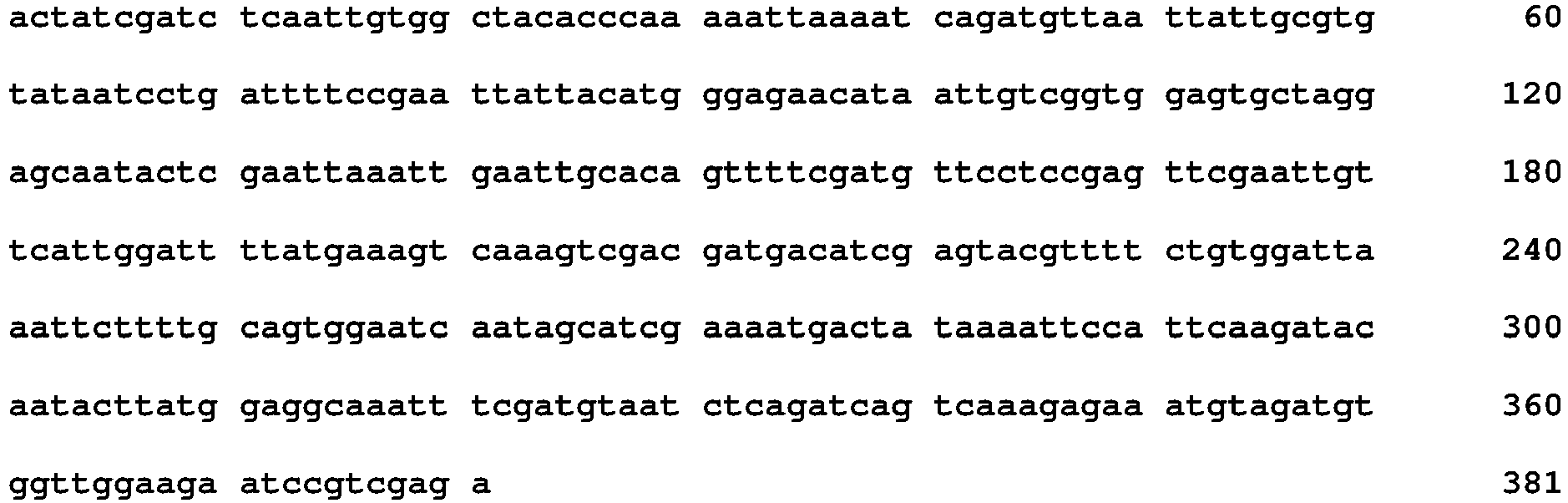
- <210> 4
<211> 360
<212> DNA
<213> Vespula vulgaris - <400> 4

- <210> 5
<211> 366
<212> DNA
<213> Vespula vulgaris - <400> 5

- <210> 6
<211> 417
<212> DNA
<213> Vespula vulgaris - <400> 6


- <210> 7
<211> 360
<212> DNA
<213> Vespula vulgaris - <400> 7

- <210> 8
<211> 342
<212> DNA
<213> Vespula vulgaris - <400> 8

- <210> 9
<211> 291
<212> DNA
<213> Vespula vulgaris - <400> 9

- <210> 10
<211> 243
<212> DNA
<213> Vespula vulgaris - <400> 10

- <210> 11
<211> 231
<212> DNA
<213> Vespula vulgaris - <400> 11

- <210> 12
<211> 299
<212> DNA
<213> Vespula vulgaris - <400> 12

- <210> 13
<211> 270
<212> DNA
<213> Vespula vulgaris - <400> 13


- <210> 14
<211> 270
<212> DNA
<213> Vespula vulgaris - <400> 14
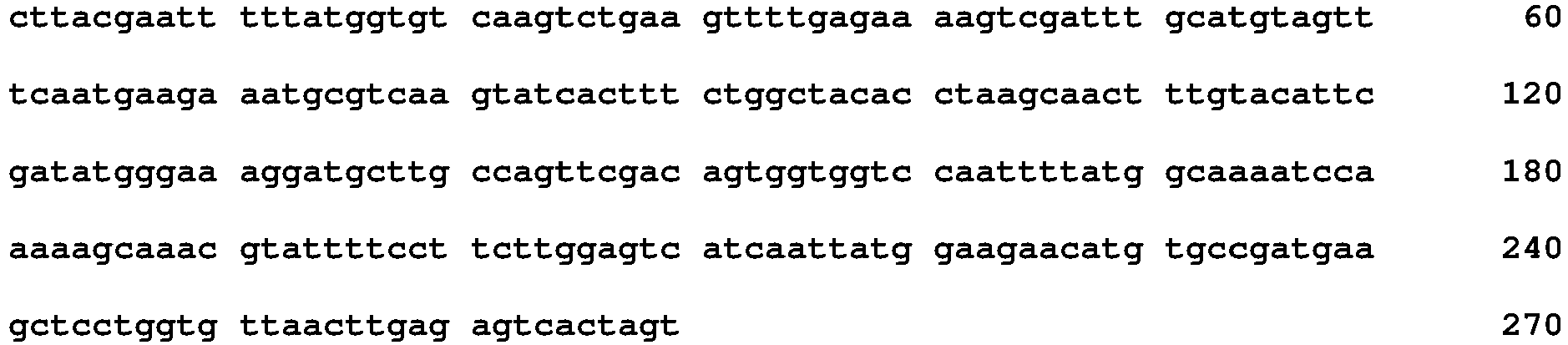
- <210> 15
<211> 159
<212> DNA
<213> Vespula vulgaris - <400> 15

- <210> 16
<211> 183
<212> DNA
<213> Vespula vulgaris - <400> 16

- <210> 17
<211> 165
<212> DNA
<213> Vespula vulgaris - <400> 17

- <210> 18
<211> 150
<212> DNA
<213> Vespula vulgaris - <400> 18

- <210> 19
<211> 132
<212> DNA
<213> Vespula vulgaris - <400> 19

- <210> 20
<211> 150
<212> DNA
<213> Vespula vulgaris - <400> 20

- <210> 21
<211> 168
<212> DNA
<213> Vespula vulgaris - <400> 21

- <210> 22
<211> 153
<212> DNA
<213> Vespula vulgaris - <400> 22

- <210> 23
<211> 171
<212> DNA
<213> Vespula vulgaris - <400> 23

- <210> 24
<211> 159
<212> DNA
<213> Vespula vulgaris - <400> 24

- <210> 25
<211> 165
<212> DNA
<213> Vespula vulgaris - <400> 25

- <210> 26
<211> 141
<212> DNA
<213> Vespula vulgaris - <400> 26

- <210> 27
<211> 144
<212> DNA
<213> Vespula vulgaris - <400> 27

- <210> 28
<211> 127
<212> PRT
<213> Vespula vulgaris - <400> 28

- <210> 29
<211> 120
<212> PRT
<213> Vespula vulgaris - <400> 29


- <210> 30
<211> 122
<212> PRT
<213> Vespula vulgaris - <400> 30

- <210> 31
<211> 139
<212> PRT
<213> Vespula vulgaris - <400> 31


- <210> 32
<211> 120
<212> PRT
<213> Vespula vulgaris - <400> 32
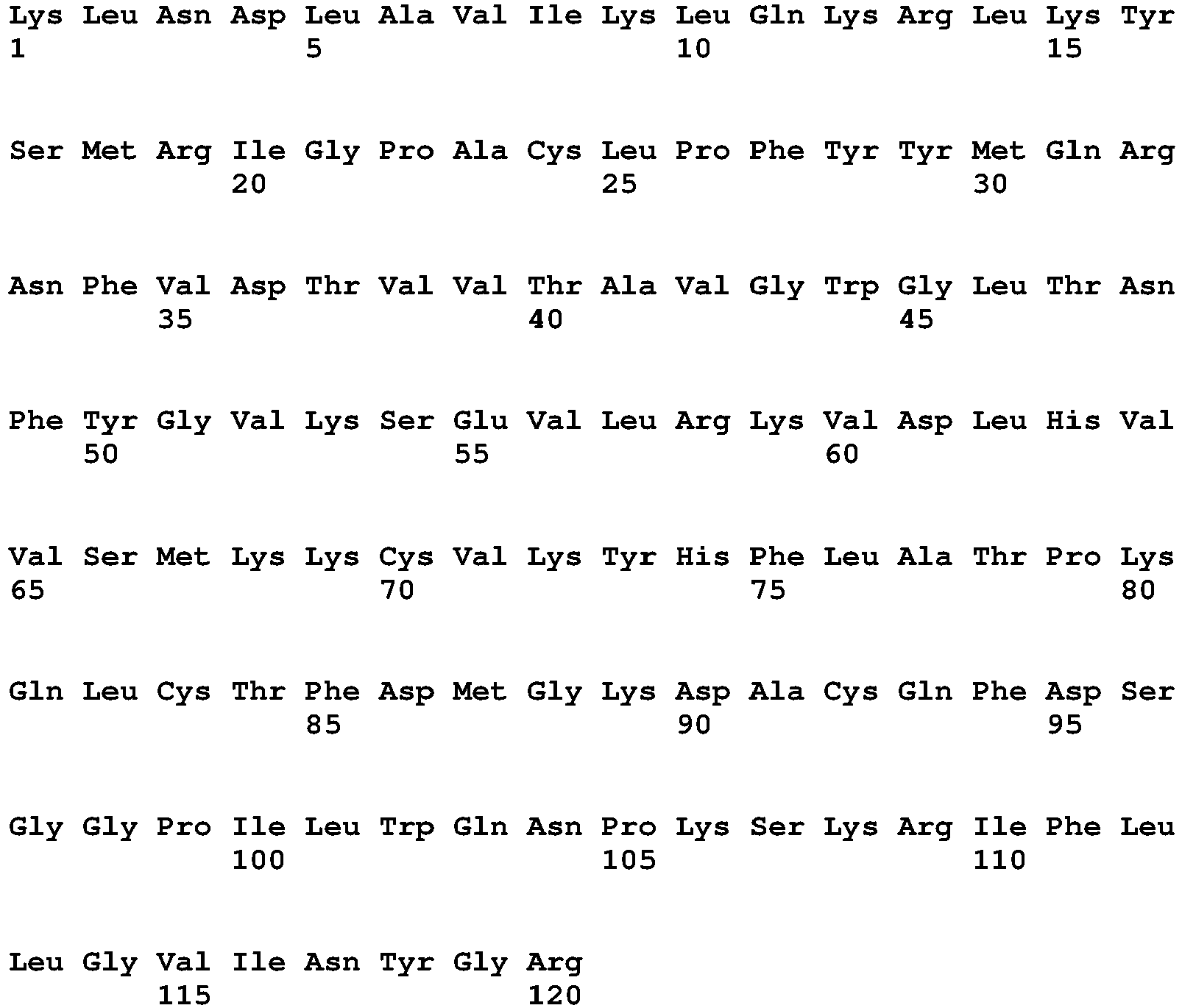
- <210> 33
<211> 114
<212> PRT
<213> Vespula vulgaris - <400> 33

- <210> 34
<211> 97
<212> PRT
<213> Vespula vulgaris - <400> 34


- <210> 35
<211> 81
<212> PRT
<213> Vespula vulgaris - <400> 35

- <210> 36
<211> 77
<212> PRT
<213> Vespula vulgaris - <400> 36

- <210> 37
<211> 101
<212> PRT
<213> Vespula vulgaris - <400> 37
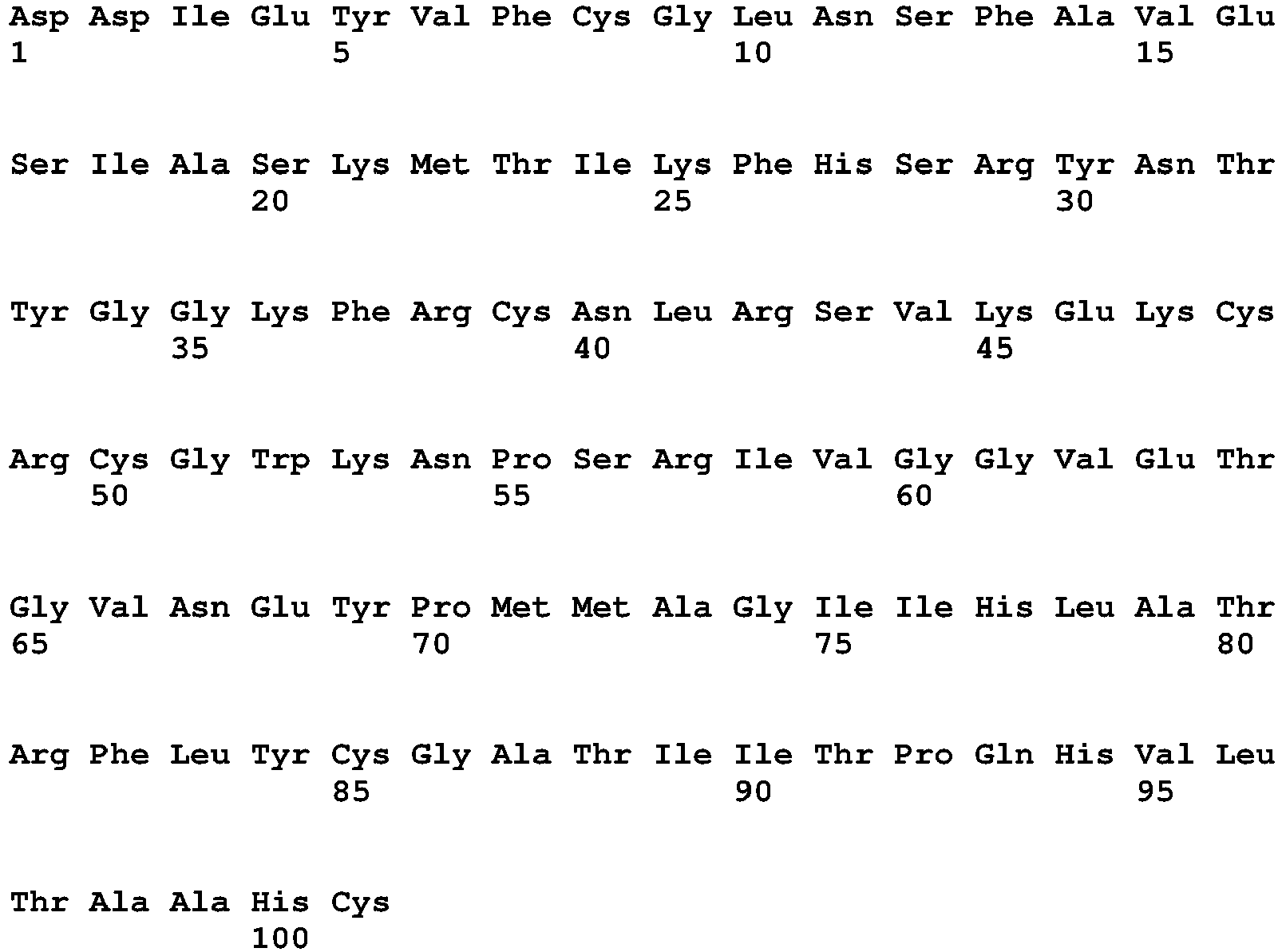
- <210> 38
<211> 90
<212> PRT
<213> Vespula vulgaris - <400> 38


- <210> 39
<211> 91
<212> PRT
<213> Vespula vulgaris - <400> 39

- <210> 40
<211> 53
<212> PRT
<213> Vespula vulgaris - <400> 40

- <210> 41
<211> 61
<212> PRT
<213> Vespula vulgaris - <400> 41


- <210> 42
<211> 55
<212> PRT
<213> Vespula vulgaris - <400> 42

- <210> 43
<211> 50
<212> PRT
<213> Vespula vulgaris - <400> 43

- <210> 44
<211> 44
<212> PRT
<213> Vespula vulgaris - <400> 44

- <210> 45
<211> 50
<212> PRT
<213> Vespula vulgaris - <400> 45

- <210> 46
<211> 56
<212> PRT
<213> Vespula vulgaris - <400> 46

- <210> 47
<211> 52
<212> PRT
<213> Vespula vulgaris - <400> 47
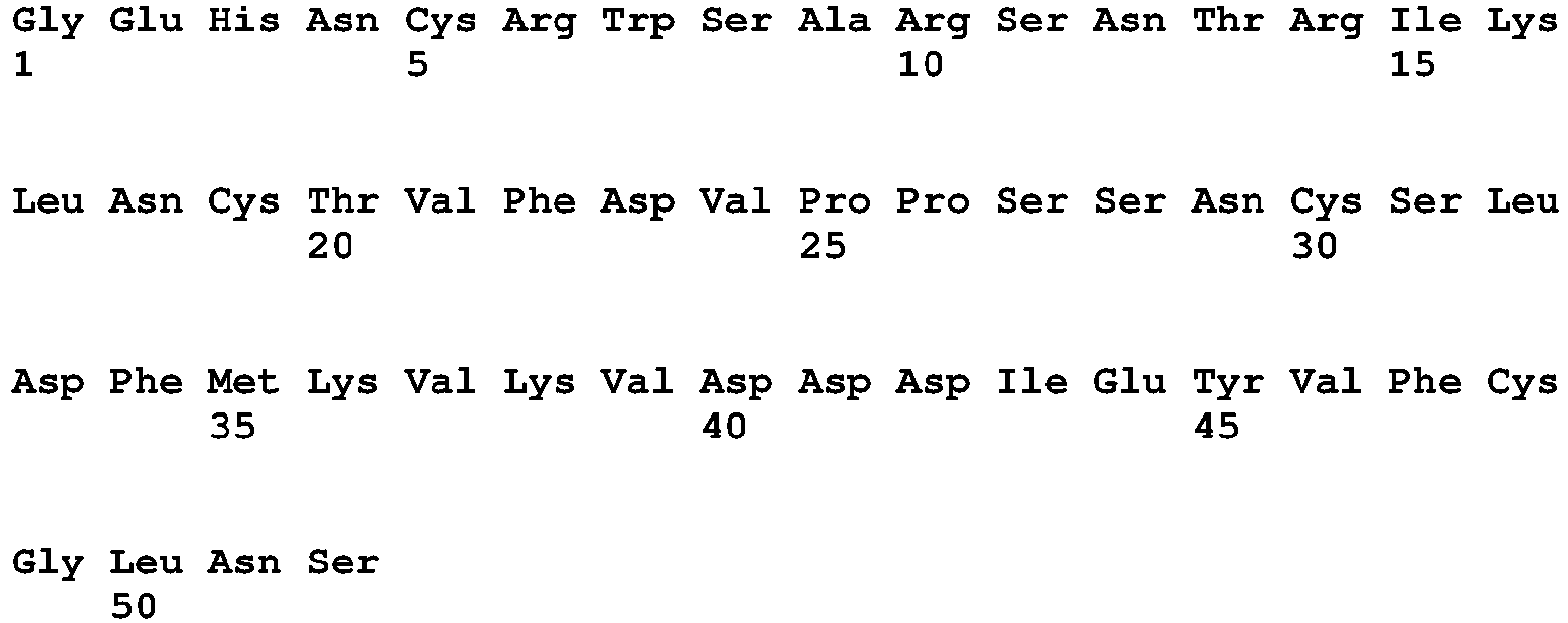
- <210> 48
<211> 57
<212> PRT
<213> Vespula vulgaris - <400> 48

- <210> 49
<211> 53
<212> PRT
<213> Vespula vulgaris - <400> 49

- <210> 50
<211> 55
<212> PRT
<213> Vespula vulgaris - <400> 50

- <210> 51
<211> 47
<212> PRT
<213> Vespula vulgaris - <400> 51

- <210> 52
<211> 48
<212> PRT
<213> Vespula vulgaris - <400> 52

- <210> 53
<211> 45
<212> DNA
<213> Vespula vulgaris - <400> 53
agtggtggtc caattttatg gcaaaatcca aaaagcaaac gtatt 45 - <210> 54
<211> 45
<212> DNA
<213> Vespula vulgaris - <400> 54
ggtggtccaa ttttatggca aaatccaaaa agcaaacgta ttttc 45 - <210> 55
<211> 45
<212> DNA
<213> Vespula vulgaris - <400> 55
ggtccaattt tatggcaaaa tccaaaaagc aaacgtattt tcctt 45 - <210> 56
<211> 45
<212> DNA
<213> Vespula vulgaris - <400> 56
ccaattttat ggcaaaatcc aaaaagcaaa cgtattttcc ttctt 45 - <210> 57
<211> 45
<212> DNA
<213> Vespula vulgaris - <400> 57
attttatggc aaaatccaaa aagcaaacgt attttccttc ttgga 45 - <210> 58
<211> 45
<212> DNA
<213> Vespula vulgaris - <400> 58
tatcctatga tggctggtat aatacatctt gcaacgcgtt ttctc 45 - <210> 59
<211> 45
<212> DNA
<213> Vespula vulgaris - <400> 59
tcttttgcag tggaatcaat agcatcgaaa atgactataa aattc 45 - <210> 60
<211> 45
<212> DNA
<213> Vespula vulgaris - <400> 60
tttgcagtgg aatcaatagc atcgaaaatg actataaaat tccat 45 - <210> 61
<211> 45
<212> DNA
<213> Vespula vulgaris - <400> 61
aattcttttg cagtggaatc aatagcatcg aaaatgacta taaaa 45 - <210> 62
<211> 45
<212> DNA
<213> Vespula vulgaris - <400> 62
cctatgatgg ctggtataat acatcttgca acgcgttttc tctat 45 - <210> 63
<211> 45
<212> DNA
<213> Vespula vulgaris - <400> 63
ttaaattctt ttgcagtgga atcaatagca tcgaaaatga ctata 45 - <210> 64
<211> 45
<212> DNA
<213> Vespula vulgaris - <400> 64
atggctggta taatacatct tgcaacgcgt tttctctatt gcggt 45 - <210> 65
<211> 45
<212> DNA
<213> Vespula vulgaris - <400> 65
ggattaaatt cttttgcagt ggaatcaata gcatcgaaaa tgact 45 - <210> 66
<211> 45
<212> DNA
<213> Vespula vulgaris - <400> 66
gctggtataa tacatcttgc aacgcgtttt ctctattgcg gtgca 45 - <210> 67
<211> 45
<212> DNA
<213> Vespula vulgaris - <400> 67
atgatggctg gtataataca tcttgcaacg cgttttctct attgc 45 - <210> 68
<211> 45
<212> DNA
<213> Vespula vulgaris - <400> 68
gagtacgttt tctgtggatt aaattctttt gcagtggaat caata 45 - <210> 69
<211> 45
<212> DNA
<213> Vespula vulgaris - <400> 69
tacgttttct gtggattaaa ttcttttgca gtggaatcaa tagca 45 - <210> 70
<211> 45
<212> DNA
<213> Vespula vulgaris - <400> 70
atcgagtacg ttttctgtgg attaaattct tttgcagtgg aatca 45 - <210> 71
<211> 45
<212> DNA
<213> Vespula vulgaris - <400> 71
gacatcgagt acgttttctg tggattaaat tcttttgcag tggaa 45 - <210> 72
<211> 45
<212> DNA
<213> Vespula vulgaris - <400> 72
gatgacatcg agtacgtttt ctgtggatta aattcttttg cagtg 45 - <210> 73
<211> 45
<212> DNA
<213> Vespula vulgaris - <400> 73
gtgaatgaat atcctatgat ggctggtata atacatcttg caacg 45 - <210> 74
<211> 45
<212> DNA
<213> Vespula vulgaris - <400> 74
aatgaatatc ctatgatggc tggtataata catcttgcaa cgcgt 45 - <210> 75
<211> 45
<212> DNA
<213> Vespula vulgaris - <400> 75
cttacgaatt tttatggtgt caagtctgaa gttttgagaa aagtc 45 - <210> 76
<211> 45
<212> DNA
<213> Vespula vulgaris - <400> 76
ggagtgaatg aatatcctat gatggctggt ataatacatc ttgca 45 - <210> 77
<211> 45
<212> DNA
<213> Vespula vulgaris - <400> 77
acgaattttt atggtgtcaa gtctgaagtt ttgagaaaag tcgat 45 - <210> 78
<211> 45
<212> DNA
<213> Vespula vulgaris - <400> 78
ttatggcaaa atccaaaaag caaacgtatt ttccttcttg gagtc 45 - <210> 79
<211> 45
<212> DNA
<213> Vespula vulgaris - <400> 79
tggcaaaatc caaaaagcaa acgtattttc cttcttggag tcatc 45 - <210> 80
<211> 45
<212> DNA
<213> Vespula vulgaris - <400> 80
aagaggttaa aatattctat gagaattggt ccagcttgtc ttccg 45 - <210> 81
<211> 45
<212> DNA
<213> Vespula vulgaris - <400> 81
gaatatccta tgatggctgg tataatacat cttgcaacgc gtttt 45 - <210> 82
<211> 45
<212> DNA
<213> Vespula vulgaris - <400> 82
ttaaaatatt ctatgagaat tggtccagct tgtcttccgt tctat 45 - <210> 83
<211> 45
<212> DNA
<213> Vespula vulgaris - <400> 83
aaatattcta tgagaattgg tccagcttgt cttccgttct attac 45 - <210> 84
<211> 45
<212> DNA
<213> Vespula vulgaris - <400> 84
aggttaaaat attctatgag aattggtcca gcttgtcttc cgttc 45 - <210> 85
<211> 45
<212> DNA
<213> Vespula vulgaris - <400> 85
gcgaggtata aaaggatttt atatattcta ggagttgttg ttgga 45 - <210> 86
<211> 45
<212> DNA
<213> Vespula vulgaris - <400> 86
gcagtggaat caatagcatc gaaaatgact ataaaattcc attca 45 - <210> 87
<211> 45
<212> DNA
<213> Vespula vulgaris - <400> 87
tattctatga gaattggtcc agcttgtctt ccgttctatt acatg 45 - <210> 88
<211> 45
<212> DNA
<213> Vespula vulgaris - <400> 88
gtggaatcaa tagcatcgaa aatgactata aaattccatt caaga 45 - <210> 89
<211> 45
<212> DNA
<213> Vespula vulgaris - <400> 89
gacactgttg ttacagctgt aggatggggt cttacgaatt tttat 45 - <210> 90
<211> 45
<212> DNA
<213> Vespula vulgaris - <400> 90
cttgcaacgc gttttctcta ttgcggtgca actataataa ctccg 45 - <210> 91
<211> 45
<212> DNA
<213> Vespula vulgaris - <400> 91
aatttttatg gtgtcaagtc tgaagttttg agaaaagtcg atttg 45 - <210> 92
<211> 45
<212> DNA
<213> Vespula vulgaris - <400> 92
ggtataatac atcttgcaac gcgttttctc tattgcggtg caact 45 - <210> 93
<211> 45
<212> DNA
<213> Vespula vulgaris - <400> 93
tggggtctta cgaattttta tggtgtcaag tctgaagttt tgaga 45 - <210> 94
<211> 45
<212> DNA
<213> Vespula vulgaris - <400> 94
ttttatggtg tcaagtctga agttttgaga aaagtcgatt tgcat 45 - <210> 95
<211> 45
<212> DNA
<213> Vespula vulgaris - <400> 95
ataatacatc ttgcaacgcg ttttctctat tgcggtgcaa ctata 45 - <210> 96
<211> 45
<212> DNA
<213> Vespula vulgaris - <400> 96
ggatggggtc ttacgaattt ttatggtgtc aagtctgaag ttttg 45 - <210> 97
<211> 45
<212> DNA
<213> Vespula vulgaris - <400> 97
aggtataaaa ggattttata tattctagga gttgttgttg gagaa 45 - <210> 98
<211> 45
<212> DNA
<213> Vespula vulgaris - <400> 98
tataaaagga ttttatatat tctaggagtt gttgttggag aacat 45 - <210> 99
<211> 45
<212> DNA
<213> Vespula vulgaris - <400> 99
cgttttctct attgcggtgc aactataata actccgcaac atgta 45 - <210> 100
<211> 45
<212> DNA
<213> Vespula vulgaris - <400> 100
aaaaggattt tatatattct aggagttgtt gttggagaac ataat 45 - <210> 101
<211> 45
<212> DNA
<213> Vespula vulgaris - <400> 101
acgcgttttc tctattgcgg tgcaactata ataactccgc aacat 45 - <210> 102
<211> 45
<212> DNA
<213> Vespula vulgaris - <400> 102
gcaacgcgtt ttctctattg cggtgcaact ataataactc cgcaa 45 - <210> 103
<211> 45
<212> DNA
<213> Vespula vulgaris - <400> 103
gaaacaggag tgaatgaata tcctatgatg gctggtataa tacat 45 - <210> 104
<211> 45
<212> DNA
<213> Vespula vulgaris - <400> 104
acaggagtga atgaatatcc tatgatggct ggtataatac atctt 45 - <210> 105
<211> 45
<212> DNA
<213> Vespula vulgaris - <400> 105
ggtcttacga atttttatgg tgtcaagtct gaagttttga gaaaa 45 - <210> 106
<211> 45
<212> DNA
<213> Vespula vulgaris - <400> 106
gttttctgtg gattaaattc ttttgcagtg gaatcaatag catcg 45 - <210> 107
<211> 45
<212> DNA
<213> Vespula vulgaris - <400> 107
ttctgtggat taaattcttt tgcagtggaa tcaatagcat cgaaa 45 - <210> 108
<211> 45
<212> DNA
<213> Vespula vulgaris - <400> 108
actgttgtta cagctgtagg atggggtctt acgaattttt atggt 45 - <210> 109
<211> 45
<212> DNA
<213> Vespula vulgaris - <400> 109
aactttgtag acactgttgt tacagctgta ggatggggtc ttacg 45 - <210> 110
<211> 45
<212> DNA
<213> Vespula vulgaris - <400> 110
cataatacat gggcaattaa cgatacaaag gcaactcaac tttat 45 - <210> 111
<211> 45
<212> DNA
<213> Vespula vulgaris - <400> 111
aggattttat atattctagg agttgttgtt ggagaacata ataca 45 - <210> 112
<211> 45
<212> DNA
<213> Vespula vulgaris - <400> 112
aatacatggg caattaacga tacaaaggca actcaacttt atctt 45 - <210> 113
<211> 45
<212> DNA
<213> Vespula vulgaris - <400> 113
tattgcggtg caactataat aactccgcaa catgtattaa cggct 45 - <210> 114
<211> 45
<212> DNA
<213> Vespula vulgaris - <400> 114
gaacataata catgggcaat taacgataca aaggcaactc aactt 45 - <210> 115
<211> 45
<212> DNA
<213> Vespula vulgaris - <400> 115
tttgtagaca ctgttgttac agctgtagga tggggtctta cgaat 45 - <210> 116
<211> 45
<212> DNA
<213> Vespula vulgaris - <400> 116
gttgttacag ctgtaggatg gggtcttacg aatttttatg gtgtc 45 - <210> 117
<211> 45
<212> DNA
<213> Vespula vulgaris - <400> 117
tgcggtgcaa ctataataac tccgcaacat gtattaacgg ctgct 45 - <210> 118
<211> 45
<212> DNA
<213> Vespula vulgaris - <400> 118
tttctctatt gcggtgcaac tataataact ccgcaacatg tatta 45 - <210> 119
<211> 45
<212> DNA
<213> Vespula vulgaris - <400> 119
cgaaactttg tagacactgt tgttacagct gtaggatggg gtctt 45 - <210> 120
<211> 45
<212> DNA
<213> Vespula vulgaris - <400> 120
acagctgtag gatggggtct tacgaatttt tatggtgtca agtct 45 - <210> 121
<211> 45
<212> DNA
<213> Vespula vulgaris - <400> 121
tgcgtcaagt atcactttct ggctacacct aagcaacttt gtaca 45 - <210> 122
<211> 45
<212> DNA
<213> Vespula vulgaris - <400> 122
gtcaagtatc actttctggc tacacctaag caactttgta cattc 45 - <210> 123
<211> 45
<212> DNA
<213> Vespula vulgaris - <400> 123
catcttgcaa cgcgttttct ctattgcggt gcaactataa taact 45 - <210> 124
<211> 45
<212> DNA
<213> Vespula vulgaris - <400> 124
ccgaattata ggccaaaatt aaacgattta gctgttataa aattg 45 - <210> 125
<211> 45
<212> DNA
<213> Vespula vulgaris - <400> 125
ggtgcaacta taataactcc gcaacatgta ttaacggctg ctcat 45 - <210> 126
<211> 45
<212> DNA
<213> Vespula vulgaris - <400> 126
gtagacactg ttgttacagc tgtaggatgg ggtcttacga atttt 45 - <210> 127
<211> 45
<212> DNA
<213> Vespula vulgaris - <400> 127
gcaactataa taactccgca acatgtatta acggctgctc attgc 45 - <210> 128
<211> 45
<212> DNA
<213> Vespula vulgaris - <400> 128
tatggtgtca agtctgaagt tttgagaaaa gtcgatttgc atgta 45 - <210> 129
<211> 45
<212> DNA
<213> Vespula vulgaris - <400> 129
actataataa ctccgcaaca tgtattaacg gctgctcatt gcgtt 45 - <210> 130
<211> 45
<212> DNA
<213> Vespula vulgaris - <400> 130
ctctattgcg gtgcaactat aataactccg caacatgtat taacg 45 - <210> 131
<211> 45
<212> DNA
<213> Vespula vulgaris - <400> 131
aggccaaaat taaacgattt agctgttata aaattgcaga agagg 45 - <210> 132
<211> 45
<212> DNA
<213> Vespula vulgaris - <400> 132
ccaaaattaa acgatttagc tgttataaaa ttgcagaaga ggtta 45 - <210> 133
<211> 45
<212> DNA
<213> Vespula vulgaris - <400> 133
aaatgcgtca agtatcactt tctggctaca cctaagcaac tttgt 45 - <210> 134
<211> 45
<212> DNA
<213> Vespula vulgaris - <400> 134
tataggccaa aattaaacga tttagctgtt ataaaattgc agaag 45 - <210> 135
<211> 45
<212> DNA
<213> Vespula vulgaris - <400> 135
tctatgagaa ttggtccagc ttgtcttccg ttctattaca tgcag 45 - <210> 136
<211> 45
<212> DNA
<213> Vespula vulgaris - <400> 136
aattataggc caaaattaaa cgatttagct gttataaaat tgcag 45 - <210> 137
<211> 45
<212> DNA
<213> Vespula vulgaris - <400> 137
gttacagctg taggatgggg tcttacgaat ttttatggtg tcaag 45 - <210> 138
<211> 45
<212> DNA
<213> Vespula vulgaris - <400> 138
atgagaattg gtccagcttg tcttccgttc tattacatgc agcga 45 - <210> 139
<211> 45
<212> DNA
<213> Vespula vulgaris - <400> 139
aagaaatgcg tcaagtatca ctttctggct acacctaagc aactt 45 - <210> 140
<211> 45
<212> DNA
<213> Vespula vulgaris - <400> 140
gttggagaac ataatacatg ggcaattaac gatacaaagg caact 45 - <210> 141
<211> 45
<212> DNA
<213> Vespula vulgaris - <400> 141
gttgcgaggt ataaaaggat tttatatatt ctaggagttg ttgtt 45 - <210> 142
<211> 45
<212> DNA
<213> Vespula vulgaris - <400> 142
ggagaacata atacatgggc aattaacgat acaaaggcaa ctcaa 45 - <210> 143
<211> 45
<212> DNA
<213> Vespula vulgaris - <400> 143
tacatgcagc gaaactttgt agacactgtt gttacagctg tagga 45 - <210> 144
<211> 45
<212> DNA
<213> Vespula vulgaris - <400> 144
acatgggcaa ttaacgatac aaaggcaact caactttatc ttatt 45 - <210> 145
<211> 45
<212> DNA
<213> Vespula vulgaris - <400> 145
tgggcaatta acgatacaaa ggcaactcaa ctttatctta ttgat 45 - <210> 146
<211> 45
<212> DNA
<213> Vespula vulgaris - <400> 146
atgaagaaat gcgtcaagta tcactttctg gctacaccta agcaa 45 - <210> 147
<211> 45
<212> DNA
<213> Vespula vulgaris - <400> 147
gtcaagtctg aagttttgag aaaagtcgat ttgcatgtag tttca 45 - <210> 148
<211> 45
<212> DNA
<213> Vespula vulgaris - <400> 148
ggtgtcaagt ctgaagtttt gagaaaagtc gatttgcatg tagtt 45 - <210> 149
<211> 45
<212> DNA
<213> Vespula vulgaris - <400> 149
cagcgaaact ttgtagacac tgttgttaca gctgtaggat ggggt 45 - <210> 150
<211> 45
<212> DNA
<213> Vespula vulgaris - <400> 150
atgcagcgaa actttgtaga cactgttgtt acagctgtag gatgg 45 - <210> 151
<211> 45
<212> DNA
<213> Vespula vulgaris - <400> 151
ataactccgc aacatgtatt aacggctgct cattgcgttg cgagg 45 - <210> 152
<211> 45
<212> DNA
<213> Vespula vulgaris - <400> 152
gctgtaggat ggggtcttac gaatttttat ggtgtcaagt ctgaa 45 - <210> 153
<211> 45
<212> DNA
<213> Vespula vulgaris - <400> 153
tattacatgc agcgaaactt tgtagacact gttgttacag ctgta 45 - <210> 154
<211> 45
<212> DNA
<213> Vespula vulgaris - <400> 154
tatcactttc tggctacacc taagcaactt tgtacattcg atatg 45 - <210> 155
<211> 45
<212> DNA
<213> Vespula vulgaris - <400> 155
atacatcttg caacgcgttt tctctattgc ggtgcaacta taata 45 - <210> 156
<211> 45
<212> DNA
<213> Vespula vulgaris - <400> 156
gtaggatggg gtcttacgaa tttttatggt gtcaagtctg aagtt 45 - <210> 157
<211> 45
<212> DNA
<213> Vespula vulgaris - <400> 157
actagttatt tagattttat tacaagatca acacctggag aaata 45 - <210> 158
<211> 45
<212> DNA
<213> Vespula vulgaris - <400> 158
attttatata ttctaggagt tgttgttgga gaacataata catgg 45 - <210> 159
<211> 45
<212> DNA
<213> Vespula vulgaris - <400> 159
aagtatcact ttctggctac acctaagcaa ctttgtacat tcgat 45 - <210> 160
<211> 45
<212> DNA
<213> Vespula vulgaris - <400> 160
gtcactagtt atttagattt tattacaaga tcaacacctg gagaa 45 - <210> 161
<211> 45
<212> DNA
<213> Vespula vulgaris - <400> 161
ataataactc cgcaacatgt attaacggct gctcattgcg ttgcg 45 - <210> 162
<211> 45
<212> DNA
<213> Vespula vulgaris - <400> 162
cttccgttct attacatgca gcgaaacttt gtagacactg ttgtt 45 - <210> 163
<211> 45
<212> DNA
<213> Vespula vulgaris - <400> 163
tgtcttccgt tctattacat gcagcgaaac tttgtagaca ctgtt 45 - <210> 164
<211> 45
<212> DNA
<213> Vespula vulgaris - <400> 164
gttgaaacag gagtgaatga atatcctatg atggctggta taata 45 - <210> 165
<211> 45
<212> DNA
<213> Vespula vulgaris - <400> 165
atcgatctca attgtggcta cacccaaaaa ttaaaatcag atgtt 45 - <210> 166
<211> 45
<212> DNA
<213> Vespula vulgaris - <400> 166
cattgcgttg cgaggtataa aaggatttta tatattctag gagtt 45 - <210> 167
<211> 45
<212> DNA
<213> Vespula vulgaris - <400> 167
actccgcaac atgtattaac ggctgctcat tgcgttgcga ggtat 45 - <210> 168
<211> 45
<212> DNA
<213> Vespula vulgaris - <400> 168
tgcgttgcga ggtataaaag gattttatat attctaggag ttgtt 45 - <210> 169
<211> 45
<212> DNA
<213> Vespula vulgaris - <400> 169
ccgcaacatg tattaacggc tgctcattgc gttgcgaggt ataaa 45 - <210> 170
<211> 45
<212> DNA
<213> Vespula vulgaris - <400> 170
ttatatattc taggagttgt tgttggagaa cataatacat gggca 45 - <210> 171
<211> 45
<212> DNA
<213> Vespula vulgaris - <400> 171
tctgaagttt tgagaaaagt cgatttgcat gtagtttcaa tgaag 45 - <210> 172
<211> 45
<212> DNA
<213> Vespula vulgaris - <400> 172
ccgttctatt acatgcagcg aaactttgta gacactgttg ttaca 45 - <210> 173
<211> 45
<212> DNA
<213> Vespula vulgaris - <400> 173
ttctattaca tgcagcgaaa ctttgtagac actgttgtta cagct 45 - <210> 174
<211> 45
<212> DNA
<213> Vespula vulgaris - <400> 174
tgcacagttt tcgatgttcc tccgagttcg aattgttcat tggat 45 - <210> 175
<211> 45
<212> DNA
<213> Vespula vulgaris - <400> 175
aattgcacag ttttcgatgt tcctccgagt tcgaattgtt cattg 45 - <210> 176
<211> 45
<212> DNA
<213> Vespula vulgaris - <400> 176
aagtctgaag ttttgagaaa agtcgatttg catgtagttt caatg 45 - <210> 177
<211> 45
<212> DNA
<213> Vespula vulgaris - <400> 177
aacttgagag tcactagtta tttagatttt attacaagat caaca 45 - <210> 178
<211> 45
<212> DNA
<213> Vespula vulgaris - <400> 178
ttgagagtca ctagttattt agattttatt acaagatcaa cacct 45 - <210> 179
<211> 45
<212> DNA
<213> Vespula vulgaris - <400> 179
gaagttttga gaaaagtcga tttgcatgta gtttcaatga agaaa 45 - <210> 180
<211> 45
<212> DNA
<213> Vespula vulgaris - <400> 180
actatcgatc tcaattgtgg ctacacccaa aaattaaaat cagat 45 - <210> 181
<211> 45
<212> DNA
<213> Vespula vulgaris - <400> 181
agagtcacta gttatttaga ttttattaca agatcaacac ctgga 45 - <210> 182
<211> 45
<212> DNA
<213> Vespula vulgaris - <400> 182
gctcattgcg ttgcgaggta taaaaggatt ttatatattc tagga 45 - <210> 183
<211> 45
<212> DNA
<213> Vespula vulgaris - <400> 183
tgtagatgtg gttggaagaa tccgtcgaga atcgtaggcg gtgtt 45 - <210> 184
<211> 45
<212> DNA
<213> Vespula vulgaris - <400> 184
aaatgtagat gtggttggaa gaatccgtcg agaatcgtag gcggt 45 - <210> 185
<211> 45
<212> DNA
<213> Vespula vulgaris - <400> 185
ttaaacgatt tagctgttat aaaattgcag aagaggttaa aatat 45 - <210> 186
<211> 45
<212> DNA
<213> Vespula vulgaris - <400> 186
ggcggtgttg aaacaggagt gaatgaatat cctatgatgg ctggt 45 - <210> 187
<211> 45
<212> DNA
<213> Vespula vulgaris - <400> 187
aaattaaacg atttagctgt tataaaattg cagaagaggt taaaa 45 - <210> 188
<211> 45
<212> DNA
<213> Vespula vulgaris - <400> 188
gcttgtcttc cgttctatta catgcagcga aactttgtag acact 45 - <210> 189
<211> 45
<212> DNA
<213> Vespula vulgaris - <400> 189
gagaaatgta gatgtggttg gaagaatccg tcgagaatcg taggc 45 - <210> 190
<211> 45
<212> DNA
<213> Vespula vulgaris - <400> 190
ggtgttgaaa caggagtgaa tgaatatcct atgatggctg gtata 45 - <210> 191
<211> 45
<212> DNA
<213> Vespula vulgaris - <400> 191
tgtggctaca cccaaaaatt aaaatcagat gttaattatt gcgtg 45 - <210> 192
<211> 45
<212> DNA
<213> Vespula vulgaris - <400> 192
agatgtggtt ggaagaatcc gtcgagaatc gtaggcggtg ttgaa 45 - <210> 193
<211> 45
<212> DNA
<213> Vespula vulgaris - <400> 193
gcttgccagt tcgacagtgg tggtccaatt ttatggcaaa atcca 45 - <210> 194
<211> 45
<212> DNA
<213> Vespula vulgaris - <400> 194
ttgaattgca cagttttcga tgttcctccg agttcgaatt gttca 45 - <210> 195
<211> 45
<212> DNA
<213> Vespula vulgaris - <400> 195
gaacataatt gtcggtggag tgctaggagc aatactcgaa ttaaa 45 - <210> 196
<211> 45
<212> DNA
<213> Vespula vulgaris - <400> 196
tgccagttcg acagtggtgg tccaatttta tggcaaaatc caaaa 45 - <210> 197
<211> 45
<212> DNA
<213> Vespula vulgaris - <400> 197
caacatgtat taacggctgc tcattgcgtt gcgaggtata aaagg 45 - <210> 198
<211> 45
<212> DNA
<213> Vespula vulgaris - <400> 198
cataattgtc ggtggagtgc taggagcaat actcgaatta aattg 45 - <210> 199
<211> 45
<212> DNA
<213> Vespula vulgaris - <400> 199
ggagaacata attgtcggtg gagtgctagg agcaatactc gaatt 45 - <210> 200
<211> 45
<212> DNA
<213> Vespula vulgaris - <400> 200
gatgcttgcc agttcgacag tggtggtcca attttatggc aaaat 45 - <210> 201
<211> 45
<212> DNA
<213> Vespula vulgaris - <400> 201
aattgtcggt ggagtgctag gagcaatact cgaattaaat tgaat 45 - <210> 202
<211> 45
<212> DNA
<213> Vespula vulgaris - <400> 202
gccgatgaag ctcctggtgt taacttgaga gtcactagtt attta 45 - <210> 203
<211> 45
<212> DNA
<213> Vespula vulgaris - <400> 203
acagttttcg atgttcctcc gagttcgaat tgttcattgg atttt 45 - <210> 204
<211> 45
<212> DNA
<213> Vespula vulgaris - <400> 204
aatccgtcga gaatcgtagg cggtgttgaa acaggagtga atgaa 45 - <210> 205
<211> 45
<212> DNA
<213> Vespula vulgaris - <400> 205
aagaatccgt cgagaatcgt aggcggtgtt gaaacaggag tgaat 45 - <210> 206
<211> 45
<212> DNA
<213> Vespula vulgaris - <400> 206
tgtggattaa attcttttgc agtggaatca atagcatcga aaatg 45 - <210> 207
<211> 45
<212> DNA
<213> Vespula vulgaris - <400> 207
ataaaattgc agaagaggtt aaaatattct atgagaattg gtcca 45 - <210> 208
<211> 45
<212> DNA
<213> Vespula vulgaris - <400> 208
aaggatgctt gccagttcga cagtggtggt ccaattttat ggcaa 45 - <210> 209
<211> 45
<212> DNA
<213> Vespula vulgaris - <400> 209
gctgttataa aattgcagaa gaggttaaaa tattctatga gaatt 45 - <210> 210
<211> 45
<212> DNA
<213> Vespula vulgaris - <400> 210
agttatttag attttattac aagatcaaca cctggagaaa tatat 45 - <210> 211
<211> 45
<212> DNA
<213> Vespula vulgaris - <400> 211
gttataaaat tgcagaagag gttaaaatat tctatgagaa ttggt 45 - <210> 212
<211> 45
<212> DNA
<213> Vespula vulgaris - <400> 212
ggctacaccc aaaaattaaa atcagatgtt aattattgcg tgtat 45 - <210> 213
<211> 45
<212> DNA
<213> Vespula vulgaris - <400> 213
ttcgacagtg gtggtccaat tttatggcaa aatccaaaaa gcaaa 45 - <210> 214
<211> 45
<212> DNA
<213> Vespula vulgaris - <400> 214
ataatcgtac atccgaatta taggccaaaa ttaaacgatt tagct 45 - <210> 215
<211> 45
<212> DNA
<213> Vespula vulgaris - <400> 215
gatgaagctc ctggtgttaa cttgagagtc actagttatt tagat 45 - <210> 216
<211> 45
<212> DNA
<213> Vespula vulgaris - <400> 216
catgtattaa cggctgctca ttgcgttgcg aggtataaaa ggatt 45 - <210> 217
<211> 45
<212> DNA
<213> Vespula vulgaris - <400> 217
ggaaaggatg cttgccagtt cgacagtggt ggtccaattt tatgg 45 - <210> 218
<211> 45
<212> DNA
<213> Vespula vulgaris - <400> 218
tatttagatt ttattacaag atcaacacct ggagaaatat attgt 45 - <210> 219
<211> 45
<212> DNA
<213> Vespula vulgaris - <400> 219
ttgcagaaga ggttaaaata ttctatgaga attggtccag cttgt 45 - <210> 220
<211> 45
<212> DNA
<213> Vespula vulgaris - <400> 220
tttatgaaag tcaaagtcga cgatgacatc gagtacgttt tctgt 45 - <210> 221
<211> 45
<212> DNA
<213> Vespula vulgaris - <400> 221
gattttatga aagtcaaagt cgacgatgac atcgagtacg ttttc 45 - <210> 222
<211> 45
<212> DNA
<213> Vespula vulgaris - <400> 222
atgaaagtca aagtcgacga tgacatcgag tacgttttct gtgga 45 - <210> 223
<211> 45
<212> DNA
<213> Vespula vulgaris - <400> 223
atgaagaaat gcgtcaagta tcactttctg gctacaccta agcaa 45 - <210> 224
<211> 45
<212> DNA
<213> Vespula vulgaris - <400> 224
gtcaagtatc actttctggc tacacctaag caactttgta cattc 45 - <210> 225
<211> 45
<212> DNA
<213> Vespula vulgaris - <400> 225
aaatgcgtca agtatcactt tctggctaca cctaagcaac tttgt 45 - <210> 226
<211> 45
<212> DNA
<213> Vespula vulgaris - <400> 226
tgcgtcaagt atcactttct ggctacacct aagcaacttt gtaca 45 - <210> 227
<211> 45
<212> DNA
<213> Vespula vulgaris - <400> 227
aagaaatgcg tcaagtatca ctttctggct acacctaagc aactt 45 - <210> 228
<211> 45
<212> DNA
<213> Vespula vulgaris - <400> 228
gatgttaatt attgcgtgta taatcctgat tttccgaatt attac 45 - <210> 229
<211> 45
<212> DNA
<213> Vespula vulgaris - <400> 229
gttaattatt gcgtgtataa tcctgatttt ccgaattatt acatg 45 - <210> 230
<211> 45
<212> DNA
<213> Vespula vulgaris - <400> 230
aattattgcg tgtataatcc tgattttccg aattattaca tggga 45 - <210> 231
<211> 45
<212> DNA
<213> Vespula vulgaris - <400> 231
tattgcgtgt ataatcctga ttttccgaat tattacatgg gagaa 45 - <210> 232
<211> 45
<212> DNA
<213> Vespula vulgaris - <400> 232
tgcgtgtata atcctgattt tccgaattat tacatgggag aacat 45 - <210> 233
<211> 45
<212> DNA
<213> Vespula vulgaris - <400> 233
aagtatcact ttctggctac acctaagcaa ctttgtacat tcgat 45 - <210> 234
<211> 45
<212> DNA
<213> Vespula vulgaris - <400> 234
tatcactttc tggctacacc taagcaactt tgtacattcg atatg 45 - <210> 235
<211> 45
<212> DNA
<213> Vespula vulgaris - <400> 235
ttgaattgca cagttttcga tgttcctccg agttcgaatt gttca 45 - <210> 236
<211> 45
<212> DNA
<213> Vespula vulgaris - <400> 236
gtcactagtt atttagattt tattacaaga tcaacacctg gagaa 45 - <210> 237
<211> 45
<212> DNA
<213> Vespula vulgaris - <400> 237
actagttatt tagattttat tacaagatca acacctggag aaata 45 - <210> 238
<211> 45
<212> DNA
<213> Vespula vulgaris - <400> 238
agagtcacta gttatttaga ttttattaca agatcaacac ctgga 45 - <210> 239
<211> 45
<212> DNA
<213> Vespula vulgaris - <400> 239
aaatgcgtca agtatcactt tctggctaca cctaagcaac tttgt 45 - <210> 240
<211> 45
<212> DNA
<213> Vespula vulgaris - <400> 240
ttgagagtca ctagttattt agattttatt acaagatcaa cacct 45 - <210> 241
<211> 45
<212> DNA
<213> Vespula vulgaris - <400> 241
agcaaacgta ttttccttct tggagtcatc aattatggaa gaaca 45 - <210> 242
<211> 45
<212> DNA
<213> Vespula vulgaris - <400> 242
aaacgtattt tccttcttgg agtcatcaat tatggaagaa catgt 45 - <210> 243
<211> 45
<212> DNA
<213> Vespula vulgaris - <400> 243
aacttgagag tcactagtta tttagatttt attacaagat caaca 45 - <210> 244
<211> 45
<212> DNA
<213> Vespula vulgaris - <400> 244
cgtattttcc ttcttggagt catcaattat ggaagaacat gtgcc 45 - <210> 245
<211> 45
<212> DNA
<213> Vespula vulgaris - <400> 245
cctgattttc cgaattatta catgggagaa cataattgtc ggtgg 45 - <210> 246
<211> 45
<212> DNA
<213> Vespula vulgaris - <400> 246
tttccgaatt attacatggg agaacataat tgtcggtgga gtgct 45 - <210> 247
<211> 45
<212> DNA
<213> Vespula vulgaris - <400> 247
gattttccga attattacat gggagaacat aattgtcggt ggagt 45 - <210> 248
<211> 45
<212> DNA
<213> Vespula vulgaris - <400> 248
agtggtggtc caattttatg gcaaaatcca aaaagcaaac gtatt 45 - <210> 249
<211> 45
<212> DNA
<213> Vespula vulgaris - <400> 249
ttatatattc taggagttgt tgttggagaa cataatacat gggca 45 - <210> 250
<211> 45
<212> DNA
<213> Vespula vulgaris - <400> 250
ccagcttgtc ttccgttcta ttacatgcag cgaaactttg tagac 45 - <210> 251
<211> 45
<212> DNA
<213> Vespula vulgaris - <400> 251
gcttgtcttc cgttctatta catgcagcga aactttgtag acact 45 - <210> 252
<211> 45
<212> DNA
<213> Vespula vulgaris - <400> 252
ccgttctatt acatgcagcg aaactttgta gacactgttg ttaca 45 - <210> 253
<211> 45
<212> DNA
<213> Vespula vulgaris - <400> 253
tgtcttccgt tctattacat gcagcgaaac tttgtagaca ctgtt 45 - <210> 254
<211> 45
<212> DNA
<213> Vespula vulgaris - <400> 254
cttccgttct attacatgca gcgaaacttt gtagacactg ttgtt 45 - <210> 255
<211> 45
<212> DNA
<213> Vespula vulgaris - <400> 255
tattacatgc agcgaaactt tgtagacact gttgttacag ctgta 45 - <210> 256
<211> 45
<212> DNA
<213> Vespula vulgaris - <400> 256
ttctattaca tgcagcgaaa ctttgtagac actgttgtta cagct 45 - <210> 257
<211> 45
<212> DNA
<213> Vespula vulgaris - <400> 257
gagtacgttt tctgtggatt aaattctttt gcagtggaat caata 45 - <210> 258
<211> 45
<212> DNA
<213> Vespula vulgaris - <400> 258
gatgacatcg agtacgtttt ctgtggatta aattcttttg cagtg 45 - <210> 259
<211> 45
<212> DNA
<213> Vespula vulgaris - <400> 259
gacatcgagt acgttttctg tggattaaat tcttttgcag tggaa 45 - <210> 260
<211> 45
<212> DNA
<213> Vespula vulgaris - <400> 260
atcgagtacg ttttctgtgg attaaattct tttgcagtgg aatca 45 - <210> 261
<211> 45
<212> DNA
<213> Vespula vulgaris - <400> 261
tacgttttct gtggattaaa ttcttttgca gtggaatcaa tagca 45 - <210> 262
<211> 45
<212> DNA
<213> Vespula vulgaris - <400> 262
tattacatgc agcgaaactt tgtagacact gttgttacag ctgta 45 - <210> 263
<211> 45
<212> DNA
<213> Vespula vulgaris - <400> 263
gctggtataa tacatcttgc aacgcgtttt ctctattgcg gtgca 45 - <210> 264
<211> 45
<212> DNA
<213> Vespula vulgaris - <400> 264
atgatggctg gtataataca tcttgcaacg cgttttctct attgc 45 - <210> 265
<211> 45
<212> DNA
<213> Vespula vulgaris - <400> 265
atgcagcgaa actttgtaga cactgttgtt acagctgtag gatgg 45 - <210> 266
<211> 45
<212> DNA
<213> Vespula vulgaris - <400> 266
cagcgaaact ttgtagacac tgttgttaca gctgtaggat ggggt 45 - <210> 267
<211> 45
<212> DNA
<213> Vespula vulgaris - <400> 267
cctatgatgg ctggtataat acatcttgca acgcgttttc tctat 45 - <210> 268
<211> 45
<212> DNA
<213> Vespula vulgaris - <400> 268
tacatgcagc gaaactttgt agacactgtt gttacagctg tagga 45 - <210> 269
<211> 45
<212> DNA
<213> Vespula vulgaris - <400> 269
tggggtctta cgaattttta tggtgtcaag tctgaagttt tgaga 45 - <210> 270
<211> 45
<212> DNA
<213> Vespula vulgaris - <400> 270
cttacgaatt tttatggtgt caagtctgaa gttttgagaa aagtc 45 - <210> 271
<211> 45
<212> DNA
<213> Vespula vulgaris - <400> 271
ggatggggtc ttacgaattt ttatggtgtc aagtctgaag ttttg 45 - <210> 272
<211> 45
<212> DNA
<213> Vespula vulgaris - <400> 272
acgaattttt atggtgtcaa gtctgaagtt ttgagaaaag tcgat 45 - <210> 273
<211> 45
<212> DNA
<213> Vespula vulgaris - <400> 273
gttttctgtg gattaaattc ttttgcagtg gaatcaatag catcg 45 - <210> 274
<211> 45
<212> DNA
<213> Vespula vulgaris - <400> 274
ttctgtggat taaattcttt tgcagtggaa tcaatagcat cgaaa 45 - <210> 275
<211> 30
<212> DNA
<213> Vespula vulgaris - <400> 275
cctggagaaa tatattgtca ggcgtattaa 30 - <210> 276
<211> 45
<212> DNA
<213> Vespula vulgaris - <400> 276
aattgtcggt ggagtgctag gagcaatact cgaattaaat tgaat 45 - <210> 277
<211> 45
<212> DNA
<213> Vespula vulgaris - <400> 277
gctcctggtg ttaacttgag agtcactagt tatttagatt ttatt 45 - <210> 278
<211> 45
<212> DNA
<213> Vespula vulgaris - <400> 278
ggagaacata attgtcggtg gagtgctagg agcaatactc gaatt 45 - <210> 279
<211> 45
<212> DNA
<213> Vespula vulgaris - <400> 279
gaagctcctg gtgttaactt gagagtcact agttatttag atttt 45 - <210> 280
<211> 45
<212> DNA
<213> Vespula vulgaris - <400> 280
cataattgtc ggtggagtgc taggagcaat actcgaatta aattg 45 - <210> 281
<211> 45
<212> DNA
<213> Vespula vulgaris - <400> 281
gaacataatt gtcggtggag tgctaggagc aatactcgaa ttaaa 45 - <210> 282
<211> 45
<212> DNA
<213> Vespula vulgaris - <400> 282
tgtcggtgga gtgctaggag caatactcga attaaattga attgc 45 - <210> 283
<211> 45
<212> DNA
<213> Vespula vulgaris - <400> 283
catgtattaa cggctgctca ttgcgttgcg aggtataaaa ggatt 45 - <210> 284
<211> 45
<212> DNA
<213> Vespula vulgaris - <400> 284
acggctgctc attgcgttgc gaggtataaa aggattttat atatt 45 - <210> 285
<211> 45
<212> DNA
<213> Vespula vulgaris - <400> 285
ccaattttat ggcaaaatcc aaaaagcaaa cgtattttcc ttctt 45 - <210> 286
<211> 45
<212> DNA
<213> Vespula vulgaris - <400> 286
gctgctcatt gcgttgcgag gtataaaagg attttatata ttcta 45 - <210> 287
<211> 45
<212> DNA
<213> Vespula vulgaris - <400> 287
ggtataatac atcttgcaac gcgttttctc tattgcggtg caact 45 - <210> 288
<211> 45
<212> DNA
<213> Vespula vulgaris - <400> 288
attttatggc aaaatccaaa aagcaaacgt attttccttc ttgga 45 - <210> 289
<211> 45
<212> DNA
<213> Vespula vulgaris - <400> 289
cttccgttct attacatgca gcgaaacttt gtagacactg ttgtt 45 - <210> 290
<211> 45
<212> DNA
<213> Vespula vulgaris - <400> 290
ggtccaattt tatggcaaaa tccaaaaagc aaacgtattt tcctt 45 - <210> 291
<211> 45
<212> DNA
<213> Vespula vulgaris - <400> 291
ttagctgtta taaaattgca gaagaggtta aaatattcta tgaga 45 - <210> 292
<211> 45
<212> DNA
<213> Vespula vulgaris - <400> 292
gatttagctg ttataaaatt gcagaagagg ttaaaatatt ctatg 45 - <210> 293
<211> 45
<212> DNA
<213> Vespula vulgaris - <400> 293
gctgttataa aattgcagaa gaggttaaaa tattctatga gaatt 45 - <210> 294
<211> 45
<212> DNA
<213> Vespula vulgaris - <400> 294
ttaaacgatt tagctgttat aaaattgcag aagaggttaa aatat 45 - <210> 295
<211> 45
<212> DNA
<213> Vespula vulgaris - <400> 295
aacgatttag ctgttataaa attgcagaag aggttaaaat attct 45 - <210> 296
<211> 45
<212> DNA
<213> Vespula vulgaris - <400> 296
gttataaaat tgcagaagag gttaaaatat tctatgagaa ttggt 45 - <210> 297
<211> 45
<212> DNA
<213> Vespula vulgaris - <400> 297
gtcaagtatc actttctggc tacacctaag caactttgta cattc 45 - <210> 298
<211> 45
<212> DNA
<213> Vespula vulgaris - <400> 298
tgcgtcaagt atcactttct ggctacacct aagcaacttt gtaca 45 - <210> 299
<211> 45
<212> DNA
<213> Vespula vulgaris - <400> 299
aaatgcgtca agtatcactt tctggctaca cctaagcaac tttgt 45 - <210> 300
<211> 45
<212> DNA
<213> Vespula vulgaris - <400> 300
aagaaatgcg tcaagtatca ctttctggct acacctaagc aactt 45 - <210> 301
<211> 45
<212> DNA
<213> Vespula vulgaris - <400> 301
atgaagaaat gcgtcaagta tcactttctg gctacaccta agcaa 45 - <210> 302
<211> 45
<212> DNA
<213> Vespula vulgaris - <400> 302
actagttatt tagattttat tacaagatca acacctggag aaata 45 - <210> 303
<211> 45
<212> DNA
<213> Vespula vulgaris - <400> 303
agttatttag attttattac aagatcaaca cctggagaaa tatat 45 - <210> 304
<211> 45
<212> DNA
<213> Vespula vulgaris - <400> 304
tatttagatt ttattacaag atcaacacct ggagaaatat attgt 45 - <210> 305
<211> 45
<212> DNA
<213> Vespula vulgaris - <400> 305
ttagatttta ttacaagatc aacacctgga gaaatatatt gtcag 45 - <210> 306
<211> 45
<212> DNA
<213> Vespula vulgaris - <400> 306
gattttatta caagatcaac acctggagaa atatattgtc aggcg 45 - <210> 307
<211> 45
<212> DNA
<213> Vespula vulgaris - <400> 307
aatgaatatc ctatgatggc tggtataata catcttgcaa cgcgt 45 - <210> 308
<211> 45
<212> DNA
<213> Vespula vulgaris - <400> 308
gtgaatgaat atcctatgat ggctggtata atacatcttg caacg 45 - <210> 309
<211> 45
<212> DNA
<213> Vespula vulgaris - <400> 309
acaggagtga atgaatatcc tatgatggct ggtataatac atctt 45 - <210> 310
<211> 45
<212> DNA
<213> Vespula vulgaris - <400> 310
gaaacaggag tgaatgaata tcctatgatg gctggtataa tacat 45 - <210> 311
<211> 45
<212> DNA
<213> Vespula vulgaris - <400> 311
ggagtgaatg aatatcctat gatggctggt ataatacatc ttgca 45 - <210> 312
<211> 45
<212> DNA
<213> Vespula vulgaris - <400> 312
gagaaatgta gatgtggttg gaagaatccg tcgagaatcg taggc 45 - <210> 313
<211> 45
<212> DNA
<213> Vespula vulgaris - <400> 313
ttagctgtta taaaattgca gaagaggtta aaatattcta tgaga 45 - <210> 314
<211> 45
<212> DNA
<213> Vespula vulgaris - <400> 314
tatcctatga tggctggtat aatacatctt gcaacgcgtt ttctc 45 - <210> 315
<211> 45
<212> DNA
<213> Vespula vulgaris - <400> 315
gatttagctg ttataaaatt gcagaagagg ttaaaatatt ctatg 45 - <210> 316
<211> 45
<212> DNA
<213> Vespula vulgaris - <400> 316
aaatgtagat gtggttggaa gaatccgtcg agaatcgtag gcggt 45 - <210> 317
<211> 45
<212> DNA
<213> Vespula vulgaris - <400> 317
tgtagatgtg gttggaagaa tccgtcgaga atcgtaggcg gtgtt 45 - <210> 318
<211> 45
<212> DNA
<213> Vespula vulgaris - <400> 318
aacgatttag ctgttataaa attgcagaag aggttaaaat attct 45 - <210> 319
<211> 45
<212> DNA
<213> Vespula vulgaris - <400> 319
ttaaacgatt tagctgttat aaaattgcag aagaggttaa aatat 45 - <210> 320
<211> 45
<212> DNA
<213> Vespula vulgaris - <400> 320
agatgtggtt ggaagaatcc gtcgagaatc gtaggcggtg ttgaa 45 - <210> 321
<211> 45
<212> DNA
<213> Vespula vulgaris - <400> 321
tgtggttgga agaatccgtc gagaatcgta ggcggtgttg aaaca 45 - <210> 322
<211> 45
<212> DNA
<213> Vespula vulgaris - <400> 322
gctgttataa aattgcagaa gaggttaaaa tattctatga gaatt 45 - <210> 323
<211> 45
<212> DNA
<213> Vespula vulgaris - <400> 323
cctatgatgg ctggtataat acatcttgca acgcgttttc tctat 45 - <210> 324
<211> 45
<212> DNA
<213> Vespula vulgaris - <400> 324
atgatggctg gtataataca tcttgcaacg cgttttctct attgc 45 - <210> 325
<211> 45
<212> DNA
<213> Vespula vulgaris - <400> 325
gaatatccta tgatggctgg tataatacat cttgcaacgc gtttt 45 - <210> 326
<211> 45
<212> DNA
<213> Vespula vulgaris - <400> 326
gctggtataa tacatcttgc aacgcgtttt ctctattgcg gtgca 45 - <210> 327
<211> 45
<212> DNA
<213> Vespula vulgaris - <400> 327
atggctggta taatacatct tgcaacgcgt tttctctatt gcggt 45 - <210> 328
<211> 45
<212> DNA
<213> Vespula vulgaris - <400> 328
cgtattttcc ttcttggagt catcaattat ggaagaacat gtgcc 45 - <210> 329
<211> 45
<212> DNA
<213> Vespula vulgaris - <400> 329
attttccttc ttggagtcat caattatgga agaacatgtg ccgat 45 - <210> 330
<211> 45
<212> DNA
<213> Vespula vulgaris - <400> 330
ttaaacgatt tagctgttat aaaattgcag aagaggttaa aatat 45 - <210> 331
<211> 45
<212> DNA
<213> Vespula vulgaris - <400> 331
ttagctgtta taaaattgca gaagaggtta aaatattcta tgaga 45 - <210> 332
<211> 45
<212> DNA
<213> Vespula vulgaris - <400> 332
gcgaggtata aaaggatttt atatattcta ggagttgttg ttgga 45 - <210> 333
<211> 45
<212> DNA
<213> Vespula vulgaris - <400> 333
gatttagctg ttataaaatt gcagaagagg ttaaaatatt ctatg 45 - <210> 334
<211> 45
<212> DNA
<213> Vespula vulgaris - <400> 334
tgtggttgga agaatccgtc gagaatcgta ggcggtgttg aaaca 45 - <210> 335
<211> 45
<212> DNA
<213> Vespula vulgaris - <400> 335
aggtataaaa ggattttata tattctagga gttgttgttg gagaa 45 - <210> 336
<211> 45
<212> DNA
<213> Vespula vulgaris - <400> 336
aacgatttag ctgttataaa attgcagaag aggttaaaat attct 45 - <210> 337
<211> 45
<212> DNA
<213> Vespula vulgaris - <400> 337
tgtagatgtg gttggaagaa tccgtcgaga atcgtaggcg gtgtt 45 - <210> 338
<211> 45
<212> DNA
<213> Vespula vulgaris - <400> 338
aaaaggattt tatatattct aggagttgtt gttggagaac ataat 45 - <210> 339
<211> 45
<212> DNA
<213> Vespula vulgaris - <400> 339
gagaaatgta gatgtggttg gaagaatccg tcgagaatcg taggc 45 - <210> 340
<211> 45
<212> DNA
<213> Vespula vulgaris - <400> 340
aaatgtagat gtggttggaa gaatccgtcg agaatcgtag gcggt 45 - <210> 341
<211> 45
<212> DNA
<213> Vespula vulgaris - <400> 341
tataaaagga ttttatatat tctaggagtt gttgttggag aacat 45 - <210> 342
<211> 45
<212> DNA
<213> Vespula vulgaris - <400> 342
gctgttataa aattgcagaa gaggttaaaa tattctatga gaatt 45 - <210> 343
<211> 45
<212> DNA
<213> Vespula vulgaris - <400> 343
aggattttat atattctagg agttgttgtt ggagaacata ataca 45 - <210> 344
<211> 45
<212> DNA
<213> Vespula vulgaris - <400> 344
aaacgtattt tccttcttgg agtcatcaat tatggaagaa catgt 45 - <210> 345
<211> 45
<212> DNA
<213> Vespula vulgaris - <400> 345
agcaaacgta ttttccttct tggagtcatc aattatggaa gaaca 45 - <210> 346
<211> 45
<212> DNA
<213> Vespula vulgaris - <400> 346
agatgtggtt ggaagaatcc gtcgagaatc gtaggcggtg ttgaa 45 - <210> 347
<211> 45
<212> DNA
<213> Vespula vulgaris - <400> 347
ttccttcttg gagtcatcaa ttatggaaga acatgtgccg atgaa 45 - <210> 348
<211> 45
<212> DNA
<213> Vespula vulgaris - <400> 348
ataaaattgc agaagaggtt aaaatattct atgagaattg gtcca 45 - <210> 349
<211> 45
<212> DNA
<213> Vespula vulgaris - <400> 349
atggctggta taatacatct tgcaacgcgt tttctctatt gcggt 45 - <210> 350
<211> 45
<212> DNA
<213> Vespula vulgaris - <400> 350
atagcatcga aaatgactat aaaattccat tcaagataca atact 45 - <210> 351
<211> 45
<212> DNA
<213> Vespula vulgaris - <400> 351
gccgatgaag ctcctggtgt taacttgaga gtcactagtt attta 45 - <210> 352
<211> 45
<212> DNA
<213> Vespula vulgaris - <400> 352
gatgaagctc ctggtgttaa cttgagagtc actagttatt tagat 45 - <210> 353
<211> 45
<212> DNA
<213> Vespula vulgaris - <400> 353
gaagctcctg gtgttaactt gagagtcact agttatttag atttt 45 - <210> 354
<211> 45
<212> DNA
<213> Vespula vulgaris - <400> 354
gctggtataa tacatcttgc aacgcgtttt ctctattgcg gtgca 45 - <210> 355
<211> 45
<212> DNA
<213> Vespula vulgaris - <400> 355
gttataaaat tgcagaagag gttaaaatat tctatgagaa ttggt 45 - <210> 356
<211> 45
<212> DNA
<213> Vespula vulgaris - <400> 356
acagctgtag gatggggtct tacgaatttt tatggtgtca agtct 45 - <210> 357
<211> 45
<212> DNA
<213> Vespula vulgaris - <400> 357
tggaagaatc cgtcgagaat cgtaggcggt gttgaaacag gagtg 45 - <210> 358
<211> 45
<212> DNA
<213> Vespula vulgaris - <400> 358
tggggtctta cgaattttta tggtgtcaag tctgaagttt tgaga 45 - <210> 359
<211> 45
<212> DNA
<213> Vespula vulgaris - <400> 359
gctcctggtg ttaacttgag agtcactagt tatttagatt ttatt 45 - <210> 360
<211> 45
<212> DNA
<213> Vespula vulgaris - <400> 360
atgatggctg gtataataca tcttgcaacg cgttttctct attgc 45 - <210> 361
<211> 45
<212> DNA
<213> Vespula vulgaris - <400> 361
cctatgatgg ctggtataat acatcttgca acgcgttttc tctat 45 - <210> 362
<211> 45
<212> DNA
<213> Vespula vulgaris - <400> 362
ggttggaaga atccgtcgag aatcgtaggc ggtgttgaaa cagga 45 - <210> 363
<211> 45
<212> DNA
<213> Vespula vulgaris - <400> 363
cttcttggag tcatcaatta tggaagaaca tgtgccgatg aagct 45 - <210> 364
<211> 45
<212> DNA
<213> Vespula vulgaris - <400> 364
cataatacat gggcaattaa cgatacaaag gcaactcaac tttat 45 - <210> 365
<211> 45
<212> DNA
<213> Vespula vulgaris - <400> 365
cttacgaatt tttatggtgt caagtctgaa gttttgagaa aagtc 45 - <210> 366
<211> 45
<212> DNA
<213> Vespula vulgaris - <400> 366
cctggtgtta acttgagagt cactagttat ttagatttta ttaca 45 - <210> 367
<211> 45
<212> DNA
<213> Vespula vulgaris - <400> 367
cttggagtca tcaattatgg aagaacatgt gccgatgaag ctcct 45 - <210> 368
<211> 45
<212> DNA
<213> Vespula vulgaris - <400> 368
aatacatggg caattaacga tacaaaggca actcaacttt atctt 45 - <210> 369
<211> 45
<212> DNA
<213> Vespula vulgaris - <400> 369
gaacataata catgggcaat taacgataca aaggcaactc aactt 45 - <210> 370
<211> 45
<212> DNA
<213> Vespula vulgaris - <400> 370
attttatata ttctaggagt tgttgttgga gaacataata catgg 45 - <210> 371
<211> 45
<212> DNA
<213> Vespula vulgaris - <400> 371
ggtataatac atcttgcaac gcgttttctc tattgcggtg caact 45 - <210> 372
<211> 45
<212> DNA
<213> Vespula vulgaris - <400> 372
gtaggatggg gtcttacgaa tttttatggt gtcaagtctg aagtt 45 - <210> 373
<211> 45
<212> DNA
<213> Vespula vulgaris - <400> 373
gctgtaggat ggggtcttac gaatttttat ggtgtcaagt ctgaa 45 - <210> 374
<211> 45
<212> DNA
<213> Vespula vulgaris - <400> 374
gttggagaac ataatacatg ggcaattaac gatacaaagg caact 45 - <210> 375
<211> 45
<212> DNA
<213> Vespula vulgaris - <400> 375
aaaagcaaac gtattttcct tcttggagtc atcaattatg gaaga 45 - <210> 376
<211> 45
<212> DNA
<213> Vespula vulgaris - <400> 376
cattgcgttg cgaggtataa aaggatttta tatattctag gagtt 45 - <210> 377
<211> 45
<212> DNA
<213> Vespula vulgaris - <400> 377
gcatcgaaaa tgactataaa attccattca agatacaata cttat 45 - <210> 378
<211> 45
<212> DNA
<213> Vespula vulgaris - <400> 378
gctcattgcg ttgcgaggta taaaaggatt ttatatattc tagga 45 - <210> 379
<211> 45
<212> DNA
<213> Vespula vulgaris - <400> 379
ccaaaaagca aacgtatttt ccttcttgga gtcatcaatt atgga 45 - <210> 380
<211> 45
<212> DNA
<213> Vespula vulgaris - <400> 380
tcgaaaatga ctataaaatt ccattcaaga tacaatactt atgga 45 - <210> 381
<211> 45
<212> DNA
<213> Vespula vulgaris - <400> 381
gctaggagca atactcgaat taaattgaat tgcacagttt tcgat 45 - <210> 382
<211> 45
<212> DNA
<213> Vespula vulgaris - <400> 382
ggagaacata atacatgggc aattaacgat acaaaggcaa ctcaa 45 - <210> 383
<211> 45
<212> DNA
<213> Vespula vulgaris - <400> 383
aggagcaata ctcgaattaa attgaattgc acagttttcg atgtt 45 - <210> 384
<211> 45
<212> DNA
<213> Vespula vulgaris - <400> 384
gttgcgaggt ataaaaggat tttatatatt ctaggagttg ttgtt 45 - <210> 385
<211> 45
<212> DNA
<213> Vespula vulgaris - <400> 385
ttatatattc taggagttgt tgttggagaa cataatacat gggca 45 - <210> 386
<211> 45
<212> DNA
<213> Vespula vulgaris - <400> 386
aaaatgacta taaaattcca ttcaagatac aatacttatg gaggc 45 - <210> 387
<211> 45
<212> DNA
<213> Vespula vulgaris - <400> 387
atgactataa aattccattc aagatacaat acttatggag gcaaa 45 - <210> 388
<211> 45
<212> DNA
<213> Vespula vulgaris - <400> 388
gttgttacag ctgtaggatg gggtcttacg aatttttatg gtgtc 45 - <210> 389
<211> 45
<212> DNA
<213> Vespula vulgaris - <400> 389
agcaatactc gaattaaatt gaattgcaca gttttcgatg ttcct 45 - <210> 390
<211> 45
<212> DNA
<213> Vespula vulgaris - <400> 390
aatactcgaa ttaaattgaa ttgcacagtt ttcgatgttc ctccg 45 - <210> 391
<211> 45
<212> DNA
<213> Vespula vulgaris - <400> 391
acgaattttt atggtgtcaa gtctgaagtt ttgagaaaag tcgat 45 - <210> 392
<211> 45
<212> DNA
<213> Vespula vulgaris - <400> 392
gttacagctg taggatgggg tcttacgaat ttttatggtg tcaag 45 - <210> 393
<211> 45
<212> DNA
<213> Vespula vulgaris - <400> 393
aatttttatg gtgtcaagtc tgaagttttg agaaaagtcg atttg 45 - <210> 394
<211> 45
<212> DNA
<213> Vespula vulgaris - <400> 394
aaattaaacg atttagctgt tataaaattg cagaagaggt taaaa 45 - <210> 395
<211> 45
<212> DNA
<213> Vespula vulgaris - <400> 395
actcgaatta aattgaattg cacagttttc gatgttcctc cgagt 45 - <210> 396
<211> 45
<212> DNA
<213> Vespula vulgaris - <400> 396
gacactgttg ttacagctgt aggatggggt cttacgaatt tttat 45 - <210> 397
<211> 45
<212> DNA
<213> Vespula vulgaris - <400> 397
ggtcttacga atttttatgg tgtcaagtct gaagttttga gaaaa 45 - <210> 398
<211> 45
<212> DNA
<213> Vespula vulgaris - <400> 398
tgcgttgcga ggtataaaag gattttatat attctaggag ttgtt 45 - <210> 399
<211> 45
<212> DNA
<213> Vespula vulgaris - <400> 399
tatcctatga tggctggtat aatacatctt gcaacgcgtt ttctc 45 - <210> 400
<211> 45
<212> DNA
<213> Vespula vulgaris - <400> 400
ccaaaattaa acgatttagc tgttataaaa ttgcagaaga ggtta 45 - <210> 401
<211> 45
<212> DNA
<213> Vespula vulgaris - <400> 401
aggccaaaat taaacgattt agctgttata aaattgcaga agagg 45 - <210> 402
<211> 45
<212> DNA
<213> Vespula vulgaris - <400> 402
aatccaaaaa gcaaacgtat tttccttctt ggagtcatca attat 45 - <210> 403
<211> 45
<212> DNA
<213> Vespula vulgaris - <400> 403
ataaaattcc attcaagata caatacttat ggaggcaaat ttcga 45 - <210> 404
<211> 45
<212> DNA
<213> Vespula vulgaris - <400> 404
ggatggggtc ttacgaattt ttatggtgtc aagtctgaag ttttg 45 - <210> 405
<211> 45
<212> DNA
<213> Vespula vulgaris - <400> 405
actgttgtta cagctgtagg atggggtctt acgaattttt atggt 45 - <210> 406
<211> 45
<212> DNA
<213> Vespula vulgaris - <400> 406
ttgcagaaga ggttaaaata ttctatgaga attggtccag cttgt 45 - <210> 407
<211> 45
<212> DNA
<213> Vespula vulgaris - <400> 407
acatgggcaa ttaacgatac aaaggcaact caactttatc ttatt 45 - <210> 408
<211> 45
<212> DNA
<213> Vespula vulgaris - <400> 408
gatttgcatg tagtttcaat gaagaaatgc gtcaagtatc acttt 45 - <210> 409
<211> 45
<212> DNA
<213> Vespula vulgaris - <400> 409
tgggcaatta acgatacaaa ggcaactcaa ctttatctta ttgat 45 - <210> 410
<211> 45
<212> DNA
<213> Vespula vulgaris - <400> 410
ttgcatgtag tttcaatgaa gaaatgcgtc aagtatcact ttctg 45 - <210> 411
<211> 45
<212> DNA
<213> Vespula vulgaris - <400> 411
ataatacatc ttgcaacgcg ttttctctat tgcggtgcaa ctata 45 - <210> 412
<211> 45
<212> DNA
<213> Vespula vulgaris - <400> 412
tcttttgcag tggaatcaat agcatcgaaa atgactataa aattc 45 - <210> 413
<211> 45
<212> DNA
<213> Vespula vulgaris - <400> 413
gcagtggaat caatagcatc gaaaatgact ataaaattcc attca 45 - <210> 414
<211> 45
<212> DNA
<213> Vespula vulgaris - <400> 414
aaattgcaga agaggttaaa atattctatg agaattggtc cagct 45 - <210> 415
<211> 45
<212> DNA
<213> Vespula vulgaris - <400> 415
tttgcagtgg aatcaatagc atcgaaaatg actataaaat tccat 45 - <210> 416
<211> 45
<212> DNA
<213> Vespula vulgaris - <400> 416
agcaaacgta ttttccttct tggagtcatc aattatggaa gaaca 45 - <210> 417
<211> 45
<212> DNA
<213> Vespula vulgaris - <400> 417
aaaagcaaac gtattttcct tcttggagtc atcaattatg gaaga 45 - <210> 418
<211> 45
<212> DNA
<213> Vespula vulgaris - <400> 418
aaacgtattt tccttcttgg agtcatcaat tatggaagaa catgt 45 - <210> 419
<211> 45
<212> DNA
<213> Vespula vulgaris - <400> 419
cgtattttcc ttcttggagt catcaattat ggaagaacat gtgcc 45 - <210> 420
<211> 45
<212> DNA
<213> Vespula vulgaris - <400> 420
attttccttc ttggagtcat caattatgga agaacatgtg ccgat 45 - <210> 421
<211> 45
<212> DNA
<213> Vespula vulgaris - <400> 421
gtcaagtctg aagttttgag aaaagtcgat ttgcatgtag tttca 45 - <210> 422
<211> 45
<212> DNA
<213> Vespula vulgaris - <400> 422
ggtgtcaagt ctgaagtttt gagaaaagtc gatttgcatg tagtt 45 - <210> 423
<211> 45
<212> DNA
<213> Vespula vulgaris - <400> 423
tctgaagttt tgagaaaagt cgatttgcat gtagtttcaa tgaag 45 - <210> 424
<211> 45
<212> DNA
<213> Vespula vulgaris - <400> 424
aagtctgaag ttttgagaaa agtcgatttg catgtagttt caatg 45 - <210> 425
<211> 45
<212> DNA
<213> Vespula vulgaris - <400> 425
ttccttcttg gagtcatcaa ttatggaaga acatgtgccg atgaa 45 - <210> 426
<211> 45
<212> DNA
<213> Vespula vulgaris - <400> 426
tataatcctg attttccgaa ttattacatg ggagaacata attgt 45 - <210> 427
<211> 45
<212> DNA
<213> Vespula vulgaris - <400> 427
gaagttttga gaaaagtcga tttgcatgta gtttcaatga agaaa 45 - <210> 428
<211> 45
<212> DNA
<213> Vespula vulgaris - <400> 428
aacgatttag ctgttataaa attgcagaag aggttaaaat attct 45 - <210> 429
<211> 45
<212> DNA
<213> Vespula vulgaris - <400> 429
cttcttggag tcatcaatta tggaagaaca tgtgccgatg aagct 45 - <210> 430
<211> 45
<212> DNA
<213> Vespula vulgaris - <400> 430
ttaaacgatt tagctgttat aaaattgcag aagaggttaa aatat 45 - <210> 431
<211> 45
<212> DNA
<213> Vespula vulgaris - <400> 431
aaattaaacg atttagctgt tataaaattg cagaagaggt taaaa 45 - <210> 432
<211> 45
<212> DNA
<213> Vespula vulgaris - <400> 432
gcgaggtata aaaggatttt atatattcta ggagttgttg ttgga 45 - <210> 433
<211> 45
<212> DNA
<213> Vespula vulgaris - <400> 433
tataaaagga ttttatatat tctaggagtt gttgttggag aacat 45 - <210> 434
<211> 45
<212> DNA
<213> Vespula vulgaris - <400> 434
gttttgagaa aagtcgattt gcatgtagtt tcaatgaaga aatgc 45 - <210> 435
<211> 45
<212> DNA
<213> Vespula vulgaris - <400> 435
aaaaggattt tatatattct aggagttgtt gttggagaac ataat 45 - <210> 436
<211> 45
<212> DNA
<213> Vespula vulgaris - <400> 436
ccaaaattaa acgatttagc tgttataaaa ttgcagaaga ggtta 45 - <210> 437
<211> 45
<212> DNA
<213> Vespula vulgaris - <400> 437
gatttagctg ttataaaatt gcagaagagg ttaaaatatt ctatg 45 - <210> 438
<211> 45
<212> DNA
<213> Vespula vulgaris - <400> 438
aggtataaaa ggattttata tattctagga gttgttgttg gagaa 45 - <210> 439
<211> 45
<212> DNA
<213> Vespula vulgaris - <400> 439
tggggtctta cgaattttta tggtgtcaag tctgaagttt tgaga 45 - <210> 440
<211> 45
<212> DNA
<213> Vespula vulgaris - <400> 440
cttacgaatt tttatggtgt caagtctgaa gttttgagaa aagtc 45 - <210> 441
<211> 45
<212> DNA
<213> Vespula vulgaris - <400> 441
aggccaaaat taaacgattt agctgttata aaattgcaga agagg 45 - <210> 442
<211> 45
<212> DNA
<213> Vespula vulgaris - <400> 442
gttgcgaggt ataaaaggat tttatatatt ctaggagttg ttgtt 45 - <210> 443
<211> 45
<212> DNA
<213> Vespula vulgaris - <400> 443
agaaaagtcg atttgcatgt agtttcaatg aagaaatgcg tcaag 45 - <210> 444
<211> 45
<212> DNA
<213> Vespula vulgaris - <400> 444
gtcgatttgc atgtagtttc aatgaagaaa tgcgtcaagt atcac 45 - <210> 445
<211> 45
<212> DNA
<213> Vespula vulgaris - <400> 445
aaagtcgatt tgcatgtagt ttcaatgaag aaatgcgtca agtat 45 - <210> 446
<211> 45
<212> DNA
<213> Vespula vulgaris - <400> 446
gctgttataa aattgcagaa gaggttaaaa tattctatga gaatt 45 - <210> 447
<211> 45
<212> DNA
<213> Vespula vulgaris - <400> 447
tatggtgtca agtctgaagt tttgagaaaa gtcgatttgc atgta 45 - <210> 448
<211> 45
<212> DNA
<213> Vespula vulgaris - <400> 448
aggattttat atattctagg agttgttgtt ggagaacata ataca 45 - <210> 449
<211> 45
<212> DNA
<213> Vespula vulgaris - <400> 449
gagaaatgta gatgtggttg gaagaatccg tcgagaatcg taggc 45 - <210> 450
<211> 45
<212> DNA
<213> Vespula vulgaris - <400> 450
ggatggggtc ttacgaattt ttatggtgtc aagtctgaag ttttg 45 - <210> 451
<211> 45
<212> DNA
<213> Vespula vulgaris - <400> 451
cattgcgttg cgaggtataa aaggatttta tatattctag gagtt 45 - <210> 452
<211> 45
<212> DNA
<213> Vespula vulgaris - <400> 452
gttataaaat tgcagaagag gttaaaatat tctatgagaa ttggt 45 - <210> 453
<211> 45
<212> DNA
<213> Vespula vulgaris - <400> 453
tgcgttgcga ggtataaaag gattttatat attctaggag ttgtt 45 - <210> 454
<211> 45
<212> DNA
<213> Vespula vulgaris - <400> 454
gatttgcatg tagtttcaat gaagaaatgc gtcaagtatc acttt 45 - <210> 455
<211> 45
<212> DNA
<213> Vespula vulgaris - <400> 455
ttgcatgtag tttcaatgaa gaaatgcgtc aagtatcact ttctg 45 - <210> 456
<211> 45
<212> DNA
<213> Vespula vulgaris - <400> 456
acgaattttt atggtgtcaa gtctgaagtt ttgagaaaag tcgat 45 - <210> 457
<211> 45
<212> DNA
<213> Vespula vulgaris - <400> 457
aaatgtagat gtggttggaa gaatccgtcg agaatcgtag gcggt 45 - <210> 458
<211> 45
<212> DNA
<213> Vespula vulgaris - <400> 458
ggtcttacga atttttatgg tgtcaagtct gaagttttga gaaaa 45 - <210> 459
<211> 45
<212> DNA
<213> Vespula vulgaris - <400> 459
gacagtggtg gtccaatttt atggcaaaat ccaaaaagca aacgt 45 - <210> 460
<211> 45
<212> DNA
<213> Vespula vulgaris - <400> 460
agtggtggtc caattttatg gcaaaatcca aaaagcaaac gtatt 45 - <210> 461
<211> 45
<212> DNA
<213> Vespula vulgaris - <400> 461
ggtggtccaa ttttatggca aaatccaaaa agcaaacgta ttttc 45 - <210> 462
<211> 45
<212> DNA
<213> Vespula vulgaris - <400> 462
ggtccaattt tatggcaaaa tccaaaaagc aaacgtattt tcctt 45 - <210> 463
<211> 45
<212> DNA
<213> Vespula vulgaris - <400> 463
ttcgacagtg gtggtccaat tttatggcaa aatccaaaaa gcaaa 45 - <210> 464
<211> 45
<212> DNA
<213> Vespula vulgaris - <400> 464
ccaattttat ggcaaaatcc aaaaagcaaa cgtattttcc ttctt 45 - <210> 465
<211> 45
<212> DNA
<213> Vespula vulgaris - <400> 465
ttagctgtta taaaattgca gaagaggtta aaatattcta tgaga 45 - <210> 466
<211> 45
<212> DNA
<213> Vespula vulgaris - <400> 466
gatttagctg ttataaaatt gcagaagagg ttaaaatatt ctatg 45 - <210> 467
<211> 45
<212> DNA
<213> Vespula vulgaris - <400> 467
ttaaacgatt tagctgttat aaaattgcag aagaggttaa aatat 45 - <210> 468
<211> 45
<212> DNA
<213> Vespula vulgaris - <400> 468
aacgatttag ctgttataaa attgcagaag aggttaaaat attct 45 - <210> 469
<211> 45
<212> DNA
<213> Vespula vulgaris - <400> 469
attttatggc aaaatccaaa aagcaaacgt attttccttc ttgga 45 - <210> 470
<211> 45
<212> DNA
<213> Vespula vulgaris - <400> 470
gattttccga attattacat gggagaacat aattgtcggt ggagt 45 - <210> 471
<211> 45
<212> DNA
<213> Vespula vulgaris - <400> 471
tttccgaatt attacatggg agaacataat tgtcggtgga gtgct 45 - <210> 472
<211> 45
<212> DNA
<213> Vespula vulgaris - <400> 472
aatcctgatt ttccgaatta ttacatggga gaacataatt gtcgg 45 - <210> 473
<211> 45
<212> DNA
<213> Vespula vulgaris - <400> 473
ggtggtccaa ttttatggca aaatccaaaa agcaaacgta ttttc 45 - <210> 474
<211> 45
<212> DNA
<213> Vespula vulgaris - <400> 474
agtggtggtc caattttatg gcaaaatcca aaaagcaaac gtatt 45 - <210> 475
<211> 45
<212> DNA
<213> Vespula vulgaris - <400> 475
ggtccaattt tatggcaaaa tccaaaaagc aaacgtattt tcctt 45 - <210> 476
<211> 45
<212> DNA
<213> Vespula vulgaris - <400> 476
ataatcgtac atccgaatta taggccaaaa ttaaacgatt tagct 45 - <210> 477
<211> 45
<212> DNA
<213> Vespula vulgaris - <400> 477
ccaattttat ggcaaaatcc aaaaagcaaa cgtattttcc ttctt 45 - <210> 478
<211> 45
<212> DNA
<213> Vespula vulgaris - <400> 478
attttatggc aaaatccaaa aagcaaacgt attttccttc ttgga 45 - <210> 479
<211> 45
<212> DNA
<213> Vespula vulgaris - <400> 479
atcgtacatc cgaattatag gccaaaatta aacgatttag ctgtt 45 - <210> 480
<211> 45
<212> DNA
<213> Vespula vulgaris - <400> 480
gatgatataa tcgtacatcc gaattatagg ccaaaattaa acgat 45 - <210> 481
<211> 45
<212> DNA
<213> Vespula vulgaris - <400> 481
attgatgata taatcgtaca tccgaattat aggccaaaat taaac 45 - <210> 482
<211> 45
<212> DNA
<213> Vespula vulgaris - <400> 482
cttattgatg atataatcgt acatccgaat tataggccaa aatta 45 - <210> 483
<211> 45
<212> DNA
<213> Vespula vulgaris - <400> 483
gacagtggtg gtccaatttt atggcaaaat ccaaaaagca aacgt 45 - <210> 484
<211> 45
<212> DNA
<213> Vespula vulgaris - <400> 484
gtacatccga attataggcc aaaattaaac gatttagctg ttata 45 - <210> 485
<211> 45
<212> DNA
<213> Vespula vulgaris - <400> 485
gatataatcg tacatccgaa ttataggcca aaattaaacg attta 45 - <210> 486
<211> 15
<212> PRT
<213> Vespula vulgaris - <400> 486

- <210> 487
<211> 15
<212> PRT
<213> Vespula vulgaris - <400> 487

- <210> 488
<211> 15
<212> PRT
<213> Vespula vulgaris - <400> 488

- <210> 489
<211> 15
<212> PRT
<213> Vespula vulgaris - <400> 489

- <210> 490
<211> 15
<212> PRT
<213> Vespula vulgaris - <400> 490

- <210> 491
<211> 15
<212> PRT
<213> Vespula vulgaris - <400> 491

- <210> 492
<211> 15
<212> PRT
<213> Vespula vulgaris - <400> 492

- <210> 493
<211> 15
<212> PRT
<213> Vespula vulgaris - <400> 493

- <210> 494
<211> 15
<212> PRT
<213> Vespula vulgaris - <400> 494

- <210> 495
<211> 15
<212> PRT
<213> Vespula vulgaris - <400> 495

- <210> 496
<211> 15
<212> PRT
<213> Vespula vulgaris - <400> 496

- <210> 497
<211> 15
<212> PRT
<213> Vespula vulgaris - <400> 497

- <210> 498
<211> 15
<212> PRT
<213> Vespula vulgaris - <400> 498

- <210> 499
<211> 15
<212> PRT
<213> Vespula vulgaris - <400> 499

- <210> 500
<211> 15
<212> PRT
<213> Vespula vulgaris - <400> 500

- <210> 501
<211> 15
<212> PRT
<213> Vespula vulgaris - <400> 501

- <210> 502
<211> 15
<212> PRT
<213> Vespula vulgaris - <400> 502

- <210> 503
<211> 15
<212> PRT
<213> Vespula vulgaris - <400> 503

- <210> 504
<211> 15
<212> PRT
<213> Vespula vulgaris - <400> 504

- <210> 505
<211> 15
<212> PRT
<213> Vespula vulgaris - <400> 505

- <210> 506
<211> 15
<212> PRT
<213> Vespula vulgaris - <400> 506

- <210> 507
<211> 15
<212> PRT
<213> Vespula vulgaris - <400> 507

- <210> 508
<211> 15
<212> PRT
<213> Vespula vulgaris - <400> 508

- <210> 509
<211> 15
<212> PRT
<213> Vespula vulgaris - <400> 509

- <210> 510
<211> 15
<212> PRT
<213> Vespula vulgaris - <400> 510

- <210> 511
<211> 15
<212> PRT
<213> Vespula vulgaris - <400> 511

- <210> 512
<211> 15
<212> PRT
<213> Vespula vulgaris - <400> 512

- <210> 513
<211> 15
<212> PRT
<213> Vespula vulgaris - <400> 513

- <210> 514
<211> 15
<212> PRT
<213> Vespula vulgaris - <400> 514

- <210> 515
<211> 15
<212> PRT
<213> Vespula vulgaris - <400> 515

- <210> 516
<211> 15
<212> PRT
<213> Vespula vulgaris - <400> 516

- <210> 517
<211> 15
<212> PRT
<213> Vespula vulgaris - <400> 517

- <210> 518
<211> 15
<212> PRT
<213> Vespula vulgaris - <400> 518

- <210> 519
<211> 15
<212> PRT
<213> Vespula vulgaris - <400> 519

- <210> 520
<211> 15
<212> PRT
<213> Vespula vulgaris - <400> 520

- <210> 521
<211> 15
<212> PRT
<213> Vespula vulgaris - <400> 521

- <210> 522
<211> 15
<212> PRT
<213> Vespula vulgaris - <400> 522

- <210> 523
<211> 15
<212> PRT
<213> Vespula vulgaris - <400> 523

- <210> 524
<211> 15
<212> PRT
<213> Vespula vulgaris - <400> 524

- <210> 525
<211> 15
<212> PRT
<213> Vespula vulgaris - <400> 525

- <210> 526
<211> 15
<212> PRT
<213> Vespula vulgaris - <400> 526

- <210> 527
<211> 15
<212> PRT
<213> Vespula vulgaris - <400> 527

- <210> 528
<211> 15
<212> PRT
<213> Vespula vulgaris - <400> 528

- <210> 529
<211> 15
<212> PRT
<213> Vespula vulgaris - <400> 529

- <210> 530
<211> 15
<212> PRT
<213> Vespula vulgaris - <400> 530

- <210> 531
<211> 15
<212> PRT
<213> Vespula vulgaris - <400> 531

- <210> 532
<211> 15
<212> PRT
<213> Vespula vulgaris - <400> 532

- <210> 533
<211> 15
<212> PRT
<213> Vespula vulgaris - <400> 533

- <210> 534
<211> 15
<212> PRT
<213> Vespula vulgaris - <400> 534

- <210> 535
<211> 15
<212> PRT
<213> Vespula vulgaris - <400> 535

- <210> 536
<211> 15
<212> PRT
<213> Vespula vulgaris - <400> 536

- <210> 537
<211> 15
<212> PRT
<213> Vespula vulgaris - <400> 537

- <210> 538
<211> 15
<212> PRT
<213> Vespula vulgaris - <400> 538

- <210> 539
<211> 15
<212> PRT
<213> Vespula vulgaris - <400> 539

- <210> 540
<211> 15
<212> PRT
<213> Vespula vulgaris - <400> 540

- <210> 541
<211> 15
<212> PRT
<213> Vespula vulgaris - <400> 541

- <210> 542
<211> 15
<212> PRT
<213> Vespula vulgaris - <400> 542

- <210> 543
<211> 15
<212> PRT
<213> Vespula vulgaris - <400> 543

- <210> 544
<211> 15
<212> PRT
<213> Vespula vulgaris - <400> 544

- <210> 545
<211> 15
<212> PRT
<213> Vespula vulgaris - <400> 545


- <210> 546
<211> 15
<212> PRT
<213> Vespula vulgaris - <400> 546

- <210> 547
<211> 15
<212> PRT
<213> Vespula vulgaris - <400> 547

- <210> 548
<211> 15
<212> PRT
<213> Vespula vulgaris - <400> 548

- <210> 549
<211> 15
<212> PRT
<213> Vespula vulgaris - <400> 549

- <210> 550
<211> 15
<212> PRT
<213> Vespula vulgaris - <400> 550

- <210> 551
<211> 15
<212> PRT
<213> Vespula vulgaris - <400> 551

- <210> 552
<211> 15
<212> PRT
<213> Vespula vulgaris - <400> 552

- <210> 553
<211> 15
<212> PRT
<213> Vespula vulgaris - <400> 553

- <210> 554
<211> 15
<212> PRT
<213> Vespula vulgaris - <400> 554

- <210> 555
<211> 15
<212> PRT
<213> Vespula vulgaris - <400> 555

- <210> 556
<211> 15
<212> PRT
<213> Vespula vulgaris - <400> 556

- <210> 557
<211> 15
<212> PRT
<213> Vespula vulgaris - <400> 557

- <210> 558
<211> 15
<212> PRT
<213> Vespula vulgaris - <400> 558

- <210> 559
<211> 15
<212> PRT
<213> Vespula vulgaris - <400> 559

- <210> 560
<211> 15
<212> PRT
<213> Vespula vulgaris - <400> 560

- <210> 561
<211> 15
<212> PRT
<213> Vespula vulgaris - <400> 561

- <210> 562
<211> 15
<212> PRT
<213> Vespula vulgaris - <400> 562

- <210> 563
<211> 15
<212> PRT
<213> Vespula vulgaris - <400> 563

- <210> 564
<211> 15
<212> PRT
<213> Vespula vulgaris - <400> 564

- <210> 565
<211> 15
<212> PRT
<213> Vespula vulgaris - <400> 565

- <210> 566
<211> 15
<212> PRT
<213> Vespula vulgaris - <400> 566

- <210> 567
<211> 15
<212> PRT
<213> Vespula vulgaris - <400> 567

- <210> 568
<211> 15
<212> PRT
<213> Vespula vulgaris - <400> 568

- <210> 569
<211> 15
<212> PRT
<213> Vespula vulgaris - <400> 569

- <210> 570
<211> 15
<212> PRT
<213> Vespula vulgaris - <400> 570

- <210> 571
<211> 15
<212> PRT
<213> Vespula vulgaris - <400> 571

- <210> 572
<211> 15
<212> PRT
<213> Vespula vulgaris - <400> 572

- <210> 573
<211> 15
<212> PRT
<213> Vespula vulgaris - <400> 573

- <210> 574
<211> 15
<212> PRT
<213> Vespula vulgaris - <400> 574

- <210> 575
<211> 15
<212> PRT
<213> Vespula vulgaris - <400> 575

- <210> 576
<211> 15
<212> PRT
<213> Vespula vulgaris - <400> 576

- <210> 577
<211> 15
<212> PRT
<213> Vespula vulgaris - <400> 577

- <210> 578
<211> 15
<212> PRT
<213> Vespula vulgaris - <400> 578

- <210> 579
<211> 15
<212> PRT
<213> Vespula vulgaris - <400> 579

- <210> 580
<211> 15
<212> PRT
<213> Vespula vulgaris - <400> 580

- <210> 581
<211> 15
<212> PRT
<213> Vespula vulgaris - <400> 581

- <210> 582
<211> 15
<212> PRT
<213> Vespula vulgaris - <400> 582

- <210> 583
<211> 15
<212> PRT
<213> Vespula vulgaris - <400> 583

- <210> 584
<211> 15
<212> PRT
<213> Vespula vulgaris - <400> 584

- <210> 585
<211> 15
<212> PRT
<213> Vespula vulgaris - <400> 585

- <210> 586
<211> 15
<212> PRT
<213> Vespula vulgaris - <400> 586

- <210> 587
<211> 15
<212> PRT
<213> Vespula vulgaris - <400> 587

- <210> 588
<211> 15
<212> PRT
<213> Vespula vulgaris - <400> 588

- <210> 589
<211> 15
<212> PRT
<213> Vespula vulgaris - <400> 589

- <210> 590
<211> 15
<212> PRT
<213> Vespula vulgaris - <400> 590

- <210> 591
<211> 15
<212> PRT
<213> Vespula vulgaris - <400> 591

- <210> 592
<211> 15
<212> PRT
<213> Vespula vulgaris - <400> 592

- <210> 593
<211> 15
<212> PRT
<213> Vespula vulgaris - <400> 593

- <210> 594
<211> 15
<212> PRT
<213> Vespula vulgaris - <400> 594

- <210> 595
<211> 15
<212> PRT
<213> Vespula vulgaris - <400> 595

- <210> 596
<211> 15
<212> PRT
<213> Vespula vulgaris - <400> 596

- <210> 597
<211> 15
<212> PRT
<213> Vespula vulgaris - <400> 597

- <210> 598
<211> 15
<212> PRT
<213> Vespula vulgaris - <400> 598

- <210> 599
<211> 15
<212> PRT
<213> Vespula vulgaris - <400> 599

- <210> 600
<211> 15
<212> PRT
<213> Vespula vulgaris - <400> 600

- <210> 601
<211> 15
<212> PRT
<213> Vespula vulgaris - <400> 601

- <210> 602
<211> 15
<212> PRT
<213> Vespula vulgaris - <400> 602

- <210> 603
<211> 15
<212> PRT
<213> Vespula vulgaris - <400> 603

- <210> 604
<211> 15
<212> PRT
<213> Vespula vulgaris - <400> 604

- <210> 605
<211> 15
<212> PRT
<213> Vespula vulgaris - <400> 605

- <210> 606
<211> 15
<212> PRT
<213> Vespula vulgaris - <400> 606

- <210> 607
<211> 15
<212> PRT
<213> Vespula vulgaris - <400> 607

- <210> 608
<211> 15
<212> PRT
<213> Vespula vulgaris - <400> 608

- <210> 609
<211> 15
<212> PRT
<213> Vespula vulgaris - <400> 609

- <210> 610
<211> 15
<212> PRT
<213> Vespula vulgaris - <400> 610


- <210> 611
<211> 15
<212> PRT
<213> Vespula vulgaris - <400> 611

- <210> 612
<211> 15
<212> PRT
<213> Vespula vulgaris - <400> 612

- <210> 613
<211> 15
<212> PRT
<213> Vespula vulgaris - <400> 613

- <210> 614
<211> 15
<212> PRT
<213> Vespula vulgaris - <400> 614

- <210> 615
<211> 15
<212> PRT
<213> Vespula vulgaris - <400> 615

- <210> 616
<211> 15
<212> PRT
<213> Vespula vulgaris - <400> 616

- <210> 617
<211> 15
<212> PRT
<213> Vespula vulgaris - <400> 617

- <210> 618
<211> 15
<212> PRT
<213> Vespula vulgaris - <400> 618

- <210> 619
<211> 15
<212> PRT
<213> Vespula vulgaris - <400> 619

- <210> 620
<211> 15
<212> PRT
<213> Vespula vulgaris - <400> 620

- <210> 621
<211> 15
<212> PRT
<213> Vespula vulgaris - <400> 621

- <210> 622
<211> 15
<212> PRT
<213> Vespula vulgaris - <400> 622

- <210> 623
<211> 15
<212> PRT
<213> Vespula vulgaris - <400> 623

- <210> 624
<211> 15
<212> PRT
<213> Vespula vulgaris - <400> 624

- <210> 625
<211> 15
<212> PRT
<213> Vespula vulgaris - <400> 625

- <210> 626
<211> 15
<212> PRT
<213> Vespula vulgaris - <400> 626

- <210> 627
<211> 15
<212> PRT
<213> Vespula vulgaris - <400> 627

- <210> 628
<211> 15
<212> PRT
<213> Vespula vulgaris - <400> 628

- <210> 629
<211> 15
<212> PRT
<213> Vespula vulgaris - <400> 629

- <210> 630
<211> 15
<212> PRT
<213> Vespula vulgaris - <400> 630

- <210> 631
<211> 15
<212> PRT
<213> Vespula vulgaris - <400> 631

- <210> 632
<211> 15
<212> PRT
<213> Vespula vulgaris - <400> 632

- <210> 633
<211> 15
<212> PRT
<213> Vespula vulgaris - <400> 633

- <210> 634
<211> 15
<212> PRT
<213> Vespula vulgaris - <400> 634

- <210> 635
<211> 15
<212> PRT
<213> Vespula vulgaris - <400> 635

- <210> 636
<211> 15
<212> PRT
<213> Vespula vulgaris - <400> 636

- <210> 637
<211> 15
<212> PRT
<213> Vespula vulgaris - <400> 637

- <210> 638
<211> 15
<212> PRT
<213> Vespula vulgaris - <400> 638

- <210> 639
<211> 15
<212> PRT
<213> Vespula vulgaris - <400> 639

- <210> 640
<211> 15
<212> PRT
<213> Vespula vulgaris - <400> 640

- <210> 641
<211> 15
<212> PRT
<213> Vespula vulgaris - <400> 641

- <210> 642
<211> 15
<212> PRT
<213> Vespula vulgaris - <400> 642

- <210> 643
<211> 15
<212> PRT
<213> Vespula vulgaris - <400> 643

- <210> 644
<211> 15
<212> PRT
<213> Vespula vulgaris - <400> 644

- <210> 645
<211> 15
<212> PRT
<213> Vespula vulgaris - <400> 645

- <210> 646
<211> 15
<212> PRT
<213> Vespula vulgaris - <400> 646

- <210> 647
<211> 15
<212> PRT
<213> Vespula vulgaris - <400> 647

- <210> 648
<211> 15
<212> PRT
<213> Vespula vulgaris - <400> 648

- <210> 649
<211> 15
<212> PRT
<213> Vespula vulgaris - <400> 649

- <210> 650
<211> 15
<212> PRT
<213> Vespula vulgaris - <400> 650

- <210> 651
<211> 15
<212> PRT
<213> Vespula vulgaris - <400> 651

- <210> 652
<211> 15
<212> PRT
<213> Vespula vulgaris - <400> 652

- <210> 653
<211> 15
<212> PRT
<213> Vespula vulgaris - <400> 653

- <210> 654
<211> 15
<212> PRT
<213> Vespula vulgaris - <400> 654

- <210> 655
<211> 15
<212> PRT
<213> Vespula vulgaris - <400> 655

- <210> 656
<211> 15
<212> PRT
<213> Vespula vulgaris - <400> 656

- <210> 657
<211> 15
<212> PRT
<213> Vespula vulgaris - <400> 657

- <210> 658
<211> 15
<212> PRT
<213> Vespula vulgaris - <400> 658

- <210> 659
<211> 15
<212> PRT
<213> Vespula vulgaris - <400> 659

- <210> 660
<211> 15
<212> PRT
<213> Vespula vulgaris - <400> 660

- <210> 661
<211> 15
<212> PRT
<213> Vespula vulgaris - <400> 661

- <210> 662
<211> 15
<212> PRT
<213> Vespula vulgaris - <400> 662

- <210> 663
<211> 15
<212> PRT
<213> Vespula vulgaris - <400> 663

- <210> 664
<211> 15
<212> PRT
<213> Vespula vulgaris - <400> 664

- <210> 665
<211> 15
<212> PRT
<213> Vespula vulgaris - <400> 665

- <210> 666
<211> 15
<212> PRT
<213> Vespula vulgaris - <400> 666

- <210> 667
<211> 15
<212> PRT
<213> Vespula vulgaris - <400> 667

- <210> 668
<211> 15
<212> PRT
<213> Vespula vulgaris - <400> 668

- <210> 669
<211> 15
<212> PRT
<213> Vespula vulgaris - <400> 669

- <210> 670
<211> 15
<212> PRT
<213> Vespula vulgaris - <400> 670

- <210> 671
<211> 15
<212> PRT
<213> Vespula vulgaris - <400> 671

- <210> 672
<211> 15
<212> PRT
<213> Vespula vulgaris - <400> 672

- <210> 673
<211> 15
<212> PRT
<213> Vespula vulgaris - <400> 673

- <210> 674
<211> 15
<212> PRT
<213> Vespula vulgaris - <400> 674

- <210> 675
<211> 15
<212> PRT
<213> Vespula vulgaris - <400> 675


- <210> 676
<211> 15
<212> PRT
<213> Vespula vulgaris - <400> 676

- <210> 677
<211> 15
<212> PRT
<213> Vespula vulgaris - <400> 677

- <210> 678
<211> 15
<212> PRT
<213> Vespula vulgaris - <400> 678

- <210> 679
<211> 15
<212> PRT
<213> Vespula vulgaris - <400> 679

- <210> 680
<211> 15
<212> PRT
<213> Vespula vulgaris - <400> 680

- <210> 681
<211> 15
<212> PRT
<213> Vespula vulgaris - <400> 681

- <210> 682
<211> 15
<212> PRT
<213> Vespula vulgaris - <400> 682

- <210> 683
<211> 15
<212> PRT
<213> Vespula vulgaris - <400> 683

- <210> 684
<211> 15
<212> PRT
<213> Vespula vulgaris - <400> 684

- <210> 685
<211> 15
<212> PRT
<213> Vespula vulgaris - <400> 685

- <210> 686
<211> 15
<212> PRT
<213> Vespula vulgaris - <400> 686

- <210> 687
<211> 15
<212> PRT
<213> Vespula vulgaris - <400> 687

- <210> 688
<211> 15
<212> PRT
<213> Vespula vulgaris - <400> 688

- <210> 689
<211> 15
<212> PRT
<213> Vespula vulgaris - <400> 689

- <210> 690
<211> 15
<212> PRT
<213> Vespula vulgaris - <400> 690

- <210> 691
<211> 15
<212> PRT
<213> Vespula vulgaris - <400> 691

- <210> 692
<211> 15
<212> PRT
<213> Vespula vulgaris - <400> 692

- <210> 693
<211> 15
<212> PRT
<213> Vespula vulgaris - <400> 693

- <210> 694
<211> 15
<212> PRT
<213> Vespula vulgaris - <400> 694

- <210> 695
<211> 15
<212> PRT
<213> Vespula vulgaris - <400> 695

- <210> 696
<211> 15
<212> PRT
<213> Vespula vulgaris - <400> 696

- <210> 697
<211> 15
<212> PRT
<213> Vespula vulgaris - <400> 697

- <210> 698
<211> 15
<212> PRT
<213> Vespula vulgaris - <400> 698

- <210> 699
<211> 15
<212> PRT
<213> Vespula vulgaris - <400> 699

- <210> 700
<211> 15
<212> PRT
<213> Vespula vulgaris - <400> 700

- <210> 701
<211> 15
<212> PRT
<213> Vespula vulgaris - <400> 701

- <210> 702
<211> 15
<212> PRT
<213> Vespula vulgaris - <400> 702

- <210> 703
<211> 15
<212> PRT
<213> Vespula vulgaris - <400> 703

- <210> 704
<211> 15
<212> PRT
<213> Vespula vulgaris - <400> 704

- <210> 705
<211> 15
<212> PRT
<213> Vespula vulgaris - <400> 705

- <210> 706
<211> 15
<212> PRT
<213> Vespula vulgaris - <400> 706

- <210> 707
<211> 15
<212> PRT
<213> Vespula vulgaris - <400> 707

- <210> 708
<211> 9
<212> PRT
<213> Vespula vulgaris - <400> 708

- <210> 709
<211> 15
<212> PRT
<213> Vespula vulgaris - <400> 709

- <210> 710
<211> 15
<212> PRT
<213> Vespula vulgaris - <400> 710

- <210> 711
<211> 15
<212> PRT
<213> Vespula vulgaris - <400> 711

- <210> 712
<211> 15
<212> PRT
<213> Vespula vulgaris - <400> 712

- <210> 713
<211> 15
<212> PRT
<213> Vespula vulgaris - <400> 713

- <210> 714
<211> 15
<212> PRT
<213> Vespula vulgaris - <400> 714

- <210> 715
<211> 15
<212> PRT
<213> Vespula vulgaris - <400> 715

- <210> 716
<211> 15
<212> PRT
<213> Vespula vulgaris - <400> 716

- <210> 717
<211> 15
<212> PRT
<213> Vespula vulgaris - <400> 717

- <210> 718
<211> 15
<212> PRT
<213> Vespula vulgaris - <400> 718

- <210> 719
<211> 15
<212> PRT
<213> Vespula vulgaris - <400> 719

- <210> 720
<211> 15
<212> PRT
<213> Vespula vulgaris - <400> 720

- <210> 721
<211> 15
<212> PRT
<213> Vespula vulgaris - <400> 721

- <210> 722
<211> 15
<212> PRT
<213> Vespula vulgaris - <400> 722

- <210> 723
<211> 15
<212> PRT
<213> Vespula vulgaris - <400> 723

- <210> 724
<211> 15
<212> PRT
<213> Vespula vulgaris - <400> 724

- <210> 725
<211> 15
<212> PRT
<213> Vespula vulgaris - <400> 725

- <210> 726
<211> 15
<212> PRT
<213> Vespula vulgaris - <400> 726

- <210> 727
<211> 15
<212> PRT
<213> Vespula vulgaris - <400> 727

- <210> 728
<211> 15
<212> PRT
<213> Vespula vulgaris - <400> 728

- <210> 729
<211> 15
<212> PRT
<213> Vespula vulgaris - <400> 729

- <210> 730
<211> 15
<212> PRT
<213> Vespula vulgaris - <400> 730

- <210> 731
<211> 15
<212> PRT
<213> Vespula vulgaris - <400> 731

- <210> 732
<211> 15
<212> PRT
<213> Vespula vulgaris - <400> 732

- <210> 733
<211> 15
<212> PRT
<213> Vespula vulgaris - <400> 733

- <210> 734
<211> 15
<212> PRT
<213> Vespula vulgaris - <400> 734

- <210> 735
<211> 15
<212> PRT
<213> Vespula vulgaris - <400> 735

- <210> 736
<211> 15
<212> PRT
<213> Vespula vulgaris - <400> 736

- <210> 737
<211> 15
<212> PRT
<213> Vespula vulgaris - <400> 737

- <210> 738
<211> 15
<212> PRT
<213> Vespula vulgaris - <400> 738

- <210> 739
<211> 15
<212> PRT
<213> Vespula vulgaris - <400> 739

- <210> 740
<211> 15
<212> PRT
<213> Vespula vulgaris - <400> 740


- <210> 741
<211> 15
<212> PRT
<213> Vespula vulgaris - <400> 741

- <210> 742
<211> 15
<212> PRT
<213> Vespula vulgaris - <400> 742

- <210> 743
<211> 15
<212> PRT
<213> Vespula vulgaris - <400> 743

- <210> 744
<211> 15
<212> PRT
<213> Vespula vulgaris - <400> 744

- <210> 745
<211> 15
<212> PRT
<213> Vespula vulgaris - <400> 745

- <210> 746
<211> 15
<212> PRT
<213> Vespula vulgaris - <400> 746

- <210> 747
<211> 15
<212> PRT
<213> Vespula vulgaris - <400> 747

- <210> 748
<211> 15
<212> PRT
<213> Vespula vulgaris - <400> 748

- <210> 749
<211> 15
<212> PRT
<213> Vespula vulgaris - <400> 749

- <210> 750
<211> 15
<212> PRT
<213> Vespula vulgaris - <400> 750

- <210> 751
<211> 15
<212> PRT
<213> Vespula vulgaris - <400> 751

- <210> 752
<211> 15
<212> PRT
<213> Vespula vulgaris - <400> 752

- <210> 753
<211> 15
<212> PRT
<213> Vespula vulgaris - <400> 753

- <210> 754
<211> 15
<212> PRT
<213> Vespula vulgaris - <400> 754

- <210> 755
<211> 15
<212> PRT
<213> Vespula vulgaris - <400> 755

- <210> 756
<211> 15
<212> PRT
<213> Vespula vulgaris - <400> 756

- <210> 757
<211> 15
<212> PRT
<213> Vespula vulgaris - <400> 757

- <210> 758
<211> 15
<212> PRT
<213> Vespula vulgaris - <400> 758

- <210> 759
<211> 15
<212> PRT
<213> Vespula vulgaris - <400> 759

- <210> 760
<211> 15
<212> PRT
<213> Vespula vulgaris - <400> 760

- <210> 761
<211> 15
<212> PRT
<213> Vespula vulgaris - <400> 761

- <210> 762
<211> 15
<212> PRT
<213> Vespula vulgaris - <400> 762

- <210> 763
<211> 15
<212> PRT
<213> Vespula vulgaris - <400> 763

- <210> 764
<211> 15
<212> PRT
<213> Vespula vulgaris - <400> 764

- <210> 765
<211> 15
<212> PRT
<213> Vespula vulgaris - <400> 765

- <210> 766
<211> 15
<212> PRT
<213> Vespula vulgaris - <400> 766

- <210> 767
<211> 15
<212> PRT
<213> Vespula vulgaris - <400> 767

- <210> 768
<211> 15
<212> PRT
<213> Vespula vulgaris - <400> 768

- <210> 769
<211> 15
<212> PRT
<213> Vespula vulgaris - <400> 769

- <210> 770
<211> 15
<212> PRT
<213> Vespula vulgaris - <400> 770

- <210> 771
<211> 15
<212> PRT
<213> Vespula vulgaris - <400> 771

- <210> 772
<211> 15
<212> PRT
<213> Vespula vulgaris - <400> 772

- <210> 773
<211> 15
<212> PRT
<213> Vespula vulgaris - <400> 773

- <210> 774
<211> 15
<212> PRT
<213> Vespula vulgaris - <400> 774

- <210> 775
<211> 15
<212> PRT
<213> Vespula vulgaris - <400> 775

- <210> 776
<211> 15
<212> PRT
<213> Vespula vulgaris - <400> 776

- <210> 777
<211> 15
<212> PRT
<213> Vespula vulgaris - <400> 777

- <210> 778
<211> 15
<212> PRT
<213> Vespula vulgaris - <400> 778

- <210> 779
<211> 15
<212> PRT
<213> Vespula vulgaris - <400> 779

- <210> 780
<211> 15
<212> PRT
<213> Vespula vulgaris - <400> 780

- <210> 781
<211> 15
<212> PRT
<213> Vespula vulgaris - <400> 781

- <210> 782
<211> 15
<212> PRT
<213> Vespula vulgaris - <400> 782

- <210> 783
<211> 15
<212> PRT
<213> Vespula vulgaris - <400> 783

- <210> 784
<211> 15
<212> PRT
<213> Vespula vulgaris - <400> 784

- <210> 785
<211> 15
<212> PRT
<213> Vespula vulgaris - <400> 785

- <210> 786
<211> 15
<212> PRT
<213> Vespula vulgaris - <400> 786

- <210> 787
<211> 15
<212> PRT
<213> Vespula vulgaris - <400> 787

- <210> 788
<211> 15
<212> PRT
<213> Vespula vulgaris - <400> 788

- <210> 789
<211> 15
<212> PRT
<213> Vespula vulgaris - <400> 789

- <210> 790
<211> 15
<212> PRT
<213> Vespula vulgaris - <400> 790

- <210> 791
<211> 15
<212> PRT
<213> Vespula vulgaris - <400> 791

- <210> 792
<211> 15
<212> PRT
<213> Vespula vulgaris - <400> 792

- <210> 793
<211> 15
<212> PRT
<213> Vespula vulgaris - <400> 793

- <210> 794
<211> 15
<212> PRT
<213> Vespula vulgaris - <400> 794

- <210> 795
<211> 15
<212> PRT
<213> Vespula vulgaris - <400> 795

- <210> 796
<211> 15
<212> PRT
<213> Vespula vulgaris - <400> 796

- <210> 797
<211> 15
<212> PRT
<213> Vespula vulgaris - <400> 797

- <210> 798
<211> 15
<212> PRT
<213> Vespula vulgaris - <400> 798

- <210> 799
<211> 15
<212> PRT
<213> Vespula vulgaris - <400> 799

- <210> 800
<211> 15
<212> PRT
<213> Vespula vulgaris - <400> 800

- <210> 801
<211> 15
<212> PRT
<213> Vespula vulgaris - <400> 801

- <210> 802
<211> 15
<212> PRT
<213> Vespula vulgaris - <400> 802

- <210> 803
<211> 15
<212> PRT
<213> Vespula vulgaris - <400> 803

- <210> 804
<211> 15
<212> PRT
<213> Vespula vulgaris - <400> 804

- <210> 805
<211> 15
<212> PRT
<213> Vespula vulgaris - <400> 805


- <210> 806
<211> 15
<212> PRT
<213> Vespula vulgaris - <400> 806

- <210> 807
<211> 15
<212> PRT
<213> Vespula vulgaris - <400> 807

- <210> 808
<211> 15
<212> PRT
<213> Vespula vulgaris - <400> 808

- <210> 809
<211> 15
<212> PRT
<213> Vespula vulgaris - <400> 809

- <210> 810
<211> 15
<212> PRT
<213> Vespula vulgaris - <400> 810

- <210> 811
<211> 15
<212> PRT
<213> Vespula vulgaris - <400> 811

- <210> 812
<211> 15
<212> PRT
<213> Vespula vulgaris - <400> 812

- <210> 813
<211> 15
<212> PRT
<213> Vespula vulgaris - <400> 813

- <210> 814
<211> 15
<212> PRT
<213> Vespula vulgaris - <400> 814

- <210> 815
<211> 15
<212> PRT
<213> Vespula vulgaris - <400> 815

- <210> 816
<211> 15
<212> PRT
<213> Vespula vulgaris - <400> 816

- <210> 817
<211> 15
<212> PRT
<213> Vespula vulgaris - <400> 817

- <210> 818
<211> 15
<212> PRT
<213> Vespula vulgaris - <400> 818

- <210> 819
<211> 15
<212> PRT
<213> Vespula vulgaris - <400> 819

- <210> 820
<211> 15
<212> PRT
<213> Vespula vulgaris - <400> 820

- <210> 821
<211> 15
<212> PRT
<213> Vespula vulgaris - <400> 821

- <210> 822
<211> 15
<212> PRT
<213> Vespula vulgaris - <400> 822

- <210> 823
<211> 15
<212> PRT
<213> Vespula vulgaris - <400> 823

- <210> 824
<211> 15
<212> PRT
<213> Vespula vulgaris - <400> 824

- <210> 825
<211> 15
<212> PRT
<213> Vespula vulgaris - <400> 825

- <210> 826
<211> 15
<212> PRT
<213> Vespula vulgaris - <400> 826

- <210> 827
<211> 15
<212> PRT
<213> Vespula vulgaris - <400> 827

- <210> 828
<211> 15
<212> PRT
<213> Vespula vulgaris - <400> 828

- <210> 829
<211> 15
<212> PRT
<213> Vespula vulgaris - <400> 829

- <210> 830
<211> 15
<212> PRT
<213> Vespula vulgaris - <400> 830

- <210> 831
<211> 15
<212> PRT
<213> Vespula vulgaris - <400> 831

- <210> 832
<211> 15
<212> PRT
<213> Vespula vulgaris - <400> 832

- <210> 833
<211> 15
<212> PRT
<213> Vespula vulgaris - <400> 833

- <210> 834
<211> 15
<212> PRT
<213> Vespula vulgaris - <400> 834

- <210> 835
<211> 15
<212> PRT
<213> Vespula vulgaris - <400> 835

- <210> 836
<211> 15
<212> PRT
<213> Vespula vulgaris - <400> 836

- <210> 837
<211> 15
<212> PRT
<213> Vespula vulgaris - <400> 837

- <210> 838
<211> 15
<212> PRT
<213> Vespula vulgaris - <400> 838

- <210> 839
<211> 15
<212> PRT
<213> Vespula vulgaris - <400> 839

- <210> 840
<211> 15
<212> PRT
<213> Vespula vulgaris - <400> 840

- <210> 841
<211> 15
<212> PRT
<213> Vespula vulgaris - <400> 841

- <210> 842
<211> 15
<212> PRT
<213> Vespula vulgaris - <400> 842

- <210> 843
<211> 15
<212> PRT
<213> Vespula vulgaris - <400> 843

- <210> 844
<211> 15
<212> PRT
<213> Vespula vulgaris - <400> 844

- <210> 845
<211> 15
<212> PRT
<213> Vespula vulgaris - <400> 845

- <210> 846
<211> 15
<212> PRT
<213> Vespula vulgaris - <400> 846

- <210> 847
<211> 15
<212> PRT
<213> Vespula vulgaris - <400> 847

- <210> 848
<211> 15
<212> PRT
<213> Vespula vulgaris - <400> 848

- <210> 849
<211> 15
<212> PRT
<213> Vespula vulgaris - <400> 849

- <210> 850
<211> 15
<212> PRT
<213> Vespula vulgaris - <400> 850

- <210> 851
<211> 15
<212> PRT
<213> Vespula vulgaris - <400> 851

- <210> 852
<211> 15
<212> PRT
<213> Vespula vulgaris - <400> 852

- <210> 853
<211> 15
<212> PRT
<213> Vespula vulgaris - <400> 853

- <210> 854
<211> 15
<212> PRT
<213> Vespula vulgaris - <400> 854

- <210> 855
<211> 15
<212> PRT
<213> Vespula vulgaris - <400> 855

- <210> 856
<211> 15
<212> PRT
<213> Vespula vulgaris - <400> 856

- <210> 857
<211> 15
<212> PRT
<213> Vespula vulgaris - <400> 857

- <210> 858
<211> 15
<212> PRT
<213> Vespula vulgaris - <400> 858

- <210> 859
<211> 15
<212> PRT
<213> Vespula vulgaris - <400> 859

- <210> 860
<211> 15
<212> PRT
<213> Vespula vulgaris - <400> 860

- <210> 861
<211> 15
<212> PRT
<213> Vespula vulgaris - <400> 861

- <210> 862
<211> 15
<212> PRT
<213> Vespula vulgaris - <400> 862

- <210> 863
<211> 15
<212> PRT
<213> Vespula vulgaris - <400> 863

- <210> 864
<211> 15
<212> PRT
<213> Vespula vulgaris - <400> 864

- <210> 865
<211> 15
<212> PRT
<213> Vespula vulgaris - <400> 865

- <210> 866
<211> 15
<212> PRT
<213> Vespula vulgaris - <400> 866

- <210> 867
<211> 15
<212> PRT
<213> Vespula vulgaris - <400> 867

- <210> 868
<211> 15
<212> PRT
<213> Vespula vulgaris - <400> 868

- <210> 869
<211> 15
<212> PRT
<213> Vespula vulgaris - <400> 869

- <210> 870
<211> 15
<212> PRT
<213> Vespula vulgaris - <400> 870


- <210> 871
<211> 15
<212> PRT
<213> Vespula vulgaris - <400> 871

- <210> 872
<211> 15
<212> PRT
<213> Vespula vulgaris - <400> 872

- <210> 873
<211> 15
<212> PRT
<213> Vespula vulgaris - <400> 873

- <210> 874
<211> 15
<212> PRT
<213> Vespula vulgaris - <400> 874

- <210> 875
<211> 15
<212> PRT
<213> Vespula vulgaris - <400> 875

- <210> 876
<211> 15
<212> PRT
<213> Vespula vulgaris - <400> 876

- <210> 877
<211> 15
<212> PRT
<213> Vespula vulgaris - <400> 877

- <210> 878
<211> 15
<212> PRT
<213> Vespula vulgaris - <400> 878

- <210> 879
<211> 15
<212> PRT
<213> Vespula vulgaris - <400> 879

- <210> 880
<211> 15
<212> PRT
<213> Vespula vulgaris - <400> 880

- <210> 881
<211> 15
<212> PRT
<213> Vespula vulgaris - <400> 881

- <210> 882
<211> 15
<212> PRT
<213> Vespula vulgaris - <400> 882

- <210> 883
<211> 15
<212> PRT
<213> Vespula vulgaris - <400> 883

- <210> 884
<211> 15
<212> PRT
<213> Vespula vulgaris - <400> 884

- <210> 885
<211> 15
<212> PRT
<213> Vespula vulgaris - <400> 885

- <210> 886
<211> 15
<212> PRT
<213> Vespula vulgaris - <400> 886

- <210> 887
<211> 15
<212> PRT
<213> Vespula vulgaris - <400> 887

- <210> 888
<211> 15
<212> PRT
<213> Vespula vulgaris - <400> 888

- <210> 889
<211> 15
<212> PRT
<213> Vespula vulgaris - <400> 889

- <210> 890
<211> 15
<212> PRT
<213> Vespula vulgaris - <400> 890

- <210> 891
<211> 15
<212> PRT
<213> Vespula vulgaris - <400> 891

- <210> 892
<211> 15
<212> PRT
<213> Vespula vulgaris - <400> 892

- <210> 893
<211> 15
<212> PRT
<213> Vespula vulgaris - <400> 893

- <210> 894
<211> 15
<212> PRT
<213> Vespula vulgaris - <400> 894

- <210> 895
<211> 15
<212> PRT
<213> Vespula vulgaris - <400> 895

- <210> 896
<211> 15
<212> PRT
<213> Vespula vulgaris - <400> 896

- <210> 897
<211> 15
<212> PRT
<213> Vespula vulgaris - <400> 897

- <210> 898
<211> 15
<212> PRT
<213> Vespula vulgaris - <400> 898

- <210> 899
<211> 15
<212> PRT
<213> Vespula vulgaris - <400> 899

- <210> 900
<211> 15
<212> PRT
<213> Vespula vulgaris - <400> 900

- <210> 901
<211> 15
<212> PRT
<213> Vespula vulgaris - <400> 901

- <210> 902
<211> 15
<212> PRT
<213> Vespula vulgaris - <400> 902

- <210> 903
<211> 15
<212> PRT
<213> Vespula vulgaris - <400> 903

- <210> 904
<211> 15
<212> PRT
<213> Vespula vulgaris - <400> 904

- <210> 905
<211> 15
<212> PRT
<213> Vespula vulgaris - <400> 905

- <210> 906
<211> 15
<212> PRT
<213> Vespula vulgaris - <400> 906

- <210> 907
<211> 15
<212> PRT
<213> Vespula vulgaris - <400> 907

- <210> 908
<211> 15
<212> PRT
<213> Vespula vulgaris - <400> 908

- <210> 909
<211> 15
<212> PRT
<213> Vespula vulgaris - <400> 909

- <210> 910
<211> 15
<212> PRT
<213> Vespula vulgaris - <400> 910

- <210> 911
<211> 15
<212> PRT
<213> Vespula vulgaris - <400> 911

- <210> 912
<211> 15
<212> PRT
<213> Vespula vulgaris - <400> 912

- <210> 913
<211> 15
<212> PRT
<213> Vespula vulgaris - <400> 913

- <210> 914
<211> 15
<212> PRT
<213> Vespula vulgaris - <400> 914

- <210> 915
<211> 15
<212> PRT
<213> Vespula vulgaris - <400> 915

- <210> 916
<211> 15
<212> PRT
<213> Vespula vulgaris - <400> 916

- <210> 917
<211> 15
<212> PRT
<213> Vespula vulgaris - <400> 917

- <210> 918
<211> 15
<212> PRT
<213> Vespula vulgaris - <400> 918

- <210> 919
<211> 45
<212> DNA
<213> Vespula vulgaris - <400> 919
gagtacgttt tctgtggatt aaattctttt gcagtggaat caata 45 - <210> 920
<211> 45
<212> DNA
<213> Vespula vulgaris - <400> 920
cttacgaatt tttatggtgt caagtctgaa gttttgagaa aagtc 45 - <210> 921
<211> 45
<212> DNA
<213> Vespula vulgaris - <400> 921
atggctggta taatacatct tgcaacgcgt tttctctatt gcggt 45 - <210> 922
<211> 45
<212> DNA
<213> Vespula vulgaris - <400> 922
tataaaagga ttttatatat tctaggagtt gttgttggag aacat 45 - <210> 923
<211> 45
<212> DNA
<213> Vespula vulgaris - <400> 923
gcgaggtata aaaggatttt atatattcta ggagttgttg ttgga 45 - <210> 924
<211> 45
<212> DNA
<213> Vespula vulgaris - <400> 924
gcaacgcgtt ttctctattg cggtgcaact ataataactc cgcaa 45 - <210> 925
<211> 45
<212> DNA
<213> Vespula vulgaris - <400> 925
tcttttgcag tggaatcaat agcatcgaaa atgactataa aattc 45 - <210> 926
<211> 45
<212> DNA
<213> Vespula vulgaris - <400> 926
tgtcttccgt tctattacat gcagcgaaac tttgtagaca ctgtt 45 - <210> 927
<211> 45
<212> DNA
<213> Vespula vulgaris - <400> 927
ccaattttat ggcaaaatcc aaaaagcaaa cgtattttcc ttctt 45 - <210> 928
<211> 45
<212> DNA
<213> Vespula vulgaris - <400> 928
tgcgtcaagt atcactttct ggctacacct aagcaacttt gtaca 45 - <210> 929
<211> 45
<212> DNA
<213> Vespula vulgaris - <400> 929
gtgaatgaat atcctatgat ggctggtata atacatcttg caacg 45 - <210> 930
<211> 45
<212> DNA
<213> Vespula vulgaris - <400> 930
acatgggcaa ttaacgatac aaaggcaact caactttatc ttatt 45 - <210> 931
<211> 45
<212> DNA
<213> Vespula vulgaris - <400> 931
catccgaatt ataggccaaa attaaacgat ttagctgtta taaaa 45 - <210> 932
<211> 45
<212> DNA
<213> Vespula vulgaris - <400> 932
aattgtcggt ggagtgctag gagcaatact cgaattaaat tgaat 45 - <210> 933
<211> 45
<212> DNA
<213> Vespula vulgaris - <400> 933
ggtgcaacta taataactcc gcaacatgta ttaacggctg ctcat 45 - <210> 934
<211> 45
<212> DNA
<213> Vespula vulgaris - <400> 934
aggccaaaat taaacgattt agctgttata aaattgcaga agagg 45 - <210> 935
<211> 45
<212> DNA
<213> Vespula vulgaris - <400> 935
gtaggatggg gtcttacgaa tttttatggt gtcaagtctg aagtt 45 - <210> 936
<211> 45
<212> DNA
<213> Vespula vulgaris - <400> 936
tttgtagaca ctgttgttac agctgtagga tggggtctta cgaat 45 - <210> 937
<211> 45
<212> DNA
<213> Vespula vulgaris - <400> 937
cagcgaaact ttgtagacac tgttgttaca gctgtaggat ggggt 45 - <210> 938
<211> 45
<212> DNA
<213> Vespula vulgaris - <400> 938
tgtggattaa attcttttgc agtggaatca atagcatcga aaatg 45 - <210> 939
<211> 45
<212> DNA
<213> Vespula vulgaris - <400> 939
ttaaaatatt ctatgagaat tggtccagct tgtcttccgt tctat 45 - <210> 940
<211> 45
<212> DNA
<213> Vespula vulgaris - <400> 940
gagtacgttt tctgtggatt aaattctttt gcagtggaat caata 45 - <210> 941
<211> 45
<212> DNA
<213> Vespula vulgaris - <400> 941
tataaaagga ttttatatat tctaggagtt gttgttggag aacat 45 - <210> 942
<211> 45
<212> DNA
<213> Vespula vulgaris - <400> 942
atggctggta taatacatct tgcaacgcgt tttctctatt gcggt 45 - <210> 943
<211> 45
<212> DNA
<213> Vespula vulgaris - <400> 943
cttacgaatt tttatggtgt caagtctgaa gttttgagaa aagtc 45 - <210> 944
<211> 45
<212> DNA
<213> Vespula vulgaris - <400> 944
tgtcttccgt tctattacat gcagcgaaac tttgtagaca ctgtt 45 - <210> 945
<211> 45
<212> DNA
<213> Vespula vulgaris - <400> 945
cgtattttcc ttcttggagt catcaattat ggaagaacat gtgcc 45 - <210> 946
<211> 45
<212> DNA
<213> Vespula vulgaris - <400> 946
tcttttgcag tggaatcaat agcatcgaaa atgactataa aattc 45 - <210> 947
<211> 45
<212> DNA
<213> Vespula vulgaris - <400> 947
gcaacgcgtt ttctctattg cggtgcaact ataataactc cgcaa 45 - <210> 948
<211> 45
<212> DNA
<213> Vespula vulgaris - <400> 948
tgcgttgcga ggtataaaag gattttatat attctaggag ttgtt 45 - <210> 949
<211> 45
<212> DNA
<213> Vespula vulgaris - <400> 949
gtagacactg ttgttacagc tgtaggatgg ggtcttacga atttt 45 - <210> 950
<211> 45
<212> DNA
<213> Vespula vulgaris - <400> 950
gtgaatgaat atcctatgat ggctggtata atacatcttg caacg 45 - <210> 951
<211> 45
<212> DNA
<213> Vespula vulgaris - <400> 951
gaatatccta tgatggctgg tataatacat cttgcaacgc gtttt 45 - <210> 952
<211> 45
<212> DNA
<213> Vespula vulgaris - <400> 952
tgcgtcaagt atcactttct ggctacacct aagcaacttt gtaca 45 - <210> 953
<211> 45
<212> DNA
<213> Vespula vulgaris - <400> 953
ttaaaatatt ctatgagaat tggtccagct tgtcttccgt tctat 45 - <210> 954
<211> 45
<212> DNA
<213> Vespula vulgaris - <400> 954
acatgggcaa ttaacgatac aaaggcaact caactttatc ttatt 45 - <210> 955
<211> 45
<212> DNA
<213> Vespula vulgaris - <400> 955
gtaggatggg gtcttacgaa tttttatggt gtcaagtctg aagtt 45 - <210> 956
<211> 45
<212> DNA
<213> Vespula vulgaris - <400> 956
atggctggta taatacatct tgcaacgcgt tttctctatt gcggt 45 - <210> 957
<211> 45
<212> DNA
<213> Vespula vulgaris - <400> 957
tataaaagga ttttatatat tctaggagtt gttgttggag aacat 45 - <210> 958
<211> 45
<212> DNA
<213> Vespula vulgaris - <400> 958
cttacgaatt tttatggtgt caagtctgaa gttttgagaa aagtc 45 - <210> 959
<211> 45
<212> DNA
<213> Vespula vulgaris - <400> 959
gagtacgttt tctgtggatt aaattctttt gcagtggaat caata 45 - <210> 960
<211> 45
<212> DNA
<213> Vespula vulgaris - <400> 960
ccaattttat ggcaaaatcc aaaaagcaaa cgtattttcc ttctt 45 - <210> 961
<211> 45
<212> DNA
<213> Vespula vulgaris - <400> 961
gcaacgcgtt ttctctattg cggtgcaact ataataactc cgcaa 45 - <210> 962
<211> 45
<212> DNA
<213> Vespula vulgaris - <400> 962
aattgtcggt ggagtgctag gagcaatact cgaattaaat tgaat 45 - <210> 963
<211> 45
<212> DNA
<213> Vespula vulgaris - <400> 963
tcttttgcag tggaatcaat agcatcgaaa atgactataa aattc 45 - <210> 964
<211> 45
<212> DNA
<213> Vespula vulgaris - <400> 964
aggccaaaat taaacgattt agctgttata aaattgcaga agagg 45 - <210> 965
<211> 45
<212> DNA
<213> Vespula vulgaris - <400> 965
tataaaagga ttttatatat tctaggagtt gttgttggag aacat 45 - <210> 966
<211> 45
<212> DNA
<213> Vespula vulgaris - <400> 966
gagtacgttt tctgtggatt aaattctttt gcagtggaat caata 45 - <210> 967
<211> 45
<212> DNA
<213> Vespula vulgaris - <400> 967
cttacgaatt tttatggtgt caagtctgaa gttttgagaa aagtc 45 - <210> 968
<211> 45
<212> DNA
<213> Vespula vulgaris - <400> 968
atggctggta taatacatct tgcaacgcgt tttctctatt gcggt 45 - <210> 969
<211> 45
<212> DNA
<213> Vespula vulgaris - <400> 969
cgtattttcc ttcttggagt catcaattat ggaagaacat gtgcc 45 - <210> 970
<211> 45
<212> DNA
<213> Vespula vulgaris - <400> 970
tcttttgcag tggaatcaat agcatcgaaa atgactataa aattc 45 - <210> 971
<211> 45
<212> DNA
<213> Vespula vulgaris - <400> 971
tgtcttccgt tctattacat gcagcgaaac tttgtagaca ctgtt 45 - <210> 972
<211> 45
<212> DNA
<213> Vespula vulgaris - <400> 972
gcaacgcgtt ttctctattg cggtgcaact ataataactc cgcaa 45 - <210> 973
<211> 45
<212> DNA
<213> Vespula vulgaris - <400> 973
tttgtagaca ctgttgttac agctgtagga tggggtctta cgaat 45 - <210> 974
<211> 45
<212> DNA
<213> Vespula vulgaris - <400> 974
gagtacgttt tctgtggatt aaattctttt gcagtggaat caata 45 - <210> 975
<211> 45
<212> DNA
<213> Vespula vulgaris - <400> 975
cttacgaatt tttatggtgt caagtctgaa gttttgagaa aagtc 45 - <210> 976
<211> 45
<212> DNA
<213> Vespula vulgaris - <400> 976
atggctggta taatacatct tgcaacgcgt tttctctatt gcggt 45 - <210> 977
<211> 45
<212> DNA
<213> Vespula vulgaris - <400> 977
tataaaagga ttttatatat tctaggagtt gttgttggag aacat 45 - <210> 978
<211> 45
<212> DNA
<213> Vespula vulgaris - <400> 978
gcgaggtata aaaggatttt atatattcta ggagttgttg ttgga 45 - <210> 979
<211> 45
<212> DNA
<213> Vespula vulgaris - <400> 979
gcaacgcgtt ttctctattg cggtgcaact ataataactc cgcaa 45 - <210> 980
<211> 45
<212> DNA
<213> Vespula vulgaris - <400> 980
tcttttgcag tggaatcaat agcatcgaaa atgactataa aattc 45 - <210> 981
<211> 45
<212> DNA
<213> Vespula vulgaris - <400> 981
tgtcttccgt tctattacat gcagcgaaac tttgtagaca ctgtt 45 - <210> 982
<211> 45
<212> DNA
<213> Vespula vulgaris - <400> 982
ccaattttat ggcaaaatcc aaaaagcaaa cgtattttcc ttctt 45 - <210> 983
<211> 45
<212> DNA
<213> Vespula vulgaris - <400> 983
tgcgtcaagt atcactttct ggctacacct aagcaacttt gtaca 45 - <210> 984
<211> 45
<212> DNA
<213> Vespula vulgaris - <400> 984
gtgaatgaat atcctatgat ggctggtata atacatcttg caacg 45 - <210> 985
<211> 45
<212> DNA
<213> Vespula vulgaris - <400> 985
acatgggcaa ttaacgatac aaaggcaact caactttatc ttatt 45 - <210> 986
<211> 45
<212> DNA
<213> Vespula vulgaris - <400> 986
catccgaatt ataggccaaa attaaacgat ttagctgtta taaaa 45 - <210> 987
<211> 45
<212> DNA
<213> Vespula vulgaris - <400> 987
aattgtcggt ggagtgctag gagcaatact cgaattaaat tgaat 45 - <210> 988
<211> 45
<212> DNA
<213> Vespula vulgaris - <400> 988
ggtgcaacta taataactcc gcaacatgta ttaacggctg ctcat 45 - <210> 989
<211> 45
<212> DNA
<213> Vespula vulgaris - <400> 989
aggccaaaat taaacgattt agctgttata aaattgcaga agagg 45 - <210> 990
<211> 45
<212> DNA
<213> Vespula vulgaris - <400> 990
gtaggatggg gtcttacgaa tttttatggt gtcaagtctg aagtt 45 - <210> 991
<211> 45
<212> DNA
<213> Vespula vulgaris - <400> 991
tttgtagaca ctgttgttac agctgtagga tggggtctta cgaat 45 - <210> 992
<211> 45
<212> DNA
<213> Vespula vulgaris - <400> 992
cagcgaaact ttgtagacac tgttgttaca gctgtaggat ggggt 45 - <210> 993
<211> 45
<212> DNA
<213> Vespula vulgaris - <400> 993
tgtggattaa attcttttgc agtggaatca atagcatcga aaatg 45 - <210> 994
<211> 45
<212> DNA
<213> Vespula vulgaris - <400> 994
ttaaaatatt ctatgagaat tggtccagct tgtcttccgt tctat 45 - <210> 995
<211> 45
<212> DNA
<213> Vespula vulgaris - <400> 995
tataaaagga ttttatatat tctaggagtt gttgttggag aacat 45 - <210> 996
<211> 45
<212> DNA
<213> Vespula vulgaris - <400> 996
cttacgaatt tttatggtgt caagtctgaa gttttgagaa aagtc 45 - <210> 997
<211> 45
<212> DNA
<213> Vespula vulgaris - <400> 997
gagtacgttt tctgtggatt aaattctttt gcagtggaat caata 45 - <210> 998
<211> 45
<212> DNA
<213> Vespula vulgaris - <400> 998
atggctggta taatacatct tgcaacgcgt tttctctatt gcggt 45 - <210> 999
<211> 45
<212> DNA
<213> Vespula vulgaris - <400> 999
tcttttgcag tggaatcaat agcatcgaaa atgactataa aattc 45 - <210> 1000
<211> 45
<212> DNA
<213> Vespula vulgaris - <400> 1000
tgtcttccgt tctattacat gcagcgaaac tttgtagaca ctgtt 45 - <210> 1001
<211> 45
<212> DNA
<213> Vespula vulgaris - <400> 1001
cgtattttcc ttcttggagt catcaattat ggaagaacat gtgcc 45 - <210> 1002
<211> 45
<212> DNA
<213> Vespula vulgaris - <400> 1002
gtgaatgaat atcctatgat ggctggtata atacatcttg caacg 45 - <210> 1003
<211> 45
<212> DNA
<213> Vespula vulgaris - <400> 1003
gcaacgcgtt ttctctattg cggtgcaact ataataactc cgcaa 45 - <210> 1004
<211> 45
<212> DNA
<213> Vespula vulgaris - <400> 1004
tgcgttgcga ggtataaaag gattttatat attctaggag ttgtt 45 - <210> 1005
<211> 45
<212> DNA
<213> Vespula vulgaris - <400> 1005
gtagacactg ttgttacagc tgtaggatgg ggtcttacga atttt 45 - <210> 1006
<211> 45
<212> DNA
<213> Vespula vulgaris - <400> 1006
gtaggatggg gtcttacgaa tttttatggt gtcaagtctg aagtt 45 - <210> 1007
<211> 45
<212> DNA
<213> Vespula vulgaris - <400> 1007
gagtacgttt tctgtggatt aaattctttt gcagtggaat caata 45 - <210> 1008
<211> 45
<212> DNA
<213> Vespula vulgaris - <400> 1008
cttacgaatt tttatggtgt caagtctgaa gttttgagaa aagtc 45 - <210> 1009
<211> 45
<212> DNA
<213> Vespula vulgaris - <400> 1009
atggctggta taatacatct tgcaacgcgt tttctctatt gcggt 45 - <210> 1010
<211> 45
<212> DNA
<213> Vespula vulgaris - <400> 1010
tataaaagga ttttatatat tctaggagtt gttgttggag aacat 45 - <210> 1011
<211> 45
<212> DNA
<213> Vespula vulgaris - <400> 1011
gcgaggtata aaaggatttt atatattcta ggagttgttg ttgga 45 - <210> 1012
<211> 45
<212> DNA
<213> Vespula vulgaris - <400> 1012
gcaacgcgtt ttctctattg cggtgcaact ataataactc cgcaa 45 - <210> 1013
<211> 45
<212> DNA
<213> Vespula vulgaris - <400> 1013
tcttttgcag tggaatcaat agcatcgaaa atgactataa aattc 45 - <210> 1014
<211> 45
<212> DNA
<213> Vespula vulgaris - <400> 1014
tgtcttccgt tctattacat gcagcgaaac tttgtagaca ctgtt 45 - <210> 1015
<211> 45
<212> DNA
<213> Vespula vulgaris - <400> 1015
ccaattttat ggcaaaatcc aaaaagcaaa cgtattttcc ttctt 45 - <210> 1016
<211> 45
<212> DNA
<213> Vespula vulgaris - <400> 1016
tgcgtcaagt atcactttct ggctacacct aagcaacttt gtaca 45 - <210> 1017
<211> 45
<212> DNA
<213> Vespula vulgaris - <400> 1017
gtgaatgaat atcctatgat ggctggtata atacatcttg caacg 45 - <210> 1018
<211> 45
<212> DNA
<213> Vespula vulgaris - <400> 1018
acatgggcaa ttaacgatac aaaggcaact caactttatc ttatt 45 - <210> 1019
<211> 45
<212> DNA
<213> Vespula vulgaris - <400> 1019
catccgaatt ataggccaaa attaaacgat ttagctgtta taaaa 45 - <210> 1020
<211> 45
<212> DNA
<213> Vespula vulgaris - <400> 1020
aattgtcggt ggagtgctag gagcaatact cgaattaaat tgaat 45 - <210> 1021
<211> 45
<212> DNA
<213> Vespula vulgaris - <400> 1021
ggtgcaacta taataactcc gcaacatgta ttaacggctg ctcat 45 - <210> 1022
<211> 45
<212> DNA
<213> Vespula vulgaris - <400> 1022
aggccaaaat taaacgattt agctgttata aaattgcaga agagg 45 - <210> 1023
<211> 45
<212> DNA
<213> Vespula vulgaris - <400> 1023
gtaggatggg gtcttacgaa tttttatggt gtcaagtctg aagtt 45 - <210> 1024
<211> 45
<212> DNA
<213> Vespula vulgaris - <400> 1024
tttgtagaca ctgttgttac agctgtagga tggggtctta cgaat 45 - <210> 1025
<211> 45
<212> DNA
<213> Vespula vulgaris - <400> 1025
cagcgaaact ttgtagacac tgttgttaca gctgtaggat ggggt 45 - <210> 1026
<211> 45
<212> DNA
<213> Vespula vulgaris - <400> 1026
tgtggattaa attcttttgc agtggaatca atagcatcga aaatg 45 - <210> 1027
<211> 45
<212> DNA
<213> Vespula vulgaris - <400> 1027
ttaaaatatt ctatgagaat tggtccagct tgtcttccgt tctat 45 - <210> 1028
<211> 45
<212> DNA
<213> Vespula vulgaris - <400> 1028
gagtacgttt tctgtggatt aaattctttt gcagtggaat caata 45 - <210> 1029
<211> 45
<212> DNA
<213> Vespula vulgaris - <400> 1029
cttacgaatt tttatggtgt caagtctgaa gttttgagaa aagtc 45 - <210> 1030
<211> 45
<212> DNA
<213> Vespula vulgaris - <400> 1030
atggctggta taatacatct tgcaacgcgt tttctctatt gcggt 45 - <210> 1031
<211> 45
<212> DNA
<213> Vespula vulgaris - <400> 1031
tataaaagga ttttatatat tctaggagtt gttgttggag aacat 45 - <210> 1032
<211> 45
<212> DNA
<213> Vespula vulgaris - <400> 1032
gcgaggtata aaaggatttt atatattcta ggagttgttg ttgga 45 - <210> 1033
<211> 45
<212> DNA
<213> Vespula vulgaris - <400> 1033
gcaacgcgtt ttctctattg cggtgcaact ataataactc cgcaa 45 - <210> 1034
<211> 45
<212> DNA
<213> Vespula vulgaris - <400> 1034
tcttttgcag tggaatcaat agcatcgaaa atgactataa aattc 45 - <210> 1035
<211> 45
<212> DNA
<213> Vespula vulgaris - <400> 1035
tgtcttccgt tctattacat gcagcgaaac tttgtagaca ctgtt 45 - <210> 1036
<211> 45
<212> DNA
<213> Vespula vulgaris - <400> 1036
ccaattttat ggcaaaatcc aaaaagcaaa cgtattttcc ttctt 45 - <210> 1037
<211> 45
<212> DNA
<213> Vespula vulgaris - <400> 1037
tgcgtcaagt atcactttct ggctacacct aagcaacttt gtaca 45 - <210> 1038
<211> 45
<212> DNA
<213> Vespula vulgaris - <400> 1038
gtgaatgaat atcctatgat ggctggtata atacatcttg caacg 45 - <210> 1039
<211> 45
<212> DNA
<213> Vespula vulgaris - <400> 1039
acatgggcaa ttaacgatac aaaggcaact caactttatc ttatt 45 - <210> 1040
<211> 45
<212> DNA
<213> Vespula vulgaris - <400> 1040
catccgaatt ataggccaaa attaaacgat ttagctgtta taaaa 45 - <210> 1041
<211> 45
<212> DNA
<213> Vespula vulgaris - <400> 1041
aattgtcggt ggagtgctag gagcaatact cgaattaaat tgaat 45 - <210> 1042
<211> 45
<212> DNA
<213> Vespula vulgaris - <400> 1042
ggtgcaacta taataactcc gcaacatgta ttaacggctg ctcat 45 - <210> 1043
<211> 45
<212> DNA
<213> Vespula vulgaris - <400> 1043
aggccaaaat taaacgattt agctgttata aaattgcaga agagg 45 - <210> 1044
<211> 45
<212> DNA
<213> Vespula vulgaris - <400> 1044
gtaggatggg gtcttacgaa tttttatggt gtcaagtctg aagtt 45 - <210> 1045
<211> 45
<212> DNA
<213> Vespula vulgaris - <400> 1045
tttgtagaca ctgttgttac agctgtagga tggggtctta cgaat 45 - <210> 1046
<211> 45
<212> DNA
<213> Vespula vulgaris - <400> 1046
cagcgaaact ttgtagacac tgttgttaca gctgtaggat ggggt 45 - <210> 1047
<211> 45
<212> DNA
<213> Vespula vulgaris - <400> 1047
tgtggattaa attcttttgc agtggaatca atagcatcga aaatg 45 - <210> 1048
<211> 45
<212> DNA
<213> Vespula vulgaris - <400> 1048
ttaaaatatt ctatgagaat tggtccagct tgtcttccgt tctat 45 - <210> 1049
<211> 45
<212> DNA
<213> Vespula vulgaris - <400> 1049
gagtacgttt tctgtggatt aaattctttt gcagtggaat caata 45 - <210> 1050
<211> 45
<212> DNA
<213> Vespula vulgaris - <400> 1050
cttacgaatt tttatggtgt caagtctgaa gttttgagaa aagtc 45 - <210> 1051
<211> 45
<212> DNA
<213> Vespula vulgaris - <400> 1051
tataaaagga ttttatatat tctaggagtt gttgttggag aacat 45 - <210> 1052
<211> 45
<212> DNA
<213> Vespula vulgaris - <400> 1052
atggctggta taatacatct tgcaacgcgt tttctctatt gcggt 45 - <210> 1053
<211> 45
<212> DNA
<213> Vespula vulgaris - <400> 1053
ccaattttat ggcaaaatcc aaaaagcaaa cgtattttcc ttctt 45 - <210> 1054
<211> 45
<212> DNA
<213> Vespula vulgaris - <400> 1054
tcttttgcag tggaatcaat agcatcgaaa atgactataa aattc 45 - <210> 1055
<211> 45
<212> DNA
<213> Vespula vulgaris - <400> 1055
gcaacgcgtt ttctctattg cggtgcaact ataataactc cgcaa 45 - <210> 1056
<211> 45
<212> DNA
<213> Vespula vulgaris - <400> 1056
tgtcttccgt tctattacat gcagcgaaac tttgtagaca ctgtt 45 - <210> 1057
<211> 45
<212> DNA
<213> Vespula vulgaris - <400> 1057
gttgcgaggt ataaaaggat tttatatatt ctaggagttg ttgtt 45 - <210> 1058
<211> 45
<212> DNA
<213> Vespula vulgaris - <400> 1058
gtgaatgaat atcctatgat ggctggtata atacatcttg caacg 45 - <210> 1059
<211> 45
<212> DNA
<213> Vespula vulgaris - <400> 1059
aattgtcggt ggagtgctag gagcaatact cgaattaaat tgaat 45 - <210> 1060
<211> 45
<212> DNA
<213> Vespula vulgaris - <400> 1060
tgcgtcaagt atcactttct ggctacacct aagcaacttt gtaca 45 - <210> 1061
<211> 45
<212> DNA
<213> Vespula vulgaris - <400> 1061
catccgaatt ataggccaaa attaaacgat ttagctgtta taaaa 45 - <210> 1062
<211> 45
<212> DNA
<213> Vespula vulgaris - <400> 1062
aggccaaaat taaacgattt agctgttata aaattgcaga agagg 45 - <210> 1063
<211> 45
<212> DNA
<213> Vespula vulgaris - <400> 1063
gtaggatggg gtcttacgaa tttttatggt gtcaagtctg aagtt 45 - <210> 1064
<211> 45
<212> DNA
<213> Vespula vulgaris - <400> 1064
acatgggcaa ttaacgatac aaaggcaact caactttatc ttatt 45 - <210> 1065
<211> 45
<212> DNA
<213> Vespula vulgaris - <400> 1065
gagtacgttt tctgtggatt aaattctttt gcagtggaat caata 45 - <210> 1066
<211> 45
<212> DNA
<213> Vespula vulgaris - <400> 1066
cttacgaatt tttatggtgt caagtctgaa gttttgagaa aagtc 45 - <210> 1067
<211> 45
<212> DNA
<213> Vespula vulgaris - <400> 1067
tataaaagga ttttatatat tctaggagtt gttgttggag aacat 45 - <210> 1068
<211> 45
<212> DNA
<213> Vespula vulgaris - <400> 1068
atggctggta taatacatct tgcaacgcgt tttctctatt gcggt 45 - <210> 1069
<211> 45
<212> DNA
<213> Vespula vulgaris - <400> 1069
ccaattttat ggcaaaatcc aaaaagcaaa cgtattttcc ttctt 45 - <210> 1070
<211> 45
<212> DNA
<213> Vespula vulgaris - <400> 1070
gcgaggtata aaaggatttt atatattcta ggagttgttg ttgga 45 - <210> 1071
<211> 45
<212> DNA
<213> Vespula vulgaris - <400> 1071
gcaacgcgtt ttctctattg cggtgcaact ataataactc cgcaa 45 - <210> 1072
<211> 45
<212> DNA
<213> Vespula vulgaris - <400> 1072
tcttttgcag tggaatcaat agcatcgaaa atgactataa aattc 45 - <210> 1073
<211> 45
<212> DNA
<213> Vespula vulgaris - <400> 1073
tgtcttccgt tctattacat gcagcgaaac tttgtagaca ctgtt 45 - <210> 1074
<211> 45
<212> DNA
<213> Vespula vulgaris - <400> 1074
tgcgtcaagt atcactttct ggctacacct aagcaacttt gtaca 45 - <210> 1075
<211> 45
<212> DNA
<213> Vespula vulgaris - <400> 1075
aattgtcggt ggagtgctag gagcaatact cgaattaaat tgaat 45 - <210> 1076
<211> 45
<212> DNA
<213> Vespula vulgaris - <400> 1076
catccgaatt ataggccaaa attaaacgat ttagctgtta taaaa 45 - <210> 1077
<211> 45
<212> DNA
<213> Vespula vulgaris - <400> 1077
gtgaatgaat atcctatgat ggctggtata atacatcttg caacg 45 - <210> 1078
<211> 45
<212> DNA
<213> Vespula vulgaris - <400> 1078
cagcgaaact ttgtagacac tgttgttaca gctgtaggat ggggt 45 - <210> 1079
<211> 45
<212> DNA
<213> Vespula vulgaris - <400> 1079
acatgggcaa ttaacgatac aaaggcaact caactttatc ttatt 45 - <210> 1080
<211> 45
<212> DNA
<213> Vespula vulgaris - <400> 1080
aggccaaaat taaacgattt agctgttata aaattgcaga agagg 45 - <210> 1081
<211> 45
<212> DNA
<213> Vespula vulgaris - <400> 1081
gtaggatggg gtcttacgaa tttttatggt gtcaagtctg aagtt 45 - <210> 1082
<211> 45
<212> DNA
<213> Vespula vulgaris - <400> 1082
gagtacgttt tctgtggatt aaattctttt gcagtggaat caata 45 - <210> 1083
<211> 45
<212> DNA
<213> Vespula vulgaris - <400> 1083
cttacgaatt tttatggtgt caagtctgaa gttttgagaa aagtc 45 - <210> 1084
<211> 45
<212> DNA
<213> Vespula vulgaris - <400> 1084
atggctggta taatacatct tgcaacgcgt tttctctatt gcggt 45 - <210> 1085
<211> 45
<212> DNA
<213> Vespula vulgaris - <400> 1085
tataaaagga ttttatatat tctaggagtt gttgttggag aacat 45 - <210> 1086
<211> 45
<212> DNA
<213> Vespula vulgaris - <400> 1086
ccaattttat ggcaaaatcc aaaaagcaaa cgtattttcc ttctt 45 - <210> 1087
<211> 45
<212> DNA
<213> Vespula vulgaris - <400> 1087
gcaacgcgtt ttctctattg cggtgcaact ataataactc cgcaa 45 - <210> 1088
<211> 45
<212> DNA
<213> Vespula vulgaris - <400> 1088
tcttttgcag tggaatcaat agcatcgaaa atgactataa aattc 45 - <210> 1089
<211> 45
<212> DNA
<213> Vespula vulgaris - <400> 1089
tgtcttccgt tctattacat gcagcgaaac tttgtagaca ctgtt 45 - <210> 1090
<211> 45
<212> DNA
<213> Vespula vulgaris - <400> 1090
gcgaggtata aaaggatttt atatattcta ggagttgttg ttgga 45 - <210> 1091
<211> 45
<212> DNA
<213> Vespula vulgaris - <400> 1091
tgcgtcaagt atcactttct ggctacacct aagcaactttgtaca 45 - <210> 1092
<211> 45
<212> DNA
<213> Vespula vulgaris - <400> 1092
gtcaagtatc actttctggc tacacctaag caactttgtacattc 45 - <210> 1093
<211> 45
<212> DNA
<213> Vespula vulgaris - <400> 1093
acatgggcaa ttaacgatacaaaggcaact caactttatc ttatt 45 - <210> 1094
<211> 45
<212> DNA
<213> Vespula vulgaris - <400> 1094
cagcgaaact ttgtagacac tgttgttaca gctgtaggat ggggt 45 - <210> 1095
<211> 45
<212> DNA
<213> Vespula vulgaris - <400> 1095
aattgtcggt ggagtgctag gagcaatactcgaattaaat tgaat 45 - <210> 1096
<211> 45
<212> DNA
<213> Vespula vulgaris - <400> 1096
catccgaatt ataggccaaa attaaacgat ttagctgtta taaaa 45 - <210> 1097
<211> 45
<212> DNA
<213> Vespula vulgaris - <400> 1097
gtgaatgaat atcctatgat ggctggtataatacatcttg caacg 45 - <210> 1098
<211> 45
<212> DNA
<213> Vespula vulgaris - <400> 1098
ggtgcaacta taataactcc gcaacatgta ttaacggctgctcat 45 - <210> 1099
<211> 45
<212> DNA
<213> Vespula vulgaris - <400> 1099
gagtacgttt tctgtggatt aaattcttttgcagtggaat caata 45 - <210> 1100
<211> 45
<212> DNA
<213> Vespula vulgaris - <400> 1100
cttacgaatt tttatggtgt caagtctgaa gttttgagaaaagtc 45 - <210> 1101
<211> 45
<212> DNA
<213> Vespula vulgaris - <400> 1101
atggctggta taatacatct tgcaacgcgt tttctctattgcggt 45 - <210> 1102
<211> 45
<212> DNA
<213> Vespula vulgaris - <400> 1102
tataaaagga ttttatatat tctaggagtt gttgttggag aacat 45 - <210> 1103
<211> 45
<212> DNA
<213> Vespula vulgaris - <400> 1103
gcgaggtata aaaggatttt atatattcta ggagttgttg ttgga 45 - <210> 1104
<211> 45
<212> DNA
<213> Vespula vulgaris - <400> 1104
gcaacgcgtt ttctctattg cggtgcaact ataataactc cgcaa 45 - <210> 1105
<211> 45
<212> DNA
<213> Vespula vulgaris - <400> 1105
tcttttgcag tggaatcaat agcatcgaaa atgactataa aattc 45 - <210> 1106
<211> 45
<212> DNA
<213> Vespula vulgaris - <400> 1106
tgtcttccgt tctattacat gcagcgaaac tttgtagaca ctgtt 45 - <210> 1107
<211> 45
<212> DNA
<213> Vespula vulgaris - <400> 1107
ccaattttat ggcaaaatcc aaaaagcaaa cgtattttcc ttctt 45 - <210> 1108
<211> 45
<212> DNA
<213> Vespula vulgaris - <400> 1108
tgcgtcaagt atcactttct ggctacacct aagcaacttt gtaca 45 - <210> 1109
<211> 45
<212> DNA
<213> Vespula vulgaris - <400> 1109
gtgaatgaat atcctatgat ggctggtata atacatcttg caacg 45 - <210> 1110
<211> 45
<212> DNA
<213> Vespula vulgaris - <400> 1110
acatgggcaa ttaacgatac aaaggcaact caactttatc ttatt 45 - <210> 1111
<211> 45
<212> DNA
<213> Vespula vulgaris - <400> 1111
catccgaatt ataggccaaa attaaacgat ttagctgtta taaaa 45 - <210> 1112
<211> 45
<212> DNA
<213> Vespula vulgaris - <400> 1112
aattgtcggt ggagtgctag gagcaatact cgaattaaat tgaat 45 - <210> 1113
<211> 45
<212> DNA
<213> Vespula vulgaris - <400> 1113
ggtgcaacta taataactcc gcaacatgta ttaacggctg ctcat 45 - <210> 1114
<211> 45
<212> DNA
<213> Vespula vulgaris - <400> 1114
aggccaaaat taaacgattt agctgttata aaattgcaga agagg 45 - <210> 1115
<211> 45
<212> DNA
<213> Vespula vulgaris - <400> 1115
gtaggatggg gtcttacgaa tttttatggt gtcaagtctg aagtt 45 - <210> 1116
<211> 45
<212> DNA
<213> Vespula vulgaris - <400> 1116
tttgtagaca ctgttgttac agctgtagga tggggtctta cgaat 45 - <210> 1117
<211> 45
<212> DNA
<213> Vespula vulgaris - <400> 1117
cagcgaaact ttgtagacac tgttgttaca gctgtaggat ggggt 45 - <210> 1118
<211> 45
<212> DNA
<213> Vespula vulgaris - <400> 1118
tgtggattaa attcttttgc agtggaatca atagcatcga aaatg 45 - <210> 1119
<211> 45
<212> DNA
<213> Vespula vulgaris - <400> 1119
ttaaaatatt ctatgagaat tggtccagct tgtcttccgt tctat 45 - <210> 1120
<211> 45
<212> DNA
<213> Vespula vulgaris - <400> 1120
gagtacgttt tctgtggatt aaattctttt gcagtggaat caata 45 - <210> 1121
<211> 45
<212> DNA
<213> Vespula vulgaris - <400> 1121
cttacgaatt tttatggtgt caagtctgaa gttttgagaa aagtc 45 - <210> 1122
<211> 45
<212> DNA
<213> Vespula vulgaris - <400> 1122
tataaaagga ttttatatat tctaggagtt gttgttggag aacat 45 - <210> 1123
<211> 45
<212> DNA
<213> Vespula vulgaris - <400> 1123
atggctggta taatacatct tgcaacgcgt tttctctatt gcggt 45 - <210> 1124
<211> 45
<212> DNA
<213> Vespula vulgaris - <400> 1124
ccaattttat ggcaaaatcc aaaaagcaaa cgtattttcc ttctt 45 - <210> 1125
<211> 45
<212> DNA
<213> Vespula vulgaris - <400> 1125
tcttttgcag tggaatcaat agcatcgaaa atgactataa aattc 45 - <210> 1126
<211> 45
<212> DNA
<213> Vespula vulgaris - <400> 1126
tgcgtcaagt atcactttct ggctacacct aagcaacttt gtaca 45 - <210> 1127
<211> 45
<212> DNA
<213> Vespula vulgaris - <400> 1127
tgtcttccgt tctattacat gcagcgaaac tttgtagaca ctgtt 45 - <210> 1128
<211> 45
<212> DNA
<213> Vespula vulgaris - <400> 1128
cgtattttcc ttcttggagt catcaattat ggaagaacat gtgcc 45 - <210> 1129
<211> 45
<212> DNA
<213> Vespula vulgaris - <400> 1129
cttccgttct attacatgca gcgaaacttt gtagacactg ttgtt 45 - <210> 1130
<211> 45
<212> DNA
<213> Vespula vulgaris - <400> 1130
gttgcgaggt ataaaaggat tttatatatt ctaggagttg ttgtt 45 - <210> 1131
<211> 45
<212> DNA
<213> Vespula vulgaris - <400> 1131
gcaacgcgtt ttctctattg cggtgcaact ataataactc cgcaa 45 - <210> 1132
<211> 45
<212> DNA
<213> Vespula vulgaris - <400> 1132
gtgaatgaat atcctatgat ggctggtata atacatcttg caacg 45 - <210> 1133
<211> 45
<212> DNA
<213> Vespula vulgaris - <400> 1133
cagcgaaact ttgtagacac tgttgttaca gctgtaggat ggggt 45 - <210> 1134
<211> 45
<212> DNA
<213> Vespula vulgaris - <400> 1134
aattgtcggt ggagtgctag gagcaatact cgaattaaat tgaat 45 - <210> 1135
<211> 45
<212> DNA
<213> Vespula vulgaris - <400> 1135
gtaggatggg gtcttacgaa tttttatggt gtcaagtctg aagtt 45 - <210> 1136
<211> 45
<212> DNA
<213> Vespula vulgaris - <400> 1136
catccgaatt ataggccaaa attaaacgat ttagctgtta taaaa 45 - <210> 1137
<211> 45
<212> DNA
<213> Vespula vulgaris - <400> 1137
acatgggcaa ttaacgatac aaaggcaact caactttatc ttatt 45 - <210> 1138
<211> 45
<212> DNA
<213> Vespula vulgaris - <400> 1138
actataaaat tccattcaag atacaatact tatggaggca aattt 45 - <210> 1139
<211> 45
<212> DNA
<213> Vespula vulgaris - <400> 1139
tttgtagaca ctgttgttac agctgtagga tggggtctta cgaat 45 - <210> 1140
<211> 45
<212> DNA
<213> Vespula vulgaris - <400> 1140
tacacccaaa aattaaaatc agatgttaat tattgcgtgt ataat 45 - <210> 1141
<211> 45
<212> DNA
<213> Vespula vulgaris - <400> 1141
ggtgcaacta taataactcc gcaacatgta ttaacggctg ctcat 45 - <210> 1142
<211> 45
<212> DNA
<213> Vespula vulgaris - <400> 1142
aggttaaaat attctatgag aattggtcca gcttgtcttc cgttc 45 - <210> 1143
<211> 45
<212> DNA
<213> Vespula vulgaris - <400> 1143
tataatcctg attttccgaa ttattacatg ggagaacata attgt 45 - <210> 1144
<211> 45
<212> DNA
<213> Vespula vulgaris - <400> 1144
gagtacgttt tctgtggatt aaattctttt gcagtggaat caata 45 - <210> 1145
<211> 45
<212> DNA
<213> Vespula vulgaris - <400> 1145
atggctggta taatacatct tgcaacgcgt tttctctatt gcggt 45 - <210> 1146
<211> 45
<212> DNA
<213> Vespula vulgaris - <400> 1146
cttacgaatt tttatggtgt caagtctgaa gttttgagaa aagtc 45 - <210> 1147
<211> 45
<212> DNA
<213> Vespula vulgaris - <400> 1147
tataaaagga ttttatatat tctaggagtt gttgttggag aacat 45 - <210> 1148
<211> 45
<212> DNA
<213> Vespula vulgaris - <400> 1148
gcaacgcgtt ttctctattg cggtgcaact ataataactc cgcaa 45 - <210> 1149
<211> 45
<212> DNA
<213> Vespula vulgaris - <400> 1149
tcttttgcag tggaatcaat agcatcgaaa atgactataa aattc 45 - <210> 1150
<211> 45
<212> DNA
<213> Vespula vulgaris - <400> 1150
acatgggcaa ttaacgatac aaaggcaact caactttatc ttatt 45 - <210> 1151
<211> 45
<212> DNA
<213> Vespula vulgaris - <400> 1151
tgtcttccgt tctattacat gcagcgaaac tttgtagaca ctgtt 45 - <210> 1152
<211> 45
<212> DNA
<213> Vespula vulgaris - <400> 1152
ccaattttat ggcaaaatcc aaaaagcaaa cgtattttcc ttctt 45 - <210> 1153
<211> 45
<212> DNA
<213> Vespula vulgaris - <400> 1153
tgcgtcaagt atcactttct ggctacacct aagcaacttt gtaca 45 - <210> 1154
<211> 45
<212> DNA
<213> Vespula vulgaris - <400> 1154
tgtggattaa attcttttgc agtggaatca atagcatcga aaatg 45 - <210> 1155
<211> 45
<212> DNA
<213> Vespula vulgaris - <400> 1155
cagcgaaact ttgtagacac tgttgttaca gctgtaggat ggggt 45 - <210> 1156
<211> 45
<212> DNA
<213> Vespula vulgaris - <400> 1156
tttgtagaca ctgttgttac agctgtagga tggggtctta cgaat 45 - <210> 1157
<211> 45
<212> DNA
<213> Vespula vulgaris - <400> 1157
aggccaaaat taaacgattt agctgttata aaattgcaga agagg 45 - <210> 1158
<211> 45
<212> DNA
<213> Vespula vulgaris - <400> 1158
tgcgttgcga ggtataaaag gattttatat attctaggag ttgtt 45 - <210> 1159
<211> 45
<212> DNA
<213> Vespula vulgaris - <400> 1159
aattgtcggt ggagtgctag gagcaatact cgaattaaat tgaat 45 - <210> 1160
<211> 45
<212> DNA
<213> Vespula vulgaris - <400> 1160
gtgaatgaat atcctatgat ggctggtata atacatcttg caacg 45 - <210> 1161
<211> 45
<212> DNA
<213> Vespula vulgaris - <400> 1161
actccgcaac atgtattaac ggctgctcat tgcgttgcga ggtat 45 - <210> 1162
<211> 45
<212> DNA
<213> Vespula vulgaris - <400> 1162
ttaaaatatt ctatgagaat tggtccagct tgtcttccgt tctat 45 - <210> 1163
<211> 45
<212> DNA
<213> Vespula vulgaris - <400> 1163
cttacgaatt tttatggtgt caagtctgaa gttttgagaa aagtc 45 - <210> 1164
<211> 45
<212> DNA
<213> Vespula vulgaris - <400> 1164
gagtacgttt tctgtggatt aaattctttt gcagtggaat caata 45 - <210> 1165
<211> 45
<212> DNA
<213> Vespula vulgaris - <400> 1165
tataaaagga ttttatatat tctaggagtt gttgttggag aacat 45 - <210> 1166
<211> 45
<212> DNA
<213> Vespula vulgaris - <400> 1166
atggctggta taatacatct tgcaacgcgt tttctctatt gcggt 45 - <210> 1167
<211> 45
<212> DNA
<213> Vespula vulgaris - <400> 1167
ccaattttat ggcaaaatcc aaaaagcaaa cgtattttcc ttctt 45 - <210> 1168
<211> 45
<212> DNA
<213> Vespula vulgaris - <400> 1168
tcttttgcag tggaatcaat agcatcgaaa atgactataa aattc 45 - <210> 1169
<211> 45
<212> DNA
<213> Vespula vulgaris - <400> 1169
gcaacgcgtt ttctctattg cggtgcaact ataataactc cgcaa 45 - <210> 1170
<211> 45
<212> DNA
<213> Vespula vulgaris - <400> 1170
aattgtcggt ggagtgctag gagcaatact cgaattaaat tgaat 45 - <210> 1171
<211> 45
<212> DNA
<213> Vespula vulgaris - <400> 1171
tgtcttccgt tctattacat gcagcgaaac tttgtagaca ctgtt 45 - <210> 1172
<211> 45
<212> DNA
<213> Vespula vulgaris - <400> 1172
tgcgttgcga ggtataaaag gattttatat attctaggag ttgtt 45 - <210> 1173
<211> 45
<212> DNA
<213> Vespula vulgaris - <400> 1173
gtgaatgaat atcctatgat ggctggtata atacatcttg caacg 45 - <210> 1174
<211> 45
<212> DNA
<213> Vespula vulgaris - <400> 1174
aggccaaaat taaacgattt agctgttata aaattgcaga agagg 45 - <210> 1175
<211> 45
<212> DNA
<213> Vespula vulgaris - <400> 1175
catccgaatt ataggccaaa attaaacgat ttagctgtta taaaa 45 - <210> 1176
<211> 45
<212> DNA
<213> Vespula vulgaris - <400> 1176
acatgggcaa ttaacgatac aaaggcaact caactttatc ttatt 45 - <210> 1177
<211> 45
<212> DNA
<213> Vespula vulgaris - <400> 1177
gtaggatggg gtcttacgaa tttttatggt gtcaagtctg aagtt 45 - <210> 1178
<211> 45
<212> DNA
<213> Vespula vulgaris - <400> 1178
ccaattttat ggcaaaatcc aaaaagcaaa cgtattttcc ttctt 45 - <210> 1179
<211> 45
<212> DNA
<213> Vespula vulgaris - <400> 1179
cttacgaatt tttatggtgt caagtctgaa gttttgagaa aagtc 45 - <210> 1180
<211> 45
<212> DNA
<213> Vespula vulgaris - <400> 1180
gagtacgttt tctgtggatt aaattctttt gcagtggaat caata 45 - <210> 1181
<211> 45
<212> DNA
<213> Vespula vulgaris - <400> 1181
tacacccaaa aattaaaatc agatgttaat tattgcgtgt ataat 45 - <210> 1182
<211> 45
<212> DNA
<213> Vespula vulgaris - <400> 1182
aattgtcggt ggagtgctag gagcaatact cgaattaaat tgaat 45 - <210> 1183
<211> 45
<212> DNA
<213> Vespula vulgaris - <400> 1183
gagtacgttt tctgtggatt aaattctttt gcagtggaat caata 45 - <210> 1184
<211> 45
<212> DNA
<213> Vespula vulgaris - <400> 1184
cttacgaatt tttatggtgt caagtctgaa gttttgagaa aagtc 45 - <210> 1185
<211> 45
<212> DNA
<213> Vespula vulgaris - <400> 1185
atggctggta taatacatct tgcaacgcgt tttctctatt gcggt 45 - <210> 1186
<211> 45
<212> DNA
<213> Vespula vulgaris - <400> 1186
tataaaagga ttttatatat tctaggagtt gttgttggag aacat 45 - <210> 1187
<211> 45
<212> DNA
<213> Vespula vulgaris - <400> 1187
ccaattttat ggcaaaatcc aaaaagcaaa cgtattttcc ttctt 45 - <210> 1188
<211> 45
<212> DNA
<213> Vespula vulgaris - <400> 1188
gcgaggtata aaaggatttt atatattcta ggagttgttg ttgga 45 - <210> 1189
<211> 45
<212> DNA
<213> Vespula vulgaris - <400> 1189
tcttttgcag tggaatcaat agcatcgaaa atgactataa aattc 45 - <210> 1190
<211> 45
<212> DNA
<213> Vespula vulgaris - <400> 1190
tgtcttccgt tctattacat gcagcgaaac tttgtagaca ctgtt 45 - <210> 1191
<211> 45
<212> DNA
<213> Vespula vulgaris - <400> 1191
gcaacgcgtt ttctctattg cggtgcaact ataataactc cgcaa 45 - <210> 1192
<211> 45
<212> DNA
<213> Vespula vulgaris - <400> 1192
acatgggcaa ttaacgatac aaaggcaact caactttatc ttatt 45 - <210> 1193
<211> 45
<212> DNA
<213> Vespula vulgaris - <400> 1193
aattgtcggt ggagtgctag gagcaatact cgaattaaat tgaat 45 - <210> 1194
<211> 45
<212> DNA
<213> Vespula vulgaris - <400> 1194
tgcgtcaagt atcactttct ggctacacct aagcaacttt gtaca 45 - <210> 1195
<211> 45
<212> DNA
<213> Vespula vulgaris - <400> 1195
catccgaatt ataggccaaa attaaacgat ttagctgtta taaaa 45 - <210> 1196
<211> 45
<212> DNA
<213> Vespula vulgaris - <400> 1196
gtgaatgaat atcctatgat ggctggtata atacatcttg caacg 45 - <210> 1197
<211> 45
<212> DNA
<213> Vespula vulgaris - <400> 1197
aggccaaaat taaacgattt agctgttata aaattgcaga agagg 45 - <210> 1198
<211> 45
<212> DNA
<213> Vespula vulgaris - <400> 1198
cagcgaaact ttgtagacac tgttgttaca gctgtaggat ggggt 45 - <210> 1199
<211> 45
<212> DNA
<213> Vespula vulgaris - <400> 1199
tgtggattaa attcttttgc agtggaatca atagcatcga aaatg 45 - <210> 1200
<211> 45
<212> DNA
<213> Vespula vulgaris - <400> 1200
ggtgcaacta taataactcc gcaacatgta ttaacggctg ctcat 45 - <210> 1201
<211> 45
<212> DNA
<213> Vespula vulgaris - <400> 1201
gtaggatggg gtcttacgaa tttttatggt gtcaagtctg aagtt 45 - <210> 1202
<211> 45
<212> DNA
<213> Vespula vulgaris - <400> 1202
tttgtagaca ctgttgttac agctgtagga tggggtctta cgaat 45 - <210> 1203
<211> 45
<212> DNA
<213> Vespula vulgaris - <400> 1203
ttaaaatatt ctatgagaat tggtccagct tgtcttccgt tctat 45 - <210> 1204
<211> 45
<212> DNA
<213> Vespula vulgaris - <400> 1204
actccgcaac atgtattaac ggctgctcat tgcgttgcga ggtat 45 - <210> 1205
<211> 45
<212> DNA
<213> Vespula vulgaris - <400> 1205
aggttaaaat attctatgag aattggtcca gcttgtcttc cgttc 45 - <210> 1206
<211> 45
<212> DNA
<213> Vespula vulgaris - <400> 1206
gagtacgttt tctgtggatt aaattctttt gcagtggaat caata 45 - <210> 1207
<211> 45
<212> DNA
<213> Vespula vulgaris - <400> 1207
cttacgaatt tttatggtgt caagtctgaa gttttgagaa aagtc 45 - <210> 1208
<211> 45
<212> DNA
<213> Vespula vulgaris - <400> 1208
atggctggta taatacatct tgcaacgcgt tttctctatt gcggt 45 - <210> 1209
<211> 45
<212> DNA
<213> Vespula vulgaris - <400> 1209
tataaaagga ttttatatat tctaggagtt gttgttggag aacat 45 - <210> 1210
<211> 45
<212> DNA
<213> Vespula vulgaris - <400> 1210
tgtcttccgt tctattacat gcagcgaaac tttgtagaca ctgtt 45 - <210> 1211
<211> 45
<212> DNA
<213> Vespula vulgaris - <400> 1211
gcaacgcgtt ttctctattg cggtgcaact ataataactc cgcaa 45 - <210> 1212
<211> 45
<212> DNA
<213> Vespula vulgaris - <400> 1212
gttgcgaggt ataaaaggat tttatatatt ctaggagttg ttgtt 45 - <210> 1213
<211> 45
<212> DNA
<213> Vespula vulgaris - <400> 1213
tgcgtcaagt atcactttct ggctacacct aagcaacttt gtaca 45 - <210> 1214
<211> 45
<212> DNA
<213> Vespula vulgaris - <400> 1214
tcttttgcag tggaatcaat agcatcgaaa atgactataa aattc 45 - <210> 1215
<211> 45
<212> DNA
<213> Vespula vulgaris - <400> 1215
gtgaatgaat atcctatgat ggctggtata atacatcttg caacg 45 - <210> 1216
<211> 45
<212> DNA
<213> Vespula vulgaris - <400> 1216
ccaattttat ggcaaaatcc aaaaagcaaa cgtattttcc ttctt 45 - <210> 1217
<211> 45
<212> DNA
<213> Vespula vulgaris - <400> 1217
gtaggatggg gtcttacgaa tttttatggt gtcaagtctg aagtt 45 - <210> 1218
<211> 45
<212> DNA
<213> Vespula vulgaris - <400> 1218
aggccaaaat taaacgattt agctgttata aaattgcaga agagg 45 - <210> 1219
<211> 45
<212> DNA
<213> Vespula vulgaris - <400> 1219
acatgggcaa ttaacgatac aaaggcaact caactttatc ttatt 45 - <210> 1220
<211> 45
<212> DNA
<213> Vespula vulgaris - <400> 1220
ggtgcaacta taataactcc gcaacatgta ttaacggctg ctcat 45 - <210> 1221
<211> 45
<212> DNA
<213> Vespula vulgaris - <400> 1221
gagtacgttt tctgtggatt aaattctttt gcagtggaat caata 45 - <210> 1222
<211> 45
<212> DNA
<213> Vespula vulgaris - <400> 1222
cttacgaatt tttatggtgt caagtctgaa gttttgagaa aagtc 45 - <210> 1223
<211> 45
<212> DNA
<213> Vespula vulgaris - <400> 1223
atggctggta taatacatct tgcaacgcgt tttctctatt gcggt 45 - <210> 1224
<211> 45
<212> DNA
<213> Vespula vulgaris - <400> 1224
tataaaagga ttttatatat tctaggagtt gttgttggag aacat 45 - <210> 1225
<211> 45
<212> DNA
<213> Vespula vulgaris - <400> 1225
gcgaggtata aaaggatttt atatattcta ggagttgttg ttgga 45 - <210> 1226
<211> 45
<212> DNA
<213> Vespula vulgaris - <400> 1226
gcaacgcgtt ttctctattg cggtgcaact ataataactc cgcaa 45 - <210> 1227
<211> 45
<212> DNA
<213> Vespula vulgaris - <400> 1227
tcttttgcag tggaatcaat agcatcgaaa atgactataa aattc 45 - <210> 1228
<211> 45
<212> DNA
<213> Vespula vulgaris - <400> 1228
tgtcttccgt tctattacat gcagcgaaac tttgtagaca ctgtt 45 - <210> 1229
<211> 45
<212> DNA
<213> Vespula vulgaris - <400> 1229
ccaattttat ggcaaaatcc aaaaagcaaa cgtattttcc ttctt 45 - <210> 1230
<211> 45
<212> DNA
<213> Vespula vulgaris - <400> 1230
tgcgtcaagt atcactttct ggctacacct aagcaacttt gtaca 45 - <210> 1231
<211> 45
<212> DNA
<213> Vespula vulgaris - <400> 1231
gtgaatgaat atcctatgat ggctggtata atacatcttg caacg 45 - <210> 1232
<211> 45
<212> DNA
<213> Vespula vulgaris - <400> 1232
acatgggcaa ttaacgatac aaaggcaact caactttatc ttatt 45 - <210> 1233
<211> 45
<212> DNA
<213> Vespula vulgaris - <400> 1233
catccgaatt ataggccaaa attaaacgat ttagctgtta taaaa 45 - <210> 1234
<211> 45
<212> DNA
<213> Vespula vulgaris - <400> 1234
aattgtcggt ggagtgctag gagcaatact cgaattaaat tgaat 45 - <210> 1235
<211> 45
<212> DNA
<213> Vespula vulgaris - <400> 1235
ggtgcaacta taataactcc gcaacatgta ttaacggctg ctcat 45 - <210> 1236
<211> 45
<212> DNA
<213> Vespula vulgaris - <400> 1236
aggccaaaat taaacgattt agctgttata aaattgcaga agagg 45 - <210> 1237
<211> 45
<212> DNA
<213> Vespula vulgaris - <400> 1237
gtaggatggg gtcttacgaa tttttatggt gtcaagtctg aagtt 45 - <210> 1238
<211> 45
<212> DNA
<213> Vespula vulgaris - <400> 1238
tttgtagaca ctgttgttac agctgtagga tggggtctta cgaat 45 - <210> 1239
<211> 45
<212> DNA
<213> Vespula vulgaris - <400> 1239
cagcgaaact ttgtagacac tgttgttaca gctgtaggat ggggt 45 - <210> 1240
<211> 45
<212> DNA
<213> Vespula vulgaris - <400> 1240
tgtggattaa attcttttgc agtggaatca atagcatcga aaatg 45 - <210> 1241
<211> 45
<212> DNA
<213> Vespula vulgaris - <400> 1241
ttaaaatatt ctatgagaat tggtccagct tgtcttccgt tctat 45 - <210> 1242
<211> 15
<212> PRT
<213> Vespula vulgaris - <400> 1242

- <210> 1243
<211> 15
<212> PRT
<213> Vespula vulgaris - <400> 1243

- <210> 1244
<211> 15
<212> PRT
<213> Vespula vulgaris - <400> 1244

- <210> 1245
<211> 15
<212> PRT
<213> Vespula vulgaris - <400> 1245

- <210> 1246
<211> 15
<212> PRT
<213> Vespula vulgaris - <400> 1246

- <210> 1247
<211> 15
<212> PRT
<213> Vespula vulgaris - <400> 1247

- <210> 1248
<211> 15
<212> PRT
<213> Vespula vulgaris - <400> 1248

- <210> 1249
<211> 15
<212> PRT
<213> Vespula vulgaris - <400> 1249

- <210> 1250
<211> 15
<212> PRT
<213> Vespula vulgaris - <400> 1250

- <210> 1251
<211> 15
<212> PRT
<213> Vespula vulgaris - <400> 1251

- <210> 1252
<211> 15
<212> PRT
<213> Vespula vulgaris - <400> 1252

- <210> 1253
<211> 15
<212> PRT
<213> Vespula vulgaris - <400> 1253

- <210> 1254
<211> 15
<212> PRT
<213> Vespula vulgaris - <400> 1254

- <210> 1255
<211> 15
<212> PRT
<213> Vespula vulgaris - <400> 1255

- <210> 1256
<211> 15
<212> PRT
<213> Vespula vulgaris - <400> 1256

- <210> 1257
<211> 15
<212> PRT
<213> Vespula vulgaris - <400> 1257

- <210> 1258
<211> 15
<212> PRT
<213> Vespula vulgaris - <400> 1258

- <210> 1259
<211> 15
<212> PRT
<213> Vespula vulgaris - <400> 1259

- <210> 1260
<211> 15
<212> PRT
<213> Vespula vulgaris - <400> 1260

- <210> 1261
<211> 15
<212> PRT
<213> Vespula vulgaris - <400> 1261

- <210> 1262
<211> 15
<212> PRT
<213> Vespula vulgaris - <400> 1262

- <210> 1263
<211> 15
<212> PRT
<213> Vespula vulgaris - <400> 1263

- <210> 1264
<211> 15
<212> PRT
<213> Vespula vulgaris - <400> 1264

- <210> 1265
<211> 15
<212> PRT
<213> Vespula vulgaris - <400> 1265

- <210> 1266
<211> 15
<212> PRT
<213> Vespula vulgaris - <400> 1266

- <210> 1267
<211> 15
<212> PRT
<213> Vespula vulgaris - <400> 1267

- <210> 1268
<211> 15
<212> PRT
<213> Vespula vulgaris - <400> 1268

- <210> 1269
<211> 15
<212> PRT
<213> Vespula vulgaris - <400> 1269

- <210> 1270
<211> 15
<212> PRT
<213> Vespula vulgaris - <400> 1270

- <210> 1271
<211> 15
<212> PRT
<213> Vespula vulgaris - <400> 1271

- <210> 1272
<211> 15
<212> PRT
<213> Vespula vulgaris - <400> 1272

- <210> 1273
<211> 15
<212> PRT
<213> Vespula vulgaris - <400> 1273

- <210> 1274
<211> 15
<212> PRT
<213> Vespula vulgaris - <400> 1274

- <210> 1275
<211> 15
<212> PRT
<213> Vespula vulgaris - <400> 1275

- <210> 1276
<211> 15
<212> PRT
<213> Vespula vulgaris - <400> 1276

- <210> 1277
<211> 15
<212> PRT
<213> Vespula vulgaris - <400> 1277

- <210> 1278
<211> 15
<212> PRT
<213> Vespula vulgaris - <400> 1278

- <210> 1279
<211> 15
<212> PRT
<213> Vespula vulgaris - <400> 1279

- <210> 1280
<211> 15
<212> PRT
<213> Vespula vulgaris - <400> 1280

- <210> 1281
<211> 15
<212> PRT
<213> Vespula vulgaris - <400> 1281

- <210> 1282
<211> 15
<212> PRT
<213> Vespula vulgaris - <400> 1282

- <210> 1283
<211> 15
<212> PRT
<213> Vespula vulgaris - <400> 1283

- <210> 1284
<211> 15
<212> PRT
<213> Vespula vulgaris - <400> 1284

- <210> 1285
<211> 15
<212> PRT
<213> Vespula vulgaris - <400> 1285

- <210> 1286
<211> 15
<212> PRT
<213> Vespula vulgaris - <400> 1286

- <210> 1287
<211> 15
<212> PRT
<213> Vespula vulgaris - <400> 1287

- <210> 1288
<211> 15
<212> PRT
<213> Vespula vulgaris - <400> 1288

- <210> 1289
<211> 15
<212> PRT
<213> Vespula vulgaris - <400> 1289

- <210> 1290
<211> 15
<212> PRT
<213> Vespula vulgaris - <400> 1290

- <210> 1291
<211> 15
<212> PRT
<213> Vespula vulgaris - <400> 1291

- <210> 1292
<211> 15
<212> PRT
<213> Vespula vulgaris - <400> 1292

- <210> 1293
<211> 15
<212> PRT
<213> Vespula vulgaris - <400> 1293

- <210> 1294
<211> 15
<212> PRT
<213> Vespula vulgaris - <400> 1294

- <210> 1295
<211> 15
<212> PRT
<213> Vespula vulgaris - <400> 1295

- <210> 1296
<211> 15
<212> PRT
<213> Vespula vulgaris - <400> 1296

- <210> 1297
<211> 15
<212> PRT
<213> Vespula vulgaris - <400> 1297

- <210> 1298
<211> 15
<212> PRT
<213> Vespula vulgaris - <400> 1298

- <210> 1299
<211> 15
<212> PRT
<213> Vespula vulgaris - <400> 1299

- <210> 1300
<211> 15
<212> PRT
<213> Vespula vulgaris - <400> 1300

- <210> 1301
<211> 15
<212> PRT
<213> Vespula vulgaris - <400> 1301


- <210> 1302
<211> 15
<212> PRT
<213> Vespula vulgaris - <400> 1302

- <210> 1303
<211> 15
<212> PRT
<213> Vespula vulgaris - <400> 1303

- <210> 1304
<211> 15
<212> PRT
<213> Vespula vulgaris - <400> 1304

- <210> 1305
<211> 15
<212> PRT
<213> Vespula vulgaris - <400> 1305

- <210> 1306
<211> 15
<212> PRT
<213> Vespula vulgaris - <400> 1306

- <210> 1307
<211> 15
<212> PRT
<213> Vespula vulgaris - <400> 1307

- <210> 1308
<211> 15
<212> PRT
<213> Vespula vulgaris - <400> 1308

- <210> 1309
<211> 15
<212> PRT
<213> Vespula vulgaris - <400> 1309

- <210> 1310
<211> 15
<212> PRT
<213> Vespula vulgaris - <400> 1310

- <210> 1311
<211> 15
<212> PRT
<213> Vespula vulgaris - <400> 1311

- <210> 1312
<211> 15
<212> PRT
<213> Vespula vulgaris - <400> 1312

- <210> 1313
<211> 15
<212> PRT
<213> Vespula vulgaris - <400> 1313

- <210> 1314
<211> 15
<212> PRT
<213> Vespula vulgaris - <400> 1314

- <210> 1315
<211> 15
<212> PRT
<213> Vespula vulgaris - <400> 1315

- <210> 1316
<211> 15
<212> PRT
<213> Vespula vulgaris - <400> 1316

- <210> 1317
<211> 15
<212> PRT
<213> Vespula vulgaris - <400> 1317

- <210> 1318
<211> 15
<212> PRT
<213> Vespula vulgaris - <400> 1318

- <210> 1319
<211> 15
<212> PRT
<213> Vespula vulgaris - <400> 1319

- <210> 1320
<211> 15
<212> PRT
<213> Vespula vulgaris - <400> 1320

- <210> 1321
<211> 15
<212> PRT
<213> Vespula vulgaris - <400> 1321

- <210> 1322
<211> 15
<212> PRT
<213> Vespula vulgaris - <400> 1322

- <210> 1323
<211> 15
<212> PRT
<213> Vespula vulgaris - <400> 1323

- <210> 1324
<211> 15
<212> PRT
<213> Vespula vulgaris - <400> 1324

- <210> 1325
<211> 15
<212> PRT
<213> Vespula vulgaris - <400> 1325

- <210> 1326
<211> 15
<212> PRT
<213> Vespula vulgaris - <400> 1326

- <210> 1327
<211> 15
<212> PRT
<213> Vespula vulgaris - <400> 1327

- <210> 1328
<211> 15
<212> PRT
<213> Vespula vulgaris - <400> 1328

- <210> 1329
<211> 15
<212> PRT
<213> Vespula vulgaris - <400> 1329

- <210> 1330
<211> 15
<212> PRT
<213> Vespula vulgaris - <400> 1330

- <210> 1331
<211> 15
<212> PRT
<213> Vespula vulgaris - <400> 1331

- <210> 1332
<211> 15
<212> PRT
<213> Vespula vulgaris - <400> 1332

- <210> 1333
<211> 15
<212> PRT
<213> Vespula vulgaris - <400> 1333

- <210> 1334
<211> 15
<212> PRT
<213> Vespula vulgaris - <400> 1334

- <210> 1335
<211> 15
<212> PRT
<213> Vespula vulgaris - <400> 1335

- <210> 1336
<211> 15
<212> PRT
<213> Vespula vulgaris - <400> 1336

- <210> 1337
<211> 15
<212> PRT
<213> Vespula vulgaris - <400> 1337

- <210> 1338
<211> 15
<212> PRT
<213> Vespula vulgaris - <400> 1338

- <210> 1339
<211> 15
<212> PRT
<213> Vespula vulgaris - <400> 1339

- <210> 1340
<211> 15
<212> PRT
<213> Vespula vulgaris - <400> 1340

- <210> 1341
<211> 15
<212> PRT
<213> Vespula vulgaris - <400> 1341

- <210> 1342
<211> 15
<212> PRT
<213> Vespula vulgaris - <400> 1342

- <210> 1343
<211> 15
<212> PRT
<213> Vespula vulgaris - <400> 1343

- <210> 1344
<211> 15
<212> PRT
<213> Vespula vulgaris - <400> 1344

- <210> 1345
<211> 15
<212> PRT
<213> Vespula vulgaris - <400> 1345

- <210> 1346
<211> 15
<212> PRT
<213> Vespula vulgaris - <400> 1346

- <210> 1347
<211> 15
<212> PRT
<213> Vespula vulgaris - <400> 1347

- <210> 1348
<211> 15
<212> PRT
<213> Vespula vulgaris - <400> 1348

- <210> 1349
<211> 15
<212> PRT
<213> Vespula vulgaris - <400> 1349

- <210> 1350
<211> 15
<212> PRT
<213> Vespula vulgaris - <400> 1350

- <210> 1351
<211> 15
<212> PRT
<213> Vespula vulgaris - <400> 1351

- <210> 1352
<211> 15
<212> PRT
<213> Vespula vulgaris - <400> 1352

- <210> 1353
<211> 15
<212> PRT
<213> Vespula vulgaris - <400> 1353

- <210> 1354
<211> 15
<212> PRT
<213> Vespula vulgaris - <400> 1354

- <210> 1355
<211> 15
<212> PRT
<213> Vespula vulgaris - <400> 1355

- <210> 1356
<211> 15
<212> PRT
<213> Vespula vulgaris - <400> 1356

- <210> 1357
<211> 15
<212> PRT
<213> Vespula vulgaris - <400> 1357

- <210> 1358
<211> 15
<212> PRT
<213> Vespula vulgaris - <400> 1358

- <210> 1359
<211> 15
<212> PRT
<213> Vespula vulgaris - <400> 1359

- <210> 1360
<211> 15
<212> PRT
<213> Vespula vulgaris - <400> 1360

- <210> 1361
<211> 15
<212> PRT
<213> Vespula vulgaris - <400> 1361

- <210> 1362
<211> 15
<212> PRT
<213> Vespula vulgaris - <400> 1362

- <210> 1363
<211> 15
<212> PRT
<213> Vespula vulgaris - <400> 1363

- <210> 1364
<211> 15
<212> PRT
<213> Vespula vulgaris - <400> 1364

- <210> 1365
<211> 15
<212> PRT
<213> Vespula vulgaris - <400> 1365

- <210> 1366
<211> 15
<212> PRT
<213> Vespula vulgaris - <400> 1366


- <210> 1367
<211> 15
<212> PRT
<213> Vespula vulgaris - <400> 1367

- <210> 1368
<211> 15
<212> PRT
<213> Vespula vulgaris - <400> 1368

- <210> 1369
<211> 15
<212> PRT
<213> Vespula vulgaris - <400> 1369

- <210> 1370
<211> 15
<212> PRT
<213> Vespula vulgaris - <400> 1370

- <210> 1371
<211> 15
<212> PRT
<213> Vespula vulgaris - <400> 1371

- <210> 1372
<211> 15
<212> PRT
<213> Vespula vulgaris - <400> 1372

- <210> 1373
<211> 15
<212> PRT
<213> Vespula vulgaris - <400> 1373

- <210> 1374
<211> 15
<212> PRT
<213> Vespula vulgaris - <400> 1374

- <210> 1375
<211> 15
<212> PRT
<213> Vespula vulgaris - <400> 1375

- <210> 1376
<211> 15
<212> PRT
<213> Vespula vulgaris - <400> 1376

- <210> 1377
<211> 15
<212> PRT
<213> Vespula vulgaris - <400> 1377

- <210> 1378
<211> 15
<212> PRT
<213> Vespula vulgaris - <400> 1378

- <210> 1379
<211> 15
<212> PRT
<213> Vespula vulgaris - <400> 1379

- <210> 1380
<211> 15
<212> PRT
<213> Vespula vulgaris - <400> 1380

- <210> 1381
<211> 15
<212> PRT
<213> Vespula vulgaris - <400> 1381

- <210> 1382
<211> 15
<212> PRT
<213> Vespula vulgaris - <400> 1382

- <210> 1383
<211> 15
<212> PRT
<213> Vespula vulgaris - <400> 1383

- <210> 1384
<211> 15
<212> PRT
<213> Vespula vulgaris - <400> 1384

- <210> 1385
<211> 15
<212> PRT
<213> Vespula vulgaris - <400> 1385

- <210> 1386
<211> 15
<212> PRT
<213> Vespula vulgaris - <400> 1386

- <210> 1387
<211> 15
<212> PRT
<213> Vespula vulgaris - <400> 1387

- <210> 1388
<211> 15
<212> PRT
<213> Vespula vulgaris - <400> 1388

- <210> 1389
<211> 15
<212> PRT
<213> Vespula vulgaris - <400> 1389

- <210> 1390
<211> 15
<212> PRT
<213> Vespula vulgaris - <400> 1390

- <210> 1391
<211> 15
<212> PRT
<213> Vespula vulgaris - <400> 1391

- <210> 1392
<211> 15
<212> PRT
<213> Vespula vulgaris - <400> 1392

- <210> 1393
<211> 15
<212> PRT
<213> Vespula vulgaris - <400> 1393

- <210> 1394
<211> 15
<212> PRT
<213> Vespula vulgaris - <400> 1394

- <210> 1395
<211> 15
<212> PRT
<213> Vespula vulgaris - <400> 1395

- <210> 1396
<211> 15
<212> PRT
<213> Vespula vulgaris - <400> 1396

- <210> 1397
<211> 15
<212> PRT
<213> Vespula vulgaris - <400> 1397

- <210> 1398
<211> 15
<212> PRT
<213> Vespula vulgaris - <400> 1398

- <210> 1399
<211> 15
<212> PRT
<213> Vespula vulgaris - <400> 1399

- <210> 1400
<211> 15
<212> PRT
<213> Vespula vulgaris - <400> 1400

- <210> 1401
<211> 15
<212> PRT
<213> Vespula vulgaris - <400> 1401

- <210> 1402
<211> 15
<212> PRT
<213> Vespula vulgaris - <400> 1402

- <210> 1403
<211> 15
<212> PRT
<213> Vespula vulgaris - <400> 1403

- <210> 1404
<211> 15
<212> PRT
<213> Vespula vulgaris - <400> 1404

- <210> 1405
<211> 15
<212> PRT
<213> Vespula vulgaris - <400> 1405

- <210> 1406
<211> 15
<212> PRT
<213> Vespula vulgaris - <400> 1406

- <210> 1407
<211> 15
<212> PRT
<213> Vespula vulgaris - <400> 1407

- <210> 1408
<211> 15
<212> PRT
<213> Vespula vulgaris - <400> 1408

- <210> 1409
<211> 15
<212> PRT
<213> Vespula vulgaris - <400> 1409

- <210> 1410
<211> 15
<212> PRT
<213> Vespula vulgaris - <400> 1410

- <210> 1411
<211> 15
<212> PRT
<213> Vespula vulgaris - <400> 1411

- <210> 1412
<211> 15
<212> PRT
<213> Vespula vulgaris - <400> 1412

- <210> 1413
<211> 15
<212> PRT
<213> Vespula vulgaris - <400> 1413

- <210> 1414
<211> 15
<212> PRT
<213> Vespula vulgaris - <400> 1414

- <210> 1415
<211> 15
<212> PRT
<213> Vespula vulgaris - <400> 1415

- <210> 1416
<211> 15
<212> PRT
<213> Vespula vulgaris - <400> 1416

- <210> 1417
<211> 15
<212> PRT
<213> Vespula vulgaris - <400> 1417

- <210> 1418
<211> 15
<212> PRT
<213> Vespula vulgaris - <400> 1418

- <210> 1419
<211> 15
<212> PRT
<213> Vespula vulgaris - <400> 1419

- <210> 1420
<211> 15
<212> PRT
<213> Vespula vulgaris - <400> 1420

- <210> 1421
<211> 15
<212> PRT
<213> Vespula vulgaris - <400> 1421

- <210> 1422
<211> 15
<212> PRT
<213> Vespula vulgaris - <400> 1422

- <210> 1423
<211> 15
<212> PRT
<213> Vespula vulgaris - <400> 1423

- <210> 1424
<211> 15
<212> PRT
<213> Vespula vulgaris - <400> 1424

- <210> 1425
<211> 15
<212> PRT
<213> Vespula vulgaris - <400> 1425

- <210> 1426
<211> 15
<212> PRT
<213> Vespula vulgaris - <400> 1426

- <210> 1427
<211> 15
<212> PRT
<213> Vespula vulgaris - <400> 1427

- <210> 1428
<211> 15
<212> PRT
<213> Vespula vulgaris - <400> 1428

- <210> 1429
<211> 15
<212> PRT
<213> Vespula vulgaris - <400> 1429

- <210> 1430
<211> 15
<212> PRT
<213> Vespula vulgaris - <400> 1430

- <210> 1431
<211> 15
<212> PRT
<213> Vespula vulgaris - <400> 1431


- <210> 1432
<211> 15
<212> PRT
<213> Vespula vulgaris - <400> 1432

- <210> 1433
<211> 15
<212> PRT
<213> Vespula vulgaris - <400> 1433

- <210> 1434
<211> 15
<212> PRT
<213> Vespula vulgaris - <400> 1434

- <210> 1435
<211> 15
<212> PRT
<213> Vespula vulgaris - <400> 1435

- <210> 1436
<211> 15
<212> PRT
<213> Vespula vulgaris - <400> 1436

- <210> 1437
<211> 15
<212> PRT
<213> Vespula vulgaris - <400> 1437

- <210> 1438
<211> 15
<212> PRT
<213> Vespula vulgaris - <400> 1438

- <210> 1439
<211> 15
<212> PRT
<213> Vespula vulgaris - <400> 1439

- <210> 1440
<211> 15
<212> PRT
<213> Vespula vulgaris - <400> 1440

- <210> 1441
<211> 15
<212> PRT
<213> Vespula vulgaris - <400> 1441

- <210> 1442
<211> 15
<212> PRT
<213> Vespula vulgaris - <400> 1442

- <210> 1443
<211> 15
<212> PRT
<213> Vespula vulgaris - <400> 1443

- <210> 1444
<211> 15
<212> PRT
<213> Vespula vulgaris - <400> 1444

- <210> 1445
<211> 15
<212> PRT
<213> Vespula vulgaris - <400> 1445

- <210> 1446
<211> 15
<212> PRT
<213> Vespula vulgaris - <400> 1446

- <210> 1447
<211> 15
<212> PRT
<213> Vespula vulgaris - <400> 1447

- <210> 1448
<211> 15
<212> PRT
<213> Vespula vulgaris - <400> 1448

- <210> 1449
<211> 15
<212> PRT
<213> Vespula vulgaris - <400> 1449

- <210> 1450
<211> 15
<212> PRT
<213> Vespula vulgaris - <400> 1450

- <210> 1451
<211> 15
<212> PRT
<213> Vespula vulgaris - <400> 1451

- <210> 1452
<211> 15
<212> PRT
<213> Vespula vulgaris - <400> 1452

- <210> 1453
<211> 15
<212> PRT
<213> Vespula vulgaris - <400> 1453

- <210> 1454
<211> 15
<212> PRT
<213> Vespula vulgaris - <400> 1454

- <210> 1455
<211> 15
<212> PRT
<213> Vespula vulgaris - <400> 1455

- <210> 1456
<211> 15
<212> PRT
<213> Vespula vulgaris - <400> 1456

- <210> 1457
<211> 15
<212> PRT
<213> Vespula vulgaris - <400> 1457

- <210> 1458
<211> 15
<212> PRT
<213> Vespula vulgaris - <400> 1458

- <210> 1459
<211> 15
<212> PRT
<213> Vespula vulgaris - <400> 1459

- <210> 1460
<211> 15
<212> PRT
<213> Vespula vulgaris - <400> 1460

- <210> 1461
<211> 15
<212> PRT
<213> Vespula vulgaris - <400> 1461

- <210> 1462
<211> 15
<212> PRT
<213> Vespula vulgaris - <400> 1462

- <210> 1463
<211> 15
<212> PRT
<213> Vespula vulgaris - <400> 1463

- <210> 1464
<211> 15
<212> PRT
<213> Vespula vulgaris - <400> 1464

- <210> 1465
<211> 15
<212> PRT
<213> Vespula vulgaris - <400> 1465

- <210> 1466
<211> 15
<212> PRT
<213> Vespula vulgaris - <400> 1466

- <210> 1467
<211> 15
<212> PRT
<213> Vespula vulgaris - <400> 1467

- <210> 1468
<211> 15
<212> PRT
<213> Vespula vulgaris - <400> 1468

- <210> 1469
<211> 15
<212> PRT
<213> Vespula vulgaris - <400> 1469

- <210> 1470
<211> 15
<212> PRT
<213> Vespula vulgaris - <400> 1470

- <210> 1471
<211> 15
<212> PRT
<213> Vespula vulgaris - <400> 1471

- <210> 1472
<211> 15
<212> PRT
<213> Vespula vulgaris - <400> 1472

- <210> 1473
<211> 15
<212> PRT
<213> Vespula vulgaris - <400> 1473

- <210> 1474
<211> 15
<212> PRT
<213> Vespula vulgaris - <400> 1474

- <210> 1475
<211> 15
<212> PRT
<213> Vespula vulgaris - <400> 1475

- <210> 1476
<211> 15
<212> PRT
<213> Vespula vulgaris - <400> 1476

- <210> 1477
<211> 15
<212> PRT
<213> Vespula vulgaris - <400> 1477

- <210> 1478
<211> 15
<212> PRT
<213> Vespula vulgaris - <400> 1478

- <210> 1479
<211> 15
<212> PRT
<213> Vespula vulgaris - <400> 1479

- <210> 1480
<211> 15
<212> PRT
<213> Vespula vulgaris - <400> 1480

- <210> 1481
<211> 15
<212> PRT
<213> Vespula vulgaris - <400> 1481

- <210> 1482
<211> 15
<212> PRT
<213> Vespula vulgaris - <400> 1482

- <210> 1483
<211> 15
<212> PRT
<213> Vespula vulgaris - <400> 1483

- <210> 1484
<211> 15
<212> PRT
<213> Vespula vulgaris - <400> 1484

- <210> 1485
<211> 15
<212> PRT
<213> Vespula vulgaris - <400> 1485

- <210> 1486
<211> 15
<212> PRT
<213> Vespula vulgaris - <400> 1486

- <210> 1487
<211> 15
<212> PRT
<213> Vespula vulgaris - <400> 1487

- <210> 1488
<211> 15
<212> PRT
<213> Vespula vulgaris - <400> 1488

- <210> 1489
<211> 15
<212> PRT
<213> Vespula vulgaris - <400> 1489

- <210> 1490
<211> 15
<212> PRT
<213> Vespula vulgaris - <400> 1490

- <210> 1491
<211> 15
<212> PRT
<213> Vespula vulgaris - <400> 1491

- <210> 1492
<211> 15
<212> PRT
<213> Vespula vulgaris - <400> 1492

- <210> 1493
<211> 15
<212> PRT
<213> Vespula vulgaris - <400> 1493

- <210> 1494
<211> 15
<212> PRT
<213> Vespula vulgaris - <400> 1494

- <210> 1495
<211> 15
<212> PRT
<213> Vespula vulgaris - <400> 1495

- <210> 1496
<211> 15
<212> PRT
<213> Vespula vulgaris - <400> 1496


- <210> 1497
<211> 15
<212> PRT
<213> Vespula vulgaris - <400> 1497

- <210> 1498
<211> 15
<212> PRT
<213> Vespula vulgaris - <400> 1498

- <210> 1499
<211> 15
<212> PRT
<213> Vespula vulgaris - <400> 1499

- <210> 1500
<211> 15
<212> PRT
<213> Vespula vulgaris - <400> 1500

- <210> 1501
<211> 15
<212> PRT
<213> Vespula vulgaris - <400> 1501

- <210> 1502
<211> 15
<212> PRT
<213> Vespula vulgaris - <400> 1502

- <210> 1503
<211> 15
<212> PRT
<213> Vespula vulgaris - <400> 1503

- <210> 1504
<211> 15
<212> PRT
<213> Vespula vulgaris - <400> 1504

- <210> 1505
<211> 15
<212> PRT
<213> Vespula vulgaris - <400> 1505

- <210> 1506
<211> 15
<212> PRT
<213> Vespula vulgaris - <400> 1506

- <210> 1507
<211> 15
<212> PRT
<213> Vespula vulgaris - <400> 1507

- <210> 1508
<211> 15
<212> PRT
<213> Vespula vulgaris - <400> 1508

- <210> 1509
<211> 15
<212> PRT
<213> Vespula vulgaris - <400> 1509

- <210> 1510
<211> 15
<212> PRT
<213> Vespula vulgaris - <400> 1510

- <210> 1511
<211> 15
<212> PRT
<213> Vespula vulgaris - <400> 1511

- <210> 1512
<211> 15
<212> PRT
<213> Vespula vulgaris - <400> 1512

- <210> 1513
<211> 15
<212> PRT
<213> Vespula vulgaris - <400> 1513

- <210> 1514
<211> 15
<212> PRT
<213> Vespula vulgaris - <400> 1514

- <210> 1515
<211> 15
<212> PRT
<213> Vespula vulgaris - <400> 1515

- <210> 1516
<211> 15
<212> PRT
<213> Vespula vulgaris - <400> 1516

- <210> 1517
<211> 15
<212> PRT
<213> Vespula vulgaris - <400> 1517

- <210> 1518
<211> 15
<212> PRT
<213> Vespula vulgaris - <400> 1518

- <210> 1519
<211> 15
<212> PRT
<213> Vespula vulgaris - <400> 1519

- <210> 1520
<211> 15
<212> PRT
<213> Vespula vulgaris - <400> 1520

- <210> 1521
<211> 15
<212> PRT
<213> Vespula vulgaris - <400> 1521

- <210> 1522
<211> 15
<212> PRT
<213> Vespula vulgaris - <400> 1522

- <210> 1523
<211> 15
<212> PRT
<213> Vespula vulgaris - <400> 1523

- <210> 1524
<211> 15
<212> PRT
<213> Vespula vulgaris - <400> 1524

- <210> 1525
<211> 15
<212> PRT
<213> Vespula vulgaris - <400> 1525

- <210> 1526
<211> 15
<212> PRT
<213> Vespula vulgaris - <400> 1526

- <210> 1527
<211> 15
<212> PRT
<213> Vespula vulgaris - <400> 1527

- <210> 1528
<211> 15
<212> PRT
<213> Vespula vulgaris - <400> 1528

- <210> 1529
<211> 15
<212> PRT
<213> Vespula vulgaris - <400> 1529

- <210> 1530
<211> 15
<212> PRT
<213> Vespula vulgaris - <400> 1530

- <210> 1531
<211> 15
<212> PRT
<213> Vespula vulgaris - <400> 1531

- <210> 1532
<211> 15
<212> PRT
<213> Vespula vulgaris - <400> 1532

- <210> 1533
<211> 15
<212> PRT
<213> Vespula vulgaris - <400> 1533

- <210> 1534
<211> 15
<212> PRT
<213> Vespula vulgaris - <400> 1534

- <210> 1535
<211> 15
<212> PRT
<213> Vespula vulgaris - <400> 1535

- <210> 1536
<211> 15
<212> PRT
<213> Vespula vulgaris - <400> 1536

- <210> 1537
<211> 15
<212> PRT
<213> Vespula vulgaris - <400> 1537

- <210> 1538
<211> 15
<212> PRT
<213> Vespula vulgaris - <400> 1538

- <210> 1539
<211> 15
<212> PRT
<213> Vespula vulgaris - <400> 1539

- <210> 1540
<211> 15
<212> PRT
<213> Vespula vulgaris - <400> 1540

- <210> 1541
<211> 15
<212> PRT
<213> Vespula vulgaris - <400> 1541

- <210> 1542
<211> 15
<212> PRT
<213> Vespula vulgaris - <400> 1542

- <210> 1543
<211> 15
<212> PRT
<213> Vespula vulgaris - <400> 1543

- <210> 1544
<211> 15
<212> PRT
<213> Vespula vulgaris - <400> 1544

- <210> 1545
<211> 15
<212> PRT
<213> Vespula vulgaris - <400> 1545

- <210> 1546
<211> 15
<212> PRT
<213> Vespula vulgaris - <400> 1546

- <210> 1547
<211> 15
<212> PRT
<213> Vespula vulgaris - <400> 1547

- <210> 1548
<211> 15
<212> PRT
<213> Vespula vulgaris - <400> 1548

- <210> 1549
<211> 15
<212> PRT
<213> Vespula vulgaris - <400> 1549

- <210> 1550
<211> 15
<212> PRT
<213> Vespula vulgaris - <400> 1550

- <210> 1551
<211> 15
<212> PRT
<213> Vespula vulgaris - <400> 1551

- <210> 1552
<211> 15
<212> PRT
<213> Vespula vulgaris - <400> 1552

- <210> 1553
<211> 15
<212> PRT
<213> Vespula vulgaris - <400> 1553

- <210> 1554
<211> 15
<212> PRT
<213> Vespula vulgaris - <400> 1554

- <210> 1555
<211> 15
<212> PRT
<213> Vespula vulgaris - <400> 1555

- <210> 1556
<211> 15
<212> PRT
<213> Vespula vulgaris - <400> 1556

- <210> 1557
<211> 15
<212> PRT
<213> Vespula vulgaris - <400> 1557

- <210> 1558
<211> 15
<212> PRT
<213> Vespula vulgaris - <400> 1558

- <210> 1559
<211> 15
<212> PRT
<213> Vespula vulgaris - <400> 1559

- <210> 1560
<211> 15
<212> PRT
<213> Vespula vulgaris - <400> 1560

- <210> 1561
<211> 15
<212> PRT
<213> Vespula vulgaris - <400> 1561


- <210> 1562
<211> 15
<212> PRT
<213> Vespula vulgaris - <400> 1562

- <210> 1563
<211> 15
<212> PRT
<213> Vespula vulgaris - <400> 1563

- <210> 1564
<211> 15
<212> PRT
<213> Vespula vulgaris - <400> 1564

- <210> 1565
<211> 1
<212> PRT
<213> Vespula vulgaris - <400> 1565

- <210> 1566
<211> 3
<212> PRT
<213> Vespula vulgaris - <400> 1566

- <210> 1567
<211> 8
<212> PRT
<213> Vespula vulgaris - <400> 1567

- <210> 1568
<211> 5
<212> PRT
<213> Vespula vulgaris - <400> 1568

- <210> 1569
<211> 8
<212> PRT
<213> Vespula vulgaris - <400> 1569

- <210> 1570
<211> 1
<212> PRT
<213> Vespula vulgaris - <400> 1570

- <210> 1571
<211> 3
<212> PRT
<213> Vespula vulgaris - <400> 1571

- <210> 1572
<211> 10
<212> PRT
<213> Vespula vulgaris - <400> 1572

- <210> 1573
<211> 9
<212> PRT
<213> Vespula vulgaris - <400> 1573

- <210> 1574
<211> 5
<212> PRT
<213> Vespula vulgaris - <400> 1574

- <210> 1575
<211> 10
<212> PRT
<213> Vespula vulgaris - <400> 1575

- <210> 1576
<211> 9
<212> PRT
<213> Vespula vulgaris - <400> 1576

- <210> 1577
<211> 7
<212> PRT
<213> Vespula vulgaris - <400> 1577


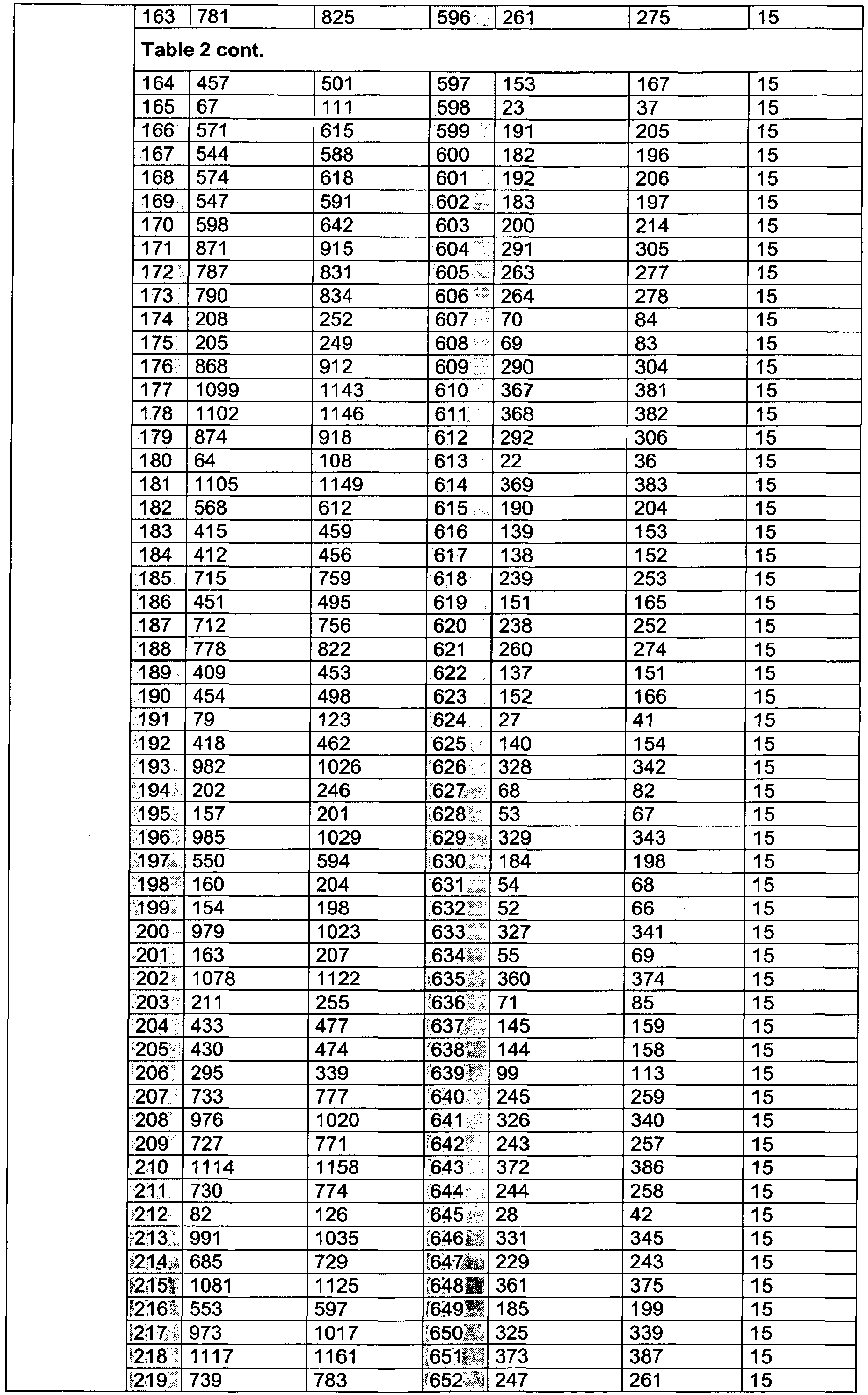


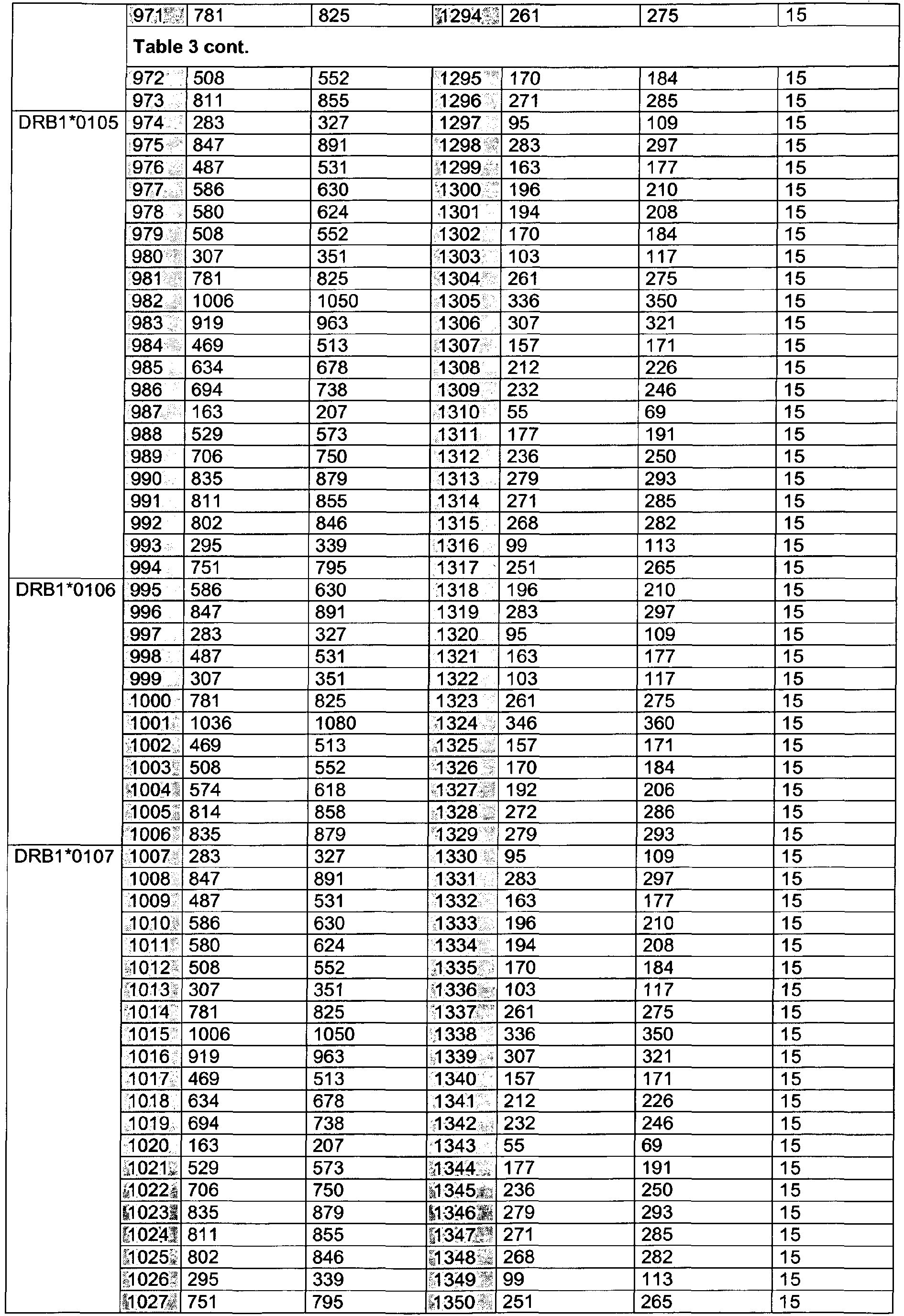


| Calculation of putative surface epitopes per protein size ratio | ||||
| Antigen | Size | Surface (Å2) | Surface epitopes* | Surface epitopes /kda |
| Ambt5 | 4.3 kDa | 2438.3 | 2.57 | 0.6 |
| Api m 1 | 16-20 kDa | 7606.4 | 8.0 | 0.4 |
| Api m 2 | 43 kDa | 15905.5 | 16.74 | 0.39 |
| Api m 4 | 3 kDa | 3885.7 | 4.09 | 1.36 |
| Ara t 8 | 14.2 kDa | 7080.1 | 7.45 | 0.52 |
| Asp f 1 | 16.8 kDa | 16037.6 | 16.88 | 1.0 |
| Asp f 6 | 23.3 kDa | 8793.2 | 9.26 | 0.4 |
| Bet v 1 | 17.4 kDa | 5215.3 | 5.49 | 0.32 |
| Bet v 2 | 14.3 kDa | 6493.9 | 6.84 | 0.48 |
| Bos d 4 | 14.2 kDa | 7246.9 | 7.63 | 0.54 |
| Bos d 5 | 18.2 kDa | 9546.5 | 10.05 | 0.55 |
| Bos d 5 | 18.2 kDa | 9618.4 | 10.12 | 0.56 |
| Der f2 | 15.8 kDa | 7785.2 | 8.19 | 0.52 |
| Der p2 | 16 kDa | 7588.8 | 7.99 | 0.5 |
| Equ c 1 | 20 kDa | 8907.4 | 9.38 | 0.47 |
| Gal d 3 | 75.8 kDa | 15952.9 | 16.79 | 0.22 |
| Gal d 4 | 16.2 kDa | 6951.3 | 7.32 | 0.45 |
| Hev b 8 | 14 kDa | 11982 | 12.61 | 0.9 |
| Mus m 1 | 18.7 kDa | 8943.5 | 9.41 | 0.5 |
| Phl p 1 | 26.1 kDa | 12145.6 | 12.78 | 0.49 |
| Phl p 2 | 10.8 kDa | 6099.5 | 6.42 | 0.59 |
| Phl p 6 | 11.8 kDa | 5429.5 | 5.72 | 0.48 |
| Pru av 1 | 17.7 kDa | 9742.8 | 10.26 | 0.58 |
| Ves v 5 | 25.8 kDa | 11657.1 | 12.27 | 0.47 |
| Zea m 14 | 11.7 kDa | 5099.5 | 5.37 | 0.46 |
| Average value | 0.55 +/- 0.23 | |||
| *Estimated IgE epitope area: 950 Å2 |
| Calculation of the average number of IgE epitopes on allergens | |||||||||
| Antigen | Protein | Organism | Common | PDB code | Size (kDa) | Surface (Å2) | Size/ Surface | Possible B-cell epitopes | Identified IgE binding peptides |
| Alt a 1 | - | Alt. alternata | Fungi | - | 15.2 | - | - | - | 2 |
| |
Vicilin | Arachis hypogaea | Peanut | - | 67.7 | - | - | - | 21 |
| |
Conglutin | Arachis hypogaea | Peanut | - | 17.5 | - | - | - | 10 |
| |
Mitogillin | Asp. fumigatus | Fungi | 1AQZ | 16.8 | 16037.6 | 1.0 | 16-17 | 13 |
| Asp f2 | - | Asp. fumigatus | Fungi | - | 31.2 | - | - | - | 9 |
| Asp f3 | Peroximal protein | Asp. fumigatus | Fungi | - | 18.4 | - | - | - | 7 |
| Aspf13 | Oryzin | Asp. fumigatus | Fungi | 28.7 | - | - | - | 5 | |
| |
PR10 | Betulla verrucosa | Birch | 1BV1 | 17.4 | 5215.3 | 3.3 | 5-6 | |
| |
Profilin | Betulla verrucosa | Birch | 1CQA | 14.3 | 6493.9 | 2.2 | 6-7 | 3 |
| Bos d 5 | b-Lactoglobulin | Bos domesticus | Cow | 1B8E | 18.2 | 9546.5 | 1.9 | 9-10 | 7 |
| Bos d5 | b-Lactoglobulin | Bos domesticus | Cow | 1QG5 | 18.2 | 9618.4 | 1.9 | 9-10 | 7 |
| |
Pectinase | Cryp. japonica | Sugi | - | 42.2 | - | - | - | 4 |
| |
Ovomucoid | Gallus domesticus | Chicken | - | 20.1 | - | - | - | 9 (8 IgG) |
| Hev b1 | Elongaton factor | Hevea brasiliensis | Latex | - | 14.6 | - | - | - | 8 |
| Hev b3 | SRPP | Hevea brasiliensis | Latex | - | 22.3 | - | - | - | 11 |
| Hev b5 | - | Hevea brasiliensis | Latex | - | 15.9 | - | - | - | 11 |
| Jun a 1 | Pectate lyase | Juniperus ashei | Cedar | - | 37.6 | - | - | - | 4 |
| Jun a 3 | - | Juniperus ashei | Cedar | - | 21 | - | - | - | 5 |
| |
Lipid transfer prot.1 | Parietaria judaica | Weed | - | 15 | - | - | - | 5 |
| |
Lipid transfer prot.2 | Parietaria judaica | Weed | - | 11.3 | - | - | - | 8 |
| Pen n18 | Serine protease | Pen. notatum | Fungi | - | 52.4 | - | - | - | 9 |
| Prediction of linear B cell epitopes by BepiPred 1.0b | |||
| Putative B-cell epitope | SEQ ID | Amino acid positions predicted* | |
| 1 | 1565 | 22 |
|
| 2 | 1566 | 32.34 |
|
| 3 | 1567 | 44-50.52 |
P D F P N Y . |
| 4 | 1568 | 59-61.63 |
S A R . |
| 5 | 1569 | 74-81 |
|
| 6 | 1570 | 91 |
|
| 7 | 1571 | 122-124 |
|
| 8 | 1572 | 143-152.154-159 |
W K N P S R I V G G . |
| 9 | 1573 | 212-220 |
|
| 10 | 1574 | 234-238 | |
| 11 | 1575 | 328-334.336-344 | A C Q F D S G . P I L W Q N P K S |
| 12 | 1576 | 358-366 | T C A D E A P G V |
| 13 | 1577 | 379-385 | R S T P G E I |
| *numbering according to SEQ ID NO.2 |
Claims (19)
- An isolated nucleic acid molecule comprising the nucleotide sequence as shown in SEQ ID NO: 1, or
isolated nucleic acid molecules that are more than 90% identical to the nucleotide sequence as shown in SEQ ID NO: 1, or
isolated fragments of the nucleic acid molecule comprising the nucleotide sequence as shown in SEQ ID NO: 1, wherein said fragments are between 150 and 1172 nucleotides in length. - The nucleic acid of claim 1, wherein the nucleotide sequence encodes polypeptides comprising one or more B cell epitopes of the Vespula venom protease Ves v 4, one or more T cell epitopes of the Vespula venom protease Ves v 4 or one or more B cell epitopes and one or more T cell epitopes of the Vespula venom protease Ves v 4.
- The nucleic acid of claims 1 or 2, wherein the nucleic acid has been modified by site-directed mutagenesis, wherein the modification preferably affects one or more of the native N-glycosylation sites, and wherein the nucleic acid preferably encodes a Ves v 4 chimeric or fusion protein.
- A vector comprising one or more nucleic acid molecule(s) of claims 1 to 3 operationally associated with a promoter.
- A host cell comprising the vector of claim 4.
- An isolated polypeptide comprising the amino acid sequence as shown in SEQ ID NO:2
or an isolated polypeptide that is more than 90% identical, more preferably more than 95% identical and most preferably more than 99% identical to the amino sequence as shown in SEQ ID NO: 2,
or an isolated fragment of the amino acid sequence as shown in SEQ ID NO:2, wherein said fragment is a partial segment of the polypeptide sequence shown in SEQ ID NO:2 which is at least 50 amino acids long. - The polypeptide of claim 6, containing a polypeptide fragment, wherein the polypeptide fragment is selected from the group consisting of amino acid residues 22 to 74, 75 to 135, 136 to 190, 191 to 240, 241 to 284, 285 to 334, and 335 to 390 of said polypeptide, wherein the numbering corresponds to the region of said polypeptide having the sequence shown in SEQ ID NO: 2,
or
wherein the polypeptide fragment is selected from the group consisting of amino acid
residues 22 to 135, 136 to 232, 233 to 313, and 314 to 390 of said polypeptide, wherein the numbering corresponds to the region of said polypeptide having the sequence shown in SEQ ID NO: 2,
or
wherein the polypeptide fragment is selected from the group consisting of amino acid residues 22 to 148, 149 to 268, and 269 to 390 of said polypeptide, wherein the numbering corresponds to the region of said polypeptide having the sequence shown in SEQ ID NO: 2. - The polypeptide of claim 7, wherein the N-glycosylation of the polypeptide has been modified, and
wherein the modified N-glycosylation is selected from the group consisting of absence of detectable core alpha(1,3)-fucosylation, mutated N-glycosylation sites, and absence of N-glycosylation. - A derivative of the polypeptide of claims 7 to 8, wherein the derivative is selected from the group consisting of chimeric or fusion protein, a mutant comprising one amino acid substitution, a mutant comprising one amino acid substitution that increase resistance of the polypeptide to proteolytic degradation and a mutant comprising one amino acid substitution that introduce one canonical protease sensitive site, and wherein the chimeric or fusion protein comprises the polypeptide of claims 7 to 8 and a non-Ves v 4 polypeptide selected from the group consisting of poly-Histidine tag (His tag), glutathione-S-transferase (GST), maltose binding protein (MBP), a chitin binding domain (CBD), 13-galactosidase, an IgG-Fc, a therapeutic polypeptide, preferably a cytokine, and other vespid venom proteins.
- A pharmaceutical composition comprising one or more of the polypeptide(s) of claims 7 to 9 and a pharmaceutically acceptable carrier.
- The pharmaceutical composition of claim 10, wherein the one or more polypeptide(s) map the total length of the Ves v 4 polypeptide, wherein the pharmaceutical composition further comprises one or more additional polypeptide(s) selected from the group consisting of Ves v 1 polypeptide (phospolipase Al), Ves v 2a polypeptide (hyaluronidase), Ves v 2b polypeptide, Ves v 3 polypeptide (dipeptidylpeptidase), Ves v 5 polypeptide, glycosylated IgE-binding proteins.
- The polypeptide of claims 7 to 9 or the pharmaceutical composition of claims 10 or 11 for use as a medicament.
- The polypeptide of claims 7 to 9
or polypeptide fragments, wherein the
polypeptide fragment selected from the group consisting of amino acid residues 22 to 74, 75 to 135, 136 to 190, 191 to 240, 241 to 284, 285 to 334, and 335 to 390 of said polypeptide, wherein the numbering corresponds to the region of said polypeptide having the sequence shown in SEQ ID NO: 2,
or
wherein the polypeptide fragment is selected from the group consisting of amino acid
residues 22 to 135, 136 to 232, 233 to 313, and 314 to 390 of said polypeptide, wherein the numbering corresponds to the region of said polypeptide having the sequence shown in SEQ ID NO: 2,
or
wherein the polypeptide fragment is selected from the group consisting of amino acid residues 22 to 148, 149 to 268, and 269 to 390 of said polypeptide, wherein the numbering corresponds to the region of said polypeptide having the sequence shown in SEQ ID NO: 2
or
the pharmaceutical composition of claims 10 or 11
for use in the treatment of allergy against Vespula venom. - The polypeptide or the pharmaceutical composition of claim 13 for use in the treatment of allergy against the Vespula venom protease Ves v 4.
- The polypeptide or the pharmaceutical composition for use in the treatment of allergy against Vespula venom or against the Vespula venom protease Ves v 4 of claims 13 or 14, wherein the polypeptide or the pharmaceutical composition are administered in an amount sufficient to reduce or inhibit an immune reaction against the Ves v 4 polypeptide, and
wherein the polypeptide and pharmaceutical composition is administered over a period of time in gradually increasing doses. - Use of the polypeptide of claims 7 to 9 or of the pharmaceutical composition of claims 10 or 11 for the generation of a medicament for the treatment of allergy against Vespula venom, preferably of allergy against the Vespula venom protease Ves v 4.
- An in vitro method for decreasing the allergenicity of a Ves v 4 poly-peptide comprising the steps ofa) providing a nucleic acid molecule of claims 1 to 3 or a nucleic acid molecule encoding a polypeptide of claims 7 to 9,b) applying site-directed mutagenesis to said nucleic acid molecule so that one or more IgE epitope(s) on the encoded polypeptide is altered to give a modified allergen, andc) determining the reduction in allergenicity of said modified allergen.
- An in vitro method for detecting serum IgE or IgG antibodies specific for the polypeptides of claims 7 to 9, comprising the steps ofa) providing serum from an allergic patient, andb) detecting said IgE or IgG antibodies in said serum by a detection method,wherein said detection method is selected from the group consisting of radio-allergosorbent test (RAST), enzyme-linked immunosorbent assays (ELISA), immunoelectrophoresis, immunoblot, immunodotblotting, bead array technology, fluid phase systems, and in vitro mediator release assays (MRA).
- The method of claim 18, wherein said detecting comprises in vitro measuring the ratio of serum IgE and IgG4 antibodies specific for the polypeptides of claims 7 to 9, and
wherein said method further comprises the step ofc) evaluating the success of immunotherapeutical treatment.
Priority Applications (1)
| Application Number | Priority Date | Filing Date | Title |
|---|---|---|---|
| EP10715674.7A EP2403868B1 (en) | 2009-03-03 | 2010-03-03 | Cloning and recombinant production of vespula venom protease and methods of use thereof |
Applications Claiming Priority (3)
| Application Number | Priority Date | Filing Date | Title |
|---|---|---|---|
| EP09003033A EP2243791A1 (en) | 2009-03-03 | 2009-03-03 | Cloning and recombinant production of Vespula venom protease and methods of use thereof |
| PCT/EP2010/001329 WO2010099956A1 (en) | 2009-03-03 | 2010-03-03 | Cloning and recombinant production of vespula venom protease and methods of use thereof |
| EP10715674.7A EP2403868B1 (en) | 2009-03-03 | 2010-03-03 | Cloning and recombinant production of vespula venom protease and methods of use thereof |
Publications (2)
| Publication Number | Publication Date |
|---|---|
| EP2403868A1 EP2403868A1 (en) | 2012-01-11 |
| EP2403868B1 true EP2403868B1 (en) | 2016-05-11 |
Family
ID=40467339
Family Applications (2)
| Application Number | Title | Priority Date | Filing Date |
|---|---|---|---|
| EP09003033A Withdrawn EP2243791A1 (en) | 2009-03-03 | 2009-03-03 | Cloning and recombinant production of Vespula venom protease and methods of use thereof |
| EP10715674.7A Not-in-force EP2403868B1 (en) | 2009-03-03 | 2010-03-03 | Cloning and recombinant production of vespula venom protease and methods of use thereof |
Family Applications Before (1)
| Application Number | Title | Priority Date | Filing Date |
|---|---|---|---|
| EP09003033A Withdrawn EP2243791A1 (en) | 2009-03-03 | 2009-03-03 | Cloning and recombinant production of Vespula venom protease and methods of use thereof |
Country Status (3)
| Country | Link |
|---|---|
| US (1) | US8802836B2 (en) |
| EP (2) | EP2243791A1 (en) |
| WO (1) | WO2010099956A1 (en) |
Cited By (1)
| Publication number | Priority date | Publication date | Assignee | Title |
|---|---|---|---|---|
| EP4592681A1 (en) * | 2024-01-29 | 2025-07-30 | HVD Biotech Vertriebsgesellschaft m.b.H. | Allergy test |
Family Cites Families (2)
| Publication number | Priority date | Publication date | Assignee | Title |
|---|---|---|---|---|
| US5593877A (en) | 1993-03-11 | 1997-01-14 | The Rockefeller University | Nucleic acid and recombinant production of vespid venom hyaluronidase |
| ATE430199T1 (en) * | 1998-01-31 | 2009-05-15 | Univ Arkansas | METHODS AND REAGENTS FOR REDUCING THE CLINICAL RESPONSE TO ALLERGY |
-
2009
- 2009-03-03 EP EP09003033A patent/EP2243791A1/en not_active Withdrawn
-
2010
- 2010-03-03 US US13/254,644 patent/US8802836B2/en not_active Expired - Fee Related
- 2010-03-03 WO PCT/EP2010/001329 patent/WO2010099956A1/en not_active Ceased
- 2010-03-03 EP EP10715674.7A patent/EP2403868B1/en not_active Not-in-force
Cited By (1)
| Publication number | Priority date | Publication date | Assignee | Title |
|---|---|---|---|---|
| EP4592681A1 (en) * | 2024-01-29 | 2025-07-30 | HVD Biotech Vertriebsgesellschaft m.b.H. | Allergy test |
Also Published As
| Publication number | Publication date |
|---|---|
| EP2243791A1 (en) | 2010-10-27 |
| WO2010099956A1 (en) | 2010-09-10 |
| EP2403868A1 (en) | 2012-01-11 |
| US20120009187A1 (en) | 2012-01-12 |
| US8802836B2 (en) | 2014-08-12 |
Similar Documents
| Publication | Publication Date | Title |
|---|---|---|
| CN1871351B (en) | A Novel Fungal Protein and Its Encoding Nucleic Acid | |
| JP3816515B2 (en) | Cloning and recombinant production of wasp venom enzymes such as phospholipase and hyaluronidase and immunological treatment based on them | |
| US8802836B2 (en) | Cloning and recombinant productions of Vespula venom protease and methods of use thereof | |
| CN1289852A (en) | Human nif gene homogenous protein and its coding sequence | |
| Trzyna et al. | A type-1 metacaspase from Acanthamoeba castellanii | |
| US6372887B1 (en) | Flea serine protease inhibitor proteins | |
| CN101274960A (en) | Genes associated with virulence in Leishmania parasites | |
| WO2012105541A1 (en) | Novel japanese cypress pollen allergen | |
| US20100015122A1 (en) | Cloning of honey bee allergen | |
| US7888068B2 (en) | Cloning of honey bee allergen C | |
| EP1528102B1 (en) | Cloning and recombinant production of Polistinae venom enzymes such as hyaluronidase, and immunological therapies based thereon | |
| US20020098546A1 (en) | Canine TAg1 proteins, nucleic acid molecules, and uses thereof | |
| CN101509001A (en) | Gene sequence of encoding fungal immunomodulatory protein of straw mushroom | |
| JPWO2003072609A1 (en) | Tick chitinase | |
| CN1673371A (en) | A new marnifi blue mold cell wall surface antigen I, its coding sequence and application thereof | |
| CN1269412A (en) | New human T cell receptor related protein and its code sequence | |
| CN1281897A (en) | Human thioredoxin related protein and its code sequence | |
| CN1281047A (en) | Human limb deformation protein and its coding sequence | |
| JP2005528893A (en) | Nucleic acid sequences and proteins and polypeptides encoding mannitol dehydrogenase or parts thereof, and their preparation and use in diagnosis and therapy | |
| JP2004261001A (en) | New lipase | |
| EP1465920A2 (en) | Mammalian simp protein, gene sequence and uses thereof in cancer therapy | |
| CN1281039A (en) | Human ribosome subunit protein and its coding sequence | |
| CN1266898A (en) | Human carboxypeptidase precursor protein and its coding sequence | |
| CN1920022A (en) | Human hMKPx gene order, encode albumen and preparation method thereof | |
| CN1271010A (en) | New human aromatic esterase protein and its code sequence |
Legal Events
| Date | Code | Title | Description |
|---|---|---|---|
| PUAI | Public reference made under article 153(3) epc to a published international application that has entered the european phase |
Free format text: ORIGINAL CODE: 0009012 |
|
| 17P | Request for examination filed |
Effective date: 20110906 |
|
| AK | Designated contracting states |
Kind code of ref document: A1 Designated state(s): AT BE BG CH CY CZ DE DK EE ES FI FR GB GR HR HU IE IS IT LI LT LU LV MC MK MT NL NO PL PT RO SE SI SK SM TR |
|
| DAX | Request for extension of the european patent (deleted) | ||
| 17Q | First examination report despatched |
Effective date: 20140117 |
|
| GRAP | Despatch of communication of intention to grant a patent |
Free format text: ORIGINAL CODE: EPIDOSNIGR1 |
|
| INTG | Intention to grant announced |
Effective date: 20151014 |
|
| GRAS | Grant fee paid |
Free format text: ORIGINAL CODE: EPIDOSNIGR3 |
|
| GRAA | (expected) grant |
Free format text: ORIGINAL CODE: 0009210 |
|
| AK | Designated contracting states |
Kind code of ref document: B1 Designated state(s): AT BE BG CH CY CZ DE DK EE ES FI FR GB GR HR HU IE IS IT LI LT LU LV MC MK MT NL NO PL PT RO SE SI SK SM TR |
|
| REG | Reference to a national code |
Ref country code: GB Ref legal event code: FG4D |
|
| REG | Reference to a national code |
Ref country code: CH Ref legal event code: EP |
|
| REG | Reference to a national code |
Ref country code: AT Ref legal event code: REF Ref document number: 798595 Country of ref document: AT Kind code of ref document: T Effective date: 20160515 |
|
| REG | Reference to a national code |
Ref country code: IE Ref legal event code: FG4D |
|
| REG | Reference to a national code |
Ref country code: DE Ref legal event code: R096 Ref document number: 602010033261 Country of ref document: DE |
|
| REG | Reference to a national code |
Ref country code: LT Ref legal event code: MG4D |
|
| REG | Reference to a national code |
Ref country code: NL Ref legal event code: MP Effective date: 20160511 |
|
| PG25 | Lapsed in a contracting state [announced via postgrant information from national office to epo] |
Ref country code: LT Free format text: LAPSE BECAUSE OF FAILURE TO SUBMIT A TRANSLATION OF THE DESCRIPTION OR TO PAY THE FEE WITHIN THE PRESCRIBED TIME-LIMIT Effective date: 20160511 Ref country code: FI Free format text: LAPSE BECAUSE OF FAILURE TO SUBMIT A TRANSLATION OF THE DESCRIPTION OR TO PAY THE FEE WITHIN THE PRESCRIBED TIME-LIMIT Effective date: 20160511 Ref country code: NL Free format text: LAPSE BECAUSE OF FAILURE TO SUBMIT A TRANSLATION OF THE DESCRIPTION OR TO PAY THE FEE WITHIN THE PRESCRIBED TIME-LIMIT Effective date: 20160511 Ref country code: NO Free format text: LAPSE BECAUSE OF FAILURE TO SUBMIT A TRANSLATION OF THE DESCRIPTION OR TO PAY THE FEE WITHIN THE PRESCRIBED TIME-LIMIT Effective date: 20160811 |
|
| REG | Reference to a national code |
Ref country code: AT Ref legal event code: MK05 Ref document number: 798595 Country of ref document: AT Kind code of ref document: T Effective date: 20160511 |
|
| PG25 | Lapsed in a contracting state [announced via postgrant information from national office to epo] |
Ref country code: LV Free format text: LAPSE BECAUSE OF FAILURE TO SUBMIT A TRANSLATION OF THE DESCRIPTION OR TO PAY THE FEE WITHIN THE PRESCRIBED TIME-LIMIT Effective date: 20160511 Ref country code: GR Free format text: LAPSE BECAUSE OF FAILURE TO SUBMIT A TRANSLATION OF THE DESCRIPTION OR TO PAY THE FEE WITHIN THE PRESCRIBED TIME-LIMIT Effective date: 20160812 Ref country code: SE Free format text: LAPSE BECAUSE OF FAILURE TO SUBMIT A TRANSLATION OF THE DESCRIPTION OR TO PAY THE FEE WITHIN THE PRESCRIBED TIME-LIMIT Effective date: 20160511 Ref country code: PT Free format text: LAPSE BECAUSE OF FAILURE TO SUBMIT A TRANSLATION OF THE DESCRIPTION OR TO PAY THE FEE WITHIN THE PRESCRIBED TIME-LIMIT Effective date: 20160912 Ref country code: ES Free format text: LAPSE BECAUSE OF FAILURE TO SUBMIT A TRANSLATION OF THE DESCRIPTION OR TO PAY THE FEE WITHIN THE PRESCRIBED TIME-LIMIT Effective date: 20160511 Ref country code: HR Free format text: LAPSE BECAUSE OF FAILURE TO SUBMIT A TRANSLATION OF THE DESCRIPTION OR TO PAY THE FEE WITHIN THE PRESCRIBED TIME-LIMIT Effective date: 20160511 |
|
| PG25 | Lapsed in a contracting state [announced via postgrant information from national office to epo] |
Ref country code: IT Free format text: LAPSE BECAUSE OF FAILURE TO SUBMIT A TRANSLATION OF THE DESCRIPTION OR TO PAY THE FEE WITHIN THE PRESCRIBED TIME-LIMIT Effective date: 20160511 |
|
| PG25 | Lapsed in a contracting state [announced via postgrant information from national office to epo] |
Ref country code: EE Free format text: LAPSE BECAUSE OF FAILURE TO SUBMIT A TRANSLATION OF THE DESCRIPTION OR TO PAY THE FEE WITHIN THE PRESCRIBED TIME-LIMIT Effective date: 20160511 Ref country code: DK Free format text: LAPSE BECAUSE OF FAILURE TO SUBMIT A TRANSLATION OF THE DESCRIPTION OR TO PAY THE FEE WITHIN THE PRESCRIBED TIME-LIMIT Effective date: 20160511 Ref country code: RO Free format text: LAPSE BECAUSE OF FAILURE TO SUBMIT A TRANSLATION OF THE DESCRIPTION OR TO PAY THE FEE WITHIN THE PRESCRIBED TIME-LIMIT Effective date: 20160511 Ref country code: SK Free format text: LAPSE BECAUSE OF FAILURE TO SUBMIT A TRANSLATION OF THE DESCRIPTION OR TO PAY THE FEE WITHIN THE PRESCRIBED TIME-LIMIT Effective date: 20160511 Ref country code: CZ Free format text: LAPSE BECAUSE OF FAILURE TO SUBMIT A TRANSLATION OF THE DESCRIPTION OR TO PAY THE FEE WITHIN THE PRESCRIBED TIME-LIMIT Effective date: 20160511 |
|
| REG | Reference to a national code |
Ref country code: DE Ref legal event code: R097 Ref document number: 602010033261 Country of ref document: DE |
|
| PG25 | Lapsed in a contracting state [announced via postgrant information from national office to epo] |
Ref country code: PL Free format text: LAPSE BECAUSE OF FAILURE TO SUBMIT A TRANSLATION OF THE DESCRIPTION OR TO PAY THE FEE WITHIN THE PRESCRIBED TIME-LIMIT Effective date: 20160511 Ref country code: SM Free format text: LAPSE BECAUSE OF FAILURE TO SUBMIT A TRANSLATION OF THE DESCRIPTION OR TO PAY THE FEE WITHIN THE PRESCRIBED TIME-LIMIT Effective date: 20160511 Ref country code: AT Free format text: LAPSE BECAUSE OF FAILURE TO SUBMIT A TRANSLATION OF THE DESCRIPTION OR TO PAY THE FEE WITHIN THE PRESCRIBED TIME-LIMIT Effective date: 20160511 Ref country code: BE Free format text: LAPSE BECAUSE OF FAILURE TO SUBMIT A TRANSLATION OF THE DESCRIPTION OR TO PAY THE FEE WITHIN THE PRESCRIBED TIME-LIMIT Effective date: 20160511 |
|
| PLBE | No opposition filed within time limit |
Free format text: ORIGINAL CODE: 0009261 |
|
| STAA | Information on the status of an ep patent application or granted ep patent |
Free format text: STATUS: NO OPPOSITION FILED WITHIN TIME LIMIT |
|
| REG | Reference to a national code |
Ref country code: FR Ref legal event code: PLFP Year of fee payment: 8 |
|
| 26N | No opposition filed |
Effective date: 20170214 |
|
| PGFP | Annual fee paid to national office [announced via postgrant information from national office to epo] |
Ref country code: FR Payment date: 20170323 Year of fee payment: 8 Ref country code: DE Payment date: 20170322 Year of fee payment: 8 |
|
| PG25 | Lapsed in a contracting state [announced via postgrant information from national office to epo] |
Ref country code: SI Free format text: LAPSE BECAUSE OF FAILURE TO SUBMIT A TRANSLATION OF THE DESCRIPTION OR TO PAY THE FEE WITHIN THE PRESCRIBED TIME-LIMIT Effective date: 20160511 |
|
| PGFP | Annual fee paid to national office [announced via postgrant information from national office to epo] |
Ref country code: GB Payment date: 20170327 Year of fee payment: 8 |
|
| REG | Reference to a national code |
Ref country code: CH Ref legal event code: PL |
|
| PG25 | Lapsed in a contracting state [announced via postgrant information from national office to epo] |
Ref country code: MC Free format text: LAPSE BECAUSE OF FAILURE TO SUBMIT A TRANSLATION OF THE DESCRIPTION OR TO PAY THE FEE WITHIN THE PRESCRIBED TIME-LIMIT Effective date: 20160511 |
|
| REG | Reference to a national code |
Ref country code: IE Ref legal event code: MM4A |
|
| PG25 | Lapsed in a contracting state [announced via postgrant information from national office to epo] |
Ref country code: LU Free format text: LAPSE BECAUSE OF NON-PAYMENT OF DUE FEES Effective date: 20170303 |
|
| PG25 | Lapsed in a contracting state [announced via postgrant information from national office to epo] |
Ref country code: CH Free format text: LAPSE BECAUSE OF NON-PAYMENT OF DUE FEES Effective date: 20170331 Ref country code: LI Free format text: LAPSE BECAUSE OF NON-PAYMENT OF DUE FEES Effective date: 20170331 Ref country code: IE Free format text: LAPSE BECAUSE OF NON-PAYMENT OF DUE FEES Effective date: 20170303 |
|
| PG25 | Lapsed in a contracting state [announced via postgrant information from national office to epo] |
Ref country code: MT Free format text: LAPSE BECAUSE OF NON-PAYMENT OF DUE FEES Effective date: 20170303 |
|
| REG | Reference to a national code |
Ref country code: DE Ref legal event code: R119 Ref document number: 602010033261 Country of ref document: DE |
|
| GBPC | Gb: european patent ceased through non-payment of renewal fee |
Effective date: 20180303 |
|
| PG25 | Lapsed in a contracting state [announced via postgrant information from national office to epo] |
Ref country code: DE Free format text: LAPSE BECAUSE OF NON-PAYMENT OF DUE FEES Effective date: 20181002 |
|
| PG25 | Lapsed in a contracting state [announced via postgrant information from national office to epo] |
Ref country code: GB Free format text: LAPSE BECAUSE OF NON-PAYMENT OF DUE FEES Effective date: 20180303 |
|
| PG25 | Lapsed in a contracting state [announced via postgrant information from national office to epo] |
Ref country code: FR Free format text: LAPSE BECAUSE OF NON-PAYMENT OF DUE FEES Effective date: 20180331 |
|
| PG25 | Lapsed in a contracting state [announced via postgrant information from national office to epo] |
Ref country code: HU Free format text: LAPSE BECAUSE OF FAILURE TO SUBMIT A TRANSLATION OF THE DESCRIPTION OR TO PAY THE FEE WITHIN THE PRESCRIBED TIME-LIMIT; INVALID AB INITIO Effective date: 20100303 |
|
| PG25 | Lapsed in a contracting state [announced via postgrant information from national office to epo] |
Ref country code: BG Free format text: LAPSE BECAUSE OF FAILURE TO SUBMIT A TRANSLATION OF THE DESCRIPTION OR TO PAY THE FEE WITHIN THE PRESCRIBED TIME-LIMIT Effective date: 20160511 |
|
| PG25 | Lapsed in a contracting state [announced via postgrant information from national office to epo] |
Ref country code: CY Free format text: LAPSE BECAUSE OF NON-PAYMENT OF DUE FEES Effective date: 20160511 |
|
| PG25 | Lapsed in a contracting state [announced via postgrant information from national office to epo] |
Ref country code: MK Free format text: LAPSE BECAUSE OF FAILURE TO SUBMIT A TRANSLATION OF THE DESCRIPTION OR TO PAY THE FEE WITHIN THE PRESCRIBED TIME-LIMIT Effective date: 20160511 |
|
| PG25 | Lapsed in a contracting state [announced via postgrant information from national office to epo] |
Ref country code: TR Free format text: LAPSE BECAUSE OF FAILURE TO SUBMIT A TRANSLATION OF THE DESCRIPTION OR TO PAY THE FEE WITHIN THE PRESCRIBED TIME-LIMIT Effective date: 20160511 |
|
| PG25 | Lapsed in a contracting state [announced via postgrant information from national office to epo] |
Ref country code: IS Free format text: LAPSE BECAUSE OF FAILURE TO SUBMIT A TRANSLATION OF THE DESCRIPTION OR TO PAY THE FEE WITHIN THE PRESCRIBED TIME-LIMIT Effective date: 20160911 |