EP2403820B1 - Chemical process for the production of haloalkenone ethers - Google Patents
Chemical process for the production of haloalkenone ethers Download PDFInfo
- Publication number
- EP2403820B1 EP2403820B1 EP10707829.7A EP10707829A EP2403820B1 EP 2403820 B1 EP2403820 B1 EP 2403820B1 EP 10707829 A EP10707829 A EP 10707829A EP 2403820 B1 EP2403820 B1 EP 2403820B1
- Authority
- EP
- European Patent Office
- Prior art keywords
- formula
- process according
- stirred tank
- reactor
- continuous stirred
- Prior art date
- Legal status (The legal status is an assumption and is not a legal conclusion. Google has not performed a legal analysis and makes no representation as to the accuracy of the status listed.)
- Active
Links
Classifications
-
- C—CHEMISTRY; METALLURGY
- C07—ORGANIC CHEMISTRY
- C07C—ACYCLIC OR CARBOCYCLIC COMPOUNDS
- C07C45/00—Preparation of compounds having >C = O groups bound only to carbon or hydrogen atoms; Preparation of chelates of such compounds
- C07C45/41—Preparation of compounds having >C = O groups bound only to carbon or hydrogen atoms; Preparation of chelates of such compounds by hydrogenolysis or reduction of carboxylic groups or functional derivatives thereof
-
- C—CHEMISTRY; METALLURGY
- C07—ORGANIC CHEMISTRY
- C07C—ACYCLIC OR CARBOCYCLIC COMPOUNDS
- C07C45/00—Preparation of compounds having >C = O groups bound only to carbon or hydrogen atoms; Preparation of chelates of such compounds
- C07C45/45—Preparation of compounds having >C = O groups bound only to carbon or hydrogen atoms; Preparation of chelates of such compounds by condensation
- C07C45/455—Preparation of compounds having >C = O groups bound only to carbon or hydrogen atoms; Preparation of chelates of such compounds by condensation with carboxylic acids or their derivatives
-
- C—CHEMISTRY; METALLURGY
- C07—ORGANIC CHEMISTRY
- C07C—ACYCLIC OR CARBOCYCLIC COMPOUNDS
- C07C45/00—Preparation of compounds having >C = O groups bound only to carbon or hydrogen atoms; Preparation of chelates of such compounds
- C07C45/61—Preparation of compounds having >C = O groups bound only to carbon or hydrogen atoms; Preparation of chelates of such compounds by reactions not involving the formation of >C = O groups
- C07C45/65—Preparation of compounds having >C = O groups bound only to carbon or hydrogen atoms; Preparation of chelates of such compounds by reactions not involving the formation of >C = O groups by splitting-off hydrogen atoms or functional groups; by hydrogenolysis of functional groups
Definitions
- the present invention relates to an improved process for the production of haloalkenone ethers, in particular 4-ethoxy-1,1,1-trifluoro-3-buten-2-one.
- EP-A-1254883 describes a semi-batch process for producing haloalkenone ethers wherein the process is conducted in the presence of a base.
- WO2009/006217 describes a batch process for producing 4-alkoxy-1,1,1-trifluoro-3-butene-2-ones using a sulfoxide or formamide catalyst.
- WO2004108647 describes a semi-batch process conducted in the absence of a base and/or in the presence of a stabilizer for the resulting alkenone.
- these semi-batch processes can exhibit disadvantages in respect of larger scale, commercial production.
- the continuous process to which the present invention relates can, if desired, be operated in the absence of a base (or other stabilisers) and/or other reagents / solvents, allows the use of smaller reactors than a semi-batch process, provides good reaction rates and yields as the continuous process allows the use of reaction temperatures above those typically associated with the semi-batch processes, avoids storage of unstable intermediate compounds and keeps the formation of any undesirable by-products to a minimum.
- R 1 is selected from the group consisting of CH 2 F, CHF 2 , CH 3 , C 2 H 5 and CF 3 . In a more preferred embodiment R 1 is CF 3 .
- R 2 is ethyl
- R 3 is chlorine
- the process is for producing 4-ethoxy-1,1,1-trifluoro-3-buten-2-one wherein R 1 is CF 3 , R 2 is ethyl and R 3 is chlorine.
- the concentration of the alkyl vinyl ether of Formula (III) in the first continuous stirred tank reactor is 15% or less w/w, even 10% or less or even 5% or less.
- the solvent in the first continuous stirred tank reactor can be any suitable solvent in which the reaction can be conducted.
- suitable solvents include toluene, methylene chloride and ethylene dichloride.
- the solvent comprises a compound of Formula (I), a compound of Formula (IV) or a mixture thereof.
- the halide of Formula (II) and the vinyl ether of Formula (III) are fed into the in a first continuous stirred tank reactor.
- the molar ratio of the halide to the vinyl ether in the reactor is typically from 0.8:1 1 to 1:0.8, preferably from 0.9:1.
- the feed rate into the first continuous stirred tank reactor is adjusted such that the total reactor volume exchanges from one hour to five hours.
- the internal temperature of the first continuous stirred tank reactor is typically from -20°C to +35°C, more preferably from -10°C to +10°C.
- the process of the present invention comprises two continuous stirred tank reactors which allows the reactor volumes can be kept to a minimum.
- the yield of the intermediate compound of Formula (IV) using just one continuous stirred tank reactor in which to perform the acetylation reaction can be 90% or more.
- the process can comprise additional reactors.
- the reaction mass from the first stirred reaction can be transferred to one or more additional continuous stirred tank reactors prior to the reaction mass being transferred to the subsequent continuous stirred tank reactor where elimination of the hydrogen halide is performed.
- the reaction mass from the first stirred reaction is transferred to a plug-flow reactor before being transferred to the subsequent continuous stirred tank reactor.
- the yield of intermediate compound of Formula (IV) can be increased to 95% or more.
- the internal temperature of the plug flow reactor can be the same as that of the first continuous stirred tank. However, in a preferred embodiment the internal temperature of the plug-flow reactor is from 0°C to +35°C, more preferably from 10°C to +35°C - which consequently allows the reaction to proceed at a faster rate and negates the need for cooling equipment to be used in conjunction with the plug-flow reactor thus further reducing cost.
- the residence time in the plug-flow reactor is typically from 15 minutes to four hours, more preferably from 30 minutes to one hour.
- reaction mass is transferred to the subsequent continuous stirred tank reactor in which the conditions are such that elimination of the hydrogen halide from the intermediate compound of Formula (IV) occurs and the haloalkenone ether of Formula (I) is formed.
- the internal temperature of the subsequent continuous stirred tank reactor is from +30°C to +150°C, more preferably +70°C to +110°C and most preferably from +90°C to +100°C. Indeed, it has been found that an internal temperature in excess of +90°C is particularly beneficial because of the shortened residence time in the reactor afforded - which avoids the formation of undesirable by-products.
- the internal pressure of the subsequent continuous stirred tank reactor may be optionally lowered in order to improve elimination of the hydrogen halide.
- the internal pressure of the subsequent continuous stirred tank reactor is from 0 to 500 mbar, more preferably from 250 to 350 mbar.
- the residence time of the reaction mass in the second reactor is typically from 15 minutes to four hours, preferably from 60 minutes to three hours. It should be further understood that the reaction mass from the subsequent continuous stirred tank reactor can be recycled through the reactor, or passed into an additional continuous stirred tank reactor if required in order to improve conversion of the intermediate compound of Formula (IV) to the haloalkenone ether of Formula (I). If an additional step is utilised then it is advantageous to lower the internal pressure of the second continuous stirred tank reactor during the recycling step to further improve the conversion.
- a 200 mL jacketed reactor equipped with an overhead stirrer and a side outlet is filled with up to 180 mL of 4-ethoxy-1,1,1-trifluoro-3-buten-2-one or 4-chloro-4-ethoxy-1,1,1-trifluoro-2-butanone.
- the reactor is connected to a scrubber containing aqueous sodium hydroxide.
- the jacket temperature is adjusted to -10 °C and trifluoro-acetylchloride (TFAC) and ethyl vinyl ether (EVE) are simultaneously fed into the reactor with the internal temperature kept between -5 and 10°C.
- TFAC trifluoro-acetylchloride
- EVE ethyl vinyl ether
- the overflowing reaction mixture is allowed to pass through a plug flow reactor (PFR) attached to the outlet of the first reactor.
- PFR plug flow reactor
- the residence time of the reaction mixture in the PFR is thirty minutes.
- the PFR is operated at room temperature.
- An analysis of the reaction mixture at the end of the PFR is done by both GC and NMR analysis. Usually, full consumption of EVE is found.
- NMR the content of 4-ethoxy-1,1,1-trifluoro-3-buten-2-one in the reaction mixture is determined and is usually found to be below 10% after three hours or more of operation.
- the chemical yield for the 4-chloro-4-ethoxy-1,1,1-trifluoro-2-butanone is between 90% and 100%.
- the 4-ethoxy-1,1,1-trifluoro-3-buten-2-one / 4-chloro-4-ethoxy-1,1,1-trifluoro-2-butanone mixture is fed into a second jacketed reactor (200 mL volume) equipped with an overhead stirrer.
- the reactor is connected to a scrubber containing aqueous sodium hydroxide.
- the reactor contains 4-chloro-4-ethoxy-1,1,1-trifluoro-2-butanone and is operated at a temperature of 80°C and at ambient pressure or at 80°C and an internal pressure of 350 mbar.
- the time for the total reactor volume to be exchanged is 60 to 120 minutes; the feed rate is adjusted accordingly.
- the resulting overflowing reaction mixture is collected and analyzed.
- the reactor is run at ambient pressure the collected material may not be fully converted and is fed into the reactor again in a second run.
- the reactor is operated at 350 mbar.
- the overflowing material is found to contain 75-85% of 4-ethoxy-1,1,1-trifluoro-3-buten-2-one.
Landscapes
- Chemical & Material Sciences (AREA)
- Organic Chemistry (AREA)
- Chemical Kinetics & Catalysis (AREA)
- Organic Low-Molecular-Weight Compounds And Preparation Thereof (AREA)
Description
- The present invention relates to an improved process for the production of haloalkenone ethers, in particular 4-ethoxy-1,1,1-trifluoro-3-buten-2-one.
- Processes for producing haloalkenone ethers, such as the above, are known. Thus,
EP-A-1254883 describes a semi-batch process for producing haloalkenone ethers wherein the process is conducted in the presence of a base.WO2009/006217 describes a batch process for producing 4-alkoxy-1,1,1-trifluoro-3-butene-2-ones using a sulfoxide or formamide catalyst.WO2004108647 describes a semi-batch process conducted in the absence of a base and/or in the presence of a stabilizer for the resulting alkenone. However, these semi-batch processes can exhibit disadvantages in respect of larger scale, commercial production. In particular, in order to produce commercial quantities of the desired product the known semi-batch processes require the use of large reactors. Furthermore, the use of a base and/or additional solvent in the process requires, for example, additional purification steps. Still further, semi-batch processes wherein the halide is added to excess alkyl vinyl ether requires the use of large quantities the alkyl vinyl ether, which is undesirable as polymerisation of the alkyl vinyl ether can readily occur. - A new improved process has now been developed which allows the process to be conducted in continuous manner - which is more commercially desirable - and which overcomes the above-mentioned disadvantages associated with the known processes. In particular, the continuous process to which the present invention relates can, if desired, be operated in the absence of a base (or other stabilisers) and/or other reagents / solvents, allows the use of smaller reactors than a semi-batch process, provides good reaction rates and yields as the continuous process allows the use of reaction temperatures above those typically associated with the semi-batch processes, avoids storage of unstable intermediate compounds and keeps the formation of any undesirable by-products to a minimum.
- Thus, according to the present invention there is provided a continuous process for producing a haloalkenone ether of Formula (I)

- (i) reacting, in a first continuous stirred tank reactor comprising a solvent, a halide of Formula (II)


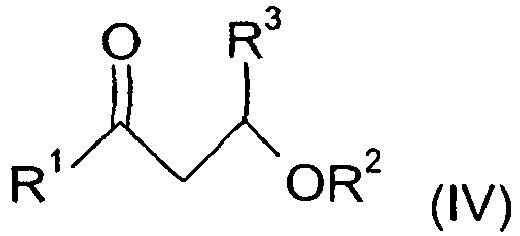
- (ii) transferring the reaction mass from the first continuous stirred tank reactor into a subsequent continuous stirred tank reactor, wherein the conditions within the subsequent reactor permit the elimination of hydrogen halide (HR3) from the intermediate compound in order to provide the haloalkenone ether of the Formula (I).
- In a preferred embodiment R1 is selected from the group consisting of CH2F, CHF2, CH3, C2H5 and CF3. In a more preferred embodiment R1 is CF3.
- In another preferred embodiment R2 is ethyl.
- In another preferred embodiment R3 is chlorine.
- In a particularly preferred embodiment the process is for producing 4-ethoxy-1,1,1-trifluoro-3-buten-2-one wherein R1 is CF3, R2 is ethyl and R3 is chlorine.
- In order to allow the process to proceed in a continuous manner it has been found that it is important that the concentration of the alkyl vinyl ether of Formula (III) in the first continuous stirred tank reactor is 15% or less w/w, even 10% or less or even 5% or less.
- The solvent in the first continuous stirred tank reactor can be any suitable solvent in which the reaction can be conducted. Examples of suitable solvents include toluene, methylene chloride and ethylene dichloride. However, in a preferred embodiment of the present invention the solvent comprises a compound of Formula (I), a compound of Formula (IV) or a mixture thereof. The use of a compound of Formula (I) and/or a compound of Formula (IV) as the solvent provides for a simplified process which avoids the need for additional solvents, avoids additional purification steps, avoids the generation of undesirable waste streams and thus offers significant cost reduction. In addition, it has been found that a faster rate of acetylation is observed in the continuous process of the present invention if a compound the Formula (I) and/or the intermediate compound of Formula (IV) are used as the solvent compared with, for example, toluene. Furthermore, where the halide of Formula (II) used in the process is a gas (for example trifluoroacetylchloride) then it has been found that this is readily soluble in a compound of Formula (I) and/or a compound of Formula (IV).
- Thus, in the continuous process of the present invention the halide of Formula (II) and the vinyl ether of Formula (III) are fed into the in a first continuous stirred tank reactor. The molar ratio of the halide to the vinyl ether in the reactor is typically from 0.8:1 1 to 1:0.8, preferably from 0.9:1.
- Typically, the feed rate into the first continuous stirred tank reactor is adjusted such that the total reactor volume exchanges from one hour to five hours.
- The internal temperature of the first continuous stirred tank reactor is typically from -20°C to +35°C, more preferably from -10°C to +10°C.
- It can be seen that the process of the present invention comprises two continuous stirred tank reactors which allows the reactor volumes can be kept to a minimum. The yield of the intermediate compound of Formula (IV) using just one continuous stirred tank reactor in which to perform the acetylation reaction can be 90% or more. However, in order to improve the yield even further it should be appreciated that the process can comprise additional reactors. For example, the reaction mass from the first stirred reaction can be transferred to one or more additional continuous stirred tank reactors prior to the reaction mass being transferred to the subsequent continuous stirred tank reactor where elimination of the hydrogen halide is performed. In a particularly preferred embodiment of the present invention the reaction mass from the first stirred reaction is transferred to a plug-flow reactor before being transferred to the subsequent continuous stirred tank reactor. By utilising one or more additional continuous stirred tank reactor(s) and/or a plug flow reactor(s) the yield of intermediate compound of Formula (IV) can be increased to 95% or more.
- The internal temperature of the plug flow reactor can be the same as that of the first continuous stirred tank. However, in a preferred embodiment the internal temperature of the plug-flow reactor is from 0°C to +35°C, more preferably from 10°C to +35°C - which consequently allows the reaction to proceed at a faster rate and negates the need for cooling equipment to be used in conjunction with the plug-flow reactor thus further reducing cost.
- The residence time in the plug-flow reactor is typically from 15 minutes to four hours, more preferably from 30 minutes to one hour.
- Once the formation of the intermediate compound of Formula (IV) has reached the desired level the reaction mass is transferred to the subsequent continuous stirred tank reactor in which the conditions are such that elimination of the hydrogen halide from the intermediate compound of Formula (IV) occurs and the haloalkenone ether of Formula (I) is formed.
- It is submitted that the skilled person will readily appreciate the nature of the conditions required for elimination of the halide. Typically, hydrogen halide elimination occurs under elevated temperature, lowered pressure or a combination of both. Thus, in a preferred embodiment, the internal temperature of the subsequent continuous stirred tank reactor is from +30°C to +150°C, more preferably +70°C to +110°C and most preferably from +90°C to +100°C. Indeed, it has been found that an internal temperature in excess of +90°C is particularly beneficial because of the shortened residence time in the reactor afforded - which avoids the formation of undesirable by-products.
- As has been mentioned, the internal pressure of the subsequent continuous stirred tank reactor may be optionally lowered in order to improve elimination of the hydrogen halide. Thus, in a preferred embodiment the internal pressure of the subsequent continuous stirred tank reactor is from 0 to 500 mbar, more preferably from 250 to 350 mbar. The residence time of the reaction mass in the second reactor is typically from 15 minutes to four hours, preferably from 60 minutes to three hours. It should be further understood that the reaction mass from the subsequent continuous stirred tank reactor can be recycled through the reactor, or passed into an additional continuous stirred tank reactor if required in order to improve conversion of the intermediate compound of Formula (IV) to the haloalkenone ether of Formula (I). If an additional step is utilised then it is advantageous to lower the internal pressure of the second continuous stirred tank reactor during the recycling step to further improve the conversion.
- A 200 mL jacketed reactor equipped with an overhead stirrer and a side outlet is filled with up to 180 mL of 4-ethoxy-1,1,1-trifluoro-3-buten-2-one or 4-chloro-4-ethoxy-1,1,1-trifluoro-2-butanone. The reactor is connected to a scrubber containing aqueous sodium hydroxide. The jacket temperature is adjusted to -10 °C and trifluoro-acetylchloride (TFAC) and ethyl vinyl ether (EVE) are simultaneously fed into the reactor with the internal temperature kept between -5 and 10°C. The total reactor volume is exchanged within two to three hours and the feed rate is adjusted accordingly. The overflowing reaction mixture is allowed to pass through a plug flow reactor (PFR) attached to the outlet of the first reactor. The residence time of the reaction mixture in the PFR is thirty minutes. The PFR is operated at room temperature. An analysis of the reaction mixture at the end of the PFR is done by both GC and NMR analysis. Usually, full consumption of EVE is found. By NMR the content of 4-ethoxy-1,1,1-trifluoro-3-buten-2-one in the reaction mixture is determined and is usually found to be below 10% after three hours or more of operation. The chemical yield for the 4-chloro-4-ethoxy-1,1,1-trifluoro-2-butanone is between 90% and 100%. Cl-IM: 1H-NMR (400 MHz, CDCl3): δ = 5.96 (dd, J=7.0, 4.5 Hz, 1 H), 3.96 (dq, J=9.5, 7.0 Hz, 1 H) 3.61 (dq, J=9.5, 7.0 Hz, 1 H), 3.51 (dd, J=18.1, 6.5 Hz, 1 H), 3.38 (dd, J=18.1, 4.5 Hz, 1 H), 1.24 (t, J=7.0 Hz, 3 H)
- The 4-ethoxy-1,1,1-trifluoro-3-buten-2-one / 4-chloro-4-ethoxy-1,1,1-trifluoro-2-butanone mixture is fed into a second jacketed reactor (200 mL volume) equipped with an overhead stirrer. The reactor is connected to a scrubber containing aqueous sodium hydroxide. At the beginning of the reaction the reactor contains 4-chloro-4-ethoxy-1,1,1-trifluoro-2-butanone and is operated at a temperature of 80°C and at ambient pressure or at 80°C and an internal pressure of 350 mbar. The time for the total reactor volume to be exchanged is 60 to 120 minutes; the feed rate is adjusted accordingly. The resulting overflowing reaction mixture is collected and analyzed. If the reactor is run at ambient pressure the collected material may not be fully converted and is fed into the reactor again in a second run. For this second run the reactor is operated at 350 mbar. After the run(s) the overflowing material is found to contain 75-85% of 4-ethoxy-1,1,1-trifluoro-3-buten-2-one.
- 4-ethoxy-1,1,1-trifluoro-3-buten-2-one: 1H-NMR (400 MHz, CDCl3): δ = 7.88 (d, J=12.6 Hz, 1 H), 5.84 (d, J=12.6 Hz, 1 H), 4.09 (q, J=7.0 Hz, 2 H), 1.38 (t, J=7.0 Hz, 3 H). 13C-NMR (100 MHz, CDCl3): δ = 180.8 (J C-F=35 Hz), 168.0, 116.4 (J C-F= 290 Hz), 98.0, 69.0, 14.3. GC analysis: HP 6890, column J&W DB-5, 15 m, 530 µm diameter, inlet: 180°C, flow He: 3.5 mL/min, 9.7 kPa; detector: 30 mL H2/min, Air: 400 mL/min, 300 °C. Temperature program: T0=50 °C, ramp to 280 °C, 20 °C/min, hold 5 min. Retention time: Cl-IM: 8.16 min, 4-ethoxy-1,1,1-trifluoro-3-buten-2-one: 8.90 min.
- Using the above described general procedure TFAC (854 g, 6.45 mol) and EVE (419 g, 5.81 mol) were reacted to give a crude mixture of 1244 g containing 4-chloro-4-ethoxy-1,1,1-trifluoro-2-butanone. 1239 g of this mixture were converted to 4-ethoxy-1,1,1-trifluoro-3-buten-2-one in two consecutive runs (60 minutes residence time each, first at ambient pressure, second at 350 mbar) to yield 4-ethoxy-1,1,1-trifluoro-3-buten-2-one (802 g, 4.77 mol, 82%).
- Using the above described general procedure TFAC (715 g, 5.40 mol) and EVE (389 g, 5.40 mol) were reacted to give a crude mixture of 1060 g containing -chloro-4-ethoxy-1,1,1-trifluoro-2-butanone. 924 g thereof were then converted to 4-ethoxy-1,1,1-trifluoro-3-buten-2-one (90 minutes residence time at 350 mbar) to yield 4-ethoxy-1,1,1-trifluoro-3-buten-2-one (628 g, 3.74 mol, 79%).
Claims (15)
- A continuous process for producing a haloalkenone ether of the Formula (I)
 (i) reacting, in a first continuous stirred tank reactor comprising a solvent, a halide of Formula (II)

 (ii) transferring the reaction mass from the first continuous stirred tank reactor into a subsequent continuous stirred tank reactor, wherein the conditions within the subsequent reactor permit the elimination of hydrogen halide (HR3) from the intermediate compound of Formula (IV) to provide the haloalkenone ether of Formula (I).
 - A process according to claim 1, wherein the concentration of the vinyl ether of Formula (III) in the reaction mass is 10% or less w/w.
- A process according to any one of the previous claims, wherein the solvent in the first continuous stirred tank reactor is a compound of Formula (I) and/or a compound of Formula (IV).
- A process according to any one of the previous claims, wherein R1 is selected from the group consisting of CH2F, CHF2, CH3, C2H5 and CF3.
- A process according to claim 4, wherein R1 is CF3.
- A process according to any one of the previous claims, wherein R2 is ethyl.
- A process according to any one of the previous claims, wherein R3 is chlorine.
- A process according to any one of the previous claims, wherein the internal temperature of the first continuous stirred tank reactor is from -20°C to +35°C.
- A process according to claim 8, wherein the internal temperature of the first continuous stirred tank reactor is from -10°C to +10°C.
- A process according to any one of the previous claims, wherein the reaction mass from the first stirred reaction is transferred to a plug-flow reactor before being transferred to the subsequent continuous stirred tank reactor.
- A process according to claim 10, wherein the residence time in the plug-flow reactor is from 15 minutes to three hours.
- A process according to claim 10 or claim 11, wherein the internal temperature of the plug-flow reactor is from 0°C to +35°C.
- A process according to any one of the previous claims, wherein the internal temperature of the subsequent continuous stirred tank reactor is from +30°C to +150°C.
- A process according to claim 13, wherein the wherein the internal temperature of the subsequent continuous stirred tank reactor is from +90°C to +100°C.
- A process according to any one of the previous claims, wherein the internal pressure of the subsequent continuous stirred tank reactor is from 0 to 500 mbar.
Priority Applications (1)
| Application Number | Priority Date | Filing Date | Title |
|---|---|---|---|
| PL10707829T PL2403820T3 (en) | 2009-03-04 | 2010-03-02 | Chemical process for the production of haloalkenone ethers |
Applications Claiming Priority (2)
| Application Number | Priority Date | Filing Date | Title |
|---|---|---|---|
| GBGB0903749.0A GB0903749D0 (en) | 2009-03-04 | 2009-03-04 | Chemical process |
| PCT/EP2010/001267 WO2010099922A1 (en) | 2009-03-04 | 2010-03-02 | Chemical process for the production of haloalkenone ethers |
Publications (2)
| Publication Number | Publication Date |
|---|---|
| EP2403820A1 EP2403820A1 (en) | 2012-01-11 |
| EP2403820B1 true EP2403820B1 (en) | 2014-08-13 |
Family
ID=40580638
Family Applications (1)
| Application Number | Title | Priority Date | Filing Date |
|---|---|---|---|
| EP10707829.7A Active EP2403820B1 (en) | 2009-03-04 | 2010-03-02 | Chemical process for the production of haloalkenone ethers |
Country Status (17)
| Country | Link |
|---|---|
| US (1) | US8552222B2 (en) |
| EP (1) | EP2403820B1 (en) |
| JP (1) | JP5584237B2 (en) |
| KR (1) | KR101764368B1 (en) |
| CN (1) | CN102341361B (en) |
| AU (1) | AU2010220630B2 (en) |
| BR (1) | BRPI1012305B1 (en) |
| CA (1) | CA2753453C (en) |
| CO (1) | CO6420332A2 (en) |
| DK (1) | DK2403820T3 (en) |
| ES (1) | ES2511994T3 (en) |
| GB (1) | GB0903749D0 (en) |
| IL (1) | IL214717A (en) |
| MX (1) | MX306109B (en) |
| PL (1) | PL2403820T3 (en) |
| WO (1) | WO2010099922A1 (en) |
| ZA (1) | ZA201106175B (en) |
Families Citing this family (3)
| Publication number | Priority date | Publication date | Assignee | Title |
|---|---|---|---|---|
| EP2310350B1 (en) | 2008-07-04 | 2017-09-06 | Solvay Sa | Process for the manufacture of alkenones |
| US8957254B2 (en) | 2009-07-06 | 2015-02-17 | Solvay Sa | Process for chemical synthesis from an alkenone made from a halogenated precursor |
| CN112979443A (en) * | 2019-12-13 | 2021-06-18 | 浙江蓝天环保高科技股份有限公司 | Continuous preparation method of trifluoromethyl butenone derivative |
Family Cites Families (9)
| Publication number | Priority date | Publication date | Assignee | Title |
|---|---|---|---|---|
| DK1254883T3 (en) * | 1995-05-26 | 2009-11-16 | Ishihara Sangyo Kaisha | Process for the preparation of substituted 1,1,1-trifluoro-3-butene-2-one |
| JP3843152B2 (en) * | 1995-08-08 | 2006-11-08 | 石原産業株式会社 | Process for producing 4-alkoxy-1,1,1-trifluoro-3-buten-2-one |
| EP1480934A2 (en) * | 2002-02-08 | 2004-12-01 | Solvay Fluor und Derivate GmbH | Production of alkenones |
| DE10325715A1 (en) | 2003-06-06 | 2004-12-23 | Solvay Fluor Und Derivate Gmbh | Simplified production of alkenones |
| US20090001635A1 (en) * | 2007-06-29 | 2009-01-01 | Weyerhaeuser Co. | Method for the production of low density oriented polymer composite with durable surface |
| MX284866B (en) * | 2007-06-29 | 2011-03-18 | Dow Agrosciences Llc | 4-chloro-4-alkoxy-1,1,1-trifluoro-2-butanones, their preparation and their use in preparing 4-alkoxy-1,1,1-trifluoro-3-buten-2-on es. |
| MX2011000196A (en) * | 2008-07-01 | 2011-03-24 | Dow Agrosciences Llc | Improved process for the preparation of 2-trifluoromethyl-5-(1-su bstituted)alkylpyridines. |
| EP2310350B1 (en) * | 2008-07-04 | 2017-09-06 | Solvay Sa | Process for the manufacture of alkenones |
| KR20110066201A (en) * | 2008-09-30 | 2011-06-16 | 솔베이(소시에떼아노님) | Synthesis method of halogenated cyclic compound |
-
2009
- 2009-03-04 GB GBGB0903749.0A patent/GB0903749D0/en not_active Ceased
-
2010
- 2010-03-02 PL PL10707829T patent/PL2403820T3/en unknown
- 2010-03-02 DK DK10707829.7T patent/DK2403820T3/en active
- 2010-03-02 CA CA2753453A patent/CA2753453C/en active Active
- 2010-03-02 KR KR1020117022738A patent/KR101764368B1/en active Active
- 2010-03-02 US US13/254,795 patent/US8552222B2/en active Active
- 2010-03-02 ES ES10707829.7T patent/ES2511994T3/en active Active
- 2010-03-02 MX MX2011008751A patent/MX306109B/en active IP Right Grant
- 2010-03-02 CN CN201080010140.7A patent/CN102341361B/en active Active
- 2010-03-02 AU AU2010220630A patent/AU2010220630B2/en active Active
- 2010-03-02 JP JP2011552356A patent/JP5584237B2/en active Active
- 2010-03-02 WO PCT/EP2010/001267 patent/WO2010099922A1/en not_active Ceased
- 2010-03-02 EP EP10707829.7A patent/EP2403820B1/en active Active
- 2010-03-03 BR BRPI1012305-9A patent/BRPI1012305B1/en active IP Right Grant
-
2011
- 2011-08-18 IL IL214717A patent/IL214717A/en active IP Right Grant
- 2011-08-22 ZA ZA201106175A patent/ZA201106175B/en unknown
- 2011-09-02 CO CO11113138A patent/CO6420332A2/en active IP Right Grant
Also Published As
| Publication number | Publication date |
|---|---|
| JP2012519195A (en) | 2012-08-23 |
| CA2753453A1 (en) | 2010-09-10 |
| ZA201106175B (en) | 2012-04-25 |
| MX306109B (en) | 2012-12-13 |
| CN102341361A (en) | 2012-02-01 |
| US8552222B2 (en) | 2013-10-08 |
| JP5584237B2 (en) | 2014-09-03 |
| CN102341361B (en) | 2014-09-17 |
| WO2010099922A1 (en) | 2010-09-10 |
| BRPI1012305B1 (en) | 2018-05-08 |
| AU2010220630A1 (en) | 2011-09-08 |
| CA2753453C (en) | 2017-07-11 |
| BRPI1012305A2 (en) | 2016-03-15 |
| MX2011008751A (en) | 2011-09-06 |
| GB0903749D0 (en) | 2009-04-15 |
| KR101764368B1 (en) | 2017-08-02 |
| AU2010220630B2 (en) | 2014-12-04 |
| PL2403820T3 (en) | 2015-02-27 |
| EP2403820A1 (en) | 2012-01-11 |
| CO6420332A2 (en) | 2012-04-16 |
| ES2511994T3 (en) | 2014-10-23 |
| US20120095265A1 (en) | 2012-04-19 |
| WO2010099922A8 (en) | 2010-12-09 |
| KR20110124790A (en) | 2011-11-17 |
| IL214717A (en) | 2014-04-30 |
| DK2403820T3 (en) | 2014-10-13 |
| IL214717A0 (en) | 2011-11-30 |
Similar Documents
| Publication | Publication Date | Title |
|---|---|---|
| CN102112428A (en) | Process for the preparation of enones | |
| CN102471202A (en) | Process for producing halogenated precursors of enones in the presence of solvents | |
| CA2753453C (en) | Chemical process for the production of haloalkenone ethers | |
| EP1433772B1 (en) | Method for producing 2-(alkyl)cycloalkenone | |
| MX2007000345A (en) | Method for the production of 3-(methylthio)propanal and 2-hydroxy-4-(methylthio)butanitrile. | |
| JP2022504881A (en) | Method for Producing 3,3,5-trimethylcyclohexylidenebisphenol (BP-TMC) | |
| EP3196183B1 (en) | Method for producing 2'-trifluoromethyl group-substituted aromatic ketone | |
| JP2012513983A (en) | Method for producing dichloropropanol using glycerol with improved selectivity for dichloropropanol | |
| CN111454132A (en) | Method for synthesizing eugenol | |
| CN108863717B (en) | Method for efficiently preparing alkynol | |
| RU2203881C1 (en) | Method for production of polyfluorinated ethers | |
| US9708319B1 (en) | Synthesis of PARP inhibitor talazoparib | |
| JP7651471B2 (en) | Process for preparing monovinyl thioethers | |
| JP4362268B2 (en) | Method for producing chlorinated aromatic compound | |
| US9580397B2 (en) | Process and apparatus for producing divinylarene dioxide | |
| CN114728895A (en) | Improved process for the preparation of asymmetric dialkyl sulfides | |
| KR102006733B1 (en) | Method of preparing heptafluoroisopropyl methyl ether | |
| CN101619021A (en) | New process for synthesizing halogenated p-acetyl phenol compounds | |
| JP2008184410A (en) | Method for producing 2,2-difluoro-phenylacetoacetate | |
| KR20100088796A (en) | New process for preparing (meth)acryloyl chloride | |
| JP4088904B2 (en) | Process for producing α, β-dibromoethylbenzenes and α-bromostyrenes | |
| JP2006028145A (en) | Process for producing mono-substituted N-alkylanilines | |
| KR20040086915A (en) | Processes For Preparing Allylic alcohol Derivatives | |
| JPS6121612B2 (en) | ||
| JPS59225126A (en) | Method for producing phenylacetones |
Legal Events
| Date | Code | Title | Description |
|---|---|---|---|
| PUAI | Public reference made under article 153(3) epc to a published international application that has entered the european phase |
Free format text: ORIGINAL CODE: 0009012 |
|
| 17P | Request for examination filed |
Effective date: 20111004 |
|
| AK | Designated contracting states |
Kind code of ref document: A1 Designated state(s): AT BE BG CH CY CZ DE DK EE ES FI FR GB GR HR HU IE IS IT LI LT LU LV MC MK MT NL NO PL PT RO SE SI SK SM TR |
|
| DAX | Request for extension of the european patent (deleted) | ||
| 17Q | First examination report despatched |
Effective date: 20120730 |
|
| GRAP | Despatch of communication of intention to grant a patent |
Free format text: ORIGINAL CODE: EPIDOSNIGR1 |
|
| INTG | Intention to grant announced |
Effective date: 20140312 |
|
| GRAS | Grant fee paid |
Free format text: ORIGINAL CODE: EPIDOSNIGR3 |
|
| GRAA | (expected) grant |
Free format text: ORIGINAL CODE: 0009210 |
|
| AK | Designated contracting states |
Kind code of ref document: B1 Designated state(s): AT BE BG CH CY CZ DE DK EE ES FI FR GB GR HR HU IE IS IT LI LT LU LV MC MK MT NL NO PL PT RO SE SI SK SM TR |
|
| REG | Reference to a national code |
Ref country code: GB Ref legal event code: FG4D |
|
| REG | Reference to a national code |
Ref country code: AT Ref legal event code: REF Ref document number: 682124 Country of ref document: AT Kind code of ref document: T Effective date: 20140815 Ref country code: CH Ref legal event code: EP |
|
| REG | Reference to a national code |
Ref country code: IE Ref legal event code: FG4D |
|
| REG | Reference to a national code |
Ref country code: DE Ref legal event code: R096 Ref document number: 602010018186 Country of ref document: DE Effective date: 20140918 |
|
| REG | Reference to a national code |
Ref country code: DK Ref legal event code: T3 Effective date: 20141007 |
|
| REG | Reference to a national code |
Ref country code: ES Ref legal event code: FG2A Ref document number: 2511994 Country of ref document: ES Kind code of ref document: T3 Effective date: 20141023 |
|
| REG | Reference to a national code |
Ref country code: NL Ref legal event code: T3 |
|
| REG | Reference to a national code |
Ref country code: LT Ref legal event code: MG4D |
|
| PG25 | Lapsed in a contracting state [announced via postgrant information from national office to epo] |
Ref country code: FI Free format text: LAPSE BECAUSE OF FAILURE TO SUBMIT A TRANSLATION OF THE DESCRIPTION OR TO PAY THE FEE WITHIN THE PRESCRIBED TIME-LIMIT Effective date: 20140813 Ref country code: LT Free format text: LAPSE BECAUSE OF FAILURE TO SUBMIT A TRANSLATION OF THE DESCRIPTION OR TO PAY THE FEE WITHIN THE PRESCRIBED TIME-LIMIT Effective date: 20140813 Ref country code: NO Free format text: LAPSE BECAUSE OF FAILURE TO SUBMIT A TRANSLATION OF THE DESCRIPTION OR TO PAY THE FEE WITHIN THE PRESCRIBED TIME-LIMIT Effective date: 20141113 Ref country code: BG Free format text: LAPSE BECAUSE OF FAILURE TO SUBMIT A TRANSLATION OF THE DESCRIPTION OR TO PAY THE FEE WITHIN THE PRESCRIBED TIME-LIMIT Effective date: 20141113 Ref country code: GR Free format text: LAPSE BECAUSE OF FAILURE TO SUBMIT A TRANSLATION OF THE DESCRIPTION OR TO PAY THE FEE WITHIN THE PRESCRIBED TIME-LIMIT Effective date: 20141114 Ref country code: PT Free format text: LAPSE BECAUSE OF FAILURE TO SUBMIT A TRANSLATION OF THE DESCRIPTION OR TO PAY THE FEE WITHIN THE PRESCRIBED TIME-LIMIT Effective date: 20141215 Ref country code: SE Free format text: LAPSE BECAUSE OF FAILURE TO SUBMIT A TRANSLATION OF THE DESCRIPTION OR TO PAY THE FEE WITHIN THE PRESCRIBED TIME-LIMIT Effective date: 20140813 |
|
| PG25 | Lapsed in a contracting state [announced via postgrant information from national office to epo] |
Ref country code: CY Free format text: LAPSE BECAUSE OF FAILURE TO SUBMIT A TRANSLATION OF THE DESCRIPTION OR TO PAY THE FEE WITHIN THE PRESCRIBED TIME-LIMIT Effective date: 20140813 Ref country code: LV Free format text: LAPSE BECAUSE OF FAILURE TO SUBMIT A TRANSLATION OF THE DESCRIPTION OR TO PAY THE FEE WITHIN THE PRESCRIBED TIME-LIMIT Effective date: 20140813 Ref country code: IS Free format text: LAPSE BECAUSE OF FAILURE TO SUBMIT A TRANSLATION OF THE DESCRIPTION OR TO PAY THE FEE WITHIN THE PRESCRIBED TIME-LIMIT Effective date: 20141213 Ref country code: HR Free format text: LAPSE BECAUSE OF FAILURE TO SUBMIT A TRANSLATION OF THE DESCRIPTION OR TO PAY THE FEE WITHIN THE PRESCRIBED TIME-LIMIT Effective date: 20140813 |
|
| REG | Reference to a national code |
Ref country code: PL Ref legal event code: T3 |
|
| PG25 | Lapsed in a contracting state [announced via postgrant information from national office to epo] |
Ref country code: SK Free format text: LAPSE BECAUSE OF FAILURE TO SUBMIT A TRANSLATION OF THE DESCRIPTION OR TO PAY THE FEE WITHIN THE PRESCRIBED TIME-LIMIT Effective date: 20140813 Ref country code: EE Free format text: LAPSE BECAUSE OF FAILURE TO SUBMIT A TRANSLATION OF THE DESCRIPTION OR TO PAY THE FEE WITHIN THE PRESCRIBED TIME-LIMIT Effective date: 20140813 Ref country code: RO Free format text: LAPSE BECAUSE OF FAILURE TO SUBMIT A TRANSLATION OF THE DESCRIPTION OR TO PAY THE FEE WITHIN THE PRESCRIBED TIME-LIMIT Effective date: 20140813 |
|
| REG | Reference to a national code |
Ref country code: GB Ref legal event code: 732E Free format text: REGISTERED BETWEEN 20150409 AND 20150415 |
|
| REG | Reference to a national code |
Ref country code: DE Ref legal event code: R026 Ref document number: 602010018186 Country of ref document: DE |
|
| PLBI | Opposition filed |
Free format text: ORIGINAL CODE: 0009260 |
|
| PLAX | Notice of opposition and request to file observation + time limit sent |
Free format text: ORIGINAL CODE: EPIDOSNOBS2 |
|
| 26 | Opposition filed |
Opponent name: SOLVAY (SOCIETE ANONYME) Effective date: 20150513 |
|
| REG | Reference to a national code |
Ref country code: HU Ref legal event code: AG4A Ref document number: E022811 Country of ref document: HU |
|
| PLAF | Information modified related to communication of a notice of opposition and request to file observations + time limit |
Free format text: ORIGINAL CODE: EPIDOSCOBS2 |
|
| PG25 | Lapsed in a contracting state [announced via postgrant information from national office to epo] |
Ref country code: LU Free format text: LAPSE BECAUSE OF FAILURE TO SUBMIT A TRANSLATION OF THE DESCRIPTION OR TO PAY THE FEE WITHIN THE PRESCRIBED TIME-LIMIT Effective date: 20150302 Ref country code: MC Free format text: LAPSE BECAUSE OF FAILURE TO SUBMIT A TRANSLATION OF THE DESCRIPTION OR TO PAY THE FEE WITHIN THE PRESCRIBED TIME-LIMIT Effective date: 20140813 |
|
| PG25 | Lapsed in a contracting state [announced via postgrant information from national office to epo] |
Ref country code: SI Free format text: LAPSE BECAUSE OF FAILURE TO SUBMIT A TRANSLATION OF THE DESCRIPTION OR TO PAY THE FEE WITHIN THE PRESCRIBED TIME-LIMIT Effective date: 20140813 |
|
| PLBB | Reply of patent proprietor to notice(s) of opposition received |
Free format text: ORIGINAL CODE: EPIDOSNOBS3 |
|
| REG | Reference to a national code |
Ref country code: FR Ref legal event code: PLFP Year of fee payment: 7 |
|
| PLCK | Communication despatched that opposition was rejected |
Free format text: ORIGINAL CODE: EPIDOSNREJ1 |
|
| PG25 | Lapsed in a contracting state [announced via postgrant information from national office to epo] |
Ref country code: MT Free format text: LAPSE BECAUSE OF FAILURE TO SUBMIT A TRANSLATION OF THE DESCRIPTION OR TO PAY THE FEE WITHIN THE PRESCRIBED TIME-LIMIT Effective date: 20140813 |
|
| APBM | Appeal reference recorded |
Free format text: ORIGINAL CODE: EPIDOSNREFNO |
|
| APBP | Date of receipt of notice of appeal recorded |
Free format text: ORIGINAL CODE: EPIDOSNNOA2O |
|
| APAH | Appeal reference modified |
Free format text: ORIGINAL CODE: EPIDOSCREFNO |
|
| REG | Reference to a national code |
Ref country code: FR Ref legal event code: PLFP Year of fee payment: 8 |
|
| APBQ | Date of receipt of statement of grounds of appeal recorded |
Free format text: ORIGINAL CODE: EPIDOSNNOA3O |
|
| PG25 | Lapsed in a contracting state [announced via postgrant information from national office to epo] |
Ref country code: SM Free format text: LAPSE BECAUSE OF FAILURE TO SUBMIT A TRANSLATION OF THE DESCRIPTION OR TO PAY THE FEE WITHIN THE PRESCRIBED TIME-LIMIT Effective date: 20140813 |
|
| PG25 | Lapsed in a contracting state [announced via postgrant information from national office to epo] |
Ref country code: TR Free format text: LAPSE BECAUSE OF FAILURE TO SUBMIT A TRANSLATION OF THE DESCRIPTION OR TO PAY THE FEE WITHIN THE PRESCRIBED TIME-LIMIT Effective date: 20140813 |
|
| REG | Reference to a national code |
Ref country code: FR Ref legal event code: PLFP Year of fee payment: 9 |
|
| PG25 | Lapsed in a contracting state [announced via postgrant information from national office to epo] |
Ref country code: MK Free format text: LAPSE BECAUSE OF FAILURE TO SUBMIT A TRANSLATION OF THE DESCRIPTION OR TO PAY THE FEE WITHIN THE PRESCRIBED TIME-LIMIT Effective date: 20140813 |
|
| REG | Reference to a national code |
Ref country code: DE Ref legal event code: R100 Ref document number: 602010018186 Country of ref document: DE |
|
| APBU | Appeal procedure closed |
Free format text: ORIGINAL CODE: EPIDOSNNOA9O |
|
| PLBN | Opposition rejected |
Free format text: ORIGINAL CODE: 0009273 |
|
| STAA | Information on the status of an ep patent application or granted ep patent |
Free format text: STATUS: OPPOSITION REJECTED |
|
| 27O | Opposition rejected |
Effective date: 20190204 |
|
| PGFP | Annual fee paid to national office [announced via postgrant information from national office to epo] |
Ref country code: ES Payment date: 20250415 Year of fee payment: 16 |
|
| PGFP | Annual fee paid to national office [announced via postgrant information from national office to epo] |
Ref country code: CH Payment date: 20250401 Year of fee payment: 16 |
|
| REG | Reference to a national code |
Ref country code: AT Ref legal event code: PC Ref document number: 682124 Country of ref document: AT Kind code of ref document: T Owner name: SYNGENTA CROP PROTECTION AG, CH Effective date: 20260114 |
|
| REG | Reference to a national code |
Ref country code: DE Ref legal event code: R081 Ref document number: 602010018186 Country of ref document: DE Owner name: SYNGENTA CROP PROTECTION AG, CH Free format text: FORMER OWNER: SYNGENTA PARTICIPATIONS AG, BASEL, CH |
|
| REG | Reference to a national code |
Ref country code: NL Ref legal event code: PD Owner name: SYNGENTA CROP PROTECTION AG; CH Free format text: DETAILS ASSIGNMENT: CHANGE OF OWNER(S), MERGE; FORMER OWNER NAME: SYNGENTA PARTICIPATIONS AG Effective date: 20260206 |
|
| REG | Reference to a national code |
Ref country code: CH Ref legal event code: R14 Free format text: ST27 STATUS EVENT CODE: U-0-0-R10-R14 (AS PROVIDED BY THE NATIONAL OFFICE) Effective date: 20260323 |
|
| REG | Reference to a national code |
Ref country code: CH Ref legal event code: U11 Free format text: ST27 STATUS EVENT CODE: U-0-0-U10-U11 (AS PROVIDED BY THE NATIONAL OFFICE) Effective date: 20260401 |
|
| PGFP | Annual fee paid to national office [announced via postgrant information from national office to epo] |
Ref country code: GB Payment date: 20260319 Year of fee payment: 17 |
|
| PGFP | Annual fee paid to national office [announced via postgrant information from national office to epo] |
Ref country code: DK Payment date: 20260323 Year of fee payment: 17 Ref country code: IE Payment date: 20260318 Year of fee payment: 17 Ref country code: DE Payment date: 20260320 Year of fee payment: 17 |
|
| PGFP | Annual fee paid to national office [announced via postgrant information from national office to epo] |
Ref country code: AT Payment date: 20260318 Year of fee payment: 17 |
|
| PGFP | Annual fee paid to national office [announced via postgrant information from national office to epo] |
Ref country code: BE Payment date: 20260323 Year of fee payment: 17 Ref country code: IT Payment date: 20260320 Year of fee payment: 17 |
|
| PGFP | Annual fee paid to national office [announced via postgrant information from national office to epo] |
Ref country code: NL Payment date: 20260323 Year of fee payment: 17 Ref country code: HU Payment date: 20260223 Year of fee payment: 17 |
|
| PGFP | Annual fee paid to national office [announced via postgrant information from national office to epo] |
Ref country code: FR Payment date: 20260323 Year of fee payment: 17 |
|
| PGFP | Annual fee paid to national office [announced via postgrant information from national office to epo] |
Ref country code: CZ Payment date: 20260216 Year of fee payment: 17 |
|
| PGFP | Annual fee paid to national office [announced via postgrant information from national office to epo] |
Ref country code: PL Payment date: 20260204 Year of fee payment: 17 |