EP2403305A1 - Resource scheduling method, scheduler and base station - Google Patents
Resource scheduling method, scheduler and base station Download PDFInfo
- Publication number
- EP2403305A1 EP2403305A1 EP09840614A EP09840614A EP2403305A1 EP 2403305 A1 EP2403305 A1 EP 2403305A1 EP 09840614 A EP09840614 A EP 09840614A EP 09840614 A EP09840614 A EP 09840614A EP 2403305 A1 EP2403305 A1 EP 2403305A1
- Authority
- EP
- European Patent Office
- Prior art keywords
- user equipment
- resource
- unit
- user
- scheduling
- Prior art date
- Legal status (The legal status is an assumption and is not a legal conclusion. Google has not performed a legal analysis and makes no representation as to the accuracy of the status listed.)
- Withdrawn
Links
Images

Classifications
-
- H—ELECTRICITY
- H04—ELECTRIC COMMUNICATION TECHNIQUE
- H04W—WIRELESS COMMUNICATION NETWORKS
- H04W72/00—Local resource management
- H04W72/50—Allocation or scheduling criteria for wireless resources
- H04W72/53—Allocation or scheduling criteria for wireless resources based on regulatory allocation policies
-
- H—ELECTRICITY
- H04—ELECTRIC COMMUNICATION TECHNIQUE
- H04W—WIRELESS COMMUNICATION NETWORKS
- H04W72/00—Local resource management
- H04W72/50—Allocation or scheduling criteria for wireless resources
- H04W72/54—Allocation or scheduling criteria for wireless resources based on quality criteria
-
- H—ELECTRICITY
- H04—ELECTRIC COMMUNICATION TECHNIQUE
- H04J—MULTIPLEX COMMUNICATION
- H04J11/00—Orthogonal multiplex systems, e.g. using WALSH codes
- H04J11/0023—Interference mitigation or co-ordination
- H04J11/005—Interference mitigation or co-ordination of intercell interference
-
- H—ELECTRICITY
- H04—ELECTRIC COMMUNICATION TECHNIQUE
- H04W—WIRELESS COMMUNICATION NETWORKS
- H04W16/00—Network planning, e.g. coverage or traffic planning tools; Network deployment, e.g. resource partitioning or cells structures
- H04W16/02—Resource partitioning among network components, e.g. reuse partitioning
-
- H—ELECTRICITY
- H04—ELECTRIC COMMUNICATION TECHNIQUE
- H04W—WIRELESS COMMUNICATION NETWORKS
- H04W72/00—Local resource management
- H04W72/04—Wireless resource allocation
-
- H—ELECTRICITY
- H04—ELECTRIC COMMUNICATION TECHNIQUE
- H04W—WIRELESS COMMUNICATION NETWORKS
- H04W72/00—Local resource management
- H04W72/12—Wireless traffic scheduling
-
- H—ELECTRICITY
- H04—ELECTRIC COMMUNICATION TECHNIQUE
- H04W—WIRELESS COMMUNICATION NETWORKS
- H04W72/00—Local resource management
- H04W72/50—Allocation or scheduling criteria for wireless resources
- H04W72/54—Allocation or scheduling criteria for wireless resources based on quality criteria
- H04W72/541—Allocation or scheduling criteria for wireless resources based on quality criteria using the level of interference
-
- H—ELECTRICITY
- H04—ELECTRIC COMMUNICATION TECHNIQUE
- H04W—WIRELESS COMMUNICATION NETWORKS
- H04W16/00—Network planning, e.g. coverage or traffic planning tools; Network deployment, e.g. resource partitioning or cells structures
- H04W16/24—Cell structures
- H04W16/30—Special cell shapes, e.g. doughnuts or ring cells
Definitions
- the present invention relates to mobile communication field, specifically to a distributed probabilistic dynamic interference coordination scheme, wherein the mechanism of ALOHA is introduced into the dynamic interference coordination, thereby providing a resource scheduling method, a scheduler implementing the aforesaid resource scheduling method and a base station (BS) comprising the aforesaid scheduler.
- BS base station
- LTE Long Term Evolution
- OFDMA orthogonal frequency division multiple access
- SC-FDMA single carrier FDMA
- the inter-cell interference is the main limitation factor for capacity in such systems with low frequency reuse factor. If a mobile station is located at the cell boundary, interference from neighboring cells is a crucial factor leading to severe performance degradation (especially throughput and coverage).
- Static and semi-static coordination technologies are the usual interference coordination technologies in LTE proposals.
- These inter-cell interference coordination technologies propose restrictions for a coordinating way between cells.
- these restrictions may be in the form of restrictions to time/frequency resources available to the resource manager, or restrictions on the transmit power applicable to may certain time/frequency resources.
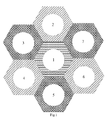
- Figure 1 shows the frequency reuse scheme of this proposal. As shown in Fig. 1 , seven cells are shown, cells 2 to 7 are adj acent cells of cell 1. In order to decrease or eliminate most of the interference, on the edge of cells, the frequencies should be orthogonal between neighbor cells, and in order to increase the utilization ratio of frequency resource, the frequency reuse factor should be increased as much as possible. For example, on the edge of each cell, cell 1 uses frequency 1, cell 2, 4 and 6 use the same frequency 2, cell 3, 5 and 7 use the same frequency 3. Cell-edge users transmit/receive with the full power. Cell-center users use the whole spectrum with restricted power to transmit/receive, and hence there will not be too much inter-cell interference (ICI) even the same frequency is used.
- ICI inter-cell interference
- a semi-static scheme is proposed in reference [3]: the entire frequency band is divided into N sub bands, then X sub bands are used for cell-edge users and N-3X sub bands are used for cell-center users.
- the X sub bands used for cell-edge users are orthogonal in neighbor cells, while the N-3X sub bands used for cell-center users are the same in all cells. Only a part of spectrum is used in the inner cell and cell edge respectively in this scheme.
- a resource scheduling method comprising: selecting resource to be scheduled from a scheduling list; selecting a first user equipment to be scheduled from the scheduling list; allocating the selected resource to the first user equipment by probability of p, wherein 0 ⁇ p ⁇ 1, if the first user equipment is of edge user.
- the method of resource scheduling may further comprise: allocating the selected resource to the first user equipment, if the first user equipment is not of edge user.
- the method of scheduling resource may further comprise: going back to the first user equipment selecting step and selecting a next first user equipment to be scheduled from the scheduling list, if the selected resource fails to be allocated to the first user equipment according to the probability of p.
- the method of resource scheduling may further comprise: informing all of related base stations of the first user equipment with the information that resource is prepared to be allocated to the first user equipment; obtaining scheduling information from all the related base stations; performing the probabilistic resource allocating step, if it is determined that at least one related base station will probably allocate the resource, prepared to be scheduled to the first user equipment, to a second user equipment as edge user of the at least one related base station, according to scheduling information obtained from all of related base stations.
- the method of resource scheduling may further comprise: allocating the selected resource to the first user equipment, if it is determined that all of related base stations will not allocate the resource, prepared to be scheduled to the first user equipment, to the second user equipment.
- the first user equipment is of edge user
- the base station to which the non-service cell belongs is a related base station of the first user equipment, if pathloss difference between from the first user equipment to its serving cell and from the first user equipment to its non-service cell is less than predetermined threshold PLD_threshold.
- the first user equipment is of edge user, and base station being adjacent to the serving base station of the first user equipment is of related base station of the first user equipment.
- the predetermined threshold SIR_threshold is equal to Euler number e.
- the probabilistic resource allocating step may comprise: generating a random number R ⁇ (0, 1); allocating the selected resource to the first user equipment, if the generated random number R is less than the probability p.
- the probability p is preconfigured or dynamically adjustable.
- the scheduling list is determined according to scheduling algorithm.
- a scheduler implementing the aforesaid resource scheduling method, comprising: unit for selecting resource, configured to select resource to be scheduled from a scheduling list; unit for selecting user equipment, configured to select a first user equipment to be scheduled from the scheduling list; unit for determining edge user, configured to determine whether the first user equipment is of edge user; and unit for probabilistically allocating resource, configured to allocate the selected resource to the first user equipment by probability of p, wherein, 0 ⁇ p ⁇ 1, wherein, if the unit for determining edge user determines the first user equipment is of edge user, the unit for probabilistically allocating resource allocates the resource, selected by the unit for selecting resource to the first user equipment by the probability of p.
- the unit for probabilistically allocating resource allocates the resource, selected by the unit for selecting resource, to the first user equipment.
- the unit for probabilistically allocating resource fails to allocate, according to the probability of p, the resource, selected by the unit for selecting resource, to the first user equipment, the unit for selecting user equipment selects a next first user equipment to schedule from the scheduling list.
- the scheduler may further comprise: unit for informing resource allocating information, configured to inform all of related base stations of the first user equipment with the information that resource is prepared to be allocated to the first user equipment if the unit for determining edge user determines the first user equipment is of edge user; unit for receiving scheduling information, configured to obtain scheduling information from all of related base stations; unit for determining related base station allocation, configured to determine whether all of related base stations will probably allocate the resource, prepared to be scheduled to the first user equipment, to a second user equipment as edge user of the at least one related base station, according to scheduling information obtained from all of related base stations, wherein, if the unit for determining related base station allocation determines that at least one related base station will probably allocate the resource, prepared to be scheduled to the first user equipment, to a second user equipment as edge user of the at least one related base station, the unit for probabilistically allocating resource allocates the resource, selected by the unit for selecting resource, to the first user equipment by the probability of p.
- unit for informing resource allocating information configured to inform all of related base
- the unit for determining related base station allocation determines that all of related base stations will not allocate the resource, prepared to be scheduled to the first user equipment, to the second user equipment, the unit for probabilistically allocating resource allocates the resource, selected by the unit for selecting resource, to the first user equipment.
- the unit for determining edge user determines the first user equipment is of edge user and the base station to which the non-service cell belongs is a related base station of the first user equipment, if pathloss difference between from the first user equipment to its serving cell and from the first user equipment to its non-service cell is less than predetermined threshold PLD_threshold.
- the unit for determining edge user determines that the first user equipment is of edge user and base station being adjacent to the serving base station of the first user equipment is of related base station of the first user equipment, if signal interference ratio of the user equipment is less than a predetermined threshold SIR_threshold. More preferably, the predetermined threshold SIR_threshold is equal to Euler number e.
- the unit for probabilistically allocating resource comprises: the unit for generating random number, configured to generate a random number R ⁇ (0,1); the unit for judging random number, configured to judge whether the generated random number is less than the probability of p; and the unit for allocating resource, configured to allocate the resource, selected by the unit for selecting resource, to the first user equipment if the generated random number is less than the probability of p.
- the probability p is preconfigured or dynamically adjustable.
- the scheduling list is determined according to scheduling algorithm.
- a base station comprising the scheduler according to the second aspect of the present invention.
- the present invention proposes a flexible distributed probabilistic dynamic interference coordination scheme to coordinate Inter-cell interference (ICI), especially advantageous for the system with low frequency reuse factor.
- ICI Inter-cell interference
- the scheme proposed by the present invention is totally distributed and dynamic, and need not signaling exchange or relative little signaling exchange.
- a distributed probabilistic dynamic interference coordination scheme wherein the mechanism of ALOHA is introduced into the dynamic interference coordination.
- the basic idea of the present invention is:
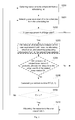
- Fig.2 shows a detailed flow diagram of the resource scheduling method according to the present invention.
- step S200 selecting resource to be scheduled from a scheduling list determined by the scheduling algorithm.
- step S201 selecting first user equipment A to be scheduled from the scheduling list determined by the scheduling algorithm. That is, the resource selected in the step S200 is prepared to be allocated to the first user equipment A selected in the step S201.
- step S202 determining whether the first user equipment A is of edge user, preferably, which may be determined according to section (1) of the aforesaid principle overview.
- the resource, prepared to be scheduled to the first user equipment A is allocated to the first user equipment A, after finishing the resource scheduling of the first user equipment A, turning to the step S200, selecting the next resource to be scheduled.
- step S203 informing all of related base stations of the first user equipment A with the information that resource is prepared to be allocated to the first user equipment A, thus, the scheduling information is obtained from all the related base stations of the first user equipment A.
- step S204 determining whether all of related base station of the first user equipment A will allocate the resource, prepared to be scheduled to the first user equipment A, to a second user equipment as edge user of the related base station, according to scheduling information obtained from all of related base stations of the first user equipment A.
- step S210 the resource, prepared to be scheduled to the first user equipment A, is allocated to the first user equipment, and the resource scheduling of the first user equipment A is finished, turning to the step S200, selecting the next resource to be scheduled.
- a random number R ⁇ (0,1) is generated.
- the resource selected in the step S200 can not be allocated to the first user equipment A selected in the step S201. This moment, back to the step S201 to select the next first user equipment A' to be scheduled from the scheduling list determined according to the scheduling algorithm. That is to try to allocate the resource selected in the step S200 to the next first user equipment A' reselected in the step S201.
- blind probabilistic resource scheduling may be performed, namely the steps S203 and S204 are omitted, when it is determined that the first user equipment is of edge user, a random judgment based on random number R and probability p is directly performed, and thus the resource probabilistic allocation according to the present invention is performed.
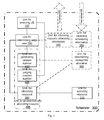
- Fig.3 shows a detailed block diagram of the scheduler 300 according to the present invention.
- the scheduler 300 comprises: unit 310 for selecting resource, configured to select resource to be scheduled from a scheduling list determined according to the scheduling algorithm; unit 320 for selecting user equipment (UE), configured to select a first UE A to be scheduled from the scheduling list determined according to the scheduling algorithm, namely prepare to allocate the resource, selected by the unit 310 for selecting resource, to the first UE A selected by the unit 320 for selecting UE; unit 330 for determining edge user, configured to determine whether the first UE A is of edge user, preferably, which may be determined according to section (1) of the aforesaid principle overview part; unit 340 for informing resource allocating information, configured to inform all of related base stations of the first UE A with the information that resource is prepared to be allocated to the first UE if the unit 330 for determining edge user determines the first UE A is of edge user ; unit 350 for receiving scheduling information, configured to obtain scheduling information from all of related base stations; unit 360 for determining related BS allocation, configured to
- Unit 390 for probabilistically allocating resource may comprise: the unit 370 for generating random number, configured to generate a random number R ⁇ (0,1); unit 375 for judging random number, configured to judge whether the generated random number is less than the probability of p; and unit 380 for allocating resource, configured to allocate the resource, selected by the unit 310 for selecting resource, to the first UE A.
- the unit 380 for allocating resource allocates the resource, selected by the unit 310 for selecting resource, to the first UE A.
- the unit 360 for determining related BS allocation performs operation.
- the unit 360 for determining related BS allocation determines that at least one related BS C will probably allocate the resource, prepared to be scheduled to the first UE A, to a second UE B of the at least one related BS C, the unit 370 for generating random number performs operation.
- the unit 380 for allocating resource allocates the resource, selected by the unit 310 for selecting resource, to the first UE A.
- the unit 380 for allocating resource allocates the resource, selected by the unit 310 for selecting resource, to the first UE A.
- the unit 320 for selecting UE selects the next first UE A' to be scheduled from the scheduling list. That is, trying to allocate the resource, selected by the unit 310 for selecting resource, to the next first UE A' reselected by the unit 320 for selecting UE.
- the units 340 ⁇ 360 of interacting information with related base station in Fig. 3 are not indispensable units.
- the units 340 ⁇ 360 may be omissible, when the unit 330 for determining edge user determines that the first UE A is of edge user, the unit 365 for probabilistically allocating resource directly performs operation.
- Fig.4 shows an application example of the present invention, wherein BS 1 and BS 2 respectively comprise separate scheduler sub-system.
- the BS 1 is the serving BS of the user equipment 1 and 3
- the BS 2 is the serving BS of the user equipment 2 and 4.
- the user equipment 1 and 2 are of edge user
- the user equipment 3 and 4 are of center user.
- center user and edge user may be determined according to section (1) (A) of the aforesaid principle overview part.
- section (2) (A) of the aforesaid principle overview part the related BS of the user equipment 1 is BS 2, and the related BS of the user equipment 2 is BS 1.
- BS 1 will notify BS 2 with the information that the edge user (the user equipment 1) will be scheduled and BS 2 will also inform BS 1 with the information that the edge user (the user equipment 2) will be scheduled. So the user equipment 1 (the user equipment 2) is scheduled by probability of p (0 ⁇ p ⁇ 1) and is not scheduled by probability of 1-p. If the user equipment 1 (the user equipment 2) is not scheduled, then the resource will be allocated to other user equipments, for example, user equipment 3 (user equipment 4). The probability that user equipment1 and user equipment 2 are scheduled simultaneously decreases to p*p, thereby reducing effectively the interference, with the resource effectively reused by other user equipments.
- Table 2 shows the performance comparison between the simulation result of the present invention and the prior art.
- the blind probabilistic scheme that is, the aforesaid steps S203 and 204 are omitted), wherein there is no information exchange between BSs, is adopted. If the edge user is scheduled, it will be allocated resource by probability of p and not be allocated by probability of 1-p.
- the simulation result shown in Table 2 is based on LTE uplink system. The detailed simulation parameters are shown in Table 1 (referring to reference [5]).
- the simulation result shows: the aforesaid blind probabilistic scheme according to the present invention may get 6% gain of the edge user throughput (5% throughput), with a little increase (1.4%) in the cell average throughput.
Landscapes
- Engineering & Computer Science (AREA)
- Computer Networks & Wireless Communication (AREA)
- Signal Processing (AREA)
- Quality & Reliability (AREA)
- Mobile Radio Communication Systems (AREA)
Abstract
Description
- The present invention relates to mobile communication field, specifically to a distributed probabilistic dynamic interference coordination scheme, wherein the mechanism of ALOHA is introduced into the dynamic interference coordination, thereby providing a resource scheduling method, a scheduler implementing the aforesaid resource scheduling method and a base station (BS) comprising the aforesaid scheduler.
- In LTE (Long Term Evolution) system, the orthogonal frequency division multiple access (OFDMA) and single carrier FDMA (SC-FDMA) technologies are adopted in the downlink and uplink respectively. In LTE-advanced system, these multiple access technologies are still the candidate schemes. The inter-cell interference is the main limitation factor for capacity in such systems with low frequency reuse factor. If a mobile station is located at the cell boundary, interference from neighboring cells is a crucial factor leading to severe performance degradation (especially throughput and coverage).
- Static and semi-static coordination technologies are the usual interference coordination technologies in LTE proposals. These inter-cell interference coordination technologies propose restrictions for a coordinating way between cells. For example, these restrictions may be in the form of restrictions to time/frequency resources available to the resource manager, or restrictions on the transmit power applicable to may certain time/frequency resources.
- A static solution is proposed in reference [1].
Figure 1 shows the frequency reuse scheme of this proposal. As shown inFig. 1 , seven cells are shown,cells 2 to 7 are adj acent cells ofcell 1. In order to decrease or eliminate most of the interference, on the edge of cells, the frequencies should be orthogonal between neighbor cells, and in order to increase the utilization ratio of frequency resource, the frequency reuse factor should be increased as much as possible. For example, on the edge of each cell,cell 1 usesfrequency 1,cell same frequency 2,cell same frequency 3. Cell-edge users transmit/receive with the full power. Cell-center users use the whole spectrum with restricted power to transmit/receive, and hence there will not be too much inter-cell interference (ICI) even the same frequency is used. However, there are two obvious disadvantages: (1) the frequency utilization rate of cell-edge users is only 1/3; (2) the solution may not be fulfilled optimally if the traffic load of the service changes. - Another static solution named as network power planning is proposed in reference [2], the whole frequency band is divided into several subsets with corresponding power, for example, 7 to 9 subsets. The frequency utilization rate of cell-edge users is 3/7 according to this proposal.
- A semi-static scheme is proposed in reference [3]: the entire frequency band is divided into N sub bands, then X sub bands are used for cell-edge users and N-3X sub bands are used for cell-center users. The X sub bands used for cell-edge users are orthogonal in neighbor cells, while the N-3X sub bands used for cell-center users are the same in all cells. Only a part of spectrum is used in the inner cell and cell edge respectively in this scheme.
- However, the aforesaid current technical scheme has disadvantages as follows:
- (a) the aforesaid solution is either static solution, or semi-static solution needing network planning, and the semi-static solution needs additional signaling to indicate the occurrence of adjustment;
- (b) in aforesaid solutions, the frequency reuse factor of cell-edge users is greater than 1, thereby decreasing spectrum efficiency;
- (c) these solutions restrict scheduling and make scheduling more complex. In view of the aforesaid problems, the present invention proposes a distributed probabilistic dynamic interference coordination scheme to decrease or eliminate ICI(Inter-cell interference), wherein the mechanism of ALOHA is introduced into the dynamic interference coordination.
- According to a first aspect of the present invention, there is provided a resource scheduling method, comprising: selecting resource to be scheduled from a scheduling list; selecting a first user equipment to be scheduled from the scheduling list; allocating the selected resource to the first user equipment by probability of p, wherein 0 ≤ p ≤ 1, if the first user equipment is of edge user.
- Preferably, the method of resource scheduling may further comprise: allocating the selected resource to the first user equipment, if the first user equipment is not of edge user.
- Preferably, the method of scheduling resource may further comprise: going back to the first user equipment selecting step and selecting a next first user equipment to be scheduled from the scheduling list, if the selected resource fails to be allocated to the first user equipment according to the probability of p.
- Preferably, If the first user equipment is of edge user, prior to the probabilistic resource allocating step, the method of resource scheduling may further comprise: informing all of related base stations of the first user equipment with the information that resource is prepared to be allocated to the first user equipment; obtaining scheduling information from all the related base stations; performing the probabilistic resource allocating step, if it is determined that at least one related base station will probably allocate the resource, prepared to be scheduled to the first user equipment, to a second user equipment as edge user of the at least one related base station, according to scheduling information obtained from all of related base stations.
- Preferably, the method of resource scheduling may further comprise: allocating the selected resource to the first user equipment, if it is determined that all of related base stations will not allocate the resource, prepared to be scheduled to the first user equipment, to the second user equipment.
- Preferably, the first user equipment is of edge user, and the base station to which the non-service cell belongs is a related base station of the first user equipment, if pathloss difference between from the first user equipment to its serving cell and from the first user equipment to its non-service cell is less than predetermined threshold PLD_threshold.
- Preferably, if signal interference ratio of the user equipment is less than a predetermined threshold SIR_threshold, the first user equipment is of edge user, and base station being adjacent to the serving base station of the first user equipment is of related base station of the first user equipment. More preferably, the predetermined threshold SIR_threshold is equal to Euler number e.
- Preferably, the probabilistic resource allocating step may comprise: generating a random number R∈ (0, 1); allocating the selected resource to the first user equipment, if the generated random number R is less than the probability p.
- Preferably, the probability p is preconfigured or dynamically adjustable.
- Preferably, the scheduling list is determined according to scheduling algorithm.
- According to a second aspect of the present invention, a scheduler implementing the aforesaid resource scheduling method is proposed, comprising: unit for selecting resource, configured to select resource to be scheduled from a scheduling list; unit for selecting user equipment, configured to select a first user equipment to be scheduled from the scheduling list; unit for determining edge user, configured to determine whether the first user equipment is of edge user; and unit for probabilistically allocating resource, configured to allocate the selected resource to the first user equipment by probability of p, wherein, 0 ≤ p ≤ 1, wherein, if the unit for determining edge user determines the first user equipment is of edge user, the unit for probabilistically allocating resource allocates the resource, selected by the unit for selecting resource to the first user equipment by the probability of p.
- Preferably, if the unit for determining edge user determines the first user equipment is not of edge user, the unit for probabilistically allocating resource allocates the resource, selected by the unit for selecting resource, to the first user equipment.
- Preferably, if the unit for probabilistically allocating resource fails to allocate, according to the probability of p, the resource, selected by the unit for selecting resource, to the first user equipment, the unit for selecting user equipment selects a next first user equipment to schedule from the scheduling list.
- Preferably, the scheduler may further comprise: unit for informing resource allocating information, configured to inform all of related base stations of the first user equipment with the information that resource is prepared to be allocated to the first user equipment if the unit for determining edge user determines the first user equipment is of edge user; unit for receiving scheduling information, configured to obtain scheduling information from all of related base stations; unit for determining related base station allocation, configured to determine whether all of related base stations will probably allocate the resource, prepared to be scheduled to the first user equipment, to a second user equipment as edge user of the at least one related base station, according to scheduling information obtained from all of related base stations, wherein, if the unit for determining related base station allocation determines that at least one related base station will probably allocate the resource, prepared to be scheduled to the first user equipment, to a second user equipment as edge user of the at least one related base station, the unit for probabilistically allocating resource allocates the resource, selected by the unit for selecting resource, to the first user equipment by the probability of p.
- Preferably, if the unit for determining related base station allocation determines that all of related base stations will not allocate the resource, prepared to be scheduled to the first user equipment, to the second user equipment, the unit for probabilistically allocating resource allocates the resource, selected by the unit for selecting resource, to the first user equipment.
- Preferably, the unit for determining edge user determines the first user equipment is of edge user and the base station to which the non-service cell belongs is a related base station of the first user equipment, if pathloss difference between from the first user equipment to its serving cell and from the first user equipment to its non-service cell is less than predetermined threshold PLD_threshold.
- Preferably, the unit for determining edge user determines that the first user equipment is of edge user and base station being adjacent to the serving base station of the first user equipment is of related base station of the first user equipment, if signal interference ratio of the user equipment is less than a predetermined threshold SIR_threshold. More preferably, the predetermined threshold SIR_threshold is equal to Euler number e.
- Preferably, the unit for probabilistically allocating resource comprises: the unit for generating random number, configured to generate a random number R∈ (0,1); the unit for judging random number, configured to judge whether the generated random number is less than the probability of p; and the unit for allocating resource, configured to allocate the resource, selected by the unit for selecting resource, to the first user equipment if the generated random number is less than the probability of p.
- Preferably, the probability p is preconfigured or dynamically adjustable.
- Preferably, the scheduling list is determined according to scheduling algorithm.
- According to a third aspect of the present invention, there is provided with a base station (BS) comprising the scheduler according to the second aspect of the present invention.
- The present invention proposes a flexible distributed probabilistic dynamic interference coordination scheme to coordinate Inter-cell interference (ICI), especially advantageous for the system with low frequency reuse factor. The scheme proposed by the present invention is totally distributed and dynamic, and need not signaling exchange or relative little signaling exchange.
- The advantages of the present invention:
- (1) dynamic, distributed ICI coordination;
- (2) simple, flexible, requiring no signaling exchange or relative little signaling exchange;
- (3) thoroughly dynamic, requiring no the network planning;
- (4) the frequency reuse factors of cell-center users and cell- edge users are all 1, the frequency selective gain may be obtained in scheduling.
- By the detailed description of the non-limiting embodiments with reference to the following drawings, the above or other objects, features and advantages of the present invention will become more apparent, wherein:
-
Fig.1 shows a schematic diagram of the frequency reuse scheme proposed by the reference [1]; -
Fig.2 shows a flow diagram of the resource scheduling method according to the present invention; -
Fig.3 shows a block diagram of thescheduler 300 according to the present invention; -
Fig.4 shows a schematic diagram of application example of the present invention. - Hereinafter, the present invention is described with reference to the drawings. In the following description, some detailed embodiments are only used for the aim of description, which should not be understood as any limitation to the present invention, but only as example. When it might be caused that the understanding of the present invention becomes ambiguous, the traditional structure or composition will be omitted.
- According to the present invention, a distributed probabilistic dynamic interference coordination scheme is proposed, wherein the mechanism of ALOHA is introduced into the dynamic interference coordination. The basic idea of the present invention is:
- (1) users may be divided into two kinds: center users and edge users; the judging criteria is as follows:
- (A) determining according to long term CSI (comprising pathloss and shadow):
- defining the threshold PLD_threshold for all of users:
- ◆ if pathloss (comprising shadow) difference between from the user equipment i to its serving cell and from the first user equipment to its non-service cell is less than PLD_threshold, the user equipment i is regarded as edge user;
- ◆ otherwise, the user equipment i is regarded as center user.
- defining the threshold PLD_threshold for all of users:
- (B) determining according to SIR of users:
- defining the threshold SIR _threshold for all of users
- ◆ if SIR of the user equipment i ≥ SIR _threshold, the user equipment i is regarded as center user;
- ◆ otherwise, the user equipment i is regarded as edge user;
- ◆ the preferable value of SIR _threshold is Euler number e, and it has been proved (referring to reference [4]): scheduling the user equipment with SIR _threshold =e is the solution capable of maximizing the overall throughput of multiple cells.
- defining the threshold SIR _threshold for all of users
- (A) determining according to long term CSI (comprising pathloss and shadow):
- (2) corresponding to two kinds of definitions (A) and (B) of edge users, the related base station definition as follows:
- (A) if pathloss (comprising shadow) difference between from the user equipment i to its serving cell and from the first user equipment to its non-service cell is less than PLD_threshold, the base station to which the non-service cell belongs is defined as the related base station;
or - (B) The neighboring base station (adjacent serving base station) within the first ring of the serving base stations will be defined as the related base station.
- (A) if pathloss (comprising shadow) difference between from the user equipment i to its serving cell and from the first user equipment to its non-service cell is less than PLD_threshold, the base station to which the non-service cell belongs is defined as the related base station;
- (3) For the center users, the interference from neighboring sectors is relative small and thus may be neglectable. Therefore, it is not necessary to do the dynamic interference coordination for the center users, this kind of user may be scheduled as usual.
- (4) the edge users are the main contributor to ICI, thus the probabilistic dynamic interference coordination is adopted for the edge user.
-
- (I) if the scheduler will allocate resource to the edge user A, the scheduler will allocate the resource to the edge user by the probability of p (0 ≤ p ≤ 1) and will not allocate the resource to the edge user by the probability of 1-p. If the edge user is not able to be scheduled according the random judgment, then the scheduler will try to allocate the resource to the next user in the scheduling list (determined by the scheduling algorithm).
- (II) if the scheduler will allocate resource to the edge user A, it will inform the resource allocation information to all of related base stations of the edge user A, simultaneously the scheduler will obtain the scheduling information from all of related base stations.
- (a) If the scheduler knows all of related base stations of the user will not allocate the resource to the edge user of the related base station, it will allocate the resource to the edge user A (by probability of 1).
- (b) If the scheduler knows at least one related base station of the user might allocate the resource to the edge user B of the at least one related base station, the scheduler will allocate the resource to the edge user A by probability of p and will not allocate the resource to the edge user A by probability of 1-p. If the edge user is not able to be scheduled according the random judgment, then the scheduler will try to allocate the resource to the next user in the scheduling list (determined by the scheduling algorithm).
- Specifically,
Fig.2 shows a detailed flow diagram of the resource scheduling method according to the present invention. Referring toFig. 2 , first, in the step S200, selecting resource to be scheduled from a scheduling list determined by the scheduling algorithm. In the step S201, selecting first user equipment A to be scheduled from the scheduling list determined by the scheduling algorithm. That is, the resource selected in the step S200 is prepared to be allocated to the first user equipment A selected in the step S201. In the step S202, determining whether the first user equipment A is of edge user, preferably, which may be determined according to section (1) of the aforesaid principle overview. - If it is determined that the first user equipment A is not edge user, then in the step S210, the resource, prepared to be scheduled to the first user equipment A, is allocated to the first user equipment A, after finishing the resource scheduling of the first user equipment A, turning to the step S200, selecting the next resource to be scheduled.
- On the other hand, if it is determined that the first user equipment A is of edge user, then in the step S203, informing all of related base stations of the first user equipment A with the information that resource is prepared to be allocated to the first user equipment A, thus, the scheduling information is obtained from all the related base stations of the first user equipment A. In the step S204, determining whether all of related base station of the first user equipment A will allocate the resource, prepared to be scheduled to the first user equipment A, to a second user equipment as edge user of the related base station, according to scheduling information obtained from all of related base stations of the first user equipment A.
- If it is determined that all of related base stations will not allocate the resource, prepared to be scheduled to the first user equipment A, to the second user equipment, then in the step S210, the resource, prepared to be scheduled to the first user equipment A, is allocated to the first user equipment, and the resource scheduling of the first user equipment A is finished, turning to the step S200, selecting the next resource to be scheduled.
- On the other hand, if it is determined that at least one related base station C might allocate the resource, prepared to be scheduled to the first user equipment A, to a second user equipment B as edge user of the at least one related base station C, then in the step S206, a random number R∈(0,1) is generated. In the step S208, determining whether the generated random number R is less than the preconfigured or dynamically adjustable probability p (0 ≤ p ≤ 1). If it is determined that the generated random number R is less than the probability p, then in the step S210, the resource, prepared to be scheduled to the first user equipment A, is allocated to the first user equipment A, and the resource scheduling of the first user equipment A is finished, turning to the step S200, selecting the next resource to be scheduled.
- On the other hand, if it is determined that the generated random number R is not less than the probability p, then it is determined that the resource selected in the step S200 can not be allocated to the first user equipment A selected in the step S201. This moment, back to the step S201 to select the next first user equipment A' to be scheduled from the scheduling list determined according to the scheduling algorithm. That is to try to allocate the resource selected in the step S200 to the next first user equipment A' reselected in the step S201.
- It should be noted that the steps S203 and S204 for interacting information with related base station in
Fig. 2 are not necessary to be performed. In case of simplicity, blind probabilistic resource scheduling may be performed, namely the steps S203 and S204 are omitted, when it is determined that the first user equipment is of edge user, a random judgment based on random number R and probability p is directly performed, and thus the resource probabilistic allocation according to the present invention is performed. -
Fig.3 shows a detailed block diagram of thescheduler 300 according to the present invention. - Referring to
Fig. 3 , the scheduler 300 according to the present invention comprises: unit 310 for selecting resource, configured to select resource to be scheduled from a scheduling list determined according to the scheduling algorithm; unit 320 for selecting user equipment (UE), configured to select a first UE A to be scheduled from the scheduling list determined according to the scheduling algorithm, namely prepare to allocate the resource, selected by the unit 310 for selecting resource, to the first UE A selected by the unit 320 for selecting UE; unit 330 for determining edge user, configured to determine whether the first UE A is of edge user, preferably, which may be determined according to section (1) of the aforesaid principle overview part; unit 340 for informing resource allocating information, configured to inform all of related base stations of the first UE A with the information that resource is prepared to be allocated to the first UE if the unit 330 for determining edge user determines the first UE A is of edge user ; unit 350 for receiving scheduling information, configured to obtain scheduling information from all of related base stations; unit 360 for determining related BS allocation, configured to determine whether all of related base stations will probably allocate the resource, prepared to be scheduled to the first UE A, to a second UE as edge user of the related BS, according to scheduling information obtained from all of related BSs; unit 365 for probabilistically allocating resource, configured to allocate the resource, selected by the unit 310 for selecting resource, to the first UE A selected by the unit 320 for selecting UE by preconfigured or dynamically adjustable probability of p (0 ≤ p ≤ 1). Unit 390 for probabilistically allocating resource may comprise: the unit 370 for generating random number, configured to generate a random number R∈ (0,1); unit 375 for judging random number, configured to judge whether the generated random number is less than the probability of p; and unit 380 for allocating resource, configured to allocate the resource, selected by the unit 310 for selecting resource, to the first UE A. - If the unit 330 for determining edge user determines the first UE A is not of edge user, the unit 380 for allocating resource allocates the resource, selected by the unit 310 for selecting resource, to the first UE A.
- If the unit 330 for determining edge user determines the first UE A is of edge user, the
unit 360 for determining related BS allocation performs operation. - If the
unit 360 for determining related BS allocation determines that at least one related BS C will probably allocate the resource, prepared to be scheduled to the first UE A, to a second UE B of the at least one related BS C, the unit 370 for generating random number performs operation. - If the unit 375 for judging random number determines that the random number R, generated by the unit 370 for generating random number, is less than the probability of p, the unit 380 for allocating resource allocates the resource, selected by the unit 310 for selecting resource, to the first UE A.
- If the
unit 360 for determining related BS allocation determines that all related base stations will not allocate the resource, prepared to be scheduled to the first UE A, to the second UE, the unit 380 for allocating resource allocates the resource, selected by the unit 310 for selecting resource, to the first UE A. - If the unit 375 for judging random number determines that the random number R, generated by the unit 370 for generating random number, is not less than the probability of p, the
unit 320 for selecting UE selects the next first UE A' to be scheduled from the scheduling list. That is, trying to allocate the resource, selected by the unit 310 for selecting resource, to the next first UE A' reselected by theunit 320 for selecting UE. - It should be noted that the
units 340 ∼ 360 of interacting information with related base station inFig. 3 are not indispensable units. In the simple case of performing blind probabilistic resource scheduling, theunits 340 ∼ 360 may be omissible, when the unit 330 for determining edge user determines that the first UE A is of edge user, theunit 365 for probabilistically allocating resource directly performs operation. -
Fig.4 shows an application example of the present invention, whereinBS 1 andBS 2 respectively comprise separate scheduler sub-system. TheBS 1 is the serving BS of theuser equipment BS 2 is the serving BS of theuser equipment user equipment user equipment user equipment 1 isBS 2, and the related BS of theuser equipment 2 isBS 1. If theuser equipment BS 1 will notifyBS 2 with the information that the edge user (the user equipment 1) will be scheduled andBS 2 will also informBS 1 with the information that the edge user (the user equipment 2) will be scheduled. So the user equipment 1 (the user equipment 2) is scheduled by probability of p (0 ≤ p ≤ 1) and is not scheduled by probability of 1-p. If the user equipment 1 (the user equipment 2) is not scheduled, then the resource will be allocated to other user equipments, for example, user equipment 3 (user equipment 4). The probability that user equipment1 anduser equipment 2 are scheduled simultaneously decreases to p*p, thereby reducing effectively the interference, with the resource effectively reused by other user equipments. - Table 2 shows the performance comparison between the simulation result of the present invention and the prior art. For the purpose of simplicity, the blind probabilistic scheme (that is, the aforesaid steps S203 and 204 are omitted), wherein there is no information exchange between BSs, is adopted. If the edge user is scheduled, it will be allocated resource by probability of p and not be allocated by probability of 1-p. The simulation result shown in Table 2 is based on LTE uplink system. The detailed simulation parameters are shown in Table 1 (referring to reference [5]). The simulation result shows: the aforesaid blind probabilistic scheme according to the present invention may get 6% gain of the edge user throughput (5% throughput), with a little increase (1.4%) in the cell average throughput. Since the scheduling is done with blind information in the case of absence of information exchange between base stations, the gain is mainly from the probabilistically resource allocating of edge user proposed by the present invention (mainly based on the known information about whether there exists neighboring cell edge user transmitting the data).
Table 1 Option Description Cellular Layout ISD=500 ,19 Cells/57 sectors with wrapround CenterFreq and BandWidth 2 GHz and 10MHz Pathloss Model 128.1+37.6*1og10(R) dB, R in kilo-meter Shadowing Model StdDev=8dB, CorrDis=50m Fastfading Model TU6 and SCM BS Antenna 2 antennas, 17 dBi gain, radiation Pattern=max{-12*(AoA/70)^2,-20} (dB) UE Antenna gain 1 omni antenna, 0 dBi gain BS Noise Factor 4.5 dB Max UE Tx power 24 dBm UE speed 3km/h UE Distribution Uniform in each sector (hexagon); MinDisToSite > 35m UE Number per sector 20 Traffic load model Full buffer Table 2 No interference coordination Dynamic interference coordination (p=0.5) gain IoT (linear value) 37.64 35.07 Cell throughput (Mpbs) 12.52 12.7 1.4% Edge throughput (kbps) 193.4 205.3 6% - The above embodiment is only for an exemplarily purpose and not intended to limit the present invention. The skilled in the art should understand that the present invention may be modified, replaced without departing from the scope and spirit of the present invention, with these modifications and replacements falling within the scope limited by appended claims.
-
- [1] R-050763, "Muting-Futher Discussion and Results" , Ericsson
- [2] R-05-0694, "Multi-cell Simulation Results for Interference Co-ordination in new OFDM DL" , Alcatel, 3GPP TSG RAN WG1 #42, London, UK, 29th August - 2nd September 2005.
- [3] R1-050738, Siemens, "Interference mitigation Considerations and Results on Frequency Reuse" , RAN G1#42, London, UK, Aug./Sept. 2005.
- [4] Kiani, S.G.; Oien, G.E.; Gesbert, D. "Maximizing Multicell Capacity Using Distributed Power Allocation and Scheduling", Wireless Communications and Networking Conference, 2007.WCNC 2007. IEEE 11-15 March 2007 Page(s): 1690-1694
- [5] 3GPP TR 25.814 V7.0.0, Physical Layer Aspects for Evolved UTRA (Release 7), 2006
Claims (23)
- A method of resource scheduling, comprising:selecting resource to be scheduled from a scheduling list;selecting a first user equipment to be scheduled from the scheduling list;allocating the selected resource to the first user equipment by probability of p, wherein ≤ p ≤ 1, if the first user equipment is of edge user.
- The method of resource scheduling according to claim 1, further comprising:allocating the selected resource to the first user equipment, if the first user equipment is not of edge user.
- The method of resource scheduling according to claim 1 or 2, further comprising:going back to the first user equipment selecting step and selecting a next first user equipment to be scheduled from the scheduling list, if the selected resource fails to be allocated to the first user equipment according to the probability of p.
- The method of resource scheduling according to any one of claims 1 to 3, characterized in that,
If the first user equipment is of edge user, prior to the probabilistic resource allocating step, the method of resource scheduling further comprises:informing all of related base stations of the first user equipment with the information that resource is prepared to be allocated to the first user equipment;obtaining scheduling information from all the related base stations;performing the probabilistic resource allocating step, if it is determined that at least one related base station will probably allocate the resource, prepared to be scheduled to the first user equipment, to a second user equipment as edge user of the at least one related base station, according to scheduling information obtained from all of related base stations. - The method of resource scheduling according to claim 4, further comprising:allocating the selected resource to the first user equipment, if it is determined that all of related base stations will not allocate the resource, prepared to be scheduled to the first user equipment, to the second user equipment.
- The method of resource scheduling according to any one of claims 1 to 5, characterized in that,
the first user equipment is of edge user, and the base station to which the non-service cell belongs is a related base station of the first user equipment, if pathloss difference between from the first user equipment to its serving cell and from the first user equipment to its non-service cell is less than predetermined threshold PLD_threshold. - The method of resource scheduling according to any one of claims 1 to 5, characterized in that,
if signal interference ratio of the user equipment is less than a predetermined threshold SIR_threshold, the first user equipment is of edge user, and base station being adjacent to the serving base station of the first user equipment is of related base station of the first user equipment. - The method of resource scheduling according to claim 7, characterized in that, the predetermined threshold SIR_threshold is equal to Euler number e.
- The method of resource scheduling according to any one of claims 1 to 8, characterized in that,
the probabilistic resource allocating step comprises:generating a random number R∈(0,1);allocating the selected resource to the first user equipment, if the generated random number R is less than the probability p. - The method of resource scheduling according to any one of claim 1 to 9, characterized in that,
the probability p is preconfigured or dynamically adjustable. - The method of resource scheduling according to any one of claim 1 to 10, characterized in that,
the scheduling list is determined according to scheduling algorithm. - A scheduler, wherein comprising:unit for selecting resource, configured to select resource to be scheduled from a scheduling list;unit for selecting user equipment, configured to select a first user equipment to be scheduled from the scheduling list;unit for determining edge user, configured to determine whether the first user equipment is of edge user; andunit for probabilistically allocating resource, configured to allocate the selected resource to the first user equipment by probability of p, wherein, 0 ≤ p ≤ 1,wherein, if the unit for determining edge user determines the first user equipment is of edge user, the unit for probabilistically allocating resource allocates the resource, selected by the unit for selecting resource to the first user equipment by the probability of p.
- The scheduler according to claim 12, characterized in that,
if the unit for determining edge user determines the first user equipment is not of edge user, the unit for probabilistically allocating resource allocates the resource, selected by the unit for selecting resource, to the first user equipment. - The scheduler according to claim 12 or 13, characterized in that,
if the unit for probabilistically allocating resource fails to allocate the resource, selected by the unit for selecting resource, to the first user equipment according to the probability of p, the unit for selecting user equipment selects a next first user equipment to schedule from the scheduling list. - The scheduler according to any one of claims 12 to 14, further comprising:unit for informing resource allocating information, configured to inform all of related base stations of the first user equipment with the information that resource is prepared to be allocated to the first user equipment if the unit for determining edge user determines the first user equipment is of edge user ;unit for receiving scheduling information, configured to obtain scheduling information from all of related base stations;unit for determining related base station allocation, configured to determine whether all of related base stations will probably allocate the resource, prepared to be scheduled to the first user equipment, to a second user equipment as edge user of the at least one related base station, according to scheduling information obtained from all of related base stations,wherein, if the unit for determining related base station allocation determines that at least one related base station will probably allocate the resource, prepared to be scheduled to the first user equipment, to a second user equipment as edge user of the at least one related base station, the unit for probabilistically allocating resource allocates the resource, selected by the unit for selecting resource, to the first user equipment by the probability of p.
- The scheduler according to claim 15, characterized in that,
if the unit for determining related base station allocation determines that all of related base stations will not allocate the resource, prepared to be scheduled to the first user equipment, to the second user equipment, the unit for probabilistically allocating resource allocates the resource, selected by the unit for selecting resource, to the first user equipment. - The scheduler according to any one of claims 12 to 16, characterized in that,
the unit for determining edge user determines the first user equipment is of edge user and the base station to which the non-service cell belongs is a related base station of the first user equipment, if pathloss difference between from the first user equipment to its serving cell and from the first user equipment to its non-service cell is less than predetermined threshold PLD_threshold. - The scheduler according to any one of claims 12 to 16, characterized in that,
the unit for determining edge user determines that the first user equipment is of edge user and base station being adjacent to the serving base station of the first user equipment is of related base station of the first user equipment, if signal interference ratio of the user equipment is less than a predetermined threshold SIR_threshold. - The scheduler according claim 18, characterized in that,
the predetermined threshold SIR_threshold is equal to Euler number e. - The scheduler according to any one of claims 12 to 19, characterized in that, the unit for probabilistically allocating resource comprises:the unit for generating random number, configured to generate a random number R∈(0,1);the unit for judging random number, configured to judge whether the generated random number is less than the probability of p; andthe unit for allocating resource, configured to allocate the resource, selected by the unit for selecting resource, to the first user equipment if the generated random number is less than the probability of p.
- The scheduler according to any one of claim 12 to 20, characterized in that, the probability p is preconfigured or dynamically adjustable.
- The scheduler according to any one of claim 12 to 21, characterized in that, the scheduling list is determined according to a scheduling algorithm.
- A base station, characterized in comprising the scheduler according to any one of claims 12 to 22.
Applications Claiming Priority (1)
| Application Number | Priority Date | Filing Date | Title |
|---|---|---|---|
| PCT/CN2009/000194 WO2010096946A1 (en) | 2009-02-24 | 2009-02-24 | Resource scheduling method, scheduler and base station |
Publications (2)
| Publication Number | Publication Date |
|---|---|
| EP2403305A1 true EP2403305A1 (en) | 2012-01-04 |
| EP2403305A4 EP2403305A4 (en) | 2016-04-06 |
Family
ID=42664988
Family Applications (1)
| Application Number | Title | Priority Date | Filing Date |
|---|---|---|---|
| EP09840614.3A Withdrawn EP2403305A4 (en) | 2009-02-24 | 2009-02-24 | RESOURCE PLANNING METHOD, PROGRAMMER AND BASE STATION |
Country Status (7)
| Country | Link |
|---|---|
| US (1) | US9107233B2 (en) |
| EP (1) | EP2403305A4 (en) |
| JP (1) | JP5307904B2 (en) |
| KR (1) | KR101489704B1 (en) |
| CN (1) | CN102246571B (en) |
| BR (1) | BRPI0924256A2 (en) |
| WO (1) | WO2010096946A1 (en) |
Cited By (1)
| Publication number | Priority date | Publication date | Assignee | Title |
|---|---|---|---|---|
| WO2023144447A1 (en) * | 2022-01-26 | 2023-08-03 | Greatest Heroes Oy | Polarization switching |
Families Citing this family (7)
| Publication number | Priority date | Publication date | Assignee | Title |
|---|---|---|---|---|
| US8243670B2 (en) * | 2009-08-19 | 2012-08-14 | Chunghwa Telecom Co., Ltd. | User grouping method for inter-cell interference coordination in mobile telecommunication |
| JP5711466B2 (en) * | 2010-03-08 | 2015-04-30 | 富士通株式会社 | Base station apparatus and communication band allocation method |
| US9445424B2 (en) * | 2010-11-10 | 2016-09-13 | Telefonaktiebolaget Lm Ericsson (Publ) | Radio base station and method for scheduling radio resources for user equipment |
| WO2012125087A1 (en) * | 2011-03-11 | 2012-09-20 | Telefonaktiebolaget L M Ericsson (Publ) | A radio base station and a method therein for scheduling radio resources |
| JP6916446B2 (en) * | 2018-09-13 | 2021-08-11 | 日本電信電話株式会社 | Base station management method, base station management device and program |
| US11064463B2 (en) * | 2018-10-03 | 2021-07-13 | The Boeing Company | Systems and methods for reuse of spectrum resources |
| EP3832464B1 (en) * | 2019-12-06 | 2024-07-10 | Tata Consultancy Services Limited | System and method for selection of cloud service providers in a multi-cloud |
Family Cites Families (14)
| Publication number | Priority date | Publication date | Assignee | Title |
|---|---|---|---|---|
| US5923650A (en) * | 1997-04-08 | 1999-07-13 | Qualcomm Incorporated | Method and apparatus for reverse link rate scheduling |
| CN1281016C (en) * | 2003-07-15 | 2006-10-18 | 大唐移动通信设备有限公司 | Method for packet data scheduling of multi-level service in CDMA mobile communication system |
| KR101226347B1 (en) * | 2004-07-28 | 2013-01-24 | 닛본 덴끼 가부시끼가이샤 | Wireless transmission system |
| JP4422660B2 (en) * | 2005-08-26 | 2010-02-24 | パナソニック株式会社 | Scheduling method and radio base station apparatus |
| JP4726662B2 (en) * | 2006-03-20 | 2011-07-20 | 株式会社エヌ・ティ・ティ・ドコモ | Radio access network apparatus and method |
| CN101064905A (en) * | 2006-04-28 | 2007-10-31 | 华为技术有限公司 | Wireless system frequency resources distribution method, equipment and wireless communication system |
| JP5268237B2 (en) * | 2006-07-28 | 2013-08-21 | シャープ株式会社 | Scheduling method, communication control device, and terminal device |
| CN1905549A (en) * | 2006-07-28 | 2007-01-31 | 华为技术有限公司 | System and method for resource allocation of OFDM system |
| EP1906548B1 (en) * | 2006-09-27 | 2014-08-13 | Samsung Electronics Co., Ltd. | Method and apparatus for scheduling data considering its power in a communication system |
| US8219092B2 (en) * | 2006-10-02 | 2012-07-10 | Freescale Semiconductor, Inc. | User equipment frequency allocation methods and apparatus |
| CN101304594B (en) | 2007-05-11 | 2011-11-30 | 电信科学技术研究院 | Management method and scheduling machine for wireless resource |
| EP2166782A1 (en) * | 2007-07-10 | 2010-03-24 | Panasonic Corporation | Radio communication base station device, radio communication terminal device, and radio communication method |
| JP5119977B2 (en) * | 2008-02-28 | 2013-01-16 | 富士通株式会社 | Radio resource allocation control apparatus and method, and radio base station |
| US8213951B2 (en) * | 2008-12-23 | 2012-07-03 | At & T Mobility Ii Llc | Using mobile communication devices to facilitate coordinating use of resources |
-
2009
- 2009-02-24 EP EP09840614.3A patent/EP2403305A4/en not_active Withdrawn
- 2009-02-24 KR KR20117022039A patent/KR101489704B1/en not_active Expired - Fee Related
- 2009-02-24 JP JP2011551382A patent/JP5307904B2/en not_active Expired - Fee Related
- 2009-02-24 WO PCT/CN2009/000194 patent/WO2010096946A1/en not_active Ceased
- 2009-02-24 CN CN200980150486.4A patent/CN102246571B/en active Active
- 2009-02-24 BR BRPI0924256A patent/BRPI0924256A2/en not_active Application Discontinuation
- 2009-02-24 US US13/202,908 patent/US9107233B2/en not_active Expired - Fee Related
Non-Patent Citations (1)
| Title |
|---|
| See references of WO2010096946A1 * |
Cited By (1)
| Publication number | Priority date | Publication date | Assignee | Title |
|---|---|---|---|---|
| WO2023144447A1 (en) * | 2022-01-26 | 2023-08-03 | Greatest Heroes Oy | Polarization switching |
Also Published As
| Publication number | Publication date |
|---|---|
| BRPI0924256A2 (en) | 2016-01-26 |
| CN102246571A (en) | 2011-11-16 |
| JP2012518957A (en) | 2012-08-16 |
| JP5307904B2 (en) | 2013-10-02 |
| KR20110119817A (en) | 2011-11-02 |
| CN102246571B (en) | 2015-12-16 |
| WO2010096946A1 (en) | 2010-09-02 |
| US9107233B2 (en) | 2015-08-11 |
| EP2403305A4 (en) | 2016-04-06 |
| KR101489704B1 (en) | 2015-02-11 |
| US20110300873A1 (en) | 2011-12-08 |
Similar Documents
| Publication | Publication Date | Title |
|---|---|---|
| EP2182751B1 (en) | Methods and apparatuses of spectrum utilization in a wireless cellular environment | |
| EP2560426B1 (en) | Wireless communication system, high-power base station, low-power base station, and communication control method | |
| US8144657B2 (en) | Clustering based resource allocation in multi-cell OFDMA networks | |
| US7738907B2 (en) | Method and apparatus for uplink power control in a frequency division multiple access communication system | |
| JP4918609B2 (en) | Mobile transceiver device and base station transceiver device for communication | |
| EP2403305A1 (en) | Resource scheduling method, scheduler and base station | |
| US20100177722A1 (en) | Method for Time Frequency Spreading in a Femtocell Network for Interference Reduction | |
| US20100279700A1 (en) | Resource allocation and power control method | |
| CN101335539A (en) | Method for suppressing co-channel interference between users and its base station | |
| Giambene et al. | Soft frequency reuse schemes for heterogeneous LTE systems | |
| EP2819483A1 (en) | Communication control device, communication control method, and communication control system | |
| Musa et al. | Performance evaluation of strict fractional frequency reuse and frequency reuse Factor-3 in 5G networks | |
| Zeng et al. | A novel dynamic interference coordination scheme in macrocell-picocell heterogeneous networks | |
| Wang et al. | Joint dynamic point blanking and ABS for ICIC in cloud cooperated heterogeneous network | |
| Wang et al. | Adaptive resource allocation scheme for wireless cellular networks | |
| Tsutsui et al. | Inter-Network Interference Coordination Using Protected Band in Co-existing Networks with HAPS and Terrestrial BSs | |
| Jung et al. | Interference avoidance and resource allocation for OFDMA downlink of femtocells with distributed power control | |
| Qin et al. | Enhanced dynamic SFR for LTE systems | |
| Stabellini et al. | Increasing system capacity in GERAN by means of TRX power reduction | |
| Lan et al. | Sensitivity of performance of SARP and HARP to traffic loading variations in a hierarchical cellular system under non-uniform traffic distribution | |
| AFOLALU et al. | User Association and Enabling Technologies in Next Generation 5G Ultra-Dense Networks–A Review | |
| KR20150139468A (en) | Method and apparatus for resource partitioning in heterogeneous networks |
Legal Events
| Date | Code | Title | Description |
|---|---|---|---|
| PUAI | Public reference made under article 153(3) epc to a published international application that has entered the european phase |
Free format text: ORIGINAL CODE: 0009012 |
|
| 17P | Request for examination filed |
Effective date: 20110926 |
|
| AK | Designated contracting states |
Kind code of ref document: A1 Designated state(s): AT BE BG CH CY CZ DE DK EE ES FI FR GB GR HR HU IE IS IT LI LT LU LV MC MK MT NL NO PL PT RO SE SI SK TR |
|
| RAP1 | Party data changed (applicant data changed or rights of an application transferred) |
Owner name: ALCATEL LUCENT |
|
| DAX | Request for extension of the european patent (deleted) | ||
| 111Z | Information provided on other rights and legal means of execution |
Free format text: AT BE BG CH CY CZ DE DK EE ES FI FR GB GR HR HU IE IS IT LI LT LU LV MC MK MT NL NO PL PT RO SE SI SK TR Effective date: 20130410 |
|
| RAP1 | Party data changed (applicant data changed or rights of an application transferred) |
Owner name: ALCATEL LUCENT |
|
| D11X | Information provided on other rights and legal means of execution (deleted) | ||
| RA4 | Supplementary search report drawn up and despatched (corrected) |
Effective date: 20160309 |
|
| RIC1 | Information provided on ipc code assigned before grant |
Ipc: H04W 16/02 20090101AFI20160303BHEP Ipc: H04W 16/30 20090101ALN20160303BHEP |
|
| STAA | Information on the status of an ep patent application or granted ep patent |
Free format text: STATUS: EXAMINATION IS IN PROGRESS |
|
| RAP1 | Party data changed (applicant data changed or rights of an application transferred) |
Owner name: ALCATEL LUCENT |
|
| 17Q | First examination report despatched |
Effective date: 20180411 |
|
| STAA | Information on the status of an ep patent application or granted ep patent |
Free format text: STATUS: THE APPLICATION IS DEEMED TO BE WITHDRAWN |
|
| 18D | Application deemed to be withdrawn |
Effective date: 20200121 |