EP2402363A2 - Method for increasing the solubility of methionine by mineral addition and acid treatment - Google Patents
Method for increasing the solubility of methionine by mineral addition and acid treatment Download PDFInfo
- Publication number
- EP2402363A2 EP2402363A2 EP10746471A EP10746471A EP2402363A2 EP 2402363 A2 EP2402363 A2 EP 2402363A2 EP 10746471 A EP10746471 A EP 10746471A EP 10746471 A EP10746471 A EP 10746471A EP 2402363 A2 EP2402363 A2 EP 2402363A2
- Authority
- EP
- European Patent Office
- Prior art keywords
- methionine
- solution
- solubility
- minerals
- acid
- Prior art date
- Legal status (The legal status is an assumption and is not a legal conclusion. Google has not performed a legal analysis and makes no representation as to the accuracy of the status listed.)
- Granted
Links
Images
Classifications
-
- C—CHEMISTRY; METALLURGY
- C07—ORGANIC CHEMISTRY
- C07K—PEPTIDES
- C07K1/00—General methods for the preparation of peptides, i.e. processes for the organic chemical preparation of peptides or proteins of any length
- C07K1/02—General methods for the preparation of peptides, i.e. processes for the organic chemical preparation of peptides or proteins of any length in solution
-
- C—CHEMISTRY; METALLURGY
- C12—BIOCHEMISTRY; BEER; SPIRITS; WINE; VINEGAR; MICROBIOLOGY; ENZYMOLOGY; MUTATION OR GENETIC ENGINEERING
- C12P—FERMENTATION OR ENZYME-USING PROCESSES TO SYNTHESISE A DESIRED CHEMICAL COMPOUND OR COMPOSITION OR TO SEPARATE OPTICAL ISOMERS FROM A RACEMIC MIXTURE
- C12P13/00—Preparation of nitrogen-containing organic compounds
- C12P13/04—Alpha- or beta- amino acids
- C12P13/12—Methionine; Cysteine; Cystine
-
- A—HUMAN NECESSITIES
- A23—FOODS OR FOODSTUFFS; TREATMENT THEREOF, NOT COVERED BY OTHER CLASSES
- A23L—FOODS, FOODSTUFFS OR NON-ALCOHOLIC BEVERAGES, NOT OTHERWISE PROVIDED FOR; PREPARATION OR TREATMENT THEREOF
- A23L33/00—Modifying nutritive qualities of foods; Dietetic products; Preparation or treatment thereof
- A23L33/10—Modifying nutritive qualities of foods; Dietetic products; Preparation or treatment thereof using additives
- A23L33/17—Amino acids, peptides or proteins
- A23L33/175—Amino acids
-
- A—HUMAN NECESSITIES
- A61—MEDICAL OR VETERINARY SCIENCE; HYGIENE
- A61K—PREPARATIONS FOR MEDICAL, DENTAL OR TOILETRY PURPOSES
- A61K31/00—Medicinal preparations containing organic active ingredients
- A61K31/185—Acids; Anhydrides, halides or salts thereof, e.g. sulfur acids, imidic, hydrazonic or hydroximic acids
- A61K31/19—Carboxylic acids, e.g. valproic acid
- A61K31/20—Carboxylic acids, e.g. valproic acid having a carboxyl group bound to a chain of seven or more carbon atoms, e.g. stearic, palmitic, arachidic acids
-
- A—HUMAN NECESSITIES
- A61—MEDICAL OR VETERINARY SCIENCE; HYGIENE
- A61K—PREPARATIONS FOR MEDICAL, DENTAL OR TOILETRY PURPOSES
- A61K47/00—Medicinal preparations characterised by the non-active ingredients used, e.g. carriers or inert additives; Targeting or modifying agents chemically bound to the active ingredient
- A61K47/02—Inorganic compounds
-
- A—HUMAN NECESSITIES
- A61—MEDICAL OR VETERINARY SCIENCE; HYGIENE
- A61K—PREPARATIONS FOR MEDICAL, DENTAL OR TOILETRY PURPOSES
- A61K9/00—Medicinal preparations characterised by special physical form
- A61K9/08—Solutions
-
- A—HUMAN NECESSITIES
- A61—MEDICAL OR VETERINARY SCIENCE; HYGIENE
- A61P—SPECIFIC THERAPEUTIC ACTIVITY OF CHEMICAL COMPOUNDS OR MEDICINAL PREPARATIONS
- A61P3/00—Drugs for disorders of the metabolism
- A61P3/02—Nutrients, e.g. vitamins, minerals
-
- C—CHEMISTRY; METALLURGY
- C07—ORGANIC CHEMISTRY
- C07C—ACYCLIC OR CARBOCYCLIC COMPOUNDS
- C07C319/00—Preparation of thiols, sulfides, hydropolysulfides or polysulfides
- C07C319/26—Separation; Purification; Stabilisation; Use of additives
-
- A—HUMAN NECESSITIES
- A23—FOODS OR FOODSTUFFS; TREATMENT THEREOF, NOT COVERED BY OTHER CLASSES
- A23V—INDEXING SCHEME RELATING TO FOODS, FOODSTUFFS OR NON-ALCOHOLIC BEVERAGES AND LACTIC OR PROPIONIC ACID BACTERIA USED IN FOODSTUFFS OR FOOD PREPARATION
- A23V2002/00—Food compositions, function of food ingredients or processes for food or foodstuffs
Definitions
- the present invention relates to a method for increasing the solubility of methionine.
- Methionine is one of the essential amino acids in the body, and has been widely used as an animal feed and food additive, as well as a component of medical aqueous solutions and other raw material for medicinal products. Methionine acts as a precursor of choline (lecithin) and creatine, and is also used as a raw material for the synthesis of cysteine and taurine. In addition, it functions as a sulfur donor. S-adenosyl-methionine is derived from L-methionine and serves as a methyl donor in the body, and it is involved in the synthesis of various neurotransmitters in the brain.
- Methionine and/or S-adenosyl-L-methionine is/are also found to prevent lipid accumulation in the liver and arteries and to be effective for the treatment of depression, inflammation, liver diseases and muscle pain ( Jeon BR et al., J Hepatol., 2001 Mar; 34(3): 395-401 ).
- L-methionine is produced through the hydrolysis of 5-( ⁇ -methylmercaptoethyl)-hydantoin.
- the chemically synthesized methionine is disadvantageously present in a mixture of L- and D-forms. Therefore, the present inventors developed a biological method for selectively synthesizing L-methionine, and they have already applied for a patent ( WO 2008/103432 ).
- the method termed in brief "a two-step process", comprises the fermentative production of an L-methionine precursor and the enzymatic conversion of the L-methionine precursor to L-methionine.
- the L-methionine precursor preferably includes O-acetyl homoserine and O-succinyl homoserine. Also, compared to the conventional chemical synthesis of producing DL-methionine simultaneously, the two-step process has the advantage of being selective for L-methionine only, with the concomitant production of organic acid, more particularly, succinic acid or acetic acid as a useful by-product. L-methionine obtained in the two-step process is included in a microorganism-fermented solution during the precursor production process, and generally exists as an aqueous solution form.
- the solubility of DL-methionine or L-methionine in the aqueous solution is generally about 5% (w/v).
- methionine is used in the aqueous solution form, preparation of high concentration of methionine aqueous solution is occasionally needed.
- it is difficult to prepare the high concentration of methionine aqueous solution because of the low solubility of methionine.
- the high concentration of methionine aqueous solution can be directly used in feed or the like, and its volume is less than low concentration thereof.
- the high concentration of methionine aqueous solution can be easily used in various applications such as formulation modification and preparation of derivatives.
- US Patent No. 5430164 discloses a method of increasing the solubility by chelation of DL-methionine using minerals.
- the chelation of DL-methionine is able to increase the solubility of L-methionine by formation of a 1:1 or 1:2 chelate complex of mineral and DL-methionine.
- this method is disadvantageous in that the high content of mineral is also required for the solubilization of high concentration of DL-methionine.
- total 3.5 to 3.9 M (39.6% to 49.6% of total methionine solution) of minerals, including 3.35 M zinc sulfate and 0.167 to 0.569 M ferric chloride are required for the preparation of 1 L of maximum 50% methionine solution.
- the present inventors therefore demonstrated that the methionine solubility can be maximized to 50% by the combination of mineral addition and acid addition and in this case the amount of mineral is only less than 15% compared to the method used before, thereby completing the present invention.
- the method of the present invention is able to prepare high concentration of methionine solution with minimal use of various minerals.
- the high concentration of methionine solution can be directly used in feed or the like, and its volume is less than low concentration thereof.
- the high concentration of methionine solution can be easily used in various applications such as formulation modification and preparation of derivatives.
- an aspect of the present invention is to provide a method for increasing the solubility of methionine solution, comprising
- An aspect, of the present invention is to provide a method for increasing the solubility of methionine solution, comprising :
- the present invention is technically characterized in that the use of metal ions for the preparation of high concentration of methionine solution is greatly reduced by combination of chelation using bivalent metal ions and pH drop by acid treatment, as compared to the conventional methods.
- the methionine-containing solution may be a solution containing DL-methionine or L-methionine.
- the methionine-containing solution may be a solution containing L-methionine produced by fermentation or enzymatic conversion, or L-methionine concentrate prepared by its purification, concentration or dry process, or a L-methionine solution made by re-solubilization of L-methionine dried-powder.
- the purity of L-methionine may be 10% to 100%
- L-methionine was prepared by the fermentation of a microorganism strain, and the enzymatic conversion reaction by the method as described in WO2008/013432 .
- L-methionine was prepared by the enzymatic conversion reaction after the fermentation, followed by the recovery using a fluid-bed granulator in a dry form of powdery granule.
- the L-methionine in a form of powdery granule has a purity of approximately 60%
- the solubility of L-methionine may be increased up to 35% according to the present invention. It is suggested that the L-methionine-containing solution produced by the fermentation and enzymatic conversion reaction has the high content of impurities except L-methionine, and thus it has the lower solubility than that of methionine with the purity of 90% or more. Therefore, as the purity of methionine is increased, the solubility of methionine can be increased from 35% to 50%.
- the bivalent metal ion may be selected from the group consisting ot Fe 2+ Ca 2+ , Mg 2+ , Mn 2+ , Cu 2+ and Zn 2+ , and preferably selected from the group consisting of Fe 2+ , Mn 2+ , and Zn 2+ .
- the mineral containing bivalent metal ions may be one or more selected from the group consisting of iron sulfide, manganese sulfide and zinc sulfide, and more preferably minerals having a lower molecular weight.
- the minerals may be used alone or in a mixture of two or more thereof. More preferably, it is avoided to use minerals having a higher molecular weight or expensive minerals.
- the amount of minerals may be preferably used in a concentration of 1 to 10%, and more preferably 2 to 8%, and most preferably 3 to 6%, based on the total volume of methionine solution.
- the acid treatment may be preferably performed by adding an acid at a concentration of 0.01 to 0.5 M to the methionine-containing solution, more preferably 0.05 to 0.4 M, and most preferably 0.1 M In the specific Example, 0.1 M was used.
- the acid may be sulfuric acid, but is not limited thereto.
- the mineral from 1.88% up to 8.43% was used with respect to methionine with various purities, thereby preparing a methionine solution of 35 to 50% (Table 1).
- total injection amounts of the minerals were more reduced by using the mixture of two or more of the minerals, as compared to the single use of the minerals (see Table 1).
- the general solubility of methionine in water can be maximized to 10 times or higher by the acid treatment, following the addition or a minimal amount of minerals for the improvement of methionine solubility.
- Another aspect of the present invention is to provide a high concentration of methionine solution having increased methionine solubility according to the above method.
- the methionine solution may be purified by an additional purification process, and then prepared in a form of dry powder or in a form of solution prepared by solubilizing it in an aqueous solution.
- the acid treatment following the mineral addition according to the present invention is able to critically increase the solubility of methionine without causing the problems of using an excessive amount of minerals and strong acidification of products due to acid addition, compared to the conventional methods in which mineral addition or acid addition is separately performed.
- the produced methionine solution can be applied to various fields including animal feeds, food additives, medicines, and other raw materials for medicinal products.
- Example 1 Preparation of 50% Methionine solution by Acid addition After Preparation of 12% Methionine solution using Manganese sulfide
- the solubility of methionine in water is known to be approximately 50 ⁇ 55 g/L at room temperature. Therefore, 2.5 g of L-methionine (99%, Sigma, USA) was dissolved in 50 mL of water to prepare a 5% L-methionine solution (50 g/L). While this solution was stirred at 70 ⁇ 81°C, 23.5 mM L-methionine (3.5 g) and 23.5 mM manganese sulfide (3.97 g) were added so as to prepare a 12% L-methionine solution (120 g/L).
- the amount of manganese sulfide is calculated to be a molar ratio of additional L-methioine and manganese sulfide should be 1:1
- an additional 40g of L-methionine (about 40 g) was added to the 12% L-methionine solution at room temperature under stirring.
- 98% sulfuric acid (36.8 N) was added to the L-methionine solution to achieve a final concentration of 0.1 M, leading to exothermic reaction.
- filtration was performed to remove the residual L-methionine crystal that was not dissolved.
- L-methionine concentration in the L-methioninie solution was determined by HPLC, And the L-methionine concentration was 50% (500 g/L) in the solution. 50 ml of the initial 5% methionine solution was increased to become 80 ml of 50% methionine solution by the addition of the excessive amount of methionine during the process of Increasing the methionine solubility. Therefore, 80 ml of 50% methionine solution was finally obtained.
- Example 2 Preparation of 50% Methionine solution by Acid addition After Preparation of 12% Methionine solution using Zinc sulfide
- L-methionine solution After preparation of 5% L-methionine solution as in Example 1, 23.5 mM L-methionine (3.5 g) was added to 50 ml thereof under stirring at 70 ⁇ 80°C. Then, 23.5 mM zinc sulfide (6.75 g) was injected to be a molar ratio of additional L-methionine and zinc sulfide of 1:1, so as to prepare a 12% L-methionine solution (120 g/L). After completely dissolving L-methionine crystals, an excessive amount of L-methionine (about 40 g) was added to the 12% L-methionine solution at room temperature under stirring.
- Example 3 Preparation of solution of 50% Methionine and 3.75% Minerals by Acid addition After Preparation of 12% Methionine solution using Manganese sulfide, Zinc sulfide, and Iron sulfide
- L-methionine After completely dissolving L-methionine crystals, an excessive amount of L-methionine (about 40 g) was added to the 12% L-methionine solution at room temperature under stirring. During this process, 98% acid (36.8 N) was added to the L-methionine solution to be 0.1 M, leading to exothermic reaction. After termination of the exothermic reaction, filtration was performed to remove the residual L-methionine crystals that were not dissolved, and the concentration of L-methionine was measured. The solution was a solution of 50% (500 g/L) L-methionine and 3.75% minerals. The concentration of L-methionine was determined by HPLC.
- Example 4 Preparation of solution of 50% Methionine and 1.88% Minerals by Acid addition After Preparation of 12% Methionine solution using Manganese sulfide, Zinc sulfide, and Iron sulfide
- L-methionine solution as in Example 2, 23.5 mM L-mcthionine (3.5 g) was added to 50 ml thereof under stirring at 70 ⁇ 80°C. Additionally, each 0.5 g of manganese sulfide, zinc sulfide, and iron sulfide was added, so as to prepare a 12% L-mcthiomne solution (120 g/L). In this process, each of the minerals became 2.96 mM manganese sulfide, 1.74 mM zinc sulfide, and 1.25 mM iron sulfide.
- L-methionine After completely dissolving L-methionine crystals, an excessive amount of L-methionine (about 40 g) was added to the 12% L-methionine solution at room temperature under stirring. During this process, 98% sulfuric acid (36.8 N) was added to the L-methionine solution to be 0.1 M, leading to exothermic reaction. After termination of the exothermic reaction, filtration was performed to remove the residual L-methionine crystals that were not dissolved, and the concentration of L-methionine was measure. The solution was a solution of 50% (500 g/L) L-methionine and 1.88% minerals. The concentration of L-methionine was determined by HPLC.
- L-methionine powder that was prepared by enzymatic conversion reaction of O-acetyl homoserine produced by fermentation was used to prepare high concentration of L-methionine.
- an L-methionine solution was prepared by enzymatic conversion reaction of O-acetyl homoserine produced by fermentation, and then this solution was dried to prepare L-methionine granules using a fluid-bed granulator.
- the content of L-methionine in the L-methionine granules was quantified by HPLC, and its purity was found to be approximately 60%.
- the specific preparation method of the L-methionine solution is described in the prior art, WO2008/013432 .
- L-methionine granules were quantified to prepare a 5% L-methionine solution 5.83 g of L-methionine granules were added to 50 ml thereof under stirring at 70 ⁇ 80°C. Additionally, 5 g of iron sulfide (13 mM) was added, so as to prepare a 12% L-methionine solution (120 g/L). After completely dissolving L-methionine granules, an excessive amount of L-methionine (about 67 g) was added to the 12% L-methionine solution at room temperature under stirring.
- the concentration of this solution is lower than those of L-methionine or DL-methionine with the purity of 99% in the above Examples, because 40% impurities present in the L-methionine granules are also dissolved in the solution so as to inhibit solubilization of L-methionine.
- L-methionine with the purity of 99% or more was prepared from the L-methionine solution produced by fermentation and enzymatic conversion.
- the L-methionine solution was titrated to pH 1.0 with sulfuric acid, and adsorbed onto cation exchange resin, and eluted with an ammonia solution.
- the eluent was titrated to pH 7.0 with sulfuric acid, and then heated to prepare a 2X concentrated an excessive amount of methanol was added to the concentrated solution to induce crystallization, and the formed crystals were recovered and dried.
- the content of the dried crystals was quantified by HPLC. The crystals were found to have the purity of 99% or more.
- experiments were performed in the same manner as in Examples 1 to 4, As a result, a methionine solution of 50% or higher can be prepared as in the above Examples.
- Example 6 Comparison of mineral amounts used in Examples 1 to 5
- Manganese sulfide having a molecular weight of 169.02 g/mole, zinc sulfide having a molecular weight of 287.53 g/mole, and iron sulfide having a molecular weight of 399,88 g/mole were used, and total amounts of the minerals used in Examples 1 to 5 were compared.
- the method of the present invention can be used for the preparation of high concentration of methionine solution with improved methionine solubility while remarkably reducing the use of minerals.
- the present invention provides a method for maximizing the general solubility of methionine in water to 10 times or higher by the acid treatment, following the addition of a minimal amount of minerals to a methionine-containing solution for the improvement of methionine solubility.
Landscapes
- Chemical & Material Sciences (AREA)
- Health & Medical Sciences (AREA)
- Organic Chemistry (AREA)
- Life Sciences & Earth Sciences (AREA)
- General Health & Medical Sciences (AREA)
- Engineering & Computer Science (AREA)
- Wood Science & Technology (AREA)
- Zoology (AREA)
- Medicinal Chemistry (AREA)
- Public Health (AREA)
- Pharmacology & Pharmacy (AREA)
- Veterinary Medicine (AREA)
- Animal Behavior & Ethology (AREA)
- General Chemical & Material Sciences (AREA)
- Chemical Kinetics & Catalysis (AREA)
- Genetics & Genomics (AREA)
- Biochemistry (AREA)
- Bioinformatics & Cheminformatics (AREA)
- Epidemiology (AREA)
- Biotechnology (AREA)
- Microbiology (AREA)
- General Engineering & Computer Science (AREA)
- Nutrition Science (AREA)
- Proteomics, Peptides & Aminoacids (AREA)
- Mycology (AREA)
- Inorganic Chemistry (AREA)
- Polymers & Plastics (AREA)
- Food Science & Technology (AREA)
- Hematology (AREA)
- Obesity (AREA)
- Nuclear Medicine, Radiotherapy & Molecular Imaging (AREA)
- Diabetes (AREA)
- Analytical Chemistry (AREA)
- Biophysics (AREA)
- Molecular Biology (AREA)
- Organic Low-Molecular-Weight Compounds And Preparation Thereof (AREA)
- Preparation Of Compounds By Using Micro-Organisms (AREA)
- Fodder In General (AREA)
Abstract
Description
- The present invention relates to a method for increasing the solubility of methionine.
- Methionine is one of the essential amino acids in the body, and has been widely used as an animal feed and food additive, as well as a component of medical aqueous solutions and other raw material for medicinal products. Methionine acts as a precursor of choline (lecithin) and creatine, and is also used as a raw material for the synthesis of cysteine and taurine. In addition, it functions as a sulfur donor. S-adenosyl-methionine is derived from L-methionine and serves as a methyl donor in the body, and it is involved in the synthesis of various neurotransmitters in the brain. Methionine and/or S-adenosyl-L-methionine (SAM) is/are also found to prevent lipid accumulation in the liver and arteries and to be effective for the treatment of depression, inflammation, liver diseases and muscle pain (Jeon BR et al., J Hepatol., 2001 Mar; 34(3): 395-401).
- For the chemical synthesis of methionine, L-methionine is produced through the hydrolysis of 5-(β-methylmercaptoethyl)-hydantoin. However, the chemically synthesized methionine is disadvantageously present in a mixture of L- and D-forms. Therefore, the present inventors developed a biological method for selectively synthesizing L-methionine, and they have already applied for a patent (
WO 2008/103432 ). The method, termed in brief "a two-step process", comprises the fermentative production of an L-methionine precursor and the enzymatic conversion of the L-methionine precursor to L-methionine. The L-methionine precursor preferably includes O-acetyl homoserine and O-succinyl homoserine. Also, compared to the conventional chemical synthesis of producing DL-methionine simultaneously, the two-step process has the advantage of being selective for L-methionine only, with the concomitant production of organic acid, more particularly, succinic acid or acetic acid as a useful by-product. L-methionine obtained in the two-step process is included in a microorganism-fermented solution during the precursor production process, and generally exists as an aqueous solution form. - In this regard, the solubility of DL-methionine or L-methionine in the aqueous solution is generally about 5% (w/v). When methionine is used in the aqueous solution form, preparation of high concentration of methionine aqueous solution is occasionally needed. Disadvantageously, it is difficult to prepare the high concentration of methionine aqueous solution, because of the low solubility of methionine. The high concentration of methionine aqueous solution can be directly used in feed or the like, and its volume is less than low concentration thereof. In addition, the high concentration of methionine aqueous solution can be easily used in various applications such as formulation modification and preparation of derivatives.
- As the conventional methods for increasing the methionine solubility, the use of mineral or acid treatment is disclosed.
US Patent No. 5430164 discloses the use of mineral to increase the solubility of DL-methionine up to 12% (w/v). In a paper, Dominik Fuchs et al. reported that acid treatment is used to increase the solubility of DL-methionine to 18% (w/v) particularly in pH 2 (Dominik Fuchs, et al., Ind. Eng. Chem. Res. 2006, 45, 6578-6584). -
US Patent No. 5430164 discloses a method of increasing the solubility by chelation of DL-methionine using minerals. The chelation of DL-methionine is able to increase the solubility of L-methionine by formation of a 1:1 or 1:2 chelate complex of mineral and DL-methionine. However, this method is disadvantageous in that the high content of mineral is also required for the solubilization of high concentration of DL-methionine. In particular, total 3.5 to 3.9 M (39.6% to 49.6% of total methionine solution) of minerals, including 3.35 M zinc sulfate and 0.167 to 0.569 M ferric chloride, are required for the preparation of 1 L of maximum 50% methionine solution. The use of relatively expensive minerals increases costs of raw materials. Hence, the amount of minerals should be reduced to obtain economic benefits in the mass production for industrialization. Meanwhile, the method of increasing the solubility of DL-methionine by acid treatment has a problem of strong acidification of products. - To solve the above problems, the present inventors therefore demonstrated that the methionine solubility can be maximized to 50% by the combination of mineral addition and acid addition and in this case the amount of mineral is only less than 15% compared to the method used before, thereby completing the present invention.
- It is an object of the present invention to provide a method for maximizing the methionine solubility with minimal use of minerals, and to provide a methionine solution having increased methionine solubility according to the method.
- The method of the present invention is able to prepare high concentration of methionine solution with minimal use of various minerals. Thus, the high concentration of methionine solution can be directly used in feed or the like, and its volume is less than low concentration thereof. In addition, the high concentration of methionine solution can be easily used in various applications such as formulation modification and preparation of derivatives.
-
-
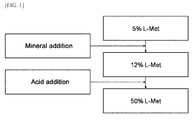
FIG. 1 is a flow chart showing a process for improving the solubility of L-methionine to 50% according to the present invention. - In order to achieve the above object, an aspect of the present invention is to provide a method for increasing the solubility of methionine solution, comprising
- step 1 of adding a mineral containing one or more bivalent metal ions to a methionine-containing solution; and
- step 2 of adding acid to the methionine-containing solution obtained in step 1.
- Hereinafter, the constitution of the present invention will be described in detail.
An aspect, of the present invention is to provide a method for increasing the solubility of methionine solution,
comprising : - step 1 of adding a mineral containing one or more bivalent metal ions to a methionine-containing solution; and
- step 2 of adding acid to the methionine-containing solution obtained in step 1.
- The present invention is technically characterized in that the use of metal ions for the preparation of high concentration of methionine solution is greatly reduced by combination of chelation using bivalent metal ions and pH drop by acid treatment, as compared to the conventional methods.
- In one specific embodiment of the present invention, the methionine-containing solution may be a solution containing DL-methionine or L-methionine. In another specific embodiment of the present invention, the methionine-containing solution may be a solution containing L-methionine produced by fermentation or enzymatic conversion, or L-methionine concentrate prepared by its purification, concentration or dry process, or a L-methionine solution made by re-solubilization of L-methionine dried-powder. In this regard, the purity of L-methionine may be 10% to 100% In the specific embodiment of the present invention, L-methionine was prepared by the fermentation of a microorganism strain, and the enzymatic conversion reaction by the method as described in
WO2008/013432 . In the specific embodiment of the present invention, L-methionine was prepared by the enzymatic conversion reaction after the fermentation, followed by the recovery using a fluid-bed granulator in a dry form of powdery granule. The L-methionine in a form of powdery granule has a purity of approximately 60%
In the L-methionine-containing solution produced by the fermentation and enzymatic conversion reaction, the solubility of L-methionine may be increased up to 35% according to the present invention. It is suggested that the L-methionine-containing solution produced by the fermentation and enzymatic conversion reaction has the high content of impurities except L-methionine, and thus it has the lower solubility than that of methionine with the purity of 90% or more. Therefore, as the purity of methionine is increased, the solubility of methionine can be increased from 35% to 50%. In the specific embodiment of the present invention, in the case of using with the purity of 99% or more that is prepared by purification of the L-methionine produced by the fermentation and enzymatic conversion reaction, the experimental results were found to be identical to those of commercially available L-methionine with the purity of 99%, which was purchased from Sigma. - In the present invention, the bivalent metal ion may be selected from the group consisting ot Fe2+ Ca2+, Mg2+, Mn2+, Cu2+ and Zn2+, and preferably selected from the group consisting of Fe2+, Mn2+, and Zn2+.
- The mineral containing bivalent metal ions may be one or more selected from the group consisting of iron sulfide, manganese sulfide and zinc sulfide, and more preferably minerals having a lower molecular weight. The minerals may be used alone or in a mixture of two or more thereof. More preferably, it is avoided to use minerals having a higher molecular weight or expensive minerals. The amount of minerals may be preferably used in a concentration of 1 to 10%, and more preferably 2 to 8%, and most preferably 3 to 6%, based on the total volume of methionine solution.
- In the present invention, the acid treatment may be preferably performed by adding an acid at a concentration of 0.01 to 0.5 M to the methionine-containing solution, more preferably 0.05 to 0.4 M, and most preferably 0.1 M In the specific Example, 0.1 M was used. In the present invention, the acid may be sulfuric acid, but is not limited thereto.
In the specific Example of the present invention, the mineral from 1.88% up to 8.43% was used with respect to methionine with various purities, thereby preparing a methionine solution of 35 to 50% (Table 1). In addition, total injection amounts of the minerals were more reduced by using the mixture of two or more of the minerals, as compared to the single use of the minerals (see Table 1). According to the present invention, the general solubility of methionine in water can be maximized to 10 times or higher by the acid treatment, following the addition or a minimal amount of minerals for the improvement of methionine solubility. - Another aspect of the present invention is to provide a high concentration of methionine solution having increased methionine solubility according to the above method.
The methionine solution may be purified by an additional purification process, and then prepared in a form of dry powder or in a form of solution prepared by solubilizing it in an aqueous solution. - The acid treatment following the mineral addition according to the present invention is able to critically increase the solubility of methionine without causing the problems of using an excessive amount of minerals and strong acidification of products due to acid addition, compared to the conventional methods in which mineral addition or acid addition is separately performed. Thus, the produced methionine solution can be applied to various fields including animal feeds, food additives, medicines, and other raw materials for medicinal products.
- Hereinafter, the constitutions and effects of the present invention will be described in more detail with reference to Examples. However, these Examples are for illustrative purposes only, and the invention is not intended to be limited by these Examples.
- Generally, the solubility of methionine in water is known to be approximately 50∼55 g/L at room temperature. Therefore, 2.5 g of L-methionine (99%, Sigma, USA) was dissolved in 50 mL of water to prepare a 5% L-methionine solution (50 g/L). While this solution was stirred at 70∼81°C, 23.5 mM L-methionine (3.5 g) and 23.5 mM manganese sulfide (3.97 g) were added so as to prepare a 12% L-methionine solution (120 g/L). The amount of manganese sulfide is calculated to be a molar ratio of additional L-methioine and manganese sulfide should be 1:1 After complete dissolving of L-methionine crystals, an additional 40g of L-methionine (about 40 g) was added to the 12% L-methionine solution at room temperature under stirring. During this process, 98% sulfuric acid (36.8 N) was added to the L-methionine solution to achieve a final concentration of 0.1 M, leading to exothermic reaction. After termination of the exothermic reaction, filtration was performed to remove the residual L-methionine crystal that was not dissolved. After the filtration, L-methionine concentration in the L-methioninie solution was determined by HPLC, And the L-methionine concentration was 50% (500 g/L) in the solution. 50 ml of the initial 5% methionine solution was increased to become 80 ml of 50% methionine solution by the addition of the excessive amount of methionine during the process of Increasing the methionine solubility. Therefore, 80 ml of 50% methionine solution was finally obtained.
- The same experiment, was performed using DL-methionine (99%, Sigma, USA), so as to obtain the identical results.
- After preparation of 5% L-methionine solution as in Example 1, 23.5 mM L-methionine (3.5 g) was added to 50 ml thereof under stirring at 70∼80°C. Then, 23.5 mM zinc sulfide (6.75 g) was injected to be a molar ratio of additional L-methionine and zinc sulfide of 1:1, so as to prepare a 12% L-methionine solution (120 g/L). After completely dissolving L-methionine crystals, an excessive amount of L-methionine (about 40 g) was added to the 12% L-methionine solution at room temperature under stirring. During this process, 98% sulfuric acid (36.8 N) was added to the L-methionine solution to be 0.1 M, leading to exothermic reaction. After termination of the exothermic reaction, filtration was performed to remove the residual L-methionine crystals that were not dissolved, and the concentration of L-methionine was measured. The L-methionine solution was a 50% (500 g/L) solution. The concentration of L-methionine was determined by HPLC.
50 ml of the initial 5%) methionine solution was finally increased to become 80 ml of 50% methionine solution by addition of the excessive amount of methionine during the process of increasing the methionine solubility. Therefore, 80 ml of 50% methionine solution was finally obtained.
The same experiment was performed using DL-methionine, so as to obtain the identical results. - After preparation of 5% L-methionine solution as in Example 1, 23.5 mM L-methionine (3.5 g) was added to 50 ml thereof under stirring at 70∼80°C. Additionally, each 1 g of manganese sulfide, zinc sulfide, and iron sulfide was added, so as to prepare a 12% L-methionine solution (120 g/L). In this process, each of the minerals became 5.92 mM manganese sulfide, 3.48 mM zinc sulfide, and 2.5 mM iron sulfide. After completely dissolving L-methionine crystals, an excessive amount of L-methionine (about 40 g) was added to the 12% L-methionine solution at room temperature under stirring. During this process, 98% acid (36.8 N) was added to the L-methionine solution to be 0.1 M, leading to exothermic reaction. After termination of the exothermic reaction, filtration was performed to remove the residual L-methionine crystals that were not dissolved, and the concentration of L-methionine was measured. The solution was a solution of 50% (500 g/L) L-methionine and 3.75% minerals. The concentration of L-methionine was determined by HPLC.
50 ml of the initial 5% methionine solution was finally increased to become 80 ml of 50% methionine solution by addition of the excessive amount of methionine during the process of increasing the methionine solubility, therefore, 80 ml of 50%) methionine solution was finally obtained.
The same experiment was performed using DL-methionine, so as to obtain the identical results. - After preparation of 5%) L-methionine solution as in Example 2, 23.5 mM L-mcthionine (3.5 g) was added to 50 ml thereof under stirring at 70∼80°C. Additionally, each 0.5 g of manganese sulfide, zinc sulfide, and iron sulfide was added, so as to prepare a 12% L-mcthiomne solution (120 g/L). In this process, each of the minerals became 2.96 mM manganese sulfide, 1.74 mM zinc sulfide, and 1.25 mM iron sulfide. After completely dissolving L-methionine crystals, an excessive amount of L-methionine (about 40 g) was added to the 12% L-methionine solution at room temperature under stirring. During this process, 98% sulfuric acid (36.8 N) was added to the L-methionine solution to be 0.1 M, leading to exothermic reaction. After termination of the exothermic reaction, filtration was performed to remove the residual L-methionine crystals that were not dissolved, and the concentration of L-methionine was measure. The solution was a solution of 50% (500 g/L) L-methionine and 1.88% minerals. The concentration of L-methionine was determined by HPLC.
50 ml of the initial 5% methionine solution was finally increased to become 80 ml of 50% methionine solution by addition of the excessive amount of methionine during the process of increasing the methionine solubility. Therefore, 80 ml of 50% methionine solution was finally obtained.
The same experiment was performed using DL-methionine, so as to obtain the identical results. - In the present Example, L-methionine powder that was prepared by enzymatic conversion reaction of O-acetyl homoserine produced by fermentation was used to prepare high concentration of L-methionine.
First, an L-methionine solution was prepared by enzymatic conversion reaction of O-acetyl homoserine produced by fermentation, and then this solution was dried to prepare L-methionine granules using a fluid-bed granulator. The content of L-methionine in the L-methionine granules was quantified by HPLC, and its purity was found to be approximately 60%. The specific preparation method of the L-methionine solution is described in the prior art,WO2008/013432 . - The L-methionine granules were quantified to prepare a 5% L-methionine solution 5.83 g of L-methionine granules were added to 50 ml thereof under stirring at 70∼80°C. Additionally, 5 g of iron sulfide (13 mM) was added, so as to prepare a 12% L-methionine solution (120 g/L). After completely dissolving L-methionine granules, an excessive amount of L-methionine (about 67 g) was added to the 12% L-methionine solution at room temperature under stirring. During this process, 98% sulfuric acid (36.8 N) was added to the L-methionine solution to be 0.1 M, leading to exothermic reaction. After termination of the exothermic reaction, filtration was performed to remove the residual L-methionine granule crystals that were not dissolved, and the concentration of L-methionine was measured The solution was 80 ml of 35% L-methionine solution (350 g/L). The concentration of L-methionine was determined by HPLC. It is suggested that the concentration of this solution is lower than those of L-methionine or DL-methionine with the purity of 99% in the above Examples, because 40% impurities present in the L-methionine granules are also dissolved in the solution so as to inhibit solubilization of L-methionine.
- To confirm this, L-methionine with the purity of 99% or more was prepared from the L-methionine solution produced by fermentation and enzymatic conversion. The L-methionine solution was titrated to pH 1.0 with sulfuric acid, and adsorbed onto cation exchange resin, and eluted with an ammonia solution. The eluent was titrated to pH 7.0 with sulfuric acid, and then heated to prepare a 2X concentrated an excessive amount of methanol was added to the concentrated solution to induce crystallization, and the formed crystals were recovered and dried. The content of the dried crystals was quantified by HPLC. The crystals were found to have the purity of 99% or more. Using the recovered L-methionine crystal powder, experiments were performed in the same manner as in Examples 1 to 4, As a result, a methionine solution of 50% or higher can be prepared as in the above Examples.
- Manganese sulfide having a molecular weight of 169.02 g/mole, zinc sulfide having a molecular weight of 287.53 g/mole, and iron sulfide having a molecular weight of 399,88 g/mole were used, and total amounts of the minerals used in Examples 1 to 5 were compared.
[Table 1] Methionine Manganese sulfide Zinc sulfide Iron sulfide Final miner als g mole wt% mole g mole g mole g wt% Ex.1 40 0.268 500 0.0235 3.97 4.96 Ex.2 40 0.268 500 0.023 6.75 8.43 Ex.3 40 0.268 500 0.0059 1.00 0.0035 1.00 0.0025 1.00 3.75 Ex.4 40 0.268 500 0.0030 0.50 0.0017 0.50 0.0013 0.50 1.88 Ex.5* 28 0.188 350 0.0125 5.00 6.25 * Use of methionine powder produced by fermentation and enzymatic conversion
- Final volume of solution is 80 ml
- Conc. of sulfuric acid 0.1 mole/L in final solution - As shown in Table 1, the final amount of minerals added to prepare 1 L of 35 to 50% methionine solutions was within 1 to 10%, indicating that a very small amount thereof was required, In addition, it was found that when two or more of the minerals were used, their addition amounts were remarkably reduced compared to the single use of the minerals.
- Taken together, the addition amounts of minerals were greatly reduced, as compared to the use of 40 to 50% minerals for the preparation of 8 to 50% methionine solutions, described in
US Patent No. 5430164 . Therefore, the method of the present invention can be used for the preparation of high concentration of methionine solution with improved methionine solubility while remarkably reducing the use of minerals. - As described in the above Examples, the present invention provides a method for maximizing the general solubility of methionine in water to 10 times or higher by the acid treatment, following the addition of a minimal amount of minerals to a methionine-containing solution for the improvement of methionine solubility.
Claims (9)
- A method for increasing the solubility of methionine to produce methionine solution, comprising:step 1 of adding a mineral containing one or more bivalent metal ions to a methionine-containing solution; andstep 2 of adding acid to the methionine-containing solution obtained in step 1.
- The method according to claim 1, wherein the bivalent metal ion is one or more selected from the group consisting of Fe2+, Ca2+, Mg2+, Mn2+, Cu2+ and Zn2+.
- The method according to claim 1, wherein the mineral containing bivalent metal ion is one or more selected from the group consisting of iron sulfide, manganese sulfide, and zinc sulfide.
- The method according to claim 1, wherein the acid is sulfuric acid.
- The method according to claim 1, wherein the methionine is DL-methionine or L-methionine.
- The method according to claim 1, wherein the methionine-containing solution is a solution containing L-methionine produced by fermentation or enzymatic conversion.
- The method according to claim 1, wherein the amount of mineral added to the solution is to achieve the concentration of 1 to 10% based on the total volume of the methionine-containing solution.
- The method according to claim 1, wherein the amount of acid added to the methionine-containing solution is to achieve the concentration of 0.01 to 0.5 M.
- A high concentration of methionine solution with increased methionine solubility according to the method of claim 1.
Priority Applications (1)
| Application Number | Priority Date | Filing Date | Title |
|---|---|---|---|
| PL10746471T PL2402363T3 (en) | 2009-02-27 | 2010-02-26 | Method for increasing the solubility of methionine by mineral addition and acid treatment |
Applications Claiming Priority (2)
| Application Number | Priority Date | Filing Date | Title |
|---|---|---|---|
| KR1020090016605A KR101164711B1 (en) | 2009-02-27 | 2009-02-27 | A method of enhancing the methionine solubility using mineral addition and acid treatment |
| PCT/KR2010/001254 WO2010098632A2 (en) | 2009-02-27 | 2010-02-26 | Method for increasing the solubility of methionine by mineral addition and acid treatment |
Publications (3)
| Publication Number | Publication Date |
|---|---|
| EP2402363A2 true EP2402363A2 (en) | 2012-01-04 |
| EP2402363A4 EP2402363A4 (en) | 2012-11-28 |
| EP2402363B1 EP2402363B1 (en) | 2014-04-16 |
Family
ID=42666091
Family Applications (1)
| Application Number | Title | Priority Date | Filing Date |
|---|---|---|---|
| EP10746471.1A Active EP2402363B1 (en) | 2009-02-27 | 2010-02-26 | Method for increasing the solubility of methionine by mineral addition and acid treatment |
Country Status (9)
| Country | Link |
|---|---|
| US (2) | US20120136058A1 (en) |
| EP (1) | EP2402363B1 (en) |
| JP (1) | JP5591263B2 (en) |
| KR (1) | KR101164711B1 (en) |
| CN (1) | CN102333787B (en) |
| ES (1) | ES2477220T3 (en) |
| MY (1) | MY153916A (en) |
| PL (1) | PL2402363T3 (en) |
| WO (1) | WO2010098632A2 (en) |
Cited By (2)
| Publication number | Priority date | Publication date | Assignee | Title |
|---|---|---|---|---|
| EP2658986A4 (en) * | 2010-12-29 | 2016-08-10 | Cj Cheiljedang Corp | PROCESSES FOR PRODUCING L-METHIONINE AND RELATED PRODUCTS |
| WO2017118871A1 (en) * | 2016-01-08 | 2017-07-13 | Metabolic Explorer | Method to produce l-methionine by a fermentative production |
Families Citing this family (1)
| Publication number | Priority date | Publication date | Assignee | Title |
|---|---|---|---|---|
| KR20180078621A (en) * | 2016-12-30 | 2018-07-10 | 씨제이제일제당 (주) | A Method for Producing L-Methionine Crystal Using Crystallization Technique |
Family Cites Families (17)
| Publication number | Priority date | Publication date | Assignee | Title |
|---|---|---|---|---|
| US2443391A (en) * | 1945-09-26 | 1948-06-15 | Du Pont | Methionine isolation process |
| DE2259159C3 (en) * | 1972-12-02 | 1980-01-10 | Deutsche Gold- Und Silber-Scheideanstalt Vormals Roessler, 6000 Frankfurt | Process for the production of storage-stable methionine |
| US3941818A (en) * | 1973-08-20 | 1976-03-02 | Zinpro Corporation | 1:1 Zinc methionine complexes |
| US3950372A (en) * | 1974-07-03 | 1976-04-13 | Zinpro Corporation | 1:1 Manganese alpha amino acid complexes |
| KR880002033B1 (en) * | 1986-05-31 | 1988-10-13 | 주식회사 동양금속화학 | Process for preparing zinc, iron, copper-methionine complex |
| US4764633A (en) | 1987-08-31 | 1988-08-16 | Zinpro Corporation | Ferric ion catalyzed complexation of zinc and/or manganese with alpha amino acids |
| US5278329A (en) * | 1992-02-21 | 1994-01-11 | Zinpro Corporation | L-form 1:1 metal methionine complexes |
| US5504055A (en) * | 1994-03-15 | 1996-04-02 | J.H. Biotech, Inc. | Metal amino acid chelate |
| US5430164A (en) | 1994-10-18 | 1995-07-04 | Zinpro Corporation | Enhanced solubilization of zinc and manganese methionine complex salts by addition of ferric ion |
| JP2002047266A (en) * | 2000-07-27 | 2002-02-12 | Res Inst For Prod Dev | Composition containing methionine / transition metal complex and amino acid |
| EP1656454A4 (en) | 2003-07-08 | 2011-06-22 | Novus Int Inc | METHODS OF RECOVERING METHIONINE |
| KR20050110167A (en) * | 2004-05-18 | 2005-11-23 | 주식회사 중앙바이오텍 | Preparing method for metal-methionine 1:1 complex |
| KR100481326B1 (en) * | 2004-06-22 | 2005-04-07 | 주식회사 동암비티 | Producing process for organic chelate |
| CN101340822B (en) * | 2005-12-21 | 2013-03-13 | 雅培制药有限公司 | Induced viscosity nutritional emulsions |
| US8007846B2 (en) * | 2006-01-18 | 2011-08-30 | Albion International, Inc. | Mixed amino acid/mineral compounds having improved solubility |
| KR100905381B1 (en) | 2006-07-28 | 2009-06-30 | 씨제이제일제당 (주) | Microorganism producing l-methionine precursor and method of producing l-methionine and organic acid from the l-methionine precurosr |
| DK2426144T3 (en) | 2007-02-23 | 2019-01-07 | Merck Sharp & Dohme | Manipulated Anti-IL-23P19 Antibodies |
-
2009
- 2009-02-27 KR KR1020090016605A patent/KR101164711B1/en active Active
-
2010
- 2010-02-26 MY MYPI2011004060A patent/MY153916A/en unknown
- 2010-02-26 US US13/203,539 patent/US20120136058A1/en not_active Abandoned
- 2010-02-26 JP JP2011551988A patent/JP5591263B2/en active Active
- 2010-02-26 EP EP10746471.1A patent/EP2402363B1/en active Active
- 2010-02-26 ES ES10746471.1T patent/ES2477220T3/en active Active
- 2010-02-26 CN CN201080009633.9A patent/CN102333787B/en active Active
- 2010-02-26 PL PL10746471T patent/PL2402363T3/en unknown
- 2010-02-26 WO PCT/KR2010/001254 patent/WO2010098632A2/en not_active Ceased
-
2016
- 2016-09-30 US US15/282,416 patent/US20170016037A1/en not_active Abandoned
Non-Patent Citations (2)
| Title |
|---|
| No further relevant documents disclosed * |
| See also references of WO2010098632A2 * |
Cited By (2)
| Publication number | Priority date | Publication date | Assignee | Title |
|---|---|---|---|---|
| EP2658986A4 (en) * | 2010-12-29 | 2016-08-10 | Cj Cheiljedang Corp | PROCESSES FOR PRODUCING L-METHIONINE AND RELATED PRODUCTS |
| WO2017118871A1 (en) * | 2016-01-08 | 2017-07-13 | Metabolic Explorer | Method to produce l-methionine by a fermentative production |
Also Published As
| Publication number | Publication date |
|---|---|
| EP2402363B1 (en) | 2014-04-16 |
| KR101164711B1 (en) | 2012-07-11 |
| CN102333787B (en) | 2014-05-21 |
| US20170016037A1 (en) | 2017-01-19 |
| ES2477220T3 (en) | 2014-07-16 |
| CN102333787A (en) | 2012-01-25 |
| JP5591263B2 (en) | 2014-09-17 |
| WO2010098632A3 (en) | 2011-04-07 |
| EP2402363A4 (en) | 2012-11-28 |
| KR20100097783A (en) | 2010-09-06 |
| US20120136058A1 (en) | 2012-05-31 |
| MY153916A (en) | 2015-04-15 |
| WO2010098632A2 (en) | 2010-09-02 |
| JP2012518684A (en) | 2012-08-16 |
| PL2402363T3 (en) | 2014-08-29 |
Similar Documents
| Publication | Publication Date | Title |
|---|---|---|
| EP2402453B1 (en) | Method for increasing methionine productivity using a mixture of methyl mercaptan and dimethyl sulfide | |
| CN103763936A (en) | Mixed amino acid metal salt complexes | |
| CN105394351A (en) | Oligosaccharide chelated composite trace element mineral matter supplement and preparation method thereof | |
| US20170016037A1 (en) | Method for Increasing the Solubility of Methionine by Mineral Addition and Acid Treatment | |
| CA1093554A (en) | Process for producing d,1-5-methyltetrahy-drofolic acid and its salts | |
| EP1035109B1 (en) | Aqueous lysine solution | |
| US20090156648A1 (en) | Preparations containing pyridoxine and alpha-hydroxyisocaproic acid (HICA) | |
| SI21188A (en) | Crystalline glucosamine sulphate metal salts | |
| EP3653633B1 (en) | Methionine-metal chelate and production method thereof | |
| CN106928078A (en) | A kind of threonine chelated iron and its application | |
| EP3272225B1 (en) | Composition for feed additive, and animal feed composition containing same | |
| CN114644580B (en) | Treatment method for producing crude L-cystine mother liquor by enzyme method | |
| WO2020075082A1 (en) | Process for the synthesis of carglumic acid | |
| CN120424148B (en) | Reduced β-nicotinamide mononucleotide salt and its composition, preparation method and use | |
| BR112020000856B1 (en) | METHOD FOR PREPARING A METHIONINE-METAL CHELLATE AND METHOD FOR PREPARING CALCIUM NITRATE | |
| JPH0469144B2 (en) | ||
| JP2008156282A (en) | α-Lipoic acid L-ornithine salt and process for producing the same | |
| US20140171682A1 (en) | Creatine hydrochloride and manufacturing method thereof | |
| CN113943333A (en) | Preparation method and application of hydrogenated nicotinamide ribose | |
| CN119707724A (en) | Preparation method of glycine-14C | |
| WO2016108391A1 (en) | Method for reducing bitterness and astringency of lysine | |
| CN121867333A (en) | Feed additive containing betaine ketoglutarate and capable of promoting animal growth and preparation method thereof | |
| JPS6328419B2 (en) | ||
| JPS6033426B2 (en) | Di-L-cysteine-L-malate and its production method | |
| CN103540641A (en) | Method for producing valine |
Legal Events
| Date | Code | Title | Description |
|---|---|---|---|
| PUAI | Public reference made under article 153(3) epc to a published international application that has entered the european phase |
Free format text: ORIGINAL CODE: 0009012 |
|
| 17P | Request for examination filed |
Effective date: 20110913 |
|
| AK | Designated contracting states |
Kind code of ref document: A2 Designated state(s): AT BE BG CH CY CZ DE DK EE ES FI FR GB GR HR HU IE IS IT LI LT LU LV MC MK MT NL NO PL PT RO SE SI SK SM TR |
|
| DAX | Request for extension of the european patent (deleted) | ||
| A4 | Supplementary search report drawn up and despatched |
Effective date: 20121026 |
|
| RIC1 | Information provided on ipc code assigned before grant |
Ipc: C07K 1/02 20060101AFI20121022BHEP Ipc: C07C 323/58 20060101ALI20121022BHEP Ipc: C12P 13/12 20060101ALI20121022BHEP |
|
| GRAP | Despatch of communication of intention to grant a patent |
Free format text: ORIGINAL CODE: EPIDOSNIGR1 |
|
| INTG | Intention to grant announced |
Effective date: 20131107 |
|
| GRAS | Grant fee paid |
Free format text: ORIGINAL CODE: EPIDOSNIGR3 |
|
| GRAA | (expected) grant |
Free format text: ORIGINAL CODE: 0009210 |
|
| AK | Designated contracting states |
Kind code of ref document: B1 Designated state(s): AT BE BG CH CY CZ DE DK EE ES FI FR GB GR HR HU IE IS IT LI LT LU LV MC MK MT NL NO PL PT RO SE SI SK SM TR |
|
| REG | Reference to a national code |
Ref country code: GB Ref legal event code: FG4D |
|
| REG | Reference to a national code |
Ref country code: CH Ref legal event code: EP |
|
| REG | Reference to a national code |
Ref country code: AT Ref legal event code: REF Ref document number: 662503 Country of ref document: AT Kind code of ref document: T Effective date: 20140515 |
|
| REG | Reference to a national code |
Ref country code: IE Ref legal event code: FG4D Ref country code: NL Ref legal event code: T3 |
|
| REG | Reference to a national code |
Ref country code: DE Ref legal event code: R096 Ref document number: 602010015198 Country of ref document: DE Effective date: 20140528 |
|
| REG | Reference to a national code |
Ref country code: ES Ref legal event code: FG2A Ref document number: 2477220 Country of ref document: ES Kind code of ref document: T3 Effective date: 20140716 |
|
| REG | Reference to a national code |
Ref country code: PL Ref legal event code: T3 |
|
| REG | Reference to a national code |
Ref country code: AT Ref legal event code: MK05 Ref document number: 662503 Country of ref document: AT Kind code of ref document: T Effective date: 20140416 |
|
| REG | Reference to a national code |
Ref country code: LT Ref legal event code: MG4D |
|
| PG25 | Lapsed in a contracting state [announced via postgrant information from national office to epo] |
Ref country code: LT Free format text: LAPSE BECAUSE OF FAILURE TO SUBMIT A TRANSLATION OF THE DESCRIPTION OR TO PAY THE FEE WITHIN THE PRESCRIBED TIME-LIMIT Effective date: 20140416 Ref country code: IS Free format text: LAPSE BECAUSE OF FAILURE TO SUBMIT A TRANSLATION OF THE DESCRIPTION OR TO PAY THE FEE WITHIN THE PRESCRIBED TIME-LIMIT Effective date: 20140816 Ref country code: CY Free format text: LAPSE BECAUSE OF FAILURE TO SUBMIT A TRANSLATION OF THE DESCRIPTION OR TO PAY THE FEE WITHIN THE PRESCRIBED TIME-LIMIT Effective date: 20140416 Ref country code: NO Free format text: LAPSE BECAUSE OF FAILURE TO SUBMIT A TRANSLATION OF THE DESCRIPTION OR TO PAY THE FEE WITHIN THE PRESCRIBED TIME-LIMIT Effective date: 20140716 Ref country code: GR Free format text: LAPSE BECAUSE OF FAILURE TO SUBMIT A TRANSLATION OF THE DESCRIPTION OR TO PAY THE FEE WITHIN THE PRESCRIBED TIME-LIMIT Effective date: 20140717 Ref country code: FI Free format text: LAPSE BECAUSE OF FAILURE TO SUBMIT A TRANSLATION OF THE DESCRIPTION OR TO PAY THE FEE WITHIN THE PRESCRIBED TIME-LIMIT Effective date: 20140416 Ref country code: BG Free format text: LAPSE BECAUSE OF FAILURE TO SUBMIT A TRANSLATION OF THE DESCRIPTION OR TO PAY THE FEE WITHIN THE PRESCRIBED TIME-LIMIT Effective date: 20140716 |
|
| PG25 | Lapsed in a contracting state [announced via postgrant information from national office to epo] |
Ref country code: AT Free format text: LAPSE BECAUSE OF FAILURE TO SUBMIT A TRANSLATION OF THE DESCRIPTION OR TO PAY THE FEE WITHIN THE PRESCRIBED TIME-LIMIT Effective date: 20140416 Ref country code: SE Free format text: LAPSE BECAUSE OF FAILURE TO SUBMIT A TRANSLATION OF THE DESCRIPTION OR TO PAY THE FEE WITHIN THE PRESCRIBED TIME-LIMIT Effective date: 20140416 Ref country code: HR Free format text: LAPSE BECAUSE OF FAILURE TO SUBMIT A TRANSLATION OF THE DESCRIPTION OR TO PAY THE FEE WITHIN THE PRESCRIBED TIME-LIMIT Effective date: 20140416 Ref country code: LV Free format text: LAPSE BECAUSE OF FAILURE TO SUBMIT A TRANSLATION OF THE DESCRIPTION OR TO PAY THE FEE WITHIN THE PRESCRIBED TIME-LIMIT Effective date: 20140416 |
|
| PG25 | Lapsed in a contracting state [announced via postgrant information from national office to epo] |
Ref country code: PT Free format text: LAPSE BECAUSE OF FAILURE TO SUBMIT A TRANSLATION OF THE DESCRIPTION OR TO PAY THE FEE WITHIN THE PRESCRIBED TIME-LIMIT Effective date: 20140818 |
|
| REG | Reference to a national code |
Ref country code: DE Ref legal event code: R097 Ref document number: 602010015198 Country of ref document: DE |
|
| PG25 | Lapsed in a contracting state [announced via postgrant information from national office to epo] |
Ref country code: SK Free format text: LAPSE BECAUSE OF FAILURE TO SUBMIT A TRANSLATION OF THE DESCRIPTION OR TO PAY THE FEE WITHIN THE PRESCRIBED TIME-LIMIT Effective date: 20140416 Ref country code: EE Free format text: LAPSE BECAUSE OF FAILURE TO SUBMIT A TRANSLATION OF THE DESCRIPTION OR TO PAY THE FEE WITHIN THE PRESCRIBED TIME-LIMIT Effective date: 20140416 Ref country code: DK Free format text: LAPSE BECAUSE OF FAILURE TO SUBMIT A TRANSLATION OF THE DESCRIPTION OR TO PAY THE FEE WITHIN THE PRESCRIBED TIME-LIMIT Effective date: 20140416 Ref country code: RO Free format text: LAPSE BECAUSE OF FAILURE TO SUBMIT A TRANSLATION OF THE DESCRIPTION OR TO PAY THE FEE WITHIN THE PRESCRIBED TIME-LIMIT Effective date: 20140416 Ref country code: CZ Free format text: LAPSE BECAUSE OF FAILURE TO SUBMIT A TRANSLATION OF THE DESCRIPTION OR TO PAY THE FEE WITHIN THE PRESCRIBED TIME-LIMIT Effective date: 20140416 |
|
| PLBE | No opposition filed within time limit |
Free format text: ORIGINAL CODE: 0009261 |
|
| STAA | Information on the status of an ep patent application or granted ep patent |
Free format text: STATUS: NO OPPOSITION FILED WITHIN TIME LIMIT |
|
| 26N | No opposition filed |
Effective date: 20150119 |
|
| REG | Reference to a national code |
Ref country code: DE Ref legal event code: R097 Ref document number: 602010015198 Country of ref document: DE Effective date: 20150119 |
|
| PG25 | Lapsed in a contracting state [announced via postgrant information from national office to epo] |
Ref country code: SI Free format text: LAPSE BECAUSE OF FAILURE TO SUBMIT A TRANSLATION OF THE DESCRIPTION OR TO PAY THE FEE WITHIN THE PRESCRIBED TIME-LIMIT Effective date: 20140416 |
|
| PG25 | Lapsed in a contracting state [announced via postgrant information from national office to epo] |
Ref country code: LU Free format text: LAPSE BECAUSE OF FAILURE TO SUBMIT A TRANSLATION OF THE DESCRIPTION OR TO PAY THE FEE WITHIN THE PRESCRIBED TIME-LIMIT Effective date: 20150226 |
|
| REG | Reference to a national code |
Ref country code: CH Ref legal event code: PL |
|
| PG25 | Lapsed in a contracting state [announced via postgrant information from national office to epo] |
Ref country code: MC Free format text: LAPSE BECAUSE OF FAILURE TO SUBMIT A TRANSLATION OF THE DESCRIPTION OR TO PAY THE FEE WITHIN THE PRESCRIBED TIME-LIMIT Effective date: 20140416 Ref country code: CH Free format text: LAPSE BECAUSE OF NON-PAYMENT OF DUE FEES Effective date: 20150228 Ref country code: LI Free format text: LAPSE BECAUSE OF NON-PAYMENT OF DUE FEES Effective date: 20150228 |
|
| REG | Reference to a national code |
Ref country code: IE Ref legal event code: MM4A |
|
| REG | Reference to a national code |
Ref country code: FR Ref legal event code: PLFP Year of fee payment: 7 |
|
| PG25 | Lapsed in a contracting state [announced via postgrant information from national office to epo] |
Ref country code: IE Free format text: LAPSE BECAUSE OF NON-PAYMENT OF DUE FEES Effective date: 20150226 |
|
| REG | Reference to a national code |
Ref country code: FR Ref legal event code: PLFP Year of fee payment: 8 |
|
| PG25 | Lapsed in a contracting state [announced via postgrant information from national office to epo] |
Ref country code: MT Free format text: LAPSE BECAUSE OF FAILURE TO SUBMIT A TRANSLATION OF THE DESCRIPTION OR TO PAY THE FEE WITHIN THE PRESCRIBED TIME-LIMIT Effective date: 20140416 |
|
| PG25 | Lapsed in a contracting state [announced via postgrant information from national office to epo] |
Ref country code: HU Free format text: LAPSE BECAUSE OF FAILURE TO SUBMIT A TRANSLATION OF THE DESCRIPTION OR TO PAY THE FEE WITHIN THE PRESCRIBED TIME-LIMIT; INVALID AB INITIO Effective date: 20100226 Ref country code: SM Free format text: LAPSE BECAUSE OF FAILURE TO SUBMIT A TRANSLATION OF THE DESCRIPTION OR TO PAY THE FEE WITHIN THE PRESCRIBED TIME-LIMIT Effective date: 20140416 |
|
| PG25 | Lapsed in a contracting state [announced via postgrant information from national office to epo] |
Ref country code: TR Free format text: LAPSE BECAUSE OF FAILURE TO SUBMIT A TRANSLATION OF THE DESCRIPTION OR TO PAY THE FEE WITHIN THE PRESCRIBED TIME-LIMIT Effective date: 20140416 |
|
| REG | Reference to a national code |
Ref country code: FR Ref legal event code: PLFP Year of fee payment: 9 |
|
| PG25 | Lapsed in a contracting state [announced via postgrant information from national office to epo] |
Ref country code: MK Free format text: LAPSE BECAUSE OF FAILURE TO SUBMIT A TRANSLATION OF THE DESCRIPTION OR TO PAY THE FEE WITHIN THE PRESCRIBED TIME-LIMIT Effective date: 20140416 |
|
| P01 | Opt-out of the competence of the unified patent court (upc) registered |
Effective date: 20230606 |
|
| PGFP | Annual fee paid to national office [announced via postgrant information from national office to epo] |
Ref country code: NL Payment date: 20251120 Year of fee payment: 17 |
|
| PGFP | Annual fee paid to national office [announced via postgrant information from national office to epo] |
Ref country code: GB Payment date: 20251208 Year of fee payment: 17 |
|
| PGFP | Annual fee paid to national office [announced via postgrant information from national office to epo] |
Ref country code: FR Payment date: 20251125 Year of fee payment: 17 |
|
| PGFP | Annual fee paid to national office [announced via postgrant information from national office to epo] |
Ref country code: BE Payment date: 20251120 Year of fee payment: 17 |
|
| PGFP | Annual fee paid to national office [announced via postgrant information from national office to epo] |
Ref country code: PL Payment date: 20251125 Year of fee payment: 17 |
|
| PGFP | Annual fee paid to national office [announced via postgrant information from national office to epo] |
Ref country code: ES Payment date: 20260324 Year of fee payment: 17 |
|
| PGFP | Annual fee paid to national office [announced via postgrant information from national office to epo] |
Ref country code: DE Payment date: 20251120 Year of fee payment: 17 |
|
| PGFP | Annual fee paid to national office [announced via postgrant information from national office to epo] |
Ref country code: IT Payment date: 20251121 Year of fee payment: 17 |