EP2401684B1 - Verfahren und System zur überwachung eines entfernten gerätes und zur interaction mit diesem - Google Patents
Verfahren und System zur überwachung eines entfernten gerätes und zur interaction mit diesem Download PDFInfo
- Publication number
- EP2401684B1 EP2401684B1 EP10746836.5A EP10746836A EP2401684B1 EP 2401684 B1 EP2401684 B1 EP 2401684B1 EP 10746836 A EP10746836 A EP 10746836A EP 2401684 B1 EP2401684 B1 EP 2401684B1
- Authority
- EP
- European Patent Office
- Prior art keywords
- user
- status
- code
- access code
- master system
- Prior art date
- Legal status (The legal status is an assumption and is not a legal conclusion. Google has not performed a legal analysis and makes no representation as to the accuracy of the status listed.)
- Active
Links
Images



Classifications
-
- G—PHYSICS
- G16—INFORMATION AND COMMUNICATION TECHNOLOGY [ICT] SPECIALLY ADAPTED FOR SPECIFIC APPLICATION FIELDS
- G16H—HEALTHCARE INFORMATICS, i.e. INFORMATION AND COMMUNICATION TECHNOLOGY [ICT] SPECIALLY ADAPTED FOR THE HANDLING OR PROCESSING OF MEDICAL OR HEALTHCARE DATA
- G16H40/00—ICT specially adapted for the management or administration of healthcare resources or facilities; ICT specially adapted for the management or operation of medical equipment or devices
- G16H40/60—ICT specially adapted for the management or administration of healthcare resources or facilities; ICT specially adapted for the management or operation of medical equipment or devices for the operation of medical equipment or devices
- G16H40/67—ICT specially adapted for the management or administration of healthcare resources or facilities; ICT specially adapted for the management or operation of medical equipment or devices for the operation of medical equipment or devices for remote operation
-
- G—PHYSICS
- G16—INFORMATION AND COMMUNICATION TECHNOLOGY [ICT] SPECIALLY ADAPTED FOR SPECIFIC APPLICATION FIELDS
- G16H—HEALTHCARE INFORMATICS, i.e. INFORMATION AND COMMUNICATION TECHNOLOGY [ICT] SPECIALLY ADAPTED FOR THE HANDLING OR PROCESSING OF MEDICAL OR HEALTHCARE DATA
- G16H20/00—ICT specially adapted for therapies or health-improving plans, e.g. for handling prescriptions, for steering therapy or for monitoring patient compliance
- G16H20/10—ICT specially adapted for therapies or health-improving plans, e.g. for handling prescriptions, for steering therapy or for monitoring patient compliance relating to drugs or medications, e.g. for ensuring correct administration to patients
- G16H20/13—ICT specially adapted for therapies or health-improving plans, e.g. for handling prescriptions, for steering therapy or for monitoring patient compliance relating to drugs or medications, e.g. for ensuring correct administration to patients delivered from dispensers
Definitions
- One potential option is to develop devices that can gather and communicate relevant data electronically, perhaps via a wireless modem.
- wireless modem technologies typically makes this technique prohibitively expensive, and these technologies are also subject to error.
- Another technique is to provide the users with devices that store information and can be interrogated in some manner when the device is returned, for example interrogated by a healthcare worker when the device is returned to a medical setting. This approach does not allow for the gathering of actionable data between patient visits.
- Another technique is to rely on the user to voluntary communicate information. Unfortunately, people are prone to error and may report information incorrectly, or selectively. In the case of medical information, healthcare professionals may have a difficult time making critical medical decisions based purely on patient representations of the facts. Studies suggest a high level of patient fallibility in reporting information.
- the invention described herein provides a solution to the dilemma described above.
- This invention enables the gathering of useful information from a remote party, for example a patient, at an affordable cost. Moreover, this invention enables that information to be gathered from a device in a manner that virtually assures its accuracy. This invention also enables the verifiable dissemination of information to the device even though the device user may be unreliable.
- the invention described herein was conceived for use in a healthcare setting. But it has applicability in other settings, such as the monitoring of weapons, devices with dangerous qualities, or the monitoring of devices controlled by users prone to undesirable behavior or error.
- US 2008/228317 A1 relates to a method, system, and apparatus for controlling patient access to medicaments.
- the method, system and apparatus can include an interfacing system that can receive identifying data from a user of a medicament dispensing device.
- the interfacing system can also communicate limited-use access authorization data to the user via a communicative intermediary.
- the limited-use access authorization data enables the dispensing device to dispense a medicament up to a certain limit in response to entering the access authorization data into the dispensing device.
- the dispensing device may not be connected to a network, but is capable of computing and storing a limited-use access authorization data as well as validating an inputted access authorization data. ,However, the access authorization data is not described to comprise device instructions for re-mote programming of the device.
- This invention relates to monitoring and remotely interacting with a device.
- the device could be a pill container tracking pills dispensed by the user.
- the device may be implemented with a processor and a display, to communicate a dynamic status code to the device user.
- This status code is typically encoded in a format that appears random to the user and is hard to guess or falsify.
- This status code could be, for example, a long number shown on the device's display that changes as device status changes. Typically only a small subset of the possible numbers may be valid status codes at any one time.
- Device data can be encoded by the device processor into a dynamic status code via a variety of algorithms.
- a device that dispenses pills may log when pills are dispensed, and an algorithm will be used to encode a summary of this dispensing history into a single 9-digit status code.
- This invention enables useful device information to be relayed to a master system, usually a computer, without a data connection between the device and the master system. Instead, the user is instructed to 'check-in' and relay the device status data to a master system, typically a remote computer system, using whatever communications channel is available and most practical. For example, the user can use a telephone or an internet-connected computer to relay the status code. The user may be instructed to check in periodically, perhaps weekly, or may be prompted to check in when alerted. The alert could be a beeping sound on the device, or a variety of externally generated alerts such as calling the patient or sending a reminder email.
- the device status code can be encoded or encrypted in such a manner that it is difficult for the user to falsify.
- the remote master system receives a valid status code from the user, it can be confident of the accuracy and reliability of the device data being transmitted.
- the device status code can be decoded by the master system to reveal information about the device or the device usage. For example, one status code might indicate "device readings are normal," while a different status code might indicate "there is a problem,” and the master system can derive these meanings from the status data because both the device and the master system are programmed with a parallel algorithm to allow the understanding and interpretation of the various codes. For example, if a user is prescribed to take medication twice per day from a handheld medication dispensing device, yet the user fails to take any medication, the dispenser could display a number as the status code that, when relayed and decoded during check-in, indicates to the master system that no pills have been taken and the master system can therefore initiate a medical response. If, instead, the user takes medication twice per day, a different number should be displayed by the device as the status code and no medical response will be necessary.
- the master system can also respond with information for the user. This may be instructions, advice, or data to input into the device.
- Data to input can be an access code that modifies or regulates the functioning of the device. For example, the user might be told an 'access code' during a telephone call, a number that the user is instructed to enter into the device via the device keypad.
- the access code can be a number that is encoded and encrypted in a manner that makes it hard to falsify. Hence, the user can only input valid data into the device if it is received from the master system and is properly encoded and valid.
- Codes can be pseudo-randomized to make the codes opaque to the user and unique to the device or user.
- the binary representation of the status code mentioned above could be XORed ("Exclusive Or” is a well known logical operation) against device-specific rolling codes, such that the resultant status code always appears random and unique for each device and for each status.
- Valid device status data can be made hard to guess. If, for example, a device status code is displayed to a user as a 9 digit number, and only 10,000 such numbers are valid at any one time, and the user has no knowledge of which 10,000 numbers are valid, then a user would only have a 1 in a 10,000 chance of guessing a valid status code. Thus the master system can be reasonably confident that any valid status code received from a user is accurate status data for the device, and any information decoded from this status data can be considered reliable and accurate. This is desirable, as otherwise information received from device users is often inaccurate and misleading.
- a master system can also encode any information to be entered by the user into the device: an access code, instructions, etc.
- An encoding algorithm including encryption via a rolling codes or any other encryption technique, can create a set of valid input codes that appear to be a random subset of a larger set of possible codes.
- input codes can be made hard to guess, attempts to input data incorrectly will usually be interpreted by the device as 'invalid' data, and any valid input code entered into the device can be trusted as accurate information relayed from the master system. This is desirable, as instructing users to directly change the settings of a device can result in undesirable settings as a result of incorrect user behavior, either unintentional or intentional.
- the device and master system can verifiably communicate, with the user serving as a relay. If a user fails at an expected task, for example if the user fails to check-in at an expected time, then the master system can note this user failure and can take action to address the issue, alert third parties, etc.
- Figure 1 illustrates an embodiment of the present invention.
- a device user 101 has control of device 102, a device that can collect useful information.
- the invention relates to the interaction between this device 102 and the master system 104, an interaction which is mediated by the user 101 using a communication channel 105.
- the device 102 should include a means to communicate with a device user 101, typically a display or a speaker.
- the device 102 should be able to communicate a status code via this display or speaker.
- This aspect is shown in figure 1 as interaction 103 between the user 101 and the device 102.
- the status code could be, as a non-limiting example, a dynamically generated number, like 209302939, which from the point of view of the device user 101 would appear to be a seemingly random number.
- the status code could also take a variety of other formats, such as an alphanumeric format, a visual symbol, a sound, or any other format used to communicate information from the device 102 to a user 101.
- the device user 101 is expected to 'check in' by phone 106 or by internet-enabled computer 107, or by whatever communications means 105 is convenient. 'Check-in' will involve communicating the current device status code displayed (or communicated by any means).
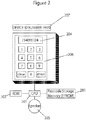
- FIG. 2 is a diagram of an exemplary implementation of the user device 102.
- a central processing unit 201 is augmented with ancillary components for storing programmatic instructions and data, such as read-only memory 202 or read/write storage memory 203.
- the exemplary device 102 also includes some degree of output capability, typically a display 204 or a speaker 205, and may enable user input, typically via a keypad 206.
- the device 102 may have information printed upon it, such as a device identifying number 207.
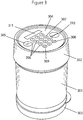
- FIG. 3 shows that the medication dispenser contains a pill tray stack 301 which contains pills.
- the pill tray stack 301 is moved by a controller unit 302 which contains microcontroller electronics, schematically similar to Figure 2 .
- the controller unit 302 also contains a mechanical motor which can be programmatically activated by the central processing unit to rotate the top tray on the pill tray stack 301. As the controller unit 302 rotates the top pill tray in the stack, pills from that tray can fall to the bottom of the dispenser, and removing the bottom cap 303 enables a user 101 to retrieve the pills.
- the user 101 interacts with the controller unit 302 via a control panel and display 304 which contains an "On" button 305, a standard keypad 306 with digits 307, an "Enter” key 308, and a clear key 309.
- the controller panel also contains a "Dispense” button 310.
- Information including the device status data, can be read by the user 101 via display 311.
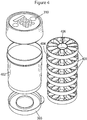
- Figure 4 shows exploded details of the dispenser, including more details of the trays 401, which are within ajar 402. If the user 101 presses the dispense button 310, the controller unit logic may deem it appropriate to dispense a pill, and if so the controller unit 302 will move the first tray such that a pill can drop down pill slot 404. Each tray 401 has a slot, and at initiation all slots are aligned, such that a pill from the top tray will drop down this slot when moved into position. The user 101 can remove cap 303 to obtain the pill.
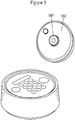
- FIG. 5 shows the underside of the controller unit 302.
- the underside is rotated by a motor within the control unit 302, and thus rotates a drive post 501 protruding from a drive plate 502.
- This drive post 501 mates into the drive lug 406 protruding from the inside ring of the top tray.
- the top tray is rotated by this drive post 501.
- the underside of each tray 401 also contains a drive post 601. Once a tray is rotated completely, its drive post 601 collides with the drive lug 406 from the tray beneath it. In this manner each tray 401 can be sequentially rotated, and each tray 401 rotates so that the pills contained in pill drawers 602 can fall down the pill slot 404.
- controller unit 302 To accomplish the invention described herein, specific techniques and details for the implementation of controller unit 302 are readily known to or can be developed by a person of ordinary skill in the art.
- this controller unit 302 is an electro-optical eye watching markings attached to the drive plate 502, and thus the microcontroller processor can note input from this sensor and track rotation of the drive plate 502.
- the microcontroller is programmed to stop the drive plate rotation based on signals from this electro-optical eye, and the microcontroller also keeps track of the total units of rotation, which translates to the number of pills dispensed.
- the processor 201 in the controller unit 302 also tracks time, logs the time when pills are dispensed, and effectively "locks", meaning it fails to dispense, under certain logical conditions, such as when the user 101 has already dispensed enough pills to meet the prescription.
- Figure 7 reflects the workflow of a 'check-in process' between a user 101 and the master system 104. During this check-in, the user 101 will be instructed to relay the device status code, and other data.
- the device status code can be dynamically displayed by the device 102.
- the 'status' of this exemplary device, as reflected in this dynamic status code, is primarily a reflection of the recent dispensing history of the device. If many pills have been dispensed recently, the status code will be different than had the device 102 dispensed no pills recently.
- the check-in process described in figure 7 can occur periodically, perhaps weekly, or may occur when the user 101 is alerted to check-in.
- An alert could be a beeping sound on the device 102, or a variety of externally generated alerts such as calling the patient or sending a reminder email.
- the user 101 is expected to communicate with a master system 104, typically a computer system, using whatever communications channel 105 is available and most practical.
- a master system 104 typically a computer system
- the user 101 can use a telephone 106 to communicate via an Interactive Voice Response (IVR) system to the master system 104, or the user 101 can use an internet-connected computer 107 to check-in via a website.
- IVR Interactive Voice Response
- step 701 the user 101 initiates the check-in process by communicating with the master system 104 via communications channel 105.
- the check-in process will involve a dialog, and at the initial step 701 the user 101 may be asked for identifying information, such as the user's name, a user ID number, identifying information for the device 102 such as a device ID, etc.
- identifying information such as the user's name, a user ID number, identifying information for the device 102 such as a device ID, etc.
- Collecting identifying information in step 701 is customary but not absolutely necessary, as the device status code, discussed below, could incorporate identifying data in an encoded format.
- step 701 entails gathering the device ID number from the user 101. This device ID number is printed on a sticker 207 that is attached to the dispensing device 102.
- step 702 the user 101 will communicate the current device status code.
- the status code can be seen by the user 101 on display 311 in response to pressing the 'On' button 305 then the 'Enter' key 308.
- a dynamic device status code can be created by an algorithm which is used to encode a variety of information.
- the status data could contain information about the times at which the device 102 was operated by the user 101, measurements collected by the device 102, etc. This information will typically be condensed by the microprocessor 201 on the device 102, using an appropriate algorithm.
- a variety of device states can be summarized by one status code that indicates "all is well," while many different states can be summarized by a different status code that indicates "there is a problem.”
- the status code is a number which may be 8 or 9 digits, short enough for a human to copy and relay to the master system 104 with ease.
- the exemplary status code contains 29 bits, and information is encoded in various bits of this code.
- certain groups of bits represent dispensing history data for a period of time, such as a day.
- 14 of the 29 bits can be subdivided into 7 groups of 2 bits, each 2 bit group representing pills dispensed in a day, where there are 4 possible states: "00" represent no pills taken, "01” for 1 pill taken, "10” for 2 pills taken, and "11” for 3 or more pills taken.
- the time interval and pill count intervals can be reassigned at treatment initialization to be appropriate to the prescription.
- the remaining bits can be allocated toward 1) a pill count, which would hold an integer representation of the total number of dispenses during the check-in time period and 2) a checksum or other required data that limits the number of, or maintains the integrity of, the possible codes. For instance, 5 of the remaining bits can be used to hold an integer count of up to 32 dispenses. Some of the remaining 10 bits can contain a checksum or can contain arbitrary bits that, if not communicated properly by the user 101, will indicate that the user 101 has communicated a false or incorrect status code.
- 4 bits can hold a checksum derived from the two's complement of the rest of the bits summed in groups of 4 bits.
- a checksum of 4 bits constrains the status code to 1/16 th of the possible array of status codes. Additional checksums or arbitrary data can be encoded into the remaining 6 bits, such that the odds of a user 101 falsifying an acceptable status code would be relatively low.
- a select few such disallowed codes can be used to communicate special device states; for instance 7 days of "00" pills per day, in combination with a pill count of 32-which could not represent a true situation if "00" represents 0 pills dispensed within a window-can indicate that the device's power was reset and initialization or reinitialization of the treatment is required.
- the 29 bits can be obfuscated by performing an XOR (the logical exclusive OR operator) operation on them against a rolling set of codes that are unique to each device 102. These codes are stored both in the device's memory and the master system's memory, but are not known to the user 101. For each check-in, a different rolling code is used by both the device 102 and master system 104. With the successful completion of a check-in, the master system 104 and device 102 advance to the next rolling code.
- XOR the logical exclusive OR operator
- the master system 104 can 'decode' the status code relayed by the user 101 in step 702, deciphering the information about the total number of pills dispensed, and the number of pills the user 101 has dispensed each day, and can create reports with this data.
- the master system 104 must be tolerant of a user 101 entering in the same code twice, realizing the user's error and not advancing the rolling code. This applies equally to incomplete check-ins.
- the device 102 since the device 102 appears to generate random eight or nine digit status codes, and since only a relatively small subset of possible status codes are valid at any one time, the user 101 will have a hard time forging misleading or incorrect data.
- a user 101 could attempt to find a valid status code by relaying many codes successively to the master system 104 until one is accepted.
- the exemplary master system 104 is programmed to allow a limited number, for example, four successive attempts, to input invalid status codes, which suggests a brute force attack, and thereafter directs the user 101 to contact a separate authority to obtain authorization to continue with the check-in. Success attempts to check in with invalid codes can also be noted on the user's report so that the user's credibility and compliance with inputting data can be assessed.
- the master system 104 will decode valid status codes to extract data and create reports.
- the master system 104 is programmed with knowledge about the device's algorithm for generating status codes, and thus the master system 104 can determine if a status code is valid in step 703, and, if not, request in step 704 an accurate or valid status code. If the status data is valid, the master system 104 can be programmed to decode in step 705 some meaning from the particular status code relayed by the user 101.
- the master system 104 may store and process this information in step 706 further to derive additional information, and may optionally generate reports or alerts in step 707 for the user 101 or for other parties.
- the master system 104 might generate a report indicating that "all is well.” If the status indicates that no pills were taken, or too many pills were taken, then a report can be generated that indicates this bad pattern and alerts healthcare workers that "there is a problem.”
- the status codes might relay an approximation of use, assessment scores, user behavior, etc.
- the status code generating algorithm could take advantage of time stamps, randomized key codes, and other techniques known to those skilled at the art.
- the algorithm used to generate status data can generate codes that are seemingly random to the device user 101. Moreover, the codes can be made long enough and random enough that the device user 101 will have difficulty relaying acceptable status data unless the user 101 relays the exact status data communicated to the device user 101 by the device 102. Therefore the user 101 can find it difficult to falsify status code information, or to relay false information accidentally. Thus the master system 104 can be reasonably confident that any valid status code received is the accurate status code communicated by the device to the device user 101.
- step 702 the master system 104 can also collect other information from the user 101.
- the dialog asks for additional information about patient symptoms, activities, general health, and medication side effects.
- the master system 104 may also respond in step 708 with information for the user 101. This information may be instructions, advice, or data to input into the device 102. In the exemplary medication dispenser device, the master system 104 responds in step 708 with an access code number and instructions for the user 101 to enter this number into the device 102 via keypad 306. The user 101 is expected to enter that access code into the device 102 in step 709.
- the controller unit 302 derives programmatic instructions when a valid access code is entered into the exemplary device 102 via the keypad 306. Via the access code the controller unit 302 can be instructed to limit the total number of pills dispensable within a certain time (e.g., no more than 2 pills in 6 hours), remind the user 101 to take pills after a certain time (e.g. if the user 101 has not dispensed a pill within the prior 24 hours, remind the user 101 via beeps and messages on the display 311), remind the user 101 to check-in (e.g.
- the user 101 if 5 days have passed, the user 101 is reminded to check-in via beeps and a message on the device display 311), and can instruct the controller unit 302 to inactivate the dispense action if the user 101 has failed to input a new access code (i.e. failed to check-in) within a certain period of time.
- the access code input can also inform the controller unit 302 of the total number of pills in the dispenser and can reprogram the controller unit's clock with a new time.
- the algorithm for encoding and decoding the access code is known to both the master system 104 and the device 102, such that the device 102 can decode the information contained in the access code relayed by the user 101 from the master system 104.
- the access code is a number that is short enough for a human to easily hear over the telephone or read on a website and input into their device 102 via keypad 306 without trouble.
- the exemplary algorithm encodes a variable amount of information. Information is added to the access code incrementally from lowest to highest order bit. The first six or seven bits represent the total pill count as derived by the master server in step 702 from the status code. Echoing back this pill count limits the set of valid access codes, and is information that can be used to deduce that the user 101 properly communicated the most recent status code to the master system 104.
- Sample instructions can be: (a) set a lockout on the device after a specified number of pills per time period (e.g., after the user 101 take 3 pills in a 24 hour time period), (b) add audible daily reminders to the treatment plan, or (c) change the length of time before the access code expires and another check-in is mandatory.
- bits are appended for a checksum, calculated by summing the entire access code number in groups of bits and taking the two's complement, which serves as one degree of limitation on the set of valid access codes for a check-in.
- the instruction bits are included in the check-sum procedure, and because they contain their own specific valid and invalid values, further restrict the probability of randomly finding a valid access code.
- an XOR between the access codes and a set of rolling codes is applied such that the valid access numbers appear entirely random to the user 101.
- the user 101 will find it difficult to falsify codes because there is high improbability of finding a valid code by guessing.
- the device 102 only allows a small number of invalid entry attempts before initiating a lockout that prevents further attempts for a period of time, thus discouraging the user 101 from attempting to brute-force the access code with multiple successive entries.
- Figure 8 illustrates the entry of access codes.
- the user 101 inputs the access code into the device 102 in step 801.
- the device 102 checks the validity of the code in step 802 and, if it is valid, interprets the instructions contained within in step 803. Otherwise, the device 102 signals to the user 101 that the access code input is invalid in step 804.
- the access code for initialization will usually be long, as it contains flags for instructions on all of the details about the treatment regimen. Subsequent access codes will usually be relatively short, as most details of the treatment do not change.
- the ability for the master server to insert device instructions into each access code facilitates remote programming of the device 102, which potentially allows for a complex treatment plan to be executed with little intervention on the part of a primary care physician or researcher.
- Automated logic can evaluate the information supplied by a patient during the check-in process, then alter the treatment and reprogram the medication dispenser accordingly via relay of an access code containing the desired instructions.
- an access code can be relayed to the device 102 via the user 101, and that access code can modify the behavior of a device 102, can modify the data stored in the device 102, can modify the mode of data collection used by device 102, etc.
- This access code can be encrypted and sufficiently random such that the user 101 would not be able to easily guess a valid access code.
- the device 102 can be programmed by a person of ordinary skill in the art to decode the access code and derive the instructions. As such, the master system 104 would be able to communicate information to the device 102 with a good deal of confidence that the user 101 could not corrupt the message, whether intentionally or unintentionally, by falsifying valid input data.
- the dialog between the user 101 and the master system 104 may be optionally augmented to ask and ascertain additional data.
- the user 101 may also be asked about symptoms, activities, behaviors, attitudes, or various other issues related to health.
- This invention prompts a dialog between a user 101 and a master system 104, and that dialog presents an opportunity to collect valuable information and process that information in a timely manner.
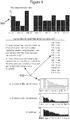
- Figure 9 shows a report related to the exemplary embodiment of the medication dispenser. This report shows dispensing data in a graph 901 derived from status codes received via the check-ins. This report also graphs the user's response to other questions 902 asked during the check-in process.
- a user 101 fails to check-in at an expected time, this failure to communicate can be noted by the master system 104.
- the device user 101 may then be contacted proactively, or alerted to make contact with the master system 104.
- the status code received from a subsequent check-in can contain a code that indicates the last access code entered, and therefore the master system 104 can be made aware of the user's failure to properly enter an access code.
- certain bits of the status code will not reset unless a new access code has been entered.
- the master system 104 can conclude that the previously communicated access code was not input into the device 102 by the user 101.
- Clear benefits are derived from the exemplary medication dispenser embodiment of the invention. Healthcare professionals can be confident that a user 101 has accurately communicated data about the quantity and times at which pills were dispensed. Moreover, the master system 104 can return access codes for the device 102 which limit medication access to appropriate levels, or initiate reminders at appropriate times. Patients are known to be error prone, and the invention described herein can minimize mistaken communication.
Landscapes
- Health & Medical Sciences (AREA)
- Engineering & Computer Science (AREA)
- Biomedical Technology (AREA)
- Business, Economics & Management (AREA)
- General Business, Economics & Management (AREA)
- Epidemiology (AREA)
- General Health & Medical Sciences (AREA)
- Medical Informatics (AREA)
- Primary Health Care (AREA)
- Public Health (AREA)
- Medical Treatment And Welfare Office Work (AREA)
Claims (7)
- Verfahren zum Verwalten von Vorrichtungsdaten, wobei das Verfahren die folgenden Schritte umfasst:Warnen eines Benutzers (101) einer Medikamentenabgabevorrichtung (102), um mit einem Mastersystem (104) zu kommunizieren;Erzeugen eines Zustandscodes durch die Medikamentenabgabevorrichtung (102) basierend auf Vorrichtungsdaten, die den Zustand der Medikamentenabgabevorrichtung (102) angeben, wobei der Zustandscode die Vorrichtungsdaten codiert;Anzeigen des Zustandscodes für den Benutzer (101);Empfangen eines von dem Benutzer (101) durch ein Eingabefeld (206, 306) der Vorrichtung (102) eingetragenen Zugriffscodes, wobei der Zugriffscode durch das Mastersystem (104) als Reaktion auf ein Empfangen des Zustandscodes über einen Kommunikationskanal (105) erzeugt und dem Benutzer (101) über einen Kommunikationskanal (105) bereitgestellt wird, wobei der Zugriffscode Vorrichtungsanweisungen zum entfernten Programmieren der Vorrichtung (102) umfasst;Erzeugen eines Berichts basierend auf dem in dem Zustandscode codierten Zustand durch das Mastersystem (104);Überprüfen einer Gültigkeit des Zugriffscodes und, falls der Zugriffscode gültig ist, Interpretieren der Anweisungen, um die Vorrichtung (102) umzuprogrammieren, andernfalls Signalisieren an den Benutzer (101), dass der Zugriffscode ungültig ist.
- Verfahren zum Verwalten von Vorrichtungsdaten nach Anspruch 1, wobei der Warnungsschritt den folgenden Schritt umfasst:
Erzeugen einer Audiowarnung oder Anzeigen der Warnung auf einer Anzeige der Vorrichtung (102). - Verfahren zum Verwalten von Vorrichtungsdaten nach Anspruch 1, wobei der Erzeugungsschritt Folgendes umfasst:Erzeugen eines Wertes, der den Zustand der Vorrichtung (102) angibt; undDurchführen eines XOR-Vorgangs auf dem Wert gegen einen rollenden Codesatz.
- Verfahren zum Verwalten von Vorrichtungsdaten nach einem der vorhergehenden Ansprüche, wobei die Anweisungen Folgendes umfassen:
Begrenzen der Gesamtzahl der Pillen, die innerhalb einer bestimmten Zeit ausgegeben werden können, Erinnern des Benutzers (101), Pillen nach einer bestimmten Zeit einzunehmen, Erinnern des Benutzers (101), einzuchecken, und/oder Deaktivieren der Abgabeaktion, falls der Benutzer (101) es versäumt hat, einen neuen Zugriffscode einzugeben. - System zum Verwalten von Vorrichtungsdaten, wobei das System Folgendes einschließt:
eine Medikamentenabgabevorrichtung (102), die Folgendes umfasst:eine Vorrichtungsidentifikationsnummer;einen Indikator, der konfiguriert ist, um einen Benutzer (101) zu warnen, um mit einem Mastersystem (104) zu kommunizieren;eine Anzeigeeinheit (204) zum Anzeigen eines Zustandscodecodes; undeine Verarbeitungseinheit (201), die konfiguriert ist, um sich mit dem Indikator und der Anzeigeeinheit (204) zu verbinden, wobei die Verarbeitungseinheit (201) konfiguriert ist, um einen Zustandscodecode basierend auf Vorrichtungsdaten, die einen Zustand der Vorrichtung (102) angeben, zu erzeugen, wobei der Zustandscodecode die Vorrichtungsdaten codiert; undwobei das Mastersystem (104) konfiguriert ist, um über einen Kommunikationskanal (105) den Zustandscodecode von einem Benutzer (101) der Vorrichtung (102) zu empfangen, wobei das Mastersystem (104) zum Erzeugen eines Berichts basierend auf dem in dem Zustandscodecode codierten Zustand der Vorrichtung und zum Erzeugen, als Reaktion auf das Empfangen des Zustandscodecodes, eines Zugriffscodes konfiguriert ist, wobei der Zugriffscode Vorrichtungsanweisung für entferntes Programmieren der Vorrichtung (102) und zum Bereitstellen des Zugriffscodes an den Benutzer (101) über den Kommunikationskanal (105) umfasst;wobei die Medikamentenabgabevorrichtung (102) ferner Folgendes umfasst:
ein Eingabefeld (206, 306), wobei die Verarbeitungseinheit (201) ferner konfiguriert ist, um den von dem Benutzer (101) durch das Eingabefeld (206, 306) eingetragenen Zugriffscode zu empfangen, um die Gültigkeit des Zugriffscodes zu überprüfen und, falls der Zugriffscode gültig ist, um die Anweisungen zu interpretieren, um die Medikamentenabgabevorrichtung (102) umzuprogrammieren, andernfalls um dem Benutzer (101) zu signalisieren, dass der Zugriffscode ungültig ist. - System zum Verwalten von Vorrichtungsdaten nach Anspruch 5, wobei das Eingabefeld (206, 306) ferner konfiguriert ist, um sich mit der Verarbeitungseinheit (201) zu verbinden und wobei die Verarbeitungseinheit (201) geeignet ist, um einen zweiten Zustandscodecode basierend auf dem Zugriffscode zu erzeugen; und
wobei der Indikator ferner konfiguriert ist, um eine akustische Warnung oder eine visuelle Warnung zu erzeugen. - System zum Verwalten von Vorrichtungsdaten nach Anspruch 5 oder 6, wobei die Anweisungen Folgendes umfassen:
Begrenzen der Gesamtzahl der Pillen, die innerhalb einer bestimmten Zeit ausgegeben werden können, Erinnern des Benutzers (101), Pillen nach einer bestimmten Zeit einzunehmen, Erinnern des Benutzers (101), einzuchecken, und/oder Deaktivieren der Abgabeaktion, falls der Benutzer (101) es versäumt hat, einen neuen Zugriffscode einzugeben.
Applications Claiming Priority (2)
| Application Number | Priority Date | Filing Date | Title |
|---|---|---|---|
| US20862809P | 2009-02-25 | 2009-02-25 | |
| PCT/US2010/025422 WO2010099324A1 (en) | 2009-02-25 | 2010-02-25 | Method, system and apparatus for monitoring and interacting with a remote device |
Publications (3)
| Publication Number | Publication Date |
|---|---|
| EP2401684A1 EP2401684A1 (de) | 2012-01-04 |
| EP2401684A4 EP2401684A4 (de) | 2016-06-29 |
| EP2401684B1 true EP2401684B1 (de) | 2019-10-30 |
Family
ID=42665905
Family Applications (1)
| Application Number | Title | Priority Date | Filing Date |
|---|---|---|---|
| EP10746836.5A Active EP2401684B1 (de) | 2009-02-25 | 2010-02-25 | Verfahren und System zur überwachung eines entfernten gerätes und zur interaction mit diesem |
Country Status (2)
| Country | Link |
|---|---|
| EP (1) | EP2401684B1 (de) |
| WO (1) | WO2010099324A1 (de) |
Families Citing this family (1)
| Publication number | Priority date | Publication date | Assignee | Title |
|---|---|---|---|---|
| CN119449655B (zh) * | 2024-11-22 | 2025-12-26 | 健帆生物科技集团股份有限公司 | 一种血液净化设备的通信状态的检测方法和装置 |
Family Cites Families (5)
| Publication number | Priority date | Publication date | Assignee | Title |
|---|---|---|---|---|
| US8092224B2 (en) * | 1995-11-22 | 2012-01-10 | James A. Jorasch | Systems and methods for improved health care compliance |
| US6751730B1 (en) * | 1995-11-22 | 2004-06-15 | Walker Digital, Llc | Method and apparatus for documenting cap removal data |
| US7510526B2 (en) * | 2004-12-30 | 2009-03-31 | Medtronic Emergency Response Systems, Inc. | Medical device information system |
| US7966495B2 (en) * | 2005-03-21 | 2011-06-21 | Revinetix, Inc. | Conserving file system with backup and validation |
| US7996106B2 (en) | 2007-03-13 | 2011-08-09 | Medicasafe, Inc. | Method, system and apparatus for controlling patient access to medicaments |
-
2010
- 2010-02-25 WO PCT/US2010/025422 patent/WO2010099324A1/en not_active Ceased
- 2010-02-25 EP EP10746836.5A patent/EP2401684B1/de active Active
Non-Patent Citations (1)
| Title |
|---|
| None * |
Also Published As
| Publication number | Publication date |
|---|---|
| EP2401684A4 (de) | 2016-06-29 |
| WO2010099324A1 (en) | 2010-09-02 |
| EP2401684A1 (de) | 2012-01-04 |
Similar Documents
| Publication | Publication Date | Title |
|---|---|---|
| US11373744B2 (en) | Method, system and apparatus for controlling patient access to medicaments | |
| US9235689B2 (en) | Method, system and apparatus for controlling patient access to medicaments | |
| AU2007276983B2 (en) | Integrated health care home communication system | |
| AU2004209115B2 (en) | Medical data communication notification and messaging system and method | |
| CA2514571C (en) | Wireless medical data communication system and method | |
| US5827180A (en) | Method and apparatus for a personal health network | |
| US8556728B2 (en) | Method and apparatus for outputting a result of a game via a container | |
| CA2715969C (en) | System and method for monitoring medication prescriptions using biometric identification and verification | |
| US20080283542A1 (en) | Apparatus for smart medical care | |
| US6751730B1 (en) | Method and apparatus for documenting cap removal data | |
| WO2000019962A2 (en) | Method and apparatus for documenting cap removal data | |
| US20220245981A1 (en) | Locking medication containers and methods of use thereof | |
| US20200135321A1 (en) | System, methods, & device for managing a product | |
| WO2004070549A2 (en) | Separation of validated information and functions in a healthcare system | |
| WO2004070557A2 (en) | Method and system for medical device connectivity | |
| EP1535231A2 (de) | Verfahren und anlage für klinische prüfungen | |
| US11238682B2 (en) | Locking medication containers and methods of use thereof | |
| EP2401684B1 (de) | Verfahren und System zur überwachung eines entfernten gerätes und zur interaction mit diesem | |
| US20230285247A1 (en) | Apparatus and method of dispensing pharmaceuticals and other medications | |
| US11557385B2 (en) | Mobile data appliance for checking medication | |
| KR102544791B1 (ko) | 블록체인과 인공지능 챗봇을 이용한 텔레메트리 관리 장치 및 관리 방법 | |
| US20220336075A1 (en) | Method, system and apparatus for controlling patient access to medicaments | |
| EP3893244A2 (de) | Verfahren zur bereitstellung von medikamenteninformationen | |
| WO2009043893A1 (en) | Drug management system and method with remote programmer | |
| CN118510445A (zh) | 利用生理传感器进行健康监测的系统、设备和方法 |
Legal Events
| Date | Code | Title | Description |
|---|---|---|---|
| PUAI | Public reference made under article 153(3) epc to a published international application that has entered the european phase |
Free format text: ORIGINAL CODE: 0009012 |
|
| 17P | Request for examination filed |
Effective date: 20110901 |
|
| AK | Designated contracting states |
Kind code of ref document: A1 Designated state(s): AT BE BG CH CY CZ DE DK EE ES FI FR GB GR HR HU IE IS IT LI LT LU LV MC MK MT NL NO PL PT RO SE SI SK SM TR |
|
| DAX | Request for extension of the european patent (deleted) | ||
| RA4 | Supplementary search report drawn up and despatched (corrected) |
Effective date: 20160601 |
|
| RIC1 | Information provided on ipc code assigned before grant |
Ipc: G06F 19/00 20110101AFI20160526BHEP |
|
| STAA | Information on the status of an ep patent application or granted ep patent |
Free format text: STATUS: EXAMINATION IS IN PROGRESS |
|
| 17Q | First examination report despatched |
Effective date: 20180702 |
|
| 17Q | First examination report despatched |
Effective date: 20180705 |
|
| REG | Reference to a national code |
Ref country code: DE Ref legal event code: R079 Ref document number: 602010061731 Country of ref document: DE Free format text: PREVIOUS MAIN CLASS: G06F0017000000 Ipc: G16H0040670000 |
|
| GRAP | Despatch of communication of intention to grant a patent |
Free format text: ORIGINAL CODE: EPIDOSNIGR1 |
|
| STAA | Information on the status of an ep patent application or granted ep patent |
Free format text: STATUS: GRANT OF PATENT IS INTENDED |
|
| RIC1 | Information provided on ipc code assigned before grant |
Ipc: G16H 20/13 20180101ALN20190423BHEP Ipc: G16H 40/67 20180101AFI20190423BHEP |
|
| RIC1 | Information provided on ipc code assigned before grant |
Ipc: G16H 40/67 20180101AFI20190503BHEP Ipc: G16H 20/13 20180101ALN20190503BHEP |
|
| INTG | Intention to grant announced |
Effective date: 20190522 |
|
| GRAS | Grant fee paid |
Free format text: ORIGINAL CODE: EPIDOSNIGR3 |
|
| GRAA | (expected) grant |
Free format text: ORIGINAL CODE: 0009210 |
|
| STAA | Information on the status of an ep patent application or granted ep patent |
Free format text: STATUS: THE PATENT HAS BEEN GRANTED |
|
| AK | Designated contracting states |
Kind code of ref document: B1 Designated state(s): AT BE BG CH CY CZ DE DK EE ES FI FR GB GR HR HU IE IS IT LI LT LU LV MC MK MT NL NO PL PT RO SE SI SK SM TR |
|
| REG | Reference to a national code |
Ref country code: GB Ref legal event code: FG4D |
|
| REG | Reference to a national code |
Ref country code: CH Ref legal event code: EP |
|
| REG | Reference to a national code |
Ref country code: DE Ref legal event code: R096 Ref document number: 602010061731 Country of ref document: DE |
|
| REG | Reference to a national code |
Ref country code: AT Ref legal event code: REF Ref document number: 1197021 Country of ref document: AT Kind code of ref document: T Effective date: 20191115 |
|
| REG | Reference to a national code |
Ref country code: IE Ref legal event code: FG4D |
|
| REG | Reference to a national code |
Ref country code: LT Ref legal event code: MG4D |
|
| PG25 | Lapsed in a contracting state [announced via postgrant information from national office to epo] |
Ref country code: NL Free format text: LAPSE BECAUSE OF FAILURE TO SUBMIT A TRANSLATION OF THE DESCRIPTION OR TO PAY THE FEE WITHIN THE PRESCRIBED TIME-LIMIT Effective date: 20191030 Ref country code: LV Free format text: LAPSE BECAUSE OF FAILURE TO SUBMIT A TRANSLATION OF THE DESCRIPTION OR TO PAY THE FEE WITHIN THE PRESCRIBED TIME-LIMIT Effective date: 20191030 Ref country code: SE Free format text: LAPSE BECAUSE OF FAILURE TO SUBMIT A TRANSLATION OF THE DESCRIPTION OR TO PAY THE FEE WITHIN THE PRESCRIBED TIME-LIMIT Effective date: 20191030 Ref country code: PL Free format text: LAPSE BECAUSE OF FAILURE TO SUBMIT A TRANSLATION OF THE DESCRIPTION OR TO PAY THE FEE WITHIN THE PRESCRIBED TIME-LIMIT Effective date: 20191030 Ref country code: GR Free format text: LAPSE BECAUSE OF FAILURE TO SUBMIT A TRANSLATION OF THE DESCRIPTION OR TO PAY THE FEE WITHIN THE PRESCRIBED TIME-LIMIT Effective date: 20200131 Ref country code: NO Free format text: LAPSE BECAUSE OF FAILURE TO SUBMIT A TRANSLATION OF THE DESCRIPTION OR TO PAY THE FEE WITHIN THE PRESCRIBED TIME-LIMIT Effective date: 20200130 Ref country code: ES Free format text: LAPSE BECAUSE OF FAILURE TO SUBMIT A TRANSLATION OF THE DESCRIPTION OR TO PAY THE FEE WITHIN THE PRESCRIBED TIME-LIMIT Effective date: 20191030 Ref country code: LT Free format text: LAPSE BECAUSE OF FAILURE TO SUBMIT A TRANSLATION OF THE DESCRIPTION OR TO PAY THE FEE WITHIN THE PRESCRIBED TIME-LIMIT Effective date: 20191030 Ref country code: PT Free format text: LAPSE BECAUSE OF FAILURE TO SUBMIT A TRANSLATION OF THE DESCRIPTION OR TO PAY THE FEE WITHIN THE PRESCRIBED TIME-LIMIT Effective date: 20200302 Ref country code: BG Free format text: LAPSE BECAUSE OF FAILURE TO SUBMIT A TRANSLATION OF THE DESCRIPTION OR TO PAY THE FEE WITHIN THE PRESCRIBED TIME-LIMIT Effective date: 20200130 Ref country code: FI Free format text: LAPSE BECAUSE OF FAILURE TO SUBMIT A TRANSLATION OF THE DESCRIPTION OR TO PAY THE FEE WITHIN THE PRESCRIBED TIME-LIMIT Effective date: 20191030 |
|
| REG | Reference to a national code |
Ref country code: NL Ref legal event code: MP Effective date: 20191030 |
|
| PG25 | Lapsed in a contracting state [announced via postgrant information from national office to epo] |
Ref country code: HR Free format text: LAPSE BECAUSE OF FAILURE TO SUBMIT A TRANSLATION OF THE DESCRIPTION OR TO PAY THE FEE WITHIN THE PRESCRIBED TIME-LIMIT Effective date: 20191030 Ref country code: IS Free format text: LAPSE BECAUSE OF FAILURE TO SUBMIT A TRANSLATION OF THE DESCRIPTION OR TO PAY THE FEE WITHIN THE PRESCRIBED TIME-LIMIT Effective date: 20200229 |
|
| PG25 | Lapsed in a contracting state [announced via postgrant information from national office to epo] |
Ref country code: CZ Free format text: LAPSE BECAUSE OF FAILURE TO SUBMIT A TRANSLATION OF THE DESCRIPTION OR TO PAY THE FEE WITHIN THE PRESCRIBED TIME-LIMIT Effective date: 20191030 Ref country code: DK Free format text: LAPSE BECAUSE OF FAILURE TO SUBMIT A TRANSLATION OF THE DESCRIPTION OR TO PAY THE FEE WITHIN THE PRESCRIBED TIME-LIMIT Effective date: 20191030 Ref country code: EE Free format text: LAPSE BECAUSE OF FAILURE TO SUBMIT A TRANSLATION OF THE DESCRIPTION OR TO PAY THE FEE WITHIN THE PRESCRIBED TIME-LIMIT Effective date: 20191030 Ref country code: RO Free format text: LAPSE BECAUSE OF FAILURE TO SUBMIT A TRANSLATION OF THE DESCRIPTION OR TO PAY THE FEE WITHIN THE PRESCRIBED TIME-LIMIT Effective date: 20191030 |
|
| REG | Reference to a national code |
Ref country code: DE Ref legal event code: R097 Ref document number: 602010061731 Country of ref document: DE |
|
| REG | Reference to a national code |
Ref country code: AT Ref legal event code: MK05 Ref document number: 1197021 Country of ref document: AT Kind code of ref document: T Effective date: 20191030 |
|
| PG25 | Lapsed in a contracting state [announced via postgrant information from national office to epo] |
Ref country code: IT Free format text: LAPSE BECAUSE OF FAILURE TO SUBMIT A TRANSLATION OF THE DESCRIPTION OR TO PAY THE FEE WITHIN THE PRESCRIBED TIME-LIMIT Effective date: 20191030 Ref country code: SK Free format text: LAPSE BECAUSE OF FAILURE TO SUBMIT A TRANSLATION OF THE DESCRIPTION OR TO PAY THE FEE WITHIN THE PRESCRIBED TIME-LIMIT Effective date: 20191030 Ref country code: SM Free format text: LAPSE BECAUSE OF FAILURE TO SUBMIT A TRANSLATION OF THE DESCRIPTION OR TO PAY THE FEE WITHIN THE PRESCRIBED TIME-LIMIT Effective date: 20191030 |
|
| PLBE | No opposition filed within time limit |
Free format text: ORIGINAL CODE: 0009261 |
|
| STAA | Information on the status of an ep patent application or granted ep patent |
Free format text: STATUS: NO OPPOSITION FILED WITHIN TIME LIMIT |
|
| REG | Reference to a national code |
Ref country code: CH Ref legal event code: PL |
|
| 26N | No opposition filed |
Effective date: 20200731 |
|
| REG | Reference to a national code |
Ref country code: BE Ref legal event code: MM Effective date: 20200229 |
|
| PG25 | Lapsed in a contracting state [announced via postgrant information from national office to epo] |
Ref country code: MC Free format text: LAPSE BECAUSE OF FAILURE TO SUBMIT A TRANSLATION OF THE DESCRIPTION OR TO PAY THE FEE WITHIN THE PRESCRIBED TIME-LIMIT Effective date: 20191030 Ref country code: LU Free format text: LAPSE BECAUSE OF NON-PAYMENT OF DUE FEES Effective date: 20200225 |
|
| PG25 | Lapsed in a contracting state [announced via postgrant information from national office to epo] |
Ref country code: SI Free format text: LAPSE BECAUSE OF FAILURE TO SUBMIT A TRANSLATION OF THE DESCRIPTION OR TO PAY THE FEE WITHIN THE PRESCRIBED TIME-LIMIT Effective date: 20191030 Ref country code: LI Free format text: LAPSE BECAUSE OF NON-PAYMENT OF DUE FEES Effective date: 20200229 Ref country code: CH Free format text: LAPSE BECAUSE OF NON-PAYMENT OF DUE FEES Effective date: 20200229 Ref country code: AT Free format text: LAPSE BECAUSE OF FAILURE TO SUBMIT A TRANSLATION OF THE DESCRIPTION OR TO PAY THE FEE WITHIN THE PRESCRIBED TIME-LIMIT Effective date: 20191030 |
|
| PG25 | Lapsed in a contracting state [announced via postgrant information from national office to epo] |
Ref country code: IE Free format text: LAPSE BECAUSE OF NON-PAYMENT OF DUE FEES Effective date: 20200225 |
|
| PG25 | Lapsed in a contracting state [announced via postgrant information from national office to epo] |
Ref country code: BE Free format text: LAPSE BECAUSE OF NON-PAYMENT OF DUE FEES Effective date: 20200229 |
|
| PG25 | Lapsed in a contracting state [announced via postgrant information from national office to epo] |
Ref country code: TR Free format text: LAPSE BECAUSE OF FAILURE TO SUBMIT A TRANSLATION OF THE DESCRIPTION OR TO PAY THE FEE WITHIN THE PRESCRIBED TIME-LIMIT Effective date: 20191030 Ref country code: MT Free format text: LAPSE BECAUSE OF FAILURE TO SUBMIT A TRANSLATION OF THE DESCRIPTION OR TO PAY THE FEE WITHIN THE PRESCRIBED TIME-LIMIT Effective date: 20191030 Ref country code: CY Free format text: LAPSE BECAUSE OF FAILURE TO SUBMIT A TRANSLATION OF THE DESCRIPTION OR TO PAY THE FEE WITHIN THE PRESCRIBED TIME-LIMIT Effective date: 20191030 |
|
| PG25 | Lapsed in a contracting state [announced via postgrant information from national office to epo] |
Ref country code: MK Free format text: LAPSE BECAUSE OF FAILURE TO SUBMIT A TRANSLATION OF THE DESCRIPTION OR TO PAY THE FEE WITHIN THE PRESCRIBED TIME-LIMIT Effective date: 20191030 |
|
| PGFP | Annual fee paid to national office [announced via postgrant information from national office to epo] |
Ref country code: DE Payment date: 20240228 Year of fee payment: 15 Ref country code: GB Payment date: 20240227 Year of fee payment: 15 |
|
| PGFP | Annual fee paid to national office [announced via postgrant information from national office to epo] |
Ref country code: FR Payment date: 20240226 Year of fee payment: 15 |
|
| REG | Reference to a national code |
Ref country code: DE Ref legal event code: R119 Ref document number: 602010061731 Country of ref document: DE |
|
| GBPC | Gb: european patent ceased through non-payment of renewal fee |
Effective date: 20250225 |
|
| PG25 | Lapsed in a contracting state [announced via postgrant information from national office to epo] |
Ref country code: DE Free format text: LAPSE BECAUSE OF NON-PAYMENT OF DUE FEES Effective date: 20250902 |
|
| PG25 | Lapsed in a contracting state [announced via postgrant information from national office to epo] |
Ref country code: GB Free format text: LAPSE BECAUSE OF NON-PAYMENT OF DUE FEES Effective date: 20250225 |
|
| PG25 | Lapsed in a contracting state [announced via postgrant information from national office to epo] |
Ref country code: FR Free format text: LAPSE BECAUSE OF NON-PAYMENT OF DUE FEES Effective date: 20250228 |