EP2399902A1 - Process for preparing 2,3-di-non-straight-alkyl-2-cyano succinic acid diesters - Google Patents
Process for preparing 2,3-di-non-straight-alkyl-2-cyano succinic acid diesters Download PDFInfo
- Publication number
- EP2399902A1 EP2399902A1 EP10743392A EP10743392A EP2399902A1 EP 2399902 A1 EP2399902 A1 EP 2399902A1 EP 10743392 A EP10743392 A EP 10743392A EP 10743392 A EP10743392 A EP 10743392A EP 2399902 A1 EP2399902 A1 EP 2399902A1
- Authority
- EP
- European Patent Office
- Prior art keywords
- potassium
- compound
- reaction
- formula
- alkyl
- Prior art date
- Legal status (The legal status is an assumption and is not a legal conclusion. Google has not performed a legal analysis and makes no representation as to the accuracy of the status listed.)
- Granted
Links
Images


Classifications
-
- C—CHEMISTRY; METALLURGY
- C07—ORGANIC CHEMISTRY
- C07C—ACYCLIC OR CARBOCYCLIC COMPOUNDS
- C07C253/00—Preparation of carboxylic acid nitriles
- C07C253/30—Preparation of carboxylic acid nitriles by reactions not involving the formation of cyano groups
-
- C—CHEMISTRY; METALLURGY
- C07—ORGANIC CHEMISTRY
- C07C—ACYCLIC OR CARBOCYCLIC COMPOUNDS
- C07C51/00—Preparation of carboxylic acids or their salts, halides or anhydrides
- C07C51/09—Preparation of carboxylic acids or their salts, halides or anhydrides from carboxylic acid esters or lactones
-
- C—CHEMISTRY; METALLURGY
- C07—ORGANIC CHEMISTRY
- C07C—ACYCLIC OR CARBOCYCLIC COMPOUNDS
- C07C67/00—Preparation of carboxylic acid esters
- C07C67/08—Preparation of carboxylic acid esters by reacting carboxylic acids or symmetrical anhydrides with the hydroxy or O-metal group of organic compounds
Definitions
- the present invention relates to a process for the synthesis of a 2,3-di(non-linear-alkyl)-2-cyano-succinate compound and use of the compound as an intermediate in the preparation of a 2,3-diisoalkylsuccinic acid and esters thereof.
- CN1313869A further discloses a process for the synthesis of the 2,3-dihydrocarbylsuccinates, comprising esterification, alkylation, reduction, oxidative coupling, S N 2 coupling, and combinations thereof.
- CN1313869A discloses in Example 18 the preparation of diethyl 2,3-dipropybuccinate through the oxidative coupling of ethyl pentanoate under the action of diisopropylamido lithium and TiCl 4 , and in Example 22 the preparation of diethyl 2,3-dicyclohexylsuccinate through the esterification of 2,3-diphenylsuccinic acid and the reduction of phenyl to cyclohexyl.
- a 2,3-dialkyl-2-cyanosuccinate compound may be prepared by alkylating a 3-alkyl-2-cyanosuccinate compound with a bromoalkane in three times amount or an expensive iodoalkane as alkylating agent, the product 2,3-dialkyl-2-cyanasuccinate compound has a boiling point close to the boiling point of the reactant 3-alkyl-2-cyanosuccinate compound so that isolation processs such as rectification are difficult to be carried out, and for a reactant having large steric hindrance, such as 3-non-linear-alkyl-2-cyanosuccinate compound, the non-linear-alkylation on 2-position is more difficult.
- a 2-non-linear-alkyl-2-cyanoacetate may react with a metal alkoxide to form a metal salt of enol (or its tautomer), and then said metal salt of enol may react with a 2-bromo-2-non-linear-alkylacetate to form a 2,3-di(non-linear-alkyl)-2-cyanosuccinate compound, which may be further converted to a 2,3-di(non-linear-alkyl)succinic acid and a 2,3-di(non-linear-alkyl)succinate.
- the process according to the present invention is especially suitable for the preparation of a 2,3-diisoatkyl-2-cyanosuccinate compound, a 2,3-diisoalkylsuccinic acid and a 2,3-diisoalkylsuccinate.
- an object of the present invention is to provide a process for the preparation of a 2,3-di(non-linear-alkyl)-2-cyanasuceinate compound.
- Another object of the present invention is to provide a process for the preparation of a 2,3-di(non-linear-alkyl)succinic acid.
- a still another object of the present invention is to provide a process for the preparation of a 2,3-di(non-linear-alkyl)succinate.
- the present invention provides a novel process for the synthesis of a 2,3-di(non-linear-alkyl)succinate compound, which process avoids the use of diisopropylamido lithium (LDA) prepared from hazardous material, n-butyl lithimn, as well as low temperature operation at -70°C, thereby rendering the commercial production of 2,3-diisoalkyl succinates as internal electron donor in a polypropylene catalyst easy.
- LDA diisopropylamido lithium
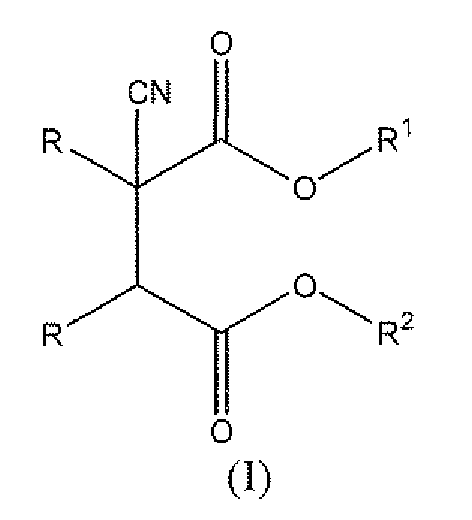
- the present invention provides a process for the preparation of a 2,3-di(non-linear-alkyl)-2-cyanosuccinate compound of the formula (I): wherein, R 1 and R 2 are independently selected from the group consisting of linear C 1 to C 20 alkyl, branched C 1 to C 20 alkyl, C 3 to C 20 cycloalkyl, C 4 to C 20 alkylcyaoalkyl, C 4 to C 20 cycloalkylalkyl, C 6 to C 20 aryl, C 7 to C 20 alkaryl and C 7 to C 20 aralkyl, preferably C 1 to C 8 alkyl, and more preferably methyl, ethyl, propyl, butyl and iso-butyl, and R is independently selected from the group consisting of C 3 to C 6 isoalkyl, C 3 to C 6 sec-alkyl and C 3 to C 6 cycloalkyl, and preferably isopropyl or is
- the metal alkoxide is selected from the group consisting of potassium methoxide, potassium ethoxide, potassium propoxide, potassium isopropoxide, potassium butoxide, potassium iso-butoxide, potassium tert-butoxide, sodium methoxide, sodium ethoxide, sodium propoxide, sodium isopropoxide, sodium butoxide, sodium iso-butoxide, sodium tert-butoxide and mixtures thereof.
- the metal alkoxide is preferably selected from the group consisting of potassium methoxide, potassium ethoxide, potassium tert-butoxide, sodium ethoxide, sodium ethoxide, sodium tort-butoxide and mixtures thereof, and more preferably potassium ethoxide.
- a molar ratio of the compound of the formula (II) to the metal alkoxide is from 1:0.8 to 1:1.2. preferably from 1:1 to 1:1.2, and more preferably about 1:1.
- the alcohol solvent is selected from the group consisting of methanol, ethanol, propanol, isopropanol, butanol, iso-butanol, tert-butanol and mixtures thereof.
- the alcohol solvent is preferably selected from the group consisting of methanol, ethanol, tert-butanol and mixtures thereof, and more preferably ethanol.
- the amount of the alcohol solvent used ranges from 1 to 50 ml of alcohol per gram of the compound of the formula (II), preferably from 10 to 40 ml of alcohol per gram of the compound of the formula (II), and more preferably from 15 to 25 ml of alcohol per gram of the compound of the formula (II).
- the reaction temperature in step (i) is from -10°C to 45°C, preferably from -5°C to 40°C, and more preferably room temperature (about 25°C).
- the reaction in step (i) can be performed conveniently under a normal pressure.
- the concentration temperature in step (ii) is one required by the atmospheric distillation of the alcohol solvent or the vacuum distillation of the alcohol solvent.
- the aprotic solvent is selected from the group consisting of tetrahydrofuran, dimethyl formamide, dimethyl sulfoxide, acetonitirle and mixtures thereof.
- the aprotic solvent is preferably tetrahydrofuran or acetonitirle, and more preferably acetonitirle.
- the amount of the aprotic solvent used ranges from 1 to 30 ml, and preferably from 10 to 28 ml, relative to one gram of the compound of the formula (II) used in step (i).
- reaction temperature in step (iii) ranges from room temperature to reflux temperature.
- reaction pressure in step (iii) ranges from normal pressure to 20 atm.
- the compound of the formula (III) is used in step (iii) in such an amount that a molar ratio of the compound of the formula (11) used in step (i) to the compound of the formula (III) ranges from 1:0.8 to 1:1.2, and preferably from 1:1 to 1:1.2.
- the compound of the formula (I) prepared by the above-described process may be isolated and purified through experimental methods commonly used in organic chemistry field, for example, column chromatography, rectification, recrystallization and the like.
- the compounds of the formula (II) are known, or can be prepared according to a method known per se (see, for example, A.C. Cope, Org. React. 1957, 9, 107).
- a cyanoacetate compound reacts with a sodium alkoxide, and then with bromoisopropane via nucleophilic reaction, to form a 3-methyl-2-cyanobutyrate compound.
- the compounds of the formula (III) are known, or can be prepared according to a method known per se (see, for example, Journal of the American Chemical Society, 1954, 76, 1137-1140 ).
- ethyl 2-bromoisopentanoate is commercially available.
- a preferred embodiment of the invention will be described below, wherein diethyl 2,3-diisopropyl-2-cyanosuccinate is prepared.
- Absolute ethanol and metallic potassium are charged into a reactor R101, or potassium ethoxide and absolute ethanol are charged into the reactor R101, to prepare a solution of potassium ethoxide;
- ethyl 3-methyl-2-cyanobutyrate is charged into a reactor R102, and then the prepared solution of potassium ethoxide is added thereto at a temperature ranging from -10°C to 45°C;
- the reaction mixture is transferred to a reactor R103 and the solvent is removed, then tetrahydrofuran or acetonitirle is added thereto, followed by the addition of ethyl 2-bromoisopentanoate, and then the reaction mixture is heated to reflux; upon the completion of the reaction, the solvent is removed again, the resultant mixture is transferred to a separator R104, water
- the present invention provides a process for the preparation of a 2,3-di(non-linear-alkyl)succinic acid, comprising the steps of:
- step (ii) is conducted in the presence of 62% to 70% sulfuric acid.
- step (ii) is conducted at a bath temperature of from 150°C to 170°C.
- the present invention provides a process for the preparation of 2,3-diisopropylsuccinic acid.
- the synthesis scheme is shown below:
- the present invention provides a process for the preparation of a 2,3-di(non-linear-alkyl)succinate, comprising the steps of:
- the 2,3-di(non-linear-alkyl)succinates are obtained by reacting the 2,3-di(non-linear-alkyl)succinic acids with an alcohol in the presence of concentrated sulfuric acid.
- dimethyl 2,3-diisopropylsuccinate, diethyl 2,3-diisopropylsuccinate, di-n-propyl 2,3-diisopropylsuccinate, di-n-butyl 2,3-diisopropylsuccinate, di-iso-butyl 2,3-diisopropylsuccinate, di-iso-pentyl 2,3-diisopropylsuccinate, di-iso-hexyl 2,3-diisopropylsuccinate, di-2-methylhexyl 2,3-diisopropylsuccinate can be obtained.
- Example 3 Preparation of 2,3-diisopropyl succinic acid
- the magnesium sulfate was filtered off and the diethyl ether was removed, to afford 0.88g crude product.
- the crude product was combined with 10% aqueous KOH solution, and then the mixture of the crude product and the aqueous KOH solution was extracted with diethyl ether, and the organic phase was dried over magnesium sulfate over night.
- the magnesium sulfate was filtered off and the solvent was removed, to afford purified target compound, diethyl 2,3-diisopropylsuccinate.
- Example 2 The procedure described in Example 1 was repeated, except that 0.22g of metallic sodium was used in place of 0.37g of metallic potassium, to obtain diethyl 2,3-diisopropyl-2-cyanosuccinate (yield: 59%).
- the mass spectrum and IR spectrum of the product are consistent with the structure of the target compound.
- Example 3 The procedure described in Example 3 was repeated, except that in the two product extraction separation operations, methyl tert-butyl ether was used to replace for the anhydrous diethyl ether and diethyl ether, respectively, to extract organics, thereby obtaining 2,3-diisopropylsuccinic acid (yield: 71%).
- the mass spectrum and IR spectrum of the product are consistent with the structure of the target compound.
Landscapes
- Chemical & Material Sciences (AREA)
- Organic Chemistry (AREA)
- Chemical Kinetics & Catalysis (AREA)
- Engineering & Computer Science (AREA)
- Oil, Petroleum & Natural Gas (AREA)
- Organic Low-Molecular-Weight Compounds And Preparation Thereof (AREA)
Abstract
Description
- The present application claims the priority of Application No.
CN200910077779.6 filed on Feb. 19, 2009 - The present invention relates to a process for the synthesis of a 2,3-di(non-linear-alkyl)-2-cyano-succinate compound and use of the compound as an intermediate in the preparation of a 2,3-diisoalkylsuccinic acid and esters thereof.
- Seeking ideal electron donor compounds has been being a hot point of the studies on novel polypropylene catalysts. Chinese patent application
CN1313869A discloses the use of 2,3-dihydrocarbylsuccinate compounds as a catalyst component in the preparation of a solid catalyst for olefin polymerization, among thesecompounds 2,3-diisopropylsuccinates being especially preferred internal electron donor compounds. As internal electron donor of Ziegler-Natta catalysts, this class of succinates improves the ability of the catalysts controlling molecular weight distributions, isotactivities and oligomer content of olefin polymers. Current Petrochemical Industry, 2003, Vol.11(10), 4-11 reports that an impact copolymer, which is produced by using a propylene polymerization catalyst containing such a 2,3-dihydrocarbylsuccinate as electron donor, has balanced rigidity and impact property. -
CN1313869A further discloses a process for the synthesis of the 2,3-dihydrocarbylsuccinates, comprising esterification, alkylation, reduction, oxidative coupling,S N2 coupling, and combinations thereof. For example,CN1313869A discloses in Example 18 the preparation ofdiethyl 2,3-dipropybuccinate through the oxidative coupling of ethyl pentanoate under the action of diisopropylamido lithium and TiCl4, and in Example 22 the preparation ofdiethyl 2,3-dicyclohexylsuccinate through the esterification of 2,3-diphenylsuccinic acid and the reduction of phenyl to cyclohexyl. - However, for the preparation of 2,3-non-linear-alkyl-succinate compounds, no ideal process is disclosed in the prior art. The non-linear-alkylation, especially isoalkylation or sec-alkylation, of a diester of succinic acid on 2- and 3-positions are generally difficult due to large steric hindrance, and the yield is relatively low. The oxidative coupling method mentioned in
CN1313869A requires the use of diisopropylamido lithium (LDA) prepared from hazardous material, n-butyl lithium, and the reaction is carried out at a temperature of -70°C. - As for the synthesis of a 2,3-di(non-linear-alkyl)-2-cyano-succinate compound, although literatures, J. Am. Chem. Soc. 1952, 74, 1056-1059 and Bull. Soc. Chim. Fr. 1975, (9-10, Pt. 2), 2189-2194, report referable methods, for example, one wherein a 2,3-dialkyl-2-cyanosuccinate compound may be prepared by alkylating a 3-alkyl-2-cyanosuccinate compound with a bromoalkane in three times amount or an expensive iodoalkane as alkylating agent, the
product 2,3-dialkyl-2-cyanasuccinate compound has a boiling point close to the boiling point of the reactant 3-alkyl-2-cyanosuccinate compound so that isolation processs such as rectification are difficult to be carried out, and for a reactant having large steric hindrance, such as 3-non-linear-alkyl-2-cyanosuccinate compound, the non-linear-alkylation on 2-position is more difficult. - Thus, there is still need for a novel process for the synthesis of a 2,3-di(non-linear-alkyl)suceinate compound, which process may provide the 2,3-di(non-linear-alkyl)succinate compound under mild conditions at a relatively high yield. Furthermore, there is also need for a process that can prepare at
industrial scale 2,3-di(non-linear-alkyl)-2-cyano-succinate compound as an intermediate of the 2,3-di(non-linear-alkyl)succinate compounds. - The inventors have made diligently studies. As a result, the inventors have found that a 2-non-linear-alkyl-2-cyanoacetate may react with a metal alkoxide to form a metal salt of enol (or its tautomer), and then said metal salt of enol may react with a 2-bromo-2-non-linear-alkylacetate to form a 2,3-di(non-linear-alkyl)-2-cyanosuccinate compound, which may be further converted to a 2,3-di(non-linear-alkyl)succinic acid and a 2,3-di(non-linear-alkyl)succinate. The process according to the present invention is especially suitable for the preparation of a 2,3-diisoatkyl-2-cyanosuccinate compound, a 2,3-diisoalkylsuccinic acid and a 2,3-diisoalkylsuccinate.
- Thus, an object of the present invention is to provide a process for the preparation of a 2,3-di(non-linear-alkyl)-2-cyanasuceinate compound.
- Another object of the present invention is to provide a process for the preparation of a 2,3-di(non-linear-alkyl)succinic acid.
- A still another object of the present invention is to provide a process for the preparation of a 2,3-di(non-linear-alkyl)succinate.
-
-
Fig. 1 is a process flow chart of the preparation of a diester of a 2,3-diisopropyl-2-cyanosuceinic acid according to an embodiment of the invention. -
Fig. 2 is a process flow chart of the preparation of a 2,3-diisopropylsuccinic acid according to an embodiment of the invention. -
Fig. 3 is a process flow chart of the preparation of adiethyl 2,3-diisopropylsuccinate according to an embodiment of the invention. - The present invention provides a novel process for the synthesis of a 2,3-di(non-linear-alkyl)succinate compound, which process avoids the use of diisopropylamido lithium (LDA) prepared from hazardous material, n-butyl lithimn, as well as low temperature operation at -70°C, thereby rendering the commercial production of 2,3-diisoalkyl succinates as internal electron donor in a polypropylene catalyst easy.
- In a first aspect, the present invention provides a process for the preparation of a 2,3-di(non-linear-alkyl)-2-cyanosuccinate compound of the formula (I):
- (i) reacting a 2-non-linear-alkyl-2-cyanoacetate of the formula (II)

- (ii) removing the alcohol solvent to obtain a concentrate;
- (iii) dissolving the concentrate from (ii) in an aprotic solvent, and then reacting with a 2-bromo-2-non-linear-alkylacetate of the formula (III), to form a 2,3-di(non-linear-alkyl)-2-cyanosuccinate of the formula (I),

- In an embodiment, the metal alkoxide is selected from the group consisting of potassium methoxide, potassium ethoxide, potassium propoxide, potassium isopropoxide, potassium butoxide, potassium iso-butoxide, potassium tert-butoxide, sodium methoxide, sodium ethoxide, sodium propoxide, sodium isopropoxide, sodium butoxide, sodium iso-butoxide, sodium tert-butoxide and mixtures thereof. The metal alkoxide is preferably selected from the group consisting of potassium methoxide, potassium ethoxide, potassium tert-butoxide, sodium ethoxide, sodium ethoxide, sodium tort-butoxide and mixtures thereof, and more preferably potassium ethoxide.
- In an embodiment, a molar ratio of the compound of the formula (II) to the metal alkoxide is from 1:0.8 to 1:1.2. preferably from 1:1 to 1:1.2, and more preferably about 1:1.
- In an embodiment, the alcohol solvent is selected from the group consisting of methanol, ethanol, propanol, isopropanol, butanol, iso-butanol, tert-butanol and mixtures thereof. The alcohol solvent is preferably selected from the group consisting of methanol, ethanol, tert-butanol and mixtures thereof, and more preferably ethanol.
- In an embodiment, the amount of the alcohol solvent used ranges from 1 to 50 ml of alcohol per gram of the compound of the formula (II), preferably from 10 to 40 ml of alcohol per gram of the compound of the formula (II), and more preferably from 15 to 25 ml of alcohol per gram of the compound of the formula (II).
- In an embodiment, the reaction temperature in step (i) is from -10°C to 45°C, preferably from -5°C to 40°C, and more preferably room temperature (about 25°C). The reaction in step (i) can be performed conveniently under a normal pressure.
- In an embodiment, the concentration temperature in step (ii) is one required by the atmospheric distillation of the alcohol solvent or the vacuum distillation of the alcohol solvent.
- In an embodiment, the aprotic solvent is selected from the group consisting of tetrahydrofuran, dimethyl formamide, dimethyl sulfoxide, acetonitirle and mixtures thereof. The aprotic solvent is preferably tetrahydrofuran or acetonitirle, and more preferably acetonitirle.
- In an embodiment, the amount of the aprotic solvent used ranges from 1 to 30 ml, and preferably from 10 to 28 ml, relative to one gram of the compound of the formula (II) used in step (i).
- In an embodiment, the reaction temperature in step (iii) ranges from room temperature to reflux temperature.
- In an embodiment, the reaction pressure in step (iii) ranges from normal pressure to 20 atm.
- In an embodiment, the compound of the formula (III) is used in step (iii) in such an amount that a molar ratio of the compound of the formula (11) used in step (i) to the compound of the formula (III) ranges from 1:0.8 to 1:1.2, and preferably from 1:1 to 1:1.2.
- The compound of the formula (I) prepared by the above-described process may be isolated and purified through experimental methods commonly used in organic chemistry field, for example, column chromatography, rectification, recrystallization and the like.
- The compounds of the formula (II) are known, or can be prepared according to a method known per se (see, for example, A.C. Cope, Org. React. 1957, 9, 107). For example, a cyanoacetate compound reacts with a sodium alkoxide, and then with bromoisopropane via nucleophilic reaction, to form a 3-methyl-2-cyanobutyrate compound.
- The compounds of the formula (III) are known, or can be prepared according to a method known per se (see, for example, Journal of the American Chemical Society, 1954, 76, 1137-1140). For example, ethyl 2-bromoisopentanoate is commercially available.
- By the above-described process, for example,
dimethyl 2,3-diisopropyl-2-cyanosuccinate,diethyl 2,3-diisopropyl-2-cyanosuccmate, 2,3-diisopropyl-2-cyanosuccinic acid 1-methyl ester-4-ethyl ester (R1=methyl, R2=ethyl), and 2,3-diisopropyl-2-cyanosuccinic acid 1-ethyl ester -4-methyl ester (R1=ethyl, R2=methyl) can be obtained. - With reference to
Fig. 1 , a preferred embodiment of the invention will be described below, whereindiethyl 2,3-diisopropyl-2-cyanosuccinate is prepared. Absolute ethanol and metallic potassium are charged into a reactor R101, or potassium ethoxide and absolute ethanol are charged into the reactor R101, to prepare a solution of potassium ethoxide; ethyl 3-methyl-2-cyanobutyrate is charged into a reactor R102, and then the prepared solution of potassium ethoxide is added thereto at a temperature ranging from -10°C to 45°C; upon the completion of the reaction, the reaction mixture is transferred to a reactor R103 and the solvent is removed, then tetrahydrofuran or acetonitirle is added thereto, followed by the addition of ethyl 2-bromoisopentanoate, and then the reaction mixture is heated to reflux; upon the completion of the reaction, the solvent is removed again, the resultant mixture is transferred to a separator R104, water is added thereto to dissolve solids, and the mixture is extracted with diethyl ether or methyl tert-butyl ether; the extract liquor is passed through a drying column T101 so as to be dried, and then is fed to a separating column T102, wherediethyl 2,3-diisopropyl-2-cyanosuccinate is separated. - In a second aspect, the present invention provides a process for the preparation of a 2,3-di(non-linear-alkyl)succinic acid, comprising the steps of:
- (i) obtaining a 2,3-di(non-linear-alkyl)-2-cyanosuccinate compound of the formula (I) by the
above-described process according to the invention
- (ii) conducting hydrolysis and decarboxylation reaction of the 2,3-di(non-linear-alkyl)-2-eyanosuccinate compound in the presence of 60% to 90% sulfuric acid at a bath temperature of from 90°C to 180C, to form a 2,3-di(non-linear-alkyl)succinic acid.
- In a preferred embodiment, the above hydrolysis and decarboxylation reaction in step (ii) is conducted in the presence of 62% to 70% sulfuric acid.
- In a preferred embodiment, the above hydrolysis and decarboxylation reaction in step (ii) is conducted at a bath temperature of from 150°C to 170°C.
- In an embodiment, the present invention provides a process for the preparation of 2,3-diisopropylsuccinic acid. The synthesis scheme is shown below:


- With reference to
Fig. 2 , a preferred embodiment of the invention will be described below, wherein 2,3-diisopropylsuccinic acid is obtained. Absolute ethanol and metallic potassium are charged into a reactor R101, or potassium ethoxide and absolute ethanol are charged into the reactor R101, to prepare a solution of potassium ethoxide; ethyl 3-methyl-2-cyanobutyrate is charged into a reactor R102, and then the prepared solution of potassium ethoxide is added thereto at a temperature ranging from -10°C to 45°C; upon the completion of the reaction, the reaction mixture is transferred to a reactor R103 and the solvent is removed, then tetrahydrofuran or acetonitirle is added thereto, followed by the addition of ethyl 2-bromoisopentanoate, and then the reaction mixture is heated to reflux; upon the completion of the reaction, the solvent is removed again, the resultant mixture is transferred to a separator R104, water is added thereto to dissolve solids, and the mixture is extracted with diethyl ether or methyl tert-butyl ether; the extract liquor is passed through a drying column T101 so as to be dried, and then is fed to a separating column T102, where diethyl 2,3-diisopropyl-2-cyanosuccinate is separated; the diethyl 2,3-diisopropyl-2-cyanosuccinate is added into a reactor R201, and a 60-90% aqueous solution of sulfuric acid is added dropwish thereto to conduct hydrolysis and decarboxylation reaction; upon the completion of the reaction, the reaction mixture is diluted with water and transferred to a separator R202 to be extracted with methyl tert-butyl ether; the obtained methyl tert-butyl ether extract liquor is charged into a reactor R203, and an aqueous solution of potassium hydroxide is added thereto; then the reaction mixture is transferred to a separator R204 to be separated; an aqueous layer separated is acidized with hydrochloric acid in a reactor R205 to obtain precipitates; the precipitates are centrifugally dried in a centrifuge C201, and then dried to afford 2,3-diisopropylsuccinic acid. - In a third aspect, the present invention provides a process for the preparation of a 2,3-di(non-linear-alkyl)succinate, comprising the steps of:
- (i) obtaining a 2,3-di(non-linear-alkyl)-2-cyanosuccinate compound by the above process according to the present invention;
- (ii) conducting hydrolysis reaction and decarboxylation reaction in the presence of a 60% to 90% sulfuric acid at a bath temperature of from 90°C to 180°C, to form a 2,3-di(non-linear-alkyl)succinic acid; and
- (iii) reacting the 2,3-di(non-linear-alkyl)succinic acid with an alcohol under an acidic condition, to obtain a 2,3-di(non-linear-alkyl)succinate, wherein the alcohol is selected from the group consisting of methanol, ethanol, propanol, isopropanol, butanol, iso-butanol and mixtures thereof; or
- Methods for esterifying the 2,3-di(non-linear-alkyl)succinic acids are known per se. See, for example,
CN1313869A and Vogel's Textbook of Practical Organic Chemistry, 5th Ed, 1989, 695-706. Preferably, the 2,3-di(non-linear-alkyl)succinates are obtained by reacting the 2,3-di(non-linear-alkyl)succinic acids with an alcohol in the presence of concentrated sulfuric acid. - By the above process according to the present invention, for example,
dimethyl 2,3-diisopropylsuccinate,diethyl 2,3-diisopropylsuccinate, di-n-propyl 2,3-diisopropylsuccinate, di-n-butyl 2,3-diisopropylsuccinate, di-iso-butyl 2,3-diisopropylsuccinate, di-iso-pentyl 2,3-diisopropylsuccinate, di-iso-hexyl 2,3-diisopropylsuccinate, di-2-methylhexyl 2,3-diisopropylsuccinate can be obtained. - With reference to
Fig. 3 , a preferred embodiment of the invention will be described below, whereindiethyl 2,3-diisopropylsuccinate is obtained. Absolute ethanol and metallic potassium are charged into a reactor R101, or potassium ethoxide and absolute ethanol are charged into the reactor R101, to prepare a solution of potassium ethoxide; ethyl 3-metloyl-2-cyanobutyrate is charged into a reactor R102, and then the prepared solution of potassium ethoxide is added thereto at a temperature ranging from -10°C to 45°C; upon the completion of the reaction, the reaction mixture is transferred to a reactor R103 and the solvent is removed, then tetrahydrofuran or acetonitirle is added thereto, followed by the addition of ethyl 2-bromoisopentanoate, and then the reaction mixture is heated to reflux; upon the completion of the reaction, the solvent is removed again, the resultant mixture is transferred to a separator R104, water is added thereto to dissolve solids, and the mixture is extracted with diethyl ether or methyl tert-butyl ether; the extract liquor is passed through a drying column T101 so as to be dried, and then is fed to a separating column T102, where diethyl 2,3-diisopropyl-2-cyanosuccinate is separated; the diethyl 2,3-diisopropyl-2-cyanosuccinate is added into a reactor R201, and a 60-90% aqueous solution of sulfuric acid is added dropwish thereto to conduct hydrolysis and decarboxylation reaction; upon the completion of the reaction, the reaction mixture is diluted with water and transferred to a separator R202 to be extracted with methyl tert-butyl ether; the obtained methyl tert-butyl ether extract liquor is charged into a reactor R203, and an aqueous solution of potassium hydroxide is added thereto; then the reaction mixture is transferred to a separator R204 to be separated; an aqueous layer separated is acidized with hydrochloric acid in a reactor R205 to obtain precipitates; the precipitates are centrifugally dried in a centrifuge C201, and then dried to afford 2,3-diisopropylsuccinic acid; the 2,3-diisopropylsuccinic acid and absolute ethanol are charged into a reactor R301, and a catalytic amount of sulfuric acid is added thereto, to conduct esterification reaction; upon the completion of the reaction, the ethanol is removed, and methyl tert-butyl ether is added into the reaction mixture; the resultant mixture is transferred to a separator R302 and wished with an aqueous solution of sodium bicarbonate; the organic layer is passed through a drying column T301 so as to be dried, and then is fed to a reactor R303, where the solvent is removed to obtain a crude product; the obtained crude product is fed to a separator R304, wished there with an aqueous solution of potassium hydroxide, and extracted with methyl tert-butyl ether; the extract liquor is dried in a drying column T302, and then fed to a reactor R305, where the solvent is removed to obtain diethyl 2,3-diisopropylsuccinate. - The following examples are given for further illustrating the invention, but do not make limitation to the invention in any way.
- Under nitrogen atmosphere, 0.37 g of metallic potassium was added into 40ml of absolute ethanol, to prepare potassium ethoxide. The prepared potassium ethoxide was added dropwise into a 100ml flask containing 1.48 g of ethyl 3-methyl-2-cyanobutyrate. The reaction mixture was stirred at room temperature for Ih, and then evaporated off the solvent to afford white solids. The white solids were dissolved in 25ml of tetrahydrofuran, and then the resultant solution was slowly added dropwise into a solution of 2.2 g of ethyl 2-bromoisopentanoate in 30ml of tetrahydrofuran, and the reaction mixture was heated to reflux for 9h. Then the solvent was evaporated, to afford a mixture of yellow sticky liquid and pale yellow solids. To this mixture were added with 75ml of diethyl ether and 20ml of water, and an organic phase was separated. The organic phase was washed with 20ml of 10% aqueous NaHCO3 solution twice, and then with water until the organic phase was neutral. The organic phase was dried over anhydrous magnesium sulfate over night, filtered, and evaporated off the solvent, to afford a yellow clear liquid. The yellow clear liquid was separated on a silica chromatographic column (eluent: petroleum ether and chloroform), to afford a pale yellow clear liquid.
- High resolution Electrospray ionization (ESI) mass spectrometry: 284.1897, 306.1656, which are consistent with the mass of M+H (calculated value: 284.1863) and M+Na (calculated value: 306.1681) of compound C15H25NO4, respectively.
- Low resolution mass spectrometer analysis (EI, mlz): 283(M+), 284 (M+1), 268(M-15)+, 241(M-42)+, 238(M-45)+, 210, 198, 168, 140, 129, 122, 115.
- IR (cm-1). 2979, 2881, 2246, 1733, 1469, 1394, 1371, 1299.6, 1141.
- 1H NMR(CDCl3/TMS, 300MHZ) (δ ppm): 0.999-1.148 (2d, 6H, CH(CH3)2), 1.213-1.378 (m, 12H: CH(CH3)2; J=7.2Hz, 2CH2CH3), 2.096-2.148 (m, 1H, CHCH(CH3)2), 2.304-2.372 (m, 1H, CH(CH3)2), 3.012&3.019 (d, 1H, O=CCHCH(CH3)2), 4.144-4.284 (2q, J=7.2Hz, 4H, 2OCH2).
- The procedure described in Example 1 was repeated, except that acetonitirle was used in place of the tetrahydrofuran solvent, to obtain
diethyl 2,3-diisopropyl-2-cyanosuccinate (yield: 64%). The mass spectrum and IR spectrum of the product are consistent with the structure of the target compound. Example 3: Preparation of 2,3-diisopropyl succinic acid - 10ml of 95% concentrated sulfuric acid was slowly added dropwise into 5ml of water, and the mixture was cooled to room temperature, to obtain a sulfuric acid solution. The prepared sulfuric acid solution was added into a three-necked flask containing 0.22g of
diethyl 2,3-diisopropyl-2-cyanosuccinate, and the reaction mixture was stirred at an oil-bath temperature of 160°C for 16h. Upon the completion of the reaction, the reaction mixture was cooled to room temperature, diluted with 30ml of water, and cooled to room temperature again. The reaction mixture was extracted with anhydrous diethyl ether, and the solvent was removed from the extract liquor, to afford a mixture of white solids and oily liquid. This mixture was dissolved in 10ml of 10% aqueous KOH solution, and the resultant solution was stirred at 50°C for 45min. The reaction mixture was extracted with diethyl ether, and the organic phase was discarded. The aqueous phase was acidified with concentrated hydrochloric acid, whereby white precipitates formed. The precipitates were filtered and dried, to afford the product, 2,3-diisopropyl succinic acid (yield: 60%). - Low resolution mass spectrometer analysis (EI, m/z): 185(M-17)+, 160(M-42)+.
- IR (cm-1): 2968, 2940, 2884, 2698, 1703, 1468, 1439, 1392, 1377, 1278, 1247, 1217, 1179, 1133, 946, 756.
- In a 100ml single-necked flask, 1g of 2,3-diisopropylsuccinic acid was dissolved in 60ml of absolute ethanol. 0.5ml of concentrated sulfuric acid was added dropwise to the flask. The reaction mixture was stirred at reflux temperature for 24h. Then the reaction mixture was cooled to room temperature and evaporated off ethanol, thereby affording a pale yellow viscous liquid. The viscous liquid was dissolved in anhydrous diethyl ether and washed with 10% aqueous NaHCO3 solution. The organic phase was washed with water to neutrality and dried over anhydrous magnesium sulfate over night. The magnesium sulfate was filtered off and the diethyl ether was removed, to afford 0.88g crude product. The crude product was combined with 10% aqueous KOH solution, and then the mixture of the crude product and the aqueous KOH solution was extracted with diethyl ether, and the organic phase was dried over magnesium sulfate over night. The magnesium sulfate was filtered off and the solvent was removed, to afford purified target compound,
diethyl 2,3-diisopropylsuccinate. - Low resolution mass spectrometer analysis (EI, m/z): 216(M-42)+, 213(M-45)+.
- IR (cm-1): 2965. 2934, 2876, 1732, 1465, 13912, 1374, 1264, 1227, 1241, 1179, 1159, 1116, 1030, 926.
- The procedure described in Example 1 was repeated, except that 0.22g of metallic sodium was used in place of 0.37g of metallic potassium, to obtain
diethyl 2,3-diisopropyl-2-cyanosuccinate (yield: 59%). The mass spectrum and IR spectrum of the product are consistent with the structure of the target compound. - The procedure described in Example 3 was repeated, except that in the two product extraction separation operations, methyl tert-butyl ether was used to replace for the anhydrous diethyl ether and diethyl ether, respectively, to extract organics, thereby obtaining 2,3-diisopropylsuccinic acid (yield: 71%). The mass spectrum and IR spectrum of the product are consistent with the structure of the target compound.
- The patents, patent applications and testing methods cited in the specification are incorporated herein by reference.
- While the invention has been described with reference to exemplary embodiments, it will be understood by those skilled in the art that various changes and modifications may be made without departing from the spirit and scope of the invention. Therefore, the invention is not limited to the particular embodiments disclosed as the best mode contemplated for carrying out this invention, but the invention will include all embodiments falling within the scope of the appended claims.
Claims (16)
- A process for the preparation of a 2,3-di(non-linear-alkyl)-2-cyanosuccinate compound having the formula (I):

which process comprises the steps of:(i) reacting a 2-non-linear-alkyl-2-cyanoacetate of the formula (II) (ii) removing the alcohol solvent, to obtain a concentrate;(iii) dissolving the concentrate obtained in (ii) in an aprotic solvent, and then reacting it with a 2-bromo-2-non-linear-alkylacetate of the formula (III), to form a 2,3-di(non-linear-alkyl)-2-cyanosuccinate compound of the formula (I),wherein, in the formulae (II) and (III), R, R1 and R2 are as defined above for the formula (I).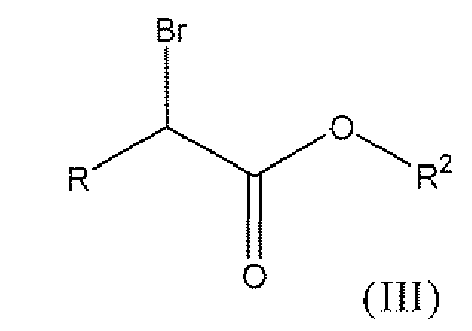
- The process of claim 1, having at least one of the following features:the metal alkoxide used in step (i) is selected from the group consisting of potassium methoxide, potassium ethoxide, potassium propoxide, potassium isopropoxide, potassium butoxide, potassium iso-butoxide, potassium tert-butoxide, sodium methoxide, sodium ethoxide, sodium propoxide, sodium isopropoxide, sodium butoxide, sodium iso-butoxide, sodium tert-butoxide and mixtures thereof;a molar ratio of the compound of the formula (II) to the metal alkoxide ranges from 1:0.8 to 1:1.2;the alcohol solvent used in step (i) is selected from the group consisting of methanol, ethanol, propanol, isopropanol, butanol, iso-butanol, tert-butanol and mixtures thereof;the amount of the alcohol solvent used ranges from 1 to 50 ml of the alcohol per gram of the compound of the formula (II);the reaction temperature in step (i) ranges from -10°C to 45°C;in step (ii), the concentration temperature is one required by atmospheric distillation of the alcohol solvent or vacuum distillation of the alcohol solvent;the aprotic solvent used in step (iii) is selected from the group consisting of tetrahydrofuran, dimethyl formamide, dimethyl sulfoxide, acetonitirle and mixtures thereof;the amount of the aprotic solvent used ranges from 1 to 30 ml, relative to one gram of the compound of the formula (II) used in step (i);the reaction temperature in step (iii) ranges from room temperature to reflux temperature;the reaction pressure in step (iii) ranges from normal pressure to 20 atm;in step (iii), the amount of the compound of the formula (III) used ranges from 0.8 to 1.2 moles, relative to one mole of the compound of the formula (II) used in step (i).
- The process of claim 2, having at least one of the following features:the metal alkoxide is potassium methoxide, potassium ethoxide or potassium tert-butoxide;the molar ratio of the compound of the formula (II) to the metal alkoxide ranges from 1:1 to 1:1.2;the alcohol solvent is selected from the group consisting of methanol, ethanol, tert-butanol and mixtures thereof;the amount of the alcohol solvent used ranges from 10 to 40 ml of the alcohol per gram of the compound of the formula (II);the reaction temperature in step (i) ranges from -5°C to 40°C; andthe aprotic solvent is selected from the group consisting of tetrahydrofuran, acetonitirle and mixtures thereof.
- The process of claim 3, having at least one of the following features:the metal alkoxide is potassium ethoxide;the alcohol solvent is ethanol;the amount of the alcohol solvent used ranges from 15 to 25 ml of the alcohol per gram of the compound of the formula (II);the molar ratio of the compound of the formula (II) to the metal alkoxide is 1:1;the reaction temperature in step (i) is room temperature;the aprotic solvent used in step (iii) is acetonitirle;the reaction temperature in step (iii) is reflux temperature;the reaction pressure in step (iii) is normal pressure; andin step (iii), the amount of the compound of the formula (III) used ranges from 1 to 1.2 moles, relative to one mole of the compound of the formula (II) used in step (i).
- The process of claim 1, wherein R1 and R2 are independently a C1 to C8 alkyl.
- The process of claim 1, wherein R1 and R2 are independently selected from the group consisting of methyl, ethyl, propyl, butyl and iso-butyl.
- The process of claim 1, wherein both R1 and R2 are ethyl.
- The process of claim 1, wherein R is independently isopropyl or iso-butyl.
- The process of claim 1, wherein a 2,3-diisopropyl-2-cyanosuccinate compound of the formula (IV) is prepared,

which process comprises the steps of:reacting a 3-methyl-2-cyanohutyrate of the formula (V) removing the alcohol solvent to afford a concentrate;reacting the above concentrate with a 2-bromoisopentanoate of the formula (VI) in an aprotic solvent, to form a 2,3-diisopropyl-2-cyanosuccinate compound of the formula (IV);wherein in the formulae (V) and (VI), R1 and R2 are as defined above for the formula (IV).
- The process of claim 9, wherein the potassium alkoxide compound used in step (i) is at least one of potassium methoxide, potassium ethoxide, potassium propoxide, potassium isopropoxide, potassium butoxide, potassium iso-butoxide and potassium tert-butoxide; a molar ratio of the compound of the formula (V) to the potassium alkoxide compound ranges from 1:0.8 to 1:1.2; the alcohol solvent used in step (i) is at least one of ethanol, ethanol, propanol, isopropanol, butanol, iso-butanol and tert-butanol; the amount of the alcohol solvent used ranges from 1 to 50 ml of alcohol per gram of the compound of the formula (V); the reaction temperature in step (i) ranges from -10°C to 45°C; the concentration temperature in step (ii) is one required by atmospheric distillation of the alcohol solvent or vacuum distillation of the alcohol solvent; the aprotic solvent used in step (iii) is tetrahydrofuran, dimethyl formamide, dimethyl sulfoxide or acetonitirle; the amount of the aprotic solvent used ranges from 1 to 30 ml, relative to one gram of the compound of the formula (V) used in step (i); the reaction temperature in step (iii) ranges from room temperature to reflux temperature; the reaction pressure in step (iii) ranges from normal pressure to 20 atm; and in step (iii), the amount of the compound of the formula (VI) ranges from 0.8 to 1.2 moles, relative to one mole of the compound of the formula (V) used in step (i).
- The process of claim 10, wherein the potassium alkoxide compound used in step (i) is potassium methoxide, potassium ethoxide or potassium tert-butoxide; the alcohol solvent used in step (i) is methanol, ethanol or tert-butanol; the amount of the alcohol solvent used ranges from 10 to 40 ml of alcohol per gram of the compound of the formula (V); the reaction temperature in step (i) ranges from -5°C to 40°C; and the aprotic solvent used in step (iii) is tetrahydrofuran or acetonitirle.
- A process for the preparation of a 2,3-di(non-linear-alkyl)succinic acid, comprising the step of:(i) obtaining a 2,3-di(non-linear-alkyl)-2-cyanosuccinate compound by the process of claim 1; and(ii) conducting hydrolysis and decarboxylation reaction in the presence of 60% to 90% sulfuric acid at a bath temperature of from 90°C to 180°C, to form a 2,3-di(non-linear-alkyl)succinic acid.
- A process for the preparation of a 2,3-di(non-linear-alkyl)succinate, comprising the step of:(i) obtaining a 2,3-di(non-linear-alkyl)-2-cyanosuccinate compound by the process of claim 1;(ii) conducting hydrolysis reaction and decarboxylation reaction in the presence of 60% to 90% sulfuric acid at a bath temperature of from 90°C to 180°C, to form a 2,3-di(non-linear-alkyl)succinic acid; and(iii) reacting the 2,3-di(non-linear-alkyl)succinic acid with an alcohol under an acidic condition, to obtain a 2,3-di(non-linear-alkyl)succinate, wherein the alcohol is selected from the group consisting of methanol, ethanol, propanol, isopropanol, butanol, iso-butanol and mixtures thereof; orreacting the 2,3-di(non-linear-alkyl)succinic acid with a haloalkane or a diester of sulfuric acid under a basic condition, to form a 2,3-di(non-linear-alkyl)succinate, wherein the haloalkane is selected from the group consisting of halomethane, haloethane, halopropane, haloisopropane, halobutane, haloisobutane and mixtures thereof, and the diester of sulfuric acid is selected from the group consisting of dimethyl sulfate, diethyl sulfate, dibutyl sulfate and mixtures thereof.
- The process of claim 1, wherein diethyl 2,3-di.isapropyl-2-cyanosuccinate is prepared, and said process is carried out as follows: absolute ethanol and metallic potassium are charged into a reactor R101., or potassium ethoxide and absolute ethanol are charged into the reactor R101, to prepare a solution of potassium ethoxide; ethyl 3-methyl-2-cyanobutyrate is charged into a reactor R102, and then the prepared solution of potassium ethoxide is added thereto at a temperature ranging from -10°C to 45°C; upon the completion of the reaction, the reaction mixture is transferred to a reactor R103 and the solvent is removed, then tetrahydrofuran or acetonitirle is added thereto, followed by the addition of ethyl 2-bromoisopentanoate, and then the reaction mixture is heated to reflux; upon the completion of the reaction, the solvent is removed again, the resultant mixture is transferred to a separator R104, water is added thereto to dissolve solids, and the mixture is extracted with diethyl ether or methyl tert-butyl ether; the extract liquor is passed through a drying column T101 so as to be dried, and then is fed to a separating column T102, where diethyl 2,3-diisopropyl-2-cyanosuccinate is separated.
- The process of claim 12, wherein 2,3-diisopropylsuccinic acid is obtained, and said process is carried out as follows: absolute ethanol and metallic potassium are charged into a reactor R101, or potassium ethoxide and absolute ethanol are charged into the reactor R101, to prepare a solution of potassium ethoxide; ethyl 3-methyl-2-cyanobutyrate is charged into a reactor R102, and then the prepared solution of potassium ethoxide is added thereto at a temperature ranging from -10°C to 45°C; upon the completion of the reaction, the reaction mixture is transferred to a reactor R103 and the solvent is removed, then tetrahydrofuran or acetonitirle is added thereto, followed by the addition of ethyl 2-bromoisopentanoate, and then the reaction mixture is heated to reflux; upon the completion of the reaction, the solvent is removed again, the resultant mixture is transferred to a separator R104, water is added thereto to dissolve solids, and the mixture is extracted with diethyl ether or methyl tert-butyl ether; the extract liquor is passed through a drying column T101 so as to be dried, and then is fed to a separating column T102, where diethyl 2,3-diisopropyl-2-cyanosuccinate is separated; the diethyl 2,3-diisopropyl-2-cyanosuccinate is added into a reactor R201, and a 60-90% aqueous solution of sulfuric acid is added dropwish thereto to conduct hydrolysis and decarboxylation reaction; upon the completion of the reaction, the reaction mixture is diluted with water and transferred to a separator R202 to be extracted with methyl tert-butyl ether; the obtained methyl tert-butyl ether extract liquor is charged into a reactor R203, and an aqueous solution of potassium hydroxide is added thereto; then the reaction mixture is transferred to a separator R204 to be separated; an aqueous layer separated is acidized with hydrochloric acid in a reactor R205 to obtain precipitates; the precipitates are centrifugally dried in a centrifuge C201, and then dried to afford 2,3-diisopropylsuccinic acid.
- The process of claim 13, wherein diethyl 2,3-diisopropylsuccinate is obtained, and said process are carried out as follows:(1) absolute ethanol and metallic potassium are charged into a reactor R101, or potassium ethoxide and absolute ethanol are charged into the reactor R101, to prepare a solution of potassium ethoxide; ethyl 3-methyl-2-cyanobutyrate is charged into a reactor R102, and then the prepared solution of potassium ethoxide is added thereto at a temperature ranging from -10°C to 45°C; upon the completion of the reaction, the reaction mixture is transferred to a reactor R103 and the solvent is removed, then tetrahydrofuran or acetonitirle is added thereto, followed by the addition of ethyl 2-bromoisopentanoate, and then the reaction mixture is heated to reflux; upon the completion of the reaction, the solvent is removed again, the resultant mixture is transferred to a separator R104, water is added thereto to dissolve solids, and the mixture is extracted with diethyl ether or methyl tert-butyl ether; the extract liquor is passed through a drying column T101 so as to be dried, and then is fed to a separating column T102, where diethyl 2,3-diisopropyl-2-cyanastaccinate is separated;(2) the diethyl 2,3-diisopropyl-2-cyanosuccinate is added into a reactor R201, and a 60-90% aqueous solution of sulfuric acid is added dropwish thereto to conduct hydrolysis and decarboxylation reaction; upon the completion of the reaction, the reaction mixture is diluted with water and transferred to a separator R202 to be extracted with methyl tert-butyl ether; the obtained methyl tert-butyl ether extract liquor is charged into a reactor R203, and an aqueous solution of potassium hydroxide is added thereto; then the reaction mixture is transferred to a separator R204 to be separated; an aqueous layer separated is acidized with hydrochloric acid in a reactor R205 to obtain precipitates; the precipitates are centrifugally dried in a centrifuge C201, and then dried to afford 2,3-diisopropylsuccinic acid;(3) the 2,3-diisopropylsuccinic acid and absolute ethanol are charged into a reactor R301, and a catalytic amount of sulfuric acid is added thereto to conduct esterification reaction; upon the completion of the reaction, the ethanol is removed, and methyl tert-butyl ether is added to the reaction mixture; the resultant mixture is transferred to a separator R302 and wished with an aqueous solution of sodium bicarbonate; the organic layer is passed through a drying column T301 so as to be dried, and then is fed to a reactor R303, where the solvent is removed to obtain a crude product; the obtained crude product is fed to a separator R304, wished there with an aqueous solution of potassium hydroxide, and extracted with methyl tert-butyl ether; the extract liquor is dried in a drying column T302, and then fed to a reactor R305, where the solvent is removed to afford diethyl 2,3-diisopropylsuccinate.
Applications Claiming Priority (2)
| Application Number | Priority Date | Filing Date | Title |
|---|---|---|---|
| CN200910077779.6A CN101811983B (en) | 2009-02-19 | 2009-02-19 | Preparation method of 2,3-diisopropyl-2-cyano diethyl succinate compound |
| PCT/CN2010/000202 WO2010094211A1 (en) | 2009-02-19 | 2010-02-12 | Process for preparing 2,3-di-non-straight-alkyl-2-cyano succinic acid diesters |
Publications (3)
| Publication Number | Publication Date |
|---|---|
| EP2399902A1 true EP2399902A1 (en) | 2011-12-28 |
| EP2399902A4 EP2399902A4 (en) | 2012-11-14 |
| EP2399902B1 EP2399902B1 (en) | 2014-11-26 |
Family
ID=42619370
Family Applications (1)
| Application Number | Title | Priority Date | Filing Date |
|---|---|---|---|
| EP10743392.2A Active EP2399902B1 (en) | 2009-02-19 | 2010-02-12 | Process for preparing 2,3-di-non-straight-alkyl-2-cyano succinic acid diesters |
Country Status (4)
| Country | Link |
|---|---|
| US (1) | US8669392B2 (en) |
| EP (1) | EP2399902B1 (en) |
| CN (1) | CN101811983B (en) |
| WO (1) | WO2010094211A1 (en) |
Cited By (1)
| Publication number | Priority date | Publication date | Assignee | Title |
|---|---|---|---|---|
| US9376513B2 (en) | 2011-01-19 | 2016-06-28 | China Petroleum & Chemical Corporation | Solid catalyst component and catalyst for olefin polymerization |
Families Citing this family (13)
| Publication number | Priority date | Publication date | Assignee | Title |
|---|---|---|---|---|
| US8541333B2 (en) | 2009-08-13 | 2013-09-24 | China Petroleum & Chemical Corporation | Catalyst component for olefin polymerization and a catalyst comprising the same |
| CN102603933B (en) * | 2011-01-19 | 2013-07-03 | 中国石油化工股份有限公司 | Solid catalyst component for olefin polymerization and catalyst |
| CN103857651B (en) * | 2011-08-29 | 2016-05-04 | 沙特基础工业公司 | For the preparation of the method for dibasic succinate |
| CN103145553B (en) * | 2013-03-06 | 2016-06-01 | 大连理工大学 | Synthesis and application of 2,3-hydrocarbyl substituted succinic acid diesters |
| CN104418770B (en) * | 2013-09-03 | 2016-03-30 | 中国石油化工股份有限公司 | A kind of preparation method of 2,3-bis-non-linear alkyl-2-cyano group succinate compound |
| CN106608841B (en) * | 2015-10-27 | 2018-06-12 | 中国石油化工股份有限公司 | The preparation method of 2- cyano -2,3- dialkyl succinic acid dialkyl ester class compounds |
| CN109111535B (en) * | 2017-06-23 | 2021-03-16 | 中国石油化工股份有限公司 | Catalyst component for olefin polymerization and catalyst thereof |
| CN113149823B (en) * | 2021-03-29 | 2023-12-08 | 上海青平药业有限公司 | 2-R 1 Process for preparing valeric acid |
| CN113200844A (en) * | 2021-03-29 | 2021-08-03 | 上海青平药业有限公司 | Preparation method of sodium valproate |
| CN116023543B (en) * | 2021-10-27 | 2024-08-02 | 中国石油化工股份有限公司 | Catalyst component for olefin polymerization, catalyst for olefin polymerization and application thereof |
| CN114276244B (en) * | 2021-10-29 | 2024-02-27 | 苏州汉酶生物技术有限公司 | Preparation method of carboxylic acid compounds and metal salt derivatives thereof |
| CN114394897B (en) * | 2022-01-25 | 2024-05-28 | 北京微量化学研究所 | Process for the preparation of esters in aqueous solvent systems |
| WO2024088244A1 (en) | 2022-10-24 | 2024-05-02 | 中国石油化工股份有限公司 | Catalyst component for olefin polymerization, preparation method therefor and use thereof |
Family Cites Families (3)
| Publication number | Priority date | Publication date | Assignee | Title |
|---|---|---|---|---|
| US4428887A (en) * | 1982-07-14 | 1984-01-31 | Monsanto Company | Method of producing mono-substituted terminal diesters |
| US4442298A (en) * | 1982-08-30 | 1984-04-10 | Monsanto Company | Chemical synthesis of ethylene/maleic anhydride dimer with phenylethyl end group |
| KR100700957B1 (en) * | 1999-04-15 | 2007-03-28 | 바셀 테크놀로지 컴퍼니 비.브이. | Components and Catalysts for Olefin Polymerization |
-
2009
- 2009-02-19 CN CN200910077779.6A patent/CN101811983B/en active Active
-
2010
- 2010-02-12 WO PCT/CN2010/000202 patent/WO2010094211A1/en not_active Ceased
- 2010-02-12 EP EP10743392.2A patent/EP2399902B1/en active Active
- 2010-02-12 US US13/202,282 patent/US8669392B2/en active Active
Cited By (1)
| Publication number | Priority date | Publication date | Assignee | Title |
|---|---|---|---|---|
| US9376513B2 (en) | 2011-01-19 | 2016-06-28 | China Petroleum & Chemical Corporation | Solid catalyst component and catalyst for olefin polymerization |
Also Published As
| Publication number | Publication date |
|---|---|
| US20120046490A1 (en) | 2012-02-23 |
| WO2010094211A1 (en) | 2010-08-26 |
| US8669392B2 (en) | 2014-03-11 |
| CN101811983A (en) | 2010-08-25 |
| EP2399902A4 (en) | 2012-11-14 |
| CN101811983B (en) | 2013-02-06 |
| EP2399902B1 (en) | 2014-11-26 |
Similar Documents
| Publication | Publication Date | Title |
|---|---|---|
| EP2399902B1 (en) | Process for preparing 2,3-di-non-straight-alkyl-2-cyano succinic acid diesters | |
| CN101811982B (en) | 2,3-diisopropyl-2.3-dicyano-diethyl succinate compound, preparation method and application thereof | |
| JP2014201545A (en) | METHOD OF MANUFACTURING 2-HYDROXYMETHYL-2,3-DIHYDRO-THIENO[3,4-b][1,4]DIOXIN-5,7-DICARBOXYLIC ACID DIALKYL ESTER | |
| CN112661639A (en) | Synthesis method of 4-acetylbutyrate compound | |
| DK169540B1 (en) | Process for the preparation of bis- (beta (3,5-dibutyl-4-hydroxybenzyl) methylcarboxyethyl) sulfide | |
| Hall et al. | Alkenes from alcohols by tandem hydrogen transfer and condensation | |
| US9732056B2 (en) | 2-(alkoxy or aryloxy carbonyl)-4-methyl-6-(2,6,6-trimethylcyclohex-1-enyl)hex-2-enoic acid compounds, its preparation and use | |
| RU2642069C2 (en) | New ester compound of alicyclic dicarboxylic acid and method of its production | |
| EP2882709B1 (en) | Transesterification process of retinol esters | |
| Son et al. | Functional group compatible palladium-catalyzed cross-coupling reactions between aryllithium and aryl halide mediated by a five-membered cyclic silyl ether | |
| WO2005089549A1 (en) | Use of epoxides as fungicides | |
| CN104447784B (en) | A kind of statins drug midbody and its preparation method and application | |
| Mohite et al. | An expedient stereoselective synthesis of (E)-α, β-unsaturated esters and thioesters using FeCl3· 6H2O | |
| Das et al. | ZrCl4 as an efficient catalyst for selective tosylation of alcohols with p-toluenesulfonic acid | |
| CN108675935B (en) | A kind of preparation method of 1,1-diarylalkane compounds | |
| CN104418770A (en) | Preparation method of 2,3-di-non-linear alkyl-2-cyan succinic acid diester compound | |
| KR20130076306A (en) | A method for preparing (meth)acrylic acid phenyl ester | |
| US5981792A (en) | Process for the production of 1-functional allylalcohol carboxylic esters | |
| CA2964818A1 (en) | Preparation of sorbate ester | |
| Szíjjártó et al. | Syntheses of fluorous propenes from 3-perfluoroalkyl-2-iodo-1-propanols | |
| EP1907349B1 (en) | Process for preparing racemic alkyl-5-halopent-4-enecarboxylic acids or -carboxylic esters | |
| Mohtat et al. | Ph3P catalyzed synthesis of alkyl 2-(4-oxopyridin-1 (4 H)-yl) acrylates by nucleophilic addition to alkyl propiolates | |
| JP2017071556A (en) | Process for producing prenyl carboxylates and prenols using oxovanadium complexes | |
| WO2018069457A1 (en) | Process for the manufacture of 2,6,10-trimethylundeca-5,9-dienal | |
| JP2024116315A (en) | Method for producing (meth)acrylic acid ester |
Legal Events
| Date | Code | Title | Description |
|---|---|---|---|
| PUAI | Public reference made under article 153(3) epc to a published international application that has entered the european phase |
Free format text: ORIGINAL CODE: 0009012 |
|
| 17P | Request for examination filed |
Effective date: 20110919 |
|
| AK | Designated contracting states |
Kind code of ref document: A1 Designated state(s): AT BE BG CH CY CZ DE DK EE ES FI FR GB GR HR HU IE IS IT LI LT LU LV MC MK MT NL NO PL PT RO SE SI SK SM TR |
|
| DAX | Request for extension of the european patent (deleted) | ||
| A4 | Supplementary search report drawn up and despatched |
Effective date: 20121016 |
|
| RIC1 | Information provided on ipc code assigned before grant |
Ipc: C07C 67/08 20060101ALI20121010BHEP Ipc: C07C 253/30 20060101AFI20121010BHEP Ipc: C07C 51/09 20060101ALI20121010BHEP |
|
| GRAP | Despatch of communication of intention to grant a patent |
Free format text: ORIGINAL CODE: EPIDOSNIGR1 |
|
| INTG | Intention to grant announced |
Effective date: 20140701 |
|
| GRAS | Grant fee paid |
Free format text: ORIGINAL CODE: EPIDOSNIGR3 |
|
| GRAA | (expected) grant |
Free format text: ORIGINAL CODE: 0009210 |
|
| AK | Designated contracting states |
Kind code of ref document: B1 Designated state(s): AT BE BG CH CY CZ DE DK EE ES FI FR GB GR HR HU IE IS IT LI LT LU LV MC MK MT NL NO PL PT RO SE SI SK SM TR |
|
| REG | Reference to a national code |
Ref country code: GB Ref legal event code: FG4D |
|
| REG | Reference to a national code |
Ref country code: CH Ref legal event code: EP |
|
| REG | Reference to a national code |
Ref country code: AT Ref legal event code: REF Ref document number: 698074 Country of ref document: AT Kind code of ref document: T Effective date: 20141215 |
|
| REG | Reference to a national code |
Ref country code: IE Ref legal event code: FG4D |
|
| REG | Reference to a national code |
Ref country code: DE Ref legal event code: R096 Ref document number: 602010020547 Country of ref document: DE Effective date: 20150108 |
|
| REG | Reference to a national code |
Ref country code: NL Ref legal event code: VDEP Effective date: 20141126 |
|
| REG | Reference to a national code |
Ref country code: LT Ref legal event code: MG4D |
|
| PG25 | Lapsed in a contracting state [announced via postgrant information from national office to epo] |
Ref country code: PT Free format text: LAPSE BECAUSE OF FAILURE TO SUBMIT A TRANSLATION OF THE DESCRIPTION OR TO PAY THE FEE WITHIN THE PRESCRIBED TIME-LIMIT Effective date: 20150326 Ref country code: NO Free format text: LAPSE BECAUSE OF FAILURE TO SUBMIT A TRANSLATION OF THE DESCRIPTION OR TO PAY THE FEE WITHIN THE PRESCRIBED TIME-LIMIT Effective date: 20150226 Ref country code: LT Free format text: LAPSE BECAUSE OF FAILURE TO SUBMIT A TRANSLATION OF THE DESCRIPTION OR TO PAY THE FEE WITHIN THE PRESCRIBED TIME-LIMIT Effective date: 20141126 Ref country code: IS Free format text: LAPSE BECAUSE OF FAILURE TO SUBMIT A TRANSLATION OF THE DESCRIPTION OR TO PAY THE FEE WITHIN THE PRESCRIBED TIME-LIMIT Effective date: 20150326 Ref country code: NL Free format text: LAPSE BECAUSE OF FAILURE TO SUBMIT A TRANSLATION OF THE DESCRIPTION OR TO PAY THE FEE WITHIN THE PRESCRIBED TIME-LIMIT Effective date: 20141126 Ref country code: FI Free format text: LAPSE BECAUSE OF FAILURE TO SUBMIT A TRANSLATION OF THE DESCRIPTION OR TO PAY THE FEE WITHIN THE PRESCRIBED TIME-LIMIT Effective date: 20141126 Ref country code: ES Free format text: LAPSE BECAUSE OF FAILURE TO SUBMIT A TRANSLATION OF THE DESCRIPTION OR TO PAY THE FEE WITHIN THE PRESCRIBED TIME-LIMIT Effective date: 20141126 |
|
| PG25 | Lapsed in a contracting state [announced via postgrant information from national office to epo] |
Ref country code: GR Free format text: LAPSE BECAUSE OF FAILURE TO SUBMIT A TRANSLATION OF THE DESCRIPTION OR TO PAY THE FEE WITHIN THE PRESCRIBED TIME-LIMIT Effective date: 20150227 Ref country code: CY Free format text: LAPSE BECAUSE OF FAILURE TO SUBMIT A TRANSLATION OF THE DESCRIPTION OR TO PAY THE FEE WITHIN THE PRESCRIBED TIME-LIMIT Effective date: 20141126 Ref country code: LV Free format text: LAPSE BECAUSE OF FAILURE TO SUBMIT A TRANSLATION OF THE DESCRIPTION OR TO PAY THE FEE WITHIN THE PRESCRIBED TIME-LIMIT Effective date: 20141126 Ref country code: SE Free format text: LAPSE BECAUSE OF FAILURE TO SUBMIT A TRANSLATION OF THE DESCRIPTION OR TO PAY THE FEE WITHIN THE PRESCRIBED TIME-LIMIT Effective date: 20141126 Ref country code: HR Free format text: LAPSE BECAUSE OF FAILURE TO SUBMIT A TRANSLATION OF THE DESCRIPTION OR TO PAY THE FEE WITHIN THE PRESCRIBED TIME-LIMIT Effective date: 20141126 |
|
| PG25 | Lapsed in a contracting state [announced via postgrant information from national office to epo] |
Ref country code: EE Free format text: LAPSE BECAUSE OF FAILURE TO SUBMIT A TRANSLATION OF THE DESCRIPTION OR TO PAY THE FEE WITHIN THE PRESCRIBED TIME-LIMIT Effective date: 20141126 Ref country code: CZ Free format text: LAPSE BECAUSE OF FAILURE TO SUBMIT A TRANSLATION OF THE DESCRIPTION OR TO PAY THE FEE WITHIN THE PRESCRIBED TIME-LIMIT Effective date: 20141126 Ref country code: SK Free format text: LAPSE BECAUSE OF FAILURE TO SUBMIT A TRANSLATION OF THE DESCRIPTION OR TO PAY THE FEE WITHIN THE PRESCRIBED TIME-LIMIT Effective date: 20141126 Ref country code: DK Free format text: LAPSE BECAUSE OF FAILURE TO SUBMIT A TRANSLATION OF THE DESCRIPTION OR TO PAY THE FEE WITHIN THE PRESCRIBED TIME-LIMIT Effective date: 20141126 Ref country code: RO Free format text: LAPSE BECAUSE OF FAILURE TO SUBMIT A TRANSLATION OF THE DESCRIPTION OR TO PAY THE FEE WITHIN THE PRESCRIBED TIME-LIMIT Effective date: 20141126 |
|
| REG | Reference to a national code |
Ref country code: DE Ref legal event code: R097 Ref document number: 602010020547 Country of ref document: DE |
|
| PG25 | Lapsed in a contracting state [announced via postgrant information from national office to epo] |
Ref country code: PL Free format text: LAPSE BECAUSE OF FAILURE TO SUBMIT A TRANSLATION OF THE DESCRIPTION OR TO PAY THE FEE WITHIN THE PRESCRIBED TIME-LIMIT Effective date: 20141126 |
|
| PG25 | Lapsed in a contracting state [announced via postgrant information from national office to epo] |
Ref country code: LU Free format text: LAPSE BECAUSE OF FAILURE TO SUBMIT A TRANSLATION OF THE DESCRIPTION OR TO PAY THE FEE WITHIN THE PRESCRIBED TIME-LIMIT Effective date: 20150212 |
|
| REG | Reference to a national code |
Ref country code: CH Ref legal event code: PL |
|
| PLBE | No opposition filed within time limit |
Free format text: ORIGINAL CODE: 0009261 |
|
| STAA | Information on the status of an ep patent application or granted ep patent |
Free format text: STATUS: NO OPPOSITION FILED WITHIN TIME LIMIT |
|
| GBPC | Gb: european patent ceased through non-payment of renewal fee |
Effective date: 20150226 |
|
| PG25 | Lapsed in a contracting state [announced via postgrant information from national office to epo] |
Ref country code: CH Free format text: LAPSE BECAUSE OF NON-PAYMENT OF DUE FEES Effective date: 20150228 Ref country code: LI Free format text: LAPSE BECAUSE OF NON-PAYMENT OF DUE FEES Effective date: 20150228 Ref country code: MC Free format text: LAPSE BECAUSE OF FAILURE TO SUBMIT A TRANSLATION OF THE DESCRIPTION OR TO PAY THE FEE WITHIN THE PRESCRIBED TIME-LIMIT Effective date: 20141126 |
|
| 26N | No opposition filed |
Effective date: 20150827 |
|
| REG | Reference to a national code |
Ref country code: IE Ref legal event code: MM4A |
|
| REG | Reference to a national code |
Ref country code: FR Ref legal event code: ST Effective date: 20151030 |
|
| PG25 | Lapsed in a contracting state [announced via postgrant information from national office to epo] |
Ref country code: GB Free format text: LAPSE BECAUSE OF NON-PAYMENT OF DUE FEES Effective date: 20150226 Ref country code: IE Free format text: LAPSE BECAUSE OF NON-PAYMENT OF DUE FEES Effective date: 20150212 |
|
| PG25 | Lapsed in a contracting state [announced via postgrant information from national office to epo] |
Ref country code: SI Free format text: LAPSE BECAUSE OF FAILURE TO SUBMIT A TRANSLATION OF THE DESCRIPTION OR TO PAY THE FEE WITHIN THE PRESCRIBED TIME-LIMIT Effective date: 20141126 Ref country code: FR Free format text: LAPSE BECAUSE OF NON-PAYMENT OF DUE FEES Effective date: 20150302 |
|
| REG | Reference to a national code |
Ref country code: AT Ref legal event code: UEP Ref document number: 698074 Country of ref document: AT Kind code of ref document: T Effective date: 20141126 |
|
| PG25 | Lapsed in a contracting state [announced via postgrant information from national office to epo] |
Ref country code: MT Free format text: LAPSE BECAUSE OF FAILURE TO SUBMIT A TRANSLATION OF THE DESCRIPTION OR TO PAY THE FEE WITHIN THE PRESCRIBED TIME-LIMIT Effective date: 20141126 |
|
| PG25 | Lapsed in a contracting state [announced via postgrant information from national office to epo] |
Ref country code: SM Free format text: LAPSE BECAUSE OF FAILURE TO SUBMIT A TRANSLATION OF THE DESCRIPTION OR TO PAY THE FEE WITHIN THE PRESCRIBED TIME-LIMIT Effective date: 20141126 Ref country code: BG Free format text: LAPSE BECAUSE OF FAILURE TO SUBMIT A TRANSLATION OF THE DESCRIPTION OR TO PAY THE FEE WITHIN THE PRESCRIBED TIME-LIMIT Effective date: 20141126 Ref country code: HU Free format text: LAPSE BECAUSE OF FAILURE TO SUBMIT A TRANSLATION OF THE DESCRIPTION OR TO PAY THE FEE WITHIN THE PRESCRIBED TIME-LIMIT; INVALID AB INITIO Effective date: 20100212 |
|
| PG25 | Lapsed in a contracting state [announced via postgrant information from national office to epo] |
Ref country code: TR Free format text: LAPSE BECAUSE OF FAILURE TO SUBMIT A TRANSLATION OF THE DESCRIPTION OR TO PAY THE FEE WITHIN THE PRESCRIBED TIME-LIMIT Effective date: 20141126 |
|
| PG25 | Lapsed in a contracting state [announced via postgrant information from national office to epo] |
Ref country code: BE Free format text: LAPSE BECAUSE OF FAILURE TO SUBMIT A TRANSLATION OF THE DESCRIPTION OR TO PAY THE FEE WITHIN THE PRESCRIBED TIME-LIMIT Effective date: 20141126 |
|
| PG25 | Lapsed in a contracting state [announced via postgrant information from national office to epo] |
Ref country code: MK Free format text: LAPSE BECAUSE OF FAILURE TO SUBMIT A TRANSLATION OF THE DESCRIPTION OR TO PAY THE FEE WITHIN THE PRESCRIBED TIME-LIMIT Effective date: 20141126 |
|
| P01 | Opt-out of the competence of the unified patent court (upc) registered |
Effective date: 20230502 |
|
| PGFP | Annual fee paid to national office [announced via postgrant information from national office to epo] |
Ref country code: DE Payment date: 20260121 Year of fee payment: 17 |
|
| PGFP | Annual fee paid to national office [announced via postgrant information from national office to epo] |
Ref country code: AT Payment date: 20260127 Year of fee payment: 17 |
|
| PGFP | Annual fee paid to national office [announced via postgrant information from national office to epo] |
Ref country code: IT Payment date: 20260128 Year of fee payment: 17 |