EP2397472A1 - A process for the preparation of a benzylbromide intermediates - Google Patents
A process for the preparation of a benzylbromide intermediates Download PDFInfo
- Publication number
- EP2397472A1 EP2397472A1 EP11156286.4A EP11156286A EP2397472A1 EP 2397472 A1 EP2397472 A1 EP 2397472A1 EP 11156286 A EP11156286 A EP 11156286A EP 2397472 A1 EP2397472 A1 EP 2397472A1
- Authority
- EP
- European Patent Office
- Prior art keywords
- bis
- structural formula
- anastrozole
- methylethyl
- cyano
- Prior art date
- Legal status (The legal status is an assumption and is not a legal conclusion. Google has not performed a legal analysis and makes no representation as to the accuracy of the status listed.)
- Withdrawn
Links
- 238000000034 method Methods 0.000 title claims abstract description 33
- 238000002360 preparation method Methods 0.000 title claims abstract description 13
- 239000000543 intermediate Substances 0.000 title description 10
- AGEZXYOZHKGVCM-UHFFFAOYSA-N benzyl bromide Chemical compound BrCC1=CC=CC=C1 AGEZXYOZHKGVCM-UHFFFAOYSA-N 0.000 title description 3
- IOCXELVDHLDNMQ-UHFFFAOYSA-N [2-ethoxy-5-(trifluoromethyl)phenyl]boronic acid Chemical compound CCOC1=CC=C(C(F)(F)F)C=C1B(O)O IOCXELVDHLDNMQ-UHFFFAOYSA-N 0.000 claims abstract description 48
- IHXHGCDOJLOZML-UHFFFAOYSA-N 2-[3-(bromomethyl)-5-(2-cyanopropan-2-yl)phenyl]-2-methylpropanenitrile Chemical compound N#CC(C)(C)C1=CC(CBr)=CC(C(C)(C)C#N)=C1 IHXHGCDOJLOZML-UHFFFAOYSA-N 0.000 claims abstract description 35
- -1 1-cyano-1-methylethyl Chemical group 0.000 claims abstract description 9
- 239000002904 solvent Substances 0.000 claims description 35
- KFZMGEQAYNKOFK-UHFFFAOYSA-N Isopropanol Chemical compound CC(C)O KFZMGEQAYNKOFK-UHFFFAOYSA-N 0.000 claims description 28
- XLYOFNOQVPJJNP-UHFFFAOYSA-N water Substances O XLYOFNOQVPJJNP-UHFFFAOYSA-N 0.000 claims description 21
- XDTMQSROBMDMFD-UHFFFAOYSA-N Cyclohexane Chemical compound C1CCCCC1 XDTMQSROBMDMFD-UHFFFAOYSA-N 0.000 claims description 20
- OKKJLVBELUTLKV-UHFFFAOYSA-N Methanol Chemical compound OC OKKJLVBELUTLKV-UHFFFAOYSA-N 0.000 claims description 18
- 229930195733 hydrocarbon Natural products 0.000 claims description 14
- 150000002430 hydrocarbons Chemical class 0.000 claims description 14
- LFQSCWFLJHTTHZ-UHFFFAOYSA-N Ethanol Chemical compound CCO LFQSCWFLJHTTHZ-UHFFFAOYSA-N 0.000 claims description 13
- 238000006243 chemical reaction Methods 0.000 claims description 13
- 239000004215 Carbon black (E152) Substances 0.000 claims description 9
- 239000000203 mixture Substances 0.000 claims description 8
- 150000001338 aliphatic hydrocarbons Chemical class 0.000 claims description 7
- 239000003153 chemical reaction reagent Substances 0.000 claims description 7
- PCLIMKBDDGJMGD-UHFFFAOYSA-N N-bromosuccinimide Chemical compound BrN1C(=O)CCC1=O PCLIMKBDDGJMGD-UHFFFAOYSA-N 0.000 claims description 6
- 239000004133 Sodium thiosulphate Substances 0.000 claims description 5
- 238000002425 crystallisation Methods 0.000 claims description 5
- 230000008025 crystallization Effects 0.000 claims description 5
- AKHNMLFCWUSKQB-UHFFFAOYSA-L sodium thiosulfate Chemical compound [Na+].[Na+].[O-]S([O-])(=O)=S AKHNMLFCWUSKQB-UHFFFAOYSA-L 0.000 claims description 5
- 235000019345 sodium thiosulphate Nutrition 0.000 claims description 5
- 150000001298 alcohols Chemical class 0.000 claims description 4
- 239000003054 catalyst Substances 0.000 claims description 4
- 150000002148 esters Chemical class 0.000 claims description 4
- 150000002576 ketones Chemical class 0.000 claims description 4
- 150000002825 nitriles Chemical class 0.000 claims description 4
- 238000010791 quenching Methods 0.000 claims description 4
- 230000000171 quenching effect Effects 0.000 claims description 4
- 239000012535 impurity Substances 0.000 abstract description 17
- YBBLVLTVTVSKRW-UHFFFAOYSA-N anastrozole Chemical compound N#CC(C)(C)C1=CC(C(C)(C#N)C)=CC(CN2N=CN=C2)=C1 YBBLVLTVTVSKRW-UHFFFAOYSA-N 0.000 description 62
- 229960002932 anastrozole Drugs 0.000 description 53
- AJUNARPIHUBZNV-UHFFFAOYSA-N 2-[3-(2-cyanopropan-2-yl)-5-(dibromomethyl)phenyl]-2-methylpropanenitrile Chemical compound N#CC(C)(C)C1=CC(C(Br)Br)=CC(C(C)(C)C#N)=C1 AJUNARPIHUBZNV-UHFFFAOYSA-N 0.000 description 25
- 239000000243 solution Substances 0.000 description 19
- XEKOWRVHYACXOJ-UHFFFAOYSA-N Ethyl acetate Chemical compound CCOC(C)=O XEKOWRVHYACXOJ-UHFFFAOYSA-N 0.000 description 18
- YXFVVABEGXRONW-UHFFFAOYSA-N Toluene Chemical compound CC1=CC=CC=C1 YXFVVABEGXRONW-UHFFFAOYSA-N 0.000 description 15
- 239000000047 product Substances 0.000 description 15
- 230000015572 biosynthetic process Effects 0.000 description 11
- 239000006227 byproduct Substances 0.000 description 11
- 239000003960 organic solvent Substances 0.000 description 11
- 238000000746 purification Methods 0.000 description 10
- 239000012265 solid product Substances 0.000 description 10
- HOOCNZFFYUBLMK-UHFFFAOYSA-N 2-[3-[(4-amino-1,5-dihydro-1,2,4-triazol-1-ium-1-yl)methyl]-5-(2-cyanopropan-2-yl)phenyl]-2-methylpropanenitrile;bromide Chemical compound [Br-].N#CC(C)(C)C1=CC(C(C)(C#N)C)=CC(C[NH+]2N=CN(N)C2)=C1 HOOCNZFFYUBLMK-UHFFFAOYSA-N 0.000 description 9
- 239000010410 layer Substances 0.000 description 9
- 150000003242 quaternary ammonium salts Chemical class 0.000 description 9
- FMCUPJKTGNBGEC-UHFFFAOYSA-N 1,2,4-triazol-4-amine Chemical compound NN1C=NN=C1 FMCUPJKTGNBGEC-UHFFFAOYSA-N 0.000 description 7
- 239000011541 reaction mixture Substances 0.000 description 7
- 238000005406 washing Methods 0.000 description 6
- 230000002378 acidificating effect Effects 0.000 description 5
- 238000004128 high performance liquid chromatography Methods 0.000 description 5
- 239000012452 mother liquor Substances 0.000 description 5
- 239000012044 organic layer Substances 0.000 description 5
- 239000007858 starting material Substances 0.000 description 5
- QGZKDVFQNNGYKY-UHFFFAOYSA-N Ammonia Chemical compound N QGZKDVFQNNGYKY-UHFFFAOYSA-N 0.000 description 4
- 239000012296 anti-solvent Substances 0.000 description 4
- LPXPTNMVRIOKMN-UHFFFAOYSA-M sodium nitrite Chemical compound [Na+].[O-]N=O LPXPTNMVRIOKMN-UHFFFAOYSA-M 0.000 description 4
- NSPMIYGKQJPBQR-UHFFFAOYSA-N 4H-1,2,4-triazole Chemical compound C=1N=CNN=1 NSPMIYGKQJPBQR-UHFFFAOYSA-N 0.000 description 3
- 230000000694 effects Effects 0.000 description 3
- 239000003270 steroid hormone Substances 0.000 description 3
- 238000003786 synthesis reaction Methods 0.000 description 3
- 102000014654 Aromatase Human genes 0.000 description 2
- 108010078554 Aromatase Proteins 0.000 description 2
- 206010006187 Breast cancer Diseases 0.000 description 2
- 206010028980 Neoplasm Diseases 0.000 description 2
- 239000002253 acid Substances 0.000 description 2
- 150000008043 acidic salts Chemical class 0.000 description 2
- 229910021529 ammonia Inorganic materials 0.000 description 2
- 150000004945 aromatic hydrocarbons Chemical class 0.000 description 2
- 238000005899 aromatization reaction Methods 0.000 description 2
- 238000009833 condensation Methods 0.000 description 2
- 230000005494 condensation Effects 0.000 description 2
- VRLDVERQJMEPIF-UHFFFAOYSA-N dbdmh Chemical compound CC1(C)N(Br)C(=O)N(Br)C1=O VRLDVERQJMEPIF-UHFFFAOYSA-N 0.000 description 2
- 125000000950 dibromo group Chemical group Br* 0.000 description 2
- 238000000605 extraction Methods 0.000 description 2
- 235000010288 sodium nitrite Nutrition 0.000 description 2
- 238000003756 stirring Methods 0.000 description 2
- BIIBYWQGRFWQKM-JVVROLKMSA-N (2S)-N-[4-(cyclopropylamino)-3,4-dioxo-1-[(3S)-2-oxopyrrolidin-3-yl]butan-2-yl]-2-[[(E)-3-(2,4-dichlorophenyl)prop-2-enoyl]amino]-4,4-dimethylpentanamide Chemical compound CC(C)(C)C[C@@H](C(NC(C[C@H](CCN1)C1=O)C(C(NC1CC1)=O)=O)=O)NC(/C=C/C(C=CC(Cl)=C1)=C1Cl)=O BIIBYWQGRFWQKM-JVVROLKMSA-N 0.000 description 1
- QIVUCLWGARAQIO-OLIXTKCUSA-N (3s)-n-[(3s,5s,6r)-6-methyl-2-oxo-1-(2,2,2-trifluoroethyl)-5-(2,3,6-trifluorophenyl)piperidin-3-yl]-2-oxospiro[1h-pyrrolo[2,3-b]pyridine-3,6'-5,7-dihydrocyclopenta[b]pyridine]-3'-carboxamide Chemical compound C1([C@H]2[C@H](N(C(=O)[C@@H](NC(=O)C=3C=C4C[C@]5(CC4=NC=3)C3=CC=CN=C3NC5=O)C2)CC(F)(F)F)C)=C(F)C=CC(F)=C1F QIVUCLWGARAQIO-OLIXTKCUSA-N 0.000 description 1
- OZAIFHULBGXAKX-UHFFFAOYSA-N 2-(2-cyanopropan-2-yldiazenyl)-2-methylpropanenitrile Chemical compound N#CC(C)(C)N=NC(C)(C)C#N OZAIFHULBGXAKX-UHFFFAOYSA-N 0.000 description 1
- OFUMROLKEGKJMS-UHFFFAOYSA-N 2-[2-(1,3-benzodioxol-5-yl)-3-[2-(cyclohexylamino)pyrimidin-4-yl]imidazol-4-yl]acetonitrile Chemical compound O1COC2=C1C=CC(=C2)C=1N(C(=CN=1)CC#N)C1=NC(=NC=C1)NC1CCCCC1 OFUMROLKEGKJMS-UHFFFAOYSA-N 0.000 description 1
- SJVGFKBLUYAEOK-SFHVURJKSA-N 6-[4-[(3S)-3-(3,5-difluorophenyl)-3,4-dihydropyrazole-2-carbonyl]piperidin-1-yl]pyrimidine-4-carbonitrile Chemical compound FC=1C=C(C=C(C=1)F)[C@@H]1CC=NN1C(=O)C1CCN(CC1)C1=CC(=NC=N1)C#N SJVGFKBLUYAEOK-SFHVURJKSA-N 0.000 description 1
- OZAIFHULBGXAKX-VAWYXSNFSA-N AIBN Substances N#CC(C)(C)\N=N\C(C)(C)C#N OZAIFHULBGXAKX-VAWYXSNFSA-N 0.000 description 1
- 208000026310 Breast neoplasm Diseases 0.000 description 1
- 102000004190 Enzymes Human genes 0.000 description 1
- 108090000790 Enzymes Proteins 0.000 description 1
- IOVCWXUNBOPUCH-UHFFFAOYSA-N Nitrous acid Chemical compound ON=O IOVCWXUNBOPUCH-UHFFFAOYSA-N 0.000 description 1
- XSQUKJJJFZCRTK-UHFFFAOYSA-N Urea Chemical compound NC(N)=O XSQUKJJJFZCRTK-UHFFFAOYSA-N 0.000 description 1
- 230000000118 anti-neoplastic effect Effects 0.000 description 1
- 239000007864 aqueous solution Substances 0.000 description 1
- 125000003118 aryl group Chemical group 0.000 description 1
- 230000031709 bromination Effects 0.000 description 1
- 238000005893 bromination reaction Methods 0.000 description 1
- 239000004202 carbamide Substances 0.000 description 1
- 150000001875 compounds Chemical class 0.000 description 1
- 239000012043 crude product Substances 0.000 description 1
- 230000001419 dependent effect Effects 0.000 description 1
- 239000000262 estrogen Substances 0.000 description 1
- IIEWJVIFRVWJOD-UHFFFAOYSA-N ethyl cyclohexane Natural products CCC1CCCCC1 IIEWJVIFRVWJOD-UHFFFAOYSA-N 0.000 description 1
- 238000001914 filtration Methods 0.000 description 1
- 231100001261 hazardous Toxicity 0.000 description 1
- LRDFRRGEGBBSRN-UHFFFAOYSA-N isobutyronitrile Chemical compound CC(C)C#N LRDFRRGEGBBSRN-UHFFFAOYSA-N 0.000 description 1
- 238000002955 isolation Methods 0.000 description 1
- 230000002503 metabolic effect Effects 0.000 description 1
- 230000004048 modification Effects 0.000 description 1
- 238000012986 modification Methods 0.000 description 1
- VOVZXURTCKPRDQ-CQSZACIVSA-N n-[4-[chloro(difluoro)methoxy]phenyl]-6-[(3r)-3-hydroxypyrrolidin-1-yl]-5-(1h-pyrazol-5-yl)pyridine-3-carboxamide Chemical compound C1[C@H](O)CCN1C1=NC=C(C(=O)NC=2C=CC(OC(F)(F)Cl)=CC=2)C=C1C1=CC=NN1 VOVZXURTCKPRDQ-CQSZACIVSA-N 0.000 description 1
- XULSCZPZVQIMFM-IPZQJPLYSA-N odevixibat Chemical compound C12=CC(SC)=C(OCC(=O)N[C@@H](C(=O)N[C@@H](CC)C(O)=O)C=3C=CC(O)=CC=3)C=C2S(=O)(=O)NC(CCCC)(CCCC)CN1C1=CC=CC=C1 XULSCZPZVQIMFM-IPZQJPLYSA-N 0.000 description 1
- 238000009806 oophorectomy Methods 0.000 description 1
- 239000012429 reaction media Substances 0.000 description 1
- 150000003839 salts Chemical group 0.000 description 1
- 238000000926 separation method Methods 0.000 description 1
- 239000007787 solid Substances 0.000 description 1
- 230000003637 steroidlike Effects 0.000 description 1
- 150000003431 steroids Chemical group 0.000 description 1
- KMIOJWCYOHBUJS-HAKPAVFJSA-N vorolanib Chemical compound C1N(C(=O)N(C)C)CC[C@@H]1NC(=O)C1=C(C)NC(\C=C/2C3=CC(F)=CC=C3NC\2=O)=C1C KMIOJWCYOHBUJS-HAKPAVFJSA-N 0.000 description 1
Classifications
-
- C—CHEMISTRY; METALLURGY
- C07—ORGANIC CHEMISTRY
- C07D—HETEROCYCLIC COMPOUNDS
- C07D249/00—Heterocyclic compounds containing five-membered rings having three nitrogen atoms as the only ring hetero atoms
- C07D249/02—Heterocyclic compounds containing five-membered rings having three nitrogen atoms as the only ring hetero atoms not condensed with other rings
- C07D249/08—1,2,4-Triazoles; Hydrogenated 1,2,4-triazoles
-
- C—CHEMISTRY; METALLURGY
- C07—ORGANIC CHEMISTRY
- C07C—ACYCLIC OR CARBOCYCLIC COMPOUNDS
- C07C253/00—Preparation of carboxylic acid nitriles
- C07C253/30—Preparation of carboxylic acid nitriles by reactions not involving the formation of cyano groups
Definitions
- the present invention relates to the process for the preparation of pure Anastrozole.
- Aromatase is an enzyme, which effects aromatisation of ring A in the metabolic formation of various steroid hormones.
- Various cancers for example breast cancer are dependent upon circulating steroid hormones, which have an aromatic ring A.
- Such cancers can be treated by removing the source of ring A aromatised steroid hormones, for example by the combination of oophorectomy and adrenalectomy.
- An alternative way of obtaining the same effect is by administering a chemical compound, which inhibits the aromatisation of the steroid ring A.
- Anastrozole is a non-steroidal antineoplastic, claimed to inhibit the aromatase (oestrogen synthase) activity. It is useful in the treatment of advanced breast cancer in postmenopausal women.
- Anastrozole Synthesis of Anastrozole is reported in Patent No. US 4,935,437 and European Patent Application No. EP 0,296,749 .
- the synthesis of Anastrozole is started from intermediate 2,2-(5-methyl-1,3-phenylene)-bis(2-methylpropionitrile) (1), which undergoes bromination to provide 3,5-bis-(1-cyano-1-methylethyl)benzylbromide (2) followed by condensation with 1,2,4-triazole (4) to form Anastrozole (5).
- Scheme - 1 Scheme 1
- the major problem with the synthesis of Anastrozole is the formation of regioisomer impurity in the said process.
- the regioisomer (6) which forms in 10-20% during the reaction of 3,5-bis-(1-cyano-1-methylethyl)benzylbromide (2) with 1,2,4-triazole (4), is removed by the purification by crystallization from suitable solvents with a major loss in yield of desired product.
- the main objective of the present invention relates to an improved process for the preparation of pure Anastrozole (5) free from impurities arises due to impure intermediate (2) contaminated with unreacted starting material (1) and dibrominated by-product 3,5-bis(1-cyano-1-methylethyt)- ⁇ , ⁇ -dibromotoluene (3).
- intermediate (2) is treated with 4-amino-1,2,4-triazole (7) to form quaternary ammonium salt (8), which further undergoes diazotisation reaction to give Anastrozole (5) free from any isomeric impurity.
- Anastrozole regioisomer (6) avoids the formation of Anastrozole regioisomer (6), but possibilities of other impurities still remain unaffected, which arise from impure intermediate (2) contaminated with unreacted starting material (1) and dibrominated by-product 3,5 -bis(1-cyano-1-methylethyl)- ⁇ , ⁇ -dibromotoluene (3).
- the present invention relates to an improved process for the preparation of pure Anastrozole (5) free from impurities arising due to impure intermediate (2) contaminated with unreacted starting material (1) and dibrominated by-product 3,5-bis(1-cyano-1-methylethyl)- ⁇ , ⁇ -dibromotoluene (3).
- Quaternary ammonium salt (Q.A.-salt) (8) on HPLC analysis shows excellent purity, but still contaminated with 2,2-(5-methyl-1,3-phenylene)-bis(2-methyl-propionitrile) (1) and unreacted 3,5-bis-(1-cyano-1-methylethyl)benzylbromide (2).
- HPLC analysis of mother liquor shows that majority of 2,2-(5-methyl-1,3-phenylene)-bis(2-methylpropionitrile) (1) and dibrominated by-product 3,5-bis(1-cyano-1-methylethyl)- ⁇ , ⁇ -dibromotoluene (3) are being removed in mother liquor.
- Anastrozole undergoes diazotisation reaction to give Anastrozole.
- an acidic salt of Anastrozole is prepared in between the process and other impurities are removed by washing acidic Anastrozole salt with an organic solvent.
- the acidic Anastrozole salt on further basifying and isolation in a suitable solvent affords Anastrozole, which is further purified using organic solvents preferably isopropanol, ethyl acetate or mixture of solvents preferably cyclohexane/ethyl acetate, cyclohexane/isopropanol or a mixture of solvents with water.
- organic solvents preferably isopropanol, ethyl acetate or mixture of solvents preferably cyclohexane/ethyl acetate, cyclohexane/isopropanol or a mixture of solvents with water.
- the present invention also relates to an improved and safe process for the preparation of 3,5-bis-(1-cyano-1-methylethyl)benzylbromide (2), which involves replacing hazardous chlorinated solvent with a safe and environmentally more friendly solvents as the reaction media.
- the preferred solvents for this purpose are selected from hydrocarbons, preferably aliphatic hydrocarbons, more preferably cyclic aliphatic hydrocarbons and most preferably cyclohexane.
- Another embodiment of the present invention relates to an improved process for the preparation of 3,5-bis-(1-cyatio-1-methylethyl)benzylbromide of structural formula (2) comprising:
- the present invention provides aprocess for the preparation of Anastrozole free from 2,2-(5-methyl-1,3-phenylene)-bis(2-methylpropionitrile) of structural formula (1) and 3,5-bis(1-cyano-1-methylethyl)-( ⁇ , ⁇ -dibromotoluene of structural formula (3) each of them preferably less than 0.1% and more preferably below quantitation limits, and all other known / unknown impurities less than 0.1 % comprising:
- the organic solvent in employed in step (b) is a hydrocarbon, preferably, aromatic hydrocarbon and more preferably toluene.
- the solvent empployed for extraction in step (c) comprises one or more water immiscible organic solvents.
- said solvents employed in the purification of Anastrozole in step (d) are selected from alcohols, ketones, nitriles, esters, hydrocarbons and water independently or mixture thereof.
- the present invention provides an improved process for the preparation of 3,5-bis-(1-cyano-1-methylethyl)benzylbromide of structural formula (2) comprising:
- said hydrocarbon employed in step (a) is preferably an aliphatic hydrocarbon and more preferably, a aliphatic cyclic hydrocarbon.
- the said aliphatic cyclic hydrocarbon is cyclohexane.
- the said brominating reagent used in operation (a) is preferably N-bromosuccinimide or 1,3-dibromo-5,5-dimethylhydantoin.
- said solvent employed in said crystallization is an alcohol preferably, a C 1 -C 10 and more preferably, methanol or isopropanol.
- reaction mass was cooled to 25 - 35 °C and washed with water (500 mL x 2) followed by washing with 2% aqueous solution of sodium thiosulphate (500 mL).
- Cyclohexane layer was separated and distilled under vacuum at 50-55 °C to get residue, which was crystallised from cyclohexane (250 mL) and further dried at 55 - 60 °C for 3 hours, to get crude product 52 gm, which on crystallization from methanol gave product (37 gm).
- HPLC-purity shows 3,5-bis-(1-cyano-1-methylethyl)benzyibromide ( 2 ) as product >80%, contaminated with unreacted 2,2-(5-methyl-,3-phenylene)-bis(2-methylpropionitrile) ( 1 ) ⁇ 15 % and dibrominated by-product 3,5-bis(1-cyano-1-methylethyl)- ⁇ , ⁇ -dibromotoluene (3) ⁇ 5%.
- reaction mixture was quenched by the addition of a solution of urea (4.5 g) in water (15 mL). Toluene (700 mL) was added to the reaction mixture and the heterogeneous solution was further cooled down to 0 - 5 °C. The solution was basified by the addition of liquor ammonia (365 mL) slowly in 4 hours at 5 - 25°C. Organic layer was separated and further washed with water (200 mL). Aqueous layer was removed and a solution of conc. HCl (140 mL) in water (140 mL) was added to the organic layer slowly in 30 minutes at 25 - 30 °C and reaction mass was heated at 60 - 65 °C for 30, minutes.
- the lower aqueous layer (280 - 300 mL) containing product was collected in a conical flask maintaining at 50°C.
- the aqueous part was again washed with toluene (700 mL) at 60 - 65 °C for 30 minutes.
- the lower aqueous layer, containing product was charged in a separating funnel and again washed with fresh toluene (700 mL).
- the aqueous layer, containing product was transferred in a R.B. flask and ethyl acetate (350 mL) was added to it.
- the heterogeneous solution was cooled to 0 - 5 °C basified by the slow addition of liquor ammonia (280 mL) in 2 - 3 hours at 5 - 25 °C.
- the solution was stirred for one hour at 25 - 35 °C, and the upper organic layer (360 - 375 mL) containing product was separated and filtered through hyflow super cell bed.
- Solvent was distilled out below 50 °C under vacuum leaving approximately 100 mL ethyl acetate in the flask.
- the content of the flask was cooled down to 25 - 35 °C and cyclohexane (500 mL) was added to the solution slowly in 30 minutes.
- Anastrozole (32 g) from example - 3 was dissolved completely in ethyl acetate (64 mL) at 35 - 40 °C. The solution was cooled down to 25 - 35 °C and cyclohexane (320 mL) was added slowly to the solution under stirring in 1 hour. The solution was further stirred at 25 - 35 °C for 2 hours, and the precipitated solid product was filtered, washed with fresh cyclohexane (15 mL x 2) at 25 - 35 °C. The solid product was dried at 50 °C, till LOD was less than 0.5 %. Weight of dry Anastrozole: 30 g. HPLC-purity : not less than 99.5%.
- Anastrozole (110 g) from example - 3 was dissolved in isopropanol (330 mL) at 45 - 50 °C. The solution was cooled down to 25 - 35 °C and cyclohexane (330 mL) was added drop wise in 30 minutes. The solution was stirred at 25 - 35 °C for 2 hours; the precipitated solid product was filtered and washed with fresh cyclohexane (30 mL x 2) and dried at 50 °C to get 92 g of pure Anastrozole. HPLC-purity: not less than 99.5%.
- Anastrozole (5 g) from example - 3 was dissolved in ethanol (10 mL) at 45 - 50 °C. The solution was cooled down to 25 - 35 °C and cyclohexane (50 mL) was added drop wise in 30 minutes. The solution was stirred at 25 - 35 °C for 2 hours; the precipitated solid product was filtered and washed with fresh cyclohexane (5 mL x 2) and dried at 50 °C to get 4.0 g of pure Anastrozole. HPLC-purity: not less than 99:5%.
- Anastrozole (5 g) from example - 3 was dissolved in isopropanol (20 mL) at 50 - 55 °C. The solution was cooled down to 5 - 10 °C and stirred for 2 hours; the precipitated solid product was filtered and washed with chilled fresh isopropanol (5 mL) and dried at 50 °C to get 4.5 g of pure Anastrozole. HPLC-purity: not less than 99.5%.
- Anastrozole (5 g) from example - 3 was dissolved in ethanol (5 mL) and water (40 mL) at 50 - 55 °C. The solution was cooled down to 25 - 35 °C and stirred for 1 hour; the precipitated solid product was filtered and dried at 50 °C to get 4.5 g of pure Anastrozole. HPLC-purity: not less than 99.5%.
Landscapes
- Chemical & Material Sciences (AREA)
- Organic Chemistry (AREA)
- Chemical Kinetics & Catalysis (AREA)
- Organic Low-Molecular-Weight Compounds And Preparation Thereof (AREA)
- Plural Heterocyclic Compounds (AREA)
Abstract
Description
- The present invention relates to the process for the preparation of pure Anastrozole.
- Aromatase is an enzyme, which effects aromatisation of ring A in the metabolic formation of various steroid hormones. Various cancers for example breast cancer are dependent upon circulating steroid hormones, which have an aromatic ring A. Such cancers can be treated by removing the source of ring A aromatised steroid hormones, for example by the combination of oophorectomy and adrenalectomy. An alternative way of obtaining the same effect is by administering a chemical compound, which inhibits the aromatisation of the steroid ring A.
- Anastrozole is a non-steroidal antineoplastic, claimed to inhibit the aromatase (oestrogen synthase) activity. It is useful in the treatment of advanced breast cancer in postmenopausal women.
- Synthesis of Anastrozole is reported in Patent No.
US 4,935,437 and European Patent Application No.EP 0,296,749 . In the above patents the synthesis of Anastrozole is started from intermediate 2,2-(5-methyl-1,3-phenylene)-bis(2-methylpropionitrile) (1), which undergoes bromination to provide 3,5-bis-(1-cyano-1-methylethyl)benzylbromide (2) followed by condensation with 1,2,4-triazole (4) to form Anastrozole (5). (Scheme - 1)
- The major problem with the synthesis of Anastrozole is the formation of regioisomer impurity in the said process. The regioisomer (6), which forms in 10-20% during the reaction of 3,5-bis-(1-cyano-1-methylethyl)benzylbromide (2) with 1,2,4-triazole (4), is removed by the purification by crystallization from suitable solvents with a major loss in yield of desired product.
- To overcome the formation of regioisomer (6), another synthetic route is reported in
US Patent No. 4,935,437 ; in which intermediate (2) is reacted with 4-amino-1,2,4-triazole (7) to form quaternary ammonium salt (8), which further undergoes diazotisation reaction to give Anastrozole (5) free from any isomeric impurity (Scheme - 2). This process avoids the formation of Anastrozole regioisomer (6), but possibilities of other impurities remain same, which arise from impure intermediate (2) contaminated with unreacted starting material (1) and dibrominated by-product 3,5-bis(1-cyano-1-methylethyl)-α,α,-dibromotoluene (3). Thus the main objective of the present invention relates to an improved process for the preparation of pure Anastrozole (5) free from impurities arises due to impure intermediate (2) contaminated with unreacted starting material (1) and dibrominated by-product 3,5-bis(1-cyano-1-methylethyt)-α,α-dibromotoluene (3).
- To avoid the formation of regioisomer (6) during the formation of Anastrozole (5); intermediate (2) is treated with 4-amino-1,2,4-triazole (7) to form quaternary ammonium salt (8), which further undergoes diazotisation reaction to give Anastrozole (5) free from any isomeric impurity.
- The said process avoids the formation of Anastrozole regioisomer (6), but possibilities of other impurities still remain unaffected, which arise from impure intermediate (2) contaminated with unreacted starting material (1) and dibrominated by-product 3,5 -bis(1-cyano-1-methylethyl)-α,α-dibromotoluene (3).
- The present invention relates to an improved process for the preparation of pure Anastrozole (5) free from impurities arising due to impure intermediate (2) contaminated with unreacted starting material (1) and dibrominated by-product 3,5-bis(1-cyano-1-methylethyl)-α,α-dibromotoluene (3).
- Intermediate (2) of more than 80 % HPLC purity contaminated with dibrominated by-product 3,5-bis(1-cyano-1-methylethyl)-α,α-dibromotoluene (3) less than 5% and unreacted starting material 2,2-(5-methyl-1,3-phenylene)-bis(2-methylpropionitrile) (1) less than 15 %, undergoes condensation with 4-amino-1,2,4-triazole (7) in a suitable solvent to give 4-Amino-1-[3,5-bis-(1-cyano-1-methylethyl)benzyl]-1H-[1,2,4]triazolium bromide (Q.A.-salt) (8) in good yield. Quaternary ammonium salt (Q.A.-salt) (8) on HPLC analysis shows excellent purity, but still contaminated with 2,2-(5-methyl-1,3-phenylene)-bis(2-methyl-propionitrile) (1) and unreacted 3,5-bis-(1-cyano-1-methylethyl)benzylbromide (2). However, HPLC analysis of mother liquor shows that majority of 2,2-(5-methyl-1,3-phenylene)-bis(2-methylpropionitrile) (1) and dibrominated by-product 3,5-bis(1-cyano-1-methylethyl)-α,α-dibromotoluene (3) are being removed in mother liquor. These results reveal the separations of major part of above impurities in mother liquor during the filtration of Q.A.-salt, but still some extent of related impurities are observed in the HPLC analysis of Q.A.-salt.
- Further the Q.A.-salt undergoes diazotisation reaction to give Anastrozole. During the said process, an acidic salt of Anastrozole is prepared in between the process and other impurities are removed by washing acidic Anastrozole salt with an organic solvent. The acidic Anastrozole salt on further basifying and isolation in a suitable solvent affords Anastrozole, which is further purified using organic solvents preferably isopropanol, ethyl acetate or mixture of solvents preferably cyclohexane/ethyl acetate, cyclohexane/isopropanol or a mixture of solvents with water. Thus another embodiment of the present invention relates to the process for the preparation of Anastrozole comprising:
- a) reacting brominated product 3,5-bis-(1-cyano-1-methylethyl)benzylbromide of structural formula (2) contaminated with 2,2-(5-methyl-1,3-phenylene)-bis(2-methylpropionitrile) of structural formula (1) and 3,5-bis(1-cyano-1-methylethyl)-α,α-dibromotoluene of structural formula (3) with 4-amino-1,2,4-triazole (7) to get quaternary ammonium salt of structural formula (8),
- b) reacting quaternary salt of structural formula (8) with sodium nitrite in presence of an acid,
- c) decomposing the excess of nitrous acid,
- d) adding an organic solvent to the reaction mixture,
- e) basifying the reaction mixture,
- f) extracting product in organic layer,
- g) adding an acid and water to the solvent layer and extracting product in aqueous layer as acidic salt removing 2,2-(5-methyl-1,3-phenylene)-bis(2-methylpropionitrile) of structural formula (1) and 3,5-bis(1-cyano-1-methylethyl)-α,α-dibromotoluene of structural formula (3),
- h) washing organic layer with water,
- i) basifying aqueous layer with a suitable base,
- j) extracting product in an organic solvent,
- k) isolating Anastrozole which is completely free from 2,2-(5-methyl-1,3-phenylene)-bis(2-methylpropionitrile) of structural formula (1) and 3,5-bis(1-cyano-1-methylethyl)-α,α-dibramotoluene of structural formula (3) and
- l) purifying Anastrozole in a suitable solvent selected from alcohols, ketones, nitriles, esters, hydrocarbons and water either independently or mixture thereof to get all other known / unknown impurities less than 0. 1%.
- During the formation of Q.A.-salt (8), on reaction of intermediate (2) with 4-amino-1,2,4-triazole (7), 2,2-(5-methyl-1,3-phenylene)-bis(2-methylpropionitrile) (1) and dibrominated by-product (3) remain unreacted. HPLC analysis of mother liquor shows the presence of 2,2-(5-methyl-1,3-phenylene)-bis(2-methylpropionitrile) (1) and dibrominated by-product (3) in mother liquor. However, some extents of these two impurities are also observed in the Q.A.-salt (8), which are removed by washing of acidic aqueous layer of Anastrozole with suitable organic solvent.
- The present invention also relates to an improved and safe process for the preparation of 3,5-bis-(1-cyano-1-methylethyl)benzylbromide (2), which involves replacing hazardous chlorinated solvent with a safe and environmentally more friendly solvents as the reaction media. The preferred solvents for this purpose are selected from hydrocarbons, preferably aliphatic hydrocarbons, more preferably cyclic aliphatic hydrocarbons and most preferably cyclohexane. Thus another embodiment of the present invention relates to an improved process for the preparation of 3,5-bis-(1-cyatio-1-methylethyl)benzylbromide of structural formula (2) comprising:
- a) reacting 2,2-(5-methyl-1,3-phenylene)-bis(2-methylpropionitrile) of structural formula (1) with a brominating reagent in the presence of a catalyst, in the presence of an organic solvent preferably a hydrocarbon and more preferably an aliphatic hydrocarbon,
- b) quenching reaction with sodium thiosulphate,
- c) removing organic solvent,
- d) isolating 3,5-bis-(1-cyano-1-methylethyl)benzylbromide of structural formula (2) contaminated with 2,2-(5-methyl-1,3-phenylene)-bis(2-methylpropionitrile) of structural formula (1) and 3,5-bis(1-cyano-1-methylethyl)-(α,α-dibromotoluene of structural formula (3),
- e) crystallising the product from suitable solvents.
- Accordingly, the present invention provides aprocess for the preparation of Anastrozole free from 2,2-(5-methyl-1,3-phenylene)-bis(2-methylpropionitrile) of structural formula (1) and 3,5-bis(1-cyano-1-methylethyl)-(α,α-dibromotoluene of structural formula (3)
each of them preferably less than 0.1% and more preferably below quantitation limits, and all other known / unknown impurities less than 0.1 % comprising: - a) isolating Q.A-salt of structural formula (8)
substantially free from 2,2-(5-methyl-1,3-phenylene)-bis(2-methylpropionitrile) of structural formula (1) and 3,5-bis(1-cyano-1-methylethyl)-α,α-dibromotoluene of structural formula (3), - b) removing remaining 2,2-(5-methyl-1,3-phenylene)-bis(2-methylpropionitrile) of structural formula (1) and dibromo by-product of structural formula (3) from Anastrozole at acidic pH by washing with a suitable solvent,
- c) isolating Anastrozole completely free from 2,2-(5-methyl-1,3-phenylene)-bis(2-methylpropionitrile) of structural formula (1) and 3,5-bis(1-cyano-1-methylethyl)-α,α-dibromotoluene of structural formula (3) at basic pH in the presence of a suitable solvent of the kind such as hereinbefore described and optionally adding an anti-solvent of the kind such as hereinbefore described,
- d) purifying Anastrozole in the presence of suitable solvents independently or mixture thereof, optionally using an anti-solvents to get all other known / unknown impurities less than 0.1%.
- Preferably, the organic solvent in employed in step (b) is a hydrocarbon, preferably, aromatic hydrocarbon and more preferably toluene.
- In another preferred feature, the solvent empployed for extraction in step (c) comprises one or more water immiscible organic solvents.
- In another preferred feature, said solvents employed in the purification of Anastrozole in step (d) are selected from alcohols, ketones, nitriles, esters, hydrocarbons and water independently or mixture thereof.
- In another embodiment, the present invention provides an improved process for the preparation of 3,5-bis-(1-cyano-1-methylethyl)benzylbromide of structural formula (2) comprising:
- a) reacting 2,2-(5-methyl-1,3-phenylene)-bis(2-methyl-propionitrile) of structural formula (1) with a brominating reagent in the presence of a catalyst, in a suitable solvent preferably a hydrocarbon,
- b) quenching reaction with sodium thiosulphate,
- c) removing solvent and isolating said 3,5-bis-(1-cyano-1-methylethyl)benzylbromide of structural formula (2) contaminated with said 2,2-(5-methyl-1,3-phenylene)-bis(2-methylpropionitrile) of structural formula (1) and 3,5-bis(1-cyano-1-methylethyl)-(α,α-dibromotoluene of structural formula (3),
and - d) crystallising the product in the presence of a suitable solvent of the kind such as hereinbefore described.
- In another preferred feature, said hydrocarbon employed in step (a) is preferably an aliphatic hydrocarbon and more preferably, a aliphatic cyclic hydrocarbon.
- In another preferred feature, the said aliphatic cyclic hydrocarbon is cyclohexane.
- In another preferred feature, the said brominating reagent used in operation (a) is preferably N-bromosuccinimide or 1,3-dibromo-5,5-dimethylhydantoin.
- In another preferred feature, said solvent employed in said crystallization is an alcohol preferably, a C1-C10 and more preferably, methanol or isopropanol.
- The present invention will now be described with reference to the following non-limiting examples which are merely for the purposes of illustrating the invention. It will be apparent to a person skilled in the art that various modifications may be possible within the present invention without departing from the scope thereof.
- In a 5 L R. B. Flask, fitted with double surface condenser and thermometer pocket on a water bath cyclohexane (1.5 L), 2,2-(5-methyl-1,3-phenylene)-bis(2-methylpropionitrile) (1) (50 g), 2,2-Azo-bis(isobutyronitrile) (AIBN) (2 g) and 1,3-dibromo-5,5-dimethylhydantoin (130 g) were charged at 25 - 35 °C. The reaction mixture was heated at 80 - 85 °C with vigorous stirring for 4 hours. The reaction mass was cooled to 25 - 35 °C and washed with water (500 mL x 2) followed by washing with 2% aqueous solution of sodium thiosulphate (500 mL). Cyclohexane layer was separated and distilled under vacuum at 50-55 °C to get residue, which was crystallised from cyclohexane (250 mL) and further dried at 55 - 60 °C for 3 hours, to get crude product 52 gm, which on crystallization from methanol gave product (37 gm). HPLC-purity shows 3,5-bis-(1-cyano-1-methylethyl)benzyibromide (2) as product >80%, contaminated with unreacted 2,2-(5-methyl-,3-phenylene)-bis(2-methylpropionitrile) (1) <15 % and dibrominated by-product 3,5-bis(1-cyano-1-methylethyl)-α,α-dibromotoluene (3) < 5%.
- Isopropanol (1.5 L), 3,5-bis-(1-cyano-1-methylethyl)benzylbromide (2) (100 g) and 4-amino-1,2,4-triazole (22.5 g) were charged in a flask at room temperature. The reaction mass was heated at 80 - 85 °C for next 5 hours. The reaction mass was further cooled down to room temperature and stirred for next one hour at 25 - 35 °C. The precipitated solid QA-salt was filtered and washed with fresh isopropanol (100 mL x 2). The Q.A.-salt was dried at 60 - 70 °C till LOD is less than 1.0 %, giving solid product (74.4 g). m.p.: 198 - 200 °C.
- 4-Amino-1-[3,5-bis-(1-cyano-1-methylethyl)benzyl]-1H-[1,2,4]triazolium bromide (8) (70 g) was dissolved in conc. HCl (280 mL) in a 5 L R.B. flask and cooled to -5 °C. A solution of sodium nitrite (15 g) in water (70 mL) was slowly added to the reaction mixture at 0 - 5 °C in 4 hrs and the reaction mixture was stirred for one hour at 0 - 5 °C and further at 10 - 20 °C for next 3 hours. The reaction mixture was quenched by the addition of a solution of urea (4.5 g) in water (15 mL). Toluene (700 mL) was added to the reaction mixture and the heterogeneous solution was further cooled down to 0 - 5 °C. The solution was basified by the addition of liquor ammonia (365 mL) slowly in 4 hours at 5 - 25°C. Organic layer was separated and further washed with water (200 mL). Aqueous layer was removed and a solution of conc. HCl (140 mL) in water (140 mL) was added to the organic layer slowly in 30 minutes at 25 - 30 °C and reaction mass was heated at 60 - 65 °C for 30, minutes. The lower aqueous layer (280 - 300 mL) containing product was collected in a conical flask maintaining at 50°C. The aqueous part was again washed with toluene (700 mL) at 60 - 65 °C for 30 minutes. The lower aqueous layer, containing product was charged in a separating funnel and again washed with fresh toluene (700 mL). The aqueous layer, containing product was transferred in a R.B. flask and ethyl acetate (350 mL) was added to it. The heterogeneous solution was cooled to 0 - 5 °C basified by the slow addition of liquor ammonia (280 mL) in 2 - 3 hours at 5 - 25 °C. The solution was stirred for one hour at 25 - 35 °C, and the upper organic layer (360 - 375 mL) containing product was separated and filtered through hyflow super cell bed. Solvent was distilled out below 50 °C under vacuum leaving approximately 100 mL ethyl acetate in the flask. The content of the flask was cooled down to 25 - 35 °C and cyclohexane (500 mL) was added to the solution slowly in 30 minutes. The precipitated solid product was filtered and washed with fresh cyclohexane (20 mL x 2). The product was dried at 45 - 50 °C till LOD was less than 1.0 % to get Anastrozole (44 g). HPLC-purity: not less than 98%.
- In a R.B. flask Anastrozole (32 g) from example - 3 was dissolved completely in ethyl acetate (64 mL) at 35 - 40 °C. The solution was cooled down to 25 - 35 °C and cyclohexane (320 mL) was added slowly to the solution under stirring in 1 hour. The solution was further stirred at 25 - 35 °C for 2 hours, and the precipitated solid product was filtered, washed with fresh cyclohexane (15 mL x 2) at 25 - 35 °C. The solid product was dried at 50 °C, till LOD was less than 0.5 %. Weight of dry Anastrozole: 30 g. HPLC-purity : not less than 99.5%.
- Anastrozole (110 g) from example - 3 was dissolved in isopropanol (330 mL) at 45 - 50 °C. The solution was cooled down to 25 - 35 °C and cyclohexane (330 mL) was added drop wise in 30 minutes. The solution was stirred at 25 - 35 °C for 2 hours; the precipitated solid product was filtered and washed with fresh cyclohexane (30 mL x 2) and dried at 50 °C to get 92 g of pure Anastrozole. HPLC-purity: not less than 99.5%.
- Anastrozole (5 g) from example - 3 was dissolved in ethanol (10 mL) at 45 - 50 °C. The solution was cooled down to 25 - 35 °C and cyclohexane (50 mL) was added drop wise in 30 minutes. The solution was stirred at 25 - 35 °C for 2 hours; the precipitated solid product was filtered and washed with fresh cyclohexane (5 mL x 2) and dried at 50 °C to get 4.0 g of pure Anastrozole. HPLC-purity: not less than 99:5%.
- Anastrozole (5 g) from example - 3 was dissolved in isopropanol (20 mL) at 50 - 55 °C. The solution was cooled down to 5 - 10 °C and stirred for 2 hours; the precipitated solid product was filtered and washed with chilled fresh isopropanol (5 mL) and dried at 50 °C to get 4.5 g of pure Anastrozole. HPLC-purity: not less than 99.5%.
- Anastrozole (5 g) from example - 3 was dissolved in isopropanol (5 mL) and water (20 mL) at 65 - 70 °C. The solution was cooled down to 25 - 35 °C and stirred for 1 hour; the precipitated solid product was filtered and dried at 50 °C to get 4.5 g of pure Anastrozole. HPLC-purity: not less than 99.5%.
- Anastrozole (5 g) from example - 3 was dissolved in ethanol (5 mL) and water (40 mL) at 50 - 55 °C. The solution was cooled down to 25 - 35 °C and stirred for 1 hour; the precipitated solid product was filtered and dried at 50 °C to get 4.5 g of pure Anastrozole. HPLC-purity: not less than 99.5%.
- Anastrozole (5 g) from example - 3 was dissolved in methanol (5 mL) and water (20 mL) at 50 - 55 °C. The solution was cooled down to 25 - 35 °C stirred for 2 hours; the precipitated solid product was filtered and dried at 50 °C to get 4.5 g of pure Anastrozole. HPLC-purity: not less than 99.5%.
- The following constitute particularly preferred numbered embodiments of the present invention:
- Numbered Embodiment 1. A process for the preparation of Anastrozole free from 2,2-(5-methyl-1,3- phenylene)-bis(2-methylpropionitrile) of structural formula (1)


- a) isolating Q.A-salt of structural formula (8)

- b) removing remaining 2,2-(5-methyl-1,3-phenylene)-bis(2-methylpropio nitrile) of structural formula (1) and dibromo by-product of structural formula (3) from Anastrozole at acidic pH by washing with a suitable solvent,
- c) isolating Anastrozole completely free from 2,2-(5-methyl-1,3-phenylene)- bis(2-methylpropionitrile) of structural formula (1) and 3,5-bis(1-cyano-1-methylethyl)-α,α-dibrotnotoluene of structural formula (3) at basic pH in the presence of a suitable solvent of the kind such as hereinbefore described and optionally adding an anti-solvent of the kind such as hereinbefore described
- d) purifying Anastrozole in the presence of suitable solvents independently or mixture thereof, optionally using an anti-solvents to get all other known / unknown impurities less than 0.1%.
- a) isolating Q.A-salt of structural formula (8)
- Numbered Embodiment 2. A process Numbered Embodiment 1 wherein the organic solvent in employed in step (b) is a hydrocarbon, preferably, aromatic hydrocarbon and more preferably toluene.
- Numbered Embodiment 3. A process according to Numbered Embodiment 1 or 2 wherein the solvent used for extraction in step (c) comprises one or more water immiscible organic solvents.
- Numbered Embodiment 4. A process according to any preceding Numbered Embodiment wherein said solvents employed in the purification of Anastrozole in step (d) are selected from alcohols, ketones, nitriles, esters, hydrocarbons and water independently or mixture thereof.
- Numbered Embodiment 5. An improved process for the preparation of 3,5-bis-(1-cyano-1-methylethyl)benzylbromide of structural formula (2) comprising:

- a) reacting 2,2-(5-methyl-1,3-phenylene)-bis(2-methyl-propionitrile) of structural formula (1) with a brominating reagent in the presence of a catalyst, in a suitable solvent preferably a hydrocarbon,
- b) quenching reaction with sodium thiosulphate,
- c) removing solvent and isolating said 3,5-bis-(1-cyano-1-methylethyl) benzylbromide of structural formula (2) contaminated with said 2,2-(5-methyl-1,3-phenylene)-bis(2-methylpropionitrile) of structural formula (1) and 3,5-bis(1-cyano-1-methylethyl)-α,α-diibromotoluene of structural formula (3),

- d) crystallising the product in the presence of a suitable solvent of the kind such as hereinbefore described.
- Numbered Embodiment 6. A process according to Numbered Embodiment 5 wherein the said hydrocarbon employed in step (a) is an aliphatic hydrocarbon.
- Numbered Embodiment 7. A process according to Numbered Embodiment 6 wherein the said aliphatic hydrocarbon is a aliphatic cyclic hydrocarbon.
- Numbered Embodiment 8. A process according to Numbered Embodiment 7 wherein the said aliphatic cyclic hydrocarbon is cyclohexane.
- Numbered Embodiment 9. A process according to any of Numbered Embodiments 5 to 8 wherein the said brominating reagent employed in step (a) is preferably N-bromosuccinimide or 1,3-dibromo- 5,5-dimethyihydantoin.
- Numbered Embodiment 10. A process according to any of Numbered Embodiments 5 to 9 wherein said solvent employed in said crystallization is an alcohol preferably, a C1-C10 and more preferably, methanol or isopropanol.
Claims (9)
- An improved process for the preparation of 3,5-bis-(1-cyano-1-methylethyl)benzylbromide of structural formula (2) comprising:
 a) reacting 2,2-(5-methyl-1,3-phenylene)-bis(2-methyl-propionitrile) of structural formula (1)
 b) quenching the reaction with sodium thiosulphate,c) removing solvent and isolating said 3,5-bis-(1-cyano-1-methylethyl) benzylbromide of structural formula (2) contaminated with said 2,2-(5-methyl-1,3-phenylene)-bis(2-methylpropionitrile) of structural formula (1) and 3,5-bis(1-cyano-1-methylethyl)-α,α-diibromotoluene of structural formula (3),
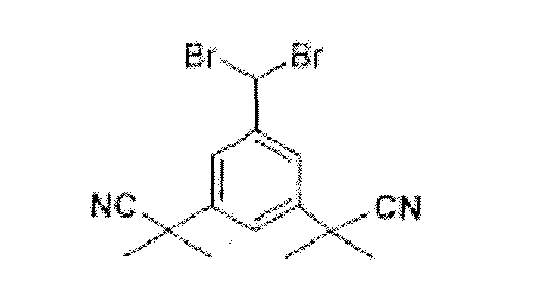 d) crystallising the product in the presence of a suitable solvent
 - A process as claimed in claim 1, wherein the solvent in step d) is selected from the group consisting of alcohols, ketones, nitriles, esters, hydrocarbons and water, or a mixture thereof.
- A process as claimed in claim 1 or claim 2 wherein the said hydrocarbon employed in step (a) is an aliphatic hydrocarbon.
- A process as claimed in claim 3 wherein the said aliphatic hydrocarbon is a aliphatic cyclic hydrocarbon.
- A process as claimed in claim 4 wherein the said aliphatic cyclic hydrocarbon is cyclohexane.
- A process as claimed in any preceding claim wherein the said brominating reagent employed in step (a) is N-bromosuccinimide or 1,3-dibromo-5,5-dimethyihydantoin.
- A process as claimed in any preceding claim wherein said solvent employed in said crystallization is an alcohol
- A process as claimed in claim 7, wherein the alcohol is a C1-C10 alcohol.
- A process as claimed in claim 8, wherein the alcohol is methanol or isopropanol.
Applications Claiming Priority (2)
| Application Number | Priority Date | Filing Date | Title |
|---|---|---|---|
| IN1216MU2005 | 2005-09-30 | ||
| EP06842738A EP1940806A2 (en) | 2005-09-30 | 2006-09-04 | A process for the preparation of pure anastrozole |
Related Parent Applications (1)
| Application Number | Title | Priority Date | Filing Date |
|---|---|---|---|
| EP06842738.4 Division | 2006-09-04 |
Publications (1)
| Publication Number | Publication Date |
|---|---|
| EP2397472A1 true EP2397472A1 (en) | 2011-12-21 |
Family
ID=38023678
Family Applications (2)
| Application Number | Title | Priority Date | Filing Date |
|---|---|---|---|
| EP11156286.4A Withdrawn EP2397472A1 (en) | 2005-09-30 | 2006-09-04 | A process for the preparation of a benzylbromide intermediates |
| EP06842738A Withdrawn EP1940806A2 (en) | 2005-09-30 | 2006-09-04 | A process for the preparation of pure anastrozole |
Family Applications After (1)
| Application Number | Title | Priority Date | Filing Date |
|---|---|---|---|
| EP06842738A Withdrawn EP1940806A2 (en) | 2005-09-30 | 2006-09-04 | A process for the preparation of pure anastrozole |
Country Status (3)
| Country | Link |
|---|---|
| US (1) | US20090221837A1 (en) |
| EP (2) | EP2397472A1 (en) |
| WO (1) | WO2007054963A2 (en) |
Cited By (1)
| Publication number | Priority date | Publication date | Assignee | Title |
|---|---|---|---|---|
| CN110862292A (en) * | 2019-11-19 | 2020-03-06 | 中国科学院兰州化学物理研究所 | A kind of preparation method of 1-aryl-1,2-dibromoethane |
Families Citing this family (4)
| Publication number | Priority date | Publication date | Assignee | Title |
|---|---|---|---|---|
| EP2172449A3 (en) | 2005-04-06 | 2011-06-22 | Sicor, Inc. | Process for the purification of Anastrazole |
| EP2024343B1 (en) * | 2006-05-19 | 2015-09-09 | Synthon B.V. | Process for purification of anastrozole |
| ITRM20130285A1 (en) * | 2013-05-14 | 2014-11-15 | Corden Pharma Latina S P A Con Uni Co Socio | METHOD FOR THE PREPARATION OF PHARMACEUTICAL GRADE ANASTROZOL |
| CN106083748B (en) * | 2016-06-21 | 2019-08-16 | 扬子江药业集团江苏海慈生物药业有限公司 | A kind of preparation method of Anastrozole |
Citations (5)
| Publication number | Priority date | Publication date | Assignee | Title |
|---|---|---|---|---|
| EP0296749A1 (en) | 1987-06-16 | 1988-12-28 | Zeneca Limited | (Substituted aralkyl) heterocyclic compounds |
| JPH04282327A (en) * | 1991-03-12 | 1992-10-07 | Nissan Chem Ind Ltd | Production of bis(bromomethyl) aromatic hydrocarbon |
| US20060035950A1 (en) * | 2004-08-09 | 2006-02-16 | Mohammed Alnabari | Novel processes for preparing substantially pure anastrozole |
| US20060189670A1 (en) * | 2005-02-22 | 2006-08-24 | Glenmark Pharmaceuticals Limited | Process for the preparation of anastrozole and intermediates thereof |
| EP1705168A1 (en) * | 2005-03-21 | 2006-09-27 | Helm AG | Improved process for side-chain bromination of alkyl-benzenes |
-
2006
- 2006-09-04 EP EP11156286.4A patent/EP2397472A1/en not_active Withdrawn
- 2006-09-04 US US11/992,708 patent/US20090221837A1/en not_active Abandoned
- 2006-09-04 WO PCT/IN2006/000336 patent/WO2007054963A2/en not_active Ceased
- 2006-09-04 EP EP06842738A patent/EP1940806A2/en not_active Withdrawn
Patent Citations (6)
| Publication number | Priority date | Publication date | Assignee | Title |
|---|---|---|---|---|
| EP0296749A1 (en) | 1987-06-16 | 1988-12-28 | Zeneca Limited | (Substituted aralkyl) heterocyclic compounds |
| US4935437A (en) | 1987-06-16 | 1990-06-19 | Imperial Chemical Industries Plc | (Substituted aralkyl) heterocyclic compounds |
| JPH04282327A (en) * | 1991-03-12 | 1992-10-07 | Nissan Chem Ind Ltd | Production of bis(bromomethyl) aromatic hydrocarbon |
| US20060035950A1 (en) * | 2004-08-09 | 2006-02-16 | Mohammed Alnabari | Novel processes for preparing substantially pure anastrozole |
| US20060189670A1 (en) * | 2005-02-22 | 2006-08-24 | Glenmark Pharmaceuticals Limited | Process for the preparation of anastrozole and intermediates thereof |
| EP1705168A1 (en) * | 2005-03-21 | 2006-09-27 | Helm AG | Improved process for side-chain bromination of alkyl-benzenes |
Non-Patent Citations (3)
| Title |
|---|
| DAISUKE KIKUCHE: "An Alternative Method for the Selective Bromination of Alkylbenzenes Using NaBrO3/NaHSO3 Reagent", JOURNAL OF ORGANIC CHEMISTRY, AMERICAN CHEMICAL SOCIETY. EASTON, US, vol. 63, no. 17, 1998, pages 6023 - 6026, XP002368706, ISSN: 0022-3263 * |
| GE Z ET AL: "IMPROVED SYNTHETIC METHOD OF ANTICANCER DRUG ANASTROZOLE", ZHONGGUO YAOWU HUAXUE ZAZHI - CHINESE JOURNAL OF MEDICINAL CHEMISTRY, GAI-KAI BIANJIBU, SHENYANG, CN, vol. 13, no. 3, 2003, pages 146 - 152, XP009067261, ISSN: 1005-0108 * |
| MATAKA S ET AL: "PHOTOTHERMAL SIDE-CHAIN BROMINATION OF METHYL-, DIMETHYL-, AND TRIMETHYLBENZENES WITH N-BROMOSUCCINIMIDE", BULLETIN OF THE CHEMICAL SOCIETY OF JAPAN, CHEMICAL SOCIETY OF JAPAN, TOKYO, JP, vol. 67, April 1994 (1994-04-01), pages 1113 - 1119, XP009061076, ISSN: 0009-2673 * |
Cited By (1)
| Publication number | Priority date | Publication date | Assignee | Title |
|---|---|---|---|---|
| CN110862292A (en) * | 2019-11-19 | 2020-03-06 | 中国科学院兰州化学物理研究所 | A kind of preparation method of 1-aryl-1,2-dibromoethane |
Also Published As
| Publication number | Publication date |
|---|---|
| EP1940806A2 (en) | 2008-07-09 |
| US20090221837A1 (en) | 2009-09-03 |
| WO2007054963A3 (en) | 2007-11-29 |
| WO2007054963A2 (en) | 2007-05-18 |
Similar Documents
| Publication | Publication Date | Title |
|---|---|---|
| US7655806B2 (en) | Process for purification of anastrozole | |
| CA2736703A1 (en) | Process for the preparation of rufinamide | |
| US7705159B2 (en) | Process for the preparation of letrozole | |
| CA2342950C (en) | New process for preparing 11-amino-3-chloro-6,11-dihydro-5,5-dioxo-6-methyl-dibenzo[c,f][1,2]-thia zepine and application in the synthesis of tianeptine | |
| EP4013398B1 (en) | IMPROVED METHOD FOR THE PRODUCE OF VILANTEROL OR A PHARMACEUTICALLY ACCEPTABLE SALT THEREOF | |
| US7989636B2 (en) | Process for the preparation of pure anastrozole | |
| EP2225198B1 (en) | Processes for preparing a substituted gamma-amino acid | |
| US20110065927A1 (en) | Process for preparing pure anastrozole | |
| US9346743B2 (en) | Processes for the synthesis of 2-amino-4,6-dimethoxybenzamide and other benzamide compounds | |
| US20090221837A1 (en) | Process for the Preparation of Pure Anastrozole | |
| US8003804B2 (en) | Synthesis of 4-[1-(4-cyano phenyl)-(1,2,4-triazol-1-yl)methyl] benzonitrile and 4-[1-(1H-1,2,4-triazol-1-yl)methylene benzonitrile intermediate | |
| US20140121384A1 (en) | Process for bendamustine hydrochloride | |
| US20070100149A1 (en) | Process for preparing letrozole | |
| CN103502210A (en) | Process for the preparation of 2-chloroallyl thiocyanate and 2-chloroallyl isothiocyanate | |
| US20090012328A1 (en) | Process for preparing bupropion hydrochloride | |
| EP1945618A2 (en) | Process for the preparation of letrozole | |
| WO2017205622A1 (en) | Method of making benznidazole | |
| WO2007002722A2 (en) | Synthesis of anastrozole and purification of one of its intermediate | |
| TW200804247A (en) | Process of producing O-methyl-N-nitroisourea | |
| EP0060171A1 (en) | Process for the N-alkylation of organic nitrogen compounds | |
| US20060025465A1 (en) | Process for preparing substituted imidazole derivates and intermediates used in the process | |
| US20110201838A1 (en) | Synthesis of 4-[3-(2,6-dimethylbenzyloxy)phenyl]-4-oxobutanoic acid | |
| CH650257A5 (en) | Method of preparation of ranitidine and means for implementing the process. | |
| US20090118517A1 (en) | Purification process for anastrozole intermediate | |
| EP2456758B1 (en) | A process for preparing trisubstituted phenyl derivatives comprising a (1h-1,2,4-triazol-1-yl)alkyl group |
Legal Events
| Date | Code | Title | Description |
|---|---|---|---|
| AC | Divisional application: reference to earlier application |
Ref document number: 1940806 Country of ref document: EP Kind code of ref document: P |
|
| AK | Designated contracting states |
Kind code of ref document: A1 Designated state(s): AT BE BG CH CY CZ DE DK EE ES FI FR GB GR HU IE IS IT LI LT LU LV MC NL PL PT RO SE SI SK TR |
|
| AX | Request for extension of the european patent |
Extension state: AL BA HR MK RS |
|
| PUAI | Public reference made under article 153(3) epc to a published international application that has entered the european phase |
Free format text: ORIGINAL CODE: 0009012 |
|
| STAA | Information on the status of an ep patent application or granted ep patent |
Free format text: STATUS: THE APPLICATION IS DEEMED TO BE WITHDRAWN |
|
| 18D | Application deemed to be withdrawn |
Effective date: 20120622 |