EP2397141A1 - Process for the synthesis of beta-amino acids and derivatives thereof - Google Patents
Process for the synthesis of beta-amino acids and derivatives thereof Download PDFInfo
- Publication number
- EP2397141A1 EP2397141A1 EP10166099A EP10166099A EP2397141A1 EP 2397141 A1 EP2397141 A1 EP 2397141A1 EP 10166099 A EP10166099 A EP 10166099A EP 10166099 A EP10166099 A EP 10166099A EP 2397141 A1 EP2397141 A1 EP 2397141A1
- Authority
- EP
- European Patent Office
- Prior art keywords
- formula
- compound
- alkyl
- denotes
- group
- Prior art date
- Legal status (The legal status is an assumption and is not a legal conclusion. Google has not performed a legal analysis and makes no representation as to the accuracy of the status listed.)
- Ceased
Links
- 238000000034 method Methods 0.000 title claims abstract description 75
- 230000008569 process Effects 0.000 title claims abstract description 72
- 238000003786 synthesis reaction Methods 0.000 title claims description 22
- 230000015572 biosynthetic process Effects 0.000 title claims description 21
- 150000001576 beta-amino acids Chemical class 0.000 title abstract description 13
- 229940093740 amino acid and derivative Drugs 0.000 title abstract description 3
- 150000001875 compounds Chemical class 0.000 claims abstract description 274
- MFFMDFFZMYYVKS-SECBINFHSA-N sitagliptin Chemical compound C([C@H](CC(=O)N1CC=2N(C(=NN=2)C(F)(F)F)CC1)N)C1=CC(F)=C(F)C=C1F MFFMDFFZMYYVKS-SECBINFHSA-N 0.000 claims abstract description 44
- 229960004034 sitagliptin Drugs 0.000 claims abstract description 41
- 239000003603 dipeptidyl peptidase IV inhibitor Substances 0.000 claims abstract description 13
- -1 cyano, aminocarbonyl Chemical group 0.000 claims description 89
- 125000004429 atom Chemical group 0.000 claims description 68
- XLYOFNOQVPJJNP-UHFFFAOYSA-N water Substances O XLYOFNOQVPJJNP-UHFFFAOYSA-N 0.000 claims description 67
- 125000004169 (C1-C6) alkyl group Chemical group 0.000 claims description 57
- 238000006243 chemical reaction Methods 0.000 claims description 57
- 239000000203 mixture Substances 0.000 claims description 41
- 239000002585 base Substances 0.000 claims description 37
- 239000002904 solvent Substances 0.000 claims description 32
- OKKJLVBELUTLKV-UHFFFAOYSA-N Methanol Chemical compound OC OKKJLVBELUTLKV-UHFFFAOYSA-N 0.000 claims description 30
- 239000003960 organic solvent Substances 0.000 claims description 30
- 239000003153 chemical reaction reagent Substances 0.000 claims description 28
- 125000005843 halogen group Chemical group 0.000 claims description 27
- 238000011282 treatment Methods 0.000 claims description 27
- LFQSCWFLJHTTHZ-UHFFFAOYSA-N Ethanol Chemical compound CCO LFQSCWFLJHTTHZ-UHFFFAOYSA-N 0.000 claims description 26
- 150000003839 salts Chemical class 0.000 claims description 26
- 239000002253 acid Substances 0.000 claims description 25
- 150000001408 amides Chemical class 0.000 claims description 25
- 238000005859 coupling reaction Methods 0.000 claims description 23
- 230000008878 coupling Effects 0.000 claims description 22
- 238000010168 coupling process Methods 0.000 claims description 22
- 125000004044 trifluoroacetyl group Chemical group FC(C(=O)*)(F)F 0.000 claims description 22
- 125000000229 (C1-C4)alkoxy group Chemical group 0.000 claims description 21
- HEMHJVSKTPXQMS-UHFFFAOYSA-M Sodium hydroxide Chemical compound [OH-].[Na+] HEMHJVSKTPXQMS-UHFFFAOYSA-M 0.000 claims description 21
- MHAJPDPJQMAIIY-UHFFFAOYSA-N Hydrogen peroxide Chemical compound OO MHAJPDPJQMAIIY-UHFFFAOYSA-N 0.000 claims description 20
- 125000000956 methoxy group Chemical group [H]C([H])([H])O* 0.000 claims description 15
- 125000004178 (C1-C4) alkyl group Chemical group 0.000 claims description 14
- 239000003513 alkali Substances 0.000 claims description 14
- 125000001495 ethyl group Chemical group [H]C([H])([H])C([H])([H])* 0.000 claims description 14
- 125000002496 methyl group Chemical group [H]C([H])([H])* 0.000 claims description 14
- 150000008064 anhydrides Chemical class 0.000 claims description 13
- 125000001797 benzyl group Chemical group [H]C1=C([H])C([H])=C(C([H])=C1[H])C([H])([H])* 0.000 claims description 13
- 229910052736 halogen Inorganic materials 0.000 claims description 13
- 125000006503 p-nitrobenzyl group Chemical group [H]C1=C([H])C(=C([H])C([H])=C1[N+]([O-])=O)C([H])([H])* 0.000 claims description 13
- QGZKDVFQNNGYKY-UHFFFAOYSA-N Ammonia Chemical compound N QGZKDVFQNNGYKY-UHFFFAOYSA-N 0.000 claims description 12
- 125000000623 heterocyclic group Chemical group 0.000 claims description 12
- 125000002887 hydroxy group Chemical group [H]O* 0.000 claims description 12
- 150000002367 halogens Chemical class 0.000 claims description 11
- 239000003586 protic polar solvent Substances 0.000 claims description 11
- LMBFAGIMSUYTBN-MPZNNTNKSA-N teixobactin Chemical compound C([C@H](C(=O)N[C@@H]([C@@H](C)CC)C(=O)N[C@@H](CO)C(=O)N[C@H](CCC(N)=O)C(=O)N[C@H]([C@@H](C)CC)C(=O)N[C@@H]([C@@H](C)CC)C(=O)N[C@@H](CO)C(=O)N[C@H]1C(N[C@@H](C)C(=O)N[C@@H](C[C@@H]2NC(=N)NC2)C(=O)N[C@H](C(=O)O[C@H]1C)[C@@H](C)CC)=O)NC)C1=CC=CC=C1 LMBFAGIMSUYTBN-MPZNNTNKSA-N 0.000 claims description 11
- 150000004945 aromatic hydrocarbons Chemical class 0.000 claims description 10
- 125000001309 chloro group Chemical group Cl* 0.000 claims description 10
- 229910052751 metal Inorganic materials 0.000 claims description 9
- 239000002184 metal Substances 0.000 claims description 9
- 150000007530 organic bases Chemical class 0.000 claims description 9
- 125000006281 4-bromobenzyl group Chemical group [H]C1=C([H])C(=C([H])C([H])=C1Br)C([H])([H])* 0.000 claims description 8
- 150000001718 carbodiimides Chemical class 0.000 claims description 8
- 238000006277 sulfonation reaction Methods 0.000 claims description 8
- 125000005279 aryl sulfonyloxy group Chemical group 0.000 claims description 7
- 150000002825 nitriles Chemical class 0.000 claims description 7
- LSNNMFCWUKXFEE-UHFFFAOYSA-M Bisulfite Chemical compound OS([O-])=O LSNNMFCWUKXFEE-UHFFFAOYSA-M 0.000 claims description 6
- 229910052783 alkali metal Inorganic materials 0.000 claims description 6
- 150000001412 amines Chemical class 0.000 claims description 6
- 150000001540 azides Chemical class 0.000 claims description 6
- 125000000852 azido group Chemical group *N=[N+]=[N-] 0.000 claims description 6
- 125000001153 fluoro group Chemical group F* 0.000 claims description 6
- KEAYESYHFKHZAL-UHFFFAOYSA-N Sodium Chemical compound [Na] KEAYESYHFKHZAL-UHFFFAOYSA-N 0.000 claims description 5
- 150000008044 alkali metal hydroxides Chemical class 0.000 claims description 5
- 229910021529 ammonia Inorganic materials 0.000 claims description 5
- 239000000010 aprotic solvent Substances 0.000 claims description 5
- 239000012312 sodium hydride Substances 0.000 claims description 5
- 229910000104 sodium hydride Inorganic materials 0.000 claims description 5
- 150000001335 aliphatic alkanes Chemical class 0.000 claims description 4
- 229910001854 alkali hydroxide Inorganic materials 0.000 claims description 4
- 125000004453 alkoxycarbonyl group Chemical group 0.000 claims description 4
- 125000001246 bromo group Chemical group Br* 0.000 claims description 4
- ORTFAQDWJHRMNX-UHFFFAOYSA-N hydroxidooxidocarbon(.) Chemical group O[C]=O ORTFAQDWJHRMNX-UHFFFAOYSA-N 0.000 claims description 4
- 229910052744 lithium Inorganic materials 0.000 claims description 4
- 238000004519 manufacturing process Methods 0.000 claims description 4
- 238000005580 one pot reaction Methods 0.000 claims description 4
- 239000002798 polar solvent Substances 0.000 claims description 4
- 125000001453 quaternary ammonium group Chemical group 0.000 claims description 4
- 239000011701 zinc Substances 0.000 claims description 4
- 229910052725 zinc Inorganic materials 0.000 claims description 4
- BRLQWZUYTZBJKN-GSVOUGTGSA-N (+)-Epichlorohydrin Chemical compound ClC[C@@H]1CO1 BRLQWZUYTZBJKN-GSVOUGTGSA-N 0.000 claims description 3
- WZLOKEZFZKLWIH-LURJTMIESA-N (2s)-1-chloro-3-(2,4,5-trifluorophenyl)propan-2-ol Chemical compound ClC[C@@H](O)CC1=CC(F)=C(F)C=C1F WZLOKEZFZKLWIH-LURJTMIESA-N 0.000 claims description 3
- WHXSMMKQMYFTQS-UHFFFAOYSA-N Lithium Chemical compound [Li] WHXSMMKQMYFTQS-UHFFFAOYSA-N 0.000 claims description 3
- ZLMJMSJWJFRBEC-UHFFFAOYSA-N Potassium Chemical compound [K] ZLMJMSJWJFRBEC-UHFFFAOYSA-N 0.000 claims description 3
- HCHKCACWOHOZIP-UHFFFAOYSA-N Zinc Chemical compound [Zn] HCHKCACWOHOZIP-UHFFFAOYSA-N 0.000 claims description 3
- KXZJHVJKXJLBKO-UHFFFAOYSA-N chembl1408157 Chemical compound N=1C2=CC=CC=C2C(C(=O)O)=CC=1C1=CC=C(O)C=C1 KXZJHVJKXJLBKO-UHFFFAOYSA-N 0.000 claims description 3
- 239000011777 magnesium Substances 0.000 claims description 3
- 229910052749 magnesium Inorganic materials 0.000 claims description 3
- 229910052700 potassium Inorganic materials 0.000 claims description 3
- 239000011591 potassium Substances 0.000 claims description 3
- 238000007363 ring formation reaction Methods 0.000 claims description 3
- FYYHWMGAXLPEAU-UHFFFAOYSA-N Magnesium Chemical compound [Mg] FYYHWMGAXLPEAU-UHFFFAOYSA-N 0.000 claims description 2
- 239000004480 active ingredient Substances 0.000 claims description 2
- 150000005325 alkali earth metal hydroxides Chemical class 0.000 claims description 2
- 125000006242 amine protecting group Chemical group 0.000 claims description 2
- 229910052731 fluorine Inorganic materials 0.000 claims description 2
- 125000002346 iodo group Chemical group I* 0.000 claims description 2
- 239000008194 pharmaceutical composition Substances 0.000 claims description 2
- 239000000546 pharmaceutical excipient Substances 0.000 claims description 2
- 230000001131 transforming effect Effects 0.000 claims description 2
- 238000002360 preparation method Methods 0.000 abstract description 29
- 239000000543 intermediate Substances 0.000 abstract description 7
- 150000001541 aziridines Chemical class 0.000 abstract description 2
- 238000010276 construction Methods 0.000 abstract description 2
- 150000002118 epoxides Chemical class 0.000 abstract 1
- YMWUJEATGCHHMB-UHFFFAOYSA-N Dichloromethane Chemical compound ClCCl YMWUJEATGCHHMB-UHFFFAOYSA-N 0.000 description 48
- 239000011541 reaction mixture Substances 0.000 description 40
- XEKOWRVHYACXOJ-UHFFFAOYSA-N Ethyl acetate Chemical compound CCOC(C)=O XEKOWRVHYACXOJ-UHFFFAOYSA-N 0.000 description 37
- IAZDPXIOMUYVGZ-WFGJKAKNSA-N Dimethyl sulfoxide Chemical compound [2H]C([2H])([2H])S(=O)C([2H])([2H])[2H] IAZDPXIOMUYVGZ-WFGJKAKNSA-N 0.000 description 36
- 239000000047 product Substances 0.000 description 29
- 238000003756 stirring Methods 0.000 description 23
- 239000012267 brine Substances 0.000 description 20
- HPALAKNZSZLMCH-UHFFFAOYSA-M sodium;chloride;hydrate Chemical compound O.[Na+].[Cl-] HPALAKNZSZLMCH-UHFFFAOYSA-M 0.000 description 20
- 239000000243 solution Substances 0.000 description 20
- 238000005160 1H NMR spectroscopy Methods 0.000 description 17
- RTZKZFJDLAIYFH-UHFFFAOYSA-N Diethyl ether Chemical compound CCOCC RTZKZFJDLAIYFH-UHFFFAOYSA-N 0.000 description 16
- 238000001704 evaporation Methods 0.000 description 15
- 230000008020 evaporation Effects 0.000 description 15
- ZMXDDKWLCZADIW-UHFFFAOYSA-N N,N-Dimethylformamide Chemical compound CN(C)C=O ZMXDDKWLCZADIW-UHFFFAOYSA-N 0.000 description 14
- VEXZGXHMUGYJMC-UHFFFAOYSA-N Hydrochloric acid Chemical compound Cl VEXZGXHMUGYJMC-UHFFFAOYSA-N 0.000 description 13
- 239000012359 Methanesulfonyl chloride Substances 0.000 description 13
- 235000019439 ethyl acetate Nutrition 0.000 description 13
- QARBMVPHQWIHKH-UHFFFAOYSA-N methanesulfonyl chloride Chemical compound CS(Cl)(=O)=O QARBMVPHQWIHKH-UHFFFAOYSA-N 0.000 description 13
- 239000012074 organic phase Substances 0.000 description 13
- 239000012043 crude product Substances 0.000 description 12
- 239000000725 suspension Substances 0.000 description 12
- 125000004432 carbon atom Chemical group C* 0.000 description 11
- 238000005406 washing Methods 0.000 description 11
- WYURNTSHIVDZCO-UHFFFAOYSA-N Tetrahydrofuran Chemical compound C1CCOC1 WYURNTSHIVDZCO-UHFFFAOYSA-N 0.000 description 10
- 150000002148 esters Chemical class 0.000 description 10
- JMMWKPVZQRWMSS-UHFFFAOYSA-N isopropyl acetate Chemical compound CC(C)OC(C)=O JMMWKPVZQRWMSS-UHFFFAOYSA-N 0.000 description 10
- 125000001424 substituent group Chemical group 0.000 description 10
- QTBSBXVTEAMEQO-UHFFFAOYSA-N Acetic acid Chemical compound CC(O)=O QTBSBXVTEAMEQO-UHFFFAOYSA-N 0.000 description 9
- WMFOQBRAJBCJND-UHFFFAOYSA-M Lithium hydroxide Chemical compound [Li+].[OH-] WMFOQBRAJBCJND-UHFFFAOYSA-M 0.000 description 9
- JGFZNNIVVJXRND-UHFFFAOYSA-N N,N-Diisopropylethylamine (DIPEA) Chemical compound CCN(C(C)C)C(C)C JGFZNNIVVJXRND-UHFFFAOYSA-N 0.000 description 9
- 238000011938 amidation process Methods 0.000 description 9
- 238000013459 approach Methods 0.000 description 8
- 238000001816 cooling Methods 0.000 description 8
- IXCSERBJSXMMFS-UHFFFAOYSA-N hydrogen chloride Substances Cl.Cl IXCSERBJSXMMFS-UHFFFAOYSA-N 0.000 description 8
- 229910000041 hydrogen chloride Inorganic materials 0.000 description 8
- 230000007062 hydrolysis Effects 0.000 description 8
- 238000006460 hydrolysis reaction Methods 0.000 description 8
- 239000002609 medium Substances 0.000 description 8
- 150000003460 sulfonic acids Chemical class 0.000 description 8
- RIOQSEWOXXDEQQ-UHFFFAOYSA-N triphenylphosphine Chemical compound C1=CC=CC=C1P(C=1C=CC=CC=1)C1=CC=CC=C1 RIOQSEWOXXDEQQ-UHFFFAOYSA-N 0.000 description 8
- 229910052794 bromium Inorganic materials 0.000 description 7
- 229910052801 chlorine Inorganic materials 0.000 description 7
- 239000000706 filtrate Substances 0.000 description 7
- NBIIXXVUZAFLBC-UHFFFAOYSA-N phosphoric acid Substances OP(O)(O)=O NBIIXXVUZAFLBC-UHFFFAOYSA-N 0.000 description 7
- ZHNUHDYFZUAESO-UHFFFAOYSA-N Formamide Chemical compound NC=O ZHNUHDYFZUAESO-UHFFFAOYSA-N 0.000 description 6
- YXFVVABEGXRONW-UHFFFAOYSA-N Toluene Chemical compound CC1=CC=CC=C1 YXFVVABEGXRONW-UHFFFAOYSA-N 0.000 description 6
- 125000003545 alkoxy group Chemical group 0.000 description 6
- 125000000217 alkyl group Chemical group 0.000 description 6
- 150000001350 alkyl halides Chemical group 0.000 description 6
- 239000012736 aqueous medium Substances 0.000 description 6
- 125000004435 hydrogen atom Chemical group [H]* 0.000 description 6
- 229910052740 iodine Inorganic materials 0.000 description 6
- 230000009467 reduction Effects 0.000 description 6
- YWWDBCBWQNCYNR-UHFFFAOYSA-N trimethylphosphine Chemical compound CP(C)C YWWDBCBWQNCYNR-UHFFFAOYSA-N 0.000 description 6
- 0 *OC(CC(N1Cc2nnc(C(F)(F)F)[n]2CC1)=O)Cc(c(F)c1)cc(F)c1F Chemical compound *OC(CC(N1Cc2nnc(C(F)(F)F)[n]2CC1)=O)Cc(c(F)c1)cc(F)c1F 0.000 description 5
- BDNKZNFMNDZQMI-UHFFFAOYSA-N 1,3-diisopropylcarbodiimide Chemical compound CC(C)N=C=NC(C)C BDNKZNFMNDZQMI-UHFFFAOYSA-N 0.000 description 5
- IJGRMHOSHXDMSA-UHFFFAOYSA-N Atomic nitrogen Chemical compound N#N IJGRMHOSHXDMSA-UHFFFAOYSA-N 0.000 description 5
- 150000007513 acids Chemical class 0.000 description 5
- 125000003118 aryl group Chemical group 0.000 description 5
- 239000003054 catalyst Substances 0.000 description 5
- 238000009903 catalytic hydrogenation reaction Methods 0.000 description 5
- 150000002170 ethers Chemical class 0.000 description 5
- 238000002474 experimental method Methods 0.000 description 5
- 150000004820 halides Chemical class 0.000 description 5
- 239000012071 phase Substances 0.000 description 5
- 239000002244 precipitate Substances 0.000 description 5
- 238000007127 saponification reaction Methods 0.000 description 5
- FPQQSJJWHUJYPU-UHFFFAOYSA-N 3-(dimethylamino)propyliminomethylidene-ethylazanium;chloride Chemical compound Cl.CCN=C=NCCCN(C)C FPQQSJJWHUJYPU-UHFFFAOYSA-N 0.000 description 4
- QOSSAOTZNIDXMA-UHFFFAOYSA-N Dicylcohexylcarbodiimide Chemical group C1CCCCC1N=C=NC1CCCCC1 QOSSAOTZNIDXMA-UHFFFAOYSA-N 0.000 description 4
- ATHHXGZTWNVVOU-UHFFFAOYSA-N N-methylformamide Chemical compound CNC=O ATHHXGZTWNVVOU-UHFFFAOYSA-N 0.000 description 4
- PXIPVTKHYLBLMZ-UHFFFAOYSA-N Sodium azide Chemical compound [Na+].[N-]=[N+]=[N-] PXIPVTKHYLBLMZ-UHFFFAOYSA-N 0.000 description 4
- UIIMBOGNXHQVGW-UHFFFAOYSA-M Sodium bicarbonate Chemical compound [Na+].OC([O-])=O UIIMBOGNXHQVGW-UHFFFAOYSA-M 0.000 description 4
- 230000001476 alcoholic effect Effects 0.000 description 4
- MNFORVFSTILPAW-UHFFFAOYSA-N azetidin-2-one Chemical compound O=C1CCN1 MNFORVFSTILPAW-UHFFFAOYSA-N 0.000 description 4
- 229910052799 carbon Inorganic materials 0.000 description 4
- 230000003197 catalytic effect Effects 0.000 description 4
- 238000000605 extraction Methods 0.000 description 4
- 230000003301 hydrolyzing effect Effects 0.000 description 4
- 125000002883 imidazolyl group Chemical group 0.000 description 4
- GLXDVVHUTZTUQK-UHFFFAOYSA-M lithium;hydroxide;hydrate Chemical compound [Li+].O.[OH-] GLXDVVHUTZTUQK-UHFFFAOYSA-M 0.000 description 4
- VLKZOEOYAKHREP-UHFFFAOYSA-N n-Hexane Chemical compound CCCCCC VLKZOEOYAKHREP-UHFFFAOYSA-N 0.000 description 4
- 238000006772 olefination reaction Methods 0.000 description 4
- 150000002924 oxiranes Chemical class 0.000 description 4
- 150000003003 phosphines Chemical class 0.000 description 4
- HXJUTPCZVOIRIF-UHFFFAOYSA-N sulfolane Chemical compound O=S1(=O)CCCC1 HXJUTPCZVOIRIF-UHFFFAOYSA-N 0.000 description 4
- 150000003459 sulfonic acid esters Chemical class 0.000 description 4
- 125000002023 trifluoromethyl group Chemical group FC(F)(F)* 0.000 description 4
- ASOKPJOREAFHNY-UHFFFAOYSA-N 1-Hydroxybenzotriazole Chemical compound C1=CC=C2N(O)N=NC2=C1 ASOKPJOREAFHNY-UHFFFAOYSA-N 0.000 description 3
- PJUPKRYGDFTMTM-UHFFFAOYSA-N 1-hydroxybenzotriazole;hydrate Chemical compound O.C1=CC=C2N(O)N=NC2=C1 PJUPKRYGDFTMTM-UHFFFAOYSA-N 0.000 description 3
- BWZVCCNYKMEVEX-UHFFFAOYSA-N 2,4,6-Trimethylpyridine Chemical compound CC1=CC(C)=NC(C)=C1 BWZVCCNYKMEVEX-UHFFFAOYSA-N 0.000 description 3
- VMQMZMRVKUZKQL-UHFFFAOYSA-N Cu+ Chemical class [Cu+] VMQMZMRVKUZKQL-UHFFFAOYSA-N 0.000 description 3
- XFXPMWWXUTWYJX-UHFFFAOYSA-N Cyanide Chemical compound N#[C-] XFXPMWWXUTWYJX-UHFFFAOYSA-N 0.000 description 3
- IAZDPXIOMUYVGZ-UHFFFAOYSA-N Dimethylsulphoxide Chemical compound CS(C)=O IAZDPXIOMUYVGZ-UHFFFAOYSA-N 0.000 description 3
- IMNFDUFMRHMDMM-UHFFFAOYSA-N N-Heptane Chemical compound CCCCCCC IMNFDUFMRHMDMM-UHFFFAOYSA-N 0.000 description 3
- QAOWNCQODCNURD-UHFFFAOYSA-N Sulfuric acid Chemical compound OS(O)(=O)=O QAOWNCQODCNURD-UHFFFAOYSA-N 0.000 description 3
- VHEGUBSDTUDBGR-QMMMGPOBSA-N [(2s)-4-(methoxyamino)-4-oxo-1-(2,4,5-trifluorophenyl)butan-2-yl] methanesulfonate Chemical compound CONC(=O)C[C@@H](OS(C)(=O)=O)CC1=CC(F)=C(F)C=C1F VHEGUBSDTUDBGR-QMMMGPOBSA-N 0.000 description 3
- 238000006136 alcoholysis reaction Methods 0.000 description 3
- 150000001409 amidines Chemical class 0.000 description 3
- 239000008346 aqueous phase Substances 0.000 description 3
- QVGXLLKOCUKJST-UHFFFAOYSA-N atomic oxygen Chemical compound [O] QVGXLLKOCUKJST-UHFFFAOYSA-N 0.000 description 3
- 125000003785 benzimidazolyl group Chemical group N1=C(NC2=C1C=CC=C2)* 0.000 description 3
- 239000006227 byproduct Substances 0.000 description 3
- 239000010949 copper Substances 0.000 description 3
- 238000001914 filtration Methods 0.000 description 3
- 239000012458 free base Substances 0.000 description 3
- 150000003944 halohydrins Chemical class 0.000 description 3
- 239000001257 hydrogen Substances 0.000 description 3
- 229910052739 hydrogen Inorganic materials 0.000 description 3
- 238000005984 hydrogenation reaction Methods 0.000 description 3
- 125000002950 monocyclic group Chemical group 0.000 description 3
- 229910052757 nitrogen Inorganic materials 0.000 description 3
- 229910052760 oxygen Inorganic materials 0.000 description 3
- 239000001301 oxygen Substances 0.000 description 3
- 125000001997 phenyl group Chemical group [H]C1=C([H])C([H])=C(*)C([H])=C1[H] 0.000 description 3
- VVWRJUBEIPHGQF-UHFFFAOYSA-N propan-2-yl n-propan-2-yloxycarbonyliminocarbamate Chemical compound CC(C)OC(=O)N=NC(=O)OC(C)C VVWRJUBEIPHGQF-UHFFFAOYSA-N 0.000 description 3
- 125000000561 purinyl group Chemical group N1=C(N=C2N=CNC2=C1)* 0.000 description 3
- 125000003373 pyrazinyl group Chemical group 0.000 description 3
- 125000000719 pyrrolidinyl group Chemical group 0.000 description 3
- 125000002294 quinazolinyl group Chemical group N1=C(N=CC2=CC=CC=C12)* 0.000 description 3
- FVAUCKIRQBBSSJ-UHFFFAOYSA-M sodium iodide Chemical compound [Na+].[I-] FVAUCKIRQBBSSJ-UHFFFAOYSA-M 0.000 description 3
- 239000007787 solid Substances 0.000 description 3
- 239000012265 solid product Substances 0.000 description 3
- 238000006467 substitution reaction Methods 0.000 description 3
- GFYHSKONPJXCDE-UHFFFAOYSA-N sym-collidine Natural products CC1=CN=C(C)C(C)=C1 GFYHSKONPJXCDE-UHFFFAOYSA-N 0.000 description 3
- FMCAFXHLMUOIGG-JTJHWIPRSA-N (2s)-2-[[(2r)-2-[[(2s)-2-[[(2r)-2-formamido-3-sulfanylpropanoyl]amino]-3-methylbutanoyl]amino]-3-(4-hydroxy-2,5-dimethylphenyl)propanoyl]amino]-4-methylsulfanylbutanoic acid Chemical compound O=CN[C@@H](CS)C(=O)N[C@@H](C(C)C)C(=O)N[C@@H](C(=O)N[C@@H](CCSC)C(O)=O)CC1=CC(C)=C(O)C=C1C FMCAFXHLMUOIGG-JTJHWIPRSA-N 0.000 description 2
- CJGJIACBPVRZNF-LURJTMIESA-N (3s)-3-hydroxy-4-(2,4,5-trifluorophenyl)butanamide Chemical compound NC(=O)C[C@@H](O)CC1=CC(F)=C(F)C=C1F CJGJIACBPVRZNF-LURJTMIESA-N 0.000 description 2
- DCKLQKFJVZGRQA-SSDOTTSWSA-N (3s)-3-hydroxy-4-(2,4,5-trifluorophenyl)butanenitrile Chemical compound N#CC[C@@H](O)CC1=CC(F)=C(F)C=C1F DCKLQKFJVZGRQA-SSDOTTSWSA-N 0.000 description 2
- DKUMEIPOPCAADN-SSDOTTSWSA-N (4r)-1-methoxy-4-[(2,4,5-trifluorophenyl)methyl]azetidin-2-one Chemical compound C1C(=O)N(OC)[C@@H]1CC1=CC(F)=C(F)C=C1F DKUMEIPOPCAADN-SSDOTTSWSA-N 0.000 description 2
- BGRWYRAHAFMIBJ-UHFFFAOYSA-N 1,3-di(propan-2-yl)urea Chemical compound CC(C)NC(=O)NC(C)C BGRWYRAHAFMIBJ-UHFFFAOYSA-N 0.000 description 2
- DVTULTINXNWGJY-UHFFFAOYSA-N 1-Bromo-2,4,5-trifluorobenzene Chemical compound FC1=CC(F)=C(Br)C=C1F DVTULTINXNWGJY-UHFFFAOYSA-N 0.000 description 2
- JVSFQJZRHXAUGT-UHFFFAOYSA-N 2,2-dimethylpropanoyl chloride Chemical compound CC(C)(C)C(Cl)=O JVSFQJZRHXAUGT-UHFFFAOYSA-N 0.000 description 2
- YOETUEMZNOLGDB-UHFFFAOYSA-N 2-methylpropyl carbonochloridate Chemical compound CC(C)COC(Cl)=O YOETUEMZNOLGDB-UHFFFAOYSA-N 0.000 description 2
- ZCYVEMRRCGMTRW-UHFFFAOYSA-N 7553-56-2 Chemical compound [I] ZCYVEMRRCGMTRW-UHFFFAOYSA-N 0.000 description 2
- NLXLAEXVIDQMFP-UHFFFAOYSA-N Ammonia chloride Chemical compound [NH4+].[Cl-] NLXLAEXVIDQMFP-UHFFFAOYSA-N 0.000 description 2
- VHUUQVKOLVNVRT-UHFFFAOYSA-N Ammonium hydroxide Chemical compound [NH4+].[OH-] VHUUQVKOLVNVRT-UHFFFAOYSA-N 0.000 description 2
- COVZYZSDYWQREU-UHFFFAOYSA-N Busulfan Chemical compound CS(=O)(=O)OCCCCOS(C)(=O)=O COVZYZSDYWQREU-UHFFFAOYSA-N 0.000 description 2
- 229910021591 Copper(I) chloride Inorganic materials 0.000 description 2
- 108010067722 Dipeptidyl Peptidase 4 Proteins 0.000 description 2
- 102100025012 Dipeptidyl peptidase 4 Human genes 0.000 description 2
- 108010088406 Glucagon-Like Peptides Proteins 0.000 description 2
- WQZGKKKJIJFFOK-GASJEMHNSA-N Glucose Natural products OC[C@H]1OC(O)[C@H](O)[C@@H](O)[C@@H]1O WQZGKKKJIJFFOK-GASJEMHNSA-N 0.000 description 2
- DGAQECJNVWCQMB-PUAWFVPOSA-M Ilexoside XXIX Chemical compound C[C@@H]1CC[C@@]2(CC[C@@]3(C(=CC[C@H]4[C@]3(CC[C@@H]5[C@@]4(CC[C@@H](C5(C)C)OS(=O)(=O)[O-])C)C)[C@@H]2[C@]1(C)O)C)C(=O)O[C@H]6[C@@H]([C@H]([C@@H]([C@H](O6)CO)O)O)O.[Na+] DGAQECJNVWCQMB-PUAWFVPOSA-M 0.000 description 2
- KFZMGEQAYNKOFK-UHFFFAOYSA-N Isopropanol Chemical compound CC(C)O KFZMGEQAYNKOFK-UHFFFAOYSA-N 0.000 description 2
- BZLVMXJERCGZMT-UHFFFAOYSA-N Methyl tert-butyl ether Chemical compound COC(C)(C)C BZLVMXJERCGZMT-UHFFFAOYSA-N 0.000 description 2
- KDLHZDBZIXYQEI-UHFFFAOYSA-N Palladium Chemical compound [Pd] KDLHZDBZIXYQEI-UHFFFAOYSA-N 0.000 description 2
- VYPSYNLAJGMNEJ-UHFFFAOYSA-N Silicium dioxide Chemical compound O=[Si]=O VYPSYNLAJGMNEJ-UHFFFAOYSA-N 0.000 description 2
- UIIMBOGNXHQVGW-DEQYMQKBSA-M Sodium bicarbonate-14C Chemical compound [Na+].O[14C]([O-])=O UIIMBOGNXHQVGW-DEQYMQKBSA-M 0.000 description 2
- FYMAUVCYKBRVFS-AWEZNQCLSA-N [(2s)-4-oxo-4-(phenylmethoxyamino)-1-(2,4,5-trifluorophenyl)butan-2-yl] methanesulfonate Chemical compound C([C@@H](OS(=O)(=O)C)CC=1C(=CC(F)=C(F)C=1)F)C(=O)NOCC1=CC=CC=C1 FYMAUVCYKBRVFS-AWEZNQCLSA-N 0.000 description 2
- SWFXZWALLLUQRC-UHFFFAOYSA-M [Cl-].FC1=CC(F)=C([Mg+])C=C1F Chemical compound [Cl-].FC1=CC(F)=C([Mg+])C=C1F SWFXZWALLLUQRC-UHFFFAOYSA-M 0.000 description 2
- 150000001241 acetals Chemical class 0.000 description 2
- 230000002378 acidificating effect Effects 0.000 description 2
- 125000001931 aliphatic group Chemical group 0.000 description 2
- 150000001447 alkali salts Chemical class 0.000 description 2
- 150000005215 alkyl ethers Chemical class 0.000 description 2
- 125000005238 alkylenediamino group Chemical group 0.000 description 2
- 125000005530 alkylenedioxy group Chemical group 0.000 description 2
- 229910000147 aluminium phosphate Inorganic materials 0.000 description 2
- 150000007854 aminals Chemical class 0.000 description 2
- 230000008901 benefit Effects 0.000 description 2
- 125000000499 benzofuranyl group Chemical group O1C(=CC2=C1C=CC=C2)* 0.000 description 2
- 150000001733 carboxylic acid esters Chemical group 0.000 description 2
- 238000006555 catalytic reaction Methods 0.000 description 2
- 239000003610 charcoal Substances 0.000 description 2
- AOGYCOYQMAVAFD-UHFFFAOYSA-N chlorocarbonic acid Chemical class OC(Cl)=O AOGYCOYQMAVAFD-UHFFFAOYSA-N 0.000 description 2
- 150000001879 copper Chemical class 0.000 description 2
- OXBLHERUFWYNTN-UHFFFAOYSA-M copper(I) chloride Chemical compound [Cu]Cl OXBLHERUFWYNTN-UHFFFAOYSA-M 0.000 description 2
- 238000002425 crystallisation Methods 0.000 description 2
- 230000008025 crystallization Effects 0.000 description 2
- 125000000753 cycloalkyl group Chemical group 0.000 description 2
- 125000004663 dialkyl amino group Chemical group 0.000 description 2
- 229940090124 dipeptidyl peptidase 4 (dpp-4) inhibitors for blood glucose lowering Drugs 0.000 description 2
- VURFVHCLMJOLKN-UHFFFAOYSA-N diphosphane Chemical compound PP VURFVHCLMJOLKN-UHFFFAOYSA-N 0.000 description 2
- 238000001035 drying Methods 0.000 description 2
- 230000000694 effects Effects 0.000 description 2
- 239000000284 extract Substances 0.000 description 2
- 238000005187 foaming Methods 0.000 description 2
- 125000002541 furyl group Chemical group 0.000 description 2
- 239000008103 glucose Substances 0.000 description 2
- 150000004795 grignard reagents Chemical class 0.000 description 2
- 150000002357 guanidines Chemical class 0.000 description 2
- 125000001072 heteroaryl group Chemical group 0.000 description 2
- 150000004679 hydroxides Chemical class 0.000 description 2
- 238000011065 in-situ storage Methods 0.000 description 2
- 125000003453 indazolyl group Chemical group N1N=C(C2=C1C=CC=C2)* 0.000 description 2
- 125000001041 indolyl group Chemical group 0.000 description 2
- 239000011630 iodine Substances 0.000 description 2
- 125000000904 isoindolyl group Chemical group C=1(NC=C2C=CC=CC12)* 0.000 description 2
- 125000000842 isoxazolyl group Chemical group 0.000 description 2
- 239000003446 ligand Substances 0.000 description 2
- KWGKDLIKAYFUFQ-UHFFFAOYSA-M lithium chloride Chemical compound [Li+].[Cl-] KWGKDLIKAYFUFQ-UHFFFAOYSA-M 0.000 description 2
- 229910000000 metal hydroxide Inorganic materials 0.000 description 2
- UAEPNZWRGJTJPN-UHFFFAOYSA-N methylcyclohexane Chemical compound CC1CCCCC1 UAEPNZWRGJTJPN-UHFFFAOYSA-N 0.000 description 2
- 125000002757 morpholinyl group Chemical group 0.000 description 2
- WHQSYGRFZMUQGQ-UHFFFAOYSA-N n,n-dimethylformamide;hydrate Chemical compound O.CN(C)C=O WHQSYGRFZMUQGQ-UHFFFAOYSA-N 0.000 description 2
- 239000012044 organic layer Substances 0.000 description 2
- 125000002971 oxazolyl group Chemical group 0.000 description 2
- 230000003647 oxidation Effects 0.000 description 2
- 238000007254 oxidation reaction Methods 0.000 description 2
- 125000000466 oxiranyl group Chemical group 0.000 description 2
- 238000006385 ozonation reaction Methods 0.000 description 2
- 150000002978 peroxides Chemical class 0.000 description 2
- 125000001484 phenothiazinyl group Chemical group C1(=CC=CC=2SC3=CC=CC=C3NC12)* 0.000 description 2
- 150000003013 phosphoric acid derivatives Chemical class 0.000 description 2
- 125000004592 phthalazinyl group Chemical group C1(=NN=CC2=CC=CC=C12)* 0.000 description 2
- 125000004193 piperazinyl group Chemical group 0.000 description 2
- 229920000642 polymer Polymers 0.000 description 2
- NNFCIKHAZHQZJG-UHFFFAOYSA-N potassium cyanide Chemical compound [K+].N#[C-] NNFCIKHAZHQZJG-UHFFFAOYSA-N 0.000 description 2
- 239000010970 precious metal Substances 0.000 description 2
- 239000002243 precursor Substances 0.000 description 2
- 125000001436 propyl group Chemical group [H]C([*])([H])C([H])([H])C([H])([H])[H] 0.000 description 2
- 125000001042 pteridinyl group Chemical group N1=C(N=CC2=NC=CN=C12)* 0.000 description 2
- 125000003072 pyrazolidinyl group Chemical group 0.000 description 2
- 125000004076 pyridyl group Chemical group 0.000 description 2
- 125000000714 pyrimidinyl group Chemical group 0.000 description 2
- 125000000168 pyrrolyl group Chemical group 0.000 description 2
- 125000006413 ring segment Chemical group 0.000 description 2
- 229920006395 saturated elastomer Polymers 0.000 description 2
- 229960004115 sitagliptin phosphate Drugs 0.000 description 2
- 229910052708 sodium Inorganic materials 0.000 description 2
- 239000011734 sodium Substances 0.000 description 2
- 235000017557 sodium bicarbonate Nutrition 0.000 description 2
- 229910000030 sodium bicarbonate Inorganic materials 0.000 description 2
- 239000007858 starting material Substances 0.000 description 2
- 239000000126 substance Substances 0.000 description 2
- 239000006188 syrup Substances 0.000 description 2
- 235000020357 syrup Nutrition 0.000 description 2
- RTZRUVMEWWPNRR-UHFFFAOYSA-N tert-butyl n-(3-iodo-1h-pyrrolo[2,3-b]pyridin-5-yl)carbamate Chemical compound CC(C)(C)OC(=O)NC1=CN=C2NC=C(I)C2=C1 RTZRUVMEWWPNRR-UHFFFAOYSA-N 0.000 description 2
- 150000003512 tertiary amines Chemical class 0.000 description 2
- YLQBMQCUIZJEEH-UHFFFAOYSA-N tetrahydrofuran Natural products C=1C=COC=1 YLQBMQCUIZJEEH-UHFFFAOYSA-N 0.000 description 2
- 125000003718 tetrahydrofuranyl group Chemical group 0.000 description 2
- 125000000335 thiazolyl group Chemical group 0.000 description 2
- 125000001544 thienyl group Chemical group 0.000 description 2
- 150000003555 thioacetals Chemical class 0.000 description 2
- 125000004568 thiomorpholinyl group Chemical group 0.000 description 2
- TUQOTMZNTHZOKS-UHFFFAOYSA-N tributylphosphine Chemical compound CCCCP(CCCC)CCCC TUQOTMZNTHZOKS-UHFFFAOYSA-N 0.000 description 2
- FMCAFXHLMUOIGG-IWFBPKFRSA-N (2s)-2-[[(2s)-2-[[(2s)-2-[[(2r)-2-formamido-3-sulfanylpropanoyl]amino]-3-methylbutanoyl]amino]-3-(4-hydroxy-2,5-dimethylphenyl)propanoyl]amino]-4-methylsulfanylbutanoic acid Chemical compound O=CN[C@@H](CS)C(=O)N[C@@H](C(C)C)C(=O)N[C@H](C(=O)N[C@@H](CCSC)C(O)=O)CC1=CC(C)=C(O)C=C1C FMCAFXHLMUOIGG-IWFBPKFRSA-N 0.000 description 1
- IIWHRFBRGVAANK-SNVBAGLBSA-N (3r)-3-(methoxyamino)-1-[3-(trifluoromethyl)-6,8-dihydro-5h-[1,2,4]triazolo[4,3-a]pyrazin-7-yl]-4-(2,4,5-trifluorophenyl)butan-1-one Chemical compound C([C@H](CC(=O)N1CC=2N(C(=NN=2)C(F)(F)F)CC1)NOC)C1=CC(F)=C(F)C=C1F IIWHRFBRGVAANK-SNVBAGLBSA-N 0.000 description 1
- QSHGYSMPRVSXIZ-SSDOTTSWSA-N (3r)-3-(methoxyamino)-4-(2,4,5-trifluorophenyl)butanoic acid Chemical compound CON[C@@H](CC(O)=O)CC1=CC(F)=C(F)C=C1F QSHGYSMPRVSXIZ-SSDOTTSWSA-N 0.000 description 1
- WHFKHBXZZAXQOD-LURJTMIESA-N (3s)-3-hydroxy-4-(2,4,5-trifluorophenyl)butanoic acid Chemical compound OC(=O)C[C@@H](O)CC1=CC(F)=C(F)C=C1F WHFKHBXZZAXQOD-LURJTMIESA-N 0.000 description 1
- HNWRRKOGKCQHRG-ZETCQYMHSA-N (3s)-3-hydroxy-n-methoxy-4-(2,4,5-trifluorophenyl)butanamide Chemical compound CONC(=O)C[C@@H](O)CC1=CC(F)=C(F)C=C1F HNWRRKOGKCQHRG-ZETCQYMHSA-N 0.000 description 1
- GAARSSHFSQQEGX-ZDUSSCGKSA-N (3s)-3-hydroxy-n-phenylmethoxy-4-(2,4,5-trifluorophenyl)butanamide Chemical compound C([C@@H](O)CC=1C(=CC(F)=C(F)C=1)F)C(=O)NOCC1=CC=CC=C1 GAARSSHFSQQEGX-ZDUSSCGKSA-N 0.000 description 1
- QYMGRIFMUQCAJW-UHFFFAOYSA-N 1,2-dihydropyrazine Chemical compound C1NC=CN=C1 QYMGRIFMUQCAJW-UHFFFAOYSA-N 0.000 description 1
- HLNJFEXZDGURGZ-UHFFFAOYSA-M 1-methylpyridin-1-ium;iodide Chemical compound [I-].C[N+]1=CC=CC=C1 HLNJFEXZDGURGZ-UHFFFAOYSA-M 0.000 description 1
- YBYIRNPNPLQARY-UHFFFAOYSA-N 1H-indene Natural products C1=CC=C2CC=CC2=C1 YBYIRNPNPLQARY-UHFFFAOYSA-N 0.000 description 1
- NRKYWOKHZRQRJR-UHFFFAOYSA-N 2,2,2-trifluoroacetamide Chemical compound NC(=O)C(F)(F)F NRKYWOKHZRQRJR-UHFFFAOYSA-N 0.000 description 1
- GXBRYTMUEZNYJT-UHFFFAOYSA-N 2-anilinoacetamide Chemical compound NC(=O)CNC1=CC=CC=C1 GXBRYTMUEZNYJT-UHFFFAOYSA-N 0.000 description 1
- FMTDZGCPYKWMPT-UHFFFAOYSA-N 3-(trifluoromethyl)-5,6,7,8-tetrahydro-[1,2,4]triazolo[4,3-a]pyrazine Chemical compound C1NCCN2C(C(F)(F)F)=NN=C21 FMTDZGCPYKWMPT-UHFFFAOYSA-N 0.000 description 1
- 125000002471 4H-quinolizinyl group Chemical group C=1(C=CCN2C=CC=CC12)* 0.000 description 1
- DNRWXABMOCRPIA-UHFFFAOYSA-N 6,8-dichloro-3,4-dihydrochromen-2-one Chemical compound O1C(=O)CCC2=CC(Cl)=CC(Cl)=C21 DNRWXABMOCRPIA-UHFFFAOYSA-N 0.000 description 1
- LYYZLZWSVOGUCU-UHFFFAOYSA-N CC(O)CC1=CC(F)=C(F)C=C1F Chemical class CC(O)CC1=CC(F)=C(F)C=C1F LYYZLZWSVOGUCU-UHFFFAOYSA-N 0.000 description 1
- 150000000703 Cerium Chemical class 0.000 description 1
- 229910052684 Cerium Inorganic materials 0.000 description 1
- RYGMFSIKBFXOCR-UHFFFAOYSA-N Copper Chemical compound [Cu] RYGMFSIKBFXOCR-UHFFFAOYSA-N 0.000 description 1
- 229910021589 Copper(I) bromide Inorganic materials 0.000 description 1
- 229910021595 Copper(I) iodide Inorganic materials 0.000 description 1
- YXHKONLOYHBTNS-UHFFFAOYSA-N Diazomethane Chemical compound C=[N+]=[N-] YXHKONLOYHBTNS-UHFFFAOYSA-N 0.000 description 1
- BRLQWZUYTZBJKN-UHFFFAOYSA-N Epichlorohydrin Chemical compound ClCC1CO1 BRLQWZUYTZBJKN-UHFFFAOYSA-N 0.000 description 1
- CTKINSOISVBQLD-UHFFFAOYSA-N Glycidol Chemical compound OCC1CO1 CTKINSOISVBQLD-UHFFFAOYSA-N 0.000 description 1
- 239000007818 Grignard reagent Substances 0.000 description 1
- 208000013016 Hypoglycemia Diseases 0.000 description 1
- PWHULOQIROXLJO-UHFFFAOYSA-N Manganese Chemical compound [Mn] PWHULOQIROXLJO-UHFFFAOYSA-N 0.000 description 1
- 238000006751 Mitsunobu reaction Methods 0.000 description 1
- 238000005481 NMR spectroscopy Methods 0.000 description 1
- CBXNYKLIVLKQMR-UHFFFAOYSA-N O=C1[CH-]N=C1 Chemical compound O=C1[CH-]N=C1 CBXNYKLIVLKQMR-UHFFFAOYSA-N 0.000 description 1
- GUBAVYYUZMCLIR-UHFFFAOYSA-N OC(CC(N1Cc2nnc(C(F)(F)F)[n]2CC1)=O)Cc(c(F)c1)cc(F)c1F Chemical compound OC(CC(N1Cc2nnc(C(F)(F)F)[n]2CC1)=O)Cc(c(F)c1)cc(F)c1F GUBAVYYUZMCLIR-UHFFFAOYSA-N 0.000 description 1
- 229910019142 PO4 Inorganic materials 0.000 description 1
- KJTLSVCANCCWHF-UHFFFAOYSA-N Ruthenium Chemical compound [Ru] KJTLSVCANCCWHF-UHFFFAOYSA-N 0.000 description 1
- PMZURENOXWZQFD-UHFFFAOYSA-L Sodium Sulfate Chemical compound [Na+].[Na+].[O-]S([O-])(=O)=O PMZURENOXWZQFD-UHFFFAOYSA-L 0.000 description 1
- 229940123464 Thiazolidinedione Drugs 0.000 description 1
- ATJFFYVFTNAWJD-UHFFFAOYSA-N Tin Chemical compound [Sn] ATJFFYVFTNAWJD-UHFFFAOYSA-N 0.000 description 1
- XSQUKJJJFZCRTK-UHFFFAOYSA-N Urea Chemical class NC(N)=O XSQUKJJJFZCRTK-UHFFFAOYSA-N 0.000 description 1
- JIAARYAFYJHUJI-UHFFFAOYSA-L Zinc chloride Inorganic materials [Cl-].[Cl-].[Zn+2] JIAARYAFYJHUJI-UHFFFAOYSA-L 0.000 description 1
- PCUHYQKCZGTMDJ-ZETCQYMHSA-N [(2s)-4-amino-4-oxo-1-(2,4,5-trifluorophenyl)butan-2-yl] methanesulfonate Chemical compound CS(=O)(=O)O[C@H](CC(N)=O)CC1=CC(F)=C(F)C=C1F PCUHYQKCZGTMDJ-ZETCQYMHSA-N 0.000 description 1
- 150000001242 acetic acid derivatives Chemical class 0.000 description 1
- 125000000641 acridinyl group Chemical group C1(=CC=CC2=NC3=CC=CC=C3C=C12)* 0.000 description 1
- 230000009471 action Effects 0.000 description 1
- 230000002411 adverse Effects 0.000 description 1
- 150000001298 alcohols Chemical class 0.000 description 1
- 125000002723 alicyclic group Chemical group 0.000 description 1
- 150000001340 alkali metals Chemical class 0.000 description 1
- 238000005904 alkaline hydrolysis reaction Methods 0.000 description 1
- 230000009435 amidation Effects 0.000 description 1
- 238000007112 amidation reaction Methods 0.000 description 1
- 235000019270 ammonium chloride Nutrition 0.000 description 1
- 125000005428 anthryl group Chemical group [H]C1=C([H])C([H])=C2C([H])=C3C(*)=C([H])C([H])=C([H])C3=C([H])C2=C1[H] 0.000 description 1
- 239000003472 antidiabetic agent Substances 0.000 description 1
- 125000006615 aromatic heterocyclic group Chemical group 0.000 description 1
- 125000002393 azetidinyl group Chemical group 0.000 description 1
- 125000004045 azirinyl group Chemical group 0.000 description 1
- 125000005604 azodicarboxylate group Chemical group 0.000 description 1
- 125000003828 azulenyl group Chemical group 0.000 description 1
- 125000004196 benzothienyl group Chemical group S1C(=CC2=C1C=CC=C2)* 0.000 description 1
- 125000000051 benzyloxy group Chemical group [H]C1=C([H])C([H])=C(C([H])=C1[H])C([H])([H])O* 0.000 description 1
- 150000004725 beta keto acid derivatives Chemical class 0.000 description 1
- 239000012455 biphasic mixture Substances 0.000 description 1
- 239000008280 blood Substances 0.000 description 1
- 210000004369 blood Anatomy 0.000 description 1
- 230000036765 blood level Effects 0.000 description 1
- 238000009835 boiling Methods 0.000 description 1
- 125000000484 butyl group Chemical group [H]C([*])([H])C([H])([H])C([H])([H])C([H])([H])[H] 0.000 description 1
- 239000004202 carbamide Substances 0.000 description 1
- 125000000609 carbazolyl group Chemical group C1(=CC=CC=2C3=CC=CC=C3NC12)* 0.000 description 1
- 150000004649 carbonic acid derivatives Chemical class 0.000 description 1
- PFKFTWBEEFSNDU-UHFFFAOYSA-N carbonyldiimidazole Chemical compound C1=CN=CN1C(=O)N1C=CN=C1 PFKFTWBEEFSNDU-UHFFFAOYSA-N 0.000 description 1
- 125000003178 carboxy group Chemical group [H]OC(*)=O 0.000 description 1
- 238000005119 centrifugation Methods 0.000 description 1
- ZMIGMASIKSOYAM-UHFFFAOYSA-N cerium Chemical compound [Ce][Ce][Ce][Ce][Ce][Ce][Ce][Ce][Ce][Ce][Ce][Ce][Ce][Ce][Ce][Ce][Ce][Ce][Ce][Ce][Ce][Ce][Ce][Ce][Ce][Ce][Ce][Ce][Ce][Ce][Ce][Ce][Ce][Ce][Ce][Ce][Ce][Ce] ZMIGMASIKSOYAM-UHFFFAOYSA-N 0.000 description 1
- 239000003795 chemical substances by application Substances 0.000 description 1
- 125000003016 chromanyl group Chemical group O1C(CCC2=CC=CC=C12)* 0.000 description 1
- 125000004230 chromenyl group Chemical group O1C(C=CC2=CC=CC=C12)* 0.000 description 1
- 125000000259 cinnolinyl group Chemical group N1=NC(=CC2=CC=CC=C12)* 0.000 description 1
- 229910052802 copper Inorganic materials 0.000 description 1
- NKNDPYCGAZPOFS-UHFFFAOYSA-M copper(i) bromide Chemical compound Br[Cu] NKNDPYCGAZPOFS-UHFFFAOYSA-M 0.000 description 1
- LSXDOTMGLUJQCM-UHFFFAOYSA-M copper(i) iodide Chemical compound I[Cu] LSXDOTMGLUJQCM-UHFFFAOYSA-M 0.000 description 1
- 125000004093 cyano group Chemical group *C#N 0.000 description 1
- 125000004122 cyclic group Chemical group 0.000 description 1
- 125000001995 cyclobutyl group Chemical group [H]C1([H])C([H])([H])C([H])(*)C1([H])[H] 0.000 description 1
- 125000000113 cyclohexyl group Chemical group [H]C1([H])C([H])([H])C([H])([H])C([H])(*)C([H])([H])C1([H])[H] 0.000 description 1
- 125000001511 cyclopentyl group Chemical group [H]C1([H])C([H])([H])C([H])([H])C([H])(*)C1([H])[H] 0.000 description 1
- 125000001559 cyclopropyl group Chemical group [H]C1([H])C([H])([H])C1([H])* 0.000 description 1
- 238000010511 deprotection reaction Methods 0.000 description 1
- 238000001212 derivatisation Methods 0.000 description 1
- 239000002274 desiccant Substances 0.000 description 1
- 125000005509 dibenzothiophenyl group Chemical group 0.000 description 1
- 238000007865 diluting Methods 0.000 description 1
- 125000005303 dithiazolyl group Chemical group S1SNC(=C1)* 0.000 description 1
- 239000003814 drug Substances 0.000 description 1
- 150000002081 enamines Chemical class 0.000 description 1
- 238000003821 enantio-separation Methods 0.000 description 1
- 230000002255 enzymatic effect Effects 0.000 description 1
- KBELBGHZTBHYPT-MRVPVSSYSA-N ethyl (3R)-3-azido-4-(2,4,5-trifluorophenyl)butanoate Chemical compound N(=[N+]=[N-])[C@@H](CC(=O)OCC)CC1=C(C=C(C(=C1)F)F)F KBELBGHZTBHYPT-MRVPVSSYSA-N 0.000 description 1
- WJCRTIFJPNHFIJ-VIFPVBQESA-N ethyl (3S)-3-methylsulfonyloxy-4-(2,4,5-trifluorophenyl)butanoate Chemical compound CS(=O)(=O)O[C@H](CC(=O)OCC)CC1=C(C=C(C(=C1)F)F)F WJCRTIFJPNHFIJ-VIFPVBQESA-N 0.000 description 1
- JNIPNUBLDYFAGJ-QMMMGPOBSA-N ethyl (3s)-3-hydroxy-4-(2,4,5-trifluorophenyl)butanoate Chemical compound CCOC(=O)C[C@@H](O)CC1=CC(F)=C(F)C=C1F JNIPNUBLDYFAGJ-QMMMGPOBSA-N 0.000 description 1
- 125000003983 fluorenyl group Chemical group C1(=CC=CC=2C3=CC=CC=C3CC12)* 0.000 description 1
- 125000003838 furazanyl group Chemical group 0.000 description 1
- 239000007789 gas Substances 0.000 description 1
- 125000001475 halogen functional group Chemical group 0.000 description 1
- 238000010438 heat treatment Methods 0.000 description 1
- 125000005842 heteroatom Chemical group 0.000 description 1
- 125000000592 heterocycloalkyl group Chemical group 0.000 description 1
- 125000004051 hexyl group Chemical group [H]C([H])([H])C([H])([H])C([H])([H])C([H])([H])C([H])([H])C([H])([H])* 0.000 description 1
- 239000012456 homogeneous solution Substances 0.000 description 1
- 150000004678 hydrides Chemical class 0.000 description 1
- XNXVOSBNFZWHBV-UHFFFAOYSA-N hydron;o-methylhydroxylamine;chloride Chemical compound Cl.CON XNXVOSBNFZWHBV-UHFFFAOYSA-N 0.000 description 1
- XLYOFNOQVPJJNP-UHFFFAOYSA-M hydroxide Chemical compound [OH-] XLYOFNOQVPJJNP-UHFFFAOYSA-M 0.000 description 1
- 230000002218 hypoglycaemic effect Effects 0.000 description 1
- 150000002460 imidazoles Chemical class 0.000 description 1
- 125000002632 imidazolidinyl group Chemical group 0.000 description 1
- 230000002779 inactivation Effects 0.000 description 1
- 125000003454 indenyl group Chemical group C1(C=CC2=CC=CC=C12)* 0.000 description 1
- 125000003406 indolizinyl group Chemical group C=1(C=CN2C=CC=CC12)* 0.000 description 1
- 238000009776 industrial production Methods 0.000 description 1
- 230000005764 inhibitory process Effects 0.000 description 1
- 230000003914 insulin secretion Effects 0.000 description 1
- 125000001977 isobenzofuranyl group Chemical group C=1(OC=C2C=CC=CC12)* 0.000 description 1
- 125000003384 isochromanyl group Chemical group C1(OCCC2=CC=CC=C12)* 0.000 description 1
- 125000001449 isopropyl group Chemical group [H]C([H])([H])C([H])(*)C([H])([H])[H] 0.000 description 1
- 125000002183 isoquinolinyl group Chemical group C1(=NC=CC2=CC=CC=C12)* 0.000 description 1
- 125000005956 isoquinolyl group Chemical group 0.000 description 1
- 125000001786 isothiazolyl group Chemical group 0.000 description 1
- TWRXJAOTZQYOKJ-UHFFFAOYSA-L magnesium chloride Substances [Mg+2].[Cl-].[Cl-] TWRXJAOTZQYOKJ-UHFFFAOYSA-L 0.000 description 1
- 229910001629 magnesium chloride Inorganic materials 0.000 description 1
- IUYHWZFSGMZEOG-UHFFFAOYSA-M magnesium;propane;chloride Chemical compound [Mg+2].[Cl-].C[CH-]C IUYHWZFSGMZEOG-UHFFFAOYSA-M 0.000 description 1
- 229910052748 manganese Inorganic materials 0.000 description 1
- 239000011572 manganese Substances 0.000 description 1
- WPBNNNQJVZRUHP-UHFFFAOYSA-L manganese(2+);methyl n-[[2-(methoxycarbonylcarbamothioylamino)phenyl]carbamothioyl]carbamate;n-[2-(sulfidocarbothioylamino)ethyl]carbamodithioate Chemical compound [Mn+2].[S-]C(=S)NCCNC([S-])=S.COC(=O)NC(=S)NC1=CC=CC=C1NC(=S)NC(=O)OC WPBNNNQJVZRUHP-UHFFFAOYSA-L 0.000 description 1
- 201000000083 maturity-onset diabetes of the young type 1 Diseases 0.000 description 1
- 230000010534 mechanism of action Effects 0.000 description 1
- XZWYZXLIPXDOLR-UHFFFAOYSA-N metformin Chemical compound CN(C)C(=N)NC(N)=N XZWYZXLIPXDOLR-UHFFFAOYSA-N 0.000 description 1
- 229960003105 metformin Drugs 0.000 description 1
- GYNNXHKOJHMOHS-UHFFFAOYSA-N methyl-cycloheptane Natural products CC1CCCCCC1 GYNNXHKOJHMOHS-UHFFFAOYSA-N 0.000 description 1
- 125000004170 methylsulfonyl group Chemical group [H]C([H])([H])S(*)(=O)=O 0.000 description 1
- 238000002156 mixing Methods 0.000 description 1
- 239000012452 mother liquor Substances 0.000 description 1
- 125000004108 n-butyl group Chemical group [H]C([H])([H])C([H])([H])C([H])([H])C([H])([H])* 0.000 description 1
- 125000004123 n-propyl group Chemical group [H]C([H])([H])C([H])([H])C([H])([H])* 0.000 description 1
- 125000001624 naphthyl group Chemical group 0.000 description 1
- 125000004593 naphthyridinyl group Chemical group N1=C(C=CC2=CC=CN=C12)* 0.000 description 1
- 238000006386 neutralization reaction Methods 0.000 description 1
- 125000000449 nitro group Chemical group [O-][N+](*)=O 0.000 description 1
- QJGQUHMNIGDVPM-UHFFFAOYSA-N nitrogen group Chemical group [N] QJGQUHMNIGDVPM-UHFFFAOYSA-N 0.000 description 1
- XYEOALKITRFCJJ-UHFFFAOYSA-N o-benzylhydroxylamine Chemical compound NOCC1=CC=CC=C1 XYEOALKITRFCJJ-UHFFFAOYSA-N 0.000 description 1
- HYDZPXNVHXJHBG-UHFFFAOYSA-N o-benzylhydroxylamine;hydron;chloride Chemical compound Cl.NOCC1=CC=CC=C1 HYDZPXNVHXJHBG-UHFFFAOYSA-N 0.000 description 1
- 229940127017 oral antidiabetic Drugs 0.000 description 1
- 239000003538 oral antidiabetic agent Substances 0.000 description 1
- 150000002905 orthoesters Chemical class 0.000 description 1
- 125000004043 oxo group Chemical group O=* 0.000 description 1
- 230000020477 pH reduction Effects 0.000 description 1
- 125000001147 pentyl group Chemical group C(CCCC)* 0.000 description 1
- 125000005327 perimidinyl group Chemical group N1C(=NC2=CC=CC3=CC=CC1=C23)* 0.000 description 1
- 125000004934 phenanthridinyl group Chemical group C1(=CC=CC2=NC=C3C=CC=CC3=C12)* 0.000 description 1
- 125000004625 phenanthrolinyl group Chemical group N1=C(C=CC2=CC=C3C=CC=NC3=C12)* 0.000 description 1
- 125000001791 phenazinyl group Chemical group C1(=CC=CC2=NC3=CC=CC=C3N=C12)* 0.000 description 1
- 125000001644 phenoxazinyl group Chemical group C1(=CC=CC=2OC3=CC=CC=C3NC12)* 0.000 description 1
- 235000021317 phosphate Nutrition 0.000 description 1
- 125000003386 piperidinyl group Chemical group 0.000 description 1
- 125000005936 piperidyl group Chemical group 0.000 description 1
- 239000000843 powder Substances 0.000 description 1
- 108090000765 processed proteins & peptides Proteins 0.000 description 1
- 125000004309 pyranyl group Chemical group O1C(C=CC=C1)* 0.000 description 1
- 125000003226 pyrazolyl group Chemical group 0.000 description 1
- 125000002098 pyridazinyl group Chemical group 0.000 description 1
- 125000001422 pyrrolinyl group Chemical group 0.000 description 1
- 150000003242 quaternary ammonium salts Chemical class 0.000 description 1
- 125000002943 quinolinyl group Chemical group N1=C(C=CC2=CC=CC=C12)* 0.000 description 1
- 125000005493 quinolyl group Chemical group 0.000 description 1
- 125000001567 quinoxalinyl group Chemical group N1=C(C=NC2=CC=CC=C12)* 0.000 description 1
- 239000002994 raw material Substances 0.000 description 1
- 229910052703 rhodium Inorganic materials 0.000 description 1
- 239000010948 rhodium Substances 0.000 description 1
- MHOVAHRLVXNVSD-UHFFFAOYSA-N rhodium atom Chemical compound [Rh] MHOVAHRLVXNVSD-UHFFFAOYSA-N 0.000 description 1
- 229910052707 ruthenium Inorganic materials 0.000 description 1
- 125000002914 sec-butyl group Chemical group [H]C([H])([H])C([H])([H])C([H])(*)C([H])([H])[H] 0.000 description 1
- 238000000926 separation method Methods 0.000 description 1
- 239000000377 silicon dioxide Substances 0.000 description 1
- 235000009518 sodium iodide Nutrition 0.000 description 1
- 238000004611 spectroscopical analysis Methods 0.000 description 1
- 230000002269 spontaneous effect Effects 0.000 description 1
- 230000002194 synthesizing effect Effects 0.000 description 1
- 125000000999 tert-butyl group Chemical group [H]C([H])([H])C(*)(C([H])([H])[H])C([H])([H])[H] 0.000 description 1
- 125000003831 tetrazolyl group Chemical group 0.000 description 1
- 125000004627 thianthrenyl group Chemical group C1(=CC=CC=2SC3=CC=CC=C3SC12)* 0.000 description 1
- 150000001467 thiazolidinediones Chemical class 0.000 description 1
- 125000001984 thiazolidinyl group Chemical group 0.000 description 1
- 125000005505 thiomorpholino group Chemical group 0.000 description 1
- 230000009466 transformation Effects 0.000 description 1
- 229910052723 transition metal Inorganic materials 0.000 description 1
- 125000005270 trialkylamine group Chemical group 0.000 description 1
- 125000004306 triazinyl group Chemical group 0.000 description 1
- 125000001425 triazolyl group Chemical group 0.000 description 1
- 125000000391 vinyl group Chemical group [H]C([*])=C([H])[H] 0.000 description 1
- 229920002554 vinyl polymer Polymers 0.000 description 1
- 239000003039 volatile agent Substances 0.000 description 1
- 230000004584 weight gain Effects 0.000 description 1
- 235000019786 weight gain Nutrition 0.000 description 1
- 239000011592 zinc chloride Substances 0.000 description 1
- 235000005074 zinc chloride Nutrition 0.000 description 1
- 125000004933 β-carbolinyl group Chemical group C1(=NC=CC=2C3=CC=CC=C3NC12)* 0.000 description 1
Classifications
-
- C—CHEMISTRY; METALLURGY
- C07—ORGANIC CHEMISTRY
- C07C—ACYCLIC OR CARBOCYCLIC COMPOUNDS
- C07C235/00—Carboxylic acid amides, the carbon skeleton of the acid part being further substituted by oxygen atoms
- C07C235/02—Carboxylic acid amides, the carbon skeleton of the acid part being further substituted by oxygen atoms having carbon atoms of carboxamide groups bound to acyclic carbon atoms and singly-bound oxygen atoms bound to the same carbon skeleton
- C07C235/32—Carboxylic acid amides, the carbon skeleton of the acid part being further substituted by oxygen atoms having carbon atoms of carboxamide groups bound to acyclic carbon atoms and singly-bound oxygen atoms bound to the same carbon skeleton the carbon skeleton containing six-membered aromatic rings
- C07C235/34—Carboxylic acid amides, the carbon skeleton of the acid part being further substituted by oxygen atoms having carbon atoms of carboxamide groups bound to acyclic carbon atoms and singly-bound oxygen atoms bound to the same carbon skeleton the carbon skeleton containing six-membered aromatic rings having the nitrogen atoms of the carboxamide groups bound to hydrogen atoms or to acyclic carbon atoms
-
- A—HUMAN NECESSITIES
- A61—MEDICAL OR VETERINARY SCIENCE; HYGIENE
- A61K—PREPARATIONS FOR MEDICAL, DENTAL OR TOILETRY PURPOSES
- A61K31/00—Medicinal preparations containing organic active ingredients
- A61K31/33—Heterocyclic compounds
- A61K31/395—Heterocyclic compounds having nitrogen as a ring hetero atom, e.g. guanethidine or rifamycins
- A61K31/495—Heterocyclic compounds having nitrogen as a ring hetero atom, e.g. guanethidine or rifamycins having six-membered rings with two or more nitrogen atoms as the only ring heteroatoms, e.g. piperazine or tetrazines
- A61K31/4985—Pyrazines or piperazines ortho- or peri-condensed with heterocyclic ring systems
-
- C—CHEMISTRY; METALLURGY
- C07—ORGANIC CHEMISTRY
- C07C—ACYCLIC OR CARBOCYCLIC COMPOUNDS
- C07C259/00—Compounds containing carboxyl groups, an oxygen atom of a carboxyl group being replaced by a nitrogen atom, this nitrogen atom being further bound to an oxygen atom and not being part of nitro or nitroso groups
- C07C259/04—Compounds containing carboxyl groups, an oxygen atom of a carboxyl group being replaced by a nitrogen atom, this nitrogen atom being further bound to an oxygen atom and not being part of nitro or nitroso groups without replacement of the other oxygen atom of the carboxyl group, e.g. hydroxamic acids
- C07C259/06—Compounds containing carboxyl groups, an oxygen atom of a carboxyl group being replaced by a nitrogen atom, this nitrogen atom being further bound to an oxygen atom and not being part of nitro or nitroso groups without replacement of the other oxygen atom of the carboxyl group, e.g. hydroxamic acids having carbon atoms of hydroxamic groups bound to hydrogen atoms or to acyclic carbon atoms
Definitions
- the present invention relates to the field of organic chemistry, more specifically to a process for the preparation of ⁇ -amino acids and derivatives thereof, which is especially suited for gliptins and particularly sitagliptin.
- Sitagliptin is an oral antidiabetic drug, which reduces glucose blood levels by inhibition of dipeptidyl peptidase-4 (DPP-4).
- DPP-4 dipeptidyl peptidase-4
- GLP glucagon-like peptide
- Sitagliptin can be used for treatment of diabetes mellitus type 2 either alone or in combination with other oral antihyperglycemic agents, such as metformin or a thiazolidinediones.
- Sitaglipin (compound of formula I) is chemically ( R )-3-amino-1-(3-(trifluoromethyl)-5,6-dihydro-[1,2,4]triazolo[4,3-a]pyrazin-7(8H)-yl)-4-(2,4,5-trifluorophenyl)butan-1-one which structure includes a chiral ⁇ -amino acid part.
- the present invention provides the following items including main aspects and preferred embodiments, which respectively alone and in combination particularly contribute to solving the above object and eventually provide additional advantages:
- the present invention provides an industrially applicable, economical and acceptable process for eventually yielding ⁇ -amino acids, particularly suitable for obtaining gliptins and especially for synthesizing sitagliptin or salts thereof such as the phosphate salt.
- the process according to the present invention makes use of inexpensive commercial chiral starting materials for introducing chirality into the desired ⁇ -amino acid molecule such as sitagliptin and its variants and derivatives.
- the present invention allows an efficient, yet highly selective inclusion of the chiral center already at an early stage in the synthesis of ⁇ -amino acid derivatives, using chiral epoxides or chiral aziridines as a source of chirality for intermediates which are suitable for building up ⁇ -amino acids and similar compounds, in particular in the construction of the sitagliptin molecule.
- the present invention makes use of chiral epoxides, in particular epichlorohydrine, glycidol, etc., as respective easily accessible, economically and synthetically advantageous raw materials widely used in the chemical and pharmaceutical industry.
- alkyl as used herein, if not stated otherwise with respect to particular embodiments, include reference to a straight or branched chain alkyl moiety having 1, 2, 3, 4, 5 or 6 carbon atoms. This term includes methyl, ethyl, propyl (n-propyl or isopropyl), butyl (n-butyl, sec-butyl or tert-butyl), pentyl, hexyl and the like. In particular, alkyl may have 1, 2, 3 or 4 carbon atoms.
- cycloalkyl as used herein, if not stated otherwise with respect to particular embodiments, includes an alicyclic moiety having 3, 4, 5, 6, 7 or 8 carbon atoms.
- the group may be a bridged or polycyclic ring system. More often cycloalkyl groups are monocyclic. This term includes groups such as cyclopropyl, cyclobutyl, cyclopentyl, cyclohexyl, norbomyl, bicyclo[2.2.2]octyl and the like.
- alkoxy as used herein, if not stated otherwise with respect to particular embodiments, include -O-alkyl, wherein alkyl is straight or branched chain and comprises 1, 2, 3, 4, 5 or 6 carbon atoms. In certain embodiments, alkoxy has 1, 2, 3 or 4 carbon atoms. This term includes methoxy, ethoxy, propoxy, isopropoxy, butoxy, tert-butoxy, pentoxy, hexoxy and the like.
- aryl as used herein, if not stated otherwise with respect to particular embodiments, includes reference to an aromatic ring system comprising 6, 7, 8, 9, 10, 11, 12, 13, 14, 15 or 16 ring carbon atoms.
- Aryl is often phenyl but may be a polycyclic ring system, having two or more rings, at least one of which is aromatic. This term includes phenyl, naphthyl, fluorenyl, azulenyl, indenyl, anthryl and the like.
- heterocycle includes, if not stated otherwise with respect to particular embodiments, a saturated (e.g. heterocycloalkyl) or unsaturated (e.g. heteroaryl) heterocyclic ring moiety having 3, 4, 5, 6, 7, 8, 9, 10, 11, 12, 13, 14, 15 or 16 ring atoms, at least one of which is selected from nitrogen and oxygen.
- heterocyclyl includes a 3- to 10-membered ring or ring system and more particularly a 5- or 6- or 7-membered ring, which may be saturated or unsaturated; examples thereof include oxiranyl, azirinyl, 1,2-oxathiolanyl, imidazolyl, thienyl, furyl, tetrahydrofuryl, pyranyl, thiopyranyl, thianthrenyl, isobenzofuranyl, benzofuranyl, chromenyl, 2H-pyrrolyl, pyrrolyl, pyrrolinyl, pyrrolidinyl, imidazolyl, imidazolidinyl, benzimidazolyl, pyrazolyl, pyrazinyl, pyrazolidinyl, thiazolyl, isothiazolyl, dithiazolyl, oxazolyl, isoxazolyl, pyridyl, pyrazinyl, pyr
- a saturated heterocyclic moiety may have 3, 4, 5, 6 or 7 ring carbon atoms and 1, 2, 3, 4 or 5 ring heteroatoms selected from nitrogen and oxygen.
- the group may be a polycyclic ring system but more often is monocyclic, for example including azetidinyl, pyrrolidinyl, tetrahydrofuranyl, piperidinyl, oxiranyl, pyrazolidinyl, imidazolyl, indolizidinyl, piperazinyl, thiazolidinyl, morpholinyl, thiomorpholinyl, quinolinidinyl and the like.
- heteroaryl may include an aromatic heterocyclic ring system having 5, 6, 7, 8, 9, 10, 11, 12, 13, 14, 15 or 16 ring atoms, at least one of which is selected from nitrogen and oxygen.
- the group may be a polycyclic ring system, having two or more rings, at least one of which is aromatic, but is more often monocyclic.
- This term includes pyrimidinyl, furanyl, benzo[b]thiophenyl, thiophenyl, pyrrolyl, imidazolyl, pyrrolidinyl, pyridinyl, benzo[b]furanyl, pyrazinyl, purinyl, indolyl, benzimidazolyl, quinolinyl, phenothiazinyl, triazinyl, phthalazinyl, 2Hehromenyl, oxazolyl, isoxazolyl, thiazolyl, isoindolyl, indazolyl, purinyl, isoquinolinyl, quinazolinyl, pteridinyl and the like.
- substituted as used herein in reference to a structure/moiety/group means that one or more, especially up to 5, more especially 1, 2 or 3, of the hydrogen atoms in said structure/moiety/group are replaced independently of each other by the corresponding number of substituents known to a person skilled in the art.
- Typical substituents include, without being limited to halogen, trifluoromethyl, cyano, nitro, oxo, NR', -OR', -C(O)R', -C(O)OR', -OC(O)R', -S(O)R', N(R')R", C(O)N(R')R", -SO 2 N(R')R' and R"', wherein each of R', R" and R'" are selected from the group consisting of C1 - C6 alkyl, C1 - C6 alkoxy, -(CH 2 )m-heterocyclyl (m being 1, 2, 4 or 4) and each R' and R" may be optionally and independently further substituted with one or more of hydrogen, halogen, cyano, amino, hydroxy, C1 - C6 alkyl and C1 - C6 alkoxy.
- substituents in particular include halogen such as fluoro, chloro and/or bromo, hydroxy, amino, C1 - C6 alkyl and C1 - C6 alkoxy, and halogenated C1 - C6 alkyl and C1 - C6 alkoxy such as trifluoro-methyl.
- substituents are at positions where they are chemically possible, it being known or evident to the person skilled in the art to decide (either experimentally or theoretically) without inappropriate effort whether a particular substitution is possible.
- substituents which may be unstable or may affect reactions disclosed herein may be omitted, at least at the relevant stage of intermediate compound or of the affected reaction.
- base substance used herein according to preferred embodiments can be any base known and typically used in organic synthesis.
- the base can include, without being limited to, amides, hydrides, hydroxides, amidines, tertiary amines.
- the preferred base is selected from hydroxides, ammonia, amines, and inorganic basic salts such as acetates, carbonates, phosphates.
- the terms “leaving group” and “a group convertible to a leaving group” used herein have their typical meaning known to those skilled in organic synthesis.
- a “group convertible to a leaving group” has the capability of being conventionally converted to a desired leaving group.
- the leaving group and the group convertible to a leaving group respectively are inert in an metal- or organometal-containing medium.
- the respective leaving group of a precursor group thereof is protected by usual and known protection groups. The respective meanings of these terms become further apparent from the more specific definitions provided herein in the disclosure of preferred embodiments.
- sitagliptin as its (S) enantiomer comprises
- the compound of formula VIc of the step d) is isolated.
- the compound of formula VIc of the step d) is not isolated but after neutralization of the reaction mixture and optional extraction solvents are partially or completely removed and the residue is transferred to conditions of the reaction of step e).
- the reaction step d) is carried out in the absence of alcohol.
- the compound of formula VIa could be prepared without providing step e) or optionally by applying step e) in order to reduce an amount of partial hydrolytic products such as amide of formula VIb.
- steps e) to h) of the option (A) are replaced by
- the compounds of formula IV are selected from ortoesters (U, V, Z are trialkoxy), acetals (U, V, Z are dialkoxy or alkylenedioxy), thioacetals (U, V, Z are dialkylthio or alkylenedithio), aminals (U, V, Z are bis(dialkylamino or alkylenediamino)), or R is vinyl, optionally from esters (R is COOR 1 , R 1 is C 1 -C 6 -alkyl) and amides (R is CONR 2 R 3 , R 1 is C 1 -C 6 -alkyl) if the reaction of compound of formula II is highly selected to epoxides and kinetically unfavoured to esters or amides.
- the method is used for the preparation of sitagliptin and related compounds and salts thereof, in which enantiomerically pure starting compounds are used.
- substituents in respective formulas have the following meaning n is 3
- X is fluoro in positions 2, 4 and 5 of benzene ring as regards to the side chain
- the amide moiety of the carboxyl group is defined by the following formula III': wherein Q is N, CH, C-CF 3 , or C-phenyl, preferably N, and R 10 is H, C 1 -C 4 -alkyl or fluorinated C 1 -C 2 -alkyl, preferably trifluoromethyl, in particular by the following formula III'a (also denoted in the illustrative embodiments below as compound of formula 8):
- the ( S )-epihalohydrin of formula 3 (compound of formula III, wherein * is in (S)-configuration and R is Cl or Br) reacts with 1-metalo-2,4,5-trifluorobenzene of formula 2 (compound of formula II, wherein M is MgX, ZnX, Li and X is Cl, Br, I) to form halohydrin of formula 4 ((S)-enantiomer of compound of formula IV, wherein X is CI or Br), optionally in the presence of catalytic amounts of copper (I) salts, preferably Cu 2 X' 2 (X' is Cl, Br, I).
- This step comprises a one pot conversion of 1-halo-2,4,5-trifluorobenzene, preferably 1-bromo-2,4,5-trifluorobenzene via "in situ" produced 1-metalo-2,4,5-trifluorobenzene, formed by treating said compound with elemental metal, such as Mg, Zn or Li, or with alkyl or arylmetal reagents, such as Grignard reagents or alkyllithium to 1-halo substituted 1-(2-hydroxypropyl)-2,4,5-trifluorobenzenes (compound of formula 4 ).
- elemental metal such as Mg, Zn or Li
- alkyl or arylmetal reagents such as Grignard reagents or alkyllithium
- Coupling of these organo-metalo species with epoxide proceeds faster in the presence of catalytic amounts of some transition metal salts such as manganese, cerium, copper salts, preferably copper (I) salts.
- transition metal salts such as manganese, cerium, copper salts, preferably copper (I) salts.
- 1-halomagnesio-2,4,5-trifluorobenzenes compound of formula 2 , wherein M is MgCl
- solvents for the coupling reaction are ethers, preferably tetrahydrofurane and diethyl ether.
- the next step of the embodiment comprises a conversion of halohydrin of formula 4 into cyanohydrin of formula 5 (compound of formula V) by reaction with cyanide anion, selected from alkali, earth alkali or quaternary ammonium salt, preferably from sodium or potassium cyanide.
- cyanide anion selected from alkali, earth alkali or quaternary ammonium salt, preferably from sodium or potassium cyanide.
- This reaction proceeds preferably in a protic solvent or in a mixture of protic and aprotic solvent.
- the preferable protic solvent is water, preferably in a mixture with aprotic polar solvent, most preferable medium is the water - N,N-dimethylformamide mixture.
- the conversion is suitably carried out at elevated temperatures above 50 °C, preferably at 70 °C to 150 °C most preferably at 80 °C to 100 °C for 1 h to 12 h, preferably 2 h to 5 h.
- the product is isolated by extraction into organic solvent, preferably selected from the group of aliphatic esters, aromatic hydrocarbons, ethers and haloalkanes.
- the next step of the embodiment comprises may involve variant options.
- Hydrolysis of cyanohydrin of formula 5 leads to carboxylic derivatives of formula VI.
- the reaction may proceed in the presence of strong acids selected from hydrogen halogenides, preferably HCl, perchloric, alkanesulfonic, halo substituted alkanesulfonic, arylsulfonic acids, or sulfonic acids on polymer support in an C 1 -C 6 -alkanol, alone or diluted by a solvent.
- the product is the corresponding acid 6a ((S)-enantiomer of compound of formula VIa) and/or intermediate amide 6b ((S)-enantiomer of compound of formula VIb).
- alcohols as solvents, preferably C 1 -C 6 -alkanoles, most preferably ethanol or methanol, optionally diluted with water or aprotic organic solvent.
- the reaction of alcoholysis is carried out at temperatures between 0 °C and boiling point preferably between 0 °C and 60 °C for 0.5 h to 24 h preferably 6 h to 15 h to give a compound of formula 6c (( S )-enantiomer of compound of formula VIc, wherein R 1 is C 1 -C 6 -alkyl).
- the product could be isolated by extraction into organic solvent and subsequent evaporation.
- the compound of formula 4 is dissolved in ethanol followed by introducing gaseous hydrogen chloride.
- the reaction is carried out for 12 h, then ethanol is evaporated, addition of water follows, provoking a separation of the product as oil, which could be collected as it is, or extracted into organic solvent with subsequent removing of the solvent.
- the next optional step of the embodiment comprises a saponification of the ester of formula 6c treated by alkaline aqueous or alcoholic medium, preferably to obtain the acid of formula 6a .
- Bases used for hydrolysis are selected from the group of alkali hydroxydes, earth-metal hydroxides, organic bases like amines, amidines and guanidines, preferably sodium hydroxide in methanol/water mixture.
- the acid of formula 6a may be isolated after acidification, optionally with previous diluting with water, followed by extraction with solvents, selected from the group of aliphatic esters, aromatic hydrocarbons, ethers and haloalkanes. If the conversion of cyanohydrin of formula 5 to compound of formula VI is not carried in alcoholic medium, the saponification of an ester may be omitted, or optionally achieved in order to hydrolyse the partial hydrolytic byproduct of formula 6b .
- compound of formula 5 is converted " in situ" into the ester of formula 6c in an acidic alcoholic medium, followed by removing the majority of the volatile compound and hydrolysing the residue of not isolated ester of formula 6c into the acid of formula 6a by action of bases and/or acids. In this way is the compound of formula 6c is provided in one pot process.
- the next step of the embodiment comprises partial hydrolysis of the compound of formula 5 to the amide of formula 6b in acidic or alkaline conditions with addition of hydrogen peroxide in water or C 1 -C 6 -alcohols or mixture thereof, preferably using sulfuric acid and hydrogen peroxide, or alkali metal hydroxides and hydrogen peroxide, most preferably the reaction is carried out with ammonia in 0.5 to 3 equivalent amount and hydrogen peroxide in 1 to 3 equivalent amount in an aqueous methanol or ethanol agitating at 0 °C to 70 °C, preferably at room temperature for 1 h to 12 h, more preferably for 1 h to 3 h.
- the reaction is carefully analyzed in order to prevent considerable conversion of the compound of formula to the acid of formula 6a .
- the product is preferably isolated as a solid by filtration or centrifugation.
- the next step of the embodiment comprises an amidation process with amines, selected from C 1 -C 6 -alkyl amines, aryl-C 1 -C 4 -alkylamines, C 1 -C 4 -alkoxy amines, aryl-C 1 -C 2 -alkoxyamines, trifluoroacetylamine, preferably O-benzylhydroxylamine in the presence of coupling reagents in a suitable organic solvent into compound of formula 6d .
- amines selected from C 1 -C 6 -alkyl amines, aryl-C 1 -C 4 -alkylamines, C 1 -C 4 -alkoxy amines, aryl-C 1 -C 2 -alkoxyamines, trifluoroacetylamine, preferably O-benzylhydroxylamine in the presence of coupling reagents in a suitable organic solvent into compound of formula 6d .
- Common coupling reagents which are ordinary used in peptide chemistry are quite useful for this conversion, and they are suitably selected from pivaloyl chloride, chloroformates preferably isobutyl chloroformate, carbodiimides, e.g. N,N'-dicyclohexylcarbodiimide, N,N'-diisopropylcarbodiimide or N-ethyl-N'-(3-dimethyaminopropyl)carbodiimide, 1-hydroxybenztriazole, 1-methylpyridinium iodide, carbonyldiimidazole, optionally in the presence of organic tertiary amines.
- Preferable solvents for this reaction are selected from haloalkanes, nitriles, alkylcarboxylic esters, ethers, aromatic hydrocarbons.
- the compound of formula 6a is converted to sitagliptin.
- the first step of this embodiment comprises further treating of the compound of formula 6a ((S)-enantiomer of a compound of formula VIa).
- This step comprises an amidation process with the heterocyclic moiety of formula 8 shown below into a compound of formula 7 in the presence of coupling reagent in a suitable organic solvent as defined above.
- the compound of formula 7 is a suitable intermediate for preparation of sitagliptin. If the stereogenic center marked with an * is a mixture of (R)- and ( S )-configuration a particular enantiomer might be separated off by chiral chromatography or by crystallization of stoichiometric ( R )/( S ) mixture with further recovering the excess enantiomer from mother liquor.
- the compound of formula 7 is sulfonated to give the corresponding sulfonic esters of formula 9 in the presence of weak bases in an aprotic organic solvent (compound of formula IX, wherein R 3 is selected from methyl, ethyl, benzyl, p-methylbenzyl, p-bromobenyl, p-nitrobenzyl and camphoryl).
- Agents used for sulfonation are suitably selected from halogenides or anhydrides of sulfonic acids, e.g. methanesulfonic, ethanesulfonic, benzenesulfonic, p-toluenesulfonic, p-bromobenzenesulfonic, p-nitrobenzenesulfonic, camphor-10-sulfonic.
- Suitable aprotic organic solvents are selected from carboxylic esters, haloalkanes, aromatic hydrocarbons, alkyl ethers, nitriles and N,N-dialkylamides.
- Suitably weak organic bases are selected from trialkylamines, dialkylarylamines or basic heterocycles e.g. imidazoles. Weak organic bases are preferred for this reaction, since strong bases provoke olefination of the product of formula 9 . In a most preferred but not limited case methanesulfonyl chloride as sulfonic halide and ethyldiisoproylamine as a weak base are used for this reaction. The product may be isolated after washing the reaction mixture with aqueous medium and subsequent evaporation of the solvent.
- the compound of formula 9 is treated by an azide reagent, suitably selected from alkali metal azide or trialkylammonium azide in a solvent, preferably selected from aprotic polar solvents e.g. sulfolan, DMSO, or amide solvents, more preferably from formamide solvents, most preferably from a mixture of sulfolan and formamide or N-methylformamide at temperatures between 20 °C and 80 °C, preferably between 40 °C to 60 °C for 5 h to 48 h preferably for 12 h to 30 h to obtain the azido compound of formula 10 .
- aprotic polar solvents e.g. sulfolan, DMSO, or amide solvents, more preferably from formamide solvents, most preferably from a mixture of sulfolan and formamide or N-methylformamide at temperatures between 20 °C and 80 °C, preferably between 40 °C to 60 °C for 5 h to
- the reaction of azidation is the SN2 nucleophylic substitution, so the (S) -configuration on the chiral carbon atom is completely converted to (R).
- the (R) -configuration in formulas 10 and 1 as depicted in a form herein is the desired configuration for providing sitagliptin.
- the compound of formula 10 is reduced, preferably by catalytic hydrogenation or reaction with trisubstituted phosphines in which the substituents may be equal or different, preferably selected from triphenylphosphine, trimethylphosphine or tributylphosphine.
- R 1 is C 1 -C 6 alkyl
- R 3 is selected from methyl, ethyl, benzyl, p-methylbenzyl, p-bromobenzyl, p-nitrobenzyl and 10-camphoryl.
- the compound of formula 6c is sulfonated by halogenides or anhydrides of sulfonic acids as described above to give the corresponding sulfonic esters of formula 11 in presence of weak bases in an aprotic organic solvent.
- Weak organic bases as described above are used for this reaction, since strong bases provoke olefination of the product of formula 11 .
- methanesulfonyl chloride as sulfonic halide and ethyldiisoproylamine as a weak base are used for this reaction.
- the product can be isolated after washing the reaction mixture with aqueous medium and subsequent evaporation of the solvent.
- the compound of formula 11 is treated by an azide reagent selected from alkali metal azide or trialkylammonium azide in a solvent as described above to obtain the azido compound of formula 12 .
- the reaction of azidation is the SN2 nucleophylic substitution, so the (S) -configuration on the chiral carbon atom is completely converted to (R) .
- the (R) -configuration in formulas 1, 10, 12, 13 as depicted in a form herein is the desired configuration for providing sitagliptin.
- the next step of this embodiment comprises a saponification of the azidoester of formula 12 , wherein R 1 is C 1 -C 6 -alkyl treated by alkaline aqueous or alcoholic medium, to obtain an acid of formula 13 .
- Bases used for hydrolysis are selected from the group of alkali hydroxydes, earth-metal hydroxides, organic bases like amines, amidines and guanidines, preferably sodium hydroxide in methanol/water mixture.
- the next step of this embodiment comprises an amidation process with the heterocyclic moiety of formula 8 into the compound of formula 13 in the presence of coupling reagent in a suitable organic solvent as defined above.
- suitable organic solvent as defined above.
- common coupling reagents as well as solvents can be used like for the amidation process from the compound of formula 6a to the compound of formula 6d described above.
- the compound of formula 10 is reduced, preferably by catalytic hydrogenation or by reaction with trisubstituted phosphines in which the substituents may be equal or different, preferably selected from triphenylphosphine, trimethylphosphine or tributylphosphine to give sitagliptin.
- the compound of formula 6b is sulfonated by halogenides or anhydrides of sulfonic acids as defined above to give the corresponding sulfonic esters of formula 11b in presence of weak bases in an aprotic organic solvent.
- Weak organic bases as defined above are used for this reaction, since strong bases provoke olefination of the product of formula 11b.
- methanesulfonyl chloride as sulfonic halide and ethyldiisopropylamine as a weak base are used for this reaction.
- the reaction is preferably carried out in dichloromethane at 0 °C to 20 °C in the presence of 1-1.5 equivalents of methanesulfonyl chloride and 1-2 equivalents of base for 0.5 h to 6 h.
- the product is isolated after washing the reaction mixture with aqueous medium and subsequent evaporation of the solvent.
- the amide of formula 11b can be substituted with a halogenide R 2 -X, wherein R 2 is C 1 -C 6 -alkyl, aryl-C 1 -C 4 -alkyl and trifluoroacetyl in order to obtain a compound with R 2 which activates the system to cyclisize to azetidone of formula 14 in basic conditions, preferably R 2 is trifluoroacetyl.
- R 3 is selected from methyl, ethyl, benzyl, p-methylbenzyl, p-bromobenyl, p-nitrobenzyl and camphoryl.
- the compound of formula 6d wherein R 2 is selected from H, OMe and OBn, is sulfonated by halogenides or anhydrides of sulfonic acids as defined above to give the corresponding sulfonic esters of formula 11d in presence of weak bases in an aprotic organic solvent.
- Weak organic bases as defined above are used for this reaction, since strong bases provoke olefination of the product of formula 11d.
- methanesulfonyl chloride as sulfonic halide and ethyldiisopropylamine as a weak base are used for this reaction.
- the reaction is preferably carried out in dichloromethane at 0 °C to 20 °C in the presence of 1-1.5 equivalents of methanesulfonyl chloride and 1-2 equivalents of base for 0.5 h to 6 h.
- the product is isolated after washing the reaction mixture with aqueous medium and subsequent evaporation of the solvent.
- the next step of this embodiment comprises the conversion of oxyamide of formula 11d, wherein R 2 is selected from a group of OMe or OBn to the azetidinone of formula 14 in the presence strong base, preferably sodium hydride in a solvent selected from amides, halogenated alkanes or aromatic hydrocarbons.
- strong base preferably sodium hydride in a solvent selected from amides, halogenated alkanes or aromatic hydrocarbons.
- the same azetidinone can be prepared by Mitsunobu reaction using azodicarboxylate or diisopropyl azodicarboxylate in the presence of phosphines, preferably triphenylphosphine in one step directly from the oxyamide 6d, wherein R 2 is selected from a group of OMe or OBn.
- the azetidinone of formula 14 wherein R 2 is OMe or OBn, is further cleaved by alkaline hydrolysis using alkali or earth alkali hydroxide, preferably lithium hydroxide to give ⁇ -oxyamino acids of formula 15, which are further coupled with heterocyclic moiety 8 into compound of formula 16 in the presence of coupling reagent in suitable organic solvent as described above.
- the next step of this embodiment comprises the reduction of ⁇ -oxyamino compounds of formula 16 , wherein R 2 is OMe or OBn, to sitagliptin of formula 1 by common methods such as catalytic hydrogenation, reduction by alkali metal in ammonia, preferably lithium or sodium or reduction by reducing elemental metal in an acid, preferably zinc or tin in hydrochloric acid.
- iodine 0.25 g was weighed into small reaction flask and titrated with the solution obtained. When darkly brown solution turned its color to white suspension, the consumption of solution was ready. Typical consumption was about 1.85 mL/mmol of iodine.
- reaction mixture was stirred for 5 h at 25 °C, followed by the addition of 75 mL acetic acid and 750 mL methyl tert-butyl ether.
- the resulted mixture was washed consecutively with 700 mL water; mixture of 700 mL water, 80 mL brine, 80 mL 20% ammonium chloride, and 750 mL 2% sodium bicarbonate.
- Example 7 Preparation of 7-((R)-3-azido-4-(2,4,5-trifluorophenyl)butyryl)-(3-(trifluoromethyl)-5,6,7,8-tetrahydro-[1,2,4]triazolo[4,3-a]pyrazine (formula 10)
- Example 8 Preparation of 7-((R)-3-amino-4-(2,4,5-trifluorophenyl)butyryl)-(3-(trifluoromethyl)-5,6,7,8-tetrahydro-[1,2,4]triazolo[4,3-a]pyrazine (formula 1, sitagliptin)
- the residue was dissolved in 30 mL ethyl acetate.
- the product was taken into the aqueous phase by adding of mixture of 60 mL of water and 3.5 g 85% H 2 SO 4 .
- Aqueous phase was washed twice with 2 x 40 mL i-propyl acetate and alkalised to pH of 9 with 11 mL 7 M KOH.
- the product was extracted with 1 x 60 mL ethyl acetate and 2 x 30 mL ethyl acetate.
- reaction mixture was then stirred for 1.5 h at 21 °C, finally diluted with additional 340 mL dichloromethane and washed consecutively with 500 mL of 5% aqueous sodium bicarbonate, and twice with 550 mL of diluted brine (500 mL water and 50 mL brine).
- Organic phase was evaporated at 60 °C and 3 mbar, yielding 87.3 g of brown, thick oil of compound of formula 11 .
Landscapes
- Chemical & Material Sciences (AREA)
- Organic Chemistry (AREA)
- Health & Medical Sciences (AREA)
- Medicinal Chemistry (AREA)
- Pharmacology & Pharmacy (AREA)
- Epidemiology (AREA)
- Life Sciences & Earth Sciences (AREA)
- Animal Behavior & Ethology (AREA)
- General Health & Medical Sciences (AREA)
- Public Health (AREA)
- Veterinary Medicine (AREA)
- Pharmaceuticals Containing Other Organic And Inorganic Compounds (AREA)
- Organic Low-Molecular-Weight Compounds And Preparation Thereof (AREA)
Abstract
The present invention relates to a process for the preparation of β-amino acids and derivatives thereof, which is especially suited for gliptins and particularly sitagliptin. A key step makes use of suitably derivatized epoxides or aziridines, which owing to a chirality provides a source of chirality for intermediates which are suitable for building up β-amino acids and similar compounds, in particular in the construction of the sitagliptin molecule.
Description
- The present invention relates to the field of organic chemistry, more specifically to a process for the preparation of β-amino acids and derivatives thereof, which is especially suited for gliptins and particularly sitagliptin.
- Sitagliptin is an oral antidiabetic drug, which reduces glucose blood levels by inhibition of dipeptidyl peptidase-4 (DPP-4). The mechanism of action of DPP-4 inhibitors ("gliptins") is an inactivation of glucagon-like peptide (GLP), which stimulates insulin secretion. The benefit of this medicine lays in its lower occurrence of adverse effects (e.g. hypoglycemia, weight gain) in the control of blood glucose values. Sitagliptin can be used for treatment of diabetes mellitus type 2 either alone or in combination with other oral antihyperglycemic agents, such as metformin or a thiazolidinediones.
- Sitaglipin (compound of formula I) is chemically (R)-3-amino-1-(3-(trifluoromethyl)-5,6-dihydro-[1,2,4]triazolo[4,3-a]pyrazin-7(8H)-yl)-4-(2,4,5-trifluorophenyl)butan-1-one which structure includes a chiral β-amino acid part.

- A preparation of enantiomerically pure β-amino acids and their derivatives remains a permanent challenge for industrial production. In the literature, there are several methods described, how to introduce chirality into the molecule of sitagliptin. The first synthesis of sitagliptin molecule was described in
WO 03/004498 
- Later on, better approaches including enantioselective hydrogenation of β-enamino acid derivatives were described as presented in Scheme 2. However, these approaches require expensive precious metal catalysts, such as rhodium (
WO 03/004498 WO 09/064476 WO 04/085378 WO 05/097733 WO 06/081151 
- Another option described in
WO 04/085661 
- Yet another option is introducing chiral centers by selective reduction of β-keto acid derivatives using precious metal catalysts (
WO 04/087650 WO 09/045507 
- There is a continued need, and therefore there it is an object of the present invention to provide an efficient route for the synthesis of β-amino acid derivatives, in particular for the synthesis of gliptins and especially of sitagliptin.
- The present invention provides the following items including main aspects and preferred embodiments, which respectively alone and in combination particularly contribute to solving the above object and eventually provide additional advantages:
- 1. A process of preparing a compound of formula IV,

a leaving group or a group convertible to a leaving group;
the process comprising the steps of:- a) providing a compound of formula II,

- b) reacting of the compound of formula II with a compound of formula IIIa when A is OH or with a compound of formula IIIb when A is NHP, wherein P is an amine protecting group and/or after deprotection NH2,

- a) providing a compound of formula II,
- 2. The process according to item 1, wherein A is OH and the compound of formula II is reacted with the compound of formula IIIa.
- 3. The process according to any of the preceding items, wherein the compound of formula II is defined by formula IIa,

- 4. The process according to item 3, wherein the reaction to obtain the compound of formula IIa and the reaction of the compound of formula IIa with the compound of formula IIIa proceed in one pot.
- 5. The process according to any of the preceding items, wherein R is a leaving group selected from the group consisting of halogen, arylsulfonyloxy, unsubstituted and fluorinated C1-C4-alkylsulfonyloxy.
- 6. The process according to any of the preceding items, wherein the leaving group R is selected from halogen, methanesulfonyl and p-substituted benzenesulfonyl group, preferably chloro.
- 7. The process according to any of the preceding items, wherein M is or contains magnesium, zinc or lithium, preferably M is halomagnesio.
- 8. The process according to any of the preceding items, wherein reaction step b) is carried out in the presence of catalytic amounts of copper, manganese or cerium salts, preferably copper salts.
- 9. The process according to any of the preceding items, wherein R is a group convertible to a leaving group, selected from protected hydroxy groups.
- 10. The process according to any of the preceding items, wherein R is a group which is inert against organometals and which is convertible to a group selected from cyano, aminocarbonyl, hydroxycarbonyl and alkoxycarbonyl groups.
- 11. The process according to item 10, wherein R is
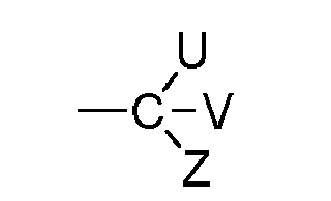
0-2 hydrogen atoms,
1-3 substituents selected from 1-oxa, 1-aza, 1-thia C1-C6-alkyl substituents in which two of them may be coupled to a 5-7-membered ring, or two of them may be joined to one and bound to carbon atom through a double bond, C1-C2-alkylidene. - 12. The process according to item 11, wherein U, V, Z are trialkoxy characterizing orthoesters, U, V, Z are dialkoxy or alkylenedioxy characterizing acetals, U, V, Z are dialkylthio or alkylenedithio characterizing thioacetals, or U, V, Z are bis(dialkylamino or alkylenediamino characterizing aminals.
- 13. The process according to any of the proceeding items, wherein the compound of formula IIIa is in the (S)-configuration, preferably (S)-epichlorohydrin is used as the compound of formula IIIa to obtain 1-chloro-3-(2,4,5-trifluorophenyl)-2(S)-propanol as the compound of formula IV.
- 14. The process according to any one of items 1 to 8, wherein the compound of formula IV with A being OH,

is further converted to a compound of formula V,
by treatment with cyanides, selected from alkali, earth-alkali metalic or quaternary ammonium cyanides. - 15. The process according to item 14, wherein the further conversion to the compound of formula V is carried out by treatment with potassium or sodium cyanide in a protic solvent or in a mixture of protic and aprotic solvent, preferably in a water/N,N-dimethylformamide mixture.
- 16. The process according to any one of items 1 to 10, wherein the compound of formula IV with A being OH,


- a) optionally deprotecting the protected hydroxy group,
- b) transforming the hydroxyl group to halogen, arylsulfonyloxy, unsubstituted or fluorinated C1-C4-alkylsulfonyloxy group, and
- c) treating the obtained compound of formula IV with cyanide anion selected from alkali, earth-alkali metalic or quaternary ammonium cyanides, preferably by treatment with potassium or sodium cyanide in a protic solvent or in a mixture of protic and aprotic solvent.
- 17. The process according to any one of items 14 to 16, wherein the compound of formula V is further converted to a compound of formula VI,

by treatment with strong acid. - 18. The process according to item 17, wherein the strong acid is selected from the group consisting of hydrogen halogenide, preferably HCl, perchloric, alkanesulfonic, halo substituted alkanesulfonic, arylsulfonic acids and sulfonic acids on polymer support.
- 19. The process according to item 11 or 12, wherein R is a group converted to C(=O)Z depicted in the compound of formula VI, and Z is selected from the group consisting of hydroxy, amino, OR1, wherein R1 is selected from C1-C6-alkyl and halo substituted C1-C6-alkyl, and NHR2, wherein R2 is selected from H, C1-C4-alkyl, aryl-C1-C2-alkyl, C1-C4-alkoxy, aryl-C1-C2-alkoxy by reactions of hydrolysis, alcoholysis, oxidation, or ozonization.
- 20. The process according to any one of items 14 to 18, wherein the compound of formula V or a salt thereof is further converted to a compound of formula Vlc,

by treatment with a strong acid, preferably a strong acid as defined in item 18, in a solvent of formula R1OH, wherein R1 is H, C1-C6-alkyl or halo substituted C1-C6-alkyl, preferably ethanol or methanol, optionally diluted with water or aprotic organic solvent. - 21. The process according to any one of items 14 to 17, wherein the compound of formula V is further converted to a compound of formula VIa

by a treatment selected from a) to c):- a) treating the compound of formula V in aqueous alkaline conditions, optionally diluted with water miscible solvent, preferably in the presence of hydrogen peroxide, more preferably in concentrated ammonia in the presence of hydrogen peroxide,
- b) treating the compound of formula V with a strong acid, preferably a strong acid as defined in item 18,
- c) treating the compound of formula VIc,

Here, preference of treatments is increased from a) to c).
- 22. The process according to item 21, wherein the compound of formula VIa is further converted to a compound of formula VId,

by treatment with a coupling reagent selected from carbodiimides and amines R2-NH2, wherein R2 is selected from H, C1-C4-alkyl, aryl-C1-C2-alkyl, C1-C4-alkoxy, aryl-C1-C2-alkoxy and trifluoroacetyl, in the presence of a solvent. - 23. The process according to item 22, wherein the coupling reagent is selected from N,N'-dicyclohexylcarbodiimide, N,N'-diisopropylcarbodiimide, N-ethyl-N'-(3-dimethyamino propyl)carbodiimide and 1-hydroxybenzotriazole, and/or the solvent is selected from haloalkanes, nitriles, alkylcarboxylic esters, ethers, aromatic hydrocarbons and mixtures thereof.
- 24. The process according to item 21, wherein the treatment according to a) or b) is performed to obtain a compound of formula VIb

- 25. The process according to any of items 17, 19 or 21, further comprising the steps of:
- a) reacting the compound of formula VI, wherein Z is hydroxyl, or the compound of formula V, with a heterocyclic moiety of formula VIII


- b) sulfonation of the compound of formula VII or a salt thereof with a halogenide or an anhydride of a sulfonic acid in the presence of a base, preferably a weak base, in an aprotic organic solvent,
to obtain a compound of formula IX or a salt thereof
- a) reacting the compound of formula VI, wherein Z is hydroxyl, or the compound of formula V, with a heterocyclic moiety of formula VIII
- 26. The process according to item 25 further comprising
- a) treatment of the compound of formula IX with an azide reagent, preferably alkali metal azide or trialkylammonium azide to obtain a compound of formula X,

- b) further reducing azido group to obtain compound of formula I,

- a) treatment of the compound of formula IX with an azide reagent, preferably alkali metal azide or trialkylammonium azide to obtain a compound of formula X,
- 27. The process according to any one of items 17 to 19 or 21, further comprising sulfonation of the compound of formula VI with a halogenide or an anhydride of sulfonic acids, in the presence of a base, preferably a weak base, in an aprotic organic solvent, to obtain a compound of formula XI,

- 28. The process according to item 27, wherein the compound of formula XI,

comprising the steps consisting of- a) treatment with alkali metal azide or trialkylammonium azide to obtain a compound of formula XII,

- b) reacting of the compound of formula XII with a heterocyclic moiety of formula VIII,


- c) further reducing azido group to obtain the compound of formula 1,

- a) treatment with alkali metal azide or trialkylammonium azide to obtain a compound of formula XII,
- 29. The process according to any of the items 25 to 28, wherein the halogenide or the anhydride of sulfonic acids is a halogenide or an anhydride of methanesulfonic, ethanesulfonic, benzenesulfonic, p-toluenesulfonic, p-bromobenzenesulfonic, p-nitrobenzenesulfonic or camphor-10-sulfonic, and wherein the aprotic organic solvent is selected from carboxylic esters, haloalkanes, aromatic hydrocarbons, alkyl ethers, nitriles and N,N-dialkylamides.
- 30. A compound of formula IV,

a leaving group, or
a group convertible to a leaving group. - 31. The compound according to item 30, wherein R is a group selected from the group consisting of halogen, arylsulfonyloxy, unsubstituted and fluorinated C1-C4-alkylsulfonyloxy.
- 32. The compound according to item 30, wherein R is a hydroxy group, optionally protected to be inert in an organometal containing medium, or an organometal inert group convertible to a group selected from cyano aminocarbonyl, hydroxycarbonyl and alkoxycarbonyl.
- 33. A compound of formula VI,

- 34. A compound of formula XI,
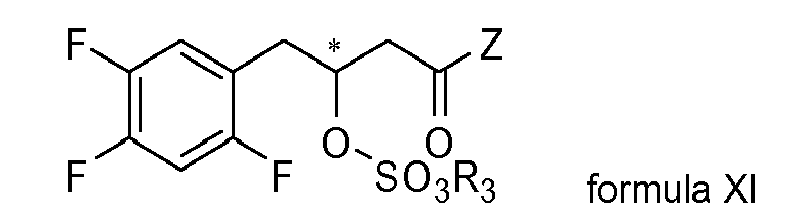
- 35. The process according to item 27, wherein the compound of formula XI,


by cyclization of in the presence of strong base, preferably sodium hydride, in a solvent selected from amides, halogenated alkanes and aromatic hydrocarbons. - 36. A compound of formula XIV,

- 37. A compound of formula XVII,

- 38. A process for producing sitagliptin or a salt thereof, comprising the steps of carrying out a process for preparing the compound of formula IV according to item 1, or carrying out a process for preparing the compound of formula VI according to item 17 or 19,
and subjecting the compound of formula IV or the compound of formula VI to further synthesis steps to yield sitagliptin or a salt thereof. - 39. The process according to item 38, comprising the steps of:
- a) using a compound of formula IIIa, wherein * denotes a chiral atom of (S) configuration,
- b) providing a compound of formula IV prepared by a process according to any one of items 1 to 13,
- c) converting said compound of formula IV to a compound of formula VI by a process according to any one of items 17 to 19,
- d) converting said compound of formula VI to a compound of formula IX by a process according to item 25,
- e) converting said compound of formula IX to sitagliptin or salt thereof.
- 40. The process according to item 38, comprising the steps of:
- a) using a compound of formula IIIa, wherein * denotes a chiral atom of (S) configuration,
- b) providing a compound of formula IV prepared by a process according to any one of items 1 to 13,
- c) converting said compound of formula IV to a compound of formula VI by a process according to any one of items 17 to 19,
- d) converting said compound of formula VI to a compound of formula IX by a process according to item 25,
- e) converting said compound of formula IX to a compound of formula X by a process according to item 26,
- f) converting said compound of formula X to sitagliptin or salt thereof.
- 41. The process according to item 38, comprising the steps of:
- a) using a compound of formula Ilia, wherein * denotes a chiral atom of (S) configuration,
- b) providing a compound of formula IV prepared by a process according to any one of items 1 to 13,
- c) converting said compound of formula IV to a compound of formula VI by a process according to any one of items 17 to 19,
- d) converting said compound of formula VI to a compound of formula XI by a process according to item 27,
- e) converting said compound of formula XI to a compound of formula XIV by a process according to item 35,
- f) converting said compound of formula XIV to sitagliptin or salt thereof.
- 42. Use of a compound of formula IV,

- 43. Use of a compound of formula VI,

for the synthesis of gliptins or salts thereof. - 44. Use of a compound of formula XI,

for the synthesis of gliptins or salts thereof. - 45. Use of a compound of formula XIV,
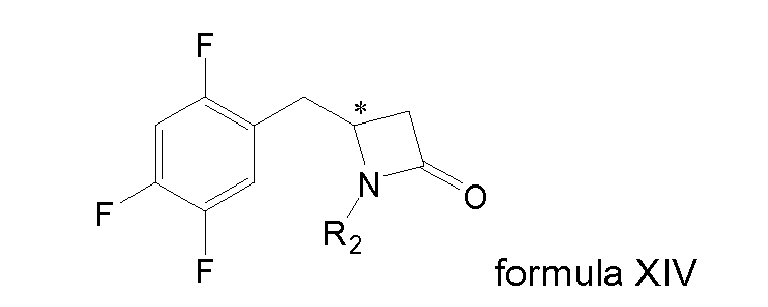
- 46. Use of a compound of formula XVII,

for the synthesis of gliptins or salts thereof. - 47. A process for producing a pharmaceutical composition comprising sitagliptin as active ingredient, comprising the steps of: a) preparing sitagliptin or a salt thereof according to a process as defined in any one of items 38 to 41, and b) admixing the thus prepared sitagliptin with at least one pharmaceutically acceptable excipient.
- In the following, the present invention will be described in more details by preferred embodiments and examples while referring to the attached drawings, noting however, that these embodiments, examples and drawings are presented for illustrative purposes only and shall not limit the invention in any way.
- The present invention provides an industrially applicable, economical and acceptable process for eventually yielding β-amino acids, particularly suitable for obtaining gliptins and especially for synthesizing sitagliptin or salts thereof such as the phosphate salt. The process according to the present invention makes use of inexpensive commercial chiral starting materials for introducing chirality into the desired β-amino acid molecule such as sitagliptin and its variants and derivatives. Advantageously the present invention allows an efficient, yet highly selective inclusion of the chiral center already at an early stage in the synthesis of β-amino acid derivatives, using chiral epoxides or chiral aziridines as a source of chirality for intermediates which are suitable for building up β-amino acids and similar compounds, in particular in the construction of the sitagliptin molecule. In a preferred and advantageous embodiment particularly suitable to prepare sitagliptin, the present invention makes use of chiral epoxides, in particular epichlorohydrine, glycidol, etc., as respective easily accessible, economically and synthetically advantageous raw materials widely used in the chemical and pharmaceutical industry.
- The term "alkyl" as used herein, if not stated otherwise with respect to particular embodiments, include reference to a straight or branched chain alkyl moiety having 1, 2, 3, 4, 5 or 6 carbon atoms. This term includes methyl, ethyl, propyl (n-propyl or isopropyl), butyl (n-butyl, sec-butyl or tert-butyl), pentyl, hexyl and the like. In particular, alkyl may have 1, 2, 3 or 4 carbon atoms.
- The term "cycloalkyl" as used herein, if not stated otherwise with respect to particular embodiments, includes an alicyclic moiety having 3, 4, 5, 6, 7 or 8 carbon atoms. The group may be a bridged or polycyclic ring system. More often cycloalkyl groups are monocyclic. This term includes groups such as cyclopropyl, cyclobutyl, cyclopentyl, cyclohexyl, norbomyl, bicyclo[2.2.2]octyl and the like.
- The term "alkoxy" as used herein, if not stated otherwise with respect to particular embodiments, include -O-alkyl, wherein alkyl is straight or branched chain and comprises 1, 2, 3, 4, 5 or 6 carbon atoms. In certain embodiments, alkoxy has 1, 2, 3 or 4 carbon atoms. This term includes methoxy, ethoxy, propoxy, isopropoxy, butoxy, tert-butoxy, pentoxy, hexoxy and the like.
- The term "aryl" as used herein, if not stated otherwise with respect to particular embodiments, includes reference to an aromatic ring system comprising 6, 7, 8, 9, 10, 11, 12, 13, 14, 15 or 16 ring carbon atoms. Aryl is often phenyl but may be a polycyclic ring system, having two or more rings, at least one of which is aromatic. This term includes phenyl, naphthyl, fluorenyl, azulenyl, indenyl, anthryl and the like.
- The term "heterocycle" as used herein includes, if not stated otherwise with respect to particular embodiments, a saturated (e.g. heterocycloalkyl) or unsaturated (e.g. heteroaryl) heterocyclic ring moiety having 3, 4, 5, 6, 7, 8, 9, 10, 11, 12, 13, 14, 15 or 16 ring atoms, at least one of which is selected from nitrogen and oxygen. In particular, heterocyclyl includes a 3- to 10-membered ring or ring system and more particularly a 5- or 6- or 7-membered ring, which may be saturated or unsaturated; examples thereof include oxiranyl, azirinyl, 1,2-oxathiolanyl, imidazolyl, thienyl, furyl, tetrahydrofuryl, pyranyl, thiopyranyl, thianthrenyl, isobenzofuranyl, benzofuranyl, chromenyl, 2H-pyrrolyl, pyrrolyl, pyrrolinyl, pyrrolidinyl, imidazolyl, imidazolidinyl, benzimidazolyl, pyrazolyl, pyrazinyl, pyrazolidinyl, thiazolyl, isothiazolyl, dithiazolyl, oxazolyl, isoxazolyl, pyridyl, pyrazinyl, pyrimidinyl, piperidyl, piperazinyl, pyridazinyl, morpholinyl, thiomorpholinyl, especially thiomorpholino, indolizinyl, isoindolyl, 3H-indolyl, indolyl, benzimidazolyl, cumaryl, indazolyl, triazolyl, tetrazolyl, purinyl, 4H-quinolizinyl, isoquinolyl, quinolyl, tetrahydroquinolyl, tetrahydroisoquinolyl, decahydroquinolyl, octahydroisoquinolyl, benzofuranyl, dibenzofuranyl, benzothiophenyl, dibenzothiophenyl, phthalazinyl, naphthyridinyl, quinoxalyl, quinazolinyl, quinazolinyl, cinnolinyl, pteridinyl, carbazolyl, ß-carbolinyl, phenanthridinyl, acridinyl, perimidinyl, phenanthrolinyl, furazanyl, phenazinyl, phenothiazinyl, phenoxazinyl, ehromenyl, isochromanyl, chromanyl and the like.
- More specifically, a saturated heterocyclic moiety may have 3, 4, 5, 6 or 7 ring carbon atoms and 1, 2, 3, 4 or 5 ring heteroatoms selected from nitrogen and oxygen. The group may be a polycyclic ring system but more often is monocyclic, for example including azetidinyl, pyrrolidinyl, tetrahydrofuranyl, piperidinyl, oxiranyl, pyrazolidinyl, imidazolyl, indolizidinyl, piperazinyl, thiazolidinyl, morpholinyl, thiomorpholinyl, quinolinidinyl and the like. Furthermore, the "heteroaryl" may include an aromatic heterocyclic ring system having 5, 6, 7, 8, 9, 10, 11, 12, 13, 14, 15 or 16 ring atoms, at least one of which is selected from nitrogen and oxygen. The group may be a polycyclic ring system, having two or more rings, at least one of which is aromatic, but is more often monocyclic. This term includes pyrimidinyl, furanyl, benzo[b]thiophenyl, thiophenyl, pyrrolyl, imidazolyl, pyrrolidinyl, pyridinyl, benzo[b]furanyl, pyrazinyl, purinyl, indolyl, benzimidazolyl, quinolinyl, phenothiazinyl, triazinyl, phthalazinyl, 2Hehromenyl, oxazolyl, isoxazolyl, thiazolyl, isoindolyl, indazolyl, purinyl, isoquinolinyl, quinazolinyl, pteridinyl and the like.
- The term "substituted" as used herein in reference to a structure/moiety/group means that one or more, especially up to 5, more especially 1, 2 or 3, of the hydrogen atoms in said structure/moiety/group are replaced independently of each other by the corresponding number of substituents known to a person skilled in the art. Typical substituents include, without being limited to halogen, trifluoromethyl, cyano, nitro, oxo, NR', -OR', -C(O)R', -C(O)OR', -OC(O)R', -S(O)R', N(R')R", C(O)N(R')R", -SO2N(R')R' and R"', wherein each of R', R" and R'" are selected from the group consisting of C1 - C6 alkyl, C1 - C6 alkoxy, -(CH2)m-heterocyclyl (m being 1, 2, 4 or 4) and each R' and R" may be optionally and independently further substituted with one or more of hydrogen, halogen, cyano, amino, hydroxy, C1 - C6 alkyl and C1 - C6 alkoxy. Specific substituents in particular include halogen such as fluoro, chloro and/or bromo, hydroxy, amino, C1 - C6 alkyl and C1 - C6 alkoxy, and halogenated C1 - C6 alkyl and C1 - C6 alkoxy such as trifluoro-methyl. It will be understood that substituents are at positions where they are chemically possible, it being known or evident to the person skilled in the art to decide (either experimentally or theoretically) without inappropriate effort whether a particular substitution is possible. For example, substituents which may be unstable or may affect reactions disclosed herein may be omitted, at least at the relevant stage of intermediate compound or of the affected reaction.
- The term "base substance" used herein according to preferred embodiments can be any base known and typically used in organic synthesis. The base can include, without being limited to, amides, hydrides, hydroxides, amidines, tertiary amines. The preferred base is selected from hydroxides, ammonia, amines, and inorganic basic salts such as acetates, carbonates, phosphates.
- The terms "leaving group" and "a group convertible to a leaving group" used herein have their typical meaning known to those skilled in organic synthesis. A "group convertible to a leaving group" has the capability of being conventionally converted to a desired leaving group. Preferably and in view of the key reaction step of the present invention, the leaving group and the group convertible to a leaving group respectively are inert in an metal- or organometal-containing medium. Optionally the respective leaving group of a precursor group thereof is protected by usual and known protection groups. The respective meanings of these terms become further apparent from the more specific definitions provided herein in the disclosure of preferred embodiments.
- According to a preferred option (A) of an embodiment of the present invention for the synthesis of a DPP-4 inhibitor of formula 1,

comprises - a) preparing a compound of formula IIa,

by treatment of a halo-trifluorobenzene with an appropriate metal or organometal compound, for example selected from the group consisting of alkyl metals, aryl metals and halides thereof, such as alkyl magnesium chloride, alkyl zinc chloride and lithium chloride, wherein alkyl suitably is C1-C6; - b) reacting of the compound of formula IIa with a compound of formula IIIa,

to form halohydrine of formula IV,
- c) converting halohydrin of formula IV to cyanohydrin of formula V

by reacting with cyanide ion in a protic solvent or in a mixture of protic and aprotic solvent, preferably in a water/N,N-dimethylformamide mixture; - d) hydrolyzing cyanohydrin of formula V to an ester of formula VIc,
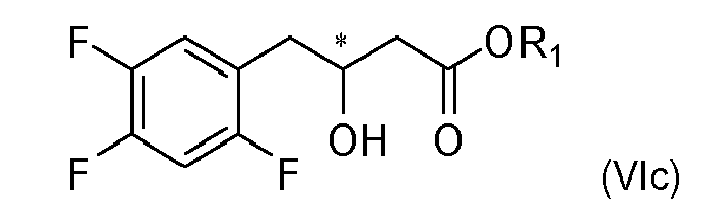
by treatment with a strong acid in a C1-C6-alkanol or halo substituted C1-C6-alkanol; - e) saponification of the ester of formula VIc to an acid of formula VIa,

by hydroxide solution in C1-C4-alkanol - f) reacting the acid of formula VIa with a compound of formula VIII

producing a compound of formula VII,
- g) sulfonation of compound of formula VII to a compound of formula IX

by treatment with halogenides or anhydrides of a sulfonic acid in the presence of weak bases in an aprotic organic solvent; - h) converting the compound of formula IX to a compound of formula X

by treatment with an azide reagent with complete or predominate conversion of chirality; - i) reducing the compound of formula X into the compound of formula I

by catalytic hydrogenation or reaction with trisubstituted phosphines. - According to another option (B) of the embodiment present invention for the synthesis of sitagliptin, the compound of formula VIc of the step d) is isolated.
- According to another option (C) of the embodiment present invention for the synthesis of sitagliptin, the compound of formula VIc of the step d) is not isolated but after neutralization of the reaction mixture and optional extraction solvents are partially or completely removed and the residue is transferred to conditions of the reaction of step e).
- According to an alternative option (D) of the embodiment present invention for the synthesis of sitagliptin, the reaction step d) is carried out in the absence of alcohol. In such aspect of the invention the compound of formula VIa could be prepared without providing step e) or optionally by applying step e) in order to reduce an amount of partial hydrolytic products such as amide of formula VIb.
- In another optional embodiment (E) steps e) to h) of the option (A) are replaced by
- j) sulfonation the compound of formula VIc,

by treatment with halogenides or anhydrides of a sulfonic acid in the presence of a weak base in an aprotic organic solvent
to form a compound of formula XI,
- k) converting the compound of formula XI to a compound of formula XII,

by treatment with an azide reagent in an aprotic polar solvent or amide solvent with a complete or predominate conversion of chirality; - l) saponification of the compound of formula compound XII to a compound of formula compound XIII

- m) amidation of the compound of formula compound XIII with the compound of formula VIII in the presence of coupling reagent in suitable organic solvent to form the compound of formula X.
- In another optional embodiment (F) the compound of formula VIa obtained in step e) of the option (A) is further treated with amide coupling reagent, preferably selected from carbodiimides and O-benzylhydoxylamine optionally, in the presence of base to form a compound of formula VId,
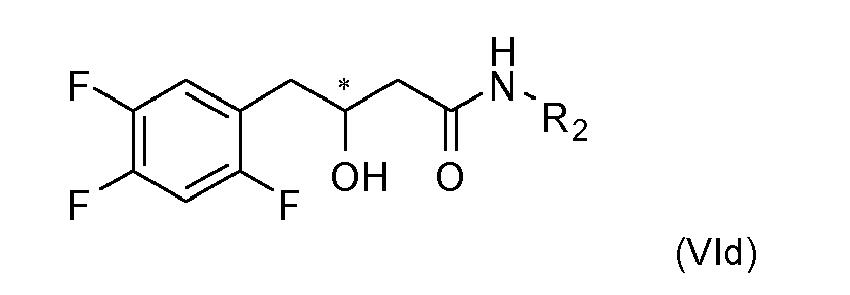
and steps d) to h) of the option (A) are replaced with - n) sulfonation of the compound of formula VId to a compound of formula XId,

by treatment with halogenides or anhydrides of a sulfonic acid in the presence of a weak base in an aprotic organic solvent; - o) cyclization of the compound of formula XId to a compound of formula XIV with a complete or predominate conversion of chirality,

in the presence of strong base, preferably sodium hydride in a solvent selected from amides, halogenated alkanes or aromatic hydrocarbons; - p) hydrolysis of the compound of formula XIV to a compound of formula XV

by treatment with alkali or earth alkali hydroxide, preferably lithium hydroxide; - q) coupling of the compound of formula XV with the compound of formula VIII to form a compound of formula XVI

in the presence of coupling reagents selected from pivaloyl chloride, chloroformates preferably isobutyl chloroformate and carbodiimides - r) eliminating of group R2 by hydrolysis or reduction, preferably by catalytic hydrogenation.
- In an alternative embodiment (G) a compound of structural formula IV obtained in step b) of the option (A),

R is
0-2 hydrogen atoms,
1-3 substituents selected from 1-oxa, 1-aza, 1-thia C1-C6-alkyl substituents in which two of them could be coupled to a 5-7-membered ring or two of them are joined to one and bound to carbon atom through a double bond,
C1-C2-alkylidene,
is converted to the compound of formula VI by reactions of hydrolysis alcoholysis, oxidation, or ozonization. Preferably the compounds of formula IV are selected from ortoesters (U, V, Z are trialkoxy), acetals (U, V, Z are dialkoxy or alkylenedioxy), thioacetals (U, V, Z are dialkylthio or alkylenedithio), aminals (U, V, Z are bis(dialkylamino or alkylenediamino)), or R is vinyl, optionally from esters (R is COOR1, R1 is C1-C6-alkyl) and amides (R is CONR2R3, R1 is C1-C6-alkyl) if the reaction of compound of formula II is highly selected to epoxides and kinetically unfavoured to esters or amides. - In a special embodiment of the invention the method is used for the preparation of sitagliptin and related compounds and salts thereof, in which enantiomerically pure starting compounds are used. Hence in preferred embodiments the substituents in respective formulas have the following meaning
n is 3
X is fluoro in positions 2, 4 and 5 of benzene ring as regards to the side chain,
and the amide moiety of the carboxyl group is defined by the following formula III':

- An illustrative and preferred but not limited approach of this special embodiment is shown in Scheme 5 and described in further detail as a representative embodiment below.

- In the first step of the embodiment the (S)-epihalohydrin of formula 3 (compound of formula III, wherein * is in (S)-configuration and R is Cl or Br) reacts with 1-metalo-2,4,5-trifluorobenzene of formula 2 (compound of formula II, wherein M is MgX, ZnX, Li and X is Cl, Br, I) to form halohydrin of formula 4 ((S)-enantiomer of compound of formula IV, wherein X is CI or Br), optionally in the presence of catalytic amounts of copper (I) salts, preferably Cu2X'2 (X' is Cl, Br, I). This step comprises a one pot conversion of 1-halo-2,4,5-trifluorobenzene, preferably 1-bromo-2,4,5-trifluorobenzene via "in situ" produced 1-metalo-2,4,5-trifluorobenzene, formed by treating said compound with elemental metal, such as Mg, Zn or Li, or with alkyl or arylmetal reagents, such as Grignard reagents or alkyllithium to 1-halo substituted 1-(2-hydroxypropyl)-2,4,5-trifluorobenzenes (compound of formula 4). Coupling of these organo-metalo species with epoxide proceeds faster in the presence of catalytic amounts of some transition metal salts such as manganese, cerium, copper salts, preferably copper (I) salts. For example 1-halomagnesio-2,4,5-trifluorobenzenes (compound of formula 2, wherein M is MgCl) reacts efficiently with 1-1.3 equivalents of (S)-epichlorohydrin in the presence copper (I) chloride, copper (I) bromide or copper (I) iodide in a 0.001-1, preferably between 0.002-0.01 equivalent amount of compound of formula 2. Best, but not limited solvents for the coupling reaction are ethers, preferably tetrahydrofurane and diethyl ether.
- The next step of the embodiment comprises a conversion of halohydrin of formula 4 into cyanohydrin of formula 5 (compound of formula V) by reaction with cyanide anion, selected from alkali, earth alkali or quaternary ammonium salt, preferably from sodium or potassium cyanide. This reaction proceeds preferably in a protic solvent or in a mixture of protic and aprotic solvent. The preferable protic solvent is water, preferably in a mixture with aprotic polar solvent, most preferable medium is the water - N,N-dimethylformamide mixture. The conversion is suitably carried out at elevated temperatures above 50 °C, preferably at 70 °C to 150 °C most preferably at 80 °C to 100 °C for 1 h to 12 h, preferably 2 h to 5 h. The product is isolated by extraction into organic solvent, preferably selected from the group of aliphatic esters, aromatic hydrocarbons, ethers and haloalkanes.
- The next step of the embodiment comprises may involve variant options. Hydrolysis of cyanohydrin of formula 5 leads to carboxylic derivatives of formula VI. The reaction may proceed in the presence of strong acids selected from hydrogen halogenides, preferably HCl, perchloric, alkanesulfonic, halo substituted alkanesulfonic, arylsulfonic acids, or sulfonic acids on polymer support in an C1-C6-alkanol, alone or diluted by a solvent. If the reaction is carried out without a solvent or in aqueous media the product is the corresponding acid 6a ((S)-enantiomer of compound of formula VIa) and/or intermediate amide 6b ((S)-enantiomer of compound of formula VIb).

- An alternative conversion of cyanohydrin of formula 5 to compound of formula 6a in aqueous medium may also proceed in alkaline conditions, accelerated by addition hydrogen peroxide. Again compound of formula 6a and compound of formula 6b can be obtained but if time, the amount of peroxide and temperature are controlled, this conversion could be stopped at the stage of amide of formula 6b formation.
- In order to proceed more uniform reaction in milder conditions it is preferable to use alcohols as solvents, preferably C1-C6-alkanoles, most preferably ethanol or methanol, optionally diluted with water or aprotic organic solvent. The reaction of alcoholysis is carried out at temperatures between 0 °C and boiling point preferably between 0 °C and 60 °C for 0.5 h to 24 h preferably 6 h to 15 h to give a compound of formula 6c ((S)-enantiomer of compound of formula VIc, wherein R1 is C1-C6-alkyl). The product could be isolated by extraction into organic solvent and subsequent evaporation. In a most preferred example the compound of formula 4 is dissolved in ethanol followed by introducing gaseous hydrogen chloride. The reaction is carried out for 12 h, then ethanol is evaporated, addition of water follows, provoking a separation of the product as oil, which could be collected as it is, or extracted into organic solvent with subsequent removing of the solvent.
- The next optional step of the embodiment comprises a saponification of the ester of formula 6c treated by alkaline aqueous or alcoholic medium, preferably to obtain the acid of formula 6a. Bases used for hydrolysis are selected from the group of alkali hydroxydes, earth-metal hydroxides, organic bases like amines, amidines and guanidines, preferably sodium hydroxide in methanol/water mixture.
- The acid of formula 6a may be isolated after acidification, optionally with previous diluting with water, followed by extraction with solvents, selected from the group of aliphatic esters, aromatic hydrocarbons, ethers and haloalkanes. If the conversion of cyanohydrin of formula 5 to compound of formula VI is not carried in alcoholic medium, the saponification of an ester may be omitted, or optionally achieved in order to hydrolyse the partial hydrolytic byproduct of formula 6b.
- In another approach compound of formula 5 is converted "in situ" into the ester of formula 6c in an acidic alcoholic medium, followed by removing the majority of the volatile compound and hydrolysing the residue of not isolated ester of formula 6c into the acid of formula 6a by action of bases and/or acids. In this way is the compound of formula 6c is provided in one pot process.
- Alternatively, the next step of the embodiment comprises partial hydrolysis of the compound of formula 5 to the amide of formula 6b in acidic or alkaline conditions with addition of hydrogen peroxide in water or C1-C6-alcohols or mixture thereof, preferably using sulfuric acid and hydrogen peroxide, or alkali metal hydroxides and hydrogen peroxide, most preferably the reaction is carried out with ammonia in 0.5 to 3 equivalent amount and hydrogen peroxide in 1 to 3 equivalent amount in an aqueous methanol or ethanol agitating at 0 °C to 70 °C, preferably at room temperature for 1 h to 12 h, more preferably for 1 h to 3 h. The reaction is carefully analyzed in order to prevent considerable conversion of the compound of formula to the acid of formula 6a. The product is preferably isolated as a solid by filtration or centrifugation.
- The next step of the embodiment comprises an amidation process with amines, selected from C1-C6-alkyl amines, aryl-C1-C4-alkylamines, C1-C4-alkoxy amines, aryl-C1-C2-alkoxyamines, trifluoroacetylamine, preferably O-benzylhydroxylamine in the presence of coupling reagents in a suitable organic solvent into compound of formula 6d.
- Common coupling reagents which are ordinary used in peptide chemistry are quite useful for this conversion, and they are suitably selected from pivaloyl chloride, chloroformates preferably isobutyl chloroformate, carbodiimides, e.g. N,N'-dicyclohexylcarbodiimide, N,N'-diisopropylcarbodiimide or N-ethyl-N'-(3-dimethyaminopropyl)carbodiimide, 1-hydroxybenztriazole, 1-methylpyridinium iodide, carbonyldiimidazole, optionally in the presence of organic tertiary amines. Preferable solvents for this reaction are selected from haloalkanes, nitriles, alkylcarboxylic esters, ethers, aromatic hydrocarbons.
- An illustrative and preferred but not limited approach of this special embodiment is shown in Scheme 6 and described in further detail as a representative embodiment below.

- In this illustrative and preferred but not limited further part of the present embodiment, the compound of formula 6a is converted to sitagliptin.
- The first step of this embodiment comprises further treating of the compound of formula 6a ((S)-enantiomer of a compound of formula VIa). This step comprises an amidation process with the heterocyclic moiety of formula 8 shown below into a compound of formula 7 in the presence of coupling reagent in a suitable organic solvent as defined above.

- For the amidation process, common coupling reagents as well as solvents can be used like for the amidation process from the compound of formula 6a to the compound of formula 6d as described above.
- The compound of formula 7 is a suitable intermediate for preparation of sitagliptin. If the stereogenic center marked with an * is a mixture of (R)- and (S)-configuration a particular enantiomer might be separated off by chiral chromatography or by crystallization of stoichiometric (R)/(S) mixture with further recovering the excess enantiomer from mother liquor.
- In the next step of this embodiment the compound of formula 7 is sulfonated to give the corresponding sulfonic esters of formula 9 in the presence of weak bases in an aprotic organic solvent (compound of formula IX, wherein R3 is selected from methyl, ethyl, benzyl, p-methylbenzyl, p-bromobenyl, p-nitrobenzyl and camphoryl).
- Agents used for sulfonation are suitably selected from halogenides or anhydrides of sulfonic acids, e.g. methanesulfonic, ethanesulfonic, benzenesulfonic, p-toluenesulfonic, p-bromobenzenesulfonic, p-nitrobenzenesulfonic, camphor-10-sulfonic. Suitable aprotic organic solvents are selected from carboxylic esters, haloalkanes, aromatic hydrocarbons, alkyl ethers, nitriles and N,N-dialkylamides. Suitably weak organic bases are selected from trialkylamines, dialkylarylamines or basic heterocycles e.g. imidazoles. Weak organic bases are preferred for this reaction, since strong bases provoke olefination of the product of formula 9. In a most preferred but not limited case methanesulfonyl chloride as sulfonic halide and ethyldiisoproylamine as a weak base are used for this reaction. The product may be isolated after washing the reaction mixture with aqueous medium and subsequent evaporation of the solvent.
- In the next step of this embodiment the compound of formula 9 is treated by an azide reagent, suitably selected from alkali metal azide or trialkylammonium azide in a solvent, preferably selected from aprotic polar solvents e.g. sulfolan, DMSO, or amide solvents, more preferably from formamide solvents, most preferably from a mixture of sulfolan and formamide or N-methylformamide at temperatures between 20 °C and 80 °C, preferably between 40 °C to 60 °C for 5 h to 48 h preferably for 12 h to 30 h to obtain the azido compound of formula 10.
- The reaction of azidation is the SN2 nucleophylic substitution, so the (S)-configuration on the chiral carbon atom is completely converted to (R). The (R)-configuration in formulas 10 and 1 as depicted in a form herein is the desired configuration for providing sitagliptin.
- In the last step of this embodiment the compound of formula 10 is reduced, preferably by catalytic hydrogenation or reaction with trisubstituted phosphines in which the substituents may be equal or different, preferably selected from triphenylphosphine, trimethylphosphine or tributylphosphine.
- An illustrative and preferred but not limited approach of this special embodiment is shown in Scheme 7 and described in further detail as a representative embodiment below. An alternative sequence of the invention comprises introduction of azido group into molecule before attaching heterocyclic moiety.

- In the compound of formula 6c, R1 is C1-C6 alkyl, and in the compound of formula 11 R3 is selected from methyl, ethyl, benzyl, p-methylbenzyl, p-bromobenzyl, p-nitrobenzyl and 10-camphoryl.
- In the first step of this embodiment the compound of formula 6c is sulfonated by halogenides or anhydrides of sulfonic acids as described above to give the corresponding sulfonic esters of formula 11 in presence of weak bases in an aprotic organic solvent. Weak organic bases as described above are used for this reaction, since strong bases provoke olefination of the product of formula 11. In a most preferred but not limited case methanesulfonyl chloride as sulfonic halide and ethyldiisoproylamine as a weak base are used for this reaction. The product can be isolated after washing the reaction mixture with aqueous medium and subsequent evaporation of the solvent.
- In the next step of this embodiment the compound of formula 11 is treated by an azide reagent selected from alkali metal azide or trialkylammonium azide in a solvent as described above to obtain the azido compound of formula 12.
- The reaction of azidation is the SN2 nucleophylic substitution, so the (S)-configuration on the chiral carbon atom is completely converted to (R). The (R)-configuration in formulas 1, 10, 12, 13 as depicted in a form herein is the desired configuration for providing sitagliptin.
- The next step of this embodiment comprises a saponification of the azidoester of formula 12, wherein R1 is C1-C6-alkyl treated by alkaline aqueous or alcoholic medium, to obtain an acid of formula 13. Bases used for hydrolysis are selected from the group of alkali hydroxydes, earth-metal hydroxides, organic bases like amines, amidines and guanidines, preferably sodium hydroxide in methanol/water mixture.
- The next step of this embodiment comprises an amidation process with the heterocyclic moiety of formula 8 into the compound of formula 13 in the presence of coupling reagent in a suitable organic solvent as defined above. For the amidation process, common coupling reagents as well as solvents can be used like for the amidation process from the compound of formula 6a to the compound of formula 6d described above.
- In the last step of this embodiment the compound of formula 10 is reduced, preferably by catalytic hydrogenation or by reaction with trisubstituted phosphines in which the substituents may be equal or different, preferably selected from triphenylphosphine, trimethylphosphine or tributylphosphine to give sitagliptin.
- An illustrative and preferred but not limited approach of this special embodiment is shown in Scheme 8 and described in further detail as a representative embodiment below.

- In another embodiment the compound of formula 6b is sulfonated by halogenides or anhydrides of sulfonic acids as defined above to give the corresponding sulfonic esters of formula 11b in presence of weak bases in an aprotic organic solvent. Weak organic bases as defined above are used for this reaction, since strong bases provoke olefination of the product of formula 11b. In a most preferred but not limited case methanesulfonyl chloride as sulfonic halide and ethyldiisopropylamine as a weak base are used for this reaction. The reaction is preferably carried out in dichloromethane at 0 °C to 20 °C in the presence of 1-1.5 equivalents of methanesulfonyl chloride and 1-2 equivalents of base for 0.5 h to 6 h. The product is isolated after washing the reaction mixture with aqueous medium and subsequent evaporation of the solvent.
- In an alternative the amide of formula 11b can be substituted with a halogenide R2-X, wherein R2 is C1-C6-alkyl, aryl-C1-C4-alkyl and trifluoroacetyl in order to obtain a compound with R2 which activates the system to cyclisize to azetidone of formula 14 in basic conditions, preferably R2 is trifluoroacetyl.
- An illustrative and preferred but not limited approach of this special embodiment is shown in Scheme 9 and described in further detail as a representative embodiment below.

- In the compound of formula 11d R3 is selected from methyl, ethyl, benzyl, p-methylbenzyl, p-bromobenyl, p-nitrobenzyl and camphoryl.
- In the first step of this embodiment the compound of formula 6d, wherein R2 is selected from H, OMe and OBn, is sulfonated by halogenides or anhydrides of sulfonic acids as defined above to give the corresponding sulfonic esters of formula 11d in presence of weak bases in an aprotic organic solvent. Weak organic bases as defined above are used for this reaction, since strong bases provoke olefination of the product of formula 11d. In a most preferred but not limited case methanesulfonyl chloride as sulfonic halide and ethyldiisopropylamine as a weak base are used for this reaction. The reaction is preferably carried out in dichloromethane at 0 °C to 20 °C in the presence of 1-1.5 equivalents of methanesulfonyl chloride and 1-2 equivalents of base for 0.5 h to 6 h. The product is isolated after washing the reaction mixture with aqueous medium and subsequent evaporation of the solvent.
- The next step of this embodiment comprises the conversion of oxyamide of formula 11d, wherein R2 is selected from a group of OMe or OBn to the azetidinone of formula 14 in the presence strong base, preferably sodium hydride in a solvent selected from amides, halogenated alkanes or aromatic hydrocarbons. Alternatively, the same azetidinone can be prepared by Mitsunobu reaction using azodicarboxylate or diisopropyl azodicarboxylate in the presence of phosphines, preferably triphenylphosphine in one step directly from the oxyamide 6d, wherein R2 is selected from a group of OMe or OBn.
- In the next step of this embodiment the azetidinone of formula 14, wherein R2 is OMe or OBn, is further cleaved by alkaline hydrolysis using alkali or earth alkali hydroxide, preferably lithium hydroxide to give β-oxyamino acids of formula 15, which are further coupled with heterocyclic moiety 8 into compound of formula 16 in the presence of coupling reagent in suitable organic solvent as described above.
- For the amidation process, common coupling reagents as well as solvents can be used like for the amidation process from 6a to 6d described above.
- The next step of this embodiment comprises the reduction of β-oxyamino compounds of formula 16, wherein R2 is OMe or OBn, to sitagliptin of formula 1 by common methods such as catalytic hydrogenation, reduction by alkali metal in ammonia, preferably lithium or sodium or reduction by reducing elemental metal in an acid, preferably zinc or tin in hydrochloric acid.
- The (R)-configuration in formulas 14, 15, 16 and 1 as depicted in a form herein is the desired configuration for providing sitagliptin.
- While preferred embodiments have been described, it will become apparent that variations are possibly and are contemplated herein, to yield sitagliptin or analogues thereof, or other gliptins or other β-amino acids and β-amino acids derivatives, when starting with compounds of formula II and III to obtain the compound of formula IV with suitable subsequent synthesis steps.
- The following examples illustrate the present invention and are not intended to limit the scope of the invention.
-

- 700 mL of tetrahydrofuran was charged into reactor and cooled to 0 °C, followed by the consecutive addition of 350 mL 2 M i-propylmagnesium chloride and 69 mL 1-bromo-2,4,5-trifluorobenzene applying stirring and maintaining temperature of the reaction mixture between 0 °C and 5 °C. After the addition, the reaction mixture was stirred gently for 1 h at 0 °C to 5 °C and for 3 h at 22 °C obtaining the solution of 2,4,5-trifluorophenylmagnesium chloride.
- 0.25 g of iodine was weighed into small reaction flask and titrated with the solution obtained. When darkly brown solution turned its color to white suspension, the consumption of solution was ready. Typical consumption was about 1.85 mL/mmol of iodine.
- To the whole amount of above prepared solution of Grignard reagent 28 mL of (S)-epichlorohidrin (formula 3) was added during stirring, followed by the addition of 0.80 g copper(I) chloride. Exotermic reaction started and when inner temperature raised to 40 °C, external cooling was applied, lowering the internal temperature to 25 °C. 28 mL of (S)-epichlorohidrin divided into two equal portions were added.
- After the addition, the reaction mixture was stirred for 5 h at 25 °C, followed by the addition of 75 mL acetic acid and 750 mL methyl tert-butyl ether. The resulted mixture was washed consecutively with 700 mL water; mixture of 700 mL water, 80 mL brine, 80 mL 20% ammonium chloride, and 750 mL 2% sodium bicarbonate.
- Organic phase was evaporated at 60 °C and 5 mbar, to yield 131 g of crude product of compound of formula 4 in the form of yellowish oil.
- 1H NMR (DMSO-d6): δ 2.64 (dd, 1H), 2.83 (dd, 1H), 3.49-3.64 (m, 2H), 3.85 3.90 (m,1H), 5.31 (d,1H), 7.37-7.48 (m, 2H).
-

- 128 g compound of formula 4, 60 g potassium cyanide, 7 g sodium iodide, 160 mL N,N-dimethylformamide and 220 mL water was charged into reactor. The mixture was heated for 3 h at 95 °C during stirring, forming homogeneous solution. After cooling to 24 °C, the reaction mixture was washed with 340 mL n-heptane. Water phase was extracted twice with 1300 mL and 400 mL ethyl acetate. Combined organic phases were washed consecutively with 2 x 950 mL water and 2 x 1100 mL of diluted brine (950 mL water and 150 mL brine).
- Organic phase was evaporated at 60 °C and 5 mbar, the residue was dissolved in 150 mL ethyl acetate and evaporated again at 60 °C and 5 mbar to remove water to yield 102.3 g of clear, brown syrupy product of compound of formula 5.
- 1H NMR (DMSO-d6): δ2.52 (dd, 1H), 2.65-2.79 (m, 3H), 3.98 (s/wide/, 1H), 5.51 (d,1H), 7.37-7.46 (m, 2H).
-

- 45 g of hydrogen chloride gas was dissolved in 100 mL absolute ethanol at -10 °C. 75 g of compound of formula 5 was added during stirring. The temperature of reaction mixture slowly raised to 35 °C, then it was cooled to 23 °C and aged for 8 h at the same temperature. Afterwards 4 g of active charcoal and 80 mL of ethanol were added, followed by stirring at 60 °C for 10 min and subsequent filtering off the charcoal.
- The filtrate was subjected to evaporation at 58 °C and 35 mbar. To the oily residue obtained 180 mL of water were added and the resulted solution was stirred at 40 °C for 2 h and biphasic mixture was formed, which was finally extracted twice with 180 mL of ethyl acetate. Combined extracts were washed with 130 mL of diluted brine (110 mL water and 20 mL brine). Organic phase was evaporated at 60 °C and 5 mbar. The obtained oily residue was dissolved in 150 mL ethyl acetate and evaporated to remove water as much as possible.
- The residue was dissolved in 300 mL ethyl acetate. The resulting solution was dried for 3 h with 20 g of anhydrous sodium sulfate. Drying agent was filtered off and the obtained filtrate was evaporated at 60 °C and 4 mbar to yield 102.5 g of clear brown oily product of compound of formula 6.
- 1H NMR (DMSO-d6): δ 1,15 (t, 3H), 2.34 (dd, 1H), 2.34 (dd, 1H), 2.66 (dd, 1H), 2.72 (dd, 1H), 4.02(q,2H), 4.06 4.10 (m, 1H), 5.02(d,1H), 7.35-7.44 (m, 2H).
-

- 93.0 g of compound of formula 6 (R1 = Et) was dissolved in the mixture of 280 mL THF and 700 mL water at 40 °C. During stirring, 49 mL of 8 M aqueous sodium hydroxide were poured gradually within 10 min. The reaction mixture was kept stirring for 2 h at 40 °C, followed by washing the reaction mixture with 900 mL of methylcyclohexane. To the aqueous phase 930 mL of ethyl acetate, 230 mL of water and 75 mL 6 N aqueous hydrochloric acid were added.
- After vigorous stirring, organic phase was separated and washed with 700 mL of diluted brine (570 mL of water and 130 mL salt). Organic phase wais subjected to evaporation at 55 °C and 5 mbar, obtaining 80.1 g of crude solid product of compound of formula 6a, which could be recrystallised from toluene (190 mL) and obtaining 62 g of pure solid.
- 1H NMR (DMSO-d6): δ 2.26 (dd, 1H), 2.34 (dd, 1H), 2.64 (dd, 1H), 2.72 (dd, 1H), 4.02 4.09 (m, 1H), 4.92(s/wide/,1H), 7.34-7.46 (m, 2H), 12.06(s/wide/,1H).
-

- 35 g of compound of formula 6a and 28.3 g of compound of formula 8 were dissolved in 364 mL dichloromethane, forming clear solution, which was pre-cooled to 16 °C before adding of 23.5 mL N,N'-diisopropylcarbodiimide. During gradual addition (15 min) of carbodiimide, the temperature was maintained between 20 °C to 25 °C applying external cooling. After the addition, the reaction mixture was stirred at 23 °C for 3 h and then aged 3 h at 0 °C, forming white suspension of precipitated N,N'-diisopropylurea. Suspension was filtered and the precipitate was washed with 2 x 50 mL dichloromethane. Clear, yellowish-brown filtrate was washed with 360 mL of diluted hydrochloric acid (obtained from 350 mL of water and 7.0 mL of 6 N HCl), 380 mL 0.5 % aqueous sodium bicarbonate, and 350 mL water.
- Organic phase was evaporated at 50 °C and 2 mbar, obtaining 58.4 g of clear, pale-brownish amber-like product of compound of formula 7, which solidified on standing.
- 1H NMR (DMSO-d6): δ 2.45-2.48(m, 1H), 2.65-2.78 (m,3H), 3.53-3.55(m, 2H), 3.96-4.21 (m,3H), 4.85-5.05(m,2H), 7.35-7.40 (m, 2H).
-

- 13.4 g of compound of formula 7 was dissolved in 70 mL of dichloromethane, followed by the addition of 15 mL of ethyldiisopropylamine. The turbid solution was cooled to 15 °C during stirring. During gradual addition of 4.7 mL of methanesulfonyl chloride the temperature of reaction mixture was maintained between 15 °C to 20 °C. After addition, stirring was continued for 1 h at 23 °C. Reaction mixture was then diluted with 70 mL of dichloromethane and consecutively washed with 100 mL 5% aqueous sodium bicarbonate and twice with 110 mL of the mixture prepared by mixing 100 mL water and 10 mL brine.
- Evaporation of the reaction mixture at 5 mbar and 55 °C gave 16.1 g of yellowish-brown, solid foamy product of compound of formula 9.
- 1H NMR (DMSO-d6): δ 2.80-3.12(m, 7H), 3.89-4.0(m,2H), 4.03-4.27 (m, 2H), 4.80-4.95(m,2H), 5.12-5.20(m,1H), 7.38-7.46 (m, 2H).
-

- 8.0 g of compound of formula 9 was dissolved in the mixture of 24 mL formamide and 14.0 g sulfolane and 3.0 g of sodium azide are added. The mixture was stirred at 50 °C for 24 h, then cooled to 24 °C and 70 mL of ethyl acetate was added. The suspension formed was washed consecutively by 3 x 80 mL water. The organic layer was evaporated at 52 °C and 4 mbar, yielding 7.2 g of brown amber-like, crude product of compound of formula 10.
- NMR (DMSO-d6): δ 2.52-2.70(m,2H), 2.80-2.93(m,2H), 3.91-4.31(m,5H), 4.89-5.13(m,2H), 6.90-6-96(m,1H), 7.09-717(m,1H);
- IR: 2123 cm-1 (N3), 1645 cm-1 (N-C=O).
-

- 12.1 g of crude compound of formula 9 from Example 7 was dissolved in the mixture of 12 mL tetrahydrofuran, 12 mL ethanol, 2 mL acetic acid and 0.6 mL water. During gradual addition of 34.3 mL 1 M solution of trimethylphosphine in tetrahydrofurane the temperature of exothermic reaction mixture was maintained bellow 30 °C by external cooling. After the addition, reaction mixture was stirred at 23 °C for 16 h and evaporated, providing 15.5 g of residue.
- The residue was dissolved in 30 mL ethyl acetate. The product was taken into the aqueous phase by adding of mixture of 60 mL of water and 3.5 g 85% H2SO4. Aqueous phase was washed twice with 2 x 40 mL i-propyl acetate and alkalised to pH of 9 with 11 mL 7 M KOH. The product was extracted with 1 x 60 mL ethyl acetate and 2 x 30 mL ethyl acetate. Combined organic phases were washed with the mixture of 30 mL water and 5 mL brine and evaporated at 50 °C and 5 mbar, yielding 7.03 g of the syrupy product of compound of formula 1 in the form of free base, which solidified on standing.
- 0.4 g of the free base of compound of formula 1 was dissolved in 4 mL of ethanol followed by the addition of 0.2 g 85% orto-phosphoric acid. The resulting suspension was cooled for 15 min at 0 °C and filtered. The product was washed with 2 mL of ethanol and 4 mL of ether and dried on filter for 1 h. 0.26 g of the off-white powdery product of sitagliptin phosphate was obtained.
-

- 68 g of compound of formula 6 (Ri = Et) was dissolved in the mixture of 340 mL dichloromethane and 73 mL ethyldiisopropylamine at 23 °C. Afterwards, the solution was cooled at 2 °C to 4 °C, following by addition of 25.3 mL of methanesulfonyl chloride while stirring and maintaining the temperature between 5 °C to 10 °C. The reaction mixture was then stirred for 1.5 h at 21 °C, finally diluted with additional 340 mL dichloromethane and washed consecutively with 500 mL of 5% aqueous sodium bicarbonate, and twice with 550 mL of diluted brine (500 mL water and 50 mL brine). Organic phase was evaporated at 60 °C and 3 mbar, yielding 87.3 g of brown, thick oil of compound of formula 11.
- 1H NMR (DMSO-d6): δ 1.13(t,1H), 2.69(dd,1H), 2.77(dd,1H), 3.03(s,3H), 3.03(m,2H), 4.07(dq,2H), 5.10-5.16(m,1H), 7.41-7.66(m,2H).
-

- 10.0 g of compound of formula 11 (R1 = Et, R3 = Me) was dissolved in the mixture of 30 mL N-methylformamide and 24.0 g sulfolane, then 4.8 g of sodium azide were added. The mixture was stirred at 50 °C for 7 h, then cooled to 24 °C, and finally 90 mL of ethyl acetate were added. The suspension formed was washed consecutively with 3 x 100 mL water. The organic layer was evaporated at 52 °C and 4 mbar, yielding 7.2 g of crude oily product of compound of formula 12 (R1 = Et), which contained about 20% of olefinic side product.
- 1H NMR (DMSO-d6): δ 1.29(t,3H), 2.52-2.54(m,2H), 2.79(dd,1H), 2.90(dd,1H), 4.06-4.10(m,1H), 4.19(q,2H), 6.88-6.98(m,2H).
- IR: 2120 cm-1 (N3), 1737 cm-1 (O-C=O)
-

- 10.0 g of compound of formula 5 was dissolved in the mixture of 5 mL of ethanol and 5 mL 25% aqueous ammonia. During stirring, 16 mL of 30% aqueous hydrogen peroxide divided in three equal portions were added gradually in 20 min long intervals. The addition of peroxide was accompanied with foaming and spontaneous heating of reaction mixture. After the addition the reaction mixture was stirred for 2 h at 23 °C and 25 mL of water were added. The suspension formed was aged at 0 °C to 5 °C for 20 min, followed by filtering-off the off-white solid product which was washed with 8 mL cold water and air-dried on filter for 2 h. After additional drying in vacuum-dessicator at 80 °C and 5 mbar 8.3 g of the compound of formula 6b was collected.
- 1H NMR (DMSO-d6): δ 2.11-2.20(m,2H), 2.60(dd,1H), 2.70(dd,1H), 4.04(m,1H), 4.91(s,1H), 6.82(s,1H), 7.29(s,1H), 7.35-7.46(m,2H).
-

- 12.0 g of compound of formula 6b was suspended in the solution of ethyldiisopropylamine in 105 mL dichloromethane. While vigorous stirred 4.5 mL of methanesulfonyl chloride were introduced gradually maintaining the temperature of reaction mixture between 10 °C to 14 °C applying external cooling. After the addition stirring was continued for 1 h at 22 °C, during which the suspension turned to bright, reddish-brown, clear solution. The reaction mixture was washed twice with 90 mL of water, followed by evaporation at final temperature 52 °C and 5 mbar of final pressure to yield 13.5 g of brownish-white solid product of compound of formula 11b.
- 1H NMR (DMSO-d6): δ 2.42-2.52(m,2H), 2.96-3.09(m,5H), 3.01 (s), 5.09-5.15(m,1H), 7.04(s,1H), 7.39-7.54(m,3H).
-

- 30.0 g of compound of formula 6a, 3.23 g of 1-hydroxybenzotriazol hydrate (HOBt) and 13.7 g methoxyamine hydrochloride were suspended in 230 mL of water and 5.25 g of lithium hydroxide hydrate were added. After 10 minutes of stirring at 23 °C, 15.3 g of N-ethyl-N-(3-dimethylaminopropyl)carbodiimide hydrochloride (EDAC) were added, maintaining the temperature at 23 °C. After 30 minutes another portion of 5.25 g lithium hydroxide and 15.3 g of EDAC were added in the same manner as before. After 2 hours, 2.25 g of EDAC were added, keeping stirring for another 1.5 hour, then the reaction mixture was acidified with 6N HCl to pH 3. The white suspension was stirred 30 minutes at 0 °C, filtered and washed with 70 mL of water. The wet product was suspended in the mixture of 90 mL water and 5 mL of 25% aqueous ammonia. The suspension was thoroughly stirred 10 minutes, followed by filtration and washings with 50 mL of water. After drying in vacuum dessicator at 70 °C and 20 mbar for 18 hours, 30.3 g of the product in the form of white powder were obtained.
- 1H NMR (DMSO-d6): δ 1.98-2.08 (m, 2H), 2.61 (dd, 1H), 2.71 (dd, 1H), 3.55 (s, 3H), 4.05 (m, 1H), 4.96 (d, 1H), 7.36-7.48 (m, 2H), 10.95 (s, 1H).
-

- 15.0 g (S)-3-hydroxy-4-(2,4,5-trifluorophenyl)butanoic acid (6a), 10.8 g O-benzylhydroxylamine hydrochloride, 105 mL dichloromethane and 12 mL ethyldiisopropylamine were charged in reaction flask. During stirring at 2 °C to 4 °C, 11.1 mL of N,N'-diisopropylcarbodiimide were added gradually in 10 minutes. After the addition the reaction mixture was stirred for 16 hours at 23 °C, followed by cooling at 2 °C for 20 minutes. The white precipitate (urea derivative) was filtered-off and discarded. The filtrate was washed two times with mixture of 60 mL water and 15 mL of brine, followed by evaporation at 50 °C and 5 mbar, providing 26.0 g of crude product (6d).
- 1H NMR (DMSO-d6): δ 2.08(d,2H), 2.59(dd,1H), 2.69(dd,1H), 4.03-4.06(m,1H), 4.75(s,2H), 7.29-7.42(m,7H).
-
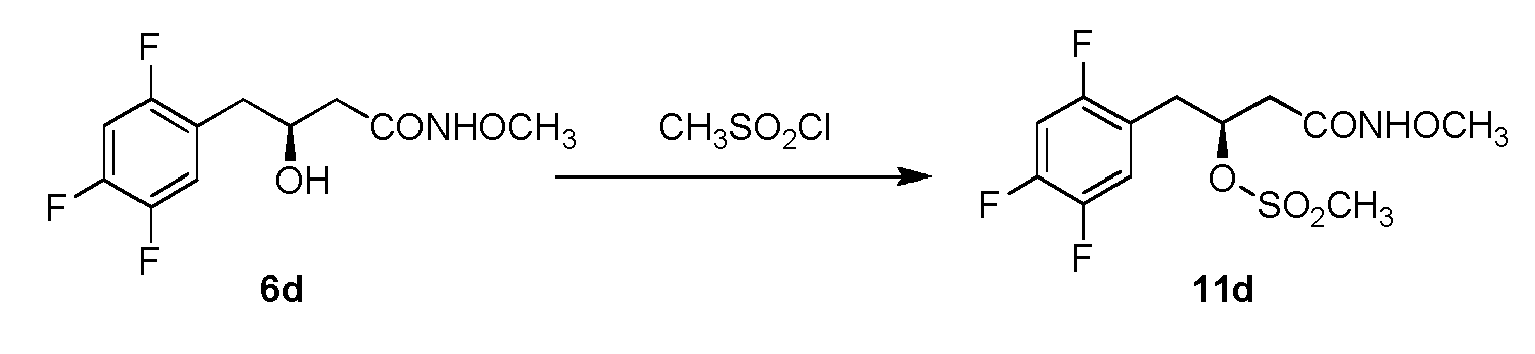
- To the solution of 8.8 g of the compound of formula 6d in 80 mL of dichloromethane at -20 °C 2.8 mL methanesulfonyl chloride were added, followed by gradual addition of 7.2 mL ethyldiisopropylamine, maintaining the temperature at -20 °C. After the addition the reaction mixture was stirred for 1 hour at 0 °C, followed by washings with the mixture of 80 mL water and 8 mL 2 M H3PO4, and 2 x (60 mL water + 5 mL brine). Organic phase was evaporated at 55 °C and 5 mbar of final pressure, yielding 7.75 g of crude product (11d).
- 1H NMR (DMSO-d6): δ 2.32(dd,2H), 2.41 (dd,2H), 3.01 (s,3H), 2.99-3.10(m,2H), 3.56(s,3H), 5.08-5.16(m,1H), 7.41-7.56(m,2H), 11.20(s,1H).
- 2.6 g of the compound of formula 6d from previous experiment, 12 mL dichloromethane and 0.63 mL methanesulfonyl chloride are charged in the reaction flask and cooled to 0 °C. During stirring at 0 °C 1.5 mL sym-collidine was added gradually, maintaining the temperature at 0 °C. After the addition the reaction mixture was stirred for 1 hour at 20°C, followed by washing the reaction mixture 1 x (30 mL water and 3 mL brine), 1 x (30 mL water and 10 mL H3PO4) and 1 x (30 mL water and 3 mL brine). The organic phase was evaporated at 55 °C and 5 mbar of final pressure, obtaining 3.15 g of crude product (11d) in the form of clear brownish amber with similar spectroscopic data as in Example 15.
-

- 2.6 g of the compound of formula 6d from Experiment 16, 12 mL dichloromethane and 0.63 mL methanesulfonyl chloride are charged in the reaction flask and cooled to 0 °C. During stirring at 0 °C 1.5 mL sym-collidine was added gradually, maintaining the temperature at 0 °C. After the addition the reaction mixture was stirred for 1 hour at 20°C, followed by washing the reaction mixture 1 x (30 mL water and 3 mL brine), 1 x (30 mL water and 10 mL H3PO4) and 1 x (30 mL water and 3 mL brine). The organic phase was evaporated at 55 °C and 5 mbar of final pressure, obtaining 3.15 g of crude product (11d) in the form of clear brownish amber.
- 1H NMR (DMSO-d6): 2.49-2.81 (m,4H), 3.35(s,3H), 4.15-4.18(m,1H), 5.08(s,2H), 7.35-7.45(m,7H).
- 2.6 g of the compound (6d), 10 ml dichloromethane and 0.50 ml methanesulfonyl chloride are charged in the reaction flask and cooled to 0 °C. During stirring at 0 °C 1.2 ml sym-collidine was added gradually, maintaining the temperature at 0 °C. After the addition the reaction mixture was stirred 1 hour at 20 °C, followed by washing the reaction mixture 1 x (25 ml water and 2 ml brine), 1 x (25 ml water and 8 ml H3PO4) and 1 x (25 ml water and 2 ml brine). The organic phase was evaporated at 52 °C and 7 mbar of final pressure, obtaining 2.93 g of crude amber-like product (11d) - ([M+H]+ = 418).
-

- To the solution of 2.2 g of the compound of formula 6d in the mixture of 16.0 mL dichloromethane and 4.0 mL N,N-dimethylformamide at 0 °C 0.29 g 60% sodium hydride was added gradually, keeping foaming under control. After the addition, the reaction mixture was kept stirring 4 hours at 23 °C, followed by the addition of 0.26 mL acetic acid and evaporation at 35 °C and 25 mbar. The residue is suspended in 50 mL of diethyl ether, followed by washing with 30 mL of water. The water phase is re-extracted with 30 mL of diethyl ether. Combined ether phases were washed with 2 x (20 mL water + 2 mL brine) and evaporated at 50 °C and 5 mbar of final pressure, obtaining 1.60 g of the crude product in the form of brownish syrup.
-

- 27 g of triphenylphosphine were added in portions to the solution of 19.2 mL diisopropyl azodicarboxylate (DIAD) and 320 mL of toluene, applying external cooling to maintain temperature of the reaction mixture at 19 °C. Then 20.0 g of compound of formula 6d were divided in three equal portions were added in 10 minutes intervals, maintaining the temperature at 19 °C. After the addition, the reaction mixture was stirred for 3 hours at 19 °C and for 16 hours at 0 °C. The precipitate was filtered-off and discarded. The filtrate was subjected to evaporation at 50 °C and 5 mbars, obtaining 40.3 g of crude product in the form of reddish-brown heavy syrup. It contained side products, which were efficiently purified in the next step.
- For analytical purposes, small amount of crude product was purified on silica, applying EtOAc/n-hexane mobile phase. Rf = 0.18 (EtOAc/n-hexane = 1/2 (vol.))
- 1H NMR (DMSO-d6): δ 2.43(dd,1H), 2.76(dd,1H), 2.84(dd,1H), 3.13(dd,1H), 3.65(s,3H), 4.06-4.09(m,1H), 7.50-7.60(m,2H)
-

- 40.2 g of the crude product from previous experiment were suspended in the mixture of 193 mL THF, 97 mL water and 6.9 g lithium hydroxide hydrate. The reaction mixture was stirred for 1.5 hour at 35 °C, followed by evaporation at 35 °C to 40 °C and 35 mbar of final pressure, obtaining ca 138.6 g of residue. To the residue 200 mL of water were added and pH of the reaction mixture was adjusted to 11 with 6 N HCl (cca 10 mL). The reaction mixture was washed twice with 80 mL i-propyl acetate. The water phase was acidified to pH 4 with 6 N HCl and extracted with 2 x 80 mL i-propyl acetate (IPAC). Combined IPAC extracts were washed with the mixture of 45 mL of water and 5 mL of brine, followed by evaporation at 53 °C and 5 mbar, providing 16.4 g of clear brownish syrupy product.
- 1H NMR (DMSO-d6): δ 2.20 (dd,1H), 2.36 (dd,1H), 2.62 (dd,1H), 2.80 (dd, 1H), 3.36 (s, 3H), 3.36-3.44 (m, 1H), 6.45 (s, wide, 1H) 7.36-7.49 (m, 2H), 12.11 (s,wide,1H)
-
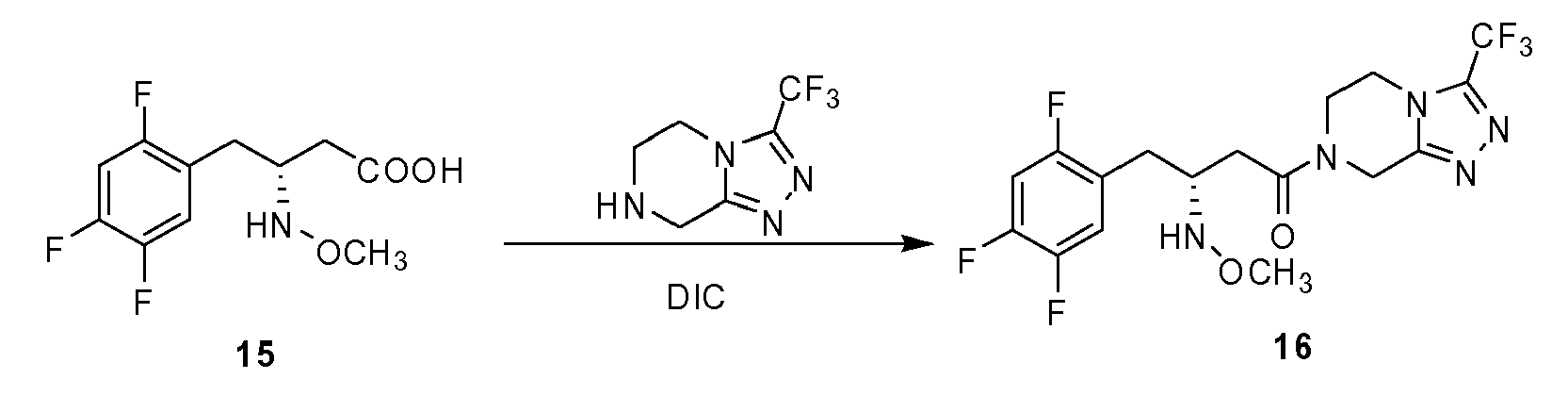
- 6.0 g of compound of formula 15, 0.3 g 1-hydroxybenzotrizole hydrate (HOBt) and 4.7 g 3-(trifluoro-methyl)-5,6,7,8-tetrahydro-[1,2,4]triazolo[4,3-a]pyrazine were dissolved in 40 mL of dry dichloromethane. To the clear solution 4.5 mL of N,N'-diisopropylcarbodiimide were added during stirring at 20 °C. After addition, the reaction mixture was kept stirring for 2 hours at 23 °C, followed by cooling the reaction mixture to 0 °C for 2 hours. The precipitate was filtered-off and discarded. The filtrate was evaporated at 45 °C and 5 mbar of final pressure, obtaining 12.0 g of crude product.
-

- 1.35 g of the crude compound of formula 16 from previous experiment and 0.40 g of 5% palladium on carbon are suspended in 20 mL methanol. The suspension is subjected to hydrogenation at 65 °C and 10 bars of pressure for 4 hours. The catalyst is filtered-off, followed by evaporation of filtrate at 55 °C and 10 mbar. 1.23 g of the crude product of formula 1 is obtained. It is dissolved in the mixture of 12 mL isopropanol, 3 mL methanol and 0.20 mL water. During stirring, 0.32 g 85% aqueous phosphoric acid is added. When crystallization starts, the suspension is aged for 20 minutes at -20 °C and filtered. The precipitate is washed on filter with 2 mL of ethanol and 5 mL of diethyl ether, yielding 0.31 g of the product.
- 1H NMR (DMSO-d6, 80°C): δ 2.68-2.93(m,4H), 3.60-3.66(m,1H), 3.94-4.11(m,2H), 4.11-4.32(m,2H), 4.83-5.04(m,2H), 6.76(s/wide/,4H), 7.33-7.39(m,1H), 7.51-7.58(m,1H)
Claims (19)
- A process of preparing a compound of formula IV,

a leaving group or a group convertible to a leaving group;
the process comprising the steps of:(i) providing a compound of formula II, (ii) reacting of the compound of formula II with a compound of formula IIIa when A is OH or with a compound of formula IIIb when A is NHP, wherein P is an amine protecting group,
- The process according to claim 1, wherein the compound of formula II is defined by formula IIa,

- The process according to claim 2, wherein the reaction to obtain the compound of formula IIa and the reaction of the compound of formula IIa with the compound of formula IIIa proceed in one pot.
- The process according to any of the preceding claims, wherein R is
a leaving group selected from the group consisting of halogen, arylsulfonyloxy, unsubstituted and fluorinated C1-C4-alkylsulfonyloxy; or
a group convertible to a leaving group, selected from protected hydroxy groups, and inert organometal groups convertible to cyano, aminocarbonyl, hydroxycarbonyl or alkoxycarbonyl groups. - The process according to any of the preceding claims, wherein M is or contains magnesium, zinc or lithium, preferably M is halomagnesio.
- The process according to any of the proceeding claims, wherein the compound of formula IIIa is in the (S)-configuration, preferably (S)-epichlorohydrin is used as the compound of formula IIIa to obtain 1-chloro-3-(2,4,5-trifluorophenyl)-2(S)-propanol as the compound of formula IV.
- The process according to any one of claims 1 to 4, wherein the compound of formula IV with A being OH,

is further converted to a compound of formula V,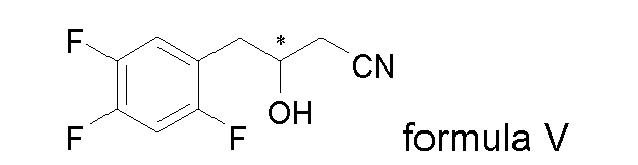
by treatment with cyanides, selected from alkali, earth-alkali metalic or quaternary ammonium cyanides. - The process according to any one of claims 1 to 4, wherein the compound of formula IV with A being OH,

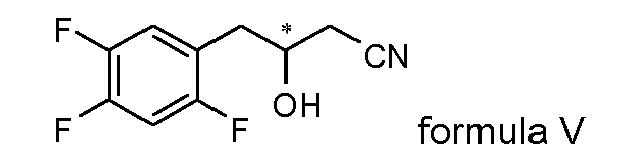
said process comprising the steps of:(i) optionally deprotecting the protected hydroxy group,(ii) transforming the hydroxyl group to halogen, arylsulfonyloxy, unsubstituted or fluorinated C1-C4-alkylsulfonyloxy group, and(iii) treating the obtained compound of formula IV with cyanides selected from alkali, earth-alkali metalic or quaternary ammonium cyanides, preferably by treatment with potassium or sodium cyanide in a protic solvent or in a mixture of protic and aprotic solvent. - The process according to claim 7 or 8, wherein the compound of formula V is further converted to a compound of formula VI,

- The process according to any one of claims 7 or 8, wherein the compound of formula V or a salt thereof is further converted to a compound of formula VIc,

by treatment with a strong acid in a solvent of formula R1OH, wherein R1 is H, C1-C6-alkyl or halo substituted C1-C6-alkyl, preferably ethanol or methanol, optionally diluted with water or aprotic organic solvent; or
wherein the compound of formula V is further converted to a compound of formula VIa, (i) treating the compound of formula V in aqueous alkaline conditions, optionally diluted with water miscible solvent, preferably in the presence of hydrogen peroxide, more preferably in concentrated ammonia in the presence of hydrogen peroxide,(ii) treating the compound of formula V with a strong acid,(iii) treating the compound of formula VIc,wherein * denotes a chiral and R is C1-C6-alkyl or halo substituted C1-C6-alkyl, with an aqueous base selected from the group of alkali hydroxides, earth-metal hydroxides and organic bases, preferably sodium hydroxide in C1-C4-alkanol/water mixture, most preferably sodium hydroxide in a methanol/water mixture.
- The process according to claim 10, wherein the compound of formula VIa is further converted to a compound of formula VId,

by treatment with a coupling reagent selected from carbodiimides and amines R2-NH2, wherein R2 is as defined, in the presence of a solvent. - The process according to claim 9, further comprising the steps of:(i) reacting the compound of formula VI, wherein Z is hydroxyl, with a heterocyclic moiety of formula VIII

 (ii) sulfonation of the compound of formula VII or a salt thereof with a halogenide or an anhydride of a sulfonic acid in the presence of a base in an aprotic organic solvent,
to obtain a compound of formula IX or a salt thereof,
optionally wherein the compound of formula IX is further converted to a compound of formula X,
- The process according to claim 9, further comprising sulfonation of the compound of formula VI with a halogenide or an anhydride of a sulfonic acid in the presence of a base in an aprotic organic solvent, to obtain a compound of formula XI,

optionally wherein the compound of formula XI is further converted to a compound of formula XII,
by treatment with an azide reagent, selected from alkali metal azide or trialkylammonium azide in a solvent, selected from aprotic polar solvents;
or optionally wherein the compound of formula XI is further converted to a compound of formula XIV,
by cyclization of in the presence of strong base, preferably sodium hydride, in a solvent selected from amides, halogenated alkanes and aromatic hydrocarbons. - A compound of formula IV,

- A compound selected from the group consisting of:a compound of formula VI,
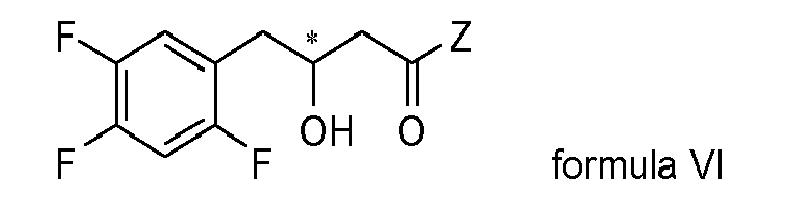 wherein * denotes a chiral atom and Z is selected from the group consisting of OR1, wherein R1 is selected from C1-C6-alkyl and halo substituted C1-C6-alkyl, NHR2, wherein R2 is selected from H, C1-C4-alkyl, aryl-C1-C2-alkyl, C1-C4-alkoxy, aryl-C1-C2-alkoxy and trifluoroacetyl;a compound of formula XI,
 wherein * denotes a chiral atom and Z is selected from the group consisting of OR1, wherein R1 is selected from C1-C6-alkyl or halo substituted C1-C6-alkyl,NHR2, wherein R2 is selected from H, C1-C4-alkyl, aryl-C1-C2-alkyl, C1-C4-alkoxy, aryl-C1-C2-alkoxy, trifluoroacetyl and R3 is selected from methyl, ethyl, benzyl, p-methylbenzyl, p-bromobenzyl, p-nitrobenzyl and 10-camphoryl;a compound of formula XIV,
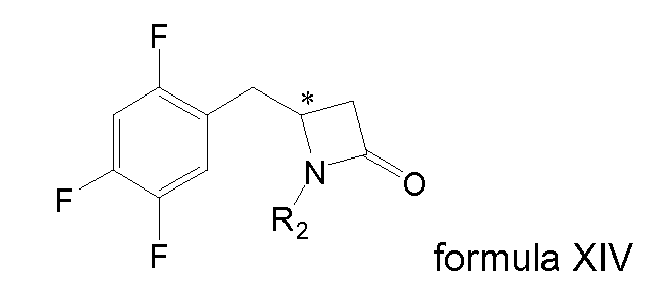 wherein * denotes a chiral atom and R2 is selected from C1-C6-alkyl, C1-C4-alkoxyl and trifluoroacetyl;a compound of formula XVII,
 wherein R4 is selected from azido and NHOMe.
 - A process for producing sitagliptin or a salt thereof, comprising the steps of carrying out a process for preparing the compound of formula IV according to claim 1, or carrying out a process for preparing the compound of formula VI according to claim 9,
and subjecting the compound of formula IV or the compound of formula VI to further synthesis steps to yield sitagliptin or a salt thereof. - Use of a compound of formula IV,

- Use of a compound according to claim 15 for the synthesis of gliptins or salts thereof.
- A process for producing a pharmaceutical composition comprising sitagliptin as active ingredient, comprising the steps of:(i) preparing sitagliptin or a salt thereof according to a process as defined in claim 16, and(ii) admixing the thus prepared sitagliptin with at least one pharmaceutically acceptable excipient.
Priority Applications (1)
| Application Number | Priority Date | Filing Date | Title |
|---|---|---|---|
| EP10166099A EP2397141A1 (en) | 2010-06-16 | 2010-06-16 | Process for the synthesis of beta-amino acids and derivatives thereof |
Applications Claiming Priority (1)
| Application Number | Priority Date | Filing Date | Title |
|---|---|---|---|
| EP10166099A EP2397141A1 (en) | 2010-06-16 | 2010-06-16 | Process for the synthesis of beta-amino acids and derivatives thereof |
Publications (1)
| Publication Number | Publication Date |
|---|---|
| EP2397141A1 true EP2397141A1 (en) | 2011-12-21 |
Family
ID=43086271
Family Applications (1)
| Application Number | Title | Priority Date | Filing Date |
|---|---|---|---|
| EP10166099A Ceased EP2397141A1 (en) | 2010-06-16 | 2010-06-16 | Process for the synthesis of beta-amino acids and derivatives thereof |
Country Status (1)
| Country | Link |
|---|---|
| EP (1) | EP2397141A1 (en) |
Cited By (9)
| Publication number | Priority date | Publication date | Assignee | Title |
|---|---|---|---|---|
| WO2012046254A3 (en) * | 2010-10-08 | 2012-06-07 | Cadila Healthcare Limited | Process for preparing an intermediate of sitagliptin via enzymatic conversion |
| CN102627648A (en) * | 2012-04-14 | 2012-08-08 | 江苏施美康药业有限公司 | Preparation method of sitagliptin |
| WO2013065066A1 (en) | 2011-11-02 | 2013-05-10 | Cadila Healthcare Limited | Processes for preparing 4-oxo-4-[3-(trifluoromethyl)-5,6- dihydro [l,2,41-triazolo[43-a]pyrazin-7(8h)-yl]-l-(2,4,5- trifluorophenyl)butan-2-amine |
| EP2491040A4 (en) * | 2009-10-21 | 2013-05-22 | Hanmi Science Co Ltd | PROCESS FOR THE PREPARATION OF SITAGLIPTIN AND INTERMEDIATES USED THEREIN |
| EP2674432A1 (en) * | 2012-06-14 | 2013-12-18 | LEK Pharmaceuticals d.d. | New synthetic route for the preparation of ß aminobutyryl substituted 5,6,7,8-tetrahydro[1,4]diazolo[4,3-alpha]pyrazin-7-yl compounds |
| US8946224B2 (en) | 2010-11-11 | 2015-02-03 | Redx Pharma Limited | Substituted [1,2,4]triazolo[4,3-A]pyrazines for medicaments and pharmaceutical compositions |
| CN105801572A (en) * | 2016-05-12 | 2016-07-27 | 山东罗欣药业集团股份有限公司 | Preparation method of rivaroxaban |
| CN107312010A (en) * | 2017-08-14 | 2017-11-03 | 苏州信恩医药科技有限公司 | Application of the trona in sitagliptin synthesis |
| CN108048317A (en) * | 2017-12-12 | 2018-05-18 | 凯莱英医药集团(天津)股份有限公司 | The continuous synthesis system and method for continuously synthesizing of a kind of alpha-non-natural amino acid |
Citations (10)
| Publication number | Priority date | Publication date | Assignee | Title |
|---|---|---|---|---|
| US20020065308A1 (en) * | 2000-11-27 | 2002-05-30 | Cameron Kimberly O. | EP4 receptor selective agonists in the treatment of osteoporosis |
| WO2003004498A1 (en) | 2001-07-06 | 2003-01-16 | Merck & Co., Inc. | Beta-amino tetrahydroimidazo (1, 2-a) pyrazines and tetrahydrotrioazolo (4, 3-a) pyrazines as dipeptidyl peptidase inhibitors for the treatment or prevention of diabetes |
| WO2004085378A1 (en) | 2003-03-19 | 2004-10-07 | Merck & Co. Inc. | Process for the preparation of chiral beta amino acid derivatives by asymmetric hydrogenation |
| WO2004085661A2 (en) | 2003-03-24 | 2004-10-07 | Merck & Co., Inc | Process to chiral beta-amino acid derivatives |
| WO2004087650A2 (en) | 2003-03-27 | 2004-10-14 | Merck & Co. Inc. | Process and intermediates for the preparation of beta-amino acid amide dipeptidyl peptidase-iv inhibitors |
| WO2005097733A1 (en) | 2004-04-05 | 2005-10-20 | Merck & Co., Inc. | Process for the preparation of enantiomerically enriched beta amino acid derivatives |
| WO2006081151A1 (en) | 2005-01-24 | 2006-08-03 | Merck & Co., Inc. | Process to chiral beta amino acid derivatives by asymmetric hydrogenation |
| WO2009045507A2 (en) | 2007-10-03 | 2009-04-09 | Teva Pharmaceutical Industries Ltd. | Processes for preparing an intermediate of sitagliptin via enzymatic reduction |
| WO2009064476A1 (en) | 2007-11-13 | 2009-05-22 | Teva Pharmaceutical Industries Ltd. | Preparation of sitagliptin intermediate |
| WO2010032264A2 (en) * | 2008-08-27 | 2010-03-25 | Cadila Healthcare Limited | Improved process for preparation of (2r)-4-oxo-4-[3- (trifluoromethyl)-5,6-dihydro [1,2,4]-triazolo[4,3-a]pyrazin- 7(8h)-yl]-l-(2,4,5-trifluorophenyl)butan-2-amine & new impurities in preparation thereof |
-
2010
- 2010-06-16 EP EP10166099A patent/EP2397141A1/en not_active Ceased
Patent Citations (10)
| Publication number | Priority date | Publication date | Assignee | Title |
|---|---|---|---|---|
| US20020065308A1 (en) * | 2000-11-27 | 2002-05-30 | Cameron Kimberly O. | EP4 receptor selective agonists in the treatment of osteoporosis |
| WO2003004498A1 (en) | 2001-07-06 | 2003-01-16 | Merck & Co., Inc. | Beta-amino tetrahydroimidazo (1, 2-a) pyrazines and tetrahydrotrioazolo (4, 3-a) pyrazines as dipeptidyl peptidase inhibitors for the treatment or prevention of diabetes |
| WO2004085378A1 (en) | 2003-03-19 | 2004-10-07 | Merck & Co. Inc. | Process for the preparation of chiral beta amino acid derivatives by asymmetric hydrogenation |
| WO2004085661A2 (en) | 2003-03-24 | 2004-10-07 | Merck & Co., Inc | Process to chiral beta-amino acid derivatives |
| WO2004087650A2 (en) | 2003-03-27 | 2004-10-14 | Merck & Co. Inc. | Process and intermediates for the preparation of beta-amino acid amide dipeptidyl peptidase-iv inhibitors |
| WO2005097733A1 (en) | 2004-04-05 | 2005-10-20 | Merck & Co., Inc. | Process for the preparation of enantiomerically enriched beta amino acid derivatives |
| WO2006081151A1 (en) | 2005-01-24 | 2006-08-03 | Merck & Co., Inc. | Process to chiral beta amino acid derivatives by asymmetric hydrogenation |
| WO2009045507A2 (en) | 2007-10-03 | 2009-04-09 | Teva Pharmaceutical Industries Ltd. | Processes for preparing an intermediate of sitagliptin via enzymatic reduction |
| WO2009064476A1 (en) | 2007-11-13 | 2009-05-22 | Teva Pharmaceutical Industries Ltd. | Preparation of sitagliptin intermediate |
| WO2010032264A2 (en) * | 2008-08-27 | 2010-03-25 | Cadila Healthcare Limited | Improved process for preparation of (2r)-4-oxo-4-[3- (trifluoromethyl)-5,6-dihydro [1,2,4]-triazolo[4,3-a]pyrazin- 7(8h)-yl]-l-(2,4,5-trifluorophenyl)butan-2-amine & new impurities in preparation thereof |
Non-Patent Citations (6)
| Title |
|---|
| DATABASE BEILSTEIN [online] BEILSTEIN INSTITUTE FOR ORGANIC CHEMISTRY, FRANKFURT-MAIN, DE; 2010, XP002613081, Database accession no. BRN12320955 * |
| FENG ET AL, SYNOPSES, vol. 4, 2010, pages 230 - 232, ISSN: 0308-2342 * |
| J. AM. CHEM. SOC., vol. 126, 2004, pages 9918 |
| MOON KIM B ET AL: "SYNTHESIS OF A CHIRAL AZIRIDINE DERIVATIVE AS A VERSATILE INTERMEDIATE FOR HIV PROTEASE INHIBITORS", ORGANIC LETTERS, AMERICAN CHEMICAL SOCIETY, US, vol. 3, no. 15, 1 January 2001 (2001-01-01), pages 2349 - 2351, XP001179485, ISSN: 1523-7060, DOI: 10.1021/OL016147S * |
| ORG. PREP. RES. & DEV., vol. 9, 2005, pages 634 |
| TETRAHEDRON ASYMMETRY, vol. 17, 2006, pages 205 |
Cited By (16)
| Publication number | Priority date | Publication date | Assignee | Title |
|---|---|---|---|---|
| US8624026B2 (en) | 2009-10-21 | 2014-01-07 | Hanmi Science Co., Ltd | Method of preparing sitagliptin and intermediates used therein |
| EP2491040A4 (en) * | 2009-10-21 | 2013-05-22 | Hanmi Science Co Ltd | PROCESS FOR THE PREPARATION OF SITAGLIPTIN AND INTERMEDIATES USED THEREIN |
| WO2012046254A3 (en) * | 2010-10-08 | 2012-06-07 | Cadila Healthcare Limited | Process for preparing an intermediate of sitagliptin via enzymatic conversion |
| US8946224B2 (en) | 2010-11-11 | 2015-02-03 | Redx Pharma Limited | Substituted [1,2,4]triazolo[4,3-A]pyrazines for medicaments and pharmaceutical compositions |
| WO2013065066A1 (en) | 2011-11-02 | 2013-05-10 | Cadila Healthcare Limited | Processes for preparing 4-oxo-4-[3-(trifluoromethyl)-5,6- dihydro [l,2,41-triazolo[43-a]pyrazin-7(8h)-yl]-l-(2,4,5- trifluorophenyl)butan-2-amine |
| CN102627648A (en) * | 2012-04-14 | 2012-08-08 | 江苏施美康药业有限公司 | Preparation method of sitagliptin |
| CN104520299A (en) * | 2012-06-14 | 2015-04-15 | 力奇制药公司 | New synthetic route for the preparation of [belta]-aminobutyryl substituted 5,6,7,8-tetrahydro[1,4]diazolo[4,3-alpha]pyrazin-7-yl compounds |
| WO2013186326A1 (en) * | 2012-06-14 | 2013-12-19 | Lek Pharmaceuticals D.D. | NEW SYNTHETIC ROUTE FOR THE PREPARATION OF ß-AMINOBUTYRYL SUBSTITUTED 5,6,7,8-TETRAHYDRO[1,4]DIAZOLO[4,3-alpha]PYRAZIN-7-YL COMPOUNDS |
| EP2674432A1 (en) * | 2012-06-14 | 2013-12-18 | LEK Pharmaceuticals d.d. | New synthetic route for the preparation of ß aminobutyryl substituted 5,6,7,8-tetrahydro[1,4]diazolo[4,3-alpha]pyrazin-7-yl compounds |
| US9388188B2 (en) | 2012-06-14 | 2016-07-12 | Lek Pharmaceuticals D.D. | Synthetic route for the preparation of β-aminobutyryl substituted 5,6,7,8-tetrahydro[1,4]diazolo[4,3-alpha ]pyrazin-7-yl compounds |
| CN104520299B (en) * | 2012-06-14 | 2017-03-01 | 力奇制药公司 | Prepare the new synthesis route of 5,6,7,8 tetrahydrochysenes [1,4] diazole simultaneously [4,3 α] pyrazine 7 based compound of β aminobutanonyl replacement |
| CN105801572A (en) * | 2016-05-12 | 2016-07-27 | 山东罗欣药业集团股份有限公司 | Preparation method of rivaroxaban |
| CN105801572B (en) * | 2016-05-12 | 2018-11-06 | 山东罗欣药业集团恒欣药业有限公司 | A kind of preparation method of razaxaban |
| CN107312010A (en) * | 2017-08-14 | 2017-11-03 | 苏州信恩医药科技有限公司 | Application of the trona in sitagliptin synthesis |
| CN108048317A (en) * | 2017-12-12 | 2018-05-18 | 凯莱英医药集团(天津)股份有限公司 | The continuous synthesis system and method for continuously synthesizing of a kind of alpha-non-natural amino acid |
| CN108048317B (en) * | 2017-12-12 | 2023-08-15 | 凯莱英医药集团(天津)股份有限公司 | A continuous synthesis system and continuous synthesis method of unnatural amino acids |
Similar Documents
| Publication | Publication Date | Title |
|---|---|---|
| CA2645362C (en) | Synthesis of acylaminoalkenylene amides useful as substance p antagonists | |
| US11897843B2 (en) | Process for the preparation of enantiomerically enriched 3-aminopiperidine | |
| WO2022192414A2 (en) | Synthesis of omecamtiv mecarbil | |
| CA2782704A1 (en) | Diphenyl-pyrazolopyridin derivatives, their preparation and their application as nuclear not receptor modulators | |
| EP2861582B1 (en) | Process for making hydroxylated cyclopentylpyrimidine compounds | |
| JP2002528524A (en) | Racemic resolution method for 2-hydroxypropionic acid | |
| EP2716631A1 (en) | Method for producing proline compound | |
| US20110021780A1 (en) | Manufacturing method for a piperidine-3-ylcarbamate compound and optical resolution method therefor | |
| EP2922833A1 (en) | Process for the preparation of (1s,4s,5s)-4-bromo-6-oxabicyclo[3.2.1]octan-7-one | |
| JP2009073739A (en) | Method for producing highly pure optically active 1-aryl-1,3-propanediol acceptable as medicine intermediate | |
| CN111808040B (en) | Synthesis method of multi-configuration 2-oxo-oxazolidine-4-carboxylic acid compounds | |
| TWI617562B (en) | An improved process for the preparation of 2-amino-5,8-dimethoxy[1,2,4]triazolo[1,5-c]pyrimidine from 4-amino-2,5-dimethoxypyrimidine | |
| KR100625649B1 (en) | Method for preparing β-hydroxybutyl acid alkyl ester | |
| WO2008079380A1 (en) | Process for the preparation and isolation of the individual stereoisomers of 1-amino, 3-substituted phenylcyclopentane carboxylates | |
| KR100743617B1 (en) | Process for the preparation of chiral 3-hydroxy pyrrolidine compound and derivatives thereof having high optical purity | |
| SK13592001A3 (en) | Synthesis of 3-amino-3-aryl propanoates | |
| CN112094241B (en) | Preparation method of 1, 4-diazaspiro [5,5] undecane-3-ketone | |
| JP2001026591A (en) | Azoniaadamantane compound, production of azaadamantane compound from the same and production of the azoniaadamantane compound | |
| KR100523321B1 (en) | Process for producing 4-hydroxy-2-pyrrolidinone | |
| JP2003500379A (en) | 4-Cyano-3-hydroxybutanoylhydrazines, derivatives thereof and method for producing the same | |
| KR101142052B1 (en) | Method of manufacturing zanamivir | |
| JP2003137835A (en) | Method for producing (r)-3-hydroxy-3-(2-phenyl)hexanoic acid | |
| TW202535846A (en) | New process for the preparation of (3r)-fluoropyrrolidine hydrochloride | |
| KR20220011669A (en) | Methods and intermediates for the preparation of BTK inhibitors | |
| CN115368283A (en) | Preparation method of cis-3-fluoro-4-hydroxypyrrolidine with chiral structure or achiral structure and derivatives thereof |
Legal Events
| Date | Code | Title | Description |
|---|---|---|---|
| AK | Designated contracting states |
Kind code of ref document: A1 Designated state(s): AL AT BE BG CH CY CZ DE DK EE ES FI FR GB GR HR HU IE IS IT LI LT LU LV MC MK MT NL NO PL PT RO SE SI SK SM TR |
|
| AX | Request for extension of the european patent |
Extension state: BA ME RS |
|
| PUAI | Public reference made under article 153(3) epc to a published international application that has entered the european phase |
Free format text: ORIGINAL CODE: 0009012 |
|
| STAA | Information on the status of an ep patent application or granted ep patent |
Free format text: STATUS: THE APPLICATION HAS BEEN REFUSED |
|
| 18R | Application refused |
Effective date: 20120216 |