EP2394984A1 - Process for the iodination of phenolic derivatives - Google Patents
Process for the iodination of phenolic derivatives Download PDFInfo
- Publication number
- EP2394984A1 EP2394984A1 EP10165485A EP10165485A EP2394984A1 EP 2394984 A1 EP2394984 A1 EP 2394984A1 EP 10165485 A EP10165485 A EP 10165485A EP 10165485 A EP10165485 A EP 10165485A EP 2394984 A1 EP2394984 A1 EP 2394984A1
- Authority
- EP
- European Patent Office
- Prior art keywords
- formula
- compound
- group
- disubstituted
- iodination
- Prior art date
- Legal status (The legal status is an assumption and is not a legal conclusion. Google has not performed a legal analysis and makes no representation as to the accuracy of the status listed.)
- Withdrawn
Links
- 238000000034 method Methods 0.000 title claims abstract description 87
- 230000008569 process Effects 0.000 title claims abstract description 76
- 238000006192 iodination reaction Methods 0.000 title claims abstract description 46
- 230000026045 iodination Effects 0.000 title claims abstract description 35
- ISWSIDIOOBJBQZ-UHFFFAOYSA-N phenol group Chemical group C1(=CC=CC=C1)O ISWSIDIOOBJBQZ-UHFFFAOYSA-N 0.000 title claims description 14
- -1 3,5-disubstituted phenol compounds Chemical class 0.000 claims abstract description 88
- 238000002360 preparation method Methods 0.000 claims abstract description 26
- PNDPGZBMCMUPRI-UHFFFAOYSA-N iodine Chemical class II PNDPGZBMCMUPRI-UHFFFAOYSA-N 0.000 claims abstract description 21
- 239000000758 substrate Substances 0.000 claims description 45
- 150000001875 compounds Chemical class 0.000 claims description 41
- 239000007864 aqueous solution Substances 0.000 claims description 34
- QFWPJPIVLCBXFJ-UHFFFAOYSA-N glymidine Chemical compound N1=CC(OCCOC)=CN=C1NS(=O)(=O)C1=CC=CC=C1 QFWPJPIVLCBXFJ-UHFFFAOYSA-N 0.000 claims description 26
- ICIWUVCWSCSTAQ-UHFFFAOYSA-N iodic acid Chemical compound OI(=O)=O ICIWUVCWSCSTAQ-UHFFFAOYSA-N 0.000 claims description 26
- 239000012045 crude solution Substances 0.000 claims description 20
- 229910052740 iodine Inorganic materials 0.000 claims description 20
- 239000011630 iodine Substances 0.000 claims description 18
- 239000011541 reaction mixture Substances 0.000 claims description 18
- ZCYVEMRRCGMTRW-UHFFFAOYSA-N 7553-56-2 Chemical compound [I] ZCYVEMRRCGMTRW-UHFFFAOYSA-N 0.000 claims description 17
- 150000003839 salts Chemical class 0.000 claims description 16
- 125000002887 hydroxy group Chemical group [H]O* 0.000 claims description 14
- 239000007787 solid Substances 0.000 claims description 13
- 238000004519 manufacturing process Methods 0.000 claims description 9
- 125000002496 methyl group Chemical group [H]C([H])([H])* 0.000 claims description 9
- 239000003125 aqueous solvent Substances 0.000 claims description 8
- 125000003545 alkoxy group Chemical group 0.000 claims description 7
- 229910052739 hydrogen Inorganic materials 0.000 claims description 7
- 239000001257 hydrogen Substances 0.000 claims description 7
- CBOIHMRHGLHBPB-UHFFFAOYSA-N hydroxymethyl Chemical compound O[CH2] CBOIHMRHGLHBPB-UHFFFAOYSA-N 0.000 claims description 7
- 230000035484 reaction time Effects 0.000 claims description 7
- XLYOFNOQVPJJNP-UHFFFAOYSA-N water Substances O XLYOFNOQVPJJNP-UHFFFAOYSA-N 0.000 claims description 6
- 125000004169 (C1-C6) alkyl group Chemical group 0.000 claims description 5
- VAPDZNUFNKUROY-UHFFFAOYSA-N 2,4,6-triiodophenol Chemical class OC1=C(I)C=C(I)C=C1I VAPDZNUFNKUROY-UHFFFAOYSA-N 0.000 claims description 5
- 239000002585 base Substances 0.000 claims description 5
- 125000005113 hydroxyalkoxy group Chemical group 0.000 claims description 5
- 230000008707 rearrangement Effects 0.000 claims description 5
- 239000000460 chlorine Substances 0.000 claims description 4
- 125000004435 hydrogen atom Chemical group [H]* 0.000 claims description 4
- UFHFLCQGNIYNRP-UHFFFAOYSA-N Hydrogen Chemical compound [H][H] UFHFLCQGNIYNRP-UHFFFAOYSA-N 0.000 claims description 3
- 229910052783 alkali metal Inorganic materials 0.000 claims description 3
- 229910052794 bromium Inorganic materials 0.000 claims description 3
- 229910052801 chlorine Inorganic materials 0.000 claims description 3
- 239000003586 protic polar solvent Substances 0.000 claims description 3
- 125000004178 (C1-C4) alkyl group Chemical group 0.000 claims description 2
- 125000004191 (C1-C6) alkoxy group Chemical group 0.000 claims description 2
- 150000001340 alkali metals Chemical class 0.000 claims description 2
- 125000005843 halogen group Chemical group 0.000 claims description 2
- 125000005191 hydroxyalkylamino group Chemical group 0.000 claims description 2
- WKBOTKDWSSQWDR-UHFFFAOYSA-N Bromine atom Chemical compound [Br] WKBOTKDWSSQWDR-UHFFFAOYSA-N 0.000 claims 1
- ZAMOUSCENKQFHK-UHFFFAOYSA-N Chlorine atom Chemical compound [Cl] ZAMOUSCENKQFHK-UHFFFAOYSA-N 0.000 claims 1
- GDTBXPJZTBHREO-UHFFFAOYSA-N bromine Substances BrBr GDTBXPJZTBHREO-UHFFFAOYSA-N 0.000 claims 1
- 239000002872 contrast media Substances 0.000 abstract description 14
- 239000000543 intermediate Substances 0.000 abstract description 6
- 230000015572 biosynthetic process Effects 0.000 abstract description 5
- 238000003786 synthesis reaction Methods 0.000 abstract description 4
- 150000002989 phenols Chemical class 0.000 abstract description 3
- 229940039231 contrast media Drugs 0.000 abstract 2
- 238000006243 chemical reaction Methods 0.000 description 36
- 239000000243 solution Substances 0.000 description 35
- HEMHJVSKTPXQMS-UHFFFAOYSA-M Sodium hydroxide Chemical compound [OH-].[Na+] HEMHJVSKTPXQMS-UHFFFAOYSA-M 0.000 description 33
- 238000004128 high performance liquid chromatography Methods 0.000 description 21
- 230000002083 iodinating effect Effects 0.000 description 18
- 125000003118 aryl group Chemical group 0.000 description 11
- VEXZGXHMUGYJMC-UHFFFAOYSA-N Hydrochloric acid Chemical compound Cl VEXZGXHMUGYJMC-UHFFFAOYSA-N 0.000 description 10
- 239000003795 chemical substances by application Substances 0.000 description 10
- 239000000047 product Substances 0.000 description 10
- DWAQJAXMDSEUJJ-UHFFFAOYSA-M Sodium bisulfite Chemical compound [Na+].OS([O-])=O DWAQJAXMDSEUJJ-UHFFFAOYSA-M 0.000 description 8
- 239000012336 iodinating agent Substances 0.000 description 8
- 238000000746 purification Methods 0.000 description 8
- 235000010267 sodium hydrogen sulphite Nutrition 0.000 description 8
- 238000002955 isolation Methods 0.000 description 7
- 239000000203 mixture Substances 0.000 description 7
- OKKJLVBELUTLKV-UHFFFAOYSA-N Methanol Chemical compound OC OKKJLVBELUTLKV-UHFFFAOYSA-N 0.000 description 6
- 125000000217 alkyl group Chemical group 0.000 description 6
- 159000000000 sodium salts Chemical class 0.000 description 6
- 230000000052 comparative effect Effects 0.000 description 5
- 238000004042 decolorization Methods 0.000 description 5
- 230000003247 decreasing effect Effects 0.000 description 5
- 229960000780 iomeprol Drugs 0.000 description 5
- NJKDOADNQSYQEV-UHFFFAOYSA-N iomeprol Chemical compound OCC(=O)N(C)C1=C(I)C(C(=O)NCC(O)CO)=C(I)C(C(=O)NCC(O)CO)=C1I NJKDOADNQSYQEV-UHFFFAOYSA-N 0.000 description 5
- 239000012429 reaction media Substances 0.000 description 5
- 241000894007 species Species 0.000 description 5
- 239000007858 starting material Substances 0.000 description 5
- LFQSCWFLJHTTHZ-UHFFFAOYSA-N Ethanol Chemical compound CCO LFQSCWFLJHTTHZ-UHFFFAOYSA-N 0.000 description 4
- 230000002378 acidificating effect Effects 0.000 description 4
- SRVFFFJZQVENJC-IHRRRGAJSA-N aloxistatin Chemical compound CCOC(=O)[C@H]1O[C@@H]1C(=O)N[C@@H](CC(C)C)C(=O)NCCC(C)C SRVFFFJZQVENJC-IHRRRGAJSA-N 0.000 description 4
- 239000012736 aqueous medium Substances 0.000 description 4
- 239000003637 basic solution Substances 0.000 description 4
- 239000006227 byproduct Substances 0.000 description 4
- 150000002500 ions Chemical class 0.000 description 4
- MHAJPDPJQMAIIY-UHFFFAOYSA-N Hydrogen peroxide Chemical compound OO MHAJPDPJQMAIIY-UHFFFAOYSA-N 0.000 description 3
- QZRGKCOWNLSUDK-UHFFFAOYSA-N Iodochlorine Chemical compound ICl QZRGKCOWNLSUDK-UHFFFAOYSA-N 0.000 description 3
- FAPWRFPIFSIZLT-UHFFFAOYSA-M Sodium chloride Chemical compound [Na+].[Cl-] FAPWRFPIFSIZLT-UHFFFAOYSA-M 0.000 description 3
- 238000007336 electrophilic substitution reaction Methods 0.000 description 3
- 239000012535 impurity Substances 0.000 description 3
- 239000002609 medium Substances 0.000 description 3
- 239000007800 oxidant agent Substances 0.000 description 3
- 238000010791 quenching Methods 0.000 description 3
- 230000000171 quenching effect Effects 0.000 description 3
- LSNNMFCWUKXFEE-UHFFFAOYSA-M Bisulfite Chemical compound OS([O-])=O LSNNMFCWUKXFEE-UHFFFAOYSA-M 0.000 description 2
- QAOWNCQODCNURD-UHFFFAOYSA-N Sulfuric acid Chemical compound OS(O)(=O)=O QAOWNCQODCNURD-UHFFFAOYSA-N 0.000 description 2
- 239000002253 acid Substances 0.000 description 2
- 230000001476 alcoholic effect Effects 0.000 description 2
- 244000309464 bull Species 0.000 description 2
- 238000002425 crystallisation Methods 0.000 description 2
- 230000008025 crystallization Effects 0.000 description 2
- 238000010790 dilution Methods 0.000 description 2
- 239000012895 dilution Substances 0.000 description 2
- 238000010828 elution Methods 0.000 description 2
- XMBWDFGMSWQBCA-UHFFFAOYSA-N hydrogen iodide Chemical compound I XMBWDFGMSWQBCA-UHFFFAOYSA-N 0.000 description 2
- 150000002496 iodine Chemical class 0.000 description 2
- 125000001449 isopropyl group Chemical group [H]C([H])([H])C([H])(*)C([H])([H])[H] 0.000 description 2
- 230000007246 mechanism Effects 0.000 description 2
- 238000006386 neutralization reaction Methods 0.000 description 2
- 239000003960 organic solvent Substances 0.000 description 2
- 230000003647 oxidation Effects 0.000 description 2
- 238000007254 oxidation reaction Methods 0.000 description 2
- 238000001556 precipitation Methods 0.000 description 2
- 125000006239 protecting group Chemical group 0.000 description 2
- 239000000376 reactant Substances 0.000 description 2
- 230000009467 reduction Effects 0.000 description 2
- 239000011780 sodium chloride Substances 0.000 description 2
- 239000002904 solvent Substances 0.000 description 2
- 238000003756 stirring Methods 0.000 description 2
- AKEJUJNQAAGONA-UHFFFAOYSA-N sulfur trioxide Chemical compound O=S(=O)=O AKEJUJNQAAGONA-UHFFFAOYSA-N 0.000 description 2
- FZIIGRGUAUSDSF-UHFFFAOYSA-N 3-n-(1,3-dihydroxypropan-2-yl)-1-n-(2,3-dihydroxypropyl)-5-hydroxy-2,4,6-triiodobenzene-1,3-dicarboxamide Chemical compound OCC(O)CNC(=O)C1=C(I)C(O)=C(I)C(C(=O)NC(CO)CO)=C1I FZIIGRGUAUSDSF-UHFFFAOYSA-N 0.000 description 1
- ZIEWQQYINJPZBW-UHFFFAOYSA-N 3-n-(1,3-dihydroxypropan-2-yl)-1-n-(2,3-dihydroxypropyl)-5-hydroxybenzene-1,3-dicarboxamide Chemical compound OCC(O)CNC(=O)C1=CC(O)=CC(C(=O)NC(CO)CO)=C1 ZIEWQQYINJPZBW-UHFFFAOYSA-N 0.000 description 1
- OYPRJOBELJOOCE-UHFFFAOYSA-N Calcium Chemical compound [Ca] OYPRJOBELJOOCE-UHFFFAOYSA-N 0.000 description 1
- 230000005526 G1 to G0 transition Effects 0.000 description 1
- DGAQECJNVWCQMB-PUAWFVPOSA-M Ilexoside XXIX Chemical compound C[C@@H]1CC[C@@]2(CC[C@@]3(C(=CC[C@H]4[C@]3(CC[C@@H]5[C@@]4(CC[C@@H](C5(C)C)OS(=O)(=O)[O-])C)C)[C@@H]2[C@]1(C)O)C)C(=O)O[C@H]6[C@@H]([C@H]([C@@H]([C@H](O6)CO)O)O)O.[Na+] DGAQECJNVWCQMB-PUAWFVPOSA-M 0.000 description 1
- 239000007836 KH2PO4 Substances 0.000 description 1
- WHXSMMKQMYFTQS-UHFFFAOYSA-N Lithium Chemical compound [Li] WHXSMMKQMYFTQS-UHFFFAOYSA-N 0.000 description 1
- GRYLNZFGIOXLOG-UHFFFAOYSA-N Nitric acid Chemical compound O[N+]([O-])=O GRYLNZFGIOXLOG-UHFFFAOYSA-N 0.000 description 1
- VUSMNMBGHJTLOV-UHFFFAOYSA-N OCC(CNC(c(c(I)c(c(I)c1C(NCC(CO)O)=O)O)c1I)=O)O Chemical compound OCC(CNC(c(c(I)c(c(I)c1C(NCC(CO)O)=O)O)c1I)=O)O VUSMNMBGHJTLOV-UHFFFAOYSA-N 0.000 description 1
- CBENFWSGALASAD-UHFFFAOYSA-N Ozone Chemical compound [O-][O+]=O CBENFWSGALASAD-UHFFFAOYSA-N 0.000 description 1
- NBIIXXVUZAFLBC-UHFFFAOYSA-N Phosphoric acid Chemical compound OP(O)(O)=O NBIIXXVUZAFLBC-UHFFFAOYSA-N 0.000 description 1
- ZLMJMSJWJFRBEC-UHFFFAOYSA-N Potassium Chemical compound [K] ZLMJMSJWJFRBEC-UHFFFAOYSA-N 0.000 description 1
- VYPSYNLAJGMNEJ-UHFFFAOYSA-N Silicium dioxide Chemical compound O=[Si]=O VYPSYNLAJGMNEJ-UHFFFAOYSA-N 0.000 description 1
- 239000003929 acidic solution Substances 0.000 description 1
- 230000002411 adverse Effects 0.000 description 1
- 239000003513 alkali Substances 0.000 description 1
- 229910052784 alkaline earth metal Inorganic materials 0.000 description 1
- 230000029936 alkylation Effects 0.000 description 1
- 238000005804 alkylation reaction Methods 0.000 description 1
- 238000004458 analytical method Methods 0.000 description 1
- 150000001491 aromatic compounds Chemical class 0.000 description 1
- 229940045348 brown mixture Drugs 0.000 description 1
- 229910052791 calcium Inorganic materials 0.000 description 1
- 239000011575 calcium Substances 0.000 description 1
- 125000004432 carbon atom Chemical group C* 0.000 description 1
- 230000015556 catabolic process Effects 0.000 description 1
- 150000001768 cations Chemical class 0.000 description 1
- 230000008859 change Effects 0.000 description 1
- 238000012512 characterization method Methods 0.000 description 1
- 239000003153 chemical reaction reagent Substances 0.000 description 1
- 239000007810 chemical reaction solvent Substances 0.000 description 1
- 238000004587 chromatography analysis Methods 0.000 description 1
- 229940125904 compound 1 Drugs 0.000 description 1
- 238000001816 cooling Methods 0.000 description 1
- 238000012937 correction Methods 0.000 description 1
- 230000007423 decrease Effects 0.000 description 1
- 238000006731 degradation reaction Methods 0.000 description 1
- 238000010511 deprotection reaction Methods 0.000 description 1
- 238000001514 detection method Methods 0.000 description 1
- 238000012631 diagnostic technique Methods 0.000 description 1
- 238000007323 disproportionation reaction Methods 0.000 description 1
- 230000000694 effects Effects 0.000 description 1
- 238000000909 electrodialysis Methods 0.000 description 1
- 238000005516 engineering process Methods 0.000 description 1
- 230000007613 environmental effect Effects 0.000 description 1
- 125000001495 ethyl group Chemical group [H]C([H])([H])C([H])([H])* 0.000 description 1
- 238000001704 evaporation Methods 0.000 description 1
- 230000008020 evaporation Effects 0.000 description 1
- 238000001914 filtration Methods 0.000 description 1
- 230000008570 general process Effects 0.000 description 1
- IXCSERBJSXMMFS-UHFFFAOYSA-N hcl hcl Chemical compound Cl.Cl IXCSERBJSXMMFS-UHFFFAOYSA-N 0.000 description 1
- 238000010438 heat treatment Methods 0.000 description 1
- 238000003384 imaging method Methods 0.000 description 1
- 230000006872 improvement Effects 0.000 description 1
- 238000002347 injection Methods 0.000 description 1
- 239000007924 injection Substances 0.000 description 1
- ICIWUVCWSCSTAQ-UHFFFAOYSA-M iodate Chemical compound [O-]I(=O)=O ICIWUVCWSCSTAQ-UHFFFAOYSA-M 0.000 description 1
- 239000000193 iodinated contrast media Substances 0.000 description 1
- 239000003456 ion exchange resin Substances 0.000 description 1
- 229920003303 ion-exchange polymer Polymers 0.000 description 1
- 229960004647 iopamidol Drugs 0.000 description 1
- XQZXYNRDCRIARQ-LURJTMIESA-N iopamidol Chemical compound C[C@H](O)C(=O)NC1=C(I)C(C(=O)NC(CO)CO)=C(I)C(C(=O)NC(CO)CO)=C1I XQZXYNRDCRIARQ-LURJTMIESA-N 0.000 description 1
- 125000000959 isobutyl group Chemical group [H]C([H])([H])C([H])(C([H])([H])[H])C([H])([H])* 0.000 description 1
- 229910052744 lithium Inorganic materials 0.000 description 1
- 159000000003 magnesium salts Chemical class 0.000 description 1
- 239000012528 membrane Substances 0.000 description 1
- 125000005948 methanesulfonyloxy group Chemical group 0.000 description 1
- 229910000402 monopotassium phosphate Inorganic materials 0.000 description 1
- 239000012452 mother liquor Substances 0.000 description 1
- 125000004108 n-butyl group Chemical group [H]C([H])([H])C([H])([H])C([H])([H])C([H])([H])* 0.000 description 1
- 125000001280 n-hexyl group Chemical group C(CCCCC)* 0.000 description 1
- 125000000740 n-pentyl group Chemical group [H]C([H])([H])C([H])([H])C([H])([H])C([H])([H])C([H])([H])* 0.000 description 1
- 125000004123 n-propyl group Chemical group [H]C([H])([H])C([H])([H])C([H])([H])* 0.000 description 1
- 230000007935 neutral effect Effects 0.000 description 1
- 230000003472 neutralizing effect Effects 0.000 description 1
- 229910017604 nitric acid Inorganic materials 0.000 description 1
- 230000001590 oxidative effect Effects 0.000 description 1
- 229910052700 potassium Inorganic materials 0.000 description 1
- 239000011591 potassium Substances 0.000 description 1
- GNSKLFRGEWLPPA-UHFFFAOYSA-M potassium dihydrogen phosphate Chemical compound [K+].OP(O)([O-])=O GNSKLFRGEWLPPA-UHFFFAOYSA-M 0.000 description 1
- 238000012545 processing Methods 0.000 description 1
- 230000000750 progressive effect Effects 0.000 description 1
- 230000002035 prolonged effect Effects 0.000 description 1
- 230000001737 promoting effect Effects 0.000 description 1
- 230000002285 radioactive effect Effects 0.000 description 1
- 238000011084 recovery Methods 0.000 description 1
- 238000006479 redox reaction Methods 0.000 description 1
- 125000002914 sec-butyl group Chemical group [H]C([H])([H])C([H])([H])C([H])(*)C([H])([H])[H] 0.000 description 1
- 238000007086 side reaction Methods 0.000 description 1
- 229910052708 sodium Inorganic materials 0.000 description 1
- 239000011734 sodium Substances 0.000 description 1
- 239000011973 solid acid Substances 0.000 description 1
- 239000012265 solid product Substances 0.000 description 1
- 238000003860 storage Methods 0.000 description 1
- 238000000859 sublimation Methods 0.000 description 1
- 230000008022 sublimation Effects 0.000 description 1
- 239000000126 substance Substances 0.000 description 1
- 125000001424 substituent group Chemical group 0.000 description 1
- 239000001117 sulphuric acid Substances 0.000 description 1
- 235000011149 sulphuric acid Nutrition 0.000 description 1
- 239000000725 suspension Substances 0.000 description 1
- 125000000999 tert-butyl group Chemical group [H]C([H])([H])C(*)(C([H])([H])[H])C([H])([H])[H] 0.000 description 1
- 238000012360 testing method Methods 0.000 description 1
- 239000002351 wastewater Substances 0.000 description 1
Images


Classifications
-
- C—CHEMISTRY; METALLURGY
- C07—ORGANIC CHEMISTRY
- C07B—GENERAL METHODS OF ORGANIC CHEMISTRY; APPARATUS THEREFOR
- C07B39/00—Halogenation
-
- C—CHEMISTRY; METALLURGY
- C07—ORGANIC CHEMISTRY
- C07C—ACYCLIC OR CARBOCYCLIC COMPOUNDS
- C07C231/00—Preparation of carboxylic acid amides
- C07C231/10—Preparation of carboxylic acid amides from compounds not provided for in groups C07C231/02 - C07C231/08
-
- C—CHEMISTRY; METALLURGY
- C07—ORGANIC CHEMISTRY
- C07C—ACYCLIC OR CARBOCYCLIC COMPOUNDS
- C07C231/00—Preparation of carboxylic acid amides
- C07C231/12—Preparation of carboxylic acid amides by reactions not involving the formation of carboxamide groups
-
- C—CHEMISTRY; METALLURGY
- C07—ORGANIC CHEMISTRY
- C07C—ACYCLIC OR CARBOCYCLIC COMPOUNDS
- C07C231/00—Preparation of carboxylic acid amides
- C07C231/14—Preparation of carboxylic acid amides by formation of carboxamide groups together with reactions not involving the carboxamide groups
-
- C—CHEMISTRY; METALLURGY
- C07—ORGANIC CHEMISTRY
- C07C—ACYCLIC OR CARBOCYCLIC COMPOUNDS
- C07C237/00—Carboxylic acid amides, the carbon skeleton of the acid part being further substituted by amino groups
- C07C237/28—Carboxylic acid amides, the carbon skeleton of the acid part being further substituted by amino groups having the carbon atom of at least one of the carboxamide groups bound to a carbon atom of a non-condensed six-membered aromatic ring of the carbon skeleton
- C07C237/46—Carboxylic acid amides, the carbon skeleton of the acid part being further substituted by amino groups having the carbon atom of at least one of the carboxamide groups bound to a carbon atom of a non-condensed six-membered aromatic ring of the carbon skeleton having carbon atoms of carboxamide groups, amino groups and at least three atoms of bromine or iodine, bound to carbon atoms of the same non-condensed six-membered aromatic ring
Definitions
- the present invention relates to a process for the preparation of triiodinated aromatic compounds.
- it relates to a process for the triiodination, with activated molecular iodine, of 3,5-disubstituted phenols to the corresponding 3,5-disubstituted-2,4,6-triiodophenols, which are useful intermediates for the synthesis of x-ray contrast agents, and to a general process for the preparation of the contrast agents themselves.
- Iodinated contrast media are well-known compounds widely used in x-ray imaging diagnostic techniques. Suitable examples of the said compounds are, for instance listed in WO2009/103666 (Bracco) and cited literature.
- the chemical structure of the wide majority of them comprises a triiodinated aromatic nucleus which provides the enhanced contrast effect. Therefore, although carried out with a variety of routes, the preparation of these contrast agents includes, as a necessary step, the iodination of an aromatic substrate, mainly 5-aminoisophthalic substrates, which undergo triiodination on the available 2, 4 and 6 positions, thus leading to the corresponding 3,5-disubstituted-2,4,6-triiodoaniline derivatives to be further converted and processed to the final agent, for instance as disclosed in US 5,075,502 .
- an aromatic substrate mainly 5-aminoisophthalic substrates, which undergo triiodination on the available 2, 4 and 6 positions, thus leading to the corresponding 3,5-disubstituted-2,4,6-triiodoaniline derivatives to be further converted and processed to the final agent, for instance as disclosed in US 5,075,502 .
- the iodination step may be performed according to different procedures known in the art.
- the iodination of the aromatic ring is generally carried out by using solutions of iodine chloride (ICl) in concentrated hydrochloric acid (HCl) at high temperature or, alternatively, by means of analogous iodinating agents such as, for instance, KICl 2 or NaICl 2 in aqueous solution; see, for a general reference, US 3,914 294 (Squibb), WO 92/14695 (Guerbet), US 5,013,865 (Mallinckrodt), WO 96/37458 and WO 96/37459 (Fructamine).
- ICl iodine chloride
- HCl concentrated hydrochloric acid
- the industrial process for preparing Iomeprol comprises iodinating the key intermediate of formula to give the corresponding iodinated derivative of formula
- This step is industrially carried out by using an aqueous solution of KICl 2 or NaICl 2 as iodinating agent, and by keeping the reaction medium to pH around 9.5 with a suitable base, for instance NaOH, in line with the teaching provided, for instance, in EP 185130 .
- a suitable base for instance NaOH
- the iodination of the phenolic substrate is carried out by using a solution of ICl as iodinating agent (composition: 44.5% I and 14% HCl w/w in H 2 O), in an aqueous medium kept to a pH value from 6 to 7 by addition of a base, preferably NaOH, and to a temperature of 25 °C, for instance as disclosed in WO00/32561
- ES 528109 discloses the preparation of 2,4,6-triiodophenols with iodine activated by H 2 O 2 (30%), in methanol, acidified with H 2 SO 4 and heated to 60°C, with a referred yield of 44%.
- the present invention provides a process for the tri-iodination of 3,5-disubstituted phenols with suitably activate iodine and, also, an improved method for the preparation of x-ray contrast agents including the above iodination step.
- a first object of the present invention is a process for the preparation of triiodophenol compounds of formula 2, said process comprises iodinating a 3,5-disubstituted phenol of formula 1, or a salt thereof, with molecular iodine in the presence of iodic acid, wherein:
- straight or branched C 1 -C 6 alkyl group we intend a linear or branched alkyl chain with from 1 to 6 carbon atoms.
- Suitable examples for alkyl groups comprise methyl, ethyl, n-propyl, isopropyl, n-butyl, isobutyl, sec-butyl, tert-butyl, n-pentyl, n-hexyl, and the like.
- the above alkyl groups may be further substituted and/or interrupted by one or more hydroxyl, alkoxy or hydroxyalkoxy groups, as set forth above.
- C 1 -C 5 alkoxy we intend any alkyl-oxy group wherein the alkyl moiety represents any of the above straight or branched alkyl group.
- hydroxyalkoxy group we intend any of the above C 1 -C 5 alkoxy groups wherein the alkyl moiety is further substituted by one or more hydroxyl group.
- alkoxy or hydroxyalkoxy groups of the invention comprise, for instance, methoxy, ethoxy, n-propoxy, isopropoxy, n-pentoxy, 2-hydroxyethoxy, 2,3-dihydroxypropoxy, 1,3-dihydroxyisopropoxy, and the like.
- R and R' represent, the same or different from each other, a group selected from -NHR 1 or -NR 2 R 3 wherein R 1 , R 2 and R 3 are, the same or different from each other, a straight or branched C 1 -C 4 alkyl group optionally substituted by from one to three hydroxyl groups such as, for instance, 1,3-dihydroxyisopropyl, 2,3-dihydroxypropyl, 1,3-dihydroxy-2-methyl-isopropyl, or 2,3,4-trihydroxybutyl.
- R and R' represent, the same or different from each other, a group selected from:
- Protection and subsequent deprotection of the said groups can be accomplished by a variety of methods widely known in the art and conventionally adopted in organic synthesis techniques.
- protective groups in organic chemistry see, for instance, T. W. Green, Protective Groups in Organic Synthesis (Wiley, N.Y. 1981 ).
- the process of the invention is particularly advantageous as it enables the almost exhaustive triiodination of a phenol derivative of formula 1 , or of corresponding salt, and leads to a triiodinated derivative of formula 2 that is unaffected, at least to a significant extent, by the presence of side-products deriving from either the partial iodination of the aromatic ring or any other impurity.
- the purification of the triiodinated compound may be avoided; in fact, it already fulfils the analytical specifications for the industrially produced intermediate in the crude solution, and may therefore be used as such, without isolation and purification in the next reaction step to the final iodinated agent of interest.
- the iodination reaction leading to the formation of the triiodophenol compounds of formula 2 occurs by using molecular iodine (I 2 ) in the presence of HIO 3 , according to the well-known electrophilic substitution mechanism.
- the effective iodinating specie is likely represented by iodine (I + ) cations, a portion of which is generated by the added molecular iodine (I 2 ), while the resulting unreactive iodide (I-) counter-ions are conveniently oxidized by the HIO 3 back to molecular iodine, or even to iodine cations with a higher oxidation state, thus making them still available for the iodination of the aromatic ring.
- iodine (I + ) cations a portion of which is generated by the added molecular iodine (I 2 )
- I- unreactive iodide
- each oxidizing agents able to oxidizing the produced iodide (I - ) ions back to molecular iodine including, for instance, nitric acid, sulphuric acid, sulphur trioxide, hydrogen peroxide, ozone, and the like, could be used as an alternative to the iodic acid that is, however, especially preferred for use in the process of the instant invention.
- the complete triiodination of the 3,5-disubstituted phenolic substrate of formula 1 to the desired triiodinated compound of formula 2 is obtained by wholly consuming a stoichiometric amount of iodinating specie, calculated as the sum of both of the added I 2 and HIO 3 , and by producing water as the sole reaction byproduct, as per the following general reaction Scheme 2.
- the combined use of iodine and iodic acid makes possible to completely triiodinating the aromatic substrate of formula 1 by avoiding, from one side, the need of any surplus of iodinating agent, especially of molecular iodine and, on the other side, the formation of by-products, especially unreactive poly-iodide ions, for instance of I 3 - ions, mainly deriving from the combination of I 2 with iodide ions.
- the sole acid comprised in the iodinating mixture exploited in the iodination process of the present invention is the HIO 3 , i.e.
- the iodination process of the invention avoids, on one hand, the use of extremely acidic iodinating mixtures, and, on the other, it proceeds by consuming all the acidity associated with the iodination process itself, either deriving from the added iodinating agent or generated by the iodination reaction. Therefore, it allows to overcome the major drawback associated with the iodination processes currently in use, and due, as said, to the need to control and curb the large amount of heat developed in the neutralization reaction with a basic solution, that has to be added together with the acidic iodinating mixture, in order to maintain the pH of the reaction medium to the desired neutral value.
- the process of the instant invention further allow to reduce to a significant extent, from an industrial point of view, the overall time of the iodination process, from the 12-15 hours actually employed, to less than 10 and, preferably, from 5 to 8 total hours.
- the process of the instant invention further consents to exploit more concentrated reaction mixtures, and to significantly reduce the amount of produced salts, namely NaCl, wherein this aspect becomes even more relevant when thinking to the need for processing and disposal of wastewater associated with industrial processes.
- the iodination of the phenol substrate is carried out by using at least one mol of molecular iodine for each mol 3,5-disubstituted phenol of formula 1 .
- the molar ratio between iodine and 3,5-disubstituted phenol substrate 1 [I 2 /1] will be comprised from 1.1 to 1.3; even more preferably, the triiodination of the 3,5-disubstituted phenol substrate with iodine and iodic acid will be carried out by using only 1.2 mol of iodine per mol of substrate 1.
- the molar ratio between I 2 and iodic acid shall be at least equal to 1 : 0.5, while the molar ratio between iodic acid and 3,5-disubstituted phenol substrate 1 [HIO 3 /1] will be comprised from 0.4 to 0.8.
- the triiodination of the 3,5-disubstituted phenol substrate 1 with iodine and iodic acid will be carried out by using a molar ratio 3,5-disubstituted phenol substrate : iodine : iodic acid of 1:1.2:0.6.
- a minimum amount of sodium bisulfite may, for instance, be added to the final reaction medium in order to destroy any optional residual iodinating species.
- the optimal quantity can, for instance, be potentiometrically determined.
- the iodination process of the instant invention comprising using the iodinating system I 2 /HIO 3 , as set forth above, is advantageously carried out in a protic solvent, for instance water or an aqueous solvents, including aqueous saline solutions.
- a protic solvent for instance water or an aqueous solvents, including aqueous saline solutions.
- an aqueous solvent prevents the need of extracting the substrate compound 1 from the aqueous medium in which it is generally industrially obtained, for instance as disclosed in EP 185130 or WO 00/32561 , to may then iodinate it in the organic medium used, instead, by the cited literature.
- an aqueous solvent as per the process of the instant invention, further allows to solve the problem of the low reaction yield that is obtained by the cited art using activated iodine in an organic solvent, and confirmed by the Comparative Example 1 of the following experimental section, most likely ascribable to both an incomplete conversion of the aromatic substrate and the good solubility of the tri-iodinated product into the elected alcoholic medium, that prevents its exhaustive precipitation or crystallization from the crude solution, as shown in figures 3-5 .
- the use of an aqueous solvent according to the process of the instant invention enables the almost exhaustive tri-iodination of the aromatic substrate and leads to a triiodinated product that is substantially pure in the crude solution, as appears from figures 1 and 2 .
- the process of the invention does not require any isolation and purification step of the iodinated compound that, being obtained with very good yield and high purity in the crude solution, may be used as such in the next reaction step to the final iodinated agent. Therefore, any optional loss of iodinated product resulting from its isolation and/or purification may advantageously be avoided.
- the triiodination of the 3,5-disubstituted phenol substrate with iodine and iodic acid is carried out directly on the crude aqueous solution deriving from the industrial process for the preparation of the desired contrast agent, in which the phenol substrate is commonly comprised as sodium salt.
- the iodination process of the instant invention essentially comprises: obtaining an aqueous solution of 3,5-disubstituted phenol substrate of formula 1, or a salt thereof, that is used as starting material, and adding solid I 2 and HIO 3 to said solution.
- the temperature is kept lower than 70°C, preferably comprised from 30 to 70°C, and, more preferably from 40 to 60°C.
- main steps of the process of the instant invention include:
- the process of the invention comprises obtaining a solution of the 3,5-disubstituted phenol substrate of formula 1, or of a salt thereof, used as pure compound, into an aqueous solvent, typically water, and using this solution as starting material.
- the said solution has a concentration comprised from 24 to 10% (w/w), and a pH comprised from 9 to 10.
- suitable salts of the substrate compound of formula 1 are preferably selected from alkali or alkali-earth metal salts of 3,5-disubstituted phenol substrate such as, for instance, sodium, lithium, potassium, calcium or magnesium salts.
- the sodium salt of the 3,5-disubstituted phenol substrate which can be used as such, i.e. as a pure compound or, alternatively, as comprised within a crude solution directly deriving from a previous step in the process for the preparation of triiodinated contrast agents, e.g. Iomeprol, for instance carried out as disclosed in WO00/32561 .
- a crude aqueous solution deriving from an industrial process for the preparation of the desired contrast agent and comprising the starting 3,5-disubstituted phenol substrate, usually as the sodium salt, is used as starting material.
- the said crude solution that generally has a pH comprised from 9 to 10
- the said crude solution may be used as such or, optionally, after dilution, typically with water, for instance up to half the original concentration of the phenolic substrate, that, commonly, is comprised from 20 to 25 % (w/w).
- Solid I 2 is then added to the substrate solution previously heated to a temperature lower that 70°C , preferably from 30 to 70°C, and, more preferably, from 30 to 60°C.
- the proper amount of the iodic acid is then added to the reaction mixture.
- HIO 3 is preferably added when the pH of the reaction medium reaches a value comprised from 4.5 to 7 and, preferably, from 5 to 6.
- the proper amount of iodic acid is added to the reaction medium when the latter reaches a pH value comprised from 5 to 5.5.
- the proper amount of iodic acid may be added to the reaction mixture at once or, alternatively, gradually, in a time of up to 4 hours, either continuously over time or portion-wise according to conventional means, thus causing the progressive conversion of the substrate compound into the corresponding triiodinated derivative.
- iodic acid may be added quite quickly, for instance in a time of up to a couple of hours, to the starting solutions heated to higher temperatures, for instance comprised from 55 and 65 °C and preferably to about 60°C.
- a slower addition of iodic acid is preferable, that may be effected over a time of up to 4 hours.
- an aqueous solution of the oxidizing agent can profitably be used, with a concentration comprised, for instance, from 30 to 55% (w/w).
- the pH of the reaction mixture is self-maintaining at the desired value, namely comprised from 5 to 5.5, during all the HIO 3 addition time and the subsequent completion time, without requiring any correction with acid or basic solutions.
- the purity of the triiodinated compound within the final crude solution may be chromatographically determined, for instance by means of the HPLC technique, either as area% or versus a standard, that generally consists of the pure isolated 3,5-disubstituted-2,4,6-triiodophenol.
- the isolation of the triiodinated product of formula 2 is possible through methods known in the organic chemistry, for instance comprising the use of ion exchange resins or electrodialysis or membrane based filtration and concentration of the crude solution, according to another preferred embodiment of the invention the crude solution of the triiodinated product of formula 2 obtained by using the iodination process of the instant invention is used, as such, in the next reaction step to the desired radiographic agent, without undergoing any previous isolation or further purification of the iodinated compound it comprises.
- the process should not lead to significant losses, by evaporation, of the aqueous solvent. Instead, the heating of the crude reaction at higher temperatures might optionally lead to a partial sublimation of the molecular iodine. By keeping the reaction temperature in the range of values formerly referred, the iodination process normally proceeds without significant loss of this reactant. Nevertheless, conventional cooling or condensing equipments may also be used to condensate the sublimated iodine that is then added to the reaction, optionally through a small amount of solvent.
- solid I 2 is added to a solution of 3,5-disubstituted phenol substrate, or of a salt thereof, or to a basic crude solution of the latter, directly obtained from the industrial process for the preparation of the desire radiographic agent, previously heated to a temperature comprised from 55 to 65°C and, preferably, about 60°C.
- Aqueous HIO 3 is then loaded in the obtained mixture in about two hours, starting from when the pH of the reaction mixture is about 5.
- the reaction mixture is then maintained under stirring and at the above temperature for additional 4 hours (completion time), and then cooled down to 25°C.
- Whole reaction time about 6 hours.
- first I 2 and then HIO 3 may be loaded in the starting solution heated to about 40°C.
- the addition of HIO 3 is preferably made in a time of about 3 hours.
- the reaction temperature is then raised to 50°C, and maintained to this value for 1 hour, then to about 60°C for 1 additional hour before to be cooled down to 25°C (total reaction time: 7 hours) or, again, the iodinating agents (I 2 and HIO 3 ) are both added to a reaction mixture heated to about 30°C (HIO 3 addition time about 4 hours), and the reaction temperature is then raised and maintained from 55 to 65°C for additional 4 hours before to be cooled to room temperature (total reaction time: 8 hours).
- a minimum amount of 18% (w/w) aqueous solution of sodium bisulfite may then be optionally added to the cooled mixture in order to destroy any optional residual iodinating species.
- the optimal amount can, for instance, be potentiometrically determined as the minimum amount of bisulfite that leads to a redox potential of the final mixture (kept to pH 5) to a stable negative value comprised from 0 to -20 mV.
- the crude solution may be first adjusted and maintained to pH 7 with 30% (w/w) aqueous NaOH and quenched with an aqueous solution of sodium bisulfite until a redox potential comprised, in this case, from -20 to -50 mV.
- the compounds of formula 1 used as starting material of the process of the invention are known and, if not commercially available per se, may be all prepared according to known methods. In this respect, as a general reference see, for instance, the aforementioned EP 185130 and WO 00/32561 . Likewise, any other reactant and/or solvent being employed in the instant process is known and readily available.
- the 3,5-disubstituted-2,4,6-triiodophenol derivatives of formula 2 may be then easily converted into the corresponding radiographic contrast agents of interest.
- a further object of the present invention is a process for the preparation of the compounds of formula 5 below in which:
- said process comprises the following main steps:
- the iodination step a) is carried out as extensively reported above, by the process of the instant invention, while subsequent steps, b) and c) comprehensive of experimental conditions and optional variants thereof, are known in the art and described, for instance, in the patent applications WO97/05097 , WO 88/09328 , EP 185130 and WO 00/32561 .
- the instant process may be applied for the preparation of radiographic agents like within the compound of formula 5 in which R and R' represent, the same or different form each other, a group selected from:
- the instant process may be applied to the preparation of widely known x-ray contrast agents like Iopoamidol (wherein, respectively, R and R' both represent a -NH-CH(CH 2 OH) 2 group, R 4 is hydrogen and R 5 is methyl; see The Merck Index, XIII Ed., 2001, No. 5073) or Iomeprol (wherein, respectively, R and R' both represent a -NH-CH 2 -CH(OH)CH 2 OH group, R 4 is methyl and R 5 is hydrogen; see The Merck Index, XIII Ed., 2001, No. 5071).
- Iopoamidol wherein, respectively, R and R' both represent a -NH-CH(CH 2 OH) 2 group, R 4 is hydrogen and R 5 is methyl
- Iomeprol wherein, respectively, R and R' both represent a -NH-CH 2 -CH(OH)CH 2 OH group, R 4 is methyl and R 5 is hydrogen; see The Merck Index,
- a further embodiment of the instant invention is a process for the preparation of iopamidol or iomeprol that is characterized in that it comprises starting from the compounds of formula 2a or 2b, respectively obtained by iodination of the corresponding substrate compounds of formula 1a and 1b with molecular iodine in the presence of iodic acid, as per the process of the instant invention.
- the instant invention relates to a process for the preparation of Iomeprol that comprises, essentially, the steps represented in the following Scheme 3 : that is characterized in that the iodination step iii) is carried out with molecular iodine in the presence of iodic acid and by operating in continuous, that is to say directly on the crude solution of the compound of formula 1b obtained from the former step ii) of the process, to give a crude solution of the iodinated compound of formula 2b used as such in the next alkylation step iv) to the intermediate 4b without isolation or purification of any of the involved intermediates.
- the iodination step iii) is carried out with molecular iodine in the presence of iodic acid and by operating in continuous, that is to say directly on the crude solution of the compound of formula 1b obtained from the former step ii) of the process, to give a crude solution of the iodinated compound of formula 2b used as such in the next alkylation
- step iii) is carried out according to the iodination process of the instant invention, as extensively reported in the previous section, while steps, i), ii), iv) and v), comprehensive of experimental conditions and optional variants thereof, are carried out according to known procedures, for instance as disclosed in WO 00/32561 and cited references.
- Smiles's rearrangement conditions comprising the use of a base such as aqueous NaOH, and purification of the final agents are for instance disclosed in EP365,541 .
- the red solution was cooled to 25 °C and quenched by addition of an 18% (w/w) aqueous solution of sodium bisulfite until decolourisation and the redox potential, measured with a suitable redox electrode, reached a stable negative value ranging from 0 to -20 mV.
- reaction mixture is kept to pH 5 by addition of minimum amounts of 30% (w/w) aqueous solution of NaOH.
- HPLC analysis (reported in Figure 1 ) indicated a conversion to 3,5-disubstituted-2,4,6-triiodophenol 2b >98% (HPLC area %) and the solution was used in the following synthetic step without any further treatment.
- the reaction mixture was then heated 2 h at 40 °C, 1 h at 50 °C and 1 h at 60 °C during which the pH spontaneously remained at 5-5.5.
- the red solution was cooled to 25 °C, adjusted and maintained at pH 7 with 30% (w/w) aqueous solution of NaOH during the quenching performed by addition of an 18% (w/w) aqueous solution of sodium bisulfite until decolourisation and the redox potential, measured with a suitable redox electrode, reached a stable negative value ranging from -20 to -50 mV.
- HPLC analysis indicated a conversion to 3,5-disubstituted-2,4,6-triiodophenol 2b >98% (HPLC area %) and the solution was used for the following synthetic step without any further treatment.
- the reaction mixture was raised to 60 °C and maintained to this value for additional 4 h, in the meanwhile the pH spontaneously remained at 5-5.5.
- the red solution was cooled to 25 °C and quenched by addition of an 18% (w/w) aqueous solution of sodium bisulfite, maintaining pH 5 by addition of 30% (w/w) aqueous solution of NaOH, until decolourisation and the redox potential, measured with a suitable redox electrode, reached a stable negative value ranging from 0 to -20 mV.
- HPLC analysis indicated a conversion to 3,5-disubstituted-2,4,6-triiodophenol 2b >98% (HPLC area %) and the solution was used in the following synthetic step without any further treatment.
- the reaction mixture was then maintained at 60 °C for additional 4 h in the meanwhile the pH spontaneously remained at 5-5.5.
- the red solution was cooled to 25 °C, adjusted and maintained at pH 7 with 30% (w/w) aqueous solution of NaOH during the quenching performed by addition of an 18% (w/w) aqueous solution of sodium bisulfite until decolourisation and the redox potential, measured with a suitable redox electrode, reached a stable negative value ranging from -20 to -50 mV.
- the HPLC analysis indicated a conversion to 3,5-disubstituted-2,4,6-triiodophenol 2b >98% (HPLC area %) and the solution was used in the following synthetic step without any further treatment.
- N-(2,3-dihydroxypropyl)-N'-[2-hydroxy-1-(hydroxymethyl)ethyl]-5-hydroxy-1,3-benzendicarboxamide (100.3 g; 0.305 mol) was dissolved in H 2 O (430 g) and converted into corresponding sodium salt by addition of 30% (w/w) NaOH (40.6 g; 0.305 mol) (pH 9.5).
- the solution was heated at 60 °C and solid I 2 (93.1 g; 0.367 mol) was added in one portion; when the pH spontaneously decreased to 5, a 50 % (w/w) aqueous solution of HIO 3 (32.2 g; 0.183 mol) was slowly added over 2 h.
- the reaction mixture was maintained at 60 °C for additional 4 h in the meanwhile the pH spontaneously remained at 5-5.5.
- the red solution was cooled to 25 °C and quenched by addition of an 18% (w/w) aqueous solution of sodium bisulfite, maintaining pH 5 by addition of 30% (w/w) aqueous solution of NaOH, until decolourisation and the redox potential, measured with a suitable redox electrode, reached a stable negative value ranging from 0 to -20 mV.
- the poor reaction yield is also ascribable to the solubility of the 3,5-disubstituted-2,4,6-triiodophenol 2b in the alcoholic medium, confirmed by the analysis of the mother liquor shown in Figure 5 , that prevents the quantitative recovery of the iodination product.
Landscapes
- Chemical & Material Sciences (AREA)
- Organic Chemistry (AREA)
- Chemical Kinetics & Catalysis (AREA)
- Organic Low-Molecular-Weight Compounds And Preparation Thereof (AREA)
- Acyclic And Carbocyclic Compounds In Medicinal Compositions (AREA)
Abstract
The present invention relates to a process for the preparation of iodinated phenols; in particular, it relates to a process including the direct iodination, with suitably activated iodine, of 3,5-disubstituted phenol compounds to the corresponding 3,5-disubstituted-2,4,6-triiodophenols, which are useful intermediates for the synthesis of x-ray contrast media, and to the preparation of the contrast media themselves.
Description
- The present invention relates to a process for the preparation of triiodinated aromatic compounds. In particular, it relates to a process for the triiodination, with activated molecular iodine, of 3,5-disubstituted phenols to the corresponding 3,5-disubstituted-2,4,6-triiodophenols, which are useful intermediates for the synthesis of x-ray contrast agents, and to a general process for the preparation of the contrast agents themselves.
- Iodinated contrast media are well-known compounds widely used in x-ray imaging diagnostic techniques. Suitable examples of the said compounds are, for instance listed in
WO2009/103666 (Bracco) and cited literature. - As a common feature, the chemical structure of the wide majority of them comprises a triiodinated aromatic nucleus which provides the enhanced contrast effect. Therefore, although carried out with a variety of routes, the preparation of these contrast agents includes, as a necessary step, the iodination of an aromatic substrate, mainly 5-aminoisophthalic substrates, which undergo triiodination on the available 2, 4 and 6 positions, thus leading to the corresponding 3,5-disubstituted-2,4,6-triiodoaniline derivatives to be further converted and processed to the final agent, for instance as disclosed in
US 5,075,502 . - Alternatively, the poly-iodination of suitable 3,5-disubstituted phenols may be exploited, leading to the corresponding 3,5-disubstituted-2,4,6-triiodophenols that may be further converted and processed to the expected final agent through the so-called Smile's rearrangement.
- For a general reference to the above synthetic route and Smile's rearrangement see, for instance,
WO 88/09328 WO 97/05097 WO 00/32561 - The iodination step may be performed according to different procedures known in the art. For instance, in industrial processes currently used for preparing marketed radiographic agents, the iodination of the aromatic ring is generally carried out by using solutions of iodine chloride (ICl) in concentrated hydrochloric acid (HCl) at high temperature or, alternatively, by means of analogous iodinating agents such as, for instance, KICl2 or NaICl2 in aqueous solution; see, for a general reference,
US 3,914 294 (Squibb),WO 92/14695 US 5,013,865 (Mallinckrodt),WO 96/37458 WO 96/37459 - The above methods suffer from major drawbacks due to the extremely acidic working conditions, that become harder due to HCl produced during the reaction, the corrosive properties of the iodinating agents and to their limited storage life.
- As an example, the industrial process for preparing Iomeprol, a well known radiographic contrast agent commonly used in daily diagnostic practice, comprises iodinating the key intermediate of formula


- This step is industrially carried out by using an aqueous solution of KICl2 or NaICl2 as iodinating agent, and by keeping the reaction medium to pH around 9.5 with a suitable base, for instance NaOH, in line with the teaching provided, for instance, in
EP 185130 - Alternatively, the iodination of the phenolic substrate is carried out by using a solution of ICl as iodinating agent (composition: 44.5% I and 14% HCl w/w in H2O), in an aqueous medium kept to a pH value from 6 to 7 by addition of a base, preferably NaOH, and to a temperature of 25 °C, for instance as disclosed in
WO00/32561 - When the above process are carried out on industrial scale, major problems arise from the need to handle, and, more importantly, to neutralize the extremely acidic iodinating reagent used. To this end, in fact, very large amounts of NaOH are required to neutralize either the HCl present in the iodinating solution or the HCl produced during the reaction.
- Moreover, as the neutralization of such strong acid is extremely exothermic, the control of the temperature to 25°C forces to use long addition time, necessary to prevent a sudden as uncontrollable temperature increases, despite the reaction is almost instantaneous.
- Attempts have been, thus, addressed to iodination procedures alternative to the use of iodine chloride or derivatives thereof. In this contest are the electrochemical iodination processes of suitable aromatic substrates, for instance disclosed in
WO 96/37461 US 3,833,490 andWO2009/103666 . - The mono-iodination of ortho-hydroxy substituted aromatic carbonyl compounds with molecular iodine suitably activated by use of a strong oxidizing agent, including iodic acid, has been alternatively proposed by Patil et al. in Tetrahedron Letters 2005, 46, 7179-7181. The possibility of using the same iodinating system to further provide ortho/para diiodinated ortho-hydroxy aromatic carbonyl derivatives is suggested by the same authors in ARKIVOC 2006, 104-108. In both articles, commercial 95% aqueous ethanol was used as reaction solvent.
-
ES 528109 - The present invention provides a process for the tri-iodination of 3,5-disubstituted phenols with suitably activate iodine and, also, an improved method for the preparation of x-ray contrast agents including the above iodination step.
-
-
FIG. 1 : Example 1: HPLC of the crude solution after 6 hours of reaction (final solution). -
FIG. 2 : Example 5: HPLC of the crude solution after 6 hours of reaction (final solution). -
FIG. 3 : Comparative Example 1: chromatogram (HPLC) of the crude solution after 1.5 hours at 38-40°C. -
FIG. 4 : Comparative Example 1: HPLC of the crude solution after 3.5 hours at 38-40°C. -
FIG. 5 : Comparative Example 1: HPLC of the mother liquors after precipitation of the triiodinated product. - A first object of the present invention is a process for the preparation of triiodophenol compounds of
formula 2,

- R and R' represent, the same or different from each other, a hydroxyalkylamino group of formula -NHR1 or -NR2R3, wherein R1, R2 and R3 are, the same or different from each other, a straight or branched C1-C6 alkyl group which is optionally substituted by one or more groups selected from hydroxyl (-OH), C1-C5 alkoxy or hydroxyalkoxy groups.
- In the present description, unless otherwise provided, with the term straight or branched C1-C6 alkyl group we intend a linear or branched alkyl chain with from 1 to 6 carbon atoms. Suitable examples for alkyl groups comprise methyl, ethyl, n-propyl, isopropyl, n-butyl, isobutyl, sec-butyl, tert-butyl, n-pentyl, n-hexyl, and the like. The above alkyl groups may be further substituted and/or interrupted by one or more hydroxyl, alkoxy or hydroxyalkoxy groups, as set forth above.
- With the term C1-C5 alkoxy we intend any alkyl-oxy group wherein the alkyl moiety represents any of the above straight or branched alkyl group.
- With hydroxyalkoxy group we intend any of the above C1-C5 alkoxy groups wherein the alkyl moiety is further substituted by one or more hydroxyl group.
- Suitable examples of alkoxy or hydroxyalkoxy groups of the invention comprise, for instance, methoxy, ethoxy, n-propoxy, isopropoxy, n-pentoxy, 2-hydroxyethoxy, 2,3-dihydroxypropoxy, 1,3-dihydroxyisopropoxy, and the like.
- According to a preferred embodiment of the process of the invention, within the compounds of
formulae 1 and 2, R and R' represent, the same or different from each other, a group selected from -NHR1 or -NR2R3 wherein R1, R2 and R3 are, the same or different from each other, a straight or branched C1-C4 alkyl group optionally substituted by from one to three hydroxyl groups such as, for instance, 1,3-dihydroxyisopropyl, 2,3-dihydroxypropyl, 1,3-dihydroxy-2-methyl-isopropyl, or 2,3,4-trihydroxybutyl. - Even more preferably, within the compounds of
formulae 1 and 2, R and R' represent, the same or different from each other, a group selected from: - NHCH3,
- NHCH2-CH(OH)-CH2OH,
- NHCH(CH2OH)2, and
- N(CH3)-CH2-CH(OH)-CH2OH.
- From all of the above, as both R and R' groups do not take direct part to the reaction step, as described in details below, it is clear to the skilled person that optional substituent groups, comprised within the meanings of R and R' and which may undergo unwanted side reactions, need to be suitably protected before reaction takes place.
- Protection and subsequent deprotection of the said groups can be accomplished by a variety of methods widely known in the art and conventionally adopted in organic synthesis techniques. For a general reference to protective groups in organic chemistry see, for instance, T. W. Green, Protective Groups in Organic Synthesis (Wiley, N.Y. 1981).
- The process of the invention is particularly advantageous as it enables the almost exhaustive triiodination of a phenol derivative of formula 1, or of corresponding salt, and leads to a triiodinated derivative of
formula 2 that is unaffected, at least to a significant extent, by the presence of side-products deriving from either the partial iodination of the aromatic ring or any other impurity. - Advantageously, therefore, in the process of the invention the purification of the triiodinated compound may be avoided; in fact, it already fulfils the analytical specifications for the industrially produced intermediate in the crude solution, and may therefore be used as such, without isolation and purification in the next reaction step to the final iodinated agent of interest.
- As reported above, in the process of the instant invention, the iodination reaction leading to the formation of the triiodophenol compounds of
formula 2 occurs by using molecular iodine (I2) in the presence of HIO3, according to the well-known electrophilic substitution mechanism. - Under the above conditions, the effective iodinating specie is likely represented by iodine (I+) cations, a portion of which is generated by the added molecular iodine (I2), while the resulting unreactive iodide (I-) counter-ions are conveniently oxidized by the HIO3 back to molecular iodine, or even to iodine cations with a higher oxidation state, thus making them still available for the iodination of the aromatic ring.
- From the foregoing it is clear that each oxidizing agents able to oxidizing the produced iodide (I-) ions back to molecular iodine, including, for instance, nitric acid, sulphuric acid, sulphur trioxide, hydrogen peroxide, ozone, and the like, could be used as an alternative to the iodic acid that is, however, especially preferred for use in the process of the instant invention.
- When molecular iodine is used in the presence of iodic acid, in fact, the unreactive iodide ions that are formed in the iodination reaction are converted back to molecular iodine through the so-called Dushman reaction, according to the following reaction Scheme 1
IO3 - + 5 I- + 6 H+ → 3 I2 + 3H2O
that further leads to a simultaneous convenient reduction of the iodate (IO3 -) ions to molecular iodine, still available for the iodination of the aromatic ring (see, for instance, Furuichi, R. and Liebhafsky, H.A. Radioactive iodine exchange and the Dushman reaction. Bull. Chem. Soc. Japan 1973, 46, 2008-2010 and Bull. Chem. Soc. Japan 1975, 48, 745-750). - As a result, the complete triiodination of the 3,5-disubstituted phenolic substrate of formula 1 to the desired triiodinated compound of
formula 2 is obtained by wholly consuming a stoichiometric amount of iodinating specie, calculated as the sum of both of the added I2 and HIO3, and by producing water as the sole reaction byproduct, as per the followinggeneral reaction Scheme 2.
- This means that, advantageously, the combined use of iodine and iodic acid, as per the iodination process of the instant invention, makes possible to completely triiodinating the aromatic substrate of formula 1 by avoiding, from one side, the need of any surplus of iodinating agent, especially of molecular iodine and, on the other side, the formation of by-products, especially unreactive poly-iodide ions, for instance of I3 - ions, mainly deriving from the combination of I2 with iodide ions. Notably, the sole acid comprised in the iodinating mixture exploited in the iodination process of the present invention is the HIO3, i.e. a solid acid, commercially available as ready to use concentrated aqueous solution, that is significantly less strong and easier to handle than HCl used in current industrial iodination processes. To this extent, it is worth nothing that all the acidity related to the iodination process of the present invention, namely the protons either coming from the added HIO3 or produced during the iodination reaction, are advantageously consumed in the said Dushman's redox reaction, as per the above reaction Scheme 1. As a result, very advantageously, the reaction pH is self-maintaining at the desired value during the iodination process, without requiring any exothermic addition of a neutralizing basic solution, and by further preventing any unwanted solution dilution.
- In other words, the iodination process of the invention avoids, on one hand, the use of extremely acidic iodinating mixtures, and, on the other, it proceeds by consuming all the acidity associated with the iodination process itself, either deriving from the added iodinating agent or generated by the iodination reaction. Therefore, it allows to overcome the major drawback associated with the iodination processes currently in use, and due, as said, to the need to control and curb the large amount of heat developed in the neutralization reaction with a basic solution, that has to be added together with the acidic iodinating mixture, in order to maintain the pH of the reaction medium to the desired neutral value.
- As a consequence of the above, the process of the instant invention further allow to reduce to a significant extent, from an industrial point of view, the overall time of the iodination process, from the 12-15 hours actually employed, to less than 10 and, preferably, from 5 to 8 total hours.
- Beside, and still in addition, by avoiding the need of using the said large amount of a basic solution, the process of the instant invention further consents to exploit more concentrated reaction mixtures, and to significantly reduce the amount of produced salts, namely NaCl, wherein this aspect becomes even more relevant when thinking to the need for processing and disposal of wastewater associated with industrial processes.
- From the former
general Scheme 2 it clearly follows that the iodination reaction exploited by the process of the instant invention requires the use of at least 3 moles of iodinating specie, intended, as said, as the sum of both I2 and HIO3, for each mol of aromatic substrate 1. - Kept safe this point, in the process of the instant invention the iodination of the phenol substrate is carried out by using at least one mol of molecular iodine for each mol 3,5-disubstituted phenol of formula 1. Preferably, the molar ratio between iodine and 3,5-disubstituted phenol substrate 1 [I2/1]will be comprised from 1.1 to 1.3; even more preferably, the triiodination of the 3,5-disubstituted phenol substrate with iodine and iodic acid will be carried out by using only 1.2 mol of iodine per mol of substrate 1.
- On the other side, because of the stoichiometry of the involved reaction, the molar ratio between I2 and iodic acid shall be at least equal to 1 : 0.5, while the molar ratio between iodic acid and 3,5-disubstituted phenol substrate 1 [HIO3/1] will be comprised from 0.4 to 0.8.
- Accordingly, in a particularly preferred embodiment of the invention, the triiodination of the 3,5-disubstituted phenol substrate 1 with iodine and iodic acid will be carried out by using a molar ratio 3,5-disubstituted phenol substrate : iodine : iodic acid of 1:1.2:0.6.
- However, a slight excess, for instance of 1% (in mol), over the minimum stoichiometric amount of iodinating agent, intended either as iodine or as iodic acid may, optionally, be used with equally good results, as reported in the experimental section.
- To this extent, a minimum amount of sodium bisulfite may, for instance, be added to the final reaction medium in order to destroy any optional residual iodinating species. In this case, the optimal quantity can, for instance, be potentiometrically determined.
- The iodination process of the instant invention, comprising using the iodinating system I2/HIO3, as set forth above, is advantageously carried out in a protic solvent, for instance water or an aqueous solvents, including aqueous saline solutions.
- To this extent, the use of water, or of an aqueous solvent, compares favourably, in particular from the standpoint of costs and environmental impact, with the use of the organic solvents taught, instead, by the above art using activated iodine as iodinating system.
- Moreover, advantageously, the use of an aqueous solvent prevents the need of extracting the substrate compound 1 from the aqueous medium in which it is generally industrially obtained, for instance as disclosed in
EP 185130 WO 00/32561 - Similarly, it prevents the need of extracting the
iodinated product 2 from the organic crude reaction to may then convert it to the desired final agent into the aqueous medium commonly used in the improved industrial processes today in use. - To this extent, unexpectedly, the use of an aqueous solvent, as per the process of the instant invention, further allows to solve the problem of the low reaction yield that is obtained by the cited art using activated iodine in an organic solvent, and confirmed by the Comparative Example 1 of the following experimental section, most likely ascribable to both an incomplete conversion of the aromatic substrate and the good solubility of the tri-iodinated product into the elected alcoholic medium, that prevents its exhaustive precipitation or crystallization from the crude solution, as shown in
figures 3-5 . - In fact, the use of an aqueous solvent according to the process of the instant invention enables the almost exhaustive tri-iodination of the aromatic substrate and leads to a triiodinated product that is substantially pure in the crude solution, as appears from
figures 1 and2 . As a result, the process of the invention does not require any isolation and purification step of the iodinated compound that, being obtained with very good yield and high purity in the crude solution, may be used as such in the next reaction step to the final iodinated agent. Therefore, any optional loss of iodinated product resulting from its isolation and/or purification may advantageously be avoided. - From all the above, and according to an especially preferred embodiment of the invention, the triiodination of the 3,5-disubstituted phenol substrate with iodine and iodic acid is carried out directly on the crude aqueous solution deriving from the industrial process for the preparation of the desired contrast agent, in which the phenol substrate is commonly comprised as sodium salt.
- The iodination process of the instant invention essentially comprises: obtaining an aqueous solution of 3,5-disubstituted phenol substrate of formula 1, or a salt thereof, that is used as starting material, and adding solid I2 and HIO3 to said solution. During the process, the temperature is kept lower than 70°C, preferably comprised from 30 to 70°C, and, more preferably from 40 to 60°C.
- More particularly, main steps of the process of the instant invention include:
- a) obtaining an aqueous solution of 3,5-disubstituted phenol substrate of formula 1, or a salt thereof, that is used as starting material,
- b) adding solid I2 to said aqueous solution of 3,5-di-substituted phenol substrate heated to a temperature comprised from 30 to 70°C, and then
- c) adding iodic acid.
- Accordingly, the process of the invention comprises obtaining a solution of the 3,5-disubstituted phenol substrate of formula 1, or of a salt thereof, used as pure compound, into an aqueous solvent, typically water, and using this solution as starting material. Preferably, the said solution has a concentration comprised from 24 to 10% (w/w), and a pH comprised from 9 to 10.
- Unless otherwise provided in the present description, suitable salts of the substrate compound of formula 1 are preferably selected from alkali or alkali-earth metal salts of 3,5-disubstituted phenol substrate such as, for instance, sodium, lithium, potassium, calcium or magnesium salts.
- Particularly preferred, among them, is the sodium salt of the 3,5-disubstituted phenol substrate, which can be used as such, i.e. as a pure compound or, alternatively, as comprised within a crude solution directly deriving from a previous step in the process for the preparation of triiodinated contrast agents, e.g. Iomeprol, for instance carried out as disclosed in
WO00/32561 - According to an especially preferred embodiment of the instant invention, a crude aqueous solution deriving from an industrial process for the preparation of the desired contrast agent and comprising the starting 3,5-disubstituted phenol substrate, usually as the sodium salt, is used as starting material.
- In this case, the said crude solution, that generally has a pH comprised from 9 to 10, may be used as such or, optionally, after dilution, typically with water, for instance up to half the original concentration of the phenolic substrate, that, commonly, is comprised from 20 to 25 % (w/w).
- Solid I2 is then added to the substrate solution previously heated to a temperature lower that 70°C , preferably from 30 to 70°C, and, more preferably, from 30 to 60°C.
- To this extent, it should be clear to a skilled practitioner that as soon as the iodine is added to the heated solution of the phenol substrate, the iodination reaction occurs through the well known electrophilic substitution mechanism, for instance started by the I+ ions generated by the added iodine, thus generating H+ ions. As a result, the pH of the reaction mixture decreases from the original basic values, to values even below neutrality.
- The proper amount of the iodic acid is then added to the reaction mixture.
- In this regard, HIO3 is preferably added when the pH of the reaction medium reaches a value comprised from 4.5 to 7 and, preferably, from 5 to 6.
- In an especially preferred embodiment of the instant invention, the proper amount of iodic acid is added to the reaction medium when the latter reaches a pH value comprised from 5 to 5.5.
- Interestingly, in fact, despite it is well known that phenols are more activated to the electrophilic substitution when are in the deprotonated (phenate) form, and that the molar ratio of the latter (over the phenol substrate) increases with the increase of the solution pH, under the identified pH conditions, apparently unfavourable, 3,5-disubstituted-2,4,6-triiodophenol derivatives of
formula 2 are unexpectedly obtained with higher yield and purity. - To this extent, the proper amount of iodic acid may be added to the reaction mixture at once or, alternatively, gradually, in a time of up to 4 hours, either continuously over time or portion-wise according to conventional means, thus causing the progressive conversion of the substrate compound into the corresponding triiodinated derivative.
- More particularly, and according to the following experimental section, iodic acid may be added quite quickly, for instance in a time of up to a couple of hours, to the starting solutions heated to higher temperatures, for instance comprised from 55 and 65 °C and preferably to about 60°C. Instead, when the starting solution is heated to a lower temperature, for instance comprised from 30 to 50°C and, a slower addition of iodic acid is preferable, that may be effected over a time of up to 4 hours.
- In this respect, an aqueous solution of the oxidizing agent can profitably be used, with a concentration comprised, for instance, from 30 to 55% (w/w).
- Interestingly, when operating under the above conditions, the pH of the reaction mixture is self-maintaining at the desired value, namely comprised from 5 to 5.5, during all the HIO3 addition time and the subsequent completion time, without requiring any correction with acid or basic solutions.
- This determines the reduction to a minimum extent of all partially iodinated by-products, and, at the same time, of all those impurities, for instance due to the possible iodine dismutation, favoured in alkaline environments, and to the optional over-concentration and/or increased oxidation power of the HIO3, favoured, instead, at lower pH. As a result, a triiodinated product of
formula 2 is obtained, in the crude solution, with a good yields and high purity, preferably equal or greater that 98%, that may, therefore, be used as such in the next step to the desired radiographic contrast agent, without requiring any isolation and further purification. - In this respect, the purity of the triiodinated compound within the final crude solution may be chromatographically determined, for instance by means of the HPLC technique, either as area% or versus a standard, that generally consists of the pure isolated 3,5-disubstituted-2,4,6-triiodophenol.
- Though the isolation of the triiodinated product of
formula 2, if desired, is possible through methods known in the organic chemistry, for instance comprising the use of ion exchange resins or electrodialysis or membrane based filtration and concentration of the crude solution, according to another preferred embodiment of the invention the crude solution of the triiodinated product offormula 2 obtained by using the iodination process of the instant invention is used, as such, in the next reaction step to the desired radiographic agent, without undergoing any previous isolation or further purification of the iodinated compound it comprises. - By working at the above mentioned temperatures, the process should not lead to significant losses, by evaporation, of the aqueous solvent. Instead, the heating of the crude reaction at higher temperatures might optionally lead to a partial sublimation of the molecular iodine. By keeping the reaction temperature in the range of values formerly referred, the iodination process normally proceeds without significant loss of this reactant. Nevertheless, conventional cooling or condensing equipments may also be used to condensate the sublimated iodine that is then added to the reaction, optionally through a small amount of solvent.
- Details on the process of the invention are reported in the following Experimental Section, for instance through Examples 1-5 concerning the iodination of 3,5-disubstituted phenols according to the present invention.
- However, from operative point of view, main steps and preferred conditions of the claimed process are schematically reported below.
- For instance, in one option, solid I2 is added to a solution of 3,5-disubstituted phenol substrate, or of a salt thereof, or to a basic crude solution of the latter, directly obtained from the industrial process for the preparation of the desire radiographic agent, previously heated to a temperature comprised from 55 to 65°C and, preferably, about 60°C.
- Aqueous HIO3 is then loaded in the obtained mixture in about two hours, starting from when the pH of the reaction mixture is about 5. The reaction mixture is then maintained under stirring and at the above temperature for additional 4 hours (completion time), and then cooled down to 25°C. Whole reaction time: about 6 hours.
- Alternatively, first I2 and then HIO3 (at the above pH value of the reaction mixture) may be loaded in the starting solution heated to about 40°C. In this case the addition of HIO3 is preferably made in a time of about 3 hours. The reaction temperature is then raised to 50°C, and maintained to this value for 1 hour, then to about 60°C for 1 additional hour before to be cooled down to 25°C (total reaction time: 7 hours) or, again, the iodinating agents (I2 and HIO3) are both added to a reaction mixture heated to about 30°C (HIO3 addition time about 4 hours), and the reaction temperature is then raised and maintained from 55 to 65°C for additional 4 hours before to be cooled to room temperature (total reaction time: 8 hours).
- A minimum amount of 18% (w/w) aqueous solution of sodium bisulfite may then be optionally added to the cooled mixture in order to destroy any optional residual iodinating species. To this extent, the optimal amount can, for instance, be potentiometrically determined as the minimum amount of bisulfite that leads to a redox potential of the final mixture (kept to pH 5) to a stable negative value comprised from 0 to -20 mV.
- To this extent, alternatively, to facilitate the reading of the redox potential variation, the crude solution may be first adjusted and maintained to
pH 7 with 30% (w/w) aqueous NaOH and quenched with an aqueous solution of sodium bisulfite until a redox potential comprised, in this case, from -20 to -50 mV. - The compounds of formula 1 used as starting material of the process of the invention are known and, if not commercially available per se, may be all prepared according to known methods. In this respect, as a general reference see, for instance, the aforementioned
EP 185130 WO 00/32561 - Once obtained, the 3,5-disubstituted-2,4,6-triiodophenol derivatives of
formula 2 may be then easily converted into the corresponding radiographic contrast agents of interest. - Hence, a further object of the present invention is a process for the preparation of the compounds of
formula 5 below
- R and R', the same or different from each other, are as formerly defined, and R4 and R5 are, the same or different from each other, hydrogen or a straight or branched C1-C6 alkyl group, optionally substituted by one or more hydroxyl group or C1-C6 alkoxy groups,
- said process comprising the preparation of the 3,5-disubstituted-2,4,6-triiodophenol derivatives of
formula 2 by iodinating a 3,5-disubstituted phenol substrate of formula 1, or a salt thereof, with molecular iodine in the presence of HIO3 through the process of the instant invention. - More preferably, said process comprises the following main steps:
- a) iodinating a 3,5-disubstituted phenol substrate of formula 1, or a salt thereof, with molecular iodine in the presence of HIO3 to obtain the corresponding 2,4,6- triiodophenol derivative of
formula 2, - b) reacting the compound of
formula 2, wherein the phenolic OH group may optionally be in the form of a salt with an alkali metal, with a compound of formula 3
R4HN(C=O)CH(R5)Z 3
wherein R4 and R5 are, the same or different from each other, as defined above, and Z is a halogen atom, such as Cl, Br, I and, preferably, Cl or Br, or any suitable leaving group such as, for instance, a residue of a sulfonic acid (for instance methanesulfonyloxy (MeSO2O-), benzenesulfonyloxy (PhSO2O-), nitrobenzenesulfonyloxy (p-NO2PhSO2O-), toluensulfonyloxy (TsO-), and so on), and, preferably, toluensulfonyloxy; so as to obtain a compound offormula 4
- c) subjecting the compound of
formula 4 to Smiles's rearrangement in the presence of a base so as to obtain the desired final compound offormula 5
- According to said process for preparing x-ray contrast agents, the iodination step a) is carried out as extensively reported above, by the process of the instant invention, while subsequent steps, b) and c) comprehensive of experimental conditions and optional variants thereof, are known in the art and described, for instance, in the patent applications
WO97/05097 WO 88/09328 EP 185130 WO 00/32561 formula 5 in which R and R' represent, the same or different form each other, a group selected from: - NHCH3,
- NHCH2-CH(OH)-CH2OH,
- NHCH(CH2OH)2, and
- N(CH3)-CH2-CH(OH)-CH2OH,
- Even more preferably, the instant process may be applied to the preparation of widely known x-ray contrast agents like Iopoamidol (wherein, respectively, R and R' both represent a -NH-CH(CH2OH)2 group, R4 is hydrogen and R5 is methyl; see The Merck Index, XIII Ed., 2001, No. 5073) or Iomeprol (wherein, respectively, R and R' both represent a -NH-CH2-CH(OH)CH2OH group, R4 is methyl and R5 is hydrogen; see The Merck Index, XIII Ed., 2001, No. 5071).
- Therefore, a further embodiment of the instant invention is a process for the preparation of iopamidol or iomeprol that is characterized in that it comprises starting from the compounds of formula 2a or 2b, respectively obtained by iodination of the corresponding substrate compounds of formula 1a and 1b with molecular iodine in the presence of iodic acid, as per the process of the instant invention.
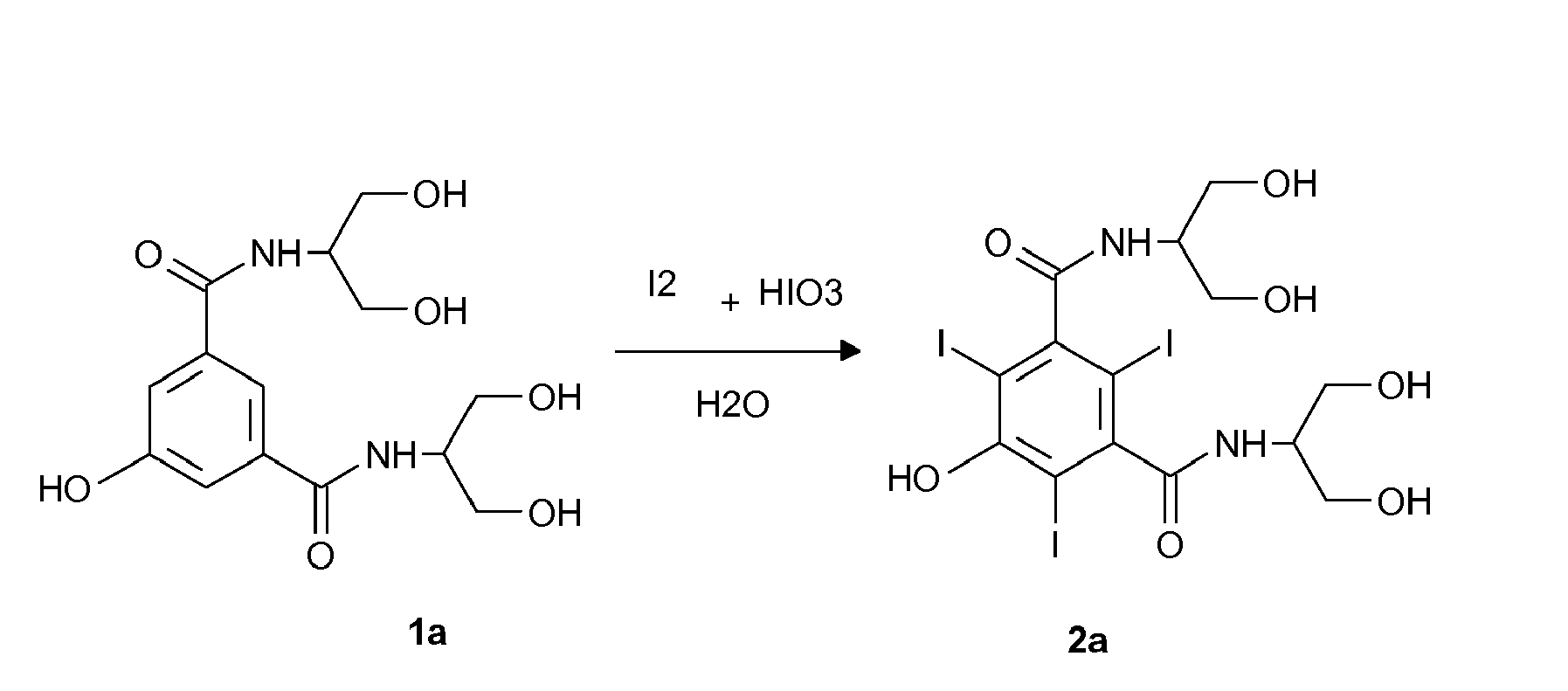

- According to an especially preferred embodiment, the instant invention relates to a process for the preparation of Iomeprol that comprises, essentially, the steps represented in the following Scheme 3 :


- According to this embodiment, step iii) is carried out according to the iodination process of the instant invention, as extensively reported in the previous section, while steps, i), ii), iv) and v), comprehensive of experimental conditions and optional variants thereof, are carried out according to known procedures, for instance as disclosed in
WO 00/32561 - In this respect, preferred Smiles's rearrangement conditions, comprising the use of a base such as aqueous NaOH, and purification of the final agents are for instance disclosed in
EP365,541 - Further details concerning the iodination process of the instant invention are reported in the following experimental section, with the sole aim to better illustrate the present invention, without representing any limitation to it.
- The purity of the obtained 3,5-substituted-2,4,6-triiodophenols and their derivatives have been determined by HPLC using the pure compound as standard.
-
Stationary phase: Zorbax SB C18, 3,5 µm, 150 x 4.6 mm (Agilent Technologies) Mobile phase: A: 0.010 M KH2PO4+0.1% H3PO4 B: MeOH Elution: gradient elution gradient table: t (min) phase A (%) phase B (%) 0 97 3 10 97 3 16 60 40 25 10 90 32 10 90 Temperature: 45 °C Detection: UV (240-300 nm) Flow: 1.5 mL/min Sample concentration: 1 mg/mL Injection: 10 µL - In a 2 L four-necked jacket reactor equipped with mechanical stirrer, condenser and combined pH/temperature electrode, an aqueous solution of 3,5-disubstituted phenol 1 sodium salt, corresponding to 22.8% (w/w) of phenol, (1175 g of solution; 0.816 mol; pH 9.6) was heated at 60°C then solid I2 (250.6 g; 0.988 mol) was added in one portion. When the pH spontaneously decreased to 5, a 50 % (w/w) aqueous solution of HIO3 (173.6 g; 0.494 mol) was slowly added over 2 h. The reaction mixture was maintained at 60 °C for additional 4 h in the meanwhile the pH spontaneously remained at 5-5.5. The red solution was cooled to 25 °C and quenched by addition of an 18% (w/w) aqueous solution of sodium bisulfite until decolourisation and the redox potential, measured with a suitable redox electrode, reached a stable negative value ranging from 0 to -20 mV.
- During the quenching, the reaction mixture is kept to
pH 5 by addition of minimum amounts of 30% (w/w) aqueous solution of NaOH. - The HPLC analysis (reported in
Figure 1 ) indicated a conversion to 3,5-disubstituted-2,4,6-triiodophenol 2b >98% (HPLC area %) and the solution was used in the following synthetic step without any further treatment. - In a 2 L four-necked jacket reactor equipped with mechanical stirrer, condenser and combined pH/temperature electrode, solid I2 (250.6 g; 0.988 mol) was added in one portion to an aqueous solution of 3,5-disubstituted phenol 1 sodium salt corresponding to 22.8% (w/w) of phenol (1175 g of solution; 0.816 mol; pH 9.6) heated at 40 °C. When the pH spontaneously decreased to 5, a 50 % (w/w) aqueous solution of HIO3 (173.6 g; 0.494 mol) was slowly added over 3 h. The reaction mixture was then heated 2 h at 40 °C, 1 h at 50 °C and 1 h at 60 °C during which the pH spontaneously remained at 5-5.5. The red solution was cooled to 25 °C, adjusted and maintained at
pH 7 with 30% (w/w) aqueous solution of NaOH during the quenching performed by addition of an 18% (w/w) aqueous solution of sodium bisulfite until decolourisation and the redox potential, measured with a suitable redox electrode, reached a stable negative value ranging from -20 to -50 mV. - The HPLC analysis indicated a conversion to 3,5-disubstituted-2,4,6-triiodophenol 2b >98% (HPLC area %) and the solution was used for the following synthetic step without any further treatment.
- In a 4 L four-necked jacket reactor equipped with mechanical stirrer, condenser and combined pH/temperature electrode, an aqueous solution of 3,5-disubstituted phenol 1 sodium salt, corresponding to 22.8% (w/w) of phenol (1175 g of solution; 0.816 mol; pH 9.6) was diluted with H2O (1054 g), heated at 30 °C, and then added with solid I2 (250.6 g; 0.988 mol) in one portion. When the pH spontaneously decreased to 5, a 50 % (w/w), aqueous solution of HIO3 (173.6 g; 0.494 mol) was slowly added over 4 h. The reaction mixture was raised to 60 °C and maintained to this value for additional 4 h, in the meanwhile the pH spontaneously remained at 5-5.5. The red solution was cooled to 25 °C and quenched by addition of an 18% (w/w) aqueous solution of sodium bisulfite, maintaining
pH 5 by addition of 30% (w/w) aqueous solution of NaOH, until decolourisation and the redox potential, measured with a suitable redox electrode, reached a stable negative value ranging from 0 to -20 mV. - The HPLC analysis indicated a conversion to 3,5-disubstituted-2,4,6-triiodophenol 2b >98% (HPLC area %) and the solution was used in the following synthetic step without any further treatment.
- In a 4 L four-necked jacket reactor equipped with mechanical stirrer, condenser and combined pH/temperature electrode, an aqueous solution of 3,5-disubstituted phenol 1 sodium salt corresponding to 22.8% (w/w) of phenol (1175 g of solution; 0.816 mol; pH 9.6) was diluted with H2O (1054 g), heated at 30 °C and then added with solid I2 (250.6 g; 0.988 mol) in one portion. When the pH spontaneously decreased to 5, a 50 % (w/w) aqueous solution of HIO3 (173.6 g; 0.494 mol) was slowly added over 4 h. The reaction mixture was then maintained at 60 °C for additional 4 h in the meanwhile the pH spontaneously remained at 5-5.5. The red solution was cooled to 25 °C, adjusted and maintained at
pH 7 with 30% (w/w) aqueous solution of NaOH during the quenching performed by addition of an 18% (w/w) aqueous solution of sodium bisulfite until decolourisation and the redox potential, measured with a suitable redox electrode, reached a stable negative value ranging from -20 to -50 mV. The HPLC analysis indicated a conversion to 3,5-disubstituted-2,4,6-triiodophenol 2b >98% (HPLC area %) and the solution was used in the following synthetic step without any further treatment. - In a 1 L four-necked jacket reactor equipped with mechanical stirrer, condenser and combined pH/temperature electrode, N-(2,3-dihydroxypropyl)-N'-[2-hydroxy-1-(hydroxymethyl)ethyl]-5-hydroxy-1,3-benzendicarboxamide (100.3 g; 0.305 mol) was dissolved in H2O (430 g) and converted into corresponding sodium salt by addition of 30% (w/w) NaOH (40.6 g; 0.305 mol) (pH 9.5). The solution was heated at 60 °C and solid I2 (93.1 g; 0.367 mol) was added in one portion; when the pH spontaneously decreased to 5, a 50 % (w/w) aqueous solution of HIO3 (32.2 g; 0.183 mol) was slowly added over 2 h. The reaction mixture was maintained at 60 °C for additional 4 h in the meanwhile the pH spontaneously remained at 5-5.5. The red solution was cooled to 25 °C and quenched by addition of an 18% (w/w) aqueous solution of sodium bisulfite, maintaining
pH 5 by addition of 30% (w/w) aqueous solution of NaOH, until decolourisation and the redox potential, measured with a suitable redox electrode, reached a stable negative value ranging from 0 to -20 mV. - The HPLC analysis (
Figure 2 ) indicated a conversion to N-(2,3-dihydroxypropyl)-N'-[2-hydroxy-1-(hydroxymethyl)ethyl]-5-hydroxy-2,4,6-triiodo-1,3-benzendicarboxamide >98% (HPLC area %) and the solution was used in the following synthetic step without any further treatment. - This test was performed to evaluate the exploitability of the iodinating conditions disclosed by Patil et al. in ARKIVOC, 2006, 104 and Tetrahedron Lett., 2005, 46, 7179 .
- In a 50 mL three-necked round bottom flask equipped with thermometer and condenser solid 3,5-disubstituted phenol 41 (16.4 g; 50 mmol) was suspended in ethanol (30 mL). To the obtained suspension, heated at 38-40 °C, were then added, respectively, solid I2 (15.2 g; 60 mmol) in one portion, and a solution of HIO3 (5.3 g; 30 mmol) in H2O (3 mL) over 5 min. The resulting dark brown mixture was maintained under stirring at 38-40 °C for around 1 h before registering the change of the reaction mixture into a clear dark brown solution. The reaction mixture was kept at the above temperature conditions for a total of 3.5 h, then cooled to room temperature thus promoting the crystallization of a pale yellow solid product. After 15 h at room temperature the solid was filtered and dried to give the desired 3,5-disubstituted-2,4,6-triiodophenol (12.1 g; 17 mmol). Yield 34.3%.
- The iodination reaction was followed and analysed by HPLC. In particular, a first check was performed 1.5 h after the iodination beginning, (reaction time suggested by the cited art), reported in
Figure 3 , and a second one after another 2 hours (total reaction time 3.5 hours), reported inFigure 4 . Obtained results show that even after 3.5 h the conversion is not complete and a significant amount (13% (HPLC area%)) of starting substrate is still present. On the other side, more prolonged reaction times lead to the formation of significant amount of degradation impurities, already well detectable after 3.5 hours reaction (Figure 4 ). This is undoubtedly a factor that adversely affects the yields. However, the poor reaction yield is also ascribable to the solubility of the 3,5-disubstituted-2,4,6-triiodophenol 2b in the alcoholic medium, confirmed by the analysis of the mother liquor shown inFigure 5 , that prevents the quantitative recovery of the iodination product. - To this extent, the improvement in both reaction yield and product purity resulting from the use of an aqueous medium and the operative conditions settled forth in the foregoing results apparent when comparing
Figures 3-5 withFigures 1 and2 , reporting, instead, the chromatogram (HPLC) of the crude solution (of Examples 1 and 5, respectively) obtained by using the process of the instant invention.
Claims (16)
- A process for the preparation of triiodophenol compounds of formula 2


wherein:R and R' represent, the same or different from each other, a hydroxyalkylamino group of formula -NHR1 or -NR2R3, wherein R1, R2 and R3 are, the same or different from each other, a straight or branched C1-C6 alkyl group which is optionally substituted by one or more groups selected from hydroxyl (-OH), C1-C5 alkoxy or hydroxyalkoxy groups. - The process of claim 1 wherein, within the compounds of formulae 1 and 2 R and R' represent, the same or different from each other, a group of formula -NHR1 or -NR2R3 wherein R1, R2 and R3 are, the same or different from each other, a straight or branched C1-C4 alkyl group optionally substituted by one to three hydroxyl groups.
- The process of claim 2 wherein, within the compounds of formulae 1 and 2, R and R' represent, the same or different form each other, a group selected from:- NHCH3,- NHCH2-CH(OH)-CH2OH,- NHCH(CH2OH)2, and- N(CH3)-CH2-CH(OH)-CH2OH.
- The process of claim 1 wherein the molar ratio between molecular iodine and 3,5-disubstituted phenol substrate 1 [I2/1] is comprised from 1.1 to 1.3, and the molar ratio between iodic acid and 3,5-disubstituted phenol substrate 1 is comprised from 0.4 to 0.8.
- The process according to claim 4 wherein the triiodination of the 3,5-disubstituted phenol substrate 1 with iodine and iodic acid is carried out by using a molar ratio 3,5-disubstituted phenol substrate : iodine : iodic acid of 1:1.2:0.6.
- The process according to any one of claims from 1 to 5 carried out in a protic solvent.
- The process of claim 6 wherein the protic solvent is water or an aqueous solvent.
- The process of claim 7 comprising: obtaining an aqueous solution of 3,5-di-substituted phenol substrate of formula 1, or of a salt thereof, and adding I2 and HIO3 to said aqueous solution.
- The process according to claim 8 wherein said aqueous solution of 3,5-di-substituted phenol substrate is a crude solution deriving from an industrial process and comprising the 3,5-di-substituted phenol substrate as salt.
- The process of claims 8-9 comprising adding solid I2 to said aqueous solution of 3,5-di-substituted phenol substrate heated to a temperature comprised from 30 to 70°C and then adding iodic acid in a time of up to 4 hours.
- The process of claim 10 wherein the iodic acid is added when the reaction mixture has a pH comprised from 5 to 6.
- The process according to any one of claims 1-11 wherein the reaction time is comprised from 5 to 8 hours.
- A process for the preparation of a compounds of formula 5
 R and R' have the meanings reported in claim 1, andR4 and R5 are, the same or different from each other, hydrogen or a straight or branched C1-C6 alkyl group, optionally substituted by one or more hydroxyl or C1-C6 alkoxy groups, comprising:a) preparing a triiodophenol compound of formula 2 according to the process of anyone of claims 1-12; said process further comprising:b) reacting said compound of formula 2, either as such or comprising the phenolic OH group in the form of a salt with an alkali metal, with a compound of formula 3
R4HN(C=O)CH(R5)Z 3
wherein R4 and R5 are, the same or different from each other, as defined above, and Z is a halogen atom selected from chlorine or bromine, or a leaving group selected from methanesulfonyloxy, benzenesulfonyloxy, nitrobenzenesulfonyloxy, toluensulfonyloxy, to obtain a compound of formula 4 c) subjecting said compound of formula 4 to Smiles's rearrangement in the presence of a base to obtain the compound of formula 5.
 - The process of claim 13 wherein both R and R' are a -CONH-CH(CH2OH)2 group, R4 is hydrogen and R5 is methyl group.
- The process of claim 13 for the preparation of a compound of formula 5 wherein both R and R' are a -CONH-CH2-CH(OH)CH2OH, R4 is methyl and R5 is hydrogen.
- The process of claim 15 comprising the steps represented in Scheme 3 :

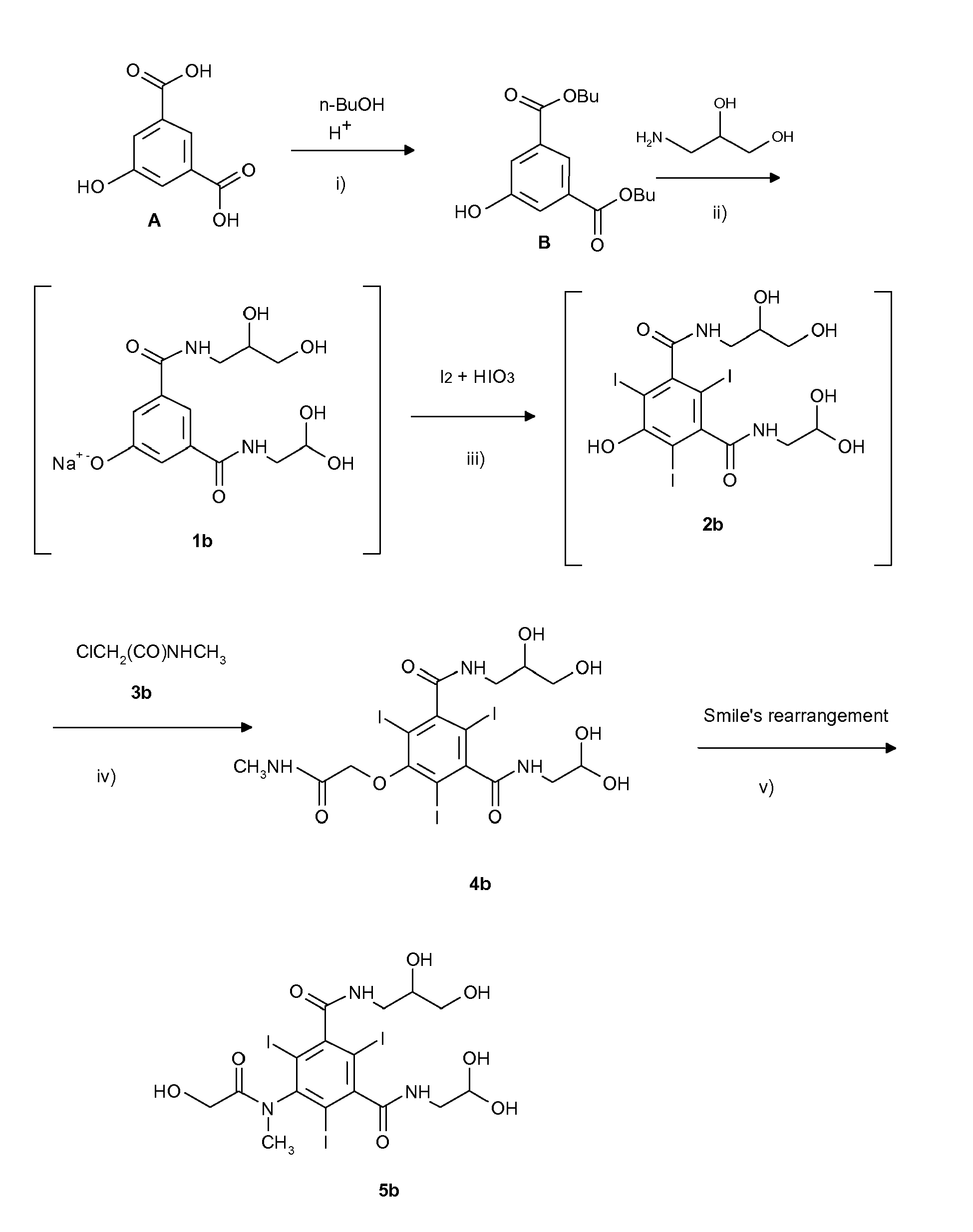
Priority Applications (18)
| Application Number | Priority Date | Filing Date | Title |
|---|---|---|---|
| EP10165485A EP2394984A1 (en) | 2010-06-10 | 2010-06-10 | Process for the iodination of phenolic derivatives |
| HRP20150899TT HRP20150899T1 (en) | 2010-06-10 | 2011-06-09 | Process for the iodination of phenolic derivatives |
| CN201180028401.2A CN103108860B (en) | 2010-06-10 | 2011-06-09 | Method for iodination of phenol derivatives |
| AU2011263733A AU2011263733B2 (en) | 2010-06-10 | 2011-06-09 | Process for the iodination of phenolic derivatives |
| US13/702,223 US8766003B2 (en) | 2010-06-10 | 2011-06-09 | Process for the iodination of phenolic derivatives |
| CA2803213A CA2803213C (en) | 2010-06-10 | 2011-06-09 | Process for the iodination of phenolic derivatives |
| HUE11725069A HUE027028T2 (en) | 2010-06-10 | 2011-06-09 | Process for the iodination of phenolic derivatives |
| RU2013100177/04A RU2563645C2 (en) | 2010-06-10 | 2011-06-09 | Process for iodination of phenolic derivatives |
| EP11725069.6A EP2580187B1 (en) | 2010-06-10 | 2011-06-09 | Process for the iodination of phenolic derivatives |
| JP2013513700A JP5752790B2 (en) | 2010-06-10 | 2011-06-09 | Method for iodination of phenol derivatives |
| PT117250696T PT2580187E (en) | 2010-06-10 | 2011-06-09 | Process for the iodination of phenolic derivatives |
| PCT/EP2011/059594 WO2011154500A1 (en) | 2010-06-10 | 2011-06-09 | Process for the iodination of phenolic derivatives |
| ES11725069.6T ES2544815T3 (en) | 2010-06-10 | 2011-06-09 | Process for iodination of phenolic derivatives |
| DK11725069.6T DK2580187T3 (en) | 2010-06-10 | 2011-06-09 | A process for the iodination of phenol derivatives |
| SI201130579T SI2580187T1 (en) | 2010-06-10 | 2011-06-09 | Process for the iodination of phenolic derivatives |
| KR1020137000501A KR101790539B1 (en) | 2010-06-10 | 2011-06-09 | Process for the iodination of phenolic derivatives |
| PL11725069T PL2580187T3 (en) | 2010-06-10 | 2011-06-09 | Process for the iodination of phenolic derivatives |
| IL223633A IL223633A (en) | 2010-06-10 | 2012-12-13 | Process for the iodination of phenolic derivatives |
Applications Claiming Priority (1)
| Application Number | Priority Date | Filing Date | Title |
|---|---|---|---|
| EP10165485A EP2394984A1 (en) | 2010-06-10 | 2010-06-10 | Process for the iodination of phenolic derivatives |
Publications (1)
| Publication Number | Publication Date |
|---|---|
| EP2394984A1 true EP2394984A1 (en) | 2011-12-14 |
Family
ID=42983748
Family Applications (2)
| Application Number | Title | Priority Date | Filing Date |
|---|---|---|---|
| EP10165485A Withdrawn EP2394984A1 (en) | 2010-06-10 | 2010-06-10 | Process for the iodination of phenolic derivatives |
| EP11725069.6A Active EP2580187B1 (en) | 2010-06-10 | 2011-06-09 | Process for the iodination of phenolic derivatives |
Family Applications After (1)
| Application Number | Title | Priority Date | Filing Date |
|---|---|---|---|
| EP11725069.6A Active EP2580187B1 (en) | 2010-06-10 | 2011-06-09 | Process for the iodination of phenolic derivatives |
Country Status (17)
| Country | Link |
|---|---|
| US (1) | US8766003B2 (en) |
| EP (2) | EP2394984A1 (en) |
| JP (1) | JP5752790B2 (en) |
| KR (1) | KR101790539B1 (en) |
| CN (1) | CN103108860B (en) |
| AU (1) | AU2011263733B2 (en) |
| CA (1) | CA2803213C (en) |
| DK (1) | DK2580187T3 (en) |
| ES (1) | ES2544815T3 (en) |
| HR (1) | HRP20150899T1 (en) |
| HU (1) | HUE027028T2 (en) |
| IL (1) | IL223633A (en) |
| PL (1) | PL2580187T3 (en) |
| PT (1) | PT2580187E (en) |
| RU (1) | RU2563645C2 (en) |
| SI (1) | SI2580187T1 (en) |
| WO (1) | WO2011154500A1 (en) |
Families Citing this family (6)
| Publication number | Priority date | Publication date | Assignee | Title |
|---|---|---|---|---|
| PL3066071T3 (en) | 2013-11-05 | 2018-09-28 | Bracco Imaging S.P.A | Process for the preparation of iopamidol |
| JP6743781B2 (en) * | 2016-08-08 | 2020-08-19 | 信越化学工業株式会社 | Resist material and pattern forming method |
| FR3113904B1 (en) | 2020-09-08 | 2022-08-12 | Innoverda | Process for the synthesis of 3,5-diiodo-4-hydroxy benzylalcohol |
| WO2023046815A1 (en) | 2021-09-24 | 2023-03-30 | Bracco Imaging Spa | Electrochemical iodination of n,n'-(2,3-dihydroxypropyl)-5-hydroxy-1,3-benzenedicarboxamide |
| CN114349605A (en) * | 2022-02-15 | 2022-04-15 | 营口兴福化工有限公司 | Synthetic method of p-iodophenol |
| EP4514771B1 (en) | 2022-04-29 | 2026-04-15 | Bracco Imaging SPA | Process for the preparation of 2,4,6-triiodophenol derivatives |
Citations (14)
| Publication number | Priority date | Publication date | Assignee | Title |
|---|---|---|---|---|
| US3833490A (en) | 1972-02-25 | 1974-09-03 | Rhone Poulenc Sa | Process for the preparation of 3,5-diiodo-4-hydroxybenzonitrile or 3-iodo-4-hydroxy-5-nitro-benzonitrile |
| US3914294A (en) | 1972-06-01 | 1975-10-21 | Squibb & Sons Inc | 3,5-Disubstituted-2,4,6-triiodobenzoic acids |
| EP0185130A1 (en) | 1984-12-10 | 1986-06-25 | BRACCO INDUSTRIA CHIMICA Società per Azioni | 5-Alkoxy-2,4,6-triodo or tribromo-isophthalic-acid derivatives, process for their preparation and X-ray contrast agents containing them |
| WO1988009328A1 (en) | 1987-05-22 | 1988-12-01 | Bracco Industria Chimica S.P.A. | Preparation of 5-acylamino-2,4,6-triiodo- or tribromo-benzoic acid derivatives |
| US5013865A (en) | 1988-04-06 | 1991-05-07 | Mallinckrodt, Inc. | Process for the preparation of 2,4,6-triiodo-5-amino-N-alkylisophthalamic acid and 2,4,6-triiodo-5-amino-isophthalamide compounds |
| US5075502A (en) | 1989-12-13 | 1991-12-24 | Mallinckrodt, Inc. | Nonionic x-ray contrast agents, compositions and methods |
| WO1992014695A1 (en) | 1991-02-25 | 1992-09-03 | Guerbet S.A. | New polyiodated compounds, method of preparation, contrast product containing them |
| WO1996037459A1 (en) | 1995-05-23 | 1996-11-28 | Fructamine S.P.A. | Process for the preparation of a dicarboxylic acid dichloride |
| WO1996037461A1 (en) | 1995-05-24 | 1996-11-28 | Nycomed Imaging A.S | Iodination process |
| WO1996037458A1 (en) | 1995-05-23 | 1996-11-28 | Fructamine S.P.A. | Process for the preparation of a halosubstituted aromatic acid |
| WO1997005097A1 (en) | 1995-07-25 | 1997-02-13 | Bracco S.P.A. | Process for the manufacturing of iodinated contrast agents |
| US5856596A (en) * | 1994-02-23 | 1999-01-05 | Fuji Xerox Co., Ltd. | Process for preparing mono-iodinated aromatic compound |
| WO2000032561A1 (en) | 1998-11-27 | 2000-06-08 | Bracco International B.V. | A process for the preparation of n,n'-bis[2, 3-dihydroxypropyl] -5-[ (hydroxyacetyl) methylamino]-2, 4,6-triiodo-1, 3-benzenedi carboxamide |
| WO2009103666A2 (en) | 2008-02-20 | 2009-08-27 | Bracco Imaging Spa | Process for the iodination of aromatic compounds |
Family Cites Families (7)
| Publication number | Priority date | Publication date | Assignee | Title |
|---|---|---|---|---|
| SU394355A1 (en) * | 1971-01-12 | 1973-08-22 | Р. М. Кузнецова, В. Н. Костин, К. С. Шаназаров, Г. И. Шарова, И. Бродский, Ф. А. Куцовска , Л. С. Розенштраух | ISOMERS OF IODOPENYLIDERIC ACIDS |
| ES528109A0 (en) | 1983-12-16 | 1985-10-01 | Bislak Sociedad Anonima | PROCEDURE FOR OBTAINING 2,4,6 TRIYODOFENOL |
| FR2581641B1 (en) | 1985-05-10 | 1988-08-12 | Delalande Sa | PROCESS FOR THE PREPARATION OF 6-ALKOXY (LOWER) -1-NAPHTOIC ACIDS AND CORRESPONDING ESTERS AND USE OF THIS PROCESS FOR THE PREPARATION OF 6-ALKOXY (LOWER) -5-HALO-1-NAPHTOIC ACIDS AND CORRESPONDING ESTERS |
| JP4434692B2 (en) * | 2003-11-04 | 2010-03-17 | 三菱瓦斯化学株式会社 | Process for producing 5-iodo-2-methylbenzoic acid |
| DE602005024566D1 (en) | 2004-08-10 | 2010-12-16 | Mitsubishi Gas Chemical Co | PROCESS FOR THE PREPARATION OF 2-AMINO-5-IOBOBENZOIC ACID |
| US20100217027A1 (en) * | 2007-08-31 | 2010-08-26 | Mitsubishi Gas Chemical Company, Inc. | Process for production phenol derivatives substituted with iodine at ortho position |
| EP2243767A1 (en) * | 2009-04-21 | 2010-10-27 | Bracco Imaging S.p.A | Process for the iodination of aromatic compounds |
-
2010
- 2010-06-10 EP EP10165485A patent/EP2394984A1/en not_active Withdrawn
-
2011
- 2011-06-09 CA CA2803213A patent/CA2803213C/en active Active
- 2011-06-09 DK DK11725069.6T patent/DK2580187T3/en active
- 2011-06-09 KR KR1020137000501A patent/KR101790539B1/en active Active
- 2011-06-09 EP EP11725069.6A patent/EP2580187B1/en active Active
- 2011-06-09 US US13/702,223 patent/US8766003B2/en active Active
- 2011-06-09 WO PCT/EP2011/059594 patent/WO2011154500A1/en not_active Ceased
- 2011-06-09 JP JP2013513700A patent/JP5752790B2/en active Active
- 2011-06-09 HU HUE11725069A patent/HUE027028T2/en unknown
- 2011-06-09 HR HRP20150899TT patent/HRP20150899T1/en unknown
- 2011-06-09 SI SI201130579T patent/SI2580187T1/en unknown
- 2011-06-09 RU RU2013100177/04A patent/RU2563645C2/en active
- 2011-06-09 CN CN201180028401.2A patent/CN103108860B/en active Active
- 2011-06-09 AU AU2011263733A patent/AU2011263733B2/en active Active
- 2011-06-09 PT PT117250696T patent/PT2580187E/en unknown
- 2011-06-09 PL PL11725069T patent/PL2580187T3/en unknown
- 2011-06-09 ES ES11725069.6T patent/ES2544815T3/en active Active
-
2012
- 2012-12-13 IL IL223633A patent/IL223633A/en active IP Right Grant
Patent Citations (15)
| Publication number | Priority date | Publication date | Assignee | Title |
|---|---|---|---|---|
| US3833490A (en) | 1972-02-25 | 1974-09-03 | Rhone Poulenc Sa | Process for the preparation of 3,5-diiodo-4-hydroxybenzonitrile or 3-iodo-4-hydroxy-5-nitro-benzonitrile |
| US3914294A (en) | 1972-06-01 | 1975-10-21 | Squibb & Sons Inc | 3,5-Disubstituted-2,4,6-triiodobenzoic acids |
| EP0185130A1 (en) | 1984-12-10 | 1986-06-25 | BRACCO INDUSTRIA CHIMICA Società per Azioni | 5-Alkoxy-2,4,6-triodo or tribromo-isophthalic-acid derivatives, process for their preparation and X-ray contrast agents containing them |
| WO1988009328A1 (en) | 1987-05-22 | 1988-12-01 | Bracco Industria Chimica S.P.A. | Preparation of 5-acylamino-2,4,6-triiodo- or tribromo-benzoic acid derivatives |
| EP0365541A1 (en) | 1987-05-22 | 1990-05-02 | Bracco Ind Chimica Spa | Preparation of 5-acylamino-2,4,6-triiodo- or tribromo-benzoic acid derivatives. |
| US5013865A (en) | 1988-04-06 | 1991-05-07 | Mallinckrodt, Inc. | Process for the preparation of 2,4,6-triiodo-5-amino-N-alkylisophthalamic acid and 2,4,6-triiodo-5-amino-isophthalamide compounds |
| US5075502A (en) | 1989-12-13 | 1991-12-24 | Mallinckrodt, Inc. | Nonionic x-ray contrast agents, compositions and methods |
| WO1992014695A1 (en) | 1991-02-25 | 1992-09-03 | Guerbet S.A. | New polyiodated compounds, method of preparation, contrast product containing them |
| US5856596A (en) * | 1994-02-23 | 1999-01-05 | Fuji Xerox Co., Ltd. | Process for preparing mono-iodinated aromatic compound |
| WO1996037459A1 (en) | 1995-05-23 | 1996-11-28 | Fructamine S.P.A. | Process for the preparation of a dicarboxylic acid dichloride |
| WO1996037458A1 (en) | 1995-05-23 | 1996-11-28 | Fructamine S.P.A. | Process for the preparation of a halosubstituted aromatic acid |
| WO1996037461A1 (en) | 1995-05-24 | 1996-11-28 | Nycomed Imaging A.S | Iodination process |
| WO1997005097A1 (en) | 1995-07-25 | 1997-02-13 | Bracco S.P.A. | Process for the manufacturing of iodinated contrast agents |
| WO2000032561A1 (en) | 1998-11-27 | 2000-06-08 | Bracco International B.V. | A process for the preparation of n,n'-bis[2, 3-dihydroxypropyl] -5-[ (hydroxyacetyl) methylamino]-2, 4,6-triiodo-1, 3-benzenedi carboxamide |
| WO2009103666A2 (en) | 2008-02-20 | 2009-08-27 | Bracco Imaging Spa | Process for the iodination of aromatic compounds |
Non-Patent Citations (6)
| Title |
|---|
| BHAGWAN R. PATIL ET AL.: "Iodine and iodic acid: an efficient reagent combination for iodination of aryl hydroxy ketones", TETRAHEDRON LETTERS., vol. 46, 6 September 2005 (2005-09-06), ELSEVIER, AMSTERDAM, NL., pages 7179 - 7181, XP002607744, ISSN: 0040-4039 * |
| BULL. CHEM. SOC. JAPAN, vol. 48, 1975, pages 745 - 750 |
| FURUICHI, R.; LIEBHAFSKY, H.A.: "Radioactive iodine exchange and the Dushman reaction", BULL. CHEM. SOC. JAPAN, vol. 46, 1973, pages 2008 - 2010 |
| PATIL ET AL., ARKIVOC, 2006, pages 104 |
| PATIL ET AL., TETRAHEDRON LETTERS, vol. 46, 2005, pages 7179 - 7181 |
| TETRAHEDRON LETT., vol. 46, 2005, pages 7179 |
Also Published As
| Publication number | Publication date |
|---|---|
| ES2544815T3 (en) | 2015-09-04 |
| EP2580187A1 (en) | 2013-04-17 |
| KR101790539B1 (en) | 2017-10-26 |
| DK2580187T3 (en) | 2015-08-24 |
| US8766003B2 (en) | 2014-07-01 |
| IL223633A0 (en) | 2013-03-05 |
| WO2011154500A1 (en) | 2011-12-15 |
| RU2563645C2 (en) | 2015-09-20 |
| AU2011263733A1 (en) | 2013-01-17 |
| PT2580187E (en) | 2015-09-21 |
| PL2580187T3 (en) | 2015-10-30 |
| JP2013528199A (en) | 2013-07-08 |
| US20130072719A1 (en) | 2013-03-21 |
| CN103108860A (en) | 2013-05-15 |
| EP2580187B1 (en) | 2015-05-27 |
| AU2011263733B2 (en) | 2015-06-11 |
| SI2580187T1 (en) | 2015-12-31 |
| CA2803213A1 (en) | 2011-12-15 |
| IL223633A (en) | 2015-09-24 |
| RU2013100177A (en) | 2014-07-20 |
| KR20130111517A (en) | 2013-10-10 |
| HRP20150899T1 (en) | 2015-10-09 |
| CN103108860B (en) | 2015-06-17 |
| HUE027028T2 (en) | 2016-08-29 |
| CA2803213C (en) | 2017-04-25 |
| JP5752790B2 (en) | 2015-07-22 |
Similar Documents
| Publication | Publication Date | Title |
|---|---|---|
| EP2580187B1 (en) | Process for the iodination of phenolic derivatives | |
| EP2421819B1 (en) | Process for the iodination of aromatic compounds | |
| EP2254850B1 (en) | Process for the iodination of aromatic compounds | |
| EP0773923B1 (en) | Process for the preparation of a halosubstituted aromatic acid | |
| KR20140100945A (en) | Iodination process for the preparation of 3,5-disubstituted-2,4,6-triiodo aromatic amines compounds | |
| EP3786152B1 (en) | Method for manufacturing aromatic nitrile compound | |
| CZ296096B6 (en) | Process for preparing N,N'-bis[2, 3-dihydroxypropyl]-5-[(hydroxyacetyl) methylamino]-2, 4,6-triiodo-1,3-benzenedicarboxamide | |
| EP1948590B1 (en) | Process for the preparation of contrast agents | |
| KR20250006017A (en) | Method for producing 2,4,6-triiodophenol derivatives | |
| JPH1077240A (en) | Method for producing 2-chloro-4-fluorophenol | |
| JP2003321439A (en) | Method for producing dihydroxydiphenylsulfone monoether | |
| JPS6340185B2 (en) |
Legal Events
| Date | Code | Title | Description |
|---|---|---|---|
| AK | Designated contracting states |
Kind code of ref document: A1 Designated state(s): AL AT BE BG CH CY CZ DE DK EE ES FI FR GB GR HR HU IE IS IT LI LT LU LV MC MK MT NL NO PL PT RO SE SI SK SM TR |
|
| AX | Request for extension of the european patent |
Extension state: BA ME RS |
|
| PUAI | Public reference made under article 153(3) epc to a published international application that has entered the european phase |
Free format text: ORIGINAL CODE: 0009012 |
|
| STAA | Information on the status of an ep patent application or granted ep patent |
Free format text: STATUS: THE APPLICATION IS DEEMED TO BE WITHDRAWN |
|
| 18D | Application deemed to be withdrawn |
Effective date: 20120615 |