EP2392799A1 - Exhaust throttle valve for internal combustion engine - Google Patents
Exhaust throttle valve for internal combustion engine Download PDFInfo
- Publication number
- EP2392799A1 EP2392799A1 EP09839245A EP09839245A EP2392799A1 EP 2392799 A1 EP2392799 A1 EP 2392799A1 EP 09839245 A EP09839245 A EP 09839245A EP 09839245 A EP09839245 A EP 09839245A EP 2392799 A1 EP2392799 A1 EP 2392799A1
- Authority
- EP
- European Patent Office
- Prior art keywords
- valve body
- valve
- valve shaft
- gas passage
- flap
- Prior art date
- Legal status (The legal status is an assumption and is not a legal conclusion. Google has not performed a legal analysis and makes no representation as to the accuracy of the status listed.)
- Withdrawn
Links
Images
Classifications
-
- F—MECHANICAL ENGINEERING; LIGHTING; HEATING; WEAPONS; BLASTING
- F16—ENGINEERING ELEMENTS AND UNITS; GENERAL MEASURES FOR PRODUCING AND MAINTAINING EFFECTIVE FUNCTIONING OF MACHINES OR INSTALLATIONS; THERMAL INSULATION IN GENERAL
- F16K—VALVES; TAPS; COCKS; ACTUATING-FLOATS; DEVICES FOR VENTING OR AERATING
- F16K1/00—Lift valves or globe valves, i.e. cut-off apparatus with closure members having at least a component of their opening and closing motion perpendicular to the closing faces
- F16K1/16—Lift valves or globe valves, i.e. cut-off apparatus with closure members having at least a component of their opening and closing motion perpendicular to the closing faces with pivoted closure-members
- F16K1/18—Lift valves or globe valves, i.e. cut-off apparatus with closure members having at least a component of their opening and closing motion perpendicular to the closing faces with pivoted closure-members with pivoted discs or flaps
- F16K1/22—Lift valves or globe valves, i.e. cut-off apparatus with closure members having at least a component of their opening and closing motion perpendicular to the closing faces with pivoted closure-members with pivoted discs or flaps with axis of rotation crossing the valve member, e.g. butterfly valves
- F16K1/223—Lift valves or globe valves, i.e. cut-off apparatus with closure members having at least a component of their opening and closing motion perpendicular to the closing faces with pivoted closure-members with pivoted discs or flaps with axis of rotation crossing the valve member, e.g. butterfly valves with a plurality of valve members
-
- F—MECHANICAL ENGINEERING; LIGHTING; HEATING; WEAPONS; BLASTING
- F02—COMBUSTION ENGINES; HOT-GAS OR COMBUSTION-PRODUCT ENGINE PLANTS
- F02D—CONTROLLING COMBUSTION ENGINES
- F02D9/00—Controlling engines by throttling air or fuel-and-air induction conduits or exhaust conduits
- F02D9/04—Controlling engines by throttling air or fuel-and-air induction conduits or exhaust conduits concerning exhaust conduits
-
- F—MECHANICAL ENGINEERING; LIGHTING; HEATING; WEAPONS; BLASTING
- F02—COMBUSTION ENGINES; HOT-GAS OR COMBUSTION-PRODUCT ENGINE PLANTS
- F02D—CONTROLLING COMBUSTION ENGINES
- F02D9/00—Controlling engines by throttling air or fuel-and-air induction conduits or exhaust conduits
- F02D9/08—Throttle valves specially adapted therefor; Arrangements of such valves in conduits
- F02D9/10—Throttle valves specially adapted therefor; Arrangements of such valves in conduits having pivotally-mounted flaps
- F02D9/1005—Details of the flap
- F02D9/101—Special flap shapes, ribs, bores or the like
-
- F—MECHANICAL ENGINEERING; LIGHTING; HEATING; WEAPONS; BLASTING
- F02—COMBUSTION ENGINES; HOT-GAS OR COMBUSTION-PRODUCT ENGINE PLANTS
- F02D—CONTROLLING COMBUSTION ENGINES
- F02D9/00—Controlling engines by throttling air or fuel-and-air induction conduits or exhaust conduits
- F02D9/08—Throttle valves specially adapted therefor; Arrangements of such valves in conduits
- F02D9/10—Throttle valves specially adapted therefor; Arrangements of such valves in conduits having pivotally-mounted flaps
- F02D9/1005—Details of the flap
- F02D9/102—Details of the flap the flap having movable parts fixed onto it
-
- F—MECHANICAL ENGINEERING; LIGHTING; HEATING; WEAPONS; BLASTING
- F02—COMBUSTION ENGINES; HOT-GAS OR COMBUSTION-PRODUCT ENGINE PLANTS
- F02M—SUPPLYING COMBUSTION ENGINES IN GENERAL WITH COMBUSTIBLE MIXTURES OR CONSTITUENTS THEREOF
- F02M26/00—Engine-pertinent apparatus for adding exhaust gases to combustion-air, main fuel or fuel-air mixture, e.g. by exhaust gas recirculation [EGR] systems
- F02M26/65—Constructional details of EGR valves
- F02M26/70—Flap valves; Rotary valves; Sliding valves; Resilient valves
Definitions
- the present invention relates to an exhaust throttle valve for an internal combustion engine, and more particularly to an exhaust throttle valve for an internal combustion engine including a housing formed with a gas passage through which a gas passes, and a valve body that opens and closes the gas passage.
- an exhaust throttle valve for an internal combustion engine including a housing formed with a gas passage through which a gas passes and a through hole provided in a direction perpendicular to the gas passage, a valve shaft rotatably journaled in the through hole, and a valve body that is connected to the valve shaft and opens and closes the gas passage.
- a valve is known in which a communication hole is provided in a first valve body that opens and closes a gas passage, a second valve body formed of a metal leaf spring is provided to cover the communication hole, and the second valve body is deformed to open the communication hole when pressure of a gas in the gas passage becomes predetermined pressure or more (Patent Document 1).
- a device in which a bypass passage branching from a gas passage and a bypass valve that opens and closes the bypass passage are provided in a housing, and opening and closing of a valve body provided in the gas passage and the bypass valve are controlled (Patent Document 2).
- the second valve body is made of metal and provided integrally with the first valve body, and thus a temperature change of a gas passing through the gas passage changes spring properties. Thus, timing when the second valve body is opened changes to cause variations in performance.
- the bypass passage and the bypass valve need to be newly provided to increase a size of the exhaust pressure control device and increase costs.
- the present invention provides an exhaust throttle valve for an internal combustion engine that is easily configured and does not depend on a gas temperature difference.
- the present invention provides an exhaust throttle valve for an internal combustion engine including: a housing formed with a gas passage through which a gas passes; a valve shaft rotatably journaled in the housing; and a valve body that is connected to the valve shaft and opens and closes the gas passage, characterized in that the valve shaft includes a first valve shaft and a second valve shaft that are coaxially provided and are relatively rotatable, the valve body includes a large valve body that is connected to the first valve shaft and formed to have substantially the same diameter as the gas passage, a communication hole provided in the large valve body, and a small valve body that is connected to the second valve shaft and abuts against the large valve body to close the communication hole, urging means that urges the second valve shaft in a direction of the small valve body abutting against the large valve body is provided outside the gas passage, and when pressure of the gas in the gas passage increases with the large valve body closing the gas passage, the small valve body is separated from the large valve body against the urging force by the urging means to open the communication
- the urging means is provided outside the gas passage, and thus a change in timing when the small valve body is opened based on a temperature difference of the gas passing through the gas passage can be prevented as much as possible, thereby obtaining a stable exhaust pressure control function. Also, there is no need for a bypass passage or a bypass valve as in Patent Document 2, allowing an easy configuration and a reduction in size.
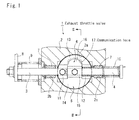
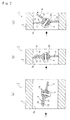
- FIGs 1 and 2 show an exhaust throttle valve 1 provided in an exhaust pipe of a diesel engine as an internal combustion engine, and in Figure 1 , an exhaust gas passes from the front to the back on the sheet plane, and Figure 2(b) shows a section taken along the line II-II in Figure 1 .
- the exhaust throttle valve 1 for the internal combustion engine includes a housing 2 formed with a gas passage 2a through which the exhaust gas passes, a first valve shaft 3 and a second valve shaft 4 rotatably journaled in the housing 2, a large valve body 5 that is connected to the first valve shaft 3 and has substantially the same diameter as the gas passage 2a, and a small valve body 6 connected to the second valve shaft 4.
- the gas passage 2a of the housing 2 has a substantially circular shape, and a first through hole 2b shown on the left and a second through hole 2c shown on the right are coaxially provided with the gas passage 2a therebetween.
- the first valve shaft 3 is rotatably held in the first through hole 2b via a bearing 7
- the second valve shaft 4 is rotatably held in the second through hole 2c via a bearing 7.
- the first and second valve shafts 3 and 4 are journaled in the first and second through holes 2b and 2c and thus rotate coaxially, and in this embodiment, a tip of the first valve shaft 3 and a tip of the second valve shaft 4 are close to each other in a position on the left in Figure 1 with respect to the center of the gas passage 2a.
- the first valve shaft 3 is rotatably driven by an unshown actuator via an arm 8 provided at the left end in Figure 1 , and switches the large valve body 5 between an opened state in Figure 2(a) and a closed state in Figures 2(b) and 2(c) .
- a first torsion coil spring 9 is provided to surround the first valve shaft 3, and the first torsion coil spring 9 is elastically fitted between the first valve shaft 3 and the housing 2 to urge the first valve shaft 3 counterclockwise shown in each drawing of Figure 2 .
- the actuator in a non-operating state of the exhaust throttle valve 1 shown in Figure 2(a) , the actuator holds the large valve body 5 in the opened state, and the large valve body 5 is maintained in the opened state by the urging force by the first torsion coil spring 9.
- the actuator rotates the first valve shaft 3 clockwise against the urging force by the first torsion coil spring 9 to close the large valve body 5.
- a second torsion coil spring 10 as urging means is provided to surround the second valve shaft 4, and the second torsion coil spring 10 is elastically fitted between the second valve shaft 4 and the housing 2 to urge the second valve shaft 4 counterclockwise shown in each drawing of Figure 2 .
- the small valve body 6 abuts against the large valve body 5 by the urging force of the second torsion coil spring 10, and when pressure exceeding the urging force by the second torsion coil spring 10 is applied to the small valve body 6 as shown in Figure 2(c) , the small valve body 6 rotates with respect to the large valve body 5.
- the large valve body 5 includes a tubular first valve shaft holding portion 11 that is formed on the side of the first through hole 2b and into which the first valve shaft 3 can be inserted, a tubular second valve shaft passing portion 12 that is formed on the side of the second through hole 2c and rotatably holds the second valve shaft 4, a substantially semicircular first flap 13 protruding from the first valve shaft holding portion 11 and the second valve shaft passing portion 12, and a substantially semicircular second flap 14 protruding from the side opposite to the first flap 13.
- the first valve shaft 3 is inserted into the first valve shaft holding portion 11 and connected and secured by a bolt, and the second valve shaft 4 is rotatably journaled in the second valve shaft passing portion 12 via the bearing 7 inserted into the second valve shaft passing portion 12.
- the small valve body 6 is located between the first valve shaft holding portion 11 and the second valve shaft passing portion 12 of the large valve body 5, and includes a tubular second valve shaft holding portion 15 into which the second valve shaft 4 can be inserted, and a third flap 16 having a substantially semicircular end protruding from the second valve shaft holding portion 15.
- the second valve shaft 4 passing through the second valve shaft passing portion 12 of the large valve body 5 is inserted into the second valve shaft holding portion 15 and connected and secured by a bolt.
- the third flap 16 is provided in a position offset from the center of the second valve shaft 4 as shown in each drawing of Figure 2 , and in a state where the large valve body 5 and the small valve body 6 are closed, the first flap 13 and the third flap 16 are brought into tight contact with each other.
- a communication hole 17 is formed having a slightly smaller shape than the third flap 16 of the small valve body 6.
- the communication hole 17 is formed to have the same width as the third flap 16 in a base of the first flap 13, and have, via a step, a smaller width than the width of the third flap 16.
- An outer peripheral end of the communication hole 17 has a substantially semicircular shape having a slightly smaller diameter than the substantially semicircular shape on the outer peripheral side of the third flap 16.
- the communication hole 17 may have any shape such as a rectangular or oval shape.
- the communication hole 17 has such a shape, and thus when the third flap 16 abuts against the first flap 13, the outer peripheral portion of the third flap 16 abuts against the first flap 13 so as to cover the outer peripheral portion of the communication hole 17, and thus the communication hole 17 is closed by the small valve body 6.
- a protrusion 18 as stopper means is formed on an outer periphery of the second valve shaft holding portion 15 of the small valve body 6, and as shown in Figure 2(c) , when the small valve body 6 is opened to a predetermined degree of opening with respect to the large valve body 5, the protrusion 18 abuts against the second flap 14 of the large valve body 5 to hold the degrees of opening of the small valve body 6 and the large valve body 5.
- FIG. 2(b) shows the operating state of the exhaust throttle valve 1 in which the large valve body 5 is closed by the actuator, and the exhaust gas passing through the gas passage 2a is interrupted by the large valve body 5 and the small valve body 6.
- the actuator rotates the first valve shaft 3 clockwise
- the first flap 13 presses the third flap 16 of the small valve body 6 clockwise
- the gas passage 2a is closed with the large valve body 5 and the small valve body 6 being maintained closed.
- the second valve shaft 4 rotates clockwise against the urging force of the second torsion coil spring 10, and thus the third flap 16 of the small valve body 6 is maintained abutting the first flap 13 of the large valve body 5 from a downstream side of the gas passage 2a.
- the communication hole 17 of the large valve body 5 is maintained closed by the third flap 16 of the small valve body 6, and the exhaust gas is interrupted by the closed large valve body 5 and small valve body 6.
- Figure 2(c) shows a state where a part of the exhaust gas is passed through the communication hole 17 to adjust pressure in the gas passage 2a, compared with the state in Figure 2(b) .
- the gas passage 2a is interrupted as shown in Figure 2(b)
- the pressure of the exhaust gas increases on an upstream side of the large valve body 5 and the small valve body 6, and thus the pressure of the exhaust gas applied to the third flap 16 of the small valve body 6 exceeds the urging force of the second torsion coil spring 10 that urges the second valve shaft 4.
- the second valve shaft 4 rotates against the urging force by the second torsion coil spring 10, and the third flap 16 of the small valve body 6 is separated from the first flap 13 of the large valve body 5 to open the communication hole 17.
- the communication hole 17 is opened and the exhaust gas passes through the communication hole 17, and thus the pressure of the exhaust gas interrupted by the large valve body 5 and the small valve body 6 decreases to adjust the pressure of the exhaust gas in the gas passage 2a.
- Timing when the third flap 16 is separated from the first flap 13 to open the communication hole 17 can be arbitrarily set by adjusting the urging force by the second torsion coil spring 10. Then, when the third flap 16 is opened by a predetermined angle with respect to the first flap 13, the protrusion 18 provided on the small valve body 6 abuts against the second flap 14 of the large valve body 5 to prevent the small valve body 6 from being excessively opened with respect to the large valve body 5.
- the second through hole 2c of the housing 2 is omitted, the second valve shaft 4 is rotatably provided in the first valve shaft 3, and the large valve body 5 and the small valve body 6 are provided in the first and second valve shafts 3 and 4.
- the second torsion coil spring 10 is elastically fitted between the first valve shaft 3 and the second valve shaft 4, and the second torsion coil spring 10 urges the large valve body 5 and the small valve body 6 to be closed.
- the first and second torsion coil springs 9,10 may be compression springs.
Landscapes
- Engineering & Computer Science (AREA)
- General Engineering & Computer Science (AREA)
- Mechanical Engineering (AREA)
- Chemical & Material Sciences (AREA)
- Combustion & Propulsion (AREA)
- Control Of Throttle Valves Provided In The Intake System Or In The Exhaust System (AREA)
- Lift Valve (AREA)
- Exhaust Silencers (AREA)
Abstract
Description
- The present invention relates to an exhaust throttle valve for an internal combustion engine, and more particularly to an exhaust throttle valve for an internal combustion engine including a housing formed with a gas passage through which a gas passes, and a valve body that opens and closes the gas passage.
- Conventionally, an exhaust throttle valve for an internal combustion engine is known including a housing formed with a gas passage through which a gas passes and a through hole provided in a direction perpendicular to the gas passage, a valve shaft rotatably journaled in the through hole, and a valve body that is connected to the valve shaft and opens and closes the gas passage.
As such an exhaust throttle valve, a valve is known in which a communication hole is provided in a first valve body that opens and closes a gas passage, a second valve body formed of a metal leaf spring is provided to cover the communication hole, and the second valve body is deformed to open the communication hole when pressure of a gas in the gas passage becomes predetermined pressure or more (Patent Document 1).
Also, as another exhaust pressure control device, a device is known in which a bypass passage branching from a gas passage and a bypass valve that opens and closes the bypass passage are provided in a housing, and opening and closing of a valve body provided in the gas passage and the bypass valve are controlled (Patent Document 2). -
- Patent Document 1: Japanese Patent Laid-Open No.
10-220253 - Patent Document 2: Japanese Patent Laid-Open No.
2007-247488 - However, for the exhaust throttle valve in Patent Document 1, the second valve body is made of metal and provided integrally with the first valve body, and thus a temperature change of a gas passing through the gas passage changes spring properties. Thus, timing when the second valve body is opened changes to cause variations in performance.
Also, for the exhaust pressure control device inPatent Document 2, the bypass passage and the bypass valve need to be newly provided to increase a size of the exhaust pressure control device and increase costs.
In view of such problems, the present invention provides an exhaust throttle valve for an internal combustion engine that is easily configured and does not depend on a gas temperature difference. - Specifically, the present invention provides an exhaust throttle valve for an internal combustion engine including: a housing formed with a gas passage through which a gas passes; a valve shaft rotatably journaled in the housing; and a valve body that is connected to the valve shaft and opens and closes the gas passage, characterized in that the valve shaft includes a first valve shaft and a second valve shaft that are coaxially provided and are relatively rotatable, the valve body includes a large valve body that is connected to the first valve shaft and formed to have substantially the same diameter as the gas passage, a communication hole provided in the large valve body, and a small valve body that is connected to the second valve shaft and abuts against the large valve body to close the communication hole, urging means that urges the second valve shaft in a direction of the small valve body abutting against the large valve body is provided outside the gas passage, and when pressure of the gas in the gas passage increases with the large valve body closing the gas passage, the small valve body is separated from the large valve body against the urging force by the urging means to open the communication hole.
- According to the above-described invention, the urging means is provided outside the gas passage, and thus a change in timing when the small valve body is opened based on a temperature difference of the gas passing through the gas passage can be prevented as much as possible, thereby obtaining a stable exhaust pressure control function.
Also, there is no need for a bypass passage or a bypass valve as inPatent Document 2, allowing an easy configuration and a reduction in size. -
-
Figure 1 is a sectional view of an exhaust throttle valve according to an embodiment; and -
Figure 2 is a sectional view taken along the line II-II inFigure 1 and shows an operation of the exhaust throttle valve. - Now, a shown embodiment will be described.
Figures 1 and2 show an exhaust throttle valve 1 provided in an exhaust pipe of a diesel engine as an internal combustion engine, and inFigure 1 , an exhaust gas passes from the front to the back on the sheet plane, andFigure 2(b) shows a section taken along the line II-II inFigure 1 .
The exhaust throttle valve 1 for the internal combustion engine includes ahousing 2 formed with agas passage 2a through which the exhaust gas passes, afirst valve shaft 3 and asecond valve shaft 4 rotatably journaled in thehousing 2, alarge valve body 5 that is connected to thefirst valve shaft 3 and has substantially the same diameter as thegas passage 2a, and asmall valve body 6 connected to thesecond valve shaft 4.
Thegas passage 2a of thehousing 2 has a substantially circular shape, and a first throughhole 2b shown on the left and a second throughhole 2c shown on the right are coaxially provided with thegas passage 2a therebetween. Thefirst valve shaft 3 is rotatably held in the first throughhole 2b via abearing 7, and thesecond valve shaft 4 is rotatably held in the second throughhole 2c via abearing 7. - The first and
second valve shafts holes first valve shaft 3 and a tip of thesecond valve shaft 4 are close to each other in a position on the left inFigure 1 with respect to the center of thegas passage 2a.
Thefirst valve shaft 3 is rotatably driven by an unshown actuator via anarm 8 provided at the left end inFigure 1 , and switches thelarge valve body 5 between an opened state inFigure 2(a) and a closed state inFigures 2(b) and 2(c) .
On the outside of thegas passage 2a, a firsttorsion coil spring 9 is provided to surround thefirst valve shaft 3, and the firsttorsion coil spring 9 is elastically fitted between thefirst valve shaft 3 and thehousing 2 to urge thefirst valve shaft 3 counterclockwise shown in each drawing ofFigure 2 .
With such a configuration, in a non-operating state of the exhaust throttle valve 1 shown inFigure 2(a) , the actuator holds thelarge valve body 5 in the opened state, and thelarge valve body 5 is maintained in the opened state by the urging force by the firsttorsion coil spring 9.
In an operating state of the exhaust throttle valve 1 shown inFigures 2(b) and 2(c) , the actuator rotates thefirst valve shaft 3 clockwise against the urging force by the firsttorsion coil spring 9 to close thelarge valve body 5. - On the outside of the
gas passage 2a, a secondtorsion coil spring 10 as urging means is provided to surround thesecond valve shaft 4, and the secondtorsion coil spring 10 is elastically fitted between thesecond valve shaft 4 and thehousing 2 to urge thesecond valve shaft 4 counterclockwise shown in each drawing ofFigure 2 .
With such a configuration, in the states shown inFigures 2(a) and 2(b) , thesmall valve body 6 abuts against thelarge valve body 5 by the urging force of the secondtorsion coil spring 10, and when pressure exceeding the urging force by the secondtorsion coil spring 10 is applied to thesmall valve body 6 as shown inFigure 2(c) , thesmall valve body 6 rotates with respect to thelarge valve body 5. - The
large valve body 5 includes a tubular first valveshaft holding portion 11 that is formed on the side of the first throughhole 2b and into which thefirst valve shaft 3 can be inserted, a tubular second valveshaft passing portion 12 that is formed on the side of the second throughhole 2c and rotatably holds thesecond valve shaft 4, a substantially semicircularfirst flap 13 protruding from the first valveshaft holding portion 11 and the second valveshaft passing portion 12, and a substantially semicircularsecond flap 14 protruding from the side opposite to thefirst flap 13.
Thefirst valve shaft 3 is inserted into the first valveshaft holding portion 11 and connected and secured by a bolt, and thesecond valve shaft 4 is rotatably journaled in the second valveshaft passing portion 12 via thebearing 7 inserted into the second valveshaft passing portion 12.
Thesmall valve body 6 is located between the first valveshaft holding portion 11 and the second valveshaft passing portion 12 of thelarge valve body 5, and includes a tubular second valveshaft holding portion 15 into which thesecond valve shaft 4 can be inserted, and athird flap 16 having a substantially semicircular end protruding from the second valveshaft holding portion 15.
Thesecond valve shaft 4 passing through the second valveshaft passing portion 12 of thelarge valve body 5 is inserted into the second valveshaft holding portion 15 and connected and secured by a bolt.
Thethird flap 16 is provided in a position offset from the center of thesecond valve shaft 4 as shown in each drawing ofFigure 2 , and in a state where thelarge valve body 5 and thesmall valve body 6 are closed, thefirst flap 13 and thethird flap 16 are brought into tight contact with each other. - In the
first flap 13 of thelarge valve body 5, acommunication hole 17 is formed having a slightly smaller shape than thethird flap 16 of thesmall valve body 6.
Specifically, thecommunication hole 17 is formed to have the same width as thethird flap 16 in a base of thefirst flap 13, and have, via a step, a smaller width than the width of thethird flap 16. An outer peripheral end of thecommunication hole 17 has a substantially semicircular shape having a slightly smaller diameter than the substantially semicircular shape on the outer peripheral side of thethird flap 16. Also, thecommunication hole 17 may have any shape such as a rectangular or oval shape.
Thecommunication hole 17 has such a shape, and thus when thethird flap 16 abuts against thefirst flap 13, the outer peripheral portion of thethird flap 16 abuts against thefirst flap 13 so as to cover the outer peripheral portion of thecommunication hole 17, and thus thecommunication hole 17 is closed by thesmall valve body 6.
Further, aprotrusion 18 as stopper means is formed on an outer periphery of the second valveshaft holding portion 15 of thesmall valve body 6, and as shown inFigure 2(c) , when thesmall valve body 6 is opened to a predetermined degree of opening with respect to thelarge valve body 5, theprotrusion 18 abuts against thesecond flap 14 of thelarge valve body 5 to hold the degrees of opening of thesmall valve body 6 and thelarge valve body 5. - An operation of the exhaust throttle valve 1 having the above-described configuration will be described. First, in the non-operating state of the exhaust throttle valve 1 shown in
Figure 2(a) , thelarge valve body 5 is held in the opened state by the actuator, and the exhaust gas passing through thegas passage 2a passes without being interrupted.
At this time, the secondtorsion coil spring 10 urges thesecond valve shaft 4 and thus thethird flap 16 of thesmall valve body 6 abuts against thefirst flap 13 of thelarge valve body 5, and thecommunication hole 17 is closed by thethird flap 16. - Next,
Figure 2(b) shows the operating state of the exhaust throttle valve 1 in which thelarge valve body 5 is closed by the actuator, and the exhaust gas passing through thegas passage 2a is interrupted by thelarge valve body 5 and thesmall valve body 6.
At this time, when the actuator rotates thefirst valve shaft 3 clockwise, thefirst flap 13 presses thethird flap 16 of thesmall valve body 6 clockwise, and thegas passage 2a is closed with thelarge valve body 5 and thesmall valve body 6 being maintained closed.
At this time, thesecond valve shaft 4 rotates clockwise against the urging force of the secondtorsion coil spring 10, and thus thethird flap 16 of thesmall valve body 6 is maintained abutting thefirst flap 13 of thelarge valve body 5 from a downstream side of thegas passage 2a.
Thus, thecommunication hole 17 of thelarge valve body 5 is maintained closed by thethird flap 16 of thesmall valve body 6, and the exhaust gas is interrupted by the closedlarge valve body 5 andsmall valve body 6. - Next,
Figure 2(c) shows a state where a part of the exhaust gas is passed through thecommunication hole 17 to adjust pressure in thegas passage 2a, compared with the state inFigure 2(b) . When thegas passage 2a is interrupted as shown inFigure 2(b) , the pressure of the exhaust gas increases on an upstream side of thelarge valve body 5 and thesmall valve body 6, and thus the pressure of the exhaust gas applied to thethird flap 16 of thesmall valve body 6 exceeds the urging force of the secondtorsion coil spring 10 that urges thesecond valve shaft 4. Then, thesecond valve shaft 4 rotates against the urging force by the secondtorsion coil spring 10, and thethird flap 16 of thesmall valve body 6 is separated from thefirst flap 13 of thelarge valve body 5 to open thecommunication hole 17. Thecommunication hole 17 is opened and the exhaust gas passes through thecommunication hole 17, and thus the pressure of the exhaust gas interrupted by thelarge valve body 5 and thesmall valve body 6 decreases to adjust the pressure of the exhaust gas in thegas passage 2a. Timing when thethird flap 16 is separated from thefirst flap 13 to open thecommunication hole 17 can be arbitrarily set by adjusting the urging force by the secondtorsion coil spring 10. Then, when thethird flap 16 is opened by a predetermined angle with respect to thefirst flap 13, theprotrusion 18 provided on thesmall valve body 6 abuts against thesecond flap 14 of thelarge valve body 5 to prevent thesmall valve body 6 from being excessively opened with respect to thelarge valve body 5. Then, the pressure of the exhaust gas decreases or the exhaust throttle valve 1 is set to the non-operating state, and thus the pressure of the exhaust gas applied to thethird flap 16 of thesmall valve body 6 decreases, and thus thethird flap 16 abuts against thefirst flap 13 by the urging force by the secondtorsion coil spring 10 to close thecommunication hole 17. - With the above-described exhaust throttle valve 1, when the pressure of the exhaust gas in the
gas passage 2a increases when thelarge valve body 5 is closed, thesmall valve body 6 is opened to open thecommunication hole 17 formed in thelarge valve body 5, thereby allowing the pressure of the exhaust gas to be adjusted.
Also, thesecond valve shaft 4 to which thesmall valve body 6 is connected is urged by the secondtorsion coil spring 10 provided outside thehousing 2, and thus a temperature change of the gas in thegas passage 2a hardly changes the urging force by the secondtorsion coil spring 10, thereby obtaining a stable operation. - Instead of the above-described embodiment, for example, it may be allowed that the second through
hole 2c of thehousing 2 is omitted, thesecond valve shaft 4 is rotatably provided in thefirst valve shaft 3, and thelarge valve body 5 and thesmall valve body 6 are provided in the first andsecond valve shafts
In this case, it may be allowed that the secondtorsion coil spring 10 is elastically fitted between thefirst valve shaft 3 and thesecond valve shaft 4, and the secondtorsion coil spring 10 urges thelarge valve body 5 and thesmall valve body 6 to be closed.
The first and second torsion coil springs 9,10 may be compression springs. -
- 1
- exhaust throttle valve
- 2
- housing
- 2a
- gas passage
- 3
- first valve shaft
- 4
- second valve shaft
- 5
- large valve body
- 6
- small valve body
- 17
- communication hole
Claims (5)
- An exhaust throttle valve (1) for an internal combustion engine comprising:a housing (2) formed with a gas passage (2a) through which a gas passes;a valve shaft rotatably journaled in said housing (2); anda valve body that is connected to said valve shaft and opens and closes said gas passage (2a),characterized in that said valve shaft includes a first valve shaft (3) and a second valve shaft (4) that are coaxially provided and are relatively rotatable,said valve body includes a large valve body (5) that is connected to said first valve shaft (3) and formed to have substantially the same diameter as the gas passage (2a), a communication hole (17) provided in said large valve body (5), and a small valve body (6) that is connected to said second valve shaft (4) and abuts against the large valve body (5) to close said communication hole (17),urging means that urges said second valve shaft (4) in a direction of said small valve body (6) abutting against said large valve body (5) is provided outside the gas passage (2a), andwhen pressure of the gas in the gas passage (2a) increases with said large valve body (5) closing the gas passage (2a), said small valve body (6) is separated from the large valve body (5) against the urging force by said urging means to open said communication hole (17).
- The exhaust throttle valve (1) for an internal combustion engine according to claim 1, characterized in that said urging means is a torsion coil spring surrounding said second valve shaft (4) and elastically fitted between said second valve shaft (4) and the housing (2).
- The exhaust throttle valve (1) for an internal combustion engine according to claim 1 or 2, characterized in that a first through hole and a second through hole are provided in said housing (2) so as to face each other with the gas passage (2a) therebetween, said first valve shaft (3) is provided in the first through hole, and said second valve shaft (4) is provided in the second through hole.
- The exhaust throttle valve (1) for an internal combustion engine according to claim 3, characterized in that said large valve body (5) includes a first valve shaft holding portion that is formed on the side of the first through hole and to which the first valve shaft (3) is connected, a second valve shaft passing portion that is formed on the side of the second through hole and rotatably holds the second valve shaft (4), a first flap protruding from the first valve shaft holding portion and the second valve shaft passing portion, and a second flap protruding from the side opposite to the first flap,
said small valve body (6) includes a second valve shaft holding portion located between the first valve shaft holding portion and the second valve shaft passing portion of said large valve body (5) and to which the second valve shaft passing through said second valve shaft holding portion is connected, and a third flap protruding from said second valve shaft holding portion,
a communication hole (17) having a smaller opening than said third flap is formed in said first flap, and said urging means urges the third flap to abut against the first flap from a downstream side of the gas passage (2a) via the second valve shaft (4). - The exhaust throttle valve (1) for an internal combustion engine according to any one of claims 1 to 4, characterized in that stopper means is provided that holds the small valve body (6) and the large valve body (5) at predetermined degrees of opening when said small valve body (6) is separated from the large valve body (5).
Applications Claiming Priority (2)
| Application Number | Priority Date | Filing Date | Title |
|---|---|---|---|
| JP2009019540A JP5359324B2 (en) | 2009-01-30 | 2009-01-30 | Exhaust throttle valve for internal combustion engine |
| PCT/JP2009/067470 WO2010087056A1 (en) | 2009-01-30 | 2009-10-07 | Exhaust throttle valve for internal combustion engine |
Publications (2)
| Publication Number | Publication Date |
|---|---|
| EP2392799A1 true EP2392799A1 (en) | 2011-12-07 |
| EP2392799A4 EP2392799A4 (en) | 2012-08-08 |
Family
ID=42395324
Family Applications (1)
| Application Number | Title | Priority Date | Filing Date |
|---|---|---|---|
| EP09839245A Withdrawn EP2392799A4 (en) | 2009-01-30 | 2009-10-07 | Exhaust throttle valve for internal combustion engine |
Country Status (4)
| Country | Link |
|---|---|
| US (1) | US20110265466A1 (en) |
| EP (1) | EP2392799A4 (en) |
| JP (1) | JP5359324B2 (en) |
| WO (1) | WO2010087056A1 (en) |
Families Citing this family (12)
| Publication number | Priority date | Publication date | Assignee | Title |
|---|---|---|---|---|
| US8926156B2 (en) | 2010-08-03 | 2015-01-06 | Enplas Corporation | Light-emitting device and illumination device |
| FR2993031B1 (en) * | 2012-07-04 | 2015-05-01 | Valeo Sys Controle Moteur Sas | ENGINE CONTROL VALVE WITH IMPROVED OPERATION |
| US10203703B2 (en) * | 2014-03-04 | 2019-02-12 | Mi Valve, Llc | Airflow balancing valve for HVAC systems |
| SG11201700533WA (en) * | 2014-08-14 | 2017-02-27 | Ferrotec Usa Corp | Multi-vane throttle valve |
| EP2988037A1 (en) * | 2014-08-22 | 2016-02-24 | Siemens Aktiengesellschaft | Valve for an overflow conduit |
| DE102015110984B4 (en) * | 2015-07-07 | 2019-05-29 | Pierburg Gmbh | Three-way exhaust gas recirculation valve assembly with three fluid ports for exhaust gas recirculation |
| FR3041692B1 (en) * | 2015-09-30 | 2019-07-12 | Faurecia Systemes D'echappement | EXHAUST LINE ELEMENT COMPRISING A VALVE WITH REPORTED BUTTONS |
| FR3048048B1 (en) * | 2016-02-22 | 2018-11-30 | Faurecia Systemes D'echappement | VALVE FOR A VEHICLE EXHAUST LINE |
| JP2017160889A (en) * | 2016-03-11 | 2017-09-14 | マツダ株式会社 | Exhaust system for engine |
| CN112460280A (en) * | 2020-10-30 | 2021-03-09 | 上海江南长兴造船有限责任公司 | Valve locking device for valve extension rod |
| CN117167503B (en) * | 2023-11-02 | 2024-04-05 | 南通图海机械有限公司 | Valve structure for precisely controlled waste gas incineration |
| CN120506331B (en) * | 2025-07-22 | 2025-09-19 | 山东速力动力科技有限公司 | An adaptive hydrogen-ammonia internal combustion engine intake regulating valve |
Family Cites Families (21)
| Publication number | Priority date | Publication date | Assignee | Title |
|---|---|---|---|---|
| US2796082A (en) * | 1955-02-14 | 1957-06-18 | Interstate Engineering Corp | Pilot actuated butterfly valve |
| DE2017094A1 (en) * | 1970-04-10 | 1971-10-21 | Volkswagenwerk Ag, 3180 Wolfsburg | Mixture control system for an internal combustion engine with controlled fuel injection |
| JPS53141825A (en) * | 1977-05-16 | 1978-12-11 | Nissan Diesel Motor Co Ltd | Exhaust recirculation control system in diesel engine |
| US4158352A (en) * | 1977-09-30 | 1979-06-19 | The Bendix Corporation | Apparatus for providing additional air to aid starting of I.C. engines |
| JPS626261Y2 (en) * | 1979-05-15 | 1987-02-13 | ||
| DE3040144A1 (en) * | 1980-10-24 | 1982-06-03 | Vdo Adolf Schindling Ag, 6000 Frankfurt | DEVICE FOR CONTROLLING THE DRIVING SPEED AND CONTROLLING THE IDLE SPEED IN MOTOR VEHICLES WITH OTTO ENGINE |
| US4779590A (en) * | 1987-02-06 | 1988-10-25 | Eaton Corporation | Engine throttle control with low idle speed actuation force |
| US4827884A (en) * | 1987-10-02 | 1989-05-09 | Bendix Electronics Limited | Throttle assembly |
| GB9014486D0 (en) * | 1990-06-29 | 1990-08-22 | Dewandre Co Ltd C | Exhaust brake variable orifice |
| KR100222527B1 (en) * | 1994-11-24 | 1999-10-01 | 정몽규 | An apparatus for controlling intake system in an internal combustion engine |
| JP3760513B2 (en) * | 1996-07-17 | 2006-03-29 | 日産自動車株式会社 | Valve opening pressure regulator |
| JPH10220253A (en) * | 1997-02-05 | 1998-08-18 | Jidosha Kiki Co Ltd | Exhaust brake device |
| BE1011130A3 (en) * | 1997-04-25 | 1999-05-04 | Solvay | Shutter device. |
| US6234208B1 (en) * | 1998-04-10 | 2001-05-22 | Solvay (Societe Anonyme) | Shut-off device |
| WO2001059279A1 (en) * | 2000-02-10 | 2001-08-16 | Siemens Aktiengesellschaft | Throttle valve arrangement with emergency air device |
| JP2002089297A (en) * | 2000-09-08 | 2002-03-27 | Taiho Kogyo Co Ltd | Variable intake device |
| JP2003120283A (en) * | 2001-10-18 | 2003-04-23 | Mitsubishi Motors Corp | Exhaust pressure control valve |
| JP2005325685A (en) * | 2003-05-19 | 2005-11-24 | Mitsubishi Motors Corp | Exhaust pressure raising device for internal combustion engine |
| JP4130912B2 (en) * | 2003-12-24 | 2008-08-13 | 愛三工業株式会社 | Exhaust pressure raising device for internal combustion engine |
| JP2007247488A (en) | 2006-03-15 | 2007-09-27 | Aisan Ind Co Ltd | Exhaust pressure control device |
| JP5534144B2 (en) * | 2009-08-04 | 2014-06-25 | 大豊工業株式会社 | Exhaust throttle valve for internal combustion engine |
-
2009
- 2009-01-30 JP JP2009019540A patent/JP5359324B2/en not_active Expired - Fee Related
- 2009-10-07 EP EP09839245A patent/EP2392799A4/en not_active Withdrawn
- 2009-10-07 WO PCT/JP2009/067470 patent/WO2010087056A1/en not_active Ceased
- 2009-10-07 US US13/138,150 patent/US20110265466A1/en not_active Abandoned
Also Published As
| Publication number | Publication date |
|---|---|
| EP2392799A4 (en) | 2012-08-08 |
| JP2010174783A (en) | 2010-08-12 |
| WO2010087056A1 (en) | 2010-08-05 |
| US20110265466A1 (en) | 2011-11-03 |
| JP5359324B2 (en) | 2013-12-04 |
Similar Documents
| Publication | Publication Date | Title |
|---|---|---|
| EP2392799A1 (en) | Exhaust throttle valve for internal combustion engine | |
| US9447715B2 (en) | Valve device for exhaust gas flow path | |
| US8342206B2 (en) | Dual butterfly control valve and method of use | |
| EP2321508B1 (en) | Butterfly valve for turbocharger systems | |
| US7533659B2 (en) | Exhaust-gas recirculation valve | |
| WO2008115212A1 (en) | Snap-action valve for exhaust system | |
| JP2016079807A (en) | Valve structure | |
| EP1873376A3 (en) | Intake air control valves | |
| EP3267009B1 (en) | Waste gate valve and turbocharger | |
| WO2015072271A1 (en) | Valve device for exhaust gas passage | |
| JP5534144B2 (en) | Exhaust throttle valve for internal combustion engine | |
| CN106014603B (en) | air inlet flow control device | |
| US20140318510A1 (en) | Valve drive apparatus and supercharger having the same | |
| CN102597436A (en) | Device for controlling timing of valve opening/closing | |
| US10934882B2 (en) | Turbocharger | |
| US20080111091A1 (en) | Exhaust throttling valve using a general purpose actuator | |
| EP3401533B1 (en) | Valve having a throttle flap arranged in a throttle flap connector | |
| US10364732B2 (en) | Valve device for exhaust flow passage | |
| JP2015059625A (en) | Butterfly valve device, internal combustion engine, and method of manufacturing butterfly valve device | |
| JP2010223208A (en) | Exhaust valve | |
| JP6117532B2 (en) | Internal combustion engine with exhaust turbocharger | |
| US10240653B2 (en) | Air intake device | |
| JP2013253538A (en) | Exhaust valve device | |
| JP2012062878A (en) | Exhaust control valve | |
| US20110120412A1 (en) | Valve |
Legal Events
| Date | Code | Title | Description |
|---|---|---|---|
| PUAI | Public reference made under article 153(3) epc to a published international application that has entered the european phase |
Free format text: ORIGINAL CODE: 0009012 |
|
| 17P | Request for examination filed |
Effective date: 20110816 |
|
| AK | Designated contracting states |
Kind code of ref document: A1 Designated state(s): AT BE BG CH CY CZ DE DK EE ES FI FR GB GR HR HU IE IS IT LI LT LU LV MC MK MT NL NO PL PT RO SE SI SK SM TR |
|
| DAX | Request for extension of the european patent (deleted) | ||
| A4 | Supplementary search report drawn up and despatched |
Effective date: 20120706 |
|
| RIC1 | Information provided on ipc code assigned before grant |
Ipc: F02D 9/04 20060101ALI20120702BHEP Ipc: F02D 9/10 20060101AFI20120702BHEP |
|
| STAA | Information on the status of an ep patent application or granted ep patent |
Free format text: STATUS: THE APPLICATION IS DEEMED TO BE WITHDRAWN |
|
| 18D | Application deemed to be withdrawn |
Effective date: 20130205 |