EP2392569A1 - Alcohol compound having dioxane structure and process for producing same - Google Patents
Alcohol compound having dioxane structure and process for producing same Download PDFInfo
- Publication number
- EP2392569A1 EP2392569A1 EP10735859A EP10735859A EP2392569A1 EP 2392569 A1 EP2392569 A1 EP 2392569A1 EP 10735859 A EP10735859 A EP 10735859A EP 10735859 A EP10735859 A EP 10735859A EP 2392569 A1 EP2392569 A1 EP 2392569A1
- Authority
- EP
- European Patent Office
- Prior art keywords
- alcohol compound
- integer
- ethyl
- carbon atoms
- benzene
- Prior art date
- Legal status (The legal status is an assumption and is not a legal conclusion. Google has not performed a legal analysis and makes no representation as to the accuracy of the status listed.)
- Withdrawn
Links
- -1 Alcohol compound Chemical class 0.000 title claims abstract description 30
- 125000000532 dioxanyl group Chemical group 0.000 title description 3
- 238000000034 method Methods 0.000 title description 2
- UHOVQNZJYSORNB-UHFFFAOYSA-N monobenzene Natural products C1=CC=CC=C1 UHOVQNZJYSORNB-UHFFFAOYSA-N 0.000 claims abstract description 28
- 125000004432 carbon atom Chemical group C* 0.000 claims abstract description 15
- 125000003118 aryl group Chemical group 0.000 claims abstract description 12
- 238000004519 manufacturing process Methods 0.000 claims abstract description 12
- UFWIBTONFRDIAS-UHFFFAOYSA-N Naphthalene Chemical group C1=CC=CC2=CC=CC=C21 UFWIBTONFRDIAS-UHFFFAOYSA-N 0.000 claims abstract description 10
- MWPLVEDNUUSJAV-UHFFFAOYSA-N anthracene Chemical group C1=CC=CC2=CC3=CC=CC=C3C=C21 MWPLVEDNUUSJAV-UHFFFAOYSA-N 0.000 claims abstract description 10
- YNPNZTXNASCQKK-UHFFFAOYSA-N phenanthrene Chemical group C1=CC=C2C3=CC=CC=C3C=CC2=C1 YNPNZTXNASCQKK-UHFFFAOYSA-N 0.000 claims abstract description 10
- BBEAQIROQSPTKN-UHFFFAOYSA-N pyrene Chemical group C1=CC=C2C=CC3=CC=CC4=CC=C1C2=C43 BBEAQIROQSPTKN-UHFFFAOYSA-N 0.000 claims abstract description 10
- 125000001495 ethyl group Chemical group [H]C([H])([H])C([H])([H])* 0.000 claims abstract description 9
- 125000002496 methyl group Chemical group [H]C([H])([H])* 0.000 claims abstract description 9
- 125000004435 hydrogen atom Chemical group [H]* 0.000 claims abstract description 8
- 125000001997 phenyl group Chemical group [H]C1=C([H])C([H])=C(*)C([H])=C1[H] 0.000 claims abstract description 7
- 125000000217 alkyl group Chemical group 0.000 claims abstract description 6
- 125000005843 halogen group Chemical group 0.000 claims abstract description 6
- GVEPBJHOBDJJJI-UHFFFAOYSA-N fluoranthrene Chemical group C1=CC(C2=CC=CC=C22)=C3C2=CC=CC3=C1 GVEPBJHOBDJJJI-UHFFFAOYSA-N 0.000 claims abstract description 5
- ZJCCRDAZUWHFQH-UHFFFAOYSA-N Trimethylolpropane Chemical compound CCC(CO)(CO)CO ZJCCRDAZUWHFQH-UHFFFAOYSA-N 0.000 claims description 7
- LFQSCWFLJHTTHZ-UHFFFAOYSA-N Ethanol Chemical compound CCO LFQSCWFLJHTTHZ-UHFFFAOYSA-N 0.000 claims description 4
- 150000003934 aromatic aldehydes Chemical class 0.000 claims description 4
- SFRDXVJWXWOTEW-UHFFFAOYSA-N 2-(hydroxymethyl)propane-1,3-diol Chemical compound OCC(CO)CO SFRDXVJWXWOTEW-UHFFFAOYSA-N 0.000 claims description 3
- QXJQHYBHAIHNGG-UHFFFAOYSA-N trimethylolethane Chemical compound OCC(C)(CO)CO QXJQHYBHAIHNGG-UHFFFAOYSA-N 0.000 claims description 3
- 239000002994 raw material Substances 0.000 abstract description 11
- 239000000853 adhesive Substances 0.000 abstract description 7
- 230000001070 adhesive effect Effects 0.000 abstract description 7
- 239000002537 cosmetic Substances 0.000 abstract description 7
- 239000003814 drug Substances 0.000 abstract description 7
- 229940079593 drug Drugs 0.000 abstract description 7
- 239000002778 food additive Substances 0.000 abstract description 7
- 235000013373 food additive Nutrition 0.000 abstract description 7
- 239000003973 paint Substances 0.000 abstract description 7
- 239000004094 surface-active agent Substances 0.000 abstract description 7
- 150000001875 compounds Chemical class 0.000 abstract description 6
- 239000000126 substance Substances 0.000 description 13
- YXFVVABEGXRONW-UHFFFAOYSA-N Toluene Chemical compound CC1=CC=CC=C1 YXFVVABEGXRONW-UHFFFAOYSA-N 0.000 description 12
- IAZDPXIOMUYVGZ-WFGJKAKNSA-N Dimethyl sulfoxide Chemical compound [2H]C([2H])([2H])S(=O)C([2H])([2H])[2H] IAZDPXIOMUYVGZ-WFGJKAKNSA-N 0.000 description 11
- 230000015572 biosynthetic process Effects 0.000 description 11
- 239000002904 solvent Substances 0.000 description 10
- 239000000543 intermediate Substances 0.000 description 9
- 238000003786 synthesis reaction Methods 0.000 description 9
- CZDYPVPMEAXLPK-UHFFFAOYSA-N tetramethylsilane Chemical compound C[Si](C)(C)C CZDYPVPMEAXLPK-UHFFFAOYSA-N 0.000 description 7
- ZMXDDKWLCZADIW-UHFFFAOYSA-N N,N-Dimethylformamide Chemical compound CN(C)C=O ZMXDDKWLCZADIW-UHFFFAOYSA-N 0.000 description 6
- 239000000047 product Substances 0.000 description 6
- 0 *C1(CO)COC(c(cc2)ccc2-c2ccccc2)OC1 Chemical compound *C1(CO)COC(c(cc2)ccc2-c2ccccc2)OC1 0.000 description 5
- 238000005160 1H NMR spectroscopy Methods 0.000 description 5
- 238000006243 chemical reaction Methods 0.000 description 5
- FXHOOIRPVKKKFG-UHFFFAOYSA-N N,N-Dimethylacetamide Chemical compound CN(C)C(C)=O FXHOOIRPVKKKFG-UHFFFAOYSA-N 0.000 description 4
- 238000004458 analytical method Methods 0.000 description 4
- HUMNYLRZRPPJDN-UHFFFAOYSA-N benzaldehyde Chemical compound O=CC1=CC=CC=C1 HUMNYLRZRPPJDN-UHFFFAOYSA-N 0.000 description 4
- XLYOFNOQVPJJNP-UHFFFAOYSA-N water Substances O XLYOFNOQVPJJNP-UHFFFAOYSA-N 0.000 description 4
- XEKOWRVHYACXOJ-UHFFFAOYSA-N Ethyl acetate Chemical compound CCOC(C)=O XEKOWRVHYACXOJ-UHFFFAOYSA-N 0.000 description 3
- 239000003377 acid catalyst Substances 0.000 description 3
- ISDBWOPVZKNQDW-UHFFFAOYSA-N 4-phenylbenzaldehyde Chemical compound C1=CC(C=O)=CC=C1C1=CC=CC=C1 ISDBWOPVZKNQDW-UHFFFAOYSA-N 0.000 description 2
- RTZKZFJDLAIYFH-UHFFFAOYSA-N Diethyl ether Chemical compound CCOCC RTZKZFJDLAIYFH-UHFFFAOYSA-N 0.000 description 2
- VEXZGXHMUGYJMC-UHFFFAOYSA-N Hydrochloric acid Chemical compound Cl VEXZGXHMUGYJMC-UHFFFAOYSA-N 0.000 description 2
- AFVFQIVMOAPDHO-UHFFFAOYSA-N Methanesulfonic acid Chemical compound CS(O)(=O)=O AFVFQIVMOAPDHO-UHFFFAOYSA-N 0.000 description 2
- NBIIXXVUZAFLBC-UHFFFAOYSA-N Phosphoric acid Chemical compound OP(O)(O)=O NBIIXXVUZAFLBC-UHFFFAOYSA-N 0.000 description 2
- QAOWNCQODCNURD-UHFFFAOYSA-N Sulfuric acid Chemical compound OS(O)(=O)=O QAOWNCQODCNURD-UHFFFAOYSA-N 0.000 description 2
- WYURNTSHIVDZCO-UHFFFAOYSA-N Tetrahydrofuran Chemical compound C1CCOC1 WYURNTSHIVDZCO-UHFFFAOYSA-N 0.000 description 2
- 150000001298 alcohols Chemical class 0.000 description 2
- RDOXTESZEPMUJZ-UHFFFAOYSA-N anisole Chemical compound COC1=CC=CC=C1 RDOXTESZEPMUJZ-UHFFFAOYSA-N 0.000 description 2
- 239000006227 byproduct Substances 0.000 description 2
- 239000013078 crystal Substances 0.000 description 2
- 125000001449 isopropyl group Chemical group [H]C([H])([H])C([H])(*)C([H])([H])[H] 0.000 description 2
- 238000005259 measurement Methods 0.000 description 2
- QNGNSVIICDLXHT-UHFFFAOYSA-N para-ethylbenzaldehyde Natural products CCC1=CC=C(C=O)C=C1 QNGNSVIICDLXHT-UHFFFAOYSA-N 0.000 description 2
- JOXIMZWYDAKGHI-UHFFFAOYSA-N toluene-4-sulfonic acid Chemical compound CC1=CC=C(S(O)(=O)=O)C=C1 JOXIMZWYDAKGHI-UHFFFAOYSA-N 0.000 description 2
- OFHQESSXOLCSMZ-UHFFFAOYSA-N (5-ethyl-2-naphthalen-1-yl-1,3-dioxan-5-yl)methanol Chemical compound O1CC(CC)(CO)COC1C1=CC=CC2=CC=CC=C12 OFHQESSXOLCSMZ-UHFFFAOYSA-N 0.000 description 1
- WNXJIVFYUVYPPR-UHFFFAOYSA-N 1,3-dioxolane Chemical compound C1COCO1 WNXJIVFYUVYPPR-UHFFFAOYSA-N 0.000 description 1
- RYHBNJHYFVUHQT-UHFFFAOYSA-N 1,4-Dioxane Chemical compound C1COCCO1 RYHBNJHYFVUHQT-UHFFFAOYSA-N 0.000 description 1
- PJKVFARRVXDXAD-UHFFFAOYSA-N 2-naphthaldehyde Chemical compound C1=CC=CC2=CC(C=O)=CC=C21 PJKVFARRVXDXAD-UHFFFAOYSA-N 0.000 description 1
- LCRCBXLHWTVPEQ-UHFFFAOYSA-N 2-phenylbenzaldehyde Chemical compound O=CC1=CC=CC=C1C1=CC=CC=C1 LCRCBXLHWTVPEQ-UHFFFAOYSA-N 0.000 description 1
- ZCYVEMRRCGMTRW-UHFFFAOYSA-N 7553-56-2 Chemical group [I] ZCYVEMRRCGMTRW-UHFFFAOYSA-N 0.000 description 1
- WKBOTKDWSSQWDR-UHFFFAOYSA-N Bromine atom Chemical group [Br] WKBOTKDWSSQWDR-UHFFFAOYSA-N 0.000 description 1
- DKPFZGUDAPQIHT-UHFFFAOYSA-N Butyl acetate Natural products CCCCOC(C)=O DKPFZGUDAPQIHT-UHFFFAOYSA-N 0.000 description 1
- 238000005481 NMR spectroscopy Methods 0.000 description 1
- CTQNGGLPUBDAKN-UHFFFAOYSA-N O-Xylene Chemical compound CC1=CC=CC=C1C CTQNGGLPUBDAKN-UHFFFAOYSA-N 0.000 description 1
- UNIDEXCMDHSUFS-UHFFFAOYSA-N [2-(4-phenylphenyl)-1,3-dioxan-5-yl]methanol Chemical compound O1CC(CO)COC1C1=CC=C(C=2C=CC=CC=2)C=C1 UNIDEXCMDHSUFS-UHFFFAOYSA-N 0.000 description 1
- DLEMRXFMMZFFID-UHFFFAOYSA-N [5-ethyl-2-(4-phenylphenyl)-1,3-dioxan-5-yl]methanol Chemical compound O1CC(CC)(CO)COC1C1=CC=C(C=2C=CC=CC=2)C=C1 DLEMRXFMMZFFID-UHFFFAOYSA-N 0.000 description 1
- VNZHMVPPEZLOGM-UHFFFAOYSA-N [5-methyl-2-(4-phenylphenyl)-1,3-dioxan-5-yl]methanol Chemical compound O1CC(C)(CO)COC1C1=CC=C(C=2C=CC=CC=2)C=C1 VNZHMVPPEZLOGM-UHFFFAOYSA-N 0.000 description 1
- 229910000147 aluminium phosphate Inorganic materials 0.000 description 1
- 150000001408 amides Chemical class 0.000 description 1
- 150000004945 aromatic hydrocarbons Chemical class 0.000 description 1
- 125000000484 butyl group Chemical group [H]C([*])([H])C([H])([H])C([H])([H])C([H])([H])[H] 0.000 description 1
- 239000003054 catalyst Substances 0.000 description 1
- 239000012295 chemical reaction liquid Substances 0.000 description 1
- 239000007810 chemical reaction solvent Substances 0.000 description 1
- 229910052801 chlorine Inorganic materials 0.000 description 1
- 125000001309 chloro group Chemical group Cl* 0.000 description 1
- 125000006165 cyclic alkyl group Chemical group 0.000 description 1
- 125000000113 cyclohexyl group Chemical group [H]C1([H])C([H])([H])C([H])([H])C([H])(*)C([H])([H])C1([H])[H] 0.000 description 1
- 230000000694 effects Effects 0.000 description 1
- 150000002148 esters Chemical class 0.000 description 1
- LYCAIKOWRPUZTN-UHFFFAOYSA-N ethylene glycol Natural products OCCO LYCAIKOWRPUZTN-UHFFFAOYSA-N 0.000 description 1
- 229910052731 fluorine Inorganic materials 0.000 description 1
- 125000001153 fluoro group Chemical group F* 0.000 description 1
- FUZZWVXGSFPDMH-UHFFFAOYSA-N hexanoic acid Chemical compound CCCCCC(O)=O FUZZWVXGSFPDMH-UHFFFAOYSA-N 0.000 description 1
- WGCNASOHLSPBMP-UHFFFAOYSA-N hydroxyacetaldehyde Natural products OCC=O WGCNASOHLSPBMP-UHFFFAOYSA-N 0.000 description 1
- 125000004464 hydroxyphenyl group Chemical group 0.000 description 1
- 229910052740 iodine Inorganic materials 0.000 description 1
- 125000006303 iodophenyl group Chemical group 0.000 description 1
- 125000000959 isobutyl group Chemical group [H]C([H])([H])C([H])(C([H])([H])[H])C([H])([H])* 0.000 description 1
- AUHZEENZYGFFBQ-UHFFFAOYSA-N mesitylene Substances CC1=CC(C)=CC(C)=C1 AUHZEENZYGFFBQ-UHFFFAOYSA-N 0.000 description 1
- 125000001827 mesitylenyl group Chemical group [H]C1=C(C(*)=C(C([H])=C1C([H])([H])[H])C([H])([H])[H])C([H])([H])[H] 0.000 description 1
- 229940098779 methanesulfonic acid Drugs 0.000 description 1
- UZKWTJUDCOPSNM-UHFFFAOYSA-N methoxybenzene Substances CCCCOC=C UZKWTJUDCOPSNM-UHFFFAOYSA-N 0.000 description 1
- 239000000203 mixture Substances 0.000 description 1
- 239000003960 organic solvent Substances 0.000 description 1
- 125000001436 propyl group Chemical group [H]C([*])([H])C([H])([H])C([H])([H])[H] 0.000 description 1
- 238000000425 proton nuclear magnetic resonance spectrum Methods 0.000 description 1
- 230000035484 reaction time Effects 0.000 description 1
- 230000009257 reactivity Effects 0.000 description 1
- 125000000999 tert-butyl group Chemical group [H]C([H])([H])C(*)(C([H])([H])[H])C([H])([H])[H] 0.000 description 1
- YLQBMQCUIZJEEH-UHFFFAOYSA-N tetrahydrofuran Natural products C=1C=COC=1 YLQBMQCUIZJEEH-UHFFFAOYSA-N 0.000 description 1
- 239000008096 xylene Substances 0.000 description 1
Classifications
-
- C—CHEMISTRY; METALLURGY
- C07—ORGANIC CHEMISTRY
- C07D—HETEROCYCLIC COMPOUNDS
- C07D319/00—Heterocyclic compounds containing six-membered rings having two oxygen atoms as the only ring hetero atoms
- C07D319/04—1,3-Dioxanes; Hydrogenated 1,3-dioxanes
- C07D319/06—1,3-Dioxanes; Hydrogenated 1,3-dioxanes not condensed with other rings
-
- A—HUMAN NECESSITIES
- A61—MEDICAL OR VETERINARY SCIENCE; HYGIENE
- A61K—PREPARATIONS FOR MEDICAL, DENTAL OR TOILETRY PURPOSES
- A61K31/00—Medicinal preparations containing organic active ingredients
- A61K31/33—Heterocyclic compounds
- A61K31/335—Heterocyclic compounds having oxygen as the only ring hetero atom, e.g. fungichromin
- A61K31/357—Heterocyclic compounds having oxygen as the only ring hetero atom, e.g. fungichromin having two or more oxygen atoms in the same ring, e.g. crown ethers, guanadrel
-
- A—HUMAN NECESSITIES
- A61—MEDICAL OR VETERINARY SCIENCE; HYGIENE
- A61K—PREPARATIONS FOR MEDICAL, DENTAL OR TOILETRY PURPOSES
- A61K8/00—Cosmetics or similar toiletry preparations
- A61K8/18—Cosmetics or similar toiletry preparations characterised by the composition
- A61K8/30—Cosmetics or similar toiletry preparations characterised by the composition containing organic compounds
- A61K8/49—Cosmetics or similar toiletry preparations characterised by the composition containing organic compounds containing heterocyclic compounds
Definitions
- the present invention relates to an alcohol compound having a dioxane structure and a method for producing the same, particularly to a cyclic alcohol compound useful as a raw material and an intermediate for paints, adhesives, medicines, cosmetics, food additives, surfactants and the like and a method for producing the above compound.
- Alcohol compounds having a dioxane structure are known as intermediates for cyclic acrylic esters which are raw materials for paints, adhesives and the like.
- Patent document 1 discloses cyclic alcohol compounds obtained by reaction of benzaldehyde with trimethylolpropane, as intermediates for cyclic acrylic esters.
- the cyclic alcohol compounds obtained by reaction of benzaldehyde with trimethylolpropane which are described in the patent document 1, are limited in uses thereof in a certain case in terms of a solubility, a reactivity, a heat resistance and the like.
- the present invention contemplates to provide a cyclic alcohol compound which is useful as a raw material and an intermediate for paints, adhesives, medicines, cosmetics, food additives, surfactants and the like, and to provide a method for producing the above compound.
- the present invention provides an alcohol compound represented by the following wherein A represents an aromatic ring selected from the group consisting of benzene, naphthalene, anthracene, phenanthrene and pyrene; R 1 represents an alkyl group having 1 to 12 carbon atoms, a substituted or unsubstituted aryl group having 6 to 10 carbon atoms or a halogen atom; n represents an integer of 0 to 4; provided that when A is benzene, n represents an integer of 1 to 4; when n represents an integer of 2 to 4, plural R 1 may be the same or different from each other; and R 2 represents a hydrogen atom, methyl or ethyl.
- A represents an aromatic ring selected from the group consisting of benzene, naphthalene, anthracene, phenanthrene and pyrene
- R 1 represents an alkyl group having 1 to 12 carbon atoms, a substituted or unsubstituted aryl group
- the alcohol compound of the present invention can suitably be used as a raw material and an intermediate for paints, adhesives, medicines, cosmetics, food additives, surfactants and the like.
- medicines, cosmetics, food additives, surfactants and the like which have a large variety can be produced by using the alcohol compound of the present invention as a raw material or an intermediate therefor.
- the alcohol compound of the present invention is a compound represented by the following Formula (1):
- A represents an aromatic ring selected from the group consisting of benzene, naphthalene, anthracene, phenanthrene and pyrene.
- R 1 represents an alkyl group having 1 to 12 carbon atoms, a substituted or unsubstituted aryl group having 6 to 10 carbon atoms or a halogen atom.
- the alkyl group in the present invention is a linear, branched or cyclic alkyl group having 1 to 12 carbon atoms, preferably 1 to 9 carbon atoms and more preferably 1 to 4 carbon atoms, and the specific examples thereof include methyl, ethyl, propyl, isopropyl, butyl, isobutyl, t-butyl, cyclohexyl, propylcyclohexyl and the like.
- the aryl group in the present invention is a substituted or unsubstituted aryl group having 6 to 10 carbon atoms, preferably 6 to 8 carbon atoms, and the specific examples thereof include phenyl, iodophenyl, hydroxyphenyl, dihydroxyphenyl, methoxyhydroxyphenyl, ethoxyhydroxyphenyl and the like.
- the halogen atom includes a fluorine atom, a chlorine atom, a bromine atom and an iodine atom.
- R 1 is particularly preferably isopropyl or phenyl from the viewpoint of an availability of the raw materials.
- n represents an integer of 0 to 4.
- n represents an integer of 1 to 4.
- R 1 may be the same or different from each other, but they are more preferably the same.
- the term n is preferably 0 or 1 from the viewpoint of an availability of the raw materials.
- R 2 represents a hydrogen atom, methyl or ethyl.
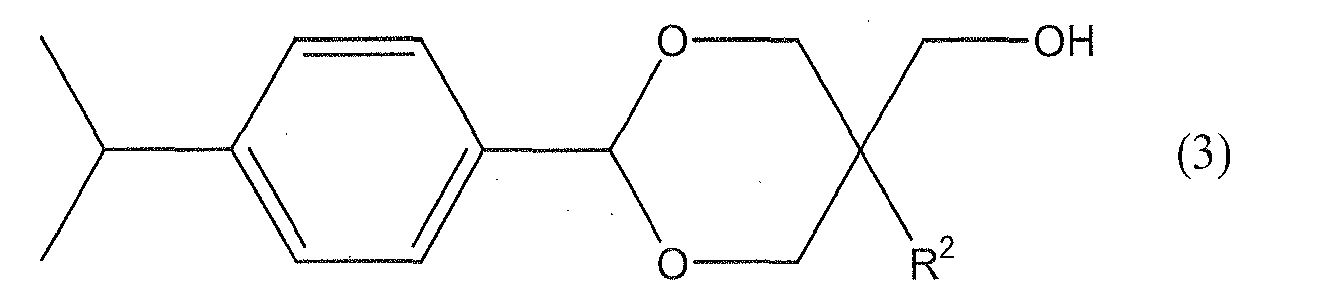
- the alcohol compound represented by Formula (1) described above is preferably an alcohol compound represented by any of the following Formulae (2) to (4).
- R 2 is the same as R 2 in Formula (1) described above, and the preferred ranges thereof are the same.
- the preferred specific examples of the alcohol compound represented by Formula (1) include 2-(biphenyl-4-yl)-5-ethyl-5-hydroxymethyl-1,3-dioxane, 2-(biphenyl-4-yl)-5-methyl-5-hydroxymethyl-1,3-dioxane, 2-(biphenyl-4-yl)-5-hydroxymethyl-1,3-dioxane, 2-(isopropylphenyl-4-yl)-5-ethyl-5-hydroxymethyl-1,3-dioxane, 2-(1-naphthyl)-5-ethyl-5-hydroxymethyl-1,3-dioxane and the like, but the present invention shall not be restricted to them.
- a method for producing the alcohol compound represented by Formula (1) described above shall not specifically be restricted, and it is preferably a method for producing it by reacting 1 mol of aromatic aldehyde represented by the following Formula (A) with 1 to 5 mole, preferably 1 to 2 mol and more preferably 1 to 1.2 mol of trihydric alcohol such as trimethylolmethane, trimethylolethane or trimethylolpropane.
- Use of the trihydric alcohol makes it possible to notably reduce formation of by-products to enhance the production efficiency.
- the reaction temperature is preferably 20 to 200°C, more preferably 100 to 180°C and particularly preferably 120 to 160°C.
- the targeted compound can efficiently be produced by manufacturing the compound at temperatures falling in the ranges described above.
- the aromatic aldehyde described above is preferably dropwise added to an organic solvent solution of the trivalent alcohol under the presence of an acid catalyst to react them. This makes it possible to reduce notably formation of by-products and enhance the production efficiency. Further, during the reaction, water contained in the solvent is preferably removed by a Dean-Stark tube and the like.
- Acid catalysts such as hydrochloric acid, sulfuric acid, phosphoric acid, paratoluenesulfonic acid, methanesulfonic acid and the like are preferably used as the catalyst which can be used in the present invention, and paratoluenesulfonic acid is particularly preferred. Also, an amount of the acid catalyst used is preferably 0.1 to 30% by mass, particularly preferably 1 to 20% by mass based on the aromatic aldehyde.
- the reaction solvent used in the present invention shall not be restricted and is preferably aromatic hydrocarbon base solvents such as benzene, toluene, xylene, mesitylene, anisole and the like; amide base solvents such as dimethylformamide, dimethylacetamide and the like; ether base solvents such as tetrahydrofuran, dioxane, dioxolan and the like; and ester base solvents such as ethyl acetate, butyl acetate and the like.
- aromatic hydrocarbon base solvents such as benzene, toluene, xylene, mesitylene, anisole and the like
- amide base solvents such as dimethylformamide, dimethylacetamide and the like
- ether base solvents such as tetrahydrofuran, dioxane, dioxolan and the like
- ester base solvents such as ethyl acetate, butyl acetate and the like.
- DMAc dimethylacetamide
- toluene special grade, manufactured by Wako Pure Chemical Industries, Ltd.
- 88.8 g (0.74 mol) of trimethylolpropane
- paratoluenesulfonic acid dihydrate special grade, manufactured by Wako Pure Chemical Industries, Ltd.
- TMS tetramethylsilane
- deuterated DMSO deuterated dimethylsulfoxide
- the alcohol compound of the present invention can suitably be used as a raw material and an intermediate for paints, adhesives, medicines, cosmetics, food additives, surfactants and the like, and it has a high industrial value.
- the alcohol compound of the present invention can be used as a raw material or an intermediate therefor to make it possible to produce various paints, adhesives, medicines, cosmetics, food additives, surfactants and the like, and the technique can be enriched.
Landscapes
- Chemical & Material Sciences (AREA)
- Organic Chemistry (AREA)
- Health & Medical Sciences (AREA)
- Life Sciences & Earth Sciences (AREA)
- Veterinary Medicine (AREA)
- Epidemiology (AREA)
- Animal Behavior & Ethology (AREA)
- General Health & Medical Sciences (AREA)
- Public Health (AREA)
- Pharmacology & Pharmacy (AREA)
- Medicinal Chemistry (AREA)
- Birds (AREA)
- Organic Low-Molecular-Weight Compounds And Preparation Thereof (AREA)
- Heterocyclic Compounds That Contain Two Or More Ring Oxygen Atoms (AREA)
- Cosmetics (AREA)
Abstract
Disclosed is an alcohol compound which is useful as a raw material and an intermediate for paints, adhesives, medicines, cosmetics, food additives, surfactants and the like, further disclosed is a method for producing the above compound.
The above alcohol compound is represented by the following Formula (1):

wherein A represents an aromatic ring selected from the group consisting of benzene, naphthalene, anthracene, phenanthrene and pyrene; R1 represents an alkyl group having 1 to 12 carbon atoms, a substituted or unsubstituted aryl group having 6 to 10 carbon atoms or a halogen atom; n represents an integer of 0 to 4; provided that when A is benzene, n represents an integer of 1 to 4; when n represents an integer of 2 to 4, plural R1 may be the same or different from each other; and R2 represents a hydrogen atom, methyl or ethyl.
Description
- The present invention relates to an alcohol compound having a dioxane structure and a method for producing the same, particularly to a cyclic alcohol compound useful as a raw material and an intermediate for paints, adhesives, medicines, cosmetics, food additives, surfactants and the like and a method for producing the above compound.
- Alcohol compounds having a dioxane structure are known as intermediates for cyclic acrylic esters which are raw materials for paints, adhesives and the like. Patent document 1 discloses cyclic alcohol compounds obtained by reaction of benzaldehyde with trimethylolpropane, as intermediates for cyclic acrylic esters.
- [Patent document 1]
JP-A-60-72884 - The cyclic alcohol compounds obtained by reaction of benzaldehyde with trimethylolpropane, which are described in the patent document 1, are limited in uses thereof in a certain case in terms of a solubility, a reactivity, a heat resistance and the like.
The present invention contemplates to provide a cyclic alcohol compound which is useful as a raw material and an intermediate for paints, adhesives, medicines, cosmetics, food additives, surfactants and the like, and to provide a method for producing the above compound. - The present invention provides an alcohol compound represented by the following

- The alcohol compound of the present invention can suitably be used as a raw material and an intermediate for paints, adhesives, medicines, cosmetics, food additives, surfactants and the like. In particular, medicines, cosmetics, food additives, surfactants and the like which have a large variety can be produced by using the alcohol compound of the present invention as a raw material or an intermediate therefor.
- The alcohol compound of the present invention is a compound represented by the following Formula (1):

- In Formula (1) described above, A represents an aromatic ring selected from the group consisting of benzene, naphthalene, anthracene, phenanthrene and pyrene.
In Formula (1), R1 represents an alkyl group having 1 to 12 carbon atoms, a substituted or unsubstituted aryl group having 6 to 10 carbon atoms or a halogen atom.
The alkyl group in the present invention is a linear, branched or cyclic alkyl group having 1 to 12 carbon atoms, preferably 1 to 9 carbon atoms and more preferably 1 to 4 carbon atoms, and the specific examples thereof include methyl, ethyl, propyl, isopropyl, butyl, isobutyl, t-butyl, cyclohexyl, propylcyclohexyl and the like. The aryl group in the present invention is a substituted or unsubstituted aryl group having 6 to 10 carbon atoms, preferably 6 to 8 carbon atoms, and the specific examples thereof include phenyl, iodophenyl, hydroxyphenyl, dihydroxyphenyl, methoxyhydroxyphenyl, ethoxyhydroxyphenyl and the like. The halogen atom includes a fluorine atom, a chlorine atom, a bromine atom and an iodine atom. R1 is particularly preferably isopropyl or phenyl from the viewpoint of an availability of the raw materials.
In Formula (1) described above, n represents an integer of 0 to 4. Provided that when A is benzene, n represents an integer of 1 to 4. When n represents an integer of 2 to 4, plural R1 may be the same or different from each other, but they are more preferably the same. The term n is preferably 0 or 1 from the viewpoint of an availability of the raw materials.
In Formula (1), R2 represents a hydrogen atom, methyl or ethyl. - The alcohol compound represented by Formula (1) described above is preferably an alcohol compound represented by any of the following Formulae (2) to (4). In Formulae (2) to (4), R2 is the same as R2 in Formula (1) described above, and the preferred ranges thereof are the same.

- The preferred specific examples of the alcohol compound represented by Formula (1) include 2-(biphenyl-4-yl)-5-ethyl-5-hydroxymethyl-1,3-dioxane, 2-(biphenyl-4-yl)-5-methyl-5-hydroxymethyl-1,3-dioxane, 2-(biphenyl-4-yl)-5-hydroxymethyl-1,3-dioxane, 2-(isopropylphenyl-4-yl)-5-ethyl-5-hydroxymethyl-1,3-dioxane, 2-(1-naphthyl)-5-ethyl-5-hydroxymethyl-1,3-dioxane and the like, but the present invention shall not be restricted to them.
- A method for producing the alcohol compound represented by Formula (1) described above shall not specifically be restricted, and it is preferably a method for producing it by reacting 1 mol of aromatic aldehyde represented by the following Formula (A) with 1 to 5 mole, preferably 1 to 2 mol and more preferably 1 to 1.2 mol of trihydric alcohol such as trimethylolmethane, trimethylolethane or trimethylolpropane. Use of the trihydric alcohol makes it possible to notably reduce formation of by-products to enhance the production efficiency.
-
(R1)n-A-CHO (A)
wherein A, R1 and n are the same as A, R1 and n in Formula (1) described above. - In the method for producing the glycol compound according to the present invention, the reaction temperature is preferably 20 to 200°C, more preferably 100 to 180°C and particularly preferably 120 to 160°C. The targeted compound can efficiently be produced by manufacturing the compound at temperatures falling in the ranges described above.
- In the method for producing the alcohol compound according to the present invention, the aromatic aldehyde described above is preferably dropwise added to an organic solvent solution of the trivalent alcohol under the presence of an acid catalyst to react them. This makes it possible to reduce notably formation of by-products and enhance the production efficiency. Further, during the reaction, water contained in the solvent is preferably removed by a Dean-Stark tube and the like.
- Acid catalysts such as hydrochloric acid, sulfuric acid, phosphoric acid, paratoluenesulfonic acid, methanesulfonic acid and the like are preferably used as the catalyst which can be used in the present invention, and paratoluenesulfonic acid is particularly preferred. Also, an amount of the acid catalyst used is preferably 0.1 to 30% by mass, particularly preferably 1 to 20% by mass based on the aromatic aldehyde.
- The reaction solvent used in the present invention shall not be restricted and is preferably aromatic hydrocarbon base solvents such as benzene, toluene, xylene, mesitylene, anisole and the like; amide base solvents such as dimethylformamide, dimethylacetamide and the like; ether base solvents such as tetrahydrofuran, dioxane, dioxolan and the like; and ester base solvents such as ethyl acetate, butyl acetate and the like. In particular, toluene, dimethylformamide and dimethylacetamide are preferred.
- The present invention shall be explained below in detail with reference to examples, but the present invention shall not be restricted to the examples shown below.
-

The product obtained above was subjected to measurement of a 1H-NMR spectrum. An NMR equipment (trade name: R-90H, manufactured by Hitachi, Ltd.) was used for the measurement, and tetramethylsilane (hereinafter referred to as TMS; special grade, manufactured by Wako Pure Chemical Industries, Ltd.) was used as an internal standard substance. The chemical shift values (δ ppm, based on TMS) of 1H-NMR of the product obtained in a deuterated dimethylsulfoxide (hereinafter referred to as deuterated DMSO; special grade, manufactured by Wako Pure Chemical Industries, Ltd.) solvent were 0.8-0.9 (t, 3H), 1.6-1.7 (q, 2H), 3.4 (s, 2H), 3.6-3.8 (dd, 4H), 4.7 (s, 1H), 5.5 (s, 1H), 7.3-7.8 (m, 9H). -

-

-

-

- The alcohol compound of the present invention can suitably be used as a raw material and an intermediate for paints, adhesives, medicines, cosmetics, food additives, surfactants and the like, and it has a high industrial value. In particular, even when conventional alcohol compounds can not be used as raw materials or intermediates, the alcohol compound of the present invention can be used as a raw material or an intermediate therefor to make it possible to produce various paints, adhesives, medicines, cosmetics, food additives, surfactants and the like, and the technique can be enriched.
Claims (5)
- An alcohol compound represented by the following Formula (1):

- The alcohol compound according to claim 1, wherein it is represented by the following Formula (2):

- The alcohol compound according to claim 1, wherein it is represented by the following Formula (3):
- The alcohol compound according to claim 1, wherein it is represented by the following Formula (4):

- A method for producing an alcohol compound represented by the following Formula (1) in which 1 mol of aromatic aldehyde represented by the following Formula (A) is reacted with 1 to 5 mol of trihydric alcohol selected from the group consisting of trimethylolmethane, trimethylolethane and trimethylolpropane:

(R1)n-A-CHO (A)
wherein A, R and n are the same as A, R and n in Formula (1) described above.
Applications Claiming Priority (2)
| Application Number | Priority Date | Filing Date | Title |
|---|---|---|---|
| JP2009019591 | 2009-01-30 | ||
| PCT/JP2010/051110 WO2010087394A1 (en) | 2009-01-30 | 2010-01-28 | Alcohol compound having dioxane structure and process for producing same |
Publications (2)
| Publication Number | Publication Date |
|---|---|
| EP2392569A1 true EP2392569A1 (en) | 2011-12-07 |
| EP2392569A4 EP2392569A4 (en) | 2012-08-01 |
Family
ID=42395652
Family Applications (1)
| Application Number | Title | Priority Date | Filing Date |
|---|---|---|---|
| EP10735859A Withdrawn EP2392569A4 (en) | 2009-01-30 | 2010-01-28 | Alcohol compound having dioxane structure and process for producing same |
Country Status (7)
| Country | Link |
|---|---|
| US (1) | US8324407B2 (en) |
| EP (1) | EP2392569A4 (en) |
| JP (1) | JPWO2010087394A1 (en) |
| KR (1) | KR20110107825A (en) |
| CN (1) | CN102300856A (en) |
| TW (1) | TW201031647A (en) |
| WO (1) | WO2010087394A1 (en) |
Family Cites Families (12)
| Publication number | Priority date | Publication date | Assignee | Title |
|---|---|---|---|---|
| GB1448458A (en) * | 1973-11-21 | 1976-09-08 | Allen & Hanburys Ltd | 1,3-dioxan derivatives and pharmaceutical compositions thereof |
| JPS6072884A (en) | 1983-09-30 | 1985-04-24 | Toagosei Chem Ind Co Ltd | Cyclic acrylic acid ester |
| US4808939A (en) | 1988-04-04 | 1989-02-28 | Unisys Corporation | Variable rate rectangular matched filter |
| US4876368A (en) | 1988-05-24 | 1989-10-24 | Hoechst Celanese Corporation | Production of monohydroxy monocyclic acetals and their esters |
| US5258477A (en) | 1989-09-22 | 1993-11-02 | National Starch And Chemical Investment Holding Corporation | Monomers and polymers containing acetal and aldehyde groups |
| CA2025789A1 (en) | 1989-09-22 | 1991-03-23 | Rama S. Chandran | Monomers and polymers containing acetal and aldehyde groups |
| PL162441B1 (en) | 1990-01-03 | 1993-12-31 | Politechnika Wroclawska | Method for the production of new surface-active sodium sulfates of 2,5-di- and 2,2,5-trisubstituted 5-hydroxymethyl-1,3-dioxanes derivatives |
| PL163371B1 (en) | 1990-08-14 | 1994-03-31 | Politechnika Wroclawska | A method of producing new chemo-degradable alkyloxirane block copolymers |
| JP2001031671A (en) | 1999-07-15 | 2001-02-06 | Kao Corp | Method for producing ether acetal |
| JP4450922B2 (en) | 2000-01-26 | 2010-04-14 | 株式会社クラレ | Cyclic acetal derivative |
| JP2004292470A (en) * | 2003-03-25 | 2004-10-21 | New Japan Chem Co Ltd | Melt viscosity-reducing agent for polyester resin, polyester resin composition comprising the same, and fiber and molded product obtained from the resin composition |
| JP5083377B2 (en) | 2010-06-11 | 2012-11-28 | 株式会社日本自動車部品総合研究所 | Valve timing adjustment device |
-
2010
- 2010-01-28 JP JP2010548547A patent/JPWO2010087394A1/en active Pending
- 2010-01-28 WO PCT/JP2010/051110 patent/WO2010087394A1/en not_active Ceased
- 2010-01-28 KR KR1020117017857A patent/KR20110107825A/en not_active Withdrawn
- 2010-01-28 CN CN201080006099.6A patent/CN102300856A/en active Pending
- 2010-01-28 EP EP10735859A patent/EP2392569A4/en not_active Withdrawn
- 2010-01-28 US US13/146,752 patent/US8324407B2/en not_active Expired - Fee Related
- 2010-01-29 TW TW099102504A patent/TW201031647A/en unknown
Non-Patent Citations (2)
| Title |
|---|
| No further relevant documents disclosed * |
| See also references of WO2010087394A1 * |
Also Published As
| Publication number | Publication date |
|---|---|
| US8324407B2 (en) | 2012-12-04 |
| WO2010087394A1 (en) | 2010-08-05 |
| TW201031647A (en) | 2010-09-01 |
| US20110282076A1 (en) | 2011-11-17 |
| CN102300856A (en) | 2011-12-28 |
| KR20110107825A (en) | 2011-10-04 |
| JPWO2010087394A1 (en) | 2012-08-02 |
| EP2392569A4 (en) | 2012-08-01 |
Similar Documents
| Publication | Publication Date | Title |
|---|---|---|
| KR20150113005A (en) | Novel aryl compound and method for producing same | |
| KR102079116B1 (en) | Method for producing 4-haloalkyl-3-mercapto-substituted 2-hydroxy-benzoic acid derivatives | |
| US8324407B2 (en) | Alcohol compound having dioxane structure and process for producing same | |
| JP5636726B2 (en) | Benzoxazine compounds having disulfide bonds | |
| IT201800000667A1 (en) | PROCEDURE FOR THE PREPARATION OF DISPLACED DIARYLOXYHETERODIAZOLIC COMPOUNDS | |
| US20230060251A1 (en) | Synthesis of capsaicin derivatives | |
| EP2502898A1 (en) | Preparation method for aromatic difluoroacetic acid ester | |
| CN102617313A (en) | Sharing synthesis method for vanillin and isovanillin | |
| TWI745596B (en) | Isocyanuric acid derivative having alkoxyalkyl group and production method for the same | |
| JP6952974B2 (en) | Method for producing amide compound | |
| US20040059133A1 (en) | Process for the production of substituted thioxanthones | |
| JP6686012B2 (en) | Method for preparing halo-substituted trifluoroacetophenone | |
| KR20230117260A (en) | Process for the preparation of 1-(3,5-dichlorophenyl)-2,2,2-trifluoroethanone and derivatives thereof | |
| JP6247992B2 (en) | Method for producing halogen compound | |
| CA2041134A1 (en) | Process for the preparation of linear 1,3-diketones | |
| JP2005330283A (en) | Method for producing phthaloyl chloride | |
| JP2016108252A (en) | Method for producing 1-alkoxy-2-alkanol compound | |
| JP5448572B2 (en) | Acetyl compound, method for producing the acetyl compound, and method for producing a naphthol compound using the acetyl compound | |
| JP5347177B2 (en) | Method for producing hexathiaadamantane compound | |
| JP6635999B2 (en) | Method for producing potassium salt, and potassium salt | |
| EP2377857A1 (en) | Glycol compound having dioxane structure and manufacturing method therefor | |
| KR100558848B1 (en) | Hexagonal cyclic compound having two exo methylenes and preparation method thereof | |
| EP1600446B1 (en) | New 3,3-dimethyl-5-cyano-benzoxepine derivatives useful for the preparation of 5-formyl-benzoxepine derivatives | |
| JP2006008522A (en) | Process for producing 2,3-dihydroxy-4-alkoxy-acylbenzenes | |
| JP6782596B2 (en) | 2-Ethyl-hydroxyhexanophenone or a salt thereof |
Legal Events
| Date | Code | Title | Description |
|---|---|---|---|
| PUAI | Public reference made under article 153(3) epc to a published international application that has entered the european phase |
Free format text: ORIGINAL CODE: 0009012 |
|
| 17P | Request for examination filed |
Effective date: 20110728 |
|
| AK | Designated contracting states |
Kind code of ref document: A1 Designated state(s): AT BE BG CH CY CZ DE DK EE ES FI FR GB GR HR HU IE IS IT LI LT LU LV MC MK MT NL NO PL PT RO SE SI SK SM TR |
|
| DAX | Request for extension of the european patent (deleted) | ||
| A4 | Supplementary search report drawn up and despatched |
Effective date: 20120704 |
|
| RIC1 | Information provided on ipc code assigned before grant |
Ipc: C07D 319/06 20060101AFI20120628BHEP |
|
| STAA | Information on the status of an ep patent application or granted ep patent |
Free format text: STATUS: THE APPLICATION HAS BEEN WITHDRAWN |
|
| 18W | Application withdrawn |
Effective date: 20140225 |