EP2391446B1 - Novel tricyanoborates - Google Patents
Novel tricyanoborates Download PDFInfo
- Publication number
- EP2391446B1 EP2391446B1 EP10701323.7A EP10701323A EP2391446B1 EP 2391446 B1 EP2391446 B1 EP 2391446B1 EP 10701323 A EP10701323 A EP 10701323A EP 2391446 B1 EP2391446 B1 EP 2391446B1
- Authority
- EP
- European Patent Office
- Prior art keywords
- alkyl
- tricyanoborate
- group
- aryl
- independently
- Prior art date
- Legal status (The legal status is an assumption and is not a legal conclusion. Google has not performed a legal analysis and makes no representation as to the accuracy of the status listed.)
- Not-in-force
Links
- 0 *c1ccccc1 Chemical compound *c1ccccc1 0.000 description 3
- YMUJGOKRHWOYCE-UHFFFAOYSA-N CCC1C=C=C(C)N(C)C1 Chemical compound CCC1C=C=C(C)N(C)C1 YMUJGOKRHWOYCE-UHFFFAOYSA-N 0.000 description 1
Classifications
-
- C—CHEMISTRY; METALLURGY
- C07—ORGANIC CHEMISTRY
- C07F—ACYCLIC, CARBOCYCLIC OR HETEROCYCLIC COMPOUNDS CONTAINING ELEMENTS OTHER THAN CARBON, HYDROGEN, HALOGEN, OXYGEN, NITROGEN, SULFUR, SELENIUM OR TELLURIUM
- C07F5/00—Compounds containing elements of Groups 3 or 13 of the Periodic Table
- C07F5/02—Boron compounds
-
- C—CHEMISTRY; METALLURGY
- C07—ORGANIC CHEMISTRY
- C07C—ACYCLIC OR CARBOCYCLIC COMPOUNDS
- C07C211/00—Compounds containing amino groups bound to a carbon skeleton
- C07C211/62—Quaternary ammonium compounds
- C07C211/63—Quaternary ammonium compounds having quaternised nitrogen atoms bound to acyclic carbon atoms
-
- C—CHEMISTRY; METALLURGY
- C07—ORGANIC CHEMISTRY
- C07D—HETEROCYCLIC COMPOUNDS
- C07D213/00—Heterocyclic compounds containing six-membered rings, not condensed with other rings, with one nitrogen atom as the only ring hetero atom and three or more double bonds between ring members or between ring members and non-ring members
- C07D213/02—Heterocyclic compounds containing six-membered rings, not condensed with other rings, with one nitrogen atom as the only ring hetero atom and three or more double bonds between ring members or between ring members and non-ring members having three double bonds between ring members or between ring members and non-ring members
- C07D213/04—Heterocyclic compounds containing six-membered rings, not condensed with other rings, with one nitrogen atom as the only ring hetero atom and three or more double bonds between ring members or between ring members and non-ring members having three double bonds between ring members or between ring members and non-ring members having no bond between the ring nitrogen atom and a non-ring member or having only hydrogen or carbon atoms directly attached to the ring nitrogen atom
- C07D213/06—Heterocyclic compounds containing six-membered rings, not condensed with other rings, with one nitrogen atom as the only ring hetero atom and three or more double bonds between ring members or between ring members and non-ring members having three double bonds between ring members or between ring members and non-ring members having no bond between the ring nitrogen atom and a non-ring member or having only hydrogen or carbon atoms directly attached to the ring nitrogen atom containing only hydrogen and carbon atoms in addition to the ring nitrogen atom
- C07D213/16—Heterocyclic compounds containing six-membered rings, not condensed with other rings, with one nitrogen atom as the only ring hetero atom and three or more double bonds between ring members or between ring members and non-ring members having three double bonds between ring members or between ring members and non-ring members having no bond between the ring nitrogen atom and a non-ring member or having only hydrogen or carbon atoms directly attached to the ring nitrogen atom containing only hydrogen and carbon atoms in addition to the ring nitrogen atom containing only one pyridine ring
- C07D213/20—Quaternary compounds thereof
-
- C—CHEMISTRY; METALLURGY
- C07—ORGANIC CHEMISTRY
- C07F—ACYCLIC, CARBOCYCLIC OR HETEROCYCLIC COMPOUNDS CONTAINING ELEMENTS OTHER THAN CARBON, HYDROGEN, HALOGEN, OXYGEN, NITROGEN, SULFUR, SELENIUM OR TELLURIUM
- C07F9/00—Compounds containing elements of Groups 5 or 15 of the Periodic Table
- C07F9/02—Phosphorus compounds
- C07F9/28—Phosphorus compounds with one or more P—C bonds
- C07F9/54—Quaternary phosphonium compounds
Definitions
- the present invention relates to novel tricyanoborates, their use and processes for preparing them.
- ionic liquids is usually used to refer to salts which are liquid at temperatures below 100 °C, in particular at room temperature. Such liquid salts typically comprise organic cations and organic or inorganic anions.
- the organic cations of ionic liquids are usually quaternary ammonium or phosphonium ions or cations of aromatic, usually nitrogen-containing bases which may be substituted by alkyl groups, halogen atoms or cyano groups and may contain further heteroatoms such as phosphorus, sulfur or oxygen.
- Examples of customary organic cations are imidazolium, oxazolium, pyrazinium, pyrazolium, pyridazinium, pyrrolidinium, pyridinium, thiazolium and triazolium cations.
- Typical anions in ionic liquids are AlCl4 - , AsF 6 - , BF 4 - , Br - , CF 3 SO 3 - , (CF 3 ) 2 PF 4 - , (CF 3 ) 3 PF 3 - , (CF 3 ) 4 PF 2 - , (CF 3 ) 5 PF - , (CF 3 ) 6 P - , Cl - , CN - , SCN - , FeCl 3 - , NO 3 - , PF 6 - , pyruvate, acetate, oxalate or the tricyanomethane anion described in EP-A-1 634 867 .
- WO 2004/072089 and WO 2007/093961 disclose cyanoborate anions of the general formula [BF n (CN) 4-n ] - , wherein n is 0, 1, 2 or 3.
- Ionic liquids have a series of interesting properties: Usually, they are thermally stable, relatively non-flammable and have a very low vapour pressure. In addition, they have very good solvent properties for numerous organic and inorganic substances. Owing to their ionic structure, ionic liquids also have interesting electrochemical properties, for example electrical conductivity which is often accompanied by a high electrochemical stability. Therefore, there is a fundamental need for new ionic liquids having a variety of properties which open up additional opportunities for their use.
- the present invention relates to novel tricyanoborates of the general formula wherein R 1 is C 1-6 alkyl, C 2-6 alkenyl, C 6-10 aryl or benzyl, X is oxygen or sulfur, and Cat n+ is a cation with n being 1 or 2, which is selected from the group consisting of an inorganic cation M n+ and an organic cation Q n+ with n being 1 or 2.
- C 1- n alkyl refers to any linear or branched alkyl group which contains from 1 to n carbon atoms.
- C 1-6 alkyl encompasses groups such as methyl, ethyl, propyl, isopropyl, butyl, isobutyl, sec -butyl, tert -butyl, pentyl, isopentyl (3-methylbutyl), neopentyl (2,2-dimethylpropyl), hexyl and isohexyl (4-methylpentyl).
- C 2- n alkenyl refers to a carbon chain which is made up of from 2 to n carbon atoms and contains at least one double bond, with the carbon atoms being saturated by hydrogen atoms and the carbon chain being able to be branched.
- C 2-4 alkenyl encompasses groups such as ethenyl, 1-methylethenyl, prop-1-enyl, prop-2-enyl, 2-methylprop-2-enyl and buta-1,3-dienyl.
- C 6-10 aryl refers to an aryl group which has from 6 to 10 carbon atoms and may be substituted by one or more C 1-4 alkyl or C 1-4 alkoxy groups.
- C 6-10 aryl encompasses phenyl, benzyl, methylphenyl, methoxyphenyl, dimethylphenyl, ethylmethylphenyl, diethylphenyl and naphthyl.
- Tricyanoborates of formula I, wherein X is oxygen, are preferred.
- Tricyanoborates of formula I, wherein R 1 is C 1-6 alkyl, preferably methyl, ethyl or propyl, and more preferably methyl, are also preferred.
- the cation Cat n+ is an inorganic cation M n+ with n being 1 or 2, which is selected from the group consisting of Li + , Na + , K + , Rb + , Cs + , NH 4 + , Be 2+ , Mg 2+ , Ca 2+ , Sr 2+ and Ba 2+ .
- the cation Cat n+ is an organic cation Q n+ with n being 1 or 2, preferably with n being 1, which contains at least one heteroatom selected from the group consisting of nitrogen, phosphorus, sulfur and oxygen.
- tricyanoborates of formula I which have a divalent organic cation Q 2+ , such as, for example, ethylenediammonium.
- tricyanoborates of formula I which have a monovalent organic cation Q + selected from the group consisting of cations of formula
- C 3- n cycloalkyl refers to a cycloalkyl group having from 3 to n carbon atoms.
- C 3-10 cycloalkyl represents, for example, cyclopropyl, cyclobutyl, cyclopentyl, cyclohexyl, cycloheptyl, cyclooctyl, cyclononyl or cyclodecyl.
- C 1- n " alkoxy” refers to an unbranched or branched alkoxy group having from 1 to n carbon atoms.
- C 1-20 alkoxy represents, for example, methoxy, ethoxy, propoxy, isopropoxy, butoxy, isobutoxy, sec -butoxy, tert- butoxy, pentyloxy, 1,4-dimethylpentyloxy, hexyloxy, heptyloxy, octyloxy, 1,5-dimethyl-hexyloxy, nonyloxy, decyloxy, 4-ethyl-1,5-dimethylhexyloxy, undecyloxy, dodecyloxy, tridecyloxy, tetradecyloxy or eicosyloxy.
- halogen refers to fluorine, chlorine, bromine or iodine.
- tricyanoborates of formula I with an organic cation Q + selected from the group consisting of organic ammonium, phosphonium, sulfonium, pyrrolidinium, pyrrolinium, pyrrolium, pyrazolium, imidazolium, triazolium, oxazolium, thiazolium, piperidinium, piperazinium, morpholinium, pyridinium, pyridazinium, pyrimidinium, pyrazinium, 1,3-dioxolium, pyrylium and thiopyrylium cation.
- organic cation Q + selected from the group consisting of organic ammonium, phosphonium, sulfonium, pyrrolidinium, pyrrolinium, pyrrolium, pyrazolium, imidazolium, triazolium, oxazolium, thiazolium, piperidinium, piperazinium, morpholinium, pyri
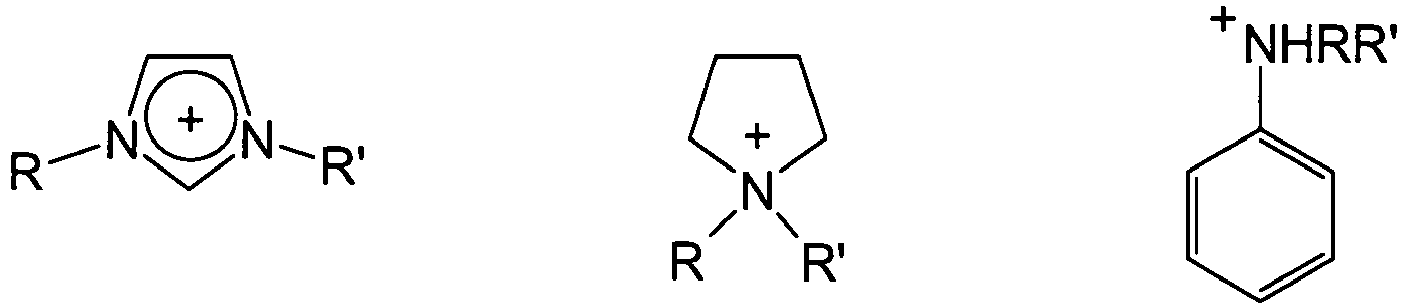
- the organic cation Q + is selected from the group consisting of + NR 4-m R' m + PR 4-m R' m wherein R and R' are, independently, C 1-20 alkyl, preferably C 1-14 alkyl and more preferably C 1-8 alkyl, and m is an integer between 0 and 4.
- R and R' are, independently, C 1-20 alkyl, preferably C 1-14 alkyl and more preferably C 1-8 alkyl, and m is an integer between 0 and 4.
- the subtituents R and R' have different lengths.
- the organic cation Q + is selected from the group consisting of + N(C 2 H 5 ) 4 + N(C 4 H 9 ) 4 + P(C 2 H 5 ) 4 + P(C 4 H 9 ) 4 + P(C 6 H 13 ) 3 (C 14 H 29 )
- the organic cations Q + are imidazolium cations, in particular imidazolium cations of the general formula wherein R and R' are, independently, C 1-20 alkyl, preferably C 1-14 alkyl. In a most preferred embodiment, R is methyl and R' is ethyl.
- Tricyanoborates with an organic cation are usually liquid at temperatures below 100 °C, in particular at room temperature, and are therefore referred to as ionic liquids. Owing to their property as ionic liquids, they are highly suitable as solvents for many organic and inorganic substances.
- the tricyanoborate of formula I wherein R 1 is C 1-6 alkyl, C 2-6 alkenyl, C 6-10 aryl or benzyl, X is oxygen or sulfur and Cat n+ is an organic cation Q n+ with n being 1 or 2, preferably with n being 1, optionally in a mixture with one or more other ionic liquids, water or organic solvents, as polar aprotic solvent.
- Ionic liquids have many fields of use: They extend from the use as solvent in inorganic and organic synthesis through the use as electrolyte to release agents and/or additives for lubricants and hydraulic fluids.
- the spectrum of specific requirements which the ionic liquids have to meet in order to be suitable for a specific application is therefore correspondingly broad.
- the ionic liquids of the invention are characterized by, in particular, a non-coordinating anion.
- they are halogen-free, which makes inexpensive and environmentally friendly disposal possible, for example by incineration, and, owing to the low corrosivity towards metals, simplifies their use and storage.
- the properties of the ionic liquids according to the invention can be varied by choice of suitable organic cations and suitable substituents -X-R 1 of the borate anion.
- suitable organic cations and suitable substituents -X-R 1 of the borate anion for example, the melting point, the thermal and electrochemical stability, the viscosity, the polarity and the solubility in water or in organic solvents can be strongly influenced by variation of the substituents -X-R 1 of the borate anion and also by variation of the organic cation and its substituents.
- the present invention relates to a process for preparing the inorganic tricyanoborates of formula I, wherein R 1 is C 1-6 alkyl, C 2-6 alkenyl, C 6-10 aryl or benzyl, X is oxygen or sulfur and Cat n+ is an inorganic cation M n+ with n being 1 or 2, preferably selected from the group consisting of Li + , Na + , K + , Rb + , Cs + , NH 4 + , Be 2+ , Mg 2+ , Ca 2+ , Sr 2+ and Ba 2+ , characterized in that B(XR 1 ) 3 is reacted with a cyanotri-C 1-6 -alkylsilane, in particular with cyanotrimethylsilane (TMSCN), in the presence of M n + (CN - ) n , wherein R 1 is C 1-6 alkyl, C 2-6 alkenyl, C 6-10 aryl or benzyl, wherein
- B(XR 1 ) 3 and M n + (CN - ) n are applied in a molar ratio of from 0.8 : 1.0 to 1.2 : 1.0, in particular in a molar ratio of from 0.9 : 1.0 to 1.1 : 1.0.
- the cyanotri-C 1-6 -alkylsilane is preferably used in an excess based on B(XR 1 ) 3 , for example in a molar ratio of from 1.5 : 1 to 10 : 1, in particular in a molar ratio of from 3 : 1 to 5 : 1.
- the process for preparing the inorganic tricyanoborates is preferably carried out at a temperature of from 0 °C to 250 °C, in particular at a temperature of from 50 °C to 100 °C.
- the process for preparing the inorganic tricyanoborates is carried out at a temperature which is above the boiling point of the alkoxytri-C 1-6 -alkylsilane formed as side product.
- the present invention also relates to a process for preparing the organic tricyanoborates of formula I, wherein R 1 is C 1-6 alkyl, C 2-6 alkenyl, C 6-10 aryl or benzyl, X is oxygen or sulfur and Cat n+ is an organic cation Q n+ with n being 1 or 2, preferably n being 1, characterized in that the inorganic tricyanoborates of formula I, wherein R 1 is C 1-6 alkyl, C 2-6 alkenyl, C 6-10 aryl or benzyl, X is oxygen or sulfur and Cat n+ is an inorganic cation M n+ with n being 1 or 2, preferably selected from the group consisting of Li + , Na + , K + , Rb + , Cs + , NH 4 + , Be 2+ , Mg 2+ , Ca 2+ , Sr 2+ and Ba 2+ , are reacted with a salt of formula (Q n+ ) p (Y
- the inorganic tricyanoborates used are prepared precedent according to the process for their preparation as claimed above.
- the halide as anion Y - of the salt of the formula (Q n+ )(Y - ) n can be selected from the group consisting of fluoride, chloride, bromide and iodide. Particularly preferred is chloride.
- pseudohalide anions Y - in the salt (Q n+ )(Y - ) n anions which consist of at least two electronegative atoms and which are chemically similar to the halogens can be used.
- the pseudohalide anion is selected from the group consisting of CN - , OCN - , SCN - and N 3 - . More preferably, the pseudohalide anion is CN - .
- organic acid anions are anions of monobasic and dibasic non-aromatic and aromatic acids, such as acetate, oleate, fumarate, maleate, pyruvate, oxalate and benzoate. Particularly preferred are acetate and pyruvate anions.
- the inorganic tricyanoborate as defined above and the salt of the formula QY are preferably used in a molar ratio of from 0.8 : 1.0 to 1.2 : 1.0, in particular in a molar ratio of from 0.9 : 1.0 to 1.1 : 1.0.
- the reaction is preferably carried out in a solvent or solvent mixture, for example in a two-phase solvent mixture comprising water and at least one organic solvent, for example in a mixture of water and methylene chloride.
- the reaction can also be carried out in the absence of a solvent or in an organic solvent in which the inorganic salt formed as side product is sparingly soluble or insoluble.
- the process for preparing the organic tricyanoborates is preferably carried out at a temperature of from 10 °C to 250 °C, in particular at a temperature in the range from room temperature to 100 °C.
- N-n -butyl-2-picolinium chloride 5.0 g, 27 mmol
- K[B(CN) 3 (OCH 3 )] 4.3 g, 27 mmol
- methylene chloride 53 g
- the latter was washed with 10 ml of water, dried over potassium carbonate and finally evaporated on a rotary evaporator yielding 4.0 g (55%) of N-n- butyl-2-picolinium tricyanomethoxyborate as a low-viscosity liquid.
Landscapes
- Chemical & Material Sciences (AREA)
- Organic Chemistry (AREA)
- Health & Medical Sciences (AREA)
- Life Sciences & Earth Sciences (AREA)
- Biochemistry (AREA)
- General Health & Medical Sciences (AREA)
- Molecular Biology (AREA)
- Pyridine Compounds (AREA)
- Organic Low-Molecular-Weight Compounds And Preparation Thereof (AREA)
- Pharmaceuticals Containing Other Organic And Inorganic Compounds (AREA)
Description
- The present invention relates to novel tricyanoborates, their use and processes for preparing them.
- The term "ionic liquids" is usually used to refer to salts which are liquid at temperatures below 100 °C, in particular at room temperature. Such liquid salts typically comprise organic cations and organic or inorganic anions.
- The organic cations of ionic liquids are usually quaternary ammonium or phosphonium ions or cations of aromatic, usually nitrogen-containing bases which may be substituted by alkyl groups, halogen atoms or cyano groups and may contain further heteroatoms such as phosphorus, sulfur or oxygen. Examples of customary organic cations are imidazolium, oxazolium, pyrazinium, pyrazolium, pyridazinium, pyrrolidinium, pyridinium, thiazolium and triazolium cations.
- Typical anions in ionic liquids are AlCl4-, AsF6 -, BF4 -, Br-, CF3SO3 -, (CF3)2PF4 -, (CF3)3PF3 -, (CF3)4PF2 -, (CF3)5PF-, (CF3)6P-, Cl-, CN-, SCN-, FeCl3 -, NO3 -, PF6 -, pyruvate, acetate, oxalate or the tricyanomethane anion described in
EP-A-1 634 867 . In addition,WO 2004/072089 andWO 2007/093961 disclose cyanoborate anions of the general formula [BFn(CN)4-n]-, wherein n is 0, 1, 2 or 3. - Ionic liquids have a series of interesting properties: Usually, they are thermally stable, relatively non-flammable and have a very low vapour pressure. In addition, they have very good solvent properties for numerous organic and inorganic substances. Owing to their ionic structure, ionic liquids also have interesting electrochemical properties, for example electrical conductivity which is often accompanied by a high electrochemical stability. Therefore, there is a fundamental need for new ionic liquids having a variety of properties which open up additional opportunities for their use.
- It is an object of the present invention to provide novel stable compounds which can be used as ionic liquids or as precursors of ionic liquids, and also a process for preparing them. These compounds should be able to be disposed of in an environmentally friendly manner after use.
- This object is achieved by the tricyanoborates according to claim 1, by their use according to claim 12 and by the processes for their preparation according to claims 13 and 14. Further preferred embodiments are the subject-matter of dependent claims.
- The present invention relates to novel tricyanoborates of the general formula

X is oxygen or sulfur, and
Catn+ is a cation with n being 1 or 2, which is selected from the group consisting of an inorganic cation Mn+ and an organic cation Qn+ with n being 1 or 2. - Here and in the following, the expression "C1-n alkyl" refers to any linear or branched alkyl group which contains from 1 to n carbon atoms. For example, the expression "C1-6 alkyl" encompasses groups such as methyl, ethyl, propyl, isopropyl, butyl, isobutyl, sec-butyl, tert-butyl, pentyl, isopentyl (3-methylbutyl), neopentyl (2,2-dimethylpropyl), hexyl and isohexyl (4-methylpentyl).
- Here and in the following, the expression "C2-n alkenyl" refers to a carbon chain which is made up of from 2 to n carbon atoms and contains at least one double bond, with the carbon atoms being saturated by hydrogen atoms and the carbon chain being able to be branched. For example, the expression "C2-4 alkenyl" encompasses groups such as ethenyl, 1-methylethenyl, prop-1-enyl, prop-2-enyl, 2-methylprop-2-enyl and buta-1,3-dienyl.
- Here and in the following, the expression "C6-10 aryl" refers to an aryl group which has from 6 to 10 carbon atoms and may be substituted by one or more C1-4 alkyl or C1-4 alkoxy groups. For example, "C6-10 aryl" encompasses phenyl, benzyl, methylphenyl, methoxyphenyl, dimethylphenyl, ethylmethylphenyl, diethylphenyl and naphthyl.
- Tricyanoborates of formula I, wherein X is oxygen, are preferred.
- Tricyanoborates of formula I, wherein R1 is C1-6 alkyl, preferably methyl, ethyl or propyl, and more preferably methyl, are also preferred.
- In a further preferred embodiment, the cation Catn+ is an inorganic cation Mn+ with n being 1 or 2, which is selected from the group consisting of Li+, Na+, K+, Rb+, Cs+, NH4 +, Be2+, Mg2+, Ca2+, Sr2+ and Ba2+.
- In an also preferred embodiment, the cation Catn+ is an organic cation Qn+ with n being 1 or 2, preferably with n being 1, which contains at least one heteroatom selected from the group consisting of nitrogen, phosphorus, sulfur and oxygen.
- Particularly preferred are tricyanoborates of formula I which have a divalent organic cation Q2+, such as, for example, ethylenediammonium.
- Further particularly preferred are tricyanoborates of formula I which have a monovalent organic cation Q+ selected from the group consisting of cations of formula
- (a) (WR2R3R4R5)+, wherein W is a nitrogen or phosphorus, and
- (i) wherein R2 to R4 are, independently, C1-20 alkyl, and R5 is C1-20 alkyl, C3-10 cycloalkyl or C6-10 aryl, wherein optionally R2 to R5, independently, contain one or more halogens, or
- (ii) wherein R2 and R3 together with W form a 5- to 7-membered ring and R4 and R5 are, independently, C1-20 alkyl, wherein optionally R4 and R5, independently, contain one or more halogens, or
- (iii) wherein R2 and R3 or R4 and R5 in each case together with W form a 5- to 7-membered ring, or
- (b) (XR6R7R8)+, wherein X is nitrogen and R6 and R7 together with X form a ring in which X formally has one single bond and one double bond to R6 and R7, and R8 is C1-20 alkyl, C3-10 cycloalkyl or C6-10 aryl, wherein R8 optionally contains one or more halogens, or
- (c) (YR9R10R11)+, wherein Y is sulfur and
- (i) wherein R9 and R10 are, independently, C1-20 alkyl and R11 is C1-20 alkyl, C3-10 cycloalkyl or C6-10 aryl, wherein optionally R9 to R11, independently, contain one or more halogens, or
- (ii) wherein R9 and R10 together with Y form a 5- to 7-membered ring and R11 is C1-20 alkyl, C3-10 cycloalkyl or C6-10 aryl, wherein R11 optionally contains one or more halogens, or
- (d) (ZR12R13)+, wherein Z is oxygen or sulfur and R12 and R13 together with Z form a ring in which Z formally has one single bond and one double bond to R12 and R13, and
- Here and in the following, the expression "C3-n cycloalkyl" refers to a cycloalkyl group having from 3 to n carbon atoms. "C3-10 cycloalkyl" represents, for example, cyclopropyl, cyclobutyl, cyclopentyl, cyclohexyl, cycloheptyl, cyclooctyl, cyclononyl or cyclodecyl.
- Here and in the following, the expression "C1-n " alkoxy" refers to an unbranched or branched alkoxy group having from 1 to n carbon atoms. "C1-20 alkoxy" represents, for example, methoxy, ethoxy, propoxy, isopropoxy, butoxy, isobutoxy, sec-butoxy, tert-butoxy, pentyloxy, 1,4-dimethylpentyloxy, hexyloxy, heptyloxy, octyloxy, 1,5-dimethyl-hexyloxy, nonyloxy, decyloxy, 4-ethyl-1,5-dimethylhexyloxy, undecyloxy, dodecyloxy, tridecyloxy, tetradecyloxy or eicosyloxy.
- Here and in the following, the expression "halogen" refers to fluorine, chlorine, bromine or iodine.
- Particularly preferred are tricyanoborates of formula I with an organic cation Q+ selected from the group consisting of organic ammonium, phosphonium, sulfonium, pyrrolidinium, pyrrolinium, pyrrolium, pyrazolium, imidazolium, triazolium, oxazolium, thiazolium, piperidinium, piperazinium, morpholinium, pyridinium, pyridazinium, pyrimidinium, pyrazinium, 1,3-dioxolium, pyrylium and thiopyrylium cation.
- Preferably, the organic cation Q+ is selected from the group consisting of

+NR4-mR'm
+PR4-mR'm
wherein R and R' are, independently, C1-20 alkyl, preferably C1-14 alkyl and more preferably C1-8 alkyl, and m is an integer between 0 and 4. Favorably, the subtituents R and R' have different lengths. - More preferably, the organic cation Q+ is selected from the group consisting of


+N(C2H5)4
+N(C4H9)4
+P(C2H5)4
+P(C4H9)4
+P(C6H13)3(C14H29)
- In a further particularly preferred embodiment, the organic cations Q+ are imidazolium cations, in particular imidazolium cations of the general formula

- In particular, the compound 1-ethyl-3-methylimidazolium tricyanomethoxyborate is claimed.
- Tricyanoborates with an organic cation are usually liquid at temperatures below 100 °C, in particular at room temperature, and are therefore referred to as ionic liquids. Owing to their property as ionic liquids, they are highly suitable as solvents for many organic and inorganic substances.
- Therefore, claimed is the use of the tricyanoborate of formula I, wherein R1 is C1-6 alkyl, C2-6 alkenyl, C6-10 aryl or benzyl, X is oxygen or sulfur and Catn+ is an organic cation Qn+ with n being 1 or 2, preferably with n being 1, optionally in a mixture with one or more other ionic liquids, water or organic solvents, as polar aprotic solvent. Ionic liquids have many fields of use: They extend from the use as solvent in inorganic and organic synthesis through the use as electrolyte to release agents and/or additives for lubricants and hydraulic fluids. The spectrum of specific requirements which the ionic liquids have to meet in order to be suitable for a specific application is therefore correspondingly broad. The ionic liquids of the invention are characterized by, in particular, a non-coordinating anion. In addition, they are halogen-free, which makes inexpensive and environmentally friendly disposal possible, for example by incineration, and, owing to the low corrosivity towards metals, simplifies their use and storage.
- The properties of the ionic liquids according to the invention can be varied by choice of suitable organic cations and suitable substituents -X-R1 of the borate anion. Thus, for example, the melting point, the thermal and electrochemical stability, the viscosity, the polarity and the solubility in water or in organic solvents can be strongly influenced by variation of the substituents -X-R1 of the borate anion and also by variation of the organic cation and its substituents.
- Further, the present invention relates to a process for preparing the inorganic tricyanoborates of formula I, wherein R1 is C1-6 alkyl, C2-6 alkenyl, C6-10 aryl or benzyl, X is oxygen or sulfur and Catn+ is an inorganic cation Mn+ with n being 1 or 2, preferably selected from the group consisting of Li+, Na+, K+, Rb+, Cs+, NH4 +, Be2+, Mg2+, Ca2+, Sr2+ and Ba2+, characterized in that
B(XR1)3 is reacted with a cyanotri-C1-6-alkylsilane, in particular with cyanotrimethylsilane (TMSCN), in the presence of M n+(CN-)n, wherein
R1 is C1-6 alkyl, C2-6 alkenyl, C6-10 aryl or benzyl,
X is oxygen or sulfur, and
M n+ is an inorganic cation with n being 1 or 2, preferably selected from the group consisting of Li+, Na+, K+, Rb+, Cs+, NH4 +, Be2+, Mg2+, Ca2+, Sr2+ and Ba2+. - Preferably, B(XR1)3 and M n+(CN-)n are applied in a molar ratio of from 0.8 : 1.0 to 1.2 : 1.0, in particular in a molar ratio of from 0.9 : 1.0 to 1.1 : 1.0. The cyanotri-C1-6-alkylsilane is preferably used in an excess based on B(XR1)3, for example in a molar ratio of from 1.5 : 1 to 10 : 1, in particular in a molar ratio of from 3 : 1 to 5 : 1. The process for preparing the inorganic tricyanoborates is preferably carried out at a temperature of from 0 °C to 250 °C, in particular at a temperature of from 50 °C to 100 °C. Preferably, the process for preparing the inorganic tricyanoborates is carried out at a temperature which is above the boiling point of the alkoxytri-C1-6-alkylsilane formed as side product.
- The present invention also relates to a process for preparing the organic tricyanoborates of formula I, wherein R1 is C1-6 alkyl, C2-6 alkenyl, C6-10 aryl or benzyl, X is oxygen or sulfur and Catn+ is an organic cation Qn+ with n being 1 or 2, preferably n being 1, characterized in that
the inorganic tricyanoborates of formula I, wherein R1 is C1-6 alkyl, C2-6 alkenyl, C6-10 aryl or benzyl, X is oxygen or sulfur and Catn+ is an inorganic cation Mn+ with n being 1 or 2, preferably selected from the group consisting of Li+, Na+, K+, Rb+, Cs+, NH4 +, Be2+, Mg2+, Ca2+, Sr2+ and Ba2+,
are reacted with a salt of formula (Qn+)p(Yp-)n, wherein
Qn+ is an organic cation, in particular an organic cation containing at least one heteroatom selected from the group consisting of nitrogen, phosphorus, sulfur and oxygen,
n is 1 or 2,
Yp- is an anion selected from the group consisting of halides, pseudohalides, sulfate and organic acid anions and
p is 1 or 2. - In a preferred embodiment, the inorganic tricyanoborates used are prepared precedent according to the process for their preparation as claimed above.
- The halide as anion Y- of the salt of the formula (Qn+)(Y-)n can be selected from the group consisting of fluoride, chloride, bromide and iodide. Particularly preferred is chloride.
- As pseudohalide anions Y- in the salt (Qn+)(Y-)n, anions which consist of at least two electronegative atoms and which are chemically similar to the halogens can be used. Preferably, the pseudohalide anion is selected from the group consisting of CN-, OCN-, SCN- and N3 -. More preferably, the pseudohalide anion is CN-.
- Suitable examples for organic acid anions are anions of monobasic and dibasic non-aromatic and aromatic acids, such as acetate, oleate, fumarate, maleate, pyruvate, oxalate and benzoate. Particularly preferred are acetate and pyruvate anions.
- When n and p are 1, and when n and p are 2, the inorganic tricyanoborate as defined above and the salt of the formula QY are preferably used in a molar ratio of from 0.8 : 1.0 to 1.2 : 1.0, in particular in a molar ratio of from 0.9 : 1.0 to 1.1 : 1.0.
- The reaction is preferably carried out in a solvent or solvent mixture, for example in a two-phase solvent mixture comprising water and at least one organic solvent, for example in a mixture of water and methylene chloride. As an alternative, the reaction can also be carried out in the absence of a solvent or in an organic solvent in which the inorganic salt formed as side product is sparingly soluble or insoluble. As a further alternative, it is also possible to carry out the reaction in an aqueous solution using a previously loaded ion exchanger.
- The process for preparing the organic tricyanoborates is preferably carried out at a temperature of from 10 °C to 250 °C, in particular at a temperature in the range from room temperature to 100 °C.
-
- TMSCN = cyanotrimethylsilane
- TMSOMe = methoxytrimethylsilane
- EA = elemental analysis
- CP-OES = optical emission spectrometry with inductively coupled plasma
- br = broad
- B(OCH3)3 (20.0 g, 0.19 mol) and KCN (12.5 g, 0.19 mol) were dissolved in TMSCN (66.8 g, 0.67 mol) and heated at a reflux temperature of 70 °C under protective gas for 18 hours. After cooling, all volatile components (unreacted TMSCN, formed TMSOMe) were distilled off to give powdery K[B(CN)3(OCH3)] in a yield of 27.8 g (92%).
- 1H-NMR (400 MHz, CD3CN, TMS): δ [ppm] = 3.22 (q, J H/B = 3.5 Hz, 3 H).
13C-NMR (125 MHz, CD3CN, TMS): δ [ppm] = 53.26 (s); 128.7 (q (80%) + septet (20%), q: J = 69.9 Hz, septet: J = 23.0 Hz).
11B-NMR (160.3 MHz, CD3CN, BF3 · Et2O external): δ [ppm] = -18.5 (s).
IR (Nujol): ν [cm-1] = 2228, 2163, 1201, 1221 br, 965, 926, 866.
Melting point: >240 °C (decomposition). - Analysis:
Element C H N B K Method EA EA EA CP-OES CP-OES % expected 30.22 1.90 26.43 6.80 24.29 % found 30.50 2.20 25.70 6.90 21.13 -
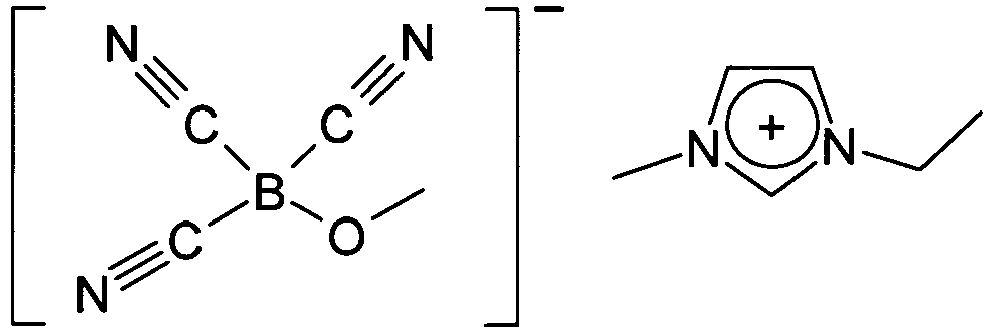
- An aqueous solution of 1-ethyl-3-methylimidazolium chloride (5.0 g, 34 mmol), K[B(CN)3(OCH3)] (5.4 g, 34 mmol) and water (25.1 g) were mixed with methylene chloride (67 g) and stirred at room temperature for 1 hour. After separation of the aqueous and the organic phase, the organic phase was washed with 10 ml of water and evaporated on a rotary evaporator yielding 5.81 g (74%) of 1-ethyl-3-methylimidazolium tricyanomethoxyborate as a colorless, low-viscosity liquid which did not solidify even at a temperature of -10 °C.
- 1H-NMR (400 MHz, CD3CN, TMS): δ [ppm] = 1.62 (br t, J= 7.0 Hz, 3 H), 3.33 (q, J H/B = 3.5 Hz, 3 H), 4.01 (s, 3 H), 4.30 (br q, J = 7,0 Hz, 2 H), 7.36 (s, 1 H), 7.39 (s, 1 H), 8.67 (s, 1 H).
13C-NMR (125 MHz, CD3CN, TMS): δ [ppm] = 15.1 (s), 36.8 (br), 45.7 (s), 53.3 (s), 122.3 (br), 124.0 (br), 128.3 (q (80%) + septet (20%), q: J = 69.9 Hz, septet: J = 23.0 Hz).
Melting point: Below 0 °C. - A solution of 1-ethyl-3-methylimidazolium chloride (5.0 g, 34 mmol) in water (25 ml) and K[B(CN)3(OCH3)] (5.4 g, 34 mmol) were mixed with methylene chloride (67 g) and stirred at room temperature for 3 hours. After separation of the aqueous and the organic phase, the latter was washed with 10 ml of water, dried over potassium carbonate and finally evaporated on a rotary evaporator yielding 3.78 g (48%) of 1-ethyl-3-methylimidazolium tricyanomethoxyborate as a low-viscosity liquid.
- 1H-NMR (400 MHz, CD3CN, TMS): δ [ppm] = 1.62 (br t, J = 7.0 Hz, 3 H), 3.33 (q, J H/B = 3.5 Hz, 3 H), 4.01 (s, 3 H), 4.30 (br q, J= 7,0 Hz, 2 H), 7.36 (s, 1 H), 7.39 (s, 1 H), 8.67 (s, 1 H).
13C-NMR (125 MHz, CD3CN, TMS): δ [ppm] = 15.1 (q), 36.8 (br), 45.7 (br), 53.3 (q), 122.3 (br), 124.0 (br), 128.3 (q (80%) + septet (20%), q: J = 69.9 Hz, septet: J = 23.2 Hz), 135.7 (d).
Melting point: Below 0 °C. -

- A solution of N-n-butyl-2-picolinium chloride (5.0 g, 27 mmol) in water (20 ml) and K[B(CN)3(OCH3)] (4.3 g, 27 mmol) were mixed with methylene chloride (53 g) and stirred at room temperature for 5 hours. After separation of the aqueous and the organic phase, the latter was washed with 10 ml of water, dried over potassium carbonate and finally evaporated on a rotary evaporator yielding 4.0 g (55%) of N-n-butyl-2-picolinium tricyanomethoxyborate as a low-viscosity liquid.
- 1H-NMR (500 MHz, CD3CN, TMS): δ [ppm] = 0.92 (t, J = 7.3Hz, 3H), 1.35-1.43 (m, 2H), 1.79-1.83 (m, 2H), 2.74 (s, 3H), 3.15 (q, J H/B = 3.9 Hz, 3H), 4.39 (br t, J = 8Hz, 2H), 7.76-7.82 (m, 2H), 8.26-8.30 (m, 1 H), 8.52-8.54 (m, 1 H).
13C-NMR (125 MHz, CD3CN, TMS): δ [ppm] = 12.9 (q), 19.4 (q), 19.7 (t), 31.7 (t), 52.5 (q), 58.0 (t), 126.0 (d), 128.0 (q (80%) + septet (20%), q: J = 69.9 Hz, septet: J= 20.7 Hz), 130.5 (d), 145.1 (d), 145.3 (d), 155.61 (s).
Melting point: Below 0 °C. -

- A solution of tetraethylammonium chloride (5.0 g, 30 mmol) in water (22 ml) and K[B(CN)3(OCH3)] (4.8 g, 30 mmol) were mixed with methylene chloride (59 g) and stirred at room temperature for 5 hours. After separation of the aqueous and the organic phase, the latter was washed with 10 ml of water, dried over potassium carbonate and finally evaporated on a rotary evaporator yielding 4.0 g (53%) of tetraethylammonium tricyanomethoxyborate as a low-viscosity liquid.
- 1H-NMR (500 MHz, CD3CN, TMS): δ [ppm] = 1.16 (tt, J= 7.3, J H/N = 1.9 Hz, 12H), 3.12 (q, J= 7.3 Hz, 8 H), 3.16 (J H/B = 3.4 Hz, 3H).
13C-NMR (125 MHz, CD3CN, TMS): δ [ppm] = 6.8 (q), 52.3 (dt, J C/N = 3.2 Hz), 54.5 (q), 128.0 (q (80%) + septet (20%), q: J= 70 Hz, septet: J= 23.5 Hz).
Melting range (DSC): Between 1 and 26 °C. -

- A solution of tetrabutylphosphonium methanesulfonate (5.0 g, 14 mmol) in water (10.4 ml) and K[B(CN)3(OCH3)] (2.2 g, 14 mmol) were mixed with methylene chloride (27.6 g) and stirred at room temperature for 5 hours. After separation of the aqueous and the organic phase, the latter was washed with 10 ml of water, dried over potassium carbonate and finally evaporated on a rotary evaporator yielding 3.4 g (64%) of tetrabutylphosphonium tricyanomethoxyborate as a low-viscosity liquid.
- 1H-NMR (500 MHz, CD3CN, TMS): δ [ppm] = 0.95 (t, J= 7.3 Hz, 12 H), 1.44-1.53 (m, 16 H), 2.04-2.10 (m, 8 H), 3.21 (J H/B = 3.4 Hz, 3H).
13C-NMR (125 MHz, CD3CN, TMS): δ [ppm] = 13.76 (br q), 19.2 (td, J P/C = 48.3 Hz), 24.1 (td, J P/C = 4.6 Hz), 24.7 (td, J P/C = 15.6), 53.4 (q), 128.0 (q + m, q: J= 70 Hz).
Melting point: Below 0 °C.
wherein optionally each of the rings formed with the substituents R2 to R13 contains one or two further, substituted or unsubstituted heteroatoms selected from the group consisting of nitrogen, sulfur and oxygen and/or be fused to another aromatic or non-aromatic 5- to 7-membered ring. A suitable substituent of the heteroatom is, for example, C1-8 alkyl.
Claims (15)
- A tricyanoborate of formula

R1 is C1-6 alkyl, C2-6 alkenyl, C6-10 aryl or benzyl,
X is oxygen or sulfur, and
Catn+ is a cation with n being 1 or 2, which is selected from the group consisting of an inorganic cation and an organic cation. - The tricyanoborate according to claim 1, wherein X is oxygen.
- The tricyanoborate according to claim 1 or 2, wherein R1 is methyl, ethyl or propyl.
- The tricyanoborate according to claim 3, wherein R1 is methyl.
- The tricyanoborate according to any one of claims 1 to 4, wherein Catn+ is an inorganic cation selected from the group consisting of Li+, Na+, K+, Rb+, Cs+, NH4 +, Be2+, Mg2+, Ca2+, Sr2+ and Ba2+.
- The tricyanoborate according to any one of claims 1 to 4, wherein Catn+ is an organic cation containing at least one heteroatom selected from the group consisting of nitrogen, phosphorus, sulfur and oxygen.
- The tricyanoborate according to claim 6, wherein the organic cation is selected from the group consisting of cations of formula(a) (WR2R3R4R5)+, wherein W is nitrogen or phosphorus, and(i) wherein R2 to R4 are, independently, C1-20 alkyl, and R5 is C1-20 alkyl, C3-10 cycloalkyl or C6-10 aryl, wherein optionally R2 to R5, independently, contain one or more halogens, or(ii) wherein R2 and R3 together with W form a 5- to 7-membered ring and R4 and R5 are, independently, C1-20 alkyl, wherein optionally R4 and R5, independently, contain one or more halogens, or(iii) wherein R2 and R3 or R4 and R5 in each case together with W form a 5- to 7-membered ring, or(b) (XR6R7R8)+, wherein X is nitrogen and R6 and R7 together with X form a ring in which X formally has one single bond and one double bond to R6 and R7, and R8 is C1-20 alkyl, C3-10 cycloalkyl or C6-10 aryl, wherein R8 optionally contains one or more halogens, or(c) (YR9R10R11)+, wherein Y is sulfur and(i) wherein R9 and R10 are, independently, C1-20 alkyl and R11 is C1-20 alkyl, C3-10 cycloalkyl or C6-10 aryl, wherein optionally R9 to R11, independently, contain one or more halogens, or(ii) wherein R9 and R10 together with Y form a 5- to 7-membered ring and R11 is C1-20 alkyl, C3-10 cycloalkyl or C6-10 aryl, wherein R11 optionally contains one or more halogens, or(d) (ZR12R13)+, wherein Z is oxygen or sulfur and R12 and R13 together with Z form a ring in which Z formally has one single bond and one double bond to R12 and R13, andwherein optionally one or more substituents selected from the group consisting of C1-20 alkyl, C1-20 alkoxy, C3-10 cycloalkyl, C6-10 aryl, halogen and cyano are bound to each of the rings formed with the substituents R2 to R13, wherein optionally the C1-20 alkyl, the C1-20 alkoxy, the C3-10 cycloalkyl and the C6-10 aryl, independently, contain one or more halogens, and
wherein optionally each of the rings formed with the substituents R2 to R13 contains one or two further, substituted or unsubstituted heteroatoms selected from the group consisting of nitrogen, sulfur and oxygen and/or be fused to another aromatic or non-aromatic 5- to 7-membered ring. - The tricyanoborate according to claim 6 or 7, wherein the organic cation is selected from the group consisting of organic ammonium, phosphonium, sulfonium, pyrrolidinium, pyrrolinium, pyrrolium, pyrazolium, imidazolium, triazolium, oxazolium, thiazolium, piperidinium, piperazinium, morpholinium, pyridinium, pyridazinium, pyrimidinium, pyrazinium, 1,3-dioxolium, pyrylium and thiopyrylium cation.
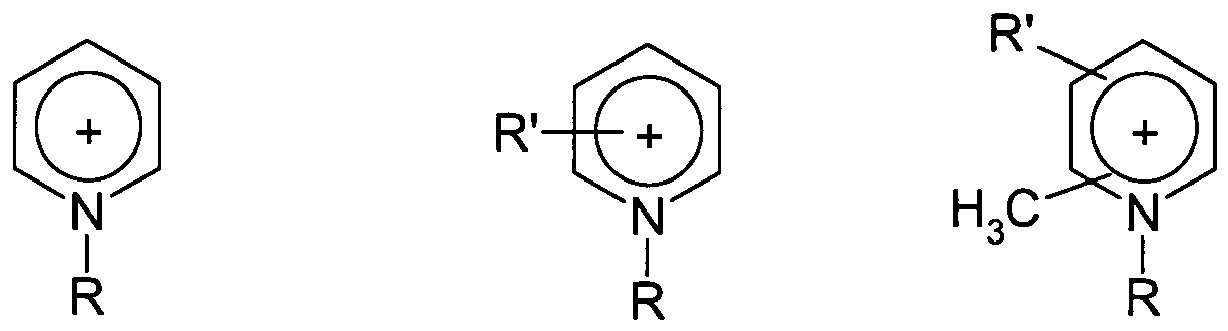
- The tricyanoborate according to any one of claims 6 to 8, wherein the organic cation is selected from the group consisting of

+NR4-mR'm
+PR4-mR'm
wherein R and R' are, independently, C1-20 alkyl, preferably C1-14 alkyl, and m is an integer from 0 to 4. - The tricyanoborate according to claim 9, wherein the organic cation is of formula

- The tricyanoborate according to claim 10, wherein R is methyl and R' is ethyl.
- Use of the tricyanoborate as defined in any one of claims 6 to 11, optionally in a mixture with one or more other ionic liquids, water or organic solvents, as polar aprotic solvent.
- A process for preparing the tricyanoborate as defined in claim 5, characterized in that B(XR1)3 is reacted with a cyanotri-C1-6-alkylsilane in the presence of M n+(CN-)n,
wherein
R1 is C1-6 alkyl, C2-6 alkenyl, C6-10 aryl or benzyl,
X is oxygen or sulfur, and
M n+ is an inorganic cation with n being 1 or 2, selected from the group consisting of Li+, Na+, K+, Rb+, Cs+, NH4 +, Be2+, Mg2+, Ca2+, Sr2+ and Ba2+. - A process for preparing the tricyanoborate as defined in any one of claims 6 to 11, characterized in that the tricyanoborate as defined in claim 5 is reacted with a salt of formula (Qn+)p(Yp-)n,
wherein
Qn+ is an organic cation as defined in any one of claims 6 to 11,
n is 1 or 2,
Yp- is an anion selected from the group consisting of halides, pseudohalides, sulfate and organic acid anions, and
p is 1 or 2. - The process according to claim 14, wherein the tricyanoborate used is prepared precedent according to the process as defined in claim 13.
Priority Applications (1)
| Application Number | Priority Date | Filing Date | Title |
|---|---|---|---|
| EP10701323.7A EP2391446B1 (en) | 2009-02-02 | 2010-01-26 | Novel tricyanoborates |
Applications Claiming Priority (4)
| Application Number | Priority Date | Filing Date | Title |
|---|---|---|---|
| EP09001388 | 2009-02-02 | ||
| US15122409P | 2009-02-10 | 2009-02-10 | |
| PCT/EP2010/000426 WO2010086131A1 (en) | 2009-02-02 | 2010-01-26 | Novel tricyanoborates |
| EP10701323.7A EP2391446B1 (en) | 2009-02-02 | 2010-01-26 | Novel tricyanoborates |
Publications (2)
| Publication Number | Publication Date |
|---|---|
| EP2391446A1 EP2391446A1 (en) | 2011-12-07 |
| EP2391446B1 true EP2391446B1 (en) | 2013-10-30 |
Family
ID=40532617
Family Applications (1)
| Application Number | Title | Priority Date | Filing Date |
|---|---|---|---|
| EP10701323.7A Not-in-force EP2391446B1 (en) | 2009-02-02 | 2010-01-26 | Novel tricyanoborates |
Country Status (16)
| Country | Link |
|---|---|
| US (1) | US8283497B2 (en) |
| EP (1) | EP2391446B1 (en) |
| JP (1) | JP5054233B2 (en) |
| KR (1) | KR101238570B1 (en) |
| CN (1) | CN102300631B (en) |
| AU (1) | AU2010209972B9 (en) |
| BR (1) | BRPI1008070A2 (en) |
| CA (1) | CA2750448C (en) |
| EA (1) | EA020216B1 (en) |
| ES (1) | ES2442915T3 (en) |
| IL (1) | IL214232A (en) |
| MX (1) | MX2011007952A (en) |
| SG (1) | SG173153A1 (en) |
| TW (1) | TWI408142B (en) |
| WO (1) | WO2010086131A1 (en) |
| ZA (1) | ZA201105535B (en) |
Families Citing this family (13)
| Publication number | Priority date | Publication date | Assignee | Title |
|---|---|---|---|---|
| EP2621934A1 (en) * | 2010-09-28 | 2013-08-07 | Merck Patent GmbH | Electrolyte formulations containing cyano-alkoxy-borate anions |
| WO2012099259A1 (en) | 2011-01-21 | 2012-07-26 | 株式会社日本触媒 | Ionic compound and process for production thereof, and electrolytic solution and electrical storage device each utilizing the ionic compound |
| SE535675C2 (en) * | 2011-03-22 | 2012-11-06 | High performance lubricants and additives for lubricants for ferrous and non-ferrous materials | |
| SG195086A1 (en) * | 2011-05-31 | 2013-12-30 | Merck Patent Gmbh | Compounds containing hydrido-tricyano-borate anions |
| EP2731954B1 (en) * | 2011-07-15 | 2015-06-17 | Merck Patent GmbH | Compounds containing alkyl-alkoxy-cyano-borate anions |
| US9058935B2 (en) * | 2011-07-15 | 2015-06-16 | Merc Patent Gmbh | Compounds containing alkyl-cyano-borate or alkyl-cyano-fluoroborate anions |
| JP6101575B2 (en) * | 2012-07-20 | 2017-03-22 | 株式会社日本触媒 | Non-aqueous electrolyte additive, non-aqueous electrolyte, and lithium secondary battery |
| WO2014037291A1 (en) * | 2012-09-04 | 2014-03-13 | Lonza Ltd | Tricyanoborate alkyl ethers |
| JP6036180B2 (en) * | 2012-10-31 | 2016-11-30 | 日亜化学工業株式会社 | Ionic liquid |
| WO2014147162A1 (en) | 2013-03-21 | 2014-09-25 | Lonza Ltd | Tricyano(fluorophenyl)borates |
| DE102013009959A1 (en) * | 2013-06-14 | 2014-12-31 | Julius-Maximilians-Universität Würzburg | Process for the preparation of salts with hydridocyanoborate anions |
| DE102014008130A1 (en) | 2014-06-06 | 2015-12-17 | Julius-Maximilians-Universität Würzburg | Process for the preparation of tetracyano borate salts |
| DE102015016400A1 (en) | 2015-12-18 | 2017-06-22 | Julius-Maximilians-Universität Würzburg | Process for the preparation of salts with Perfluoralkyltricyanoboratanionen or Tetracyanoboratanionen |
Family Cites Families (8)
| Publication number | Priority date | Publication date | Assignee | Title |
|---|---|---|---|---|
| DE10026565A1 (en) * | 2000-05-30 | 2001-12-06 | Merck Patent Gmbh | Ionic liquids |
| JP4322004B2 (en) * | 2002-11-22 | 2009-08-26 | 株式会社トクヤマ | Onium salt |
| JP4127788B2 (en) * | 2002-11-22 | 2008-07-30 | 株式会社トクヤマ | Onium salt |
| DE10306617A1 (en) * | 2003-02-14 | 2004-08-26 | Merck Patent Gmbh | New organic cyanoborates, used as ionic liquid, non-aqueous electrolyte, phase transfer catalyst or intermediate e.g. for liquid crystal compound, pharmaceutical or plant protection agent, are prepared via alkali metal salt |
| EP1634867A1 (en) | 2004-08-25 | 2006-03-15 | Lonza AG | Tricyanomethane salts of organic cations |
| DE102004051278A1 (en) * | 2004-10-21 | 2006-04-27 | Merck Patent Gmbh | New boron-containing strong acids, their preparation and use |
| EP1819005A1 (en) | 2006-02-13 | 2007-08-15 | Ecole Polytechnique Fédérale de Lausanne (EPFL) | Ionic liquid electrolyte |
| EP2621934A1 (en) * | 2010-09-28 | 2013-08-07 | Merck Patent GmbH | Electrolyte formulations containing cyano-alkoxy-borate anions |
-
2010
- 2010-01-26 CA CA2750448A patent/CA2750448C/en not_active Expired - Fee Related
- 2010-01-26 BR BRPI1008070A patent/BRPI1008070A2/en not_active IP Right Cessation
- 2010-01-26 KR KR1020117020311A patent/KR101238570B1/en not_active Expired - Fee Related
- 2010-01-26 US US13/147,416 patent/US8283497B2/en not_active Expired - Fee Related
- 2010-01-26 ES ES10701323.7T patent/ES2442915T3/en active Active
- 2010-01-26 EP EP10701323.7A patent/EP2391446B1/en not_active Not-in-force
- 2010-01-26 EA EA201101149A patent/EA020216B1/en not_active IP Right Cessation
- 2010-01-26 AU AU2010209972A patent/AU2010209972B9/en not_active Ceased
- 2010-01-26 JP JP2011546699A patent/JP5054233B2/en not_active Expired - Fee Related
- 2010-01-26 WO PCT/EP2010/000426 patent/WO2010086131A1/en not_active Ceased
- 2010-01-26 SG SG2011054186A patent/SG173153A1/en unknown
- 2010-01-26 CN CN2010800056581A patent/CN102300631B/en not_active Expired - Fee Related
- 2010-01-26 MX MX2011007952A patent/MX2011007952A/en active IP Right Grant
- 2010-01-28 TW TW099102342A patent/TWI408142B/en active
-
2011
- 2011-07-21 IL IL214232A patent/IL214232A/en not_active IP Right Cessation
- 2011-07-27 ZA ZA2011/05535A patent/ZA201105535B/en unknown
Also Published As
| Publication number | Publication date |
|---|---|
| CN102300631B (en) | 2013-10-30 |
| EA020216B1 (en) | 2014-09-30 |
| KR20110112858A (en) | 2011-10-13 |
| AU2010209972B9 (en) | 2013-10-17 |
| JP5054233B2 (en) | 2012-10-24 |
| TWI408142B (en) | 2013-09-11 |
| KR101238570B1 (en) | 2013-02-28 |
| IL214232A (en) | 2015-03-31 |
| US8283497B2 (en) | 2012-10-09 |
| HK1163005A1 (en) | 2012-09-07 |
| EA201101149A1 (en) | 2012-03-30 |
| CA2750448C (en) | 2013-10-01 |
| CN102300631A (en) | 2011-12-28 |
| EP2391446A1 (en) | 2011-12-07 |
| IL214232A0 (en) | 2011-09-27 |
| AU2010209972B2 (en) | 2013-09-26 |
| AU2010209972A1 (en) | 2011-08-25 |
| JP2012516832A (en) | 2012-07-26 |
| MX2011007952A (en) | 2011-08-15 |
| ZA201105535B (en) | 2012-04-25 |
| TW201033221A (en) | 2010-09-16 |
| ES2442915T3 (en) | 2014-02-14 |
| US20120018676A1 (en) | 2012-01-26 |
| BRPI1008070A2 (en) | 2016-03-15 |
| SG173153A1 (en) | 2011-08-29 |
| CA2750448A1 (en) | 2010-08-05 |
| WO2010086131A1 (en) | 2010-08-05 |
Similar Documents
| Publication | Publication Date | Title |
|---|---|---|
| US8283497B2 (en) | Tricyanoborates | |
| US9518068B2 (en) | Compounds containing hydrido-tricyano-borate anions | |
| KR101614235B1 (en) | Method for producing difluorophosphate | |
| JP5950916B2 (en) | Electrolyte formulation comprising cyano-alkoxy-borate anion | |
| WO2013010641A1 (en) | Compounds containing alkyl-cyano-borate or alkyl-cyano-fluoroborate anions | |
| US9624107B2 (en) | Method for producing difluorophosphate | |
| KR20160072265A (en) | Method for preparation of cyano compounds of the 13th group with a lewis acid | |
| Ignat'ev et al. | Cyanoborates | |
| JP2012051752A (en) | Method for producing difluorophosphate | |
| JP2005179254A (en) | Room temperature molten salt and method for producing the same | |
| JP5019456B2 (en) | Method for producing organic cation tricyanomethanide | |
| HK1163005B (en) | Tricyanoborates | |
| WO2013010640A1 (en) | Compounds containing alkyl-alkoxy-cyano-borate anions | |
| JP2023015723A (en) | Electrolyte composition, non-aqueous electrolyte, and method for manufacturing electrolyte composition | |
| WO2016162400A1 (en) | Method for preparation of cyano compounds of boron with a bronstedt acid |
Legal Events
| Date | Code | Title | Description |
|---|---|---|---|
| PUAI | Public reference made under article 153(3) epc to a published international application that has entered the european phase |
Free format text: ORIGINAL CODE: 0009012 |
|
| 17P | Request for examination filed |
Effective date: 20110902 |
|
| AK | Designated contracting states |
Kind code of ref document: A1 Designated state(s): AT BE BG CH CY CZ DE DK EE ES FI FR GB GR HR HU IE IS IT LI LT LU LV MC MK MT NL NO PL PT RO SE SI SK SM TR |
|
| DAX | Request for extension of the european patent (deleted) | ||
| GRAP | Despatch of communication of intention to grant a patent |
Free format text: ORIGINAL CODE: EPIDOSNIGR1 |
|
| INTG | Intention to grant announced |
Effective date: 20130726 |
|
| GRAS | Grant fee paid |
Free format text: ORIGINAL CODE: EPIDOSNIGR3 |
|
| GRAA | (expected) grant |
Free format text: ORIGINAL CODE: 0009210 |
|
| AK | Designated contracting states |
Kind code of ref document: B1 Designated state(s): AT BE BG CH CY CZ DE DK EE ES FI FR GB GR HR HU IE IS IT LI LT LU LV MC MK MT NL NO PL PT RO SE SI SK SM TR |
|
| REG | Reference to a national code |
Ref country code: GB Ref legal event code: FG4D |
|
| REG | Reference to a national code |
Ref country code: CH Ref legal event code: EP |
|
| REG | Reference to a national code |
Ref country code: AT Ref legal event code: REF Ref document number: 638294 Country of ref document: AT Kind code of ref document: T Effective date: 20131115 |
|
| REG | Reference to a national code |
Ref country code: IE Ref legal event code: FG4D |
|
| REG | Reference to a national code |
Ref country code: DE Ref legal event code: R096 Ref document number: 602010011312 Country of ref document: DE Effective date: 20131224 |
|
| REG | Reference to a national code |
Ref country code: NL Ref legal event code: T3 |
|
| REG | Reference to a national code |
Ref country code: ES Ref legal event code: FG2A Ref document number: 2442915 Country of ref document: ES Kind code of ref document: T3 Effective date: 20140214 |
|
| REG | Reference to a national code |
Ref country code: SE Ref legal event code: TRGR |
|
| REG | Reference to a national code |
Ref country code: AT Ref legal event code: MK05 Ref document number: 638294 Country of ref document: AT Kind code of ref document: T Effective date: 20131030 |
|
| REG | Reference to a national code |
Ref country code: LT Ref legal event code: MG4D |
|
| PG25 | Lapsed in a contracting state [announced via postgrant information from national office to epo] |
Ref country code: BE Free format text: LAPSE BECAUSE OF FAILURE TO SUBMIT A TRANSLATION OF THE DESCRIPTION OR TO PAY THE FEE WITHIN THE PRESCRIBED TIME-LIMIT Effective date: 20131030 Ref country code: FI Free format text: LAPSE BECAUSE OF FAILURE TO SUBMIT A TRANSLATION OF THE DESCRIPTION OR TO PAY THE FEE WITHIN THE PRESCRIBED TIME-LIMIT Effective date: 20131030 Ref country code: NO Free format text: LAPSE BECAUSE OF FAILURE TO SUBMIT A TRANSLATION OF THE DESCRIPTION OR TO PAY THE FEE WITHIN THE PRESCRIBED TIME-LIMIT Effective date: 20140130 Ref country code: HR Free format text: LAPSE BECAUSE OF FAILURE TO SUBMIT A TRANSLATION OF THE DESCRIPTION OR TO PAY THE FEE WITHIN THE PRESCRIBED TIME-LIMIT Effective date: 20131030 Ref country code: LT Free format text: LAPSE BECAUSE OF FAILURE TO SUBMIT A TRANSLATION OF THE DESCRIPTION OR TO PAY THE FEE WITHIN THE PRESCRIBED TIME-LIMIT Effective date: 20131030 Ref country code: IS Free format text: LAPSE BECAUSE OF FAILURE TO SUBMIT A TRANSLATION OF THE DESCRIPTION OR TO PAY THE FEE WITHIN THE PRESCRIBED TIME-LIMIT Effective date: 20140228 |
|
| PG25 | Lapsed in a contracting state [announced via postgrant information from national office to epo] |
Ref country code: AT Free format text: LAPSE BECAUSE OF FAILURE TO SUBMIT A TRANSLATION OF THE DESCRIPTION OR TO PAY THE FEE WITHIN THE PRESCRIBED TIME-LIMIT Effective date: 20131030 Ref country code: CY Free format text: LAPSE BECAUSE OF FAILURE TO SUBMIT A TRANSLATION OF THE DESCRIPTION OR TO PAY THE FEE WITHIN THE PRESCRIBED TIME-LIMIT Effective date: 20131030 Ref country code: LV Free format text: LAPSE BECAUSE OF FAILURE TO SUBMIT A TRANSLATION OF THE DESCRIPTION OR TO PAY THE FEE WITHIN THE PRESCRIBED TIME-LIMIT Effective date: 20131030 |
|
| PG25 | Lapsed in a contracting state [announced via postgrant information from national office to epo] |
Ref country code: PT Free format text: LAPSE BECAUSE OF FAILURE TO SUBMIT A TRANSLATION OF THE DESCRIPTION OR TO PAY THE FEE WITHIN THE PRESCRIBED TIME-LIMIT Effective date: 20140228 |
|
| PG25 | Lapsed in a contracting state [announced via postgrant information from national office to epo] |
Ref country code: EE Free format text: LAPSE BECAUSE OF FAILURE TO SUBMIT A TRANSLATION OF THE DESCRIPTION OR TO PAY THE FEE WITHIN THE PRESCRIBED TIME-LIMIT Effective date: 20131030 |
|
| REG | Reference to a national code |
Ref country code: DE Ref legal event code: R097 Ref document number: 602010011312 Country of ref document: DE |
|
| PG25 | Lapsed in a contracting state [announced via postgrant information from national office to epo] |
Ref country code: LU Free format text: LAPSE BECAUSE OF FAILURE TO SUBMIT A TRANSLATION OF THE DESCRIPTION OR TO PAY THE FEE WITHIN THE PRESCRIBED TIME-LIMIT Effective date: 20140126 Ref country code: PL Free format text: LAPSE BECAUSE OF FAILURE TO SUBMIT A TRANSLATION OF THE DESCRIPTION OR TO PAY THE FEE WITHIN THE PRESCRIBED TIME-LIMIT Effective date: 20131030 Ref country code: SK Free format text: LAPSE BECAUSE OF FAILURE TO SUBMIT A TRANSLATION OF THE DESCRIPTION OR TO PAY THE FEE WITHIN THE PRESCRIBED TIME-LIMIT Effective date: 20131030 Ref country code: CZ Free format text: LAPSE BECAUSE OF FAILURE TO SUBMIT A TRANSLATION OF THE DESCRIPTION OR TO PAY THE FEE WITHIN THE PRESCRIBED TIME-LIMIT Effective date: 20131030 Ref country code: RO Free format text: LAPSE BECAUSE OF FAILURE TO SUBMIT A TRANSLATION OF THE DESCRIPTION OR TO PAY THE FEE WITHIN THE PRESCRIBED TIME-LIMIT Effective date: 20131030 |
|
| PLBE | No opposition filed within time limit |
Free format text: ORIGINAL CODE: 0009261 |
|
| STAA | Information on the status of an ep patent application or granted ep patent |
Free format text: STATUS: NO OPPOSITION FILED WITHIN TIME LIMIT |
|
| PG25 | Lapsed in a contracting state [announced via postgrant information from national office to epo] |
Ref country code: DK Free format text: LAPSE BECAUSE OF FAILURE TO SUBMIT A TRANSLATION OF THE DESCRIPTION OR TO PAY THE FEE WITHIN THE PRESCRIBED TIME-LIMIT Effective date: 20131030 |
|
| 26N | No opposition filed |
Effective date: 20140731 |
|
| REG | Reference to a national code |
Ref country code: IE Ref legal event code: MM4A |
|
| REG | Reference to a national code |
Ref country code: DE Ref legal event code: R097 Ref document number: 602010011312 Country of ref document: DE Effective date: 20140731 |
|
| PG25 | Lapsed in a contracting state [announced via postgrant information from national office to epo] |
Ref country code: IE Free format text: LAPSE BECAUSE OF NON-PAYMENT OF DUE FEES Effective date: 20140126 |
|
| PG25 | Lapsed in a contracting state [announced via postgrant information from national office to epo] |
Ref country code: SI Free format text: LAPSE BECAUSE OF FAILURE TO SUBMIT A TRANSLATION OF THE DESCRIPTION OR TO PAY THE FEE WITHIN THE PRESCRIBED TIME-LIMIT Effective date: 20131030 |
|
| PG25 | Lapsed in a contracting state [announced via postgrant information from national office to epo] |
Ref country code: MC Free format text: LAPSE BECAUSE OF FAILURE TO SUBMIT A TRANSLATION OF THE DESCRIPTION OR TO PAY THE FEE WITHIN THE PRESCRIBED TIME-LIMIT Effective date: 20131030 |
|
| REG | Reference to a national code |
Ref country code: FR Ref legal event code: PLFP Year of fee payment: 7 |
|
| PG25 | Lapsed in a contracting state [announced via postgrant information from national office to epo] |
Ref country code: MT Free format text: LAPSE BECAUSE OF FAILURE TO SUBMIT A TRANSLATION OF THE DESCRIPTION OR TO PAY THE FEE WITHIN THE PRESCRIBED TIME-LIMIT Effective date: 20131030 |
|
| PG25 | Lapsed in a contracting state [announced via postgrant information from national office to epo] |
Ref country code: SM Free format text: LAPSE BECAUSE OF FAILURE TO SUBMIT A TRANSLATION OF THE DESCRIPTION OR TO PAY THE FEE WITHIN THE PRESCRIBED TIME-LIMIT Effective date: 20131030 |
|
| PG25 | Lapsed in a contracting state [announced via postgrant information from national office to epo] |
Ref country code: BG Free format text: LAPSE BECAUSE OF FAILURE TO SUBMIT A TRANSLATION OF THE DESCRIPTION OR TO PAY THE FEE WITHIN THE PRESCRIBED TIME-LIMIT Effective date: 20131030 Ref country code: GR Free format text: LAPSE BECAUSE OF FAILURE TO SUBMIT A TRANSLATION OF THE DESCRIPTION OR TO PAY THE FEE WITHIN THE PRESCRIBED TIME-LIMIT Effective date: 20140131 |
|
| PG25 | Lapsed in a contracting state [announced via postgrant information from national office to epo] |
Ref country code: TR Free format text: LAPSE BECAUSE OF FAILURE TO SUBMIT A TRANSLATION OF THE DESCRIPTION OR TO PAY THE FEE WITHIN THE PRESCRIBED TIME-LIMIT Effective date: 20131030 Ref country code: HU Free format text: LAPSE BECAUSE OF FAILURE TO SUBMIT A TRANSLATION OF THE DESCRIPTION OR TO PAY THE FEE WITHIN THE PRESCRIBED TIME-LIMIT; INVALID AB INITIO Effective date: 20100126 |
|
| REG | Reference to a national code |
Ref country code: FR Ref legal event code: PLFP Year of fee payment: 8 |
|
| PGFP | Annual fee paid to national office [announced via postgrant information from national office to epo] |
Ref country code: NL Payment date: 20161223 Year of fee payment: 8 Ref country code: CH Payment date: 20161206 Year of fee payment: 8 |
|
| PGFP | Annual fee paid to national office [announced via postgrant information from national office to epo] |
Ref country code: SE Payment date: 20161128 Year of fee payment: 8 Ref country code: ES Payment date: 20161109 Year of fee payment: 8 |
|
| PGFP | Annual fee paid to national office [announced via postgrant information from national office to epo] |
Ref country code: DE Payment date: 20161128 Year of fee payment: 8 Ref country code: FR Payment date: 20170127 Year of fee payment: 8 |
|
| PGFP | Annual fee paid to national office [announced via postgrant information from national office to epo] |
Ref country code: GB Payment date: 20170117 Year of fee payment: 8 |
|
| PGFP | Annual fee paid to national office [announced via postgrant information from national office to epo] |
Ref country code: IT Payment date: 20170105 Year of fee payment: 8 |
|
| PG25 | Lapsed in a contracting state [announced via postgrant information from national office to epo] |
Ref country code: MK Free format text: LAPSE BECAUSE OF FAILURE TO SUBMIT A TRANSLATION OF THE DESCRIPTION OR TO PAY THE FEE WITHIN THE PRESCRIBED TIME-LIMIT Effective date: 20131030 |
|
| REG | Reference to a national code |
Ref country code: DE Ref legal event code: R119 Ref document number: 602010011312 Country of ref document: DE |
|
| REG | Reference to a national code |
Ref country code: SE Ref legal event code: EUG |
|
| REG | Reference to a national code |
Ref country code: CH Ref legal event code: PL |
|
| REG | Reference to a national code |
Ref country code: NL Ref legal event code: MM Effective date: 20180201 |
|
| GBPC | Gb: european patent ceased through non-payment of renewal fee |
Effective date: 20180126 |
|
| PG25 | Lapsed in a contracting state [announced via postgrant information from national office to epo] |
Ref country code: FR Free format text: LAPSE BECAUSE OF NON-PAYMENT OF DUE FEES Effective date: 20180131 Ref country code: DE Free format text: LAPSE BECAUSE OF NON-PAYMENT OF DUE FEES Effective date: 20180801 Ref country code: SE Free format text: LAPSE BECAUSE OF NON-PAYMENT OF DUE FEES Effective date: 20180127 |
|
| REG | Reference to a national code |
Ref country code: FR Ref legal event code: ST Effective date: 20180928 |
|
| PG25 | Lapsed in a contracting state [announced via postgrant information from national office to epo] |
Ref country code: CH Free format text: LAPSE BECAUSE OF NON-PAYMENT OF DUE FEES Effective date: 20180131 Ref country code: LI Free format text: LAPSE BECAUSE OF NON-PAYMENT OF DUE FEES Effective date: 20180131 Ref country code: GB Free format text: LAPSE BECAUSE OF NON-PAYMENT OF DUE FEES Effective date: 20180126 Ref country code: NL Free format text: LAPSE BECAUSE OF NON-PAYMENT OF DUE FEES Effective date: 20180201 |
|
| PG25 | Lapsed in a contracting state [announced via postgrant information from national office to epo] |
Ref country code: IT Free format text: LAPSE BECAUSE OF NON-PAYMENT OF DUE FEES Effective date: 20180126 |
|
| REG | Reference to a national code |
Ref country code: ES Ref legal event code: FD2A Effective date: 20190731 |
|
| PG25 | Lapsed in a contracting state [announced via postgrant information from national office to epo] |
Ref country code: ES Free format text: LAPSE BECAUSE OF NON-PAYMENT OF DUE FEES Effective date: 20180127 |