EP2391180A1 - Allocation method for physical downlink control channel, base station and user terminal - Google Patents
Allocation method for physical downlink control channel, base station and user terminal Download PDFInfo
- Publication number
- EP2391180A1 EP2391180A1 EP10733214A EP10733214A EP2391180A1 EP 2391180 A1 EP2391180 A1 EP 2391180A1 EP 10733214 A EP10733214 A EP 10733214A EP 10733214 A EP10733214 A EP 10733214A EP 2391180 A1 EP2391180 A1 EP 2391180A1
- Authority
- EP
- European Patent Office
- Prior art keywords
- component carriers
- pdcch
- component
- carrier
- component carrier
- Prior art date
- Legal status (The legal status is an assumption and is not a legal conclusion. Google has not performed a legal analysis and makes no representation as to the accuracy of the status listed.)
- Granted
Links
Images


Classifications
-
- H—ELECTRICITY
- H04—ELECTRIC COMMUNICATION TECHNIQUE
- H04L—TRANSMISSION OF DIGITAL INFORMATION, e.g. TELEGRAPHIC COMMUNICATION
- H04L5/00—Arrangements affording multiple use of the transmission path
- H04L5/0001—Arrangements for dividing the transmission path
- H04L5/0003—Two-dimensional division
- H04L5/0005—Time-frequency
- H04L5/0007—Time-frequency the frequencies being orthogonal, e.g. OFDM(A) or DMT
- H04L5/001—Time-frequency the frequencies being orthogonal, e.g. OFDM(A) or DMT the frequencies being arranged in component carriers
-
- H—ELECTRICITY
- H04—ELECTRIC COMMUNICATION TECHNIQUE
- H04L—TRANSMISSION OF DIGITAL INFORMATION, e.g. TELEGRAPHIC COMMUNICATION
- H04L5/00—Arrangements affording multiple use of the transmission path
- H04L5/0091—Signalling for the administration of the divided path, e.g. signalling of configuration information
- H04L5/0096—Indication of changes in allocation
-
- H—ELECTRICITY
- H04—ELECTRIC COMMUNICATION TECHNIQUE
- H04L—TRANSMISSION OF DIGITAL INFORMATION, e.g. TELEGRAPHIC COMMUNICATION
- H04L5/00—Arrangements affording multiple use of the transmission path
- H04L5/0091—Signalling for the administration of the divided path, e.g. signalling of configuration information
- H04L5/0096—Indication of changes in allocation
- H04L5/0098—Signalling of the activation or deactivation of component carriers, subcarriers or frequency bands
-
- H—ELECTRICITY
- H04—ELECTRIC COMMUNICATION TECHNIQUE
- H04W—WIRELESS COMMUNICATION NETWORKS
- H04W52/00—Power management, e.g. Transmission Power Control [TPC] or power classes
- H04W52/02—Power saving arrangements
- H04W52/0209—Power saving arrangements in terminal devices
- H04W52/0225—Power saving arrangements in terminal devices using monitoring of external events, e.g. the presence of a signal
- H04W52/0229—Power saving arrangements in terminal devices using monitoring of external events, e.g. the presence of a signal where the received signal is a wanted signal
-
- H—ELECTRICITY
- H04—ELECTRIC COMMUNICATION TECHNIQUE
- H04W—WIRELESS COMMUNICATION NETWORKS
- H04W72/00—Local resource management
- H04W72/20—Control channels or signalling for resource management
- H04W72/23—Control channels or signalling for resource management in the downlink direction of a wireless link, i.e. towards a terminal
-
- H—ELECTRICITY
- H04—ELECTRIC COMMUNICATION TECHNIQUE
- H04W—WIRELESS COMMUNICATION NETWORKS
- H04W24/00—Supervisory, monitoring or testing arrangements
-
- H—ELECTRICITY
- H04—ELECTRIC COMMUNICATION TECHNIQUE
- H04W—WIRELESS COMMUNICATION NETWORKS
- H04W68/00—User notification, e.g. alerting and paging, for incoming communication, change of service or the like
-
- H—ELECTRICITY
- H04—ELECTRIC COMMUNICATION TECHNIQUE
- H04W—WIRELESS COMMUNICATION NETWORKS
- H04W72/00—Local resource management
- H04W72/04—Wireless resource allocation
- H04W72/044—Wireless resource allocation based on the type of the allocated resource
- H04W72/0453—Resources in frequency domain, e.g. a carrier in FDMA
-
- Y—GENERAL TAGGING OF NEW TECHNOLOGICAL DEVELOPMENTS; GENERAL TAGGING OF CROSS-SECTIONAL TECHNOLOGIES SPANNING OVER SEVERAL SECTIONS OF THE IPC; TECHNICAL SUBJECTS COVERED BY FORMER USPC CROSS-REFERENCE ART COLLECTIONS [XRACs] AND DIGESTS
- Y02—TECHNOLOGIES OR APPLICATIONS FOR MITIGATION OR ADAPTATION AGAINST CLIMATE CHANGE
- Y02D—CLIMATE CHANGE MITIGATION TECHNOLOGIES IN INFORMATION AND COMMUNICATION TECHNOLOGIES [ICT], I.E. INFORMATION AND COMMUNICATION TECHNOLOGIES AIMING AT THE REDUCTION OF THEIR OWN ENERGY USE
- Y02D30/00—Reducing energy consumption in communication networks
- Y02D30/70—Reducing energy consumption in communication networks in wireless communication networks
Definitions
- the present invention relates to the field of mobile communications and in particular to a method for configuring a downlink physical control channel, a base station and a UE.
- a cell may correspond to only one carrier typically with a maximum bandwidth of 20MHz.
- LTE-A Long Term Evolution-Advanced
- CA Carrier Aggregation
- Scheduling information on resource allocated to UEs is carried over a Physical Downlink Control Channel (PDCCH), and the respective UEs monitor the PDCCH allocated thereto and acquire the resource scheduling information so that they can transmit data only over time and frequency resources indicated by the resource scheduling information.
- PDCCH Physical Downlink Control Channel
- No method for configuring a PDCCH has been proposed so far for the LTE-A system, and if the use of the method for the LTE system were continued, then a UE would have to monitor respective component carriers of the LTE-A system and acquire resource scheduling information over a detected PDCCH, which may mean that the UE has to operate over the respective component carriers and consequently will waste its consumed power.
- the invention provides a method for configuring a PDCCH, a base station and a UE to reduce the amount of consumed power of the UE for monitoring the PDCCH.
- a method for configuring a PDCCH includes:
- a base station includes a carrier configuration unit and an information notification unit, wherein:
- a UE includes an information reception unit and a carrier monitoring unit, wherein:
- the invention provides a method for configuring a PDCCH in an LTE-A system, particularly by configuring for a UE a component carrier or component carriers for monitoring the PDCCH and by notifying the UE about information on the configured component carrier or component carriers so that the UE monitors the PDCCH only over the configured component carrier or component carriers. That is to say, in this way, the UE will operate only over a necessary component carrier or component carriers without monitoring respective component carriers in the LTE-A system to thereby reduce the number of concurrently monitored component carriers, and in the case of nonconsecutive component carriers, also reduce the number of consequently enabled receivers and consequently the amount of consumed power of the UE for monitoring the PDCCH.
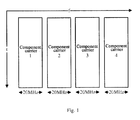
- Fig.1 is a schematic diagram of aggregated carriers in an LTE-A system
- Fig.2a is a schematic diagram of a PDCCH scheduling relationship according to the first embodiment of the invention.
- Fig.2b is a schematic diagram of a PDCCH scheduling relationship according to the second embodiment of the invention.
- Fig.3 is a flow chart of a method according to the first embodiment of the invention.
- Fig.4 is a flow chart of a method according to the second embodiment of the invention.
- Fig.5 is a flow chart of a method for adjusting a component carrier according to the embodiment of the invention.
- Fig.6 is a structural diagram of a base station according to the embodiment of the invention.
- a method according to the invention generally includes: a base station configures a UE with a component carrier for monitoring a PDCCH and notifies the UE about information on the configured component carrier so that the UE monitors a PDCCH over the configured component carrier.
- a PDCCH is configured over different component carriers, and only the data transmission over the component carrier where the PDCCH resides is scheduled for the PDCCH over the respective component carriers, that is, only the downlink data transmission over the component carrier where the PDCCH resides and data transmission over the uplink component carrier corresponding thereto is scheduled, as illustrated in Fig.2a .
- Fig.3 is a flow chart of a method according to the first embodiment, as illustrated in Fig.2 , which can include the following steps:
- Step 301 A base station selects a component carrier available to a UE based on a preset carrier configuration policy according to channel qualities of the UE over respective component carriers.
- the network side can acquire the channel qualities of the UE over the respective component carriers from random access (preamble) codes transmitted from the UE, where the network side can directly measure, with the preamble code transmitted from the UE, the quality of a downlink component carrier corresponding to an uplink component carrier over which the preamble code is transmitted or determine the channel qualities of the UE over the respective component carriers from path loss information over the respective component carriers implicitly carried in the preamble codes.
- the preamble codes can be grouped in advance so that each of the groups can represent a path loss condition.
- the preamble codes can be grouped in advance into groups A and B, and if the UE measures a downlink path loss above a preset threshold, then the preamble code of the group A is transmitted, and the network side determines that the path loss of the UE over the component carrier is above the preset threshold upon reception of the preamble code of the group A.
- a component carrier available to the UE can be selected according to the preset carrier configuration policy by selecting a component carrier with a channel quality above a preset quality threshold for the UE according to the channel qualities of the UE over the respective component carriers.
- a component carrier can be selected for the UE according to one or any combination of the following factors: a transmission capability of the UE, a service characteristic of the UE, loads of the UE over the respective component carriers, etc.
- a corresponding carrier configuration policy may be that a component carrier with a bandwidth or a transmission quality satisfying an access requirement is selected for the UE according to the service characteristic of the UE, for example, if the service characteristic of the UE relates to a high rate or a large bandwidth required for an access service, then a member with a large bandwidth or a good transmission quality is selected for the UE; or that a component carrier with a bandwidth or a transmission quality satisfying the transmission capability of the UE is selected for the UE according to the transmission capability of the UE, for example, if the UE has a strong transmission capability, then a component carrier with a large bandwidth or a good channel quality is selected for the UE, and if the UE is a newly accessing UE, then a component carrier with a load condition below a preset load threshold is selected for the UE.
- a plurality of component carriers can be selected for the UE dependent upon a specific requirement instead of selecting one component carrier for the UE.
- Step 302 A PDCCH over which resource scheduling information of the selected component carrier is carried is configured over the selected component carrier.
- Step 303 The base station notifies the UE about information on the component carrier or component carriers configured for the UE to monitor the PDCCH by the way of signaling from the network side.
- the base station notify the UE about information on the component carrier configured for the UE to monitor the PDCCH in Radio Resource Control (RRC) signaling, a Media Access Control (MAC) command or a PDCCH control command so that the UE only monitors the PDCCH over the component carrier.
- RRC Radio Resource Control
- MAC Media Access Control
- the network side can group component carriers allocated to respective UEs into respective sets of component carriers and notify in a system broadcast the UE about information on grouping of the component carriers and the identifier of a set of component carriers where the UE resides; or the network side and the UE can prescribe grouping of the respective component carriers into the sets of component carriers, and the network side can simply notify in a system broadcast the UE about the identifier of a set of component carriers where the UE resides.
- Step 304 The UE monitors the PDCCH over the component carrier upon reception of the information on the component carrier configured for the UE to monitor the PDCCH and transmits data over a time and frequency resource indicated in the resource scheduling information carried over the PDCCH.
- the UE will monitor only the component carrier upon reception of the information on the component carrier configured for the UE to monitor the PDCCH and transmit data only over the downlink component carrier where the PDCCH resides and an uplink component carrier corresponding thereto, that is, transmit data over a time and frequency resource indicated in the resource scheduling information carried over the PDCCH.
- a UE 1 is configured with a set of component carriers consisted of a component carrier 1, a component carrier 2 and a component carrier 3, and data transmission over the component carrier 1, the component carrier 2 and the component carrier 3 can be scheduled for any PDCCH in the set of component carriers.
- Fig.4 is a flow chart of a method according to a second embodiment of the invention, as illustrated in Fig.4 , which can include the following steps:
- Step 401 A base station selects the available component carriers for a UE according to a service characteristic of the UE, channel qualities thereof over the respective component carriers and a quality of a PDCCH so as to constitute a set of component carriers.
- a set of component carriers can be selected particularly in the following steps:
- the base station firstly determines the amount of resource required for the UE according to the service characteristic of the UE and the channel qualities thereof over the respective component carriers.
- a PDCCH bandwidth required for the UE is determined according to the amount of resource required for the UE and the quality of the PDCCH.
- the base station selects for the UE the set of component carriers satisfying the required PDCCH bandwidth. That is, the sum of PDCCH bandwidths of the component carriers in the set of component carriers is larger than or equal to the PDCCH bandwidth required for the UE.
- the set of component carriers typically contains more than one component carrier.
- Step 402 The PDCCH over which resource scheduling information of the selected set of component carriers is carried is configured over the respective component carriers in the set of component carriers.
- the PDCCH configured over the respective component carriers in the set of component carriers is the resource scheduling information that carries the set of component carriers.
- Step 403 The base station notifies the UE about information on the set of component carriers configured for the UE to monitor the PDCCH in signaling from the network side.
- the base station can notify the UE about information on the set of component carriers configured for the UE to monitor the PDCCH in RRC signaling, an MAC command or a PDCCH control command so that the UE only monitors the PDCCH over the set of component carriers.
- Step 404 The UE monitors the PDCCH over the set of component carriers upon reception of the information on the set of component carriers configured for the UE to monitor the PDCCH and transmits data over a time and frequency resource indicated in the resource scheduling information carried over the PDCCH.
- the UE will monitor only the component carriers in the set of component carriers upon reception of the information on the set of component carriers configured for the UE to monitor the PDCCH and transmit data only over the downlink members carrier where the PDCCH resides and uplink component carriers corresponding thereto, that is, transmit data over a time and frequency resource indicated in the resource scheduling information carried over the PDCCH.
- the component carrier(s) can be configured for the UE to monitor the PDCCH as initial configuration or reconfiguration of the UE.
- the component carrier(s) can be configured for the UE to monitor the PDCCH, and after the UE monitors the PDCCH over the component carrier(s) configured for the UE, the component carrier(s) configured for the UE may not satisfy the service requirement of the UE any longer as a channel condition, a service load, the amount of traffic of the UE, etc., varies, and at this time the base station can adjust the component carrier(s) configured for the UE.
- the base station can determine whether the component carrier(s) configured for the UE satisfies the service requirement of the UE in real time according to one or any combination of a channel quality of the component carrier(s) configured for the UE, a load of the component carrier(s) and the amount of traffic of the UE, and if not so, then the base station can trigger a flow of adjusting for the UE the component carrier(s) where the PDCCH resides, that is, adjusting the component carrier(s) configured for the UE to monitor the PDCCH to another component carrier satisfying the service requirement of the UE.
- a situation resulting in adjusting the component carrier(s) may be that the component carrier(s) configured for the UE shall be adjusted after the UE establishes a connection with a network because the base station acquires insufficient information on the UE when the UE initially access the network; or the component carrier(s) configured for the UE will be adjusted due to a change to the channel quality of the component carrier(s) or adjusted to the component carrier(s) with a larger or smaller bandwidth due to a change to the amount of traffic of the UE during data transmission; or the component carrier(s) configured for the UE will be adjusted due to a change to the load of the component carrier(s), for example, there are so many UEs over a component carrier that the load of the component carrier reaches a load threshed, and a part of the UEs shall be adjusted to a lightly loaded component carrier; so on.
- a component carrier configured for the UE to monitor the PDCCH is adjusted to a varying channel quality, and as illustrated in Fig.5 , if a component carrier originally configured for the UE is a component carrier 1 and there is another component carrier 2 in the system, then the process can include the following steps:
- Step 501 The base station monitors in real time channel qualities over the two component carriers.
- the UE can measure channel qualities over the two component carriers and report measurement results to the base station in a Channel Quality Indicator (CQI), where a smaller CQI indicates a poorer channel quality.
- CQI Channel Quality Indicator
- Step 502 The base station determines whether the CQI of the component carrier 1 is below a first quality threshold, and if so, then the process goes to the step 503; otherwise, the flow ends.
- two quality thresholds can be set, where the first quality threshold is smaller or equal to the second threshold.
- the CQI of the component carrier 1 smaller than the first quality threshold indicates that the channel quality of the component carrier 1 has been degraded and needed to be adjusted.
- Step 503 The base station determines whether the CQI of the component carrier 2 is above the second quality threshold, and if so, then the process goes to the step 504; otherwise, the flow ends.
- Step 504 The base station adjusts the component carrier configured for the UE to monitor the PDCCH from the component carrier 1 to the component carrier 2 and notifies the UE about information on adjusting in signaling from the network side.
- a component carrier with a CQI above the second quality threshold can be selected from the component carriers which have not been configured for the UE and the UE can be adjusted to the selected component carrier.
- Fig.6 is a structural diagram of a base station according to an embodiment of the invention, as illustrated in Fig.6 , which includes a carrier configuration unit 600 and an information notification unit 610.
- the carrier configuration unit 600 is configured to configure for a UE with a component carrier or component carriers for monitoring a PDDCH.
- the information notification unit 610 is configured to notify the UE about information on the component carrier or component carriers configured by the carrier configuration unit 600 so that the UE only monitors the PDCCH over the configured component carrier or component carriers.
- the carrier configuration unit 600 can include a first selection sub-unit 601 and a first configuration sub-unit 602.
- the first selection sub-unit 601 is configured to select the component carrier available to the UE based on a preset carrier configuration policy according to one or any combination of channel qualities of the UE over respective component carriers, a service characteristic of the UE, a transmission capability of the UE and whether the UE is a newly accessing UE.
- the first selection sub-unit 601 can select for the UE the component carrier with a channel quality above a preset quality threshold according to the channel qualities of the UE over the respective component carriers; or select for the UE the component carrier with a bandwidth or a transmission quality satisfying the requirement of an access service according to the service characteristic of the UE; or select for the UE the component carrier with a bandwidth or a transmission quality satisfying the transmission quality of the UE according to the transmission quality of the UE; or select for the UE the component carrier with a load condition below a preset load threshold if the UE is a newly accessing UE; or any combination thereof.
- the first configuration sub-unit 602 is configured to configure the PDCCH over which resource scheduling information of the component carrier is carried over the component carrier selected by the first selection sub-unit 601.
- the carrier configuration unit 600 can particularly include a second selection sub-unit 603 and a second configuration sub-unit 604.
- the second selection sub-unit 603 is configured to select the available component carriers for the UE according to a service characteristic of the UE, channel qualities thereof over the respective component carriers and a quality of the PDCCH so as to constitute a set of component carriers.
- the amount of resource required for the UE can be determined according to the service characteristic of the UE and the channel qualities thereof over the respective component carriers; a PDCCH bandwidth required for the UE can be determined according to the amount of resource required for the UE and the quality of the PDCCH; and a set of component carriers constituted of component carriers satisfying the required PDCCH bandwidth can be selected for the UE.
- the second configuration sub-unit 604 is configured to configure the PDCCH over which resource scheduling information of the component carriers is carried over the component carriers selected by the second selection sub-unit 603.
- the information notification unit 610 can notify the UE about the information on the configured component carrier or component carriers in signaling from the network side or a system broadcast.
- the signaling from the network side can include Radio Resource Control (RRC) signaling or Media Access Control (MAC) signaling or PDCCH control signaling
- the system broadcast can include information on grouping of the respective component carriers into sets of component carriers and the identifier of a set of component carriers or the identifiers of sets of component carriers where the component carrier or component carriers configured for the UE resides or reside; or the network side and the UE can prescribe the information on grouping of the respective component carriers into the sets of component carriers, and at this time the system broadcast can include the identifier of a set of component carriers or the identifiers of sets of component carriers where the component carrier or component carriers configured for the UE resides or reside.
- RRC Radio Resource Control
- MAC Media Access Control
- the base station can further include an adjusting-determining unit 620 and a carrier adjusting unit 630.
- the adjusting-determining unit 620 is configured to determine whether the component carrier or component carriers configured by the carrier configuration unit 600 for the UE to monitor the PDCCH satisfies or satisfy a service requirement of the UE, and if not, then transmit an adjusting instruction to the carrier adjusting unit 630.
- the carrier adjusting unit 620 can perform the foregoing operation of determining particularly according to one or any combination of a channel quality and a load condition of the component carrier or component carriers configured for the UE to monitor the PDCCH or the amount of traffic of the UE.
- the carrier adjusting unit 630 is configured to adjust the component carrier or component carriers configured for the UE to monitor the PDCCH to another component carrier or other component carriers satisfying the service requirement of the UE upon reception of the adjusting instruction and to notify the UE about information on adjusting in signaling from the network side.
- a UE can include an information reception unit and a carrier monitoring unit.
- the information reception unit is configured to receive information on a component carrier or component carriers configured by a base station for the UE to monitor a PDCCH.
- the carrier monitoring unit is configured to monitor the PDCCH only over the component carrier or component carriers configured for the UE according to the information on the component carrier or component carriers received by the information reception unit.
- the information reception unit can receive the information on the component carrier or component carriers configured by the base station for the UE to monitor the PDCCH in signaling from the network side or a system broadcast.
- the information reception unit can further be configured to receive in signaling from the network side adjusting information including information on adjusting the component carrier or component carriers configured for the UE to monitor the PDCCH to another component carrier or other component carriers satisfying a service requirement of the UE.
- the carrier monitoring unit can further be configured to adjust the monitoring of the PDCCH over the component carrier or component carriers configured for the UE to the monitoring of the PDCCH over the adjusted component carrier or component carriers according to the adjusting information received by the information reception unit.
- the method and device according to the invention will not be limited to the LTE-A system in the embodiments but can also be applicable to other wireless communication system with carrier aggregation.
- the invention provides a method for configuring a PDCCH in an LTE-A system, particularly by configuring for a UE a component carrier or component carriers for monitoring the PDCCH and by notifying the UE about information on the configured component carrier or component carriers so that the UE monitors the PDCCH only over the configured component carrier or component carriers. Stated otherwise, in this way, the UE will operate only over a necessary component carrier or component carriers without monitoring respective component carriers in the LTE-A system to thereby reduce the number of concurrently monitored component carriers, and in the case of nonconsecutive component carriers, also reduce the number of consequently enabled receivers and consequently the amount of consumed power of the UE for monitoring the PDCCH.
Landscapes
- Engineering & Computer Science (AREA)
- Signal Processing (AREA)
- Computer Networks & Wireless Communication (AREA)
- Mobile Radio Communication Systems (AREA)
Abstract
Description
- The present invention relates to the field of mobile communications and in particular to a method for configuring a downlink physical control channel, a base station and a UE.
- In the Long Term Evolution (LTE) system or earlier wireless communication systems, a cell may correspond to only one carrier typically with a maximum bandwidth of 20MHz. In the subsequently proposed Long Term Evolution-Advanced (LTE-A) system, the peak rate of the system has been greatly improved over the LTE system up to 1Gbps in the downlink and 500Mbps in the uplink. This requirement can not be satisfied over a carrier with a bandwidth of 20MHz, and therefore Carrier Aggregation (CA) has been introduced to the LTE-A system so that a plurality of consecutive or inconsecutive carriers in a cell are aggregated together to serve a UE concurrently, where the aggregated carriers are commonly referred to as component carriers, each of which generally has a bandwidth of no more than 20MHz. As illustrated in
Fig.1 , a plurality of (four in the figure) component carriers can be aggregated in an LTE-A cell, and a base station and a UE can transmit data over the aggregated component carriers for an improved throughout of the system. - Scheduling information on resource allocated to UEs is carried over a Physical Downlink Control Channel (PDCCH), and the respective UEs monitor the PDCCH allocated thereto and acquire the resource scheduling information so that they can transmit data only over time and frequency resources indicated by the resource scheduling information. No method for configuring a PDCCH has been proposed so far for the LTE-A system, and if the use of the method for the LTE system were continued, then a UE would have to monitor respective component carriers of the LTE-A system and acquire resource scheduling information over a detected PDCCH, which may mean that the UE has to operate over the respective component carriers and consequently will waste its consumed power.
- In view of this, the invention provides a method for configuring a PDCCH, a base station and a UE to reduce the amount of consumed power of the UE for monitoring the PDCCH.
- A method for configuring a PDCCH includes:
- configuring by a base station a component carrier or component carriers for a UE for monitoring the PDCCH and notifying the UE about information on the configured component carrier or component carriers so that the UE monitors the PDCCH only over the configured component carrier or component carriers.
- A base station includes a carrier configuration unit and an information notification unit, wherein:
- the carrier configuration unit is configured to configure a component carrier or component carriers for a UE for monitoring a PDDCH; and
- the information notification unit is configured to notify the UE about information on the component carrier or component carriers configured by the carrier configuration unit so that the UE monitors the PDCCH only over the configured component carrier or component carriers.
- A UE includes an information reception unit and a carrier monitoring unit, wherein:
- the information reception unit is configured to receive information on a component carrier or component carriers configured by a base station for the UE to monitor a PDCCH; and
- the carrier monitoring unit is configured to monitor the PDCCH only over the component carrier or component carriers configured for the UE according to the information on the component carrier or component carriers received by the information reception unit.
- As can be apparent from the foregoing technical solutions, the invention provides a method for configuring a PDCCH in an LTE-A system, particularly by configuring for a UE a component carrier or component carriers for monitoring the PDCCH and by notifying the UE about information on the configured component carrier or component carriers so that the UE monitors the PDCCH only over the configured component carrier or component carriers. That is to say, in this way, the UE will operate only over a necessary component carrier or component carriers without monitoring respective component carriers in the LTE-A system to thereby reduce the number of concurrently monitored component carriers, and in the case of nonconsecutive component carriers, also reduce the number of consequently enabled receivers and consequently the amount of consumed power of the UE for monitoring the PDCCH.
-
Fig.1 is a schematic diagram of aggregated carriers in an LTE-A system; -
Fig.2a is a schematic diagram of a PDCCH scheduling relationship according to the first embodiment of the invention; -
Fig.2b is a schematic diagram of a PDCCH scheduling relationship according to the second embodiment of the invention; -
Fig.3 is a flow chart of a method according to the first embodiment of the invention; -
Fig.4 is a flow chart of a method according to the second embodiment of the invention; -
Fig.5 is a flow chart of a method for adjusting a component carrier according to the embodiment of the invention; and -
Fig.6 is a structural diagram of a base station according to the embodiment of the invention. - In order to make the objects, aspects and advantages of the invention more apparent, the invention will be described in details hereinafter with reference to the drawings and embodiments thereof.
- A method according to the invention generally includes: a base station configures a UE with a component carrier for monitoring a PDCCH and notifies the UE about information on the configured component carrier so that the UE monitors a PDCCH over the configured component carrier.
- The foregoing method will be described in details below in several embodiments.
- In a first embodiment, a PDCCH is configured over different component carriers, and only the data transmission over the component carrier where the PDCCH resides is scheduled for the PDCCH over the respective component carriers, that is, only the downlink data transmission over the component carrier where the PDCCH resides and data transmission over the uplink component carrier corresponding thereto is scheduled, as illustrated in
Fig.2a . -
Fig.3 is a flow chart of a method according to the first embodiment, as illustrated inFig.2 , which can include the following steps: - Step 301: A base station selects a component carrier available to a UE based on a preset carrier configuration policy according to channel qualities of the UE over respective component carriers.
- In this step, the network side can acquire the channel qualities of the UE over the respective component carriers from random access (preamble) codes transmitted from the UE, where the network side can directly measure, with the preamble code transmitted from the UE, the quality of a downlink component carrier corresponding to an uplink component carrier over which the preamble code is transmitted or determine the channel qualities of the UE over the respective component carriers from path loss information over the respective component carriers implicitly carried in the preamble codes. For example, the preamble codes can be grouped in advance so that each of the groups can represent a path loss condition. For example, the preamble codes can be grouped in advance into groups A and B, and if the UE measures a downlink path loss above a preset threshold, then the preamble code of the group A is transmitted, and the network side determines that the path loss of the UE over the component carrier is above the preset threshold upon reception of the preamble code of the group A.
- Particularly a component carrier available to the UE can be selected according to the preset carrier configuration policy by selecting a component carrier with a channel quality above a preset quality threshold for the UE according to the channel qualities of the UE over the respective component carriers.
- In addition to selecting a component carrier for the UE according to the channel qualities of the UE over the respective component carriers, a component carrier can be selected for the UE according to one or any combination of the following factors: a transmission capability of the UE, a service characteristic of the UE, loads of the UE over the respective component carriers, etc. A corresponding carrier configuration policy may be that a component carrier with a bandwidth or a transmission quality satisfying an access requirement is selected for the UE according to the service characteristic of the UE, for example, if the service characteristic of the UE relates to a high rate or a large bandwidth required for an access service, then a member with a large bandwidth or a good transmission quality is selected for the UE; or that a component carrier with a bandwidth or a transmission quality satisfying the transmission capability of the UE is selected for the UE according to the transmission capability of the UE, for example, if the UE has a strong transmission capability, then a component carrier with a large bandwidth or a good channel quality is selected for the UE, and if the UE is a newly accessing UE, then a component carrier with a load condition below a preset load threshold is selected for the UE.
- It shall be noted that a plurality of component carriers can be selected for the UE dependent upon a specific requirement instead of selecting one component carrier for the UE.
- Step 302: A PDCCH over which resource scheduling information of the selected component carrier is carried is configured over the selected component carrier.
- In this embodiment, only the data transmission over the component carrier where the PDCCH resides is scheduled for the PDCCH over the respective component carriers, and therefore resource scheduling information of the component carrier is carried over the PDCCH configured over the component carrier after the component carrier is selected.
- Step 303: The base station notifies the UE about information on the component carrier or component carriers configured for the UE to monitor the PDCCH by the way of signaling from the network side.
- In this step, the base station notify the UE about information on the component carrier configured for the UE to monitor the PDCCH in Radio Resource Control (RRC) signaling, a Media Access Control (MAC) command or a PDCCH control command so that the UE only monitors the PDCCH over the component carrier.
- Furthermore it can alternatively notify the UE in a system broadcast from a system instead of notifying the UE in signaling from the network side. The network side can group component carriers allocated to respective UEs into respective sets of component carriers and notify in a system broadcast the UE about information on grouping of the component carriers and the identifier of a set of component carriers where the UE resides; or the network side and the UE can prescribe grouping of the respective component carriers into the sets of component carriers, and the network side can simply notify in a system broadcast the UE about the identifier of a set of component carriers where the UE resides.
- Step 304: The UE monitors the PDCCH over the component carrier upon reception of the information on the component carrier configured for the UE to monitor the PDCCH and transmits data over a time and frequency resource indicated in the resource scheduling information carried over the PDCCH.
- The UE will monitor only the component carrier upon reception of the information on the component carrier configured for the UE to monitor the PDCCH and transmit data only over the downlink component carrier where the PDCCH resides and an uplink component carrier corresponding thereto, that is, transmit data over a time and frequency resource indicated in the resource scheduling information carried over the PDCCH.
- In a second embodiment, for a set of component carriers configured for a UE, data transmission over any of component carriers in the set of component carriers where a PDCCH resides can be scheduled for the PDCCH over the respective component carriers. As illustrated in
Fig.2b , aUE 1 is configured with a set of component carriers consisted of acomponent carrier 1, acomponent carrier 2 and acomponent carrier 3, and data transmission over thecomponent carrier 1, thecomponent carrier 2 and thecomponent carrier 3 can be scheduled for any PDCCH in the set of component carriers. -
Fig.4 is a flow chart of a method according to a second embodiment of the invention, as illustrated inFig.4 , which can include the following steps: - Step 401: A base station selects the available component carriers for a UE according to a service characteristic of the UE, channel qualities thereof over the respective component carriers and a quality of a PDCCH so as to constitute a set of component carriers.
- In this step, a set of component carriers can be selected particularly in the following steps:
- S1: The base station firstly determines the amount of resource required for the UE according to the service characteristic of the UE and the channel qualities thereof over the respective component carriers.
- S2: A PDCCH bandwidth required for the UE is determined according to the amount of resource required for the UE and the quality of the PDCCH.
- S3: The base station selects for the UE the set of component carriers satisfying the required PDCCH bandwidth. That is, the sum of PDCCH bandwidths of the component carriers in the set of component carriers is larger than or equal to the PDCCH bandwidth required for the UE. The set of component carriers typically contains more than one component carrier.
- Step 402: The PDCCH over which resource scheduling information of the selected set of component carriers is carried is configured over the respective component carriers in the set of component carriers.
- Since the respective component carriers in the set of component carriers can be scheduled for the PDCCH of any component carrier in the set of component carriers, the PDCCH configured over the respective component carriers in the set of component carriers is the resource scheduling information that carries the set of component carriers.
- Step 403: The base station notifies the UE about information on the set of component carriers configured for the UE to monitor the PDCCH in signaling from the network side.
- Likewise, the base station can notify the UE about information on the set of component carriers configured for the UE to monitor the PDCCH in RRC signaling, an MAC command or a PDCCH control command so that the UE only monitors the PDCCH over the set of component carriers.
- Furthermore it can alternatively notify the UE in a system broadcast from a system instead of notifying the UE in signaling from the network side.
- Step 404: The UE monitors the PDCCH over the set of component carriers upon reception of the information on the set of component carriers configured for the UE to monitor the PDCCH and transmits data over a time and frequency resource indicated in the resource scheduling information carried over the PDCCH.
- The UE will monitor only the component carriers in the set of component carriers upon reception of the information on the set of component carriers configured for the UE to monitor the PDCCH and transmit data only over the downlink members carrier where the PDCCH resides and uplink component carriers corresponding thereto, that is, transmit data over a time and frequency resource indicated in the resource scheduling information carried over the PDCCH.
- In the foregoing embodiments, the component carrier(s) can be configured for the UE to monitor the PDCCH as initial configuration or reconfiguration of the UE.
- According to the above two embodiments, the component carrier(s) can be configured for the UE to monitor the PDCCH, and after the UE monitors the PDCCH over the component carrier(s) configured for the UE, the component carrier(s) configured for the UE may not satisfy the service requirement of the UE any longer as a channel condition, a service load, the amount of traffic of the UE, etc., varies, and at this time the base station can adjust the component carrier(s) configured for the UE.
- Particularly, the base station can determine whether the component carrier(s) configured for the UE satisfies the service requirement of the UE in real time according to one or any combination of a channel quality of the component carrier(s) configured for the UE, a load of the component carrier(s) and the amount of traffic of the UE, and if not so, then the base station can trigger a flow of adjusting for the UE the component carrier(s) where the PDCCH resides, that is, adjusting the component carrier(s) configured for the UE to monitor the PDCCH to another component carrier satisfying the service requirement of the UE.
- A situation resulting in adjusting the component carrier(s) may be that the component carrier(s) configured for the UE shall be adjusted after the UE establishes a connection with a network because the base station acquires insufficient information on the UE when the UE initially access the network; or the component carrier(s) configured for the UE will be adjusted due to a change to the channel quality of the component carrier(s) or adjusted to the component carrier(s) with a larger or smaller bandwidth due to a change to the amount of traffic of the UE during data transmission; or the component carrier(s) configured for the UE will be adjusted due to a change to the load of the component carrier(s), for example, there are so many UEs over a component carrier that the load of the component carrier reaches a load threshed, and a part of the UEs shall be adjusted to a lightly loaded component carrier; so on.
- A description will be presented below of an example in which a component carrier configured for the UE to monitor the PDCCH is adjusted to a varying channel quality, and as illustrated in
Fig.5 , if a component carrier originally configured for the UE is acomponent carrier 1 and there is anothercomponent carrier 2 in the system, then the process can include the following steps: - Step 501: The base station monitors in real time channel qualities over the two component carriers.
- The UE can measure channel qualities over the two component carriers and report measurement results to the base station in a Channel Quality Indicator (CQI), where a smaller CQI indicates a poorer channel quality.
- Step 502: The base station determines whether the CQI of the
component carrier 1 is below a first quality threshold, and if so, then the process goes to thestep 503; otherwise, the flow ends. - Here two quality thresholds can be set, where the first quality threshold is smaller or equal to the second threshold. The CQI of the
component carrier 1 smaller than the first quality threshold indicates that the channel quality of thecomponent carrier 1 has been degraded and needed to be adjusted. - Step 503: The base station determines whether the CQI of the
component carrier 2 is above the second quality threshold, and if so, then the process goes to thestep 504; otherwise, the flow ends. - Step 504: The base station adjusts the component carrier configured for the UE to monitor the PDCCH from the
component carrier 1 to thecomponent carrier 2 and notifies the UE about information on adjusting in signaling from the network side. - Here the two component carriers are taken only as an example, and if there are more than two component carriers, then a component carrier with a CQI above the second quality threshold can be selected from the component carriers which have not been configured for the UE and the UE can be adjusted to the selected component carrier.
- The method according to the invention has been described in details above, and a base station and a UE according to the invention will be described in details below.
Fig.6 is a structural diagram of a base station according to an embodiment of the invention, as illustrated inFig.6 , which includes acarrier configuration unit 600 and aninformation notification unit 610. - The
carrier configuration unit 600 is configured to configure for a UE with a component carrier or component carriers for monitoring a PDDCH. - The
information notification unit 610 is configured to notify the UE about information on the component carrier or component carriers configured by thecarrier configuration unit 600 so that the UE only monitors the PDCCH over the configured component carrier or component carriers. - Particularly the
carrier configuration unit 600 can include afirst selection sub-unit 601 and afirst configuration sub-unit 602. - The
first selection sub-unit 601 is configured to select the component carrier available to the UE based on a preset carrier configuration policy according to one or any combination of channel qualities of the UE over respective component carriers, a service characteristic of the UE, a transmission capability of the UE and whether the UE is a newly accessing UE. - The
first selection sub-unit 601 can select for the UE the component carrier with a channel quality above a preset quality threshold according to the channel qualities of the UE over the respective component carriers; or select for the UE the component carrier with a bandwidth or a transmission quality satisfying the requirement of an access service according to the service characteristic of the UE; or select for the UE the component carrier with a bandwidth or a transmission quality satisfying the transmission quality of the UE according to the transmission quality of the UE; or select for the UE the component carrier with a load condition below a preset load threshold if the UE is a newly accessing UE; or any combination thereof. - The
first configuration sub-unit 602 is configured to configure the PDCCH over which resource scheduling information of the component carrier is carried over the component carrier selected by thefirst selection sub-unit 601. - Alternatively in another structure, the
carrier configuration unit 600 can particularly include asecond selection sub-unit 603 and asecond configuration sub-unit 604. - The
second selection sub-unit 603 is configured to select the available component carriers for the UE according to a service characteristic of the UE, channel qualities thereof over the respective component carriers and a quality of the PDCCH so as to constitute a set of component carriers. - In a specific selection operation, the amount of resource required for the UE can be determined according to the service characteristic of the UE and the channel qualities thereof over the respective component carriers; a PDCCH bandwidth required for the UE can be determined according to the amount of resource required for the UE and the quality of the PDCCH; and a set of component carriers constituted of component carriers satisfying the required PDCCH bandwidth can be selected for the UE.
- The
second configuration sub-unit 604 is configured to configure the PDCCH over which resource scheduling information of the component carriers is carried over the component carriers selected by thesecond selection sub-unit 603. - Furthermore the
information notification unit 610 can notify the UE about the information on the configured component carrier or component carriers in signaling from the network side or a system broadcast. - Particularly, the signaling from the network side can include Radio Resource Control (RRC) signaling or Media Access Control (MAC) signaling or PDCCH control signaling, and the system broadcast can include information on grouping of the respective component carriers into sets of component carriers and the identifier of a set of component carriers or the identifiers of sets of component carriers where the component carrier or component carriers configured for the UE resides or reside; or the network side and the UE can prescribe the information on grouping of the respective component carriers into the sets of component carriers, and at this time the system broadcast can include the identifier of a set of component carriers or the identifiers of sets of component carriers where the component carrier or component carriers configured for the UE resides or reside.
- Preferably, the base station can further include an adjusting-determining
unit 620 and acarrier adjusting unit 630. - The adjusting-determining
unit 620 is configured to determine whether the component carrier or component carriers configured by thecarrier configuration unit 600 for the UE to monitor the PDCCH satisfies or satisfy a service requirement of the UE, and if not, then transmit an adjusting instruction to thecarrier adjusting unit 630. - The
carrier adjusting unit 620 can perform the foregoing operation of determining particularly according to one or any combination of a channel quality and a load condition of the component carrier or component carriers configured for the UE to monitor the PDCCH or the amount of traffic of the UE. - The
carrier adjusting unit 630 is configured to adjust the component carrier or component carriers configured for the UE to monitor the PDCCH to another component carrier or other component carriers satisfying the service requirement of the UE upon reception of the adjusting instruction and to notify the UE about information on adjusting in signaling from the network side. - A UE according to the invention can include an information reception unit and a carrier monitoring unit.
- The information reception unit is configured to receive information on a component carrier or component carriers configured by a base station for the UE to monitor a PDCCH.
- The carrier monitoring unit is configured to monitor the PDCCH only over the component carrier or component carriers configured for the UE according to the information on the component carrier or component carriers received by the information reception unit.
- Particularly, the information reception unit can receive the information on the component carrier or component carriers configured by the base station for the UE to monitor the PDCCH in signaling from the network side or a system broadcast.
- The information reception unit can further be configured to receive in signaling from the network side adjusting information including information on adjusting the component carrier or component carriers configured for the UE to monitor the PDCCH to another component carrier or other component carriers satisfying a service requirement of the UE.
- The carrier monitoring unit can further be configured to adjust the monitoring of the PDCCH over the component carrier or component carriers configured for the UE to the monitoring of the PDCCH over the adjusted component carrier or component carriers according to the adjusting information received by the information reception unit.
- It shall be noted that the method and device according to the invention will not be limited to the LTE-A system in the embodiments but can also be applicable to other wireless communication system with carrier aggregation.
- As can be apparent from the foregoing description, the invention provides a method for configuring a PDCCH in an LTE-A system, particularly by configuring for a UE a component carrier or component carriers for monitoring the PDCCH and by notifying the UE about information on the configured component carrier or component carriers so that the UE monitors the PDCCH only over the configured component carrier or component carriers. Stated otherwise, in this way, the UE will operate only over a necessary component carrier or component carriers without monitoring respective component carriers in the LTE-A system to thereby reduce the number of concurrently monitored component carriers, and in the case of nonconsecutive component carriers, also reduce the number of consequently enabled receivers and consequently the amount of consumed power of the UE for monitoring the PDCCH.
- The foregoing description is merely illustrative of the preferred embodiments of the invention but not to limit the invention, and any modifications, equivalent substitutions and adaptations made without departing from the spirit and principle of the invention shall come into the scope of the invention.
Claims (18)
- A method for configuring a Physical Downlink Control Channel, PDCCH, characterized by comprising:configuring, by a base station, a component carrier or component carriers for a UE for monitoring the PDCCH and notifying the UE about information on the configured component carrier or component carriers so that the UE monitors the PDCCH only over the configured component carrier or component carriers.
- The method according to claim 1, characterized in that configuring, by the base station, the component carrier for the UE for monitoring the PDCCH comprises:A1. selecting, by the base station, the component carrier available to the UE according to a preset carrier configuration policy; andA2. configuring, over the selected component carrier, the PDCCH over which resource scheduling information of the component carrier is carried.
- The method according to claim 2, characterized in that the preset carrier configuration policy comprises one or any combination of the following policies:the component carrier with a channel quality above a preset quality threshold is selected for the UE according to channel qualities of the UE over respective component carriers; orthe component carrier with a bandwidth or a transmission quality satisfying the requirement of an access service is selected for the UE according to a service characteristic of the UE; orthe component carrier with a bandwidth or a transmission quality satisfying a transmission capability of the UE is selected for the UE according to the transmission capability of the UE; orthe component carrier with a load condition below a preset load threshold is selected for the UE if the UE is a newly accessing UE.
- The method according to claim 1, characterized in that configuring, by the base station, the component carriers for the UE for monitoring the PDCCH comprises:B1. selecting, by the base station, the available component carriers for UE according to a service characteristic of the UE, channel qualities thereof over the respective component carriers and a quality of the PDCCH so as to constitute a set of component carriers; andB2. configuring the PDCCH over which resource scheduling information of the set of component carrier is carried over the selected component carriers.
- The method according to claim 4, characterized in that the step of B1 comprises:B 11. determining, by the base station, the amount of resource required for the UE according to the service characteristic of the UE and the channel qualities thereof over the respective component carriers;B12. determining a PDCCH bandwidth required for the UE according to the amount of resource required for the UE and the quality of the PDCCH; andB13. selecting for the UE the set of component carriers satisfying the required PDCCH bandwidth so as to constitute a set of component carriers.
- The method according to any one of claims 1 to 5, characterized in that notifying the UE about the information on the configured component carrier or component carriers comprises: notifying, by the base station, the UE about the information on the configured component carrier or component carriers by the way of signaling from the network side or a system broadcast.
- The method according to claim 6, characterized in that the signaling from the network side comprises Radio Resource Control, RRC, signaling or Media Access Control, MAC, signaling or PDCCH control signaling; and
the system broadcast comprises information on grouping of the respective component carriers into sets of component carriers and the identifier of a set of component carriers or the identifiers of sets of component carriers where the component carrier or component carriers configured for the UE resides or reside; or the network side and the UE prescribe the information on grouping of the respective component carriers into the sets of component carriers, and the system broadcast comprises the identifier of a set of component carriers or the identifiers of sets of component carriers where the component carrier or component carriers configured for the UE resides or reside. - The method according to any one of claims 1 to 5, characterized by further comprising: determining, by the base station, whether the component carrier or component carriers configured for the UE to monitor the PDCCH satisfies or satisfy a service requirement of the UE, and if not, then adjusting the component carrier or component carriers configured for the UE to monitor the PDCCH to another component carrier or other component carriers satisfying the service requirement of the UE, and notifying the UE about information on adjusting by the way of signaling from the network side.
- The method according to claim 8, characterized in that the base station performs the step of determining according to one or any combination of a channel quality of the component carrier or component carriers configured for the UE to monitor the PDCCH, a load condition thereof or the amount of traffic of the UE.
- The method according to claim 9, characterized in that when the base station performs the step of determining according to a channel quality of the component carrier or component carriers configured for the UE to monitor the PDCCH, the steps of determining and adjusting comprise:determining, by the base station, whether a channel quality of the component carrier or component carriers configured for the UE to monitor the PDCCH is below a first quality threshold, and if so, then selecting a component carrier or component carriers with a channel quality above a second quality threshold from component carriers which are not configured for the UE, and adjusting the component carrier or component carriers configured for the UE to monitor the PDCCH to the selected component carrier or component carriers;wherein the first quality threshold is smaller than or equal to the second quality threshold.
- A base station, characterized by comprising a carrier configuration unit and an information notification unit, wherein:the carrier configuration unit is configured to configure a component carrier or component carriers for a UE for monitoring a PDDCH; andthe information notification unit is configured to notify the UE about information on the component carrier or component carriers configured by the carrier configuration unit so that the UE monitors the PDCCH only over the configured component carrier or component carriers.
- The base station according to claim 11, characterized in that the carrier configuration unit comprises a first selection sub-unit and a first configuration sub-unit,
the first selection sub-unit is configured to select the component carrier available to the UE based on a preset carrier configuration policy according to one or any combination of channel qualities of the UE over respective component carriers, a service characteristic of the UE, a transmission capability of the UE and whether the UE is a newly accessing UE; and
the first configuration sub-unit is configured to configure the PDCCH over which resource scheduling information of the component carrier is carried over the component carrier selected by the first selection sub-unit. - The base station according to claim 11, characterized in that the carrier configuration unit comprises a second selection sub-unit and a second configuration sub-unit,
the second selection sub-unit is configured to select the available component carriers for the UE according to a service characteristic of the UE, channel qualities thereof over the respective component carriers and a quality of the PDCCH so as to constitute a set of component carriers; and
the second configuration sub-unit is configured to configure the PDCCH over which resource scheduling information of the component carriers is carried over the component carriers selected by the second selection sub-unit. - The base station according to any one of claims 11 to 13, characterized in that the information notification unit notifies the UE about the information on the configured component carrier or component carriers by the way of signaling from the network side or a system broadcast.
- The base station according to any one of claims 11 to 13, characterized by further comprising an adjusting-determining unit and a carrier adjusting unit, wherein:the adjusting-determining unit is configured to determine whether the component carrier or component carriers configured by the carrier configuration unit for the UE to monitor the PDCCH satisfies or satisfy a service requirement of the UE, and if not, then transmit an adjusting instruction to the carrier adjusting unit; andthe carrier adjusting unit is configured to adjust the component carrier or component carriers configured for the UE to monitor the PDCCH to another component carrier or other component carriers satisfying the service requirement of the UE upon reception of the adjusting instruction and to notify the UE about information on adjusting by the way of signaling from the network side.
- A UE, characterized by comprising an information reception unit and a carrier monitoring unit, wherein:the information reception unit is configured to receive information on a component carrier or component carriers configured by a base station for the UE to monitor a PDCCH; andthe carrier monitoring unit is configured to monitor the PDCCH only over the component carrier or component carriers configured for the UE according to the information on the component carrier or component carriers received by the information reception unit.
- The UE according to claim 16, characterized in that the information reception unit receives the information on the component carrier or component carriers configured by the base station for the UE to monitor the PDCCH by the way of signaling from the network side or a system broadcast.
- The UE according to claim 16 or 17, characterized in that the information reception unit is further configured to receive by the way of signaling from the network side adjusting information including information on adjusting the component carrier or component carriers configured for the UE to monitor the PDCCH to another component carrier or other component carriers satisfying a service requirement of the UE; and
the carrier monitoring unit is further configured to monitor the PDCCH over the adjusted component carrier or component carriers according to the adjusting information received by the information reception unit.
Applications Claiming Priority (2)
| Application Number | Priority Date | Filing Date | Title |
|---|---|---|---|
| CN200910077297.0A CN101784081B (en) | 2009-01-21 | 2009-01-21 | Method for configuring downlink physical control channel, base station and terminal |
| PCT/CN2010/070179 WO2010083741A1 (en) | 2009-01-21 | 2010-01-14 | Allocation method for physical downlink control channel, base station and user terminal |
Publications (3)
| Publication Number | Publication Date |
|---|---|
| EP2391180A1 true EP2391180A1 (en) | 2011-11-30 |
| EP2391180A4 EP2391180A4 (en) | 2014-12-17 |
| EP2391180B1 EP2391180B1 (en) | 2019-12-11 |
Family
ID=42355538
Family Applications (1)
| Application Number | Title | Priority Date | Filing Date |
|---|---|---|---|
| EP10733214.0A Active EP2391180B1 (en) | 2009-01-21 | 2010-01-14 | Allocation method for physical downlink control channel and base station |
Country Status (4)
| Country | Link |
|---|---|
| US (1) | US8848729B2 (en) |
| EP (1) | EP2391180B1 (en) |
| CN (1) | CN101784081B (en) |
| WO (1) | WO2010083741A1 (en) |
Cited By (4)
| Publication number | Priority date | Publication date | Assignee | Title |
|---|---|---|---|---|
| EP2427006A4 (en) * | 2009-04-27 | 2015-06-17 | China Academy Of Telecomm Tech | METHOD, SYSTEM AND DEVICE FOR DISTRIBUTING INFORMATION TO SUPERVISED SUPPLEMENTS OF USER DEVICE COMPONENTS |
| EP2556694A4 (en) * | 2010-04-05 | 2016-11-23 | Samsung Electronics Co Ltd | MULTI-CARRIER COMMUNICATION SYSTEM, AND ADAPTIVE CARRIER SELECTION METHOD AND CORRESPONDING BINDING QUALITY REPORT REPORTING |
| US9548850B2 (en) | 2010-02-11 | 2017-01-17 | Nokia Solutions And Networks Oy | Assignment of component carriers |
| US9706422B2 (en) | 2012-02-03 | 2017-07-11 | Nokia Technologies Oy | Data buffer status influenced control channel monitoring |
Families Citing this family (23)
| Publication number | Priority date | Publication date | Assignee | Title |
|---|---|---|---|---|
| WO2011054148A1 (en) * | 2009-11-06 | 2011-05-12 | 华为技术有限公司 | Method and device for resource configuration |
| WO2011078582A2 (en) * | 2009-12-22 | 2011-06-30 | 엘지전자 주식회사 | Method and apparatus for efficiently measuring a channel in a multi-carrier wireless communication system |
| JP5577709B2 (en) | 2010-01-13 | 2014-08-27 | ソニー株式会社 | Base station, terminal device, communication control method, and radio communication system |
| CN101959249B (en) | 2010-01-30 | 2012-09-26 | 华为技术有限公司 | Composition carrier management method and equipment |
| US10439786B2 (en) | 2010-03-18 | 2019-10-08 | Qualcomm Incorporated | Methods of resolving PDCCH confusion in LTE |
| EP3043504A3 (en) * | 2010-03-31 | 2016-10-12 | Huawei Technologies Co., Ltd. | Aperiodic downlink channel quality reporting in a radio communication system utilizing carrier aggregation |
| CN102457352B (en) * | 2010-11-04 | 2014-05-07 | 华为技术有限公司 | Method for reporting RF (Radio Frequency) capability in carrier aggregation and equipment and system thereof |
| CN102231913B (en) * | 2011-06-17 | 2015-08-19 | 电信科学技术研究院 | Method, system and equipment for allocating and determining PDCCH |
| WO2013009635A2 (en) * | 2011-07-08 | 2013-01-17 | Interdigital Patent Holdings, Inc. | Component carrier traffic mapping |
| CN102307083A (en) * | 2011-08-12 | 2012-01-04 | 电信科学技术研究院 | Aperiodic Feedback of Channel State Information and Its Scheduling Method, Device and System |
| CN103024919B (en) * | 2012-12-03 | 2016-05-25 | 电信科学技术研究院 | A kind of across carrier dispatching management method and equipment |
| CN104471997B (en) | 2013-06-27 | 2019-01-18 | 华为技术有限公司 | Carrier switching method, base station and user equipment |
| CN104704897B (en) * | 2013-08-09 | 2019-07-23 | 华为技术有限公司 | Carrier configuration method, base station, and user equipment |
| WO2015061947A1 (en) * | 2013-10-28 | 2015-05-07 | Alcatel Lucent | Method and apparatus for obtaining dci of the interfering cell based on common pdcch/epdcch sets |
| CN103874212B (en) * | 2014-03-07 | 2017-07-14 | 电信科学技术研究院 | A kind of cross-carrier dispatching method and device based on carrier aggregation |
| US9560649B1 (en) * | 2014-03-13 | 2017-01-31 | Sprint Spectrum L.P. | Method of allocating communication resources to a wireless device in a wireless communication network |
| EP4475622A3 (en) * | 2014-09-24 | 2025-03-12 | InterDigital Patent Holdings, Inc. | Channel usage indication and synchronization for lte operation in unlicensed bands |
| US9609651B1 (en) * | 2015-01-08 | 2017-03-28 | Sprint Spectrum L.P. | Exchanging uplink and downlink carrier frequencies |
| US20180145800A1 (en) * | 2016-11-24 | 2018-05-24 | Samsung Electronics Co., Ltd. | Method of reducing power consumption in user equipment |
| KR20250174992A (en) | 2018-05-10 | 2025-12-15 | 인터디지탈 패튼 홀딩스, 인크 | Channel access indication for spectral reuse, power savings and coexistence |
| WO2020133200A1 (en) * | 2018-12-28 | 2020-07-02 | 北京小米移动软件有限公司 | Carrier configuration method and device |
| CN113300789B (en) * | 2020-02-21 | 2022-09-23 | 大唐移动通信设备有限公司 | Channel monitoring and its control method and device |
| WO2026000613A1 (en) * | 2024-06-28 | 2026-01-02 | Huawei Technologies Co., Ltd. | Method and apparatus on union carrier operation |
Family Cites Families (7)
| Publication number | Priority date | Publication date | Assignee | Title |
|---|---|---|---|---|
| CN100433716C (en) * | 2005-08-16 | 2008-11-12 | 中兴通讯股份有限公司 | A system and method for supporting multi-carrier downlink high-speed data packet access |
| CN100461917C (en) * | 2006-01-10 | 2009-02-11 | 中兴通讯股份有限公司 | Method for searching multiple high-speed shared control channels by mobile terminal in multi-carrier cell |
| CN100393173C (en) * | 2005-08-17 | 2008-06-04 | 中兴通讯股份有限公司 | Method for configuring high-speed downlink shared channel in multi-carrier cell in TD-SCDMA system |
| EP1924113B1 (en) * | 2005-08-17 | 2015-03-18 | ZTE Corporation | Configuring and searching high speed shared control channel of multi carrier cell |
| US8385217B2 (en) * | 2005-11-16 | 2013-02-26 | Zte Corporation | Method for configuring channel and carrier resources for multi-carrier high speed downlink packet access |
| CN100518042C (en) * | 2006-03-30 | 2009-07-22 | 中兴通讯股份有限公司 | Carrier resource process method based on multi-carrier high speed downlink block access system |
| CN100555925C (en) * | 2005-11-16 | 2009-10-28 | 中兴通讯股份有限公司 | Channel configuration and allocation method suitable for multi-carrier high-speed downlink packet access |
-
2009
- 2009-01-21 CN CN200910077297.0A patent/CN101784081B/en active Active
-
2010
- 2010-01-14 EP EP10733214.0A patent/EP2391180B1/en active Active
- 2010-01-14 US US13/145,746 patent/US8848729B2/en active Active
- 2010-01-14 WO PCT/CN2010/070179 patent/WO2010083741A1/en not_active Ceased
Non-Patent Citations (6)
| Title |
|---|
| CATT: "DL Control Channel Scheme for LTE-A", 3GPP DRAFT; R1-090191, 3RD GENERATION PARTNERSHIP PROJECT (3GPP), MOBILE COMPETENCE CENTRE ; 650, ROUTE DES LUCIOLES ; F-06921 SOPHIA-ANTIPOLIS CEDEX ; FRANCE, no. Ljubljana; 20090108, 8 January 2009 (2009-01-08), XP050318124, [retrieved on 2009-01-08] * |
| CMCC: "Resource Allocation and PDCCH Design Issues in Carrier Aggregation", 3GPP DRAFT; R1-090337 RESOURCE ALLOCATION AND PDCCH DESIGN ISSUES IN CARRIER AGGREGATION, 3RD GENERATION PARTNERSHIP PROJECT (3GPP), MOBILE COMPETENCE CENTRE ; 650, ROUTE DES LUCIOLES ; F-06921 SOPHIA-ANTIPOLIS CEDEX ; FRANCE, no. Ljubljana; 20090109, 9 January 2009 (2009-01-09), XP050318245, [retrieved on 2009-01-09] * |
| MOTOROLA: "MAC-to-PHY Mapping and Associated Control Signalling for Supporting Carrier Aggregation", 3GPP DRAFT; R1-090323-MACTOPHYMAPPING_FINAL, 3RD GENERATION PARTNERSHIP PROJECT (3GPP), MOBILE COMPETENCE CENTRE ; 650, ROUTE DES LUCIOLES ; F-06921 SOPHIA-ANTIPOLIS CEDEX ; FRANCE, no. Ljubljana; 20090108, 8 January 2009 (2009-01-08), XP050318235, [retrieved on 2009-01-08] * |
| NOKIA ET AL: "Transport block mapping and DL control signalling in LTEAdvanced", 3GPP DRAFT; R1-084315 TRANSPORT BLOCK MAPPING AND DL CONTROL SIGNALING IN LTE-ADVANCED, 3RD GENERATION PARTNERSHIP PROJECT (3GPP), MOBILE COMPETENCE CENTRE ; 650, ROUTE DES LUCIOLES ; F-06921 SOPHIA-ANTIPOLIS CEDEX ; FRANCE, no. Prague, Czech Republic; 20081104, 4 November 2008 (2008-11-04), XP050317590, [retrieved on 2008-11-04] * |
| QUALCOMM EUROPE: "Multicarrier Control for LTE-Advanced", 3GPP DRAFT; R1-090359, 3RD GENERATION PARTNERSHIP PROJECT (3GPP), MOBILE COMPETENCE CENTRE ; 650, ROUTE DES LUCIOLES ; F-06921 SOPHIA-ANTIPOLIS CEDEX ; FRANCE, no. Ljubljana; 20090108, 8 January 2009 (2009-01-08), XP050318265, [retrieved on 2009-01-08] * |
| See also references of WO2010083741A1 * |
Cited By (5)
| Publication number | Priority date | Publication date | Assignee | Title |
|---|---|---|---|---|
| EP2427006A4 (en) * | 2009-04-27 | 2015-06-17 | China Academy Of Telecomm Tech | METHOD, SYSTEM AND DEVICE FOR DISTRIBUTING INFORMATION TO SUPERVISED SUPPLEMENTS OF USER DEVICE COMPONENTS |
| US9548850B2 (en) | 2010-02-11 | 2017-01-17 | Nokia Solutions And Networks Oy | Assignment of component carriers |
| EP2534783B1 (en) * | 2010-02-11 | 2018-06-13 | Nokia Solutions and Networks Oy | Assignment of component carriers |
| EP2556694A4 (en) * | 2010-04-05 | 2016-11-23 | Samsung Electronics Co Ltd | MULTI-CARRIER COMMUNICATION SYSTEM, AND ADAPTIVE CARRIER SELECTION METHOD AND CORRESPONDING BINDING QUALITY REPORT REPORTING |
| US9706422B2 (en) | 2012-02-03 | 2017-07-11 | Nokia Technologies Oy | Data buffer status influenced control channel monitoring |
Also Published As
| Publication number | Publication date |
|---|---|
| CN101784081A (en) | 2010-07-21 |
| US20120188886A1 (en) | 2012-07-26 |
| US8848729B2 (en) | 2014-09-30 |
| CN101784081B (en) | 2014-04-16 |
| WO2010083741A1 (en) | 2010-07-29 |
| EP2391180B1 (en) | 2019-12-11 |
| EP2391180A4 (en) | 2014-12-17 |
Similar Documents
| Publication | Publication Date | Title |
|---|---|---|
| US8848729B2 (en) | Allocation method for physical downlink control channel, base station and user terminal | |
| US10200178B2 (en) | Communications device, infrastructure equipment, mobile communications network and methods | |
| US9532319B2 (en) | Method and apparatus for power control | |
| JP6607540B2 (en) | Method, mobile communication device, system and circuit for estimating occupancy level of shared channel | |
| EP3565347B1 (en) | Resource scheduling method, radio access network device, and terminal device | |
| KR102040167B1 (en) | Signaling arrangement for wireless system | |
| US10687288B2 (en) | Synchronization across transmitting nodes using shared radio frequency spectrum | |
| US20150271791A1 (en) | Mobile terminal device and associated method for obtaining uplink resources | |
| US9014039B2 (en) | Method and device for performing and controlling user equipment measurement in multiple carrier aggregated mobile communication system | |
| EP3248427B1 (en) | User equipment, cellular network node and method for providing licensed-assisted access | |
| EP2443851A1 (en) | Scheduling data transmissions between a mobile terminal and a base station in a wireless communications network | |
| US12096238B2 (en) | Method and apparatus for enhancing multi-carrier cell, and computer storage medium | |
| CN111262677A (en) | Carrier management method, system, base station and user equipment | |
| US9749987B2 (en) | Mobile communication method and radio base station | |
| US9769845B2 (en) | Method for group scheduling grant, user equipment and radio network controller | |
| CN102377539A (en) | Methods for feedback and acquisition of channel state information (CSI) of a plurality of component carriers (CC), user equipment (UE) and evolved NodeB | |
| EP3166354A1 (en) | Coverage enhancement mode change for enhanced coverage user equipment | |
| EP2921020B1 (en) | Methods and apparatuses for enabling cell activation in a network | |
| EP2836010B1 (en) | Data distribution transmission method, apparatus and system | |
| EP3636019B1 (en) | Communication device and method for indicating a preference based on the device power consumption or on performance of carriers | |
| EP2921019B1 (en) | Improved control of rf retuning behaviour in a carrier aggregation based communication network |
Legal Events
| Date | Code | Title | Description |
|---|---|---|---|
| PUAI | Public reference made under article 153(3) epc to a published international application that has entered the european phase |
Free format text: ORIGINAL CODE: 0009012 |
|
| 17P | Request for examination filed |
Effective date: 20110822 |
|
| AK | Designated contracting states |
Kind code of ref document: A1 Designated state(s): AT BE BG CH CY CZ DE DK EE ES FI FR GB GR HR HU IE IS IT LI LT LU LV MC MK MT NL NO PL PT RO SE SI SK SM TR |
|
| DAX | Request for extension of the european patent (deleted) | ||
| A4 | Supplementary search report drawn up and despatched |
Effective date: 20141117 |
|
| RIC1 | Information provided on ipc code assigned before grant |
Ipc: H04W 72/04 20090101AFI20141111BHEP Ipc: H04L 5/00 20060101ALI20141111BHEP |
|
| STAA | Information on the status of an ep patent application or granted ep patent |
Free format text: STATUS: EXAMINATION IS IN PROGRESS |
|
| 17Q | First examination report despatched |
Effective date: 20170502 |
|
| REG | Reference to a national code |
Ref country code: DE Ref legal event code: R079 Ref document number: 602010062334 Country of ref document: DE Free format text: PREVIOUS MAIN CLASS: H04W0088000000 Ipc: H04W0072040000 |
|
| GRAP | Despatch of communication of intention to grant a patent |
Free format text: ORIGINAL CODE: EPIDOSNIGR1 |
|
| STAA | Information on the status of an ep patent application or granted ep patent |
Free format text: STATUS: GRANT OF PATENT IS INTENDED |
|
| RIC1 | Information provided on ipc code assigned before grant |
Ipc: H04W 68/00 20090101ALN20190527BHEP Ipc: H04W 52/02 20090101ALI20190527BHEP Ipc: H04L 5/00 20060101ALI20190527BHEP Ipc: H04W 24/00 20090101ALN20190527BHEP Ipc: H04W 72/12 20090101ALN20190527BHEP Ipc: H04W 72/04 20090101AFI20190527BHEP |
|
| INTG | Intention to grant announced |
Effective date: 20190626 |
|
| GRAS | Grant fee paid |
Free format text: ORIGINAL CODE: EPIDOSNIGR3 |
|
| GRAA | (expected) grant |
Free format text: ORIGINAL CODE: 0009210 |
|
| STAA | Information on the status of an ep patent application or granted ep patent |
Free format text: STATUS: THE PATENT HAS BEEN GRANTED |
|
| AK | Designated contracting states |
Kind code of ref document: B1 Designated state(s): AT BE BG CH CY CZ DE DK EE ES FI FR GB GR HR HU IE IS IT LI LT LU LV MC MK MT NL NO PL PT RO SE SI SK SM TR |
|
| REG | Reference to a national code |
Ref country code: GB Ref legal event code: FG4D |
|
| REG | Reference to a national code |
Ref country code: CH Ref legal event code: EP |
|
| REG | Reference to a national code |
Ref country code: AT Ref legal event code: REF Ref document number: 1213470 Country of ref document: AT Kind code of ref document: T Effective date: 20191215 |
|
| REG | Reference to a national code |
Ref country code: DE Ref legal event code: R096 Ref document number: 602010062334 Country of ref document: DE |
|
| REG | Reference to a national code |
Ref country code: IE Ref legal event code: FG4D |
|
| REG | Reference to a national code |
Ref country code: NL Ref legal event code: MP Effective date: 20191211 |
|
| REG | Reference to a national code |
Ref country code: LT Ref legal event code: MG4D |
|
| PG25 | Lapsed in a contracting state [announced via postgrant information from national office to epo] |
Ref country code: BG Free format text: LAPSE BECAUSE OF FAILURE TO SUBMIT A TRANSLATION OF THE DESCRIPTION OR TO PAY THE FEE WITHIN THE PRESCRIBED TIME-LIMIT Effective date: 20200311 Ref country code: FI Free format text: LAPSE BECAUSE OF FAILURE TO SUBMIT A TRANSLATION OF THE DESCRIPTION OR TO PAY THE FEE WITHIN THE PRESCRIBED TIME-LIMIT Effective date: 20191211 Ref country code: LT Free format text: LAPSE BECAUSE OF FAILURE TO SUBMIT A TRANSLATION OF THE DESCRIPTION OR TO PAY THE FEE WITHIN THE PRESCRIBED TIME-LIMIT Effective date: 20191211 Ref country code: ES Free format text: LAPSE BECAUSE OF FAILURE TO SUBMIT A TRANSLATION OF THE DESCRIPTION OR TO PAY THE FEE WITHIN THE PRESCRIBED TIME-LIMIT Effective date: 20191211 Ref country code: GR Free format text: LAPSE BECAUSE OF FAILURE TO SUBMIT A TRANSLATION OF THE DESCRIPTION OR TO PAY THE FEE WITHIN THE PRESCRIBED TIME-LIMIT Effective date: 20200312 Ref country code: NO Free format text: LAPSE BECAUSE OF FAILURE TO SUBMIT A TRANSLATION OF THE DESCRIPTION OR TO PAY THE FEE WITHIN THE PRESCRIBED TIME-LIMIT Effective date: 20200311 Ref country code: SE Free format text: LAPSE BECAUSE OF FAILURE TO SUBMIT A TRANSLATION OF THE DESCRIPTION OR TO PAY THE FEE WITHIN THE PRESCRIBED TIME-LIMIT Effective date: 20191211 Ref country code: LV Free format text: LAPSE BECAUSE OF FAILURE TO SUBMIT A TRANSLATION OF THE DESCRIPTION OR TO PAY THE FEE WITHIN THE PRESCRIBED TIME-LIMIT Effective date: 20191211 |
|
| PG25 | Lapsed in a contracting state [announced via postgrant information from national office to epo] |
Ref country code: HR Free format text: LAPSE BECAUSE OF FAILURE TO SUBMIT A TRANSLATION OF THE DESCRIPTION OR TO PAY THE FEE WITHIN THE PRESCRIBED TIME-LIMIT Effective date: 20191211 |
|
| PG25 | Lapsed in a contracting state [announced via postgrant information from national office to epo] |
Ref country code: NL Free format text: LAPSE BECAUSE OF FAILURE TO SUBMIT A TRANSLATION OF THE DESCRIPTION OR TO PAY THE FEE WITHIN THE PRESCRIBED TIME-LIMIT Effective date: 20191211 Ref country code: CZ Free format text: LAPSE BECAUSE OF FAILURE TO SUBMIT A TRANSLATION OF THE DESCRIPTION OR TO PAY THE FEE WITHIN THE PRESCRIBED TIME-LIMIT Effective date: 20191211 Ref country code: RO Free format text: LAPSE BECAUSE OF FAILURE TO SUBMIT A TRANSLATION OF THE DESCRIPTION OR TO PAY THE FEE WITHIN THE PRESCRIBED TIME-LIMIT Effective date: 20191211 Ref country code: EE Free format text: LAPSE BECAUSE OF FAILURE TO SUBMIT A TRANSLATION OF THE DESCRIPTION OR TO PAY THE FEE WITHIN THE PRESCRIBED TIME-LIMIT Effective date: 20191211 Ref country code: PT Free format text: LAPSE BECAUSE OF FAILURE TO SUBMIT A TRANSLATION OF THE DESCRIPTION OR TO PAY THE FEE WITHIN THE PRESCRIBED TIME-LIMIT Effective date: 20200506 |
|
| PG25 | Lapsed in a contracting state [announced via postgrant information from national office to epo] |
Ref country code: IS Free format text: LAPSE BECAUSE OF FAILURE TO SUBMIT A TRANSLATION OF THE DESCRIPTION OR TO PAY THE FEE WITHIN THE PRESCRIBED TIME-LIMIT Effective date: 20200411 Ref country code: SK Free format text: LAPSE BECAUSE OF FAILURE TO SUBMIT A TRANSLATION OF THE DESCRIPTION OR TO PAY THE FEE WITHIN THE PRESCRIBED TIME-LIMIT Effective date: 20191211 Ref country code: SM Free format text: LAPSE BECAUSE OF FAILURE TO SUBMIT A TRANSLATION OF THE DESCRIPTION OR TO PAY THE FEE WITHIN THE PRESCRIBED TIME-LIMIT Effective date: 20191211 |
|
| REG | Reference to a national code |
Ref country code: CH Ref legal event code: PL |
|
| REG | Reference to a national code |
Ref country code: DE Ref legal event code: R097 Ref document number: 602010062334 Country of ref document: DE |
|
| PG25 | Lapsed in a contracting state [announced via postgrant information from national office to epo] |
Ref country code: MC Free format text: LAPSE BECAUSE OF FAILURE TO SUBMIT A TRANSLATION OF THE DESCRIPTION OR TO PAY THE FEE WITHIN THE PRESCRIBED TIME-LIMIT Effective date: 20191211 |
|
| REG | Reference to a national code |
Ref country code: AT Ref legal event code: MK05 Ref document number: 1213470 Country of ref document: AT Kind code of ref document: T Effective date: 20191211 Ref country code: BE Ref legal event code: MM Effective date: 20200131 |
|
| PLBE | No opposition filed within time limit |
Free format text: ORIGINAL CODE: 0009261 |
|
| STAA | Information on the status of an ep patent application or granted ep patent |
Free format text: STATUS: NO OPPOSITION FILED WITHIN TIME LIMIT |
|
| PG25 | Lapsed in a contracting state [announced via postgrant information from national office to epo] |
Ref country code: DK Free format text: LAPSE BECAUSE OF FAILURE TO SUBMIT A TRANSLATION OF THE DESCRIPTION OR TO PAY THE FEE WITHIN THE PRESCRIBED TIME-LIMIT Effective date: 20191211 Ref country code: LU Free format text: LAPSE BECAUSE OF NON-PAYMENT OF DUE FEES Effective date: 20200114 |
|
| 26N | No opposition filed |
Effective date: 20200914 |
|
| PG25 | Lapsed in a contracting state [announced via postgrant information from national office to epo] |
Ref country code: CH Free format text: LAPSE BECAUSE OF NON-PAYMENT OF DUE FEES Effective date: 20200131 Ref country code: AT Free format text: LAPSE BECAUSE OF FAILURE TO SUBMIT A TRANSLATION OF THE DESCRIPTION OR TO PAY THE FEE WITHIN THE PRESCRIBED TIME-LIMIT Effective date: 20191211 Ref country code: PL Free format text: LAPSE BECAUSE OF FAILURE TO SUBMIT A TRANSLATION OF THE DESCRIPTION OR TO PAY THE FEE WITHIN THE PRESCRIBED TIME-LIMIT Effective date: 20191211 Ref country code: LI Free format text: LAPSE BECAUSE OF NON-PAYMENT OF DUE FEES Effective date: 20200131 Ref country code: SI Free format text: LAPSE BECAUSE OF FAILURE TO SUBMIT A TRANSLATION OF THE DESCRIPTION OR TO PAY THE FEE WITHIN THE PRESCRIBED TIME-LIMIT Effective date: 20191211 Ref country code: BE Free format text: LAPSE BECAUSE OF NON-PAYMENT OF DUE FEES Effective date: 20200131 |
|
| PG25 | Lapsed in a contracting state [announced via postgrant information from national office to epo] |
Ref country code: IE Free format text: LAPSE BECAUSE OF NON-PAYMENT OF DUE FEES Effective date: 20200114 Ref country code: IT Free format text: LAPSE BECAUSE OF FAILURE TO SUBMIT A TRANSLATION OF THE DESCRIPTION OR TO PAY THE FEE WITHIN THE PRESCRIBED TIME-LIMIT Effective date: 20191211 |
|
| REG | Reference to a national code |
Ref country code: DE Ref legal event code: R081 Ref document number: 602010062334 Country of ref document: DE Owner name: DATANG MOBILE COMMUNICATIONS EQUIPMENT CO., LT, CN Free format text: FORMER OWNER: CHINA ACADEMY OF TELECOMMUNICATIONS TECHNOLOGY, BEIJING, CN |
|
| REG | Reference to a national code |
Ref country code: GB Ref legal event code: 732E Free format text: REGISTERED BETWEEN 20210729 AND 20210804 |
|
| PG25 | Lapsed in a contracting state [announced via postgrant information from national office to epo] |
Ref country code: TR Free format text: LAPSE BECAUSE OF FAILURE TO SUBMIT A TRANSLATION OF THE DESCRIPTION OR TO PAY THE FEE WITHIN THE PRESCRIBED TIME-LIMIT Effective date: 20191211 Ref country code: MT Free format text: LAPSE BECAUSE OF FAILURE TO SUBMIT A TRANSLATION OF THE DESCRIPTION OR TO PAY THE FEE WITHIN THE PRESCRIBED TIME-LIMIT Effective date: 20191211 Ref country code: CY Free format text: LAPSE BECAUSE OF FAILURE TO SUBMIT A TRANSLATION OF THE DESCRIPTION OR TO PAY THE FEE WITHIN THE PRESCRIBED TIME-LIMIT Effective date: 20191211 |
|
| PG25 | Lapsed in a contracting state [announced via postgrant information from national office to epo] |
Ref country code: MK Free format text: LAPSE BECAUSE OF FAILURE TO SUBMIT A TRANSLATION OF THE DESCRIPTION OR TO PAY THE FEE WITHIN THE PRESCRIBED TIME-LIMIT Effective date: 20191211 |
|
| PGFP | Annual fee paid to national office [announced via postgrant information from national office to epo] |
Ref country code: GB Payment date: 20260123 Year of fee payment: 17 |
|
| PGFP | Annual fee paid to national office [announced via postgrant information from national office to epo] |
Ref country code: DE Payment date: 20260121 Year of fee payment: 17 |
|
| PGFP | Annual fee paid to national office [announced via postgrant information from national office to epo] |
Ref country code: FR Payment date: 20260123 Year of fee payment: 17 |