EP2390726A1 - Liquid developer, liquid developing device, and wet image forming method - Google Patents
Liquid developer, liquid developing device, and wet image forming method Download PDFInfo
- Publication number
- EP2390726A1 EP2390726A1 EP11004353A EP11004353A EP2390726A1 EP 2390726 A1 EP2390726 A1 EP 2390726A1 EP 11004353 A EP11004353 A EP 11004353A EP 11004353 A EP11004353 A EP 11004353A EP 2390726 A1 EP2390726 A1 EP 2390726A1
- Authority
- EP
- European Patent Office
- Prior art keywords
- liquid
- liquid developer
- organic polymer
- image
- carrier liquid
- Prior art date
- Legal status (The legal status is an assumption and is not a legal conclusion. Google has not performed a legal analysis and makes no representation as to the accuracy of the status listed.)
- Granted
Links
- 239000007788 liquid Substances 0.000 title claims abstract description 289
- 238000000034 method Methods 0.000 title claims abstract description 25
- 150000001875 compounds Chemical class 0.000 claims abstract description 74
- 229920000620 organic polymer Polymers 0.000 claims abstract description 67
- 108091008695 photoreceptors Proteins 0.000 claims abstract description 63
- 239000002245 particle Substances 0.000 claims abstract description 62
- 238000005259 measurement Methods 0.000 claims abstract description 13
- 239000000049 pigment Substances 0.000 claims description 49
- PPBRXRYQALVLMV-UHFFFAOYSA-N Styrene Chemical compound C=CC1=CC=CC=C1 PPBRXRYQALVLMV-UHFFFAOYSA-N 0.000 claims description 44
- 229920000089 Cyclic olefin copolymer Polymers 0.000 claims description 22
- 239000004713 Cyclic olefin copolymer Substances 0.000 claims description 22
- 229920003086 cellulose ether Polymers 0.000 claims description 15
- 229920001971 elastomer Polymers 0.000 claims description 13
- 239000000806 elastomer Substances 0.000 claims description 13
- 229920002037 poly(vinyl butyral) polymer Polymers 0.000 claims description 13
- 238000007599 discharging Methods 0.000 claims description 5
- 238000012546 transfer Methods 0.000 abstract description 58
- 230000000740 bleeding effect Effects 0.000 abstract description 26
- -1 fatty acid ester Chemical class 0.000 description 28
- 239000006185 dispersion Substances 0.000 description 24
- 238000004140 cleaning Methods 0.000 description 19
- 229920005989 resin Polymers 0.000 description 19
- 239000011347 resin Substances 0.000 description 19
- 230000000052 comparative effect Effects 0.000 description 18
- JFNLZVQOOSMTJK-KNVOCYPGSA-N norbornene Chemical compound C1[C@@H]2CC[C@H]1C=C2 JFNLZVQOOSMTJK-KNVOCYPGSA-N 0.000 description 16
- 230000015572 biosynthetic process Effects 0.000 description 15
- 239000000047 product Substances 0.000 description 15
- 239000000123 paper Substances 0.000 description 12
- 229920000642 polymer Polymers 0.000 description 12
- 238000002156 mixing Methods 0.000 description 11
- KAKZBPTYRLMSJV-UHFFFAOYSA-N Butadiene Chemical compound C=CC=C KAKZBPTYRLMSJV-UHFFFAOYSA-N 0.000 description 10
- 239000003921 oil Substances 0.000 description 10
- 235000019198 oils Nutrition 0.000 description 10
- 229920001400 block copolymer Polymers 0.000 description 9
- 229920001577 copolymer Polymers 0.000 description 9
- 239000003381 stabilizer Substances 0.000 description 9
- 229920000428 triblock copolymer Polymers 0.000 description 8
- 150000001338 aliphatic hydrocarbons Chemical class 0.000 description 7
- XYLMUPLGERFSHI-UHFFFAOYSA-N alpha-Methylstyrene Chemical compound CC(=C)C1=CC=CC=C1 XYLMUPLGERFSHI-UHFFFAOYSA-N 0.000 description 7
- 239000002904 solvent Substances 0.000 description 7
- 229920003048 styrene butadiene rubber Polymers 0.000 description 7
- 235000015112 vegetable and seed oil Nutrition 0.000 description 7
- 239000008158 vegetable oil Substances 0.000 description 7
- WZCQRUWWHSTZEM-UHFFFAOYSA-N 1,3-phenylenediamine Chemical compound NC1=CC=CC(N)=C1 WZCQRUWWHSTZEM-UHFFFAOYSA-N 0.000 description 6
- RRHGJUQNOFWUDK-UHFFFAOYSA-N Isoprene Chemical compound CC(=C)C=C RRHGJUQNOFWUDK-UHFFFAOYSA-N 0.000 description 6
- XCJYREBRNVKWGJ-UHFFFAOYSA-N copper(II) phthalocyanine Chemical compound [Cu+2].C12=CC=CC=C2C(N=C2[N-]C(C3=CC=CC=C32)=N2)=NC1=NC([C]1C=CC=CC1=1)=NC=1N=C1[C]3C=CC=CC3=C2[N-]1 XCJYREBRNVKWGJ-UHFFFAOYSA-N 0.000 description 6
- ZSWFCLXCOIISFI-UHFFFAOYSA-N cyclopentadiene Chemical compound C1C=CC=C1 ZSWFCLXCOIISFI-UHFFFAOYSA-N 0.000 description 6
- 238000010586 diagram Methods 0.000 description 6
- 235000014113 dietary fatty acids Nutrition 0.000 description 6
- 238000009826 distribution Methods 0.000 description 6
- 239000000194 fatty acid Substances 0.000 description 6
- 229930195729 fatty acid Natural products 0.000 description 6
- 239000003960 organic solvent Substances 0.000 description 6
- 239000000126 substance Substances 0.000 description 6
- 229920002554 vinyl polymer Polymers 0.000 description 6
- WKBPZYKAUNRMKP-UHFFFAOYSA-N 1-[2-(2,4-dichlorophenyl)pentyl]1,2,4-triazole Chemical compound C=1C=C(Cl)C=C(Cl)C=1C(CCC)CN1C=NC=N1 WKBPZYKAUNRMKP-UHFFFAOYSA-N 0.000 description 5
- 229920013820 alkyl cellulose Polymers 0.000 description 5
- 239000004359 castor oil Substances 0.000 description 5
- 235000019438 castor oil Nutrition 0.000 description 5
- 238000011161 development Methods 0.000 description 5
- 230000005684 electric field Effects 0.000 description 5
- 150000004665 fatty acids Chemical class 0.000 description 5
- ZEMPKEQAKRGZGQ-XOQCFJPHSA-N glycerol triricinoleate Natural products CCCCCC[C@@H](O)CC=CCCCCCCCC(=O)OC[C@@H](COC(=O)CCCCCCCC=CC[C@@H](O)CCCCCC)OC(=O)CCCCCCCC=CC[C@H](O)CCCCCC ZEMPKEQAKRGZGQ-XOQCFJPHSA-N 0.000 description 5
- OTTZHAVKAVGASB-UHFFFAOYSA-N hept-2-ene Chemical compound CCCCC=CC OTTZHAVKAVGASB-UHFFFAOYSA-N 0.000 description 5
- 239000003784 tall oil Substances 0.000 description 5
- LIKMAJRDDDTEIG-UHFFFAOYSA-N 1-hexene Chemical compound CCCCC=C LIKMAJRDDDTEIG-UHFFFAOYSA-N 0.000 description 4
- KWKAKUADMBZCLK-UHFFFAOYSA-N 1-octene Chemical compound CCCCCCC=C KWKAKUADMBZCLK-UHFFFAOYSA-N 0.000 description 4
- OKTJSMMVPCPJKN-UHFFFAOYSA-N Carbon Chemical compound [C] OKTJSMMVPCPJKN-UHFFFAOYSA-N 0.000 description 4
- 235000005956 Cosmos caudatus Nutrition 0.000 description 4
- VGGSQFUCUMXWEO-UHFFFAOYSA-N Ethene Chemical compound C=C VGGSQFUCUMXWEO-UHFFFAOYSA-N 0.000 description 4
- 239000005977 Ethylene Substances 0.000 description 4
- 239000004793 Polystyrene Substances 0.000 description 4
- 238000013329 compounding Methods 0.000 description 4
- LPIQUOYDBNQMRZ-UHFFFAOYSA-N cyclopentene Chemical compound C1CC=CC1 LPIQUOYDBNQMRZ-UHFFFAOYSA-N 0.000 description 4
- TVMXDCGIABBOFY-UHFFFAOYSA-N octane Chemical compound CCCCCCCC TVMXDCGIABBOFY-UHFFFAOYSA-N 0.000 description 4
- JRZJOMJEPLMPRA-UHFFFAOYSA-N olefin Natural products CCCCCCCC=C JRZJOMJEPLMPRA-UHFFFAOYSA-N 0.000 description 4
- YWAKXRMUMFPDSH-UHFFFAOYSA-N pentene Chemical compound CCCC=C YWAKXRMUMFPDSH-UHFFFAOYSA-N 0.000 description 4
- 229920003251 poly(α-methylstyrene) Polymers 0.000 description 4
- 229920002223 polystyrene Polymers 0.000 description 4
- 238000007639 printing Methods 0.000 description 4
- 230000008569 process Effects 0.000 description 4
- XBFJAVXCNXDMBH-UHFFFAOYSA-N tetracyclo[6.2.1.1(3,6).0(2,7)]dodec-4-ene Chemical compound C1C(C23)C=CC1C3C1CC2CC1 XBFJAVXCNXDMBH-UHFFFAOYSA-N 0.000 description 4
- 239000004711 α-olefin Substances 0.000 description 4
- VOZKAJLKRJDJLL-UHFFFAOYSA-N 2,4-diaminotoluene Chemical compound CC1=CC=C(N)C=C1N VOZKAJLKRJDJLL-UHFFFAOYSA-N 0.000 description 3
- XDTMQSROBMDMFD-UHFFFAOYSA-N Cyclohexane Chemical compound C1CCCCC1 XDTMQSROBMDMFD-UHFFFAOYSA-N 0.000 description 3
- IMROMDMJAWUWLK-UHFFFAOYSA-N Ethenol Chemical group OC=C IMROMDMJAWUWLK-UHFFFAOYSA-N 0.000 description 3
- IMNFDUFMRHMDMM-UHFFFAOYSA-N N-Heptane Chemical compound CCCCCCC IMNFDUFMRHMDMM-UHFFFAOYSA-N 0.000 description 3
- 238000005513 bias potential Methods 0.000 description 3
- 125000004432 carbon atom Chemical group C* 0.000 description 3
- 239000000969 carrier Substances 0.000 description 3
- HGCIXCUEYOPUTN-UHFFFAOYSA-N cis-cyclohexene Natural products C1CCC=CC1 HGCIXCUEYOPUTN-UHFFFAOYSA-N 0.000 description 3
- 125000000753 cycloalkyl group Chemical group 0.000 description 3
- 230000002542 deteriorative effect Effects 0.000 description 3
- 229920001249 ethyl cellulose Polymers 0.000 description 3
- 235000019325 ethyl cellulose Nutrition 0.000 description 3
- 238000011156 evaluation Methods 0.000 description 3
- 230000009477 glass transition Effects 0.000 description 3
- 125000002887 hydroxy group Chemical group [H]O* 0.000 description 3
- 239000000203 mixture Substances 0.000 description 3
- 230000002093 peripheral effect Effects 0.000 description 3
- 238000011084 recovery Methods 0.000 description 3
- 229920006395 saturated elastomer Polymers 0.000 description 3
- 239000007787 solid Substances 0.000 description 3
- ZGEGCLOFRBLKSE-UHFFFAOYSA-N 1-Heptene Chemical compound CCCCCC=C ZGEGCLOFRBLKSE-UHFFFAOYSA-N 0.000 description 2
- AFFLGGQVNFXPEV-UHFFFAOYSA-N 1-decene Chemical compound CCCCCCCCC=C AFFLGGQVNFXPEV-UHFFFAOYSA-N 0.000 description 2
- CRSBERNSMYQZNG-UHFFFAOYSA-N 1-dodecene Chemical compound CCCCCCCCCCC=C CRSBERNSMYQZNG-UHFFFAOYSA-N 0.000 description 2
- OEVVKKAVYQFQNV-UHFFFAOYSA-N 1-ethenyl-2,4-dimethylbenzene Chemical compound CC1=CC=C(C=C)C(C)=C1 OEVVKKAVYQFQNV-UHFFFAOYSA-N 0.000 description 2
- JZHGRUMIRATHIU-UHFFFAOYSA-N 1-ethenyl-3-methylbenzene Chemical compound CC1=CC=CC(C=C)=C1 JZHGRUMIRATHIU-UHFFFAOYSA-N 0.000 description 2
- UAJRSHJHFRVGMG-UHFFFAOYSA-N 1-ethenyl-4-methoxybenzene Chemical compound COC1=CC=C(C=C)C=C1 UAJRSHJHFRVGMG-UHFFFAOYSA-N 0.000 description 2
- GQEZCXVZFLOKMC-UHFFFAOYSA-N 1-hexadecene Chemical compound CCCCCCCCCCCCCCC=C GQEZCXVZFLOKMC-UHFFFAOYSA-N 0.000 description 2
- HFDVRLIODXPAHB-UHFFFAOYSA-N 1-tetradecene Chemical compound CCCCCCCCCCCCC=C HFDVRLIODXPAHB-UHFFFAOYSA-N 0.000 description 2
- SDJHPPZKZZWAKF-UHFFFAOYSA-N 2,3-dimethylbuta-1,3-diene Chemical compound CC(=C)C(C)=C SDJHPPZKZZWAKF-UHFFFAOYSA-N 0.000 description 2
- RYPKRALMXUUNKS-UHFFFAOYSA-N 2-Hexene Natural products CCCC=CC RYPKRALMXUUNKS-UHFFFAOYSA-N 0.000 description 2
- WSSSPWUEQFSQQG-UHFFFAOYSA-N 4-methyl-1-pentene Chemical compound CC(C)CC=C WSSSPWUEQFSQQG-UHFFFAOYSA-N 0.000 description 2
- ZTQSAGDEMFDKMZ-UHFFFAOYSA-N Butyraldehyde Chemical group CCCC=O ZTQSAGDEMFDKMZ-UHFFFAOYSA-N 0.000 description 2
- ZZSNKZQZMQGXPY-UHFFFAOYSA-N Ethyl cellulose Chemical compound CCOCC1OC(OC)C(OCC)C(OCC)C1OC1C(O)C(O)C(OC)C(CO)O1 ZZSNKZQZMQGXPY-UHFFFAOYSA-N 0.000 description 2
- YZCKVEUIGOORGS-UHFFFAOYSA-N Hydrogen atom Chemical compound [H] YZCKVEUIGOORGS-UHFFFAOYSA-N 0.000 description 2
- VQTUBCCKSQIDNK-UHFFFAOYSA-N Isobutene Chemical compound CC(C)=C VQTUBCCKSQIDNK-UHFFFAOYSA-N 0.000 description 2
- 235000019486 Sunflower oil Nutrition 0.000 description 2
- MCMNRKCIXSYSNV-UHFFFAOYSA-N Zirconium dioxide Chemical compound O=[Zr]=O MCMNRKCIXSYSNV-UHFFFAOYSA-N 0.000 description 2
- 125000003545 alkoxy group Chemical group 0.000 description 2
- 125000000217 alkyl group Chemical group 0.000 description 2
- IAQRGUVFOMOMEM-UHFFFAOYSA-N but-2-ene Chemical compound CC=CC IAQRGUVFOMOMEM-UHFFFAOYSA-N 0.000 description 2
- 125000004181 carboxyalkyl group Chemical group 0.000 description 2
- 238000005056 compaction Methods 0.000 description 2
- 238000005520 cutting process Methods 0.000 description 2
- MGNZXYYWBUKAII-UHFFFAOYSA-N cyclohexa-1,3-diene Chemical compound C1CC=CC=C1 MGNZXYYWBUKAII-UHFFFAOYSA-N 0.000 description 2
- URYYVOIYTNXXBN-UPHRSURJSA-N cyclooctene Chemical compound C1CCC\C=C/CC1 URYYVOIYTNXXBN-UPHRSURJSA-N 0.000 description 2
- 239000004913 cyclooctene Substances 0.000 description 2
- DIOQZVSQGTUSAI-UHFFFAOYSA-N decane Chemical compound CCCCCCCCCC DIOQZVSQGTUSAI-UHFFFAOYSA-N 0.000 description 2
- QDOXWKRWXJOMAK-UHFFFAOYSA-N dichromium trioxide Chemical compound O=[Cr]O[Cr]=O QDOXWKRWXJOMAK-UHFFFAOYSA-N 0.000 description 2
- 150000001993 dienes Chemical class 0.000 description 2
- 239000002270 dispersing agent Substances 0.000 description 2
- SNRUBQQJIBEYMU-UHFFFAOYSA-N dodecane Chemical compound CCCCCCCCCCCC SNRUBQQJIBEYMU-UHFFFAOYSA-N 0.000 description 2
- 230000000694 effects Effects 0.000 description 2
- 238000001962 electrophoresis Methods 0.000 description 2
- 230000007613 environmental effect Effects 0.000 description 2
- 238000005227 gel permeation chromatography Methods 0.000 description 2
- NDJKXXJCMXVBJW-UHFFFAOYSA-N heptadecane Chemical compound CCCCCCCCCCCCCCCCC NDJKXXJCMXVBJW-UHFFFAOYSA-N 0.000 description 2
- DCAYPVUWAIABOU-UHFFFAOYSA-N hexadecane Chemical compound CCCCCCCCCCCCCCCC DCAYPVUWAIABOU-UHFFFAOYSA-N 0.000 description 2
- 229930195733 hydrocarbon Natural products 0.000 description 2
- 150000002430 hydrocarbons Chemical class 0.000 description 2
- 230000002209 hydrophobic effect Effects 0.000 description 2
- 229920013821 hydroxy alkyl cellulose Polymers 0.000 description 2
- 239000000944 linseed oil Substances 0.000 description 2
- 235000021388 linseed oil Nutrition 0.000 description 2
- 238000004519 manufacturing process Methods 0.000 description 2
- 229910044991 metal oxide Inorganic materials 0.000 description 2
- 238000012986 modification Methods 0.000 description 2
- 230000004048 modification Effects 0.000 description 2
- VLKZOEOYAKHREP-UHFFFAOYSA-N n-Hexane Chemical compound CCCCCC VLKZOEOYAKHREP-UHFFFAOYSA-N 0.000 description 2
- VAMFXQBUQXONLZ-UHFFFAOYSA-N n-alpha-eicosene Natural products CCCCCCCCCCCCCCCCCCC=C VAMFXQBUQXONLZ-UHFFFAOYSA-N 0.000 description 2
- BKIMMITUMNQMOS-UHFFFAOYSA-N nonane Chemical compound CCCCCCCCC BKIMMITUMNQMOS-UHFFFAOYSA-N 0.000 description 2
- CCCMONHAUSKTEQ-UHFFFAOYSA-N octadec-1-ene Chemical compound CCCCCCCCCCCCCCCCC=C CCCMONHAUSKTEQ-UHFFFAOYSA-N 0.000 description 2
- RGSFGYAAUTVSQA-UHFFFAOYSA-N pentamethylene Natural products C1CCCC1 RGSFGYAAUTVSQA-UHFFFAOYSA-N 0.000 description 2
- QMMOXUPEWRXHJS-UHFFFAOYSA-N pentene-2 Natural products CCC=CC QMMOXUPEWRXHJS-UHFFFAOYSA-N 0.000 description 2
- 230000000379 polymerizing effect Effects 0.000 description 2
- 239000002244 precipitate Substances 0.000 description 2
- 239000003549 soybean oil Substances 0.000 description 2
- 235000012424 soybean oil Nutrition 0.000 description 2
- 230000000087 stabilizing effect Effects 0.000 description 2
- 238000003756 stirring Methods 0.000 description 2
- 239000002600 sunflower oil Substances 0.000 description 2
- 239000002383 tung oil Substances 0.000 description 2
- 238000011144 upstream manufacturing Methods 0.000 description 2
- OJOWICOBYCXEKR-KRXBUXKQSA-N (5e)-5-ethylidenebicyclo[2.2.1]hept-2-ene Chemical compound C1C2C(=C/C)/CC1C=C2 OJOWICOBYCXEKR-KRXBUXKQSA-N 0.000 description 1
- WLTSXAIICPDFKI-FNORWQNLSA-N (E)-3-dodecene Chemical compound CCCCCCCC\C=C\CC WLTSXAIICPDFKI-FNORWQNLSA-N 0.000 description 1
- WRIDQFICGBMAFQ-UHFFFAOYSA-N (E)-8-Octadecenoic acid Natural products CCCCCCCCCC=CCCCCCCC(O)=O WRIDQFICGBMAFQ-UHFFFAOYSA-N 0.000 description 1
- UOCLXMDMGBRAIB-UHFFFAOYSA-N 1,1,1-trichloroethane Chemical compound CC(Cl)(Cl)Cl UOCLXMDMGBRAIB-UHFFFAOYSA-N 0.000 description 1
- FMZITCJWMYHQFG-UHFFFAOYSA-N 1,2,3,4,4a,5,8,8a-octahydro-2-methyl-1,4:5,8-dimethanonaphthalene Chemical compound C1C(C23)C=CC1C3C1CC2CC1C FMZITCJWMYHQFG-UHFFFAOYSA-N 0.000 description 1
- ZFYXTBYFHIVKEC-UHFFFAOYSA-N 1,2,4-tribromo-5-ethenylbenzene Chemical compound BrC1=CC(Br)=C(C=C)C=C1Br ZFYXTBYFHIVKEC-UHFFFAOYSA-N 0.000 description 1
- ICKFOGODAXJVSQ-UHFFFAOYSA-N 1,3,5-tribromo-2-ethenylbenzene Chemical compound BrC1=CC(Br)=C(C=C)C(Br)=C1 ICKFOGODAXJVSQ-UHFFFAOYSA-N 0.000 description 1
- OSNILPMOSNGHLC-UHFFFAOYSA-N 1-[4-methoxy-3-(piperidin-1-ylmethyl)phenyl]ethanone Chemical compound COC1=CC=C(C(C)=O)C=C1CN1CCCCC1 OSNILPMOSNGHLC-UHFFFAOYSA-N 0.000 description 1
- WGGLDBIZIQMEGH-UHFFFAOYSA-N 1-bromo-4-ethenylbenzene Chemical compound BrC1=CC=C(C=C)C=C1 WGGLDBIZIQMEGH-UHFFFAOYSA-N 0.000 description 1
- QOVCUELHTLHMEN-UHFFFAOYSA-N 1-butyl-4-ethenylbenzene Chemical compound CCCCC1=CC=C(C=C)C=C1 QOVCUELHTLHMEN-UHFFFAOYSA-N 0.000 description 1
- KTZVZZJJVJQZHV-UHFFFAOYSA-N 1-chloro-4-ethenylbenzene Chemical compound ClC1=CC=C(C=C)C=C1 KTZVZZJJVJQZHV-UHFFFAOYSA-N 0.000 description 1
- 229940106006 1-eicosene Drugs 0.000 description 1
- FIKTURVKRGQNQD-UHFFFAOYSA-N 1-eicosene Natural products CCCCCCCCCCCCCCCCCC=CC(O)=O FIKTURVKRGQNQD-UHFFFAOYSA-N 0.000 description 1
- HLOUDBQOEJSUPI-UHFFFAOYSA-N 1-ethenyl-2,3-dimethylbenzene Chemical compound CC1=CC=CC(C=C)=C1C HLOUDBQOEJSUPI-UHFFFAOYSA-N 0.000 description 1
- NVZWEEGUWXZOKI-UHFFFAOYSA-N 1-ethenyl-2-methylbenzene Chemical compound CC1=CC=CC=C1C=C NVZWEEGUWXZOKI-UHFFFAOYSA-N 0.000 description 1
- WHFHDVDXYKOSKI-UHFFFAOYSA-N 1-ethenyl-4-ethylbenzene Chemical compound CCC1=CC=C(C=C)C=C1 WHFHDVDXYKOSKI-UHFFFAOYSA-N 0.000 description 1
- UVHXEHGUEKARKZ-UHFFFAOYSA-N 1-ethenylanthracene Chemical compound C1=CC=C2C=C3C(C=C)=CC=CC3=CC2=C1 UVHXEHGUEKARKZ-UHFFFAOYSA-N 0.000 description 1
- IGCQXPZQGHULRC-UHFFFAOYSA-N 1-ethenylcycloheptene Chemical compound C=CC1=CCCCCC1 IGCQXPZQGHULRC-UHFFFAOYSA-N 0.000 description 1
- SDRZFSPCVYEJTP-UHFFFAOYSA-N 1-ethenylcyclohexene Chemical compound C=CC1=CCCCC1 SDRZFSPCVYEJTP-UHFFFAOYSA-N 0.000 description 1
- KTNBSFJZASJUKB-UHFFFAOYSA-N 1-ethenylcyclooctene Chemical compound C=CC1=CCCCCCC1 KTNBSFJZASJUKB-UHFFFAOYSA-N 0.000 description 1
- ISSYTHPTTMFJKL-UHFFFAOYSA-N 1-ethenylcyclopentene Chemical compound C=CC1=CCCC1 ISSYTHPTTMFJKL-UHFFFAOYSA-N 0.000 description 1
- LUECERFWADIZPD-UHFFFAOYSA-N 1-tert-butyl-2-ethenylbenzene Chemical compound CC(C)(C)C1=CC=CC=C1C=C LUECERFWADIZPD-UHFFFAOYSA-N 0.000 description 1
- SMSKIVCCLIQXFD-UHFFFAOYSA-N 1-tert-butyl-3-ethenylbenzene Chemical compound CC(C)(C)C1=CC=CC(C=C)=C1 SMSKIVCCLIQXFD-UHFFFAOYSA-N 0.000 description 1
- QEDJMOONZLUIMC-UHFFFAOYSA-N 1-tert-butyl-4-ethenylbenzene Chemical compound CC(C)(C)C1=CC=C(C=C)C=C1 QEDJMOONZLUIMC-UHFFFAOYSA-N 0.000 description 1
- IGGDKDTUCAWDAN-UHFFFAOYSA-N 1-vinylnaphthalene Chemical compound C1=CC=C2C(C=C)=CC=CC2=C1 IGGDKDTUCAWDAN-UHFFFAOYSA-N 0.000 description 1
- HECLRDQVFMWTQS-RGOKHQFPSA-N 1755-01-7 Chemical compound C1[C@H]2[C@@H]3CC=C[C@@H]3[C@@H]1C=C2 HECLRDQVFMWTQS-RGOKHQFPSA-N 0.000 description 1
- CISIJYCKDJSTMX-UHFFFAOYSA-N 2,2-dichloroethenylbenzene Chemical compound ClC(Cl)=CC1=CC=CC=C1 CISIJYCKDJSTMX-UHFFFAOYSA-N 0.000 description 1
- OTTZHAVKAVGASB-HYXAFXHYSA-N 2-Heptene Chemical compound CCCC\C=C/C OTTZHAVKAVGASB-HYXAFXHYSA-N 0.000 description 1
- FWLHAQYOFMQTHQ-UHFFFAOYSA-N 2-N-[8-[[8-(4-aminoanilino)-10-phenylphenazin-10-ium-2-yl]amino]-10-phenylphenazin-10-ium-2-yl]-8-N,10-diphenylphenazin-10-ium-2,8-diamine hydroxy-oxido-dioxochromium Chemical compound O[Cr]([O-])(=O)=O.O[Cr]([O-])(=O)=O.O[Cr]([O-])(=O)=O.Nc1ccc(Nc2ccc3nc4ccc(Nc5ccc6nc7ccc(Nc8ccc9nc%10ccc(Nc%11ccccc%11)cc%10[n+](-c%10ccccc%10)c9c8)cc7[n+](-c7ccccc7)c6c5)cc4[n+](-c4ccccc4)c3c2)cc1 FWLHAQYOFMQTHQ-UHFFFAOYSA-N 0.000 description 1
- JFMYRCRXYIIGBB-UHFFFAOYSA-N 2-[(2,4-dichlorophenyl)diazenyl]-n-[4-[4-[[2-[(2,4-dichlorophenyl)diazenyl]-3-oxobutanoyl]amino]-3-methylphenyl]-2-methylphenyl]-3-oxobutanamide Chemical compound C=1C=C(C=2C=C(C)C(NC(=O)C(N=NC=3C(=CC(Cl)=CC=3)Cl)C(C)=O)=CC=2)C=C(C)C=1NC(=O)C(C(=O)C)N=NC1=CC=C(Cl)C=C1Cl JFMYRCRXYIIGBB-UHFFFAOYSA-N 0.000 description 1
- QTSNFLIDNYOATQ-UHFFFAOYSA-N 2-[(4-chloro-2-nitrophenyl)diazenyl]-n-(2-chlorophenyl)-3-oxobutanamide Chemical compound C=1C=CC=C(Cl)C=1NC(=O)C(C(=O)C)N=NC1=CC=C(Cl)C=C1[N+]([O-])=O QTSNFLIDNYOATQ-UHFFFAOYSA-N 0.000 description 1
- MFYSUUPKMDJYPF-UHFFFAOYSA-N 2-[(4-methyl-2-nitrophenyl)diazenyl]-3-oxo-n-phenylbutanamide Chemical compound C=1C=CC=CC=1NC(=O)C(C(=O)C)N=NC1=CC=C(C)C=C1[N+]([O-])=O MFYSUUPKMDJYPF-UHFFFAOYSA-N 0.000 description 1
- SBYMUDUGTIKLCR-UHFFFAOYSA-N 2-chloroethenylbenzene Chemical compound ClC=CC1=CC=CC=C1 SBYMUDUGTIKLCR-UHFFFAOYSA-N 0.000 description 1
- ILPBINAXDRFYPL-UHFFFAOYSA-N 2-octene Chemical compound CCCCCC=CC ILPBINAXDRFYPL-UHFFFAOYSA-N 0.000 description 1
- LQJBNNIYVWPHFW-UHFFFAOYSA-N 20:1omega9c fatty acid Natural products CCCCCCCCCCC=CCCCCCCCC(O)=O LQJBNNIYVWPHFW-UHFFFAOYSA-N 0.000 description 1
- OLGHJTHQWQKJQQ-UHFFFAOYSA-N 3-ethylhex-1-ene Chemical compound CCCC(CC)C=C OLGHJTHQWQKJQQ-UHFFFAOYSA-N 0.000 description 1
- YPVPQMCSLFDIKA-UHFFFAOYSA-N 3-ethylpent-1-ene Chemical compound CCC(CC)C=C YPVPQMCSLFDIKA-UHFFFAOYSA-N 0.000 description 1
- YHQXBTXEYZIYOV-UHFFFAOYSA-N 3-methylbut-1-ene Chemical compound CC(C)C=C YHQXBTXEYZIYOV-UHFFFAOYSA-N 0.000 description 1
- LDTAOIUHUHHCMU-UHFFFAOYSA-N 3-methylpent-1-ene Chemical compound CCC(C)C=C LDTAOIUHUHHCMU-UHFFFAOYSA-N 0.000 description 1
- SUJVAMIXNUAJEY-UHFFFAOYSA-N 4,4-dimethylhex-1-ene Chemical compound CCC(C)(C)CC=C SUJVAMIXNUAJEY-UHFFFAOYSA-N 0.000 description 1
- KLCNJIQZXOQYTE-UHFFFAOYSA-N 4,4-dimethylpent-1-ene Chemical compound CC(C)(C)CC=C KLCNJIQZXOQYTE-UHFFFAOYSA-N 0.000 description 1
- JLBJTVDPSNHSKJ-UHFFFAOYSA-N 4-Methylstyrene Chemical compound CC1=CC=C(C=C)C=C1 JLBJTVDPSNHSKJ-UHFFFAOYSA-N 0.000 description 1
- DWDURZSYQTXVIN-UHFFFAOYSA-N 4-[(4-aminophenyl)-(4-methyliminocyclohexa-2,5-dien-1-ylidene)methyl]aniline Chemical compound C1=CC(=NC)C=CC1=C(C=1C=CC(N)=CC=1)C1=CC=C(N)C=C1 DWDURZSYQTXVIN-UHFFFAOYSA-N 0.000 description 1
- LVOJOIBIVGEQBP-UHFFFAOYSA-N 4-[[2-chloro-4-[3-chloro-4-[(5-hydroxy-3-methyl-1-phenylpyrazol-4-yl)diazenyl]phenyl]phenyl]diazenyl]-5-methyl-2-phenylpyrazol-3-ol Chemical compound CC1=NN(C(O)=C1N=NC1=CC=C(C=C1Cl)C1=CC(Cl)=C(C=C1)N=NC1=C(O)N(N=C1C)C1=CC=CC=C1)C1=CC=CC=C1 LVOJOIBIVGEQBP-UHFFFAOYSA-N 0.000 description 1
- OPMUAJRVOWSBTP-UHFFFAOYSA-N 4-ethyl-1-hexene Chemical compound CCC(CC)CC=C OPMUAJRVOWSBTP-UHFFFAOYSA-N 0.000 description 1
- SUWJESCICIOQHO-UHFFFAOYSA-N 4-methylhex-1-ene Chemical compound CCC(C)CC=C SUWJESCICIOQHO-UHFFFAOYSA-N 0.000 description 1
- YRIYXMAKROEVBQ-UHFFFAOYSA-N 5,5-dimethylbicyclo[2.2.1]hept-2-ene Chemical compound C1C2C(C)(C)CC1C=C2 YRIYXMAKROEVBQ-UHFFFAOYSA-N 0.000 description 1
- JGLIHSMBVDZMSA-UHFFFAOYSA-N 5-(cyclohexen-1-yl)bicyclo[2.2.1]hept-2-ene Chemical compound C1=CC2CC1CC2C1=CCCCC1 JGLIHSMBVDZMSA-UHFFFAOYSA-N 0.000 description 1
- YSWATWCBYRBYBO-UHFFFAOYSA-N 5-butylbicyclo[2.2.1]hept-2-ene Chemical compound C1C2C(CCCC)CC1C=C2 YSWATWCBYRBYBO-UHFFFAOYSA-N 0.000 description 1
- LVXDMUDXBUNBQY-UHFFFAOYSA-N 5-cyclohexylbicyclo[2.2.1]hept-2-ene Chemical compound C1=CC2CC1CC2C1CCCCC1 LVXDMUDXBUNBQY-UHFFFAOYSA-N 0.000 description 1
- DGBJYYFKBCUCNY-UHFFFAOYSA-N 5-cyclopentylbicyclo[2.2.1]hept-2-ene Chemical compound C1CCCC1C1C(C=C2)CC2C1 DGBJYYFKBCUCNY-UHFFFAOYSA-N 0.000 description 1
- INYHZQLKOKTDAI-UHFFFAOYSA-N 5-ethenylbicyclo[2.2.1]hept-2-ene Chemical compound C1C2C(C=C)CC1C=C2 INYHZQLKOKTDAI-UHFFFAOYSA-N 0.000 description 1
- QHJIJNGGGLNBNJ-UHFFFAOYSA-N 5-ethylbicyclo[2.2.1]hept-2-ene Chemical compound C1C2C(CC)CC1C=C2 QHJIJNGGGLNBNJ-UHFFFAOYSA-N 0.000 description 1
- PCBPVYHMZBWMAZ-UHFFFAOYSA-N 5-methylbicyclo[2.2.1]hept-2-ene Chemical compound C1C2C(C)CC1C=C2 PCBPVYHMZBWMAZ-UHFFFAOYSA-N 0.000 description 1
- WTQBISBWKRKLIJ-UHFFFAOYSA-N 5-methylidenebicyclo[2.2.1]hept-2-ene Chemical compound C1C2C(=C)CC1C=C2 WTQBISBWKRKLIJ-UHFFFAOYSA-N 0.000 description 1
- GOLQZWYZZWIBCA-UHFFFAOYSA-N 5-octylbicyclo[2.2.1]hept-2-ene Chemical compound C1C2C(CCCCCCCC)CC1C=C2 GOLQZWYZZWIBCA-UHFFFAOYSA-N 0.000 description 1
- PGNNHYNYFLXKDZ-UHFFFAOYSA-N 5-phenylbicyclo[2.2.1]hept-2-ene Chemical compound C1=CC2CC1CC2C1=CC=CC=C1 PGNNHYNYFLXKDZ-UHFFFAOYSA-N 0.000 description 1
- CJQNJRMLJAAXOS-UHFFFAOYSA-N 5-prop-1-enylbicyclo[2.2.1]hept-2-ene Chemical compound C1C2C(C=CC)CC1C=C2 CJQNJRMLJAAXOS-UHFFFAOYSA-N 0.000 description 1
- QSBYPNXLFMSGKH-UHFFFAOYSA-N 9-Heptadecensaeure Natural products CCCCCCCC=CCCCCCCCC(O)=O QSBYPNXLFMSGKH-UHFFFAOYSA-N 0.000 description 1
- RGCKGOZRHPZPFP-UHFFFAOYSA-N Alizarin Natural products C1=CC=C2C(=O)C3=C(O)C(O)=CC=C3C(=O)C2=C1 RGCKGOZRHPZPFP-UHFFFAOYSA-N 0.000 description 1
- CFHUFQRPVIWJKD-UHFFFAOYSA-N C1(=CC=CC=C1)C1C2C3C4C=CC(C3(C(C1)C2)C2CCCC2)C4 Chemical compound C1(=CC=CC=C1)C1C2C3C4C=CC(C3(C(C1)C2)C2CCCC2)C4 CFHUFQRPVIWJKD-UHFFFAOYSA-N 0.000 description 1
- UELATJKAEPXBNN-UHFFFAOYSA-N C12C=CC(C3C4=CC=CC=C4CC13)C2.CCCC=CCCCC=CC=CC=C Chemical compound C12C=CC(C3C4=CC=CC=C4CC13)C2.CCCC=CCCCC=CC=CC=C UELATJKAEPXBNN-UHFFFAOYSA-N 0.000 description 1
- IEDKDGPWTCVEKF-UHFFFAOYSA-N C12C=CC(C3CC4CC=CC=C4C=C13)C2.CCCCC=CCCCC=CC=CC=C Chemical compound C12C=CC(C3CC4CC=CC=C4C=C13)C2.CCCCC=CCCCC=CC=CC=C IEDKDGPWTCVEKF-UHFFFAOYSA-N 0.000 description 1
- FCVMAJSEZDNJNX-UHFFFAOYSA-N C1C(C23)C=CC1C3C1CC2CC1C1=CCCCC1 Chemical compound C1C(C23)C=CC1C3C1CC2CC1C1=CCCCC1 FCVMAJSEZDNJNX-UHFFFAOYSA-N 0.000 description 1
- YDPDXLQMBGNCFQ-UHFFFAOYSA-N C1C(C23)C=CC1C3C1CC2CC1C1CCCCC1 Chemical compound C1C(C23)C=CC1C3C1CC2CC1C1CCCCC1 YDPDXLQMBGNCFQ-UHFFFAOYSA-N 0.000 description 1
- APQJRJLAJMKHPW-UHFFFAOYSA-N C1C(C23)C=CC1C3C1CC2CC1C=C Chemical compound C1C(C23)C=CC1C3C1CC2CC1C=C APQJRJLAJMKHPW-UHFFFAOYSA-N 0.000 description 1
- MAOGOJRJEJTKSC-UHFFFAOYSA-N C1C(C23)C=CC1C3C1CC2CC1C=CC Chemical compound C1C(C23)C=CC1C3C1CC2CC1C=CC MAOGOJRJEJTKSC-UHFFFAOYSA-N 0.000 description 1
- CYGXFAMQODORLV-UHFFFAOYSA-N C1CCCC1C1C(C2C3C4CC2C=C4)CC3C1 Chemical compound C1CCCC1C1C(C2C3C4CC2C=C4)CC3C1 CYGXFAMQODORLV-UHFFFAOYSA-N 0.000 description 1
- 229920002134 Carboxymethyl cellulose Polymers 0.000 description 1
- REEFSLKDEDEWAO-UHFFFAOYSA-N Chloraniformethan Chemical compound ClC1=CC=C(NC(NC=O)C(Cl)(Cl)Cl)C=C1Cl REEFSLKDEDEWAO-UHFFFAOYSA-N 0.000 description 1
- VEXZGXHMUGYJMC-UHFFFAOYSA-M Chloride anion Chemical compound [Cl-] VEXZGXHMUGYJMC-UHFFFAOYSA-M 0.000 description 1
- 239000001856 Ethyl cellulose Substances 0.000 description 1
- 229920000663 Hydroxyethyl cellulose Polymers 0.000 description 1
- 239000004354 Hydroxyethyl cellulose Substances 0.000 description 1
- 229920001479 Hydroxyethyl methyl cellulose Polymers 0.000 description 1
- 229920002153 Hydroxypropyl cellulose Polymers 0.000 description 1
- OYHQOLUKZRVURQ-HZJYTTRNSA-N Linoleic acid Chemical compound CCCCC\C=C/C\C=C/CCCCCCCC(O)=O OYHQOLUKZRVURQ-HZJYTTRNSA-N 0.000 description 1
- 239000005642 Oleic acid Substances 0.000 description 1
- ZQPPMHVWECSIRJ-UHFFFAOYSA-N Oleic acid Natural products CCCCCCCCC=CCCCCCCCC(O)=O ZQPPMHVWECSIRJ-UHFFFAOYSA-N 0.000 description 1
- CYTYCFOTNPOANT-UHFFFAOYSA-N Perchloroethylene Chemical group ClC(Cl)=C(Cl)Cl CYTYCFOTNPOANT-UHFFFAOYSA-N 0.000 description 1
- 239000004642 Polyimide Substances 0.000 description 1
- 239000004372 Polyvinyl alcohol Substances 0.000 description 1
- JUJWROOIHBZHMG-UHFFFAOYSA-N Pyridine Chemical compound C1=CC=NC=C1 JUJWROOIHBZHMG-UHFFFAOYSA-N 0.000 description 1
- WGLPBDUCMAPZCE-UHFFFAOYSA-N Trioxochromium Chemical compound O=[Cr](=O)=O WGLPBDUCMAPZCE-UHFFFAOYSA-N 0.000 description 1
- XTXRWKRVRITETP-UHFFFAOYSA-N Vinyl acetate Chemical group CC(=O)OC=C XTXRWKRVRITETP-UHFFFAOYSA-N 0.000 description 1
- AUNAPVYQLLNFOI-UHFFFAOYSA-L [Pb++].[Pb++].[Pb++].[O-]S([O-])(=O)=O.[O-][Cr]([O-])(=O)=O.[O-][Mo]([O-])(=O)=O Chemical compound [Pb++].[Pb++].[Pb++].[O-]S([O-])(=O)=O.[O-][Cr]([O-])(=O)=O.[O-][Mo]([O-])(=O)=O AUNAPVYQLLNFOI-UHFFFAOYSA-L 0.000 description 1
- HZEWFHLRYVTOIW-UHFFFAOYSA-N [Ti].[Ni] Chemical compound [Ti].[Ni] HZEWFHLRYVTOIW-UHFFFAOYSA-N 0.000 description 1
- 238000010521 absorption reaction Methods 0.000 description 1
- 125000002777 acetyl group Chemical group [H]C([H])([H])C(*)=O 0.000 description 1
- 239000006230 acetylene black Substances 0.000 description 1
- 230000009471 action Effects 0.000 description 1
- HFVAFDPGUJEFBQ-UHFFFAOYSA-M alizarin red S Chemical compound [Na+].O=C1C2=CC=CC=C2C(=O)C2=C1C=C(S([O-])(=O)=O)C(O)=C2O HFVAFDPGUJEFBQ-UHFFFAOYSA-M 0.000 description 1
- AOADSHDCARXSGL-ZMIIQOOPSA-M alkali blue 4B Chemical compound CC1=CC(/C(\C(C=C2)=CC=C2NC2=CC=CC=C2S([O-])(=O)=O)=C(\C=C2)/C=C/C\2=N\C2=CC=CC=C2)=CC=C1N.[Na+] AOADSHDCARXSGL-ZMIIQOOPSA-M 0.000 description 1
- 238000007774 anilox coating Methods 0.000 description 1
- 239000012298 atmosphere Substances 0.000 description 1
- 239000000987 azo dye Substances 0.000 description 1
- HEQCHSSPWMWXBH-UHFFFAOYSA-L barium(2+) 1-[(2-carboxyphenyl)diazenyl]naphthalen-2-olate Chemical compound [Ba++].Oc1ccc2ccccc2c1N=Nc1ccccc1C([O-])=O.Oc1ccc2ccccc2c1N=Nc1ccccc1C([O-])=O HEQCHSSPWMWXBH-UHFFFAOYSA-L 0.000 description 1
- 239000011324 bead Substances 0.000 description 1
- 239000011230 binding agent Substances 0.000 description 1
- 239000001055 blue pigment Substances 0.000 description 1
- 238000009835 boiling Methods 0.000 description 1
- MPMBRWOOISTHJV-UHFFFAOYSA-N but-1-enylbenzene Chemical compound CCC=CC1=CC=CC=C1 MPMBRWOOISTHJV-UHFFFAOYSA-N 0.000 description 1
- 229910052793 cadmium Inorganic materials 0.000 description 1
- BDOSMKKIYDKNTQ-UHFFFAOYSA-N cadmium atom Chemical compound [Cd] BDOSMKKIYDKNTQ-UHFFFAOYSA-N 0.000 description 1
- CJOBVZJTOIVNNF-UHFFFAOYSA-N cadmium sulfide Chemical compound [Cd]=S CJOBVZJTOIVNNF-UHFFFAOYSA-N 0.000 description 1
- 159000000007 calcium salts Chemical class 0.000 description 1
- 239000006229 carbon black Substances 0.000 description 1
- 239000011203 carbon fibre reinforced carbon Substances 0.000 description 1
- 239000001768 carboxy methyl cellulose Substances 0.000 description 1
- 235000010948 carboxy methyl cellulose Nutrition 0.000 description 1
- 229920003090 carboxymethyl hydroxyethyl cellulose Polymers 0.000 description 1
- 239000008112 carboxymethyl-cellulose Substances 0.000 description 1
- 229920002678 cellulose Polymers 0.000 description 1
- 239000001913 cellulose Substances 0.000 description 1
- 235000010980 cellulose Nutrition 0.000 description 1
- 239000006231 channel black Substances 0.000 description 1
- HBHZKFOUIUMKHV-UHFFFAOYSA-N chembl1982121 Chemical compound OC1=CC=C2C=CC=CC2=C1N=NC1=CC=C([N+]([O-])=O)C=C1[N+]([O-])=O HBHZKFOUIUMKHV-UHFFFAOYSA-N 0.000 description 1
- PZTQVMXMKVTIRC-UHFFFAOYSA-L chembl2028348 Chemical compound [Ca+2].[O-]S(=O)(=O)C1=CC(C)=CC=C1N=NC1=C(O)C(C([O-])=O)=CC2=CC=CC=C12 PZTQVMXMKVTIRC-UHFFFAOYSA-L 0.000 description 1
- YOCIQNIEQYCORH-UHFFFAOYSA-M chembl2028361 Chemical compound [Na+].OC1=CC=C2C=C(S([O-])(=O)=O)C=CC2=C1N=NC1=CC=CC=C1 YOCIQNIEQYCORH-UHFFFAOYSA-M 0.000 description 1
- ZLFVRXUOSPRRKQ-UHFFFAOYSA-N chembl2138372 Chemical compound [O-][N+](=O)C1=CC(C)=CC=C1N=NC1=C(O)C=CC2=CC=CC=C12 ZLFVRXUOSPRRKQ-UHFFFAOYSA-N 0.000 description 1
- 239000003795 chemical substances by application Substances 0.000 description 1
- YACLQRRMGMJLJV-UHFFFAOYSA-N chloroprene Chemical compound ClC(=C)C=C YACLQRRMGMJLJV-UHFFFAOYSA-N 0.000 description 1
- 229910000423 chromium oxide Inorganic materials 0.000 description 1
- 238000005352 clarification Methods 0.000 description 1
- 239000011248 coating agent Substances 0.000 description 1
- 238000000576 coating method Methods 0.000 description 1
- 239000010941 cobalt Substances 0.000 description 1
- 229910017052 cobalt Inorganic materials 0.000 description 1
- GUTLYIVDDKVIGB-UHFFFAOYSA-N cobalt atom Chemical compound [Co] GUTLYIVDDKVIGB-UHFFFAOYSA-N 0.000 description 1
- 239000003086 colorant Substances 0.000 description 1
- 238000007796 conventional method Methods 0.000 description 1
- 230000001186 cumulative effect Effects 0.000 description 1
- 125000004122 cyclic group Chemical group 0.000 description 1
- ZXIJMRYMVAMXQP-UHFFFAOYSA-N cycloheptene Chemical compound C1CCC=CCC1 ZXIJMRYMVAMXQP-UHFFFAOYSA-N 0.000 description 1
- GVRWIAHBVAYKIZ-UHFFFAOYSA-N dec-3-ene Chemical compound CCCCCCC=CCC GVRWIAHBVAYKIZ-UHFFFAOYSA-N 0.000 description 1
- LCSLWNXVIDKVGD-UHFFFAOYSA-N deca-3,7-diene Chemical compound CCC=CCCC=CCC LCSLWNXVIDKVGD-UHFFFAOYSA-N 0.000 description 1
- 230000007423 decrease Effects 0.000 description 1
- XNMQEEKYCVKGBD-UHFFFAOYSA-N dimethylacetylene Natural products CC#CC XNMQEEKYCVKGBD-UHFFFAOYSA-N 0.000 description 1
- 229940069096 dodecene Drugs 0.000 description 1
- 238000001035 drying Methods 0.000 description 1
- 239000000975 dye Substances 0.000 description 1
- 238000010292 electrical insulation Methods 0.000 description 1
- 238000005516 engineering process Methods 0.000 description 1
- 230000002708 enhancing effect Effects 0.000 description 1
- YQGOJNYOYNNSMM-UHFFFAOYSA-N eosin Chemical compound [Na+].OC(=O)C1=CC=CC=C1C1=C2C=C(Br)C(=O)C(Br)=C2OC2=C(Br)C(O)=C(Br)C=C21 YQGOJNYOYNNSMM-UHFFFAOYSA-N 0.000 description 1
- BXOUVIIITJXIKB-UHFFFAOYSA-N ethene;styrene Chemical group C=C.C=CC1=CC=CC=C1 BXOUVIIITJXIKB-UHFFFAOYSA-N 0.000 description 1
- PLYDMIIYRWUYBP-UHFFFAOYSA-N ethyl 4-[[2-chloro-4-[3-chloro-4-[(3-ethoxycarbonyl-5-oxo-1-phenyl-4h-pyrazol-4-yl)diazenyl]phenyl]phenyl]diazenyl]-5-oxo-1-phenyl-4h-pyrazole-3-carboxylate Chemical compound CCOC(=O)C1=NN(C=2C=CC=CC=2)C(=O)C1N=NC(C(=C1)Cl)=CC=C1C(C=C1Cl)=CC=C1N=NC(C(=N1)C(=O)OCC)C(=O)N1C1=CC=CC=C1 PLYDMIIYRWUYBP-UHFFFAOYSA-N 0.000 description 1
- 229920001038 ethylene copolymer Polymers 0.000 description 1
- 238000002474 experimental method Methods 0.000 description 1
- FPVGTPBMTFTMRT-NSKUCRDLSA-L fast yellow Chemical compound [Na+].[Na+].C1=C(S([O-])(=O)=O)C(N)=CC=C1\N=N\C1=CC=C(S([O-])(=O)=O)C=C1 FPVGTPBMTFTMRT-NSKUCRDLSA-L 0.000 description 1
- 235000019233 fast yellow AB Nutrition 0.000 description 1
- 239000010419 fine particle Substances 0.000 description 1
- 239000012530 fluid Substances 0.000 description 1
- ZZUFCTLCJUWOSV-UHFFFAOYSA-N furosemide Chemical compound C1=C(Cl)C(S(=O)(=O)N)=CC(C(O)=O)=C1NCC1=CC=CO1 ZZUFCTLCJUWOSV-UHFFFAOYSA-N 0.000 description 1
- 239000001056 green pigment Substances 0.000 description 1
- 150000002367 halogens Chemical group 0.000 description 1
- 238000010438 heat treatment Methods 0.000 description 1
- HTENFZMEHKCNMD-UHFFFAOYSA-N helio brilliant orange rk Chemical compound C1=CC=C2C(=O)C(C=C3Br)=C4C5=C2C1=C(Br)C=C5C(=O)C1=CC=CC3=C14 HTENFZMEHKCNMD-UHFFFAOYSA-N 0.000 description 1
- AHAREKHAZNPPMI-UHFFFAOYSA-N hexa-1,3-diene Chemical compound CCC=CC=C AHAREKHAZNPPMI-UHFFFAOYSA-N 0.000 description 1
- 125000002768 hydroxyalkyl group Chemical group 0.000 description 1
- 235000019447 hydroxyethyl cellulose Nutrition 0.000 description 1
- 229920013819 hydroxyethyl ethylcellulose Polymers 0.000 description 1
- 239000001863 hydroxypropyl cellulose Substances 0.000 description 1
- 235000010977 hydroxypropyl cellulose Nutrition 0.000 description 1
- 239000001866 hydroxypropyl methyl cellulose Substances 0.000 description 1
- 229920003088 hydroxypropyl methyl cellulose Polymers 0.000 description 1
- 235000010979 hydroxypropyl methyl cellulose Nutrition 0.000 description 1
- UFVKGYZPFZQRLF-UHFFFAOYSA-N hydroxypropyl methyl cellulose Chemical compound OC1C(O)C(OC)OC(CO)C1OC1C(O)C(O)C(OC2C(C(O)C(OC3C(C(O)C(O)C(CO)O3)O)C(CO)O2)O)C(CO)O1 UFVKGYZPFZQRLF-UHFFFAOYSA-N 0.000 description 1
- 235000019239 indanthrene blue RS Nutrition 0.000 description 1
- UHOKSCJSTAHBSO-UHFFFAOYSA-N indanthrone blue Chemical compound C1=CC=C2C(=O)C3=CC=C4NC5=C6C(=O)C7=CC=CC=C7C(=O)C6=CC=C5NC4=C3C(=O)C2=C1 UHOKSCJSTAHBSO-UHFFFAOYSA-N 0.000 description 1
- 229910052500 inorganic mineral Inorganic materials 0.000 description 1
- 239000001023 inorganic pigment Substances 0.000 description 1
- JEIPFZHSYJVQDO-UHFFFAOYSA-N iron(III) oxide Inorganic materials O=[Fe]O[Fe]=O JEIPFZHSYJVQDO-UHFFFAOYSA-N 0.000 description 1
- QXJSBBXBKPUZAA-UHFFFAOYSA-N isooleic acid Natural products CCCCCCCC=CCCCCCCCCC(O)=O QXJSBBXBKPUZAA-UHFFFAOYSA-N 0.000 description 1
- 239000006233 lamp black Substances 0.000 description 1
- 235000020778 linoleic acid Nutrition 0.000 description 1
- OYHQOLUKZRVURQ-IXWMQOLASA-N linoleic acid Natural products CCCCC\C=C/C\C=C\CCCCCCCC(O)=O OYHQOLUKZRVURQ-IXWMQOLASA-N 0.000 description 1
- 229940057995 liquid paraffin Drugs 0.000 description 1
- 235000010187 litholrubine BK Nutrition 0.000 description 1
- 229940107698 malachite green Drugs 0.000 description 1
- FDZZZRQASAIRJF-UHFFFAOYSA-M malachite green Chemical compound [Cl-].C1=CC(N(C)C)=CC=C1C(C=1C=CC=CC=1)=C1C=CC(=[N+](C)C)C=C1 FDZZZRQASAIRJF-UHFFFAOYSA-M 0.000 description 1
- 239000000463 material Substances 0.000 description 1
- 229910052751 metal Inorganic materials 0.000 description 1
- 239000002184 metal Substances 0.000 description 1
- 150000004706 metal oxides Chemical class 0.000 description 1
- 125000000956 methoxy group Chemical group [H]C([H])([H])O* 0.000 description 1
- WCYWZMWISLQXQU-UHFFFAOYSA-N methyl Chemical class [CH3] WCYWZMWISLQXQU-UHFFFAOYSA-N 0.000 description 1
- 229920000609 methyl cellulose Polymers 0.000 description 1
- 239000001923 methylcellulose Substances 0.000 description 1
- 235000010981 methylcellulose Nutrition 0.000 description 1
- 239000011707 mineral Substances 0.000 description 1
- 239000000178 monomer Substances 0.000 description 1
- VENDXQNWODZJGB-UHFFFAOYSA-N n-(4-amino-5-methoxy-2-methylphenyl)benzamide Chemical compound C1=C(N)C(OC)=CC(NC(=O)C=2C=CC=CC=2)=C1C VENDXQNWODZJGB-UHFFFAOYSA-N 0.000 description 1
- CTIQLGJVGNGFEW-UHFFFAOYSA-L naphthol yellow S Chemical compound [Na+].[Na+].C1=C(S([O-])(=O)=O)C=C2C([O-])=C([N+]([O-])=O)C=C([N+]([O-])=O)C2=C1 CTIQLGJVGNGFEW-UHFFFAOYSA-L 0.000 description 1
- 229910001000 nickel titanium Inorganic materials 0.000 description 1
- 239000012454 non-polar solvent Substances 0.000 description 1
- 229910052755 nonmetal Inorganic materials 0.000 description 1
- ZQPPMHVWECSIRJ-KTKRTIGZSA-N oleic acid Chemical compound CCCCCCCC\C=C/CCCCCCCC(O)=O ZQPPMHVWECSIRJ-KTKRTIGZSA-N 0.000 description 1
- 239000001053 orange pigment Substances 0.000 description 1
- 239000012860 organic pigment Substances 0.000 description 1
- HDBWAWNLGGMZRQ-UHFFFAOYSA-N p-Vinylbiphenyl Chemical compound C1=CC(C=C)=CC=C1C1=CC=CC=C1 HDBWAWNLGGMZRQ-UHFFFAOYSA-N 0.000 description 1
- 235000012736 patent blue V Nutrition 0.000 description 1
- PMJHHCWVYXUKFD-UHFFFAOYSA-N penta-1,3-diene Chemical compound CC=CC=C PMJHHCWVYXUKFD-UHFFFAOYSA-N 0.000 description 1
- VGXOXHRUFVBLBN-UHFFFAOYSA-N pentacyclo[6.5.1.13,6.02,7.09,13]pentadec-4-ene Chemical compound C1C2C3C(C=C4)CC4C3C1C1C2CCC1 VGXOXHRUFVBLBN-UHFFFAOYSA-N 0.000 description 1
- FXNMNFAQKCFGGN-UHFFFAOYSA-N pentacyclo[6.6.1.13,6.02,7.09,14]hexadec-4-ene Chemical compound C1C(C23)C4CCCCC4C1C3C1C=CC2C1 FXNMNFAQKCFGGN-UHFFFAOYSA-N 0.000 description 1
- 229920000767 polyaniline Polymers 0.000 description 1
- 229920001721 polyimide Polymers 0.000 description 1
- 229920005672 polyolefin resin Polymers 0.000 description 1
- 229920002451 polyvinyl alcohol Polymers 0.000 description 1
- 238000002360 preparation method Methods 0.000 description 1
- 230000001737 promoting effect Effects 0.000 description 1
- 239000001057 purple pigment Substances 0.000 description 1
- 235000012752 quinoline yellow Nutrition 0.000 description 1
- 239000004172 quinoline yellow Substances 0.000 description 1
- 229940051201 quinoline yellow Drugs 0.000 description 1
- IZMJMCDDWKSTTK-UHFFFAOYSA-N quinoline yellow Chemical compound C1=CC=CC2=NC(C3C(C4=CC=CC=C4C3=O)=O)=CC=C21 IZMJMCDDWKSTTK-UHFFFAOYSA-N 0.000 description 1
- 239000002994 raw material Substances 0.000 description 1
- 239000001054 red pigment Substances 0.000 description 1
- 230000001105 regulatory effect Effects 0.000 description 1
- 238000009877 rendering Methods 0.000 description 1
- 238000011160 research Methods 0.000 description 1
- 230000004044 response Effects 0.000 description 1
- 230000004043 responsiveness Effects 0.000 description 1
- 238000012552 review Methods 0.000 description 1
- PYWVYCXTNDRMGF-UHFFFAOYSA-N rhodamine B Chemical compound [Cl-].C=12C=CC(=[N+](CC)CC)C=C2OC2=CC(N(CC)CC)=CC=C2C=1C1=CC=CC=C1C(O)=O PYWVYCXTNDRMGF-UHFFFAOYSA-N 0.000 description 1
- 238000007142 ring opening reaction Methods 0.000 description 1
- 150000003839 salts Chemical class 0.000 description 1
- 239000004576 sand Substances 0.000 description 1
- VVNRQZDDMYBBJY-UHFFFAOYSA-M sodium 1-[(1-sulfonaphthalen-2-yl)diazenyl]naphthalen-2-olate Chemical compound [Na+].C1=CC=CC2=C(S([O-])(=O)=O)C(N=NC3=C4C=CC=CC4=CC=C3O)=CC=C21 VVNRQZDDMYBBJY-UHFFFAOYSA-M 0.000 description 1
- 238000006467 substitution reaction Methods 0.000 description 1
- 229920001169 thermoplastic Polymers 0.000 description 1
- 239000004416 thermosoftening plastic Substances 0.000 description 1
- RBKBGHZMNFTKRE-UHFFFAOYSA-K trisodium 2-[(2-oxido-3-sulfo-6-sulfonatonaphthalen-1-yl)diazenyl]benzoate Chemical compound C1=CC=C(C(=C1)C(=O)[O-])N=NC2=C3C=CC(=CC3=CC(=C2[O-])S(=O)(=O)O)S(=O)(=O)[O-].[Na+].[Na+].[Na+] RBKBGHZMNFTKRE-UHFFFAOYSA-K 0.000 description 1
- UJMBCXLDXJUMFB-UHFFFAOYSA-K trisodium;5-oxo-1-(4-sulfonatophenyl)-4-[(4-sulfonatophenyl)diazenyl]-4h-pyrazole-3-carboxylate Chemical compound [Na+].[Na+].[Na+].[O-]C(=O)C1=NN(C=2C=CC(=CC=2)S([O-])(=O)=O)C(=O)C1N=NC1=CC=C(S([O-])(=O)=O)C=C1 UJMBCXLDXJUMFB-UHFFFAOYSA-K 0.000 description 1
- SDTYFWAQLSIEBH-UHFFFAOYSA-N undec-3-ene Chemical compound CCCCCCCC=CCC SDTYFWAQLSIEBH-UHFFFAOYSA-N 0.000 description 1
- LMISWUPDWKMCIH-UHFFFAOYSA-N undeca-3,7-diene Chemical compound CCCC=CCCC=CCC LMISWUPDWKMCIH-UHFFFAOYSA-N 0.000 description 1
- AZGPUOZQDCSPRB-UHFFFAOYSA-N undeca-3,8-diene Chemical compound CCC=CCCCC=CCC AZGPUOZQDCSPRB-UHFFFAOYSA-N 0.000 description 1
- UGCDBQWJXSAYIL-UHFFFAOYSA-N vat blue 6 Chemical compound O=C1C2=CC=CC=C2C(=O)C(C=C2Cl)=C1C1=C2NC2=C(C(=O)C=3C(=CC=CC=3)C3=O)C3=CC(Cl)=C2N1 UGCDBQWJXSAYIL-UHFFFAOYSA-N 0.000 description 1
- JEVGKYBUANQAKG-UHFFFAOYSA-N victoria blue R Chemical compound [Cl-].C12=CC=CC=C2C(=[NH+]CC)C=CC1=C(C=1C=CC(=CC=1)N(C)C)C1=CC=C(N(C)C)C=C1 JEVGKYBUANQAKG-UHFFFAOYSA-N 0.000 description 1
- XLYOFNOQVPJJNP-UHFFFAOYSA-N water Substances O XLYOFNOQVPJJNP-UHFFFAOYSA-N 0.000 description 1
- 239000001052 yellow pigment Substances 0.000 description 1
Images
Classifications
-
- G—PHYSICS
- G03—PHOTOGRAPHY; CINEMATOGRAPHY; ANALOGOUS TECHNIQUES USING WAVES OTHER THAN OPTICAL WAVES; ELECTROGRAPHY; HOLOGRAPHY
- G03G—ELECTROGRAPHY; ELECTROPHOTOGRAPHY; MAGNETOGRAPHY
- G03G15/00—Apparatus for electrographic processes using a charge pattern
- G03G15/06—Apparatus for electrographic processes using a charge pattern for developing
- G03G15/10—Apparatus for electrographic processes using a charge pattern for developing using a liquid developer
- G03G15/104—Preparing, mixing, transporting or dispensing developer
-
- G—PHYSICS
- G03—PHOTOGRAPHY; CINEMATOGRAPHY; ANALOGOUS TECHNIQUES USING WAVES OTHER THAN OPTICAL WAVES; ELECTROGRAPHY; HOLOGRAPHY
- G03G—ELECTROGRAPHY; ELECTROPHOTOGRAPHY; MAGNETOGRAPHY
- G03G9/00—Developers
- G03G9/08—Developers with toner particles
- G03G9/12—Developers with toner particles in liquid developer mixtures
- G03G9/122—Developers with toner particles in liquid developer mixtures characterised by the colouring agents
-
- G—PHYSICS
- G03—PHOTOGRAPHY; CINEMATOGRAPHY; ANALOGOUS TECHNIQUES USING WAVES OTHER THAN OPTICAL WAVES; ELECTROGRAPHY; HOLOGRAPHY
- G03G—ELECTROGRAPHY; ELECTROPHOTOGRAPHY; MAGNETOGRAPHY
- G03G9/00—Developers
- G03G9/08—Developers with toner particles
- G03G9/12—Developers with toner particles in liquid developer mixtures
- G03G9/125—Developers with toner particles in liquid developer mixtures characterised by the liquid
-
- G—PHYSICS
- G03—PHOTOGRAPHY; CINEMATOGRAPHY; ANALOGOUS TECHNIQUES USING WAVES OTHER THAN OPTICAL WAVES; ELECTROGRAPHY; HOLOGRAPHY
- G03G—ELECTROGRAPHY; ELECTROPHOTOGRAPHY; MAGNETOGRAPHY
- G03G9/00—Developers
- G03G9/08—Developers with toner particles
- G03G9/12—Developers with toner particles in liquid developer mixtures
- G03G9/13—Developers with toner particles in liquid developer mixtures characterised by polymer components
- G03G9/131—Developers with toner particles in liquid developer mixtures characterised by polymer components obtained by reactions only involving carbon-to-carbon unsaturated bonds
-
- G—PHYSICS
- G03—PHOTOGRAPHY; CINEMATOGRAPHY; ANALOGOUS TECHNIQUES USING WAVES OTHER THAN OPTICAL WAVES; ELECTROGRAPHY; HOLOGRAPHY
- G03G—ELECTROGRAPHY; ELECTROPHOTOGRAPHY; MAGNETOGRAPHY
- G03G9/00—Developers
- G03G9/08—Developers with toner particles
- G03G9/12—Developers with toner particles in liquid developer mixtures
- G03G9/13—Developers with toner particles in liquid developer mixtures characterised by polymer components
- G03G9/132—Developers with toner particles in liquid developer mixtures characterised by polymer components obtained otherwise than by reactions only involving carbon-to-carbon unsaturated bonds
Definitions
- the present disclosure relates to a technical field regarding a wet developing method, which is one of the electrophotographic systems that can be adopted in printers, copy machines, facsimile machines, or multi-functional peripherals having these functions.
- Developing systems used in an electrophotographic method for rendering an electrostatic latent image with electrically charged colored particles are generally classified roughly into a dry developing method and a wet developing method, depending on the type of the developer used.
- the wet developing method uses a liquid developer having colored particles dispersed within an electrically insulating carrier liquid.
- the colored particles electrically charged within the liquid developer moves from a developing roller surface to a photoreceptor drum surface according to the principle of electrophoresis, in order to render an electrostatic latent image on the photoreceptor drum surface into a toner image.
- the obtained toner image is transferred from the photoreceptor drum to a recording medium.
- the colored particles of the liquid developer are hardly scattered into the atmosphere, and therefore fine particles with, for example, submicron-sized average particle diameter can be used. Thus, high-quality, high-resolution images with excellent gradation can be obtained.
- the carrier liquid When an image forming apparatus using the wet developing method is continuously driven without printing anything or to print very few, the carrier liquid accumulates in a nip between the photoreceptor and an intermediate transfer body (intermediate transfer system) or a nip between the photoreceptor and a sheet (direct transfer system), causing bleeding.
- the bleeding is particularly noticeable when starting to drive the image forming apparatus, or between sheets when the image forming apparatus is used for continuous printing, because the entire image surface is a non-image area in those cases.
- An object of the present disclosure is to provide a liquid developer, a liquid developing device, a wet image forming apparatus, and a wet image forming method, which are capable of preventing the occurrence of bleeding even when using a variety of pigments.
- the inventors of the present disclosure have focused on that the bleeding in images can be prevented by including an organic polymer compound into a liquid developer and adjusting the viscosity of the liquid developer to a predetermined viscosity, and completed the present disclosure through further researches.
- one aspect of the present disclosure for accomplishing the object described above is a liquid developer that includes an electrically insulating carrier liquid, colored particles dispersed within the carrier liquid, and an organic polymer compound, and has a viscosity of 30 to 400 mPa ⁇ s at a measurement temperature of 25°C.
- liquid developing device for developing an electrostatic latent image on a surface of a photoreceptor drum by using a liquid developer
- the liquid developing device uses, as the liquid developer, a liquid developer that includes an electrically insulating carrier liquid, colored particles dispersed within the carrier liquid, and an organic polymer compound, and has a viscosity of 30 to 400 mPa ⁇ s (at a measurement temperature of 25°C).
- a wet image forming apparatus having: a charger for charging a surface of a photoreceptor drum; an exposure device for forming an electrostatic latent image on the charged surface of the photoreceptor drum; a liquid developing device for developing the electrostatic latent image on the surface of the photoreceptor drum by using a liquid developer; and a transfer device for transferring (directly or indirectly) the developed image to a recording medium, wherein the wet image forming apparatus uses, as the liquid developer, a liquid developer that includes an electrically insulating carrier liquid, colored particles dispersed within the carrier liquid, and an organic polymer compound, and has a viscosity of 30 to 400 mPa ⁇ s (at a measurement temperature of 25°C).
- a wet image forming method having: a charging step of charging a surface of a photoreceptor drum; an exposure step of forming an electrostatic latent image on the charged surface of the photoreceptor drum; a developing step of developing the electrostatic latent image on the surface of the photoreceptor by using a liquid developer that includes an electrically insulating carrier liquid, colored particles dispersed within the carrier liquid, and an organic polymer compound, and has a viscosity of 30 to 400 mPa ⁇ s (at a measurement temperature of 25°C); a transfer step of transferring the developed image to a recording medium; and a discharge step of discharging the recording medium having the image transferred thereto, to a discharge part.
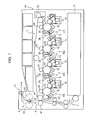
- FIG. 1 is a schematic configuration diagram of a wet image forming apparatus according to an embodiment of the present disclosure.
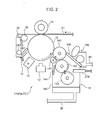
- FIG. 2 is a schematic configuration diagram showing a liquid developing device and the periphery thereof of the wet image forming apparatus shown in FIG. 1 .
- the basic components of a liquid developer according to the present embodiment are an electrically insulating carrier liquid and colored particles dispersed within the carrier liquid.
- This liquid developer is characterized in containing an organic polymer compound and has a viscosity of 30 to 400 mPa ⁇ s at a measurement temperature of 25°C.
- the viscosity (at the measurement temperature of 25°C) is preferably 40 to 300 mPa ⁇ s, and more preferably 50 to 250 mPa ⁇ s.
- An electrically insulating carrier liquid generally plays a role of a liquid carrier and is used for the purpose of enhancing electrical insulation of a liquid developer to be obtained.
- an electrically insulating organic solvent having a volume resistivity of 10 12 ⁇ cm or above at 25°C i.e., an electrical conductivity of 1.0 pS/cm or lower
- a carrier liquid which further can dissolve organic polymer compounds described hereinafter is preferably used (the one with relatively high solubility for the organic polymer compounds).
- the viscosity and type of the carrier liquid as well as the compounding amount therein need to be appropriately adjusted and selected in order to obtain the 30 to 400 mPa ⁇ s viscosity (at the measuring temperature of 25°C) in the entire liquid developer. Because the viscosity of the liquid developer varies depending on a combination of the organic solvent used as the carrier liquid and the organic polymer compound, described hereinafter, the type and compounding amount of the organic solvent need to be appropriately determined in accordance with a desired viscosity of the liquid developer and the type of organic polymer compounds to be selected.
- Examples of such an electrically insulating organic solvent include aliphatic hydrocarbons that are liquid at ordinary temperature, and vegetable oil.
- aliphatic hydrocarbons examples include liquid n-paraffinic hydrocarbons, iso-paraffinic hydrocarbons, halogenated aliphatic hydrocarbons, branched aliphatic hydrocarbons, and a mixture thereof. More specifically, n-hexane, n-heptane, n-octane, nonane, decane, dodecane, hexadecane, heptadecane, cyclohexane, perchloroethylene, trichloroethane, and the like can be used.
- a nonvolatile organic solvent and an organic solvent of relatively low volatility are preferred.
- liquid paraffins that include relatively large amount of aliphatic hydrocarbon with 16 or more carbon atoms can be preferably used.
- the vegetable oil examples include tall oil fatty acid (major components: oleic acid, linoleic acid), vegetable oil-based fatty acid ester, soybean oil, sunflower oil, castor oil, flaxseed oil, and tung oil. Above all, tall oil fatty acid and the like are preferably used.
- a commercially available carrier liquid may be used as the carrier liquid, and examples thereof include liquid paraffins "Moresco White P-55,” “Moresco White P-40,” “Moresco White P-70,” and “Moresco White P-200” manufactured by Matsumura Oil Co., Ltd.; tall oil fatty acids “Hartall FA-1,” “Hartall FA-1P,” and “Hartall FA-3” manufactured by Harima Chemicals, Inc.; vegetable oil-based solvents “Vege-Sol TM MT,” “Vege-Sol TM CM,” “Vege-Sol TM MB,” “Vege-Sol TM PR,” and tung oil manufactured by Kaneda Co., Ltd.; “Isopar TM G,” “Isopar TM H,” “Isopar TM K,” “Isopar TM L,” “Isopar TM M,” and “Isopar TM V” manufactured by ExxonMobil Corporation; liquid paraffins "Cosmo White P-60,” “Co
- any carrier liquid may be used as long as it dissolves the organic polymer compounds.
- the one with relatively high solubility for the organic polymer compounds (the one that dissolves the organic polymer compounds successfully) may be used alone as the carrier liquid, or it may be combined with the one with relatively low solubility for the organic polymer compounds (the one that poorly dissolves the organic polymer compounds).
- the electrical conductivity of the entire carrier liquid to be used or the electrical conductivity of the liquid developer should not be excessively high according to the type of the carrier liquid to be used.
- vegetable oils such as tall oil fatty acids generally have higher electrical conductivities than the aliphatic hydrocarbons such as liquid paraffins. For this reason, when the above-described oils are included as the carrier liquid in order to successfully dissolve the organic polymer compounds in the carrier liquid, attention needs to be paid to the contained amount of the above-described oils.
- the content of the above-described oils in the entire carrier liquid depends on the type and content of the organic polymer compounds included in the liquid developer, and is preferably, for example, 2 to 80 mass%, and more preferably 5 to 60 mass%. It is difficult to successfully dissolve the organic polymer compounds in the carrier liquid when the content of the oils is less than 2 mass%.
- the electrical conductivity of the entire carrier liquid or the electrical conductivity of the liquid developer becomes excessively high when the content of the oils exceeds 80 mass%. Excessively high electrical conductivity of the liquid developer leads to poor developing properties, low image density, and high risk of fogging.
- the electrical conductivity of the liquid developer is preferably, for example, 200 pS/cm or lower. Therefore, the electrical conductivity of the entire carrier liquid or the electrical conductivity of the liquid developer is preferably adjusted to, for example, 200 pS/cm or lower by dissolving the organic polymer compounds in the oils such as tall oil fatty acids and then mixing a highly electrically resistant aliphatic hydrocarbon with thus obtained solution (often referred to as "resin solvent” hereinafter in the present specification).
- the present embodiment may use a well-known toner that is obtained by dispersing pigments in binder resins.
- pigments are used as the colored particles.
- the liquid developer of the present disclosure pigments itself can be included in the liquid developer and thus a thermal fixation process required when using a toner containing a binding resin can be skipped in order to perform image formation.
- the pigments serving as the colored particles can be fixed onto a recording medium without consuming thermal energy or light energy, and consequently the consumption energy of the wet image forming apparatus can be reduced.
- organic pigments or inorganic pigments can be used as the pigments of the present embodiment without any limitation.
- Examples of a black pigment include azine dyes such as carbon black, oil furnace black, channel black, lampblack, acetylene black, and aniline black, metal salt azo dyes, metallic oxides, and combined metal oxides.
- Examples of a yellow pigment include cadmium yellow, mineral fast yellow, nickel titanium yellow, navels yellow, naphthol yellow S, hansa yellow G, hansa yellow 10G, benzidine yellow GR, quinoline yellow lake, permanent yellow NCG, and tartrazine lake.
- Examples of an orange pigment include molybdenum orange, permanent orange GTR, pyrazolone orange, Vulcan orange, indanthrene brilliant orange RK, benzidine orange G, and indanthrene brilliant orange GK.
- red pigment examples include colcothar, cadmium red, permanent red 4R, lithol red, pyrazolone red, watching red calcium salt, lake red D, brilliant carmine 6B, eosin lake, rhodamine lake B, alizarin lake, and brilliant carmine 3B.
- purple pigment examples include fast violet B and methyl violet lake.
- blue pigment examples include C.I. Pigment Blue 15:3, cobalt blue, alkali blue, Victoria blue lake, phthalocyanine blue, non-metal phthalocyanine blue, partial chloride of phthalocyanine blue, fast sky blue, and indanthrene blue BC.
- green pigment examples include chrome green, chromium oxide, pigment green B, and malachite green lake.
- the content of pigment(s) in the liquid developer is preferably 1 to 30 mass%, more preferably 3 mass% or more, and more preferably 5 mass% or more.
- the content of pigment(s) is also more preferably 20 mass% or less, and more preferably 10 mass% or less.
- An average particle diameter of each pigment within the liquid developer which is a volume basis median diameter (D 50 ) is preferably 0.1 to 1.0 ⁇ m.
- the average particle diameter less than 0.1 ⁇ m leads to low image density and high risk of fogging due to poor developing properties.
- the average particle diameter above 1.0 ⁇ m leads to low fixation properties.
- the volume basis median diameter (D 50 ) here generally denotes a particle diameter at the point where a cumulative curve based on the total volume 100% of one group of particles with a determined particle distribution attains 50%.
- the liquid developer according to the present embodiment may contain a dispersion stabilizer for promoting and stabilizing the dispersion of the particles (pigments) within the liquid developer.
- a dispersion stabilizer "BYK-116" manufactured by BYK Co., Ltd., for example, can be suitably used as the dispersion stabilizer according to the present embodiment.
- “Solsperse 9000,” “Solsperse 11200,” “Solsperse 13940,” “Solsperse 16000,” “Solsperse 17000, and “Solsperse 18000” manufactured by The Lubrizol Corporation, and "Antaron TM V-216" and "Antaron TM V-220” manufactured by International Specialty Products, Inc. can be preferably used.
- the content of the dispersion stabilizer within the liquid developer is approximately 1 to 10 mass%, and preferably 2 to 6 mass%.
- the liquid developer according to the present embodiment contains organic polymer compounds. Because simply increasing the viscosity of the liquid developer is not enough to prevent the occurrence of bleeding, adding organic polymer compounds to the liquid developer can achieve sufficient effects, as will be described in the following embodiments.
- Any organic polymer compounds can be used without limitation as long as they can dissolve in the carrier liquid, increase the viscosity of the liquid developer, and prevent the occurrence of bleeding during image formation.
- Specific examples of such organic polymer compounds include a cyclic olefin copolymer, styrene elastomer, cellulose ether, and polyvinyl butyral.
- the use of styrene elastomer can obtain excellent effects.
- These organic polymer compounds can be used alone or in combination of two or more.
- the liquid developer of the present embodiment has the organic polymer compounds dissolved in the carrier liquid.
- the carrier liquid contains gel-like organic polymer compounds as well.
- the organic polymer compounds may become mutually entwined and form a gel having a relatively low fluidity.
- concentrations of the organic polymer compounds is high or when affinity of the organic polymer compounds for the carrier liquid is low or when the ambient temperature is low, the organic polymer compounds may form a gel.
- the carrier liquid is in the form of solution.
- the content of the organic polymer compounds is preferably, for example, 1 to 10 mass% but varies depending on the types thereof.
- the content of the organic polymer compounds is less than 1 mass%, sufficient viscosity cannot be obtained in the liquid developer, which might not be able to effectively prevent the occurrence of bleeding during image formation (on formed images).
- the content of the organic polymer compounds exceeding 10 mass% leads to the formation of an excessively thick film of the organic polymer compounds on a surface of a sheet, deteriorating the drying characteristics of the film, increasing the adherence (tackiness) of the film, and lowering a scratch resistance of the image.
- the content of the organic polymer compounds exceeding 10 mass% also leads to poor developing properties, resulting in low image density and high risk of fogging.
- organic polymer compounds that can be used in the present embodiment are described hereinafter in more detail.
- a cyclic olefin copolymer is an amorphous, thermoplastic cyclic olefin resin that has a cyclic olefin skeleton in its main chain, has no environmental load substance and is excellent in transparency, lightweight properties, and low water absorption properties. More specifically, the cyclic olefin copolymer of the present embodiment is a polymer compound that has a main chain composed of a carbon-carbon bond, in which at least a part of the main chain has a cyclic hydrocarbon structure.
- the cyclic hydrocarbon structure is introduced by using, as a monomer, a compound having at least one olefinic double bond in the cyclic hydrocarbon structure (cyclic olefin), such as norbornene and tetracyclododecene.
- cyclic olefin such as norbornene and tetracyclododecene.
- the conditions for the cyclic olefin copolymer that can be used in the present embodiment are: the cyclic olefin copolymer can stably exist in a dissolved state in the carrier liquid for a long period of time; and the cyclic olefin copolymer can accumulate and then form a film on the surface of the sheet when the concentration of the cyclic olefin copolymer within the carrier liquid increases and consequently exceeds the saturated amount of the dissolved cyclic olefin copolymer on the surface of the sheet after the image is transferred to the sheet.
- examples of the cyclic olefin copolymer that can be used in the present embodiment include (1) cyclic olefin-based addition (co) polymer or its hydrogenated product, (2) an addition copolymer of a cyclic olefin and an ⁇ -olefin, or its hydrogenated product, and (3) a cyclic olefin-based ring-opening (co) polymer or its hydrogenated product.
- the ⁇ -olefin has 2 to 20 carbon atoms, and preferably 2 to 8 carbon atoms. Specific examples thereof include ethylene, propylene, 1-butene, 1-pentene, 1-hexene, 3-methyl-1-butene, 3-methyl-1-pentene, 3-ethyl-1-pentene, 4-methyl-1-pentene, 4-methyl-1-hexene, 4,4-dimethyl-1-hexene, 4,4-dimethyl-1-pentene, 4-ethyl-1-hexene, 3-ethyl-1-hexene, 1-octene, 1-decene, 1-dodecene, 1-tetradecene, 1-hexadecene, 1-octadecene, and 1-eicosene. These ⁇ -olefins can be used alone or in combinations of two or more thereof.
- a method for polymerizing cyclic olefins, a method for polymerizing cyclic olefins with ⁇ -olefins, and a method for hydrogenating the resultant polymer are not particularly limited and can be carried out according to well-known methods.
- the structure of the cyclic olefin copolymer is not particularly limited and may be linear, branched or crosslinked. In the present embodiment, the cyclic olefin copolymer is preferably linear.
- a copolymer of norbornene and ethylene, or of tetracyclododecene and ethylene can be preferably used as the cyclic olefin copolymer, and the copolymer of norbornene and ethylene is more preferred.
- the content of norbornene in the copolymer is preferably 60 to 82 mass%, more preferably 60 to 79 mass%, yet more preferably 60 to 76 mass%, and most preferably 60 to 65 mass%.
- the glass transition temperature of the film of the cyclic olefin copolymer may become excessively low, which may lead to a risk of lowering film formation properties of the cyclic olefin copolymer.
- the glass transition temperature of the film of the cyclic olefin copolymer may become excessively high, which may lead to a risk of lowering fixation properties of the pigments, that is, fixation properties of images by the film of the cyclic olefin copolymer. It also may significantly reduce the solubility of the cyclic olefin copolymer for the carrier liquid.
- a commercially available cyclic olefin copolymer can be used.
- the copolymer of norbornene and ethylene include “TOPAS TM TM" (norbornene content: approximately 60 mass%), “TOPAS TM TB” (norbornene content: approximately 60 mass%), “TOPAS TM 8007” (norbornene content: approximately 65 mass%), “TOPAS TM 5013” (norbornene content: approximately 76 mass%), “TOPAS TM 6013” (norbornene content: approximately 76 mass%), “TOPAS TM 6015" (norbornene content: approximately 79 mass%), and “TOPAS TM 6017” (norbornene content: approximately 82 mass%), which are manufactured by TOPAS Advanced Polymers GmbH. These copolymers may be used alone or in combinations of two or more thereof, depending on the circumstances.
- a conventionally known styrene elastomer can be used as the styrene elastomer available in the present embodiment.
- Specific examples thereof include a block copolymer composed of an aromatic vinyl compound and a conjugated diene compound or olefinic compound.
- Examples of the block copolymer include a block copolymer that has a structure expressed by Formula 1 where A is a polymer block composed of an aromatic vinyl compound and B is a polymer block composed of an olefinic compound or a conjugated diene compound.
- [C1] [A-B] x -A (CHEMICAL FORMULA 1) (WHERE x REPRESENTS AN INTEGER CHOSEN SUCH THAT THE NUMBER AVERAGE MOLECULAR WEIGHT RANGES FROM 1,000 TO 100,000.)
- aromatic vinyl compound constituting the block copolymer examples include styrene, ⁇ -methylstyrene, ⁇ -methylstyrene, m-methylstyrene, p-methylstyrene, 2,3-dimethylstyrene, 2,4-dimethylstyrene, monochlorostyrene, dichlorostyrene, p-bromostyrene, 2,4,5-tribromostyrene, 2,4,6-tribromostyrene, o-tert-butylstyrene, m-tert-butylstyrene, p-tert-butylstyrene, ethylstyrene, vinylnaphthalene, and vinylanthracene.
- the polymer block A may be composed of one or two or more types of the aromatic vinyl compounds described above. Of these aromatic vinyl compounds, the one composed of styrene and/or ⁇ -methylstyrene provides properties suitable for the liquid developer of the present embodiment.
- Examples of the olefinic compound constituting the block copolymer include ethylene, propylene, 1-butene, 2-butene, isobutene, 1-pentene, 2-pentene, cyclopentene, 1-hexene, 2-hexene, cyclohexene, 1-heptene, 2-heptene, cycloheptene, 1-octene, 2-octene, cyclooctene, vinylcyclopentene, vinylcyclohexene, vinylcycloheptene, and vinylcyclooctene.
- Examples of the conjugated diene compound constituting the block copolymer include butadiene, isoprene, chloroprene, 2,3-dimethyl-1,3-butadiene, 1,3-pentadien, and 1,3-hexadien.
- the polymer block B may be composed of one or two or more types of each of the olefinic compounds and/or the conjugated diene compounds. Of these compounds, the one composed of butadiene and/or isoprene provides the properties suitable for the liquid developer of the present embodiment.
- block copolymer examples include a polystyrene-polybutadiene-polystyrene triblock copolymer or its hydrogenated product, polystyrene-polyisoprene-polystyrene triblock copolymer or its hydrogenated product, polystyrene-poly (isoprene/butadiene)-polystyrene triblock copolymer or its hydrogenated product, poly ( ⁇ -methylstyrene)-polybutadiene-poly ( ⁇ -methylstyrene) triblock copolymer or its hydrogenated product, poly ( ⁇ -methylstyrene)-polyisoprene-poly ( ⁇ -methylstyrene) triblock copolymer or its hydrogenated product, poly ( ⁇ -methylstyrene)-poly (isoprene/butadiene)-poly ( ⁇ -methylstyrene) triblock copolymer or its hydrogenated product
- SBS styrene-butadiene elastomer
- the styrene-butadiene elastomer is obtained by copolymerizing styrene monomer and butadiene, which is the conjugated diene compound.
- preferred styrene monomer include styrene, ⁇ -methylstyrene, o-methylstyrene, m-methylstyrene, p-methylstirene, p-ethylstyrene, 2,4-dimethylstyrene, p-n-butylstyrene, p-dodecylstyene, p-methoxystyrene, p-phenylstyrene, and p-chlorostyrene.
- the styrene-butadiene elastomer has a number average molecular weight Mn within a range of, preferably, 1,000 to 100,000 (see Formula 1) and more preferably 2,000 to 50,000, in a molecular weight distribution measured using a GPC (gel permeation chromatography).
- a weight-average molecular weight Mw of the styrene-butadiene elastomer is within a range of, preferably, 5,000 to 1,000,000 and more preferably 10,000 to 500,000. In this case, at least one peak is present within the weight-average molecular weight Mw range of 2,000 to 200,000 and preferably within the weight-average molecular weight Mw range of 3,000 to 150,000.
- the value of (weight-average molecular weight Mw/number average molecular weight Mn) ratio is preferably equal to or lower than 3.0, and more preferably equal to or lower than 2.0.
- the content of styrene within the styrene-butadiene elastomer is within a range of, preferably, 5 to 75 mass% (see Formula 2) and more preferably 10 to 65 mass%.
- the styrene content is less than 5 mass%, the glass transition temperature of a film of the styrene elastomer becomes excessively low, deteriorating the film formation properties of the styrene elastomer.
- the softening point of the film of the styrene elastomer becomes excessively high, lowering fixation properties of the pigments, that is, fixation properties of images by the film of the styrene elastomer.
- styrene elastomer a commercially available styrene elastomer can be used.
- “Clayton” manufactured by Shell, "Asaprene TM “ T411, T413, T437, “Tufprene TM “ A, 315P, which are manufactured by Asahi Kasei Chemicals Corporation, and "JSR TR1086,” “JSR TR2000,” “JSR TR2250” and “JSR TR2827” manufactured by JSR Corporation can be used as a styrene-conjugated diene block copolymer.
- Cellulose ether is a polymer formed by substituting a hydroxyl group of a cellulose molecule with an alkoxy group.
- the substitution rate is preferably 45 to 49.5%.
- the alkyl moiety of the alkoxy group may be substituted with, for example, hydroxyl group or the like.
- a film formed by cellulose ether is excellent in toughness and thermal stability.
- the conditions for the cellulose ether that can be used in the present embodiment are: the cellulose ether can stably exist in a dissolved state in the carrier liquid for a long period of time; and the cellulose ether can accumulate and then form a film on a surface of a sheet when the concentration of the cellulose ether within the carrier liquid increases and consequently exceeds the saturated amount of the dissolved cellulose ether on the surface of the sheet after the image is transferred to the sheet.
- examples of the cellulose ether that can be used in the present embodiment include: alkyl cellulose such as methylcellulose and ethylcellulose; hydroxyalkyl cellulose such as hydroxyethyl cellulose and hydroxypropyl cellulose; hydroxy alkyl alkyl cellulose such as hydroxyethyl methyl cellulose, hydroxypropyl methyl cellulose, and hydroxyethyl ethyl cellulose; carboxy alkyl cellulose such as carboxymethyl cellulose; and carboxyalkyl hydroxy-alkyl cellulose such as carboxymethyl hydroxyethyl cellulose.
- These cellulose ethers may be used alone or in combinations of two or more thereof, depending on the circumstances. Of these cellulose ethers, alkyl celluloses are preferred. Of these alkyl celluloses, ethyl celluloses are preferred.
- a commercially available cellulose ether can be used.
- examples thereof include “Ethocel TM STD4,” “Ethocel TM STD7,” and “Ethocel TM STD10” manufactured by Nissin-Kasei Co., Ltd.. These ethyl celluloses may be used alone or in combinations of two or more thereof, depending on the circumstances.
- the polyvinyl butyral that can be used in the present embodiment (butyral resin: alkyl acetalized polyvinyl alcohol) is, as shown in Formula 3, a copolymer of a hydrophilic vinyl alcohol unit having a hydroxyl group, a hydrophobic vinyl acetal unit having a butyral group, and a vinyl acetate unit having an intermediate property between a vinyl alcohol unit and vinyl acetal unit and having an acetyl group.
- Polyvinyl butyral which has a degree of butyralization (the ratio between a hydrophilic moiety and a hydrophobic moiety) between 60 to 85 mol% is preferred in the liquid developer of the present embodiment in terms of its excellent film formation properties (film formation properties).
- the polyvinyl butyral has a vinyl acetal unit indicating the solubility of the polyvinyl butyral for a nonpolar solvent and a vinyl alcohol unit for improving the bonding properties of the recording medium such as a paper sheet. Therefore, the polyvinyl butyral has high affinity with both the carrier liquid and the recording medium.
- the polyvinyl butyral that can be used in the present embodiment is not particularly limited. Examples thereof include “Mowital TM " B20H, B30B, B30H, B60T, B60H, B60HH and B70H manufactured by Hoechst AG; “S-LEC TM " BL-1 (degree of butyralization: 63 ⁇ 3 mol%), BL-2 (degree of butyralization: 63 ⁇ 3 mol%), BL-S (degree of butyralization: 70 mol% or more), BL-L, BH-3 (degree of butyralization: 65 ⁇ 3 mol%), BM-1 (degree of butyralization: 65 ⁇ 3 mol%), BM-2 (degree of butyralization: 68 ⁇ 3 mol%), BM-5 (degree of butyralization: 63 ⁇ 3 mol%) and BM-S, manufactured by Sekisui Chemical Co., Ltd.; and "Denka butyral” #2000-L, #3000-1, #3
- the liquid developer according to the present embodiment can be produced by sufficiently dissolving or mixing/dispersing the carrier liquid, pigments, organic polymer compounds and, depending on the situation, the dispersion stabilizer for several minutes to over 10 hours, depending on the situation, by using, for example, a ball mill, sand grinder, Dyno mill, rocking mill or the like (or a media distributed machine using zirconia beads and the like may be used).
- the mixing/dispersion time and the rotating speed of the machine to be used are adjusted so that the average particle diameter (D 50 ) of the pigments within the liquid developer becomes, preferably, 0.1 to 1.0 ⁇ m as described above.
- the average particle diameter of the pigments (D 50 ) exceeds 1.0 ⁇ m, deteriorating the fixation properties as described above.
- the dispersion time is excessively long or when the rotating speed is excessively high, the average particle diameter of the pigments (D 50 ) becomes less than 0.1 ⁇ m, leading to poor developing properties, resulting in low image density and high risk of fogging.
- the liquid developer may be produced by dissolving the organic polymer compounds in the carrier liquid and then mixing/dispersing the pigments (along with the dispersion stabilizer, depending on the situation).
- the liquid developer may also be produced by preparing a resin solution (obtained by dissolving the organic polymer compounds in the carrier liquid) and a pigment dispersion (obtained by mixing/dispersing the pigments in the carrier liquid (along with the dispersion stabilizer, depending on the situation)), and then mixing the resin solution with the pigment dispersion at an appropriate mixing ratio (mass ratio).
- a particle size distribution needs to be measured in order to calculate the average particle diameter (D 50 ) of the pigments.
- the particle size distribution of the pigments can be measured as follows. For example, a predetermined amount of produced liquid developer or prepared pigment dispersion is sampled and diluted to 10 to 100 times of its volume with the same carrier liquid as the one used in the liquid developer or the pigment dispersion. The particle size distribution of thus obtained liquid is measured based on a flow system using a laser diffraction type particle size distribution measuring device "Mastersizer 2000" manufactured by Malvern Instruments Ltd..
- the viscosity of the produced liquid developer can be measured at a measurement temperature of 25°C by using a vibrational viscometer "Viscomate VM-10A-L” manufactured by CBC Co., Ltd..
- sheet in the following description denotes a variety of recording media on which images can be formed, such as, for example, high quality plain paper, printing paper, copy paper, tracing paper, cardboard, and OHP sheets.
- FIG. 1 is a schematic configuration diagram of the wet image forming apparatus according to the present embodiment.
- FIG. 2 is a schematic configuration diagram showing the liquid developing device of the wet image forming apparatus and its periphery shown in FIG. 1 .
- the wet image forming apparatus according to the present embodiment is a color printer; however, it could be any type of wet image forming apparatus capable of forming images on sheets or recording media, such as, for example, a black-and-white printer, a copy machine, a facsimile machine, or a multi-functional peripheral having these functions.
- a wet image forming apparatus 1A has a variety of units and parts used for forming images.
- the image forming apparatus 1A further has yellow (Y), magenta (M), cyan (C) and black (Bk) liquid developer circulators below what is shown in FIG. 1 , but the illustration thereof is omitted.
- the wet image forming apparatus 1A has a tandem type image forming part 2 for forming an image based on image data, a sheet accommodating part 3 for accommodating the sheets, a secondary transfer part 4 for transferring the image formed by the image forming part 2 onto the sheets, a discharge part 6 for discharging the sheets to the outside of the apparatus after the image is completely fixed thereon, and a sheet conveying part 7 for conveying the sheets from the sheet accommodating part 3 to the discharge part 6.
- a fixing part 5 for fixing the transferred image onto each sheet (the fixing part 5 has a heating roller 51 and a pressure roller 52 that are disposed to face each other so as to convey the sheet therebetween) is disposed between the secondary transfer part 4 and the discharge part 6.
- the wet image forming apparatus 1A of the present embodiment may not have such a fixing part, and, instead, may simply have sheet conveying rollers 8, 8.
- the wet image forming apparatus 1A according to the present embodiment is capable of fixing the transferred image onto the sheet by using the abovementioned liquid developer of the present embodiment, without requiring the fixing part. Therefore, since the wet image forming apparatus 1A does not require the fixing part 5 that consumes thermal or light energy as in the prior art, simplification and cost-cutting of the wet image forming apparatus 1A can be realized.
- the image forming part 2 has an intermediate transfer belt 21, a cleaning unit 22 for cleaning the intermediate transfer belt 21, and image forming units FY, FM, FC and FB corresponding to the colors of yellow (Y), magenta (M), cyan (C), and black (Bk).
- the surface facing the outside is described as "front surface”
- the surface facing the inside is described as “rear surface.”
- the image forming units FY, FM, FC and FB are disposed side by side along a lower running surface of the intermediate transfer belt 21.
- the order of the image forming units FY, FM, FC and FB is not limited to the one illustrated in FIG. 1 , but the arrangement shown in FIG. 1 is a preferred example from the perspective of minimizing the influence of color mixture on a completed image.
- Each of the image forming units FY, FM, FC and FB has a photoreceptor drum 10, a charger 11, an LED exposure device 12, a liquid developing device 14, a primary transfer roller 20, a cleaning device 26, a destaticizing device 13, and a carrier liquid removing roller 30.
- the black image forming unit FB located closest to the secondary transfer part 4 is not provided with the carrier liquid removing roller 30, but the rest of its configuration is same as those of the other image forming units.
- a surface (circumferential surface) of the cylindrical photoreceptor drum 10 is capable of carrying an image rendered by charged colored particles (charged to a positive polarity in the present embodiment).
- the photoreceptor drums 10 shown in the diagram are capable of rotating in a counterclockwise direction.
- the charger 11 uniformly charges the surface of the photoreceptor drum 10. Operations of the charger 11 configure a charging step.
- the LED exposure device 12 has LEDs as light sources to emit light beams to the uniformly charged surface of the photoreceptor drum 10, based on the image data input from external equipment. As a result, an electrostatic latent image based on the image data is formed on the surface of the photoreceptor drum 10. Operations of the exposure device 12 configure an exposure step.
- the liquid developing device 14 holds the liquid developer having the electrically insulating carrier liquid and the colored particles dispersed in the carrier liquid, so as to face the electrostatic latent image formed on the surface of the photoreceptor drum 10. Accordingly, the electrostatic latent image on the surface of the photoreceptor drum 10 is developed (rendered) to a toner image by the charged colored particles. Operations of the liquid developing device 14 configure a developing step. Note that the liquid developing device 14 and the wet image forming apparatus 1A according to the present embodiment use the abovementioned liquid developer.
- the liquid developing device 14 includes a developer container 140, a developing roller 141, a feed roller (anilox roller) 142, a supporting roller 143, a feed roller blade 144, a developer cleaning blade 145, a developer recovery device 146, and a developing roller charger 147.
- the developer container 140 into which the liquid developer is fed accumulates the liquid developer therein.
- the liquid developer obtained after the concentrations of the carrier liquid and the colored particles are adjusted, is fed from a feed nozzle 278 into the developer container 140.
- the liquid developer is fed toward a nip between the feed roller 142 and the supporting roller 143, and an excess of the liquid developer drops below the supporting roller 143 and accumulates in a bottom part of the developer container 140.
- the accumulated liquid developer is recovered through a pipe 82 and prepared for reproduction/reuse.
- the supporting roller 143 disposed substantially in the middle of the developer container 140, comes into abutment from below, against the feed roller 142, to form the nip therebetween.
- the feed roller 142 is not disposed immediately above the supporting roller 143 but shifted in a direction to separate from the feed nozzle 278.
- a circumferential surface of the feed roller 142 is provided with a groove for holding the liquid developer.
- the supporting roller 143 rotates in the counterclockwise direction and the feed roller 142 rotates in the clockwise direction, as shown by the dotted arrows in the diagram.
- the liquid developer fed from the feed nozzle 278 is temporarily accumulated on the upstream side of the direction of rotation of the supporting roller 143 at the nip between the feed roller 142 and the supporting roller 143, and then delivered upward while being held in the groove of the feed roller 142 as the rollers 142 and 143 rotate.
- the feed roller blade 144 is brought into press-contact with the circumferential surface of the feed roller 142 to regulate the amount of liquid developer held in the groove of the feed roller 142, to a predetermined amount.
- the excess liquid developer that is scraped off by the feed roller blade 144 accumulates in the bottom part of the developer container 140.
- the developing roller 141 is disposed at an upper opening part of the developer container 140, in a manner that the developing roller 141 is contact with the feed roller 142.
- the developing roller 141 is rotated in the same direction as the feed roller 142.
- the surface of the developing roller 141 moves in a direction opposite to the surface of the feed roller 142 at a nip where the developing roller 141 is in abutment with the feed roller 142. Therefore, the liquid developer held on the circumferential surface of the feed roller 142 is delivered to the circumferential surface of the developing roller 141.
- the amount of liquid developer held in the groove of the feed roller 142 (the thickness of a liquid developer layer) is regulated to the predetermined amount, the amount of liquid developer carried on the surface of the developing roller 141 (the thickness of the liquid developer layer) is also kept at a predetermined value.
- the developing roller charger 147 provides bias potential having the same polarity as a charged polarity of the colored particles (a bias potential having the positive polarity, in the present embodiment), from an external surface side to the developing roller 141 (developing corona charge), so as to move the colored particles in the liquid developer layer carried on the surface of the developing roller 141, to the surface side of the developing roller 141.
- a bias potential having the positive polarity in the present embodiment
- the colored particles within the liquid developer layer are collected/compressed on the developing roller 141 side by an electric field action (compaction process), forming a layer of highly-concentrated colored particles on the developing roller 141 side.
- the liquid developer layer is fed to the photoreceptor drum 10, and the electrostatic latent image is developed on the photoreceptor drum 10.
- the developing roller charger 147 is provided so as to face the circumferential surface of the developing roller 141 on the downstream side of the direction of rotation of the developing roller 141 from a contact portion between the developing roller 141 and the feed roller 142, and on the upstream side of the direction of rotation of the developing roller 141 from a contact portion between the developing roller 141 and the photoreceptor drum 10. In other words, the developing roller charger 147 generates an electric field through the developing corona charge. Consequently, the liquid developer layer on the developing roller 141 is divided into the colored particle layer on the surface of the developing roller 141 and a carrier liquid layer on the colored particle layer.
- a developing region a region where the developing roller 141 and the photoreceptor drum 10 are in face contact with each other, and a peripheral region thereof
- the divided liquid developers layer on the developing roller 141 come into contact with the surface of the photoreceptor drum 10.
- the collected/compressed colored particles on the developing roller 141 side move from the surface of the developing roller 141 to the surface of the photoreceptor drum 10 according to the principle of electrophoresis, in order to render the electrostatic latent image on the surface of the photoreceptor drum 10 into an image.
- the colored particles within the liquid developer layer on the developing roller 141 are compressed on the surface of the developing roller 141 (compaction process) as a result of the developing corona charge performed by the developing roller charger 147, the colored particles do not come into contact with photoreceptor drum 10 at a non-image region on the photoreceptor drum 10, preventing the occurrence of fogging in image formation.
- an electric charge is injected into the colored particles within the liquid developer layer on the developing roller 141.
- a development electric field develops the electrostatic latent image on the photoreceptor drum 10 with satisfactory response by using the colored particles.
- the colored particles electrostatically and tightly adhere to an image area on the surface of the photoreceptor drum 10.
- the developing roller 141 comes into contact with the photosensitive drum 10, whereby the toner image based on the image data is formed on the surface of the photoreceptor drum 10 by a difference in potential between the electrostatic latent image on the surface of the photoreceptor drum 10 and the development electric field applied to the developing roller 141.
- the developer cleaning blade 145 is disposed in contact with the downstream side of the direction of rotation of the developing roller 141 from the contact portion between the developing roller 141 and the photoreceptor drum 10.
- the developer cleaning blade 145 removes the liquid developer on the surface of the developing roller 141 after the electrostatic latent image on the photoreceptor drum 10 is developed.
- the developer recovery device 146 recovers the liquid developer removed by the developer cleaning blade 145 and delivers the liquid developer to a pipe 81 of each liquid developer circulator.
- the liquid developer flows downward along the surface of the developer cleaning blade 145. Due to the high viscosity of the liquid developer, the developer recovery device 146 is provided with delivery rollers for assisting in delivering the liquid developer.
- the primary transfer roller 20 is disposed on the rear surface of the intermediate transfer belt 21 so as to face the photoreceptor drum 10. Voltage having a polarity opposite to that of the colored particles within the image is applied from a power source (not shown) to the primary transfer roller 20. At a position where the primary transfer roller 20 is in contact with the intermediate transfer belt 21, the primary transfer roller 20 applies, to the intermediate transfer belt 21, the voltage having the polarity opposite to that of the colored particles. The colored particles are attracted to the front surface of the intermediate transfer belt 21 and its periphery by this applied voltage. In other words, the image that is developed on the surface of the photoreceptor drum 10 is transferred to the intermediate transfer belt 21.
- the intermediate transfer belt 21 functions as an image carrier for carrying an image thereon and conveying it to a sheet.
- the use of the abovementioned liquid developer of the present embodiment can prevent the liquid developer from accumulating in the nip between the photoreceptor drum and the intermediate transfer body, thereby preventing the occurrence of bleeding during image formation.
- the cleaning device 26 is a device for cleaning the liquid developer that remains on the photoreceptor drum 10 without being transferred from the photoreceptor drum 10 to the intermediate transfer belt 21.
- the cleaning device 26 has a residual developer conveying screw 261 and a cleaning blade 262.
- the residual developer conveying screw 261 disposed within the cleaning device 26 conveys the residual developer to the outside of the cleaning device 26, the residual developer being scraped off the photoreceptor drum 10 by the cleaning blade 262 and then stored in the cleaning device 26.
- the plate-like cleaning blade 262 extends in a direction of a rotation axis of the photoreceptor drum 10 so as to scrape the liquid developer remaining on the surface of the photoreceptor drum 10.
- One end portion of the cleaning blade 262 is in sliding contact with the surface of the photoreceptor drum 10 so as to scrape the residual liquid developer on the photoreceptor drum 10 as the photoreceptor drum 10 rotates.
- the destaticizing device 13 with destaticizing light sources destaticizes the surface of the photoreceptor drum 10 using lights of the light sources, after the liquid developer is removed by the cleaning blade 262.
- the substantially cylindrical carrier liquid removing roller 30 is capable of rotating about a rotation axis thereof parallel to the rotation axis of the photoreceptor drum 10, in the same direction as the photoreceptor drum 10.
- the carrier liquid removing roller 30 is disposed on the secondary transfer part 4 side with respect to the position where the photoreceptor drum 10 and the intermediate transfer belt 21 are in contact with each other.
- the carrier liquid removing roller 30 removes the carrier liquid from the front surface of the intermediate transfer belt 21.
- the sheet accommodating part 3 shown in FIG. 1 accommodates the sheets on which the image is fixed and formed.
- the sheet accommodating part 3 is disposed in a lower part of the wet image forming apparatus 1A.
- the sheet accommodating part 3 also has a paper cassette (not shown) that is formed so as to be able to accommodate the sheets.
- the secondary transfer part 4 transfers the image formed on the intermediate transfer belt 21, to each of the sheets.
- the secondary transfer part 4 has a supporting roller 41 for supporting the intermediate transfer belt 21 and a secondary transfer roller 42 disposed so as to face the supporting roller 41.
- the secondary transfer part 4, the intermediate transfer belt 21, and the primary transfer roller 20 constitute a transfer device. Operations of the secondary transfer part 4, operations of the intermediate transfer belt 21, and operations of the primary transfer roller 20 constitute a transfer step.
- the conveying rollers 8, 8 may be provided above the secondary transfer part 4, as described above.
- the sheet conveying part 7 having a plurality of pairs of conveying rollers is for conveying the sheets from the sheet accommodating part 3 to the discharge part 6 via the secondary transfer part 4. After the transfer of the image, the sheet having the image fixed thereon completely is discharged from the discharge part 6 that is provided on an upper part of the wet image forming apparatus 1A. Operations of the discharge part 6 for discharging the sheet to which the image is transferred constitute a discharge step.
- the wet image forming method according to the present embodiment includes: the charging step of charging the surface of the photoreceptor drum 10; the exposure step of forming the electrostatic latent image on the charged surface of the photoreceptor drum 10; the developing step of developing the electrostatic latent image on the surface of the photoreceptor drum 10 by using a liquid developer that includes an electrically insulating carrier liquid, colored particles dispersed within the carrier liquid, and an organic polymer compound, and has a viscosity of 30 to 400 mPa ⁇ s (at a measurement temperature of 25°C); the transfer step of transferring the developed image to the sheet; and the discharge step of discharging the sheet having the image transferred thereto, from the discharge part 6.
- the use of the above mentioned liquid developer can prevent the occurrence of bleeding during image formation and obtain high-quality images.
- the average particle diameter (D 50 ) of the pigment within the pigment dispersion was 0.5 ⁇ m.
- each of the organic polymer compounds (resin) in an amount of 15 parts by mass shown in Table 1 below was stirred, mixed and dissolved in each of the resin solution solvents in an amount of 85 parts by mass shown in Table 1 below, by using a stirring device (Tornado SM-102 manufactured by As One Corporation) (room temperature (25 C°), rotating speed: 800 rpm, time: 30 minutes), in order to obtain a resin solution.
- a stirring device Tech SM-102 manufactured by As One Corporation
- carrier liquid 2 a carrier liquid different than the carrier liquid 1
- the carrier liquid 1 and the carrier liquid 2 in the present example indicate a first type of carrier liquid (carrier liquid 1) and a second type of carrier liquid (carrier liquid 2) used in the respective liquid developers.
- each of the obtained resin solutions, the high-concentration pigment dispersion, and an additional carrier liquid were stirred and mixed at each of mixing ratios shown in Table 2 below, by using the stirring device (Tornado SM-102 manufactured by As One Corporation) (room temperature (25 C°), rotating speed: 800 rpm, time: 30 minutes), in order to obtain liquid developers A to E (Examples 1 to 5) and liquid developers G to K (comparative examples 1 to 5).
- Polyvinyl butyral (“S-LEC TM BL-1” manufactured by Sekisui Chemical Co., Ltd.) in an amount of 3.8 parts by mass was dissolved in castor oil (castor oil "LAV” manufactured by Ito Oil Chemicals Co., Ltd.) in an amount of 36.5 parts by mass, serving as a carrier liquid, in order to prepare a resin solution.
- castor oil castor oil "LAV” manufactured by Ito Oil Chemicals Co., Ltd.
- the obtained resin solution in an amount of 40.3 parts by mass and the cyan pigment (C.I.
- the average particle diameter (D 50 ) of the pigments within the liquid developer F was 0.4 ⁇ m.
- Table 3 shows the compounding ratios (mass%) among the pigments, dispersion, organic polymer compounds and carrier liquid in each of the liquid developers A to K obtained as described above.
- Carrier liquid 1 and carrier liquid 2 shown in Table 3 correspond to the carrier liquid 1 and the carrier liquid 2 shown in Tables 1 and 2.
- the cyan liquid developers A to K are poured into the cyan image forming unit FC, and a square solid image (5 cm ⁇ 5 cm) was formed on a sheet of printing paper (paper for wet development "EP-L”: 128 g/m 2 , manufactured by Mitsubishi Paper Mills Limited) by uniformly applying the pigments in an amount of 0.026 mg/cm 2 .
- the thickness of the liquid developer layer on the circumferential surface of the developing roller 141 was set at 6 ⁇ m.
- a development voltage to be applied to the developing roller 141 when forming the image on the surface of the photoreceptor drum 10 based on the image data was set at 400 V.
- the sheet discharged from the discharge part 6 was subjected to image evaluation.
- the other image formation conditions are as follows:
- the solid image is formed on the intermediate transfer belt (the drive of the experimental machine is stopped prior to secondary transfer).
- a piece of tape (Mending tape (CAT. NO. 810-1-18) manufactured by 3M) is pasted to a boundary section between an image area and a non-image area in a rear end part of the solid image.
- the tape is pressed with a finger to transfer the image on the intermediate transfer belt to the tape.
- the tape is pasted on a sheet of white paper (paper for wet development "EP-L”: 128 g/m 2 , manufactured by Mitsubishi Paper Mills Limited) to visually observe the boundary section between the image area and the non-image area.
- the result is then marked by " ⁇ .”
- the result is then marked by "x.”
- the result is also marked by " ⁇ .”
- the liquid developer includes the electrically insulating carrier liquid, colored particles dispersed within the carrier liquid and the organic polymer compounds, and has a viscosity of 30 to 400 mPa ⁇ s (at a measurement temperature of 25°C)
- the viscosity and the tackiness of the liquid section in the non-image area increases because the carrier liquid contains the organic polymer compounds in the non-image area.
- This increases the amount of carrier liquid passing through the nip between each photoreceptor and the intermediate transfer body, whereby the amount of carrier liquid accumulating before reaching the nip decreases drastically. This can solve the problem of bleeding that occurs when forming images. As a result, high-quality images with no bleeding can be obtained.
- a liquid developer capable of preventing the occurrence of bleeding can be reliably obtained by selecting at least one organic polymer compound from cyclic olefin copolymer, styrene elastomer, cellulose ether, and polyvinyl butyral.
- the liquid developer includes 1 to 10 parts by mass% organic polymer compounds, the occurrence of bleeding during image formation (on formed images) can be prevented, ensuring excellent image developing properties.
- More excellent developing properties can be obtained when the carrier liquid has a volume resistivity of 10 12 ⁇ cm or above.
- the image, transferred to the sheet can be fixed thereto without requiring the fixing step of using thermal or light energy to fix the image, transferred onto the sheet, which is effective in terms of energy saving.
- the organic polymer compounds within the carrier liquid accumulates on a surface of the recording medium and forms a film while coating the pigments accumulated on the surface of the recording medium, and this film formed by the organic polymer compounds fixes the pigments to the recording medium. Therefore, the consumption of the thermal energy or light energy can be eliminated or reduced significantly, and the pigments, or the image, can be fixed to the recording medium with no or low heat. Consequently, the consumption energy of the wet image forming apparatus can be reduced.
- the conventional fixing part that uses thermal or light energy can be eliminated or simplified so as to realize simplification and cost-cutting of the wet image forming apparatus.
- the carrier liquid penetrates the image area of the sheet, and the organic polymer compounds precipitate on the surface of the sheet.
- the colored particles are fixed to the sheet.
- the carrier liquid penetrates the non-image area of the sheet, the organic polymer compounds precipitate on the surface of the sheet. Therefore, the precipitated organic polymer compounds are fixed to the image area and the non-image area of the sheet, preventing the colored particles from being peeled off or the image from being contaminated. Accordingly, high-quality images can be obtained.
- a liquid developing device that uses the liquid developer described above is capable of preventing the occurrence of bleeding when forming images (on formed images) and obtaining high-quality images.
- a wet image forming method that uses the liquid developer described above is capable of preventing the occurrence of bleeding and obtaining high-quality images.
Landscapes
- Physics & Mathematics (AREA)
- General Physics & Mathematics (AREA)
- Chemical & Material Sciences (AREA)
- Chemical Kinetics & Catalysis (AREA)
- Liquid Developers In Electrophotography (AREA)
- Wet Developing In Electrophotography (AREA)
Abstract
Description
- The present disclosure relates to a technical field regarding a wet developing method, which is one of the electrophotographic systems that can be adopted in printers, copy machines, facsimile machines, or multi-functional peripherals having these functions.
- Developing systems used in an electrophotographic method for rendering an electrostatic latent image with electrically charged colored particles are generally classified roughly into a dry developing method and a wet developing method, depending on the type of the developer used. The wet developing method uses a liquid developer having colored particles dispersed within an electrically insulating carrier liquid. The colored particles electrically charged within the liquid developer moves from a developing roller surface to a photoreceptor drum surface according to the principle of electrophoresis, in order to render an electrostatic latent image on the photoreceptor drum surface into a toner image. The obtained toner image is transferred from the photoreceptor drum to a recording medium. The colored particles of the liquid developer are hardly scattered into the atmosphere, and therefore fine particles with, for example, submicron-sized average particle diameter can be used. Thus, high-quality, high-resolution images with excellent gradation can be obtained.
- When an image forming apparatus using the wet developing method is continuously driven without printing anything or to print very few, the carrier liquid accumulates in a nip between the photoreceptor and an intermediate transfer body (intermediate transfer system) or a nip between the photoreceptor and a sheet (direct transfer system), causing bleeding. The bleeding is particularly noticeable when starting to drive the image forming apparatus, or between sheets when the image forming apparatus is used for continuous printing, because the entire image surface is a non-image area in those cases.
- As a way to prevent the occurrence of bleeding, there has been reported technology for stabilizing the dispersion of a liquid toner by using a specific pigment, so as to prevent bleeding in images.
- This conventional method, however, cannot use different-colored pigments other than a specific pigment because the use of other pigments still causes the bleeding. An object of the present disclosure is to provide a liquid developer, a liquid developing device, a wet image forming apparatus, and a wet image forming method, which are capable of preventing the occurrence of bleeding even when using a variety of pigments.
- As a result of a dedicated study in view of the object described above, the inventors of the present disclosure have focused on that the bleeding in images can be prevented by including an organic polymer compound into a liquid developer and adjusting the viscosity of the liquid developer to a predetermined viscosity, and completed the present disclosure through further researches.
- Specifically, one aspect of the present disclosure for accomplishing the object described above is a liquid developer that includes an electrically insulating carrier liquid, colored particles dispersed within the carrier liquid, and an organic polymer compound, and has a viscosity of 30 to 400 mPa·s at a measurement temperature of 25°C.
- Another aspect of the present disclosure for accomplishing the object described above is a liquid developing device for developing an electrostatic latent image on a surface of a photoreceptor drum by using a liquid developer, wherein the liquid developing device uses, as the liquid developer, a liquid developer that includes an electrically insulating carrier liquid, colored particles dispersed within the carrier liquid, and an organic polymer compound, and has a viscosity of 30 to 400 mPa·s (at a measurement temperature of 25°C).
- Yet another aspect of the present disclosure for accomplishing the object described above is a wet image forming apparatus, having: a charger for charging a surface of a photoreceptor drum; an exposure device for forming an electrostatic latent image on the charged surface of the photoreceptor drum; a liquid developing device for developing the electrostatic latent image on the surface of the photoreceptor drum by using a liquid developer; and a transfer device for transferring (directly or indirectly) the developed image to a recording medium, wherein the wet image forming apparatus uses, as the liquid developer, a liquid developer that includes an electrically insulating carrier liquid, colored particles dispersed within the carrier liquid, and an organic polymer compound, and has a viscosity of 30 to 400 mPa·s (at a measurement temperature of 25°C).
- Yet another aspect of the present disclosure for accomplishing the object described above is a wet image forming method, having: a charging step of charging a surface of a photoreceptor drum; an exposure step of forming an electrostatic latent image on the charged surface of the photoreceptor drum; a developing step of developing the electrostatic latent image on the surface of the photoreceptor by using a liquid developer that includes an electrically insulating carrier liquid, colored particles dispersed within the carrier liquid, and an organic polymer compound, and has a viscosity of 30 to 400 mPa·s (at a measurement temperature of 25°C); a transfer step of transferring the developed image to a recording medium; and a discharge step of discharging the recording medium having the image transferred thereto, to a discharge part.
-
FIG. 1 is a schematic configuration diagram of a wet image forming apparatus according to an embodiment of the present disclosure; and -
FIG. 2 is a schematic configuration diagram showing a liquid developing device and the periphery thereof of the wet image forming apparatus shown inFIG. 1 . - The basic components of a liquid developer according to the present embodiment are an electrically insulating carrier liquid and colored particles dispersed within the carrier liquid. This liquid developer is characterized in containing an organic polymer compound and has a viscosity of 30 to 400 mPa·s at a measurement temperature of 25°C.
- The viscosity (at the measurement temperature of 25°C) is preferably 40 to 300 mPa·s, and more preferably 50 to 250 mPa·s.
- An electrically insulating carrier liquid generally plays a role of a liquid carrier and is used for the purpose of enhancing electrical insulation of a liquid developer to be obtained. For example, an electrically insulating organic solvent having a volume resistivity of 1012 Ω·cm or above at 25°C (i.e., an electrical conductivity of 1.0 pS/cm or lower) is preferably used as the electrically insulating carrier liquid. In addition, a carrier liquid which further can dissolve organic polymer compounds described hereinafter is preferably used (the one with relatively high solubility for the organic polymer compounds).
- It should be noted that the viscosity and type of the carrier liquid as well as the compounding amount therein need to be appropriately adjusted and selected in order to obtain the 30 to 400 mPa·s viscosity (at the measuring temperature of 25°C) in the entire liquid developer. Because the viscosity of the liquid developer varies depending on a combination of the organic solvent used as the carrier liquid and the organic polymer compound, described hereinafter, the type and compounding amount of the organic solvent need to be appropriately determined in accordance with a desired viscosity of the liquid developer and the type of organic polymer compounds to be selected.
- Examples of such an electrically insulating organic solvent include aliphatic hydrocarbons that are liquid at ordinary temperature, and vegetable oil.
- Examples of the aliphatic hydrocarbons include liquid n-paraffinic hydrocarbons, iso-paraffinic hydrocarbons, halogenated aliphatic hydrocarbons, branched aliphatic hydrocarbons, and a mixture thereof. More specifically, n-hexane, n-heptane, n-octane, nonane, decane, dodecane, hexadecane, heptadecane, cyclohexane, perchloroethylene, trichloroethane, and the like can be used. From the perspective of environmental responsiveness (VOC measures), a nonvolatile organic solvent and an organic solvent of relatively low volatility (with, for example, a boiling point of 200°C or higher) are preferred. In addition, liquid paraffins that include relatively large amount of aliphatic hydrocarbon with 16 or more carbon atoms can be preferably used.
- Specific examples of the vegetable oil include tall oil fatty acid (major components: oleic acid, linoleic acid), vegetable oil-based fatty acid ester, soybean oil, sunflower oil, castor oil, flaxseed oil, and tung oil. Above all, tall oil fatty acid and the like are preferably used.
- A commercially available carrier liquid may be used as the carrier liquid, and examples thereof include liquid paraffins "Moresco White P-55," "Moresco White P-40," "Moresco White P-70," and "Moresco White P-200" manufactured by Matsumura Oil Co., Ltd.; tall oil fatty acids "Hartall FA-1," "Hartall FA-1P," and "Hartall FA-3" manufactured by Harima Chemicals, Inc.; vegetable oil-based solvents "Vege-Sol™ MT," "Vege-Sol™ CM," "Vege-Sol™ MB," "Vege-Sol™ PR," and tung oil manufactured by Kaneda Co., Ltd.; "Isopar™ G," "Isopar™ H," "Isopar™ K," "Isopar™ L," "Isopar™ M," and "Isopar™ V" manufactured by ExxonMobil Corporation; liquid paraffins "Cosmo White P-60," "Cosmo White P-70," and "Cosmo White P-120" manufactured by Cosmo Oil Co., Ltd.; vegetable oils "refined soybean oil S," "flaxseed oil," and "sunflower oil" manufactured by The Nisshin Oillio Group, Ltd.; and "castor oil LAV" and "castor oil I" manufactured by Ito Oil Chemicals Co., Ltd..
- In the present embodiment, any carrier liquid may be used as long as it dissolves the organic polymer compounds. In other words, the one with relatively high solubility for the organic polymer compounds (the one that dissolves the organic polymer compounds successfully) may be used alone as the carrier liquid, or it may be combined with the one with relatively low solubility for the organic polymer compounds (the one that poorly dissolves the organic polymer compounds). In this case, it should be noted that the electrical conductivity of the entire carrier liquid to be used or the electrical conductivity of the liquid developer should not be excessively high according to the type of the carrier liquid to be used. For instance, vegetable oils such as tall oil fatty acids generally have higher electrical conductivities than the aliphatic hydrocarbons such as liquid paraffins. For this reason, when the above-described oils are included as the carrier liquid in order to successfully dissolve the organic polymer compounds in the carrier liquid, attention needs to be paid to the contained amount of the above-described oils.
- The greater the content of the oils in the entire carrier liquid, the better in terms of the solubility for the organic polymer compounds but the worse in terms of the electrical conductivity. The lower the content of the oils in the entire carrier liquid, the better in terms of the electrical conductivity but the worse in terms of the solubility for the organic polymer compounds.
- As described above, the content of the above-described oils in the entire carrier liquid depends on the type and content of the organic polymer compounds included in the liquid developer, and is preferably, for example, 2 to 80 mass%, and more preferably 5 to 60 mass%. It is difficult to successfully dissolve the organic polymer compounds in the carrier liquid when the content of the oils is less than 2 mass%. The electrical conductivity of the entire carrier liquid or the electrical conductivity of the liquid developer becomes excessively high when the content of the oils exceeds 80 mass%. Excessively high electrical conductivity of the liquid developer leads to poor developing properties, low image density, and high risk of fogging.
- In the present embodiment, the electrical conductivity of the liquid developer is preferably, for example, 200 pS/cm or lower. Therefore, the electrical conductivity of the entire carrier liquid or the electrical conductivity of the liquid developer is preferably adjusted to, for example, 200 pS/cm or lower by dissolving the organic polymer compounds in the oils such as tall oil fatty acids and then mixing a highly electrically resistant aliphatic hydrocarbon with thus obtained solution (often referred to as "resin solvent" hereinafter in the present specification).
- As colored particles, the present embodiment may use a well-known toner that is obtained by dispersing pigments in binder resins. Preferably, pigments are used as the colored particles. By using the liquid developer of the present disclosure, pigments itself can be included in the liquid developer and thus a thermal fixation process required when using a toner containing a binding resin can be skipped in order to perform image formation. In other words, the pigments serving as the colored particles can be fixed onto a recording medium without consuming thermal energy or light energy, and consequently the consumption energy of the wet image forming apparatus can be reduced.
- For example, conventionally known organic pigments or inorganic pigments can be used as the pigments of the present embodiment without any limitation.
- Examples of a black pigment include azine dyes such as carbon black, oil furnace black, channel black, lampblack, acetylene black, and aniline black, metal salt azo dyes, metallic oxides, and combined metal oxides. Examples of a yellow pigment include cadmium yellow, mineral fast yellow, nickel titanium yellow, navels yellow, naphthol yellow S, hansa yellow G, hansa yellow 10G, benzidine yellow GR, quinoline yellow lake, permanent yellow NCG, and tartrazine lake. Examples of an orange pigment include molybdenum orange, permanent orange GTR, pyrazolone orange, Vulcan orange, indanthrene brilliant orange RK, benzidine orange G, and indanthrene brilliant orange GK. Examples of a red pigment include colcothar, cadmium red, permanent red 4R, lithol red, pyrazolone red, watching red calcium salt, lake red D, brilliant carmine 6B, eosin lake, rhodamine lake B, alizarin lake, and brilliant carmine 3B. Examples of a purple pigment include fast violet B and methyl violet lake. Examples of a blue pigment include C.I. Pigment Blue 15:3, cobalt blue, alkali blue, Victoria blue lake, phthalocyanine blue, non-metal phthalocyanine blue, partial chloride of phthalocyanine blue, fast sky blue, and indanthrene blue BC. Examples of a green pigment include chrome green, chromium oxide, pigment green B, and malachite green lake.
- The content of pigment(s) in the liquid developer is preferably 1 to 30 mass%, more preferably 3 mass% or more, and more preferably 5 mass% or more. The content of pigment(s) is also more preferably 20 mass% or less, and more preferably 10 mass% or less.
- An average particle diameter of each pigment within the liquid developer, which is a volume basis median diameter (D50) is preferably 0.1 to 1.0 µm. The average particle diameter less than 0.1 µm leads to low image density and high risk of fogging due to poor developing properties. The average particle diameter above 1.0 µm leads to low fixation properties. The volume basis median diameter (D50) here generally denotes a particle diameter at the point where a cumulative curve based on the total volume 100% of one group of particles with a determined particle distribution attains 50%.
- The liquid developer according to the present embodiment may contain a dispersion stabilizer for promoting and stabilizing the dispersion of the particles (pigments) within the liquid developer. A dispersion stabilizer "BYK-116" manufactured by BYK Co., Ltd., for example, can be suitably used as the dispersion stabilizer according to the present embodiment. In addition, "Solsperse 9000," "Solsperse 11200," "Solsperse 13940," "Solsperse 16000," "Solsperse 17000, and "Solsperse 18000" manufactured by The Lubrizol Corporation, and "Antaron™ V-216" and "Antaron™ V-220" manufactured by International Specialty Products, Inc. can be preferably used.
- The content of the dispersion stabilizer within the liquid developer is approximately 1 to 10 mass%, and preferably 2 to 6 mass%.
- The liquid developer according to the present embodiment contains organic polymer compounds. Because simply increasing the viscosity of the liquid developer is not enough to prevent the occurrence of bleeding, adding organic polymer compounds to the liquid developer can achieve sufficient effects, as will be described in the following embodiments.
- Any organic polymer compounds can be used without limitation as long as they can dissolve in the carrier liquid, increase the viscosity of the liquid developer, and prevent the occurrence of bleeding during image formation. Specific examples of such organic polymer compounds include a cyclic olefin copolymer, styrene elastomer, cellulose ether, and polyvinyl butyral. Preferably, the use of styrene elastomer can obtain excellent effects. These organic polymer compounds can be used alone or in combination of two or more.
- The liquid developer of the present embodiment has the organic polymer compounds dissolved in the carrier liquid. This means that the carrier liquid contains gel-like organic polymer compounds as well. Depending on the types and molecular weights of the organic polymer compounds, the organic polymer compounds may become mutually entwined and form a gel having a relatively low fluidity. For example, when concentrations of the organic polymer compounds is high or when affinity of the organic polymer compounds for the carrier liquid is low or when the ambient temperature is low, the organic polymer compounds may form a gel. On the other hand, when the organic polymer compounds hardly entwine mutually in the carrier liquid and hence are relatively fluid, the carrier liquid is in the form of solution.
- The content of the organic polymer compounds is preferably, for example, 1 to 10 mass% but varies depending on the types thereof.
- When the content of the organic polymer compounds is less than 1 mass%, sufficient viscosity cannot be obtained in the liquid developer, which might not be able to effectively prevent the occurrence of bleeding during image formation (on formed images). The content of the organic polymer compounds exceeding 10 mass% leads to the formation of an excessively thick film of the organic polymer compounds on a surface of a sheet, deteriorating the drying characteristics of the film, increasing the adherence (tackiness) of the film, and lowering a scratch resistance of the image. The content of the organic polymer compounds exceeding 10 mass% also leads to poor developing properties, resulting in low image density and high risk of fogging.
- The organic polymer compounds that can be used in the present embodiment are described hereinafter in more detail.
- A cyclic olefin copolymer is an amorphous, thermoplastic cyclic olefin resin that has a cyclic olefin skeleton in its main chain, has no environmental load substance and is excellent in transparency, lightweight properties, and low water absorption properties. More specifically, the cyclic olefin copolymer of the present embodiment is a polymer compound that has a main chain composed of a carbon-carbon bond, in which at least a part of the main chain has a cyclic hydrocarbon structure. The cyclic hydrocarbon structure is introduced by using, as a monomer, a compound having at least one olefinic double bond in the cyclic hydrocarbon structure (cyclic olefin), such as norbornene and tetracyclododecene.
- The conditions for the cyclic olefin copolymer that can be used in the present embodiment are: the cyclic olefin copolymer can stably exist in a dissolved state in the carrier liquid for a long period of time; and the cyclic olefin copolymer can accumulate and then form a film on the surface of the sheet when the concentration of the cyclic olefin copolymer within the carrier liquid increases and consequently exceeds the saturated amount of the dissolved cyclic olefin copolymer on the surface of the sheet after the image is transferred to the sheet. Thus, examples of the cyclic olefin copolymer that can be used in the present embodiment include (1) cyclic olefin-based addition (co) polymer or its hydrogenated product, (2) an addition copolymer of a cyclic olefin and an α-olefin, or its hydrogenated product, and (3) a cyclic olefin-based ring-opening (co) polymer or its hydrogenated product.
- Specific examples of the cyclic olefin copolymer are as follows:
- (a) Cyclopentene, cyclohexane, cyclooctene;
- (b) Cyclopentadiene, 1,3-cyclohexadiene and other one-ring cyclic olefins;
- (c) Bicyclo [2.2.1] hept-2-ene (norbornene), 5-methyl-bicyclo [2.2.1] hept-2-ene, 5,5-dimethyl-bicyclo [2.2.1] hept-2-ene, 5-ethyl-bicyclo [2.2.1] hept-2-ene, 5-butyl-bicyclo [2.2.1] hept-2-ene, 5-ethylidene-bicyclo [2.2.1] hept-2-ene, 5-hexyl-bicylo [2.2.1] hept-2-ene, 5-octyl-bicyclo [2.2.1] hept-2-ene, 5-octadecyl-bicylo [2.2.1] hept-2-ene, 5-methylidene-bicyclo [2.2.1] hept-2-ene, 5-vinyl-bicyclo [2.2.1] hept-2-ene, 5-propenyl-bicyclo [2.2.1] hept-2-ene, and other two-ring cyclic olefins;
- (d) Tricyclo [4.3.0.12,5] dec-3,7-diene (dicyclopentadiene), tricyclo [4.3.0.12,5] dec-3-ene;
- (e) Tricyclo [4.4.0.12,5] undec-3,7-diene or tricyclo [4.4.0.12,5] undec-3,8-diene or tricyclo [4.4.0.12,5] undec-3-ene that is a partially hydrogenated product (or an adduct of cyclopentadiene and cyclohexane) thereof;
- (f) 5-cyclopentyl bicyclo [2.2.1] hept-2-ene, 5-cyclohexyl-bicyclo [2.2.1] hept-2-ene, 5-cyclohexenyl bicyclo [2.2.1] hept-2-ene, 5-phenyl-bicyclo [2.2.1] hept-2-ene, and other three-ring cyclic olefins;
- (g) Tetracyclo [4.4.0.12,5.17,10] dodec-3-ene (tetracyclododecene), 8-methyltetracyclo [4.4.0.12,5.17,10] dodec-3-ene, 8-ethyltetracyclo [4.4.0.12,5.17,10] dedec-3-ene, 8-methylidenetetracyclo [4.4.0.12,5.17,10] dedec-3-ene, 8-ethylidenetetracyclo [9.9.0.12,5.17,10] dodec-3-ene, 8-vinyltetracyclo [4.4.0.12,5.17,10] dodec-3-ene, 8-propenyl-tetracyclo [4.4.0.12,5.17,10] dodec-3-ene, and other four-ring cyclic olefins;
- (h) 8-cyclopentyl-tetracyclo [4.4.0.12,5.17,10] dodec-3-ene, 8-cyclohexyl-tetracyclo [4.4.0.12,5.17,10] dodec-3-ene, 8-cyclohexenyl-tetracyclo [4.4.0.12,5.17,10] dodec-3-ene, and 8-phenyl-cyclopentyl-tetracyclo [4.4.0.12,5.17,10] dodec-3-ene;
- (i) Tetracyclo [7.4.13,6.01,9.02,7] tetradeca-4,9,11,13-tetraene (1,4-methano-1,4,4a,9a-tetrahydrofluorene), tetracyclo [8.4.14,7.01,10.03,8] pentadeca-5,10,12,14-tetraene (1,4-methano-1,4,4a,5,10,10a-hexahydroanthracene);
- (j) Pentacyclo [6.6.1.13,6.02,7.09,14]-4-hexadecene, pentacyclo [6.5.1.13,6.02,7.09,13]-4-pentadecene, pentacyclo [7.4.0.02,7.13,6.110,13]-4-pentadecene, heptacyclo [8.7.0.12,9.14,7.111,17.03,8.012,16]-5-eicosene, heptacyclo [8.7.0.12,9.03,8.14,7.012,17.113,16]-14-eicosene; and
- (k) Polycyclic olefins such as tetramers of cyclopentadiene. These cyclic olefins may be used alone or in combinations of two or more thereof.
- The α-olefin has 2 to 20 carbon atoms, and preferably 2 to 8 carbon atoms. Specific examples thereof include ethylene, propylene, 1-butene, 1-pentene, 1-hexene, 3-methyl-1-butene, 3-methyl-1-pentene, 3-ethyl-1-pentene, 4-methyl-1-pentene, 4-methyl-1-hexene, 4,4-dimethyl-1-hexene, 4,4-dimethyl-1-pentene, 4-ethyl-1-hexene, 3-ethyl-1-hexene, 1-octene, 1-decene, 1-dodecene, 1-tetradecene, 1-hexadecene, 1-octadecene, and 1-eicosene. These α-olefins can be used alone or in combinations of two or more thereof.
- A method for polymerizing cyclic olefins, a method for polymerizing cyclic olefins with α-olefins, and a method for hydrogenating the resultant polymer are not particularly limited and can be carried out according to well-known methods.
- The structure of the cyclic olefin copolymer is not particularly limited and may be linear, branched or crosslinked. In the present embodiment, the cyclic olefin copolymer is preferably linear.
- In the present embodiment, a copolymer of norbornene and ethylene, or of tetracyclododecene and ethylene can be preferably used as the cyclic olefin copolymer, and the copolymer of norbornene and ethylene is more preferred. In this case, the content of norbornene in the copolymer is preferably 60 to 82 mass%, more preferably 60 to 79 mass%, yet more preferably 60 to 76 mass%, and most preferably 60 to 65 mass%. When the content of norbornene is less than 60 mass%, the glass transition temperature of the film of the cyclic olefin copolymer may become excessively low, which may lead to a risk of lowering film formation properties of the cyclic olefin copolymer. When the content of norbornene exceeds 82 mass%, the glass transition temperature of the film of the cyclic olefin copolymer may become excessively high, which may lead to a risk of lowering fixation properties of the pigments, that is, fixation properties of images by the film of the cyclic olefin copolymer. It also may significantly reduce the solubility of the cyclic olefin copolymer for the carrier liquid.
- In the present embodiment, a commercially available cyclic olefin copolymer can be used. Examples of the copolymer of norbornene and ethylene include "TOPAS™ TM" (norbornene content: approximately 60 mass%), "TOPAS™ TB" (norbornene content: approximately 60 mass%), "TOPAS™ 8007" (norbornene content: approximately 65 mass%), "TOPAS™ 5013" (norbornene content: approximately 76 mass%), "TOPAS™ 6013" (norbornene content: approximately 76 mass%), "TOPAS™ 6015" (norbornene content: approximately 79 mass%), and "TOPAS™ 6017" (norbornene content: approximately 82 mass%), which are manufactured by TOPAS Advanced Polymers GmbH. These copolymers may be used alone or in combinations of two or more thereof, depending on the circumstances.
- A conventionally known styrene elastomer can be used as the styrene elastomer available in the present embodiment. Specific examples thereof include a block copolymer composed of an aromatic vinyl compound and a conjugated diene compound or olefinic compound. Examples of the block copolymer include a block copolymer that has a structure expressed by Formula 1 where A is a polymer block composed of an aromatic vinyl compound and B is a polymer block composed of an olefinic compound or a conjugated diene compound.
[C1]
[A-B]x-A (CHEMICAL FORMULA 1)
(WHERE x REPRESENTS AN INTEGER CHOSEN
SUCH THAT THE NUMBER AVERAGE MOLECULAR
WEIGHT RANGES FROM 1,000 TO 100,000.) - Examples of the aromatic vinyl compound constituting the block copolymer include styrene, α-methylstyrene, ο-methylstyrene, m-methylstyrene, p-methylstyrene, 2,3-dimethylstyrene, 2,4-dimethylstyrene, monochlorostyrene, dichlorostyrene, p-bromostyrene, 2,4,5-tribromostyrene, 2,4,6-tribromostyrene, o-tert-butylstyrene, m-tert-butylstyrene, p-tert-butylstyrene, ethylstyrene, vinylnaphthalene, and vinylanthracene.
- The polymer block A may be composed of one or two or more types of the aromatic vinyl compounds described above. Of these aromatic vinyl compounds, the one composed of styrene and/or α-methylstyrene provides properties suitable for the liquid developer of the present embodiment.
- Examples of the olefinic compound constituting the block copolymer include ethylene, propylene, 1-butene, 2-butene, isobutene, 1-pentene, 2-pentene, cyclopentene, 1-hexene, 2-hexene, cyclohexene, 1-heptene, 2-heptene, cycloheptene, 1-octene, 2-octene, cyclooctene, vinylcyclopentene, vinylcyclohexene, vinylcycloheptene, and vinylcyclooctene.
- Examples of the conjugated diene compound constituting the block copolymer include butadiene, isoprene, chloroprene, 2,3-dimethyl-1,3-butadiene, 1,3-pentadien, and 1,3-hexadien.
- The polymer block B may be composed of one or two or more types of each of the olefinic compounds and/or the conjugated diene compounds. Of these compounds, the one composed of butadiene and/or isoprene provides the properties suitable for the liquid developer of the present embodiment.
- Specific examples of the block copolymer include a polystyrene-polybutadiene-polystyrene triblock copolymer or its hydrogenated product, polystyrene-polyisoprene-polystyrene triblock copolymer or its hydrogenated product, polystyrene-poly (isoprene/butadiene)-polystyrene triblock copolymer or its hydrogenated product, poly (α-methylstyrene)-polybutadiene-poly (α-methylstyrene) triblock copolymer or its hydrogenated product, poly (α-methylstyrene)-polyisoprene-poly (α-methylstyrene) triblock copolymer or its hydrogenated product, poly (α-methylstyrene)-poly (isoprene/butadiene)-poly (α-methylstyrene) triblock copolymer or its hydrogenated product, polystyrene-polyisobutene-polystyrene triblock copolymer, and poly (α-methylstyrene)-polyisobutene-poly (α-methylstyrene) triblock copolymer.
- As the styrene elastomer that can be used in the present embodiment, it is preferred to use a styrene-butadiene elastomer (SBS) that has a structure in which the polymer block A and polymer block B are expressed by
Formula 2.
OR METHYL; R3 REPRESENTS A HYDROGEN ATOM, A HALOGEN ATOM,
A PHENYL GROUP OR A SATURATED ALKYL GROUP, METHOXY GROUP OR ETHOXY GROUP HAVING 1 TO 20 CARBON ATOMS; AND m, n
EACH REPRESENT AN INTEGER CHOSEN SUCH THAT THE CONTENT
OF THE POLYMER BLOCK A RANGES FROM 5 TO 75 mass%.) - The styrene-butadiene elastomer is obtained by copolymerizing styrene monomer and butadiene, which is the conjugated diene compound. Examples of preferred styrene monomer include styrene, α-methylstyrene, o-methylstyrene, m-methylstyrene, p-methylstirene, p-ethylstyrene, 2,4-dimethylstyrene, p-n-butylstyrene, p-dodecylstyene, p-methoxystyrene, p-phenylstyrene, and p-chlorostyrene.
- The styrene-butadiene elastomer has a number average molecular weight Mn within a range of, preferably, 1,000 to 100,000 (see Formula 1) and more preferably 2,000 to 50,000, in a molecular weight distribution measured using a GPC (gel permeation chromatography). A weight-average molecular weight Mw of the styrene-butadiene elastomer is within a range of, preferably, 5,000 to 1,000,000 and more preferably 10,000 to 500,000. In this case, at least one peak is present within the weight-average molecular weight Mw range of 2,000 to 200,000 and preferably within the weight-average molecular weight Mw range of 3,000 to 150,000.
- In the styrene-butadiene elastomer, the value of (weight-average molecular weight Mw/number average molecular weight Mn) ratio is preferably equal to or lower than 3.0, and more preferably equal to or lower than 2.0.
- The content of styrene within the styrene-butadiene elastomer (the content of the polymer block A) is within a range of, preferably, 5 to 75 mass% (see Formula 2) and more preferably 10 to 65 mass%. When the styrene content is less than 5 mass%, the glass transition temperature of a film of the styrene elastomer becomes excessively low, deteriorating the film formation properties of the styrene elastomer. When the styrene content exceeds 75 mass%, the softening point of the film of the styrene elastomer becomes excessively high, lowering fixation properties of the pigments, that is, fixation properties of images by the film of the styrene elastomer.
- In the present embodiment, a commercially available styrene elastomer can be used. For example, "Clayton" manufactured by Shell, "Asaprene™" T411, T413, T437, "Tufprene™" A, 315P, which are manufactured by Asahi Kasei Chemicals Corporation, and "JSR TR1086," "JSR TR2000," "JSR TR2250" and "JSR TR2827" manufactured by JSR Corporation can be used as a styrene-conjugated diene block copolymer. Furthermore, "Septon" S1001, S2063, S4055, S8007, "Hybrar" 5127, 7311, which are manufactured by Kuraray Co., Ltd., and "Dynaron" 6200P, 4600P, 1320P manufactured by JSR Corporation can be used as a hydrogenated product of the styrene-conjugated diene block copolymer. Also, "Index" manufactured by The Dow Chemical Company can be used as a styrene-ethylene copolymer. As a composition, "Aron AR" manufactured by Aronkasei Co., Ltd. and "Rabalon" manufactured by Mitsubishi Chemical Corporation can be used. These materials can be used alone or in combinations of two or more types thereof.
- Cellulose ether is a polymer formed by substituting a hydroxyl group of a cellulose molecule with an alkoxy group. The substitution rate is preferably 45 to 49.5%. The alkyl moiety of the alkoxy group may be substituted with, for example, hydroxyl group or the like. A film formed by cellulose ether is excellent in toughness and thermal stability.
- The conditions for the cellulose ether that can be used in the present embodiment are: the cellulose ether can stably exist in a dissolved state in the carrier liquid for a long period of time; and the cellulose ether can accumulate and then form a film on a surface of a sheet when the concentration of the cellulose ether within the carrier liquid increases and consequently exceeds the saturated amount of the dissolved cellulose ether on the surface of the sheet after the image is transferred to the sheet. Thus, examples of the cellulose ether that can be used in the present embodiment include: alkyl cellulose such as methylcellulose and ethylcellulose; hydroxyalkyl cellulose such as hydroxyethyl cellulose and hydroxypropyl cellulose; hydroxy alkyl alkyl cellulose such as hydroxyethyl methyl cellulose, hydroxypropyl methyl cellulose, and hydroxyethyl ethyl cellulose; carboxy alkyl cellulose such as carboxymethyl cellulose; and carboxyalkyl hydroxy-alkyl cellulose such as carboxymethyl hydroxyethyl cellulose. These cellulose ethers may be used alone or in combinations of two or more thereof, depending on the circumstances. Of these cellulose ethers, alkyl celluloses are preferred. Of these alkyl celluloses, ethyl celluloses are preferred.
- In the present embodiment, a commercially available cellulose ether can be used. Examples thereof include "Ethocel™ STD4," "Ethocel™ STD7," and "Ethocel™ STD10" manufactured by Nissin-Kasei Co., Ltd.. These ethyl celluloses may be used alone or in combinations of two or more thereof, depending on the circumstances.
- The polyvinyl butyral that can be used in the present embodiment (butyral resin: alkyl acetalized polyvinyl alcohol) is, as shown in
Formula 3, a copolymer of a hydrophilic vinyl alcohol unit having a hydroxyl group, a hydrophobic vinyl acetal unit having a butyral group, and a vinyl acetate unit having an intermediate property between a vinyl alcohol unit and vinyl acetal unit and having an acetyl group. Polyvinyl butyral which has a degree of butyralization (the ratio between a hydrophilic moiety and a hydrophobic moiety) between 60 to 85 mol% is preferred in the liquid developer of the present embodiment in terms of its excellent film formation properties (film formation properties). The polyvinyl butyral has a vinyl acetal unit indicating the solubility of the polyvinyl butyral for a nonpolar solvent and a vinyl alcohol unit for improving the bonding properties of the recording medium such as a paper sheet. Therefore, the polyvinyl butyral has high affinity with both the carrier liquid and the recording medium.
[C3]
- The polyvinyl butyral that can be used in the present embodiment is not particularly limited. Examples thereof include "Mowital™" B20H, B30B, B30H, B60T, B60H, B60HH and B70H manufactured by Hoechst AG; "S-LEC™" BL-1 (degree of butyralization: 63 ± 3 mol%), BL-2 (degree of butyralization: 63 ± 3 mol%), BL-S (degree of butyralization: 70 mol% or more), BL-L, BH-3 (degree of butyralization: 65 ± 3 mol%), BM-1 (degree of butyralization: 65 ± 3 mol%), BM-2 (degree of butyralization: 68 ± 3 mol%), BM-5 (degree of butyralization: 63 ± 3 mol%) and BM-S, manufactured by Sekisui Chemical Co., Ltd.; and "Denka butyral" #2000-L, #3000-1, #3000-2, #3000-3, #3000-4, #3000-K, #4000-1, #5000-A, and #6000-C manufactured by Denki Kagaku Kogyo KK. These polyvinyl butyrals may be used alone or in combinations of two or more thereof.
- The liquid developer according to the present embodiment can be produced by sufficiently dissolving or mixing/dispersing the carrier liquid, pigments, organic polymer compounds and, depending on the situation, the dispersion stabilizer for several minutes to over 10 hours, depending on the situation, by using, for example, a ball mill, sand grinder, Dyno mill, rocking mill or the like (or a media distributed machine using zirconia beads and the like may be used).
- Mixing/dispersing these components pulverize the pigments into fine pieces. The mixing/dispersion time and the rotating speed of the machine to be used are adjusted so that the average particle diameter (D50) of the pigments within the liquid developer becomes, preferably, 0.1 to 1.0 µm as described above. When the dispersion time is excessively short or when the rotating speed is excessively low, the average particle diameter of the pigments (D50) exceeds 1.0 µm, deteriorating the fixation properties as described above. When the dispersion time is excessively long or when the rotating speed is excessively high, the average particle diameter of the pigments (D50) becomes less than 0.1 µm, leading to poor developing properties, resulting in low image density and high risk of fogging.
- In the present embodiment, the liquid developer may be produced by dissolving the organic polymer compounds in the carrier liquid and then mixing/dispersing the pigments (along with the dispersion stabilizer, depending on the situation). The liquid developer may also be produced by preparing a resin solution (obtained by dissolving the organic polymer compounds in the carrier liquid) and a pigment dispersion (obtained by mixing/dispersing the pigments in the carrier liquid (along with the dispersion stabilizer, depending on the situation)), and then mixing the resin solution with the pigment dispersion at an appropriate mixing ratio (mass ratio).
- A particle size distribution needs to be measured in order to calculate the average particle diameter (D50) of the pigments. The particle size distribution of the pigments can be measured as follows. For example, a predetermined amount of produced liquid developer or prepared pigment dispersion is sampled and diluted to 10 to 100 times of its volume with the same carrier liquid as the one used in the liquid developer or the pigment dispersion. The particle size distribution of thus obtained liquid is measured based on a flow system using a laser diffraction type particle size distribution measuring device "Mastersizer 2000" manufactured by Malvern Instruments Ltd..
- The viscosity of the produced liquid developer can be measured at a measurement temperature of 25°C by using a vibrational viscometer "Viscomate VM-10A-L" manufactured by CBC Co., Ltd..
- Next, the liquid developing device and the wet image forming apparatus according to the present embodiment are described with reference to the drawings. The terms indicating the directions such as "upper," "lower," "left" and "right" in the following description are merely for clarification and do not intend to limit the present disclosure in any way. The term "sheet" in the following description denotes a variety of recording media on which images can be formed, such as, for example, high quality plain paper, printing paper, copy paper, tracing paper, cardboard, and OHP sheets.
-
FIG. 1 is a schematic configuration diagram of the wet image forming apparatus according to the present embodiment.FIG. 2 is a schematic configuration diagram showing the liquid developing device of the wet image forming apparatus and its periphery shown inFIG. 1 . Note that the wet image forming apparatus according to the present embodiment is a color printer; however, it could be any type of wet image forming apparatus capable of forming images on sheets or recording media, such as, for example, a black-and-white printer, a copy machine, a facsimile machine, or a multi-functional peripheral having these functions. - As shown in
FIG. 1 , a wetimage forming apparatus 1A according to the present embodiment has a variety of units and parts used for forming images. Theimage forming apparatus 1A further has yellow (Y), magenta (M), cyan (C) and black (Bk) liquid developer circulators below what is shown inFIG. 1 , but the illustration thereof is omitted. - The wet
image forming apparatus 1A has a tandem typeimage forming part 2 for forming an image based on image data, a sheetaccommodating part 3 for accommodating the sheets, asecondary transfer part 4 for transferring the image formed by theimage forming part 2 onto the sheets, adischarge part 6 for discharging the sheets to the outside of the apparatus after the image is completely fixed thereon, and asheet conveying part 7 for conveying the sheets from thesheet accommodating part 3 to thedischarge part 6. - In a general wet image forming apparatus, normally a fixing part 5 for fixing the transferred image onto each sheet (the fixing part 5 has a
heating roller 51 and apressure roller 52 that are disposed to face each other so as to convey the sheet therebetween) is disposed between thesecondary transfer part 4 and thedischarge part 6. The wetimage forming apparatus 1A of the present embodiment, however, may not have such a fixing part, and, instead, may simply have sheet conveying rollers 8, 8. In other words, the wetimage forming apparatus 1A according to the present embodiment is capable of fixing the transferred image onto the sheet by using the abovementioned liquid developer of the present embodiment, without requiring the fixing part. Therefore, since the wetimage forming apparatus 1A does not require the fixing part 5 that consumes thermal or light energy as in the prior art, simplification and cost-cutting of the wetimage forming apparatus 1A can be realized. - The
image forming part 2 has anintermediate transfer belt 21, acleaning unit 22 for cleaning theintermediate transfer belt 21, and image forming units FY, FM, FC and FB corresponding to the colors of yellow (Y), magenta (M), cyan (C), and black (Bk). - The
intermediate transfer belt 21, an electrically conductive and wide endless belt member, is driven to circulate in a clockwise direction inFIG. 1 . In the drive circulation of theintermediate transfer belt 21, the surface facing the outside is described as "front surface," and the surface facing the inside is described as "rear surface." - The image forming units FY, FM, FC and FB are disposed side by side along a lower running surface of the
intermediate transfer belt 21. The order of the image forming units FY, FM, FC and FB is not limited to the one illustrated inFIG. 1 , but the arrangement shown inFIG. 1 is a preferred example from the perspective of minimizing the influence of color mixture on a completed image. - Each of the image forming units FY, FM, FC and FB has a
photoreceptor drum 10, acharger 11, anLED exposure device 12, a liquid developingdevice 14, aprimary transfer roller 20, acleaning device 26, adestaticizing device 13, and a carrierliquid removing roller 30. Note that the black image forming unit FB located closest to thesecondary transfer part 4 is not provided with the carrierliquid removing roller 30, but the rest of its configuration is same as those of the other image forming units. - A surface (circumferential surface) of the
cylindrical photoreceptor drum 10 is capable of carrying an image rendered by charged colored particles (charged to a positive polarity in the present embodiment). The photoreceptor drums 10 shown in the diagram are capable of rotating in a counterclockwise direction. - The
charger 11 uniformly charges the surface of thephotoreceptor drum 10. Operations of thecharger 11 configure a charging step. - The
LED exposure device 12 has LEDs as light sources to emit light beams to the uniformly charged surface of thephotoreceptor drum 10, based on the image data input from external equipment. As a result, an electrostatic latent image based on the image data is formed on the surface of thephotoreceptor drum 10. Operations of theexposure device 12 configure an exposure step. - The liquid developing
device 14 holds the liquid developer having the electrically insulating carrier liquid and the colored particles dispersed in the carrier liquid, so as to face the electrostatic latent image formed on the surface of thephotoreceptor drum 10. Accordingly, the electrostatic latent image on the surface of thephotoreceptor drum 10 is developed (rendered) to a toner image by the charged colored particles. Operations of the liquid developingdevice 14 configure a developing step. Note that the liquid developingdevice 14 and the wetimage forming apparatus 1A according to the present embodiment use the abovementioned liquid developer. - As shown in
FIG. 2 , the liquid developingdevice 14 includes adeveloper container 140, a developingroller 141, a feed roller (anilox roller) 142, a supportingroller 143, afeed roller blade 144, adeveloper cleaning blade 145, adeveloper recovery device 146, and a developingroller charger 147. - The
developer container 140 into which the liquid developer is fed accumulates the liquid developer therein. The liquid developer, obtained after the concentrations of the carrier liquid and the colored particles are adjusted, is fed from afeed nozzle 278 into thedeveloper container 140. In this case, the liquid developer is fed toward a nip between thefeed roller 142 and the supportingroller 143, and an excess of the liquid developer drops below the supportingroller 143 and accumulates in a bottom part of thedeveloper container 140. The accumulated liquid developer is recovered through apipe 82 and prepared for reproduction/reuse. - The supporting
roller 143, disposed substantially in the middle of thedeveloper container 140, comes into abutment from below, against thefeed roller 142, to form the nip therebetween. Thefeed roller 142 is not disposed immediately above the supportingroller 143 but shifted in a direction to separate from thefeed nozzle 278. A circumferential surface of thefeed roller 142 is provided with a groove for holding the liquid developer. The supportingroller 143 rotates in the counterclockwise direction and thefeed roller 142 rotates in the clockwise direction, as shown by the dotted arrows in the diagram. - The liquid developer fed from the
feed nozzle 278 is temporarily accumulated on the upstream side of the direction of rotation of the supportingroller 143 at the nip between thefeed roller 142 and the supportingroller 143, and then delivered upward while being held in the groove of thefeed roller 142 as therollers feed roller blade 144 is brought into press-contact with the circumferential surface of thefeed roller 142 to regulate the amount of liquid developer held in the groove of thefeed roller 142, to a predetermined amount. The excess liquid developer that is scraped off by thefeed roller blade 144 accumulates in the bottom part of thedeveloper container 140. - The developing
roller 141 is disposed at an upper opening part of thedeveloper container 140, in a manner that the developingroller 141 is contact with thefeed roller 142. The developingroller 141 is rotated in the same direction as thefeed roller 142. As a result, the surface of the developingroller 141 moves in a direction opposite to the surface of thefeed roller 142 at a nip where the developingroller 141 is in abutment with thefeed roller 142. Therefore, the liquid developer held on the circumferential surface of thefeed roller 142 is delivered to the circumferential surface of the developingroller 141. Because the amount of liquid developer held in the groove of the feed roller 142 (the thickness of a liquid developer layer) is regulated to the predetermined amount, the amount of liquid developer carried on the surface of the developing roller 141 (the thickness of the liquid developer layer) is also kept at a predetermined value. - The developing
roller charger 147 provides bias potential having the same polarity as a charged polarity of the colored particles (a bias potential having the positive polarity, in the present embodiment), from an external surface side to the developing roller 141 (developing corona charge), so as to move the colored particles in the liquid developer layer carried on the surface of the developingroller 141, to the surface side of the developingroller 141. As a result, the colored particles within the liquid developer layer are collected/compressed on the developingroller 141 side by an electric field action (compaction process), forming a layer of highly-concentrated colored particles on the developingroller 141 side. Thereafter, the liquid developer layer is fed to thephotoreceptor drum 10, and the electrostatic latent image is developed on thephotoreceptor drum 10. Consequently, the developing efficiency is improved, forming a high-resolution image. The developingroller charger 147 is provided so as to face the circumferential surface of the developingroller 141 on the downstream side of the direction of rotation of the developingroller 141 from a contact portion between the developingroller 141 and thefeed roller 142, and on the upstream side of the direction of rotation of the developingroller 141 from a contact portion between the developingroller 141 and thephotoreceptor drum 10. In other words, the developingroller charger 147 generates an electric field through the developing corona charge. Consequently, the liquid developer layer on the developingroller 141 is divided into the colored particle layer on the surface of the developingroller 141 and a carrier liquid layer on the colored particle layer. In a developing region (a region where the developingroller 141 and thephotoreceptor drum 10 are in face contact with each other, and a peripheral region thereof), the divided liquid developers layer on the developingroller 141 come into contact with the surface of thephotoreceptor drum 10. At this moment, the collected/compressed colored particles on the developingroller 141 side move from the surface of the developingroller 141 to the surface of thephotoreceptor drum 10 according to the principle of electrophoresis, in order to render the electrostatic latent image on the surface of thephotoreceptor drum 10 into an image. Because the colored particles within the liquid developer layer on the developingroller 141 are compressed on the surface of the developing roller 141 (compaction process) as a result of the developing corona charge performed by the developingroller charger 147, the colored particles do not come into contact withphotoreceptor drum 10 at a non-image region on thephotoreceptor drum 10, preventing the occurrence of fogging in image formation. In addition, as a result of forming an electric field through the developing corona charge, an electric charge is injected into the colored particles within the liquid developer layer on the developingroller 141. A development electric field develops the electrostatic latent image on thephotoreceptor drum 10 with satisfactory response by using the colored particles. Moreover, the colored particles electrostatically and tightly adhere to an image area on the surface of thephotoreceptor drum 10. - The developing
roller 141 comes into contact with thephotosensitive drum 10, whereby the toner image based on the image data is formed on the surface of thephotoreceptor drum 10 by a difference in potential between the electrostatic latent image on the surface of thephotoreceptor drum 10 and the development electric field applied to the developingroller 141. - The
developer cleaning blade 145 is disposed in contact with the downstream side of the direction of rotation of the developingroller 141 from the contact portion between the developingroller 141 and thephotoreceptor drum 10. Thedeveloper cleaning blade 145 removes the liquid developer on the surface of the developingroller 141 after the electrostatic latent image on thephotoreceptor drum 10 is developed. - The
developer recovery device 146 recovers the liquid developer removed by thedeveloper cleaning blade 145 and delivers the liquid developer to apipe 81 of each liquid developer circulator. The liquid developer flows downward along the surface of thedeveloper cleaning blade 145. Due to the high viscosity of the liquid developer, thedeveloper recovery device 146 is provided with delivery rollers for assisting in delivering the liquid developer. - The
primary transfer roller 20 is disposed on the rear surface of theintermediate transfer belt 21 so as to face thephotoreceptor drum 10. Voltage having a polarity opposite to that of the colored particles within the image is applied from a power source (not shown) to theprimary transfer roller 20. At a position where theprimary transfer roller 20 is in contact with theintermediate transfer belt 21, theprimary transfer roller 20 applies, to theintermediate transfer belt 21, the voltage having the polarity opposite to that of the colored particles. The colored particles are attracted to the front surface of theintermediate transfer belt 21 and its periphery by this applied voltage. In other words, the image that is developed on the surface of thephotoreceptor drum 10 is transferred to theintermediate transfer belt 21. Theintermediate transfer belt 21 functions as an image carrier for carrying an image thereon and conveying it to a sheet. - According to the wet image forming apparatus of the present embodiment, the use of the abovementioned liquid developer of the present embodiment can prevent the liquid developer from accumulating in the nip between the photoreceptor drum and the intermediate transfer body, thereby preventing the occurrence of bleeding during image formation.
- The
cleaning device 26 is a device for cleaning the liquid developer that remains on thephotoreceptor drum 10 without being transferred from thephotoreceptor drum 10 to theintermediate transfer belt 21. Thecleaning device 26 has a residualdeveloper conveying screw 261 and acleaning blade 262. The residualdeveloper conveying screw 261 disposed within thecleaning device 26 conveys the residual developer to the outside of thecleaning device 26, the residual developer being scraped off thephotoreceptor drum 10 by thecleaning blade 262 and then stored in thecleaning device 26. - The plate-
like cleaning blade 262 extends in a direction of a rotation axis of thephotoreceptor drum 10 so as to scrape the liquid developer remaining on the surface of thephotoreceptor drum 10. One end portion of thecleaning blade 262 is in sliding contact with the surface of thephotoreceptor drum 10 so as to scrape the residual liquid developer on thephotoreceptor drum 10 as thephotoreceptor drum 10 rotates. - In preparation for the image formation in the next cycle, the
destaticizing device 13 with destaticizing light sources destaticizes the surface of thephotoreceptor drum 10 using lights of the light sources, after the liquid developer is removed by thecleaning blade 262. - The substantially cylindrical carrier
liquid removing roller 30 is capable of rotating about a rotation axis thereof parallel to the rotation axis of thephotoreceptor drum 10, in the same direction as thephotoreceptor drum 10. The carrierliquid removing roller 30 is disposed on thesecondary transfer part 4 side with respect to the position where thephotoreceptor drum 10 and theintermediate transfer belt 21 are in contact with each other. The carrierliquid removing roller 30 removes the carrier liquid from the front surface of theintermediate transfer belt 21. - The sheet
accommodating part 3 shown inFIG. 1 accommodates the sheets on which the image is fixed and formed. The sheetaccommodating part 3 is disposed in a lower part of the wetimage forming apparatus 1A. The sheetaccommodating part 3 also has a paper cassette (not shown) that is formed so as to be able to accommodate the sheets. - The
secondary transfer part 4 transfers the image formed on theintermediate transfer belt 21, to each of the sheets. Thesecondary transfer part 4 has a supportingroller 41 for supporting theintermediate transfer belt 21 and asecondary transfer roller 42 disposed so as to face the supportingroller 41. Note in the present embodiment that thesecondary transfer part 4, theintermediate transfer belt 21, and theprimary transfer roller 20 constitute a transfer device. Operations of thesecondary transfer part 4, operations of theintermediate transfer belt 21, and operations of theprimary transfer roller 20 constitute a transfer step. - In place of the fixing part 5, the conveying rollers 8, 8 may be provided above the
secondary transfer part 4, as described above. - The
sheet conveying part 7 having a plurality of pairs of conveying rollers is for conveying the sheets from thesheet accommodating part 3 to thedischarge part 6 via thesecondary transfer part 4. After the transfer of the image, the sheet having the image fixed thereon completely is discharged from thedischarge part 6 that is provided on an upper part of the wetimage forming apparatus 1A. Operations of thedischarge part 6 for discharging the sheet to which the image is transferred constitute a discharge step. - Forming the image on the sheet by using the wet
image forming apparatus 1A accomplishes the wet image forming method according to the present embodiment. The wet image forming method according to the present embodiment includes: the charging step of charging the surface of thephotoreceptor drum 10; the exposure step of forming the electrostatic latent image on the charged surface of thephotoreceptor drum 10; the developing step of developing the electrostatic latent image on the surface of thephotoreceptor drum 10 by using a liquid developer that includes an electrically insulating carrier liquid, colored particles dispersed within the carrier liquid, and an organic polymer compound, and has a viscosity of 30 to 400 mPa·s (at a measurement temperature of 25°C); the transfer step of transferring the developed image to the sheet; and the discharge step of discharging the sheet having the image transferred thereto, from thedischarge part 6. According to the wet image forming method of the present embodiment, the use of the above mentioned liquid developer can prevent the occurrence of bleeding during image formation and obtain high-quality images. - The present disclosure is now described hereinafter in more detail using examples, but the present disclosure is not limited by the following examples.
- A cyan pigment (C.I. Pigment Blue 15:3) in an amount of 20 parts by mass, serving as the colored particles, and "Antaron™ V-216" (manufactured by ISP Corporation) in an amount of 8 parts by mass, serving as the dispersion stabilizer, were mixed/dispersed in a liquid paraffin in an amount of 72 parts by mass ("Moresco White P-55" manufactured by Matsumura Oil Co., Ltd.), serving as a carrier liquid 1, by using a rocking mill (RM-10 manufactured by Seiwa Giken Co., Ltd.) at a drive frequency of 60 Hz at room temperature (25C°) for one hour, in order to prepare a high-concentration pigment dispersion. Note that heat was generated in this mixing/dispersion process, but the temperature was not adjusted. The average particle diameter (D50) of the pigment within the pigment dispersion was 0.5 µm.
- Next, each of the organic polymer compounds (resin) in an amount of 15 parts by mass shown in Table 1 below was stirred, mixed and dissolved in each of the resin solution solvents in an amount of 85 parts by mass shown in Table 1 below, by using a stirring device (Tornado SM-102 manufactured by As One Corporation) (room temperature (25 C°), rotating speed: 800 rpm, time: 30 minutes), in order to obtain a resin solution. When a carrier liquid different than the carrier liquid 1 was used, this different liquid carrier was denoted as "
carrier liquid 2" in Table 1. Specifically, the carrier liquid 1 and thecarrier liquid 2 in the present example indicate a first type of carrier liquid (carrier liquid 1) and a second type of carrier liquid (carrier liquid 2) used in the respective liquid developers.Table 1 Mixing ratio and names of raw materials of resins and solvents Resins Resin solutions Product names of resins Solvents of resin solutions Product names of solvents of resin solutions Example 1 Liquid developer A 15 85 TOPAS TM Carrier 1 Moresco White P-55 Example 2 Liquid developer B 15 85 TOPAS TM Carrier 1 Moresco White P-55 Example 3 Liquid developer C 15 85 Asaprene T413 Carrier 2 Vege-Sol CM Example 4 Liquid developer D 15 85 Asaprene T413 Carrier 2 Vege-Sol CM Example 5 Liquid developer E 15 85 Ethocel STD4 Carrier 2 Hartall FA-1 Comparative Example 1 Liquid developer G 15 85 TOPAS TM Carrier 1 Moresco White P-55 Comparative Example 2 Liquid developer H 15 85 TOPAS TM Carrier 1 Moresco White P-55 Comparative Example 3 Liquid developer I 15 85 Asaprene T413 Carrier 2 Vege-Sol MT Comparative Example 4 Liquid developer J 15 85 Asaprene T413 Carrier 2 Vege-Sol MT Comparative Example 5 Liquid developer K - - - - - - Subsequently, each of the obtained resin solutions, the high-concentration pigment dispersion, and an additional carrier liquid were stirred and mixed at each of mixing ratios shown in Table 2 below, by using the stirring device (Tornado SM-102 manufactured by As One Corporation) (room temperature (25 C°), rotating speed: 800 rpm, time: 30 minutes), in order to obtain liquid developers A to E (Examples 1 to 5) and liquid developers G to K (comparative examples 1 to 5).
Table 2 Method for preparing the developers (high-concentration pigment dispersion + resin solution + additional carrier) Compounding Ratio (parts by mass) High-Concentration Pigment Dispersant Resin solutions Additional Carriers Additional Carriers Product names of additional carriers Example 1 Liquid developer A 20 6.7 73.3 Carrier 1 Moresco White P-55 Example 2 Liquid developer B 25 66.7 8.3 Carrier 1 Moresco White P-55 Example 3 Liquid developer C 20 6.7 73.3 Carrier 1 Moresco White P-55 Example 4 Liquid developer D 25 63.3 11.7 Carrier 1 Moresco White P-55 Example 5 Liquid developer E 25 21.5 53.5 Carrier 1 Moresco White P-55 Comparative Example 1 Liquid developer G 20 3.3 76.7 Carrier 1 Moresco White P-55 Comparative Example 2 Liquid developer H 25 73.3 1.7 Carrier 1 Moresco White P-55 Comparative Example 3 Liquid developer I 20 3.3 76.7 Carrier 1 Moresco White P-55 Comparative Example 4 Liquid developer J 25 70 5 Carrier 1 Moresco White P-55 Comparative Example 5 Liquid developer K 25 0 75 Carrier 2Moresco White P-200 - Polyvinyl butyral ("S-LEC™ BL-1" manufactured by Sekisui Chemical Co., Ltd.) in an amount of 3.8 parts by mass was dissolved in castor oil (castor oil "LAV" manufactured by Ito Oil Chemicals Co., Ltd.) in an amount of 36.5 parts by mass, serving as a carrier liquid, in order to prepare a resin solution. The obtained resin solution in an amount of 40.3 parts by mass and the cyan pigment (C.I. Pigment Blue 15:3) in an amount of 5 parts by mass, serving as the colored particles, were mixed/dispersed in a vegetable oil-based solvents "Vege-Sol™ MT" in an amount of 54.7 parts by mass, manufactured by Kaneda Co., Ltd., by using the rocking mill (RM-10 manufactured by Seiwa Giken Co., Ltd.) at a drive frequency of 60 Hz for one hour (at room temperature 25C°. Heat was generated but the temperature was not adjusted), in order to prepare a liquid developer F (Example 6). The average particle diameter (D50) of the pigments within the liquid developer F was 0.4 µm.
- Table 3 shows the compounding ratios (mass%) among the pigments, dispersion, organic polymer compounds and carrier liquid in each of the liquid developers A to K obtained as described above. Carrier liquid 1 and
carrier liquid 2 shown in Table 3 correspond to the carrier liquid 1 and thecarrier liquid 2 shown in Tables 1 and 2.Table 3 Pigments Dispersants Organic polymer compounds Carrier liquid 1 Carrier liquid 2Viscosity (mPa·s) Bleeding Example 1 Liquid developer A 4 1.6 1 93.4 0 32 ○ Example 2 Liquid developer B 5 2 10 83 0 367 ○ Example 3 Liquid developer C 4 1.6 1 87.7 5.7 34 ○ Example 4 Liquid developer D 5 2 9.5 29.7 53.8 394 ○ Example 5 Liquid developer E 5 2 3.2 71.5 18.3 107 ○ Example 6 Liquid developer F 5 0 3.8 36.5 21.5 117 ○ Comparative Example 1 Liquid developer G 4 1.6 0.5 93.9 0 24 × Comparative Example 2 Liquid developer H 5 2 11 82 0 412 × Comparative Example 3 Liquid developer I 4 1.6 0.5 91.1 2.8 27 × Comparative Example 4 Liquid developer J 5 2 10.5 23 59.5 432 × Comparative Example 5 Liquid developer K 5 2 0 18 75 102 × - Each of the liquid developers in an amount of 15 ml was placed in a 20-ml container to measure its viscosity by using a vibrational viscometer (Viscomate VM-10A-L manufactured by CBC Co., Ltd.) in an environment of 25°C. The results are shown in Table 3.
- By using the wet image forming apparatus (color printer) 1A without the fixing part (an experimental machine of a wet image forming apparatus manufactured by Kyocera Mita Corporation, with linear speed of 116 mm/s), shown in
FIG. 1 , the cyan liquid developers A to K are poured into the cyan image forming unit FC, and a square solid image (5 cm × 5 cm) was formed on a sheet of printing paper (paper for wet development "EP-L": 128 g/m2, manufactured by Mitsubishi Paper Mills Limited) by uniformly applying the pigments in an amount of 0.026 mg/cm2. In so doing, the thickness of the liquid developer layer on the circumferential surface of the developingroller 141 was set at 6 µm. In addition, a development voltage to be applied to the developingroller 141 when forming the image on the surface of thephotoreceptor drum 10 based on the image data was set at 400 V. The sheet discharged from thedischarge part 6 was subjected to image evaluation. The other image formation conditions are as follows: - Bias potential for the developing corona charge performed by the developing roller charger 147: 4000 V
- The intermediate transfer belt 21: made of polyimide
- Dark potential of the photoreceptor drum 10: +500 V
- Light potential of the photoreceptor drum 10: +10 V
- Primary transfer voltage of the primary transfer roller 20: 300 V (constant voltage control)
- Secondary transfer current of the secondary transfer part 4: 40 µA (constant current control)
- The solid image is formed on the intermediate transfer belt (the drive of the experimental machine is stopped prior to secondary transfer). A piece of tape (Mending tape (CAT. NO. 810-1-18) manufactured by 3M) is pasted to a boundary section between an image area and a non-image area in a rear end part of the solid image. The tape is pressed with a finger to transfer the image on the intermediate transfer belt to the tape. Then, the tape is pasted on a sheet of white paper (paper for wet development "EP-L": 128 g/m2, manufactured by Mitsubishi Paper Mills Limited) to visually observe the boundary section between the image area and the non-image area. When the contrast of the boundary section between the image area and the non-image area is clear, the result is then marked by "○." When the contrast is blurry, the result is then marked by "x." When the contrast is not clear and makes the image look like it is rubbed, then the result is also marked by "×."
- The results are shown in Table 3.
- As is clear from Table 3, no bleeding occurred with the liquid developers A to F (Examples 1 to 6), each of which has the pigments dispersed in the carrier liquid, contains the organic polymer compounds and has a viscosity of 30 to 400 m·Pas.
- On the other hand, bleeding occurred with the liquid developers G to J (Comparative Examples 1 to 4), each of which has the organic polymer compounds and a viscosity outside the range specified by the present disclosure. Bleeding occurred with the liquid developer K (Comparative Example 5), which does not contain the organic polymer compounds and has a viscosity of 102 mPa·s.
- The experiments prove that the use of the liquid developers containing the organic polymer compounds and having a viscosity of 30 to 400 mPa·s can obtain high-quality images with no bleeding.
- As described in detail with the specific examples above, when the liquid developer includes the electrically insulating carrier liquid, colored particles dispersed within the carrier liquid and the organic polymer compounds, and has a viscosity of 30 to 400 mPa·s (at a measurement temperature of 25°C), the viscosity and the tackiness of the liquid section in the non-image area increases because the carrier liquid contains the organic polymer compounds in the non-image area. This increases the amount of carrier liquid passing through the nip between each photoreceptor and the intermediate transfer body, whereby the amount of carrier liquid accumulating before reaching the nip decreases drastically. This can solve the problem of bleeding that occurs when forming images. As a result, high-quality images with no bleeding can be obtained. When the viscosity of the liquid developer is lower than 30 mPa·s, sufficient viscosity and tackiness cannot be achieved in the liquid section of the non-image area, causing the bleeding. When the viscosity of the liquid developer exceeds 400 mPa·s, the viscosity and tackiness of the liquid section of the non-image area become excessively high, forming vertical stripes that make an image look like it is rubbed.
- A liquid developer capable of preventing the occurrence of bleeding can be reliably obtained by selecting at least one organic polymer compound from cyclic olefin copolymer, styrene elastomer, cellulose ether, and polyvinyl butyral.
- When the liquid developer includes 1 to 10 parts by mass% organic polymer compounds, the occurrence of bleeding during image formation (on formed images) can be prevented, ensuring excellent image developing properties.
- More excellent developing properties can be obtained when the carrier liquid has a volume resistivity of 1012 Ω·cm or above.
- When the colored particles are in the form of pigments, the image, transferred to the sheet, can be fixed thereto without requiring the fixing step of using thermal or light energy to fix the image, transferred onto the sheet, which is effective in terms of energy saving. In other words, the organic polymer compounds within the carrier liquid accumulates on a surface of the recording medium and forms a film while coating the pigments accumulated on the surface of the recording medium, and this film formed by the organic polymer compounds fixes the pigments to the recording medium. Therefore, the consumption of the thermal energy or light energy can be eliminated or reduced significantly, and the pigments, or the image, can be fixed to the recording medium with no or low heat. Consequently, the consumption energy of the wet image forming apparatus can be reduced. Moreover, the conventional fixing part that uses thermal or light energy can be eliminated or simplified so as to realize simplification and cost-cutting of the wet image forming apparatus.
- In addition, when transferring the liquid developer of the present disclosure to a sheet, the carrier liquid penetrates the image area of the sheet, and the organic polymer compounds precipitate on the surface of the sheet. As a result, the colored particles are fixed to the sheet. When the carrier liquid penetrates the non-image area of the sheet, the organic polymer compounds precipitate on the surface of the sheet. Therefore, the precipitated organic polymer compounds are fixed to the image area and the non-image area of the sheet, preventing the colored particles from being peeled off or the image from being contaminated. Accordingly, high-quality images can be obtained.
- A liquid developing device that uses the liquid developer described above is capable of preventing the occurrence of bleeding when forming images (on formed images) and obtaining high-quality images.
- A wet image forming method that uses the liquid developer described above is capable of preventing the occurrence of bleeding and obtaining high-quality images.
- This application is based on Japanese Patent application No.
2010-121146 - Although the present disclosure has been fully described by way of example with reference to the accompanying drawings, it is to be understood that various changes and modifications will be apparent to those skilled in the art. Therefore, unless otherwise such changes and modifications depart from the scope of the present disclosure hereinafter defined, they should be construed as being included therein.
Claims (7)
- A liquid developer comprising an electrically insulating carrier liquid and colored particles dispersed within the carrier liquid,
wherein the liquid developer further comprises an organic polymer compound and has a viscosity of 30 to 400 mPa·s at a measurement temperature of 25°C. - The liquid developer according to claim 1, wherein the organic polymer compound is at least one selected from cyclic olefin copolymer, styrene elastomer, cellulose ether, and polyvinyl butyral.
- The liquid developer according to claim 1 or 2, wherein a content of the organic polymer compound is 1 to 10 parts by mass%.
- The liquid developer according to any of claims 1-3, wherein the carrier liquid has a volume resistivity of 1012 Ω·cm or above.
- The liquid developer according to any of claims 1-4, wherein the colored particles are in the form of pigments.
- A liquid developing device that develops an electrostatic latent image formed on a surface of a photoreceptor drum using a liquid developer,
wherein the liquid developing device uses, as the liquid developer, a liquid developer that comprises an electrically insulating carrier liquid, colored particles dispersed within the carrier liquid, and an organic polymer compound, and has a viscosity of 30 to 400 mPa·s at a measurement temperature of 25°C. - A wet image forming method, comprising the steps of:charging a surface of a photoreceptor drum;forming an electrostatic latent image on the charged surface of the photoreceptor drum;developing the electrostatic latent image on the surface of the photoreceptor drum by using a liquid developer that comprises an electrically insulating carrier liquid, colored particles dispersed within the carrier liquid, and an organic polymer compound, and has a viscosity of 30 to 400 mPa·s at a measurement temperature of 25°C;transferring the developed image to a recording medium; anddischarging the recording medium having the image transferred thereto, from a discharge part.
Applications Claiming Priority (1)
| Application Number | Priority Date | Filing Date | Title |
|---|---|---|---|
| JP2010121146A JP5103504B2 (en) | 2010-05-27 | 2010-05-27 | Liquid developer and wet image forming method |
Publications (2)
| Publication Number | Publication Date |
|---|---|
| EP2390726A1 true EP2390726A1 (en) | 2011-11-30 |
| EP2390726B1 EP2390726B1 (en) | 2019-01-16 |
Family
ID=44209636
Family Applications (1)
| Application Number | Title | Priority Date | Filing Date |
|---|---|---|---|
| EP11004353.6A Not-in-force EP2390726B1 (en) | 2010-05-27 | 2011-05-26 | Liquid developer, liquid developing device, and wet image forming method |
Country Status (4)
| Country | Link |
|---|---|
| US (1) | US8846286B2 (en) |
| EP (1) | EP2390726B1 (en) |
| JP (1) | JP5103504B2 (en) |
| CN (1) | CN102269948B (en) |
Cited By (2)
| Publication number | Priority date | Publication date | Assignee | Title |
|---|---|---|---|---|
| WO2017182553A1 (en) * | 2016-04-22 | 2017-10-26 | Xeikon Manufacturing N.V. | Digital printing apparatus and digital printing process |
| NL2018013B1 (en) * | 2016-12-16 | 2018-06-26 | Xeikon Mfg Nv | Digital printing process and printed recording medium |
Families Citing this family (7)
| Publication number | Priority date | Publication date | Assignee | Title |
|---|---|---|---|---|
| US8524435B2 (en) * | 2010-03-15 | 2013-09-03 | Kyocera Mita Corporation | Liquid developer and wet-type image forming apparatus |
| US9034544B2 (en) * | 2011-08-22 | 2015-05-19 | Fuji Xerox Co., Ltd. | Compound, charge transporting film, photoelectric conversion device, and electrophotographic photoreceptor using the compound, method of producing electrophotographic photoreceptor, process cartridge, and image forming apparatus |
| JP5629700B2 (en) * | 2012-01-25 | 2014-11-26 | 京セラドキュメントソリューションズ株式会社 | Density detection device and image forming apparatus provided with the same |
| JP5656890B2 (en) * | 2012-01-25 | 2015-01-21 | 京セラドキュメントソリューションズ株式会社 | Density detection device and image forming apparatus provided with the same |
| JP5656891B2 (en) * | 2012-01-25 | 2015-01-21 | 京セラドキュメントソリューションズ株式会社 | Density detection device and image forming apparatus provided with the same |
| JP5696125B2 (en) * | 2012-11-06 | 2015-04-08 | 京セラドキュメントソリューションズ株式会社 | Liquid developer and image forming method |
| JP6056661B2 (en) * | 2013-05-31 | 2017-01-11 | 富士ゼロックス株式会社 | Liquid developing device and image forming apparatus |
Citations (12)
| Publication number | Priority date | Publication date | Assignee | Title |
|---|---|---|---|---|
| EP0838731A1 (en) * | 1996-05-13 | 1998-04-29 | Toray Industries, Inc. | Developer |
| JPH10228135A (en) * | 1997-02-12 | 1998-08-25 | F I T:Kk | Liquid developer |
| JPH10333366A (en) * | 1997-04-03 | 1998-12-18 | Minolta Co Ltd | Liquid developer for electrophotography |
| US20030186157A1 (en) * | 2002-03-25 | 2003-10-02 | Tsutomu Teraoka | Liquid developer, image-fixing apparatus using the same, and image-forming apparatus using the same |
| JP2006184389A (en) * | 2004-12-27 | 2006-07-13 | Ricoh Co Ltd | Fixing method, fixing device, and image forming apparatus |
| JP2008310021A (en) * | 2007-06-14 | 2008-12-25 | Kyocera Mita Corp | Liquid developer and method for manufacturing the same |
| JP2009157254A (en) * | 2007-12-27 | 2009-07-16 | Sakata Corp | Liquid developer |
| JP2009169262A (en) * | 2008-01-18 | 2009-07-30 | Kyocera Mita Corp | Liquid developer and method for manufacturing the same, and image forming apparatus using liquid developer |
| JP2010026311A (en) * | 2008-07-22 | 2010-02-04 | Kyocera Mita Corp | Liquid developer and preparation method of the same, and image forming apparatus using liquid developer |
| JP2010026309A (en) * | 2008-07-22 | 2010-02-04 | Kyocera Mita Corp | Liquid developer and image forming apparatus using liquid developer |
| JP2010032689A (en) * | 2008-07-28 | 2010-02-12 | Kyocera Mita Corp | Liquid developer, and image forming apparatus using liquid developer |
| JP2010121146A (en) | 2008-11-17 | 2010-06-03 | Hitachi Zosen Corp | Solid-state polymer type water electrolyzing device |
Family Cites Families (17)
| Publication number | Priority date | Publication date | Assignee | Title |
|---|---|---|---|---|
| DE3118544A1 (en) * | 1981-05-09 | 1982-12-02 | Hoechst Ag, 6000 Frankfurt | ELECTROPHOTOGRAPHIC LIQUID DEVELOPER AND METHOD FOR THE PRODUCTION THEREOF |
| JPS582851A (en) * | 1981-06-29 | 1983-01-08 | Dainippon Printing Co Ltd | Wet type toner for electrophotography |
| US5053306A (en) * | 1990-03-07 | 1991-10-01 | E. I. Du Pont De Nemours And Company | Acid-containing a-b block copolymers as grinding aids in liquid electrostatic developer preparation |
| JPH0519538A (en) | 1991-07-09 | 1993-01-29 | Dainippon Ink & Chem Inc | Yellow liquid developer for electrostatic charge development |
| JPH09160389A (en) * | 1995-12-11 | 1997-06-20 | Ricoh Co Ltd | Electrophotographic wet development method |
| JP3588213B2 (en) * | 1996-12-26 | 2004-11-10 | ティコナ・ゲゼルシャフト・ミット・ベシュレンクテル・ハフツング | Toner for developing electrostatic images containing polyolefin resin having cyclic structure |
| US7189484B2 (en) * | 2003-12-31 | 2007-03-13 | Samsung Electronics Co., Ltd. | Reduced light scattering in projected images formed from electrographic toners |
| JP2006047404A (en) * | 2004-07-30 | 2006-02-16 | Ricoh Co Ltd | Electrophotographic photosensitive member for liquid development and electrophotographic apparatus provided with the photosensitive member |
| KR101330480B1 (en) * | 2005-04-28 | 2013-11-15 | 사카타 인쿠스 가부시키가이샤 | Liquid developer |
| JP5175547B2 (en) * | 2005-05-26 | 2013-04-03 | サカタインクス株式会社 | Liquid developer and method for producing the same |
| US20100062361A1 (en) | 2005-06-08 | 2010-03-11 | Koji Iwase | Liquid developing agent and process for producing the same |
| CN101169608B (en) | 2006-10-26 | 2011-01-05 | 京瓷美达株式会社 | Leakage prevention member and cleaning device |
| JP2008225442A (en) * | 2007-02-16 | 2008-09-25 | Seiko Epson Corp | Liquid developer and image forming apparatus |
| US20080227011A1 (en) * | 2007-03-15 | 2008-09-18 | Shinichi Kuramoto | Toner, developer, and image forming apparatus |
| JP2010072574A (en) * | 2008-09-22 | 2010-04-02 | Seiko Epson Corp | Method for producing liquid developer, liquid developer and image forming apparatus |
| JP5103497B2 (en) * | 2010-03-15 | 2012-12-19 | 京セラドキュメントソリューションズ株式会社 | Method for manufacturing liquid developer, liquid developer, liquid developing apparatus and wet image forming apparatus |
| JP2011203413A (en) * | 2010-03-25 | 2011-10-13 | Kyocera Mita Corp | Liquid developer, liquid developing device and wet-type image forming apparatus |
-
2010
- 2010-05-27 JP JP2010121146A patent/JP5103504B2/en not_active Expired - Fee Related
-
2011
- 2011-05-24 US US13/114,538 patent/US8846286B2/en active Active
- 2011-05-26 EP EP11004353.6A patent/EP2390726B1/en not_active Not-in-force
- 2011-05-27 CN CN201110141383.0A patent/CN102269948B/en not_active Expired - Fee Related
Patent Citations (12)
| Publication number | Priority date | Publication date | Assignee | Title |
|---|---|---|---|---|
| EP0838731A1 (en) * | 1996-05-13 | 1998-04-29 | Toray Industries, Inc. | Developer |
| JPH10228135A (en) * | 1997-02-12 | 1998-08-25 | F I T:Kk | Liquid developer |
| JPH10333366A (en) * | 1997-04-03 | 1998-12-18 | Minolta Co Ltd | Liquid developer for electrophotography |
| US20030186157A1 (en) * | 2002-03-25 | 2003-10-02 | Tsutomu Teraoka | Liquid developer, image-fixing apparatus using the same, and image-forming apparatus using the same |
| JP2006184389A (en) * | 2004-12-27 | 2006-07-13 | Ricoh Co Ltd | Fixing method, fixing device, and image forming apparatus |
| JP2008310021A (en) * | 2007-06-14 | 2008-12-25 | Kyocera Mita Corp | Liquid developer and method for manufacturing the same |
| JP2009157254A (en) * | 2007-12-27 | 2009-07-16 | Sakata Corp | Liquid developer |
| JP2009169262A (en) * | 2008-01-18 | 2009-07-30 | Kyocera Mita Corp | Liquid developer and method for manufacturing the same, and image forming apparatus using liquid developer |
| JP2010026311A (en) * | 2008-07-22 | 2010-02-04 | Kyocera Mita Corp | Liquid developer and preparation method of the same, and image forming apparatus using liquid developer |
| JP2010026309A (en) * | 2008-07-22 | 2010-02-04 | Kyocera Mita Corp | Liquid developer and image forming apparatus using liquid developer |
| JP2010032689A (en) * | 2008-07-28 | 2010-02-12 | Kyocera Mita Corp | Liquid developer, and image forming apparatus using liquid developer |
| JP2010121146A (en) | 2008-11-17 | 2010-06-03 | Hitachi Zosen Corp | Solid-state polymer type water electrolyzing device |
Cited By (3)
| Publication number | Priority date | Publication date | Assignee | Title |
|---|---|---|---|---|
| WO2017182553A1 (en) * | 2016-04-22 | 2017-10-26 | Xeikon Manufacturing N.V. | Digital printing apparatus and digital printing process |
| NL2016657A (en) * | 2016-04-22 | 2017-10-31 | Xeikon Mfg Nv | Digital printing apparatus and digital printing process |
| NL2018013B1 (en) * | 2016-12-16 | 2018-06-26 | Xeikon Mfg Nv | Digital printing process and printed recording medium |
Also Published As
| Publication number | Publication date |
|---|---|
| JP5103504B2 (en) | 2012-12-19 |
| EP2390726B1 (en) | 2019-01-16 |
| JP2011248083A (en) | 2011-12-08 |
| CN102269948B (en) | 2014-05-14 |
| US20110294065A1 (en) | 2011-12-01 |
| US8846286B2 (en) | 2014-09-30 |
| CN102269948A (en) | 2011-12-07 |
Similar Documents
| Publication | Publication Date | Title |
|---|---|---|
| EP2390726B1 (en) | Liquid developer, liquid developing device, and wet image forming method | |
| US8862041B2 (en) | Image forming apparatus | |
| US9239547B2 (en) | Image forming apparatus for forming images with liquid developer | |
| JP5103505B2 (en) | Liquid developer and wet image forming method | |
| JP5810193B2 (en) | Image forming apparatus | |
| EP2367061B1 (en) | Liquid developer and wet-type image forming apparatus | |
| US8822122B2 (en) | Image forming apparatus and image forming method | |
| JP5564486B2 (en) | Image forming apparatus and fixing device | |
| JP5298109B2 (en) | Wet image forming device | |
| CN103809403B (en) | Liquid developer and image forming method | |
| JP5581302B2 (en) | Image forming apparatus |
Legal Events
| Date | Code | Title | Description |
|---|---|---|---|
| AK | Designated contracting states |
Kind code of ref document: A1 Designated state(s): AL AT BE BG CH CY CZ DE DK EE ES FI FR GB GR HR HU IE IS IT LI LT LU LV MC MK MT NL NO PL PT RO RS SE SI SK SM TR |
|
| AX | Request for extension of the european patent |
Extension state: BA ME |
|
| PUAI | Public reference made under article 153(3) epc to a published international application that has entered the european phase |
Free format text: ORIGINAL CODE: 0009012 |
|
| 17P | Request for examination filed |
Effective date: 20120330 |
|
| RAP1 | Party data changed (applicant data changed or rights of an application transferred) |
Owner name: KYOCERA DOCUMENT SOLUTIONS INC. |
|
| 17Q | First examination report despatched |
Effective date: 20150805 |
|
| STAA | Information on the status of an ep patent application or granted ep patent |
Free format text: STATUS: EXAMINATION IS IN PROGRESS |
|
| GRAP | Despatch of communication of intention to grant a patent |
Free format text: ORIGINAL CODE: EPIDOSNIGR1 |
|
| STAA | Information on the status of an ep patent application or granted ep patent |
Free format text: STATUS: GRANT OF PATENT IS INTENDED |
|
| INTG | Intention to grant announced |
Effective date: 20180918 |
|
| GRAS | Grant fee paid |
Free format text: ORIGINAL CODE: EPIDOSNIGR3 |
|
| GRAA | (expected) grant |
Free format text: ORIGINAL CODE: 0009210 |
|
| STAA | Information on the status of an ep patent application or granted ep patent |
Free format text: STATUS: THE PATENT HAS BEEN GRANTED |
|
| AK | Designated contracting states |
Kind code of ref document: B1 Designated state(s): AL AT BE BG CH CY CZ DE DK EE ES FI FR GB GR HR HU IE IS IT LI LT LU LV MC MK MT NL NO PL PT RO RS SE SI SK SM TR |
|
| REG | Reference to a national code |
Ref country code: GB Ref legal event code: FG4D |
|
| REG | Reference to a national code |
Ref country code: CH Ref legal event code: EP |
|
| REG | Reference to a national code |
Ref country code: IE Ref legal event code: FG4D |
|
| REG | Reference to a national code |
Ref country code: DE Ref legal event code: R096 Ref document number: 602011055696 Country of ref document: DE |
|
| REG | Reference to a national code |
Ref country code: AT Ref legal event code: REF Ref document number: 1090155 Country of ref document: AT Kind code of ref document: T Effective date: 20190215 |
|
| REG | Reference to a national code |
Ref country code: NL Ref legal event code: MP Effective date: 20190116 |
|
| REG | Reference to a national code |
Ref country code: LT Ref legal event code: MG4D |
|
| PG25 | Lapsed in a contracting state [announced via postgrant information from national office to epo] |
Ref country code: NL Free format text: LAPSE BECAUSE OF FAILURE TO SUBMIT A TRANSLATION OF THE DESCRIPTION OR TO PAY THE FEE WITHIN THE PRESCRIBED TIME-LIMIT Effective date: 20190116 |
|
| REG | Reference to a national code |
Ref country code: AT Ref legal event code: MK05 Ref document number: 1090155 Country of ref document: AT Kind code of ref document: T Effective date: 20190116 |
|
| PG25 | Lapsed in a contracting state [announced via postgrant information from national office to epo] |
Ref country code: NO Free format text: LAPSE BECAUSE OF FAILURE TO SUBMIT A TRANSLATION OF THE DESCRIPTION OR TO PAY THE FEE WITHIN THE PRESCRIBED TIME-LIMIT Effective date: 20190416 Ref country code: FI Free format text: LAPSE BECAUSE OF FAILURE TO SUBMIT A TRANSLATION OF THE DESCRIPTION OR TO PAY THE FEE WITHIN THE PRESCRIBED TIME-LIMIT Effective date: 20190116 Ref country code: PL Free format text: LAPSE BECAUSE OF FAILURE TO SUBMIT A TRANSLATION OF THE DESCRIPTION OR TO PAY THE FEE WITHIN THE PRESCRIBED TIME-LIMIT Effective date: 20190116 Ref country code: LT Free format text: LAPSE BECAUSE OF FAILURE TO SUBMIT A TRANSLATION OF THE DESCRIPTION OR TO PAY THE FEE WITHIN THE PRESCRIBED TIME-LIMIT Effective date: 20190116 Ref country code: ES Free format text: LAPSE BECAUSE OF FAILURE TO SUBMIT A TRANSLATION OF THE DESCRIPTION OR TO PAY THE FEE WITHIN THE PRESCRIBED TIME-LIMIT Effective date: 20190116 Ref country code: PT Free format text: LAPSE BECAUSE OF FAILURE TO SUBMIT A TRANSLATION OF THE DESCRIPTION OR TO PAY THE FEE WITHIN THE PRESCRIBED TIME-LIMIT Effective date: 20190516 Ref country code: SE Free format text: LAPSE BECAUSE OF FAILURE TO SUBMIT A TRANSLATION OF THE DESCRIPTION OR TO PAY THE FEE WITHIN THE PRESCRIBED TIME-LIMIT Effective date: 20190116 |
|
| PGFP | Annual fee paid to national office [announced via postgrant information from national office to epo] |
Ref country code: DE Payment date: 20190514 Year of fee payment: 9 |
|
| PG25 | Lapsed in a contracting state [announced via postgrant information from national office to epo] |
Ref country code: LV Free format text: LAPSE BECAUSE OF FAILURE TO SUBMIT A TRANSLATION OF THE DESCRIPTION OR TO PAY THE FEE WITHIN THE PRESCRIBED TIME-LIMIT Effective date: 20190116 Ref country code: HR Free format text: LAPSE BECAUSE OF FAILURE TO SUBMIT A TRANSLATION OF THE DESCRIPTION OR TO PAY THE FEE WITHIN THE PRESCRIBED TIME-LIMIT Effective date: 20190116 Ref country code: RS Free format text: LAPSE BECAUSE OF FAILURE TO SUBMIT A TRANSLATION OF THE DESCRIPTION OR TO PAY THE FEE WITHIN THE PRESCRIBED TIME-LIMIT Effective date: 20190116 Ref country code: IS Free format text: LAPSE BECAUSE OF FAILURE TO SUBMIT A TRANSLATION OF THE DESCRIPTION OR TO PAY THE FEE WITHIN THE PRESCRIBED TIME-LIMIT Effective date: 20190516 Ref country code: BG Free format text: LAPSE BECAUSE OF FAILURE TO SUBMIT A TRANSLATION OF THE DESCRIPTION OR TO PAY THE FEE WITHIN THE PRESCRIBED TIME-LIMIT Effective date: 20190416 Ref country code: GR Free format text: LAPSE BECAUSE OF FAILURE TO SUBMIT A TRANSLATION OF THE DESCRIPTION OR TO PAY THE FEE WITHIN THE PRESCRIBED TIME-LIMIT Effective date: 20190417 |
|
| PGFP | Annual fee paid to national office [announced via postgrant information from national office to epo] |
Ref country code: FR Payment date: 20190410 Year of fee payment: 9 |
|
| REG | Reference to a national code |
Ref country code: DE Ref legal event code: R097 Ref document number: 602011055696 Country of ref document: DE |
|
| PG25 | Lapsed in a contracting state [announced via postgrant information from national office to epo] |
Ref country code: AT Free format text: LAPSE BECAUSE OF FAILURE TO SUBMIT A TRANSLATION OF THE DESCRIPTION OR TO PAY THE FEE WITHIN THE PRESCRIBED TIME-LIMIT Effective date: 20190116 Ref country code: DK Free format text: LAPSE BECAUSE OF FAILURE TO SUBMIT A TRANSLATION OF THE DESCRIPTION OR TO PAY THE FEE WITHIN THE PRESCRIBED TIME-LIMIT Effective date: 20190116 Ref country code: CZ Free format text: LAPSE BECAUSE OF FAILURE TO SUBMIT A TRANSLATION OF THE DESCRIPTION OR TO PAY THE FEE WITHIN THE PRESCRIBED TIME-LIMIT Effective date: 20190116 Ref country code: SK Free format text: LAPSE BECAUSE OF FAILURE TO SUBMIT A TRANSLATION OF THE DESCRIPTION OR TO PAY THE FEE WITHIN THE PRESCRIBED TIME-LIMIT Effective date: 20190116 Ref country code: RO Free format text: LAPSE BECAUSE OF FAILURE TO SUBMIT A TRANSLATION OF THE DESCRIPTION OR TO PAY THE FEE WITHIN THE PRESCRIBED TIME-LIMIT Effective date: 20190116 Ref country code: AL Free format text: LAPSE BECAUSE OF FAILURE TO SUBMIT A TRANSLATION OF THE DESCRIPTION OR TO PAY THE FEE WITHIN THE PRESCRIBED TIME-LIMIT Effective date: 20190116 Ref country code: EE Free format text: LAPSE BECAUSE OF FAILURE TO SUBMIT A TRANSLATION OF THE DESCRIPTION OR TO PAY THE FEE WITHIN THE PRESCRIBED TIME-LIMIT Effective date: 20190116 Ref country code: IT Free format text: LAPSE BECAUSE OF FAILURE TO SUBMIT A TRANSLATION OF THE DESCRIPTION OR TO PAY THE FEE WITHIN THE PRESCRIBED TIME-LIMIT Effective date: 20190116 |
|
| PGFP | Annual fee paid to national office [announced via postgrant information from national office to epo] |
Ref country code: GB Payment date: 20190522 Year of fee payment: 9 |
|
| PLBE | No opposition filed within time limit |
Free format text: ORIGINAL CODE: 0009261 |
|
| STAA | Information on the status of an ep patent application or granted ep patent |
Free format text: STATUS: NO OPPOSITION FILED WITHIN TIME LIMIT |
|
| PG25 | Lapsed in a contracting state [announced via postgrant information from national office to epo] |
Ref country code: SM Free format text: LAPSE BECAUSE OF FAILURE TO SUBMIT A TRANSLATION OF THE DESCRIPTION OR TO PAY THE FEE WITHIN THE PRESCRIBED TIME-LIMIT Effective date: 20190116 |
|
| 26N | No opposition filed |
Effective date: 20191017 |
|
| REG | Reference to a national code |
Ref country code: CH Ref legal event code: PL |
|
| PG25 | Lapsed in a contracting state [announced via postgrant information from national office to epo] |
Ref country code: LI Free format text: LAPSE BECAUSE OF NON-PAYMENT OF DUE FEES Effective date: 20190531 Ref country code: MC Free format text: LAPSE BECAUSE OF FAILURE TO SUBMIT A TRANSLATION OF THE DESCRIPTION OR TO PAY THE FEE WITHIN THE PRESCRIBED TIME-LIMIT Effective date: 20190116 Ref country code: CH Free format text: LAPSE BECAUSE OF NON-PAYMENT OF DUE FEES Effective date: 20190531 |
|
| REG | Reference to a national code |
Ref country code: BE Ref legal event code: MM Effective date: 20190531 |
|
| PG25 | Lapsed in a contracting state [announced via postgrant information from national office to epo] |
Ref country code: SI Free format text: LAPSE BECAUSE OF FAILURE TO SUBMIT A TRANSLATION OF THE DESCRIPTION OR TO PAY THE FEE WITHIN THE PRESCRIBED TIME-LIMIT Effective date: 20190116 Ref country code: LU Free format text: LAPSE BECAUSE OF NON-PAYMENT OF DUE FEES Effective date: 20190526 |
|
| PG25 | Lapsed in a contracting state [announced via postgrant information from national office to epo] |
Ref country code: TR Free format text: LAPSE BECAUSE OF FAILURE TO SUBMIT A TRANSLATION OF THE DESCRIPTION OR TO PAY THE FEE WITHIN THE PRESCRIBED TIME-LIMIT Effective date: 20190116 |
|
| PG25 | Lapsed in a contracting state [announced via postgrant information from national office to epo] |
Ref country code: IE Free format text: LAPSE BECAUSE OF NON-PAYMENT OF DUE FEES Effective date: 20190526 |
|
| PG25 | Lapsed in a contracting state [announced via postgrant information from national office to epo] |
Ref country code: BE Free format text: LAPSE BECAUSE OF NON-PAYMENT OF DUE FEES Effective date: 20190531 |
|
| REG | Reference to a national code |
Ref country code: DE Ref legal event code: R119 Ref document number: 602011055696 Country of ref document: DE |
|
| GBPC | Gb: european patent ceased through non-payment of renewal fee |
Effective date: 20200526 |
|
| PG25 | Lapsed in a contracting state [announced via postgrant information from national office to epo] |
Ref country code: FR Free format text: LAPSE BECAUSE OF NON-PAYMENT OF DUE FEES Effective date: 20200531 Ref country code: GB Free format text: LAPSE BECAUSE OF NON-PAYMENT OF DUE FEES Effective date: 20200526 |
|
| PG25 | Lapsed in a contracting state [announced via postgrant information from national office to epo] |
Ref country code: CY Free format text: LAPSE BECAUSE OF FAILURE TO SUBMIT A TRANSLATION OF THE DESCRIPTION OR TO PAY THE FEE WITHIN THE PRESCRIBED TIME-LIMIT Effective date: 20190116 Ref country code: DE Free format text: LAPSE BECAUSE OF NON-PAYMENT OF DUE FEES Effective date: 20201201 |
|
| PG25 | Lapsed in a contracting state [announced via postgrant information from national office to epo] |
Ref country code: MT Free format text: LAPSE BECAUSE OF FAILURE TO SUBMIT A TRANSLATION OF THE DESCRIPTION OR TO PAY THE FEE WITHIN THE PRESCRIBED TIME-LIMIT Effective date: 20190116 Ref country code: HU Free format text: LAPSE BECAUSE OF FAILURE TO SUBMIT A TRANSLATION OF THE DESCRIPTION OR TO PAY THE FEE WITHIN THE PRESCRIBED TIME-LIMIT; INVALID AB INITIO Effective date: 20110526 |
|
| PG25 | Lapsed in a contracting state [announced via postgrant information from national office to epo] |
Ref country code: MK Free format text: LAPSE BECAUSE OF FAILURE TO SUBMIT A TRANSLATION OF THE DESCRIPTION OR TO PAY THE FEE WITHIN THE PRESCRIBED TIME-LIMIT Effective date: 20190116 |