EP2388253B1 - Thiazole derivative and process for producing same - Google Patents
Thiazole derivative and process for producing same Download PDFInfo
- Publication number
- EP2388253B1 EP2388253B1 EP10750780.8A EP10750780A EP2388253B1 EP 2388253 B1 EP2388253 B1 EP 2388253B1 EP 10750780 A EP10750780 A EP 10750780A EP 2388253 B1 EP2388253 B1 EP 2388253B1
- Authority
- EP
- European Patent Office
- Prior art keywords
- group
- general formula
- thiazole derivative
- halogen
- represented
- Prior art date
- Legal status (The legal status is an assumption and is not a legal conclusion. Google has not performed a legal analysis and makes no representation as to the accuracy of the status listed.)
- Not-in-force
Links
- 0 C*(C1NC1*)=C Chemical compound C*(C1NC1*)=C 0.000 description 3
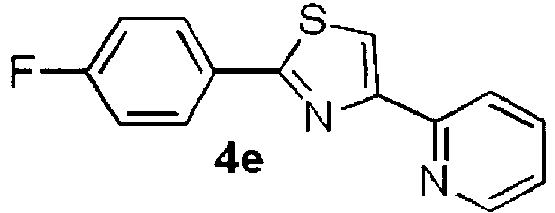
- IVLPBQOCRAVCLX-UHFFFAOYSA-N Fc(cc1)ccc1-c1nc(-c2ccccn2)c[s]1 Chemical compound Fc(cc1)ccc1-c1nc(-c2ccccn2)c[s]1 IVLPBQOCRAVCLX-UHFFFAOYSA-N 0.000 description 2
- NYOFUBDPSPSCHM-UHFFFAOYSA-N S=CN(c1ccccc1)c1ccccc1 Chemical compound S=CN(c1ccccc1)c1ccccc1 NYOFUBDPSPSCHM-UHFFFAOYSA-N 0.000 description 2
- DFRZZOGCKZVLOK-AWKYBWMHSA-N C#CC1N=C(c2ccccc2)S[C@H]1N1CCOCC1 Chemical compound C#CC1N=C(c2ccccc2)S[C@H]1N1CCOCC1 DFRZZOGCKZVLOK-AWKYBWMHSA-N 0.000 description 1
- ASIIXVRGJFNHHX-UHFFFAOYSA-N CC(C)(C)c1nc(-c2ccccn2)c[s]1 Chemical compound CC(C)(C)c1nc(-c2ccccn2)c[s]1 ASIIXVRGJFNHHX-UHFFFAOYSA-N 0.000 description 1
- IWUYFXOLFZJCST-UHFFFAOYSA-N COc(cc1)ccc1-c1nc(-c2ccccc2)c(N(c2ccccc2)c2ccccc2)[s]1 Chemical compound COc(cc1)ccc1-c1nc(-c2ccccc2)c(N(c2ccccc2)c2ccccc2)[s]1 IWUYFXOLFZJCST-UHFFFAOYSA-N 0.000 description 1
- NFFMRBYTCUWYRK-UHFFFAOYSA-N S=C(c1ccc[s]1)NCc1ncccc1 Chemical compound S=C(c1ccc[s]1)NCc1ncccc1 NFFMRBYTCUWYRK-UHFFFAOYSA-N 0.000 description 1
- LYURGTIBGGBBPF-UHFFFAOYSA-N S=C(c1ccccc1)NCc1ccccn1 Chemical compound S=C(c1ccccc1)NCc1ccccn1 LYURGTIBGGBBPF-UHFFFAOYSA-N 0.000 description 1
- JTPCNFJKUYPQRN-UHFFFAOYSA-N S=C(c1ncccc1)NCc1ccccn1 Chemical compound S=C(c1ncccc1)NCc1ccccn1 JTPCNFJKUYPQRN-UHFFFAOYSA-N 0.000 description 1
Images

Classifications
-
- C—CHEMISTRY; METALLURGY
- C07—ORGANIC CHEMISTRY
- C07D—HETEROCYCLIC COMPOUNDS
- C07D277/00—Heterocyclic compounds containing 1,3-thiazole or hydrogenated 1,3-thiazole rings
- C07D277/02—Heterocyclic compounds containing 1,3-thiazole or hydrogenated 1,3-thiazole rings not condensed with other rings
- C07D277/08—Heterocyclic compounds containing 1,3-thiazole or hydrogenated 1,3-thiazole rings not condensed with other rings having one double bond between ring members or between a ring member and a non-ring member
- C07D277/12—Heterocyclic compounds containing 1,3-thiazole or hydrogenated 1,3-thiazole rings not condensed with other rings having one double bond between ring members or between a ring member and a non-ring member with hetero atoms or with carbon atoms having three bonds to hetero atoms with at the most one bond to halogen, e.g. ester or nitrile radicals, directly attached to ring carbon atoms
- C07D277/18—Nitrogen atoms
-
- C—CHEMISTRY; METALLURGY
- C07—ORGANIC CHEMISTRY
- C07D—HETEROCYCLIC COMPOUNDS
- C07D277/00—Heterocyclic compounds containing 1,3-thiazole or hydrogenated 1,3-thiazole rings
- C07D277/02—Heterocyclic compounds containing 1,3-thiazole or hydrogenated 1,3-thiazole rings not condensed with other rings
- C07D277/20—Heterocyclic compounds containing 1,3-thiazole or hydrogenated 1,3-thiazole rings not condensed with other rings having two or three double bonds between ring members or between ring members and non-ring members
- C07D277/32—Heterocyclic compounds containing 1,3-thiazole or hydrogenated 1,3-thiazole rings not condensed with other rings having two or three double bonds between ring members or between ring members and non-ring members with hetero atoms or with carbon atoms having three bonds to hetero atoms with at the most one bond to halogen, e.g. ester or nitrile radicals, directly attached to ring carbon atoms
- C07D277/38—Nitrogen atoms
- C07D277/42—Amino or imino radicals substituted by hydrocarbon or substituted hydrocarbon radicals
-
- C—CHEMISTRY; METALLURGY
- C07—ORGANIC CHEMISTRY
- C07D—HETEROCYCLIC COMPOUNDS
- C07D417/00—Heterocyclic compounds containing two or more hetero rings, at least one ring having nitrogen and sulfur atoms as the only ring hetero atoms, not provided for by group C07D415/00
- C07D417/02—Heterocyclic compounds containing two or more hetero rings, at least one ring having nitrogen and sulfur atoms as the only ring hetero atoms, not provided for by group C07D415/00 containing two hetero rings
- C07D417/04—Heterocyclic compounds containing two or more hetero rings, at least one ring having nitrogen and sulfur atoms as the only ring hetero atoms, not provided for by group C07D415/00 containing two hetero rings directly linked by a ring-member-to-ring-member bond
-
- C—CHEMISTRY; METALLURGY
- C07—ORGANIC CHEMISTRY
- C07D—HETEROCYCLIC COMPOUNDS
- C07D417/00—Heterocyclic compounds containing two or more hetero rings, at least one ring having nitrogen and sulfur atoms as the only ring hetero atoms, not provided for by group C07D415/00
- C07D417/14—Heterocyclic compounds containing two or more hetero rings, at least one ring having nitrogen and sulfur atoms as the only ring hetero atoms, not provided for by group C07D415/00 containing three or more hetero rings
Definitions
- the present invention relates a thiazole derivative and a process for producing the same. More specifically, the present invention relates to a process for producing a pyridyl thiazole compound or a dihydrothiazole compound at a high yield, inexpensively, simply and selectively.
- a thiazole derivative is a useful compound as a functional compound (or a synthesis intermediate thereof) such as an agricultural chemical (insecticide, etc.), a medical product, a fungicide and a dye, and an electronic material.
- Examples thereof include a thiazole derivative that is a compound having a thiazole skeleton used as an interleukin-6 production inhibitor/ bone absorption inhibitor/ anti-osteoporosis agent (Patent Document 1), a thiazole derivative used as a bone forming accelerator (Patent Document 2), a thiazole derivative used as a protein kinase C inhibitor (Patent Document 3), a thiazole derivative used as an agricultural chemical intermediate (Patent Document 4), and a thiazole derivative used as a neuropeptide Y antagonist (Patent Document 5).
- Patent Documents 1 and 2 various methods are disclosed as synthesis examples of thiazole derivatives.
- bromine is dropped into a dichloromethane solution of 4'-chloropropiophenone to be acted and the mixture is then reacted with thiourea (Patent Documents 1 and 2), a method of adding 3-chloroacetylacetone to an ethanol solution of thiourea and reacting with heating, and then adding a poor solvent to be deposited by cooling (Patent Document 3), a method of mixing difluorophenacyl bromide and cyanothioacetoamide in water to be reacted with heating (Patent Document 4), and a method of mixing ⁇ -acetonaphtone and thiourea, and tetrabutylammonium bromide in ethyl acetate and dropping bromine thereinto to be reacted (Patent Document 6).
- These methods respectively remain rooms for improvements with respect to using bromine that has a pungent
- a pyridyl thiazole compound that is one of thiazole derivatives is useful as a fungicidal composition, and a production process thereof is described in the following document (Patent Document 7).
- Patent Document 7 2,6-dibromopyridine is treated with alkyl lithium and N.N-dimethyl acetoamide is then added thereto.
- the reaction mixture is brominated with a brominating agent in the presence of an acid and then reacted with thioacetamide and, finally by a coupling reaction with alkyl halogen, a desired pyridyl thiazole compound is thus obtained.
- This process includes a step with multiple stages and thus has a problem with respect that an operation method thereof is somewhat complicated.
- dihydrothiazole referred to as thiazoline in IUPAC, and referred to as dihydrothiazole in order to clarify difference from thiazole in the present invention
- thiazoline referred to as thiazoline in IUPAC
- dihydrothiazole in order to clarify difference from thiazole in the present invention
- proposed is, for example, a method of mixing methyl 2-(difluoromethyl)-5-(((2-chloroethyl)amino)carbonyl)-4-(2-methylpropyl)-6-trifluoromethyl)-3-pyridinecarboxylate and diphosphorus pentasulfide with heating and degassing to produce dihydrothiazole (Patent Document 8).
- a particular starting substance is required in order to obtain a 4,5-dihydrothiazole compound having a pyridyl group at the 2nd position.
- a thiazole derivative is very useful as an intermediate of a functional material such as a pharmaceutical composition and a dye, and an electronic material; however, in a conventional synthesis method, there has been considered to have a room for improvements such as particularity of raw materials to be used and necessity of production steps with multiple stages. Therefore, an object in the present invention is to propose a simplified production process using easily available raw materials. Means for Solving the Problems
- the present invention relates to a process for producing a thiazole derivative represented by the general formula (I), wherein a strong base is added to a thioamide represented by the general formula (II) and the mixture is then reacted with a thioformamide represented by the general formula (III) : wherein represents a single bond or a double bond, R1 represents a group selected from a branched or cyclic alkyl group having 3 to 12 carbon atoms, an aryl group, and a heteroaromatic group, and each of the groups may be further substituted with one or more substituents selected from halogen and hydroxy;
- R 2 represents an aryl group that may be substituted with one or more substituents selected from halogen and hydroxy, or a pyridyl group that may be substituted with one or more substituents selected from halogen and hydroxy;
- R 3 and R 4 are the same or different, and each represents a group selected from a linear, branched or cyclic alkyl group having 1 to 12 carbon atoms, an aryl group, and a heteroaromatic group, wherein each of the groups may be further substituted with one or more substituents selected from halogen and hydroxy, or R 3 and R 4 represent a C 5 to C 7 heterocyclic ring formed together with a nitrogen atom to which R 3 and R 4 are bonded; and Y represents a hydrogen atom or
- R 1 in the above formula is the same as a group represented in the general formula (I) and the general formula (II), and Y is the same as a group represented in the general formula (I).
- a desired thiazole derivative can be synthesized according to this selectivity, which thus makes it possible to obtain broad candidate compounds including applications and functions in the pharmaceutical field and the basic material field by a simple method.
- Examples of a strong base added to a thioamide represented by the general formula (II) include n-butyllithium, lithium diisopropylamide, sodium hydride, potassium hydride, potassium t-butoxide, calcium hydride, sodium hydroxide, and sodium amide. These strong bases act on carbon adjacent to the nitrogen atom in the thioamide to extract hydrogen and form a thioamide dianion. n-butyllithium is preferably used as a strong base.
- dihydrothiazole as represented by the general formula (IV) is a compound in which an amino group is bonded to the 5th position in a thiazoline ring.
- Thiazoline has been known as an intermediate of a medical drug or an agricultural chemical and, in the present invention, an amino group and a phenyl group are respectively bonded instead of a conventional hydrogen atom and the 4th and 5th positions become asymmetric carbons, and thus, a new possibility for an optical activity can also be searched.
- a thioformamide represented by the general formula (III) is reacted and iodine is then added thereto to be reacted, thereby enabling to obtain a thiazole derivative represented by the following general formula (V), other than dihydrothiazole represented by the general formula (IV).
- R 1 is the same as a group shown in the general formula (I).
- R 5 and R 6 are the same or different, and each represents a group selected from a linear, branched or cyclic alkyl group having 1 to 12 carbon atoms, an aryl group, and a heteroaromatic group (wherein each of the groups may be further substituted with one or more substituents selected from halogen and hydroxy), or at least one of R 5 and R 6 represents an aryl group that may be substituted with one or more substituents selected from halogen and hydroxy, or a heteroaromatic group that may be substituted with one or more substituents selected from halogen and hydroxy.
- a thiazole derivative represented by the general formula (V) has intensive fluorescence emission particularly when R 5 and R 6 are aryl groups, that is, the 5th position in a thiazole ring is a diarylamino group, and is a compound that can be expanded to an electron transfer layer, and the like in an organic electroluminescence element (hereinafter electroluminescence is abbreviated as "EL").
- the method for producing a thiazole derivative of the present invention can simply and easily produce a thiazole derivative from easily available, inexpensive raw materials without undergoing a complicated synthesis path, which thus can achieve to reduce synthesis cost. Furthermore, for a synthesized product, specifying a substituent of a thioamide makes it possible to obtain a generated product selectively; The obtained thiazole derivative can bring significant contribution to creation of a novel compound useful as medical drugs and agricultural chemicals, etc.
- Fig. 1 is a view showing a fluorescence spectrum for one example of the thiazole derivative of the present invention (Example 6).
- the present invention is characterized by adding a strong base to a thioamide and then reacting the mixture with a thioformamide, and the following reaction formula (a) can be utilized as one example of a synthesis method of the thioamide:
- R 1 represents a group selected from a branched or cyclic alkyl group having 3 to 12 carbon atoms, an aryl group, and a heteroaromatic group, and each of the groups may be further substituted with one or more substituents selected from halogen and hydroxy.
- a branched alkyl group include isopropyl, isobutyl and t-butyl
- examples of a cyclic alkyl group include cyclopropyl and cyclohexyl
- examples of an aryl group include benzyl, tolyl and xylyl
- examples of a heteroaromatic group include pyridyl, furyl and thienyl.
- R 2 in the formula represents an aryl group that may be substituted with one or more substituents, or a pyridyl group that may be substituted with one or more substituents. More specifically, R 2 represents a group selected from a phenyl group that maybe substituted with 1 or 2 groups selected from a halogen atom and a hydroxyl group, or a pyridyl group that may be substituted with 1 or 2 groups selected from a halogen atom and a hydroxyl group respectively, which is a group being a key to selectively synthesizing the thiazole derivative of formula (I).
- reaction formula (a) is a method conventionally known as a synthesis method of thioamide that is a starting substance of the present invention. This method is characterized in that any of the raw materials (compounds in the left side of the formula) can be easily and inexpensively obtained, structure design of a thioamide can be freely performed as a result thereof, and the like. However, R 2 is used selectively in the present invention for synthesis of a desired thiazole derivative.
- dimethylformamide dimethylsulfoxide, N-methylpyrrolidone, toluene, and the like can be used as an organic solvent.
- dimethylformamide is preferable from the viewpoint that a generated product is easily separated in a process of washing a reaction system with water.
- this reaction is performed at 60 to 110°C, and preferably 80 to 90°C.
- a reaction speed is lowered and a yield tends to decrease, and when the reaction is performed at a higher temperature, a side reaction easily occurs and there is a possibility to take trouble in purification.
- the most preferable ratio among these is 1:1.1:1.1, since an aldehyde group-containing compound is completely reacted and purification of a thioamide is effectively promoted.
- this reaction is called the Willgerodt-Kindler reaction and described in detail in the document ( Brown, E. V. Synthesis 1975, 358 ).
- the upper reaction of the above described reactions is to generate a thioamide dianion.
- the reaction is a reaction disclosed in the document ( Murai, T. et al., J. Org. Chem. 2005, 70, 8153 ), etc.
- a point to remember in initiation of this reaction is necessity to perform the reaction in an inert gas atmosphere such as nitrogen or argon under a dehydrated condition.
- a thioamide dianion obtained by reacting with a strong base has a possibility for being easily dissolved due to presence of water or oxygen, and is made stably exist to transfer to the next reaction.
- lithium diisopropylamide, sodium hydride, potassium hydride, potassium t-butoxide, calcium hydride, sodium hydroxide, sodium amide, and the like can also be used as other strong bases, and butyllithium (nBuLi) is preferable from the viewpoints of reactivity, price, and availability. Furthermore, use of butyllithium leads to an advantage such that separation is easy as a butane gas after the reaction.
- Tetrahydrofuran is used as a solvent in the above described reaction.
- Toluene and diethyl ether, and the like can also be used as other solvents, but the former has a possibility of slight progress of a side reaction and the latter has a possibility that a reaction intermediate is precipitated without being dissolved to decrease a reaction yield, and thus, tetrahydrofuran is preferable.
- the reaction can be carried out within the reaction temperature range from -78°C to room temperature, and around 0°C is suitable in consideration of suppression of a side reaction and efficiency.
- a mixing ratio of each compound to be reacted cannot be clearly determined depending on compounds to be used, and generally, about 2 equivalent amount of nBuLi is added to a thioamide and then about 1 equivalent amount of a thioformamide is added thereto.
- a thiazole skeleton is formed by a cyclization reaction in a molecule.
- dihydrothiazole introduced with an amino group at the 5th position which has never been known so far, is obtained.
- Both of carbon at the 5th position to which the amino group is bonded and carbon at the 4th position to which a phenyl group is bonded are asymmetric carbons, and can be used in various application developments including optical activity.
- 4,5-dihydro-1,3-thiazoles are materials that have been known before, and are particularly used as important intermediates for synthesis of active compounds based on dihydrothiazole and thiazole in the agricultural chemical and pharmaceutical industries (reference German patent No. DE10142749 , etc.)
- the thiazole derivative is sufficiently expected as a raw material for new application development, in addition to the same applications of dihydrothiazole that has been used so far.
- a thioformamide is reacted and iodine is then further added thereto, thus a thiazole derivative represented by the general formula (V) can be obtained.
- dihydrothiazole is basically generated, but by adding iodine to the reaction system, it is considered to proceed de-protonation.
- R 5 and R 6 shown in the general formula (V) is an aryl group that may be substituted with one or more substituents selected from halogen and hydroxy, or a heteroaromatic group that may be substituted with the same substituents, and thus, the derivative shows fluorescence emission.
- a thioformamide is added at the above described reaction temperature (-78°C to room temperature) and then reacted while mixing from about several minutes to several hours, thereafter adding iodine so as to have a molar concentration of an equivalent mole to 3 mole ratios, preferably 1.5 to 2.5 mole ratios with respect to the thioformamide, with keeping the reaction temperature.
- solid iodine can be directly added, or iodine can be once dissolved in a reaction solvent (e.g., tetrahydrofuran) and added to a reaction system.
- a reaction solvent e.g., tetrahydrofuran
- an EL element utilizing electroluminescence has characteristics such as having excellent impact resistance, since it has high visibility because of self-luminescence and is a complete solid-state element, and thus, such an EL element attracts attention for utilization as a light emitting element in various display devices.
- an organic EL element significantly reduces an applied voltage, and besides, it has characteristics such that miniaturization is easy and electric power consumption is small.
- Huge quantities of compound groups having a diarylamino group have been reported so far, and utilization as an organic EL element is now widely studied.
- a thiazole derivative represented by the above described general formula (V) has intensive fluorescence emission particularly when R 5 and R 6 are diarylamino groups.
- a conjugated system of a diarylamino group extends even to a thiazole ring and a substituent phenyl, in this compound and, as a totally new electronic material, for example, a base compound that can be used for an electron transfer layer in an organic EL element can be created.
- Such thiazole is useful as a functional compound (or a synthesis intermediate thereof) such as an agricultural chemical, a medical drug, a fungicide and a dye, and an electronic material, and in recent years, it is attracting attention also as a light emitting material for high-intensity brightness and colorization (particularly, realization of red light emission) of an organic EL.
- Benzaldehyde (10.1 mL, 0.1 mol) was added to a dimethyl formamide (DMF: 50 mL) solution of benzylamine (12.0 mL, 0.11 mol) at room temperature. Then, sulfur (3.52 g, 0.11 mol) was added thereto and heated while stirring at 80 to 90°C for 6 hours. The reaction mixture solution was poured into ethyl ether (50 mL) and the organic layer was washed with an aqueous solution of saturated sodium hydrogen carbonate (200 mL) and hydrochloric acid (35%, 10 mL).
- DMF dimethyl formamide
- the compound 1 (0.227 g, 1.0 mmol) was dissolved in THF (2.0mL), and n-butyllithium-hexane solution (1.3 mL, 2.0 mmol) was gradually added to this solution at 0°C. After stirring for 5 minutes, N,N-dimethylthioformamide was added thereto at the same temperature and stirring was further continued for 2.5 hours. Water (10 mL) was added to the reaction mixture solution, and the organic layer was extracted with diethyl ether (10 mL). The organic layer was washed twice with water (10 mL), and an aqueous layer was further re-extracted with diethyl ether (5 mL).
- a 1 H-nuclear magnetic resonance spectrum and a 13 C-nuclear magnetic resonance spectrum of the compound 3 were measured, using JNM ⁇ -400 type manufactured by JEOL Ltd., at 25°C in deuterated chloroform, and the 1 H-nuclear magnetic resonance spectrum was measured 8 times of the number of integration, and the 13 C-nuclear magnetic resonance spectrum was measured 100 to 200 times of the number of integration. Results thereof are shown as follows.
- Benzaldehyde (2.03 mL, 0.02 mol) was added to a dimethyl formamide (DMF: 8 mL) solution of pyridylmethylamine (2.22 mL, 0.022 mol) at room temperature. Sulfur (0.71 g, 0.022 mol) was then added thereto and the mixture was heated while stirring at 80 to 90°C for 6 hours. The reaction mixture solution was poured into ethyl ether (20 mL), and the organic layer was washed with an aqueous solution of saturated sodium hydrogen carbonate (50 mL).
- DMF dimethyl formamide
- the compound 1' (0.228 g, 1.0 mmol) was dissolved in THF (2.0 mL), and an n-butyllithium-hexane solution (1.3 mL, 2.0 mmol) was gradually added to this solution at 0°C. After stirring for 5 minutes, N,N-dimethylthioformamide was added thereto at the same temperature and stirring was further continued for 3 hours. Water (10 mL) was added to the reaction mixture solution, and the organic layer was extracted with diethyl ether (10 mL). The organic layer was washed twice with water (10 mL), and an aqueous layer was further re-extracted with diethyl ether (5 mL).
- Example 1 the compound 1 shown in Example 1 was synthesized, the compound 1 (0.257 g, 1.0 mmol) was then dissolved in THF (2.0 mL), a BuLihexane solution (1.43 M, 1.40 mL, 2.0 mmol) was added to this solution at 0°C, and the mixture was stirred for 5 minutes. N,N-diphenylthioformamide (0.213 g,1.0 mmol) was added to the solution at 0°C, and the mixture was stirred for 30 minutes. Thereto was added iodine (0.512 g, 2.0 mmol) at 0°C, and stirring was continued for 2 hours.
- THF 2.0 mL
- a BuLihexane solution (1.43 M, 1.40 mL, 2.0 mmol
- N,N-diphenylthioformamide 0.213 g,1.0 mmol was added to the solution at 0°C, and the mixture was stirred for 30 minutes.
- iodine
- reaction mixture solution was poured into a saturated solution of ammonium chloride and extracted with methylene chloride.
- the organic layer was dried with magnesium sulfate and concentrated.
- the residue was purified by silica gel column chromatography to obtain 2-(4-methoxyphenyl)-4-phenyl-5-diphenylaminothiazole at a yield of 26% as a yellow solid.
- Measurement results such as a nuclear magnetic resonance spectrum for the compound 5 are shown below.
- a fluorescence spectrum (solid line) by a fluorescence spectrometer of the compound is shown in Fig. 1 .
- a fluorescent intensity is a value when that of rhodamine B was assumed to be 100 in the figure.
- a fluorescence spectrum (dashed line) of 2-(4-methoxyphenyl)-4-phenyl-5-dimethylaminothiazole is shown for comparison, and an effect in the case where a diphenylamino group was used as a substituent is prominently shown.
- the thiazole derivative prepared through a process of the present invention can be simply produced from easily available raw materials without undergoing a complicated synthesis path by the production process of the present invention.
- specifying a substituent of a starting substance makes it possible to obtain a generated product selectively.
Landscapes
- Chemical & Material Sciences (AREA)
- Organic Chemistry (AREA)
- Plural Heterocyclic Compounds (AREA)
- Pharmaceuticals Containing Other Organic And Inorganic Compounds (AREA)
- Thiazole And Isothizaole Compounds (AREA)
Description
- The present invention relates a thiazole derivative and a process for producing the same. More specifically, the present invention relates to a process for producing a pyridyl thiazole compound or a dihydrothiazole compound at a high yield, inexpensively, simply and selectively.
- A thiazole derivative is a useful compound as a functional compound (or a synthesis intermediate thereof) such as an agricultural chemical (insecticide, etc.), a medical product, a fungicide and a dye, and an electronic material. Examples thereof include a thiazole derivative that is a compound having a thiazole skeleton used as an interleukin-6 production inhibitor/ bone absorption inhibitor/ anti-osteoporosis agent (Patent Document 1), a thiazole derivative used as a bone forming accelerator (Patent Document 2), a thiazole derivative used as a protein kinase C inhibitor (Patent Document 3), a thiazole derivative used as an agricultural chemical intermediate (Patent Document 4), and a thiazole derivative used as a neuropeptide Y antagonist (Patent Document 5).
- In these documents, various methods are disclosed as synthesis examples of thiazole derivatives. For example, bromine is dropped into a dichloromethane solution of 4'-chloropropiophenone to be acted and the mixture is then reacted with thiourea (Patent Documents 1 and 2), a method of adding 3-chloroacetylacetone to an ethanol solution of thiourea and reacting with heating, and then adding a poor solvent to be deposited by cooling (Patent Document 3), a method of mixing difluorophenacyl bromide and cyanothioacetoamide in water to be reacted with heating (Patent Document 4), and a method of mixing β-acetonaphtone and thiourea, and tetrabutylammonium bromide in ethyl acetate and dropping bromine thereinto to be reacted (Patent Document 6). These methods respectively remain rooms for improvements with respect to using bromine that has a pungent odor, with respect to necessity of obtaining particular reagents, and the like.
- On the other hand, a pyridyl thiazole compound that is one of thiazole derivatives is useful as a fungicidal composition, and a production process thereof is described in the following document (Patent Document 7). According to the document, 2,6-dibromopyridine is treated with alkyl lithium and N.N-dimethyl acetoamide is then added thereto. The reaction mixture is brominated with a brominating agent in the presence of an acid and then reacted with thioacetamide and, finally by a coupling reaction with alkyl halogen, a desired pyridyl thiazole compound is thus obtained. This process includes a step with multiple stages and thus has a problem with respect that an operation method thereof is somewhat complicated.
- Furthermore, for a preparation process of dihydrothiazole (referred to as thiazoline in IUPAC, and referred to as dihydrothiazole in order to clarify difference from thiazole in the present invention) that is one of thiazole derivatives, proposed is, for example, a method of mixing methyl 2-(difluoromethyl)-5-(((2-chloroethyl)amino)carbonyl)-4-(2-methylpropyl)-6-trifluoromethyl)-3-pyridinecarboxylate and diphosphorus pentasulfide with heating and degassing to produce dihydrothiazole (Patent Document 8). In this method, a particular starting substance is required in order to obtain a 4,5-dihydrothiazole compound having a pyridyl group at the 2nd position.
-
- Patent Document 1: Japanese Unexamined Patent Application Publication (JP-A) No.
Hei10-87490 - Patent Document 2:
JP-A No. Hei11-209284 - Patent Document 3:
JP-A No. 2002-53566 - Patent Document 4: Domestic re-publication of
PCT application No. WO2002/094798 - Patent Document 5: Japanese Unexamined Patent Application Publication (Translation of PCT Application) No.
2006-502131 - Patent Document 6:
JP-A No. 2006-225334 - Patent Document 7:
JP-A No. Hei5-194506 - Patent Document 8:
JP-A No. Hei11-269174 - As described above, a thiazole derivative is very useful as an intermediate of a functional material such as a pharmaceutical composition and a dye, and an electronic material; however, in a conventional synthesis method, there has been considered to have a room for improvements such as particularity of raw materials to be used and necessity of production steps with multiple stages. Therefore, an object in the present invention is to propose a simplified production process using easily available raw materials. Means for Solving the Problems
- As a result of intensive studies made in order to solve the above described problems and achieve the desired object, it was found in the present invention that when a thioamide is synthesized and then acted with a thioformamide through a thioamide dianion, thiazole or dihydrothiazole can be selectively synthesized by a substituent of the thioamide.
- That is, the present invention relates to a process for producing a thiazole derivative represented by the general formula (I), wherein a strong base is added to a thioamide represented by the general formula (II) and the mixture is then reacted with a thioformamide represented by the general formula (III) :


- R2 represents an aryl group that may be substituted with one or more substituents selected from halogen and hydroxy, or a pyridyl group that may be substituted with one or more substituents selected from halogen and hydroxy;
- R3 and R4 are the same or different, and each represents a group selected from a linear, branched or cyclic alkyl group having 1 to 12 carbon atoms, an aryl group, and a heteroaromatic group, wherein each of the groups may be further substituted with one or more substituents selected from halogen and hydroxy, or R3 and R4 represent a C5 to C7 heterocyclic ring formed together with a nitrogen atom to which R3 and R4 are bonded; and Y represents a hydrogen atom or

- It is characterized in that when R2 is an aryl group, dihydrothiazole represented by the following general formula (IV) is selectively obtained, and when R2 is a pyridyl group, thiazole represented by the following general formula (VI) is selectively obtained:


- R1 in the above formula is the same as a group represented in the general formula (I) and the general formula (II), and Y is the same as a group represented in the general formula (I).
- Such a selective reaction has not been known at all so far, and the reaction mechanism thereof will be specifically described later. A desired thiazole derivative can be synthesized according to this selectivity, which thus makes it possible to obtain broad candidate compounds including applications and functions in the pharmaceutical field and the basic material field by a simple method.
- Examples of a strong base added to a thioamide represented by the general formula (II) include n-butyllithium, lithium diisopropylamide, sodium hydride, potassium hydride, potassium t-butoxide, calcium hydride, sodium hydroxide, and sodium amide. These strong bases act on carbon adjacent to the nitrogen atom in the thioamide to extract hydrogen and form a thioamide dianion. n-butyllithium is preferably used as a strong base.
- Further, dihydrothiazole as represented by the general formula (IV) is a compound in which an amino group is bonded to the 5th position in a thiazoline ring. Thiazoline has been known as an intermediate of a medical drug or an agricultural chemical and, in the present invention, an amino group and a phenyl group are respectively bonded instead of a conventional hydrogen atom and the 4th and 5th positions become asymmetric carbons, and thus, a new possibility for an optical activity can also be searched.
- In addition, a thioformamide represented by the general formula (III) is reacted and iodine is then added thereto to be reacted, thereby enabling to obtain a thiazole derivative represented by the following general formula (V), other than dihydrothiazole represented by the general formula (IV).

- In the formula, R1 is the same as a group shown in the general formula (I). R5 and R6 are the same or different, and each represents a group selected from a linear, branched or cyclic alkyl group having 1 to 12 carbon atoms, an aryl group, and a heteroaromatic group (wherein each of the groups may be further substituted with one or more substituents selected from halogen and hydroxy), or at least one of R5 and R6 represents an aryl group that may be substituted with one or more substituents selected from halogen and hydroxy, or a heteroaromatic group that may be substituted with one or more substituents selected from halogen and hydroxy.
- A thiazole derivative represented by the general formula (V) has intensive fluorescence emission particularly when R5 and R6 are aryl groups, that is, the 5th position in a thiazole ring is a diarylamino group, and is a compound that can be expanded to an electron transfer layer, and the like in an organic electroluminescence element (hereinafter electroluminescence is abbreviated as "EL").
- The method for producing a thiazole derivative of the present invention can simply and easily produce a thiazole derivative from easily available, inexpensive raw materials without undergoing a complicated synthesis path, which thus can achieve to reduce synthesis cost. Furthermore, for a synthesized product, specifying a substituent of a thioamide makes it possible to obtain a generated product selectively; The obtained thiazole derivative can bring significant contribution to creation of a novel compound useful as medical drugs and agricultural chemicals, etc.
- Furthermore, addition of iodine to a reaction system enables to obtain a thiazole derivative having extension in a conjugated system, and broad applications for development of new electronic materials can be expected.
-
Fig. 1 is a view showing a fluorescence spectrum for one example of the thiazole derivative of the present invention (Example 6). - The production process of the present invention will be more specifically described below.
- The present invention is characterized by adding a strong base to a thioamide and then reacting the mixture with a thioformamide, and the following reaction formula (a) can be utilized as one example of a synthesis method of the thioamide:

- In the formula, R1 represents a group selected from a branched or cyclic alkyl group having 3 to 12 carbon atoms, an aryl group, and a heteroaromatic group, and each of the groups may be further substituted with one or more substituents selected from halogen and hydroxy. Examples of such a branched alkyl group include isopropyl, isobutyl and t-butyl, examples of a cyclic alkyl group include cyclopropyl and cyclohexyl, examples of an aryl group include benzyl, tolyl and xylyl, and examples of a heteroaromatic group include pyridyl, furyl and thienyl. These groups are preferable because of high yield when a thioamide dianion is formed by a reaction with a strong base.
- R2 in the formula represents an aryl group that may be substituted with one or more substituents, or a pyridyl group that may be substituted with one or more substituents. More specifically, R2 represents a group selected from a phenyl group that maybe substituted with 1 or 2 groups selected from a halogen atom and a hydroxyl group, or a pyridyl group that may be substituted with 1 or 2 groups selected from a halogen atom and a hydroxyl group respectively, which is a group being a key to selectively synthesizing the thiazole derivative of formula (I).
- The above described reaction formula (a) is a method conventionally known as a synthesis method of thioamide that is a starting substance of the present invention. This method is characterized in that any of the raw materials (compounds in the left side of the formula) can be easily and inexpensively obtained, structure design of a thioamide can be freely performed as a result thereof, and the like. However, R2 is used selectively in the present invention for synthesis of a desired thiazole derivative.
- In this reaction, dimethylformamide, dimethylsulfoxide, N-methylpyrrolidone, toluene, and the like can be used as an organic solvent. Among these substances, when a thioamide is once purified and then isolated and stored, etc., dimethylformamide is preferable from the viewpoint that a generated product is easily separated in a process of washing a reaction system with water.
- In addition, this reaction is performed at 60 to 110°C, and preferably 80 to 90°C. When the reaction is preformed at a lower temperature than the above temperature, a reaction speed is lowered and a yield tends to decrease, and when the reaction is performed at a higher temperature, a side reaction easily occurs and there is a possibility to take trouble in purification.
- The above reaction can be performed within the range of molar ratios of an aldehyde group-containing compound: sulfur: amino group-containing compound = 1:1:1 to 1:1.2:1.2. The most preferable ratio among these is 1:1.1:1.1, since an aldehyde group-containing compound is completely reacted and purification of a thioamide is effectively promoted. In addition, this reaction is called the Willgerodt-Kindler reaction and described in detail in the document (Brown, E. V. Synthesis 1975, 358).
- A synthesis path of dihydrothiazole when a compound having a phenyl group for R2 is used as the above described amino group-containing compound will be shown below:

- The upper reaction of the above described reactions is to generate a thioamide dianion. Specifically, the reaction is a reaction disclosed in the document (Murai, T. et al., J. Org. Chem. 2005, 70, 8153), etc. A point to remember in initiation of this reaction is necessity to perform the reaction in an inert gas atmosphere such as nitrogen or argon under a dehydrated condition. A thioamide dianion obtained by reacting with a strong base has a possibility for being easily dissolved due to presence of water or oxygen, and is made stably exist to transfer to the next reaction. In addition, lithium diisopropylamide, sodium hydride, potassium hydride, potassium t-butoxide, calcium hydride, sodium hydroxide, sodium amide, and the like can also be used as other strong bases, and butyllithium (nBuLi) is preferable from the viewpoints of reactivity, price, and availability. Furthermore, use of butyllithium leads to an advantage such that separation is easy as a butane gas after the reaction.
- Tetrahydrofuran is used as a solvent in the above described reaction. Toluene and diethyl ether, and the like can also be used as other solvents, but the former has a possibility of slight progress of a side reaction and the latter has a possibility that a reaction intermediate is precipitated without being dissolved to decrease a reaction yield, and thus, tetrahydrofuran is preferable. The reaction can be carried out within the reaction temperature range from -78°C to room temperature, and around 0°C is suitable in consideration of suppression of a side reaction and efficiency.
- A mixing ratio of each compound to be reacted cannot be clearly determined depending on compounds to be used, and generally, about 2 equivalent amount of nBuLi is added to a thioamide and then about 1 equivalent amount of a thioformamide is added thereto. The thioamide and nBuLi generate a dianion in a reaction with a ratio of 1:2, and the reaction progresses at almost 100% yield. Furthermore, since the generated dianion has high activity, a reaction at almost 100% with the thioformamide occurs. Therefore, a molar ratio of respective compounds is basically thioamide:nBuLi:thioformamide = 1:2:1.
- In the lower stage of the above described reactions, a thiazole skeleton is formed by a cyclization reaction in a molecule. In addition, due to a thioformamide used in this reaction, dihydrothiazole introduced with an amino group at the 5th position, which has never been known so far, is obtained. Both of carbon at the 5th position to which the amino group is bonded and carbon at the 4th position to which a phenyl group is bonded are asymmetric carbons, and can be used in various application developments including optical activity.
- Addition of an organic magnesium compound (Grignard reagent), for example, PhMgBr and nBuMgBr, in a suitable amount in the reaction of the lower stage also makes it possible to promote a cyclization reaction.
- By the way, 4,5-dihydro-1,3-thiazoles are materials that have been known before, and are particularly used as important intermediates for synthesis of active compounds based on dihydrothiazole and thiazole in the agricultural chemical and pharmaceutical industries (reference German patent No.
DE10142749 , etc.) In the present invention, since an amino group is introduced into the 5th position, the thiazole derivative is sufficiently expected as a raw material for new application development, in addition to the same applications of dihydrothiazole that has been used so far. - In the above described reaction process, a thioformamide is reacted and iodine is then further added thereto, thus a thiazole derivative represented by the general formula (V) can be obtained. As described above, when an aryl group is present at the 4th position (a phenyl group in the general formula (V)), dihydrothiazole is basically generated, but by adding iodine to the reaction system, it is considered to proceed de-protonation. Among thiazole derivatives thus obtained, at least one of R5 and R6 shown in the general formula (V) is an aryl group that may be substituted with one or more substituents selected from halogen and hydroxy, or a heteroaromatic group that may be substituted with the same substituents, and thus, the derivative shows fluorescence emission.

- As reaction conditions at the time of iodine addition, a thioformamide is added at the above described reaction temperature (-78°C to room temperature) and then reacted while mixing from about several minutes to several hours, thereafter adding iodine so as to have a molar concentration of an equivalent mole to 3 mole ratios, preferably 1.5 to 2.5 mole ratios with respect to the thioformamide, with keeping the reaction temperature. In addition of iodine, solid iodine can be directly added, or iodine can be once dissolved in a reaction solvent (e.g., tetrahydrofuran) and added to a reaction system. When iodine is reacted for about several minutes to several hours while stirring and the like after addition, a desired thiazole derivative represented by the general formula (V) having an aryl group at the 4th position can be obtained.
- By the way, an EL element utilizing electroluminescence has characteristics such as having excellent impact resistance, since it has high visibility because of self-luminescence and is a complete solid-state element, and thus, such an EL element attracts attention for utilization as a light emitting element in various display devices. In particular, an organic EL element significantly reduces an applied voltage, and besides, it has characteristics such that miniaturization is easy and electric power consumption is small. Huge quantities of compound groups having a diarylamino group have been reported so far, and utilization as an organic EL element is now widely studied. A thiazole derivative represented by the above described general formula (V) has intensive fluorescence emission particularly when R5 and R6 are diarylamino groups. That is, a conjugated system of a diarylamino group extends even to a thiazole ring and a substituent phenyl, in this compound and, as a totally new electronic material, for example, a base compound that can be used for an electron transfer layer in an organic EL element can be created.
- Next, a synthesis path of thiazole will be shown in the case of using a compound having a pyridyl group in R2 as the above described amino group-containing compound:

- Since there is no difference from the reactions that have been already described until the upper and middle stages of the above described reactions, the lower stage will be only described herein. When nBuLi is acted on a thioamide having a pyridyl group to thus form a dianion, and a thioformamide is reacted thereto, although dihydrothiazole is once generated, de-protonation proceeds due to a nitrogen atom in a pyridyl group, and 4-(2-pyridyl)thiazole is generated by dehydrogenation. Such thiazole is useful as a functional compound (or a synthesis intermediate thereof) such as an agricultural chemical, a medical drug, a fungicide and a dye, and an electronic material, and in recent years, it is attracting attention also as a light emitting material for high-intensity brightness and colorization (particularly, realization of red light emission) of an organic EL.
- An example using a thioamide bonded to the 2nd position of a pyridyl group was shown in the above described reaction formula (c), and a thioamide bonded to the 3rd or 4th position of a pyridyl group may be used. However, use of a thioamide bonded to the 2nd position of a pyridyl group is preferable since the final generated product (general formula (I')) can be obtained at the highest yield.
- Some examples of the present invention will be shown below in order to more specifically clarify the present invention.
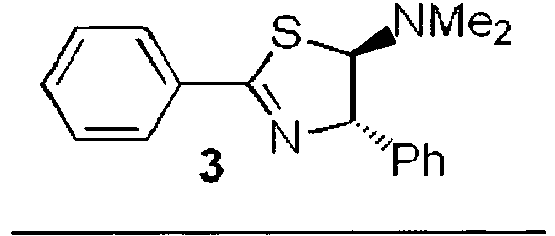
- The whole scheme for a synthesis method of compound 3 (4,5-dihydro-2,4-diphenyl-5-dimethylaminothiazole) is shown below as follows:

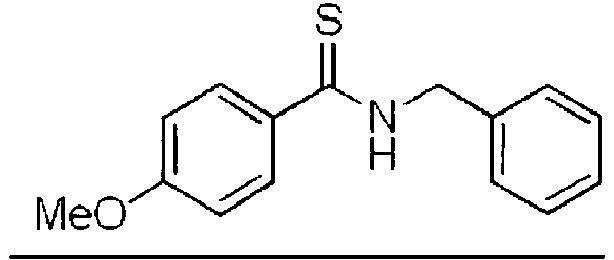
- Benzaldehyde (10.1 mL, 0.1 mol) was added to a dimethyl formamide (DMF: 50 mL) solution of benzylamine (12.0 mL, 0.11 mol) at room temperature. Then, sulfur (3.52 g, 0.11 mol) was added thereto and heated while stirring at 80 to 90°C for 6 hours. The reaction mixture solution was poured into ethyl ether (50 mL) and the organic layer was washed with an aqueous solution of saturated sodium hydrogen carbonate (200 mL) and hydrochloric acid (35%, 10 mL). Furthermore, the organic layer was dried with magnesium sulfate, filtrated and concentrated under reduced pressure, and the residue was re-crystallized with hexane/methylene chloride (1:1, 30 mL) to obtain 21.3 g (yield: 94%) of the compound 1 as a yellow solid.
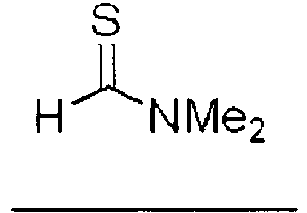
- The compound 1 (0.227 g, 1.0 mmol) was dissolved in THF (2.0mL), and n-butyllithium-hexane solution (1.3 mL, 2.0 mmol) was gradually added to this solution at 0°C. After stirring for 5 minutes, N,N-dimethylthioformamide was added thereto at the same temperature and stirring was further continued for 2.5 hours. Water (10 mL) was added to the reaction mixture solution, and the organic layer was extracted with diethyl ether (10 mL). The organic layer was washed twice with water (10 mL), and an aqueous layer was further re-extracted with diethyl ether (5 mL). The organic layer collected was dried with magnesium sulfate, filtrated, and concentrated under reduced pressure, and the residue was purified by silica gel chromatography (developing solvent; Hexane:EtOAc:Et2N = 5:1:0.01) to obtain trans-4,5-dihydro-2,4-diphenyl-5-dimethylaminothiazole (0.14 g, 50%) as a light yellow solid.
Melting point at 89 to 91°C - A 1H-nuclear magnetic resonance spectrum and a 13C-nuclear magnetic resonance spectrum of the compound 3 were measured, using JNMα-400 type manufactured by JEOL Ltd., at 25°C in deuterated chloroform, and the 1H-nuclear magnetic resonance spectrum was measured 8 times of the number of integration, and the 13C-nuclear magnetic resonance spectrum was measured 100 to 200 times of the number of integration. Results thereof are shown as follows.
- 1H NMR (CDCl3) δ2.11 (s, 6H, NMe2), 5.11(d, J=2.0 Hz, 1H, SCH), 5.6 (d, J= 2.0 Hz, 1H, C=NCH), 7.08-7.19 (m, 5H, Ar), 7.27-7.35 (m, 3H, Ar), 7.90-7.92 (m, 2H, Ar); 13C NMR (CDCl3) δ40.0 (NMe2), 84.2 (SCH), 90.5 (C=NCH), 126.0, 127.6, 128.4, 128.5, 131.1, 133.5, 139.7, 168.7 (SCN)
IR data and MS data are also shown below together. IR (KBr) 2947, 1597, 1450, 1355, 1265, 1229, 1051, 1027, 834, 754, 687, 651, 566, 521 cm-1; MS(EI)m/z 282(M+); HRMS (EI) Calcd for C17H18N2S(M+) 282.1191. found: 282.1177. - A mixing ratio, a temperature, a time and the like of each compound were the same operations as in Example 1, but "stirring was continued for 30 minutes and a phenyl magnesium bromide (PhMgBr) THF solution (1.09 M, 1.83 mL, 2.0 mmol) was added at room temperature and the mixture was stirred for 2 hours" instead of adding N,N-dimethylthioformamide at the same temperature and then continuing stirring for 2.5 hours. After that, operations were performed in the same manner as in Example 1 to obtain trans-4,5-dihydro-2,4-diphenyl-5-dimethylaminothiazole (0.235 g, 83%) as a light yellow solid. As shown in this example, addition of PhMgBr makes it possible to promote a cyclization reaction.
- Regarding a synthesis example of each of the dihydrothiazoles (3b to 3g) shown in Table 1 below, yields as well as the compound 1 and thioformamide which were used are shown in the same table. In addition, various conditions such as an amount to be used of each compound (molar ratio), a temperature, and a time are the same as in Example 2.
[Table 1] I(Thiomide) Thioformamide 3 (Thiazole derivative) Yields 

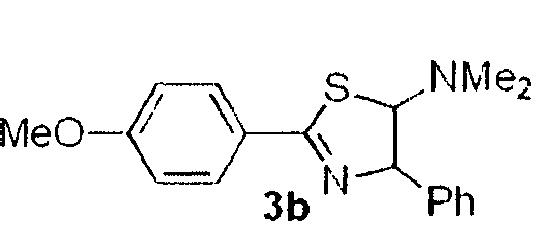
73% 


24% 


19% 


60% 
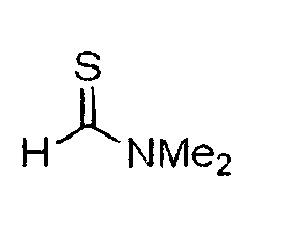

36% 


38% - Measurement results such as a nuclear magnetic resonance spectrum for each dihydrothiazole shown in Table 1 are shown below.
- IR(neat) 2951, 2833, 2786, 1605, 1508, 1254, 1170, 1031, 948, 837, 698, 657, 566 cm-1; 1HNMR (CDCl3) δ2.19 (s, 6H, NMe2), 3.77 (s,3H,OMe), 5.16 (d, J= 2.0 Hz, 1H, SCH), 5.61 (d, J = 2.0 Hz, 1H, C=NCH), 6.88-6.90 (d, J = 8.8 Hz, 2H, Ar), 7.19-7.26 (m, 5H, Ar), 7.92-7.94 (m, 2H, Ar); 13C NMR (CDCl3) δ40.0 (NMe2), 55.2 (OMe), 84.2 (SCH), 90.4 (C=NCH), 113.6, 126.1, 126.2, 127.5, 128.5, 130.1, 140.0, 162.0, 168.0 (SCN); MS (EI)m/z 312 (M+); HRMS (EI) Calcd for C18H20N2OS (M+) 312.1296. found: 312.1292.
- IR(neat) 2966, 1614, 1454, 1287, 1044, 873, 835, 753, 699, 598 cm-1; 1H NMR (CDCl3) δ51.28 (dd, J=6.8 Hz, 2.0 Hz, 6H, CH(CH 3)2), 2.13 (s, 6H, NMe2), (sept, J=6.8 Hz, 1H, CH(CH3)2), 4.99 (d, J=2.0Hz, 1H, SCH), 5.33-5.34 (d, J=2.0Hz, 1H, C=NCH), 7.16-7.27 (m, 5H, Ar); 13C NMR (CDCl3) δ21.6 (CH(CH3)2), 35.0 (CH(CH3)2), 40.0 (NMe2), 83.5 (SCH), 89.7 (C=NCH), 126.0, 127.6, 128.6, 140.0, 178.6 (SCN); MS (EI)m/z 248 (M+); HRMS(EI) Calcd for C14H20N2S(M+) 248.1347. found: 248.1354.
- IR (neat) 3290, 3059, 2951, 2788, 1599, 1494, 1467, 1435, 1296, 1280, 1176, 1149, 1045, 1025, 996, 958, 836, 789, 743, 698, 537cm-1; 1H NMR (CDCl3) δ2.11 (s, 6H, NMe2), 5.14-5.15 (d, J = 2.0 Hz, 1H, SCH), 5.63 (d, J = 2.0 Hz, 1H, C=NCH), 7.18-7.22 (m, 2H, Ar), 7.24-7.25 (m, 2H, Ar), 7.30-7.37 (m, 2H, Ar) 7.68-7.73 (td, J = 7.8 Hz, 2.0 Hz, 1H, Ar), 8.11-8.13 (d, J = 8.29 Hz, 1H, Ar), 8.64-8.66 (d, J = 8.29 Hz, 1H, Ar ); 13C NMR (CDCl3) δ40.1 (NMe2), 84.9 (SCH), 88.9 (C=NCH), 121.9, 125.6, 126.2, 127.8, 128.7, 136.6, 139.6, 149.4, 151.3, 170.9 (SCN); MS (EI) m/z 283 (M+); HRMS (EI) Calcd for C16H17N3S (M+) 283.1143. found: 283.1170.
- IR (neat) 3062, 2949, 1603, 1506, 1451, 1234, 1154, 1028, 949, 842, 753, 698, 657, 562 cm-1; 1H NMR (CDCl3) δ2.20 (s, 6H, NMe2), 5.22 (d, J= 2.0 Hz, 1H, SCH), 5.63 (d, J = 2.0 Hz, 1H, C=NCH), 7.05-7.10 (t, J = 8. 5 Hz, 2H, Ar), 7.23-7.31 (m, 5H, Ar), 7.95-8.00 (m, 2H, Ar); 13C NMR (CDCl3)δ 40.1 (NMe2), 84.3 (SCH), 91.1 (C=NCH), 126.0, 127.6, 128.4, 128.5, 131.1, 133.5, 139.7, 168.7 (SCN); 19F NMR (CDCl3) δ -108.8; MS (EI) m/z 300 (M+);HRMS (EI) Calcd for C17H17FN2S (M+) 300.1096. found: 300.1120.
- IR (neat) 2965, 2360, 1611, 1451, 1362, 1042, 1002, 751, 698 cm-1; 1H NMR (CDCl3) δ1.39 (s, 9H, CH(CH)3), 2.21 (s, 6H, NMe2), 5.02-5.03 (d, J = 1.5 Hz, 1H, SCH), 5.46-5.47(d, J= 1.5 Hz, 1H, C=NCH), 7.22-7.35 (m, 5H, Ar); 13C NMR (CDCl3) δ29.6 (CH(CH)3), 38.9 (CH(CH)3), 40.0 (NMe2), 83.8 (SCH), 89.5 (C=NCH), 125.9, 127.5, 128.5, 139.9, 181.5 (SCN) ; MS (EI) m/z 262 (M+) ; HRMS (EI) Calcd for C15H22N2S(M+) 262.1504. found: 262.1500.
- (m.p. 92-94°C): IR (KBr) 2854, 1598, 1450, 1269, 1231, 1137, 1113, 945, 752, 565 cm-1; 1H NMR (CDCl3)δ 2.47-2.52 (m, 4H, N(CH2)2), 3.67-3.69 (m, 4H, O(CH2)2), 5.08-5.09 (d, J = 2.0 Hz, 1H, SCH), 5.68 (d, J = 2.0 Hz, 1H, C=NCH), 7.18-7.29 (m, 5H, Ar), 7.36-7.41 (m, 3H, Ar), 7.95-7.98 (m, 2H, Ar); 13C NMR (CDCl3) δ47.9 (N(CH2)2), 66.3 (O(CH2)2), 83.6 (SCH), 89.1 (C=NCH), 126.2, 127.8, 128.5, 128.6, 128.7, 131.4, 133.3, 139.4, 168.8 (SCN); MS (EI) m/z 324 (M+); HRMS (EI) Calcd for C19H20N2OS (M+)324.1296. found: 324.1269.
- The whole scheme for a synthesis method of the compound 4 (2-phenyl-4- (2-pyridyl) thiazole) is shown below as follows:


- Benzaldehyde (2.03 mL, 0.02 mol) was added to a dimethyl formamide (DMF: 8 mL) solution of pyridylmethylamine (2.22 mL, 0.022 mol) at room temperature. Sulfur (0.71 g, 0.022 mol) was then added thereto and the mixture was heated while stirring at 80 to 90°C for 6 hours. The reaction mixture solution was poured into ethyl ether (20 mL), and the organic layer was washed with an aqueous solution of saturated sodium hydrogen carbonate (50 mL). Further, the organic layer was dried with magnesium sulfate, filtrated, and concentrated under reduced pressure, and the residue was purified by silica gel column chromatography (developing solvent; Hexane: EtOAc = 2:1 to 1:2) to obtain 3.33 g (yield: 73%) of the compound 1' as a yellow solid.
- The compound 1' (0.228 g, 1.0 mmol) was dissolved in THF (2.0 mL), and an n-butyllithium-hexane solution (1.3 mL, 2.0 mmol) was gradually added to this solution at 0°C. After stirring for 5 minutes, N,N-dimethylthioformamide was added thereto at the same temperature and stirring was further continued for 3 hours. Water (10 mL) was added to the reaction mixture solution, and the organic layer was extracted with diethyl ether (10 mL). The organic layer was washed twice with water (10 mL), and an aqueous layer was further re-extracted with diethyl ether (5 mL). The organic layer collected was dried with magnesium sulfate, filtrated, and concentrated under reduced pressure, and the residue was purified by silica gel chromatography (developing solvent; Hexane:EtOAc:Et2N = 5:1:0.01) to obtain 2-phenyl-4-(2-pyridyl)thiazole (0.149 g, 62%) as a light orange solid.
Melting point at 107 to 109°C - The same various measurements were performed also on the obtained 2-phenyl-4-(2-pyridyl)thiazole, and results thereof are shown below.
- IR (KBr) 2362, 1587, 1474, 1420, 1057, 991, 754, 684, 667, 591 cm-1; 1H NMR (CDCl3)δ 7.07-7.11 (m, 1H, Ar), 7.28-7.35 (m, 3H, Ar), 7.62-7.66 (td, J = 7.6 Hz, 7.8 Hz, 1H, Ar), 7.91-7.93 (m, 2H, Ar), 7.97 (s, 1H, SCH), 8.14-8.16 (d, J = 7.8 Hz, 1H, Ar), 8.50-8.51 (d, J = 3.9 Hz, 1H, Ar) ; 13C NMR (CDCl3) δ116.8, 121.2, 122.7, 126.5, 128.8, 130.0, 133.5, 136.8, 149.3, 152.5, 156.0, 167.9 (SCN); MS (EI) m/z 238 (M+); HRMS (EI) Calcd for C14H10N2S (M+) 238.0565. found: 238.0572.
- Regarding a synthesis example of each of the pyridyl thiazoles (4b to 4h) shown in Table 2 below, yields as well as the compound 1' that was used are shown in the same table. In addition, various conditions such as an amount to be used of each compound (molar ratio), a temperature, and a time are the same as in Example 4.
[Table 2] 1' (Thioamide) 4 (Thiazole derivative) Yields 

46% 

38% 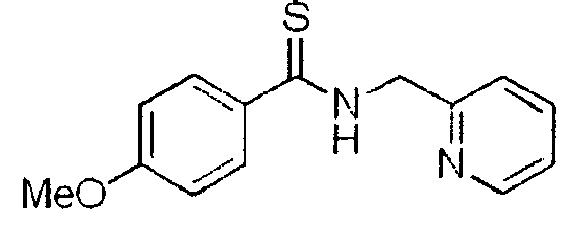
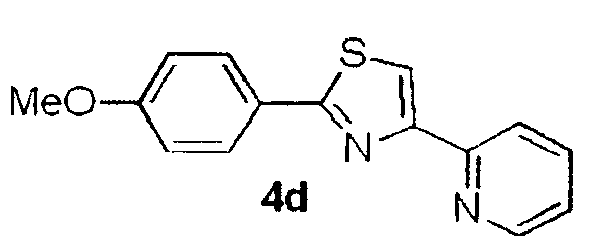
85% 

46% 

37% 

64% 
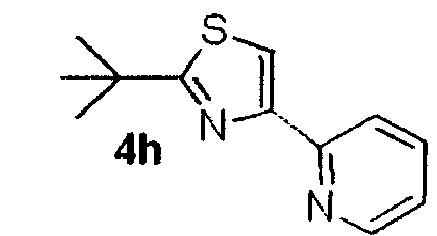
24% - Measurement results such as a nuclear magnetic resonance spectrum for each pyridyl thiazole shown in Table 2 are shown below.
- 1H NMR (CDCl3) δ7.12-7.16 (m, 1H, Ar), 7.20-7.24 (m, 1H, Ar), 7.67-7.72 (m, 2H, Ar), 8.11-8.16 (m, 2H, Ar), 8.20-8.22 (d, J = 7.8 Hz, 1H, Ar), 8.52-8.55 (m, 2H, Ar).
- (m.p. 114-115°C) : IR (KBr) 3126, 1587, 1473, 1424, 1227, 1052, 830, 767, 698 cm-1; 1H NMR (CDCl3) δ7.09-7.10(m, 1H, Ar), 7.22- 7.25 (m, 1H, Ar) , 7.42-7.43 (dd, J = 4.9 Hz, 1.0 Hz, 1H, Ar), 7.56-7.58 (dd, J = 3.9 Hz, 1.0 Hz, 1H, Ar), 7.76-7.80 (m, 1H, Ar), 8.04(s, 1H, SCH), 8.23-8.25 (d, J =7.8 Hz, 1H, ), 8.63-8.64 (m, 1H, Ar); 13CNMR (CDCl3) δ116.0, 121.3, 122.8, 126.6, 127.6, 127.7, 136.8, 137.2, 149.3, 152.2, 155.6, 161.5 (SCN);MS(EI) m/z 244 (M+); HRMS (EI) Calcd for C12H8N2S2 (M+) 244.0129. found: 244.0105.
- (m.p. 100-103C): IR (KBr) 3085, 2836, 1605, 1476, 1306, 1247, 1180, 1026, 834, 776, 713 cm-1; 1H NMR (CDCl3) δ3.76 (s, 1H, OMe), 6.85-6.89 (d, J = 8.8 Hz, 2H, Ar), 7.11- 7.17 (m, 1H, Ar), 7.66-7.70 (td, J = 7.8 Hz, 2.0 Hz, 1H, Ar), 7.86-7.90 (d, J = 8.8 Hz, 2H, Ar), 7.93 (s, 1H, SCH), 8.15-8.17 (d, J = 7.8 Hz,;1H, Ar), 8.52 -8.54 (m, 1H, Ar); 13C NMR (CDCl3) δ55.3 (CH3), 114.2, 116.0, 121.2, 122.7, 126.5, 128.0, 136.9, 149.3,152.6, 155.7, 161.1, 167.9 (SCN); MS (EI) m/z 268 (M+); HRMS (EI) Calcd for C15H12N2OS (M+) 268.0670. found: 268.0663.
- (m.p.140-144°C): IR (KBr) 3103, 1588, 1519, 1477, 1229, 1060, 994, 832, 751, 581, 505 cm-1; 1H NMR (CDCl3) δ7.12-7.18 (t, J = 8.8 Hz, 2H, Ar), 7.22-7.25 (m, 1H, Ar), 7.76-7.81 (td, J = 7.82 Hz, 1H, Ar), 7.99-8.04 (m, 2H, Ar), 8.08 (s, 1H, SCH), 8.23-8.25 (d, J= 7.81 Hz, 1H, Ar), 8.63-8.64 (m, 1H, Ar); 13C NMR (CDCl3) δ115.8, 116.0, 116.8, 121.2, 122.8, 129.9, 129.9, 136.9, 149.3, 152.4, 156.0, 162.6 165.1, 166.8 (SCN); 19F NMR (CDCl3) δ-20.0; MS (EI)m/z 256 (M+); HRMS (EI) Calcd for C14H9FN2S (M+) 256.0470. found: 256.0474.
- (m.p.123-127°C): IR (KBr) 2361, 1588, 1475, 1407, 1327, 1162, 1110, 1068, 846, 764, 673, 608 cm-1; 1H NMR (CDCl3) δ7.13-7.17 (m, 1H, Ar), 7.59-7.91 (d, J = 8.3 Hz, 2H, Ar), 7.66-7.71 (td, J =7.6 Hz, 1H, Ar), 8.01-8.03 (m, 3H, Ar), 8.13-8.15 (d, J = 7.8 Hz, 1H, Ar), 8.52-8.54 (d, J = 4.9 Hz, 1H, Ar); 13C NMR (CDCl3) δ117.8, 121.3, 122.5, 123.0, 125.8, 125.9, 126.7, 131.4, 131.7, 136.6, 136.9, 149.4, 152.2, 156.6, 166.0 (SCN); 19F NMR (CDCl3) δ-63.1; MS (EI) m/z 306 (M+);HRMS (EI) Calcd for C15H9 F3N2S(M+) 306.0439. found: 306.0428.
- Orange liquid: IR (neat) 2967, 1588, 1496, 1420, 1331, 1051, 754, 621 cm-1; 1H NMR (CDCl3) δ1.35-1.37 (d, J= 7.3 Hz, 6H, CH(CH 3)2), 3.25-3.35 (sept, J = 6.9 Hz, 1H, CH(CH3)2), 7.08-7.11 (m, 1H, Ar), 7.62-7.67 (td, J = 7.6 Hz, 1H, Ar), 7.84 (s, 1H, SCH), 8.02-8.04 (d, J = 7.84 Hz, 1H, Ar), 8.51-8.52 (d, J =4.9 Hz, 1H, Ar); 13C NMR (CDCl3) δ23.1 (CH(CH3)2), 33.4 (CH(CH3)2), 115.6, 121.1, 122.4, 136.8, 149.3, 152.8, 154.5, 178.0 (SCN); MS (EI) m/z 204 (M+); HRMS (EI)Calcd for C11H12N2S (M+) 204.0721. found: 204.0691.
- Orange oil:IR (neat) 2961, 2925, 1588, 1495, 1463, 1065, 994, 754 cm-1; 1H NMR (CDCl3) δ1.42 (s, 9H, C(CH3)3), 7.10-7.19 (m, 1H, Ar), 7.65-7.69 (td, J = 7.8 Hz, 1H, Ar), 7.85 (s, 1H, SCH), 8.08-8.10 (dd, J = 7.8 Hz, 1.0 Hz, 1H, Ar), 8.51-8.52 (d, J = 7.8 Hz, 1H, Ar); 13CNMR (CDCl3) δ30.9 (C(CH3)3), 37.8 (C(CH3)3), 115.6, 121.3, 122.4, 136.8, 149.3, 153.0, 154.4, 181.1 (SCN); MS (EI) m/z 218 (M+); HRMS (EI) Calcd for C12H14N2S (M+) 218.0878. found: 218.0857.
- The whole scheme for a synthesis method of the compound 5 (2-(4-methoxyphenyl)-4-phenyl-5-diphenylaminothiazole) by a reaction of adding iodine is then shown as follows:

- Specifically, the compound 1 shown in Example 1 was synthesized, the compound 1 (0.257 g, 1.0 mmol) was then dissolved in THF (2.0 mL), a BuLihexane solution (1.43 M, 1.40 mL, 2.0 mmol) was added to this solution at 0°C, and the mixture was stirred for 5 minutes. N,N-diphenylthioformamide (0.213 g,1.0 mmol) was added to the solution at 0°C, and the mixture was stirred for 30 minutes. Thereto was added iodine (0.512 g, 2.0 mmol) at 0°C, and stirring was continued for 2 hours. The reaction mixture solution was poured into a saturated solution of ammonium chloride and extracted with methylene chloride. The organic layer was dried with magnesium sulfate and concentrated. The residue was purified by silica gel column chromatography to obtain 2-(4-methoxyphenyl)-4-phenyl-5-diphenylaminothiazole at a yield of 26% as a yellow solid.
- Measurement results such as a nuclear magnetic resonance spectrum for the
compound 5 are shown below. A fluorescence spectrum (solid line) by a fluorescence spectrometer of the compound is shown inFig. 1 . A fluorescent intensity is a value when that of rhodamine B was assumed to be 100 in the figure. In this figure, a fluorescence spectrum (dashed line) of 2-(4-methoxyphenyl)-4-phenyl-5-dimethylaminothiazole is shown for comparison, and an effect in the case where a diphenylamino group was used as a substituent is prominently shown. - mp.: 152-155°C; IR(KBr)3064, 2926, 2839, 1602, 1515, 1490, 1415, 1341, 1290, 1245, 1173, 1029, 975, 838, 748, 514 cm-1; 1H NMR (CDCl3) 63.75 (s, 3H, OMe), 6.86 (d, J = 8.8 Hz, 2H, Ar), 6.90 (t, J = 7.3 Hz, 2H, Ar), 7.05-7.07 (m, 4H, Ar), 7.10-7.20 (m, 7H, Ar), 7.82(d, J = 8.8 Hz, 2H, Ar), 7.85-7.88 (m, 2H, Ar); 13C NMR (CDCl3) δ55.4 (OMe), 114.1, 121.3, 122.9, 127.0, 127.4, 127.7, 127.9, 128.2, 129.2, 133.4, 138.9, 146.5, 148.6, 161.2, 163.6 (SC=N); MS (EI) m/z 434 (M+); HRMS (EI) Calcd for C28H22N2OS(M+) 434.1453. found: 434.1437.
- The same operations were performed except for using N-phenyl-N-methylthioformamide (0.119 g, 1.0 mmol) in place of N,N-diphenylthioformamide in Example 6, to obtain 2-(4-methoxyphenyl)-4-phenyl-5-(N-phenyl-N-methylamino) thiazole at a yield of 19% as a yellow solid.
- mp.: 100-101°C; IR(KBr) 2939, 1904, 1596, 1491, 1298, 1258, 1221, 1168, 1136, 1111, 1028, 977, 833, 751, 701cm-1; 1H NMR (CDCl3) δ3.10 (s, 3H, NMe), 3.74 (s, 3H, OMe),6.76-6.87 (m, 5H, Ar), 7.12-7.21 (m, 3H, Ar), 7.26 (t, J = 7.3 Hz, 2H, Ar), 7.83 (d, J = 9.4 Hz, 2H, Ar), 7.90 (d, J = 7.32 Hz, 2H, Ar); 13C NMR (CDCl3) δ40.3 (NMe), 55.3 (OMe), 114.1, 114.2, 119.3, 127.1, 127.3, 127.7, 127.9, 128.5, 129.1, 133.8, 141.0, 148.3, 148.4, 161.1, 163.2 (SC=N);MS(EI)m/z 372 (M+).
- The thiazole derivative prepared through a process of the present invention can be simply produced from easily available raw materials without undergoing a complicated synthesis path by the production process of the present invention. For a synthesized product, specifying a substituent of a starting substance makes it possible to obtain a generated product selectively.
Claims (5)
- A process for producing a thiazole derivative represented by the general formula (I), wherein a strong base is added to a thioamide represented by the general formula (II), wherein the strong base is one or more selected from n-butyllithium, lithium diisopropylamide, sodium hydride, potassium hydride, potassium t-butoxide, calcium hydride, sodium hydroxide, and sodium amide, and
the mixture is reacted with a thioformamide represented by the general formula (III):


R1 represents a group selected from a branched or cyclic alkyl group having 3 to 12 carbon atoms, an aryl group, and a heteroaromatic group, and each of the groups may be further substituted with one or more substituents selected from halogen and hydroxy;
R2 represents an aryl group that may be substituted with one or more substituents selected from halogen and hydroxy, or a pyridyl group that may be substituted with one or more substituents selected from halogen and hydroxy;
R3 and R4 are the same or different, and each represents a group selected from a linear, branched or cyclic alkyl group having 1 to 12 carbon atoms, an aryl group, and a heteroaromatic group wherein each of the groups may be further substituted with one or more substituents selected from halogen and hydroxy, or R3 and R4 represent a C5 to C7 heterocyclic ring formed together with a nitrogen atom to which R3 and R4 are bonded; and
Y represents a hydrogen atom or
- The process for producing a thiazole derivative according to claim 1, wherein after reacting the thioformamide, iodine is further added and the mixture is reacted.
- A process for producing a thiazole derivative according to any one of claim 1 or 2, wherein said thiazole derivative is represented by the general formula (IV):

- A process for producing a thiazole derivative according to any one of claims 1 or 2, wherein said thiazole derivative represented by the general formula (V):

R5 and R6 are the same or different, and each represents a group selected from a linear, branched or cyclic alkyl group having 1 to 12 carbon atoms, an aryl group, and a heteroaromatic group wherein each of the groups may be further substituted with one or more substituents selected from halogen and hydroxy, and at least one of R5 and R6 represents an aryl group that may be substituted with one or more substituents selected from halogen and hydroxy, or a heteroaromatic group that may be substituted with one or more substituents selected from halogen and hydroxy. - A process for producing a thiazole derivative represented by the general formula (I), wherein a strong base is added to a thioamide represented by the general formula (II), wherein the strong base is one or more selected from n-butyllithium, lithium diisopropylamide, sodium hydride, potassium hydride, potassium t-butoxide, calcium hydride, sodium hydroxide, and sodium amide, and the mixture is reacted with a thioformamide represented by the general formula (III):
thioamide (II) thioformamide (III) thiazole derivative (I) 





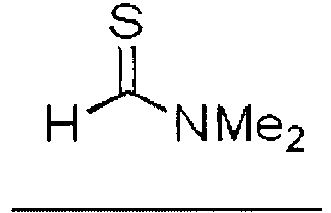




Applications Claiming Priority (2)
| Application Number | Priority Date | Filing Date | Title |
|---|---|---|---|
| JP2009055787 | 2009-03-10 | ||
| PCT/JP2010/053765 WO2010104027A1 (en) | 2009-03-10 | 2010-03-08 | Thiazole derivative and process for producing same |
Publications (3)
| Publication Number | Publication Date |
|---|---|
| EP2388253A1 EP2388253A1 (en) | 2011-11-23 |
| EP2388253A4 EP2388253A4 (en) | 2012-08-08 |
| EP2388253B1 true EP2388253B1 (en) | 2015-02-11 |
Family
ID=42728316
Family Applications (1)
| Application Number | Title | Priority Date | Filing Date |
|---|---|---|---|
| EP10750780.8A Not-in-force EP2388253B1 (en) | 2009-03-10 | 2010-03-08 | Thiazole derivative and process for producing same |
Country Status (5)
| Country | Link |
|---|---|
| US (1) | US8871944B2 (en) |
| EP (1) | EP2388253B1 (en) |
| JP (1) | JP5610351B2 (en) |
| KR (1) | KR20110113775A (en) |
| WO (1) | WO2010104027A1 (en) |
Families Citing this family (3)
| Publication number | Priority date | Publication date | Assignee | Title |
|---|---|---|---|---|
| EP3402798B1 (en) | 2016-01-14 | 2021-04-28 | Handok Inc. | Compounds antagonizing a3 adenosine receptor, method for preparing them, and medical-use thereof |
| JP7193071B2 (en) * | 2017-02-08 | 2022-12-20 | 国立大学法人東海国立大学機構 | Fluorescent materials and UV absorbers |
| CN107298648B (en) * | 2017-06-06 | 2019-01-25 | 上海市伤骨科研究所 | A kind of rhein thioamide compound, its preparation method and use |
Family Cites Families (18)
| Publication number | Priority date | Publication date | Assignee | Title |
|---|---|---|---|---|
| JPS6339868A (en) | 1986-08-04 | 1988-02-20 | Otsuka Pharmaceut Factory Inc | Di (lower alkyl) phenol derivative |
| JPH029284A (en) | 1988-06-28 | 1990-01-12 | Toshiba Corp | Picture recorder for itv picture |
| JPH0269174A (en) | 1988-09-02 | 1990-03-08 | Sumitomo Heavy Ind Ltd | Measuring device for bioprocess |
| GB9027613D0 (en) | 1990-12-20 | 1991-02-13 | Ici Plc | Fungicides |
| JP3209576B2 (en) * | 1992-06-12 | 2001-09-17 | 八洲化学工業株式会社 | Acaricide |
| JPH06145169A (en) * | 1992-09-17 | 1994-05-24 | Nippon Soda Co Ltd | New nitrogen-containing 5-membered ring compound, its production and controller for harmful organism |
| JP3613827B2 (en) | 1994-04-19 | 2005-01-26 | ソニー株式会社 | Digital signal reproduction device |
| JPH11209284A (en) | 1998-01-27 | 1999-08-03 | Sagami Chem Res Center | Osteogenesis promoter |
| JPH11222483A (en) * | 1998-02-02 | 1999-08-17 | Yashima Chemical Ind Co Ltd | 2,4-diphenyl-2-oxa (thia) azoline derivative and herbicide containing the same as active ingredient |
| EP0936222B1 (en) | 1998-02-13 | 2005-09-07 | Dow AgroSciences LLC | A method to prepare 2-(3-pyridyl)-4,5-dihydrothiazoles |
| JP2002053566A (en) | 2000-08-11 | 2002-02-19 | Japan Tobacco Inc | Thiazole compound and pharmaceutical use thereof |
| WO2002094798A1 (en) | 2001-05-23 | 2002-11-28 | Nippon Soda Co.,Ltd. | Process for preparation of thiazole compounds |
| DE10142749A1 (en) | 2001-08-31 | 2003-03-20 | Haarmann & Reimer Gmbh | Process for the preparation of 4,5-dihydro-1,3-thiazoles |
| JP2003212863A (en) * | 2002-01-18 | 2003-07-30 | Daito Kagaku Kk | Method for producing thiazole by condensation of halogenated ketone with thioformamide |
| AU2003253364B2 (en) | 2002-08-07 | 2007-06-07 | F. Hoffmann-La Roche Ag | Thiazole derivatives |
| JP4733995B2 (en) | 2005-02-18 | 2011-07-27 | 富士フイルム株式会社 | Method for producing thiazole derivative |
| EP1975204B1 (en) * | 2007-03-27 | 2013-10-02 | FUJIFILM Corporation | Azo dye and azo compound |
| CN100590123C (en) * | 2008-04-24 | 2010-02-17 | 中国农业大学 | 2,4-disubstituted thiazoline derivatives and their preparation methods and applications |
-
2010
- 2010-03-08 WO PCT/JP2010/053765 patent/WO2010104027A1/en not_active Ceased
- 2010-03-08 JP JP2011503804A patent/JP5610351B2/en not_active Expired - Fee Related
- 2010-03-08 US US13/255,202 patent/US8871944B2/en not_active Expired - Fee Related
- 2010-03-08 EP EP10750780.8A patent/EP2388253B1/en not_active Not-in-force
- 2010-03-08 KR KR1020117021059A patent/KR20110113775A/en not_active Ceased
Also Published As
| Publication number | Publication date |
|---|---|
| KR20110113775A (en) | 2011-10-18 |
| EP2388253A1 (en) | 2011-11-23 |
| WO2010104027A1 (en) | 2010-09-16 |
| EP2388253A4 (en) | 2012-08-08 |
| JPWO2010104027A1 (en) | 2012-09-13 |
| JP5610351B2 (en) | 2014-10-22 |
| US20110319616A1 (en) | 2011-12-29 |
| US8871944B2 (en) | 2014-10-28 |
Similar Documents
| Publication | Publication Date | Title |
|---|---|---|
| ES2561355T3 (en) | Procedure for the oxidation of certain sulfilimines substituted to insecticidal sulfoximins | |
| JP2002105055A (en) | Method for manufacturing indium complex or its tautomer | |
| US6774138B2 (en) | Thiazolyl(pyridyl)ethyne compounds | |
| JP5077969B2 (en) | Process for the preparation of 2-substituted 5- (1-alkylthio) alkylpyridines | |
| US8871944B2 (en) | Thiazole derivative and process for producing same | |
| WO1999059985A1 (en) | Intermediates for the synthesis of epothilones and methods for their preparation | |
| JP5974738B2 (en) | Method for producing α-hydroxyketone compound | |
| CN105820174A (en) | Polysubstituted thienoindole derivative and preparation method thereof | |
| KR101603324B1 (en) | Method for preparation of 3-alkylthio-2-bromopyridine | |
| JP4294952B2 (en) | Method for producing thiazole derivatives having insecticidal activity | |
| KR101845935B1 (en) | preparation method of pyridoisoindole derivatives | |
| CN105481781B (en) | Compound and its preparation method and application | |
| JP2007230963A (en) | Method for producing 2,4-disubstituted pyridine | |
| JP2009280515A (en) | Heterocyclic oligomer compound having pentafluorosulfanyl group | |
| US3946031A (en) | 2-Substituted-1,2,4-thiadiazolo-[2,3-a]-benzimidazoles | |
| CN105085371B (en) | (S) { 1 (chloro-carbonic acid ester group) 2 [2 (1,3 dioxy iso-indoles) base] ethyl } halide salt and preparation method thereof | |
| CN101410386A (en) | 2-alkenyl-3-aminothiophene derivative and process for producing the same | |
| JPH064614B2 (en) | Process for producing 4-oxo-4H-pyran-3-carboxamide compound | |
| JPH0710857B2 (en) | Intermediate compound | |
| JP4082883B2 (en) | Method for producing aziridine derivative | |
| CN102532012B (en) | Method for preparing 2-substituted-5-((1-alkyl sulfenyl) alkyl) pyridine | |
| US3976654A (en) | 2-Substituted-1,2,4-thiadiazolo-[2,3-a]-benzimidazoles and process for their preparation | |
| JP3233806B2 (en) | Method for producing sulfenylacetic acid derivative | |
| JP5765371B2 (en) | Heterocyclic oligomer compound having a pentafluorosulfanyl group | |
| JP2009504721A (en) | Chemical process |
Legal Events
| Date | Code | Title | Description |
|---|---|---|---|
| PUAI | Public reference made under article 153(3) epc to a published international application that has entered the european phase |
Free format text: ORIGINAL CODE: 0009012 |
|
| 17P | Request for examination filed |
Effective date: 20110811 |
|
| AK | Designated contracting states |
Kind code of ref document: A1 Designated state(s): AT BE BG CH CY CZ DE DK EE ES FI FR GB GR HR HU IE IS IT LI LT LU LV MC MK MT NL NO PL PT RO SE SI SK SM TR |
|
| DAX | Request for extension of the european patent (deleted) | ||
| RIC1 | Information provided on ipc code assigned before grant |
Ipc: C07D 277/18 20060101AFI20120628BHEP Ipc: C07D 417/04 20060101ALI20120628BHEP Ipc: C07D 417/14 20060101ALI20120628BHEP |
|
| A4 | Supplementary search report drawn up and despatched |
Effective date: 20120711 |
|
| 17Q | First examination report despatched |
Effective date: 20140115 |
|
| GRAP | Despatch of communication of intention to grant a patent |
Free format text: ORIGINAL CODE: EPIDOSNIGR1 |
|
| INTG | Intention to grant announced |
Effective date: 20141127 |
|
| RIN1 | Information on inventor provided before grant (corrected) |
Inventor name: MURAI, TOSHIAKI |
|
| GRAS | Grant fee paid |
Free format text: ORIGINAL CODE: EPIDOSNIGR3 |
|
| GRAA | (expected) grant |
Free format text: ORIGINAL CODE: 0009210 |
|
| AK | Designated contracting states |
Kind code of ref document: B1 Designated state(s): AT BE BG CH CY CZ DE DK EE ES FI FR GB GR HR HU IE IS IT LI LT LU LV MC MK MT NL NO PL PT RO SE SI SK SM TR |
|
| REG | Reference to a national code |
Ref country code: GB Ref legal event code: FG4D |
|
| REG | Reference to a national code |
Ref country code: CH Ref legal event code: EP |
|
| REG | Reference to a national code |
Ref country code: IE Ref legal event code: FG4D |
|
| REG | Reference to a national code |
Ref country code: AT Ref legal event code: REF Ref document number: 709863 Country of ref document: AT Kind code of ref document: T Effective date: 20150315 |
|
| REG | Reference to a national code |
Ref country code: DE Ref legal event code: R096 Ref document number: 602010022213 Country of ref document: DE Effective date: 20150326 |
|
| REG | Reference to a national code |
Ref country code: NL Ref legal event code: VDEP Effective date: 20150211 |
|
| REG | Reference to a national code |
Ref country code: AT Ref legal event code: MK05 Ref document number: 709863 Country of ref document: AT Kind code of ref document: T Effective date: 20150211 |
|
| REG | Reference to a national code |
Ref country code: LT Ref legal event code: MG4D |
|
| PG25 | Lapsed in a contracting state [announced via postgrant information from national office to epo] |
Ref country code: FI Free format text: LAPSE BECAUSE OF FAILURE TO SUBMIT A TRANSLATION OF THE DESCRIPTION OR TO PAY THE FEE WITHIN THE PRESCRIBED TIME-LIMIT Effective date: 20150211 Ref country code: LT Free format text: LAPSE BECAUSE OF FAILURE TO SUBMIT A TRANSLATION OF THE DESCRIPTION OR TO PAY THE FEE WITHIN THE PRESCRIBED TIME-LIMIT Effective date: 20150211 Ref country code: NO Free format text: LAPSE BECAUSE OF FAILURE TO SUBMIT A TRANSLATION OF THE DESCRIPTION OR TO PAY THE FEE WITHIN THE PRESCRIBED TIME-LIMIT Effective date: 20150511 Ref country code: HR Free format text: LAPSE BECAUSE OF FAILURE TO SUBMIT A TRANSLATION OF THE DESCRIPTION OR TO PAY THE FEE WITHIN THE PRESCRIBED TIME-LIMIT Effective date: 20150211 Ref country code: ES Free format text: LAPSE BECAUSE OF FAILURE TO SUBMIT A TRANSLATION OF THE DESCRIPTION OR TO PAY THE FEE WITHIN THE PRESCRIBED TIME-LIMIT Effective date: 20150211 Ref country code: SE Free format text: LAPSE BECAUSE OF FAILURE TO SUBMIT A TRANSLATION OF THE DESCRIPTION OR TO PAY THE FEE WITHIN THE PRESCRIBED TIME-LIMIT Effective date: 20150211 |
|
| PG25 | Lapsed in a contracting state [announced via postgrant information from national office to epo] |
Ref country code: IS Free format text: LAPSE BECAUSE OF FAILURE TO SUBMIT A TRANSLATION OF THE DESCRIPTION OR TO PAY THE FEE WITHIN THE PRESCRIBED TIME-LIMIT Effective date: 20150611 Ref country code: LV Free format text: LAPSE BECAUSE OF FAILURE TO SUBMIT A TRANSLATION OF THE DESCRIPTION OR TO PAY THE FEE WITHIN THE PRESCRIBED TIME-LIMIT Effective date: 20150211 Ref country code: NL Free format text: LAPSE BECAUSE OF FAILURE TO SUBMIT A TRANSLATION OF THE DESCRIPTION OR TO PAY THE FEE WITHIN THE PRESCRIBED TIME-LIMIT Effective date: 20150211 Ref country code: AT Free format text: LAPSE BECAUSE OF FAILURE TO SUBMIT A TRANSLATION OF THE DESCRIPTION OR TO PAY THE FEE WITHIN THE PRESCRIBED TIME-LIMIT Effective date: 20150211 Ref country code: GR Free format text: LAPSE BECAUSE OF FAILURE TO SUBMIT A TRANSLATION OF THE DESCRIPTION OR TO PAY THE FEE WITHIN THE PRESCRIBED TIME-LIMIT Effective date: 20150512 |
|
| REG | Reference to a national code |
Ref country code: DE Ref legal event code: R119 Ref document number: 602010022213 Country of ref document: DE |
|
| PG25 | Lapsed in a contracting state [announced via postgrant information from national office to epo] |
Ref country code: EE Free format text: LAPSE BECAUSE OF FAILURE TO SUBMIT A TRANSLATION OF THE DESCRIPTION OR TO PAY THE FEE WITHIN THE PRESCRIBED TIME-LIMIT Effective date: 20150211 Ref country code: DK Free format text: LAPSE BECAUSE OF FAILURE TO SUBMIT A TRANSLATION OF THE DESCRIPTION OR TO PAY THE FEE WITHIN THE PRESCRIBED TIME-LIMIT Effective date: 20150211 Ref country code: RO Free format text: LAPSE BECAUSE OF FAILURE TO SUBMIT A TRANSLATION OF THE DESCRIPTION OR TO PAY THE FEE WITHIN THE PRESCRIBED TIME-LIMIT Effective date: 20150211 Ref country code: CZ Free format text: LAPSE BECAUSE OF FAILURE TO SUBMIT A TRANSLATION OF THE DESCRIPTION OR TO PAY THE FEE WITHIN THE PRESCRIBED TIME-LIMIT Effective date: 20150211 Ref country code: SK Free format text: LAPSE BECAUSE OF FAILURE TO SUBMIT A TRANSLATION OF THE DESCRIPTION OR TO PAY THE FEE WITHIN THE PRESCRIBED TIME-LIMIT Effective date: 20150211 |
|
| REG | Reference to a national code |
Ref country code: CH Ref legal event code: PL |
|
| PG25 | Lapsed in a contracting state [announced via postgrant information from national office to epo] |
Ref country code: MC Free format text: LAPSE BECAUSE OF FAILURE TO SUBMIT A TRANSLATION OF THE DESCRIPTION OR TO PAY THE FEE WITHIN THE PRESCRIBED TIME-LIMIT Effective date: 20150211 Ref country code: PL Free format text: LAPSE BECAUSE OF FAILURE TO SUBMIT A TRANSLATION OF THE DESCRIPTION OR TO PAY THE FEE WITHIN THE PRESCRIBED TIME-LIMIT Effective date: 20150211 |
|
| PLBE | No opposition filed within time limit |
Free format text: ORIGINAL CODE: 0009261 |
|
| STAA | Information on the status of an ep patent application or granted ep patent |
Free format text: STATUS: NO OPPOSITION FILED WITHIN TIME LIMIT |
|
| PG25 | Lapsed in a contracting state [announced via postgrant information from national office to epo] |
Ref country code: IT Free format text: LAPSE BECAUSE OF FAILURE TO SUBMIT A TRANSLATION OF THE DESCRIPTION OR TO PAY THE FEE WITHIN THE PRESCRIBED TIME-LIMIT Effective date: 20150211 |
|
| REG | Reference to a national code |
Ref country code: FR Ref legal event code: ST Effective date: 20151130 |
|
| REG | Reference to a national code |
Ref country code: IE Ref legal event code: MM4A |
|
| 26N | No opposition filed |
Effective date: 20151112 |
|
| PG25 | Lapsed in a contracting state [announced via postgrant information from national office to epo] |
Ref country code: IE Free format text: LAPSE BECAUSE OF NON-PAYMENT OF DUE FEES Effective date: 20150308 Ref country code: DE Free format text: LAPSE BECAUSE OF NON-PAYMENT OF DUE FEES Effective date: 20151001 Ref country code: LI Free format text: LAPSE BECAUSE OF NON-PAYMENT OF DUE FEES Effective date: 20150331 Ref country code: CH Free format text: LAPSE BECAUSE OF NON-PAYMENT OF DUE FEES Effective date: 20150331 |
|
| PG25 | Lapsed in a contracting state [announced via postgrant information from national office to epo] |
Ref country code: FR Free format text: LAPSE BECAUSE OF NON-PAYMENT OF DUE FEES Effective date: 20150413 Ref country code: SI Free format text: LAPSE BECAUSE OF FAILURE TO SUBMIT A TRANSLATION OF THE DESCRIPTION OR TO PAY THE FEE WITHIN THE PRESCRIBED TIME-LIMIT Effective date: 20150211 |
|
| PG25 | Lapsed in a contracting state [announced via postgrant information from national office to epo] |
Ref country code: BE Free format text: LAPSE BECAUSE OF FAILURE TO SUBMIT A TRANSLATION OF THE DESCRIPTION OR TO PAY THE FEE WITHIN THE PRESCRIBED TIME-LIMIT Effective date: 20150211 |
|
| PGFP | Annual fee paid to national office [announced via postgrant information from national office to epo] |
Ref country code: GB Payment date: 20160318 Year of fee payment: 7 |
|
| PG25 | Lapsed in a contracting state [announced via postgrant information from national office to epo] |
Ref country code: MT Free format text: LAPSE BECAUSE OF FAILURE TO SUBMIT A TRANSLATION OF THE DESCRIPTION OR TO PAY THE FEE WITHIN THE PRESCRIBED TIME-LIMIT Effective date: 20150211 |
|
| PG25 | Lapsed in a contracting state [announced via postgrant information from national office to epo] |
Ref country code: HU Free format text: LAPSE BECAUSE OF FAILURE TO SUBMIT A TRANSLATION OF THE DESCRIPTION OR TO PAY THE FEE WITHIN THE PRESCRIBED TIME-LIMIT; INVALID AB INITIO Effective date: 20100308 Ref country code: BG Free format text: LAPSE BECAUSE OF FAILURE TO SUBMIT A TRANSLATION OF THE DESCRIPTION OR TO PAY THE FEE WITHIN THE PRESCRIBED TIME-LIMIT Effective date: 20150211 Ref country code: SM Free format text: LAPSE BECAUSE OF FAILURE TO SUBMIT A TRANSLATION OF THE DESCRIPTION OR TO PAY THE FEE WITHIN THE PRESCRIBED TIME-LIMIT Effective date: 20150211 |
|
| PG25 | Lapsed in a contracting state [announced via postgrant information from national office to epo] |
Ref country code: CY Free format text: LAPSE BECAUSE OF FAILURE TO SUBMIT A TRANSLATION OF THE DESCRIPTION OR TO PAY THE FEE WITHIN THE PRESCRIBED TIME-LIMIT Effective date: 20150211 |
|
| PG25 | Lapsed in a contracting state [announced via postgrant information from national office to epo] |
Ref country code: PT Free format text: LAPSE BECAUSE OF FAILURE TO SUBMIT A TRANSLATION OF THE DESCRIPTION OR TO PAY THE FEE WITHIN THE PRESCRIBED TIME-LIMIT Effective date: 20150611 |
|
| PG25 | Lapsed in a contracting state [announced via postgrant information from national office to epo] |
Ref country code: TR Free format text: LAPSE BECAUSE OF FAILURE TO SUBMIT A TRANSLATION OF THE DESCRIPTION OR TO PAY THE FEE WITHIN THE PRESCRIBED TIME-LIMIT Effective date: 20150211 |
|
| GBPC | Gb: european patent ceased through non-payment of renewal fee |
Effective date: 20170308 |
|
| PG25 | Lapsed in a contracting state [announced via postgrant information from national office to epo] |
Ref country code: LU Free format text: LAPSE BECAUSE OF NON-PAYMENT OF DUE FEES Effective date: 20150308 |
|
| PG25 | Lapsed in a contracting state [announced via postgrant information from national office to epo] |
Ref country code: GB Free format text: LAPSE BECAUSE OF NON-PAYMENT OF DUE FEES Effective date: 20170308 |
|
| PG25 | Lapsed in a contracting state [announced via postgrant information from national office to epo] |
Ref country code: MK Free format text: LAPSE BECAUSE OF FAILURE TO SUBMIT A TRANSLATION OF THE DESCRIPTION OR TO PAY THE FEE WITHIN THE PRESCRIBED TIME-LIMIT Effective date: 20150211 |