EP2387624B1 - Metal recovery from metallurgical waste by chloridising - Google Patents
Metal recovery from metallurgical waste by chloridising Download PDFInfo
- Publication number
- EP2387624B1 EP2387624B1 EP10705408.2A EP10705408A EP2387624B1 EP 2387624 B1 EP2387624 B1 EP 2387624B1 EP 10705408 A EP10705408 A EP 10705408A EP 2387624 B1 EP2387624 B1 EP 2387624B1
- Authority
- EP
- European Patent Office
- Prior art keywords
- metal
- chloride
- process according
- gaseous
- metal chloride
- Prior art date
- Legal status (The legal status is an assumption and is not a legal conclusion. Google has not performed a legal analysis and makes no representation as to the accuracy of the status listed.)
- Not-in-force
Links
- 229910052751 metal Inorganic materials 0.000 title claims description 42
- 239000002184 metal Substances 0.000 title claims description 42
- 239000002699 waste material Substances 0.000 title description 17
- 238000011084 recovery Methods 0.000 title description 9
- 229910001510 metal chloride Inorganic materials 0.000 claims description 68
- 238000000034 method Methods 0.000 claims description 50
- VEXZGXHMUGYJMC-UHFFFAOYSA-M Chloride anion Chemical compound [Cl-] VEXZGXHMUGYJMC-UHFFFAOYSA-M 0.000 claims description 24
- 239000000463 material Substances 0.000 claims description 22
- HCHKCACWOHOZIP-UHFFFAOYSA-N Zinc Chemical compound [Zn] HCHKCACWOHOZIP-UHFFFAOYSA-N 0.000 claims description 19
- 239000007789 gas Substances 0.000 claims description 19
- 229910052725 zinc Inorganic materials 0.000 claims description 19
- 239000011701 zinc Substances 0.000 claims description 19
- 239000000047 product Substances 0.000 claims description 18
- XEEYBQQBJWHFJM-UHFFFAOYSA-N Iron Chemical compound [Fe] XEEYBQQBJWHFJM-UHFFFAOYSA-N 0.000 claims description 16
- RYGMFSIKBFXOCR-UHFFFAOYSA-N Copper Chemical compound [Cu] RYGMFSIKBFXOCR-UHFFFAOYSA-N 0.000 claims description 15
- 229910052802 copper Inorganic materials 0.000 claims description 15
- 239000010949 copper Substances 0.000 claims description 15
- 239000011343 solid material Substances 0.000 claims description 13
- 150000001805 chlorine compounds Chemical class 0.000 claims description 11
- 239000000470 constituent Substances 0.000 claims description 10
- 239000011133 lead Substances 0.000 claims description 10
- 239000002910 solid waste Substances 0.000 claims description 9
- 239000000243 solution Substances 0.000 claims description 9
- VEXZGXHMUGYJMC-UHFFFAOYSA-N Hydrochloric acid Chemical compound Cl VEXZGXHMUGYJMC-UHFFFAOYSA-N 0.000 claims description 8
- RAHZWNYVWXNFOC-UHFFFAOYSA-N Sulphur dioxide Chemical compound O=S=O RAHZWNYVWXNFOC-UHFFFAOYSA-N 0.000 claims description 8
- 238000010438 heat treatment Methods 0.000 claims description 8
- 229910000041 hydrogen chloride Inorganic materials 0.000 claims description 8
- IXCSERBJSXMMFS-UHFFFAOYSA-N hydrogen chloride Substances Cl.Cl IXCSERBJSXMMFS-UHFFFAOYSA-N 0.000 claims description 8
- 229910052742 iron Inorganic materials 0.000 claims description 8
- NLXLAEXVIDQMFP-UHFFFAOYSA-N Ammonia chloride Chemical compound [NH4+].[Cl-] NLXLAEXVIDQMFP-UHFFFAOYSA-N 0.000 claims description 6
- PXHVJJICTQNCMI-UHFFFAOYSA-N Nickel Chemical compound [Ni] PXHVJJICTQNCMI-UHFFFAOYSA-N 0.000 claims description 6
- 238000003723 Smelting Methods 0.000 claims description 6
- 238000007670 refining Methods 0.000 claims description 6
- XLYOFNOQVPJJNP-UHFFFAOYSA-N water Substances O XLYOFNOQVPJJNP-UHFFFAOYSA-N 0.000 claims description 6
- 239000007864 aqueous solution Substances 0.000 claims description 5
- 239000007787 solid Substances 0.000 claims description 5
- ATJFFYVFTNAWJD-UHFFFAOYSA-N Tin Chemical compound [Sn] ATJFFYVFTNAWJD-UHFFFAOYSA-N 0.000 claims description 4
- 239000006227 byproduct Substances 0.000 claims description 4
- 229910052569 sulfide mineral Inorganic materials 0.000 claims description 4
- 229910052718 tin Inorganic materials 0.000 claims description 4
- 239000011135 tin Substances 0.000 claims description 4
- 235000019270 ammonium chloride Nutrition 0.000 claims description 3
- 229910052759 nickel Inorganic materials 0.000 claims description 3
- 238000010791 quenching Methods 0.000 claims description 3
- 230000000171 quenching effect Effects 0.000 claims description 3
- GYHNNYVSQQEPJS-UHFFFAOYSA-N Gallium Chemical compound [Ga] GYHNNYVSQQEPJS-UHFFFAOYSA-N 0.000 claims description 2
- ZOKXTWBITQBERF-UHFFFAOYSA-N Molybdenum Chemical compound [Mo] ZOKXTWBITQBERF-UHFFFAOYSA-N 0.000 claims description 2
- BQCADISMDOOEFD-UHFFFAOYSA-N Silver Chemical compound [Ag] BQCADISMDOOEFD-UHFFFAOYSA-N 0.000 claims description 2
- 150000003819 basic metal compounds Chemical class 0.000 claims description 2
- 229910052733 gallium Inorganic materials 0.000 claims description 2
- 229910052732 germanium Inorganic materials 0.000 claims description 2
- GNPVGFCGXDBREM-UHFFFAOYSA-N germanium atom Chemical compound [Ge] GNPVGFCGXDBREM-UHFFFAOYSA-N 0.000 claims description 2
- PCHJSUWPFVWCPO-UHFFFAOYSA-N gold Chemical compound [Au] PCHJSUWPFVWCPO-UHFFFAOYSA-N 0.000 claims description 2
- 229910052737 gold Inorganic materials 0.000 claims description 2
- 239000010931 gold Substances 0.000 claims description 2
- 229910052738 indium Inorganic materials 0.000 claims description 2
- APFVFJFRJDLVQX-UHFFFAOYSA-N indium atom Chemical compound [In] APFVFJFRJDLVQX-UHFFFAOYSA-N 0.000 claims description 2
- 229910052750 molybdenum Inorganic materials 0.000 claims description 2
- 239000011733 molybdenum Substances 0.000 claims description 2
- 229910052709 silver Inorganic materials 0.000 claims description 2
- 239000004332 silver Substances 0.000 claims description 2
- 150000007514 bases Chemical class 0.000 claims 3
- 239000002893 slag Substances 0.000 description 19
- 150000002739 metals Chemical class 0.000 description 10
- QAOWNCQODCNURD-UHFFFAOYSA-N Sulfuric acid Chemical compound OS(O)(=O)=O QAOWNCQODCNURD-UHFFFAOYSA-N 0.000 description 6
- UCKMPCXJQFINFW-UHFFFAOYSA-N Sulphide Chemical compound [S-2] UCKMPCXJQFINFW-UHFFFAOYSA-N 0.000 description 6
- ZAMOUSCENKQFHK-UHFFFAOYSA-N Chlorine atom Chemical compound [Cl] ZAMOUSCENKQFHK-UHFFFAOYSA-N 0.000 description 4
- 238000006243 chemical reaction Methods 0.000 description 4
- 239000000460 chlorine Substances 0.000 description 4
- 229910052801 chlorine Inorganic materials 0.000 description 4
- 239000012141 concentrate Substances 0.000 description 4
- 238000009833 condensation Methods 0.000 description 4
- 230000005494 condensation Effects 0.000 description 4
- 238000004090 dissolution Methods 0.000 description 4
- 238000009834 vaporization Methods 0.000 description 4
- UFHFLCQGNIYNRP-UHFFFAOYSA-N Hydrogen Chemical compound [H][H] UFHFLCQGNIYNRP-UHFFFAOYSA-N 0.000 description 3
- HEMHJVSKTPXQMS-UHFFFAOYSA-M Sodium hydroxide Chemical compound [OH-].[Na+] HEMHJVSKTPXQMS-UHFFFAOYSA-M 0.000 description 3
- 239000001257 hydrogen Substances 0.000 description 3
- 229910052739 hydrogen Inorganic materials 0.000 description 3
- 239000012535 impurity Substances 0.000 description 3
- 238000002360 preparation method Methods 0.000 description 3
- 238000012360 testing method Methods 0.000 description 3
- XLOMVQKBTHCTTD-UHFFFAOYSA-N Zinc monoxide Chemical compound [Zn]=O XLOMVQKBTHCTTD-UHFFFAOYSA-N 0.000 description 2
- 239000010953 base metal Substances 0.000 description 2
- 230000015572 biosynthetic process Effects 0.000 description 2
- 238000005660 chlorination reaction Methods 0.000 description 2
- 150000001875 compounds Chemical class 0.000 description 2
- 238000007796 conventional method Methods 0.000 description 2
- 238000005868 electrolysis reaction Methods 0.000 description 2
- 238000000605 extraction Methods 0.000 description 2
- 239000000446 fuel Substances 0.000 description 2
- 229910052500 inorganic mineral Inorganic materials 0.000 description 2
- HWSZZLVAJGOAAY-UHFFFAOYSA-L lead(II) chloride Chemical compound Cl[Pb]Cl HWSZZLVAJGOAAY-UHFFFAOYSA-L 0.000 description 2
- 229910000000 metal hydroxide Inorganic materials 0.000 description 2
- 150000004692 metal hydroxides Chemical class 0.000 description 2
- 239000011707 mineral Substances 0.000 description 2
- 239000000203 mixture Substances 0.000 description 2
- 230000003647 oxidation Effects 0.000 description 2
- 238000007254 oxidation reaction Methods 0.000 description 2
- 239000002244 precipitate Substances 0.000 description 2
- 238000001556 precipitation Methods 0.000 description 2
- 238000012545 processing Methods 0.000 description 2
- 238000000746 purification Methods 0.000 description 2
- 238000000926 separation method Methods 0.000 description 2
- 239000000126 substance Substances 0.000 description 2
- 150000004763 sulfides Chemical class 0.000 description 2
- 239000004215 Carbon black (E152) Substances 0.000 description 1
- VYZAMTAEIAYCRO-UHFFFAOYSA-N Chromium Chemical compound [Cr] VYZAMTAEIAYCRO-UHFFFAOYSA-N 0.000 description 1
- CWYNVVGOOAEACU-UHFFFAOYSA-N Fe2+ Chemical compound [Fe+2] CWYNVVGOOAEACU-UHFFFAOYSA-N 0.000 description 1
- QAOWNCQODCNURD-UHFFFAOYSA-L Sulfate Chemical compound [O-]S([O-])(=O)=O QAOWNCQODCNURD-UHFFFAOYSA-L 0.000 description 1
- NINIDFKCEFEMDL-UHFFFAOYSA-N Sulfur Chemical compound [S] NINIDFKCEFEMDL-UHFFFAOYSA-N 0.000 description 1
- 239000005864 Sulphur Substances 0.000 description 1
- 239000005083 Zinc sulfide Substances 0.000 description 1
- 239000000654 additive Substances 0.000 description 1
- 238000005054 agglomeration Methods 0.000 description 1
- 230000002776 aggregation Effects 0.000 description 1
- 229910052785 arsenic Inorganic materials 0.000 description 1
- RQNWIZPPADIBDY-UHFFFAOYSA-N arsenic atom Chemical compound [As] RQNWIZPPADIBDY-UHFFFAOYSA-N 0.000 description 1
- 239000012267 brine Substances 0.000 description 1
- 239000003795 chemical substances by application Substances 0.000 description 1
- 229910052804 chromium Inorganic materials 0.000 description 1
- 239000011651 chromium Substances 0.000 description 1
- 239000003818 cinder Substances 0.000 description 1
- 229910017052 cobalt Inorganic materials 0.000 description 1
- 239000010941 cobalt Substances 0.000 description 1
- GUTLYIVDDKVIGB-UHFFFAOYSA-N cobalt atom Chemical compound [Co] GUTLYIVDDKVIGB-UHFFFAOYSA-N 0.000 description 1
- 239000000356 contaminant Substances 0.000 description 1
- 230000003247 decreasing effect Effects 0.000 description 1
- 238000011161 development Methods 0.000 description 1
- 230000000694 effects Effects 0.000 description 1
- 238000005363 electrowinning Methods 0.000 description 1
- 238000005516 engineering process Methods 0.000 description 1
- 239000012530 fluid Substances 0.000 description 1
- 238000005243 fluidization Methods 0.000 description 1
- 229910001385 heavy metal Inorganic materials 0.000 description 1
- 229910052595 hematite Inorganic materials 0.000 description 1
- 239000011019 hematite Substances 0.000 description 1
- 229930195733 hydrocarbon Natural products 0.000 description 1
- 150000002430 hydrocarbons Chemical class 0.000 description 1
- 238000009854 hydrometallurgy Methods 0.000 description 1
- 238000002347 injection Methods 0.000 description 1
- 239000007924 injection Substances 0.000 description 1
- 238000009413 insulation Methods 0.000 description 1
- FBAFATDZDUQKNH-UHFFFAOYSA-M iron chloride Chemical compound [Cl-].[Fe] FBAFATDZDUQKNH-UHFFFAOYSA-M 0.000 description 1
- LIKBJVNGSGBSGK-UHFFFAOYSA-N iron(3+);oxygen(2-) Chemical compound [O-2].[O-2].[O-2].[Fe+3].[Fe+3] LIKBJVNGSGBSGK-UHFFFAOYSA-N 0.000 description 1
- SZVJSHCCFOBDDC-UHFFFAOYSA-N iron(II,III) oxide Inorganic materials O=[Fe]O[Fe]O[Fe]=O SZVJSHCCFOBDDC-UHFFFAOYSA-N 0.000 description 1
- 229910001710 laterite Inorganic materials 0.000 description 1
- 239000011504 laterite Substances 0.000 description 1
- 238000002386 leaching Methods 0.000 description 1
- JQJCSZOEVBFDKO-UHFFFAOYSA-N lead zinc Chemical compound [Zn].[Pb] JQJCSZOEVBFDKO-UHFFFAOYSA-N 0.000 description 1
- 230000014759 maintenance of location Effects 0.000 description 1
- WPBNNNQJVZRUHP-UHFFFAOYSA-L manganese(2+);methyl n-[[2-(methoxycarbonylcarbamothioylamino)phenyl]carbamothioyl]carbamate;n-[2-(sulfidocarbothioylamino)ethyl]carbamodithioate Chemical compound [Mn+2].[S-]C(=S)NCCNC([S-])=S.COC(=O)NC(=S)NC1=CC=CC=C1NC(=S)NC(=O)OC WPBNNNQJVZRUHP-UHFFFAOYSA-L 0.000 description 1
- 150000002736 metal compounds Chemical class 0.000 description 1
- 229910044991 metal oxide Inorganic materials 0.000 description 1
- 150000004706 metal oxides Chemical class 0.000 description 1
- -1 metals chlorides Chemical class 0.000 description 1
- 239000010813 municipal solid waste Substances 0.000 description 1
- 150000002816 nickel compounds Chemical class 0.000 description 1
- 239000002245 particle Substances 0.000 description 1
- NIFIFKQPDTWWGU-UHFFFAOYSA-N pyrite Chemical compound [Fe+2].[S-][S-] NIFIFKQPDTWWGU-UHFFFAOYSA-N 0.000 description 1
- 229910052683 pyrite Inorganic materials 0.000 description 1
- 239000011028 pyrite Substances 0.000 description 1
- 229910052952 pyrrhotite Inorganic materials 0.000 description 1
- 238000009877 rendering Methods 0.000 description 1
- 238000012216 screening Methods 0.000 description 1
- 150000004760 silicates Chemical class 0.000 description 1
- HPALAKNZSZLMCH-UHFFFAOYSA-M sodium;chloride;hydrate Chemical compound O.[Na+].[Cl-] HPALAKNZSZLMCH-UHFFFAOYSA-M 0.000 description 1
- 238000000638 solvent extraction Methods 0.000 description 1
- 239000007921 spray Substances 0.000 description 1
- 150000003467 sulfuric acid derivatives Chemical class 0.000 description 1
- 229910021653 sulphate ion Inorganic materials 0.000 description 1
- 239000002912 waste gas Substances 0.000 description 1
- 239000011787 zinc oxide Substances 0.000 description 1
Images
Classifications
-
- C—CHEMISTRY; METALLURGY
- C22—METALLURGY; FERROUS OR NON-FERROUS ALLOYS; TREATMENT OF ALLOYS OR NON-FERROUS METALS
- C22B—PRODUCTION AND REFINING OF METALS; PRETREATMENT OF RAW MATERIALS
- C22B1/00—Preliminary treatment of ores or scrap
- C22B1/02—Roasting processes
- C22B1/08—Chloridising roasting
-
- C—CHEMISTRY; METALLURGY
- C22—METALLURGY; FERROUS OR NON-FERROUS ALLOYS; TREATMENT OF ALLOYS OR NON-FERROUS METALS
- C22B—PRODUCTION AND REFINING OF METALS; PRETREATMENT OF RAW MATERIALS
- C22B1/00—Preliminary treatment of ores or scrap
- C22B1/02—Roasting processes
- C22B1/10—Roasting processes in fluidised form
-
- C—CHEMISTRY; METALLURGY
- C22—METALLURGY; FERROUS OR NON-FERROUS ALLOYS; TREATMENT OF ALLOYS OR NON-FERROUS METALS
- C22B—PRODUCTION AND REFINING OF METALS; PRETREATMENT OF RAW MATERIALS
- C22B13/00—Obtaining lead
- C22B13/02—Obtaining lead by dry processes
- C22B13/025—Recovery from waste materials
-
- C—CHEMISTRY; METALLURGY
- C22—METALLURGY; FERROUS OR NON-FERROUS ALLOYS; TREATMENT OF ALLOYS OR NON-FERROUS METALS
- C22B—PRODUCTION AND REFINING OF METALS; PRETREATMENT OF RAW MATERIALS
- C22B15/00—Obtaining copper
- C22B15/0026—Pyrometallurgy
- C22B15/006—Pyrometallurgy working up of molten copper, e.g. refining
-
- C—CHEMISTRY; METALLURGY
- C22—METALLURGY; FERROUS OR NON-FERROUS ALLOYS; TREATMENT OF ALLOYS OR NON-FERROUS METALS
- C22B—PRODUCTION AND REFINING OF METALS; PRETREATMENT OF RAW MATERIALS
- C22B19/00—Obtaining zinc or zinc oxide
- C22B19/28—Obtaining zinc or zinc oxide from muffle furnace residues
-
- C—CHEMISTRY; METALLURGY
- C22—METALLURGY; FERROUS OR NON-FERROUS ALLOYS; TREATMENT OF ALLOYS OR NON-FERROUS METALS
- C22B—PRODUCTION AND REFINING OF METALS; PRETREATMENT OF RAW MATERIALS
- C22B19/00—Obtaining zinc or zinc oxide
- C22B19/30—Obtaining zinc or zinc oxide from metallic residues or scraps
-
- C—CHEMISTRY; METALLURGY
- C22—METALLURGY; FERROUS OR NON-FERROUS ALLOYS; TREATMENT OF ALLOYS OR NON-FERROUS METALS
- C22B—PRODUCTION AND REFINING OF METALS; PRETREATMENT OF RAW MATERIALS
- C22B7/00—Working up raw materials other than ores, e.g. scrap, to produce non-ferrous metals and compounds thereof; Methods of a general interest or applied to the winning of more than two metals
- C22B7/001—Dry processes
- C22B7/002—Dry processes by treating with halogens, sulfur or compounds thereof; by carburising, by treating with hydrogen (hydriding)
-
- C—CHEMISTRY; METALLURGY
- C22—METALLURGY; FERROUS OR NON-FERROUS ALLOYS; TREATMENT OF ALLOYS OR NON-FERROUS METALS
- C22B—PRODUCTION AND REFINING OF METALS; PRETREATMENT OF RAW MATERIALS
- C22B7/00—Working up raw materials other than ores, e.g. scrap, to produce non-ferrous metals and compounds thereof; Methods of a general interest or applied to the winning of more than two metals
- C22B7/04—Working-up slag
-
- Y—GENERAL TAGGING OF NEW TECHNOLOGICAL DEVELOPMENTS; GENERAL TAGGING OF CROSS-SECTIONAL TECHNOLOGIES SPANNING OVER SEVERAL SECTIONS OF THE IPC; TECHNICAL SUBJECTS COVERED BY FORMER USPC CROSS-REFERENCE ART COLLECTIONS [XRACs] AND DIGESTS
- Y02—TECHNOLOGIES OR APPLICATIONS FOR MITIGATION OR ADAPTATION AGAINST CLIMATE CHANGE
- Y02P—CLIMATE CHANGE MITIGATION TECHNOLOGIES IN THE PRODUCTION OR PROCESSING OF GOODS
- Y02P10/00—Technologies related to metal processing
- Y02P10/20—Recycling
Definitions
- the present invention relates to a process for recovering a metal from metallurgical waste such as process slag waste produced during smelting and refining processes.
- the invention relates to a process for recovering a metal of interest in the form of a metal chloride from slag waste materials produced in base metal smelting and refining processes and optionally subsequently extracting the metal from the metal chloride.
- metalliferous ore deposits are formed in the Earth's crust they are rarely composed of just one metalliferous element; indeed it is well documented that certain combinations of metals commonly occur together.
- lead deposits are commonly associated with zinc and so as the lead concentrate is formed at the mine processing plant, zinc is inherently present in the concentrate as an impurity. It is not until the primary metal is won from the concentrate at a smelter that the impurities are removed.
- slag wastes Due to the high energy nature of their formation, slag wastes are generally very stable and so do not readily release metal constituents present. In general, therefore, metal impurities entrapped within the slag waste from the smelter are rarely regarded as a commodity and only low capital processing techniques, such as hydrometallurgical processes, have been exploited in order to realise their value. However, these processes are not selective and this indiscriminate dissolution of all the waste often creates further complications in realising the value of the material. A particular problem is the ready leaching of iron that commonly occurs in much greater volume than other metals of interest.
- GB 210111 A describes the treatment of lead-zinc sulphide ores by chlorination to form metallic chlorides and separating the lead chloride from the associated zinc and iron by dissolution of the zinc and iron chloride products into water.
- GB 1186836 A is concerned with the purification of iron ores, particularly sulfides, by chlorination with the view to removing contaminants. The recovery of potential commodities from waste material is not described.
- GB 309307 A describes the extraction of tin from tin bearing ores or materials by heating in the presence of ammonium chloride followed by dissolution of the chloride formed in water.
- US 3649245 describes a process for the purification of pyrite and pyrrhotite cinders from non-ferrous materials, from arsenic and from sulphur, involving reducing the hematite to magnetite in a fluid bed with direct injection of a hydrocarbon fuel in the presence of small quantities of HCl.
- WO 97/29214 A1 relates to a process for the separation of copper and heavy metals from incinerated garbage residue and slag by heating to over 650° C under reducing conditions together with substances containing chlorine or chlorides.
- GB 813293 A describes the recovery of chloride and sulphate sublimates from chloride roasting of sulphide materials such as ores, ore concentrates, roasting residues and slags.
- US 3892639 A describes a process for the extraction of metals of value from laterite ores including nickel, chromium, manganese, iron and cobalt by a series of steps including chlorinating the ore with hydrogen chloride gas to form volatile metal chlorides and condensing the volatile chlorides to effect separation.
- the present invention provides a process for recovering a metal chloride or mixed metal chloride from a solid waste material comprising recoverable metal containing constituents produced by lead, copper or zinc smelting and refining processes, said process comprising the steps of:-
- the invention also provides a process for recovering a metal from a solid waste material comprising recovering the metal in the form of a metal chloride or mixed metal chloride from a solid waste material according to the first aspect of the invention and extracting the metal from the metal chloride or chlorides.
- the present invention is based on the finding that valuable metal containing constituents contained in slag wastes which would otherwise not be recoverable in a cost effective way or at commercially viable levels may be obtained by converting the constituents into volatile metal chlorides which can then be recovered and further treated to extract the metal itself.
- An advantage of converting the metal constituent to a metal chloride in the metal recovery process is that as metal chlorides generally have lower vapourisation temperatures than other metal compounds such as oxides and the pure metals, less energy will be required to volatilise them, rendering the overall recovery process economically more attractive.
- the method of the invention is applicable to the recovery of metals chlorides from a variety of smelter slag wastes and may suitably be applied to any slag waste from lead, copper or zinc smelting or refining processes which has sufficiently high levels of metal containing constituents of interest to be economically worthwhile recovering.
- composition and levels of potentially recoverable metal containing constituents will vary considerably depending on the origin of the slag waste.
- slag wastes from lead smelting processes commonly comprise zinc containing constituents, typically in the form of oxides and silicates for example.
- Other valuable metals which are commonly found in lead smelter slags include iron, copper, silver, indium,gold, molybdenum, tin, gallium and germanium.
- copper deposits are commonly associated with nickel, copper smelter slags are a useful potential source of nickel compounds. The method of the present invention therefore affords the possibility of recovering a wide variety of valuable metals of interest.
- Heating of the solid waste material in the process according to the invention may conveniently be performed in a fluidised bed reactor.
- the fluidised bed reactor will desirably be provided with heat insulation to keep the solid material molten.
- the solid feed material should be of an appropriate size so as to permit fluidisation with the bed of the reactor; large particles may require screening and crushing, whereas finer materials may require agglomeration.
- the fluidised bed will be maintained with compressed air to ensure a homogenous bed.
- the solid feed material additionally comprises a small proportion of sulfide-containing minerals, generally no more than 20% weight/weight of the solid material, typically in the order of 10% to 20% weight/weight.
- the sulfides Upon heating, the sulfides are oxidised to sulfates, liberating heat energy which can be used to heat the fluidised bed.
- the sulfide-containing minerals therefore act as a fuel source to help maintain the temperature within the fluidised bed reactor, thereby providing savings in heating costs.
- base metals mined from around the world derive from sulfide deposits and indeed most smelter feed stocks are sulfide based, providing a sulfide supply to the smelter site does not generally present operational difficulties.
- Sulfur dioxide gas generated by the oxidation of sulfide minerals can be recovered from the reactor vessel and this can then be converted into sulfuric acid using conventional techniques. Sulfur dioxide and sulfuric acid therefore represent commercially valuable by-products of the process of the present invention and their preparation constitutes another aspect of the invention.
- the temperature to which the solid material is heated in the process according to the invention will depend on the particular waste material to be treated and the desired metal chlorides to be recovered. It will be appreciated that the solid feed material must be heated to a temperature which is sufficiently high to ensure that reaction of the metal containing constituents present to form volatile metal chlorides can take place at a practicable rate. Generally, this will be achieved by maintaining the temperature of the solid material at a temperature which is at or above the vaporisation temperature of the metal chloride to be recovered. Where the solid waste material comprises more than one metal for recovery then it should, of course, be heated to a temperature at or above the vaporisation temperature of the least volatile metal chloride to be recovered. Typically, temperatures in the region of 700°C to 1600°C are required, generally 700°C to 900°C.
- the gaseous chloride for use in the process according to the invention may suitably be a chloride which ordinarily occurs in gaseous form, such as hydrogen chloride, or one which is readily volatilised, such as ammonium chloride.
- the gaseous chloride is hydrogen chloride gas.
- Hydrogen chloride gas for use in the process of the invention may conveniently be prepared by conventional methods, for example by electrolysis of a brine solution to produce hydrogen and chlorine gases which are then combined to produce hydrogen chloride gas.
- a commercially useful by-product of this process is sodium hydroxide, the preparation of which represents another aspect of the invention.
- the hydrogen and chlorine gases are combined to produce hydrogen chloride gas prior to treating the heated solid material. In another embodiment, the hydrogen and chlorine gases are brought into contact upon treating the heated solid material.
- Treatment of the solid material with the gaseous chloride is conveniently brought about by bringing the heated solid material into contact with a stream of the gaseous chloride.
- gaseous metal chloride-containing product may be conducted continuously, for example by continuously replenishing the supply of gaseous chloride and the supply of solid material in the reaction vessel.
- the solid material is heated in a fluidised bed reactor and gaseous chloride is fed into the base of the reactor.
- gaseous chloride is fed into the base of the reactor.
- the gas may optionally be recirculated within the reactor vessel.
- one or more gaseous metal chloride products will be produced following treatment with the gaseous chloride.
- the gaseous metal chloride containing product produced by treating the heated solid waste material with the gaseous chloride is then further treated to recover the metal chloride or mixed metal chloride.
- the recovered metal chloride or mixed metal chloride may optionally then itself be further refined to extract the metal itself.
- the gaseous metal chloride containing product is treated to recover the metal chloride or chlorides by quenching with water, thereby forming an aqueous solution of the metal chloride or chlorides.
- a venturi scrubber or other such similar conventional technology may be used in conjunction with a packed cascading tower in order to maximise dissolution of the metal chlorides into water.
- Metal chlorides with low solubilities such as lead chloride, will naturally precipitate out during the water quenching process.
- phased precipitation of basic metal compounds such as metal hydroxides may be obtained.
- the metal hydroxides thus obtained may subsequently be dried to provide the corresponding metal oxides.
- any iron that has been extracted can be removed from solution.
- Any copper present can then be cemented from solution as a pure copper metal precipitate by the addition of elemental zinc.
- the zinc dissolves preferentially to the copper and so the copper is removed from solution.
- the zinc can either be precipitated from solution by raising the pH to over 9 to form a zinc oxide or electrowon from solution to form a zinc cathode.
- gaseous metal chloride containing product is treated to recover the metal chloride or chlorides by a condensation process.
- the gaseous metal chloride containing product emerging from the reactor is passed to a condenser and cooled to below the vaporisation temperature of the metal chloride to be recovered.
- a series of condensers is provided, each operating within a defined temperature range to enable fractional condensation of different metal chlorides produced by treatment of the slag waste with gaseous chloride.
- the condensers operate in series with a decreasing temperature gradient across them. In this way, uncondensed gases from the first condenser are passed to a second condenser cooled to a lower temperature than the first condenser so as to condense a different metal chloride and so forth.
- the waste gas steam leaving the condenser or condensers will desirably be cleaned to further recover metals through a spray condensation unit prior to discharge to the atmosphere.
- sulfur dioxide gas generated by the oxidation of sulfide minerals is recovered in the first reactor and this can be converted into sulfuric acid as a commercially valuable by-product.
- the condensed metal chloride product or products of the recovery process may be further refined to extract the metal itself.
- the condensed metal chloride will be solubilised and the metal recovered by direct precipitation, solvent extraction electro winning or electrolysis with the gaseous chloride agent being regenerated for reuse.
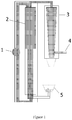
- Figure 1 shows a fluidised bed reactor (2) into which a smelter slag may be fed.
- Gaseous chloride is introduced to the fluidised bed through an inlet (5) at the base of the fluidised bed reactor and the gas recirculated through the fluidised bed reactor by means of a circulation pump (1).
- Gaseous metal chloride produced by passing the steam of gaseous chloride through the fluidised bed is passed to a condenser (3) and collected. Exhaust gases are expelled from the condenser through an outlet (4) and may be cleaned prior to discharge to the atmosphere.
- Lead smelter slag containing over 5%wt/wt, was fed with no additional preparation to a fluidised bed reactor at 900°C.
- the fluidised bed was maintained with compressed air to ensure a homogenous bed and the temperature was maintained by external elements due to the laboratory scale of the test.
- Pre-formed hydrochloric gas was then fed into the fluidised bed where it reacted instantaneously with the slag.
- the hydrochloric gas preferentially converts the entrapped zinc, copper and residual lead into metal chlorides that are then volatilised from the bed. Tests show that in excess of 90% of the zinc was extracted and similar values were obtained for both the copper and lead.
- volatilised metal chlorides were then condensed to solids and collected for refining into saleable metal products.
- the test indicated a retention time of 4 hours and an optimum usage of hydrochloric gas equivalent to 125% of the estimated stoichiometric demand of the zinc alone.
Landscapes
- Chemical & Material Sciences (AREA)
- Engineering & Computer Science (AREA)
- Organic Chemistry (AREA)
- Materials Engineering (AREA)
- Mechanical Engineering (AREA)
- Metallurgy (AREA)
- Manufacturing & Machinery (AREA)
- Life Sciences & Earth Sciences (AREA)
- Environmental & Geological Engineering (AREA)
- General Life Sciences & Earth Sciences (AREA)
- Geology (AREA)
- Geochemistry & Mineralogy (AREA)
- Manufacture And Refinement Of Metals (AREA)
- Processing Of Solid Wastes (AREA)
Description
- The present invention relates to a process for recovering a metal from metallurgical waste such as process slag waste produced during smelting and refining processes. In particular, the invention relates to a process for recovering a metal of interest in the form of a metal chloride from slag waste materials produced in base metal smelting and refining processes and optionally subsequently extracting the metal from the metal chloride.
- When metalliferous ore deposits are formed in the Earth's crust they are rarely composed of just one metalliferous element; indeed it is well documented that certain combinations of metals commonly occur together. For example lead deposits are commonly associated with zinc and so as the lead concentrate is formed at the mine processing plant, zinc is inherently present in the concentrate as an impurity. It is not until the primary metal is won from the concentrate at a smelter that the impurities are removed.
- Many methods are known for extracting metals and their compounds from ores, including methods which involve liberating the metal in the form of its chloride. Such methods have not previously been applied to the recovery of metals such as zinc from slag wastes, reflecting the very different nature of these materials.
- Due to the high energy nature of their formation, slag wastes are generally very stable and so do not readily release metal constituents present. In general, therefore, metal impurities entrapped within the slag waste from the smelter are rarely regarded as a commodity and only low capital processing techniques, such as hydrometallurgical processes, have been exploited in order to realise their value. However, these processes are not selective and this indiscriminate dissolution of all the waste often creates further complications in realising the value of the material. A particular problem is the ready leaching of iron that commonly occurs in much greater volume than other metals of interest.
-
GB 210111 A -
GB 1186836 A -
GB 309307 A -
US 3649245 describes a process for the purification of pyrite and pyrrhotite cinders from non-ferrous materials, from arsenic and from sulphur, involving reducing the hematite to magnetite in a fluid bed with direct injection of a hydrocarbon fuel in the presence of small quantities of HCl. -
WO 97/29214 A1
GB 813293 A -
US 3892639 A describes a process for the extraction of metals of value from laterite ores including nickel, chromium, manganese, iron and cobalt by a series of steps including chlorinating the ore with hydrogen chloride gas to form volatile metal chlorides and condensing the volatile chlorides to effect separation. There remains a continuing need for the development of further, improved, commercially viable methods for recovering metals of interest from slag waste material. - According to a first aspect, the present invention provides a process for recovering a metal chloride or mixed metal chloride from a solid waste material comprising recoverable metal containing constituents produced by lead, copper or zinc smelting and refining processes, said process comprising the steps of:-
- (i) heating the solid waste material in an oxidising environment;
- (ii) treating the heated material of step (i) with a gaseous chloride to form a gaseous metal chloride containing product; and
- (iii) treating the gaseous metal chloride containing product of step (ii) to recover the metal chloride or mixed metal chloride.
- The invention also provides a process for recovering a metal from a solid waste material comprising recovering the metal in the form of a metal chloride or mixed metal chloride from a solid waste material according to the first aspect of the invention and extracting the metal from the metal chloride or chlorides.
- The present invention is based on the finding that valuable metal containing constituents contained in slag wastes which would otherwise not be recoverable in a cost effective way or at commercially viable levels may be obtained by converting the constituents into volatile metal chlorides which can then be recovered and further treated to extract the metal itself. An advantage of converting the metal constituent to a metal chloride in the metal recovery process is that as metal chlorides generally have lower vapourisation temperatures than other metal compounds such as oxides and the pure metals, less energy will be required to volatilise them, rendering the overall recovery process economically more attractive.
- The method of the invention is applicable to the recovery of metals chlorides from a variety of smelter slag wastes and may suitably be applied to any slag waste from lead, copper or zinc smelting or refining processes which has sufficiently high levels of metal containing constituents of interest to be economically worthwhile recovering.
- It will be appreciated, of course, that the composition and levels of potentially recoverable metal containing constituents will vary considerably depending on the origin of the slag waste. As discussed above, slag wastes from lead smelting processes commonly comprise zinc containing constituents, typically in the form of oxides and silicates for example. Other valuable metals which are commonly found in lead smelter slags include iron, copper, silver, indium,gold, molybdenum, tin, gallium and germanium. As copper deposits are commonly associated with nickel, copper smelter slags are a useful potential source of nickel compounds. The method of the present invention therefore affords the possibility of recovering a wide variety of valuable metals of interest.
- Heating of the solid waste material in the process according to the invention may conveniently be performed in a fluidised bed reactor. The fluidised bed reactor will desirably be provided with heat insulation to keep the solid material molten. It will be appreciated that the solid feed material should be of an appropriate size so as to permit fluidisation with the bed of the reactor; large particles may require screening and crushing, whereas finer materials may require agglomeration. Typically, the fluidised bed will be maintained with compressed air to ensure a homogenous bed.
- In one embodiment, the solid feed material additionally comprises a small proportion of sulfide-containing minerals, generally no more than 20% weight/weight of the solid material, typically in the order of 10% to 20% weight/weight.
- Upon heating, the sulfides are oxidised to sulfates, liberating heat energy which can be used to heat the fluidised bed. The sulfide-containing minerals therefore act as a fuel source to help maintain the temperature within the fluidised bed reactor, thereby providing savings in heating costs. As the majority of base metals mined from around the world derive from sulfide deposits and indeed most smelter feed stocks are sulfide based, providing a sulfide supply to the smelter site does not generally present operational difficulties.
- Sulfur dioxide gas generated by the oxidation of sulfide minerals can be recovered from the reactor vessel and this can then be converted into sulfuric acid using conventional techniques. Sulfur dioxide and sulfuric acid therefore represent commercially valuable by-products of the process of the present invention and their preparation constitutes another aspect of the invention.
- The temperature to which the solid material is heated in the process according to the invention will depend on the particular waste material to be treated and the desired metal chlorides to be recovered. It will be appreciated that the solid feed material must be heated to a temperature which is sufficiently high to ensure that reaction of the metal containing constituents present to form volatile metal chlorides can take place at a practicable rate. Generally, this will be achieved by maintaining the temperature of the solid material at a temperature which is at or above the vaporisation temperature of the metal chloride to be recovered. Where the solid waste material comprises more than one metal for recovery then it should, of course, be heated to a temperature at or above the vaporisation temperature of the least volatile metal chloride to be recovered. Typically, temperatures in the region of 700°C to 1600°C are required, generally 700°C to 900°C.
- The gaseous chloride for use in the process according to the invention may suitably be a chloride which ordinarily occurs in gaseous form, such as hydrogen chloride, or one which is readily volatilised, such as ammonium chloride. In one embodiment, the gaseous chloride is hydrogen chloride gas.
- Hydrogen chloride gas for use in the process of the invention may conveniently be prepared by conventional methods, for example by electrolysis of a brine solution to produce hydrogen and chlorine gases which are then combined to produce hydrogen chloride gas. A commercially useful by-product of this process is sodium hydroxide, the preparation of which represents another aspect of the invention.
- In one embodiment, the hydrogen and chlorine gases are combined to produce hydrogen chloride gas prior to treating the heated solid material. In another embodiment, the hydrogen and chlorine gases are brought into contact upon treating the heated solid material.
- Treatment of the solid material with the gaseous chloride is conveniently brought about by bringing the heated solid material into contact with a stream of the gaseous chloride. Depending on the efficiency of the reaction to form the gaseous metal chloride product, it may be appropriate to recirculate the stream of gaseous chloride within the reaction vessel, so as to optimise the amount of gaseous metal chloride containing product formed per unit of gaseous chloride consumed.
- The formation of gaseous metal chloride-containing product may be conducted continuously, for example by continuously replenishing the supply of gaseous chloride and the supply of solid material in the reaction vessel.
- In one embodiment, the solid material is heated in a fluidised bed reactor and gaseous chloride is fed into the base of the reactor. In order to optimise the usage of the extracting gas and to maintain the fluidised bed, the gas may optionally be recirculated within the reactor vessel.
- Depending on the composition of the solid material and the temperature to which it is heated, one or more gaseous metal chloride products will be produced following treatment with the gaseous chloride.
- The gaseous metal chloride containing product produced by treating the heated solid waste material with the gaseous chloride is then further treated to recover the metal chloride or mixed metal chloride. The recovered metal chloride or mixed metal chloride may optionally then itself be further refined to extract the metal itself.
- In one embodiment, the gaseous metal chloride containing product is treated to recover the metal chloride or chlorides by quenching with water, thereby forming an aqueous solution of the metal chloride or chlorides.
- Conveniently, a venturi scrubber or other such similar conventional technology may be used in conjunction with a packed cascading tower in order to maximise dissolution of the metal chlorides into water.
- Metal chlorides with low solubilities, such as lead chloride, will naturally precipitate out during the water quenching process. By raising the pH of the aqueous metal chloride solution in a controlled manner, phased precipitation of basic metal compounds such as metal hydroxides may be obtained. The metal hydroxides thus obtained may subsequently be dried to provide the corresponding metal oxides.
- By adjusting the pH of the solution to the
range pH 2 to 4 typically, any iron that has been extracted can be removed from solution. Any copper present can then be cemented from solution as a pure copper metal precipitate by the addition of elemental zinc. The zinc dissolves preferentially to the copper and so the copper is removed from solution. Finally, the zinc can either be precipitated from solution by raising the pH to over 9 to form a zinc oxide or electrowon from solution to form a zinc cathode. - In another embodiment, the gaseous metal chloride containing product is treated to recover the metal chloride or chlorides by a condensation process.
- In this embodiment, the gaseous metal chloride containing product emerging from the reactor is passed to a condenser and cooled to below the vaporisation temperature of the metal chloride to be recovered. In one embodiment, a series of condensers is provided, each operating within a defined temperature range to enable fractional condensation of different metal chlorides produced by treatment of the slag waste with gaseous chloride. Typically, the condensers operate in series with a decreasing temperature gradient across them. In this way, uncondensed gases from the first condenser are passed to a second condenser cooled to a lower temperature than the first condenser so as to condense a different metal chloride and so forth.
- Following condensation of the volatile metal chlorides, the waste gas steam leaving the condenser or condensers will desirably be cleaned to further recover metals through a spray condensation unit prior to discharge to the atmosphere. Desirably, sulfur dioxide gas generated by the oxidation of sulfide minerals is recovered in the first reactor and this can be converted into sulfuric acid as a commercially valuable by-product.
- In one embodiment, the condensed metal chloride product or products of the recovery process may be further refined to extract the metal itself. Suitably, the condensed metal chloride will be solubilised and the metal recovered by direct precipitation, solvent extraction electro winning or electrolysis with the gaseous chloride agent being regenerated for reuse.
- An apparatus for use according to an embodiment of the process of the invention is illustrated schematically in
Figure 1. Figure 1 shows a fluidised bed reactor (2) into which a smelter slag may be fed. Gaseous chloride is introduced to the fluidised bed through an inlet (5) at the base of the fluidised bed reactor and the gas recirculated through the fluidised bed reactor by means of a circulation pump (1). Gaseous metal chloride produced by passing the steam of gaseous chloride through the fluidised bed is passed to a condenser (3) and collected. Exhaust gases are expelled from the condenser through an outlet (4) and may be cleaned prior to discharge to the atmosphere. - Throughout the description and claims of this specification, the words "comprise" and "contain" and variations of the words, for example "comprising" and "comprises", mean "including but not limited to", and do not exclude other moieties, additives, components, integers or steps. The singular encompasses the plural unless the context otherwise requires. In particular, where the indefinite article is used, the specification is to be understood as contemplating plurality as well as singularity, unless the context requires otherwise.
- Preferred features of each aspect of the invention may be as described in connection with any of the other aspects.
- Generally speaking the invention extends to any novel one, or any novel combination, of the features disclosed in this specification (including any accompanying claims and drawings). Thus features, integers, characteristics, compounds, chemical moieties or groups described in conjunction with a particular aspect, embodiment or example of the invention are to be understood to be applicable to any other aspect, embodiment or example described herein unless incompatible therewith. Moreover unless stated otherwise, any feature disclosed herein may be replaced by an alternative feature serving the same or a similar purpose.
- The process of the invention is further illustrated by the following non-limiting example.
- Lead smelter slag, containing over 5%wt/wt, was fed with no additional preparation to a fluidised bed reactor at 900°C. The fluidised bed was maintained with compressed air to ensure a homogenous bed and the temperature was maintained by external elements due to the laboratory scale of the test. Pre-formed hydrochloric gas was then fed into the fluidised bed where it reacted instantaneously with the slag. The hydrochloric gas preferentially converts the entrapped zinc, copper and residual lead into metal chlorides that are then volatilised from the bed. Tests show that in excess of 90% of the zinc was extracted and similar values were obtained for both the copper and lead. The volatilised metal chlorides were then condensed to solids and collected for refining into saleable metal products. The test indicated a retention time of 4 hours and an optimum usage of hydrochloric gas equivalent to 125% of the estimated stoichiometric demand of the zinc alone.
Claims (16)
- A process for recovering a metal chloride or mixed metal chloride from a solid waste material comprising recoverable metal containing constituents produced by lead, copper or zinc smelting and refining processes, said process comprising the steps of:-(i) heating the solid waste material in an oxidising environment;(ii) treating the heated material of step (i) with a gaseous chloride to form a gaseous metal chloride containing product; and(iii) treating the gaseous metal chloride containing product of step (ii) to recover the metal chloride or mixed metal chloride.
- A process according to claim 1 wherein the solid source material is in the form of a fluidised bed.
- A process according to claim 1 or claim 2 wherein the gaseous chloride is gaseous ammonium chloride or hydrogen chloride gas
- A process according to any preceding claim wherein the solid material is heated to a temperature of 700-1600 °C
- A process according to any preceding claim wherein in step (ii) the gaseous chloride is recirculated over the heated material of step (i).
- A process according to any preceding claim wherein chlorides of more than one metal are recovered.
- A process according to any preceding claim wherein the solid material is combined with a sulfide mineral, and sulfur dioxide is generated as a by-product on heating the sulfide mineral.
- A process according to any preceding claim wherein the metal chloride is a chloride of a metal selected from zinc, iron, copper, silver, gold, nickel, molybdenum, indium, tin, gallium and germanium.
- A process according to any preceding claim wherein in step (iii) the metal chloride or chlorides are recovered by quenching the gaseous metal chloride containing product of step (ii) with water to produce an aqueous solution of the metal chloride or chlorides.
- A process according to claim 9 wherein the pH of the aqueous metal chloride solution is adjusted to precipitate the metal in the form of a basic compound.
- A process according to claim 10 wherein any iron present is precipitated in the form of a basic compound by adjusting the pH of the aqueous solution to a pH in the range of from 2 to 4.
- A process according to claim 10 where copper metal is precipitated by adding zinc to the aqueous solution.
- A process according to claim 12 where zinc is precipitated in the form of a basic compound by adjusting the pH of the aqueous solution to a pH of greater than 9.
- A process according to any one of claim 1 to 8 wherein in step (iii) the metal chloride or chlorides are recovered by condensing the gaseous metal chloride containing product of step (ii).
- A process according to claim 14 wherein different metal chlorides are condensed at different temperatures
- A process according to any preceding claim wherein the recovered metal chloride or basic metal compound is further treated to extract the metal
Applications Claiming Priority (2)
| Application Number | Priority Date | Filing Date | Title |
|---|---|---|---|
| GB0900677A GB0900677D0 (en) | 2009-01-16 | 2009-01-16 | Metal recovery process |
| PCT/GB2010/050062 WO2010082065A2 (en) | 2009-01-16 | 2010-01-15 | Metal recovery process |
Publications (2)
| Publication Number | Publication Date |
|---|---|
| EP2387624A2 EP2387624A2 (en) | 2011-11-23 |
| EP2387624B1 true EP2387624B1 (en) | 2017-04-12 |
Family
ID=40433391
Family Applications (1)
| Application Number | Title | Priority Date | Filing Date |
|---|---|---|---|
| EP10705408.2A Not-in-force EP2387624B1 (en) | 2009-01-16 | 2010-01-15 | Metal recovery from metallurgical waste by chloridising |
Country Status (13)
| Country | Link |
|---|---|
| US (1) | US8945489B2 (en) |
| EP (1) | EP2387624B1 (en) |
| AP (1) | AP2900A (en) |
| AU (1) | AU2010205521B2 (en) |
| BR (1) | BRPI1007469B1 (en) |
| CA (1) | CA2749907C (en) |
| CL (1) | CL2011001731A1 (en) |
| ES (1) | ES2632725T3 (en) |
| GB (1) | GB0900677D0 (en) |
| MX (1) | MX2011007454A (en) |
| PL (1) | PL2387624T3 (en) |
| WO (1) | WO2010082065A2 (en) |
| ZA (1) | ZA201105789B (en) |
Families Citing this family (4)
| Publication number | Priority date | Publication date | Assignee | Title |
|---|---|---|---|---|
| CN109554536A (en) * | 2018-11-23 | 2019-04-02 | 华南理工大学 | A kind of device and method of vacuum chloridising roasting processing heavy metal dangerous waste |
| GB201911658D0 (en) | 2019-08-14 | 2019-09-25 | Minex Tech Group Limited | Metal recovery process |
| CN111979422B (en) * | 2020-07-09 | 2022-10-21 | 有研资源环境技术研究院(北京)有限公司 | Method for comprehensively recovering valuable metals in goethite slag |
| CN112813277B (en) * | 2020-12-28 | 2022-01-11 | 中南大学 | A method for separating and recovering valuable metals by chlorination roasting of copper smelting slag |
Family Cites Families (16)
| Publication number | Priority date | Publication date | Assignee | Title |
|---|---|---|---|---|
| GB813293A (en) | 1956-12-31 | 1959-05-13 | Metallgesellschaft Ag | Method of subjecting ores and residues to a chloridizing roast and simultaneous sintering |
| US1414491A (en) * | 1920-09-07 | 1922-05-02 | Int Precipitation Co | Method for the recovery of metallic values from slag |
| GB210111A (en) | 1923-03-16 | 1924-01-31 | Frederick Walter Choat | Improvements in or relating to pig feeding appliances |
| GB210001A (en) * | 1923-04-26 | 1924-01-24 | John Gardner | Improvements in or relating to windmotors |
| GB210011A (en) * | 1923-06-02 | 1924-01-24 | Edgar Arthur Ashcroft | Improvements in the treatment of lead-zinc sulphide ores, mattes and the like |
| GB309307A (en) * | 1928-04-05 | 1929-04-11 | Edgar Arthur Ashcroft | Improvements in the metallurgy of ores or materials containing tin |
| GB737889A (en) | 1952-10-20 | 1955-10-05 | United Steel Companies Ltd | Treatment of ores or slags for the recovery of vanadium |
| GB780980A (en) | 1954-06-29 | 1957-08-14 | John Sandor | Improvements in and relating to the extraction of valuable constituents from slags |
| GB821922A (en) | 1956-01-20 | 1959-10-14 | Walter M Weil | Improvements in or relating to a process for recovering manganese values from metalliferous material containing manganese and iron |
| GB862392A (en) | 1956-03-13 | 1961-03-08 | Columbia Southern Chem Corp | The production of metal chlorides |
| BE707207A (en) | 1966-12-16 | 1968-04-01 | ||
| GB1186836A (en) * | 1968-06-25 | 1970-04-08 | Boliden Ab | A process for the purification by chlorination of roasted iron sulphide materials |
| SE352657B (en) | 1968-07-26 | 1973-01-08 | Montedison Spa | |
| US3892639A (en) * | 1974-09-11 | 1975-07-01 | Us Interior | Extraction of metal values from lateritic ores |
| US5993175A (en) * | 1995-06-23 | 1999-11-30 | Lg Electronics Inc. | Oil supply apparatus for friction portion of linear compressor |
| AT405191B (en) | 1996-02-08 | 1999-06-25 | Holderbank Financ Glarus | METHOD FOR SEPARATING COPPER AND HEAVY METALS FROM WASTE COMBUSTION RESIDUES AND SLAGS |
-
2009
- 2009-01-16 GB GB0900677A patent/GB0900677D0/en not_active Ceased
-
2010
- 2010-01-15 BR BRPI1007469-4A patent/BRPI1007469B1/en not_active IP Right Cessation
- 2010-01-15 AU AU2010205521A patent/AU2010205521B2/en not_active Ceased
- 2010-01-15 MX MX2011007454A patent/MX2011007454A/en active IP Right Grant
- 2010-01-15 PL PL10705408T patent/PL2387624T3/en unknown
- 2010-01-15 CA CA2749907A patent/CA2749907C/en active Active
- 2010-01-15 ES ES10705408.2T patent/ES2632725T3/en active Active
- 2010-01-15 WO PCT/GB2010/050062 patent/WO2010082065A2/en not_active Ceased
- 2010-01-15 US US13/144,774 patent/US8945489B2/en active Active
- 2010-01-15 EP EP10705408.2A patent/EP2387624B1/en not_active Not-in-force
- 2010-01-15 AP AP2011005820A patent/AP2900A/en active
-
2011
- 2011-07-15 CL CL2011001731A patent/CL2011001731A1/en unknown
- 2011-08-05 ZA ZA2011/05789A patent/ZA201105789B/en unknown
Non-Patent Citations (1)
| Title |
|---|
| None * |
Also Published As
| Publication number | Publication date |
|---|---|
| WO2010082065A2 (en) | 2010-07-22 |
| BRPI1007469B1 (en) | 2020-03-17 |
| WO2010082065A3 (en) | 2010-09-10 |
| ZA201105789B (en) | 2012-04-25 |
| ES2632725T3 (en) | 2017-09-15 |
| CA2749907C (en) | 2017-03-28 |
| AP2900A (en) | 2014-05-31 |
| EP2387624A2 (en) | 2011-11-23 |
| CL2011001731A1 (en) | 2012-02-24 |
| AU2010205521A1 (en) | 2011-08-11 |
| AP2011005820A0 (en) | 2011-08-31 |
| BRPI1007469A2 (en) | 2019-04-09 |
| US20120114539A1 (en) | 2012-05-10 |
| GB0900677D0 (en) | 2009-02-25 |
| US8945489B2 (en) | 2015-02-03 |
| AU2010205521B2 (en) | 2016-07-28 |
| PL2387624T3 (en) | 2017-09-29 |
| CA2749907A1 (en) | 2010-07-22 |
| MX2011007454A (en) | 2011-10-24 |
Similar Documents
| Publication | Publication Date | Title |
|---|---|---|
| US8961649B2 (en) | System and method for extracting base metal values from oxide ores | |
| Antuñano et al. | Hydrometallurgical processes for Waelz oxide valorisation–An overview | |
| CA2624609C (en) | Processing of nickel sulphide ore or concentrates with sodium chloride | |
| RS61390B1 (en) | Hydrometallurgical treatment process for extraction of precious, base and rare elements | |
| RS58853B1 (en) | Treatment process for extraction of precious, base and rare elements | |
| AU2021204219B2 (en) | Recovery of Metals from Pyrite | |
| WO2013120132A1 (en) | Process for zinc oxide production from ore | |
| US8945489B2 (en) | Metal recovery process | |
| US7871454B2 (en) | Chemical process for recovery of metals contained in industrial steelworks waste | |
| AU2013211472A1 (en) | System and method for extracting base metal values from oxide ores | |
| WO2019113652A1 (en) | Improved zinc oxide process | |
| WO2008139412A1 (en) | Producing a metal like zinc from sulphide ores by chloride leaching and electrowinning | |
| CN114525412A (en) | Method for leaching copper sulfide concentrate by using chloride | |
| EA040809B1 (en) | METHOD OF HYDROMETALLURGICAL PROCESSING FOR EXTRACTION OF NOBLE, NON-COLORED AND RARE ELEMENTS | |
| Moyes et al. | Intec Ltd | |
| AU2020327673A1 (en) | Metal recovery process |
Legal Events
| Date | Code | Title | Description |
|---|---|---|---|
| PUAI | Public reference made under article 153(3) epc to a published international application that has entered the european phase |
Free format text: ORIGINAL CODE: 0009012 |
|
| 17P | Request for examination filed |
Effective date: 20110810 |
|
| AK | Designated contracting states |
Kind code of ref document: A2 Designated state(s): AT BE BG CH CY CZ DE DK EE ES FI FR GB GR HR HU IE IS IT LI LT LU LV MC MK MT NL NO PL PT RO SE SI SK SM TR |
|
| DAX | Request for extension of the european patent (deleted) | ||
| 17Q | First examination report despatched |
Effective date: 20140820 |
|
| GRAP | Despatch of communication of intention to grant a patent |
Free format text: ORIGINAL CODE: EPIDOSNIGR1 |
|
| GRAJ | Information related to disapproval of communication of intention to grant by the applicant or resumption of examination proceedings by the epo deleted |
Free format text: ORIGINAL CODE: EPIDOSDIGR1 |
|
| INTG | Intention to grant announced |
Effective date: 20160219 |
|
| INTG | Intention to grant announced |
Effective date: 20160226 |
|
| INTC | Intention to grant announced (deleted) | ||
| GRAP | Despatch of communication of intention to grant a patent |
Free format text: ORIGINAL CODE: EPIDOSNIGR1 |
|
| RIN1 | Information on inventor provided before grant (corrected) |
Inventor name: WILLIAMS, KEITH PHILLIP Inventor name: BOWELL, ROBERT JOHN Inventor name: DEY, BRIAN MATTHEW |
|
| INTG | Intention to grant announced |
Effective date: 20160725 |
|
| GRAJ | Information related to disapproval of communication of intention to grant by the applicant or resumption of examination proceedings by the epo deleted |
Free format text: ORIGINAL CODE: EPIDOSDIGR1 |
|
| GRAP | Despatch of communication of intention to grant a patent |
Free format text: ORIGINAL CODE: EPIDOSNIGR1 |
|
| INTG | Intention to grant announced |
Effective date: 20161104 |
|
| GRAS | Grant fee paid |
Free format text: ORIGINAL CODE: EPIDOSNIGR3 |
|
| GRAA | (expected) grant |
Free format text: ORIGINAL CODE: 0009210 |
|
| AK | Designated contracting states |
Kind code of ref document: B1 Designated state(s): AT BE BG CH CY CZ DE DK EE ES FI FR GB GR HR HU IE IS IT LI LT LU LV MC MK MT NL NO PL PT RO SE SI SK SM TR |
|
| REG | Reference to a national code |
Ref country code: GB Ref legal event code: FG4D |
|
| REG | Reference to a national code |
Ref country code: CH Ref legal event code: EP |
|
| REG | Reference to a national code |
Ref country code: IE Ref legal event code: FG4D |
|
| REG | Reference to a national code |
Ref country code: AT Ref legal event code: REF Ref document number: 883955 Country of ref document: AT Kind code of ref document: T Effective date: 20170515 |
|
| REG | Reference to a national code |
Ref country code: DE Ref legal event code: R096 Ref document number: 602010041459 Country of ref document: DE |
|
| REG | Reference to a national code |
Ref country code: RO Ref legal event code: EPE |
|
| REG | Reference to a national code |
Ref country code: SE Ref legal event code: TRGR |
|
| REG | Reference to a national code |
Ref country code: NL Ref legal event code: MP Effective date: 20170412 |
|
| REG | Reference to a national code |
Ref country code: LT Ref legal event code: MG4D |
|
| REG | Reference to a national code |
Ref country code: ES Ref legal event code: FG2A Ref document number: 2632725 Country of ref document: ES Kind code of ref document: T3 Effective date: 20170915 Ref country code: AT Ref legal event code: MK05 Ref document number: 883955 Country of ref document: AT Kind code of ref document: T Effective date: 20170412 |
|
| PG25 | Lapsed in a contracting state [announced via postgrant information from national office to epo] |
Ref country code: NL Free format text: LAPSE BECAUSE OF FAILURE TO SUBMIT A TRANSLATION OF THE DESCRIPTION OR TO PAY THE FEE WITHIN THE PRESCRIBED TIME-LIMIT Effective date: 20170412 |
|
| PG25 | Lapsed in a contracting state [announced via postgrant information from national office to epo] |
Ref country code: LT Free format text: LAPSE BECAUSE OF FAILURE TO SUBMIT A TRANSLATION OF THE DESCRIPTION OR TO PAY THE FEE WITHIN THE PRESCRIBED TIME-LIMIT Effective date: 20170412 Ref country code: NO Free format text: LAPSE BECAUSE OF FAILURE TO SUBMIT A TRANSLATION OF THE DESCRIPTION OR TO PAY THE FEE WITHIN THE PRESCRIBED TIME-LIMIT Effective date: 20170712 Ref country code: AT Free format text: LAPSE BECAUSE OF FAILURE TO SUBMIT A TRANSLATION OF THE DESCRIPTION OR TO PAY THE FEE WITHIN THE PRESCRIBED TIME-LIMIT Effective date: 20170412 Ref country code: HR Free format text: LAPSE BECAUSE OF FAILURE TO SUBMIT A TRANSLATION OF THE DESCRIPTION OR TO PAY THE FEE WITHIN THE PRESCRIBED TIME-LIMIT Effective date: 20170412 |
|
| REG | Reference to a national code |
Ref country code: GR Ref legal event code: EP Ref document number: 20170401830 Country of ref document: GR Effective date: 20171122 |
|
| PG25 | Lapsed in a contracting state [announced via postgrant information from national office to epo] |
Ref country code: LV Free format text: LAPSE BECAUSE OF FAILURE TO SUBMIT A TRANSLATION OF THE DESCRIPTION OR TO PAY THE FEE WITHIN THE PRESCRIBED TIME-LIMIT Effective date: 20170412 Ref country code: IS Free format text: LAPSE BECAUSE OF FAILURE TO SUBMIT A TRANSLATION OF THE DESCRIPTION OR TO PAY THE FEE WITHIN THE PRESCRIBED TIME-LIMIT Effective date: 20170812 |
|
| REG | Reference to a national code |
Ref country code: DE Ref legal event code: R097 Ref document number: 602010041459 Country of ref document: DE |
|
| PG25 | Lapsed in a contracting state [announced via postgrant information from national office to epo] |
Ref country code: CZ Free format text: LAPSE BECAUSE OF FAILURE TO SUBMIT A TRANSLATION OF THE DESCRIPTION OR TO PAY THE FEE WITHIN THE PRESCRIBED TIME-LIMIT Effective date: 20170412 Ref country code: DK Free format text: LAPSE BECAUSE OF FAILURE TO SUBMIT A TRANSLATION OF THE DESCRIPTION OR TO PAY THE FEE WITHIN THE PRESCRIBED TIME-LIMIT Effective date: 20170412 Ref country code: SK Free format text: LAPSE BECAUSE OF FAILURE TO SUBMIT A TRANSLATION OF THE DESCRIPTION OR TO PAY THE FEE WITHIN THE PRESCRIBED TIME-LIMIT Effective date: 20170412 Ref country code: EE Free format text: LAPSE BECAUSE OF FAILURE TO SUBMIT A TRANSLATION OF THE DESCRIPTION OR TO PAY THE FEE WITHIN THE PRESCRIBED TIME-LIMIT Effective date: 20170412 |
|
| PLBE | No opposition filed within time limit |
Free format text: ORIGINAL CODE: 0009261 |
|
| STAA | Information on the status of an ep patent application or granted ep patent |
Free format text: STATUS: NO OPPOSITION FILED WITHIN TIME LIMIT |
|
| PG25 | Lapsed in a contracting state [announced via postgrant information from national office to epo] |
Ref country code: SM Free format text: LAPSE BECAUSE OF FAILURE TO SUBMIT A TRANSLATION OF THE DESCRIPTION OR TO PAY THE FEE WITHIN THE PRESCRIBED TIME-LIMIT Effective date: 20170412 Ref country code: IT Free format text: LAPSE BECAUSE OF FAILURE TO SUBMIT A TRANSLATION OF THE DESCRIPTION OR TO PAY THE FEE WITHIN THE PRESCRIBED TIME-LIMIT Effective date: 20170412 |
|
| 26N | No opposition filed |
Effective date: 20180115 |
|
| PG25 | Lapsed in a contracting state [announced via postgrant information from national office to epo] |
Ref country code: SI Free format text: LAPSE BECAUSE OF FAILURE TO SUBMIT A TRANSLATION OF THE DESCRIPTION OR TO PAY THE FEE WITHIN THE PRESCRIBED TIME-LIMIT Effective date: 20170412 |
|
| REG | Reference to a national code |
Ref country code: DE Ref legal event code: R119 Ref document number: 602010041459 Country of ref document: DE |
|
| REG | Reference to a national code |
Ref country code: CH Ref legal event code: PL |
|
| PG25 | Lapsed in a contracting state [announced via postgrant information from national office to epo] |
Ref country code: LU Free format text: LAPSE BECAUSE OF NON-PAYMENT OF DUE FEES Effective date: 20180115 Ref country code: DE Free format text: LAPSE BECAUSE OF NON-PAYMENT OF DUE FEES Effective date: 20180801 Ref country code: FR Free format text: LAPSE BECAUSE OF NON-PAYMENT OF DUE FEES Effective date: 20180131 |
|
| REG | Reference to a national code |
Ref country code: IE Ref legal event code: MM4A |
|
| REG | Reference to a national code |
Ref country code: FR Ref legal event code: ST Effective date: 20180928 |
|
| REG | Reference to a national code |
Ref country code: BE Ref legal event code: MM Effective date: 20180131 |
|
| PG25 | Lapsed in a contracting state [announced via postgrant information from national office to epo] |
Ref country code: CH Free format text: LAPSE BECAUSE OF NON-PAYMENT OF DUE FEES Effective date: 20180131 Ref country code: LI Free format text: LAPSE BECAUSE OF NON-PAYMENT OF DUE FEES Effective date: 20180131 Ref country code: BE Free format text: LAPSE BECAUSE OF NON-PAYMENT OF DUE FEES Effective date: 20180131 |
|
| PG25 | Lapsed in a contracting state [announced via postgrant information from national office to epo] |
Ref country code: IE Free format text: LAPSE BECAUSE OF NON-PAYMENT OF DUE FEES Effective date: 20180115 |
|
| PG25 | Lapsed in a contracting state [announced via postgrant information from national office to epo] |
Ref country code: MC Free format text: LAPSE BECAUSE OF FAILURE TO SUBMIT A TRANSLATION OF THE DESCRIPTION OR TO PAY THE FEE WITHIN THE PRESCRIBED TIME-LIMIT Effective date: 20170412 |
|
| PG25 | Lapsed in a contracting state [announced via postgrant information from national office to epo] |
Ref country code: MT Free format text: LAPSE BECAUSE OF NON-PAYMENT OF DUE FEES Effective date: 20180115 |
|
| PG25 | Lapsed in a contracting state [announced via postgrant information from national office to epo] |
Ref country code: TR Free format text: LAPSE BECAUSE OF FAILURE TO SUBMIT A TRANSLATION OF THE DESCRIPTION OR TO PAY THE FEE WITHIN THE PRESCRIBED TIME-LIMIT Effective date: 20170412 |
|
| PG25 | Lapsed in a contracting state [announced via postgrant information from national office to epo] |
Ref country code: PT Free format text: LAPSE BECAUSE OF FAILURE TO SUBMIT A TRANSLATION OF THE DESCRIPTION OR TO PAY THE FEE WITHIN THE PRESCRIBED TIME-LIMIT Effective date: 20170412 Ref country code: HU Free format text: LAPSE BECAUSE OF FAILURE TO SUBMIT A TRANSLATION OF THE DESCRIPTION OR TO PAY THE FEE WITHIN THE PRESCRIBED TIME-LIMIT; INVALID AB INITIO Effective date: 20100115 |
|
| PG25 | Lapsed in a contracting state [announced via postgrant information from national office to epo] |
Ref country code: MK Free format text: LAPSE BECAUSE OF NON-PAYMENT OF DUE FEES Effective date: 20170412 Ref country code: CY Free format text: LAPSE BECAUSE OF FAILURE TO SUBMIT A TRANSLATION OF THE DESCRIPTION OR TO PAY THE FEE WITHIN THE PRESCRIBED TIME-LIMIT Effective date: 20170412 |
|
| PGFP | Annual fee paid to national office [announced via postgrant information from national office to epo] |
Ref country code: SE Payment date: 20220729 Year of fee payment: 13 Ref country code: RO Payment date: 20220712 Year of fee payment: 13 Ref country code: GB Payment date: 20220729 Year of fee payment: 13 Ref country code: FI Payment date: 20220729 Year of fee payment: 13 Ref country code: BG Payment date: 20220729 Year of fee payment: 13 |
|
| PGFP | Annual fee paid to national office [announced via postgrant information from national office to epo] |
Ref country code: PL Payment date: 20220712 Year of fee payment: 13 Ref country code: GR Payment date: 20220729 Year of fee payment: 13 |
|
| PGFP | Annual fee paid to national office [announced via postgrant information from national office to epo] |
Ref country code: ES Payment date: 20221024 Year of fee payment: 13 |
|
| P01 | Opt-out of the competence of the unified patent court (upc) registered |
Effective date: 20230524 |
|
| REG | Reference to a national code |
Ref country code: SE Ref legal event code: EUG |
|
| GBPC | Gb: european patent ceased through non-payment of renewal fee |
Effective date: 20230115 |
|
| PG25 | Lapsed in a contracting state [announced via postgrant information from national office to epo] |
Ref country code: SE Free format text: LAPSE BECAUSE OF NON-PAYMENT OF DUE FEES Effective date: 20230116 Ref country code: RO Free format text: LAPSE BECAUSE OF NON-PAYMENT OF DUE FEES Effective date: 20230115 Ref country code: GB Free format text: LAPSE BECAUSE OF NON-PAYMENT OF DUE FEES Effective date: 20230115 Ref country code: FI Free format text: LAPSE BECAUSE OF NON-PAYMENT OF DUE FEES Effective date: 20230115 |
|
| PG25 | Lapsed in a contracting state [announced via postgrant information from national office to epo] |
Ref country code: GR Free format text: LAPSE BECAUSE OF NON-PAYMENT OF DUE FEES Effective date: 20230804 |
|
| REG | Reference to a national code |
Ref country code: ES Ref legal event code: FD2A Effective date: 20240327 |
|
| PG25 | Lapsed in a contracting state [announced via postgrant information from national office to epo] |
Ref country code: ES Free format text: LAPSE BECAUSE OF NON-PAYMENT OF DUE FEES Effective date: 20230116 |
|
| PG25 | Lapsed in a contracting state [announced via postgrant information from national office to epo] |
Ref country code: ES Free format text: LAPSE BECAUSE OF NON-PAYMENT OF DUE FEES Effective date: 20230116 |
|
| PG25 | Lapsed in a contracting state [announced via postgrant information from national office to epo] |
Ref country code: PL Free format text: LAPSE BECAUSE OF NON-PAYMENT OF DUE FEES Effective date: 20230115 |
|
| PG25 | Lapsed in a contracting state [announced via postgrant information from national office to epo] |
Ref country code: PL Free format text: LAPSE BECAUSE OF NON-PAYMENT OF DUE FEES Effective date: 20230115 |
|
| PG25 | Lapsed in a contracting state [announced via postgrant information from national office to epo] |
Ref country code: BG Free format text: LAPSE BECAUSE OF NON-PAYMENT OF DUE FEES Effective date: 20230115 |
|
| PG25 | Lapsed in a contracting state [announced via postgrant information from national office to epo] |
Ref country code: BG Free format text: LAPSE BECAUSE OF NON-PAYMENT OF DUE FEES Effective date: 20230115 |