EP2387599B1 - Black pigment dispersion - Google Patents
Black pigment dispersion Download PDFInfo
- Publication number
- EP2387599B1 EP2387599B1 EP10700968A EP10700968A EP2387599B1 EP 2387599 B1 EP2387599 B1 EP 2387599B1 EP 10700968 A EP10700968 A EP 10700968A EP 10700968 A EP10700968 A EP 10700968A EP 2387599 B1 EP2387599 B1 EP 2387599B1
- Authority
- EP
- European Patent Office
- Prior art keywords
- formula
- salt
- alkyl
- group
- unsubstituted
- Prior art date
- Legal status (The legal status is an assumption and is not a legal conclusion. Google has not performed a legal analysis and makes no representation as to the accuracy of the status listed.)
- Not-in-force
Links
- 239000006185 dispersion Substances 0.000 title claims description 43
- 239000000049 pigment Substances 0.000 title claims description 34
- 239000002245 particle Substances 0.000 claims description 37
- 229920000642 polymer Polymers 0.000 claims description 37
- 239000002270 dispersing agent Substances 0.000 claims description 31
- 239000000178 monomer Substances 0.000 claims description 26
- 229920001577 copolymer Polymers 0.000 claims description 21
- SNRUBQQJIBEYMU-UHFFFAOYSA-N Dodecane Natural products CCCCCCCCCCCC SNRUBQQJIBEYMU-UHFFFAOYSA-N 0.000 claims description 20
- 238000000034 method Methods 0.000 claims description 20
- 150000003839 salts Chemical class 0.000 claims description 16
- 125000004432 carbon atom Chemical group C* 0.000 claims description 15
- 229910052760 oxygen Inorganic materials 0.000 claims description 14
- 239000002904 solvent Substances 0.000 claims description 14
- 238000012986 modification Methods 0.000 claims description 13
- 238000006116 polymerization reaction Methods 0.000 claims description 13
- 238000005809 transesterification reaction Methods 0.000 claims description 13
- 125000004169 (C1-C6) alkyl group Chemical group 0.000 claims description 12
- 230000004048 modification Effects 0.000 claims description 12
- 230000008569 process Effects 0.000 claims description 12
- 229910052736 halogen Inorganic materials 0.000 claims description 11
- 150000002367 halogens Chemical class 0.000 claims description 11
- 125000002496 methyl group Chemical group [H]C([H])([H])* 0.000 claims description 11
- 150000003254 radicals Chemical class 0.000 claims description 11
- QVGXLLKOCUKJST-UHFFFAOYSA-N atomic oxygen Chemical compound [O] QVGXLLKOCUKJST-UHFFFAOYSA-N 0.000 claims description 10
- 239000001301 oxygen Substances 0.000 claims description 10
- 239000002253 acid Substances 0.000 claims description 9
- 125000001424 substituent group Chemical group 0.000 claims description 9
- 125000000020 sulfo group Chemical group O=S(=O)([*])O[H] 0.000 claims description 9
- 150000008064 anhydrides Chemical class 0.000 claims description 8
- 229910052739 hydrogen Inorganic materials 0.000 claims description 8
- 230000007062 hydrolysis Effects 0.000 claims description 8
- 238000006460 hydrolysis reaction Methods 0.000 claims description 8
- 125000000217 alkyl group Chemical group 0.000 claims description 7
- 230000000379 polymerizing effect Effects 0.000 claims description 7
- 229920000193 polymethacrylate Polymers 0.000 claims description 7
- 229910052717 sulfur Inorganic materials 0.000 claims description 7
- DYLIWHYUXAJDOJ-OWOJBTEDSA-N (e)-4-(6-aminopurin-9-yl)but-2-en-1-ol Chemical compound NC1=NC=NC2=C1N=CN2C\C=C\CO DYLIWHYUXAJDOJ-OWOJBTEDSA-N 0.000 claims description 6
- SMZOUWXMTYCWNB-UHFFFAOYSA-N 2-(2-methoxy-5-methylphenyl)ethanamine Chemical compound COC1=CC=C(C)C=C1CCN SMZOUWXMTYCWNB-UHFFFAOYSA-N 0.000 claims description 6
- CERQOIWHTDAKMF-UHFFFAOYSA-N Methacrylic acid Chemical compound CC(=C)C(O)=O CERQOIWHTDAKMF-UHFFFAOYSA-N 0.000 claims description 6
- 229910006074 SO2NH2 Inorganic materials 0.000 claims description 6
- 229910006069 SO3H Inorganic materials 0.000 claims description 6
- 125000003917 carbamoyl group Chemical group [H]N([H])C(*)=O 0.000 claims description 6
- 229910052801 chlorine Inorganic materials 0.000 claims description 6
- 125000002147 dimethylamino group Chemical group [H]C([H])([H])N(*)C([H])([H])[H] 0.000 claims description 6
- 229910052731 fluorine Inorganic materials 0.000 claims description 6
- 125000000896 monocarboxylic acid group Chemical group 0.000 claims description 6
- 125000000565 sulfonamide group Chemical group 0.000 claims description 6
- 239000001257 hydrogen Substances 0.000 claims description 5
- 239000003999 initiator Substances 0.000 claims description 5
- 230000009435 amidation Effects 0.000 claims description 4
- 238000007112 amidation reaction Methods 0.000 claims description 4
- 125000004435 hydrogen atom Chemical group [H]* 0.000 claims description 4
- 125000001997 phenyl group Chemical group [H]C1=C([H])C([H])=C(*)C([H])=C1[H] 0.000 claims description 4
- 125000006710 (C2-C12) alkenyl group Chemical group 0.000 claims description 3
- NINIDFKCEFEMDL-UHFFFAOYSA-N Sulfur Chemical compound [S] NINIDFKCEFEMDL-UHFFFAOYSA-N 0.000 claims description 3
- YLFIGGHWWPSIEG-UHFFFAOYSA-N aminoxyl Chemical compound [O]N YLFIGGHWWPSIEG-UHFFFAOYSA-N 0.000 claims description 3
- 125000004429 atom Chemical group 0.000 claims description 3
- 125000001797 benzyl group Chemical group [H]C1=C([H])C([H])=C(C([H])=C1[H])C([H])([H])* 0.000 claims description 3
- 229910052799 carbon Inorganic materials 0.000 claims description 3
- 125000001072 heteroaryl group Chemical group 0.000 claims description 3
- 230000000977 initiatory effect Effects 0.000 claims description 3
- 239000011593 sulfur Substances 0.000 claims description 3
- SNRUBQQJIBEYMU-NJFSPNSNSA-N dodecane Chemical group CCCCCCCCCCC[14CH3] SNRUBQQJIBEYMU-NJFSPNSNSA-N 0.000 claims description 2
- 239000012634 fragment Substances 0.000 claims description 2
- 125000000542 sulfonic acid group Chemical group 0.000 claims description 2
- -1 preferably an alkali Chemical class 0.000 description 63
- 239000006229 carbon black Substances 0.000 description 24
- 239000000203 mixture Substances 0.000 description 22
- WYURNTSHIVDZCO-UHFFFAOYSA-N Tetrahydrofuran Chemical compound C1CCOC1 WYURNTSHIVDZCO-UHFFFAOYSA-N 0.000 description 15
- 230000015572 biosynthetic process Effects 0.000 description 12
- 239000000047 product Substances 0.000 description 12
- 238000003786 synthesis reaction Methods 0.000 description 12
- 238000005160 1H NMR spectroscopy Methods 0.000 description 11
- QTBSBXVTEAMEQO-UHFFFAOYSA-N Acetic acid Chemical compound CC(O)=O QTBSBXVTEAMEQO-UHFFFAOYSA-N 0.000 description 11
- LFQSCWFLJHTTHZ-UHFFFAOYSA-N Ethanol Chemical compound CCO LFQSCWFLJHTTHZ-UHFFFAOYSA-N 0.000 description 11
- 238000005227 gel permeation chromatography Methods 0.000 description 11
- 239000000243 solution Substances 0.000 description 11
- LRHPLDYGYMQRHN-UHFFFAOYSA-N N-Butanol Chemical compound CCCCO LRHPLDYGYMQRHN-UHFFFAOYSA-N 0.000 description 10
- FLCAEMBIQVZWIF-UHFFFAOYSA-N 6-(dimethylamino)-2-methylhex-2-enamide Chemical compound CN(C)CCCC=C(C)C(N)=O FLCAEMBIQVZWIF-UHFFFAOYSA-N 0.000 description 9
- OKKJLVBELUTLKV-UHFFFAOYSA-N Methanol Chemical compound OC OKKJLVBELUTLKV-UHFFFAOYSA-N 0.000 description 9
- YXFVVABEGXRONW-UHFFFAOYSA-N Toluene Chemical compound CC1=CC=CC=C1 YXFVVABEGXRONW-UHFFFAOYSA-N 0.000 description 9
- 229920001400 block copolymer Polymers 0.000 description 9
- VLKZOEOYAKHREP-UHFFFAOYSA-N n-Hexane Chemical compound CCCCCC VLKZOEOYAKHREP-UHFFFAOYSA-N 0.000 description 9
- XLYOFNOQVPJJNP-UHFFFAOYSA-N water Substances O XLYOFNOQVPJJNP-UHFFFAOYSA-N 0.000 description 9
- GWEVSGVZZGPLCZ-UHFFFAOYSA-N Titan oxide Chemical compound O=[Ti]=O GWEVSGVZZGPLCZ-UHFFFAOYSA-N 0.000 description 8
- 150000001875 compounds Chemical class 0.000 description 8
- 238000001816 cooling Methods 0.000 description 8
- 238000004821 distillation Methods 0.000 description 8
- QGZKDVFQNNGYKY-UHFFFAOYSA-O Ammonium Chemical compound [NH4+] QGZKDVFQNNGYKY-UHFFFAOYSA-O 0.000 description 7
- 238000006243 chemical reaction Methods 0.000 description 7
- YMWUJEATGCHHMB-UHFFFAOYSA-N Dichloromethane Chemical compound ClCCl YMWUJEATGCHHMB-UHFFFAOYSA-N 0.000 description 6
- 150000003863 ammonium salts Chemical class 0.000 description 6
- QBCOASQOMILNBN-UHFFFAOYSA-N didodecoxy(oxo)phosphanium Chemical compound CCCCCCCCCCCCO[P+](=O)OCCCCCCCCCCCC QBCOASQOMILNBN-UHFFFAOYSA-N 0.000 description 6
- 239000012530 fluid Substances 0.000 description 6
- BXWNKGSJHAJOGX-UHFFFAOYSA-N hexadecan-1-ol Chemical compound CCCCCCCCCCCCCCCCO BXWNKGSJHAJOGX-UHFFFAOYSA-N 0.000 description 6
- 230000037230 mobility Effects 0.000 description 6
- 239000000843 powder Substances 0.000 description 6
- 238000002360 preparation method Methods 0.000 description 6
- 239000007787 solid Substances 0.000 description 6
- YSAANLSYLSUVHB-UHFFFAOYSA-N 2-[2-(dimethylamino)ethoxy]ethanol Chemical compound CN(C)CCOCCO YSAANLSYLSUVHB-UHFFFAOYSA-N 0.000 description 5
- KFDVPJUYSDEJTH-UHFFFAOYSA-N 4-ethenylpyridine Chemical compound C=CC1=CC=NC=C1 KFDVPJUYSDEJTH-UHFFFAOYSA-N 0.000 description 5
- CQEYYJKEWSMYFG-UHFFFAOYSA-N butyl acrylate Chemical compound CCCCOC(=O)C=C CQEYYJKEWSMYFG-UHFFFAOYSA-N 0.000 description 5
- RBHJBMIOOPYDBQ-UHFFFAOYSA-N carbon dioxide;propan-2-one Chemical compound O=C=O.CC(C)=O RBHJBMIOOPYDBQ-UHFFFAOYSA-N 0.000 description 5
- 230000005684 electric field Effects 0.000 description 5
- 238000004519 manufacturing process Methods 0.000 description 5
- AKEJUJNQAAGONA-UHFFFAOYSA-N sulfur trioxide Chemical compound O=S(=O)=O AKEJUJNQAAGONA-UHFFFAOYSA-N 0.000 description 5
- IJGRMHOSHXDMSA-UHFFFAOYSA-N Atomic nitrogen Chemical compound N#N IJGRMHOSHXDMSA-UHFFFAOYSA-N 0.000 description 4
- RTZKZFJDLAIYFH-UHFFFAOYSA-N Diethyl ether Chemical compound CCOCC RTZKZFJDLAIYFH-UHFFFAOYSA-N 0.000 description 4
- 0 O=C1N*OCc2ccccc12 Chemical compound O=C1N*OCc2ccccc12 0.000 description 4
- PPBRXRYQALVLMV-UHFFFAOYSA-N Styrene Chemical compound C=CC1=CC=CC=C1 PPBRXRYQALVLMV-UHFFFAOYSA-N 0.000 description 4
- 229960000583 acetic acid Drugs 0.000 description 4
- 150000001721 carbon Chemical group 0.000 description 4
- 150000002148 esters Chemical class 0.000 description 4
- JXDYKVIHCLTXOP-UHFFFAOYSA-N isatin Chemical compound C1=CC=C2C(=O)C(=O)NC2=C1 JXDYKVIHCLTXOP-UHFFFAOYSA-N 0.000 description 4
- 238000005259 measurement Methods 0.000 description 4
- 125000004108 n-butyl group Chemical group [H]C([H])([H])C([H])([H])C([H])([H])C([H])([H])* 0.000 description 4
- JUJWROOIHBZHMG-UHFFFAOYSA-O pyridinium Chemical compound C1=CC=[NH+]C=C1 JUJWROOIHBZHMG-UHFFFAOYSA-O 0.000 description 4
- 238000010526 radical polymerization reaction Methods 0.000 description 4
- 239000000725 suspension Substances 0.000 description 4
- 239000003513 alkali Substances 0.000 description 3
- 150000001412 amines Chemical class 0.000 description 3
- 238000004458 analytical method Methods 0.000 description 3
- 125000003118 aryl group Chemical group 0.000 description 3
- 229910052794 bromium Inorganic materials 0.000 description 3
- 239000003054 catalyst Substances 0.000 description 3
- 150000001768 cations Chemical class 0.000 description 3
- 229960000541 cetyl alcohol Drugs 0.000 description 3
- 239000003795 chemical substances by application Substances 0.000 description 3
- 239000000084 colloidal system Substances 0.000 description 3
- 238000009826 distribution Methods 0.000 description 3
- QUPDWYMUPZLYJZ-UHFFFAOYSA-N ethyl Chemical compound C[CH2] QUPDWYMUPZLYJZ-UHFFFAOYSA-N 0.000 description 3
- 125000002887 hydroxy group Chemical group [H]O* 0.000 description 3
- RAXXELZNTBOGNW-UHFFFAOYSA-N imidazole Natural products C1=CNC=N1 RAXXELZNTBOGNW-UHFFFAOYSA-N 0.000 description 3
- 239000000463 material Substances 0.000 description 3
- 229940094933 n-dodecane Drugs 0.000 description 3
- 230000003287 optical effect Effects 0.000 description 3
- KJIFKLIQANRMOU-UHFFFAOYSA-N oxidanium;4-methylbenzenesulfonate Chemical compound O.CC1=CC=C(S(O)(=O)=O)C=C1 KJIFKLIQANRMOU-UHFFFAOYSA-N 0.000 description 3
- 239000012071 phase Substances 0.000 description 3
- 239000011541 reaction mixture Substances 0.000 description 3
- 238000001238 wet grinding Methods 0.000 description 3
- RYHBNJHYFVUHQT-UHFFFAOYSA-N 1,4-Dioxane Chemical compound C1COCCO1 RYHBNJHYFVUHQT-UHFFFAOYSA-N 0.000 description 2
- CRSBERNSMYQZNG-UHFFFAOYSA-N 1-dodecene Chemical compound CCCCCCCCCCC=C CRSBERNSMYQZNG-UHFFFAOYSA-N 0.000 description 2
- OSSNTDFYBPYIEC-UHFFFAOYSA-N 1-ethenylimidazole Chemical compound C=CN1C=CN=C1 OSSNTDFYBPYIEC-UHFFFAOYSA-N 0.000 description 2
- QEDJMOONZLUIMC-UHFFFAOYSA-N 1-tert-butyl-4-ethenylbenzene Chemical compound CC(C)(C)C1=CC=C(C=C)C=C1 QEDJMOONZLUIMC-UHFFFAOYSA-N 0.000 description 2
- OZAIFHULBGXAKX-UHFFFAOYSA-N 2-(2-cyanopropan-2-yldiazenyl)-2-methylpropanenitrile Chemical compound N#CC(C)(C)N=NC(C)(C)C#N OZAIFHULBGXAKX-UHFFFAOYSA-N 0.000 description 2
- MCLKERLHVBEZIW-UHFFFAOYSA-N 2-[4-(carboxymethyl)-2,5-dihydroxyphenyl]acetic acid Chemical compound OC(=O)CC1=CC(O)=C(CC(O)=O)C=C1O MCLKERLHVBEZIW-UHFFFAOYSA-N 0.000 description 2
- KGIGUEBEKRSTEW-UHFFFAOYSA-N 2-vinylpyridine Chemical compound C=CC1=CC=CC=N1 KGIGUEBEKRSTEW-UHFFFAOYSA-N 0.000 description 2
- WHNPOQXWAMXPTA-UHFFFAOYSA-N 3-methylbut-2-enamide Chemical compound CC(C)=CC(N)=O WHNPOQXWAMXPTA-UHFFFAOYSA-N 0.000 description 2
- JLBJTVDPSNHSKJ-UHFFFAOYSA-N 4-Methylstyrene Chemical compound CC1=CC=C(C=C)C=C1 JLBJTVDPSNHSKJ-UHFFFAOYSA-N 0.000 description 2
- OMPJBNCRMGITSC-UHFFFAOYSA-N Benzoylperoxide Chemical compound C=1C=CC=CC=1C(=O)OOC(=O)C1=CC=CC=C1 OMPJBNCRMGITSC-UHFFFAOYSA-N 0.000 description 2
- LSNNMFCWUKXFEE-UHFFFAOYSA-M Bisulfite Chemical compound OS([O-])=O LSNNMFCWUKXFEE-UHFFFAOYSA-M 0.000 description 2
- CPELXLSAUQHCOX-UHFFFAOYSA-M Bromide Chemical compound [Br-] CPELXLSAUQHCOX-UHFFFAOYSA-M 0.000 description 2
- KAKZBPTYRLMSJV-UHFFFAOYSA-N Butadiene Chemical compound C=CC=C KAKZBPTYRLMSJV-UHFFFAOYSA-N 0.000 description 2
- 239000004215 Carbon black (E152) Substances 0.000 description 2
- YLQBMQCUIZJEEH-UHFFFAOYSA-N Furan Chemical compound C=1C=COC=1 YLQBMQCUIZJEEH-UHFFFAOYSA-N 0.000 description 2
- RRHGJUQNOFWUDK-UHFFFAOYSA-N Isoprene Chemical compound CC(=C)C=C RRHGJUQNOFWUDK-UHFFFAOYSA-N 0.000 description 2
- CTQNGGLPUBDAKN-UHFFFAOYSA-N O-Xylene Chemical compound CC1=CC=CC=C1C CTQNGGLPUBDAKN-UHFFFAOYSA-N 0.000 description 2
- KYQCOXFCLRTKLS-UHFFFAOYSA-N Pyrazine Chemical compound C1=CN=CC=N1 KYQCOXFCLRTKLS-UHFFFAOYSA-N 0.000 description 2
- JUJWROOIHBZHMG-UHFFFAOYSA-N Pyridine Chemical compound C1=CC=NC=C1 JUJWROOIHBZHMG-UHFFFAOYSA-N 0.000 description 2
- FAPWRFPIFSIZLT-UHFFFAOYSA-M Sodium chloride Chemical compound [Na+].[Cl-] FAPWRFPIFSIZLT-UHFFFAOYSA-M 0.000 description 2
- WQDUMFSSJAZKTM-UHFFFAOYSA-N Sodium methoxide Chemical compound [Na+].[O-]C WQDUMFSSJAZKTM-UHFFFAOYSA-N 0.000 description 2
- YTPLMLYBLZKORZ-UHFFFAOYSA-N Thiophene Chemical compound C=1C=CSC=1 YTPLMLYBLZKORZ-UHFFFAOYSA-N 0.000 description 2
- MCMNRKCIXSYSNV-UHFFFAOYSA-N Zirconium dioxide Chemical compound O=[Zr]=O MCMNRKCIXSYSNV-UHFFFAOYSA-N 0.000 description 2
- 150000001298 alcohols Chemical class 0.000 description 2
- XYLMUPLGERFSHI-UHFFFAOYSA-N alpha-Methylstyrene Chemical compound CC(=C)C1=CC=CC=C1 XYLMUPLGERFSHI-UHFFFAOYSA-N 0.000 description 2
- 150000001408 amides Chemical class 0.000 description 2
- 239000002585 base Substances 0.000 description 2
- 235000019400 benzoyl peroxide Nutrition 0.000 description 2
- 238000009835 boiling Methods 0.000 description 2
- 125000000484 butyl group Chemical group [H]C([*])([H])C([H])([H])C([H])([H])C([H])([H])[H] 0.000 description 2
- 239000002775 capsule Substances 0.000 description 2
- 239000003153 chemical reaction reagent Substances 0.000 description 2
- 239000013078 crystal Substances 0.000 description 2
- 230000009977 dual effect Effects 0.000 description 2
- 238000002296 dynamic light scattering Methods 0.000 description 2
- 238000000921 elemental analysis Methods 0.000 description 2
- JROGBPMEKVAPEH-GXGBFOEMSA-N emetine dihydrochloride Chemical compound Cl.Cl.N1CCC2=CC(OC)=C(OC)C=C2[C@H]1C[C@H]1C[C@H]2C3=CC(OC)=C(OC)C=C3CCN2C[C@@H]1CC JROGBPMEKVAPEH-GXGBFOEMSA-N 0.000 description 2
- 125000001495 ethyl group Chemical group [H]C([H])([H])C([H])([H])* 0.000 description 2
- 239000007789 gas Substances 0.000 description 2
- 125000000623 heterocyclic group Chemical group 0.000 description 2
- 229930195733 hydrocarbon Natural products 0.000 description 2
- 150000002430 hydrocarbons Chemical class 0.000 description 2
- INQOMBQAUSQDDS-UHFFFAOYSA-N iodomethane Chemical compound IC INQOMBQAUSQDDS-UHFFFAOYSA-N 0.000 description 2
- 150000002576 ketones Chemical class 0.000 description 2
- 239000007788 liquid Substances 0.000 description 2
- 229910052751 metal Inorganic materials 0.000 description 2
- 239000002184 metal Substances 0.000 description 2
- ZUZLIXGTXQBUDC-UHFFFAOYSA-N methyltrioctylammonium Chemical class CCCCCCCC[N+](C)(CCCCCCCC)CCCCCCCC ZUZLIXGTXQBUDC-UHFFFAOYSA-N 0.000 description 2
- 229910052757 nitrogen Inorganic materials 0.000 description 2
- 239000012074 organic phase Substances 0.000 description 2
- 239000003973 paint Substances 0.000 description 2
- 229920000058 polyacrylate Polymers 0.000 description 2
- 125000002924 primary amino group Chemical group [H]N([H])* 0.000 description 2
- 239000007858 starting material Substances 0.000 description 2
- 238000003756 stirring Methods 0.000 description 2
- 239000000126 substance Substances 0.000 description 2
- HIFJUMGIHIZEPX-UHFFFAOYSA-N sulfuric acid;sulfur trioxide Chemical compound O=S(=O)=O.OS(O)(=O)=O HIFJUMGIHIZEPX-UHFFFAOYSA-N 0.000 description 2
- 239000004094 surface-active agent Substances 0.000 description 2
- 238000002834 transmittance Methods 0.000 description 2
- IMFACGCPASFAPR-UHFFFAOYSA-N tributylamine Chemical class CCCCN(CCCC)CCCC IMFACGCPASFAPR-UHFFFAOYSA-N 0.000 description 2
- 239000008096 xylene Substances 0.000 description 2
- DTGKSKDOIYIVQL-WEDXCCLWSA-N (+)-borneol Chemical group C1C[C@@]2(C)[C@@H](O)C[C@@H]1C2(C)C DTGKSKDOIYIVQL-WEDXCCLWSA-N 0.000 description 1
- PCJGHYSTCBLKIA-UHFFFAOYSA-N (1-acetylcyclohexyl)sulfonyloxy 1-acetylcyclohexane-1-sulfonate Chemical compound C1CCCCC1(C(C)=O)S(=O)(=O)OOS(=O)(=O)C1(C(=O)C)CCCCC1 PCJGHYSTCBLKIA-UHFFFAOYSA-N 0.000 description 1
- 125000004343 1-phenylethyl group Chemical group [H]C1=C([H])C([H])=C(C([H])=C1[H])C([H])(*)C([H])([H])[H] 0.000 description 1
- IUVCFHHAEHNCFT-INIZCTEOSA-N 2-[(1s)-1-[4-amino-3-(3-fluoro-4-propan-2-yloxyphenyl)pyrazolo[3,4-d]pyrimidin-1-yl]ethyl]-6-fluoro-3-(3-fluorophenyl)chromen-4-one Chemical compound C1=C(F)C(OC(C)C)=CC=C1C(C1=C(N)N=CN=C11)=NN1[C@@H](C)C1=C(C=2C=C(F)C=CC=2)C(=O)C2=CC(F)=CC=C2O1 IUVCFHHAEHNCFT-INIZCTEOSA-N 0.000 description 1
- 125000003006 2-dimethylaminoethyl group Chemical group [H]C([H])([H])N(C([H])([H])[H])C([H])([H])C([H])([H])* 0.000 description 1
- 125000002941 2-furyl group Chemical group O1C([*])=C([H])C([H])=C1[H] 0.000 description 1
- OMIGHNLMNHATMP-UHFFFAOYSA-N 2-hydroxyethyl prop-2-enoate Chemical compound OCCOC(=O)C=C OMIGHNLMNHATMP-UHFFFAOYSA-N 0.000 description 1
- JNDVNJWCRZQGFQ-UHFFFAOYSA-N 2-methyl-N,N-bis(methylamino)hex-2-enamide Chemical compound CCCC=C(C)C(=O)N(NC)NC JNDVNJWCRZQGFQ-UHFFFAOYSA-N 0.000 description 1
- 125000004493 2-methylbut-1-yl group Chemical group CC(C*)CC 0.000 description 1
- 125000003903 2-propenyl group Chemical group [H]C([*])([H])C([H])=C([H])[H] 0.000 description 1
- 125000004105 2-pyridyl group Chemical group N1=C([*])C([H])=C([H])C([H])=C1[H] 0.000 description 1
- 125000000175 2-thienyl group Chemical group S1C([*])=C([H])C([H])=C1[H] 0.000 description 1
- MKTOIPPVFPJEQO-UHFFFAOYSA-N 4-(3-carboxypropanoylperoxy)-4-oxobutanoic acid Chemical compound OC(=O)CCC(=O)OOC(=O)CCC(O)=O MKTOIPPVFPJEQO-UHFFFAOYSA-N 0.000 description 1
- VFZDNKRDYPTSTP-UHFFFAOYSA-N 5,8,8-trimethyl-3-oxabicyclo[3.2.1]octane-2,4-dione Chemical compound O=C1OC(=O)C2(C)CCC1C2(C)C VFZDNKRDYPTSTP-UHFFFAOYSA-N 0.000 description 1
- QGZKDVFQNNGYKY-UHFFFAOYSA-N Ammonia Chemical compound N QGZKDVFQNNGYKY-UHFFFAOYSA-N 0.000 description 1
- APLVPBUBDFWWAD-UHFFFAOYSA-N CC(c(cccc1)c1N1)=CC1=O Chemical compound CC(c(cccc1)c1N1)=CC1=O APLVPBUBDFWWAD-UHFFFAOYSA-N 0.000 description 1
- 239000005977 Ethylene Substances 0.000 description 1
- UFHFLCQGNIYNRP-UHFFFAOYSA-N Hydrogen Chemical compound [H][H] UFHFLCQGNIYNRP-UHFFFAOYSA-N 0.000 description 1
- MHAJPDPJQMAIIY-UHFFFAOYSA-N Hydrogen peroxide Chemical compound OO MHAJPDPJQMAIIY-UHFFFAOYSA-N 0.000 description 1
- CERQOIWHTDAKMF-UHFFFAOYSA-M Methacrylate Chemical compound CC(=C)C([O-])=O CERQOIWHTDAKMF-UHFFFAOYSA-M 0.000 description 1
- SDQJTWBNWQABLE-UHFFFAOYSA-N O=C(c(cccc1)c1N1)NC1=O Chemical compound O=C(c(cccc1)c1N1)NC1=O SDQJTWBNWQABLE-UHFFFAOYSA-N 0.000 description 1
- LAGWDBDMXBCPEI-FLFKKZLDSA-N O=C1Nc2ccccc2/C1=C(/c(cc(c(/C1=C(/c(cccc2)c2N2)\C2=O)c2)OC1=O)c2O1)\C1=O Chemical compound O=C1Nc2ccccc2/C1=C(/c(cc(c(/C1=C(/c(cccc2)c2N2)\C2=O)c2)OC1=O)c2O1)\C1=O LAGWDBDMXBCPEI-FLFKKZLDSA-N 0.000 description 1
- SILNNFMWIMZVEQ-UHFFFAOYSA-N O=C1Nc2ccccc2N1 Chemical compound O=C1Nc2ccccc2N1 SILNNFMWIMZVEQ-UHFFFAOYSA-N 0.000 description 1
- ABJFBJGGLJVMAQ-UHFFFAOYSA-N O=C1Nc2ccccc2NC1=O Chemical compound O=C1Nc2ccccc2NC1=O ABJFBJGGLJVMAQ-UHFFFAOYSA-N 0.000 description 1
- ZCQWOFVYLHDMMC-UHFFFAOYSA-N Oxazole Chemical compound C1=COC=N1 ZCQWOFVYLHDMMC-UHFFFAOYSA-N 0.000 description 1
- CYTYCFOTNPOANT-UHFFFAOYSA-N Perchloroethylene Chemical group ClC(Cl)=C(Cl)Cl CYTYCFOTNPOANT-UHFFFAOYSA-N 0.000 description 1
- PCNDJXKNXGMECE-UHFFFAOYSA-N Phenazine Natural products C1=CC=CC2=NC3=CC=CC=C3N=C21 PCNDJXKNXGMECE-UHFFFAOYSA-N 0.000 description 1
- 239000004642 Polyimide Substances 0.000 description 1
- CZPWVGJYEJSRLH-UHFFFAOYSA-N Pyrimidine Chemical compound C1=CN=CN=C1 CZPWVGJYEJSRLH-UHFFFAOYSA-N 0.000 description 1
- VYPSYNLAJGMNEJ-UHFFFAOYSA-N Silicium dioxide Chemical compound O=[Si]=O VYPSYNLAJGMNEJ-UHFFFAOYSA-N 0.000 description 1
- FZWLAAWBMGSTSO-UHFFFAOYSA-N Thiazole Chemical compound C1=CSC=N1 FZWLAAWBMGSTSO-UHFFFAOYSA-N 0.000 description 1
- 150000008065 acid anhydrides Chemical class 0.000 description 1
- 230000002378 acidificating effect Effects 0.000 description 1
- 150000007513 acids Chemical class 0.000 description 1
- 125000003670 adamantan-2-yl group Chemical group [H]C1([H])C(C2([H])[H])([H])C([H])([H])C3([H])C([*])([H])C1([H])C([H])([H])C2([H])C3([H])[H] 0.000 description 1
- 239000000654 additive Substances 0.000 description 1
- 230000002411 adverse Effects 0.000 description 1
- 230000002776 aggregation Effects 0.000 description 1
- 238000004220 aggregation Methods 0.000 description 1
- 125000001931 aliphatic group Chemical group 0.000 description 1
- 150000001338 aliphatic hydrocarbons Chemical class 0.000 description 1
- 229910001413 alkali metal ion Inorganic materials 0.000 description 1
- 150000001340 alkali metals Chemical class 0.000 description 1
- 150000001336 alkenes Chemical class 0.000 description 1
- 125000003277 amino group Chemical group 0.000 description 1
- 125000000129 anionic group Chemical group 0.000 description 1
- 150000001450 anions Chemical class 0.000 description 1
- 125000003710 aryl alkyl group Chemical group 0.000 description 1
- 238000010533 azeotropic distillation Methods 0.000 description 1
- 239000004305 biphenyl Substances 0.000 description 1
- 239000012267 brine Substances 0.000 description 1
- 230000005587 bubbling Effects 0.000 description 1
- YHWCPXVTRSHPNY-UHFFFAOYSA-N butan-1-olate;titanium(4+) Chemical compound [Ti+4].CCCC[O-].CCCC[O-].CCCC[O-].CCCC[O-] YHWCPXVTRSHPNY-UHFFFAOYSA-N 0.000 description 1
- 239000006227 byproduct Substances 0.000 description 1
- 239000003990 capacitor Substances 0.000 description 1
- 230000015556 catabolic process Effects 0.000 description 1
- 239000000919 ceramic Substances 0.000 description 1
- 230000008859 change Effects 0.000 description 1
- 238000012512 characterization method Methods 0.000 description 1
- 150000008280 chlorinated hydrocarbons Chemical class 0.000 description 1
- UUAGAQFQZIEFAH-UHFFFAOYSA-N chlorotrifluoroethylene Chemical group FC(F)=C(F)Cl UUAGAQFQZIEFAH-UHFFFAOYSA-N 0.000 description 1
- 238000003776 cleavage reaction Methods 0.000 description 1
- 238000001246 colloidal dispersion Methods 0.000 description 1
- 239000003086 colorant Substances 0.000 description 1
- 238000011109 contamination Methods 0.000 description 1
- 150000004696 coordination complex Chemical class 0.000 description 1
- 239000002178 crystalline material Substances 0.000 description 1
- 238000002425 crystallisation Methods 0.000 description 1
- 230000008025 crystallization Effects 0.000 description 1
- 125000004122 cyclic group Chemical group 0.000 description 1
- 125000001995 cyclobutyl group Chemical group [H]C1([H])C([H])([H])C([H])(*)C1([H])[H] 0.000 description 1
- 125000000113 cyclohexyl group Chemical group [H]C1([H])C([H])([H])C([H])([H])C([H])(*)C([H])([H])C1([H])[H] 0.000 description 1
- 125000004210 cyclohexylmethyl group Chemical group [H]C([H])(*)C1([H])C([H])([H])C([H])([H])C([H])([H])C([H])([H])C1([H])[H] 0.000 description 1
- 125000001511 cyclopentyl group Chemical group [H]C1([H])C([H])([H])C([H])([H])C([H])(*)C1([H])[H] 0.000 description 1
- 125000001559 cyclopropyl group Chemical group [H]C1([H])C([H])([H])C1([H])* 0.000 description 1
- 125000004186 cyclopropylmethyl group Chemical group [H]C([H])(*)C1([H])C([H])([H])C1([H])[H] 0.000 description 1
- 125000003493 decenyl group Chemical group [H]C([*])=C([H])C([H])([H])C([H])([H])C([H])([H])C([H])([H])C([H])([H])C([H])([H])C([H])([H])C([H])([H])[H] 0.000 description 1
- 125000002704 decyl group Chemical group [H]C([H])([H])C([H])([H])C([H])([H])C([H])([H])C([H])([H])C([H])([H])C([H])([H])C([H])([H])C([H])([H])C([H])([H])* 0.000 description 1
- 238000003795 desorption Methods 0.000 description 1
- 229940069096 dodecene Drugs 0.000 description 1
- 125000005066 dodecenyl group Chemical group C(=CCCCCCCCCCC)* 0.000 description 1
- 125000003438 dodecyl group Chemical group [H]C([H])([H])C([H])([H])C([H])([H])C([H])([H])C([H])([H])C([H])([H])C([H])([H])C([H])([H])C([H])([H])C([H])([H])C([H])([H])C([H])([H])* 0.000 description 1
- 239000000975 dye Substances 0.000 description 1
- 125000004185 ester group Chemical group 0.000 description 1
- 125000000816 ethylene group Chemical group [H]C([H])([*:1])C([H])([H])[*:2] 0.000 description 1
- 238000001704 evaporation Methods 0.000 description 1
- 238000000605 extraction Methods 0.000 description 1
- 239000011152 fibreglass Substances 0.000 description 1
- 239000012065 filter cake Substances 0.000 description 1
- 238000001914 filtration Methods 0.000 description 1
- 230000004907 flux Effects 0.000 description 1
- 239000012362 glacial acetic acid Substances 0.000 description 1
- 239000011521 glass Substances 0.000 description 1
- PCHJSUWPFVWCPO-UHFFFAOYSA-N gold Chemical compound [Au] PCHJSUWPFVWCPO-UHFFFAOYSA-N 0.000 description 1
- 239000010931 gold Substances 0.000 description 1
- 229910052737 gold Inorganic materials 0.000 description 1
- 229920000578 graft copolymer Polymers 0.000 description 1
- 150000008282 halocarbons Chemical class 0.000 description 1
- 125000003187 heptyl group Chemical group [H]C([*])([H])C([H])([H])C([H])([H])C([H])([H])C([H])([H])C([H])([H])C([H])([H])[H] 0.000 description 1
- 125000006038 hexenyl group Chemical group 0.000 description 1
- 229920001519 homopolymer Polymers 0.000 description 1
- 125000000959 isobutyl group Chemical group [H]C([H])([H])C([H])(C([H])([H])[H])C([H])([H])* 0.000 description 1
- 125000001449 isopropyl group Chemical group [H]C([H])([H])C([H])(*)C([H])([H])[H] 0.000 description 1
- ZLTPDFXIESTBQG-UHFFFAOYSA-N isothiazole Chemical compound C=1C=NSC=1 ZLTPDFXIESTBQG-UHFFFAOYSA-N 0.000 description 1
- 125000001786 isothiazolyl group Chemical group 0.000 description 1
- LZWQNOHZMQIFBX-UHFFFAOYSA-N lithium;2-methylpropan-2-olate Chemical compound [Li+].CC(C)(C)[O-] LZWQNOHZMQIFBX-UHFFFAOYSA-N 0.000 description 1
- LTRVAZKHJRYLRJ-UHFFFAOYSA-N lithium;butan-1-olate Chemical compound [Li+].CCCC[O-] LTRVAZKHJRYLRJ-UHFFFAOYSA-N 0.000 description 1
- 238000003760 magnetic stirring Methods 0.000 description 1
- FPYJFEHAWHCUMM-UHFFFAOYSA-N maleic anhydride Chemical compound O=C1OC(=O)C=C1 FPYJFEHAWHCUMM-UHFFFAOYSA-N 0.000 description 1
- 229910021645 metal ion Inorganic materials 0.000 description 1
- 125000000956 methoxy group Chemical group [H]C([H])([H])O* 0.000 description 1
- QLPMKRZYJPNIRP-UHFFFAOYSA-M methyl(trioctyl)azanium;bromide Chemical compound [Br-].CCCCCCCC[N+](C)(CCCCCCCC)CCCCCCCC QLPMKRZYJPNIRP-UHFFFAOYSA-M 0.000 description 1
- SNVLJLYUUXKWOJ-UHFFFAOYSA-N methylidenecarbene Chemical compound C=[C] SNVLJLYUUXKWOJ-UHFFFAOYSA-N 0.000 description 1
- 238000003801 milling Methods 0.000 description 1
- 239000002480 mineral oil Substances 0.000 description 1
- 150000007522 mineralic acids Chemical class 0.000 description 1
- 125000001280 n-hexyl group Chemical group C(CCCCC)* 0.000 description 1
- 125000000740 n-pentyl group Chemical group [H]C([H])([H])C([H])([H])C([H])([H])C([H])([H])C([H])([H])* 0.000 description 1
- 125000004123 n-propyl group Chemical group [H]C([H])([H])C([H])([H])C([H])([H])* 0.000 description 1
- 239000002105 nanoparticle Substances 0.000 description 1
- 125000001624 naphthyl group Chemical group 0.000 description 1
- 125000001971 neopentyl group Chemical group [H]C([*])([H])C(C([H])([H])[H])(C([H])([H])[H])C([H])([H])[H] 0.000 description 1
- 125000004433 nitrogen atom Chemical group N* 0.000 description 1
- 125000005187 nonenyl group Chemical group C(=CCCCCCCC)* 0.000 description 1
- 125000001400 nonyl group Chemical group [H]C([*])([H])C([H])([H])C([H])([H])C([H])([H])C([H])([H])C([H])([H])C([H])([H])C([H])([H])C([H])([H])[H] 0.000 description 1
- 125000002868 norbornyl group Chemical group C12(CCC(CC1)C2)* 0.000 description 1
- 125000005482 norpinyl group Chemical group 0.000 description 1
- 238000000655 nuclear magnetic resonance spectrum Methods 0.000 description 1
- 125000004365 octenyl group Chemical group C(=CCCCCCC)* 0.000 description 1
- 239000003921 oil Substances 0.000 description 1
- 150000007524 organic acids Chemical class 0.000 description 1
- 150000002892 organic cations Chemical class 0.000 description 1
- 125000004430 oxygen atom Chemical group O* 0.000 description 1
- 239000011049 pearl Substances 0.000 description 1
- 125000003538 pentan-3-yl group Chemical group [H]C([H])([H])C([H])([H])C([H])(*)C([H])([H])C([H])([H])[H] 0.000 description 1
- 150000002976 peresters Chemical class 0.000 description 1
- 150000002978 peroxides Chemical class 0.000 description 1
- 239000003208 petroleum Substances 0.000 description 1
- 229920001485 poly(butyl acrylate) polymer Polymers 0.000 description 1
- 229920001721 polyimide Polymers 0.000 description 1
- 229920001296 polysiloxane Polymers 0.000 description 1
- 239000002244 precipitate Substances 0.000 description 1
- 150000005374 primary esters Chemical class 0.000 description 1
- BDERNNFJNOPAEC-UHFFFAOYSA-N propan-1-ol Chemical compound CCCO BDERNNFJNOPAEC-UHFFFAOYSA-N 0.000 description 1
- RLJWTAURUFQFJP-UHFFFAOYSA-N propan-2-ol;titanium Chemical compound [Ti].CC(C)O.CC(C)O.CC(C)O.CC(C)O RLJWTAURUFQFJP-UHFFFAOYSA-N 0.000 description 1
- PBMFSQRYOILNGV-UHFFFAOYSA-N pyridazine Chemical compound C1=CC=NN=C1 PBMFSQRYOILNGV-UHFFFAOYSA-N 0.000 description 1
- UMJSCPRVCHMLSP-UHFFFAOYSA-N pyridine Natural products COC1=CC=CN=C1 UMJSCPRVCHMLSP-UHFFFAOYSA-N 0.000 description 1
- 125000001453 quaternary ammonium group Chemical group 0.000 description 1
- 230000005855 radiation Effects 0.000 description 1
- 239000002994 raw material Substances 0.000 description 1
- 230000035484 reaction time Effects 0.000 description 1
- 238000001953 recrystallisation Methods 0.000 description 1
- 239000012925 reference material Substances 0.000 description 1
- 239000011369 resultant mixture Substances 0.000 description 1
- 229920006395 saturated elastomer Polymers 0.000 description 1
- 230000007017 scission Effects 0.000 description 1
- 125000002914 sec-butyl group Chemical group [H]C([H])([H])C([H])([H])C([H])(*)C([H])([H])[H] 0.000 description 1
- 239000011780 sodium chloride Substances 0.000 description 1
- KOUDKOMXLMXFKX-UHFFFAOYSA-N sodium oxido(oxo)phosphanium hydrate Chemical compound O.[Na+].[O-][PH+]=O KOUDKOMXLMXFKX-UHFFFAOYSA-N 0.000 description 1
- 159000000000 sodium salts Chemical class 0.000 description 1
- QOAFLTFHMZZJFP-UHFFFAOYSA-M sodium;2,3-dioxo-1h-indole-5-sulfonate;dihydrate Chemical compound O.O.[Na+].[O-]S(=O)(=O)C1=CC=C2NC(=O)C(=O)C2=C1 QOAFLTFHMZZJFP-UHFFFAOYSA-M 0.000 description 1
- HPALAKNZSZLMCH-UHFFFAOYSA-M sodium;chloride;hydrate Chemical compound O.[Na+].[Cl-] HPALAKNZSZLMCH-UHFFFAOYSA-M 0.000 description 1
- 238000001179 sorption measurement Methods 0.000 description 1
- 239000000758 substrate Substances 0.000 description 1
- RINCXYDBBGOEEQ-UHFFFAOYSA-N succinic anhydride Chemical compound O=C1CCC(=O)O1 RINCXYDBBGOEEQ-UHFFFAOYSA-N 0.000 description 1
- QAOWNCQODCNURD-UHFFFAOYSA-N sulfuric acid Substances OS(O)(=O)=O QAOWNCQODCNURD-UHFFFAOYSA-N 0.000 description 1
- 125000000999 tert-butyl group Chemical group [H]C([H])([H])C(*)(C([H])([H])[H])C([H])([H])[H] 0.000 description 1
- CIHOLLKRGTVIJN-UHFFFAOYSA-N tert‐butyl hydroperoxide Chemical compound CC(C)(C)OO CIHOLLKRGTVIJN-UHFFFAOYSA-N 0.000 description 1
- 125000005207 tetraalkylammonium group Chemical group 0.000 description 1
- 229950011008 tetrachloroethylene Drugs 0.000 description 1
- CBXCPBUEXACCNR-UHFFFAOYSA-N tetraethylammonium Chemical class CC[N+](CC)(CC)CC CBXCPBUEXACCNR-UHFFFAOYSA-N 0.000 description 1
- HWCKGOZZJDHMNC-UHFFFAOYSA-M tetraethylammonium bromide Chemical compound [Br-].CC[N+](CC)(CC)CC HWCKGOZZJDHMNC-UHFFFAOYSA-M 0.000 description 1
- VXUYXOFXAQZZMF-UHFFFAOYSA-N tetraisopropyl titanate Substances CC(C)O[Ti](OC(C)C)(OC(C)C)OC(C)C VXUYXOFXAQZZMF-UHFFFAOYSA-N 0.000 description 1
- 125000003831 tetrazolyl group Chemical group 0.000 description 1
- VLLMWSRANPNYQX-UHFFFAOYSA-N thiadiazole Chemical compound C1=CSN=N1.C1=CSN=N1 VLLMWSRANPNYQX-UHFFFAOYSA-N 0.000 description 1
- 229930192474 thiophene Natural products 0.000 description 1
- 238000001269 time-of-flight mass spectrometry Methods 0.000 description 1
- 229910052723 transition metal Inorganic materials 0.000 description 1
- 150000003624 transition metals Chemical class 0.000 description 1
- 125000005208 trialkylammonium group Chemical group 0.000 description 1
- 150000003852 triazoles Chemical class 0.000 description 1
- 125000001425 triazolyl group Chemical group 0.000 description 1
- PDSVZUAJOIQXRK-UHFFFAOYSA-N trimethyl(octadecyl)azanium Chemical class CCCCCCCCCCCCCCCCCC[N+](C)(C)C PDSVZUAJOIQXRK-UHFFFAOYSA-N 0.000 description 1
- FLXZVVQJJIGXRS-UHFFFAOYSA-N trimethyl(octadecyl)azanium hydrate Chemical compound O.CCCCCCCCCCCCCCCCCC[N+](C)(C)C FLXZVVQJJIGXRS-UHFFFAOYSA-N 0.000 description 1
- SZEMGTQCPRNXEG-UHFFFAOYSA-M trimethyl(octadecyl)azanium;bromide Chemical compound [Br-].CCCCCCCCCCCCCCCCCC[N+](C)(C)C SZEMGTQCPRNXEG-UHFFFAOYSA-M 0.000 description 1
- 125000002948 undecyl group Chemical group [H]C([*])([H])C([H])([H])C([H])([H])C([H])([H])C([H])([H])C([H])([H])C([H])([H])C([H])([H])C([H])([H])C([H])([H])C([H])([H])[H] 0.000 description 1
- 125000000391 vinyl group Chemical group [H]C([*])=C([H])[H] 0.000 description 1
- 229920002554 vinyl polymer Polymers 0.000 description 1
- 239000011345 viscous material Substances 0.000 description 1
Images

Classifications
-
- C—CHEMISTRY; METALLURGY
- C09—DYES; PAINTS; POLISHES; NATURAL RESINS; ADHESIVES; COMPOSITIONS NOT OTHERWISE PROVIDED FOR; APPLICATIONS OF MATERIALS NOT OTHERWISE PROVIDED FOR
- C09B—ORGANIC DYES OR CLOSELY-RELATED COMPOUNDS FOR PRODUCING DYES, e.g. PIGMENTS; MORDANTS; LAKES
- C09B7/00—Indigoid dyes
- C09B7/08—Other indole-indigos
-
- C—CHEMISTRY; METALLURGY
- C07—ORGANIC CHEMISTRY
- C07D—HETEROCYCLIC COMPOUNDS
- C07D405/00—Heterocyclic compounds containing both one or more hetero rings having oxygen atoms as the only ring hetero atoms, and one or more rings having nitrogen as the only ring hetero atom
- C07D405/14—Heterocyclic compounds containing both one or more hetero rings having oxygen atoms as the only ring hetero atoms, and one or more rings having nitrogen as the only ring hetero atom containing three or more hetero rings
-
- C—CHEMISTRY; METALLURGY
- C07—ORGANIC CHEMISTRY
- C07D—HETEROCYCLIC COMPOUNDS
- C07D493/00—Heterocyclic compounds containing oxygen atoms as the only ring hetero atoms in the condensed system
- C07D493/02—Heterocyclic compounds containing oxygen atoms as the only ring hetero atoms in the condensed system in which the condensed system contains two hetero rings
- C07D493/04—Ortho-condensed systems
-
- C—CHEMISTRY; METALLURGY
- C09—DYES; PAINTS; POLISHES; NATURAL RESINS; ADHESIVES; COMPOSITIONS NOT OTHERWISE PROVIDED FOR; APPLICATIONS OF MATERIALS NOT OTHERWISE PROVIDED FOR
- C09B—ORGANIC DYES OR CLOSELY-RELATED COMPOUNDS FOR PRODUCING DYES, e.g. PIGMENTS; MORDANTS; LAKES
- C09B57/00—Other synthetic dyes of known constitution
-
- C—CHEMISTRY; METALLURGY
- C09—DYES; PAINTS; POLISHES; NATURAL RESINS; ADHESIVES; COMPOSITIONS NOT OTHERWISE PROVIDED FOR; APPLICATIONS OF MATERIALS NOT OTHERWISE PROVIDED FOR
- C09B—ORGANIC DYES OR CLOSELY-RELATED COMPOUNDS FOR PRODUCING DYES, e.g. PIGMENTS; MORDANTS; LAKES
- C09B67/00—Influencing the physical, e.g. the dyeing or printing properties of dyestuffs without chemical reactions, e.g. by treating with solvents grinding or grinding assistants, coating of pigments or dyes; Process features in the making of dyestuff preparations; Dyestuff preparations of a special physical nature, e.g. tablets, films
- C09B67/0071—Process features in the making of dyestuff preparations; Dehydrating agents; Dispersing agents; Dustfree compositions
- C09B67/0084—Dispersions of dyes
- C09B67/0085—Non common dispersing agents
- C09B67/009—Non common dispersing agents polymeric dispersing agent
-
- C—CHEMISTRY; METALLURGY
- C09—DYES; PAINTS; POLISHES; NATURAL RESINS; ADHESIVES; COMPOSITIONS NOT OTHERWISE PROVIDED FOR; APPLICATIONS OF MATERIALS NOT OTHERWISE PROVIDED FOR
- C09D—COATING COMPOSITIONS, e.g. PAINTS, VARNISHES OR LACQUERS; FILLING PASTES; CHEMICAL PAINT OR INK REMOVERS; INKS; CORRECTING FLUIDS; WOODSTAINS; PASTES OR SOLIDS FOR COLOURING OR PRINTING; USE OF MATERIALS THEREFOR
- C09D17/00—Pigment pastes, e.g. for mixing in paints
- C09D17/003—Pigment pastes, e.g. for mixing in paints containing an organic pigment
-
- C—CHEMISTRY; METALLURGY
- C09—DYES; PAINTS; POLISHES; NATURAL RESINS; ADHESIVES; COMPOSITIONS NOT OTHERWISE PROVIDED FOR; APPLICATIONS OF MATERIALS NOT OTHERWISE PROVIDED FOR
- C09D—COATING COMPOSITIONS, e.g. PAINTS, VARNISHES OR LACQUERS; FILLING PASTES; CHEMICAL PAINT OR INK REMOVERS; INKS; CORRECTING FLUIDS; WOODSTAINS; PASTES OR SOLIDS FOR COLOURING OR PRINTING; USE OF MATERIALS THEREFOR
- C09D7/00—Features of coating compositions, not provided for in group C09D5/00; Processes for incorporating ingredients in coating compositions
-
- G—PHYSICS
- G02—OPTICS
- G02F—OPTICAL DEVICES OR ARRANGEMENTS FOR THE CONTROL OF LIGHT BY MODIFICATION OF THE OPTICAL PROPERTIES OF THE MEDIA OF THE ELEMENTS INVOLVED THEREIN; NON-LINEAR OPTICS; FREQUENCY-CHANGING OF LIGHT; OPTICAL LOGIC ELEMENTS; OPTICAL ANALOGUE/DIGITAL CONVERTERS
- G02F1/00—Devices or arrangements for the control of the intensity, colour, phase, polarisation or direction of light arriving from an independent light source, e.g. switching, gating or modulating; Non-linear optics
- G02F1/01—Devices or arrangements for the control of the intensity, colour, phase, polarisation or direction of light arriving from an independent light source, e.g. switching, gating or modulating; Non-linear optics for the control of the intensity, phase, polarisation or colour
- G02F1/165—Devices or arrangements for the control of the intensity, colour, phase, polarisation or direction of light arriving from an independent light source, e.g. switching, gating or modulating; Non-linear optics for the control of the intensity, phase, polarisation or colour based on translational movement of particles in a fluid under the influence of an applied field
- G02F1/166—Devices or arrangements for the control of the intensity, colour, phase, polarisation or direction of light arriving from an independent light source, e.g. switching, gating or modulating; Non-linear optics for the control of the intensity, phase, polarisation or colour based on translational movement of particles in a fluid under the influence of an applied field characterised by the electro-optical or magneto-optical effect
- G02F1/167—Devices or arrangements for the control of the intensity, colour, phase, polarisation or direction of light arriving from an independent light source, e.g. switching, gating or modulating; Non-linear optics for the control of the intensity, phase, polarisation or colour based on translational movement of particles in a fluid under the influence of an applied field characterised by the electro-optical or magneto-optical effect by electrophoresis
-
- G—PHYSICS
- G02—OPTICS
- G02B—OPTICAL ELEMENTS, SYSTEMS OR APPARATUS
- G02B5/00—Optical elements other than lenses
- G02B5/20—Filters
- G02B5/22—Absorbing filters
- G02B5/223—Absorbing filters containing organic substances, e.g. dyes, inks or pigments
Definitions
- the invention relates to a pigment dispersion, especially a black pigment dispersion, comprising a bis-oxodihydro-indolylene-benzodifuranone colourant, a specific dispersant, and a suitable solvent, the use of said dispersion, colourants and/or dispersants in electrophoretic displays, and to novel bis-oxodihydro-indolylene-benzodifuranone colourants and dispersants.
- the presently preferred form of electrophoretic medium comprises white titania and carbon black particles in a hydrocarbon suspending fluid, this hydrocarbon being used alone or in admixture with a chlorinated hydrocarbon or other low dielectric constant fluid.
- a hydrocarbon suspending fluid this hydrocarbon being used alone or in admixture with a chlorinated hydrocarbon or other low dielectric constant fluid.
- Most other prior art electrophoretic displays which require a black pigment have also used carbon black for this purpose, apparently largely because the material is readily available in mass quantities and very inexpensive.
- a number of problems with prior art electrophoretic displays are associated with the use of carbon black for the black electrophoretic particles. Carbon black has a complex and poorly understood surface chemistry, which may vary widely with the specific raw material (typically petroleum) and the exact process used for the carbon black production.
- Carbon black pigment particles also have a poorly understood aggregate, fractal structure. Furthermore, carbon black is notoriously effective in adsorbing gases and liquids with which it comes into contact, and such adsorbed gases and liquids can change the physicochemical properties of the carbon black surface. Hence, it is difficult to ensure consistent surface properties of carbon black from batch to batch. This is especially problematic in electrophoretic displays, since the electrophoretic particles used are typically so small (of the order of 1 ⁇ m) that their properties are dominated by the properties of their surfaces.
- Carbon black is also known to have electrical conductivity, not only in bulk, but also dispersed in polymers, at least to an extent to give antistatic properties ( S.P. Rwei et al., Colloid. Polym. Sci. 2002, 280, pages 1110-1115 ) and also in a dispersion in mineral oils ( J. Electroanal. Chem. 2005, 577, 67-78 ). This means that an electric current will flow through the dispersion upon application of an electric field, leading either to a break-down of the field and, hence, the orientation of the particles (in case of a field once applied without continuously keeping a certain voltage) or requiring electrical energy to compensate for this.
- a black particle for use in electrophoretic media that does not suffer from the problems associated with the use of carbon black, e.g. for a dispersion of a black particle, said dispersion having low electrical conductivity, i.e. a high resistance.
- the search for such a black particle is subject to considerable difficulties.
- the optical properties of numerous pigments are of course known from their use in the paint and similar industries, a pigment for use in an electrophoretic display must possess several properties in addition to appropriate optical properties.
- the pigment must be compatible with the numerous other components of the electrophoretic medium, including the suspending fluid, any other pigment particles present, charge control agents and surfactants typically present in the suspending fluid, and the capsule wall material (if a capsule wall is present).
- the pigment particles must also be able to sustain a charge when suspended in the suspending fluid, and the zeta potentials of the particles caused by such charges should all be of the same polarity and should not extend over an excessively wide range, or the electrophoretic medium may not have desirable electro-optic properties; for example, if some particles have very low zeta potentials, a very long driving pulse may be required to move such particles to a desired position within the electrophoretic medium, resulting in slow switching of the medium. It will be appreciated that such information relating to the ability of pigment particles to acquire and hold charges is not available for most pigments potentially usable in an electrophoretic display, since such electrical properties are irrelevant to the normal commercial uses of the pigments.
- compositions comprising certain specific dispersants and certain bis-oxodihydro-indolylene-benzodifuranone colourants, said colourants being generically described in WO 00/24736 A1 , or the "violet powder" specifically described in Example 12b thereof can be used as replacement for carbon black in electrophoretic displays.
- suitable additives dispersions of a purely organic black pigment in media with low conductivity and low permittivity can be prepared, which show electrophoretic mobility under the influence of an electric field and, hence, can be used as black pigment for electrophoretic display applications, with lower conductivity and thus lower power consumption than the state of the art.
- Fig. 1 illustrates the three-point electrode geometry in one particular well of a 96-well-plate (cf. Example 11 for more information).
- the big spots represent the connection points for the electrodes.
- the resistance is measured between the half-circle electrodes, the center electrode serving for grounding.
- the invention relates to a dispersion which is useful for electrophoretic displays, especially a dispersion wherein the dispersed particles have a diameter of 100 to 1000 nm (nanometers) preferably 200-800 nm, most preferably 300-600 nm, comprising
- Said cis-trans isomers of the colourant of formula I have the following core structures (omitting the substituents), the trans-trans isomer of the above formula I probably being the most stable, the cis-cis isomer probably being the least stable of said isomers.
- the compound of formula (I) When the compound of formula (I) is anionic, its charge may be compensated by any known suitable cation, for example a metallic, organic, inorganic or metal organic cation, such as preferably an alkali, earth alkali or transition metal, ammonium, primary ammonium, secondary ammonium, ternary ammonium, e.g. trialkylammonium, quaternary ammonium, e.g. tetraalkylammonium, or an organic metal complex.
- a metallic, organic, inorganic or metal organic cation such as preferably an alkali, earth alkali or transition metal, ammonium, primary ammonium, secondary ammonium, ternary ammonium, e.g. trialkylammonium, quaternary ammonium, e.g. tetraalkylammonium, or an organic metal complex.
- the colourants of formula (I) are both reflective and transparent to near infra-red radiation, thus limiting heat buildup, however the ratio of reflectance and transmittance depends on their particle size.
- the reflectance (including diffracted reflectance) is much more significant with large particles, such as those having a thickness of ⁇ 0.4 ⁇ m, while transmittance is preponderant in the case of tiny particles, such as those having a size of from 0.01 to 0.3 ⁇ m, as well as in the case of dyes which dissolve into the substrate.
- the instant colourants of formula (I) are normally obtained from the synthesis in the form of very large agglomerates and aggregates of unattractive dark colours and are highly difficult to disperse, such as the violet powder obtained according to example 12b of WO00/24736 .
- these crude powders can easily be transformed into suitable colourants just by wet-milling them with milling aids in the presence of a solvent, preferably an alcohol, amide, ester, ether or ketone, thus obtaining particles of mean size ⁇ 0.5 wm, preferably from 0.01 to 0.3 ⁇ m, which show surprisingly very attractive black hues similar to carbon black.
- Wet-milling can for example be performed in an attritor, such as a Dyno ® or Netzsch ® mill, Skandex ® paint shaker or the like, for example using glass or ceramics (e.g. zirconia) pearls of size preferably from 0.1 to 3.0 mm, in particular from 0.5 to 1.0 mm.
- the amount of alcohol, amide, ester, ether or ketone is adequately from 0.1 to 1000 parts per part of colourant, preferably from 1 to 10 parts per part of colourant.
- Heterocyclic groups are for example Heterocyclic groups may also be formed by linking adjacent substituents of aryl, for example
- Preferred colourants are the pigment of the formula 1 and the novel sulfonic acid of the formula 2a or a salt thereof and/or a cis/trans-isomer of said acid or salt.
- the invention relates also to said novel novel sulfonic acid of the formula 2a or a salt thereof and/or a cis/trans-isomer of said acid or salt.
- the bis-oxodihydroindolylen-benzodifuranone colourants of the present invention are prepared e.g. as described in WO00/24736 A1 , especially according or in analogy to the method disclosed in example 12b of WO00/24736 A1 .
- Novel colourants of the formula I described in the present patent application carrying a sulfonic acid group or isomers or tautomers thereof can be also prepared by reaction of the compound disclosed in example 12b of WO00/24736 A1 with fuming sulfuric acid.
- Said specific dispersants are polymers or copolymers, preferably modified polyacrylate or polymethacrylate polymers, especially block copolymers comprising modified polyacrylate or polymethacrylate polymers, obtainable by the process described in WO 2006/074969 A1 comprising the steps
- a nitroxylether having the structural element of the formula is e.g. a compound of the formula
- Stable free radicals having a structural element are for example disclosed in EP-A-621 878 (Xerox).
- nitroxylethers and nitroxyl radicals are those of formulae
- the free radical initiator is preferably an azo compound (e.g. 2,2'-azobisisobutyronitrile), a peroxide (e.g. acetyl cyclohexane sulphonyl peroxide), perester (e.g. disuccinic acid peroxide) or a hydroperoxide (e.g. t-butyl hydroperoxide).
- azo compound e.g. 2,2'-azobisisobutyronitrile
- a peroxide e.g. acetyl cyclohexane sulphonyl peroxide
- perester e.g. disuccinic acid peroxide
- hydroperoxide e.g. t-butyl hydroperoxide
- the first polymerization step is carried out according to the polymerization reactions a1).
- the second step b) is a transesterification reaction, hydrolysis or an anhydride modification.
- a transesterification reaction Particularly preferred is a transesterification reaction.
- the transesterification preferably comprises the removal of the C 1 -C 6 alcohol byproduct by distillation.
- step a1 or a2 of the above described process is carried out twice and a block copolymer is obtained wherein in the first or second radical polymerization step the monomer or monomer mixture contains 50 to 100% by weight, based on total monomers, of a C 1 -C 6 alkyl or hydroxyalkyl ester of acrylic or methacrylic acid and in the second or first radical polymerization step respectively, the ethylenically unsaturated monomer contains no primary or secondary ester bond.
- the monomer or monomer mixture contains from 50 to 100% by weight based on total monomers of a C 1 -C 6 alkyl or hydroxyalkyl ester of acrylic or methacrylic acid and in the second polymerization step the ethylenically unsaturated monomer is 4-vinyl-pyridine or pyridinium-ion, 2-vinyl-pyridine or pyridinium-ion, vinyl-imidazole or imidazolinium-ion, dimethylacrylamide, 3-dimethylaminopropylmethacrylamide, styrene, ⁇ -methyl styrene, p-methyl styrene or p-tert-butyl-styrene.
- the block copolymer is a gradient block copolymer.
- the polymer or copolymer is prepared by c ontrolled f ree r phenomenonl p olymerization (CFRP).
- U.S. 4,581,429 discloses a free radical polymerization process by controlled or "living" growth of polymer chains, which produces defined oligomeric homopolymers and copolymers, including block and graft copolymers.
- initiators of the partial formula R'R"N-O-X In the polymerization process the free radical species R'R"N-O• and •X are generated.
- •X is a free radical group, e.g. a tert.-butyl or cyanoisopropyl radical, capable of polymerizing monomer units containing ethylene groups.
- reaction step b) comprises the modification of the polymer or copolymer prepared by reaction steps a1) or a2) by a transesterification reaction, an amidation, hydrolysis or anhydride modification or a combination thereof.
- Transesterification means to replace the alcohol radical in an ester group of the polymer or copolymer by another alcohol radical.
- the alcohol radical to be replaced is methanol, ethanol, propanol or butanol.
- the transesterification reaction is carried out at elevated temperatures, typically 70 - 200°C, by reacting the CFRP polymer with the corresponding alcohol using well-known catalysts, such as tetra-isopropyltitanate, tetrabutyltitanate, or alkali- or earth alkali alcoholates, like NaOMe, LiOMe or LiOC(CH 3 ) 3 .
- the low boiling product alcohol is removed from the transterification reaction mixture by distillation. If needed, catalyst residues may be removed by adsorption or extraction or otherwise processed or inactivated by known methods, like hydrolysis with water or acids.
- the choice of the replacing alcohol is important. The replacing alcohol controls the properties of the resulting copolymer.
- Hydrolysis means the cleavage of an ester bond under alkaline or acidic conditions and can be carried out when the polymer or copolymer contains ester functionalities.
- the degree of hydrolysis may vary in a wide range and depends on reaction time and conditions. For example 5 to 100%, preferably 10% to 70% of the ester functionalities may be hydrolized, to form the free acid group, from which also a salt can be prepared.
- the metal ion is preferably an alkali metal ion, such as Li + , Na + or Ka + or an ammonium cation, such as NH 4 + or NR 4 + , wherein R is hydrogen or C 1 -C 18 alkyl with the proviso that the four R need not all have the same meaning.
- Anhydride modification can be carried out when the polymer or copolymer contains hydroxyl functionalities.
- the hydroxyl functionalities come for example from hydroxyl functional monomers, such as hydroxyethyl acrylate or methacrylate.
- Virtually all aliphatic or aromatic anhydrides can be used in the modification process. Examples for anhydrides are maleic acid anhydride, pyromelitic acid anhydride, cyclohexyldiacid anhydride, succinic acid anhydride, camphoric acid anhydride.
- the dispersants are polymeric dispersants selected from modified poly(meth)acrylate polymers of the formula II wherein X represents oxygen or the group NH, m is 0 or 10-20, p is 60-90, R 15 is hydrogen or methyl, and R represents alkyl having up to 30, preferably up to 20, more preferably up to 16 carbon atoms wherein one or more carbon atoms may be replaced by oxygen and which is unsubstituted or substituted by dimethylamino or trimethylamino with the proviso that the group X-R is not the same in all (p) moieties of the partial formula -CH 2 -C(R 15 )(CO-X-R)-present in formula I and the different groups X-R are randomly distributed along the polymer chain, and salts of such polymers having a salt-forming group.
- These preferred dispersants differ from those specifically disclosed in WO2006/074969 A1 and US 2003/105201 A1 in structural respect.
- Alkyl R having up to 30 carbon atoms wherein one or more carbon atoms are replaced by oxygen and which is substituted by dimethylamino or trimethylamino is e.g. 5-dimethylamino-3-oxapentyl of the formula (CH 3 ) 2 N-CH 2 -CH 2 -O-CH 2 -CH 2 - or 5-trimethylamonio-3-oxapentyl, and is preferably different from 2-dimethylaminoethyl.
- alkyl R has 2-20, especially 4-16 carbon atoms and is e.g. n-butyl or linear or branched C 12-16 alkyl, like 1-hexadecyl.
- the group X-R must not be the same in all (p) moieties of the partial formula -CH 2 -C(R 15 )(CO-X-R)- present in formula I.
- R is unsubstituted C 1-6 alkyl, e.g. 1-butyl, while in the remaining moieties R is different from unsubstituted C 1-6 alkyl, e.g.
- linear or branched C 12-16 alkyl like 1-hexadecyl, or 5-dimethylamino-3-oxapentyl of the formula (CH 3 ) 2 N-CH 2 -CH 2 -O-CH 2 -CH 2 - or 5-trimethylamonio-3-oxapentyl.
- a salt-forming group in a compound of the formula I is especially a dimethylamino group which may be reacted e.g. with methyliodide to form a trimethylamonio group.
- Suitable counterions are e.g. tetraphenyl-borate or a dialkylphosphonate, like didodecylphosphonate.
- suitable solvents for dispersants are aliphatic hydrocarbons, e.g. the high-purity isoparaffinic solvents with narrow boiling ranges IsoparTM G and IsoparTM M; halogenated hydrocarbons, like tetrachloroethylene and HalocarbonTM 0.8 (a low molecular weight polymer of chlorotrifluoroethylene), and silicone fluids.
- a preferred dispersant is dodecane.
- the dispersions of the present invention can be used in electrophoretic displays.
- the invention relates also to the use in an electrophoretic display of a bis-oxodihydro-indolylene-benzodifuranone colourant of the formula I, and/or of a polymeric dispersant as defined herein, and to the use in an electrophoretic display of a dispersion comprising a bis-oxodihydro-indolylene-benzodifuranone colourant of the formula I, a polymeric dispersant as defined herein, and a suitable solvent.
- the invention relates also to an electrophoretic display comprising a dispersion of a bis-oxodihydro-indolylene-benzodifuranone colourant of the formula I, a polymeric dispersant as defined herein and a solvent which is suitable for dispersions used in electrophoretic displays.
- Cetylalcohol (98% pure1-hexadecanol; obtainable from the company Cognis)
- poly(nBA-co-LialA-b-DMAPMA) given in Example 7 describes a polymer comprising a block (characterized by the letter "b") of poly-n-butylacrylate wherein the butyl group has at random be replaced by LIAL® alcohols, i.e. poly(nBA-coLialA) and another block of poly-dimethylaminopropylmethacrylamide.
- LIAL® alcohols i.e. poly(nBA-coLialA) and another block of poly-dimethylaminopropylmethacrylamide.
- the approximated numers of the monomers in said blocks are given e.g. in Example 7 as (11-co-60)-b-10, i.e.
- n-butylacrylate units there are approximately 11 n-butylacrylate units at random copolymerized with 60 Lial-acrylate units followed by a block of 10 dimethylaminopropylmethacrylamide (DMAPMA) units.
- DMAPMA dimethylaminopropylmethacrylamide
- Example 12b The synthesis of the pigment of the above formula 1 from bisbenzofuranone and isatin is described in Example 12b on page 35 of WO 00/24736 A1 ).
- the product is described in WO 00/24736 A1 as a "violet powder". While the inventors of the present patent application consider the above formula 1 to represent the most likely structure of the product obtained according to said Example 12b, the structure is not absolutely certain. The correct structure could also correspond to an isomer, especially a cis/trans-isomer of formula 1 , or to a mixture of such isomers.
- the humid presscake is suspended in 100 ml of water, 5 g of the amine or ammonium salt are added, and the product is extracted twice each with 150 ml of methylene chloride. The two organic phases are merged and stirred into 1200 ml of hexane; the product precipitates as small crystals. The suspension is stirred for 30 minutes and filtered on a fibre glass filter. As the product tends to liquefy on the filter, the product is dissolved off the filter with 100 ml of methylene chloride and isolated by evaporating the solvent on the rotavapor at slightly elevated temperature under vacuum.
- the products contain predominantly two sulfo groups, as determined by MS technique. Based on 1 H-NMR-data the exact location of the sulfo groups is uncertain.
- Example 2a Manufacture of the pigment of the formula 2a
- Example 3 Trioctylmethylammonium salt of the above formula 2 ; used ammonium salt: trioctylmethylammonium bromide. Yield: 1.6 g The product is characterized by elemental analysis, corresponding to the bis(trioctylmethylammonium) salt:
- Example 4 Octadecyltrimethylammonium salt of the above formula 2 ; used ammonium salt: octadecyltrimethylammonium bromide. Yield: 8.3 g The product is characterized by elemental analysis, corresponding to the mono(octadecyltrimethylammonium) salt monohydrate:
- Example 5 Tetraethylammonium salt of the above formula 2 ; used ammonium salt: tetraethylammonium bromide. Yield: 1.2 g
- Example 6 Synthesis of compound 4 (4'), i.e. poly(nBA-co-CetylA-b-4VP)
- the starting material of the formula 5 is obtained as follows:
- Example 8 Synthesis of the copolymeric salt of the formula 7 [poly(nBA-co-LialA-co-DMAEE[Me-quat]A-b-DMAPMA)]+(TPB) -
- Example 9 Synthesis of the dispersant of formula 9 [poly(nBA-co-LialA-co- DMAEE[H]A)-b-DMAPMA] + (DDDP) -
- the average ( 1 H-NMR) composition of the cation p(nBA-Co-DMAEE[H]A-co-Lial125A)-b-p(4VP) + is determined to be (7-co-1-co-66)-b-14.
- the starting materials are prepared as follows:
- Example 8 In a 500 mL flask equipped with a mechanic stirrer and a distillation column with dry ice acetone cooling, 175 g of the copolymer of the formula 8 are prepared according to the procedure of Example 8: 103.7 g of a p(nBA)-b-p(4VP) block copolymer with an average ( 1 H-NMR) composition of 73 nBA and 14 4-vinylpyridine units, 110.1 g of Lial 125 (ca.
- the inhomogeneous mixture is heated to 80-85 °C and stirred for 2 hours, followed by another portion of 2.42 g of dibenzoyl peroxide (Fluka, 50% in water) in 20 ml of 1,4-dioxane and stirring for 2 hours at 85 °C.
- 50 ml of toluene are added, heated to 60 °C, and cooled to room temperature.
- the two phase system is seperated and the aquous phase is extracted two times with each 50 ml of toluene.
- the combined organic phases are washed with water and a nearly saturated aqueous sodium chloride solution (brine; 2 times 20 ml and 1 time 20 ml respectively).
- the toluene is evaporated to dryness.
- the residual solid is dissolved in hot hexane (60 °C, 200 ml) and left to cool down for crystallization. Part of the crystals are filtered off, the filter cake is washed with cold hexane, and dryed at 25 °C on a rotorvap.
- This example illustrates the preparation of the oil phase containing various dispersed electrophoretic black pigment particles.
- the physical characteristics of the obtained dispersions are given in Table 1 below.
- 1.00 g of the pigment substance is milled by a disperser DAS 200 (Lau GmbH) for 15 hours at 25°C into 9.0 g of dodecane (749.0 kg/m 3 ) (Aldrich D22,110-4) in the presence of 0.75 g of the dispersant mentioned in Table 1.
- the above-mentioned 1.00 g of the pigment substance are replaced by 0.5 g of each of the pigments mentioned in Example 11i.
- the dispersion is diluted with further dodecane from 10% to 2% by weight. 20 ⁇ l of this dispersion are further diluted with dodecane to 1 ml before measurements by dynamic light scattering.
- the size [diameter in nm] and the zeta potential ( ⁇ ) [mV] of the dispersed pigment particles are measured by dynamic light scattering by means of a Malvern Zetasizer Nano Series apparatus (Malvern Instruments Ltd., United Kingdom).
- the resulting particle sizes are shown in the row “Size” of the below Table 1 in units of nanometers, the (calculated) electrophoretic mobilities in the row ⁇ in units of 10 -8 m 2 /Vs at 40V (the electrophoretic mobility is the coefficient of proportionality between particle speed and electric field strength), and the zeta potential in the row "Zeta (mV)".
- the resistance of the well with pure dodecane is > 10 13 ⁇ (> 10 13 Ohm).
- zeta potential indicates the degree of repulsion between adjacent, similarly charged particles in a dispersion.
- a high zeta potential confers stability, i.e. the dispersion resists aggregation.
- attraction exceeds repulsion and the dispersion will break and flocculate.
- colloids with high zeta potential (negative or positive) are electrically stabilized while colloids with low zeta potentials tend to coagulate or flocculate.
- the other importance of the zeta potential is that the mobility of a particle under influence of an electric field is proportional to the zeta potential.
- a high resistance (resistivity) of the dispersion is desired in order to reduce its electrical conductivity, to get lower power consumption of the display, and to get an image stable for a longer time by application of an electrical field kept by a capacitor under powerless conditions, respectively.
Landscapes
- Chemical & Material Sciences (AREA)
- Organic Chemistry (AREA)
- Physics & Mathematics (AREA)
- Life Sciences & Earth Sciences (AREA)
- Wood Science & Technology (AREA)
- Engineering & Computer Science (AREA)
- Materials Engineering (AREA)
- Nonlinear Science (AREA)
- Chemical Kinetics & Catalysis (AREA)
- General Physics & Mathematics (AREA)
- Optics & Photonics (AREA)
- Health & Medical Sciences (AREA)
- Electrochemistry (AREA)
- Molecular Biology (AREA)
- Dispersion Chemistry (AREA)
- Emulsifying, Dispersing, Foam-Producing Or Wetting Agents (AREA)
- Electrochromic Elements, Electrophoresis, Or Variable Reflection Or Absorption Elements (AREA)
- Addition Polymer Or Copolymer, Post-Treatments, Or Chemical Modifications (AREA)
- Pigments, Carbon Blacks, Or Wood Stains (AREA)
Description
- The invention relates to a pigment dispersion, especially a black pigment dispersion, comprising a bis-oxodihydro-indolylene-benzodifuranone colourant, a specific dispersant, and a suitable solvent, the use of said dispersion, colourants and/or dispersants in electrophoretic displays, and to novel bis-oxodihydro-indolylene-benzodifuranone colourants and dispersants.
- As discussed in
US 7,002,728 B2 , the presently preferred form of electrophoretic medium comprises white titania and carbon black particles in a hydrocarbon suspending fluid, this hydrocarbon being used alone or in admixture with a chlorinated hydrocarbon or other low dielectric constant fluid. Most other prior art electrophoretic displays which require a black pigment have also used carbon black for this purpose, apparently largely because the material is readily available in mass quantities and very inexpensive. However, a number of problems with prior art electrophoretic displays are associated with the use of carbon black for the black electrophoretic particles. Carbon black has a complex and poorly understood surface chemistry, which may vary widely with the specific raw material (typically petroleum) and the exact process used for the carbon black production. Carbon black pigment particles also have a poorly understood aggregate, fractal structure. Furthermore, carbon black is notoriously effective in adsorbing gases and liquids with which it comes into contact, and such adsorbed gases and liquids can change the physicochemical properties of the carbon black surface. Hence, it is difficult to ensure consistent surface properties of carbon black from batch to batch. This is especially problematic in electrophoretic displays, since the electrophoretic particles used are typically so small (of the order of 1 µm) that their properties are dominated by the properties of their surfaces. - As also stated in US 7'002'758 carbon black presents certain peculiar difficulties in obtaining proper charging of particles in opposite charge dual particle electrophoretic displays. Specifically, it has been found that when using carbon black and titania as the black and white particles respectively in an opposite charge dual particle electrophoretic display, combinations of charging agents and other materials which produce all positively charged carbon black particles tend to produce a minor proportion of titania particles which are also positively charged. The resultant mixture of negatively and positively charged titania particles leads to contamination of the extreme optical states of the medium, thus adversely affecting its contrast ratio.
- Carbon black is also known to have electrical conductivity, not only in bulk, but also dispersed in polymers, at least to an extent to give antistatic properties (S.P. Rwei et al., Colloid. Polym. Sci. 2002, 280, pages 1110-1115) and also in a dispersion in mineral oils (J. Electroanal. Chem. 2005, 577, 67-78). This means that an electric current will flow through the dispersion upon application of an electric field, leading either to a break-down of the field and, hence, the orientation of the particles (in case of a field once applied without continuously keeping a certain voltage) or requiring electrical energy to compensate for this.
- There is thus a need for a black particle for use in electrophoretic media that does not suffer from the problems associated with the use of carbon black, e.g. for a dispersion of a black particle, said dispersion having low electrical conductivity, i.e. a high resistance. However, the search for such a black particle is subject to considerable difficulties. Although the optical properties of numerous pigments are of course known from their use in the paint and similar industries, a pigment for use in an electrophoretic display must possess several properties in addition to appropriate optical properties. The pigment must be compatible with the numerous other components of the electrophoretic medium, including the suspending fluid, any other pigment particles present, charge control agents and surfactants typically present in the suspending fluid, and the capsule wall material (if a capsule wall is present). The pigment particles must also be able to sustain a charge when suspended in the suspending fluid, and the zeta potentials of the particles caused by such charges should all be of the same polarity and should not extend over an excessively wide range, or the electrophoretic medium may not have desirable electro-optic properties; for example, if some particles have very low zeta potentials, a very long driving pulse may be required to move such particles to a desired position within the electrophoretic medium, resulting in slow switching of the medium. It will be appreciated that such information relating to the ability of pigment particles to acquire and hold charges is not available for most pigments potentially usable in an electrophoretic display, since such electrical properties are irrelevant to the normal commercial uses of the pigments.
- The same arguments are also valid, if the partner of the black pigment is not a white, but a colored particle, and for this display Yellow/Black, Red/Black, Green/Black and Blue/Black particles systems are needed with the same characteristics as the above-mentioned Black/White systems.
- It has now surprisingly been found that a composition comprising certain specific dispersants and certain bis-oxodihydro-indolylene-benzodifuranone colourants, said colourants being generically described in
WO 00/24736 A1 -
Fig. 1 illustrates the three-point electrode geometry in one particular well of a 96-well-plate (cf. Example 11 for more information). The big spots represent the connection points for the electrodes. The resistance is measured between the half-circle electrodes, the center electrode serving for grounding. - The invention relates to a dispersion which is useful for electrophoretic displays, especially a dispersion wherein the dispersed particles have a diameter of 100 to 1000 nm (nanometers) preferably 200-800 nm, most preferably 300-600 nm, comprising
- α) a bis-oxodihydro-indolylene-benzodifuranone colourant of the formula I

R2, R3, R4, R5, R7, R8, R9 and R10 are each independently of all others H, halogen, R11, COOH, COOR11, COO-, CONH2, CONHR11, CONR11R12, CN, OH, OR11, OOCR11, OOCNH2, OOCNHR11, OOCNR11R12, NO2, NH2, NHR11, NR11R12, NHCOR12, NR11OR12, N=CH2, N=CHR11, N=CR11R12, SH, SR11, SOR11, SO2R11, SO3R11, SO3H, SO3 -, SO2NH2, SO2NHR11 or SO2NR11R12; and R2 and R3, R3 and R4, R4 and R5, R7 and R8, R8 and R9, and/or R9 and R10 can also be linked together by a direct bond or an O, S, NH or NR11bridge;
R11 and R12 are each independently of the other C1-C12alkyl, C3-C12cycloalkyl, C2-C12alkenyl, C3-C12cydoalkenyl or C2-C12alkinyl, each of which is uninterrupted or interrupted by oxygen, NH, NR13 and / or sulfur in two or more fragments each comprising at least 2 C atoms, and each of which is also unsubstituted or substituted one or more times with COOH, COOR13, COO-, CONH2, CONHR13, CONR13R14, CN, oxo, OH, OR13, OOCR13, OOCNH2, OOCNHR13, OOCNR13R14, NR13, NH2, NHR13, NR13R14, NHCOR14, NR13COR14, N=CH2, N=CHR13, N=CR13R14, SH, SR13, SOR13, SO2R13, SO3R13, SO3H, SO3 -, SO2NH2, SO2NHR13, SO2NR13R14 or halogen; or C7-C12aralkyl, heteroaryl having up to 11 C-atoms or C6-C12aryl, each of which is unsubstituted or substituted one or more times with COOH, COOR13, COO-, CONH2, CONHR13, CONR13R14, CN, OH, OR13, OOCR13, OOCNH2, OOCNHR13, OOCNR13R14, NO2, NH2, NHR13, NR13R14, NHCOR14, NR13COR14, N=CH2, N=CHR13, N=CR13R14, SH, SR13, SOR13, SO2R13, SO3R13, SO3H, SO3 -, SO2NH2, SO2NHR13, SO2NR13R14 or halogen; and each R13 or R14 is, independently of any other R13 or R14, C1-C6alkyl, benzyl or phenyl, each of which is unsubstituted or substituted one or more times with substituents as defined above, with the proviso that the total number of atoms in any substituent of R13 and R14 is from 1 to 8; whereby pairs of substituents selected from the group consisting of all R13 and R14 can optionally be linked together by a direct bond or an O, S, NH or NR11 bridge so as to form rings,
or a cis-trans isomer thereof or a salt of such colourant or isomer having a salt-forming group, - β) a polymeric dispersant comprising modified poly(meth)acrylate polymers obtainable by the process comprising the steps
- a1) polymerizing in a first step one or more ethylenically unsaturated monomers in the presence of at least one nitroxylether having the structural element of the formula

- a2) polymerizing in a first step one or more ethylenically unsaturated monomers in the presence of at least one stable free nitroxyl radical of the formula

- b) comprising the modification of the polymer or copolymer prepared under a1) or a2) by a transesterification reaction, an amidation, hydrolysis or anhydride modification or a combination thereof, and
- y) a solvent which is suitable for dispersions used in electrophoretic displays.
- a1) polymerizing in a first step one or more ethylenically unsaturated monomers in the presence of at least one nitroxylether having the structural element of the formula
- In the following the components of the dispersion are described in more detail.
- Said cis-trans isomers of the colourant of formula I have the following core structures (omitting the substituents), the trans-trans isomer of the above formula I probably being the most stable, the cis-cis isomer probably being the least stable of said isomers.

- When the compound of formula (I) is anionic, its charge may be compensated by any known suitable cation, for example a metallic, organic, inorganic or metal organic cation, such as preferably an alkali, earth alkali or transition metal, ammonium, primary ammonium, secondary ammonium, ternary ammonium, e.g. trialkylammonium, quaternary ammonium, e.g. tetraalkylammonium, or an organic metal complex.
- The colourants of formula (I) are both reflective and transparent to near infra-red radiation, thus limiting heat buildup, however the ratio of reflectance and transmittance depends on their particle size. The reflectance (including diffracted reflectance) is much more significant with large particles, such as those having a thickness of ≥0.4 µm, while transmittance is preponderant in the case of tiny particles, such as those having a size of from 0.01 to 0.3 µm, as well as in the case of dyes which dissolve into the substrate.
- The instant colourants of formula (I) are normally obtained from the synthesis in the form of very large agglomerates and aggregates of unattractive dark colours and are highly difficult to disperse, such as the violet powder obtained according to example 12b of
WO00/24736 -
- The substituents in formula I and the general terms used in defining them have the following preferred meanings:
- R2, R4, R5, R7, R9, and R10 are preferably H, F or Cl, especially H. R3 and R8 are preferably H, NO2, OCH3, OC2H5, Br, Cl, CH3, C2H5, N(CH3)2, N(CH3)(C2H5), N(C2H5)2, α-naphthyl, β-naphthyl or SO3 -. Preferably, R1 is identical to R5, R2 is identical to R7, R3 is identical to R8, R4 is identical to R9, and/or R5 is identical to R10.
- C1-C12Alkyl is, for example, methyl, ethyl, n-propyl, isopropyl, n-butyl, sec-butyl, isobutyl, tert-butyl, 2-methyl-butyl, n-pentyl, 2-pentyl, 3-pentyl, 2,2-dimethylpropyl, n-hexyl, heptyl, n-octyl, 1,1,3,3-tetramethylbutyl, 2-ethylhexyl, nonyl, decyl, undecyl or dodecyl.
- C3-C12Cycloalkyl is, for example, cyclopropyl, cyclopropyl-methyl, cyclobutyl, cyclopentyl, cyclohexyl, cyclohexyl-methyl, trimethylcyclohexyl, thujyl, norbornyl, bornyl, norcaryl, caryl, menthyl, norpinyl, pinyl, 1-adamantyl or 2-adamantyl.
- C2-C12Alkenyl is, for example, vinyl, allyl, 2-propen-2-yl, 2-buten-1-yl, 3-buten-1-yl, 1,3-butadien-2-yl, 2-penten-1-yl, 3-penten-2-yl, 2-methyl-1-buten-3-yl, 2-methyl-3-buten-2-yl, 3-methyl-2-buten-1-yl, 1,4-pentadien-3-yl, or any desired isomer of hexenyl, octenyl, nonenyl, decenyl or dodecenyl.
- C3-C12Cycloalkenyl is, for example, 2-cyclobuten-1-yl, 2-cyclopenten-1-yl, 2-cyclohexen-1-yl, 3-cyclohexen-1-yl, 2,4-cyclohexadien-1-yl, 1-p-menthen-8-yl, 4(10)-thujen-10-yl, 2-norbornen-1-yl, 2,5-norbornadien-1-yl, 7,7-dimethyl-2,4-norcaradien-3-yl or camphenyl. C2-C12Alkinyl is, for example, 1-propin-3-yl, 1-butin-4-yl, 1-pentin-5-yl, 2-methyl-3-butin-2-yl, 1,4-pentadiin-3-yl, 1,3-pentadiin-5-yl, 1-hexin-6-yl, cis-3-methyl-2-penten-4-in-1-yl, trans-3-methyl-2-penten-4-in-1-yl, 1,3-hexadiin-5-yl, 1-octin-8-yl, 1-nonin-9-yl, 1-decin-10-yl or 1-dodecin-12-yl.
- C7-C12Aralkyl is, for example, benzyl, 2-benzyl-2-propyl, β-phenyl-ethyl, 9-fluorenyl, α,α-dimethylbenzyl, ω-phenyl-butyl, ω-phenyl-pentyl or ω-phenyl-hexyl. When C7-C12aralkyl is substituted, either the alkyl moiety or the aryl moiety of the aralkyl group can be substituted. C6-C12Aryl is, for example, phenyl, naphthyl or 1-biphenyl.
- Halogen is for example F, Cl, Br or J, preferably F on alkyl and Cl or Br on aryl.
- Heteroaryl having up to 11 C-atoms is an unsaturated or aromatic radical having 4n+2 conjugated π-electrons, for example 2-thienyl, 2-furyl, 1-pyrazolyl, 2-pyridyl, 2-thiazolyl, 2-oxazolyl, 2-imidazolyl, isothiazolyl, triazolyl, tetrazolyl or any other ring system consisting of thiophene, furan, thiazole, oxazole, imidazole, isothiazole, thiadiazole, triazole, pyridine, pyrazine, pyrimidine, pyridazine and benzene rings and unsubstituted or substituted by from 1 to 6 ethyl substituents.
- Heterocyclic groups are for example


- Preferred colourants are the pigment of the formula 1


- The invention relates also to said novel novel sulfonic acid of the formula 2a or a salt thereof and/or a cis/trans-isomer of said acid or salt.
- The bis-oxodihydroindolylen-benzodifuranone colourants of the present invention are prepared e.g. as described in
WO00/24736 A1 WO00/24736 A1 WO00/24736 A1 - Said specific dispersants are polymers or copolymers, preferably modified polyacrylate or polymethacrylate polymers, especially block copolymers comprising modified polyacrylate or polymethacrylate polymers, obtainable by the process described in
WO 2006/074969 A1 comprising the steps - a1) polymerizing in a first step one or more ethylenically unsaturated monomers in the presence of at least one nitroxylether having the structural element of the formula

- a2) polymerizing in a first step one or more ethylenically unsaturated monomers in the presence of at least one stable free nitroxyl radical of the formula
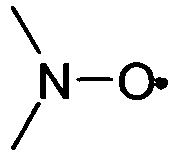
and a second step - b) comprising the modification of the polymer or copolymer prepared under a1) or a2) by a transesterification reaction, an amidation, hydrolysis or anhydride modification or a combination thereof.
- For the reasons stated on pages 2 and 3 of
WO 2006/074969 A1 the dispersants obtainable by the above process (which employs a post-polymerisation modification technique) differ distinctly in structural respect from polymers with same monomer composition, but synthesized directly from corresponding monomers without post-modification. It should especially be noted that the monomer distribution which results from the transesterification step, is only governed by the transesterification reaction and can be expected to provide a more uniform i.e. random distribution along the polymer chain, as compared to direct synthesis by radical polymerisation. - The ethylenically unsaturated monomer in step al or a2 is preferably selected from isoprene, 1,3-butadiene, α-C5-C18alkene, 4-vinyl-pyridine or pyridinium-ion, 2-vinyl-pyridine or pyridinium-ion, vinyl-imidazole or imidazolinium-ion, dimethylacrylamide, 3-dimethylaminopropylmethacrylamide, styrene, α-methyl styrene, p-methyl styrene, p-tert-butyl-styrene or a compound of formula CH2=C(Ra)-(C=Z)-Rb, wherein Ra is hydrogen or methyl, Rb is NH2, O- (Me+), unsubstituted C1-C18alkoxy, C2-C100alkoxy interrupted by at least one N and/or O atom, or hydroxy-substituted C1-C18alkoxy, unsubstituted C1-C18alkylamino, di(C1-C18alkyl)-amino, hydroxy-substituted C1-C18alkylamino or hydroxy-substituted di(C1-C18alkyl)amino, -O-CH2-CH2-N(CH3)2 or -O-CH2-CH2-N+H(CH3)2 An-;
An- is a anion of a monovalent organic or inorganic acid;
Me is a monovalent metal atom or the ammonium ion;
Z is oxygen or sulfur; with the proviso that, as stated above, at least one monomer used in the steps a1) or a2) is a C1-C6 alkyl or hydroxy C1-C6 alkyl ester of acrylic or methacrylic acid. - A nitroxylether having the structural element of the formula


- Stable free radicals having a structural element

EP-A-621 878 - Examples, such as

WO96/24620 - Particularly suitable nitroxylethers and nitroxyl radicals are those of formulae

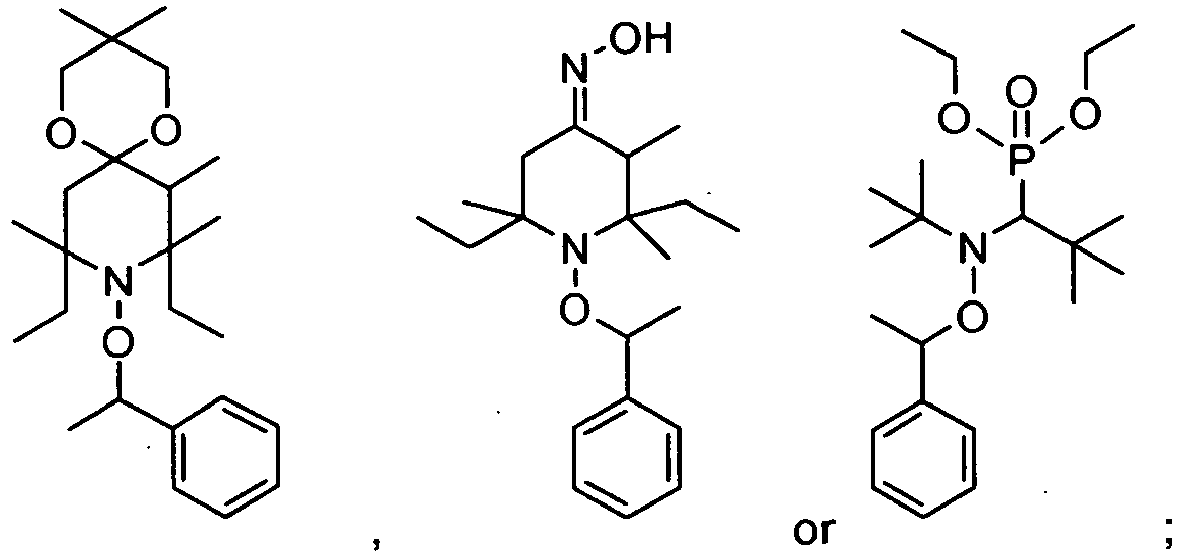


- When the process according to route a2) is chosen, the free radical initiator is preferably an azo compound (e.g. 2,2'-azobisisobutyronitrile), a peroxide (e.g. acetyl cyclohexane sulphonyl peroxide), perester (e.g. disuccinic acid peroxide) or a hydroperoxide (e.g. t-butyl hydroperoxide).
- Preferably the first polymerization step is carried out according to the polymerization reactions a1).
- Preferably the second step b) is a transesterification reaction, hydrolysis or an anhydride modification. Particularly preferred is a transesterification reaction.
The transesterification preferably comprises the removal of the C1-C6 alcohol byproduct by distillation. - In a specific embodiment step a1 or a2 of the above described process is carried out twice and a block copolymer is obtained wherein in the first or second radical polymerization step the monomer or monomer mixture contains 50 to 100% by weight, based on total monomers, of a C1-C6 alkyl or hydroxyalkyl ester of acrylic or methacrylic acid and in the second or first radical polymerization step respectively, the ethylenically unsaturated monomer contains no primary or secondary ester bond.
- When a block copolymer is prepared it is preferred that in the first polymerization step the monomer or monomer mixture contains from 50 to 100% by weight based on total monomers of a C1-C6 alkyl or hydroxyalkyl ester of acrylic or methacrylic acid and in the second polymerization step the ethylenically unsaturated monomer is 4-vinyl-pyridine or pyridinium-ion, 2-vinyl-pyridine or pyridinium-ion, vinyl-imidazole or imidazolinium-ion, dimethylacrylamide, 3-dimethylaminopropylmethacrylamide, styrene, α-methyl styrene, p-methyl styrene or p-tert-butyl-styrene.
- In a specific embodiment of the invention the block copolymer is a gradient block copolymer.
- As mentioned above it is mandatory that the polymer or copolymer is prepared by controlled free radical polymerization (CFRP).
Solomon et al. in US 4,581,429 have firstly described such processes using stable free nitroxyl radicals as controlling agents. These are the steps defined under a1) and a2) above. -
U.S. 4,581,429 discloses a free radical polymerization process by controlled or "living" growth of polymer chains, which produces defined oligomeric homopolymers and copolymers, including block and graft copolymers. Disclosed is the use of initiators of the partial formula R'R"N-O-X. In the polymerization process the free radical species R'R"N-O• and •X are generated. •X is a free radical group, e.g. a tert.-butyl or cyanoisopropyl radical, capable of polymerizing monomer units containing ethylene groups. - As stated above, reaction step b) comprises the modification of the polymer or copolymer prepared by reaction steps a1) or a2) by a transesterification reaction, an amidation, hydrolysis or anhydride modification or a combination thereof.
- Transesterification means to replace the alcohol radical in an ester group of the polymer or copolymer by another alcohol radical. Preferably the alcohol radical to be replaced is methanol, ethanol, propanol or butanol. Typically the transesterification reaction is carried out at elevated temperatures, typically 70 - 200°C, by reacting the CFRP polymer with the corresponding alcohol using well-known catalysts, such as tetra-isopropyltitanate, tetrabutyltitanate, or alkali- or earth alkali alcoholates, like NaOMe, LiOMe or LiOC(CH3)3. Typically the low boiling product alcohol is removed from the transterification reaction mixture by distillation. If needed, catalyst residues may be removed by adsorption or extraction or otherwise processed or inactivated by known methods, like hydrolysis with water or acids. The choice of the replacing alcohol is important. The replacing alcohol controls the properties of the resulting copolymer.
- Hydrolysis means the cleavage of an ester bond under alkaline or acidic conditions and can be carried out when the polymer or copolymer contains ester functionalities. The degree of hydrolysis may vary in a wide range and depends on reaction time and conditions. For example 5 to 100%, preferably 10% to 70% of the ester functionalities may be hydrolized, to form the free acid group, from which also a salt can be prepared. The metal ion is preferably an alkali metal ion, such as Li+, Na+ or Ka+ or an ammonium cation, such as NH4 + or NR4 +, wherein R is hydrogen or C1-C18alkyl with the proviso that the four R need not all have the same meaning.
- Anhydride modification can be carried out when the polymer or copolymer contains hydroxyl functionalities. The hydroxyl functionalities come for example from hydroxyl functional monomers, such as hydroxyethyl acrylate or methacrylate. Virtually all aliphatic or aromatic anhydrides can be used in the modification process. Examples for anhydrides are maleic acid anhydride, pyromelitic acid anhydride, cyclohexyldiacid anhydride, succinic acid anhydride, camphoric acid anhydride.
- Preferably, the dispersants are polymeric dispersants selected from modified poly(meth)acrylate polymers of the formula II

WO2006/074969 A1 andUS 2003/105201 A1 in structural respect. - When m is 0 the pyridyl-ethylene moiety is absent.
- Alkyl R having up to 30 carbon atoms wherein one or more carbon atoms are replaced by oxygen and which is substituted by dimethylamino or trimethylamino is e.g. 5-dimethylamino-3-oxapentyl of the formula (CH3)2N-CH2-CH2-O-CH2-CH2- or 5-trimethylamonio-3-oxapentyl, and is preferably different from 2-dimethylaminoethyl.
- Preferably, alkyl R has 2-20, especially 4-16 carbon atoms and is e.g. n-butyl or linear or branched C12-16alkyl, like 1-hexadecyl.
- As stated above the group X-R must not be the same in all (p) moieties of the partial formula -CH2-C(R15)(CO-X-R)- present in formula I. Preferably, in up to 20% of said moieties R is unsubstituted C1-6alkyl, e.g. 1-butyl, while in the remaining moieties R is different from unsubstituted C1-6alkyl, e.g. linear or branched C12-16alkyl, like 1-hexadecyl, or 5-dimethylamino-3-oxapentyl of the formula (CH3)2N-CH2-CH2-O-CH2-CH2- or 5-trimethylamonio-3-oxapentyl.
- A salt-forming group in a compound of the formula I is especially a dimethylamino group which may be reacted e.g. with methyliodide to form a trimethylamonio group. Suitable counterions are e.g. tetraphenyl-borate or a dialkylphosphonate, like didodecylphosphonate.
- Examples of suitable solvents for dispersants are aliphatic hydrocarbons, e.g. the high-purity isoparaffinic solvents with narrow boiling ranges Isopar™ G and Isopar™ M; halogenated hydrocarbons, like tetrachloroethylene and Halocarbon™ 0.8 (a low molecular weight polymer of chlorotrifluoroethylene), and silicone fluids. A preferred dispersant is dodecane.
- The dispersions of the present invention can be used in electrophoretic displays.
- The invention relates also to the use in an electrophoretic display of a bis-oxodihydro-indolylene-benzodifuranone colourant of the formula I, and/or of a polymeric dispersant as defined herein, and to the use in an electrophoretic display of a dispersion comprising a bis-oxodihydro-indolylene-benzodifuranone colourant of the formula I, a polymeric dispersant as defined herein, and a suitable solvent.
- The invention relates also to an electrophoretic display comprising a dispersion of a bis-oxodihydro-indolylene-benzodifuranone colourant of the formula I, a polymeric dispersant as defined herein and a solvent which is suitable for dispersions used in electrophoretic displays.
- The following Examples illustrate the invention.
-
- DMAPMA: N,N-Dimethylaminopropyl methacrylamide
- DMAEE: Dimethylaminoethoxyethanol
- hyflo: Hyflo SuperCel® (Fisher Scientific, Inc.); flux calcined diatomaceous earth
- GPC: gel permeation chromatography
- LDI-TOF MS: Laser desorption/ionization time-of-flight mass spectrometry
- Mn: Number average molecular weight
- nBA: n-butylacrylate
- PDI: Polydispersity (The polydispersity of a sample is defined as weight average molecular weight Mw divided by Mn and gives an indication just how narrow a distribution is.)
- Ph4BNa: Tetraphenylborane sodium salt
- THF: tetrahydrofurane
- 4VP: 4-vinyl-pyridine
- Abbreviations for NMR spectra:
- s: singulet
- t: triplet
- m: multiplet
- Cetylalcohol (98% pure1-hexadecanol; obtainable from the company Cognis)
- LIAL® 125 A: mixture of straight chain and mono-branched C12-15 alkanols from Sasol Olefins and Surfactants GmbH.
- Lupragen® N 107: Dimethylaminoethoxyethanol (obtainable from the company BASF)
- As stated in Example 6 the transesterification proceeds at random. This is not reflected properly by many formulae, like formula 4 according to which it would seem that there is a block of butyl esters and a block of C12-15-alkyl esters. Nevertheless, said formulae are more illustrative than e.g. formula 4' and have been used for this reason. In contrast to the formulae, the abbreviated names better reflect which part of the polymer is random and which part is a block. For example the name poly(nBA-co-LialA-b-DMAPMA) given in Example 7 describes a polymer comprising a block (characterized by the letter "b") of poly-n-butylacrylate wherein the butyl group has at random be replaced by LIAL® alcohols, i.e. poly(nBA-coLialA) and another block of poly-dimethylaminopropylmethacrylamide. The approximated numers of the monomers in said blocks are given e.g. in Example 7 as (11-co-60)-b-10, i.e. there are approximately 11 n-butylacrylate units at random copolymerized with 60 Lial-acrylate units followed by a block of 10 dimethylaminopropylmethacrylamide (DMAPMA) units. It should, however, be noted that the abbreviated names do not mention the end groups on both sides of the polymer, i.e. e.g. the 1-phenyl-ethyl group.
-
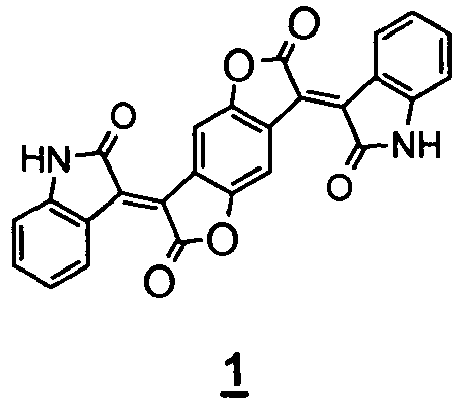
- The synthesis of the pigment of the above formula 1 from bisbenzofuranone and isatin is described in Example 12b on page 35 of
WO 00/24736 A1 WO 00/24736 A1 - A new synthesis which yields an improved form of the pigment of the above formula 1 , a cis/trans-isomer thereof or a mixture of such isomers is described hereinafter:
- A mixture of 8.5 g of 2,5-dihydroxy-1,4-benzenediacetic acid (0.37 Mol, Aldrich), 11g Isatin (0.74 Mol, Aldrich 98%) and 14 g of p-toluenesulfonic acid-monohydrate (Fluka purum) in 800 ml of glacial acetic acid is stirred during 14 hour at 105°C. The reaction mixture is cooled to room temperature and the suspension filtered over a paper filter, washed with 250 ml of acetic acid, 200 ml of methanol and 500 ml of water. The black powder is dried in a vacuum oven at 70°C/104 Pa.
-

- 5.00 g of the black pigment of the above formula 1 or an isomer thereof (obtained by the new synthesis described in Example 1) are dissolved under stirring in 30 ml of fuming sulfuric acid (comprising 25% of free SO3). The dark violet solution, whose temperature has reached 30°C, is cooled down to 20°C, stirred for 4 hours, discharged into 500 ml of an ice/water-mixture and stirred for another hour. 25 g (i.e. a multiple stoichiometric excess) of the amine or ammonium salt specified in Examples 2 to 5 are added within 5 minutes. The black suspension is stirred for 30 minutes, filtered and washed with 50 ml of water. The humid presscake is suspended in 100 ml of water, 5 g of the amine or ammonium salt are added, and the product is extracted twice each with 150 ml of methylene chloride. The two organic phases are merged and stirred into 1200 ml of hexane; the product precipitates as small crystals. The suspension is stirred for 30 minutes and filtered on a fibre glass filter. As the product tends to liquefy on the filter, the product is dissolved off the filter with 100 ml of methylene chloride and isolated by evaporating the solvent on the rotavapor at slightly elevated temperature under vacuum.
- The products contain predominantly two sulfo groups, as determined by MS technique. Based on 1H-NMR-data the exact location of the sulfo groups is uncertain.
- In order to manufacture a disulfonic acid of the formula 2 where the location of the sulfo groups is certain, i.e. as depicted in the below formula 2a, the following process of manufacture is used:
- A mixture of 2.3 g of 2,5-dihydroxy-1 ,4-benzenediacetic acid (0.01 Mol, Aldrich), 5.7 g isatin-5-sulfonic acid sodium salt dihydrate (0.02 Mol, Fluka 98%) and 0.7g p-toluenesulfonic acid-monohydrat (Fluka purum) in 80 ml acetic acid and 20 ml water is stirred during 14 hour at 105°C. The reaction mixture is cooled to 80°c and the suspension filtered over a paper filter, washed with 80 ml of acetic acid and 100 ml of methanol. The black powder is dried in a vacuum oven at 70°C/104 Pa (Pa = Pascal) yielding the compound of formula 2a; LDI-TOF: m/z = 608.

- Example 2: Tributylammonium salt of the above formula 2; used amine: tributylamine. Yield: 2.1 g
- Example 3: Trioctylmethylammonium salt of the above formula 2; used ammonium salt: trioctylmethylammonium bromide. Yield: 1.6 g
The product is characterized by elemental analysis, corresponding to the bis(trioctylmethylammonium) salt: - Found (Calculated): C 66.35% (67.92%); H 9.02% (8.85%); N 3.86% (4.17%); O 14.25% (14.29%); S 5.44% (4.77%). No residual bromide is detected.
- Example 4: Octadecyltrimethylammonium salt of the above formula 2; used ammonium salt: octadecyltrimethylammonium bromide. Yield: 8.3 g
The product is characterized by elemental analysis, corresponding to the mono(octadecyltrimethylammonium) salt monohydrate: - Found (Calculated): C 59.06% (60.18%); H 7.46% (6.34%); N 4.01% (4.48%); O 21.25% (22.17%); S 6.78% (6.84%). No residual bromide is detected.
- Example 5: Tetraethylammonium salt of the above formula 2 ; used ammonium salt: tetraethylammonium bromide. Yield: 1.2 g
-


- In a 500 mL flask equipped with a mechanical stirrer and a distillation column with dry ice acetone cooling, 100.0 g of poly(nBA-b-4VP), i.e. a block copolymer of n-butylacrylate and 4-vinylpyridine, degree of polymerization 75-b-15, described in example A2 on page 36 of
WO2006/074969 A1 , 100 g of xylene and 71.7 g of cetylalcohol (molecular weight 242.5 g/mol; 45 mol% relative to the n-butyl esters) are added and dried by azeotropic distillation of the xylene. Three portions of 0.25 g of tert. butoxylithium (LiOtBu) are added during 5h at 190 °C. The formed n-butanol is distilled off at reduced pressure. As a result, 149.8 g of poly(nBA-co-CetylA-b-4VP) of the formula 4 are obtained as a yellowish wax. Number average molecular weight Mn=15.400 g/mol (PDI 1.5). Analysis via gel permeation chromatography (GPC) as well as 1H-NMR indicate almost quantitative conversion of the cetylalcohol. - The above formula 4 does probably not reflect the structure of the obtained product correctly in that the transesterification probably proceeds at random so that the true structure of the obtained product seems to be better reflected by formula 4'. Analogous comments apply to the below Examples 7 to 9.
-

- In a 350 ml flask equipped with a mechanic stirrer and a distillation column with dry ice acetone cooling 90.5 g of the copolymer of formula 5 and 100.3 g of Lial 125 (80 mol% relative to the n-butyl esters) are placed and inertisized by bubbling nitrogen through the solution during 1 hour at room temperature. The mixture is heated to 135-142 °C and catalyst is added (4 portions of 350 mg of tetra(isopropyl)orthotitanate, each 2 hours). The formed n-butanol is distilled off at low pressure (200 mbar). After 8 hours the resulting brownish polymer is cooled to room temperature, affording 145.1 g of the copolymer of the formula 6 (Mn 11300, PDI 1.35 (by GPC (THF)), solid content 97.3% (halogen dryer 200 °C) and a composition (according to 1H-NMR) for poly(nBA-co-LialA-b-DMAPMA) as (11-co-60)-b-10.
- The starting material of the formula 5 is obtained as follows:
- In a 500 ml flask, equipped with a mechanic stirrer and distillation column are loaded 122.5 g of poly-n-butylacrylate [poly(nBA)] (synthesized analogous to Example
A1 in WO2006/074969 ; degree of polymerization 75 according to 1H-NMR, Mn = 6830, PDI = 1.31 and 85.98 g of dimethylaminopropyl methacrylamide (DMAPMA). The mixture is heated under nitrogen to 135 °C. After 2.5 h the reaction is terminated by cooling below 100 °C and non-reacted monomer DMAPMA is distilled off at high vacuum (<20 mbar) until a solid content of > 98.0% is reached (by halogen dryer 200°C). - As a result, 143 g of the brownish viscous block copolymer of the formula 5 are isolated with Mn [GPC (THF)] 7480, (PDI 1.32). According to analysis by 1H-NMR the degree of polymerization is determined for p(nBA-b-DMAPMA) as 71-b-10.
-

- In a 500 mL flask equipped with a mechanic stirrer and a distillation column with dry ice acetone cooling 200.0 g of poly(nBA-b-4VP) of the formula 3 depicted in Example 6 with a degree of polymerization of 75-b-15, prepared according to example
A2 in WO2006/074969 , 203.1 g of Lial 125 (ca. 100 mol% relative to the n-butyl esters) and 4.6 g of Lupragen N 107 (MW 133.2, ca. 3 mol% relative to the n-butyl esters; dimethylaminoethoxyethanol [DMAEE]) are added. One portion of 2.5 g of tetra(isopropyl)orthotitanate is added and the mixture is stirred under inert conditions and low pressure for 8 hours at 140 °C, distilling off formed n-butanol. At the end of the process, residual excess alcohols are removed under high vacuum (20 mbar) until solid content of > 95% (halogen dryer, 200 °C) is reached. This affords a brownish viscous polymer with the average (1H-NMR) composition for p(nBA-co-DMAEEA-co-Lial125A)-b-p(4VP) as (5-co-1-co-70)-b-15 and a Mn (GPC/THF) of 17.500 (PDI 1.31). 50.0 g of this polymer are placed in a 250 ml three necked flask, equipped with a mechanical stirrer, and 100 g of n-dodecane are added. The mixture is slightly heated to 40 °C to obtain a homogenous solution. After cooling to room temperature, 0,29 g of methyliodide (1.0 equiv relative to amino-groups) are added to the polymer solution and subsequently stirred overnight at room temperature. The resulting quaternized polymer solution is obtained with a solid content of 32,1% (halogen dryer, 200 °C) and a Mn (GPC/THF) of the polymer of 14.300 (PDI 1.29). In the final step, 0.66 g of sodium tetraphenylborate (Ph4BNa), dissolved in 13.2 g of dodecane, are slowly added to the polymer solution and stirred for 3 hours at room temperature. The resulting slightly turbid mixture is filtered over hyflo resulting in a yellowish solution (solid content 31.3%) and a Mn of 14.300 (PDI 1.24) of the salt of the formula 7 . The average (1H-NMR) composition of the cation is determined for p(nBA-co-DMAEE[Me-quat]A-co-Lial125A)-b-p(4VP)+ as (5-co-1-co-70)-b-15. -

- 50.0 g of the copolymer of formula 8 are homogenously dissolved in 283 g of n-dodecane at 50 °C. The didodecylphosphonate (DDDP, 0.64 g) of the formula 10 described in step 9.2 is added and stirred for 2 hours at 80 °C. The ammonium salt of the formula 9 is obtained as a clear brownish solution in n-dodecane. GPC(THF) of the polymer gives a Mn of 18.800 (PDI 1.30). The average (1H-NMR) composition of the cation p(nBA-Co-DMAEE[H]A-co-Lial125A)-b-p(4VP)+ is determined to be (7-co-1-co-66)-b-14.
- The starting materials are prepared as follows:
- In a 500 mL flask equipped with a mechanic stirrer and a distillation column with dry ice acetone cooling, 175 g of the copolymer of the formula 8 are prepared according to the procedure of Example 8: 103.7 g of a p(nBA)-b-p(4VP) block copolymer with an average (1H-NMR) composition of 73 nBA and 14 4-vinylpyridine units, 110.1 g of Lial 125 (ca. 100 mol% relative to n-butylesters), 1.0 g of Lupragen N 107 (MW 133.2; 1.5 mol% relative to the n-butyl esters) and 1.3 g of tetra(isopropyl)orthotitanate are transesterified (18 hours at 140 °C and 200 mbar) to a brownish viscous copolymer of the formula 8 with the average (1H-NMR) composition for p(nBA-co-DMAEEA-co-Lial125A)-b-p(4VP) of (7-co-1-co-66)-b-14 and a Mn (GPC/THF) of 15.900 (PDI 1.61).
-

- In a 250 ml three necked flask, equipped with a magnetic stirring bar, 10.6 g of sodium hypophosphite monohydrate (Fluka, MW 106) are dissolved in 10 ml of water and cooled to 15 °C. To this solution 7.51 g of concentrated sulfuric acid (97%, 0.75 equivalents) are slowly introduced, resulting in a turbid viscous reaction mass. 35.4 g of 1-dodecene (2.0 equivalents) are added at room temperature, followed by a solution of 2.42 g of dibenzoyl peroxide (Bnz-O-O-Bnz; Fluka; 50% in water) in 20 ml of 1,4-dioxane. The inhomogeneous mixture is heated to 80-85 °C and stirred for 2 hours, followed by another portion of 2.42 g of dibenzoyl peroxide (Fluka, 50% in water) in 20 ml of 1,4-dioxane and stirring for 2 hours at 85 °C. After cooling to room temperature, 50 ml of toluene are added, heated to 60 °C, and cooled to room temperature. The two phase system is seperated and the aquous phase is extracted two times with each 50 ml of toluene. The combined organic phases are washed with water and a nearly saturated aqueous sodium chloride solution (brine; 2 times 20 ml and 1 time 20 ml respectively). After filtration over hyflo, the toluene is evaporated to dryness. The residual solid is dissolved in hot hexane (60 °C, 200 ml) and left to cool down for crystallization. Part of the crystals are filtered off, the filter cake is washed with cold hexane, and dryed at 25 °C on a rotorvap. This affords 14.65 g (36% yield) of the compound of the formula 10 as a white crystalline material; 1H-NMR (CDCI3, ppm): 9.8 (s, 1H, OH); 1.5-1.8 (m, 8 H, 2 P-CH 2-CH 2-)), 1.2-1.5 (m, 36 H, 18 -CH 2-), 0.9 (t, 6H, 2 CH 3).
-

- In a 100 mL flask equipped with a mechanical stirrer, distillation column with dry ice acetone cooling, 18.77 g of poly(nBA-b-4VP), degree of polymerization 73-b-14, prepared according to example
A2 in WO2006/074969 , and 20.63 g of Lial-125 (80 mol% relative to the n-butyl esters) are added and degassed at 65°C for 60 minutes at 50 mbar. Three portions of 0.29 g of titanium-bis(acetylacetonateybis-isopropylate are added during 6 hours at 142°C. The formed n-butanol is distilled off at reduced pressure.
As a result, 28.94 g of the copolymer of the formula 11 [poly(nBA-co-LialA-b-4VP)] are obtained as a brownish viscous substance; Mn=18.760 g/mol (PDI 1.34). Analysis via GPC as well as 1H-NMR indicate almost quantitative conversion of the Lial-125 alcohol. - This example illustrates the preparation of the oil phase containing various dispersed electrophoretic black pigment particles. The physical characteristics of the obtained dispersions are given in Table 1 below.
- 1.00 g of the pigment substance is milled by a disperser DAS 200 (Lau GmbH) for 15 hours at 25°C into 9.0 g of dodecane (749.0 kg/m3) (Aldrich D22,110-4) in the presence of 0.75 g of the dispersant mentioned in Table 1. In the case of the two-colour electrophoretic dispersion of Example 11 i the above-mentioned 1.00 g of the pigment substance are replaced by 0.5 g of each of the pigments mentioned in Example 11i.
- The dispersion is diluted with further dodecane from 10% to 2% by weight. 20 µl of this dispersion are further diluted with dodecane to 1 ml before measurements by dynamic light scattering.
- The size [diameter in nm] and the zeta potential (ξ) [mV] of the dispersed pigment particles are measured by dynamic light scattering by means of a Malvern Zetasizer Nano Series apparatus (Malvern Instruments Ltd., United Kingdom). The resulting particle sizes are shown in the row "Size" of the below Table 1 in units of nanometers, the (calculated) electrophoretic mobilities in the row µ in units of 10-8m2/Vs at 40V (the electrophoretic mobility is the coefficient of proportionality between particle speed and electric field strength), and the zeta potential in the row "Zeta (mV)".
- The electrophoretic mobility µ [ is calculated from the Smoluchowski relation (ξ= µη/ε where µ is the mobility, η = 1.344 mPa*s is the viscosity of the medium at 25°C and ε = 2.0 is the dielectric constant at 20°C).
- The resistance R [Ω] given in Table 1 is measured as follows:
- A dispersion of carbon black (Base Carbon Black from the Cabot Modified Carbon Black Toolkit; Cabot Corp.) in dodecane is prepared as reference, using copolymer 4 (cf. Example 6) SP-10515 as dispersant, according to the above "General Procedure for the Preparation of the Dispersions".
- The resistance of the well with pure dodecane is > 1013 Ω (> 1013 Ohm).
- As can be seen from Table 1, in all cases the absolute value of the zeta potential and the resistance of the dispersions of the black pigments which are matter of this patent application (Examples 11 b to 11e) is higher than that of the reference material carbon black (Example 11a).
- The significance of zeta potential is that its absolute (i.e. positive or negative) value is related to the stability of colloidal dispersions. The zeta potential indicates the degree of repulsion between adjacent, similarly charged particles in a dispersion. For molecules and particles that are small enough, like the nano particles of the present invention, a high zeta potential confers stability, i.e. the dispersion resists aggregation. When the potential is low, attraction exceeds repulsion and the dispersion will break and flocculate. So, colloids with high zeta potential (negative or positive) are electrically stabilized while colloids with low zeta potentials tend to coagulate or flocculate. The other importance of the zeta potential is that the mobility of a particle under influence of an electric field is proportional to the zeta potential. The higher the (absolute) zeta potential, the faster is the movement of the particles and the switching between the two states.
- A high resistance (resistivity) of the dispersion is desired in order to reduce its electrical conductivity, to get lower power consumption of the display, and to get an image stable for a longer time by application of an electrical field kept by a capacitor under powerless conditions, respectively.
| Example | Pigment [formula no./Example] | Dispersant [formula no./Example] | Conc. ** | Size [nm] | µ [10-8 m2/Vs at 40V] | Zeta [mV] | R[Ω] |
| 11a | Carbon Black* | 4 /6 | 150 | 149 | -3.4 x 10⁻³ | -3.96 | 3.53 x 10⁹ |
| 11b | 2 /4 | 4/6 | 100 | 551 | -2.32 x 10⁻² | -27.1 | 5.71 x 10⁹ |
| 11c | 2a (free disulfonic acid) / 2a | 6/7 | 75 | 314 | -3.09 x 10⁻² | -36.1 | 1.09 x 10¹⁰ |
| 11d | 2a (free disulfonic acid) / 2a | 11 /10 | 75 | 338 | -3.71 x 10⁻² | -43.2 | 4.36 x 10¹⁰ |
| 11e | 1 / 1 | 8 /9.1 | 75 | 511 | -1.32 x 10⁻² | -15.4 | 4.69 x 10⁹ |
| 11f | 1 / 1 | 4/6 | 75 | 471 | -1.99 x 10⁻² | -23.2 | Not measured |
| 11g | 1 / 1 | 9 /9 | 75 | 435 | -2.59 x 10⁻² | -30.2 | Not measured |
| 11h | 1 / 1 | 7 /8 | 75 | 411 | 2.29 x 10⁻² | -26.6 | Not measured |
| 11i | 1 / 1 + Pigment Yellow 128*** | 6 /7 | 75 | 493 | -1.95 x 10⁻² | -22.7 | Not measured |
| * Base Carbon Black from the Cabot Modified Carbon Black Toolkit; Cabot Corp. **The row "conc." gives the percentage of weight of dispersant relative to the weight of pigment. *** CROMOPHTAL Jet Yellow 8GT; Ciba, Inc. |
Claims (11)
- A dispersion which is useful for electrophoretic displays comprisingα) a bis-oxodihydro-indolylene-benzodifuranone colourant of the formula I
 wherein R1 and R6 are each independently of the other H, CH3, CF3, F or Cl, preferably H or F, most preferably H;R2, R3, R4, R5, R7, R8, R9 and R10 are each independently of all others H, halogen, R11, COOH, COOR11,COO-, CONH2, CONHR11, CONR11R12, CN, OH, OR11, OOCR11, OOCNH2, OOCNHR11, OOCNR11R12, NO2, NH2, NHR11, NR11R12, NHCOR12, NR11COR12, N=CH2, N=CHR11, N=CR11R12, SH, SR11, SOR11, SO2R11, SO3R11, SO3H, SO3 -, SO2NH2, SO2NHR11 or SO2NR11R12; and R2 and R3, R3 and R4, R4 and R5, R7 and R8, R8 and R9, and/or R9 and R10 can also be linked together by a direct bond or an O, S, NH or NR11 bridge;R11 and R12 are each independently of the other C1-C12alkyl, C3-C12cycloalkyl, C2-C12alkenyl, C3-C12cycloalkenyl or C2-C12alkinyl, each of which is uninterrupted or interrupted by oxygen, NH, NR13 and / or sulfur in two or more fragments each comprising at least 2 C atoms, and each of which is also unsubstituted or substituted one or more times with COOH, COOR13, COO-, CONH2, CONHR13, CONR13R14, CN, oxo, OH, OR13, OOCR13, OOCNH2, OOCNHR13, OOCNR13R14, NR13, NH2, NHR13, NR13R14, NHCOR14, NR13COR14, N=CH2, N=CHR13, N=CR13R14, SH, SR13, SOR13, SO2R13, SO3R13, SO3H, SO3 -, SO2NH2, SO2NHR13, SO2NR13R14 or halogen; or C7-C12aralkyl, heteroaryl having up to 11 C-atoms or C6-C12aryl, each of which is unsubstituted or substituted one or more times with COOH, COOR13, COO-, CONH2, CONHR13. CONR13R14, CN, OH, OR13, OOCR13, OOCNH2, OOCNHR13, OOCNR13R14, NO2, NH2, NHR13, NA13R14, NHCOR14, NR13COR14, N=CH2, N=CHR13, N=CR13R14, SH, SR13, SOR13, SO2R13, SO3R13, SO3H, SO3 -, SO2NH2, SO2NHR13, SO2NR13R14 or halogen; and each R13 or R14 is, independently of any other R13 or R14, C1-C6alkyl, benzyl or phenyl, each of which is unsubstituted or substituted one or more times with substituents as defined above, with the proviso that the total number of atoms in any substituent of R13 and R14 is from 1 to 8; whereby pairs of substituents selected from the group consisting of all R13 and R14 can optionally be linked together by a direct bond or an O, S, NH or NR11 bridge so as to form rings,or a cis-trans isomer thereof or a salt of such colourant or isomer having a salt-forming group,β) a polymeric dispersant comprising modified poly(meth)acrylate polymers obtainable by the process comprising the stepsa1) polymerizing in a first step one or more ethylenically unsaturated monomers in the presence of at least one nitroxylether having the structural element of the formula
 a2) polymerizing in a first step one or more ethylenically unsaturated monomers in the presence of at least one stable free nitroxyl radical of the formulaand a second step
 b) comprising the modification of the polymer or copolymer prepared under a1) or a2) by a transesterification reaction, an amidation, hydrolysis or anhydride modification or a combination thereof, andy) a solvent which is suitable for dispersions used in electrophoretic displays.
 - A dispersion according to claim 1 wherein the colourant is a pigment of the formula 1.

- A dispersion according to claim 1 wherein the colourant is a sulfonic acid of the formula 2a

- A dispersion according to any one of claims 1-3 wherein the polymeric dispersant is selected from modified poly(meth)acrylate polymers of the formula II

- A dispersion according to any one of claims 1-4 wherein the solvent is dodecane.
- A dispersion according to any one of claims 1-5 wherein the dispersed particles have a diameter of 200-800 nm.
- A bis-oxodihydro-indolylene-benzodifuranone colourant of the formula 2a depicted in claim 3 or a salt thereof and/or a cis/trans-isomer of said acid or salt.
- Use of a bis-oxodihydro-indolylene-benzodifuranone colourant of the formula I as defined in any one of claims 1-3, and/or of a polymeric dispersant as defined in any one of claims 1, 9 and 10 in an electrophoretic display.
- A polymeric dispersant selected from modified poly(meth)acrylate polymers of the formula II

- A dispersant according to claim 9 wherein in up to 20% of said p moieties of the partial formula -CH2-C(R15)(CO-X-R)- R is unsubstituted C1-6alkyl, while in the remaining moieties R is different from unsubstituted C1-6alkyl.
- An electrophoretic display comprising a dispersion of a bis-oxodihydro-indolylene-benzodifuranone colourant of the formula I as defined in any one of claims 1-3, a polymeric dispersant as defined in any one of claims 1, 9 and 10, and a solvent which is suitable for dispersions used in electrophoretic displays.
Priority Applications (1)
| Application Number | Priority Date | Filing Date | Title |
|---|---|---|---|
| EP10700968A EP2387599B1 (en) | 2009-01-19 | 2010-01-07 | Black pigment dispersion |
Applications Claiming Priority (3)
| Application Number | Priority Date | Filing Date | Title |
|---|---|---|---|
| EP09150843 | 2009-01-19 | ||
| EP10700968A EP2387599B1 (en) | 2009-01-19 | 2010-01-07 | Black pigment dispersion |
| PCT/EP2010/050089 WO2010081756A1 (en) | 2009-01-19 | 2010-01-07 | Black pigment dispersion |
Publications (2)
| Publication Number | Publication Date |
|---|---|
| EP2387599A1 EP2387599A1 (en) | 2011-11-23 |
| EP2387599B1 true EP2387599B1 (en) | 2013-03-20 |
Family
ID=40911912
Family Applications (1)
| Application Number | Title | Priority Date | Filing Date |
|---|---|---|---|
| EP10700968A Not-in-force EP2387599B1 (en) | 2009-01-19 | 2010-01-07 | Black pigment dispersion |
Country Status (10)
| Country | Link |
|---|---|
| US (1) | US8674006B2 (en) |
| EP (1) | EP2387599B1 (en) |
| JP (1) | JP5683491B2 (en) |
| KR (1) | KR101704076B1 (en) |
| CN (1) | CN102282216B (en) |
| CA (1) | CA2749240A1 (en) |
| MX (1) | MX2011007484A (en) |
| RU (1) | RU2541013C2 (en) |
| TW (1) | TWI478986B (en) |
| WO (1) | WO2010081756A1 (en) |
Families Citing this family (19)
| Publication number | Priority date | Publication date | Assignee | Title |
|---|---|---|---|---|
| EP2387600B1 (en) * | 2009-01-19 | 2014-04-02 | Basf Se | Organic black pigments and their preparation |
| KR101342538B1 (en) | 2011-11-01 | 2013-12-17 | (주) 디에이치홀딩스 | Air Cutoff Valve and Restart Stable Method thereof |
| ES2622330T3 (en) * | 2012-06-01 | 2017-07-06 | Basf Se | Black dye mixture |
| JP6170673B2 (en) | 2012-12-27 | 2017-07-26 | 富士フイルム株式会社 | Composition for color filter, infrared transmission filter, method for producing the same, and infrared sensor |
| KR102210576B1 (en) * | 2013-09-25 | 2021-02-01 | 미쯔비시 케미컬 주식회사 | Photosensitive coloring composition, black matrix, coloring spacer, image display device, and pigment dispersion |
| JP6547931B2 (en) * | 2014-10-27 | 2019-07-24 | 花王株式会社 | Colored curable resin composition |
| JP5923227B1 (en) * | 2014-12-18 | 2016-05-24 | 花王株式会社 | Colored curable resin composition |
| CN112375400B (en) | 2016-08-24 | 2022-09-09 | 东丽株式会社 | Black pigment and method for producing the same, pigment dispersion, photosensitive composition and cured product thereof |
| JP2017116955A (en) * | 2017-03-03 | 2017-06-29 | 富士フイルム株式会社 | Infrared transmission filter composition, infrared transmission filter, infrared transmission filter manufacturing method, and infrared sensor |
| KR102174436B1 (en) | 2017-08-17 | 2020-11-04 | 주식회사 엘지화학 | Qualitative analysis method of insoluble pigment compounds |
| JP6764894B2 (en) * | 2018-04-19 | 2020-10-07 | 富士フイルム株式会社 | Composition for infrared transmission filter, infrared transmission filter, manufacturing method of infrared transmission filter, and infrared sensor |
| US20200197240A1 (en) | 2018-12-19 | 2020-06-25 | The Procter & Gamble Company | Absorbent article comprising printed region |
| JP2019049759A (en) * | 2018-12-26 | 2019-03-28 | 富士フイルム株式会社 | Composition for infrared transmission filter, infrared transmission composition layer, infrared transmission filter, method for manufacturing infrared transmission filter, and infrared sensor |
| WO2021209349A1 (en) * | 2020-04-14 | 2021-10-21 | Basf Se | An amine-modified polymer, a controlled free radical polymerization for preparing the same and implementations thereof |
| JP7625243B2 (en) | 2020-10-16 | 2025-02-03 | 山陽色素株式会社 | Black pigment dispersion |
| JP2023004245A (en) | 2021-06-25 | 2023-01-17 | 山陽色素株式会社 | Black pigment dispersion and chromatic color pigment dispersion |
| JPWO2023054116A1 (en) | 2021-09-29 | 2023-04-06 | ||
| JPWO2024171841A1 (en) * | 2023-02-16 | 2024-08-22 | ||
| CN118956180B (en) * | 2024-07-31 | 2026-06-30 | 山东凯瑞尔光电科技有限公司 | Low-reflectivity black dispersion liquid and preparation method thereof |
Family Cites Families (18)
| Publication number | Priority date | Publication date | Assignee | Title |
|---|---|---|---|---|
| GB1568231A (en) | 1976-03-10 | 1980-05-29 | Ici Ltd | Substituted 2,6-dioxo-2,6-dihydrobenzo (1:2-b; 4:5-6')-difuran or dipyrrole dyestuffs |
| JPH0848893A (en) | 1994-08-09 | 1996-02-20 | Sumitomo Chem Co Ltd | Novel benzodifuranone compound and method for dyeing or printing hydrophobic fiber material using the same |
| JP3572774B2 (en) | 1996-01-19 | 2004-10-06 | 三菱化学株式会社 | Optical recording medium and information recording method |
| CN1324355A (en) * | 1998-10-22 | 2001-11-28 | 西巴特殊化学品控股有限公司 | Oxobenzofuranylide-dihydroindolone |
| WO2001032577A1 (en) * | 1999-11-03 | 2001-05-10 | Ciba Specialty Chemicals Holding Inc. | Pigmented vitreous material its precursor glass items coated therewith and method of its preparation |
| TWI236482B (en) * | 2000-11-13 | 2005-07-21 | Ciba Sc Holding Ag | Process for the (co)polymerization of vinyl chloride in the presence of a stable free nitroxyl radical |
| US6849679B2 (en) | 2001-05-21 | 2005-02-01 | Ciba Specialty Chemicals Corporation | Pigment compositions with modified block copolymer dispersants |
| WO2006074969A1 (en) | 2005-01-11 | 2006-07-20 | Ciba Specialty Chemicals Holding Inc. | Process for the post-modification of homo and copolymers prepared by controlled free radical polymerization processes |
| KR101267460B1 (en) | 2005-10-26 | 2013-05-31 | 시바 홀딩 인크 | Colored particles for electrophoretic displays |
| JP2007266411A (en) * | 2006-03-29 | 2007-10-11 | Nippon Kayaku Co Ltd | Field effect transistor |
| WO2008003604A2 (en) | 2006-07-05 | 2008-01-10 | Ciba Holding Inc. | Coloured organic electrophoretic particles |
| EP2038701B1 (en) | 2006-07-06 | 2017-04-12 | Basf Se | Encapsulated dispersions comprising electrophoretically mobile organic colorants |
| EP2041619A2 (en) * | 2006-07-11 | 2009-04-01 | Koninklijke Philips Electronics N.V. | Electrophoretic device and method for controlling the same |
| WO2008052592A1 (en) * | 2006-10-30 | 2008-05-08 | Telecom Italia S.P.A. | High security use of bank cards and system therefore |
| JP4549363B2 (en) * | 2007-05-18 | 2010-09-22 | 株式会社リコー | Electrophoretic particles and image display device using the same |
| CN101755013B (en) * | 2007-07-19 | 2014-05-07 | 巴斯夫欧洲公司 | NIR-inert substrates comprising bis-oxodihydroindolylen-benzodifuranones |
| US8270063B2 (en) | 2007-09-07 | 2012-09-18 | Basf Se | Encapsulated dispersions comprising electrophoretically mobile organic colorants |
| EP2387600B1 (en) | 2009-01-19 | 2014-04-02 | Basf Se | Organic black pigments and their preparation |
-
2010
- 2010-01-07 US US13/144,106 patent/US8674006B2/en not_active Expired - Fee Related
- 2010-01-07 CA CA2749240A patent/CA2749240A1/en not_active Abandoned
- 2010-01-07 RU RU2011134468/05A patent/RU2541013C2/en not_active IP Right Cessation
- 2010-01-07 MX MX2011007484A patent/MX2011007484A/en not_active Application Discontinuation
- 2010-01-07 JP JP2011545713A patent/JP5683491B2/en not_active Expired - Fee Related
- 2010-01-07 CN CN201080004855.1A patent/CN102282216B/en not_active Expired - Fee Related
- 2010-01-07 KR KR1020117019154A patent/KR101704076B1/en not_active Expired - Fee Related
- 2010-01-07 EP EP10700968A patent/EP2387599B1/en not_active Not-in-force
- 2010-01-07 WO PCT/EP2010/050089 patent/WO2010081756A1/en not_active Ceased
- 2010-01-18 TW TW099101243A patent/TWI478986B/en not_active IP Right Cessation
Also Published As
| Publication number | Publication date |
|---|---|
| JP2012515240A (en) | 2012-07-05 |
| US20120172498A1 (en) | 2012-07-05 |
| KR101704076B1 (en) | 2017-02-07 |
| MX2011007484A (en) | 2011-08-03 |
| TWI478986B (en) | 2015-04-01 |
| WO2010081756A1 (en) | 2010-07-22 |
| CN102282216A (en) | 2011-12-14 |
| TW201031714A (en) | 2010-09-01 |
| EP2387599A1 (en) | 2011-11-23 |
| CA2749240A1 (en) | 2010-07-22 |
| JP5683491B2 (en) | 2015-03-11 |
| KR20110112838A (en) | 2011-10-13 |
| RU2011134468A (en) | 2013-03-10 |
| RU2541013C2 (en) | 2015-02-10 |
| US8674006B2 (en) | 2014-03-18 |
| CN102282216B (en) | 2014-05-14 |
Similar Documents
| Publication | Publication Date | Title |
|---|---|---|
| US8674006B2 (en) | Black pigment dispersion | |
| US7999086B2 (en) | Method of conditioning azo pigments containing carboxylic ester groups | |
| US20050001202A1 (en) | Perylenetetracarboxylic acid dibenzimidazole sulfoderivatives containing oxo-groups in the perylene core which form part of a para-quinoid system of bonds, lyotropic liquid crystal systems and anisotropic films containing the same, and methods for making the same | |
| CN1297611C (en) | Perylene pigment compositions | |
| EP1944339B1 (en) | Pigment compositions, colored compositions making use of the pigment compositions, and color filters | |
| KR20120014111A (en) | Novel Triarylmethane Compounds | |
| JP2009523164A (en) | 6,7-Dihydrobenzimidazo [1,2-c] quinazolin-6-onecarboxylic acid and its esters and methods for their synthesis | |
| JP5610610B2 (en) | Azo dye | |
| EP1425282A2 (en) | Process for the preparation of diketopyrrolopyrroles | |
| KR20180021394A (en) | Coloring compounds, and colorant materials comprising them | |
| JP3168038B2 (en) | Pigment compound | |
| JP2012158649A (en) | Novel thiazole-based cationic dye | |
| KR20160091265A (en) | A compound, a method for preparing the same, and a colorant comprising the same | |
| CN1178992C (en) | Method for preparing deep colour perylene dye | |
| KR101990804B1 (en) | Colored photosensitive composition, color filter, method of producing the same, and display device | |
| JPH06240158A (en) | Pigment derivative and its application | |
| KR20060028394A (en) | Monoazo Compounds and Methods for Making the Same | |
| CN106565486A (en) | Branched polyether alcohol ester compound and application thereof | |
| CN108069917B (en) | 1,3, 5-triazine derivatives and their use in pigments | |
| EP3492527A1 (en) | Azo-pigment composition with a low content of o-anisidine | |
| WO2018051875A1 (en) | Pigment dispersant, pigment composition, and coating material | |
| JP2023004245A (en) | Black pigment dispersion and chromatic color pigment dispersion | |
| KR101644916B1 (en) | Azo compound or salt thereof | |
| EP1693421A1 (en) | Benzimidazolone compound | |
| KR20060129315A (en) | 2,4-dioxopyrimidine-based mesoionic pigment |
Legal Events
| Date | Code | Title | Description |
|---|---|---|---|
| PUAI | Public reference made under article 153(3) epc to a published international application that has entered the european phase |
Free format text: ORIGINAL CODE: 0009012 |
|
| 17P | Request for examination filed |
Effective date: 20110819 |
|
| AK | Designated contracting states |
Kind code of ref document: A1 Designated state(s): AT BE BG CH CY CZ DE DK EE ES FI FR GB GR HR HU IE IS IT LI LT LU LV MC MK MT NL NO PL PT RO SE SI SK SM TR |
|
| DAX | Request for extension of the european patent (deleted) | ||
| RIC1 | Information provided on ipc code assigned before grant |
Ipc: C08F 8/14 20060101ALI20120723BHEP Ipc: C09D 7/00 20060101ALI20120723BHEP Ipc: C07D 405/14 20060101ALI20120723BHEP Ipc: C08F 8/12 20060101ALI20120723BHEP Ipc: C09B 7/08 20060101AFI20120723BHEP Ipc: C08F 8/46 20060101ALI20120723BHEP Ipc: C09B 57/00 20060101ALI20120723BHEP |
|
| GRAP | Despatch of communication of intention to grant a patent |
Free format text: ORIGINAL CODE: EPIDOSNIGR1 |
|
| GRAS | Grant fee paid |
Free format text: ORIGINAL CODE: EPIDOSNIGR3 |
|
| GRAA | (expected) grant |
Free format text: ORIGINAL CODE: 0009210 |
|
| AK | Designated contracting states |
Kind code of ref document: B1 Designated state(s): AT BE BG CH CY CZ DE DK EE ES FI FR GB GR HR HU IE IS IT LI LT LU LV MC MK MT NL NO PL PT RO SE SI SK SM TR |
|
| REG | Reference to a national code |
Ref country code: GB Ref legal event code: FG4D |
|
| REG | Reference to a national code |
Ref country code: CH Ref legal event code: EP |
|
| REG | Reference to a national code |
Ref country code: IE Ref legal event code: FG4D |
|
| REG | Reference to a national code |
Ref country code: AT Ref legal event code: REF Ref document number: 602085 Country of ref document: AT Kind code of ref document: T Effective date: 20130415 |
|
| REG | Reference to a national code |
Ref country code: DE Ref legal event code: R096 Ref document number: 602010005597 Country of ref document: DE Effective date: 20130516 |
|
| REG | Reference to a national code |
Ref country code: NL Ref legal event code: T3 |
|
| PG25 | Lapsed in a contracting state [announced via postgrant information from national office to epo] |
Ref country code: NO Free format text: LAPSE BECAUSE OF FAILURE TO SUBMIT A TRANSLATION OF THE DESCRIPTION OR TO PAY THE FEE WITHIN THE PRESCRIBED TIME-LIMIT Effective date: 20130620 Ref country code: LT Free format text: LAPSE BECAUSE OF FAILURE TO SUBMIT A TRANSLATION OF THE DESCRIPTION OR TO PAY THE FEE WITHIN THE PRESCRIBED TIME-LIMIT Effective date: 20130320 Ref country code: ES Free format text: LAPSE BECAUSE OF FAILURE TO SUBMIT A TRANSLATION OF THE DESCRIPTION OR TO PAY THE FEE WITHIN THE PRESCRIBED TIME-LIMIT Effective date: 20130701 Ref country code: BG Free format text: LAPSE BECAUSE OF FAILURE TO SUBMIT A TRANSLATION OF THE DESCRIPTION OR TO PAY THE FEE WITHIN THE PRESCRIBED TIME-LIMIT Effective date: 20130620 Ref country code: SE Free format text: LAPSE BECAUSE OF FAILURE TO SUBMIT A TRANSLATION OF THE DESCRIPTION OR TO PAY THE FEE WITHIN THE PRESCRIBED TIME-LIMIT Effective date: 20130320 |
|
| REG | Reference to a national code |
Ref country code: AT Ref legal event code: MK05 Ref document number: 602085 Country of ref document: AT Kind code of ref document: T Effective date: 20130320 |
|
| REG | Reference to a national code |
Ref country code: LT Ref legal event code: MG4D |
|
| PG25 | Lapsed in a contracting state [announced via postgrant information from national office to epo] |
Ref country code: FI Free format text: LAPSE BECAUSE OF FAILURE TO SUBMIT A TRANSLATION OF THE DESCRIPTION OR TO PAY THE FEE WITHIN THE PRESCRIBED TIME-LIMIT Effective date: 20130320 Ref country code: GR Free format text: LAPSE BECAUSE OF FAILURE TO SUBMIT A TRANSLATION OF THE DESCRIPTION OR TO PAY THE FEE WITHIN THE PRESCRIBED TIME-LIMIT Effective date: 20130621 Ref country code: LV Free format text: LAPSE BECAUSE OF FAILURE TO SUBMIT A TRANSLATION OF THE DESCRIPTION OR TO PAY THE FEE WITHIN THE PRESCRIBED TIME-LIMIT Effective date: 20130320 Ref country code: SI Free format text: LAPSE BECAUSE OF FAILURE TO SUBMIT A TRANSLATION OF THE DESCRIPTION OR TO PAY THE FEE WITHIN THE PRESCRIBED TIME-LIMIT Effective date: 20130320 |
|
| PG25 | Lapsed in a contracting state [announced via postgrant information from national office to epo] |
Ref country code: HR Free format text: LAPSE BECAUSE OF FAILURE TO SUBMIT A TRANSLATION OF THE DESCRIPTION OR TO PAY THE FEE WITHIN THE PRESCRIBED TIME-LIMIT Effective date: 20130320 Ref country code: BE Free format text: LAPSE BECAUSE OF FAILURE TO SUBMIT A TRANSLATION OF THE DESCRIPTION OR TO PAY THE FEE WITHIN THE PRESCRIBED TIME-LIMIT Effective date: 20130320 |
|
| PG25 | Lapsed in a contracting state [announced via postgrant information from national office to epo] |
Ref country code: IS Free format text: LAPSE BECAUSE OF FAILURE TO SUBMIT A TRANSLATION OF THE DESCRIPTION OR TO PAY THE FEE WITHIN THE PRESCRIBED TIME-LIMIT Effective date: 20130720 Ref country code: RO Free format text: LAPSE BECAUSE OF FAILURE TO SUBMIT A TRANSLATION OF THE DESCRIPTION OR TO PAY THE FEE WITHIN THE PRESCRIBED TIME-LIMIT Effective date: 20130320 Ref country code: EE Free format text: LAPSE BECAUSE OF FAILURE TO SUBMIT A TRANSLATION OF THE DESCRIPTION OR TO PAY THE FEE WITHIN THE PRESCRIBED TIME-LIMIT Effective date: 20130320 Ref country code: CZ Free format text: LAPSE BECAUSE OF FAILURE TO SUBMIT A TRANSLATION OF THE DESCRIPTION OR TO PAY THE FEE WITHIN THE PRESCRIBED TIME-LIMIT Effective date: 20130320 Ref country code: PT Free format text: LAPSE BECAUSE OF FAILURE TO SUBMIT A TRANSLATION OF THE DESCRIPTION OR TO PAY THE FEE WITHIN THE PRESCRIBED TIME-LIMIT Effective date: 20130722 Ref country code: SK Free format text: LAPSE BECAUSE OF FAILURE TO SUBMIT A TRANSLATION OF THE DESCRIPTION OR TO PAY THE FEE WITHIN THE PRESCRIBED TIME-LIMIT Effective date: 20130320 Ref country code: AT Free format text: LAPSE BECAUSE OF FAILURE TO SUBMIT A TRANSLATION OF THE DESCRIPTION OR TO PAY THE FEE WITHIN THE PRESCRIBED TIME-LIMIT Effective date: 20130320 |
|
| PG25 | Lapsed in a contracting state [announced via postgrant information from national office to epo] |
Ref country code: CY Free format text: LAPSE BECAUSE OF FAILURE TO SUBMIT A TRANSLATION OF THE DESCRIPTION OR TO PAY THE FEE WITHIN THE PRESCRIBED TIME-LIMIT Effective date: 20130320 Ref country code: PL Free format text: LAPSE BECAUSE OF FAILURE TO SUBMIT A TRANSLATION OF THE DESCRIPTION OR TO PAY THE FEE WITHIN THE PRESCRIBED TIME-LIMIT Effective date: 20130320 |
|
| PLBE | No opposition filed within time limit |
Free format text: ORIGINAL CODE: 0009261 |
|
| STAA | Information on the status of an ep patent application or granted ep patent |
Free format text: STATUS: NO OPPOSITION FILED WITHIN TIME LIMIT |
|
| PG25 | Lapsed in a contracting state [announced via postgrant information from national office to epo] |
Ref country code: DK Free format text: LAPSE BECAUSE OF FAILURE TO SUBMIT A TRANSLATION OF THE DESCRIPTION OR TO PAY THE FEE WITHIN THE PRESCRIBED TIME-LIMIT Effective date: 20130320 |
|
| 26N | No opposition filed |
Effective date: 20140102 |
|
| PG25 | Lapsed in a contracting state [announced via postgrant information from national office to epo] |
Ref country code: IT Free format text: LAPSE BECAUSE OF FAILURE TO SUBMIT A TRANSLATION OF THE DESCRIPTION OR TO PAY THE FEE WITHIN THE PRESCRIBED TIME-LIMIT Effective date: 20130320 |
|
| REG | Reference to a national code |
Ref country code: DE Ref legal event code: R097 Ref document number: 602010005597 Country of ref document: DE Effective date: 20140102 |
|
| PG25 | Lapsed in a contracting state [announced via postgrant information from national office to epo] |
Ref country code: LU Free format text: LAPSE BECAUSE OF FAILURE TO SUBMIT A TRANSLATION OF THE DESCRIPTION OR TO PAY THE FEE WITHIN THE PRESCRIBED TIME-LIMIT Effective date: 20140107 |
|
| REG | Reference to a national code |
Ref country code: IE Ref legal event code: MM4A |
|
| PG25 | Lapsed in a contracting state [announced via postgrant information from national office to epo] |
Ref country code: IE Free format text: LAPSE BECAUSE OF NON-PAYMENT OF DUE FEES Effective date: 20140107 |
|
| REG | Reference to a national code |
Ref country code: FR Ref legal event code: PLFP Year of fee payment: 6 |
|
| PG25 | Lapsed in a contracting state [announced via postgrant information from national office to epo] |
Ref country code: MC Free format text: LAPSE BECAUSE OF FAILURE TO SUBMIT A TRANSLATION OF THE DESCRIPTION OR TO PAY THE FEE WITHIN THE PRESCRIBED TIME-LIMIT Effective date: 20130320 |
|
| REG | Reference to a national code |
Ref country code: FR Ref legal event code: PLFP Year of fee payment: 7 |
|
| PG25 | Lapsed in a contracting state [announced via postgrant information from national office to epo] |
Ref country code: MT Free format text: LAPSE BECAUSE OF FAILURE TO SUBMIT A TRANSLATION OF THE DESCRIPTION OR TO PAY THE FEE WITHIN THE PRESCRIBED TIME-LIMIT Effective date: 20130320 |
|
| PG25 | Lapsed in a contracting state [announced via postgrant information from national office to epo] |
Ref country code: SM Free format text: LAPSE BECAUSE OF FAILURE TO SUBMIT A TRANSLATION OF THE DESCRIPTION OR TO PAY THE FEE WITHIN THE PRESCRIBED TIME-LIMIT Effective date: 20130320 |
|
| PG25 | Lapsed in a contracting state [announced via postgrant information from national office to epo] |
Ref country code: HU Free format text: LAPSE BECAUSE OF FAILURE TO SUBMIT A TRANSLATION OF THE DESCRIPTION OR TO PAY THE FEE WITHIN THE PRESCRIBED TIME-LIMIT; INVALID AB INITIO Effective date: 20100107 Ref country code: TR Free format text: LAPSE BECAUSE OF FAILURE TO SUBMIT A TRANSLATION OF THE DESCRIPTION OR TO PAY THE FEE WITHIN THE PRESCRIBED TIME-LIMIT Effective date: 20130320 |
|
| REG | Reference to a national code |
Ref country code: FR Ref legal event code: PLFP Year of fee payment: 8 |
|
| REG | Reference to a national code |
Ref country code: FR Ref legal event code: PLFP Year of fee payment: 9 |
|
| PG25 | Lapsed in a contracting state [announced via postgrant information from national office to epo] |
Ref country code: MK Free format text: LAPSE BECAUSE OF FAILURE TO SUBMIT A TRANSLATION OF THE DESCRIPTION OR TO PAY THE FEE WITHIN THE PRESCRIBED TIME-LIMIT Effective date: 20130320 |
|
| PGFP | Annual fee paid to national office [announced via postgrant information from national office to epo] |
Ref country code: NL Payment date: 20200128 Year of fee payment: 11 Ref country code: GB Payment date: 20200129 Year of fee payment: 11 |
|
| PGFP | Annual fee paid to national office [announced via postgrant information from national office to epo] |
Ref country code: CH Payment date: 20200127 Year of fee payment: 11 |
|
| PGFP | Annual fee paid to national office [announced via postgrant information from national office to epo] |
Ref country code: FR Payment date: 20200128 Year of fee payment: 11 |
|
| PGFP | Annual fee paid to national office [announced via postgrant information from national office to epo] |
Ref country code: DE Payment date: 20200327 Year of fee payment: 11 |
|
| REG | Reference to a national code |
Ref country code: DE Ref legal event code: R119 Ref document number: 602010005597 Country of ref document: DE |
|
| REG | Reference to a national code |
Ref country code: CH Ref legal event code: PL |
|
| REG | Reference to a national code |
Ref country code: NL Ref legal event code: MM Effective date: 20210201 |
|
| GBPC | Gb: european patent ceased through non-payment of renewal fee |
Effective date: 20210107 |
|
| PG25 | Lapsed in a contracting state [announced via postgrant information from national office to epo] |
Ref country code: FR Free format text: LAPSE BECAUSE OF NON-PAYMENT OF DUE FEES Effective date: 20210131 Ref country code: NL Free format text: LAPSE BECAUSE OF NON-PAYMENT OF DUE FEES Effective date: 20210201 |
|
| PG25 | Lapsed in a contracting state [announced via postgrant information from national office to epo] |
Ref country code: CH Free format text: LAPSE BECAUSE OF NON-PAYMENT OF DUE FEES Effective date: 20210131 Ref country code: DE Free format text: LAPSE BECAUSE OF NON-PAYMENT OF DUE FEES Effective date: 20210803 Ref country code: GB Free format text: LAPSE BECAUSE OF NON-PAYMENT OF DUE FEES Effective date: 20210107 Ref country code: LI Free format text: LAPSE BECAUSE OF NON-PAYMENT OF DUE FEES Effective date: 20210131 |